
Podcast Ep. 17 – Jason & Cindy Stewart Recount Their Conversion
Jun 17th, 2012 | By Tim A. Troutman | Category: PodcastIn this episode, Tom Riello, a former PCA pastor, interviews Jason Stewart, a former pastor in the Orthodox Presbyterian Church, and his wife Cindy on the topic of their conversion to the Catholic faith in 2011. Jason earned his Master of Divinity from Mid-America Reformed Seminary (Dyer, IN) in 2005, and subsequently served for five and a half years as pastor of Trinity OPC in eastern Pennsylvania. Jason and Cindy currently live in Rockford, IL, and have four children. He is completing a two year course of study with the Diocese of Rockford’s Diaconal Program.
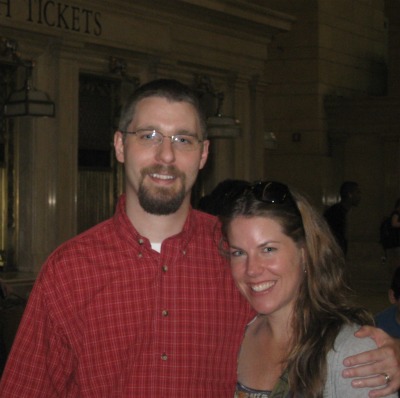
Jason and Cindy Stewart
Listen to the episode here:
[podcast]https://www.calledtocommunion.com/media/Called%20to%20Communion%20Episode%2017%20-%20Jason%20and%20Cindy%20Stewart%20Conversion.mp3[/podcast]
Or download the mp3 by right clicking here and choosing ‘save target as.’
A written account of Jason and Cindy’s story is available in “An OPC Pastor Enters the Catholic Church.”

To All,
You must listen to this podcast, especially if you and/or your spouse is thinking deeply about the Church. You will hear how a married couple approached this journey not only as individuals but as companions. It was my favorite podcast to be a part of.
Great podcast and many thanks to Jason and Cindy for sharing their story together. I also appreciated Jason’s article from earlier this year.
My question for Jason and/or Cindy: As you studied the Catholic position and considered its arguments on its own terms, as well as the best “protests” that your reformed tradition has to offer, what was or were the most difficult objection(s) to Catholicism that you had the hardest time overcoming? How did you overcome them?
Thanks,
Mark
Excellent podcast. My wife and I entered the Church together as well; we helped each other on the way with things that we were reading and discovering. Ecclesiastes 4:12!
MarkS, I’m not Jason or Cindy, but for my wife and me (as probably for many) the Marian dogmas presented significant obstacles because of our Reformed background. In the end, the question for us came down to this: is the Catholic Church what she claims to be—namely, the Church that Christ founded? If so, then it’s not possible for these dogmas to be false, whether I am able to understand their basis or not.
I also realized something else that’s summed up by one of the Pontificator’s Laws: if there’s nothing that the Catholic Church teaches which I believe just because the Church teaches it, then I’m really still playing the Protestant. I’m still making myself the judge of the truth. And so I for one came into the Church not understanding how or why the Marian dogmas were true, nor how transubstantiation “works.” But I was resolved to believe them on faith: to assent to them as divine truth precisely because the Church proclaims them and because the Church cannot err with respect to faith and morals. We make that appeal a lot at CtC, but we do so because it is important: Is the Catholic Church the Church that Christ founded or not? The answer makes all the difference in the world.
Fred
MarkS,
Thanks for commenting. I’ll let Cindy chime in here for herself, but I’ll share that for me the principle of sola scriptura was simultaneously the most difficult and the easiest obstacle to overcome. The concept of the Bible alone as the ultimate standard for faith and life was both central to my understanding of divine authority and at the same time profoundly weak when tested biblically, theologically, philosophically, and historically. Once I recognized that sola scriptura failed on its own terms, I began also to see that only the Catholic Church could rescue the Christian belief in an infallible and therefore authoritative Bible.
Blessings,
– Jason
I transcribed a portion of your story with which I related, but from the side of the congregation, not the session:
When I was a layman in a PCA church, with just casual “Ligonier” style training, I started to get worried about my and my children’s future as far as heresy. What was keeping us on the straight and narrow? What if I swallowed a heresy and went to my session only to disagree with them?
How would I know if they were right or if I was?
I knew full well what would happen and it made my heart sink within me. I would go to another session somewhere where my heresy would be accepted, and my children would be left a rotten legacy.
Now of course anyone can fall for heresy at anytime, Catholics aren’t immune of course, but as you alluded to in this quote, this “agree or leave” system is really part of the Presbyterian system. I was told as much by every Reformed source -whether person or book- I could find. That I could always go where “the gospel was being preached” “faithfully” and “biblically” if I didn’t think it currently was where I was at. As a layman, who was expecting the rod and staff of the Church to guide my family, this situation scared me stiff. It was perfectly and obviously evident to me that there was no final church authority in my religion to tell me when I erred. In fact, they explicitly denied that there could be such a temporal authority. Seeing as my family was a temporal family, I got out of there quick!
Thank you so much for your encouraging story! Us former Reformed pew sitters need more witnesses like yours to encourage us to follow the truth wherever it leads.
Peace,
David Meyer
[…] listened to an interview this evening with a former Orthodox Presbyterian Church pastor and his wife, Jason and Cindy Stewart, who converted in 2011, as did our family. I commend it to you, in large measure because many of […]
Thanks for posting this excellent interview. As an evangelical who is seriously, sincerely exploring Catholicism, these posts are really helpful. In fact, I thank God for this whole blog. What a great source for information, and a place for me to find answers to my questions. I know that if I have questions about Catholicism, I can count on the people here to give me solid, well-thought-out, educated answers. Keep up all the excellent work!
Welcome Home from a former two decades ordained Protestant minister (Pentecostal) in 2006 along with my whole family. God bless you.
Thank you for this testimony. I had been in the reformed faith for 40 years before converting to the Catholic faith this year. I agree with your recommendation to study Catholicism from Catholics . I had always studied it from Protestant sources, including the book you mentioned by Loraine Boettner. I had no idea how so much of what he wrote about Catholicism was false until I read Karl Keating’s book on Catholicism and Fundamentalism. Keating actually points out many of the incorrect statements of Boettner’s. Reading the Church Father’s also was shocking to my Protestant eyes.
Mark asked about obstacles and Fred responded. I agree that the Mary doctrine has been the tough one for myself. Called to Communion has helped in this respect along with some of the audio links they gave on this subject. Dave Armstrong’s book on Mary which is available in kindle format has also helped. Study of the early church on this has helped. The book by Dr. Mark Miravalle called Introduction to Mary has also been a huge help. [This link here gives the beginning of his book free online: https://www.christendom-awake.org/pages/marian/intromary1.htm%5D . I agree with Fred…..I came to the conclusion that the Catholic Church was the true church Christ established and have submitted in those areas of doctrine where I still need growth in my understanding. Thanks so much to Called to Communion for helping us in growth of the understanding of Catholic doctrine.
PS. I just wanted to add that what Cindy said on the audio about praying was so true in my conversion too. I kept everything in prayer and God constantly was surprising me with answers ….. Sometimes He gave the answers to questions I had even before I had a chance to put them into verbal prayer. He , knowing what is on our hearts, knowing our seeking for truth, will surprise us; I am constantly amazed at His intimacy. One example of this was a statement I read by a Protestant against a certain Catholic saint. I had no idea who this saint was. I do not believe I had ever heard of him before this time. I looked him up and thought about how strange it all was. Here then, came the God wink, the very next day my son [not knowing anything about what was transpiring with me] sent me a link to a documentary type movie on this particular saint which he in turn had heard about through a friend whose parents had known the saint. It just made me laugh out loud. God is intimate and knows our hearts.
MarkS,
Certainly my pride was a stumbling block! :) No joke. It took me swallowing a big pill of humility to even begin to study Catholicism on its own terms.
The first major obstacle was belief in Scripture Alone. I began to question if I really held to that position anyway since as a Presbyterian we subscribed to the Westminster Confession and Catechisms. Are these not affirmed right alongside Scripture? Why do these Standards exist if Scripture alone is enough? There was a need for an outside interpreter or authority even in Presbyterian and Reformed circles, and such interpretive documents don’t merely serve the purpose of separating the Reformed from other Christian traditions. They define doctrine.
The next was Mary, what do I do with Mary…? The Mother of our Lord was shoved into a theological corner being completely ignored and neglected. Why are Protestants so scared of her? Why was it acceptable only at Christmas to speak of her? I confess that when I first began to read of Marian devotion in Catholicism there seemed to be too much focus on her. But then I understood that it was my perspective which was off. That the mission the Father had for Mary was to give us His Only Begotten Son, and her missionary work did not end at delivery. I quickly began to see that Mary continually brings us Jesus…even today. I decided to just pray about it, to ask Jesus what his Mother was to mean to me. All I can say is that one day the trepidation of calling her Mother melted away. My study and prayer brought me to a clear understanding that I was not committing idolatry by calling her Mother, I was loving the Woman who so faithfully brought us Jesus! Where would any of us be without Jesus?! She was no longer just a “holy pipeline”, but a real person that must be honored and loved.
Blessings,
Cindy
MarkS,
I’ll add that the Marian dogmas were problematic for me too, initially. What helped me greatly – in conjunction with what Fred and my wife Cindy have already mentioned – was discovering the Church Father’s uncontroverisal description of Mary as the New Eve. The CCC 494 states:
Blessings,
– Jason
I’m trying to figure out why you CTC guys continually emphasize “He went to BIG TIME REFORMED SEMINARY and later converted to Catholicism.”
What is the connection you perceive between going to a Reformed seminary and converting to Catholicism?
Hello Tim,
I think I can speak for the others in saying that we don’t think there is any intrinsic connection between attending a Reformed seminary and then becoming Catholic. Obviously the vast majority of persons who attend and graduate from Reformed seminaries remain Reformed. Having attended a Reformed seminary and then become Catholic is merely something a number of us here have in common. But none of us, so far as I know, has made any claim about the prestige or quality of the seminary we attended.
(May I request that for future comments you please avoid using all caps. Thanks.)
In the peace of Christ,
– Bryan
Hi Tim,
My alma mater is actually quite modest. Mid-America Reformed Seminary is a small institution dedicated to equipping men for pastoral ministry in the Reformed tradition. In my written account of how I came to be Catholic, I noted that my seminary education was confessionally in tune to the point of nearly perfect pitch. In doing so I was merely emphasizing that I learned Reformed theology from a group of some of the most godly, genuine, theologically and historically informed Reformed men one might find. I thank God for each one of them.
And I do agree with Bryan that there is no necessary connection between attending a Reformed seminary and becoming Catholic.
Blessings,
– Jason
Question for Jason Stewart: You were asked by Mark “…what was or were the most difficult objection(s) to Catholicism that you had the hardest time overcoming?”
You then replied …”the principle of sola scriptura was simultaneously the most difficult and the easiest obstacle to overcome. The concept of the Bible alone as the ultimate standard for faith and life was both central to my understanding of divine authority and at the same time profoundly weak when tested biblically, theologically, philosophically, and historically. Once I recognized that sola scriptura failed on its own terms, I began also to see that only the Catholic Church could rescue the Christian belief in an infallible and therefore authoritative Bible.”
My question is how do you personally see Sola Scriptura (The Bible alone which is the same as saying the Word of God is suffice) fall apart when tested biblically? I have read a few testimonies of those professed to be protestants and are now Catholics say the same thing and every time I read these testimonies I am shocked to see that they did not see what I saw immediately as a Born Again Christian. The Scriptures testifies that Jesus Christ who is the center of our faith is the Word of God so I don’t see how anyone can overlook this simple truth since we do not live off bread alone but by every Word of God.
In other words: Who gave us the Word of God? God did! It’s His Word! He spoke it and it shall accomplish all His desires never returning void! Compare Isaiah 55 and Jesus as the Word saving us from our sins.
Who assures us that the Word of God is indeed the Word of God? The Holy Ghost testifies that the Word is true. Just as it did with Jesus and his ministry.
Who is the Word of God? Jesus Christ! No other religious founder or so called prophet will ever have this exclusive title?
Who do we glorified by standing on the Word of God as the final authority? Jesus Christ! Otherwise, we are entertaining what man has to say over Jesus. If Jesus were to be physically on earth today who will not hunger to hear what He has to say since HE speaks truth and only truth which gives us life?
How do we treat teachings that are not in the Word of God? As if God never said it. It is heresy a lie from the pit of hell. God did not utter it! Jesus being the Word didn’t reveal it.
Why is the Church the pillar of all truth? The Church which are living stones glorifies the Word of God and only the Word of God! Christ centered and Bible centered and these must be one!
What Church is the true Church? The Church that holds the Word of God above all! Granted, denominations are rampant but Galatians 5:20 KJV states that those who commit heresy or self-willed opinions will not inherit the kingdom of God. It also makes sense that since we are fighting a spiritual battle the truth is going to get attacked and many are going to fall away or live after the flesh and not the spirit. Since the flesh cannot submit to God we have factions but this is why we are to carry our cross daily and love our brethren as Christ loved us
What makes up the Church of God? The believers the Body of Christ who hold unto the Word of God above all!
How does one know the truth of God? Faith, in agreement with the written Word and Living Word of God. Again Christ centered and Bible centered
How does one acquire? Faith comes by hearing and hearing the Word of God!
How come the Word of God is always emphasized over and over and over? Hence the Word OF GOD, again Jesus Christ is the WORD OF GOD.
Now how can someone still conclude that Sola Scriptura is false when that means that we are to only abide in the Word of God because Jesus Christ is the Word of God? I find it extremely difficult for a spirit-filled believer to commit such heresy which is a work of the flesh. The reason people create factions is not a matter of Sola Scriptura being wrong its a matter of their flesh getting the best of them. Sure people disagree at times but there’s a difference in opinions and self-willed opinions that have desires to gratify self attached which are the heresies I am referring to and the natural man wants to promote his false or misleading understanding which is not of the spirit but of the flesh. He can’t grasp the deep spiritual truth because he refuses to die to his natural understanding.
The cross does not give us a minor shift or two with regard to a few of our ethical and moral and religious values. The cross radically disrupts the very center and citadel of your life from self to Christ. And if the cross has not done that, you’re not a Christian! … YOU ARE NOT A CHRISTIAN until the cross has RADICALLY DISRUPTED THE VERY CENTER AND CITADEL OF YOUR LIFE. And brought you from a life of commitment to serve self, whether it’s Religious Self, Moral Self, Proud Self, Covetous Self, Lustful Self, Prideful Self, Unforgiving Self, Lazy Self, IT DOESN’T MATTER WHAT ARE THE FOCAL POINTS OF THE REIGN OF YOUR SELF!
If you’ve gone to the cross in union with Christ it’s been SHATTERED.
-Albert martin-
re 16
I would note great zeal in #16. I would also note that the author claims to be born again and will take that claim at face value. My own impression is that the author is an evangelical type rather than a reformed type. I base this on the idea that it is scripture that is being appealed to rather than a creed or theology. Hopefully I am reading this correctly.
The limitation is that while scripture is cited, in part or in whole, the writer fails to recognize when he or she avoids scripture for the intention of maintaining a position.
My problem as an evangelical born again Christian was that I avoided or denied those parts of scripture which did not support my evangelical born again Christian position. So in John 20:23 where Jesus tells the apostles, “Whose sins you forgive, they are forgiven them,” we decided that Jesus not withstanding, we could go directly to God for forgiveness, and we would assume that He would do exactly that, no matter what He said in scripture. We were beyond that authority given to the apostles in what appeared to be a function given to the Church.
But then we did not need the Church, especially of the kind described in Matthew 16 where a man with a perfectly good name, Simon, is renamed by Jesus Himself and given a charge consistent with the charge given the chamberlain of the King of Israel. We did not need that, and we did not need Peter, so we denied it and him.
We had no idea of what the Church was in scripture in part because we were busy denying those parts of scripture where it is described, because we did not want that to be true. We did not want Jesus’ Kingship to include a Kingdom with a chamberlain. We did not want Jesus to be a sacrificial Lamb Who must eaten per the proscription in Exodus, John 6, the Synoptics and Paul’s writing in 1st Corinthians. (Actually I learned that was a Catholic idea and then knew why we did not want to believe it.)
Scripture was full of items like Peter, and Mary, the Eucharist as Passover, and a Council in Jerusalem making decision binding on the entire Church, and we did not need those things, so we denied them. Scripture not withstanding.
We justified our position by blaming others for their failures. Scripture says that there is one Lawgiver and Judge Who is Judge of all, and He told us that the judgment we give is the judgment we’ll get. We were told to request the forgiveness of our debts (sins) as we forgive those in debt (sin) to us. However we were the lawgiver and judge and we were not subject to the words in the Lord’s prayer or in Hebrews. We did not need to concern ourselves with judgment, or with running the race to the end, because we were saved. Being saved, we could ignore Jesus’ words (or Peter’s or Paul’s or John’s or James’ words) whenever they came in conflict with our position. We were past all of the conditions that Jesus had associated with salvation or obedience to Him through the Church.
That is what I was seeing as a born again evangelical Christian. I was proclaiming the absolute authority of God’s written word while denying what it said. I was also in conflict with other born again Christians, not all evangelical, who read the same words, sentences, and passages and came to a different conclusion than me. Different conclusions from the same scripture appears to make God the Author of confusion. That couldn’t be right, so where was the problem?
Scripture was not actually the problem. The problem was Luther’s dictum that any man inhabited by the Holy Ghost was capable of apprehending and expounding the Word of God (written). Luther discovered people doing exactly that who were in conflict with Luther’s positions. We inhaled Luther’s dictum, without inhaling Luther’s position.
It occurred to me that Scripture came from somewhere. One might look at the source. The scripture we inherited came from the Church which made a binding decision on what is and what is not scripture. That exactly matched a statement from Nicolai Grundtvig, a Lutheran theologian, who wrote, “I have discovered a truth; we do not discover the church in scripture, we discover the scripture in the church.”
What Grundtvig discovered was the Lutheran position in scripture. What I had discovered was the born again evangelical Christian position in scripture. However as noted above, I made the discovery by ignoring any passage of scripture which conflicted with the positions I held.
When one reaches the point where one is in general disagreement with where one is at, one knows one is leaving, but may not have any idea of where one is going. That was what happened to me. I was leaving but I did not have a destination. I did have an idea. I knew it would have to be a place where scripture is honored in belief and practice, and not in the breech. I did manage to find that place, thanks be to God.
How is that, God is my judge?
Cordially,
dt
Thanks DT , I have felt those same things.
DT,
I have understood according to the Scripture that God wants us to cry out for understanding. Proverb 2 and Daniel 10:12. The Word of God and the truths it contains are of the spirit and as much as we battle with our flesh (pride, idleness, etc. ) we must constantly crucify our understanding that is dead because our flesh is dead. Our Adamic reasoning always wants to resurface and prove to be right even when the Word is trying to correct us. John 6 and Matthew 16 are both perfect examples of how God’s Word being spirit and life yet foolishly many take it to be literal. The man after the spirit can now see what God means under the text but this revelation is not easily attained unless one is found crying out for understanding hence why many were offended and decided not to follow Jesus anymore. It happened then and sadly it continues to happen now as many are refusing to love the truth and be saved they become reprobates because in order to receive life they must first die to the only life they know and that life they know is their corrupt understanding with self sitting on the throne reigning wanting no more but self-gratification. It’s funny you mentioned John 20:23 because I hope you’re not saying that you assume the Holy Spirit meant that we are to confess our sins to a priest saying a few Hail Marys and Our Fathers and voila we are forgiven because that would be complete nonsense. Compare John 20:23 with 2 corinthians 2:10 and the book of Philemon in regards to the remittance of sins. In regards to retaining the sins of others compare John 20:23 with 2 Timothy 4:14-15.
When we forgive someone of their sins they have transgressed against us or God it is expected that everyone in the Body of Christ forgive that person as well and if we have the Spirit of God we will. (2 corinthians 2:10 and the book of Philemon) When someone is doing harm and continues to do harm despite the warnings given we are to wipe our feet and shake the dust off them and warn others believers of these people and if we have the Spirit of God which loves the truth we will warn others. (2 Timothy 4:14-15)
If anyone leaves the Body of Christ which seeks to glorify the Word of God above all to enter a religion its only because the reign of self has resurfaced or perhaps never even died in the first place thus it seeks to be fed and it gets fed quite well when one practices self-piety and religion. This is an invitation to seek the Face of God in the spirit and not His hands in the flesh otherwise you will find yourself dead but deceived in thinking your religious observance means you’re alive to God when in reality your lips speak but your heart is no where near God’s presence.
In the love of Christ and the love for the Spirit Romans 15:30
God is my judge,
Though I am not Roman Catholic, I have to say that much of what you have espoused sounds – to me, at least – dangerously close to a gnostic understanding of Christian spirituality. Perhaps that is not your true position, but it strikes me thus. It is true that in St. Paul’s writings especially there is the notion of the flesh warring against the spirit, but when taken in the context of all of Paul’s writings, and all of Scripture, it would seem that he is referring to the “old man,” i.e., the sinful nature, as opposed to the regenerated “new man” sanctified by the Holy Spirit of God. By virtue of the incarnation and Christ’s final victory in death over the powers of evil we can no longer think of flesh as evil in and of itself. Thus, to read Scripture strictly in a “spiritual” sense (or to pick and choose what to take “literally” and what to take “figuratively” or “spiritually”) is to undermine much of what God has taught us about this life and His good creation through it.
So I suppose, getting back to the point, who is to determine how to interpret Scripture? Is it not the “fleshly” pride you spoke of that rises up within me that says, “I am determined to interpret Scripture for myself.” Or maybe, “I will follow this denomination’s doctrine, because I know this is a correct understanding of Scripture.” Either way, is it not pride? The doctrine of “Sola Scriptura” combined with “The Priesthood of All Believers,” at my vantage point, are the culprits for the 35,000 denominations we have in Protestantism, many of them having lost their way to the spirit of the age. “Sola Scriptura” seems to have morphed into “sola schismata.” Now we vote on truth, and truth becomes whatever the majority believes the scriptures say or do not say. Surely God did not mean this to be so. Surely Jesus’ prayer in John 17 remains unfulfilled.
Again, I am not Roman Catholic and at one time would have said the exact same things you said above. I no longer do, but I’m not sure what that means for me or where God is leading.
Tim
Cindy,
I was wondering if I could get your email address and email you a few questions about Catholicism? I’m currently researching and will attend RCIA soon. Still have a lot of lingering questions and would love to dialogue about them with you if you have time.
Sincerely,
Christie
Hi, Christie!
Absolutely! I have sent you a private email. I look forward to hearing from you!
Blessings,
Cindy
Cindy,
Thank you! I actually haven’t received an email, did you get the right address from C2C? I have re-typed it, in case it was the wrong one.
Sincerely,
Christie
Christie,
I resent the email this afternoon with the address from your last comment. :)
Blessings,
Cindy
Dear Jason and Cindy. God richly bless you as you found treasure on earth for heaven. your experience and testimony will shine like the sun that brighten our heart to see and seek the truth. we as Catholic for most of the time taking it for granted. your faith journey give us energy to dig deeply in to the deep of our faith.
God bless you and your family
Rina
Hello,
just as a way to respond to the notion that Reformed people who adhere to Westminster or other confessions put them on the same line with the Bible.
Actually, the first chapter of both Westminster and 2. London Confession of 1689. states that the Scriptures are the only inspired authority. Yet, Sola Scriptura does not mean that there are no other authorities that serve as summaries of The Authority of the Bible.
So, the Holy Scriptures are our sole inspired Authority which we use to question and check all other (fallible) authorities God has given us for our protection: the Creeds, Confessions and pastors/elders (and Presbyterians would add “church sessions”). And having these fallible authorities is 100% in line with both the Bible and the historical Protestant belief (yet, many protestants today are confused about this – and ergo, many go to Rome for answers).
In the end, if it goes against Scripture, it can’t be true – no matter what RCC or anybody else says!
Soli Deo Gloria!
Hi “A Reformed Baptist” (#26),
You wrote,
What would be the appropriate protocol when two individuals interpret Scripture differently?
many thanks, Casey
Casey,
between you and me, I guess you would knock on Pope’s door and ask for a true interpretation, and when given, you would say: “Thank you, you said it and I believe it!” even though deep inside of you you know that something is wrong (say, salvation by grace and faith + merit; say, praying to the saints…).
As for me and my Protestant brethren that are faithful to Sola Scriptura (not Solo Scriptura), I would read the Word of God (as my only final authority) with prayer and trembling, but then I would cross-check it with 20 centuries of Bible exposition, Creeds and theology (time-permitting, of course) and seek to come to a conclusion that is satisfying the most Scriptural evidence in light of the research. And if something does not have a Scriptural mandate (say, adding merit to our justification, or praying to the saints, or having idols, or having another Savior in Mary, or whatever the Scriptures is silent about or is preaching against)
Now, if you would say that this is individualistic, my friend, I would say it is not different from what the Pope (God forbid his blasphemies against the only One the Scriptures call and mandate us to call “Holy Father”!) and the Magisterium is claiming to do, with one difference only: I do not say that my interpretation is infallible.
Your Reformed Baptist friend
Hi “A Reformed Baptist (#28),
You wrote,
I didn’t ask you to conjecture as to how I would determine what Scripture teaches; your conjecturing as to my position is inaccurate, presumptuous, and uncharitable. Rather, I asked you to explain how, in your own interpretive paradigm, two individuals resolve an interpretive disagreement over Scripture’s meaning.
You also wrote,
Dear Casey,
yes, I am sorry for being uncharitable, although I’m puzzled that you say that I am being untruthful. But, we’ll come to that alter, when you tell me how do two Romanists come to grips with a passage.
Yet, before I answer your question, I have to try to dodge your apologetical bullet of attacking Sola Scriptura with your question. I am well aware that this very question has made many of Protestant to doubt Sola Scriptura and feel their need for Rome to say what is right and what is wrong.
So, here is the beginning of my answer. We have to differentiate three levels of texts that we are trying to interpret.
First level are texts and doctrines that are definitely important so that their wrong interpretation would define if a person is ortodox or not (that is, if a person is a heretic or not). With regards to these texts (pertaining things like the doctrine of God, especially Trinity, the doctrine of salvation etc.), following Sola Scriptura all true believers come to a true meaning of the texts (with maybe a different nuances, but still the same meaning). The proof of the pudding is the doctrine of magisterial and even some radical Reformers, which pertaining these things is one and the same (yes, again, with some nuances that are inside the ortodoxy).
Second level are texts that constitute various ortodox church-traditions. These are the questions that are important for Church belief and practice, but are not damning. These are, for example, the mode and time of baptism, the meaning of the Lord’s Supper etc.) Now, as a Reformed Baptist who has a lot of respect to my Presbyterian, Lutheran and Anglican brothers, I think that even these issues would be solved if Sola Scriptura would be followed through consistently. For example, a consistent interpretation of Scriptures and of covenant theology would necessarily imply both the believers baptism and a baptism by immersion. In other words, I would say that the Scripture is clear with regards to these issues.
And if you know about the early history of Reformed Baptists, this understanding that the Scriptures actually unite us in one true Church (with regards to #1) even though we have to be a seperate denominaton (with regards to #2) is the reason why our confession (2nd London of 1689) is actually a copy of Westminster Confession: because we understood the need and the way of brotherly unity with our brothers is through a common understanding of God and salvation.
Now, I know I’m getting too long, but I just have to say what I have to say :), the reason there are various denominations around the world is not because of Sola Scriptura, but despite and in spite of it, as many anabaptistic groups were dividing for reasons that were not substantial or that were cases where Sola Scriptura was not followed (so, dispensationalists became dispensational when some lady had a “vision” and then they tried to accomodate Scriptures to that vision of pretrib rapture).
Which brings us to matters the least importance, where there can be differences among the brethren inside the same church or denomination. Church history is full of those kinds of differences (and we could even make the case that even among the church Fathers there are differences of a previous kind!)
So, now, to answer your question. If I do not agree with a persons interpretation and it is a first level text (about the Trinity), I would show them their inconsistency from the Scriptures and tell them that they need to repent of it in order to be saved. If I do not agree with a persons interpretation and it is a second level text, I would again (trusting the clarity of Scripture in these things) show them their inconsistency from the Scriptures, but if they do not change their view, they are still my brother or sister. We can still cooperate and bless each others even though they do not follow “us” (our church, see Mark 9:38-40). And if I do not agree with a persons interpretation on a third level text (say, if I need to have a complete rest on Sunday or just abstain from work), I might consider a person a weaker brother, but we are and still should be a part of the same church (1. Corinthians 8).
I understand that churches (even Reformed Baptist churches) have split because of the third level disputes, but that was despite and in spite of Sola Scriptura, because the Scripture clearly teaches otherwise. To say that the proof against Sola Scriptura is in the existence of denominations and churches that split against the very intention of Sola Scriptura is unfair. In the end of the day, that kind of reasoning will just bite you back as the history of a “uniform Catholic Church” that supossedly always knew what it believed because of the authority of a Roman Pontiff and Magisterium and because of reliable Tradition had its shares of splits and disagreements and persecutions centuries before Martin Luther and Calvin were born! Were there troubles because of the Pope and Tradition? Well, anyway you answer the question, it shows that Sola Scriptura is not the cause of splits and disagreements (yeah, there were disagreements even in the church under Apostles!)
Your RB friend!
Hello Reformed Baptist friend (#30),
I’m not really sure what to call you, so feel free to offer your name! You wrote,
Your argument that some texts/doctrines are so important that their wrong interpretation would be considered unorthodox/heretical begs the question. Individuals, using their own interpretation of scripture, have debated for many centuries whether the texts teach the Trinity or sola fide. Also, people, even within many Protestant traditions, disagree as to which texts/doctrines fall under this first arbitrary category you have created, or are rather “non-essential.” To give but one of many examples, I, with St. Peter (1 Peter 3:21), believe baptism is an “essential” for salvation.
You also wrote,
You say a “consistent interpretation of Scripture and of covenant theology” necessarily implies believers baptism and immersion, and that this teaching is “clear.” Yet many individuals within your own Reformed tradition disagree with you, suggesting they are not clear, unless we impugn your interlocutors with ignorance, willful disobedience, or lacking some spiritual quality that you yourself have. On what basis do you believe these doctrines to be clear, or your interpretation authoritative?
You also wrote,
So if two individuals disagree over what you call a “first level text,” (for example, sola fide), which as I’ve argued is an arbitrary distinction you have made, you would authoritatively determine the person who rejects sola fide is not saved. On what authority or basis do you make this assessment?
Finally, you wrote,
I’m not sure anyone has argued that a “proof” against sola scriptura is the existence of denominations. The existence of thousands of Protestant denominations with mutually exclusive beliefs and doctrines would be a reason to question the clarity of scripture, and whether sola scriptura is sufficient to resolve doctrinal disputes between well-meaning Christians. Proofs against sola scriptura are instead arguments like (1) sola scriptura is not itself a scriptural doctrine, (2) sola scriptura is irrational, and (3) the testimony of the early Church contests sola scriptura. These arguments, and more, can be found in a number of articles available on this website. You can find them at this link: https://www.calledtocommunion.com/index/#scripture. God bless, casey
Reformed Baptist (#30)
How do you determine what texts and doctrines are definitely important by contrast with ones which are not of the same level?
jj
Casey,
What do 2 RC’s do when they disagree on an interpretation of Scripture? Can’t go to your church because your church has never officially interpreted the thousands of verses in the Bible. So how is this to be resolved?
Hi Pat (#33),
You wrote,
Great question. In one sense, I think that you are inaccurate, in that two individual Catholics who disagree over the interpretation of Scripture can go to the Church, in several ways. First, they can consider what has been taught officially by Church councils, through Church creeds, and through various other Church documents that are viewed as infallible. Many of these have very specifically addressed common disagreements over scriptural interpretation, such as the doctrine of justification, which was addressed in great detail at Trent, and again in the Joint Declaration on the Doctrine of Justification, among other places. In another way, two Catholics can visit what the Church Fathers and other saints and doctors of the Church have said on various passages. Although what the Fathers, Doctors, and other saints have said is not infallible, they comprise a deposit of faith that can influence one’s interpretation, and help eliminate certain interpretations which are contrary to what the Church has always taught and believed. Third, they could go to the Congregation for the Doctrine of the Faith, at one point managed by our emeritus pope, Joseph Ratzinger. The CDF assists Catholics in determining if their beliefs or interpretations are in accord with the deposit of faith and Church tradition.
However, you are in another sense correct that there is no official, Vatican-approved commentary on all of scripture that encompasses all the Church-approved meanings and interpretations of Scripture. This, I think, is a good thing, because if the Word of God is living and active, there is a sense in which we can always revisit the Scriptures and find deeper understanding and meaning that, though new interpretations cannot contradict what the Church has previously taught, can provide deeper clarity and insight. I wonder if a common Protestant misconception is that a passage can have only one meaning, an idea which the Church has never taught, and, upon reflection, Scripture itself teaches is not the case. Consider Paul’s statement in 1 Corinthians 10:4 that the rock from which the Israelites drank in the desert was Christ, or Isaiah 7, where a prophesy is given to Ahaz which has an immediate application to him, and a deeper meaning ultimately in the birth of Christ several hundred years later. The Catholic Catechism discusses these various senses of scripture, which is well worth the read, in CCC 101 – 141. God bless, Casey
JJ asked, in #32:
Indeed. For example, Primitive Baptists consider footwashing to be a sacrament, and there definitely seems to be something sacramental to the snake handlers’ views about rattlers and copperheads being loose during worship. Other Protestants disagree, but on what principled basis? Why are these groups wrong about the importance of the texts they use to justify their beliefs?
Peace,
Fred
Casey,
I don’t see how what you wrote would resolve many of the differences in interpreting Scripture on those verses and passages that have no official interpretations. Even if you reference the church fathers you still don’t have an official interpretation. Secondly, how would a RC know when he has researched enough given how vast the writings of the church are? I have yet to meet a Roman Catholic who has read the over 30 volumes of the fathers or even the catechism.
How can a verse of Scripture have more than one meaning? If there are multiple meanings then we can never know what an author meant by what he wrote. Don’t you have a singular meaning to the sentences and paragraphs you wrote? I hope so. How much more the authors of Scripture. It is one thing to misinterpret and another to say there are multiple interpretations that are all correct. Not all interpretations can be correct while only one interpretation can be correct. Meaning and implications are not the same things.
The problem with much of Roman Catholic doctrines is that doctrines are read back into scripture to make it say things the authors of Scripture never intended. The Marian dogmas are an example of this.
I don’t have much time this morning, but let me just say two things:
1. Scripture itself defines what doctrines are essential (and what aren’t) when it says that those who err on matters of Trinity (“If you don’t believe that I AM you will die in your sins”) and salvation (“If anybody comes and teaches another Gospel, let it be anathema!”) are outside the Church. I already showed that from the Bible at least some way in the previous post about #2 and #3, as both Paul and the other apostles make these kind of distinctions (for example, quarreling about non-essential things).
2. Sola Scriptura is a Scriptural doctrine, because the Bible breathes on the principle of Sola Scriptura as understood by Reformation Protestants. And that Scriptures are clear we see clearly from passages like 2 Tim 3:16-17 and the like, and from the lack of Scriptural evidence that we are to go beyond the local Church and its pastors/bishops/overseers for the meaning of Apostolic tradition as was given to us in the Scriptures as authoritative interpreters (even the Council in Jerusalem was confirmed by Scripture in both Acts and Galatians!)
God bless,
Miro
Hi Pat (#36),
You wrote,
I suppose I’m confused as to why you believe it is important for one to have an official interpretation of every verse in scripture?
You also wrote,
I attempt to have one meaning when I communicate, but my language is not as complex as scripture, since it is not inspired by God, infallible, or “living and active.” Multiple interpretations can be correct, as I sought to provide two examples where a text has more than one meaning. The Israelites actually, in history, drank water from a rock hit by Moses in the desert, described in Numbers 20: a historical miracle. Paul, more than ten centuries later, allegorizes this passage by saying the Israelites, by drinking the water, in a sense, drank from Christ. I hope you wouldn’t accuse Paul of misinterpreting Numbers 20. I would encourage you to take the time to read the section from the Catholic Catechism that I previously provided, as this explains how there can be multiple meanings and interpretations that are not contradictory. We see many Fathers of the Church employing these various senses of interpretation, and believing them to be compatible.
Finally, you wrote,
Your assertion regarding any Marian dogma remains unproven. It is one thing for an interpretation to “make” a text say something the author “never intended.” It is another thing to realize that scriptural texts might have meanings beyond what the writer intended because they are inspired by God. Isaiah’s prophesy to Ahaz in Isaiah 7 has an immediate application to the circumstances of Israel and Judah . The NT writers, reflecting and meditating on the text, realized that Isaiah’s prophesy had an even greater meaning – the coming of the Messiah through a virgin. Again, we have no reason to believe the writers of Numbers believed that in Moses’ action he would be participating in an allegory regarding Christ, yet this is exactly what St. Paul does. in Christ, Casey
Hi Miro (#37),
You wrote,
You say that erring on certain doctrines, such as the Trinity or salvation (I presume you mean the particular Protestant sola fide conception of salvation), makes one outside the Church, but this begs the question, because one would have to already have proof that his conception of these doctrines was accurate and faithful to scripture, and that he was even in the Church in the first place.
You also write,
I don’t understand what you mean by “the Bible breathes on the principle of Sola Scriptura as understood by Reformation Protestants,” or how this proves sola scriptura. Nothing in 2 Tim 3:16-17 proves that scripture is inherently clear. in Christ, Casey
Casey,
Its important to interpret all the Scripture so that we will know what God has for us. It would also help us to be protected from error and false teachings. Since the RCC claims to be the only authority to interpret Scripture I’m shocked that it has not done this given that it supposedly has this authority and gift. Since it hasn’t, it leaves RC’s in dark and ignorant of the meaning of Scripture. It means also that the RC cannot tell me what the definitive-official interpretation of Scripture or if there is a disagreement with one interpretation of Scripture with another no RC can say this is the official interpretation. You may not have so many different denominations but you do have countless different interpretations.
Paul is not giving a different interpretation of Numbers 20 but drawing out an implication of the passage. Implication and interpretation are not the same things.
In the Marian dogmas it is said that Mary was without sin her entire life based on Luke 1:28. We know that this greeting by the angel means that Mary was without sin her entire life. There is nothing about that verse that comes even close to meaning that and yet many RC’s claim that it does mean that. This doctrine certainly does contradict a number of Scriptures such Romans 3:23, 5:12
A Reformed Baptist (Miro)No Gravatar (#37)
Even supposing this text does mean Jesus is identifying Himself with the “I Am” of Exodus – not obvious from the language, which could just mean that you have to believe that He is the Messiah – the Anointed – which term applies to Samson, Samuel, David, probably others – even if, as I say, this is identifying Jesus with Yahweh, it doesn’t say anything about the Trinity. This is perfectly compatible with Sabellianism.
But in any case, are you saying this is the only essential belief – belief in Jesus’s divinity?
And I don’t see at all how this can be called a belief at all:
What does it mean to say you ‘must believe in salvation?’ And to say you have to believe in ‘the Gospel’ simply says you have to believe in the ‘the Gospel’ – but it does not say what the Gospel is.
I think the issue of knowing what are essential and what non-essential beliefs is not something that stands out from Scripture.
jj
John,
RC’s like to think that the Scriptures cannot be understood without some kind of infallible interpreter. The Lord Jesus never taught this kind of thing nor did the apostles. Before the time of Christ and during the time of Christ people understood for the most part what Scripture meant without an infallible interpreter. Protestants have also interpreted the Scripture correctly without an infallible interpreter.
Essential beliefs certainly do stand out in Scripture. John 3:16 and I Cor 15:1-4 are a couple of examples. Other examples could be found in John 1:1-3 and Matthew 5-7.
Pat:
Catholics generally take the view that Holy Scripture, because it is written both by human authors and by the Holy Spirit, is intended by its author and Its Author to convey multiple “senses”: The literal sense, and also other senses in which the literal understanding is a “sign” or “type” or “prefiguration” of further meanings: allegorical, moral, and anagogical. Catholics take this approach to Scripture because it comes to us from the New Testament authors (e.g. the author of Hebrews) and their disciples, the Early Church Fathers.
The Literal Sense
Now, in most cases, to understand the literal sense, one needs only a “few things”: One need only know the language in all its idioms and able to put oneself “in the moccasins” of its original audience, knowing all their cultural references and attitudes.
That, by itself, will grant pretty-accurate comprehension of the literal sense.
But it is difficult for a 21st century person in the post-Christian West, divided culturally and technologically from the authors of Scripture by such a wide gulf, to achieve those “few things.” As a consequence, a lot of passages will be subject to misinterpretation. Not such obvious things as “Jesus wept,” of course: But most of the letters of Paul contain passages on which denominations have built whole volumes of Systematic Theology, unaware that they were profoundly misinterpreting Paul. Likewise the other New Testament authors.
You may ask, “How can you, R.C., know that they (rather than you) are misinterpreting Paul?” I answer: I can think of, at minimum, 3 very different approaches to Paul’s soteriology in Romans and Galatians, which are held by serious scholars who are holy and devout men, seeking the guidance of the Holy Spirit. I bet you can, too. Yet (at least) two of these approaches must be wrong, and yet “whole volumes of Systematic Theology” have been based on them.
So the truth of my assertion cannot really be doubted: The literal sense of Scripture is easy for some passages, but for others, it is not, because we are not their intended audience, and what might have been obvious to them is non-obvious to us. (And remember: Peter warns us that there are some passages in Paul which were non-obvious even to first century readers!)
So it turns out that on disputed questions, understanding the literal sense of Scripture has great challenges.
The Other Senses
To understand the other senses of which the literal sense is a “sign” requires imagination and sensitivity and insight and such gifts as the Holy Spirit brings, some to one person, some to another. A full understanding of these senses will probably never come naturally to a single person, but must be cross-communicated in the community of faith over generations. But for this reason, these senses are subject to a different kind of error: A person’s imagination can wander far afield and yet be mistaken for an insight from the Holy Spirit.
So, even supposing that the literal sense could be understood with guaranteed accuracy, the other senses which proceed from the literal sense are going to be quite a challenge. We can expect a wide number of fanciful errors — and looking at history, we can see that there have been. Again, you and I need not know what is actually correct to make that assertion! …we need only note that devout, scholarly persons have disagreed wildly with one another in many ways, and that (at least) one of them was wrong.
Useful Versus Sufficient
Pat, I offer the above in response to your statement that, “RC’s like to think that the Scriptures cannot be understood without some kind of infallible interpreter.”
For Scripture to be Useful and Informative, one need not have an infallible interpreter. A man with a good seminary education and a good heart, who is seeking the Lord’s guidance in all ways, who comes to the Scripture already holding orthodox beliefs, will not go far wrong. Oh, he almost certainly will go wrong in a few ways! …but in most ways, he won’t. Thus, overall, we can be fairly certain that his reading of Scripture will be a net positive. It will have been Useful and Informative, producing far more enlightenment than error.
But “Useful and Informative” is very different from “Sufficient To Distinguish Orthodoxy From Error.”
For that, I am sorry to say, Scripture is NOT Sufficient. Nor was it ever. No, not in the time of Jesus and the Apostles, nor among the Exiles, nor among the North and South Kingdoms, nor in the period of the Undivided Kingdom, nor during the time of the Judges, nor during the Exodus and Conquest.
And it obviously isn’t, now.
If it were, there’d be only one visible communion of Christians on earth.
Is there only one visible communion of Christians on earth? Only one, even in the Protestant tradition? No?
Then Scripture, despite its inspiration and inerrancy, is shown by history to be insufficient to produce doctrinal agreement, even merely on the meaning of Scripture. (Let alone on topics which are critical to the Christian faith but cannot be found in Scripture; e.g., which books should be in the canon.)
Thus, if we are to have such agreement, it could only come through Christ providing us with a Church (or at least with something) able to correct faulty interpretations of Scripture, with divine authority). And we can reasonably expect that same authority to help us with the topics that aren’t even in the Scriptures, like the canon.
Pat (#42)
Conceivably there exist “RC’s” who think this – or who like to think it; I have never met one. Certainly it is not I who think, or like to think, that. I was asking “Reformed Baptist (Miro)” what his authority was for believing certain doctrines to be essential. You have responded by saying:
I think the same question exists here: how do you know these are essential beliefs? Is John 6:53 and essential belief? And if it is, and you know what it means – how do you know that?
jj
Hi Pat (#40),
You wrote,
I have already explained, at least in part, why the Catholic Church has not sought to exhaustively interpret Holy Scripture in comment #34. I have also explained how the Church resolves problems regarding errors and false teachings, and that this has been an effective tool through the ages of distinguishing orthodoxy from heresy and defining true doctrine. Catholics are not “in the dark and ignorant” of Scripture’s meaning, as plenty of Church Councils and official documents have declared dogma on a host of theological issues. I am getting the impression that you are operating on the presumption that for the Church to be who she claims to be, she has to authoritatively and exhaustively interpret every single piece of scripture. Yet just because the Church can resolve disagreements regarding the interpretation of scripture, it would not follow that her refusal to provide some sort of exhaustive interpretive commentary delegitimizes her authority. Can you provide a subject or theological question that arises from the scriptures that the Catholic Church has not authoritatively discussed? She’s done quite a bit of theological work these past 20 centuries… Also, I am curious if the Christian community in which you live and worship claims to exhaustively and authoritatively interpret every single passage of scripture? No Protestant community that I was ever a part of made such a claim, so I’m surprised that you are shocked that the Catholic Church has refused to do this.
You also wrote,
I don’t know what you mean by distinguishing between implication and interpretation. I have never heard of this distinction before, and it certainly flies in the face of how the early Church interpreted scripture, as many Church Fathers employed the various senses of scripture explained in the Catholic Catechism (e.g. Augustine, Jerome, Irenaeus, etc.). Paul is not providing an implication (“a conclusion that can be drawn from something”) from Numbers 20, he is interpreting the text by allegorizing its meaning in light of Christ. Implications of Numbers 20 would be things like (1) God is powerful enough to make water come out of a rock, (2) God quenched the thirst of the Israelites, (3) Moses acted on behalf of God in hitting the rock, etc. Your distinction between implication and interpretation seems arbitrary and contrary to historical Christian interpretation of scripture. I’m also surprised at your emphasis on this, because the various Protestant traditions I worshipped in would agree that texts can operate on different interpretive levels.
Finally, you wrote,
The dogma of Mary being preserved from original sin (i.e. her immaculate conception), finds some basis in Luke 1:28 in that she is “full of grace,” a title given to no one else in scripture. I actually agree that to draw the conclusion that she was preserved from original sin solely on this verse would be a stretch (though I would be interested to hear what you think it means that she was given this remarkable honorific!). Yet you are incorrect if you are arguing that Catholics read Luke 1:28 and from that verse alone draw this conclusion. The conclusion of her immaculate conception draws from a variety of scriptural and logical arguments, and has been with the Church in the deposit of faith since the early centuries. This doctrine is not contradicted by Romans 3:23 (“all have sinned and fall short of the glory of God”), because all must be properly contextualized. If Paul is willing to make an exception to the “all” for the God-man Jesus (which I presume you believe he would), than the “all” does not mean all humans in the strictest categorical sense. Paul could, at least in theory, also make an exception for His mother, who would need to be a perfect vessel in order to prevent Jesus from himself inheriting original sin. I’m not sure how you would use Romans 5:12 to dispute the immaculate conception? God bless, Casey
Casey,
first of all, you said in one of your previous comments that Sola Scriptura is not the same as clarity of Scripture, which I find an unnecessary division and I think that you would point that out only to try to show my ignorance for some reason. Yet, even though these doctrines are not one and the same, they are so connected that Sola Scriptura rests upon the clarity of Scripture among other things (only Scriptures being the authoritative Word of God for us today is another.
Second, you said this:
“You say that erring on certain doctrines, such as the Trinity or salvation (I presume you mean the particular Protestant sola fide conception of salvation), makes one outside the Church, but this begs the question, because one would have to already have proof that his conception of these doctrines was accurate and faithful to scripture, and that he was even in the Church in the first place.”
Well, the proof is in the pudding, as you Americans like to say (I’m from a RC country in EU). When Athanasius was fighting the Arians, his uppermost authority was the Word of God, especially as he countered arian bishops and even a pope. Siding with the clear teaching on Scripture (and I would say the Scripture speaks with the same level of clarity about both the Trinity and Sola Scriptura) makes one “in the Church” upon a Trinitarian wording of baptism and upon an ortodox (Pauline worded) doctrine of justification by grace alone, through faith alone, in Christ alone. Even the Apostles were bound by the OT and NT Scriptures (under the illuminated interpretation of the Holy Spirit) not to go beyond the Scriptures.
You have also said:
“I don’t understand what you mean by “the Bible breathes on the principle of Sola Scriptura as understood by Reformation Protestants,” or how this proves sola scriptura. Nothing in 2 Tim 3:16-17 proves that scripture is inherently clear. in Christ, Casey”
Now, it could be that since English is my second language there are parts that you do not understand well. So, when I say that the Bible “breathes on the principle of Sola Scriptura” I meant that the Bible except where there is new revelation coming from Apostles and Prophets works on the principle of Sola Scriptura.
We see it primarily in two ways:
First of all, we see it when the Bible forbids us to add to Scriptures. For example, God says in Deut 12:32: “See that you do all I command you; do not add to it or take away from it.” and then again in Proverbs 30:6: “Do not add to his words, or he will rebuke you and prove you a liar.” So, the only people who do not transgress this by adding more revelation are the Apostles and Prophets, who are the foundation of the church (Eph 2:20). All other adding, whether by the Fathers or by the Magisterium or even by us, is forbidden by Scriptures!
Second, with regards to 2. Timothy 3:16-17 (I’ll quote v. 15 also):
“and how from infancy you have known the Holy Scriptures, which are able to make you wise for salvation through faith in Christ Jesus. 16 All Scripture is God-breathed and is useful for teaching, rebuking, correcting and training in righteousness, 17 so that the servant of God may be thoroughly equipped for every good work.”
Now, we see two things (among other) here. Scriptures are able to make a person/the servant of God both “wise for salvation through faith in Christ Jesus” – that is, it is sufficiently clear as to the doctrine of salvation and even efficient by the Spirit of God to bring salvation and sustain salvation by faith. Also, the Scriptures are useful for teaching, rebuking, correcting and training in righteousness, and to equip us for every good work – that is, it is sufficiently clear as to the doctrine of Christian life and worship. It makes us equipped for righteous living and serving God and neighbor by our good works.
In Christ alone,
Miro
Pat: #42 “John, RC’s like to think that the Scriptures cannot be understood without some kind of infallible interpreter. The Lord Jesus never taught this kind of thing nor did the apostles. Before the time of Christ and during the time of Christ people understood for the most part what Scripture meant without an infallible interpreter. Protestants have also interpreted the Scripture correctly without an infallible interpreter.”
“Protestants have also interpreted the Scripture correctly without an infallible interpreter.” Calvinism? Arminianism? Wesleyanism? Lutheranism? Zwinglianism? Given the disparities noted here, it would appear that the word “correctly” needs to be defined. People reading the same scripture arrived at differing conclusions.
Coming in from an evangelical mindset, ergo a Biblicist, I was graced to find my way to the Church Jesus founded, by way of scripture. When I was an evangelical, I realized that I was not an infallible interpreter, there being a great deal of scripture which left me wondering how it was to be interpreted; and given the number of churches with differing brands evident to me from early on after my conversion, I must say that I could easily question the infallibility of others, and did.
However, I gradually found that I did not believe that God left us in a lurch, hanging us out to dry, by leaving us without a means to understand the import of scripture. The import of the “Reformation” is that God did leave us unable to understand the import of scripture, and of how He wants to work in us. Indeed, I found such words as “grace” meant different things to different people and different Christian religions. We had common words that meant unlike things and we often did not know that was occurring in our conversations.
For the Father to create us, the Son to rescue us, and then the Holy Spirit to sanctify us means that He is intimately involved with us, and I did not believe that He would leave us each to our own devices. If infallibility is involved, it must be His infallibility, and it must be manifest in such a way that someone as unlearned as me could recognize it. He did come to save the poor and whatever limited critical thought I was capable of meant that at least in this sense I am poor.
So the question is how He choses to do so. Making us each responsible for “understanding” is not a viable consideration, as is obvious, given the results thus far. If He created a means, a Church, to do His bidding through those He appointed, then it is “if today you hear His voice, harden not your heart.” My understanding of scripture led me to this point. When I understood its import, then I had to make a choice: Him? or me? and the scripture was quite clear: “If today you hear His voice.” I did hear His voice. I went where I did not expect to go and, having arrived, I have never wanted to go back to the confusion of my earlier days. He did come to save me, and this is part and parcel of that salvation.
John #41
You said:
“Even supposing this text does mean Jesus is identifying Himself with the “I Am” of Exodus – not obvious from the language, which could just mean that you have to believe that He is the Messiah – the Anointed – which term applies to Samson, Samuel, David, probably others – even if, as I say, this is identifying Jesus with Yahweh, it doesn’t say anything about the Trinity. This is perfectly compatible with Sabellianism.
But in any case, are you saying this is the only essential belief – belief in Jesus’s divinity?
And I don’t see at all how this can be called a belief at all:”
Well, I was pointing out only one verse where Jesus plainly said that not believing that He is Yahweh is damnable, but of course other verses inform our belief about the Trinity. Let’s not be silly about this! I don’t have to bring out all the verses supporting Trinity to show that it is important, but only with the one that shows the importance of right belief about the Son. The same is with the passage from Galatians about another Gospel.
You also said:
“What does it mean to say you ‘must believe in salvation?’ And to say you have to believe in ‘the Gospel’ simply says you have to believe in the ‘the Gospel’ – but it does not say what the Gospel is.”
Now, I would ask you to read my post again (#37) as I do not know how you misunderstood me. I plainly said: “Scripture itself defines what doctrines are essential … when it says that those who err on matters of Trinity … and salvation … are outside the Church.”
So, the plain meaning of my words are this: the Scriptures say that to err regarding the matters of Trinity and salvation means that you are outside the saving Church. This is plain from its condemning both those who do not believe in the deity of the Son of God (and by principle in the Trinity) and by its condemning those who do not believe in the Gospel as delivered once for all through Apostles who handed it down to us first in their preaching and then in the Scriptures as a sole biding and authoritative rule of faith. Again, I do not need to define the Gospel now, as I am giving evidence of Scriptures actually giving us an inspired list of essential doctrines.
When you say: “I think the issue of knowing what are essential and what non-essential beliefs is not something that stands out from Scripture.”
Well, sir, you can opine all you want against the clear testimony of these Scriptures. It is a tyrannical system that makes essential those things that Scriptures never elevate on that level, and unloving not to uphold the doctrines that Scriptures hold essential!
Hi Miro (#46),
You wrote,
I certainly did not make a previous statement differentiating sola scriptura from the doctrine of scripture in order to show your ignorance (I presume you are talking about #31). I have no desire to insult you or score points against you in this conversation, so please take my word that I desire only the most charitable and fruitful dialogue with you. I agree that the two doctrines are related, but they are not the same, and if we’re going to have a productive conversation it is important to ensure we are talking about the exact same thing and making the necessary distinctions. There are different implications and conclusions that are drawn from the two doctrines.
You next wrote,
You would have to prove that the Scriptures are indeed so clear that any individual claiming to be guided by the Holy Spirit would conclude that the Nicean/Constantinopolitan definition of the Trinity is scriptural. Yet the Arian controversy, the Sabellian controversy, the Unitarian controversy, and numerous other conceptions of God all claim to be based on scripture’s teaching. I agree with you that St. Athanasius in his debate with the Arians relied on scripture as an authority, but this does not mean he also recognized the need for a Church authority to interpret scripture and define doctrine. He was present at and contributed to Nicaea, an ecumenical council that believed itself to be acting on behalf of Christ, and was in communion with Pope Julius I, who convened a synod in 341 urging for Athanasius to be reinstated after he was deposed by Arians. He also stated in his First Letter to Serapion that he adhered to “the tradition, teaching, and faith proclaimed by the apostles and guarded by the fathers.” Athanasius also is probably not a great representative of your position, because he thought Baruch (a book that is not in the Protestant canon) to be scripture, unless you are a rare Protestant who believes Baruch to be part of the canon.
Also, your claim of a “Pauline worded” doctrine of justification as “by faith alone” is ironic, since Paul never actually used those words. The only time the phrase “faith alone” appears in the scriptures is in James 2:24, where James says that a man is not justified by faith alone.
Next, you wrote,
You would have to prove that any Catholic interpretation of scripture was “adding” to God’s words, rather than rightly and faithfully interpreting them. You would also have to prove that the 27 books of the New Testament are not “additions” to God’s word in the Hebrew Bible. For example, by what authority do you determine Paul’s letter to the Ephesians to be part of God’s divinely-revealed scriptures? If you are unfamiliar with the scriptural, historical, and logical dilemmas associated with Protestant conceptions of the formation of the canon, Tom Brown’s article may be a helpful read: https://www.calledtocommunion.com/2010/01/the-canon-question/
Finally, you wrote,
I would contest that you yourself are “adding” to the scriptures, by misinterpreting 2 Timothy 3. Paul never says that the scriptures are “sufficiently clear as to the doctrine of salvation.” This is your interpretation of the text, which goes well beyond what Paul says. Paul rather says that the scriptures are able to make the reader “wise for salvation through faith in Christ Jesus,” which is perfectly compatible with the Catholic conception that an individual can come to a knowledge of faith in Christ through the scriptures, guided by the authority of those designated by Christ. Paul never says in any of his letters that individual Christians can do it on their own without those given authority by Christ to build and guide His Church – indeed, he often refers to his own Christ-given authority to urge his readers to obey him, and Christ.
Again, his saying that the scriptures are useful for “teaching, rebuking, correcting and training in righteousness, and to equip us for every good work” does not necessarily mean “sufficiently clear.” This is again your interpretation of what he means, but nothing in the text says “sufficiently clear.” You have “added” the idea of “sufficiently clear” to St. Paul’s language. There is nothing in this text incompatible with a Catholic conception of the need for an interpretive authority, and the Catholic Church whole-heartedly agrees that scripture is useful for all of the purposes provided by St. Paul. God bless, Casey
Casey,
first of all, when you say: “You would have to prove that the Scriptures are indeed so clear that any individual claiming to be guided by the Holy Spirit would conclude that the Nicean/Constantinopolitan definition of the Trinity is scriptural.” you are going beyond what I say. I do not say that any individual can come to the same extent of theological knowledge, but that the Scriptures by themselves (on their own, or Scriptures Alone) are clear enough for us to come to the same conclusions with regards to Trinity as we see in the Creeds. I do not negate the need for other authorities, whether we think of elders/pastors/teachers (and other names the Scriptures call them) or of Creeds and doctrinal standards. I do negate them being fallible. So, what you are accusing me is “solo Scriptura” (yes, I know you elsewhere tried to disprove the distinction, but it is a clear distinction still!) and I actually believe in Sola Scriptura – meaning that the Scriptures Alone are the only source of ultimate and final authority upon which all other subsequent and fallible authorities are to be built by its faithful interpretation.
As to my interpretation of 2. Timothy 3,15-17, I am definitely not adding to the text, but I am drawing out its right conclussions. I am definitelly not anachronizing the text as Romanists do when they are imposing subsequent doctrines upon the texts of Scripture that do not teach such which they like to see in them.
With regards to Athanasius being set against myself, well, in protestant construct church fathers do not need to be infallible to be useful, yet it is to your disadvantage when you see that some church fathers were at odds with each other and some even holding to views that were later condemned by the very Roman church that uses them as proof in showing its authority.
I am very excited of the article that my presbyterian brother wrote on your blog, because it clearly shows that your whole system stands or falls (and he shows it to fall!) on the (non)existence of monarchical type of popes in the first and mid-second century Rome. Basically, if (and I would say, since) this is so and there were no popes in Rome before the mid-second century, that casts doubt on the whole subsequent rise of many doctrines that RCC has to adhere to because they were supposedly authorized by popes who never had that power from Christ in the first place. Personaly, I think that if Rome could lay aside this doctine of pope’s primacy and starts deconstructing its doctrine against the clear teaching of Scripture, we could actually have another Reformation. Yes, probably for centuries the end produce would be nothing similar to a Reformed Baptist or even Presbyterian view (and personaly I think the Apostolic and Catholic truth is somewhere between these two positions), but at least Romanists would start thinking outside the imagined umbrella of a Roman pontiff.
Casey, without doubt I am not a patristics scholar, as my line of expertize is more with the interpretation of Scriptures and protestant theology. Unfortunately, we come from two opposing angles to this same Scriptures: I come from inside of them and you come from 20 centuries of church tradition. And frankly, I didn’t mean to start debating with Called to Communion folks, but my intention was more to correct your misinterpretation of Sola Scriptura. As an ex-Protestant, you are probably not ignorant of a protestant position, so I would just encourage you to stick with the magisterial protestant understanding, and not talk about “primitive Baptists” as one of your colleages did in his comment. I myself am praying for God’s grace to always lead me into truth whatever the truth is. I am certain it is not in Rome though. Rome most certainly has something to offer to us, as even the heretics of old were able to offer some corrective to the church, and a theologian who completelly ignores the heretics will certainly become a heretic himself erring in the other extreme. But, I hope your mind is open for a Protestant correction of Rome’s beliefs. I do not know how would that even play out in the light of your present holding to Rome’s magisterial authority (and that is why that article about early Rome is so important), but thhis kind of a correction could probably do something useful for you personally if it did!
In Christ who alone is our righteousness,
Miro
# 48
ARB:
“As to my interpretation of 2. Timothy 3,15-17, I am definitely not adding to the text, but I am drawing out its right conclussions.”
Says who? What if your pastor disagrees with your private interpretation? What would you do if you were unable to convince him he was wrong and your “right conclusion” is informed by the Holy Spirit while his is interpretation is not, even though he claims that it is as well?
Since you have arrived at the “right conclusion,” does that mean everyone must be bound by your interpretation to be considered a Christian? Could you be wrong?
Hi Miro (#48),
You wrote,
As for the Trinity, my point is exactly in reference to the “same conclusions,” or exact formulation of the Nicene and Constantinopolitan creeds. For example, the Nicene creed says Jesus is “begotten of the Father” and that He is “consubstantial with the Father.” These are examples of the exact disagreement between the Catholic understanding of the Godhead and that of the Arians, Sabelllians, Unitarians, etc. As for the supposed distinction between sola scriptura and solo scriptura, your assertion has no argumentation or evidence. If you disagreed with CTC’s article on the false distinction between the two, please explain why.
You also wrote,
You say you are drawing out the right conclusions from the text, but your interpretation of 2 Timothy 3 adds a meaning to the text that is not present in the words of the text themselves. St. Paul never says the scriptures are “sufficiently clear” – you have concluded that he means this, but you have not explained why this conclusion follows from St. Paul’s own words. Your accusation that Catholics are “anachronizing” texts is an assertion, not an argument.
You also wrote,
The Church Fathers are not de facto infallible in the Catholic paradigm either. Your dilemma is that you claim Athanasius as an example of sola scriptura in action, but I have provided counterevidence in #47 demonstrating that he is not an example of sola scriptura at all. Rather, his presence and contribution to Nicaea, his communion with pope Julius I, and the words from his own mouth that he adhered to “the tradition, teaching, and faith proclaimed by the apostles and guarded by the fathers,” all demonstrate that he would reject the Protestant conception of sola scriptura. Athanasius lived and worshipped within a Catholic paradigm and believed the Church in which he was a bishop possessed a magisterial authority to interpret scripture.
I would prefer to keep this conversation focused on issues related to scripture and interpretive authority, since this was the original comment you made on this blog post. Your comments regarding Brandon Addison’s article are not immediately relevant to this conversation so I’m not going to address them – the comments section of Brandon’s article is the best place to discuss that subject.
You also wrote,
I don’t understand what you mean by your statement that you come from “inside” of scripture. You are not inside scripture – you are an external interpreter of scripture just like the Church is an external interpreter, except that the Church has a claim to authoritatively interpret scripture from Christ, and you do not. If you believe CTC has misinterpreted the doctrine of sola scriptura, please provide an argument explaining how.
Finally, you wrote,
I’m not familiar with the “magisterial Protestant understanding” of scriptural interpretation? Are you saying there is a single, correct, Protestant understanding of scripture? I’m guessing it is your personal interpretation, and not the thousands of various Protestant traditions that disagree with you. What, exactly, makes your interpretation authoritatively better than any other? Most of what you say about the Catholic Church here are assertions, not arguments or evidence for your position on scripture. I do however agree that we should both be in prayer to deepen our understanding of Christ and seek deeper communion with Him and the project of seeking the truth. I am certainly committed to that endeavor, with an open mind, and am glad that you are as well. in Christ, Casey
Miro,
Just to be clear, Primitive Baptists are a denomination. From your comment, I was afraid you might be mistaking a proper name for some sort of derogatory term. Here’s a little information about them. https://www.georgiaencyclopedia.org/articles/arts-culture/primitive-baptists
Rick (#49),
actually, I am a pastor, so me and my pastor agree on this one! :)
You said:
“Says who? What if your pastor disagrees with your private interpretation? What would you do if you were unable to convince him he was wrong and your “right conclusion” is informed by the Holy Spirit while his is interpretation is not, even though he claims that it is as well?
Since you have arrived at the “right conclusion,” does that mean everyone must be bound by your interpretation to be considered a Christian? Could you be wrong?”
Well, if you read my comments above, you would see that there are differences in what doctriness actually make one outside the Church. Simply disagreeing with my pastor or anyone else doesn’t mean any one of us is not a Christian (even if we are both wrong).
As the matter of fact, even RC’s disagree with themselves in interpreting different verses, and when we take the whole church history chronologically, some RC’s in the past believed things that later RCC defined as against the church belief or even dogma.
So, Protestants do not need to be on the same page with regards to every single verse and doctrine in order to have full, ecclesiastical or brotherly fellowship with each other. The problem of diversity is a problem when looking from the RC’s who do not understand that there was and there is diversity even among the RC’s!
Casey,
you said:
“I don’t understand what you mean by your statement that you come from “inside” of scripture. You are not inside scripture – you are an external interpreter of scripture just like the Church is an external interpreter, except that the Church has a claim to authoritatively interpret scripture from Christ, and you do not. If you believe CTC has misinterpreted the doctrine of sola scriptura, please provide an argument explaining how.”
Yes, I didn’t explain that right, did I. I meant that the doctrine of Sola Scriptura means dealing with Scripture by interpreting it with Scripture in light of its contexts. On the other hand, RCC is interpreting Scripture by insisting that later theological development can be shown to be valid by verses plucked out of its context.
With regards to the Church having authority to interpret scripture “from Christ,” it is still your burden of proof to show that Christ has even instituted your denomination in the way that you claim He did, let alone that He gave the roman bishop the right to rule this universal church. And since I do not believe that He did, that means that your church and my church and any other church have the same “authority” to interpret the Scriptures – and God will be the judge of us all (James 3:1).
Hi Miro (#53),
You wrote,
The Catholic paradigm also interprets Scripture “in light of its contexts.” Your claim that the Catholic Church interprets scripture by “plucking” verses of scripture out of context is only a valid criticism of scriptural interpretation if there is only one method of scriptural interpretation, which would be some manner of historical-critical approach, which I presume is what you are presenting as the only good option. The historical-critical interpretation is perfectly valid, and the Church upholds its goodnes and utility. However, as I’ve presented in comments #34, #38, and #43, there are several other forms of scriptural interpretation, which are used by the writers of scripture themselves, and are employed by many early Church figures. Of course, to interpret a verse so that it contradicts the historical-critical interpretation would be potentially problematic, but you would need to demonstrate that the Catholic Church has indeed done this.
You also wrote,
I agree that if I am seeking to present the Catholic interpretive paradigm as superior to the Protestant one, than the burden of proof is on me to provide the necessary evidence. To adequately address that topic would require an article, book, or likely many books! The following link has several CTC articles that address the subject, particularly under the heading “Apostolic Succession” : https://www.calledtocommunion.com/index/#church. There will be more to come from us on that topic in the future, as well. That aside, I do not need to present the Catholic interpretive paradigm as superior to the Protestant one to demonstrate that the Protestant paradigm is inherently flawed, as I have sought to do throughout our conversation, by arguing that your particular paradigm is one of many, likely thousands, of interpretations, none of which have any more authority than any other, and that sola scriptura is entirely inadequate to resolve interpretive disagreements. Quite the contrary, returning to the topic on which this conversation originally began, the history of Protestantism and Protestant interpretation suggests sola scriptura is only compounding the problem of Christianity’s fracturing because individuals, even within the relatively small world that is Reformed Protestantism, interpret the scripture’s in dramatically, and often contradictory ways. If this is the case, the veracity of Catholicism aside, Protestantism, even Reformed Protestantism, does not appear to be a particularly persuasive option. God bless, Casey
Casey,
Is it true that many Protestant churches and individuals have correctly interpreted the Scripture on Who Jesus is, what He did and why He did it? Are you saying they are “dramatically, and often contradictory ways” interpreting the Scriptures on the deity of Christ, His death and resurrection and what they mean?
Casey,
what Rome is good at, is escaping the true interpretation of Scripture and “dodging bullets” by circular reasoning of many vistas of interpretation supporting its claim for supposed authority and then again using this same alleged authority to authorize its flawed interpretations of Scripture (or, in some cases, no-interpretations of Scripture when the Scripture is actually silent of a dogma it produced).
Historical-critical approach that takes into consideration the right genre of Scripture is the only interpretive grid that the very Scripture authors are using. Now you would say: what about typology and allegory and the like… Well, yes, we should only interpret Scripture typologically or allegorically when we have a Scriptural sanction to do so – and in light of the historical-critical method! And, every time we go into typology or allegory, this should be only to support something that the Scriptures speak plainly about (like the allegory in Galatians about Hagar and Sarai, which is used by Apostle as an allegorical illustration of a theological point he was Scripturaly proving from other Scriptures before using an allegory).
And when you say that an interpretation that is contrary to historical-critical approach would be “potentially problematic” (wow, what a careful use of words, cause you never know – there might be some, and you are aware of it), how about the second Commandment (Exodus 20:4-6):
“Do not make an idol for yourself, whether in the shape of anything in the heavens above or on the earth below or in the waters under the earth. 5 You must not bow down to them or worship them; for I, the Lord your God, am a jealous God, punishing the children for the fathers’ sin, to the third and fourth generations of those who hate Me, 6 but showing faithful love to a thousand generations of those who love Me and keep My commands.”
First of all, RCC errs even by hiding this under the second commandment and teaching its people only to recite the first part of it (what is actually the first commandment). And second, isn’t it contrary to the historical-critical interpretation to say that this verse does not teach anything against making of pictures and idols and worshiping them (yes, dulia and hyperdulia, I understand that, but this is only another way of immunizing the Bible from it’s plain meaning).
With regards to apostolic succession, first of all, it does not have any Scriptural evidence for it, and second, as Brandon Addison has shown (https://www.calledtocommunion.com/2014/03/the-quest-for-the-historical-church-a-protestant-assessment/), RCC case is pretty weak even from a historical perspective (if you can provide your links, so can I :)).
But, what really makes me puzzled is your stubborn attack on the protestant and even reformed tradition. First of all, not all that is protestant in name is really protestant (as a Reformed Baptist, I say that not all Anabaptists were and not all Baptists and other denominations are Protestant, even though they might be saved). There are no thousands of protestant denominations, and even those true protestant denominations that are seperated for various political, doctrinal and practical reasons can and do have both unity and fellowship. And, when you talk about thousands of interpretations, you make it sound like we are all anathemazing each others for differing views, when in all actuality protestants are pretty united as to who is and who isn’t a Christian.
You say: “Sola Scriptura” or, if you wish, “non-clarity of Scriptures” is to blame for many protestant denominations. But, in your own testimony, RCC had Scriptures, Tradition and the Magisterium, with the Pope – and yet, there still were and still are many denominations! Yes, it is easy to maintain a “holy and pure” Church when you have monopoly, richness and in most of the history force to back up your claims to authority! It is easy to do so when even the princes and kings fear you! So you drive out or in the past would drown and burn those who would try to counter this claim and reform it! But now, when Rome lost a lot of its power, what happens then? Then it calls anathemized Protestants “seperated brethren,” then it keeps liberal theologians who subscribe to less of RCC’s dogmatic teaching than even Luther did and, just a few days ago, it baptizes babies of a homosexual couple!
You say that Reformed Protestantism is not “a particularly persuasive option”? I say: if Rome, with all of its murderous and blasphemous and immoral priests, bishops, cardinals and popes is the bastion of Christianity and the keeper of Apostolic Tradition, so that these men secured and handed down for us the Truth, but in the same time were ravaging wolves – and that I should submit to that “Church”, – sir, I would rather be an atheist then believe that my Lord Jesus would come to 16th Century and say “Woe be to you, oh Luther and oh Calvin” rather than: “Woe be to you, oh Babylon the Great!” As He himself said: you will know them (the false teachers) by their fruit!” and “Beware of them!!!”
God bless you with illumination of His Spirit by means of His holy written Word,
Miro
Hi Pat (#55),
You wrote,
As for the first question, I don’t think I can respond to it effectively because it is worded so broadly and generally. Yes, it certainly feasible for someone out of the Catholic Church to rightly interpret who Jesus is, what He did, and why He did it, but I’m not sure this is exactly what you’re driving at. Can you please extrapolate a bit on what you’re asking? I don’t want to provide an answer to the wrong question.
As for the second question, yes, I am saying exactly that Protestants come to dramatically and often contradictory interpretations of scripture on Christ’s deity, His death, and His resurrection. Compare Schleiermacher to Martin Luther, or John Shelby Spong to John Calvin. in Christ, Casey
Hi Pat,
Jumping in here; I hope that’s ok. In #55 you asked:
The Docetists, Arians, Nestorians, Sabellians, Monophysites, Apollinarians, LDS, Oneness Pentecostals, Unitarians, etc. all held or hold heretical views of the Godhead, all of them appeal to the Bible in defense of their views, and at least some of them made or make claims to sola scriptura in defense of their views.
The obvious conclusion, I would say, is that there are indeed dramatically different and often contradictory ways of interpreting the Bible’s Christology. And of course Judaism rejects the Trinity on the strength of the OT. Granted they are not using the full deck, but when Christians find the Trinity in the OT in “seed form” or something, they are doing something no Orthodox Jew would accept.
In short, apart from a divinely authorized Magisterium we have literally no way to figure out which of these groups (or orthodox Trinitarians) is correct. It would be special pleading to favor orthodox Trinitarianism just because that is what we believe. It would be an ad hominem to suggest that these groups were either stupid (really? Arius was a native Greek speaker and couldn’t understand the NT??) or evil (could they not say the same about us? Arius did) or something, and that is why they blew it.
Peace,
Fred
P.S. Please note that I am *not* saying Trinitarian Protestants are in the exact same boat with Mormons and Unitarians or whatever. The point is simply that these groups all appeal to the Bible in defense of their views, not that they are theologically indistinguishable or equivalent.
Casey,
Spong does not come close to representing Protestantism. He is so liberal as to be a heretical. Calvin and Luther would certainly agree on lot of doctrines. Should I compare some liberal Roman Catholic scholar with a conservative one and draw the conclusion there is no unity in the Roman Catholic church?
My first point proves that a supposed infallible interpreter of Scripture is not necessary to interpret Scripture correctly. My example proves there is widespread agreement among many Protestants on essential doctrines.
What is true of Protestants in regards to interpretation of Scripture is also true of RC’s. There are contradictory interpretations among Roman Catholics.
Hi Miro (#56),
You wrote,
This is just more assertion, not argumentation.
You also wrote,
Your determination about when to apply other scriptural interpretive models (e.g. typology or allegory), if I’m interpreting you correctly, is that only the Apostles had authority to do this. Yet I don’t know on what basis you draw this conclusion, or why you rule out the possibility that the Apostles passed on their interpretive authority to their successors. In contrast to your position, I conclude from NT allegorical interpretations of the OT that allegorical and typological interpretations that these models are perfectly acceptable for any biblical interpreter.
You also wrote,
I used the language of “potentially problematic” in respect to other interpretive models contradicting historical-critical interpretations because historical-critical interpretations can also be wrong. For example, I don’t find the JEPD thesis on the Torah offered by many historical-critical scholars to be persuasive (it was my understanding that many Reformed and evangelicals also dispute the JEPD thesis). I also disagree with many of those scholars’ conclusions regarding the impossibility of the miraculous, by trying to determine the “true” historical reality behind the description of supposedly miraculous events. I presume that you do, as well. If I understand where you are going with Deuteronomy 20:4-6, God Himself would have committed idolatry when Christ became incarnate, given that Jesus is called the perfect image of God (e.g. 1 Col. 1:15, Hebrews 1:3). In truth, I think the historical-critical method is helpful in explaining God’s prohibitions of images in the OT, in contextualizing the conditional, historical realities that illuminate the reasons for God’s prohibition in that place and time. The coming of Christ in the flesh, so that man could see Him, touch Him, and even paint or draw Him, is a dramatic change in the way God relates to mankind; and something, notably, that wasn’t widely debated in the Church until the iconoclastic tendencies of Islam influenced eastern Christian sensibilities.
You also wrote,
You, as one very particular kind of Protestant, can claim that other people claiming to be Protestant are not really Protestant because they don’t adhere to your interpretation of scripture. They claim to be Protestant nonetheless – and they might throw the same accusation your way! Since you have no more authority than they do, how could anyone determine which Protestants are the true Protestants and which ones are fake?
You wrote,
A thorough discussion of the history of the Catholic Church goes well beyond our conversation on scripture. Indeed there have been times in the history of the Church when its leaders or representatives did heinous, wicked things. We at CTC mourn these historical events, especially since they have done so much harm towards the work of ecumenical unity. I would say, as someone who once was exposed to much Protestant condemnation of past Catholic historical errors, that many accusations against the Church are not accurate, or misconstrued, and that many evils widely endorsed by Protestants at various points in history are downplayed (e.g. chattel slavery, apartheid, colonization, and the “White Man’s Burden” come to mind). Yet even great wickedness by individuals within the Church does not de facto demonstrate the Church is not who she says she is, only that she is human, and susceptible to just as much sinful behavior as those outside of it.
Finally, you wrote,
Your accusations against people in the Church is a bit hyperbolic and certainly ad hominem. If what you say is true, that you would “rather be an atheist” than consider the possibility that Luther and Calvin were in error to leave the Catholic Church and dispute Church teaching, than I fear our conversation may be reaching its end. Ecumenical dialogue requires a willingness to consider other’s viewpoints charitably and thoughtfully, and certainly a willingness to question one’s own beliefs and assumptions. I pray we might all pursue that enterprise with deepest diligence, and guided by the Holy Spirit. blessings, Casey
Fred,
Not sure those groups you use would claim to be believers in Sola Scriptura. I would have to see some support if that is the case. I know many claim to use the Bible to support their claims but that doesn’t mean they truly are able to. Even Roman Catholics like to support their doctrines on scripture but when we look at some of the ways they try to it doesn’t.
The problem you have is that your magisterium has never officially interpreted the Scripture. You can only go by what you as individuals thinks a passage or a verse means but never point to how your church has officially interpreted a verse or passage. The Roman Catholic has no advantage when it comes to making the case that he has the final and complete interpretation of Scripture.
Casey,
you wrote:
“The coming of Christ in the flesh, so that man could see Him, touch Him, and even paint or draw Him, is a dramatic change in the way God relates to mankind; and something, notably, that wasn’t widely debated in the Church until the iconoclastic tendencies of Islam influenced eastern Christian sensibilities.”
First of all, you have to prove from Scriptures that Christ-event actually did make this command invalid. Certainly, even in the OT God did authorize some pictures in the Temple, but these were not to be worshiped. And, even in the OT God did show himself physically as the Angel of the Lord, in the burning bush and etc., and typologically in the “Nehushtan” snake, but we know that when people started worshiping God through those idols (even the Golden Calf was a representation of YHWH, and not of some other god), God forbid it and judged the transgressors. So, for God to change His mind and now allow people to make idols of Christ, Mary and the saints would be just silly, if it wouldn’t be dangerous idolatry!
You also wrote:
“Yet even great wickedness by individuals within the Church does not de facto demonstrate the Church is not who she says she is, only that she is human, and susceptible to just as much sinful behavior as those outside of it.”
I agree to this! There are some things that I am ashamed in Protestant history (both proper and of those who I wouldn’t consider protestant). But, that is my precise point: the Church is “human, and susceptible to just as much sinful behavior as those outside of it” – and to that we Protestants add: and theological error! We are not talking about some Roman catholics out there in isolated pockets of time and space, but we are talking about supposed Vicar’s of Christ and their Cardinals and Bishops! If the Church couldn’t at least elect and hold from gross immorality the very men that supposedly guard its doctrine, then why should I as a Protestant, or as a Roman catholic also, think that she is capable of holding fast to the Apostolic Tradition, and not invent the “traditions of men” and “philosophies”!?!
And finally, you wrote:
“If what you say is true, that you would “rather be an atheist” than consider the possibility that Luther and Calvin were in error to leave the Catholic Church and dispute Church teaching, than I fear our conversation may be reaching its end. Ecumenical dialogue requires a willingness to consider other’s viewpoints charitably and thoughtfully”
I did not say that I would “rather be an atheist” than consider the possibility that Luther and Calvin were in error to leave the RCC. I said that I would rather be an atheist than believe that God was not able to deliver what He supposedly promised through Apostolic succession to guard His Church from error! Now, I am not an atheist, because I do not think that God has promised that. What He promised was to protect and guide the true Catholic Church under the Headship of Christ, under the authority of Scriptures and under the guidance of the Holy Spirit.
And finally, about the “ecumenical dialog,” I trully cannot imagine that you can actually say this with any kind of reasonable sincerity. For, either you are not reasonable or you are not sincere when you say that we should both have “willingness to consider other’s viewpoints charitably and thoughtfully, and certainly to question one’s own beliefs and assumptions.” Now, how am I to do that if every time I compare your possition to Scriptures, you say: “Well, you don’t have authority to oppose the Apostolic Tradition? Yield to Rome and then we can speak!” Even, how are we to engage in ecumenical dialoge, when your own Tradition anathemises me and all Protestants at the Council of Trent?
So, here’s what I’ll say in the end: get rid of your false notion of “Apostolic succession and authority” – and then we can talk “charitably and thoughtfully”! You won’t? Well, then just say that you are not interested into “ecumenical dialogue” but that you are interested in “ecumenical commanding and inviting seperated brethren to come back under the authority of the bishop of Rome.”
Miro
Casey, by the way, you sound sometimes as Protestants do not know who is a Protestant and who isn’t. But, historically, Protestants are those who are Trinitarian in their theology and affirm 5 “Sola’s” of Reformation:
Scripture Alone
Christ Alone
Grace Alone
Faith Alone
God’s Glory Alone
Therefore, it is pretty easy to guess who is a Protestant (and, I’m not saying who is a Christian, as you can be a Christian and not adhere to all 5 Sola’s of Reformation) and who is not. For example, Adventists who hold to Ellen White’s teaching are not Protestant, charismatics and pentecostals who put their visions as authoritative interpretions of the Bible are not Protestants, and so on.
Miro
Hi Pat (#59),
You wrote,
Spong does not represent your version of Protestantism. Yet he is a Protestant nonetheless – I’m sure he considers himself one, and he is ordained by a Protestant denomination. You view his interpretation of scripture as heretical, and I’m sure he would have many critical things to say about yours.
Your tu quoque regarding Catholicism is categorically different than the Protestant dilemma, because neither the writings or statements of “liberal” Catholic scholars nor “conservative” Catholic scholars are official Church teaching. Church councils, encyclicals, the Catholic Catechism, etc. officially represent Church teaching.
You also wrote,
My first point proves that a supposed infallible interpreter of Scripture is not necessary to interpret Scripture correctly. My example proves there is widespread agreement among many Protestants on essential doctrines.
There is widespread agreement among people with whom you determine to be faithful Protestants regarding doctrines you personally consider to be essential.
Finally, you wrote,
There are indeed contradictory interpretations among individual Catholics. Yet individual Catholics do not have final interpretive authority – the Magisterium does. In Protestantism, every individual claiming to be guided by the Holy Spirit and being faithful to scripture can claim to be the final interpretive authority, and chaos and factionalism results. Or, as is often the case, Protestants create a de facto magisterium by accepting the interpretations of various theologians, scholars, or pastors as de fide. God bless, Casey
Hi Miro (#61),
You wrote,
As I say in #60, Christ is the perfect image of God the Father; furthermore Christ, and God the Father, commend us to worship Him. Thus God has permitted us to worship Himself through an image of Himself in Christ. Additionally, I don’t need to “prove” this from Scripture, because as a Catholic I don’t view Scripture as the only infallible authority God has given His people.
You also wrote,
Because even the Apostles, who were given authority to write inspired and infallible Scripture, engaged in “gross immorality,” and yet their authority remained. Peter denied he even knew Christ three times. Others abandoned Christ at His most desperate moment – a good thing to reflect on as we approach Holy Week. It is testimony to God’s power and guiding love through the Holy Spirit, in the midst of such sin, that the Apostles could still carry out Christ’s commission.
You also wrote,
As for the first question, we could engage in a prolonged debate over the interpretation of various Biblical texts. In our discussion, I have briefly sought to provide some scriptural warrant for various critiques of your position or affirmation of the Catholic position. I do not think this approach is particularly effective at resolving interpretive disputes, as evidenced by the fact that thus far you have found my interpretations of scripture unsatisfactory, and I have yours to be, as well. Yet a more fundamental question remains: does either of us have authority to determine what is the true and faithful interpretation of scripture, or even more fundamentally, what is or isn’t scripture? Did Christ give anyone such an authority? The answers to those questions will either lead us into greater Christian unity, or expose the fact that we have no guide, that Christ has left us to our own interpretive devices.
As for Trent, the subject of anethemas has been discussed at great length on other blog posts, including my own conversion story: https://www.calledtocommunion.com/2013/01/holy-church-finding-jesus-as-a-reverted-catholic-a-testimonial-response-to-chris-castaldo/. Look at comments #43, #44, #184, etc.
Finally, you wrote,
Except that the reverse could also be said: “get rid of your false notion of sola scriptura.” The fact is we both have certain presumptive beliefs that underlie our theological positions. I am still more than happy to discuss and evaluate them. Nobody at CTC is “commanding” you to do anything. We rather exhort you to consider the underlying presumptions of your own theological system. in Christ, Casey
Casey,
Spong does not represent Protestantism.
Catholics for Choice may not represent your version of abortion but they consider themselves good RC’s as do thousands of others like them. Pelosi and Biden considers themselves good RC’s though they support laws contrary to church teachings.
Hans Kung considers himself a good RC though he wrote much that was not in harmony with RCC teachings. There are many RC scholars that I have come across that deny for example the way the papacy has developed. It is contrary to what the “official” story of the papacy.
Having codified teachings is one thing. Having everyone believe and agree with them is another. The members of the RCC are just as divided as protestants. Just look at how many RC’s embrace gay marriage.
No one individual in the RCC has “final interpretive authority”. That’s why you don’t have an official interpretation of any Scripture until the Magisterium as a whole creates one. Until then, you have the same kind of chaos that you claim Protestants do.
Hi Miro (#62),
You wrote,
How much can be assumed just by a single word! You say “historically” Protestants are Trinitarian and subscribe to the 5 Solae of the Reformation. Yet Protestantism is a thoroughly organic movement with no clear authority structure – the only thing that seemed to unite them all was opposition to the Catholic Church. Luther and Calvin represent certain strands of historic Protestantism. Ulrich Zwingli, Michael Servetus, the Anabaptists, and many, many other 16th century groups represent other strands, all either calling themselves Protestant or claiming they represented the “true” reform the Church needed. On what basis could anyone say “only this group of people are the true Protestants” when there is no clear authority structure to label who is in and who is out? Luther calls Zwingli a heretic. Calvin calls Anabaptists heretics. Others, in contrast, viewed Luther and Calvin as the heretics. The problem only gets murkier the farther we are from the Protestant Reformation. Yet none have any authority to determine who are the true heretics – once you eschew religious authority over the text, it’s no longer possible to claim the higher interpretive ground. in Christ, Casey
Hi Pat (#65),
Why not?
“My version” of Catholicism is of little value. Same would go for Kung, Pelosi, Biden. The Catholic Church’s official teaching on abortion and any other issue is what would count, since only the Church has authority to teach on behalf of Christ.
Who ever said the veracity of a religious institution is based on how many people claiming to be associated with that institution follow what it teaches? Even if all Catholic laymen disobeyed Church teaching, it wouldn’t negate the Church’s authority to teach doctrine on behalf of Christ. If we based the veracity of Christ’s teaching on how well the Apostles did during Holy Week, He wouldn’t come out very well, either.
True, only the Magisterium, or in rare cases the Pope, has final interpretive authority. The “chaos” that exists among the Catholic laity is because many Catholics choose to disobey what the Church has taught, not because the Church hasn’t clarified its teaching on abortion, or justification, or contraception, or any number of issues. The chaos of Protestantism is more fundamental, and more difficult (if not categorically impossible) to overcome. in Christ, Casey
Casey,
Spong does not represent Protestantism because no one man or church can. It begs the question to claim that the Roman Catholic church is “has authority to teach on behalf of Christ.”
It’s good to see you that you don’t have official interpretations of the Scripture. It is impossible for a Roman Catholic to claim any authority when interpreting Scripture.
Many Protestants do believe and agree with the fundamental doctrines of the faith. In fact not to believe the ones I mentioned would mean you are not a Christian. This is why your claim that Protestantism is in chaos does not hold because if it did there would be no agreement on the fundamentals.
Casey,
I was first frustrated by your position of running home to Rome every time you would be challenged, but now I am just more and more amused.
You said:
“Additionally, I don’t need to “prove” this from Scripture, because as a Catholic I don’t view Scripture as the only infallible authority God has given His people.”
Well, there you go: we have a clear teaching of Scripture (actually written by “the finger of God”) not to make nor worship anything on heavens and earth (anything, not just images of God), yet RCC concludes that since Christ is the perfect image of God (and we are supposed to know how He looked) we can now make images of Christ and of Mary and the saints and worship through them – and all that without any Scriptural warrant and actually with Scripture clearly (ups, a word you don’t like, sorry :)) affirming the second commandment in Romans 1:23 (“and exchanged the glory of the immortal God for images resembling mortal man…”), 1. Cor 6:9; 10:7, 14; 2. Cor 6:16; Gal 5:20; 1 Thess 1:9; 1. John 5:21; Rev 9:20; 21:8; 22:15.
And what do you do with all these Scriptures? You say: the Rome has might (Apostolic authority), the Rome must be right.
Thanks but no thanks! I would rather be obedient to the Apostolic and Prophetic Tradition contained in the Scriptures! If God really wanted me to bow down to idols and worship images, if He thought that it was needed for me to become “the man of God … complete, equipped for every good work” (worship is certainly part of this completeness in “every good work”, don’t you think?), He would have told me that through the “Scriptures, which are able to give you wisdom for salvation through faith in Christ Jesus. All Scripture is inspired by God and is profitable for teaching, for rebuking, for correcting, for training in righteousness” (2. Tim 3:15-16).
If it isn’t in Scriptures, it might seem wise to some (Col 2:23), but it must certainly be binding for none!
Miro
Hi Pat (#68),
I am confused. First you ask me if there are “dramatically, and often contradictory ways” interpreting the Scriptures on the deity of Christ, His death and resurrection and what they mean?” I reply in the affirmative, and provide several examples of Protestants who interpret Scripture, on these exact points, in contradictory ways. Then you say the examples I give of Protestants who disagree with your interpretation of Scripture are actually not Protestants (even though these individuals call[ed] themselves Protestants) and that nobody can “represent Protestantism.” You do not get to choose which people are Protestants and which are not. You can certainly choose which people agree with your scriptural interpretation, but these two distinctions are not the same.
Not to believe the “fundamental doctrines of the faith” you mentioned would mean an individual was “not a Christian” according to an arbitrary definition of Christian which you yourself define, based on your own personal interpretation of Scripture. All manner of people who hold beliefs contrary to your own still consider themselves to be Christian. in Christ, Casey
Casey,
What then is the official definition by your church what a Christian is?
Hi Miro (#69),
I took the time to look up all the verses you referenced. All of them reject idolatry. Yet, in respect to the subject of religious iconography, this is the exact point in question, so your interpretation of the verses only begs the question, because I’m not persuaded the Catholic veneration of images fits the definition of idolatry. As for God’s prohibition on the worship of images, I don’t think God the Father intended that prohibition to extend to worshipping Christ His son, begotten in His perfect image. There were certainly people that saw Jesus in the flesh, possibly even drew Him during His lifetime, or maybe by recollection after His resurrection. Then there’s the miracle of the Shroud of Turin… Anyway, I’ll simply quote the Catholic Catechism, says it better than I ever could:
The first quotation is from St. John of Damascus, the second quotation is from the Second Council of Nicaea. Note that the council says that they preserve all the “written and unwritten traditions of the Church” that were entrusted to them, and are in accord with the “history of the preaching of the Gospel.” In other words, the veneration of images is a reality the council believed to preserved as apostolically-faithful tradition.
You also wrote,
This is not accurate, and it is uncharitable to put words in my mouth. I don’t find your scriptural analysis persuasive. I find the Catholic understanding of icons to be more faithful to scripture and apostolic tradition. Even so, my personal opinion on the matter is less important than that of the Church, if she is indeed who she claims to be, which would be a more fundamental question to address.
Finally,
I think it would be more accurate to say if the veneration of idols isn’t in your interpretation of scripture, or even more fundamentally, in what you personally have decided are the contents of the canon of scripture. Nothing in 2 Tim 3 demonstrates that St. Paul believed scripture to be the only infallible authority, only that scripture is an authority. Plus, if we use that historical-critical interpretive model, we’d also have to qualify his statement by recognizing that when he was writing, his audience would have understood scripture to be the Old Testament, since there was no complete NT canon at that time. God bless, Casey
Casey,
You wrote–“The first quotation is from St. John of Damascus, the second quotation is from the Second Council of Nicaea. Note that the council says that they preserve all the “written and unwritten traditions of the Church” that were entrusted to them, and are in accord with the “history of the preaching of the Gospel.” In other words, the veneration of images is a reality the council believed to preserved as apostolically-faithful tradition.”
Can you give a couple of examples of the “unwritten traditions” of the church in the first 500 years after Christ died and rose again? How do you know it has anything to do with the veneration of images?
Casey,
again and again we are back to square one: “is it the Bible plus something else or is it the Bible?”
And we are both stuck in the “explaining away mode”: I explain away some of Tradition with the Bible, and you explain away some of the Bible with church teaching and some Tradition.
Yes, I was well aware even before I wrote down those verses that, in their true context, they were primarily speaking of worshiping heaten idols (too bad I can’t interpret it allegorically and have an infallible Apostolic Authority to back up my claims ;)). Yet, it is also true that the original intention of Ex 20 and Dt 5 commandment was against using all pictures of God or of anything else to help our worship. Doesn’t it worry you one bit that your church just disregards the commandment of God by obeying the commandment of men? For, the second commandment was never revoked in any way in Scriptures, even though the Apostles had plenty of both reasons and contexts to do so. For example, there are passages like 2. Cor 3:17-18: 17
“Now the Lord is the Spirit, and where the Spirit of the Lord is, there is freedom. 18 We all, with unveiled faces, are looking as in a mirror at[d] the glory of the Lord and are being transformed into the same image from glory to glory;[e] this is from the Lord who is the Spirit.”
Not just that this passage clearly teaches that this image and glory of our Lord is “spiritual” in contrast to that of Moses face which was earthly, but this would be one of those perfect times for Paul under the inspiration of the Spirit to acknowledge in any way the paradigm shift in the worship of God! But he does no such thing here, nor in many places where he condems idol and image worship – as he never qualifies it to accomodate Christian worship of Christ through images.
And in all of this, you never once mention what is the reason in using images to show “respect” to saints.
Another strand of evidence is not only a complete silence on the part of the NT with regards to early Christians worshiping Christ and the saints through images, but the silence of the Jews who were opposing Christians, who would be appalled at the notion of idol and image worship. No, heaten from the early centuries are actually appalled that Christians use no idols and no images – and therefore conclude that they have no gods – in their worship.
Also, you completelly miss the point in my quoting 2 Tim 3. Certainly, Paul does not say: “only the Scriptures are infallible” in these verses, but he does say that it is possible for Christians to be “complete” and “ready for every good work” through the Scriptures, and then in 4:2 he urges Timothy to “preach the Word”, and earlier he urged him to “read the Scriptures.”
Therefore, that which is enough to “complete” and make people “ready for every good work” is enough at least for Christians’ ortopraxy (if you will not grant the ortodoxy, which I believe is needed for the ortopraxy in such verses as Titus 2:1-5 where “sound teaching” produces sound living.)
Yes, the NT was not yet complete (but certain books were), but Apostles as a living Tradition, “Viva Voce” of a true kind, were making up for what was lacking until the canon was complete near the end of the first century. That is exactly what Peter is talking about in 2 Peter 1:12-15, where he says that he will “remind them” while he is still alive, but he will “also make every effort that you may be able to recall these things at any time after my departure”. And what is the very next thing that he commends to his hearers? “I will leave you the popes?” No! “Magisterium?” No! He commends them to look to Scriptures: “So we have the prophetic word strongly confirmed. You will do well to pay attention to it, as to a lamp shining in a dismal place, until the day dawns and the morning star rises in your hearts” (1 Pet 1:20-21) and then again in 3:2 “the words previously spoken by the holy prophets and the command of our Lord and Savior given through your apostles” and then again in 3:15-16 calling Paul’s epistles Scriptures: “15 Also, regard the patience of our Lord as an opportunity for salvation, just as our dear brother Paul has written to you according to the wisdom given to him. 16 He speaks about these things in all his letters in which there are some matters that are hard to understand. The untaught and unstable twist them to their own destruction, as they also do with the rest of the Scriptures.”
Of course, these are the very verses you talk about when addressing the need for Magisterium. Yet, not only is there no “Magisterium” mentioned in these verses, but Peter addresses these verses to the members of the church saying: when you hear and read – “be on your guard, so that you are not led away by the error of lawless people and fall from your own stability. 18 But grow in the grace and knowledge of our Lord and Savior Jesus Christ. To Him be the glory both now and to the day of eternity”.
Yes, I know, your answer will be: “church authority disproves you!” Well, like I said: we are back to square one.
Miro
Hi Pat (#72),
I preemptively apologize for giving a brief answer to your question on “what is a Christian,” according to the Catholic understanding. I’m strapped for time today. Bryan Cross has already covered this ground on CTC. Please consult the following two links:
https://www.calledtocommunion.com/2009/06/christ-founded-a-visible-church/comment-page-5/#comment-42470
(The first couple paragraphs of Bryan’s comment provide the answer to your question). And…
https://www.calledtocommunion.com/2010/03/doug-wilsons-authority-and-apostolic-succession/#comment-7236
in Christ, Casey
Hi Pat (#73),
There is plenty of religious iconography of Christ and other Christian images that archeologists and scholars believe were done in the first two five centuries, by Christians – in secret worship sites, burial sites, churches, stand-alone images, etc. The Second Council of Nicaea almost certainly had these unwritten traditions in mind. One historical analysis you can consult on the topic is in Robert Louis Wilken’s book, “The First Thousand Years,” which I have reviewed elsewhere at CTC. Chapter 14, entitled “Architecture and Art,” discusses this subject. in Christ, Casey
Hi Miro (#74)
A few problems with this characterization. First, the question of “the Bible” or “the Bible plus something” is misleading, because the Protestant canon of scripture is just as much a tradition you have assented to as any Catholic tradition I have assented to. Second, I disagree with specific interpretations of scripture you have offered, not the Bible itself. I, and the Catholic Church, firmly uphold Scripture as divine revelation, and we assent to its’ teaching.
It would only “worry” me if what the Catholic Church was doing was “disregarding” God’s commandments in Exodus and Deuteronomy, or “revoking” Scripture, rather than deepening its understanding of God and right worship of Him in regards to new revelation, in this case, the incarnation. The Jews of Jesus’ own day also could not understand how His claim to be God Himself could not categorically be blasphemous, because of certain presumptions in their conception of monotheism. And yet, in the wonderful mystery of the incarnation, the incarnation was not blasphemous.
There are many things St. Paul could have written, but didn’t. There are many things that St. Paul did write, but that we no longer have extant (e.g. he wrote more than two letters to the Church in Corinth). Many of those things not preserved in writing are preserved in the unwritten tradition referenced in my previous comment. Just because Paul didn’t address a specific issue in the extant letters we possess today doesn’t mean he never addressed them. You seem to have certain assumptions about what the New Testament is (e.g. a complete guide to everything the Apostles wanted to share with the Church), which are assumptions, not evidence. St. Paul himself exhorts his audience to obey what has been communicated by word or letter in 2 Thess 2:15.
I don’t remember you asking me to answer this question? You can consult the Catholic Catechism, which I previously referenced, for explanations from the Church as to why images are used in Catholic devotional practices.
Silence in the NT regarding the use of images in worship would only be a helpful piece of evidence if the NT was the full extent of all apostolic authoritative doctrine. Yet this is the point in question. I presume “heaten” is supposed to be “heathen,” and that you are saying that the pagan Roman society was appalled that Christians did not use idols or images? Is that an accurate summary of what you are saying? Please see my comment to Pat in #76 regarding early historical evidence for the use of images in Christian worship.
Strange. According to you, the scriptures are clear, and yet I keep misinterpreting them. I think one of the most important things you said in the above quote is that the Apostles served “as a living Tradition, “Viva Voce” of a true kind, were making up for what was lacking until the canon was complete near the end of the first century.” The idea that the Apostles served this function until the canon was complete is a common Protestant presumption that I have never seen historical or scriptural evidence to corroborate. Your analysis of 2 Tim 3 also presumes that when Paul says his audience will be made “complete” by obedience to the OT scriptures, that this is apart from Apostolic authority which would be passed to their successors. There’s no reason to assume that the “prophetic word” that you mention in 2 Peter 1 (I think you meant 2 Peter, and not 1 Peter) is understood solely as what is written, and not also not the unwritten.
Please see my above comment where I explain why the absence of a specific idea or doctrine in a certain set of Bible verses does not negate its apostolic reality. I wonder, also, if St. Peter expected his audience to figure out the “error of lawless people” on their own by consulting the scriptures at their disposal and all reaching their own independent conclusions, or by consulting the Apostolic witness and its derived authority from Christ.
For ecumenical dialogue to take place, it is important, and charitable, not to presume what one’s interlocutors’ answers will be. In this case, in none of my responses to your interpretation of scripture has the answer been “church authority disproves you!” You have acted this way towards me several times. I ask you again to please stop presuming my answers. in Christ, Casey
Hi Pat,
You wrote in #61:
The Arians certainly did argue from Scripture, and they had perfectly rational reasons for doing so (that did not make them right of course, but it is just undeniable that there is more than one passage that lends itself to an Arian view). As for the others…I do not remember specifically off the top of my head. But I would be willing to bet you a dollar that they did. :-)
Feel free to correct me, but it seems as though “truly able to” is code for “their exegetical results differ from mine, so they are wrong.” Try reading the first couple volumes of Pelikan’s The Christian Tradition for examples of how Arius and others appealed to Scripture in support of their views.
I would be remiss if I failed to point out again that Arius (among others) was a native Greek speaker. Do you seriously suppose that he would have been less qualified to interpret Scripture than, say, any modern seminary Greek instructor? That is a rhetorical question. :-) The answer is an undeniable no: Arius was totally competent to read the Greek NT.
Am I correct that you believe sola scriptura has always been the rule for Christians, from the very beginning? If so, this only strengthens my position: Arius (and other, later heresiarchs) would have been compelled to defend their views from the Bible, because no one would have listened to them otherwise (if sola scriptura was in force at that time). Yet Arius persuaded almost all of Eastern Christendom. So it seems that you can’t have it both ways: either Arius & Co. defended their views from the Bible (which completely undermines modern Protestant notions of perspicuity), or they didn’t (which demolishes the idea that the early Church relied upon Scripture alone (because Arius succeeded without — as you suggest — a compelling Scriptural argument).
You also wrote:
When you look at those ways through the lens of a Protestant, Reformed interpretive paradigm then Catholic views might not seem to have Scriptural warrant. But I have no reason to accept that paradigm. In fact, I think I have excellent reasons to reject that paradigm, which I did months before even thinking that I should give the Catholic Church a hearing. See here for more. In short, the Protestant/Reformed interpretive paradigms are self-contradictory and just do not work, so why should I accept a judgment of Catholic hermeneutics based upon a bad paradigm?
Lastly, you write:
This criticism assumes that the Church has an obligation to provide an official, infallible interpretation of every verse of the Bible. This assumption is grounded in a Protestant viewpoint; really, it is just sola scriptura with a Supreme Court that you can’t escape by moving from one congregation to the next one down the block. The Church teaches that God’s revelation is not limited to Scripture, but includes Sacred Tradition as well, and that the Magisterium is the authoritative interpreter and guardian of that revelation. So when individual Catholics read the Bible they are obliged to do so “within the living tradition of the Church” as the Catechism says.
Lastly, the Church has never taught that there is a single meaning of Scripture. As Casey has pointed out, the Church holds that there are four, and that God’s intended meaning trumps the human author’s intentions. That is why (as I think Casey pointed out) Isaiah 7:14 was thought by the Jews to be fulfilled centuries before Christ and by a young woman, but the Church insists that it was fulfilled by Christ’s birth by a Virgin: God’s intended meaning wins.
Peace,
Fred
Casey,
yes, heathen… I’m ashamed even though English is my second language ;)
I am sorry if my presuming your response has caused any bad imotions. I will stop now… actually, I will stop whatsoever, because I don’t think that you guys want dialoge, you want converts. Like I said, a dialoge is possible when both sides have the same level or authority to interpret Scriptures.
Miro
Hi Miro (#80),
I appreciate your apology. The problem is not so much with causing “bad emotions” than it is creating distractions and unnecessary confusion in a conversation. I’m surprised by your accusation that I am not interested in dialogue, as we’ve been dialoguing for I think more than a week, and you can correct me if I’m wrong, but I don’t think I’ve belittled you or been unwilling to answer your many questions or criticisms.
Your statement that dialogue is “only possible when both sides have the same level or authority to interpret the Scriptures,” also begs the question. Our conversation has been more than just a debate over the interpretation of specific Biblical texts – I’ve also sought to move our conversation to issues related to the presumptions underlying the entire Protestant interpretive paradigm, which I think are more fundamental than our extended disagreements over interpretation. I believe dialogue is possible when two people disagree on something and are willing to discuss those differences and question the presumptions that underlie those differences. If this is the end of our conversation, I wish you well and pray that we might both grow in our love and knowledge of Christ. God bless, Casey
Casey,
I checked the link to Bryan’s article and this is what he said is required to become a Christian-“In the Catholic paradigm, faith in Christ is not sufficient by itself to make a person a member of this Body; a believer is incorporated into this Body by valid baptism, but is removed from this Body either by heresy, apostasy, schism, or excommunication.”
This does not tell me what a RC must believe specifically to be saved. Does a person for example have to be a member of the RCC to be saved? Must he be in subjection to the pope also to be saved because this is what the RCC teaches.
Hi Pat (#82),
A few other quotations from Bryan’s comments are helpful:
and,
As for your questions…
No, there are circumstances in which someone might not be a member of the Catholic Church, and still be saved.
A person does not necessarily need to be subject to the Pope to be saved. The Catholic Church does not teach this. in Christ, Casey
Miro,
I’ve been following your dialogue with Casey. In comment #62 you said, “the Church is “human, and susceptible to just as much sinful behavior as those outside of it – and to that we Protestants add: and theological error!”. Yet, in comment #30 you leave absolutely no room for you, Miro, to be “human and susceptible to theological error”.
In each of your three tiers, your premises are A) the Bible is infallible and B) my interpretation is the most correct. When you meet someone who disagrees with you on a first level issue, you hold your interpretation as correct, and his as incorrect and deem him as unsaved. In the case of a second level disagreement, you hold your interpretation as correct and deem the person a brother or sister outside the church. In the third level disagreements you hold your interpretation as correct and deem the person a weaker brother or sister than yourself though still within the church. Never did you mention where you recognize you may have something to learn from someone else’s interpretation of Scripture, never did you mention you consider submitting to their interpretation over your own, never did you consider you are the one who is incorrect or at least weaker or even equal.
This, is where the Sola Scriptura Christian and the Catholic Christian differ. When the Sola Scriptura Christian disagrees with an interpretation, he holds to his as the Truth, never considering he may need to submit to someone else’s interpretation. Thus, ecclesial communities split, no one is willing to submit to the other in the case of a disagreement. Meanwhile, the Catholic recognizes that in our sinfulness, we are to submit first and pray for understanding. The Catholic is to adhere to everything taught by the current Pope, and the current pope is to teach everything and contradict nothing that was taught by the previous Pope, on down to Peter teaching everything and contradicting nothing that Jesus taught. (I imagine this claim will send you on a tangent where you bring up the multitude of doctrines you disagree with, however, perhaps you’ll see I’m just wishing to help you understand the Catholic position better).
It’s curious. You have clearly spelled out your disdain for the office of the Pope, scoffing at the idea that he could never be wrong in his teachings on matters of faith and morals, yet as you’ve spelled out so clearly in comment #30, you hold true for yourself the very thing you disdain the Catholic Church for upholding in regard to the Pope. Even if you say the words, “I don’t consider myself infallible”, the end result is that you in cases of disagreement you never consider that you are the one who is wrong.
It’s easy to “submit” to others when you already agree with them. In fact, it’s not true submission in that case, it’s simply agreement. True submission occurs when two people disagree, and one chooses to submit to the other. This is the only way in which true unity can occur.
If you took the time to read all of my words, I thank you for your time.
-Adrienne
+JMJ+
Casey,
If what you say is true in regards to salvation then what should I make of these statements?
“There is only one universal Church of the faithful, outside of which no one at all can be saved.” (Pope Innocent III, Fourth Lateran Council, 1215)
“We declare, say, define, and pronounce that it is absolutely necessary for the salvation of every human creature to be subject to the Roman Pontiff.” (Pope Boniface VIII, in the bull, Unam Sanctam, 1302)
“The Holy Roman Church firmly believes, professes, and teaches, that none of those who are not within the Catholic Church, not only pagans, but Jews, heretics and schismatics, can ever be partakers of eternal life, but are to go into the eternal fire ‘prepared for the devil, and his angels’ (Mt. 25:41)., unless before the close of their lives they shall have entered into that Church; also that the unity of the ecclesiastical body is such that the Church’s sacraments avail only those abiding in that Church, and that fasts, almsdeeds, and other works of piety which play their part in the Christian combat are in her alone productive of eternal rewards; moreover, that no one, no matter what alms he may have given, not even if he were to shed his blood for Christ’s sake, can be saved unless he abide in the bosom and unity of the Catholic Church.” (Mansi, Concilia, xxxi, 1739; Pope Eugene IV, in the bull, Cantate Domino, 1441).”
Casey,
I think we actually disagree on what a dialogue is. You said:
“I’ve also sought to move our conversation to issues related to the presumptions underlying the entire Protestant interpretive paradigm, which I think are more fundamental than our extended disagreements over interpretation.”
The entire Protestant interpretive paradigm involves the possibility that each individual has the right and a mandate to question any man and church’s authority (like noble Bereans did to Apostle Paul) according to Scriptures. What you do is that you deny me this authority when every time I interpret a verse you imply that I don’t have the authority to interpret this verse in a way that cuts the authority of RCC teaching. Maybe all this time this isn’t what you were implying, but this is how I’m reading you.
On the other hand, yes you were patient and nice to me when we disregard this implication.
Miro
Adrienne (#85),
When I said that RCC is “human, and susceptible to just as much sinful behavior as those outside of it”, I was actually quoting Casey. My remark that Protestants would add “theological error” is actually not so unsubstianted, since there were even some Popes who were condemned of heresy in their letters by the council.
On the other hand, every Protestant knows, and so do I, that I am a “human, and susceptible to just as much sinful behavior as those outside of it.” Yet, my interpretive paradigm doesn’t include the infallibility in order to be true to Scripture. There is a clear understanding of Scripture, and from my moderate but still engaging experience of debating with heretics like JW’s I do know how the Scriptures disproves them by their jumping from one Scripture to another when confronted with the clear teaching of the Bible. Heretics have “their verse,” but ortodox Christians have the whole Bible, or tota Scriptura. I believe this is exactly what Peter is saying in 2. Peter 2.
Can I learn something from somebody? Yes! Sorry I didn’t mention this. Actually, in the last 5 years I personally underwent a theological shift from a dispensationalist to a Reformed Christian, and it all started with a debate with a very annoying Presbyterian fella. And during this time of shifting from dispy to Reformed, I had to challenge my beliefs almost every day. I still remember when I was listening to Richard Pratt talk about baptizing children (I’m a Reformed Baptist, and a pastor), and at one point I thought that I might have to change my view. I remember praying to God: “Lord, this would mean that I need to baptize my kids, leave my ministry, lose many friends – but I will do this if this is what your Word is saying.” Now, I can’t be sure I’m right, but as I researched more I stopped at Reformed Credobaptist position as being the most Biblical according to the understanding that I have of what the Bible actually teaches. And if I am wrong, I believe that God is displeased with me being disobedient to the teaching of His Word, but in the same time He is pleased with my wish to honor what I believe His Word teaches.
All of this to say: yes, I can be wrong, yes, I can and do learn from others – even from CTC blog – and yes, I do believe that Reformed Baptist position is the closest one can come to a Biblical Christianity!
You said:
“This, is where the Sola Scriptura Christian and the Catholic Christian differ. When the Sola Scriptura Christian disagrees with an interpretation, he holds to his as the Truth, never considering he may need to submit to someone else’s interpretation. Thus, ecclesial communities split, no one is willing to submit to the other in the case of a disagreement.”
To this I say: you are part right, but part wrong. I do believe that Protestants are wrong in splitting too much. But, I still think that some splitting is actually good! Why not have Presbyterians, Anglicans, Lutherans and Reformed Baptists, and some variety of independents… but cooperate with each others in the Togehter4theGospel does. On the other hand, I personally do not have to agree with every little detail of 1689 in order to submit to the authority of the local church where I am a pastor.
You wrote:
“Meanwhile, the Catholic recognizes that in our sinfulness, we are to submit first and pray for understanding. The Catholic is to adhere to everything taught by the current Pope, and the current pope is to teach everything and contradict nothing that was taught by the previous Pope, on down to Peter teaching everything and contradicting nothing that Jesus taught.”
Yes, like you wrote in the (brackets), let us not go to different doctrines. But, the problem with you CTC guys is that you do not understand that you are working on the same assumption of autonomy that you are accusing us Protestants! You as sinful beings (just as we are) decide to “submit first” to a church that holds a claim for this authority, but we are actually doing the same thing. You choose to submit to RCC because she makes a claim of authority and you, by your own finite and sin-burdened minds (just like mine is!) decide that history and the Bible support its authority, so you willfully submit to it!
Now, I do the same (see how I rephrased your statement): the Protestants recognizes that in our sinfulness, we are to submit first to the infallible and God-breathed Scriptures and pray for understanding. The Protestant is to adhere to everything taught by the Scriptures, and the Scriptures teach everything and contradict nothing that was taught by the Apostles down to Peter teaching everything and contradicting nothing that Jesus taught.”
Finally you wrote: “Even if you say the words, “I don’t consider myself infallible”, the end result is that you in cases of disagreement you never consider that you are the one who is wrong.”
But, I don’t consider myself infallible! And in cases of disagreement, I do consider that I can and at times am wrong! But, when I do understand that I am wrong is when somebody points to the clear teaching of Scripture (and as I said, this has happened to me in the past, not to mention my conversion to Protestantism), so that I understand I am wrong according to the authority of God and not of men!
I did read all your words. :) I hope my case will be better understood now, and thank you for helping me clarify some things!
Miro
Pat,
thank you for pointing out this question, as I am also puzzled how can Protestants be considered Christians now after Vatican II, while we were damned before.
Miro
Hi Miro (#86),
Thanks for the comments and continued conversation.
I agree with you that the individual’s right and mandate to interpret scripture independently, and question any one’s else authority to interpet scripture is the common and probably most dominant interpretive paradigm in Protestantism. I also agree that there is a sense in which I want to “deny” you that authority, though I suppose I’d phrase it more as question the presupposition of that individual authority. We’ve talked about the interpretation of several verses – you’ve offered your interpretation, and I’ve offered mine. Correct me if I’m wrong, but I’m no persuaded of yours, and you’re no more persuaded of mine. If that is the case, than I think there are a couple theories as to why this is happening. One would be that the Protestant interpretive paradigm (hereafter PIP) is the right paradigm, we just haven’t spent enough time debating the meaning of the texts. Another would be that the PIP is not the correct paradigm, and that there truly is some interpretive authority, such as defined by the Catholic interpretive paradigm (hereafter CIP). I think this actually brings us back to the original starting point of our conversation regarding the problem of denominationalism within Protestantism.
We at CTC look at the history of Protestantism and its use of such doctrines as sola scriptura and the clarity of scripture, and we ask, why is it that the PIP seems to be less a unifying factor than a dividing one? I am not familiar with the situation of Protestantism within your own country. In the United States, we are consistently witnessing fundamental debates over the meaning of scripture, not just within Protestantism or evangelicalism writ large, but even within the comparatively small community of the Reformed. These debates separate Christians into progressively smaller denominations and communities practically every year, and often create more and more bad blood. We draw a conclusion that PIP seem unable to resolve disagreements over scriptural interpretation, even on what many view to be the “essentials” of doctrine. We then start to ask other questions, like, is scripture intended to do what PIP wants it do? What did the early Church think of this issue? Are there any other models with scriptural or historical warrant? And so on.
Based on your comment, I think the next logical place to go would be to ask you to provide your basis for using the PIP. I see your reference to the Bereans in Acts 17. My concerns with this would be several: (1) that the Bereans consulted the scriptures to determine the veracity of Paul’s message does not de facto rule out that Paul still had interpretive authority to interpret scripture. (2) to the Bereans, Paul was simply another Jew claiming to have new revelation, so his being commissioned an apostle would have no meaning for them, as they were not Christian. Indeed, given the historical context, this was probably not the first time someone claimed to represent or carry news of the messiah, and consulting the scriptures would be the natural way to consider the veracity of such a message, since I can think of no other way to test Paul’s message. In contrast, you and I are both claiming to be Christian, but who disagree over scripture’s meaning. In Paul’s letters he consistently appeals to his authority as an Apostle as the reason why his audience should accept his authority to teach infallibly and interpret scripture. If we had someone with an authority like Paul’s, our dispute could be objectively resolved. (3) It presumes that Acts is divinely-inspired scripture and is part of the canon. I would want to know how you determine that it is inspired and canonical?
Could you provide any other arguments for why you believe the PIP should be the preferred model? in Christ, Casey
#88
Concerning the Vatican I Doctrine of – Outside The Church There Is No Salvation:
Pope Pius elsewhere:
Vatican II did not teach any new doctrine which was inconsistent with either Vatican I or the early Church fathers or Scripture regarding this doctrine. People are joined to the Catholic Church in other ways than just physically or by membership or by water baptism. Even Protestants are in some sense joined to the Catholic Church:
and
and
Casey,
the problem that you at CTC see with protestantism is a perceived and not a real problem for Sola Scriptura or clarity of Scripture, that is PIP. 1. The problem of protestant denominations is also the problem of RCC, since CIP wasn’t able to stop the fragmenting of the church neither in the first centuries of the church, nor in the year 1054 (and the fragmenting of near eastern Christianities, nor the fragmenting of Protestantism, nor the fragmenting after Vatican II in the very RCC.
2. Of course, you could say now that this problem would be non-existent if everybody would follow the CIP model. But, this is the very thing that I do say: we wouldn’t have this problem (at least, not to an extent that we have it, going beyond the scriptural example of apolonians, petritians and paulians in the Church – 1. Cor 1-2) if we would stick to the Scriptures Alone and prayerfully seek its meaning without going into traditions of men, without seeking visions and without seeking to please modern and postmodern philosophies (or, in the old times, Greek and Gnostic philosophies). 3. We Reformed Baptists, and I think many Presbyterians and many radical reformers, would add: this mess we are in is precisely because the Catholic church had lost it and stopped looking at the only infallible Word of God for authority. This is the reason we have Luther, who believed in consubstantiation and baptism of regeneration, Zwingly, who believed in the bond of church and state, Calvin, who believed in paedobaptism, and Anabaptists who were too simplistic and wanted to throw away everything Catholic in their zeal to be scriptural – only to fall to their own traditions and influences of charismatic people. And all this mess is precisely because RCC went astray, and the Reformers were trying to decide what parts of tradition they inherited was a mess and what is biblical and binding!
To all of this, we can add our common enemies: modernism and postmodernism (even though I already mentioned them) that were and are a game changer in many denominations when they started to question Scriptures (thus, going against Sola Scriptura) and in many cases took over denominations and expelled the good guys!
So, this is how I interpret Protestant mess. I say: thank you, RCC, for giving us a mess and then blaming PIP for it! :)
With regards to your last question, I would say that there are still many things that make the PIP preferred. For example, to name just a few: 1) Even though not many Protestants would agree on secondary and tertiary issues (see #30), most Bible believing Protestants would agree on primary issues. On the other hand, based on the many RCC’s that I know in Europe and South America, I don’t think this is the case. Many RCC’s under CIP say things like: “I am an atheist and a Romancatholic!” 2) When it comes to morals, most RCC’s in Europe (I can’t say in US and on the other Continents) cannot care less about biblical morality, and even many priests and bishops are known for their moral sins (of sexual, homosexual, drinking, gambling, sometimes even murder, and every other imaginable nature). Therefore, CIP doesn’t seem to make very good Roman Catholics, at least not in Europe, whether we talk about faith or practice!
Miro
Rick,
indeed, RCC is good at explaining itself away, all the way to a practical universalism of kinds.
Yet, the fact remains that on Trent, RCC was clear in its condemnation of now “seperated brethren,” by bringing anathemas on them. You can explain it away, but the factual quotes that Pat gave above, and that I will now paste here still stay and are unexplainable by the quotes you wrote:
“There is only one universal Church of the faithful, outside of which no one at all can be saved.” (Pope Innocent III, Fourth Lateran Council, 1215)
“We declare, say, define, and pronounce that it is absolutely necessary for the salvation of every human creature to be subject to the Roman Pontiff.” (Pope Boniface VIII, in the bull, Unam Sanctam, 1302)
“The Holy Roman Church firmly believes, professes, and teaches, that none of those who are not within the Catholic Church, not only pagans, but Jews, heretics and schismatics, can ever be partakers of eternal life, but are to go into the eternal fire ‘prepared for the devil, and his angels’ (Mt. 25:41)., unless before the close of their lives they shall have entered into that Church; also that the unity of the ecclesiastical body is such that the Church’s sacraments avail only those abiding in that Church, and that fasts, almsdeeds, and other works of piety which play their part in the Christian combat are in her alone productive of eternal rewards; moreover, that no one, no matter what alms he may have given, not even if he were to shed his blood for Christ’s sake, can be saved unless he abide in the bosom and unity of the Catholic Church.” (Mansi, Concilia, xxxi, 1739; Pope Eugene IV, in the bull, Cantate Domino, 1441).”
Please, deal with these quotes with official quotes from these same popes and councils (thus: be contextual, and not anachronistic).
Miro
Hi Pat (#85),
The question here would be what it means to be “outside” the “one universal Church of the faithful.” The answer to this lies in how people who are not functionally inside the Church might still in some formal way still be part of that Church (e.g. through baptism, baptism of desire, etc.). Rick in #90 has provided quotations from other councils and the Catechism that illuminate how that might be so.
Mark Shea has written a helpful article on this subject: https://www.mark-shea.com/unam.html. The question again lies in which exactly it might mean to be “subject to the Roman Pontiff,” and how someone might be somehow be united to the Church. Jesus speaks to this Himself, as Mark Shea notes, in Mark 9:38-40.
Again we should consider distinctions between formal and functional categories of “heretics and schismatics.” The concept of invincible ignorance is also worth noting here, in that an individual for all manner of reasons might not realize or understand he/she is a heretic or schismatic, which would reduce culpability. I know this is a short answer but I didn’t want to sit a lot longer. Rick, feel free to provide additional insights, context on this issue. God bless, Casey
Casey,
Does Mark Shea speak officially for your church? You still have the same problem that you accuse Protestants of. Protestants must interpret Scripture on their own and so do you and other RC’s. No one in your church can give me the official interpretations of those quotes.
The fact is those quotes show more is needed for the RC to be saved than just believing in Christ alone. The RCC teaches another gospel.
“Outside the Church no one can be saved” means that all salvation comes from Christ who is the head of the Church and through the Church which is his body. This does not mean you have to be a formal member of the Catholic Church to be saved. There is one Lord, one faith, and one baptism and Jesus himself said, ” He who is not with me [and my Church] is against me, and he who does not gather with me [and my Church] scatters.” Luke 11:23
So there is no inconsistency between pre and post Vatican II regarding Pope Innocent III’s quote as you claim that prior to Vatican II “we were damned” but after Vatican II “Protestants [can] be considered Christians now.” I already provide a quote from Pope Pius IX regarding Vatican I which clarified that there could be salvation attainable to those outside of the Church who are invincibly ignorant and are thus not guilty in the eyes of God. Pope Pius IX also said: ““It is known to us and to you that those who are in invincible ignorance of our most holy religion, but who observe carefully the natural law, and the precepts graven by God upon the hearts of all men, and who being disposed to obey God lead an honest and upright life, may, aided by the light of divine grace, attain to eternal life;…”
Fr. William Most writes:
This is nothing new. The Church has always believed in the baptism (necessary for salvation) of blood and desire thus martyrs attain salvation and those who, while not ever hearing of Jesus or his Church, respond to God’s grace and desire to do his will. Cornelius never heard of Jesus, he was a God-fearer (Jewish convert) with whom God was pleased because he did good works (alms). If he would have died on his way to obtain his baptism, certainly God would have saved him just as he would if someone was learning about Christianity and desired to be baptized but died before entering the Church and becoming a Christian.
This is nothing new. St. Augustine wrote:
“God is not unjust, so as to deprive the just of the reward of justice, if the
sacrament of the divinity and humanity of Christ was not announced to
them.”
Casey,
I know I’m stepping in into another’s question, and I hope nobody thinks this is rude :), but I just can’t help not notice that there is a lot of explaining away here even of the RCC’s own documents. Making 19. and 20. century distinctions between “formal and functional categories”, that are then interpolated into a RCC historical document from 15th and earlier centuries is anachronistic and, in my opinion, very unfair, as this makes it unbelievably hard to question any RCC document on its own value.
Actually, it reminds me of sects like Jehowah Witnesses, who had to explain away their former prophecies by adding “spiritual” to Christ’s coming – just so they don’t have to deal with the fact that their Magisterium in Brooklyn (or, their predecessors) didn’t actually err or changed their minds!
And when you say: “The question again lies in which exactly it might mean to be “subject to the Roman Pontiff,” and how someone might be somehow be united to the Church. Jesus speaks to this Himself, as Mark Shea notes, in Mark 9:38-40” but disprove the Protestant use of the same passage to show that unity of the Church doesn’t have to be direct and visible, aren’t you RCC’s being just a bit hypocritical on this point.
Miro
Miro,
Jimmy Akin writes:
A Catholic thus might construct an argument for Unam Sanctam’s definition like this:
1) To be saved it is necessary to be a Christian.
2) To be a Christian it is necessary to be a member of Christ’s Church.
3) To be a member of Christ’s Church it is necessary to be a member of the Catholic Church.
4) To be a member of the Catholic Church it is necessary to be subject to the Roman Pontiff.
5) Therefore, it is necessary for salvation to be subject to the Roman Pontiff.
Here is the entire article:
https://www.catholicculture.org/culture/library/view.cfm?recnum=3447
Hope this helps,
God bless,
Rick
Rick,
thank you, but it doesn’t really help since it is (for an outsider like myself) a circular reasoning. As Akin wrote: “What the radical traditionalists have forgotten is that they are not the interpreters of previous papal statements; the Magisterium is, and their personal interpretations may not go against the authoritative teaching of the current Magisterium.”
Well, if previous papal statements seem to say something that present papal statements speak against, then present Magisterium just explains it in the way that seems like everything is ok.
I can see why a Romanist would take them at their word, but to a Protestant this is just another cover up (and there are just too many in the history of RCC interpretation of both Scripture and their own documents)!
Miro
Hi Miro (#91),
Catching up here…. You wrote,
The problem of PIP is not the same problem as CIP. In PIP, there is no authoritative way to resolve theological disagreements. It simply comes down to opinion. In CIP, there is an authority that can resolve disputes over scripture, etc. Individuals’ willingness to accept and obey that authority is a different problem, and is actually very similar to what we see in the NT – people knowing Christ speaks with authority, but having a hard time accepting and obeying his “hard message.”
Plenty of Protestants agree with your approach, but come to entirely different conclusions regarding scripture’s meaning. Is it also possible that your approach to interpretation is also a “tradition of men” rather than what God has ordained?
Luther, Zwingli, Calvin, the Anabaptists, etc. were all using the same principle of sola scriptura, and yet coming to mutually exclusive interpretations of its meaning. What about your own tradition, such as the Baptist confessional documents you previously mentioned? For argument’s sake, what if someone within your own theological tradition was trying their best to obey what scripture taught, and came to conclude that sola fide was not a scriptural doctrine? If he can’t resolve his interpretive differences with those in his congregation, is it time to start another Reformed Baptist denomination that rejects sola fide but keeps all the rest? And then what happens when someone in the new denomination decides believer’s baptism isn’t scriptural, but keeps all the rest? Is it time for another denomination? You see where this is going…
The underlying presumption here is that what scripture teaches is clear, so that there can be a uniformity of belief. Yet you personally get to define what is meant by “Bible-believing Christians” who subscribe to scripture’s plain meaning. I consider myself a “Bible-believing Christian,” and we certainly disagree on the fundamentals of the faith. So I think what you mean by “Bible-believing Christians” is actually “people who agree with me and my interpretation of scripture.” In the CIP, the Church has defined doctrine, and consistently explains doctrine as various questions or heresies arise. Plenty of Catholics reject that authority, no doubt, that that is an issue of obedience, or in some cases poor catechesis, rather a failure with the paradigm. in Christ, Casey
Hi Pat (#94),
Casey,
Mark Shea’s position represents one way Catholic theologians have sought to understand the relationship between your first set of quotations in #85 and later statements made at Vatican II and elsewhere. Protestants interpret scripture on their own, but also they get to decide what scripture is or isn’t. Catholics interpret scripture within the broader community of Tradition and the Magisterium, which provides boundaries and guidelines as to how to interpret the text, and what interpretations are ruled out. For example, a Catholic cannot read scripture and interpret Arianism, because that interpretation has been officially rejected.
As for the “official interpretation” of quotations from various Church councils or doctrinal statements: historic creeds and doctrinal statements are interpreted in light of further councils and statements, which do provide a great degree of clarification as to earlier councils’ meanings, and eliminate interpretations which do not square with other statements from the Magisterium. Furthermore, in the Catholic paradigm, we can continually ask for clarification and understanding regarding the meaning of doctrinal statements, the relationship between statements, etc. In sola scriptura, this is not an option. One just keeps going back to the text, and the text can’t provide further clarification or explanation.
I’m not sure I understand what you’re arguing here as its relative to interpretive paradigms. If you mean by your statement that the Catholic Church does not teach the Protestant understanding of the gospel defined as sola fide, well, yes, it certainly does! in Christ, Casey
Hi Miro (#96),
Catholic explanations of various historical documents is only “explaining away” if those doctrinal statements offer mutually exclusive statements. From a Catholic perspective, each new doctrinal statements provides additional clarification that brings deeper understanding to what came before. Based on your definition of “explaining away,” Reformed Protestants would violate this same principle. A Reformed Protestant reads the OT in light of the NT. To the outsider, it seems like there is a lot of “explaining away” of OT passages that are difficult, appear to contradict other scripture, or seem to conflict with later revelation. To the Reformed Protestant, he is willing to accept that God is acting in history, and that Genesis or Deuteronomy cannot simply be read “on its own value,” to use your language, but in light of Christ and His Church. The Catholic is simply extending this principle into the present, recognizing that if Christ has indeed promised to preserve His Church and keep it from error, she will continue to teach and explain in the present, which often requires further contextualization or explanation of the past.
I agree that there is in a sense a degree of invisible unity in the Church, since I share Christian fellowship with Protestants in as much as they are faithful to Christ’s teachings, have been baptized, etc. Yet I think the apostolic witness and Christ Himself place a premium on visible unity (e.g. John 17:21), as well as the deepest communion possible this side of heaven, and this is what we’re striving for. I’m not terribly interested in trying to “disprove” Protestant interpretations of Mark 9:38-40. For one, when you say the “Protestant interpretation” of that passage, I think a more accurate statement would be your interpretation of that passage, since there is far more than just one interpretation of that passage. Second, as I’ve argued in previous comments, I think our problem is more fundamental than seeking to find the correct interpretation of individual scripture passages, since the PIP has no meaningful way of determining which interpretation is authoritative.
Pat and Miro: In light of the beginning of Holy Week, I suggest that we take a break from our conversation and devote this week to prayer and deeper meditation of the Scripture’s and Christ’s sacrifice, as well as reflection on our conversation. I’m happy to approve your comments, but I do not plan to comment again until after Easter Sunday. God bless, Casey
Casey,
you actually didn’t deal with my comments, as you have just rehearsed again what you keep telling me. I actually did have in mind that you might say that what RCC is doing is the same that Reformed are doing with the Bible (interpreting Older revelation in light of the New). But, for one we are doing this to God’s infallible revelation whereas you are doing it to assumed infallible revelation of men, who said “Protestants are anathemized over and over again!!!” while 400 years later these men say: “Protestants are anathemized, but only in some extreme cases.”
Anyways, I agree with this what you wrote:
“In light of the beginning of Holy Week, I suggest that we take a break from our conversation and devote this week to prayer and deeper meditation of the Scripture’s and Christ’s sacrifice, as well as reflection on our conversation. I’m happy to approve your comments, but I do not plan to comment again until after Easter Sunday.”
Blessed Resurrection Day!
Miro
Casey,
How many Rc’s even understand Arianism let alone if they can determine if they are interpreting Scripture like Arius did?
As for your claim -“.. for the “official interpretation” of quotations from various Church councils or doctrinal statements: historic creeds and doctrinal statements are interpreted in light of further councils and statements, which do provide a great degree of clarification as to earlier councils’ meanings, and eliminate interpretations which do not square with other statements from the Magisterium” doesn’t help you that much when you read and study Scripture. What RC have you ever meant that has ever read what a council document says in seeking to see if they have the correct interpretation of Scripture? I have dialogued with a fair amount of RC’s and have yet to meet one. Have you ever done this?
Who do you go “for clarification and understanding regarding the meaning of doctrinal statements…”? Even if you were to do this you would not have the official understanding if your church has never given such statements. For this to work a person would have to read all the documents on it for the past 2000 years to know if they have it right. Couple this with various contradictions among various popes and church fathers and it becomes an impossible task.
That is why I asked to explain how you claim to believe in the gospel and yet your church adds further conditions to the gospel such as being subjection to the pope for salvation? This is not sola fide i.e. faith alone.
BTW- Protestants already agree on what Scripture is. 66 books.
Somethings in Scripture are not clear because we don’t know enough about the background. This is also a problem for you. Having an infallible magisterium does not make this problem go away.
How does a RC interpret Scripture in light of Tradition when there is no official list of these Traditions? How would a RC know what these Traditions are if Rome has never produced such a list and where they came from and when?
Hi Pat (#103),
Per my previous comment, I’ll get back to you after Easter Sunday, but just wanted to clarify something from my previous comment in #100. The Catholic Church does not teach sola fide, but whether or not this is a “different Gospel” than that of Christ Himself is one of the fundamental issues dividing Reformed Protestants and Catholics. My previous comment should have been clearer in saying that “yes, if you define the Gospel as sola fide, then indeed, the Catholic Church teaches a ‘different’ gospel.” in Christ,
Casey
Casey,
RCC definitely teaches something other, something very different that the Gospel as it is defined in the Scriptures. Yes, RCC would say that not all of the Gospel is defined in the Scriptures, but it would be frightening to me to be a RC and know that my church believes and teaches another Gospel from the one that we have been given by the inspired Word of God in the Scriptures, the only Word that is “Thus says the Lord” Word. Couple that with several scriptural warnings not to add to scriptural revelation (and I would say the only exception to this is direct revelation from God (which cannot be against the previous revelation!).
Miro
Hi Miro (#102, #105),
I looked back at your previous comment in #96 and couldn’t find any questions. Could you please tell me what questions I did not answer?
Please show me where any Church document specifically says “Protestants are anathemized.” I don’t think you will find this language anywhere. What you will find is that individuals in visible communion with the Catholic Church but hold to certain teachings (including Protestant ones) are declared anathema. To be declared anathema is a formal Church disciplinary measure for those believing or teaching errant doctrine might be chastened to repentance. For the Church to declare someone anathema who isn’t Catholic would make as little sense as a Reformed Baptist community seeking to discipline a United Methodist for failing to believe Baptist doctrines, yet who was not Baptist by birth or association.
Your statements are again assertions, not arguments. The Catholic Church teaches a different gospel than your interpretation of the Scriptures, and actually views your interpretation as the errant one. I don’t even need to go outside the Bible to be persuaded that it does not teach sola fide, as I came to this conclusion using only the Protestant canon as my guide, prior to my formal entrance into the Catholic Church. Your statement that Scripture warns against adding to Scriptural revelation begs the question, because one has to first determine what is canonical scripture. It also conflates the Catholic understanding of Scripture, Holy Tradition, and Magisterial authority, which in the CIP are not the same. Of those three, only scripture is inspired. In Christ, Casey
Hi Pat (#103)
Plenty of Catholics understand the distinction between Arianism and Catholic orthodox teaching on the Trinity, and plenty know the Church has issued formal doctrine on the subject.
Yes, I have done this, and yes, I have met plenty of Catholics who do this. We at Called to Communion do this. My weekly Bible study, which is all Catholics, do this, and we keep a copy of the Catechism at our disposal for just this purpose. And the Church has formally taught this is the way to do scriptural interpretation, such as in Verbum Domini, which I encourage you to read, since it provides extensive reflection on how the Church advises Catholics to read scripture:
https://www.vatican.va/holy_father/benedict_xvi/apost_exhortations/documents/hf_ben-xvi_exh_20100930_verbum-domini_en.html
One would not need to read all Church documents to know what the Church teaches on a given subject. The Catechism will do just fine for most of the historical debates within Christian theology in the last 2,000 years. If all else were to fail in some contention over scripture’s meaning, one could consult the Congregation for the Doctrine of the Faith. You have not provided any evidence of “contradictions among various popes,” and any disagreements among Church Fathers is a red herring, since the Church never said Church Father’s writings were categorically infallible, it is rather Holy Tradition which provides an infallible deposit of faith. However, as Fred Noltie has pointed out on a different blog post, your consistent hammering on Catholicism not having some “official interpretation” of every Bible verse is really a very peculiar Protestant concern, since within the CIP, Catholics do not expect or need the Church to authoritatively interpret every single verse of scripture to understand what is necessary for the faith. You are imposing your own peculiar criteria in assessing the Church’s validity, which is a form of ecclesial consumerism, a topic Bryan Cross addressed here:
https://www.calledtocommunion.com/2010/07/ecclesial-consumerism/
Neither I, nor the Church, believe sola fide to be a scriptural doctrine, so this is begging the question.
Not true. Plenty of Protestants reject Mark 16:9-20 and John 7:53-8:11 as later additions to the original inspired texts. And many Protestant exegetes believe many books of the New Testament to be pseudopigraphal, untrustworthy, and not inspired.
The “problem” seems to be your problem, not the Church’s, since Catholics do not live and worship in a system where every single verse of scripture has to be infallibly and exhaustively interpreted. And Protestants disagree on practically everything in scripture, so I’m not sure what you mean by some of scripture being “clear.”
Indeed there is no “official list,” but this does not mean some traditions define and inform the Church in such a way as to be worthy of consultation. Many Church Fathers are sighted over and over again in magisterial teaching, demonstrating their importance and value to the deposit of faith, so one could very easily start there. And to anticipate a follow-up criticism, if Church Fathers disagree on a certain subject, then one could then consult official Church teaching, which more than likely has addressed the issue.
I think taking the time to read Verbum Domini and Dei Verbum, as well as The Meaning of Tradition and Tradition and Traditions by Yves Congar, one of the most influential voices at the Second Vatican Council, will shed some light on how Catholics have read, and continue read Scripture in light of Tradition. In Christ, Casey
Miro (#47)
Well, you said that you were showing me where the Scripture says:
But that verse – which does not even have to mean what you said, that He is Yahweh – I pointed out other interpretations quite possible on the grounds of the language and context – that verse, nevertheless, does not remotely mean:
1) Scripture defines what doctrines are essential
2) Those who err on matters of Trinity … and salvation
are outside the Church. That verse does not even explain why you think your idea that some doctrines are essential and some inessential is a real distinction.
jj
Casey,
you wrote:
“The Catholic Church teaches a different gospel than your interpretation of the Scriptures, and actually views your interpretation as the errant one. I don’t even need to go outside the Bible to be persuaded that it does not teach sola fide, as I came to this conclusion using only the Protestant canon as my guide, prior to my formal entrance into the Catholic Church. Your statement that Scripture warns against adding to Scriptural revelation begs the question, because one has to first determine what is canonical scripture. It also conflates the Catholic understanding of Scripture, Holy Tradition, and Magisterial authority, which in the CIP are not the same. Of those three, only scripture is inspired.”
First of all, “The Catholic Church” you talk about doesn’t exist in visible unity anymore. It doesn’t exist for almost a millennium now since the great Schism. So, the Catholic Church doesn’t view Protestant interpretation of Scripture as an errant one, but the Roman church does. Actually, the Ortodox church believes that the Roman church is errant even with regards to salvation (holding to theosis and rejecting the Purgatory and indulgences – see for example: https://www.ukrainian-orthodoxy.org/questions/2005/differences.htm). And while I do understand that both the RCC and OC would reject Protestantism, I personally believe that Protestantism of the Reformers explains and unites many things where RCC and OC differ. For example, it cherishes both the penal substitution of the West and the Theosis of the East (of course, in the sanctification not justification) in the doctrine of being united to Christ through faith and the Spirit of God. Thus, Protestantism is the renewal of Catholic Christianity!
You do need to go outside of Scripture to defent the errant gospel of Rome that is against “sola Fide” as defined by Protestantism: “by faith alone but not by faith that is alone”! Paul talks about the first part and about the second part of “faith alone”, while James emphasizes the second part only!
But, where you are wrong is in saying that it is my interpretation that you are against. No, the Rome’s claim to authority makes you believe this, but in all actuality I must conclude that you are persuaded that, as you have yourself said (“Of those three, only scripture is inspired.”) the only source-material of faith that is actually inspired does not consist the whole Gospel that is needed for salvation! Now, if Rome could prove (and it cannot) that it does have the magisterial authority to interpret the Bible and set the beliefs for Christianity, that would be one thing. But, the Rome actually claims that it has both the right to interpret the Bible authoritatively AND to give us extra-biblical source-material that is needed for our salvation – now that is another thing! So, when Paul was writing to Romans, giving them his understanding of the Gospel, and yet the blessed Apostle never mentioned human works as helping us keep or attain grace or salvation through merit (“CCC 2027 No one can merit the initial grace which is at the origin of conversion. Moved by the Holy Spirit, we can merit for ourselves and for others all the graces needed to attain eternal life, as well as necessary temporal goods.). Therefore, the Roman church is not only the interpretor of Scripture, but it is adding to and twisting the Scriptures in order to uphold its errant gospel and to uphold its errant “authority”.
And again, you say that one must “first determine what is canonical scripture.” Well, the canonical Scripture just “is”, whether it is defined or not! Peter defined Paul’s letters as Scriptures 300+ years before “the Church” determined it as canonical scripture. So, to add to Paul’s words, or to add to Apostle John’s Revelation was as wrong the second his ink dried up as it was 300 or 2000 years later! That is not because someone determined it to be Scripture, but because it was the inspired Scripture and only inspired Scripture can add to inspired Scripture! I mean, who determined that Malachi was inspired Scripture before there was a Roman church? Was it Jewish tradition, the one that Jesus spoke against so many times? No, churches recognized Scripture, because the Scripture is Scripture whether you or I determine the canon or not!
Miro
Hi Miro (#110),
Sure it does. This is covered in CCC 811-848. For example, in 820: “Christ bestowed unity on his Church from the beginning. This unity, we believe, subsists in the Catholic Church as something she can never lose, and we hope that it will continue to increase until the end of time.” The bishop of Rome, as the successor of the Apostle Peter, is the principle of unity and a sign of the visible Church. There have certainly been wounds to this unity (CCC 817-819), per your mention of Orthodox and Protestant ecclesial communities, but this does not fundamentally negate the Church’s catholicity.
I’ve looked for where in scripture Paul teaches sola fide and haven’t yet found it. What I have found are verses such as Gal 5:16, where Paul seems to teach a soteriological doctrine in agreement with how the Catholic Church has formulated its doctrine: “faith working through love.”
This line of reasoning begs the question, because you haven’t shown how the canon can exist without an authority to determine its contents.
Peter does indeed seem to say in 2 Peter 3:16 that Paul’s letters are to be understood as scripture. No disagreement with you there. Yet one still has to determine which letters attributed to Paul are authentic (many Protestants believe that many of his letters are indeed not authentic!), let alone the authenticity or canonical status of any other part of the New Testament. I agree with you that if there is indeed texts inspired by God, that “Scripture is Scripture” regardless of yours or my analysis or determination. Yet there still has to find some method of recognizing what that scripture is, as you note, “churches recognized Scripture.” And when three regional synods in the 4th and 5th century declared this recognition, they set the contents of the canon differently then your Protestant canon. But why should we listen to Hippo, Carthage, and Rome, unless they spoke with some sort of God-given authority? If not a Christ-given authority, what method do you suggest we use? in Christ, Casey
Casey,
you say:
“This is covered in CCC 811-848”
And I say: that is settled there because you choose to believe the RCC claims to authority, therefore you are setting yourself as the ultimate authority over your own decision to trust Rome!
You say:
“I’ve looked for where in scripture Paul teaches sola fide and haven’t yet found it.”
Actually, the testimony of Scripture, the testimony of Paul and James, is best explained not by RCC doctrine of faith + merit, but by Protestant doctrine of “faith alone that produces works as proof of faith.” Paul says: “For by grace you have been saved through faith. And this is not your own doing; it is the gift of God!” (Eph 2:8ff) “For we hold that one is justified by faith apart from works of the law.” (Rom 3:28) “Now to the one who works, his wages are not counted as a gift but as his due. 5 And to the one who does not work but believes in him who justifies the ungodly, his faith is counted as righteousness” (Rom 4:4-5)
Therefore, works are a necessary outcome and product of faith, and yes this faith works through love, so that where there is no works there is no true faith, but these works are not meritorious, do not merit grace!
You wrote:
“you haven’t shown how the canon can exist without an authority to determine its contents.”
Well, the canon exists by it’s very being Scripture. Scripture is Scripture whether any external authority determines that it is Scripture or not! It is so because Scripture is God’s Word, having God’s own authority. Paul’s letters didn’t become Scripture when Peter said they were (nor in the 4th century), but as soon as Paul penned them! It is like saying that God is not God until there is the Church to determine that He is! It is not the Church who determines what is and what isn’t Scripture, but the Scriptures determine what is and what isn’t the Church!
You wrote:
“Yet one still has to determine which letters attributed to Paul are authentic (many Protestants believe that many of his letters are indeed not authentic!…”
They are authentic because they are Scripture, and the Church has recognized it as Scripture!
As to what many Protestants question, I know for certain that many RCC’s question the authenticity of Paul’s letters and many other writings as well (say, JEDP thesis). I don’t, because I trust the Word of God when it says that Paul wrote an epistle, or that Isaiah wrote his Prophecy.
The church recognized the NT canon, but was mistaken about the OT canon.
Again, you make a decision to trust Rome in it’s claim to authority with regards to both the Scriptures and the tradition. And by this trust, you reveal your own claim to autonomy that is against Scripture’s command to test everything (1. Thess 5:20-21) with Scriptures (Acts 17:11) – even the Apostles and Angels from heaven (Gal 1:6-9), even the traditions of men, and especially a church and its leaders who claim to be first and above scrutiny (3 John 9)!
Miro
Hi Miro (#112)
If you are saying that I have free will as an autonomous individual to weigh the claims of the Catholic Church as true or false, then yes, I agree. Do you have an alternative method for determining the claims of various religious traditions? This is quite different than the claim that an individual has authority to either determine the contents of scripture, or infallibly interpret them. In the Catholic tradition, we refer to the “Motives of Credibility” as those logical reasons for believing the Catholic Church to hold the authority to which she claims:
https://www.calledtocommunion.com/2013/11/lawrence-feingold-the-motives-of-credibility-for-faith/
I agree with the verses of scripture that you reference, but I disagree with the conclusion you draw from them, namely, that salvation is by “faith alone,” and that works merit nothing.
I think you may have misunderstood me. The Catholic Church does not believe itself capable of simply declaring anything it wishes, by virtue of sheer power or will, to be scriptural or canonical. The Church rather teaches that she has the authority to recognize that which is the divinely-inspired Word of God, an authority given by Christ Himself. The Church, like you, believes that those texts which are divinely-inspired are so not by any human fiat, but by their very nature. The dilemma is determining which texts are indeed of this nature.
Your statement that the scriptures determine what is or isn’t the Church makes no sense. For one, the Church existed for decades before any of the books in the NT canon were written. If you are familiar with the history of the formation of the canon, you are aware that there was great debate as to which books were indeed divinely-inspired and worthy of the canon. Some questioned the canonicity of Hebrews and Jude. Others argued for the inclusion of 1 Clement and the Shephard of Hermas. Your declaration that “scripture is scripture” is insufficient to resolve these disagreements.
Did the Church get it right because it had authority to do so, or they got lucky, or God ensured they chose right, but made no provision the Church get anything else right? I find your claim that the church was right on the NT but wrong on the OT canon to be inconsistent – what is your basis for making such a claim, unless you believe yourself to have an authority from God to determine what is canonical and what is not? As for what individual Catholics believe to be canonical – their opinions have no authority or bearing, since the Church has declared in her magisterial authority what is scripture, and what is not. However, within Protestantism, every individual is the final arbiter and interpreter unto himself, and thus we find many competing claims regarding what is the true Word of God, and what is its proper interpretation, with no opinion any more authoritative than any other.
I wholeheartedly agree that we should test any individual or religious authorities’ claims by Scripture, but in order to do this, we first would have to determine what Scripture is or isn’t, and who, if anyone, has authority to rightly interpret Scripture. Otherwise testing someone’s claims against scripture only reduces to testing their claims according to what I individually think scripture means, which is not particularly helpful. Furthermore, the individual may find, as I did when I was a Reformed Protestant, that I could not escape the “traditions of men,” because my interpretation of the NT that led me to sola fide was deeply affected by my own enculturation within Protestantism and certain flawed premises ingrained in me by Lutheran and Calvinist understandings of interpretation. Once I realized this, I started to see the exact opposite of sola fide all over the contents of the canon. If that happens to an individual, as it happens to so many, what then should one do? In Christ, Casey
Casey,
you say:
“If you are saying that I have free will as an autonomous individual to weigh the claims of the Catholic Church as true or false, then yes, I agree. Do you have an alternative method for determining the claims of various religious traditions?”
Well, yes and no. Like I wrote, we are to test “various religious traditions” by Scripture, and test our own understanding of truth by Scripture. But, the point that I am making is that you are as autonomous in your claim that it is the church in Rome who is right “and every man a liar” as I am when I claim that only God is right “and every man a liar”, and that the only method of seeing who is following God’s thoughts after Him are those whose teaching is in line with Scriptures. Maybe it doesn’t help us to see if women should wear scarfs in church or not (and so, every church is obliged to live in accordance with their own understanding of Scriptures), but it does help us to understand which church or denomination teaches the right doctrine of God or of salvation.
You say: “I disagree with the conclusion you draw from them, namely, that salvation is by “faith alone,” and that works merit nothing.”
Well, Scriptures say that works don’t and can’t merit more grace. It is you and your church against the authority of Scriptures!
You say: “For one, the Church existed for decades before any of the books in the NT canon were written.”
Indeed, but the church of that time was never without men who were the founders of the church, the very “viva voce” of God! And these men left us a deposit of faith in their Scriptures. Yes, it is true that the church recognized the canon, but it is also true that the canon was used far before it was recognized officially. Does that mean that the church was actually without Scriptures and without authority? Of course not! They had Scriptures and they knew which books are Scriptures, and it wasn’t until this knowledge of Scriptures was attacked by the heretics like Marcion that the church had to actually define Scriptures.
You wrote: “I wholeheartedly agree that we should test any individual or religious authorities’ claims by Scripture, but in order to do this, we first would have to determine what Scripture is or isn’t, and who, if anyone, has authority to rightly interpret Scripture.”
So, who determined what Scripture is in Acts 17 when Paul came to Bereans? Did Paul come and say: these are Scriptures, but not these, I have the authority to interpret Scriptures, and this is how I interpret Scriptures, now test my claims whether or not my interpretation of Scripture is in line with what I say the correct interpretation of Scriptures should be? Or did he come to Berea, preach the Gospel, and then those people already knew what Scriptures are (if yes, who told them) and test Apostle Paul’s words with those Scriptures? And, where those OT Scriptures the same as RCC’s canon, Eastern Ortodox church canon, Oriental Ortodox church canon, Protestant church canon or which OT canon was it?
Lastly, you wrote:
“Once I realized this, I started to see the exact opposite of sola fide all over the contents of the canon.”
No, once you took traditions of men as authority, you started to mold the Scriptures into this preexisting mold of the errant RCC theology and started seeing things in an unscriptural way, influenced from the outside asserted meanings. Were you to stick to the Scriptures, you would probably still be a Presbyterian, and if lucky, maybe even a Reformed Baptist by now. (I say this last part of the sentence with a giggle :)).
Miro
Hi Miro (#114),
Before we test various religious traditions by Scripture, we’d have to have an authoritative means of determining what Scripture is or isn’t. So far I have not seen you offer such a means.
I understand that you believe your interpretation of scripture, which draws the doctrine of sola fide from the text, is the correct one. But what I keep trying to explain to you is that I and many others like me have interpreted the texts differently. Your “fist pounding” that Scripture clearly teaches one thing, and not another (like the ability to merit grace) is not persuasive, because I and many others believe there to be many verses that teach doctrines contrary to your interpretation (e.g. Genesis 15:6, Romans 4:22). If it was so “clear,” why are so many coming to different interpretive conclusions?
This seems in contradiction to your previous statement that the canon created the Church, rather than vice versa. You also seem to be accusing me of holding a position I did not profess to hold, namely that the Church was “without Scriptures and without Authority.” I, and the Catholic Church, do indeed hold that the Church had Scripture – prior to anything written with apostolic authority, there was the OT scriptures. And the Church had another authority, apostolic authority, given by Christ Himself. We Catholics however believe the deposit of faith was not limited to the Scriptures, but also various apostolic traditions, and the infallible apostolic authority seen at the Council of Jerusalem, Nicaea, etc.
I presume the scriptures the Bereans had at their disposable was the LXX, since those were the scriptures used by Greek-speaking Jews throughout the Roman Empire, and were the scriptures quoted by the Apostolic writers when they quoted the OT. If that’s the case, they would seem to be quoting from a body of texts that include books that Protestants, and I presume you, do not hold to be canonical.
You are again making unfair and uncharitable assumptions about me and my position. If we are going to have charitable dialogue, this kind of interaction must be avoided. You are actually wrong about my own experience, since what I described to you all happened before I was Catholic or even thought of Catholicism as an attractive option. I realized my interpretation of scripture was informed by Protestant traditions (e.g. sola fide, sola scriptura) that themselves had questionable Biblical warrant, and then started to wonder if it was even possible to read scripture apart from any interpretive lens – as I said before, as if it might be possible to read scripture in a vacuum. I realized then that this was not possible, that one cannot escape being informed by interpretive traditions when reading scripture. “Sticking to the Scriptures,” as you put it, is inherently impossible. If one comes to this conclusion, the next question is what, if any religious tradition, can make claim to holding an authoritative interpretive tradition, and if that claim is a persuasive one. In Christ, Casey
Casey,
You wrote–” We Catholics however believe the deposit of faith was not limited to the Scriptures, but also various apostolic traditions..” Can you give me some list by your church what these “various apostolic traditions” are?
Did you know that your church at one time believed in sola fide at one time?
Hi Pat (#116),
No, I was not aware that the Catholic Church at any time has taught sola fide. in Christ, Casey
That is because the Church has never taught the false view of sola fide which was condemned by Trent. There is a sense in which it may be said truly, but the Reformers rejected that for their own opinions.
Fred
Fred,
What do you make of this:
“Robert Bellarmine listed eight earlier authors who used sola (Disputatio de controversiis: De justificatione 1.25 [Naples: G. Giuliano, 1856], 4.501-3):
Origen, Commentarius in Ep. ad Romanos, cap. 3 (PG 14.952).
Hilary, Commentarius in Matthaeum 8:6 (PL 9.961).
Basil, Hom. de humilitate 20.3 (PG 31.529C).
Ambrosiaster, In Ep. ad Romanos 3.24 (CSEL 81.1.119): “sola fide justificati sunt dono Dei,” through faith alone they have been justified by a gift of God; 4.5 (CSEL 81.1.130).
John Chrysostom, Hom. in Ep. ad Titum 3.3 (PG 62.679 [not in Greek text]).
Cyril of Alexandria, In Joannis Evangelium 10.15.7 (PG 74.368 [but alludes to Jas 2:19]).
Bernard, In Canticum serm. 22.8 (PL 183.881): “solam justificatur per fidem,” is justified by faith alone.
Theophylact, Expositio in ep. ad Galatas 3.12-13 (PG 124.988).
To these eight Lyonnet added two others (Quaestiones, 114-18):
Theodoret, Affectionum curatio 7 (PG 93.100; ed. J. Raeder [Teubner], 189.20-24).
Thomas Aquinas, Expositio in Ep. I ad Timotheum cap. 1, lect. 3 (Parma ed., 13.588): “Non est ergo in eis [moralibus et caeremonialibus legis] spes iustificationis, sed in sola fide, Rom. 3:28: Arbitramur justificari hominem per fidem, sine operibus legis” (Therefore the hope of justification is not found in them [the moral and ceremonial requirements of the law], but in faith alone, Rom 3:28: We consider a human being to be justified by faith, without the works of the law). Cf. In ep. ad Romanos 4.1 (Parma ed., 13.42a): “reputabitur fides eius, scilicet sola sine operibus exterioribus, ad iustitiam”; In ep. ad Galatas 2.4 (Parma ed., 13.397b): “solum ex fide Christi” [Opera 20.437, b41]).
See further:
Theodore of Mopsuestia, In ep. ad Galatas (ed. H. B. Swete), 1.31.15.
Marius Victorinus (ep. Pauli ad Galatas (ed. A. Locher), ad 2.15-16: “Ipsa enim fides sola iustificationem dat-et sanctificationem” (For faith itself alone gives justification and sanctification); In ep. Pauli Ephesios (ed. A. Locher), ad 2.15: “Sed sola fides in Christum nobis salus est” (But only faith in Christ is salvation for us).
Augustine, De fide et operibus, 22.40 (CSEL 41.84-85): “licet recte dici possit ad solam fidem pertinere dei mandata, si non mortua, sed viva illa intellegatur fides, quae per dilectionem operatur” (Although it can be said that God’s commandments pertain to faith alone, if it is not dead [faith], but rather understood as that live faith, which works through love”). Migne Latin Text: Venire quippe debet etiam illud in mentem, quod scriptum est, In hoc cognoscimus eum, si mandata ejus servemus. Qui dicit, Quia cognovi eum, et mandata ejus non servat, mendax est, et in hoc veritas non est (I Joan. II, 3, 4). Et ne quisquam existimet mandata ejus ad solam fidem pertinere: quanquam dicere hoc nullus est ausus, praesertim quia mandata dixit, quae ne multitudine cogitationem spargerent [Note: [Col. 0223] Sic Mss. Editi vero, cogitationes parerent.], In illis duobus tota Lex pendet et Prophetae (Matth. XXII, 40): licet recte dici possit ad solam fidem pertinere Dei mandata, si non mortua, sed viva illa intelligatur fides, quae per dilectionem operatur; tamen postea Joannes ipse aperuit quid diceret, cum ait: Hoc est mandatum ejus, ut credamus nomini Filii ejus Jesu Christi, et diligamns invicem (I Joan. III, 23) See De fide et operibus, Cap. XXII, §40, PL 40:223.
Source: Joseph A. Fitzmyer Romans, A New Translation with introduction and Commentary, The Anchor Bible Series (New York: Doubleday, 1993) 360-361.
I do not make anything out of that, Pat. I do not know Latin. :-) Sorry.
Regardless, it would not affect what I said: there is a true view of sola fide (and in fact Trent discusses it), but the Reformers preferred to follow their own opinions, which were erroneous on the topic.
Peace,
Fred
Fred,
If you read closely on some of the quotes they are in English. Here is what Aquinas said in the quote: “(Therefore the hope of justification is not found in them [the moral and ceremonial requirements of the law], but in faith alone, Rom 3:28: We consider a human being to be justified by faith, without the works of the law).”
The Reformers were not just following their own opinions but Scripture and some of the leaders of the church.
Peace
Fred,
what is a true view of Sola Fide that you talk about?
Miro
Casey,
with regards to LXX, since it differs from the canon hold by Jewish theologians in the Land, the burden of proof is on you that: (1) Jewish theologians in the Land who had only what would later be known “a Protestant canon” we wrong about it, and rejected the added books of LXX for wrong reasons; and (2) that Jewish diaspora when reading those books in the LXX were not using them in a different way than the canon strictly speaking, as devotional books that were useful but not inspired, useful but not inerrant.
In other words, it is not a far fetch to imagine Jews in Berea understanding quite well that these books were not authoritative.
You said:
“I, and the Catholic Church, do indeed hold that the Church had Scripture – prior to anything written with apostolic authority, there was the OT scriptures. And the Church had another authority, apostolic authority, given by Christ Himself.”
Yes, but who defined those Scriptures for the Church? And if I am reading you correctly (lest I be accused once more of being uncharitable), what you are really saying is that before the church defined the canon of the NT, it only had the OT and its own apostolic authority as authoritative? That NT books were not authoritative in and of themselves before the church pronounced them authoritative?
You also wrote:
“You are again making unfair and uncharitable assumptions about me and my position. If we are going to have charitable dialogue, this kind of interaction must be avoided. You are actually wrong about my own experience, since what I described to you all happened before I was Catholic or even thought of Catholicism as an attractive option. I realized my interpretation of scripture was informed by Protestant traditions (e.g. sola fide, sola scriptura) that themselves had questionable Biblical warrant, and then started to wonder if it was even possible to read scripture apart from any interpretive lens – as I said before, as if it might be possible to read scripture in a vacuum. I realized then that this was not possible, that one cannot escape being informed by interpretive traditions when reading scripture.”
It seems to me that you are too easily offended, my friend. In my opinion, if I don’t call you names or something like that, I am not being uncharitable to you, but just presenting my case against yours to the best of my present knowledge of your position. I could say that you are uncharitable to me when you keep pressing your own opinions about Scriptures not being clear and stuff, but I won’t do that because I realize now you are a RC and you must say these things, because frankly this is your only defense against Scriptures.
You said: “Sticking to the Scriptures,” as you put it, is inherently impossible. If one comes to this conclusion, the next question is what, if any religious tradition, can make claim to holding an authoritative interpretive tradition, and if that claim is a persuasive one.”
Again, who are you to say that sticking to Scriptures is inherently impossible? If Lord Jesus could point to Scriptures and assume they are clear enough to hold the conscience of men and even Satan bound by them, if Paul assumed they are clear enough to hold the conscience of Bereans bound by them, who are you to fight against the clarity of Scriptures?
I see that you were persuaded by your own false argument, when you said: “I realized then that this was not possible, that one cannot escape being informed by interpretive traditions when reading scripture.”
Your argument is not false that we cannot escape being informed by things (interpretive traditions, or other things) when reading Scriptures. Your argument is false when you apply this knowledge in the wrong direction. You said: either it is nothing or it is all! Either I can interpret Scripture without being informed by any interpretive tradition, or I will surrender to the most developed tradition there is, the RCC tradition that is still (2000 years after Christ) being developed and that is still adding to the depository of faith.
Why didn’t you go with this knowledge in the direction the Scriptures warn us: Beware the traditions of men: “See to it that no one takes you captive by philosophy and empty deceit, according to human tradition, according to the elemental spirits of the world, and not according to Christ.” (Col 2:8) and many other verses where people were to beware of the traditions of men and of the fathers, and the only traditions we were to hold were direct traditions from the Apostles “by spoken word or letters”, those which are now given to us materially in their entirety in the New Testament!
I understand you might say I was uncharitable, Casey, but I wasn’t. It is not my intention to hurt you or to twist your words. Sorry if my way of explaining things does not meet your expectations, but if you will charge me with being uncharitable, you should then charge even your own council of Trent of being uncharitable, because when I read it it is clear to me that they are misreading and misinterpreting the Reformers at times (see for example O’Maileys (a Jesuit) book: Trent: What Happened at the Council, page 249 (available on Amazon for preview in the printed edition)).
So, if your authoritative and inerrant council can speak in this way, have grace on me who am neither authoritative nor inerrant!
Miro
Hello Miro,
You asked me (in #122):
See the Decree on Justification from Session 6 of the Council of Trent, especially chapter VIII.
From the same page see also chapter VII, which presents the causes of justification and which you will see are all from God and none from men. This chapter is fundamental to understanding the decree: if we miss the fact that God is the cause of our justification, we can never grok Trent.
Peace,
Fred
Pat, you said in #121 (after quoting Aquinas):
Let me assure you that Aquinas held no proto-Protestant views of justification. I do not consider myself an expert by any means, but I have read (or am in the process of reading, or have on my list to be read) everything he wrote that is available in English that I can find. I have read some things more than once. His views on justification are fully compatible with what the Council of Trent says in the the Decree on Justification, to which I linked in #124. :-)
Peace,
Fred
Hi Miro (#123)
I disagree that the “burden of proof” is on me, as if it is inherently more likely that the Jews in Berea did not view the LXX as scripture and rejected the deuterocanonical books. I’m not sure why you believe that to be the case. As I said before, the LXX was the scriptures of the Jewish diaspora, and I don’t know why you presume that the Jewish diaspora used the post-Second-Temple books of the LXX as “devotional books that were useful but not inspired.” Do you have evidence to substantiate that claim?
Are you asking who defined what the scriptures were for the Jewish people, prior to the Church, or who defined what the scriptures were for the Church prior to the formalization of the canon, or both? If the former, I am no expert on Judaism at that time period, but it is my understanding that there was a general de facto acceptance of the LXX as the authoritative scripture across the Greek-speaking Jewish diaspora. Certainly there was debate over this in the first century, as others rejected the LXX and rather accepted only the Hebrew-language canon. As for the Church prior to the acceptance of a formalized canon, the fact that the Jesus and the NT writers cited the LXX as scripture would indicate that Christ, and subsequently apostolic authorities, recognized the LXX as the authoritative canon of scripture. And no, I did not say that the NT were not authoritative in and of themselves. I expressly said the opposite of this in #113. The writings of the NT are in and of themselves inspired and authoritative. Even so, there needs to be some authority or process by which they are recognized as such, otherwise there is no authoritative way to determine what is true scripture and what is not… and precisely why there was great debate in the early Church as to what was scripture.
I suppose we have different understandings of what is necessary for charitable dialogue. Making presumptions and accusations about why a person did something is uncharitable and unfair. It would be much better to simply ask why. I don’t understand how my contesting your claims of scripture’s clarity could be considered uncharitable, as I’m contesting your position, not you as a person. And again, the statement “you are a RC and you must say these things” is not an argument, but an ad hominem attack on my person. All the same, the reason I keep urging you to avoid this kind of dialogue is because it is a distraction from the arguments and evidence we are discussing.
I contest your claim that Jesus and Paul taught the clarity of scripture as Reformed Protestantism has understood it. “Sticking to the Scriptures” is inherently impossible because, as our dialogue has demonstrated, we keep disagreeing over the interpretation of Scripture. The fact that I am now Catholic and accept magisterial interpretation of scripture is not relevant, as I explained, because before I even contemplated Catholicism as a viable option, I had begun to question whether Scripture teaches sola fide or other uniquely Protestant doctrines.
You seem to think you can avoid believing in extra-biblical traditions as a Protestant, but I do not think this is possible. For one, it begs the question, because you and I differ over what constitutes divinely-inspired scripture. Furthermore, the Protestant canon itself is an “extra-biblical tradition” in the sense that the 66 books of the Protestant canon are accepted de facto by most Protestants as scripture, trusting that the Reformers were correct in defining the canon as they did. Furthermore, I’m interested to know why you fundamentally believe that Apostolic authority is given to the Church “materially in their entirety in the New Testament.” What is your evidence for this claim?
It’s very kind of you to apologize, and I recognize given that you’re still talking after these weeks that you take this conversation seriously; you have obviously invested time in this. As I said above, the issue is less with hurting my feelings than wanting to keep the conversation focused. I tried to read page 249 from the book you suggested, but was unable to, so I can’t evaluate O’Malley or what you are seeking to explain. However, given that our conversation has been centered on the clarity of scripture, sola scriptura, and scriptural interpretation, this is likely a bit off-topic. In Christ, Casey
Casey,
my answer to the question of why I believe that Sola Scriptura still is the only authority on matters of faith and morals (not the only source of knowing what the Scriptures say or who God is, but the only authoritative, soul-binding source) is the very quality of Scriptures. It is because Scriptures are Scriptures, and traditions of men and the magisterium aren’t Scriptures but something else (something not inspired by God) that I hold Scriptures above the tradition and the confessions.
Scriptures have their inherent authority from the time they are written. This is why I say that the whole necessary deposit of the faith is given us in the Scriptures. And it is hard to prove beyond any doubt Sola Scriptura because the Scriptures were not the only authority in the time of the apostles and the prophets. But it is exactly because of the quality and the certainty of Scriptures that they are the only God’s Word that we have now. As we see in Ephesians 2:20, the church was founded on the apostles and prophets – and they left us with the Word of God in a written form. And because this foundation was laid once for all in their preaching and because we lack their verbal preaching today verbatim (as Paul wrote “in voice and letter” we lack the voice) but do have their writtings that are Scriptures, and because the Scriptures are vested with such a quality and God blessed activity that with the Spirit it works to make us wholly equipped for salvation (Heb 4:12-13; 2. Tim 3:16-17; 2. Peter 1:3ff) that I believe it is both unnecessary and forbidden to add to Scriptures or rely on anything else as a final authority that is binding to men’s consciences.
With regards to the content of Scripture (which books comprise it), I understand your point. But, you forget that when the content of Scriptures was determined, it was not the Roman church that determined it, but the Catholic-Ortodox church. You might say: “But it was the Roman church,” but it is not only the Protestants that would question that – but even the Ortodox! And I, for that matter, am a confessional Christian. And that means that I do cherish the tradition to an extent. I cherish it to the extent that it can help me understand what the Bible is, and what the Trinity is, and even what salvation is. Now, I do believe that each church that is faithful to the Scriptures would come to the same understanding eventually (Eph 4:13) as their “evangelists and pastor-teachers” are struggling to understand and teach the “apostles and prophets” faithfully to their churches. But, these confessions do help us to understand issues more clearly and more quickly, so that every pastor doesn’t have to rewrite his confession from scratch. Confessions are tools to be used and I am thankful for the faithful labor of men that came before me. But if they disagree with Scriptures, like for example the seventh ecumenical council on the icons (I would call them the idols), I disagree with them. And that is what makes me a Protestant. I am willing to come to grips with the fact that some of the greatest minds in church history disagreed with my interpretation, and it makes me ask: “Why was that?” And then I study them and see why they believed what they believed, and where they got their false ideas and interpretations, and how have they influenced the church at large. And it also makes me a bit more humble every time, because if they could be wrong – so can I (or better, so am I).
And therefore, I study and pray: “God, help me understand your Word!” And then again, I study something and then I see: well, this Apostolic Father saw it the same way that I did, and Calvin saw it the same way that I did, and I have joy because that means that I could be right on this. And sometimes I come with a “new interpretation that nobody else thought of” and I say to myself: “It is certainly not possible that you are the first person to ever understand this right after 2.000 years of interpretation!” And so, I try to see where I am wrong and change it.
But in all of this, I try to rely on the only Word of God that we have today: the Scriptures! The Scriptures are the final test of my or any man’s interpretation! And it is because of their quality and because they are the only both inerrant and inspired Word of God today.
That is to say: you can question my understanding with Scriptures and challenge my understanding with the testimony of the church throughout the ages, but what you cannot do (in my understanding) is to bind my conscience to anything that is not the written Word of God/Scriptures! In other words, if an Apostle or a Prophet (Eph 2:20; 2. Thess 2:15) didn’t say it (and we have a material proof beyond the doubt of it) or write it, it can only be a devotional and a reflection on the Scriptures, but not a source of authority.
I hope you understand my position a bit better now. I must be frank that I do not give into this as much thought or effort as I probably should have, because I lack the time to do so. There are certainly better apologists for my position out there that could and do define things much better that I am able to.
Miro
Hi Miro (#127),
Right, but how do you, as an individual, determine which texts are Scripture, and which are not? If there are such things as inspired, infallible texts, that is a wonderful thing, but we as subjective humans still have to have some way of figuring out what they are. Many books within the greater Christian tradition, and without, claim to be from God, or people claim them to be from God. I presume you don’t believe they all are from God.
What if people in the early centuries of the Church claimed to have unwritten traditions that had apostolic authority, such as part of the liturgy, or the sign of the cross, etc.? Is there a reason one should categorically reject those claims, while embracing their claims that they had written books that had apostolic authority?
That’s not entirely accurate. We Catholics believe the Orthodox bishops are legitimate bishops because they maintained the apostolic tradition of Holy Orders. The point is that the early Church (bishops in the east and west) that authoritatively recognized the canon had the authority to do so from Christ and the Apostles. So the disconnect between the Protestant understanding of the formation of the canon, and the Catholic/Orthodox distinction of the canon, remains.
I am glad that you see tradition as something that should humble your approach to scriptural interpretation, but as Bryan Cross and Neal Judish argue in the below link, Protestants still, essentially, choose which traditions they want to obey, and which they want to disregard, based solely on person opinion and preference. There is thus no principled distinction between sola scriptura and solo scriptura.
https://www.calledtocommunion.com/2009/11/solo-scriptura-sola-scriptura-and-the-question-of-interpretive-authority/
Your position however presupposes Biblicism and sola scriptura, which are the exact issues in question. Unless you have some authoritative way of determining what the scriptures are, appealing to specific verses in specific books within the Protestant canon keeps begging the question, because the inspiration of those books remains as yet unproven.
That’s OK, I’m happy for the dialogue, and hope you believe yourself in some way enriched or bettered for engaging in the discussion. I am blessed to have the opportunity to share and defend the Catholic faith. In Christ, Casey
Casey,
Even if there were things known about the apostles in the 2nd century that were not in the NT that would not mean these things were inspired-inerrant. In fact we have no reason to think they were since no church council claimed they were and we don’t what these traditions of the apostles were outside the NT.
Hi Pat (#129),
Well, for starters, the claim is not that unwritten apostolic tradition was inspired, but that they are infallible. Second, we do have evidence from written apostolic authority that they expected the unwritten word to be accepted with the same level of reverence as the unwritten word (e.g. 2 Thess. 2:15). Third, even if your statement about church councils was accurate, which it is not, this would not categorically disprove that there was an expectation the Church would accept, de fide, unwritten apostolic teaching. The Council of Nicaea provides but one example of a church council incorporating unwritten traditions into a pronouncement viewed as carrying the weight of apostolic authority.
However, more broadly, we do indeed know many of the unwritten apostolic traditions outside the NT, because many Church Fathers spoke of them at great length and viewed them as having apostolic authority. St. Irenaeus himself writes in 180 A.D. the following in his Against Heresies:
Yves Congar, O.P. has an entire book on this subject that is well worth the read: The Meaning of Tradition. On page 37 he names a host of apostolic traditions recorded by early Church Fathers: the Lenten fast, baptismal rites, Eucharistic rites, infant baptism, prayer facing to the East, validity of baptism by heretics, certain rules for the election and consecration of bishops, the sign of the cross, prayer for the dead, and various liturgical feasts and rites. So, in truth, we have a great many reasons to believe in the reality of unwritten apostolic authoritative traditions. in Christ, Casey
Casey,
What is ” the ‘order of Tradition’ that they have transmitted to those to whom they entrusted the churches?” Please give me a couple of examples of these Traditions that have been transmitted by an apostle. What apostle or apostles transmitted these traditions? Who does Irenaeus say they are?
What apostle taught “prayer facing to the East” for example? This is a claim that needs to sustained with some specifics.
If the “prayer facing to the East” is an apostolic tradition then why is it not being done today by RC’s? I know a number of priests who have never mentioned this.
Casey,
it all boils down to how are we to interpret Paul in 2. Thess 2:15. There certainly were traditions both written and spoken. But, like I wrote in the last comment, the written ones that are the Scriptures have a long-lasting quality to them that spoken traditions (or even, spoken traditions that were written down by uninspired men) do not have! False tradition about the non-death of John until Christ comes back is just one tradition that even John had to say: “No, Christ did not mean that!” And it is interesting that what John is contesting there is not the Lord’s saying, but the Lord’s intention!
Therefore, there are two questions that we have to come to grips with when we find “a tradition from the apostles”: did they actually say it, and what did they actually mean when they said it. For example, if a tradition actually says that apostles prayed for the dead, how are we to interpret that? Did they really pray for the dead? Did they pass a comment that we should pray for the dead, but that was in a context of spiritual dead or even the apostates (those committing “sin unto death”). Was it in an Eastern Ortodox sense of praying that they would be closer to God, was it in Roman Catholic sense of them escaping Purgatory earlier. Or maybe there is another interpretation of the “praying for the dead” event?
As a Roman Catholic, I understand that you trust the Magisterium to be in some way lead by God and pronouncing inerrant decision what a prayer for the dead is and what is not. But, both the Ortodox and the Protestants contest your authority to do so, each for their own reasons.
On the other hand, as a Protestant, even if a tradition is well documented and there is a great confidence that an Apostle actually did say something, it is not just that I want to reject that tradition, but it is more of a caution not to put it in the same authority as the Scriptures. Therefore, I can be enriched by that tradition in my understanding of a text or practice, but I as a pastor cannot tell my church: you ought to pray for the dead so they can escape the Purgatory, because I don’t have a Scriptural warrant to do so. I might like the idea (which I really don’t), but I do not have the right to impress unscriptural traditions to the consciences of men! And this is exactly what the Reformers thought!
Again, you will come back to the content of Scripture books. Well, who told the Bereans of the content of their Bible books when Paul preached to them without the church? Was it the Jewish Magisterium? If so, was it infallible as you claim the Roman Magisterium is? If not, then how did they know?
Miro
Casey,
Thanks for the great work you have been doing on this thread this week. Awesome.. I am greatly impressed by your clarity and patience.
I just have a quick question regarding a one statement in your #130. Maybe you can just point me in a good direction for looking into myself.
This is an area I don’t understand well. I can see how the Living Magisterium of the Church can infallibly convey or clarify tradition, and infallibly identify genuine Apostolic Tradition and distinguish between immutable truths and pius beliefs which can be reformed. However I have a hard time understanding the same for the Apostles themselves. Certainly, they had that same infallibility but didn’t they also have actual revelation or inspiration? Of course they also had a greater authority to establish tradition, but it seems like that was also linked to actually having been taught and trained by Jesus Christ. So isn’t the ultimate source revelation?
Thanks
GNW_Paul
Hi GNW Paul (#133),
Thanks for the kind words and appreciate you following the conversation thread. I believe you are right that the written Apostolic tradition was inspired by God, and is infallible. It is my understanding that the Catholic Churches teaches the written Apostolic tradition was inspired and infallible (c.f. 2 Tim. 3:16), while the unwritten Apostolic tradition was not “God-breathed,” but only carried infallible Apostolic authority. I hope that helps. I would highly recommend Congar’s book on tradition on this subject, I believe he deals with this distinction. Also, below is a helpful brief article on the subject by Jimmy Akin. in Christ, Casey
https://www.ewtn.com/library/ANSWERS/INSPIR.HTM
Thanks Casey, The Jimmy Akin article is helpful as always. Yves Conger will have to wait, but I hope to read it someday.
Casey,
you wrote to GNW Paul: “the unwritten Apostolic tradition was not “God-breathed,” but only carried infallible Apostolic authority.”
But, if unwritten Apostolic tradition is infallible, wouldn’t that mean that (1) Apostles were always infallible (but, like I said, John had to make clear an Apostolic tradition in John 20; and Paul had to correct Peter in Galatians 2); (2) Transmitters of the Apostolic tradition were infallible (but, again, John had to correct the interpretation of an Apostolic tradition)?
Miro
Hi GNW Paul (#135),
My pleasure. Another CTC friend watching our conversation emailed me and suggested that CCC 74-82 may actually be evidence that unwritten apostolic tradition not only infallible, but also inspired. I’m not sure I see that in those passages of the catechism (and as I mentioned before, I’ve read other Catholics arguing tradition is not inspired), but I’m more than happy to consider arguments from those who know this subject better than I. in Christ, Casey
Hi Pat (#131),
You seem to presume that unless one could associate a tradition with a specific Apostle, one could not claim that the tradition had apostolic tradition. Yet I don’t know why that would be necessary. It certainly is not essential with the CIP. Nor I was aware it was necessary with the PIP. For example, several books of the NT are not attributed to specific Apostles (at least, not within the books themselves!), and yet Protestantism generally attributes Apostolic authority to these books (e.g. Mark, Luke, Acts, Hebrews, James, Jude). In these cases, there is certainly a tradition that these books had apostolic authority, even though the individuals who wrote them were either certainly not apostles (Mark, Luke, Acts) or were likely not apostles (Hebrews, James, Jude).
In the same way, we have a large breadth of documents from the early Church claiming to hold to traditions having apostolic authority (e.g. Cyprian, Augustine, Basil, Tertullian, etc.), but without specific reference to the exact circumstances of how that tradition began (i.e. which particular apostle(s) started the tradition). Again, this is all in Congar’s book. As for Irenaeus, I trust you’re able to read his Against Heresies yourself and make a determination as to what he has in view. The appropriate sections are in Books III and IV:
https://www.earlychristianwritings.com/irenaeus.html
Origen and St. Basil both referred to prayer facing to the East as an apostolic tradition. I think some clarification is in order though, because I think you misunderstand what is meant by prayer facing to the East. There is a long-standing tradition, still often followed today, that Catholic churches face east so that when the priest celebrates the Mass “ad orientem” (facing the high altar), he is praying to the east. In Christ, Casey
Hi Miro (#132),
I don’t know what you mean when you say that the Scriptures have a “long-lasting quality” that unwritten traditions not have. I’ve provided many examples of traditions that date to the early centuries of the Church.
We would look to the practice and teachings of the Church through the centuries (e.g. St. John Chrysostom, who expressly describes it) and see what they did by praying to the dead, which would necessarily inform our understanding of what was meant by the apostolic tradition of praying for the dead.
Except this all begs the question, since you haven’t established any authoritative way to determine what scripture is or isn’t.
I don’t understand why you won’t just tell me what method you use to determine what is scripture and what is not.
As for the Bereans in Acts 17, yes, I presume the scriptures at the disposal of the Bereans were accepted either on some understanding of an infallible Jewish tradition or by the divinely-established Jewish religious authority (Matthew 23:2, John 11:51), or some combination of the two. On what basis do you think they determined what was or wasn’t scripture? In Christ, Casey
Miro (#136),
I think you must mean John 21:22-23. Is that correct? That verse says that a rumor was started among the believers that John wouldn’t die. That’s a far cry from a claim of authoritative apostolic tradition. As for Paul’s correction of Peter – I think you may be misinterpreting what the Catholic understanding of infallible means. It does not mean the apostles were without sin or worthy of correction. It simply means that when they spoke authoritatively on matters of faith and morals (e.g. doctrine, scripture, etc.), they did so infallibly, without error. Paul corrects Peter for an action (removing himself from eating with the Gentiles because of the influence of some hard-line Jewish Christians), not his teaching. in Christ, Casey
Casey,
yes, I meant John 21. First of all, the rumor started not with the believers, but with Peter who heard what Jesus said and then told it to “brothers” – which could even mean the rest of the Apostles.
But, even if this was not the case, here we have an “Apostolic tradition” – that is, the very words of Christ, that outside of Scriptures were interpreted in a false way by the first century church. So, if the first century church needed the Scriptures (John 21) to actually correct the false interpretation of Apostolic tradition, how much more the church of the 2nd or the 3rd, and especially the 16th or 21st century needs the Scriptures to interpret supposed Apostolic traditions whose existence cannot be verified by Scripture, let alone prove that the church had preserved the exact wording and the meaning of those.
With regards to Peter, yes Paul confronted him about his practice, so that he actually did something that was against his belief. That means that he or any other apostle could possible do something that is not really in line with their belief under some circumstances (and, I would say, they could even say something, because RCC believes that the Pope is infallible only when he speaks ex cathedra, and the same could be said of the Apostles: they were infallible only when actually teaching in an authoritative way, and this doesn’t mean that all of their private opinions and practices were infallible (for example, Paul has his opinion about should Christians marry or not, and if we would have only a part of his 1. Cor 7 it would be easy to manipulate it into an authoritative Apostolic tradition that Christians shouldn’t marry). And if that is so, we cannot know for sure if the Apostle did something or thought something, did he do so against his belief in the time of his weakness or even expressing his own opinion (especially opinions that they didn’t think through themselves, similar to Luther’s tabletalks), did the church rightly interpret what he said or did.
Therefore, only the Scriptures are a valid way to interpret all of these traditions, and at least some of these traditions are proved either false (for example, icons and idols in the church) or unsubstantiated (for example, praying for the dead to escape the Purgatory or praying to the saints to help us) by the Scriptures.
Miro
Casey,
to respond to your questions:
You wrote: “I don’t know what you mean when you say that the Scriptures have a “long-lasting quality” that unwritten traditions not have. I’ve provided many examples of traditions that date to the early centuries of the Church.”
Scriptures have a quality that makes them the Word of God, but it is a lasting quality (when compared with say Paul’s or Peter’s sermon that is not recorded in the Scriptures) because it is inspired Word of God, while somebody’s transmission of a tradition that date to the early centuries of the Church is not the Word of God, but just that: a tradition.
Then you wrote: “We would look to the practice and teachings of the Church through the centuries (e.g. St. John Chrysostom, who expressly describes it) and see what they did by praying to the dead, which would necessarily inform our understanding of what was meant by the apostolic tradition of praying for the dead.”
But, this again begs the question can we know for certain what and why did the Apostles exactly say, and whether that was actually inspired and infallible (or, if you wish, ex cathedra) or not (see my previous comment #141). And if it was, then the question again is: did churches actually corrupt the tradition by interpolating their own meaning and practices that the Apostles never intended!
Then you wrote: “Except this all begs the question, since you haven’t established any authoritative way to determine what scripture is or isn’t.”
Again, the church didn’t make some scraps on a paper the Scriptures, but it only recognized what Scriptures are. So, I rely that the Holy Spirit gave wisdom to the first church to recognize and protect the Scriptures. Now, you could say that the Spirit could also protect the unwritten tradition, but God never promised to protect the tradition in any other way but the Scriptures “which cannot be broken” (John 10:35). This gives us authoritative Scriptures (because God said that He will protect His Scriptures!) and only informative traditions to work with (thus, having the same attitude towards traditions that our Lord had!). And we use that which is authoritative and inspired (and thus infallible) to check, accept or reject that which is informative and uninspired (and thus infallible)!
Finally you wrote: “I don’t understand why you won’t just tell me what method you use to determine what is scripture and what is not.
As for the Bereans in Acts 17, yes, I presume the scriptures at the disposal of the Bereans were accepted either on some understanding of an infallible Jewish tradition or by the divinely-established Jewish religious authority (Matthew 23:2, John 11:51), or some combination of the two. On what basis do you think they determined what was or wasn’t scripture?”
That there was a method, questions that were used to determine the NT canon, speaks a ton about the church actually recognizing the Scriptures and not having some kind of an infallible insight into every book of NT Scripture. You can find a short explanation of how the church recognized in the 4th century the canon here: https://bible.org/seriespage/canonicity. And also, the very fact that it took the church 400 years to recognize the canon speaks of its working assumption that the churches in general already knew which books were inspired, and this was something that they needed to stress because of the heretics who wanted to add to or take from the already recognized canon (thus, making the recognition official in a confession, something I don’t think is wrong but very useful).
Now, with regards to Bereans, I think that the same criteria existed. The Jewish people recognized the books of the OT as authoritative on the similar grounds that the NT church had. Now, if they had (as you wrote) “some understanding of an infallible Jewish tradition,” the question is both why this tradition was different for the diaspora Jews and for the Jews in the land, and whether that means that we should then accept this Jewish tradition as infallible today (but, Jesus didn’t!). And again, if it was (as you wrote) “by the divinely-established Jewish religious authority (Matthew 23:2, John 11:51), or some combination of the two”, again you have to answer the fact that Jews in diaspora had a different canon (I don’t believe they had, but you obviously do since you claimed before that they saw all the books in the LXX as Scripture) than the ones in the Land. So, where Jews in diaspora disobedient to this Jewish religious authority? And, if this divinely-established Jewish religious authority was infallible, why didn’t they believe in Jesus? And, if they got corrupted and thus no longer divinely established by the time the Lord came, does it mean that the early church could have also gotten corrupted after it recognized the canon of Scriptures and thus fulfilled its divinely-established role?
All of this is to say: I do not need to be a Roman-Catholic to read the Scriptures and enjoy their authority and infallible instruction!
Miro
Hi Miro (#141),
I think you’re right that more than likely Peter took what Jesus told him and told other Apostles and disciples. Yet just because he told them something that Jesus told him doesn’t mean that the rumor that John would live forever was a de facto authoritative apostolic tradition, nor that Peter even believed the subsequent rumor about John’s supposed immortality. Indeed, John calls later disciples’ false belief about John a “rumor,” not a tradition. You seem to be arguing that any misinterpretation or misconception on the part of Christians in the early centuries would fit the definition of an apostolic tradition, but that is conflating two very distinct concepts: an authoritatively taught unwritten tradition, and a rumor spread among various groups of Christians. What is described in John 21 is perfectly compatible with the CIP, as nothing in the passage demonstrates Peter taught that John would never die. Indeed, he may as well just told them exactly what John records him hearing from Christ.
I’m not entirely sure I understand what you’re arguing here. You seem to be suggesting that we don’t have any way of discerning if St. Peter was acting against his conscience or if he truly believed and taught something for which he needed to be rebuked by St. Paul. If that is indeed what you are arguing, I would propose that in Acts 10 Peter authoritatively discusses this exact subject, and comes to the conclusion that in regards to the Gentiles and Jews, God shows “no favoritism.” His later action in Antioch could thus very easily be interpreted as a moment of “weakness.” Yet even if we didn’t have the record of Acts 10, what St. Paul describes in Galatians 2 would still be compatible with the CIP because nothing in the passage says St. Peter was authoritatively teaching wrong doctrine.
I don’t see how this conclusion follows, unless we have absolutely no way to determine which traditions were of apostolic origin. I would argue that we do have such means. Furthermore, your statement again begs the question by presuming sola scriptura. In Christ, Casey
Hi Miro (#142)
This is question-begging because you haven’t demonstrated (1) what texts are scripture, nor (2) that we have no reasonable way of determining an authoritative apostolic tradition.
I’m not seeing how my comments on tradition beg the question. I think your question about whether or not we have any good reason to view any traditions as apostolic and authoritative is a good question. The answer is the one I gave to Pat in #130: many early Church Fathers expressly discuss various traditions they believe to be of authoritative apostolic origin. I’m wondering if you’re conflating question-begging and question-asking. To beg the question is when the conclusion that one is attempting to prove is included in the initial premises of an argument. This is a very important logical fallacy to understand, because I’ve been accusing you of it in regards to sola scriptura for almost our entire conversation. See below:
https://en.wikipedia.org/wiki/Begging_the_question
On what basis do you believe that the Holy Spirit would give wisdom to the early Church to “recognize and protect the Scriptures”? I’m confused as to how you draw the conclusion that Jesus promised to ensure the early Church would authoritatively determine the contents based on John 10:35. That does not seem to follow. For starters, He’s talking about the Hebrew scriptures, since no NT document was written at that point. Second, he says the Scriptures “cannot be broken,” which given the context seems to mean that his interlocutors cannot dispute the OT scriptures’ authority, particularly Psalm 82:6, which is what he is quoting.
The arguments presented in the link you provided are very helpfully addressed by Tom Brown here:
https://www.calledtocommunion.com/2010/01/the-canon-question/
Tom’s article (and subsequent podcast) was incredibly helpful for me in working through the canon question.
The churches in general didn’t know which books were inspired and infallible. There was great debate over which books to include (see comment #113). You can’t have heretics unless you have some authority to determine who are the real heretics and who are the orthodox, because everyone will accuse each other of being heretics (e.g. the Arians believed the Orthodox were the heretics).
To answer your question would be pure speculation on my part. Acts 17 never says the Bereans had a complete canon – it only says they searched the scriptures. It seems most likely this was the LXX, given they would have been a Greek-speaking community, and the diaspora Jews used the LXX as their scriptures, as did the writers of the NT. Nor do I know what scriptures the Jewish religious authorities were using in Jerusalem, and if they had made a declarative statement on the contents of the canon. You seem to be arguing that the Bereans’ situation is supposed to be normative for the Church in perpetuity, but that isn’t explicitly stated in the text. The Jewish religious authority’s refusal to accept Christ (sinful action) is not the same as a statement declaring doctrine. Their God-given infallibility was taken and given to the Apostles, after the Resurrection. Notice interestingly that because he is high priest, Caiaphas rightly notes Christ’s death will save many from perishing (John 11) – quite remarkably, this is exactly what the atonement did. As for the early Church, Jesus promised in Matthew 16 that the gates of Hell would not prevail against the Church, so no, it could not become corrupted after recognizing the canon.
I agree that you don’t need to be Catholic to read the Scriptures and enjoy their instruction. What you are not able to do is have an authoritative means of determining if what you are reading is actually the inspired, infallible Word of God. In Christ, Casey
Casey,
since you are not really willing to answer my questions, and your questions keep being the same no matter what I answer, I do not think this conversation can go on.
Your church’s claim to authority is no founded upon the Scriptures, but upon the ever growing traditions of men that is also ever supporting its claims in a clever but still unscriptural ways. There are only two places in Scriptures where unwritten traditions are authoritative, and in both cases people who were to hold to these traditions actually heard the Apostle Paul say these things. Also, there is no place in Scriptures where an Apostle is claiming his right to proclaim a doctrine with words “thus says the Tradition,” but there are many, many places where their claims are substantiated with words “it is written” and “thus says the Lord.”
Unfortunately, the more the church in Rome goes further and further away from the biblical doctrine, the more we hear “thus says Tradition” or “thus says the Magisterium” and less “it is written.” And this is especially the case with its apologists, and less so with its more progressive theologians, who are ready at times to admit that Rome’s authority is on shaky biblical grounds.
For example, Jezuit scholar O’Malley writes about Trent: “The second weakness was an underdeveloped sense of historical criticism, and endemic to Scholasticism, which resulted at the council in affirmations of apostolic origins were much less secure than the council intimated. The humanists had made important strides in developing a keener awareness of anachronism, and occasionally their influence made itself felt at Trent. If that influence had been stronger, the council might have been more qualified in some of its assertions.” (Trent: What Happened at the Council, pages 249-250).
Thus, more than 4 centuries from Trent, you are still doing the same thing: anachronistically interpreting things that to you look like seed doctrines of the church, and believing that the first church did actually believe what the Roman church of the 21st century believes now.
You wrote: “You seem to be arguing that the Bereans’ situation is supposed to be normative for the Church in perpetuity, but that isn’t explicitly stated in the text.”
It is intriguing to me how little you ask of yourself to substantiate from Scriptures, and how much you ask me to substantiate from Scriptures. What you ask is an undeniable verse: “You should develop your doctrine from Scripture alone!” that dates from a time when Scripture was still being written, and when apostles were still speaking the Word of God (verbal tradition). Berean situation does not explicitly state “Sola Scriptura” in the text, but it is undeniable that (1) Berans were asking Paul to substantiate his claims from Scriptures “if it is so,” so that his subsequent authority as an Apostle of Christ was to be verified with a antecedent authority of the written and existing Scriptures. This is the same practice that Moses under God’s inspiration told the Jews in Deuteronomy 13:1-12. Bereans practiced this, and so should we – especially when a church says we should take away from the Law its second commandment not to make idols, and when it adds to it in many ways (Deu 13:1). (2) The Scriptures commend the Bereans for their practice, thus making sure we notice their example and follow it.
Therefore, in the same way that we believe in the Trinity even though it is not explicitly stated in the Scriptures, we also believe Sola Scriptura on the similar grounds!
Finally, you wrote: “As for the early Church, Jesus promised in Matthew 16 that the gates of Hell would not prevail against the Church, so no, it could not become corrupted after recognizing the canon.”
First of all, this would mean that according to your paradigm the RCC is the only church then, because every other church (including the Ortodox) has differing beliefs and thus is corrupted. Second, you are interpreting this corruption to mean the doctrine only, and not morals, because the church was (and is) corrupted in its morality, just look at the history of the popes! Third, you are basing your view of no-corruption of the church upon a verse that says that it will not be prevailed by the gates of Hell. So, you are interpolating into this verse something that is never there. The Scriptures cannot be broken, the Scriptures as the Word of God will never pass away -and therefore, the Scriptures Alone serve as the only foundation and pillar of the Church. Once preserved (or better, always being preserved) as God’s Word, the Scriptures always stand as the “kritikos” (Heb 4:12-13) of men and churches alike, and not the other way around. What the Roman church is doing is being a “kritikos” of the Word of God, and this should never be the case!
I am saddened how you were seduced by Rome into believing damning doctrines of men. Repent and say to yourself: “Unto the Law! Unto the Testimony!” Come back to your Berea and search the Scriptures “if it is really so”, holding God’s word as the only authority that stands above every other authority – whether angelic or human (Gal 1:8-9)!
Miro
Hi Miro (#145),
What questions have I not been willing to answer? I do agree that we are starting to go in circles, so if you think the conversation is no longer productive or helpful, we can certainly stop.
I’m not sure what two places you’re talking about, so it’s difficult to comment on that.
That presumes we need such a formula to have an understanding of authoritative tradition. But I don’t think we do. We have examples of Apostles expecting Christians to obey their unwritten words as binding on the conscience. We have examples of subsequent generations of Christians providing examples of such unwritten traditions. It would be reasonable to conclude the traditions these Christians say are of apostolic origin are indeed of apostolic origin.
This is a good bit of assertion, and only tangentially related to our conversation of scripture and its authority and clarity. I do think it’s worth noting that the Catholic position is not that the early church, or “first church,” as you call it, believed exactly the same thing as the Catholic Church in the 21st century. The CIP holds only that what the Church teaches now is not in contradiction to all previous generations of the Church, and has clarified or explained doctrines and practices as necessary. The Church had no formal doctrinal conception of Jesus’ relationship to God until Nicaea in 325 AD. It had no formal doctrinal conception of Christ’s two natures until Chalcedon in 451 AD. And so on. Those doctrines were in “seed form,” as you put it, in the Holy Scriptures, but required further clarification, which those councils provided. The Catholic Church claims she has done only the same thing through twenty centuries of her magisterial teaching.
I think that’s a bit unfair. I’ve provided plenty of scriptural defenses of the Catholic position.
The case of the Bereans in Acts 17 is perfectly compatible within the CIP. The text does not tell us what the contents of the scriptures the Bereans used, nor the means by which they determined them to be the scriptures. They certainly could have accepted the scope of their scriptures as an authoritative infallible tradition. Also, the specific historical circumstance is significant: the Bereans described in Acts 17 were a Jewish community faithfully believing and practicing the Jewish faith as transmitted to them. To them, St. Paul was likely one of many people claiming to represent a change or fulfillment of their Jewish faith; for them to consult their scriptures in considering the validity of St. Paul’s claims is reasonable. Once they accepted St. Paul as a faithful representative of Christ, and having an authority that enabled him to teach and write infallibly, they became subject to St. Paul and the other Apostles and their subsequent successors. Your reference to Deuteronomy 13, and how to determine a true prophet from a false prophet, is also perfectly compatible with the CIP, and I would argue the Catholic Church has consistently demonstrated it is of divine origin through its miracles and fulfilled prophesy (e.g. Fatima).
As for (2), I think you’re right that Luke commends the Bereans for consulting the scriptures, but this presumes that subsequent individuals (outside the unique case of the Bereans) investigating the claims of Christianity have an authoritative way of determining what those scriptures are and what they mean – something the CIP, not the PIP, provides.
It is true that in the CIP, the Catholic Church is the one true Church. Orthodox and other communities with valid holy orders and bishops are in schism from that Church, and are in imperfect communion with her. Protestant communities are “ecclesial communities,” that have “many elements of the Church of Christ, which allow us, amid joy and hope, to acknowledge the existence of a certain communion, albeit imperfect.” This is explained here:
https://www.vatican.va/roman_curia/congregations/cfaith/documents/rc_con_cfaith_doc_28051992_communionis-notio_en.html
That’s true, it’s a sad historical reality, that there have been a fair share of immoral people in various positions of authority in the Catholic Church in the twenty centuries of her existence. Yet Christ’s promise in Matthew 16 doesn’t mean He would ensure everyone in the Church would be perfect, or even moral, but only that He would preserve her from error. It’s quite amazing the Church has persevered through all of it – brighter minds than I have argued this is an evidence of her divine origin, because if any other organization was full of such a checkered history, it surely would be in the dustbin of history!
Moving from “the scriptures cannot be broken and will never pass away” to “the scriptures alone are the only foundation and pillar of the Church” is not a logical sequence. I also find it not a little ironic that you refer to a “foundation and pillar,” since in the NT that verse is found 1 Tim. 3:15, where Paul says that the Church, not scripture, is the foundation and pillar of the truth.
I am saddened that you feel that way about my Catholic faith. As I’ve explained before “searching the scriptures” as you’re proposing begs the question, since what the scriptures are, and if individuals can authoritatively determine what they mean, has yet to be demonstrated in your interpretive paradigm. I’d also argue, as I have before, that although you claim to hold God’s word alone as your only authority, it’s God’s word alone as interpreted by you. I submit to the authority established by Christ Himself, and I have many opportunities to repent of my sin and find forgiveness and mercy within her doors. In Christ, Casey
Casey,
Where has Rome officially interpreted 1 Tim. 3:15? Where did Paul say that the church is the RCC?
Pat (147)
This is difficult for me to say, and please correct me if I’m wrong, but some of your comments seem to suggest that you come to this conversation without the humility to consider the possibility that your position is incorrect.
Your Presumption: The RCC is not the church unless Paul said so — and “said so” only includes statements that Paul wrote down.
This presumption is clouding your vision.
It is just a plain fact that a man named Jesus lived in Israel 2000 years ago and claimed to be the Messiah. That fact was reflected and evidenced in the three-dimensional world, and it was also written down (largely in the Gospels). Some of the witnesses wrote letters in extraordinary circumstances when a problem needed to be resolved, but they also occasionally made trips to provide oral instruction. These events happened in the real world, in real space, in real time, off the printed page. The Holy Spirit guided these events – Jesus didn’t leave His followers as orphans, but gave the Helper to lead them into all truth.
I understand (and applaud) your veneration of written revelation (Scripture), and your vigilant desire to test the spirits.
I am not saying that you need to change your mind about sola scriptura.
What I AM saying is that you should really, genuinely, honestly, humbly, and cautiously, consider the possibility that the Holy Spirit may have inspired written revelation (Scripture) AND apostolic teachings and practices (Tradition), and that the Holy Spirit may have found a way to preserve both for future generations.
If you are going to demand that everyone else prove their positions while playing by your rules (when the rules are the very topic of discussion), then you are not really engaging in dialogue, and your time is better spent elsewhere.
I don’t want you to spend your time elsewhere – I would much rather you recognize and evaluate your presumption. Perhaps a good first step would be for you to really, honestly test-drive the Catholic view of authority, just for the sake of argument, then run the data through that system and see how it works (history, Scripture, patristics, etc.). You may be surprised, not only with how well the data makes sense in the Catholic authority structure, but also how several tensions in Protestant doctrines resolve (the James 2:24 and Romans 3:28 “tension” comes to mind, though the Catholic understanding makes perfect sense of both). I test drove the sola scriptura view from the time I could read until last year, and the issue of authority perspectives was a deciding issue for me.
Pat (#147):
In chapter I of the thirteenth session of the Council of Trent, where the Council identifies the Church as the “pillar and stay of truth.”
The Catechism of the Catholic Church makes the same identification in §2032.
Therefore any interpretation which contradicts this fact is a false one.
Fred
Markesquire,
What “traditions” are you talking about in the late and early 2nd century that shows that the church at Rome is the church that Paul is referring to? RC’s continually make claims about tradition and I have yet to see an official list by Rome of exactly what it is and who came up with these traditions. The other issue you have is to show that any of these traditions are equal with Scripture.
What is sola scriptura? Can you define it for me so I know what you mean?
Fred,
I read chapter 1 and didn’t find anything about it officially interpreted 1 Tim. 3:15. Where does it say so?
“CHAPTER I.
Bishops shall apply themselves with prudence to reform the manners of their subjects: from the correction of those bishops there shall be appeal.
The same sacred and holy Synod,-lawfully assembled in the Holy Ghost, the same legate and nuncios of the Apostolic See presiding therein,-purposing to ordain certain things which relate to the jurisdiction of bishops, in order that they may, in accordance with the decree of the last Session, so much the more willingly reside in the churches committed to them, by how much they shall be able, with greater ease and convenience, to rule and to keep in propriety of life and conversation those subject to them, thinks it meet that the bishops be first of all admonished to bear in mind, that they are pastors and not strikers, and that they ought so to preside over those subject to them, as not to lord it over them, but to love them as sons and brethren; and to strive, by exhortation and admonition, [Page 85] to deter them from what is unlawful, that they may not be obliged, should they transgress, to coerce them by due punishments. Towards whom, however, should they happen to sin in any manner through human frailty, that injunction of the apostle is by bishops to be observed, that they reprove, entreat, rebuke them in all kindness and doctrine; seeing that benevolence towards those to be corrected often effects more than austerity; exhortation more than menace; charity more than power. But if, on account of the grievousness of the transgression, there be need of the rod, then is rigour to be tempered with gentleness, judgment with mercy, severity with lenit; that so discipline, so salutary and necessary for the people, may be preserved without harshness; and they who are chastened may be amended, or, if they will not repent, that others, by the wholesome example of their punishment, may be deterred from vices; since it is the office of a pastor, at once vigilant and kind, to apply first of all gentle fomentations to the disorders of his sheep, and afterwards to proceed to sharper and more violent remedies, when the grievousness of the distempers may require them; but if not even these are effectual in removing those disorders, then is he to free the other sheep at least from the danger of contagion. Whereas, therefore, those guilty of crimes, ordinarily, in order to avoid punishment, and to evade the judgments of their bishops, affect to have subjects of complaint and grievances, and, under the subterfuge of an appeal, impede the process of the judge, (this Synod) in order to prevent a remedy which was instituted for the protection of innocence, from being abused to the defence of wickedness, and that this their craft and tergiversation may be met, hath ordained and decreed that: In causes relative to visitation and correction, or to competency or incompetency, as also in criminal causes, there shall be no appeal, before the definitive sentence, from the bishop or his vicar general in spirituals, against any interlocutory sentence, or other (alleged) grievance, whatsoever; neither shall the bishop, nor his vicar, be bound to defer to any [Page 86] such appeal, as being frivolous; but they may proceed to ulterior measures, that appeal, or any inhibition whatsoever emanating from a judge of appeal, as also every usage and custom even immemorial, to the contrary notwithstanding; except it be that the said grievance cannot be repaired by the definitive sentence, or that there is no appeal from the said definitive sentence; in which cases the statutes of the ancient canons shall remain untouched.”
Miro, it was the Thessalonian Jews who clung to Sola Scriptura and who consequently rejected the new oral traditions Paul was PREACHING. In contrast, the Berean Jews heard the same preaching from Paul regarding the OT meaning of Christ crucifed, examined the same OT, but unlike the Thessalonian Jews, they accepted the new oral tradition of Christ crucified (Paul was not quoting from NT because there wasn’t a NT) which Paul was preaching. That is why they were praised by Paul even though both groups heard the same message preached. Paul was praising the Bereans and considered them more noble because they accepted the new oral tradition he was preaching and criticized the Thessalonians for rejecting it.
Here is the context as to why the Bereans were praised:
In contrast:
I found this quote from Steve Ray in Dave Armstrong’s blog:
Also, here is a good summary from Jimmy Akin regarding the Bereans:
https://jimmyakin.com/2012/09/sola-scriptura-the-bereans.html
Pat (#151):
I gave you a link :-)
Fred
Rick (#152),
I must admit that I admire you for the ingenuity with which you are trying to disprove Sola Scriptura by twisting Scriptures! Wow, how come it never dawned to me that Bereans were actually commended for accepting the tradition and not for studying Scriptures to see if “the Word” (new prophecy) is in line with the Scriptures???
But you are mistaken! The difference between Thessalonians and Bereans is not in ones rejecting new tradition and sticking to the Scriptures, because it says clearly that Paul “went in, as was his custom, and for three weeks he argued with them from the Scriptures, explaining and proving that it was necessary for the Christ to suffer and to rise from the dead, and saying, “This Jesus, whom I proclaim to you, is the Christ.” It doesn’t say that they compared Paul’s message with Scriptures and thought he was wrong, but they basically rejected the message because they were jaleous that the Greeks were accepting Christ – this was almost ever the problem Jews had with Paul, as even in 1. Thess 1,14-15 Paul clearly said: “…the Jews,who killed both the Lord Jesus and the prophets, and drove us out, and displease God and oppose all mankind by hindering us from speaking to the Gentiles that they might be saved.”
So, when he came to Berea, and these people accepted Paul’s Word (and it was prophetic and Apostolic, and not a mere oral tradition) they were commended for accepting it because they searched the Scriptures Paul was using to prove Jesus is the Christ. And they were commended for accepting Paul’s words because it was in line with Scriptures, and not (as it is with RCC teachings) against what the Scriptures teach (as even Moses warns us, see my comments above).
Miro
Miro (#154),
The dialogue on this post has appeared to move beyond yours and my exchange, but a couple quick notes regarding your comment to Rick. I’ll let Rick respond to your particular concerns with his interpretation of Acts 17. That said, you wrote,
Your accusation that Rick is “twisting” the scriptures is unfair and uncharitable, because it presumes he is knowingly doing something immoral; namely, warping a “clear” meaning of scripture to suit his own theological beliefs. The charitable perspective would be to presume that both Rick, myself, and other Catholics are earnestly seeking to properly interpret the meaning of scripture, and are thus far not persuaded by your own interpretation of Acts 17. For myself, I’m not entirely persuaded Akin’s first argument on Berea is directly pertinent to our own discussion. Your earlier point seemed to be the Bereans were relying on scripture alone, not Paul’s God-given apostolic authority, to determine the validity of his message regarding Christ. You conclude that if this is true, the Bereans provide the God-given model for all Christians in evaluating various doctrines. I’ve addressed briefly in previous comments why I think that reasoning is flawed. Akin’s second argument on Berea, “By the Old Testament Alone,” is, I think, a more pertinent rebuke to your argument.
That aside, the fact that we’re having such a difficult time coming to a consensus on what is going on in the example of the Bereans in Acts 17 is further evidence rebuking the Protestant conception of the clarity of scripture.
Your reasoning is more question-begging, because it presumes de facto that St. Paul’s words could not be both apostolic and authoritative oral tradition. Your insertion of the word “mere” before oral tradition suggests oral tradition could be not be apostolic, but that is the exact issue under consideration in this conversation. I don’t see why his words could not be apostolic and authoritative oral tradition, as the CIP interprets them to be. in Christ, Casey
Casey,
could you please stop taking the “this is uncharitable” escape card?!
With regards to your dissecting my words, there is nothing that is wrong with me saying that Bereans were relying on Scripture alone to verify a new revelation, just as Moses told the Israelites to do. Roman church, on the other hand, wants people to brake away from this God-honoring and God-commended practice of the Bereans, when it says that it can impress the traditions of men that are not only adding to the Scriptures, but that are against the very commandments of Scriptures (for example, the second commandment against making idols). And therefore, what I am doing here is just saying the same thing that Paul said in Galatians 1 that I don’t care if an Apostle or an Angel from heaven gives me an “oral tradition” or a new prophecy: if it’s another Gospel from the one that is given in the Scriptures, it’s false and anathematized!
Miro
Miro, you seem not to understand the meaning of Tradition as Catholics (Jesus, Apostles, Christians throughout history for over 1500 years+) understand it, here is what it means:
So when you say:
The very words of Paul (revelation handed down to those to whom he was speaking) is Tradition, not “mere
[t]radition.” Paul was not quoting Old Testament Scripture, he was explaining something in it which was not clearly stated or found in the OT. Even Jesus had to interpret Scripture to those on the road to Emmaus. This too is Tradition. In fact, nearly every doctrine of the Apostles came in oral form from Jesus, so the vast majority of the New Testament is based on oral [T]radition. When the Apostles (and their successors) pass on to the faithful what they learned from Jesus, or from the Holy Spirit, this is [T]radition, (divine revelation not found in the written word but nevertheless communicated orally to the Church), not [t]radition, (disciplines, customs, etc.) or man-made [t]raditions condemned by Jesus, which is what you falsely assume we Catholics call [T]radition. According to Scripture, Jesus said and did many things that were never written down. It is beyond reasonable to think that the Apostles became mute and forgot every one of those events and never taught the things he spoke about during those times in which he performed miracles, etc. – again, all of which were never written down in Scripture. The Apostle himself tells us that [Sacred] Tradition is on par with Scripture:
Christians must follow this [T]radition as well as the bible:
There are several examples of Tradition in the New Testament. To name a few:
1. The word Nazarene was mentioned ‘He shall be called a Nazarene.’” (Matt. 2:23) – this is nowhere to be found in the Old Testament.
2. “The scribes and Pharisees sit on Moses’ seat; so practice and observe whatever they tell you, but not what they do; for they preach, but do not practice” (Matt. 23:2-3). Moses’ seat is nowhere to be found in the Old Testament.
3. “All drank the same supernatural drink. For they drank from the supernatural Rock which followed them, and the Rock was Christ” (1 Cor. 10:4) “The Old Testament says nothing about any movement of the rock that Moses struck to provide water for the Israelites (Ex. 17:1-7, Num. 20:2-13), but in rabbinic Tradition the rock actually followed them on their journey through the wilderness.” David Palm
You said:
Sola Scriptura is nowhere to be found in the bible, it’s self-refuting. No need to disprove it.
Rick,
I am aware of what RCC says about Tradition. But, I do not work under the RCC assumptions. There is a difference between a tradition and revelation, and my point (which you kinda try to neglect by trying to disprove my exegesis by pointing to my supposed fallacies of naming) is that whether through claimed tradition whether through claimed supernatural revelation – all new information is to be checked by Scriptures! Jesus did it, Apostles did it, early church did it – why can’t I do this for RCC’s claims too?
And, there were traditions that Apostles left with churches as they went from one town to the other, I agree with that. You quoted 2. Thess 2:15: “stand firm and hold to the traditions which you were taught by us, either by word of mouth or by letter.” But, Paul also said in the penultimate verse of his epistle: “I, Paul, write this greeting with my own hand. This is the sign of genuineness in every letter of mine; it is the way I write.” (3:17)
Therefore, my point is twofold:
(1) Thessalonians have actually heard words come out from Paul’s lips and these words and these alone were authoritative, in the same way that they were to listen and obey only those letters that they received from him that had this “sign of genuineness.” Therefore, when the church does not have this “sign of genuineness” for the oral traditions that they received from the Apostles (that is, we cannot know for sure who spoke the words, when they spoke the words, where the words changed, what was the intended meaning of their words), the church should not heed and obey these words, because for all we know they could be from the devil himself!
(2) The church acting as “the pillar and ground of truth” (1. Tim 3:15) was to save and compile the written tradition of Scriptures (that is, its own foundation in “the apostles and prophets” Eph 2:20) which is the only kind of tradition that is verifiable and authoritative, and their “evangelists and pastor-teachers” (Eph 4:11) or “overseers” (1. Tim 3:1, which is the context of Paul’s saying in v. 15!) or “elders” (Titus 1:5) were to “preach the Word” (2. Tim 4:2) as contained in “the Scriptures” (2. Tim 3:15-17) which are able to make men “wise unto salvation” (2. Tim 3:15) so that when they are “reading, exhorting and teaching” (2. Tim 13-16) from the Scriptures people will be both equipped and saved!
Now, about the traditions of the OT people of God contained and verified by Jesus and the Apostles:
1. I did not say that there are no true traditions, but that these traditions are not authoritative and were to be verified by Scriptures. And actually, the only reason why you and I both hold to these traditions that you mentioned and not hundreds and maybe even thousands of other Jewish traditions is that these are both confirmed by the inspired author’s of Scripture and Lord Jesus and they did not go against the teaching of Scriptures.
2. Some of these traditions might not even be traditions, but the author’s of Scripture using the popular imagery to convey a point. For example, with regards to the Rock that followed them, Paul could be just referring to the Rock that Moses struck as a type of Christ, and then move on to the spiritual reality of Christ actually following and taking care of His people in manifold ways. In the matter of fact, if you read on in Numbers 20 and following, you will see that the Israelites had to find water and even spoke against Moses for having no water (Nu 21:5; 33:14).
You said: “Sola Scriptura is nowhere to be found in the bible, it’s self-refuting. No need to disprove it.”
But the Scriptures say that we are to confirm any new revelation and any old tradition with the Scriptures! That is exactly what Lord Jesus did – and found many traditions of the Jewish Fathers to be not just added to Scripture, but actually canceling scriptural commands, in the same way the RCC is canceling the second command with its traditions! What the Protestants do is just follow the lead of our Lord and Savior!
What you cannot prove is that traditions that the church preserved were authentic and that we are to accept these traditions that combat the Scriptures as authoritative. Like I said, I am willing to be informed by tradition, but I do not find any Scriptural warrant to submit to a tradition that goes against the Scriptures!
Miro
Miro (#159),
Please reference where this is taught in the Bible.
Jason,
Matt 15:3 is would be a principle to apply here. Also the nature of Scripture itself alone being the inspired-inerrant Word of God. Any so called “new” revelation must be judged by the Scripture and if not in harmony with them is to be rejected.
Pat (#161),
“He [Jesus] answered them, ‘And why do you transgress the commandment of God for the sake of your tradition’?” (Matt. 15:3).
Jesus is condemning a bad tradition. Judaism taught that the command to honor one’s father and mother typically included supporting one’s parents in material ways. The tradition of the Pharisees allowed an exemption from observing this duty. Jesus tells them this tradition rendered the command (word) of God concerning honoring father and mother null and void. He asks them: “And why do you break the commandment of God for the sake of your tradition?”
The Matthew 15:3 principle is simply this: don’t break God’s law by making up unwarranted exemptions from it.
Where does the Bible teach this?
Granted. But who gets to decide what is in harmony with the Scriptures and what is not? Herein lies the heart of the disagreement between Protestants and Catholics.
Jason,
it is taught for example in Deuteronomy 13:1-6, where a supposedly new revelation is to be checked by the Law (the Scriptures), and then again in Deuteronomy 29:28 where Moses said that the hidden things are of the Lord, and we are to hold the revelation of the Law (the Scriptures).
Also, I have no intention to explain myself again and again with every new person asking me the same questions. Please read my comments above.
Miro
Jason,
if I can also say with regards to your comment to Pat, if there are “bad traditions” of the Mosaic dispensation, then there are certainly “bad traditions” of the Christian dispensation. And we are to judge both with the Scriptures!
For example, if a tradition says: you are allowed to make idols, and the Scriptures of both the OT and the NT say: do not make idols, then we are to reject the tradition as a bogus tradition!
With regards to your question who can make this judgement, I would say that the Scriptures are clear enough about that, and we see that in that only churches who have idols are the ones who accept the traditions to play into their theology.
Miro
Miro (#163),
I have, and I did before asking you to reference where the Bible teaches “the Scriptures say that we are to confirm any new revelation and any old tradition with the Scriptures!” I made my request because you have yet to demonstrate this claim. You have listed a variety of Scripture passages in the process. Unfortunately for the case you’re attempting to make, the references are fully compatible with the Catholic authority paradigm of Scripture, Tradition, and Magisterium.
If you’d prefer to focus on just one dialogue partner in discussing the matter at hand, you’re welcome to select one. I entered the discussion because this conversation is happening under the post containing the podcast in which I and my wife were interviewed about coming into full communion with the Catholic Church.
Miro (#164),
Of course.
I’d allow this if by “judge” you mean that the tradition must be consistent with the Scriptures.
The Catholic Church doesn’t make idols.
Nicea II decided in favor of sacred images. Iconoclasm was condemned as heresy.
Miro,
In #163 you write:
This may come as a shock to you, but others feel the same way about that sort of thing. For example, Reformed people say that true worship comes from the heart, but they proceed to condemn us as idolaters when they see us kneel before an image of a saint. You don’t know our hearts, so you have no standing to make that condemnation, and we grow weary beyond telling of having to say repeatedly that we do not worship the saints.
Courtesy begets courtesy. :-)
Peace,
Fred
Jason,
On what basis does a RC judge new revelations? For example, how would you judge the revelation that Muhammad supposedly got? Since you reject the Scripture as the ultimate judge of revelation on what grounds would you tell a Muslim that Muhammad was deceived?
All Christians have a responsibility in not allowing themselves not to be deceived. Scripture is replete with examples of warnings of not to be deceived. See Acts 20:28-31; 2 Peter 2:1 and I John 4:1-6
Fred,
The book by The Glories of Mary by St. Alphonsus Liguori is all about worshiping Mary.
Pat (#168),
On the basis of the deposit of faith as defined by the Magisterium of the Catholic Church.
This is why we must listen carefully to the Church Jesus gave to teach us his truth.
Fred,
I cannot see how these two things relate, but I did think later that I shouldn’t have written that, especially since this is a thread about Jason’s life and it was him that wrote.
Sorry Jason!
But, to respond to your frustration, what we Reformed do is holding you up to our understanding of Scripture where (1) there is no difference between dulia and hyperdulia; (2) there is a command forbidding us to make images and idols to use in our worship.
Miro
Jason,
in your model then you do not have any way of checking if the RC is true or false, since I should just “must listen carefully to the Church Jesus gave to teach us his truth.” But, in many instances I think that it is this very church that is teaching false doctrines!
Now, Paul did not say to Bereans: just believe me, but he commended them for checking his message against the Scriptures!!!
Miro
Jason,
you say: “The Catholic Church doesn’t make idols.”
I live in a Roman Catholic country. I go down the street from my house, an idol of Mary there. I go to the RC church, many more idols of Mary, Lord Jesus and other saints. I go to people’s homes, there is my Lord portrayed hanging on the cross, and little statutes of Mary. What are these if not idols?
Miro
Jason,
How could your church refute what Muhammad said if it believes that the God of your church is the same God as Muhammad? In your catechism it says–“841 The Church’s relationship with the Muslims. “The plan of salvation also includes those who acknowledge the Creator, in the first place amongst whom are the Muslims; these profess to hold the faith of Abraham, and together with us they adore the one, merciful God, mankind’s judge on the last day.”
How could your catechism claim that RC’s worship the same God as Muslims when Muslims deny the Trinity and deity of Christ?
Those passages I gave you did not depend on listening to the church because there can be false teachers in the church as 2 Peter 2:1 warns.
Pat
Excusing my barging in but something you said caught my attention.
@168 You said
Since you reject the Scripture as the ultimate judge of revelation on what grounds would you tell a Muslim that Muhammad was deceived?
Me:
Are you saying here that you will use the Scriptures when talking to a Muslim? Well I honestly don’t know about the Muslims you interact with but in my country I would not dare to use Scripture with my Muslim brothers, except maybe if my real intention were to precipitate a religious crisis. No Muslim I know considers the Christian bible as even remotely inspired or of divine origin. My talk with a Muslim brother will not survive the very first exchange if I were to quote the Scriptures to him.
Miro (#172),
The contrast in Acts 17 is between the open-minded Bereans and the hostile Thessalonians. Paul didn’t praise the Bereans for their skepticism but for their willingness and eagerness to follow his interpretive lead in reading the well-known Messianic prophecies in the new light of the crucifixion and resurrection of Jesus of Nazareth.
The Church never says “just believe me,” but instead she labors to provide biblical and historical rationale for her teachings.
Jason,
What does a RC do when the RCC fails ” to provide biblical and historical rationale for her teachings”? I can think of a number of doctrines that fail this test.
Miro (#173),
Sacred images.
Pat (#177),
Assumes with charity that such rationale is provided somewhere and that he or she has only to look in the right place to find it.
Such as?
Jason,
I agree we should be charitable. However, are you willing to admit your church could be wrong? I have done some research on the papacy and it doesn’t line up with what Rome has said. I’m not the only one who is saying but also RC scholars.
Doctrines that fail the ” biblical and historical rationale” tests would be things like the perpetual of Mary (which we have discussed), her assumption, indulgences and purgatory to name a few.
Mikel,
Muslims that I have dialogued with online don’t go crazy when Scripture is quoted. They actually have a high regard for Scripture (though they think its corrupted. BTW- they never offer any examples of this supposed corruption). They think Jesus was a prophet but not God. However they do believe He did miracles. Ask them how many miracles did Muhammad do? How many people did he raise from the dead in public? Ask them to show you in the Koran where it says this.
No need to quote Scripture per se but you can show them that the Quran lies when it says Jesus did not die on the cross. There is better evidence for the Crucifixion of Christ and His death and resurrection than any event or person in the ancient world. Since the Koran lies, it cannot be the Word of God.
Jason,
you wrote: “The Church never says “just believe me,” but instead she labors to provide biblical and historical rationale for her teachings.”
Yes it does (with the emphasis on the historical), but it also asserts its interpretation against any other interpretation, and says “RCC is right because it has authority to interpret, therefore your interpretations that show RCC is wrong are actually wrong!”
I mean, this is the monologue that I keep hearing over and over and over again from you guys, supposedly claiming to want a “communion” with Reformed people.
Miro
Pat (#180),
Not in the truths of divine revelation. The Church is the pillar and ground of the truth (1 Tim. 3:15).
Do you admit that you could be wrong?
Do you admit that they would be wrong? Catholic scholars can err.
Fail by whose interpretation of the bible and history. Taking only the doctrine of Mary’s perpetual virginity, how could this teaching be demonstrated to your satisfaction? What would you need in order to believe that it is part of the apostolic deposit of faith?
Pat,
You asserted in #169:
Please provide chapter and verse where St. Alphonsus says that his intention is to offer Mary the same worship he offers to God. Short of this, you have no case whatsoever:
In the absence of documenting your accusation, you have a duty to retract your claim.
Fred
Miro (#182),
What’s the alternative to a Church that claims apostolic prerogative in interpreting the Scriptures? Is it not precisely what has been witnessed for the last 492 years? Every man asserts his own interpretation (or the group with which he agrees) over against any other interpretation. Only the claim is not “I am right because I have authority to interpret” but “The Bible teaches x, y, or z because that’s what the clearly Bible teaches.” And every group maintains its biblical teaching over against every other group’s biblical teaching.
God has given us the apostles and their successors so that we might continue to hear the voice of Jesus speaking through them (Luke 10:16). That is why the authentic interpretation of the Scriptures belongs to the Magisterium.
Pat,
You asked in #168:
The Catechism says this in §66:
See also §67.
So the answer to your question is that we judge all alleged new revelation to be either private (relating to the person(s) who received it) or not as revelation at all. We have no obligations with respect to private revelations; the recipient(s) may.
Fred
Jason,
You wrote that statutes of the RCC are not idols, but sacred images.
Well, first of all, the Bible forbids both idols (1. John 5:21) and icons/images (Rom 1:23):
“You shall not make for yourself a carved image, or any likeness of anything that is in heaven above, or that is on the earth beneath, or that is in the water under the earth. You shall not bow down to them or serve them; for I the Lord your God am a jealous God” (Deut 5:8-9)!
Second, when you give divine atributes to human beings and pray to them and honor them and trust them to help you, aren’t you making them into gods, and thus their statutes into idols that represent them?
Tradition and RCC say that it is OK to make “sacred images” and statutes. The Bible calls that idolatry. But, RCC has not only said that it is OK for people to make and honor these images, but (as you yourself noted) has said that iconoclasm is a heresy. Therefore, RCC has called a biblical doctrine a heresy! (And, it is not the only biblical doctrine that it has called a heresy!)
Miro
Fred,
like I said, I live in a RCC country (87% of RCC’s), and I would say that for sure most RCC’s think that it is OK to worship Mary.
Miro
Jason,
A better translation of I Tim 3:15 is the NASB which is a literal translation:” but in case I am delayed, I write so that you will know how one ought to conduct himself in the household of God, which is the church of the living God, the pillar and support of the truth.”
I could be wrong because no one is infallible except Christ. Scholars, laymen, church leaders etc can and do err. Jesus never promised to protect His church from error. In fact we know there were various churches in Revelation that were being rebuked for teaching error.
If I’m in error then some counter facts are going to need to be presented that show this.
To show that Mary did not have her own children I would need to see explicit statements that says this. If not that, then Greek words that show that brothers and sisters used in connection with a parent does not mean siblings by the same parents.
If you cannot produce these counter evidences will you admit that Mary did indeed have other children?
Fred,
Here is one of many statements in the Glories of Mary that show worship and praise to her:
“Mary Is a Compassionate Advocate for Even the Most Miserable
WE have so many reasons for loving this truly lovable Queen that, if Mary were praised all over the world, if all preachers spoke about her alone, and if all human beings laid down their lives for her, it would be little compared with the honor and thanks we owe her for the tender love she feels for all, even for the most desperate sinners who happen to have the slightest spark of devotion to her.
She is the singular Refuge of the abandoned, the Hope of the miserable, and the Advocate of every sinner who turns to her.
“It is the great prerogative of Mary to be all-powerful with her Son. But what good would such a prerogative be, as far as we are concerned, if she did not bother about us? No, let us have no misgivings about it; and let us thank our Lord and His Blessed Mother. As she is far more powerful than all the Saints, to the same degree she is more tender and solicitous for our happiness.
…”The Mother of God is the ladder of sinners, on which they mount to the heights of God’s grace. She is my greatest confidence. She is the whole ground of my hope.”
Your church has given full approval to this work. Will you tell other RC’s about this? Will you tell them that Mary is their hope and confidence?
Jason (#185),
when a church follows unbiblical traditions and gains power, eventually it will claim more and more power for itself to cover all the weak spots in its religion. It will end up in a circular reasoning where it is eventually right because God told it that it is right (and, He suppoosedly did it through Tradition, cause why bother with the Scriptures). And, in the past, RCC would just murder those who disagreed. The history of the popes and of the church reveals how much power-grab there was in the church. As Reformers have well noticed, RCC has in the past looked a lot more like the beast of Revelation than the Bride of Revelation. So, it is no miracle that RCC exists and claims what it is claiming.
Unfortunately, if the RCC would be different in its approach, we could probably have meaningful conversations and maybe even influence our traditions a lot more. But, I am not interested into listening to, as one RCC priest told me once, an elder brother. I rather listen to my Father in His infallible and sufficient Word!
Miro
Fred,
Are “private revelations” true? If Christ tells St Gertrude that “that 1000 souls would be released from purgatory each time it is said devoutly” doesn’t that mean 1000 souls will be released out of purgatory?
https://www.ourcatholicprayers.com/prayers-for-souls-in-purgatory.html
Miro,
You wrote in #168:
I respect anyone who can apologize :-)
The two things relate because we get tired of being told over and over and over that we worship Mary. We deny it every time, but that does not stop the next guy from making the same tired accusation. So it is tedious, as repeating yourself in a combox for every new participant (I totally agree with you that you should not have to do that; I suggest maybe referring them to your earlier comments in the thread when this happens).
First, why should we be held accountable to your claim that there is no difference? This is an external critique, and really does not bear on how we think about things.
Secondly, perhaps you overlooked the fact that I said worship is a matter of the heart (something that I know the Reformed believe just as Catholics do). You cannot look at what a person is doing/has done and know what his motivations are/were. See (just for a few examples) Joshua 22, where an illegal altar was built, but the intentions of the builders were accepted. Likewise in 2Ki. 5 Naaman the Syrian asks Elisha if it would be okay for him to kneel in a pagan temple when his master expected it, even though his intentions were to worship Israel’s God alone. Elisha confirmed that this was okay. And this was kneeling in a pagan temple! Likewise the Pharisee who justified himself in his heart while praying in the Temple. He went home *un*justified because he did not worship from the heart.
In short: You have no Scriptural grounds for saying that we are “worshiping” the saints when it is clearly intention that matters and we have told you (repeatedly) what our intentions are.
Peace,
Fred
I do hope this is not derailing this thread
Pat you said:
Muslims that I have dialogued with online don’t go crazy when Scripture is quoted. They actually have a high regard for Scripture (though they think its corrupted. BTW- they never offer any examples of this supposed corruption). They think Jesus was a prophet but not God. However they do believe He did miracles. Ask them how many miracles did Muhammad do? How many people did he raise from the dead in public? Ask them to show you in the Koran where it says this.
Me:
The Muslims you have dialogued with online. Online you say. I don’t think it will matter even if they do go crazy. There is the barrier of cyberspace to prevent the effect of any negative reactions. I on the other hand am talking about real world face to face talk. I actually thought that is what you also meant. My apologies.
You say Muslims have a high regard for the Scriptures despite thinking it is corrupted. How does that work? How does one have a high regard for an item that one simultaneously believes to be corrupt?
You said:
No need to quote Scripture per se but you can show them that the Quran lies when it says Jesus did not die on the cross.
Me:
What does ‘no need to quote Scripture per se’ means? I imagined you implied that we should use scripture alone to show the Muslims they are wrong about their religion.
You:
There is better evidence for the Crucifixion of Christ and His death and resurrection than any event or person in the ancient world.
Me:
I will need to use evidence outside the Scriptures for that. Using Scriptural evidence will not get me to first base with my Muslim brothers.
Muslim I know don’t believe the Christian Bible plain and simple. They believe in the Quran completely and absolutely. Even more so (in apparent outward appearance) than the average Christian do the Bible. It’s very simple for them. The Quran says Jesus is not God. Therefore Jesus is not God. The Quran didn’t say Jesus died and rose on third day. Therefore Jesus did not die and rise on the third day. And like I said earlier I wouldn’t make bold to say outright to their face that the Quran lies.
Miro (#187)
You’ve explained to them what you mean by ‘worship’ – give the honour only due to God – and asked them if they think that same honour can be given to Mary and they have said ‘yes’?
jj
Miro (#187):
I hope you will forgive me if I do not take your estimate as sufficient evidence. Aside from the fact that your estimate isn’t statistically relevant, there is far too much equivocation in this thread as to what worship actually is.
I would be interested in knowing what country you live in, but of course I respect your privacy and it is not a problem if you would rather not say. As for me, I am American (as in USA).
Peace,
Fred
We are honouring Mary, we are honouring
We are honouring Mary, never worshipping
People say we worship her, not at all
Everybody join the chorus
Honour her
Honour Mary
This is the lines of a simple chorus. It is one of the first songs we learn as kids attending the Block Rosary and the Legion of Mary society as a Catholic in Nigeria. Every Catholic knows this very simple song. But does it stop the ‘you are worshiping Mary’ accusations? Off course not.
Hey you are worshipping Mary! Hey you are worshipping Mary!! Hey you are worshipping Mary!!! I actually believe it is an automatic response, that proceeds thus:
Q: Are you are Catholic?
A: Yes.
Q: You worship Mary.
Something has always puzzled me with these accusations. If Catholics were actually intentionally worshipping Mary in their hearts but then always deny her when confronted, wouldn’t the denial negate the worship in the first place. I mean I secretly worship Mary in the privacy of my room but loudly deny her in public. What kind of worship is that?
I have never met or heard of a Catholic who said they worship Mary. Never.
Pat,
You wrote in #192:
I know of no obligation for any Catholic with respect to private revelation, except the recipient. Even if the Magisterium declares a private revelation to be “worthy of belief” (see here), Catholics are not obliged to believe them.
Personally I know nothing about a revelation given to St. Gertrude, and so I have no opinion about the matter.
Fred
Miro (187),
Catholics agree that the Bible teaches against idols. This would not be the same as the images or statues that are present in Catholic or Orthodox churches. Why would I say this? The Bible itself, after teaching against Idols in Exodus 20 gives instruction in Exodus 25 and commands that 2 cherubim be made and placed over the Ark in the Tabernacle. It also commands images of cherubim to be embroidered on the sheets of linen in Chapter 26 of Exodus–these sheets make up some of the walls. There are other times these are mentioned in Exodus as well. Then when Solomon builds the temple the cherubim are in it as well and God blesses this temple. There is also the time God commanded a serpent to be made and put on a pole for the healing of the people. It is evident from Scripture that idols are different from images used in the areas of worship. Idols are objects of worship and would therefore differ. Many here have responded to your statements explaining that what the Catholics do is not worship.
Thank, Kimd
Miro,
Therefore Idols differ from images and statues just as the Bible itself demonstrates in the comment I made. What Catholics do is in line with how the Bible rightly uses images and statues. If the Catholics worshiped the images or statues then that would be making them into idols. God was certainly not promoting idolatry when he commanded these statues and images in Exodus to be made for the tabernacle worship areas.
Pat @ 190
Yes I will, and yes I do, BUT with the necessary qualifications that St. Alphonsus is assuming his readers understand, and understanding that he is writing in a different culture with a different mode of expression than the devotional books you are familiar worth. Hence it seems outlandish to you. As I suggested in comment 196 under “Ancient Marian Devotion”(https://bit.ly/1nfBgBp), you should try reading some of his other works to be able to put his Marian writings in context instead of scandalizing yourself by them. Reading the document I linked to, a very popular writing of St. Alphonsus, would be a good place to start.
I would recommend reading over, carefully and prayerfully, the quote from St. Maximilian Kolbe I gave in comment 110 in the Coredemptrix post: https://bit.ly/comment-110 .
Pat,
In #190 you offered a quotation that started like this:
You did not provide a link or other reference, so I can’t say for sure, but this looks like a chapter title or section heading. If I am correct about that, it is essential context for what follows. In short, anything St. Alphonsus says about the Blessed Virgin in this section is said with reference to her acting as our advocate with her Son. There is nothing of worship here. There is grateful thanksgiving and praise to an advocate whose intercession on our behalf is effective. There is nothing scandalous here unless you consider it a scandal to ask your mother to pray for you.
It is Jason’s thread and he will make any decisions about this that he feels necessary, but for what it’s worth (which may be nothing) I am pretty uncertain as to how this question of yours is relevant to the story of his conversion. I am also a bit frustrated that we Catholics are all telling you we do not worship Mary, but it seems to be having zero effect on your opinion. That reduces this from a dialogue to an interrogation.
Fred
Miro,
Talk about idolatry, there is a difference between thinking that an idol is indeed representing god vs an object of focus for worshiping. I dare say that we would have no qualm in destroying the statues if it needs to be discarded or clean them like any objects in our household. Try telling a Hindu or a Taoist to do the same and see what’s their response! Also, it makes me wonder, have you ever salute to a flag when you sing the national anthem? Does that makes you worshiping a piece of cloth?
Miro,
I apologize for being too harsh in my #202 post. In essence, we are really make use of objects to help is to focus in our worshiping.
John
Fred (#193),
what I know of US Roman Catholicism is that it is far more evangelical than RC here in Europe or in S. America. I notice that you guys actually read your Bibles. Now, I know some very nice RCC’s here that read the Bible, and I respect them a lot for that! But when you notice also that of 87% of RCC’s only maybe 10% read the Bible and the rest live like pagans (idolatry, taking the name of God in vain – but, interestingly, Mary is hardly mentioned in cuss words), and even many priests’ lives and words are far from being sanctified to God, people talking about their affairs and children with married women… you start wondering what kind of a Christianity is this! Here it is all one big sacramental business, and people know it. I know of divorced women paying the priest to baptize or do other sacraments to their children… It is also very much politicized in a way that RC church has close ties with the right wing government, and priests and even bishops talk against any other kind of government in their sermons not sometimes, but often (something I do not like in Protestant churches in the US). Not a very nice picture indeed. Again, I know of some very nice RCC’s and even priests influenced with the Bible (many of them have Protestant inclinations), but those are scarce!
I’m telling you this to say: yes, many times I prejudice your Roman Catholicism because of ample statistical evidence that I see here in Europe, and it is very hard for me to differentiate the two.
But, having said all of this, even if I grant you that you are a precise Roman Catholic who does not worship, but only honors Mary and the saints, then the two real differences between you and me is not what we do in our hearts (because, I also honor Mary and the saints whose lives inspire me to live in a greater trust in God), but in what ways are we doing this. First of all, we read that Peter rejected when men wanted to bow down before him saying “I am only a man!” Second, we still have Scriptural commands (among others, in Deut 5 and Rom 1) not to make images or statutes for worship purposes. Third, of the examples you mentioned, I just cannot see the connection. You wrote:
“See (just for a few examples) Joshua 22, where an illegal altar was built, but the intentions of the builders were accepted. Likewise in 2Ki. 5 Naaman the Syrian asks Elisha if it would be okay for him to kneel in a pagan temple when his master expected it, even though his intentions were to worship Israel’s God alone. Elisha confirmed that this was okay. And this was kneeling in a pagan temple!”
In Joshua 22, the altar was a replica of an altar, and it was not used for anything else but as a memorial. In 2. Kings 5 for whatever reason Elisha said it is OK for Naaman to kneel in a pagan temple, both Elisha and Naaman understood that what his master is doing is idolatry.
We could also speak of the golden calf, which represented an image of God who led Israelites from Egypt, because they said: “This is the God who led us from Egypt.” We could also speak of the snake tha Moses made so everyone who looked at it would be cured, but the Israelites called it Nehushtan and worshiped it, so the king had to destroy it. There is also a command not to worship God in ways that pagans worship Him, yet using images and statutes is the primary way pagans worship their gods.
As Calvin said, human heart is a factory of idols, and since God knew it he has forbitten us to make images and statutes. And we never see this sanction removed in Scripture! One of the last Epistles, 1 John 5:21, warns us against idols and John has a lot to say about images in Revelation!
Miro
John Tan,
I did not see your comment as harsh. But, if it will make you at ease, apology accepted! :)
I wrote in a previous comment to Fred that I do understand the difference, but still I think that what Roman Catholics are doing is idolatry, since you are praying to the saints and using images to help you in that.
What is interesting to me is that you say that the images of saints help you in worship. You mean, worship of God, since RC’s say they don’t worship the saints but only honor them? If so, why do you need images and statues of men to worship God? Isn’t this at the heart of biblical commands in Deut 5 and condemnation of the use in Romans 1:18ff?
Miro
Kimd (#199, 200),
Both examples that you have provided were images that were made not for worship, but the first one (Ex 25) as a decoration and a declaration of God’s holiness, and (2) the snake as a symbol of God’s healing power.
I would say that we never ever see that these images of angels were used in worship, and when the snake becomes an object of worship, a good king destroys it for it was seducing the people to idolatry (2 Ki 18:4).
Miro
Everybody with whom I had privilege of corresponding,
for some time now I can no longer participate in this discussion because of my duties that I have in a way neglected in writting here for at least an hour every day.
So, let me recapitulate the reasons I wrote in the comments why I adhere to Sola Scriptura:
1. The unmatched quality of Scriptures being the only verifiable Word of God for us today. WCF 1:1 is able to pronounce this very well:
“Therefore it pleased the Lord, at sundry times, and in divers manners, to reveal Himself, and to declare that His will unto His Church; and afterwards for the better preserving and propagating of the truth, and for the more sure establishment and comfort of the Church against the corruption of the flesh, and the malice of Satan and of the world, to commit the same wholly unto writing; which makes the Holy Scripture to be most necessary; those former ways of God’s revealing His will unto His people being now ceased.”
2. There are traditions that were passed to the church from the Apostles, but there are certainly bogus traditions that were not passed from the Apostles but are fabrications of men (and sometimes heretics!). It is enough to read the first paragraphs of Papias work to see some of these traditions in the second century already. Since none of these traditions are the Word of God (that is, even if of apostolic origin, they are not inspired and therefore not authoritative), and since it is hard to know which tradition is true or false, we are not to impress them unto consciences of men. We can certainly hold a tradition as an informative and to an extent a more authoritative interpretation of Christian life because it represents an early interepretation of Christianity, but we are also to check it with the Scriptures and reject it if it differs from the Scriptures.
3. Whenever the Scriptures mention traditions, it either rejects them (as Jesus rejected many traditions of the Jewish fathers) or it commends people to hold those traditions they have heard themselves from the Apostles or their immediate representatives. Yet, it should not escape our notice that even in those instances when Apostles send their representatives (for example, after the Jerusalem council, and in many Pauline letters), the Apostles prefer to send written Scriptures/tradition to the oral word/tradition.
4. As to your claim that the church has given us the Scriptures, I conclude that the church has indeed recognized the Scriptures from the very first days (almost 400 years before the council did this on an official level) and saved them from being lost, under the providence of God. And I hold to the same NT Scriptures as RCC does. Therefore, this does not diminish the claim of Sola Scriptura, since we (1) both recognize the same NT Scriptures; (2) when the RCC recognizes the Scriptures, it is not granting anything to the Scriptures but is only recognizing what already was in the Scriptures all this time. And any church is as faithful to God as it is faithful to the Scriptures that He had given to us.
There are probably more arguments that escape my memory right now. And I grant that you probably do not agree with all or any of them (if you agreed with all, you would not be RC’s, right).
But this is what I believe, and what Reformers believed.
I did not intend to hurt anybody in anything that I said. Sometimes I can be a bit persistent and unyielding in my assertions, taking people’s arguments to their logical conclusions. If this is uncharitable, I apologize if I hurt you, but this is how I argue. I apologize for the hurt feelings, but not for my arguments.
In the end, I apologize to all who might read my arguments and might conclude that the Protestant cause is weak. Please bear in mind that I am no apologist, at least not a trained apologist. I am just a young pastor who loves God’s Word and His truth of the Gospel of Christ. There are certainly much better apologists you can read, people like James White, R.C. Sproul and others. Unfortunately, I must admit that I did not even take the time to synthesize their arguments.
May God bless both all of you and myself with His grace and mercy and kindness, and may He lead us into all truth!
Miro
Pat (#189),
These are obviously structural metaphors. Pillars and foundations hold up buildings. The Church supports the truth of the gospel.
The combination of these figures is intended to convey the stability and permanence of the Church. One thinks of the promise of Matthew 16:18 that the Church is founded on rock that the powers of death cannot overcome. These metaphors are applied to the Church in the midst of a passage concerned about orthodoxy. When Paul wrote these words there was no collection of apostolic letters. But there was (and is) a Church whose authority defined what was good and what was bad teaching. This same Church later discerned which books would form what is today called the New Testament.
If the Church is not protected from error in matters of faith and morals, then the deposit of faith cannot be preserved. If the Church can go wrong in the essentials, then we’re left without a way to identify the content of the deposit of faith.
Particular churches can fall into error. The Church universal cannot.
You have been presented repeatedly with facts and counter evidences from the Bible, Church Fathers, protestant reformers, etc.
I and others have presented counter evidences that you have not accepted nor refuted. No, I don’t admit that the Blessed Virgin Mary had other natural children.
Firstly, for several of the topics under discussion, it may help to reflect that Catholicism’s idea of the Church is like the Family of God. The saints are our older brothers and sisters, we look up to them, venerate them, and have their images around us just like one would of an admired older sibling. Mary is Our Mother in the order of grace and was given to us by Jesus as Our Mother, we venerate her and love her as our Mother (hence one reason it is difficult to stay civil when Mary is attacked, don’t diss our Mamma). One may have a very loving, compassionate, and merciful father, but that doesn’t render the specific role of the mother in the family redundant. And so forth.
The above analogy, I hope, may help our Protestant brothers and sisters understand that Catholic perspective, which is profoundly different than the overarching courtroom perspective of Protestantism.
Jason,
You have done no exegesis of any passage of the NT that demonstrates Mary had no other children. I pointed out from Greek lexicons that show Jesus having blood brothers and sisters. I also showed that there were church fathers who believed she had other children and that there is nothing in the OT that shows that the mother of the Messiah would not have children and that married couples were expected to have many children if possible. I also showed that the idea of the perpetual virginity of Mary comes from a dubious apocryphal book written well after the New Testament. Your belief about this comes down to only what your church tells you to believe. The facts do not matter since you believe your church cannot err even when shown so.
You are just asserting that “Particular churches can fall into error. The Church universal cannot.” There is no promise from Christ that any church, no matter how big or small cannot fall into error. Scriptures warns that this is possible and history shows it.
The deposit of the faith is protected in the writings of Scripture and not in men or any church. Churches are not inspired or inerrant only the Scriptures are.
Miro (#207),
Yes, the Bible is utterly unique and indispensable in the life of the Church. Even in theology there is a certain pride of place the Scriptures deserve in our theological considerations. But this is an endorsement of prima scriptura not sola scriptura.
The Bible simply does not say that God’s revelation of himself was committed “wholly unto writing.” This principle is a tradition, not a biblical teaching. And, when compared with Scripture, is found to be wanting.
A good example would be the tradition of sola scriptura.
It was anywhere between 15 to 20 years after the ascension of our Lord that the first NT letter was written. Some 30 years before the first Gospel. Unwritten tradition was normative in the apostolic Church.
Excellent.
Indeed! Thank you for commenting at CtC.
Pat (#210),
I’ve pointed out:
I’ve given some of the reasons (there are more) why the Church teaches Mary was a perpetual virgin. The facts do matter. You have not shown that the Church has erred on this matter.
Jesus has promised to preserve the Church as a body in truth by his Spirit (Jn. 14:26; 16:13). He has promised to remain with her apostolic leaders until “the close of the age” (Matt. 28:20). He has promised that the powers of death and deception will not prevail against her (Matt. 16:18).
If the Church as a body would err, Christ’s promises would be made void, and God would be proved unfaithful.
Which would mean that we are left to the fallible opinion of every Bible interpreter. How would we know whose interpretation is accurately conveying the deposit of faith? This does not sound consistent with the promises of Jesus cited above.
The Catholic Church does not claim to be inspired, only infallible. There is a significant difference.
Jaason,
Church fathers do not determine doctrine. None of the fathers that believe in the perpetual virginity of Mary was not based on any exegesis of Scripture.
The gospels were written in Greek not Aramaic. They knew how to describe the relationships that Jesus had. If Jesus’s brothers and sisters were really cousins then they would have used Greek words for this. Matt 13:55-56 is a good example of this.
Psalm 69 which is a messianic Psalm clearly shows that the Messiah would have brothers. Verse 8—“ I have become estranged from my brothers, And an alien to my mother’s sons.”
Jn. 14:26; 16:13 is not a promise to the church but to His apostles.
You wrote “He has promised to remain with her apostolic leaders until “the close of the age” (Matt. 28:20).” Notice carefully the context of this passage. They are to teach what He Himself taught them while He was with them. He never taught them the perpetual virginity of Mary and various other doctrines your church teaches. This promise only applies to what He specifically taught them and not some doctrines that would come centuries later.
God’s promises and faithfulness does not depend on man. “..May it never be! Rather, let God be found true, though every man be found a liar,..” Rom 3:4
Your church is a fallible interpreter of the Scripture and it has never officially-infallibly interpreted the Scriptures anyway. Infallibly is not a requirement to know if we are “accurately conveying the deposit of faith”.
Claiming to be infallible and being infallible are 2 different things. The history of your church clearly shows it is not infallible in anything. No one and no church is.
Pat (#213),
It’s the Magisterium that determines doctrine. The Church Fathers represent the tradition of the Church. That’s why when there is a consensus among them on a particular doctrine, great weight is placed on that consensus by the Magisterium in making a doctrinal definition.
You’ve just told me this information is irrelevant.
That’s not what the earliest Fathers say, which is relevant.
Would they? Or would they like the Septuagint, despite having the word for cousin available, adopt the custom of referring to more distant relatives as adelphoi.
Psalm 69 also says, “O God, you are aware of my foolish sins; my guilt is not hidden from you” (v. 5). Would you want to argue that this verse contained in a messianic Psalm clearly shows that the Messiah would sin?
So the promise expired with their deaths? If this is true, then we are of all men to be most pitied.
He also didn’t teach the well-defined Niceno-Constantinopolitan Trinitarianism that has become the standard of orthodoxy for the Church. That dogma with its philosophical precision would come a century or two later than belief in Mary’s perpetual virginity.
Amen.
This is an assertion that you have not proven.
The Church speaks infallibly only when there is a pressing or urgent need to define dogma. She has not declared the meaning of every text of Scripture.
If this is the case, how does one differentiate merely human opinion about divine revelation from an authentic interpretation of divine revelation? How does one even identify divine revelation on this scheme?
Agreed.
This is merely an assertion that I cannot respond to given its vagueness.
You have already stated that at least Jesus is infallible. Are you retracting that belief?
Miro (206),
I understand that you may not be responding any more due to time constraints. Your comment in 206 confirms or agrees with what I was stating. The statue and images used in the tabernacle and the temple were located in sacred places or places of worship ,but they themselves were not objects of worship. I agree. This is what I am saying about the use of Catholic statues/images. They, likewise, are not objects of worship or to put it differently they were not objects of adoration– “adoration (latreia) — due to God alone —”. Catholics do not worship the statues or images. As the Catechism states :
Here is an example of one of the uses of icons in the Eastern Orthodox church according to an article written by Ligonier Ministries:
[the full article from which the quote comes explains in a pretty balanced way the uses and differences in the Catholic, Orthodox and Protestant views and can be found here https://www.ligonier.org/learn/articles/graven-images/?fb_action_ids=10203319773023774&fb_action_types=og.likes&fb_source=other_multiline&action_object_map=%5B453025743059%5D&action_type_map=%5B%22og.likes%22%5D&action_ref_map=%5B%5D
Thanks Miro, good talking with you.
Jason,
I think my previous comments sufficiently show why I disagree with your replies to my last comment, so I won’t reply to your comment, because I would have to stick around some more (which doesn’t mean I will not come back one day). Also, I understand that as a hosts you should have the last word! :)
Have a nice day!
Miro
Jason,
It is true that there has been only one infallible human being and that is the Lord Christ. The sum total of all fallible men-leaders in your church can never attain to infallibility. That does not mean they cannot know truth or teach it.
There are no copies of the gospels being written in Aramaic from the 1st century. The word the gospel writers used for brothers was adelphós; gen. adelphoú, fem. adelphé̄ which means “A brother. Adelphós generally denotes a fellowship of life based on identity of origin, e.g., members of the same family.”
Zodhiates, Spiros: The Complete Word Study Dictionary : New Testament. electronic ed. Chattanooga, TN : AMG Publishers, 2000, c1992, c1993, S. G80
There is no textual evidence that it was “referring to more distant relatives as adelphoi”.
Yes the promise of John 14:26; 16:13 would have expired at their deaths. However, we are not alone because we have the Scriptures that they wrote to guide us and church leaders to teach what they left us. It is by the Scripture that we can determine truth from error.
Your church claims it cannot err in matters of faith and morals. We know there are a number of examples from its history this is not true. The inquisitions are one example and the specific case of Joan of Arc is another.
Where does the RCC claim to have infallibly interpreted the Scripture? Can you give me a couple of examples?
You asked in reference to my claim that infallibility is not necessary with this:
” If this is the case, how does one differentiate merely human opinion about divine revelation from an authentic interpretation of divine revelation? How does one even identify divine revelation on this scheme?”
No one in the church of the 4th century who helped to determine the NT claimed to be infallible nor did any of the Jews before the time of Christ in determining the canon of the OT. Even today you can read and come to a correct understanding of most of the Scriptures without being infallible.
Ps 69 contains sections that do pertain to the Messiah and fulfilled in the gospels. Verses 8-9, 21 certainly do.
Pat (#217),
The infallibility the Church enjoys is a gift from Christ, not something that is attained by human effort.
There are no manuscripts of the original autographs of the Gospels period. We have copies.
The reason why it is believed the Gospel of Matthew was originally written in Aramaic (or Hebrew) is because we have early testimony that this was indeed the case:
Four early witnesses tell us the Gospel of Matthew was written in Aramaic or Hebrew.
We’re agreed, I hope, that we can know for certain that “brother” in relation to Jesus cannot mean full brother, since Joseph was not Jesus’ biological father.
You’ve already admitted in an earlier comment that adelphos can be used figuratively or mystically in the sense that all countrymen are brothers or all Christians are brothers or our neighbor is our brother. The Septuagint follows Hebrew usage and uses adelphos to designate blood relatives further removed than siblings. Imitating the Hebrew text, it tells us Lot was Abraham’s adelphos (Gn. 14:16). Other examples can be given of this broader usage. It is reasonable to assume that this custom carried over into the Gospels, especially if Matthew wrote his Gospel in his native tongue which was then translated into Greek.
I’ve also reminded you a couple of times that there is an ancient tradition that these are actually step brothers of Jesus.
There is simply not enough textual evidence for your conclusion that “the brethren” of the Lord are sons of Mary the mother of Jesus.
Where does it say that Jesus’ promise would expire with their deaths?
Again, without contemporary apostolic leadership, how can we distinguish between merely human opinions about the Bible and authentic interpretations of the Bible?
Scripture must be interpreted. How do we determine whose interpretation is giving the authentic meaning of the text?
Neither is an example of the Church defining doctrine or morals.
Dei Verbum, paragraph 10:
The Catholic Church has stated that “the task of authentically interpreting the word of God, whether written or handed on, has been entrusted exclusively to the living teaching office of the Church, whose authority is exercised in the name of Jesus Christ.”
They most certainly in that century understood that the bishops of the Church enjoyed “the charism of truth” as St. Irenaeus put it a century or two earlier. If what you say really is true, how do you know we have the correct collection of sacred books?
Correct according to whom?
But the poetic description of betrayal found in that psalm is not intended to be read with a wooden literalism. Using it as a proof text to prove Mary had natural children violates the literary genre of the psalms.
Jason,
1) There is nothing in the NT where Christ gave “infallibility the Church enjoys is a gift from Christ”.
2) Never said we had the originals. Scholars tell us the gospels were written in Greek. Though there may be a reference to Matthew writing in Hebrew but there is no evidence for this claim.
What words in Aramaic were used to convey blood brothers and sisters during this period?
3) True that Joseph was not the biological father of Jesus but he would have been of James, Joseph and Simon. etc. These would have been His half-blood brothers since they would have come from Mary and Joseph after His birth.
True that “adelphos can be used figuratively or mystically in the sense that all countrymen are brothers or all Christians are brothers or our neighbor is our brother” but not when the word is used in connection with a parent as it is in Matthew 13:55-56.
Though there may be “an ancient tradition that these are actually step brothers of Jesus.” there is no evidence for it. As Protestant scholar D. A. Carson points out, if “brothers” refers to Joseph’s sons by an earlier marriage, not Jesus but Joseph’s firstborn would have been legal heir to David’s throne.”
4) You wrote–“Where does it say that Jesus’ promise would expire with their deaths?” It doesn’t. However Jesus is very specific about what He is referring to. “….he will teach you all things, and bring all things to your mind, whatsoever I shall have said to you.” He is referring to what He Himself had said to them the apostles.
In John 16:13 He says ” But when He, the Spirit of truth, comes, He will guide you into all the truth; for He will not speak on His own initiative, but whatever He hears, He will speak; and He will disclose to you what is to come. ” Here again Jesus is addressing His apostles specifically and not some later generation of church leaders. The “truth” that He revealed to them later became the NT.
5) You wrote-“Again, without contemporary apostolic leadership, how can we distinguish between merely human opinions about the Bible and authentic interpretations of the Bible?” I gave you my answer via pastors and teachers. How do you do it? The pope or the magisterium has never infallibly-officially interpreted the Scripture. So how do you “distinguish between merely human opinions about the Bible and authentic interpretations of the Bible?”
6) How are the inquisitions and the case of Joan of Arc not “an example of the Church defining doctrine or morals” when these things certainly involved doctrine and morality? How do you condemn or punish a heretic without defining doctrine and enforcing morality on these kinds of people?
7) Where know this is not true—“teaching only what has been handed on”.. The apostles never handed on to anyone the perpetual virginity of Mary and various other doctrines of your church. There is no evidence for these things. Claiming that they are “unwritten traditions of the apostles” is not proof of anything because there is no evidence for them.
8) Where does Irenaeus define this ““the charism of truth” and does he mean all bishops have this ability? Did those who worked on determining the NT canon claim this for themselves? Do you think all the bishops throughout the centuries in your church have always told the truth?
Your question ..” how do you know we have the correct collection of sacred books?” is a good question. There were a number tests that were applied to the various writings in the first 3-400 years that they used to help them to determine which ones should be in the NT canon. One test was apostolic. If the book was written by an apostle then it was included in the canon. Was the book or letter written by one who was associated with an apostle? Luke-Acts is an example of this. Ultimately the canon is the result of Christ guiding the process.
9) Correct according to the facts of Scripture. Using the good exegetical principles will usually lead us to a correct interpretation. Even with an infallible magisterium and pope you don’t have an infallible interpretation of the Scriptures because your church has never produced such a work. Your in the same boat that Protestants are.
10) If “Using it as a proof text to prove Mary had natural children violates the literary genre of the psalms.” then what should I conclude about verse 9 which reads -“For zeal for Your house has consumed me,
And the reproaches of those who reproach You have fallen on me.”? Was not this literally fulfilled in John 2:13-17?
I am enjoying reading all of these debates and have no wish to enter into them. I have one question, though, in regards to this latest discussion over whether or not Mary had children in addition to Jesus and the usage of the varying terms in Greek. I am wondering who decided to translate Elizabeth as Mary’s “cousin” in English, while when referencing the other pertinent passages, the term used is “brothers.” Are there different Greek terms used? If so, and if Matthew’s original manuscript was Hebrew or Aramaic, who decided between these terms and why?
Tim (#220),
Good question. Possibly John Wycliffe. At least that what some suggest. Looking over the Greek again this morning the term used of Elizabeth in Luke 1:36 is not anepsios “cousin” but suggenes “kinswoman” or “relative”. Which in itself adds something to the discussion. We know that Elizabeth was Mary’s cousin but Luke doesn’t identify her with that very definite term. Instead he chooses a more general word that could refer to an aunt or an even more distant relative.
Imagine someone making the argument that Elizabeth was not Mary’s cousin because the more generic word for relative is used to describe her relationship to Mary.
This serves as a reminder that final exegetical conclusions about family relations within the Jewish context of the Gospels cannot be based simply on an appeal to an author’s word choice. Other considerations must be brought to bear in determining what relationship a particular individual shares with another within the broader family.
Does that help, Tim?
Pat (#219),
When all is said and done, these are the orthodox options available in considering the family relation of the “brothers of Jesus”:
1) The brothers are cousins; 2) The brothers are stepbrothers through Joseph; 3) The brothers are adoptive children.
The alternative that they are half brothers through Mary is and has always been considered heretical.
I’ll say again that the textual evidence is too scant for you to arrive at the conclusion that the “brothers” are natural children of the Virgin Mary. The Catholic way of reading the evidence is to read it in a way consistent with the perpetual teaching of the Church that Mary is Ever-Virgin. The options listed above provide such a reading.
If no pastor or teacher is infallible in matters of faith and morals, how do you distinguish between Bible teachers expressing merely human opinions about the Bible and Bible teachers expressing authentic interpretations of the Bible?
I listen to the Church that is the pillar and ground of the truth.
Jason,
You left out one other option in regards to Mary having children after Jesus and that is the one you refuse to accept as the best explanation. She and Joseph had sexual relations after Jesus was born. There is nothing in the OT that forbade the virgin to have children after the birth of the Messiah and there was no command from the angel or God that forbade her from having children after the birth of Christ. There is no reason to think they did not have normal sexual relations after Jesus was born and were blessed by God with many children.
Note this Psalm 127 on this issue:
” 3 Behold, children are a gift of the LORD,
The fruit of the womb is a reward.
4 Like arrows in the hand of a warrior,
So are the children of one’s youth.
5 How blessed is the man whose quiver is full of them;
They will not be ashamed
When they speak with their enemies in the gate.
Points 2 and 3 have no evidence for them.
Protestant scholars have no problem accepting that Mary had other children. No Greek lexicon of the NT shows that (Kittel, 1964, 1:144) “a broadened meaning for adelphos (to refer to a cousin) does not exist in the New Testament.”
If what you say is true –“The alternative that they are half brothers through Mary is and has always been considered heretical ” then were these leaders of the early church — ” Tertullian (Early third century)
Jovinianus (Late third century) Victorinus, bishop of Petavium (Early fourth century) Helvidius (late fourth century) considered heretics?
Interesting you should say this considering that the Protoevangelium of James contains the first known mention of Mary’s continual virginity. “The first mention of it is by Origen of Alexandria in the early 3rd century, who says the text, like that of a “Gospel of Peter”, was of dubious, recent appearance and shared with that book the claim that the ‘brethren of the Lord’ were sons of Joseph by a former wife.” https://en.wikipedia.org/wiki/Gospel_of_James
Pope Gelasius I, bishop of Rome 492–496, lists it among “The remaining writings which have been compiled or been recognised by heretics or schismatics the Catholic and Apostolic Roman Church does not in any way receive; of these we have thought it right to cite below a few which have been handed down and which are to be avoided by catholics:” – Gelasian Decree, Chapter 5
This book was a false gospel.
You study the Scripture to determine “merely human opinions about the Bible and Bible teachers expressing authentic interpretations of the Bible”. You listen to good expositors and teachers of the Scripture to determine “authentic interpretations of the Bible”.
Again, how do you? Where do you find the official-infallible interpretation of Romans 7:14-25 for example? If your church is the pillar and ground of the truth then it must have officially interpreted this important passage.
Pat (#223),
This is a conclusion that goes beyond the evidence provided in the text of the New Testament. It is an inference based on an insistence rooted in the prior linguistic presupposition that adelphos must refer to blood-related siblings.
There are three reasons: 1) the constant tradition of the Church on the matter; 2) Joseph understands from the angel’s message to him that he is not to have sexual intercourse with Mary (Matt. 1:25); 3) Mary’s perplexed response to the angel’s message (Lk. 1:34).
Obviously.
If protestants have no problem accepting that Mary had other children, this linguistic conclusion is consistent with that assumption.
Here’s what St. Jerome says in his tract Against Helvidius (c. A.D. 383):
You wrote:
It’s agreed that the Protoevangelium of James isn’t canonical. The fact remains that it reverberates a well-known and early tradition regarding the perpetual virginity of Mary while at the same time incorporating it into a legend about her.
I let the Church tell me what is the content of the Christian faith.
The Church is like a good umpire — making the right calls and only when needed. Please explain what serves in this capacity within the Protestant system.
Jason,
When you were in the Reformed Seminary did you believe that Mary had other children based on any exegesis of Scripture? When you were a pastor of the Orthodox Presbyterian Church did you believe the Marian dogmas? I would think with your training you must have addressed these issues.
For you to say that Mary and Joseph did not have sex after the birth because “This is a conclusion that goes beyond the evidence provided in the text of the New Testament” is not based on any exegesis of any passages but on protecting Rome from error.
The reason that “adelphos must refer to blood-related siblings” is because when the parent is mentioned with the children this is what the meaning demands. Its what the context demands. In other contexts it would not mean blood-related siblings. In some cases it can refer to “spiritual siblings (fellow Christians) as in Rom 16:17 and 2 Cor 11:9. In these 2 examples no parents are mentioned.
Saying this was “the constant tradition of the Church on the matter” does not tell me much. We don’t see it in Scripture as I have laid out and the first mention of it comes from a false gospel (which was condemned by a pope in the 5th century) which was not written until the earliest in the mid-2nd century. If it first appears in the 2nd century in a false gospel book then it was not believed by the entire church then or now.
Your 2nd point-“Joseph understands from the angel’s message to him that he is not to have sexual intercourse with Mary (Matt. 1:25)” has no solid support. The phrase “He had no relations with her until she bore a son” does not mean he had no sexual relations after. If the gospel writers wanted to convey the idea that she was a virgin for the rest of her life they would have said so. They would have given reasons why this was to be given that many children were believed to be a blessing of the Lord and that sex between husband and wife was a good and holy thing. In other words, they would have given reasons for Mary being an exception not to have other children.
You also have another problem in your view and that is Joseph’s sex drive. Being a man he would have had this need. There is no reason to think he did not have a normal sex drive.
“Mary’s perplexed response to the angel’s message (Lk. 1:34)” also does not mean she would not have other children either. I think we can understand in part her perplexity given that she is having a conversation with an angel sent from God with a personal message that would change the world forever and that she was to play a strategic part in it. Her statement in being a virgin at this time fits well with her godly character.
I don’t see Jerome condemning the men I mentioned nor appealing to any exegesis of the text to support his position. Rather he appeals to others of the past for his support. This in and of itself is not an argument for it being true but that others believed as he did. I honestly don’t see how this could be a heretical given that there is nothing about it that affects the Lord Christ’s life, person and ministry. Nor does it affect a person’s salvation or sanctification.
I understand how you “let the Church tell me what is the content of the Christian faith” but how does it tell you the correct interpretation of Scripture on a given passage? How does the church act “like a good umpire” for you in this?
For the Protestant he can go to his pastor or elders for a better understanding. He can also consult commentaries or take courses in seminaries to gain a better understanding.
This has been a good discussion and I thank you for challenging me. I wonder how it will be for you 10 years from now. With your training I suspect you will be challenged by what you are told to believe on some things.
Pat,
I would like to point out 2 reasons why we believe Mary was a perpetual virgin:
1) In Like 1:27, in a single capture, virgin was mentioned twice. Seems pretty redundant to me since a normal jewish law abiding woman would of course be a virgin and lose her virginity after married. So, what exactly that this word “virgin” emphasizing? We believe that she has made a vow of perpetual virginity. In accordance to the Moses law (which can be referred to Numbers 30), the vow of virginity would still stand if her would be husband knows about it and says nothing at the point of knowing it.
2) As pointed out by many here, it is her perplexing response to Archangel Gabriel upon the proclamation that she will conceive. Let me quote from KJV, Luke 1:31:
And, behold, thou shalt conceive in thy womb, and bring forth a son, and shalt call his name Jesus.
Notice that the angel said that she WILL be conceiving and not she HAS conceived. So, knowing that she will be marrying soon, wouldn’t the prospect of having children with Joseph cross her mind when she hears this?
Anybody, please correct me if I’m wrong…
John
Pat (#227),
And therein lies the heart of the disagreement. In the Catholic paradigm, Scripture functions as a witness to Tradition. As someone has said, Scripture sits in the witness box, not on the judge’s bench.
Many passages of the Bible can be read in a variety of ways. Church history is replete with examples. On the topic at hand, the Gospels could be plausibly read to mean that Jesus had natural brothers. That’s not an irrational conclusion. But it’s the wrong conclusion given the Church, which is the pillar and ground of truth, has never, never read the passages as referring to Jesus’ natural brothers. And, as I’ve pointed out, there are a few options for reading such references to the “brothers” of Jesus in a way that is consistent with the Church’s Tradition.
The Church guided and protected by the Holy Spirit tells me that Mary was a perpetual virgin, which means opinions to the contrary are wrong.
But he will not know which of these sources — if any — is providing him an accurate rendering of the Christian faith because they are all professedly fallible.
Jason,
Our disagreement primarily is not on any exegesis of Scripture and its meaning but on Roman Catholic authority that tells you what you must believe. To be a faithful Roman Catholic you must not go against the teachings of your church even if the facts shows that it is wrong.
How can “Scripture sits in the witness box, not on the judge’s bench” when the Scripture alone is the inspired-inerrant Word of God not be the judge of all men’s teachings? Church traditions and men are not inspired-inerrant. They are of a lesser authority and do not sit in judgment of the Scripture. You are doing the very thing Jesus warned about Matthew 15:1-9 about allowing traditions of men to circumvent the Scripture.
When did the Roman Catholic officially interpret these passages as not being the blood brothers and sisters of Jesus? We know it was not in the first 5 centuries since Pope Gelasius I, (bishop of Rome 492–496) essentially condemned the source of this idea.
Your assertion—“ The Church guided and protected by the Holy Spirit…” is not support by history or Scripture . If it were there would have been no anti-popes, inquisitions, crusades and even the current priest scandals. What Jesus did promise is to build His church and the gates of hell would not prevail against it. Those examples shows that it has. Your church can be right on some things and wrong on others. Same for Protestants.
There is no source of men that is infallible.
Here is what a Roman Catholic apologist said about infallibility:
“Robert Sungenis: In fact, most of what Catholics believe and practice today has never been stated infallibly. Most of our faith and morals comes from the Ordinary Magisterium, and the Ordinary Magisterium is rarely singled out as infallible dogma. There have been only two definite instances of the exercise of papal infallibility. The first was in 1870 when the doctrine of papal infallibility was decreed as a doctrine in itself, and the second was in 1950 when the doctrine of the Assumption of Mary was decreed. Every other teaching by the popes, past and present, has never been officially defined as an excathedra, infallible, and irreformable teaching. Of course, the Church could go back and analyze various teachings of past popes in order to decide whether one or the other was teaching infallibly on a given issue, but she has never done so, and thus there is no list of infallible papal teachings.”
https://doxacommunications.com/gww/Lucid/wordpress/wp-content/uploads/2013/05/Response-to-David-Palm-on-Galileo-issue.pdf
So we are still in the same boat. You put your trust in your church and I put mine the Scripture.
Pat (#228),
Yes. Catholics and Protestants are working with two different authority paradigms.
“Facts” must always be interpreted correctly. Sacred Tradition guides us as to the facts regarding Mary as Ever-Virgin.
At the Council of Jerusalem the Scriptures are called as a witness to the council’s decision that Gentiles need not become Jewish proselytes before entering the Church (Acts 15:14-18). This is the Catholic authority paradigm at work.
But may be infallible under certain conditions.
“This teaching office is not above the word of God, but serves it, teaching only what has been handed on, listening to it devoutly, guarding it scrupulously and explaining it faithfully in accord with a divine commission and with the help of the Holy Spirit, it draws from this one deposit of faith everything which it presents for belief as divinely revealed.” (Dei Verbum, paragraph 10).
The “word of God” referenced in the above paragraph refers to both Sacred Scripture and Sacred Tradition.
Assuming a worst-case scenario, how does believing Mary’s perpetual virginity make void and nullify any of God’s commandments analogous to the situation in Matt. 15? Remember you are also accusing your forefathers in the faith of doing this very thing given their beliefs about the Virgin Mary.
The Church tells us to believe in the perpetual virginity of Mary. By doing so the Church has set parameters on how these passages cannot be read. They cannot be read in a way that contradicts the traditional teaching of the Church regarding Mary’s virginity.
The Protoevangelium of James is no more the source of belief in Mary’s perpetual virginity than the Council of Nicea is the source of belief in the Holy Trinity. The Protoevangelium of James reflects a belief and tradition earlier than itself.
Are you suggesting that the apostle Peter’s sin of denying Christ renders his New Testament letters uninspired?
Are you asserting that Jesus’ promise has failed? Do you understand the serious implications of ecclesial deism?
How do you know given there is no divine authority present in the Church to identify what is and is not the content of the deposit of faith?
Agreed. The Catholic Church does not teach otherwise.
The Catholic understanding of infallibility as it relates to the Church is that the Church will never bind the faithful in matters pertaining to faith and morals to believe something that is false.
No. Given your rejection of continuing apostolic authority within the Church, you lack any principled way by which you may know the authentic interpretation of the deposit of faith.
Scripture must be interpreted. Trust consequently is actually focused on something other than the Scriptures.
Jason -#229,
What specific facts from “Sacred Tradition guides us as to the facts regarding Mary as Ever-Virgin”? All I have seen you do in regards to those facts that show Jesus had blood brothers and sisters (Matthew 13:55-56) is to claim only that the word brother in this context cannot mean blood brothers. All you have done is to assert this against Greek lexiconal sources. When you “Sacred Tradition” you have not yet given any specifics of exactly what this is. For example, who specifically is the human source of these “Sacred Traditions”? I need to know who is saying these things specifically so as to see if they are speaking in the place of Christ or just giving their human opinion.
In Acts 15 the apostles appealed to the Scripture, the experiences of the apostles and the Holy Spirit for their decision. They did not appeal to any tradition outside of Scripture.
No church tradition is infallible nor inspired-inerrant.
How could your teaching office serve the Word of God when some of your traditions nullify the Scripture?
You have yet to demonstrate that “Sacred Tradition” is the Word of God. Tradition is never called the inspired-inerrant Word of God in Scripture.
The perpetual virginity of Mary leads to the worship of Mary. It is part of Marian dogmas that has been shown not to be apostolic in its claims (her sinlessness, assumption and prayers to her) have led many a Roman Catholic astray. Just read the Glories of Mary as example of this. There are many more things in your church that shows this also. “‘But in vain do they worship Me, Teaching as doctrines the precepts of men.’” Matthew 15:9
This bind you are in with this statement—“ The Church tells us to believe in the perpetual virginity of Mary. By doing so the Church has set parameters on how these passages cannot be read. They cannot be read in a way that contradicts the traditional teaching of the Church regarding Mary’s virginity.” This is what cults do. They also claim to have infallible interpreters and even when shown that the Scripture does not support their doctrines they rest on the same kind of claim that you do. This kind of thing is going to be more and more difficult for Roman Catholics to maintain as we gain a better understanding of the Scripture and the contexts in which they were written. It might have worked in the middle ages for the church to tell people what to believe and that was enough. Not today. To many people know far more about Scripture and the history of the church to blindly accept what the church says.
The New Testament letters are inspired-inerrant. This does not depend on Peter being infallible but on the Spirit of Christ who worked through fallible men to produce the Scripture.
Jesus cannot fail but men can and do. He is the One building the church through fallen men and women. The Scriptures teachings are the foundations for doctrine and practice. Putting your faith in the traditions of men leads to error.
We can know the deposit of faith by the Scripture. It is only in the Scripture that we find the deposit of faith. An example would be Matthew 5-7 because it lays out for how Christians are to live out their faith in Christ. Doctrines are to be grounded in the Scripture and not traditions.
How do you know if a Roman Catholic is correctly interpreting a verse correctly if your church has never officially interpreted the Scripture? How do you know you have the “authentic interpretation of the deposit of faith” when your church has never interpreted the Scripture?
You must trust your leaders to interpret the Scripture correctly but you have no way to hold them accountable if they are wrong.
Pat (#230),
What would be the means by which you “see” if the Fathers and councils are speaking in the place of Christ or just giving their human opinion? By what means would you distinguish between “speaking in the place of Christ” and “giving human opinion”?
The experience of the apostles forms a tradition outside of Scripture. It is that apostolic experience with the Gentiles that is witnessed to by the OT Scriptures. They do not base their decision on Scripture simpliciter.
You have repeated but not demonstrated this assertion.
Another assertion that has not been demonstrated, only repeated.
“Therefore, brethren, stand fast, and hold the traditions which ye have been taught, whether by word, or our epistle” (2 Thess. 2:15).
This is conjecture. A retort in kind would be that denial of the perpetual virginity of Mary leads to disparagement of Mary. This kind of negative speculation is not beneficial for ecumenical dialogue.
Again, the Church’s Marian dogmas have not been shown not to be apostolic.
St. Alphonsus Liguori’s comments on the Virgin Mary fall into the category of advanced Catholic theology. Given you do not accept the basic Marian dogmas, it is not surprising that you are adverse toward his writings on the Blessed Mother.
Is this sort of thing helpful for our discussion? Ecumenical dialogue of the kind we’re attempting at CtC is never advanced by this approach.
Please focus on the arguments rather than engaging in these types of comments.
Something similar can be said mutatis mutandis of the Magisterium of the Church in its teaching capacity.
Yes.
No. Acts 15 contradicts this assertion.
Yes. In divine things, Sacred Tradition is the only kind of tradition safe for trusting.
An unproven assertion not supported even by Scripture.
That’s not what St. Paul said in 2 Thess. 2:15.
Scripture must be read in a way consistent with magisterial teaching.
If the Magisterium could err in its teaching on faith and morals, then the Church wouldn’t be the pillar and ground of the truth (1 Tim. 3:15).
Pat, did you read any of the three posts I linked to in # 229? If you haven’t, please do. There are many good things that may be of help for you in those posts. Perhaps they can give you more insight in understanding the Catholic authority paradigm.
Imagine the following was written to you by an atheist.
That is what is happening here. We point to Tradition and the Magisterium as the other two “legs” required for the stability of the Gospel. You deny both of them, and exclude the possibility they could be needed. The arguments that Fred was presenting in the “Ancient Marian Devotion” thread were trying to show that without these other two legs, Scripture becomes unstable.
One of the great things about CTC is the focus on “Paradigms” (which can also get annoying at times). But it is essential to (1) keep the discussion largely focused on dialogue and mutual understanding and away from apologetics wars, and (2) to prevent the all-to-common rut of arguing without understanding the others “paradigm”, and accomplishing as much as two people in giant hamster-balls trying to hug each other.
If you demand us to demonstrate how Catholicism/Mary/Tradition can fit into your paradigm which refuses a place to these, then we can not do it.
Myself, and many others here, have realized that the Protestant paradigm is insufficient, and that Catholicism’s paradigm is sufficient, better corresponds to Scripture (as a whole, not just proof-verses), reality, and logic. As Chesterton wrote, “A man is not really convinced of a philosophic theory when he finds that something proves it. He is only really convinced when he finds that everything proves it.”
We still can, even if only vaguely, remember was living under the Protestant paradigm was like, partly because that which was good in it we have only found confirmed in Catholicism (even if in a way we weren’t expecting), as Chesterton quotes another convert: I cannot explain why I am a Catholic; because now that I am a Catholic I cannot imagine myself as anything else.” However, the problems with the Protestant paradigm are still obvious whenever we look at it. I recall the zeal I would read CARM and Tim LaHaye exposing the errors of Catholicism, but when I look at the same articles now, it is obvious to me that they aren’t even attacking Catholicism. It feels like someone trying to hit you with a bat from ten feet away.
Hence the reason for CTC, it is a place were we come together, and discuss issues, explaining our own view on them, and trying to see what the other side sees. As Catholics, we are confident that those seeking truth will find it, and that we will come to a deeper understanding and appreciation of our own faith through dialoguing with others. However, this does require a mutual good will. Asserting that we adore Mary while we consistently deny it does not manifest mutual respect and good will. Asserting that faith in the ongoing guidance of the Church by the action of the Holy Spirit is akin to belonging in a cult does not help mutual understanding.
In a later post (under the Perpetual Virginity thread) I will try to restate your arguments. I would ask you try to do the same with ours, and assess the accuracy of my restating your arguments.
Jason,
Thank you for sharing your testimony.
Out of curiosity, could you elaborate on how you became satisfied with, not only the Marian doctrines (Immaculate Conception, Assumption, divine motherhood), for even some non-Catholics can hold to this, but also the dogmatic nature of these doctrines. In particular, how is it that you were able to hold on the one hand that the Church has no authority to give new revelation nor add/subtract to that one deposit of faith given from the Apostles to the Episcopate, and on the other hand that some of these doctrines of Mary appear later in history?
Thank you for your time
Blessings
Hi Eric (#233),
This is a thoughtful question and one that consumed much of my attention when I began exploring the beliefs of the Catholic Church.
In working through this issue early on, I came across a few helpful paragraphs in Peter Kreeft’s Catholic Christianity. On page 18, having emphasized that the Church does not have the authority to change or delete any part of the deposit of faith, Kreeft writes:
Again, he writes on page 19:
As Kreeft has indicated, the Church’s Marian dogmas draw out what is implicit in the deposit of faith. The earliest Fathers recognize Mary as the New Eve, something not explicit in Scripture, but nevertheless seen as true when her role and activity in God’s redemptive plan are considered. This insight then provided the foundation for a deeper understanding of her conception, nature, the end of her earthly life, and her ongoing function as the Second Eve in the life of the Church.
I’m pressed for time at the moment but in a subsequent comment I’ll zero in on the important statement “appear later in history” in relation to Marian dogmas.
Jason Stewart,
Thank you for your response.
Yes, I understood that. I am seeking to learn more of “how” the singular deposit of faith implicates the Immaculate Conception, in particular.
To be honest, this does not come as a reason which imposes me to believe the early Fathers had the Immaculate Conception brewing in their writings. I think it is partly due to the fact that in my own personal Baptist days, I vaguely remember already understanding Mary as a 2nd and New Eve on my own. This thought which came did not mean that I was getting near confessing her as Immaculately Conceived.
Moreover, the early Christian writers such as Tertullian, Origen, and Ephram of Syria speak of Mary as the New Eve but that Mary also either sinned or needed baptism. And so Mary being a woman who had committed sin was compatible with their “New Eve” typology. And because of this, I could not identify anything of a kernel type theology brewing which would eventually lead to the concept of the Immaculate Conception. Justin Martyr also sees Mary as the New Eve through her obedience, but can also say in other places that Jesus alone kept all the commands of God perfectly. As well as Irenaeus. And so the very earliest fathers seem to have a compatibility in their theology of Mary as the New Eve as well as her falleness. Given this, should we still see these writings containing in them a brewing of the immaculate conception?
These later implication do not seem to come from the fathers who first introduced Mary as the New Eve. How can we be satisfied intellectually knowing that the “implications” of her immaculate conception came from later thoughts that are projected back upon typology in the Fathers, who themselves did not see those implication?