
By Analogy, By Proxy: Wherein Something is Described
Jun 13th, 2010 | By Andrew Preslar | Category: Blog PostsRobert Frost’s poem “Mending Wall” was first published in 1914, near the beginning of the Great War. This coincidence suggests a double analogy which I want to draw by deploying the poem as a proxy for my conception of the complex nature of the relationship between Catholicism and Protestantism.
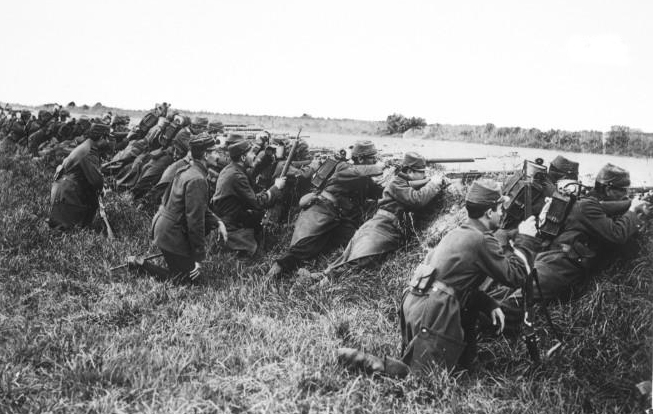
Should we envisage Catholic and Protestant relations to be more like the Battle of the Marne or more like the “mending wall” encounter depicted by Frost in his famous poem? Of course, both scenarios involve, shall we say, different points of view, and the immediate result of both fields of action is a sort of stalemate. But you will agree that there are some pretty significant differences between the two engagements. Certainly there have been wars of religion–baptized men with incompatible beliefs gathering for battle and the shedding of blood. But there have also been discussions of religion, baptized men with incompatible beliefs gathering for fellowship and the drinking of beer (or whatever people imbibe when they are at leisure to disagree without impending threat of physical violence).
Most people today will agree that inter-confessional conversations and even debates are preferable to wars of religion. On the other hand, isn’t there still a threat of an even graver sort of danger, when what is disputed is a matter of spiritual life or death? Even if we agree that we are all better off without physical and social hostilities, don’t we remain locked in battle, compelled by our deepest commitments to oppose one another?
Adequate answers to these questions will have to recognize all sorts of distinctions. We must proceed carefully. If we think carefully about the nature of our “deepest commitments” and “one another,” then it should become apparent that our fundamental orientation cannot be mutual hostility, nor even a steady truce. But someone will say, “What about the doctrine of justification?” And another might add, “What about the Eucharist?” Indeed. What about these things? Are they, primarily, not what x or y believes them to be? Does the deepest significance of the means of grace lie in the fact that affirming them in a particular way allows one to draw a line of demarcation between us and them? Is it not a more fundamental fact that such precious gifts are freely offered for the salvation of all mankind, having precisely the effects of forgiveness, peace, and unity?
I am not interested in false dichotomies. One can love his fellow man and still be convinced that that man is a heretic. But I am interested in the way we imagine what is going on in the discussion between Catholics and Protestants. The image of a battlefield is not entirely inappropriate, but it is too limited and limiting. If this is the model that most informs our conception of Christian reconciliation, then the only conceivable hope of unity will lie in victory, and every discussion will be perceived as a kind of combat. Is there a more accurate, a more nuanced, perhaps a more promising way to represent how things are between us?
This brings me to the image of the Mending Wall. Like any great work of art, the poem suggests seemingly limitless applications, these residing in the “freedom of the reader,” rather than, as with allegory, any “purposed domination of the author.” Well, in the freedom of this reader, the poem evokes the way things are in Catholic and Protestant interaction. I don’t intend to exegete this bit of whimsy, this description by analogy by proxy, other than to say that, in my thinking, neither neighbor simply represents either side of the religious divide. Who is represented by which neighbor is relative to points along the wall, the particular stone under consideration, and, of course, the different sorts of individual Catholics and Protestants. Overall, in this particular application, the poem may be understood as representing the desires, fears, habits, judgments, inconsistencies and, perhaps, paradoxes that crop up all around, on both sides, whenever Protestants and Catholics seriously consider one another.
Mending Wall
by Robert Frost
Something there is that doesn’t love a wall,
That sends the frozen-ground-swell under it,
And spills the upper boulders in the sun,
And makes gaps even two can pass abreast.
The work of hunters is another thing:
I have come after them and made repair
Where they have left not one stone on a stone,
But they would have the rabbit out of hiding,
To please the yelping dogs. The gaps I mean,
No one has seen them made or heard them made,
But at spring mending-time we find them there.
I let my neighbor know beyond the hill;
And on a day we meet to walk the line
And set the wall between us once again.
We keep the wall between us as we go.
To each the boulders that have fallen to each.
And some are loaves and some so nearly balls
We have to use a spell to make them balance:
‘Stay where you are until our backs are turned!’
We wear our fingers rough with handling them.
Oh, just another kind of out-door game,
One on a side. It comes to little more:
There where it is we do not need the wall:
He is all pine and I am apple orchard.
My apple trees will never get across
And eat the cones under his pines, I tell him.
He only says, ‘Good fences make good neighbors’.
Spring is the mischief in me, and I wonder
If I could put a notion in his head:
‘Why do they make good neighbors? Isn’t it
Where there are cows?
But here there are no cows.
Before I built a wall I’d ask to know
What I was walling in or walling out,
And to whom I was like to give offence.
Something there is that doesn’t love a wall,
That wants it down.’ I could say ‘Elves’ to him,
But it’s not elves exactly, and I’d rather
He said it for himself. I see him there
Bringing a stone grasped firmly by the top
In each hand, like an old-stone savage armed.
He moves in darkness as it seems to me~
Not of woods only and the shade of trees.
He will not go behind his father’s saying,
And he likes having thought of it so well
He says again, “Good fences make good neighbors.”
[Source]
