
The Tu Quoque
May 24th, 2010 | By Bryan Cross | Category: Blog PostsNeal and I offered a brief reply to the tu quoque objection in our article titled “Solo Scriptura, Sola Scriptura, and the Question of Interpretive Authority.” Here I provide a more thorough reply to the tu quoque objection, and open a forum for discussion of the authority argument and the tu quoque objection.
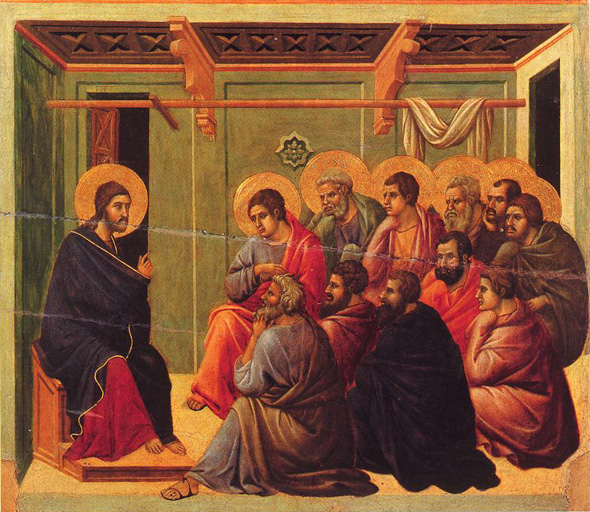 Christ Taking Leave of the Apostles
Duccio di Buoninsegna (1308-11)
Museo dell’Opera del Duomo, Siena
I. The authority argument
In various places I have argued previously that without apostolic succession, creeds and confessions have no actual authority.1 They have no actual authority apart from apostolic succession because without apostolic succession the only available basis for a creed or confession’s authority is the individual’s agreement with the interpretation of Scripture found in that creed or confession. Each person picks the confession of faith that most closely represents his own interpretation of Scripture. If his interpretation of Scripture happens to change, he is not bound by his prior choice of confession; rather, he simply picks a different confession that more closely matches his present interpretation. I have described this as painting one’s magisterial target around one’s interpretive arrow, i.e. the practice of choosing and grounding magisterial authority based on its agreement with one’s own interpretation of Scripture.2
But an important principle regarding authority is this: “When I submit (only when I agree), the one to whom I submit is me.” In other words, agreement with oneself cannot be the basis for authority over oneself. Therefore a creed or confession’s agreement with one’s own interpretation of Scripture cannot be the basis for its authority.3 And this is why without apostolic succession, creeds or confessions have no actual authority. That is a simple overview of the authority argument.4
II. The tu quoque objection
The primary objection to this argument is the tu quoque [lit. you too] objection, namely, that the person who becomes Catholic upon determining that the Catholic Church is the Church that Christ founded is doing so because the Catholic Church most closely conforms to his own interpretation of Scripture, history and tradition. In other words, in choosing to become Catholic, he has simply chosen the ‘denomination’ that best conforms to his own interpretation of Scripture, tradition and history. Hence if Protestant confessions have no authority over the individual Protestant because Protestants select them on the basis of their conformity to their own interpretation of Scripture, then neither does the Catholic Church have any authority over the person who becomes Catholic, because Catholics select the Catholic Church on the basis of its agreement with their own interpretation of Scripture, history, and tradition. But if choosing the Catholic Church on the basis of one’s own interpretation of Scripture, history, and tradition does not undermine the authority of the Catholic Church, then neither does choosing a Protestant confession on the basis of one’s own interpretation of Scripture undermine that Protestant confession’s authority. In other words, just as the person becoming Catholic claims to have discovered that those in the magisterium of the Catholic Church are the successors of the Apostles, and thereby bearing divine authority, so the person adopting a Protestant confession believes he has discovered that this particular confession is in agreement with Scripture, and thus that this confession derives its authority from Scripture. But if picking a confession on the basis of its agreement with one’s own interpretation of Scripture entails that this confession has no authority over oneself, then picking the Catholic Church on the basis of its agreement with one’s own interpretation of history, tradition and Scripture entails that the Catholic Church has no authority over oneself. In short, the conclusion of the tu quoque objection is that either the Catholic Church likewise has no authority, or the Protestant confessions can truly have authority.
III. Reply
A. Deciding to become Catholic should involve study of Scripture, history and tradition.
Apart from a supernatural experience, ideally an adult would come to seek full communion with the Catholic Church only after a careful study of the motives of credibility, Church history, the Church Fathers, and Scripture.5 He would start with the Church in the first century at the time of the Apostles, and then trace the Church forward, decade by decade, to the present day. As he traced the Church forward through the centuries, he would encounter schisms from the Church (e.g. Novatians, Donatists). In each case he would note the criteria by which the party in schism was the one in schism from the one, holy, catholic and apostolic Church Christ founded, and not the other way around. By such a study, and by the help of the Holy Spirit, he would discover that the Catholic Church is the one, holy, catholic and apostolic Church that Christ founded in the first century, and that has continued to grow throughout the world over the past two millennia. But as I will show below, this study of history, tradition and Scripture by which he discovers that the Catholic Church is the Church that Christ founded does not entail that the Catholic Church has no more authority than a Protestant confession.
So why is discovering the Catholic Church through the study of history, Scripture and tradition not equivalent to discovering a confession that agrees with one’s own interpretation of Scripture, and how does the difference explain why the Catholic Church so discovered can remain authoritative while the Protestant confession cannot? The difference lies fundamentally neither in the discovery process nor in the evidence by which the discovery is made, even though those may be different. The difference lies fundamentally in the nature of that which is discovered.
B. The basis for the difference between the authority of Scripture and Protestant confessions
Consider why, for the Protestant, Scripture has more authority than any Protestant confession. Protestants and Catholics agree that “God is the author of Sacred Scripture. The divinely revealed realities, which are contained and presented in the text of Sacred Scripture, have been written down under the inspiration of the Holy Spirit.”6 Scripture is θεόπνευστος (God-breathed), whereas a Protestant confession is a merely human interpretation of the written words of God. Scripture does not have its authority on the basis of our agreement with what it says; Scripture has its authority because of who said it, that is, because of its divine source. But no Protestant thinks that any Protestant confession has the very authority of Scripture. No Protestant thinks that a Protestant confession is itself the Word of God. Protestants recognize that confessions are subordinate to Scripture because they recognize that the activity of [mere, unauthorized] men who interpret Scripture in order to construct the confession makes the authority of that confession to be different from the authority of the Scripture it attempts to interpret and explain. Because every confession is made by human interpreters, and these human interpreters are neither divinely inspired nor divinely authorized, these confessions are therefore merely human artifacts, not anything to which all men must submit on account of its divine authority. Just as every systematic theology book is a product of mere men, so every Protestant confession is the product of mere men. Some might be better than others, but none binds the conscience, because the authors were mere men, as are we, without divine inspiration or divine authorization.
Even though every Protestant confession has Scripture as its material source (i.e. that from which its authors draw), yet for anything in the confession that is not an exact re-statement of Scripture itself, the more it has merely human judgment mixed within it, with no guarantee of divine protection from error, the more it is merely a human judgment, i.e. a human opinion. In other words, because Protestant confessions were crafted by mere humans not having divine authorization, to the degree they go beyond an exact re-statement of Scripture, they are essentially human opinion, and therefore have no more ecclesial authority than human opinion, even though their subject matter is the divine Word of God in written form. For this reason Protestant confessions have no more authority than any systematic theology book, even one written by a plurality of authors. This is why a Protestant confession has its ‘authority’ only on the basis of the individual’s agreement with its interpretation of Scripture, not because of who wrote that confession.7
Protestants recognize the difference in authority between Scripture and Protestant confessions because they recognize the difference in the respective authority of their sources.8 No Protestant confession has the authority to bind the conscience, precisely because no Protestant confession has divine authority; each has only human authority. Even Protestant confessions state that they cannot bind the conscience. The Westminster Confession of Faith states, “God alone is Lord of the conscience, and hath left it free from the doctrines and commandments of men, which are, in any thing, contrary to His Word; or beside it, if matters of faith, or worship.”9 And elsewhere, “All synods or councils, since the Apostles’ times, whether general or particular, may err; and many have erred. Therefore they are not to be made the rule of faith, or practice; but to be used as a help in both.”10 If any Protestant confession had divine authority, it would necessarily bind the conscience of anyone who knew it to have divine authority. All Christians would be obligated by that Protestant confession’s divine authority to interpret Scripture according to the rule of faith provided in that particular Protestant confession.
If the Protestant finds his conscience bound to a particular interpretation of Scripture, and he finds that same interpretation of Scripture presented in a confession, then per accidens his conscience will be bound to that confession (or that part of that confession) not because of any intrinsic authority had by the confession, but because the confession happens to express the interpretation that he presently holds to be necessary and thus conscience-binding. If his conscience ceases to be bound by that particular interpretation, the confession no longer binds his conscience. This shows that the confession has no intrinsic authority; it is not the confession that is authoritative over his beliefs; rather, his present beliefs make the confession to be ‘authoritative,’ by containing the interpretation he presently believes to be required of himself.11 The confession has no interpretive authority, because the individual is not required to conform to the confession. The confession, if it is to be the individual’s confession, must conform to the individual’s interpretation. He picks this particular confession because it conforms to his interpretation; it does not oblige him to conform to it, or, once picked, to remain conformed to it. And that is why no Protestant confession has any actual authority. Each Protestant confession merely contains a distinct interpretation which some individuals happen to believe (or at one time happened to believe) is not only true but necessary, and thus, conscience-binding. For this reason, neither a Protestant confession nor parts of it can bind anyone’s conscience; at most it is merely a record of what some people find or have found in their reading of Scripture to be the only way they can in good conscience interpret Scripture.
C. The basis for the distinction between the authority of the Catholic Church and Protestant confessions.
What the person becoming Catholic discovers in his study of history, tradition and Scripture is not merely an interpretation. If what he discovered were merely an interpretation of history, tradition and Scripture, then what he discovered would have no more authority than any Protestant confession. If his discovery were merely an interpretation, it too would be merely a human opinion. The prospective Catholic finds in his study of history and tradition and Scripture something that does not have a merely human source, either from himself or from other mere humans not having divine authorization. He finds in the first, second and third (etc.) centuries something with a divine origin and with divine authority. He finds the one, holy, catholic and apostolic Church and its magisterial authority in succession from the Apostles and from Christ. He does not merely find an interpretation in which the Church has apostolic succession; he finds this very same Church itself, and he finds it to have divine authority by a succession from the Apostles. In finding the Church he finds an organic entity nearly two thousand years old with a divinely established hierarchy preserving divine authority. The basis for the authority of the Church he finds is not its agreement with his own interpretation of Scripture, history or tradition. History, tradition and Scripture are means by which and through which He discovers the Church in reality. The Church he finds in history and in the present has its divine authority from Christ through the Apostles and the bishops by way of succession.
Herein lies the critical difference between the Church the inquirer finds in the centuries following Christ, and a Protestant confession. The former, like Scripture, has a divine origin and a divine authority, whereas the latter has a merely human origin and hence a merely human authority, just as any systematic theology book has a merely human origin and a human authority, even as it draws from and seeks to exposit Scripture. Whereas a Protestant confession cannot bind the conscience except per accidens, (i.e. unless one is already bound in conscience by the interpretation contained in that confession), a divinely authorized magisterium binds the conscience per se, that is, by the divine authority it has within itself.
Consider the following example. Jesus says:
“You search the Scriptures because you think that in them you have eternal life; it is these that testify about Me.” (John 5:39)
Through searching the Scriptures, the reader is not supposed to find only an interpretation of Christ. The one who searches the Scripture is supposed to discover, through the Scriptures, the second Person of the Divine Trinity. The reader of Scripture who discovers only interpretations of Scripture, but does not discover Christ, has not discovered that Person to whom Scripture points. Such a reader of Scripture already knows that Scripture has divine authority, but through Scripture he has not yet discovered anything greater in authority than himself. Through his reading of Scripture he is supposed to discover something (actually Someone) more authoritative than himself, and more authoritative than his own interpretation.
The tu quoque objection does not apply to the reader who through the Scriptures discovers Christ, because in discovering Christ such a reader is not picking as an ‘authority’ something that conforms to (or agrees with) his own interpretation of Scripture. Discovering Christ through the Scriptures differs altogether from picking a confession based on its agreement with one’s own interpretation of Scripture. In picking a Protestant confession the individual retains interpretive authority, for the reasons I explained above. But the reader who through the Scriptures discovers the Person of Christ has discovered something more than an interpretation; he has discovered a Divine Person, Someone having authority over himself, even interpretive authority over himself. Likewise, the person who reads history, tradition, and Scripture, and discovers the Church, has not merely discovered an interpretation, but has discovered something with a divine origin and hence with divine authority, and thus interpretive authority, even conscience-binding authority; he has discovered the Body of Christ.
Every interpretation of Scripture that is made by men-without-divine authorization is the product of mere-man, and thus has no divine authority over man. No such interpretation can bind the conscience. This is why no Protestant confession has actual authority. Even the prospective Catholic’s interpretation of Scripture, tradition and history has no divine authority as such. If the prospective Catholic had only an interpretation, and a confession that expressed that interpretation, his confession would have no actual authority, nor for that reason would any community of persons formed by like-minded individuals having only that shared interpretation and a corresponding confession, even if they called themselves a ‘church’ or ‘the Church.’ But if through and beyond his interpretation he discovers the actual Church that Christ founded, filled with the Holy Spirit and retaining divine authority through an unbroken succession from the Apostles, spanning through twenty centuries “terrible as an army with banners,” bearing the trophies [relics] of the apostles and martyrs, and spread out over all the whole world, then he has discovered something that isn’t merely human. He has discovered the divine society on earth, the one, holy, catholic and apostolic Church that Christ founded, to which not only his interpretation but his whole life must submit and conform. Just as discovering Christ through the study of the Scriptures is not subject to the tu quoque objection, so for the same reason discovering the Body of Christ through the study of Scripture, tradition and history is not subject to the tu quoque. In both cases it is the same Christ he has discovered, in His physical body which has ascended into Heaven, or in His mystical body, the Church:
A reply of St. Joan of Arc to her judges sums up the faith of the holy doctors and the good sense of the believer: “About Jesus Christ and the Church, I simply know they’re just one thing, and we shouldn’t complicate the matter.” (CCC 795.)
The Protestant method of relating the Church to Scripture defines the Church not by way of divine authority from Christ handed down in succession from the Apostles, but by sufficient agreement with one’s own interpretation of Scripture.12 This method of defining ‘the Church’ by its very nature does not allow ‘the Church’ any authoritative role in adjudicating interpretive disagreements, because for each disputant, if ‘the Church’ rules against his interpretation, for him she ceases to be ‘the Church,’ and hence he need not submit to her. Therefore the possibility of the Church having any authority, even “ministerial authority,” requires that the Church not be defined by its agreement with one’s own interpretation of Scripture. In this way, defining ‘the Church’ by way of agreement with one’s own interpretation of Scripture is nothing less than an implicit denial of a visible catholic Church. If Christ intended His followers to be united in one faith in a visible catholic Church, and if there can be no such thing as a visible catholic Church simply by individual appeals to Scripture apart from the exercise of magisterial authority such as in ecumenical councils, then the Church cannot be defined by its agreement with one’s own interpretation of Scripture. In that case there has to be another way of locating the Church, if there is to be a visible catholic Church. And the only other way available is by a succession of magisterial authority from the Apostles.
III. Follow-up Questions & Answers
Q1. But doesn’t the Protestant also claim to have discovered the Church? If so, then why doesn’t Protestantism avoid the tu quoque in this same way?
A. Protestants do believe that they have discovered the Church, but by that they mean that they have discovered other persons who have faith in Christ, or a faith in Christ that is sufficiently similar to their own.13 They do not claim to have discovered apostolic authority in an unbroken succession of bishops coming from the Apostles. And that is why they do not believe that the Church they have discovered has divine authority or interpretive authority to which all Christians should submit. From a Protestant point of view, Scripture is the only divine authority in the Church, and that is why Protestants believe that only Scripture can bind the conscience. For this reason, given the Protestant conception of the Church, the Church cannot provide divine authorization to any interpretation of Scripture, history or tradition. The individual Protestant, on the basis of his own interpretation of Scripture, always retains veto authority over whatever his ecclesial community determines, even with its highest authority.14 Because what he refers to as ‘Church’ has no divine authority, the ‘Church’ he has discovered does not and cannot give his interpretation or confession divine authorization. That is why his situation is not like that of the Catholic. The individual Protestant himself remains his own highest interpretive authority, and the particular confession he has adopted (if he has adopted one) remains subject to his acceptance or rejection of it; it has no actual authority over him. The Catholic, by contrast, upon discovering the divine authority of the Catholic Church does not remain his own interpretive authority, and the Creed and doctrines he adopts, he adopts on the divine authority of the Church that has defined them, not on the basis of their agreement with his own interpretation of history, tradition and Scripture.
Q2. The Protestant claims to have discovered the gospel. Surely that has divine authority.
A. If by ‘gospel’ one is referring to passages from Scripture, then of course these have divine authority, because Scripture is God-breathed. But if by ‘gospel’ one is referring to [merely] human judgments or opinions regarding the meaning of these passages of Scripture, then these judgments, or interpretations, or opinions do not have divine authority and therefore are not conscience-binding. This is why Protestants themselves rightly recognize that no Protestant confession has the authority to bind the conscience; their confessions (insofar as they go beyond exact re-statements of Scripture) are merely judgments of men, not divinely authorized interpretations of Scripture. So for that reason, what Protestants refer to as ‘the gospel,’ insofar as it is not an exact re-statement of Scripture, has no more authority than a systematic theology text, being a merely human opinion.
Q3. There are multiple and competing claims to apostolic succession (e.g. Catholic, Orthodox, Anglican, Coptic, etc.). Isn’t the person who picks one of them as the Church that Christ founded simply picking as a [seemingly] divine authority that institution that most closely conforms to his own interpretation of Scripture, history and tradition? And if so, how is he not exactly in the same situation as the Protestant who picks the confession that most closely conforms to his own interpretation of Scripture?
A. There are three theoretically possible errors here: (1) The inquirer could think that there is apostolic succession, when there is none. (2) The inquirer could think someone has authority in succession from the Apostles when in fact he doesn’t, but someone else does. (3) The inquirer could find someone who has Holy Orders in succession from the Apostles, but is in schism from the one, holy, catholic and apostolic Church that Christ founded. However, the theoretical possibility of these three errors does not make the position of the person who discovers the magisterium of the one, holy, catholic and apostolic Church Christ founded subject to the tu quoque. To see that, note that it is also possible to err by mistaking a false Messiah for the true Messiah. But the possibility of mistaking a false messiah for the true Messiah does not entail that the true Messiah cannot be discovered, or that in discovering the true Messiah one has merely discovered an interpretation of Scripture. Likewise, the three theoretically possible errors just listed do not entail that the magisterium of the one, holy, catholic and apostolic Church Christ founded cannot be discovered, or that this magisterium is just an interpretation, or that the basis for its authority is its agreement with the inquirer. Just as the Messiah is not an interpretation, so lines of succession from the Apostles are not interpretations. And just as the Messiah has His divine authority from Himself, and not from any agreement between Himself and the one who discovers Him, so likewise, the magisterium of the one, holy, catholic and apostolic Church that Christ founded has its authority in succession from Christ through the succession from the Apostles, not from any agreement between itself and the one who discovers it. So while the inquirer must use his own reasoning and judgment to interpret Scripture, history, and tradition, and while he may err in doing so, this does not entail that through his inquiry he cannot discover something [outside the text] bearing divine authority. And for the reasons explained above, if through his inquiry he discovers something [outside the text] bearing divine authority, his position is not subject to the tu quoque.
Q4. But isn’t the person who becomes Catholic using his own private judgment just like the Protestant?
A. We cannot but use our own intellect and will in interpreting evidence, drawing conclusions, discovering truths, and making decisions. In that respect, inquirers who eventually become Protestant or Catholic start in the same epistemic situation, using their own intellect and will to find the truth through the evidence available to them. Using our intellect and will in coming to believe something is not what makes the Protestant confession to be without divine authority, nor is it what makes the Catholic’s faith in the Catholic Church not subject to the tu quoque objection. What makes a Protestant confession to be without authority is that it is a product of merely human minds, minds without divine authorization, as they sought to interpret and explain the Scriptures. The Catholic Church, by contrast, is not the product of men-lacking-divine authorization. The Catholic Church was founded by Christ Himself, who is God. The Catholic Church’s divine authority was handed down to us from Christ by the Apostles whom He authorized, and then by bishops whom they authorized, down to this present day. With the help of the Holy Spirit, the inquirer who uses his intellect and will to examine history, tradition and Scripture, discovers this divinely founded entity bearing divine authority, and at that point submits to it. His own interpretation has no divine authority. But he discovers something beyond his own interpretation, something to which his own interpretation points, and which does have divine authority. He discovers the Church. The Protestant can understand this in some sense, because in discovering Scripture the Protestant too has discovered something having divine authority, even while using his own intellect and will.
Q5. What about the person who becomes Catholic because the Catholic Church teaches his own interpretation of Scripture? How is such a person not in the same epistemic situation as the Protestant?
A. He is in the same epistemic situation as the Protestant. If a person becomes a Catholic on the basis that (and hence condition that) the Catholic Church shares his own interpretation of Scripture, he is not truly a Catholic at heart; he is still a Protestant at heart. One does not rightly become a Catholic on the ground that one happens to believe at present all the doctrines that the Church teaches. That approach is a form of rationalism, not fides quaerens intellectum (faith seeking understanding). One rightly becomes a Catholic by an act of faith in which one believes all that the Catholic Church teaches, even if not fully understanding it, on the ground of the apostolic authority of the Church’s magisterium.15 When we are received into the Catholic Church, we say before the bishop, “I believe and profess all that the holy Catholic Church believes, teaches, and proclaims to be revealed by God.” We are not saying that we just happen to believe Catholic doctrines. We are not merely reporting our present mental state viz-a-viz Catholic doctrine. We are making a confession of faith, an act of the will whereby we are submitting to the apostolic authority of the Church regarding what it is that she “believes, teaches, and proclaims to be revealed by God” on the ground of her magisterial authority in succession from the Apostles whom Christ Himself appointed and sent. We believe in Christ through believing those sent and authorized by Him and His Apostles, as they teach and explain the deposit of faith entrusted to them by Christ. “Faith seeking understanding” is possible only where submission is required, but submission is not required wherever the identity and nature of the Church is determined and defined by one’s own interpretation of Scripture.16
Q6. If tomorrow the magisterium of the Catholic Church definitively proclaimed that Jesus was actually a mere prophet, not the Son of God, and did not die on a cross, you would not believe those teachings or submit to them. Doesn’t this show that you too only submit when you agree, and that therefore, you are your own interpretive authority, just like the Protestant?
A. The question presupposes that the magisterium of the Church could do such a thing. But part of the dogma of the Catholic Church is precisely that the magisterium of the Church cannot possibly do such a thing, cannot overturn or oppose any dogma of the faith. So the question presupposes the falsity of that Catholic dogma, and in that respect is question-begging, just as the question “If Jesus had sinned, would you still follow Him?” is a question-begging question for Christians, because Christians believe that the Son of God cannot possibly sin. Individual bishops can and do fall into heresy and schism. But Catholic faith includes the belief that the magisterium of the universal Church cannot do so. Orthodoxy and heresy are determined objectively by the magisterium of the universal Church, not ultimately by the individual’s interpretation. The authority of the magisterium in infallibly defining doctrines preserves those doctrines until Christ returns, because the Church has no authority to reverse or overturn what she has already defined with her full authority. So if a particular bishop were to teach contrary to what the magisterium of the Church has infallibly defined, the Catholic faithful should in that case remain true to the magisterium, and not follow the heretical bishop. That is not making oneself a higher authority than the bishop; it is remaining faithful to the still more authoritative visible magisterium of the universal Church.
Q7. Keith Mathison claimed that all appeals to Scripture are appeals to interpretation of Scripture. You claim that someone who becomes Catholic, after personal study of Scripture, tradition and history, discovers not merely an interpretation, but apostolic succession. How would you respond to the claim that all appeals to Scripture, tradition and history are appeals to interpretations of Scripture, tradition and history? And if all appeals to Scripture, tradition and history are appeals to interpretations of Scripture, tradition and history, then aren’t you being inconsistent in granting that the prospective Catholic can discover Apostolic Succession itself, while denying that the Protestant can discover the objective truth of “justification by extrinsic imputation of Christ’s alien righteousness” in Scripture?
A. The idea behind Keith’s claim is that when we appeal to a passage of Scripture to support a position or claim, we assume a particular interpretation of that passage. We interpret it within a web of beliefs that we bring to it, a paradigm, if you will. That’s no less true when we appeal to the writings of the Church Fathers, and to tradition and history. But that does not mean that we have no access to reality and can only access the interpretations present to our minds.17 Through his interpretation of Scripture, history and tradition the prospective Catholic discovers something other than his interpretation. His interpretation exists in his mind, but the practice of apostolic succession exists in the extra-mental world, not just in his mind. The bishops and their relations to the Apostles are not interpretations that exist in the prospective Catholic’s mind; the bishops are real, flesh-and-blood men, and there is a real, historical, organic and sacramental continuity between them and the previous generation of bishops, and between those bishops and the generation of bishops before them, and so on, extending all the way back to the divinely-authorized Apostles. Even if a Protestant thinks there is no such thing as apostolic succession, he can acknowledge that if there is such a thing as apostolic succession, it exists extra-mentally. By contrast, “justification by extrinsic imputation of Christ’s alien righteousness” is not a statement found in Scripture, but an interpretation of various statements within Scripture. This interpretation of Scripture brings a nominalistic conception of justification to the text of Scripture. That is one reason why “justification by extrinsic imputation of Christ’s alien righteousness,” whether true or false, is an interpretation of the text. In order not to be an interpretation of the text, it would have to exist extra-mentally, i.e. be explicitly stated by the text of Scripture. But it is nowhere explicitly stated in Scripture; it is an interpretation of Scripture. Because it is an interpretation of Scripture, and because it is an interpretation made by mere men without divine authorization, it has no divine authority, whether or not some people write it down as part of a confession. And that is why the Protestant position is subject to the authority argument while the Catholic position is not subject to the tu quoque objection.
May Christ by His Spirit make us one in the truth, and one in His Church. In the name of the Father, and of the Son, and of the Holy Spirit. Amen.
- See, for example, the section of the article Neal and I wrote last Fall, titled “The Delusion of Derivative Authority.” More recently I have offered some comments on two Green Baggins threads; see my comments in comments #78-#157 under Leithart “potentially” Out of Accord, and my comments in comments #1-#484 under “Determining the Doctrine of the Church.” See also something I wrote two years ago, titled, “Michael Brown on Sola Scriptura or Scriptura Solo.” [↩]
- See “The Alternative to Painting a Magisterial Target Around One’s Interpretive Arrow.” [↩]
- That can also be shown by the fact that any group of heretics (e.g. Arians, Nestorians, Monophysites, etc.) could make a confession that agreed with their own interpretation of Scripture, and no such confession would be authoritative. So agreement with one’s own interpretation of Scripture is not sufficient to make a creed or confession authoritative. [↩]
- I’m not here speaking of ‘club authority,’ i.e. “If you want to be a member of our club, you must subscribe to this confession.” I’m speaking of catholic ecclesial authority, i.e. something to which all Christians everywhere should submit, and by which our interpretation of Scripture should be guided. [↩]
- On the motives of credibility, see “Lawrence Feingold on the Motives of Credibility.” [↩]
- CCC 105. [↩]
- The authors of Protestant confessions did not have divine authorization because they did not have Holy Orders. Protestants do not claim that the men who wrote the various Protestant confessions received divine authorization to do so. Nor do Protestants believe that the authority of any Protestant confession depends upon the authors of that confession having received divine authorization to do so. [↩]
- If a Protestant confession were divinely authorized, then Protestants (and all Christians) would be obligated to interpret Scripture in accordance with that confession, and could not take exceptions to the confession or adopt another confession, except by an act of rebellion against its authority or utter ignorance of its authority. If two or more Protestant confessions had divine authority, then they could not disagree with each other, because there is one God, and God cannot contradict Himself. [↩]
- Westminster Confession of Faith, XX.2. [↩]
- Westminster Confession of Faith, XXX.3. [↩]
- I put ‘authoritative’ in single quotes, because the confession, in such a case, is no more authoritative than a systematic theology text or tract or magazine that happens to state the interpretation the individual presently holds to be necessary. [↩]
- See my “The Tradition and the Lexicon,” and IV.A. of “Solo Scriptura, Sola Scriptura and the Question of Interpretive Authority.” [↩]
- For example, the Westminster Confession of Faith states, “The visible Church, which is also catholic or universal under the Gospel (not confined to one nation, as before under the law), consists of all those throughout the world that profess the true religion; and of their children.” (WCF XXV.2) [↩]
- E.g. a general assembly of his denomination. [↩]
- See “St. Thomas Aquinas on the Relation of Faith to the Church.” [↩]
- This is also why ‘cafeteria Catholics,’ i.e. those who pick and choose from the Church’s teaching, are at least in a state of [material] heresy, and are in grave danger of being in a state of formal heresy, and thus not having faith at all. [↩]
- The two epistemic errors on each side of the truth are first, that we do not interpret reality and second, that we cannot know reality, because we only have interpretations. [↩]

Bryan:
Before I go to bed, I just wanted to say that this is excellent. I will take up a few of your arguments at my own blog, where I plan a post on Newman’s doctrine of conscience. Of course, if the Reformed guys at places like Triablogue and Green Baggins takes note of your post, we will end up having some intricate epistemological debates. I say: bring it on!
Best,
Mike
[…] ~ The Tu Quoque, Called to Communion […]
Bryan,
I’ve noticed something that Catholics do all the time, which is refer to their own position as something that they “discovered,” “found,” “encountered,” or “realized.” I’m sure you can see just how that kind of thing sounds to those you’re trying to convince and/or convert, right? It’d be like me saying, “When I really rolled up my sleeves and did the research, I discovered that 9/11 was actually a huge insurance scam. You can imagine how surprised I was to find this to be the case, but once I realized that the twin towers were demolished on purpose, I had no choice but to submit to the facts that the incontrovertible evidence support.”
It’s question-begging, is what I’m saying.
The citation above assumes what it’s trying to prove. There are loads of brilliant scholars who have spent decades studying the fathers and have reached diametrically opposite conclusions than you have reached. How do you know that you have discovered truth while they are merely (mis)interpreting data? So in a certain sense I agree with you—if the Catholic church is what Rome says it is, then you’d better believe that we Protestants are culpable for not discovering this by our study of Scripture and tradition. But that’s the question: Is the CC what it says it is, or isn’t it?
But to say that you avoid the tu quoque because your study didn’t result in an interpretation of the data, but a “discovery” of the truth is just another way of saying that you agree with yourself (which seems to be what you fault us for).
I’ll suggest a thought-experiment: How would you respond to an Orthodox believer who made the exact same argument as you have made, using the exact same words and everything, but what he claims to have “discovered” is that the Petrine primacy was actually a perversion of the original deposit of faith and not a development of it?
Jason,
My purpose in this post is not to demonstrate or prove that the Catholic Church is what Catholics believe she is. My purpose in this post is only to show why the Catholic’s claim to have discovered the Church Christ founded is not subject to the tu quoque objection. Modernists claim that Christ is a human construct. In order to explain to a modernist how the discovery of Christ [as the second Person of the Trinity] is not subject to the tu quoque, I have to ask the modernist not to beg the question by assuming that the Christian’s claim [about Christ’s deity] comes entirely from within the Christian as a human construct, but could possibly be divine revelation. Similarly in order to explain to a Protestant how the Catholic’s discovery of the Catholic Church as the Church that Christ founded is not subject to the tu quoque, I have to ask the Protestant not to beg the question by assuming that the Catholic’s claim [about the Catholic Church being the Church Christ founded] is a mere construct or interpretation. Whether or not the Catholic Church is the Church that Christ founded is a question we can debate another day. To follow my argument here (in this post), you don’t need to assume (or agree) that the Catholic Church is the Church that Christ founded. But if you assume a priori that the Catholic’s (or Orthodox) claim to have discovered the Church that Christ founded is a mere interpretation and nothing more, then you won’t be able to see why the Catholic (or Orthodox) position is not subject to the tu quoque.
If my purpose in this post were to show the Catholic Church to be the one, holy, catholic and apostolic Church that Christ founded, then you would be completely right that my argument in this post begs the question, i.e. assumes precisely what is in question between Protestants and Catholics. My post would also, in that case, beg the question between Catholics and Orthodox. The argument that I’m giving in this post explains why both the Catholic and Orthodox claims are not subject to the tu quoque. So, in short, my purpose in this post is not to show that the Catholic Church is the Church that Christ founded, but only to show why the tu quoque does not apply to the person who becomes Catholic. So I’m assuming that for the sake of argument the reader is capable of seeing (generally) the Catholic (or Orthodox) claim on its own terms.
As for showing that the Catholic Church is the Church that Christ founded, that’s not what this post aims to show. But I began to present an answer to that question here, but only got as far as the early ninth century.
In the peace of Christ,
– Bryan
Bryan,
Look, I agree that the nature of what you have submitted to is different from that to which I have submitted, and that once the Catholic converts he surrenders the interpretive authority which the Protestant retains. I get that, honest.
But there still seems to be a naïveté on the part of the Catholic (or Orthodox) who insists that, when he goes back to the early church, he is simply discovering an objective fact rather than reaching a conclusion based on interpretation of data. There are hosts of questions that need to be answered once we finish reading the 37-volume Early Church Fathers set, but the way you present the case, it looks like you think that Catholic ecclesiology is as obvious as the expectation that Shakespeare’s King Lear will have a king in it called “Lear.”
So it seems to me that you are every bit as subject to the tu quoque as we are, at least when it comes to the most critical moment of all, namely, the interpretation of the raw data.
I may be helpful to distinguish two different times, T1 and T2, and discuss the issue of whether/how Protestants and Catholics are their own interpretive authority at those two times. Here’s what I mean. We’ll refer to T1 as that time referenced in Question 4 of Bryan’s article.
T1 = the moment at which one exercises one’s will, as that will is informed by one’s own interpretation of the data via the intellect to decide whether to be a Catholic or (a certain denomination of) Protestant.
T2 = any moment after T1
In Answer 4, Bryan seems to agree both the Protestant and the Catholic are in the same boat at T1: “We cannot but use our own intellect and will in interpreting evidence, drawing conclusions, discovering truths, and making decisions. In that respect, inquirers who eventually become Protestant or Catholic start in the same epistemic situation, using their own intellect and will to find the truth through the evidence available to them.”
The whole debate, it seems to me, is about T1. And once we agree that, at T1, both parties are in the same boat, that seems to be the end of the debate. What am I missing here?
JJS:
That criticism would only be apt if Bryan were trying to prove Catholicism to be true. But he has said, and you’ve acknowledged that he’s said, that he is not. The problem here, I suspect, is that you’re not attending to another key distinction he’s relying on.
Prior to the assent of faith in the Catholic Church’s claims for herself, the most that the sincere, objective, but uncommitted inquirer can do is study the dataset and reach an opinion about which version of Christianity it best supports. If one forms the opinion that the dataset best supports the claims of the Catholic Church for herself, then one has good reason to make the assent of faith in them. Even so, that is not the same as intellectual compulsion, as though one could only hold such an opinion as something perfectly obvious. The assent is a free choice which, as such, is not compelled by the dataset itself or by any particular interpretation of it. Yet, once said assent is made, one cannot but see the dataset as making said assent more reasonable than the alternatives. For by making the assent, one has ipso facto adopted what is, in effect, a hermeneutical paradigm (HP) within which all the relevant data are altogether explicable in Catholic terms. Prior to the assent of faith, the Catholic HP only appears as one opinion among others that also have a certain plausibility; after the assent, the Catholic HP can no longer appear just as an opinion, but as a way of understanding the dataset that, in certain areas, is divinely protected from error. That’s what it means to adopt the Catholic HP.
Everything I’ve said in the above paragraph is autobiographical as well as expository: I was once just such an inquirer as I’ve hypothesized, until I decided to assent by faith to the Catholic Church’s claims for herself. And the decision I’ve described points up the essential difference between the Catholic and Protestant HPs—a difference which you recognize, but whose significance you don’t seem to appreciate.
A Protestant as such always reserves to himself the right to judge the orthodoxy of something called “the Church” (in light of Scripture and whatever he also takes to be normative) even when he has joined what he takes to be either “the” Church or some branch thereof. Choosing to be Catholic means surrendering that putative right. If and when one comes to see the Catholic Church as the Church, and makes the corresponding assent of faith in her claims for herself, then one has chosen to have one’s orthodoxy is measured by her teaching, not vice-versa. Accordingly, a Catholic cannot see the definitive teaching of the Church as just one set of opinions over against others; nor can he see “Rome” as just one denomination or sect among others. Choosing to be Catholic means abjuring the very idea that religion is a matter of opinion, because choosing to be Catholic means joining what one has come to see as the Body of Christ, sharing in his teaching authority as her head through the bishops in apostolic succession, and thus as divinely protected from error when teaching with her full authority.
Accordingly, the key premise of Bryan’s argument in the above post is, in effect, that the object of Catholic assent is fundamentally different in kind from the object of Protestant assent, even if the process of inquiry leading up to the assent is otherwise very similar in form and diligence. To put it in succinct technical form: the terminus ad quem is radically different even when the terminus a quo is the same. The terminus ad quem here is ecclesial infallibility, which is the pivotal feature of the Catholic HP, and requires as a correlate that some visible body is “the” Church outside of which there is no salvation. If and when one adopts that HP, then one is committed to rejecting any interpretation of the data that would falsify the Catholic Church’s claims for herself. That is the stance which various Reformed critics are reacting against when they accuse Catholics like Bryan and me of “presuppositionalism” and of trying to make Catholicism “unfalsifiable.” What such critics take to be the intellectually respectable alternative to our stance as Catholics is tantamount to treating religion as ultimately just a matter of opinion; for on the Protestant HP, nobody’s teaching or profession of faith is admitted as infallible, hence all are provisional and open to future revision—by the individual, if not by the institution itself.
All this is why the tu quoque rebuttal is inapt. The difference is that Catholics as such refuse to treat everything as a matter of opinion.
Best,
Mike
Ryan,
The important thing is the difference in objectivity of the criteria used to make such decisions. Yes, both Catholics and Protestants used their intellect to decide, but they didn’t use the same criteria and hence are not in the same epistemological boat. Catholics use an objective criteria of Apostolic Succession but Protestants use a subjective criteria of ‘whoever agrees with my interpretation of Scripture.’
That’s why the “you too” argument doesn’t work. No, not us too. We don’t join whichever Church conforms to our interpretation of Scripture. We join whichever Church is objectively the same institution (per Apostolic Succession) as the one that Christ founded and then we conform our interpretation of Scripture to that Church. That’s what we believe. If you say “Apostolic Succession is false” then that’s a legitimate claim and we can debate it. But then it means we’re wrong about our objective criteria, not that we’re in the same epistemic boat and hence subject to the same criticism.
Bryan,
I enjoyed reading your post. It does address head-on some of the questions that many Protestants have. Now allow me to ask a small question, again a “thought experiment.” I am NOT asking you to elaborate on why the RCC is right and the EO are wrong here…this is purely for the sake of argument.
Following your logic, your claim that the RCC is exempt from the “you too!” argument would apply equally to any institution claiming to be the one, true Church descending from the Apostles by succession. The pure logic of the matter applies to the RCC, the EO, the OO, and conceivably could apply even to something like Mormonism…and I am not comparing Rome to Salt Lake City…just saying the logic applies :-)
So the seeker uses his intellect, hopefully prayerfully, seeking the genuine leading of the Spirit into all truth. Should he become Protestant, he has submitted himself to an institution that instructs him on the one hand to submit to its authority, but on the other hand, only insofar as it agrees with his interpretation of Scripture. In essence it’s telling him to submit, but not really. He always has the escape hatch…his eye is forever on the exit, in case he finds that one silver bullet that makes him realize that Methodists have been right all along, and Calvinists were actually in error.
OK, so let’s say that instead he “discovers” the RC or EO Church. By your logic he is now submitting to an institution claiming divine authority–this is fundamentally different from the Protestant’s position, and with your reasoning here, I agree. Now I find it is often the case that many evangelicals who become RC do so in total ignorance of what the EO teaches, or even that it exists beyond the local Greek festival. Let’s say that a year after “discovering” the RC Church, this new Catholic convert realizes there’s a branch of Christianity he’s been unaware of. If he’s truly submitted to the RC Magisterium, he can really only examine it to learn how and where it’s in error. He can in no sense be open to the possibility that he’s missed something along the way, or that he’s made the wrong selection. He has no option to act on the new information. Were he to be open to the possibility, then his eye is back on the exit and he isn’t truly submitting to Rome. Were he to remain closed, then would this not be entirely intellectually dishonest?
And of course this scenario would be exactly identical in reverse–for the EO believer who studies RC doctrine and writings. In both cases, the believer has already submitted to an authority that will tell him that his current choice is right, and all others are not.
If we saw a Mormon believer doing exactly this, we’d probably smack our collective foreheads and say “How can he be so closed-minded? He won’t even look honestly at the evidence!” Yet he would merely be consistent, right?
So I would have to conclude that, so long as we seek to be intellectually honest, and so long as we remain human, we can never fully escape the reality that on *some* level we continue to submit to our own best judgment based on available evidence, as well as subjective experience.
Your thoughts?
JJS,
(as I was writing this, I see that Michael said some similar things – but here goes anyway)
You said:
I would like to re-cast your scenario in an alternate light, and then offer a some thoughts.
A first century re-make of your dilemma:
“There are loads of brilliant [rabbinic] scholars who have spent decades studying the fathers [law and the prophets] and have reached diametrically opposite conclusions than you [disciples of Jesus] have reached. How do you know that you have discovered truth while they are merely (mis)interpreting data? So in a certain sense I agree with you—if Jesus is who he says he is, then you’d better believe that we scribes and Pharisees are culpable for not discovering this by our study of Scripture and tradition. But that’s the question: Is this Jesus Christ who he says he is, or isn’t he?”
Would you or any Protestant view the “first century” version of this dilemma as a valid self defense on the part of the Jewish religious leadership for refusing to recognize the personal authority (and therefore the teaching authority) of Jesus Christ – the Messiah? I am going to wager, that for most Protestants, the answer is no. But why no? The Jewish religious leaders did seem to espouse a theoretically plausible “interpretation” of the “data” – an interpretation that would seem to make an accusation of irrationality or “obvious” ill-will seem too harsh a criticism against them. On the other hand, Jesus Himself explicitly states that the law and prophets all bear witness to Him. Likewise, on the road to Emmaus, we are told how He “opened up the scriptures to them”. Likewise, the entire early apologetic for the fact that Jesus of Nazareth was the Christ rested upon a similar “macro” interpretation of the OT scriptural data (Peter’s sermon in acts, Stephen’s sermon at his martyrdom, etc). In fact, this “macro” apologetic informs the thinking of the earliest fathers (I think it was Irenaeus who said that wisdom consists in knowledge of the number and meaning of the covenants).
So here we have one set of data with at least two alternate (and crucially divergent) interpretations. Consider how similar this situation is to that which separates Catholics and Protestants. Catholics claim to see clear evidence in scripture and tradition for the special authority of the apostles, and Peter in particular. Moreover, they claim to see clear evidence that such authority was meant to be passed on. Catholics look at the OT, NT, and patristic data and see strong evidence that Jesus was primarily in the business of establishing a Church – a new covenant family designed to incorporate, reconstitute and expand the old covenant family – a visible, historical family capable of enduring the storms of history due to His endowment of both His personal authority and His Spirit. In short, Catholics see the Church as a living “Spirit-filled” reality (the Body of Christ) – the very means established by Christ to communicate the gospel. In that sense, the Church (the covenant family) herself constitutes an irreducible aspect of the gospel itself. This is, of course, why Catholics have such a high view of the Church – because she is understood to be a supernatural reality – both historically and in the here and now. Protestants study the same data set with apparent sincerity; yet claim to see no evidence that Christ established such a historical, supernatural reality, as the Catholic Church claims to be.
So we are left at an impasse:
Your version:
My version:
How does one bridge the gap between alternate interpretations of the data and the recognizable content of “de fide”? I think the short answer is “by an act of faith”! And here I think is the crux of the matter. What is an “act of faith”? For a Catholic, an act of faith is an “assent of the mind and will” to truths “known to be true” based upon the authority of the one making the truth claims. Faith “AS THE ASSENT OF FAITH” is not PRIMARILY predicated upon the rational plausibility or explanatory power of an interpretive account of a data set. However, it is never contrary to a rational interpretation of the data (as the Catholic position is not) That is why “faith” is never a “leap of faith” – faith is never fidiestic. As such then, supernatural faith (or lack thereof) is an assent to (or rejection of) some authority claiming to possess supernatural truths which, by definition, exceed the reach of unaided reason.
This was the case with Christ in the first century. There were two competing interpretations of the data – yes. BUT there was something more. There was a living confrontation with someone making an authority claim (either Christ himself, or His “authorized” apostles). In addition to the OT data, Christ performed miracles and even rose from the dead. Yet even these events – as events – do not rationally FORCE the conclusion that Jesus was “the Christ, the son of the living God” (some thought He was Elijah or one of the prophets, etc). Belief in Christ’s divinity, or status as Messiah, goes beyond the data (notice that it does no violence to the data – it is not unreasonable to believe that a man raised from the dead might be the son of God – its just not reasonably “inescapable”). The assent of faith is required in order to embrace the additional (i.e. “added” to that which reason can know by itself) supernatural truth about Christ’s identity which the scriptures and the events of Christ life point to – but do not force upon the mind and will. Moreover, it was precisely Christ’s claim to supernatural authority which forced the issue with regard to assent or rejection. Christ (or Christ through the apostles) forced the Jewish leadership to make a decision. Statements such as: “I am the way, the truth and the life” or “I and the Father are one” or “I am the door”, etc simply forced a decision with regard to WHO Jesus was. That decision constitutes the basic distinction between the terms “believer” and “unbeliever”. Thus, the first century Jewish religious leader was faced with one data set, two rational interpretations, AND a Person claiming divine authority and insisting that a choice be made – acceptance or rejection of said authority by an assent of faith or lack thereof (belief or unbelief)
The same situation pertains with regard to the Catholic Church. The Church makes quite astounding claims (claims – which if untrue – are the most arrogant imaginable). Someone looking into Catholic / Protestant issues is faced with one data set, (at least) two rational interpretations AND a Church claiming divine authority and insisting that a choice be made – – acceptance or rejection of Christ’s authority in the Magisterium by an assent of faith or lack thereof (belief or unbelief). Again, the data does not FORCE the conclusion that the Church is an organic, supernatural, indefectible reality – but neither does the data do violence to that supposition (indeed a Catholic would claim that the Catholic interpretation is THE best interpretation of all the data). An assent of faith is called for in order to embrace (beyond – but not against – the dictates of reason) an understanding of the Catholic Church as a divine, rather than merely human institution. This is why in the Nicene Creed we find the following:
We believe in God the Father almighty maker of heaven and earth. . . . . .
We believe in Jesus Christ the only son of the Father . . . . .
We believe in The Holy Spirit the Lord the Giver of Life . . . .
We believe in one, holy, catholic and apostolic Church . . . .
The Church is part of the deposit of faith. She is “something to BELIEVE in”, because she is the mystical body of Christ. She is tangible, both historically AND in the here and now. She makes claims, she calls for a decision, she confronts the person with a choice – just as her founder, Jesus, did. That is why, for me, one of the most potent portions of Byran’s article is the following:
.
In this way, the Catholic Church’s very existence is a kind of apologetic that calls for a response.
Pax et Bonum,
-Ray
Tim,
Thanks for your response. I’m still not seeing point though. It seems like we’re not all talking about the same thing. Let me modify a portion of your comment in such a way that my question is more clear:
“[Catholics] don’t join whichever Church conforms to our interpretation of Scripture [or history or Tradition]. [At T1] we join whichever Church is [the one our interpretation of those three things tells us to be] objectively the same institution (per Apostolic Succession) as the one that [we believe] Christ founded and then [at T2] we conform our interpretation of Scripture [and history and Tradition] to that Church.”
The Protestant joins (or chooses not to join) a given church at T1 in same way as the prospective Catholic chooses to become Catholic in the above, modified quote. The Catholic’s decision at T1, requires the decisions at T2 that are indicated above. I agree that a Protestant will have a hard time maintaining that he does the same as the Catholic at T2 above. But how does that diffuse the tu quoque? Bryan’s post seems to indicate that, at least at T1, things are the same for Protestant and prospective Catholic.
The *process* by which one becomes Catholic or (some variation of) Protestant at T1 is identical. (This is my point. I’m happy to be corrected here, if I’m missing something). If one becomes Catholic at T1, then that’ll some consequences “downstream” at T2 that the Protestant can’t plausibly say he has. “Private judgment” seems inevitable in some sense of that term.
Jason,
Here is a photo of the inside of the Aya Sofya (Hagia Sophia) church in what is present-day Iznik, Turkey, the city that used to be called Nicaea. Right in this building the seventh ecumenical council met at the end of the eighth century, to decide the issue of iconoclasm.
This is also the location of the first ecumenical council. During those eight centuries, it was not difficult to determine where is the Catholic Church. Yes, there were schisms from the Church (e.g. Novatians and Donatists). But even the common person on the street could tell you which church in any city was the Catholic Church. Figuring out which was the Catholic Church did not require reading 37 volumes of Church Fathers. Just a cursory perusal of the Fathers indicates that they and the whole world were quite aware of the location and identity of the Catholic Church. This is why St. Cyril, bishop of Jerusalem in the fourth century, could write:
Such a statement wouldn’t make sense if there was widespread confusion or uncertainty about the location and identity of the Catholic Church. At the very beginning of the second century St. Ignatius writes about the authority of the bishops, priests, and deacons, in all his epistles. In one place he says that “all who belong to God and Jesus Christ are with the bishop. And those, too, will belong to God who have returned, repentant, to the unity of the Church so as to live in accordance with Jesus Christ. Make no mistake brethren. No one who [knowingly] follows another into schism inherits the kingdom of God (1 Cor 6:9). ” (Letter to the Philadelphians) In another letter he writes, “No [Christian] who acts apart from the bishop and the priests and the deacons has a clear conscience.” (Letter to the Trallians) Toward the end of the second century St. Irenaeus writes, “But it is also necessary to hold in suspicion others who depart from the primitive succession, and assemble themselves together in any place whatsoever.” (Against Heresies, 4.26) Such statements presuppose a clarity regarding the identity of the Catholic bishop in each city.
In the third century, St. Cyprian, bishop of Carthage wrote:
In another letter he wrote:
And in his On the Unity of the Catholic Church he wrote:
St. Hilary (also a fourth century bishop and doctor of the Church) wrote:
St. Augustine states,
And elsewhere he wrote:
And again:
It was clear to all these Church Fathers where was the Church that Christ founded. It was the one, holy, catholic and apostolic Church, to which they belonged, and which they shepherded. If a particular group was cut off from the rest of the Church, it was not Catholic. Catholicity is an essential mark of the Church that Christ founded. And that’s the relation between catholicity and the infallibility of the ecumenical councils. For the Fathers, ‘Catholic’ isn’t fundamentally a name; it is a quality of the Church that Christ founded. That is because if a person thinks he knows better than the universal Church in ecumenical council, he is denying the catholicity of the Church. To deny the infallibility of the councils is to deny catholicity as a mark of the Church, which is to deny that line of the Nicene Creed.
So if someone believes that the Catholic Church that convened the seventh ecumenical (and met in the Aya Sofya pictured above) was not the one, holy, catholic and apostolic Church, then my immediate question to such a person would be, “Then at the end of the eighth century / early ninth century, which Church was the one, holy, catholic and apostolic Church? How did it go from being a visible catholic Church in the fourth century, to being an invisible catholic Church in the early ninth century? If a person cannot locate the one, holy, catholic and apostolic Church in the early ninth century, then he needs to explain at what point the visible catholic Church disappeared, how he knows this, and how he knows that his particular present-day sect (or group of sects) is the continuation of the one, holy, catholic and apostolic Church Christ founded before it dropped off the radar of history. I don’t think that restorationists (e.g. Mormons, Campbellites, etc.) have the default position; in my opinion, they have the burden of proof. (cf. Ecclesial deism article.) That’s why I’m still waiting for Keith’s answer to this question.
(sorry for the gang-pile — know that it is a charitable gang-pile :-)
In the peace of Christ,
– Bryan
BT (#9):
Not to pre-empt Tim, but I think I already answered that question in my #7, and I’m sure that Tim would agree with me.
Best,
Mike
Sorry, I meant Bryan, not Tim. Since Ryan is addressing to Tim essentially the same objection that you’re addressing to Bryan, I got confused.
Michael (re. 13),
While you referenced a comment by someone other than me, you seem to be responded to one of my comments. I read your #7, and I’m still not seeing it. I’d really like to understand this because, to me, this is the critical issue in RC v. Protestant issues.
I’d like to see someone formulate the precise RC claim that is at issue in Bryan’s post in a short, syllogistic manner. That might help get at what’s being claimed here and whether the tu quoque applies.
In your #7, your wrote:
Sometimes I think that we might just have to deal with the kind of uncertainty you describe at the end of your quote. If at T1, the Catholic assents to a position that, at T2, enables them to appeal to infallibility, certainty, etc. then some real epistemological gains are made (assuming Catholicism is true). And that parenthetical seems to be the whole ballgame: Catholics only escape the tu quoque if Catholicism is true. Would you agree with that last statement?
BT, (re: #9)
I wish I had included your question in my list of questions at the end of the post. Your question requires a little explanation of the relationship between faith and reason, which, as I mentioned in passing in the Wilson vs. Hitchens post (and in this podcast), belongs to the more general category of the relation between grace and nature. There I wrote, “faith is to reason what grace is to nature.” Grace does not destroy nature, but perfects it. So, likewise, faith does not destroy or squelch reason, but perfects, illumines, and elevates it. Faith therefore does not cut off or block reason’s pursuit of the truth. The two errors on both sides of the truth here are rationalism on the one hand, and fideism on the other. Rationalism does not recognize a higher authority than one’s own reason. Fideism, by contrast, makes grace destroy nature by squelching or suppressing the pursuit of truth through reason. Genuine faith is neither destroyed by reason nor destroys reason, because the true God we love and pursue is the Way, the Truth, and the Life. The only two other options are the rationalism that denies the possibility of sacred revelation, or the fideism which amounts to a kind of Manichean dualism with respect to truth (i.e. there is good truth and evil truth, or there is true truth and false truth).
So our submission to the divinely authorized magisterium depends on the truth that this magisterium is in fact divinely authorized, just as a Protestant’s faith in what the Bible teaches always depends on the truth that the Bible is the word of God written. Cults (in that manipulative sense of the term) often take the fideistic path, by forbidding their members from investigating the authority of the cult. That’s not the epistemic state of the Catholic. Our submission to the Catholic magisterium does not shut us off from the possibility of inquiring into the basis for the authority of the Catholic magisterium. It can’t. Our entire submission to the magisterium is based on it being actually divinely authorized. This is why there can be (and are) so many Catholic universities. But our continuing openness to the pursuit of truth through reason doesn’t make us rationalists, nor does it mean that we are not really submitting to the Church’s magisterium. Our submission is first to God, who is Truth, and who has revealed Himself in His Son, through the Church. And therefore, our submission to the Church is based on the Church truly being what and who she claims to be, the Church that Christ founded.
So the kind of investigation you refer to (examining the Orthodox) is something a Catholic (as Catholic) can do. We can’t just assume that the first claim to magisterial authority we have bumped into is necessarily the right one. But that doesn’t mean that we must remain subordinate to no one, lest we someday happen to come across the real one, holy, catholic and apostolic Church. Nor does our willingness to investigate the claims, say, of the Orthodox, mean that we are not truly submitted to the Catholic magisterium. Faith never destroys reason; faith is based on the truth, because grace builds on nature, not on a vacuum (ala Marcionism, in which the God of the NT is not the God who created nature). If a person is not convinced that the magisterium to which he is submitted is the authentic magisterium of the one, holy, catholic and apostolic Church that Christ founded, he cannot exercise faith in Christ through trusting that magisterium. Faith, to be faith, requires that it be built on the truth. That does not mean that the believer must understand everything he is believing — that would be rationalism, and would rule out “faith seeking understanding.” But he must have good reason to believe that the magisterium he is trusting to speak for Christ is, in fact, the magisterium that Christ authorized to speak for Himself. Hiding evidence from oneself about the the identity and authority of the magisterium to which he is presently submitted would, in that respect, undermine the possibility of exercising true faith in Christ through trusting the magisterium.
In the peace of Christ,
– Bryan
Ryan, (re: #15)
You wrote:
No, I wouldn’t. See Question 3 (at the end of the post) and then comment #4. A person can be wrong about which group of persons has apostolic succession or which group of persons is the true magisterium of the Church Christ founded, but such a person is not necessarily in the same epistemic situation as the Protestant, for the reasons I explained in the body of my post. Submitting to a magisterium one believes to have divine authority, but which does not in actuality have divine authority, does not make one subject to the tu quoque. That’s because a magisterium that [allegedly] has its divine authority by apostolic succession is not the same sort of thing as an interpretation of Scripture derived by one’s own reading of Scripture, whether or not that magisterium actually has divine authority by apostolic succession. The person who submits to such a magisterium, thinking that it is the divinely authorized magisterium of the Church Christ founded, is in error, but with respect to authority he is not related to that magisterium in the same way that the Protestant is related to his [i.e. the Protestant’s] confession. The former person is subordinate to it in a way that the Protestant is not subordinate to the Protestant confession.
In the case of submission to a magisterium on the basis of it having divine authority by apostolic succession, there are two ‘levels,’ as it were. In the lower level, by one’s reason one makes a judgment that this group of persons is the magisterium of the Church Christ founded. In the upper level one submits by faith to the teaching of this magisterium. The person’s judgment at the lower level about the authority of the magisterium is not based on his agreement with that magisterium’s teaching, or on its agreement with his own interpretation of Scripture. If it were, that would be Protestantism, which reduces the two levels to one. The person’s judgment at the lower level is based on whether those persons have received divine authorization to teach in Christ’s name by way of apostolic succession, i.e. whether or not they have valid Holy Orders, and are not in schism from the Church Christ founded. But if he finds out that this group of persons he thought was the magisterium is actually not the magisterium, that doesn’t mean that his two levels were just one level (like the Protestant’s authority situation). Rather, it means that the object of his ecclesial faith was misdirected. But, because he was basing his judgment that they had ecclesial authority on their [seemingly] having Holy Orders and not being in schism, then even though he turns out to be wrong, and they were not actually the magisterium of the Church Christ founded, his position is not subject to the tu quoque. There were still two levels, not one. If, however, their [alleged] authority (to him) had been based on their agreement with him, and not on divine authorization in succession from the Apostles, then there wouldn’t have been two levels, but only one. And in that case, his position would have been subject to the tu quoque.
In the peace of Christ,
– Bryan
Ryan (#15):
I was addressing BT in my (#13), and in #14 I immediately corrected my error about the person he was addressing. I got confused about who was speaking to whom because your objection to Tim’s argument was essentially the same as BT’s to Bryan’s. Since Bryan has now answered BT on his own account, and you’ve now addressed me directly, I’ll answer you directly.
You wrote:
As you know, the question whether Catholicism is actually true is distinct from the question what epistemic attitude, if any, distinguishes Catholicism from Protestantism. Before the former question can be usefully addressed, we need a clear answer to the latter. I think that Bryan, Tim, and I have answered the latter clearly, but your whole comment indicates that our point is still not entirely clear to you. So I’ll try again here.
Epistemically, what distinguishes Catholicism from Protestantism is the sort of assent each involves. Since the Protestant recognizes no individual or ecclesial authority as infallible under any conditions, even when he considers Scripture inerrant (which not all Protestants do), the Protestant must inevitably regard as provisional any assent he might render to doctrinal statements, whether those statements are offered as mere expositions of Scripture or go beyond that. If he considers Scripture inerrant, he will of course say that his assent to the truths contained in Scripture is absolute not provisional. But to the question what the truths we can extract from Scripture actually mean or imply for doctrinal purposes, he can answer only by citing expositions and interpretations that represent his own or others’ opinions. Affirming that Scripture is inerrant, therefore, affords the Protestant as such no basis whatsoever for saying that we know what, exactly, God is revealing to us through Scripture in a manner that can be expressed by doctrinal statements. He might of course glean, from his own reading of Scripture and the work of his preferred scholars, a pretty fair idea of what the human authors of Scripture intended by their words. But given his rejection of infallible interpretive authority, the Protestant leaves himself in no position to distinguish reliably between de fide doctrines—i.e., the doctrines to which God calls for our assent—and the theological views of both authors and interpreters. Hence the Protestant as such has no way in principle to distinguish clearly the assent of faith, which is a divine gift involving assent to statements made with divine authority, from mere human opinions about what various “sources,” primarily Scripture, actually transmit to us as divine revelation.
This means, among other things, that the Protestant sees something called “the Church” in a fundamentally different way from Catholics. Given how he conceives assent to divine truth, the Protestant cannot see something called “the Church” as a sure guide to discerning it. Since “the Church” is fallible under all conditions, her orthodoxy is to be judged by what this-or-that person or group takes to be the doctrinally correct interpretation of Scripture (and other sources too, on some accounts), rather than vice-versa. Ultimately, the Protestant’s assent involves submission not to “the Church” but to himself as his most reliable guide to discerning divine revelation. “The Church,” from this point of view, is simply the set of people who ascribe to the “correct” interpretation of the sources, where what’s “correct” is what the individual believer provisionally accepts as such. The claims of this-or-that church to a certain kind of authority thus form no part of the deposit of faith; rather, what counts as “the Church” depends on its conformity to the deposit of faith, when said deposit is understood in a manner logically independent of any ecclesial claims to authority. Thus “the Church” is not strictly necessary for knowing Truth himself. It might be educationally useful for some, and is certainly pastorally useful for many. But that’s about it. In principle, it’s quite possible to read the Bible alone in a room and thereby learn all that God wants us to know for our salvation. Of course that sort of thing yields a variety of opinions whose holders like to call “doctrines” given by the Holy Spirit. Many of those opinions are, of course, mutually incompatible. That’s why we have more Protestant denominations and sects than anybody, including Protestants themselves, can agree on how to count.
When the Catholic, on the other hand, makes his assent of faith, he is among other things assenting to the claims made by a visible, historically continuous body that it is the Body of Christ on earth, authorized by him as her Head to teach in his name and thus, when speaking with her full authority, protected by his Spirit from requiring belief in propositions that are false. Accordingly, the Catholic does not, because as such he cannot, claim to know the deposit of faith in a manner logically independent of the claims the Church makes for herself. He does not, because he cannot, claim to know the “true doctrine” from the sources without depending on the authoritative certification of the sources as such by the Church, and the authoritative interpretations thereof by the Church. Thus for the Catholic, faith in the risen Christ, acceptance of the Bible as the Word of God, and faith in the teaching of the Church as that of the Body of Christ are logically inseparable from each other. And so the Catholic does not judge the orthodoxy of the Church; rather, he submits to the Church as, among other things, the judge of his orthodoxy.
We are now in a position to address the question why the Catholic mode of assent should be preferred to the Protestant’s. But we cannot settle that question just by learning the historical dataset and deciding, with our own human judgment, whether it best supports Catholicism or some version of Protestantism. Most people are in no position to take in all the relevant data, and even those who are in such a position disagree on how to interpret it for the purpose at hand. From a historical point of view, the question is which hermeneutical paradigm to adopt for the purpose of interpreting the data: the Catholic, or some Protestant version.
Now the question which HP to adopt cannot be answered by appeal to the dataset itself, for the question is precisely which manner of interpreting the data is preferable. The question can only be answered, I believe, by asking ourselves which HP is better suited to distinguishing the propositionally expressible content of divine revelation itself—assuming there is such a thing as divine revelation—from mere theological opinions, and thus to facilitating the assent of faith as distinct from that of opinion. Now as you say, if Catholicism is true, the answer to that question is obvious. But if Catholicism is false, we are left only with provisional opinions. And if we are left only with provisional opinions, then we have no reliable way to distinguish from human opinion that which God actually wants us to believe.
Best,
Mike
Sorry, I didn’t cut and paste from Wordpad the last paragraph of my previous comment. Here it is:
“That result is the epistemic aspect of the Protestant HP. History amply demonstrates that it doesn’t leave us with any single, self-consistent body of doctrine; it yields a variety of mutually incompatible ones. Now on the assumption that there is such a thing as a definitive divine revelation, and that even (or especially) the simple person can identify and assent to it by faith, such a result is hardly satisfactory. One would only feel obliged to accept it if one were convinced there was no alternative but to accept the idea that the Christian religion is just a matter of opinion. But there is such an alternative: Catholicism. And that fact, by itself, is a good reason to prefer Catholicism’s epistemic stance to Protestantism’s.
Bryan (reply to #16),
I really hope you’re right about the Catholic’s right to continue seek truth. However, I’m seriously skeptical of this claim. I have a few reasons for this.
The first is Cardinal Newman, who said in his “Grammar of Assent”
The second is Vatican 1, as quoted at Catholic Answers, which says.
My third comes from Catholic moral wisdom as I’ve seen from various sources. It has seemed to me, in my time as a Catholic, that examinations of conscience and Catholic apologist alike advise against entertaining doubts, reading books from “the other side”, and other actions that would necessarily be involved in an investigation like this. We all know that there have been times when specific books have been entirely forbidden by the Church.
These quotes seem to imply that Catholics have been a “special grace” so that they should not have to conduct any such investigation of their beliefs. If they do so with an open mind, don’t they fall under the condemnation of Newman and Vatican I? Wouldn’t this be willful doubt and the cultivation of doubt as condemned in the Catechism in point 2088?
Bryan,
Excellent post – my “deep” questions are still percolating, so I’ll ask an easier one. Recently I bumped into sedevacantism and was…intrigued. Well, that and vaguely horrified (this coming from a Protestant!) I guess it seems like once one swims the Tiber, it seems really bizarre and arbitrary to say that the Papacy went empty post-Vatican II.
But then something “clicked” when reading your Q5. I’m don’t know if you can speak for sedevacantists or Catholics on the whole about this, so how do you as a Catholic make epistemic sense of sedevacantism? Do you think that such people were “Catholic Protestants” who were only willing to go along with Catholicism only insofar as it agreed with their preexisting interps of Scripture or their ideas what the Church “should” believe? Or is there some other way you/Catholics epistemically account for sedevacantism?
~Benjamin =)
What the person becoming Catholic discovers in his study of history, tradition and Scripture is not merely an interpretation. If what he discovered were merely an interpretation of history, tradition and Scripture, then what he discovered would have no more authority than any Protestant confession. If his discovery were merely an interpretation, it too would be merely a human opinion. The prospective Catholic finds in his study of history and tradition and Scripture something that does not have a merely human source, either from himself or from other mere humans not having divine authorization. He finds in the first, second and third (etc.) centuries something with a divine origin and with divine authority. He finds the one, holy, catholic and apostolic Church and its magisterial authority in succession from the Apostles and from Christ
Bryan,
Our communions part way at the Reformation. You would say that you have studied the Church at the Reformation and made the assessment that the RCC at this point in time (and all other times) is the same one, holy, catholic, apostolic Church of the early centuries of Christianity. I would look a the RCC at the Reformation and my assessment would be just the opposite. So do you think that your assessment is not an interpretation of history but my assessment is an interpretation of history, as you have used the term “interpretation?” So how is your assessment not an interpretation of history?
In a very real way, I agree that at the outset we need to look at the RCC at the Reformation (or today or at any other time in history that may interest us) and ask whether it measures up to the one, holy, catholic, apostolic criteria. The critical difference between Protestant and Catholic is not that one does this and the other does not, but rather in the way we go about this assessment. My disagreement with you is not that you make such an assessment, but rather in the criteria you use to make the judgment.
TDC (re: #20),
You wrote:
Inquiry is incompatible with assent when the term ‘inquiry’ is being used in the sense of presupposing that the inquirer does not yet believe something to be true, and the term ‘assent’ is being used in the sense of implying that the assenting person believes to be true that to which he assents. I’m not claiming that someone can be inquiring and assenting (in those senses of the terms) about the same thing at the same time. That would be a contradiction. I’m saying that a Catholic can by faith assent to what the magisterium says, while investigating, for example, the evidence for and against the Orthodox claim to be the Church that Christ founded, and investigating the evidence for or against the apostolic authority of the Catholic magisterium. So what I’m saying is not incompatible with what Newman is saying, properly understood. Newman isn’t opposing fides quaerens intellectum.
I’m not saying that a Catholic may rightly suspend faith until he has demonstrated the credibility of his faith. That would be rationalism. That would collapse the two levels into one. (See comment #17.) What I am saying is quite compatible with what Dei Filius is saying. I’m saying that the Catholic can, while maintaining faith (not suspending faith) that assents to the magisterium of the Church, truly investigate the evidence for or against the apostolic authority of the magisterium. He can also, while maintaining faith, seek to understand the basis for the doctrines of the faith taught by the magisterium. Faith does not nullify the “seeking understanding” dimension of reason, because grace does not destroy nature.
I agree with you here, that not everyone is able, ready or equipped to do this. It requires the resources and guidance and equipping to be able rightly to evaluate these things. Many people do not have that sort of equipping and guidance, and can easily be led into confusion and doubt by such an investigation. They need qualified guidance like the Ethiopian eunuch needed Phillip. But my claim was not that every Catholic is in a condition to do this, or that every Catholic should do this, but that in principle it can be done by Catholics. Of course willful doubt of the authentic teaching of the persons one knows to be the divinely authorized magisterium of the Church is a sin. As Jesus said, “He who rejects you rejects Me.” But that does not mean that in principle we cannot study Church history, or study the Church Fathers, etc., in order to understand better the evidence for (and against) the Catholic Church’s claim to be the Church that Christ founded, and the evidence for and against other sects, denominations or religions. I agree that a person who is weak in his faith in Christ should not read material that makes him doubt what in his heart he knows to be true. But, fideism is not the solution to weak faith. A Catholic who is not well-catechized, and doesn’t know whether the Catholic Church is the Church Christ founded, would be well-served, in my opinion, to read through Warren Carroll’s Christendom series, and Jurgens’ trilogy on the Faith of the Early Fathers. That would be the “seeking understanding” way of exercising his faith. Catholicism is neither rationalism nor fideism. The Catholic is not like the Mormon BT describes in comment #9, but neither is the Catholic a rationalist. He avoids both errors.
You mentioned paragraph 2088 of the Catechism, which reads:
Doubt is not the same thing as the seeking understanding part of “faith seeking understanding.” Nor is doubt the same thing as investigating the evidence and arguments for or against the authority and authenticity of the Catholic magisterium. Doubt could motivate one to do so (and in that case such an investigation would be wrong), but such an investigation need not be motivated by doubt. I agree with you that not every Catholic can do such an investigation, because not everyone is equipped to do so. But if doing so were intrinsically opposed to faith, then Catholic scholars could not rightly investigate the claims and arguments and evidence used against the Catholic Church. And Catholics, scholars or not, need to be prepared to give an answer for what we believe, and why we believe it, not just for the sake of helping others come into the Church, but also for the sake of the strength of our own faith. Faith is strengthened (in one way) the more we know the motives of credibility. Grace not only perfects nature, it builds on nature. And for that reason faith not only perfects reason, but it builds on reason, without reducing to reason. And that’s how rational investigation into the motives of credibility strengthens faith.
In the peace of Christ,
– Bryan
Bryan (re: #23),
Thanks for the clarification. I won’t press the issue much further, because I don’t want to take the thread off topic, but the Catholic view that you described above seems to put the doubter in a bind. A Catholic who has a strong faith may investigate the evidence in order to strengthen his faith, but if a Catholic genuinely doubts that Catholicism is true, it sounds like a fresh investigation of the evidence with a mind open to the possibility that Catholicism is wrong would be a sin. He must simply accept that Catholicism is true. That sounds intellectually dishonest, and the perfect environment for confirmation bias.
If the only time a Catholic can investigate the evidence is to see why its true (faith seeking understanding), and never to see whether its true or false (a doubter’s investigation), I don’t see how it is an improvement on fideism.
I may just be misunderstanding you, but I think this is a problem. What then, should the Catholic who finds himself in serious doubt about the faith do? Only read Catholic sources? That seems like it would assume the very thing that the doubter is questioning, the truth of Catholicism. How can the doubter continue on while being intellectually honest?
Thanks for your time
[…] is a bit of the problem over at Called to Communion. Bryan is talking about the philosophy of Protestantism and Catholicism. But it isn’t ringing […]
TDC (#24):
I was once a Catholic who genuinely doubted that Catholicism is true. So I conducted “a fresh investigation of the evidence with a mind open to the possibility that Catholicism is wrong.” My investigation was not limited to Protestantism; along the way, I found that I could not take it seriously as an intellectual proposition. My investigation wasn’t limited to Christianity or even to theism. In the end, though, I worked my way back to theism, and then to Christianity; the choices for me then came down to Orthodoxy and Catholicism. In the end, I found that the only intellectually honest choice I could make was Catholicism. So, from an investigation which started with doubt about, nay disgust with, Catholicism, I emerged with a stronger Catholic faith than before.
I can’t say that I know Newman would approve of such a thing, but I doubt he would have disapproved. I’m sure the present pope would approve.
Best,
Mike
“All synods or councils, since the Apostles’ times, whether general or particular, may err; and many have erred. Therefore they are not to be made the rule of faith, or practice; but to be used as a help in both.”
And, of course, this claim may err as well. So, according to Protestantism, becoming Catholic is a legitimate option, since the basis for rejecting Catholicism may be in error as well.
This may be a crude analogy. But for me, the difference between being Protestant and being Catholic was the difference between dating and getting married. As long as I was dating, I was never truly wedded and bound to my love.
TDC,
If you are in doubt you should not act like you have faith. That would be putting faith against reason. True faith has confidence that the truth he ascents to can stand up to reason. Running from scrutiny is the mark of a lack of faith. But how should you do the scrutiny? You might not be qualified to assess the data. You need to recognize that as well. So you get help from Catholics who have the expertise.
What role to non-Catholic works play? They have wisdom. The Holy Spirit gives all humans insight into God so we can profit from listening to protestants, atheist, moslems, anyone. But prudence plays a role. We can learn from lions and we can be eaten by lions. We need to learn how to do the former and eliminate the risk of the ladder. Same goes with non-Catholics. You need to learn what you can and learn how to access the people who know a lot more. They will ask questions that stump you. That is part of how you learn.
Francis says: according to Protestantism, becoming Catholic is a legitimate option, since the basis for rejecting Catholicism may be in error as well.
Francis – Of course it is a legitimate option. And is attested too by the myriads of Catholics turned Evangelical, the option of going the other way is legitimate too. The question really boils to down to what Bryan says concerning looking at the Catholic Church today and determining whether this is the same “one, holy, catholic, and Apostolic” Church that Christ founded. What I’m hoping is that Bryan can tell us why this determiniation for the Protestant turned Catholic is not an “interpretation” of history as Bryan uses the term.
Dr. Beckwith,
I had thought the same thing before (#27).
I agree with Bryan that there is an essential distinction that is too often being conflated. I distinguish them by the names “private interpretation” and “private investigation.”
-“Private Interpretation” is in regards to claiming for oneself the *authority* to make binding *interpretations* of Scripture. The Protestant has two options here: either each individual has the power to make authoritative interpretations, or else a select group (i.e. Magisterium) does. In disregarding the latter, the Protestant has unwittingly made each individual their own pope. One clear problem (aside from the double standard) with this is that if everyone is just as *authoritative*, there is no way to objectively settle disputes. When we take the words “This is My Body,” the Church can step in and *authoritatively* say the faithful must believe this to be taken literally; however, in Protestantism, it’s one individual’s claim versus another on that same phrase, with the result being a perpetual stalemate.
-“Private Investigation” is the individual’s process of looking at the available evidence to seek out Christ to the best of one’s ability. This requires the component of faith because no Christian doctrine can be proven by reason alone. This does require an ultimately subjective choice, but it’s fallacious to say all choices are equally informed (as anyone can see that a Biblically informed seeker has better grounds to make a choice than a Biblically uninformed individual). Using Scripture, History, and Reason, the ‘investigator’ has the dual duty to look for possible candidates while ruling out others. For example, the first thing to realize is that Christianity didn’t start with *me*, and ‘assuming’ Jesus isn’t a failure, we would expect His True Church to exist in every age. Now, which bodies meet this criteria? The (Roman) Catholic Church is at *least* a candidate. Or how about this whopper: Does the church you’re investigating at least CLAIM to be the Church Jesus founded? If not, run away. (You’d be surprised how Protestants readily concede their denomination is not the One True Church.) Another example of investigation, does the foundational doctrine of Protestantism, Sola Scriptura, make sense Biblically, Historically, and Rationally? If not, then Protestantism cannot be the correct path. With this overall approach, the Private Investigator begins to arrive at the most reasonable conclusion, even if his conclusion is fallible.
I think a better way to look at this is to see the whole thing in terms of Passive Interpretation versus Active Interpretation. One taking a Passive approach is simply looking at the evidence, one taking the Active approach is making authoritative judgments binding on others.
Andrew (#30):
I’ll spare Bryan the trouble. The answer to what you, in first sentence above, call the question is brief: if the Catholic Church ever was “the one, holy, catholic, and apostolic” Church, it always was and always will be. That’s because, as such, she would be the subject of Christ’s promise in Matthew 16:18.
As for your second question, you’re either ignoring or misunderstanding what Bryan (and I, and Tim, and Ray) have already said. The interpretive investigation leading up to the assent of faith in the Church is indeed just that: interpretive, and thus it yields only an opinion. But once the assent of faith in the Catholic Church is freely made in light of such an opinion, one cannot see oneself as assenting merely to an interpretation, as if it were just one legitimate interpretation among others incompatible with it. For what one is assenting to is either altogether and perniciously false, or divine authority itself. If one doesn’t see that, then one has not yet chosen to make the assent of Catholic faith.
Best,
Mike
Andrew writes:
Francis – Of course it is a legitimate option. And is attested too by the myriads of Catholics turned Evangelical, the option of going the other way is legitimate too. The question really boils to down to what Bryan says concerning looking at the Catholic Church today and determining whether this is the same “one, holy, catholic, and Apostolic” Church that Christ founded. What I’m hoping is that Bryan can tell us why this determiniation for the Protestant turned Catholic is not an “interpretation” of history as Bryan uses the term.
Reminds me of that old line: “Believe in infant baptism? I’ve seen it happen!”
Hello Benjamin (re: #21),
Asking me about sedevacantism isn’t necessarily asking me an easier question. :-) I have known a couple sedevacantists, and from what I have gathered, they aren’t all alike in what they believe, and why they believe it. So, that makes it quite difficult to give you a cut-and-dried answer that explains why sedevacantists believe that they believe, and how it relates to this post. If I had to generalize, I would say that they are like the person I described in #17. They aren’t Protestant; they don’t deny apostolic succession. But they are confused and mistaken about the present locus of magisterial authority.
In the peace of Christ,
– Bryan
Andrew (re: #22)
You wrote:
I’m intrigued by your claim that “our communions part way at the Reformation.” Since Luther nailed his 95 theses on the Wittenburg door in 1517, does that mean that you believe that the Catholic Church in 1516 was still at that time (i.e. in 1516) the one, holy, catholic and apostolic Church Christ founded? If not, then what year, in your opinion, was (roughly) the last year the Catholic Church was the one, holy, catholic and apostolic Church Christ founded?
In the peace of Christ,
– Bryan
TDC (re: #24)
You wrote:
We’re equivocating on the term ‘doubt,’ and that’s what is causing the confusion. Doubt is said in two ways: one pertaining to reason, and the other pertaining to faith. ‘Doubt’ pertaining to reason is, in this sense, just ignorance, i.e. lack of knowledge. If the Apostle Peter walks up to me, but I don’t know that he has been divinely authorized to speak for Christ, I cannot exercise faith in what he says. That is, in that epistemic condition I cannot trust Christ by trusting what this man [Peter] says about Christ. For all I know this fishy-smelling man could simply be the local fisherman. In that situation I have no reason to believe that he is a divinely authorized spokesman for God. So in such a situation, my not exercising faith in what he says is not culpable doubt; it is just lack of knowledge of his divine authorization. Doubt of that sort is not culpable, unless by negligence I have chosen not to learn what I should have learned.
But the other kind of doubt pertains to faith. This is what the Catechism is describing in 2088-2089:
Just as faith presupposes some degree of knowledge of the divine authority of that which is being believed (e.g. Scripture and the Church), so doubt (at the level of faith) presupposes some degree of knowledge (at the level of reason) regarding the identity and authority of the Church and Scripture. In other words, there is no such thing as culpably doubting (at the level of faith), without knowing (at the level of reason) that the source of the doctrine in doubt is in some way divine or divinely authorized (e.g. Scripture, magisterium). Voluntary doubt and incredulity are sinful, because they are a choice of the will to reject or neglect what one knows to be divine or divinely authorized. The solution to voluntary doubt and incredulity is repentance. Involuntary doubt is still at the level of faith, and is a spiritual condition, for which one should seek the help of a priest or spiritual director. A person struggling with involuntary doubt should pray for the gift of faith, and should make use of the sacraments as means of grace. But involuntary doubt can also possibly be helped by studying the motives of credibility, precisely because grace builds on nature, and hence an increase in knowledge of the motives of credibility can strengthen our faith.
But, doubt (at the level of reason) is not in itself a spiritual problem, nor is it a sin (unless it is a result of culpable negligence). A person who does not know (from the evidence of history, tradition and Scripture) that the Catholic Church is the Church that Christ founded cannot exercise faith in Christ through the magisterium of the Catholic Church. So doubt (at the level of reason) makes faith impossible. Faith builds on reason. This is why Ralph McInerny’s book is titled Praeambula fidei (preambles of the faith). It helps provide the evidence (to reason) upon which the informed person can then make an act of faith.
The solution to doubt (at the level of reason) is not repentance (unless the doubt is due to willful negligence), nor is the solution a [fideistic] leap. The solution to doubt (at the level of reason) is studying the evidence, including the motives of credibility. The individual should study all the evidence, the best evidence, from all the different points of view. Why? Because his goal (at the level of reason) is to find the truth about the locus of divine authority. Only if he has good reason to believe that the bishops of the Catholic Church are the successors of the Apostles can he exercise faith in Christ by trusting the guidance and teaching of these bishops.
I hope that helps clear up the matter.
In the peace of Christ,
– Bryan
Bryan (re: #37),
Your distinctions were very helpful. It clarified alot for me.
I have one final question. According to Catholicism, can someone who has made an informed decision to follow Christ through the Catholic Church in the past ever innocently (without sinning) come to a point in which he no longer believes due to doubt (at the level of reason) and needs to conduct a fresh study to find the truth (as you described above)? It seems that the quote I provided in point #20 from Vatican I denies this, which would mean that every informed Catholic who reaches that level of disbelief/doubt (at the level of reason) is somehow culpable.
Your thoughts?
what year, in your opinion, was (roughly) the last year the Catholic Church was the one, holy, catholic and apostolic Church Christ founded?
Bryan,
I really can’t say. This would be my answer if you asked me what year Israel stopped being faithful. I would say Israel was faithful in the days of Solomon when the shekinah glory filled the temple, but then she (those who were in succession from Solomon) was not faithful when Jesus came on the scene as per the words of Jesus.
So would you say that the RCC when the Reformers came on the scene could equally claim to be 1) one, 2) holy, 3) catholic, and 4) Apostolic as could the Church in the Apostles time? My sense is that that Catholics don’t really make any sort of assessment, and the Church at a given time is said to possess the four marks based solely on the succession of her bishops, which succession is termed “sacramental.”
Do you think that it is reasonable (to use Mike’s term) for the Protestant churches to historically and theologically dig into the details of what it means to be characterized by the four marks and make some sort of assessment of the Church at a given age based on these marks? And then lastly, when our respective communions make judgments on how to utilize the four marks and then apply them to the facts of the history of the Church in a given era, are we not both positing a certain interpretation of the tradition of the Church? To me this seems quite obvious, but while I think you might agree that the Protestants are engaging in historical interpretation, somehow the Catholics are not.
Bryan
You wrote:
Is it okay with you if I respond to this question as part of the main response I’m writing to the Solo/Sola paper you and Neal wrote? I’ve already realized that this response is also going to have to include comments on your Ecclesial Deism paper and now also this Tu quoque paper. I’m hoping I can finish it before you write any more papers I need to add to the list :-)
I’m not making any concerted attempt to follow all these combox discussions here and on other blogs. It seems like everytime I log on to one (sometimes after several days away), there’s 150 new comments, and I have no interest in scrolling through all of them. Time constraints leave me the choice between responding to your main papers here on the CtC site or trying to keep up with several combox threads. I’m going for the former.
Keith
what year, in your opinion, was (roughly) the last year the Catholic Church was the one, holy, catholic and apostolic Church Christ founded?
“So now I say to you: You are Peter and on this rock I will build My Church. And the gates of the hell can never hold out against it.” Mt 16:18
I found myself reading about the problem I once had. When Jesus said that the gates of hell would not prevail against the Church, the Protestant and LDS positions are that the gates of hell did prevail against the Church. The underlying assumption is that God was not able to do what He said He would do, which leads to the Protestant and LDS position: Now I/we have to do it for Him.
Having defined God’s inability to accomplish what He said He would do, we went further and defined how we would tap into God and get what He wants to accomplish done. Literally we would do it for Him. If the first redefinition did not work, well we would redefine it again and again and again (virtually ad infinitum) until it worked the way I/we think it should work. Having not trusted Him in the first place, we found we were justified in not trusting Him now, and in not trusting anyone else who also did not trust Him but was seeking an outcome that we deemed competitive or unsatisfactory.
We would write meaningless creeds which could be safely ignored. We would split over nit items. Having arrived at unsatisfactory conclusions and recognizing exactly that, a portion of us would begin begging God to come back and straighten everything out, while condemning those who irritated us. It is an amazing contempt for people, no matter their position vis-à-vis God, who are made in God’s image and likeness and deserving of the dignity of that wonder. However love of neighbor was not always our strong point. You are saved by grace through faith. A display of faith through works (James), the working out of our salvation in fear and trembling (Paul), the very idea of feeding the hungry, clothing the naked, or visiting the sick (Jesus) was anathema to our revised idea of salvation. Luther had one misunderstood idea which stuck, it was that faith alone was sufficient. Hope and love were thrown overboard as unnecessary at best and peripheral at worst.
We were the Donatists of the new age of Christianity. We believed that a perfected individual could not fail, and when we could not find perfected individuals who fit our criteria of perfection, we demanded our view of perfection and parted ways with them. There was really no need of the forgiveness of sins and no need of someone representing Someone Who could not be trusted to effect that forgiveness on our behalf.
The alternative is that the Oneness, Holiness, Catholicity and Apostolicity of the Church was never lost and continues on from Peter through Benedict 16. The manifold failures of the Church’s sons and daughters throughout the ages notwithstanding, it is a trustworthy God Who makes this work of His endure, and has done so from the time He founded It.
A mention was made of Israel and its failure. Simeon and Anna were not failures. Eleven of the first twelve apostles, weakness notwithstanding, were not failures. The 3000 who were added to the Church and baptised after hearing Peter preach were not failures. The Mother of God is not a failure.
John the Baptist is in the tradition of the prophets who called Israel back from their waywardness. They always had someone to call, and that call always met a proper response by some. God did not abandon Israel anymore than He abandoned the Church.
I was not and am not the arbiter of who is saved and who is not. I am a penitent, a being in need of salvation, who found Someone standing at the door of my heart knocking. That door was opened and I found both a confessor and a Meal. It is a humbling experience and humility is virtue. I am also a man who needs to be called back, repeatedly, and suspect that will be true to the end of my days here.
Donald,
You articulated virtually the same idea as Bryan in a post on his other blog “Principium Unitatis” in regards to the “bottom-up” Tower of Babel approach to Church. Forgive me, Bryan. I’ve forgotten the actual title of the post and I do not have a link. If you think it’s relevant to this discussion, could you post a link to it?
FYI, here are a couple brief thoughts in response to Tim’s argument that, even though both Cath’cs and Prot’ts employ private judgment, we are not in the same epistemic boat since the Cath’c criterion for locating the true church is objective, while the Prot’t criterion is subjective:
https://www.creedcodecult.com/2010/05/some-thoughts-on-tu-quoque.html
TDC (re: #38)
You wrote:
In my opinion, that paragraph from Vatican I (Session 3 Canon 6) does not answer this question that you’re asking here. That paragraph is teaching that the person who has attained to the Catholic faith is not in the same epistemic condition as one who has not yet attained to the Catholic faith. The person who has not yet attained to the Catholic faith is still at the first level (i.e. the level of reason alone) — see comment #17. The person who has attained the Catholic faith is not only informed by the natural light of reason, but also by the supernatural light of faith. He is informed by two lights, one natural, and the other supernatural. So a person who has attained to the Catholic faith (and thus knows the magisterium to be divinely authorized) cannot have a just reason for [suspending the Catholic faith until he, by way of reason, demonstrates its credibility or veracity]. If he could legitimately do so, that would imply that there is no divinely authorized magisterium and that he was in the same epistemic state as the rationalist.
But, in my opinion, that does not tell us whether he must sin in order to lose Catholic faith. That’s because, as I mentioned above, there are two general ways to doubt the Catholic faith: one, by denying or rejecting what one (in one’s heart) knows to be divine authority, and the other, by not knowing whether the Catholic magisterial authority is in fact a divine authority. Doubt of the first sort would surely involve sin. But canon 6, in my opinion, does not entail that coming to a state of doubt of the second sort would necessarily require sinning. Imagine a poorly catechized Catholic who stumbles across a section of Jack Chick tracts/comics in a ‘Christian’ bookstore. He starts reading them, and they cause him to wonder whether the Catholic Church is what he thought it was. Maybe he then meets with some nice people who are much more educated than himself, and they tell him he has been deceived in being raised Catholic. They invite him to a Bible study, and they tell him that the Catholic Church has denied the gospel and is the Whore of Babylon and that the Pope is the Antichrist, etc. Perhaps he has no awareness of or access to informed Catholics who can explain what’s wrong with these claims. At that point, he might no longer know whether his local priest or bishop (or the Pope) is the authentic magisterial authority of the Church. He might be completely confused and uncertain, and right back at square one trying to figure out this whole Christianity thing.
You might say that he sinned in starting to read those materials. But, if he wasn’t well-catechized, it seems quite possible that he might not have known that given his state, these materials would be a stumbling block to him. (This sort of thing happens not infrequently to poorly catechized Catholics.) Anyway, I don’t think Canon 6 is attempting to address the question of whether a person who comes to doubt, in this [second] sense, necessarily sinned in the process. (But, I’m open to being corrected on this point.) I think Canon 6 is condemning the notion that the Catholic is essentially in the same epistemic situation as the rationalist, and that the [divine] teaching authority of the Church is subject to the authority of human reason.
In the peace of Christ,
– Bryan
Keith (re: #40),
That’s fine. No rush. I look forward to reading your reply.
In the peace of Christ,
– Bryan
Jason,
You wrote:
Well, not exactly. If my criterion for discerning the rightful ruler from a passel of pretenders is *having red hair*, then, whether or not I used private judgment to figure out this criterion in the first place, and whether or not it is true that the rightful ruler will have red hair, my criterion is objective.
Tim Troutman had already anticipated this sort of objection to the objective aspect of the AS criterion when he wrote:
My response (above) is also a sort of knock off of something that Tim wrote elsewhere, with regard to this very issue.
Since you admit that AS is at least somewhat objective, the heart of this particular tu quoque is that Catholics have to use private judgment, say, personal study of the relevant data, before submitting to the Church. Thus, you write:
This argument proves too much, since it renders every act of faith, which has been preceded by a period of study, a matter of private judgment. In other words, your argument entails the non-distinction between faith and opinion. This is a problem, not only for the Catholic who claims not to be his own ultimate interpretive authority, but for everyone who claims to have faith at all.
As to the personal study (private judgment) involved in seeking out the merits of the case for AS (or anything else divinely revealed), your point in this post is essentially the same as the point you made in the Green Baggins thread, to which I subsequently responded. An expanded version of that response can be read here.
Mike said in #33:
if the Catholic Church ever was “the one, holy, catholic, and apostolic” Church, it always was and always will be
That’s very nice, Mike. You are just defining the RCC today to be the true Church. But what if she isn’t by any reasonable (your term) criteria by which we measure the adjectives 1) one, 2) holy, 3) catholic, and 4) Apostolic? I hope you see the implications of what you are saying here, Mike. No matter how much the Church strays from the four marks of the Church, by your measure she still is the one, holy, catholic, and apostolic Church by definition. In other words “one, holy, catholic, and apostolic” become meaningless as adjectives as applied to the Church. And Matt 16:18 only promises the the gates of Hell won’t prevail again the Church. This hardly means that the successors of the Church today would remain faithful to the principles of Apostolic Church. It just means that God will preserve His Church. Is that Church the RCC? Well, that’s just the point under consideration, no?
As for your second question, you’re either ignoring or misunderstanding what Bryan (and I, and Tim, and Ray) have already said.
Mike – you are just misunderstanding what I am asking. I’m trying to get Bryan to answer me as to why we both come to different conclusions after considering the same data, but his conclusion is “not merely an interpretation” while mine is? I get the fact that Bryan has made the “assent of faith,” OK? So now we are both looking at what it means to be one, holy, catholic, and apostolic and Bryan says that there is no interpretation in his case. I’m asking him to explain this. Perhaps, like you, Bryan has defined the RCC to be one, holy, catholic, and apostolic. If so, then that’s the end of the conversation, isn’t it? Bryan and you have your definitions and there is no debate. If so, OK, but I would like to hear Bryan say this.
Joe (re: #42),
I’m not sure. You may be referring to “Is the Church a Democracy?” or “Institutional Unity and Outdoing Christ,” or “Day 7 of the Church Unity Octave.”
In the peace of Christ,
– Bryan
Andrew M (re: #39)
You wrote:
This is what allows you to try to have it both ways. On the one hand, you claim that “Our communions part way at the Reformation.” (comment #22) But, since you have absolutely no idea when the Catholic Church [allegedly] ceased to be the one, holy, catholic and apostolic Church Christ founded, you feel free to start rejecting from the first and second centuries onward, whatever the Catholic Church taught and practiced that doesn’t agree with your interpretation of Scripture. That way your theological methodology is indistinguishable from the ecclesial deism of the Restorationists, while you simultaneously claim to reject ecclesial deism, and insist that “Our communions part way at the Reformation.” If you don’t know when the Catholic Church ceased to be the one, holy, catholic and apostolic Church that Christ founded, then you don’t actually know that “Our communions part way at the Reformation.” Your theology implies that theologically you parted ways at least twelve hundred years earlier, after which point those posited, secret, faithful Bible-believing few kept the “biblical faith” quite separate from the [allegedly] apostate Catholic Church during those many long centuries. By your picking and choosing from the Catholic Church (e.g. rejecting the distinction of bishop and presbyter, rejecting baptismal regeneration, rejecting Real Presence, etc.), you are theologically parting ways already at the time of St. Ignatius of Antioch at the beginning of the second century. If you want to claim that “Our communions part way at the Reformation” then you need to believe and accept what the one, holy, catholic and apostolic Church Christ founded had defined and established up to that point. Otherwise while historically the separation may have occurred in the sixteenth century, theologically, you went out from us long before that.
In the peace of Christ,
– Bryan
Andrew (#47):
I am doing no such thing. What I’m defining is the concept: one, holy, catholic, and apostolic church (OHCAC). It belongs to such a concept that whatever is the OHCAC always was and always will be the OHCAC. But in the comment you’re criticizing, I did not assert that the Catholic Church is the OHCAC; nothing I said in my comment ruled out the possibility, for instance, that the Orthodox communion is the OHCAC. That’s why I said: “…if the Catholic Church ever was “the one, holy, catholic, and apostolic” Church, it always was and always will be.” Really, this is elementary logic: the sort of thing I once had to work hard to get across to college freshman, and probably will again soon, because there’s plenty of work in that area. I shouldn’t have to instruct a college-educated adult like you in it. But apparently I do.
I agree that Matt 16:18 does not mean that each and every bishop will remain “faithful to the principles” of the apostolic church. In fact, nobody ever said it does mean that. What it does mean, among other things, is that whichever communion of churches was once the OHCAC will always, by divine promise, remain faithful as a whole to the principles of the apostolic church–a church which, it cannot be denied, was itself the OHCAC. So, if we can identify some later, visible communion of churches as the OHCAC, we know that that visible communion is continuous with the apostolic church and has remained faithful as a whole to its principles.
But as a Protestant, such a move is not open or even, apparently, conceivable to you. You cannot first identify some visible communion of churches as the OHCAC and then, citing Matt 16:18, infer that that communion has remained faithful to the principles of the apostolic church. No, you first have to determine for yourself what those principles are, then you have to decide which church is faithful to them, and then you infer that that church is the OHCAC. (That’s assuming, of course, that you can specify any visible body or communion as “the” OHCAC, which I’ve never seen you do, despite having been asked more than once by more than one of us.) But if what I’ve called the “concept” of OHCAC is accurate, then no Protestant church could qualify as OHCAC. The oldest of them go back only to the 16th century; whereas the apostolic church was OHCAC, and by Matt 16:18, whichever “church” was once OHCAC always will be OHCAC.
Of course you will reply that my exposition of the concept of OHCAC is inaccurate. That’s because you interpret the Nicene-Constantinopolitan Creed’s phrase “one, holy, catholic, and apostolic” differently from me. But what authority is there to adjudicate between our respective interpretations of that non-biblical phrase? Unlike you, I recognize the episcopal authority which propounded that creed as infallible in doing so, and the present-day authority that I acknowledge as continuous with that 4th-century authority is more similar to it, in both doctrine and structure, than those of your church. I know this on many grounds, not least of which is that I sometimes worship in Eastern-Catholic and Orthodox churches, which use the Divine Liturgy of St. John Chrysostom in forms little changed since AD 400. The churches which use that liturgy are, and always have been, much more like the Roman Church than the PCA.
So Bryan’s challenge to you is, I should think, apt. If you can’t specify when that which was once OHCAC ceased to be OHCAC (which I consider an impossibility anyway, given my reading of Matt 16:18), and you aren’t prepared to tell us which communion or body is now OHCAC, what that tells me is that your very concept of OHCAC is useless–even aside from the question which church actually is OHCAC.
Jason (re: #43)
Perhaps I can add a bit to Andrew P’s comments. You wrote:
Sure, but we can’t just count scholarly noses. Many scholars believe that Noah’s flood was a myth, that the Garden of Eve was a myth, that Adam was a myth, that the crossing of the Red Sea was a myth, etc. etc. For those scholars who think apostolic succession is a myth, it is important to consider what role theological skepticism (and rationalism) is playing in their evaluation of what the Church Fathers say about apostolic succession. It is worth considering whether these scholars are the same ones who think the NT books were written long after the deaths of the Apostles, by ecclesial communities, etc. because of course they couldn’t have been written by the Apostles. I’ve been around such scholars — their modus operandi is skepticism about the activity of the supernatural. They are always looking for naturalistic explanations for all things supernatural. They doubt that King David ever existed, until they are forced by archaeology to admit that he may have existed. They doubt that the walls of Jericho tumbled after the Hebrews marched around it, again until archeology shows that the walls had collapsed. They doubt virtually everything that was written in Scripture, always attributing it to later redactors and redacting communities. And they treat the tradition of the Church in the same way, with the same skepticism and revisionism.
When we set aside all the nay-saying of the skeptics, and we look at the fact that no one doubted apostolic succession for virtually 1500 years, then the testimony of the Fathers and the unanimous practice and tradition of the Church all over the world for 1500 years is not just one opinion among a cacophony of competing opinions. To deny apostolic succession is to assert that Christians all over the world, wherever the Church spread, got it wrong, for 1500 years. Such a denial is not just skeptical; it is arrogant, claiming that the whole Church, throughout the whole world, for fifteen centuries, was wrong about something as fundamental to the Christian faith as the basis for ecclesial authority, and that we enlightened few know better. Such skepticism cannot be compartmentalized. (This is what led to the liberalism of the nineteenth and twentieth centuries.) It continues to creep out into everything, calling into question the miracles of the NT, the historicity of Jesus, the canonicity of various books of the Bible, etc. If the whole Church could be so wrong for so long about something so fundamental to the faith as the basis for ecclesial authority, then anything she says and has ever said could be wrong, and absolutely everything about her and within her can be called into question. That’s liberalism. It is the opposite of faith. It isn’t just passive with respect to faith; it actively seeks to tear down and destroy the faith.
Or, he could simply ask whether for the first fifteen hundred years of Church history, this is what all Christians believed, i.e. that apostolicity as a mark of the Church required apostolic succession. Determining the answer to that question would not be “investing” the fact of apostolic succession with ecclesiological significance. The very meaning of terms such as “ecclesiological significance” depends on the answer to this question, because of course the Church didn’t just pop into existence in the sixteenth century. What it means to be “ecclesiological” depends on what the Church was for fifteen hundred years, and how people identified it in each generation. The Church is not something the moderns made up; it was handed down to us over the ages, from those who came before us. So what the Church is and how to identify it, necessarily depends on how the men before us identified it, unless we think of the Church as Platonic and atemporal and inorganic.
The reason why the Catholic is not subject to the tu quoque is not because the Catholic sorts through the evidence differently, or reaches a different conclusion from (1) or (2), even though, of course, he does reach a different conclusion from (1) and (2). We cannot but use our intellect and will in these inquiries, as I explained in my answer to Q4 at the end of the post. Of course we use our intellect and will, and study the evidence of the Fathers, Scripture, history, tradition, etc. And of course some people reach different conclusions than we do. If that summarized the situation, then we’d be strapped with the tu quoque. What makes the Catholic not subject to the tu quoque is that he discovers something outside himself, having greater authority than himself, whereas the persons reaching (1) or (2) do not. The presumption in your objection here is (seemingly) that if private judgment (intellect and will) are used in an inquiry, then the inquirer cannot discover something outside himself greater in authority than himself. But that would mean that intellect and will have no role in discovering Christ (i.e. fideism), or it would mean that Christ is a mere man (Ebionitism). But if you agree that fideism and Ebionitism are false, then you are granting that it is a least possible for the intellect and will to have a role in discovering something outside oneself greater in authority than oneself. And that means that even if you yourself don’t find a divinely authorized Church in the first millennium of Church history, it is at least possible for others to do so. And if they do so, then they aren’t subject to the tu quoque, for the reason I explained in the body of the post.
No, it doesn’t matter when you start the clock. An interpretation of a text is a different sort of thing than a succession of bishops from the Apostles and Christ. The former cannot be authoritative over me (for the reasons I explained in the body of the post) while the latter can.
Yes Catholics have to interpret texts in order to discover the succession from the Apostles. But the fact that we have to interpret texts in order to discover the succession from the Apostles does not entail that the succession is just an interpretation; it isn’t an interpretation.
The objection is something like this. At some early stage in your inquiry, you interpreted the data of Scripture, history and tradition in such a way that you decided that apostolic succession is the proper criterion for locating the Church Christ founded, rather than “justification by faith alone” as the proper criterion. That was your interpretation of that data. Therefore, you are basically doing the same thing as the Protestant, treating as “the Church” that which conforms to your interpretation of Scripture, history and tradition.
When I gave up ecclesial deism, then (over some period of time) the Fathers’ interpretation of Scripture became more authoritative than my own interpretation of Scripture. And when that happened, I saw that they did not believe that the proper criterion for locating the Church was looking around to see who taught justification by faith alone (let alone extrinsic imputation of Christ’s alien righteousness). As you know, Alister McGrath has pointed out that the Reformation understanding of the nature of justification by “faith alone” was unknown from the time of St. Paul to the Reformation, calling it a “genuine theological novum.” The Fathers all believed in justification through baptism, though of course baptism presupposes some sort of faith (except in the case of infants). According to the Fathers, the marks of the Church are the four stated in the Creed, and they understood ‘apostolicity’ to require apostolic succession. So, the question then is whether to go with a criterion that was unknown for 1500 years, or go with what all the Church believed for fifteen hundred years to belong essentially to the marks of the Church.
In the peace of Christ,
– Bryan
Amen. And when I have seen certain apologists quote such scholars as authorities on historical matters where the Catholic and Reformed person disagree and pointed that out to them I’ve never gotten a response.
Andrew- You said (to Mike Liccione):
In this line you refer to the “Church” (the OHCAC). Then you go on to suggest that it’s even possible for this OHCAC to stray from the very attributes intrinsic to its nature. And that’s where you lost me. Is the Church, by her very nature unconditionally safeguarded from “straying from the 4 marks” of the herself?
That’s why the “if” in Dr. Liccione’s statement above (#33) makes all the difference in the world. IF the Catholic Church was ever the OHCAC, then she remains so to this day. The OHCAC simply cannot cease being the OHCAC.
And this is the reason why it’s becoming more and more apparent that the Achilles’ heel of Reformed theology lies in its ecclesiology which on the one hand affirms the public, visible, institutional nature of the OHCAC, and on the other hand, bears the burden of explaining how it’s possible that at some mysterious point between 107 AD and 1563 AD the OHCAC went “underground” and was “rediscovered” in the Post-Tridentine era.
It’d be easier to simply say that the Church was always “underground” and that Christ’s prayer for our unity was unrealistically idealistic. But you’ve got way too much integrity to say that!
thanks for your time.
Andrew P (#46):
Rebutting Jason, you wrote:
As I’ve been saying for months, nay years, this is the heart of the matter. If Protestantism of whatever form is true, then there can be no principled distinction between faith and opinion, and therefore no principled way to distinguish between that which is held by faith–i.e., de fide doctrines–and that which is held by opinion–i.e., interpretations of the sources. Given as much, the essence of my argument against Protestantism is that it precludes knowing when one is assenting to a proposition as a true expression of divine revelation rather than human opinion.
The difference between a liberal and a conservative Protestant is that the former recognizes and embraces this consequence while the latter has not.
Best,
Mike
Bryan and Andrew M.,
I’m relatively confident you two are talking past each other (Talking past each other? On the internet? Say it ain’t so!) ;-)
I’m pretty sure Andrew’s larger point was that there is no “bright line” answer one could give in response to your (Bryan’s) request. Truthfully, when I read Bryan’s query, I myself thought it a tad odd (“Does he really want a date, even an approximate one? Like the church was OHCAC in 1514-ish but not in 1515-ish? There was OHCAC on May 22, 450AD but on May 23, man, everything started going downhill!…”?) I phrase my thoughts facetiously because it struck me that Bryan’s request was, at best, a bit odd and probably one that Andrew M is not in a position to answer well unless he’s got a PhD in medieval or early modern European history – it’s just too complicated an issue!
That said, when I saw Andrew’s reply, (I think) I understood what he meant, but also saw that it was failing to answer (in Bryan’s opinion) one of the more important questions out there. *chuckles* So though I might agree with Andrew’s response, I can totally see how it might come across as one which ducks precisely the issue under contention.
I surely don’t mean to chide or berate either of you gentlemen and I hope it’s not coming across as such. Perhaps just take this as an encouragement to keep striving for understanding, not only of Christ but also of our brethrens’ positions. In reading your exchange, though, it occurred to me that you might be unaware of the degree to which, at least to this observer, you both seem to be talking past each other. There – you now have my $0.02, for what (little) they’re worth… :-)
Sincerely,
~Benjamin
Andrew,
I think a fair question(s) to you is: Which Church does the promise of Matthew 16 apply to? Which Church is the one, holy, Catholic and Apostolic Church? If you say the Church that preaches the Gospel and rightly administers the Sacraments, the next legitimate question is, according to whom?
I am doing no such thing. What I’m defining is the concept: one, holy, catholic, and apostolic church (OHCAC). It belongs to such a concept that whatever is the OHCAC always was and always will be the OHCAC. But in the comment you’re criticizing, I did not assert that the Catholic Church is the OHCAC; nothing I said in my comment ruled out the possibility, for instance, that the Orthodox communion is the OHCAC.
Mike,
You are evidently not comprehending what I am getting at, and I wish you would drop the insults about teaching me logic particularly since you are missing my point. Nobody is arguing against the fact that the modern RCC can trace the succession of its bishops back to the 1st century. And nobody is arguing that the Church in the 1st century was not, generally speaking, true to the words of Christ. But for you this connection means that the Church will always be true and always be the one, catholic, catholic, apostolic Church. You have ended the debate by stating the matter this way and gutted the words “one, holy, catholic, apostolic” of their meaning. It really does not matter how dis-unified, unholy, etc that RCC was at any given time. We are apparently supposed to ignore this and say that she is the one, catholic, catholic, apostolic Church, all evidence to the contrary not withstanding. The Protestants want to discuss whether the faith of the Church at Rome was, to take one of the four marks, connected to the faith of the Apostles with what she professed at Trent and elsewhere. But given your starting point that discussion is useless, it cannot possibly go anywhere. If you will agree with this last statement than that’s all I was looking for. Then all I can say is that I hope that all conservative Catholics such as yourself have not painted themselves into such a corner and there is some hope for dialog.
I agree that Matt 16:18 does not mean that each and every bishop will remain “faithful to the principles” of the apostolic church. In fact, nobody ever said it does mean that…
Right Mike, including me! What on earth did I say that would make you think that I believed this?
But as a Protestant, such a move is not open or even, apparently, conceivable to you. You cannot first identify some visible communion of churches as the OHCAC and then, citing Matt 16:18, infer that that communion has remained faithful to the principles of the apostolic church.
It is not inconceivable that the Church of Rome could be that visible entity which Christ ordained to unify His Church. But by what criteria is the Church is later centuries supposed to use to evaluate this? The RCC posits the four marks and so the Protestant communions took this and ran with it. In the Reformation they attempted to test the RCC in the Renaissance/Reformation era by these criteria and from what they could see the RCC failed by any reasonable dictionary definition of the terms, 1) one, 2) holy, 3) catholic, and 4) apostolic. But you are entering at this point and saying that no, if the RCC can trace her roots to apostolic origin and she was OHCAC then, she is OHCAC now. End of story, case closed – forget about what the obvious definitions of the four marks.
No, you first have to determine for yourself….
Now come on Mike, I’ve only said this to you how many times? It’s not about me, it’s about the criteria that the Protestant vs. the Catholic communions utilized.
If you can’t specify when that which was once OHCAC ceased to be OHCAC
So then if I cannot specify when leaders of Israel ceased to be faithful then I must conclude that the Sanhedrin was faithful to the religion of Abraham? Really, does it make any sense at all to challenge the Protestants with such a question? Why do I need to come up with an exact point in time when the Church at Rome was no longer faithful? If for sake of argument, we can say (which I think we can) that the Church of Rome in the Renaissance/Reformation era was not characterized by OHCAC as was the Apostolic Church then how is that proof affected if I cannot state whether it was the 8th or 12th, etc century where she went astray? Why does this exact point affect the argument of whether the 16th century RCC was or was not faithful?
you aren’t prepared to tell us which communion….
Your assumption here is that the Church which finds her genesis in the Scriptures was administratively one, but that’s something that has to be proven rather than assumed. The visible Church that Christ ordained is defined in the Scriptures. I’m sure you know the passages. There is nothing about Rome here or in the period immediately following the Apostles. Was the Church that Christ found meant to be administratively unified by Rome? That seems to me to be a very tough case to make given the historical data we have. But I think that you want me to show you one entity that is the VC if the RCC is not, correct? And if I cannot show you this one entity then the RCC must be that entity by default despite the fact the foundational ecclesiological documents of the Church never mention one administrative entity. Perhaps what is inconceivable for you is that Christ founded a Church without such a unifying administrative center?
Bryan,
OK, I think I’ve finally figured out (in my head, at least) why I think your argument is moot. But, of course, comments and thoughts from a fellow philosopher (or anyone else, for that matter) are always welcome.
The point of your article is to respond to a hypothetical Tu Quoque charge against your/the traditional Catholic position. In every logic textbook I can conveniently lay my hands on, however, the tu quoque fallacy is an informal, not a formal fallacy. So even if your position *were* committing a tu quoque fallacy, it wouldn’t affect the validity of your position in the first place!
Allow an illustration: A standard textbook definition of a tu quoque charge would be Bill Clinton saying “It’s morally right to not have adulterous affairs”. To which a hypothetical interlocutor responds “But you yourself had just such an affair!” Of course, this certainly looks bad – but as I always emphasized with my Intro to Critical Thinking students that this is, at best, a charge of hypocrisy and not a charge of logical invalidity – in fact, Clinton’s advice still is good, even though he himself chose not to follow it.
So in other words, unless you’re construing the Tu Quoque as some kind of formal logical fallacy (like affirming the consequent, etc), then I’m pretty sure your argument here is trivial. You claim that your position does not entail a Tu Quoque, which is fine, but even if a Tu Quoque *were* being committed, the validity of your argument would still not be affected (If invalid before, it would still be invalid; if valid before, it would still be valid regardless of whether or not a Tu Quoque was committed). Make sense? Thoughts?
~Benjamin =)
Benjamin,
The tu quoque being an informal, rather than a formal fallacy, does not make my argument here “moot,” or invalid, or “trivial.” The conclusion of the authority argument (see above) is that “without apostolic succession, creeds and confessions have no actual authority.” But if the tu quoque objection were correct, then the conclusion of our authority argument would be moot, because in that case the Catholic Church would likewise have no actual authority, and so with respect to authority we’d all (i.e. Catholics and Protestants) be in the same boat, so to speak. So, showing (here, in this thread) that the tu quoque objection is not correct is not “moot” or “trivial,” because whatever shows that something else is not “moot” or “trivial” is itself not “moot” or “trivial.”
In the peace of Christ,
– Bryan
Essentially the tu quoque is not a defense of protestantism but an argument for functional atheism. That is not to say Sola Scriptura is right but to say that all faith is really opinion and divine revelation is not objectively knowable. Most protestants don’t get that. They are thinking that if they knock Catholicism down then people will naturally become protestants. They might but why? Not because protestantism offers them more truth about God. That has not been argued. What it offers is more power for my own opinion. The idea being that if we don’t know what truth is we might as well believe something that is agreeable.
Bryan,
No doubt I’m misunderstanding something – big surprise there. :-) I take it we agree that the TQ is an informal, not a formal logical fallacy. Its being so entails that the validity of the underlying argument is wholly unaffected by whether or not a TQ (or any other informal fallacy) is committed. (Correct? I think we agree on that claim too, but I might be wrong…)
So while I (think I) understand your response, and I can see why it does seem to matter, this doesn’t quite jive with what it means to be an informal fallacy. After all, if your argument’s validity is unaffected by whether or not a TQ is committed (as is entailed by the definition of an informal fallacy), then how is it not moot?
A possibility occurs to me: Perhaps we are understanding TQ’s differently. Your comment seems to suggest that this TQ attack “matters” in some larger sense than most TQ’s do (“Normal” TQ’s, if there were such a thing, tend to be [mere] “You too!” retorts which don’t affect the truth/falsity of the original claim [as in my Clinton example.] We seem to be dealing with a “You too!” retort which DOES affect the truth/falsity of the original claim). Hence, perhaps, we’re not dealing with a TQ but some other kind of fallacy? (Or perhaps recursive claims which do affect the validity of the underlying argument are TQs? I’ve never heard of such used before, but that’s not saying much…)
I find our responses here rather ironic, if I may so observe. :-) Had I written this article, apparently I would have said “TQ’s don’t affect the validity of the underlying argument, hence cannot be used to refute the Catholic position.” You have written saying, in essence, “There is no TQ here, hence it cannot be used to refute the Catholic position”. It’s ironic, at least to me, that our conclusions are not nearly as incongruous as they might otherwise be… :-) Have a blessed Memorial Day!
Sincerely,
Benjamin =)
Benjamin, (re: #61)
You wrote:
Correct.
Because of the broader context of the argument, not just the argument itself. (Philosophers are very good at abstracting away things, but if not accompanied by wisdom this ability can become a weakness, when it makes us lose sight of the forest for the trees, or become like the blind men and the elephant.) The soundness of the authority argument is worthless (with respect to resolving the Catholic – Protestant disagreement) if the tu quoque objection is true. The broader context is the Protestant – Catholic disagreement. So, given that broader context, refuting the tu quoque objection is not moot.
Correct.
When two positions are being compared, then in order to show the superiority of the one, it is not enough to show a problem with the other. We must also show that the one is not subject to that same problem.
There is a broader context, and hence a broader question on the table than merely “does the rejection of apostolic succession entail that creeds and confessions have no actual authority?” That broader question is the Protestant-Catholic question. If you take a step back, and see the larger context, then I think you’ll see why it is essential that I show why “there is no TQ here.”
A blessed Memorial Day to you as well. And a blessed Feast of the Visitation.
In the peace of Christ,
– Bryan
Andrew (#57):
No Andrew, you continue to misconstrue my argument. My argument that whichever church was once OHCAC will always be OHCAC does not depend on any claim that the Catholic Church retains apostolic succession. My argument is that, given the very concept of what it is to be OHCAC, then whichever church was once OHCAC will always be OHCAC, whether that church is the Catholic Church or some other communion. That you still don’t get that is only further indication that you lack competence in the logical analysis of arguments. That’s not an insult. Logical analysis is a skill which takes some training, and evidently you haven’t had that.
Ask yourself this, Andrew: why do you think it even matters how the Nicene-Constantinopolitan Creed’s phrase ‘one, holy, catholic, and apostolic church’ is understood? Is it because the men who propounded that creed had the authority to bind Christians to what they meant by that phrase? If so, why is that? If it’s not because they enjoyed apostolic succession, then their opinion has only human authority and does not bind us; we are free to redefine the phrase OHCAC as seems fit to us, which of course is what Protestants did and do. But opinions having only human authority don’t bind Christians. If, on the other hand, the bishops at Constantinople in 381 did enjoy apostolic succession and were teaching with the Church’s full authority, then Christians are bound even today by what they meant, and it behooves us to understand the phrase OHCAC as they intended it. The only way to be sure we understand it as it was intended 1, 630 years ago is not by scholarly debate alone, which can yield only opinions, but by identifying how it’s understood by the men today who have inherited the same authority as the men who propounded it. The only candidates for such authority are those who can trace their apostolic succession back to those who propounded it, and beyond. Accordingly, your construal of OHCAC means nothing to me, and your church’s construal of OHCAC means nothing to me, because neither of you have any authority other than that of human opinion, which in matters of dogma has no authority. Opinions are like certain other things that everybody’s got.
If you’ll notice, I didn’t ask you to state the precise date when the Catholic Church ceased to be OHCAC. That’s because I know perfectly well that, whatever it was that causes you to believe that the Catholic Church had ceased to be OHCAC, no precise date can be put on that development. But you’ve now answered the question with as much precision as your position allows.
And where does that leave us? Do we have to say that the property of being-OHCAC is something that can be gradually lost, or gained, like the property of being hot or cold, so that no particular point can be specified when a church become one or the other? And if so, why should I accept your account of the property of being-OHCAC as opposed to the account of a church which has apostolic succession? What authority does your account have, as opposed to that of my church? That of Scripture? Don’t you mean your interpretation of Scripture, the one on the basis of which you selected the church you worship in? Why should I accept that as an authority? Until you can demonstrate that your interpretation of the sources–in this case, Scripture and the Creed of 381–can claim the full authority of a church with apostolic succession, it means nothing whatsoever to me.
I did ask you another question, however, which called for a fairly precise answer and which is a perfectly fair question: which visible body or communion is now OHCAC? You answered:
Basically, your answer rejects my question by rejecting what you take to be an assumption underlying that question. Now for one thing, I made no such assumption; I asked which visible body or communion is OHCAC, and mere visibility does not entail what you seem to mean by “administrative unity,” as the Orthodox could tell you. That’s precisely why I framed my question as I did; since you seem to reject that idea that being-OHCAC requires administrative unity, I asked you which visible body or communion (other than the Roman communion, which you reject) is the one you regard as OHCAC. Besides myself, several of the authors of this blog have asked you essentially that same question before. You never answered it, and you still haven’t answered it. That’s because you have no answer. And that alone suffices to show that your concept of OHCAC is useless.
As requested, I’ve come over here and intend to interact with this article, the thing is… I’m through 3.B right now and have a boat load of corrections and errors to address. Would it be better if I did a 3 part response (Foundations, Claims, and Q&A) or all in one mammoth chunk? Either way, I’m sure a lot will get lost in the following combox firestorm.
Eddie,
The best way to do this would be to present your objections one or two at a time, which we then discuss, and then you present your next one or two objections.
In the peace of Christ,
– Bryan
Bryan,
Thank you. I want to start by saying that I realize my last post might have sounded a bit strong and I didn’t mean to. I want to preface these comments, as well as postscript my prior, that I apologize if any of these things have been dealt with elsewhere on the site (since I’m new here) and were hashed out in the combox above. I’ve skimmed the combox and I *think* I’m coming from a different place than the comments above, but please forgive me if I rehash anything.
I’ll start then with a couple comments on section 1, which I already know is in reference to something else, so please forgive if you’ve said something before and just left it out rather than repeat yourself. As I understand your principle regarding authority and if I might reword it a little, “If I only submit when I agree, then the one to whom I submit is actually myself.”
If that is correct, then I would ask:
1) Is it true? I tried running through some examples in my head and I’m not so sure it is. Are there cases of disagreement that may cause one to not submit, while not submitting only to yourself? I’m thinking of the Christian’s submission to the governing authorities of the world. I agree to submit to the government when I agree that its policies are not forcing me to sin. If I don’t submit them, is it myself that I am really submitting to? God’s Law? The Church?
Or perhaps if you would like a positive example: Coming to faith in Christ. Can one submit to Christ without agreeing with His Church? His teachings? Who He claims to be? Most of us would say that you need to actually agree and assent to the truths of Scripture before you could call yourself a Christian. Yet if my agreement to submit to Christ is because I’m convinced He is the Messiah, am I really only submitting to myself?
Now, before you answer that (because the answer will probably be related to what is next), there is another underlying theme/problem I saw which started in this section, and carried forward a good ways:
2) There seems to be no differentiation between *recognizing* the truth, and declaring something to be truth due to one’s own personal interpretation.
Now I’m not concerned (at this point) about whether or not the Protestant does one thing in practice and says another with his mouth. That’s for the discussion of the Protestant position later in 3.B. Rather we establish the fact that something has authority because of what it is (ontologically), not because of what someone says about it (which I’m pretty sure is where you’re going in 3.C, but I have set that aside for the moment to type this out).
So if we’re going to discuss whether or not a creed or confession has any real authority, we need to get down this fact that I didn’t see thus far: It has it’s authority and is binding insofar as it agrees with God’s Word. The Church has its authority because it is Christ’s body, it has authority because of what it is. The Bible has its authority because it is God’s Word, it has authority because of what it is. Yes, these appeals are circular, but so are all ultimate appeals, they are self justifying (ex: God deserves glory because He is God).
This is important because the Protestant would claim that a creed or confession has an inherent authority insomuch as it agrees with Scripture. It does not depend upon my views or my claims, it stands and falls on its own. Whether or not one recognizes that authority IN NO WAY diminishes the authority it has. Just because someone turns their back on God doesn’t mean God loses His authority over that person or the world. The same goes for confessions and creeds.
If this is right, then:
3) Your statements seem to show a conflict between Rome’s teachings and Christ’s if you deny this recognizing of inherent authority. For Rome teaches that Protestants (CC 838), Muslims (CC 841), and various other non-Christians (CC 847) are actually saved. This means that those who would follow Christ and would if given a chance, would recognize Christ’s voice to them (John 10:1-18). CC 841 makes it rather explicit that if they found Rome, they would follow and convert.
So why then, can a new convert, studying the bible, who is “seek[ing] God with a sincere heart, and, moved by grace, try in their actions to do his will as they know it,” NOT recognizing Christ’s voice in creeds and confessions? Why *must* it be personal interpretation instead of Christ’s sheep recognizing His voice, His truth, His Word, in these creeds and confessions?
Granted, man is prone to error and his sinful stains may prevent Him from seeing the full truth on his own. However this in no way negates his ability to recognize Christ’s voice to at least SOME degree, and to recognize God’s authority in a creed to be able to submit to it. A submission which would be according to how much of Christ’s voice they recognize in it, and not according to how much it submits itself to their mere opinion.
Eddie, (re: #66)
Regarding “When I submit (only if I agree), the one to whom I submit, is me,” you wrote:
In the case of the government, there is a higher authority (natural law, and divine law). But the fact that we must always obey the higher law does not mean that we only obey the government when we agree with what the government says. Otherwise, the government would have no authority whatsoever. Rather, it means that the government’s authority is limited, not absolute. It can only legislate within the boundaries of higher law, not beyond those boundaries. But that does not mean that we are the higher law.
The basis for the divine authority of Christ is not one’s agreement with Christ, even though those who recognize Christ’s divine authority immediately in the obedience of faith begin to conform their minds to His. We agree with Him because He has authority; it is not that He has authority because we agree with Him. His authority is not based on our agreement with Him, even though our agreement with Him necessarily follows from our recognition of His authority.
I make this distinction quite clearly, later in the post.
No disagreement here.
Yes, but you really need to read the rest of the post in order to see what I say about the “inasmuch as it agrees with Scripture.”
No it doesn’t. Read those paragraphs again, more carefully this time.
CCC 841 says no such thing.
Grace isn’t a substitute for nature. This is precisely why authorized shepherds are needed in Christ’s Church. Otherwise, if the Spirit taught all things immediately and directly, all those who believe in Christ would be agreed on all things theological. But grace does not replace nature. We still need human teachers, even after we have the Spirit. And if we have no teachers, or we have bad teachers, we will be confused or misled. This is why heretics and schismatics are so dangerous; they do not just harm themselves, but lead many people into error. Just look around. Turn on Christian television and watch Benny Hinn for a while; it cures the notion that the Spirit alone is sufficient to teach everyone the truth, apart from the Church. Of course the Spirit has the power to do this. But the Spirit does not do this, because Christ has given a certain responsibility to the Church, a responsibility that the Spirit does not replace, but through which the Spirit ordinarily operates.
See my precious comments immediately above.
Protestantism is living in large measure on the continued inertia of what it brought with it from Catholicism. But that inertia is largely spent. That’s why confessional Protestantism has degenerated into liberalism and Evangelicalism, the latter which is now degenerating into Emergentism.
If they were all listening to Christ’s voice, then they would all agree. But that bosom-burning thing just doesn’t work. The facts of the last five-hundred years of history shows that bosom-burning (i.e. Montanism) is not a reliable way of following the Spirit, because He is the Spirit of Truth, and truth cannot contradict truth. And yet by bosom-burning, everyone contradicts everyone else, in chaos. How shall they hear without a preacher? (Rom 10:14) They won’t. We need preachers of orthodoxy in order to know what orthodoxy is.
In the peace of Christ,
– Bryan
To Bryan and others familiar with this site,
I’ll respond tomorrow, but it will be much easier if I knew how you guys did all that bold, italics, and quoting. I tried clicking on some links at the bottom, but none of them seemed to tell me how to do it!
Thanks for the help in advance,
Eddie
Hey Eddie,
If you hover your mouse over “About” at the navigation menu, you’ll see a drop-down containing a link to “Comment Formatting.” That should answer your questions about italics, quoting, etc.
Pax Christi,
David
David, thank you for pointing out where I could go for the formatting, I appreciate it! That’s one of those things that earns a “facepalm” once you discover it!
Bryan,
I apologize for taking so long to reply. I didn’t forget you! Life just got hectic this last week and I didn’t get a chance to come back here. I did get a chance to finish reading your article above and I’ll have a comment on it in my replies here. Please forgive any formatting errors I may make in this reply as well!
That is exactly my point though. A confession’s authority is limited vs. absolute because it only “legislates within the boundaries of higher law.” Therefore disagreeing with it can be just like disagreeing with the government, without doing damage to it’s authority whatsoever. I submit to God’s Word, and not the confession.
Again, this proves my point. My submitting to Christ because I agree that Christ is who He said He is, does not mean that I am submitting to myself. In fact, your statement here appears to undermine your entire article because a confession really DOES have authority whether or not we agree with it (your major sticking point as to why Protestant Confessions don’t have actual authority).
I’m not so sure you do, but I’m just focusing on the foundation right now, your first section.
I have now, but claiming that is not what is actually being done assumes what you’re trying to prove. Something Jason brought up earlier in the comments. Ok, Ok, I’ll try to focus again. It looks like my 2nd point is getting brushed aside for later, but if you can direct me towards what you’re thinking of specifically, I can address it better than taking a guess as to which paragraph you’re referring to.
Now hold on a minute. Your persistent claim in this article is that one WOULD find Rome as the true Catholic Church with the help of the Holy Spirit (3.A.1 and pretty much all of 3.C). In fact, to claim that to find Protestantism is one’s opinion, and to discover Rome is a work of God, assumes that Rome is where the Holy Spirit leads believers (vs. being led by nature and mere personal interpretation elsewhere). If that is true, and if all of Christ’s sheep know His voice (John 10), then when one discovers Christ, the 2nd person of the Trinity in the text (3.C.4, right after the quote from John 5:39), they will naturally turn to Rome. Because otherwise they only would have discovered an interpretation of Christ, and not Christ Himself, and it’s not Christ’s voice if it is a personal interpretation.
This leaves us with a few options: 1) Protestants aren’t really Christians because they never discover Christ, but you never claim that and neither does Rome. 2) Your summary of Rome’s teachings are incompatible with Christ’s teachings. Or 3) Protestants actually can and do discover the 2nd person of the Trinity making Rome’s Catechism correct in regards to a Protestant’s salvation, and Scripture correct in regards to recognizing Christ’s voice, but your argument against the tu quoque incorrect about this only happening in Rome.
Granted, I didn’t stick to just the first section as I wanted to, but you wanted me to consider the whole article… so I did. ;^)
That’s quite unfair historically speaking. Pelagianism, popularized in America by Finney, mixed with Congregationalist/Anabaptist views of the Church has brought about this degeneration. Neither of which started with Protestantism but came out of Rome might I remind you… but we’re getting sidetracked.
I fully agree that teachers are needed and that God has ordained specific ways for His people to be taught His Word. This does not negate God’s people from recognizing Him however on their own, as it would appear even Rome acknowledges in those Catechism segments I referenced before.
Eddie,
That is true of Protestant confessions. But, there is an important difference between disagreeing with a law of the US government, and disagreeing with a dogma defined by the Church. By our very nature we have access to a higher law than the human laws of the US government. This higher law is called natural law. This is precisely how, even apart from supernatural revelation, we are able to judge that some particular human law is unjust. But, we don’t, by our very nature, have access to the deposit of faith, which is supernaturally revealed. Because the deposit of faith is supernatural in what it reveals, and supernaturally revealed, it is not naturally known or naturally knowable. It was entrusted to the Church, and is rightly known through the Church. The Churchs’ authoritative interpretation of the deposit of faith establishes the authoritative interpretive boundaries of the deposit of faith. To disagree with the divinely established interpretive authority (i.e. the magisterium) or to oppose it, is to make ourselves the higher interpretive authority. But that is not the case when it comes to human law, because in the case of human law, we by nature have access to the higher law. When it comes to the deposit of faith, however, we have authorized access to it only through the magisterium. So disagreeing with the magisterium is not just like disagreeing with the government. Not only does the magisterium have a higher authority than does the government, but in the case of the government we have natural access to an authority (i.e. natural law) higher than the government, while in the case of the magisterium, regarding the rightful interpretation of the deposit of faith, we do not have natural access to an authority higher than the magisterium. Scripture is not naturally knowable; it is known rightly and truly only with supernatural aid. And Christ gave this charism to the Church, and in a special way to her magisterium. Hence to oppose the Church (in matters of faith and morals) is to oppose God. But to oppose the US government is not necessarily to oppose God.
I agree. But notice the difference between agreeing that Christ is who He says He is (based on discovering Him to be divine), and agreeing with His teachings. If you ‘submitted’ to Him because you agreed with His teachings, you would not be submitting at all. You can truly submit to Him if you do so because you believe He is divine; but you cannot submit to Him if you do so because you agree with His teachings.
As I pointed out in the post, insofar as a confession simply re-states what Scripture says, then (on those points) it has the same authority as Scripture. But insofar as a confession interprets Scripture, and the interpretation is made by humans without divine authorization, then the confession has no divine authority. It has no more authority than a systematic theology book.
I included the statement about the Holy Spirit because faith (not only in Christ but in-Christ-through-the-Church) is not something that human reason can come to on its own. Faith requires the aid of the Holy Spirit. I do believe that everyone who is following the Spirit will [eventually] become Catholic, but I’m not making that claim in this post.
That conclusion does not follow, not only because knowing Christ is a matter of degree (not all or nothing), but also because Christ can be known in various ways through different means, e.g. Scripture, sacraments, prayer, tradition, community, service. Christ can even be known (in some degree) through incorrect interpretations of Scripture. “Hearing Christ’s voice” does not necessarily mean “perfectly hearing Christ’s voice.” Hearing Christ’s voice correctly about one truth within the deposit of faith, does not entail hearing His voice correctly about every truth within the deposit of faith. So a person can truly come to know and love Christ, without yet knowing that the Catholic Church is the Church Christ founded and into which all Christians should be incorporated in full communion. (cf. CCC 846)
In the peace of Christ,
– Bryan
Bryan,
You appear much faster at replying than I, so I hope you’re not bored to tears because I take so long!
I wasn’t saying anything about ecclesiology, merely inherent authority and how a confession can have actual authority. The fact you agreed that it is true of Protestant confessions seems to place you at odds with your prior statements saying a confession has no actual authority.
I’m tempted to address your point on the deposit of faith, but I fear it would detract/sidetrack from the point at hand.
I think you’re trying to squirm out of this one. ;^) I submit to Him because I agree with what He taught about Himself!
Now hold on, this is what happens when you chop a paragraph in half. You can lose the intent of what it was talking about! I was referring to something having authority in and of itself, whether or not we agree with it. Which flies directly in the face of one of your opening sentences:
“[Creeds and confessions] have no actual authority apart from apostolic succession because without apostolic succession the only available basis for a creed or confession’s authority is the individual’s agreement with the interpretation of Scripture found in that creed or confession.” (emphasis mine)
Your opening statement is that it is one’s agreement with the confession that is its “only available basis” for authority. I was pointing out that this isn’t true because authority doesn’t rest in agreement. If you agree that authority doesn’t actually rest in our agreement with it then my case is made, and your initial assertion is false.
You don’t have to make the claim at this point, we’re dealing with your foundational assumptions in section one.
I was never talking about agreeing on all points of doctrine. This is another one of those paragraph chop jobs. Here’s the important part that got left out:
“In fact, to claim that to find Protestantism is one’s opinion, and to discover Rome is a work of God, assumes that Rome is where the Holy Spirit leads believers (vs. being led by nature and mere personal interpretation elsewhere).”
I find it odd that you left it out, because you asserted almost this very thing just above. The part you replied to even starts with, “if that is true,” referring back to this statement. It means that Christ, and His Voice that His people recognize, are leading them to Rome as well. So the question remains… why not? You claim it is because of personal interpretation. Tu quoque says that it’s because we both use our interpretations. So that even if you want to claim that Rome’s interpretation is correct and Spirit led, it is still an interpretation, the same method, and the tu quoque stands firm.
Eddie,
I’m not bored. :-) I prefer it when those making comments take their time, because generally such comments are more thoughtful and careful. Let me see if I can clear up something.
A photocopy of the Bible is not a confession; it is another copy of the Bible. In this post, I’m making a distinction between those parts of a Protestant confession that are direct quotations from Scripture, and those parts that are interpretation of Scripture. The parts that are direct quotations from Scripture have authority because God is their author. But strictly speaking, they are not a confession; they are just small ‘photocopies’ of parts of the Bible. There is only a Protestant confession if there is more than a collection of Bible verses. If it were a collection of Bible verses, it wouldn’t be a Protestant confession, because all Catholics could affirm it. The other parts of the confession (besides the direct re-statements of Scripture) have no authority, because the only possible basis for their authority is that someone agrees with them, and ‘agreement with oneself’ is an insufficient basis for authority over oneself.
So when I say that Protestant confessions have no authority, I’m not talking about the parts that are direct quotations from Scripture. That’s not what makes them Protestant confessions. I’m talking about everything other than the direct quotations from Scripture.
You [rightly] don’t agree with what everyone says about themselves. (Many examples are available, but David Koresh comes to mind.) Before you start trusting persons’ statements about themselves, you have to determine that they are trustworthy and truthful. So it is only per accidens that you submit to Christ because you agree with what He taught about Himself. First you determine that He is divinely authorized, and then, because of His divine authority, you submit to what He says. Your agreement with what He says is not the basis for your submission; your submission is the basis for your agreement with what He says. Once you believe (not on the basis of your agreement with Him, but on the basis of the miracles He performs and the prophecies He fulfills) Him to be divinely authorized, then you submit to Him (including what He says about Himself) not because He agrees with you, but because of His divine authorization. Otherwise, if you ‘submitted’ to Christ only because what He says (even about Himself) agrees with what you think, then you wouldn’t actually be submitting to Him; you would ultimately be ‘submitting’ to yourself.
I agree that authority cannot rest in our agreement with that authority. That’s one of the premises of my argument. When I say that agreement with oneself is the only available basis for the authority of Protestant confessions, I’m not saying that in this case agreement with authority can ground authority. I’m saying rather that the only remaining option for explaining a Protestant confession’s ‘authority’ is agreement with oneself. And precisely because agreement with oneself cannot ground authority, therefore Protestant confessions do not have actual authority.
Why not what?
I don’t know what you are referring to with the ‘its’ in these two sentences. So, I’m not sure what you are saying in these two sentences.
Here in this post I’m not talking about “Rome’s interpretation.” If there is a divinely authorized teaching magisterium, then the authority of the magisterium’s interpretation of Scripture is not the same as mine. My interpretation has no authority, but if there is a divinely authorized magisterium, then the magisterium’s interpretation of Scripture is divinely authorized. So the person who has not discovered that there is a divinely authorized magisterium is in a position in which no confession can have authority (except of course those parts of it that are direct quotations of scripture), since the only [broadly] possible basis for a confession’s authority would be agreement with himself, and that cannot in fact serve as a basis for its authority. By contrast, the person who has discovered that there is a divinely authorized magisterium is in a position where confessions can have authority. And that’s why the tu quoque does not apply. He has discovered a divinely authorized magisterium, which is not an interpretation of Scripture, tradition and history, just as Jesus of Nazareth is pointed to by Scripture, tradition and history, but is not merely an interpretation of Scripture, tradition, and history.
In the peace of Christ,
– Bryan
Eddie J and Bryan Cross
I’m not sufficiently educated in Philosophy and Theology to generally keep up with the conversation here at C2C, but I’d like to offer some thoughts on this discussion. So far the discussion has focused on the very formal logical principles to either support the claim that there IS something different in regards to ‘submission to authority’ in becoming Roman Catholic as opposed to formally declaring oneself a member of most of the non-Catholic confessions.
Eddie, I see that you can’t see the difference from the logical arguments that Bryan is presenting. I am not capable of making a better logical argument are explaining Bryan’s logic more clearly, I can only follow it myself. As important and helpful as pure logic and rational argument are, I think there are times when we need to look up and see the forest for the trees a bit.
Bryan is presenting the claim that when a thinking and discerning Protestant with prior knowledge of the Gospel and the Bible and some theology (though not necessarily a scholar or extremely knowledgeable) ‘discovers’ that the Catholic Church is true, they are doing something functionally different than when the same individual or similar individual in similar circumstances ‘discovering’ that the Lutheran or Presbyterian or Anglican confession of faith is true.
In Bryan’s words:
I believe that real life observations can illustrate that ‘discovering’ the truth of a confession is very different that ‘discovering’ a true Church.
I have sponsored three former Protestants through RCIA, talked with friends and family about the Church, including some who did convert and an Anglican Priest that hasn’t – yet – but who was struggling to understand why his seminary friends have. I also have participated in these online ecumenical discussions off and on since 1990 (USENET days). I especially enjoyed to vigorous discussions over at InternetMonk back in 2007 or so when Michael was really baring his soul in trying to understand Catholicism and the rationale of those becoming Catholic.
“But what if the Pope infallibly declares X, Y or Z tomorrow and I can’t accept that.” In my experience this is a common objection of those Protestants who find themselves becoming sympathetic and open to the Church’s claims and are unwilling to go further. Such people rightly recognize that if they become Catholic they do so because they have come to believe that the Catholic Church is exactly what it claims to be, and if that is so then Magisterial and Papal Infallibility is also true. This response from people who find themselves attracted to and persuaded by Catholicism to some degree makes clear that to become Catholic means to them precisely what Bryan is trying to show by logic. I submit that any catechized Protestant who wrestles with the decision to become Catholic regardless of their ultimate decision has to confront this issue: “If I proclaim my faith in the Catholic Church, part of that is professing that the Church can infallibly teach doctrine and whether by council or by an infallible Papal statement I am by conscience binding myself to accept in faith what the Church teaches clearly not only today but in the future as well.” For many the honest answer is “No WAY! I can’t profess to believe in a Church that might teach something that I will then be compelled to believe.”
I think this gets precisely to the point of difference that Bryan is trying to show logically. A sincere Catholic Convert isn’t merely assenting to agree with what the Church clearly teaches today but also tomorrow. My observation is that even for those who have come to share much or most of the Catholic Faith, this is a heart stopping proposition. Why? Because that is inherently something different than the relationship of faith in a Statement of Confession. For precisely the reasons that Bryan presents very logically above. In fact, I know this is precisely the reason that some (and likely a good many) conservative Anglo-Catholics continue to, and will continue to stay out of the Catholic Church no matter how crazy the Anglican Communion and various fragments get.
2) In the many Protestant families and churches becoming Catholic is seen as a much bigger deal than changing from Baptist to Lutheran or Anglican. Although there are various reasons for this both cultural and doctrinal, we can’t deny that the authority of the Pope representing the Magisterium is one of the biggest reasons. Why?? A Baptist may be able to list a dozen each of doctrines and practices that Lutherans and Anglicans get ‘wrong.’ Why is becoming Catholic going so much further than becoming Lutheran or an Anglican? I claim that the answer is Authority. A Lutheran or an Anglican can (and a few do) believe every single dogma the Catholic Church teaches except Authority. Teaching with Authority changes everything. More Protestants would be interested in the Catholic Church if it weren’t for the Marian Dogmas. I know some who would even be okay if Catholic’s commonly believed exactly as we believe about Mary, as long as the immaculate conception wasn’t Dogma. After all, such things aren’t “essential to salvation.” But it is precisely because these dogmas are taught with Authority that makes them so difficult to abide.
Isn’t this even the point of the contentions about the Catholic Church regarding ecumenism: That the RCC refuses to compromise? There are two assumptions inherent in that perspective. The second (less obvious) inherent assumption is that the correct path to unity is to focus on central truths (minimize or eliminate to make the list of dogmas short) and state things broadly (easy to leave wiggle room for various interpretations). In fact this sounds like it could be the approach that some Protestants take to holding a church together with a Confession: make it a short list and keep it broad enough to let people in in. BTW, the first and obvious assumption is that the Catholic Church doesn’t have the authority she claims which is schizophrenic because being the One True Church and having authority is not just a side issue, that is the nature of the Church it can’t be negotiated AND why would anyone who believed such a claim was false want to compromise on anything ELSE with a church with such a false self identity?
3) Although certainly we can agree that we shouldn’t judge any church by the behavior of individuals, I think that even looking at the behavior of not so exemplary Catholics also shows that there is a difference. Clearly many Catholics act in practice act as if the Church has little or no authority to teach at least some things, especially against contraception. Such examples show in practice that many Catholics practice Solo Mia rather than fidelity to the Magisterium. What is germane to this discussion is how they talk about themselves and their relationship to the Church. “I am Catholic, but not a very good one” is a common statement. How often do you here of someone who is a self-proclaimed “bad Baptist” or “bad Anglican?” Such statement acknowledge that there is a standard – a Canon – in Catholicism that looks to the Church. There is a world of misunderstanding about that standard and the theology of calling yourself “a bad Catholic” according to the standard, but it makes clear that even the laxest Catholics understand that the Church itself (not just the Bible) proclaims a standard. So there is something about being Catholic that even for the complacent is different than being _____ AND even poor examples and rebels KNOW there is an authoritative (or authoritarian in some eyes) institution which sets the bar.
Finally
I am guessing that most people on Eddie’s side of this debate can even find some contradiction in their own personal thoughts and statements. If you find yourself in agreement with certain statements about Catholics and Faith that go to authority, then you already acknowledge the difference between a living authority and a confession of faith. Statements like: Catholics follow the Pope not the Bible; or Catholic’s aren’t allowed to think for themselves; or Catholics don’t have to understand they just follow. You can’t have it both ways! Either a conscientious Catholic is bound by something more that just mere personal agreement with what the Church teaches OR they are actually doing something fundamentally different in professing faith in the Church than agreeing intellectually to a few propositions.
So although I admit this is in no means logical proof that Tu Quoque does not apply in this case, I think it is good evidence of what Bryan is saying: that people in actual practice DO recognize that becoming Catholic is submission to actual authority and that Confessing membership in a non-authoritative church is something different. I think I do show that in the real world outside of philolosophical debate people on both sides recognize that becoming convinced in conscience that the Catholic Church not only teaches true doctrine but has the authority (past, present and future) to teach is different than becoming convinced of a particular Confession of Faith or choosing to confess the truth of a confession that you have chosen to match your own interpretation.
Under the circumstances, I’d say Bryan’s argument even without my thoughts is sufficient to put the burden of accusation back on the Tu Quoque side. From the beginning Bryan has advanced the argument that becoming Catholic is indeed different and as I have tried to show that conforms with the way people actually react and behave regarding the Church.
– I believe The Church is of divine origin and has divine authority.
– I believe that Catholic Church is THE one, THE holy, THE catholic and THE apostolic Church.
– I believe that the Catholic Bishops are the actual living magisterial authority in succession from the Apostles and from Christ.
Because I believe all the above, even when my judgment or interpretation contradicts the Church I will trust the Church first and prayerfully seek to understand. In practice when my efforts to understand drift, I don’t follow them. I explore them, study issues, pray, and maintain the faith. Yes, I suppose theoretically that I could leave the Church but in order to do that I’d have to be convinced not only that the Church is wrong about X, Y, and Z but ALSO that apostolic succession is meaningless; that even Paul was being silly by ordaining successors to lead his local Churches and never intended them to have the guidance of the Holy Spirit required to do the job; that Jesus didn’t ever intend even a shred of visible unity in his Church; that Christ intended his body on earth to me something effervescent with visible reality. In fact I do find some things hard. Sola Fide arguments can sway my thinking for a while. I question all the time. But I still accept and believe what the Church teaches because of she is The Church through Apostolic Succession FIRST and for more practical reasons second.
The Tu Quoque charge needs to be substantiated by proving logically that professing faith in those precepts and a Church you believe embodies those things that it claims is indeed the same as confessing to a statement of faith as a PCUSA after leaving the ELCA because I disagreed with the profession of faith and thereby knowing full well that I can reserve the option to leave the PCUSA at any time and join the TEC which was my other choice. What Bryan is making clear is that the Catholic Church is not just one similar choice among the many, and the real world bears this out.
One of these things is not like the others, one of these churches isn’t the same. LOL
Thanks for the great discussion. I am thankful to both sides for helping me learn more all around.
I apologize again for the delay. I wish I could say it is because I thought about this for 2 weeks, but life just got busy for me!
Bryan,
I think I had better tie all this into the main post or we’ll never get there! I understand your point about considering a source trustworthy first, in order to trust what it is saying/claiming in regards to Christ. I think you’re just pushing things backwards in time though. If it’s not my interpretation of His sayings, it’s my interpretation of who He is (trustworthy or untrustworthy) before He speaks (faith seeking understanding).
Let me address the main of the post then, and I’m going to have to get mathematical to do it. So let’s see how much “higher math” and Philosophy I’ve remembered:
L = Lutheran
P = Presbyterian
R = Roman
then also:
A = Student
B = Scripture, history, and tradition
C = Student’s interpretation of B
So there seems to be a problem when it appears that:
A + B = L
A + B = P
A + B = R
Now there are a couple ways to account for such a discrepancy, and this article deals with one way. All parties involved agree that Scripture, history, and tradition exist outside themselves and are set, unchangeable unless later evidence proves otherwise (corrected text, contrary evidence, etc.).
The Tu Quoque claims that the equation is the same for everyone. Your post argues from the conclusion. That because L, P, and R are different, it is an incorrect formula. Or in more basic math terms, if 1+1 seems to equal 2, and 3, and 4, then the problem lies not in the answers, but in the 2nd number. So that the 2nd number must be 2 to have it equal 3, or 3 to have it equal 4.
The problem is however that you don’t actually address the formula or the methodology the tu quoque is appealing to. I understand your point, but it misses the mark of what the Protestant is trying to say in return. You do touch on the methodology some in Q&A 5 and 7, but that’s the only spot I found it (outside of stating what it was in section 2).
Aside from the complaint that you are not comparing apples to apples (confessions and creeds to confessions and creeds, or church tradition to church tradition), does this post really address the Tu Quoque? I’m not so sure it does. Here’s how the conversation would go as I understand it (and perhaps we have evidenced so far in our conversation):
This post, “It’s not the same process because the results are the same.”
Random Protestant, “But that’s the point, the same process produces different results.”
This post, “Which should be proof that the processes are different because we start in the same spot.”
R. P., “No, it proves that the starting points/people are different, thus using the same process you get different results.”
Ironically, the positions are flipped when looking at where one puts their emphasis.
R. P., “I accept this view of tradition/history because I accept this view of Scripture.”
This post, “I accept this view of Scripture because I accept this view of tradition/history.”
Same interpretation with different starting points? Or Different interpretations with same starting points? How many licks to the center of a tootsie roll pop?
Paul,
I hope my above post helps make clear what I am saying as well. I’m pretty sure that Bryan and I are understanding each other, just coming at it from different angles. Please also ignore the letter C in my “givens” above. I reworked the formula a couple ways but then decided to just KISS. I forgot to erase “C” in the process.
I like your distinction in #1 about accepting teaching today AND tomorrow. I think you need to remember what most Protestants hear when that is said: invisible vs. visible church. Thus the distinction between the Church and the church. The Church being the one, holy, (invisible) Catholic Church, and the church being the localized or denominational visible church. So one always submits to the Catholic Church, wherever it is found. Some believe that is Rome (thus the rest of the name), others believe it is elsewhere (Bible Baptist, Lutheran, Presbyterian, etc.).
As for #2, in the nicest possible way, the reason becoming Roman is so much more serious than becoming another Protestant denomination is because of that 6th Council of Trent. In the eyes of many, when Rome decided to change what it meant to be justified, it was playing with (hell)fire. Thus denying that one’s salvation is by grace alone through faith alone in Christ alone, is tantamount to what Paul called “another gospel” and therefore anathema.
Lastly, in regards to #3, I think such comments typically refer to one’s standing in light of the Law. One reason you don’t hear about it very much in Protestant circles is because we don’t believe in a “state of grace.” We don’t believe in working back to a right standing with God because we don’t believe that you need to be good/holy/just in order to be declared good/holy/just by God (the difference between imputation and infusion of grace).
Eddie, (re: #75)
You wrote:
The question of “who He is” is a question of identity. The question of “trustworthy or untrustworthy” is a question not of identity, but of character. Of course the question of His identity is related to the question of His character; if He is the Son of God, then His character is impeccable. But the two questions are distinct. Your objection seems to be that even if our determination of Christ’s divine authority is not based on our agreement with what He says, nevertheless, our prior determination of Christ’s identity is still an interpretation.
Imagine a person living in AD 30, who witnesses Christ’s preaching, sees His miracles, and comes to see that Christ has been sent from God and is the Son of God. What is the basis for Christ’s authority in this case? The basis for Christ’s authority is not agreement with this man’s interpretation of the evidence. The basis for Christ’s authority is Christ’s identity and divine authorization. The means by which the man discovers Christ’s authority are not the basis for Christ’s authority, but rather are evidences of Christ’s authority. The discovery of Christ is not just an interpretation of data; it is that which is revealed through the interpretation. It is an encounter with the One who is Truth, an insight, an illumination, an enlightenment. The Christian martyrs didn’t lay down their lives for a mere interpretation, but for Christ Himself. Just as the means by which the first Christians discovered Christ’s divine authority was not the basis for Christ’s authority, so likewise the means by which a person discovers the Apostles’ authority (and that of their successors) is not the basis for their authority. Our agreement with the Apostles is not the basis for their authority; the basis for their authority is their divine authorization by Christ. That is why our interpretation and doctrine must conform to theirs. So likewise, our agreement with the successors of the Apostles is not the basis for their authority. The basis for their authority is their divine authorization from Christ through the Apostles. And that again, is why their divine authority is not based on our agreement with them; instead, their divine authority is the reason why our interpretation and doctrine must conform to theirs.
No, actually, this post does not make that argument. The authority argument (to which the tu quoque is a response) is explained at the beginning of this post. The gist of the authority argument is that agreement with a confession is not a sufficient basis for its authority, and yet without apostolic succession, agreement with a confession is the only available possible ground for a confession’s ‘authority.’ And that entails that Protestant confessions have no authority, because Protestants reject apostolic succession.
Instead of saying that the problem is that I don’t do something (which turns your statement into a criticism of me), show how what it is you think I don’t do refutes my argument against the tu quoque. In other words, instead of criticizing me, show what’s wrong with my argument, and why my argument does not refute the tu quque objection.
Merely asking questions about my argument doesn’t show that my argument does not refute the tu quoque.
In this post, I’m not claiming that “it’s not the same process because the results are the same.” (I don’t even know what the referent of your ‘it’ is in that sentence.) Nor am I claiming that “the processes are different because we start in the same spot.” I’m explaining why the Creed, for Catholics has actual authority, while for Protestants the Creed and confessions can have no actual authority. Merely because study of history, tradition and Scripture is involved in becoming Catholic, does not mean that the line of successors [from the Apostles] the inquirer discovers is an interpretation, just as Jesus Christ is not an interpretation. Discovering the authority of the Apostles and their successors is, in that respect, like discovering the authority of Christ. By contrast, the parts of Protestant confessions that are not direct quotations from Scripture, are interpretations, and can be nothing more than interpretations, even where true.
In the peace of Christ,
– Bryan
Eddie J,
Thanks for the reply.
I find this a bit odd. It seems to me you are pointing out the clear difference between Protestant Ecclesiology and Catholic Ecclesiology and then saying that even though they are fundamentally different, that adhering to one is the same as adhering to another.
Protestants believe there IS an invisible Church and that there INS”T a single visible Catholic Church. Protestants ‘submit’ to an ecclessial body they believe to teach correctly in their judgment but they don’t claim to be the single, visible Church. In fact I am sure you are well aware that many Protestants very soundly criticize the Catholic Church for making such claims.
The Catholic Church IS the ONE, THE Holy, Catholic and Apostolic Church. Catholics are VISIBLY united with the Church in the Sacraments. There is visible Apostolic Authority.
No, this is exactly what we are dancing around. Believing that the Catholic Church was founded by Christ, that his promise that” the Gates of Hell will not prevail against it” applies to that Church. Etc. etc…. Is fundamentally different than believing that true church is invisible and choosing one of the 75 local Protestant options to ‘submit’ to.
The point of my comment #74 was just that, the Catholic Church is not just another Church and Protestants and Catholic both know that. I am sure you know it as well. I can understand that you are fully convinced that the claims of the Catholic Church are false. However, can you imagine how you would respond if an angel appeared to you and told you the Catholic Church is exactly what she has always claimed to be?
Bryan / Eddie,
I would like to chime in here in order to suggest that perhaps the foundational disagreement or misunderstanding with regard to the nature and force of the “tu quoque” objection has to due with the much wider theological conception of “faith and Reason” – especially as it pertains to our understanding of “faith” or “the assent of faith”. To explain what I mean, let me recap a few comments in this thread which I hope will bring me to my point of departure. For brevity and (I hope clarity) I will be joining some comments together. I invite correction if anyone believes that my “splicing” has distorted their intended meaning.
Bryan said:
Tim T. said:
Michael Liccione said:
Notice two common elements in all the above comments: all three Catholics acknowledge that the epistemic methodology and tools are the same for both the Catholic and the Protestant. However, all three Catholics maintain that although the “process of the inquiry” is the same, the conclusion is radically different precisely because the Catholic concludes to an “object” that is “outside himself”.
However, Jason (presumably Protestant) responds [text in brackets is mine]:
And Ryan, along similar lines, offers the following framework for considering the “tu quoque”:
Now both Jason and Ryan concede to the Catholics that ”given” the nature of the object of discovery reached by the inquiry process (the epistemic point in time Ryan refers to as T2), the Catholic has in hand a basis for authority (the authority of Christ inhering in the successors of the apostles) which inoculates him against the “authority argument”. Hence, both Jason and Ryan seem to acknowledge that in this respect the “tu quoque” charge does not work against the Catholic. However, it is that ”given”, which causes all the trouble. How does one KNOW that the current day successors of the apostles actually possess the charism of Christ’s authority? One cannot “see” Christ’s authority in a person as something one can study empirically through a process of inquiry – historical or otherwise. One can study historical apostolic succession as an outward act (unbroken, successive, historical ordination by laying on of hands from one bishop to another); but one cannot study whether the supernatural quality/charism of Christ’s authority was passed on simultaneous to each such act of ordination. This is because knowledge of such a quality/charism is beyond the competency of reason alone; rather, it is attained by an assent of “reasonable” faith (which is ultimately where I think this discussion will lead).
The fundamental dispute is epistemological. Both the Catholic and the Protestant seem to agree that they are limited to the same epistemic methodology and tools. Moreover, both the Catholic and the Protestant would (presumably) admit to their own fallibility when employing such tools and methodology. From the perspective of both Jason and Ryan, this seems to create an inescapable epistemic prison which necessarily prevents the Catholic from reaching his infallible authoritative object. In short (so the thinking goes), the underlying fallibility of the discovery process (T1) undermines the possibility of arriving at an “infallible” object.
Some thread commentators seem to have approached the question this way: “how can the “object” discovered possess a quality superior to that possessed by the one making the discovery?” But as Bryan and others have pointed out; our interpretation of the data (the result of the inquiry process) does not determine whether the successors to the apostles possess Christ’s authority or not. Objectively, they either do or they do not – independent of what we “discover”. Hence, it is logically possible that the object of the discovery process possesses a quality superior to the one making the discovery. The more precise question is “how can the fallible discoverer “KNOW” that the object of his discovery possesses an authority which speaks infallibly (under certain conditions) on matters of faith and morals? This, I believe, is the epistemic concern at the heart of Jason’s and Ryan’s objections, which lead them to assert that, upon further inspection, the Catholic position IS still liable to the “tu quoque” charge – albeit indirectly and at the epistemic, rather than the ontological level. This is why Jason still asserted:
And why Ryan still asserted [brackets mine]:
Now it should be pointed out that just because we are “fallible” in the use of our intellect and will during any “inquiry process”; it does not follow that we must necessarily err when arriving at a conclusion. Such a position would entail radical skepticism which can be shown to be logically incoherent. Fallibility only entails that we have the potential>/i> for error. In fact, many (perhaps most) of our attempts to discover the truth about some aspect of reality succeed. Still, the fact that we might be wrong in our conclusions (fallibility) forces we humans to assess the level of “Certitude” we attach to our conclusions. Thus, the Catholic might be wrong, or he might be right, concerning his conclusion that the successors of the apostles possess Christ’s teaching authority: but how can he know it to be so with certainty? The question can then be clarified as follows: “how can the fallible discoverer “KNOW WITH CERTITUDE” that the object of his discovery, possesses an authority which speaks infallibly (under certain conditions) on matters of faith and morals?” The most powerful form of the Protestant “tu quoque” objection will then go something like this:
1. The Catholic (like the Protestant) is fallible when conducting his historical-theological inquiry
2. This fallibility entails that the Catholic cannot know “with certitude” that the successors of the apostles possess Christ’s teaching authority
3. Thus when the Catholic claims he is submitting to the successors of the apostles because they possess Christ’s divine teaching authority, he is really submitting because he has a personal level of certainty that Christ’s authority is, in fact, located in the successors of the apostles
4. But a “personal level of certainty” is a subjective assessment
5. Hence, he is really submitting to his subjective assessment of the authority which inheres in the successors of the apostles
6. But submission to a subjective assessment is precisely what the Catholic accuses the Protestant of doing
7. The “tu quoque” objection succeeds
I am convinced that the resolution to this dilemma rests with a proper understanding of the relationship between “faith and reason”; and most especially with a proper understanding of the nature of divine revelation and the “assent of faith” which responds to it.
Before I get into such subjects, I wonder Eddie if you feel I have accurately represented the best Protestant form of the argument?
Bryan, do you think I have overlooked something crucial so far?
Pax et Bonum,
-Ray
Ray (re. # 79),
Thanks for such a great post. That took a lot of work, and the comment is an instance one of the reasons I think CTC is so fruitful: it’s filled with intelligent, devout Christians trying to arrive at the truth. I’ll have to think on your post for a little longer before responding to it, though I’m interested in what others have to say about in the meantime.
Ryan:
In my comments #7 and #18 above–the latter of which was addressed to you–I merely adumbrated the argument I offer here: https://mliccione.blogspot.com/2010/06/bad-arguments-against-magisterium-part.html.
Best,
Mike
All:
I went back and re-read some of the key comments in this thread. And here’re my thoughts. I think I agree with Bryan (et. al) that the RC is not subject to the tu quoque, though I think the reason for that has been obscured in some of the posts. There seems to be an important distinction between epistemic and ontic levels that sometimes gets overrun.
Having re-read Bryan #17, I think he’s responded to (at least my) objection regarding the tu quoque. It seems to me that the dialectic goes something like this:
So here’s where things either go awry or just get plain confusing to the Protestant. There’s two types of similar—though, for the Protestant, materially different—responses that the RC offers:
Response 1—epistemic + ontic
I’m calling this the “epistemic + ontic” response because of the bolded section. Some of the responses so far to the Protestant’s tu quoque objection, have been written in such a way that they tie the epistemic point to the truth of RC. In other words, they seem to say that the RC is not in the same epistemic boat simply because he’s right: viz. the RCC is the true church. And so that’s what made me ask, “So your rebuttal of the tu quoque only works if RC is true?” in comment # 15. Mike, your response to that question is a kind of “epistemic + ontic” response (if I’m reading you correctly). In your #18, you wrote:
So, it seems like you’re tying your rebuttal of the tu quoque the truth of the RCC. That’s partly why the RC response seems so unsatisfying, I think. That’s partly why this sort of response is so unsatisfying to the Protestant.
But there does seem to be a direct response that’s been offered that doesn’t assume the truth of RC. It stays on the epistemic level, you might say. So the other response that I’ll call “epistemic only” is essentially found in Bryan’s #17. To finish out the imaginary conversation, it’d go like this:
Response 2—epistemic only
I think that “epistemic only” response does it. Thus, I drop my tu quoque objection. Thank you, brothers.
Ray:
I’m still interested in hearing what you had in mind regarding the relationship between faith and reason.
[NB: Please don’t anyone misread this comment as me pitting various RC commenters against each other. That’s not my intent. I’m just trying to show that, from the Protestant perspective, there seems to be two different lines of responses, and that’s why the responses seem unsatisfying. I’ve learned a lot from all the commenters on this site, and hope to continue to do so. The “epistemic + ontic” response still works to rebut the tu quoque, it’s just that the Protestant won’t accept the condition that RC is true. So the “epistemic only” response will more likely be accepted by the Protestant.]
Hi Ray:
We are indeed making progress here. But I still think there’s a need to get clearer about the issue.
You quoted me thus:
Your reply was:
I think you missed my point, which was strictly “epistemic.” For purposes of argument, I did not assume that Catholicism is true. My point, rather, was that whether or not Catholicism is true,, the nature of the assent one makes to the claims of the Catholic Church is essentially different from the nature of the assent one makes as a Protestant—whichever version of Protestantism one happens to assent to.
When one assents to the claims of the Catholic Church, one chooses to let the Church be the measure of one’s own orthodoxy. That’s because one has accepted her claim to be what I said in the above quotation. But a Protestant as such continues making his own interpretation of the sources the measure of any church’s orthodoxy. Thus one joins a church not because it claims to the “the” Church in the sense in which the Catholic Church does, but because the church one joins seems, overall, to uphold criteria of orthodoxy which one has adopted independently of the claims of any particular church.
I think you recognize as much in accepting the argument of Bryan’s that you also quote and that I have endorsed elsewhere. I just don’t think you’ve read enough of what I’ve written—such as the post to which I linked in #81—to see that. You’ve taken just one remark of mine out of context.
Still, there is an ontic correlate of the epistemic difference. For a Catholic, one cannot know the Incarnate Word, who is the Truth itself, without explicitly or implicitly joining a visible Body, the Body of Christ, that extends the Incarnation throughout earthly time and space and thus shares in his divine authority as she claims. For a Protestant, on the other hand, no visible communion of believers, no matter how large, is ontically coextensive with the Body. The question who “really” belongs to the Body is accordingly either unknowable or left strictly to opinion. And so if Catholicism is true, then the identifiable subjectum of the deposit of faith is, itself, an item of the deposit of faith; whereas in Protestantism, it is not.
Best,
Mike
Thanks, Mike. (I assume your last comment was directed to me; Ryan not Ray.) You wrote:
Could you flesh this out a little? What do you mean my “explicitly or implicitly joining a visible Body”? Is this language meant to encompass the “ecclesial communities” countenanced in the Catechism?
Again, you could flesh this out a little more? It seems to me that the RC is also committed to the claim that we can’t identify every member of the Church. Or perhaps, you’re referring to the ‘hierarchy’ of the church as being “either unknowleable or left strictly to opinion” on the Protestant view?
Ryan:
Yes. See Lumen Gentium §14-16 and Unitatis Redintegratio.
From the fact that we cannot identify each and every member of the Church, it does not follow that no visible church is ontically co-extensive with “the” Church. What follows, rather, is that if there is a visible church ontically co-extensive with “the” Church—which is what Catholics claim—then whoever belongs to the Body of Christ belongs to “the” Church either explicitly or implicitly, to some degree or other.
Best,
Mike
I think this question should go to the apostolic succession article, rather than the Tu Quoque article – but I haven’t seen the apostolic succession article, so here it is:
It seems clear to me from the scriptures that Christ passed on some sort of authority to the apostles. And it seems clear from scripture and the writings of the early church that the apostles selected other bishops/presbyters to succeed them.
An authority can be considered rightful, but that declaration doesn’t mean that the authority is necessarily infallible or any other good thing.
What I am confused about is the determination that the authority given to the apostles necessarily included the charism of infallibility. Who came up with this belief, and why? What did they mean by infallibility?
Second question is this: What is it about the “passing on” of authority that makes the authority given to the successors to have the same weight as the original authority given to the apostles?
So what was special about the apostles, how did people come to the conclusion that the apostles were infallible, and how did people come to the conclusion that the infallibility was passed on?
Thanks!
Regarding this last question I posted about infallibility, I just found the original very similar question I asked in another thread. (the article on St. Thomas and Faith). I had lost that post, couldn’t remember the name of the thread, and had not until now seen Bryan Cross’s response.
Thanks to google “site” search, I found it.
Bryan, thanks for the response. If someone else wants to comment, please ignore this repeat – and feel free to go to the other page.
MG (and Perry),
Thank you for your long and thoughtful response over on the “Orthodox” thread. I will being by saying that I agree with many of the things you stated in your post. However, I believe that you underestimate the force of the epistemic problem. As a result, you have proposed a distinction without a difference, at least with regard to the specific epistemic problem at play with regard to the recognition and explication of divine revelation.
The distinction between “authority” and “accuracy” that you suggest works perfectly well “given” the existence of some “authority”. However, that given IS the epistemic problem. You wrote:
Of course, and I have argued much the same in detailed exchanges with Reformed Christians in comments which you are welcome to survey in prior portions of this and other threads. Our Protestant brothers and sisters, however; point out that both the Catholic and EO assertion that there is an instrument of divine authority per se; is itself a subjective, fallible, conclusion upon which the entire edifice of both the RCC and EO understanding of “defined” or “orthodox” dogma rests. Remove that first, fallible, subjective claim regarding the divine authority grant inhering within the RCC or EO ecclesia; and the edifice caves in. You wrote:
The problem is not that some fallible person might not possibly “get it right” with regard to recognizing some “infallible authority”. No doubt, some postulated “infallible authority” source might – ontologically speaking – possess the authority so postulated. A fallible individual’s affirmation or denial of such an authority does not determine its ontological reality – it simply is what it is (or is not). The broader problem is that persons (such as you and I) who affirm the existence of such authorities have no better guarantee for the “accuracy” –as you call it – of such affirmations, than is common to the human condition. That is – such affirmations are our opinions (even if we believe them to be well considered – “competent” – opinions) because it is we who make the affirmations. The actual accuracy of such a proposition [that there is an infallible authority] rests precisely upon an intellectual competence that just is, in fact, fallible. The problem is not ontological – we might be right – but rather epistemic – having to do with the level of certitude with which we hold and affirm such propositions. It is a problem that does not go away just because Protestants fail to posit the existence of such an authority in the first place; whereas Catholics and EO do.
Now I submit that this seems to present an inescapable epistemic bubble from which there is no escape – and there is a perspective within which that assessment is correct; namely, from the perspective of the capacities of human reason [in this sense, I am in agreement with both MG and Perry that we are all in “the same boat”]. However, there is another perspective from which that assessment is not entirely correct; namely the perspective gained by making an “assent of faith”. The “assent of faith” assisted by divine grace is the only possible means by which the concomitant lack of certitude [which Perry describes as a physiological issue] derived from the inherent fallibility of the knowing subject might be transcended, so as to enable the grasp of truths which are, by nature, beyond the reach of human reason with a certitude at least sufficient for a living orientation toward God. However, to get a perspective on exactly how something called the “assent of faith” might even “in principle” be understood to effect such a transition between fallibility and a “lived” certitude without appearing as an utter fideistic leap; it is paramount to consider what the “object” of such an assent might be (i.e. faith in Whom or what); and whether the very constitution of such an object is itself indifferent with regard to the epistemic problem at hand. I maintain that, given the nature of the case, not any old object will do. However, to see this, I believe our thought horizons must be widened.
Nearly all of the debates that separate Catholic, Protestant and Orthodox Christians can be distilled down to the problem of “authority”. The trouble is that our discussions (here at CTC and elsewhere) almost always work within an insufficiently wide framework for surveying the “authority” problem in all its dimensions. Such discussions implicitly assume that:
a.) some divine revelation has been given and
b.) some means exists by which said revelation can be recognized as revelation and its content reliably distinguished from human opinion.
Thus, we are implicitly working within the framework of systematic theology – never questioning whether there is such a thing as divine revelation, nor questioning that it can be recognized as such, or its contents clarified over against human opinion. Such a framework is naturally appropriate for sites like CTC which are designed to drive discussion among persons who have already embraced some form of Christian theism. Unfortunately, that framework is too narrow to resolve baseline authority disputes that ultimately arise among the different Christian communions themselves. The question is not merely, “how in principle, short of some infallible interpreter (read infallible authority), might the “de fide” content of revelation be distinguished from mere human opinion?” That is an excellent question GIVEN the fact of a “revelation” from God. It is an excellent question as posed to Protestants who attempt to locate the content of divine revelation in a written codex; failing, thereby, to recognize the inherent interpretive problem involved in extracting the God-intended meaning from a text: a problem for which they explicitly deny, in principle, any non-fallible solution whatever.
However, the wider and more useful question for the problem at hand is: “how, in principle, might a divine revelation, assuming (ex hypothesis) one is given, be recognized or distinguished from mere human opinion?” That question forces us outside the scope of systematic theology proper and requires us to consider the nexus between faith and reason. Focusing upon this wider question, I maintain, sheds light on the “authority” problem and the epistemic puzzle presented by the tu quoque rebuttal, in a way that disputes occurring exclusively within the context of systematic theology cannot. This is what I had in mind when I indicated in my last post to Perry (and within my last post in this thread) that the depressing epistemic lurch presented by the tu quoque is not the last word on the matter. Since Perry has not responded to my post, I will go ahead and indicate here what I think remains to be said. Accordingly, we need to take this debate “outside” if you will. We need to exit the world of systematic theology and look at the problem as a pagan would (in fact, as modernity does) by considering the very idea of a “divine revelation” and the potential means by which human beings might recognize and respond to it as such.
Why should human beings have any interest whatsoever in something called “divine revelation”? It is because human beings very much desire answers to questions of human meaning and purpose given on some better authority than mere human opinion. This is Christianity’s claim to fame. This is the attraction of the very idea of “divine revelation”. If we were an entirely pagan civilization, this truth would be clearer to us. The fact that we are running on the inertia of a passing Christian ethos means that many who are still coming to Christian faith do not explicitly pay attention to the question: “what is revelation and why do I care?” If you disagree with this initial claim, I would be happy to discuss it in more detail: for now, however, I will simply assume that everyone recognizes that the very idea of a “divine revelation” entails the notion that there is highly valued information that one cannot obtain from natural sources: hence, the need for something to be “revealed” from a “divine” source. Notice that it is the “authority” on which a given disclosure of “human meaning and purpose information” is given that is of primary epistemic concern with regard to our embrace of “divine revelation” – not simply the “content” of whatever it is that is being “revealed”. Whatever value we might place upon the content of such a purported revelation will be secondary and dependent upon our assessment that such content is, in fact, given on divine authority.
But what is involved in giving or communicating a “revelation” in the first place? For human beings to receive a communication of any kind (regardless of the communicable content): that communication must necessarily present itself to the human mind by a means recognizable to the human intellect itself. In short, both the method and instruments of communication must condescend to the mind’s natural means of knowing. Hence, if God is going to reveal Himself, He will, presumably (given the way in which He has designed human beings), use instruments found among the created order to do so.
Let’s stop for a minute and consider the implications of all of the above with regard to the “act” of, or “assent” of, “faith”. Given the inherent fallibility of every human being, the only way to overcome the temptation to epistemic agnosticism predicated upon our unavoidable lack of certitude with regard to large scale questions of human meaning and purpose, is to make an “assent of faith” in something or someone proposing to answer such questions on something better than mere human opinion. Notice that the immediate “object” of faith” is not the content of revelation, but the authority status of the revelatory source – though the reason for the assent of faith is to gain access to the revelatory content as a divine, rather than human, disclosure. Secondly, though God is the formal or remote object of the “assent of faith”, being the ultimate revelatory cause behind any communication He introduces within the natural order; the immediate or “instrumental” object of the “assent of faith” is the created instrumentality through which such a revelatory communication must necessarily be delivered if it is to be recognized and comprehended by the human intellect. It is this immediate or instrumental object of the “assent of faith” which requires attention, since it is our only tangible means of access to anything that might be called “divine revelation”, and also because it is the identity of just this “object” which sits at the center of the “authority” problem within Christianity.
Continued . . .
What sort of immediate “object” would be capable of acting as an instrument of God’s revelatory deliverances such that the human mind might recognize that object’s “in principle” ability to distinguish the content of divine revelation from mere human opinion? Will any object do? Given that we are dealing with Christian revelatory claims rather than other revelatory proposals; we may immediately narrow our options by noting that Protestantism, Catholicism and Orthodoxy each recognize something loosely described as “the deposit of faith”, by which is meant the totality of God’s self revelatory disclosure to mankind, whether implicitly or explicitly conceived: a deposit culminating at or near the end of the apostolic age. Moreover, all three of these forms of Christianity assert that the very reason that such self-disclosure was given or “revealed” in history was so that the content of said disclosure might be communicated both geographically and through time. Accordingly, let me crystallize the central question as follows:
“What sort of instrumental “object” would be capable of acting as an instrument of God’s revelatory deliverances such that the human mind might recognize its “in principle” ability to distinguish the content of divine revelation from mere human opinion while simultaneously dispersing God’s revelatory deliverances both geographically and trans-historically?”
I submit that any instrument or “object” which cannot make that crucial distinction while simultaneously spreading the content of God’s revelation both geographically and trans-historically is insufficient and inappropriate as an instrumental “object” of the “assent of faith” for a Christian. If any so called “object” is incapable of distinguishing between the content of God’s revelation and mere human opinion, it is inappropriate for any sort of “assent of faith” whatever because it cannot “in principle” deliver the very thing which constitutes the reason why any “assent” might be given in the first place. If, on the other hand, some instrumental object did possess an “in principle” capacity to make the appropriate distinction between the content of divine revelation and mere human opinion, but made no proposal to distribute such content geographically and trans-historically, it would be an inappropriate object of a Christian “assent of faith”. So let’s consider how the three primary Christian proposals with regard to the instrumental object of an “assent of faith” fare when view from this wide angle epistemic perspective.
Might a book in which a revelatory content is ostensibly embedded make the necessary distinction we are looking for? Absolutely not, for two reasons: First, because such a medium or instrument is non-dynamic. Any content embedded therein, must necessarily be extracted by means of an interpretive effort if we are to have access to the “meaning” of the word symbols, or other signs, utilized to embed such a meaning. This is the problem inherent to both the “solo” and “sola” interpretive approach within Protestantism. Secondly, unless the medium itself (whether individual writings or the entire canonical codex) somehow contains within itself an indication that it just is some sort of “divine production”; then the ascription of such a quality to the text must derive from an external source, which must in turn answer for its own authority status: hence, the “inspiration problem” and the “canon problem” within Protestantism. Notice also that the “interpretive problem” applies just as well to the non-dynamic productions of ecumenical councils, popes, etc: productions which were, after all, necessary in light of divergent biblical interpretations to begin with. Being non-dynamic by nature, just like the text of scripture, such monuments of Christian tradition will likewise require interpretive extraction of whatever embedded meaning they contain. It is precisely this interpretive problem with regard to non-dynamic monuments of Christian tradition which makes application of the dictum of St. Vincent of Lorens practically useless for resolving the epistemic problem at hand – an insight which John Henry Newman develops in a detailed fashion within his “Apologia Pro Vita Sua”.
What does all of this point up? It entails that any proposal recommended as an appropriate instrumental “object” of a Christian “assent of faith” must possess an “in principle” capability for distinguishing the content of revelation from mere human opinion through a dynamic (living?) instrumentality that remains present to the human race both geographically and trans-historically from the time of the original revelatory deposit down to the present and into the future. The only two candidates for such an “object” or instrument appear to be the respective ecclesial bodies of the RCC and EO. To my knowledge, there are no other dynamic instruments (communions or otherwise) within the orbit of Christianity even making a claim to possess the needed authoritative capability.
In the EO proposal, the dynamic, trans-geographical, trans-historical object presented as an immediate “object” for the “assent of faith” is a subset of men (bishops) said to possess a divine authority (the authority of Christ – the ultimate source of the original revelatory disclosures and the formal object of any “assent”) which is operative in an infallible way specifically when such bishops are gathered in an “ecumenical council”. The difficulties within EO as regards our overarching epistemic problem are twofold. First, the EO proposal provides no “in principle” arbitrating authority by which to distinguish from among all those who claim to be “bishops”, any specific set of “bishops” which count for the purposes of convening an “ecumenical council” – the sole mechanism by which the content of divine revelation can be distinguished from human opinion – given the EO proposal. Since the only authoritative mechanism by which the content of divine revelation can be distinguished from human opinion is an ecumenical council; and no means exists by which to determine what makes a council ecumenical; should bishops or lay persons disagree over some aspect of the content of divine revelation there is “in principle” no dynamic arbitrating authority within the EO proposal by which such disagreements might be adjudicated. Without a current day means by which to recognize any given gathering of bishops as ecumenical, the practical result is that the “d fide” content of revelation remains embedded within textual monuments such that it must be extracted by fallible, subjective, appeals to the textual renderings of prior councils (those currently recognized as “ecumenical”); an appeal which suffers from all the interpretive problems noted above – leaving both bishops and lay persons with only fallible, interpretive, theologico-historical constructs with regard to the explication of the content of divine revelation. Without a present-day means by which to adjudicate between competing or variant interpretive constructs from these authoritative sources, one is left with no “in principle” means by which to differentiate between contrary positions either now or for the foreseeable future. Hence, the EO proposal ultimately presents as an immediate “object” of the “assent of faith”, an instrument which “in principle” has no capacity to distinguish between the content of divine revelation and mere human opinion in the here and now – which is where we need it in order to address our wide angle epistemic problem. Thus, the EO proposal is an inappropriate “object” for the “assent of faith” – again because it is an object which “in principle” has not the capacity to deliver a rendering of the “de fide” content of revelation on an authority basis distinguishable from human opinion – which constitute the very reason for which one would make an “assent of faith” in the first place.
By contrast, the Catholic Church’s proposal does not appear to suffer from the epistemic shortcomings inherent within the EO paradigm due to its unique understanding of the Petrine ministry. By asserting that Christ gave a unique authority grant to St. Peter and his successors over and above that given to the rest of the apostles and their successors specifically as a principal of unity within the Church; the RCC immediately presents herself as possessing an “in principle” capacity for distinguishing which councils are “ecumenical” for purposes of normative doctrinal determinations – namely, those approved/recognized by the bishop of Rome. Further, she retains a means by which to arbitrate between contrary interpretations of the content of divine revelation that might arise among bishops themselves – that is – by means of a direct intervention by the bishop of Rome, who is personally posited to have the capacity, via his unique divine authority grant, to distinguish between the content of revelation and human opinion under specific conditions. In short, the Catholic Church’s proposal with regard to an instrumental “object” for the “assent of faith” does indeed provide an “in principle” capacity, namely the Petrine ministry, by which the RCC might distinguish, in the here-and-now, between the ‘de fide” content of divine revelation and mere human opinion. As such, the Magisterium of the Catholic Church is “in principle” an appropriate instrumental object for the “assent of faith”, since, IF ONE GRANTS HER CLAIMS, (which is what an “assent of faith” would entail), one would have in hand a means by which to access answers to questions concerning the meaning and purpose of human existence on something better than mere human opinion.
Now I want to be clear that this kind of argument in no way eliminates the need for an “assent of faith” per se. Just because the Catholic Church puts forward a specific proposal with regard to the immediate object of an “assent of faith” that would IF TRUE, resolve the original epistemic dilemma I have been tracking: it does not, of course, follow that her claim IS true. The authority of Christ inhering in the successors of Peter and the apostles is not something one can see or test empirically. Thus, no amount of historical, theological, or other evidence one might martial in support of the Catholic Church’s claims for herself will ever amount to a demonstrative proof. Though, of course, I and other Catholics believe there are many motives of credibility which render such an “assent” eminently reasonable. Ultimately, however, to bridge the gap between probability and living certainty, one will have to make a grace-assisted “assent of faith”.
What I believe the argument does show, however, is that within the orbit of Christianity, only the Catholic Church’s proposed “instrumental object” has an “in principle” capacity to distinguish between the content of revelation and mere human opinion in a way that corresponds to the very reason that one might make “an assent of faith” in the first place. Other proposals, by their very nature, appear to insert an identifiable, unavoidable, element of human subjectivity and fallibility between the knowing subject and the immediate instrumental object of the “assent of faith”. Even if one were to grant the entire EO understanding of authority; one would still have to make a personal historical tour into the counciliar data, etc to “fish-out” the totality of divine revelation embedded therein – which seems to be precisely Perry’s approach as indicated by his positive explanation as to how the OC adjudicates theological claims. This would not be the case, IF, within EO there were some living authority, universally recognized among the EO as having divine authorization to adjudicate between variant interpretations of the relevant sources. Likewise, if there were some living, real-time authority recognized as having the divine authorization to approve a given council of bishops as “ecumenical”, then such a vehicle could be employed in the here-and-now should then need arise. Lacking either of these capabilities it is seems to me that what is, or is not, considered “orthodox” doctrine must always be a point of debate and contention among the various EO communions. This why, given competent, extensive defenses of the motives of credibility in support of both the RCC and EO conception of authority, I make an assent of faith in the claims of the RCC: because here at least, should the claims be true, one has an authority mechanism able to deliver a non-fallible rendering of divine revelation. It seems to me that the same cannot be said for the EO approach.
Pax et Bonum
Ray
“Since Perry has not responded to my post”
Perry, I wrote this addressing MG before you responded to me last evening and I forgot to remove it from my response. Please ignore as I acknowledge that you have responded to me.
Pax et Bonum,
Ray
Ray:
I’m glad to see that somebody else gets the point I’ve been making for years. But you really should have your won blog. Burying thoughts like this in a combox, and leaving it at that, isn’t going to attract much attention.
One remark of yours struck me particularly:
I addressed the Vincentian-Canon issue two years ago: https://mliccione.blogspot.com/2008/07/of-what-use-is-vincentian-canon.html. I’d love to know what you think.
Best,
Mike
Mike,
Excellent VC article. I especially concur with the following – which I take to be a core element of your analysis:
If one begins with no idea whatever as to the identity of something called “the Church” or her legitimate spokesmen or monuments, how does one decide “what counts” or “who counts” when applying the VC? Use of the VC within a given ecclesiological context makes good sense; whereas the idea of polling the Christians of the past (or the monuments of antiquity) for the purpose of determining just what is, or is not, “de fide” – that does seem like a recipie for endless dispute. And if the polling should become aimed at determining ecclesiological perogatives themselves – well look out because that is a recipie for division.
Pax et Bonum,
Ray
Dr. Liccione, (sorry, forgot to address you formally in the previous replies)
This is a re-posting of my final word on the thread “I Love the Orthodox too much to be Orthodox”.
Your ecclesiastical “problem of the criteria” seems to resemble some skeptical arguments and skeptical though-experiments. It reminds me of the problem of how to distinguish between different physical objects. We all have a relatively good idea of what the difference is between one object and another; but this isn’t because we have formulated perfectly general criteria for what constitutes one physical object as different from another before we start looking at the world. Instead we start with an awareness of the differences between physical objects. We can immediately identify many particular cases of physical objects. And then we can formulate plausible criteria that capture most of the cases. But criteria have their limits, and there are always some counterexamples, or apparent counterexamples, or potential counterexamples (on this point, and the suggestion that follows, I am partly indebted to the excellent book “Reason in the Absence of Rules”). But we can get past these counterexamples by developing in our own awareness of physical objects. We learn when the criteria apply and when they don’t by developing our intellectual and sensory abilities in an intellectually virtuous way. This also involves interaction with people that are more intellectually virtuous than we are, and imitation of them in an attempt to learn the requisite intellectual skills. As always, a healthy dose of particularism can cure skepticism; methodism is a placebo.
I think the same thing goes for how we identify institutions and how we identify an institution’s official teachings. The fact that there’s not universal agreement on what precisely the criteria are for identifying the teaching of the Church doesn’t seem to have any effect on whether we can in fact identify the teaching in a way similar to how we identify the teaching of any institution. We start with some particular obvious cases of people in an institution, and then build criteria that seem to roughly capture our idea of how we identified these people as members. Then we increase in our familiarity of that institution so as to know how to apply the rules correctly and catch the exceptions to those rules. Its not hard to figure out some of the basic things that Orthodoxy teaches and who some of its adherents are. And you can go from there and get quite a ways without running into constant ambiguity (even if there are some isolate cases where you’re not 95% sure who’s in and who’s out).
I don’t think a Roman Catholic is in any better of a situation either, because one must use common sense to identify the fact that the criteria given by the Pope in Vatican I and elsewhere are indeed official teaching. This can be brought out by the question, “Why think that the Pope, instead of some council held in South America, is the formal official teacher of the Roman Church?” Consider someone named Bob who has never met a Roman Catholic before, or heard what Rome’s stance on any issue is. This person meets two Catholic theologians—Hans and Joseph—walking in a park, who begin to tell him about Rome’s teachings. Hans is a bizarre heterodox Catholic, who says that Councils can trump the Pope in a way incompatible with Vatican I’s decree. Joseph is theologically conservative and tells the standard teaching of Vatican I as is. How does Bob figure out if Hans or Joseph is right? It might seem like the answer is “by checking what the Pope says in Vatican I”; but remember that Bob doesn’t know that the Pope is the official teacher of Rome yet. How would Bob get over the conflicting sources of information that tell him divergent things? I think its by the same process of institution-familiarization that I am talking about above. It would be no problem to figure out what’s going on, because he can simply go check what the vast majority of Rome’s previous documents and teachers—especially the ones that present themselves as official and foundational—say about the subject, and who they recognize as the official spokesperson. One will be able to detect a kind of deference to papal authority. And with enough familiarization with the various people that acknowledge papal authority, you can figure out that these guys are not the exception to the rule, but that they correctly perceive the actual teachings of the Roman Church.
And a similar Bob problem can be made for how to identify the existence of the Roman Church. Suppose Bob meets two people, both claiming to be Roman Catholic priests. But they are not in communion with each other. One claims that his group (which is actually schismatic) is the Roman Church; the other (who is not schismatic) is in the Roman Church. Both present various arguments, and Bob can’t immediately tell the difference between them. Does this mean Bob can’t ultimately figure out what the Roman Church is? No, it just means he needs common sense and experience of the institutions and documents in question to discern real from apparent instances of the Roman Church. He would need to look for a time in history when the Roman Church’s identity was easy to locate, and then trace a continuity of structure and aim to one of several competing claimants among present day hierarchies.
In terms of having formulated criteria for how you identify the Orthodox Church, one suggestion that seems plausible is that we have an implicit criteria for knowing what the Church is in the ecclesiology of Fathers like Clement, Ignatius, Irenaeus, Cyprian, Hippolytus, etc. when they speak about continuity of doctrine and continuity of the episcopacy via succession. But again, our ability to recognize that there exists such a criteria depends on a kind of common-sense approach to how we identify the official teaching of a visible society. And it depends on our ability to identify the doctrine of a given institituion. With sufficient familiarity, this is no problem usually. And again, we have St. Vincent to thank for criteria for teaching-identification; and the receptivity that later theologians had to his ideas help signify that his is indeed the official view.
And if I were Bob, researching in a library, coming across competing *apparently representative, official* Roman statements about the relationship between Rome and the East couldn’t I say that Roman theologians don’t agree about whether the East is a group of real churches or not? For aren’t there probably some weird, exceptional, perhaps hyper-traditionalist or pre-Vatican II Catholics that would claim that the official teaching of Rome is that the East is in heresy and schism? I’m not saying such people are right, or likely to be right, or that we should listen to them as though they are actually representative voices. All I’m saying is it takes common sense and experience to figure out that they aren’t to be taken seriously. And similarly, it takes some common sense and experience to figure out what’s official Orthodox teaching. So I think we are at least equal on this point; I don’t think Rome has an advantage.
Also, would your above argument have been a principled reason for choosing Rome over the East pre Vatican I? And even if I’m wrong about common sense and experience putting us on even playing field, if the Orthodox formulated explicit criteria, couldn’t that change things so that we are evenly-matched?
Ray,
I think you will find my post (originally on “I Love the Orthodox Too Much to be Orthodox” and now on this thread–once such comments have been approved) in response to Dr. Liccione makes an attempt to deal with your arguments, given how similar they are to his. I’d be interested to hear your response.
Ray,
Michael is right, don’t hide this in a combox.
This personal tour is exactly what DOES NOT appeal to a convert from Protestantism looking to choose between Catholicism and Orthodoxy. I could just remain Protestant if I want to “fish out” divine revelation from a set of data.
I’m not a very good angler.
Peace,
David Meyer
I will try to state a high-level description including the subject in Ray’s last long posts. Basically we are discerning between Systems.
A System is comprised of (the examples of Sources and Institutions are from the RCC):
– Sources of Divine Revelation: Scripture and Tradition
– Institutions: Bishops, Ecumenical Council, Pope
– Corpus: definitions from Institutions. They mostly interpret the content of Sources, but they also identify Sources.
– Rules: Subset of Corpus defining Institutions, how they work, and particularly how they define the Corpus.
The System must exhibit several levels of logical consistency:
– functional: with its mission of identifying Sources, interpreting its content and spreading it.
– historical: abidance by Rules
– internal: definitions from Corpus must not contradict the content of Sources
– external: definitions from Corpus must not contradict physical laws and historical facts.
I posit that all four levels of logical consistency are relevant in principle to discern between Systems, although in some practical cases the evidence from looking at one of the levels might be strong enough to dispense with the need to look at the others. Thus, while in comment #89 above Ray discerns between the Protestant, EO and RC by looking at consistency at the functional level, in several comments at the “I love the Orthodox…” thread I looked at consistency at the internal level (specifically with biblical passages), but I discarded the OO on the basis of just historical consistency, by looking at historical context for the Council of Chalcedon. And it is quite clear that if the RCC had ever defined geocentrism as dogma the situation today would be very different (external consistency).
Since in my previous comment I mentioned discarding the OO option by just examining historical consistency, and since my examination thereof in the comment at the “I love the Orthodox …” thread was extremely cursory, here is the full version:
– Second (“Robber” for RCs and EOs) Council of Ephesus in 449: 130 attendants. Council of Chalcedon in 451: at least 370 attendants, who in their overwhelming majority signed its confession of faith.
– Was the high number of diophysite attendants in Chalcedon due to the diophysite side having embarked on a massive consecration of bishops during the run-up to the Council in order to tilt the vote to their favor? No.
– Were many of those signing the diophysite position pressed in any way by the Emperor so as to render their vote invalid? No.
Notably, in order for the EO Churches to exhibit historical consistency, it is critical for them to claim that in Lyon II (1274) and Florence (1439) the third point applied to the Eastern bishops, who were either pressed by the Emperor in the first case and practically bribed by the Pope, in the context of the Ottoman threat, in the second. Sure enough that claim does not cause the RC Church to exhibit historical inconsistency, because the Western bishops were under no pressure.
I add to #94 that internal consistency also requires that definitions in Corpus must not contradict previous definitions in Corpus, a claim usually made about Vatican II by the SSPX side, particularly on the topic of religious liberty.
Needless to say it also requires that there is no contradiction in the content of Sources themselves, which is not an issue in Christianity but is in other Systems (e.g. LDS).
In the formal description of my previous comments, probably “Entities” is a more appropriate notion than “Institutions”.
MG,
I tend to agree with your basic description of our basic epistemic approach to common objects. I am quite Aristotelian when it comes to what I will call “fundamental” or ground floor epistemology. Your description is Aristotelian in many ways (you might already know this). The trouble is that as we humans move from tangible objects that exist on the ordinary plane of human existence and begin via abstraction and intellectual effort to work our way toward large scale ethical and metaphysical assertions, we very easily lose our way. Moreover, I maintain that specific questions we most desire to know such as the meaning of our existence and our destiny (if any) are strictly beyond the capability of human reason to grasp “in principle”. Metaphysics can go far, but not far enough. Thus we need, and God has provided, a “divine” revelation. The history of philosophy is simply littered with wannabe macro explanations about the meaning of human life. This naturally leads to a general despair with regard to large scale human questions – I give you modernity as a prime example. The point is that we need divine revelation to beat this temptation to despair regarding human destiny. This is not epistemic skepticism at the fundamental level, rather it is epistemic skepticism at what might be called the religio-existential level. It is the affirmation that the capacities of the human intellect are limited. It can go far, but not far enough. Not only that, but the farther it goes, the more prone to error it becomes and the more careful we must be.
But then consider what this means in terms of divine revelation. Since we are to start with seeking precious information from a supernatural source, there simply will be no way whatever to rationally demonstrate that any supernatural authority inheres in any instrument within the natural order. Such a quality is strictly unobservable. An “act of faith” will become absolutely necessary at some point, and as directed to some specific object, no matter how much effort one puts into rounding up good motives of credibility for accepting a given authority claim. My overall point is that if a given instrument claiming to be a repository of God’s revelation cannot put forward a mechanism which can be recognized by the inquirer as having an “in principle” ability to distinguish between the “de fide” content of revelation and human opinion in the here and now; then given the very purpose of an “assent of faith”, such an instrument is insufficient. The EO position, IMO, by relegating the content of divine revelation to textual monuments (past codifications of ecumenical councils) necessarily requires that a fallible interpretive effort be put forth to extract the “true”, “orthodox” doctrinal content from those sources. EO proposes no present-day divine authority source to arbitrate between conflicting renderings from these historical counciliar documents. The RCC on the other hand does provide such an authority: hence, the RCC is an appropriate object for an “assent of faith”, whereas EO is not. You said:
Right, if the Orthodox had an authoritative means by which to determine who / which bishops count as “Orthodox”, AND if they then proposed some explicit criteria, then yes that might present a potential alternative with regard to making an “assent of faith”. It is at THAT point that a tour into history to ascertain the respective credibility of the two claims would make sense to me.
Pax et Bonum
Ray
MG (#93):
I’m unsure whether you read the comment of mine to which I linked you over in the Orthodoxy thread. That’s because I don’t think the parallel you try to draw really engages my point. You write:
Your ecclesiastical “problem of the criteria” seems to resemble some skeptical arguments and skeptical though-experiments. It reminds me of the problem of how to distinguish between different physical objects.
Now like Ray just above, I mostly agree with the way you resolve “skepticism” about distinguishing physical objects. But the kind of argument I was making is not amenable to the same sort of resolution.
I had begun my case by arguing, in effect, that in order to make a rational choice between the Roman and Orthodox communions’ respective claims to be “the” Church” that sometimes teaches with the infallible authority of Christ himself, one needs to compare the two communions with respect to how clearly and consistently each propounds criteria for distinguishing infallible from non-infallible acts of teaching. What I went on to argue, in the comment of mine to which I provided you a link, is that the Roman communion does that better than the Orthodox communion. This is not to say that it’s impossible to know that a given body of Orthodox teaching meets that communion’s criteria for infallibility. The “seven” ecumenical councils do so, and some Orthodox argue that other authorities do too. But the burden of my comment was that the Orthodox criteria for the ecumenicity of councils are not as clear and consistent as the Roman. In fact, there is no consensus in Orthodoxy about what actually makes a council ecumenical as thus binding on the whole Church; there is only consensus that seven councils of the first millennium are ecumenical. I do not say that that approach is unreasonable, but I do say that the Roman criteria are clearer and more consistent, and thus more reasonable. And that is my sole reason for preferring the claim of the Roman Church to be “the” Church in which the Church founded by the Lord “subsists” as a perduring whole.
The difficulties you raise about don’t strike me as particularly cogent. First, you write:
I’ve already answered that common claim here, and I find nothing in your comment to make me reconsider my answer.
Second, you write:
It’s interesting that you pick that example. For the question how churches other than “the Church” relate to “the Church” is one of the chief points on which official Catholic teaching just is much clearer
than official Orthodox teaching. In fact, as far as I know, there is no Orthodox teaching on the subject which Orthodox in general consider binding and irreformable, on whether the Catholic Church is a communion of true churches or not. Some Orthodox bishops and theologians say no; some say yes (their view of Protestantism, of course, being much like the Roman). The ecclesial status of the Roman communion seems to be a matter of opinion within Orthodoxy, such that both opinions are considered within the ambit of Orthodoxy. Again, I have written about this topic , and I see no reason to reconsider what I wrote.
Finally, you ask me:
To answer your question: yes, but not as clearly as afterward. Long before Vatican I, it was taken for granted in the Catholic Church that general councils whose dogmatic decrees were ratified by the papacy, at whatever point that came about, are irreformable and bind the whole Church. Thus, such decrees were exercises of the Church’s infallibility–but only because they were ratified by the papacy.
I don’t think it accidental that the Orthodox have not held an “ecumenical” council of their owon since the eighth century. For after that, the eventually decisive break with Rome began developing, starting with the 9th-century “Photian” schism and culminating in that of 1054. Now if the Orthodox developed criteria of ecumenicity and infallibility as clear and consistent as the Roman, and could agree on how to invoke them, then yes, the two communions would be on an epistemically level “playing field.” But they haven’t, and I see no reason to beieve that, without Rome, they will.
Best,
Mike
MG, Mike, David, Johannes, others,
I have read a great deal of John Henry Newman in my lifetime. However, I have to confess that somehow I have overlooked his discourse on faith and its object which you can read in the link below. It has shocked me. So much so, that I defer the very essence of my argument above to the far wiser and eloquent rendition presented by the venerable Cardinal convert, who was once one of the world’s greatest defenders of the Vincentian Canon. For those of you who have never read it, I cannot recommend it highly enough. It is the sort of thing every kind of Christian theist should think deeply about before wading into theological discourse; for it forces us to ask “just what kind of thing is Christianity and on what basis do I embrace its claims”.
https://www.newmanreader.org/works/discourses/discourse10.html
Pax et Bonum,
Ray
Ray,
Thank you for these posts. I appreciate them very much. I am not a convert, I was baptized as an infant in the Catholic Church and I have recently found myself confronted on a personal level with Orthodoxy, something I never gave much thought to before. Some non-Catholic members and a baptized Catholic member of my family are becoming Orthodox and I am finding myself in the position where they are offended by my non support of this decision. I personally do not have any animosity towards the Orthodox Church I just believe that there is One Church and that Church is the Catholic Church. I think the media and ecumenical meetings between the Holy Father and the Orthodox are misunderstood by people. They see and hear these things and led to believe that the only thing standing between the two is the Holy Father and it does not really matter which Church you belong to as long as the sacraments are valid.
As a Catholic I am confronted between choosing to appease those who I love and the world or offending the Church (which for me is not much different then offending the Lord himself) almost daily. Those of my family who are becoming Orthodox are offended because I choose not to participate in their decision or attend their initiation into the Orthodox Church. I would attend a non-Catholic service ordinarily, but because the one who is baptized but not a practicing Catholic would be renouncing the Catholic Church and would at that very moment cease to be a Catholic ,as told to me by a Priest, I am told by the Church I can not participate in this act by attending their service. Would I risk offending those I love for just a Church? Absolutely not.
I just wanted to let you know that your posts and the link you provided have given me much comfort and peace and clarity. During personal times when feelings and those who we love are involved in these issues, the truths we know can be hard to see through the fog of opinions, media and lack of knowledge of all things that exist around every turn. I have prayed for answers to many questions, and your posts answers them all.
God bless you and thank you.
Renee
Michael L,
Perspicuity doesn’t imply truth, so even if it were the case that the Catholic position were clearer, it wouldn’t imply that it is true. If the Catholic position were right, then the lack of it on the Orthodox side would be a marker of a real deficiency, but that would only be so if we knew the Catholic position was right first. So even if the Catholic position more clearly puts forward its principles, this doesn’t give one side a leg up.
Further, such principles are fairly only recently promulgated with the kind of clarity referred to here. At the Great Western schism such was not the case. Such was not the case at the Fifth council which asserted that the council was the “only way” that such a normative judgment could be reached.
You claim that there is no consensus in Orthodoxy about what makes a council ecumenical. First we need to scrape away the ambiguities. It surely doesn’t refer to what every theologian or cleric says. If so, Catholicism would fail by the same token. If we take “consensus” in the sense of say the consensus partum where there it is taken in the sense of a normative judgment, then the lack of such an articulation by Orthodox writers is neither here nor there since the theory admits that such persons will not be sufficient to establish as much. What we would need to look for is where said councils of the church articulated or gave evidence for what makes a council ecumenical. An Orthodox could point those out as articulation of what makes a council normative. Where in the first thousand years do any of the councils of the church do so one way or another? They seem to promulgate normative judgments on all major theological areas, but did they miss that one? Or was it to be for a later date, in which case the church functioned quite well and gave normative judgments without such an articulation?
As for Saint Vincent, if we reject his account here, we will have to reject his account of doctrinal “development” also for similar reasons. As for what is held “everywhere” it seems to me that he thinks of it in terms of what is held in unity between the apostolic sees. This, like Irenaeus and Tertullian, seems to take “the church” to be the church of the apostolic sees in unity. The method those writers recommend to finding the truth in disputes is not by looking to whatever Rome judges, but by looking at what all the apostolic sees teach in unity.
As for Rome’s status, there exists to my knowledge no statement that attempts to be binding on all sorts of issues, such as the status of Mormon baptism. Yet all the Orthodox reject it and do so on an adequate normative basis, that is, the tradition relative to heretic and schismatic baptism. When some body or see goes into heresy or at least schism, it doesn’t seem plausible that we need an ultimately normative judgment on such matters every single time. So it is not as if Rome’s status is in limbo (PUN!). Encyclicals from the Patriarchs up into the 19th century and going back at least as far as Florence and even earlier declared Rome to be in schism and to put forward heresy. What individual clerics or theologians (in the academic sense) say can’t trump those judgments. So I think there is a lot less ambiguity here. Even the official ecumenical documents of the joint theological commission from the Orthodox side speak of Rome resuming her place in the Church-that is, she isn’t in the Church.
As far as not having an ecumenical council since the 8th century, of course plenty of normative teaching documents from the Orthodox church say otherwise, particularly in reference to the 8th council. But by the same token, it is no accident that Rome has not stopped having councils, even when there is no new heresy to combat. If Rome were in communion with the other sees, I seriously doubt that they would have had as many as they did. It was only when theywere free of responsibility to the other sees (and initially the emperor) that they did so. So it is no accident that Rome keeps having such councils, even if their implementation is to their own practical and spiritual detriment.
Further in terms of epistemic playing field, I think there is a point that is missed. In terms of finding out which is the true church, the playing field is level in so far as any person has to do the leg work. With respect to what in fact is true and not merely perspicuous, only the facts can tell and not our a priori need to address epistemic worries. If the facts aren’t according to the latter then we aren’t free to disregard them and a clearer articulation won’t change that. We willcreate a mythology just for ourselves if we do. (Que the Grand Inquisitor) Further, plenty of doctrines even on Catholic principles were not “clearly articulated” for centuries (some still aren’t) and said doctrines turned on the finest points of language and thought at times. If the Orthodox Church’s position is unclarified, it would be in no worse position in maintaining that it can call an ecumenical council without Rome than when the Church professed faith in the Trinity prior to giving of the Nicene Creed. The situation has always been “messy” in this way. And since the Catholic position doesn’t address all that we’d like epistemologically, but only what is revealed, there is no a priori reason to select Catholicism based on its theoretical success at addressing our epistemic worries. The question is whether reality is that way or not. If it is not, then you have to learn to live with reality.
With respect to the consensus partum and your post on your blog, if we take the route you suggest, then practically the entire Catholic apologetic for patristic support for how to understand various biblical texts relating to the Papacy and what was believed is useless (or question begging) and cannot establish Catholic claims since there are a plurality of interpretations of say Matt 16:18. If the sole sufficient criteria is if Rome judges them to be part of the consensus partum, then we cannot use the consensus partum to come to find out that Rome is what she claims to be. In short, we can’t “discover” the Catholic Church by going into history “deep” or otherwise. No amount of studying, as recommended in the “Tu Quo Que” article here could provide a rational basis for discovering the Church apart from that principle. That is, the same dilemma you posit for Vincent afflicts your own position. We’d need to know that Rome was the Church first in order to know what the consensus partum was in interpreting the Bible, the Fathers or any other piece of evidence. What then can we use to find out if Rome is the church if not the above?
This is so clear: the Apostles did not go around handing out Bibles. (Actually there were no Christian Bibles, as the NT had not been written yet.) Clearly St JHN’s discourse is targeted to a Protestant audience, who basically hold a position of “ecclesiastical deism”: today there are just no such “messengers from God” like the Apostles, no such thing as a “living authority” or “living oracle” to whom we must submit. (Actually there has not been such thing since the Apostles died.)
On the other hand, the issue between RCs and EOs is a completely different one: who is today this “living authority”, this “living oracle” that “comes from God”? Who are today the true full successors of the Apostles? Are they the Pope and RC bishops, or the EO bishops? (Actually which of the two lines HAS ALWAYS BEEN that since 1054 or a couple centuries earlier or later?)
To note: St JHN specifically mentions miracles as one of the reasonable motives of credibility:
Accordingly I add a fifth level of logical consistency we should look for to discern the right System = {Sources, Entities, Corpus, Rules}, so that they are:
1. Instrumental: capacity to identify the content of the divine revelation in the Sources (and the Sources themselves), and to transmit that content trans-historically and geographically (Ray’s posts #88 & #89).
2. Historical: abidance by Rules.
3. Internal: absence of contradiction between definitions in Corpus and content of Sources, and between definitions in Corpus themselves.
4. External ordinary: absence of contradiction between definitions in Corpus and physical laws or historical facts.
5. External extraordinary: confirmation by occasional targeted breakings of physical laws (miracles).
Regarding the fifth level, either the RCC has been forsaken by God as playground for the dark side, or it has received ample confirmation. (BTW, I am talking only about RCC-approved miracles like Lourdes. I perceive Medjugorje as a purely human phenomenon in the very best case.)
Perry (#104):
That would be a cogent objection if it were an objection to my actual argument. But it isn’t. The question to which I offered my argument as an answer is how to locate the living, visible subjectum of infallible teaching authority, namely something called “the Church.” I refrained from claiming that the relative perspicuity of the Catholic criteria for infallibilityestablishes that the Catholic Church is that subjectum, partly because, as you imply, perspicuity alone does not establish truth. My claim, rather, was that it’s “more reasonable” to identify the Roman communion as that subjectum than the Orthodox communion. That’s because, ceteris paribus, greater relative perspicuity is a good reason for preferring the Roman to the Orthodox communion. The question then becomes, of course, whether all other things are indeed equal.
In approaching that question, the first thing to note is that it couldn’t even have become a question for inquirers until after the East-West schism had become firm. For until then, the concurrent courses of history and doctrinal development did not really permit the question to be asked. It had been taken for granted in both East and West that something called “the Church” had the living, visible, divinely granted authority to bind consciences in matters of doctrine, but it wasn’t until the schism had become firm that the question which communion relevantly counts as “the Church” could even have been raised. It was no accident that the question of papal infallibility also began to be raised in the West around that time. For if only one of the two communions counted as that “Church” with the living, visible authority to bind consciences in matters of doctrine, there had to be a clear reason to favor one over the other; and if it was to be the Roman communion, that could only be because something about the papacy gave it that status. There was some historical evidence for the Catholic answer; but precisely because the question itself didn’t get raised until the Middle Ages, the evidence could not have been decisive in itself. It still isn’t; and in the very nature of the case, it could not be.
Yet for the same reasons, the evidence for the opposite answer isn’t and couldn’t be decisive either. So in order to argue, from an Orthodox point of view, that the “other things” aren’t equal, and that in fact they favor the Orthodox communion, one is going to have to argue that the falsity of at least some distinctively Catholic doctrines is clearly apparent from what had been held in common in the first millennium. Such an inference cannot, however, be a matter of deductive necessity—partly for the reason I’ve already given and partly because, if it were such a matter, then generation after generation of Western doctors and theologians must have been much duller and more ignorant than in fact they were. Nor can one argue that it’s clearly apparent all the same because “the Church,” meaning the Orthodox communion, authoritatively interprets the common doctrinal patrimony so as to make the falsity of Catholic distinctives apparent. That would simply beg the question. No, the question is simply one of authority—specifically, what reason would there be to favor one communion’s claim to the relevant sort of authority?
The only such reason I can see on the horizon is precisely the one I originally appealed to: perspicuity. For there is no way to show that the “other things” aren’t equal unless one first settles the question of relative perspicuity.
This is where what I see as your main objection comes in, at the end of your comment:
That overlooks the importance of the distinction I’ve been invoking. There can be what you call a “rational basis” for preferring one communion’s claim to authority over the other that doesn’t amount to “establishing” or proving said claim. The via media here between proof on the one hand, and lack of any rational basis on the other, is the relative perspicuity and explanatory power of the two competing paradigms of authority. The superiority of the one over the other cannot be such as to compel intellectual assent. It’s more a matter of a species of induction, namely “inference to the best explanation.” That’s the only sort of argument available, and it has to focus on the question of authority. That’s because trying to settle the matter just by building and following one’s own hermeneutical paradigm for interpreting the sources implicitly rejects the question at issue, which is precisely that of interpretive authority. And that’s why I’ve consistently focused over the past five years on the relative perspicuity and explanatory power of the competing models of authority.
Best,
Mike
Michael L,
Here is another reason for thinking that it isn’t more reasonable in a non-question begging way. Because the principles that motivate the claimed perspicuity are not common between the two models. The move from an identifiable authority to necessarily a singular authority is grounded in some of the controversial theses that plurality entails composition and composition undermines or precludes the possibility of an ultimately normative authority. These seem to be some of the principles upon which the Catholic position turns that are not common to the Orthodox position. Without them the Catholic position relative to perspicuity seems hobbled. You just can’t get there from here. Without them being common it seems harder to claim that one side is more reasonable without assessing the truth of those principles.
I disagree that it couldn’t have become a question prior to the schism. The question was certainly a live one for centuries relative to various sects and sees in times of heresy spread across and outside of the Empire. Where was the church and what identified it?
Further, we have examples where Popes acted on what they perceived as a universal jurisdiction and/or a supreme authority only to receive a rebuke or an excommunication, even at the level of an ecumenical council and even when they claimed their judgment was “irreformable.” When supreme synods in rebuke to popes say things like, that there is “no other way” for a supreme judgment to come about collegially, it is hard for me to understand what space there is for the Catholic position.
And in fact, the Papacy has not argued this way in its official documents. In Satis Cognitum for example, it is stated that,
“Wherefore, in the decree of the Vatican Council as to the nature and authority of the primacy of the Roman Pontiff, no newly conceived opinion is set forth, but the venerable and constant belief of every age.” (sec.15)
It is further stated that the doctrines of papal infallibility, supreme and universal jurisdiction and that by divine right were instituted and known by the church since its inception at Pentecost. It is not a later development. And because of this belief, Catholic apologists, along with various Catholic documents have argued from various points in history that the question was “answered” with sufficient clarity over and over again. This is apparent if we look at the Monophysite and Nestorian schisms (and here I do not mean to deny their status as heresy). If there was a time in which the question could be asked, those periods certainly seem sufficient. The same is true during the Monothelite controversy when imperial officers pressed Maximus that they had the assent of all the sees, including Rome. And what “communion” there counted as “the Church” was asked and answered and Catholics have claimed, both popularly and officially that their answer is the one that was given such that to separate from them was schism from the church.
So it seems to me false to say that the theological stance of East and West did not permit the question to be asked. If this were so, then all of the apologetic claims from patristic and conciliar data that the question was “answered” in the affirmative relative to the Catholic position are not only idle, but obviously mistaken since there was only something called “the Church” and the papal dogmas were only materially so at the time, but not yet held in all of the principle sees.
Also, ff the church is essentially visible, then this is good reason to think the papacy would be so from its earliest days. It is not like a doctrine found in texts or expressed in liturgies, but a visible office, like that of a bishop. Without question the threefold offices were openly manifest by the time of Constantine (I’d argue and I’d think you’d agree, long prior to that.) The Catholic Church and Catholic apologists have routinely claimed such was the case for the office of the pope relative to the necessary conditions for being in communion with and a member of the church. The employment of the Formula of Hormisdas by Rome and Catholic apologists does not give evidence of something called “the Church”.
I do agree that it was no accident that the question of papal infallibility was asked after the schism. It seems quite a reasonable question to ask considering two facts. The first being that Rome was operating alone apart from both the heavy hand of the Imperium and the other Apostolic Sees and second being the mess that was the Great Western Schism.
So I honestly can’t see how the gloss you’ve provided is available to you. It is not that I think you’re dishonest Mike, but that I don’t understand how you put the two together.
You are right that the Orthodox side will have to argue not only the falsity of various Catholic doctrines and that they weren’t in fact held in common, but also that some important Fathers and saints in the west were wrong on some important points of theology. That isn’t in principle problematic nor does it license something like a stalemate that you seem to be offering. Here’s why. We’ve done the same (along with Rome) concerning lots of other Fathers and saints, including no less illustrious names as Gregory of Nyssa. Second, Rome has done the same with Augustine. Third, Rome is in the same position reciprocally with respect to Orthodox fathers and saints she claims as her own.
From the position of finding the truth of the matter (as opposed to making an ultimate normative judgment) the reason one could have isn’t on par with the principle of parsimony, but what the facts turn out to be, no less than is the case with evaluating Protestant claims about what the Church was thought to be in ages past. Such is also the case for rival claims (albeit absurd) of apostolicity among restorationist bodies like the Mormons. Otherwise we are where I pointed to previously. All of the historical data that Catholics employ is idle and they should therefore cease from using it in an argumentative fashion (except of course to show how their view comports with it) to win over either Protestants to their position or Orthodox. There is then no ground in the consensus partum for licensing either position, and this will also be true in rendering Catholic arguments against Protestantism from the “consensus partum” idle. This consigns so far as I can see a good amount of Catholic apologetics to the circular file.
So I am not sure thoughtful Catholics will be willing to give up the idea of “establishing” or proving their position. Nor is it clear to me that various authoritative documents allow them to do so. Further, this is why I alluded to the “end run” earlier. The perspicuity claim cannot be put forward without a demonstration of the controversial theological principles I gestured at above. They are prima facia false in a good number of cases so that the question is whether a good argument can be put forward to show with supplementary principles that they hold good in this case. I think that will likely end in more question begging.
I agree that your route might provide some sort of edge and it would be between the Scylla of a proof and the Charybdis of the absence of reason if the perspicuity claim didn’t rest on question begging principles itself.But if we remove those principles, there is nothing left to the claim of perspicuity. Which is “clearer” becomes far murkier.
Now it may be the case that following one’s own hermeneutical paradigm for interpreting sources may reject the question at issue, at this juncture, but that isn’t a reason for thinking that it won’t pop up somewhere else, somewhere more critical. I think it does and in place that places it either prior to or nestled within an implicit inconsistency in a given model. If this weren’t the case, then Catholics would not be arguing that Orthodox lacks a normative teaching office.
The upshot is that I don’t think the perspicuity claim works because it doesn’t in fact turn on neutral principles. The dice are loaded from the get-go.
Perry:
One problem here is that I don’t recognize Catholicism in your characterization of certain aspects of my position—any more than, in other contexts, I recognize Orthodoxy in certain aspects of your position. That’s important because, for apologetic purposes, we must distinguish our particular theological and philosophical views from what our respective communions teach definitively and irreformably. Let’s take it from the top.
I had said that the relatively greater perspicuity of the Catholic account of ecclesial authority was my “sole reason” for preferring Catholicism to Orthodoxy. I stand by that. You now reply:
First, neither I nor the Catholic Church hold that plurality always entails composition. To take the most basic instance: the Trinity is a plurality, yet that plurality does not entail that God is put together out of parts. Of course plurality entails composition when the elements composed are material, and therefore numerically plural; but we agree that the divine persons are not material entities. The Catholic teaching, rather, is that God in se, as distinct from the God-Man himself, is not composed of parts in any of the various ways in which something can be composed of parts. That just follows from God’s aseity. Now as metaphysicians, you and I might well disagree about what such concepts as “plurality” and “composition” really involve. You find Aquinas’ account wanting, which it may well be, just as I find Palamas’ account wanting. But that sort of disagreement is a matter of scholarly opinion. In itself, it implies nothing about what our respective communions teach as definitive and irreformable.
Second, and regarding ecclesiology, neither I nor the Catholic Church derive papal authority from the generalization that “composition undermines or precludes the possibility of an ultimately normative authority.” We hold that there are such things as “particular churches” and that there is such a thing as the Church Universal, so that there’s a sense in which the Church Universal is composed of particular churches. The disagreement between Catholicism and Orthodoxy is not about whether there is composition here, but about the nature of the composition itself. So the Catholic understanding does not depend on any false generalization to the effect that composition “precludes any ultimately normative authority.” The disagreement is about how to relate the authority exercised in “churches” to that of “the Church.” But whatever the truth of that matter may be, it’s not one that can be determined by prior philosophical commitments.
I also think you’ve misidentified what I call “the question.” You write:
As I posed it, the question is whether the Roman communion or the Eastern Orthodox communion is “the Church.” (I did not include the Oriental Orthodox in that because I accept the now-common EO view that the OO schisms were based largely on verbal misunderstanding.) Obviously, what I’m calling “the question” could not have been clearly posed before the two communions were clearly distinct, which wasn’t until at least the 11th century. Therefore, the fact that Eastern patriarchs and councils sometimes rebuked popes before then does not address the question. And the fact that some of them held, in effect, that there’s “no other way for a supreme judgment to come about collegially” is not dispositive from a doctrinal standpoint. For, as an empirical generalization, their position was unexceptionable. Before modern communications, and simply as a matter of fact, there was indeed no other way for supreme judgments to “come about collegially.” But from a doctrinal standpoint, that doesn’t tell us what role the See of Rome does or does not have in doctrinal rulings that normatively bind the whole Church.
I also think you’re mischaracterizing what counts as definitive and irreformable Catholic doctrine. You write:
If Satis Cognitum be understood to mean that a doctrine formally equivalent to Vatican I’s dogmas on papal authority was professed by the communion of particular churches from the beginning, then that assertion is simply false. In fact, there never has been such a time. But if SC be taken to mean that an understanding materially equivalent to the pertinent dogmas was always present in East and West, then that must be true if Catholicism is true. And we have evidence for that going back to at least St. Irenaeus, who learned his doctrine from St. Polycarp in Asia Minor, took up a see in France, and had direct interaction with Rome. Of course the Orthodox disagree that the first-millennium evidence as a whole should be interpreted that way. But that merely raises anew the question of interpretive authority. It does nothing settle that question.
That is the main reason why the following misses the mark:
When the occasion arises—as it inevitably does—I have argued that, if the Catholic teaching on the authority of the Magisterium could be “established” or “proved” in the sense you’re invoking here, that teaching would actually be self-refuting. For it would be justified only if unnecessary. Why?
The Catholic teaching is that that “Tradition, Scripture, and the teaching authority of the Church are so linked…that none can stand without the others” (Dei Verbum §10). That implies that nothing which Scripture and Tradition tell us is de fide can be properly understood apart from the teaching authority of the Church—which, of course, includes the teaching about the authority of the Church herself. But by the same token, neither can that authority stand by itself apart from Scripture and Tradition; it would be mere positivism, indeed plain silly, to maintain otherwise. The upshot of DV’s teaching is that Scripture and Tradition supply a coherent, non-arbitrary rationale for the Magisterium that does not, just by itself, intellectualy compel assent to the Magisterium’s claims for itself. Hence the proper task for Catholic apologetics would not be to show that such assent is compelled by way of “proof” from sources independent of such claims; there are no such sources, and there could not be if DV’s teaching is true. Rather, the task is to show that the Catholic way is a reasonable way to interpret the sources as a whole. Any claim stronger than that would entail denying that the Magisterium is necessary for properly interpreting Scripture and Tradition, which is contrary to what the Magisterium teaches about its own authority.
That’s an outline of what I’ve called the Catholic “hermeneutical paradigm.” About that HP, you write:
As I indicated at the top of this comment, the “perspicuity claim” does not rest on the principles you say it does. In fact, a neutral inquirer need not assume, as truths, any peculiarly Catholic principles in order to see the Catholic HP as one that makes sense. He need only entertain them as hypotheses. That won’t mean he’s thereby convinced that the Catholic HP is correct. It means only that he can find some rational basis for accepting the Magisterium’s claims for itself. And what I’ve argued is that its greater perspicuity, relative to the Orthodox HP, is a good reason for seeing it that way.
Best,
Mike
Having read the article, I’d like to give my reply. I’ll try to be irenic, yet forthright; as well as succinct.
First, the main thing that struck me in Bryan’s article was the apple-to-oranges comparison he makes between the Roman Catholic Magisterium and Protestant confessions. An apples-to-apples comparison would be the RC Magisterium and the Protestant Bible. For Protestants don’t submit to confessions, ultimately – we submit to the Holy Scriptures, ultimately.
Secondly, as I see it, the case Bryan presents to explain away the Protestant’s Tu Quoque objection is never proven. For he tries to explain it away by appealing to what the prospective Catholic discovers – i.e. the Divinely instituted RC Magisterium. Yet, what they discover has nothing to do with the Tu Quoque objection. The Tu Quoque objection concerns the act of interpretation, not the result of it. In other words, the Protestant, upon being accused of being his own interpretive authority, replies that the Roman Catholic is as well since the Roman Catholic used his/her own interpretation to come to trust the RC Magisterium.
Grace and peace.
Brad
Brad (re: #109),
Regarding your first point, I’m responding to Protestants who claim that Protestant confessions do have [subordinate] authority, under Scripture. And there is no authority to which no submission is due. So the first question on the table was the authority of Protestant confessions, which I argued was null, as you can see at the beginning of this post. In response, I received the tu quoque objection. So by definition the tu quoque to which I’m responding is about the authority of Protestant confessions, not about the authority of Scripture. Hence your “apples-to-oranges” objection is about a different tu quoque (i.e. a response to a claim that Scripture has no authority), not the tu quoque I’m addressing in this post.
In your second point, you wrote:
The tu quoque is not only about the act of interpretation, but also about an alleged parity of interpretive authority. The argument I make here is precisely that the nature of what is discovered makes a difference with respect to whether or not one retains ultimate interpretive authority. And this difference answers the tu quoque objection.
In the peace of Christ,
– Bryan
Thank you Bryan (#110).
In regards to you responding to the claim that Protestant confessions have authority, then okay. I don’t think that gets to the heart of the matter, however. But if that’s what the article is about, then I’ll leave it there.
You said:
I agree that the Catholic doesn’t “retain” interpretive authority. But I disagree that he doesn’t retain “ultimate” interpretive authority. The very fact that he initially interprets Scripture, tradition and history as pointing to the RCC proves this much. He just relinquishes further interpretive authority.
Note: I’m not sure what “parity” means. :)
Grace and peace.
Brad
Brad (re: #111),
If Jesus and you were reading Scripture together, and you said that a passage means x, and He replied, “No, Brad, it doesn’t mean x; it means y” would you reply, “Well, Jesus, we’ll just have to agree to disagree, you and I, because I retain ultimate interpretive authority, since I initially used my interpretation of Scripture, tradition and history to find you.”? I think not. So, as I explained in the post, just because one initially uses one’s interpretation of Scripture, tradition and history to find something, it does not follow that one retains ultimate interpretive authority. Whether one retains ultimate interpretive authority depends on the nature of what one finds.
In the peace of Christ,
– Bryan
Bryan (#112)
Good reply! That’s a great example and made me laugh out loud (not because I disagree with it (which I do), but because of the absurdity of telling Jesus that I’d disagree with his interpretation!).
Okay, after that tid bit.
I disagree with you here because of your claim that the RCC Magisterium is authorized by Jesus. I would disagree with this. And in its place I would put Scripture, without the RCC Magisterium. Your objection then is: The Protestant thus retains interpretive authority, while the Catholic does not.
I disagree on two counts:
First, the Catholic still must interpret the Magisterium, even though it’s living. All communication is thus. Communication, whether oral or written, must be interpreted, whether metaphor, prose, et al.
Secondly, yes, the Protest retains interpretive authority. Yet, you make it sound like the Protestant, by retaining his own interpretive authority, is not being subject to Jesus. And with this I disagree. The very fact that Protestants will take action (even when they don’t naturally want to) based on their interpretations of Scriptures, bears this out. It shows that a Protestant who is sincerely searching the Scriptures is subjecting himself to Christ (whose Word we believe is found in the Scriptures). Thus, our interpretive authority does not equate with being our own authority.
Grace and peace.
Brad
Brad (re: #113)
Yeah, it was a bit tongue-in-cheek. :-) But, my point by that example was that the nature of what one discovers does (or can) determine whether one retains ultimate interpretive authority. If one discovers someone with greater interpretive authority than oneself, then one does not retain ultimate interpretive authority.
Ok. The purpose of this post [“The Tu Quoque] isn’t to show or establish that the Magisterium is divinely authorized. This post takes the divine authority of the Magisterium as a given, in order to focus on the tu quoque. Regarding the divine authority of the Magisterium, we do have an article on apostolic succession in the works. In the mean time, I make an initial case for apostolic succession in this section of my reply to Michael Horton.
Indeed, the Catholic must still interpret the Magisterium. But, it does not follow that the Catholic retains ultimate interpretive authority, just as from the fact that if Jesus were presently on earth among us, it would not follow that we would retain ultimate interpretive authority. The necessity of interpretation on the part of each individual does not entail parity of interpretive authority among interpreters. Just as Jesus would (and does) retain ultimate interpretive authority were He physically present here on earth today, so those He has invested with His teaching and interpretive authority over the members of His Body, the Church, retain interpretive authority over those whom He did not give such authority.
I agree that a Protestant who does not know about the Magisterium Christ established, but who seeks to obey Christ through subjecting himself to [his own interpretation of] Scripture, is subjecting himself to Christ, as best as he knows. But, if Christ established a Church with an authoritative Magisterium, and if concerning this Magisterium it is true that: “The one who listens to you listens to Me, and the one who rejects you rejects Me; and he who rejects Me rejects the One who sent Me” (Luke 10:16), then, in that respect, the Protestant is, by not listening to the Magisterium, in that respect not listening to Christ, and is, by [unknowingly] rejecting the Magisterium, in that respect [unknowingly] rejecting Christ. In other words, if Christ established certain shepherds over His Church, and these shepherds represent Him, and we are to submit to them as to Christ, then a person who does not submit to them but makes himself his own ultimate interpretive authority is [in that respect] being his own authority when he should be [in that respect] submitting to Christ. Those who through no fault of their own are unaware of the Magisterium and its divine authority, are not culpable for not following Christ in this respect. That is not the case for those who know Christ authorized and sent Apostles, but reject them, or who knowingly reject the successors of Christ’s Apostles authorized by them. Just as rejecting the Son is rejecting the Father who sent the Son, so rejecting the Apostles is rejecting the Son who authorized and sent them. And so likewise, rejecting the bishops whom the Apostles authorized and sent is a rejection of the Apostles, which is a rejection of the Son, which is a rejection of the Father. But all this depends on the question of apostolic succession, which is something I’m assuming in this article, not seeking to establish or demonstrate here.
In the peace of Christ,
– Bryan
It does not follow that such a protestant is submitting to Christ. It only follows that he is submitting to something. That something can be his own interpretation. It can be a protestant interpretive tradition. But just because he acts against his natural instincts does not mean his interpretation is correct.
It also does not mean he does not ultimately control which interpretation he embraces. People respond differently to doctrinal uncertainty. Some respond by taking the easiest road. Essentially assuming God’s answer is always Yes. Some respond by taking the harder road and assume God’s answer is No or at least that it might be No so that is the safer coarse. The first group ends up in liberalism. The second in fundamentalism.
Brad,
If I may briefly hop in here. Your discussion with Bryan seems to be developing in the way I outlined in comment # 82. Please do read that comment, as I think it may help.
(You seem to also have in mind the T1/T2 distinction I tried to draw in comments ## 6 and 11. Please do read those comments and the responses from Bryan (#17) and Ray (#79). Perhaps that will clear up the argumentative structure.)
I fear that in many of these issues the Protestants and Catholics are not really understanding each other when they ‘disagree’. So the disagreements are merely apparent. Much work has to be done to ensure we’re understanding each other; especially given the medium of ‘the combox’. I think the issue of ‘interpretive authority’ is *the* issue on which all other issues [in these kinds of discussions] rest. If Catholics are correct in their claims regarding interpretive authority (as I now believe they/we are), and if the Protestant tu quoque fails (as I now believe it does), then one of three consequences obtains. Protestants (1) must admit a lack of any true authority; or (2) they must advert to a burning in the bosom; or (3) if the former two are unacceptable (and they are), then Protestants can no longer remain Protestant.
Dear Brad,
Please consider reading my comment #78 in the “Sola Scriptura: A Dialogue between Michael Horton and Bryan Cross” article, which addresses – very specifically – the problem you are honing in on regarding the fact that the Catholic SEEMS to have the equivelant epistemic problem as the Protestant -at least as regards the initial subjective “choice” to recognize the authority of the succesors to Peter and the apostles. I very much believe that the central problem is that many of our Protestant brothers have failed to reflect deeply on the purpose and nature of Divine Revelation generally, and its relationship to biblical “faith” or the “act of faith”. Beside that comment, I highly recommend a short article by John Henry Newman entitled “Faith and Private Judgment” which will, I hope, shed further light on this sub-strata epistemic issue. Here are the links:
My comment link: https://www.calledtocommunion.com/2010/11/sola-scriptura-a-dialogue-between-michael-horton-and-bryan-cross/#comment-13836
The short Newman article: https://www.newmanreader.org/works/discourses/discourse10.html
Pax et Bonum,
Ray
Ray, Ryan, Randy, Bryan:
Forgive me if I’m slow or unresponsive. Life beckons and/or preference for other things might win out.
But thank you for your thoughts and pointers.
Grace and peace.
Brad
Cross#17
Italian: Qua ci sono due aspetti diversi.
1) il rapporto del protestante e del cattolico con la propria autorità ecclesiastica, 2) la natura e la metodologia del processo decisionale.
Per quanto riguarda la natura del rapporto del protestante e del cattolico rispetto alle proprie autorità ecclesiastiche (1) si può dire senza dubbio che è diversa nella sua natura. (2)Sia il cattolico che il protestante devono elaborare criteri di giudizio nel suo processo decisionale. Il protestante, la propria interpretazione della Scrittura. Il cattolico trova nella “successione apostolica” il suo criterio di giudizio. La mia tesi qua è che la scelta della successione apostolica come criterio di giudizio è per sua natura una scelta dottrinale e quindi predetermina in partenza l’esito della ricerca.
English translation: Here there are two different aspects.
1) the relation of the Protestant and the Catholic with his ecclesial authority, 2) the nature and methodology of decision-making process.
With regard to the nature of the relationship of the Protestant and Catholic with respect to their ecclesial authority (1) one can say without doubt that it is different in its nature. (2) Both the Catholic and Protestant, should develop evaluation criteria in their decision making. The Protestant, by his interpretation of Scripture. The Catholic locates it in the “apostolic succession” as his criterion for judging. My argument here is that the choice of apostolic succession as a basis for judging is by nature a doctrinal choice and therefore at the start predetermines the outcome of the research.
Cross#17
Italian: Innanzittutto, e riferito a questa frase (in the lower level, by one’s reason one makes a judgment that this group of persons is the magisterium of the Church Christ founded) se c’è un giudizio, e il giudizio inevitabilmente c’è, ci dovranno anche essere dei criteri in base ai quali l’individuo fa questo giudizio. E questo giudizio, previo a qualunque sottomissione a un magistero, è un giudizio privato.
Il cattolico non usa il proprio giudizio per determinare il contenuto della propria fede (poi vedremo che neanche questo è vero), ma usa il suo giudizio privato per determinare i criteri che gli permetteranno di affidare il proprio giudizio a un altro.
Comunque, e tralasciando anche questo aspetto, arriviamo al nodo della questione.
La scelta della successione apostolica come criterio di giudizio presuppone l’accettazione a priori di una data ecclesiologia. La sola scelta della successione apostolica come criterio di giudizio equivale a limitare la nostra scelta alla Chiesa Cattolica o a quella Ortodossa (e a pochissime altre) perché solo queste Chiese hanno un’ecclesiologia in cui l’autorità si trasmette sacramentalmente e quindi sono le uniche chiese in cui la successione apostolica è possibile. Quindi, quando si sceglie la “succesione apostolica” come criterio, non si sceglie un freddo e inappellabile criterio esterno alla questione, ma si sta già scegliendo ipso facto un’ecclesiologia ben precisa carica di tante implicazioni dottrinali. Di conseguenza, il criterio della successione apostolica è un criterio pieno di implicazioni dottrinali. La chiesa scelta dovrà avere per forza l’ecclesiologia da me imposta nel mio criterio di giudizio, criterio che è stato deciso prima di qualsiasi sottomissione a nessun magistero (io decido la dottrina prima di sottomettermi a nessun magistero e quindi divento l’autorità ultima).
Da questo si evince che non è vero che chi sceglie questo criterio non faccia considerazioni sul contenuto dottrinale del magistero di quella chiesa (the person’s judgment at the lower level about the authority of the magisterium is not based on his agreement with that magisterium’s teaching, or on its agreement with his own interpretation of Scripture). Applicare la successione apostolica come criterio di giudizio vuol dire stabilire a priori una certa ecclesiologia e quindi decidere a priori su questioni dottrinali.
English translation: First of all, and referring to this sentence (“in the lower level, by one’s reason one Makes a Judgment That this group of persons is the magisterium of the Church Christ founded”) if there is a judgment and the judgment is inevitable, there will also be a basis on which the individual makes this judgment. And this judgment, prior to any submission to a Magisterium, is a private judgment. The Catholic does not use his own judgment to determine the content of his faith (we’ll see that even this is true), but uses his private judgment to determine the criteria that will allow him to entrust his own judgment to another.
However, and ignoring this aspect, we come to the crux of the matter.
The choice of apostolic succession as the criterion for judging presupposes the acceptance of a particular ecclesiology. The sole choice of apostolic succession as a basis for judging is equivalent to limiting our choice to the Catholic Church or the Orthodox (“and few others”) because only these Churches have an ecclesiology in which the ecclesial authority is transmitted sacramentally and therefore are the only churches in which apostolic succession is possible. So, when you choose “apostolic succession” as a criterion, do not choose a cold and final criterion external to the issue, but it is ipso facto already choosing a precise ecclesiology with many doctrinal implications. Consequently, the criterion of apostolic succession is a policy full of doctrinal implications. The church should have the choice to force the ecclesiology set by me in my assessment criterion [The sense is that the criterion used (“apostolic succession”) determines the ecclesiology of the church we choose, not that the church has the choice to force the ecclesiology], a criterion that has been decided prior to any submission to any teaching (“doctrine before I decide to submit to any teaching and then became the ultimate authority”) .
From this it appears that is not true that those who choose this criterion do not make considerations about the doctrinal content of the magisterium of the church (“the person’s Judgement at the lower level about the authority of the magisterium is not based on His Agreement With That magisterium’s teaching, or agreement with ITS on His Own interpretation of Scripture”). To apply apostolic succession as a basis for judging means to establish a certain ecclesiology and therefore decide a priori on doctrinal issues.
Cross #17
Italian: In conclusione, la successione apostolica non è un criterio neutro e autoevidente, ma presuppone scegliere a priori il contenuto dottrinale che dovrà avere la chiesa scelta. Quindi anche tu (tu quoque) sei nella stessa posizione epistemologica del protestante perché hai scelto la tua chiesa in base a criteri dottrinali da te stabiliti prima di sottometterti a nessun magistero e diventando te stesso di conseguenza l’autorità ultima delle tue credenze.
English translation: In conclusion apostolic succession is not a neutral criterion and self-evident, but presupposes the a priori choice that the church should have the choice regarding doctrinal content. Then you too (tu quoque”) are in the same epistemological position as the Protestant regarding why you choose your church based on doctrinal criteria you selected before submitting to any magisterium, and therefore making yourself the ultimate authority as a result of your beliefs.
Luis, (re: #119)
You wrote:
There is an ambiguity in the words “doctrinal choice” [scelta dottrinale]. The discovery of a divine authority has doctrinal implications, and in that sense is a doctrinal choice. But such a discovery is not a decision between two sets of propositions, and in that sense it is not a doctrinal choice. If through historical investigation I discover that the early Church practiced apostolic succession and that there is an unbroken succession of bishops extending from the Apostles down to the present day, and a practice of ordination that unites them in a chain, that discovery of this line of bishops obviously has doctrinal implications. But it is not a decision between doctrines, just as discovering the divinity of Christ is not a decision between doctrines, even though it obviously has doctrinal implications.
That is true, as I pointed out repeatedly in the post. The difference is that in sola scriptura, the individual remains his own ultimate interpretive authority, whereas upon discovering and submitting to bishops having apostolic succession, the individual no longer retains ultimate interpretive authority. And that’s why the Catholic is not subject to the tu quoque objection. No one is denying that both inquirers (i.e. the person becoming Protestant, and the person becoming Catholic) begin with private judgment.
You are again playing on the ambiguity in the “doctrinal content” [contenuto dottrinale]. The discovery of apostolic succession in the Church Fathers, and of the bishops today whose unbroken line of succession extends back to the Apostles, has doctrinal implications, but it is not a choice between two doctrines. We cannot (without begging the question) use a doctrinal criterion to decide whether or not apostolic succession is true (although biblical evidence can be found to support it within the paradigm). Rather, apostolic succession is discovered in reality [i.e. in the world], in the Church Fathers (and throughout the universal Church until the time of Protestantism) and in the present-day bishops. For the inquirer then, if there is such a thing as apostolic succession, and this is the way the early Church understood ecclesial authority to be transmitted, then he knows he must conform his doctrine to what the Church governed by these successors of the Apostles says. But if there is no apostolic succession, then he can form his doctrines as he pleases, according to his own interpretation of Scripture.
In the peace of Christ,
– Bryan
Cross#120
Italian: Lei presenta la successione apostolica come criterio di giudizio per determinare qual è il vero magistero. La mia obiezione è che la scelta di questo criterio implica aver dato già risposta a questioni dottrinali sulle quali il cattolico, per non cadere nel Tu Quoque, non dovrebbe pronunciarsi prima di sottomettersi al Magistero . Se il criterio di giudizio contiene nelle sue implicazioni dottrinali il risultato di ciò che si cerca, allora il criterio di giudizio non è un più un criterio di giudizio, ma è una presa di posizione mascherata da criterio di giudizio.
English translation: You are presenting apostolic succession as the criterion of judgment to determine what is the true magisterium. My objection is that the choice of this criterion implies already having given answers to doctrinal questions regarding which the Catholic, in order not to fall into the Tu quoque, should not comment before submission to the Magisterium. If the criterion for judging contains in its doctrinal implications the result of what you are looking for, then the criterion of judgment is no longer a criterion for judging, but it is a statement of position masquerading as a criterion for judging.
Italian: Tant’è vero che il suo criterio di giudizio per decidere qual è il vero magistero corrisponde millimetricamente all’insegnamento del Magistero Cattolico sulla fonte della propria autorità (e cioè l’apostolicità della Chiesa). Se in una ricerca per trovare la vera autorità, uno adotta un criterio che corrisponde esattamente al criterio adottato da una particolare chiesa nel definire la fonte della propria autorità, è evidente che quel criterio condurrà inevitabilemente a quella stessa chiesa di cui si è adottato il criterio.
English translation: So true is it that your criterion of judgment for deciding what is the true magisterium corresponds very precisely to the teaching of the Catholic Magisterium regarding the source of his authority (that is, the apostolic Church). If on a quest to find the true authority, one adopts a criterion which exactly corresponds to criterion adopted by a particular church to define the source of its authority, it is evident that this criterion will inevitably lead to the same church of which we have adopted the criterion.
Cross# 120
Italian: Lei ha “scoperto” la divinità di Gesù senza fare decisioni dottrinali? E come ha fatto?
E può “scoprire” la successione apostolica senza fare scelte dottrinali sulla natura dell’autorità nella Chiesa? Senza decidere nulla sulla natura dei sacramenti e in particolare dell’Ordine Sacerdotale?
Dice il Catechismo della Chiesa Cattolica:
1087 Thus the risen Christ, by giving the Holy Spirit to the apostles, entrusted to them his power of sanctifying:10 they became sacramental signs of Christ. By the power of the same Holy Spirit they entrusted this power to their successors. This”apostolic succession” structures the whole liturgical life of the Church and is itself sacramental, handed on by the sacrament of Holy Orders.
. . . is present in the earthly liturgy . .
Come ha “scoperto” che per la Potenza dello Spirito, gli apostoli conferiscono tale potere ai loro successori senza fare scelte dottrinali sulla Trinità? O sulla missione dello Spirito Santo in tutto questo processo? O sulle parole di Gesù a cui si saranno neccessariamente riferiti tanti testi da Lei studiati? Lei ha semplicemente “scoperto” ciò che struttura tutta la vita liturgica della Chiesa! Come ha fatto a non prendere decisioni dottrinali? Tanti secoli di ricerca e riflessione teologica, e Lei mi dice che ha “scoperto” tutte queste realtà senza fare decisioni dottrinali?
Sono veramente incuriosito della natura e della metodologia di queste “scoperte” (e non solo io!).
English translation: You have “discovered” the divinity of Jesus without doctrinal decisions? And how did you do this?
Can you “discover” the apostolic succession without making choices about the nature of the doctrine in the Church? Without deciding anything about the nature of the sacraments and in particular the Order of Priests?
The Catechism of the Catholic Church says:
1087 Thus the risen Christ, by giving the Holy Spirit to the apostles, entrusted to them his power of sanctifying:10 they became sacramental signs of Christ. By the power of the same Holy Spirit they entrusted this power to their successors. This”apostolic succession” structures the whole liturgical life of the Church and is itself sacramental, handed on by the sacrament of Holy Orders. . . . is present in the earthly liturgy . .
How did you “discovered ” that by the power of the Spirit, the apostles gave that power to their successors, without making choices about the doctrine of the Trinity? Or about the mission of the Holy Spirit in this process? Or that the words of Jesus to which you may cite, necessarily refer to the many texts you have studied? You have just “discovered” the structure of the entire liturgical life of the Church! How did you not make doctrinal decisions? Many centuries of research and theological reflection, and you say you “discovered” all these realities without making doctrinal decisions? I’m really curious about the nature and methodology of these “discoveries” (and not just me!).
Italian: Mi scusi, ma Lei per giungere al suo criterio di giudizio ha dovuto realizzare una ricerca storica. Nello studio storico si deve necessariamente decidere sulla verità di set of propositions contrastanti. E necessariamente per adottore il criterio di giudizio da Lei scelto, ha anche dovuto prendere decisioni tra i set of propositions dottrinali contrastanti nei suoi testi di studio (niente di meno che i Padri della Chiesa!). È impossibile adottare quel criterio, per la natura stessa del criterio, senza prima aver fatto scelte dottrinali rispetto alla natura e alla fonte di autorità della vera chiesa. Il criterio stesso presuppone quelle scelte e quindi, se Lei è arrivato tramite la ricerca storica a quel criterio, in un qualche momento della sua ricerca avrà dovuto fare decisione dottrinali (e non poche e di non poca rilevanza).
English translation: Excuse me, but for you to arrive at this criterion of judgment you had to carry out historical research. In the historical study you must necessarily decide about the truth of conflicting set of propositions. And necessarily to adopt the criterion of judgment of your choice, you also had to make decisions between the conflicting set of doctrinal propositions in your textbooks (nothing less than the Fathers of the Church!). It is impossible to adopt this criterion, the nature of the policy, without first having made choices with respect to the doctrinal nature and source of authority of the true church. The criterion requires those same choices, so if you came through historical research to that criterion, at some point of your research you had to make doctrinal decisions (and not few and of no small importance).
Cross#120
Italian: Quello che sostengo io è che Lei per poter adottare quel criterio (“successione apostolica”) ha dovuto fare scelte dottrinali nella sua ricerca storica tramite i Padri della Chiesa. Se sono stati i Padri della Chiesa a guidarlo alla “successione apostolica”, Lei ha dovuto necessariamente pronunciarsi sulla verita delle affermazioni dottrinali dei Padri. L’assenso a queste affermazioni dottrinali è già una decisione dottrinale che Lei ha preso prima di sottomettersi al Magistero, anzi, i Padri della Chiesa sono diventati il suo Magistero!
Quindi, sia la natura stessa del criterio da Lei adottato, sia il contenuto della sua ricerca, rendono impossibile che Lei non si sia pronunciato su questioni dottrinali prima di adottare il criterio che inevitabilmente l’ha condotto ad accettare il Magistero della Chiesa Cattolica.
Il Tu Quoque pende ancora sulla sua testa :)
English translation: What I argue is that for you to be able for adopt that criterion (“apostolic succession “) you had to make choices in your doctrinal historical research of the Fathers of the Church. If you had the Fathers of the Church to guide him to the “apostolic succession” you were obliged to rule on the doctrinal truth of the statements of the Fathers. Consent to these doctrinal statements is already a doctrinal decision that you took before submission to the Magisterium, indeed, the Fathers of the Church have become your teaching!
Thus, both the nature of the criterion you adopted , or the content of your research, it is impossible that you have not acted on doctrinal issues before adopting the policy that led you inevitably to accept the Magisterium of the Catholic Church.
The Tu quoque is still hanging over your head:)
Luis, (re: #121)
You are pointing to judgments that the inquirer (who subsequently becomes Catholic) makes, as evidence that the Catholic is subject to the tu quoque objection. But, as I explained above, the tu quoque objection is not “you too once used private judgment,” but rather, “you too retain ultimate interpretive authority.” And the discovery of apostolic succession, for reasons I have shown above, allows the Catholic no longer to retain ultimate interpretive authority, and therefore to not be subject to the tu quoque objection.
You claim that choosing apostolic succession as a criterion for determining what is the true magisterium, entails either Orthodoxy or Catholicism. I agree. However, you seem to think that this choice can only be made a priori, or fideistically. On that point, I do not agree. Unless one assumes some kind of ecclesial deism, the historical evidence for the authenticity of apostolic succession, its universal practice, and the silence of any early opposition to it, give very good reason to accept it, over the denial of apostolic succession. (I have made a brief case for apostolic succession here.) The fact is, as I pointed out above, it is objectively true (not merely intra-paradigmatically true) that if apostolic succession is true, then Catholicism or Orthodoxy (setting aside the Oriental Churches) is true, and that if apostolic succession is false, then some sort of sola scriptura approach is true. The very nature of apostolic succession, by its very concept, has this implication. But one doesn’t have to presume the truth of apostolic succession in order to investigate whether apostolic succession is true. One can remain neutral or undecided about whether apostolic succession is true, while doing all the research about it.
Your objection is that the ‘discovery’ of apostolic succession cannot be a discovery, because, (you claim), such a ‘discovery’ involves prior doctrinal decisions. Well then there are no historical discoveries, only historical ‘discoveries.’ But that’s simply not true. I don’t have to make any doctrinal decisions about the available patristic data, in order to compare different paradigms that make use of that data, or to compare a paradigm that makes use of that patristic data, with a paradigm that does not. Some paradigms are better than others at fitting all the available data, without making prior decisions about the data, but only after collecting the available data. Our natural discoveries of historical truths, events, persons, etc. involve (but are not reducible to) just this, i.e. finding a paradigm that best explains the data. In reading your comment, I am led to believe that for you, reasoning is only serial (i.e. in a series), and cannot be paradigmatic reasoning (i.e comparison of paradigms) that includes under consideration any prior decisions concerning the data, and examining them simultaneously under different possible sets of interpretive decisions.
In the peace of Christ,
– Bryan
Italian:
Caro Bryan:
due domande preliminari alla mia risposta del tuo post #122.
Avrei bisogno di accertarmi di non aver frainteso alcune tue affermazioni.
Così:
“The Church he finds in history and in the present has its divine authority from Christ through the Apostles and the bishops by way of succession”
“One rightly becomes a Catholic by an act of faith in which one believes all that the Catholic Church teaches, even if not fully understanding it, on the ground of the apostolic authority of the Church’s magisterium”
Interpreto rettamente le tue parole se affermo che, secondo queste frasi, per credere a tutto ciò che la Chiesa insegna, è prima necessario accettare che il locus della vera autorità risiede nella successione apostolica?
Un seconda domanda:
– Quali sono i requisiti necessari affinché nella trasmissione dell’autorità ci sia vera successione di autorità apostolica e non una mera trasmissione di funzioni di governo ecclesiastico?
English translation:
Dear Bryan:
I have two preliminary questions to my response to your post # 122.
I need to make sure I have not misunderstood some of your statements.
Thus [you wrote]:
Am I correctly interpreting your words when I say that, according to these sentences, to believe everything the Church teaches, you must first accept that the real locus of authority lies in apostolic succession?
A second question:
What are the necessary requirements to ensure that in apostolic succession there is a true transmission of apostolic authority and not a mere transfer of functions of church government?
Luis (re: #123),
In order to believe everything that the Church teaches, it is not necessary first to accept that the real locus of authority lies in apostolic succession (unless you include the requirement of believing the doctrine of apostolic succession itself, which, of course, the Church teaches). It is highly unlikely that a person would believe everything the Church teaches, without first believing that the authority of the Church comes from Christ through the Apostles and their successors. But it is possible.
However, there is a difference between belief and faith. The former is based on reasons and evidence that do not require trust in divine authority. Faith, however, is that virtue by which we firmly believe all the truths God has revealed, on the authority of God revealing them, who can neither deceive nor be deceived. So, to have faith as a Catholic requires believing all that the Church believes, teaches, and proclaims to be revealed by God, on the divine authority given to the Church by Christ. That is, we have faith in Christ by having faith in the Church which He founded and entrusted with the deposit of faith, the governance of which He entrusted to men whom He authorized to speak in His name (such that to listen to them is to listen to Christ, and to reject them is to reject Christ), and to which He promised that He would be with her to the end of the age and against which the gates of hell shall not prevail.
Imagine a man in Galilee during the time of Christ. As soon as this man grasps that Christ is divine, then even though he does not know everything Christ has already said, or everything he will say, the man in faith (by grace) may confess that he believes and professes whatever Christ teaches. Likewise, in every subsequent generation, as soon as the inquirer grasps that the Magisterium has divine authority from Christ, then even though he might not yet know or understand all the doctrines taught by the Magisterium, nevertheless, he may in faith (by grace), on the basis of his recognition of the Church’s divine authorization, affirm that he believes and professes whatever the Church believes, teaches, and proclaims to be revealed by God.
What ensures that apostolic succession is a true transmission of apostolic authority, is just what ensured that Christ’s authorization of the Apostles was a true transmission of His authority, i.e. the divine authority itself. It is the Tradition of the Church, universally accepted and in no place contested (until the sixteenth century) that ecclesial authority was acquired not by taking it to oneself, but by being given such authority by those already having it, and they in turn, had such authority in the same way, and so on, all the way back to the Apostles. The universal acceptance and practice of apostolic authority, and the absolute absence of protest or opposition to apostolic succession, throughout the whole realm of Christendom, shows that this is what the Apostles handed down. For that reason, the same faith by which we believe what the Apostles taught in the New Testament, is the same faith by which we believe and accept apostolic succession, because it comes from the Apostles as the way in which ecclesial authority would be handed down, until Christ returns at the end of the age.
In the peace of Christ,
– Bryan
Cross#124
Italian: Sta pensando a un’esperienza soprannaturale? Oppure c’è una via “ordinaria” per credere che l’autorità della Chiesa Cattolica proviene da Cristo senza accettare prima la verità della successione apostolica?
English translation: Are you thinking about a supernatural experience? Or is there an “ordinary” way to believe that the authority of the Catholic Church comes from Christ without first accepting the truth of apostolic succession?
Bryan,
Italian: forse non mi sono espresso bene. Con questa domanda (“Quali sono i requisiti necessari affinché nella trasmissione dell’autorità ci sia vera successione di autorità apostolica e non una mera trasmissione di funzioni di governo ecclesiastico?”) facevo riferimento a come sappiamo che l’atto di trasmissione dell’autorità è valido? Sto pensando alle ragioni per cui la Chiesa Cattolica nega che la Chiesa Anglicana e alcune chiese luterane a carattere episcopale abbiano la vera successione apostolica. Si richiede solo una linea “genealogica” ininterrotta di atti di trasmissione di autorità (requisito che queste chiese dicono di rispettare) oppure l’atto della trasmissione di autorità deve rispettare certi requisiti affinché l’autorità apostolica venga realmente trasmessa? (questa domanda non fa riferimento alle obiezioni sollevate nella risposta 3, ma è solo riferita alle condizioni di validità dell’atto di trasmissione stesso).
Queste domande le faccio perché sono pertinenti per rispondere alla questione del Tu Quoque.
English translation: Perhaps I have not expressed myself well. With this question (“What are the necessary requirements to ensure that in apostolic succession there is a true transmission of apostolic authority and not a mere transfer of functions of church government?”) I was referring to how we know that the act of transmission of the authority is valid? I’m thinking of reasons why the Catholic Church denies that the Anglican Church and some Lutheran churches have a Bishop with true apostolic succession. Does it only require one unbroken “genealogical” line of acts of transmission of authority (the requirement that these churches claim to respect) or must the act of transmitting authority meet certain requirements in order for the apostolic authority to be actually transmitted? (This question does not refer to the objections raised in response 3, but is only based on conditions for the validity of the transmission itself).
I am asking these questions because they are necessary in order to answer the question of the Tu quoque.
Luis (re: #125)
I wrote:
You then asked:
When I said that it is theoretically possible (though very unlikely) for a person to come to believe all the doctrines that the Catholic Church teaches, without first believing that the authority of the Church comes from Christ through the Apostles and their successors, I was not speaking of a supernatural [mystical] experience, but of a genuinely-seeking theologian and historian who, in studying all the data of Scripture and the Fathers, might come to see and believe the truth of all the Catholic doctrines on their own independent theological merits (i.e. as the most beautifully fitting and insightful explanation of all the available data). Of course at that point he likely would also embrace apostolic succession as well. But my point is that the theological reasoning by which this hypothetical person comes to believe that the Catholic doctrines are true need not necessarily take as a premise that apostolic succession is true. His belief that apostolic succession is true could (theoretically) come at the end of his reasoning, as the last piece of the puzzle to fall in place. At that point he might then assent to all these Catholic doctrines as divinely revealed, on the divine authority given to the Church by Christ, and so have faith (see “St. Thomas Aquinas on the Relation of Faith to the Church.”)
In the peace of Christ,
– Bryan
Luis, (re: #126)
You wrote:
Apostolic succession is about the sacrament of Holy Orders. A sacrament, recall, is an efficacious sign of grace, instituted by Christ and entrusted to the Church, by which divine life is dispensed to us through the work of the Holy Spirit. (CCC glossary) Every sacrament has both a material and formal principle. St. Augustine writes, “The word is added to the element and this becomes a sacrament.” (Tract. 80 super Joan.) In baptism, for example, the material principle is water. If the matter used is something other than water (e.g. beer, oil, juice, etc.), then it is not a valid baptism, even if the proper form is used. The proper form for baptism requires baptism in the name of each member of the Trinity, e.g. “I baptize you in the name of the Father, and of the Son, and of the Holy Spirit.” If the proper matter is used (i.e. water), and yet the proper form is not used, then it is not a valid baptism — i.e. the person has not yet been baptized.
Likewise, in the sacrament of Holy Orders the proper form and matter is necessary. The matter of ordination is the imposition of hands by a validly ordained bishop. Only validly ordained bishops, i.e., those who are in the line of apostolic succession, can validly confer the three degrees of the sacrament of Holy Orders (i.e. episcopacy, priesthood, deaconate). (See Chapter IV and Canon 7 of Session 23 of the Council of Trent.) St. Athanasius describes a relevant event involving this in the fourth century:
St. Athanasius explains that Ischyras was not a presbyter (i.e. a priest), but only a layman, because the person who had laid hands on Ischyras was Colluthus, who was not a bishop, but only a presbyter pretending to be a bishop.
The form of priestly ordination (or of ordination to the episcopacy for a candidate not already a priest) must include reference to the power “of consecrating and of offering the true Body and Blood of the Lord” which is the essential power of the ministerial priesthood. (Cf. Canon 1 of Session 23 of the Council of Trent. On the sacrificial nature of the Eucharist in the Church Fathers, see the “Proof of a Sacrificial Priesthood” section of Tim Troutman’s “Holy Orders and the Sacrificial Priesthood.”)
That helps explain why Anglican orders are “null and void,” according to Pope Leo XIII, because, as he explained in Apostolicae Curae:
I’m giving an over-simplified explanation, but bear with me nonetheless. The Edwardine Ordinal (of 1552) is the rite of ordination introduced by Cranmer during the reign of King Edward VI, altering the previous one that in its essence went back to the fourth century, and according to Pope Innocenent I (AD 416) went back to St. Peter himself (see Anglican Orders). The Edwardine Ordinal was not subsequently modified until 1662, hence the “century” that had already elapsed, referred to in the paragraphs cited just above from Apostolicae Curae. The form of the Edwardine Ordinal (1552-1662) included the following:
But, the Edwardine Ordinal did not include a reference to the power of consecrating and offering the true Body and Blood of the Lord, because Cranmer (et al) denied the sacrificial character of the mass. And hence in 1896, Pope Leo XIII, in continuity with three centuries of Catholic practice treating Anglican ordinations (under the Edwardine Ordinal) as invalid, made his definitive determination of the invalidity of Anglican orders, in his well-known papal bull Apostolicae Curae. The same defect in the Edwardine Ordinal is also present in the rites of Lutheran episcopal ordinations, since they too deny that sacrificial character of the mass. I hope that is helpful in answering your question.
In the peace of Christ,
– Bryan
Update: See Suarez’s “A Defense of the Catholic and Apostolic Faith Against the Errors of Anglicanism.”
Bryan,
Italian: avevo scritto una lunga e complessa replica alla tua argomentazione, poi ci ho ripensato e ti mando una risposta breve e semplice. Premetto che non tratto di delucidare qual è il paradigma più verosimile o quello che si adegua di più ai dati che abbiamo a disposizione. Pretendo solo di stabilire che anche il cattolico è soggetto al Tu Quoque.
English translation: I wrote a long and complex reply to your argument, then I thought and I am sending you a short and simple reply. I start by saying that it is not a stretch to elucidate what is the most likely paradigm or what adapts more data that we have available. I claim only to establish that even the Catholic is subject to the Tu Quoque.
Italian: ESPOSIZIONE DEL PROBLEMA
La tua tesi è che la differenza tra il cattolico e il protestante risiede nella natura di ciò che trova nella sua ricerca.
Il protestante trova nelle confessioni di fede soltanto elaborazioni umane senza vera autorità divina. Questo implica che l’individuo sceglie la propria confessione, non in virtù del valore intrinseco dell’autorità stessa, ma sulla base della propria interpretazione dei dati. L’individuo è, secondo questa tua analisi, l’autorità ultima nel paradigma protestante.
English translation: STATEMENT OF THE PROBLEM
Your argument is that the difference between the Catholic and the Protestant lies in the nature of what he finds in his search.
The Protestant confessions of faith are found only in the documents whose authority is only human and not divine. This implies that the individual chooses his own confession, not in virtue of the intrinsic value of the same authority, but on the basis of his interpretation of the data. The individual is, according to your analysis, the ultimate authority in the Protestant paradigm.
Italian: Il cattolico, invece, quando si affida all’autorità magisteriale della Chiesa Cattolica si affida a un’autorità non derivativa (come quella protestante) ma intrinseca, piena, che proviena da Gesù stesso. A differenza dell’autorità protestante che, data la sua natura non intrinsecamente autoritativa, fa diventare il singolo l’autorità ultima, l’autorità nel paradigma cattolico è autoritativa in sé stessa. Questa autorità, così come la concepisce il paradigma cattolico, proviene da Gesù stesso ed è trasmessa per successione apostolica.
English translation: The Catholic, however, when relying on the teaching authority of the Catholic Church relies on a non-derivative authority (as Protestants), but intrinsic, full, that comes from Jesus himself. In contrast to Protestant authority, which, given its inherently non-authoritative nature, makes the individual the ultimate authority, the authority in the Catholic paradigm is authoritative in itself. This authority, as well as the conception of the Catholic paradigm, comes from Jesus himself and is transmitted by the apostolic succession.
Italian: LA MIA RISPOSTA
A mio parere, è di fondamentale importanza stabilire che per sfuggire all’accusa di Tu Quoque è necessario che la persona, nel corso della sua ricerca per stabilire qual è la vera autorità ecclesiale, non prenda decisioni dottrinali prima di sottomettersi all’autorità ecclesiale. Con “decisioni dottrinali” intendo semplicemente il fatto di stabilire la verità o la falsità di una data dottrina, qualsiasi sia la procedura seguita o il grado di evidenza che uno pretende di avere. Questo comprende anche le decisioni dottrinali prese nello studio di qualsiasi tipo di documento (storico, letterario, amministrativo, ecc). Qualsiasi decisione dottrinale si prenda prima della propria sottomissione all’autorità ecclesiale mette la persona che così fa sullo stesso piano del protestante. Se ho già preso un certo numero di decisioni dottrinali prima di sottomettermi a un’autorità, sceglierò l’autorità a cui sottomettermi in funzione delle mie decisioni dottrinali precedenti, e diventerò ipso facto la mia ultima autorità dottrinale, quello appunto di cui viene accusato il protestante.
English translation: MY REPLY
In my opinion, it is of fundamental importance to establish that to escape the accusation of the Tu Quoque it is necessary that the person in the course of his research to determine what is the true ecclesial authority , not make doctrinal decisions before submitting to the eccesial authority. By “doctrinal decisions, ” I mean simply the fact of establishing the truth or falsity of a given doctrine, whatever the procedure or the level of evidence that one claims to have. This includes also the doctrinal decisions made in the study of any document type (historical, literary, administrative, etc.). Any doctrinal decision that is made before its submission to the eccesial authority puts the person who does so on the same level as the Protestant. If I have already made a number of doctrinal decisions before submitting to an authority, the choice of which authority to submit myself to takes into account my previous doctrinal decisions, and ipso facto I become my final doctrinal authority, which is precisely the accusation made against the Protestant.
Italian: Questo è il caso di coloro che diventano cattolici perché prima hanno accettato la verità della successione apostolica. Non si può accettare la successione apostolica senza aver preso prima un buon numero di decisioni dottrinali come, ad esempio, la natura dei sacramenti, la legittimità e la necessità del sacramento dell’Ordine, la Trinità, e via dicendo (cfr. Luis#121, Bryan #128! ). Invito il lettore a leggere con attenzione i capitoli del Catechismo della Chiesa Cattolica sui sacramenti e più specificatamente quello consacrato al sacramento dell’Ordine. Anche una lettura superficiale basterà per confermare il fatto che l’accettare la verità della successione apostolica equivale ad avere già preso decisioni dottrinali su tutti i punti dottrinali specificamente cattolici. Questo non dovrebbe stupire più di tanto, dal momento che tutte le dottrine sono collegate tra di loro in modo inestricabile e le une non possono sussistere senza le altre. Chi diventa cattolico perché convinto della verità della successione apostolica, in realtà diventa cattolico perché ha già deciso che le più rilevanti dottrine cattoliche sono vere.
English translation: This is the case of those who become Catholics because they have previously accepted the truth of apostolic succession. We can not accept the apostolic succession without having first made a number of doctrinal decisions, such as the nature of the sacraments, the legitimacy and necessity the sacrament of Orders, the Trinity, and so on (see # 121 Luis , Bryan # 128!). I invite the reader to read through the chapters of the Catechism of the Catholic Church on the sacraments, and more specifically devoted to the Sacrament of Holy Orders. Even a casual glance will suffice to confirm the fact that accepting the truth of apostolic succession is equivalent to having already made decisions on all doctrinal points of specifically Catholic doctrine. This should not surprise that much, since all the doctrines are bound together inextricably and one can not exist without the other. The person who becomes Catholic because he was convinced of the truth of apostolic succession, actually became Catholic because he has already decided that the most important Catholic doctrines are true.
Italian: È impossibile fare una scelta di autorità senza prima aver preso un certo numero di decisioni dottrinali, perché per decidere bisogna avere dei criteri in base ai quali decidere, e quei criteri devono neccesariamente riguardare la materia sulla quale si deve decidere. La scelta dell’autorità ecclesiastica è una scelta dottrinale (perché dottrinale è la natura dei fondamenti con cui ognuna di queste autorità ecclesiali giustifica se stessa) e quindi non è possibile sottomettersi a una qualsiasi autorità senza aver preso prima delle decisioni di natura dottrinale sulla validità di quei fondamenti.
English translation: It is impossible to make a choice of of which authority without first having made a number of doctrinal decisions, because you have to have criteria for deciding on which to base decisions, and these criteria must necessarily relate to the subject on which you have to decide. The choice of ecclesial authority is a doctrinal choice (the choice of an authority is a decision of a doctrinal nature because the fundamentals with which that authority is justified are of a doctrinal nature) and thus it is not possible to submit to any authority whatsoever without first making decisions of a doctrinal nature about the validity of those foundations.
Luis, (re: #129)
Your argument here in #129 depends on the assumption that paradigmatic reasoning (i.e comparison of paradigms that includes under consideration any prior decisions concerning the data, and examines them under different possible sets of interpretive decisions) is impossible, and that therefore discovering the divine authority of the Magisterium of the Church is necessarily preceded by private judgments about doctrine that predetermine the outcome of the inquiry. However, as I pointed out in the last paragraph of #122, prior decisions [related to doctrine] that may have been made in an inquiry can be re-considered through paradigmatic reasoning. So the discovery of the divine authority of the Magisterium of the Catholic Church need not necessarily depend on prior doctrinal decisions, but can be a direct recognition of that authority through the obvious explanatory superiority of the Catholic paradigm in relation to all the available data.
It is a bit like what happened when St. Peter grasped something of Christ’s divine authority, and said to Jesus:
St. Peter did not have to qualify his recognition of Christ’s holiness and divine authority, by saying to himself, “Well, if my prior doctrinal decisions are true, then this man is from God.” No. He truly perceived Christ’s holiness and divine authority through the obvious explanatory superiority of the paradigm in which the catching of all these fish, after the disciples had fished all night, was the result of a supernatural miracle brought about by Christ’s divine authority.
In the peace of Christ,
– Bryan
A proposito di questo passo (Speaking of this passage):
“When Simon Peter saw it, he fell down at Jesus’ knees, saying, Depart from me; for I am a sinful man, O Lord. (Luke 5:8)
Lei dice (You said):
“St. Peter did not have to qualify his recognition of Christ’s holiness and divine authority, by saying to himself, “Well, if my prior doctrinal decisions are true, then this man is from God.” No. He truly perceived Christ’s holiness and divine authority through the obvious explanatory superiority of the paradigm in which the catching of all these fish, after the disciples had fished all night, was the result of a supernatural miracle brought about by Christ’s divine authority”
Italian: Quello che Lei dice non è del tutto vero. Il miracolo da solo non è sufficiente a spiegare la reazione di Pietro. Perché il miracolo di Gesù potesse avere il senso datogli da Pietro, era necessario che Pietro avesse un paradigma interpretativo ben preciso. Pietro (come gli altri) aspettava un Messia (un Re unto da Dio) che adempiesse alle promesse che Dio aveva fatto a Israele. Pietro riconosce in quel Gesù il Cristo promesso da Dio. Pietro può gettarsi alle ginocchia di Gesù e dire “Signore, allontanati da me perché sono un peccatore” perché riconosce in Gesù quell’Inviato da Dio che era stato promesso ai padri. Il miracolo di Gesù ha senso solo all’interno di un dato paradigma interpretativo. Uno straniero che, ignaro delle promesse di Dio a Israele, avesse presenziato a quel miracolo, avrebbe reagito certo con stupore e meraviglia, ma non avrebbe potuto dare all’evento l’interpretazione teologica data da Pietro. I dati e gli eventi, isolati, da soli, non hanno un senso in se stessi, ma dobbiamo inserirli in un paradigma interpretativo che li metta in rapporto tra di loro. Il senso infatti nasce dalla relazione. E Pietro quel giorno fece la relazione giusta.
English translation: What you say is not entirely true. The miracle itself is not sufficient to explain the reaction of Peter. For the miracle of Jesus to have the sense that Peter gave to it, it was necessary for Peter to have a precise interpretative paradigm. Peter (as others) was waiting for a Messiah (a king anointed by God) who fulfilled the promises that God had done for Israel. Peter acknowledges that Jesus is the Christ promised by God. Peter can throw himself at Jesus’ knees and say, “Lord, depart from me because I am a sinner” because he recognizes in Jesus the sending from God that was promised to the fathers. The miracle of Jesus has meaning only within a given interpretive paradigm. If a foreigner, ignorant of God’s promises to Israel, had been present at that miracle, he would have reacted with surprise and astonishment, but he could not give the event the theological interpretation given by Peter. The data and events, isolated, alone, have no meaning in themselves, but we include them in an interpretive paradigm that puts them in relation to each other. The sense (meaning) in fact originates from the relation (i.e. from relating the different elements). And that day, Peter made the right judgment, that is, in the sense that he inserted Jesus in the correct position within his [Peter’s] interpretive paradigm.
The article’s argument is fallacious because it confuses the ontological and epistemological issues.
With respect to the argument,
The Catholic and Protestant are on the same ontological basis: If they are right, they have found truth/reality beyond their mind.
Likewise they are on the same epistemological basis: They both interpret history, scripture, and whatever facts and come (fallibly) to what they believe is something real (beyond their mind).
What Cross does is to focus entirely on the epistemological when talking about Protestants, and focus entirely on the ontological when talking about Catholics. Thus the supposed difference he points out between the two is not actually a difference between the Protestant and the Catholic, but is the difference between the epistemological and the ontological.
Cross seems close to realizing this at certain points in the article, especially at objection Q7. But instead of realizing the mistake, Cross simply assumes that the Protestant has no ontological reality–that it is all in the Protestant’s mind. But this is a straw man. If the Protestant is right, then the Protestant has found not just some mental opinions, but an external reality. (Just as the Catholic has if the Catholic is right.) Cross even admits this for a particular example, earlier in the article that if the Protestant through the Scriptures finds Christ, then that is on the same basis as the Catholic who through his interpreting finds the Church.
This is likewise true of the creeds. Perhaps the problem is that when Cross hears a protestant say that a creed is not an absolute authority, Cross mistakenly thinks the Protestant means this ontologically, whereas the Protestant meant it only epistemologically. For if the Protestant is right that a given creed corresponds to the true/real interpretation of Scripture (not just his subjective understanding, but the objective, true meaning), then ontologically, the creed must be the voice of God, and thus absolutely authoritative. The protestant creed in that case does in fact make true statements about external reality.
When, on the other hand, a Protestant says it is not authoritative, this is meant epistemologically, that his belief is based on fallible human judgment. This is meant in the same sense as when the Catholic by fallible human judgment believes that the Church is an absolute authority. Insofar as that conclusion has a fallible link (his interpretation of the facts and human judment), the conclusion is thus fallible. Thus again, the two are on the same epistemological basis.
It is only by mistaking the epistemological for the ontological that Cross sees any difference. As Cross says, “But that does not mean that we have no access to reality and can only access the interpretations present to our minds.” Surely then the Protestant is equally capable of accessing reality, and has equal access to something more than the interpretations present to his mind. In his response to Q7 Cross almost seems to try to get around this by assuming that only physical/visible existents (e.g., “flesh-and-blood”) are real. He seems to be suggesting that an (external) eternal/invisible reality that the Protestant finds is somehow less real than the (temporal) “flesh-and-blood” that the Catholic finds. But if what the Protestant finds is the invisible God, then surely he has found at least as great of an ontological situation as the Catholic who finds his “flesh-and-blood men”.
I could take the article apart phrase by phrase, pointing out which is ontological and which is epistemological and where the two are being confused. But that would take lots of space. Hopefully what I have said has made the point sufficiently clear. I can clarify further if needed.
Joel,
You seem to also have in mind the T1/T2 distinction I tried to draw in comments ## 6 and 11. Please do read those comments and the responses from Bryan (#17) and Ray (#79). Perhaps that will clear up the argumentative structure.
As for the ontological v. epistemological issue, that has been raised and responded to. Please see comments #82 and #83. If, after reading those comments, you’re objection(s) hasn’t been addressed, perhaps you can jump back in where those comments left off.
Ryan,
Your T1/T2 distinction is important. The tu quoque is directed at T1, but the Catholic seems to respond mainly about T2. But the weak link is the human interpretation at T1. (And also perhaps at ‘T3’ where the Catholic appeals to and follows his *interpretation* of what the Church has said.)
Either human judgment/interpretation is useless and relativistic, in which case the the Catholic and the Protestant are in the same bad situation, or it is possible for someone to reason correctly and discover the truth, in which case they are in the same good situation.
As far as your “epistemic + ontic”, the tu quoque still holds, because the Protestant can make the same “epistemic + ontic” about himself: that what he has discovered is something outside himself.
The tu quoque also holds for your “epistemic only”. You put it thus (I don’t know how to do quote boxes):
“And even if he’s mistaken about that magisterial authority being the true magisterial authority, he’s still no longer making himself the final interpreter. So, in that sense, he is no longer “submitting only when he agrees.” Instead, he’s submitting even if he doesn’t fully agree, and then seeks to understand.”
But the Catholic is still “submitting only when he agrees.” That is, only as long as he agrees that the RC Church is the true interpretation of the facts. If the RC were to later decide he was mistaken about his ‘discovery’ of the infallible Church, then he will no longer find the RC Church authoritative, and thus may become a Baptist or atheist or whatever. Putting it into your terminology, at T1 they both “submit only when they agree”. And one can’t get around this by looking at only T2; one has to consider the whole T1+T2 chain. They aren’t really different “times”. At all times, the RC’s belief is based upon the whole chain of reasoning, from the underlying facts to the Church to what the Church teaches.
(One might make a similar argument about T3, that the RC will follow an interpretation of what the RC Church has said only if it corresponds with his interpretation of what the RC Church has said.)
Thus again if one looks at just the epistemic, they are both in the same boat.
The reply to you in comment #83 makes the same mistakes. Michael says:
“When one assents to the claims of the Catholic Church, one chooses to let the Church be the measure of one’s own orthodoxy. That’s because one has accepted her claim to be what I said in the above quotation. But a Protestant as such continues making his own interpretation of the sources the measure of any church’s orthodoxy.”
To make the correct comparison in the forward direction one should say that the Protestant chooses to let the Truth (outside himself) that he believes he has found be the measure of orthodoxy. Michael is trying to say that the RC believes that he has found something outside himself while the P believes he has found only subjectivism. This is not true. He is mistakenly comparing the RC’s belief about the ontic with the P’s belief about the purely epistemic. If you compare the purely epistemic they are the same. If you compare the beliefs about the ontic, they are the same, because both believe that what they have discovered and submit to is outside themselves.
Or go the other direction and apply what is said about the P the same way to the RC. The RC makes an interpretation of the facts to conclude that the RCChurch is authoritative and thus believes it is the measure of orthodoxy. Thus the latter depends upon his interpretation. One should thus say that the RC also continues making his interpretation the measure of orthodoxy. Only by his interpretation does he think he has found the external measure of orthodoxy, just as in the case of the P. (Since the if RC discovered that his interpretation of the facts is mistaken–that he was mistaken about the Church being authoritative–then he will cease to hold that church (or its teachings) as the measure of orthodoxy.) One must look at the whole chain of reasoning–the whole basis on which the belief rests, which is only as strong as the weakest link. If part of the chain is the RC’s interpretation, then the whole chain is based on his interpretation, no less so than for the P.
If that interpretive step is worthless, then it is worthless for both the RC and the P. If on the other hand it is possible to use reason to ‘get at’ the truth of external reality, then it is possible for both the RC and the P. The RC cannot have it both ways.
Joel,
Thanks for your comments. The argument I am making does not confuse the ontological and epistemological. There is an ontological difference between the nature of what is discovered in the case of a person discovering the Magisterium, and the nature of what is derived in the case of a person arriving at a certain interpretation of Scripture. The person who picks up a Bible and arrives at an interpretation cannot know (apart from a direct revelation from God) that this interpretation has divine authority. The divine authority of Scripture does not provide divine authorization of his interpretation of Scripture. And therefore this interpretation can remain for him only human opinion about sacred Scripture. But the person who discovers the divinely authorized Magisterial authority as divinely authorized by Jesus Christ through apostolic succession, has not discovered [what for him must remain] a mere human opinion, but has discovered something with divine authority as such. And because of this ontological difference, the Catholic is not subject to the tu quoque objection. “Submitting only when one agrees” refers to agreement with the teaching or doctrine of the particular denomination of which one is a member. And the Catholic is not doing that; the Catholic is submitting to the Church not because of any agreement between himself and the teaching of the Catholic Church, but because he has discovered that the Catholic Church is the Church founded, and possesses divine authority.
In the peace of Christ,
– Bryan
Bryan,
Thanks for the response. You say,
“The person who picks up a Bible and arrives at an interpretation cannot know (apart from a direct revelation from God) that this interpretation has divine authority.”
This is the epistemological for the P. Likewise the chain of reasoning leading the RC to trust in his Church’s teachings (really his interpretation of the Church’s teaching) includes fallible human reasoning (interpretation leading to the conclusion about the Church, and interpretation of the Church’s teaching). Because it too is fallible human reasoning, he equally cannot know certainly that his final understanding has divine authority, and thus his understanding (to the same extent as the P) is “mere human opinion”.
Then you say,
“But the person who discovers the divinely authorized Magisterial authority as divinely authorized by Jesus Christ through apostolic succession, has not discovered [what for him must remain] a mere human opinion, but has discovered something with divine authority as such.”
Now you have shifted to the ontological: the RC believes he has actually found something in reality. So this should be compared not with the above epistemic for the P, but the same ontic issue for the P. Thus P believes the *true* meaning of Scripture is (at least in part) knowable, (and not that what he has found is merely subjective notions lacking correspondence with reality). That is, the P too believes he has understood a message of divine source (and thus of divine authorization). The P says that insofar as his understanding accurately reflects the true divine message, then it has absolute authority. And beyond a message, the P believes he has found (if he is right) eternal Truth and God Himself (the Word himself), something with divine authority as such. Just as much as the RC believes he has found (insofar as he is right) something with divine authority. (P rejects the notion that the true interpretation of Scripture is utterly unknowable. That is a claim of extreme skepticism.)
Thus it seems you have done the same thing I pointed out before: compared the epistemological for the P with the ontological for the RC. That is why it is fallacious.
It occurred to me that a schematic picture may help. Both P and RC must go from some basis or evidence to some (mental) understanding of reality:
E –> Tr
E is the evidence/basis (this may include Scripture, history, tradition).
Tr = the Truth
And really this truth must be ‘merely’ the person’s understand or belief about reality, but is something the person believes they have found in the external reality.
Both the RC and the P follow that general path from E to Tr which includes interpretation–human reasoning. To that extent it is fallible and is “human opinion”.
But human reasoning is not completely worthless. We do have the ability to know the external world.
Both P and RC believe the Tr they have found is a reality beyond themselves. And both believe the Tr they have found is (insofar as they are right in that reasoning) a message from God and that Tr is thus absolutely authoritative.
Now the RC elaborates some of the steps in his path as:
E –> Ch –> Teaching –> Tr
(though perhaps neglecting the last step)
His chain is in 3 steps:
T1) He goes from the evidence to the RC Church (Ryan called this step T1, let’s go with it),
T2) from belief that he has found the authoritative Church to belief that the Church’s Teachings are authoritative,
T3) from that Teaching to his understanding of the Teaching. (If the Teaching is a communication from the Church to the person, then it is not really communication unless the receiving person interprets the communication.)
T1, T2, T3 are not times (though a person may go through such a temporal sequence), but together they represent the whole chain of reasoning or epistemological basis at any given time.
It seems that the RC tries to get rid of the tu quoque by saying that (given the truth of Ch) the Teaching is absolutely authoritative/infallible. Indeed, that conclusion follows necessarily from Ch, and is not subjective. True, but the whole chain is only as strong as its weakest link. The tu quoque is directed at steps T1 or T3.
The RC criticizes the P, saying that their sequence is:
E –> some Creed –> Tr
And that these steps are mere human reasoning. Perhaps, but so are T1 and T3 for the RC.
Now this is not necessarily a good description of P’s chain, for things like creeds, the other teachings of the Church, peer review, and history all feed back into one’s reasoning in trying to discover the true message(s) of Scripture, so it isn’t strictly in that order. And that is why P isn’t interpreting in isolation–not ‘solo’.)
Even if this were a good description of the P’s chain of reasoning, the RC’s argument against P still fails, because insofar as P’s understanding of the creed is really a message that God communicated (is actually that which God communicated through Scripture), then the creed (and his understanding of it) is absolutely authoritative. (Just as is the RC’s Tr insofar as he is correct in his reasoning about the Ch and interpretation of its Teaching.)
Speaking purely epistemologically, though, P will admit that there are steps of fallible human reasoning in that chain, and thus the result cannot be relied upon absolutely as infallible. But likewise the RC’s chain has links of fallible human reasoning, and thus the result Tr cannot be relied upon absolutely as infallible (e.g., what if the RC is wrong about the Church? or what if his interpretation of what that Church says is wrong?).
Because both have human reasoning in their chain, they are both in the same epistemic boat. And they are in the same ontological boat because they both have discovered what is (if they are right in their fallible judgment) is outside themselves and is absolutely authoritative.
Joel, (re: #136)
You wrote:
The claim is not about “his understanding,” and whether it has divine authority (it doesn’t). His understanding does not need to have divine authority, in order for the tu quoque not to be true of him. The object discovered has divine authority, and he knows that it has divine authority. But his knowing does not itself have divine authority.
Protestants refuse to make their interpretations of Scripture equivalent in authority to Scripture, precisely because they recognize and claim that their interpretations do not have divine authority. Here’s an example:
In his book titled The Doctrine of the Knowledge of God, John Frame, who taught at Westminster Seminary for thirty-one years and who now teaches at Reformed Theological Seminary, wrote the following:
Frame is here claiming that if any creed or confession is made a test of orthodoxy, then that creed or confession cannot be challenged “on the basis of the Word of God.” And that implication, according to Frame, both weakens and threatens the authority of Scripture. It weakens the authority of Scripture, according to Frame, by removing that creed or confession from the possibility of correction by Scripture, thus pulling it out from under Scripture’s authoritative oversight. It threatens the authority of Scripture by placing something other than Scripture at the same functional level of authority as Scripture. The reason why no creed can be made a “test of orthodoxy” is precisely that [for Frame and all other Protestants] no creed has divine authority. Protestants believe that no interpretation of Scripture has divine authority, even while at the same time each sect or faction believes that its own interpretation is true.
Here’s another example. Orestes Brownson, in The Convert; or, Leaves from my experience (1857), writes concerning his Presbyterian days:
Again, this is why, for Protestants, no creed or confession is binding, precisely because no interpretation of Scripture has divine authority. So I think you are depicting the Protestant position inaccurately, as a position that is in fact rejected by all Protestants.
In your summary statement, you wrote:
They are not in the same ontological boat because no Protestant claims that his confession or interpretation has divine authority, while the Catholic does claim that the Magisterium has divine authority. And because they are not in the same ontological boat, the Catholic submits to the Church not because he agrees with her teaching, but because of her divine authority. By contrast, the Protestant who submits to his denomination or elders does so only because their teaching (generally) agrees with his interpretation of Scripture. This is the difference between magisterial authority and ministerial ‘authority.’ And it is this difference that makes the Catholic not subject to the tu quoque.
In the peace of Christ,
– Bryan
Joel,
You seem to conflate the act of human rationality with some type of interpretive mitigation of knowable objects. What the Catholic holds is that Christ is not an interpreted concept, a mere word or collection of words, but a knowable object, or rather subject-that is person (“The Word” which created visible things). In turn, the chain of epistemic impressions is not propositional but rather personal and charismatic (Incarnational). Christ—>Church/Magisterium—>apostolic succession—->believer. I can hold to the doctrine of purgatory on the basis of this chain of authority not because I agree with it on any grounds that it adheres to my rational rubric of assent. Though, as I study further, I will see that revealed religion as communicated through the Incarnational Church isn’t against reason, but its ground isn’t reason alone or anything close to it but faith in a Person.
When a Protestant holds to a given dogma they do so on the basis of a belief that it is of divine source. That belief is not personal but propositional; the proposition can correspond to really occurring things per accidens but without any real (in the world of things) connection to it. The Catholic must have a belief, too, in the Magisterium, as you recognize, but the difference is that it is a connection of persons. I’m related to my kids because of an ontological reality, not because I believe I am related to them. My belief is secondary to the reality and I know it not because I believe it but because ‘it is so’. In my journey I became convinced that I was related to the early Church only in proposition which became to me completely incompatible with the Incarnation no matter how salutary those beliefs were.
Peace to you on your journey,
Brent
Bryan,
I think Orestes Brownson is spot on. His words mirror my recent experience in the PCA, and so well put! I want to read more of him. It is true about Presbyterians that they make discipline one of the “marks” of the church, and will certainly excommunicate, but at the same time will leave doctrine to the individual. That is just inconsistent. It is like they have a big howitzer, but instead of artillery shells they drop bottle rockets down the barrel with a helpless shrug. They know they *should* be firing the authentic magisterial rounds, but think the ammo ran out in the early church.
“If you claim authority over my faith, tell me what I must believe, and do not throw upon me the labor and responsibility of forming a creed for myself;”
Well said indeed.
Bryan (#137),
Thanks for distinguishing the two kinds of authority. To clarify, apart from private revelation, can one have more than human opinion about the truth of an interpretation of apostolic tradition prior to its being taught or proscribed with the full authority of the Magisterium?
Pax Christi,
John
Bryan,
You wrote:
“The claim is not about “his understanding,” and whether it has divine authority (it doesn’t). His understanding does not need to have divine authority, in order for the tu quoque not to be true of him. The object discovered has divine authority, and he knows that it has divine authority. But his knowing does not itself have divine authority.”
But when you talk about P you point to his understanding. When you talk about RC you point to the object of his understanding. This is a double standard. If you compare the RC’s object with P’s object then you get something similar: P has discovered divine authority (e.g., in the creed because the creed says what Scripture says) and he knows that it has divine authority. But it is his knowing that does not itself have divine authority. P and RC are thus the same.
You wrote:
“Protestants refuse to make their interpretations of Scripture equivalent in authority to Scripture, precisely because they recognize and claim that their interpretations do not have divine authority.”
That is when they are speaking epistemologically. You cannot validly compare that to your ontology. You may only compare your ontology to their ontology. Ontologically speaking, insofar their interpretation is the true interpretation, it logically must have divine authority because it is the message of Scripture. On the other hand P saying he doesn’t know certainly is on the same epistemological level as RC saying he can’t know certainly that he is right about the Church (or his interpretation of the teaching of the church).
The quote from Frame is speaking epistemologically. A more ontological version would be something like “The creed is authoritative *only* insofar as it says what Scripture says. But to that extent it is absolutely authoritative.” (Which is another way of saying ‘sola scriptura’.) Any creed that says what Scripture says must necessarily be in-itself a true test for orthodoxy, whether we think so or not, whether we use it as such or not. Thus Frame’s comments are speaking to epistemology.
You wrote:
“Protestants believe that no interpretation of Scripture has divine authority.”
This is false (when speaking ontologically). This may be the primary source of your misunderstanding. Protestants believe that the *true* interpretation of Scripture has divine authority, because (by definition) that is what God intended to communicate. That is the authority of Scripture. If Scripture had no actual meaning, then it would be no communication at all.
You wrote:
“while at the same time each sect or faction believes that its own interpretation is true.”
The RC is one of them, believing that his interpretation of the evidence (regarding the Church and his interpretation of its teachings) is the true one. This highlights the epistemological nature–that any of these beliefs, including the RC’s, might be wrong.
You wrote:
“Again, this is why, for Protestants, no creed or confession is binding, precisely because no interpretation of Scripture has divine authority.”
For the same reason, the RC’s judgment about the Church is part of his chain of reasoning, and therefore the whole chain is ultimately based on his (private) judgment and therefore is, to the same extent, without divine authority. (Here comparing epistemology to epistemology.)
But ontologically, the true interpretation must have divine authority.
You wrote:
“So I think you are depicting the Protestant position inaccurately, as a position that is in fact rejected by all Protestants.”
No, I think you are misunderstanding the P, thinking he is speaking ontologically when he is in fact speaking epistemologically. Now it is possible (and perhaps likely) that some or many Protestants have made the same mistake as you in confusing the epistemological and ontological. If so, I will not defend them in that. Such a position is contradictory.
You wrote:
“They are not in the same ontological boat because no Protestant claims that his confession or interpretation has divine authority…”
Again, when the P says that, he is speaking epistemologically, not ontologically.
You wrote:
“…while the Catholic does claim that the Magisterium has divine authority.”
And there you are speaking ontologically. Thus the two are apples and oranges. You are comparing his understanding to the object of your understanding.
You wrote:
“the Catholic submits to the Church not because he agrees with her teaching, but because of her divine authority. By contrast, the Protestant who submits to his denomination or elders does so only because their teaching (generally) agrees with his interpretation of Scripture.”
I could turn this around and make an equally fallacious argument comparing the RC epistemology to the P ontology. E.g.,:
“The P submits to the Church not because he agrees with her teaching, but because of the divine authority of that which she teaches (i.e., because it is what Scripture teaches). By contrast, the RC who submits to the RC church does so only because he thinks the nature of that church agrees with his interpretation of the evidence.” (Also one could point out that the RC can do no more than follow his interpretation of the church’s teachings. And for additional clarification one could add, “P submits to Scripture not because he agrees with its teaching, but because of the divine authority of that which it teaches.”)
Hopefully you will recognize that this argument is fallacious, and for the same reason as yours.
Brent,
You wrote:
“What the Catholic holds is that Christ is not an interpreted concept, a mere word or collection of words, but a knowable object, or rather subject-that is person (“The Word” which created visible things).”
P also holds that he has discovered the person of Christ, and eternal reality. And Scripture (i.e., Christ, the Apostles, Prophets, and the Church–persons) is a major means of that discovery. It’s not ‘merely propositional’, it’s living communication involving persons.
You wrote:
“When a Protestant holds to a given dogma they do so on the basis of a belief that it is of divine source.”
Yes. Likewise a RC holds to a dogma because they believe it is of divine source (via the Church).
So then your following conclusion should hold equally for the RC:
“That belief is not personal but propositional; the proposition can correspond to really occurring things per accidens but without any real (in the world of things) connection to it. The Catholic must have a belief, too, in the Magisterium, as you recognize, but the difference is that it is a connection of persons. I’m related to my kids because of an ontological reality, not because I believe I am related to them. My belief is secondary to the reality and I know it not because I believe it but because ‘it is so’. In my journey I became convinced that I was related to the early Church only in proposition which became to me completely incompatible with the Incarnation no matter how salutary those beliefs were.”
You’ve lost me here. The P too believes the real (personal) union of the Church not because of his belief but because ‘it is so’ in reality.
It seems the same objection keeps being made but it is built upon more of an equivocation/confusion. For example, whenever I read “yes Protestants have to ‘interpret’ scripture, but the Catholic ALSO has to ‘interpret’ what the Magisterium says,” there is equivocation with the term ‘interpret’.
On one hand, “interpretation” means authoritatively-interpret, while on the other hand “interpret” means comprehend/understand. The Protestant is reading the proposition like this: “yes Protestants have to ‘authoritatively interpret’ scripture, but the Catholic ALSO has to ‘authoritatively interpret’ what the Magisterium says.” But this is wrong because the Catholic isn’t doing such a thing. The distinction is as different as saying whether Transubstantiation is dogma versus understanding what the dogma of Transubstantiation means. The Catholic isn’t arguing whether Transubstantiation is dogma or not (while the Protestant is arguing just that), rather the Catholic merely has to seek to learn and comprehend what the (actual) dogma of Transubstantiation means.
The equation really should look like this:
Scripture + Protestant = authoritative interpretation
Scripture + Magisterium = authoritative interpretation
The Protestant too often fails to realize they’re occupying the place of “Magisterium”. The only possible way to get out of that ‘bind’ is to say the Protestant is not divinely appointed (which they do), but then the Tu Quoque breaks down because the Magisterium is divinely appointed. This is speaking on the ‘theoretical’ level.
Protestants often then turn to saying the Magisterium is not really divinely appointed in reality, but that simply shifts the discussion to something else: whether there can be and is a Magisterium.
Nice observation, Nick. I’d be curious to see Joel (or any of the protestant commenters) respond to that second paragraph. Being a theologian for a protestant (at least from the way I see protestants do theology) means to try and figure out what the Bible says, as if it is some sort of code. Catholics do not do theology by trying to “Figure it out,” because we believe that it already has been figured out in a certain respect. Theology for Catholics is Fides quaerens intellectume, “Faith seeking understanding.”
I hope the difference between the two perspectives is clear, and I hope that one of our protestant commenters can explain it from their perspective.
How so? You’ve asserted it, but what relationality of persons is necessary for a Protestant to hold to their view of baptism? Eucharist? Aren’t you at your leisure to come to whatever determination you think Scripture teaches?
Saying “I believe ‘X’ because it is so in reality” is different than saying “I believe ‘X’ because it is so in reality” because of a verifiable source. In the first, the source is my belief qua X that it is divine. In the later, the source is the Magisterium qua X that it is divine.
Belief–>x–>divine
Magisterium–>x–>divine (belief)
This follows the same pattern of belief the Apostles had regarding Christ. I believe your argument would disprove their belief as compared to any other religious claim as being “interpretive”.
Peace to you on your journey,
Brent
Brent (#144):
I think Joel means this:
(1) God speaks what scripture teaches
(2) Scripture teaches X
(3) Therefore, X is spoken by God
That’s logically valid, but the conclusion is only as strong as the weakest premise. The common response to (1) is that Protestants have only human opinion about which books are scriptural. The common response to (2) is that Protestants have only human opinion about whether scripture teaches a given X.
Joel can correct me if I’ve misunderstood him, but I think his rejoinder wrt (1) is that Catholics likewise have only human opinion that their identification of the Church is correct, and yet that does not prevent their assenting to what the Church teaches. Wrt (2), it’s that “P rejects the notion that the true interpretation of Scripture is utterly unknowable. That is a claim of extreme skepticism.”
To move forward, I think we have to flesh out the difference between what Bryan has called “magisterial” and “ministerial” authority. The latter is disciplinary; when exercised, it fixes terms of communion. The former is more than disciplinary, but in what respect is unclear. One way to clarify it is to ask, what obtains after the exercise of full magisterial authority that did not obtain before?
In Christ,
John
Nick,
I second deacon Bryan’s observation.
John,
That’s fine if it is all clear as the sky what #2 is but I don’t think Joel is asserting that or hasn’t yet. We then have to determine “what obtains” as you describe regarding #2 since if #2 is a mere human opinion than #3 does not follow (regarding the various and important teachings of Christ that so many Christians disagree about–which portends varying epistemic situations).
Further, what follows from his line of argument is that the Apostles only have opinion about Jesus (divine authority). The Church in persona Christi acts as a continuation of that authority (“If they reject you they reject me”). The Church was “sent” very much the same way the “Word” was sent and dwelt among us. We don’t “know” that Jesus is God in the same way we don’t “know” the Magisterium is true if by “know” we mean we have empirically verifiable evidence. We believe it by faith through the gift of grace, not without reasons but not by reason alone. However, believing that Christ is God gives us a privileged status with the Father, and in the same way believing in the Magisterium gives us a privileged status with the mind of Christ.
What I noticed, and maybe someone can explain this sufficiently to me to convince me otherwise, is that without the Church I have no material connection to Christ (I actually came to this conclusion without seeing the Church as the way out). The Church is Christ’s Sacrament to the world. I can hold to one thousand true propositions of scripture and all I have is shared gnosis with God not a communion the Truth. In turn it lead me to a kind of Christian Cartesian/Kantian crisis, where I either: (a) couldn’t get out of my mind to the Truth in itself and could only not doubt my own thinking or (b) would have to posit some a proiri intuitions (presuppositionalism) and drink some chamomile tea before bed. Instead, I chose the Church which is “his body the fullness of the one who fills all things in every way” (Eph 1:23).
Through the Immaculate Conception,
Brent
Brent (#147):
Thanks for your comment. A merely intellectual union through the holding of common propositions would be ghastly indeed, but it’s not what Protestants intend. We are united to Christ by our common humanity and by the indwelling of the Spirit; that is the reality sealed at our baptism and enjoyed in the eucharist. Because we belong to Christ as very members incorporate of his mystical body, we are united also to one another. That is so even when Christians fail to realize the union through full communion. Marriage provides an analogy, for the failures of a husband and wife to live as one do not annul the bond between them.
Joel has argued that the propositions-person contrast is misplaced in this discussion. I think he’s right. Both sides hold that the Christian’s assent is ultimately to God, who in these last days has spoken to us by his Son. The question is, how do we access his word for us? And more specifically, what is the function of doctrinal definitions?
For Protestants, the definitions are boundary markers; they set explicit terms of communion. They do that for Catholics as well, but it seems they do something more, having an epistemological as well as a disciplinary function.
Blessings in Christ,
John
Nick,
You wrote:
“The distinction is as different as saying whether Transubstantiation is dogma versus understanding what the dogma of Transubstantiation means. The Catholic isn’t arguing whether Transubstantiation is dogma or not”
First of all, it is not clear that you can meaningfully predicate something of a term unless you understand what is meant by the term. If I ask you “Is X dogma?” Surely you will ask me “What do you mean by the term X?” You can’t even answer the question “Does the Church teach that X is dogma?” without knowing what is meant by the term.
Another example, consider an authoritative command that you must obey. The most you can really do is to obey your best understanding (interpretation) of the command. That’s all you have to go on. You cannot possibly submit to a command of which you have no understanding. This is the same whether you received the command from the Magisterium or you read it directly from Scripture or if Jesus himself spoke it directly to you. You don’t really have the Magisterium’s interpretation; you have your interpretation of the Magisterium’s interpretation. If your interpretation of the command is not an authoritative interpretation, then what you are following and submitting to (your understanding) is not authoritative. (epistemologically speaking)
It doesn’t help that you believe you have an extra infallible step in there (the Magisterium) because you still have to go through one more interpretive step. One could imagine some other group that included more steps:
From
Scripture -> your understanding
to
Scripture -> Magisterium -> your understanding
to
Scripture -> Magisterium -> something else that is divinely authoritative -> your understanding
You could add as many additional steps as you want and you’ll still be in the same boat: with you ending up with your submitting to your understanding of the end of the chain of communication you receive. (epistemologically speaking.)
If anything, you are in a less certain position, because not only is there uncertainty in your belief about your understanding, there is uncertainty regarding your belief about the Magisterium + uncertainty regarding your belief about each additional step. Each additional step requires more (fallible) beliefs.
But moreover, you say that whether something is dogma or not is not disputed, yet it is my understanding that the Catholic does not even have an authoritative list of authoritative declarations of the Church. For example, there is still an open question about which statements by Popes are ex cathedra or not, etc. I have encountered internal disagreement/debates among Catholics about what exactly the Church teaches on a subject. So it seems that determining the content of the Church’s authoritative/infallible teaching requires, itself, interpretation by the Catholic, before he can in turn interpret that content. It is not a clear-cut case of knowing and submitting to the content and merely seeking to understand it. At least, not always. One may have to judge whether a statement was or was not made ex cathedra before one believes it to be authoritative.
Thus one will end up following (submitting to) that which most agrees with one’s own interpretation of what is it that the Church has taught.
Brent,
You’ve lost me again.
and
John,
I think your comments were helpful.
Joel, (re: #141)
You wrote:
The argument compares the object in both cases. As I explained in the article, and in my previous comment, what the Protestant arrives at is an interpretation of Scripture. This interpretation, by the Protestant’s own admission, is not divinely authorized; this is why (by his own admission) it does not have the divine authority to bind the conscience of every man. What the Catholic arrives at is the Magisterium, which he has found to be divinely authorized by Christ through apostolic succession, and which according to the Catholic has the divine authority to bind the conscience of every man.
As I explained in the article, for a Protestant, the creed or confession has divine authority only where it repeats verbatim the words of Scripture. For the Protestant, any man-made interpretation of Scripture does not have divine authority; this is why the Protestant principle of sola scriptura insists that Scripture alone is the final rule for faith and doctrine. See the Frame quotation above. If any man’s interpretation were divinely authorized, then it too, along with Scripture, would be part of the final rule for faith and doctrine. But that’s precisely what Protestantism rejects; that is the basis upon which Luther rejected the authority of ecumenical councils, not that most of what they said wasn’t true, but that none of what they said had the authority to bind the conscience, except when they were directly quoting Scripture, because none of what they said had divine authority, even though much of what they said is the true interpretation of Scripture.
‘Divine authority’ means among other things that all men are bound to submit to it. But that’s not what a Protestant believes about his own interpretation of Scripture. He may believe that he himself is bound to believe this particular interpretation, given what he presently knows; but he does not believe that his interpretation binds the conscience of all men. In fact, he explicitly denies it. Of course he believes that divine revelation has divine authority, but he does not believe that his own interpretation of that revelation has divine authority, because otherwise his interpretation would be on a level with Scripture, and that is something he denies.
Such a creed would just be Scripture itself. So, you are speaking of (what is for the Protestant) an impossibility. For the Protestant, there can be no creed that is the test of orthodoxy, unless that ‘creed’ is Scripture itself. This is entailed by sola scriptura, which is a basic principle of Protestantism.
Of course. But the meaning as deduced by a mere man, is not divinely authorized. What is divinely inspired, for the Protestant, is not the meaning of Scripture as articulated in any merely human mind or in any man-made confession, but only Scripture itself. Every man-made confession, even if completely true, is not divinely inspired and does not have divine authority, because it was produced by mere-men; this is why Protestants recognize that no Protestant confession or creed (or any words except those of Scripture alone) can bind any man’s conscience. They have no divine authority, even if they contain truth, except where they repeat verbatim the words of Scripture.
I have not yet seen any reason to believe that my argument is fallacious. But the argument you present here in this last paragraph, is so because its first premise is false. Protestants, though each believing that Scripture has divine authority, and that their own interpretation is true (or mostly true) simply do not believe that their interpretation, or any other man’s interpretation, has divine authority and is therefore equal in authority to Scripture, or binds the conscience of all men.
For example, the Westminster Confession of Faith states:
According to the WCF, because the Apocryphal books are not divinely inspired, therefore, they are of no authority in the Church of God. Likewise, because no human interpretation of Scripture is divinely inspired, therefore, for the very same reason, all man-made interpretations of Scripture are of no authority in the Church of God.
Similarly, in that same chapter, the WCF states:
This statement rules out the possibility that any creed or confession or mere man’s interpretation of Scripture could have divine authority, because it excludes all but “the Holy Spirit speaking in the Scripture” from the role of supreme judge in adjudicating controversies of religion. But if creeds or confessions or human interpretations could have divine authority, they, along with Scripture, would be part of the “supreme judge” by which all controversies of religion are to be determined.
John, re: #140, to acquire more than a human opinion about an interpretation of divine revelation, one would need to receive a divinely authorized interpretation of divine revelation; that could come either through a direct revelation, or through Tradition as explained by the Magisterium.
In the peace of Christ,
– Bryan
Building on John’s comment in #146, is it the Catholic position that Protestantism, particularly by way of sola scriptura, ultimately reduces to skepticism? I’ve yet to hear of any Protestants claiming that for themselves. Is it because there are no skeptics among Protestants, or that the claim is exaggerated?
Further, will Catholics at least acknowledge that some true interpretations of Scripture are “knowable” in a Protestant paradigm? Luke 8:5, for example is interpreted by Luke 8:11-12. If so, wouldn’t this lend credibility to the Protestant position on sola scriptura?
Salvadore, (re: #151, 152)
You asked:
No, that’s not the Catholic position.
That’s a false dilemma, because there is a third alternative: Catholics do not make the claim. Moreover, denying perspicuity is not equivalent to embracing skepticism. (But you see that it is not those who affirm perspicuity who might possibly be thought to be skeptics, but those who deny perspicuity, i.e. Catholics.)
Of course the denial of perspicuity does not mean that every verse is entirely unintelligible apart from the Tradition and Magisterium. What it means to deny the Protestant notion of perspicuity is to believe that God has made Scripture in such a way that without the Apostolic Tradition and the Magisterium to which the Scriptures were divinely entrusted, unity of faith, sacraments, and government cannot be preserved in the Church. And that’s what the testimony of the last five hundred years of Protestantism confirms.
In the peace of Christ,
– Bryan
Joel,
Apparently I’ve confounded you but Bryan’s left you with some work to do.
Are you saying that because a knower (A) must be the one in possession of “B”, that another knower (A2) cannot have a more privileged position than anyone else no matter what they claim because whether or not they claim to have an authority they have to come to that particular conclusion (that “C” is an authority) by way of the same process as A? Or:
1) A claims B
2) A2 claims B because of C
but because
3)A2 must claims C for #2
therefore
4) A2 has no better epistemic position than A
What Bryan is saying is that no Protestant is saying that #1 is divinely authoritative, but the Catholic is claiming that C is. Thus #2 holds as authoritative. #3 is false because it assumes that it shares in its nature the same type of truth statement as #1. Further, my problem with the argument is that from it also follows:
1) You say that Buddhism is the true religion
2) I say that Christianity is the true religion because the CC is God’s divine authority and it teaches so
3) Since I must first claim that the CC is God’s divine authority
therefore
4) You and I are in the same epistemic situation regarding truth claims #1 and #2 regardless of your claim to divine authority
The way out is the person of Christ, right? He is the divine authority. But, doesn’t that according to your argument put us right back where you left off? If I claim that Jesus is God and as such is the divine authority, one (according to your argument) can still argue that their claim to truth is just as probable as your claim, epistemically speaking.
Did I lose you again?
Brent
Bryan (#150):
Thanks much for your answer. Would you mind commenting on the following argument? It’s offered as a means for avoiding confusion, not as an argument I’m here asserting.
(1) What the scriptures teach, God speaks
(2) B is the scriptures
(3) What B teaches, God speaks, by 1 and 2
(4) B teaches X
(5) Therefore, God speaks X, by 3 and 4
My impression is that you maintain, not that the argument is invalid, but that it’s beside the point, since the conclusion in (5) is no stronger than the weakest of the steps leading up to it. Because the Protestant holds at least (2) and (4) as mere human opinion, his inference at the end can be no more than human opinion. In particular, with respect to (4), your objection is not that Protestants must be simply agnostic about the teaching of scripture. That a given B teaches some X can be a well-founded opinion. But, without divine authorization, the belief remains mere human opinion.
Is that an accurate representation of your position? If not, please rework it as seems best to you.
In Christ,
John
John, (re: #155)
The argument is valid, but not sound, because it makes use of a variable in (4) and (5). But the first premise is problematic as well, for two reasons. First, because ‘teach’ is ambiguous between being the material source of interpretation or being also those conclusions persons reach when reading and studying Scripture. Second, because “what the Scriptures teach” is itself an abstraction; in actuality it depends on who is interpreting them. What the Scriptures teach to the Jehovah’s Witnesses is not necessarily what God speaks. What the Scriptures teach to Benny Hinn, is not necessarily what God teaches. And so on. The words of Scripture are all God-breathed, and thus every verse was spoken by God; being “written under the inspiration of the Holy Spirit, they have God as their author, and were as such committed to the Church.” (Vatican 1) But that does not mean that every interpretation of Scripture is what God speaks. When exposited by those to whom the Scriptures were entrusted, who were given the authority and necessary supernatural gifts rightly to interpret and explain the Scriptures, when exercising that authority, in that case, what the Scriptures teach is what God speaks. But premise (1) does not include that qualification, and without that qualification the statement is an abstraction that is not true in every case.
In the peace of Christ,
– Bryan
I am Catholic, but…
I really do not see why what Joel is saying is wrong — isn’t it true that my understanding of a Magisterial document (say, the Catechism) interpreting the Bible is just as fallible as a Protestant’s understanding of the Bible?
That is, I don’t see how a Protestant’s divine faith in the Bible and human understanding of what it teaches is epistemologically different from a Catholic’s divine faith in the Bible + Magisterium and human understanding of what they teach. (In practice, of course, the Magisterium does clarify things which are not put forward so clearly in the Bible… but I don’t see how the process of knowledge is itself different.)
In my mind, the real necessity of the Magisterium is that (unlike the canon of Scripture) it’s not closed, so it can issue new statements when new errors arise (or new possibilities – eg IVF). Many of the things splitting Protestantism are actually set forth very clearly in the Bible (homosexual acts being a sin, for example).
What am I missing?
Francis, (re: #57),
I don’t know if you have read the post yet, but if you read my post, you will see that I’m not making any claim about fallibility, or claiming that the Catholic inquirer becomes infallible, or anything like that. My argument in this post is not about fallibility. In my post I explain why the Catholic is not subject to the tu quoque objection.
In the peace of Christ,
– Bryan
Bryan, (#150)
You wrote:
“The argument compares the object in both cases.”
(perhaps someone can tell me how to do quote boxes?)
No, the claimed object in both cases is something external and real from God.
You wrote:
“what the Protestant arrives at is an interpretation of Scripture.”
Yes, epistemologically speaking. But in his ontology he has found eternal realities communicated by God.
You wrote:
“This interpretation, by the Protestant’s own admission, is not divinely authorized”
What is meant is that P, like everyone else, is fallible, and might be mistaken in his apprehension of reality and communications received by him. Nevertheless, unless he is an extreme skeptic, he believes that he has actual apprehension of reality, and actual understanding of communication received.
You wrote:
“this is why (by his own admission) it does not have the divine authority to bind the conscience of every man.”
Yet he affirms that the true interpretation (whatever that is, and anything else that expresses it) does have divine authority to bind the conscience of every man, because it is the word of God. Both P and RC have fallible steps in the chain of reasoning leading to apprehension of what is believed to have divine authority. That the RC believes he has infallible steps in his chain does not diminish the fact that the chain also has fallible steps in it.
You wrote:
“for a Protestant, the creed or confession has divine authority only where it repeats verbatim the words of Scripture.”
Not true. Anything validly deduced from the words of Scripture must necessarily have also been intended by God, and thus have divine authority. Thus when a creed states something that necessarily follows from the words of Scripture, then that statement must have divine authority. This is logically necessary.
You wrote:
“For the Protestant, any man-made interpretation […]”
You speak as if a “man-made interpretation” were the end/object that P seeks. On the contrary, P seeks (among other things) the true, God-intended interpretation.
You wrote:
“sola scriptura insists that Scripture alone is the final rule for faith and doctrine. ”
Sure, but anything that necessarily follows from Scripture is Scriptural. Thus anything that contains that which necessarily follows from Scripture is therefore Scriptural and thus part of this sole rule.
You wrote:
“If any man’s interpretation were divinely authorized […]”
The true interpretation (and it only) is divinely authorized. Insofar as a man’s interpretation coincides with the true interpretation, that meaning is divinely intended, and is therefore part of the ‘sole rule’. This is the same as what Aquinas wrote, that
“we believe the successors of the apostles and prophets only in so far as they tell us those things which the apostles and prophets have left in their writings.” (De Veritate)
And it is the same as Augustine wrote, that
“As to all other writings [besides Scripture], in reading them, however great the superiority of the authors to myself in sanctity and learning, I do not accept their teaching as true on the mere ground of the opinion being held by them; but only because they have succeeded in convincing my judgment of its truth either by means of these canonical writings themselves, or by arguments addressed to my reason.” (letter 82: to Jerome)
You wrote:
“‘Divine authority’ means among other things that all men are bound to submit to it. But that’s not what a Protestant believes about his own interpretation of Scripture. He may believe that he himself is bound to believe this particular interpretation, given what he presently knows; but he does not believe that his interpretation binds the conscience of all men.”
All men are bound to submit to the Truth. But a man’s understanding of it may err. You may be wrong in your belief about the Church (perhaps the Orthodox church is the true one–in which case your belief about the Church is without divine authority). Do you say all men are bound to the RC Church on the basis of your fallible belief in it? No, and for the same reason for the P. On the other hand, you do believe that if you are right, then every man is bound to it. Likewise P believes that if he is right (e.g., in holding the true interpretation of a Scriptural teaching), then every man is necessarily bound to that interpretation.
You wrote:
“he does not believe that his own interpretation of that revelation has divine authority, because otherwise his interpretation would be on a level with Scripture”
Insofar as his interpretation is what Scripture actually teaches (what God intended), then it necessarily is “on a level with Scripture”. It is itself. (The law of identity.)
You wrote:
“But the meaning as deduced by a mere man, is not divinely authorized.”
It is divinely authorized if it is deduced validly. And if it is not validly deduced, then it is not divinely authorized. The criterion is objective (outside P).
You wrote:
“[The argument’s] first premise is false.”
This refers to my mirrored fallacious argument. The statement was “The P submits to the Church not because he agrees with her teaching, but because of the divine authority of that which she teaches (i.e., because it is what Scripture teaches).” This is true because by definition for the P, the Church teaches what Scripture teaches. (Insofar as something contrary to Scripture is being taught, it is by definition not the Church, whether any man thinks so or not.)
Again, when the P says that something extrabiblical is not divine authority, they are speaking epistemologically. He means that there was a fallible step in the chain, and thus the result may (or may not) err. (While on the other hand, if it does not err, it is authoritative.) Supposing that it does not err, then it is authoritative (ontologically speaking), AND that does not contradict the P’s saying that it is not authoritative (epistemologically speaking, because it is not an infallible source) because the two statements are in different senses. A contradiction must affirm and deny in the same sense.
Therefore, if P says X is not authoritative (epistemologically), it does not follow that he holds that X is not authoritative ontologically.
You wrote:
“it excludes all but “the Holy Spirit speaking in the Scripture””
Even then, all that the Holy Spirit intends explicitly and implicitly in Scripture is included.
You wrote:
“But if creeds or confessions or human interpretations could have divine authority, they, along with Scripture, would be part of the “supreme judge” by which all controversies of religion are to be determined.”
And they must logically be so, insofar as they say that which is implied by Scripture.
You wrote (#156) regarding Bryan’s argument:
“The argument is valid, but not sound, because it makes use of a variable in (4) and (5).”
One could fix this by making it a definition rather than an undefined variable. E.g., “Let X be something B teaches.”
You wrote:
“the first premise is problematic as well, for two reasons. First, because ‘teach’ is ambiguous between being the material source of interpretation or being also those conclusions persons reach when reading and studying Scripture. Second, because “what the Scriptures teach” is itself an abstraction; in actuality it depends on who is interpreting them.”
One could clarify “teach” to refer to the teaching/meaning that God actually intended.
Brent,
If you are asking whether I think all human beliefs and arguments have equal warrant, then no.
Suppose P goes from some set of evidence to a belief in the authority of Scripture and then from that to his understanding of that communication of God to men.
evidence -> Scripture -> understanding
Further suppose RC goes from evidence to belief in the authority of Scripture+the RC Church, and from that to his understanding of that communication.
evidence -> Scripture + RCChurch (+Tradition?) -> understanding.
It may or may not be that (Scripture + RCCHurch) is better warrant for the respective understanding than Scripture is for the P’s. I’m not arguing that question one way or another. (To do that, we would have to consider all the particular evidences/arguments/claims/etc.) Though I might point out that even if so–even if it does improve the second step–the first step becomes bigger. That is, the jump from evidence to (Scripture + RCChurch) is bigger than the jump to (Scripture), so probably requires more evidence/argumentation–thus more room for human error–additional human beliefs that might contain error.
But what is certain is that both chains include fallible steps of human reasoning. Therefore each of the two chains is fallible (whether or not one has more warrant than the other).
Now, I see Bryan says he isn’t talking about fallibility, but that *is* what the Protestant is talking about when he says that his understanding isn’t authoritative (or that an extrabiblical source isn’t authoritative). What he means is only epistemological: that there is a fallible link in the chain, and thus the result may or may not err, and thus it cannot be relied upon as absolutely reliable and completely True. It may or may not be the actual content of what God has intended to communicate.
In saying this, the P is not making a judgment that all extrabiblical sources provide or have the same warrant, or that they all have/provide no warrant. (On the contrary, he probably affirms certain sources as having/providing very high warrant, and others none.) He is saying only that each of the other sources provides less warrant (to varying degrees) than Scripture, because we don’t have anything as infallible as Scripture.
I think that if Bryan is not talking about fallibility, then he is not really addressing the Protestant’s position.
Bryan (#156):
Interesting, thanks again. I’m wondering how these three principles come together in the process by which the Magisterium exercises its full authority:
(i) To have more than a human opinion about an interpretation of divine revelation, one needs divine authorization for the interpretation
(ii) Divine authorization can come either through a direct revelation or through an explanation by the Magisterium
(iii) Supernatural gifts are necessary rightly to interpret and explain the revelation
Specifically, I’m curious about the epistemological situation of the men who exercise magisterial authority. Suppose they formally teach an interpretation that hasn’t been formally taught before. Before actually issuing the interpretation, can they, apart from a direct revelation, have more than human opinion about it? That is, do the supernatural gifts in (iii) stand in for the direct revelation in (ii), so that the teachers have divine authorization per (i) for what they will define but have not defined yet?
Pax Christi,
John
A question for Bryan and other Catholics:
Is your faith in the Catholic Church contingent on your belief in apostolic succession?
I mean, if you were to “discover” some data that convinced you, contrary to your previous belief, that apostolic succession never actually happened, could you remain Catholic?
I understand the end result of how _scripture_ is interpreted is different in the two paradigms. But I am now trying to understand the difference between interpreting historical data and interpreting scripture. It seems that, either way, your reasons for your faith rests on how you have interpreted prior data.
Maybe the difference that you now believe that a historical discovery contradicting the Catholic paradigm is impossible? Or you would disbelieve automatically any revelation claiming to contradict your view of history?
Or maybe you are OK with private interpretation of data (i.e. reason) being a support for your choice of faith?
In that case, why is private interpretation of historical data OK, but private interpretation of scripture is not ok?
Joel,
Thanks for carrying forward the conversation. If it wasn’t clear, I’m Protestant and agree with you in the main.
I could be mistaken, but I think Bryan’s opinion-authority argument is as much about ecclesiology as it is about epistemology. For him, it seems, an interpretation is of authority, i.e. more than human opinion, if the Christian has a duty to assent to it that is independent of his seeing its correspondence to the sources of revelation. In other words, once the Magisterium formally teaches an interpretation, it is intrinsically authoritative, since Christians qua Christians must assent to anything so taught. By contrast, if the obligation to believe an interpretation is inherited through its correspondence to scripture, then the interpretation is only human opinion, no matter how well founded it may be. It isn’t intrinsically authoritative because the Christian can escape the obligation to believe it by denying that it’s a true representation of what God teaches in the bible.
In Christ,
John
PS For quotation boxes, you can use the code blockquote (more info here)
Hi Jonathan,
Your question presupposes your Protestant mindset is the same as the Catholic one. It is not. The principle of any ‘alone’ – that there is a linch-pin on which all the other doctrines would fall – is solely yours. Our faith is organic, not merely epistemic or analytic.
Joel,
Thanks for the clarification. If the Protestant position is fallibility, and the Catholic isn’t arguing against fallibility (we’ll admit we can be fallible) but is arguing for Magisterial infallibility in matters of faith and morals when operating in the office through a charism of the Holy Spirit, and that as such, a believer is not subject to the tu quoque regarding faith and morals because the ground of our truth is a divine authority (The Pillar of Truth, the Church) versus a fallible one; then even if you and I both come to our first assumption (evidence—>Magisterium/Scripture/Tradition; evidence—>scripture) through the same fallible means, our conclusions are not of the same nature.
Evidence—->Magisterium/Scripture/Tradition—->held dogma (divinely authoritative and binding)
Evidence—->Scripture—->Individual interpreter—->dogma (non-binding, mere human opinion)
As to your charge of the simplicity of “P” in “step 2”, I say:
1. It is not more simple as evidenced above. The Protestant must, in addition to determining the authority (text in this case) must also act as a quasi-authoritative interpeter of that authority.
2. Further, it does not follow that the larger a “step 2” the more error might be in that step. From experience we know that the more corroboration for a given claim that we find in step 2, the more validity of the claim. In fact, in the larger “step” there is a redacting effect of human error. If I were to pick up a book and make an interpretive claim about it, I would not be in a better position than someone who also interviewed the author, had personal letters between her and her friends, etc.
3. However, in #2 I’m claiming that the “more” in step 2 is authoritative, personal and dynamic. If one were to add mere scholarship and reflection then they would be subject to a greater degree of fallibility.
4. Since, no Christian until the close of the canon, assuming access to it, could claim:
evidence—>Scripture
So, the P has to argue for an additional phenomena which is the later development of the authoritative Scriptures which cannot be proven from Scripture but must also be proven from history (since they have not Magisterium). Which makes “step 2” less simple (Scripture/History/?) but introduces at the very least the same kind of problems as the C appears to have but without any personal, dynamic authority. Thereby subjecting P to more fallibility not C since the P inherently cannot get to their first assumption (theological) without out an act of evaluating evidence that cannot be provided by their principal (sola scriptura) for authoritative dogma.
Lastly, as to the question of why we can privately/personally interpret history rather than the Sacred Text, it would be because history doesn’t provide us with that mandate but Scripture does (2 Pet 1:20 and others)
However, Peter authoritatively interpreted Joel in Acts 2:16. Were the Christians at liberty in that passage to disagree with Peter’s interpretation of the text because he was a mere human? This was the man who had just denied Christ thrice! Should they have withheld assent until they were convinced of the interpretation themselves or were they warranted to assent at Peter’s words? If so, why?
Peace to you on your journey,
Brent
Jonathan Brumley,
I would not remain Catholic in that situation. BUT, I very well might not remain Christian either. If I came to find the historical record untrustworthy on apostolic succession, which is blatant in the church fathers, why would I not also doubt everything else they said or touched including the scripture itself?
Is the Resurrection of Christ historical? Yes. Is the data for it left merely to “private interpretation”? No. If someone has a jaundiced eye to the history, the church is there to interpret the history for them as well. We are sheep, and we have one shepherd. Of course even though the evidence for the resurrection is abundant (there is a famous rabbi who even believed it based on the historical evidence alone without believing Jesus was the Christ) people will still choose not to believe if they are not given grace.
If a Protestant becomes convinced the resurrection was not literal based on his understanding scripture, what will stop him from this heresy? He has already consulted his “final” authority (scripture) and therefore will see any warnings you or I give him as secondary and subordinate to that. That is the “paradigm” I realized could not be true when I was a Protestant. There must be an interpreter with full authority outside of and higher than myself if I am ever going to take seriously an excommunication from the Church (a situation described in scripture). If that situation is to have any meaning at all, my interpretation of scripture (brilliantly informed though it be) simply cannot be trusted as the final authority. Otherwise the bull of excommunication will just be burnt in the street. (ahem, Luther) The entire point of the excommunication is that the body executing it has the final authority. A book cannot pronounce an excommunication on an individual. There is no “private judgment” for me if I were to receive a bull of excommunication from the Catholic Church. I received it… period. Unless I am deaf dumb and blind I know I received it, and I know I need to obey it because my highest authority has spoken. Being excommunicated from a Protestant church (or being a protestant excommed from the Catholic Church) is polar opposite in that the bull will almost certainly be seen as having no authority, because the highest authority (scripture) has already been consulted!
This is how I saw the “tu quoque” issue when I converted last year. To me the two paradigms are starkly different, and Catholicism/E. Orthodoxy are the only ones that even claim to be in the paradigm that made sense to me. If I messed up, by all means tell me how and I will exit Catholicism pronto.
Peace,
David Meyer
Joel (re. #159):
If you’ll hover you’re cursor over the “About” tab at the top of the screen, a drop-down box will appear. Click “Comment Formatting.”
John,
You wrote:
The true interpretation *is* intrinsically authoritative and not only human opinion (because it is that which is intended by God). He cannot escape it.
Anyone who denies that the true interpretation is the true one is in error.
Brent,
You wrote:
Likewise the ground of P’s truth is a divine authority (Scripture) versus a fallible one.
You wrote:
If you are going to insert “individual interpreter, you need to do it fairly:
Ev —I1–> Mag/Scr/Trad —I2–> held dogma
Ev —I1–> Scripture —I2–> held dogma
In both cases, step 1 and step 2 involve human interpretation I1 and I2 (though hopefully not done in isolation). I say that for both chains, because there are fallible steps, therefore the end result must be (epestimologically) considered fallible. While on the other hand, insofar as either end result is True, then it is True (and thus absolutely authoritative).
(Incidentally, I think both end results are mostly true. The vast majority of the P’s and RC’s faith is held in common. The more I learn of Protestants and Catholics, the more I find that the differences are exaggerated. They almost always actually agree (though perhaps without realizing it, perhaps due to miscommunication) and the actual differences when you get down to them often seem minor or technical differences. You might notice that in my comments here I have been arguing that they are not so different.)
You wrote:
I think you misunderstood. This was more of a side comment, but what I meant is that if one were to argue that I2 for RC is a smaller jump than I2 for P, then I would also point out that I1 is a bigger jump for RC than I1 is for P. That’s all I was saying. Your comments that followed seem based on that misunderstanding.
As for 2 Pet 1:20, it is clear from the context that it says that the *prophet* did not make a private interpretation, but passed on God’s message (“…for no prophecy was ever made by an act of human will, but men moved by the Holy Spirit spoke from God”). It refers to the prophet, not the people listening to/reading the prophet. The passage is an assurance that the words of these prophets and eyewitnesses are truly a message from God. “For we did not follow cleverly devised tales[…]but we were eyewitnesses of His majesty.”
You wrote:
Not if it is the true interpretation! What matters (ontologically) is not whether the person believing/saying it is fallible. That would be an ad hominem fallacy. What ultimately matters is whether it is *true*.
But I believe the standard answer (more epistemological) to your question would be that the *apostle* Peter was in that instance speaking not his own interpretation but it was the inspiration of the Holy Spirit. And that the inspired words of the Apostles and Prophets hold a higher *epistemic* position than the words of other men.
On the other hand, if we are going to be considering passages in Scripture, we might also consider Acts 17 where the Bereans are praised (“noble minded”) for “examining the Scriptures daily to see whether these things were so,” when Paul taught them.
David,
You wrote:
That does not mean you and I won’t convince him. The final authority is the *true* meaning of Scripture, not his own judgment. Keith Mathison gave a good picture of the difference between ‘solo’ and ‘sola’. Suppose Jesus himself spoke directly to a crowd of 1000 of us and told us to go to a particular town, and suppose I turned left and everyone else turned right. If I’m following ‘solo’, I won’t consider what everyone else says or does, and I’ll keep going left. But if I’m a rational person, I’ll follow ‘sola’ and strongly suspect that I have misunderstood Jesus, and so I’ll stop and talk to others and work it out together with them.
Holding that Jesus’ command is of higher authority than those around me does not mean that I should completely ignore those around me. Iron sharpens iron.
Brent and Joel,
Once we take account of how “opinion” and “authority” are being used, it’s true that Protestants have only opinion. For P, a Christian cannot be convicted from his own conscience of disobedience if he refrains from giving assent to an interpretation whose correspondence to the sources he doubts. This sets him apart from RC, because for the latter, if a Christian’s conscience is rightly formed, he can be convicted from it for refusing assent to any teaching formally presented to him. With regard to what conscience dictates in that case, it matters not a whit whether the Christian would assent to the interpretation apart from its being formally presented.
But whilst P has only opinion, I’m not sure what’s gained by arguments showing that that’s so–it’s a truism when opinion is defined as it has been in this thread. The real question is whether there is some institution having the interpretative authority that Catholicism posits. RC affirms that there is such an institution, which P denies. Arguably, EO and OO deny it, too (see Mike L’s comment here).
In Christ,
John
Joel @168
I think the fact that you put emphasis on *true* there is significant but I cant put my finger on why. But that definition (the true meaning) is certainly something both parties can plausibly claim in a dispute on doctrine, thus nullifying either claimed meaning being anywhere near a “final” authority. My point is, he (Heretic Man) will not agree with you that he is disobeying his final authority (scripture), but will say (and truly believe, in all good conscience) he is obeying it. This removes any meaning at all from excommunication. The *true* meaning of scripture is not objective the way a physical key locking a door is. What constitutes the *true* meaning is disagreed on by well meaning Christians, so to set that up as somehow being the final authority does not fit the facts. That is asking it to do something it cannot do. A book cannot excommunicate someone!
This method is blatantly ignored (or not known) by sola scriptura Christians. MOST Christians venerate images, pray for their dead, pray to saints, believe in the real presence, baptize babies, have 7 sacraments, have a priesthood, firmly believe in apostolic succession, reject sola fide, reject sola scriptura, on and on…. none of these things would Keith want to use his “follow the crowd” idea on. In fact some of them he might resist even if he were the only one walking left as every single other Christian walked right. What about the reformers? They were the minority by far and walked in a different direction from the Catholic Church.
Keith’s example does not work under test. Why was Athanasius “against the world“? Shouldn’t he have gone with the majority interpretation according to Keith’s picture? No, of course not! The majority would have led him into heresy, right?
Peace,
David Meyer
Joel,
First, I’m glad that you find the issues to be a lot in semantics. 500 year old semantics have a way of petrifying. And to David’s point, didn’t St. Jerome wake up to find the whole world to be Arian? Bad to follow the crowd then.
This is false because Catholics hold a dogma not in virtue of I2 at all. A Protestant has to exercise interpretive powers to get to a held dogma and the tension of inserting that activity into the C position is because a P implicitly recognizes that Scripture doesn’t teach much but rather is a witness that is profitable for doctrine (insert I2 to get held dogma). A Catholic does not. I simply have to assent to the fact that the Church has a divine teaching authority (which is the I1) and then as a consequence of that I get that Jesus is God, Mary didn’t sin, she was assumed into heaven, etc. You can come to that conclusion on your own from various forms of evidence, but all you will have is a belief grounded in the will. <a href="https://www.calledtocommunion.com/2010/02/st-thomas-aquinas-on-the-relation-of-faith-to-the-church/".See St. Thomas Aquinas on the Relation of Faith to the Church.
St. Jerome said ignorance of Scriptures is ignorance of Christ. No one is arguing for being ignorant of Scripture (insert Bereans). But, what you have admitted is that at least in the apostolic times there was a charism of the Holy Spirit whereby men could speak as authoritative interpreters of Scripture. Which leads to either cessation or Catholicism; I think (to John’s point). We should also probably point out that St. Peter at that moment wasn’t inspired in the strict sense of the term because the two authors of scripture at that particular moment are Joel and Luke not Peter. Luke is inspired to write the words of Peter which are an interpretation of the inspired words of Joel.
Peace to you on your journey,
Brent
John,
You wrote:
But likewise you could say that RC cannot be convicted of disobedience if he refrains from giving assent to an interpretation he doubts of that teaching. I have seen disagreement among Catholics over the interpretation of certain teachings of the Church. I have also seen disagreements over whether something is or is not a formal teaching of the Church (e.g., is such-and-such statement by a Pope ex cathedra or not? was such-and-such council an *ecumenical* council or not?), because there is no authoritative/infallible collection of all authoritative/infallible teachings of the Church (from what I understand). So there is a matter of interpretation.
And likewise the RC also refrains from giving assent that, say, the Orthodox Church is the true Church, because he doubts that interpretation of the facts. (He can’t believe this on the basis of the RCChurch’s formal teaching, for that would be begging the question.)
So, there are parts of his chain where RC agrees based on the correspondence to his interpretation. That one part of his chain is what he believes (based on something earlier in the chain) to be authoritative formal teaching, does not diminish the fact that his chain as a whole is based on his judgment/interpretation.
David,
You wrote:
Also, Non-Roman-Catholic-Man will not agree with you that he is disobeying his authority (the RC Church). Likewise someone who disagrees with your interpretation of the RCChurch’s teachings will not agree with you that he is disobeying the final authority of the Church.
In the case of a disagreement, one should consider, “Both of us cannot be correct. One of us must be mistaken. I am fallible, so it might be me that is mistaken.” And then hopefully work out together what is most reasonable.
What do you mean by “objective”? If one means something outside of myself, and that there is a real truth to it that does not depend on what any man thinks of it, then yes it is objective. It does not depend on the subjective thoughts of man, but on external reality.
Don’t fall into the trap of ‘naturalism’ in thinking that only physical things are objective.
He’s not saying that everyone will go the same way. And he’s not saying the majority is necessarily right. He’s not saying “follow the crowd.” But that doesn’t mean you are doomed to isolation as your only other option. There is middle ground.
But the central point is that even if Jesus himself–who presumably we agree to be at least as authoritative as Scripture and the Church :-)–were to be physically present and command us 1000 people, we the audience would have to *interpret* Jesus’ communication to us. We would be in the same boat as if we read his words recorded in Scripture. The problem of ‘interpretation’ does not exist only for Scripture.
Brent,
You wrote:
I think we are using different meanings for “held dogma.” Perhaps you should define what you mean by it.
Perhaps an illustration would help. Suppose someone handed me a paper with Mandarin writing on it and told me to believe the dogma of the Church written there and to live my life by it. Because I know nothing of Mandarin, the paper communicates nothing to me. I have no clue what it means to believe that dogma and live my life by it.
On the other hand, if it was in English, then I would to some degree understand what it means to believe that dogma and live my life by it. In practice, though, what I would be affirming is my understanding/interpretation of the dogma that I have in my head. In living my life by it I would be trying to conform my life to my understanding of it. I don’t know anything at all of the dogma (even its existence) unless I interpret the communication by which the dogma is communicated to me. This is I2, and what one actually holds in one’s head and follows is one’s interpretation.
I don’t see how RC can escape this step. You might try to argue that the Magisterium’s communication to you is easier for you to understand/interpret than Scripture. But you can’t get around having to interpret that communication.
Joel,
You are right. The other fact, which you leave out, is that, if Jesus were standing in front of us, we could ask him questions and request that he clarify his meaning if we didn’t understand everything he said. You cannot do this with a book. If you want a living breathing voice to which questions can be posed and which can clarify its meaning over time, you need the Catholic magisterium. This is another reason why Catholics and Protestants are not in the same boat. Protestants only have a book to ask, and you cannot ask a book questions.
#172, #173
Are we conflating understanding (comprehensibility) with interpretation (agent caused ‘expounding’ or ‘rendering’)? We have the word interpreter but not understander for a reason. Right? Wouldn’t interpretation be a kind of “next level” of ”abstraction’-for lack of a better term-beyond understanding? In other words, if Jesus were speaking, I would be trying to understand him. If I were examining his entire corpus of “speaking”, I couldn’t do that in the moment of him speaking it, so therefore it would require some type of interpretive activity (synthesis, correlation, implied meaning, literal vs. figurative). Understanding seems to relate to cognitive awareness whereas interpretation seems to relate to a generative cognitive activity. Even more, interpretation implies previous comprehension/understanding.
Is this an important distinction? I’m thinking out loud.
Thank you all for helping me think through this, and thank you John and Joel (and others) for your well thought out posts.
Cheers
David,
You wrote:
You can try to argue that the Magisterium is superior in this way, but that is not what the original argument was that I’m rebutting here. This would be a different discussion.
Even so, there are some difficulties with what you say. First, not everyone can, whenever he needs, get an audience with the Pope to get ex cathedra answers to all his questions for clarification. Nor can everyone have an ecumenical council convoked for him to which he can put all his clarifying questions, to get all the needed divinely authorized answers.
But even if you could, this would not solve the problem at hand, because any clarifying answer would itself be a communication to you, and thus you would have to interpret that. Whatever is the sum total of the Church’s communication to you (at a given time), you have to interpret it; otherwise, nothing has been communicated to you.
Joel,
I’m with you as regards epistemology. Because RC’s identification of the Church is fallible, and because his interpretation of Church teachings is fallible, he has no real advantage over P there. But the opinion-authority argument is primarily about ecclesiastical authority, not about epistemology. Or if you like, the argument is about political ethics within the Church.
According to RC, it’s incumbent upon Christians to assent to any teaching that the Magisterium formally proposes. RC can adhere to this principle even if he’s unsure how to apply it in every case. It’s true, RC might misinterpret some teaching, or be mistaken about whether something has been taught. But that doesn’t invalidate the principle, since he may be acting in good faith. Likewise, even someone mistaken about which is the true Church can act in good faith on the principle, as long as he submits to the formal teaching of what he takes to be the Church. Again, someone may simply be ignorant of the duty embodied in the principle, in which case the same considerations apply as apply in other cases of ignorance of obligations.
Now, according to P, there is no single bishop or body of persons to whose teachings Christians must always assent. As a result, the duty RC posits doesn’t exist in P’s ecclesiology; P gives a different explanation for the obligation to assent to the creeds. And because of the special way RC defines “opinion” and “authority,” RC denies the creeds have authority in P’s ecclesiology. But who cares how RC chooses to define those words? The real question is whether there is such a Magisterium as RC posits.
By the way, I do think there’s a variant of the tu quoque that’s pretty devastating for Catholicism. It comes into play once RC ramps up his epistemological claims through Newmanesque development of doctrine.
Best,
John
John and Joel,
Out of curioustiy and to further understand your position, do you believe that the Apostles and those with direct access to the Apostles are in the same boat as Protestants?
Brent (#175),
I’ll try to explain what I’ve meant by the terms:
If Alice communicates to Bob, then ideally Bob ends up having in his mind the meaning(s) that Alice intended to communicate. The process of Bob trying to go from the raw communication medium to his having in mind Alice’s meaning is “interpreting” or “interpretation”-as-a-process/act. The end result that Bob actually has in his mind may be more or less like Alice’s meaning. This end result is his “understanding” of Alice’s meaning, or equivalently “his interpretation” of it.
Caveat: The word “interpretation” can refer either to the act/process of interpreting or to the end result of that act. Or I suppose it could also refer to his attempt to explain his understanding of Alice’s meaning to someone else.
I suppose one might be able to categorize the act of interpreting into different kinds or levels, like the difference between just trying to understand (trying to get the correct understanding) while someone is speaking to you vs analyzing a written text in-depth. Most of the time you probably don’t even realize you are interpreting, because it is so automatic, immediate, and unconscious. Other times you may make a strenuous, conscious effort at interpreting.
John,
You wrote,
Here is a possible difference: Is RC obligated to believe/follow a teaching of the Church even if it is wrong? That is, is he obligated to affirm and follow not only the infallible teachings but also fallible ones (implying that they might be in error or not what God has taught or even contrary to what God has taught)? If so, that would certainly pose a dilemma for P who would likely be concerned at the idea that one ought to believe or propagate a falsehood or ought to obey an immoral command or encourage others to do the same.
But he cannot apply it in any case unless he has some idea of how to apply it in that case.
Isn’t a P holding to a faulty interpretation also acting in similar good faith? (assuming he is submitting to that which he honestly believes that God has taught)
The analogous duty for P would be to submit to everything that God has actually taught through Scripture. (Any of his misunderstandings of God’s teaching being analogous to RC’s misunderstandings.)
True. His criterion is that it be actually true, not that it was produced by a particular man or group of men. His first duty and total submission is due not to particular men but to God and God alone, and so anything that is truly God’s teaching (whether in a creed or anything else) demands that submission. (This does not mean that nothing else deserves his submission. He may owe some degree–perhaps high degree–of submission to something(one) else, just not as total of a submission as to God.)
Part of the problem may be that in the original article Bryan writes as though the only alternatives are that something be an absolute authority to which one must give total, unquestioning submission, or it is no authority at all. This ignores a wide spectrum between. E.g., one’s parents may be a legitimate authority over him, and yet not absolute but subordinate to other authority. It almost seems the argument is “a fallible creed does not have absolute authority over P, so therefore it has ‘no actual authority’.”
Brian (#178),
Protestants typically believe that the Apostles and Prophets, in being divinely inspired, were in a different boat than others. As I quoted Aquinas before, “we believe the successors of the apostles and prophets only in so far as they tell us those things which the apostles and prophets have left in their writings.” (De Veritate)
Joel #179,
What is a “raw communication medium” versus the one that humans are privileged to? Further, on what grounds am I to believe that the authors of scripture have “more or less like Christ’s meaning” or that I have “more or less their teachings”?
Lastly, so you are saying that just trying to understand is the most basic level of interpretation? For example: 1 + 2 = 3. I am interpreting this by saying 3-2 = 1? Or, “Sam walked to the store”. In reading this statement, my thinking that Sam used his legs to get to a place that sells things is an interpretation?
Brian (#178):
Good question. With respect to divine revelation, there’s a difference between the apostles and their successors in the ministry. The apostles received the word directly from the Lord. What they received, they preached and also deposited in the churches. The church in subsequent generations is charged with holding fast to that deposit. It preaches the word it has received from apostles, neither augmenting nor diminishing it, and passes it on the same to posterity.
As it happens, Roman Catholics and Protestants agree that the revelation constituting the object of our faith was completed with the apostles. They also agree that the tradition from the apostles is public; and many Catholics agree with Protestants that the scriptures (one way or another) contain all articles of faith. The biggest disagreement, I think, concerns how perspicuous apostolic tradition is. That leads into David Pell’s comment in #174. Protestants do not believe that the tradition from the apostles is ambiguous such that to sift true from false interpretations one must rely on teachers who provide authoritative clarifications.
In Christ,
John
Joel,
How would it not “solve the problem at hand”? I thought we agreed that communication can convey truth. You end by stating that the person who gets their answer from the magisterium still has to interpret what they hear. That’s true, but isn’t it possible for one statement to be clearer than other, or more properly directed towards the questions being asked? I’m not saying that the Bible isn’t saying anything. But I do think it’s obvious that the scriptures aren’t meant to be read like a textbook. They’re not like instruction manuals and cookbooks, which are truly perspicuous. If you want to know how to make chocolate cake, you can find a recipe, follow it to the T, and come up with the right answer. But if you want to make vanilla cake, you’re not going to get what you were expecting, and two people who want vanilla cake but are reading a recipe for chocolate cake and trying to fill in the gaps themselves are naturally going to be at a loss.
So even if we assume we know what the canon is (which is itself the first insurmountable obstacle for Protestants), and if we stick to just the New Testament, we are dealing with a book that is (I think very obviously) not written to be an instruction manual or recipe for cooking up whatever doctrine is important to us at the moment, but which is written in a generally unsystematic fashion, composed of, on the one hand, narratives, and on the other, letters written to particular people in particular places to answer particular questions (and some whacky apocalyptic literature at the end). It assumes knowledge on the part of its hearers/readers comes from the liturgical and sacramental community in which it was being read. Just the other day I had a Protestant friend ask me what the heck Paul is talking about when he gives instructions on enrolling widows. But there are numerous examples, and these examples constitute one of the many reasons that Protestants can’t move forward; they have been arguing over the same issues for 500 years because they more or less have to reinvent the wheel in every generation because their working assumption is that the Bible is meant to spell out everything for us. Different people fill in the gaps in different ways. Different people with different skillsets see connections in different places and come up with different solutions for age-old questions. Then they die and the next set of interpreters comes along. Everything is up for grabs.
Now, given that we both agree that communication is possible, and (hopefully) that some communication is more effective for accomplishing the goals of the communicator and the interests of the one communicated to, why would you say that the living voice of the Magisterium, guided throughout all time, would not solve this problem? Okay, I understand that you don’t believe that the Catholic Magisterium is what it says it is, but how could you not think that it would put us in a better situation? To go back to my example of seeking clarity for certain passages and needing to know what an author has in the back of his mind: Paul is gone. He cannot tell us whether in Romans 6 he was referring to water baptism (as universally understood until the the Protestant era) or some kind of wholly invisible and cognitive exchange between the sinner and God. This is an example that came up for me time and time again as a Protestant wondering what to do with everything the New Testament says about baptism. But if the Magisterium can say, “Yes, this is talking about the sacrament of water baptism,” aren’t we at least one step further along?
David (#184),
Are there doctrines a Christian must believe which he cannot know the apostles to have taught without relying on clarification supplied by the Magisterium?
Joel (#180),
Thanks for your comment. I think we’re pretty much in agreement.
Within RC’s dogmatic framework, what the Magisterium formally teaches is ex hypothesi a true interpretation of divine revelation. But the key difference remains: RC must assent to what is formally taught even if he would not assent to it were it not formally taught. To see the difference, think of Loyola’s rule, viz. “To be right in everything, we ought always to hold that the white which I see, is black, if the Hierarchical Church so decides it, believing that between Christ our Lord, the Bridegroom, and the Church, His Bride, there is the same Spirit which governs and directs us for the salvation of our souls. Because by the same Spirit and our Lord Who gave the ten Commandments, our holy Mother the Church is directed and governed.”
Yes, that’s it. The disciplinary authority claimed by Protestant churches is not “authority” in the sense RC gives the word. That’s why it’s a truism that P has only opinion. Interestingly, the US Supreme Court does not have “interpretative authority” under RC’s definition. To be sure, one must abide by the Court’s rulings or else face legal discipline. But there is no obligation to assent to the Court’s interpretations as being correct interpretations of the law. They do not bind the conscience and so are mere opinion.
John
Great analogies.
(a) The Supreme Court– That is a man made authority (allowed by God albeit), and as such, does not require assent or obedience in that one is free to move to another country if they do not want to abide by its laws. Even if one were to argue that one must submit to their governing authority, this would be true for evil governments as well since the passage of scripture one would be referencing makes no distinction (Romans 13:1). In addition, there is nothing immoral in moving to another country if you dissent, making their authority binding only geographical and temporal.
(b) Parents– I think this is the analogy that is more spot on. There is a reason the Vicar of Christ is called “Papa” and not Supreme Juridical Master of the Universe. There is a reason the priests are Fathers in virtue of their Apostolic ministry through the Bishops. Parents are God-given, God-ordained authorities over their children. They hold that position irrespective of geography or time. Mary is our eternal Mother, she doesn’t cease to be when we “grow up”. Scripture is fluent with imagery binding a child’s obedience to their parent. One may question, disagree, not understand, pout, even throw a fit, but you still must obey. We can think of only extreme cases of abuse where a temporary restraining order might be appropriate, but certainly not the same type of “throwing off” as in the first analogy or as in say the Protestant revolution. Unlike in the first example, in the second example obedience implies not interpretative agreement, but submission. This, I think, is the issue for most as Karl Adams pointed out in his life; The Authority of the Church asks men to submit their pride to the Church and this is a big pill to swallow. As Protestant, a given church only acts as a geographical/temporal authority that can be thrown off by moving (to another denomination) or by waiting long enough for things to change. The Universal Church claims authority that is universal, and this I think is what makes it hard to swallow. Grown men hate to become like little children.
Peace to you on your journey,
Brent
Joel,
I had said:
You responded:
I said the way I meant objective. I mean a way that is beyond the doubt of and accessible to all observers like locking a door. Tying a knot, or handing someone a bull of excommunication.
No, I don’t want to fall there. And yes, things are objective merely in that way. We know, for instance, that there are a certain number of stars in the sky at this moment. Objectively that is a fact. You are confusing the fact that there are a set amount with the actual number of that set.
For instance, next week Catholics celebrate the institution of the Eucharist. I think we agree that the scripture has a single objective doctrine there. And it is a VERY important, if not a crucial doctrine to all Christians (sans modern evangelicals). Yet there are multiple views that at least seem plausible from the text of scripture. I have been Zwinglian memorialist, then Calvinistic, now Transubstantiationist, and each time I was quite convinced scripture was on my side. This ONE issue is enough to divide. AND IT IS JUST ONE among many issues! The scripture speaks with one voice, yes. But a branched church model based on sola s. has no way to proclaim that one voice except by accident. (even a stopped clock tells the right time twice a day)
If Zwinglianism is wrong, do you not doubt it is a really evil heresy? If it is wrong, shouldn’t there be discipline and excommunication for believing it? Of course. But Protestantism has no mechanism to do this because whether Zwinglian or Calvinist, each man is following as his Final Authority an objectively true book. Do you see how the fact that the book is objectively true means absolutely zilch in this scenario? A Church using that model will not be able to function as we know the Church needs to… by excommunicating heretics. This was THE issue for me as a Protestant, because I knew for a fact that I had to be a heretic somehow, and I wanted the Church to set me straight. But how can a Church that I choose based on my shared set of doctrines set me straight?
I could not disagree more. Consider the knowledge given on the road to Emaus with Jesus explaining the Old Testament! Were his hearers disagreeing among themselves and going in different directions? No. He was there to answer any questions and clarify things. Your comparison of the monologue of reading a book to an conversation with the author is just way off the mark, particularly given Jesus peripatetic and oral style of teaching. They are orders of magnitude different, and in the case of the latter, clarification can be obtained, something a book cannot always provide. I just saw that you tried to answer this in #176. But the infinite regress you describe just does not exist in reality. Sometimes clarification may take hundreds of years, but in the meantime the faithful can give the assent of faith that they will believe whatever the Church ends up declaring. Personally I am doing this on a number of issues right now, evolution and Thomism/Molinism etc.
The true Church should be seen doing (and does) what it did when it “clarified” the Trinity. Genuine confusion arose, people disagreed about what scripture taught, the Church clarified. No infinite regress of “interpreting the interpretation”. When I meet a Protestant, it could take me hours to decipher the intricacies of what they believe unless they happened to subscribe 100% to a confession I was familiar with like the WCF. I would say ~95% of the Catholic Catechism is utterly clear to all who read it. The other 5% eventually will be as the Magisterium clarifies over time. This is proved by the fact that when Protestants speak of the Catholic Church, they generally know precisely what she teaches about the Trinity, Resurrection, Transubstantiation, Assumption, Contraception, women’s ordination etc. No infinite regress, no interpreting interpretations, no confusion as to what Catholics teach.
Peace,
David Meyer
Mark Shea has a great article on his blog, on the subject of ‘Docility’: the Catholic view of authentic submission to the authority of the Magisterium.
https://www.mark-shea.com/docility.html
or here:
https://www.catholicity.com/commentary/shea/05190.html
John,
Let’s hear it.
John (re. #186)
What definition would you give for “authority.” Specifically, how does one determine
(a) what authority is;
(b) who has ecclesial authority;
(c) what kinds of assent are required to that authority; and
(d) what are the conditions (if there are any) that permit the person subordinated to that authority to refuse to follow that authority?
Brent,
You asked, “What is a “raw communication medium”?”
Some examples: vibrations in the air, ink on paper, flashes of light, flags waving about.
You asked, “Further, on what grounds am I to believe that the authors of scripture have “more or less like Christ’s meaning” or that I have “more or less their teachings”?”
On what grounds am I to believe that the RC Church has “more or less like Christ’s meaning” or that you have “more or less” the Church’s teaching? etc. I think this goes beyond the current discussion.
Yes even those simple communications have to be interpreted. For “1+2=3”, one must consider “what do each of those 5 symbols mean? To what idea does each refer?” and “What is this particular combination of those symbols predicating about those ideas?” Similarly with your other example. An educated person will typically interpret these simple statements instantly without thinking about the fact that he is interpreting.
David,
You wrote: “How would it not “solve the problem at hand”?”
Just what I said. The original article complains that Protestants interpret. But so do Roman Catholics. What you said does not eliminate the need for Roman Catholics to interpret.
You wrote: ” I thought we agreed that communication can convey truth.”
Yes, so surely Scripture can?
You wrote “I do think it’s obvious that the scriptures aren’t meant to be read like a textbook.”
I don’t know what you mean by “read like a textbook.”
That would be an abuse of Scripture, coming to it with what you want it to say, rather than what God intends it to say. (Eisegesis rather than exegesis.)
You wrote: “So even if we assume we know what the canon is (which is itself the first insurmountable obstacle for Protestants)”
I’d say it’s analogous to the RC knowing which is the true Church, and what is its extent.
You wrote: “[The New Testament is] not written to be an instruction manual or recipe for cooking up whatever doctrine is important to us at the moment”
Indeed, it communicates that which God intended to communicate, not whatever we want it to say at the moment. I would say that what matters is what God has intended to communicate to us, not whatever we feel is “important to us at the moment”.
Because this is a different argument. The original argument was special pleading, and what you say does not change that. If communication is possible, then surely Protestants can reasonably get to at least some of the authoritative meaning communicated via Scripture. But Bryan Cross was arguing that P can get to no authoritative meaning (because interpreting is required). But if communication were impossible, then surely it would also be impossible for RC.
John,
You wrote: “the key difference remains: RC must assent to what is formally taught even if he would not assent to it were it not formally taught.”
How is this different from P having to assent to whatever God teaches in Scripture, even if he would not assent to it were it not taught by God in Scripture?
You wrote: “Yes, that’s it. The disciplinary authority claimed by Protestant churches is not “authority” in the sense RC gives the word.”
If “authority” is meant only in the sense of being absolute, then nothing else (parents for example) could ever be considered an authority, because they are subordinate to higher “authority”, and not absolute.
You wrote: ” Interestingly, the US Supreme Court does not have “interpretative authority” under RC’s definition.”
This gets off topic, but I would agree with that. The US Supreme Court has been wrong before.
Brent,
You wrote: “this would be true for evil governments as well since the passage of scripture one would be referencing makes no distinction (Romans 13:1).”
The passage presupposes that “rulers are not a cause of fear for good behavior, but for evil. Do you want to have no fear of authority ? Do what is good and you will have praise from the same.” and that “it is a minister of God to you for good”. Looks like the term is being defined to exclude any claimant that does not meet that definition. But, again, this is off topic.
You wrote: “One may question, disagree, not understand, pout, even throw a fit, but you still must obey [one’s parents].”
What if one’s parents contradict what God has said? For both to be absolute authorities would be a contradiction.
You wrote: “Unlike in the first example, in the second example obedience implies not interpretative agreement, but submission.”
But how can you submit to your parent’s command if you have no idea what meaning the command conveys? You cannot possibly submit unless you first interpret your parent’s command.
Dear Joel,
I think you are saying, raw communication is the empirical, measurable qualities of it; anything beyond describing sound wavelengths, frequency, light intensity, etc. we have interpretation. I disagree but we cannot possibly come to an armistice in the comboxes.
My example of “more or less Christ’s teaching” was directly related to your example of the communication between Alice and Bob. Why am I suppose to be optimistic about Bob understanding Alice much less the teaching’s of Christ? All I am hopeful of Bob understanding is some kind of Lockean impression not Alice. He’ll never understand Alice. This is important since you are saying that it is possible and I want to know why I should accept that premise.
A child in acquiring language, learns symbols, and in as much that they have been introduced to phantasms that correspond to those symbols, will acquire them with greater ease. The process you describe is not anywhere close to what we mean when we mean interpret. No one doing theological interpretation is doing this kind of basic semiotics. However, once one has learned the “language” they no longer interpret but can now get to the thing itself through the concept. 1+2=3 makes more sense if I have had a quarter in my pocket, been given two more to then find that now I have 3. This makes the symbols intelligible. So, when I see 1+2=3, it helps me get to the really occurring phenomena I described.
If all the Protestant position can argue for is that their take on a given passage is no more likely to be correct than a pagan’s take on that same passage, then the entire Reformation is undermined since it’s basing its schismatic action on a “hermeneutical coin flip” (as Bryan once said).
Take this example: if a man walks into his house after a business trip and find’s another adult male’s shoes in his bedroom, is that enough grounds to conclude his wife is cheating and thus warrant him seeking a divorce? If all he has is that guess on why the shoes are there, then assuming adultery is a dangerous leap. (i.e. Suppose the wife bought her husband new shoes, or the shoes are his father-in-law’s.)
That example is why, ultimately, an authoritative interpreter is necessary.
And the options are really two: either a Pastor has genuine authority over the layman, or his interpretation of Scripture is no better than the layman (and can be overturned at will by the layman). If the latter, then there can be no genuine ecclesial authority, and the Pastor is no more than a lay spokesman for that Sunday’s sermon. But this latter option goes against logic, history, and Scripture – thus a genuine Pastoral authority must exist. Once the Protestant admits that, then the dispute shifts to a power-grab and which side is more entitled to that Pastoral authority, but the Protestant is not in a good position at that point.
The Protestant is trying to have it both ways, which is really a double standard: Luther (or any Protestant) cannot stand up and claim Rome is embracing a false gospel and he is correct if Luther is going to simultaneously say he has no Pastoral authority to make such a claim and – worse yet – admit he could be wrong. The only consistent thing Luther (or any Protestant) can say is that he deems his interpretation more probable, but that ultimately results in a Christianity without any dogmas (as we’re seeing more and more today). This is essentially what David is saying in regards to ‘excommunication’ and ‘heresy’ being logically impossible categories in the Protestant scheme.
It is my belief that the grand majority of Protestants have never stopped to think about this – and the many that have end up leaving Protestantism for Rome.
Joel,
Let’s just agree to disagree about interpretation. That is fine. It is probably not a profitable exercise is this forum. However, I would recommend (from #193) you demonstrating which C position is contradictory to “what God has said” and then make a post in the comboxes for that issue. That might help move things forward since it is that type of situation you have in mind.
Peace to you on your journey
David,
I thought about it some more, and I’m not sure your argument (that the Church says things in ways easier to understand) even makes most of the difference. If you consider the actual doctrinal disagreements between P and RC, they are not issues over something being easier to understand. For example, it’s not that “Mary never sinned” is easier to understand than the way Scripture says the same thing. The issue is that Scripture does not say that at all. The RC Church does not get that from interpreting Scripture but from other sources.
Going on to your next comment (#188):
This is an enlightenment/naturalistic/empiricist/positivist view–that the objective is reduced to the physical/visible, to that accessible by human observation/experiment.
You wrote:”This ONE issue [Eucharist] is enough to divide.”
I’m not so sure. I agree with a comment I read by N. T. Wright, that all Christians should be able to eat at the same table. For example, if I believe that Jesus is really present in the elements, I’m not sure what it matters whether that presence is physical yet without the physical accidents, or whatever. I don’t see why we must divide over such technicalities. There is room for disagreement and debate without division. Even among Catholics I have seen internal debate and disagreement on certain things without dividing the Church over it.
You wrote:”Do you see how the fact that the book is objectively true means absolutely zilch in this scenario?”
By which you mean when we look at epistemology. But likewise when we look at epistemology for RC, we also find that different people interpret the evidence differently: where some people think the Orthodox church is the True Church, also Anglicans and some Lutherans think they have true Apostolic succession, and some think that the apostolic authority ended with the Apostles. Thus, just as what you said, the fact that objectively there is one True Church means absolutely zilch in this scenario, because different people have come to different conclusions about what that Church is, each thinking they are right. And you have the same issue with excommunication. You might find a church willing to excommunicate you or set you straight according to their doctrine, but whether that’s valid depends on what is in fact the True Church.
(Incidentally, I think there is a real truth of the matter, and I don’t think it is utterly unknowable. Both for the Church and for the meaning of Scripture.)
As for the ability to get clarifying answers, I addressed that in an earlier comment, that any clarifying answer is itself a communication to you which you would have to interpret.
To this, you replied, “But the infinite regress you describe just does not exist in reality.” But I’m not saying there is an infinite regress. I think communication is possible, thus infinite regress is not necessary. Bryan Cross is the one arguing that because P has to interpret he must fail to get at any of the authoritative meaning. And I’m saying, if so, then likewise RC must also interpret, and thus cannot get at any of the authoritative meaning. So then the RC must admit there is no infinite regress, that communicate is possible and the regress ends when communication succeeds. But if communication (which includes interpretation) succeeds, then why can’t it succeed for P?
You wrote, “I would say ~95% of the Catholic Catechism is utterly clear to all who read it.”
I happen to think that a lot of Scripture is clear too. (and that Catholics and Protestants agree on the vast majority of doctrines. people only focus on and exaggerate the differences.)
But regardless how clear something is, one still must interpret it.
You wrote “[For the RC,] No infinite regress, no interpreting interpretations, no confusion as to what Catholics teach.”
Yes, because every individual Catholic agrees perfectly with every other Catholic? That’s just not true. Catholics have had internal disagreement and debate (e.g., on social teaching, disagreements about what exactly the Church has taught authoritatively on it, and what exactly the Church’s teaching means and what it means to follow/submit to it).
Brent,
You wrote:
What do we disagree on? Communication involves two minds. The medium is that which is outside the two minds and carries the signal from one mind to the other. And yes, I say that going from the perception of the medium to an idea is an act/process. Anyone who has looked at all into Computer Vision, for example, knows that going from an image to an identification of what it is an image of is a very hard problem. Speech recognition is also a notoriously difficult problem. We do it so effortlessly that we sometimes don’t realize how complex and amazing this process of coming-to-an-understanding (what I’ve been terming “interpreting”) really is even in the simplest of cases.
You wrote:”Why am I suppose to be optimistic about Bob understanding Alice much less the teaching’s of Christ? All I am hopeful of Bob understanding is some kind of Lockean impression not Alice. He’ll never understand Alice. This is important since you are saying that it is possible and I want to know why I should accept that premise.”
If communication is impossible, then so is the communication from the Church to you, or any communication to you about the Church or about the evidence that leads to the Church. What I’m saying is that you can’t be special pleading. You can’t have it both ways.
You wrote:”However, once one has learned the “language” they no longer interpret but can now get to the thing itself through the concept.”
So then why can’t someone get to the thing itself when reading Scripture?
You wrote:”Let’s just agree to disagree about interpretation.”
If it’s just a disagreement over the definition of terms, that’s no reason to end debate; we can drop the terms. What is important is the thing referred to.
You wrote:”I would recommend (from #193) you demonstrating which C position is contradictory to “what God has said””
I didn’t say Catholic position. I was talking about human parents. My point is more that “authority” does not always mean “absolute authority”. Thus if a P says he has only Scripture as an absolute authority, that does not imply that he submits to (or relies upon) no other authorities. “not an absolute authority” does not imply “no authority”.
Nick,
You wrote:
This is a straw man. But if it weren’t, one could compare it to the RC’s interpretation of the evidence that the RC Church is the True Church, or his interpretation of the Church’s teachings. Surely that too would be a “coin flip.”
You wrote: “That example is why, ultimately, an authoritative interpreter is necessary.”
But who is going to authoritatively interpret for you the truth about who is your authoritative interpreter? Or who is going to interpret for you the communications from your authoritative interpreter to you? Not your authoritative interpreter, for that would be circular.
Your example could apply to those cases too.
You wrote:
By “genuine authority” do you mean absolute authority? If so, then those are not the only two options. If you don’t mean absolute authority, then there probably isn’t a problem.
You wrote:”If the latter, then there can be no genuine ecclesial authority”
What if, for example, the genuine ecclesial authority is held by the universal Church (including all Christians) as a whole body? The body of the whole priesthood of all believers? What if every Christian is a member of the royal priesthood?
Joel,
You are probably right that we simply have a misunderstanding of terms.
I would be more than happy to discuss our different understanding of terms at my personal email but wouldn’t want to fill the comboxes with it out of respect for Bryan. blessedsacrament2010@gmail.com. I do think the question of authority and how it functions as a means to obtaining a doctrinal position and how that is different than me picking up my Bible to discern what the Bible “teaches” is relevant to his post.
I knew you were talking about human parents, but I said that they are the better analogy to the Church. Thus, if what undermines their ability to exercise authority (a legitimate authority) is saying something that contradicts what God said, it would also follow that if the Church were a legitimate authority, you would subscribe to it except in the case you suggested. Did I misunderstand or overreach you?
How can a text “act” as an absolute authority? If so, how do you get to that conclusion with scripture alone?
Joel,
I haven’t been able to participate here since Monday, so I’ve some catching up to do. But before I write a reply to your recent comments, it would be helpful if you would answer the following two questions for me. Exactly which interpretation of Scripture is the divinely authorized interpretation of Scripture, and how do you know that it, and not any other, is the divinely authorized interpretation?
Thanks!
In the peace of Christ,
– Bryan
Joel,
I think the Supreme Court analogy is on topic. To see why, consider the recent “Son of tu quoque” post. The trouble with its reasoning is that Supreme Court rulings are reformable. Stare decisis is not absolute in our legal system; not only can the Court reverse its interpretations, but in actual practice it has done so, and has admitted as much. So, the Court is fallible in its interpretations and does not have the kind of interpretive authority that Catholicism posits for the Catholic Magisterium. Instead, it has a disciplinary authority.
Does that mean the Supreme Court lacks authority? Yes, if one gives “authority” the special sense it has in RC’s opinion-authority argument. What P should say in response is that, although Supreme Court rulings lack “authority,” they’re still legally enforceable in our civil polity: defy them, and you’re apt to face punishment. According to P, the same goes for the rulings of church courts. If a communicant defies them, he risks censure and excommunication. That’s what P means by authority–and once RC acknowledges that that’s P’s position, there’s no need to quarrel over the terminology RC uses to characterize the position.
At the end of the day, the disciplinary authority P posits is the power to fix terms of communion. But Protestant churches don’t profess to be infallible in exercising that power, nor do they profess to be the one true church. For P, it’s entirely possible that someone could find himself excommunicated and still be in the right. The person could have a well formed conscience and be fully cognizant both of what he did and why he was punished–and his conscience would not tell him he was wrong. That’s impossible for RC, because in his framework, the Church’s judgments bind rightly formed consciences. There are no exceptions: if your conscience is rightly formed and if you know the Church has rebuked you, then you cannot defy the rebuke in good conscience.
So far, that’s just classic RC theology. As I mentioned before, things get more interesting once Newman-style development of doctrine gets thrown into the mix. In fact, I think that’s what David Pell is doing with his idea that the Magisterium supplies authoritative clarification. The trouble with that idea is that once we introduce a necessary epistemological dependence on the Magisterium, apostolic tradition is no longer public in a meaningful sense. For in that case, there are doctrines that a Christian must believe on pain of excommunication and that he cannot even in principle know the apostles to have taught without relying on either an authoritative interpretation from the Magisterium or a private revelation. Once RC goes that route, the tu quoque comes back with a vengeance, for reasons much like those you have been giving: if the faithful need clarification, then the bishops charged with providing the clarification need it too unless they are epistemically privileged. And if they are thus privileged, tradition isn’t public, because some have greater access to it than others have even in principle. By “in principle” I mean not merely that some do access more of the tradition than others access, but that some can access things in it that others cannot access, such that the latter have to rely on the former for information about what they cannot access.
That’s a quick sketch, but there are more issues involved, including whether revelation was completed with the apostles, and whether St. Irenaeus’ conception of apostolic tradition is correct.
Cheers,
John
Joel #199,
How is my statement about probability a ‘straw man’? If someone like Luther believes his interpretation is more probable, is a coin-flip sufficient grounds to cause schism?
There is not a coin-flip (at least not the same sense) when a Seeker submits to the Catholic Church, because in that regard all men must go with what they deem the strongest case. This is essentially the Catholic “vs” Eastern Orthodox question. The reason why it’s not in the same sense for the Protestant question is because in the Protestant realm there is no single Magisterium, but rather a yin-yang of ‘Personal Magisterium & Personal Fallibility’. (i.e. The Protestant Pastor is “free” to be dogmatic, including self-appointed, while simultaneously admitting fallibility and thus subject to correction or challenge by another Protestant Pastor playing the same tune.)
This ties directly into ecclesial hierarchy, namely authoritative Pastors. I’m not sure what you’re getting at by “absolute authority,” but if you’re speaking of infallible authority, then that is what I mean. There is either a hierarchy in which the layman can never over-turn the authority of a Pastor, or the office of Pastor is ultimately without meaning since the layman can over-turn him the moment he deems. If the Protestant wants to believe there is genuine hierarchy, the Protestant must then stop and ask themself: is church authority self-appointed or is it by succession? If they say self-appointed, they’ve deflated hierarchy of meaning; but if they say by succession, they’re in trouble as well.
You said: “What if, for example, the genuine ecclesial authority is held by the universal Church (including all Christians) as a whole body? The body of the whole priesthood of all believers? What if every Christian is a member of the royal priesthood?”
I’m not sure what you’re saying, since it can be taken various ways. If you’re saying “we’re all Bishops,” then there is no hierarchy by definition, and everyone’s interpretation is just as authoritative as another. The classic example is when two Calvinist Pastors disagree over infant baptism; they’re both pastors, but it’s a deadlock since they’re equal in authority. The “modern solution” to such issues is that today we see most of Protestantism slide into a Christianity without dogma as more and more ‘disputed’ doctrines (which is almost all of them) become categorized into the ‘non-essential’ category. If you’re saying all Christendom must agree on something for it to be a dogma, then I doubt a single thing in Christianity would hold (e.g. even the very name of Jesus is not agreed upon, since some prefer “Yeshua” and such as the official ‘English name’).
Hey Joel,
I’ve been trying to follow you but find it increasingly difficult to do so: noise is going up, signal is going down. I wanted to encourage you to slow down or take a break and think more carefully through some of these problems you’re working on.
An example: I’ve watched you badly mischaracterize Bryan’s use of ‘absolute authority’, most recently in 197:
But that’s not at all what Bryan has said, or, at the very least, that’s not at all what Bryan was trying to communicate.
I live in Atlanta, where we have the Atlanta Hawks (NBA). Growing up, I never understood their logo. Every time I saw that Pac-Man with a crumb in his mouth, I thought Hawks fans were morons. Imagine my chagrin, years later, when I finally saw the bird. I’m pretty sure you’re going to ‘see the bird’ in Bryan’s point about authority. No, I don’t think it will make you Catholic. I’m 40 now and still don’t like the Hawks. But I do think that once you’ve seen it, you’ll appreciate its implications.
Gentlemen, let us pray for one another as for friends.
Praised be Jesus Christ
All, but especially John
Andrew McCallum and I had a few exchanges that overlapped this area over on the The Solo Scriptura, Sola Scriptura, and the Question of Interpretive Authority thread. So I thought I’d jump in here a bit. There is a lot of overlap here with the whole discussion on that thread.
My purpose in bringing this into the discussion here is to hopefully help us all move forwards on the authority question. Joel and John in particular have been wrestling with the Catholic criticism of Protestants regarding Authority and “mere human opinion.” I think we can step back and consider things a little more carefully. John is correct that the Catholic position has a bigger concept of Authority and don’t recognize the Authority that the Protestants know well that they do have. One thing important here is we must be careful to recognize specifically the authority to do what? exactly and how, and under what conditions.
For Catholics we are talking about the authority to bind and loose and the rest implied by Mathew 16:18-20. Also the authority to settle disputes among Christians as established in Mathew 18:15-20. I’m not aiming to get into a exegetical debate about these passages (or others) or the specifics of what authority they justify for the Church. What I hope to clarify is that Catholics do (or at least should) have a very high view of ecclesiastical authority. This extends to more than merely interpretation of scripture and in fact the interpretation of scripture is only one facet of ecclesiastical authority for Catholics. I’m sure I’m not explaining anything new here. The point is that when Catholics talk about ecclesiastical authority, that is the kind of authority we are talking about.
I admit to not being entirely clear on precisely what kind of authority Protestants are talking about. I do know it varies widely from on group of Protestants to another. However I do recognize that Protestants recognize some ecclesiastical authority. They claim the authority of church governance, and the authority to declare what will be taught as the faith within their denomination or at least their congregation. They claim the authority to teach and explain the faith in accordance with their confessions and the some authority to break fellowship with members who stray too far from their theology. However no Protestant group claims the type of authority the Catholic Church claims and excercises.
Of course many Protestants think the Catholic claims to authority are ludicrously audacious. Yet, at the same time they often seem to think that if the Catholic Church would just drop the few audacious claims like infallibility that Catholic Authority would then be on par with something Protestants recognize. It appears to me that many Protestants think that Catholicism is Protestantism with some added clutter and if the clutter were just discarded, we’d all be the same. Where to Catholics such a notion is as ridiculous as leaving the eggs out of a cake.
This is all very integral to the Tu Quoque discussion of course, because the precise point of debate as Bryan Cross States in the original article:
I often find that Protestants sound a bit psychitzophrenic at this point in the arguments, and I am seeing that in the exchanges with John and Joel. On the one hand we have some protestant frustration that Catholics don’t recognize that Protestants do indeed have ecclesiastical authority and claiming that individual Christians aren’t doing anything different when they submit to the authority of the Catholic Church than they would be doing by submitting to the WCF. On the other hand when presented with Catholic Church exercising its authority in the council of Trent or declaring the Dogma of the Immaculate Conception the very same people are appalled at the audacity of the Catholic Church to do such things.
So finally I’ll end with why I find the Protestant conception of ecclesiastical authority to be entirely inadequate. Just one example: contraception. Prior to 1930 every single Christian Church solidly condemned contraception as totally depraved and utterly immoral. Protestant ecclesiastical authority does have the ability to preserve Christian teaching on faith and morals over generations because at the next conference they may decide that everyone before them was wrong after all. As a Protestant of any variety, you can’t know what you church will be teaching your grand children.
GNW Paul (#205):
Thanks for your post and for your charitable approach in it. I’ve discussed this topic off and on with Dr. Liccione for a couple years now. There are really two distinct issues within it: one is the authority to bind conscience, which Catholicism has claimed for centuries; and one is the ability to provide authoritative clarification, which is a comparatively recent idea that took off in the 19th century. With respect to the first issue, I think Bryan is correct that Catholics have “authority” whilst Protestants have only “opinion.” I wouldn’t gloss those words as he has, but it doesn’t bother me that he defines them differently. With respect to the second issue, I believe the clarification idea is un-catholic by the standards of the early church. Orthodox commonly think that, too.
This thread has become a bit confused, it seems, because it has focused ostensibly on the first issue. The tu quoque simply doesn’t apply there; for the disagreement there concerns ecclesiology, and everyone acknowledges that Catholics and Protestants hold different views on how actions by the Church relate to individuals’ conscience. I’d prefer we set that question aside for the present, because though it’s important, Protestants don’t respond to the Catholic claims by saying “you also have only opinion.” Rather, they respond by saying, “the Church does not have the authority over conscience that you are positing.”
But whilst the tu quoque is immaterial to the first issue, it is quite germane to the second, which concerns epistemology. The thrust of the Protestant (and Orthodox) objection there is that apostolic tradition is not ambiguous such that there is need for an infallible Magisterium that can clarify what the apostles taught. That objection does have the Protestant (and the Orthodox) saying something like “you also,” because they hold that if apostolic tradition is ambiguous to the church at large, then it is likewise ambiguous to the bishops whose task it is to provide clarification. The key thought is that apostolic tradition is public in a meaningful sense, which all sides admit in theory, but which Catholicism implicitly denies in so far as it posits a necessary epistemological dependence on the Magisterium.
I say “in so far” because Catholicism does not, strictly speaking, need to posit epistemological dependence on the Magisterium. The opinion-authority argument in its ecclesiological dimension concerns how far judgments by the bishops can bind of conscience–which is a separate issue (or separable) from the perspicuity of apostolic tradition.
In Christ,
John
PS Although I agree with Catholicism that contraception is illicit, I don’t think the example is relevant to the present discussion, for the reason I gave here.
John, (re: #206)
This Tu Quoque article was prompted by a deluge of claims by Protestants that Catholics too have only opinion, especially in response to our Solo Scriptura article.
If the apostolic tradition weren’t ambiguous [apart from an infallible Magisterium], there wouldn’t be any dogmatic distinction between Protestants and Orthodox (and the Orthodox wouldn’t consider Protestants heretics), unless you, as a Protestant, maintain that all Orthodox are some combination of [stupid or evil], such that they each [all 300 million of them] are either incapable or unwilling to acknowledge what is plain in apostolic tradition. So your statement is self-refuting.
In the peace of Christ,
– Bryan
Bryan (#207):
My guess is that the vast majority of your Protestant interlocutors don’t understand what you mean by “opinion” and “authority.” If they did understand, they’d cheerfully admit that Protestant churches don’t have authority. It seems there are at least a couple reasons for the prevalence of their confusion. One is that Protestants are simply unfamiliar with the sense in which you’re using the terms. They think you’re talking about epistemology, not about the power of bishops to bind consciences. That leads to the other reason for misunderstanding, which is that many Catholics do give “opinion” an epistemological sense when they argue that Protestants have only opinion.
To your second point, not everything that is epistemically accessible is plain in the sense that someone who fails to grasp it is “stupid.” Even intelligent and well-meaning people can be in error about things which it is in their power to know. Protestants and Orthodox hold that it is in the power of ordinary Christians to know what the apostles taught without relying on an infallible magisterium. So, to the extent they disagree with each other, they think the other side is failing to see something that it can see.
Some Catholics take a very different approach, arguing that apart from private revelation or authoritative clarification from the Magisterium, ordinary Christians cannot know certain dogmas to have been taught by the apostles. To be sure, they allow that the evidence renders some beliefs about what the apostles taught more plausible or probable than others. But they hold nonetheless that there are certain beliefs which both (a) must be affirmed on pain of anathema and (b) which the Christian cannot actually know the apostles to have taught without relying on either direct revelation or Magisterial clarification.
Of course, some Catholics is not all. Earlier you quoted Orestes Brownson. Notably, when Newman put forward the authoritative clarification idea, Brownson argued at length against it.
In Christ,
John
John, (re: #208)
Whether or not that is true, it is not true that “Protestants don’t respond to the Catholic claims by saying “you also have only opinion.”” That’s exactly what they say. That’s just what the tu quoque is, namely, the claim that the Catholic too ultimately has only opinion, not authentic divine authority in the Magisterium of the Catholic Church.
Right, I should have included “blind” along with “stupid or evil.” But, even so, your claim entails that all 300,000,000 Orthodox are some combination of stupid, blind, or evil. Otherwise, ‘plain’ has no meaning, since if the apostolic tradition weren’t plain but were instead ambiguous, the rate of failure to grasp it wouldn’t be any different. If you don’t agree, then given the present world population, how many millions more Orthodox not seeing that Protestantism is the authentic expression of apostolic tradition would it take, for the apostolic tradition to be not plain, but ambiguous? If your answer is that given the present world population, no number of additional Orthodox not seeing that Protestantism is the authentic expression of apostolic tradition would make the apostolic tradition ambiguous, then your claim that the apostolic tradition is “plain” and “not ambiguous” is not an empirical claim, but mere semantics serving an ideology, since if your claim were false, the world wouldn’t be any different than it presently is.
The person who appeals to Protestant-Orthodox agreement that apostolic tradition is plain, has just made the case for Catholicism.
In the peace of Christ,
– Bryan
Bryan (#209),
That people can do something does not imply that they will do it, or than any particular fraction of them will do it. Protestants and Orthodox hold that ordinary Christians can do something, viz. that without relying on private revelation or magisterial clarifications, they can know the apostles to have taught those doctrines to which their respective churches require assent as terms of communion. Many Catholics would advance the same claim about Catholic dogmas, your friend Orestes Brownson among them. He denied “that opinions,” i.e. interpretations of divine revelation that prior to their definition are quoad nos only more or less probable, “may be and are made by the church articles of faith.” Indeed, he wrote a number of articles against Newman because he believed Newman’s theory–and yours–“is not Catholic, and cannot be entertained by Catholics.”
Do you hold that the evidence in favor of Catholicism being the religion of the apostles is ambiguous? If so, why are you Catholic? If not, are Protestants and Orthodox blind, stupid, or evil?
Pax Christi,
John
John, (re: #210)
That’s a much weaker claim than you made before. Originally you claimed, “apostolic tradition is not ambiguous such that there is need for an infallible Magisterium that can clarify what the apostles taught.” Here you are claiming that those doctrines “to which their respective churches require assent as terms of communion” can, without Magisterial clarification, be known to have been taught by the apostles. Your original claim implies that the whole of apostolic tradition can be known without Magisterial clarification. But your weaker claim is compatible with only a small portion of the apostolic tradition being knowable apart from an infallible Magisterium. And that weaker claim would therefore be fully compatible with the claim that in order to know the whole of apostolic tradition, one would need an infallible Magisterium.
What you cannot say is that without relying on magisterial clarifications, Protestants and Orthodox can know that whatever doctrines to which their respective churches require assent as terms of communion are the whole of what the apostles taught. The incompatibility of Protestant doctrines and Orthodox doctrines show that [at least] one of them [Protestant or Orthodox] is wrong about what is the whole of the apostolic tradition.
But if you wish to claim that for Protestants and Orthodox, the whole of what the apostles taught is plain, then the fact that Protestants and Orthodox cannot agree on what the Apostles taught is problematic for such a claim, for the reason I explained in my previous comment.
As for Brownson, his opinion is just that, a mere opinion; he was not a part of that infallible Magisterium that clarifies apostolic tradition. (So it is question-begging to appeal to him as if he is a Catholic authority on this subject.)
As for whether the evidence that the Catholic Church is the Church Christ founded is plain, it is plain to those who know of it, and who are open to the truth. As for why Protestants and Orthodox are not Catholic, each such person is either invincibly ignorant of the evidence concerning the Catholic Church, culpably ignorant of that evidence, or culpably suppressing in unrighteousness the truth he knows about the divine origin of the Catholic Church.
In the peace of Christ,
– Bryan
Bryan (#212):
Is it a necessary condition for articles of faith, in the sense of doctrines to which assent is positively required as a term of communion, that ordinary Christians be able to know the apostles to have taught them without relying on private revelation or on an infallible teaching office in the church?
Protestants and Orthodox hold that it is. Orestes Brownson held that, as well. Obviously he is not the Pope speaking ex cathedra. That does not mean he is wrong, and you apparently don’t think he’s a mere fool. Do you believe he is wrong here?
Is that “an empirical claim,” per #209?
Pax Christi,
John
John, (re: #212)
No. Replace ‘apostles’ with ‘Jesus’ and replace ‘infallible teaching office’ with ‘Apostles’ and you’ll see why. I explained this in comment #142 of the “Some Preliminary Reflections on Mathison’s Dialectic” thread.
Yes. (See above.)
Not as stated, because it includes a qualifier that is impossible to verify (or falsify) publicly this side of heaven, namely, “who are open to the truth.” Only God truly sees the heart. But if we remove that clause, then it would be an empirical claim, namely, the claim that from all the available evidence, it is plain that the Catholic Church is the Church Christ founded. Most people have been exposed to only a very small fraction of the available evidence, or to skewed or distorted versions of the available evidence.
In the peace of Christ,
– Bryan
Bryan (#213):
Thanks. I think we’re making headway towards pinpointing where our differences lie. That should be valuable even if neither of us ends up changing his mind.
There are two problems with your suggestion. First, the apostles bear witness that Jesus did not give all his teaching openly. Some of it he delivered to the disciples only in private. That contrasts to what the early fathers testify about the apostles. For, they deny there are doctrines the apostles taught and handed down only in private. Second, the apostles were instrumental in disclosing a new word from God. By contrast, the Magisterium professes to set forward not new words from God, but only the deposit of faith transmitted by the apostles. I’ll return to this in a moment.
Very interesting. Do you hold that the evidence is such that, when taken as a whole, your conclusion is rationally unassailable for men who are open to the truth? (giving RA whatever sense you think appropriate to the context) Also, as an aside, have you discussed this with Mike Liccione? My impression, which could be mistaken, is that he holds the evidence is such as to make it very reasonable to think that Catholicism is religion of the apostles, without being conclusive or “plain” to all men of good will.
Since you referred to your old comment, I’d like to take up something from it that’s germane to the opinion-authority argument in its epistemological form. To focus the matter, here’s a question:
Is there a difference quoad nos between doctrines that are implicit-and-revealed and doctrines that are implicit-but-not-revealed?
Obviously there’s a difference quoad se; what I’m wondering is whether you believe ordinary Christians can distinguish implicit doctrines of the one kind from implicit doctrines of the other without relying on private revelation or magisterial clarification.
To keep things concrete… I imagine we agree that the gospel in its entirety is implicit in the Genesis protevangelium. At the same time, the entirety of the gospel is not there implicit-as-revealed; the OT leaves the promise’s meaning ambiguous in part. Likewise, we surely agree that Is. 7:14 foretells the Messiah’s virgin birth. But whilst the saying in that verse admits of such an interpretation, it admits of other interpretations as well. Indeed, for all we know, the Jews of Christ’s time no more expected the Messiah to be born of a virgin than they expected him to be crucified and then raised the third day. It seems, then, that till its fulfillment Isaiah’s saying was quoad nos not “plain” but “ambiguous,” even to men of good will.
In both those instances it was further revelation that took away the ambiguity. More revelation was needed because both passages had a meaning that was implicit-but-not-revealed. What prompts my question above is that Catholicism denies magisterial definitions amount to new revelation. So, if you like, I’m asking for a meaningful sense in which the Magisterium’s authoritative clarification of ambiguities in apostolic tradition is different from additional revelation.
Pax Christi,
John
In the Post 124, Bryan refers to an excerpt of the Convert or leaves from my experience. Downloading the whole book I found this which I find interesting, the connection of the protestant sects with Donatism:
The Presbyterians, like most of the Protestant sects in
this country, adopt the doctrine of the old Donatists,
that the Church is composed of the elect, the just, or
the [saints only, and they therefore distinguish be-
tween the church and the congregation,, or between
those who are held to be saints, and those held to be
sinners, that is, between those who profess to have
been regenerated, and those who make no such pre-
tension, although they may have been baptized.
Leonard
John, (re: #214)
Those aren’t “problems” with what I said, because they are fully compatible with what I said. That is, that the Apostles were unique in those two respects does not entail that it is a necessary condition for every article of faith that ordinary Christians, without relying on private revelation or on an infallible teaching office in the Church, be able to determine for themselves that that article of faith was taught by the Apostles. The principle established by the order Christ instituted is that the message of Christ is made known to the world by the Church, authoritatively and definitively through those whom He appointed to speak and teach in His Name. (Lk 10:16; Mt. 10:40, Mk 6:11, Jn 13:20) And that principle remains the same, even though the Apostles were handing on what was [in part] new revelation and what had [at least in part] been given to them in private, while the successors of the Apostles hand on revelation that has been previously disclosed, and has been entrusted to them publicly in the Church. But even as the Apostles handed on not only what had been spoken to them by Christ, but also what had been revealed to them by the Holy Spirit after Christ’s ascension, so also the successors of the Apostles hand on not only what was explicitly taught by the Holy Spirit speaking through the Apostles, but also what the Holy Spirit throughout the successive generations has shown to be implicit in that apostolic deposit.
Correct, if by ‘rationally unassailable’ one means “cannot be rejected or denied with intellectual honesty,” and if we are speaking of all the evidence. Christ did not leave mankind with a mere probability as to the identity of His Church. He made the identify of His Church clear, as a city set on a hill, so that anyone seeking her may find her. One of Satan’s intentions is precisely to obscure and hide the identity of Christ’s Church, to prevent souls from recognizing her and entering her. I discussed this in more detail in comment #12 of the Son of a Tu Quoque thread.
For us there are no doctrines that are implicit-but-not-revealed. Revelation is complete and has ceased. The Catechism makes this clear:
Whatever is truly implicit in revelation, has already been revealed, even if it has not yet been made explicit or formally defined.
Additional revelation adds materially to the formal object of faith [on the part of believers], not only illuminating previously given divine revelation but also revealing further divine mysteries and thus adding to the articles of faith. By contrast, the Magisterium’s authoritative clarification does not add materially to the formal object of faith, but rather further illuminates the formal object of faith [on the part of believers] already given, by excluding misunderstandings and false construals of the formal object of faith, and affirming the orthodox understanding of the formal object of the faith under the guidance of the Holy Spirit, thereby deepening our understanding of that same object. That is the distinction St. Vincent of Lerins (AD 434) makes when he writes, “But perhaps someone says: Will there then be no progress in the religion of Christ? Certainly there should be, even a great and rich progress . . . only, it must in truth be a progress in Faith and not an alteration of Faith. For progress it is necessary that something should increase of itself, for alteration, however, that something should change from one thing to the other.” (Commonitorium, 23) Even the coming of Christ did not alter the essence of faith, because the whole Old Testament pointed to Christ. (cf. Summa Theologiae II-II Q.1 a.7 “Whether the articles of faith have increased in course of time?” See also Brant Pitre’s Jesus and the Jewish Roots of the Eucharist, and Taylor Marshall’s The Crucified Rabbi: Judaism and the Origins of Catholic Christianity.) Because in Christ, God has said everything, and given us the “All Who is His Son,” any alleged new revelation (that in fact is no new revelation but mere human speculation or invention) concerning faith in God would be a corruption that in some sense would deny what has already been revealed in Christ, and in this way would alter the essence of the faith taught by the Apostles from Christ. Genuine doctrinal development does not alter the essence of the faith revealed by Christ, but instead deepens the Church’s understanding of the apostolic deposit, by making explicit under the guidance of the Holy Spirit what has been implicit in that deposit all along, bringing out from that very treasure things both new and old (Matt. 13:52). But this question is a question not about or related to this Tu Quoque article, but about the development of doctrine, and so does not rightly belong in this combox, but back in the “Some Preliminary Reflections on Mathison’s Dialectic” thread, where the topic includes the development of doctrine.
In the peace of Christ,
– Bryan
Bryan (#216):
Thanks for your reply. I asked about implicitness in order to find out more about where you stand on the perspicuity of apostolic tradition. That’s the key issue for the epistemological version of the opinion-authority argument, the version to which I think Protestants and Orthodox rightly respond by arguing, in effect, “you also.”
There are two aspects to the material-formal distinction, which correspond to the two aspects of the opinion-authority argument.
Under the argument’s ecclesiological aspect, a doctrine belongs to the formal object of faith when the Magisterium has explicitly required assent to it. Prior to the Magisterium’s explicitly requiring assent, the doctrine belongs to the material but not to the formal object of faith.
Under the argument’s epistemological aspect, a doctrine belongs to the formal object of faith when the Magisterium has explicitly declared it to be contained in the deposit of faith. The deposit is materially complete but contains some doctrines which (apart from private revelation) ordinary Christians cannot know the apostles to have handed down until the Magisterium explicitly declares them to have been handed down.
Although in its first aspect the material-formal distinction has a long pedigree within Catholicism, in its second aspect the distinction is a latecomer, with little support before the 19th century. In earlier times, it is true, Catholics routinely held that scripture is not perspicuous such that all articles of faith can be learned from it without outside help. They did not, however, entertain the same doubt about big-T Tradition, the combination of the scriptures and the body of teachings passed down from the apostles outside of scripture. Big-T tradition was commonly held to be perspicuous such that from it ordinary Christians could identify the contents of the apostolic deposit without relying on private revelation or magisterial clarification. To be sure, ordinary Christians’ judgments did not bind consciences and were corrigible in that if the Magisterium contradicted someone’s judgment, he had to submit to the Magisterium’s determination. Nonetheless, the belief was not current that in the period antecedent to the Magisterium’s action ordinary Christians could not know the apostles to have taught what the Magisterium subsequently declared that they taught.
I mention the history because the tu quoque does not apply to old school Catholics. It comes into play only when one puts an epistemological spin on the opinion-authority argument. To see why, let’s advert to one of your old posts at Principium Unitatis. There, in response to my conversation at Perennis with Dr. Liccione, you characterized the epistemological tu quoque as offering the following dilemma:
According to your post, the dilemma is false, since Catholics can embrace the first horn while denying that the consequent follows from the antecedent:
As it happens, I never denied that Catholics had that option. Catholics in the mold of Orestes Brownson can take it; the argument was not directed against their position. Rather, it was directed against the school which holds that the apostolic deposit of faith “materially” includes some doctrines which ordinary Christians cannot know it to include without relying on private revelation or magisterial clarification.
In the present thread you appear to have aligned yourself with that school. For, if ordinary Christians (“other informed persons”) can see that a proposed doctrine is implicit in the deposit of faith, then they can see that it was taught by the apostles, albeit taught implicitly. Since you hold that ordinary Christians sometimes cannot see that the proposed doctrine was taught by the apostles, you also hold that they sometimes cannot see that it is implicit in the deposit of faith. Thus, you remain caught in the dilemma, the gist of which is to say to the Magisterium as it contemplates defining some doctrine about which the tradition is allegedly ambiguous, “if ordinary Christians cannot know the doctrine in question to have been taught by the apostles, then you also cannot know it to have been taught by them.”
Pax Christi,
John
PS Please feel free to move this comment to the “Some Preliminary Reflections on Mathison’s Dialectic” thread if it belongs there.
John, (re: #217)
My response (on Principium Unitatis) to the dilemma you raised at Perennis was not to take Brownson’s position. What makes the dilemma you raised a false dilemma, as I explained at Principium Unitatis in 2008, is that the consequent of the conditional in the first horn of the dilemma does not follow from the antecedent of that conditional. Just because the Magisterium can see that the proposed doctrine is implicit in the deposit of faith, it does not follow that the Magisterium can in principle see more than other informed persons, or that tradition is no longer public in a meaningful sense. Some informed persons could, by a gift of wisdom and insight, possibly see more than the Magisterium regarding some yet undefined doctrines, and even be the human means by which the Magisterium comes to see it, even while other otherwise informed Christians do not see the truth of that yet undefined doctrine. Yet that does not entail that it is a necessary condition for every article of faith that ordinary Christians, without relying on private revelation or on an infallible teaching office in the Church, be able to determine for themselves that that article of faith was taught by the Apostles. Likewise, other informed persons could, also by a gift of wisdom and insight, possibly see just as clearly as the Magisterium regarding some yet undefined doctrines. Yet that too does not entail that it is a necessary condition for every article of faith that ordinary Christians, without relying on private revelation or on an infallible teaching office in the Church, be able to determine for themselves that that article of faith was taught by the Apostles. (Because the Holy Spirit guides the Magisterium in defining doctrines, once the doctrine has been defined, no person, no matter how well informed, could see contrary to the Magisterium regarding the truth-value of the defined doctrine.) And Tradition can be public in a meaningful sense without it being a necessary condition for every article of faith that ordinary Christians, without relying on private revelation or on an infallible teaching office in the Church, be able to determine for themselves that that article of faith was taught by the Apostles. So the falsity of the consequent of the first horn of your dilemma does not entail the truth of Brownson’s position. That’s why your dilemma is a false dilemma. There’s a middle position that avoids both horns.
That’s why from the antecedent “if ordinary Christians [apart from private revelation and Magisterial clarification] cannot know the doctrine in question to have been taught by the apostles” it does not follow that the Magisterium “cannot know [the doctrine in question] to have been taught by [the apostles].” In any particular case regarding a yet undefined doctrine, the Magisterium might very well see more clearly than “ordinary Christians,” especially if the persons counted as “ordinary Christians” are not well formed in the Tradition. Part of being informed is living within the Tradition as it has developed by the Holy Spirit the last two millennia in the Church through Magisterial clarifications often in the face of challenges from heresy. That’s why the notion that in order to know (in the 21st century) that a doctrine was taught by the apostles, we must have historical records of the doctrine explicitly in the apostles’ writings or explicitly attributed to the apostles in the first few centuries after Christ, is to beg the question by presuming that what it means to be ‘informed’ does not include Spirit-guided Magisterial teachings after the first few centuries or the liturgical practices of the Church after the fourth century, on the tacit assumption of some form of ecclesial deism. There’s no point trying to argue against development of doctrine by presupposing ecclesial deism; one might as well simply assert the falsity of development of doctrine. The ‘scientific’ view-from-nowhere approach to determining what belongs to the apostolic deposit is in fact a view from somewhere, namely, the stance of ecclesial deism. That’s why the “ordinary Christian” who is not informed by the Tradition in its organic development, but only in its nascent form as preserved in historical records from the first three or four centuries, may be unable to see more recently defined doctrines as authentic developments. But the Magisterium is not so uninformed, and we need not be either.
I cannot move comments from one thread to another (a software limitation). So, if you wish to discuss the development of doctrine, please direct your comments to the “Some Preliminary Reflections on Mathison’s Dialectic” thread.
In the peace of Christ,
– Bryan
John (#217):
While I agree with Bryan’s response to the dilemma you pose, I believe you’ve misconceived the entire issue to begin with. That’s why I think Bryan is right that your real difficulty is about development of doctrine, which was not the original occasion for the tu quoque objection and our response to it.
As I understand it, the tu quoque “dilemma” you pose for the Catholic is as follows. Where apostolic tradition is perspicuous enough to enable “the ordinary Christian” to know what the Apostles taught, magisterial clarification is unnecessary for identifying articles of faith; and where apostolic tradition is not perspicuous enough to enable “the ordinary Christian” to know what the Apostles taught, then the Magisterium no more “knows” what the Apostles taught then the ordinary Christian does, and hence its authoritative “clarification” is insufficient to yield articles of faith, just as Protestantism is said to be. But each horn of that dilemma depends on an assumption we reject: that what is necessary for a given doctrine D to count as an article of faith is that it be “known” to be what the Apostles taught, so that if magisterial clarification of what’s implicit in the apostolic deposit fails to yield such “knowledge,” then it doesn’t do the job. That assumption, as I argued in another thread, misconceives the very nature of the assent of faith as distinct from that of knowledge. That is not just a philosophical disagreement between Thomists and non-Thomists. It runs much deeper, and is about the very nature of the supernatural gift and “theological virtue” of faith.
The same problem carries over into your treatment of DD. If qualifying as “knowledge” of what the Apostles taught were necessary for articles of faith, then of course no DD that goes beyond the mere deductive consequences of what’s explicit in the sources can yield articles of faith as distinct from pious opinions.
Best,
Mike
Bryan (#218):
Thanks for your reply. Would you mind clarifying this statement?
As written, the line is unobjectionable. The issue between us turns on the modality of the verb in bold. Protestants, Orthodox and old fashioned Catholics agree with your sentence when the verbal auxiliary is “do,” but disagree when it is “could.” The reason is that the grace of “wisdom and insight” must be differentiated from the grace of revelation. From Brownson’s perspective, the former grace brings one actually to see what could be seen all along, even if it was not seen before. The latter enables one to see what in the past could not be seen.
You nominally distinguish the two graces. If you reject the above characterization of how they differ, what do you believe is the principled difference between them? My question in no way presupposes “ecclesial deism.” In fact, it seeks a response to a critique that many of your fellow Catholics have themselves made, e.g. De Lubac’s bête noire, Charles Boyer.
I am happy to move over to the other thread. If the question belongs under “Some Preliminary Reflections on Mathison’s Dialectic,” please post your reply there.
Mike (#219):
Thanks for stopping by. The two topics are intertwined, for the PEIP responds to the epistemological (i.e. DD-laden) version of the opinion-authority by saying “you also” to the Magisterium. Still, if you and Bryan would prefer to move the discussion elsewhere, that’s all right by me. In that case, please post your reply in the other thread.
Yes, your summary is correct here, provided “material” is understood before “articles of faith.” When the Magisterium defines a belief which previously was undefined, the belief becomes part of the formal proximate object of faith. Prior to becoming part of the FPOF, the belief belonged to the material proximate object of faith, as all sides admit. What I am arguing is that prior to definition it must belong to the MPOF not only quoad se but also quoad nos.
If you do a guest post on that topic, I would be eager to read it. From your critique of KM, it’s a little unclear to me how far you and Bryan are on the same page. Do you hold that, for those who are open to the truth and who (to the extent humanly possible) have reviewed the available evidence, the conclusion that Catholicism is the religion of the apostles is rationally unassailable? (see #216) My impression has been that you hold Catholicism to be rationally preferable to the alternatives, whilst being also rationally avoidable. At least, that seemed to be the upshot of your argument that the CIP had the advantage of not casting Protestants and Orthodox as fools or knaves.
Best,
John
John,
In 217 you said you had argued “against the school which holds that the apostolic deposit of faith “materially” includes some doctrines which ordinary Christians cannot know it to include without relying on private revelation or magisterial clarification.”
I am out of my intelectual element here, you and Bryan are creating some very stimulating discussion and I do not want to intrude, but this criticism keeps coming up in your comments and seems to me like an elephant in my living room. First, you seem to be assuming there is a distinction between the magisterial clarification of the apostolic deposit of faith, and the actual apostolic deposit of faith. I am guessing only scripture would be what you considered the apostolic deposit of faith. What about the canon though? It is anachronistic to look at some certain books as your apostolic deposit while ignoring what can best be described as the magisterium that collected them into the canon. It seems to me you are “relying on private revelation or magisterial clarification” for your identification of the apostolic deposit in the first place, but then turning around to criticise what you judge as “additions” to that deposit by some later magisterium. If I started giving chapter and verse from 1 Clement and claimed it was from the apostolic deposit of faith, I am guessing you would object. But to be consistent with your criteria that ordinary Christians need not rely on magisterial clarification you should not object. Perhaps the book of Jude is a later addition to the deposit? Or 3 John? My point is that you are already starting with the assumption of the magisterium at square one. Unless I missed the apostle John’s signed table of contents for the bible. I also think you are very eloquently representing what Bryan calls ecclesial deism.
No need to respond to me directly, but if you could respond in your next response to Bryan I would be grateful.
Have a blessed holy week everyone!
-David Meyer
John,
What do you mean by quoad nos? Not what does it mean generally, but what do you hold that it implies. In other words, what would it mean for the belief to be a part of the MPOF quoad nos before the Church defines it?
And as quoad nos, does that mean it is perspicuous? In other words, all you have to be is epistemologically privileged and not charismatically gifted “to see it”. The answer to this question seems to lead to Mike’s distinction and would also lead one to conclude that the Magisterial Church is unnecessary if one is scholarly enough. It also doesn’t follow because there are as many scholarly opinions on both sides (as you have copiously and generously evidenced), so how do you choose? Which is part of Bryan’s point.
Also, I don’t think it is helpful to call a Catholic “old school”. In some sense, all heretics are “old school” after an Ecumenical Council.
Peace to you on your journey,
Brent
David (#221):
Thanks for your question. I would not limit the apostolic deposit to the scriptures. What the apostles taught orally is of equal authority to what they taught by the written word. It’s true that I hold to sola scriptura, in the sense that there are no articles of faith which are not materially in scripture, but that’s not quite the issue for the present thread. Here we’re concerned with big-T tradition, the totality of doctrine that the church has received from the apostles. The relation of scripture and extra-scriptural tradition as channels of big-T tradition is accordingly a matter of secondary importance. As to the biblical canon, anxiety over its exact boundaries is a comparatively late development in church history. The fathers did not share it; they no more fretted about 3 John than we fret today about disputed passages within the gospels, such as the long ending of Mark or the pericope adulturae in John.
Brent (#222):
Sorry, I meant no offense in saying “old school.” Is there an alternative description you would prefer, e.g. “old fashioned”? “Traditional” is too vague, for Mike and Bryan would hold that they also are traditional Catholics; whilst “traditionalist” is anachronistic for men like Brownson, and too rhetorically charged for neo-thomists like Boyer.
For a belief to belong to the MPOF quoad nos ordinary Christians must be able to see that it belongs to the MPOF without relying on private revelation. By “see” I mean that they not only can know the belief to be possible given the apostles’ teaching (i.e. not inconsistent with it), but that they can know it to be necessitated by their teaching.
The requirement stems from Catholicism’s dogmatic commitment to the completion of revelation before the death of the apostles. As a good Catholic, Bryan has rightly denied that the Church practices “historical retrojection” when it defines dogmas, which are not “mere human speculation or invention.” The question is, in what meaningful sense are those claims true? If the MPOF contains some beliefs that ordinary Christians cannot (not merely do not) know it to contain prior to their definition, then the distinction between “wisdom and insight” and “revelation” is blurred.
For an example, as you know, St. Bernard dismissed the Immaculate Conception as being mere retrojection, the fruit of speculation and invention. Catholics like Brownson believe that in doing so, Bernard was wrong about something that even then was in the power of ordinary Christians to know. If it helps, you can think of “Where’s Waldo?” as a metaphor for their position. The Immaculate Conception (Waldo) could be seen in Bernard’s day, the saint just failed to spot him.
Best,
John
PS Brent, I don’t mean to be condescending with a metaphor from a kids’ book–it’s just the first image that came to mind.
John,
So, what’s stopping one to argue that you could “see” whatever doctrine you “cannot see”? In other words, “Waldo” is there for you “to see” but you don’t for some reason like your commitment to certain Protestant presuppositions (I’m just conjecturing) or something else.
Yes, I think that “meaningful sense” is what we have not yet made clear or at the least come to a common understanding. I think this speaks to Mike’s distinction.
Brent (#225):
If someone told me that I can see something that I do not see, then I’d ask him to point it out for me. That’s one reason why I am curious about whether Mike agrees with Bryan that, given all the available evidence, the identification of the Catholic Church as the true church is rationally unassailable, at least to men of good will. For that amounts to telling me, a protestant, that in principle I can see something that I do not see.
In Christ,
John
John,
1. Do you disagree with the CC that what she sees is in fact there? Maybe that’s obvious. If so, why should I agree with you versus the CC?
2. Is the MPOF quoad nos rationally unassailable?
What is the “MPOF”?
material proximate object of faith
See St. Thomas Aquinas on the object of faith and knowledge here
Sorry gents, I’m in the throes of grading term papers until tomorrow afternoon, after which my priority is the Mass of the Last Supper. I’ll be free on Friday–by which time, I suspect, most of you will have a priority other than this thread. ;)
Best,
Mike
Mike (#230):
No problem. Good luck finishing the grading.
Brent (#227):
Great questions. Going in order,
1. Yes, I disagree, on the grounds that certain of the RCC’s articles of faith are unattested in the public tradition from the apostles. That’s also a reason why I disagree with the gnostics. It would be special pleading for me to side with St. Irenaeus against them whilst allowing that we can have dogmas which lack a demonstrable connection to the apostles through public tradition.
2. Yes, in the sense that to the identification of material articles of faith I would apply more or less the same standard as Bryan has applied to the identification of the Catholic Church. Fr. Boyer did the same. BTW, Hans Boersma gives a quick summary of Boyer’s disagreement with De Lubac here. (p. 222 is accessible in the preview at Amazon)
Best,
John
John,
I thought you cited scholarly authors to the contrary? Are you equating Catholicism to gnosticism? Could you shed light on a particular doctrinal analogy? I think that would be more helpful than a sweeping methodological charge. To my first question which I am still confused and unsure if you answered, how am I to decide between your interpretation of St. Irenaeus and another? How am I to choose sides between De Lubac (Theology in History) and Fr. Boyer?
2. Is the MPOF found in the O.T. or strictly in the Apostolic message in Scripture and ‘public’ Tradition? Would an ordinary Christian’s a posteriori ‘seeing’ a doctrine in the MPOF fullfil your quad nos requirement. In other words, if a Christian could see it after the Church defined it (assuming some could see it before–not ‘some’ because all couldn’t see it but some because that is the nature of theological virtue) would that satisfy your requirement?
Cheers,
Brent
Brent,
1. I could be mistaken, but my impression has been that ecclesiastical infallibility, as understood in modern day Catholicism, is fairly narrow in scope. It does not extend to questions of fact regarding what a saint like Irenaeus did or didn’t teach. It simply protects the Church from error in definitively saying whether a given teaching is or isn’t Catholic. If that’s correct, then whether a saint actually taught some doctrine attributed to him isn’t a question where infallibility comes into play. Rather, it’s a question for ordinary historical reasoning, such as Congar applies to determining what charisma veritatis certum means in AH.
Do you have De Lubac’s Theology in History? On p. 256 he quotes Boyer’s article “Qu’est-ce la théologie?” The passage is worth reading. I disagree with Boyer about whether the Immaculate Conception is RA in the public tradition; but he judges the doctrine by the right standard. In weighing his criticism of De Lubac, I think you should consider the argument on its merits. He holds that De Lubac’s theory undercuts the longstanding Catholic belief that the revelation constituting the object of our faith was completed with the apostles. To rebut that criticism, I think you need to provide a meaningful sense in which authoritative clarifications (à la #174) are not additional revelation. Distinguishing the two verbally isn’t enough.
2. The ultimate object of faith is a person (actually, Three Persons), and is the same under both testaments. The proximate object is materially incomplete in OT because further revelation came with the advent of Christ. The record of that further revelation is the tradition from the apostles, which is public in a meaningful sense.
I’d need to know more about the grace you have in mind; specifically, how it differs from the grace of revelation. As I mentioned before, it does not follow that because something is visible everyone will see it. Waldo is visible in the children’s puzzle, but a person may not actually spot him till someone else points him out. In that case, the person could spot Waldo without the other’s help, he just fails to do so.
Although Boersma uses the term a posteriori in a temporal sense, we might be better off saying ex post, just to keep temporal and logical senses distinct. Boyer’s point is that ordinary Christians must able to know ex ante, that is, before its definition, that a dogma belongs to MPOF. If that is not the case–that is, if the are dogmas which can only be know to belong to the MPOF ex post, after their definition,–then some explanation is needed for how the existence of these dogmas, which by hypothesis are implicit all along in the MPOF but not visible ex ante, is compatible with the MPOF being public in character and completed with the apostles.
Best,
John
Whoops, dropped the que after Qu’est-ce…
John,
1. I think we are misunderstanding each other. On the one hand, we are speaking about historical fact on the other we are speaking about proper theological interpretation. Would you agree that if the Church defines a dogma, that ex post a certain proposition takes on a definitive heterodoxical feature? We can say it was heterodox before, but not qua the Church. Which is to my point (and to the point of Scripture when it describes Her as the ground and pillar of truth). Maybe as a starting point, since it has verbally not become clear to me how clarifications are to be conflated with revelation, you would so offer such a proof? If I write a sentence it is revealed. It may not be clear, but it is revealed. If one clarifies what it means (interprets), I do not understand how this is the same as revelation.
2. How would you define ordinary Christian? And, could you also explain how a concept like homoousios is ex ante ‘known’ by the ‘ordinary Christian’? Lastly, is the Church’s understanding of the deposit of faith restricted from any a fortiori development whereby she knows “A” therefore she will know “C” when “B” (which is not revelation) is known (e.g., The Assumption).
Back to my original question, you said:
How do I decide between you and Boyer?
(#234-c’est pas grave)
God bless,
Brent
From the Catholic Encyclopedia article General Councils:
Prior to Vatican II, there was a debate within the Catholic Church about the scope of infallible teachings – i.e. can the living magisterium exercise the charism of infallibility only in regards to matters involving divine revelation, or can living magisterium also exercise the charism of infallibility in regards to matters involving natural law? IOW, could the magisterium ever, in principle, teach infallibly about moral doctrines involving artificial contraception, in vitro fertilization, embryonic stem cell research, etc.? Vatican II settled that debate – the living magisterium can teach infallibly about matters of faith and morals, and moral doctrines can be taught infallibly because the Church is speaking for Christ about truths that can be known through the natural law. The scope of the Church’s infallible teaching is not restricted to only matters involving divine revelation.
All this is important, I think, because it goes to the heart of why Christ established his church, and why he gave certain men in his church the authority to speak in his name. Whether a Protestant is aware of it or not, when a Protestant rejects the authority of the living magisterium of Christ’s church, the Protestant is rejecting the authority of Christ. The living magisterium is a gift from God because we need to know with certainty what constitutes the true doctrines of faith and morals, since these doctrines involve matters of life and death.
John, what Apostolic teaching would I look to determine the morality or immorality of in vitro fertilization or artificial contraception?
To answer your question, the ordinary Christian would know that he must listen to the church that Christ founded when she infallibly teaches on matters of faith and morals.
The ordinary Christian would know that he must listen to Christ’s church or be excommunicated because he has received proper catechesis along with the supernatural infused virtue of knowledge. The Christian with a deficient understanding of the faith might believe that there is nothing wrong with listening to a church founded by a man or a woman instead of listening to the church founded by Christ.
Brent,
1. When the Church defines a dogma, it establishes an explicit term of communion, which renders a certain proposition formally heretical. That action has no necessary bearing on whether one could know ex ante that the proscribed proposition was materially heretical. Fixing explicit terms of communion is an ecclesiological task. It’s logically separable from the epistemological task of clarifying alleged ambiguities in the tradition from the apostles.
If there are dogmas which quoad nos belong to the MPOF ex post but not ex ante, then quoad nos their definition is indistinguishable from new revelation. Maybe the dogmas in question belonged to the MPOF quoad se all along. In that case, the Magisterium, by virtue of being able to see that a belief which does not belong to the MPOF quoad nos belongs to it quoad se, has greater access to the MPOF than do ordinary Christians. Such a result undercuts the public character of apostolic tradition.
2. By ordinary Christians, I understand those who are not epistemically privileged, whether through private revelation or through a grace indistinguishable from private revelation.
Nicaea used homoousios as a term of art. The word had no definite meaning ex ante, so we have to frame the question by asking whether ordinary Christians could know ex ante that the sense given it by the creed was true to the MPOF. To answer in the negative is to abandon the ground on which the orthodox fathers took their stand. They never conceded that the heretical alternatives were plausible, or that apostolic tradition had left room for reasonable disagreement over the creed’s articles.
Regarding A, B, and C, the Theotokos of Ephesus was a development at the level of language. It restated beliefs which ex ante already belonged to the MPOF quoad nos. In that respect it is different from the Assumption or the Immaculate Conception, which are the fruits of speculation.
You should judge Boyer’s evidential claim by the standard against which he asks to be judged, viz. is “a truly rational and logical bond” “perceptible” ex ante between the Immaculate Conception and the apostles’ teaching as passed down through public tradition?
Whereas Boyer is right about the standard, De Lubac is right that the evidence doesn’t meet Boyer’s standard. In Boersma’s paraphrase, De Lubac held, “It was only possible to see the rational link a posteriori [ex post], and this rationality was not a neutral one but one that was guided by the ‘analogy of faith’, which would read Scripture in the light of the Church’s faith.”
That’s the upshot of the exchange between Holweck and MacDonald on the Assumption, too. MacDonald got the standard right, Holweck the evidence.
God bless,
John
John:
Sorry for my delay in replying. Frankly, I had forgotten that I had promised a reply, and only remembered when I logged on to CTC after a few weeks, and saw Brent’s #235 as the most recent comment. I note that you devoted part of your #220 to a reply to me, and I’ve now read the rest of this thread. So here goes my substantive reply.
In #219, I had characterized part of your position thus:
To that, you replied in #220:
I find that way of broaching the issue with me rather unhelpful, since it involves what I see as a confusion of levels.
In my own post), I had distinguished the “ultimate, material object of faith,” namely God-in-Christ, from the “proximate, formal object of faith,” which I called the “ensemble of secondary authorities” we must trust in order to believe what God-in-Christ wants us to believe. In some of our exchanges, I have referred to the latter as the ‘FPOF’. Thus in my lexicon, the FPOF consists of the triad: Scripture-Tradition-Magisterium. And such usage observes scholastic hygiene; for on my schema, our acceptance of the FPOF is our fides quo, and our trust in God-in-Christ is our fides quod.
Now my schema does not positively rule out yours, which includes a distinction between the formal and material objects of faith within what I call the ‘FPOF’. On your schema, the FPOF consists of formally defined “articles of faith,” which historically are products of what you’d call ‘the Church’ and I call ‘the Magisterium’; whereas the ‘MPOF’ is the actual content of apostolic tradition, which is what is formalized by articles of faith. But using the phrase (or acronym) ‘FPOF’ in both your sense and mine is confusing. I propose instead to use ‘FPOF’ as I’ve been using it (since I was the one who introduced the phrase), instead calling what you mean by ‘FPOF’ the ‘set of defined articles of faith’.
With that in mind, what’s the problem? The problem is that you affirm and I deny the following: a genuine, defined article of faith (call it ‘AF’) must be rationally necessitated by the content of apostolic tradition, so that “the ordinary Christian” does not need the authority of “the Church” or “the Magisterium” in order to know that he is bound to believe AF as a Christian. If you’re right, then I’ve got the content of the FPOF wrong. On my account, the FPOF includes the Magisterium (and thus, more broadly, the Church) because the definitive teaching of the Magisterium is necessary for us to distinguish what belongs to the normative content of “apostolic tradition”–i.e., Scripture-and-Tradition–from what does not, and to distinguish orthodox from heterodox interpretations of said content. Thus, even though apostolic tradition is ontically prior to the college of bishops that exercises the Magisterium, the latter is epistemically prior to the former. But on your the FPOF needn’t and shouldn’t include the Magisterium–for we needn’t put our trust in the Magisterium in order to know all that Christians must accept as belonging to the deposit of faith, i.e., the entire normative content of apostolic tradition.
I have long argued that, if your position were correct, then only intellectual incompetence or moral turpitude (or, more colloquially, “foolishness or knavery”) could account for heterodoxy, which is manifestly not the case. That’s one of the reasons why Newman was right to say: “No revelation is given, unless there be some authority to decide what it is that is given.” But now you’ve issued another tu quoque challenge to me. You write:
You have characterized my position correctly. But it doesn’t follow that Bryan and I aren’t on the same page. You had asked Bryan whether he considered the identity of the true Church as the Catholic Church to be “rationally unassailable.” In #216, he replied:
I concur. The difficulty, of course, is that not “all” the evidence is available to any particular individual in via, even though it is available in patria. Hence, what is rationally unassailable in itself is not rationally unassailable to uncommitted inquirers in general (allowing for rare, miraculous cases). If it were, then every person of intelligence and good will would be Catholic, which is manifestly not the case. Hence Bryan’s account and mine are quite compatible.
And I think the same holds for a great many articles of faith. Hence the necessity of an ecclesial teaching authority that is divinely preserved from error under certain conditions.
Best,
Mike
Mike:
Thanks much for your reply. I gather the moderator hadn’t yet approved my #236 at the time you wrote. Please take a look at it when you have a chance.
My usage observes the distinction between belief in and belief that. The former is the province of the ultimate object, the Holy Trinity. The latter is the province of the proximate object, articles of faith.
I don’t think it’s helpful to elide the ultimate-proximate distinction into the material-formal one. We’re better off first distinguishing the ultimate and proximate objects, then turning to the proximate object and distinguishing material and formal articles of faith. In that usage, even prior to its definition, a dogma is a material article of faith. Once defined, it becomes a formal article, whilst of course remaining a material article also.
We disagree about the extent to which magisterial definitions bind consciences. I have called that the opinion-authority question in its ecclesiological aspect. I do not make a special pleading (“tu quoque”) objection to Catholicism’s answer of that question.
The special pleading objection comes into play once the opinion-authority question is given an epistemological aspect. That happens when it’s posited that big-T tradition is not perspicuous in regard to some articles of faith, and thus stands in need of authoritative clarification.
Now, the ecclesiological issue is separable from the epistemological one. It’s conceivable that the tradition should be perspicuous enough to enable the faithful reliably to identify a belief as material heresy. Their identification does not by itself make the belief formal heresy; it becomes formal only once it is explicitly forbidden on pain of excommunication.
Roman Catholics like Boyer and MacDonald, or Brownson and Perrone, do not put an epistemological spin on the opinion-authority argument. They object to that move for the same reasons that I do. Regarding those reasons, please see my previous post.
You write:
I’m still not sure about that last sentence. In #212 I asked whether the following is “an empirical claim” (per #209):
Bryan answered (#213):
He added (#216):
The effect of your nuance is to take the teeth out of Bryan’s stated position. If the totality of the evidence suffices to make the identification RA, but (apart from a miracle) nobody in practice has enough evidence for an RA identification, then that the totality of evidence suffices is not “an empirical claim” even when the good-will qualifier is taken into account. The generality of mankind are then left with “mere probability,” not being graced with a miracle.
Best,
John
Mateo (#236):
Thanks for your comment. I think you’ve accurately represented what Catholicism understands by the scope of magisterial infallibility.
On moral issues I usually agree with Catholicism. For how morality relates to the present discussion, please see my comment here.
You write:
Let’s assume Catholicism is true. Does the grace of infallibility really have to do with providing certainty about the truth in faith and morals? That’s to put a heavy epistemological gloss on the opinion-authority argument. Remember, the basic meaning of “opinion” in this thread isn’t what’s uncertain, but what’s not of intrinsic authority.
God bless,
John
John,
So I can better understand you how your theological system works:
1. Am I right to assume that the Church being the “ground and pillar of truth” to you means “define dogma (so as to) establish explicit terms of communion?
2. Public = perspicuous?
3. What makes an ordinary Christian and the Church distinguishable from each other?
Comments:
To judge Boyer by “a truly rational and logical bond” would be to concede that theology is only that which is “truly and rationally bonded”, or that which any intel processor with a decent OS with all the available evidence could adduce.
While Mike, you say, has defanged Bryan’s argument, it seems quite apparent that you have taken the fangs out of the Church. I’m compelled to imagine a Church that acts like an Elk’s Club board. Their only job is to state the obvious and our only job is to concede, grab a towel, and head to the sauna room.
Lastly, and I’m still waiting, How do I decide between you and Boyer (et. al)? Please don’t give me a criteria for judging both because then the criteria, we might say, becomes the judge. Which then leads us to ask, “where did the criteria come from and is their an alternative?” To which I’ll return to the first question of how to pick between arbiters of criteria.
Peace to you on your journey,
Brent
If we assume the Catholicism is true, then we are assuming that the Catholic Church is the church of Matthew 18:17, because that is what the Catholic Church claims that she is – i.e. she is the church founded by Christ that all Christians must listen to. But you only listen to the Catholic Church when she agrees with what you personally believe:
The Catholic Church’s opposition to artificial contraception is primarily based on arguments from natural law, which is also how you came to believe that artificial contraception is sinful, i.e. “My opposition, though, comes from my beliefs about the moral law, which is revealed to us primarily through intuition, not through written sources.” The Catholic Church and you have arrived at the same conclusion, and both the Catholic Church and you are arguing for a moral doctrine based on what humans know by natural law. If I understand you correctly, you object to a moral doctrine being called a doctrine of faith, and I don’t have a problem with that since the Catholic Church claims the authority to teach infallibly about both doctrines of faith and doctrines of morals. So let us agree that the moral doctrine prohibiting artificial contraception is not a doctrine of faith, it is a doctrine of morals. You then ask the question: “Does the grace of infallibility really have to do with providing certainty about the truth in faith and morals?” Of course it does! Perhaps I misunderstand you, but are you asserting that Christ’s church was not authorized by Christ to teach binding moral doctrine to Christians?
Look at what Christ is teaching here. What if I think that a brother is sinning, but the brother isn’t really sinning. Perhaps I am mistaken, perhaps I think that eating meat sacrificed to idols is a sin, and I am objecting to the brother that does that. Who has the ultimate temporal authority to decide the morality of this matter? Christ teaches that it the church that he founded that has that authority, not me, and certainly not my personal opinions about what I think constitutes moral behavior. It is quite obvious to me that Christ is teaching that his church has the authority to decide moral doctrine that is binding upon all Christians, and I wonder how any sola scriptura confessing Protestant could ever deny that.
How can Christians accept this teaching of Paul if they can have no certainty of what constitutes moral behavior? When you say that you “usually” agree with the Catholic Church, you are saying a lot! Who, exactly, has the temporal authority that you recognize as the ultimate arbiter in deciding what doctrines of faith and morals a Christian must accept? If that temporal authority isn’t found within the church that Christ founded, then where, exactly, is it found?
Brent (#241):
Thanks for numbering the questions.
1. The Church is the ground and pillar of the truth because it brings the truth to the world and stands for truth against error. That doesn’t mean that any one bishop and those in communion with him are graced with infallibility in their formal judgments. Such an idea is peculiar to Catholicism; neither Protestants nor Orthodox subscribe to it. As Fr. Behr has said,
Mike has quoted Pelikan, who presents a position like Behr’s as the standard one in the East. To that point, I’d note that St. Irenaeus and St. Chrysostom, both easterners, interpreted Paul’s phrase in ways suggestive of their sharing what Mike considers the “basic epistemological error” of the PEIP.
2. I would say so, but the contemporary Catholics who put an epistemological spin on the opinion-authority argument hold that the tradition is public without being perspicuous. Usually, they say that the doctrines about which tradition is not perspicuous are public whilst being implicit. The challenge for them is to explain how the proclamation of these implicit doctrines is different in a meaningful sense from historical retrojection. As I’ve said, distinguishing the two verbally isn’t enough.
3. Not all ordinary Christians have disciplinary authority, much as not all American citizens have judicial authority. Still, the persons who have disciplinary authority exercise it qua ordinary Christians. That is, they do not define doctrines which can be known to be Catholic only through private revelation, or through a grace indistinguishable from it.
Regarding the comments:
Despite the thrust of much recent work in philosophy of mind, the human mind is not a computer. If you’re going to use the analogy, I need to know more about what you understand by it. Do you believe that a computer could reliably identify the RCC as the true church?
The bishops are fangless in the sense that the US Supreme Court is fangless. Both have disciplinary authority; indeed, the swords of both were given by God. But neither acts as an epistemological arbiter.
Boyer’s criterion and mine are essentially the same. The criterion merely operationalizes the historic small-c catholic beliefs that apostolic tradition is public, and that the revelation constituting the object of our faith was completed with the apostles. Since the disagreement between Boyer and myself is about evidence, not criteria, you should approach it as you do other evidential questions. Think of how you decided in favor of Catholicism over against Eastern Orthodoxy, Oriental Orthodoxy, Protestantism, etc. No super-magisterium validated your judgment that Catholicism is what it professes to be. You had to rely on your own God-given cognitive resources to arrive at your answer.
Mateo (#242):
My recollection, perhaps mistaken, is that Newman was at pains to distinguish infallibility, which is objective, from certainty, which is subjective.
Now, that a judgment lacks intrinsic authority does not mean that it lacks all authority or is uncertain. Your judgments about what the Magisterium has formally taught are not intrinsically authoritative; in that sense, they are opinions. Nonetheless, in so far as you are a faithful Catholic and understand the Magisterium formally to have taught a doctrine, your conscience binds you to assent to it.
To your question,
Neither Protestants nor Orthodox posit an infallible magisterium that serves as an epistemological arbiter, i.e. one charged with clarifying what otherwise would be ambiguous quoad nos. So, if “ultimate” = “epistemological”, then there isn’t an ultimate arbiter. That doesn’t mean Christians must be forever in doubt about doctrine; it means only that their confidence is not mediated through formal decisions of any one ostensibly infallible bishop or body of bishops.
God bless,
John
John,
1. Who is “Church/it” and how does it “stand against”?
St. John of Chrysostom, the great protestant apologists speaking of One bishop writes:
Above, Chysostom adds to your interpretation of “It is upon Peter’s confession of Christ as the true Son of God that the Church is immovably built.” “He who built the Church upon his confession.” (Hom 82[83] in Matt 3, vol VII, 741[786]; same in Hom 21[20] in Joann 1, vol VIII, 128[120])
2. Let’s take up just Sacred Scripture. What your argument assumes is that “not perspicuous” = “in need of revelation or a gift indistinguishable from it”. How would you define revelation? (both in content and in relation to the revelator) I think this is important if I’m going to distinguish between the two, I need to make sure we are both operating with the same concept of revelation.
It depends on who writes the algorithm. No really this is not my contention, but I understand you and Bryan/Mike are working through this issue.
Nor did a “super-magisterium” validate my belief in Christ. However, and maybe against Bryan’s claim (if I understand it correctly), belief in Christ and His Church are not purely rational decisions. I do not merely “rely on my own God-given cognitive resources” or to put it another way “my own understanding”. Both require faith and what always precedes faith, namely grace.
Since we are asking the question, why did you choose your “Presby” congregation you worship with now? (I used the term because that is how you referred to it)
Through the Immaculate Conception,
Brent
You are correct in saying that MY judgements are NOT intrinsically authoritative. Which is exactly what Christ is teaching in Mathew 18:15-17. I am commanded by Christ to exercise my judgement when I see a brother is sinning, and I must try to bring that brother back to the faith. But the ultimate temporal authority for determining whether or not a brother is sinning does not belong to me, it belongs to the church that Christ instituted. If my efforts, and the efforts of my witnesses, fail to change the sinning brother’s behavior, then the brother is to be brought to the church for judgement. Scriptures teach that the church instituted by Christ possesses the ultimate temporal authority to decide the matter once and for all. The church instituted by Christ has intrinsic authority to decide the matter, because Christ’s church speaks in the name of Christ. The fact that I am a member of the church founded by Christ, and that I have no intrinsic authority to formally define conscience binding doctrine, does not mean that there is no one in the church that is authorized to formally define conscience binding doctrine! You haven’t really addressed my question to you. If those authorized by Christ to formally define doctrines of faith and morals are not to be found within the church founded by Christ, then where, exactly, are those men (or women) to be found?
I agree that sola scriptura confessing Protestants reject the doctrine of faith that Christ authorized certain men to speak with conscience binding authority in matters pertaining to faith and morals. Obviously this must be true, or the sola scriptura confessing Protestants could not assert that their Protestant bible is the ONLY source of inerrant teaching that a Christian has access to. But the doctrine of sola scriptura is a novelty of the Protestant “reformation” and both the Oriental Orthodox and the Eastern Orthodox reject this Protestant novelty. The Catholic Church, the Oriental Orthodox, and the Eastern Orthodox all agree that the dogmas promulgated at a valid ecumenical council are conscience binding upon all Christians. The disagreement within the particular churches is not about the intrinsic authority of the bishops to promulgate inerrant doctrine at ecumenical councils; the disagreement is about how the “ordinary Christian” knows when an ecumenical council is valid. How that question is answered is the subject for another thread.
When I ask you who has the final authority to formally define Christian doctrine, I am asking you to whom do you submit your judgments about what constitutes the doctrines of the Christian faith. If we agree that the scriptures are materially sufficient to support all Christian doctrine, then my question is really about who has the ultimate temporal authority to interpret scriptures.
“When I submit (so long as I agree), the one to whom I submit is me.”
John, when scriptures are interpreted to determine what constitutes the doctrines of faith and morals of the Christian faith, whom do acknowledge as possessing the final interpretive authority of the sacred scriptures? Is it yourself that possesses the ultimate temporal authority, or does that ultimate temporal authority rest with some other living person (or persons)?
Brent,
1. In the line you quote, I had in mind visible, particular churches. They stand against error primarily by preaching against it, but also by exercising discipline. What constitutes a visible, particular church is an important question, but I’m reluctant to enter into it here, for fear of wandering from the topic. Suffice it to say, you’re a knowledgeable fellow, and I think you can make a good guess at how a classically protestant high churchman would answer.
Thanks for the quotations from St. Chrysostom. As interesting as they are, the controversy between the CIP and the PEIP doesn’t turn on whether St. Peter or his confession (or the One he confessed) is the rock. Please note that my comments haven’t volunteered any interpretation of Matt. 16:18. Like St. Augustine in his old age, I actually find both the “Peter” and the “confession” readings plausible, and know of no article of faith that hinges on the Christian’s adopting the one rather than the other.
2. “Revelation” admits of a variety of senses; it’s good of you to ask which we’re talking about. In this thread I’ve tried to keep close to the usage of Lamentabili Sane, which proscribed the following proposition:
Since the next condemned proposition (22) dealt with “the dogmas the Church holds out as revealed,” I think it’s natural to take the decree as teaching at least that all (material) dogmas were revealed before the death of the last of the apostles. That would make Lamentabili consonant with Sess. 4, Chap. 4, Sec. 6 of Vatican I, where the act of “revelation” is connected with the making known of “new doctrine,” and where the expression traditam per Apostolos revelationem seu fidei depositum equates “the revelation given through the apostles” with “the deposit of faith.”
You write,
I became a protestant after concluding that there were certain beliefs, non-negotiables for faithful Roman Catholics, which I honestly could not in good conscience affirm. I joined my presbyterian congregation because it descends from the 18th century Church of Scotland, which I believe to have been a real continuation of the pre-Reformation Catholic Church. When I lived in England, I conformed to the Church of England for the same reason. That’s the quick answer; again, I’m worried that saying more risks drawing the thread away from its stated topic, the special pleading or “tu quoque” objection.
Blessings in Christ,
John
Mateo,
Thanks for your reply. It’s late where I am, but I’d like to answer briefly before getting to bed.
As I explained in my comments to Joel, Protestants and Roman Catholics disagree about what is accomplished when a doctrine is formally defined. That’s an ecclesiological issue. Both sides hold that formal definitions fix terms of communion. RCs go further, holding that definitions bind rightly formed consciences without exception.
The positing of a magisterium that exercises this intrinsic interpretive authority is one of the distinguishing features of the RCC. In fact, Newman once speculated that for the Catholic faithful, “this is not the least persuasive argument for her infallibility, that she alone of all Churches dares claim it, as if a secret instinct and involuntary misgivings restrained those rival communions which go so far towards affecting it.”
Orthodox do not in general hold that any single bishop or body of bishops possesses ex officio an intrinsic interpretive authority, such that the faithful are bound in conscience to assent simply and without exception once they understand him or them formally to have taught a given doctrine. For more on that, please see Mike L.’s comment here.
Again, it’s worth noting that there is no analogy for the interpretive authority posited by Catholicism within civil government, at least in the United States. There’s no need for it in civil government; and Protestants see no need for it in the Church, either.
With that said, please also note that I do not make a tu quoque objection to the opinion-authority argument in its ecclesiological aspect. The TQA comes into play only when the argument is given an epistemological twist, through denial of the perspicuity of big-T tradition. Since it is to the argument under the epistemological aspect that I object by saying, in effect, “you also,” we need not here discuss the argument under its ecclesiological aspect, to which I also object, but not by saying some variant of “you also.”
God bless,
John
In 242 Mateo is responding to John. I did a cutout on part of that response
[John’s comment:] On contraception, I’m opposed to it and very grateful for Catholicism’s witness to more a humane outlook on sexuality than prevails in our culture, even among most Christians. My opposition, though, comes from my beliefs about the moral law, which is revealed to us primarily through intuition, not through written sources, which aren’t exhaustive about the details of our obligations. As a result, I don’t believe the condemnation of contraception can be an article of faith, though it falls within the bounds of the Church’s disciplinary authority.
If the Catholic Church is the Church founded by Christ, of which He is the head, I presume that the when the Church speaks in the areas of faith and morals, it speaks with the “mind of Christ.” I see our Lord as the source behind both the 10 commandments and the moral/natural law.
I don’t ascribe to wanting to be an angel, however I desperately want to be human and manly, which is what I was made to be. The Author of the human race is also the Author of that law that describes how we’ll best be human based on our relationship with Him, with ourselves, and with one another.
If the Church is speaking the mind of Christ, should it then be expected to have the authority to go with the responsibility when it makes its pronouncements as it works from the natural law? When I surrendered my authority to move under this particular umbrella, that is what I then believed, and now believe even more, having matured in the faith. If discipline is part and parcel of the responsibility of the Church when pronouncements are made, she must have the authority to back up those decisions. Whose sins you forgive, they are forgiven them. Who defines sin? Could the mind of Christ as pronounced through the Church be at least one such source? Finding my own discernment and authority deficient, and having arrived here, I have to believe that the answer is yes. Jesus did not abandon us. He is present and speaks to us through the Church He founded and through which His own authority is brought to bear.
I am not a great Catholic, but I am a Catholic and on occasion I get to go back and discover/rediscover what I believe. Thank you for that. It is a journey I need to take often and with keen appreciation.
Cordially,
dt
When you speak about the magisterium of the Catholic Church formally defining doctrine – (i.e. promulgating a doctrine that has the level of theological certainty of de fide definita) – I understand both how that is done, and what that entails. But when you speak about Protestants formally defining doctrine, I scratch my head and wonder what you could possibly mean. Protestantism is thousands upon thousands of bickering and divided sects, a world of its own, where some Protestant sect or another contests every single article of the Christian faith. When a Herbert Armstrong, a Charles Taze Russell or a John Calvin founds a new sect of Protestantism, the founders accept some doctrines of the Catholic faith, and reject other doctrines of the Catholic faith. The Catholic doctrines that are rejected are replaced with a hodge-podge of doctrines that are either made up by the founder of the new sect of Protestantism or doctrines borrowed from the founder of some other sect of Protestantism. So if you would, please clarify for me how Protestants formally define doctrine, and what that entails for Protestants. I don’t think that it is possible to answer that request, but I would like to be proven wrong. Also, if you would, please identify the specific sect of Presbyterianism that you belong to, and explain to me how your sect formally defines doctrine, and what that entails relative to the hundreds of other Calvinist sects that disagree with the teachings of your sect. How would I know that your sect of Calvinism teaches the true doctrines of Christianity, when there are hundreds of other Calvinist sects that disagree with at least some of the doctrines taught by your particular sect? (I believe this must be true, otherwise there would only be one Protestant sect of Calvinists that manifest a unity of belief). Do you even believe that every formally defined doctrine taught by your particular sect of Presbyterianism is irreformable?
I read Michael’s comment, and I didn’t see how it can be construed to say that Michael is asserting that the Oriental Orthodox and the Eastern Orthodox teach that when bishops promulgate de fide definita dogma at a valid Ecumenical Council, that the members of the church are NOT bound to accept that dogma upon pain of excommunication. The Oriental Orthodox and the Eastern Orthodox believe exactly the opposite of that, and I would be quite surprised if Michael Liccione didn’t believe that too.
The bishops are long dead that promulgated the dogmas at the Ecumenical Councils that the Oriental Orthodox and Eastern Orthodox accept as valid. So it is quite correct to say that the Oriental Orthodox and the Eastern Orthodox are bound by the teachings of a body of bishops, since the Oriental Orthodox and the Eastern Orthodox do not believe that it is possible to change the dogmas of promulgated by the Ecumenical Councils that they accept as valid. Dogmas promulgated at valid Ecumenical Councils are irreformable – that is something that the Catholic Church, the Oriental Orthodox Church and the Eastern Orthodox Church all agree about. The difference between the particular churches is a question about how one determines the validity of an Ecumenical Council, and not that dogmas promulgated by Ecumenical Councils are a source of inerrant doctrine for Christians. This is why the Catholics, Oriental Orthodox and the Eastern Orthodox all teach that the Protestant doctrine of sola scriptura is rank heresy, since sola scriptura is a novelty of the “Reformation” that asserts that the Protestant bible is the ONLY source of inerrant doctrine for Christians.
The founding fathers of the United States did not believe that the Constitution of United States was irreformable, and that is why they included within the Constitution the means to amend the Constitution. So of course there can’t be an analogy between the Catholicism and the civil government of the United States, since every single article of the U.S. Constitution, is, in principle, reformable. But your analogy with the U.S. Constitution and the doctrines promulgated by Protestants seems apt to me, since every single article of the faith is contested by some sect of Protestantism or another. It seems to me that within Protestantism as a whole, that every article of faith is seen to be reformable. But that isn’t a good thing, IMO, that is a scandal that would drive me out of Protestantism.
You make an excellent point that God is the source of both the natural law and the moral law that has been transmitted to us via divine revelation. Thank you for making this clear.
Amen! What constitutes moral behavior for me is the same as what constitutes moral behavior for a Christian two thousand years ago. All Christians taught that practicing artificial contraception was sinful until the Anglicans broke rank in 1930. Now most Protestants (and even some Orthodox) are teaching the novelties of the Anglicans. If someone is teaching that what constitutes moral behavior is reformable, that person is preaching moral relativism. One way to test the orthodoxy of a particular sect is to see if that sect teaches the same morality that was taught to Christians a thousand years ago. Has that sect maintained the teaching that abortion, artificial contraception, homosexual activity and divorce are forbidden for Christians? This is a simple test, and if a sect fails that test, it should be avoided.
John #246,
1. On the one hand we have “The Church” and on the other we have “particular church(es)”. I understand how clarifying the later takes us off topic, but you equivocating the two certainly brings clarity to our misunderstanding. Let’s move on…
2. I’m not sure you defined what you mean. You’ve circumscribed revelation but you haven’t defined per se what it is you are circumscribing. In other words, what does it mean for something to be revealed versus not be revealed? Since it is your contention that the gift we ascribe to the Magisterium of the Church is indistinguishable from revelation, what exactly do you mean by that gift (revelation)? We both agree on the circumscription of revelation. I tried to make this kind of distinction from the Biblical evidence here. If such a distinction could be made that would assuage your concerns, would you join in full communion with the Catholic Church?
Also, in what sense can the Church “hold” something without articulating it. It is, as you know, the Church’s contention that Mary’s Assumption was always held by the Church, implied by the MPOF. I’ve talked about the Assumption here regarding the timeliness of The Church adding it to the FPOF which is exactly against the modernist tendencies you and I both find repugnant (old Catholicism vs. new Catholicism; old school vs. post-Vat II).
While the particular question is not to the point, the question is meant to reveal how the PEIP works “in the field” so to speak. While to wax on and on about theory is fun the issues in question are not of the type with implications similar to the study of birds. I’m interested in how the PEIP works because at the heart of the tu quoque is the assumption that what we are both left with is the same, at least epistemologically. So, what I’m trying to discern is how the PEIP gets one to “a particular church” whose criteria would, I assume, be a part of the perspicuous big-T tradition (oral and written). In my case, I just find a local parish that is in communion with a local Bishop who is in communion with the Bishop of Rome. Or, as St. Ignatius writes, “Wheresoever the bishop appears, there let the people be, even as wheresoever Christ is, there is the Catholic Church.”
Peace to you on your journey,
Brent
Mateo:
Protestant churches formally define doctrines by requiring assent to certain beliefs and forbidding assent to others as terms of communion, i.e. on pain of excommunication. The doctrines to which assent is required are articles of faith. I belong to one of the NAPARC churches. Like your particular “sect,” mine also exercises discipline over its communicants. Of course, mine does not profess that its validly delivered judgments are intrinsically authoritative, such that to fail to heed them is always and without exception wrong. If that means that protestant churches do not have “authority” by your lights, so be it. To squabble over words is idle, provided we keep the concepts straight.
The Orthodox do not in general believe that the dogmas of the ecumenical councils are infallible and irreformable by virtue of their being the duly issued doctrinal judgments of councils which satisfy certain juridical criteria for being ecumenical. The truth of a council’s teaching is itself one of the criteria for its recognition as ecumenical in the East. By that standard, any genuine ecumenical council’s teaching is perforce true, and qua true is irreformable and to be believed by all Christians. This consequence is by no means premised on any one bishop or body of bishops’ being ex officio infallible when formally teaching on questions of faith and morals.
That’s why Newman was quite correct when he observed that the “rival communions” to the RCC do not claim the infallibility posited by Catholicism. For the Roman Communion, the duly issued teaching of the pope, or of an ecumenical council ratified by the pope, is necessarily true: yet its being true is not one of the criteria for its recognition as dogma. The criteria are strictly juridical, which they must be for the notion of intrinsic interpretive authority to be coherent.
I’m glad to learn you refrain from explaining interpretive authority through analogy to civil government. It’s worth noting that even if the constitution were set in stone, the Supreme Court’s validly issued rulings would still be neither infallible, nor irreformable, nor would they in all cases without exception bind rightly formed consciences.
You write,
This a minor point, but the first sentence needs some qualification. Moderate voluntarists (e.g. Scotists) are not moral relativists, but they sometimes allow that what constitutes moral behavior changes over time, depending on God’s will for a particular person or age. If we set that complication aside, the sentence is still a bit off target, inasmuch as the Protestants and Orthodox who have yielded on birth control don’t usually hold that what constitutes moral behavior changes over time. Instead, they say (incorrectly) that contraception was licit in principle even before it was widely recognized as such. On their account, what changed is not the object, i.e. what constitutes moral behavior, but the subject’s perception of the object, i.e. his corrigible judgment about what constitutes moral behavior.
Your second sentence is rather more interesting to me, and more relevant to the “tu quoque” objection. Protestants and Orthodox alike argue that Catholicism has innovated by defining doctrines of faith unattested in apostolic tradition. Do you believe that apostolic tradition is sufficiently perspicuous for ordinary Christians to be able reliably to identify, say, the Immaculate Conception as belonging to the deposit of faith, without relying on private revelation or on the Magisterium’s definition of the doctrine?
Mr. Todd:
Thanks for your thoughts. I’m with you on the need for discipline. Our disagreement concerns only the extent of disciplinary authority. Parents have real God-given authority over their children; ordinarily, to disobey one’s parents is to disobey the Lord. There are rare exceptions, though, and I think the same is true in regard to the obedience owed to the ecclesiastical hierarchy.
God bless,
John
Brent (#251):
My apologies, I missed your comment when I wrote last night.
1. There was no equivocation–I’m not a Jesuit. ;) The Church consists of visible, particular churches. You’re welcome to disagree, but again, we can’t take the matter up here without veering off topic.
2. Circumscribing is one approach to defining; in fact, the literal Greek for “to circumscribe,” περιγράφω, regularly meant “to define.” Trivia aside, in what sense do you believe the revelation constituting the object of our faith was completed with the apostles? You’ve focused on the continuity of graces between the apostolic and post-apostolic ages; that’s fine, but your own dogmatic commitments require you to posit a discontinuity as well, through a principled distinction between the grace of revelation and the grace by which the Magisterium defines doctrines.
The Church has not explicitly defined as terms of communion every belief which is eligible so to be defined. Definitions come only as needed in practice. That by no means implies that apostolic tradition isn’t perspicuous about material articles of faith which haven’t become formal articles through definition. As you know, Protestants (and Orthodox) believe the tradition was perspicuous in regard to Nicene theology even before Nicaea. Catholics used to believe that, too, but today many do not. The challenge for them, as for you, is to provide a meaningful sense in which doctrines transmitted by tradition, but about which tradition is not perspicuous, nonetheless count as “revealed” even before their definition.
Pax Christi,
John
re 252 Our disagreement concerns only the extent of disciplinary authority
John,
When I left evangelicalism to become a Roman Catholic, it was because I truly did not believe that I was the arbiter of truth; and having read the histories behind the various, numerous, and highly competitive Protestant churches and their founders, I did not believe that they were the arbiters either. Everyone was making claims for the meanings of a book that they had not written or codified. The claims were contrary, often arbitrary, and exclusionary (one is in or one is not was a position of Calvin I believe when he defined “believers”). Protestantism seemed like the tower of babel repeated in relatively modern history.
In my reading of scripture, I believed what Jesus was saying, usually literally. I found great ideas developing in the Old Testament being fulfilled by Jesus in the New Testament, and I found that as an evangelical and a Protestant, I was opposed to a great many of those ideas and of that fulfillment.
One thing I found was Jesus being commissioned by God the Father to bring about our salvation, then of Jesus commissioning His apostles to continue His work. In Timothy and Titus I found Paul working with those worthies to continue the ongoing task of governing the Church which brings Jesus’ salvation to the world. Paul’s preparation with them included preparing them to select and train their own successors even as Paul had selected and trained them.
I found much that same kind of thing in the early Church fathers, who were commissioned by the apostles, and then by the bishops ordained by the immediate successors of the apostles, and on. The monarchical episcopacy was evident scripturally and historically. Throughout the ages with all the ups and downs, the methodology set up by our Lord has held.
Those successors to the apostles, guided by the Holy Spirit, chose the canon. Those successors, guided by the Holy Spirit, addressed theological and doctrinal issues at various councils. The Church, guided by the Holy Spirit, made binding decisions. Binding is an important word. I am as a Catholic obliged to hold to certain truths. My understanding is not required, but my agreement is required. The Lord did not need me to determine the truth, I needed (and need) Him, operating through the Church He founded, to learn what the truth is. He saves me, I do not and cannot save Him.
One of those things that Jesus said was that the gates of hell would not prevail against His Church. As an evangelical, I was forced to assume that hell had prevailed and that He was unable to keep it from happening. My choices were either that Jesus was not much of a God if He was unable to defend His Church, or that Protestantism had gotten it wrong. Once I managed (by grace) to arrive at that location, it quickly became apparent which way I would have to go: Protestantism had gotten it wrong.
When Jesus gave the Church the power to loose and bind, He gave it His authority. Reading about it in a book is not the same as having the Author appoint someone with that authority who is working for Him and carrying His work forward.
I am as a Catholic obliged to hold to certain truths. My understanding is not required, but my agreement is required. I believe that the Church has authority in any area where it has responsibility. The difference between us is an understanding of what Jesus did when He founded a Church, and subsequently of where that Church is to be found. Our disagreement is over who is in charge. If I am in charge, than we can debate the extent of the Church’s disciplinary authority. If I am not in charge, I cannot debate the issue.
If I am acting in faith, I assume that our Lord makes this come out alright in the end, no matter what I think I am seeing. I gave up my judgment seat for a pew and a kneeler facing a tabernacle. It was a move in the right direction, and highly scriptural. I am looking up instead of down or across. Better view.
Cordially,
dt
John #253,
1. OK
2.
In so much that it is materially present in the Sacred Scripture and Sacred Tradition entrusted to the Church (Magisterium).
The continuity between the apostolic and post-apostolic ages requires just that kind of distinction or else one is left with a theology buried in books and times past (“distinguish to unite!”). In addition, we must ask what in fact the Church was doing when She prescribed a canon (a time that falls well after the apostolic age)? What charism was she using then? I can admit that it was not the same charism as inspiration, but if not what is it? Was it what St. Peter was doing in the beginning of Acts while interpreting the inspired Scriptures? Or, was She simply doing good scholarship that was binding upon all rational creatures who in good conscious could see what was perspicuous to any with a “God-given cognitive resource”? If so, I guess I’m obliged a holy golf clap for the church. Hooray. Even more, aren’t we led down the regrettable path of arguing for either ignorance or ill for anyone who simply cannot “see” what so plainly obvious the church is “dogmatically” defining? How, in principal, does this act as a cause for unity? (citing Protestant and Orthodox agreement is collusive at best since in the same moment the Orthodox agree with the Protestant they turn around to excommunicate him)
In my last comment I said:
Care to comment?
In Christ,
Brent
Mr. Todd (#254):
If you don’t find the Reformation compelling, that’s fine. Please understand that critiques of Protestantism are not in themselves a cogent answer to the special pleading (“tu quoque”) objection. Disciplinary authority (jurisdiction) is not per se the authority of an epistemological arbiter; and to combine the two is to make a move to which not only Protestants, but also Orthodox, and even some of your fellow Catholics object.
God bless,
John
Brent (#255),
Thanks. I’ll try re-numbering, for our mutual convenience.
1)
Can the faithful reliably identify the articles of faith “materially present” in Sacred Scripture and Sacred Tradition without relying either on private revelation or on the formal definition of the Magisterium? If they cannot, then by what test can the Magisterium’s proclamation of doctrines not reliably identifiable in the deposit apart from its proclamation (or private revelation) be distinguished from historical retrojection?
2)
This post at Torn Notebook is worth checking out, along with the comments beneath it. (The discussion of the three-legged stool is relevant also to point 1.)
3)
There’s a relevant disanalogy between interpreting the OT scriptures and interpreting the tradition from the apostles. Our faith is according to the OT scriptures, but is not perspicuous in the OT scriptures, which (as St. Irenaeus says) are filled with ambiguities and enigmas apart from the knowledge of their fulfillment in Christ. Now, to say that the public tradition from the apostles is likewise filled with ambiguities and enigimas apart from clarification supplied by the Spirit and authenticated by official teachers is to make a rather different claim. Is it one you wish to make?
4)
Catholicism’s teachings about the authority of the bishop of Rome constitute perhaps the single largest impediment to reunion both with the Reformation Churches and with the Eastern. We can agree, I think, that beliefs should be judged by more than how well they are conducive in practice to the realization of unity.
5)
The recognition of a visible, particular church is in principle no more difficult than the recognition of a valid civil government. It’s easy when the kingdom’s polity is well-settled, harder when it’s not. Quoting St. Ignatius does not prove your point. If you lived in sixteenth century England and had Cranmer as your bishop, you would have disobeyed him and instead obeyed a foreign bishop whose ostensible universal jurisdiction was disputed at the time not only by Protestants but by the East as well. Ignatius nowhere says that that’s the right course of action.
Pax Christi,
John
I understand that. If I am a Mormon, I have to listen to the Prophet of Salt Lake City and confess what the Prophet of Salt Lake City defines as binding doctrine. If I am a Jehovah Witness, I have to listen to the teaching authority in Brooklyn, or be excommunicated. But how is any of that scriptural? Christ commands us to listen to the church that Christ founded or be excommunicated, and no Protestant does that. Protestants listen to personal “churches” founded by men and women that teach doctrinal novelties, and there is nothing in the scriptures that justify that practice. Quote me the scriptures that teach that I can go into schism with Christ’s church and found my own personal denomination, and then I will believe that Protestantism is scriptural!
You say that Protestant churches “formally define doctrine”. That means what, exactly? Martin Luther, John Calvin and Garner Ted Armstrong define novel doctrines that have never been confessed by Christians. I can define novel doctrines and found my own personal Protestant church too. My doctrinal novelties don’t become the doctrines of Christianity just because I can find some followers to believe in the doctrines that I make up.
How can a doctrine be “validly delivered” and not true? If the doctrines that your denomination teach are not true, they are not valid. And if you can’t know that the doctrines that your denomination teaches are either true or false, then those “doctrines” are mere opinions, and you are founding your faith on things that may not be true. Which would mean that the Protestant doctrine of faith alone means having faith in doctrines that might not be true …
Neither the Oriental Orthodox nor the Eastern Orthodox can give you the criteria for determining the validity of an Ecumenical Council. Only the Catholic Church can do that. That discussion leads us into a whole new topic that is vitally important, but that discussion is for another time.
All you are saying is that to be valid, a dogma must be true, which is to say nothing meaningful at all.
I have heard that accusation before, but I don’t buy it. We would have to start another thread to discuss each specific alleged Catholic “innovation”.
The apostolic tradition found in the scriptures teaches me that I must listen to the church that Christ founded – which is the same thing as listening to the men who are vested with authority in the teaching office of Christ’s church (the living magisterium). The scriptures are sufficiently perspicuous for me to know that I must follow the command of Christ found in Matthew 18:15-17, which means listening to the living magisterium when dogma is formally defined. The development of doctrine naturally occurs over time because what has been divinely revealed has both explicit and implicit implications. To make an analogy, is the Pythagorean theorem “perspicuous” when one only knows the five Euclidean postulates? Not at all. But when the theorems of Euclidean geometry are developed systematically, the Pythagorean postulate becomes apparent to men and women with ordinary reasoning ability. As a high school junior, I was brought to see how the Pythagorean theorem is implicit in the five Euclidean postulates. To complete my analogy between the Pythagorean theorem and the dogma of the Immaculate Conception: the dogma of the Immaculate Conception is implicit in what has been divinely revealed, but if one denies that the teaching office of Christ’s church can develop doctrine over time, one is being neither scriptural nor rational.
The scriptures are also sufficiently perspicuous for me to know that the Protestant novelty of sola scriptura is nowhere taught in scriptures. Do I have to look to the Protestant bible as my ONLY source of inerrant doctrine? No – that belief is a Protestant novelty that I have no reason to believe.
The question that a Protestant has to wrestle with is why he is listening to a church founded by a man or a woman instead of listening to the church founded by Christ. There is nothing in scriptures that justify listening to men and women who are in schism with Christ’s church!
John,
1.
Is it the Magisterium of the Holy Catholic Church, invested with the keys of the Kingdom, preservation of the Spirit, and nurture of our Lord’s Mother? If it is not that Church, then who the heck knows what they will say. (see #2)
2. I see nothing with the Church being the servant of Scripture and that in her action She recognized the canon incompatible with the idea that the Scriptures are of/within the Church (something the author comments on in the thread). Also, the canon is not the same thing as Scriptures. So in one sense we can say that the Church gave us what is not Scripture or rather the “table of contents”. The Magisterium is accountable to Scripture and the Tradition, but that accountability is evident to all faithful Catholics or as Fr. Paul puts it, “If you could prove to me that the Pope has ever defined a dogma plainly repugnant to the meaning of Scripture, and plainly bereft of any support of a plausible patristic tradition, the I would follow you out of the Roman Communion.” No reply I’m brought even greater consolation by all the lauding of our Holy Father PBXVI.
3. Can we agree that the Church, in defining the Assumption and the Immaculate Conception relied upon the O.T. Scriptures as they related to the organic Tradition of the Church?
4.
I can agree that this is an important feature of any protestant argument, but since we are discussing the central ecclesial belief of the “church” it would seem relevant. Ironically, the Catholic “exclusivist” position has done more to include the most, whereas the protestant “inclusivist” position has done the more to exclude the most from each other.
5.
I agree it can get a little messy. But, I think this would help.
Cheers,
Brent
Our disagreement concerns only the extent of disciplinary authority
Mr. May,
The owners of this site are often very good at letting an idea inside of a larger reply move through. It permits us to examine and work through ideas and sub-ideas.
I apologize for working through a lengthy portion of my thought process previously in responding to the item above, however it appears to me that you perfectly described the core of Protestantism: To whit, this is what “I” will believe, and in your description it involved how much disciplinary authority you would agree with.
I have some acquaintances who are Presbyterians Pro-life. The pro-life position within their flavor of Presbyterianism is not the denominational position, ergo they are in opposition to what their denomination believes vis-a-vis life. The individuals are pressing their case to make a decision on this moral area that contradicts the position of their denomination. (The last I heard, they had lost this battle at the headquarters level.)
While I have a position on abortion, and it is consistent with what I believed prior to being Catholic, my old denomination did not hold that position. It could be counted on to murmur sentiments about how tragic abortion is while backing the right to kill the unborn child. What could my old denomination do? If they took the part of life, they risked losing people who believed themselves to be inhabited by the Spirit of God and therefore fully capable of making such decisions without undue pressure from the denomination or congregation. The denomination was subject to the individual. If the individual was pro-abortion, who could gainsay that person?
That is what I eventually found to be backwards or upside down. Who was in charge? Me? Christ Jesus? Me is what I left in favor of Him, and how He sees things, and how He wants things to be understood. That is what I was responding to in one of your previous comments.
Cordially,
dt
The parent/child analogy is interesting. Especially since scripture draws so many parallels between the family and the church. My question here is who judges when the situation justifies the rare case of disobeying the parents? Do the children do that? What is the standard? That is up to the state or perhaps the church to dispense the child from his obligation to obey. If you told my 14 year old about these rare cases when it is OK to disobey he would have one happen every week.
The same is true of the church. The person who does not want to obey should not be the judge of whether the priest or bishop has overstepped their bounds. There is a higher authority that mostly respects the rights of the spiritual fathers to lead as they see fit. Only in extreme cases is that interfered with. But the higher authority is there.
Of course there is a top to any hierarchy. That is the pope. God does put limits on a pope’s ability to make huge errors. That is called infallibility. But mostly he just lets a bad pope lead as he sees fit. That is a hard situation but just as letting kids disobey parents is not the solution to the uncommon situation of a bad parent letting the individual believers disobey the church is not the solution to bad churchmen. In both cases the higher authority must fix it. In the case of the church the higher authority is God. Only He can fix the church. Luther could not do it. Henry VIII could not do it. You can’t do it either.
I believe that your observation about the “core of Protestantism” is very much relevant to this thread. The doctrine of sola scriptura destroys the authority of the church and renders any idea about ‘submitting’ to the authority of church to be a charade. For the Protestant sects that have been built upon a foundation of sola scriptura, their ‘churches’ can have no conscience binding authority. Quoting from the main article:
Exactly. When sola scriptura is the foundation of one’s ecclesiology, the ‘church’ will always be subject to the individual, because if the individual does not agree with his church’s interpretation, it ceases being ‘the church’ for that individual. If one believes that scripture can be interpreted in such a way that abortion is allowed under certain circumstances, then all one has to do is church shop until one finds a Protestant denomination that agrees with one’s interpretation. Then one can ‘submit’ to the authority of that denomination. Since Protestantism at this point in time consists of thousands upon thousands of denominations with no unity of faith, one needs only to indulge in a bit of ecclesial consumerism to discover a Protestant denomination that ‘correctly’ interprets scriptures (i.e. interprets scriptures according to my current interpretation of scriptures). And if my church shopping spree fails to come up with a perfect fit for me, I am free to found my own Protestant denomination, even if it is a denomination of one person, myself. Which seems to be one of the most popular options in Protestantism today – belonging to the church of the unchurched Protestant.
Gentlemen,
Thanks very much for your comments. I’ll be traveling this weekend, and imagine you may be busy, too. Please know I intend to reply, but it will be Monday before I write anything.
Yours in Christ,
John
PS DT, my surname isn’t May, though I can see how the time stamp might lead to confusion. Another case in which what’s “perspicuous” isn’t necessarily “clear”… ;)
Indeed, let us not squabble over words, especially the word authority, as we all know what that word really means.
Do you agree that your denomination has authority to bind your conscience to its moral teachings only to the extent that your denomination’s moral teachings are exact quotes of scriptures? This is why I asked you earlier a question about the morality of in vitro fertilization. Let us do a thought experiment here. One member of you church claims that in vitro fertilization is a sinful abomination that no one should practice, and another member of your church disagrees with that. How would that dispute be resolved within your church? What are the verses of scriptures that would ever give a definitive answer to the question of the morality of in vitro fertilization? I could ask the same question about polygamy. What are the specific verses of the scriptures that prohibit polygamy for Christians? In fact, I could extend this line of questioning to include not just doctrines of morals, but doctrines of faith. Where are the verses of scriptures that teach the doctrine of sola scriptura? Do you not see why Bryan is correct when he writes:
Gents,
Thanks for your patience. I’ve returned from traveling and am able now to take up your remarks.
First I’d ask, please to see again my comment #206, which identifies the specific aspect of the opinion-authority argument to which I have said, in effect, “you also.”
I ask this because the “tu quoque” objection is not protestant per se. It amounts to an internal critique of modern day Catholicism. As such, it has been made not only by Protestants (and Orthodox), but also by RCs unhappy with the turn Catholic thinking about revelation has taken over the past century and a half.
Because the objection has the form of internal critique, arguments taking aim at Protestantism do not deflect it–unless Charles Boyer was a crypto-protestant.
With that said, I’ll try briefly to address the recent comments.
Re: #258
Mateo,
Neither the English nor the Scottish Reformers professed to found a new Church. On the contrary, the post-Reformation Church of England and Scottish Kirk professed to be continuations of the pre-Reformation Catholic Church. You disagree, and that’s fine for our present purposes. (The Brits disagreed, too, when the post-independence US state governments professed to be the valid continuation of the pre-independence colonial governments; but they came around eventually.)
Validity is a juridical concept with no necessary relation to truth.
If the institution possessing jurisdiction is also graced with ex officio infallibility, then its validly delivered rulings cannot but be true. But the authority of jurisdiction is not per se the authority of an epistemological arbiter; an institution can have jurisdiction without enjoying infallibility.
That’s why civil government offers no analogy to the intrinsic interpretive authority posited by Catholicism. The Supreme Court in Roe v. Wade gave a false interpretation of the constitution. The ruling, however, was validly delivered, and as such is enforceable in our civil polity.
Protestants and Orthodox believe Christians can know whether a given doctrine is apostolic or not. The knowledge is not, however, mediated through an institution whose decisions satisfying certain strictly juridical criteria are of necessity free from error. Again, that’s why Newman was right that the “rival communions” to the RCC are not rivals in respect of Catholicism’s claim of infallibility.
Very interesting; I’ve discussed that very analogy with Dr. Liccione. Please see his #132 and my #133 in this thread. Incidentally, per the “Where’s Waldo?” example, I have used “perspicuous” in a technical sense meaning able-to-be-seen, not necessarily able-to-be-seen-with-relative-ease.
Re: #259
Brent,
1. The question asks how the Magisterium can make good on its claim not to be above big-T tradition. The Supreme Court is not above the constitution because it isn’t an epistemological arbiter. Citizens have no necessary epistemic dependence on its judgments; they can test the judgments by comparing them to the constitution and seeing the correspondence (or lack thereof). If you believe that big-T tradition is not perspicuous in regard to some articles of faith, then what test can Christians apply to the Magisterium’s definition of those articles in order to distinguish the definition from historical retrojection?
2. Ibid.
3. No, in so far as modern day Catholicism has allowed a late synchronic consensus on those doctrines to stand in as a substitute for diachronic witness to them.
4. A topic for another time. As you know, I think Protestants and Orthodox will reunite before either reunites with the RCC.
5. Agreed. Being in the succession is a necessary, not a sufficient condition; but that’s also a topic for another day.
Re: #260
DT,
Opinion has two senses in the present thread. On the one hand, it can mean a judgment which is not intrinsically authoritative; that is, one which does not ipso facto bind rightly formed consciences. On the other, it can mean a judgment which lacks warrant enough to count as knowledge. The former sense is what I have called “ecclesiological,” the latter “epistemological.”
With regard to abortion’s being illicit, if you hold that Protestants have only opinion in the ecclesiological sense, I agree. Neither Protestants nor Orthodox believe that the formal judgments of any bishop or body of bishops are ex sese infallible, binding consciences always and without exception.
If you hold that Protestants have only opinion about abortion in the epistemological sense, I disagree. An infallible magisterium is not necessary for one to have genuine knowledge of the moral law.
Re: #261
Randy,
The state can dispense from the legal obligation to obey, but that implies nothing about the moral obligation. It’s interesting that on your picture, only the the bishop of Rome has plenary authority, inasmuch as the pope can dispense from the obligation to obey any parent, husband, state, or other bishop, whilst no one on earth can dispense from the obligation to obey the pope.
Re: #262
Mateo,
Sola scriptura has nothing to do with the “tu quoque” objection. As an aside, the magisterial reformers did not define “the Church” as those who agreed with them; in fact, they held that the RCC remained within the Church.
Re: #264
Mateo,
On the authority which protestant churches claim, please see my comment #202. In addition, I’d be interested to know what you think of this post on St. Maximus the Confessor.
God bless,
John
John,
3. “synchronic consensus”- I think you are importing more into this phrase than necessary if you are implying that Catholic doctrine is somehow ahistorical. However, I think to define theology as purely diachronic is to relegate it to the purely historical.
4. Wow! That’s a big one. Could you point to some manifest evidence to this claim? Also, on what theological grounds would such a union be possible? Further, how would you explain the phenomena that there has been far less denominationalism in the EO compared to the protestant churches?
To the other points, How do we work through our truce whereby I say, “Can’t you see it” and you say “I cannot”? Is all we are left with is a tu quoque back and forth volley that has the inevitable end of a charge of ill or ignorance?
Cheers
You are missing a point here. The difference your analogy ignores is that with parental authority it is not the child who has the right to decide it can be dispensed with. Not only is the child often immature but there is a conflict between being the subject of the authority and being the one the judge precisely when and how it can be exercised.
The trouble is that exact situation exists with your model of church authority. The layperson has the right to judge if the church has overstepped it’s authority. The layperson often lacks spiritual maturity but more importantly there is a conflict between the two roles. The subject of the authority cannot judge the limit of the authority.
Think about students and teachers. Would and school allow the students to judge whether a teacher’s work load is excessive? Whether his grading is fair? Whether the class rules are appropriate? It is unthinkable. Students would abuse that power. No school operates that way. But you feel God has set up His church that way.
Re: #265 referencing #260
John: Opinion has two senses in the present thread. On the one hand, it can mean a judgment which is not intrinsically authoritative; that is, one which does not ipso facto bind rightly formed consciences. On the other, it can mean a judgment which lacks warrant enough to count as knowledge. The former sense is what I have called “ecclesiological,” the latter “epistemological.”
John: With regard to abortion’s being illicit, if you hold that Protestants have only opinion in the ecclesiological sense, I agree. Neither Protestants nor Orthodox believe that the formal judgments of any bishop or body of bishops are ex sese infallible, binding consciences always and without exception.
John: If you hold that Protestants have only opinion about abortion in the epistemological sense, I disagree. An infallible magisterium is not necessary for one to have genuine knowledge of the moral law.
Rightly formed consciences is a loaded expression. How does one rightly form one’s conscience? Where in Protestantism does one look for forming a rightly formed conscience? Who is the guide on that one? One uses scripture with unaided human reason and arrives at twenty or forty thousand churches with competing and conflicting opinions about virtually everything including the value of human life. I guess one might trust the place that most reasonably conforms to what I believe, in which case I am taking direction from me, and my own unaided human reason brought to bear on whatever consideration I am interested in at the moment. That is exactly what I found untenable as a Protestant.
I have some perceptions and opinions about Orthodoxy, but they are that, perceptions and opinions. I have never been a member of the Orthodox Churches, although I did consider them when I was moving from Protestantism to Catholicism. I actually suspect that Orthodox bishops, operating in their Sees, do have an authority similar if not identical to that of Catholic bishops operating in their Sees but, having made the transition I made, it does not matter to me.
I have an opinion about Protestantism in particular and in general, having been one. I left Protestantism because I knew who was in charge (which has more than adequately displayed in #260), and I knew that he lacked virtually every quality needed to be able to make binding judgments. He could not bind himself let alone anyone else. He was never given that authority.
To be sure, I agree with you, no Protestant leader has the authority to bind the laity with formal judgments.
My discernment tells me that you are coming from a Calvinist position of sorts. Calvin insisted on the authority of the church he founded, in part because he saw the folly of Luther’s early positions regarding the freedom of the laity, which undermined Luther further down that road. However as was noted, Presbyterianism does not recognize the sanctity of life being greater than the decision making power of the individual, so abortion is okay.
Note that I saw Moses make binding decisions. I saw Jesus make binding decisions. In Acts I saw where the Church made a ruling about what was and what was not required for Gentiles becoming Christians. “I rule then that instead of making things more difficult for the pagans who turn to God, we send them a letter telling them merely to abstain from anything polluted by idols, from fornication, from the meat of strangled animals, and from blood.” Acts 15:19-20
I saw binding decisions being made. I saw men who succeeded their Lord inspired by the Holy Spirit acting in His behalf with other men. That is what I saw in the Catholic Church when I finally made the decision to examine it.
I saw something else that responds to your position: An infallible magisterium is not necessary for one to have genuine knowledge of the moral law. I remember discussions about abortion when I was a Protestant. I remember the justification that we Americans had to support the law. I remember the underlying reason: The Catholics were against abortion and we could not be supporting any Catholic position. So some very smart people used a profound argument to separate the Catholics and the Protestants over the issue of abortion early.
The idea that abortion is not acceptable only took root later in parts of Protestantism but certainly not in its entirety. You are relying on your own current position in regard to abortion (and contraception?). What is the position of your church? Whatever it is, it cannot bind a conscience. It was never given that authority by God.
Cordially,
dt
Brent (#266):
3. Nobody is relegating the deposit of faith to the past; the truths belonging to the deposit are as vivifying today as they were in the apostles’ time. What I’ve asked for is a test by which the Magisterium’s identification of doctrines belonging to the deposit can be distinguished from historical retrojection. St. Bernard, as you know, rejected the Immaculate Conception, calling it an innovation foreign to apostolic tradition. How can you show he was wrong?
4. Those are important questions, but again, they’re not germane to the “tu quoque.” All I will say here is that the disagreements between the Reformation churches and the Eastern are intra-IP, whilst the disagreements of either with the RCC are inter-IP.
The gist of Mateo’s Pythagorean Theorem analogy (#258) looks correct to me, although he uses “perspicuous” in a different sense than I have used it. It’s possible I’ve misread him, but Mateo interestingly seems to agree with Fr. Boyer, and thus to be exempt from the “tu quoque.”
Randy (#267):
We may disagree on this, but I do not believe authority is unreal just because it is qualified. A child can have genuine knowledge of the moral law. If his parent bids him do something he knows to be intrinsically immoral, he is not obliged to do it. The same goes for a wife whose husband bids her do something she knows to be wrong. An indult from another authority figure, though highly desirable and ordinarily to be sought, is not strictly necessary in either case.
DT (#268):
Thanks for your thoughts. Your last couple paragraphs are quite relevant to the “tu quoque” objection. To clarify, do you believe one can know abortion to be wrong without relying on the Magisterium’s declaring that it is wrong? (I believe one can; faithful Catholics usually agree.)
God bless,
John
John,
3. “What I’ve asked for is a test by which the Magisterium’s identification of doctrines belonging to the deposit can be distinguished from historical retrojection.”
For starters we could introduce Newman’s ideas in chapter 1-6 in An Essay on the Development of Christian Doctrine here. That can hardly be done in a combox though. I’m sure an article is forthcoming (from Mike maybe?).
St. Bonaventure and others opposed the IC because they lacked the ability to understand the possibility of the soul’s creation and infusion as simultaneous. Is your claim that you think St. Bonaventure wouldn’t be a Catholic today?
4. I think you are putting too much stock into the IP theories and forgetting that the EO and RC Churches are apostolic, whilst the Reformation churches are not. It is that brotherly impetus (not a philosophic one) which will be the cause of unity.
I thought Mateo’s analogy was good as well. Which really takes us back to the previous question about distinguishing between retrojection and authentic development. I’ll bow out, I guess, until that article surfaces.
Peace,
Brent
re: 269 to dt
I found that backing abortion as American law troubling because our founders saw life, liberty and the pursuit of happiness as rights given to us by God. That occurred first.
I was familiar with Genesis where God creates man which is consistent with what the American founders proclaimed. Life is a gift of God.
Not being familiar with natural law in the least at that time, I still suspect that it was natural law (something written in the heart) that impelled me to take the anti-abortion position. I saw abortion as an affront to justice because an innocent person was being denied life based on that person’s location (the womb). In that it appeared consistent with denying people rights based on skin color, and denying people rights based on skin color is both evil and wrong.
Later, in reading the early Church Fathers, I saw them connect contraception (the denial of life in the womb), abortion (the termination of life in the womb), and infanticide (the killing of the fruit of the womb) with the commandment forbidding us to murder. I also saw this in Paul VI’s Humane Vitae.
Paul VI pointed out one more item: Once abortion on demand was acceptable to a large number of people, euthanasia would gain support as well. I believe that some American states now permit physicians to assist people in dying. That is what John Paul II coined as the “culture of death.”
The issue here is what is right. Something is not right because the Church says so, the Church recognizes the right no matter where it is found because it is right. The Church cannot baptize evil. The Church brings the mind of Christ because Christ is her Head.
When I left Protestantism, they – pretty much a corporate affair – had acquiesced in the face of evil, that being abortion. You are assuming that one need not be Catholic to respond to grace or the natural law. I believe that, however given the stances of the majority of Protestant Churches, it appears that the mind of Christ is not present in the face of evil, no matter what their adherents may believe.
Where is the mind of Christ there?
Cordially,
dt
Of course Protestants believe they know what constitutes orthodoxy, but quite obviously, as a whole, they do not, since it cannot be denied that Protestantism is thousands upon thousands of divided sects teaching conflicting and irreconcilable doctrine. All these divided Protestant sects cannot be teaching orthodoxy, therefore, most of them must be teaching at least some heresy. If the reason why Protestants don’t know what constitutes orthodoxy does not have as its source the Reformation’s novelty of sola scriptura, then what, in your opinion, is the source of all this Protestant doctrinal confusion?
OK, ‘perspicuous‘, in your technical sense, does not mean that a man with normal intelligence and good will can read the Protestant bible, and with relative ease, understand what constitutes the entirety of orthodox belief. Which is obvious, since millions of sola scriptura confessing Protestants with normal intelligence and good will read their Protestant bibles, and the end result of all that reading is millions of conflicting opinions about what constitutes the orthodox doctrines of Christianity!
How are sola scriptura confessing Protestants ever going to resolve their disputes about what constitutes orthodoxy without first abandoning the novelty of sola scriptura? Nowhere within a Protestant bible is the novelty of sola scriptura even taught, and less yet, does the Protestant bible contain a teaching that the individual is the ultimate arbiter for determining the correct interpretation of the Protestant bible.
Do we agree that the doctrine of sola scriptura is unscriptural?
In the short term you might not require the intervention of another authority. Longer term you would. If the disobedience is not a one time thing but is going to keep happening then either the authority has broken down or it’s limits need to be somehow set. Like a wife refusing to have an abortion because it is against church teaching. Then church teaching would be a limit she can’t just invoke any time she likes to avoid submitting.
The trouble with protestant church authority is the qualification is based on the judgement of the one doing the obeying. So it ends up boiling down to some vague notions of being sure of yourself. Some people jump ship quite quickly and some will remain faithful pretty much regardless. But there is no objective, biblical criteria for when to find new leadership. Perhaps because that is not supposed to be our job. Jesus said He will build His church. He said if somebody won’t listen even to the church treat him like a tax collector and a sinner (Mt 18:18). He never said when this happens go find a new church or start a new church.
Brent (#270):
Thanks for the dialogue, and God bless.
DT (#271):
Interesting, thanks. What you believe about the moral law, Catholics like Fr. Boyer also believe about apostolic tradition. To be sure, they believe the Spirit prevents the Magisterium from erring when it teaches a doctrine of faith or morals using its full authority. But even then, they hold that ordinary Christians can reliably identify the teaching as apostolic without having to depend on the Magisterium’s formal declaration that it is apostolic. That’s why the “tu quoque” objection doesn’t apply to them, but only to Catholics in the mold of Newman or de Lubac.
Mateo (#272):
What do you understand by sola scriptura? The slogan carries a variety of meanings, which is why I try not to use it.
Numerous Christians appearing to be of normal intelligence and good will study the evidence and end up disagreeing with your identification of the Church as subsisting in a unique way in the RCC. How do you propose resolving the disagreement?
Randy (#273):
I have never said that a Christian who disagrees with his bishop can go and start a new church; that thought is as odious to me as it is to you. What I have said is that there is no one bishop or group of bishops to whom Christians owe unqualified allegiance, i.e. whose validly delivered pronouncements on faith and morals are intrinsically (ex sese) authoritative, binding rightly formed consciences always and without exception.
Pax Christi,
John
274
Joe,
Perhaps I framed this incorrectly. I left Protestantism – in part – because I could not justify supporting with my person or my funds a church that denied the right to life of an unborn child. Participation in such a belief system and the financial support thereof put me in the wrong camp. I wasn’t walking the talk.
However, as noted previously, I saw authority as a condition in scripture. I saw it with Moses. It was so clear that when Aaron and Miriam contended with Moses, God took Moses’ side against them.
Jesus noted that the scribes and Pharisees held the seat of power and must be obeyed. The new covenant had not yet come to pass and the scribes and Pharisees were the authority as Jesus recognized.
When the new covenant was established, Peter under the direction of the Holy Spirit received Cornelius and his household into the Church. It was a binding decision, evidently God could even save the pagans and He used the chief apostle do so and then to describe it.
Later, at the Council of Jerusalem, it was decided that pagans could be received into the Church without learning Moses first. There were only four conditions laid down and each of them was to help new Christians avoid going back to their previous practices. It was binding.
Paul prepared Timothy and Titus, including preparing them to find and ordain their successors. Authority passed on from the apostles to their successors. Paul was teaching them to make binding decisions.
When Athanasius stood up for the Trinity, he lacked the authority to bind other bishops leaning in another direction. Augustine, recognizing the validity of Athanasius’ position, also recognized that he lacked the authority to bind other bishops, so he pressed the case with Peter’s successor because Peter’s successor had that authority. After examining the evidences, Peter’s successor used his authority. Historical Christianity is trinitarian because someone in authority made the call, and it was binding.
The place I left could not make a binding call because it lacked the authority. The place I arrived at could and did and I properly acquiesced. The One Who gave authority to Moses, also gave it to Peter, the apostles and their successors, and Peter and his successors had authority when the apostles or their successors needed binding direction.
Jesus Who is God stated that the gates of hell would not prevail against the Church, and hell never has, although once upon a time I would have said that the Church failed and used it as a justification for being outside of the Church Jesus founded. The Yellow Pages under Church are an eloquent description of the result of believing that Jesus failed to protect His Church. It is an item I can more clearly see because of the grace of God and His efforts within me. He never failed me and He never failed His Church, of which I am now a son.
I loved Jesus, I believed Him, and I responded accordingly. Here I am, about forty years down this road, still loving Jesus, still believing Him and – noting use of the confessional – still trying to respond to grace appropriately.
Where the rubber meets the road is pretty much where I live. Of all the contributors here I am probably the least knowledgeable, so references to Boyer (who I’ve read a bit of) and some of your other references pretty much go by me without finding traction. If you need someone familiar with Boyer’s background, I’ll look forward to reading a reply from someone else, and most probably learn something in the bargain.
Cordially,
dt
DT (#275),
Thanks again. It’s clear we disagree about the scope of ecclesiastical authority. When I look in scripture and the fathers, I honestly don’t see the bishop of Rome, or any other bishop, having the kind of authority which Catholicism locates in the papacy. That’s a big topic, and really too big to take up here. But all the same, I’m grateful for your sincerity and good will.
God bless,
John
First, let us agree what sola scriptura is not – it is not the doctrine that because the scriptures are God breathed (literally inspired), they are therefore, inerrant. That is a Catholic doctrine that was taught long before the ‘Reformation’, and that doctrine is something that Catholics and sola scriptura confessing Protestants should see as common ground.
The CTC Glossary of Terms gives this definition of sola scriptura:
This definition seems wrong to me because a book can’t be infallible, only and act of teaching can be infallible. Infallibility is a charism of the Holy Spirit that is given to some men, under certain circumstances, and like all the charismatic gifts of the Holy Spirit, it is given by the Holy Spirit for the building up of the body of Christ:
The Protestant novelty of sola scriptura is the rallying cry of rebellion against all living human authority. It is the assertion that the charism of infallibility no longer is given to anyone in the Church founded by Christ. The novelty of sola scriptura goes even further than just denying that no one in the Catholic Church can ever exercise the charism of infallibility, it is the assertion that no man or woman in the post Apostolic era can ever exercise the charism of infallibility. Which leads to this definition of the Protestant doctrine of sola scriptura::
Sola scriptura is a self refuting absurdity, because the doctrine of sola scriptura is nowhere to be found within the scriptures contained in a Protestant bible. Sola scriptura is a self refuting absurdity because the ‘reformers’ are implicitly claiming to be infallible when they promulgated the novel doctrine that no man can speak infallibly!
The doctrine of sola scriptura is the doctrine that asserts that all arguments from living authority suffer from the fallacy of the Argument of Authority:
——————————————————
Of course! One cannot be a sola scriptura confessing Protestant without denying the “scope of ecclesiastical authority“, since the Protestant doctrine of sola scriptura is fundamentally a doctrine about the denial of ecclesiastical authority to anyone except the long dead Apostles.
Numerous Christians with good will and normal intelligence do not believe that the scriptures are the inspired, inerrant, word of God. For the Christians that claim to believe that the scriptures are inerrant, they must deal with the fact that scriptures clearly teach that Christ founded a church, proclaimed that against His church that the powers of death will never prevail, and commanded that all Christians must listen to the church that He founded because it will be guided by the Holy Spirit. Which means one thing for sure, the church that Christ founded must have a two-thousand year old history, must claim that she is the church founded by Christ, and must claim the charism of infallibility when she formally defines her doctrine. This criteria eliminates every Protestant church from being a contender for being the church that we must listen to, since every single Protestant ‘church’ is a Johnny-come-lately institution founded by some man or some woman.
The trouble is that the group of bishops who ended up in charge of the church did lead us to that teaching. The idea that the church had the authority to bind the consciences of all believers. That does seem strange to protestants. It certainly did to me. But once you find the bishops as a whole and the bishop of Rome in particular have arrived at to that conclusion you have to deal with that. Either God led them there or He didn’t. If He led them there then that teaching must be true. No way God leads His church into error on such an important matter.
If God didn’t lead them there then you end up at ecclesial deism. That is that God abandoned the church. That leads to a ton of other issues. What about the biblical promises? If that authority was not legit then what chance do we have of ever having one faith defined for Christians to unite around?
So if you accept the legitimacy of apostolic succession then you have to accept where it goes. For me, as I contemplated it, I understood more why an authority that could bind the consciences of all believers was needed. People get so sure of themselves when they debate religion. A lesser authority simply would not work.
Think of the issue of female ordination. If you had a lesser, fallible authority deciding the question. If it said women could be ordained then those who believed women’s ordination is wrong would continue to believe that. You would say they should not start a new church. How could that work? You have all these church leaders that this group of people feel should not be leaders. Everything the decide from that point on is going to be suspect.
On the other hand if this lesser, fallible authority said no women should be ordained then those who believed women were being wrongly cheated out of opportunities for leadership would continue to believe that. You would say they should not start a new church. How could that work? They would think their leaders to be bigots. Can they respect and obey them in good conscience?
It seem like you need the right answer. Not only that you need that answer to be known to be right. Those on the other side need to be convinced that God has spoken. That is the only way they will give up their position. It is just so much easier to believe you are right and the church has made an error that if you leave any door open to that then the vast majority are going to decide that is the case. Then the only workable solution will be a schism.
I guess through history and logic I came to the conclusion that there is no middle ground between “unqualified allegiance” and “a Christian who disagrees with his bishop can go and start a new church.” Not if you accept that one can’t participate in a church that one feels is teaching and practicing seriously wrong theology. Either I accept the church’s correction as being from God and therefore true or I need to find/create another church.
Mateo (#277):
Thanks for your clarification. I have three points in response.
1. Whether God has vouchsafed a grace of infallibility to certain persons over the centuries is not at issue. It’s probable, I think, He has. The question is whether there are legal criteria for the exercise of infallibility, such that pronouncements validly made according to those criteria are perforce free of error.
2. Approval by an infallible arbiter is not necessary for beliefs to enjoy warrant enough to count as knowledge. Christians can reliably identify the dogmatic content of apostolic tradition even without an infallible arbiter.
3. Both the Church of England and the Church of Scotland profess to be organic continuations of the pre-Reformation Church in their respective lands. You are free to disagree, but because the epistemological “tu quoque” is an internal critique of modern day Catholicism, arguments directed against Protestant ecclesiology don’t parry it.
Randy (#278):
Thanks. If Catholicism is true, then the doctrine in the blockquote at the head of your post is taught by “the group of bishops who ended up in charge of the church,” but it’s not taught by “the bishops as a whole.” The reason is that the RCC recognizes Orthodox orders as valid, and yet the East holds a different conception of authority. This post and the comments beneath it give a taste of the difference. For more than a taste, I’d recommend the first four papers in John Meyendorff’s Living Tradition.
The charism of infallibility, and under what circumstances that particular charism of the Holy Spirit is exercised is indeed the issue, at least as far as the tu quooque argument that is under discussion. The tu quoque argument arose first in the CTC article Solo Scriptura, Sola Scriptura and the Question of Interpretive Authority, in section V. Objections and Replies, A. Tu Quoque: “The Catholic Position Does not Avoid Solo Scriptura“ where this is written:
What charism of the Holy Spirit needs to meet legal criteria for it to be exercised? What do you mean by that? Where would I find the code of law that governs the exercise of the charismatic gifts of the Holy Spirit?
Right. I can know that Herbert Armstrong claims to exercise the charism of prophesy because I heard him make that claim. I can also know that he is a false prophet because so much of what he prophesized never came about. I can know that John Calvin taught novel doctrines that were unheard until John Calvin taught them. Your point is what?
Some Protestant Christians can identify some of the dogmatic content of the Christian faith, I will grant you that. I have yet to meet a Protestant that gets everything wrong. But quite obviously Protestants, as a whole, cannot identify the entire dogmatic content of the Christian faith, because it is an undeniable fact that Protestantism is fragmented into thousand upon thousands of denominations that teach conflicting doctrine! If acceptance of the novelty of sola scriptura is not the cause of the doctrinal chaos that reigns within Protestantism, the what, in your opinion, is the cause of that doctrinal chaos?
As far as the Catholic Church is concerned, the Church of England and the Church of Scotland no longer have valid apostolic succession, ant that is what makes them Protestant sects without teaching authority. I believe that the Eastern Orthodox Churches and the Oriental Orthodox would concur with that assessment.
If I understand you correctly, you don’t believe that your church has any authority to teach doctrines of faith or morals that would bind your conscience, because you are the ultimate temporal authority for deciding what doctrines you will be bound by. If you came to believe that the particular church that you currently belong to was teaching false doctrine, you reserve the right to church shop until you find a denomination that agrees with your personal interpretation of scriptures. If I am wrong about that, please correct me.
Mateo (#280):
Regarding,
1.) Catholicism’s legal criteria are not necessary but rather sufficient conditions for the exercise of infallibility. They are not necessary, because the Spirit is free to bestow graces upon anyone. But they are sufficient, because Catholicism posits that the Spirit protects the Magisterium from error whenever it exercises its full teaching authority; and there are legal requirements an action’s meeting of which is sufficient for it to count as the exercise of full teaching authority (cf. canons 337, 341, & 749 of the 1983 Code).
2.) There’s a difference between what people can do and what they actually do. In particular, that a truth is accessible to someone does not imply he knows or will know it. The epistemological “tu quoque” objection comes up when it’s posited that apostolic tradition is ambiguous in regard to some articles of faith, i.e., that there are dogmas which Christians cannot (not do not) know to be apostolic apart from private revelation or the Magisterium’s definition. If that’s not your position (and it’s by no means the position of all Catholics), then you’re not exposed to the objection. Again: the gist of the objection is to say to the Magisterium as it contemplates defining some doctrine about which the tradition is allegedly ambiguous, “if ordinary Christians cannot know the doctrine in question to have been taught by the apostles, then you also cannot know it to have been taught by them.”
3.) I do not claim to be “the ultimate temporal authority.” Rather, I deny that there is such a thing. That is to say, the decisions of no one bishop or body of bishops are possessed of intrinsic interpretive authority. I’ve repeatedly written that Protestants have only “opinion” in the ecclesiological sense of the word; we’re agreed there, so no need to keep rehashing that matter. What I deny is that the lack of intrinsic interpretive authority implies, in your words, that “no one can ever have any certainty about what constitutes orthodox belief.”
Pax Christi,
John
John, thank you for your reply, and your forbearance.
There ordinary way that the living magisterium exercises the charism of infallibility does NOT have to meet the criteria you have listed from the Code of Canon Law. Let us look at what you quoted:
The canons you have quoted are not germane to the ordinary way that the teaching office of the church exercises the charism of infallibility, but rather, they are germane to the extraordinary exercise of the church’s teaching office. How does Joe Christian know when the magisterium has formally (solemnly) defined an dogma of the Christian faith? How does Joe Christian know when an ecumenical council is valid? These canons answer those questions.
Typically, the teaching office of the church is exercised in an extraordinary manner when a heresy arises that needs to be addressed by the church. When a Nestorius, a Sabellius, a Luther or a Calvin begins teaching what is contrary to what is contained in the deposit of faith, and the shepherds of the flock determine that pernicious heresy is leading the sheep astray, the shepherds are authorized by Christ to solemnly define what is contained in the deposit of faith. An extraordinary exercise of the teaching office of the church is the ultimate fulfilling of what Christ taught in Matthew 18:15-18:
Suppose I believe that brother Sabellius is sinning by spreading what I believe to be heresy. Who has the ultimate temporal authority to determine if the brother Sabellius is indeed spreading heresy, and who has the ultimate temporal authority to excommunicate brother Sabellius if he refuses to recant his heresy? It is the church (the church that Christ founded -see Matt. 16-18) that has been given that authority by Christ, and when the church solemnly declares a particular teaching to be anathematized, that solemn teaching of the church has the power to bind the conscience of all the faithful – “whatever you bind on earth shall be bound in heaven”.
If you are denying that there is an ultimate temporal authority that has been given the power by Christ to anathematize heresy, if you are denying that an ultimate temporal authority has been given the power by Christ to bind the consciences of the faithful when that authority solemnly defines dogma, then how, exactly, do you reconcile your personally belief with what is explicitly taught in the scriptures in Matthew 18:15-18?
Please explain how Matthew 18:17 is NOT an issue of ecclesiology – “tell it to the church; and if he refuses to listen even to the church, let him be to you as a Gentile and a tax collector.” I understand that you recognize that your Protestant church lacks the ecclesial authority to teach doctrine that “bind in heaven and earth” the consciences of the members of your Protestant church. What I want to know is why you think that a church lacking ecclesial authority to bind on heaven and earth is a church that I, or anyone else, should bother listening to. A church that lacks the authority to bind the consciences of her members with what she solemnly teaches can’t possibly be the church of Matthew 18:17.
Agreed.
Agreed. A person that is poorly catechized will not know the doctrines of the Christian faith.
How can anyone know what is contained in the apostolic tradition unless they are taught by orthodox teachers? If one’s teachers are heretics, it is likely that one will not know what is contained in the apostolic tradition, because even if one is studying the God-breathed scriptures under the tutelage of heretics, one will likely be confused by heterodox interpretations of the scriptures.
When the living magisterium solemnly defines what is contained in the deposit of faith, it is not necessitated because what is contained in the deposit of faith was ambiguous, but because what is contained in the deposit of faith is NOT ambiguous, at least not ambiguous to those who have received proper catechesis from orthodox teachers and who have been nurtured by the Sacraments so that the Sanctifying Gift of Understanding is fully active. The ordinary Christian that has been properly catechized and has been nurtured by a valid Sacrament of the Eucharist, will develop the sensus fidelium (the sense of the faithful), which is a supernatural gift, a gift of understanding that goes beyond the epistemological limitations of a man exercising his natural reason. An orthodox Christian that has the sense of the faithful will know that he or she must listen to the church that Christ founded when she solemnly defines dogma.
What, exactly is an ordinary Christian? Infants and toddlers are ordinary Christians if they have received the Sacrament of Baptism and are being brought up in the church founded by Christ. Infants and toddlers cannot know what the doctrines of the true church are until they are catechized by orthodox teachers. Protestants, on the other hand, are not ordinary Christians; they are neither taught by orthodox teachers, nor are they nurtured in the supernatural life by reception of a valid Sacrament of the Eucharist. So it is not surprising to me that Protestants lack the supernatural gift of the sensus fidelium, and that they might believe that the living magisterium of Christ’s church promulgates solemnly defined dogma about matters that seem to them to be ambiguous as to whether or not these dogmas belong to the deposit of the faith.
Mateo (#282):
Thanks for your answer. I think it’s probable the “ordinary way” of exercising infallibility actually does fall under the canons; the phrasing of 749 §2 is almost verbatim that of Lumen Gentium 25.2, which the CDF cited in its famous Responsum explaining Ordinatio Sacerdotalis by reference to the infallibility of the ordinary and universal magisterium. That’s a thorny topic, though, and fortunately we don’t need to go into it right now. For, whether the quoted canons apply both to the extraordinary and ordinary, or only to the extraordinary magisterium, it remains the case that they specify legal requirements an action’s meeting of which is sufficient for it to count as an exercise of full, infallible teaching authority. The positing of sufficient legal conditions for the exercise of infallibility is, again, one of the distinguishing features of Catholicism.
You write,
Rest assured, I haven’t denied that the verse concerns ecclesiology. What I’ve said is that the ecclesiological question regarding how discipline binds consciences is separable from the epistemological issue at the heart of the “tu quoque,” viz. the perspicuity of apostolic tradition. Because it’s separable, it’s best saved for another time, one when we’re not discussing objections to the opinion-authority argument which take the form of saying “you also.”
You also write,
The flipside of that question is, how can one know who is an orthodox teacher? The relationship between the two questions is important. To put things illustratively, though a bit crudely: Catholicism starts with the Roman See, whose official doctrine is guaranteed to be orthodox, and asks what it officially teaches; Protestants and Orthodox start with apostolic tradition, and ask which teachers have held fast to the tradition.
As a small procedural matter, I remember Bryan requested a while ago that the discussion move to the thread “Some Preliminary Reflections on Mathison’s Dialectic.” The moderators have been kind enough to allow the discussion to continue in this thread, but so that we can honor Bryan’s wish, would you mind putting your next comment in the other thread? I’ll then jump over there, too.
Pax Christi,
John
PS I explained my use of the expression “ordinary Christians” in #237.
Some questions.
If, “justification by extrinsic imputation of Christ’s alien righteousness,” were true, then wouldn’t it (or, it’s truth) exist extra- mentally?
Also, I don’t think it’s correct to say that on the protestant IP, P’s agreement-with-one’s-beliefs’ is the basis of P’s authority. Rather it is the truth of one’s own beliefs, and the fact that P contains content that is identical with the content of these beliefs. P’s containing content which is identical to the content of true beliefs is as good a basis as any for it’s authority, is it not? Of course, one needs to show that one’s beliefs are in fact true, but that’s as true of everybody else.
Conformity to the deposit of faith is, after all, a good basis of authority BECAUSE such a conformity would be conformity to something which is (by definition, it seems) true. Conformity with true beliefs (or, rather, the content of affirmative judgements when the correct judgement is made) would be a good basis of authority BECAUSE such a conformity would be a conformity to something which is (by definition again) true.
.Mark
Hi Mark,
You have a very thoughtful comment there, and very technical, both are my week spots so someone else will have to answer you. But I wanted to perhaps bring your question down to earth a bit by asking this simple question:
If I were to leave the Catholic Church and be a Protestant again, where do you suggest I go and why?
This is not a rhetorical question.
Mark,
Questions about justification and imputation should be directed to a thread on that subject, such as “Does the Bible Teach Sola Fide?.” This “Tu Quoque” post is not about that subject.
You wrote:
In order for us to discuss this, you would need to remove the ambiguity in “P.” You refer to “P” as an “it”. So, I have no idea what “P” is supposed to represent, and therefore cannot answer your question. It would be better to use ordinary language, to avoid this ambiguity.
In the peace of Christ,
– Bryan
David,
I’m actually Catholic, and wouldn’t recommend any branch of Protestantism. I believe that Protestantism is false, and even that it’s falsity shouldn’t be too hard to see as far as actual arguments are concerned.
I’ve commented here some in the past, and my own questions usually revolve around trying to really pin down the philosophical problems with protestantism that articles like this try to help us get a sense of. This usually takes the form of me making objections that I see as serious objections, and sitting by and hoping for a response from someone who has the time and desire to do so, like you ;-)
I’m convinced that the Canon issue is a clear example of a philosophical problem with protestantism, but I’m not sure I’m seeing the actual problem that this article is trying to point us to.
Best,
Mark
Bryan,
I brought up the question about justification in order to better understand this segment of this article, which was supposed to make the connection between ‘not having extra- mental existence’, ‘being an interpretation’, and ‘not having divine authority’.
[“In order not to be an interpretation of the text, it would have to exist extra-mentally, i.e. be explicitly stated by the text of Scripture… Because it is an interpretation of Scripture, and because it is an interpretation made by mere men without divine authorization, it has no divine authority, whether or not some people write it down as part of a confession. And that is why the Protestant position is subject to the authority argument while the Catholic position is not subject to the tu quoque objection.”]
Let P just be some propositions stated by a confession, and which either directly conforms to true beliers or is deducible from true beliefs. Or, we can let it be a collection of such propositions. I’m not sure what hangs on saying whether it is one or the other, and both way seem to capture my point. Did you want me to be more specific?
Also, I should have said this. The only reason conformity with true beliefs is valuable is because such conformity is an indication of truth. But we could have such an indication without making mention of other believers; after all, a proposition’s not being believed doesn’t thereby mean that the proposition is not (or would not be, if brought to consciousness) authoritative or worthy of being regard to have such authority. So, it looks like the real reason behind granting authority to any given P is just this, P is true (or the claims contained therein are true). So the reason for believing any given confession would just be that the confession contains true statements.
I’m also starting to wonder whether the thrust of the article was supposed to be that confessions don’t have DIVINE authority. And I seem to be attacking the view that it’s impossible for any confession to have authority epistemically, because I was getting the sense that you were also claiming that confessions (because of what they are, as confessions) couldn’t potentially have authority over a believer (even if everything the confession said was true).
Best,
Mark
Mark, (re: #288)
Regarding your justification question, of course the truth of any uniquely Protestant doctrine, were it true, would exist also in the mind of God. But in this life we don’t have direct access to the mind of God. In Protestant methodology, our present access to revealed theological truth is only through Scripture. So in order for a uniquely Protestant doctrine to be more than a private interpretation, it must have an extra-mental existence in the sense of being explicitly stated in Scripture. Without magisterial authority, wherever a Protestant confession includes interpretations of Scripture, that confession has no binding authority, precisely because those persons who formulated the confession according to their interpretation of Scripture did not have the authority to bind anyone’s conscience. I have addressed this in my answer to Question 2 in the post.
As I pointed out recently, the purpose of CTC and these comboxes is for Protestant-Catholic dialogue, not primarily for Catholics to ask questions or debate other Catholics. That activity is good too in its proper place, but that’s just not the purpose of CTC.
In the peace of Christ,
– Bryan
Bryan,
The study of a prospective catholic includes many things. Where this study falls short is the place reformed christians start. I will show your inconsistency in granting and denying, so please forgive me for being tedious.
Answer for Q7:
You wrote:
We interpret it within a web of beliefs that we bring to it, a paradigm, if you will. That’s no less true when we appeal to the writings of the Church Fathers, and to tradition and history. But that does not mean that we have no access to reality and can only access the interpretations present to our minds.
Response:
The prospective catholic and protestant are on a level field.
You wrote:
His interpretation exists in his mind, but the practice of apostolic succession exists in the extra-mental world, not just in his mind. The bishops and their relations to the Apostles are not interpretations that exist in the prospective Catholic’s mind; the bishops are real, flesh-and-blood men, and there is a real, historical, organic and sacramental continuity between them and the previous generation of bishops, and between those bishops and the generation of bishops before them, and so on, extending all the way back to the divinely-authorized Apostles.
R:
The Prot interpretation exists in his mind, but the God who imputes exists in the extra-mental world, not just his mind. God is not an interpretation that exists in the Prot mind; God is real, eternal, transcendent, immanent and is the source of all authority.
You wrote:
Even if a Protestant thinks there is no such thing as apostolic succession, he can acknowledge that if there is such a thing as apostolic succession, it exists extra-mentally.
R:
Even if a prospective catholic thinks there is no God who imputes, he can acknowledge that if there is a God, He (or it) exists extra-mentally.
By contrast….
You wrote:
“justification by extrinsic imputation of Christ’s alien righteousness” is not a statement found in Scripture, but an interpretation of various statements within Scripture.
R:
“the Roman Pontiffs are true successors of Peter with Apostolic Primacy” is not a statement found in Scripture, but an interpretation of various statements within (and without) Scripture.
You wrote:
This interpretation of Scripture brings a nominalistic conception of justification to the text of Scripture. That is one reason why “justification by extrinsic imputation of Christ’s alien righteousness,” whether true or false, is an interpretation of the text.
R:
This interpretation of Scripture brings a magisterial-greek-thomistic conception of succession to the text of Scripture. That is one reason why “the roman pontiffs are true successors of Peter with Apostolic Primacy”, whether true or false, is an interpretation of the text.
You wrote:
In order not to be an interpretation of the text, it would have to exist extra-mentally, i.e. be explicitly stated by the text of Scripture. But it is nowhere explicitly stated in Scripture; it is an interpretation of Scripture. Because it is an interpretation of Scripture, and because it is an interpretation made by mere men without divine authorization, it has no divine authority, whether or not some people write it down as part of a confession.
R:
No dispute here.
I saved the most important part for the end.
You wrote:
Through his interpretation of Scripture, history and tradition the prospective Catholic discovers something other than his interpretation.
R:
Through his interpretation of Scripture (among other things) the Prot discovers something other than his interpretation. He discovered the God who imputes and interprets all things.
Thanks,
Eric
Bryan,
Response to Q6 & A:
Truth judges authority. If a magisterial organ (individual bishop) can teach something contrary to revealed truth, then doubts arise about which group of bishops teach the truth. Doubts grow if that individual is not called out with clear and full force by the true magisterial teachers. Acts of submission require the agreement and interpretation from the individual. Identifying who is the true objective magisterium results from their initial appeal to interpretations of scripture, tradition, history, etc. When the prospective catholic from Q7 appealed to interpretations, he was trying to determine who determines orthodoxy and heresy. As a convert, he must determine who fits his own interpretation of doctrinal preservation. It makes no difference which bishop-god teaches because the individual must follow his own authoritative interpretation in any selection of teachers. If following truth determines who receives the submission, then the individual must follow his own interpretation about what is truth. Any issue concerning teachers teaching truth will be filtered through autonomous natural reason before any submission is granted. Each catholic convert praises reason for choosing the true religion or true teacher of religion.
Thanks,
Eric
Bryan,
I.
You wrote:
They have no actual authority apart from apostolic succession because without apostolic succession the only available basis for a creed or confession’s authority is the individual’s agreement with the interpretation of Scripture found in that creed or confession.
R:
The ultimate basis for authority is God. Derivative authority is based on divine appointment. The proximate basis for a creed or confessional authority is not the individual’s agreement with the interpretation of Scripture found in them, but in the individual as a derivative divine authority. The reason for this is that the individual “I” has a duty and right to confess the remote origin of all authority. God has appointed every “I” to confess the basis of its authority. Whatever “I” confesses to be the proximate and remote causes of its authority will constitute the first rule found in all interpretation. Any “I” who does not acknowledge God as the source of authority still retains its derivative divine authority. It is not effaced.
What’s so special about me ? My “I” is a law unto itself because of the inherent natural and moral law derived by divine authority. This law is the proximate basis for any creed. The “I” has priority (not primacy) and submits to itself. Even the catholic practice of examining a conscience presupposes this. During examination, “I” and God are nearly identical in their involvement. The law within and without examine over the subjective conscience, containing the moral law. Later on, the aboriginal vicar of God makes the moral judgment in accord with “I” and God.
1. Overcome yourself.
2. Whoever is overcome by another is in bondage to the other (2 Peter 2:19)
3. Bondage is subjection to an authority.
4. Yourself submits to self-authority.
1. Government implies law.
2. Law implies power and authority.
3. I am a law unto myself (Rom. 2:14)
4. I am authority unto myself.
1. All authority is derived from God.
2. I am authority unto myself.
3. I am authority derived from God.
II.
You wrote:
The primary objection to this argument is the tu quoque [lit. you too] objection, namely, that the person who becomes Catholic upon determining that the Catholic Church is the Church that Christ founded is doing so because the Catholic Church most closely conforms to his own interpretation of Scripture, history and tradition…..In short, the conclusion of the tu quoque objection is that either the Catholic Church likewise has no authority, or the Protestant confessions can truly have authority.
R:
This is a good statement.
III.
“I confess the scriptures (66) to be the sole-infallible-supreme authority as a rule for faith and life” (sample of WCF in my own words)
This is not an interpretation of a part of the rule, nor an interpretation of many parts of the rule, nor an interpretation of the whole rule. It is a confession, prior to interpretation, of what is the rule for all my interpretation. When “I” adopt a creed, that adoption is an act related to “faith and life”. Since it relates to “faith and life”, then it is subject to the rule of faith and life. I submit to the scriptures and not my own interpretation. Because “I” is an authority unto itself, “I” is obliged to confess the supreme origin of authority. The confessing interpreter automatically has authority from God and constitutes, according to his nature, a divine-authority within reality.
When the prospective catholic studies, he is a student who assumes his own authority. His “I” submits, for his own sake, to higher authorities known as “experts”. These experts are historians, theologians, anthropologists, etc. Eventually, the question comes to higher authorities that exceed experts. These higher authorities will have a power and authority apart from their own native authority, expert authority and other native authorities, but always derived from God. Study evolves into interpretation. Interpretation evolves into making factual connections between the things studied and other external realities. This is what a law unto itself does in judgment. The prospective catholic and protestant have the same process of discovery and each reach their own respective “agreements” with other authorities. Differences of nature in the objects agreed upon is irrelevant because the individual retains his native authority at the end. They submit to themselves as they submit to another.
Many of your ideas about the individual are controlled by negation. I am not God. I am not infallible. I am not a supreme divine authority. All of this negation has caused amnesia about very fundamental aspects in christian anthropology.
A.
You wrote:
The difference lies fundamentally in the nature of that which is discovered.
R:
Protestants and catholics submit to themselves first in all interpretation and agreement. The nature of the object agreed upon is not relevant.
B.
The proximate basis for protestant confessions being authoritative is the individual as an authority. The individual confesses the rule for anything specific to a confession, then proceeds to interpret from the rule. This adds more content to the confession without being the basis of the confession.
C.
You wrote:
Herein lies the critical difference between the Church the inquirer finds in the centuries following Christ, and a Protestant confession. The former, like Scripture, has a divine origin and a divine authority, whereas the latter has a merely human origin and hence a merely human authority, just as any systematic theology book has a merely human origin and a human authority, even as it draws from and seeks to exposit Scripture
R:
That inquirer submits, after all his study, to the church or a protestant confession on the basis of proximate authority.
Conclusion:
Catholic bishop-gods vie for submission from individuals. The official doctrinal reinforcement is a breeding ground for lusting after this submission. It is an attempt to overcome the other. I am very willing to acknowledge their bishopric authority under Christ after they recognize our mutual divine authority. Some statements from VII come very close to this. After considering the nature of individuals, we can say that the “you too” objection stands.
Thanks,
Eric
“We cannot but use our own intellect and will in interpreting evidence, drawing conclusions, discovering truths, and making decisions. In that respect, inquirers who eventually become Protestant or Catholic start in the same epistemic situation, using their own intellect and will to find the truth through the evidence available to them. Using our intellect and will in coming to believe something is not what makes the Protestant confession to be without divine authority, nor is it what makes the Catholic’s faith in the Catholic Church not subject to the tu quoque objection.”
It seems then that what this article ends on is that once the TQ objection by Protestants is nullified the debate is pushed back to historical legitmacy. So after all these epistemic arguments that have been raised one is left with seeing if the RCC as is currently constitued is in continuity with the church of the apostles….
Poking holes in Sola Scriptura does not necessitate becoming a catholic, rather it forces me to accept that Scripture is the “best” we have for making truth claims. It is entirely possible (and my studies have suggested so- I enjoyed watching Kepha argue with Mr Cross and Mr Liccone a few years back on these very issues and his thoughts have convinced me i am on solid ground) that whilst the apostolic church started out by listening to the succeding bishops the lines became corrupt so to speak so that the church soon realised that the only sure thing they could have was writtings of those with a connection to the apostles. On that matter it strikes me a proof of what i am saying that the earliest non-canonical writing we have – the didache- attempts to pass itself off as the teaching of the apostles.
Mr Cronin:
Since you mention my name in your comment, I’d thought I’d offer my own reply even though this thread is not about an article I wrote.
As I see it, the fundamental issue in this debate is whether there is a principled way, as opposed to an ad hoc way, of distinguishing between the assent of divine faith and that of human opinion. That is what became clear to me in the debate a few years ago with “Kepha” and his friends. The clam that Bryan, I, and others at CTC makes is that the Catholic interpretive paradigm (CIP) does provide such a principled way and that the conservative-Protestant IP (CPIP) does not. I believe your comment confirms that.
On the CPIP, the best that inquirers can do is examine the scriptural, patristic, and historical evidence for themselves and reach theological conclusions that must be provisional because they are rightly professed to be fallible. That, in effect, is what you have affirmed and what Kepha has done. And if there is no living authority to infallibly distinguish theological opinions from propositions truly conveying divine revelation, that is the best we can do. But that, I argue, yields merely the assent of opinion, not of divine faith. The assent of divine faith entails assenting to truths revealed by God and doing so on divine authority. That in turn entails recognizing certain secondary authorities as infallibly setting forth what God would have us believe, and believing it unreservedly, not provisionally, because it bears the stamp of divine authority. On the CPIP, that secondary authority is the Bible and the Bible alone. But if, as the CPIP would have it, all our acts of assent are fallible, then the conviction that the Bible contains such-and-such books and is divinely inspired is itself fallible and thus provisional. That makes it an opinion, not an an assent of divine faith. On the other hand, the assent of the Catholic to the tripartite authority of Scripture, Tradition, and the Magisterium is an act of divine faith, not a provisionally formed and held opinion. That is because, on the CIP, there is a living authority, the Magisterium, which is divinely protected from error under certain conditions, and thus bears the stamp of divine authority when it rules that Scripture and Tradition have such-and-such content and are to be interpreted in such-and-such a way rather than others.
Now the main reason for acknowledging such an authority is not that its existence can reasonably be inferred from the scriptural, patristic, and historical dataset–though such an inference can be upheld as a reasonable opinion, and should be so upheld by the Catholic–but that, absent such authority, there is no principled way to distinguish the assent of divine faith from that of human opinion. Adherents of the CPIP will of course affirm that the Bible is the sole inerrant rule of faith, and in so doing might imagine they’ve got such a principled distinction. But they do not. They accept the Bible–or at least the bulk thereof–for what it is in fact, but they have no way to explain why that acceptance is anything more than an opinion. The Catholic does. Of course that does not by itself show that Catholicism is true. What it does show, however, is that the CIP has something necessary for the assent of faith, and that the CPIP lacks it.
I realize that Kepha, you, and many others believe that the Magisterium’s claims for itself can be shown to be false by an honest examination of the historical record. That is not an unreasonable opinion, though I believe it to be less cogent than the opposite opinion. My real objection to that approach is that it assumes the validity of the CPIP rather than demonstrating it. It assumes, in other words, that the Magisterium’s claim to have the sort of authority I say is necessary can be adequately assessed by somebody with a more reliable understanding of the deposit of faith than the Magisterium itself has. But that is simply to assume the validity of the CPIP and the invalidity of the CIP. Thus it begs the question.
Given as much, and given also that the CIP has something necessary that the CPIP lacks, I conclude that Kepha and friends have not only failed to make their case, but cannot do so even in principle. Their position leaves us only with opinion, not faith. I’ve noticed that you and many others are willing to bite that bullet, but I hardly think that it allows for what Jesus Christ would consider faith.
Best,
Mike
Mike:
“And if there is no living authority to infallibly distinguish theological opinions from propositions truly conveying divine revelation, that is the best we can do. But that, I argue, yields merely the assent of opinion, not of divine faith. ”
“Now the main reason for acknowledging such an authority is not that its existence can reasonably be inferred from the scriptural, patristic, and historical dataset–though such an inference can be upheld as a reasonable opinion, and should be so upheld by the Catholic–but that, absent such authority, there is no principled way to distinguish the assent of divine faith from that of human opinion. ”
Precisely. I think the CiP is a nice idea. Even a good idea! But the existence of the idea does not guarantee that such an authorithy has been maintained.
“others believe that the Magisterium’s claims for itself can be shown to be false by an honest examination of the historical record. That is not an unreasonable opinion, though I believe it to be less cogent than the opposite opinion. My real objection to that approach is that it assumes the validity of the CPIP rather than demonstrating it”
Ah ah aaah my friend. Surely to all that’s good you can see that you are assuming the validity of the CIP rather than demonstrating it!!! Is that not the entire premise of CtC?? That your epistemic concerns force your beliefs about interpretive paradigms?
Laters
Richie
Richard:
You wrote:
If you’re offering that as an objection to what I wrote, it is misplaced. I had explicitly noted that my argument “…does not by itself show that Catholicism is true. What it does show, however, is that the CIP has something necessary for the assent of faith, and that the CPIP lacks it.” What my argument shows, in other words, is that the CIP, unlike the CPIP, observes a necessary condition for making the assent of divine faith. That is not, to be sure, sufficient to show that Catholicism is true. But it is a strong reason to believe that the CIP is a better paradigm for interpreting the relevant data than the CPIP, at least for purposes of identifying what calls for the assent of faith rather than just that of opinion.
I had written:
And you replied:
I’m afraid that evinces a complete misunderstanding of the applicable dialectic here. I simply pointed out that the criticism of the CIP to which I was responding assumes the invalidity of the CIP, and thus begs the question rather than showing the invalidity of the CIP. To point that out does not assume the validity of the CIP; the logical force of my point can be appreciated by a non-Catholic, or indeed by somebody without any skin in this game at all.
Moreover, I do not claim that my epistemological concerns “force” anybody to adopt the CIP rather than the CPIP. I offered my argument to show that there’s better reason to accept the CIP than to accept the CPIP, for those who believe that the Christian religion has been divinely revealed, and is not just a matter of opinion. That point holds regardless of whether one believes that said religion has been divinely revealed or not, and hence it holds whether one adopts the CIP or not. It does not force anybody to adopt the CIP; one can be a complete unbeliever and still take the point; or one can be content, as you appear to be, with holding that religion is just a matter of opinion. In fact, I first made the argument in question when I was not yet sure that Christianity is divinely revealed at all.
Best,
Mike
Mike
“I offered my argument to show that there’s better reason to accept the CIP than to accept the CPIP, for those who believe that the Christian religion has been divinely revealed, and is not just a matter of opinion.”
Ok. Fair enough, but the force of this website seems to be- there is an “epistemological hole” in the CPIP. it may not force you to accept the CIP but it sure seems to be doing so to others.
Secondly as i indicated in my first comment the presence of such an “epistemological hole” does not a catholic make, as it needs to be shown that the catholic answer to this “hole” has been maintained. The protestant objection has been that it has not. My point therefore has merely been that arguing over the TQ is a little moot. As the debate should be focused on whether there is evidence for the continual presence of one true church.
But then you probably dont accept that last paragraph and will tell me again that im assuming the CPIP rather than proving it… statements like that only tell me that you are indeed forced into accepting the CIP by your epistemological concerns. Perhaps i dont understand you after all.
Actually a better question would be how does one – in your opinion- not assume the CPIP and work out whether the Catholicism is true or not. Perhaps if you showed i would understand what you are trying to say.
Mike
you say:
The assent of divine faith entails assenting to truths revealed by God and doing so on divine authority. That in turn entails recognizing certain secondary authorities as infallibly setting forth what God would have us believe, and believing it unreservedly, not provisionally, because it bears the stamp of divine authority
That seems pretty clear to me that you are committed to the idea that the assent of faith must continue to exist after the death of the apostles. What’s so wrong with opinon?
Richard:
In #297, you wrote:
I’m not sure what you mean by “the protestant objection.” If you mean that the Catholic Church has not consistently maintained the teaching that she says she has, an argument to that effect would be in order. I’m quite willing to grant that, if the Catholic Church has ever repudiated a teaching set forth with her full authority, then her claims for herself would be false. But you have not presented an argument to that effect.
For that purpose, however, it won’t do to argue that “evidence for the continual presence of one true church” is lacking. For part of the Catholic-Protestant disagreement is precisely about what would constitute evidence for or against such a presence. On the CPIP, the deposit of faith is knowable independently of ecclesial authority, so that the individual who knows said deposit can and should judge the orthodoxy of any visible body calling itself “the Church.” Now if one also assumes that any church is obligated to maintain fidelity to the deposit of faith–and I believe we both assume that–then for the adherent of the CPIP, it is up to him to decide, on the basis of the evidence available to him, which church if any has actually done so. But if only by virtue of her claims to authority, the Catholic Church must fail such a test. For in the nature of the case, she claims that the deposit of faith is not knowable independently of her authority, and that claim is not one which the adherent of the CPIP can admit as part of what God has revealed, and thus of the deposit of faith. Accordingly, the result of any attempt to assess the “evidence” for or against the Catholic Church on the basis of the CPIP is foreordained, and thus begs the question.
In #298, you wrote:
There’s nothing inherently wrong with forming and holding opinions about matters of opinion. But the question at issue is whether we can and ought to see divine revelation as something much more than a matter of opinion, so that it calls for the assent of faith as distinct from that of opinion. Of course, if you don’t think it necessary to make the assent of faith as distinct from that of opinion, then you won’t think it necessary to distinguish, in a principled way, between divine revelation and human opinion so that the assent of faith can be rendered to the former. In that case, the argument I’ve been offering so far has nothing to say to you.
I would submit, however, that if you’re content with that result, then you have no way to identify, assent to, and pass on divine revelation as distinct from your own and/or others’ religious opinions. And if that’s the case, you have no faith–because you don’t recognize anything as the object of the assent of faith. Do you want an argument from me that that result is a problem for one who calls himself a Christian?
Best,
Mike
Hmmm. Would it be fair of me to say that the reason you are a catholic is because given your understanding of the assent of faith there must be a church to fulfill the criteria the assent of faith (as you understand it) demands and NOT for any other reason whatsoever.
Richard:
To answer your question: No, it would not be fair to say that. The reasoning I’ve outlined so far only explains why I am not a Protestant.
I am Catholic for three reasons: (1) I believe there has been such a thing as divine revelation meant for all mankind; (2) I believe that, given (1), we must be able to distinguish, in a principled way, between beliefs expressing divine revelation and mere human opinion, and that for such purpose, we must have a living human agency that is divinely protected from error when teaching with its full authority; (3) I believe the Catholic Church has a stronger claim to be that agency then either the Eastern-Orthodox or Oriental-Orthodox communions, and that no Protestant church can make such a claim with any plausibility.
Best,
Mike
Mike
Thanks for your answer. I want you to know that i aint taking the mickey here or trying to wind you up when I say I am genuinely confused by what you are saying.
On one hand you keep acknowledging that the assent of faith vs the assent of opinion is a live issue for you and that without the assent of faith there is no principled way of ascertaining the deposit of faith…. Fair enough i’m with you so far but then when you say that researching the historical record would not constitute evidence for or against a church that had such a principled way of distinguishing the deposit of faith im confused because i can’t see how else you found that church and THEN you claim that your opinion is that the RCC has “(3) I believe the Catholic Church has a stronger claim to be that agency then either the …..” This seems contradictory at face value. Can you see my difficulty with what you are saying? Perhaps a better question would be how did you go about ascertaining that the RCC is the church that can claim to rightfully have a mechanism to distinguish between revelation and opinion.
Richard:
Thanks for being so gracious. I shall try to clear up the confusion you express.
I am not a Protestant because no Protestant church can plausibly claim to have–and most would even deny having–the living teaching authority I believe is necessary for distinguishing between divine revelation and human opinion. To that extent, historical consideration are of little relevance. But such considerations became quite relevant when the question for me was which communion–the Roman, or one of the Orthodox communions–has that kind of authority.
As I read church history, both the Roman and the Eastern-Orthodox communions have a rationally plausible claim to be “the” Church Christ founded (unlike the “Oriental” Orthodox), and thus to have the needed teaching authority. The reason I came to believe that the Roman communion–i.e., the Catholic Church–has the stronger claim is that, as a matter of history, her criteria for both the unity and the orthodoxy of the Church Christ founded are clearer and more consistent than those of the EO communion. The EOs do not seem to have as clear and consistent a story about what makes a church council “ecumenical,” meaning a council of the whole Church whose doctrinal canons bind the whole Church as articles of faith. You get somewhat different answers depending on which Orthodox theologians and bishops you ask, and there’s no Orthodox “pope” to settle for everybody the question which answer would be correct. But the Catholic Church does have the pope, and on her ecclesiology, what suffices to make a council ecumenical is that the pope, the universal pastor, confirms and ratifies its canons as binding on the whole Church. That’s been her story ever since a story has been needed and told. And I found that telling, because simple believers need to be able to recognize clearly, with a minimum of fuss, when the Church is teaching with her full authority, so that they can render the assent of faith to what is so taught. “What you have hidden from the learned and the wise, you have revealed to the merest children…”
Of course, now that I have made an assent of faith to the Catholic Church’s claims for her own authority, the matter is no longer a matter of opinion for me. It’s not as though I could reasonably expect, on further historical investigation, to form a different opinion that would lead me to Orthodoxy. For once one makes an assent of faith in an authority that explicitly claims to be infallible under certain conditions, it would be self-inconsistent to allow that it might be mistaken when it teaches under those conditions.
Does that help?
Best,
Mike
[…] Catholic only submits to the Church because he agrees with it, but in fact that is not the case, as Dr. Bryan Cross (and others) have demonstrated again and again. However Nate did not understand that his argument was rebutted, and so he kept table-pounding it […]
Coming to this discussion some time after the original discussion has ended, I haven’t read all the preceding comments. So if I make a point here that has been made before, feel free to ignore me. :-)
I think there is a fundamental fallacy in Bryan’s argument in this article. The fallacy comes from making a false assumption about the Reformed view of church authority. The assumption seems to be that since the Reformed don’t attribute INFALLIBLE authority to the church (how does one type in italics in this venue, by the way?–OK, Bryan just told me in another thread, so next time I’ll try to do that), they don’t really attribute ANY authority to the church. For example, Bryan says this:
“Because every confession is made by human interpreters, and these human interpreters are neither divinely inspired nor divinely authorized, these confessions are therefore merely human artifacts, not anything to which all men must submit on account of their divine authority. Just as every systematic theology book is a product of mere men, so every Protestant confession is the product of mere men. Some might be better than others, but none binds the conscience, because the authors were mere men, as are we, without divine inspiration or divine authorization.”
But this is incorrect. Consider this statement from the Westminster Confession, chapter 31, “Of Synods and Councils”:
” It belongeth to synods and councils, ministerially to determine controversies of faith and cases of conscience, to set down rules and directions for the better ordering of the public worship of God, and government of His Church; to receive complaints in cases of maladministration, and authoritatively to determine the same: which decrees and determinations, if consonant to the Word of God, are to be received with reverence and submission; not only for their agreement with the Word, but also for the power whereby they are made, as being an ordinance of God appointed thereunto in His Word.”
The decrees of church courts are to be received not only because of their agreement with the Word, but also for the power whereby they are made, as being an ordinance of God.
We can say as a general principle that any authority that has authority has a right to be heeded as such so long as it is exercising its authority lawfully. In the Reformed view, church courts are not granted infallibility. When they err, they are exercising their authority unlawfully and thus have no authority. But when their deliverances are lawful–in accordance with the Word of God, according to a proper use of the power they have been given–those deliverances have the authority of God behind them. They are not mere unauthorized human opinions which we are not required to accept, but we happen to agree with them because they duplicate Scripture which we ARE required to accept. They are not the same as a systematic theology book written by an individual theologian. Proper church councils exercising their authority lawfully have authority from God to bind the conscious IN THEMSELVES AS AN ORDINANCE OF GOD. Therefore, we are not just submitting to ourselves when we submit to them; we are submitting to an authoritative deliverance of a body authorized by God to make such deliverances.
Understanding this, Bryan’s contrast between Roman Catholics and Reformed Protestants falls apart. Roman Catholics use their own reason to examine the available data in order to determine what is and what is not truly from God, and they conclude that the Roman Catholic Church is an infallible source of authority from God. They then submit to that authority. Reformed Protestants use their reason to do the same thing, and they conclude that the Scriptures are an infallible authority from God and that the church which is faithful to the Scriptures is a fallible authority from God. They then submit to these authorities in an appropriate manner.
I would also add that I think that Bryan’s argument misses the real point of the Tu Quoque objection. The real point is this: Roman Catholics often accuse Protestants of relying on their own reason rather than divine authority in their deciding what is true in religion. The Tu Quoque response is that this is not a good argument, because everyone, including Roman Catholics, must rely on his own reason when coming to decide what is true in religion. As Bryan acknowledges, everyone–Reformed, Roman Catholic, Atheist, etc.–has to look at the available data and use his own reason to determine what it makes sense to believe. Every time a Roman Catholic makes the decision or continues the decision to trust the Roman Catholic magisterium, he is doing so (hopefully) because he believes that he has good reason to do so. Similarly, every time a Reformed Protestant makes the decision or continues the decision to trust the Scriptures, or to submit to lawful church authority, he does so (hopefully) because he thinks he has good reason to do so. Fundamentally, then, both are equally relying on their own reason. They simply come to different conclusions to some degree about what to trust and why. It is true that Roman Catholics, because they have an infallible magisterium, can put more trust in church authority than Reformed Protestants can; but the more important point is that both are doing what they think it makes sense for them to do, which invalidates the common Roman Catholic argument that Protestants are wrong because they are relying on their ability (in God’s grace) to figure out what it makes sense to believe and trust.
It can also be added that neither Reformed nor Roman Catholics are entirely uncritical in their trust in church authority. As I’ve already mentioned, both use their own reason in deciding to trust and to continue to trust that authority. But it is also the case that for both of them there could be possible defeaters of that trust. Even for Roman Catholics, who hold the magisterium to be infallible, there would be a problem if someday the magisterium declared something like “2+2=5.” I know the Roman view is that this will never happen, but as a thought experiment, if it DID happen, Romanists would, I presume, use their critical rationality to conclude that the church must be wrong on the grounds that it is a self-evident fact that 2+2 does not = 5. This brings out in another way the fact that every time the Roman Catholic decides to trust the magisterium, he is doing so on the grounds that what the magisterium is saying is not clearly wrong and irrational, and thus he is trusting in his own reason to decide that it makes sense to trust it.
Mark
Mark,
If you put your cursor on the “About” tab above, and then click on “Posting Guidelines,” you’ll see that we don’t permit referring to participating persons in the third person. You’re new here, and you didn’t know, so you get a pass. But now you know!
You wrote:
If, on the one hand, you believe that the rulings and decisions of Church authority are authoritative only when they agree with your interpretation of Scripture, then if these “Church authorities” actually had no authority at all, what would be different? How is their ‘authority,’ under such a condition anything more than a mere label or mere lip-service to the notion of authority, as signified by the old dictum, “When I submit only when I agree, the one to whom I submit is me.” (Again, the point is to raise the case of the “The Emperor’s New Clothes.”) There is talk of ‘authority,’ but the behavior is such that if there were no authority at all, nothing would be any different in practice or appearance.
If on the other hand, you believe that that the rulings and decisions of Church authority are authoritative even when they do not agree with your interpretation of Scripture, then why don’t you accept the decisions of the Council of Trent as authoritatively requiring a revision of your interpretation of Scripture?
All that is fully compatible with what I said in the article.
That conclusion does not follow from those premises, for reasons I explain in the article. The fact that we must make use of our own reason does not entail that those who discover a divine authority are “equally relying on their own reason” compared to those who do not discover this divine authority.
Your claim that “there could be possible defeaters” begs the question, by presuming that it is possible for the Catholic Church to teach something contrary to reason. In Catholic doctrine, however, such a thing is impossible. So your objection here is based on a question-begging premise.
In the peace of Christ,
– Bryan
Hi Bryan,
I just saw this. I thought I would get an email if there was a reply here, but for some reason I didn’t. Or perhaps I just missed it.
Sorry about that! I should have looked at the posting guidelines more carefully before I posted. I guess I wrote in the third person because I was thinking of my writing as coming after a myriad of other commenters had already been involved in the conversation.
Perhaps our disagreement here comes down to semantics to some extent. I grant that there is a sense in which Protestants rely more on their own reason than Roman Catholics do. Roman Catholics believe there is an infallible magisterium, so once they have discovered that through reasoning, they submit implicitly to it. They do not need to check out independently everything that the magisterium claims. Since church authority in Protestantism is fallible, however, each claim made by the authorities must be tested by each individual in the light of Scripture. So there is more relying on one’s own reasoning in Protestantism.
I see your point about how submitting to an authority only when one agrees with it can be seen as really submitting only to oneself. I would say, though, that it is still the case that there is something substantial in the idea that the church has authority to teach, to discipline, etc. If the church declares that the Trinity is correct doctrine and required to believe, it is now the case that I must believe in that doctrine not only because the Scripture teaches it, but because the church lawfully teaches it. I have an added element of responsibility to believe it. Granted, this does not make a great deal of practical difference to my own beliefs if I was going to believe it anyway. But it does make a practical difference. It means that the doctrine has been defined by the church, so that the church can now discipline on the basis of it. If a person refuses to believe it, he can be charged with heresy. I do not personally have the ability to charge or convict anyone of heresy, as this is a power given to church authorities. Going along with this, the formal unity of the church now includes the Trinity as part of its basis. Church courts have authority I do not possess, including the ability to define doctrine formally for the church and to discipline those who err. Submitting to church auth0rity means submitting to an authority I don’t have.
In addition, there is a deference that is to paid to church authorities on some occasions where I disagree. I cannot obey the church when it commands sin, but I can obey it when it is not commanding sin but simply enacting some rule that I think unwise to some degree, or when it concludes a matter of discipline in a way I personally would not, etc. For the sake of the unity and authority of the church, I defer whenever I can in good conscience do so.
I was not begging the question there. I grant that the Roman view is that the church will never say anything like “2+2=5.” But it still remains the case that if it were to do so, if it were possible, a thinking Roman Catholic would have to dissent from this proclamation. That is significant, because it means that each time the church pronounces some doctrine, part of the reason it is accepted by each Roman Catholic is because he does not perceive any violation of known facts in it. There is thus some relying on one’s own reason in each act of assent.
But this is probably not a terribly important point, because I think you will grant it. I think your main argument is that there is really no submission to church authority in Protestantism. This would be an important argument against Protestantism on the ground that it can be shown that the Bible requires submission to church authority (and therefore Protestantism would be divided against itself, and thus cannot be correct in its views on this subject). But I think my earlier answer shows that there are substantial ways in which Protestants can and so submit to a real church authority distinct from themselves.
Mark, (re: #307)
But as soon as you unpack the meaning of ‘lawfully’ here, you find that it reduces to agreement with what I think Scripture teaches. In other words, I must submit to the Church, except when I don’t agree with the Church. And the whole thing is thereby unmasked as “play church,” as I once described it, an illusion in which we hide our rejection of authority by setting up or appearing (to ourselves and to others) to ‘submit’ to something we call ‘authority’ but which is actually subordinate to ourselves.
Right, but again, as soon as you unpack the term ‘church’ here, you find that it is defined by way of agreement with one’s own interpretation of Scripture, by basing one’s determination of which confessions are right on their degree of agreement with one’s own interpretation of Scripture, and thereby (i.e. from one or more of those confessions) determining that “the gospel” is one of the marks of the church, and then picking out “the church” either on the basis of one’s own interpretation of Scripture concerning what is the gospel, or on the basis of what one of these confessions (itself picked out on the basis of agreement with one’s own interpretation of Scripture) says the gospel is.
So as soon as you unpack the term ‘church’ (given sola scriptura) you find again that it has no power to discipline, because only those who agree with it are ‘subject’ to it. Its ‘authority’ is based on one’s agreement with its position, and is thereby no authority at all, but only the illusion of authority. See “Michael Brown on “Sola Scriptura or Scriptura Solo” and the article Neal Judisch and I wrote titled “Solo Scriptura, Sola Scriptura, and the Question of Interpretive Authority.”
And he can just laugh and go down the street and start his own church. Anyone can accuse anyone of heresy. Such an accusation has no teeth if ‘church’ is conceived in terms of agreement with one’s own interpretation of Scripture. Protestantism is built on this idea, because it is built precisely on what Luther did in response to heresy charges, namely, burned the documents and started his own ‘church.’ (Of course he did not call it “starting his own church”; of course he referred to it as the continuation of the Catholic Church. But so could the guy you are referring to, who upon being charged with heresy just goes down the street, starts his own church and calls it the continuation of the one he just left.)
Except when you disagree with their decisions, as did Luther. See, you can’t have it both ways. If these courts really do have authority, then Luther was wrong not to submit to the Church. But if Luther was right to thumb his nose at ecclesial authority, then so can any Protestant at any Protestant ‘ecclesial authority.’ The notion that Luther could justifiably rebel against Church authority but Protestants cannot, is a performative contradiction. Once that branch has been cut off, the only way to recover it (i.e. Church authority) is returning to the authority from which one’s theological ancestors departed. You can’t bootstrap Church authority (or the obligation to submit to Church authority) into existence for oneself or one’s theological descendants while in a condition of rejecting Church authority. The basis for the existence of Protestantism as such is the notion that rejection and defiance of Church authority is justified on the basis of one’s own interpretation of Scripture, and so that assumption is a bedrock assumption of Protestantism per se.
You’re preaching to the choir, because I fully agree with you. The problem is that Protestantism is built precisely on (and could not even exist without) Luther’s rejection of that claim.
That’s nice of you, but if Church authority cannot bind the conscience, there can be no teeth to Church discipline, since anyone can always appeal to his conscience as the higher authority.
No, you are begging the question. If the protasis of a conditional cannot possibly be true, the conditional is false. It is like saying, “if God could lie, Christians would have to dissent from God’s revelation.” That’s not a true statement. That conditional is false because the protasis cannot possibly be true. Because the protasis can never obtain, there can be no truth relation between the protasis and the apodosis, just as there can be no truth relation between a square circle and some possible state of affairs. A square circle is not anything at all, and therefore cannot have a truth relation to anything.
In the peace of Christ,
– Bryan
Mark Hausam –
As you formulate your response to Bryan I’m hoping you could specifically respond to this paragraph:
Put a different way, how can a protestant take Church authority seriously when Protestantism came into being precisely because it rejected Church authority in a particular case?
I’ve responded to comments here over on the “Why Protestantantism Has No ‘Visible Catholic Church'” thread, so as to try to tie these things together for purposes of efficiency.
Thanks!
Mark
Hi Brian,
You, presumably, have some issues that you haven’t studied as much as others, or where you might see the motives of credibility as being more ambiguous than in other cases, or even issues where you flat out just think the arguments seem against the Catholic position, but you have resolved to give assent to whatever the Church teaches, right? But don’t you also have some possible scenarios in which you would reject the Church’s teaching? You write that it is incoherent to even suggest such a thing, but I don’t see how it is. Surely if the Magisterium decreed as a de fide teaching that anybody who has the name “Bryan Cross” is obliged to commit adultery, you would reject that decree on natural law grounds and conclude that the Catholic Church can teach error.
As I see it, the submission to the interpretive authority is, of necessity, either an arbitrary act of will or in some way driven by some good reasons or other.
If there are any possible situations in which you would recognise, by your own reason, that the Catholic Church has taught error, you too retain ultimate interpretive authority, you are just setting the bar higher for what you are willing to put up with before you let your personal opinion triumph over your submission to the authority.
Or is yours a presuppositionalist strategy, in which you admit that your presupposition is indeed arbitrary, but all other systems contain contradictions and are thus intellectually unviable?
Alec, (re: #311),
Not if by “have” you mean “are possible.”
No, I never wrote that. Incoherence means either unintelligible or self-contradictory. It isn’t “incoherent” to suggest such a thing. Rather, the thing suggested is not possible.
The Magisterium cannot ever decree such a thing as a de fide doctrine, just as Jesus can never decree that rape is good.
I agree. In the Catholic case, it is the latter, which we call the motives of credibility. (See the link at the beginning of the article at the top of this page.)
The conditional is true, but the protasis of the conditional cannot be satisfied.
No. See the “Motives of Credibility” post linked at the beginning of the article at the top of this page. See also what I say about fideism and presuppositionalism in the “Wilson vs. Hitchens” post.
In the peace of Christ,
– Bryan
“The Magisterium cannot ever decree such a thing as a de fide doctrine, just as Jesus can never decree that rape is good.”
Sorry, I’m still not getting it. I agree that it’s conceptually impossible for an authority protected by God to teach moral error, but whether the Catholic Church is such an entity is precisely what’s in question.
If somebody claims “X is a human” we can say, “If X isn’t a rational animal, X isn’t a human” because of what we already know about what it is to be a human.
So, you are putting forward the Catholic Church as a possible “interpretive authority (IA) protected by God from teaching moral error” in the same way that X is possibly a human. We can then say:
1. If a particular IA teaches that adultery is moral, then that IA isn’t an IA protected by God from teaching moral error.
2. This IA teaches that adultery is moral.
3. Therefore this IA isn’t protected by God from teaching moral error.
Or is your argument an induction that, on the combined strength of your other motives of credibility, it’s unlikely that 2. would ever in actuality occur in the case of the Catholic Church? That’s a reasonable position, but I don’t see how it escapes the tu quoque I articulated in my first comment.
BTW, thanks for introducing me, via your links in your posts, to the mp3s of Prof. Lawrence Feingold’s excellent lectures. I’m learning lots from them.
Alec (re: #313)
Thanks for this well-reasoned reply. That’s refreshing.
That’s too weak, as a description of what I’m saying, because the motives of credibility do more than show that the Catholic Church is a “possible” interpretive authority. So also is the claim that the motives of credibility get us only to “it’s unlikely that 2.” The motives of credibility establish with moral certainty the divine origin and divine authority of the Catholic Church. I agree that if the motives of credibility showed only that the Catholic Church is possibly an interpretive authority, or showed only that the Catholic Church is likely to be an interpretive authority, then (a) we’d always need to remain on the lookout for defeaters of the claim that she possesses divine authority, defeaters such as her teaching with her full authority something contrary to the natural law, and (b) we would in that case remain in the position of standing in judgment over the Church, and (c) faith could not be certain. On this last point see the Catholic Encyclopedia article on fideism, especially the last paragraph. In this post I’m only explaining why the tu quoque objection fails, so I’m not here showing what the motives of credibility do. But they do more than what is presupposed in your objection.
I’m glad you found Prof. Feingold’s lectures helpful.
In the peace of Christ,
– Bryan
Yes, I was unclear in talking about you putting forward the Catholic Church as a “possible” authority. You obviously think the motives of credibility are compelling.
However, my objection doesn’t presuppose whether the motives of credibility are strong or weak, or whether moral error is actually taught, or is likely/unlikely to be taught in the future by the Catholic Church.
If there are even any logically possible states of affairs in which you would say “That teaching grates against my conscience so much that I reject the Church’s authority” then my objection is successful: you retain ultimate interpretive authority, your standards are just different as to what you’ll put up with before you dissent.
Alec, (re: #315)
This needs to be disambiguated, because as written it can be referring to the logical possibility of my saying x. But just because it is logically possible for me to say x, it does not follow that I retain ultimate interpretive authority, no matter what x is. That’s because I might be saying x disobediently, rebelliously, etc., by acting against a superior interpretive authority. So the logical possibility has to be reworded so that I rightly refuse to accept the teaching. That allows the conditional to be reworded as such: “If there are even any logically possible states of affairs in which you would rightly say, “That teaching is false” and rightly reject the Church’s teaching authority, then my objection is successful.
But now we can see that the antecedent is just another way of saying, “It is possible for the Church to teach falsehood as dogma, and thereby in such a case not have divine authority.” And that’s precisely what the motives of credibility disallow. So, the antecedent of your conditional (when fully unpacked and disambiguated) is not true, and thus the conditional is not satisfied, and the consequent not established.
In the peace of Christ,
– Bryan
“just because it is logically possible for me to say x, it does not follow that I retain ultimate interpretive authority, no matter what x is. That’s because I might be saying x disobediently, rebelliously, etc., by acting against a superior interpretive authority.”
Of course, just because a person dissents from an authority, doesn’t mean they’re actually correct about the truth from the God’s-eye-view of things.
When I say “retains ultimate interpretive authority”, I’m describing the operation of a person’s thinking, not making a judgement on whether they are in fact correct about the issue. That is, to say: if a person has a scenario in which, on the basis of conscience, they would reject the interpretive authority, then that person retains ultimate interpretive authority.
You reiterate that if the motives of credibility are strong, then we would expect to never see the said scenario eventuate. Absolutely! Again, I don’t think the objection is effected by this.
#311
Alec,
Sorry but I couldn’t resist interfering in this extremely interesting exchange, but for me your initial question could be raised to a still higher level:
“If there are any possible situations in which you would recognise, by your own reason, that the Christianity is false religion, you too retain ultimate interpretive authority, you are just setting the bar higher for what you are willing to put up with before you let your personal opinion triumph over your submission to God.”
Which could be reformulated into a question whether there are any possible situations in which I could renounce Christianity and become a Muslim or a Buddhist, e.g. if I found Christianity to be inconsistent or experienced some divine revelation (for the sake of discussion, let us exclude delusion or demonic deception) to the effect that Jesus Christ was just a man and that I should renounce the false religion of Christianity.
It all comes down to the meaning of the word ‘possible’. In terms of pure abstract logic, it is in fact possible, yet in terms of things which I believe that could actually happen, it is not.
Alec (re: #317)
Your statement conflate two possible situations: (a) one in which the person knows that the Church has ultimate teaching and interpretive authority, and yet culpably refuses to allow the Church to form his conscience about x, and so follows his malformed conscience and breaks with the Church regarding x, and (b) one in which the person does not know that the Church has ultimate teaching and interpretive authority, and non-culpably does not allow the Church to form his conscience about x, and so follows his malformed conscience and breaks with the Church regarding x. The person in the second scenario does retain ultimate interpretive authority, because he has not yet discovered an ecclesial authority with teaching authority higher than himself. And so the tu quoque objection would apply to a person in that condition. But the tu quoque objection does not apply to the person in the (a) condition, because there is no possible situation for such a person in which his conscience could knowingly break with the Church’s dogma, because, having come to know that the magisterium has divine teaching authority, his conscience too is from then on subordinate to, and thus bound by, the teaching of the magisterium. Of course he can in good conscience disagree with individual priests and bishops, but not with the magisterium when teaching with her full authority. To break with the Church regarding some dogma x, he would have to violate his conscience regarding his obligation to inform and form his conscience according to divine authority.
In the peace of Christ,
– Bryan
[…] my personal theological opinions and then looking for a tradition that affirmed them, I could identify this Church objectively by looking at who the original apostles ordained to continue the Church’s authoritative […]
Hi Bryan. Thanks for your reply. I hope you’re willing to pick up this discussion again.
I couldn’t understand what you were trying to get across in your last comment. Anybody who disagrees with the ethical teachings of an authority protected by God from error must, of necessity, have a malformed conscience. That’s not what I’m arguing against. Let me try to explain:
You (and other CTC contributors) present a stark dichotomy.
“Ultimately, it comes down to this: Will I submit and conform to the doctrine, worship and government of the Church Christ founded, or will I make or form or ‘do’ church in my own image, according to my own interpretation, and my own desires, opinions and judgments?”
I think that this contradicts what you wrote elsewhere (which I agree with) “ …in order to avoid falsehood, we have to be willing to ask questions such as “If my position was false, how would I know?” That’s part of intellectual honesty. That is, we have to be willing to put our own position in in the dock, and consider it from the point of view of competing positions…. Imagine talking with a Branch Davidian, and you say to him: “If you were wrong, and you were presently in a cult run by a delusioned false prophet, how would you know?” And he responds, “That’s a loaded question; even to consider the hypothetical possibility that David Koresh is wrong is unacceptable.” You would see that his refusal even to consider the question (“How would you know if you were wrong?”) is a methodological mistake that traps him in his present error, by preventing him from allowing himself to come to see his errors as errors.”
I think there are three possible outcomes of evaluating an authority’s purported claim to infallibly define matters of morals:
1. The individual’s ethical intuitions line up with the authority’s teaching, so they have no trouble in submitting themself to it.
2. The individual’s ethical intuitions clash with the authority’s teaching, but they don’t find them sufficiently unsettling, and still submit.
3. The individual’s ethical intuitions clash with the authority’s teaching, and, as they see it, the teaching grates against the conscience so much that they serve to falsify any claim to infallibility.
Bryan, what would you say if a cultist came to you and asked your advice on whether the cult leader is actually protected by God from teaching ethical errors?
If it followed your statement about the Branch Davidians, I’m guessing it would be something along the lines of “Submit when your conscience agrees, allow for some counterintuitive beliefs, but if you really think that the authority is commanding something ethically unacceptable, then you need to consider whether they actually are infallible or not.”
But, if this is the advice you would give, then this proves my tu quoque: contra your dichotomy, you too are actually commending the same method of belief formation, but you just don’t think that any of the Catholic Church’s teachings fall into 3.
Alec (re: #321)
Except there is no contradiction between being willing to ask oneself “If my position was false, how would I know?” and having to choose between submitting to the Church Christ founded or making my own ‘church.’ Faith and knowledge do not hide from such questions, nor are such questions incompatible with faith or knowledge. Asking (and answering) a counterfactual does not require skepticism concerning the factual.
I agree, but just as that does not nullify Christ’s statement that no man can serve two masters, or open a middle position between loving God and not loving God, so likewise it does not transcend the dilemma that we must either submit to the Church Christ founded, or not submit to that Church, but instead either join or make one of our own choosing.
I agree.
I agree that all three are theoretical possibilities, but (3) is not an actual possibility when the authority in question is divinely protected from teaching error. You agree, I presume, that the second conjunct in (3) never could apply to Jesus’s teachings, even when the first conjunct could apply to Jesus’s teachings. Hence theoretical universality does entail actual universality.
I would say something along the lines of what St. Francis De Sales said in his work Catholic Controversies. Who authorized this cult leader to speak for God? Where did he get his authority? What do the motives of credibility show regarding his status as someone sent from God? How do these motives of credibility compare to those of the Catholic Church? Is he part of the Church Christ founded, or in schism from the Church Christ founded?
No, here you’ve completely misjudged what I would say. I think you’re missing the role in the Catholic paradigm of the motives of credibility in coming to faith.
In the peace of Christ,
– Bryan
In his “The Belief of Catholics” Ronald Knox wrote:
I think how Protestants could have supposed otherwise is via exposure to repeated presentations of the following:
“Come on now, it’s just a straight choice between a prideful reliance on *mere* private judgement or trusting in God’s appointed representatives. Is that really so hard?”
One of the points I’ve been trying to make in this exchange, Bryan, is that this dichotomy is not presented as an eschatological statement about how if one culpably rejects God then one is damned, (for which your citation of Matthew 6:24 would be most appropriate) but rather as if Catholics have some profoundly different, vastly more spiritually mature methodology of getting at truth with regard to the question “who, or what speaks for God?”.
Consider the following dialogue:
Cultist: “Guru Ben-Mashiach Bluebeard, I thought you presented a good case that certain prophecies were fulfilled in your life, but do I really have to steal from that orphanage to buy your new diamond-encrusted helicopter? My conscience tells me that this is immoral. Let me lay it out:
1. If a particular authority teaches immorality, then that authority isn’t an authority protected by God from teaching moral error.
2. You teach immorality.
3. Therefore you aren’t protected by God from teaching moral error.”
Guru Ben-Mashiach Bluebeard: “The protasis of 1. cannot be satisfied when the authority in question is divinely protected from teaching error, as in my case, so it’s your duty to submit your malformed conscience to my ministry. It’s ultimately a choice between submitting to God and rebellion against Him. So what if you have some misgivings about my teachings? Are you going to rely on your own mere private judgements, or submit to God? Remember: when I only submit when I agree, the one to whom I submit is me.”
Of course, Guru Ben-Mashiach Bluebeard is right: if he is indeed a genuine prophet, then the dissenting cultist’s conscience must, of necessity, be malformed. But surely you believe that the cultist is behaving rationally if he ultimately rejects Bluebeard’s authority on the basis of his immoral teaching? From this, one can draw the general principle that it can be an epistemically legitimate procedure to treat an authority’s claim to infallibility as falsified by their teaching of immorality. And, if you agree with that then, as far as I can see, the claim to having some radically different methodology fails.
Thus far in this exchange, I’ve used ethical examples, but to further draw out the absurdity, imagine a world in which you perceived that there was a good case for, say, apostolic succession and Petrine primacy in the early Church, but that the Catholic Church taught as a de fide doctrine that, in the Parable of the Sower, the seeds gobbled up by the fowl are symbolic of those who receive the word of the kingdom, understand it, and attain eternal life. Would you convert to Catholicism in this case? Surely not. Scripture is sufficiently clear on this question that a plowboy can justifiably add “doesn’t teach that Matthew 13:4 refers to the saved” to his list of marks of infallibility.
As above, the “It’s a binary choice between humbly submitting yourself to God’s legitimate interpreter of Scripture or being a itchy-eared prideful Lone Ranger.” melts away to “When assessing a possible claimant to divine infallibility, you might have to put up with assenting to things which you can see a strong case against, but if they teach some really wacky stuff, then may well serve as a falsification of their supposed infallibility.”
Of course, the second doesn’t have the same rhetorical force. But I think it has the advantage of being true.
Alec, (re: #323)
That’s possible, but that is not the dilemma we have presented here, because we have never claimed that private judgment is avoided in the investigation of the motives of credibility. We’ve claimed just the opposite. So the dilemma you construct is a strawman.
Then you have misunderstood what we are saying. It is not a different “methodology” per se, but, as explained in the post at the top of this page, a difference in the nature of what is discovered. The Protestant as Protestant (by his own admission) does not discover a magisterium established by the incarnate Christ; the Catholic does.
In this case, yes, because the cultist does not already know by other means that “Bluebeard” is divinely authorized. In that epistemic condition (on the part of the cultist), Bluebeard’s teaching is a motive of discredibility.
First, our claim is not to some different “methodology,” for the reason I explained just above.
Second, your argument here conflates the period of inquiry concerning the motives of credibility, and the subsequent life of faith. Your inference regarding the cultist is from a person who has no motives of credibility to believe that Bluebeard is divinely authorized. Thus it treats the rational effect of a [hypothetical] motive of discredibility during the period of inquiry into the motives of credibility as the same as it would be during the subsequent life of faith. But they are not the same. Once Abraham knows (by other means) that the Person speaking is God, then the command to sacrifice Isaac is not evidence that the Person speaking is not God, or that God is not moral, but rather is evidence that Abraham himself does not fully understand God’s good and perfect plan.
Third, your argument mistakenly presupposes that God (and His Church) could teach something immoral as moral. If God cannot do this, and perpetually guards His Church from doing this, and we know this, then we (Catholics in the life of faith) are not in the position of continually holding the Church’s teachings up against the standard of our own moral conscience, but instead are in an epistemic position in which we can allow the Church’s teaching to guide and form our own moral conscience.
Here again you’re conflating the period of inquiry and the life of faith, as if what one in the period of inquiry would do entails epistemic equivalence between Protestants on the one hand, and on the other, Catholics living the life of Catholic faith. But a person in the period of inquiry is not in the epistemically equivalent state of the Catholic living the life of faith. Moreover, what would hypothetically serve as a motive of discredibility in the period of inquiry would not be even possible for that entity in which, through the motives of credibility, one may come to divine faith, just as the hypothetical false teaching of some man from Nazareth that would serve as a motive of discredibility of his claim to divine authority would not even be possible for that divine Person from Nazareth whom, through the motives of credibility, one may come to know as truly sent by God.
The saints in heaven do not subject God’s revelation to the judgment of their own conscience, to make sure that what He says is not immoral, not because they are brainwashed, but because they already know Him to be the standard of Goodness, and therefore incapable of teaching immorality. They are, in this respect, in a different epistemic condition from the inquirer who has not yet discovered divine authority. Likewise, the Catholic in the life of faith knows that the Church through God’s divine protection cannot teach false doctrine, and is therefore not subjecting the Church’s doctrine to the judgment of his own interpretation of Scripture, but instead allowing the Church to guide and form his interpretation of Scripture.
As mentioned in the body of the article at the top of this page, the coherency of Scripture, its interpretation in the Church Fathers and its relation to the Church’s teaching are part of the motives of credibility. But recognizing that coherence as a motive of credibility is altogether different from painting a magisterial target around one’s interpretive arrow.
Again, this conflates the period of inquiry into the motives of credibility, with the life of faith. The person in the stage of inquiry into the motives of credibility is, like the Protestant, not in an epistemic position of acknowledging and submitting to a divinely authorized magisterium. But that does not mean or entail that the Catholic living the life of faith, and thus having come to know and believe in the divine authority of the Church Christ founded, is in the same epistemic condition as the inquirer, or as the Protestant.
In the peace of Christ,
– Bryan
Thank you for continuing to engage me Bryan, and I hope you’ve had a good Advent. If this exchange is a chore for you, then let me say that I think I’m making progress in understanding your position! This temporal distinction that CtCers make between the epistemic position within a period of investigation as opposed to “the life of faith” is important.
Dr. Liccione wrote “…my assent of faith entailed submitting to a body that claims to be preserved by God from error when speaking with her full authority. To make such an assent is to surrender one’s option to withdraw it on the basis of one’s private judgment.” https://www.calledtocommunion.com/2010/10/is-scripture-sufficient/#comment-11751
You wrote: “In this case, yes, because the cultist does not already know by other means that “Bluebeard” is divinely authorized. In that epistemic condition (on the part of the cultist), Bluebeard’s teaching is a motive of discredibility. ”
As to the cultist not knowing that Bluebeard is divinely authorized, remember I said that Guru Bluebeard has his fulfilled prophecies. Here’s where the CtC distinction between a period of investigation and surrendering one’s option to private judgement becomes problematic: even if you were to utterly demolish his arguments about fulfilled prophecy, the cultist might just say “I might have given myself the permission to assess those arguments at one period, but now I’ve surrendered my option to do so. Now, because of my paradigm, I don’t accept your mere private judgement as a legitimate source of information.” While, as Chesterton said, the point of having an open mind is eventually to close it on something solid, I’m struggling to see how a person who has made a mistake during the period of investigation could ever escape.
Alec B. (re: #325)
This is where hypotheticals break down. Not only has Guru Bluebeard not fulfilled any prophecies, he does not exist. If he had fulfilled prophecies, then, as a divine messenger of the one true God, he would not contradict all other true prophets of the one true God, including Christ and His Apostles. Instead, he would be a follower of Christ, and either a layman or a cleric in Christ’s Church. Hence he would not be telling anyone not to follow Christ’s Apostles or their successors the bishops. Instead, as a Catholic he would be telling people to enter and serve the Church Christ founded, and be obedient to the divinely established authorities in that Church.
In the peace of Christ,
– Bryan
Hi Bryan, I can’t see how your last post addressed the question of how a person who has made a mistake during the period of investigation would ever escape from a false religion.
Cultist: “Bluebeard has spoken authoritatively, and in the Bluebeardian paradigm, we don’t accept your, or the Catholic Church’s statements as being anything more than fallible personal interpretations of Scripture. So, to appeal to your own personal interpretation of those passages is to beg the question i.e. presuppose precisely what is in question. See my post on “Bluebeard’s Pronouncements and the Lexicon” on Called To CoBluenion”
Alec, (re: #327)
A person could come to see that the false “religious authority” (e.g. Bluebeard) does not, and did not, have the divine authority the individual originally thought he had, by discovering in light of additional evidence that the reasons on the basis of which the individual had first come to believe this false religious figure to have divine authority were in fact, bad reasons or non-justifying reasons for believing him to be divinely authorized.
In the peace of Christ,
– Bryan
Bryan, (re: #328)
Is it possible for one to come to the Catholic faith through “bad” motives of credibility, discover that those don’t work, and, with no access to more substantial motives of credibility, ‘righteously’ fall away from the faith? ‘Righteously’ not in the sense that apostasy is ever objectively commendable, but in the sense that given these intellectual circumstances, one is bound to follow their erroneous conscience and leave the Church? Not that good motives don’t exist–I think they do–but it still makes me wonder *how* faith in revealed doctrine can be more certain than the motives by which we came to believe that revelation occurred.
Supposing my motives of credibility are somehow absolutely certain, and I find something in the deposit of faith that seems absolutely contrary to logic, then sure, I’m necessarily wrong about what I perceive to be a contradiction. In that case, I can’t appeal to “my conscience” or to reason to defy the Church, because “1. Whatever God reveals is true. 2. God has revealed X. 3. X is true” is an airtight argument. What St. Ignatius said about White, Black, and the Church works fine here.
But what if the motives of credibility seem for some reason to have a flaw? I can’t appeal to revelation, because the questionable motives of credibility are what let me “know” that that “revelation” is actually from God.
This problem has bugged me to absolutely no end for the past two years (since I became Catholic). I think the motives are very solid indeed, especially going a la Feser and looking into classical philosophy and the creation of the modern worldview via nominalism, so it hasn’t been too much of a practical crisis for me. It has always been a *potential* crisis, though, and I’m still nervous whenever somebody who knows his Aristotle/Aquinas and who isn’t even close to being a part of that philosophical tradition raises good questions. Even when they are questions I am pretty sure I can answer, it’s never as much of a easy choice as it is between Aristotle and the average historically illiterate philosophy professor.
In any case, I don’t think it creates a Tu Quoque problem for the Catholic, because whatever the correct motives of credibility may be, the ones that lead you to confess that “I believe and profess all that the Holy Catholic Church teaches, believes, and proclaims to be revealed by God” provide you with something entirely different than those that lead you to confess merely that “I believe and profess all that the Holy Bible teaches and proclaims to be revealed by God”.
Ty
Ty, (re: #329)
This hypothetical presupposes that nothing more is given to the intellect in receiving the [supernatural] gift of faith than was obtained through the [natural] motives of credibility. But as the First Vatican Council taught, faith is a “supernatural virtue” we obtain “with the grace of God inspiring and assisting us,” and with the “the inspiration and illumination of the Holy Spirit.” Hence the First Vatican Council taught:
That’s true even if the reasons one was given for believing the Church to be divinely authorized were poor reasons. Of course a person who discovers that he was misled or deceived in the false motives of credibility he was given may experience a crisis of faith upon such a discovery. But because of the supernatural gift of faith, this discovery can never be a sufficient reason to abandon the faith. Rather, faith seeks understanding, which in this case would involve seeking out the truth regarding the motives of credibility. I’m not saying that a person can never follow his conscience out of the Church. But necessarily such a conscience would be malformed in some respect, as would be that of anyone who followed his conscience away from Christ. Even a malformed conscience is ultimately directed to Christ and His Church, because the conscience cannot ultimately be directed against the truth. But the conscience can be malformed regarding the identity of Christ and His Church.
In the peace of Christ,
– Bryan
[…] groups, pastors, and teachings all going under the banner of “Evangelicalism” without begging the question (i.e., “X is biblically correct because X teaches the Bible correctly”), or relying on […]
Bryan, with regard to this supernatural quality of faith in the Catholic Church, could you expand on what this actually is, experientally?
Is it a “self-authenticating religious experience”? I.e. the much reviled “bosom-burning”?
Or is it “I trust the Church is infallible because it says it is”, which you yourself rightly point out (e.g. https://www.calledtocommunion.com/2009/05/wilson-vs-hitchens-a-catholic-perspective/#comment-5637) is arbitrary?
Or is there a third possibility that I haven’t thought of? Help me out here.
As far as I can see, your reply to me in comment 328 becomes problematic: even if you destroyed his arguments, the Bluebeardian could simply respond (a la your response to Ty): “Bluebeard taught (Pronouncements 4:23) that faith in Bluebeard’s authority is a supernatural virtue we obtain with the grace of God inspiring and assisting us, and with the inspiration and illumination of the Holy Spirit. Consequently, the situation of those, who by the heavenly gift of faith have embraced Bluebeard’s authority, is by no means the same as that of those who, led by human opinions, follow a false religion; for those who have accepted the faith under the guidance of Bluebeard can never have any just cause for changing this faith or for calling it into question.”
Alec (re: #332)
Supernatural faith is not an experience. It is a gift of grace, an act of the will, and also a supernatural virtue, by which we freely adhere to God and assent to the truths He has revealed, on account of the authority of God Himself who reveals them, who can neither deceive nor be deceived.
The dilemma you pose is between fideism on the one hand, and subjectivism on the other hand. The Catholic position is neither, because the motives of credibility, which show that the assent of faith is “by no means a blind impulse of the mind,” (and thereby avoids fideism) are not inward, but are external (and thereby avoids subjectivism). This subjectivist notion that denied the public and objective role of the motives of credibility in faith was condemned by the First Vatican Council:
It was also condemned in Pope Pius X’s Pascendi Dominici Gregis; see especially paragraphs 14ff.
You wrote:
This overlooks the role of the motives of credibility in the act of faith. As I explained to you in comments #324, #326, and #328 above, Bluebeard does not have motives of credibility, but instead has motives of discredibility.
In the peace of Christ,
– Bryan
Hi Bryan, I’m back again.
You wrote that, in my hypothetical situation, Bluebeard has motives of discredibility, but my question was not “could there be some reasons which would falsify that belief?” but rather “how would a person who adopts the CTC epistemology ever come to know such reasons?”
To demonstrate, on the Sola Scriptura thread, K. Doran said
Couldn’t the Bluebeardian just say something similar:
“If I use my private judgment to conclude that Bluebeard is likely wrong about the Prophecy of the 10 Pines based on non-magisterial data, I won’t leave Bluebeardism, because I include the magisterial data as of sufficient weight to override my own best interpretations of scripture.
If you are willing to separate from Bluebeard because your own private judgement, then that just shows you never understood the *true* Bluebeardian paradigm in the first place: all you were doing is feigning submission to God by ‘submitting’ to Bluebeard so long as your private judgement agreed with him. Because remember: if I only submit when I agree, the one to whom I submit is me.”
Alec, (re: #334)
First, what you mean by “CTC epistemology” is the Catholic teaching on the relation of faith and reason, because CTC has no unique epistemology. Second, as I pointed out in #316 above, for any “can x be said?” question, where x is some combination of words, the answer is always yes. So the answer to the “couldn’t the Bluebeardian say x?” question is yes, not because of anything theological or philosophical, but because the answer to any “couldn’t a being capable of speech say x?” question, where x is some combination of language components, is always yes. That’s why “can x be said?” is not a helpful question. You seem to be attempting to argue that if the Bluebeardian can say something parallel to what the Catholic rightly says, then the Catholic is in the same epistemic situation as the Bluebeardian. But that conclusion does not follow from that premise.
So let’s get to the substance of your question. Your question is, I think, essentially, “if Catholicism were not true, how would a Catholic be able to discover that Catholicism is not true?”
I answered a similar question back in 2011, in comments #77 and #78 of the “Wilson vs. Hitchens” thread. Implicit in the question is the assumption that Catholic faith in some way cuts human reason off from at least part of reality (i.e. motives of discredibility), such that the Catholic as faithful Catholic is unable to discover this part of reality. But Catholic faith does not cut the Catholic off from any part of reality. (If you disagree, then show from what part of reality the Catholic as Catholic is cut off.) For the Catholic, human reason remains fully functioning and capable of investigating every part of reality, and thus every motive of credibility and discredibility. Catholic faith does not restrict or cut off reason from reality. Rather, Catholic faith illumines, elevates, and frees reason, as explained in Fides et Ratio.
At the same time, for the person of faith, human reason is rightly subordinate to divine authority, and therefore the Catholic is not his own ultimate authority or his own ultimate interpretive authority regarding Scripture. The notion that a person must be his own ultimate authority, in order not to cut himself off from reality, and thus in order not to be in an epistemic position equivalent to that of a follower of Bluebeard, presupposes that theism always cuts its adherent off from reality, and thus presupposes that theism is false, and thus begs the question against theism. Such a position cuts itself off from the possibility that theism is true.
As I mentioned in the “Wilson vs. Hitchens” comments, there are two distinct ways for a position to be unfalsifiable (in the ‘cannot be shown to be false’ sense of the term). One is by cutting off the agent from epistemically accessing at least part of reality he could otherwise encounter, such that he is disallowed from discovering that his position does not conform to reality. That’s what Branch Davidian / Jim Jones (and Bluebeardian) sort of cults attempt to do to their followers. The other way of being unfalsifiable (in this sense of the term) is to be true. So the “how would I know if I’m wrong” test does not rule out unfalsifiability or claims of unfalsifiability absolutely, but only rules out unfalsifiability in the way that cuts one off from some part of reality. And the Catholic faith is known (by faith) to be unfalsifiable not by cutting off its adherents from any part of reality, but by its claim (on divine authority) to be true. That sort of unfalsifiability is therefore fully compatible with the “how would I know if I’m wrong” test. Such a test need not concede to skepticism about the truth of one’s own position, but requires a willingness to consider whether any part of reality is contrary to one’s position, and conform epistemically to whatever part of reality is contrary to one’s present position. And that a Catholic can rightly affirm.
So the Catholic doctrine that the Catholic faith is true, and thus that nothing can falsify the Catholic faith, does not place the Catholic in the same epistemic boat as the Bluebeardian, because the Bluebeard cult maintains unfalsifiablity by cutting its adherent off from reality (and thus from motives of discredibility), while the Catholic Church maintains the unfalsifiability of her doctrines not by cutting her adherents off from reality, but by the divine authority and truth of Christ from Whom she received them.
In the peace of Christ,
– Bryan
[…] came across a post at Called to Communion that addresses the subject. I got more out of the comments than the original post. If you are so […]
Bryan,
Have you had a chance to read ‘Roman but not Catholic’ by Kenneth Collins and Jerry Walls? One of the chapters (written by Jerry Walls) interacts with this post and extensively responds to it. It would be interesting to know what your thoughts are. Do you plan on writing a response?
God bless,
Federico
Hello Federico, (re: #337)
Yes I’ve read it. I do plan to write a response, but because of my other responsibilities it will have to wait until later in the summer. Thanks for asking!
In the peace of Christ,
– Bryan
Some readers have privately asked me to write a response to Chapter 8 of Roman but Not Catholic by Jerry Walls and Kenneth J. Collins (Baker, 2017), because that chapter is a direct response to the “The Tu Quoque” post at the top of this page. My review of the book can be found on pages 485-491 of Volume 35, Issue 4, October 2018 of Faith and Philosophy. But below is my reply to Chapter 8. That particular chapter is titled “You Are Your Own Pope: The Tu Quoque Objection,” and was written only by Jerry. Because my intention here is only to show why Jerry’s chapter does not refute the argument in my post above, my reply below is a bit tedious, as I respond to each of his criticisms.
In Chapter 8 of Roman but Not Catholic Jerry first misrepresents the authority argument as “those who do not accept Roman claims about apostolic succession are bereft of any principled reason to accept the authority of creeds and confessions.” (pp. 125-126) The conclusion of the authority argument is rather that without apostolic succession, creeds and confessions as such have no authority, unless they are merely restatements of Scripture.
Second, Jerry misrepresents my description of the ideal investigation of the Catholic question. In my post above I wrote, “Apart from a supernatural experience, ideally an adult would come to seek full communion with the Catholic Church only after a careful study of the motives of credibility, Church history, the Church Fathers, and Scripture.” Jerry mischaracterizes that as referring to the “ideal convert,” (p. 130; see also p. 141). He then rightly claims that this ideal is unrealistic for most people. I agree with Jerry that such an ideal is unrealistic for most people; that’s why it is an ideal condition. But my argument in the post at the top of this page does not depend on anyone enjoying the ideal condition for investigating the Catholic question.
Jerry then writes:
Here Jerry misrepresents the Catholic position regarding the role of the motives of credibility. The motives of credibility neither establish any doctrine nor give any doctrine its authority. They instead serve as indicators of the operation of divine agency and thereby as signs of divine revelation.
(Regarding Jerry’s claim on pages 132 and 134 about the Bereans see my comment #69 under the “Christ Founded a Visible Church” article.)
Next Jerry writes:
Here again Jerry has misrepresented the authority argument. The authority argument (not account) is neither a sociological claim nor a sociological argument. It is not a description of what all Protestants do or what all Catholics do not do. The conclusion of the authority argument could be true even if most Protestants remained in the particular tradition in which they were raised.
He writes:
I agree. I never claimed such, nor does anything I wrote entail such. I do not believe that any Protestant’s beliefs make a confession authoritative, nor do I believe that any confessional Protestant believes that his or her beliefs make a confession authoritative. The soundness of the authority argument does not depend either on the claim that a Protestant’s present beliefs actually make a confession authoritative, or on the claim that any Protestants believe that their present beliefs make a confession authoritative.
Jerry writes:
Here again Jerry sets up a straw man by misrepresenting the authority argument, because the authority argument does not present such a dilemma. The authority argument instead shows that if there is no divinely authorized interpretive authority, then one’s only basis for believing an interpretation of Scripture to have divine authority is one’s prior belief that this interpretation is the correct interpretation of Scripture.
Jerry then writes:
The authority argument is about both creeds and confessions. Here Jerry switches only to creeds, leaving out confessions, and so addresses a straw man. If he were to claim that “confessions” too are “normative summaries of core biblical teaching,” the problem with such a claim would be self-evident, namely, that the various confessions are mutually exclusive on certain points.
A Protestant may affirm the Westminster Confession of Faith (WCF), for example, because he believes it to be a “normative summary of core biblical teaching precisely because [he] believe[s] Scripture succeeds as revelation and is essentially clear.” And then he may “recognize pastors and teachers as having authority insofar as they faithfully study and preach the Scriptures in a way that is consistent” with the essential truths laid out in the WCF. If, however, he comes to believe that a Lutheran interpretation of Scripture is a better interpretation of Scripture, neither the WCF nor his present Protestant denomination have divine interpretive authority to disallow him from believing a Lutheran interpretation or adopting the Augsburg Confession as his new confession, and now believing that the WCF has no authority over him. At most the denomination of which he is a member can use his degree of adherence to the WCF as a condition of his remaining a member, the way a school’s statement of faith has ‘authority’ over its teachers only if they wish to remain employees of that school.
Next Jerry writes:
Apart from apostolic succession, the basis for attributing to someone some type of ecclesial authority to which submission is due is at best general agreement with one’s own interpretation of Scripture, not merely the claim to have been authorized by Scripture itself. Otherwise every Protestant would be obliged to submit to the ecclesial authority of every person claiming to be authorized by Scripture. But within Protestantism the notion of ecclesial authority to which one must submit to remain a member does not extend beyond one’s denomination, even if persons in other denominations claim to be authorized by Scripture and contradict the doctrine of one’s own denomination. This shows that the claim to be authorized by Scripture is not the only factor determining to whom one submits as a Protestant; one’s choice of denomination, based at best on its general agreement with one’s interpretation of Scripture, is doing the work of picking out to whom one must submit. And this leads to the problem demonstrated by the authority argument.
In his section titled “Degrees of Authority and Room for Disagreement,” Jerry writes:
Here Jerry argues as follows: if when the Catholic Magisterium also teaches some things in a non-infallible way it retains its authority, then Protestant confessions can be authoritative even though they are not the final, infallible word. But that conclusion does not follow from that premise. What grounds the authority of the teachings of the Magisterium even when those holding this office “do not intend to proclaim these teachings by a definitive act” is not a Catholic’s agreement with the teaching, but apostolic succession. Such is not the case in those ecclesial communities that do not have apostolic succession.
In response to my explanation that the Catholic is not subject to the authority argument because the Catholic has discovered an additional divine authority, namely, the hierarchical authority possessed by the bishops in succession from the Apostles, Jerry claims that this is question-begging, writing, “But Cross’s claim is profoundly question-begging. The issue at stake here is precisely whether the Roman Catholic Church is in fact what it claims to be.” (p. 137) That may be the issue in Jerry’s book, but it is not the issue in my “The Tu Quoque” post at the top of this page. My argument in “The Tu Quoque” post is not intended to show that the Catholic Church is what she claims to be, but only to explain why the tu quoque objection fails when directed at Catholics. If the tu quoque objection requires presupposing that the Catholic Church is not what she claims to be, then the tu quoque objection itself begs the question, and therefore should not be used against Catholics.
Jerry characterizes my position as the notion that “discovering Christ in Scripture is essentially the same as discovering the Church,” (p. 129) and that “discovering Christ through the study of Scripture is tantamount to discovery the church, the body of Christ” (p. 138). But both claims misrepresent what I said. Yes there is a mystical union of Christ and His Church, such that to be joined to one is to be in a mystical way joined to the other, whether or not one knows that one is so joined. That does not mean or entail, however, that the Mystical Body of Christ as such has every property of the Head, or a fortiori that every member of the Mystical Body of Christ has every property of the Head. (cf. Mystici Corporis Christi, 86) Most crucially, however, my argument does not depend upon the nature of the relation between Christ and His Mystical Body. I used the example of the discovery of Christ in Scripture only as an analogy to the Catholic’s discovery of the Church, to illustrate how the tu quoque objection fails under such a case. Just as the “you’re just following Christ because you agree with Him” objection fails because it implicitly presupposes that one cannot have discovered Christ’s divine authority, so the tu quoque objection aimed at Catholics fails because it implicitly presupposes that Catholics cannot have discovered divine authority in the Magesterium of the Catholic Church, in succession from the Apostles.
Next Jerry writes,
Following this statement he points to the example of Oxford University as illustrating a middle position. Oxford University is composed of thirty-eight colleges, not all of which were formed at the same time. In his analogy he treats Oxford University as analogous to the visible small-c “catholic church,” which is composed of churches of various ages. The problem with Jerry’s analogy is that Oxford University is hierarchically unified because it is governed by a Congregation and Council, and a set of statutes, whereas the various Protestant denominations are not governed by any trans-denominational governing body or any set of canonical laws. So while his example is supposed to show a third way, it shows something hierarchically and canonically unified as the Catholic Church is, and as Protestant denominations taken together are not.
Next in describing Protestant submission to Protestant pastors Jerry writes:
I agree. But for Protestants that “prior judgment that the church is a legitimate authority” involves making use of a conception of “legitimate” that at best is based on whether that church sufficiently aligns with one’s own interpretation of Scripture. And that sets up the authority argument described at the top of this page.
Lastly Jerry claims that discovering the divine authority of Scripture involves “grasping the central claims of Scripture and their truth.” Notice here again that Jerry does not extend this to “confessions,” because otherwise the existence of contradictory confessions would entail that at least one of the contradicting confessions was authored by persons who either did not grasp the central claims of Scripture and their truth, or did not grasp the divine authority of Scripture. But the tu quoque objection is an objection to an argument about the authority of creeds and confessions, not the authority of “central claims of Scripture.” So here again Jerry constructs a straw man in relation to my argument at the top of this page.
So for all these reasons, Jerry’s chapter neither refutes the authority argument nor refutes my argument at the top of this page showing why the Catholic position is not subject to the tu quoque.
May Christ bring unity and heal the schisms that still divide us.
The Ascension of the Lord, 2019
Bryan,
I think this is honestly a difficult thing for us Protestants to wrap our heads around. I didn’t understand this argument for a very long time because it is a nuanced argument utilizing categories unfamiliar to Protestant thinking. I think your analogy, however, is helpful.
If you, through your own fallible interpretation of Christ’s teaching and miracles, come to believe he is Divine, then you submit your opinions to his. It’s possible your identification of Jesus as Divine is mistaken, but your epistemological position is settled. If Jesus teaches X when you think Y, you subsume your judgment to his because of your (admittedly fallible) identification of him as Divine necessarily privileges his teaching over your opinions. Protestants can and should concede this point.
Moreover, I think Protestants can and should concede there *is* an epistemological difference between us. Catholics believe you’ve found an institution founded by Christ that continues to speak with his Divine authority. This set of facts means you’re in an analogous position to identifying Jesus as Divine. If the Church teaches something you don’t believe, you submit to it because of it’s Divine authority. Protestants do not believe such an institution speaks with such Divine authority and instead claim Divine authority comes through the Spirit speaking in Scripture. Thus, if a church/council/confession teaches something, it is not Divinely binding by virtue of it being spoken by the church/council/confession. Further conversation can illuminate whether either paradigm suffers from a serious deficiency, but I think this summary should be conceded by Protestants.
Brandon,
There is an epistemological difference in that you have an added layer of infallible teaching in Roman Catholicism, but at the end of the day, I’m not sure what practical difference it makes. Roman Catholics are submitting to their understanding of what the Magisterium teaches, whereas Protestants are submitting to their understanding of what Scripture teaches. In both cases, our understanding can be wrong and, possibly corrected.
The problem is that I don’t see where the Magisterium has a mechanism for correcting error that Protestants don’t, and it is the correction of error that ultimately is going to give the Magisterium its authority. For example, it’s widely accepted that most US Roman Catholics reject what the Magisterium seems to be saying about birth control. Now, the Magisterium could excommunicate or discipline those who are pro birth control, but they don’t. But even if they were to do so, it is my understanding that the Magisterium does not claim infallibility for disciplinary actions. So, it is at least theoretically possible that the Magisterium executes someone who is pro birth control but is wrong to do so since the Magisterium did not yet fully understand that there are cases in which birth control is licit and one day makes that discovery. Something similar has happened with the Magisterium’s view of capital punishment and religious freedom, at least in the growth in understanding part.
All of that is to say, if I cannot be confident that the Magisterium’s discipline is infallible, then I cannot be confident that I don’t share the Magisterium’s understanding of dogma. In which case, what advantage does the Magisterium actually offer. It would seem that if you want to make the kinds of arguments frequently made here, the only way to get the “principled means” that one is looking for is to find a religious body that not only claims to define dogma infallibly but that also infallibly disciplines people. In reality, if the discipline is fallible, then I as a Protestant cannot be sure that the RCC was right to call Luther a heretic, so I can’t know via a principled means whether or not the Protestant view on any matter is actually wrong.
Robert,
I largely agree with what you say. I don’t think this epistemological distinction is a panacea for the numerous apologetic issues suffering the traditionalist RC claims even antedating Francis’ pontificate. Additionally, as I’ve argued, the principled means Bryan and Neal originally argued, apostolic succession, is not actually principled. It’s an anachronistic reconstruction that distorts the actual historical record, IMO.
At the same time, when attempting to evaluate the argument Tu Qupque, I believe Bryan and Neal accurately draw a distinction between Protestant and Catholic conceptions of authority that is more than merely “an added layer of infallible of teaching.” Catholics believe they have found the institution able to speak with infallible authority on the Apostolic Deposit, while Protestants believe he left a fallible church to minister the Apostolic Deposit. The ecclesiastical and epistemological ramifications are different for each. As someone in the PCA, I remain in the PCA not because it is able to infallibly define the apostolic deposit, but because I believe it faithfully reflects the teaching of Scripture. If I change my opinions, I can leave (See III.B in the article).
For the Catholic, however, to leave the RCC because his opinion is different would be a repudiation of his entire faith. Summarizing above, Bryan states the Catholic position (emphasis mine),
Bryan is very clear in the article that in finding the RCC, of course you need to use your fallible interpretation. People do the same thing in evaluating the claims of Jesus. Once your fallible judgments bring you to a point of identifying a divine authority, however, you submit your judgments to that divine authority. I think acknowledging Bryan’s point here is important because it is an actual distinction between Protestant and Catholic ecclesiology and epistemology.
Finally, I think it’s important to contextualize this whole discussion. It came up in the context of Keith Matthison’s distinction between Sola and Solo Scriptura. Mathison wanted to stress the two were distinct and Solo gives you problems of private judgment whereas Sola does not. Bryan and Neal rightly pointed out that if you attack Solo Scriptura for issues with private judgment, Sola Scriptura fails prey to similar problems. There are two epistemological options. You either have your own fallible interpretations *or* you have an infallible interpreter. No matter how much Matthison likes the church or is willing to defer to her, if the Church is fallible, he needs to use his private judgment to determine when, where, and/or if it erred, just as the adherent of solo scriptura utilizes his private judgment in interpreting Scripture. Thus, there is no epistemological difference between solo and sola scriptura insofar as both agree that there is no infallible interpreter of Divine revelation. The Catholic is in a different epistemological position because via Apostolic Succession, the RCC is gifted the charism of infallibility when dealing with matters of faith and morals. When Rome defines something, her members are obliged to agree. When Geneva defines something, members are not necessarily bound to her definitions.
I don’t want to hijack Bryan’s comment thread here–thanks for the space to allow us to have this exchange, Bryan–but do you see what I see, Robert?
Brandon,
Given what I just read from you in response to Bryan and Robert, are you then saying that Jerry Walls’ critique of Bryan’s argument completely failed, and that therefore tu quoque objection doesn’t apply to Catholics?
God bless
Federico
Brandon,
I get what you are saying. And I think it’s largely true of the RCC from the medieval period through Vatican 2. I question, however, how much it remains true today in practice even if true in theory.
Catholics believe they have found the institution able to speak with infallible authority on the Apostolic Deposit, while Protestants believe he left a fallible church to minister the Apostolic Deposit. The ecclesiastical and epistemological ramifications are different for each. As someone in the PCA, I remain in the PCA not because it is able to infallibly define the apostolic deposit, but because I believe it faithfully reflects the teaching of Scripture. If I change my opinions, I can leave (See III.B in the article).
I agree that the ecclesiastical ramifications are different. I’m not so sure abou the epistemological ramifications.
For the Catholic, however, to leave the RCC because his opinion is different would be a repudiation of his entire faith. Summarizing above, Bryan states the Catholic position (emphasis mine),
But would it be a repudiation under the post-V2 understanding of things? You can leave the RCC today for a Protestant church that the RCC will recognize as legitimately Christian even if it might not recognize the body as a church or as a church in the fullest sense. (Lutheranism, Presbyterianism, etc.). That does not strike me as a repudiation of his entire faith. Perhaps it is a repudiation of a core element of his faith, but if to leave the RCC for another church is to repudiate one’s entire faith, then Protestants and RCs are both erring to view one another as Christians. This should be particularly so for RCs, since they should have an even stronger conception that one cannot be really called a Christian apart from union with a visible body of professing believers.
Once your fallible judgments bring you to a point of identifying a divine authority, however, you submit your judgments to that divine authority. I think acknowledging Bryan’s point here is important because it is an actual distinction between Protestant and Catholic ecclesiology and epistemology.
1. There is an ecclesiological difference to be sure.
2. But epistemologically? All that seems to be happening is a disagreement on the locus of divine authority. For Protestants, divine authority inheres (theoretically at least) in Scripture and then in the church insofar as it accurately proclaims that authority. For the RC, divine authority inheres (theoretically at least) in Scripture, tradition, and the church. But there’s no qualifier for the church “insofar as.” What the church says with dogmatic authority is inherently binding. But that’s no different than what Protestants say about Scripture. Whatever Scripture says is inherently binding. On that level there is no epistemological difference. Both of us have an infallible divine authority to which we submit our judgments. The RCC authority (in theory at least) is merely larger.
3. This brings me back to the point about fallible discipline. Without infallible discipline, how does the RC believer know that he is actually in submission to the magisterium and not his private judgment any better than the Protestant knows he is submitting to Scripture and not his private judgment? That his understanding and application of the magisterial teaching of the RCC is correct and that is subservient to divine authority, that is not the mere opinion of the individual RC believer? Epistemologically, this seems to me to be where the tu quoque really applies. Protestants and Roman Catholics both (in theory) submit to infallible authorities that serve as “principled means.” But how does the individual RC know any better than the Protestant than he is actually submitting to that principled means. Here is where I don’t see how this stress on principled means shouldn’t logically lead those who embrace it into a cultic group that claims infallibility not only for dogma but also for discipline.
Finally, I think it’s important to contextualize this whole discussion. It came up in the context of Keith Matthison’s distinction between Sola and Solo Scriptura. Mathison wanted to stress the two were distinct and Solo gives you problems of private judgment whereas Sola does not. Bryan and Neal rightly pointed out that if you attack Solo Scriptura for issues with private judgment, Sola Scriptura fails prey to similar problems. There are two epistemological options. You either have your own fallible interpretations *or* you have an infallible interpreter. No matter how much Matthison likes the church or is willing to defer to her, if the Church is fallible, he needs to use his private judgment to determine when, where, and/or if it erred, just as the adherent of solo scriptura utilizes his private judgment in interpreting Scripture. Thus, there is no epistemological difference between solo and sola scriptura insofar as both agree that there is no infallible interpreter of Divine revelation. The Catholic is in a different epistemological position because via Apostolic Succession, the RCC is gifted the charism of infallibility when dealing with matters of faith and morals. When Rome defines something, her members are obliged to agree. When Geneva defines something, members are not necessarily bound to her definitions.
1. But you don’t escape “fallible interpretations,” which makes the idea of two mutually exclusive epistemological options questionable unless we are talking about a cult. In both Rome and Protestantism you have an infallible interpreter. Rome says it is the church. Protestants say it is Scripture. The RC believer is actually living according to his fallible interpretation of the church, whereas the Protestant is living according to his fallible interpretation of the Scripture.
2. Note my added qualification: “There is no epistemological difference between solo and sola scriptura insofar as both agree that there is no [visible church that is an] infallible interpreter of Divine revelation.” And stress the insofar. Here I agree if we add the qualification and stress the insofar.
3. So this leads to: There is no epistemological difference between Protestants and RCs INSOFAR as once the infallible interpreter is fallibly recognized on either side, neither Protestants nor RCs can infallibly ascertain whether they are submitting their private judgement to that interpreter.
So I don’t see what epistemological improvement that Magisterium provides besides additional content.
Hello Robert,
Two questions for you, as I’m trying to understand your position.
First, in what way is the Bible an “interpreter” of itself? Unless you are using that word analogically, the common meaning of “interpreter” would refer to a person or group of people, not to a text.
Second, I’m going to steal an analogy from elsewhere on this site and ask your opinion of it. (See below for the link. It may be that we ought to move our conversation to that thread.) Suppose that someone gave you a map that was never wrong, and told you to journey to a far away city. Now suppose that I not only got the infallible map, but also had a person I could call anytime I wanted to, and that this person never gave wrong directions. Would you argue that there is no difference epistemological difference between our two situations?
Peaceful days,
Jordan
Infallibility and Epistemology: https://www.calledtocommunion.com/2010/04/infallibility-and-epistemology/
Jordan,
First, in what way is the Bible an “interpreter” of itself? Unless you are using that word analogically, the common meaning of “interpreter” would refer to a person or group of people, not to a text.
I guess the most obvious example would be the New Testament interpreting the Old Testament. More broadly construed, the meaning of one passage is qualified/taken in concert with/adjusted by the whole canon.
Second, I’m going to steal an analogy from elsewhere on this site and ask your opinion of it. (See below for the link. It may be that we ought to move our conversation to that thread.) Suppose that someone gave you a map that was never wrong, and told you to journey to a far away city. Now suppose that I not only got the infallible map, but also had a person I could call anytime I wanted to, and that this person never gave wrong directions. Would you argue that there is no difference epistemological difference between our two situations?
I don’t know if I would say there is no difference. There is at least additional content. It might be more accurate to say that I don’t know that the guide would necessarily prove to be an advantage unless the person making the journey infallibly receives the guide’s directions. It could be an advantage, but is not necessarily an advantage.
I get the analogy with the Magisterium. But it’s unclear to me what necessary advantage I have if I add an infallible church to guide my reading of the infallible deposit. I’m still going to receive the guidance from the church fallibly at the final point of contact. When it comes to the practical outworking of things, both Protestants and RCs are receiving guidance fallibly.
I know that one of the advantages proposed by RCs is that you can ask the Magisterium for help in a way that you can’t ask, say, the Apostle Paul. But as a practical matter, no individual RC can actually ask the Magisterium. You might get a local bishop. Maybe you even visit the pope. But neither one is the Magisterium. And even so, there’s no guarantee that I won’t misunderstand the Magisterium, even if I ask it yes or no questions.
Thanks
Federico,
I don’t think Jerry accurately articulates Bryan’s position and therefore I believe his criticism fails. IMO, there is no need to refute the Tu Quoque. The backbone of the entire RCC case is that Rome possesses Apostolic Succession. Protestants should spend more time exploring this avenue because it is more relevant and the center piece of the conservative RCC apologetic.
Robert,
I’m sympathetic with much of what you say. The application of Magisterial authority is complex and messy. The fact that there is debate about what the Roman Magisterium has infallibly defined illustrates much of what you have said. Nevertheless, I think you’re missing why there is an epistemological distinction between Protestantism and Catholicism.
First, let allow me to clarify something you said,
I should have been more precise. Being a member of the RCC onlybecause you agree with it is inconsistent for what it means for one to be RC. The RCC teaches it is the sacramental body of Christ–as Bryan’s summary indicates–so not submitting your conscience to what the church teaches de fidewould be a repudiation what one’s membership entails. Protestant churches do not believe their churches are co-terminus with the body of Christ. As a result, me leaving the PCA is not leaving the organic, sacramental body of Christ, rather it is leaving one confessional community for another.
Continuing on, you said,
I’m not quite sure that the only difference is that the RCC authority is merely larger. It’s organic. It can engage in clarifying questions. It explains and defends the previous Divine Revelation in new circumstances. This is different in kind from what Protestants can claim. By “merely” appealing to Scripture, we are appealing to an interpretation (our own or one with whom we agree) and for which we readily admit is not infallible. The Catholic, however, can ask the Church (or refer to what she has said) her opinion on a topic and receive an infallible answer.
This is a fair question and I’m not entirely sure how a member of the RCC would answer. If I were to guess–and Catholics, please feel free to correct me–I would say that following Jesus does not guarantee you will always understand what he says. We’re still fallible and sometimes have problems interpreting what someone says. The posture of faith, however, is that we submit ourselves to divine authority and so the heart of faith trusts in the object of their faith and not their own subjective understanding of the object.
I don’t think this is quite accurate. Protestants do not believe in an infallible interpreter. We do believe we have God’s infallible Word, but that needs to be interpreted. By whom? By the church and by individuals. Bryan’s point is that within Protestantism, what authority do these interpreters possess? Whether you believe in solo or sola scriptura, it is fallible. The RCC, however, believes Scripture is infallibly interpreted by the organic and sacramental bishops through perpetual apostolic succession. So at the end of the day, Protestants must admit his interpretations of Divine Scripture is his own fallible interpretations. The Catholic, however, can say that through her interpretations, she finds an infallible interpreter of the Apostolic Deposit. It’s not merely that she agrees with the positions of the RCC, she comes to trust the RCC has infallible divine authority. Consequently, her beliefs are no longer her fallible opinion, but the infallible divine interpretation of Christ’s teaching.
Yes, this is accurate, but I think it misses the point. RCs remain epistemically fallible, but the object of their interpretation is infallible. Prots remain epistemically fallible and the object of their interpretation is fallible. This is where I believe the major distinction resides and why Catholics do not fall prey to the Tu Quoque argument.
Hi Robert,
Thanks for the response. You wrote:
That’s what I thought you meant. First, when we look at the meaning of one passage and we qualify, adjust, or take it in concert with the whole canon, that is not an example of the text interpreting itself. Rather, we as individuals are doing the interpreting, using context in the act of interpretation. If I read Luke 1:35 and interpret it in the context of Exodus 40:34 and Hebrews 9:4, then apply the biblical concept of “types” to conclude that the Ark of the Covenant was a type of Mary, the text is not doing any interpreting. I am doing all of that myself.
Second, there are a couple passages in the New Testament which are direct interpretations of Old Testament passages, for example Galatians 4:24-31. Properly speaking, though, we shouldn’t say that the text interprets Genesis or Isaiah. We should recognize that Paul, a person, is interpreting those passages, and recording that interpretation for us. It is false to describe the Bible as an interpreter of itself.
In response to my second question, you wrote in part:
I actually think that “the practical outworking of things” is exactly where the advantage lies. You are correct that I could potentially misinterpret the words of the infallible phone-a-friend. Nonetheless, practically speaking, I would have an advantage over you in reaching the final destination. I’m just guessing, but I think that if you had to stake your life on the outcome (which you must do when we are talking about salvation) you would take the phone-a-friend and the map rather than just the map. You would not claim that those two options offered the same practical advantage.
Finally, you are of course correct that the individual Catholic cannot ask the Magisterium for an infallible answer to a question any time they wish. Nonetheless, the Catholic argues that the Magisterium has provided and retains the capacity to provide infallible answers to the Church as a whole, anytime that is necessary. If true, that ability does provide a practical epistemological advantage, unless you start going into the sort of extreme skepticism that I think would undue much of what we want to hold on to as Christians.
Peaceful days,
Jordan
Thanks, Jordan,
Let me respond to your points.
That’s what I thought you meant. First, when we look at the meaning of one passage and we qualify, adjust, or take it in concert with the whole canon, that is not an example of the text interpreting itself. Rather, we as individuals are doing the interpreting, using context in the act of interpretation. If I read Luke 1:35 and interpret it in the context of Exodus 40:34 and Hebrews 9:4, then apply the biblical concept of “types” to conclude that the Ark of the Covenant was a type of Mary, the text is not doing any interpreting. I am doing all of that myself.
That’s fair for the most part. It would be more accurate for me to say that the Holy Spirit is the only infallible interpreter of Scripture. I suspect that ultimately the Roman Catholic would agree and that the position advocated here is ultimately that the Magisterium is the infallible receiver of the Holy Spirit’s interpretation or the infallible follower of the Spirit’s lead in the interpretation.
My only caveat here is that for the sola Scriptura Protestant, the individual is not doing all of the work of interpretation himself. He is doing it in concert with the church and with the assistance of the Holy Spirit. He is just not an infallible receiver of the Spirit’s infallible interpretation. He would agree with the solo Scriptura Protestant that there is no infallible receiver or follower of the Spirit’s interpretation (except Jesus). That is where both kinds of Protestants agree. But that doesn’t mean there is no “principled difference” between them or that one is utterly incapable of certainty in choosing the right interpretation.
Second, there are a couple passages in the New Testament which are direct interpretations of Old Testament passages, for example Galatians 4:24-31. Properly speaking, though, we shouldn’t say that the text interprets Genesis or Isaiah. We should recognize that Paul, a person, is interpreting those passages, and recording that interpretation for us. It is false to describe the Bible as an interpreter of itself.
This bifurcation between text and person is not possible Scripturally, which is one of the reason why I think the arguments offered here fall short. Scripture is not a dead text but is living and active (Heb. 4:12–13). It always accomplishes the purpose God has for it in those who read it. So who is interpreting Genesis or Isaiah? It would be accurate to say that Paul is doing it, the Holy Spirit is doing it, and the text of Galatians is doing it. The text is no less alive than Paul or the Spirit.
I’m just guessing, but I think that if you had to stake your life on the outcome (which you must do when we are talking about salvation) you would take the phone-a-friend and the map rather than just the map. You would not claim that those two options offered the same practical advantage.
In practice I would take the infallible person and the infallible map. To make the analogy with the church and the Bible, it would be wiser to take the infallible church with the infallible Scriptures provided such a thing exists. But a couple of things:
1. The CTC argument is often framed at the beginning with Bryan’s account of talking to some Mormons and discovering that he had no principled means to figure out whether his interpretation was better than theirs or if his was right and theirs was wrong. But the unstated qualifier is that Bryan had no principled means of the kind he wanted. From there, we get an assumption that is almost always unstated: a. The kind of means that Bryan and the other RCs here want must exist.
2. From just my simple reading of Scripture, it seems pretty clear that God has been quite willing not to provide such a means throughout history. What was Abraham’s principled means to know that the call he received was from God and not simply a voice in his head of his own making? What was the principled means that a first century Jew had to know that Isaiah or any other OT book was divinely inspired? God apparently didn’t provide one in either case and in many other instances.
3. Since there was no principled means, did God not love those persons? Did he not want them to have the certainty of faith? I don’t see how reflecting on the claims made here doesn’t lead one to question the love of God and desire for people to have the certainty of faith at least for anyone who lived before the era of Christ. That seems like a big deal to me.
Finally, you are of course correct that the individual Catholic cannot ask the Magisterium for an infallible answer to a question any time they wish. Nonetheless, the Catholic argues that the Magisterium has provided and retains the capacity to provide infallible answers to the Church as a whole, anytime that is necessary. If true, that ability does provide a practical epistemological advantage, unless you start going into the sort of extreme skepticism that I think would undue much of what we want to hold on to as Christians.
The problem I see is that I only have need of an infallible interpreter if I first get incredibly skeptical about my own ability to discern truth from falsehood, to follow the Spirit, and to rightly rightly and identify understand the Apostolic Deposit. Apart from that skepticism, I don’t need an infallible interpreter. All I need is what God has given: His infallible Word, His infallible Spirit, and the fallible church that has received both.
This is where I think the RC apologetic here gets inconsistent. You want me to despair of my ability to rightly understand the Apostolic deposit and have the certainty of faith. Why does that despair not exist with respect to your ability to rightly understand the Magisterium?
Much of the apologetic here seems to be addressing the problem of our own subjectivity and is trying to make sure that everything is objectively airtight. I sympathize with that. I just don’t see where that has actually been accomplished. If I have to be skeptical about my understanding of the Bible, why do I not have to be skeptical about my understanding of the church and its dogma? Do I just count on the fact that I’ve attached myself to the right church and then not worry too much about it? That seems a bit irrational and lazy to me.
So, let me boil it all down. Despite any other advantages that a living infallible Magisterium provides, at the bottom line point where I need to be confident that I have rightly understood and followed the Magisterium, what epistemological advantage does an infallible Magisterium who cannot discipline me infallibly provide to me as long as I remain fallible?
Brandon,
Thanks,
Being a member of the RCC onlybecause you agree with it is inconsistent for what it means for one to be RC. The RCC teaches it is the sacramental body of Christ–as Bryan’s summary indicates–so not submitting your conscience to what the church teaches de fide would be a repudiation what one’s membership entails. Protestant churches do not believe their churches are co-terminus with the body of Christ. As a result, me leaving the PCA is not leaving the organic, sacramental body of Christ, rather it is leaving one confessional community for another.
There is a difference to be sure between what it means to leave the RCC (at least prior to V2; these days, who knows?) and what it means to leave the PCA. But at the end of the day, anyone who converts to Rome is a member only because they agree with it. They agree that there is such a thing that is Apostolic Succession, that Jesus founded a church to be an infallible interpreter, and that all of this preserved fully in the Roman Communion alone. Thus, they submit. Now after that, perhaps they can’t leave the church or decide not to submit, but the fact is at the basic, most important level, you become a RC only because you agree with it. I don’t see any real difference at that point with Protestants submitting to the Bible as their divine authority.
What I find interesting in this debate is that for the CTC guys, submission essentially equates to agreement. You aren’t submitting unless you agree. Perhaps after joining the RCC, you agree because you submit, but the point is that they are co-terminous. Protestants, on the other hand, have a mechanism for submitting to the church even where you don’t agree, at least in the ordination process. I don’t have to agree with everything in the WCF to be ordained, but I have to submit to the authority of my Presbytery if they ask me not to teach my disagreement.
I would add that the vast majority of RCs in this country, and perhaps around the world, do not agree with the CTC that submission entails/requires one to agree/accept/believe what the Roman Church says de fide. You even have members of the Magisterium who don’t do that if you trust the words of other members of the Magisterium. So that opens up the question as to whether Bryan’s epistemology is actually the Roman Catholic position. And since there is no infallible discipline, how would I know which position is correct except to engage in my own private, fallible interpretation of the Magisterium, which interpretation cannot be infallibly corrected or affirmed? So, what epistemological advantage has occurred except to give me some more stuff to figure out with my fallible self?
The Catholic, however, can ask the Church (or refer to what she has said) her opinion on a topic and receive an infallible answer.
Sure. But in this case you are still appealing to the church’s definition of something, which definition is something that you only know fallibly. At the end of the day, the individual Protestant or Roman Catholic only have an interpretation to which to appeal. In theory, the interpretation to which the RC appeals is infallible, but the RC can’t know with the kind of certainty that CTC wants if he is accurately believing and applying that interpretation. He has no idea whether he is actually submitting or not.
The scheme of submission, I think, finally looks like this for the sola Scriptura Protestant:
Protestant—his fallible interpretation of—fallible interpretation of (church)—infallible Apostolic deposit
For the Roman Catholic:
Roman Catholic—his fallible interpretation of—infallible Apostolic deposit (which really includes the Magisterium and what the church says today de fide)
There is a difference in that you can ask the Magisterium questions, but if all that happens is that the Magisterium’s answers are the Apostolic deposit, what have you ultimately accomplished epistemologically except to expand the Apostolic deposit?
I think what this view actually leads to in practice is the vast majority of RCs totally uninterested in most aspects of what they are supposed to believe. Perhaps they recognize, unconsciously, that they can’t know with the kind of certainty that CTC wants, any dogma. They can only achieve a relatively high degree of certainty that they have to believe what the RCC teaches de fide. So, they simply affirm that they do so and don’t go any further. The church believes for them. All they have to do is attach themselves to the church and get the Eucharist semi-regularly. The Magisterium is the infallible receiver that the individual RC is not, so just say you bow to the Magisterium and all is good. Your counting on your connection to the church to save you, which connection is equivalent to your connection to Christ because ultimately, for the traditional RC, Christ and the church are coterminous.
The posture of faith, however, is that we submit ourselves to divine authority and so the heart of faith trusts in the object of their faith and not their own subjective understanding of the object.
Ok, but I fail to see how this is any different than the Protestant’s relationship to Christ, which entails a submission to Scripture. There is a difference in that the RCC mediates Christ in a manner different than Protestant churches do. However, in each individual act of submission, what one is actually doing is relying on their own subjective understanding of the object, even in the case of the individual RC believer. Presumably, the CTC guys would be against homosexuality, communion for those illicitly divorced, etc. Father James Martin, many German bishops, and other RCs seem to in favor of those things. Both can appeal to teachings of the Magisterium to support their position (To be fair, I think the weight of the evidence from the Magisterium, at least historically, is not on Martin’s side; but that’s my private, fallible interpetation). Neither group is disciplined, and even if they were, it would be fallible. So, which side is right? I don’t know except to rest in my own reading of the catechism, documents, etc. So what has actually been accomplished epistemologically? What has actually been done besides giving me more content to interpret? I can’t have a personal audience with the Magisterium, and even if I could, how would I ever know with the kind of certainty CTC demands that I have actually agreed the Magisterium? The potential for misunderstanding never goes away on this side of glory.
This is really where the tu quoque comes in. Protestants are critiqued for not having a principled means to distinguish their fallible interpretation from divine revelation. But at the end of the day, without infallible discipline, the principled means suggested here doesn’t exist for RCs either even after they find the church Jesus founded, at least not in practice. At best it exists only for the Magisterium. I think if you one is going to demand it, The only you’re really going to find it is in a cultic group who claims both infallible interpretative authority and infallible disciplinary authority. In which case, if Bryan is right about the whole principled interpreter, I’d be far better off trusting the JWs or the Mormons. After all, if I must have it, it must exist, right? (That’s the CTC assumption that goes unstated, I think).
And beyond all that, what you have said really means that the RC is trusting in the church for her salvation. Obviously, from a Protestant perspective, that is unacceptable.
I don’t think this is quite accurate. Protestants do not believe in an infallible interpreter. We do believe we have God’s infallible Word, but that needs to be interpreted. By whom? By the church and by individuals.
As I said to Jordan, it would be probably be better to say that for Protestants, the infallible interpreter is the Holy Spirit. I think that is finally the RC position as well. So, what you have with the RC Magisterium is an infallible receiver or follower of the Spirit’s work in interpretation. (I mean, after all, the Magisterium I hope would not say that the Holy Spirit is not the leader in the interpretative task) I even had one trad RC tell me that with the RC Magisterium, you have an infallible receiver of God’s work of revelation and interpretation.
If that’s the case, Rome hasn’t solved the fundamental epistemological concern of the individual being a fallible receiver and therefore unable to distinguish between opinion and dogma. What, then, do I have except some more content or another voice to interpret?
Bryan’s point is that within Protestantism, what authority do these interpreters possess? Whether you believe in solo or sola scriptura, it is fallible.
Yes. But then Bryan assumes the often unstated point that a fallible authority is illegitimate, at least in matters of salvation. The problem here is for Bryan and other trads, the fact that Rome is fallible in discipline doesn’t mean one can justifiably not submit to the Magisterium in disciplinary matters. I can’t go around as a RC complaining that Rome got it wrong excommunicating Luther or Arius or whoever, for that would be unsubmissive of me. Turns out a fallible authority is just fine for the trad RC where the rubber meets the road. So, why are Protestants at a disadvantage, then?
The RCC, however, believes Scripture is infallibly interpreted by the organic and sacramental bishops through perpetual apostolic succession. So at the end of the day, Protestants must admit his interpretations of Divine Scripture is his own fallible interpretations.
Yes.
The Catholic, however, can say that through her interpretations, she finds an infallible interpreter of the Apostolic Deposit. It’s not merely that she agrees with the positions of the RCC, she comes to trust the RCC has infallible divine authority.
For the trad RC, yes. Except that at the point of initial submission, you submit to the Magisterium only because you agree with the Magisterium that there is such thing as Apostolic Succession as Rome defines it, that it is necessary, etc. Which RC here said while he was still a Protestant, “You know, I really can’t agree with Rome that Rome is the church Jesus founded, but I’m going to submit anyway”?
Consequently, her beliefs are no longer her fallible opinion, but the infallible divine interpretation of Christ’s teaching.
To the extent that the trad RC thinks about her beliefs, her beliefs are actually based on her fallible interpretation of the Magisterium’s infallible divine interpretation of Christ’s teaching. She cannot know infallibly whether she is submitting to the actual infallible teaching, at least not without infallible discipline. In practice, as I said above, I think this means that most RCs end up content to just show up at mass and let the church believe for them.
Hi Robert,
Thanks again for the discussion. You cover a couple things here that are good questions, but probably off topic for this post. I’ll try to address some of this.
You wrote:
I agree that most Protestants do not try to read and understand everything on their own or without assistance from other Christians. As to whether there is a principled difference between the solo and sola approaches to interpretation, that’s probably a better discussion for the article, Solo Scriptura, Sola Scriptura, and the Question of Interpretive Authority. I’m happy to continue the discussion there if you’d like to post something.
You wrote:
I disagree that the text is no less alive than Paul or the Spirit. That idea simply doesn’t recognize the different natures of a person versus a text. When the author of Hebrews says that the word of God is “living,” he does not mean this literally. In the same way, when he says that the text is “sharper than any two edged sword” or that it “penetrates even to dividing soul and spirit, joints and marrow,” he does not mean these literally. He does not mean that the text actually cuts our joints from our marrow. Nor does he mean or imply that the text interprets itself. He means, rather, that God uses the text to lead us to repentance of sin.
You wrote:
Okay, that’s good agreement then. You mention a couple of following points which I think are probably off-topic for this thread. Again, I think they are good questions, but I don’t want to get too far off track. The main point here is to discuss the tu quoque objection and whether the Catholic is actually in a different position than the Protestant with respect to church authority. I hope that doesn’t come across as uncharitable, I’m just trying to respect some of the dialog guidelines here. I’d be happy to continue to discuss your other points in the thread I linked to above.
Finally, you write:
You ask, “What epistemological advantage does an infallible Magisterium” provide us? This seems at odds with your earlier agreement that “it would be wiser to take the infallible church with the infallible Scriptures provided such a thing exists.” Why would you choose this option if you don’t believe it would offer an epistemological advantage?
Peaceful days,
Jordan
Robert,
You said,
I sense some imprecision in the language, so let me make sure we’re on the same page. It is not so much that the Catholic *agrees* with the RCC about the doctrine of Apostolic Succession as it is that the doctrine of Apostolic Succession shows the Catholic the RCC is who she claims to be. The Catholic and the RCC may have agreement on those topics, but it is not their agreement per se that causes the Catholic to become Catholic—if we take Bryan and Neal’s argument. I agree a wide swath of Catholics do not agree with CtC on this point, and I think they would acknowledge that too, but CtC has persuaded me this is the most consistent expression of Catholic theology (and we are discussing their argument, so it’s important to address it directly).
This whole argument is tied to the supposed Solo/Sola distinction argued by Mathison. Mathison claimed you can know the teaching of Scripture not by merely appealing to scripture itself, but by submitting yourself to subsidiary authorities. Solo had the problem of individualism that Sola resolves. Bryan and Neal pointed out Sola and Solo end up with the same problem of private judgment. If the church is comprised of people who agree with your interpretations of Scripture, Sola doesn’t get you any further than Solo. The Catholic, however, can appeal to something beyond merely private opinions to the living, organic, infallible Magisterium. The Magisterium’s role is not to infallibly expand the Apostolic Deposit, but to define it. So if there is ambiguity about what is actually in the Apostolic Deposit, the Magisterium’s purported divine sanction is to infallibly define what Jesus actually taught. Protestants cannot infallibly say, “Jesus taught X.” The Magisterium claims it can. There is your epistemological distinction (Note I say distinction,/> and not “advantage” as Jordan does in # 348).
Well, I think this is a problem within the RCC that even the authors at CtC admit. Protestantism has similar issues and I’ve been critical of Bryan when I think he’s pointed to excesses/weaknesses of Protestantism that do not represent it’s most consistent expression. Even the grace of the Gospel can entice people to “sin all the more that grace my abound,” but that’s a misapplication of the Gospel and not because the Gospel lacks integrity or internal coherency. All this to say, I do believe this is a problem with the RCC, but I don’t think it’s an argument against it’s claims to be the Church Jesus Foundedper se.
Yes, I agree, but a distinction still remains. Protestants have the Spirit minister to individuals and churches but those entities remain fallible. The Catholic, however, claims the Spirit can and does still minister to fallible individuals but additionally gives a charism of infallibility to the Magisterium. Therefore, while the PCA may be wrong in its determination of doctrine “X” the RCC is necessarily, by the charism of the Spirit, protected from making a doctrinal error.
I agree with you here. Fallible authority is not ipso facto an illegitimate means to communicate infallible truth. That’s why I don’t think Protestants are at a “disadvantage” for admitting that Scripture is infallible while the Church is not. Moreover, we don’t utilize decontextualized historical arguments to provide the edifice of our epistemological foundation. In application, the Protestant is in a much better epistemological position than the Catholic. Nevertheless, I’m willing to admit the epistemic position of Protestants and Catholics is different because of the claims each tradition makes.
Right. Individuals remain fallible and know fallibly. Nothing in the Catholic epistemology transforms the individual’s cognitive abilities. However, the Catholic claims they have found the institution that infallibly declares the teachings of Jesus. In this way, the individual’s apprehension of those teachings may well be incorrect or imperfect, but the Catholic argument is not that all followers will easily believe everything the Church teaches or that everything the church teaches will be easily understandable. Nevertheless, the individual can look to the RCC for infallible guidance and clarification about Jesus’ message. In our shared PCA churches (I believe you are in the PCA, right?), we tell seekers to look to the church for fallible guidance and clarification about Jesus’ message in the infallible Scriptures.
If this seeker were to ask if Protestants could guarantee their interpretation of the Gospel was correct, the Protestant would have to admit at an epistemological level the interpretation of his tradition could be wrong. The RCC, however, can guarantee their interpretation of the Gospel because of their sacramental connection to Jesus through Apostolic Succession. Epistemologically, the RCC provides certainty (unwarranted, IMO) of the Apostolic Deposit whereas the Protestant provides fallible opinion of the Apostolic Deposit.
I’ll use Bryan’s analogy and extend one of my own. The RCC acts to the 21st century seeker like Jesus did to a 1st century seeker. The seeker’s cognition and epistemic position are fallible, but once he uses this fallible judgment to find a divine voice, he always and ever submits his opinion to that “person.” That person is able to clarify and expound upon their position, meaning the follower places his implicit trust in them, regardless of his own opinion. The Protestant believes our epistemic position is more akin to the Israelites in Deuteronomy 18. When Moses explains God will send prophets whom he will speak through, Deuteronomy 21:21 asks a question very similar to the one Cross and Judisch find problematic for the Protestant, “How can we know when a message has not been spoken by the Lord?” Or, in other words, how can we differentiate human opinion from divine revelation? The response is, “If what a prophet proclaims in the name of the Lord does not take place or come true, that is a message the Lord has not spoken. That prophet has spoken presumptuously, so do not be alarmed.” In other words, the individual has a divine command to listen to the words of the prophets and judge them to see if they are in fact speaking from God. In this situation, you do not find a person who is infallible and deem them trustworthy with implicit trust. Instead, you rely on your interpretation of their teaching to determine whether or not they are speaking for God.
Using our epistemic dichotomy of fallible or infallible, the Israelite epistemic state for determining divine revelation is fallible while the 1st century seeker’s would be infallible.
There are a few important consequences from this: 1) Neither epistemic state is inherently deficient or problematic for God’s public communicative acts. 2) Conceding the RCC is in a different epistemic position is a benign concession *and* different from saying they are in a better epistemic condition. 3) If Apostolic Succession connects us to the perpetual, sacramental body of Christ, then Christians are in an infallible epistemic condition with regard to the content of the Apostolic Deposit. 4) If Apostolic Succession does not connect us to the perpetual, sacramental body of Christ, Christians are in a fallible condition with regard to the content of the Apostolic Deposit.
Since the RCC’s claims to Apostolic Succession are false, that leaves us with #4. I’ve seen some argue that if #4 is true, then this leaves Christianity as an untenable option on philosophical grounds. This is probably not the space to debate that point further, but even if Apostolic Succession were a historical fact, orthodox Christianity would be falsified because the epistemic conditions of Jews after Moses (per Deut 18) did not distinguish divine revelation from human opinion.
All of this to say, Bryan is right. The Tu Quoque doesn’t apply to the Roman Catholic. It does apply to the post-Moses Jewish community & the early Christian communities, however, muting any attempts to claim that the Roman Catholic is in the only acceptable epistemic state.
I became a Catholic, not because I agreed with what the Church taught, but because I came to believe that the Church would teach truth. The claim that the Church teaches the truth is not (properly) arrived at by examining what the Church teaches, working out on some other grounds whether the teaching is true, and then joining the Church. That would be my becoming a Catholic because I agreed with the Church. I had tested the Church’s teaching, found that the Church agreed with me, and joined the Church.
Instead, I had to come to find out on other grounds that the Church was God’s truth-teller. Those grounds start, fundamentally, from reason. They are what the Church calls the ‘motives of credibility.’ They are well illustrated in Ronald Knox’s The Belief of Catholics. They do not in themselves constitute faith; faith is a gift of God – but must be cooperated with.
But it is in that sense that I do not think it is accurate to say – certainly it is misleading to say – that you should become a Catholic because you agree with the Church.
jj
Hi,
I did not come to believe the Catholic church’s claims for itself because I read what its leaders taught and agreed with it. I came to believe that Jesus is the Son of God, that through Him, Truth became Incarnate and by his union with His Bride, that Truth remains incarnate in the world in His Church. The question to be answered is, where do I find the Bride of Christ. The list of credible claimants is pretty small, and to my knowledge, no Protestant communion attempts the rather outrageous claim. There is a reason the Church is an article of faith found in the Apostles and Nicene creeds, why the Church is an object of faith just as are the Father, Son and Holy Spirit.
The promise of the Truth does not entail that all who hear it receive it with the same understanding, or live impeccably according to that teaching even given a full understanding of it.
With respect to what epistemological advantage is gained under the Catholic understanding, one is that settled teaching remains settled. I do not intend by the following to hijack the thread into a discussion of the specific topic, but only as an example: the nature and effect of baptism, and to whom it can be applied, is settled, unlike what happened post-Reformation among the various Protestant communions as they sought to understand the Scriptures, each (supposedly) according to the Holy Spirit.
Just the (fallible) musings of a layman :)
Peace and blessings, Bill
Brandon,
Bryan is right. The Tu Quoque doesn’t apply to the Roman Catholic.
I have written up some extended comments to the points you make, but I think it would be most helpful to step back a minute and try a different approach. The Tu Quoque applies to the individual Roman Catholic with respect to his relationship to the Apostolic tradition, and it does for a very simple reason: For Roman Catholicism, the Magisterium (but really and finally only the pope) is the Apostolic tradition.
Now I realize that Roman Catholics, at least the most thoughtful among them will try to distinguish on some level the Magisterium from the tradition. But that distinction is illusory. Just compare the Protestant view of Apostolic tradition with Rome’s.
1. Sufficiency
a. Protestants say that the Scriptures are a sufficient source of what we must believe for salvation.
b. RCs say the Scriptures are insufficient to give us what we must believe for salvation. There is a way in which the material sufficiency view of tradition can come close to the Protestant view of Scripture’s sufficiency, but the material sufficiency view ultimately means that the Scriptures are insufficient apart from the church. The partim-partim view blatantly affirms that there are some things we must believe that are not in Scripture and cannot be proved from Scripture even if these things do not contradict Scripture. (Both positions are acceptable in Roman Catholicism, with the partim-partim view arguably being the predominant view historically).
2. Perspicuity
a. Protestants say that the Scriptures are clear enough that anyone who does his due diligence can understand their essential message.
b. Roman Catholicism says that the Scriptures are not clear enough that anyone who does his due diligence can understand their essential message. However, while it may not be stated explicitly, Roman Catholicism says that the Magisterium is clear enough that anyone who does his due diligence in interpreting the Magisterium can understand its essential message. At some point, the RC apologetic always comes down to “look at all those competing churches in Protestantism, therefore the Scriptures are not clear enough to settle disagreements. But here is the Magisterium, which is much clearer and can settle disagreements.”
3. Necessity
a. Protestants say that the Scriptures are necessary, in the way that the church is not, for individuals to know the way of salvation and what it means to please God. The church, for Sola Scriptura Protestants has a secondary necessity. It actually does have a similar secondary necessity for most solo Scriptura Protestants, even if they deny it, because there are precious few individuals who attempt to understand the Bible wholly apart from the church.
b. Roman Catholics say that the church is necessary, in the way that the Scriptures are not, for individuals to know the way of salvation and what it means to please God. I know that the mass has Scripture readings, that there are homilies, and so forth. But none of those things are needed for the saving sacraments of the RCC. You can have baptism, the Eucharist, and other things apart from the Scriptures and they will still convey grace. Any necessity that Scripture has for Roman Catholicism pertains to its necessity for the Magisterium to do its job. And even then, the necessity is questionable. An ordinary, individual Roman Catholic can go his whole life blissfully unaware of the Scripture’s doctrine. He doesn’t really even have to know the Scripture’s doctrine that the RCC is the church Jesus founded. All he has to do is be baptized without knowingly rejecting any Roman claims. (Hence the reasons why most RCs are content to let the church believe for them and worry only about taking the Eucharist, not the dogma.)
Here is where there really is a fundamental difference between RCism and Protestantism. RCism says that Christianity is fundamentally a sacerdotal and ritualistic religion. Individuals don’t need to know any dogma. It’s why Roman Catholicism very easily became inclusivist. The “innocent native in Africa” can be saved without hearing of Christ and without even knowing the RC church exists as long as he does not knowingly reject it. Protestantism, on the other hand, says that Christianity is a fundamentally text-centric, doctrinal religion. Historically, it matters that individuals in Protestantism know the doctrines for their own salvation in a way that it just doesn’t matter for individual Roman Catholics. This is why the CTC guys are often critiqued by cradle RCs who convert to Protestantism. Their way of arguing is an imposition of Protestant sensibilities on Roman Catholicism.
4. Self-attestation
a. Protestants say that there are many qualities that make it reasonable to believe that the Bible is the Word of God (“motives of credibility” in RC terms). But the final persuasion comes from the Holy Spirit.
b. Roman Catholics say that there are motives of credibility that make it reasonable to believe the church’s claims, but that they are insufficient to finally persuade the individual. What’s left to do that? Only the Holy Spirit.
5. Authority
a. Protestants say that the Scriptures alone are the final infallible authority for the church. You can’t question or deny the Scriptures’ teaching.
b. Some Roman Catholics say that final infallible authority belongs to the triad of Scripture, tradition, and Magisterium. But really it’s the Magisterium. Once the Magisterium has delivered an interpretation, it can’t be corrected by Scripture or tradition. That, in effect means that what the Magisterium says is actually Scripture and oral tradition. An accurate interpretation of a source is, in a very real sense, the source itself. To have the Magisterial teaching is to have the Scripture and the tradition even if one never sets his eyes on Scripture or the tradition. Pope Pius IX recognized this, which is why he could say “I am the tradition.”
Here it is important to note that when I say that for the individual Roman Catholic, the Magisterium is the tradition, it really means that the pope is the tradition. By virtue of his being the infallible tie-breaker, as it were, the pope’s de fide pronouncements can be made even if no one else in the Magisterium agrees, and the pope wins. It’s also evident in the fact that you don’t really have the true church without the pope. He’s finally the only indispensable thing in Romanism.
My concern here is with the individual believer. The individual Roman Catholic is in no different relationship and is doing nothing different epistemologically with respect to the Apostolic tradition. He can only fallibly interpret and apply the Apostolic tradition, which is the Magisterium and really and ultimately the pope. This is the exact same thing for the Protestant and Apostolic tradition, except that we say the tradition is Scripture. If Bryan’s argument is correct, then the only possible individual who is in a different epistemic position is the pope. An individual might derive a benefit from that by being united to the pope, but it’s not an epistemic benefit apart from an individual’s infallibility. The individual is counting on the pope knowing the dogma, not himself. I am not the pope and will never be the pope. Bryan is not the pope and will never be the pope. You are not the pope and will never be the pope. All of us is epistemically related to the Apostolic tradition in the same way. The only difference is that for Rome the Apostolic tradition is the Magisterium and for us Protestants it is the Bible.
Robert,
You said,
I’ve seen this apologetic levied, and I don’t find it very compelling. I don’t think, however, that argument is directly related to the tu quoque. Principally, the Tu Quoque states that within Protestantism, there is no way to infallibly know which interpretation of Scripture is correct. Within the RCC, however, because you find the divinely sanctioned interpreter of the Scriptures, you are theoretically able to arrive at the infallible interpretation of Scripture & the Apostolic teaching. There is nothing in this argument that argues the Magisterium is necessarily clearer than Scripture, but it can clarify and, by virtue of its divine commission, settle disagreements. There are of course disputes and disagreements about the boundaries of any of the RCCs pronouncements, but she can continue to offer infallible (though more or less perspicuous) clarifications. At least at a theoretical level, the continued discussion about the meaning of church teaching does not invalidate the fact that the church can continue to speak on the Apostolic Deposit.
This begins to shift the focus of the discussion beyond the Tu Quoque, IMO. Protestantism and Catholicism are both fighting (what appears to be losing) battles with modernity. Many evangelical churches in the US could only very loosely be called text-centric. In my experience, Catholicism is awful at catechesis…but then again so are most churches I’ve attended. I find Reformed denominations to be better than most, but I know many Reformed ministers whose children are not believers. I find it deeply dismaying, but it’s a problem across the board. And on the “anonymous Christian” question, this is not merely a Catholic concern nor is it connected to the question of the Tu Quoque. Moreover, CtC makes clear that Catholicism does not subscribe to the notion that “you don’t need to know any dogma.”
I agree this is a problem with the Catholic position *in practice,* but if for the sake of argument you grant the Catholic position, the Magisterium cannot contradict Scripture or Tradition. In this way, Scripture and Tradition “constrain” the Magisterium’s teaching. The Church cannot contradict itself just as Scripture cannot contradict itself. In the Catholic paradigm, God has vouchsafed them both. As a result, I don’t think this is a fair summation of the Catholic position.
This is correct, but it is not the issue in dispute. Everyone uses their fallible judgment. Bryan does not argue the Catholic becomes infallible by virtue of becoming Catholic. Instead, Bryan point out a mundane distinction: Whilst remaining fallible, the Protestant determines Apostolic teaching only and ever through fallible means and interpretations of God’s Word. The Catholic, whilst remaining fallible, determines the Apostolic teaching through the definition of the organic, sacramental body of Christ commissioned to infallibly define the faith.
My point has been, yes, Protestants interpret God’s Word through fallible means. We don’t have a mechanism for the infallible definition of God’s Word as applied in circumstance “X.” Catholics, however, believe they interpret God’s Word through an infallible means, the Magisterium. This Magisterium can infallibly determine questions not clearly articulated in Scripture, such as the relationship between the two natures of Christ or the acceptance of the books in the canon. Protestants do not have such infallible mechanisms. Protestants have fallible means, but they are subject to the possibility of error.
I’d point you to Bryan’s Comment #77 above, because I think it illustrates the important distinctions I’ve been attempting to get at, unsuccessfully. Toward the end of his comment, Bryan says things I would contest—particularly that churches have no authority unless they are infallible—but his comment makes clear what he is arguing and utilizes the Jesus/Church analogy clearly.
Jake Meador, a Reformed Protestant, recently wrote an article titled “On The Traditionalists and the Protestants” (Mere Orthodoxy, November 13, 2019). His argument there is that because the relationship between “divine law” and ecclesiastical authority in the Catholic framework is “strikingly similar” (“bears a striking resemblance”) to the relationship between Scripture and ecclesiastical authority in the Reformed Protestant framework, therefore Catholics have not escaped the “problem of private judgment” that faced the Reformers, and this concedes the “principle of Protestantism.”
The problem with Jake’s argument is not the premise, but the inference. Namely, his conclusion does not follow from his premise. From a similarity/resemblance between the two relations he references, it does not follow that Catholics are also strapped with the problem of private judgment. And that’s for two reasons. First, because his argument equivocates on the term ‘private judgment’ as if it means only the use of one’s intellect and will to make a judgment regarding matters of religion. And second, because there are at least three relevant differences between the two relations he references.
Regarding the first reason, as was noted earlier in this thread (see comment #88 above):
For example, Catholics in the fourth century after Nicea had to use their intellect and will to make judgments about whether or not to follow the Arian bishops, but that does not entail that the Nicene Creed was not made binding dogma by the authority of the bishops at the Council of Nicea. Likewise, Catholics in the present day must use their intellect and will to make judgments about which papal statements are magisterial, and which Church teachings are “divine law” (i.e. dogma) and which are “ecclesiastical law.” But this does not entail that the Church does not have the authority to define dogma, and that there is no such dogma, and that Catholics are not bound to assent by faith to Church dogma. The similarity Jake notes between the two relations does not entail that the Church has no authority to define dogma, and therefore does not entail the principle of private judgment.
Second, regarding the two relations Jake references, there are three relevant differences that make his conclusion a non sequitur when the principle of private judgment is rightly defined. As I’ve shown in “The “Catholics are Divided Too” Objection” there is in the Catholic framework, but not in the Protestant framework, a principled basis for the distinction between what is “of faith” and what is not “of faith,” and a divinely established authority capable of answering definitively whether a matter is of faith, even though there are times when some such questions have yet to be answered.
Moreover, in the Catholic framework, but not in the Protestant framework, this divinely established magisterium has been granted the gift of infallibility under certain conditions, so that its decisions under such conditions can be known by all the faithful to be dogma and perpetually binding. (See Lumen Gentium, 25)
Finally, in the Catholic framework, but not in the Protestant framework, one article of dogma is the indefectibility of the visible Church defined in relation to the episcopal successor of the Apostle Peter. These three differences show that the Catholic cannot be subject to the principle of private judgment.
This is not a criticism of Jake personally. I had the privilege of meeting Jake earlier this fall, and I very much appreciated the talk I heard him give at the conference we were attending, and I respect him and appreciate his writing. I agree with him on many things, even many theological matters. And I should add that it does not entirely surprise me that Jake drew this conclusion from a Douthat article, because, as I’ve argued in comment #117 of the “Ecclesial Consumerism” thread, “at the very basis of Douthat’s belief system, it seems to me, is a Protestant foundation.”
Larry E. Ball is a retired minister in the Presbyterian Church in America and is now a CPA. He lives in Kingsport, Tennessee.
“Why the Bible is Not the Final Authority! The Bible is God’s inerrant Word, but who and how the Word is interpreted can become its final authority for doctrine and life.”
Written by Larry Ball | Sunday, December 18, 2016
Bryan,
I have read this website for years. Love everything you’ve done for the faith. Wanted to share a recent YouTube video in response to this article.
https://youtu.be/PzrcXKA14PA
Curious on any thoughts you might have. Would love for you to write a response to this video on the site.
Is it the position of Called to Communion that we cannot know anything of what the Bible teaches apart from the Magisterium of the Catholic Church? Is it only an opinion that the Bible teaches that Jesus Christ is the Messiah? Is it only an opinion that the Bible the teaches against sodomy? Is it only an opinion that the book of Job is about a man that endures much suffering? I am trying to get a sense of what is meant by “opinion” in the oft-repeated notion that Protestants have no principled means to determine human theological opinion from divinely revealed truth.
Todd (re: #359),
The video has been taken down from YouTube, but you can still find it on Twitter:
https://twitter.com/i/broadcasts/1RDxlawVVekKL
It is, unfortunately, not the most mature of discussions. However, I think it merits a response if only because notable Catholics on YouTube (such as Christian Wagner) have been discouraging others from using the epistemic argument against Protestants. In this video, Wagner accuses the argument of being ahistorical; the Catholic Church, he says, has not used this argument against non-Catholics. He also says that the argument relies on unwarranted skepticism toward private interpretation of texts.
The arguments contained in the video are nothing new, I think, and it is unfortunate that young Catholics on YouTube are being discouraged from availing themselves of a powerful argument.
Respectfully,
Brian Ortiz
P.S. The video has been reuploaded by Wagner, here:
https://www.youtube.com/watch?v=NfI2rBuJ8Rs
(Moderator, please delete all of my previous comments in the queue. Thank you!)
Hi Brian,
I don’t speak on behalf of this website, but the Catholic Church does not teach that we cannot know anything of what the Bible teaches apart from the Magisterium. On the contrary, it teaches that “Thanks to its supernatural sense of faith, the People of God as a whole never ceases to welcome, to penetrate more deeply and to live more fully from the gift of divine Revelation.” (Catechism #98) The best examples of this ongoing, deeper penetration into Revelation are the Doctors of the Church, about half of whom were not bishops. St. Thomas Aquinas is the epitome of this.
Bryan can give the best answer to what he means by the word opinion in this post. But I don’t think the word “opinion” here means, “Competely uncertain belief,” nor “Interpretation that is as likely to be false as to be true,” nor “Belief that cannot in principle be definitively true or false.” Rather I take “opinion” to mean, “Interpretation that cannot bind the conscience.” (See the first paragraph under section B. above.) Protestant confessions and theological formulations lack authority. That is different from saying that they are uncertain or as likely to be false as true.
For example, we have no need of a Magisterium to understand “Thou shalt not commit adultery,” … at least up to a point. We can know from the common meaning of those words that the Bible teaches we should not have sex with someone who is not our spouse. But there is a whole range of questions we might ask of that command. Can we have more than one spouse? Can we marry someone of the same gender? How about someone we are related to? Can we have sex with our spouse while using contraception? What counts as sex, exactly? Etc.
The Protestant has no authoritative way of resolving those questions. She can make an argument, but her argument cannot bind the conscience. In that way, it is mere theological opinion. This is still the case even if she has a strong argument or a true position on the question. The Catholic faithful, on the other hand, can turn to the Magesterium to resolve this question, as they did in Acts, for example, over the question on circumcision.
Hope that is helpful.
Peaceful days,
Jordan
Jordan and Bryan Ortiz,
Really enjoyed what you both wrote their. I don’t necessarily have a dog in this fight per se. I like both Bryan Cross and Christian, though I agree that Christian’s channel can get somewhat childish and immature. Having said that, I guess his argument, and this was a point Erick Ybarra made yesterday in his channel, is that it’s not so much an epistemological difference with protestants as a judicial. Now how each of these people define epistemology vs. judicial I’m not sure, so I’m guessing how those defintions are understood will shape the Catholic on this issue IMO.
Respectfully,
Todd Cossman
Jordan (#362)
I need to push back because I think you’ve oversimplified things and because this article overlooks a very real, practical, on the ground reality that means Protestants and Roman Catholics are functionally in the same boat.
What I mean is this:
1. Each individual Protestant denomination has the power to bind the consciences of its members. Each church sets membership requirements that you have to fulfill in order to join. That’s a kind of binding of the conscience. Disciplinary procedures are also in place. It’s not as if in a well-functioning church, you can commit adultery and you’re going to escape church discipline. Certainly there are Protestant churches that are lax on discipline, but that’s no less true of the Roman church.
2. A.A. Hodge’s commentary on the Westminster Confession says that the WCF doesn’t bind absolutely but only insofar as people voluntarily submit to it and only insofar as its form and matter comport with Scripture. That might sound different than the Roman Catholic position, and in some ways it is I suppose. However, even RCs voluntarily submit to the church, and they are called to do so only insofar as its form and matter comport with tradition. If a bishop were to bless same-sex unions, for instance, the faithful RCs in his diocese would by no means be wrong to reject him. The Vatican, of course, could eventually get involved to sanction or remove the bishop. But historic Protestant bodies, be they Presbyterian, Lutheran, Anglican, etc. also can get rid of leaders who have gone astray.
3. This makes submission contingent on agreement, but that’s really the only option we have if the church can’t kill heretics. Because of free will and other factors, the thinking Roman Catholic is faced with a choice at every point in his journey whether he is going to submit his judgment to the church’s or not, if he’s going to continue to agree or not. If at some point, he chooses not to, the only options are for the church to warn him and then finally excommunicate him if he doesn’t get back in line. In practice, that doesn’t look much different than what a Protestant does, at least a Protestant in one of the historic streams of Protestantism. In fact, I don’t see how it’s any different at all.
4. There is no absolute guarantee that a person who joins the Roman Catholic Church will remain a Roman Catholic the rest of his life, just as there is no absolute guarantee that a person who joins a particular Protestant church or tradition will remain in it. God, of course, knows what the future will bring, but we don’t. So, at any point in one’s life, one can change one’s beliefs and leave a church or tradition, be it Roman Catholic, Lutheran, Presbyterian, Anglican, and so forth. And if that were to happen, nothing can be done about it except to warn the person. You can’t keep someone from leaving, at least not in most of the world. That person could leave and the church could reckon him among the non-Christian world, but in practice, it can only do that verbally, and if the person leaves a particular church, he’s generally not going to care much about the fact that the church has told him he is on his way to hell. Being able to forcibly retain members is the only way to keep this from happening, but that won’t really get you true submission because if you stay in because of coercion, you aren’t staying in because you believe the church or tradition is true but because you don’t want to lose your physical life.
So, practically speaking, what people do and what recourse the church has to respond to people really doesn’t differ at all in practice between Protestants and Roman Catholics. That doesn’t mean there aren’t any differences. There is one, and as far as I can tell, only one real difference:
5. If a Protestant leaves his church for another, the church that he is leaving will not necessarily judge him an unbeliever. For example, if a conservative Presbyterian changes his view on baptism and becomes convinced it is for believers only, he could leave and join a Reformed or Calvinistic Baptist church. Or, he might have a new understanding of baptismal regeneration and join a conservative Lutheran church. In either case, I don’t know of any Presbyterian body that would say that person should be regarded as an unbeliever. The elders at the Presbyterian church might warn him that such a change will not be good because those differences are a matter of truth and error, and it is never good for one’s well-being to believe error. But at the end of the day, that Presbyterian church will allow the member who has changed his convictions to transfer out and continue to regard him as in a state of salvation. (If the member was joining a sect that rejects the Trinity or a non-Christian religion, he would be declared an apostate and excommunicated after the church tries to reason with him and they are unsuccessful.)
Where Roman Catholics would differ, I think, is that you can’t leave the Roman Church for any reason and still have a reasonable hope of salvation. The judgment, I think, would essentially say that said person has rejected the Christian faith. This judgment would be rendered whether person leaves the Roman Catholic Church for an orthodox Presbyterian or Lutheran body or a sect that denies the Trinity or a non-Christian religion. It would also apply, as far as I know, if the person leaves for even another church that you view as being in schism, such as the Eastern Orthodox. It seems to me, that in historic Roman Catholicism, you can’t leave the Roman Catholic Church for ANY reason and still be considered by the church, insofar as she can tell, a Christian. This is not the case in Protestantism, at least not in modern Protestantism.
Now that is a real theological difference, but again, what can the RC Church do practically? They can declare the person apostate, but if the person has truly changed his beliefs, the person isn’t going to care. Just as when a Protestant church does it. You might say that, well, the RC Church claims divine authority in that action in a way that Protestant churches don’t, but I don’t think that’s the case. Your disciplinary decisions aren’t considered infallible by the church. In this case at least, I think, both Protestants and Roman Catholics would agree that the decision has divine authority only insofar as it is a correct judgment. If either were to make an error in excommunication, that authority would not be there and so the excommunicated person shouldn’t fear for his soul.
In light of that difference, there is one practical ramification. The thinking Roman Catholic is probably going to give a greater benefit of the doubt to the Roman church than a thinking Protestant would give to his. The thinking Roman Catholic, having believed the Roman church’s claims, will have a greater fear that leaving the Roman church will endanger his mortal soul than the thinking Protestant will, generally speaking, leaving his church. There are some positives to that, but there are also some real negatives.
All of that is to say is that where the rubber meets the road, there’s not really a difference, in an age when no church has a monopoly on state power, between Protestants and RCs in practice when it comes to issues such as binding of conscience. Both RCs and Protestants allow the church to bind their consciences only so far. Maybe traditionalist RCs let the church bind their consciences further than a confessional church does, but practically speaking, there’s still a limit, for the person who puts thought into religion there is, anyway.
One might retort that, well, if Rome’s claims are true, then you should believe them. But of course, the same can be said for any individual Protestant body. One could say, well, if you grant that the Roman position is correct, things are different. But I don’t see how they are different in their practical outworking in our era of religious liberty. One could say that the Roman Church claims divine authority for itself and doesn’t claim to be merely human. Well, historic Protestant denomination don’t deny that they have divine authority and they don’t claim to be merely human. And Apostolic Succession can’t solve the problem of competing claims of authority, no matter how much a RC, EO, or any other body wants it to. You have to agree with a particular view of AS, agree with a particular reading of history and lineage, and so on. It’s submission based on agreement all the way down.
Hi Robert,
Thank you for your response. Yes, I do oversimplify things! I’m going to do it again here. There are some topics you raise that are best addressed on another thread or the CtC Open Forum, such as church discipline and salvation. For now, I will focus on the authority question.
Here’s a summary of what I think you are arguing:
1. Protestant confessions have to be understood by our intellect and submitted to by our will.
2. Likewise, Catholic dogmas have to be understood by our intellect and submitted to by our will.
–Therefore: Protestant confessions and Catholic dogmas have the same level of authority.
The first two premises are true, but the conclusion does not follow from those premises. For example, suppose an atheist friend of ours added a third premise:
3. Similarly, Jesus’s teachings have to be understood by our intellect and submitted to by our will. Therefore all three teachings have the same level of authority.
We would both correctly object that Jesus’s authority does not depend on our understanding him or submitting to him. His authority comes from his person, not our willing submission. Similarly, the Catholic Church has authority based on who she is, the bride of Christ and his authorized representative. A Protestant theologian, denomination, or confession does not have this authority because it does not have this identity.
Suppose, as an analogy, that you and I are soldiers in the army of a king. This king appoints a general to be his commander, and publicly gives him a symbol of that authority, a pair of ornate keys. During the battle, confusion arises; some officers say the troops ought to advance, others that they ought to retreat. Now you and I are well trained, smart soldiers, and we read the battlefield and the battle plans and convincingly urge our fellow soldiers to retreat. A few minutes later, the general sends word that we should advance instead. Which command has authority? Obviously, the general’s and not ours. Only the general received command of the army from the king. This is true even if we ignore the general and decide to retreat anyway, taking our company with us. We are obliged to obey him, and we commit a great evil if we do not.
Please let me know if there is a specific question from your post that I failed to address. I’ll just ask that you raise one point at a time so I don’t get overwhelmed.
Peaceful days,
Jordan
Jordan (#365),
Thanks for the response. Let me clarify in a couple of different posts.
Let me start with the analogy. Suppose in your scenario that the general is wrong and that advancing would either in no ways achieve the objective but result in pointless loss of the solidier’s life, wantonly kill civilians, or something of the like. In that case, the soldier would be entirely correct to ignore the orders.
One could respond that, well, that presupposes that the general could be wrong but what is being said is that the general can never be wrong, or at least can’t be wrong in his orders to advance. Bryan makes a similar point in the article: “The question presupposes that the magisterium of the Church could do such a thing. But part of the dogma of the Catholic Church is precisely that the magisterium of the Church cannot possibly do such a thing, cannot overturn or oppose any dogma of the faith. So the question presupposes the falsity of that Catholic dogma, and in that respect is question-begging.”
That’s all well and good, but that is precisely what is at issue here, and that is whether or not the Roman Church’s claims are true. Of course Protestants don’t grant that, and there’s no reason for them to grant that simply based on Rome’s say so. Bryan’s response doesn’t actually hit the mark, and neither does the response be that, well, you are presupposing that the general could give wrong orders.
So, really, what you (and Bryan) are saying, “If you grant that the claims about the general or the church are true, that in certain cases, it is impossible for the general or church to err, then the general or church does have divine authority and should be obeyed.”
OK, sure, but that point applies to anything. If you grant that the Lutheran and Reformed conception of ecclesiastical authority is true, then Rome is wrong and the Lutheran and Reformed confessions have divine authority insofar as they accurately represent divine revelation. Or, if you grant that the Buddhist conception of reality is true, then Christianity is wrong and we have to follow Buddha to escape the cycle of reincarnation. Or, if you grant that atheism is true, then it is foolish to believe in God.
I believe I’ve said this off and on as I’ve commented here over the years and have talked to Roman Catholics, and that is there a point in the argument where the Protestant is accused of question-begging because he is not presupposing the truth of the RC paradigm. Well, it’s just as well true that the RCs here are question-begging because they are presupposing that the Protestant conception of authority isn’t real divine authority. But the important question is whether or not the claims on either side are actually true.
Jordan (#365)
OK, let’s look at this. You said:
//We would both correctly object that Jesus’s authority does not depend on our understanding him or submitting to him. His authority comes from his person, not our willing submission.//
This is true in an objective sense. Jesus has authority regardless of whether we submit to him or not. He’s God. However, until he enforces this authority with His divine power at his return, as a very practical everyday matter, his teachings have authority in our lives only insofar as we grant that authority. This is not to deny he is Lord over all. Because of that, disobeying him is certainly wrong and will be dealt with. But that awaits the last day. (He can, of course, enforce that authority providentially before them, but we lack the ability to say definitively when this has happened. Only at the last day when faith becomes sight can we do this.)
//Similarly, the Catholic Church has authority based on who she is, the bride of Christ and his authorized representative. A Protestant theologian, denomination, or confession does not have this authority because it does not have this identity.//
This is presupposing something that has to be proved. Yes, RCs do not think any Protestant church is the bride of Christ and his authorized representative. But of course, Protestants say otherwise. In historic Protestantism, the church is the bride of Christ and his authorized representative. (Here is another real difference between us: Rome says that church must be visibly united as one bureaucratic entity under a single Magisterium to be this bride, whereas Protestants say that doesn’t have to be the case. But again, what matters here is which claim is actually true).
What we’re left with is really two claims that aren’t all that different. It looks something like this:
1. The Roman Church must be obeyed in certain circumstances, but may be disobeyed in others, because it only has divine authority in certain cases. Historically, for Rome, Rome has divine authority that cannot be rightfully disobeyed whenever the Magisterium says something is a dogma (and it says something is dogma based on oral and written tradition, ie, revelation). To a degree that may be simplistic, but I think it works for our purposes here.
2. The Protestant church must be obeyed in certain circumstances, but may be disobeyed in others because it only has divine authority in certain cases. Historically, for Protestants, the church has divine authority that cannot rightfully be disobeyed whenever its teaching accurate reflects divine revelation.
All the Roman claim really does is perhaps make it easier for the layperson to determine what has divine authority and what doesn’t. In practice, however, I don’t think it actually works out that way. In light of the reams of things written by the church and actions taken in history, as well as the fact that Rome has never given an infallible list of infallible dogmas, it’s actually far more complicated to figure out what is Roman dogma than to tell someone to pick up a Protestant confession and compare it to Scripture. But that may be a topic for another thread.
As a practical on-the-ground reality, however, while there is objective authority in either case, practically speaking, neither Protestants nor Roman Catholics can do much unless someone agrees with them. You can warn and admonish, but without the power of the sword to enforce that authority, all you have is spiritual power. As a practical, subjective matter, both communions have authority only insofar as the individual grants it.
Hi Robert (#366),
Yes, I completely agree that the Catholic claim has to be argued for, not merely assumed. It is assumed in this particular post because it would be impossible to lay out a substantive case for Catholic authority and also address the Tu Toque objection in a single blog post.
If you’d like to talk about the reasonable basis for the Catholic claims, I’d recommend the Motives of Credibility post or the Bishops of History post.
Peaceful days,
Jordan
Hi Robert (#367),
We agree that no one exercises authority in a way that compels the will. Rather, the authority that I’m talking about binds the conscience. Alas for us sinners, we can still ignore our conscience and follow the path of sin. Praise be to God for our Savior.
You write that, “The Protestant church must be obeyed in certain circumstances, but may be disobeyed in others because it only has divine authority in certain cases.” We disagree on this point. A Protestant body of any kind does not have authority in any cases, even when it agrees with Scripture.
Let’s take the example of baptism. The PCA teaches that infants should be baptized, while the Southern Baptist Convention teaches that only confessing adults should be baptized. Suppose that the SBC is correctly interpreting scripture on this point. That correct interpretation wouldn’t give the SBC authority of any kind. To go back to my analogy, you and I as soldiers in the army to do not have any authority to command. Even when we correctly urge our fellow soldiers to follow the king’s orders, we remain soldiers and not the General.
Similarly, you write, “The Roman Church must be obeyed in certain circumstances, but may be disobeyed in others, because it only has divine authority in certain cases.” Again, we disagree on this. The Catholic Church has divine authority at all times. However, it chooses to exercise that authority in specific circumstances and not others. I don’t mean to nitpick this point, but the difference is crucial. The General retains authority even when he delegates certain decisions to his soldiers, such as the proper care of their equipment or health.
I’ll stop there for the moment. Does that distinction make sense?
Peaceful days,
Jordan
//We agree that no one exercises authority in a way that compels the will. Rather, the authority that I’m talking about binds the conscience.//
OK. But then operationally, there isn’t any difference where the rubber hits the road. Any church can claim this authority, but at the end of the day all it can do is argue and try to persuade.
//Alas for us sinners, we can still ignore our conscience and follow the path of sin. Praise be to God for our Savior.//
Amen
//You write that, “The Protestant church must be obeyed in certain circumstances, but may be disobeyed in others because it only has divine authority in certain cases.” We disagree on this point. A Protestant body of any kind does not have authority in any cases, even when it agrees with Scripture. Let’s take the example of baptism. The PCA teaches that infants should be baptized, while the Southern Baptist Convention teaches that only confessing adults should be baptized. Suppose that the SBC is correctly interpreting scripture on this point. That correct interpretation wouldn’t give the SBC authority of any kind. To go back to my analogy, you and I as soldiers in the army to do not have any authority to command. Even when we correctly urge our fellow soldiers to follow the king’s orders, we remain soldiers and not the General.//
Actually, a general has authority only insofar as he obeys the king’s orders. So, in a case where the general disobeys or commands something contrary to the king, then a lesser officer certainly has the authority to relieve the general of command and to take command of the unit, and if he didn’t, he could be prosecuted by the king along with the general. Things may get a little more dicey when it comes to the lowest level of enlistees, but certainly at the point where the general commands the enlistees to act contrary to the king, the enlistees have no obligation to obey him, which means he has surrendered his authority over them. He no longer has authority, at least at that point.
The PCA and SBC, as true churches of Christ, both have divine authority when they correctly, ministerially, interpret and apply the king’s orders. But just as in an army a general loses his authority when he contravenes the king’s orders, in those cases at least, those churches don’t have authority. In the example at hand, if the SBC is correct, then its position should be adopted and followed. And vice versa if the PCA is correct. It seems to me that the Roman Catholics on this site are really looking for is some foolproof way for the individual to know when an interpretation of the Bible or something else is correct so that he can in a foolproof way determine when any church body has exercised authority properly. But you get that only if you make each individual infallible.
//Similarly, you write, “The Roman Church must be obeyed in certain circumstances, but may be disobeyed in others, because it only has divine authority in certain cases.” Again, we disagreee on this. The Catholic Church has divine authority at all times. However, it chooses to exercise that authority in specific circumstances and not others. I don’t mean to nitpick this point, but the difference is crucial. The General retains authority even when he delegates certain decisions to his soldiers, such as the proper care of their equipment or health.//
But again, the general loses authority when he contravenes the orders of the king. So, if the church were to order something contrary to Scripture or tradition, goodbye authority, at least on that point. And it has ordered such things in the past. Pope John Paul II apologized for the Crusades. And the pope at the time of the Crusades certainly believed he had the divine authority to call people to engage in the Crusades, so saying that such was an improper exercise of authority is all well and good for us today, but it does nothing to help the church of 1000 years ago, and it doesn’t really give good guidance for today. Ultimately, it seems to me that one is left with having to believe that the Roman church is right in every single case that the Roman church says it is right in the present.
//I’ll stop there for the moment. Does that distinction make sense?//
Respectfully, no, it doesn’t. Just as the general retains his authority only to the degree that he represents the wishes of the king, so too does the church retain its authority only to the degree that it represents the wishes of its King.
For all practical purposes, Protestants and Roman Catholics agree here. The only difference is that Roman Catholics would say that in select cases at least, the general always represents the wishes of the King. But figuring out those cases isn’t all that straightforward, so its unclear what real advantage is gained.
In terms of human attempts to persuade someone, yes. The same is true of Jesus’s divinity. All one can do is to argue and persuade. The difference is that Jesus actually is God – and the difference regarding the Catholic Church depends on whether that Church actually is what it claims. Indeed, if I though it was not what it claims, I would have more sympathy with those who call it the anti-Christ. I struggled with that in becoming a Catholic twenty-five or so years ago. I did have to consider the arguments and persuasions. I am deeply grateful to God for what I believe was the gift of faith His Spirit gave me to enter the Church.
Hi Robert,
Thanks again for the response. Let’s clarify three points of disagreement because I’m not sure I understand your position on them. You wrote:
“OK. But then operationally, there isn’t any difference where the rubber hits the road. Any church can claim this authority, but at the end of the day all it can do is argue and try to persuade.”
My first point is that two people can have meaningful differences in authority, even if neither compels the will. For example, there is a real difference between my authority and Christ’s, even though neither of us compel the will of another person. Christ can bind the conscience; I cannot. A person is obligated to obey Christ. They are not obligated to obey me. So there is a real difference in our authority, even though neither of us compels the will.
You also write:
“The PCA and SBC, as true churches of Christ, both have divine authority when they correctly, ministerially, interpret and apply the king’s orders…In the example at hand, if the SBC is correct, then its position should be adopted and followed. And vice versa if the PCA is correct.”
My second point is that there is a difference between being correct and having authority. They are not the same thing. A person can be correct on a particular issue without having authority as a person. For example, if a private in an army correctly interprets a battlefield; they are correct, but don’t have authority.
Thirdly, you write, “So, if the church were to order something contrary to Scripture or tradition, goodbye authority, at least on that point.”
My third point is that a person retains their authority even if they are wrong on a particular issue. This is a common feature of everyday life for all kinds of people with authority: parents, CEOs, Generals, prime ministers, etc. For example, if a mother makes an error in disciplining her child, she still has authority generally, in her person.
So here three questions for you that I think will help us.
1. Do you agree that two people can have meaningful differences in authority, even if neither can compel the will?
2. Do you agree that there is a difference between being correct and having authority?
3. Do you agree that a person does not lose the authority of their position, simply by making an error?
If you disagree with any of these, can you help me understand why? Thanks again.
Peaceful days,
Jordan
Hi, Jordan (#372),
Thanks for the response. let’s look at your three questions:
//1. Do you agree that two people can have meaningful differences in authority, even if neither can compel the will?//
Yes, but at least on an earthly level, that authority is in a practical sense granted by the followers. In this sense, the Roman Church has no greater authority than any Protestant congregation but operationally and practically has authority only to the degree that the members of either church do what the bishop or pastors/elders say.
To put it another way maybe would help. In the case where you have two authorities, where one can effectively persuade the will of his subjects and the other cannot, the one who can effectively persuade the will of his subjects has greater authority. That greater authority and power, I would say, belongs only to Jesus.
//2. Do you agree that there is a difference between being correct and having authority?//
This would depend on the circumstance, I think. Truth has an inherent authority regardless of who speaks it. I can imagine a situation where there are a number of different options to choose from, all of which are morally acceptable and in accord with truth. In that case, there can be an authority that is different simply from being correct and that authority can order those under him to follow a particular path.
In other cases, and this has happened throughout human history, someone with authority has ordered a sinful course of action that is not in accord with truth. In such a case, his lack of being correct means he has no authority.
//3. Do you agree that a person does not lose the authority of their position, simply by making an error?//
Depends on the severity of the error. If a general orders something you know to be contrary to the king’s express desires and orders, then the general has no authority, at least at that point. At that point, you follow the king, not the general even if the king has delegated authority to the general. Only if the king delegates absolute authority to the general does the general retain authority in all circumstances.
Honestly, I think a lot of the discussion on authority misses the point. Why is the authority of the general the main concern and not whether or not the general is following the king’s orders?
Hi Robert,
Thanks again for the follow-up.
I asked, “Do you agree that two people can have meaningful differences in authority, even if neither can compel the will?”
To this you answered, “Yes, but at least on an earthly level, that authority is in a practical sense granted by the followers…To put it another way maybe would help. In the case where you have two authorities, where one can effectively persuade the will of his subjects and the other cannot, the one who can effectively persuade the will of his subjects has greater authority. That greater authority and power, I would say, belongs only to Jesus.”
If I’m understanding you correctly, this is a problematic view of authority for a Christian. For example, how do you interpret the authority of Satan in the garden? In that situation, Satan was the one who could “effectively persuade the will of his subjects,” yet I assume we would both affirm that he did not have a greater authority than God. In order to affirm God’s authority in that situation, we need some concept of authority that exists in the one commanding, but that isn’t dependent on the actions of the one being commanding.
Again, in the interest of a focused conversation, I’ll leave points two and three alone for now. However, at the end of your comment, you wrote: “Honestly, I think a lot of the discussion on authority misses the point. Why is the authority of the general the main concern and not whether or not the general is following the king’s orders?”
I’ve focused on that because the purpose of this particular thread is the Tu Quoque objection to the authority argument, as Brian details above. But if you’d rather have a conversation about a particular Catholic dogma, the motives of credibility, apostolic succession, etc., there’s plenty of posts dedicated to those on this site, as well as an Open Forum where you can post any question.
Peaceful days,
Jordan
Absolutely agree. The ability effectively to persuade the will of one’s subjects is not authority; it’s a form of power. Authority should mean the right to rule, not its ability.
Jordan,
//In that situation, Satan was the one who could “effectively persuade the will of his subjects,” yet I assume we would both affirm that he did not have a greater authority than God. In order to affirm God’s authority in that situation, we need some concept of authority that exists in the one commanding, but that isn’t dependent on the actions of the one being commanding.//
I was alluding to the Reformed concept of irresistible grace, so I wouldn’t say that Satan had such power. And to any extent that He did, it would be a power granted by God, so thus He still retains greater authority.
Setting that aside, I’m speaking again, though of all practical realities. It’s all well and good to say that the Roman Church has authority a Protestant communion doesn’t, but there’s no practical way in which that cashes out unless the Roman Church can actually enforce that authority in a manner that a Protestant communion can’t. And for good or ill, the Roman Church can’t do anything different than any Protestant communion can.
The same is not true of God. God can strike people dead. God can guarantee submission to His authority, at least in any form of Augustinian theology. So the parallel won’t work to say, “Well, your view of authority is problematic when it comes to God.” It’s apples and oranges at that point.
//I’ve focused on that because the purpose of this particular thread is the Tu Quoque objection to the authority argument, as Brian details above.//
Yeah, but honestly Brian just handwaves the objection away by saying, in essence, You can’t judge the RC Church by Protestant standards because the Roman Church says it can’t err. That’s viciously circular. If it’s reasonable enough for the individual to weigh evidence to determine which church is the true church, it’s just as reasonable for that same individual to weigh evidence for whether or when that church has obeyed the king’s orders. This whole discussion between us about kings and generals ultimately forces you to say, I think, that the private in the army has no right to disobey the general even when the general disobeys the king. This is either because the general can’t disobey the king or because you the private in the army just aren’t capable of understanding when it has happened. The former essentially equates the church with God by granting it infallibility and the latter means you surrender your reason at the point of conversion.
Both Rome and Protestants agree that whatever authority the church has it is delegated by the king and that the general must follow the king’s orders. But what happens if he doesn’t? Brian’s answer is basically that he can’t and you can’t even entertain the possibility that he could.
Robert – I am ex-Reformed myself. Regarding this:
Do you disagree that power and authority are not the same? I mean, if they were, I don’t see how one could avoid the “might makes right” position.
It seems to me that the authority of the Church is not the same as the power of the Church to enforce its authority. Indeed, there have been times and places where the Church had such power – and I do not think that has ever led to good results. The claim that the Catholic Church makes to have the authority to teach is not based on any power to enforce.
jj
Hi Robert,
I’m more confused than before, unfortunately. You wrote:
“I was alluding to the Reformed concept of irresistible grace, so I wouldn’t say that Satan had such power. And to any extent that He did, it would be a power granted by God, so thus He still retains greater authority.”
Could you clarify this? The way it is phrased, it indicates that Satan was granted power to provide irresistible grace to Adam and Eve in order to get them to sin. I am confident that’s not what you meant.
You wrote, “Setting that aside…”
I think we ought not set it aside at this point, because I think most of our higher order disagreements are caused by confusion or disagreement over the concept of authority. So I’ll rephrase my earlier statement in #374. Do you believe that authority exists in the one commanding and isn’t dependent on the submission of the one being commanded?
Peaceful days,
Jordan
John, #375,
There is no right to rule without the power to enforce that rule, at least when it comes to practical application.
Hi, Jordan, #378
Sorry for the confusion. The comment was muddled.
Satan didn’t have the power to effectively guarantee Adam’s submission. So His power/authority wasn’t equivalent to God’s.
My overall point is that in effect, the Roman church doesn’t have greater authority than any Protestant communion unless and until it can effectively guarantee submission. And that just can’t be done in an era of freedom of religion and conscience. It’s debatable that it could ever have been actualized before. When the rubber hits the road, the church has only as much authority as its adherents grant it. It is unclear, then, how Rome’s claim to greater authority or exclusive authority makes any real difference in practice.
But back to your question:
//Do you believe that authority exists in the one commanding and isn’t dependent on the submission of the one being commanded?//
Yes
The question I have for you is this: Is the one submitting to the person in authority still under obligation to obey that authority if he exercises that authority improperly?
Let’s use the king-general analogy and add a sergeant:
If the general orders the army to do something contrary to the king’s desires and in fact would be considered by the king to be treasonous, does the sergeant have the right and duty to relieve the general of his authority and take command himself if the sergeant follows the king’s orders? Or, does the king grant such authority to the general that he must be obeyed even if one sincerely and accurately believes that he is committing treason against the king?
It seems that the position on authority promoted on this site requires submission to the general even in the case of treason, or at least makes it utterly impossible for anyone under the general to recognize when treason has been committed.
Brian’s response to that is effectively, “Well, you’re assuming that the Roman Church could commit treason but we know it can’t.”
However, in the medieval era, when popes called for Crusades, if one were to say that the pope had no such authority to call for Crusades, that person would be swiftly disciplined by the church, indicating that the church and the pope believed it had the authority to order Crusades and that such authority could not be questioned. Yet, hundreds of years later, JP2 apologized for the Crusades, indicating that, in fact, the papacy had no such authority.
I get that the modern church would limit the pope’s authority to doctrinal issues and that one could say that the call for Crusades was not doctrinal. Fine. But the person living at the time of the Crusades had no such advantage.
So, rejection of the church’s authority in some area today, might be disciplined, but the person objecting might turn out three hundred years from now to have been correct. So, what’s the process by which TODAY I can know where it is right to reject the church’s authority, or is it that the church must be obeyed no matter what it says, even if it seems clear from the reading of Scripture and tradition that the pope or church has overstepped its authority? It has done so in the past with the Crusades, for instance, as the church today recognized.
Robert – if you only want responses from Jordan, pardon me for butting in – but I would like your comment on this statement of yours:
Maybe I’m not understanding this, but it sounds to me like “might makes right.” Surely authority does not itself imply the power to enforce??!!
Maybe I’m not understanding you.
jj
Hi, John,
No problem.
I wouldn’t call it “might makes right” exactly, but authority does imply the use of force. There can be different kinds of force, I think. Church discipline and excommunication is a kind of force, for example, but does not these days typically include physical punishment.
One has to be able to enforce authority in order to have authority.
Why should we obey God? One reason is that He can use force against us. The many warnings about hell in Scripture presuppose that God’s might and authority are inextricably linked. If God couldn’t punish sinners, sinners have little good reason to obey His authority. What’s he going to do if he doesn’t?
Apply that to church authority in a practical sense. I don’t see how, practically speaking, the Roman Church has any more authority over its members than any Protestant church does over its members. One could say of course, that those who disobey the Roman church will suffer eternal consequences. But of course, Protestant churches say that as well.
Hi Robert,
Thanks for your patience with my response. I’ll continue to comment, though there may be a handful of days where there are gaps given my current state in life.
First, I’d like to further clarify your comment in #376. We agreed that Satan’s power/authority in the garden of Eden wasn’t equal to or greater than God’s, but I’m still not sure what you meant by your original comment in #373. There you argued that “In the case where you have two authorities, where one can effectively persuade the will of his subjects and the other cannot, the one who can effectively persuade the will of his subjects has greater authority.”
Do you still hold this to be true? Or do we agree that the example of Satan shows us that a person’s authority doesn’t come from their ability to effectively persuade others?
Second, you wrote, “My overall point is that in effect, the Roman church doesn’t have greater authority than any Protestant communion unless and until it can effectively guarantee submission.”
Here and in some previous comments (e.g. #367), it sounds like you are offering a different view of authority. In this view, a person has greater authority than someone else if they can inflict a more severe punishment for disobedience. Again, I think this is problematic for a Christian. For example, during the early Church, the Roman government could inflict more severe punishments on Christians than the bishops could in order to enforce religious rules. Yet we would both agree, I assume, that the bishops of the church had greater authority than the Roman government.
We agreed that “authority exists in the one commanding and isn’t dependent on the submission of the one being commanded.” Do you also agree that authority to bind the conscience exists in the one commanding and isn’t dependent on the extent to which they can enforce that authority with punishments?
Third, you asked, “Is the one submitting to the person in authority still under obligation to obey that authority if he exercises that authority improperly?”
That depends on the nature of the authority and the nature of the command. Each case would be different. We can examine the Protestant and Catholic cases here.
In the Protestant paradigm, the answer is always “No” because the Protestant Bible is the only authority that can bind the conscience. Protestants do not claim that any of their religious bodies have the authority to bind the conscience in any way.
In the Catholic paradigm, the answer is “No” in some circumstances and “That is not possible” in other circumstances. That is because the Catholic claims that the Church has authority to bind the conscience in some circumstances but not others.
Let’s look at a “No” example first. The Church does not claim authority to bind the conscience over a prudential judgment about whether (as you mentioned previously) a particular person ought to or ought not to go on a Crusade. So, a person is not obligated in conscience to submit to a call of that sort.
Now let’s look at a “That is not possible” example. The Church does claim authority to bind the conscience when it issues an extraordinary declaration of a dogma by an ecumenical council in union with the Pope. We agree that this claim of infallibility can’t merely be asserted, it must have a reasonable basis. That reasonable basis is given in the other threads I mention above.
You can raise objections to the Catholic claim of infallibility. Again, I encourage you to do that on those other threads, if desired. But you can’t raise this particular objection (i.e. What if a dogma is wrong?) without violating the principles of logical reasoning because it already assumes that the Catholic position is wrong. Brian is not attempting to hand-wave the objection away. He’s trying to show how the objection violates the principles of logical reasoning that we should follow if we want to reach agreement on the truth. This is because asking a Catholic, “What would you do if the church’s dogma is wrong?” is akin to an atheist asking a Protestant, “What would you do if the Bible’s teaching was wrong?”
Peaceful days,
Jordan
Robert:
Sorry, I am guilty of doing things back to front. It’s not “might makes right” unless you were to say – which, I understand, you did not – that the ability to enforce your statements, commands, etc implies you have the authority to make those statements.
However, I do not think that I can agree with you that “authority does imply the use of force.” Take the apostles. They had the authority of Jesus to preach the Gospel; they had no power to enforce their preachments.
The reason I think all this relevant to the question of the authority of the Catholic Church. Unless you mean ‘force’ in the most indirect way – the Church has the power to excommunicate, for example – but I don’t see that the lack of power to enforce its teachings means that the Church is not what Catholics say it is.
Hello Bryan,
In this video by a Catholic and a Protestant in dialogue with each other they comment on your article by saying that you are inadvertently committing yourself to Kantian idealism/skepticism/postmodernism by casting doubt on the ability of people to interpret Scripture accurately:
https://www.youtube.com/watch?v=NfI2rBuJ8Rs
How would you respond?
Hello Sai (re: #385),
That’s a two hour video. Would you please point me to the section (minute x to minute y) to which you would like me to respond? Thank you.
In the peace of Christ,
-Bryan
Hi Bryan,
I really appreciated the article and clarifications to it in the comments section. As a Catholic dialoguing with a Protestant friend about this very issue, the tu quoque objection was raised in a slightly different way than I’ve heard in the past. The objection went something like “you claim to have found ‘the Church’ but the very premise that there is a ‘visible Church’ to find and submit to is one you determined on the basis of your own interpretation of Scripture. Thus the rest of the argument is therefore built upon your own private interpretation and collapses.” How would you go about replying to this specific version of the objection in light of what has been written here?
Thank you,
Chris
Hello Chris (re: #387),
The very premise that there is a visible Church does not have to come from Scripture. It can come from history. Certainly we see it clearly at the Council of Nicea in 325, and in subsequent councils. And through history and the Church Fathers we can trace it from the Apostles to the Council of Nicea. That’s what I’m referring to in the article above with the phrase “trace the Church forward”. See also comment #12 above in this thread. Scripture can play a role in that tracing (at least about the first century), not necessarily in some faith-informed way, but in a way that provides historical evidence while the inquirer remains open to the various theological hypotheses and traditions. In that sense, i.e. when used in that manner, Scripture is serving as a motive of credibility that (as such) is accessible to reason and precedes faith.
In the peace of Christ,
-Bryan
Yes, indeed! It was precisely Fr Ronald Knox’s “The Belief of Catholics” that freed me from what seemed to me the circularity of presuppositionalism. Very briefly, he pointed me to:
– the existence of God and some of His attributes by reasoning
– history to show the likelihood of revelation
– history to show the unavoidable, it seemed to me, understanding of Jesus as a unique revelation of God
– the Bible *as history*, first, not revelation, as showing me that what Jesus gave us was the Church as the authoritative presence of God in the world.
Hi Bryan and John,
Thank you so much for the kind replies! I certainly agree that history shows us the Catholic Church is the One, Holy, Catholic, and Apostolic Church that Our Lord founded. However, I can imagine an interlocutor who explicitly accepts biblicism saying that the Fathers/history were in error on this point (something I recall Zwingli did on the question of baptism, for example). How do we appeal to the Scriptural texts as history to show the existence of a visible Church while not falling into private interpretation or presuppositionalism ourselves? Do you think the principle of allowing historically proximate evidence guide seemingly underdeveloped evidence is the key here?
Thank you!
Best regards,
Chris
I remember the first point that sort of really began my thinking here – in 1984, ten years before I eventually knew I must become a Catholic. I asked our Reformed minister how we knew what the canon of Scripture should be. After a moment, he responded – in good presuppositionalist fashion – the canon of Scripture had to be presupposed.
The fact is that Jesus did not leave us Scripture. He left us the Church. The Church gave us Scripture.
My point is that we cannot appeal to Scripture has history. We appeal to the writings that eventually became Scripture. We can read them simply as history – with no assumption that they are, somehow, inspired.
And – it seems to me – they tell us as history about Someone Who comes to us from … well, beyond history.
But what He claimed to give us was, not Scripture, but the Church. And that Church appears to have been intended to be authoritative – to have authority. And it seemed that unity was an important property of that Church.
jj
Hello Chris, (re: #390)
In the next month or so I’m going to be posting here an article related to this. I do think we can see in Scripture that Christ founded a visible Church, as Tom Brown and I explained a number of years ago. But I think the way to approach the question with a person who, as you put it, rejects history and the Church Fathers, is to see the question as a difference in paradigms. I do not become a biblicist to win over biblicists. Instead, I show them the presuppositions and implications of their biblicist paradigm (e.g. ecclesial deism), and then compare the two paradigms, the respective abilities of these two paradigms to account for all the data, and their ability to explain the inadequacies of the other paradigm. So my approach to Scripture is always a Catholic approach to Scripture, never a biblicist approach to Scripture. Therefore my approach to Scripture is always informed by the Church Fathers, and therefore I’m never in the “you have your interpretation of Scripture, and I have mine, who is to say?” situation with the biblicist. That’s because we’re in different paradigms. And because what separates us, i.e. the disagreement between us, is paradigmatic in nature, therefore working toward agreement in the truth requires addressing this difference in paradigms. More on this hopefully in the next month or so.
In the peace of Christ,
-Bryan
Hi Bryan and John,
Thanks again for taking the time to reply! I really look forward to the upcoming article. As it relates to answering the meta-question of paradigms and what the Lord left us when he ascended to Heaven, I cannot agree more. This has actually been a very fruitful endeavor so far in my own personal dialogue with family and friends who are Protestants. I suppose my larger question as it relates to this point (i.e. discussion/evaluation of different paradigms) would be something like this: would bringing up Scriptural passages like Matthew 18:17 to show the visibility of the Church in these discussions make one open to the tu quoque objection (since one might charge I’m “interpreting” this passage myself)? It seems to me the answer is still “no” on the grounds that this is a piece of data for which either paradigm must account (and by thus be evaluated) but I’d really appreciate your thoughts on the matter.
Thank you again!
Best regards,
Chris
“…would bringing up Scriptural passages like Matthew 18:17 to show the visibility of the Church in these discussions make one open to the tu quoque objection (since one might charge I’m “interpreting” this passage myself)? It seems to me the answer is still “no” on the grounds that this is a piece of data for which either paradigm must account (and by thus be evaluated…”
Well, yes, of course. I suppose for me it came down, not to arguments about what was logically the consequence of this or that starting point, but to a matter of life or death. What must I do to be saved?
Hello Chris (re: #393),
Anytime a Catholic appeals to Scripture, someone can respond by saying something like “that’s just your interpretation of Scripture.” But if we’re following the tradition of the Church regarding how that Scripture has been understood, then we can explain why we’re not in the position of the biblicist. But your interlocutor can respond by saying that appealing to tradition begs the question, because whether the tradition is reliable is one of the points in question between Catholics and Protestants. And this is where I think it is important to lay out the two paradigms, the assumptions and implications of each, and how each explains all the data, both Scriptural data, patristic data, and historical data. That way your interlocutor can see that your appeal to Matthew 18 doesn’t stand alone, to be judged solely according to the biblicist paradigm, because that would beg the question between the two paradigms. Rather, your appeal to Mt. 18 (understood according to the Catholic paradigm and thus by way of tradition) is part of a case for the Catholic paradigm, as a much better explanation of all the data than is the Protestant paradigm. More on this in the next month or so.
In the peace of Christ,
-Bryan
Hi Bryan and John,
I really appreciate you both taking the time to reply! I’m really looking forward to the article, Bryan! I just have a few clarification questions for you regarding your last post that tie back into my first comment (but I’m more than happy to wait for the article if you don’t have the time to keep replying on this one).
In particular, would an investigator first need to establish the correct paradigm prior to approaching any Scriptural texts at all to avoid the tu quoque objection?
Additionally, if an investigator is convinced first on Scriptural grounds that there is a visible/indefectible Church and then decides to trace it forward from the Apostles on (with the intention of submitting to it when he finds it), does he fall into the tu quoque at the very first step?
I’ve personally found that Matthew 16/18 (as interpreted by the Fathers) are very helpful texts in dialoguing with Protestant family/friends who reject the idea of a visible Church and are willing to reject the witness of the Fathers too. Often times these texts get them to start evaluating/questioning their own paradigm as it doesn’t seem to fit as well into a biblicist one as it does in a Catholic one. However, if in the end, this approach would only produce people who ultimately accept the Church per accidens, then I’ll certainly need to change my approach to dialogue to explicitly focus on paradigms from the start.
Thank you,
Chris
Blessed Pentecost to you Chris, (re: #396)
No, each person has to start his investigation where he already is, and work from there. We start our investigation within a paradigm. We can come to realize that there are other paradigms, and at that point inquiry requires comparing those with our own. The reason I’m answering ‘no’ to your question is that a person might not yet even realize that he has a paradigm, or that there are other paradigms. He can’t be required to first establish the correct paradigm, if he doesn’t even know that he has a paradigm or that there are other paradigms. Moreover, part of comparing two paradigms is looking at the data through both of them, i.e. how does Scripture look like through this Protestant paradigm compared to through the Catholic paradigm? So that rules out the absolute need to get the paradigms straight before opening the Bible. You would need to be looking at the Bible even to compare paradigms, at least to do so thoroughly. And to be clear, a Catholic can never avoid the possibility of someone raising the tu quoque objection. The question is whether the Catholic is in fact in the same epistemic situation as the Protestant, and as I’ve argued in the article above, the answer to that question is no.
No, because when he finds the Church, his reason for identifying her as the Church is not “she matches my interpretation of Scripture.” He finds something with an existence outside of Scripture, extending back to the Apostles, and with her own history not laid out in Scripture beyond the first century. This material continuity of the Church with the Apostles is distinct from formal agreement with one’s interpretation of Scripture. And that’s true even if the inquirer began the investigation on the basis of the possibility that some passages of Scripture implied that Christ founded a visible Church.
I agree. If a Protestant becomes Catholic on the basis that the Church’s teaching agrees with his own interpretation of Scripture, then theologically he’s still a Protestant. That’s part of the paradigm difference. We don’t rightly become Catholic the way a person might move from one Protestant denomination to another as his interpretation of Scripture changes. See the last three paragraphs in Ecclesial Consumerism. I hope that helps.
In the peace of Christ,
Pentecost, 2024
Hi Bryan,
A happy belated Pentecost to you as well! My apologies that I haven’t been able to follow up on your previous comment as life has been very busy the past month or so. But I wanted to say that I really appreciate your reply and found it very helpful. However, I also want to follow up on a point you made in Comment #388 (as well as John’s similar point made in #389).
There you mentioned the relevant Scriptural passages we’ve discussed serving as a motive of credibility when appealed to as history, thus accessible to reason and preceding faith. However, does appealing to the words of Our Lord in Matthew 16/18 as history and saying they are accessible to reason undercut our point vis-a-vis the need to have an interpreter t0 properly understand/interpret the text? In other words, does appealing to Scriptural passages as a motive of credibility/historical witness (whose meaning can be inferred from reason) lead us to commit special-pleading when we claim that human reason is not sufficient to understand/interpret Sacred Scripture in response to biblicist arguments? I’d imagine the answer lies somewhere in the idea of “two levels” you’ve described above but was just curious how you’d approach it.
Thank you,
Chris
Hello Chris, (re: #398)
Something can be looked at through the eyes of reason-uninformed-by-faith, and also through the eyes of reason-informed-by-faith. The use of Scripture as a motive of credibility or when comparing paradigms can be with the eyes of reason-uninformed-by-faith. The truth that understanding the divine revelation given in Scripture requires the illumination of the Holy Spirit, and the truth that Christ established an enduring magisterial authority in His Church for Scripture to function such that there is one faith in the Church, are both referring to truths at the level of faith, i.e. Scripture looked at through the eyes of reason-informed-by-faith, not to Scripture looked at through the eyes of reason-uninformed-by-faith. In a debate with a Protestant, for example, I don’t seek to establish a uniquely Catholic doctrine from Scripture. That’s because this is a matter of faith, and my interlocutor does not share the Catholic faith. To try to prove Catholic distinctives from Scripture alone would be to remain methodologically in the Protestant paradigm. However I can show at the level of reason that the falsehood of that Catholic doctrine does not follow from Scripture. So there is no logical or performative contradiction between (a) using Scripture in that way, and as a motive of credibility and in comparing paradigms, on the one hand and on the other hand (b) believing that understanding Scripture at the level of faith requires the illumination of the Holy Spirit, and believing that Christ established an enduring magisterial authority in His Church for Scripture to function such that there remains one faith in His Church. The former is at the level of reason, but the latter is at the level of faith.
In the peace of Christ,
-Bryan