
Infallibility and Epistemology
Apr 26th, 2010 | By Tim A. Troutman | Category: Blog PostsConsider the following argument. Protestants have an inerrant source for the faith, the Scriptures. But it does not make one more confident of the true interpretation of the faith to add another layer of infallibility (the Church or magisterium) because the individual receiving instruction in the faith is fallible. Whatever is received, regardless of whether its inerrant or whether it came from an infallible source, must be interpreted by a fallible human and therefore becomes fallible. Because of this, Catholics have no greater assurance than Protestants that they have correctly received the faith. Just because Catholics have an ‘infallible Church’ does not make them more confident of the truth because both Catholics and Protestants are fallible. If we’ve seen this argument once, we’ve seen it at least a hundred times. In this post, I’ll show why it’s false.
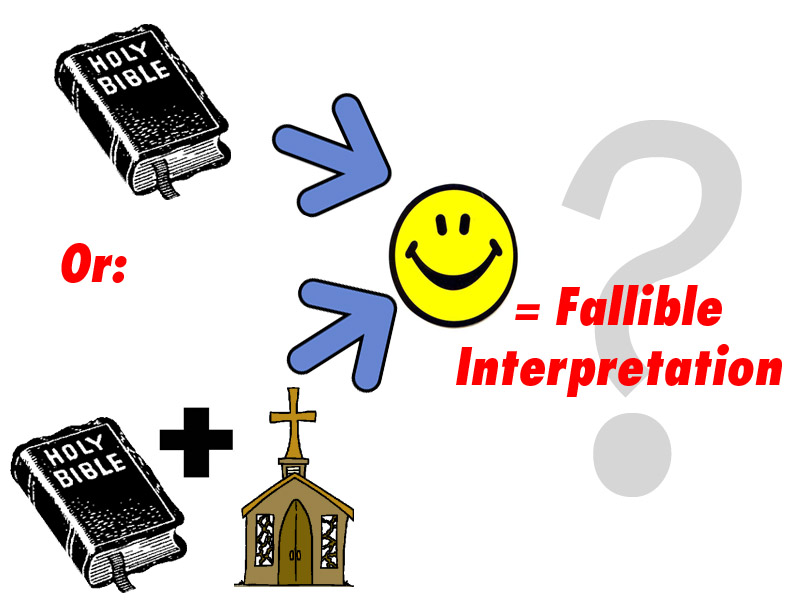
One problem with this argument is that it turns the question of infallibility into a question solely of individual epistemology. The question of whether the Church is infallible or not has a profound impact on our individual epistemology, but when we say that the Church is infallible, we’re not directly saying anything about individual epistemology. We’re making a statement about the reality of things. Suppose Joe and I are going to send Ted to the store to buy some eggs, but Ted doesn’t know how to get there and he’s not very good with directions. Joe gives Ted a map. I tell Ted, “In addition to the map, when you get to the first street, ask the baker to help you read the map. He never makes mistakes with directions.” Joe says, “The baker does make mistakes with directions because Ted can interpret directions wrong whether from a map or from a person.” Notice that Joe has denied my statement of the baker’s infallibility not based on anything related to the baker but on Ted’s ability to interpret the baker’s directions. The is the same error as someone denying the claim of Church infallibility based on individual fallibility. My statement about the baker can be true regardless of whether or not Ted is skillful at interpreting directions. It’s a separate question. Likewise, the question of Church infallibility is distinct from the question of whether or not it helps us achieve greater certainty.
Alternatively Joe could say, “The baker might be infallible but he won’t help Ted any more than the map because Ted is bad with directions.” Come on Joe! If Ted is bad with directions, I say we should give him all the help he can get! But it seems obvious that an infallible baker would help Ted find his way. Now is there something about Ted that makes it impossible to improve on his certainty any more than giving him a map? Let’s get back to the question of Scripture and Church and look at the argument carefully.
Here’s the argument. Scripture + Church is not better than Scripture alone because of man’s fallibility. So man’s fallibility is said to be the cause of Scripture + Church not being better than Scripture as regards certainty. Now God could have placed us in various states of infallible authority. Consider the basic three as follows. 1. No infallible authority. 2. Scripture only. 3. Scripture + Church. Now Protestants agree that 2 is an improvement on 1, but 3 is not an improvement on 2.1 But if man’s fallibility caused 3 not to improve on 2, then it would also cause 2 not to improve on 1. This is because, objectively speaking, 3 is better than 2 just as (and in the same way that) 2 is better than 1. A living authority that lacks the possibility of error and is capable of addressing any new question (along with the inerrant document) is better than only an inerrant document addressing a limited number of questions and unable to clarify itself. But if this fact is nullified by man’s failure to receive it infallibly because of something inherent in man himself (fallibility), then it can only be because the infallibility of any source is necessarily reduced to fallible interpretation by man. So objectively speaking, the Scripture alone (2) is better than no infallible authority (1), but in regard to man, 2 is not better than 1 because such infallibility (or inerrancy) is reduced to fallible interpretation in man. Sure, 2 might be better than 1 practically; Scripture is true and therefore sets us on the right path. But according to this argument it is not better than 1 in regard to certainty because man is a fallible interpreter. And yes, 3 might be better than 2 on some practical level, but not in regard to certainty. All infallible sources are reduced to fallible interpretations by man so nothing is really better than anything else as far as certainty goes. The moment we say that 3 is not better than 2, we simultaneously say 2 is not better than 1. And the moment we say that 2 is better than 1, we say that 3 is better than 2 (or would be if it was true). The Protestant argument fails because we all know and agree that 2 is better than 1. Therefore 3 is also better than 2.
Consider a practical example in the following situations. 1. Scripture alone. 2. Scripture plus personal and direct guidance from Jesus Christ whenever any question arises. (Let’s say you had His cell phone number.) Now is 2 any better than 1? According to the argument above, it’s not any better whatsoever as regards certainty of the true meaning of Scripture. It might be neat to chat with Jesus, but the solo scripturist in 1 has just as clear of an idea of the true faith as the person in 2 according to the argument we’re addressing. But we know that Jesus could not make a mistake in interpreting the Scriptures. So only a total skeptic could say that His living authority would not help us decide the correct interpretation of various Scripture passages. It is precisely this same living infallible authority that Catholics claim is at work through the Church.
Now the arguments above don’t prove that the Church is infallible. But they do show that the “you’re not any more certain than us” argument is fallacious. It does not refute the doctrine of Church infallibility because it does not address it. And it does not prove that an infallible Church does not aid us in certainty for the reasons given above. I also recommend Dr. Liccione’s post on the same subject from some different angles: Bad Arguments Against the Magisterium, II
When Protestants (or Catholics) make a claim about Scripture’s inerrancy, they are not making a claim about their individual certainty, but about the trustworthiness of the source. Likewise, when we Catholics claim that the Church is infallible, we are not making a claim about our individual certainty. We’re primarily making a claim about the Church herself.
- At least according to the argument we’re currently addressing. Many Protestants are fully aware that 3 would definitely be an improvement on 2 but do not believe it is true for other reasons. [↩]

Good article, and your point is well taken, however I want to comment on your presumption of what infallible means. Here you seem to imply the meaning is more about right or wrong than it is about infallibility. Infallible means that it is unable to fail, not that it is never wrong. The church is not infallible by the words of Jesus himself. In the letters to the churches in Revelation Jesus warns that if they do not change He will come and take their lamp stand way. In other words, they will fail. By this warning we must conclude that the church can in fact fail, and a simple look at history will show us that churches and leaders of churches fail all the time. Simply because there is a church called Catholic that remains one can not say that the Catholic church of today is infallible. As humans we all die, yet humans still exist today. So are we to conclude that humans can live for thousands of years? Of course not. And simply because there is a Roman Catholic Church we cannot conclude that the RCC is infallible either. It can fail if Jesus decides that it will, if he comes and takes the lamp stand. The question of being right or wrong is really secondary and only matters in our imaginations. Jesus is the judge and he alone decides whether or not we fail. We cannot go before him and demand our rights because we say we are right, we have the Bible, or we have the Bible and the Church. Our demands are futile. It is grace, not our righteousness by which we do not fail. It is not the church that is infallible it is the mercy and grace of our Lord Jesus Christ.
It is not Bible, or Bible + Church. It is Jesus + Grace alone. If we look to the Bible or to the Church for our justification, we are hopelessly lost already.
By your example you seem to be implying that if we only had the right information we would be home free. I would say that is a lie that the Devil would be glad to give us. Think about the Garden of Edon. What was it that the serpant was giving Eve? Was the serpant ignorant? Did the serpant not know the truth? Would Eve have been better off if the Serpant had better knowledge?
What do the words “Jesus”, “grace”, and the concept “Grace alone” mean, and where did you learn their meaning?
-Thanks
David Meyer
Wow, this article is really helpful. The first rebuttal is good but the one using Jesus on the cell phone is great! Storing away for future reference.
Here’s the argument. Scripture + Church is not better than Scripture alone because of man’s fallibility. So man’s fallibility is said to be the cause of Scripture + Church not being better than Scripture as regards certainty. Now God could have placed us in various states of infallible authority. Consider the basic three as follows. 1. No infallible authority. 2. Scripture only. 3. Scripture + Church. Now Protestants agree that 2 is an improvement on 1, but 3 is not an improvement on 2.1 But if man’s fallibility caused 3 not to improve on 2, then it would also cause 2 not to improve on 1.
Tim,
I was thinking that if an LDS person were reading your argument he might add in a #4 which would be Scripture + Church + Book of Mormon. Surely #4 would be an improvement on #3, correct? But of course that assumes that BOM is meant by God to be an infallible standard to further elucidate our understanding of God’s purpose for humankind. So while I think the LDS claim would make sense given where they come from, I don’t think you and I would have problems refuting the historical basis for the BOM claims. But the LDS claim would be valid if the historical basis for the BOM is correct. If it’s not then I would make the case that #4 is worse than #3 and I think you will agree here. So likewise your #3 being an improvement of #2 is correct if the claims for the infallibility of the tradition of the RCC are correct. If we cannot validate the historical claims for the RCC understanding of the tradition of the Church then #3 is worse than #2. And that’s why I tried to ground the discussion with the historical arguments for and against considering the tradition of the Church (as interpreted by the RCC) as infallible.
Now the arguments above don’t prove that the Church is infallible. But they do show that the “you’re not any more certain than us” argument is fallacious.
I’m looking at this from a different angle which is really more defensive than offensive. I got challenged by Mike L in the last thread (and many times before) on what the Protestant Churches could know concerning what we hold to be foundational matters. You have heard the argument and maybe made the argument too – We can’t know something to be true unless we have an infallible source to tell us it’s true. So for example, we are told that given our assumptions, Arius may have been correct about the Trinity. We cannot really know that the doctrine of the Trinity is correct because we don’t believe that the Church could err in her formulation of that doctrine. So is this correct? Well the way we go about demonstrating the problem of such an argument is looking at generally how Protestants and Catholics move from infallible to fallible interpretations. At some point the RCC makes fallible interpretations from an infallible body of knowledge. Not everything stated by the RCC is defined infallibly, agreed? But do you think that you can confidentially hold to something that the RCC teaches even though it is not defined infallibly? If so, then why is there the epistemological critique of the Protestant Churches as they move from infallible to fallible? We are saying that the Trinity as defined at Nicea is true even though we won’t say that Nicea could not have erred. If the Catholic can have assurance as to the truthfulness of what the RCC teaches in terms of non de fide matters, then why is there this epistemological critique of the Protestant churches?
So do you see what I’m getting at? I’m engaging in the fallible/infallible discussion not too show that the Catholic cannot be more certain, but to make the case that the Protestant can be certain, and that if the Protestant ought to be skeptical about knowledge fallibly defined so ought the Catholic to be skeptical about knowledge similarly defined (that is, in non-infallible terms) by the RCC.
The difference is that the Catholic acknowledges the Trinitarian formulations of Nicea as correct because the Catholic believes the college of bishops has been invested with the gift of infallibility such that it has the authority to define matters of the faith and bind the consciences of believers, whereas Protestants accept the Trinitarian formulations of Nicea because they have submitted Nicea to their own individual scrutiny and concluded that, on this matter at least, the council got it right. This is why Protestants can pick and choose among councils, or even within the canons of individual councils (which is why most Protestants don’t even know what else the council of Nicea or the second Council of Orange defined, and would disagree with it if they did know).
Sorry, I don’t think that was clear enough about “non de fide matters” specifically. As I understand it, our concern with “non de fide matters” is not so much about epistemology and propositional correctness, but obedience. The non de fide matters are matters of discipline that aren’t seen as “right” or “wrong” but prudent or imprudent. We obey the disciplinary rulings of the Church because it is right to submit to authority, even if we don’t understand or necessarily agree with, say, fasting every Friday during Lent. But we can do that in good conscience because the distinction is made between de fide and non de fide and we have scriptural and historical example of the Church binding the consciences of believers with matters that aren’t de fide. What we’re certain about is that God has commanded us to submit to our ecclesiastical authority in matters of discipline.
David:
This response of yours was spot on:
But what you say about “non-de fide” issues is not entirely accurate. They do not include just disciplinary matters; they include doctrine that does not meet the conditions on infallibility. Rather than get bogged down in examples here, I shall just quote Vatican II:
Now since the bishops only speak infallibly as a whole, and only under certain conditions, not everything taught by the bishops, including the pope, meets the conditions on infallibility. In the case of the “extraordinary” magisterium, which is exercised when general councils or popes issue dogmatic definitions, the conditions on infallibility are crystal clear: the bishops and pope are always infallible when exercising the extraordinary magisterium. But not infrequently, it is unclear when the “ordinary and universal” magisterium (OUM) of the bishops is being exercised infallibly. It is generally the task of theologians to clarify the matter. But sometimes they don’t, because theologians often err, either by treating as matters of opinion some doctrines that have actually been infallibly taught by the OUM, or by treating as if they were irreformable some doctrines that are ultimately matters of opinion. In cases such as these—at least when the issue is of great pastoral significance—it is up to Rome to clarify the matter. That’s what happened in the case of women’s ordination in the 1990s.
Best,
Mike
Thanks for clarifying that for me!
Dan,
Thanks for the comments. This post is not a defense of Church infallibility; that will come later. My only intention was to refute a particular argument that is often used against Catholics regarding the relationship of individual certainty to infallibility of source. I am not claiming to prove Church infallibility; I am arguing that if it were true, then it would improve our individual certainty of the accurate interpretation of the Catholic faith.
You said:
This is confusing the Church with a particular congregation. Jesus did not say that the Church (as Church) i.e. His Bride, i.e. His mystical Body, would fail. We do believe that individual congregations can and have failed in the faith and in so far as they do, they cease to be perfectly united with the one, Holy, Catholic and apostolic Church.
This is a pretty dismal outlook on the faith brother. And where are we to go if both Bible and Church will lead us astray?
What did I say that made you think that?
Andrew,
I agree with a lot of what you said. In addition to what David said above let me add a thought. You said:
The argument I’m addressing is one that says that the Catholic position (if true) is not any improvement on individual certainty. I agree with you that if the Bride of Christ is fallible then fidelity to her would not improve on individual certainty of the true faith. If all you mean is that Protestants, in virtue of having the Scripture (and reason and the academy) are more certain of the true faith than those who do not have the Scriptures, then I agree that you are right. But that is not how the argument is typically presented to us and that’s not the view that I’m refuting here.
If all you mean is that Protestants, in virtue of having the Scripture (and reason and the academy) are more certain of the true faith than those who do not have the Scriptures, then I agree that you are right. But that is not how the argument is typically presented to us and that’s not the view that I’m refuting here.
Tim – First I agree with you that Catholics ought to be more certain of a doctrine defined via the teaching authority of an infallible Church, IF God intended for the body of data known as the tradition of the Church was meant to understood as infallible, as per the qualifications of the RCC. But of course that’s a very big IF – it’s where the apologetic rubber really meets the road.
The way that the Catholic apologists generally present the matter to us is that we cannot be certain of many truths (like the Trinity) if we don’t believe that the specific formulation of these beliefs was promulgated infallibly. It’s these kinds of arguments which I find interesting since Catholics well as Protestants hold to many truths firmly although they are not defined infallibly. Both ecclesiastic communities have times at which they cross over the wall, so as to speak, when they move from infallible to fallible, but they cross over at different points. If Protestants cannot be sure of some doctrines that are not defined infallibly, what of those doctrines in Catholicism that are sententia fidei proxima or matters of less certainty? What if the same critique aimed at Protestants is brought to bear on these kinds of doctrines?
Has anybody read Doug Wilson’s little booklet Persuasions: A Dream of Reason Meeting Unbelief? In it a character called Evangelist engages a variety of unbelievers in discussions about the Christian faith. Here’s an interesting section regarding the Bible and multiple interpretations:
Thoughts anyone?
Jason,
Look at the last part again:
Notice he uses the word ‘variable.’ He is using a scientific method, which is limited, instead of thinking deeper as a philosopher. Instead of looking for the variable, he should have asked “What is the cause of the variation?” The cause of the variation is not only in the men, but also in the Bible, because what is being observed in the room is relational, between men and the Bible. In other words, the cause of the variation in interpretations includes both the interpretive limitations of the men and the degree of perspicuity of the Bible. So, given [only] the nature of man (even regenerated man), and given the nature of the Bible, the interpretive disagreement is unavoidable.
Notice here that the “Evangelist” contradicts himself. He tells them not to “trust those who are the source of the problem” but then urges them to trust themselves in “stay[ing] as close to [their own interpretation of] the Bible’s teaching as [they] can”, as if they are somehow a much more trustworthy sub-species of humans than those other humans who are the “source of the problem.” Or, he is implying that when other people read and teach from the Bible, they are interpreting it, but when you read it for yourself, then you somehow aren’t interpreting. That human factor that causes the variation throughout the room is magically circumvented when you trust your own interpretation, or when each mean trusts his own interpretation. The “Evangelist” doesn’t seem to realize that each man trusting his own interpretation is precisely what produced the 100 different interpretations in the first place. So having each man trust his own interpretation doesn’t avoid the problem; it just conceptually sweeps it under the rug.
Not having recourse to Apostolic succession, the “Evangelist” doesn’t have any other choice. But the Catholic does. Recall that earlier I said, “So, given [only] the nature of the Bible, and given the nature of man (even regenerated man), the interpretive disagreement is unavoidable.” When Apostolic succession is brought into the picture, the intrinsic hermeneutical problem is resolved. In trusting the Apostles and their successors we are not trusting men who have no greater authority and equipping than ourselves. We are trusting those whom Christ supernaturally authorized and equipped to teach and interpret Scripture for His Bride, until He returns. They have a charism that we don’t. In trusting them, we are not ultimately trusting in the interpretive power of men (either ourselves or others no more authorized and equipped than ourselves); we are trusting Christ.
“The one who listens to you listens to Me, and the one who rejects you rejects Me; and he who rejects Me rejects the One who sent Me.” (Luke 10:16)
In the peace of Christ,
– Bryan
Jason,
I have read it and enjoyed it. It gives some very smart answers to common complaints against Christianity. It is similar to his book Easy Chairs, Hard Words in that it is in a conversational style, so it is super readable and keeps your interest.
The passage you quoted seems really like one of those canards thrown out by unbelievers that Doug does a good job addressing in his answer. His answer is by no means meant to address believers who are differing in opinion though. It does nothing to address the problem I am struggling with at the moment for instance. We can all agree that whatever Scripture says is infallible and that it only says one thing, yes. But what is it saying? Should we be satisfied with a least common denominator Christianity? So as not to hijack this thread you can read more of where i’m coming from here if you wish.
Peace,
-David Meyer
I don’t understand this. Why is this a canard? Jesus said in John 17 if we have unity then the world will know that Jesus was sent from God. If we disagree on almost every doctrine and almost every liturgical practice then people are not going to see much evidence of the supernatural in that. So when unbelievers declare that to be so they are throwing out a canard? I think Bryan’s post shows how Doug Wilson’s response is a canard. It works rhetorically but it does not hold up to logical scrutiny.
What he is really saying is completely undefendable. He really wants this group to accept his interpretive framework for the bible. When he says “the solution is to stay as close to the Bible’s teaching as you can” the understanding is that he will help then discern what the bible is really teaching. He will form them into his tradition. What he thinks is the Bible’s teaching. It is a bait a switch. You claim to offer the word of God and really offer human tradition. He does not realize it himself. But his own tradition is all he has to offer.
Randy,
I think David is right to call it a canard as coming from an unbeliever. The reason is that the unbeliever is using the argument to reach an entirely different conclusion than a Catholic or Protestant would. We have already accepted the fact that there is an absolute and objective truth and that it is revealed in God’s Word. But the atheist uses the argument above to reject truth altogether or to claim that it is unknowable. It is false reasoning on the atheist’s part.
Wilson’s argument is ultimately inadequate, as Bryan showed, but the atheist’s argument is still a canard; I mean in fact it’s just a terrible argument. It’s like saying – I don’t believe that New York City exists because there are many roads that claim to lead there and there’s no way to know which one to take. That’s how bad of an argument the atheist is making.
Now we don’t say that Protestantism is false because people disagree about it; we say it is false for a variety of reasons but one reason is precisely this epistemic uncertainty where certainty ought to be. There are places where uncertainty might be expected, such in non crucial and highly technical theology. In that case, demonstrating uncertainty there is not a strong argument against a group. But if the group is uncertain on its very foundation, [e.g. the canon] then such lack of certainty is a strong argument against the validity of that group. Protestants cannot demonstrate the sort of requisite certainty in their canon, (on which they believe the faith is based), nor in Luthers novel reading of justification in Scripture, etc. This is a strong argument against Protestantism.
So to re-cap, we (and plenty of others) have made this sort of argument showing the deficiency of Protestantism and argued that, having Apostolic Succession and an infallible magisterium, we are not subject to the same inconsistency. The strongest (and maybe the only) rebuttal, to date, that I have seen is this: “an infallible Church wouldn’t help you be any more certain than us.” This post is an attempt to refute that rebuttal.
Randy,
The canard is the statement “Anyone can read the Bible and get whatever interpretation he wants from it.” Perhaps canard is a bad way to describe it , but it is a stupid response to someone reading a passage of any book to them, not just Scripture. The fact that people disagree about what the Bible means does not in any way mean that they are justified in rejecting it as uninteligable or that the source material is wrong. the rest of what you said I agree with. I would say it like this: I think that Doug’s solution to the disagreement of interpretation amongst believersfalls flat and is very canardy. “staying as close to the Bible as you can” just puts you right back at square one of personal opinion, I get it. The “good job” he does is just pointing out that the FACT of disagreement doesn’t mean people have an excuse to reject the material.
Augustine and Pelagius disagreed about what Scripture said. This does not show that Scripture is unreliable.
I do think that scrutiny of the protestant position can lead to atheism. I think Newman said he felt only atheism or Catholicism stood up to his analysis of history. That is starting with the premise that if there is a God and He is revealing Himself to man then that revelation would have certain characteristics. One key characteristic was that it would not self-contradict. That there would be an identifiable arc of truth that was uncorrupted by time and culture. That if there was no such thing that would be a good argument for atheism. That all religious truth would have the character of being natural rather than supernatural in origin. He argued Catholicism fit the bill and the protestant Christianity did not.
Anyway, that is what I hear in the “everyone reads the bible differently” argument. Often they are truly seeking some truth about God. Sure there are some that are just looking for an excuse to reject Christianity. But many honestly find the different answers they get, especially to moral questions, to be a sign that maybe the whole thing is questionable.
Hey Folks,
I would like to offer some thoughts about the nature of theology itself as it relates to the epistemology questions under discussion. It seems to me that when we are arguing about de fide, we are generally (not always) arguing about matters known only by supernatural revelation as opposed to truths which might also be attained through natural reason.
It seems to me to be a very subtle and common tendency when discussing theology to forget that the supernatural “revelation” we are the recipients of is God Himself, not primarily, “propositional truths” about God. The propositions flow later – as an after effect – out of the direct encounter with God. The object of theology is the Trinity, not propositional compendiums about the Trinity. Suppose you have the opportunity to go to the most fabulous destination in the world – the site of utmost temporal fulfillment. In order to insure your safe and successful passage to the destination, others who have traveled there ahead of you present you with a highly detailed map. However, imagine that you become so enamored by the map itself, and the discipline of cartography generally, that you lose site of, or even interest in, the destination. Theology is the map, the existential encounter with God is the destination. The map (theology) says turn this direction – not that, bank left, not right – its essential, but the goal is to secure safe passage to the destination Himself.
Failure to reach God due to excessive preoccupation with propositions about God would be a great tragedy – and I wonder sometimes if it is not a tragedy that has befallen some academic theologian – I know it is a constant temptation for me. One can even ask whether one can truly fulfill one’s role as a theologian if this situation becomes habitual. Consider that in both modern day Protestantism and Catholicism, “spirituality” and “theology” are often treated and taught as two distinct disciplines – you can get a PhD in Theology or a PhD in Christian Spirituality – there is something intuitively wrong with this situation in my mind. A common profession of the Fathers is “lex orandi, lex credendi” – “the rule of prayer is the rule of belief”. My experience is that the depth of the Father’s theological insights seem somehow proportioned to their sanctity.
This distinction between God and propositions ABOUT God helps explain why there is necessarily a “development of doctrine” throughout the history of the Church. God’s covenant people are not relating fundamentally to a set of propositions, but a Person. It is a lived encounter, experienced within a communal context. Since we possess finite intellects, it is necessary from time to time to express, propositionally, in words, the content of that experience. Sacred scripture, and especially the Gospels, are a unique and normative instance of just this process – a propositional account of a direct encounter with Jesus Christ. But no set of propositions can adequately express an encounter with God, or capture the totality of any self-revelation that He deigns to divulge. In fact, it is impossible even to propositionally exhaust an encounter with another finite person much less God.
When I first meet John, I can come away describing his height, eye color, skin color, etc. – and the propositions would be true – but they would not be exhaustive. I might learn that John speaks well in public. Upon spending more time with John I may discover that he can speak both English and French. The more time I spend with John and the deeper I reflect on our encounters, the more precision accrues to my description of John – but none of these later discoveries will in any way invalidate the truths I learned and expressed about John earlier in our relationship. No matter how much time I spend with John, and no matter how much I express my understanding of John in words to others; there will always be more to know about John – deeper recesses of his being to discover – discoveries that can once again be expressed propositionally.” A fortiori with God.
This process I take to be the very essence of what Catholics mean by “doctrinal development”. The Holy Spirit poured out at Pentecost upon the Church, serves as the animating force, century after century, which actualizes and deepens the Church’s encounter with the Risen Lord. As the centuries go by the Church, from time to time, has need to express the content of that encounter propositionally – this becomes the documentary source material for theology. This is also why the precision and distinctions expressed in propositional form increase with the centuries – as the Church’s encounter deepens over time among the tumults of history. Since the propositional statements expressed over the centuries all relate to the same Person, they can never be in irreconcilable conflict with each other– they must be “developments” representative of a continuing and deepening of a living encounter (one might eventually discover that John speaks German, but having once expressed the fact that he spoke French, one can never truthfully say later that John never spoke French at all). Thus, in a real way, the propositional content of revelation accruing among the covenant family – sacred scripture first above all – and solemn definitions thereafter – serve both to inform and illumine future propositions. The very nature of personal relationship establishes an alternation between living encounter and propositional expression of the content of that encounter. Yet, since God, in His Person, is quite literally inexhaustible, and we as finite creatures grow and learn by a dynamic process of encounter and intellection; it stands to reason that the Church’s encounter with God and her expressions of that encounter will continue to develop and deepen until the eschaton.
This is why criticisms of the Catholic epistemological situation strike me as ill founded. The ongoing dynamic between the existential encounter of God facilitated by the Holy Spirit among His covenant people on the one hand; and the propositionally expressible content of that experience formalized by the God-ordained spokesman of that family on the other; is exactly fitting to the realities of a living relationship between God and man. The encounter of God within the covenant family is expressed propositionally by those authorized by God to speak for the family.
For a while such expression are sufficient to maintain family stability. When the clarity and precision of existing propositional expressions become insufficient to maintain stability; the family spokesmen step in to synthesize, clarify, and restate the content of her lived experience once again. And so it goes to the end of the world. What holds this dynamic process together in continuity and makes its content something that can be located by men in the course of history? The visible dimension – the historically visible dimension – of the new covenant family. The Church – the covenant family – is the widest category of divine revelation – she is the meta reality through which the self-revelation of God is encountered and expressed in history. A living Magisterium, within the dynamic of a visible living family is just what is needed to propositionally express the living encounter with the living God – as a continuity that is accessible to persons separated by both space and time.
Just food for thought or comment
Pax et Bonum,
-Ray
I didn’t realize it, Bryan. But you’re absolutely right. In this short bit of text, the author calls into question man, identifying him as the “source of the problem.” Then immediately he appeals to man as the one capable of staying “close to the Bible’s teaching…” Thank you for shedding light on this strangely easy-to-miss case of (unintentional) philosophical sleight of hand.
Ray:
Bravo!
Just a few observations. First, the bifurcation between “theology” and “spirituality” that you decry is also decried by the Orthodox, who don’t suffer from it to nearly the same extent we do. Catholicism has suffered more from it due to the legacy of scholasticism. But a lot of people recognize the problem, and Catholicism has always had people, especially the saints, who get beyond it.
Second, Internet discussion of religion tends to draw people who enjoy debate, which is usually about propositions. And so sites like this can give people the unfortunate impression that theology is all about debating propositions. It isn’t just that, of course; but defending the Faith typically involves that, and we naturally find ourselves doing a lot of it here!
Best,
Mike
I think the Protestant argument is that adding an infallible Church does not put you in a fundamentally superior position at an epistemological level. The argument is not that further infallible sources can’t in theory offer the possibility of help, the argument is that you aren’t automatically more certain merely because you have inserted an interpreter between the text and yourself. To use the Baker analogy, it is not of necessity true that the Baker is clearer in his instructions than the map.
John,
Thanks for stopping by.
Yes. That is what I understand the argument to be.
Personally, I’d rather read a map than hear directions from someone. In fact, I’d rather read a 99% correct map than hear directions from an infallible source. The reason is because I (personally) am clearer on directions having seen nearly perfect directions than having heard perfect directions. Maybe this is similar to what you’re getting at? If so, it’s not relevant. If not, I haven’t understood what you meant.
The question is whether a live person with infallibility would improve on (not be better in place of) a perfect map. The answer is yes. (The Catholic doctrine is not Church instead of Scripture, but Church alongside of Scripture). An infallible Church can only add to the certainty of the believer. If you disagree, please explain how an infallible Church would not improve one’s certainty of the Christian faith.
John:
If the Protestant argument is what you say it is, it’s pretty weak. We all recognize that any given individual might find that a particular interpreter isn’t helping them become “more certain” about what’s being interpreted. That could hold even if the interpreter is infallible. But that might be just a problem with the individual’s comprehension or dispositions; when that is the case, it doesn’t follow that the interpreter isn’t offering something objectively helpful. All that follows is that, if the interpreter is offering something objectively helpful, the individual is not subjectively ready to be helped by it.
A weightier Protestant form of argument would be that an infallible interpreter cannot afford us greater certainty even in principle. The most common argument of that form runs roughly like this: “OK, so the Bible needs interpretation. But whether the interpreter is infallible or not, his interpretations require interpretation themselves, thus leaving the hapless believer in no better a position than before.” The problem with that argument is its failure to note the importance of the fact that the “interpreted,” in this case Scripture, is a fixed collection of writings that do not interpret themselves, whereas the allegedly infallible Magisterium interprets itself by clarifying and developing its own interpretations over time. Of course that process is never complete, nor could it ever be, given the subject matter. But it does help clarify things as we go. And that aids certainty, for those willing to acknowledge the infallibility of the interpreter.
Best,
Mike
I think the Protestant argument is a response to the claim that an infallible interpreter and an infallible interpretation is a requirement to have infallible doctrines. Whether adding another infallible source has clarified anything is more a matter of the facts of the case, rather than something that can be assumed. It’s like if you have Matthew, and then you add Mark, you may or may not have more knowledge or certainty, you would have to argue from the facts of the situation. You don’t have a knowledge of a different kind, or so the argument goes. You don’t have superiority at the epistemological level, though you might claim to at the factual level.
The idea that a Magisterium can address new questions could be argued to be an epistemological superiority, except it is tempered by the counter argument that individuals don’t usually have any ability to prompt a Magisterium to issue an infallible proclamation in response to your question. If the magisterium does issue a proclamation, then by the time it filters down to you, it is the same kind of written instruction found in scripture and may not be different at an epistemological level.
The more interesting epistemological responses might have to do with the canon of scripture, and whether the Church can offer epistemological superiority without actually invoking strict infallibility.
Dr. Liccione / Tim,
Yes this “strong” form of the argument for fallibility strikes me as rife with a sort of deep philosphical skepticism that is unjustified. Individuals gain real increase in knowledge in every day life by way of clarifying information (which might be a better way to think of the term “interpretation”). For instance, I ask my wife “what’s in the bowl – is it salad or pudding” – she says “its just salad”. I now know that the bowl is not full of pudding – but I can still ask a lot of questions about the salad, or even what salad IS. “What’s in the salad?” – she says “lettuce, carrots, pecans, and tomatoes”. Now I know more about the salad – not everything, of course, but at least this – whatever else this salad is, it cannot be described without admiting the presence of lettuce, pecans, carrots, and tomatoes. I ask “does it have cumcumbers in it?” – she says “no it does not”. I ask “are you serious sure [no cumcumbers]?” – she says “I most certainly am” (which is the sort of thing a Catholic looks for in a Magisterial definition to find out what level of auhority is being attached to the definition). Now my wife is fallible (please don’t tell her I said that!), but that is not the point. The point is that from the fact of MY fallibility, my capacity for making mistakes, it does not follow that I generally have any problem understanding and applying clarifications and distinctions provided by another – and so long as I have access to that person, I always have a means by which to clarify some point of their communication about which I am unclear.
When considering scripture, by and large, the argument is not over what words are actually in the text. Despite some translation quibbles (and prescinding from the Canon problem), Protestants and Catholics can agree about what words are there – the trouble comes when an attempt is made to clarify the MEANING of the words. Even here, Catholics are not arguing that everything in Scripture is just hopelessly inscrutable without a living infallible interpreter – “thou shalt not murder” is a biblical moral principal that is clear (I think all would agree) from nearly any individual reading of the text itself (even if we might disagree about how it ought to be applied in every context – say Just War debates, etc.). We can go further, even those passages which have been the source of debate, are debatable just so far as they admit of the possibility of further clarification – but such passages, from a reading of the text alone, already provide some level of clarification by way of exclusion or negation. For instance, in sacred scripture we read that Jesus Christ is the “Son of God”. Nobody argues that these words are not in the text. Nobody argues that our individual fallibility prevents us from gaining real knowledge from the words themselves without additional interpretive aid – we now know that whatever else Jesus is, He is not a false prophet.
Thus, the term “Son of God” tells us something just by way of exclusion or negating – we all know some things that the term “Son of God” does NOT mean. The arguments arise when trying to pry open the positive content of what such a term DOES mean – hence, the history of Christological controveries throughout Church history. So when an ecumenical council tells us that “Son of God” means “one in being with the Father, true God from true God” as opposed to the Arius’ theory that it means some sort of super-glorified creature; our fallibility does not prevent us from learning something by way of further negation – we now know (assuming we accept the authority of the council) that “Son of God” cannot mean a finite creature – another possibility has ben excluded. But there persists an unclarified remainder – “what does it mean to be one in being with the father?” – that admits of further possibility for clarification – and so on.
So I think the principal problem with the “strong” form of the argument that Dr. Liccione presented for our consideration is that it is built upon a serious ambiguity. To say “his [infallibile interpreter]interpretations require interpretation themselves” Is to fail to recognize the difference between the knowledge that is gained from an interpretive clarification by way of negation versus the positive content of said interpretation which admits (indefinitely in the case of God) of further interpretive clarifications. This, as I indicated above is why the ongoing, dynamic, Catholic epistemelogical outlook makes so much sense (at least to me).
Pax et Bonum,
-Ray
John,
I’m not clear on what you mean here. I take it from the rest of the paragraph that you don’t think adding books to the bible increases certainty of the faith. If this is what you mean, it is manifestly false because if you took any book of the bible and considered it alone, it would be obvious that adding the remaining books would increase your certainty of the faith. Suppose Jude was the only book Joe had. Ted has the whole bible. Who is more certain of the faith? I think you’re saying that Ted has more information but isn’t any more certain. But according to Protestants, difficult passages are to be interpreted in light of the easier passages. The more passages you have, according to this principle, the more certain you’re likely to be of the correct doctrine. Therefore increasing the quantity of infallible (or inerrant) sources increases ones certainty by some amount.
This doesn’t suffice as a counter argument. If we knew that there was one (and only one) infallible statement made by the Church throughout history, this would, by itself, be an improvement on certainty over the Scriptures alone (particularly if it were over some difficult issue – say the Trinity). Your argument can only say that “it doesn’t improve it much.” (Which is false; we can get into that later if needed) But your argument does not show that an infallible magisterium does not improve individual certainty.
No it is not the same kind. The Scriptures are God-breathed, a quality that even the infallible declarations of the magisterium do not possess. Your argument here is refuted by the principle above, that even increasing infallible documents of the same kind would improve certainty. The deficiency of your argument here is multiplied considering that the magisterial documents can and do address contemporary issues, within the context of current controversies, and use a voice from within one’s own culture. This is an incredible increase of certainty.
I’m not sure what you mean here.
Dan –
Thanks for the insightful comments. I think you’re absolutely right that the Protestant argument is built on a deep philosophical skepticism. I don’t like to toss that accusation out too quickly, but in this case, it is directly fitting.
Dan? :>)
Oops! I meant Ray. Hah – I’m too young to be getting confused like this.
John (#25):
You’re not framing the Catholic claim correctly, hence you’re not framing the Protestant counter-argument correctly. Catholics acknowledge that the Bible, being divinely inspired, contains divinely revealed truths of faith, apart from the interpretive rulings of the Magisterium. It’s not as though an infallible interpreter is needed, just as a matter of logic, for us to have been given divinely revealed, and thus irreformable, truths of faith. The Catholic claim is, rather, that an infallible interpreter is needed for us to understand those truths in a way that yields something more than opinions about what they mean. True, one cannot assume that interpretive rulings by the Magisterium will always, as a matter of fact, clarify such truths for a given individual. But one can reasonably conclude that, over time, the interpretive rulings of the Magisterium clarify the deposit of faith for those with the dispositions to receive them as such.
For instance, the New Testament makes clear that Jesus has a unique relationship with God, whom he calls ‘Father’. Over time, the Magisterium made clear that Jesus is the same God as the Father, eternally begotten by him, while also a different person from the Father. How a different person from the Father can be the same God as the Father is not all that clear to us; but the statement that it’s so is itself a clarification of the biblical message that Jesus is the Son of God. Now if the interpretive rulings of the Magisterium at such a level were just fallible opinions, then we would thereby be given no reason to believe that the biblical message is clarified by them. For such opinions might be wrong, and and thus replaceable by others, incompatible with them, that might be better clarifications of the inerrant biblical message. Conversely, if interpretive rulings at that level are divinely preserved from error, then we can be sure that we understand what is meant by the biblical truths we already affirm as divinely revealed and thus inerrant.
Accordingly, the Protestant counter-argument would have to be that we can understand the biblical message without an infallible interpreter to the same degree that we could understand it with an infallible interpreter. Now in one sense, that argument is correct. It is logically possible, under the guidance of the Holy Spirit, for a given individual to come to know the content of the deposit of faith just by reading the Bible themselves. But the Catholic claim is that, without an infallible interpreter, neither the individual nor the Church at large can come to know the content of the deposit of faith as anything more than a set of fallible opinions about what a given book means. It is a question, not of the content, but of the authority by which the content is received.
Best,
Mike
John and Andrew M. raise similar questions.
John (#25) writes:
And Andrew M. (#11) writes:
I am particularly interested in what is meant by “epistemological superiority” and “sure” / “certain.”
A fallible Church, employing numerous scholars to come up with the best rational explanation of an (empirically) heterogeneous set of ancient documents, has more cumulative intellectual manpower than a solitary person–obviously. Is this is what is meant by “epistemological superiority”? And is Protestant doctrinal “certainty” relative to the power of the scholarly magisterium to compel assent?
Of course, this sort of magisterium (historical-critical scholarship), being fallible, can only compel the assent of reason. It cannot call for the assent of faith, based upon supernatural authority.
In the case at hand, historical–hermeneutical reason regarding ancient Semitic documents (whether some of these documents are especially sacred, as in the “word of God,” is yet another theological question that cannot be resolved by reason alone), the interpretive conclusions of scholarship, especially where those conclusions go beyond the empirical and touch upon matters theological, are bound to be somewhat tentative. This is particularly evident when theologically fundamental questions are addressed to a set of texts, which questions are not, in their concrete form, raised in those texts; e.g., Is abortion always gravely immoral? Is Jesus Christ consubstantial with God the Father? What is a sacrament?
The assent of faith, however, is not tentative. Nor is the life of faith. If we grant, and the Catholic Church does indeed grant, that non-Catholics do have faith in Christ, despite having (explicit) recourse to only the fallible magisterium of scholarship, then the question that emerges is, “How is this (enjoyment of the certainty of faith by Protestants) possible?”
I think that this question is maybe in the same ballpark as Andrew M.’s and John’s questions. I have some idea what the answer is, based in part on past experience, which I describe here.
As for Catholics and the assent of faith, well, I cannot do better than to copy and paste bits of Ray Stamper’s comment (#19) above, which is excellent in itself and also happens to admirably summarize one of the major arguments hitherto advanced at CTC:
The living and historic Church is the vital epistemic connection between the world of theological discourse in the ancient Near East (the [original] world of Sacred Scripture) and the rest of history. The Church is an epistemic connection because the Church has a mind. The Church can speak her mind, at all times, because she has been gifted with an enduring and visible head. The Church speaking her mind is a source of unity in truth because the Church cannot err when she speaks her mind, and the Church cannot err when she speaks her mind because her’s is the mind of Christ.
Ray S. your #19 is extremely helpful to me. Thank you. This hit home:
Your further explaination of how doctrinal developement takes place made sense to me for the first time when you pointed out the difference between expressed propositions about God, and God himself. So simple, but easily glossed over by those (me included) who study the propositions to enrich their understanding of God. It seems to me the true church should have these two in balance without conflating them or excluding one or the other. Sola Scriptura tends toward the propositional side of this balance if not completely conflating the two.
Peace,
David Meyer
David,
I am glad the post was helpful. I would like to point out to you and any others who might be interested in the issue of “development of doctrine” or the wider question of “doctrinal epistemology”, that the ideas I expressed are not my own. They are drawn principally from two seminal Catholic works which I simply cannot recommend highly enough – they were game changers for me. These are:
Cardinal John Henry Newman’s: “On the Development of Christian Doctrine”
but above all
Cardinal Yves Congar’s: “Tradition and traditions: the Biblical, Historical and Theological Evidence for Catholic Teaching on Tradition”
(Note: This work is heavy duty, but it is not a polemic by any stretch – it is especially powerful because of the deep sympathy Congar has for the core Protestant concerns – the authority of sacred scripture and the concern that the Catholic approach undermines and violates the sacred text by establishing what amounts to an autonomous Magesterium)
Both of these works, but especially Congar’s, get to the absolute sub floor of what separates the Protestant and Catholic approach to divine revelation (there is truly a mind-set/paradigm gap at play) – and the fundamental attitude toward “living Tradition” is at the root of this difference.
Many contributors here at C2C have crossed the Tiber after having spent years in Reformed circles, and after having read deeply among the very best theologians within the Reformed tradition (works by luminaries like Mathison are a good example). IMO, if our Protestant brothers and sisters could find the time to read deeply among such Catholic luminaries as Newman and Congar, I think the effectiveness of our intechanges would be greatly enhanced. If for no other reason than that we will more readily hit upon our most underlying points of departure.
Pax et Bonum,
-Ray
This may not be the best place to leave a comment like this, but I have a Catholic friend who has been sending me here and corresponding quite a bit about the discrepancies between Protestant and Catholic Dogma/theology.
Anyway, my question is concerning epistemology. In my dialogues with my friend, he has been pressing me on the issue of “how do know with certainty specific truths.” LIke the question, “how do you know what belongs in the canon.” Holding to Sola Scriptura, he claims that I contradict my own theology by appealing to intrinsic and extrinsic evidence to establish any unspecified amount of certainty. I disagree with this point while acknowledging that what is known as “solo scriptura” may be guilty of something similar to what he is saying. At any rate, this is not my question. This is only a bit of framework, and hopefully it is not too ambiguous.
I’m going to ask a couple of easy questions that have easy answers, at least on the face of it. These questions will reflect the sort of questions that I am being asked, and hopefully these questions will demonstrate the depth of philosophical and epistemological assumptions that are being made.
Questions:
Is the world round or flat? How do you know?
Answer: the evidence proposed from reliable sources lends more credibility to round than flat, and therefore I believe that it is round.
Problem: how do you know that you interpreted the evidence rightly? Which are the reliable sources? How do you measure credibility?
The problem is really based on the difficulty of the epistemological process. Do we formulate “true” truths, and when we do, how do we know? And how do we formulate “false” truths?
It seems to me, that we could question our ability to recognize truth even, when using the 4 rules of logic (law on non-contradiction, law of identity, law of excluded middle, law of rational inference). We could question our ability to recognize truth on the basis that others, who are using the laws of logic (at least think they are), still come up with different conclusions. How can we be “totally certain” that we are thinking rightly, and “the other guy” is not?
Now, these questions of epistemology make the question “is the earth round or flat?” very hard to answer, even though the question itself and the evidences for it are quite easy to analyze and decide on. Someone could say, “Aristotle was smarter than you, and knew how to employ logic much better than you, and he believed the earth was flat.” (I know he looked at different evidences, and that I perceive truths that he has not accounted for.)
So, the canon question. How do I know that the 27 books are the right ones. I supply a good amount of external evidence and then you ask, how do you know that the evidences are are actually accurate? I have a decent amount of certainty with regard to these evidences just not a “infallible certainty.” For some reason this is not satisfactory because then you ask, how can you determine what evidences are accurate or not. By rules of logic I say.
Then you say, “Why do people who employ these rules reach different conclusions.”
I say, they made logical mistakes, used different evidences, or did not have enough evidence, or did not “perceive” truths accounted for by the other opposing party.
Then, y’all say, “well how can you know you have truth if there is so much disagreement?”
My point is that individuals do not have the epistemic abilities to reach what I call “infallible certainties.” (I’m not saying that the magesterium can’t–though i do not believe they can or do. Whether they can or can’t is not my point.) The Scriptures, and possibly the magesterium can hold to things with infallible certainty. BUT, My individual belief about the scriptures or the magesterium cannot be an “infallible certainty.” I’m not capable of such a certainty on an individual level.
I think the Catholic response would be “that is what the magesterium is for.” But, what your asking for me to do is to trust in something that contains infallible certainty even though I cannot have an infallible certainty about it. And, my problem is this: that is what I do with the scriptures, I hold to them without infallible certainty and I get a lot of negative feedback for it. I have a reasonable amount of certainty as to the authenticity of the 27 books of the NT, as I do on all of the doctrines that I hold. You all say that it is insufficient to refrain from the infallible certainty of the doctrinal positions put forward by the magesterium, even though my faith in the magesterium is in itself a “fallible certainty.”
My concluding point is this: I have a reasonable amount of certainty that the 27 NT books are the right ones and this certainty is NOT determined primarily by the Catholic church’s decision itself. I have a reasonable amount of certainty to reject the Apocrypha as scripture and so on. Although, I don’t have an infallible certainty in my personal beliefs about anything as true. (because I am fallible)
This is totally consistent with Sola Scirptura and it isn’t self-defeating. The apologetic questions of “by what authority do we determine the canon”, is ultimately reduced to difficult questions of epistemology and not basic considerations of evidence.
Also, this is not the Tu Quoque arguement. If anyone thinks it is, then I am not communicating this very well, or I am completely misunderstood. I plan to develop these things much further.
“How do I know that the 27 books are the right ones. I supply a good amount of external evidence and then you ask…”.
I’m not convinced. Could you outline briefly your “good external evidence” that 3 John is one of the “right ones”. I’d be curious what you consider to be good in this context. It might give material for discussing it further.
Josh,
This is not a response to your post. I expect that someone will respond to you thoroughly. I have a question:
Let’s imagine that someone says, “I have a reasonable amount of certainty that the 25 NT books are the right ones”.
How would you reply to his or her alleged “certainty” since you have 27?
(I recommend St. Thomas Aquinas on the Relation of Faith to the Church. Also you might be interested in my guest post: The Canon Made Impossible: Ehrman, McDowell & an Unlikely Agreement where I talk about certainty, epistemology and the cannon of Scripture)
Peace to you on your journey
Josh,
I’m going to reproduce parts of a post I recently submitted on another thread. I would like to get your thoughts on it. I am a Protestant currently considering the claims of the RCC.
Let’s assume for the sake of argument that we can prove beyond doubt that Catholic priests really are worshippers of the pagan deity Dagon, that Popes and Councils have contradicted themselves repeatedly, and that perhaps only a few Catholics might be saved in spite of their apostate religion. This proof would have no bearing on a Protestant’s ability or inability to define heresy vs orthodoxy and schism vs unity. I would like to hear a positive argument for the Protestant’s means of defining which doctrines are essential, and then the orthodox interpretation of those essential doctrines. Then, a positive argument that either explains why the concept of schism is unimportant, or, if it is important, how a Protestant can define it and recognize a schismatic.
For example, is denial of the necessity of infant baptism heretical? Is belief in any role of works in salvation heretical? Is contraception a sin? Is sodomy within marriage a sin? If an elder from my church leaves and starts his own church, is he a schismatic? Why or why not?
Assume we have already proved that the RCC is apostate and not even in contention as a viable alternative, so negative arguments against Rome are, in this scenario, completely irrelevant.
Whenever I ask this question, I get a run-around. If many Protestants wrongly become Catholic because of a felt-need for a certainty that doesn’t exist, then what degree of certainty is necessary and why? How do we arrive at it?
Burton
Just to clarify. I’m not arguing that it is unreasonable to believe the magesterium.
I’m arguing that a reasonable amount of certainty regarding the NT books is warranted and that most of the Catholic arguments used to undermine this credibility, apart from the magesterium, are actually epistemological questions and do not accomplish what is intended.
The Catholic arguments do show the seeming advantage of having a magesterium, if it is true; and that i concede. ( I said seeming because, I would see an advantage in Jesus staying rather than leaving, and be at odds with God on the
Matter.). This, though, is not my question.
My Question is defensive.
How can you have reasonable certainty about the books without reasonable certainty about the criteria for including a book? And how can you have reasonable certainty about that with a Protestant epistemology, since it is not documented anywhere?
For example, let’s say we are satisfied to accept all the tradition that comes down to us about Luke being a friend of Paul etc. That doesn’t make what he wrote to be inspired by God and infallible. It might make it a somewhat reasonable account of what went on, but it wouldn’t make it scripture.
How do you make the jump from accepting what tradition says about books on a factual/historical basis to saying it is inspired by God?
John,
I wiill. I’m writing this on my iPhone so it will not be full sentences:
Eusebius said “they are well known and accepted by most.” (H.E. 3.25.2-3).
They were taken into the “catholic (canonical) epistles” (H.E. 7.25.7,10).
Athanasius included them in 367, then they were reaffirmed at Hippo, then again at Carthage.
At the reformation, cajetan questioned their authorship and Erasmus their tradition; no one questioned their canonicity.
This is enough to post. These things give me a reasonable amount of certainty of their authenticity.
Can I be infallibly certain? No, I can’t. In this or anything else for that matter.
So Josh, consensus = truth? That is your epistemological foundation of religious truth? Not criticizing, just wanting to clarify.
John
You asked, “How can you have reasonable certainty about the books without reasonable certainty about the criteria for including a book?”
Certain sources are more credible in different areas than others. For example, if Eusebius says that they were accepted by Athanasius, then it is reasonable to suppose they were. On matters of faith, like “who is God?” Eusebius is less reliable.
The same could be asked “how do you know that the evidences that the earth is round is reliable?” Answer that question. And then I can blow holes in your answers with epistemological questions. Try it shall we??
Luke was endorsed by Paul. Paul was endorsed by Jesus. Aside: what criteria did the magesterium/council use to decide your question.
No John, consensus doesn’t equal truth. Consensus is a factor to consider and weigh among other evidences.
I’m moving on to Brent’s question next.
I’m curious how you get to judge that Athanasius was reliable on certain subjects, and Eusebius is unreliable on particular subjects and reliable on others. I mean to sit back 16 centuries later and be able to pass judgement on that, that’s quite something, and I’m curious how one goes about that. I mean, as long as one is dropping famous names, Chrysostom rejected that book, and rejected a lot of books in the NT, being as he came from Syria, and the Syrian church never really accepted those books. So I’m curious how you go about saying Athanasius=good, Chrysostom=bad on this topic.
I mean, I don’t see the relationship to the earth is round thing. NASA says it’s round, and so they say, they’ve flown all the way around it. I’m not aware that Athanasius claimed to have some hotline to truth that Chrysostom did not have.
Luke was “endorsed” by Paul? Well, tradition says 1 Clement was written by the Clement mentioned by Paul in Philemon 4:3, and he was “endorsed” by Paul. How do you know “endorsement” makes it scripture? I’m sure Paul “endorsed” a lot of folks at various times. He no doubt appointed a lot of elders and so forth. I don’t assume that makes everything those folks wrote to be infallible scripture though. I’m sure a lot of those folks gave sermons that Paul endorsed, but I don’t assume that said sermons were therefore infallible. Why would you?
Josh (#35):
I suspect your thinking about these matters would benefit if you shifted your focus from “certainty”–a notoriously elusive concept–to the distinction between natural knowledge and supernatural faith.
On the natural level, we can and do attain knowledge by means of our human cognitive faculties without being infallible or even, in many cases, certain. We know, for example, that 2+2=4. But some people feel a twinge of uncertainty about that when they start philosophizing, because they imagine (wrongly) that such a formula might express a physical law that could change without notice, or ceases to apply at some deeper level of physics we are as yet unfamiliar with. So they know the truth, but aren’t certain the truth in question is secure. On the empirical level, take your example of Earth’s being spherical (you say ’round’, but of course it’s possible for something to be both round and flat, like a coin). We know that to be the case, because the accumulation of evidence over the centuries has been overwhelming; the climactic moment came in 1961, when for the first time, a man flew into orbit above the earth high enough to see the whole Earth with his own eyes. Of course few people have done that; but we know that Earth is spherical because that truth has been established as fact by a convergence of reliable, mutually corroborating methods. Now I happen to be certain that Earth is spherical, but many people are not, because it’s logically possible that Earth is not spherical, and people can imagine scenarios in which the Earth’s sphericality turns out to be an illusion. Finally, people know many things that they don’t know they know, either because they haven’t thought about it at all, or because they aren’t aware of the considerations that would justify claiming that what they know is fact as opposed to opinion. In sum, natural knowledge does not require either infallibility or certainty. I grant you that.
Divine revelation is a somewhat different matter. Assuming there is such a thing as public, divine revelation–an assumption you share–much of what God reveals to us cannot be known by our human cognitive faculties, but can only be taken on faith: in this case, faith in divine authority. That authority, along with the assent of faith in it, can only be supernatural gifts of God. On the natural level, of course, people rely on the authority of experts for much of their human knowledge, thus taking such matters on (human) faith; but such authority is always dispensable in principle, because given the talent and opportunity, anybody could deploy for themselves the “reliable methods” by which facts are established as knowledge. Matters of divine faith are not like that, however; divine authority is indispensable in principle, at least in this life. Accordingly, the role of reason in identifying divine revelation as such is to provide good reasons to put faith in such-and-such sources as bearers of divine authority, so that the assent of faith in them, as the formal, proximate object of faith (FPOF), would be reasonable. In that role, of course, human reason is as fallible as it is anywhere else. But that is not a problem because reason could never suffice, even in principle, to establish as fact what we can be made aware of only by divine authority. One cannot attain certainty by reason about matters of divine faith, because reason cannot show propositions purportedly expressing divine revelation to be true; it can only show that putting faith in the authority (-ies) propounding them is reasonable. Any confidence beyond that belongs to the supernatural gift of divine faith, which is freely accepted or rejected, and thus never compelled by human reason.
Let’s now apply all this to the specific issue you raise. You claim, in effect, that your acceptance of the 27-book NT canon is rationally justified without recourse to infallibility, whether personal or magisterial. And I happen to agree with you. That’s because there’s good reason to believe that the early Church knew better than we, or even the later Church, which writings among the many circulating in the first few centuries were authentically “apostolic.” But so far that’s only a literary judgment, and thus a judgment of human reason; it is not per se an article of faith. By contrast, the proposition that books which are authentically apostolic are also divinely inspired is an article of faith, because it can never be established by human reason alone, but can only be accepted with divine faith, and only if one accepts the authority of the tradition and teaching authority of the Church which attests to such inspiration. Some people, of course, just read the Bible on their own and conclude that it’s divinely inspired; but if left at the level of the individual, that judgment has only the force of opinion, and thus has no authority. It only calls for the assent of divine faith in conjunction with the authority, if any, of a divinely commissioned body of people who attest to it.
Now if that authority could always be wrong in its judgments, then its claiming divine authority would not be credible. That’s because there would be no way, even in principle, to distinguish such authority from merely human authority, which unlike God is always fallible. So infallibility turns out to be necessary after all if we are to identify divine revelation as such, and as opposed to human opinion. It is not credible to fix the locus of infallible, divine authority just in a book, for the judgment that such-and-such a book is inerrant would only be an opinion unless backed by a living authority bearing divine, and thus infallible, authority. But accepting such authority on divine faith, along with the judgments it propounds, does not rule out experiencing doubts as temptations against faith. Thus it does not necessarily involve certainty as a psychological state. Nor does it have such certainty as can attend knowledge truly so-called; for accepting something only on faith is not the same thing as having knowledge, even assuming that what we thus accept is permanently true.
In sum, then, I think it’s a mistake to worry about certainty, either as a property of doctrinal truths or as a psychological state. The thing to worry about is marking off the subject matter of divine revelation in the first place, so that we know when we have an object for the assent of supernatural faith, as distinct from that of human opinion. I have argued repeatedly over the years that ecclesial infallibility under certain conditions is necessary for doing that.
Best,
Mike
Josh,
I realize that my questions in the above post (#38) are scattered and not exactly on topic, so I want to focus my question. Assuming it can be proven that the RCC in not what it claims to be (regarding magisterial authority) and that history is convincing regarding the NT canon, how does this help you as a Protestant distinguish orthodoxy from heresy and define schism in such a way that all Christians are bound to the same definition of true doctrine and unity?
Also, do you also believe that the OT canon is equally convincingly defined from history such that any reasonable Christian would accept it?
Burton
Brent,
You asked “Let’s imagine that someone says, “I have a reasonable amount of certainty that the 25 NT books are the right ones”.
How would you reply to his or her alleged “certainty” since you have 27?”
To make it easier, Imagine someone saying that they had a handful of evidences that the earth is flat.”
How would we proceed to demonstrate our certainty?
Compare evidences, analyze statements for logical fallacies, discuss truths unaccounted for by the other party, and things of this nature. Neither would reach an absolute certainty from an epistemelogical standpoint.
The same is true with the books, 25 or 27; i.e. Compare evidences, analyze statements for logical fallacies, discuss truths unaccounted for by the other party, and things of this nature. Neither will reach an absolute certainty from an epistemelogical standpoint.
The Catholic position is “because they said so.” If Christ gave them the authority to say so, then this isn’t illogical. But, you can not be infallibly certain that Christ gave them this authority.
To prove the magesterial authority to someone like me you will have to: Compare evidences, analyze statements for logical fallacies, discuss truths unaccounted for by the other party, and things of this nature. Neither will reach an absolute certainty from an epistemelogical standpoint.
Protestants just do not have a magesterium. All creeds and councils are therefore subject to the ongoing scrutiny of the Scriptures. None will be reached with “infallible certainty. Our interpretations themselves are subject to the scriptures via other people coming to Compare evidences, analyze statements for logical fallacies, discuss truths unaccounted for by the other party, and things of this nature.
Both sides do it with special revelation. Catholics just do it once. They make a fallible decision to trust in the claim of a magesterium to infalliblity. If they are right then everything is great, but if they are wrong, then they will have many fallible beliefs.
Protestants makes a fallible decision to trust in the sole infalliblity of the Word, and are subject to fallible interpretations until Christ returns. The church itself as a body gifted with many gifts helps this case though
Mike,
Thanks alot. Great response. I am still unconvinced that the ecclesial infallibility is necessary to mark the content matter of divine revelation. I have no intention of arguing that point yet. This post was to see how I should go about arguing it. Many, for example, marked out certain books as divine revelation before the ecclesial decision. Anyway, your position is logical, and tenable. I just don’t believe that it is absolutely necessary. The affirmation: either ecclesial authority or no commendable grounds for supernatural faith” is arguable I think.
Thanks alot! You were very helpful.
Josh
Mike,
You said:
I know people have complained about combox applauding, but I’m going to run that risk. You have precisely identified what was for me, before I was Catholic or even considering Catholicism, a lurking problem. Just to add, Michael Polanyi helped me see that certainty (and I think Newman says something similar) is just a personal commitment to the impossibility of the null hypothesis. In fact, doubt, is just the human capacity to consider the possibility of the null-hypothesis.
So the question remains: “What is the cause of the hypothesis?”
I put it this way because this is what every theologian is doing, or namely, positing some theological proposition (as a theological hypothesis).
So, as you have astutely turned your focused (and as St. Thomas notes), there must be some cause of the hypothesis that is greater than mere human opining — no matter how “informed” that opinion is. The Protestant implicitly accepts this notion in their doctrine of sola scriptura; revering the Text for its more-than-human origin. And, if theology (the act of referencing the deposit of faith to formulate articles of faith) is a supernatural science, the propounder of those propositions must be specially aided by grace to be free from error, or those propositions will never transcend the domain of the tentative sciences.
If they do not, then theology is as tentative as biology; and as you aptly noted in your guest post on this site, liberal theology is (of necessity) lurking just around the corner.
Josh,
I’m not trying to get infallible certainty. I recommend you read my article on the canon and make the appropriate comment.
Peace to you on your journey
Josh: You say that “catholics do it just once”. But I would argue that you really “did it just once” also, in accepting the consensus of 27 books. Honestly now, you didn’t really seriously consider the pros and cons of the shorter Syrian canon or the longer Ethiopian canon. You just went with the small-c catholic consensus on that one.
To the extent that you might “Compare evidences, analyze statements for logical fallacies” etc etc, I’m sure you were just doing so with the aim to prove your already existing position, rather than seriously considering whether to add or subtract to your canon. But lets say you did some serious “comparing evidences” etc. Most of such comparing would come down to citing this church father or that church father. 90% of them didn’t do much comparing evidences, they just accepted their tradition. If they really did serious comparing evidences, then you are reliant on whether they did a good job.
Basically, you are almost entirely reliant on the tradition and consensus of the church on this issue, and you basically “did it just once” at the beginning of your Christian life, and didn’t really seriously revisit it thereafter.
Burton,
I don’t believe that anyone can be bound to our interpretation of scripture. As long as they are bound to the Scriptures themselves, meaningful dialogues and healthy controversies can serve to sharpen each other statements in a way as to make doctrinal errors more difficult to hold–ex: Athanasius’s definition made it harder to succumb to the Arian controversy. (Catholics will say which scriptures, and I will say “consider the evidences and make up your mind.”) Holding to heresies is possible in both systems via being wrong about the magesterium, or being wrong about your own personal, or denomination’s interpretation of scripture and the doctrine therein espoused.
As far as the OT evidence goes, I think it is clear enough for any reasonable person to follow. Once you add in the Apocrypha (CAtholic one) you get into the controversy though. I believe there are good arguments on both sides, and that the arguments from the Protestant side are better. The position on the Apocrypha as equally inspired wasn’t officially espoused until Trent (though mentioned at Florence–i think that is the name), so a look at the Church Fathers can go either way. I find it interesting that a committed roman Catholic during the time of the Reformation also denied their inspiration, Cardinal Cajetan. A list with 14 reasons to reject the apocrypha is on my blog at https://passion2knowgod.wordpress.com/. I just got it up a couple of days ago so nothing special. Since you are a protestant, at this point, let’s take these discussions from here to another location. Emails or blogs. Maybe we can mutually help one another here.
I wanted to praise this website, though. the Quick responses from good leaders that I have received is impressive. This is no doubt the best place that I know of for CAtholic apologetics. Sharp guys with gracious attitudes, most of you are. Thanks alot!
Josh
Brent & Josh,
Brent wrote:
Of course, I agree with this. If theology is to avoid being a merely tentative science and arrive at propositions (articles of faith) that transcend human opinion, then we need an infallible propounder. Of course if one does not think it important that theology rise above the tentative, or that articles of faith should transcend human opinion, then the question of infallibility is simply superfluous.
Therefore, one question I for Josh is whether or not you are fundamentally concerned with this If/Then situation in the first place. In other words Josh, given what you wrote above:
Would you be okay with the affirmation that theology, on the Protestant epistemic principles which you have been defending, is and ever will be a tentative science such that propositional articles of faith, are and always will be limited to the sphere of human opinion – always subject to the possibility of future revision in principle? If so, are you willing to embrace the consequences of such an affirmation?
Consider a core soteriological issue such as the justification: arguably the most controversial doctrinal issue in theological circles – even within the ambit of Protestantism. The whole point of seeking or paying attention to any purported revelation from God in the first place, is to find answers to the most profound questions of human existence (presumably answers with a higher claim on our assent than mere human opinion). Given belief in other truths such as that God exists and that human beings are somehow separated from Him, the doctrine of justification speaks to a core human concern: “how can this breach be repaired”? But if the very definition and determination of the scope and content of such a crucial doctrine is in principle tentative; how does that comport with the very reason for seeking the content of some revelation from God in the first place – i.e. to achieve opinion-transcending answers to core human questions?
Nor is it merely an individual issue, there are implications for child rearing and evangelization generally. We zealously explain to our children and neighbors that God exists and has broken into human history to reveal answers to the deepest questions of human meaning and destiny; but when they ask what exactly it is that God has to say (for instance with regard to a core question like justification), are we willing to openly admit: “well, there is a lot of disagreement on that and no one is quite sure whose doctrine of justification really matches up with God’s – if anyone does at all”?
If that is what “revealed” religion has to offer my children and the world, then personally, I say “to hell with it”, precisely because it does not deliver the very thing it purportedly exists to deliver: namely, answers to crucial human questions which transcend mere opinion mongering. I think sometimes we Christians forget what first caught our attention about revealed religious claims in the first place. It seems to me that there is something incongruous about peddling the notion that one embraces a revealed religion which answers to deep human questions, while simultaneously affirming that the positive content of what has been revealed remains up in the air and so leaves the original deep human questions in as unsettled a state as they were before pursuing revealed religion. I think that many Catholic converts, as well as seekers like Burton, instinctively grasp this dissonance. Josh, I would be interested to hear your thoughts on this matter, because if Protestants and Catholics disagree about the very point and import of “revealed” religion, then out mutual discussion about infallibility would seem to be of little use
Pax Christi,
Ray
Josh,
Thanks for your response. I want to ask you further about these sentences:
“I don’t believe that anyone can be bound to our interpretation of scripture.”
“Holding to heresies is possible in both systems via being wrong about the magesterium, or being wrong about your own personal, or denomination’s interpretation of scripture and the doctrine therein espoused.”
But how then can heresy and schism be defined? If no one can be bound by anyone else’s interpretation of Scripture, and if we have no principle other than “being bound to Scripture”, then doesn’t heresy (and certainly schism) become a meaningless concept? Who decides which beliefs are heretical, and on what basis is that decision made?
For example, how would you be able to make the judgement that I or my denomination is wrong about the interpretation of Scripture, and is therefore heretical? If you personally come to the conclusion that I am a heretic, but at the some time concede that I am not bound by your interpretation, then am I really a heretic?
Burton
Josh (#53),
I’m sorry, but this is not true. The deuterocanon was not controversial before the Reformation in the way you seem to think. Here’s a list of the same fathers you cite as being “against” these books, including Jerome, with quotations showing they viewed them as Scripture, even if they did not regard them as part of the canon (a term more referring to the readings in the liturgy): https://matt1618.freeyellow.com/deut.html#St
Given the fact that Rome accepted the Councils of Carthage and Hippo, that is a pretty official move, and Jerome was still instructed to include the deuterocanon. No, this wasn’t an ex cathedra declaration, but a Catholic does not need one to assert that it is part of the Faith.
I need to see a quote from him denying their inspiration. He argued against including them in the canon, but I doubt he would have denied they were inspired. He would have been a heretic if he did so since prior Ecumenical Councils did quote these books as Scripture (https://matt1618.freeyellow.com/deut.html#Ecumenical Councils).
I’ll comment on those there.
IC XC NIKA
Garrison
“The position on the Apocrypha as equally inspired wasn’t officially espoused until Trent”.
I don’t think you will find much explicit discussion of equal or non-equal inspiration in the early church, although there would be a number of tangential references to unequal inspiration even among and within the undisputed books. In other words, if the only problem is you agree the so-called Apocrypoha is inspired, albeit not equally inspired, then that is no reason to keep it out of the canon, lest you also keep out many other undisputed books. Even Luther was disparaging of various books, including James, Hebrews and Revelation compared to others he considered more important. He saw no problem with this. Thus it has always been in the church.
No Fathers Deny the Apocrypha as Scripture, Garrison?
Garrison wrote on my blog: “This argument is also problematic in that, as I said earlier, many Fathers quote these books as Scripture and refer to them as inspired, but none deny it.”
Here is a quote from Jerome:
“What the Savior declares was written down was certainly written down. Where is it written down? The Septuagint does not have it, and the Church does not recognize the Apocrypha. Therefore we must go back to the book of the Hebrews, which is the source of the statements quoted by the Lord, as well as the examples cited by the disciples…But he who brings charges against me for relating the objections that the Hebrews are wont to raise against the story of Susanna, the Song of the Three Children, and the story of Bel and the Dragon, which are not found in the Hebrew volume, proves that he is just a foolish sycophant…The apostolic men use the Hebrew Scripture. It is clear that the apostles themselves and the evangelists did likewise. The Lord and Savior, whenever He refers to ancient Scripture, quotes examples from the Hebrew volumes…We do not say this because we wish to rebuke the Septuagint translators, but because the authority of the apostles and of Christ is greater…”
This is an interesting comment in light of this argument that I wrote on my blog: Jesus references the first and last prophets to die when, and only when, read according to the Hebrew Canon! That is not silence nor speculation. Jesus’ reference of Abel to Zechariah suggests that the canon Jesus was familiar with was the Jewish OT canon that includes the books we have today. The Apocryphal works were known in Jesus’ day, and Jesus did not recognize any of the ones who died outside of the Hebrew Canon as prophets, nor did he ever quote them as scripture. Not only this, but chronologically, Zechariah wasn’t the last prophet to die as I stated earlier. Jesus’ reference to Zechariah is a clear indicator of his idea of what was included in the Scriptures he used. Again this is not silence, nor speculation.
Notice Jerome’s words: “Therefore we must go back to the book of the Hebrews, which is the source of the statements quoted by the Lord, as well as the examples cited by the disciples”
Jerome critiqued his position, but not in recognizing these books as divinely authoritative for doctrine, but only in recognizing them as useful.
In fact all of these reject the apocryphal books as equal to authoritative scripture: Origen, Melito of Sardis, Athanasius, Cyril of Jerusalem, Gregory of Nazianzus, Hilary of Poitiers, Epiphanius, Basil the Great, Jerome, Rufinus and a host of others.
You wanted the quote from Cajetan, Garrison, well here it is:
“Here we close our commentaries on the historical books of the Old Testament. For the rest (that is, Judith, Tobit, and the books of Maccabees) are counted by St Jerome out of the canonical books, and are placed amongst the Apocrypha, along with Wisdom and Ecclesiasticus, as is plain from the Prologus Galeatus. Nor be thou disturbed, like a raw scholar, if thou shouldest find anywhere, either in the sacred councils or the sacred doctors, these books reckoned as canonical. For the words as well of councils as of doctors are to be reduced to the correction of Jerome. Now, according to his judgment, in the epistle to the bishops Chromatius and Heliodorus, these books (and any other like books in the canon of the bible) are not canonical, that is, not in the nature of a rule for confirming matters of faith. Yet, they may be called canonical, that is, in the nature of a rule for the edification of the faithful, as being received and authorised in the canon of the bible for that purpose. By the help of this distinction thou mayest see thy way clearly through that which Augustine says, and what is written in the provincial council of Carthage.” 129 Cardinal Caietan (Jacob Thomas de Vio), Commentary on all the Authentic Historical Books of the Old Tesdtament, In ult. Cap., Esther. Taken from A Disputation on Holy Scripture by William Whitaker (Cambridge: University, 1849), p. 48. See also B.F. Westcott’s A General Survey of the History of the Canon of the New Testament (Cambridge: MacMillan, 1889), p. 475.
These statements by Catejan are a fair summary of the overall view of the Church in both the East and West from the time of Athanasius and Jerome up through the 16th Century. Jerome’s opinion completely dominated that of the ensuing centuries in the Western Church as is seen in the testimony of Cajetan.
A second major point that proves the Roman Catholic claims to be spurious is the fact that the universal practice of the Church as a whole up to the time of the Reformation was to follow the judgment of Jerome who rejected the Old Testament Apocrypha on the grounds that these books were never part of the Jewish canon. Those books were permissable to be read in the Church for the purposes of edification but were never considered authoritative for the establishing of doctrine. This is why I believe that the term canonical in the early Church had 2 meanings, one broad in the sense that it encompassed all the books which were permissable to be read in the Church and another narrow which included only those books which were authoritative for the establishment of doctrine.
Plenty of other people down through the ages rejected the Apocrypha as divinely authorized for doctrine, which is exactly how the Roman Church takes it today. Many who rejected them were still considered faithful Catholics, and that is because the position of Jerome was espoused in which people recognized some books as permissible and the others as authoritatively doctrinal. Now Rome accepts them all as infallibly and authoritatively doctrinal.
I also think this sheds light on Jerome and his supposed “change of mind.” I personally think it has been terribly misinterpreted by the modern Catholic apologists.
Josh, you are way overstating your case:
Scriptures were written on scrolls in those days, so there did not exist one book with all the scriptures in one particular order. As we know, Chronicles is not chronologically the last book. If the deutero books WERE in the canon, they would have been grouped perhaps after the minor prophets ( if one can even talk about “after” in a world with only scrolls and no books ) and thus would still occur prior to Chronicles. Even the Septuagint back then was on scrolls, so we can’t really talk about a Hebrew order in contrast to a Greek order. Certainly in the later Septuagint codexes the deuteros are interspersed among the other books, so nothing definitive can be said about what deuteros might have existed “between” Able and Zechariah.
As for Jerome, yes he can be quoted against the deuteros. But he can also be quoted in favor of them, and specifically refers to them as scripture in a number of places. I see no reason to believe, as you claim, that the church ever regarded his opinion as definitive, and even if it did the question would remain about which opinion, since he wavered in this question. In fact the presumption must always be Lex orandi, lex credendi. That means if they were read in church, the presumption is that they were considered canonical. Considerable evidence is required to overecome Lex orandi, lex credendi, and I don’t see any.
Concerning your list of fathers supposedly against the deuteros, your list is false. For example, Origen includes Baruch and 2 books of Maccabees. Cyril includes Baruch. Basil seems to include Sirach, Baruch, Bel and the dragon, Wisdom. This is no small point, because Protestants make the flawed logical jump that all the books that they reject can be considered as a lump. Supposedly if most Fathers reject most of the deuteros ( if that were true, which questionable), then we ought to thereby reject all the deuteros. But this is flawed reasoning. The so-called deuteros were never thought of as a lump back then, so neither can we thus consider them when evaluating them. In fact books like Baruch have considerably better support in the fathers than Esther. So by what leap of logic does a Protestant include Esther but exclude Baruch? There is no good reason for things like that, except that the Masorites, who camed much later, happened to have in their possession Esther in the Hebrew tongue and decided to include it, whereas they had lost some of these other books in Hebrew and decided to exclude them. I mean, if we exclude a book because a number of fathers had doubts about them, then we not only need to exclude Esther, but probably some NT books as well, like Revelation, James, Jude, 1-3 John and so forth.
For a little expansion on Jerome’s and Rufinus’s positions see my blog response: https://passion2knowgod.wordpress.com/2012/07/12/defense-of-the-protestant-position-of-the-apocrypha/comment-page-1/#comment-11
Josh (#58),
And, as I said on your blog, there is a difference between what is the canon and what is Scripture. You did not notice that Jerome does refer to the deuterocanon as Scripture. You did not interact with the citations from the Fathers also stating they are as such. You must interact with them or I will not discuss this topic with you.
As I also stated on your blog, you must cite your quotations.
Regardless of Jerome’s (or Cajetan’s!) belief, the Church in ecumenical councils has ruled consistently throughout history that these books are indeed Scripture. If they dispute the inspiration of these books (I have yet to be shown they actually do), then they are wrong. It is a simple principle, and one they submitted to.
This is a completely unfounded assertion. What evidence do you have that Jeromes view “dominated” the thought of the Church? Cajetan’s view shows that error persisted. Nothing more and nothing less. You are absolutely wrong to think the East supports your paradigm. Every single ancient Church includes these books as part of their canon. You overstate your position and Jerome’s (and Cajetan’s) opposition too much.
Many people were Arians at one time, too. Does that mean Arius was right? Most certainly not. Argumentum ad populum will get you nowhere in the formulation of dogma. Regardless, I believe the site with quotations I gave you earlier as well as the testimony of the Eastern Churches more than destroys your premise. A good night to you.
IC XC NIKA
Garrison
I think too often these discussions go down the rabbit warren of seeking certainty. That’s an epistemological maze from which there is no escape.
I think the real issue is the search for consensus. Churches can’t function without a mechanism for working towards consensus. And it needs to be a consensus with some kind of authority otherwise the debates will keep getting restarted and rehashed ad-infinatum. The early church had such a mechanism, and it is what gave us a canon. Protestants want to smooch the canon, but throw away the mechanism that got us there. Then they struggle to justify that canon, and spend eternity arguing about issues that the church settled a long time ago.
No matter how much you rearrange the epistemological arguments about interpretation and authority, these problems remain in Protestantism. The result is denominations that are either scared to say much about doctrine (i.e. most of them), or else denominations that split or argue, or else draw a circle so tightly around themselves that they remain small and often getting smaller.
John,
Good point. Without the magisterium Protestants are doomed to continue to divine into thousands of denominations and sects with many different bodies and faiths. This is not the “one body” and “one faith” I read about in Ephesians 4:4-5! All the while, the Catholic Church is still one visible Church existing in “one body” and still has “one faith”, the teaching of the Magisterium. This speaks volumes, to me at least, and is why I think the Cathlolic Church is better suited to determine the canon than Protestants.
[…] is the argument Tim Troutman rebuts in his post “Infallibility and Epistemology.” (And a similar one to the tu quoque argument that Called to Communion also […]
Tim Troutman,
Thank you for your contribution on CtC in both articles and in your talks (mp3’s).
I have been reading through the NT lately with eyes wide open for anything that would possibly cause one to wonder how the Ecclesial Principles that are essential to our Catholic Faith are compatible with what seems absolutely clear from the Apostolic Mandates in the NT. I would say that these areas of the NT fall under the category of what very few interpreters would disagree on, whereas other categories can show how vast interpretations can be yielded.
But I am thinking of St. Paul’s prohibition to all Christians that they are not to be have fellowship with any “brother” who is actively living in persistent sin and unrighteousness. And this would of course pose, at the very least, a question towards the Catholic ecclesial principle that each Christian is under binding law to obey and submit to his Bishop, especially the one Pope, regardless of their behavior. To quote St. Paul, he says
In fact, this citation from St. Paul actually hints to the topic of epistemology. Speaking to each Corinthian, he says “is it not those who are inside that you are to judge”? In other words, St. Paul sees a capacity to judge within the local community at Corinth. Moreover, St. Paul continues with some words which also may cause one to question how it does not point in the opposite direction than what the Catholic epistemology principle is aiming.
St. Paul not only sees capacity to judge in these scenarios, but he actually disapproves of them “not judging”!
On top of that, it seems that the NT does not allow Christians to pay heed to anyone person, whether claiming to be a Christian or not, who walks in darkness. I am thinking of the mandates we have from St. John:
If a given Bishop or Pope is actively pursuing self-interest, who loves the world, and lives according to the flesh, it would “seem”, from this teaching in 1 John, that he would fall under the category of a person who is “walking in darkness”, and therefore is “lying and not practicing the truth”. Secondly, St. John limits his “fellowship” (v7) as well as “fellowship” with the Father and Son to those who “walk in the Light”. It would appear that St. John is saying that those who practice sin are not in fellowship with the Father and Son, nor are they in fellowship with “us” (v5-7)
Therefore, given that in Catholic Theology, each Christian is under binding obligation, is “locked in” sort of speak, to obey and submit to Bishops and Pope who can be said to be “walking in darkness”, how is this compatible with what seems to be clear mandates in the NT to abstain from fellowship and to not listen to these sorts of people?
Would that not affect the Infallibility and Epistemology subject ?
Tim, please shouldn’t we say that it is the Holy Spirit who is infallible and who protects the Church rather than saying that the Church is infallible?
Collins, hi yes it is true that the infallibility of the Church is a derived infallibility as God alone is infallible per se. However, it is licit to call the Church infallible since she has that charism (CCC 2035 e.g.). This is similar to how we can say that, given modern science, matter is indestructible. Yet this indestructibility that it has is derived and does not belong to it per se (in itself). God alone is entirely indestructible per se, although in His wisdom He might extend this quality in a limited sense much like He extends infallibility, in a limited sense, to His bride.