
Catholic and Reformed Conceptions of the Atonement
Apr 1st, 2010 | By Bryan Cross | Category: Blog PostsAs we enter into the three most sacred days of the liturgical year, when Christ entered into His Passion and death, it may be helpful to consider the difference between the Reformed and Catholic conceptions of Christ’s Passion and Atonement.
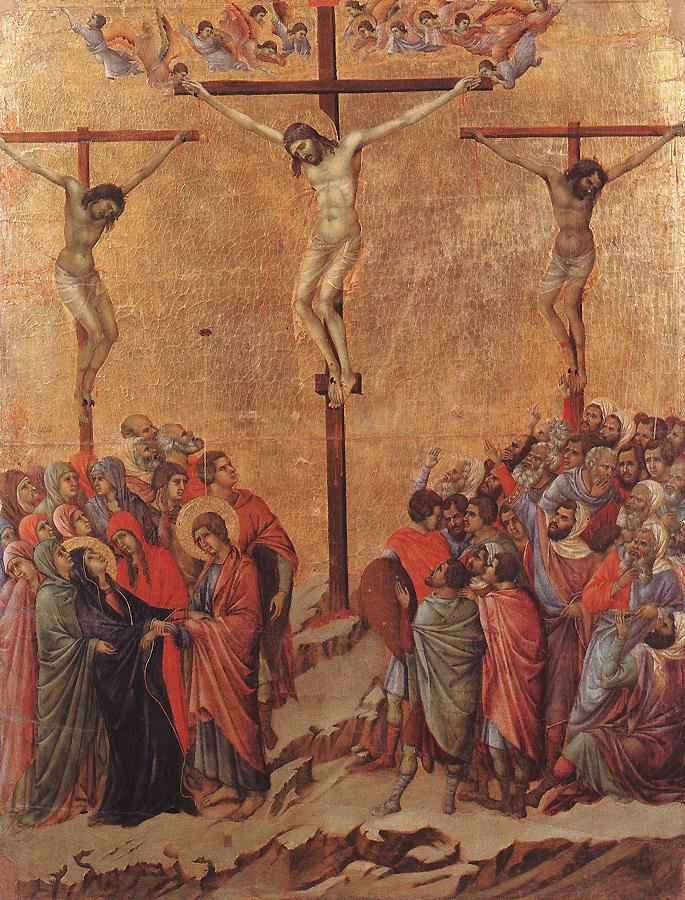 Crucifixion
Duccio di Buoninsegna (1308-11)
Museo dell’Opera del Duomo, Siena
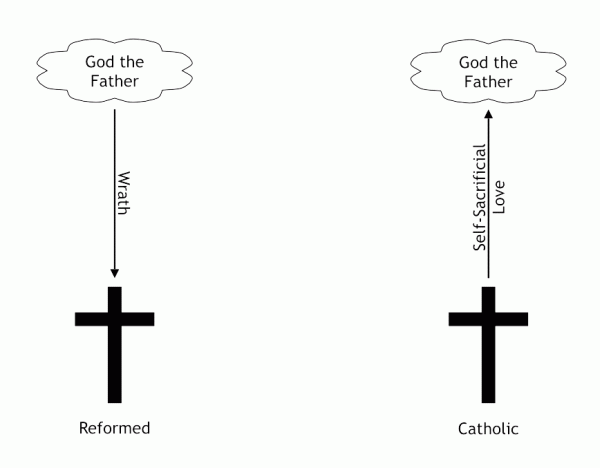
The Reformed conception of the Atonement is that in Christ’s Passion and death, God the Father poured out all of His wrath for the sins of the elect, on Christ the Son. In Christ’s Passion and death, Christ bore the punishment of the Father’s wrath that the elect deserved for their sins. In the Reformed conception, this is what it means to bear the curse, to bear the Father’s wrath for sin. In Reformed thought, at Christ’s Passion and death, God the Father transferred all the sins (past, present, and future) of all the elect onto His Son. Then God the Father hated, cursed and damned His Son, who was evil in the Father’s sight on account of all the sins of the elect being concentrated in the Son. (R.C. Sproul says that the 56th minute of his talk here.) In doing so, God the Father punished Christ for all the sins of the elect of all time. Because the sins of the elect are now paid for, through Christ’s having already been punished for them, the elect can never be punished for any sin they might ever commit, because every sin they might ever commit has already been punished. For that reason Reformed theology is required to maintain that Christ died only for the elect. Otherwise, if Christ died for everyone, this would entail universal salvation, since it would entail that all the sins of all people, have already been punished, and therefore cannot be punished again.
The Catholic conception of Christ’s Passion and Atonement is that Christ offered Himself up in self-sacrificial love to the Father, obedient even unto death, for the sins of all men. In His human will He offered to God a sacrifice of love that was more pleasing to the Father than the combined sins of all men of all time are displeasing to Him, and thus made satisfaction for our sins. The Father was never angry with Christ. Nor did the Father pour out His wrath on the Son. The Passion is Christ’s greatest act of love, the greatest revelation of the heart of God, and the glory of Christ.1 So when Christ was on the cross, God the Father was not pouring out His wrath on His Son; in Christ’s act of self-sacrifice in loving obedience to the Father, Christ was most lovable in the eyes of the Father. Rather, in Christ’s Passion we humans poured out our enmity with God on Christ, by what we did to Him in His body and soul. And He freely chose to let us do all this to Him. Deeper still, even our present sins contributed to His suffering, because He, in solidarity with us, grieved over all the sins of the world, not just the sins of the elect. Hence, St. Francis of Assisi said, “Nor did demons crucify Him; it is you who have crucified Him and crucify Him still, when you delight in your vices and sins.”2 The Passion is a revelation of the love of God, not the wrath of God. The fundamental difference can be depicted simply in the following drawing:3
One problem with the Reformed conception is that it would either make the Father guilty of the greatest evil of all time (pouring out the punishment for all sin on an innocent man, knowing that he is innocent), or if Christ were truly guilty and deserved all that punishment, then His suffering would be of no benefit to us.
A second problem with the Reformed conception is the following dilemma. If God the Father was pouring out His wrath on the Second Person of the Trinity, then God was divided against Himself, God the Father hating His own Word. God could hate the Son only if the Son were another being, that is, if polytheism or Arianism were true. But if God loved the Son, then it must be another person (besides the Son) whom God was hating during Christ’s Passion. And hence that entails Nestorianism, i.e. that Christ was two persons, one divine and the other human. He loved the divine Son but hated the human Jesus. Hence the Reformed conception conflicts with the orthodox doctrine of the Trinity. The Father and the Son cannot be at odds. If Christ loves men, then so does the Father. Or, if the Father has wrath for men, then so does Christ. And, if the Father has wrath for the Son, then the Son must have no less wrath for Himself.
St. Thomas Aquinas says:
Christ as God delivered Himself up to death by the same will and action as that by which the Father delivered Him up; but as man He gave Himself up by a will inspired of the Father. Consequently there is no contrariety in the Father delivering Him up and in Christ delivering Himself up. 4
There St. Thomas explains that there is no contrariety between the Father and the Son during Christ’s Passion, no loss of love from the Father to the Son or the Son to the Father. The Father wholly and entirely loved His Son during the entire Passion. By one and the same divine will and action, the Father allowed the Son to be crucified and the Son allowed Himself to be crucified.5
One question, from the Reformed point of view, is: How then were our sins paid for, if Christ was not punished by the Father? Christ made atonement for the sins of all men by offering to God a sacrifice of love that was more pleasing to the Father than the combined sins of all men of all time are displeasing to Him. Hence through the cross Christ merited grace for the salvation of all men. Those who refuse His grace do not do so because Christ did not die for them or did not win sufficient grace for them on the cross, but because of their own free choice.
A second question, from the Reformed point of view, is this: St. Paul tells us, “Christ redeemed us from the curse of the Law, having become a curse for us–for it is written, “Cursed is everyone who hangs on a tree.”6 How should we understand the curse, if God the Father is not pouring out His wrath on His Son? St. Augustine explains clearly in his reply to Faustus, that what it means that Christ was cursed is that Christ suffered death.7 Christ took our sin in the sense that He willingly bore its consequence, namely, death, because death is the consequence of sin and its curse. Death is not natural. But Christ took the likeness of sinful man in that He subjected Himself to death, even death on a cross for our sake.
A third question, from the Reformed point of view, is this: How then should we understand Isaiah 53? What does it mean that:
Surely he hath borne our infirmities and carried our sorrows: and we have thought him as it were a leper, and as one struck by God and afflicted. But he was wounded for our iniquities, he was bruised for our sins: the chastisement of our peace was upon him, and by his bruises we are healed. All we like sheep have gone astray, every one hath turned aside into his own way: and the Lord hath laid on him the iniquity of us all. .. And the Lord was pleased to bruise him in infirmity: if he shall lay down his life for sin, he shall see a long-lived seed, and the will of the Lord shall be prosperous in his hand. Because his soul hath laboured, he shall see and be filled: by his knowledge shall this my just servant justify many, and he shall bear their iniquities. (Isaiah 53;4-6, 10-11)
This means that Christ carried in His body the sufferings that sin has brought into the world, and that Christ suffered in His soul over all the sins of the world, and their offense against God. He bore our iniquities not in the sense that God punished Him for what we did, but in the sense that He grieved over them all, in solidarity with us. That is what it means that the Lord laid on Him the iniquity of us all. He suffered the consequences of sin (i.e. suffering, grief, death), by entering into solidarity with us, entering into our fallen world, and allowing Himself to suffer in it with us, for us, even by our hands.8
- This is why Christ retained His five wounds in His resurrected body. And this is why Catholics show Christ on the cross, in the crucifix, because this is Christ’s glory. We, with St. Paul, glory in Christ crucified. (1 Cor 1:23-24) [↩]
- CCC 598 [↩]
- Of course in the Reformed system Christ also self-sacrificially loves the Father. But what effects propitiation in the Reformed system is the complete pouring out of God’s wrath upon the Son. In Catholic doctrine, by contrast, God does not pour out His wrath for our sins onto His Son, and what effects propitiation is Christ’s positive gift of love to the Father. Hence the illustration depicts what effects propitiation in the respective theological systems. It is not intended to be an exhaustive illustration of all that is going on during Christ’s Passion. [↩]
- See ST III Q.47 a.3 ad 2 [↩]
- For a fuller explanation of what Christ did for us through His Passion, according to St Thomas Aquinas, see “Aquinas and Trent 6.” [↩]
- Gal 3:13 [↩]
- Contra Faustus, XIV. [↩]
- For additional reading on the Catholic understanding of the atonement see Philippe De La Trinitaté’s What is Redemption?, and Jean Rivière’s The Doctrine of the Atonement Volume 1 and Volume 2. [↩]

Bryan,
I think the Reformed concept of the atonement refers not only to Christ’s Passion and death, but also his descent into hell, which they believe to be Gehenna. Calvin explains what he believes to be the necessity of this punitive suffering in his Institutes, book II, ch. 16 (esp. sec. 10 and 12).
Peace in Christ,
Tom
Bryan,
Listening to that Sproul audio sent chills down my spine thinking “I used to believe that” and by “that” I mean when Sproul said, “God damned His Son”!!! I look back on that and recognize that that is such an impoverished view of the atonement and the love of God.
I discussed this issue with a Reformed friend once and we had to back up to examine our presuppositions. We found that we disagreed on the atonement because we disagreed on the immutability of God. I know some affirm both divine immutability and penal substitution but the more consistent theologians, I believe, affirm one or the other.
Still there are some (modern) Catholic theologians that both deny immutability and affirm penal substitution (e.g. von Balthasar). At least they are being consistent, although I believe they are wrong in this non-traditional belief.
Bryan,
Your discussion of Aquinas and the movie clip made me think of a section in Eleonore Stump’ book on Aquinas. In the section on Aquinas’s view of the atonement (pp. 427-454), she explains the difference between a “penal” view of the atonement and a “substitutionary” view of the atonement. She takes Thomas’s view to be the latter, and defends it on philosophic grounds.
Near the end of her chapter, though, she argues that Luther/Calvin may have been on to something that Aquinas missed. She argues that Jesus’ cry from the cross and his intense suffering the garden give support to the Reformation view that, in some sense, the actual sins of all people are transferred to Christ:
In what follows, she tries to incorporate (1) the Reformed idea that Jesus, in some sense, bore the actually sins of all with (2) Aquinas’s understanding of the stain on the soul:
I’m curious about how you’d respond to Stump’s claims here.
Perhaps this is why Protestants have a bare cross. To look on a scene of pure sin is too much for us so the bare cross becomes more of a symbol of the resurection in a way. (my Lutheran Mother has always taught me the cross is bare to show the resurrection, so as not to focus on Christ’s death in our place) As if we are actually looking away from the crucifixion in shame even when looking right at the cross.
The cross seen as crucifix has more meaning then if seen as an act of love. One can look on that painful scene and see the most loving act ever. A human free from sin saying to us “my life for yours” rather than full of our sin. It upsets me I have never even heard this conception of the Atonement before.
Thank you Bryan.
Ryan,
Prof. Stump wrote that while still a Protestant. (I know because I helped prepare all the chapters; I was her office assistant at the time.) She became Catholic shortly after. A very good Thomistic explanation of Christ’s suffering and the nature of the desolation He experienced can be found here in Prof. Feingold’s talk.
David, “It upsets me I have never even heard this conception of the Atonement before. ” I hear you. We all have said the same thing.
In the peace of Christ,
– Bryan
Bryan,
A clarifying question. You wrote, “Hence through the cross Christ merited grace for the salvation of all men. Those who refuse His grace do not do so because Christ did not die for them or did not win sufficient grace for them on the cross, but because of their own free choice.”
Do you think Christ merited efficient grace for all or only some?
Bryan,
I asked the right guy! I didn’t know Prof. Stump had converted. How recently was that? It always seemed odd to me that she was both a Protestant and a staunch defender of St. Thomas.
It seems that it’s hard to be a great admirer of St. Thomas and remain Protestant. (Perhaps, that’s one reason the early reformers disliked him so much.) He’s kind of like a magnet that slowly pulls you into the fullness of the church. I’m feeling the force of that magnetic myself. Truth has a kind of invisible power to it.
Hello Perry,
Your question presupposes that I believe there is such a thing. The Church has not said that there is such a thing, in the sense in which you probably mean it. The Church has taught that Christ merited sufficient grace for all, and that God gives sufficient grace to all to achieve salvation. Taking this thread down the “efficient grace” question would be to take it off-track.
In the peace of Christ,
– Bryan
Ryan,
It was about five or six years ago.
In the peace of Christ,
– Bryan
wow. thank you so much for this explanation. can you tell me how, if it does, the Catholic view differs from the Orthodox concept of atonement?
Have you ever read J.P. Hoding’s version of penal substitution? His version seems to avoid a lot of the normal pitfalls in Protestant understanding, though it does involve Jesus taking our punishment.
https://www.tektonics.org/af/atonedefense.html
https://www.tektonics.org/uz/2muchshame.html
He sees sin, hell, and the atonement through the lense of the honor/shame society. Basically, sin robs God of the honor that we owe to Him as Lord of the universe. In response, God should have dishonored us equally. Because we inherently deserve less honor than God, our being dishonored can never equal the honor we robbed of God (resulting in eternal hell).
Jesus, according to Holding, suffered that dishonor in our place. Because he, being God, deserves more honor than all of us, those hours of dishonor on the cross were able to pay the honor penalty we owed.
I’m just curious how this interacts with other theories of the atonement, especially the Catholic one. Although I kind of understand the Catholic view, I get confused when I read statements by Scott Hahn and his students that seem to point to some kind of “covenant penal substitution”. Case in point, see comment 68 in Taylor Marshall’s article.
https://www.calledtocommunion.com/2009/09/john-calvins-worst-heresy-that-christ-suffered-in-hell/
Even Andrew Preslar indicated that a “carefully nuanced PSA” may have a place in Catholic theology. I wonder of Hahn’s or Holding’s (or both?) views of atonement could be reconciled/integrated with the explanation by Bryan Cross in this article.
Sorry for the muddled nature of this comment, but I wanted to hear all your thoughts on these issues.
I must say that I’ve never understood why people get so exercised about atonement theory. I’ve heard various theories; each has something to contribute, but each is one-sided by itself. I believe simply what the Catholic Church teaches as de fide. Here’s what I get from that.
Jesus atoned for our sins by sacrificing himself. He sacrificed himself by bearing in his person the consequences of our sins. That was globally efficacious because, as the innocent King of creation, he didn’t have to do it but did it anyway, thus making present his gratuitous and humanly inexplicable love. Indeed, his self-sacrifice suffused the human condition itself with the infinite, unmerited love that motivated the sacrifice. The Resurrection showed that divine love to be stronger than the physical and spiritual death that are the consequences of sin. The Lord did battle for us, his lost children, and won the victory over death by letting sinners, representing us all, torture and execute him as a serious public nuisance. The exquisite irony of that picture, which made it opaque to Satan, is far more telling for me than a merely juridical metaphor.
I know that a lot of people lately have debated the question whether Jesus was truly “damned” on the Cross and/or his descent ad infernum. The question strikes me as wanting a distinction. We cannot say that Jesus actually was damned; for several reasons, it is logically impossible for God to damn God. But I think Hans Urs von Balthasar was right to argue, in effect, that Jesus experienced what it is like to be damned. That would explain a number of things. But I leave the explanation to others who worry about this topic more than I do.
.
Bryan
I don’t agree with your interpretation of the Isaiah passage. It says nothing about Christ grieving over sin in “solidarity” with us. Instead it says he was wounded, bruised, and chastised. And it directly says that God bruised him, that God laid our iniquities on him. There seems to be a lot more than mere “solidarity” going on here. There seems to be a link between our iniquities being laid on him and the bruising and chastisement being described.
Why else the cross? Nothing you say about Jesus suffering “the consequences of sin (i.e. suffering, grief, death), by entering into solidarity with us, entering into our fallen world, and allowing Himself to suffer in it with us, for us, even by our hands”, requires the cross. Just living as a human on this earth Jesus experienced everything you mention above.
Dear Mike,
Your summary is beautiful, but I think in terms of simplicity and punch it doesn’t hold a candle to the summary provided in Sayers’ wonderful catechism:
Q.: What is meant by the Atonement?
A.: God wanted to damn everybody, but His vindictive sadism was sated by the crucifixion of His own Son, who was quite innocent, and, therefore, a particularly attractive victim. He now only damns people who don’t follow Christ or who never heard of Him.
Neal
Rana,
Good question. The atonement is an event that is manifold in its nature. And so we find that the notions of redemption, ransom, victory, sacrifice, satisfaction, example, and substitute are all used to describe and explain it. And from a Catholic point of view, all those aspects are present in what Christ did. The Orthodox tradition tends not to emphasize the legal aspect; the focus is on Christ as Victor, vanquishing sin, death and Satan, so that we would be united with God. See Bishop Kallistos Ware’s book How We Are Saved: The Understanding of Salvation in the Orthodox Tradition. In it he lays out the different theories of the atonement, and explains how the Orthodox tradition conceives it.
In the peace of Christ,
– Bryan
Stephen, (re: #12)
I haven’t read Holding’s material, so I can’t say anything about it.
Regarding your second question, what I said in the post above, and what Andrew said in the link you included, are fully compatible. Christ really is our substitute. He really did bear the curse, by bearing in His body the suffering and dissolution of death, and by bearing in His spirit the desolation that is the absence of spiritual consolation. By taking these upon Himself, freely, in self-sacrificial love, Christ offered something more pleasing to the Father than all our sins are displeasing. And in that way Christ merited for us the grace by which our sins are forgiven, we are restored to friendship with God, and we are saved from the punishment of hell. So Christ bears the curse, and in doing so participates in our punishment (i.e. the punishment of the curse), so that we can participate in His divine life, and avoid the ultimate punishment (i.e. eternal separation from God, in hell). In that (carefully qualified) sense, Christ’s atonement was one of penal substitution. But it was not one in which the Father imputed all our sins to Christ, and then poured out all His wrath for that sin, on Christ. The Father never hated the Son or hated any sin in the Son, because the Son was always sinless, and God the Father always sees the Son as the Son really is, sinless. Christ took on all human sin not by becoming intrinsically guilty (and thus deserving of punishment), or by imputation (and thus being falsely accused by an omniscient Being), but by (1) allowing Himself to suffer the effects of the curse, and (2) by seeing all the sin of all men for what it is in all its evil, and in solidarity with us (as one sharing our nature), with the grief of contrition freely and lovingly offering Himself as a perfect sacrifice for it.
In the peace of Christ,
– Bryan
Thanks Michael,
Let me add something as a point of clarification and qualification. To be damned is to be without hope, and without charity. It is to know that one is eternally separated from God, with no hope, not even the possibility of there being hope. That is utter despair. To be damned is to hate God, and to hate His justice. To be damned is to hate oneself with never-ending hatred that knows itself to be never-ending. But Christ endured the cross for the joy set before Him; He always retained hope and charity. He did not despair (that would have been a mortal sin). Nor did He hate God. Thus He never hated Himself. Nor did He ever lose sanctifying grace; otherwise His human will would have been against His divine will. So, for these reasons, if we say that He experienced what it is like to be damned, we must include some very important qualifications. He experienced the external loss of divine protection, and the interior loss of spiritual consolation. The damned also experience that, so in those two respects Christ experienced what it is like to be damned. But Christ didn’t experience the despair, self-loathing, hatred for God and deprivation of grace that the damned experience. So in those respects Christ didn’t experience what it is like to be damned.
Update: For more on Christ’s vision of the Father while on the cross, especially in response to Balthasar, see comment #4 in the “Harrowing of Hell” thread.
In the peace of Christ,
– Bryan
Steve (re: #14),
Of course the word ‘solidarity’ is not used in Isaiah 53. But that doesn’t entail that Christ grieved either over His own sins, or in separation from us. Isaiah says, “Surely our griefs He Himself bore.” (Is 53:4) He bore them because they became His griefs, and they became His griefs because He entered into solidarity with us at the incarnation. He bore these griefs His whole life. This is why Isaiah says that He was “a man of sorrows, and acquainted with grief.” (Is 53:3)
God (Father, Son, and Holy Spirit) laid our iniquities on the Son [in His human nature] in the manner in which I described in comment #17. In His human nature, with His human intellect, He saw all the sins of all men, and how evil they are, and how they offend God who deserves all our love and obedience. That’s the sense in which these iniquities fell on Him, not in the sense that He became guilty in Himself, or guilty in the eyes of the Trinity. They were laid on Him in the sense that He saw all the sins of His brothers and sisters in His human family, and as the great high priest of all mankind, He, in solidarity with us, grieving over these sins of His human family, offered Himself to the Father as the perfect sacrifice for all these sins.
Of course there is a link. Human suffering and death are the result of iniquity. In His Passion Christ is freely bearing the curse of suffering and death to offer Himself as a perfect sacrifice to the Father for the iniquities that have been laid upon Him.
God could have forgiven all human sin, without the cross, and without the incarnation. But it was fitting that Christ become man, and die for us, even on a cross. Regarding the necessity of the incarnation St. Thomas writes,
Then in Question 46, St. Thomas asks whether it was necessary for Christ to suffer in order for man to be delivered, and he answers:
So according to St. Thomas, the necessity of Christ’s suffering was one of fittingness for attaining the end, that we might be saved through Him, that He might be glorified, and that Scripture might be fulfilled. The necessity was not absolute, as though God couldn’t have forgiven us without the cross.
The cross is fitting because the greater the sacrifice, the greater the love. And by His obedience unto death, even death upon a cross, Christ gave a far greater gift of love to the Father, and most perfectly demonstrated to us our sinfulness and His infinite love for us.
In the peace of Christ,
– Bryan
Bryan:
Yes indeed. The claim that Jesus experience “what it’s like” to be damned requires further distinctions, which you have made. I just didn’t feel like making them myself. ;)
Best,
Mike
I’ve never understood how Jesus could be said to have received the full punishment for our sin (as some Protestant theories put it), because that would mean that Jesus should be in Hell forever, no?
This is a *VERY* important topic to bring up this time of year.
For those who don’t know, I had a debate on Penal Substitution where I show it thoroughly unbiblical and address the major Protestant Bible prooftexts in my opening essay:
https://sites.google.com/site/catholicdefense/psdebate
Here is a list of easily verifiable quotes from leading Protestant theologians (including Calvin and Luther) stating very clearly they hold that Jesus was effectively damned:
https://catholicnick.blogspot.com/2009/04/was-jesus-damned-in-your-place.html
My husband & I are attending an Anglican (AMiA) church while we try to sort out what we believe and where we belong. We’ve been Reformed since 2001. This site started my inquiry into Catholicism when a convert friend linked here this past Reformation Day, and it’s been an enormous help for me. Thank you for that. I’d appreciate your prayers as I continue studying and as my husband starts studying (soon, I hope).
That said, the minister this morning said that Christ experienced the complete withdrawal of God’s love on the cross, which is the reason for the darkness (God the Father had turned His back) and for Jesus’ cry asking why the Father had forsaken Him.
What is the Catholic explanation for those issues (darkness & cries re: being forsaken)?
Thanks for any insight.
Jeff,
The claim is that the punishment Christ received in hell was infinite because it was against an infinite divine Person. Therefore (according to this idea) Christ did not need to spend eternity in hell to pay the penalty for our sins; three days in hell were sufficient. But then even the suffering that Christ endured at His circumcision was sufficient to pay the penalty for all sins of all mankind, since that suffering was an “infinite suffering” by being the suffering of an infinite divine Person. So, this idea nullifies the reason for Christ “suffering in hell” and for His enduring the cross. If His circumcision was an infinite punishment because it was against an infinite Person, then He could have said “It is finished” on the eighth day of His life on earth, since the infinite price had already been paid. The cross and suffering in hell are thereby made superfluous.
In the peace of Christ,
– Bryan
Bryan or whoever else might be able to comment on this:
At the Easter vigil the reading about Abraham being called by God to sacrifice Isaac made me think of this article. How can this foreshadow God giving up his only son if the theory of penal substitution is correct? Nobody was being punished for anything. The sacrifice was all about whether Abraham was willing to give up something of “infinite” value to him. This seems to fit with other examples of sacrifice from the Old Testament (I’m thinking particularly of Cain and Abel) where a sacrifice is an offering to God of something of value, not God pouring out wrath on something (how could God pour out wrath on a vegetable offering?). Moving from there to the New Testament, it makes sense of how we can say that our lives are now a living sacrifice, i.e. an offering to God. Is this correct?
On the other hand, I have seen Reformed/Protestant proponents of the penal substitution theory claim that it corresponds to the “scapegoat” in the Old Testament upon whom the sins of the people were supposedly transferred and then the goat was killed. Could you say anything about that?
It might be helpful to supplement this article with something about what a “sacrifice” is and trace the theme of sacrifice throughout scripture.
Lawwife,
Thanks for your comment, and your question. All three of the [synoptic] Gospel writers refer to the darkness that fell over the whole land from the sixth hour (i.e. noon) until the ninth hour (i.e. 3 pm). (Cf. Matthew 27:45, Mark 15:33, and Luke 23:44.) But so far as I know, none of the Church Fathers interpret this as an indication that God the Father ‘turned His back’ on the Son. This was a sign to those who had called “crucify him, crucify him,” just as darkness was one of the plagues of Egypt before the Passover, a sign that they were opposing God, and that they should repent. This was creation groaning over what was being done to its Creator.
As for the meaning of Christ’s cry “My God, My God, why have You forsaken Me?” we should not understand that as meaning that the Son (in His divine nature) was cut off from the Trinity or separated from the perfect happiness of the divine life. But in His human nature He experienced what it is like to be handed over to His enemies and to suffer and die. In those respects He was forsaken. Likewise, in His human nature he experienced the absence of spiritual consolation, and in that respect too He was forsaken, even though He (in His human nature) did not cease to behold the Father. He spoke these words as man, that is, according to His human nature. But the Father never ceased to love Him, nor did the Father’s love for the Son ever diminish in the least. Everything the Son experienced on the cross, He Himself willed to experience, including these ways of being forsaken in His human nature. Tertullian explains:
I recommend listening to the talk at this link.
In the peace of Christ,
– Bryan
It is interesting to note that when Jesus died the curtain of the Temple was torn in two, which could, in some sense manifest that God was mourning the death of His Son and not damning Him, or turning His back from Him and cursing Him.
Psalm 22:1 My God, my God, why have you forsaken me?
Why are you so far from saving me,
so far from the words of my groaning?
22:24 For God has not despised or disdained
the suffering of the afflicted one;
he has not hidden his face from him
but has listened to his cry for help.
This shows how badly people have misread “My God, My God,” not only ignoring 22:1B, but 22:24 and Ps 22 as a whole.
David,
The Abraham example is quite appropriate and very powerful in this discussion. You are correct, the sacrifice had nothing to do with sin, nor was anyone being punished. In fact, Protestants say James 2:21 teaches Abraham was ‘vindicated’ (rather than increased in justification) at the sacrifice of Isaac, meaning Abraham was already justified – and Protestants insist the justified can never be subject to the type of punishment pen-sub requires, thus it would be impossible for God to have based this on a pen-sub model!
David: Moving from there to the New Testament, it makes sense of how we can say that our lives are now a living sacrifice, i.e. an offering to God. Is this correct?
Nick: Yes! It is very correct! In fact 1 John 3:16 says something interesting,
“This is how we know what love is:
Jesus Christ laid down his life for us.
And we ought to lay down our lives for our brothers.”
Notice the parallelism here, Jesus “laid down his life for us” and in turn (as good Christians) we are called to “lay down our life for others.” This directly contradicts P-Sub! If Jesus died “for” us in a P-Sub sense, then Christians could never die “for” others. Any way that phrases this in terms of transfer-of-punishment will have to apply to the last clause, which causes obvious problems.
David: On the other hand, I have seen Reformed/Protestant proponents of the penal substitution theory claim that it corresponds to the “scapegoat” in the Old Testament upon whom the sins of the people were supposedly transferred and then the goat was killed. Could you say anything about that?
Nick: Yes. One huge detail which most people fail to see is that the scapegoat was never killed, it was released in the desert! If that’s not the most incompatible notion with P-Sub, I don’t know what is. Some might argue the implication was that the goat was being sent off to die in the desert, but the text never goes into such details, thus it’s unwarranted. The point that it was to be kept alive contradicts P-Sub.
David: It might be helpful to supplement this article with something about what a “sacrifice” is and trace the theme of sacrifice throughout scripture.
Nick: A worthy task. Just off the top of my head: Abel wasn’t engaging in P-Sub (Heb 11:4!!), nor was Noah after getting off the ark (Gen 8:20f), Abraham and Isaac, the Passover Lamb had nothing to do with Psub (Ex 11:4-7). Also, just as important, is how the term “atone” is used in the Bible. I know of nowhere where “atone” is used in a Psub sense, and in fact I see plenty of evidence it is used in an anti-Psub sense: Gen 32.16-20; Numbers 25:1-13 (Psalm 106:30-31); Deuteronomy 9:16-21 (Ex 32:30, Psalm 106:19-23); Numbers 16:42-49; Proverbs 16:6 and 16:14.
Wow, Nick, thanks. I appreciate that. Sometimes I feel so MISLED, even if it’s not been intentional, by Protestant/Reformed teaching.
Thank you for the explanation, Bryan. Often I feel while reading Catholic thoughts on the Bible that the Scripture is totally opening up for me for the first time, as if it’s been partially hidden up until now. That’s really an amazing experience b/c I grew up the daughter of an independent, fundamentalist Baptist pastor and attended a Christian school from K-12 (and then graduated from a college that began in the Wesleyan Holiness tradition and still has multiple Bible/theology courses required for a degree). I’m trying to listen, though it’s a little complicated with a toddler to care for! :)
PULeese, do not equate Luther and Calvin. They are birds of a different feather.
And to David Meyer – no matter what your mother said, before about 1940, surely before 1914, many if not most, most Lutheran churches had crucifixes. I know two of the three churches I have serves have them and the third was not organized until 1945.
Via @TGC. Thanks for the investment of your time and thoughts on this discussion. Brief question for you (assuming I have not misread your position): Why assume God’s love and God’s punishment are mutually exclusive?
Hello Chris, (re: #32)
Welcome to Called To Communion. Nothing in my post presupposes that God’s love and God’s punishment are mutually exclusive. When God punishes a person for sin, He does not cease to love the person being punished, but He does not love that person’s sin. And it is precisely because of the person’s sin that he is punished. Also, God disciplines those He loves, to bring them to repentance, and even to lead them away from temptation. So in either punishment or discipline, God continues to love the recipient. But in both punishment and discipline, God does not love the person’s sin. Eternal punishment, separates those who receive it from fellowship with God.
In the peace of Christ,
– Bryan
Bryan Cross (Re: #17)
Thank you for your posts on this site. As a Reformed Christian believer thinking through some of the issues addressed here, your posts have been particularly helpful and engaging.
In #17, you said, “…In that (carefully qualified) sense, Christ’s atonement was one of penal substitution. But it was not one in which the Father imputed all our sins to Christ, and then poured out all His wrath for that sin, on Christ. The Father never hated the Son or hated any sin in the Son, because the Son was always sinless, and God the Father always sees the Son as the Son really is, sinless.”
How does this explanation square with 2 Corinthians 5:21: “For our sake he made him to be sin who knew no sin, so that in him we might become the righteousness of God”?
Thanks,
Bryan Meyers
Bryan Meyers (re: #34)
Welcome to Called To Communion. See comment #29 in the Does the Bible Teach Sola Fide? post. If that doesn’t answer your question, then please write me back.
In the peace of Christ,
– Bryan
As I read this article and thought about the reformed view, a question came to my mind. I am not sure if my thinking is correct, but it would seem that the punishment deserved for our sin is an eternity in hell. If “Christ bore the punishment of the Father’s wrath that the elect deserved for their sins” would He not need to suffer this punishment as well? God is just and it would seem that Christ would if the reformed view were correct. Is my thinking logical, or am I way off?
Question #2
Would OT accounts of God withholding his wrath on people because of intercession by individuals he is pleased with (i.e. Moses) relate to the atonement in any way? It
I think I am answering my own question as I research the reformed view of the atonement and how they deal with the eternal punishment of Hell. Calvin suggests that Christ basically suffered an equivalent of an eternity of Hell during His passion. I know that is over simplified, but am I on the right track?
Brian, here is Taylor Marshall’s post on John Calvin’s doctrine that Christ suffered in Hell. Also see Bryan Cross on the Catholic perspective, The Harrowing of Hell
For some reason my html tag didn’t work right. Oh well, you get the idea. The short answer is that yes, you’re on the right track.
Thanks Tim. This site has been a real blessing for me. I only wish I had a bigger brain in order to contribute to the great discussions here. Also, thank you to all the Protestants who visit and dialogue with the folks here at CTC.
Today, in his post titled About the Atonement,” Baptist theologian Roger Olson writes the following:
Affirming that Christ suffered and that the Father did not suffer, is not driving a wedge between the Father and the Son; it is affirming that Christ has two natures (i.e. divine and human), that the Father does not have a human nature (i.e. did not become incarnate), and that Christ suffered only in His human nature, not in His divine nature. The assumption that if Christ suffers, the Father must suffer, entails the heresy of modalism, i.e. that the Father and the Son are the same Person. In addition, the notion that the Father [in His divine nature] suffered makes God into a mere creature, being passible and having potency, and capable of losing or gaining happiness. It also therefore makes Christ into a mere creature.
But what is notable about Roger’s post is what I continue to find among Protestant theologians — namely, a seeming unawareness of any other conception of substitutionary atonement than that of the Father pouring out His divine wrath and everlasting punishment for our sins, on the Son in His suffering and death. But in fact, when the Church Fathers speak of Christ being our sacrificial substitute and bearing our sins, they are speaking not of God the Father pouring out His wrath for our sins, on Christ. They are speaking rather of Christ bearing the curse of suffering and [physical] death, that curse described in Genesis 3 (see, for example, what St. Augustine says here.), and they are speaking of Christ offering Himself up to the Father as both a perfect high priest and a perfect victim, a perfect sacrifice of love, a gift of greater love than the injustice of all our sins. This is the conception of the atonement St. Anselm and St. Thomas later expounded and developed, and which I have described in the post above. It contrasts very distinctly with the Protestant notion epitomized below by R.C. Sproul. In the 56th minute in this video, Sproul says that God the Father says to the Son on the cross, “God damn you.”
Sproul seems to interpret Christ bearing the curse as God the Father hating (lit. damning) the Son, and pouring out His wrath for our sin on the Son, who receives upon Himself the Father’s wrath equivalent to everlasting punishment in hell, for our sins. But that’s not how St. Augustine or St. Thomas understood the curse. That would either make the Father the perpetrator of the greatest evil of all time, i.e. pouring out the punishment for all human sin (or at least that of the elect) on an innocent man, knowing that he is innocent (see this video), or if Christ were really guilty and deserved all that punishment, then Christ’s suffering would be of no benefit to us.
Some Protestants think that God pouring out His wrath and punishment for all human sin on an innocent man, knowing that he is innocent, is fine, so long as that man volunteered to suffer it. Roger Olson seems to think that as well. But what makes it unjust to punish an innocent man for another’s crime is not just that the innocent man doesn’t wish to be punished, or didn’t volunteer to be punished, but that he is innocent. When, at the end of Dickens’ Tale of Two Cities Sydney Carton secretly takes Darnay’s place on the way to the guillotine, this is not an unjust act on Carton’s part. But if the judge were knowingly to execute an innocent man, for the crimes of another, that would be an unjust act on the part of the judge.
The reason why punishing an innocent person (knowing that he is innocent) for the crimes of another is unjust, whether or not the person wills that he be punished, is that giving to someone more good than he is due, is compatible with justice because justice does not restrict mercy. But, giving to someone less good (or more evil) than he is due is not compatible with justice. Justice is asymmetrical in that respect. For this reason, punishing an innocent person, knowing that he is innocent, is unjust, whether or not the person volunteers to be punished. That is why the Protestant conception of the Father pouring out His wrath for our sins on Christ makes God the Father unjust to Christ, whereas the satisfaction conception of the atonement does not, because while justice prohibits punishing an innocent person, it does not prohibit receiving a substitutionary gift that makes reparation for the debt owed by another.
This is why St. Thomas uses the language of St. Paul in speaking of the Father “delivering up” Christ, as when St. Paul wrote,”but delivered him up for us all.” (Romans 8:32) St. Thomas writes:
God the Father did not pour out His wrath on His Son; rather, according to His plan He delivered Christ over to the Jews and Romans (i.e. permitted Christ to be arrested and flogged and crucified), and they freely poured out their wrath on Christ. There was no contrariety between the Father and the Son during the Passion, no loss of love from the Father to the Son or the Son to the Father. The Father wholly and entirely loved His Son during the entire Passion. By one and the same divine will and action, the Father allowed the Son to be crucified and the Son allowed Himself to be crucified. (See Summa Theologica III Q.47 a.3) (For an explanation of “My God, my God, why has Thou forsaken me?”, see comment #26 above.)
Otherwise, if the Father had wrath for men while the Son had love for men, this either (1) conflicts with the doctrine of the Trinity, in making the Father and the Son be at odds with each other [i.e. “drives a wedge”]; if Christ loves men, then so does the Father, or if the Father has wrath for men, then so does Christ, which doesn’t fit with “Father forgive them, for they know not what they do,” or (2) it conflicts with the doctrine of the incarnation, in making the Son’s divine will to be that of divine wrath directed toward His own human nature, and either (2a) the Son’s human will contradicting His divine will, by loving His human nature while the divine will hates His human nature, or (2b) the Son’s human will being in perfect conformity with the divine will, and in His enraged human will pouring out wrath on His own human nature and wanting to punish it and kill it, like Phinehas in Numbers 25:7, but toward His own flesh.
This theological mess will continue, so long as the sacrificial and substitutionary language of Scripture and the Fathers is misconstrued as meaning that Christ steps voluntarily into the blind stream of divine wrath so that we don’t receive it. We need to remember and recover the original conception of substitutionary atonement, which long preceded the Protestant Christ-takes-the-divine-wrath version.
Thanks Bryan! Patripassionism is my favorite heresy. It fits in well with what we are learning in my Trinitarian Theology class, but this stuff is so deep that I can’t put it into words as well as you do here. This comment is making me look forward to writing my paper on “The Trinity in the Paschal Mystery,” in which I’ll get to delve into Von Balthasar’s, “Mysterium Paschale.” If you have any other sources to recommend on the subject, please let me know.
This should be its own post. I hope it doesn’t get buried before some of the protestant commenters have an opportunity to respond.
Clarification if it wasn’t obvious… We aren’t being taught Patripassionism in my theology class. We are being taught about patripassionism in my class. It is the information in this post that fits in well with what we are learning. :)
Bryan,
What if I bumped into you at Blockbuster, and they weren’t letting you rent A Man For All Seasons because you owed $5.00 in late fees and you haven’t got the money on you. Being the generous man that I am, I step and say to the clerk, “Here, I’ll take care of it” and hand her a fiver. Now your slate is clean because you someone else has voluntarily paid your debt (and the clerk obviously knows about it).
Are you saying that she would be unjust to take my money?
Deacon Bryan, (re: #42/43)
Thanks, I’m glad you aren’t being taught patripassionism [as true]. :-) A good book on this general subject is Thomas Weinandy’s Does God Suffer?.
In the peace of Christ,
– Bryan
Jason, (re: #44)
It wouldn’t be unjust for her to receive a gift from you to pay my debt, because in receiving a gift from you she wouldn’t be doing anything unjust to you. That scenario is analogous to the satisfaction theology developed by St. Anselm and St. Thomas. But if she reached under the counter, and pulled out a taser, and tasered you 1 full minute for each dollar I owed, that would be unjust on her part, even if you [in your great benevolence] volunteered to let it be done to you.
In the peace of Christ,
– Bryan
Well, unless you were trying to rent The Big Lebowski, there’s no way I’d volunteer to be tasered for you….
Kidding aside, I guess I don’t see the difference. What if DVDs actually cost 5 taser-shots to rent? If you didn’t have the ability to endure that and I stepped in and paid the price, what’s the problem? It sounds like you’re just objecting to the nature of the payment (i.e., punishment) and not to the idea that payment is being made in a substitutionary way.
Jason, (re: #47)
Paying, per se, is not unjust. Nor is paying someone’s debt. But, not all forms of payment are just. Consider payments in the form of sexual services, or payment in the form of requiring the harvesting of your children’s eyes. So, yes, the injustice I’m pointing to in the Christ-takes-the-divine-wrath conception of the atonement is not that Christ is acting as our substitute in making reparation to God on our behalf, but that God knowingly pours out His punishment [wrath equivalent to eternal damnation in hell] for our sins on His innocent Son.
In the peace of Christ,
– Bryan
Just a thought, but could it be that the difference between positive payment (what seems the Catholic atonement) and punishement (Protestant atonement) has to do with the nature of sin? Heres what I mean: When I sin (by not returning The Seven Samurai to blockbuster on time) that sin can’t be undone. Punishing me for it really does not change the manager of blockbusters desire for his $5. Taser me all day long, he might chuckle, but he is still out his $5. Taser someone else in my place, still no $5. But if he recieves his $5 from me, you, ANYONE, he will be satiated. He really does not care where it comes from, as long as someone has the ability to pay, he will receive the $5.
With this in mind, Christ merely receiving punishment meant for us does not do justice to the dire situation of Adams sons. What is needed is a “payment” of perfect love to the Father (which only Christ can provide) that overshadows my sin in His eyes.
Am I on the right track?
That is a description of an act of charity, an act of mercy. This action would be meritorious if this action was unselfishly motivated out of a grace enabled love of God and man. And the only reason such an action could be meritorious, is because it is united with the atoning sacrifice of the Cross, the supreme act of supernatural charity and mercy. God the Father would be pleased with your act of mercy, just as he is well pleased with all the actions of his only begotten Son.
OK, that helps be understand your view, Bryan. It is not substitution you object to, but a substitutionary payment that takes the form of receiving undue wrath.
Couple questions, though: (1) Would you say that Jesus’ death quenched God’s wrath, even if for different reasons than Protestants say this? (2) How is it not a subtle rationalism to say what would and what would not count as injustice on God’s part? I thought the way it worked was that we derive our understanding of justice from what God is and does, rather than deriving it first and then subjecting him to it.
Isaiah writes. “The Lord was pleased to crush him.” Which I have always understood within the protestant framework of expiation. I was wondering if someone could comment on that verse from a Catholic perspective of the Father receiving the Son’s sacrifice by not actively pouring wrath on him. Thanks.
Jason, (re: #51)
To answer that question, we should first clarify exactly what we mean by “God’s wrath.” (See what I wrote in the section titled “Does God hate sinners?“) When we humans speak of wrath, based on our experience of ourselves and other humans, we are referring to a movement in our sensible appetite. (cf. ST I q. 81 a.3) But there is no movement or change in God. The Church has infallibly taught (at the Fourth Lateran Council and at Vatican I) that God is immutable. So wrath predicated of God should not be conceived as a movement of passion or emotion in God. St. Thomas raises an objection to divine immutability, based on passages of Scripture which seem to speak of God drawing near to us. “Draw nigh to God and He will draw nigh to you” (James 4:8). In his reply to this objection, St. Thomas explains:
That we can offend God the Father by our sin does not mean that our sin in any way changes Him, or elicits any emotion or sensation in Him. It means rather that our sin changes us in relation to God, such that we cannot be united to Him, but are separated from communion with Him. So, to answer your question, the gift of love Christ (in His human nature) gave to the Father through His obedience unto death, “quenched God’s wrath” in the sense that it made a way through justice for us to draw near to the Father, through union with Christ. Man (mankind), by sin, stood in a relation of infinite debt to God, because of our sin against God, by which we failed to give to God the love and obedience and honor that is due to Him. Christ, however, gave to God a superabundant gift by which mankind no longer stands in that relation of debt. Yet, if we (as individuals) refuse this gift, we remain separated from God eternally, and in that sense remain under the wrath of God.
Justice is something we know as a first principle. Our grasp of it can be improved, but we cannot logically derive it from prior premises. The whole of the natural law is based on justice: giving to each his due. It is not that the proposition “give to each his due” is divinely implanted in our minds before birth. Rather, we grasp with our intellect (and this is helped by proper parental training) that by their nature and relation, beings are due certain goods from others and from ourselves, and that it is good to give them their due. This is the concept to which the mother appeals when she tells the two-year old, “You need to share with your brother.” And if the brother isn’t shared with, he starts crying, for the very reason that [distributive] justice isn’t being done. How often concerning our siblings did we as children say to our parents in that whiny voice, “That’s not fair?” We did this before we’d even cracked a Bible.
When Abraham was interceding with God for Sodom and Gomorrah, he said the following, “Far be it from You to do such a thing, to slay the righteous with the wicked, so that the righteous and the wicked are treated alike. Far be it from You! Shall not the Judge of all the earth deal justly?” (Gen 18:25) He didn’t say, “Well, if you are going to do it, then that will set the standard for what justice is, and so there’s no point in my appealing to justice, in my request that you not slay the righteous with the wicked.” Instead, using what he already knew about justice, he knew that God cannot possibly act unjustly. Otherwise, it would be meaningless to say that God is just. That would be saying merely, “God does whatever He does.” So this avoids two errors: divine voluntarism, and rationalism. It avoids divine voluntarism, because justice is eternal and immutable, the eternal law of God, a Ratio in God, as St. Augustine says (De Lib. Arb. i, 6). But for that same reason it avoids rationalism, because that eternal law is the standard of justice. Yet, man is not ignorant of that eternal law until through supernatural revelation we learn of divine actions that then give us a concept of justice. Every rational creature (including Abraham) knows this eternal law not as it is in itself, but by participation, through having been endowed with reason by which we have been made in the image of the Divine Logos. Hence St. Thomas says:
So, we know, in the same way that Abraham knew justice, that it would be unjust to punish [i.e. impose the full retribution for evil actions] an innocent man for all the sins of all men (or of all the elect). Otherwise justice would be injustice, which would mean that there is no justice, but only power and cowering submission.
(David, I hope this comment also helps answer your question as well.)
In the peace of Christ,
– Bryan
Hello Todd, (re: #52)
I addressed that passage of Isaiah toward the end of the post, and then in more detail in comment #19 (see also comment #17).
In the peace of Christ,
– Bryan
Here are two articles that address some recent concerns brought up in this thread.
1) This first article does something almost unheard of: it’s a simple lexical look at the Hebrew word for atonement. This catches PSub advocates and many others totally off guard, because the results are blatantly anti-Psub; the concept of PSub was absolutely foreign to the Hebrew Scripture’s and mindset, and this is abundantly clear by just examing how Scripture itself uses and defines the term “atonement”!
2) This second article shows how the Patriarch Job must be the “suffering servant” of Isaiah 53 if the Psub approach is taken.
I also was reminded of two other intercession passages that don’t get much mention but are quite powerful: Jeremiah 15:1 and 18:20
The story of Christ and His Bride, which is the Story of the redemption of Man, is the greatest Love Story that the cosmos has ever been witness to. And, because Man is made in the Image of God, love stories come natural to Man by his nature, since God is above all else Love.
Now, consider that if Christ died for the Church, His Bride, in the sense of dying in Her stead, then She must have been guilty of something for which She was Herself deserving of death — i.e., Jesus stepped in and paid the penalty that was justly due to the Bride. Yet all men, who by their nature know what is a true and beautiful love story, know that a love story is hardly beautiful if it involves a bride who is truly guilty of some heinous offense meriting death.
And so it is plain that it cannot be that Christ died for a guilty Bride, for this would be a terrible love story. Surely it cannot be that the Love Story of Christ and the Church is an imperfect, almost unconscionable, love story.
No troubadour would sing a ballad of a great knight’s love for a wanton and wicked lady. No bard would pen a poem to honor two lovers, a great man whose love is perfect and his vile, shameful lady who is deserving of death. These ideas are despicable to the deepest heart of love in Man. The deepest heart of Man knows that Christ’s Bride must have been — and must still be — a most lovely and innocent thing if She is to be worthy of Him, and if Theirs is to be the perfect Love Story.
Therefore Christ’s death for the Church cannot be for Her in the sense of dying in Her stead to make satisfaction for Her awful crime.
Surely Christ died in an act of perfect and infinite love for His Bride. In this way, He earned Her love by proving His love for Her. Truly Christ was the first and most perfect Knight of Christendom. The great test of every knight is the test of the measure of his love. Is he willing to give up his life for his beloved? If so, then he is worthy of her love. If not, then he is no knight.
Christ did not die to pay off the jailer to have His Beloved released from Her just condemnation. No, Christ died to earn Her pure and innocent love and to receive Her as His just reward. The Father gave the Son the Bride because the Father saw that the Son had proved Himself worthy of Her. He earned Her perfect love through a perfect act of love. Christ indeed bought Her for a great price, but this price was paid in love to Her loving Father, not as a ransom to Her seething executioner.
Jeff:
I was going to click the “Like” button, but then I remembered this isn’t Facebook. Good job!
Best,
Mike
Jeff,
Ah! I like the story too. I might throw in (explicitly) something to the effect that the Bride, in her former days, was wanton and prone to adultery (OT prophets concerning Irsael, some of which is poetry!), but that in her abject exile and estrangement, the knight rescued and not only purified and restored her, but elevated her and sanctified her by love for all time thenceforward, by virtue of his daring quest (NT apostles concerning the Church). I mean, the knight dies for a reason, to rescue his lady from something. I think that your story-line and rich themes can pretty much accommodate that bit.
Andrew
That story also has the potential to make the blessed virgin fit into the salvation story. At the cross there was no church yet. But there needed to be a most lovely and innocent woman there to represent the church. God made it so.
OK so I was just re-reading this article and I had a question. For those of you who don’t know I am a member of a PCA church and very involved. I have been wrestling with understanding and possibly converting to Catholicism because it is starting to make WAY too much sense to me, so forgive me for randomly popping in on old articles to ask questions (btw, Dr. Liccione, your guest contributions and remarks in the comboxes have been most enlightening). So for the question:
In this article you said that we are to understand the atonement in that Christ was “obedient unto death,” and that “in Christ’s act of self-sacrifice in loving obedience to the Father, Christ was most loveable in the eyes of the Father.” My question is, what exactly was the Father requiring of the Son in which He was being obedient? And does this in any way violate Christ’s offering up of himself (that He was being asked to do something by the Father)?
Shalom,
Aaron G.
Aaron G., (re: #60)
Thanks for your comment and questions. St. Thomas provides an answer to your first question in Summa Theologica III Q.47 a.2. Regarding your second question, no, this does not violate Christ’s offering up of Himself; His obedience to the Father was at the same time an act of love for the Father. (See the reply to the third objection of that same article.) (See also CCC 609.)
Christ’s whole life on earth, every act He did in His human will, from His free choice to love God at the moment of His conception, until His ascension into Heaven, was what was required of Him by the Father. As He said, “from Myself I do nothing, but I speak these things just as the Father taught Me.” [ἀπ’ ἐμαυτοῦ ποιῶ οὐδέν, ἀλλὰ καθὼς ἐδίδαξέν με ὁ πατὴρ ταῦτα λαλῶ.] (John 8:28) He lived a life of perfect obedience to the Father. This is why every aspect of His life on earth is a revelation of the Father:
And later in the Catechism:
In short, that Christ’s whole life was a life of obedience to His Father’s commands is fully compatible with Christ’s freely fulfilling these commands out of love for His Father.
In the peace of Christ,
– Bryan
Today Thabiti Anyabwile (Senior Pastor of First Baptist Church of Grand Cayman and a Council member with The Gospel Coalition) wrote about what happened between the Father and the Son, on Good Friday:
Thabiti’s claim that on the cross, the “ancient, eternal fellowship between Father and Son was broken” makes the eternal relationship between Father and Son contingent, not necessary. According to the Creed, the Logos is eternally begotten by the Father, and consubstantial with the Father. The Logos is the perfect image of the Father, precisely because He is eternally begotten of the Father, and consubstantial with the Father. Claiming that the “ancient, eternal fellowship between the Father and Son” is contingent, denies that Christ is eternally begotten of the Father, and consubstantial with the Father. That’s because such a claim entails that the Father and the Logos originally formed a union by mutual agreement, since the union could subsequently be broken by the will of one or both of the two Persons, and subsequently be restored by one or both of their wills. And this contingency of the relationship between the Father and the Logos implies that the Logos either has His being independently of the Father (so that they could contingently choose to enter or not enter into fellowship with each other), or was created by the Father and then entered contingently into fellowship with the Father.
For this reason Thabiti’s claim that the ancient, eternal fellowship of Father and Son could be formed and broken, entails either tritheism, or Arianism. That’s because if the Logos is eternally begotten of the Father and consubstantial with the Father, then the fellowship of the Father and the Logos is not contingent, but necessary. So the ancient, eternal fellowship of Father and Son could be formed and broken (and reformed) only if the Logos is not eternally begotten of the Father. And if the Logos is not eternally begotten of the Father then either the Logos is a distinct deity from the Father (from which tritheism follows), or the Logos is a created being (from which Arianism follows).
Part of the reason for this error is the mistaken notion of the atonement, described in the post above, in which the Father has to pour out wrath on His Son. That notion of the atonement forces the following dilemma: either the Father pours out His wrath only on a human nature, in which case, the suffering isn’t infinite in value and therefore isn’t redemptive, or the Father pours out His wrath on the Logos, which entails tritheism or Arianism for the reasons just explained. Another source of the error is downplaying the Creed among the Reformed, preferring instead to limit themselves to biblical language, and not seeing “eternally begotten” in Scripture. Another possible source of the error is a Christological error in which there are, as it were, two second Persons of the Trinity: the Person of the God-man who can lose union with the Father, and the Logos prior to the incarnation who could not lose union with the Father. According to orthodox Christology, by contrast, the reason the incarnate Logos cannot lose union with the Father is the same reason the pre-incarnate Logos cannot lose union with the Father: there is only one and the same Logos, who is eternally begotten of the Father and consubstantial with the Father. Claiming that the intra-Trinitarian relation between the Father and Son can be (and in fact was) broken implies either that the Logos after the incarnation is not the same Logos who was with the Father before the incarnation [i.e. a form of Nestorian Christology], or it implies that even the Logos prior to the incarnation was only contingently related to the Father, and that entails tritheism or Arianism, as I’ve just explained.
Ray (re#62)
And both subsequent errors really proceed from this fundamental one. Excellent post – thank you.
Frank
R.C. Sproul has just published this Blog Post on Jesus being forsaken. It reaffirms what Sproul has repeatedly said elsewhere, but he’s making the claim still today in 2012.
Sadly, Sproul is unaware that the Greek term for “impute” is used over 40 times in Scripture, but NEVER in reference to sin being imputed to Christ (nor Adam’s sin “imputed” to us; nor even Christ’s Righteousness being imputed). But none the less, this is integral to upholding Sola Fide, so Sproul makes the necessary “connections,” as horrendous as they are.
This would be condemned by any Ecumenical Council.
So Jesus was literally fulfilling prophecy, the numerous claims of Psalm 22, and yet Jesus was not in the “Bible-quoting mood”? That’s the epitome of eisegesis and an unfortunate agenda driven reading.
Sort of a dilemma for Protestant ecclesiology (I know, I know, there is no Protestant ecclesiology but bear with me), aint it? How can we ordain a Reformed guy to a position of leadership if we cannot know if he is elect and/or regenerate? You cannot.
That’s not good. In fact, that’s blatant heresy.
Sproul’s (in)famous words from his Reformed Conference presentation a few years ago.
Hi Bryan,
I pray you’re well today, friend, and rejoicing in the hope of Christ’s death and Resurrection. He is alive! Praise God!
Thanks for the thoughtful post here and the attempts to engage at my original post at Pure Church. With the hopes of avoiding a replay of the Reformation on this comment thread :-), let me risk over-simplification by giving a few short responses.
1. We obviously are not going to be agreed on the age-old argument re: authority. Suffice it to say that as a Reformed Protestant I hold that it is the word of God that creates God’s people (e.g., Gen. 12:1-3; Ezek. 37; John 1) and our duty to humble ourselves under the word which is able to save us (James 1:21). You write eloquently about the Catholic Tradition but without even a supporting reference to biblical texts. I think that’s telling. And I think that’s where your position, though true in many regards, suffers an inadequacy (which I’ll suggest in a moment). So, I continue to take my stand with Luther:
“Unless I am convinced by testimonies of the Scriptures or by clear arguments that I am in error—for popes and councils have often erred and contradicted themselves—I cannot withdraw, for I am subject the Scriptures I have quoted; my conscience is captive to the Word of God. It is unsafe and dangerous to do anything against one’s conscience. Here I stand; I cannot do otherwise. So help me God. Amen.”
We invariably elevate human reason and theology above the text of Scripture if we do not begin and end our “theologizing” with exegesis of the text. What are we really saying when we say, as you write, “The Catholic approach starts with (or is fundamentally guided by) what the tradition has handed down regarding how to understand the passage in Scripture, and exegesis works to illumine Scripture within that tradition-informed understanding of Scripture”? We’re effectively saying God wasn’t clear in His word and the more reliable point of departure is not God’s word but man’s tradition. It’s difficult to see how your statement that “exegesis works to illumine Scripture within that tradition-informed understanding of Scripture” could ever avoid a kind of confirmation bias, simply visiting the Scripture to substantiate what we already hold by way of Tradition. That’s abhorrent to the Scripture itself, where we’re told we should learn “not to go beyond what is written.” Please don’t get me wrong. Tradition has its place, but it is neither the starting or the decisive place. The Bible itself is.
2. I don’t have any difficulty with the important distinctions regarding Christ’s death in His humanity but His continuing life in His deity. Just as He is eternally the Son before the Incarnation, He continues to be eternally God the Son throughout His death. It was necessary that He take on our nature in order to be our Great High Priest (Heb. 2:14-15, 17). But He never ceases to be God, the Second Person of the Trinity.
3. We can agree that Christ’s sacrifice is an act of love, but that’s not an argument against Jesus satisfying the Father’s wrath. This is the heart of our disagreement regarding the atonement. One must allow that the atonement is discussed using a range of motifs (victor, sacrifice, example, etc.). But the heart of the Gospel is Christ’s sacrifice as penal substitution, which sacrifice propitiates the wrath of God. We have to affirm both the love that motivated the sacrifice and the effects of the sacrifice re: the Father’s wrath being satisfied.
The Bible teaches us that Christ offers himself in love as a sacrifice and that the Father loves Him for that sacrifice. Consider, for example, John 10:17–“The reason my Father loves me is that I lay down my life—only to take it up again.” Repeatedly we’re told the Father loves the Son (for ex, John 3:35; 5:20; 15:9-10; 17:24; 2 Pet. 1:17; etc). But we’re also told that the Son loves the Father, with the expression of that love being His obedience to the Father’s will (John 14:31). So, we may confidently say there exists a mutual communion of love between the Father and the Son, and we may say that the Father loves the Son precisely because He sacrifices himself.
But we must say more than this because the Bible says more than this. We must also maintain that the Son’s sacrifice propitiates the Father’s wrath. That’s repeatedly taught in Scripture. It’s clear that sinners apart from Christ face God’s wrath (John 3:36; Rom. 1:18; Eph. 5:6; Col. 2:5-6). As sinners, we were “children of wrath” (Eph. 2:3). Yet, “Jesus… rescues us from the coming wrath” (1 Th. 1:10). How does He do that? By assuaging the Father’s wrath in His atoning sacrifice. “Since we have now been justified by his blood, how much more shall we be saved from God’s wrath through him!” (Rom. 5:9). Texts like John 3:36 make very little sense if we’re not to understand that the Father’s wrath was satisfied by Christ. In fact, the Father’s own righteousness is bound up with whether Christ endures the punishment we deserve, especially those whose sins had not yet been punished because of the Father’s perseverance. See Romans 3:25-26.
So, not only does the Father and Son act in holy love toward one another. But the Son, as an act of love for the glory and righteousness of the Father, and as an act of love for the redeemed, offers himself to absorb the Father’s holy wrath on our behalf. It’s not a matter of one or the other for both are plainly taught in Scripture. Here’s the question: Can we accept, as the Bible teaches, that the Father can both love His Son and simultaneously satisfy His wrath upon the Son? All God’s perfections hold together perfectly–His love embraces His wrath and His wrath delights in His love–and that “conjunction of diverse excellencies” (as Edwards put it) is revealed most supremely in the Cross of our Lord. I think your blog post and comment miss this because you’re essentially expounding a tradition rather than the biblical text.
As I skimmed the comments in this post and even points in your post itself, it seemed some folks were motivated to accept your emphasis on “self-sacrificing love” because they’re squeamish regarding the wrath of God. That’s unfortunate because it positions people to accept one part of biblical truth while denying other truths clearly taught in Scripture. Better to yield our emotions to the truth of God’s word than to have our emotions drive us to faulty theological conclusions. We must keep in mind that God’s wrath is in no way mingled with sin or unrighteous anger the way human wrath is (Jam. 1:19, for ex.). His wrath is perfectly righteous, perfectly just, perfectly holy, and even perfectly loving. If we could avoid pejorative and provocative caricatures like “cosmic child abuse” and keep in mind the good and perfect character of God, we’ll be helped to hold together the diverse excellencies of our God and King, forever praised! We’ll also help dear people like “Law wife” avoid tragic mistakes like leaving Gospel-preaching and Gospel-practicing churches for the errors of Roman Catholicism. What we want is for the Scripture themselves to open up before us, not the Traditions about or hovering somewhere around the Scripture.
The Lord bless you this Resurrection season,
Thabiti
Thabiti (#65)
If I may stick my nose into your discussion with Bryan, I note this first in your comment:
However, it seems to me that that is the only point that matters. As you point out in the rest of your comment, there is so much that Protestants and Catholics agree on! The point that matters – and the only point that really prevents the unity that Our Lord prayed for – is authority. Did Jesus leave us an earthly authority that we could trust, or must we rely on our own interpretation of the Scripture? You may say that Scripture is that authority – but Scripture is only a witness to a witness. It cannot decide for me any of the differences that exist amongst Christians. I have to trust my own understanding – something Scripture itself is a little inclined to tell us to be cautious of :-)
I don’t think it is enough – or even particularly useful – to point out the places we agree. I and the atheist agree on much – natural physical law, for instance; depending on the atheist in question, much of moral wisdom as well. But I think that I have submitted to Christ in submitting to His authority in the Catholic Church. Neither the atheist nor the Protestant thinks that. And it seems to me that the ‘obedience of faith’ requires precisely that submission. ‘Rebellion is as the sin of witchcraft.’
Lest it seem I am just pushing in an running – I am! – but only for a short time! My wife and I are off this (Saturday – I am in New Zealand) morning to another part of the country to visit friends – back on Tuesday evening and glad to interact on the subject of authority then.
jj
Thabiti,
I was a bit taken aback by your (excellent) advice about the danger of elevating human reason above Scripture after I just visited your website and saw your recent 3-part Good Friday series on “What Does It Mean for the Father to Forsake the Son?”.
You quote Christ’s words, “My God, why have you forsaken me?” and build your series around this. You go onto say: “What does it mean for Jesus to be forsaken on the cross? At least three things.” I think this is important, but I’m troubled at your third meaning, which seems to be precisely a matter of human reason and traditions of men being elevated above Holy Scripture.
The first meaning you give is: “1. The Father allowed Jesus to suffer social abandonment.”
This is accurate and follows with what Psalm 22:1B and the rest of the Psalm 22 actually says, so I’m shocked you waited till part-2 to mention Psalm 22 at all.
The second meaning you give is: “2. The Father Allowed Jesus to Suffer Emotional Desertion”
I think this second meaning can partly be tied to the first meaning, but some points you made seemed to be eisegesis and even heresy when you say God does not hear Christ’s prayer(s) while on the Cross and that “the Father stands far off—farther away than the women who were there”. Sadly, you don’t quote Psalm 22:24, which says: “God has not despised or abhorred the affliction of the afflicted, and he has not hidden his face from him, but has heard, when he cried to him.” I’m sorry Thabiti, but this verse plainly goes against almost that entire post.
The third meaning you give is: “3. The Father Allowed the Son to Suffer Spiritual Wrath”
Elaborating on this point, you said:
This, to me, is the most disturbing claim, and which posts like Bryan’s have sought to set aright. I would ask you to prayerfully consider who is doing eisegesis here. Who is elevating traditions of men (e.g. Calvin) above the plain text of Scripture and bare-bones-basic Christology? I can tell you with a 100% clear conscience that I don’t see in Scripture any of what you said and expounded upon here. If there were such verses, I’d be the first to investigate, but building this grand doctrine off of Psalm 22:1A, after you’ve already given a perfectly reasonable and Biblical interpretation (i.e. your first meaning), is just wrong and irresponsible.
Hey Thabiti (#65),
I was looking at some of your quoted parts for Scripture and I didn’t see precisely how they warranted saying that the Second Person of the Trinity received the wrath of the First Person of the Trinity.
It seems that you may be somewhat confused regarding the Catholic position, that is there is no failing of understanding of those texts in the Bible that speak of sinners meriting God’s wrath prior to justification (via atonement) and that Christ’s loving sacrifice appeases God’s anger with sinners who are forgiven on His account, but that doesn’t mean that the Second Person of the Trinity received any wrath from the First Person of the Trinity. Nor can we say the Second Person of the Trinity’s humanity received wrath because Christ’s humanity is His nature not His Personhood, and natures cannot receive wrath, only persons can.
There is no conflict with Christ’s love propitiating, that is appeasing, the Father’s (and Christ’s; and the Holy Spirit’s) wrath. In fact Scripture writes this to us:
Ephesians 5:2
And walk in love, as Christ also has loved us and has delivered himself for us, an oblation and a sacrifice to God for an odour of sweetness
Here the emphasis is that Christ was a sweet odor (incense) to God the Father, and the Father accepted His offering as one is pleased with an odor of sweetness. St. Paul continues to use this reference to newly justified Christians who are the sweet odor of Christ to God, that is they are living sacrifices to the Father in their life in Christ. Now Christ’s sacrifice was an odor of sweetness and so is the lives of the saints, but we know that the saints are not condemned in the sacrifices that they make in Christ.
Here are the references to saints being odors of sweetness to God:
Philippians 4:18, St. Paul speaking to the Philippians and thanking them for their gifts and sacrifices on his behalf:
18 But I have all and abound: I am filled, having received from Epaphroditus the things you sent, an odour of sweetness, an acceptable sacrifice, pleasing to God.
2 Corinthians 2:14-15
14 Now thanks be to God, who always makes us to triumph in Christ Jesus and manifests the odour of his knowledge by us in every place. 15 For we are the good odour of Christ unto God, in them that are saved and in them that perish.
Perhaps a better argument might be made regarding how it is said that Christ is made sin for us:
2 Corinthians 5:21
21 Him, who knew no sin, he has made sin for us: that we might be made the justice of God in him.
However, this question has already been responded to in comment #35 of Bryan, where he linked to another post that showed his good (in my opinion) answer.
I think you will find a far more thorough theological description of Catholic conceptions of the Atonement here:
https://www.calledtocommunion.com/2009/04/aquinas-and-trent-part-6/
May God bless you this Good Friday and all of your days to come,
Steven Reyes
Hello Thabiti, (re: #65)
I am well, thank you. And I pray that you also have a blessed Easter. I just realized that you may know my Aunt Linda. It is amazing how small the world is, in certain ways. Perhaps divine providence played a role. :-)
I’m grateful for the time you put into this comment. You raise a number of points, and it would take much more time and mutual commitment to reach agreement on them. In my opinion the larger Protestant-Catholic disagreement is not something that can be handled piecemeal; it is a paradigm difference. If we don’t recognize that it is a *paradigm* difference, we end up begging the question when evaluating the other position. So first we have to come to understand both paradigms, each on its own terms.
One of the ground rules for ecumenical dialogue, in my opinion, is the Golden Rule. And that Rule requires that we not deconstruct each other’s position by way of psychological analysis, as, for example, if I were to say something like, “You only disagree with me because you are running from the truth.” I think you wouldn’t appreciate having your arguments treated in that way. And so I think you should not claim that some persons in this conversation accept the Catholic position because “they’re squeamish regarding the wrath of God.” Maybe they accept the Catholic teaching regarding the atonement because they believe that the Catholic teaching is true. That seems to be the more charitable assumption to extend. So the Golden Rule, and a precondition for fruitful ecumenical dialogue, calls us not to presuppose that the other person holds his position because of some internal flaw or weakness. I hope you agree.
Yes, you and I do not agree about authority, especially about the role and authority of Tradition in relation to Scripture. You think exegesis of Scripture is the proper starting point, and that letting Tradition guide interpretation wrongly elevates human reason. But, from the Catholic point of view, Tradition is from Christ, through the Apostles, guarded, preserved, and clarified by the Church guided by His Spirit. So from the Catholic point of view trusting in the interpretation one reaches by one’s own reason, apart from the Tradition, is wrongly elevating human reason [in its act of determining the proper interpretation of Scripture] over the divine authority of Tradition. So we disagree on that point, and it would require a conversation focused on that point, in order to resolve that disagreement. That’s part of the larger Catholic-Protestant paradigm difference, and I’ll set it aside at present, to focus below on the problem raised in comment #62.
You also claim that by relying on tradition we are saying that God’s word in Scripture is not clear, and that man’s tradition is to be preferred. But, from a Catholic point of view, the Tradition on which we are relying is not “man’s tradition” but Christ’s Tradition given to the Apostles, and handed down and clarified by the Church guided by the Holy Spirit. And yes, we are saying that God’s word in Scripture is not sufficiently clear to be understood with consensus, apart from the guidance of Tradition and the Magisterium of the Church, by all persons having authentic faith in Christ. That’s not any criticism of God, if, as we believe, He didn’t intend Scripture to function sufficiently apart from the guidance of Tradition and the Magisterium (just as God didn’t demote Moses to ordinary layman, after inscribing the ten commandments on tablets of stone). And, as I have argued in the comments here, if the last five hundred years have not falsified the perspicuity thesis, then it is an unfalsifiable philosophical assumption, a tradition of men, not derived from the text of Scripture, but brought to the text of Scripture. And if the perspicuity thesis were false, you would never know, because there would be no greater level of fragmentation and disagreement among Bible-only Christians than there is presently. But that too is a question that is better placed on the back burner, because it should be treated in a different thread — not here, where the question is the atonement.
The notion that the Catholic paradigm is one in which we “simply visit Scripture to substantiate what we already hold by way of Tradition,” and therefore cannot avoid “confirmation bias,” is a mistaken view of the Catholic position. It shows how difficult it is for a Protestant to see the Catholic paradigm accurately. As a community, the Catholic Church doesn’t ever start without Scripture. From the beginning of the Church on the day of Pentecost, we already had the Old Testament. But also from that first day we were never without the Tradition embodied in the life and liturgical practice of the Apostles, and declared in their preaching. For us, the Scripture and Tradition have never been separated, but have always been functioning together since day one. This claim about “confirmation bias” of the Tradition treats the Tradition as something that needs to be tested against an interpretation-of-Scripture-preformed-in-a-tradition-less-vacuum. But, first, there is no tradition-less vacuum from which to interpret Scripture; everyone who comes to Scripture brings some tradition or other. And second, the notion that Tradition must be tested against Scripture-interpreted-apart-from-Tradition presupposes that Tradition is not authoritative, not from the Apostles and not developed and defined further by the Church under the guidance of the Holy Spirit over the last two millennia of the Church’s life. And that’s a Protestant presupposition. So you are using a Protestant presupposition to criticize the Catholic paradigm, and that begs the question. I have discussed this in more detail in “The Tradition and the Lexicon,” so I’ll put this matter on the back burner as well.
You claim that by relying on Tradition, we are violating Scripture’s injunction not to “go beyond what is written.” (1 Cor. 4:6) But, from a Catholic perspective, you are (because not being guided by Tradition) misinterpreting St. Paul’s injunction there, by making him out to contradict what he says elsewhere, when he exhorts the Thessalonian believers to “stand firm and hold to the traditions that you were taught by us, either by our spoken word or by our letter.” (2 Thess 2:15) When in 1 Cor 4:6 he says “not to go beyond what is written,” he is not saying that they should not follow the oral Tradition given to them by the Apostles. He means “not go beyond” in the sense that they must not violate the Scripture’s injunction to humility, in the citations from Scripture he has just given (1 Cor 1:19, 1:31, 3:19-20). Since we disagree about the interpretation of that passage, I’ll move the question about what it means to the back burner as well.
We do agree on many things. We agree that Christ, throughout His death continued to be the Son of God, the Second Person of the Trinity, and never ceased to be God. We agree that Christ’s sacrifice is an act of love. We agree that Christ had to be human to be our high priest. We agree that sinners, apart from Christ, face God’s wrath in the sense of eternal punishment for their sins. We agree that having been justified by His blood, much more shall we be saved by Him from the wrath of God. (Rom 5:9) We agree that Christ suffered in our place, and for our sake, and that by His act on the cross, we are saved from God’s wrath. Those truths, insofar as they can be abstracted from their respective paradigms, are common to both paradigms, and therefore are common ground between us.
In at least two ways, however, we do not agree regarding what was happening between the Father and the Son during the crucifixion. First, you believe that during the crucifixion the Father was pouring out all His wrath for all the sins of the elect, on the Son. In the Reformed system, the complete punishment for each sin committed by each of the elect, was received by Christ on the cross, meted out directly by the Father. Each of those sins deserved eternal punishment in hell fire. So according to the Reformed view, on the cross Christ received from the Father a punishment equivalent to x eternal punishments in hell fire, where x is the number of all the elect multiplied by the number of all the sinful acts (thoughts, words, deeds, omissions) ever committed by all the elect. Hence, Sproul says that on the cross the Father essentially says to the Son, “God damn you.” (See comment #41.) That’s just what I mean by the Father ‘hating’ the Son, i.e. ‘disfellowshiping’ Him, breaking communion with Him. John Piper’s colleague Rick Gamache claims that during the crucifixion the Father accused the Son of committing a long list of sins. You claim that Christ offers Himself “to absorb the Father’s holy wrath on our behalf,” as though the Son offers Himself to the Father as a punching bag on whom the Father can take out all His wrath justly due to us for all our sins. This treatment of Christ is just, in your view, because the Father has imputed our sin to the Son; that’s how you interpret St. Paul’s statement in 2 Cor. 5:21 that God made Christ “to be sin.”
By contrast, in the Catholic tradition the Father loved the Son during the crucifixion, as He does eternally, and was not angry with Him, and did not think Him to be guilty of any sin, and did not turn away from Him. In the Catholic tradition the Father (and the Son and the Spirit in the one divine will) delivered over the Son in His human nature (Christ complying in His human will), into the hands of sinful men to be crucified. What the Son endured, in His human nature, was the curse for sin, which as St. Augustine explains, is suffering and death, not wrath or anger or rejection or hatred from the Father. (Again, see the link at comment #41.) God did not create man to suffer and die. Suffering and death were the result of the fall, not part of the original design. (See “Lawrence Feingold on Original Justice and Original Sin.”) And that (i.e. suffering and death) is what the Son, in His human nature, endured.
Yes, the Son, through His human nature, satisfies God’s (not just the Father’s wrath, but the Son’s and the Spirit’s as well) wrath for human sin, meriting grace for our eternal life, as I explained above, and on your site. (I have saved a pdf of that conversation here.) He did this by offering Himself, in His human nature, to the Father as a sacrifice for our sin, and this act of love, in His human will, made satisfaction for our sins, by making an offering that is more pleasing to the Father than all our sins are displeasing. The meaning of 2 Cor. 5:21, as St. Augustine explains, is that Christ was made a sin offering. (See comment #35 above.) That doesn’t mean that sin was imputed to Christ, or that He became legally guilty in the eyes of the Father. It means that He, as innocent, offered Himself to the Father for our sin, as a gift more pleasing than all our sins were displeasing. The meaning of Isaiah 53, likewise, was explained in the body of the post, and in comments #17 and #19. This way of understanding the atonement makes sense of all those passages you cited (Rom 5:9, John 3:36, Rom 3:25-26, etc.). But, nowhere in Scripture does it say that God the Father poured out His wrath on His Son. You are bringing that assumption to the text of Scripture, and reading it into the passages on the atonement, and into the passages on our being saved from God’s wrath. And it is difficult for you, I think, to see the other paradigm, and see these passages through the framework of the other paradigm, because you are so used to reading the concept of “God pouring out His wrath on His Son” into these passages, rather than understanding them as the Son, in His human nature, offering to the Father a sacrifice of love that is more pleasing than all our sins are displeasing. Resolving this disagreement would take some time, so I’ll push this disagreement to the back burner as well.
(The back burner is getting crowded, I know, but we just can’t address all these questions at once; we should treat them one at a time, in their proper place. And I don’t have the time at present to treat them all.)
The second way in which we do not agree regarding what was happening between the Father and the Son during the crucifixion is that you claim that the “ancient, eternal fellowship between Father and Son was broken,” whereas in the Catholic tradition, that fellowship cannot possibly be broken, any more than God could possibly cease to exist. And this disagreement, concerning whether that ancient, eternal fellowship was broken, is the one on which I wish to focus.
I think the argument in comment #62 is solid, in that your claim entails either Arianism or polytheism. I understand that you explicitly reject both Arianism and polytheism. So, I’m not claiming that you explicitly affirm either Arianism or polytheism. But, I do think your position is incoherent, because although you explicitly deny Arianism and polytheism, your claim that the “ancient, eternal fellowship between Father and Son was broken,” entails either Arianism or polytheism. This criticism is not an external criticism that presupposes the Catholic paradigm. This problem is *internal* to the Reformed paradigm.
You think your position avoids both Arianism and polytheism, because you claim that ontologically, nothing changed between the Father and the Son during the crucifixion. Instead, you claim, what changed between the Father and the Son during the crucifixion was that the “ancient, eternal fellowship between Father and Son was broken.” And a temporary loss of that eternal fellowship, in your opinion, does not entail either Arianism or polytheism, because, you claim, during the crucifixion, all the ontology of the Father and the Son remained the same.
The problem for your position is that in order for there to be a [temporary] loss of the eternal fellowship between the Father and the Son, either Arianism or polytheism must be true. That’s because in order for there to be a breach of fellowship between the Father and the Son, the Son cannot be the Father’s own perfect self-understanding, as I explained here. If the Son is the Father’s perfect self-understanding, the Father’s perfect Concept of Himself, the one perfect internal Word of the Father, then necessarily the Father cannot ever lose fellowship with the Son, because the Father cannot lose perfect communion with His own self-understanding, His own Concept of Himself, His own internal Word. (On the Son as the internal Word of the Father, see St. Thomas Aquinas’ Summa Theologiae I Q.27 – Q. 35.) For this reason, only if the Son is not the Father’s self-understanding, the Father’s perfect Concept of Himself, the internal Word of the Father, can there be a loss of the eternal fellowship between the Father and the Son. But if the Son is not the Father’s self-understanding, perfect Concept, and internal Word, then the Son is extrinsic to the Father. That’s the only other option. The Son can be internal to the Father only as Logos; the only other way to be internal to the Father is as the Spirit is internal to the Father (i.e. is the relation between the Father and the Father’s Logos). (Hence your claim that the ancient, eternal fellowship between the Father and the Son was broken would entail that the Spirit ceased to exist, since the Spirit is the fellowship of the Father and the Son.)
This is why the claim that there was a [temporary] loss of the eternal fellowship between the Father and the Son entails that the relation of the Logos to the Father is something *extrinsic* to the Father. And the Son can be extrinsic to the Father only if the Son either (a) has His being independently of the Father (in which case polytheism is true), or (b) was created by the Father (in which case Arianism is true). Your claim (that the ancient, eternal fellowship between the Father and the Son was broken) is based on a three-headed organism conception of the Trinity [as the mythic Cerberus], as though one head could turn away from the other. The problem with the three-headed organism conception of the Trinity is that because God is immaterial, and therefore the heads cannot be differentiated by being composed of different chunks of matter, nothing would differentiate the three heads from each other, unless they did not share the same nature. But the Father, the Son, and the Holy Spirit all are one and the same divine nature. So there must be processions, in order to differentiate the three Persons from each other. And the processions cannot be external, for then the Son and the Spirit wouldn’t be consubstantial with the Father. Hence, the processions must be internal to the Father, and so the Apostle John teaches that the Logos is in the bosom of the Father (John 1:18), and St. Paul teaches that the Spirit searches the “depths of God” (1 Cor. 2:10), which the Spirit can do because the Spirit is internal to the Father.
In the Creed, we begin by saying we believe in one God, and in this way we rule out polytheism. But we also say of Jesus Christ that He is “born of the Father before all ages. God from God, Light from Light, true God from true God, begotten, not made, consubstantial with the Father;” and in saying “begotten, not made” we rule out Arianism. But the difference between ‘begotten’ and ‘made’ is that ‘begotten’ is eternal, necessary and internal to God, whereas ‘made’ is temporal, contingent, and external to God, in the sense that nothing made is consubstantial with the Father, whereas the Son and the Spirit are consubstantial with the Father. They are consubstantial with the Father, and yet the Son is not the Father, and the Spirit is not the Father, only because they are internal processions of the Father. That’s what “eternally begotten” of the Father means, in the case of the Son, and “proceeding from the Father and the Son” means, in the case of the Spirit.
So the Tradition preserved in the Creed teaches that the Son is internal to the Father, not external. He is the Father’s internal, eternal, Word, the perfect Concept of the Father, that is, the Father’s own internal Concept. The Father has no other internal Word, no other internal Concept. It is not as though the Father can reject His own internal Word, His own internal Concept. That would turn God the Father into a zombie, with no internal Word, no self-understanding, no ‘lights on inside.’ The very notion is blasphemous. The Father cannot lose fellowship with Himself, and therefore He cannot lose fellowship with His own perfect internal Word, because fellowship with His perfect internal Word is His perfect fellowship with Himself. Likewise, the Son is “the power of God and the wisdom of God” (1 Cor 1:24). The Father has no other Power than the Son, no other Wisdom than the Son. That is why without Him [i.e. the Logos], nothing was made that has been made. (John 1:3) The Father made the heavens and the earth by His Wisdom, His Understanding. (Jer. 10:12, 51:15) And that Wisdom and Understanding is the Logos, the Second Person of the Trinity. The Father cannot reject or break fellowship with His own Power and Wisdom and Understanding; that would leave Him [i.e. the Father] powerless and witless. Again, the very idea is blasphemous. The Logos is the definitive Word of God because the Father has no other Word. If the Father had another Word, then Christ would not be the Father’s “one, perfect and unsurpassable Word.” It would not be true that “In him he has said everything; there will be no other word than this one.” (Catechism of the Catholic Church, 65) But the notion that the Father could break the ancient, eternal fellowship with the Son, without losing His self-understanding, requires that the Father have a second Logos by which the Father retains self-understanding, even while estranged from the first Logos.
You said:
That’s because for you, the Son is not the Father’s “self-understanding,” not the Father’s internal Word. What you seem not to understand is that by denying that the Son is the Father’s internal Word, you make the Son extrinsic to the Father. And in this way, your position entails either Arianism or polytheism.
And this is a very serious problem. Your initial response, if I understood you correctly, was that Reformed Christians just need to live with the tension between these two truths: (a) polytheism and Arianism are false, and (b) the Bible teaches that the ancient, eternal fellowship between the Father and the Son was broken.
But, if the claim that the ancient, eternal fellowship between the Father and the Son was broken entails either polytheism or Arianism, then perhaps we should reconsider whether the Bible, in fact, anywhere teaches that the ancient, eternal fellowship between the Father and Son was broken or lost during the crucifixion. If another theological paradigm is available that is no less compatible with the Scriptures, and is in keeping with the ancient Tradition and Creeds, but doesn’t entail polytheism or Arianism, that paradigm starts to look theologically superior to a theological position that (in this respect) is not in keeping with the Tradition, and entails either Arianism or polytheism.
Your second response to my argument is that it presupposes a prohibition of differing roles among the Persons of the Trinity in the economy of redemption. However, the reason Arianism or polytheism follows from claiming that the ancient, eternal fellowship between the Father and Son was broken, has nothing to do with whether or not the Persons of the Trinity have different roles in the economy of redemption. No premise in the argument disallows different roles in the economy of redemption among the Persons of the Trinity. The problem comes only from claiming that at some time, the ancient, eternal fellowship between the Father and the Son was broken.
May Christ bring peace and unity and reconciliation between Protestants and Catholics, through the grace that comes to us through His Passion and death on the cross. + Amen.
In the peace of Christ,
– Bryan
Update: I discussed this problem in more detail in comments #25 and #36 under Lane Keister’s article titled “Schaff, Hodge, and Murray on Jesus’ Natures.”
So far I have come across two Protestant pastors who are horrified at the claim God turned his back on Jesus (Steve J Camp and the article by Al Hsu in Christianity today). Responding to Hsu’s CT article (who claims Psalm 22 as a whole is in view, no wrath-dumping), Daniel Wallace posted this on this blog today in objection:
This comment that God was no longer acting as Jesus’ Father is directly akin to Thabiti’s “ancient fellowship broken” comment.
Unfortunately, this is (unintentionally blasphemous) talk is projected onto the text and read into it whenever possible. There is no realization that all those various texts on the Cross can indeed mean something other than Psub.
Not sure if anyone has seen this yet, but Fr Cyril at Energetic Processions found another troubling claim from RC Sproul made on Ligonier Ministries Blog 2 weeks ago. This could explain why Protestants like Sproul say what they do about the Atonement, because they have no idea that it truly impacts the Trinity.
Here is what Sproul said:
This totally explains why he and others can make such remarks about the Atonement. Though the last sentence is ‘grammatically’ accurate (i.e. “It’s the God-man Who dies”) , he doesn’t understand that in orthodox fashion, considering he rejected the claim the Second Person died.
Very interesting thread. Your view of the atonement is precisely the one I teach in my theology courses. My biggest problem with the modern version of penal substitution is that it divides the obedience of Christ into active and passive modes. This to me is the essence of the problem. In NT theology, the cross is the culmination of the humiliation and servanthood that began with the incarnation itself (Phil. 2:5-11; Gal. 4:4-5; Rom. 8:3-4). Hence, the classic proof text of 2 Cor. 5:21 is not only speaking about the cross (though the cross was the climactic public demonstration and expression of his sacrifice), but about the incarnate “clothing” of our nature on the part of Jesus, which included his experience of our own suffering under the divine curse from his birth (Gal. 4:4-5) to the scene of the cross (Gal. 3:13). What Jesus was doing on the cross was “serving” others (Mk. 10:45), as he did throughout his obedient life. He was not being punished by God, rather he was offering to God an obedient sacrifice for the sins of the whole world.
I would also note that modern expressions of penal substitution seem to go beyond the Reformers in an important respect. While they regularly spoke of Jesus’ death being the punishment for our sins, and saw God executing his justice upon his Son, so far as I can tell they all stop short of saying that the Father actually in that moment became alienated from the Son, so that the Father’s fury and holy wrath against sin were actually directed against Jesus on the cross. I am not aware of any Reformation era statement which actually speaks of God “pouring out” his hatred of sin and anger upon his own Son. While they think of the atonement as an objective punishment for sin to satisfy divine justice, they do not adopt the modern Reformed/evangelical convention of speaking of the cross as a subjective period of broken communion within the heart of the Trinity.
Dear Paul,
Thanks very much for your comment.
At Institutes 2.16.10, Calvin has:
Without using the precise language preferred by moderns, that really sounds to me like it fills the bill for “a subjective period of broken communion” between the Father and the Son, but I’m open to hear if you have a different interpretation of the passage.
best,
John
Good point John. I’m not denying that Calvin extends the punishments of Jesus beyond the body to include the sufferings of his soul as he stood in fear before the Judgment Seat on the cross. Nor do I for my part deny that Jesus took upon himself on the cross (as an obedient sacrifice though, not as a punishment from God) that deep sense of guilt and shame that plagues the human condition in its alienation from God. He felt the shame of Adam and Eve in the Garden as he was suspended naked on the cross, and the shame of the whole world in its darkness and sin.
In terms of your quotes, he says that Jesus “endured the death which is inflicted ON THE WICKED by an angry God.” That is not quite the same (though it is close) as saying that he “endured the death which was inflicted on him by an angry God.” Also if you look at Calvin’s comments on Matthew 27:46 he makes it clear that even though on the cross Jesus truly did feel the fear and sorrow of sinners as they stand before God’s Judgment Seat, in reality God was NOT alienated from him. Whereas modern penal substitution advocates see in Jesus’ language (My God, My God) an indication of God’s actual subjective abandonment of his own Son, Calvin sees in that same expression a confession of Jesus’ faith that God had in fact not abandoned him, though he could not feel his loving presence at that time.
Hello Paul, (comment #74)
Whether you realize it or not, to suggest Christ could “feel like a sinner” is a form of Nestorianism. Further, it seems as if you’re describing Christ’s enduring of this suffering more of a phantasm than reality, and that is likewise problematic, for it means Christ was hallucinating to some extent and unable to differentiate between reality and ‘mental disorder’.
Bryan Cross , I completely disagree with you. Let’s take (out of a plethora of other passages) this passage as an example…
Psalms 22:1-2
(1) My God! My God! Why have you abandoned me? Why are you so far from delivering me—from my groaning words?
(2) My God, I cry out to you throughout the day, but you do not answer; and throughout the night, but I have no rest.
These verses find Messiah crying out in deepest anguish. It is no accident that these are the very words that Jesus cried out while hanging on the cross. He quoted these words after a period of three hours of intense darkness. During those three hours the entire wrath of God, due to the sins of Israel and the world, was poured out upon Him. This is the one and only place in the Gospel accounts that Jesus addresses God as “my God”. On every other occasion, and there are over 170 references, Jesus says “Father” or “my Father”.
It is made very clear that Jesus enjoyed a very special, unique relationship with God. On the cross, however, Jesus was dying for the sins of the world, and was experiencing a judicial relationship with God, not a paternal one; hence His cry of “my God, my God” instead of “my Father, my Father.”
Robert,
Jesus does not cry out “God,” but “My God.” The fact that he does not address God as his father is hardly indicative of the assumptions you read into the language. I guess you’ve never taken the time to notice that in Calvin’s commentary on Matthew 27:46, he takes the cry “My God, My God” as a confession of Jesus’ faith that God had NOT in fact abandoned him on the cross. Despite his experience of suffering and sorrow (which Calvin does take to be a judicial execution of justice upon Jesus as the substitute) on the cross, Calvin does NOT think that God’s wrath was literally and subjectively “poured out” on his own Son. While Calvin did advocate penal substitution, he saw it only as Jesus experiencing the objective consequences of human sin, not as an actual punitive enactment of divine wrath on the part of God the Father. What started out as a minor overemphasis on the forensic context of the atonement in the Reformers, has become a monstrous false teaching in the hands of their less adept theological heirs.
2 Corinthians 5:21 (ESV)
21 For our sake he made him to be sin who knew no sin, so that in him we might become the righteousness of God.
It amazes me how advocates of penal substitution think their reading of certain prooftexts is somehow self-evident. 2 Corinthians 5:21 does not speak of imputation, but of “being” or “becoming.” Becoming the righteousness of God is the equivalent of the “new creation” spoken of in 5:17. Therefore, we understand that Paul was not speaking solely about the cross in 5:21 (though it is part of the picture), but about the whole incarnation. It is conceptually close to Romans 8:3-4.
Dear Paul,
I have looked a little more at the relevant chapter of the Institutes. I think you’re right about what Calvin’s trying not to say. The “money quote,” if you will, is at 2.6.11:
This, I take it, is what you’re referring to as a denial of “subjective” wrath. In the very next sentence, though, Calvin expresses what (if I’m reading you aright) you refer to as the (objective) “judicial execution of justice”: “But this we say, that he bore the weight of the divine anger, that, smitten and afflicted, he experienced all the signs of an angry and avenging God.”
I think Calvin’s trying to have his cake and eat it. I haven’t yet sufficiently crystallized my thinking to explain or defend that fully, so this comment is kind of a placeholder to let you know I’m still here, and I’m thinking.
But I also wanted to write in now to register earnest agreement with your preference for this position (however inconsistent I may find it) to the modern Reformed distortion of it. I began to transcribe portions of the RC Sproul video that Bryan linked at the top of this post to serve as an example of what I mean, but I found that I couldn’t bring myself even to type out some of the things Sproul says in it.
I’m curious: do you happen to know when this “monstrous false teaching” (as you’ve correctly characterized it) became standard fare among the Reformed? And what are the implications of its contemporary acceptance by so much of the Reformed world (and I mean that descriptively and prescriptively)?
best,
John
I’m honestly not sure John. I’m familiar with Sproul’s quotes, and I can assure you, Calvin would mark that man out as a blasphemer for uttering such unspeakable things about our Lord. As to the shift in expression from Calvin to later thinkers, I am not sure. I would not be shocked to find this sort of rhetorical excess in some of the Puritan sermons and thinkers, since the Puritans in so many ways form the bridge between the Reformers and modern evangelical forms of thinking. More than anything, I think that theological clarity and competence has taken a turn for the worse in the last century, and I think a lot of this modern language about the atonement just boils down to a lack of understand of what people are actually talking about. Modern preachers and evangelical “theologians” are too often quick to rush in where angels fear to tread. I will also note that the way Sproul and others talk about the atonement goes hand in hand with a watering down of divine impassibility (as though God needed to vent his pent up anger on somebody) that has become increasingly common in Reformed and evangelical circles. Once was forget that God is without passions, it can become easier to slip into this sort of foolish talk.
@ Paul Owen
I already said that Jesus addresses God as “my God”.
Oh, the fact that Christ uses “God” instead of “Father” speaks volumes.
I did notice Calvin’s exegesis. I don’t care what he says. I am not a Calvinist.
Did I say that God abandoned Christ when he hung on the cross? Please show me where I said this. I agree with you that God doesn’t abandon Christ, and this is indicative in another Messianic Psalm…
Psalms 16:1-11
(1) Keep me safe, God, for I take refuge in you.
(2) I told the LORD, “You are my master, I have nothing good apart from you.”
(3) As for the saints that are in the land, they are noble, and all my delight is in them.
(4) Those who hurry after another god will have many sorrows; I will not present their drink offerings of blood, nor will my lips speak their names.
(5) The LORD is my inheritance and my cup; you support my lot.
(6) The boundary lines have fallen in pleasant places for me; truly, I have a beautiful heritage.
(7) I will bless the LORD who has counseled me; indeed, my conscience instructs me during the night.
(8) I have set the LORD before me continually; because he stands at my right hand, I will stand firm.
(9) Therefore, my heart is glad, my whole being rejoices, and my body will dwell securely.
(10) For you will not leave my soul in Sheol, you will not allow your holy one to experience corruption.
(11) You cause me to know the path of life; in your presence is joyful abundance, at your right hand there are pleasures forever.
The emphasis of verses 1-2 is that Messiah’s refuge is in God, and in verse 3 that his delight is with the saints, the believing Remnant, echoing the sentiments of Zechariah 11. In verses 4-9, the psalmist says that God the Father will be the Messiah’s total trust in life, even to the point of death (verses 10–11). Even in death Messiah still trusts in God. The point of the song is that even though God allows Messiah to die, yet “you will not leave my soul in Sheol, you will not allow your holy one to experience corruption.” Messiah will be resurrected back to life.
Let’s read another Old Testament passage…
Isaiah 53:8-12
(8) “From detention and judgment he was taken away—and who can even think about his descendants? For he was cut off from the land of the living, he was stricken for the transgression of my people.
(12) Therefore I will allot him a portion with the great, and he will divide the spoils with the strong; because he poured out his life to death, and was numbered with the transgressors; yet he carried the sins of many, and made intercession for their transgressions.”
Just as the suffering of the Servant ended in death; after scourging, mockery and crucifixion, so too, Jesus died. Just as the Suffering Servant was treated as a criminal and died a criminal’s death; so Jesus, by dying a death by means of crucifixion, died a criminal’s death along with two other criminals. The death of the Suffering Servant was a result of a judicial sentencing and a judicial judgment.
And then Jesus cries out…
Psalms 22:1
(1) My God! My God! Why have you abandoned me?…
Let me reiterate once more, that this is the only time in the Gospels that Jesus ever referred to God as, “My God, my God.” At least 170 times he addressed God as “Father” and 21 other times it was more specific: “My Father.” The only time he ever addressed the Father as “My God” was at the end of the three hours of darkness, at the end of three hours of spiritual death.
Because of his spiritual death (note the words, “Why have you abandoned me?”), Jesus no longer had a paternal relationship with God but a judicial one. He was suffering the wrath of God. He was drinking the cup he agonized over in Gethsemane. Although he prayed that he would not have to drink it, it was God the Father’s will that he would drink it. Because of the drinking of the cup, the wrath of God was poured out upon him and he was spiritually dead.
Consequently, he no longer had a paternal relationship with God the Father, rather, he had a judicial relationship with God, and so the right words were used, “my God.” This cry for help was answered because, at that point, Jesus was resurrected spiritually and fellowship with the Father was fully restored after three hours of separation. Jesus both died spiritually and was resurrected spiritually before he ever died physically.
2 Corinthians 5:21
(21) God made the one who did not know sin to be sin for us, so that God’s righteousness would be produced in us.
Galatians 3:13
(13) The Messiah redeemed us from the curse of the Law by becoming a curse for us. For it is written, “A curse on everyone who is hung on a tree!”
These two verses are perfectly clear and simple to understand the fact that the Messiah became a curse for us. He became a curse in our stead. He was the representative in our place. He took the penalty of the Law and suffered a penal death.
@Robert,
1) On the one hand you deny that God abandoned Jesus, then you put in bold print the words, “Why have you abandoned me?” And you say that Jesus “no longer had a paternal relationship” with God. Not only is that heretical (to say the least), but it contradicts your claim that you are not saying God abandoned Jesus. Obviously, if Jesus was left without a Father on the cross, then he was abandoned!
2) Did you actually say Jesus was “spiritually dead” for three hours? Wow. I would encourage you to read Hebrews 2:14-15 and 10:10-12. The Bible nowhere associates Jesus’ sacrifice with his “spiritual” death, but always and only with his human nature and “blood.” Nowhere are we told that Jesus’ spirit died on the cross.
3) 2 Corinthians 5:21 speaks of “becoming,” not solely of imputation, and has in view the whole incarnate experience of Jesus, not just his death (cf. Rom. 8:3-4).
4) Galatians 3:13 speaks of Jesus taking the curse of the Law upon himself. It does not say that in so doing God was punishing him. When an innocent substitute suffers in place of the sinner, this is called a “sacrifice,” not a punishment. Jesus took the “curse” in our place as a sacrifice “acceptable to God,” not as a punishment from God. Jesus did not remain aloof from us, but entered with us into our accursed state, suffering obediently there on the cross. You can’t simply quote texts which speak about Jesus suffering the penalty deserved by us; you have to demonstrate that the purpose of that suffering was to execute punishment on a substitute, as opposed to a substitute entering into our condition for AND “with” us (as Isaiah 53:12 says). “God with us” is a principle that is true of the cross, not just the incarnation. Jesus’ willingness to humble himself and suffer the curse “with” us is the meritorious ground of the atonement “for” us. Read Philippians 2:5-11.
Robert Rowe (re #81):
You wrote:
If what you say is true, then both the Nicene Creed:
And the Gospel of St. John
must be wrong, because what you are saying requires that Jesus –the Second Person of the Trinity–ceased for those three hours to be of the same essence as the Father or that Jesus was two persons, one fully human and one Divine, and that the human Jesus was separated from the Father while the divine Jesus remained united to the Father in the Trinitarian Godhead.
That is the Nestorian heresy.
Pax Tecum,
Frank
Paul,
A quick question as I continue to mull things over: do you think your exegesis of 2 Cor 5.21 is compatible with Calvin’s? Calvin seems quite explicit in his commentary that St Paul is here speaking in terms of imputation, something you seem, in contrast, to deny.
John
In honor of St. Anselm of Canterbury (c. 1033 – 21 April 1109), whose feast day is today, here are some relevant selections from his work Cur Deus Homo (Why God became man). Notice that his understanding of the nature of the atonement is that Christ in His human nature gives something of great value to God that outweighs in its goodness the hatefulness of our sins. Notice the contrast between St. Anselm’s understanding of the atonement, and that of Sproul’s (see the video in comment #41) according to which propitiation is made by God exhausting His wrath for man’s sin, on Christ.
In Book II chapter 14 of Cur Deus Homo, St. Anselm explains how the death of Christ outweighs the number and magnitude of all sins. (Boso is his pupil and interlocutor.)
Later, in Book II chapter 18, St. Anselm explains how the life of Christ is recompense paid to God for the sins of mankind.
Finally, in Book II chapter 19, he writes:
St. Anselm, pray for us, that Protestants and Catholics may together rightly understand the work of Christ on our behalf, and in full communion share in the fullness of its benefits.
As a small collateral point, the emphasized text of this quote from St. Anselm above:
pressuposes (of course correctly) that the human nature of Jesus was not only holy but also in the state of original justice, fully enjoying the preternatural gift of immortality.
@ John S.
Sorry to take so long to reply to your question. I’ve been out of the office all weekend and without internet access. I would say my view is different from Calvin’s on this point. He sees 2 Cor. 5:21 solely in terms of imputation and the cross. I see it in terms of the whole incarnate experience of Jesus, akin to Romans 8:3-4. I think Calvin was a wonderful exegete, but at times he is too quick to use the biblical text as a sword against his opponents, leading to misinterpretation. Here, in his zeal to defend forensic imputation, he misses the incarnational context of Paul’s thinking about the atonement.
Does this mean our views are incompatible? I’m not sure. They certainly do differ, in that I see the cross as a relaxation of justice, not the strict execution of it. God accepted the gift of Christ’s sacrifice in the place of our punishment, rather than accepting Christ’s punishment in the place of our punishment (Calvin’s view). I view my position as the same as Anselm’s, and I really don’t think Calvin would lose sleep over my quibbles with his viewpoint. My main problem with penal substitution, as I’ve said, is that it puts a wall between Jesus’ active obedience in life, and his so-called “passive” obedience in his death. I don’t think that distinction is biblical or helpful.
Dear Paul,
No problem about the delay in responding. I often think that lack of internet access may be — for myself personally — more nearly a boon than a bane. And thanks very much for the clarification of your position vis-a-vis Calvin’s. I think your exegesis is astute, and I’m very much with you on this point. I’d want to hear more about the “relaxation of justice,” but (like Calvin?) I won’t lose any sleep over that quibble, and I trust you won’t either. :-) I imagine we might find ourselves more in disagreement on the so-called “subjective” side of atonement: infusion vs. imputation and all that. But that’s probably beyond the scope of this thread. Thanks again for your very helpful and thought-provoking comments.
best,
John
@ John S.,
By relaxation of justice I only mean that God did not demand a substitute punishment as the means of the atonement. He accepted a gift of compensation (the sacrifice of his Son) in the place of our punishment. In that sense strict justice was relaxed, but not in such a manner as to set aside God’s holiness. As to the subjective side, I doubt we would have serious differences. I’m an Episcopalian with Anglo-Catholic (and Augustinian) sympathies. I believe that 2 Corinthians 5:21 is referring not only to our legal righteousness in Christ, but with our moral renewal through Christ. Justification (God’s free forgiveness because of Christ’s merits) causes moral renewal and progressive holiness. Hope that helps to clarify how I see things!
In Christ and Our Lady,
Paul
Paul,
All clear! And thanks once more for the conversation, particularly for bringing to light the differences between Calvin’s view and that of many of his heirs.
blessings,
John
Mr Cross,
Commenting amidst your comments: “To be damned is to be without hope, and without charity. It is to know that one is eternally separated from God, with no hope, not even the possibility of there being hope. That is utter despair. To be damned is to hate God, and to hate His justice. To be damned is to hate oneself with never-ending hatred that knows itself to be never-ending. But Christ endured the cross for the joy set before Him;”
{Right, Heb. 12:2 ~ Jesus, the author and finisher of our faith, who for the joy that was set before Him endured the cross, despising the shame, and has sat down at the right hand of the throne of God.}
“He always retained hope and charity. He did not despair (that would have been a mortal sin). Nor did He hate God. Thus He never hated Himself. Nor did He ever lose sanctifying grace; otherwise His human will would have been against His divine will.”
{We have no hope or love apart from Jesus. We can only despair apart from Christ. We hate God in our natural state. Jesus took ALL our (God’s elect, not mankind in potential) sin upon himself. He bore OUR sins in His own body on the tree, that WE, having died to sins, might live for righteousness (1 Pe. 2:24); cf. 1 Co. 15:3 ~ Christ died for OUR sins. Those of God’s elect, not all mankind.}
“So, for these reasons, if we say that He experienced what it is like to be damned, we must include some very important qualifications. He experienced the external loss of divine protection, and the interior loss of spiritual consolation. The damned also experience that, so in those two respects Christ experienced what it is like to be damned. But Christ didn’t experience the despair, self-loathing, hatred for God and deprivation of grace that the damned experience.”
{Right, the Father laid all these sins upon him. We call it imputation. He who knew NO sin BECAME sin for us (2 Co. 5:21). Christ bore the sin of MANY” ~ Is. 53:2 .}
“In Christ’s Passion and death, Christ bore the punishment of the Father’s wrath that the elect deserved for their sins.” AND, “Christ offered Himself up in self-sacrificial love to the Father, obedient even unto death, for the sins of all” his people (Mt. 1:21). The two concepts above are not mutually exclusive. The extent of the atonement IS, however.
In relation to the reformed doctrine of Limited Atonement the article notes:
This is certainly true in Reformed theology. However, it doesn’t perhaps show the whole scope of reformed theology. The classic “sufficient”/”efficient” view of the atonement expressed by Peter Lombard was the position held by all sides in the reformation (Calvin himself explicitly affirmed the truth of Lombard’s position in his commentary on 1 John*) and it is essentially the position expressed in the Synod of Dordt.
Peter Lombard:
“He offered himself on the altar of the cross not to the devil, but to the Triune God, and he did so for all with regard to the sufficiency of the price, but only for the elect with regard to its efficacy, because he brought about salvation only for the predestined.”
*[Calvin Commentary on 1 John 2:2 “They who seek to avoid this absurdity, have said that Christ suffered sufficiently for the whole world, but efficiently only for the elect. This solution has commonly prevailed in the schools. Though then I allow that what has been said is true, yet I deny that it is suitable to this passage;”]
Or, as Calvin notes regarding the “sufficiency” of Christ’s Sacrifice for every single person (expressing what he confessed as truth–namely that “Christ suffered sufficiently for the whole world”):
The classic efficiency vs. sufficiency definition is laid out nicely by St. Chrysostom (minus the predestinarian beliefs of Calvin and St. Augustine and the mistaken view of Calvin that only the eternally elect partake in Christ).
Regardless of whether one agrees with St. Chrysostom’s interpretation of this particular passage, he shows that the ancient catholic understanding recognizes in a real sense that Christ may be said to have borne only the sins of those who believe (while acknowledging His death is sufficient for the sins of the whole world).
Of course, a number of predestinarion reformers such as Luther (who essentially held the predestinarian beliefs of St. Augustine*) believed that Christ’s Sacrifice is not only “sufficient” but also in a limited sense “efficient” (i.e. “efficient” as described by St. Chrysostom above) for those non-“elect to glory” or “reprobate” that temporarily partake in Christ with the “elect to glory.” [Side Note: My beliefs on predestination (on the basis of Scripture and the historic faith of the Church) align with the more “catholic” predestinarian view of St. Augustine and Luther over the newer view of Calvin].
*(Although both St. Augustine and Luther explicitly affirmed monergism and “double predestination” St. Augustine expressed an infralapsarian conception of God’s predestination (like the Synod of Dordt) while Luther (like Calvin) unfortunately expressed a supralapsarian conception of the issue. Further, although both were fundamentally in agreement on the issue of free will–St. Augustine tended to emphasize the sense in which free will is true more than Luther (or, Calvin)).
The Article says:
Apparently this was not an issue for the Ancient Catholic faith as expressed by St. Chrysostom. i.e. The Father transferred the guilt of the condemned man onto His Son (the innocent incarnate Second Person of the Trinity) and punished Him as the condemned man:
https://www.newadvent.org/fathers/220211.htm
Side Note: Chrysostom notes, using this analogy, the blessed “legal fiction”* of the Gospel–the Father accounts Christ Who was without guilt internally as having our guilt (and giving him the punishment thereof). Through the shedding of His Blood we who have sinned are accounted before the Throne as having no evil reputation (i.e. as though we had not sinned/failed to keep the Law of Immaculate Love).
*”Legal Fiction” is no mere “fiction” in the eyes of the Judge (e.g. the wonderful “legal fiction” of having an adopted child accounted by the Court as the child of the adoptive parent).
The image in the article showing the wrath for sin coming on the Son and the loving Sacrifice of the Son going up to the Father are not contradictory. They simply show two aspects of the amazing truth of Christ’s Atoning Sacrifice as found in the Scriptures and confirmed in the Fathers.
God Bless,
WA Scott
William, (re: #93)
You wrote:
Here you appeal to the distinction between sufficient for all / efficient for some as though it supports the Reformed conception of the atonement according to which God the Father pours out on His Son all the Father’s penal wrath for the sins of the elect. But the sufficient for all / efficient for some distinction neither entails that conception of atonement nor is exclusive to that conception of the atonement, and in fact is fully compatible with the satisfaction conception of the atonement described above. Therefore the sufficient for all / efficient for some distinction does not support the Reformed conception of the atonement over against the Catholic conception of the atonement (or vice versa). For that reason, in this discussion it is a red herring.
When you say, “The classic efficiency vs. sufficiency definition is laid out nicely by St. Chrysostom,” you try to make the Reformed conception of the atonement seem to be in continuity with the Fathers by appealing to St. Chrysostom, who wrote:
The problem is that this passage from St. Chrysostom is logically incompatible with Calvinism. In Calvinism the elect believe because Christ died for them. That’s precisely what makes them willing. All for whom Christ died are given effectual and irresistible grace. Nor in the Reformed conception of atonement (as Christ bearing the full wrath of the Father for each sin of the elect) would it make sense to say that He died for all but did not bear the sins of all. In Reformed theology bearing the sins of persons is just what it means to die for those persons.
But the quotation from St. Chrysostom is fully compatible with the satisfaction conception of the atonement described above, because the ‘bearing’ here refers to intercession, not punishment. Christ dies for all in making a sacrifice for all, but those who reject Him do not benefit from His heavenly intercession by which that sacrifice is applied to us. That’s the sense in which He does not bear their sins. (See the statements below from St. Chrysostom’s commentary on Hebrews.)
Regarding the problem that the Reformed position makes God divided against Himself, you wrote:
This, I think, is a misunderstanding of St. Chrysostom. In the previous paragraph of his commentary on this verse (2 Cor 5:21), he writes:
Here St. Chrysostom makes clear that “Him that knew now sin He made sin” means “suffered as a sinner,” as one condemned to suffer the curse of death. (See St. Augustine’s similar interpretation of that verse here.) He who is righteousness itself suffers death as if He were a sinner, and in the broader context St. Chrysostom is careful to deny that Christ was made a sinner, but explains this term ‘made sin’ as meaning that He suffered as though a sinner, even as if the worst of sinners, in the manner of His death.
In the next paragraph, St. Chrysostom is explaining why penance is fitting for those who sin, and offers an illustration of a king and a robber, to show why doing penance is appropriate for one who has been acquitted by way of a great cost to the one forgiving. This illustration is not intended to provide an exact explication of the atonement. The king, in such a story, would have provided a great gift to the robber by exonerating him. But by punishing his son for what the king knew his son had not done, the king would have committed a great injustice against his son, as I explained in comments #3 and #5 in the Aquinas and Trent: Part 6 thread. For St. Chrysostom, however, Christ suffers not by bearing the full punishment for anyone’s sins, but by entering into the fallen condition of man under the curse, and giving himself up to death.
St. Chrysostom explains in his commentary on Hebrews 9 the nature of Christ’s sacrifice:
According to St. Chrysostom, the atonement is by the sacrifice of Christ, who, as both the priest and victim, offers Himself without spot to the Father. That’s an entirely different notion from one in which the Father views the Son as heaped up with the sins of the world, and pours out His wrath for the sins of the world on the Son.
A bit later in his commentary on Hebrews, St. Chrysostom again describes the nature of Christ’s atonement:
If the propitiation occurred by way of the Father pouring out His wrath on His Son on the cross, there would be no remaining propitiation when the resurrected Son entered Heaven. All the Father’s wrath would have been exhausted upon Christ on the cross (or, taking Calvin’s addition, during Christ’s subsequent hours in the fire of hell). That’s why St. Chrysostom’s claim that Christ entered heaven with a sacrifice which had the power to propitiate the Father is incompatible with the Reformed conception of the atonement. But it fits perfectly with the satisfaction conception of the atonement described above. It also shows that St. Chrysostom’s story of the king and the robber has to be taken as an analogy, and not an exact parallel of his understanding of the nature of Christ’s atonement.
In the peace of Christ,
– Bryan
Dr Cross:
Actually, in Calvinism, don’t the elect believe and Christ died for us because the Father ordained these?
This is cool: “In Reformed theology bearing the sins of all is just what it means to die for all.”
Amen; if “all” = “all the elect.” BTW: A potential “sufficiency” is ultimately meaningless. Christ died and rose again to save his people from their sins (Matt. 1:21).
Hugh (re: #95)
You wrote:
True, but in Reformed theology Christ dies only for those whom the Father elects, and the Spirit applies Christ’s work only to those for whom Christ died. So in Reformed theology the specificity of the Spirit’s application of redemption stems from the specificity of Christ’s work on the cross.
Right; that was a mistake on my part, and I’ve fixed it above. Thanks for pointing that out.
It is easy to call positions we disagree with or don’t understand “meaningless.” But it is important to be aware that even though a position may seem meaningless from the point of view of one’s own paradigm, it may be quite meaningful and intelligible in another paradigm. Here, for example, your claim hangs on a certain way of conceiving what it means to be “dead in sin.” But in the Catholic paradigm, being “dead in sin” has a different meaning — see comment #10 in the “A Reply to R.C. Sproul Regarding the Catholic Doctrines of Original Sin and Free Will” post.
In the peace of Christ,
– Bryan
Hello Bryan and thanks for your reply.
The atonement theories of “satisfaction” and “penal substitution” are complementary. The Atonement is a deep and rich truth which is easily great enough to encompass the many different reflections of the Church (e.g. satisfaction theory of St. Anselm, penal substitution, Christus victor, etc.) regarding the awesome work that our Triune God accomplished in our Atonement. They complement each other just as the many different images of the atonement expressed in the ordinances, sacrifices, and types of the Old Covenant complement rather than contradict one another (e.g. two goats–both having the sins of the people placed upon them–one being killed for the sin it bore–the other sent into the wilderness as a scape goat bearing the people’s sin).
I agree. It is common ground (as I noted in my previous post).
I agree. I noted the difference between Calvinism and St. Chrysostom’s non-predestinarian position in my last post. Further, as I indicated in my last post and have made clear in other threads I’m not a 5 point Calvinist (except perhaps in the highly nuanced sense described by James Akins https://www.ewtn.com/library/ANSWERS/TULIP.htm ).* Thus, I do not have any interest in defending every point of “limited atonement” as typically expounded by my brothers who adhere more fully to the tenets of Calvin. Nevertheless, there are some important truths common to churchman across the spectrum (from the non-predestinarian St. Chrysostom to the predestinarian Calvin) and that’s what I’m getting at (i.e. in the efficient sense Christ may truly be said to bear the sins of some on the Cross but not others–while in the sufficient sense Christ truly bore the sins of all men).
*(As I noted above–I am a predestinarian along the lines of St. Augustine and Luther–in particular I affirm with Luther and St. Augustine that many of the non-elect or “reprobate” partake for a time in Salvation even as many eternally elect partake for a time in condemnation while outside of Christ (I do prefer St. Augustine’s infralapsarian articulation of predestination over Luther’s supralapsarian articulation).
The proposition “died for all but did not bear the sins of all” was expressly acknowledged by the mature Calvin as true–as I demonstrated in my last post (and Calvin also expressly affirms the truth of this proposition in passages other than the one I quoted). Certainly not all my Calvinist brethren are willing to go along with Calvin on this point. For a helpful discussion of the differences in Reformed/Calvinist thought on this issue see the following article:
https://www.google.com/url?sa=t&rct=j&q=calvin&source=web&cd=1&ved=0CCIQFjAA&url=http%3A%2F%2Fcausedesign.com%2Fcalvin500%2Fcalvin01.doc&ei=ftFUULuyLMOryQGv5oBg&usg=AFQjCNG_iLdPG0L4TC6v_TScXGqf4_3qPA
I agree that it is compatible with a satisfaction conception (as I noted above).
Amen to the quote from St. Chrysotom. None of the reformers would disagree in the least that Christ suffered “as a sinner” (bearing as St. Chrysostom says here the “punishment” and elsewhere the “guilt” of the sinner) while still being sinless. When the reformers speak of Christ being made a “sinner” for us they are likewise affirming what St. Augustine says in his commentary on Psalm 38 regarding how our sin is Christ’s sin through our mystical union with Him:
“But how could He who had no sin, say, There is no rest in my bones, from the face of my sin….Now when it goes on to say, the words of mine offenses, it is beyond a doubt that they are the words of Christ. Whence then come the sins, but from the Body, which is the Church? Because both the Head and the Body of Christ are speaking. Why do they speak as if one person only? Because they two, as He has said, shall be one flesh. Genesis 2:24 This (says the Apostle) is a great mystery; but I speak concerning Christ and the Church…For why should He not say, my sins, who said, I was an hungered, and you gave Me no meat…Why should He not say, from the face of my sins, who said to Saul, Saul, Saul, why do you persecute Me, Acts 9:4 who, however, being in Heaven, now suffered from no persecutors? But just as, in that passage, the Head spoke for the Body, so here too the Head speaks the words of the Body; while you hear at the same time the accents of the Head Itself also. Yet do not either, when you hear the voice of the Body, separate the Head from it; nor the Body, when you hear the voice of the Head: because they are no more two, but one flesh. Matthew 19:6” https://www.newadvent.org/fathers/1801038.htm
Of course, this identifying of the Head with the Body and the Body with the Head through our Union with Christ (so closely knit to our Lord that all that is ours is His and all that is His is ours) is the foundation of the reformers affirmation of the “double imputation” (our sin to Christ and Christ’s righteousness to us). As Luther notes in his commentary on Gal 2:20:
Faith connects you so intimately with Christ, that He and you become as it were one person. As such you may boldly say: “I am now one with Christ. Therefore Christ’s righteousness, victory, and life are mine.” On the other hand, Christ may say: “I am that big sinner. His sins and his death are mine, because he is joined to me, and I to him.” https://www.studylight.org/com/mlg/view.cgi?book=ga&chapter=002
Luther discusses these and other issues related to the atonement at length in his commentary on Galatians 3:13 which can be read here: https://www.studylight.org/com/mlg/view.cgi?book=ga&chapter=003
You say that according to St. Chrysostom the King could not transfer the guilt and punishment of the criminal to His Son because it would be a great injustice–yet St. Chrysostom says that’s exactly what happened. It is no injustice for the Son to submit to the Father’s Will and willingly take what is not His for our sake. When Christ made Himself sin for us then His receiving punishment in our place was no injustice–but the greatest act of mercy in history. None of the passages that you’ve quoted nor the context of this quote contradict or take away in the least the unambiguous assertion of a penal substitution that St. Chrysostom makes in this passage.
This doesn’t contradict the view of the reformers. They all affirm that Christ was “made sin” in the sense that St. Augustine describes in his commentary in the Psalm (as quoted above) while also affirming continually that He was all the while the spotless Lamb of God (and without His spotlessness/perfect righteousness His Sacrifice would have been useless). Calvin on this verse:
“By saying, without spot, or unblamable, though he alludes to the victims under the Law, which were not to have a blemish or defect, he yet means, that Christ alone was the lawful victim and capable of appeasing God; for there was always in others something that might be justly deemed wanting; and hence he said before that the covenant of the Law was not ἀμεμπτον, blameless.”
https://www.sacred-texts.com/chr/calvin/cc44/cc44014.htm
All the reformers affirm with St. Chrysostom that Christ made full satisfaction or payment for our sins on the Cross while (as our High Priest, Mediator, and Advocate in Heaven) Christ continually brings or pleads His Sacrifice before the Father in order to propitiate the Father on our behalf. As the famous Calvinist Matthew Henry succinctly notes in his commentary on this chapter: “We must plead this blood on earth, while He is pleading it for us in heaven.” https://www.christnotes.org/commentary.php?com=mhc&b=58&c=9
You said:
Calvin did not say that Christ suffered in hell after the Cross. Rather, Calvin held that “descended into hell” refers to Christ’s agony on the Cross–as the Roman Catholics Nicholas Cusa and Pic della Mirandola had expounded this passage of the Apostles Creed about a century before Calvin. (Calvin’s interpretation of the phrase “descended into hell” in the Apostles Creed certainly does not reflect the original intent of the phrase– but I believe the theological concept expressed in Calvin’s interpretation is itself perfectly sound and vitally important). Calvin’s discussion on this issue may be read here: https://www.reformed.org/documents/Christ_in_hell/index.html
In closing-while the Reformers affirmed that Christ as our sin bearer bore the Father’s Wrath against sin in His Passion–they also affirm that Christ was always beloved of His Father. How these various (and wondrous) strands of Scriptural truth exactly fit together is a mystery that we won’t fully understand this side of eternity.
God Bless,
WA Scott
p.s. As usual–I can’t say that I’ll have time for further responses anytime in the near future.
Not sure if anyone has seen this yet, but Luke Stamps (who is an assistant pastor at California Baptist University) has written a book review of the book “Forsaken: The Trinity and the Cross” (by Thomas McCall), which deals with Penal Substitution as it relates to the Trinity. Luke Stamps makes the following claim in his review on The Gospel Coalition Blog:
Not to beat a dead horse, but these claims fall prey to the double error of (1) violating basic Christology in that the Son is still being truly “abandoned” by the Father, including in the context of Divine Wrath being dumped, forcing a form of Nestorianism, and (2) ignoring the plain reading of Psalm 22:1b which proves the “abandonment” was not providing divine rescue from Jesus’ enemies.
I have a question. Is there any official statement of Catholic Doctrine that states that Christ did not have God’s wrath poured on Him?
If Roman Catholic doctrine has officially condemned such a position then apparently the news hasn’t gotten out…
Peter Kreeft and Ronald K. Tacelli:
“It seems impossible for God to solve the dilemma of justice versus mercy, but we know from the Gospel account how he does it. The problem is that he cannot, it seems, do both; he must either exact the just penalty for sin – death – or not. Mercy seems a relaxation of justice, and justice a refusal of mercy. Either you punish or you don’t. The laws of logic seem to prevent God from being both just and merciful at the same time… God solves this dilemma on Calvary. Full justice is done: sin is punished with the very punishment of hell itself – being forsaken of God (Mt 27:46). But mercy and forgiveness are also enacted. The trick is to give us the mercy and him the justice” (Handbook of Christian Apologetics by Peter Kreeft and Ronald K. Tacelli, p. 127).
God Bless (and no further responses from me–big paper due shortly),
WA Scott
Kim, (re: #99)
In the peace of Christ,
– Bryan
WA Scott-
Consider the fact that P. Kreeft & R. Tacelli state that the just penalty for sin is death, which Christ willingly accepts. Nowhere do they imply that Christ and the Father “lost” divine communion somehow during or as a result of His Crucifixion and death. Therefore, it is possible to understand Christ’s death on the cross as the just penalty for sin without slipping into the error of suggesting that the Father damned the Son completely and the two were then somehow, even in their divinity, truly separated. It seems that Bryan’s CCC reference and the Handbook’s explanation (i am presuming that’s where your quote came from) are completely in concord. Thanks!
Herbert,
Kreeft and Fr. Tacelli do say that, on the cross, “sin is punished with the very punishment of hell itself – being forsaken of God (Mt 27:46),” and, with all due respect to them, that does seem difficult to square with the Church’s teaching.
best,
John
John S.,
Maybe I am granting too much to the authors. Maybe they were just a bit off in their explanation. My understanding, though, which may very well be confused, is that Christ’s human nature could experience forsaken ness while His divine nature retained its communion with the Father. Therefore it was possible for Him to sincerely cry out on the cross (Eloi, Eloi…) without having to, in His divinity, experience forsaken ness. So it wouldn’t be right to say that the divine person, Christ, experienced “the very punishment of hell itself- being forsaken of God.” But it may be accurate to say that His human nature could have experienced such a thing. After all, Bryan’s CCC reference says that it was “in our name” that Christ cried out from the cross. He wouldn’t have been doing such a thing (crying out) insincerely, though, but would have done so through His own real, experienced human suffering. And all the while, His divine nature would have retained its inviolable communion with the Father. To me, from this perspective, Kreeft & Tacelli’s comments jive with Magisterial teaching… Further thoughts or corrections of my misunderstanding would be appreciated.
Herbert, (re: #104)
The link in comment #6 above is to a lecture directly on this question.
In the peace of Christ,
– Bryan
Bryan,
Newman gave a lecture (when he was Catholic) which focuses on Christ’s internal emotional suffering in the garden, and it is very similar to certain aspects of Feingold’s lecture where he describes the internal aspects of Christ’s suffering. Here is the link to Newman’s lecture: https://www.newmanreader.org/works/discourses/discourse16.html You may have seen it.
Feingold states:
and Newman states:
Kim
Bryan,
Kim asked a very important question. Do you have a magisterial statement condemning the view that the Father, as part of the narrative of the Cross, showed wrath towards sin which Christ bore in our behalf and therefore made Christ experience that holy indignation as the Sin-Bearer?
You replied that is found in CCC 603. But as per my reading of the whole CCC, this can be interpreted differently and which does not condemn the view above.
CCC 602 Consequently, St. Peter can formulate the apostolic faith in the divine plan of salvation in this way: “You were ransomed from the futile ways inherited from your fathers. . . with the precious blood of Christ, like that of a lamb without blemish or spot. He was destined before the foundation of the world but was made manifest at the end of the times for your sake.” Man’s sins, following on original sin, are punishable by death. By sending his own Son in the form of a slave, in the form of a fallen humanity, on account of sin, God “made him to be sin who knew no sin, so that in him we might become the righteousness of God.”
CCC 603 Jesus did not experience reprobation as if he himself had sinned. But in the redeeming love that always united him to the Father, he assumed us in the state of our waywardness of sin, to the point that he could say in our name from the cross: “My God, my God, why have you forsaken me?” Having thus established him in solidarity with us sinners, God “did not spare his own Son but gave him up for us all”, so that we might be “reconciled to God by the death of his Son”.
Note that in 603, the words “as if he himself had sinned” is a condemnation against the view that Christ really sinned. This is not the view of of those who hold to penal substitution. In fact, the substituionary nature (which does not eliminate the possibility of the Father showing wrath against sin that Christ bore in our behalf) is seen in the next sentences. Christ “assumed us in a state of our waywardness of sin” and because of that fact Christ “could say in our name from the cross: My God, my God why have you forsaken me?” The context is clear. The cry that Christ uttered was our cry when we were in a state of waywardness of sin. It is in this context that “God did not spare his own Son”.
This does not condemn the view that the Father did put the Son as the bearer of men’s sin and therefore his indignation towards sin was experienced by the Son at the Cross. The object of God’s wrath is sin but that Christ bore it and therefore Christ, in behalf of the sinner, experienced that wrath in our behalf. This is not to discount the fact that all of this is because God loves the sinner and redeems him by His own doing – God is willing to take all punishment that sin deserves so that the sinner might live. Thus CCC 604 states, “By giving up his own Son for our sins, God manifests that his plan for us is one of benevolent love, prior to any merit on our part: “In this is love, not that we loved God but that he loved us and sent his Son to be the expiation for our sins.” God “shows his love for us in that while we were yet sinners Christ died for us.””
Of course, I could be wrong but I need Bryan to put forth a clear magisterial statement condemning the view of penal substitution — the part where the Father can not be conceived as pouring His wrath towards sin and consequently making Christ experienced it as the Sin-Bearer in behalf of the sinner. If there is none, then this post is merely a theological opinion that errs in interpreting his Magisterium or going beyond what the magisterium taught.
Regards,
Joey
Joey, (re: #107)
In its method, Catholic theology differs in important respects from Protestant theology, in which a teaching or doctrine must be written down, and its denial explicitly condemned. The Church typically does not formally define a doctrine until it is challenged by some heresy. But that does not mean that the doctrine comes into existence at the time it is defined. Those doctrines that remain unchallenged often remain undefined, even to this day. The doctrine of Christ’s satisfactory sacrifice is like that; the Church has never had to define it, because there has never been a movement within the Church attempting to deny it. It is not that within the Tradition there were two acceptable and contrary positions on this question: one in which the Father never withdraws His love for the Son, and does not pour out on Christ His [i.e. the Father’s] full retribution for the sins of the elect, and another position in which the Father withdraws His love for the Son and pours out on Christ His [i.e. the Father’s] full retribution for the sins of the elect. The latter position has never been part of the Tradition. Only in the middle of the twentieth century can one begin to find certain Catholics, having been influenced by Protestantism, taking this position. The magisterium, however, has never taken this position or taught this doctrine. The doctrine taught by the magisterium, as seen very clearly even in the relevant section of the Catechism (and elsewhere), is that of sacrificial satisfaction, and the preservation of Christ’s beatific vision even during His Passion (cf. Novo millennio ineunte, 26-27). That vision would not be beatific if the Father were pouring out on Christ His [i.e. the Father’s] full wrath and rejection for the sins of the elect; Christ would be experiencing the primary torment of the damned. Therefore Catholics are to give the doctrine that Christ’s atonement is by sacrificial satisfaction “religious submission of mind and of will.”
In the peace of Christ,
– Bryan
Byran,
In its method, Catholic theology differs in important respects from Protestant theology, in which a teaching or doctrine must be written down, and its denial explicitly condemned.
I think in your paradigm, there has to be a specific dogma that is denied or an anathema that is upheld in order for a particular view to be labeled as heresy. PSub theory is not in this category as no magisterial statement condemns the view and no major dogma is denied.
I also would like to know what magisterial source you can cite in your claim that can be believed as “condemned” by the laity even without magisterial statements on the matter? Does the laity have the authority to determine heresy from truth without any positive statement from the Magisterium?
History however is replete with examples of different theories of atonement. The so called church fathers have different theories newer theories formed in Catholic circles up to this day. I am at a loss at your statement that the doctrine of the atonement has not been challenged by competing theories (Psub included) if there is a standard theory that must be upheld by any Catholic. If there is a particular theory (such your theory) that any Roman Catholic should hold to , then that has to be clear in the Magisterial teachings. If there is no defined dogma on the matter, then PSub theory is a legitimate theological opinion not subservient to any other competing theory that exists even in Catholic tradition.
The latter case is not found in tradition (whatever this means) because Psub does not assert that the Father withdraws His love for the Son (Can you cite sources for this assertion?) On the second assertion: Is it not true that tradition (taken to be written Scripture including the voices of the saints of the past) replete with statements whereby Christ suffered the consequence of sin and its punishment because he was the Sin-bearer and the substitute of the sinner?
The Magisterium has not taken a position on Psub therefore it is your duty to reflect that decision not condemn Psub. Tradition is replete with the concept of Psub therefore by extension the Magisterium allows this particular theory to exist within her fold without condemning it. Your duty as a laity is uphold your teaching authority’s decision and therefore your negative position against Psub is going beyond the Magisterial dictate.
Psub theory does not contradict or deny any of the statements above.
This is a logic not shared with Psub theory. On what grounds are you asserting that the Father’s pouring out of wrath (holy indignation) towards sin which was borne by Christ (in behalf of the sinner) and therefore Christ experiencing the wrath of God toward sin (in view of redeeming man and exalting Christ) will diminish the beatific vision? The punishment of sin which was experienced by Christ in our behalf is viewed from the fact that God’s purpose is to exalt His Son and vindicate Him during His resurrection and exaltation. Viewed from this perspective, the experience of Christ is the means by which the beatific vision is fully upheld — i.e. by letting Christ go through such suffering in behalf of the sinner and the vindication of the Father of Christ in His Resurrection.
But this is going beyond what is taught by the Magisterium by condemning a particular theory of the atonement on which the Magisterium never condemned. Surely, Psub advocates does not deny that Christ’s atonement is by sacrificial satisfaction “religious submission of mind and of will” but to say that this is the only theory that should be uphel by Catholics and none else is without warrant and without authority.
In an article by Robert Murray, SJ entitled Vatican II and The Bible, he recounts that ‘penal substitutionary’ atonement was even considered as the final theory of the atonement within the Catholic tradition. He said:
“Together with this text the commission slipped in another, ‘On Guarding the Deposit of Faith in its Purity’ which aimed to raise to the level of dogmatic anathemas some criticisms of theological trends expressed in the encyclical Humani generis of Pius XII (1950), and to define as dogma a ‘penal substitution’ theory of the Atonement, a mystery on which Catholic tradition has always declined to canonize one theory.” (Vatican II and the Bible)
This means that Psub is a worthy contender among all theories and even one that was considered to be a dogma during Vatican II. I wonder why many Catholics (including Bryan) loath this particular theory as if the Magisterium condemns it as heresy when, in fact, the Magisterium has never denied its legitemacy of this theory within her Tradition. Is the laity now more wise and powerful than the decision of the Magisterium? Is the laity now authoritative on what particular theory every Catholic should subscribe even to the exclusion of other theories the Magisterium never condemned? Isn’t this a case of being inconsistent with Bryan’s authority paradigm by going beyond his Magisterium’s authority?
Furthermore, I read the Apostolic Letter Novo millennio ineunte. Here are the relevant passages. I could not find anything against Psub but rather I find the expressions of Psub everywhere stated and upheld (see bold statements).
Please tell me where Psub is denied in this letter.
Regards,
Joey
Penal substitution affirms that the Trinity was never divided and that the eternal and unchanging love between the Father and the Son was never lost. However, it also affirms that through Christ’s perfect participation with us in His humanity He bore in His Passion the just wrath of God towards our sins. (As the innocent lamb in the Old Covenant had the sins of the people placed on it and then received the full penalty for that sin under the Old Covenant). Of course, how all these awesome truths fit together, as noted earlier, is a mystery (like the many other mysteries of our faith).
Is 53:10a “Yet it pleased Jehovah to bruise Him (Hebrew “Crush Him”)” (Darby Translation)
Joey, (re: #109)
In Catholic theology ‘heresy’ is a technical term, and it is not the case that in faith and morals Catholics may believe anything that has not been formally declared a heresy. Nor are defined dogmas the only theological truths to which Catholics are required to give assent. So, I’m not going beyond the magisterium; rather, what is required of the faithful is more than affirming only what has been dogmatically defined, and avoiding only what has been anathematized.
You’re using the term “PSub,” meaning “penal substitutionary atonement,” but it is very important to be aware that the term “penal substitution” has a different meaning in Catholic theology than it does in Reformed theology. At the beginning of the article at the top of this page, you will see a link to a video by R.C. Sproul explaining the Reformed conception of penal substitution. If you watch it to the end, you will see that according to Sproul the Father essentially says to the Son, “God damn You.” According to that conception of penal substitution, bearing the curse means bearing the full punishment under justice for every sin committed by the elect. But that’s not what the term ‘penal substitution’ means in Catholic theology. In Catholic theology, ‘penal substitution’ means that Christ endured the curse of physical death (which was the curse God imposed on man after Adam’s sin) for our sakes, and offered Himself in a perfect sacrifice of loving obedience, in our place as our High Priest and Victim. That is also how the Orthodox and the Church Fathers understand the curse; see, for example, the letter of St. Augustine to Faustus, linked in the article above. It is a completely different conception of ‘penal substitution.’ So it would be equivocation to use the term ‘penal substitution’ as if in Catholic theology it meant the same as it does in Reformed theology. (Hence the statement by Fr. Murray is not about the Reformed conception of penal substitution, or indicate that there is dogmatic ‘space’ with the Catholic Tradition for the Reformed conception of penal substitution.)
It is true that in the Church Fathers there are distinct explanations of what was taking place on the Cross, but penal substitution (in the Reformed sense) was not among them, and is incompatible with the satisfaction account provided in the Catechism, and with Catholic soteriology considered as a whole. The doctrine taught by the magisterium is laid out not only in the Catechism but also in the Tradition taught and developed in both of the first two millennia. See, for example, the teaching of St. Thomas Aquinas on this subject, in “Aquinas and Trent: Part 6.”
You asked:
The ground is that hell is not heaven. If receiving God’s full wrath for sin did not “diminish the beatific vision,” there would be no difference between heaven and hell.
Regarding Novo millennio ineunte, it does not teach the Reformed conception of penal substitution, but rather the Catholic conception of penal substitution. My only point in making reference to it is that it upholds the traditional teaching that Christ maintained the beatific vision even during His passion.
In the peace of Christ,
– Bryan
Bryan, William and Joey,
Ok, so another question.
I notice that Berkhof argues against the statement that “such an atonement assumes an impossible transfer of wrath” on pages 382-383 in his Systematic Theology. Here is part of what he says:
1. Here he says that “the guilt of sin as liability to punishment was transferred to Jesus Christ”—What scripture does he use for this? I could not find where in the Bible it says that the guilt was transferred. Catholics do not hold to this view do they?
2. Do some Protestants say that the wrath of God is poured on the sin Christ was bearing and not upon Christ Himself? If they do–how can wrath be poured upon sin and not upon the person who has the sin? Some of the statements, made by some holding the Protestant view, seemed to separate the punishment of the sin [being imputed on Christ] from any punishment upon Christ himself. Also, I could not find any place in Scripture that says God poured out wrath on Christ. Why do Protestants feel that a sacrifice for sin is not enough? Why do they feel that it has to include a pouring out of wrath on the sacrifice?
Thanks, Kim
Bryan,
The term Psub in its simplest theological meaning is that the substitute bore the penalty that sinners deserve although he is innocent. The theological query upon which you are drawing distinction about the Roman Catholicism and Protestantism is the nature of penalty that Christ bore in behalf of the sinner. The Roman Catholic tradition has left this undefined within her tradition. You say that St. Augustine only view the penalty as physical death (I have to verify this). But, newer expressions of the kind penalty does not limit it physical suffering. For example, the Apostolic Letter referred to above states:
In this short statement, we can say that:
1. Christ identified himself with sin and therefore suffers “abandonment” by the Father.
2. That abandonment is a kind of darkness that he experience having felt the gravity of sin and suffering because of sin.
3. That kind of experience let him feel what it completely means to resist the Father’s love by sin.
4. That is why the suffering that he felt because of sin is more than physical but a suffering of the soul.
Even in this conception, the penalty that Christ substituted himself for in behalf of the sinner is defined (though in a limited sense). The feeling of “abandonment” and “suffering” are directly linked to sin. These are the consequences of sin felt by Christ (in a real sense) although he is without sin. This can only be perceived that Christ really felt the penalty of sin in behalf of the sinner. How can the Father subject a sinless person (in fact His own Son) to feel and experience something that only sinners deserve? The Apostolic Letter also says,
So, context is necessary to understand what it means for Christ to bear the penalty of sin for the sake of the sinner. Words like, “God damned the Son” – “The Father pours His wrath towards the Son” – are very prone to misunderstanding without context. It seems that R.C. Sproul understands how these words can be taken erroneously and therefore excuses himself before saying it. But, the context should be supplied where the Son being the substitute, the Sin-bearer, experienced a life-event that only sinners deserve and should experience because of sin although He is without sin (for the sinner’s sake). Thus, “For our sake he made him to be sin who knew no sin, so that in him we might become the righteousness of God” (2 Cor 5:21). “For Christ died for sins once for all, the righteous for the unrighteous, to bring you to God” (1 Peter 3:18). And, “You know the generous grace of our Lord Jesus Christ. Further, “Though he was rich, yet for your sakes he became poor, so that by his poverty he could make you rich.” (2 Cor 8:9). It is an accepted fact fact that sin is offensive to God and that God in His holiness hates and is wrathful against sin thus Christ, the sin-bearer experienced what only sinners deserve although He remains without Sin. Furthermore, Psub is careful to distinguish that there is no one to one correspondence of penalty between the sinner and Christ. It has been cleared that the kind of penalty that Christ endured is have differences than that the sinner deserve because of the dignity of both persons are different. Therefore, the words above that seems offensive should be nuanced by these contexts.
As to your response:
I have answered this partly already above. I would concur with the Apostolic Letter in saying,
Our logic is subservient to the revealed truths and therefore merely asserting that there would be no difference between heaven and hell is non-explanatory in theological discussion espousing the views of Mystery. The Apostolic Letter states:
Regards,
Joey
Hi Kim,
1. Here he says that “the guilt of sin as liability to punishment was transferred to Jesus Christ”—What scripture does he use for this? I could not find where in the Bible it says that the guilt was transferred. Catholics do not hold to this view, do they?
-The concept of Headship is a common theme in the Bible. If you study covenant theology, this will be evident. The concept of “Original Sin” for example where Adam’s sin is considered to be ours such that “all have sinned” in Adam (Adam being the Head). In the same manner, Christ as our Head by virtue of our union with Him bore our sins (and suffered the consequence thereof) in our behalf. The biblical passages to support this theological concept will not be discussed here.
2. Do some Protestants say that the wrath of God is poured on the sin Christ was bearing and not upon Christ Himself? If they do–how can wrath be poured upon sin and not upon the person who has the sin? Some of the statements, made by some holding the Protestant view, seemed to separate the punishment of the sin [being imputed on Christ] from any punishment upon Christ himself. Also, I could not find any place in Scripture that says God poured out wrath on Christ. Why do Protestants feel that a sacrifice for sin is not enough? Why do they feel that it has to include a pouring out of wrath on the sacrifice?
-Because Christ bore our sin, he experienced the penalty of sin in our behalf. It was not Christ’s sin as he was sinless. It was our sin. Therefore, the event whereby he felt “abandoned” and “suffered” because of sin should have been ours since Christ is sinless and only sinners are deserving of that kind of experience. Without bearing our sin, Christ is not subject to such ordeal. Thus, the primary object of God’s Holy indignation is sin and not Christ.
Theological expressions such as “God poured out wrath on Christ” is easily misunderstood. The context has laid out. There is no direct statement from the bible that says “God poured out his wrath”. These are theological expressions that are derive from the biblical narrative. The meaning of which should not be divorced from the biblical context.
Since the character of God is unchanging His Holiness or Holy indignation towards sin remains the same. Sin must be punished according to God’s revealed character as portrayed in Scripture. God’s wrath toward sin is a reflection of His character. Therefore, the concept of the wrath of God toward sin can not be divorced from the satisfaction that Christ made when he identified himself as a transgressor (though without sin) for the sake of redeeming man.
The biblical narrative for the statements above is emmence and if you want a complete treatement, I can recommend some books.
Regards,
Joey
Hello Kim,
The very nature of a sin offering is to bear the terrible wrath/punishment due for sin in place of the sinner. In the Scripture the sin offering was to be slaughtered and the blood that flowed from its body was brought before God to appease (or propitiate) His just wrath against the sins of the people (The bloody slaughter of the innocent sin offering in place of the deserved bloody slaughter of the people for their wickedness (e.g. as God brought on the Canaanites and will bring on all people in His Second Coming and Final Judgment)).
Just one among many: Is 53:5 “But he was wounded for our transgressions, he was bruised [Hebrew “crushed”] for our iniquities: the chastisement of our peace was upon him*; and with his stripes we are healed. vs.6 All we like sheep have gone astray; we have turned every one to his own way; and the LORD hath laid on him the iniquity of us all.” [The Father laid our iniquities on Christ (and thus “the guilt of those sins as liability to punishment”–which the word for “iniquities” in Hebrew encompasses) and Christ suffered on account of this iniquity/guilt that He bore. Thus, in His Substitutionary death Christ took our iniquity and the full chastisement/beating that this iniquity deserved]
It certainly appears that the notable Catholic apologist Peter Kreeft, among others, holds this view.
The Scriptures are clear (and as P.Kreeft and R.Taccelli note) God as a just judge must punish all sin–and He visits this punishment on the one Who bears sin/guilt. Either Christ bears our sin/guilt and the just wrath and punishment thereof in His Passion OR we will bear our own sin/guilt and the wrath and punishment for it .
Is 53:10a Yet it pleased the LORD to bruise him (Hebrew “crush Him”); he hath put him to grief: when thou shalt make his soul an offering for sin [God executed His wrath/crushed His Son for us]
On the nature of Christ’s anguish on the Cross—I think the words of the Nicholas of Cusa in the 1400s perhaps provide a bridge of sorts between the thoughts you have quoted from Feingold (i.e. that Christ experienced “every desolation which is the worse kind of suffering–the suffering of the most extreme depression and desolation”) and those of Peter Kreeft and Sproul on the same matter (i.e. the Father essentially saying to the Son, “God damn You” such that Christ experienced the abandonment of the Father or hell on our behalf).
Cusa (Tenth Book of the Excitationes):
‘Than Christ’s Passion no passion can be greater ; it was as the suffering of the damned, whose damnation cannot be increased, even to the pain of hell. He is the only one who by such a death passed to His glory, and willed to suffer that pain of sense, similar to the damned in hell, to the glory of God His Father, to show that He must be obeyed even to the final punishment. . . . We sinners in Him paid the penalties of Hell, which we justly deserve.” (I just have this quote–I don’t have access to the original work–but I assume this is representative)
God Bless,
WA Scott
p.s. My schedule for the last two days has been slightly more free (hence the last two posts)–but for the foreseeable future I anticipate little or any further participation on my part–so thanks all for the interesting discussion.
Joey (114)–(I will include W.A Scott even though he may not be following) Hi,
Ok, so yes I understand the concept of headship especially as explained in Romans 5 which is summarized in verse 19:
I also understand the need for the shedding of blood which is required for justification as stated in verse 9,
But I do not think I see the wrath of God being placed on the Son. I see the sacrifices in the Old Testament, which point to Christ’s ultimate sacrifice, as being an atonement by blood sacrifice. I do not see the aspect of wrath on these sacrifices. I see the blood being shed for the payment or as a substitute for the penalty of sin which was death. I see the necessity of the shedding of blood (death) because of the penalty of death that occurred when Adam fell . I also see that the sacrifice of Christ means salvation from the wrath of God as stated in the reference above in Romans. Clearly the acceptance of the sacrifice on our behalf brings freedom from wrath. But I am not sure that this requires wrath to be poured on the sacrifice.
I also understand that when this work of atonement is applied to us then we are no longer guilty because the blood has been shed. I am not sure I see Christ as being made guilty. I can see it as a “guilt-sacrifice” similar to the types in the OT that occurred in Leviticus 5:6 (NASV),
But I see this as a payment and yes a substitute for the guilt. I am not sure it means that the lamb had the guilt. His blood was offered as a substitute for the guilt.
I do see that sin has to be dealt with and for it to be forgiven there has to be a blood sacrifice. Jesus refers to his blood accomplishing this in Mt26:28:
So then, I see he pays the penalty. Perhaps we differ on the penalty. The penalty was physical and spiritual death. If Christ's sacrifice is /was better than the sacrifices of bulls and rams (etc) because he is God himself and therefor the merit of his sacrifice is perfect, then why do we have to incorporate wrath on Him. Could not the full satisfaction of sin be made by Christ because of who He is ,and because of His fulfillment of the types of sacrifices demanded by God?
Dr. Ludwig Ott in Fundamentals of Catholic Dogma states (pg 177),
Again, Scripture speaks clearly of His superior sacrifice (but does not mention it in terms of wrath place on Him), Heb 9:14–
and 22,
I clearly see the teaching on Christ being our sacrifice and sin offering . Hebrews goes into detail on all of this and the fact that his sacrifice is superior to the OT sacrifices . Part of the greatness of His sacrifice was not only the fact that he was perfect, that He was God himself, but also the fact that he has entered “into heaven itself, now to appear in the presence of God for us.” The fact that he ever lives to make intercession for us and the fact that he has entered this superior tabernacle—or the tabernacle not made with hands.
However , I do notice that Kreeft , in his book called Catholic Christianity , includes the possible aspect of wrath being poured on Christ. On page 129 he states,
He uses that phrase along with a list of others to describe “Some explanations, or human analogies, given by Scripture”. He also states on pg 130,
Basically I see a discrepancy here. I also do not clearly see this taught in the Bible or in tradition.
Thanks, Kim
Kim, (re: #116)
We’ve used Kreeft’s book when teaching RCIA, and we’ve found a few places where he says something incongruous with the Catholic tradition, when he moves into areas of theology (which isn’t his area of training) and unintentionally imports Protestant ideas which he learned in his formation as a Calvinist. He has subsequently retracted at least one theological claim he made as a Catholic (see, for example here), on a rather fundamental Catholic dogma. So the bottom line is that Kreeft’s writings, as helpful and courageous as he is as a scholar and author in so many areas relating to culture, morality and philosophy, are not an entirely reliable source on theological questions like this. And knowing his humility, he would probably be the first to admit this, and would defer to Catholic theologians. I say this with the greatest respect for him; he’s a hero of our time.
In the peace of Christ,
– Bryan
Bryan (117),
Hmm, what you say is understandable. I guess the problem I see (possibly) with this argument is that his book has been out since 2001. Perhaps he does still hold to this doctrine or see it as a possibility–I would think that after all of these years someone would have spoken to him about it if they felt it was heretical. Scott H. did this in the link you gave. So what I am thinking , is that it is not really considered heretical teaching ?
Bryan, (concerning my statement in 118),
I do see that the Catholic Encyclopedia, in their section on the atonement, basically upholds what you have said,
Thanks, Kim
Kim,
Here’s the relevant section:
The context is different. The special connection between the wrath of God and the Atonement is whether the atonement is necessary in order for God to be merciful and loving towards sinners. This does not deny the wrath of God motif in connection with the Atonement as there are many perspective on how that connection can be perceived.
Note that even the author states that this is true: His Atoning Sacrifice took the place of our punishment, and that He took upon Himself the sufferings and death that were due to our sins. That simple truth however can be distorted. I am just not sure what the author meant that one of the distortion is to “treat the Passion of Christ as being literally a case of vicarious punishment” – What does the author meant by this or understand this phrase he’s written is subject to many interpretations. Does Psub theorists fall under this category for the author? If the Prot and Catholic Theologians who hold to Psub are guilty of this, in what sense and what part of the conception are they guilty of the assertion in the author’s view? I don’t know.
Regards,
Joey
Joey (120) Hi again,
I think that the quote about vicarious atonement would be referring to the kind of definition that Dr. Ludwig Ott makes in his book, Fundamentals of Catholic Dogma pg 186:
So then the meaning of the quote in the encyclopedia would not be be a “literal ..case of vicarious punishment” [ Christ taking all of the punishment of Hell for each of our sins], but rather Christ giving himself as a sacrifice for our sins [which would include death and suffering ]
This is my guess. but others who know the Catholic faith better may have a clearer response to give! I am still trying to learn, as you can see! Thanks, Kim
Hello Kim–I saw your last post and I couldn’t help but get in one last comment:
Throughout Scripture–the ultimate punishment of the offender is being forsaken of God.
e.g. 1 Chr. 15:2 “The LORD is with you, while you are with him; and if you seek him, he will be found of you; but if you forsake him, he will forsake you.” –> Matt 27:46 “My God, My God why have You forsaken Me?”
What else is this but Christ enduring the forsaking of His Father vicariously/ in our (the offender’s) stead?
God Bless,
W.A.Scott
p.s. Apologies for saying “Cusa” instead of Cardinal “Nicholas of Cusa” in post 115
p.p.s. I came across earlier an online translation of Cardinal Nicolas of Cusa’s work from the 1400s which addresses the nature of Christ’s suffering in our stead.
In addition to what I quoted in post 215–the following are a few more of Nicholas of Cusa’s expounding of Christ’s vicarious penal substitution:
[33]…In its intensity of pain [His death] enfolded within
itself the penalty of death of all those who were to be freed [from
eternal death]. Thus, each individual who was rightly supposed to suffer
death because of his transgression of, or disobedience to, the Law
makes satisfaction in and through the death of Christ, even if [that individual]
ought to have suffered the penalty of torment in Hell. Therefore,
the intensity of the sorrow of Christ (who bore our sorrows36 and
who took upon Himself the sentence of condemnation and who fastened
the handwriting to the Cross, 38where He made satisfaction) was
so great that no one could have suffered it except Him in whom there
was most perfect love—which love was able to be present only in the
Son of God. Hence, whatever punishment is either written about or
thought of is less than that satisfaction-making punishment that Christ
suffered. (pg 242 “He was Crucified for us”)
[11]…At an earlier time you heard how His suffering had application to the punishments of Hell (pg “He descended into hell”)
William (122),
Thanks for that extended quote. I can see all of that quote agreeing with what Bryan has except possibly this part,
I would have to find out what he meant by this statement. Does he mean by satisfaction-making punishment that Christ suffered the punishment itself? It seems possible he may have, but perhaps someone could shed light on this. [I have not checked out your link yet]
The rest of the quote can agree with what Bryan has written and explained.
I agree that part of the punishment we endure as offenders in Hell is being forsaken by God 2 Thess 1:9,
[Note-you had a typo–should have been 2 Chr 15:2 instead of 1 Chr] The question then is, did Christ suffer the punishment from God and was he forsaken—-this is what this discussion has entailed. I still am not sure Scripture teaches this. I will have to study more, and look into this quote you have given. [if Bryan is following along or anyone else—how does this last part of the Cardinal’s statement agree or disagree with what Bryan has been stating?]
William–I will be thinking through these things some more,
Thanks, Kim
William (122),
I do see that the Cardinal does seemingly hold to a punitive view . In the link you gave there were more sermons (or lectures?) . In the one called “Who by the Holy Spirit Offered Himself ” on pages 204-205 it stated:
However in his sermon,” He Descended unto Hell” on page 251 he states,
So I find it a tad confusing since in one place he calls it -“was as [the suffering] of the damned
who cannot be more greatly damned—i.e., was [suffering] all the way to punishment in Hell ” and ” He willed to suffer that punishment-of-the-senses like that of the damned in Hell”. But in the last sermon I quoted he called it a visit!
Anyways there does seem to be evidence that held to some kind of punitive idea. Since he lived in the 1400’s then this idea was not due to the reformation views of the 1500’s.
Thanks, Kim
Thanks Kim,
I think that’s one of the great things about Cardinal Nicholas of Cusa’s statements–they provide helpful (pre-reformation) grounds for greater agreement between what Feingold is saying and what P.Kreeft and others are saying without explicitly falling into one camp or the other.
Speaking of common ground–given a number of comments I’ve seen in this thread I think it’s useful to reiterate (perhaps not for you–but for others following the thread) using the words of Calvin himself that penal substitution properly understood does not teach that Christ ever ceased to be perfectly united and loved by His Father even in the midst of His Passion:
We do not, however, insinuate that God was ever hostile to him or angry with him. How could he be angry with the beloved Son, with whom his soul was well pleased? or how could he have appeased the Father by his intercession for others if He were hostile to himself? But this we say, that he bore the weight of the divine anger, that, smitten and afflicted, he experienced all the signs of an angry and avenging God. Hence Hilary argues, that to this descent we owe our exemption from death. Nor does he dissent from this view in other passages, as when he says, “The cross, death, hell, are our life.” And again, “The Son of God is in hell, but man is brought back to heaven.” (Institutes II.xvi.11.)
…
Though feeling, as it were, forsaken of God, he did not cease in the slightest degree to confide in his goodness. (Institutes II.xvi.12)
One other issue to address (and another potential point of agreement)–I think the Scriptures indicate that the internal agonies of Christ from His experience of abandonment by the Father–did not lessen or obscure but rather heightened (and went hand in hand with) the agonies He experienced from the incredible physical abuse, mockings, and separation from His family and friends, etc that He endured for our sake.
I believe it’s much like the intense sufferings of the rich man in hell in Luke 16–they didn’t override what might seem like a lesser suffering–namely of knowing that his brothers would also go to that place–rather it appeared to heighten that suffering….On that note–while it’s certainly not dispositive–I don’t think it’s merely coincidental that the request of Christ that followed His cry of abandonment was the same request made by the rich man in hell (of course, this would be only one of the many rich meanings encompassed by Christ’s 5th Word “I thirst”).
God Bless,
W.A.Scott
p.s. Thanks for catching my typo–I’m frequently amazed when I look back and see how poorly written and typo-filled my posts are (shows the importance of reading through before sending).
Enjoyed the discussion….
Bryan,
I’m curious, from a Catholic perspective, why does blood atone for sins (in both Old and New Covenants)? From a penal substitution perspective it would seem that because the life of a being is in the blood, the pouring of blood/giving of life satisfied the requirement of the death penalty. I don’t yet understand why God views blood itself as atoning in a non-penal substitution framework.
–Christie
Christie, (re: #126)
In the OT, the blood of animals did not atone for sins (Heb 10:4), but pointed forward to the only blood that does atone for sins, namely, that of Christ. So the question is why does Christ’s blood atone. The blood represents the very life. To give one’s possessions (e.g. house, property, clothes, money) is to give something external to oneself. But to pour out one’s blood unto death, is to give one’s very self. Hence Jesus says, “Greater love has no man than this, that he lay down his life for his friends.” (Jn. 15:13) This is why His blood is so precious, and St. Peter explains that we “were not redeemed with perishable things like silver or gold from your futile way of life inherited from your forefathers, but with precious blood, as of a lamb unblemished and spotless, the blood of Christ.” (1 Pet. 1:18-19) Christ redeemed us by giving the greatest gift of love, namely, His very life, letting it be poured out for our salvation. By His blood, He offered Himself without blemish to God (Heb 9:14), and by means of this sacrifice made peace with God for us (Col 1:20) and purchased the Church (Acts 20:28; Rev. 5:9). Christ’s blood sanctifies us (and the NT frequently alludes to the OT practice of cleansing things by the sprinkling of blood) because through this perfect offering to God, Christ won for us the sanctifying grace and agape by which we are sanctified.
In the peace of Christ,
– Bryan
Bryan,
Thank you for your helpful response, I appreciate it! You said that the blood of animals didn’t atone in the OT. Then why all the blood sacrifices and talk of atonement throughout the OT? And why did God say in Leviticus 17:10-11, “If any one of the house of Israel or of the strangers who sojourn among them eats any blood, I will set my face against that person who eats blood and will cut him off from among his people. For the life of the flesh is in the blood, and I have given it for you on the altar to make atonement for your souls, for it is the blood that makes atonement by the life.” I thought that in the OT, the blood of the animals were types of Christ’s blood in that they did atone (appease and turn away God’s wrath), but that they didn’t cleanse/take away sin, just merely covered it.
I am trying to follow your reasoning, but having trouble understanding why Jesus had to die in the satisfaction theory. If there isn’t a dealth penalty for sin, why were the animals in the OT slaughtered, and why did Christ die to pour His blood out?
Also, when you object to penal substitution because of it would be an injustice for Jesus to receive the punishment for all the sins of all men (or the elect) in the form of the Father’s wrath equivalent to eternal damnation, I don’t understand why you don’t also object to Jesus taking on a form of our punishment when he took on the curse of sin by his suffering and death. Wouldn’t that still be unjust, since an innocent man is still being punished by the Father, just in a lesser sense?
Thank you,
Christie
Christie, (re: #128)
You wrote:
Under the Old Covenant, God was preparing a people for the coming Messiah. All the ceremonial laws had this purpose. They pointed forward to Christ, both teaching and preparing the people to understand and be properly disposed toward sin and Christ’s coming redemption. If the blood of bulls and goats could take away sin, then Christ’s sacrifice would have been superfluous.
(Regarding the eating of blood, Catholics United for the Faith has a helpful explanation for that prohibition.)
You wrote:
No, the blood of animals could not cover sin, but I don’t see how a Protestant could hold the notion that Christ’s atonement actually takes away sin and does not merely cover it, because of the Protestant notion of simul iustus et peccator.
The blood of animals pointed to Christ’s blood, and the OT Hebrews were saved not by the blood of animals but by faith in the Lamb who was to come, foreshadowed in the animals they offered in sacrifice.
To make satisfaction for sin. Without Christ’s satisfactory atonement, we would not receive grace, and would still be dead in our sins, with no hope of eternal life. Regarding your statement “If there isn’t a death penalty for sin …” there is a death penalty for sin. Sin is how death came into the world. If man had never sinned, man would never have experienced death.
Lastly, you wrote:
I addressed this in the first five comments under the “Aquinas and Trent: Part 6” post. If that discussion (in those five comments) doesn’t answer your question, then please write me back.
In the peace of Christ,
– Bryan
Bryan,
I’m still a bit confused on why blood was used in atoning sacrifices of the Old Covenant, and why the blood of the God-man needed to be poured out. The Father required the blood, since it is the life of the creature, to be poured out, but why? (according to Catholic theology)
Where I’m coming from: In the evangelical way of thinking of the atonement, since the wages of sin is death, someone needed to die (either us or Jesus). So Jesus stepped in our place and died in place of us, receiving the punishment/wrath due to our sin. If the death of the animals in the Old Covenant and of Jesus wasn’t satisfying that death penalty, then why the death and the pouring of blood?
–Christie
Excellent question, Christie, and I doubt you’ll get an answer that makes sense. If all that was needed was for the blood of the animals to be poured out, the priests could have just bled the animals. Same with Jesus.
Protestants view the sacrifice of Christ as both propitiatory and expiatory. The Roman Catholics on this board seem to view it as merely expiatory. If God does not curse the sinner, his promise of death to Adam is a false promise. God says again and again that He will not let the wicked go unpunished. The glory of the gospel is that God keeps this promise and shows love and mercy at the same time to His elect. We are punished in Christ, and we are righteous in Christ. To Rome this is a legal fiction. Apart from the Spirit of God, they won’t believe it. And so they become like all other non-Christian religions whereby God does not demand perfection but just good enough, with some help from on high. Roman Catholicism, especially since Vatican II, ultimately pays lip service to Christ. If one can reach heaven merely by following the light that one knows, there is no point to even knowing about Christ. In fact, Rome damns sinners who would not otherwise be damned if it preaches its gospel to Muslims, Jews, Buddhists, etc. Before Rome comes to the shores of the foreign land, the people follow the light that they know and can be saved. Once Rome gets there and those that follow the light that they have reject Christ, even Rome at the present must say that they are going to hell. Based on Rome’s current trajectory, I personally would not be surprised if the church became out and out universalists. It’s the only way they could be consistent and maintain that one can be saved apart from knowledge of what Christ has done.
And Brian, simul justus et peccator refers to our state on this side of glory. In heaven, we will be sinners no longer. So Protestants believe in far more than just the covering of sin. We believe in its final eradication.
Christie, (re: #130)
You wrote:
The animal sacrifices did not make atonement for sin but were instead types of the one sacrifice that has made atonement for sin, namely, the sacrifice of Christ. Christ poured out His blood for our sins to make satisfaction for our sins. By pouring out His blood, He gave Himself entirely in sacrifice to the Father, on our behalf, even unto death, as I explained in #127. This gift outweighs in its greatness all the demerit of our sins.
I know where you’re coming from; it was the paradigm in which I conceived of the atonement for most of my life. Your difficulty, it seems to me, is in grasping or ‘seeing’ the other paradigm, which is like seeing 3D images in stereograms that initially look like merely two dimensional images.
In the Protestant paradigm, Christ takes our place on the cross (or even after the cross in a descent into hell) by stepping into the stream of divine wrath that we would have received from God the Father had we died in our sins and gone to hell. God the Father pours out on Christ all His [i.e. the Father’s] wrath and retribution for every single sin of all the elect.
In the Catholic paradigm, by contrast, at Calvary the Father is not pouring out His wrath or retribution for our sins on Christ; rather, Christ in His human nature, by the plan of God, is offering a great gift in love to the Father on our behalf, namely, His own life, poured out even unto death. God the Father does not commit deicide. Rather, wicked men betrayed and killed Christ, under God’s permissive will according to His foreknowledge. By offering this pure, perfect, and supreme sacrifice, Christ in His human nature gives to the Father a gift of greater worth and desirability and merit than the combined demerit of all the sins of all men who ever lived and will live. In this way Christ as our High Priest and Victim, makes satisfaction to the Father on our behalf. Through Christ’s priestly satisfaction, we are given grace. Without Christ’s sacrifice, there would have no supreme gift given to the Father, and thus no satisfaction for our sins, and no grace for salvation through Christ.
If my answer still doesn’t answer your question, then I recommend that you read What is Redemption?, by Philippe De La Trinite.
In the peace of Christ,
– Bryan
Bryan,
I’ll be sure to check that book out, thank you for the recommendation. I definitely don’t understand it yet.
Would it be orthodox to think about it like this: the wages of sin is death. Someone needs to die, either us or Christ. So Christ dies in our place as a substitute (or a representative on our behalf), offering a sacrifice up to the Father that is infinitely more pleasing than our sins our displeasing, because He doesn’t owe God anything and He is God, so He can pay infinite satisfaction for our infinite offense against Him?
I don’t see why the Catholic theory does away with the need for punishment; doesn’t the Father need to punish sin to be appeased?
–Christie
“I don’t see why the Catholic theory does away with the need for punishment; doesn’t the Father need to punish sin to be appeased?”
Hello Christie,
The Church fathers certainly thought this was the case–St. Athanasius notes that Christ bore the wrath of the Father (“Thy wrath”) that was the penalty for our transgression (in reference to Ps 88, Ps 69, and Is 53): …He suffered these things, not for His own sake but for ours. “Thou hast made Thy wrath to rest upon me,” says the one; and the other adds, “I paid them things I never took.” For He did not die as being Himself liable to death: He suffered for us, and bore in Himself the wrath that was the penalty for our transgression, even as Isaiah says, “Himself bore our sickness.”
https://www.athanasius.com/psalms/aletterm.htm
Even notable post-reformation Roman Catholics thought so–St. Alphonsus [Sermon for the Feast of the Purification]:
The Eternal Father had already determined to save man who had fallen through sin, and to deliver him from eternal death. At the same time He willed that Divine JUSTICE should not be deprived of a worthy and fitting SATISFACTION. And so He did not spare the life of His Son Who had already become man to redeem men, but willed that He should pay with the utmost rigor the PENALTY which all men deserved. He who has not spared even His own Son, but has delivered Him for us all [Rom. 8: 32].”
God bless,
W.A.Scott
Christie, (re: #133)
It isn’t that “someone needs to die,” but that satisfaction needs to be made, for the sake of justice which, has been violated by our sins against God. That satisfaction was made by Christ’s gift of His own life, offered up to the Father on our behalf.
When someone offends you, surely you don’t need to punish that person in order to forgive him or her. If he or she sends you flowers or a good book you have been wanting or some other thoughtful gift, that too is a way of making amends. And the same is true of God’s justice. He doesn’t have to vent wrath on someone in order to restore justice; a worthy gift that outweighs in its goodness the demerit of the offense can make satisfaction on behalf of the offender.
In the peace of Christ,
– Bryan
William, (re: #134)
You wrote:
None held the penal substitutionary view promoted by Protestants. See below.
The ‘wrath’ being referred to there is not the retribution for the sinner’s sins, but the punishment which God gave to Adam and Eve, and through them to all their descendants conceived in original sin, namely, physical death. This has been explained in many of the comments above.
Just because St. Alphonsus uses the word ‘penalty’ does not mean he holds or is defending the Protestant theory of penal substitution. To infer such would be an example of the word-concept fallacy. Here St. Alphonsus is upholding the [Catholic] satisfaction doctrine. Christ’s sacrifice satisfies justice, in the way I have described above. The ‘penalty’ being referred to here is physical death. Yes God willed (permissively) that Christ suffer the penalty of death. But that’s altogether different than God pouring out on Christ the punishment for every sin committed by every man (or by all the elect). That would make God (who is perfect Justice) guilty of knowingly punishing an innocent man. None of the Fathers teach such a thing.
In the peace of Christ,
– Bryan
Robert (re:#131),
The Catholic Catechism’s teaching is that those who, through no fault of their own, have not heard the Gospel, *may* be able to be saved– not that they *will* be saved, but that it is *possible*–, but that if they are saved, it is still by and through Christ and the Catholic Church. It is not simply by “following the light that they know.” No one is saved, or *can* be saved, by his/her good works. The Council of Trent clearly condemned that heresy– as does the current Catechism, *when* one reads more than isolated sections out of context.
Moreover, immediately after the section in the Catechism dealing with the *possibility* of salvation for the above mentioned persons, the teaching is reaffirmed that the Church has both the responsibility and the obligation to evangelize all peoples everywhere. Again, simply because some non-Christians *may* be saved, through Christ, who have not heard the Gospel (through no fault of their own), that does not mean that they *will * be saved.
The Catechism also states, right in line with the Bible, that *often*, people are deceived in their reasoning, and they embrace lies, worshiping and serving the creation rather than the Creator. We have no way of knowing the inner receptivity to God, or lack thereof, of individual people who have not heard the Gospel. It could well be that most of them are currently on the way to Hell. That might not be the case, but it could well be– and do we want to hang peoples’ eternal souls on a “maybe”?? I certainly don’t want to do that, as a lay Catholic, and neither does the teaching authority of the Church.
The clearly revealed way of salvation, in Sacred Scripture and Sacred Tradition, is through knowing and trusting in Jesus Christ, and in partaking of the sacraments of the Church that He founded, including Baptism, the Eucharist, and Penance. On the necessity of the Sacraments, as a start, see John 6:32-71, John 20:19-23, and 1 Peter 3:21. Also see the relevant sections at this site: https://www.churchfathers.org/
The Church *must* tell people who don’t know about the clearly revealed way of salvation, and she *does* tell them. It is Protestant leaders and teachers (particularly low-church Protestants but not only them) who misunderstand the Church and the Sacraments, and who thus, deprive their flocks, and non-Christians who also need to know, of genuine graces needed for salvation.
This does not mean that Protestants are not saved, but to the extent that any are saved, their salvation is through Trinitarian baptism (often administered to them as infants, befitting God’s gracious ways with us), faith in Christ, *and* having an imperfect communion with His Church (as the Catechism describes), and *in spite of* being deprived of the Sacraments of the Church. I write all of the aforementioned as a former “fallen-away” Catholic who was, myself, a convinced, committed Protestant for several years.
What about people that have heard of the Gospel but have not been adequately presented with the motives of credibility? Virtually everyone has heard of Christianity, but many have not been given the reason to believe. Moreover, the secular culture is so radically opposed to the Catholic faith that it makes it very difficult for ordinary individuals to come to know and understand those reasons.
Friends,
If you wish to comment in this thread, please keep your comments on the topic of the atonement. Questions or comments about the possibility of salvation for those who have never heard the gospel should be directed to the “VanDrunen on Catholic Inclusivity and Change” post. Thanks!
In the peace of Christ,
– Bryan
Bryan,
Thanks much for articulating exactly the right way of expressing the orthodox doctrine of Christ’s atonement. What people fail to grasp is that Christ does not bear the punishment due to sin in the same manner that sinners do in this life, and will do eternally in hell. Christ bore the punishment due to sin as an act of sacrifice and obedience to the Father’s will. It is not the receiving of God’s wrath that makes the atonement satisfactory (as a substitute punishment), rather it is the Son’s offering up the gift of his blood (his life) on the altar of the cross that atones for human transgression. He suffers in our place as the act of an obedient servant, not as the recipient of wrath from an angry deity. It is not the punishment itself that satisfies divine wrath, but Christ’s humility, obedience, and sacrificial compliance with God’s will that his blood be poured out on the altar of the cross.
The modern evangelical model of penal substitution (not exactly the same as the view of Calvin by the way) severs the link between the incarnation and the cross. The humility and suffering of the Son on our behalf does not begin on the cross, but encompasses his whole incarnate experience. It begins with Jesus’ birth and culminates with his sacrifice at Calvary. It is all of one piece; his unspeakable condescension in setting aside his heavenly glory and becoming one with his fallen creation.
I apologize for any confusion–I responded to Christie’s question–“I don’t see why the Catholic theory does away with the need for punishment; doesn’t the Father need to punish sin to be appeased?” I never said that he (or St. Athanasius, etc.) held the specific Protestant theory of penal substitution. In fact, I already made clear earlier in the thread that even Cardinal Nicholas of Cusa’s position (which was likely closer to the Protestant position than St. Alphonsus) was not necessarily identical with the Protestant understanding of penal substitution.
As I noted above, I certainly don’t consider that the Church fathers had a view of penal substitution that was identical to that held by the reformers (the reformers further emphasized and developed the historic doctrine of penal substitution–just as many current Roman Catholic beliefs–e.g. Immaculate conception, etc have been developed extensively from what is found in the historic teaching of the Church). However, even based on your understanding of St. Athanasius it is clear that the retributive wrath of the Father (“Thy wrath”) for the sin of Adam was poured out on the Innocent Son in the physical sufferings of death–causing His Innocent Blood to be shed for another’s transgression:
…He suffered these things, not for His own sake but for ours. “Thou hast made Thy wrath to rest upon me,” says the one; and the other adds, “I paid them things I never took.” For He did not die as being Himself liable to death: He suffered for us, and bore in Himself the wrath that was the penalty for our transgression, even as Isaiah says, “Himself bore our sickness.”
https://www.athanasius.com/psalms/aletterm.htm
Likewise: “Laden with guilt the world was condemned of law, but the Logos assumed the condemnation, and suffering in the flesh gave salvation to all” (1.60 Orations against Arius)
At the very least it must be acknowledged that the Church Fathers taught that the punishment of physical death due to trangression was visited on the Innocent Son by the Father (through the instrument of evil men)–how else could Is 53:10 say: “And the Lord was pleased to bruise Him (Hebrew “Crush Him”) in infirmity” [Douay-Rheims]:
Chrysostom speaks of capital punishment being applied by the Just Judge to the innocent in place of the guilty:
“For had He achieved nothing but done only this, think how great a thing it were to give His Son for those that had outraged Him. But now He has both well achieved mighty things, and besides, has suffered Him that did no wrong to be punished for those who had done wrong.” https://www.newadvent.org/fathers/220211.htm
“If one that was himself a king, beholding a robber and malefactor under punishment, gave his well-beloved son, his only-begotten and true, to be slain; and transferred the death and the guilt as well, from him to his son, (who was himself of no such character,) that he might both save the condemned man and clear him from his evil reputation and then if, having subsequently promoted him to great dignity, he had yet, after thus saving him and advancing him to that glory unspeakable, been outraged by the person that had received such treatment: would not that man, if he had any sense, have chosen ten thousand deaths rather than appear guilty of so great ingratitude? This then let us also now consider with ourselves, and groan bitterly for the provocations we have offered our Benefactor” https://www.newadvent.org/fathers/220211.htm
“It was like an innocent man’s undertaking to die for another sentenced to death, and so rescuing him from punishment.” https://www.newadvent.org/fathers/23103.htm
Again–St. Athanasius likewise makes clear that the Father visited His “wrath” (“Thy wrath”) upon Christ for another’s transgression–hence, He knowingly punished (poured out His “wrath”) on an innocent man in the terrible physical sufferings of Christ’s Passion for another’s sin (not to mention the ultimate “crushing” of Christ’s experience of abandonment by the Father Matt 27:46).
Finally, as was quoted above–well before the reformation–Cardinal Nicholas of Cusa speaks in the 1400s of Christ’s sufferings as including the full penalty for each individual’s sin–including the torment of hell.
[33]…In its intensity of pain [His death] enfolded within itself the penalty of death of all those who were to be freed [from eternal death]. Thus, each individual who was rightly supposed to suffer death because of his transgression of, or disobedience to, the Law makes satisfaction in and through the death of Christ, even if [that individual] ought to have suffered the penalty of torment in Hell. Therefore, the intensity of the sorrow of Christ (who bore our sorrows36 and who took upon Himself the sentence of condemnation and who fastened the handwriting to the Cross, 38where He made satisfaction) was so great that no one could have suffered it except Him in whom there was most perfect love—which love was able to be present only in the
Son of God. Hence, whatever punishment is either written about or thought of is less than that satisfaction-making punishment that Christ suffered. (pg 242 “He was Crucified for us”)
God Bless,
W.A. Scott
William, (re: #141)
In some place, though I do not now remember where, I wrote about the three punishments God delivered in Genesis 3. There I explained that each of the three punishments was medicinal with respect to the human race. The first punishment, directed to the serpent, is the protoevangelium, and is obviously oriented to man’s restoration to fellowship with God. But the punishments given to Eve and Adam, respectively, are also redemptive and restorative in purpose. Each punishment increases the recipient’s dependency on the other spouse, and on God. They also open a means for redemptive suffering, for sharing in Christ’s suffering. In this way these punishments draw the couple to each other and to God, and thus counteract the separations (both horizontal and vertical) that otherwise would have been effected by their sin. Even death is an act of divine mercy for Adam and Eve in their post-fall condition (Gen 3:22-24).
The punishment of hell, by contrast, is not medicinal. Because of death the sinner is not able to go on sinning in hell, and thus compounding his eternal debt of demerit. Nevertheless, the punishment endured by the reprobate in hell is not ordered to restoring them to fellowship to God. It is retributive justice.
So these are two wholly different types of punishments. The former is disciplinary and medicinal; the latter is retributive and non-medicinal. Hence if the same word is used to describe both, we have to be aware that the term is being used in two distinct senses. Otherwise, again, we would be committing the word-concept fallacy by assuming that the use of the same term entails the use of the same concept.
Second, as I explained in the article above, specifically by way of the citation from St. Thomas (though I could also have cited the Sixth Ecumenical Council), there is only one divine will. That divine will is not at enmity with itself. God the Father did not punish or murder Christ the Son; instead, by the one divine will God the Father and Christ the Son, and the Holy Spirit, willed that Christ deliver Himself over to death by the hands of wicked men, and Christ (in His human will) willed this also, in obedience to the divine will.
Third, it is one thing to be punished for wrongdoing; it is quite another thing to allow oneself to suffer by another’s hand an effect that for others is a punishment for wrongdoing. The latter is called ‘punishment’ only by analogy, because one receives what for others would be punishment but in one’s own case is only materially the same (i.e. the pain received, say, of being crucified), but formally (and hence specifically) different. To suffer death does not mean that one has been punished by God; in Christ’s case it means that God (and Christ in His human will) handed Him over to be put to death not by God, but by evil men. Even the handing Him over was not an act of punishment or for the purpose of punishing Him, but in order that He might receive in Himself what for us is punishment but for Him by His innocence and love, was satisfaction by sacrifice on our behalf.
So here’s the passage you cited from St. Athanasius:
The referent here of the term ‘wrath’ is the weakness and suffering and physical death that man incurred in Genesis 3, due to the loss of the preternatural gifts of immortality and impassibility. This is why St. Athanasius says that Christ was not Himself “liable to death,” and that he “bore our weaknesses.” He is referring to the post-fall human condition of passibility and mortality, which Christ (by the one divine will, and also in His human will) chose to receive, and which, by handing Himself over (again, by the one divine will, and in His human will) to evil men, allowed Himself to suffer and die by our hands. The Protestant notion of one divine Person pouring out His wrath on another divine Person is nowhere in this conceptual picture. This no change of disposition in God, let alone in one divine Person of the blessed Trinity toward another divine Person. Instead, the ‘wrath’ is understood as a condition to which God, in His mercy, has subjected post-fall man, and into which God Himself enters, in Christ. Christ enters into a condition in which man is without the preternatural gifts, and Christ freely gives up two of those gifts (immortality and impassibility) so that He could fulfill His mission to suffer and die as our sacrifice, to make satisfaction for our redemption. His not having those two preternatural gifts was not a punishment by the Father for Adam’s sin or anyone else’s sin.
You wrote:
That’s the word-concept fallacy. You’re imposing your Protestant paradigm on the text. It is not retributive wrath, but a medicinal discipline to which God has subjected mankind.
Your other citation from St. Athanasius was:
Here the term ‘assumed’ does not mean that God the Father condemned Christ, but that Christ as our High Priest and sacrificial Victim, took our sins upon Himself in solidarity with us, as explained in the article above.
You wrote:
If by that you mean that the Church Fathers taught that by the one divine will God the Father (and God the Son and God the Holy Spirit) handed the Son in His human nature over to suffering and death by the hands of wicked men, then yes, but that is fully compatible with the satisfaction doctrine, and in no way indicates or suggests the Protestant position. If, however, you mean that the Church Fathers taught that God the Father used His Son as a divine punching bag, so as to get out all of His wrath for sin, then no. That notion is nowhere to be found in the Church Fathers. If God takes no delight in the death of the wicked, a fortiori He derives no pleasure in bruising the innocent. The meaning of the Isaiah passage is that it pleased God to bring about our redemption by this plan, namely, handing over His Son to be put to death by our hands, so that in His human nature He might make satisfaction to God for our sins.
Regarding the quotation from St. Chrysostom, you already cited it in comment #93, and I addressed it in comment #94.
You also cited the following statement by Nicholas of Cusa (which you had already cited in comment #122):
Nicholas himself here distinguishes between punishment proper, and satisfaction-making punishment, which is only called ‘punishment’ by analogy, as explained above. It does not imply that the Father was pouring out wrath on the Son in some feigned or actual intra-Trinitarian rift. So this does not support the Protestant conception of the atonement. That Christ suffered more than anyone else could have suffered is true, but is also affirmed by the satisfaction doctrine. So this quotation gives no support to the Protestant view of the atonement.
In the peace of Christ,
– Bryan
Hello Bryan, It’s obvious we’re both coming to mutually exclusive interpretations of the Fathers and the Scripture that reflect our distinctive paradigms–So, even if I had time it seems pointless to continue this line of argument…Therefore, I’ll just stick to a few of the underlying points you’ve laid out in your paradigm.
As for your distinctions on punishments (medicinal discipline versus retributive punishment)–I largely agree. However, you appear to have defined “retributive” and “punishment” in a manner that renders it exclusive of any medicinal effects. Consequently, if you perceive any “medicinal” effect (or, at least a major “medicinal effect”) flowing from an action that otherwise appears punitive this medicinal effect renders the action void of any true retributive qualities. I don’t believe the fact that a “punishment” due to sin has a medicinal/restorative effect (even if that is a central purpose of the “punishment”) always necessitates an absence of retributive qualities. Further, I would argue there is medicinal effect (though this effect is not central and is more limited and incidental than in Christ’s sufferings) even from the punishment of the reprobate. Of course, the medicinal effect flowing out of their punishment is for others, not for themselves (which shouldn’t be an issue seeing the punishments of Christ had medicinal effects for others rather than Himself). Scripture is full of examples of the “medicinal effects” to God’s people and His creation that comes directly or indirectly even from the otherwise completely retributive punishment that belongs to the reprobate–Ps 73:16-22; Ps 58:10-11; Ps 52:5-7; and many other passages. In sum, I believe (on the basis of Scripture and the Fathers) that the clear medicinal effects of Christ’s agony do not empty it of its clear retributive qualities (taking the death sentence from the Law deserved by the “guilt” transferred to Him (as St. Chrysostom notes–the guilt and the sentence thereof were transferred to Him (though, of course, He remained perfectly innocent in His person)).
The single divine will–any reasonably informed Christian agrees with this (it’s Christianity 101). The reformers certainly do not maintain that the Father is wrathful while the Son is loving. It is clearly acknowledged by the reformers that both the Father and Son have perfect hatred or wrath towards sin and unceasing perfect love toward the other Persons of the Trinity (see post 125), etc. However, the Blessed Trinity willed from all eternity that the Father and the Son would take distinctive roles (no conflicting wills involved) in the work of our redemption. These distinctive roles are laid out clearly in Scripture and briefly described by St. Chrysostom:
[Note: In quoting St. Chrysostom or other Fathers–as I have said previously–I’m not claiming that they have a position identical to myself (though I do not believe that they hold your particular position either). In the case of the above quote, I know that you believe “punishment” is only medicinal discipline and has no retributive element to it. While I disagree with that assertion (as noted above) that particular issue is not the reason for me providing this quotation. Rather, I’m merely attempting to point out the precedence (not only from Scripture but also from the Church Fathers) for reformers expressing themselves as they do on the different roles of the Father and the Son in our redemption. I realize that you will not share my opinion–that’s fine–we’ll just have to agree to disagree.]
This is not the historic position of penal substitution held by the reformers as noted in post 125 above. As I noted in that post, Calvin himself affirmed that the Father and the Son were always perfectly united and the Father never stopped loving the Son even as He (at the height of the Passion) allowed Him to suffer through the experience of abandonment by the Father that we deserve. As to the Father’s love of the Son in the Passion–Genesis provides an amazing picture in the near sacrifice of the beloved Isaac by Abraham. The Father was pleased to crush (drive the knife in) on account of the Salvation we have thereby but He certainly took no pleasure in the suffering and death of His Beloved Son just as Abraham took no pleasure in the prospect of plunging a knife into his beloved son (despite knowing that Isaac would be brought back to life–Heb 11:17-19). Of course, the pleasure of the Father described in Isaiah 53:10 reflects the single divine will of the Triune God (the Son-in His divine and human will-and the Holy Spirit likewise took pleasure in the Father putting the Son to grief so that we might be saved). Closing on a positive note–I believe there is actually more substantive agreement between the various sides than you think…
I realize you’ve spent a while writing your response and I’d love to give a fuller reply but unfortunately I don’t have the time (my semester is getting rolling and for the foreseeable future I’m not going to have the time to participate except in a very limited manner-if at all).
God Bless,
W.A.Scott
William, (re: #143)
I did not define the term ‘punishment’ in a manner that renders it exclusive of any medicinal effects. I distinguished the retributive but non-medicinal sense of the term from the disciplinary and medicinal sense, which of course is also retributive, since it is giving back some pain that is due for the disobedience. The Reformed conception of the atonement is that Christ received on the cross the entire penalty due for all the sins of all the elect. But the punishment of the suffering we endure in this present life, and the punishment of physical death, are not even a tiny fraction of the entire penalty due to sin. Otherwise there would be no everlasting hell. According to the Church Fathers, however, Christ entered into our post-fall condition of passibility and mortality, which for Him was not punishment strictly speaking (because it was not retributive for Him; He did not deserve it), but only by analogy, as I explained in my previous comment. Nor did Christ suffer hell. He did not receive the non-medicinal punishment (i.e. hell) that is due for every sin. So the Reformed paradigm is altogether different from that of the Church Fathers, according to which Christ entered into our passible and mortal condition not to receive part of the divine wrath from the Father, but in order in His human nature to offer in love to the Father a perfect sacrifice, by which satisfaction for our sins is made.
The Church Fathers do not teach that our guilt was transferred to Him, as though guilt could actually be transferred from one person to another by divine fiat alone, God who is Truth merely stipulating that a truly innocent person is now guilty of another’s sins. Rather, Christ bore the objective aspect (i.e. the pain) of the punishment God gave to Adam and his descendants, by allowing Himself to suffer and die. And He took on Himself our sins not by an accounting maneuver from above, but by solidarity with us as our High Priest as that for which He was making sacrifice, as explained above.
Regarding the statement from St. Chrysostom purportedly supporting the actual transfer of guilt, I addressed that in comment #94.
You wrote:
The problem is the incoherency in this position. On the one hand it claims that the Father is pouring out His wrath on the Son, the same wrath that in its essence is disfellowship and separation from God, which punishment He gives to the souls in hell, even for having committed a single sin and not repenting. On the other hand it claims (as you claim here) that the communion of the Father and the Son remains perfect throughout Christ’s Passion. The only way out of this problem is Nestorianism, as I have explained in the comments above. And that’s a reductio.
You quoted St. Chrysostom:
Again, that is perfectly compatible with the satisfaction doctrine, and therefore provides no support for the Reformed position over against the satisfaction doctrine.
All heresies have ‘precedence’ for their positions by misinterpreting some statement or other in the Scriptures or in the Church Fathers. There is no need to show ‘precedence’ in that sense, since that was never contested. The problem is that the Reformed position was never taught in the Church Fathers; it is an entirely different conceptual paradigm, and therefore cannot be an organic development of their teaching.
That’s fine, because, as you said, “it seems pointless to continue this line of argument.” I think our exchange has run its course.
In the peace of Christ,
– Bryan
Bryan and William,
I thank both of you for the way you have continued this discussion. It helps me to understand the two different views and some of the reasoning behind them in regards to the Church Fathers and Scripture.
I actually think there is a lot of good that could come out of continuing our discussion further and if I have time in the foreseeable future I will enjoy some further back-and-forth on this issue (It isn’t easy to hold back from responding to the latest post–however, with the birth of my firstborn son drawing near (which is totally awesome) I’m having to put a moratorium on any unnecessary drains on time–including theology blogging). God Bless and thanks for the discussion. W.A. Scott
p.s. Thanks Kim–I’m just sorry I couldn’t finish up the dialogue with Bryan (I feel like I’m jumping ship at the best part).
Hi all–if I may jump in here…
Just yesterday I discovered the below excerpt of a commentary on St. Paul’s letters to the Thessalonians while reading this article entirely unrelated to the atonement. I would like to suggest, tentatively, that it could help with interpreting the suffering servant passage in Isaiah 53:
So, when the prophet writes that “the LORD has laid on him the iniquity of us all” (v. 6), these words could be taken to mean that “the LORD has allowed for the iniquity of us all to be laid on him”. And when the prophet writes that “it was the will of the LORD to bruise him” (v. 10), these words could be understood to mean that “it was the permissive will of the Lord for him to be bruised”.
What do you think?
Bryan,
Colossians 2:13-14 says: And you, who were dead in your trespasses and the uncircumcision of your flesh, God made alive together with him, having forgiven us all our trespasses, by canceling the record of debt that stood against us with its legal demands. This he set aside, nailing it to the cross. (ESV)
I was wondering how a Catholic would think about Jesus nailing the “record of debt” to the cross. What does that mean?
Also, I don’t understand how this works in terms of the Sacrament of Reconciliation and need for confession post-initial-justification in Catholic theology. How could our debt for sin be canceled, but not all our past/present/future sins forgiven at the moment of our initial justification? How does that work?
*If this is too off-topic, just let me know.
–Christie
Christie,
I hope Bryan responds, but I wanted to chime in on one aspect of what you asked.
You said: “How could our debt for sin be canceled, but not all our past/present/future sins forgiven at the moment of our initial justification? How does that work?”
As a former Calvinist, I think I understand Limited Atonement sufficiently. And even within that paradigm, we can roughly distinguish between the event of the atonement and then an application (of sorts) later. Whether “accepting Christ”, or baptism, the Lords Supper, “having faith” or whatever, most Protestants have no trouble seeing the application of the atonement as occurring after the historical event, while in another sense seeing the work of the atonement having already been done. Catholicism is no different in this regard.
I just wanted to point out that Protestants would seem be open to the same question you present.
Christie (re: #148)
Concerning that passage in Colossians, St. Thomas writes:
So Christ cancels the bond against us, nailing it to the cross, as it were, by making satisfaction to God through His death on the cross.
Precisely because it is an atonement by satisfaction, and not by God the Father getting out all His retributive wrath for all the sins of the elect, on His Son on the cross. That is, the reason this is puzzling to you is because you’re still thinking in terms of atonement-by-divine-retribution, rather than atonement-by-satisfaction. In the atonement-by-divine-retribution-on-Christ concept, the penalty for all the sins of the elect (past sins, present sins, and all future sins) is received from the Father by Christ on the cross. So there is no point even asking God to forgive your sins, not only after you have come to faith, but even the first time you hear the Protestant gospel. The Protestant gospel message, on that notion, is the claim that your sins (past, present, and future) are all already forgiven, because the punishment for them was was already received by Christ on the cross.
In the Catholic doctrine of the atonement as satisfaction, by contrast, Christ by His sacrifice merited superabundant grace for us. And we receive this sanctifying grace through the sacraments. Our sins are forgiven only when we receive this grace. This takes place through baptism, in which we are united to Christ, and conformed to His death on the cross. So at baptism all our past sins are forgiven, but not future sins, because we retain the potential to commit mortal sins, and thereby drive sanctifying grace from our soul. In the sacrament of penance, likewise, our past sins (committed since our baptism or since last reception of the sacrament of confession) are forgiven. So the cancelling of the debt is accomplished by the satisfaction of Christ’s sacrifice though which grace is merited for us, but is applied to us through the sacraments.
A person cannot be simultaneously forgiven and at enmity with God:
It is not God that changes, when a man is forgiven. It is the man that changes.
As Trent Session Six (chapter 7) teaches, Christ’s sacrifice is the “meritorious cause” of our justification (because He merited the grace by which we are forgiven), and baptism is the instrumental cause, by which this grace is applied to us. So these two causes are not independent of each other; one does not make the other superfluous. The sacraments have their efficacy through Christ’s sacrifice, and we receive the benefits of Christ’s sacrifice through the sacraments.
In the peace of Christ,
– Bryan
I was unable, at the moment, to read through all the comments above, but I read the first 40 or 50 and was very intrigued.
It seems that one aspect that was never addressed anywhere is that the reformers believe Christ’s sacrifice parallels the Old Testament sacrifices in Leviticus et. al. That is, they believe that guilt could be transferred to an innocent party, e.g. a lamb, and that innocent party punished for Israel’s sins. And therefore, as it was in the Old Covenant, it is with the New Covenant. The Old Testament sacrifices had a specific audience and so does the New Testament’s sacrifice. The difference is that Christ suffered “once for all” whereas time and time again the Israelites offered sacrifices that could never truly take away sin.
Curious to hear your thoughts.
JohnD (re: #151),
That comes up in comment #129.
In the peace of Christ,
– Bryan
John (151),
Although I doubt I could add much to Bryan’s extremely thorough discussions in this thread, I would point out that the OT nowhere promotes the notion that the sacrificed animal becomes the object of divine wrath. The animal is killed because only its blood compensates for human transgression, because the blood is the seat of life (Lev. 17:11). The only way to offer the “life” of the animal on the altar is by releasing its blood, which results of course in its death. So by way off giving the animal to God as a compensation, the animal typologically (Jesus is the true Lamb) suffers the penalty that sinners deserve (death), as an innocent and pleasing sacrifice to God though, not as an object of the divine wrath.
Hello Bryan (apologies ahead of time to everyone for the length of this post)
I apologize for misreading you. Anyhow, it looks like we have some common ground on “medicinal discipline” having a retributive quality (and being retributive punishment in that sense).
Actually, if you mean what I think you mean here–that retributive punishment/penal substitution requires an exact equivalence in Christ’s suffering and the eternal penalty demanded by the Law for every single sin–then many Reformed (and Lutherans, etc) do not hold to retributive punishment/penal substitution. While the exact equivalence position has been popular especially in recent times among Reformed, Lutherans, etc. (and I think–rightly understood– there are some very good reasons for affirming the exact equivalence position), a number of notable Reformed have explicitly denied that there is any exact equivalence. For example, Charles Hodge: “This perfection of the satisfaction of Christ, as already remarked, is not due to his having suffered either in kind or in degree what the sinner would have been required to endure; but principally to the infinite dignity of his person.” https://www.audiowebman.org/start/books/charles_hidge/vol_3/vol_0307.htm#n-01-20 Therefore, unless Charles Hodge and other Reformed, Lutherans, etc who deny equal equivalence thereby deny retributive punishment/penal substitution–we must say that it is possible for the Church Fathers to likewise hold retributive punishment/penal substitution even when they deny exact equivalence.
Historically, the Church has always affirmed that Christ’s death satisfied/paid fully the entire penalty due for sin (whether for all sin that is forgiven or (more commonly) all sin ever committed). The question has remained whether the punishment which God’s justice and Law required was satisfied by the infinite value of the slightest pang of suffering of Christ on our behalf or whether His taking of our punishment necessarily encompassed more. The Church has generally held that it required more (e.g. at least the suffering of physical death)–and I believe as did Cardinal Nicholas of Cusa that it encompassed the whole penalty due to our sins under the Law (e.g. the pains of physical and eternal death).
[Side note on the scope of the atonement: As noted in post #93 I hold the Augustinian position (held by Luther and many other reformers) rather than a “Reformed” position (unless the term “Reformed” is used in a broader sense that is not limited to 5 point Calvinism). Consequently, I believe that the salvific benefits of Christ’s death (or, its salvific “efficacy”) extend in a limited sense beyond the confines of those elect to glory. Further, even many notable 5 point Calvinists have held that Christ made sufficient payment for the sins of the whole world and not just for the elect–as the 19th century Reformed theologian Shedd says: “Christ’s death as related to the claims of the law upon all mankind, cancels those claims wholly…But the relation of an impenitent person to this atonement, is that of unbelief and rejection of it. Consequently, what the atonement has effected objectively in reference to the attribute of divine justice, is not effected subjectively in the conscience of the individual. There is an infinite satisfaction that naturally and necessarily cancels legal claims, but unbelief derives no benefit from the fact.” https://www.monergism.com/vicarious.html ]
Under this view no one would say that Christ was punished strictly speaking but rather only by analogy (because everyone affirms that it was the sin of others that Christ bore as our scape goat that deserved retribution–not any sin of He had committed–as will be explained further below). Further, using the “only by analogy” limitation on what qualifies as punishment would render Christ’s “medicinal discipline” only as discipline by analogy since He didn’t deserve any chastening.
Again, this appears to be based at least somewhat on the assumption that anything that has a clear retributive purpose (e.g. hell) is incapable of having a medicinal effect. However, as I noted in my last post—the Scripture shows that even the punishment of the reprobate has a medicinal effect on others. If this is the case, then the medicinal effect of Christ’s suffering does not exclude it from also being retributive punishment. Besides, (as noted in previous posts) Cardinal Nicholas of Cusa (who you stated your agreement with) clearly states that Christ’s sufferings encompassed the retributive punishment or pains of hell.
Is it not possible for Christ to be crushed by the Father and yet also be offering up a perfect sacrifice which satisfies for our sins? Why are these exclusive? No one would deny that it was out of Christ offered Himself up in love to the Father as a willing sacrifice for our sins. The Church Fathers and the Scriptures teach both this offering of love and the Father’s infliction of punishment–as the Scripture says “It pleased the Lord to crush Him,” and Gregory the Great notes that “‘The Father is righteous,’ in punishing a righteous man”/and afflicted His Son “without cause”:
I assume we can both agree that this is a great description of the Father afflicting the Son without cause on account of our sin. Also, I think it’s helpful to remember that the sacrifice in a sense comes as much from the Father as the Son. This is clear to all of us who have a son (i.e. a loving father would prefer to die in his son’s place), clearly indicated by many passages such as John 3:16 that speak of the great sacrifice endured by the Father, and pictured graphically in the sacrifice Abraham was called to make in becoming the executioner of his dearly beloved son (and the Church Fathers note how Abraham’s sacrifice of his son is a picture of the Father acting as the executioner of His Son for our sins). Of course, I believe–as I hope everyone else on this thread does–that the doctrine of impassibility properly understood does not render the many vivid Scriptural assertions of Divine emotion as nothing more than empty anthropomorphism on behalf of an emotionless, unfeeling Deity. As the Reformed theologian Shedd notes in relation to impassibility: “When God gave up to humiliation and death his only begotten Son, he was not utterly indifferent and unaffected by the act. It was as truly a sacrifice for the Father to surrender the beloved Son as it was for the Son to surrender himself. The Scriptures so represent the matter: “God so loved the world that he gave his only begotten Son”; “God spared not his own Son, but freely gave him up.” When the Father, in the phrase of the prophet, “awoke the sword against the man who was his fellow,” he likewise pierced himself.” https://www.monergism.com/vicarious.html
Further, since Christ is God in the flesh and the Son and Father are “One” in the Trinity—penal substitution is often (and properly) spoken of as God taking upon Himself the punishment His Creatures deserve.This taking by God of the punishment of our sin (our breaking of the Commandment/Covenant) is foretold in God’s Covenant with Abraham in Genesis 15. The background (that you are likely aware of)–>both parties in a Covenant walk between the animals that have been split in two–saying, in effect, “so be it unto me if I break this Covenant.” However, in this Covenant God alone walks between the split animals, showing (among other things) that He would take upon Himself the punishment due to the violations of the Covenant. (As Shedd notes (see above link): “The trinitarian holds that the Son of God is true and very God and that when he voluntarily becomes the sinner’s substitute for atoning purposes, it is very God himself who satisfies God’s justice. The penalty is not inflicted upon a mere creature whom God made from nothing and who is one of countless millions; but it is inflicted upon the incarnate Creator himself…The unity of being and nature between Father and Son makes the act of self-sacrifice in the salvation of man common to both: “He that has seen me has seen the Father. I and my Father are one” (John 14:9; 10:30). “The mediator,” says Augustine (On the Trinity 4.19), “was both the offerer and the offering; and he was also one with him to whom the offering was made”).
We may be closer than you think here. The technical understanding of penal substitution regarding the transfer of guilt to Christ is clarified in the traditional distinction between reatus culpae (or, “potential guilt”) and reatus poenae (or, “actual guilt” as Dabney calls it) is quite similar to the distinction you make here. Here is Berkhof’s quick summary of the point in relation to original guilt (and elsewhere he speaks of it in relation to Christ’s bearing of our guilt):
I believe the view of transferred “reatus poenae” certainly does not go beyond the Roman Catholic affirmations that by divine fiat we bear the “guilt and punishment” of the original sin of Adam (that is, we bear not only the intrinsic effect of Adam’s sin but also the “actual guilt” (or, reatus poenae) of sin committed by another). Catechism of Trent: “Wherefore, the pastor should not omit to remind the faithful that the guilt and punishment of original sin were not confined to Adam, but justly descended from him, as from their source and cause, to all posterity.” https://www.catholicapologetics.info/apologetics/general/trentc.htm Further, if we bear the guilt and punishment of sin committed by another (transferred to our account through divine fiat) via our fleshly union with 1st Adam* as the Catechism of Trent make clear–I don’t believe it’s a stretch that the 2nd Adam’s union with us allows Him (though sinless) to bear our guilt in a real sense.
I realize this–However, the quote you provided (as I noted in post 95)–as well as other statements that St. Chrysostom made immediately after your quotation and elsewhere—don’t contradict but rather back up the very apparent assertion of St. Chrysostom’s analogy–namely, that “our Benefactor” transferred the guilt and sentence of our sin to His Son. Finally, in light of the Reformed distinction between reatus culpae and as reatus poenae I don’t think the acknowledgment of “transferred guilt” should be very problematic.
You said regarding penal substitution:
If an apparent incoherence renders a certain belief impossible—then the Trinity (that God is Three and One) is also impossible. There are many central matters of the faith that are impossible to give an exact explanation of—as you know, we call them “mysteries.” The fact that Christ truly experienced being forsaken of the Father on the Cross is made clear in Scripture from His anguished cry on the Cross (unless we seek to empty the awful words of their full power). On the hand–given the clear truths of the Trinity and the Hypostatic Union of Christ’s human nature and Divine nature–it is obviously impossible for Christ to ever cease to be perfectly united to His Father in either nature (which the reformers likewise affirm). Yet, the fact remains that Christ experienced the agony of separation from His Father on the Cross. For all these to be true is indeed incoherent to our finite minds just like the many the other mysteries of the Christian faith. Again, as Calvin notes on this point:
You said:
This is certainly true. I have this same concern, for instance, with the many devotions, etc. of Roman Catholics and Eastern Orthodox towards the Blessed Virgin Mary that are only loosely based on the Scriptural precedence for honoring the Mother of God (but that’s a discussion for another thread—and one we’ve discussed at some length on another thread).
I believe that the general penal substitution position of the reformers (which is not limited to that held by the normative 5 point Calvinist position) is an organic development of the Fathers and the Scripture. I also see the reformers’ development of the doctrine of penal substitution, when properly understood, as quite tame compared to the significant development of doctrine required for a number of the dogmas of Rome (e.g. treasury of merits of the saints, etc). I guess we’ll have to agree to disagree on these points.
God Bless, W.A. Scott
The position you’re describing as Protestant is apparently derived from the “double jeopardy” argument championed by Owen and used by some Reformed theologians.** However, Owen’s position was certainly not worked out in the manner you describe above and I don’t know of any reputable Reformed theologian who would characterize the atonement and our forgiveness thereby in this way.
**[Note on Owen: Despite his double jeopardy argument he actually didn’t maintain the “exact equivalence” of the penalty suffered by Christ as held by many today (and this is not to speak ill of the exact equivalence position-which I think has substantial merit) See post 154 for further discussion on “exact equivalence.” He also held (with the Synod of Dordt) a sufficient/efficient distinction on the atonement: “It was in itself of infinite value and sufficiency to have been made a price to have bought and purchased all and every man in the world. That it did formally become a price for any is solely to be ascribed to the purpose of God intending their purchase and redemption by it.” (Owen, Against Universal Redemption 4.1.)]
That said, while no one holds the position you’ve laid out (i.e. no need to ask God to forgive, etc.) I definitely agree that Owen’s “double jeopardy” argument has serious problems that can lead (if followed to their logical conclusion) to a position such as what you’ve described here, and I assume this is what you’re getting at in your description of the Protestant view.
Unsurprisingly, a number of notable Calvinist theologians also have problems with any conception of the atonement that entails “double jeopardy.” For instance, Charles Hodge notes contra any arguments for “double jeopardy”:
The 19th century reformed theologian Shedd notes regarding the nature of penal substitution:
Finally, despite Owen’s use of the “double jeopardy” argument he also denies the potential logical implications of double jeopardy–noting that Christ’s payment does not ipso facto liberate:
God Bless,
W.A. Scott
p.s. Correction of post 154: On the *other* hand–given the clear truths of the Trinity and the Hypostatic Union of Christ’s human nature and Divine nature–it is obviously impossible for Christ to ever cease to be perfectly united to His Father in either nature (which the reformers likewise affirmed).
p.p.s. Just wanted to mention that my wife and I have been blessed by the Lord with a son in mid-February (shortly before our upcoming 1st year anniversary–he’s the best 1st anniversary gift we could ask for). I’ve had a couple of days with looser schedule and that’s ending, so this will probably be my last post for a while. Sorry again for the long posts and be blessed.
And He took on Himself our sins not by an accounting maneuver from above, but by solidarity with us as our High Priest as that for which He was making sacrifice, as explained above.
Bryan your above view of the atonement contradicts Aquinas view of the atonement. Aquinas like Anslem also held to a substitutionary view of the atonement. Both Anselm and Aquinas believed that Christ suffered on our behalf and paid the debt due to our sin. Here is an excerpt from Aquinas view:
For Aquinas, the main obstacle to human salvation lies in sinful human nature, which damns human beings unless it is repaired or restored by the atonement. In his section on man, he considers whether punishment is good and appropriate. He concludes that
punishment is a morally good response to sin: it is a kind of medicine for sin, and aims at the restoration of friendship between the wrongdoer and the one wronged.[10]
“Christ bore a satisfactory punishment, not for His, but for our sins,” and
substitution for another’s sin is entirely possible[11] as long as the offender joins himself in will to the one undergoing punishment.
So the function of satisfaction for Aquinas is not to placate a wrathful God or in some other way remove the constraints which compel God to damn sinners. Instead, the function of satisfaction is to restore a sinner to a state of harmony with God by repairing or restoring in the sinner what sin has damaged. [12]This is Aquinas’ major difference with Anselm. Rather than seeing the debt as one of honor, he sees the debt as a moral injustice to be righted.’
Your view of Christ suffering in solidarity with us cannot be found in Aquinas.
Vincent, (re: #156)
You wrote:
Actually, what I have been saying is quite precisely the doctrine taught by St. Thomas and by St. Anselm. I have showed this from St. Thomas’s own writings in “Aquinas and Trent: Part 6,” in which I examine the four ways in which, according to St. Thomas, we are saved by Christ’s Passion. None of them is punishment of the Son by the Father. All of them are aspects of love from Christ (in His human will) to the Father on our behalf.
The Wikipedia entry you cite is incorrect in certain respects. It is true that for St. Thomas Christ is our substitute, but He substitutes for us not by receiving the wrath of God, but by offering in love the perfect sacrifice we could not offer. For St. Thomas, satisfaction and punishment are distinct, and the atonement is not by Christ taking from the Father the punishment we deserved, because it is not by punishment. It is by a satisfactory gift of love to the Father. Christ’s sacrifice is meritorious, says St. Thomas, precisely because it is an act of charity in the [human] will of Christ, inasmuch as Christ embraced the suffering of the cross out of love for the Father and the whole world.
On the contrary, that is precisely what St. Thomas is speaking of when he writes of the interior suffering (suffering in soul) of Christ for the sins of the whole human race. According to St. Thomas, because Christ in His Passion retains the beatific vision, He sees each sin ever committed and to be committed, and sees perfectly the way it wrongs God by failing to give Him the love, obedience, honor and glory that is due to God. Hence St. Thomas says in Summa Theologica III Q.46 a.6, when he writes:
According to St. Thomas, the interior pain was not one of His conscience tormenting Him for wrongdoing, since He had never sinned. Nor was the Father angry with Him, and pouring out an angry tirade within Christ’s soul for our sins, while Christ ‘took it like a man.’ Rather, Christ was sorrowed, grieving in His soul over our sins. In Catholic language, as our High Priest He was making an act of contrition for all our sins, in solidarity with us. His solidarity with us, in His heart grieving over our sins and their offense against God, this was the source of His internal suffering. This is the way He ‘stood in the gap,’ not by receiving a stream of wrath from the Father, but by making the perfect act of contrition to the Father on our behalf as both intercessor (High Priest), and victim (i.e. sacrifice).
In the peace of Christ,
– Bryan
Joe Heschmeyer has a helpful follow-up post to this post titled “How Does Good Friday *Work*, Exactly?.”
From the perspective of **everyday experience** – which is all the “outsider” to these debates has to go on – it’s incredibly striking that there appears on the face of it to be no analogous experience between what Christ experienced in Holy Week and the normal life of Christians.
The Catholic / Orthodox liturgy puts massive emphasis on it in the Church year; the evangelicals (I’m speaking loosely) attempt to put similar weight on it in preaching – usually through increasing the emotional pitch, sometimes through theoretical rigour, rarely and often beautifully through personal committment to actually following Christ’s life of toil, mercy and service.
As a convert to evangelicalism from nothin’, “The Atonement” **very** quickly became a non-issue for me; I worked out my own understanding from experience that Christ’s **presence** saves me, and the Cross and Resurrection are simply the way He choses to do this.
**Many** years had to pass for me to discover these words that helped me understand my experience a bit more:
“He died to rise again, because the glory of God through His coming into the world is not the cross, but the resurrection. He died to rise again and He rose to stay. The miracle by which we understand that it is really God who remains among us is unity, the impossible unity among men…”
https://www.clonline.org/articoli/eng/rosarygius.html
…but these are the elementary, Biblical terms in which you understand it **from experience** when you meet Christ, before you develop a theology…
PS – I think it’s impossible not to mention in this context probably the most comprehensively Biblical treatment of the Atonement I know of:
“Must There Be Scapegoats?” by Raymund Schwager; some people have taken Girard’s theories on the origins of religion and the meaning of “demytholigisation” a little took obsessively as the key to everything (specifically, everything that’s “wrong with the Church”) but I think Schwager does a pretty good job of putting a *positive* interpretation of the fact that there is so much plain violence in the Bible, and that the central fact of Christianity appears to be an act of brutal violence. This in itself is almost miraculous, isn’t it?
https://www.amazon.com/Must-There-Be-Scapegoats-Redemption/dp/0062507664 (in print)
Sorry it costs an enormous fortune in English. If you can read German it’s actually on the Web for free:
https://www.uibk.ac.at/theol/leseraum/texte/299.html (text)
https://www.uibk.ac.at/theol/leseraum/texte/222.html (commentary)
In my opinion, one book worth learning German to read :)
Bryan,
This comment addresses some points made in your original post. I did not read through the whole comments section, so please refer me to things there if you have already addressed them.
(1) You said:
This is a false dichotomy that stems from missing a key aspect of the Reformed view of the atonement. That key aspect is that Christ, in a real yet mysterious way, united Himself to the elect so that He was their head and they were His body. Therefore, when the Father pours out His wrath on the Son, He is punishing someone who has assumed the guilt of the elect. Thus, wrath is not poured out on a man that the Father knows is innocent, but rather on a man who is now ontologically (albeit mysteriously) united to a bunch of guilty sinners. This union of Christ with his elect is also what allows the suffering he undergoes to be of benefit to His people. They no longer must pay the penalty due to them for their sins.
(2) You said:
This objection only carries weight if St. Thomas Aquinas’s analysis here is wrong. He says, “Nothing prevents one and the same thing being loved under one aspect, while it is hated under another. God lovessinners in so far as they are existing natures; for they have existence and have it from Him. In so far as they are sinners, they have notexistence at all, but fall short of it; and this in them is not from God. Hence under this aspect, they are hated by Him” (Ques. 20, Article II, Reply to objection 4) . I realize Aquinas did not affirm a penal substitutionary view of the atonement, but if we apply his analysis here to the Reformed view, then your objection is answered.
JohnD, (re: #161)
If Christ were really and truly made guilty, then, as I explained in comment #41 above, His suffering and death would be deserved, and He would deserve hell as well. In that case, His suffering and death would be of no benefit to us, for obvious reasons. If instead of punishing His Son in hell forever (as guilty persons deserve), the Father simply pardoned the guilty Christ, not requiring Him to suffer in hell forever, even though Christ had no non-guilty divine mediator to make atonement for Him, then the Father is merely doing the same [i.e. simply pardoning without the satisfaction of an innocent mediator] with all the elect, which then makes the incarnation superfluous.
It is true that something can be loved in one respect and hated under another. But there is nothing in Christ that is hateful to God. Otherwise, He too would have needed a redeemer, as I explained above.
In the peace of Christ,
– Bryan
Bryan (re: #162),
I believe you are conflating objections to PSA. At first, you argued that Reformed theology is in the following dilemma: the Father is guilty of a great evil OR the Son’s death is of no benefit to Christians. When I showed this is not the case if you simply allow Christ to be united to His people, you said:
First, to reiterate, the sense in which Christ is made truly guilty is the sense in which He is united to guilty people. Second, this objection seems new. You are saying that what Christ suffered on the cross cannot possibly be equivalent to the penalty the elect would’ve had to pay if Christ had not redeemed them. Am I interpreting you correctly? If so, I will answer this objection, but it is of a different nature than your original dilemma.
You also said:
In one sense, there is nothing in Christ that is hateful to God. But again, you cannot claim the Reformed view is inconsistent if you don’t allow all aspects of their theology to speak. In the sense that Christ is united with His people, then there is something in Christ that is hateful to God because His people are sinners.
Peace,
John D.
JohnD, (re: #163)
Catholics (and Orthodox) also believe that Christ was “united” to His guilty people, by taking on human nature. But Catholics (and Orthodox) do not believe that this in any way made Christ guilty. So being united to His guilty people didn’t (and doesn’t) ipso facto make Christ guilty. Again, the dilemma stands. Christ was either guilty or not guilty. If He was guilty, then He deserved (and deserves) the suffering He endured on the cross, and hell to boot. Nor could He, as guilty, save anyone, but would Himself need a Savior. But if He was not guilty, then the Father is guilty of the greatest evil of all time (pouring out the punishment for all sin on an innocent person, knowing that He is innocent).
To overcome this dilemma, you would need to show one of two things: either (a) embrace one horn of the dilemma (and show that the consequence of that horn is not problematic), or (b) provide a third option, in this case, show that Christ was neither “guilty” nor “not guilty.” And that would require overturning the law of excluded middle. So far, you have done neither (a) nor (b).
In the peace of Christ,
– Bryan
Bryan (re: #164),
Thanks for the reply. I have attempted to show option (a) as you have framed it. The Reformed view affirms that Christ was truly guilty in the sense that He was united to guilty people.
You said:
No argument there, but that was not my point. If you want to charge the Reformed position with inconsistency, you need to allow all aspects of their theology to speak. The sense in which Christ is united with His elect in Reformed theology is a different and stronger claim than Christ uniting himself with human nature. I admit that the incarnation did not necessitate that He became truly guilty. However, Christ’s union with the elect in Reformed theology entails that He is able to be associated with them in such a way that He can rightfully said to have assumed the guilt of their sin. I believe this shows (a) in that one horn does not have the problematic consequences you have attributed to it.
JohnD (re: #165)
If Christ were really and truly guilty, then, as I explained in comment #41 above (and #162), His suffering and death was deserved, and He deserved hell as well. In that case, His suffering and death would be of no benefit to us, for obvious reasons. He Himself needed a Savior.
In the peace of Christ,
– Bryan
@JohnD (#165):
You are thinking through the issues systematically, which is a good approach. While you claim to be taking option (a), I think you are really pointing out option (b), in that you are arguing that Christ can be united to the elect in their guilt without himself being guilty. You are right, however, to think that this is an approach that has been taken by Reformed theologians starting with Calvin himself (Dennis Tamburello’s work on Calvin’s concept of union with Christ might be a helpful reference).
I see some significant Scriptural and philosophical problems with that position. In the first place, Scripture excludes the possibility that union with the human nature in Christ includes sin (e.g., Hebrews 4:15). Where union with Christ is described in Scripture, it always involves good will (e.g., 1 Cor. 2:16 and 6:17, Phil. 2:5). The language of union between Christ and the elect is never applied to sin.
This is consistent with the philosophical understanding of what sin is: a defect of the will. For Christ to be united to the sin of the elect, he would have to have a moral union with their will. In addition to being Scripturally prohibited, it is metaphysically impossible for a person with a divine will to will contrary to the divine will, i.e., to sin. He simply cannot will that object. Consequently, there is no possible way for Christ to be united to the sins of the elect. Hence, the attempt to create a middle ground fails, and the dilemma remains intact: either Christ was guilty (which is impossible), or an innocent man was punished by God (which is equally impossible). Because the conclusions of the premise that Christ had guilt transferred to Him are impossible, it is therefore proved by contradiction that the guilt of sinners was not transferred to Him.
Additionally, if guilt was not transferred to Him, the entire exchange underlying imputed justification is false.
Bryan (re: #166),
You said:
You are making a reductio ad absurdum claim here. Your entire argument hinges on the clause that says “He deserved hell as well.” You have not set out an argument for that position, but I think the following argument is what you have in mind:
(1) All guilty men deserve an eternity in Hell for their sins against God.
(2) The Reformed view argues that Christ became truly guilty.
(3) The Reformed view necessitates that Christ deserved an eternity in Hell.
That argument appears valid. However, the Reformed might suggest a reformulation of (1). Consider the following:
(R1) All guilty men deserve a just punishment for their sins against God.
I grant that “eternal damnation” qualifies as a just punishment for men. However, (R1) allows the Reformed view to escape inconsistency as it can now be argued (3) does not necessarily follow from (R1) and (2). How so? Well, Christ was truly man, but he was also truly God. Is it possible that the God-Man could endure a punishment that was (a) justly equivalent to the eternal damnation mere men deserved, and (b) not exactly the same as the eternal damnation mere men will endure ? Penal substitution advocates will answer yes and assert that it happened at the Cross.
Peace,
John D.
JohnD, (re: #168)
My point has nothing do with whether Christ could in a short time bear a punishment that was “justly equivalent” to the eternal damnation endured by men who die in a state of mortal sin. My point is much simpler. If Christ was truly guilty, then His suffering was deserved, and does us no good, just as the suffering of those in hell does us no good.
In the peace of Christ,
– Bryan
Bryan (re: #169),
I apologize for missing the boat so much in understanding your objection. I now understand what you are saying.
This objection can be answered. Reformed Christians assert that Christ endured the just punishment the elect deserved for their past, present, and future sins. Consider Romans 8:1 from their position, “There is therefore now no condemnation to them which are in Christ Jesus.” So, Christ’s suffering, which was deserved because of His union with sinners, allows the elect to escape God’s wrath and receive eternal life through Jesus. On the Reformed view, the elect were crucified with Christ so that they might be raised with Him.
Peace,
John D.
Jonathan (re: #167),
Thanks for the reply. I believe most of your comments stem from a misunderstanding of the Reformed view of Christ’s union with the elect. You say things like:
and
However, the Reformed to not assert that Christ sinned, nor do they teach that He was “united to the sins of the elect” [emphasis mine].
Rather, Christ’s union with the elect in Reformed theology entails that He is able to be associated with them in such a way that He can rightfully said to have assumed the guilt of their sin. It is never asserted that Christ sinned Himself. Second, He is not “united to sin” but rather united to the body of Christ, the elect. This being united to the His body is thoroughly biblical.
You are correct that Christ assuming the guilt of the sins of the elect may not be as explicit in Scripture, but it is there (Isaiah 53, 1 Peter 2 for example). Also, it is a consequence of His union with His people.
JohnD (re: #170)
None of that refutes the following argument:
(1) If Christ was truly guilty, then His suffering was deserved, and does us no good, just as the suffering of those in hell does us no good.
(2) Christ was truly guilty.
Therefore,
(3) His suffering was deserved, and does us no good, just as the suffering of those in hell does us no good.
If you want to refute the argument, you’ll need to show that at least one of the two premises is false, or that the conclusion does not follow from the premises. I suspect that you reject the first premise. You affirm that “If Christ was truly guilty, then His suffering was deserved” but you deny that “If Christ was truly guilty, then His suffering does us no good.” Here’s the problem. If the suffering of punishment by a *guilty* person is salvific for others, then Christ’s incarnation and suffering wasn’t even necessary. It is then entirely unnecessary that the suffering person is innocent. Even Satan’s suffering in hell could be salvific for others.
In the peace of Christ,
– Bryan
JohnD (#171):
Thanks for the consideration. I do not believe that I have misunderstood the Reformed position; rather, I believe that it is incoherent for the reason that I outlined. You explain the position as follows:
There is no such way; it is literally impossible. Christ cannot rightfully be associated with the guilt of sin for the reasons I outlined above, so it is impossible for Christ to be united to the faithful in that way. He can be united to the faithful in many other ways, and these ways are outlined in Scripture, but not in that way. And the fact that He cannot be united in that way is repeatedly affirmed in Scripture. It is simply impossible for Christ to be associated or to assume the guilt of sinners by virtue of being united to Him. It is just as if you were arguing that 2+2=4, but in this specific case, it could be 5. Even God cannot do what is metaphysically impossible.
It is not there at all, implicitly or explicitly. Indeed, the fact that the physical chastisement of Christ is cited as the way in which Christ bears our sins directly contradicts your interpretation. There can’t be a real unity there, because guilt and sin is a property of the soul and will, so this cannot possibly be asserting any kind of union between Christ and sinners with respect to sin. It should be given its ordinary meaning, which is that Christ bore the weight of the debt for sin and that He offered Himself, not that he somehow assumed our guilty. This is likewise the sense of “made sin” and “made a curse” in Scripture, i.e., that Christ offered Himself for our sins.
As I said before, while Christ is united to us, He is absolutely not united to us or associated with us in any way with respect to our sin. To the extent Reformed theology says that any such union or association is possible, it asserts something that cannot be, i.e., a metaphysical impossibility. It is logically equivalent to the assertion that Christ Himself can sin. If you accept that the latter is impossible, you should for the exact same reason conclude that the former is impossible as well.
@Jonathan (#173) and @JohnD (#171)
Indeed, this is the point about mortal sin. Venial sin damages out union with Christ, and mortal sin severs it. The branches that are dead are removed from the Vine.
jj
Bryan (re: #172),
You are correct that the Reformed view denies the portion of premise (1) that you called attention to:
You also said:
This is a straw man. It is not that a mere guilty person is able to save others. Rather, the God-man is able to assume the guilt of the elect, take their punishment, and thus save them from the wrath of God that abides on every man still in Adam.
Satan is an angel, and we do not have any indication that angels could unite themselves to humans. Even if Satan could do such a thing, he could not reconcile us to God, because after Satan took our punishment, he would still stand condemned before God, and if we stood with him, we would stand condemned as well. On the contrary, Christ could take the punishment due to the elect and subsequently still enjoy communion with God, and if we stand with Him, then we can enjoy such communion as well.
Also, “Christ our Passover lamb” needed to be spotless since He is the fulfillment of the Passover. So, it was necessary that Christ be innocent in the sense that it pleased God for the victim of sacrifice to be that way. However, that initial innocence does not preclude the sacrificial victim from having the guilt of sin laid on Him (Leviticus 16:22, Isaiah 53:6).
Peace,
John D.
JohnD, (re: #175)
In #175 you wrote:
But in #165 you wrote:
If innocent means “not guilty,” then if Christ was “truly guilty” He was not innocent. And if to make atonement it was necessary that He be innocent, then He, being not innocent, could not make atonement.
In the peace of Christ,
– Bryan
JohnD:
To summarize, there are three separate arguments that have been presented for the impossibility of such a guilt transfer, any of which suffice to defeat the Reformed view:
1. Guilt, as a defect of the will, is not a type of metaphysical entity that can be transferred.
2. It is metaphysically impossible for Christ to be rightfully or truly described as guilty, since He is God.
3. If the Reformed theory of the atonement were true, efficacious atonement would not be possible.
The last argument proceeds as follows:
1. Either Christ was guilty or Christ was not guilty at the time of the sacrifice.
2. If Christ was guilty at the time of the sacrifice, then He was not innocent.
3. A sacrifice must be innocent to be efficacious.
4. Therefore, if Christ was guilty at the time of the sacrifice, then His sacrifice was not efficacious.
5. If Christ was not guilty at the time of the sacrifice, then His sacrifice could be efficacious.
6. But if Christ was not guilty at the time of the sacrifice, then He could not bear the guilt according to the Reformed theory of the atonement.
7. Therefore, for the sacrifice to be efficacious, the Reformed theory of the atonement cannot be true (from 4, 5, and 6).
I don’t see how any of 1-7 can be disputed. 1 is the law of non-contradiction, leading to either 2 or 5. 3 is a premise you accept. 6 is the definition of the Reformed theory of the atonement. 4 and 7 necessarily follow. That’s a valid a sound argument.
Bryan (re: #176),
You said: “If innocent means “not guilty,” then if Christ was “truly guilty” He was not innocent. And if to make atonement it was necessary that He be innocent, then He, being not innocent, could not make atonement.”
The apparent conflict is easily reconciled on the Reformed view with a quick look at redemptive history. Christ was the innocent lamb in that He never sinned, but He became truly guilty when He assume the guilt of the elect. So, throughout His life He was like us in all ways except sin, but when it His hour came, He bore the guilt of the elect in His body and made atonement for their sin. Just as the Passover lamb and scapegoat were not guilty prior to their punishment, Christ was not guilty prior to His punishment.
Jonathan (re: #177),
You make a lot of critical comments that can be resolved on a Reformed view if you allow all of Reformed theology to speak. I will respond to some of your comments:
Don’t think of transferred as occurring between two unrelated entities X and Y, so that P which is originally a property of X is taken away and becomes a property of Y. Rather, X and Y are joined together (denote their union X&Y); Christ is the groom and the church is His bride and the two shall become one. Therefore, P, which was a property of X, may rightly be considered a property of X&Y. Let P = the guilt of sins. This argumentation may not hold for ALL properties, but the opponent of the Reformed view has no biblical basis for saying it could NOT hold when P = the guilt of sins, especially in light of Isaiah 53:5-6.
This begs the question and ad hoc prohibits God’s union with His elect from pertaining to sin and guilt.
This is based on the following key premise in your ensuing argument.
I’m not sure what this means precisely. But, if it means that a sacrificial victim must be blameless prior to the sacrifice taking place, then this is true with Christ. On a Reformed view, only when His hour comes does Christ assume the guilt of the sins of the elect, but up to that point He is innocent.
Peace,
John D.
JohnD (#179):
The problem is that this has nothing to do with “all of Reformed theology” or Reformed theology in particular at all. That would be ad hominem argumentation. It has to do with three very specific claims that are necessarily false regardless of who makes them. If Reformed theology makes those claims, then it is false irrespective of any additional content that Reformed theology has.
In #177, I presented three conclusions make transfer of guilt necessarily false, providing a detailed argument for only the last one. You responded to the first conclusion, that guilt cannot metaphysically be transferred, as follows:
That’s the right formulation, but your last sentence is not only entirely unsupported but also defeated by my argument. Guilt is a property of will, which I will denote as P(W). For P(W) to be common to the union, there must be a union of will. Thus, co-conspirators are equally guilty, but the fact that a man is united to his wife does not make him guilty of her crimes. The union of Christ with the Church may be a mystery, but that does not countenance metaphysical impossibility. By analogy, the union of the human nature with the divine nature in Christ is a mystery, but it is nonetheless impossible for Christ to sin in His human nature, because it is impossible for the divine and human wills to be both united and contrary.
Just the same, it is impossible for there to be mutually exclusive properties of the will, so sharing P(W) by union while still retaining the property of a morally upright will would be impossible. That is why transfer of guilt between wills is necessarily impossible; it would require the transferee to simultaneously have the properties of being morally upright and having P(W) incompatible with moral uprightness. That is a general conclusion that is a corollary of the law of non-contradiction, by the way; a property P can be shared by virtue of a union only when such property P is not incompatible with another property Q of the subject.
Lastly, I would be entitled to think that Isaiah 53 wasn’t asserting a contradiction, because this would be a falsehood, and Scripture asserts no falsehoods. But in this case, the passage makes no assertion of union; it simply says that the sacrifice of the suffering servant is efficiacious, that is serves to carry the burden of sins.
Since I didn’t present an argument in that statement, it would by necessity be begging the question if that were all I said, but you apparently didn’t follow the argument that I did give. Christ is a divine person. Divine persons cannot sin, both by metaphysical definition and by the dogmatic teaching of the Sixth Ecumenical Council:
Sin means having a contrary will, and guilt is nothing other than the property of having a contrary will to God, P(W). As I said before, it is a contradiction in terms for a divine person to have P(W). That’s not begging the question; it’s the law of non-contradiction. All of this follows necessarily from the metaphysical nature of guilt as a property of the will, P(W).
Lastly, in response to conclusion #3, you said:
Regardless of the preface, at some specific instant, by the law of non-contradiction, Christ must either be guilty or innocent. If the sacrifice is required to be innocent, then He is impure at the moment of sacrifice and thus unworthy, so the sacrifice is inefficacious. If He is innocent at the moment of sacrifice but He then becomes guilty, then on the Reformed view, His sacrifice is inefficacious. This means that on the Reformed view, His sacrifice is necessarily inefficacious.
Your analogy to the scapegoat is irrelevant, and your analogy to the Passover lamb defeats your argument. Taking the latter first, the Passover lamb is not punished, precisely because the lamb is innocent. Rather, he is sacrificed; his life is offered to God by the will and act of the one making the sacrifice. This is further confirmed by the fact that the Passover lamb cannot possibly be united in guilt to the ones represented, because it has no rational will W, much less any P(W). In other words, the analogy to the Passover lamb shows your idea of sacrifice as union to guilt is defective.
The scapegoat must not involve guilt transfer for the same reason; the scapegoat is an animal that cannot share P(W) either. Therefore, it is another example of how the burden of sin can be taken away by a sacrifice without a union of guilt. Thus, it is another counterexample to your general premise that sin must be punished to be taken away. But it is also irrelevant simply because the scapegoat also must be pure when offered, so the closer analogy would be the Passover lamb, which is actually slain in the manner that Christ was. Increasing the points of disanalogy makes it less applicable (and therefore less relevant) than your other example.
If you’re going to respond, please respond to the arguments, because I will have nothing relevant to say if you talk about “all of Reformed theology” or make other general holistic statements. We are focusing on three specific conclusions that I have proved that everyone must hold, so unless you can provide a rebuttal, you should agree with them as well. The fact that these conclusions, if true, would entail denial of Reformed theology should not affect your conclusion one way or the other if your goal is to find the truth. So let’s forget about Catholic and Reformed for purposes of this inquiry and just focus on the specific points that are at issue.
Re #180, I would propose the following as a simplification of the arguments above.
Major premise: It is a contradiction in terms, by virtue of union or otherwise, for a person to be simultaneously guilty and innocent.
The three arguments are based on the following minor premises:
1. Transfer of guilt to an innocent person requires that person to be simultaneously innocent and guilty.
2. Transfer of guilt to Christ requires that Christ be simultaneously innocent according to His human nature and guilty according to His human nature.
3. Transfer of guilt to a sacrifice requires the sacrifice be simultaneously guilty and innocent.
The conclusion of any of the three syllogisms is that transfer of guilt in the Atonement cannot exist. The only response can be directed either to the major premise or to all three minor premises. 1 appears to ne true by definition of innocence and guilt. The truth of 2 depends only on Christ maintaining the hypostatic union, which I assume is not in doubt. 3 requires only that the sacrifice be pure, which is not in dispute. I therefore see no way around the conclusion that transfer of guilt simply cannot happen during the Atonement.
JohnD, (re: #178)
You wrote:
Satan too was innocent before he became truly guilty.
So that brings us right back to what I said in #172:
Now, if your reply is that Satan is truly guilty in a different sense than was Christ, because Satan sinned and Christ never sinned, then you’re equivocating when you say that Christ and Satan were truly guilty. In that case, you’ll need to distinguish between Satan’s condition as “truly guilty” and Christ’s condition as “treated as truly guilty but actually always truly innocent.” But as soon as you make this distinction, then you’ve moved over to the other horn of the dilemma I raised in #161, namely, the injustice of punishing a truly innocent person while knowing him to be truly innocent.
In the peace of Christ,
– Bryan
[…] and poured out the wrath equivalent to eternal damnation for the sins of all humankind onto Jesus, has no place in Catholic teaching. The Father did not punish Jesus instead of punishing us. He accepted a gift from Jesus, His very […]
I’ve been wondering. Does the story of Abraham and Isaac, have any bearing on the view of atonement?
I have gathered and assume that Isaac was old enough that his part in the sacrifice would have to have been voluntary, and the sacrifice was being carried out by the father, Abraham.
Does this in any way show that in a prefiguring sence, that the action or causality of death or punishment was by the fathers hand? Or does this is simply conflate the issue sence Abraham obviously isn’t God.
Thanks, Hunter
Bryan,
In reference to Colossians 2:10-14: “In him you were also circumcised, in the putting off of the sinful nature, not with a circumcision done by the hands of men but with the circumcision done by Christ, having been buried with him in baptism and raised with him through your faith in the power of God, who raised him from the dead. When you were dead in your sins and in the uncircumcision of your sinful nature, God made you alive with Christ. He forgave us all our sins, having canceled the written code, with its regulations, that was against us and that stood opposed to us; he took it away, nailing it to the cross.” In this passage it says, “He forgave us ALL our sins.” What would Catholics make of this verse along with the Catholic teaching that not all past-present-future sins were forgiven at initial justification? How is this interpreted?
–Christie
Christie (re: #185)
“All sins” refers to all past sins. Future sins do not yet exist; we humans are not presently guilty for wrongs we will do in the future. (This is not Minority Report.) See “Reformed Imputation and the Lord’s Prayer.”
In the peace of Christ,
– Bryan
All past-present-future sins were atoned for by the Lamb of God on the Cross, but only past sins are forgiven at the time of contrition/confession.
1 John 1:9
If we confess our sins, he is faithful and just and will forgive us our sins and purify us from all unrighteousness.
2 Peter 1:8-9
For if you possess these qualities in increasing measure, they will keep you from being ineffective and unproductive in your knowledge of our Lord Jesus Christ. But whoever does not have them is nearsighted and blind, forgetting that they have been cleansed from their past sins.
Also, James clearly says that a believer can fall from a state of spiritual life back to a state of spiritual death, which could not happen if all of one’s sins were forgiven “at the point of initial justification.”
James 1:13-15
When tempted, no one should say, “God is tempting me.” For God cannot be tempted by evil, nor does he tempt anyone; but each person is tempted when they are dragged away by their own evil desire and enticed. Then, after desire has conceived, it gives birth to sin; and sin, when it is full-grown, gives birth to death.
Peace,
EJ
Jonathan (re: #180),
Sorry for the long delay in responding. Due to the length of your post, I did not want to quote you again and again with comments interspersed because it would be too long. Instead, I outline the main points of my disagreement below, along with more explanation of the Reformed position.
1. You refer to guilt as a “property of the will” but I think that confuses the discussion. It would be more accurate to say that guilt is the result of willing certain actions. It is not that a person’s will incurs guilt, but rather that a person incurs guilt and thus bears a guilty status. So, when I say “guilt is a property of person X,” I mean that “X has a guilty status.”
2. I would agree that Christ cannot incur guilt by sinning because He never sinned. But, could Christ come to bear a guilty status in some other way? The Reformed answer is yes; Christ assumes the guilty status of the elect through imputation by uniting Himself to them. Even if it is a metaphysical fact that the personal/volitional aspects of committing sin are nontransferable, that does not mean the relational aspects of possessing a guilty status are nontransferable. Scripture confirms that guilty statuses are not rigid, nontransferable conditions. Consider the fact that all humans were implicated in Adam’s fall (except Christ), and thus all men are born under God’s curse. If God chooses to deal with humanity in this way, then he does act inconsistently in decreeing that His Son, who committed no sin, would assume a guilty status by nature of His union with a particular people.
3. Is it possible for a person to be both innocent and guilty? Not in the same way. But, Reformed Christians affirm that Christ is not guilty of committing sin, yet he bears a guilty status by imputation.
4. The burden of sin cannot be taken away by the Old Testament sacrifices. The high priest offered sacrifices time and time again that could never put away sin. However, the OT sacrifices foreshadow Christ’s sacrifice, as does the description in Leviticus 16. Both the scapegoat and Passover Lamb are unblemished, but then are punished with death. The Reformed view is that Christ is holy and blameless yet assumes the guilty status of the elect, so He is justly punished in their stead to bring about their redemption.
This is a fair request, and I will do my best to oblige.
Peace,
John D.
Bryan (re: #182)
Sorry for the delayed response. I do not find your Satan objection to be compelling. Satan’s punishment cannot be salvific for anyone. Why? One reason: He is not united to anyone as Christ is united to His elect. Therefore, Satan can only receive his own punishment. There are other reasons that could be presented, but I think that one is reasonable to demonstrate the irrelevance of using Satan as an example.
Satan is truly guilty of committing sin and bears a guilty status for eternity. Christ is innocent of committing sin and bears a temporary guilty status when the guilt of the sins of the elect is imputed to him. I think that is sufficient to establish the different senses in which Christ and Satan could be called guilty.
Peace,
John D.
JohnD (re: #189)
You wrote:
Here’s what I said in #182:
To have a “guilty status” while being actually innocent, is just to have a false reputation. But God, who is truth, cannot consider Christ to have a “guilty status” while knowing that Christ is actually innocent, nor can He be deceived about Christ’s being actually innocent. And it is unjust to punish a person who is “innocent of committing sin” while knowing that he is “innocent of committing sin.” Therefore, we’re back at the first horn of the dilemma I raised in the post:
In the peace of Christ,
– Bryan
Bryan (re: #190):
I feel that you are not acknowledging the distinction the Reformed make. You wrote:
The position is not that Christ had a guilty status while being actually innocent. To have a guilty status is to be truly guilty. The distinction is in the mode of becoming guilty.
The ordinary way of becoming guilty is through the commission of sin. However, the Reformed position is that Christ assumes the guilt of the elect in an extraordinary way by uniting Himself to them.
So, your dilemma only has force if you can show that the imputation of guilt is metaphysically impossible or morally unjust. This will be a difficult task considering that the Catholic position asserts all mankind was implicated in Adam’s sin, and thus all men are born with a guilty status even before they commit actual sin. If God deals with humanity in this way, then it seems guilty statuses are not the rigid, nontransferable conditions that your dilemma requires.
Peace,
John D.
JohnD, (re: #191)
You wrote:
Guilt is an intrinsic disorder of the will. The reatus culpa [i.e. guilt] is the disorder in the will, and remains until the person is forgiven, by way of the reordering of the will back to God in love. And the reatus culpa is distinct from the reatus poena (i.e. debt of punishment) that also remains after the act, until the debt is forgiven or paid. The newborn infant, prior to baptism, has neither reatus culpa nor reatus poena. Rather, he lacks sanctifying grace and charity. That’s just what original sin is, namely, the absence of the original justice Adam and Eve had through sanctifying grace and charity. (See “Lawrence Feingold on Original Justice and Original Sin.”)
Swapping sins and obedience between persons is something that God cannot do, because sins and obedience do not exist separately from persons, like a ball or a rock that can be passed around, or even like a body part that can be transplanted. A sin is necessarily an act of a particular person, and therefore always remains essentially the act of this particular person. Tom’s sin can never become Bob’s sin. They may both commit the same type of sin, and Tom’s sin can be the occasion for or provocation of Bob’s sin. But necessarily Tom’s sin will always be Tom’s sin, just as his birth will always be his birth, and his death will always be his death, and not someone else’s death.
The guilt of sin is not a generic disorder in the will; rather, it is essentially an internalization of the disorder of the act of sin against the Power (i.e. God) by which it was created and to which it is ordered, into the power by which the act was done (i.e. the will), by the person’s doing of that disordered act through that power. This is why God cannot even implant guilt within a person without that person sinning, nor can God create a person already having guilt, and not having sinned. Any unwilled disorder would be extrinsic disorder (i.e. extrinsic to the will), and thus not guilt. To be guilt, the disorder must be willed disorder.
So for Christ to have guilt, Christ”s human will would have to be turned away from God by loving something other than God more than God. And this turning away would have to be willed by Christ’s human will. In other words, Christ would have to sin. As long as Christ’s human will retained love for God above all things, then He remained guiltless, free of guilt from any wrongful act by Him or anyone else. So if His will remained ordered to God in love, then He did not become guilty of anyone’s sins. But if His will became disordered, this disorder would be guilt (and not merely a disorder extrinsic to His will) only if He willed against God’s will, i.e. only if He sinned.
You’ve misrepresented the Catholic position. The Catholic position is not that the rest of mankind is “implicated in Adam’s sin” or that each descendant of Adam is “born with a guilty status.” No one is born guilty. Rather, as I explained above, children are conceived and born in original sin, i.e. without sanctifying grace and without agape. But that absence of sanctifying grace and agape is not guilt. See “Aquinas and Trent: Part 7,” in which I lay out Trent’s teaching on original sin.
In the peace of Christ,
– Bryan
JohnD, I think Bryan has explained why guilt is a property of the will as well as it can be expressed. Likewise, the Calvinist view that all humans are born with a sin nature and therefore guilty of sin is not supportable. Rather than being an argument against the Catholic position, which does not hold actual guilt for original sin, your point actually serves as an additional argument against the Calvinist position. This is because sin is an act of the rational will, and infants cannot exercise a rational will to sin.
Bryan (re: #192),
You wrote:
Yet, when I looked at the article you linked, I found statements like this:
Commenting on that anathema, you explain that:
You also say in comment #5 of that article:
You then say also in comment #19 of that article:
Obviously, you are not affirming the imputation of the guilt of Adam’s sin to all men. However, you do seem to affirm that all men are born guilty before God in some sense. So, I am a little unclear on your position, especially regarding the statement that comes next:
Do infants have “objective” guilt before God or not?
Last, I will respond to your comment that
This is a restatement of your position that guilt can only be acquired through the commission of disordered acts. I agree that this is ordinarily the case. However, there have been two extraordinary men in history (Adam and Jesus) who were united to their offspring in such a way as to allow for the transfer of their respective guilty statuses. You have not proven that guilty statuses are non-transferrable between persons who are united.
Peace,
John D.
JohnD, (re: #194)
The term ‘guilt’ (in English) has a strict sense and a looser sense by analogy. In the strict sense it refers to the reatus culpa, i.e. the disorder in the will resulting from actual sin. In the looser sense by analogy it refers to the disorder [relative to this economy of salvation, in which God has called us to a supernatural end] of not having sanctifying grace and agape. This is the “reatum originalis peccati” referred to by the fifth session of Trent which is translated into English as ‘guilt.’ And that distinction in senses of the terms explains the quotations you cite, because they are referring only to the absence of sanctifying grace and agape.
You wrote:
No, they do not, because they do not have the reatus culpa, i.e. the disorder in the will resulting from actual sin. They have only the absence of sanctifying grace and agape, and the disorder of lower desires which is concupiscence proper.
It is not a “restatement;” it is an explanation of what guilt is. Because of what guilt is, it cannot be transferred from one person to another. Guilt is not just a disorder of the will in opposition to God, but is essentially the disorder remaining in the will, of the disordered act of *that* will. This is precisely why we are not guilty for other people’s sinful acts. If you think that guilt can be transferred, then you’ll need to show why guilt is something other than what I’ve said.
In the peace of Christ,
– Bryan
I hope I can get the opinion of good Catholics on the pope’s words today:
“The Lord has redeemed all of us, all of us, with the Blood of Christ: all of us, not just Catholics. Everyone! ‘Father, the atheists?’ Even the atheists. Everyone! And this Blood makes us children of God of the first class! We are created children in the likeness of God and the Blood of Christ has redeemed us all! And we all have a duty to do good. And this commandment for everyone to do good, I think, is a beautiful path towards peace. If we, each doing our own part, if we do good to others, if we meet there, doing good, and we go slowly, gently, little by little, we will make that culture of encounter: we need that so much. We must meet one another doing good. ‘But I don’t believe, Father, I am an atheist!’ But do good: we will meet one another there.”
So is it true that the Catholic Church teaches that everyone has been redeemed?
Antonio,
It is important to define our terms. By ‘redeemed’ here Pope Francis does not mean regenerated; he is referring to the work of Christ on the cross on behalf of the world. Christ has redeemed the whole world. But we each must receive this redemption, in order to receive and enjoy its benefits. The divinely established means by which we receive the fruit of His redemption, is the sacraments.
In the peace of Christ,
– Bryan
Update: See Mark Shea’s comment. See also my comment #4 in the “Pope Francis, Atheists, and the Evangelical Spirit” thread.
Antonio, Bryan,
Yes, this is one of the clearest points of the Old and New Testaments, if you simply read the Bible.
The Jews were appointed as a “priestly people” REPRESENTING THE WHOLE OF HUMANITY in order to draw the world to worship the One G-d and expect the Messiah who was to come. Just as with Abraham, the presence of “one righteous man” is enough to “redeem” a whole city full of evil. This was so perfectly true that they had the true worship which included a ministerial priesthood and prophesy so that the message was not only in words but also a “drama” of ritual and the history of a people.
Christ (and the Church) now represent G-d’s present redemption to the world and FOR the world; the Church IS THE WORLD RECONCILED TO G-D. This is probably the main “reason to be Catholic” – there simply can’t be another “world” in this world. However, as Bryan points out, redemption is only realised within the Saint, the one who lives the whole of the Church in his or her person through being conformed to Christ.
Cheers,
m
Bryan (re: #195),
You said:
1) You have defined guilt as the “reatus culpa, i.e. the disorder in the will resulting from actual sin.” However, even if that is a proper sense of the word, it is not coextensive with the biblical meaning of guilt. The definition is especially lacking when it comes to considering the proposition that “X is guilty.” Surely, in the bible, this means more than “X possesses a disorder in his will because he sinned.” There is a relational aspect to guilt that cannot be excluded from this discussion.
2) As I said in a previous comment:
Christ does not need the reatus culpa of the elect to be transferred to Him in order to be pierced for their transgressions. All that needs to happen is that their relational status is transferred to Him so that He can rightfully pay the debt due to their sins and restore their relational status with the Father. Again, “transferred” may not even be the best word here. On the Reformed view, Christ spiritually unitesHimself to the elect in a real (yet mysterious) way. I don’t see a problem in saying this union allows Him to assume the elect’s guilty status.
3) To my knowledge, the Reformed view does not necessitate that such an amazing imputation occurred more than twice. It is not ordinary for Bob’s guilt to be imputed to Steve. Rather, the first Adam spiritually stood in for the entire human race, and the last Adam, Jesus Christ, spiritually stands in for His people.
Peace,
John D.
Michael (re: #198),
You said:
Could you direct us to places in the Old Testament where such an idea is clearly taught?
Bryan,
To return to a much earlier analogy in this thread (comments 46-52): I don’t see how Jesus being crucified is different from the video store clerk tasing an innocent person, which you said would be unjust. God is willing and demanding the suffering of an innocent person–what is the difference whether you talk about it as the clerk (or God) “pouring out wrath” or whether you call it the other person (or Jesus) “offering a gift” to the clerk of allowing himself to be tased. It’s the same thing that you’re talking about. Either way, it seems twisted that what pleases the clerk is to see someone get tased. And it seems twisted that what pleases God is to see someone voluntarily suffer and die. Wouldn’t a video store clerk who killed a third party, or who demanded that some third party step in front a train, in order to pay for a late video, be acting unjustly?
I guess that the bigger question is, why is someone volunteering to suffer and die pleasing to God? If someone whom I loved volunteered to jump off of a bridge, that would not please me, or make up for some offense by someone else.
Bryan
A few thoughts from your original post.
This comment totally disconnects the trinity. I and the father are One. In the Reformed concept, the Father is guilty of nothing more than coming to us in the form of the Son to take our punishment through the pouring out of His love.
Hmm… nailing your son to a cross is an act of love? My son’s might object… just thinking.
This paragraph again paints a false dichotomy. God the Father did not hate the human Jesus any more than a judge hates a convicted felon. He was simple exercising His requirement for justice… on Himself. And again, by Jesus’ own words, I and the Father are One. God was taking our punishment in the person of the Son. You paint Jesus and God as two independent beings… they are not.
ēlî ēlî lamâ šabaqtanî does not sound like a Fatherly love feast to me.
Blessings
Curt
Jack Bill:
You asked:
Please consider, that in Christ, perfect mercy and perfect justice kiss — they meet. God, of course, could have saved the world anyway He wished, but the most fitting and just way was that a Perfect Sacrifice be made for atonement of our sins.
Think of it as a scale of justice: one side the sins of the world and the other the perfect sacrifice. We all can full well acknowledge what is on the side for which we are responsible. We cannot account for the justice required on the other. Christ gave himself as a gift — suffering at the hands of those for whom he died to save — to satisfy the justice due a perfect and holy God. God did not require our blood-letting, He required our obedience. Instead, we gave Him our disobedience. In return, He did not ask for our payment, He became The Payment — a gift of love for His betrayers.
God takes no pleasure in the death of the wicked (Ez 18).
Going back to your question, God is not pleased when someone volunteers to suffer and die. God takes no pleasure in that. That is why He sent Himself, in the person of His Son, to die for us.
Peace to you on your journey,
Brent
Jack #201
John 15:13
“Greater love has no man than this, that a man lay down his life for his friends.”
God is love as you know. It isn’t the suffering and dying that pleases Him. It’s self sacrificial love.
Bryan,
Thanks for your response. But here is the hang-up: once God ordained that if and only if Christ did this particular thing (suffer and die on the cross), the God would forgive the sins of mankind, then and only then can you say “the cross is an act of self-sacrificial love.” But you need that (more or less arbitrary) fiat on God’s part to make it make sense, and that’s the rub. Why that thing? Where’s the love in demanding that particular thing, or something like it?
If someone was holding my brother hostage, and said that he would only release my brother if I cut off my toe and gave it to him, then for me to do so would certainly be an act of self-sacrificial love, I don’t doubt; but the hostage-taker would hardly be described as a loving person. Now you could say that that the hostage-taker didn’t want my toe, or for me to suffer or bleed or be unable to walk; that what he was so moved by was really my self-sacrificial love. Would that really make him any more savory of a character, and any less of a sadist–even if my brother had done something really awful to him?
Hello Jack Bill,
RE: #205
I totally take your point – the apparent arbitrariness of the Cross is a problem with modern Catholicism (*as practised*) as much as with modern evangelicalism.
We lack the context of the whole Life of Christ, which, beginning with the first moment of His conception, was one long act of self-offering, summarised in the Cross in His Person (not in some hypothetical “act”, but a specific one that you can become familiar with by attending Mass).
We also lack the ability to translate what is so “saving” about Christ’s presence (that is what He acheived on the Cross, right? His presence with us even beyond the ultimate limitation of human nature, humiliation and death) into modern language.
These are two aspects of not reading the Gospels, a terrible habit for rich Christians who are pretty well swimming in copies of the Bible…
Jack Bill:
Christ is God. That changes everything.
God came into the world, and we did not know Him. We killed Him. And, He rose from the dead. There is nothing sadist about that. That is love taking our very worst and making it work out for our very best.
JohnD (re: #199)
You wrote:
That claim would need to be substantiated. Asserting it does not substantiate it. Anything can be asserted.
You wrote:
If you go back to the paragraph that begins “The guilt of sin is not a generic disorder of the will …” in comment #192, you will see that there is a relational aspect to guilt, because the will is ordered to God. The disorder of guilt is a disorder against the created order of the will to God.
You also wrote:
True; that in itself does not “mean” that. But, the actual relation of any person to God (who is Truth) is always according to the truth, because God is not deceived. So if a person is not guilty, that person can have no “relational aspects of possessing a guilty status” before God, and if a person is actually guilty, that person can have no “relational aspects” of possessing a righteous status before God from whom nothing is hidden. Only before fallible human judges can an actually guilty person have an innocent status, and an actually innocent person have a guilty status. Before God, who is Truth, the guilt or righteousness of a person is always and only the truth about the person’s will. To make God out to transfer guilt status without transferring guilt, or transfer righteous status without transferring righteousness, is to make God out to be like the ‘tailors’ in the fable of The Emperor’s New Clothes, as though He is saying that He is doing something, but not actually doing it. And that makes God out to be someone disconnected from the Truth, just like the scoundrels in the fable. But God, who is Truth, cannot be disconnected from the Truth. Hence things can be related to God only as they actually are.
In the peace of Christ,
– Bryan
Jack (re: #201)
You wrote:
Because God did not crucify His Son anymore than Jesus committed suicide. We killed Jesus. God planned this in accord with our free sinful choices, and allowed His Son to be handed over to be condemned, scourged, crucified, and killed, by us.
You wrote:
Exactly. That’s precisely why it is essential to realize, as St. Peter preaches, that this Man “you nailed to a cross by the hands of godless men and put Him to death”. (Acts 2:23) God’s plan works through our foreseen free choices. Jesus did not commit suicide; He allowed us to kill Him, in order to effect our redemption. Likewise, God the Father did not kill His Son; He allowed us to do so, in order to effect our redemption. It did not please God the Father to hand over His Son to death per se; nor did such a death per se please the Son. Rather, what pleased the Father and the Son was the salvation of the world through the self-giving sacrifice of the Son by the hands of sinful men.
In the peace of Christ,
– Bryan
Bryan, Jack,
RE: #209
Here we have come to the exact point of contact between Christ’s suffering and the perfect revelation of God and man’s own nature in the cross (as well as the problem that the Scriptures can only be perfectly interpreted by entering personally and corporately into the Presence and Spirit of the man and God, Jesus of Nazareth Himself; as it was in the days of the Gospel, with the interpretation of Moses, so now)…
I will offer again a pointer to that astonishing bit of Biblical studies by Schawger which both Catholics and Protestants seem to have missed out on somewhat (maybe because of the distorted readings of Girard, on whom Schwager based his readings):
“…the non-violent one shows clearly by his conduct that he is certainly no enemy; indeed, his loving surrender of his life reveals that though being perceived as attacking those who persecute and kill him, he wills only the good for them. The non-violent one is thus nearer to that desire of his enemies that want something good for themselves than they are to themselves…”
https://vox-nova.com/2011/05/18/you-should-know-who-raymund-schwager-is-and-a-quote-to-prove-it/
“The rejected stone is the beloved son who was seized and killed by the evil winegrowers. At the same time, the message of the rejected stone expresses how God chose precisely the murdered one and made him the cornerstone. This conclusion requires that the investigation to follow must be guided by the hermeneutical rule that special attention is to be paid to violence in the conflict over Jesus. We must ask if violence is the reason for the collective delusion, and how God overcomes this evil power…”
https://girardianlectionary.net/res/mtbs_136-145.htm
Christ came to reveal the truth about God; not as a proposition about Himself, but by slowly revealing His Divinity “in person”, as a man among men, through the mystery of the Incarnation. It is this truth that saves us by enabling us to know God and receive His mercy; it is our sin, ultimately violence against God and ourselves and each other, that separates us from Him. In this Catholic view, mercy and truth meet :)
What to make of the homily of Pope Francis?
https://www.news.va/en/news/pope-the-christian-life-proclaims-the-road-to-reco
PP, (re: #211)
What about it do you not understand?
In the peace of Christ,
– Bryan
What does the Holy Father mean by the following statements?
“That God in Christ took on our sins and He BECAME the sinner for us.”
And more importantly,
“And my sins are there in His body, in His soul!”
Is it not metaphysically impossible for our sins to be IN Christ’s soul, or am I not understanding this discussion? Also, I notice very little discussion about the propitiatory value of The atonement. No doubt the Reformed conception of the atonement divides the Trinity and makes God the Father guilty of mankind’s greatest sin, deicide. However, Trent makes clear that Christ’s loving sacrifice appeased or turned away the Father’s wrath. However one believes the immutability of God eliminates the possibility of emotions or passions in God, the council pretty unequivocally ascribes the personal attributes of the Father with regard to Christ’s work on the cross.
Trent, Session 22, Chap. 2: “For, appeased by this sacrifice, The Lord grants the grace and gift of penitence and pardons even the gravest crimes and sins.”
Or
Catechism of the Coucil of Trent: “And as no sacrifice more pleasing and acceptable could have been offered to God, He reconciled us to the Father, appeased His wrath, and made Him favorable to us.”
The latter statement from the Roman Catechism especially seems to contradict the idea that God’s immutability precludes real anger in God. However we want to understand it, and as mysterious as it may be, it seems necessary to maintain that divine anger is an attribute of an immutable God. This appeasing of a very personal God was accomplished through Christ’s loving sacrifice which offered to the Father a gift more pleasing than all of mankind’s sins were displeasing. Christ turned away, soothed, or appeased the Father’s wrath, He didn’t endure it. That, in my very limited understanding, is where the Reformed penal substitionary framework goes disastrously off track.
PP, (re: #213)
You wrote:
He means not that Christ sinned or that our sins were imputed to Christ, but that Christ took on our sins in solidarity with us, as explained both in the post above, and in comment #157 above.
There are two ways to be “in”. One is to be in the will, as a disorder. Sin was not in Christ in that way. But another way is to be in the intellect, as that known through union with God and man, and through direct experience of it being done to him, and then grieved in the will, on account of what is in the intellect. In that sense sin was in Christ.
Right, but the appeasement is not a change in God, but a change in man’s relation to God through what Christ in our human nature has offered to God on our behalf.
No, there’s no contradiction. It simply has to be understood correctly, in the way I just explained above.
Right, I agree, but this doesn’t mean that there was a change in God. It means rather, as I mentioned above, that we (mankind) stand in a different relation to God, through the great act of self-sacrificial love for God by Christ in our human nature on our behalf.
In the peace of Christ,
– Bryan
Thanks Bryan. Great answer to my question about Pope Francis’ comments. I did not make the proper distinction between will and intellect. Without magisterial clarification, however, I think the relationship between God’s immutability and His personal attributes is an area ripe for further theological study. The Church has always spoken of the atonement in terms of “averting anger,” “appeasing wrath,” etc. Does divine immutability necessitate that such anger is a mere anthropomorphism? It seems to me the Church has always seen in the atonement an act of divine intimacy in which the personal dispositions of God are entirely involved. After all, Christ’s death merited the grace of justification by a personal appeal to the Father. It seems that man stands in a different relation to God as a result of the Father’s personal response to Christ’s sacrificial death. In other words, the grace necessary to stand in a different relation to God is the fruit of the Father being personally pleased and appeased by Christ’s actions. I understand such a framework appears to require some type of change in God, and that is precisely why, in my limited understanding, there must be some divine mystery that avoids the extremes of denying immutability or denying the real personal traits of God.
Just to add, Bryan, your explanation of Aquinas and his view of the atonement is excellent in Post 157. Thank you.
PP (re: #215)
The choice is not between “mere anthropomorphism” and divine mutability. Divine wrath is real, not as an emotion, but as the relationship between God and a rational creature when that creature acts against God with full knowledge and complete consent. But it is not God who changes, so as to “become” wrathful; it is we who change through our choice of sin, and so put ourselves in a different relation to the immutable God.
Yes, but this “response” is not a change in God, but a change in the relation of man to God through Christ’s sacrifice in His human nature.
There are two changes in relation between God and man. First, mankind as a whole is placed in a different relation to God simply by Christ’s sacrifice. This is what created all the hullabaloo a few weeks ago, when Pope Francis casually talked about Christ redeeming all men. (See here.) And second, each person who is baptized and receives the infusion of sanctifying grace and agape is thereby placed in a different relation to God, united to Him in love. Neither of these changes is in God; both changes are in man.
And thank you for your comment about #157. You’re welcome.
In the peace of Christ,
– Bryan
Bryan (re: #208),
Thanks for the reply. I thank you for introducing new terms to me and writing clearly. You said:
A person can be guilty in different senses as you alluded to in comment #192, the reatus culpa and the reatus poena. Christ, through His union with the elect, can rightfully assume the reatus poena for their sins. I admit that this is not proper to normal human relations. In other words. Steve cannot assume the reatus poena for Joe’s sins. But, Steve can assume the reatus poena for Steve’s sins. So, it is not inconsistent to state that Christ, who can rightfully be identified with His elect by nature of their union with Him, bears the guilt (in the sense of reatus poena) of their sins in His body.
I am not too fond of the “transfer” language because it often deemphasizes the union of Christ and His elect. Christ assumes the guilt of the elect, not in the sense that His will is disordered (which is impossible), but in the sense that His status before God is identifiable with the elect’s status before God. This status entails severe, temporal chastisement for the sake of eternal communion.
Peace,
John D.
John D (re: #217)
You wrote:
The position you are describing presupposes that the reatus poena is something that can be voluntary “assumed,” as when you say that “Steve can assume the reatus poena for Steve’s sins.” That treats the reatus poena as something voluntarily taken on by a separate act of the will than the act of sinning. But the reatus poena is not something that can be voluntarily assumed by an act of the will other than the act of sinning, for the same reason it cannot be voluntarily cast off (i.e. unassumed) by a separate act of the will other than the act of sinning. If reatus poena could be voluntarily assumed or unassumed, then persons could voluntarily “unassume” their reatus poena on their death bed entirely apart from Christ’s sacrifice, and thereby come before God’s Judgment Seat without reatus poena. And parents could assume the reatus poena for the sins of their children, and children could assume the reatus poena for the sins of their parents. And so on. You’re working in a nominalistic framework in which sin, the guilt of sin, and the debt of punishment for sin, free float separately from the person who sinned, and can be subsequently attached, then unattached, or reattached, to any particular person simply by voluntary choice. But that’s based on a failure to understand both what sin and guilt are, and how the debt of punishment is intrinsically related to the sinner.
The reatus poena is by its very essence one’s debt of punishment due for one’s sin, and supervenes by logical necessity (not by a subsequent voluntary decision) upon the sinner. If one has not sinned, then one cannot have a debt of punishment for having sinned, just as if one has not murdered someone, then one cannot have a true memory of murdering someone, and if one does not already owe x amount to Joe, one cannot voluntarily choose to owe Joe x amount except by taking something of x value from Joe; if one owes nothing to Joe one can choose in such a situation to pay Joe x amount, or choose to give to Joe x amount at some future time, or vow to give to Joe x amount, but those are not voluntarily taking on a debt. They are rather taking on an intention to give what one does not owe, or an obligation (based on one’s obligation to keep one’s vows) to give to Joe what one does not owe to Joe.
Just as the union of Christ with repentant murderers does not mean that Christ can have true memories of murdering people, so also the union of Christ with the elect does not mean that Christ can have the reatus poena for the sins of the elect. The only way to have the debt of punishment for sin is by sinning to have taken something owed to God, i.e. by sinning. But Christ never sinned, and therefore He could never owe God a debt of punishment. He can (and did) make a sin offering to God on our behalf, but not because He had reatus poena, for then He too would have needed a Savior. It was precisely because He had no sin, no guilt (i.e. reatus culpa), and no debt of punishment (reatus poena) that He could offer up to God His own life as a perfect sacrifice that outweighs in its greatness all the demerit of our sins.
For the reasons I have been explaining in this thread, Christ could have that “status” only if He had either reatus culpa or the reatus poena. But I have explained in #192 why Christ could not have reatus culpa, and I have explained just above why He could not have reatus poena. He was perfect, spotless, sinless, and guiltless. That is why His sacrifice is pleasing to God, and capable of reconciling us with God.
In the peace of Christ,
– Bryan
Bryan (192 + 218)
This is a nonsequitur. I can volunteer to assume your debt. That does not mean you can voluntarily cast off your debt. That one it false does not make the converse false… or true. If you get a speeding ticket and the judge finds you guilty… and then pays your fine for you… your debt is forgiven. That does not imply that the judge is guilty… just that he is loving. So it is with Christ.
Of course Jesus did not “owe” God a debt of punishment. That does not mean that He could not assume our debt of punishment. I can assume your debt without being a debtor myself. Its purely an act of love. Scripture tells us…
This is telling us that Jesus did precisely what you said He could not. I don’t think a long explanation of reatus poena and reatus culpa defines the sacrifice of Christ nearly as well as this verse… nor does it transmit the gospel message with nearly as much love!
Blessings
Curt
Curt, (re: #219)
Under a legal system in which one’s legal status is by a stipulation that is not required to correspond to the truth concerning the heart (as an innocent man can be declared guilty, and a guilty man be declared innocent), and the debt in question is extrinsic to the person (e.g. a debt of money, car, house, property, etc.) a debt can be transferred by legal stipulation. But when the debt is to God, who is Truth, and the human relatum of the debt is based on what is intrinsic to the soul, then although the debt can be forgiven by God’s choice (because it is owed to Him), it cannot be transferred to some other person, because the debt is a truth-relation based on what is intrinsic to the soul’s actions in relation to God, not a free-floating label to be pinned on anyone apart from the truth concerning that person’s actions in relation to God.
Regarding 2 Cor 5:21, the traditional understanding of this passage is explained by St. Augustine – see comment #29 in the “Does the Bible Teach Sola Fide?” thread.
In the peace of Christ,
– Bryan
Bryan (220)
Unless God, who is sovereign, decides that it can. Augustine states repetitively that Christ was sacrificed for our sins. In this, He clearly pays the debt we owe to God… for apart from this, there is no reason for His sacrifice. In fact, the word sacrifice derived from sacrificium denotes “making holy”. Now if Christ is already holy, who is He making holy?
Blessings
Curt
Curt (re: #221)
You wrote:
Divine sovereignty does not mean that God can do anything whatsoever. For example, He cannot lie. And that is the reason why He cannot falsely accuse anyone, or claim someone owes a debt of punishment for sin, if that person has not in fact sinned.
True, but, as I have explained both in the post above, and repeatedly throughout the ensuing comments, there are two ways to pay a debt of punishment. One is by receiving all the punishment owed, and the other is by offering a gift of greater value than the demerit of all sin.
He makes His people holy. But the way to understand the meaning of sacrifice is in the OT sacrificial typology.
In the peace of Christ,
– Bryan
Bryan
Nor does He do that (falsely accuse anyone, or claim someone owes a debt of punishment for sin, if that person has not in fact sinned). He can, however, accept payment from One who voluntarily offers to pay a debt of punishment on behalf of others. Divine sovereignty is known only by what God has definitively revealed to us about His character. God cannot lie because He has revealed to us that He is truth. Likewise, God has revealed to us that He is both just, and merciful. As part of the triune Godhead, Christ reveals to us His fulfillment of both justice and mercy in one act… the voluntary payment of our debt of punishment. This is absolutely within the character of God, and cannot be discarded out of hand simply by saying “God cannot do that”. Through this sacrificium He makes us holy. Conversely, if our debt of punishment was not paid by Christ, we would not be holy in God’s eyes.
Blessings
Curt
Curt, (re: #223)
I was in my second year of seminary a number of years ago when I realized why this claim is problematic. (If God can lie, then His revelation is entirely untrustworthy, and cannot be the basis for knowing that He cannot lie. So by presupposing that God’s revelation is entirely trust-worthy the claim above presupposes that God cannot lie , and thus is self-contradictory.)
I’m not merely *saying* “God cannot lie.” There is a metaphysical basis for this, and this metaphysical basis is precisely why God cannot claim that someone owes a debt of punishment for sin, if that person has not in fact sinned.
I think our exchange has run its course, and isn’t making any progress at this point, so let’s be done with it.
In the peace of Christ,
– Bryan
I have not heard of this website until today.
When I saw the tagline “Reformation meets Rome,” I thought (incorrectly that perhaps I had found an edifying mouthpiece of beneficial discussion between Reformed and Catholic Christians.
And yet, as I soon as I started reading through the comparison, it was at once obvious that the writer was Catholic and opposed to the Reformed point of view. The mark of a fair treatment of a subject is that this is not the case. It would have been so much better to have consulted with a Reformed friend for assistance in writing the section describing the Reformed view. The impression I now have as I leave is that I cannot come back here for information, since that is not primarily the goal.
Glen, (re: #225)
Before you head back to only those sites in which the writers believe (and/or convince some readers to believe) that they take the view from nowhere when they evaluate positions, you may wish to read “Two Ecumenicisms.” (On the possibility / impossibility of taking the view from nowhere see MacIntyre’s Whose Justice? Which Rationality? and his Three Rival Versions of Moral Enquiry.) Note also that if hiding one’s own position on a question were necessary for being fair to an opposing position, then your comment criticizing our position on that very question [i.e. that hiding one’s position is not necessary for being fair to an opposing position] would be unfair to our position. But setting aside that problem of self-refutation, which claim in the post above do you think is not true?
In the peace of Christ,
– Bryan
Glenn,
I’m a bit lost at your comment. What exactly were you expecting?
While there are articles on this site that engage “Mere Christianity”. This is a website of mostly former Protestants. I personally believe this site has been, and continues to be very open and respectful to interdenominational dialogue. With that said, it is a site from a Catholic Paradigm. I really don’t know of a place that can discuss theology without any presupposition at all. I spend time on Protestant blogs as well and “in my opinion” find this one to generally more respectful and charitable in the com box, yet I still visit those.
Are you looking for a site that has a Protestant IP, or a site that simply has no opinion and wont disagree with anyone? If the latter, why even dialog at all? I find tremendous value and challenge to my walk with Christ in tough, yet loving dialog. That is how we grow…as Iron sharpens Iron.
Hope to see you around here more.
Hunter
Bryan (224)
So you introduce metaphysical characteristics of God into the conversation, but I’m not allowed to ask you how we can know the metaphysical characteristics of God and their subsequent implications on atonement?
Curt
Curt (re: #228)
I have no idea where you got that idea. When we see that a particular conversation is making no progress and has run its course, and decide to drop it and perhaps come back to it some time later, that doesn’t mean that you can’t ask me something. So there is no need to construe in that manner what I said at the end of #224. It is important to recognize when a particular conversation is going nowhere, and not treat that recognition as an attempt to restrict dialogue.
In the peace of Christ,
– Bryan
Bryan
Ok… I just misunderstood your comment “so let’s be done with it” which sounded kind of final to me.
So… how we can know the metaphysical characteristics of God and their subsequent implications on atonement?
Blessings
Curt
Curt,
Not to butt in, but your question seems leading. What are you getting at? If you are not skeptical about the metaphysical attributes of God, then you wouldn’t be asking the question, I assume. Therefore, maybe you should state the reasons you have for being skeptical about your knowledge of the metaphysical attributes of God. Then explain how that bares on your knowledge of the atonement, and maybe why you don’t have skepticism about your understanding regarding the atonement.
It just seems awkward, and I’ve been guilty more than once, to ask a question when it seems obvious what the answer is one would give. That is probably why Bryan thought the conversation was going nowhere.
Curt (re: #230)
Through both reason and revelation.
In the peace of Christ,
– Bryan
Bryan
In 224, you said
Ok I follow your logic here. Then you continue…
So I asked for clarification… what is the way that we can know the metaphysical characteristics of God? You responded…
So I am struggling with the logic that seems to say:
1. We cannot know by revelation that God cannot lie because, if God could lie, then His revelation would be untrustworthy (the “self contradictory” logic problem)
2. However, we know that God cannot lie through our understanding of His metaphysical characteristics.
3. Our understanding of His metaphysical characteristics are known through revelation and reason.
Can you see how this logic would seem circular to me? What am I missing?
I should add that I’m not trying to digress into the metaphysical characteristics of God per se. However, this thought stream became the crux of your argument for your statement in 224…
Since the latter statement forms the foundation for your objection to the Reformed concept of atonement, I wanted to try to understand how you got to that understanding.
Blessings
Curt
Curt, (re: #233)
Of course, I agree, that line of reasoning would be problematic. What you’re missing is (a) the distinction between the order of knowing and the order of authority, and (b) how that distinction applies to “revelation and reason.” In the order of knowing, we know first through human reason that God cannot lie and, by the motives of credibility accessible to reason, that He has revealed Himself in Christ through the Sacred Deposit mediated to us by the Church, and then we know by grace through the gift of supernatural faith the content of that supernatural revelation contained therein. In the order of authority, the authority of that supernatural revelation known by grace through supernatural faith is greater than the authority of what we can know of God by human reason.
Just so you know, I’m mostly tied up time-wise right now, so my ability to carry on a conversation here is presently quite limited
In the peace of Christ,
– Bryan
Bryan
To your last comment… 10-4… I’ll chew on that explanation for a while.
Blessings
Curt
Bryan,
In the article, you state that some issues with penal substitution are that it would make an omniscient being falsely accusing an innocent man, knowing He is innocent; or guilty of a horrible crime — punishing an innocent man, knowing He is innocent. I’m wondering, how could either of these situations occur, since in the above comments you imply that it is a metaphysical impossibility to impute/transfer guilt to Christ in the first place, given His sinless human will?
–Christie
Christie, (re: 236)
They can’t. Not only can guilt not be transferred, but God cannot falsely accuse the innocent, or punish the innocent for sins they did not commit.
In the peace of Christ,
– Bryan
Bryan (237)
But God can choose to forgive the debt that is owed. In your original post, you said…
This statement does not square with Isaiah 53…
Just as the innocent lamb was sacrificed to God by the Jews to atone for their sins, so also was the Lamb of God sacrificed to atone for our sins. According to 53:6, ” the Lord has caused the iniquity of us all to fall on Him.” God willed it, and so it was.
Blessings,
Curt
Bryan, (re:237)
Today I was pondering Acts 9:4-5 and then thought of two questions regarding this issue.
1. On your view, why is it metaphysically possible for Saul to persecute Jesus by persecuting Christians?
2. On your view, why is it metaphysically impossible for God to punish the sins of Christians by punishing Jesus?
Peace,
John D.
[…] Cross has, as usual, a splendid and piercing exposition on the differences between the Catholic and Reformed conceptions of the Atonement. And I begin to understand what is meant by the statement that “as Jesus died, the wrath of […]
[…] more on these issues, see this post on the […]
Bryan,
Thank you, that helped. I was also wondering, on another note, what source you used to reference that Nestorianism taught that Christ was two persons, one divine and one human. I found that claim on Catholic Answers and CARM, but on Catholic encyclopedia it seems more vague as to what exactly Nestorius taught regarding Christology. Is there a source you could point me to that shows Nestorianism is what you say it is in this article?
Sincerely,
Christie
Christie (re: #242)
It is slightly more complicated than the way I summarized it, but you can read it for yourself in the summary of the Acts of the Fourth Ecumenical Council, and in St. Cyril of Alexandria’s Five Tomes Against Nestorius, available here.
In the peace of Christ,
– Bryan
Bryan
In 237 you said…
But, as I pointed out in 238, there are key verses in Isaiah 53 that disagree with your assertion…
I am quite curious how you can read Isaiah 53 and yet assert that “God cannot falsely accuse the innocent, or punish the innocent for sins they did not commit.”
Blessings
Curt
Curt, (re: #244)
I’ve addressed that in the body of the post above, and in comment #19 above.
In the peace of Christ,
– Bryan
Bryan (245)
I read your comments above, and found your words inadequate to support your assertion. In the body of the post, you assert…
Yet, you give no support for this interpretation. If we let Scripture interpret Scripture, we can look at Isaiah 53:10 which declares…
So when. in comment 19, you state….
… this comment seems to contradict the entirety of Isaiah 53, particularly verse 10… the Christ rendered Himself as a guilt offering. Further, you did not reconcile the assertion of your original post…
…with Isaiah 53:10… “But the Lord was pleased to crush Him, putting Him to grief;”
So I was looking for something beyond your previous comments that reconcile these particular assertions with the verses 10 and 11 in Isaiah 53 which seem to say the opposite.
Blessings
Curt
Blessings
Curt
@Christie:
If you’re looking for a conceptual summary of Nestorianism, the key concept of this heresy is “prosopon of the union” as being something distinct from the Word of God, as if the union of the human nature with the Word somehow adds something to the person of the Word. The heresy that there were two sons is attributed to Paul of Samosata. This says that Jesus Christ was a man in union with the Word of God. Nestorius did not believe that, since he never believed that there was a man who existed before the union or apart from the union who was united with the Word. Hence, he honestly denied to his dying day that he believed in two sons.
What he did believe was that each nature had to have a proper prosopon (which might be understood as “person” in the sense of individuating reality). For Nestorius, a nature without a prosopon could not exist as an instance of that nature. So he distinguished the prosopon of the Word, from the prosopon of the servant and from the prosopon of the union (Christ). Even in Nestorius’s very latest writings from exile, The Bazaar of Heracleides, he used this term “prosopon of the union.” So even though he technically accepted that there was only one person in Christ, he never could shake the idea that Christ was a compound of two prosopa, rather than being the very same person as the Word of God. This is why he thought that Christotokos (Christ-bearer) was a better term than theotokos (God-bearer), even though the meaning should literally be identical (since Christ and the Son of God are identical).
By contrast, the orthodox used the term Word of God identically before and after the Incarnation. Likewise, they never spoke of a “person of the union.” For example, St. Leo the Great spoke of each form doing what is proper to it, but he never spoke of a “form of the union.” Thus, even though he was falsely accused of sharing the Nestorian belief (both by supporters and opponents of Nestorius), one can see that he never distinguishes the Word from Christ and never uses anything like a prosopon of the union. So in Leo, form can be understood as a manifestation of natural power (which is the way it was used in the West since Tertullian) and not any kind of existence separate from the person.
Link to the relevant discussion in Nestorius’s Bazaar of Heracleides, written from exile:
https://www.tertullian.org/fathers/nestorius_bazaar_4_book2_part1.htm
Bryan,
Thank you!! Reading about it in the words of St. Cyril was really helpful.
–Christie
JohnD (re: #239)
That’s a good question, and helps clarify the distinction. In the incarnation Christ took on our nature, i.e. human nature. Through recapitulating His humanity, we are granted a share in His divinity. Hence in baptism we were made partakers of the divine nature (2 Pet 1:4). We receive Christ’s Spirit from Christ our Head, and thereby share the same supernatural life. The Church is made from the sacraments (represented by water and blood) which flow from the side of the pierced Christ, as Eve was made from the rib of Adam, and the two became one flesh, through a mystical union that does not obliterate our distinct identities, but elevates us into one divine life that is our animating principle ordered to one divine end. In this way, we are members of Christ’s Mystical Body, and therefore in this sense what is done to us is thereby done to Him.
But the disorder of sin is in the will (as explained in comments #161 – #218 above), and the punishment of sin is against the disorder in the will. In neither the incarnation nor baptism is there a ‘swapping’ of wills. Christ, in taking on human nature, takes on a human will, but it is not someone else’s will that He takes on; it is His human will, by which He chooses, and by which He remained sinless in His human life. Nor does He take on more than one human will. So in the incarnation He does not receive a guilty will, nor does He ever sin. And therefore He cannot be justly punished by God for sins we have committed, since these sins are not in His will, as explained in #161 – #218 above, just as a husband cannot be justly punished by God for the sins of his wife. The union of Christ and His Church does not dissolve our distinct identities, or fuse us all into one physical person with one will. Our distinct personhood (and thus our distinct will) remains intact, even while we are united ontologically in the ways described just above.
In the peace of Christ,
– Bryan
Curt (re: #246)
I wasn’t intending to “support” that interpretation. I’m merely explaining how this passage fits with this paradigm of the atonement.
It doesn’t contradict any of Isaiah 53. Verse 10 does not mean that Christ made Himself guilty. Rather, it means that He made Himself an offering to atone for guilt. You’re assuming that the only way to be a “guilt offering” is to have guilt imputed to oneself, but that’s precisely the point in question, so your objection begs the question.
The meaning is not that the Father delights in torturing His Son, but rather that God was pleased with this way (i.e. Christ’s incarnation and Passion and death) as the means by which to reconcile us to Himself. His pleasure is with the plan in which the Son suffered (at our hands) for our sake, not with the suffering per se of the Son. As I wrote in comment #142 above, “The meaning of the Isaiah passage is that it pleased God to bring about our redemption by this plan, namely, handing over His Son to be put to death by our hands, so that in His human nature He might make satisfaction to God for our sins.”
In the peace of Christ,
– Bryan
Bryan (251)
Thanks for the response.
I get what you mean when you say… “You’re assuming that the only way to be a “guilt offering” is to have guilt imputed to oneself”… I stand corrected in terms of the word “guilt”. Jesus was never guilty. But Bryan, with all due respect, your assumption that “He made Himself an offering to atone for guilt” is simply a reword of the actual Scripture which changes the meaning to suit your paradigm, and therefore begs the question. Verse 5 says “The chastening for our well-being fell upon Him”. According to Webster, “chasten” means “to correct by punishment or suffering”. Thus, the punishment for our sin fell on Jesus. You can’t just ignore or reword verses that don’t fit your paradigm. Our paradigms must align with all of God’s word, as it was written. So, for example, if we read verse 5 completely through…
But He was pierced through for our transgressions,
He was crushed for our iniquities;
The chastening for our well-being fell upon Him,
And by His scourging we are healed.
…we see a perfect picture of the Gospel (good news)… Jesus took the punishment for our sins, and by this, we are healed. Or verse 6…
All of us like sheep have gone astray,
Each of us has turned to his own way;
But the Lord has caused the iniquity of us all
To fall on Him.
… we are all sinners, but the price for our injustice has fallen on Jesus.
Isaiah 53 clearly shows that He bore the punishment for our guilt. If the wages of sin is death, and Christ did not sin, why did He die? The answer is that punishment for our sin was imputed to Christ. If our sins are forgiven and Christ did not bear the punishment for those sins, then how has justice been attained? It seems to me that your paradigm accounts for God’s perfect love but fails to account for His perfect justice.
Blessings
Curt
Curt, (re: #252
First, “with all due respect” is probably a phrase that needs to be removed from the English language, because it has come to mean something other than that. Second, what I’m telling you about the meaning of “guilt offering” is not an “assumption.” This is part of a very long tradition regarding the meaning of offerings and sacrifices. Third, explaining the meaning of a verse is not “rewording” a verse. That would entail that there could be no commentaries, no sermons, etc. Fourth, the explanation I’m giving is not “to suit [my] paradigm”; but is part of the Catholic paradigm.
First, what you’re doing in this line of reasoning here is presupposing that Webster is the definitive way of determining the meaning of Scripture. And that’s not a neutral presupposition, as I showed in “The Tradition and the Lexicon.” Second, there is more than one sense to the term translated as ‘punishment,’ but your line of argumentation conflates them. The Reformed notion is that on the cross Christ received the full retribution in the Father’s wrath for each sin ever committed (and to be committed) by the elect. The Catholic belief, by contrast, is that on the cross Christ took upon Himself the penalty that had been given to Adam (man) for sin, namely, death. But there was no animosity or break in communion between the Father and the Son, or wrath of the Father for the Son. Nor did Christ bear “the full retribution in the Father’s wrath” for any sin. Your line of reasoning, however, fails to make this distinction, and thus assumes that if Christ endured some penalty, then the Reformed notion of penal substitution must be true.
Again, explaining the meaning of a verse is not “rewording” a verse. When Jesus says “I am the door” (Jn 10:7), you rightly don’t conclude that Jesus has hinges.
Of course our paradigms must “align” with all of God’s word, as it was written. But that does not mean that the only correct interpretation is a wooden interpretation.
That conclusion does not follow from those two premises. My post above explains that Christ through His sacrifice offered a perfect gift of love to God, a gift that outweighed in its goodness the demerit of our sins, and thus satisfied God’s justice. You’re jumping to the conclusion that these verses entail an imputation of sin (or guilt) to Christ. But not only does that conclusion not follow from the verses, but there is an alternative way of understanding why Christ died, and how His death effected our salvation. That’s the whole point of the post above.
The post at the top of this page explains this. If you don’t understand how the Catholic teaching accounts for God’s justice, then please read the post again.
In the peace of Christ,
– Bryan
Bryan (253)
Perhaps the world is as cynical as you think, but I meant what I said in the plain meaning of the phrase.
Is it? To which tradition do you refer … Origen’s “payment to the devil” ransom view? Anselm’s modification of the ransom view into the satisfaction view of atonement a thousand years later? Or all of the variants in between and subsequent? Perhaps we could go back to the Old Testament view of offerings and sacrifices… the perfect lamb was led to slaughter and burned to a crisp… a little higher investment than mere “solidarity” with the grieving sinner. Is it pure coincidence that Christ is “the Lamb of God who takes away the sin of the world”?
It may or may not be. It is, if you project meaning into the verse that is not a derivative of the verse without providing supporting evidence for such a projection. When you say, “He bore our iniquities not in the sense that God punished Him for what we did, but in the sense that He grieved over them all, in solidarity with us. That is what it means that the Lord laid on Him the iniquity of us all.”… that is not at all what the Scripture plainly says… so how did you get there? You are saying that when Jesus was “crushed, chastened, rendered as a guilt offering and bore our sins” that He was merely “grieving in solidarity” with us? The Scripture indicates there was a lot more than grieving going on.
No … because commentaries and sermons use supporting Scripture to formulate interpretations. Even if you use tradition, the Church did not contemplate the concept of atonement you have described for it first thousand years.
No… merely a normative way to determine the meaning of words. So yes… I believe the word “chasten” means “chasten”. It does not mean “solidarity with us in grief” or “love offering”. What you are doing is projecting meaning onto words that are not normative, and when questioned, you sidestep by projecting false presuppositions about my reasoning. If one can change the meaning of words to fit their paradigm, and then claim absolute divine authority to do so, there is then no rational basis for constructive discussion of alternative paradigms.
In this piece, your position that the Reformed cannot understand Catholic interpretation of Scripture is summarized in this analogy…
The flaw with your reasoning is that the original Reformers were a part of the Catholic family. They were born, bred, raised, educated and ordained in the Catholic family. Not only did they understand the language and the nuances of interpretation as taught by the early fathers, they understood the errors that were being committed by their peers. Further, to assert that using Webster’s definition of a word to determine the meaning of a sentence is somehow “not neutral” is a bit of a paranoid position, don’t you think? … are there Catholic definitions of words that you consider to be the “neutral” definition?
My line of argument conflates them because they are both true. Christ suffered both death and punishment… the fullness of what we deserve. Otherwise, God’s perfect justice would not be served. Further, the notion that “there was no animosity or break in communion between the Father and the Son, or wrath of the Father for the Son.” again flies in the face of Scripture. On the cross, Jesus said “My God, My God, why hast Thou forsaken Me?”. That sounds a lot like a break in communion. I won’t quote Webster’s definition of forsake… I’m sure its not neutral. According to 2 Cor 5:21, “He made Him who knew no sin to be sin on our behalf, so that we might become the righteousness of God in Him.” If Jesus became sin, was there not a break in communion with the Father, or was the Father conjoined with sin? So my line of reasoning does not fail to make the distinction… rather it finds your explanation of the Catholic paradigm to be lacking support both in Isaiah 53, and elsewhere in Scripture.
Yes I am familiar with “the great scale in the sky” concept… its why so many people believe that if their good acts outweigh their bad acts, they will go to heaven… a tragic heresy that grew out of… well… not the Reformation. I specifically said in my last post that guilt was not imputed to Christ. Rather, He voluntarily took the punishment for our sin. That included both death (resulting from the corporal sin of Adam) and whatever other punishments were due. When you say my conclusion does not follow from the verse… well, yes it does. Jesus was “crushed, chastened, rendered as a guilt offering and bore our sins”. Maybe that sounds like a walk in the park, but to me it sounds like punishment. Here is what I really don’t understand about your view… if you believe Christ died for us… and His death was totally undeserved… and God let that happen… in fact, willed it to happen… why do you make it sound so reprehensible that Jesus would bear the punishment for our sins?
Its not that I don’t understand… its just that it doesn’t… unless you redefine the word justice.
Blessings
Curt
Curt (re: #254)
I have no doubt that you meant what you said. But the phrase in its present use implies that what one is about to say is so devastating that it could be taken as disrespectful. And that sort of rhetoric is unnecessary and unhelpful.
The Catholic Tradition.
Here’s where you resort to constructing a straw man, by implying falsely that in the Catholic doctrine, Christ’s suffering and sacrifice is reduced to “mere solidarity with the grieving sinner.” Constructing that sort of straw man, even after the Catholic position has been described to you many times at this point, means that it is probably time to wrap up the discussion.
What you say here presupposes not only that I am “projecting meaning” into a verse (that’s loaded language), but also presupposes a Protestant way of approaching Scripture. That’s why I directed you above to the “The Tradition and the Lexicon” article. Catholics approach and interpret Scripture from within the Tradition. Tradition provides the context within which to understand rightly the meaning of Scripture. This Tradition thereby explains the meaning of terms like ‘sacrifice’ and ‘offering,’ and of what is being said in Isaiah 53.
See what I just said above.
No, that’s another straw man. I never said that, nor does it follow from anything I said. Again, continuing to construct straw men, at this point in the discussion, means that it is time to wrap up the discussion.
This begs the question, by presupposing that Tradition has no substantive role in explicating the meaning of Scripture.
Even if that were true (it is not), the Holy Spirit is not less present in the Church during the second millennium than during the first. The Holy Spirit continues to unfold and further illumine the deposit of faith, even in the second millennium.
Right, and that begs the question, for the reason I explained in “The Tradition and the Lexicon.” And begging the question, at this late point in the discussion, means that it is time to wrap it up.
This is a straw man that presupposes that there is no such thing as the Catholic paradigm, as described in “The Tradition and the Lexicon.” And again that sort of question-begging, even after all this conversation, means that it is time to wrap up the discussion.
This is another question-begging straw man.
That’s not a flaw with my reasoning, because my reasoning makes no claim about the original Protestant Reformers. I’m speaking about present-day interlocutors.
Here you resort to the ad hominem, which strongly confirms my conclusion above that it is time to wrap up the conversation.
This begs the question, and thus again indicates the close of the conversation is long past due.
This is a question-begging assertion. You seem to think that the only way justice can be served (or satisfied) when someone has done some evil, is for someone to be punished with a punishment at least equal in magnitude to the punishment that act deserved. But, as I have explained repeatedly in the post and subsequent comments, another way of satisfying justice is for someone to give a gift of such great value to the one against whom the injustice was done (in this case God) that it outweighs and thus compensates for what was wrongly taken by the unjust act. Thus merely asserting that punishment is the only way justice can be served begs the question against the Catholic teaching, and question-begging at this stage of the conversation means that it is time to wrap it up.
Sure it “sounds like” that, but the notion that the correct interpretation of every passage is what it “sounds like” is not the Catholic way of approaching Scripture, as I have already explained. So your appeal to the “sounds like” methodology begs the question, which, at this point in the conversation, means it is time to wrap up the conversation. I have addressed this objection (regarding Christ’s cry on the cross) in the second paragraph in comment #26 above, and the link therein.
Neither, as I explained in comment #35 above, and to you in comment #220 above. (And the fact that you continue to ignore the Catholic explanation of 2 Cor 5:21, and speak as though the Protestant explanation is the only possible explanation of the passage, even after I have directed you to the Catholic explanation, means that the conversation needs to be wrapped up.)
This is both a straw man and question-begging. Again, time to wrap it up.
As I explained in #253, there are two senses of the term ‘punishment,’ and here again you conflate them, as though if Christ suffers a penalty (e.g. death), then He must bear the full punishment of divine wrath for each sin. And that conclusion does not follow from that premise. (And merely asserting that it does, does not demonstrate that it does.)
What is reprehensible is God the Father knowingly pouring out His wrath for every sin, on an innocent Person, knowing that that Person is innocent, as I explained in the first five comments under the “Aquinas and Trent: Part 6” post.
Again, this begs the question, and merely asserts, but doesn’t even explain why the satisfaction doctrine fails to satisfy justice. So because of all these straw men and begged-questions, even after the conversation has been going on for so long, it is clear that the conversation has continued too long. Thanks for discussing this with me Curt. May the Holy Spirit help us to find unity in the truth.
In the peace of Christ,
– Bryan
Bryan,
What is the difference between redemption objectively accomplished and subjectively applied? How could we say that all men are redeemed (bought back) by Christ’s sacrifice, when not all men will have redemption subjectively applied?
Sincerely,
Christie
Christie, (re: #256)
I hope I’ve answered that question already in comment #101 of “Pope Francis, Atheists, and the Evangelical Spirit.”
In the peace of Christ,
– Bryan
Bryan,
Thank you, I’m sorry I didn’t see that answer you had posted!
–Christie
Bryan,
I have a question regarding forgiveness. In comment 60 [under the “St. Paul on Justification post] you wrote,
“The guilt of sin is an intrinsic disorder of the will. Forgiveness of sin ‘obliterates’ the disorder in the will. It is not a change in God (who is immutable), but in the one forgiven. The culpa of sin is the disorder of the sinful act. But the reatus culpa [i.e. guilt] is the disorder in the will, and remains until the person is forgiven.”
You also wrote that God cannot falsely accuse the innocent of being guilty. Is the opposite true as well? God, who is Truth, cannot falsely accuse the guilty of being innocent? I’m wondering because it seems that this concept would make it impossible for God to forgive us when we sin, given that He would be judging us innocent when we were in fact guilty.
–Christie
Christie, (re: #259)
Yes.
God forgives us not by changing His attitude (or anything about Himself), but by changing us, such that by this change wrought in us by grace, we are at that very moment restored to communion with Him, and are *truthfully* said to be righteous. I talked about this (indirectly) in comments #53, #216, and #218 above, and more directly in comments #60, #76, and #81 of the “St. Paul on Justification” thread. Regarding what it means to be made righteous by the infusion of agape, see “Imputation and Paradigms.”
In the peace of Christ,
– Bryan
Bryan,
Thank you. I can see how that applies when someone has sinned mortally and needs to be received back into sanctifying grace. But what about forgiveness for venial sins? Are we changed when these sins are washed away when we pray for them to be forgiven?
–Christie
Bryan (re: #250),
Thanks for the reply. I see how the distinction you draw comes back to your point of sin and guilt being a property of the will that no transfer of guilt/sin can take place without a transfer of wills. I will definitely think on that. Though, if one views the debt of punishment as what is transferred, rather than the disorder in the will itself, the PSA problem you point out is not as much of a problem.
Here is a question I asked over at Jason’s blog, and I was interested in your answer since you seem to know Aquinas quite well. On the Aquinas view (i.e. majority Catholic view) of the atonement, did Christ voluntarily assume responsibility for discharging the debt of punishment of sinners?
Peace,
John D.
Bryan,
I was thinking about what you wrote, ” God cannot falsely accuse the innocent, or punish the innocent for sins they did not commit” and how that relates to original sin.
I’m pretty sure it is Catholic dogma that a person who is in the state of original sin and dies (even if they haven’t committed actual sins hypothetically) will be eternally punished.
However, in some comments above, you wrote that having original sin doesn’t make one guilty per se; since guilt is a disorder in the will caused by that disordered act, sin. And just having original sin doesn’t mean that person committed a sinful act that would make them personally guilty.
So if someone is not guilty from being born after the Fall, how is it right that God could punish this innocent person in hell for the sin they did not commit (Adam’s sin)?
–Christie
Christie, (re: #263)
No, that’s not Catholic dogma or doctrine. There is no *punishment* for those who die in original sin but without ever having committed an actual sin. The Church instead calls us to entrust such persons (who have died without baptism) to the mercy of God (see comment #63 and the subsequent comments) in the “Signs of Predestination” thread.
And the rest of your comment above is predicated on the premise I just quoted.
In the peace of Christ,
– Bryan
Dear Bryan,
I don’t mean to be argumentative, I’m just curious, but I recently read this post (https://www.catholicsistas.com/2013/09/12/talking-eternal-salvation-3-need-know-dogmas-never-hear/) by Brantly Millegan in which he writes it is dogma that those who die in original sin only, do go to hell. He wrote,
“From the 6th Session of the Council of Florence: “We define…[that] the souls of those who depart this life in actual mortal sin, or in original sin alone, go down straightaway to hell to be punished, but with unequal pains.” So do only people who have committed great sins and explicitly rejected God go to hell? No. Original Sin alone is enough to condemn a person to hell. And according to the Council of Trent, the stain of Original Sin is passed on by propagation: it’s a stain we have from the moment of our conception.”
I’m not entirely sure what to think.
–Christie
Bryan, I think it depends on what how you define “punishment”, but it certainly is a dogma that Original Sin alone damns a person to hell. From the 6th session of the Council of Florence: “We define…[that] the souls of those who depart this life in actual mortal sin, or in original sin alone, go down straightaway to hell to be punished, but with unequal pains.”
That’s dogma, and was always taken as such (see Ott or the Encyclopedia on New Advent, etc). This is why the grace of baptism is necessary for salvation, and why we baptize babies.
Now, it says they will be punished with “unequal pains”. This certainly leaves open the notion of Limbo (the edge of hell) or something similar in which those who die with Original Sin but with no actual sin will have no pain of sense, but perhaps would have “natural happiness”, but lacking the beatific vision of heaven.
Brantly
Brantly and Christie,
You have to be careful when distributing a predicate over a conjunction, because the predicate may not equally apply to both members of the conjunction, but instead be true on account of only one member of the conjunction, and be true only by analogy for the other conjunct. Punishment proper is received only by those who commit actual sin. Those who die in original sin without having committed any actual sin, are ‘punished’ only in the sense of not receiving the Beatific Vision, because without sanctifying grace they cannot enter into the Beatific Vision. But it is not Catholic dogma that all unbaptized persons who die without having been baptized (and a fortiori all unbaptized infants who die without having been baptized) go to hell; otherwise, CCC 1261 would be heretical. And that indicates that from the Catholic perspective, for those infants who die without baptism, it remains possible for God to give them sanctifying grace before their death.
Regarding those who die only with original sin, in the Supplement to St. Thomas’s Summa Theologiae we find:
In the peace of Christ,
– Bryan
“But it is not Catholic dogma that all unbaptized persons (and a fortiori all unbaptized infants) go to hell”
No, of course not (baptism of desire, blood). I said that it’s Catholic dogma that all those who die with Original Sin go to hell, and I quoted the Council of Florence which unambiguously says so, and which the Tradition, from my understanding, also unambiguously has held. You said that it is not Catholic dogma, which is incorrect (as demonstrated from the Council of Florence).
This is why the question of the fate of unbaptized babies is even a question at all. They have Original Sin, Original Sin alone damns a person to hell, and baptism or the desire thereof is the only means we know of for the removal of Original Sin. If they weren’t baptized, it would seem they go to hell. But since this seems repugnant, and other Scriptural evidence seems to indicate that would be incongruous with God’s nature, the Church says we have reason to hope for their salvation, that it’s possible God removes Original Sin of these children before they die or something. And that’s true, but possible does not mean that God does. It just means it’s possible, but, as the CCC also says, baptism is the only sure means of salvation we know of from revelation, which is why we baptize babies, and should do so urgently.
Brantly
Bryan,
Thank you for your response. I’m still thinking it over. But couldn’t CCC 1261 logically be heretical if it contradicts a dogma defined at an ecumenical council? Shouldn’t the dogma from the council take precedent over few sentences in the Catechism, since the Catechism isn’t infallible?
–Christie
I’d also like to point out that CCC 1261 is not dogma (I’m not saying it’s wrong, just pointing out degrees of authority here), whereas the quote I’ve given from the Council of Florence is.
Branlty
I’m sorry I keep having multiple comments here. It seems you updated your comment after I responded.
Your quote from Thomas Aquinas actually contradicts what you had said before, namely, that there is no punishment for those who die in a state of Original Sin alone. There is punishment, but a certain kind of punishment. As I said in my original comment, it depends on what we mean by “punishment” here. In any case, he agrees that the unbaptized do not enter heaven. And if a person is not in heaven, they are in hell (if even the edge of hell, Limbo).
Brantly
Brantly,
Again, more caution is in order. I never said that “all those who die with Original Sin go to hell” is not Catholic dogma. In #264 I was responding to a different claim, namely, that persons who die in a state of original sin without having committed any actual sin, “will be eternally punished.” According to Catholic doctrine they will not be *punished* because they did nothing wrong. They will not receive the Beatific Vision, but that is not punishment proper, because it is not receiving a gift, which is different from receiving what is due under justice.
As for your last paragraph in #268, that’s compatible with everything I said. So is what you said in #270.
In #271 you wrote:
No, it doesn’t “contradict” what I said before. What is said by analogy isn’t ipso facto a species within that same genus, just as the sense in which some foods are healthy for us isn’t another kind of health possible for humans. Those who die in original sin without committing any actual sin are not punished in the proper sense of the term (i.e. receiving what is due by justice for wrongdoing), but only in an analogical sense, by not receiving a gift they could possibly have received.
In the peace of Christ,
– Bryan
Christie (re: #269)
Of course theoretically that’s possible. But in this case, as a new Catholic, you should be more ready to believe that you have misunderstood the dogma than that the CCC is heretical.
Indeed. But in this case there is a third option besides choosing between the two: namely, understanding them as being compatible. Just as it would be presumptuous to assume that God gives sanctifying grace to every baby who dies without being baptized, so it would be no less presumptuous to claim to know which babies (or what general percentage of babies) who died in infancy without receiving baptism are in hell.
In the peace of Christ,
– Bryan
Right, as I said earlier, I think this comes down to what is meant by “punishment”. Even in the quote you provided from Thomas Aquinas, he calls privation from the beatific vision a kind of punishment, in which case one could say that those who die in Original Sin alone and go to hell suffer “eternal punishment”. But, as we have said, since they have not committed any actual sin, they would not suffer any pain of sense.
Further, I recently spoke to a professor-theologian friend of mine about this and he said that whether those who die with Original Sin but without actual sin will experience the second kind of punishment of hell (“pain of loss”) is an open question in dispute. And “pain of loss” is ordinarily considered a worse punishment than “pain of sense”.
Brantly
Brantly, (re: #274)
Actually, he doesn’t call it a “kind of punishment.” He uses the word ‘poena,’ but that does not mean it is a “kind” of punishment, because, as I explained in comment #272, what is said by analogy is not necessarily another species within the genus. And your claim in the last paragraph in #274 that whether such persons are punished with the pain of loss is “an open question” doesn’t support the claim in #263 that it is a dogma of the Catholic Church that such persons are eternally punished.
I’m a little puzzled by your silence (here) to Christie, when, based on what you have written elsewhere (see comment #265), she is wondering (see comment #269) whether the Catechism is heretical and whether she has to choose between Catholic dogma and the Catechism. Does that trouble you, or do you think CCC 1261 is heretical?
In the peace of Christ,
– Bryan
As I’ve said a few times here, I really think this comes down to what is meant by the word “punishment”. I agree that those who die in Original Sin alone do not have poena sensus (which is only for actual sin, of which they have none), but are deprived of the beatific vision.
I did a little more reading and consulting and got a bit more of this straightened out for myself. The other punishment/penalty/poena of hell is poena damni, or the punishment/penalty of the damned, which is the loss of the beatific vision. The “open question” is whether or not unbaptized infants experience the suffering/pain from the poena damni or not, but not whether they have the poena damni, at least in the sense that they are, in fact, deprived of the beatific vision, as we’ve already agreed.
So whether it’s a dogma that all those who die in Original Sin alone are “eternally punished” comes down to how the word “punished” is used. However the word is used, though, the underlying facts remain unchanged. Included among those are that all those who die in Original Sin go to hell (along with those who die in a state of Mortal sin, “but with unequal pains”).
Re CCC 1261, I don’t have a problem with it, and it’s not entirely relevant since it doesn’t address whether Original Sin alone condemns a person to hell, but whether God perhaps removes the Original Sin in some way we are unaware of and saves infants that die without baptism.
Frankly, I do have questions about CCC 1037, which says “God predestines no one to go to hell; for this, a willful turning away from God (a mortal sin) is necessary, and persistence in it until the end.” At this time (and I’m still thinking about it, talking to people, etc), it’s not clear to me how this line squares with the definition of the Council of Florence. I obviously do not want to say that the CCC is wrong on something. I have a few ideas right now about what the person who wrote this might have been meaning. As you and Christina have both already said, the CCC is not infallible and so it’s also possible that it could have some sort of mistake (or be ambiguous or be incomplete). I really am not sure right now and don’t have a firm opinion about it, though I’m fairly confident that what the Council of Florence defined is a dogma. And it’s not like this is just some old idea the Church has moved passed, even the fairly recent International Theological Commission in their document “The Hope of Salvation for Infants Who Die Without Being Baptized” says:
“The necessary reconsideration of the theological issues cannot ignore the tragic consequences of original sin. Original sin implies a state of separation from Christ, and that excludes the possibility of the vision of God for those who die in that state.”
In any case, I think we all agree that Original Sin alone excludes a person from the beatific vision and that poena sensus is reserved only for actual sin.
God bless,
Brantly
Brantly, (re: #276)
Given James 3:1 and all its implications, I recommend that when a fellow Catholic is prompted by something you write to wonder whether a paragraph in the CCC is heretical, when in fact you don’t believe that paragraph is heretical, you make it a priority to clear up the misunderstanding. And if you are still working all these things out, it might be better to reach a more developed, mature, and stable position on the question before teaching publicly, or at least to take a more qualified/nuanced stance in one’s teaching.
Florence and the CCC are using the term ‘hell’ in non-identical senses. Florence is using it in a sense that allows limbo to belong to it. The CCC is not (see the last line in CCC 1033). Pope Pius IX says “Because God knows, searches and clearly understands the minds, hearts, thoughts, and nature of all, his supreme kindness and clemency do not permit anyone at all who is not guilty of deliberate sin to suffer eternal punishments.” (Quanto Conficiamur Moerore, 7)
I guess I’m rather taken aback by the willingness of some young Catholics to be more willing to think (and publicly state) that (a) in the CCC the Magisterium possibly published a false doctrine and the whole Catholic world has failed to notice it for twenty-one years, than that (b) they might have misunderstood something. It seems to me more fitting that we (especially converts) should rather take a stance of humility and faith seeking understanding, for years within the bosom of the Church, until we have acquired the mind and heart of the Church on these questions, than to start calling into question the veracity of parts of the Church’s Catechism so soon after being received.
I’m going to end this rabbit-trail and request that any further comments on this thread be on the topic of the article above.
In the peace of Christ,
– Bryan
Bryan,
Just to clarify, I wasn’t insinuating that the CCC actually WAS heretical. I was just asking if it theoretically could be. I was more interested in learning how you or I or anyone should understand the part of the dogma that states that “the souls of those who depart this life in actual mortal sin, or in original sin alone, go down straightaway to hell to be punished.”
–Christie
Christie,
You are right. I didn’t mean to imply that you were. My apologies.
In the peace of Christ,
– Bryan
Bryan,
I’m happy to say that I don’t have a problem with CCC 1261. If my comment which comes right after hers looks like a response, it’s not: we both wrote our comments and published them at the same time. Meaning, I saw her comment #269 after I had already published my comment #270. In any case, I thought our general discussion was aimed at answering the question. In addition, the idea that the CCC might be heretical came from you (#267), not me, and her follow up question was not about whether the CCC was heretical but whether the definition of an ecumenical council could trump the CCC (as a general rule), because your argument was that a particular proposition was false because it would make the CCC heretical. She then asked whether it was possible the CCC be heretical, in which case you said that it could, which is all that I said as well.
“And if you are still working all these things out, it might be better to reach a more developed, mature, and stable position on the question before teaching publicly, or at least to take a more qualified/nuanced stance in one’s teaching.”
The only thing I taught about publicly was something about which I am confident about, namely what the consequences are for dying in a state of Original Sin. I didn’t write any articles about whether those who die without Original Sin experience the poena damni or not. Further, it doesn’t strike me from your comments that you have all of these issues entirely worked out in your own mind either, which is fine, we’re just discussing them in the comments here, but you speak fairly confidently about things that I know other theologians would not speak so confidently about, and then tell me I need more time on these things.
“Florence and the CCC are using the term ‘hell’ in non-identical senses. Florence is using it in a sense that allows limbo to belong to it. The CCC is not (see the last line in CCC 1033).”
Yes, that’s one possibility I’ve entertained. I (and others who have been in theology academia for years) haven’t absolutely settled on that explanation, though it’s certainly one possibly solution.
“the CCC the Magisterium possibly published a false doctrine and the whole Catholic world has failed to notice it for twenty-one years, than that (b) they might have misunderstood something.”
I guess I’m taken aback by your response to what I wrote. I said I hadn’t concluded that the CCC was false, but that I had questions about a particular line. I’m not the only one, as I know well established theologians who have similar questions and who also leave open the possibility that something there is incorrect, as you yourself did as well (or, as I said earlier, at least ambiguous or incomplete).
Also, just to be clear, the only reason I started commenting on this thread is because Christine as you a question, and your response to her seemed to contradict what she had understood me to write, so she emailed me about it, and I said I would just discuss the issue here in the comments.
God bless,
Brantly
Brantly, (re: #280)
I did not say unqualifiedly that it is “possible” for the CCC to be heretical. That over-simplifies what I said. In answer to a question whether CCC 1261 could “logically” be heretical if it contradicts a defined dogma, I said that “theoretically that’s possible.” That means that within the system of Catholic theology, it is theoretically possible for a paragraph of the Catechism to contain a heresy. But that doesn’t mean that in my present condition I’m more willing to believe a CCC paragraph to be heretical than I am that I have misunderstood something somewhere. Let’s not conflate the former admission with the latter position.
Regarding teaching, everything one writes online, including on this thread, is public teaching.
This discussion seems to me to be less than fruitful and is off-topic. So, again I’ll ask that any further comments be only on the article above.
In the peace of Christ,
– Bryan
In response to an article on this subject by Catholic seminarian Joe Heschmeyer, Michael Taylor wrote a critique from a Reformed perspective. Most recently, Matt Nagel, a seminarian at Kenrick-Glennon Seminary in St. Louis, has posted Part 1 and Part 2 of a reply to Taylor on the subject of the Catholic understanding of the atonement.
Bryan:
Though this is an older post, it’s new to me as a relatively new inquirer and CTC reader. This article resolved a long-lingering question regarding how I can become Catholic despite deeply-held views of Christ’s Atonement as propitiation. Your third footnote sums it up well: “[W]hat effects propitiation in the Reformed system is the complete pouring out of God’s wrath, [whereas in] Catholic doctrine . . . what effects propitiation is Christ’s positive gift of love to the Father.” This distinction seems minor and I’m embarrassed to say it never occurred to me, but it has huge implications. Interestingly, if one views Calvary as a cooperative act of a unified Father and Son, the Catholic perspective better highlights the significance of Abraham and Isaac.
I will contribute a piece of additional biblical support that might make the case presented by this article even clearer to the eyes of some Protestant readers.
Since Old Testament sacrifices were prefigurations of Jesus’ sacrifice, it is useful to consider what in them pleased God. Was it the suffering, blood and death of the victim in themselves? Or was the obedience and love of the offerer? In other words, was YHWH acting like an Aztec blood-thirsty god, or was He acting as Love as the Apostle John defines Him in his 1st letter?
The answer is in these two passages, which are essential for understanding what pleased God in OT sacrifices, and therefore in Jesus’:
And Samuel said, “Has the LORD as great delight in burnt offerings and sacrifices, as in obeying the voice of the LORD? Behold, to obey is better than sacrifice, and to listen than the fat of rams.” (1 Sam 15: 22)
For I desire steadfast love (*) and not sacrifice, the knowledge of God rather than burnt offerings. (Hos 6: 6)
(*) “steadfast love” is the translation of “chesed” or “hesed”, which means love associated with both loyalty and kindness. Which was lived perfectly by Jesus in its two dimensions: loyal love to the Father, and in that love, kind, merciful love to us.
So what pleased God was obedience and love, not the suffering and death of the victim “per se”. Which should make clear what the central component in Jesus’ sacrifice was, what was in it that pleased the Father infinitely and atoned for our faults: not his suffering, pouring of blood and death “per se”, but his obedient love to the Father “to the point of death, even death on a cross.” (Phil 2: 8)
Hello MarkEsquire, Johannes,
I can only add a big “yes” to your remarks.
The offering of Christ´s passion, resurrection and ascension has two dimensions, in fulfilling the need for sacrifice to ensure “peace” among human beings and peace with God, and also in revealing the Trinity.
The connection with the history of sacrifice is very nicely introduced in Dwight Longenecker´s “More Christianity”, specifically referencing Abraham and Isaac (remember, this is our father in faith!).
The revelatory nature of the Christian Passover is (minutely) detailed in Raymund Schwager´s “Must There Be Scapegoats?” with incredible attention to all the jots and tittles of the OT, Psalms and Gospels referring to sacrifice and revelation…
This was one of the “keys” that enabled me to **remain** Christian after the realisation that without the Catholic understanding (or perhaps “experience”) of Christ´s sacrifice, it is not possible to remain Christian and loyal to one´s experience…
Johannes,
Had I read what you wrote above – in just the way you put it – when I was still Reformed, I would have become Catholic much sooner.
Very well said.
Dave
Dave, thank you for your feedback.
All glory to the Father, the Son, and the Holy Spirit. Amen.
Two Questions:
First, when presented with the Reformed question of how are sins can be paid for without punishment, this article answers that “Christ made atonement for the sins of all men by offering to God a sacrifice of love that was more pleasing to the Father than the combined sins of all men of all time are displeasing to Him.” This idea of God’s choice between pouring out wrath or accepting a loving sacrifice seems like a critical concept since it is mentioned at least twice, but I don’t see any source or citation. What supports this idea, and/or where did it originate?
Second, why must God to choose between pouring out just wrath or delighting in Christ’s loving sacrifice? Under the Protestant view, I often asked why God couldn’t just forgive us without Calvary, and I was always told that God HAD to punish sins to remain Holy, and Jesus took the punishment in our place. The Catholic view described in this article poses a kind of meta-scenario where God can pour out wrath, but that the sin need not be punished if something (Christ’s love-sacrifice) would please Him more.
It seems like the Protestant view involves God as a creditor, mankind as a defaulting debtor, and Christ as the voluntary guarantor who satisfies on our behalf a debt that MUST be paid. Under the Catholic position above, it seems that God is still a creditor, mankind is still a defaulting debtor, but Christ plays a slightly different role. Instead of writing a check to pay OUR indebtedness in His capacity as our guarantor, Christ writes a fat check in His OWN capacity. God apparently prefers the check from “Jesus” as opposed to the check from “Jesus, as guarantor of mankind.”
Mark,
I hope you don’t mind my butting in.
If you look at the way offering and appeasement functioned in the OT, you’ll see that the concept of penal substitution (as the Reformed articulate it) is completely absent. For example, when Jacob was estranged from Esau and heard that he was only a few miles away heading in his direction, he sent ahead a series of offerings that “appeased” his brother’s wrath.
Likewise after the rebellion of Korah, Aaron was commanded to offer burnt incense in order to quench God’s wrath. In neither of these cases was anyone punished in the place of another. Instead, some sort of gift or action was considered by the offended party to be sufficient to restore fellowship. This is how we understand the sacrifice of Christ.
Ironically it is the Catholic view that actually extols the sufficiency of the cross, since Jesus’ self-offering, in and of itself, satisfies the Father. In the Protestant view God is only satisfied after he has meted out his fury upon his Son (an idea fraught with heaps of Trinitarian problems), whereas in the Catholic view the sacrifice of Christ, as such, appeases the Father.
A good way to make the distinction is by contrasting restitution and retribution. If you borrow my iPad and drop it in the pool by accident, but if you replace it with a new one, thereby making restitution, there is no need for me to seek retribution against you in any form. The only reason retribution would be pursued would be if you failed to make restitution. So if at the cross Jesus made restitution by offering a pleasing sacrifice, why would God need to also punish him?
I am personally less than comfortable with all this accounting language. God is not a creditor, he is (by his very nature) a Father, and as a Father he reproduces his own divine image in his offspring—because that’s what fathers do. His earthly son, Adam, was called to offer himself back to God in sacrificial and self-giving love, because that’s what sons do. The divine Son did just this, thereby overcoming the chasm by assuming human nature so that we can have fellowship with God by a new and living way, through the veil, that is, through his flesh (Heb. 10).
And while it may be hypothetically possible for God to have forgiven sins without the cross in some alternate universe about which we know nothing, if in our actual scenario salvation includes forgiveness of sins and our participation in the divine nature, the incarnation was necessary, and so was the atonement.
Again, sorry for butting in, it’s just that I really like talking about this stuff.
First, there ARE indeed other ways in which God could have dealt with sin, but there was a purpose in the Passion of Christ that centers on love.
St. Thomas Aquinas deals beautifully with this question in answering WHY the Passion was “befitting” for our salvation:
“…man knows thereby how much God loves him, and is thereby stirred to love Him in return, and herein lies the perfection of human salvation; hence the Apostle says (Romans 5:8): “God commendeth His charity towards us; for when as yet we were sinners . . . Christ died for us.”
See this in context, (https://www.newadvent.org/summa/4046.htm#article3)
Jason (288)
Forgive me for butting in on your butting in :-) … but … you said:
I humbly beg to disagree. If you consider, for example, Ezra 6:17…
The Jews were required to make animal sacrifices to atone for their sins. Now if we look at John 1, we see the direct correlation to the Old Testament concept…
Jesus was the sacrificial offering… the Lamb… who was punished for the atonement of our sins. Just as the lamb was unjustly punished for the sins of the Jews, so Jesus was unjustly punished for the sins of mankind.
There are, of course, numerous references to sacrificial sin offerings in the Old Testament. The sacrifice was made by a lamb, goat, bull, dove or other “non-guilty” party that was “punished” by the giving of its life to atone for the sins of others. Penal substitution was not, therefore, absent from the Old Testament… quite the contrary. This flows seamlessly into the concept of Jesus as the “Lamb of God”, who gave His life to atone for the sins of mankind. If the “wages of sin is death”, then Jesus took the punishment we were due.
Please forgive the buttinski !
Blessings
Curt
Curt,
There is nothing in the passages you cite about punishment being transferred to an innocent party. Catholics believe those passages, too, but we don’t import into them something that’s not there. In short, if the Catholic position on the atonement were true, those verses would still say exactly what they do in fact say.
Jason 291
If you want to believe that the lamb/dove/goat etc were guilty of sin, you are free to do so. However, it seems to me that the slitting of their throat as a sin offering for me transfers my punishment to them. I am not importing something that is not there, rather, I am simply recognizing what is there. Likewise, when Christ died on the cross, He took the “wages” of my sin upon Himself.
Jesus became sin for us…
Jesus suffered for us. By His wounds, we are healed…
Punishment transferred…
Jason, its all there in plain sight… no “importing” necessary.
Blessings
Curt
Curt,
The point is that the paradigm you’re working from has no real biblical precedent, be it explicitly or implicitly.
In the case of the sin offering, at what point is it suggested that the “sinlessness” of the animal is transferred to the people?
Rather, from our paradigm (CTC peeps, please correct me if I’m wrong) God freely chooses to accept this offering from the people to overlook their sin out of love for them.
A couple more questions just for clarification:
1) Has the Catholic Church formally, clearly, and infallibly adopted the doctrine of satisfaction to the exclusion of penal substitution, or vice versa? Is this an area where faithful Catholics still have room to contemplate and disagree?
2) Are the two perspectives (demonstrably) mutually exclusive? Can they be reconciled?
Candidly, I assumed the doctrine of penal substitution so deeply that I had simply not fully appreciated the satisfaction account. The doctrine of satisfaction seems stronger when one looks at atonement in the Old Testament. But, frankly, a lot of NT verses still strike me as supporting penal substitution, that he suffered and/or became sin for us.
Perhaps the best place to start is realizing that both perspectives involve substitution, thereby eliminating “for us,” “for you,” or “on your behalf” as evidence for either position. With the substitution concept removed, perhaps the distilled content will more clearly reflect whether Christ received negative wrath (for us), offered a positive loving sacrifice (for us), or both.
Daniel 293
You infer a notion of penal substitution in which sinlessness is transferred. I do not subscribe to such a notion. Penal substitution, as it is classically known, means that one who is not guilty accepts the punishment for one who is guilty to satisfy the debt that is owed. In both the Old Testament case and in the death of Jesus, we see this concept clearly. In both cases, the innocent pay the price for the guilty, and in both cases, God mercifully forgives the guilty whose debt has thus been satisfied. This demonstrates both the perfect justice and perfect love characteristics of God. What the CCC overlooks, in my humble opinion, is that death is a form of punishment… originating with the fall.
Blessings
Curt
Curt,
If it’s so “plain,” why do I not see it? In fact, why did no one see it for a millennium and a half?
Until you can see that your paradigm is doing all the heavy lifting, we won’t get anywhere. In a word, you’re seeing what you’re seeing because you are approaching the text with a set of Protestant glasses on which tell you that Jesus endured the wrath of God so that it wouldn’t have to be poured out on you (and then that idea is read back into the OT). As long you see that as theologically neutral rather than loaded, you’ll never be able to understand why anyone else thinks the way they do.
It’s your move. Personally, when I was told these kinds of things as a Protestant, my response was to ask how it was that I was importing my paradigm into such clear passages and interpreting them in its light. But be careful, because asking that question could result in actually changing your position.
I mean, it would be way easier just to continue to think that everyone else is either foolish or hardhearted. Because if it’s as “plain” as you say, what other reason could there be for my error?
Mark (re: #294)
The Church has not infallibly defined this doctrine, but there are many Catholic doctrines not infallibly defined. That does not make the Protestant conception of the atonement an option for Catholics. There are different categories of authority for Catholic doctrine, between “infallible dogma” and optional opinion. The conception of the atonement according to which God the Father poured out upon Christ all the punishment for every sin (or every sin of the elect), is not compatible with other Catholic doctrines, or with Catholic Tradition regarding the atonement. As for verses saying that He suffered for us, those are fully compatible with the satisfaction position, since the satisfaction position also affirms that Christ suffered for us. So also is His becoming sin for us. (See the link in comment #220.)
In the peace of Christ,
– Bryan
Jason
You make me chuckle. First, if your view is that I’m on one side and “everyone else” is on the other side, your paradigm might be clouding your vision just a tad… and this presumes that there are only two views of atonement, which extends the misrepresentation even further. I at least acknowledge that there are people with different views of atonement. Secondly, is it not the Catholic position that Tradition holds equal weight to Scripture… and thus, various councils espouse theological doctrines which evolved out of earlier concepts (like the Trinity, for example)? Your paradigm simply excludes other theologians from the same opportunity. Thirdly, I did not quote paradigms to support my view… I quoted Scripture which speaks for itself. So, when I Peter 2 says “for by His wounds you were healed” and when Galatians 3 says that Jesus was cursed for us, it is obvious to those who are not reading our paradigm into those verses that Jesus bore the punishment for our sin. Captured clearly… yes clearly… in Isaiah 53…
I would ask you, if Jesus was crushed for my iniquity, in what way is He not being punished for my sin? And if, by His scourging, I am healed, in what way is this not penal substitution?
Finally, which view of atonement from the early church fathers do you ascribe? There were certainly more than one, and they (and others later) did not fully agree with the current doctrine of the Church. And there was certainly discussion and dissention regarding concepts of atonement among the church fathers long before the Reformation. So its fine to challenge my understanding, but let’s be factually and intellectually honest as we proceed. There was not one undisputed concept of atonement in the Church from its beginning until the Reformation. The concept that the Church has ultimately come to was a theological evolution over time. If you accept that truth, then our only real point of difference is “who” gets to participate in theological evolution? That is the real paradigm difference.
Blessings
Curt
Bryan, you refer to “…the Protestant conception of the atonement.” As you should know, there’s not just one Protestant view of the atonement. This is the kind of thing that makes this site so aggravating. You’re always referring to some position of (one strand of) Reformed theology as the one Protestant view.
Curt,
OK, if you want to dig your heels and insist that you’re approaching Scripture neutrally and interpreting its objective and plain meaning (rather than being willing to compare paradigms), that’s fine with me.
It was nice talking with you, but there’s no point in continuing to do so.
Curt, if you want to show that Christ experienced God’s wrath for sinners, then you need to show that He experienced the torments of Hell, because it is _those_ torments which are God’s just punishment for sin.
What sufferings did He experience? The “piercing” (of the cross), and the “scourging” (at the pillar). He suffered the “iniquity of us all”, (the sins of all mankind). He was “crushed” by the weight of these sins for His entire life.
But enduring the “iniquity of us all” is not equivalent to enduring “God’s wrath”; nor is it equivalent to enduring the “torments of Hell”.
The Church says “Jesus did not experience reprobation as if He Himself had sinned” (CCC 603). So if you could prove that He experienced the reprobation of God’s wrath, that would indeed be a serious problem for Catholics.
Greetings,
ISTM that Job too was “crushed,” surely this means that he too was a penal substitute, no? No.
“He who justifies the wicked and he who condemns the righteous, Both of them alike are an abomination to the Lord.” – Proverbs 17:15
Those seem to be closer to God’s morals than PSA would have one believe… there is NOTHING just about punishing the innocent as though guilty… that is the opposite of justice. Luckily… this concept is WHOLLY absent from the pages of the Holy Writ.
IC XC
Bryan, (re: #298)
Here is one of Martin Luther’s fullest expressions of his doctrine of the atonement:
“Now, no one, not even an angel of heaven, could make restitution for the infinite and irreparable injury and appease the eternal wrath of God which we had merited by our sins; except that eternal person, the Son of God himself, and He could do it only by taking our place, assuming our sins, and answering for them as though He Himself were guilty of them. This our dear Lord and only Savior and Mediator before God, Jesus Christ, did for us by His blood and death, in which He became a sacrifice for us; and with His purity, innocence, and righteousness, which was divine and eternal, He outweighed all sin and wrath He was compelled to bear on our account; yea, He entirely engulfed and swallowed it up, and His merit is so great that God is now satisfied and says, If he wills thereby to save, then there shall be a salvation.”
— Luther, Second Sermon on Luke 24:36-47 (Easter Tuesday, or Third Easter Day, 1531)
No one is surprised that these words include a clear statement of penal substitution that is essentially the same as that held by confessional Lutheran and Reformed Christians today–penal substitution was unquestionably a essential theme of Luther’s ministry.
However, this prompts a question: While Luther was “infallibly” condemned for many alleged errors, did the Roman Catholic system ever condemn his doctrine of the nature of the atonement? Did any prominent Roman Catholic voice during the Reformation era ever take him to task over his teaching of penal substitution?
And if not, why not?
Regards,
Keith
Jonathan 302
First, I did not say that. You have projected an assumption about how Jesus must have paid the price for our sin. I have no idea how He paid the price for our sin. I just know that Scripture says that He did. I don’t have to prove your assumption to believe Scripture.
Again, here you are making an assumption. The very fact that Jesus died is a form of penal substitution. Jesus committed no sin, yet the wages of sin is death… He died because of our sin… that is penal substitution. 2 Cor 5:21… “He made Him who knew no sin to be sin on our behalf, so that we might become the righteousness of God in Him.” If Jesus became sin so that we can become righteous… is that not a form of penal substitution? When the verse above says “by His scourging, we are healed”… we know what the outcome is. It does not say “how” we are healed. Neither does Scripture tell us “how” God created the universe… just that he did.
Well, Jesus died. Death is the wage of sin. Death resulted from God’s wrath against man for sin. Jesus knew no sin, thus the death of Jesus was undeserved. We know, therefore, that Jesus experienced reprobation as if He Himself had sinned. On the cross, He declares this, crying out “Father, Why have You forsaken Me?” Therefore CCC603 is incorrect. Now, I am sure you will say that His death was not the full price of our sin. But if CCC603 is partially incorrect, then it is incorrect.
Finally, that Scripture is silent about “how” Jesus paid the price for our sins does not somehow make it less true. Asking me to show you how is like me asking you to show me how He didn’t. I am perfectly content to read I Peter 2 … “for by His wounds you were healed” and believe it.
Blessings
Curt
Chris 303
If you got a speeding ticket and, out of mercy, your dad paid the fine for you, that would satisfy justice (the fine is paid) and demonstrate love (your father showed mercy on you). This is what God has done for us… times infinity. While we were yet sinners, Christ died for us. The last thing we want is justice without mercy.
Blessings
Curt
Curt,
Ironically enough, at the very beginning of this thread, when I was still a Protestant minister, I offered a similar scenario in my argument for penal substitution (except I think I used a Blockbuster late fee as my example. Ah, Blockbuster! It was a simpler time).
You can find my exchange with Bryan about it if you control-F and search for “JJS,” I think.
Jason 307
I followed your thread with Bryan from back when. While it clarifies the distinction between “satisfaction” as theorized by Anselm and “full wrath” as is attributed to some protestantism, it does not explain how the death of Jesus on the cross does not constitute at least some form of penal substitution. Jesus died unjustly. That He did so voluntarily does not make it just. Further, it was God’s will that Jesus should sacrifice Himself unjustly. How do we reconcile this with Bryan’s concept in 53… that God is immutably just and therefore incapable of making such a requirement?
Thanks
Curt
Curt, (re: #308)
There is no difficulty reconciling two claims that are not at least contraries. That it was God’s will that Jesus should offer Himself as a sacrifice on our behalf is fully compatible with it being unjust for God to punish (knowingly) an innocent man for all the sins of all men. As I’ve explained above, God isn’t the one who punished Jesus; we did. God’s willing that Christ (in His human nature) freely and in love offer Himself to God as a sacrifice for our salvation through the instrumentality of the free, immoral, and unjust actions of the wicked men who betrayed, condemned, scourged, crucified, and murdered Him (Acts 7:52), is not the same as God knowingly punishing an innocent man for the sins of other men. Nor does the former entail the latter.
In the peace of Christ,
– Bryan
Bryan 309
While men may have caused Jesus’ death, nonetheless, physical death is part of God’s wrath. If Jesus could voluntarily subject Himself to a portion of God’s wrath on behalf of mankind, why could He not voluntarily subject Himself to all of God’s wrath on behalf of mankind?
Thanks
Curt
Hi Curt,
I’m sorry if I misunderstood you by claiming you said Jesus experienced God’s wrath. If I understand your last comment, it seems you are insisting that Jesus experienced reprobation, but not necessarily God’s wrath? I don’t understand this, but maybe you can elaborate.
You say scripture doesn’t say how Jesus paid for our sins, but you follow that up by insisting that He paid for our sins by reprobation rather than by an offering of restitution. You seem to be saying that reprobation is the only possible explanation that Jesus experienced mortal death or feelings of forsakenness.
But you are begging the question by denying another explanation. For we are saying there is another explanation, that His whole life was a sacrifice of perfect love and obedience, and that this perfect sacrifice of love (completely giving up His life for our sake) was accepted by the Father as complete restitution for our sins. Our explanation for His mortal death and feelings of forsakenness is that we (not God) inflicted these things upon Him – by our sin.
Why did obedience necessitate experiencing mortal death? God loves us, and He wants us to experience joy, which we can experience only in fulfilling our purpose. Our purpose is to give up our own lives in sacrifice and love for God and others. Only in sacrifice and love do we find true joy.
Therefore since God loved us and wants us to experience joy, He chose to show us a life of superabundant love, by the example of His Son. What is perfect love? 1. Love bears all wrongs. 2. There is no greater love than to give up one’s life for our friends. Therefore, in order to show a life of superabundant love, Jesus was turned over to man to bear the wrongs of the whole world and to give up His life for every man. Nothing short of perfect obedience would have made restitution for our sins. Nothing short of superabundant love would have shown the Son’s perfect obedience. Nothing short of suffering the wrongs for all mankind would have demonstrated God’s superabundant love for us. Therefore, it was necessary that Jesus die, at the hand of all mankind, for the sins of all mankind, in order to pay the price for our sins.
In the article, Brian showed how Jesus’s perfect sacrificial love made complete restitution for our sins. Now, I have explained that theory again, and I have explained why suffering an unjust death at the hands of man was an essential part of that restitution. So, do you you still insist that God’s reprobation for sinners is the only possible explanation for Jesus’s suffering on the cross? Or do you see how it was necessary for Jesus to suffer mortal death at the hand of man in order to demonstrate a life of superabundant love and obedience, and thus make complete restitution for our sins?
If you still insist on reprobation rather than restitution, what is lacking from your side is an explanation of how an offering of perfect obedience would be insufficient to pay the price for our sins, or how paying the price for sins would necessitate furthermore experiencing an unjust reprobation from the Father (rather than an unjust punishment from man). Furthermore, I would appreciate an explanation of how Jesus could have atoned for our sins by penal substitution without experiencing the full punishment for sins. For the full punishment for sin is not just mortal death, but it is eternal death and eternal separation from God. Jesus experienced neither eternal death nor eternal separation from God. Therefore, the theory of penal substitution doesn’t explain how He paid the full price for our sins.
In contrast, the theory of restitution does explain how Jesus paid the full price for our sins.
Curt, (re: #310)
I’ve explained this in the comments above (see #142). It is one thing to be punished for wrongdoing; it is quite another to allow oneself to suffer by another’s hand an effect that for others is a punishment for wrongdoing but in one’s own case is not the consequence of wrongdoing. The latter is called ‘punishment’ only by analogy, because one receives what for others would be punishment but in one’s own case is only materially the same (i.e. the pain received, say, of being crucified, and the separation of body and soul), but is formally (and hence specifically) different. So while physical death can be “part of God’s wrath,” not every case of physical death is a case of divine wrath for the person dying. And Christ’s death was just such a case, i.e. not an instance of divine wrath, but rather a voluntary foregoing of the immortality He could have rightly possessed as the Second Adam, and a giving of Himself up to death by the hands of sinful men.
In the peace of Christ,
– Bryan
Bryan 312
I went back and read 142 along with your comments in 312.
Of course it is different in causality and in the actuality regarding one’s guilt, but the same in effect, is it not? If I take a whippin for something you did, I still am whipped, regardless of why.
So I am trying to understand what you mean by “formally different”. Are you distinguishing by the actuality of guilt?
Ok… then why cannot the same be said for other such cases? Why could we not say that, by enduring the punishment for our sin in its entirety… whatever that is… that this was a voluntary foregoing of His immunity from such punishment He could have rightly possessed as the Second Adam? Why is God’s mercy limited to death but not other consequences of sin?
Thanks
Curt
Jonathan 311
I think the word “reprobation” has a different connotation in the CCC passage cited than the protestant understanding of the word… and to be consistent, I used it in the way CCC did (as I understood it, which might be in error), which may be causing confusion.
I said I did not know how Jesus paid for our sins. I gave a factual example from Scripture … that Jesus died an undeserving death… and stated that this, in my humble opinion, is a form of penal substitution.
At this site, it is my experience that everyone who disagrees is alleged to “beg the question” based on their own paradigm, yet the reverse is rarely recognized. Question begging depends largely on the truth assumptions you begin with. So let me ask you… what proof do you have that the CCC understanding of atonement is the correct understanding?
I agree… why stop short? If death was all that was required to pay for our sins, then when we died, our sins would be paid for. But we know this isn’t so. Jesus must have done more… and He did. He demonstrated infinite love by taking the infinite punishment for our sins.
Well, he proposed a theory which did not seem more or less convincing than other theories, in my humble opinion.
I think I understand the theory… I just don’t see evidence to support it.
I have not insisted on anything at this point… I have only made Scriptural observations with comments pertinent to the assertions made herein.
Again, I am not arguing from any particular endpoint, nor trying to prove a particular understanding. This is not my website. Certain assertions were made in the original article and subsequent comments. I am challenging the veracity of those assertions using Scripture as common ground. I recognize that interpretation makes Scripture less common ground than we would all like, but it is what we have.
If you are postulating that the only full punishment for sin is eternal death and eternal separation from God, then neither does the theory of restitution explain how He paid the full price for our sins… for restitution was not demonstrated as an option, but merely asserted as such, and then claimed to be sufficient. If you are not claiming that the full punishment for sin is eternal death and eternal separation from God, I could likewise assert that Jesus somehow took our punishment in such a way that it was sufficient.
Blessings
Curt
Curt, (re: #313)
It is the same in effect if we limit our focus only to the material, i.e. the condition in both cases of having been whipped. But the species of the action is determined by the form, and a difference in species has different immaterial consequences. For example, the consequences of death-by-accident and death-by-murder are both death. But only in the second case is the person murdered.
In this case it is not just that Christ is innocent, but that God the Father did not pour out wrath on Him. The fact that the end result was Christ’s death does not mean or entail that the Father punished Him. Rather, He, in loving obedience to God’s consequent will, freely gave Himself up to death as a sacrifice on our behalf. He wasn’t punished by God. He was scourged, and crucified, and murdered, by men.
Because the ultimate punishment of sin is from God, not from men, and is of the soul, not just the body. God cannot punish the innocent, because He is just. So He cannot punish Christ. But He in justice can allow persons to lay down their lives for others in love, by the hands of evil men. So in justice He could allow Christ to do so.
In the peace of Christ,
– Bryan
Bryan,
I wish to thank you for recommending Jean Rivière’s *The Doctrine of the Atonement* in a footnote to your essay. I had no previous knowledge of this obviously excellent scholarly work, which I am finding very helpful.
Regards,
Keith
Bryan (re: #250),
Thanks for your reply to my questions. I know it has been a while, but I would like to respond.
I originally asked:
In answering the first question, you explain how the Church is Christ’s Mystical Body, concluding:
In answering the second question, you explain how sin is a disorder in the will, and since there is no swapping of wills, Christ cannot be justly punished for sins committed by on account of our will not His. You conclude:
I would like to focus on your last statement in your answer to the first question when you say, “therefore in this sense what is done to us is thereby done to Him.” As far as the nature of the union you’ve described is concerned, it seems logical to assume the reverse as well. Namely, what was done to Him, was done to us. If this inference is allowed, then the objection that PSA is unjust does not go through. If what was done to Him was done to us, then the proper guilty agents could be punished (i.e. us) in Christ. The elect are punished and pay their debt in Christ’s passion (those who die separated from Christ are required to pay the debt themselves). No transfer of wills is necessary. All that is required is a robust doctrine of union with Christ that includes the aforementioned inference.
It is hard to see how you could rule out that inference when there is Scriptural warrant for believing the elect were crucified with Christ (Galatians 2:20) and that even while on earth they are said to be seated with Him in the heavenly places (Ephesians 2:6).
Peace,
John D.
Bryan,
Can you explain what Aquinas means here? I was reading his commentary (lectures) on Galatians 3:10-15 and here is a blockquote from it.
The only thing I find confusing is when he refers to Christ suffering the punishment of sin by dying for us. I realize in the Satisfaction theory of the atonement, Christ does not suffer the penalty of the sins of men in the literal sense of enduring the wrath God has against men’s sins. So, why does Aquinas say that Christ suffers the punishment of sin? Is he referring to the curse of sin on the world in general as a result of Adam’s transgression? If so, then it appears Christ would still have “suffered the punishment of sin” by dying a natural death.
I am genuinely a bit confused and I want to understand. You are usually excellent at expounding Aquinas so can you help clear up the categories at hand?
Also, a personal question, do you agree with Aquinas in his interpretation of battleground chapters regarding the doctrine of justification by faith (e.g. Romans 2-5 and Galatians 2-3)?
I’d actually rather you respond to this comment first if possible rather than my other one above.
Peace,
John D.
JohnD (re: #318)
I have addressed in the following comments above: 17, 19, 41, 69, 94, 111, 129, 136, 142, 144, 253, 255, 312, and 315.
That’s a rather open-ended question. Could you be more specific? What particular interpretation of what particular verses do you have in mind?
In the peace of Christ,
– Bryan
Bryan (re: #319),
Thanks for citing the relevant comments. I read the first 4 you cited and found them helpful. I will mull over the rest when time permits.
I also saw you said this in #19:
Could you explain how Jesus could see the sins of all men with His human intellect according to His human nature? Wouldn’t Jesus see the sins of all men according to His divine nature since it would require omniscience?
Peace,
John D.
JohnD (re: #320)
In the beatific vision we see the divine essence, and in the divine essence we see all that pertains to us. That doesn’t require omniscience on our part. In His human nature Christ retained the beatific vision, even while upon the cross (see comment #4 in The Harrowing of Hell thread). And all sin pertains to Him, because it is against Him, and because His mission was to make atonement for sin through His Passion and death. In solidarity with us in His human nature He suffered internally for each human sin ever committed and ever to be committed, on account of its offense against God, as Prof. Feingold explains in the lecture at comment #2 under “A Catholic Reflection on the Meaning of Suffering.”
In the peace of Christ,
– Bryan
JohnD (re: #317)
The problem you are overlooking here is that Christ, who is innocent, would still knowingly be punished by God, for sins Christ did not commit. And that would be unjust. The mystical union of Christ and His Church is not a swapping of places, but a communion in the one, shared divine Life, through participated recapitulation of His human life. Christ never becomes guilty or sinful. And punishing an innocent Person, while knowing He is innocent, is unjust.
In the peace of Christ,
– Bryan
Bryan (re: #322),
You said:
Even if the Reformed Christian admits that much, it doesn’t show that punishing guilty persons by punishing an person united to them, though innocent himself, is unjust. Right?
Also, it seems that prior paradigm commitments will not allow your argument to go through against a committed Reformed Christian. Since even if you got them to admit that PSA theory describes something apparently unjust, they could not relinquish such a belief if they believed it was asserted by the Holy Scriptures. And, since God is the author of Scripture and is always just, the apparent injustice based on intuition, human experience, etc. would not warrant a rejection of PSA theory.
It seems your argument provides evidence that the Bible does not teach PSA theory since the theory runs contrary to deep moral ideas that we have. But it could not be a knockdown argument unless it demonstrated that PSA theory is inconsistent with what is taught in Scripture, but that would be a difficult task when one considers the special nature of God’s dealings with the 1st and 2nd Adam. In other words, appeal to general moral principles about not punishing the innocent will not prove enough, because the atonement deals with a very special case.
Also, how do you interpret Isaiah 53:10 under the satisfaction theory of the atonement? Specifically, what is meant when it says that it “pleased the Father to crush Him”?
Peace,
John D.
JohnD, (re: #323)
That’s like saying of conjoined twins that punishing one of them for the sins of the other is not unjust. It is still a case of knowingly punishing an innocent person. The fact that he or she is joined to someone else does not make knowingly punishing him for someone else’s wrongs, just.
Of course. But it also allows them to consider whether in fact their interpretation is the correct one, especially if another interpretive paradigm explains the Scriptural data better.
True, but it could warrant abandoning one interpretive paradigm for a better interpretive paradigm.
Difficulty is not the question; the question is truth.
That’s like saying that God cannot lie, except when it is a special case, or that God cannot torture children for fun, except when it is a special case. What needs to be demonstrated (rather than merely assumed or asserted) is why in the “special” case the act is not evil.
I’ve addressed this in the body of the article, and in the comments above. See comments 17, 19, 142, and 251.
In the peace of Christ,
– Bryan
Bryan (re: #324),
Thanks for the reply.
Amen to that, and sometimes the truth is difficult to discern.
You said:
As a general principle, I concede the point. The joining itself does not make it just.
You said:
Fair enough. But, I think the Reformed Christian still has two escape routes regarding this challenge.
1. It doesn’t need to be demonstrated since if Scripture affirms PSA theory, then it is not unjust. So, the Reformed Christian has recourse to exegetical debate regarding Leviticus 16, Isaiah 53, Romans 3, 5, and 8, Galatians 3, Psalm 22, and other passages. He would have to try Jason’s method of test running the theories through passages and see which one sticks better? Can you explain how that method can help someone like who is open to both theories yet sees convincing exegetical arguments presented on both sides?
2. Berkhof, in his systematic theology, answers the objection this way:
Peace,
John D.
JohnD (re: #325)
First, arguments (whether exegetical or non-exegetical) are not rightly evaluated by whether they are “convincing” or “persuasive,” since that puts oneself in the place of God. Arguments are rightly evaluated by objective criteria, i.e. whether they are sound. Secondly, exegetical arguments never determine the *interpretation* of a passage. They inform the interpretation, but do not determine it, because the interpretation will depend also on what one does and does not bring to the interpretive process. Third, evaluating these passages is not a matter of seeing which verses “stick better,” but instead comparing the respective interpretive paradigms regarding all the relevant passages of Scripture pertaining to the atonement.
As for the Berkhof quotation, the notion that knowingly punishing an innocent person for the sake of another person is just under those four conditions, begs the question, i.e. presupposes precisely what is in question.
In the peace of Christ,
– Bryan
Bryan (re:#326),
Thanks for clarifying.
So, I suppose it all comes down to “comparing the respective interpretive paradigms regarding all the relevant passages of Scripture pertaining to the atonement.” That doesn’t sound like an easy task. But as you say, it’s not about difficulty, it’s about truth.
Also, regarding Galatians 3:13, do you agree with Aquinas in this portion of his commentary on the passage? Particularly, the last portion regarding Christ being cursed by God.
One more thing (sorry for the topic switch), can a Catholic who holds a Thomistic view of providence and predestination affirm that God foreordains whatsoever comes to pass? It seems that if it is affirmed that whatsoever comes to pass is brought about freely and contingently (as opposed to ‘of necessity’ which Aquinas clearly denies), then a Catholic could hold such a view. And I don’t mean foreordain in the Molinist sense of actualizing the world of His choice. I mean foreordain in the sense of freely decreeing everything through the motion He wills.
Thanks for all the interaction,
Peace,
John D.
JohnD, (re: #327)
What St. Thomas says there regarding Christ bearing the curse is fully in agreement with the traditional teaching on the curse, which I explained in the body of the post at the top of this page, and in comments 17, 19, and 41.
Regarding your predestination question, so as to stay on topic here please take that question to this post on that subject.
In the peace of Christ,
– Bryan
Dear Bryan,
I hope you’re doing well and having a good holiday season. I’ve been thinking about this for a while and was wondering, what you mean when you say that if Christ were truly guilty he would have deserved the suffering and death on the cross? (I’m talking about the atonement from a Catholic perspective, where the ‘punishment’ of suffering and physical death aren’t punishments for Him, but medicinal ones for us due to the effects of our original sin). I’m wondering why Christ needed to be innocent if the suffering and physical death He experienced weren’t punishments for guilty people…since they are effects of original sin, not consequences of individual personal actual sins, which makes us guilty and deserving of hell. If the “punishment” (suffering and death) He experienced on the cross was not the consequences of guilt, then why did He need to not be guilty to be our Savior?
Sincerely,
Christie
Christie:
If I may, and I know Bryan will do a better job explaining this than I, I would ask you to think back to the Old Testament and the type/shadows of Christ. God instituted the sacrificial system to prepare the Jews for the Messiah, and for us as our schoolmaster to understand the New Covenant. In the Old Testament, the lamb had to be spotless, without blemish. This was a symbol of perfection and innocence. In fact, those are precisely the concepts an image of a lamb evokes. Christ, the lamb of God who takes away the sins of the world does so not by becoming a scalawag, but instead He saves us because He is not just a shadow of a perfect, sinless and guiltless lamb – He is the Perfect One, the Son of God, our Pasche.
I think an alternate view of the atonement only makes sense if the lamb of the Old Testament was “punished.” But, it was not. It was sacrificed.
If Christ were guilty of something, then his punishment would been justice for him. Instead, because he is guiltless, the justice of his punishment is for us. In this way, I think that Catholics can admit to a type of vicarious atonement (vs. vicarious punishment). The sacrifice of Christ on the cross, executed by those He was redeeming, satisfied the wrath of the Father – not because it was an act of aggression by God – but because it was a perfect act of Love by God for us. Perfect loves casts out all fear. Amen.
Peace to you on your journey
Christie (re: #329)
As Brent said, in order for Christ’s sacrifice to be a perfect sacrifice pleasing to God and atoning for our sins, Christ had to be sinless. Had He been sinful, He would have deserved suffering and death, and would Himself have needed a Savior. But because He was perfect, the suffering and death He accepted for our sake He could (and did) accept in complete freedom, purely out of love for the Father, in order to make atonement for our sins. It seems to me that your question arises from the wrath-from-the-Father-poured-out-on-Christ paradigm of the atonement. If you look at the atonement from the perspective of the Catholic paradigm, then you see that the sinless perfection of Christ is necessary in order for the gift of love He offers to the Father on our behalf to be perfect, and therefore superabundant in its meritorious value, such that by this perfect sacrifice Christ made atonement for every sin that has ever been committed, and will be committed, by every human person who has ever lived, and ever will live, and merited the gift of sanctifying grace for every human person who has ever lived, and ever will live.
In the peace of Christ,
– Bryan
Bryan,
Thank you for your quick and thoughtful response. Brent, thank you as well. I’m still not tracking, though. Bryan, you wrote, “Had He been sinful, He would have deserved suffering and death, and would Himself have needed a Savior.” But our physical death and suffering in this life are not products of our sinfulness /guilt from actual sin; they’re products from the Fall, from our original sin. Someone can suffer and die without committing a single actual sin (before the age of reason, for example). So I don’t see how Him taking on physical death and suffering would have been ‘deserved,’ because we don’t deserve them, either, from our actual sins. Does it make sense as to why I’m confused? It’s hard for me to explain.
–Christie
Christie (re: #332)
True.
Right.
The fact that a person can suffer and die without ever having committed an actual sin is fully compatible with the truth that if a person sins, he deserves death. And yes, because of our actual sins, we do deserve death, just as Adam deserved death for his sin. If A then B, does not entail if B then A. (See the affirming the consequent fallacy.) Hence the truth of [if sin then death is deserved] does not entail [if death then the one dying sinned].
In the peace of Christ,
– Bryan
Bryan,
In your original post you said:
In light of this, I would like to adduce Aquinas’ argument in Question 46, Article 2, Reply to Objection 3 in which he says, “
.
Suppose Aquinas’ argument is valid that if no one is wronged, then there is no injustice.
Then, to show the Father is guilty of no evil on PSA theory, it suffices to show that no one is wronged. Christ is the only one who could possibly be said to be wronged. However, if a Reformed Christian could show that Christ is NOT wronged at the cross, then it seems this would be enough to escape your dilemma.
Obviously, that would require an argument, but considering the fact that Christ’s death became the means of His Glorification as Savior of the World, it does not seem like it would be too difficult to show.
What do you think?
Peace,
John D.
JohnD (re: #334)
First, that’s not an argument; that’s a claim. Second, Aquinas does not make that claim in the selection you quoted. Third, yes, if no one is wronged, then there is no injustice, but that’s trivially true, because being wronged and being treated unjustly are the same.
In the peace of Christ,
– Bryan
Bryan (re:#335),
I stand corrected. Would it be accurate to say the principle “if no one is wronged, then there is no injustice” is presupposed in the section I quoted?
In light of this, how would you respond to the following argument from a Reformed Christian?
(1) If no one is wronged by an action, then no injustice is committed.
(2) If an action X brings about Y’s vindication, glorification, and triumph then X does not wrong Y.
(3) The Father’s punishing Christ on the cross brings about His vindication, glorification and triumph.
(4) The Father’s action at the cross does not wrong Christ [from 2 and 3].
(5) No injustice is committed at the cross [from 1 and 4].
Peace,
John D.
JohnD (re: #336)
No, because it is not a principle, but a tautology.
I would say that premise (2) is false, because utilitarianism is false. The end does not necessarily justify the means.
In the peace of Christ,
– Bryan
[…] now, one of the more mainstream views of the atonement in the Catholic Church is substitutionary satisfaction. St. Anselm of Canterbury first systematically articulated the theory in the late 1000′s, and […]
Bryan (re: #321),
You said:
If Christ retained the beatific vision in His humanity, then why did He not sweat blood and show signs of trepidation prior to the agony in the garden? Why did the sins of humanity not grieve Him this deeply throughout His life?
Peace,
John D.
JohnD (re: #339)
Prof. Feingold addresses that question starting at 3’45” of the Q&A session accessible at this page.
In the peace of Christ,
– Bryan
[…] On this topic Cross writes, […]
Here’s an example of a Reformed misunderstanding and misuse of St. Thomas on the atonement, on account of failing to grasp the paradigm difference I have described above, by David W. Ponter of Reformed Theological Seminary, in a post titled “Thomas Aquinas (1225-1274) on the Double Payment Fallacy.” Ponter, first quotes from Summa Contra Gentiles 4.55.29, which reads:
Then Ponter writes:
In other words, according to Ponter, there is no injustice when persons are punished for their own sin, even though Christ was already punished in full for the very same sin, because the benefit of Christ’s work was not applied to them. Hence, according to Ponter, St. Thomas is showing why the double payment objection (i.e. that if Christ has already been punished for a sinner’s sin, then it is unjust to punish the sinner, because that sin’s punish has already been paid) is a “fallacy.”
There is a fundamental problem here with Ponter’s argument. St. Thomas’s argument is based on the Catholic conception of the atonement I have described in the post above, not on the Reformed conception of the atonement. St. Thomas’s conclusion follows only because he did not hold the Reformed conception of the atonement, namely, where the atonement is not a case of the Father pouring out on His Son the full measure of His wrath for our sins, but rather the Son offering a sacrifice of love to the Father on our behalf. Hence there is no double punishment. But given the Reformed conception of the atonement, according to which the full punishment for all our sins was poured out on Christ by the Father, the problem of double punishment would remain. So Ponter’s conclusion does not follow, given the Reformed conception of the atonement. By failing to recognize that St. Thomas is working in an entirely different paradigm of the atonement, Ponter misunderstands and misuses St. Thomas’s argument to be showing something it doesn’t actually show, i.e. that the Reformed conception of the atonement does not have a double punishment problem.
Bryan (re 342)
In your initial post, you stated
If Christ made sufficient satisfaction to atone for all the sins of all of mankind for all time, then there would be no need for man to do anything to atone for his sins… atoning satisfaction has already been made. If you disagree, then it seems to me that there is still a double jeopardy problem as you described above.
Blessings
Curt
Curt, (re: #343)
I don’t disagree.
In the peace of Christ,
– Bryan
Hey Bryan,
You say: ” Ponter misunderstands and misuses St. Thomas’s argument to be showing something it doesn’t actually show, i.e. that the Reformed conception of the atonement does not have a double punishment problem.”
David: Actually I am just highlighting an early example of the suggested double payment dilemma being rejected. Then I link to Ursinus and Davenant, both rely on Thomas’ categories and distinction regarding the sufficient satisfaction and the conditional application of the satisfaction. The post his for historical purposes.
Your broader claim seems to be that Thomas did not hold to a satisfaction theory of the atonement. Even if I were to grant that, so what? That would not impact the point of the post.
Also I really doubt one could say that Thomas did not hold to a satisfaction view of the atonement. For Thomas, very simply stated, Christ endured the penalty due to sinners. I would say its not an either/or but a both-and.
The problem is that the sort of Bezarian doctrine of satisfaction, which finds full expression in Owen, is a corruption of the classic doctrine of satisfaction. The later Owenian doctrine of satisfaction is a very different animal which is often passed off as the classical position.
Anyway, thanks for the traffic. ;-)
David
Hello David, (re: #345)
I’m not sure where you got that idea. I have never said such a thing, and have even argued just the opposite (see here, for example).
The rest of your comment is based on the assumption that I think St. Thomas did not hold to a satisfaction conception of the atonement, so I’ll refrain from commenting on it.
In the peace of Christ,
– Bryan
Thanks for clarifying things.
If we can agree that Thomas held to a doctrine of satisfaction, then there should be no problem. The point is Christ can make a *satisfaction* for sin for a given man, and yet that man, should he remain impenitent, will make a *satisfaction* for his sin in his own person. *Satisfaction* entails bearing the *penalty*, which means being *punished.*
I read Thomas as saying exactly that:
[22] This, too, is clear from what has been said: Christ had to suffer death not only to give an example of holding death in contempt out of love of the truth, but also to wash away the sins of others. This indeed took place when He who was without sin willed to suffer the penalty due to sin that He might take on Himself the penalty due to others, and make satisfaction for others. And although the grace of God suffices by itself for the remission of sins, as the nineteenth argument was proposing, nonetheless in the remission of sin something is required on the part of him whose sin is remitted: namely, that he satisfy the one offended. And since other men were unable to do this for themselves, Christ did this for all by suffering a voluntary death out of charity. Summa Contra Gentiles, 4.55.22.
But it must further be noticed that satisfaction is also measured in accord with the dignity of him who satisfies. For one word of apology by a king offered in satisfaction for some injury is considered greater than if anyone else should either kneel, or prostrate naked, or undertake any humiliation to satisfy someone injured. No mere man, however, had that infinite dignity such that his satisfaction could be reputed worthy in respect to the injury done God. Hence, it was necessary that some man of infinite dignity be found who would undergo punishment for all and so satisfy fully for the sins of the whole world. For this, then, the only-begotten Word of God, true God and Son of God, assumed a human nature and willed to suffer death in it that satisfying He might cleanse the entire human race of sin. Hence, St. Peter also says, “Christ died once for our sins the Just for the unjust, that He might offer us to God” (1 Pet 3: 18). Thomas Aquinas, On Reasons for Our Faith Against the Muslims, and a Reply to the Denial of Purgatory by Certain Greeks and Armenians: To the Cantor of Antioch, trans. Peter Damian M. Fehlner (New Bedford, MA: Franscicans of the Immaculate, 2002), 52-53.
For Thomas, Christ undergoes the *penalty* due to a sinner which means he is *punished* (wrath). Christ thereby makes a satisfaction for sin to God in behalf all men. And so at some point it must have come up that if Christ is punished for a man, that man cannot be punished in his own person, which is exactly how Thomas states the objection: ” Furthermore, if Christ made *satisfaction* enough for the sins of the human race, it seems unjust that men still *suffer* the *penalties* which were brought in, Scripture says, by sin. Summa Contra Gentiles 4.53.26.
I never thought I would need to labour this aspect of Thomas’ teaching at my site, but it would not be that hard expand a search to his expositions of Paul’s letters, as well as his two Summa’s, and other works, if I absolutely needed to.
And so, as I read Thomas, what he says here is the doctrine of later classic-moderate Calvinists such as Ursinus, et al.
Your criticism of me that I assume Thomas held to a “Reformed” doctrine of atonement seems way too open-ended from my perspective. I suspect you leaped to a wrong conclusion. What you think is the Reformed perspective may not be mine, and so not relevant to my intent in the post. I fail to understand, then, your criticism of my use of Thomas with regard to the double payment “problem” in the first place.
Does that help?
Thanks for your time,
David
Let me add one critical thought.
In the classic-moderate Reformed tradition, Christ is punished in this way and only in this way: he is treated *as though* he was a sinner, as though he had committed all my sins. Christ is never punished as if he actually was a sinner, or that he actually deserved punishment. He was never an object of divine hatred or wrath in his person. Only that, Christ is treated as though he was sinful.
I was hesitant to stress this in my earlier post because though I think Thomas hints at this here and there, I am not sure if he actually made that explicit distinction. He may, I just cant recall anything like it right now. If you do know of something that suggests that in Thomas, please do pass on the reference.
So for the classic-moderate Reformed tradition, Christ undergoes the “punishment” we would receive, as though he had committed our sins, as though he was a sinner.
Hope that little extra clarification helps.
David
David, (re: #347)
You’re demonstrating my point in #342, by presupposing that punishment is the only way to make satisfaction, and therefore that in order to make atonement for our sins, Christ must have suffered the full punishment for each of our sins. And that’s what the Reformed tradition assumes. But that’s not what St. Anselm believed, or what St. Thomas believed. The penalty which St. Thomas refers to in the quotation you cited is physical death, not the equivalent of hell. In suffering physical death, Christ bore what for us is a penalty, but what for Him was not a penalty properly speaking, but a satisfactory sacrifice, because He did not deserve it. In the crucifixion, the Father was not punishing His Son, but allowing men to put Him to death. In the Reformed tradition, by contrast, on the cross God the Father pours out the full measure of His wrath upon Christ for every sin of men. But such a notion is not at all in St. Anselm or St. Thomas (or any Church Fathers). That’s why there is no double penalty problem in St. Thomas, because for St. Thomas Christ never suffered the punishment that the damned suffer in hell (or that the elect would have suffered in hell), whereas in the Reformed tradition, on the cross Christ did suffer the punishment [the elect] would have endured in hell. For this reason St. Thomas’s argument does not show why there is no double punishment problem for the Reformed conception of the atonement because he holds a different conception of the atonement than does the Reformed tradition.
In the peace of Christ,
– Bryan
David (re: #347),
Bryan will have a more fine-tuned response than this, but here’s some thoughts based on your quote from Aquinas:
And here:
1. That bolded portions sound like PSA theory, but they do not necessitate it.
2. In the first bolded section, “suffer the penalty due to sin” could refer to the penalty of death that was assigned to the whole human race due to Adam.
3. In the first bolded section, “that He might take on Himself the penalty due to others” could refer to Christ voluntary assuming the burden of atoning for sins. In other words, He took the role of discharging the debt of punishment, but this does not necessitate that He suffered the literal punishment (wrath, separation from God) of those elect-to-glory.
4. In the second bolded section, the “punishment” underwent is not specified, so it does not necessarily refer to the literal punishment of the sins of those elect-to-glory.
Lastly, I recognize some of those comments might seem forced or distortions of the plain reading of Aquinas. However, when you read what Aquinas writes elsewhere, I think you will have no trouble concluding (if you believe he was consistent) that he did not subscribe to a PSA theory as held by most Reformed Christians. For example:
Aquinas teaches that the “penalty” Christ suffered and the “price” He “paid” are not literal punishments or legal payments in the sense of Christ enduring the exact wrath the guilty deserved for their sins.
But, I must defer to others in this thread for better exegesis of Aquinas and more comprehensive interaction with your post.
Peace,
John D.
Hey Bryan,
You say:
You’re demonstrating my point in #342, by presupposing that punishment is the *only* way to make satisfaction, [Emphasis mine.]
David: I don’t think so, nor so Thomas. I have no idea if Thomas thinks that the *only* way to make satisfaction for sin is via punishment. I suspect he would, as sin is indexed to *Law* in Thomas, and so is satisfaction. Satisfaction meets the demands of holy law. And given Thomas is not a voluntarist.
But that aside, you continue:
and therefore that in order to make atonement for our sins, Christ must have suffered the full punishment for each of our sins. And that’s what the Reformed tradition assumes. But that’s not what St. Anselm believed, or what St. Thomas believed. The penalty which St. Thomas refers to in the quotation you cited is physical death, not the equivalent of hell.
David: Okay. So now we are debating, not ‘satisfaction,’ properly speaking. Firstly, Thomas does say Christ was *punished* with death. Do you even grant that?
And so also let me ask you this then, does Thomas believe that sinners suffer in hell for a duration of time, longer than say the instance of death? Yes or no? Put aside purgatory etc. Do the finally impenitent, in Thomas’ view, suffer eternal wrath? Yes or no?
If you say yes, then what Christ suffered, namely death, is an *equivalent* of the full punishment due to a given sinner. It is not the same in identity.
And here is the important point: the classic-moderate Reformed taught that Christ suffering physical death and temporal sufferings (on the cross, whipping, etc) is *deemed* by God to be a *just* *equivalent* of what was due to a given sinner (namely eternal death; body and soul in eternal punishment). The technical phrase in the 17th century was that Christ suffered the tantundem to the Law’s demands versus the idem. Owen on the other hand, argued that Christ suffered the very idem of the law’s demands, namely physical death. Owen did say, to his credit, that Christ did not need to suffer the identical duration of death. Owen’s position was never generally accepted by the Reformed. The best of the best accepted that Christ’s suffering, though finite in duration and nature, were infinite in value and therefore deemed as a just equivalent. For sources on this, see here: https://calvinandcalvinism.com/?page_id=7339
So I think its safe to say that Thomas did not think that Christ suffered the very idem of the law’s demands, as that would entail eternal duration of punishment. Rather his infinite personhood secured infinite value for his finite sufferings (which is very Anselmian).
If any Reformed said that Christ had to suffer the actual torments of hell in order to sustain a just satisfaction to divine holy law (as you allege), they are screwed up–in my humble opinion of course. :-)
You say: In suffering physical death, Christ bore what for us is a penalty, but what for Him was not a penalty properly speaking, but a satisfactory sacrifice, because He did not deserve it. In the crucifixion, the Father was not punishing His Son, but allowing men to put Him to death.
David: I am with you right up until the last. The Son *is* *punished*, Thomas says that undeniably. He receives the curse due to us. I recall reading that clearly from his exposition of Galatians some time ago. However, the Son is forever an innocent and holy person and is never deemed by God to be an actual sinner. The Son is not punished if he was *in* *himself,* a sinner, but only as he assumes the outward character of being sinful: he is treated as though he was guilty.
You say: In the Reformed tradition, by contrast, on the cross God the Father pours out the full measure of His wrath upon Christ for every sin of men. But such a notion is not at all in St. Anselm or St. Thomas (or any Church Fathers). That’s why there is no double penalty problem in St. Thomas, because for St. Thomas Christ never suffered the punishment that the damned suffer in hell (or that the elect would have suffered in hell),
[separated for emphasis]
whereas in the Reformed tradition, on the cross Christ did suffer the punishment [the elect] would have endured in hell.
David: Naaa, sorry. The best of the best, C Hodge, Dabney, Shedd and others, say that Christ suffered a just equivalent of what was due to a sinner. As Dabney says, not only is the person a substitute, but the punishment is one too.
It is the full weight of the curse of the law, but insofar as Christ suffers what is deemed by God as a just equivalent.
To be clear, you allege:
“whereas in the Reformed tradition, on the cross Christ did suffer the punishment [the elect] would have endured in hell.”
Can you tell me what credible Reformed theologian says that? Who specifically do you have in mind? I don’t know of any Reformed theologian of credit, who says Christ “suffered the punishment that the damned suffer in hell” (your words exactly).
You say: For this reason St. Thomas’s argument does not show why there is no double punishment problem for the Reformed conception of the atonement because he holds a different conception of the atonement than does the Reformed tradition.
David: Youve not shown that. If Thomas held that Christ obtained in suffering, which he says was suffering the penalty and *punishment* in the place of sinners, then that is a penal satisfaction. And if one posits that Christ obtained a penal (ie legal) satisfaction for all the sins of the whole human race (as Thomas does) then the question easily arises, “How is it that a man may be punished in his own person, for those sins for which Christ made satisfaction?” Thomas’ answer is exactly correct, that though he satisfied (suffered and was punished in the place of all men) the application of the benefit of his satisfaction is conditional. My use of Thomas in that post is perfectly legitimate.
The bottom line is, your allegation: “ whereas in the Reformed tradition, on the cross Christ did suffer the punishment [the elect] would have endured in hell.”
Can you tell me what credible Reformed theologian says that? Who specifically do you have in mind? Is there some print-text I can go to and read from any of the standard Calvinist exponents?
Because from where I sit, and from my knowledge of Reformed theology, thats a strawman.
Thanks,
David
David (re: #351)
Yes, of course, hell, for St. Thomas is everlasting.
Yes.
No, that conclusion does not follow. Again, there is another, entirely different paradigm available here. I could explain it, but it would just be a repeat of the post I’ve written at the top of this page.
You’re getting caught over a distinction that is not relevant to the problem I’m raising. I understand that of course Christ did not suffer everlasting punishment. And I understand the Reformed notion that the punishment Christ received, both in body and soul, was so horrific in relation to who He is in His divinity, that it is equivalent in suffering to the eternal punishment all the elect would have suffered in hell, had Christ not born this suffering in their place. That’s not the point at issue here, regarding St. Thomas, because that Reformed position still holds that Christ suffered the full wrath of God for all the sins of the elect, such that the penal equivalent of the full punishment these sins deserved, was received by Christ on the cross from the Father. St. Thomas, by contrast, holds that Christ paid for our sins not by receiving the equivalent wrath, but by offering to the Father a gift of love of more value to the Father than the offense of all our sins, and thereby making satisfaction by positive gift, rather than by bearing the Father’s wrath.
Indeed, but for St. Anselm, as with St. Thomas, the satisfaction was by offering a positive gift to the Father, not by bearing the wrath of the Father.
I agree that no orthodox Reformed say that.
For St. Thomas Christ takes on the mortality and passibility that was the effect for us of Adam’s sin, and the Father allows Him to be handed over to sinful men and put to death. But the Father does not pour out any wrath on the Son. As for the curse, St. Thomas holds the same position as St. Augustine, that the curse is not the full wrath of God due for all our sins (or the penal equivalent), but rather physical death. See the St. Augustine “reply to Faustus” link in the body of the post at the top of this page.
God allows Him to be treated by men as though He was guilty. But again, the Father does not pour out wrath upon Him, but remains always well-pleased with Him.
I completely agree that this is what the Reformed tradition teaches. My point is that in the Reformed tradition, the atonement is by way of the Father’s wrath poured down upon Christ, whereas in St. Thomas the atonement is not by wrath poured down upon Christ, but by Christ’s positive gift of self-sacrificial love to the Father.
I think you’re slightly misunderstanding me. I’m not saying that any Reformed theologian claims that Christ suffered in hell. I’m saying that what St. Thomas believes about the atonement, is not what every Reformed theologian believes about the atonement, and what precisely raises the double punishment problem. Every Reformed theologian believes that on the cross Christ suffered what was the penal equivalent of what the elect would have suffered in hell, such that the full punishment their sins deserve was born in its entirety by Christ on the cross. (See, for example, the Sproul video at the first link the post at the top of this page.) That’s not what St. Thomas believes.
If only theology were that simple. What you doing there is called the word-concept fallacy. Just because the word ‘punishment’ or ‘penal’ is used, it doesn’t entail that it means what Reformed persons mean when they refer to penal substitution theory.
This paradigm difference is one that is not on the radar of the Reformed community, for the most part. So it may take some time for us to understand each other, and I appreciate your patience.
In the peace of Christ,
– Bryan
@David (#351):
I thought it might be worth saying a word or two about syntax.
What St. Thomas literally says is that Christ suffered punishment (or the curse), not that He was punished (or cursed). I don’t think any Catholic would grant the switch you have made for the reasons I gave at comment #181. That is because there would be no one to punish or curse Christ even as if He were a sinner. There is no metaphysical or legal basis for God to punish an innocent as if he were guilty, although He can allow someone to freely and voluntarily offer His suffering on behalf of the guilty (which He did). Therefore, one cannot infer from Christ suffering punishment that He was punished, nor from Christ suffering the curse that He was accursed by God.
@Bryan (#349):
Because David brought him up, there seem to be recurring references to John Davenant, who attended the Synod of Dort and who is used to assert a kind of “middle ground” in English Calvinism. But he seems to run squarely into the same problem of double punishment. Note the following:
https://wedgewords.wordpress.com/2008/02/05/davenant-and-calvinism/
Thus far, I have not seen any counter-example in what is thought of as “Reformed thought” that does not involve, at some point, Christ suffering the wrath of God, which is the linchpin of the double jeopardy problem. It seems to me that Davenant’s mentor Overall, whose position is likewise presented at the link and who denies Calvinism, has correctly understood the orthodox tradition on this point.
Jonathan (re: #353)
Thanks. I agree that changing the ‘L’ in TULIP to “Unlimited atonement,” given the Reformed conception of the atonement, entails universalism not only because it procures and thus guarantees regeneration, imputation, and perseverance for each person, but also because by justice the same sin cannot be punished twice, and all sins would have been already fully punished once, in Christ’s sufferings. St. Thomas maintained that Christ died for all men, and St. Thomas was not a universalist, and St. Thomas was logically brilliant. Hence, his conception of the atonement was not the Reformed conception of the atonement.
In the peace of Christ,
– Bryan
Jonathan (re: #353),
In common understanding, this seems correct. But that’s where the paradigm difference comes in yet again. If the Reformed believe Scripture teaches that Christ is punished as if He was guilty (or being guilty by imputation), then that trumps any metaphysical/legal understanding that we have.
Also, Aquinas does admit a sense in which Christ is "cursed by God" in His commentary on Galatians 3:13-14:
Nevertheless, it’s not what David was suggesting, and I think you and Bryan have clearly shown that Aquinas held a belief different than the Reformed idea of penal substitution.
Peace,
John D.
@JohnD (#355):
I don’t think that there’s any way that Scripture could do that and simultaneously remain both fully divine and fully human. Scripture must work through our human understanding to be truly human, while it teaches about divine mysteries through the action of the Trinity.
Positing the direct divine insertion of the meaning into our understanding, like the Platonic innate ideas upon which Calvin and other Calvinists relied, defies the ordinary operation of reason. In the absence of information from reason, one is ultimately left with the person’s own will as the authority. “When I submit (so long as I agree), the one to whom I submit is me.”
In other words, I agree with you that the problem Bryan outlines is one that results from a belief about what Scripture teaches. But that is itself based on a concept of Scriptural authority that is unsupported. If you truly believe that no metaphysical/legal understanding supports your reasoning, then you should likewise conclude that Scripture does not teach this, at least in the absence of any compelling divine authority. You’ve essentially illustrated how both reason and a principled means for discerning divine revelation are necessary for true interpretation of divine revelation.
Hey Bryan,
You say: Yes, of course, hell, for St. Thomas is everlasting.
David: Exactly, this is why the later moderate Calvinists, especially, set out the distinctions between the idem and the tantundem. Thankfully, even what we call High Calvinists–advocates of limited satisfaction–held that Christ did not suffer the quanta of suffering due to a given sinner (John Dick).
Once you go down the road of quanta of suffering, you end up with so much suffering for so much sin and you are now way outside the Anselmian tradition.
Cut cut
You say: That’s not the point at issue here, regarding St. Thomas, because that Reformed position still holds that Christ suffered the full wrath of God for all the sins of the elect, such that the penal equivalent of the full punishment these sins deserved, was received by Christ on the cross from the Father. St. Thomas, by contrast, holds that Christ paid for our sins not by receiving the equivalent wrath, but by offering to the Father a gift of love of more value to the Father than the offense of all our sins, and thereby making satisfaction by positive gift, rather than by bearing the Father’s wrath.
David: If you cant that Thomas held that Christ was “punished” with death, then you have Christ suffering wrath.
You say: Indeed, but for St. Anselm, as with St. Thomas, the satisfaction was by offering a positive gift to the Father, not by bearing the wrath of the Father.
David: back in #349, you said: “In suffering physical death, Christ bore what for us is a penalty, but what for Him was not a penalty properly speaking, but a satisfactory sacrifice, because He did not deserve it. In the crucifixion, the Father was not punishing His Son, but allowing men to put Him to death.”
Back in #347, I cited Thomas as saying specifically: “Hence, it was necessary that some man of infinite dignity be found who would undergo punishment for all and so satisfy fully for the sins of the whole world.”
For Thomas Christ was “punished.” Thats the whole point of the satisfactio. He suffers the penalty making a “payment” in their behalf. He was punished with death. You cant have your cake and eat it too.
What I mean by Christ being punished and what the classic-moderate Calvinists mean is that he undertook to “punishment” that was due to a sinner, not that he in himself was punished. But this punishment was deemed to be a just equivalent.
You say: I agree that no orthodox Reformed say that.
David: But you asserted it twice. Again, to repeat, you said: “whereas in the Reformed tradition, on the cross Christ did suffer the punishment [the elect] would have endured in hell.”
Are you now retracting that statement?
You say: For St. Thomas Christ takes on the mortality and passibility that was the effect for us of Adam’s sin, and the Father allows Him to be handed over to sinful men and put to death. But the Father does not pour out any wrath on the Son. As for the curse, St. Thomas holds the same position as St. Augustine, that the curse is not the full wrath of God due for all our sins (or the penal equivalent), but rather physical death. See the St. Augustine “reply to Faustus” link in the body of the post at the top of this page.
David: If Thomas uses words like satisfactio, propitiatio, or expiatio your argument here is completely voided. It should not be too hard to check to see if he specifically uses the last two words. Even with satisfactio, that is enough. The term was used to denote a payment of a debt.
For you, you would have to say that when the Son was punished with death, he was punished only by men with death.
You say: God allows Him to be treated by men as though He was guilty. But again, the Father does not pour out wrath upon Him, but remains always well-pleased with Him.
David: But Thomas said Christ was punished with death and this death was in some manner, the punishment of God. I think thats the real issue here for you. As I read you, you want to say that for Thomas meant that *only* men punished Christ? But in no sense did God punish the Son.
Cut] you say: I completely agree that this is what the Reformed tradition teaches. My point is that in the Reformed tradition, the atonement is by way of the Father’s wrath poured down upon Christ, whereas in St. Thomas the atonement is not by wrath poured down upon Christ, but by Christ’s positive gift of self-sacrificial love to the Father.
David: So your position is that for Thomas, the Father does not actually express punishment (wrath) upon the Son?
Somewhat of a change of subject:
Old David: Can you tell me what credible Reformed theologian says that? Who specifically do you have in mind? I don’t know of any Reformed theologian of credit, who says Christ “suffered the punishment that the damned suffer in hell” (your words exactly).
You say: I think you’re slightly misunderstanding me. I’m not saying that any Reformed theologian claims that Christ suffered in hell. I’m saying that what St. Thomas believes about the atonement, is not what every Reformed theologian believes about the atonement, and what precisely raises the double punishment problem. Every Reformed theologian believes that on the cross Christ suffered what was the penal equivalent of what the elect would have suffered in hell, such that the full punishment their sins deserve was born in its entirety by Christ on the cross. (See, for example, the Sproul video at the first link the post at the top of this page.) That’s not what St. Thomas believes.
David: If I am misunderstanding you its because you are not clear. It is because you are framing the position of your opponents in the worst possible manner, and that by way of a caricature. And to be clear, I did read you to suggest that Christ suffered in hell. You said he suffered what sinners were to suffer, namely the very punishment the damned suffer in hell. No one says that. You are caricaturing the Reformed position at that point.
You say: If only theology were that simple. What you doing there is called the word-concept fallacy. Just because the word ‘punishment’ or ‘penal’ is used, it doesn’t entail that it means what Reformed persons mean when they refer to penal substitution theory.
David: Okay, but you’ve not shown me any evidence otherwise. And what I have posted clearly moved beyond the singular words, penal and punishment.
Back to Thomas again:
[22] This, too, is clear from what has been said: Christ had to suffer death not only to give an example of holding death in contempt out of love of the truth, but also to wash away the sins of others. This indeed took place when He who was without sin willed to suffer the penalty due to sin that He might take on Himself the penalty due to others, and make satisfaction for others. And although the grace of God suffices by itself for the remission of sins, as the nineteenth argument was proposing, nonetheless in the remission of sin something is required on the part of him whose sin is remitted: namely, that he satisfy the one offended. And since other men were unable to do this for themselves, Christ did this for all by suffering a voluntary death out of charity. Summa Contra Gentiles, 4.55.22.
[23] Be it granted, also, that in the punishment of sins he who sinned ought to be punished, as the twentieth argument was proposing; for all that, in the matter of satisfaction one can bear another’s penalty. For, when penalty is inflicted for sin, we weigh his iniquity who is punished; in satisfaction, however, when to placate the one offended, some other voluntarily assumes the penalty, we consider the charity and benevolence of him who makes satisfaction, and this most especially appears when one assumes the penalty of another. And, therefore, God does receive from one satisfaction for another, as was shown in Book III. Summa Contra Gentiles, 4.55.23.
David: Note, Christ assumed the penalty due to sinners. What penalty is due to sinners? Let’s grant that its at least “death.” Who demands this penalty? God. Who exacts this penalty? God. God exacted the penalty of death from Christ, in the place of sinners. If we are talking about the mechanism of all this, that’s another issue, in that God did not physically step out of heaven or immediate and efficiently effect punishment from heaven to the body of the Son, but rather he allowed the afflictions of sinners to be means whereby he afflicted the Son with the penalty of death.
So there is God the offended party. The sinner as the offending party. The Son assumes the penalty of the offending party. The charity dimension for Thomas is expressly in this manner:
I answer that, He properly atones for an offense who offers something which the offended one loves equally, or even more than he detested the offense. But by suffering out of love and obedience, Christ gave more to God than was required to compensate for the offense of the whole human race. First of all, because of the exceeding charity from which He suffered; secondly, on account of the dignity of His life which He laid down in atonement, for it was the life of one who was God and man; thirdly, on account of the extent of the Passion, and the greatness of the grief endured, as stated above (46, 6). And therefore Christ’s Passion was not only a sufficient but a superabundant atonement for the sins of the human race; according to 1 John 2:2: “He is the propitiation for our sins: and not for ours only, but also for those of the whole world.” ST Part 3, Q 48.2.
The charity is in the divine condescension of God who allows the Son to voluntarily assume the role of vicar for our satisfaction.
Anyway…
Thanks,
David
Just to clarify this.
Bryan, you say:
Thanks. I agree that changing the ‘L’ in TULIP to “Unlimited atonement,” given the Reformed conception of the atonement, entails universalism not only because it procures and thus guarantees regeneration, imputation, and perseverance for each person, but also because by justice the same sin cannot be punished twice, and all sins would have been already fully punished once, in Christ’s sufferings. St. Thomas maintained that Christ died for all men, and St. Thomas was not a universalist, and St. Thomas was logically brilliant. Hence, his conception of the atonement was not the Reformed conception of the atonement.
David: This is a key point isn’t it. You are mistakenly working from the assumption that within Reformed theology, there is (and was) only one legitimate version of vicarious satisfaction, a version which entails a limited satisfaction. The whole point of the C&C site is to disprove that mythology. It is really myth and bunk. I suspect that you’ve taken TULIP as being an exhaustive definition of Reformed doctrine of satisfaction. I would also suggest you bring yourself up to speed in terms of current academic literature on this. G. Michael Thomas, Jonathan Moore, Richard Muller, and others.
Within the broad Reformed tradition there have been two versions of vicarious satisfaction existing side by side. One version can be summed up by the modern TULIP, but the other version, as set out by Davenant as a representative, avoids all the problematics of the Owenian-TULIP version. You are doing to the Reformed, namely mass lumping, what many Reformed do other theological positions. But that’s bad history. The claim that TULIP is or exhausts all that there is and was about Reformed theology is the kool-aid that so many in TULIP land have guzzled down. You are just perpetuating that myth but now from the other side of the theological divide.
And then the second key point seems to be your claim is that in no way can we say that Christ assumed and suffered the punishment of the Father . . . but that’s a whole ‘nother issue.
Thanks for your time,
David
@David (#357):
It might help to focus on St. Thomas’s distinction between infliction and assumption. God exacts a penalty by inflicting punishment, but in the case of assumption, no one is being punished, so no penalty is being exacted. Christ was not punished by men or by God. Instead, Christ assumed punishment, bearing the penalty without being punished as a sinner.
hey Jonathan,
You say: “Instead, Christ assumed punishment, bearing the penalty without being punished as a sinner.”
David: Exactly. Within the Reformed tradition we would say that death is a punishment. Christ, received in his body, the punishment due to sin; by way of equivalency of course even as Thomas himself alludes to (SCG 4:55;26-27, etc). As Thomas says, he assumed the penalty of others (CSG, 4.55.14, 4.55.22.) to satisfy divine justice (4.54.9.) thereby paying their legal obligation. Therefore “we” can say, he was “punished” in the place of others. It is not that the Son, as to his person, was somehow a sinner or an object of divine wrath, or in some sort of adversarial relationship with the Father. When Reformed speak of Christ bearing the wrath of God they mean only the outward manifestation of divine wrath, namely affliction and death due to sin, not the inward disposition of divine disapprobation (at least the better Reformed).
The problem with the doctrine of limited satisfaction as often delineated in “TULIP land” is the suggestion that imputation of sin (where Christ is “reckoned” a sinner) entails some sort of literal transference of sin. The sins of a person are somehow literally transferred to Christ, and if so, how can God then treat that man as if he was still deserving of penalty? The double payment argument, historically, only kicked off when some high Calvinists started describing the causal mechanism in imputation and satisfaction as some sort of transactionalist transfer of commodities.
I am not sure that we are all that far apart, but then again I may be too optimistic here. :-)
Thanks for the thoughtful discussion. It has helped bring some clarity to me, even with regard to my own expressions, and I always love delving into Thomas.
David
@David (#360):
That’s very helpful; thanks. So when Davenant speaks of sustaining wrath, he means it in this metaphorical sense (viz. Jesus suffers like one punished by God thus “reckoned” a sinner) and not literally? That is interesting. I have understood Reformed theology as requiring double imputation (our sins imputed to Christ like Christ’s righteousness to us). If the reverse imputation were only a metaphorical and not a literal exchange, that would change the analysis.
It looks like I have some reading to do, and there would still remain the problem that there are people considered orthodox in the Reformed community who believe in literal double imputation. But this gives me a more hopeful angle for understanding Reformed theology, so I appreciate your sharing it. Thanks for allowing the diversion, and I will leave you and Bryan to your discussion.
Hey Jonathan,
David: Keep in mind that not all classic-moderate Calvinists spoke with the same clarity and explicitness.
You say: That’s very helpful; thanks. So when Davenant speaks of sustaining wrath, he means it in this metaphorical sense (viz. Jesus suffers like one punished by God thus “reckoned” a sinner) and not literally?
David: Yes, insofar as death was a literal enaction or fulfilment of punishment: he didnt die metaphorically. I am not sure how to traverse the landscape of metaphor here in my wording. Christ is “reckoned” that is, “treated as though he was a sinner.” As Thomas says, he assumes the “penalty” that is, the punishment due to a sinner which is their original “obligation” to God. I found a lot clear language in Thomas on this, this morning. The problem is that its in his later discussions of sacraments and penance etc. I don’t have to time to work through the ST or his other writings. But what he says later in the CSG clearly underlays his earlier discussion in the SCG. Sin brings in obligation, a debt. A man through suffering punishment pays the debt. This is what he says later. Earlier, Christ assumes the obligation a man is bound to pay, by bearing his penalty, his punishment. In this way he discharges the penal debt, and in this way he makes “satisfaction” to God. The debtor is God and his Law. God obtains satisfaction “satisfactio” in Christ’s payment, which covers the sin (expiatio, etc), that is, the offense of sin or grounds of offense. All this for Thomas is an act of pure voluntary love on the part of the Son.
Thomas pretty much gets into it when he says here:
[9] The tradition of the Church, moreover, teaches us that the whole human race was infected by sin. But the order of divine justice—as is clear from the foregoing—requires that God should not remit sin without satisfaction. But to satisfy for the sin of the whole human race was beyond the power of any pure man, because any pure man is something less than the whole human race in its entirety. Therefore, in order to free the human race from its common sin, someone had to satisfy who was both man and so proportioned to the satisfaction, and something above man that the merit might be enough to satisfy for the sin of the whole human race. But there is no greater than man in the order of beatitude, except God, for angels, although superior to man in the condition of nature, are not superior in the order of end, because the same end beatifies them. Therefore, it was necessary for man’s achievement of beatitude that God should become man to take away the sin of the human race. And this is what John the Baptist said of Christ: “Behold the Lamb of God, behold Him who takes away the sin of the world” (John 1:79). And the Apostle says: “As by the offense of one, unto all men to condemnation; so also by the justice of one, unto all men to justification” (Rom. 5:16). SCG 4.54.9.
David: 1) No remission without satisfaction. 2) Christ makes satisfaction for the sin of the race. Later he says satisfaction is accomplished by Christ assuming the penalty of another, namely mankind, bearing its punishment.
That’s the core of vicarious satisfaction in all its classical formulations. High Calvinists (limited satisfaction advocates) tweak this and go in to make other extraneous claims, but they are just wrong on all over place.
I suspect the problem Bryan has is with regard to the issue of can we say God, properly speaking, “punished” the Son, etc etc. I would say yes, in by way of secondary causes, God allowed Christ to suffer the penalty of death, according to the ordination of God by way of permissive will. Permissive will is found in Thomas as much as it is in Calvin, et al. Even if we a given author used strong language, (eg., “Christ suffered the whole weight of divine wrath,” etc) its always with the understanding that he is treated as the worst of the worst sinners, treated as I *really* am, suffering the horrible pains of death, that penalty, in my place.
You say: That is interesting. I have understood Reformed theology as requiring double imputation (our sins imputed to Christ like Christ’s righteousness to us). If the reverse imputation were only a metaphorical and not a literal exchange, that would change the analysis.
David: Thats part of the problem. Too many of the Reformed speak of imputation as transference. In Calvin and some early Reformers, they used the word transference, but either metaphorically (Christ is treated as though he had committed our sins), or as referencing the transference of punishment: in that, the punishment I, as a believer, should have received as a sinner, is “transferred” to Christ.
For some later Reformed theologians, imputation, as a concept became mediated in thought as a sort of concrete non-metaphorical transference of sin. This actually led the Crispians to say that Christ actually became sinful. What some of the High Calvinists came to do is to assert what I call a form of Forensic Crispianism. They write as if actually forensically (legally) Christ became sinful, even though he did not become sinful in nature (Crisp). And so a lot of modern high Calvinist discussion of this is just so much junk as its so cluttered with bad terminology and bad ideas.
When you say double imputation that opens up ways to get a handle on this, at least from within the Reformed discussion. In the Reformed discussion, all grant that Christ’s righteousness is not literally transferred to the justified, such that Christ’s righteousness is taken from him and imparted to another. Nor are there bits and pieces of his righteousness transferred to the justified. However, when it comes to the imputation of sin to Christ, often that’s exactly what they suggest: somehow the guilt of sin of the elect is “taken away” from them, laid on Christ, which they erroneously call “imputation.” In modern “TULIP land” there is more confusion than light on these topics.
You say: It looks like I have some reading to do, and there would still remain the problem that there are people considered orthodox in the Reformed community who believe in literal double imputation. But this gives me a more hopeful angle for understanding Reformed theology, so I appreciate your sharing it. Thanks for allowing the diversion, and I will leave you and Bryan to your discussion.
David: Yeah, I cant help that. A person who really does think that imputation entails a literal transference of guilt, or speaks as if that is the case even though they may not explicitly think it, is still “orthodox” in the main, in my opinion. I cant fix the problem that so many in the Reformed tradition, today, see imputation as a transaction or exchange and transfer of commodities. A good chunk of my research site has been trying to wade through a lot of the clutter by demonstrating the approach of the more thoughtful Reformed exponents of vicarious satisfaction.
Hope that helps, even if it raises more issues.
David
Bryan,
I hope you rejoin the above discussion, since I am honestly confused whether the Catholic understanding has any problems with David’s presentation of a Reformed conception of the atonement.
For example, it seems that the statement here could be said by a Catholic:
David, the above statement comes from your comment #360.
Peace,
John D.
Gents-
I have been ‘lurking around’ the past couple days, and just wanted to add to what David is noting about the diversity among the Reformed with regard to the nature of “imputation” and satisfaction. Some of you may or may not know that these issues brought on a fairly heated debate in 19th c. American Presby’s among the New School and the Old School. Two documents stand out to highlight their theological diversity. The first on the nature of imputation is an article by a moderate (i.e., thought by the Old Schoolers to be fairly orthodox) new school theologian, James Richards, and his lecture on imputation found here: https://archive.org/stream/lecturesonmental00richrich#page/396/mode/2up . The keen reader will note that this is not your Owenian view of imputation that you are accustomed from getting by way of the Hortons and Sprouls of the world. But, it does have a pedigree going all the way back (at least as far as I can tell) to the early 17th c. in Reformed theology. It probably goes back further, but I am not willing to defend that currently. As an aside, if you read Richards and find it surprising, you should then find C. Hodge’s review of Richards’ book which is even more surprising. He likes Richards more than you might think. Again, all of this highlighting diversity!
Second, as for the nature of satisfaction and its relation to imputation of sin, the New School again showed that they had a different view than *some* of the Old Schoolers. In the New School’s Auburn Declaration of 1837, they write under the heading “Imputation of Sin and Righteousness”:
The sin of Adam is not imputed to his posterity in the sense of a literal transfer of personal qualities, acts, and demerit; but by reason of the sin of Adam, in his peculiar relation, the race are treated as if they had sinned. Nor is the righteousness of Christ imputed to his people in the sense of a literal transfer of personal qualities, acts, and merit; but by reason of his righteousness in his peculiar relation they are treated as if they were righteous.
Again under the heading “The Atonement of Christ”:
The sufferings of Christ were not symbolical, governmental, and instructive only; but were truly vicarious, i. e., punishment due to transgressors. And while Christ did not suffer the literal penalty of the law, involving remorse of conscience and the pains of hell, he did offer a sacrifice which infinite wisdom saw to be a full equivalent. And by virtue of this atonement, overtures of mercy are sincerely made to the race, and salvation secured to all who believe.
Note what they are affirming and denying. Everything they say is purposeful, given the variety of opinion in 19th c. Presbyterianism. There is not one Reformed opinion on the aforementioned topics.
I don’t always find myself on a Roman Catholic blog, but when I do, I enjoy it. Cheers.
Mike Lynch
David,
I read something recently that you might be interested in. It’s a thesis paper (106 pages) written by a Catholic named John P. Joy, submitted to the International Theological Institute, for his S.T.M. degree — titled “Poena Satisfactoria.” In it, he analyzes Anselm, Aquinas and Calvin’s writings, and seeks to place Aquinas’ position in between Anselm’s satisfaction theory and Calvin’s penal substitution theory. I found it here: https://www.unamsanctamcatholicam.com/fun-stuff/store.html.
–Christie
Thanks, for that Christie.
I will try to obtain it via library ILL. Ive not actually liked the term “substitution” for a long time now as people are using it to denote identity of suffering and person. Vicarious was the older term, along with satisfaction.
Thanks,
David
Hi Mike Lynch (#364),
Thanks for the comment. I was not aware of these different understandings of “imputation” among the Reformed. A couple of comments:
I’d like to see “sacrificial” as an adjective in this list. For we believe it was a “sacrificial” suffering which He offered – willingly giving up His own life, at the hands of evil men, to atone for our sins.
It’s interesting that imputation shows up here too, that Adam’s sin was “imputed” to His offspring. Again, that’s different from Catholic theology, in which Adam’s sin is passed on as actual harm to the of soul / body (e.g. loss of integrity, loss of immortality).
Hey Jonathan,
Yeah, the meaning of imputation has pretty much been really screwed up in and by popular and modern works. In classic literature it meant “to treat as,” “to reckon as.”
As to imputation of Adamic sin, there is complexity here too within the Reformed tradition.
With the rise of “Federal Theology” imputation of Adam’s sin came to be seen as primarily immediate imputation, pertaining to the single act of disobedience imputed to others. Non-Federalists versions generally adopt mediate imputation, which pertains more to the inherited nature.
Thankfully, some Federalists were for mediate imputation, these were basically dissenters from the “immediate” tradition. Federal and immediate imputation is truly a legal fiction.
In the modern popular literature, though, its generally constructed that
Reformed = Federal and Immediate imputation.
From someone within the Reformed tradition, its as if, and for lots of reasons, Reformed theology has been redirected into a very narrow and selective reading of its own historical diversity.
The same applies to the question of the imputation of Christ’s active obedience. I was just listening to a so-called discernment blogger label all dissenters from the imputation of Christ’s active obedience as heretics and false gospelers.
David
Re: #367
I said:
I’m missing in these two examples the most significant harm passed on by Adam – the loss of friendship with God.
Bryan (re: #208),
A new comment on an old post on an dialogue we had a while ago.
Suppose a Reformed Christian adduced the example of Jacob getting Esau’s birthright as an instance of imputation? IOW, Jacob was not the firstborn, but became reckoned as the firstborn? I could imagine Protestants arguing this is classic imputation. That is, Jacob is reckoned something that he was not.
Peace,
John D.
JohnD (re: #370)
Jacob was reckoned by Isaac as his firstborn, not by God. God wasn’t fooled or deceived. If, contrary to fact, the blessing was *automatically* given to the firstborn, and yet God had given it to Jacob, then God would have made a mistake and been deceived. But the blessing was conferred by an act of the father, and not automatically on the firstborn, but on the child determined by the father to be the firstborn. And the father, being fallible, could make this determination incorrectly, and thus confer the blessing on someone who was not his firstborn. None of this requires God to believe or count Jacob something he was not.
In the peace of Christ,
– Bryan
Bryan (re: #371),
Thanks for the reply. I was not very familiar with this OT practice, but it makes sense what you said. Essentially, it seems you, God ordained that the father have the ability to confer this special blessing, even though the father might do so imprudently.
Thanks,
John D.
Bryan (re: #41),
Another question revisiting some older comments.
The Reformed object (for example, in the combox of Jason’s website) that the Catholic view does violence to God’s justice. Suppose they admit your premise that “justice allows the reception of a substitutionary gift that makes reparation for the debt owed by another”. Nevertheless, they object, the Catholic view does not require this substitutionary gift at all. That is, God could have just forgiven man’s sin without the substitutionary gift (or any gift or payment for that matter). Therefore, it is irrelevant that the Catholic view posits a way of reparation that is presumed to be consistent with God’s justice, since Catholics will also turn around and say that no reparation was necessary for God to forgive sin and still be just.
So, to summarize, the reasoning goes:
(1) If God is perfectly Holy and just, then He cannot “clear the guilty” without the debt due to justice being satisfied.
(2) Catholics hold that God could have “cleared the guilty” (by forgiving their sin) without the debt due to justice being satisfied (e.g. through penal substitution or substitutionary gift).
(3) So, the Catholic view posits a God that is not perfectly Holy and just.
Does that reasoning misrepresent the Catholic position? In several comments above, you pointed out that the Reformed were assuming that penal substitution was the only way to satisfy for sin. I think that’s a good point. But, it seems that something is necessary to satisfy for sin, yet St. Thomas seems to argue that God could have forgiven sin without satisfaction.
Peace,
John D.
Hello John D., absolutely correct, Catholicism does not believe in a God who is ONLY just and holy. God is also, or rather, primarily, merciful. Or, put it more correctly, Mercy.
Re: 373
Hi John D,
This is an interesting question, and I’ll be glad to let Bryan answer this.
Without answering the question, here’s what came into my mind –
Sin harms and offends different parties in different ways.
1. God’s justice is offended.
2. The sinner is harmed
3. Other men (women, children) who are harmed by this sin.
It seems that to answer your question, whether reparation/atonement for sin is just, we should separately consider how the sin has harmed or offended the different parties involved, and ensure that justice is done in each case.
In the first case of the offense against God, it seems that He could be entirely merciful and require nothing of the sinner. But it would be unjust for God to disregard others harmed by the sin.
In the case of harm done to other men, there needs to be some sort of justice or reparation.
In the case of the harm done to the sinner, I’m not sure what is needed – but it seems there needs to be healing and reparation of a sort. The sinner cannot enter into the Beatific Vision until he is purified of all disorders in his character.
I would find it interesting to sort out the Reformed and Catholic views and see which is more just in each of these cases. Keep in mind that in the Catholic view that even for the elect, there is a period of reparation or punishment for sin in purgatory.
I view purgatory as accomplishing the reparation for sin against myself and other men. (because the offense against God is already forgiven). In my understanding, the time spent in purgatory is a time of healing/purification, and a time of waiting for God to work all things to good (through the work of the Church militant) for others I have offended.
Michael (re:#374),
So, then would a Catholic say His mercy can supersede His justice? That doesn’t sound right. Maybe I’m misunderstanding.
Peace,
John D.
Jonathan (re:#375),
That is precisely where a major disagreement arises. The Reformed Christian would say that “requiring nothing” of the guilty person is unjust, and God is always just and will by no means “clear the guilty”. Also, he might add, how does a Catholic understand Christ’s words in Luke 24:23? Was it not necessary that the Christ should suffer these things and enter into His glory?
Peace,
John D.
Hello John,
thank you. But our concept of “mercy” is far narrower than yhat of the Bible, thanks be to God.
If God is infinitely perfect and blessed and Himself, and has no need to create anyone pr anything to increase His glory and happiness, then creation itself is a mercy, a condescension. “I had pity on your nothingness”… Creation is the “grace before grace” and indeed the NT presents Christ’s redemption as a New Creation (right down to the symbolic 7 days in John’s Gospel).
Where is all this leading? Catholicism sees not less (“mercy supercedes justice”) but MORE (God’s Justice is PART OF His mercy).otherwise you always struggle with such merely human conceptions of justice etc. I have been there.
“It was necessary for the Christ to suffer”, yes, precisely because I, sinner, resist the mercy of God and put Him to death in the person of the Son.As Luthwr said in one of his good moments, we would not let God reign (not cooperate with his mercy, as Christ commands, equating it with “perfection” no less) but we would reign as gods (we would like to be the judge… look how that works out, not even human justice is done)…
The Protestant questions about God’s kustice and mercy are not “wrong” per se but because we lacked a contant renewal of the primacy of Mercy, we tended to reduce these concepts to merely human terms.
Then we ended up “projecting” the anger and sense of a need to punish (usually, ironically, our own) iniquities onto God, whereas in the Bible they are clearly used in a different way, as a condescension to our human reason. I say “we” as I used to be Evangelical and this was a big barrier to me remaining Christian. Been there…
But all of this has been dealt with in scrupulous Biblical detail by R. Schwager RIP, in “Must There be Scapegoats?” (Free o line in German, if you can find it).
And, by the way, A LOT is required of the repentant sinner, even after forgiveness. Indeed, Christ made it quite clear we had to continue to make present His work (not repeat or replace, but become part of by His grace) his redemption in history. And how did he accomplish that? Not in a nice cosy way.
But again, the injustice we will suffer are not meaningless, they are transformed by Christ into the means of enlightening the nations.
“After forgiveness” – even our concept of forgiveness is severely reduced. Even a human experience of forgiveness takes a long time, as my Evangelical teachers wisely reminded me. How much more is God’s forgiveness so much more than just a quick “I forgive”. The Prodigal Son was not let down a week after coming home, I will bet. Gods mercy begins to totally recreate even what was disfigured by sin and ignorance, indeed preciely where I am in most need of Thy mercy, in my weakness I am strongest for Christ.
Hi JohnD,
That’s a good question. Here’s my thoughts:
First of all, Christ’s suffering was not “necessary” in the “inevitable” sense. Christ could have chosen to avoid the suffering of the passion. Though He did not want the cross, He said “not my will, but yours be done”. So, He freely chose the way of the cross out of love for the Father and for us.
However, Christ’s suffering was “necessary” to atone for sin in two other senses:
1. in order to restore friendship between God and man.
2. in order to atone for sins committed against ourselves and our fellow man
Elaborating on these two necessary things:
#1 Even though God could have forgiven us of our sins without the cross, that act of forgiveness alone would not have reconciled us to God. Friendship is a two way street, and in order to be in friendship with God, man has to love God. That love is possible only by grace. In order to love God, we must have the Holy Spirit. The Holy Spirit proceeds from the love between Father and Son; that love was incarnate in the greatest possible gift of sacrificial love, which is the cross.
#2. Even though God could forgive us of offenses against Him without the cross, our sins do not offend only Him. In addition, our sins have harmed ourselves and our fellow man as well. In order to atone for the harm done by sin, it is necessary that love be poured out into our hearts. This love, poured out into the Church through the Holy Spirit (which proceeds from the love manifested on the cross), enables us to reconcile with each other and forgive each other of sins committed. This same love poured into our hearts frees us from sin, and therefore through the process of sanctification heals the body and soul of the harm we have done to ourselves.
In summary, I think the incarnation, passion, and cross of Christ was “necessary” in order that we might obtain the Holy Spirit and thus a participation in love and in friendship with God and with each other.
One more point on this:
If my wife forgives me for my sin against her, she can do so out of mercy without requiring anything of me. The act of forgiveness goes far beyond justice. In cancelling the debt, she gives me much more than what is due to me.
What would be unjust is if God did not punish an individual for his sins against others. That is why purgatory is a just punishment for sins of the elect. Matthew 5:25-26:
Michael and Jonathan (re: #378-379),
Thanks for your replies. I will mull over them and try to gain a better understanding. I’ll be back with follow-up questions at some point in the next few days.
Peace,
John D.
JohnD (re: #373)
Well, yes. The Catholic rejects (1) and (3). But the argument begs the question, because (1) presupposes precisely what is in question.
You would need more than a “seems” to demonstrate the truth of that assertion.
I mentioned this in #220 above. The notion that God is unable to forgive sin without punishing it or without receiving satisfaction, treats God as subordinate to [impersonal] Justice, and thus reduces God to something less than God (because nothing is greater than God). But sin is not against something higher than God (i.e. Justice), such that God must punish or receive payment in order to cancel the debt. Sin is against God Himself. Because sin is against God Himself, and because God is free, God can freely choose to forgive that sin, period. Just as you can forgive a debt owed to you, without violating justice, so God, without punishment or payment, can forgive the debt of sin without violating justice, because sin is against Him, not against something higher than Himself to which He is subordinate.
In the peace of Christ,
– Bryan
Bryan (re: #381),
I suppose the question-begging part is whether the or not the debt due to justice must “be satisfied” at all? So, still on a Catholic view, a person could not retain the debt of eternal punishment and simultaneously be forgiven, right? That is, the Catholic would agree that the debt of punishment must be wiped out in order for a person not to be punished, but would also assert that this wiping out can take place out of a free act out of mercy apart from satisfaction. How then do you understand “necessary” in Luke 24:26?
Well said.
Is God conditionally bound to require something to satisfy for sin? That is, after He has decreed to punish evildoers and covenant breakers, is He still free to forgive completely, without any satisfaction?
I appreciate your helpful remarks.
Peace,
John D.
Heard this song on Christian radio. The chorus is:
Is there a sense in which Catholics can affirm the line “that you would take my place”? If that is laid out anywhere in the comments above, the catechism, or the summa, I would be very interested to hear. The satisfaction theory of atonement is often placed in opposition to penal substitution, which I think leads people who hold the satisfaction view to avoid substitution language. Again, in what ways can substitution or “taking our place” be affirmed on a Catholic view of the atonement?
Peace,
John D.
JohnD (re: #383)
See comments #111 and #157 above.
In the peace of Christ,
– Bryan
Reformed Baptist Pastor John Piper posted an reflection yesterday (3-18-14) that tied together his morning Scripture reflection, a sermon he heard, and a NYTimes article. It’s a weird mix of thoughts, so I didn’t read it, but seeing that his morning Scripture reflection was “My God, why have you forsaken me,” I was curious to how he was going to tie that in, and I scrolled down to find this:
This blasphemous quote goes right along with Sproul’s ‘damned in our place’ quote. As you can see though, these are some pretty desperate proof-texts to be able to justify something so anti-Trinitarian. And if “My God” is the definitive proof of the ‘true meaning of the Cross’, someone forgot to tell Luke and John to include this in their Gospel accounts.
Nick (385)
So… is the crux of your argument that we only believe things that are recorded in all four gospel accounts? That would certainly provide us with a curious understanding of Scripture.
Isaiah 53 is one of the preeminent prophecies pointing us to the Messiah and we all (I hope) accept that it does. Damnation is divine punishment. When verse 10 says “But the Lord was pleased to crush Him, putting Him to grief; if He would render Himself as a guilt offering” … that is divine punishment. “The chastening for our well-being fell upon Him” and “As He will bear their iniquities”. These statements say what they mean. Christ took the chastening (punishment) for our well-being. They describe the infinite love that Christ showed “Because He poured out Himself to death, and was numbered with the transgressors; yet He Himself bore the sin of many,
and interceded for the transgressors.”
I chuckle when you say that this is a “desperate proof-text to be able to justify something so anti-Trinitarian”… when the Trinity itself is nowhere mentioned in Scripture. If we believe in the Trinity at all, then certainly Isaiah 53 cannot be brushed off as a “desperate proof-text” regarding the Reformed description of atonement.
Blessings
Curt
Hello Curt,
@ Number 386.
Your points are all good ones. It always gives me a painful nostalgia to hear such things.
After all, every Reformed exegetical principle and even the results are more or less Catholic teachings.
The problem is always that the overall “form”, both of Scripture itself, and of the whole Tradition, is, while not lost, but still let’s say “cauterised” like when a piece of the body is removed or truncated. It has an effect on the overal shape, like if you remove a couple of poles from a tent – it may stand, in some circumstances even better than before (for a while, til the wind changes), but it is recognisably a new shape, all over, though substantially pretty well the same.
This is how it feels to me as a convert “from nuthin” via Evangelicalism to Catholic faith, when following this thread.
Curt (re: #386)
This has been addressed above, thoroughly, in comments #245, 251, 253, 255, 309, 312, and 315. Returning to it as if that conversation has not taken place, is not helpful.
In the peace of Christ,
– Bryan
Yeah I agree with Nick. I think thats bunk too. I would not say its blasphemy tho. Blasphemy is reserved for other things.
The word “damned” has its roots in the idea of eternal damnation, not just a general sort of punishment. If all that is meant is that general idea that Christ received in body the curse of the law–even at its most general meaning–that which was due to us, then we are right back to what Thomas said (cited above).
However, even in conversational English, “damnation” means the punishment of hell.
Why are you listening to Sproul? He is one of the worst representative’s of sound theology within the Reformed camp. And sadly, Piper is what too rhetorical and he too comes out with some loopy stuff.
In short, that language is just way over the top and very unhelpful. It promotes disinformation rather than information.
David
Bryan,
What, in your sense, is the atoning value of Christ’s resurrection? Paul said He was raised for our justification; but how does the resurrection fit into the salvific work of Christ on the cross? He had already offered the sacrifice we could never offer; so what does His conquering of death really do in addition? (I’m thinking of Dr. Feingold’s explanation that High Priests, after offering the sacrifices for the people, gave God’s blessings back down to the people — descending blessings I think he called them. My thinking is that, if Christ hadn’t been risen, then our Great High Priest wouldn’t be alive to give the descending blessings of grace/forgiveness to us).
–Christie
Bryan (388)
I was simply taking issue with Nick’s assertion that Isaiah 53 was an anti-Trinitarian “desperate proof text” for the Reformed position. Nick did not previously make that assertion, nor did #245, 251, 253, 255, 309, 312, and 315 deal with Nick’s assertion. It was Nick, not I, who reinitiated the conversation.
Thanks
Curt
Michael (387)
Thanks… I appreciate your thoughts and understand your feelings. I would further postulate that perhaps the Reformers felt like the tent collapsed all around them and they were forced to find new shelter … which they found in the Catholic Scripture.
Blessings,
Curt
Curt,
Just to briefly clarify: I didn’t say Isaiah 53 was anti-Trinitarian, I said the claim that Jesus was damned was anti-Trinitarian (and even then it’s unintentionally so by PSub advocates). Also, in the Septuagint (more reliable/clarified than the Hebrew MT), Isaiah 53:10 doesn’t say God “crushed” the Messiah, but rather God “cleansed” the Messiah of/by the stripes. That’s how the Early Church Fathers quoted Isaiah 53:10 as well (e.g. Clement, Justin, Augustine, Chrysostom). To “cleanse” doesn’t sound anything like damning.
Nick (393)
Thanks for the clarification, though I think you misread what I said.
Regarding the accuracy of the Septuagint… The Septuagint was a Greek translation from the original Hebrew text… which might make one wonder how the translation can be more reliable/clarified than the original Hebrew from which it was translated??? Neither the Jews nor the Protestants agree with your assertion “the Septuagint (more reliable/clarified than the Hebrew MT “.
A quick example regarding the early fathers… Aquinas quotes Isaiah in Summa Theol0gica…
Isaiah 53:10 “The Lord was pleased to bruise Him in infirmity.”
No mention of the word “cleanse” or any such concept. Just sayin…
Curt
Today, Reformed Protestant apologist Joe Mizzi wrote on his blog an article titled “Why have you forsaken me?” (3-26-14), which briefly deals with Jesus’ words on the Cross and what these words mean. Included in the reflection was the following:
Clearly, Mizzi is talking about Jesus being spiritually damned, though he is careful not to use harsh words (as e.g. Piper does). Mizzi’s wording is akin to Thabiti’s words (quoted earlier in this comment box by Dr Cross) where it was said “the ancient fellowship between Father and Son was broken.” In this case, Mizzi says: (a) God the Father couldn’t look upon His Son, (b) that the Father “left the Son on His own,” (c) that though we deserved to be rejected from God’s presence and “cast into outer darkness” (a Biblical description of separation from God in Hell) Jesus suffered as our substitute.
Aside from the Christological error entailed in this, the Bible clearly refutes these things: (a) Psalm 22:24 says God did not hide His Face (baffling is that Mizzi quotes Psalm 37:25 and yet ignores any reference to Psalm 22), (b) in John 8:28-29 Jesus says the Father is always with him (even though Jesus was allegedly bearing our guilt all his human life), (c) being cast into outer darkness is only possible if one loses sanctifying grace and charity (as the Wedding Feast parable of Matt 22:11-13 says), which Jesus didn’t do on the Cross.
Nick (395)
Physical death is the result of our sin. Yet Jesus, who knew no sin, subjected Himself to death. This death was our punishment, not His. Why would Jesus subject Himself to only a part of our punishment? And how could one death atone for the sins of billions? Regarding the allusion to some sort of “clear Biblical refutation” in your conclusion…
a) That Jesus quotes Psalm 22:1 does not somehow imply that the Psalm in its entirety is about Him. That is an interpretative leap. Jesus quotes David in an appropriate situation. There are prophetic verses in Ps22, but in the prophetic sense, v24 is talking about us, not Jesus. David emphasizes that God has not forgotten us… that He is our salvation. This is evident in the next few verses where David (and we) praise God for deliverance.
b) John 8:29 actually says: “And He who sent Me is with Me; He has not left Me alone”. This is in the present perfect tense, not future. The word “always” is nowhere in the verse. Your paraphrase using “always” reads much more into the verse and thus expands it into a new and different meaning.
(c) You assert “being cast into outer darkness is only possible if one loses sanctifying grace and charity” … yet death came to the sinless One? So, why can one part of the punishment happen to the sinless One, but not the other part? There is an inherent and unexplained logic problem here.
I’m not defending Mizzi’s wording or interpretation here… just challenging yours for the sake of discussion. When Jesus cried out “My God, my God, why have You forsaken me?”, we cannot ignore the plain meaning. Jesus was forsaken by God. Jesus said exactly what He meant… and it shows us the extreme to which Christ went out of His infinite love for us … and, by the way, for the Father, whose will was done. You seem to be saying that Jesus could overcome physical death (which is eternal outside of salvation in Christ), but somehow could not overcome the other punishment (eternal “damnation” or whatever word represents the balance of the punishment) due to us. Christ could do it all, and He did do it all. He paid it all… on the cross… and in the three days until the resurrection. As Paul said,
Hebrews 7
25 Therefore He is able also to save forever those who draw near to God through Him, since He always lives to make intercession for them.
26 For it was fitting for us to have such a high priest, holy, innocent, undefiled, separated from sinners and exalted above the heavens; 27 who does not need daily, like those high priests, to offer up sacrifices, first for His own sins and then for the sins of the people, because this He did once for all when He offered up Himself.
It is unfitting to water down the full measure of the price Christ paid for our salvation by some concept of partial payment or partial atonement. Christ died once for all sins, including your and mine.
Blessings
Curt
Curt, this struck me in your comment:
The full punishment for sin is eternal separation from God, so we can’t say Jesus endured the full punishment for sin on the cross. Therefore, penal substitution, even if it were true, would not add up on its own. What makes Jesus’s offering perfect is not that he endured the full punishment of Hell – rather it was a perfect offering because of the perfect love and obedience Jesus which He offered to the Father. Not just a lamb, but a “spotless” lamb.
As to Christ’s feeling of being “forsaken”, St. Thomas discusses it in ST III, 50, Article 2.
Jonathan (397)
Excellent point. In addition, the full punishment for our sin is eternal physical death, which Jesus overcame in three days. Clearly, Jesus is capable of overcoming the “eternality” of our punishment. Time is part of creation, including eternity and all subsets thereof. God the Father, God the Son and God the Holy Spirit all exist outside of time as we know it. As such, they are not constrained to time limitations or eternalities as may apply to humans or the rest of creation. If it was God’s will for Jesus to suffer death on a cross, and then resurrect Him from the dead three days later, it is further possible that during that period, it was God’s will for Jesus to suffer the balance of our punishment in some similar way. We don’t know how God resurrected Jesus… neither do we know how Jesus could pay the balance of the debt in such a fashion. But God is not limited to our understanding.
What we do know is that “the wages of sin is death, but the free gift of God is eternal life in Christ Jesus our Lord.” (Romans 3:23). Since we cannot experience eternal life if we remain bound by the wages of sin, then Jesus must have paid the entire penalty for our sin, otherwise this Scripture would be untrue.
Blessings,
Curt
Curt (re#396),
I agree with Jonathan’s response to the main questions you had for me. The early Ecumenical Councils fought hard against anything that would destroy the central truth of Christianity: the Trinity as revealed through the Incarnation. So this casual talk of separation between Persons of the Trinity in the sense of divine punishment is theologically unacceptable. Period.
You said:
The problem is that *you* don’t understand what Jesus meant by “forsaken.” You’re assuming this can only mean one thing and can only be interpreted in one way, your way. Once you stop and consider that there are different ways this can be understood, your whole argument essentially falls apart. In my experience, since this is the closest thing Protestants can find to “Biblical proof” that Jesus was spiritually separated from the Father, they desperately cling to this verse and will hear nothing of plausible alternate interpretations. Hopefully you can see how unfair and unreasonable such an approach is to studying the Scriptures.
The rest of your response is kind of hard to respond to because you don’t seem to have a grasp on certain key Christological teaching. For example, when I brought up John 8:28-29, you got hung up on the word “always,” yet my point was that Protestantism teaches that our guilt was imputed to Jesus the moment He took flesh, and that suffered for our sins His entire life (not just at the Cross), so logically speaking the Father could never be in communion with Jesus nor look with favor upon Jesus during *any* of Christ’s 33 years on earth.
Hi Curt, Jonathan,
well, yes, and this is how we also say that God’s redemptuon i Christ is also His vindication of His having created us and all things i the first place. We are created to live, not to die, ad it says in the Greek Old Testament. Plus don’t forget that Christ’s Body and Soul really experienced the separation of temporal death and yet remained united in the one Person of the Word. But finally think about this: we can’t even acheive separation from God without his “help” in the sense of creating us free; we can’t definitively make ourselves “free” enough to reject Him until He definitively reveals Himself to us at the Resurrection; Chtist’s Passover is the foretaste of this, and Christ’s continuing presence among us is the ongoing “work” of redemption that anwers the other points made by the other posters recently.
Nick,
My point was that Protestantism teaches that our guilt was imputed to Jesus the moment He took flesh, and that suffered for our sins His entire life (not just at the Cross).
This is just wrong. Where do you get this idea?
Nick (re: #399)
Robert (#401) is correct; Protestantism does not teach or hold that.
In the peace of Christ,
– Bryan
Robert,
When were our sins imputed to Christ according to Protestant theology? Reformed theologians are clear that Christ’s Passive Obedience is not limited to Good Friday, but rather extends to all the suffering Christ endured throughout His life. So, again, I’d ask you when (roughly) was our guilt imputed to Christ?
I’m searching online for a more explicit answer to this question, and someone on Puritan Board answered this very question by pointing to the Heidelberg Catechism, Question #37:
This clearly says all the days of Christ’s life, but especially at the Passion, Christ endured in soul and body the wrath of God. This would logically require us to conclude the ‘guilt of the elect’* was imputed to Jesus at either the Annunciation or at Christmas.
*It’s interesting to note this says this suffering was for the sins of “all mankind,” suggesting a universal atonement.
Nick
You said
I’ll accept that challenge. The word forsake or forsaken is used 118 times by my count in Scripture. Find me a few places in Scripture where the word forsake does not mean to quit or leave entirely, to desert; abandon, depart from, abandon, renounce, reject, leave or withdraw from. My argument stands on the Biblical use of the word forsaken. Your argument stands on a some sort of redefinition of the word. Any argument can be made if we redefine words to mean what we want. Personally, I find Jesus’ words to be quite clear and more than sufficient Biblical proof. I am quite happy to “desperately cling” to the words of Jesus, in which He displays the full depth of His suffering and thereby, the infinite cost of the gift of salvation which He has purchased for our sake.
Blessings
Curt
Nick (re: #404)
The statement in the HC does not mean that His whole life He bore the infinite wrath of God against sin. In the Reformed tradition, the divine wrath to which Christ was subject prior to the cross was being in a sin-cursed world, with sinful persons, with fallen natures, being scorned by men and tempted by the devil, in anticipation of His final sufferings. In that tradition, the infinite wrath against sin came upon Christ only upon the cross. Hence it is not true that “This would logically require us to conclude the ‘guilt of the elect’* was imputed to Jesus at either the Annunciation or at Christmas.”
In the peace of Christ,
– Bryan
Bryan (#re406),
It makes sense for the Reformed to say that the full fury of God’s wrath wasn’t unleashed upon Jesus until the Cross, but couldn’t Jesus still be bearing the imputed guilt throughout all His life? Otherwise, I see no way they can say Passive Obedience extends to all moments of Jesus’ life, since no imputed guilt until the Cross would entail Jesus suffering needlessly for the elect all the years (and days) prior to Good Friday.
If I were to truncate HC#37 from:
“all the time that he lived on earth, but especially at the end of his life, sustained in body and soul, the wrath of God against the sins of all mankind,”
and simplified it down to,
“all the time that he lived on earth sustained in his soul the wrath of God against the sins of all mankind”
Would this ‘simplification’ be a caricature? If not, then Jesus suffered in His *soul* the wrath of God every moment of His earthly life.
Curt (re#405),
You said: “Find me a few places in Scripture where the word forsake does not mean to quit or leave entirely, to desert or withdraw from.”
I can find you a very good example from Scripture: Psalm 22. When David (long before Jesus) uttered the words “Why have you forsaken me?,” 500 years before the time of Christ, was David suffering the eternal wrath of God and undergoing some divine punishment? If yes, then David was damned, which would mean he lost salvation, as well as mean God also punished David’s sin twice (once on David and once on Jesus). If No, then you admit it’s possible for God to “abandon” one of his saints in a non-retributive way.
And needless to say, I’m sure of the 118 times where ‘forsake’ appears in the OT, I’d bet few (if any) refer to suffering damnation, which also shows ‘forsake’ need not be interpreted in any ‘extreme’ or ‘maximal’ sense.
I found Zacharias Ursinus’ Commentary on the Heidelberg Catechism, and I found specifically his commentary on Q#37. Here are some interesting points Ursinus makes :
(Note that I have truncated the quotations down at certain points to make it more readable.)
This seems to be saying that while Jesus suffered for our sins in both body and soul His entire life, even from birth, none the less the fullest expression of God’s wrath didn’t get inflicted until the Cross.
Ursinus certainly makes a lot out of the “forsaken me” clause, and he is clearly reading this in the spiritual sense of suffering eternal wrath. This goes along with Calvin’s claim that what Christ suffered physically was almost incidental compared to the Divine wrath inflicted on His soul. Ursinus says that Jesus felt God’s anger, dreadful wrath, the horrors of hell (and death), had His humanity forsaken by the Divinity, and suffered the equivalent to everlasting punishment.
This is a side issue, but it would seem to be either an implicit denial of Limited Atonement (i.e. Christ suffered only for the guilt of the elect) or else a logical inconsistency (since if He took everyone’s punishment, they couldn’t be damned, even if the ‘merits’ were never subsequently applied).
Folks, I’m going to tighten the moderation on this thread; more light, less heat. The purpose of the thread is to resolve a disagreement, not to find fault or defend one’s own position.
Nick (408)
You responded
I think I’m beginning to understand our difference here. In my view, it is perfectly possible for God to forsake someone for a period of time. David is such a case. David felt the abandonment of God when he was being forsaken for sinful behavior, and yet God responded when David repented. His sin was not punished twice… it was punished in two ways. There is a difference. If I receive a fine and jail time for a crime, and I serve the jail time but my father pays the fine, you would not say the crime was punished twice. But you might say my father forgave my debt. Its like that. God can turn His back on us when we sin, and yet welcome us when we repent. In the case of Jesus, God turned His back by allowing Jesus to be hung on the cross and subsequently pay the price for our sin. The price paid is infinite. Even if Adam’s sin had been the only sin, the penalty would have been infinite. The magnitude of the penalty is not based on the of the significance sin, but the significance of the one sinned against. For example, if I tackled you, you would probably punch me. If I tackled a policeman, I would probably be arrested. If I tackled the President, I would probably be shot. The crime is the same. The magnitude of the punishment is relative to the significance of the person aggrieved. God is infinitely loving and infinitely just. Thus, even the smallest sin deserves infinite punishment… impossible for us to pay, no matter how long we stay in purgatory. This is what made the cross necessary. Only the infinite sacrifice of Jesus … the just for the unjust… could fully satisfy the debt owed. Infinite grace.
Blessings
Curt
Curt (re#410),
Wow, I think we might be closer in agreement than you/I might have thought. If Jesus was ‘forsaken’ by God in a similar way that David was ‘forsaken’, namely God ‘did nothing’, meaning God could have intervened, but didn’t. So I would basically agree with your claim that:In the case of Jesus, God turned His back by allowing Jesus to be hung on the cross. What you’re describing is *not* that God is ‘spiritually forsaking’ Jesus, causing some invisible tortures on Christ’s soul equivalent to damnation, as the ‘official’ Reformed understanding goes, but rather what you’re saying is much closer to the Biblical testimony of the eye-witness Gospel accounts, which is also the Catholic view.
I don’t think it’s accurate to read Psalm 22 as the cry of a man being punished for sin. Rather, it seems like the cry of a man who is being scorned and humiliated by others for his faith. The Psalmist is not the evildoer, rather, he is surrounded by evildoers. They taunt him, saying “Commit your cause to the Lord; let him deliver – let him rescue the one in whom He delights!”
The implication of the Psalm is that sometimes the Lord “delights” in us, and yet allows us to experience the evil of the world. In this way, the Lord “forsakes” us, or, like Nick said, “turns His back” on us for a time.
This suffering is part of the human experience and part of the life of faith. But we don’t suffer it alone. On the cross, Christ experienced this kind of suffering with us, when the Father abandoned Him to the evil of the world.
Nick (411)
I agree that we are close, but the Protestant doesn’t stop at death on the cross. Verses like Is 53:6 “All of us like sheep have gone astray, each of us has turned to his own way; But the Lord has caused the iniquity of us all to fall on Him.” tell us that more went on than just Jesus sharing in our suffering. This verse tells us that God the Father actually caused our iniquity to be transferred to Christ. Further, through the gospel, we learn that through the obedience of Christ to endure that voluntarily, our sins are forgiven if we believe. I John 1:9 “If we confess our sins, He is faithful and righteous to forgive us our sins and to cleanse us from all unrighteousness.” How could our sins be forgiven if neither Christ nor I paid the penalty? Contrary to the double payment problem you described before, this would create a “zero payment” problem. But Jesus sacrificed Himself in some way (that I don’t think we can understand) to pay the price for the sins of all those who will believe. This is pointed to in Hebrews 7:26 “For it was fitting for us to have such a high priest, holy, innocent, undefiled, separated from sinners and exalted above the heavens; 27 who does not need daily, like those high priests, to offer up sacrifices, first for His own sins and then for the sins of the people, because this He did once for all when He offered up Himself.” There is no need for additional sacrifice… Jesus died once for all. Hebrews 9 differentiates the old and new covenants and reiterates the “once for all” concept under the new covenant, closing with this… “but now once at the consummation of the ages He has been manifested to put away sin by the sacrifice of Himself. 27 And inasmuch as it is appointed for men to die once and after this comes judgment, 28 so Christ also, having been offered once to bear the sins of many, will appear a second time for salvation without reference to sin, to those who eagerly await Him.” And finally in Hebrews 10,
Augustine encapsulates the thought when he says “by His death, the one most true sacrifice offered on our behalf, He purged abolished and extinguished … whatever guilt we had.”
So Protestants believe that, if we confess our sins, they are completely forgiven through the sacrifice of Christ, just as Augustine believed. There are numerous theories about “how” they are forgiven starting with the patristic fathers, up through the reformation and beyond. But all (I think) Protestants believe that Christ paid in full for our guilt. We further believe that payment for all of the sins of all mankind entailed more suffering for Christ than just the cross (again, in some way we cannot understand)… and I don’t mean to minimize the cross. But neither should we minimize the extent of our guilt which was somehow settled by Jesus. The difficulty that Protestants have with the Catholic version of atonement is (in simplified terms) that it still requires the sinner to atone for his sins. To us, that is a slap in the face to the infinite sacrifice that Jesus made on our behalf to atone for our sins. It also seems (to us) to run counter to verses like Hebrews 10:10 “By this will we have been sanctified through the offering of the body of Jesus Christ once for all.” and 14 “For by one offering He has perfected for all time those who are sanctified.”
By the way, be careful about using terms like the ‘official reformed understanding”… there is no such thing, particularly when thinking about subjects like the atonement. There are a number of ways to understand atonement, some of which go back to discussions by and between the patristic fathers. Different reformers held different views as do modern Protestants (and, as did the patristic fathers).
Thanks for the follow up!
Curt
Jonathan (412)
Very good point … and your description of David juxtaposed with the passion of Christ brings the prophetic analogy closer to home.
Thanks for the insight,
Curt
Curt (#413),
If we agree that Jesus quoting Psalm 22 on “forsaken me” means God the Father refused to intercede when the Romans came after Jesus, then the question becomes: Which Scriptural text can Protestants turn to that clearly shows the Father pouring out His Wrath on Jesus? If there are no such texts, then obviously nobody should hold to that idea. In my study of this matter, Jesus quoting Psalm 22 is the closest/best/only proof most Reformed Theologians can find, which is why they rely so heavily on it (with 2 Cor 5:21 being a distant second favorite I often see them quote).
With that in mind, I’d ask you: What about your reference to Isaiah 53:6 necessitates that the Father poured out His wrath upon Jesus (if in fact you believe this happened)?? A verse saying our sins were “laid upon” Jesus doesn’t come off to me as explicitly saying nor logically requiring the Fathers wrath to be poured upon the Son. We all affirm Christ died for us, making atonement for our sins – All the Catholic is trying to say is that this doesn’t require Jesus to be punished in our place.
As I think I mentioned in earlier comments, the phrase “lay sin upon” does not refer to laying sin upon an animal, but rather it means laying sin upon the High Priest. That’s a crucial distinction. When understood properly, for the High Priest to “bear the sin” of the laity, it means the High Priest must go offer sacrifice for the sins of the laity (see Leviticus 10:17). It does not mean the High Priest has their guilt imputed to him and now he has God’s wrath upon himself. This proper understanding is also demonstrated both in the Greek version of Isaiah 53:6 as well as the Hebrew version of Isaiah 53:6. In the LXX the verse reads “the Lord gave him up for our sins” – nothing implying guilt or wrath upon Jesus, simply the proper understanding of Ps 22. While on the other hand, in the Hebrew the same verse when it says “lay upon,” the Hebrew term here isn’t “lay” or “carry” in a generic sense, but rather it refers to a hero “interceding” for others, which is how the Hebrew term is used elsewhere in Isaiah (e.g. Isaiah 53:12b) and Jeremiah. So there is really no plausible grounds to read “sins laid upon” Jesus to refer to Jesus being now guilty before God.
You concluded by saying: “Augustine encapsulates the thought when he says “by His death, the one most true sacrifice offered on our behalf, He purged abolished and extinguished … whatever guilt we had.” ” A Catholic would say “Amen” to this, but we’d clarify that none of this means nor entails Jesus taking your punishment. That’s simply not what “atonement” means in the Bible. This is why Augustine says Christ’s death “purged” and “abolished” and “extinguished” the guilt, rather than suffering the punishment of that guilt.
Bryan,
I have a question. In one of the comments you mentioned that the fellowship between the Father and the Son was not broken. You also have stated that Christ did “suffer the absence of spiritual consolation”. Can you explain what the second statement means—suffering the absence of spiritual consolation and how this is different from a break in fellowship?
Thanks, Kim
Hello Kim (re: #416)
See comment #26 above.
In the peace of Christ,
– Bryan
Bryan (417),
I saw 26 above and that is one reason I am asking the question. In that comment you stated,
I am asking what you meant here when you said he experienced the absence of spiritual consolation. In Ignatius I think spiritual consolation refers to ” an interior movement is aroused in the soul, by which it is inflamed with love of its Creator and Lord”. I don’t think that is what you mean, so I would like clarification on what you meant in comment 26 by the absence of spiritual consolation.
Secondly, in my thinking spiritual consolation would be part of fellowship, but his fellowship with the Father was not broken. Therefore —
1. What do you mean by spiritual consolation?
2. Why would Christ have an absence of this consolation if his fellowship was not broken?
3. Are not the two related or closely linked? If they are related then why the absence of the consolation?
Thanks, Kim
Nick (415)
Great questions… let me start with this logic:
1) I am a sinner
2) Because of my sin, God’s perfect justice demands my punishment
3) God laid my sins upon Christ
4) Christ willingly bore my sins
5) I will no longer be punished… then how will justice be served?
What does it mean for Christ to bear my sins? What does it mean when Isaiah 53 says Jesus was rendered as a “guilt offering”? Are we to believe that Jesus bore our sins and was rendered as a guilt offering means that nothing happened? Well, you might say, He was crucified. Yes, and so was Peter and a good many other disciples. But He was crucified unjustly. Yes, and and so was Peter and a good many other disciples. What sets Jesus apart? He was God, he was sinless and He was offered as a guilt offering. Is it not logical that if our sins and our guilt are transferred to Him, that our punishment is transferred as well? Otherwise, it has no meaning. If God is perfectly just, then the sentence must be carried out, otherwise justice is not served. You might ask how it is just to punish the innocent for the crime of the guilty. This is where the Catholic “greater love” concept has merit, I believe. By way of analogy, let’s say my son who is a great guy has an auto accident and is convicted of involuntary manslaughter. Now suppose I went to the judge and said “I’m an old man and my son is young. He is a great citizen and is no threat to society. Why don’t you let me serve his jail time and let him go free.” I am acting out of love, the judge, if he agrees, is acting out of mercy and my son is receiving grace. This exemplifies perfect love, perfect grace and perfect justice… all three are characteristics of God. If I offered the same deal and the judge let my son go free but did not require me to spend time in jail, it would exemplify only perfect love and perfect grace, but not perfect justice. The Catholic position as outlined here, in my humble view, accounts for God’s love and His mercy, but it does not account for his perfect justice.
Nick, I don’t know if you notice it or not, but every time we talk about verses, you get into a discussion about the “real” meaning of words in the Greek or Hebrew. Yet there are many translations of Scripture which somehow missed the “real” meaning, and instead used the words that are actually there. I understand your point about the high priest bearing the sacrifice up to the alter. It was the lamb that paid the price, wasn’t it. Jesus is both the High Priest and the Lamb of God. Thus He bore our sins as the High Priest… and paid the price as the Lamb.
By the way, in my copy of the Tanakh, Isaiah 53 says this:
5But he was wounded because of our sins, Crushed because of our iniquities. He bore the chastisement that made us whole, And by his bruises we were healed. 6We all went astray like sheep, Each going his own way; And the LORD visited upon him The guilt of all of us.”
Jewish Publication Society of America (2000-12-01). Tanakh: The Holy Scriptures–The New JPS Translation According to the Traditional Hebrew Text (p. 733). Jewish Publication Society. Kindle Edition.
So when you assert that there was no transfer of guilt in the Hebrew, I give you the Tanakh… Even the Jews have it stated this way. I can only work with actual words used. Its difficult to ascertain meaning if we claim the words don’t really mean what they say. Savez-vous?
Blessings
Curt
Curt (re: #419),
I don’t think the phrasing “the LORD visited upon him the guilt of all of us” is sufficient to decide the issue. It can be taken in at least three ways:
1) The LORD imputed the guilt of the sins of the elect to Christ, so that the guilt of sinners became Christ’s guilt through a transfer [penal substitution].
2) The LORD sent Christ with the mission and purpose of discharging the guilt of sinners through satisfaction [satisfaction theory].
3) God allowed Christ to grieve over our guilt in solidarity with us.
Did He “visit the guilt” in the sense that He literally transferred the guilt to Christ? Or did He “visit the guilt” in the sense that He gave Christ the assignment of clearing guilt through satisfaction?
I’m sorry if my language above is not perfect, but my main point is that quoting Isaiah 53:6 is not sufficient to settle the issue since it can be interpreted according to either paradigm.
Peace,
John D.
John (420)
I agree that these are three theoretical possibilities when it come to interpretation of 53:6 when taken in a vacuum. The problem is that neither of your explanations 2 nor 3 deal with God’s perfect justice and thus cannot stand on their own. Or to rephrase, in 2 and 3, there is no penal consequence to sin. This is contrary to everything we know about sin from Scripture. So you are correct, Isaiah 53:6 is not sufficient to settle the issue on its own. So we let Scripture interpret Scripture. Taken together with …
So, in addition to Isaiah 53:6, what do we now know? Jesus “became a curse for us”. Jesus “became sin on our behalf”. “The Lord was pleased to crushed Him.” He was “crushed for our iniquities”. He was “rendered as a guilt offering”. These verses convey a lot more than “Christ grieving over our guilt in solidarity with us”.
Further, please consider this: If you believe that the death of Christ on the cross atones for our sins, then you already believe in penal substitution, for it was not Christ who deserved the cross, but you and I. I hope you will agree that His death on the cross alone goes far beyond “Christ grieving over our guilt in solidarity with us”.
So yes, Isaiah 53:6 is one supporting Scripture among many which confirm that Jesus took upon himself the penalty for our sin to satisfy God’s requirement for perfect justice, perfect love and perfect grace so that our sins could be forgiven.
Blessings,
Curt
Curt (re: #419),
Bryan has responded to this claim in several comments. See most recently, #381.
Peace,
John D.
Curt (re: #421),
But, each of those passages is compatible with the Catholic paradigm as has been pointed out in many previous comments.
Here is a brief summary of possible [Catholic] ways of interpreting the passages you cite:
He died for the sake of cleansing us from our iniquities. He underwent satisfactory suffering because we sinned. Our sin motivated His passion and death.
Bryan says in #251, “The meaning is not that the Father delights in torturing His Son, but rather that God was pleased with this way (i.e. Christ’s incarnation and Passion and death) as the means by which to reconcile us to Himself. His pleasure is with the plan in which the Son suffered (at our hands) for our sake, not with the suffering per se of the Son.”
He became “sin” in the sense that He became “a sin offering”.
St. Thomas says, “Christ freed us from punishment by enduring our punishment and our death which came upon us from the very curse of sin. Therefore, inasmuch as He endured this curse of sin by dying for us, He is said to have been made a curse for us.” And additionally, “But with respect to the evil of punishment, Cursed is everyone that hangeth on a tree is explained thus: The punishment itself is a curse, namely, that He should die in this way. Explained in this way, He was truly cursed by God, because God decreed that He endure this punishment in order to set us free.”
I agree.
Peace,
John D.
John D (422)
Great! By your lack of response to my comment, I assume that the list of Scriptures and comment I supplied was sufficient to establish that the Reformed view does not rest with one verse? So let’s look at Bryan’s comment in 381 and previous, and I will try to explain why they have not persuaded me that the RC position adds up.
If we go back to 53, Bryan says this…
So first, Bryan is saying that God is just by His very nature, and therefore cannot act unjustly. I agree. He goes on to say that God could not punish Jesus because it would be unjust to do so. This argument falls apart in my view because Jesus was punished on the cross. He voluntarily submitted Himself to that form of punishment. The position asserted in 53 seems to ignore the fact that Jesus endured punishment while living and certainly when He endured the cross.
Fast forward to comments in 381, Bryan takes a change of course with the following assertion:
So now we have a new concept developing. God is bigger than justice, and can do whatever He wants… the very opposite of the comment in 53… that God is just and will act justly by His very nature. So He is now not bound to punish sin because He can operate outside of the rules of justice that He Himself established.
Well, which is it?
The latter certainly moves us beyond the logic problem of the former, but now there is another logic problem. Scripture declares many times that our sin will be punished. For example…
Psalm 89
31 If they violate My statutes And do not keep My commandments,
32 Then I will punish their transgression with the rod And their iniquity with stripes.
So if the new position is that our sins are forgiven outside of the established rules of justice (ie, wiped clean without any punishment experienced by the sinner or Christ), then Psalm 89 and other similar verses would be rendered untrue, because God says definitively that He will punish sin.
Now… let’s compare that to a reformed view. Man is in a terrible predicament. Because of sin, he is sentenced to die and suffer both punishment and eternal separation from God. God in the trinity decided to rectify the problem through His love. In the person of Jesus, He came to earth, endured temptation, endured suffering to the cross, and punishment for the sins of man. Three days later, He arose victorious over sin and death. Through the process, we see God express perfect love, perfect grace and perfect justice.
Blessings
Curt
John D (423)
John, your comment 423 popped up after I submitted 424, so please ignore my “assumption” in the first paragraph of 423. You make some good points in 423 that I will respond to momentarily.
Thanks
Curt
This essentially says that Christ had to undergo some of the punishment for our sin… but not all of it. Based on what Scripture or principle is this assertion made? This seems like a random assertion to me. What is “satisfactory suffering”?
I agree with the principle of your statement, but would add that the guilt offering means that Jesus took our guilt and the corresponding punishment upon Himself. Guilt without punishment is sort of meaningless, isn’t it?
Interesting that Thomas says, “Christ freed us from punishment by enduring our punishment and our death…” He distinguishes our punishment from death itself, indicating that they are two different things. I agree that that Jesus was a sin offering… the sacrificial Lamb of God who, as Thomas said, “freed us from punishment by enduring our punishment”. This makes my point exactly.
This again, in my view, runs contrary to much of what has been described as the RC paradigm. Bryan states in his opening dialog “The Father was never angry with Christ. Nor did the Father pour out His wrath on the Son.” I agree with the first statement. When Thomas says “He was truly cursed by God, because God decreed that He endure this punishment in order to set us free”, this aligns more with what I am saying and contradicts Bryan’s statement… unless you don’t consider hanging on a cross to be wrath. Now, if you want to say that Jesus went to the cross voluntarily, and thus the punishment was not wrath driven, that’s ok. Just apply the same principle to the balance of the punishment we owe as well.
Hopefully I got all of the blockquotes right so this is readable!
Blessings
Curt
Hello JohnD,
RE: 422, and Curt, RE: 419.
Looking again at the point about justice and reading the Scriptures, we must remember that the method of exegesis that Christ and the Apostles left for us is not text-based (otherwise the Pharisees could have easily mastered it) but rather based on God’s intervention in the world.
Always in the Gospels you can see this in action, something happens and the Disciples remember the Scripture which refers to it (usually after the Resurrection) – or Jesus is provoked into answering, and His response (which becomes NT Scripture!) explains the event.
In the same way, we are not to interpret God’s justice as an abstract concept (otherwise the philosophers of this age could do a better job) – I am reminded of Christ’s Baptism (note: the first “gesture” of his public ministry i.e. His first “sermon” – as with His trial before Pilate He is mainly silent).
In what way exactly does His being numbered among (repentent!) sinners constitute justice, please? :)
And remember that Christ’s baptism and His Passion are directly linked by His own words.
In the same way, Catholics do not reason (assuming we do bother to reason) firstly from the Scriptures but from Christ among us.
KimD (re: #418)
Spiritual consolation is at the level of the sensitive powers of the soul, whereas fellowship is at the level of the rational powers of the soul, because agape is a virtue in the will. So there can be an absence of spiritual consolation (e.g. dark night of the soul) while friendship and fellowship remain. Christ suffered spiritual desolation at the level of His sensitive powers, not by losing sanctifying grace, or losing agape, or losing the indwelling of the Holy Spirit, or losing the Beatific Vision in His intellect and will, but by no longer enjoying in His sensitive powers the sense of God’s presence, protection, and love.
In the peace of Christ,
– Bryan
Curt (re: #424-425),
Thanks for the replies. I’ll address your first comment.
I agree the Reformed view does not rest on one verse. However, I maintain that all verses brought forth in favor of the Reformed conception of the atonement can be interpreted according to the Catholic paradigm.
Bryan does not say or imply this. Rather, he argues that God is just by nature and that God is not subordinate to some standard of justice outside of himself. Please try to give the benefit of doubt in your use/interpretations of Bryan’s statements. If there is a way to interpret his words that avoids contradiction and/or inconsistency with Catholic teaching, opt for that route.
The position is not that sins are forgiven outside the rules of justice. Rather, God forgives sins without contradicting His justice. As St. Thomas says in Question 46 in the summa:
So, according to a Catholic paradigm, the verses where “God says definitively that He will punish sin” are not rendered false. Rather, they are not viewed as rigid, absolutes in light of the fact that God has always known of His merciful plan to forgive sinners through His Son. Perhaps Psalm 89:31-32 states the case for the sinner if all other things are held equal. “If they violate My statutes And do not keep My commandments, then I will punish their transgression with the rod And their iniquity with stripes [all other things equal b/w the violators and God]”. But, if the New Covenant entails the meritorious death of God’s son, the outpouring of the Holy Spirit, and the infusion of agape into the souls of sinners (i.e. Catholic premises), then all things are not equal b/w the violators and God. And thus, the conditional statement does not apply to forgiven sinners in the New Covenant, even if it does apply to those who die in a state of unrepentant sin. This is a possible interpretation that is consistent with the Catholic paradigm, though probably not the only one.
I’ll return to the Scripture passages in a future comment.
Peace,
John D.
Bryan,
If I might digress from the important matter of penal substitution, I wish to pose a question on another important topic concerning the atonement.
Unless I am mistaken, Rome affirms that the self-sacrificial obedience-righteousness of Christ was substitutionary, having been performed in the place of sinners. (I think you agree with this.)
My question:
How is this consistent with Rome’s denial that this righteousness of Christ constitutes the believer’s formal righteousness before God?
Regards,
Keith
John (429)
Hey John… Your point by point rebuttals to my understanding are fair. However, your conclusion still strikes me as disjointed. If God always knew that Jesus would redeem the sinner without incurring the punishment, then why did He say that 1) their iniquities would be punished? and 2) that Jesus bore the iniquity of us all? The logical reading of this is that Jesus endured the punishment for our iniquities. I would agree that the Catholic understanding is a “possible interpretation”, but it is not, in my humble view, consistent with a straightforward reading of the Scriptures I cited.
Blessings
Curt
Curt (re: #431),
Thanks for your reply, and I appreciate that you find my comments to be fair.
Their iniquities will indeed be punished if all else is equal between the believer and God. Regarding the second comment, “bore the iniquity of us all” does not have to mean “suffered the punishment due to the iniquity of us all”. Two alternatives that are compatible with the Catholic paradigm could be:
A. Jesus grieved over the iniquity of us all in solidarity with us, seeing all of our sins and all of their consequences.
B. Jesus’s loving sacrifice made atonement for sinners, just as OT passages speak of the priest “bearing the iniquity” of others (e.g. Leviticus 10:16-17).
I still think the texts can be read logically in harmony with the Catholic paradigm. I do not deny that the texts you cited can be interpreted in a penal substitutionary way, but they can also be interpreted in a Catholic way. Now, allow me point to two pieces of textual evidence regarding Isaiah 53 that run counter to the penal substitution theory.
1) Isaiah 53:4 states: Surely he has borne our griefs and carried our sorrows;
yet we esteemed him stricken, smitten by God, and afflicted.
The fact that “we esteemed Him…smitten by God” implies that He was not actually smitten by God, since the crowd calling for persecution did not get things right about Jesus; they got them wrong and said things like “We have no king but Caesar”.
2) Matthew 8:16-17 fulfills (at least in part) Isaiah 53:4, and this is in the context of Jesus casting out demons and healing the sick. Jesus “took their illnesses” and “bore their diseases” in the sense of discharging the illnesses and demons that plagued the people, not in the sense of suffering those illnesses in His body.
I hear ya. I thought penal substitution was the only consistent, straightforward way of reading many texts, but now I do not think that (you can find me earlier in this thread expressing that older view).
Peace,
John D.
Keith F. (re: #430),
I will take a stab at this, but I am open to being corrected by Bryan.
Yes, it was substitutionary in the sense that He sacrificed for sinners and did so in a manner that they could not do for themselves.
Christ’s righteousness is not our righteousness in the sense of His acts/obedience/righteousness being imputed/reckoned to our accounts (i.e. His meritorious acts are not counted as our meritorious acts, in the sense that we are not given credit for performing them because we did not perform them).
Christ’s righteousness is our righteousness in the sense that Trent means when it says:
So, as I understand it, on the Catholic view, Christ’s merit on the cross leads to agape being poured forth into the souls of sinners by the Holy Spirit. This charity in the soul of a believer makes him/her a friend of God and an heir of His gracious promises.
In summary:
1. Christ’s righteousness is not our righteousness in the sense that we did not perform the meritorious acts that He performed, and cannot be credited as having done such.
2. Christ’s righteousness is our righteousness in the sense of His sacrificial, loving obedience being that which brings about the infusion of grace and supernatural virtues in the soul of the believer, without which the believer is not truly righteous.
Peace,
John D.
Bryan and John D. (re: #433),
Thank you, John D., for your thoughtful response.
I see a distinction between (1) the atoning work of Christ as performed for our benefit and (2) His work as accomplished in our “place,” “name,” or “stead,” i.e. as a “substitution.”
My question is: If Rome affirms the latter (as well as the former), then how is this assertion consistent
with its denial that the righteousness of Christ’s work constitutes the Christian’s formal righteousness before God?
Regards,
Keith
Keith (re: #434),
I’m sorry if I missed the main thrust of your question. I will take another stab at it, and if I am still missing it, then I will leave it to Bryan.
Cool! It is important to recognize that the “substitutionary” nature of the atonement on the Catholic paradigm is different than the “substitutionary” nature of the atonement on the Reformed paradigm. In #111, Bryan explains:
In #157, Bryan explains:
So, that’s what is meant by substitutionary atonement according to the Catholic paradigm. On to your question.
Perhaps this is too simplistic, but I believe the denial you refer to is nothing more than a denial of imputation, which Rome has always denied. In other words, Christ’s righteousness can’t be our righteousness by a mere crediting of God. On the Catholic view, Christ’s righteousness leads to (efficiently causes?) the believer’s formal righteousness before God, but it cannot literally constitute it since that would require imputation.
Hope this helps. And if it’s not helpful, hopefully Bryan can jump in.
Peace,
John D.
Bryan and John D,
Thank you for another informed response.
This is the specific denial that that I have in mind:
Under the heading “In What the Justification of the Sinner Consists, and What are its Causes,” Trent affirms, “the unique formal cause [of ‘justification’]” is the “justice [righteousness] of God . . . by which He makes us just.” (Denzinger: 799) Accordingly, Trent pronounces “If anyone shall say . . . that by that justice [‘the justice of Christ by which He merited for us’] itself they [‘men’] are formally just: let him be anathema” (820)
I think that these words, which do not refer explicitly to imputation, deny, not only that Christ’s righteousness
is imputed to the sinner when he trusts in Christ, but also that Christ became the Christian’s formal righteousness when He completed His work of self-sacrificial obedience-righteousness.
My question is: How then can the work of Christ be truly said to have been performed in our “name” or “stead”?
Regards,
Keith
Keith (re: #436),
I’ve been tied up with end-of-semester obligations, so unable to participate here. Regarding your question:
The answer is in that same paragraph (Trent VI.7):
He did it for us, meriting justification for us, making satisfaction for us, so that we might have everlasting life.
In the peace of Christ,
– Bryan
Bryan,
Thanks for the thought-provoking response.
Regards,
Keith
Bryan (re: original article),
You sum up the Catholic position nicely in here:
Much of the combox has addressed various philosophical questions related to the Trinity, imputation, justice, as well as theological/exegetical questions related to how certain passages of Scripture or the Fathers relate to the Catholic and Reformed paradigms. However, I would liks to draw attention to the fact that Isaiah 53 greatly emphasizes how Christ’s suffering/punishment will lead to man’s healing, but it does not specify that Christ’s love will lead to man’s healing.
Isaiah 53:5 But he was pierced for our transgressions; he was crushed for our iniquities; upon him was the chastisement that brought us peace, and with his wounds we are healed
Isaiah 53:7 He was oppressed, and he was afflicted, yet he opened not his mouth
Isaiah 53:10 Yet it was the will of the LORD to crush him; he has put him to grief
1 Peter 2:24 He himself bore our sins in his body on the tree, that we might die to sin and live to righteousness. By his wounds you have been healed.
Luke 24:26 Was it not necessary that the Christ should suffer these things and enter into His glory?
This is a sample of passages that speak to Christ’s suffering being an essential element of His atonement, yet they do not speak of the self-sacrificial love by which He died. So, I have a two questions related to this:
1. Are there other passages (in Scripture and/or Tradition) that make the love connection clear i.e. that it was not the punishment itself that brought healing but the perfect love which Christ maintained while offering Himself to be punished?
2. This is a Jason Stellman (Bryan Cross?) type paradigm question. How would the Catholic paradigm give rise to the passages where the suffering/punishment of Christ is the essential element (not self-sacrificial love)? Wouldn’t it make more sense for authors to pen those words if they held to a penal substitutionary paradigm?
Peace,
John D.
Bryan (re: #437),
As I ponder your quotation from Trent, this question comes to me:
If Trent’s words (VI.7), “merited for us justification . . . and made satisfaction for us” refer to a “substitution” (cf. *CCC* 615) a work performed “in our place,” “in our name”, or “in our stead,” then was not (in some literal sense) His merit our merit when He accomplished it?
I think the following words of Thomas Aquinas express much of what “substitution” means:
In answering the question “Whether we were delivered from sin through Christ’s Passion?,” he writes:
“since He [Christ] is our head, then, by the Passion which He endured from love and obedience, He delivered us as His members from our sins . . . in the same way as if a man by the good industry of his hands were to redeem himself from a sin committed with his feet. For . . . whole Church, Christ’s mystic body, is reckoned as one person with its head, which is Christ.” (*Summa*, 3:49:1)
And Aquinas writes in answer to “”Whether Christ’s Passion brought about our salvation by way of merit?”:
“Christ’s works are referred to Himself and to His members in the same way as the works of any other man in a state of grace are referred to himself . . . Consequently Christ by His Passion merited salvation . . . for all His members.”
(*Summa*, 3:48:1)
I think that some words of John Paul II concerning the atonement, quoted by Joey Henry in #109, are relevant here:
He speaks of a “paradoxical” “mystery” “before which we cannot but prostrate ourselves in adoration” and affirms “We shall never exhaust the depths of this mystery.”
Do not words such as “Christ self-sacrificially righteous in my place on the cross” set forth such a biblical paradox? Is there not some danger if we limit their meaning to what we can comprehend?
Regards,
Keith
Keith F. (re: #440),
I know you addressed Bryan, but I thought I’d attempt a reply.
His merit is not ours in the sense that we did not (and could not) make satisfaction for ourselves or merit an eternal reward in the way that Christ did.
An imperfect, but somewhat useful, analogy is a basketball team that is really bad and is losing by 20 points with 2 minutes left. Then, they make a substitution and put in a supernaturally-incredible superstar who is able to overcome the deficit and win the game for the team. While the bad players didn’t score any of the points in the comeback (and are not credited with scoring any of them), they still receive the reward of winning. So, on a Catholic paradigm, His merit is not our merit, but He merits for us.
Additionally, the bad players still receive credit for good things they did (points, assists, steals, rebounds, etc.) insofar as they participated in the victory. So on a Catholic view, Christ’s meritorious leads to the situation where members of His body can merit an increase in grace/justification.
Next, consider your quote from St. Thomas:
It would be wrong-headed to think that St. Thomas has imputation in mind when he says, “therefore Christ’s works are referred to Himself and to His members in the same way as the works of any other man in a state of grace are referred to himself” since Aquinas does not hold to any doctrine of imputation of the sin of Adam or imputation of alien righteousness. So, one way of reading him here is to recognize that the “grace” being “bestowed” is the context. And, Christ’s work is “referred to himself and His members” [regarding the grace received/bestowed] in the same way as any other man receives grace (e.g. an increase in justification) through the performance of good works.
Hope this is somewhat helpful.
Peace,
John D.
John D (441)
While Bryan is tied up with school duties, I’ll jump in with just a quickie… Your basketball analogy breaks down for the Catholic paradigm at this point… If none of the players on the bad team did anything meritorious (scoring, assists, etc) and the supernatural player scored enough points to win, the bad players still win, and enjoy the benefits of winning. The merit of the supernatural player is “reckoned to them” as a win, just as Christ’s victory over sin is reckoned to us for salvation in the reformed paradigm. Not so in the Catholic paradigm.
BTW, I like your questions in 439 above and am waiting to read a response. In my reading of Scripture, Isaiah 53:11 is the only verse that overtly speaks of “satisfaction”, yet it does not rule out substitution as a possible contributing factor for the satisfaction. The many verses you quote (and others) point strongly to the concept of Christ bearing punishment for our sins. The cross itself is a real physical example of this, for Christ himself did not deserve to die on the cross, but we did.
Blessings
Curt
Bryan and JohnD (re: #441),
Thank you for your patience.
The question of the imputation of Christ’s righteousness pertains to the life-history of mere human beings. The subject of the atonement concerns the history of the God-man, or rather the climax of that history. Therefore, since the God-man is a more important Person than mere humans, I think we ought to give more attention to the meaning of Jesus’ cross-work.
This is the focus of the words of Aquinas focuses that I have quoted. I acknowledge that he had no explicit doctrine of the imputation of Christ’s righteousness. I am simply concerned with what he says about the meaning of Jesus’ obedience unto death.
I believe that the fact that Christ self-sacrificially obeyed God in the place of sinners is most clearly taught in the New Testament and accordingly has been acknowledged by the entire catholic church since the days of the apostles. Unless I am very mistaken, Rome did not dispute the Reformers on this point, but rather affirms that on the cross Jesus acted “in our place,” “in our stead,” and “in our name.”
Rome also acknowledges that the words “Christ is our righteousness” express biblical truth, but, in effect, insists that they be understood figuratively. In other words, as I believe you, Bryan, have clearly stated, Rome says that these words mean that Christ obtained for us the transforming work of the Spirit which produces divine righteousness in us. Christ is thus the cause of our righteousness rather than our righteousness itself and the words call Christ our righteousness merely because He is *associated* with it. Thus, “Christ is our righteousness” is understood as containing a kind of figure of speech known as “metonymy.”
Now my question is: If Christ obeyed God in our place on the cross, then how could He (as the Doer of His work) not thereby (at that time) have become–in a literal sense–our obedience-righteousness?
Also, if Christ as the head offers Himself to God in the place of His body, does this not entail that, in this event, the church is, in the words of Aquinas quoted above, (mysteriously, or paradoxically) “reckoned [by God] as one person with its head, which is Christ”?
JohnD, regarding your illustration of the concept of “substitution,” I am not sure that it fits either “substitutes” or “substitution” in the following words in the *Catechism of the Catholic Church*:
“Jesus substitutes his obedience for our disobedience
615 ‘For as by one man’s disobedience many were made sinners, so by one man’s obedience many will be made righteous.’ [Romans 5:19] By his obedience unto death, Jesus accomplished the substitution of the suffering Servant, who ‘makes himself an offering for sin,’ when ‘he bore the sin of many,’ and who ‘shall make many to be accounted righteous,’ for ‘he shall bear their iniquities.’ [Isaiah 53:10-12]. Jesus atoned for our faults and made satisfaction for our sins to the Father.”
One more question (even though my three questions in this posting are really one): How can Jesus substitute His obedience-righteousness for our disobedience-unrighteousness without the former becoming, not by metonymy, but literally (albeit incomprehensibly) ours?
Regards,
Keith
Keith (#440 / #442)
No, not as individuals. Merit cannot be transferred, because God is Truth. Rather, the only sense in which Christ’s merit is ‘literally’ ours is that it was attained by a member of our species, i.e. one who shares our nature. But that doesn’t entail universalism. The quotations from St. Thomas are rightly understood in the fuller context of his theology, already explained above, namely, that by Christ’s satisfaction on our behalf, we receive grace. No merit is transferred.
No.
The inexhaustible character of the sacred mysteries never justifies saying what is false about them.
In just the way I’ve already described. Nothing about His act of offering Himself to God on our behalf to make satisfaction for our sins entails that He becomes “in a literal sense” our obedience-righteousness. Since we are created beings, our obedience cannot be eternal. But Christ is eternal.
St. Thomas does not say that the Church is one person, but rather that the Church can be thought of quasi una persona, as one person. The ‘quasi’ is important because it shows that the claim is a comparison, like one person, or as if one person. Christ and His Church together are not merely one person, because grace does not destroy nature, and union with Christ is not fusion. The Church is mystically the Body of Christ, because Christ in union with His Church is the whole Christ. Through our insertion into Him by baptism, we become members of His family, made one by its union with Christ the Head, sharers in one divine Life. But that mystical union is not rightly conceived as one that creates a new person, or eliminates existing persons, reducing them to one existing person. Taking this union in a non-mystical way is the error Pope Pius XII described in Mystici Corporis Christi 86.
You wrote:
Because taking our place as one who makes satisfaction to God on our behalf is neither the same as, nor entails, becoming a quality of our soul, or erasing our life history, and replacing it with His life history.
This conversation has run its course, so let’s put it to rest.
In the peace of Christ,
– Bryan
Bryan,
While you’re in the atonement zone, any thoughts on #439?
Peace,
John D.
JohnD (re: #439)
The works mentioned in footnote 8 at the top of this page will answer your first question. The second question is a loaded question, because it presupposes that the passages are not essentially about love. But that’s just what voluntary sacrifice is, i.e. an expression of love. (John 15:13) The problematic assumption in your question is the assumption that these passages are about “suffering/punishment” and “not self-sacrificial love,” as if they are not about both.
In the peace of Christ,
– Bryan
What could be more important than a proper understanding of what it means that Christ was righteous in our place?! I would love to see Keith F. allowed to follow up to 443 before putting that conversation to rest!! Bryan’s doctrine of Christ’s substitutionary atonement seems to be based on the idea that God affirms what is false. How much better to affirm that Christ’s righteousness becomes ours literally?
Dave O. (re: #446),
It’s not Bryan’s own doctrine that he has set in contrast to the Reformed doctrine, but rather the doctrine of atonement based on principles taught by the Church throughout the ages and taught more formally by Anselm and Aquinas. Secondly, I don’t know what you mean by God affirming what is false on the Catholic view of the atonement, so perhaps you can be more specific.
Peace,
John D.
Yes, sorry, I should have been more clear about what I meant there. Of course, it is actually the Reformed view of the atonement (and justification) which has been criticized by many Roman Catholics as resting upon a legal fiction – God affirming what is false by declaring sinners to be righteous on the basis of Christ’s righteousness even while of ourselves we are still sinners. As expected, this is the same criticism Bryan is making. He seems to be saying that the entire doctrine of substitutionary atonement is based on the idea that God affirms falsehood. My point is that, ironically, he does the same thing albeit in a different way. Bryan agrees (with Keith F.) that in the atonement Christ substitutes his obedience/righteousness for our disobedience/unrighteousness but then explains that this is not literally true but only figuratively. In effect God affirms something that is not true in any literal sense. In the atonement, God affirms what is false. It is the Reformed view that simply takes God at His word. In atoning for our sins, Christ’s righteousness becomes ours literally!
Regards,
Dave
Dave (#448)
No, that’s over-simplifying what I’ve said. I believe in substitutionary atonement. Christ makes atonement for us, in our place. What requires God to affirm falsehood is extra nos imputation, whereby I’m actually unrighteous internally, but simulataneously declared by God to be righteous, and Christ is actually internally righteous, but simultaneously declared by God to be unrighteous. If God were to pour out His wrath in punishment for our sin on the innocent, knowing that innocent Victim is innocent, that would make God unjust, knowingly punishing an innocent Person for crimes He did not commit. The Catholic doctrine has no such problem.
Christ’s Person taking our place in the offering of the atoning sacrifice is not the same thing as Christ’s righteousness substituting for our righteousness. In the Catholic doctrine, there is no ontological or legal transfer of obedience, righteousness, sin, or guilt. In His human nature Christ bears our sin through solidarity with us, making an act of contrition to God for us as one of us, in fact, as our High Priest. But there is no ontological or legal transfer of guilt, sin, righteousness, or obedience between Christ and ourselves.
No, He does not.
No, He does not.
If that were “literally” true, then you would now be sinless. But even the Reformed believe that Christ’s righteousness remains extra nos (outside of us). Inside, you’re still dung, and filthy rags (unlike Christ, who is perfectly righteous), at least during this present life. So even in the Reformed view you don’t “literally” have Christ’s righteousness, at least not yet. You have to wait until you’re fully sanctified.
In the peace of Christ,
– Bryan
Hi Bryan or anybody that can answer a question I have.
I was reading comment 64 over at the post here https://www.calledtocommunion.com/2010/12/signs-of-predestination-a-catholic-discusses-election/. I thought my question would possibly be more in line with the topic here on the conceptions of the atonement.
It was stated in comment 64:
I realize our sins are not infinite, however Ott on page 178 explains that although the sins are not infinite the insult to God is infinite. Then on page 188 Ott says,
Therefore because we would need a sacrifice of infinite value since we gave an infinite insult it appears to contradict the statement in the top quote from comment 64, ” The value of atoning sacrifice is much greater than what was required to satisfy the eternal punishment due the sins of all mankind. ” Was it not, then, necessary in order to satisfy the eternal punishment due to man, to have a sacrifice of infinite value or is there something I am misunderstanding?
Thanks, Kim
Kim (re: #451)
The “infinite insult” is infinite only secundum quid, not per se. That’s what is meant by “kind of infinity” in the following statement by St. Thomas:
The act of sin consists of a turning away from God, and an inordinate turning to some finite, mutable good. Regarding this latter aspect of sin, as St. Thomas explains, “sin is finite, both because the mutable good itself is finite, and because the movement of turning towards it is finite, since the acts of a creature cannot be infinite.” (ST I-II Q.87 a.4.)
This is why no sin is infinite in quantity. The punishment of sin is infinite only in time (i.e. it is everlasting), in the perpetual loss of that from which the sinner has definitively turned away, as St. Thomas explains:
Mortal sin is infinite only in that from which it turns away: “aversio ab incommutabili bono, quod est infinitum.” Because mortal sin is not infinite per se, and because one infinite is not greater than another, this is why, as St. Thomas explains, the punishment of mortal sins is not all equal. But nevertheless, the punishment due for this sin is infinite in a certain respect, i.e. the everlasting loss of that from which the sinner has turned away. And yet this debt is such that mere man cannot pay it.
By contrast, the value of Christ’s atonement is infinite, because by the incarnation, God, who is infinite, is the One who makes it. In answer to the objection that since those who crucified Christ committed an infinite offense (by murdering God), therefore there was for them no forgiveness, St. Thomas writes:
Likewise, in reply to the third objection in that article, he writes:
And because the One acting is God, Christ’s satisfaction has infinite efficacy and a superabundant value:
In the peace of Christ,
– Bryan
Thanks, as always, Bryan!
Kim
Gents,
I have a question for the Catholics on this blog. I’m trying to understand something.
I’ve seen it explained as Christs sacrifice was more pleasing than all sin is displeasing (Catholic view). I was hoping someone could help unpack that a little further. If what Christ did was efficacious and more pleasing than all sin sin displeasing, why do Catholics have to participate in confession, and why are Catholics in and out of a state of grace? Is Christs act ‘potentially’ efficacious in Catholic paradigm?
Thanks,
Zeke
Zeke (re: #454),
Grace does not destroy nature. We are rational beings by nature, and thus capable of free choice. Free choice is a great gift we have been given, because by it we participate in our formation, and thus not only in attaining our actual end, but also in determining our actual end, as I have explained in “The Gospel and the Meaning of Life.” Christ did not take that away from us. The God who created us is the same God who saves us. So the cross of Christ, and Christ’s loving sacrifice on our behalf, do not take away our power of free choice, neither at the moment of our conversion or at any subsequent point in the Christian life. Hence we can resist grace. And even as Christians we can, by this power of free choice fall into mortal sin, and even apostatize from the faith altogether.
But just as at the level of nature we can participate in our own formation, so we can participate with grace in our own salvation, in freely believing the gospel, receiving baptism and the other sacraments, and working out our salvation in fear and trembling. Just as our cooperation with God in our sanctification does not entail that Christ’s work on the work on the cross was insufficient or inadequate, so our ability to sin, to apostatize, and to participate in our forgiveness (by going to confession), do not entail any inadequacy or insufficiency in the work of Christ (see comment #22 in the “Trent and the Gospel: A Reply to Tim Challies” thread). Our free participation in our salvation is not an indication of the inadequacy of Christ’s work, but rather that Marcionism is false — the God who made us is the same God who saves us, and thus participation is a gift that Christ does not steal from us in saving us. Otherwise, there would be no more reason for us to remain on earth after the moment of our conversion, as I’ve explained in “Monocausalism and Temporal Nihilism.” Because Marcionism is false, Christ the Savior does not rescue us from the Final Judgment by abducting us from that event, or causing us to bypass it. Rather, by Christ’s sacrifice not only are our sins forgiven through the sacraments He has established for that purpose, but He provides thereby the spiritual medicine and nourishment we need to live lives of heroic virtue, and be truly pleasing to God on that Day.
So the problem with the “If Christ’s sacrifice was sufficient, why do we still need to do anything” objection is that it presupposes a false conception of what it means for Christ’s sacrifice to be sufficient. It presupposes that the sufficiency of Christ’s sacrifice means that nothing is left for us to do, as though salvation is a zero-sum matter, such that if we participate, then this must mean Christ accomplished something less than 100%. But that’s a man-made conception of what makes Christ’s sacrifice perfect. It also presupposes an implicit Marcionism. The God who created us did not leave us with nothing to do on earth. He did not take away our capacity to choose, to love Him or reject Him. The God who saves us is the same God who created us, and for the very same reason, in saving us He does not take away our capacity to choose, to love Him or reject Him. Rather, again, we are given the great gift of participation in our salvation, through faith, making use of the sacraments, prayer, fasting, good works, choosing not to sin, etc. That’s why your present ability to sin does not indicate that Christ’s sacrifice was inadequate or insufficient. The sufficiency of a sacrifice depends on the purpose of that sacrifice. And the purpose of Christ’s sacrifice was not to take away our participation in our salvation, or take away our power of choice, but to provide all that was necessary for our salvation through our participation in our salvation by way of our created faculties, including our power of choice.
In the peace of Christ,
– Bryan
Zeke (re: #453),
Bryan’s #454 answers your questions quite thoroughly. I would simply like apply what he laid out in response to you final question in #453.
Christ’s work is actually efficacious with respect to God’s intended end and purpose. To quote Bryan’s #453, God provided “all that was necessary for our salvation through our participation in our salvation by way of our created faculties, including our power of choice.”
Also, perhaps by “efficacious” in this context you mean “salvific” in the sense of saving particular persons from sin and securing Heaven for that person. In that case, Christ’s act is potentially salvific for the whole world (cf. 1 John 2:2) but actually salvific for the elect. In that sense, Christ’s work is sufficient for all and efficacious for some.
Peace,
John D.
Zeke in #453:
Here is a good explanation of this by Lawrence Feingold: (emphasis mine)
Atonement is different from salvation. Atonement is universal. Everyone is given enough grace to be saved, but only those who cooperate with God’s grace will be saved. While Christ’s atonement “merited forgiveness of all human sins, past, present and future,” (Feingold) one can lose his salvation if he rejects God’s grace by committing a mortal sin and thus not being in a state of grace. Anyone not in a state of grace will not be saved. The sacrament of confession can restore sanctifying grace.
In Summa Theologiae III Q.1 a.2 St. Thomas says the following:
St. Thomas’s claim that the incarnation (and Passion) was not absolutely necessary for our forgiveness, but rather necessarily only as a better way of attaining this end, goes against the commonly held Protestant notion that God could not forgive us without punishing something (either ourselves, or an innocent person in our place). In the lecture below, Eleonore Stump explains how that claim (i.e. that God could not forgive us without punishing something) is incompatible with God’s love.
Bryan (re:#458),
Thanks for posting this excellent lecture. I’ve gotten through 50 mins and am really enjoying it. I definitely will have some atonement-focused questions after hearing the rest.
Does Eleonore Stump concur with Fr. William Most’s middle position concerning predestination (i.e. a position with nuances that make it distinct from either Thomism or Molinism)? It certainly seems like she holds this view from several comments in her lecture.
Regardless, do you think a Catholic’s particular view of predestination would lead to a denial of any of the substantial points in Stump’s lecture?
Peace,
John D.
Bryan (re: original article),
I stumbled upon this following argument against the Catholic conception of atonement that you have explained and defended above. I do not think you’ve addressed this objection specifically, but if you have, then feel free to direct me to that place.
1) God forgives human sin and gives grace by means of Christ’s atonement.
2) God could have forgiven human sin and given grace by other means that did not involve punishing an innocent person.
3) It is unjust to permit the punishment of an innocent person to effect a good when the same good could be effected by other means that do not include punishing the innocent.
4) God acts unjustly (from 1, 2, and 3).
Since (1) and (2) are affirmed by St. Thomas, it would seem you have to deny (3) to avoid the conclusion. That is, unless (4) is a non sequitur that I’m missing. Yet, (3) seems to be true, at least when examined with our moral intuitions. How might one who affirms the Catholic, Thomistic conception of the atonement respond to this argument?
Peace,
John D.
JohnD (re: #460)
First, (4) is a non sequitur, because the premises equivocate between “punish” and “permit punishment.” But beyond that problem, (3) is not true in part because “the same good could be effected” conflates the distinction between the goodness of the end achieved and the goodness of the means by which that end is achieved. That distinction is precisely what St. Thomas is talking about in the paragraph quoted in #458 above. Yes, the same end could be achieved (i.e. the Beatific Vision) by mere divine fiat offering grace and forgiveness to sinners. But the goodness of saving us by means of taking on our nature through the incarnation and then, making satisfaction through an act of supreme sacrificial love even unto death through our assumed nature, would be lost if God were to bring us to the same end by immediate fiat. It is not intrinsically unjust to permit an innocent person to choose knowingly and freely to save others by allowing himself to be punished by others, even when the same end can be achieved by other means that do not include punishing the innocent. So a fortiori it is not unjust to permit this if this way of saving others is a better means than the means that do not include anyone punishing the innocent.
In the peace of Christ,
– Bryan
I was wondering if someone could give a brief summary of the points of agreement and the points of disagreement between Anselm’s and St. Thomas’s view of the Atonement.
Bryan (re: #461),
Thanks for your reply. To eliminate the problem of equivocation, (2) can be reformulated as follows:
2) God could have forgiven sin and given grace by other means that did not involve *permitting* the punishment of an innocent person.
This shows that the goodness of the means impacts the overall goodness of the action, but it does not escape the charge of injustice in (3) if (3) is reformulated as follows:
3) It is unjust to permit the punishment of an innocent person to effect a good end when the same good end could be effected by other means that do not include punishing the innocent.
If you are correct here, then the argument I brought forth in #460 certainly fails. So, allow me to press you on these points.
Take the case of a judge deciding the trial of a man known to be guilty. Can the judge permit the punishment of the man’s mother (an innocent person) in the man’s place in order that the man might be saved from punishment? According to your previous comment, there’s nothing “intrinsically unjust” if the judge permits this as long as the mother assumed this role “knowingly and freely” even if the same end (saving the man from punishment) could be achieved by judicial fiat. Perhaps you will say the non-punishment of the man would be unjust, so that judicial fiat could not effect the same end. In response, one can contrive the case where the guilty man committed the crime against the judge himself, so on a Thomistic account of justice, the non-punishment is not unjust if the judge freely chooses to cancel the debt. Perhaps you will say permitting the punishment of the innocent mother is not “intrinsically unjust” but that this permission is “actually unjust” for some other reason. I would like to know that reason.
I am curious to read your response to this situation as it is somewhat analogous to the atonement. Granted, just how good of an analogy it is will depend on whether one holds to a Reformed PSub theory or Thomistic satisfaction theory. But that (i.e. how good of an analogy it is) is irrelevant to the main point of what I’ve presented here and in #460.
Peace,
John D.
Is there an acceptable theological middle ground between the Reformed Penal Substitution theory and the Thomistic satisfaction theory?
I am studying Christology and atonement theory with a former Jesuit priest who is a pastor in my diocese and a professor in the theology department of a noted Catholic university, as well as an instructor in the continuing education of the clergy in the Diocese. He says that the Atonement has elements of Satisfaction, Ransom, Penal Substitution, Christus Victor. It is not an either/or, but both/and.
What do you think, Bryan Cross?
E.J. (re: #464),
I think one would have to spell out what a middleground entails before it could be declared acceptable or not. It’s impossible to say X is acceptable without knowing what you mean by X. See
A Catholic does not have to deny this as long as the “elements” you describe are consistent with Church teaching (e.g. it would not be consistent with church teaching to say the Father punished the Son with our penalty in our place).
Peace,
John D.
This is an interesting post.
I wonder though, would you consider this theory on atonement penal substitutionary? I would, but from a different bent, of course. However, Christ still willingly took the world’s sins upon himself to satisfy God’s distaste for sin, no? I’ll acknowledge that the direction is different from the Reformed scheme.
Has anyone commented on Luke 22:42 and its ramifications? In other words, “let this cup pass ” implies more than just an offering to the Father?
Hello Lucas (re: #466)
You can find my answer to that question in comment #111 above.
Yes, Christ took upon Himself the sins of the world, as our High Priest and Victim, to make satisfaction to God. He did this not by having the guilt of these sins imputed to Himself in the eyes of God, but rather through His solidarity with us by way of our shared human nature, acting as our High Priest, He grieved over them all and made an act of contrition to God for these sins, and offered Himself in love to the Father, even unto death, to make satisfaction on our behalf on account of our sins. See comments #17, 19, and 157 above.
The cup He refers to is the suffering He was to endure. The offering He gave to the Father included the suffering and death by which He made satisfaction for our sins. Suffering here isn’t merely something received and endured, but something offered by the sufferer, as I’ve explained in “A Catholic Reflection on the Meaning of Suffering.” (See also the lecture in comment #2 of that thread.)
In the peace of Christ,
– Bryan
Thanks for your responses…
Two more questions:
How do you interpret Romans 3:25? That God had to show his own righteousness by presenting Christ as a “propitiation” (satisfaction), because he had overlooked former sins? In other words, it seems that, for God to be righteous, he must punish sin in one way or another. Or Romans 8:3-4, which talks about punishing sin in the flesh? How does this fit in your scheme?
Also, regarding the necessity of the atonement, Jesus makes statements about it being necessary (couldn’t have been done another way); John 3:14 for instance is an example. How do you respond to that?
Lucas,
Has anyone commented on Luke 22:42 and its ramifications? In other words, “let this cup pass ” implies more than just an offering to the Father?
Prof. Scott Hahn of Stubenville University has a rather famous lecture on this topic. You can find the talk summarized here
https://richardconlin.wordpress.com/2014/04/17/the-fourth-cup-by-scott-hahn/
Or, if you would like, you can listen to his entire exposition here
https://www.salvationhistory.com/audio-resources/the_fourth_cup
I think you will find the content fascinating. I know I did.
Lucas (re: #468)
The righteousness of God that has now been manifested apart from the law (v. 21), and which we (both Jews and Gentiles) receive by faith in Jesus Christ (v. 22), is a gift to us procured for us by the redemption accomplished by Jesus Christ (v. 24) whom God put forward by sending His Son into the world to suffer and die upon the Cross, such that through this blood sacrifice He would be a propitiation for our sins (v. 25) — this righteousness is to be received by faith, in contrast to the righteousness of the law, which was by works. In sending His Son to make propitiation for our sin through satisfaction, God showed His own righteousness, by making satisfaction for the sins of the whole world, both past, present, and future, rather than continuing to ‘overlook’ (as it were) sins by not punishing them. In this way, in this one action, He shows Himself to be both just and the justifier of those who have faith in Christ (v. 26).
God does not have to punish sin in order to be righteousness, because another way to make satisfaction is to offer something of great value to God, in this case, Christ offered Himself as a gift of love to the Father, even unto death. The notion that in order for God to be righteous He must punish sin presupposes the falsehood of the satisfaction position, and thus just begs the question (i.e. presupposes precisely what is in question). Also, regarding the necessity of punishment, see the quotation from St. Thomas in comment #19 above.
The meaning is that through the grace that comes to us through Christ’s sacrifice, God did to sin what the law could not do to sin, that is, subdue and destroy sin, breaking its power, so that the righteous requirement of the law could be fulfilled in us who no longer live according to the flesh but according to the Spirit, through infused grace and agape. Here St. Paul writes metaphorically as though sin were a person, but strictly speaking sin is not a person. Sin is ‘condemned’ not in the sense that sin is punished for doing something wrong (because sin itself is not an agent and has no will), but in the sense of being conquered, defeated, and destroyed through the redemptive work of Christ by which He made satisfaction for our sins.
Again, see comment #19 above, where the different senses of ‘necessity’ are distinguished.
In the peace of Christ,
– Bryan
Curt (re: #442),
I realized I never replied to this:
All analogies break down at some point. However, I think my analogy can withstand this objection if you consider the fact that the “players on the bad team” need to be on the supernatural player’s team in order to win. On the Catholic paradigm, what does it take to “be on Christ’s team”? The answer is sanctifying grace (i.e. participation in the divine nature) which is a gift received by faith (in baptism, and through the sacrament of reconciliation if such grace is ever lost).
So, the bad persons can quit the team (i.e. forfeit sanctifying grace) and reject the gift offered to them by the supernatural player, or they can stay on the team, and obtain victory through the merits of the supernatural player.
Peace,
John D.
Discussion continued from Ligon Duncan’s Did the Church Father’s Know the Gospel thread, posts #133 and 134. https://www.calledtocommunion.com/2010/07/ligon-duncans-did-the-fathers-know-the-gospel/#comment-158270
Hello Bryan, you said:
I have to disagree. I believe that all of these objections (not just (c)) stem in large degree from the double jeopardy argument which will be addressed directly later in this post. {Please Note: Because I quoted the Anglican Reformer Latimer in the prior post in this discussion (post# 133 in the Ligon Duncan thread https://www.calledtocommunion.com/2010/07/ligon-duncans-did-the-fathers-know-the-gospel/#comment-158270) I’ll be quoting him several times as an example of standard atonement beliefs of reformers who held salvation can be lost, that is, genuine apostasy–> “GA” (besides, Latimer is easily quoted from because of his large number of works readily available online).}
Objection (a) Full Punishment for Each Sin
The reformers who believed salvation could be lost (or, “GA”) taught that the atonement occurred via a penal substitution that was a full punishment for every sin. The Anglican reformer Latimer notes:
That said, it must be noted that there are many different understandings even among notable reformed theologians from the time of the reformation as to what exactly “full punishment” means–many say that it means His dignity swallowed up the full measure of wrath rather than Christ actually experiencing in His humanity the full weight of wrath for each particular sin. However, I believe that Christ experienced for me the full weight of wrath (without sinful despair, etc.) for each sin I’ve committed and that His dignity permitted Him to do this within the limited span of time on the Cross.
Objection (b) Payment of All Sins
The understanding of the reformers who believed in GA was that the payment of the Cross was sufficient to cover all sins of all men–past, present and future. Again, the Anglican reformer Latimer notes:
Of course, these reformers held that we only continue to partake in that sufficient payment for forgiveness to the extent we remain united to Christ and His Substitutionary Atonement by faith and the Holy Spirit.
Further, even among the reformed theologians who deny GA, belief in the sufficiency of the atonement for every sin of every person (elect or non-elect) was the standard position historically. As the Synod of Dordt notes:
https://www.crcna.org/welcome/beliefs/confessions/canons-dort
This belief in the sufficiency of the atonement is, of course, the formula of Lombard: Christ’s Atonement is unlimited in sufficiency but limited in efficacy–namely, to the individual and the moment one repents and believes the Gospel (the exception being for unborn/infants/mentally retarded who partake in grace). Again, the caveat for those reformers who believed in GA is that the satisfaction is only efficacious for the continued remission of sins for such time as an individual is in a state of true faith and repentance.
Further, while the majority of reformers (and the Synod of Dordt, of course) were strict predestinarians (whether they believed in GA or not), the standard position of the reformers regardless of predestinarian beliefs was that of Lombard.
Objection (c) Double Jeopardy
Also, the reformers’ belief that Christ’s punishment was sufficient payment for the sins of every single person (whether elect or non-elect) does not create “double jeopardy” for the reasons outlined in quotes of the reformed (5 point Calvinist) theologians Charles Hodge and William G. T. Shedd in the following post 155:
https://www.calledtocommunion.com/2010/04/catholic-and-reformed-conceptions-of-the-atonement/#comment-47542
Further, there is no “double jeopardy” and no retraction of forgiveness for those reformers who believed in GA for although a satisfaction for the remission of all sins, past, present AND FUTURE is present in the Sacrifice/Blood of Christ that is applied to us from the first moment of Salvation, yet this “One Sacrifice/One Justification” in Christ is applied to our soul by faith on a moment by moment, day by day basis as we proceed through our earthly pilgramage. In other words, when Christ’s Blood is first applied by faith every sin past and present is forgiven–but the actual spiritual application (by faith) of Christ’s Blood/Sacrifice for the remission of future sins does not occur until we have actually committed those sins (and hence,they are no longer “future” sins when they are remitted).God Bless, and have a great week.
W.A. Scott (re: #472),
Is this your view as well? I find this view incompatible with the doctrine of particular redemption i.e. that Christ died only for the elect.
In other words, if Christ’s atonement was definite and particular in that it only atoned for the sins of the elect, then how can it be said to be sufficient for all? Sure, on the Reformed view, it could have been sufficient for all if Christ chose to atone for the sins of all men, but on that view he did not choose to do that. On the Reformed view, the atonement is insufficient to save a person whom Christ did not choose to die for beforehand. So, I just don’t see how a Reformed view of definite atonement can preserve the “sufficient for all, efficacious for some” distinction.
Interested in seeing how you can reconcile these two things: (1) Definite atonement/particular redemption and (2) the atonement is truly sufficient for all (not hypothetically sufficient i.e. Christ could have chose to make it sufficient for all).
Peace,
John D.
I found the following admission by the late Christopher Hitchens to be interesting. One of his barbs against Christianity, (which he picked up from Thomas Paine) was the following:
“I couldn’t be brought to believe that there’s such a thing as vicarious redemption, which I think is an immoral doctrine. I could pay your debt , Douglas [Wilson], I’d happily do it. Some people would even be willing to serve other people’s terms in prison. But I can’t say “I’ll take your sins on me”. I can’t say “You can throw your responsibilities on me”.
But, as J.I. Packer wrote:
“Anselm’s Cur Deus Homo?, which largely determined the mediaeval development, saw Christ’s satisfactio for our sins as the offering of compensation or damages for dishonour done, but the Reformers saw it as the undergoing of vicarious punishment (poena) to meet the claims on us of God’s holy law and wrath (i.e. his punitive justice).”
My bolding.
Hello JohnD,
The standard reformed view as expressed by the famous Calvinist theologian Charles Hodge is that Christ’s death was truly (and not merely hypothetically) sufficient for all:
“The righteousness of Christ being of infinite value or merit, and being in its nature precisely what all men need, may be offered to all men. It is thus offered to the elect and to the non-elect; and it is offered to both classes conditionally. That condition is a cordial acceptance of it as the only ground of justification. If any of the elect (being adults) fail thus to accept of it, they perish. If any of the non-elect should believe, they would be saved. What more does any Anti-Augustinian scheme provide? The advocates of such schemes say, that the design of the work of Christ was to render the salvation of all men possible. All they can mean by this is, that if any man (elect or non-elect) believes, he shall, on the ground of what Christ has done, be certainly saved. But Augustinians say the same thing. Their doctrine provides for this universal offer of salvation, as well as any other scheme. It teaches that God in effecting the salvation of his own people, did whatever was necessary for the salvation of all men, and therefore to all the offer may be, and in fact is made in the gospel.”
“He did all that was necessary, so far as a satisfaction to justice is concerned, all that is required for the salvation of all men. So that all Augustinians can join with the Synod of Dort in saying, ‘No man perishes for want of an atonement.’”
“By this dispensation it is rendered manifest to every intelligent mind in heaven and upon earth, and to the finally impenitent themselves, that the perdition of those that perish is their own fault. They will not come to Christ that they may have life. They refuse to have Him to reign over them. He calls but they will not answer. He says, ‘Him that cometh to me, I will in no wise cast out.’ Every human being who does come is saved. This is what is meant when it is said, or implied in Scripture, that Christ gave Himself as a propitiation, not for our sins only, but for the sins of the whole world. He was a propitiation effectually for the sins of his people, and sufficiently for the sins of the whole world. ”
“His death had the effect of justifying the offer of salvation to every man; and of course was designed to have that effect. He therefore died sufficiently for all.”
https://www.graceonlinelibrary.org/reformed-theology/limited-atonement/for-whom-did-christ-die-by-charles-hodge/
Of course, the many reformers (including Luther) who affirmed that salvation could be lost held a broader view as to the “efficacious” work of Christ’s Death (in particular, towards the non-elect to whom the Lord Sovereignly grants the gift of faith but not the gift of perseverance to the end). Have a good Lord’s Day and a great week.
W.A. Scott (re: #475),
Thanks for the detailed reply from Hodge. I think it sheds some light but does not get to the heart of the issue I was raising. To restate the issue: How can Christ’s death be said to be “sufficient for all” when he died only for the elect in the sense of taking on the guilt of only their sins and bearing the punishment for only their sins?
You quote Hodge:
This is a non-sequitur if by “He died sufficiently for” it is meant that Christ’s death is sufficient, with respect to its power, to save all men. However, this is not a non-sequitur if Hodge does not believe that Christ’s death carries sufficient power to save all men. In that case, we are not addressing the same issue. If Christ bore only the guilt/sins of the elect in the atonement, then His atonement is only sufficiently powerful to save the elect. My point of bringing this up is that the Catholic view (as Bryan explains in the original article) can preserve the “sufficient for all, efficacious for some” idea while the Reformed view cannot do so consistently (unless “sufficient” is understood in some other sense than sufficient in its power).
Peace,
John D.
Hello John D.,
Hodge states in the article I linked to that Christ bore the penalty which all men had incurred:
“The righteousness of Christ, the merit of his obedience and death, is needed for justification by each individual of our race, and therefore is needed by all. It is no more appropriate to one man than to another. Christ fulfilled the conditions of the covenant under which all men were placed. He rendered the obedience required of all, and suffered the penalty which all had incurred; and therefore his work is equally suited to all.”
Consequently, he says elsewhere in the article (as quoted above):
“He did all that was necessary, so far as a satisfaction to justice is concerned, all that is required for the salvation of all men. So that all Augustinians can join with the Synod of Dort in saying, ‘No man perishes for want of an atonement.’”
https://www.graceonlinelibrary.org/reformed-theology/limited-atonement/for-whom-did-christ-die-by-charles-hodge/
God Bless, W.A. Scott (I may be able to follow up in the next week or two if I have the opportunity)
W.A. Scott (re: #477),
If Christ bore the sin/guilt of all men (as opposed to just the elect), then no man can be justly punished in Hell. It is unjust to punish a person in Hell for a sin that’s already been punished. But, God is not unjust and always judges according to Truth for He is Truth itself. Do yo
If He did all that was necessary and required for the salvation of all men, in that He suffered all they deserved in their place, then why are not all men saved? I am raising a dilemma. Either (a) Christ’s sacrificial death was a penal substitution for all men or (b) Christ’s sacrificial death was a penal substitution for some men. If (a), then all should be saved, which Hodge (and traditional Reformed folk deny). If (b), then it was not truly “sufficient for all.” The Catholic has a way out of the dilemma and can embrace (c) Christ’s death was not a penal substitution.
Thoughts?
Peace,
John D.
Hello John D., you are describing the “double jeopardy” objection to penal substitution. This issue is discussed in post 155 above: https://www.calledtocommunion.com/2010/04/catholic-and-reformed-conceptions-of-the-atonement/#comment-472
How “double jeopardy” applies in the case of the reformers (e.g. Luther and many others) who affirmed penal substitution AND held that Salvation can be lost is discussed in “Objection (c)” of post 472 above.
The wording is confusing in post 472 so here’s a somewhat clarified portion of the post (please note that “GA” refers to belief in the reality of “genuine apostasy” (i.e. the reality of losing salvation)):
God Bless, W.A. Scott
W.A. Scott (472 & 479),
In #478, I said: I am raising a dilemma. Either (a) Christ’s sacrificial death was a penal substitution for all men or (b) Christ’s sacrificial death was a penal substitution for some men. If (a), then all should be saved, which Hodge (and traditional Reformed folk deny). If (b), then it was not truly “sufficient for all.”
From what I can tell, you embrace (a) but don’t think my conclusion follows (i.e. that all should be saved). I don’t think you’ve justified this or shown that the conclusion doesn’t follow. You start the paragraph “there is no double jeopardy. . . because . . . “ and go on to explain:
How does that show there is no double jeopardy? I think that explanation misses the point about the punishment Christ endured on behalf of the elect (on a Reformed penal substitution view). To be clear, what you are calling the “double jeopardy” objection, I would formulate as follows:
(1) It is unjust to inflict more punishment than what is deserved.
(2) Christ endured the full punishment that every man deserved for each sin against God.
(3) Some men are punished in Hell for their sin against God.
(4) The men punished in Hell receive more punishment than what is deserved (i.e. more than full punishment) [from 2 and 3].
(5) God is unjust to inflict punishment in Hell.
What is wrong with this argument? I’d appreciate a specific reply because I am failing to see how your explanation in 472 or 479 diminishes the force of the objection.
From what I read in #155, you may reply that (4) is false because the full punishment endured by Christ is not applied to the men punished in Hell. God, the covenant maker, can choose to accept the substitutionary punishment in the case of each man, on certain conditions if God chooses, and in the case of those who don’t believe the substitutionary punishment is not applied.
To this, I would respond that on a Reformed penal view, the specific punishment for every man’s sins is inflicted on Christ independently of whether it is applied to the men or not. So, if Christ’s substitutionary payment is not applied to an unrepentant sinner, then Christ underwent such punishment unjustly and the Father inflicted it unjustly. On this odd view, Christ underwent punishment for a sin He did not commit for a person that He would never be united with (and thus never receive their guilt by imputation, if for the sake of argument, such imputation is possible). This conclusion (i.e. that the Father inflicts such unjust punishment) is absurd, so I reject the hypothesis that Christ underwent the full punishment for each sin of every man, where the substitutionary payment may or may not be applied to those men. Thoughts?
Peace,
John D.
Hello John D.,
My apologies for the confusion, the quote from post 472 in my prior post was in specific reference to “objection (c)” raised by Bryan as to how both penal substitution and loss of Salvation were able to be held by a number of reformers (see the quote from Bryan at the top of post 472). The quote doesn’t make any sense outside of that context (especially since it’s highly questionable whether it even makes sense in context ;-) )
As to your other comments–I believe there is a real sense in which Christ bears the guilt and penalty for the sins of every man. However, I’ll leave it to Charles Hodge to provide a more official reformed opinion on this matter. Charles Hodge describes the reformed belief of penal substitution in the following manner contra double jeopardy objections such as those raised in your last post:
https://www.graceonlinelibrary.org/reformed-theology/limited-atonement/for-whom-did-christ-die-by-charles-hodge/
God Bless, W.A. Scott
W.A. Scott (re: #481),
Ok. Do you also believe there will be people in Hell whose guilt and penalty Christ bore on the cross? If so, in what sense did He really bear their guilt and penalty?
Thank you for providing the quote from Hodge.
On a Catholic view, the “sufficient for one, sufficient for all” paradigm is preserved, since it is the loving self-sacrifice offered to God the Father that is more displeasing than all of the sins of the human race are displeasing. However, I am asking you (and Hodge et. al.) to explain how this could be the case on a Reformed penal substitution view. Hodge seems to argue:
(1) It’s absurd/heretical to argue that Christ would have needed to suffer more in order to save more.
(2) The double jeopardy objection (DJO) implies (1).
(3) The (DJO) implies an absurdity and so is false.
I deny (2), and I sense that “suffer more” may be where the point is missed. By hypothesizing that Christ needed to be whipped more, beaten more, and face more intense physical/spiritual pain to save more, Hodge creates the absurdity. But, the DJO doesn’t imply such a conception of Christ doing more. What the DJO does bring to light is the intent of the atonement, not the precise nature of the suffering/punishment. In other words, on a Reformed penal view, Christ would’ve had to intend to save more in order to save more, but this does not necessitate that such an augmented intention requires a greater quantity of physical/spiritual punishment (especially if what Christ endured was already justly equivalent to eternal punishment) So, the DJO is not solved by Hodge in the quote you presented.
Again, perhaps “nothing more” in the sense of additional physical/spiritual punishment, but more would’ve been required in the sense that Christ would have to intend to save more.
Peace,
John D.
Hello John D.,
You said:
I would say He bore the guilt and penalty of the hell-bound in the same sense as you would say Christ made a perfect and sufficient self-sacrifice to the Father for every single person despite the fact that many will be in hell regardless. Can we really say that He offered a self-sacrifice of love for these individuals when they end up in hell? I believe we can.
You said:
This is not a unique reformed or penal substitutionary belief. The entire unconditional election doctrine of Augustine (which was essentially borrowed by the reformers) is based on the premise that God did not INTEND to save more than His elect, and therefore He does not intend that the Cross/Atonement bring final salvation to any other than those Whom He unconditionally elected from the mass of condemned humanity from before the foundations of the world. As Augustine notes for his foremost example of unconditional election–two equally guilty infants (i.e. under original sin), one of whom God ordains to receive mercy in Baptism the other of whom God justly ordains to die in original sin without the grace of Baptism (note–while I agree with Augustine on the principal of unconditional election, I can only assume that God desires to have mercy on all who die before birth or in infancy, whether baptized or not). There is, of course, the nuance in Augustine and many reformers that God intends that some non-elect will receive the gift of faith and partake in salvation for a time without the gift of perseverance to the end–and I agree wholeheartedly with the historic Augustinian position on this point.
James Akin also essentially expresses this Augustinian position of “limited atonement” in his Tiptoe through the Tulips article:
https://www.ewtn.com/library/ANSWERS/TULIP.htm
All that said, as the reformers and many reformed since that time acknowledged, the Scriptures make clear that God genuinely desires the Salvation of every single man (Ezek 18 “Have I any pleasure at all that the wicked should die? said the Lord GOD: and not that he should return from his ways, and live?”). This does not, however, overturn God’s Sovereign decision to justly pass over the reprobate while pouring out His greatest blessings (the gift of faith and the gift of perseverance) on certain individuals who are just as unworthy as the reprobate.
Have a blessed Easter
W.A.Scott
W.A. Scott (re: #483),
Thanks for your reply. Allow me to recap where we are in this discussion. In #480, I formulated what we’re calling the double jeopardy objection (DJO) to the Reformed penal substitution theory of the atonement:
Every Christian rejects the conclusion, and so must reject one or more of the premises. I contend that it’s premise (2), a pillar of the Reformed penal substitution theory, which is false.
In #481, you quoted Hodge contra the DJO. I replied to this in #482, attempting to show why the Hodge quote does not solve the DJO. In #483, you focused on election and the intent of the atonement, and I thank you for your comments, especially quoting Jimmy Akin =) but I don’t think you answered my reply to Hodge or my claim that the DJO still goes through. If I’m just missing the point, feel free to point that out.
You also said:
This is not true, unless you are willing to admit that the Reformed penal substitution is false and the Catholic satisfaction view is true. You can’t mean it “in the same sense” unless you have a view of the atonement that allows for such an understanding. If by “bearing the guilt and penalty” of every man, all you mean is Christ made atonement for all men’s sins through a loving, self-sacrifice that was more pleasing to the Father than all the sins of mankind were displeasing , then you are not advocating the traditionally Reformed conception of atonement, but rather agreeing with the Catholic satisfaction view. The traditionally reformed view acknowledges that Christ endured the Father’s wrath and a punishment that is justly equivalent to damnation in the place of the elect. Perhaps you can clarify this statement.
So do I, but I don’t believe you can reconcile that with the Reformed penal substitution view of the atonement.
Peace & Happy Easter,
John D.
Hello John D. and I hope you had a blessed Easter.
You said:
Penal Substitution does not entail unjust punishment. First, God as Sovereign of Heaven and Earth has made an unbreakable decree that sin must be punished, as the Scripture says, “the soul that sins, it shall die” (Ezek. 18:20) and “the wages of sin is death” (Romans 16:23) and this death penalty for the crime of sin must be paid, whether it is exacted from the offending party or the substitute–as Scripture says: “without the shedding of blood there is no remission” (Heb 9:22b). God became man so that His Blood would be shed for our crimes rather than our own blood being shed. (btw, as Calvin and other reformers note, there is no division of the Trinity implied by penal substitution–further, as the Scriptures make abundantly clear, the Sacrifice of the Son was no less a Sacrificial act of the Father Himself, Who had His only Beloved put to death even as Abraham was given the agonizing command to execute his only beloved son and thereby make a sacrifice no less than that of Isaac himself).
In other words, penal Substitution is the Triune God taking the mandatory death penalty due to our sin upon Himself rather than putting it on an innocent third party–and thereby making His own substitutionary payment available to all who will receive it. God is not unjust in requiring the penalty for sin from those who refuse the payment He made on their behalf in Christ.
Second, the satisfaction of the penalty for sin is found only “in Christ.” In other words, an absolute satisfaction of the penalty for all sin has been made, but there are metes and bounds to this satisfaction, namely it is restricted to the Person of Christ. Only those united mystically to Christ are partakers in the substitutionary payment. Anyone who is outside of Christ is outside of the one “location” in Heaven and Earth where satisfaction has effectually been made. If God were to exact the eternal death due to sin from someone “in Christ” it would entail double jeopardy, but for those outside of God’s “City of Refuge” payment for one’s own sins is both necessary and just.
I could go on about why penal substitution is not unjust but I’ll have to stop here for the moment.
You said:
I have to disagree, the reformers affirmed Anselm’s satisfaction teaching. They also affirmed and built on the Catholic penal substitutionary teachings seen in many pre-reformation teachers–e.g. Cardinal Nicholas Cusa who notes in the 1400s:
https://jasper-hopkins.info/SermonsCCLXXVI-CCXCIII.pdf
These Catholic (and Scriptural) understandings of the Atonement from a penal and commercial (Anselmian) standpoint are not contradictory, but rather complement one another. Further, Christ’s sacrifice is traditionally seen as a “self-offering of love” to the Father in both the penal and commercial descriptions of Christ’s Atonement. However, the primary point of my reference to the Anselmian theory was to illustrate a similar dilemma to the one you raised against penal substitution. Namely, how any man can justly end up in hell, if satisfactory payment is made to God on behalf of every man (whether such “payment” be described in terms of suffering due for breaking the Law (penal substitution) or as satisfaction of debt owed to a Creditor (Anselmian satisfaction)). The answer to this question is (as noted above and among other explanations) that the Party who makes the sufficient payment for all men is the Party to whom the payment is due. Hence, the Party is entirely just in requiring payment from any man who refuses this sufficient payment. Further, the Party is entirely just in limiting the effectiveness of this satisfaction in Heaven and Earth to the Person of Christ (the God-Man who made the payment) and those united to this Person by faith.
This may have to be my last post for a while, so have a great week and thanks for the conversation.
p.s. As a quick addendum, I would note that from an Augustinian/predestinarian standpoint–the Party who makes sufficient payment of the debt owed to Himself (and effective payment thereof Only in Christ), is likewise entirely just in electing which undeserving and condemned debtors He will effectively apply His substitutionary payment to (via His bestowal of the gift of faith and the gift of perseverance to the end). Conversely, He is entirely just in sovereignly allowing the remainder of equally condemned debtors to refuse that He should honor the payment offered (in Christ) on their behalf. [Note: Those who refuse God’s payment in Christ on their behalf necessarily choose to pay their own eternal debt/penalty, and God, the Creditor and Judge justly honors this choice of the condemned debtor].
W.A. Scott (re: #485),
Thanks for the reply. You write several paragraphs defending your assertion, “Penal Substitution does not entail unjust punishment.” But, you don’t specify which premises in the argument I presented you are denying. I’m not saying you haven’t answered the argument at all, but I don’t think you’ve done so in a way that avoids its force, and that’s partially because you’ve left key aspects untouched or unclear. Let me be more specific:
What is alleged in the DJO (the argument I presented) is that Reformed penal substitution entails that punishment is exacted from the offending party and the substitute in the case of those in Hell. I assume you deny this. But then the burden is on you to show how that is not the case. I think you do mean to deal with this when you say:
The point in contention then is whether the payment is of such a nature that it can be refused. I contend that if it is truly a Reformed penal substitution, then it cannot be refused since it as actually paid on the cross. For example, suppose there is an elect man named Steve and a non-elect man named Joe. Did Christ on the cross take on the specific punishment/penalty-for-guilt due to (a) both of these men’s sins or (b) Steve’s sins but not Joe’s? If (a), then Joe is punished unjustly in Hell, since Christ paid and he too pays. If (b), then Christ’s atonement was not sufficient for Joe. OR you can escape the dilemma by saying that Christ did not take on the specific punishment due to either of them.
What it seems you want to say is that the atonement is of such a nature that Christ makes a general payment, on behalf of all men, one that is so pleasing to the Father for than all our sins are displeasing, and those who receive the merits of this payment (it is applied to them) receive forgiveness for their sins and eternal life. Well if that’s what you want to say, then I wholeheartedly agree. That is the Catholic understanding.
I agree with all of this.
I agree with this as well. The issue comes down to the nature of the payment/atonement and whether on Reformed penal substitution the payment is of the type that can be refused. I contend it cannot be refused if it entails that Christ actually suffered the specific punishments/penalties-for-guilt due to some men or all men. This is because Christ’s atonement took place, once for all, definitively, and thus the punishments/penalties-for-guilt were either paid, once for all, definitively on that view.
Thanks and you too.
Peace,
John D.
Hello John D,
As noted above, the standard reformed position–while affirming the infinite honor paid to God, etc. per the Anselmian model–distinguishes (as noted in previous posts) between “penal” substitution and the standard “pecuniary” substitution when defining the penal satisfaction accomplished by Christ. Charles Hodge, for instance, notes that pecuniary satisfaction ipso facto liberates while penal satisfaction can have conditions:
Charles Hodge further notes that pecuniary satisfaction is via an exact equivalent (i.e. an exact amount of money paid for the money owed) while penal satisfaction may be “different in kind”:
Charles Hodge, Systematic Theology, 1: 470-471.
God Bless, W.A.Scott
Finally, there is no double jeopardy required in the case of the non-elect in penal satisfaction as taught by the reformers and later the reformed (and Anglicans and Lutherans) for the same reasons there is no unjust double payment of honor demanded by God under the Anselmian model for those who end up in hell (and a couple of the reasons no double payment is unjustly required in the honor model (Anselm) or penal model are discussed in my previous post (post 485)).
W.A. Scoot,
Here is Anselm’s theory;
If I, an American of no special rank, were to go to England and throw a rotten tomato at the Queen, Obama would have to get on T.V. and make a formal apology to undo the crime. The love shown by one head of state humbling himself before another would make a satisfaction I couldn’t due to my low estate.
The Reformed position says that one rotten tomato deserve another. It says Obama would need to stand in front of her Majesty and brace himself to receive a tomato pelting from her in return as the only just compensation for what I had done.
Since sin carries both guilt and a debt of punishment, this example fails to show how my conversion comes about. For that we would need to turn to Aquinas.
The Church’s 2,000 year old practice of offering Masses ( sacrifices of propitiation ) for the dead should be more than enough to show Penal Substitution is not compatible with the Faith.
I think this article is deficient is explaining the reformed position. As it is deficient in portraying the RC position of the atonement. The reformed would say that indeed the wrath of God on sin was satisfied by Christ when he bore the punishment of sin though he was without sin. He was not the direct object of divine but sin. He took our punishment of sin out of His love go defend the Father’s glory. His love for His Father is the ultimate motive why He became our substitute and satisfied the justice of God. The Father never cease to have communion with the Son in his Sin Bearing nor cease to love the Son. This is an equal truth most often unmentioned in discussing this topic. This aspect of the atonement is called Penal Substituion.
The RC Church allowed differences of theories to be discussed within its fold even Psub. The idea that Christ experienced the wrath of God against sin as Sin Bearer is also included in gaining understanding on the atknement. What is presented here is a myopic view of Satisfaction Theory. Indeed it is a very helpful view but it does not stand alone. Insights on the Ransom Theory, Cnristus Victor and Psub must also be entertained and discussed. Here’s an article I’ve written about it:
https://thessalonians516.blogspot.com.au/2015/04/penal-substitution-and-roman-catholicism.html
Regards,
Joey
Hello Joey,
I clicked on you link and see you feel PS is one orthodox Catholic position among several.
Isn’t PS more compatible with Limited Atonement than with what the Catholic Church teaches?
Doesn’t it deny any distinction between mortal and venial sin, saying sin is sin, law breaking is law breaking whether serial murder or jay walking?
Does PS allow for temporal punishment after forgiveness?
PS says we are all law breakers and that means we deserve death. Jesus was scourged and crucified in the place of sinners. Does that mean all sinners deserve scourging and crucifixion without exception?
[…] Catholics reject limited atonement, as do most people that call themselves Christians. According to Called to Communion: […]
I grew up with a simple view of Penal Substitution, and have recently become Catholic. I am persuaded that Penal Substitution is incompatible with the Trinity and fails to explain the non-punitive nature of Old Testament sacrifices. But as we approach Easter, I watched Passion of the Christ and have been troubled and confused by the role of Christ’s suffering in the atonement.
Regardless of whether it is true or false, the Protestant view (Penal Substitution) provides a direct explanation for the role of Christ’s suffering in atonement: our sins were imputed to Christ, who then received their corresponding punishment: suffering and death. Even if inaccurate, you could see how one might associate Christ’s suffering with punishment because the atonement just so happened to occur during/through a Roman punishment.
The Catholic view (Satisfaction) does not seem to include a direct explanation for why Christ suffered in the Passion narrative: sin is a negative privation of the self-giving love that men owed to God, and Christ offered self-giving love in such superabundant measure that it filled the privation (sin) of all men for all time. But there’s nothing about making payments of love that would require suffering to be part of the story at all. Wasn’t Christ perfectly giving Himself to the Father for all eternity past in the Trinity? So, from the Catholic perspective, why does the story include the unbearable scene with the cat-of-nine-tails, or the nails, etc.?
It seems to me that either suffering is the necessary currency for making atoning “payments,” or it is not.
If suffering is not the necessary currency for making atoning payments, then it seems odd that the central and perfect act of atonement occurred the way it did, with the anguish in Gethsemane, the beatings, the scourging, the nails, and the cross all purely coincidental and superfluous to a wholly independent love-gift that Christ was making.
But if suffering is the necessary currency for making atoning payments, how did that become the case? When God engineered the universe, did He wrote into its code a rule that if someone wants to make atoning payments on behalf of others, they must make such payments in the form of suffering, being scourged with a cat-of-nine-tails, being crucified, etc.? Isn’t it arbitrary that suffering is the currency instead of something else?
Thanks in advance for your thoughts and responses. I know that we may never understand the atonement perfectly, but I would really benefit from the most complete explanation that has been revealed (particularly in the form of transactional flow-charts like the figure in the original post)!
Mark, (re: #492)
One presupposition in your objection is that either Christ’s suffering was necessary for making satisfaction or His suffering was “superfluous to a wholly independent love-gift.” The Catholic doctrine does not fall under either horn of that dilemma, because it treats the Passion and death of Christ as a “fitting” way by which Christ made satisfaction for our sins. See the last three paragraphs of comment #19 above.
Regarding your first sentence, it is not about what is “required” but about what is fitting. Regarding your second sentence, Christ made satisfaction for us by His human will in His Human nature. He did not have a human will or human nature “for all eternity past,” but only from the moment of Mary’s fiat. Greater love is possible in suffering and death, as Christ Himself said, “Greater love has no man than this, that he lay down his life for his friends.” (Jn. 15:13) That is because it allows a greater gift. Laying down His life for His friends, and offering Himself in love to the Father through His Passion even unto death, is greater love than a gift that cost nothing at all. This is why martyrs are saints, because by the gift of their lives they make an act of great love for God. This is also why all suffering is an opportunity to give more to God in love.
In the peace of Christ,
– Bryan
Thanks, Bryan (#493).
If I understand your response, the Catholic position is that Christ’s suffering was not strictly necessary to accomplish the atonement. Rather, I understand you to say that the Catholic position is merely that Christ’s suffering was a “fitting” way to accomplish the atonement.
I’m not sure I understand how “fitting-ness” operates in questions like these. It seems that x is “fitting” for y if x is an appropriate way (perhaps the optimally appropriate way) to accomplish y. Is there a systematic definition of the concept?
I’m not sure that your clarification resolves my question because even “fitting” suffering entails some teleological action on the part of God, who is the ultimate architect and author. It is not a coincidence that x (suffering) existed, that y (global atonement) potentially existed, and that their relation was orchestrated (or preordained) in such a way that x was the most appropriate way to accomplish y.
So perhaps I should just ask the same question using different terminology: why did God orchestrate the world in such a way that suffering was a fitting/appropriate way to make atoning payments?
Thanks again for your thoughts. I think that a solid answer to this question could help bridge the gap between Catholics and those who accept Penal Substitution because they see Satisfaction as lacking an adequate explanation for the prevalence of suffering (through Roman punishment) in the Passion narrative.
Mark, (re: #494)
Your objection seems to be presupposing the “divine orchestration” or “coincidence” dilemma. But again, the Catholic position does not fall into such a dilemma. Love is by its very nature, not by “divine orchestration” or “coincidence,” a fitting way of making satisfaction. And as I explained in my previous comment, greater love is possible in suffering than without suffering, all other things being equal. So suffering is not ipso facto a fitting/appropriate way to make atoning payments. Rather love, expressed to its fullness through the gift of oneself even in suffering and death, is by its very nature a fitting way of making satisfaction.
In the peace of Christ,
– Bryan
Kevin DeYoung defends the penal substitution theory of the atonement by asserting that it is not a theory (i.e. not one possibility among others), and treating it as the only option by claiming that it is the only way to make sense of the data, while not presenting or even mentioning any other explanation of the data.
The problem is that the truth of one’s own position cannot be established by simply asserting it to be true, and not showing why it is a better explanation than alternative positions.
I was raised Church of Christ, and was a practicing Methodist when I was drawn to the Catholic Church back in 1993. Of course before that, I was taught the penal substitution discipline, and carried that mindset over to my pew in the RC. I really had no idea that Catholics did not believe in it–per se. When the priests would say that “Christ died for us” that is what I though they meant, that he took the penalty of death for sin in my stead and paid the price so I would not have to–basically saving me from burning in the fires of Hell for eternity.
From reading the explanations of the Reformed, I now see a glaring problem with penal substitution as explained by them. If the penalty of sin is death by the eternal fires of Hell (God’s wrath), why is Jesus Christ seated at the right hand of the Father in Heaven instead of burning in Hell for eternity in our stead? God is a just God, right?
Thanks–
–Layne
Here is an interesting article from Rabbi Jonathan Sacks on sacrifice. His thesis is that Hebrew sacrifice must be understood in light of the biblical command to love. Sacrifice is, essentially, a token or sign of love.
-David
“A Note on Aquinas and Penal Atonement” by Trevor Anderson, addresses the use of St. Thomas in Steve Jeffery, Michael Ovey, and Andrew Sach’s Pierced for Our Transgressions (Crossway, 2007).
“Why Substitutionary Atonement Is Necessary for Evangelical Faith” (June 13, 2017) by Owen Strachan, Associate Professor of Christian Theology at Midwestern Baptist Theological Seminary in Kansas City, Missouri.
Is there any element of wrath at all in the catholic understanding of atonement? or is it purely Christ’s love for God?
Could a person remain a Roman Catholic while believing that the doctrine of the Treasury of Merit and Satisfaction along with the Indulgence doctrine are error and that the doctrine of Penal Substitution is bible truth
Hello Kaleb (re: #501)
See comments #53, #142, #216, and #312 in the thread above.
In the peace of Christ,
– Bryan
Hello Mike (re: #502)
Let me provide the necessary background for examining the presuppositions in your question by first pointing you to three articles here. The first is “St. Thomas Aquinas on the Relation of Faith to the Church.” The second is titled “The Tradition and the Lexicon.” The third is titled “Indulgences, the Treasury of Merit and the Communion of Saints.” If after reading these you wish to follow up, please do so on the relevant article.
In the peace of Christ,
– Bryan
[…] Cross at Called to Communion has a related piece Catholic and Reformed Conceptions of the Atonement which includes this succinct […]
I am a recovering Calvinist, in that I now no longer accept penal substitution. It seems neither biblical nor even coherent.
Yes, there is substitution in that Jesus died and went to hell that we might not
Yes, God has a great anger at sin, enough to do something about it – to rescue man.
Yes, God punishes at times and in places, but the idea that He punished Jesus in our place is only sustained by a handful of proof texts and a misunderstanding of the OT sacrificial system.
Yes, Jesus sacrifices himself in our place and for our benefit, but that is not to do with punishment
God makes clear that He does not desire animal sacrifices – they do not appease or please Him; but they are there to teach man something – that sin will need a death. But, again, that is not to do with punishment
And yet, I could not join you in Catholicism because I do believe that Pelagianism and semi-Palegianism are still as much heresies as when the universal church first declared them to be
Hello Richard (re: #506)
Thanks for your note. Regarding your last comment:
So also does the Catholic Church. See “Did the Council of Trent Contradict the Second Council of Orange?.”
In the peace of Christ,
– Bryan
Hi Bryan, thanks for this article and for being willing to follow up on comments 8 years in!
I’m in RCIA and I’m debating atonement with former reformed church-mates and they do not buy the idea that Christ bearing the curse of sin is different than bearing the wrath of God. They say the curse of law of Galatians 3:13 implies that the curse (death) comes from the law (God’s word). So death comes from God’s just word including Christ’s death.
I went to Augustine’s reply to Faustus to look more closely at the curse explanation and he seems to say a similar thing in the 7th paragraph:
“The curse is pronounced by divine justice, and it will be well for us if we are redeemed from it.”
Did Christ bear divine justice upon the cross in bearing the curse? If so how is that different than bearing God’s wrath?
Thanks!
Hi Bryan,
I have a question on your comment 455.
I came across this comment in replying to a friend on an RC sproul talk trying to say that we have no free will essentially.
Can you clarify what you mean by the statement that we participate in our own formation? He is taking it to mean that we participate in our own birth, presumably because you later go on to talk about how we choose to participate in accepting the gospel and the sacraments.
Can you further clarify what you mean by “participating in our own formation?”
Hello Angie (re: #509),
I did not mean that we participate volitionally in our own physical birth. I’m speaking about our life story. Even though there are many things about which we have no choice (e.g. to whom we were born, when and where we were born, etc.) there are many things about which we do have a choice. When we make these choices, we participate in determining the kind of person we will be. We call this “second nature.” That is, we play a role by our free choices in the formation of our character, and in our eternal end, by saying yes or no to God. Of course our saying yes to God requires God’s work of grace in us, with which we can cooperate or reject. If there were no role for self-determination, there would be no point to being here on earth. We would be created already in heaven (or hell), without any choice in the matter, and without any choice in the kind of person we were. I hope that helps!
In the peace of Christ,
– Bryan
[…] I’ve addressed that objection in comment #455 of the “Catholic and Reformed Conceptions of the Atonement” post. The objection […]
I have a question about Bryan’s comment 322. In the comment Bryan states:
“The mystical union of Christ and His Church is not a swapping of places, but a communion in the one, shared divine Life, through participated recapitulation of His human life.”
Could you provide additional explanation/comment on this, either by commenting directly, or referring me to other resources discussing this. I am particularly interested in the idea of a “participated recapitulation of His human life.” Any additional explanation would be greatly appreciated.
Thank you.
Hey Bryan,
Any chance you could help me out with my questions in my previous comment 508?
Thanks!
Hi Allen,
Doubtless Bryan can give you a more complete reply, but it might be helpful for you to ask your friends to define exactly what they mean by “wrath,” if you haven’t already. The word “wrath” is obviously primarily a term describing a human emotion, and God (being impassible) does not have actually emotions. Nor is wrath a sort of fiery energy beam or anything like that, which God the Father exhausts by shooting all of it at his Son. I know that sounds silly to say aloud, but I think often times people have a sort of picture of that in their heads without realizing it.
God’s wrath is best understood as separation from and opposition to God. That’s the punishment that a person endures when they turn away from him through sin. And once you understand it that way, it becomes more clear why Jesus could not be separated from or in opposition to God. His human will was always in submission to the Father, and His divine will is always identical to the Father. His two wills and natures are united in a single person that cannot be separated from or in opposition to the Father, that is to say, himself.
Are your friends arguing that physical death is a separate punishment from wrath, that this death is from the Father, and that therefore we ought to say that the Father punished the Son?
Peaceful days,
Jordan
Hello Bryan,
I thought you’d be interested to know that William Lane Craig has published a full response to Eleonore Stump’s critique of penal substitution. It’s available online: https://www.pdcnet.org/8525737F0058138F/file/0117AAF382DD4BCA852584BD00751A5B/$FILE/faithphil_2019_0036_0004_0102_0124.pdf
Many of the objections he responds to are similar to the ones discussed in the article and subsequent threads.
Peace,
John
Tim Keller’s tweet today picks up the same Calvinistic notion I addressed in 2012 in my reply to Thabiti Anyabwile in comment #69 above.
Greetings to all.
If I could, let me share some my thoughts on this topic.
I’m thinking about myself, that I am Reformed, but for me Reformed and Anselm’s conceptions of atonement are so useless and so farfetched, they really didn’t explain anything; and also, no one can really understand them. Yes, we see, that Jesus voluntary suffered as a substitute in the place and for the sins of the whole jewish nation, and, what is the most important, in the place of incipient church. We can say, that God was satisfied by Christ’s perfect obedience, and we see, that Christ’s death delayed the jewish national catastrophe for 30 years.
But the direct influence of this part of Atonement, (or let I call the historical work which Christ did 2000 years ago outside us as “finished work”), is limited by the frameworks of time and place. As Andreas Osiander said: “Christ obeyed and suffered centuries ago; we cannot appropriate what He then did and make it our own”. Properly speaking, Jesus can’t be our substitute, and He can’t die for our sins, – just because nor we, nor our sins didn’t exist at that time. It is a strange and annoying nonsense and anachronism for me, when people nowadays says that “Christ died for our sins”, speak about His “finished work” and repeating such kind of words from the New Testament, but not understanding, that these words really have nothing to do with them.
But how Atonement works for us? We saved not by fact of the Cross, but rather by the principle of the Cross: “not my will, but yours be done”. Historical work of Christ serves for us as example and model of self-denial, which must be performed in us by the power of grace. So the outward and historical cross must become our inward and participatory one, and we must be spiritually united with Christ in His death. So apostle say that we are “baptized into his death”, “planted together in the likeness of his death” and also “I am crucified with Christ: nevertheless I live; yet not I, but Christ liveth in me”, “the world has been crucified to me, and I to the world” and etc., etc.. True redemption and atonement is subjective and that, which must be occured in us by the work of Christ. Without this work of grace in us, all that Christ done still be a mere history, like the death of Socrates, Cato or Seneca or other heroic deaths of ancient heroes.
As Johann Scheffler said:
In vain the Cross on Golgotha
Was raised—thou hast not any part
In its deliverance unless
It be raised up within thy heart.
So I think. Am I correct, or may be I lost something in my understanding? Best wishes to all.
I agree with you here:
But I think you have made a false dichotomy here:
It seems to me ‘both/and’, not ‘either/or’.
An interview with Margaret M. Turek, author of Atonement: Soundings in Biblical, Trinitarian, and Spiritual Theology (Ignatius Press, 2022): How the Mystery of the Trinity illuminates the mystery of atonement”
Holy Saturday, 2022
An excerpt from Margaret Turek’s new book on the atonement:
From “Diagnosing the Modern Aversion to a Biblical Theology of Atonement” by Margaret Turek (Church Life Journal, July 15, 2022)
Here Scott Hahn points out how the Calvinist conception of the atonement is “Trinitarian schizophrenia:”
Thank you for this, Bryan. As for many others, Scott Hahn was instrumental in mu and my wife’s becoming Catholics.
Bryan,
In following the link provided in comment #520 above, I found an additional article titled The Work of the Cross by Thomas Weinandy. Since you have recommended another one if his works, I’m hoping you can help me understand some of what he writes here:
“Thus the Incarnation leads directly to the cross, for the cross expresses the Son’s complete solidarity with our sinful condition and its condemnation. The Son of God was truly born under the law, and thus under its curse (see Gal. 4:4).
This condemnation, due to sin, is nothing less than being separated from God. In the garden of Gethsemane, it was this cup of condemnation that the Son, in agony, saw set before him in its full horror, and ardently implored the Father to remove (see Matt 26:36-46; Mark 14:32-42; Luke 22:39-46; John 12:27; Heb 5:7-9). Thus, the Son’s human cry from the cross “My God, my God, why have you abandoned me?” (Matt 27:46)—was no mere charade, but the authentic lamentation of one who was suffering the wages of humankind’s sin. The Son of God truly tasted death for us, not just the suffering of physical death, but the deeper “second death” of being separated from God (see: Heb 2:8-9). Having been “made sin,” the Son of God, as man, literally suffered the pains of hell, for hell is simply the experience of the absolute loss of God’s loving presence.”
The article continues by describing the wrath of God in this language of separation and abandonment, to which Christ was subject on our behalf.
What Weinandy seems to state here is what I frequently encounter in non-Catholic Christian circles, namely the idea that if Jesus truly suffered the curse of Adam and Eve, then he must, at least in some sense, have died spiritually.
To be fair, the majority of Weinandy’s article seems to be in accord with the Catholic position you have laid out in this post and subsequent comments. But his introductory paragraphs raised some red flags for me before hearing the rest of what he had to say. Prior to reading this blog here at CTC, I had never heard of these distinctions in atonement theory – even after having been Catholic for several years. Now, I am genuinely seeking to understand the proper ways to speak of the atonement and the appropriate language to use. Hence my request for your opinion on Weinandy’s article, particularly the longer paragraph quoted above.
Thank you!
Hello Ana, (re: #523)
I agree that what Fr. Weinandy says in what you excerpted is theologically problematic. In His human nature Christ can suffer the loss of the consolation of God’s presence. But because of the hypostatic union, He cannot suffer separation from God, because He is God. Nor does God the Father ever cease to love the Son. Nor does the Son ever cease to love Himself. Nor does He cease, in His human nature, to see the face of God with the Beatific Vision. See comment #4 in the Harrowing of Hell thread. This confusion on the part of some Catholic theologians is due to the influence of Protestantism.
In the peace of Christ,
-Bryan
Immaculate Heart of Mary, pray for us.
Catholic theologian Dr. John Joy has published a book titled The Atoning Death of Christ: St. Thomas’s Doctrine of Vicarious Satisfaction (Cruachan Hill Press, February, 2023).
See his interview about the book with Philip Campbell in the video titled “How Are We Saved? Discussing Penal Substitution & Vicarious Satisfaction with Dr. John Joy.”
Bryan–
Although this post is 13 years old and counting, it is still very relevant. I started reading it this Easter and have been illuminated so much with Catholic teaching. I am reading through the comments (there are so many) and I have noticed that Protestant teaching seems to equate physical death with God’s punishment for sin in one way or another. Even St Paul (which Protestants are so well versed) did not see his own death as punishment but rather his finally being able to be with the Lord.
I look at it this way, if Christ died to remove the punishment of sin (physical death) for the elect, then why are none of the elect still living amongst us today?
Thanks–
–Layne
Hello Bryan (Dr Cross),
I was raised in a fundamentalist Baptist culture in the southeast, but later began to read Reformed theologians (first Sproul, Piper, Doug Wilson etc) and more recently Leithart and James Jordan until I decided to start moving towards communion with Rome. The topic of the Trinity is something that always seemed to me, in these Protestant contexts, as a kind of “checkbox” you check and then just move on to “preaching the gospel to yourself 24/7” for the remainder of your Christian life. It doesn’t really matter how big the checkbox is, or if it has sharp corners, curved corners, or a bold or dotted outline – all that mattered was that you “check” that box, and you’re good to go. But no one really seemed to understand the Trinity or was able to explain why it is important and how it relates to other than Christian doctrines. In a better light, perhaps it the Trinity is an after-thought instead of a checkbox, as seems to be the case with Thabiti as of the time this article was originally written: the doctrine of the Trinity does not inform conceptually subsequent doctrines, but rather the latter informs the former.
All of that to say that as I find myself going down the path to conversion to Catholicism, I really am seeking to understand the Trinity in much greater depth. In particular interested was this paragraph from your comment to Thabiti (#69):
I’m very interested about the internal processions and was wondering if you could recommend any books or articles that could help me and others like me coming from the “Doctrine of the Trinity is a an afterthought” camp to develop a deeper understanding of the Trinity. Also any books that would be a good philosophical pre-requisite, I would be grateful for your recommendations. Currently I’m reading through Sullivan’s and Maritain’s introductions to philosophy as well as Plato’s Republic.
I looked at the recommended reading section of this website and didn’t find anything there directly about the doctrine of the Trinity, but maybe I missed it :)
Pax et Bonum,
Bryan
Andrew Rillera (an Anglican), has recently come out with an excellent book on the Biblical notions of sacrifice and how those relate to Christ’s death. The book is titled *Lamb of the Free: Recovering the Varied Sacrificial Understandings of Jesus’s Death*. I don’t necessarily endorse all of his conclusions (or arguments), but he does do a good job of demonstrating the lack of an exegetical basis for penal substitution in the Old Testament descriptions of the sacrificial system. In fact, he goes further and argues that there is no basis for attributing “substitution” in general to the death of Christ. I found this quite interesting – the word “substitution” does get used sometimes in the Catholic tradition, but on closer examination it usually seems to be in some secondary sense, and not “substitution” *simpliciter*, wherein if someone acts as my “substitute” it means that I was supposed to do or experience X, and instead the other person did or experienced X, therefore I do not do or experience X.
For example, the heading for 615 in the Catechism is “Jesus substitutes his obedience for our disobedience.” This is not substitution in the strict sense described above, since any “substitution” of Christ’s obedience for our disobedience does not mean that we are not to be obedient! And indeed, this initial “substitution” of Christ’s obedience for our disobedience could be said to be for the purpose of obtaining the very possibility of our obedience via our participation/union with Christ. Rillera is very good on pointing out how the notions of participation or solidarity make more sense of the New Testament writings on the death of Christ as opposed to the notion of substitution.
Bryan M. (comment 527 above): If you haven’t found some good resources on the Trinity yet, I recommend *The Trinity: An Introduction to Catholic Doctrine on the Triune God* by Gilles Emery, O.P. (specifically the translation by Matthew Levering that is published by The Catholic University of America Press, the first volume in their Thomistic Ressourcement series). If you want something more in-depth, there is *The Trinity: On the Nature and Mystery of the One God*, by Thomas Joseph White, O.P, which is volume 19 in the same series.
Erick Ybarra has, for some time, been arguing that the Reformed conception of the Atonement can be found in the Church Fathers and in post-Reformation Catholic theologians. He is coming out with a book on the topic. Here is an interview on it:
https://www.youtube.com/live/zTDyC8ad6Hc
I have been re-reading Called to Communion articles in preparation for reading the book. Dr. Cross, have you followed Ybarra’s arguments, and have you any thoughts?
Hello Bernard (re: #529),
Thanks very much for the comment. I have not read Erick’s argument. But I surmise that what he is saying is compatible with what I’ve argued above. That’s because “penal substitutionary atonement” (PSA) has different senses, and the kind of PSA he affirms is probably the kind I also affirm, even in the thread above. And I suspect that he rejects the kind I’m criticizing in the post above, because that kind is theologically problematic (as explained above) and is not found in the Fathers.
In the peace of Christ,
-Bryan