
Aquinas and Trent: Part 7
Mar 7th, 2010 | By Bryan Cross | Category: Blog PostsOn this day, March 7, in the year 1274, seven hundred and thirty six years ago, St. Thomas Aquinas departed from this life, and thus today is his traditional feast day.1 Last year, on this day, I began a series of posts intending to show how St. Thomas’s theology helps explain the soteriology set forth in the decrees and canons of the Council of Trent. This post is a continuation of that series. Having laid out what St. Thomas wrote about original sin, here I examine and explain what the Fifth Session of the Council of Trent taught concerning original sin.
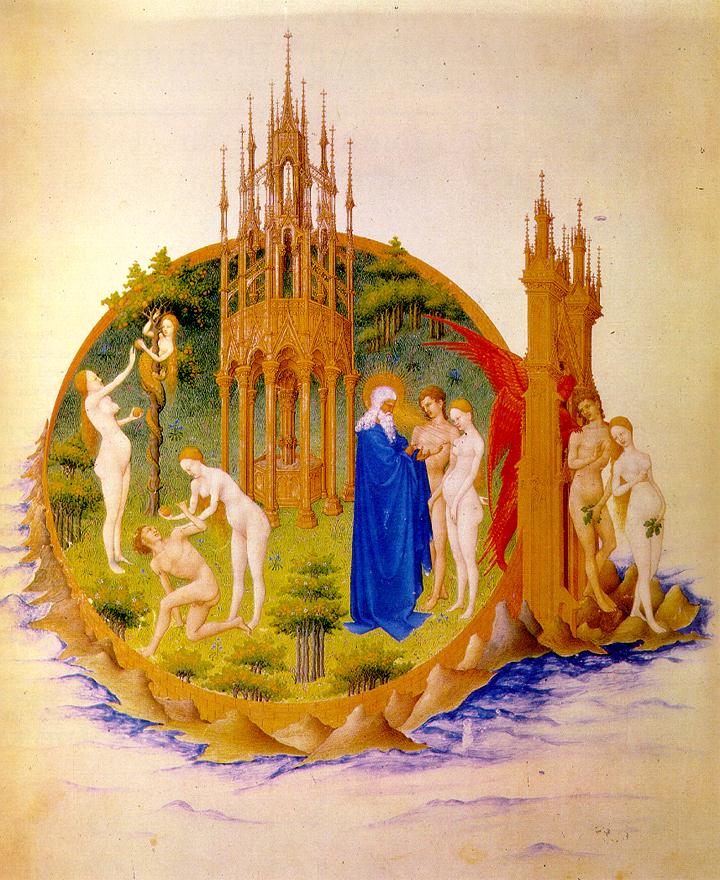 Temptation, Fall, and Expulsion
Brothers Limbourg (1411-1416)
When a Catholic monk named Martin Luther posted ninety-five theses on the door of the Castle Church in Wittenberg in October of 1517, he initiated a controversy that eventually led not only to his excommunication on January 3, 1521, but to the subsequent separation of Protestants from the Catholic Church. During the following two decades the Church attempted to effect a reconciliation with Protestants. These efforts culminated in Pope Paul III convoking an ecumenical council in 1542, the nineteenth ecumenical council in the history of the Church.2 This council met in the city of Trent, and had its first session in 1545. The purpose of the Council was two-fold: to extirpate various heresies that had arisen, and to reform the morals among the clergy and the lay faithful.3
The First Session formally opened the Council. The Second Session set forward the manner in which the bishops should conduct themselves during the Council. The Third Session expressed the Creed of the Church. The Fourth Session addressed the canon of Scripture. The Fifth Session addressed the doctrine of original sin. And the Sixth Session addressed the doctrine of justification.
It was not by accident that the Council addressed the doctrine of original sin before taking up the doctrine of justification. The doctrine of justification depends in part on the doctrine of original sin, as I shall show below. So in order rightly to understand the Council’s teaching on justification, one must first understand its teaching on original sin. In previous posts in this series, I presented and explained St. Thomas’s theology of original sin. (See “Aquinas and Trent: Part 2,” in which I explain the essence of original sin, according to St. Thomas, and “Aquinas and Trent: Part 3,” in which I explain the effect of original sin, according to St. Thomas.) I will not repeat here what I have said there; and what I say here presupposes that the reader has read at least those two posts in this series.
Why is the Council of Trent relevant to the reconciliation of Protestants and Catholics? Shouldn’t we just put the past behind us, and move forward? The reason why the Council of Trent remains relevant is that the canons of the Council of Trent are infallible, so the Church has no authority to overturn them. Whatever was declared heretical at Trent will remain heretical until Christ returns in the clouds in glory. The authority of the canons does not depend on whether those claims were in fact affirmed by any person. Nor does it depend on the bishops’ degree of understanding of the Protestants’ theological positions. But the canons condemn only the claims stated in the canons; they do not condemn unstated positions that may have been held by Protestants. Doesn’t the infallibility of the canons of Trent make ecumenical dialogue pointless? Not at all. To understand why, see my post titled “Two Ecumenicisms.” Protestants and Catholics can be reconciled only by coming to the truth concerning their separation in the sixteenth century. And that requires coming to terms with the Council of Trent. Protestants can no more reject the Council of Trent on the basis of their own interpretation of Scripture than any other heresy in the history of the Church could justifiably reject the teaching of an ecumenical council on the basis of its own interpretation of Scripture.
The Fifth Session: The Decree Concerning Original Sin
The Decree of the Fifth Session begins with an introductory paragraph:
That our Catholic faith, without which it is impossible to please God,4 may, after the destruction of errors, remain integral and spotless in its purity, and that the Christian people may not be carried about with every wind of doctrine,5 since that old serpent,6 the everlasting enemy of the human race, has, among the many evils with which the Church of God is in our times disturbed, stirred up also not only new but also old dissensions concerning original sin and its remedy, the holy, ecumenical and general Council of Trent, lawfully assembled in the Holy Ghost, the same three legates of the Apostolic See presiding, wishing now to reclaim the erring and to strengthen the wavering, and following the testimonies of the Holy Scriptures, of the holy Fathers, of the most approved councils, as well as the judgment and unanimity of the Church herself, ordains, confesses and declares these things concerning original sin:
Here the Tridentine Fathers affirm that the Church’s faith, without which it is impossible to please God, includes things concerning original sin and its remedy. In other words, the gospel includes a teaching on original sin. The bishops explain that they are addressing this subject in response to what they believe to be the work of the devil in stirring up dissensions new and old concerning the doctrine of original sin and its remedy. They state again that they are assembled as a “general and ecumenical” council, in accordance with the laws of the Church, and presided over by legates of the Apostolic See (i.e. Rome). For this reason they are assured of the presence and guidance of the Holy Spirit, who guides the Church into all truth (John 16:13), most assuredly when her bishops are assembled in ecumenical council.7 The Council states its intention to bring back those sheep that are erring, and to strengthen those sheep that are wavering. Lastly, the bishops affirm that what they are teaching regarding original sin follows both the testimony of the Holy Scriptures, and that of the unanimity of the Church, not only at that time but throughout the 1500 year history of the Church preceding the Council.
Next the Council in five paragraphs addresses five errors pertaining to original sin. I will examine each of these five paragraphs in turn.
I. The Error of Denying Original Sin
In the first paragraph the Council declares:
1. If anyone does not confess that the first man, Adam, when he transgressed the commandment of God in paradise, immediately lost the holiness and justice in which he had been constituted, and through the offense of that prevarication incurred the wrath and indignation of God, and thus death with which God had previously threatened him,8 and, together with death, captivity under his power who thenceforth had the empire of death, that is to say, the devil,9 and that the entire Adam through that offense of prevarication was changed in body and soul for the worse,10 let him be anathema.
In this first paragraph, the Council is condemning the error of denying that Adam, by his sin, lost the original holiness and righteous that God had given him. According to the Council, when Adam transgressed God’s commandment, the following five things happened: (1) he lost the holiness and justice in which he had been constituted, (2) he incurred the wrath and indignation of God, (3) he incurred the death with which God had previously threatened him, (4) he incurred captivity under the power of the devil who from that time on had the empire of death, and (5) he was changed for the worse both in body and soul. The statement about the change in “body and soul” is a reaffirmation of the first canon of the Second Council of Orange (529 AD), which canon was intended to refute the error of those who taught that not the soul but only the body was damaged by Adam’s sin.
The loss of the original holiness and justice in which man had been constituted refers to the loss of what St. Thomas treats as the third good of human nature, explained here and here in previous posts in this series. There too I laid out his explanation for death as the result of sin, and what it means to be “changed for the worse” both in body and in soul. The wrath and indignation of God I discussed in my post on St. Thomas’s doctrine on the Passion of Christ. St. Thomas discusses man’s captivity under the power of the devil in Summa Theologiae III Q.49 a.2.
The most important thing to understand in this first paragraph, with respect to reconciling Protestants and the Catholic Church, is what the Council is saying when it teaches that by his sin Adam lost the holiness and justice in which he had been constituted. The holiness and justice to which the Council refers are due to the presence of sanctifying grace and agape in Adam’s soul. Adam was holy because he had sanctifying grace in his soul, that is, he was a participant in the divine nature (2 Peter 1:4), and enjoyed the indwelling of the Trinity.11 And he was just (or righteous) because he had agape, i.e. love for God as Father. This original holiness and justice was not something Adam produced by his own nature. Nor were they part of the essence of his human nature; otherwise, in losing them he would have ceased to be human.
Why is this important for Protestant-Catholic reconciliation? Many Protestants believe that grace is only for the forgiveness of sins, and hence only something Adam and Eve received after they sinned. For this reason they tend to treat salvation prior to the Fall as by human-works-apart-from-grace, and salvation after the Fall as by grace-apart-from-human-works. But the notion that Adam and Eve, apart from grace, could have merited the Beatific Vision, is a form of Pelagianism.12 Only God has His [divine] inner life and the perfect happiness of seeing God, by His very nature. Man could have the Beatific Vision by his nature without grace only if he were God. But man is not God; man is a creature. Therefore, in order to attain the Beatific Vision, which is supernatural end [i.e. an end above the reach of man’s nature as such], man needs grace. In order for man to enter into heaven, i.e. into the perfect beatitude of the inner Life of the Trinity, God must give to man a participation in this inner Life; man must receive the gift of grace from God.
The Second Council of Orange (AD 529), which was primarily responding to Pelagianism, declared:
“Even if human nature remained in that integrity in which it was formed, it would in no way save itself without the help of its Creator.” (Can. 19)
Notice that “save” is not only from punishment, because human nature would remain in that integrity in which it was formed, only if Adam had not sinned. And where there is no sin, there is no punishment. But yet, according to Orange contra the Pelagians, even a sinless Adam and Eve would have needed divine help in order to be “saved.” In other words, they would have needed grace, to attain heaven, even if they had not sinned. St. Thomas concurs, writing:
But man’s perfect Happiness, as stated above (Question 3, Article 8), consists in the vision of the Divine Essence. Now the vision of God’s Essence surpasses the nature not only of man, but also of every creature, as was shown in the I, 12, 4. For the natural knowledge of every creature is in keeping with the mode of his substance: thus it is said of the intelligence (De Causis; Prop. viii) that “it knows things that are above it, and things that are below it, according to the mode of its substance.” But every knowledge that is according to the mode of created substance, falls short of the vision of the Divine Essence, which infinitely surpasses all created substance. Consequently neither man, nor any creature, can attain final Happiness by his natural powers.13
And that is why, in Catholic theology, Adam and Eve were given grace by God, prior to their Fall. It was by grace that they were able to walk with God in the cool of the day. No one can have friendship with God apart from grace, because no one can have friendship with God without agape, and no one can have agape without grace. Agape is supernatural;14 it is poured out into our hearts by the Holy Spirit.15 Man does not cease to be man if he loses agape. Hence, agape is not an essential component of our human essence or human nature. If agape were had by nature, then man without agape would be a contradiction in terms. God did not have to walk with Adam in the cool of the day. He did not have to form a friendship with man. He did this gratuitously, as a gift. This divine friendship with man as Father to son was a superadded gift of grace, not something man has by his nature as man.16
Yet, when we recognize that grace was necessary prior to the Fall, in order for Adam and Eve to have merited the Beatific Vision, then we no longer have a principled basis for excluding works done in grace from being meritorious toward the Beatific Vision under the New Covenant. And the role of works under grace is explicitly one of the points of disagreement between Protestants and the Catholic Church. It is also addressed in the Sixth Session of the Council of Trent. So here we see that rightly understanding the reasons for a doctrine taught in the Sixth Session requires understanding what was taught in the Fifth Session.
II. The Error of Denying that Adam’s Sin Deprived His Posterity of Original Holiness and Justice
In this second paragraph, the Council declares:
2. If anyone asserts that the transgression of Adam injured him alone and not his posterity,17 and that the holiness and justice which he received from God, which he lost, he lost for himself alone and not for us also; or that he, being defiled by the sin of disobedience, has transfused only death and the pains of the body into the whole human race, but not sin also, which is the death of the soul, let him be anathema, since he contradicts the Apostle who says: By one man sin entered into the world and by sin death; and so death passed upon all men, in whom all have sinned.18
In this second paragraph, the Council is condemning the error of denying that Adam’s sin deprived his posterity of original holiness and justice. The Council here affirms three things: (1) Adam’s transgression did not only injure himself, but also his posterity, (2) Adam’s transgression lost not only for himself but also for us his posterity the original holiness and justice that he had been given by God, (3) Adam’s transgression transfused to us not only bodily pains and bodily death, but also transfused sin, which is the death of the soul, into the whole human race. Adam was supposed to be propagate sanctifying grace to his offspring. In this way, the sexual act would have been a means of grace for the child conceived. But, by his sin, Adam passed on to his offspring the privation of sanctifying grace and agape, and hence the privation of holiness, righteousness. And that is precisely what original sin is, the privation of original righteousness. That is what it means for the soul to be dead, not for it to lack natural life, but for it to lack divine life, i.e. sanctifying grace and agape.
In addition, because Adam lost the original righteous he had been given, he also lost the preternatural gifts (integrity of powers of the soul, infused knowledge, impassibility, and immortality) he had enjoyed, and therefore he passed on concupiscence, ignorance, suffering, and death to his offspring. Those who claim that grace is only needed for forgiveness of sin, falsely conclude from the fact that the infant has committed no actual sin that the infant does not yet need grace for salvation, and therefore does not yet need baptism. This again, is Pelagianism, because it denies that sanctifying grace is absolutely needed to attain to heaven. Similarly, those who mistake concupiscence (i.e. disordered appetites) for original sin find that such disordered appetites remain after baptism, and falsely conclude that baptism is not the remedy for original sin. But the fundamental problem of man, is not that he has disordered lower appetites, but that he lacks sanctifying grace, and hence lacks agape. That’s what original sin is; the privation of sanctifying grace and agape. And for that, the remedy is baptism, as we will see in the next paragraph.
III. Errors Regarding the Remedy for Original Sin
3. If anyone asserts that this sin of Adam, which in its origin is one, and by propagation, not by imitation, transfused into all, which is in each one as something that is his own, is taken away either by the forces of human nature or by a remedy other than the merit of the one mediator, our Lord Jesus Christ,19 who has reconciled us to God in his own blood, made unto us justice, sanctification and redemption;20 or if he denies that that merit of Jesus Christ is applied both to adults and to infants by the sacrament of baptism rightly administered in the form of the Church, let him be anathema; for there is no other name under heaven given to men, whereby we must be saved.21 Whence that declaration: Behold the Lamb of God, behold him who taketh away the sins of the world;22 and that other: As many of you as have been baptized, have put on Christ.23
In this third paragraph, the Council condemns two errors. The first error is to claim that the remedy for original sin is something other than the merit of Jesus Christ, the Second Adam. The second error is to deny that adults and children receive Christ’s merit through the sacrament of baptism. Positively, in this paragraph the Council is teaching three things: (1) the sin of Adam that is transfused into all his posterity by propagation, not by imitation, is in each of us as something that is our own, (2) this sin [of Adam] in each of us is not taken away either by the forces of human nature or by any remedy other than the merit of the one mediator, our Lord Jesus Christ, who has reconciled us to God in His own blood, and (3) the grace that Christ merited in His Passion, by which the sin [of Adam] in us is removed, is applied both to adults and to infants by the sacrament of baptism rightly administered in the form of the Church.24
This paragraph is relevant to the reconciliation of Protestants with the Catholic Church because many Protestants deny that baptism is anything more than a sign or symbol, not recognizing baptism as the sacrament Christ established as the means through which we receive the sanctifying grace He merited for us in His Passion. For these Protestants, to be forgiven only requires believing the message about Christ and trusting in Him; baptism is something one does subsequently in obedience to Christ’s command. But the Church has always believed and taught that it is in baptism that we are joined to Christ, and receive the grace He merited for us in His Passion. This is what we say in the Creed: “one baptism for the forgiveness of sins.” And the efficacy of baptism as the sacrament of salvation is taught unanimously by the Church Fathers.25 Of course faith does come by hearing. But in Catholic doctrine the sanctifying grace through which we have the virtues of faith, hope and agape, comes to us through the sacrament of baptism. We first come to believe the good news, and have love for Christ, by hearing the gospel.26 But in the sacrament of baptism, faith, hope and agape are deepened; they are made to be firmly planted dispositions in our soul. In baptism they become theological virtues.27 In baptism we are ingrafted into Christ (cf. Rom 6), and by becoming firmly rooted dispositions faith, hope, and agape become part of who we are, not just acts we do.28
IV. The Error of Denying that Infants Need Baptism as a Remedy for Original Sin
4. If anyone denies that infants, newly born from their mothers’ wombs, are to be baptized, even though they be born of baptized parents, or says that they are indeed baptized for the remission of sins,29 but that they derive nothing of original sin from Adam which must be expiated by the laver of regeneration for the attainment of eternal life, whence it follows that in them the form of baptism for the remission of sins is to be understood not as true but as false, let him be anathema, for what the Apostle has said, by one man sin entered into the world, and by sin death, and so death passed upon all men, in whom all have sinned,30 is not to be understood otherwise than as the Catholic Church has everywhere and always understood it.
For in virtue of this rule of faith handed down from the apostles, even infants who could not as yet commit any sin of themselves, are for this reason truly baptized for the remission of sins, in order that in them what they contracted by generation may be washed away by regeneration.31 For, unless a man be born again of water and the Holy Ghost, he cannot enter into the kingdom of heaven.32
In this fourth paragraph the Council condemns two errors. The first is the error of denying that infants are to be baptized. The second is the error of denying that infants should be baptized for the remission of original sin. Positively, the Council here teaches four things: (1) Newly born infants are to be baptized, even if born of baptized parents, (2) Newly born infants are to be baptized for the expiation of original sin from Adam for the attainment of eternal life, (3) The words of the Apostle Paul in Romans 5:12 should not be understood otherwise than as the Catholic Church has everywhere and always understood them, and (4) According to this rule of faith [i.e. how Romans 5:12 has everywhere and always been understood by the Church] handed down from the apostles, even infants who could not as yet commit any sin of themselves, are (like adults) truly baptized for the remission of sins in order that what they contracted by generation [i.e. original sin] may be washed away by regeneration.
The primary problem for the newborn infant, prior to baptism, is not that he is not yet a member of the covenant family by a public sign or seal. The primary problem for the newborn infant is that he does not have sanctifying grace and agape, and thus does not have original righteousness or holiness, and thus is not in friendship with God. And that problem infinitely outweighs all other problems because what is at stake is eternal life and eternal separation from God. Doing a baby-dedication is a pious act, but Christ never instituted ‘dedication’ as a means by which anyone would receive grace; He instituted baptism. We know, of course, that God is capable of acting in extraordinary ways to give grace to whomever He wills at whatever times He wills. It is surely not beyond His power to do so. But we must not treat the possibility of the extraordinary as an excuse not to pursue with all our effort the ordinary means God has established through Christ by which adults, children, and infants are given the grace that translates them from death to life, from enemies of God to His friends.
V. Errors Regarding the Removal of Sin Through Baptism
5. If anyone denies that by the grace of our Lord Jesus Christ which is conferred in baptism, the guilt of original sin is remitted, or says that the whole of that which belongs to the essence of sin is not taken away, but says that it is only canceled or not imputed, let him be anathema. For in those who are born again God hates nothing, because there is no condemnation to those who are truly buried together with Christ by baptism unto death,33 who walk not according to the flesh,34 but, putting off the old man and putting on the new one who is created according to God,35 are made innocent, immaculate, pure, guiltless and beloved of God, heirs indeed of God, joint heirs with Christ;36 so that there is nothing whatever to hinder their entrance into heaven. But this holy council perceives and confesses that in the one baptized there remains concupiscence or an inclination to sin, which, since it is left for us to wrestle with, cannot injure those who do not acquiesce but resist manfully by the grace of Jesus Christ; indeed, he who shall have striven lawfully shall be crowned.37 This concupiscence, which the Apostle sometimes calls sin,38 the holy council declares the Catholic Church has never understood to be called sin in the sense that it is truly and properly sin in those born again, but in the sense that it is of sin and inclines to sin. But if anyone is of the contrary opinion, let him be anathema. This holy council declares, however, that it is not its intention to include in this decree, which deals with original sin, the blessed and immaculate Virgin Mary, the mother of God, but that the constitutions of Pope Sixtus IV, of happy memory, are to be observed under the penalties contained in those constitutions, which it renews.39
In this fifth paragraph the Council first condemns two errors. The first is the error of denying that by the grace of Christ which is conferred at baptism, the guilt of original sin is remitted. The second is the error of claiming that the whole of that which belongs to the essence of sin is not taken away, but that the [debt] of sin is merely canceled or not imputed. The Council then proceeds to teach six things: (1) God hates nothing in those who are born again [i.e. those who are regenerated through the grace conferred in baptism], because by their baptism they have been buried together with Christ, put off the old man, put on the new man, made innocent, free from condemnation, immaculate, pure, guiltless, beloved of God, heirs of God, and heirs with Christ, so that nothing hinders their entrance into heaven, (2) In baptized persons there remains concupiscence, which is an inclination to sin, and which is left with us to wrestle with, (3) Concupiscence cannot injure those who do not give into it, but manfully resist it by the grace of Jesus Christ, (4) Those who have lawfully resisted concupiscence shall be crowned40 (5) The Catholic Church has always understood concupiscence not to be sin in the sense that it is truly and properly sin in those who are born again, but to be sin in the sense that it is of sin (as an effect) and inclines to sin (as a cause), and (6) What this Council says about the universality of original sin in mankind should not be taken to apply to the blessed Virgin Mary.
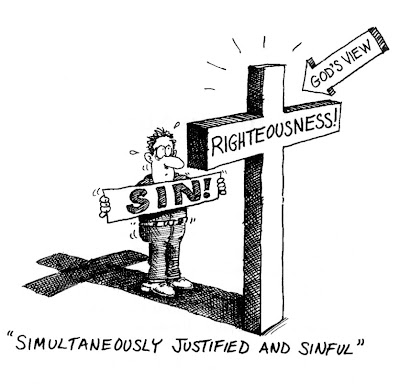
Of all five paragraphs in the Fifth Session of the Council of Trent, this last one was the one most incompatible with the theology of Luther and Calvin. Luther and Calvin agreed that the grace of Christ that is conferred at baptism remits original sin. But, they denied that this grace removes the whole of that which belongs to the essence of sin. Instead, they claimed that sin remained in the baptized person, but the debt of sin was canceled, and the remaining sin was not imputed or counted. This is typically referred to as simul iustus et peccator (simultaneously justified and sinner), illustrated in the cartoon at right.41 Whereas in Catholic doctrine, the grace of Christ given to us through the sacrament of baptism truly removes all our sin, in Luther and Calvin’s opinion, the grace of Christ does not remove all our sin; it leaves sin in our soul, but by God’s favor on account of Christ, sin in our soul is no longer counted against us.
Two things need to be said here. First, in Catholic doctrine, there is a sense in which that cartoon is correct, but there is also a sense in which that cartoon is heretical. In order to understand these two senses, we must distinguish between mortal and venial sin. Mortal sin removes agape from the soul; venial sin does not. That’s because in mortal sin the sinner directly chooses something else over God as his last end. By contrast, the person committing venial sin still loves God more than himself, and still seeks God as his final end, but chooses something other than the best path by which to attain to God. Even the saints sinned venially every day (the Blessed Mother excepted). So, if the sign held by the person in the cartoon above is referring to venial sin, then it is true that the baptized person remains a sinner. But even so, it is not that Christ’s righteousness hides or covers his venial sin. God sees every venial sin. But He sees it as venial, as still coming from a heart that loves Him above all else. And so He sees it with mercy, not wrath. Yet if the sign in the cartoon is referring to mortal sin, then the cartoon is heretical, because then it is affirming the second error condemned in this fifth paragraph of the Fifth Session of Trent.
The reason why it is impossible to be simultaneously in a state of mortal sin, and justified, is because God cannot lie. God can only count as righteous that which is actually inherently righteous. That’s because the relational problem between man and God necessarily depends upon the internal condition of man. As St. Thomas said, “But the effect remains so long as the cause remains. Wherefore so long as the disturbance of the order remains the debt of punishment must needs remain also.”42 In other words, so long as man is turned away from God, and without agape, the debt of sin remains, because the cause of that debt remains. God does not only look at the outside of man; He looks at the heart, and is related to man according to the condition of the man’s heart.43 If a man has sanctifying grace and agape in his soul, then his relation with God is one of friendship and he is justified, and the God who cannot lie cannot claim that he is unjust. But if a man does not have sanctifying grace and agape, then he is not a friend of God, and the God who cannot lie cannot say that he is just, without first making him just in his soul.
The Protestant response is to claim that God is speaking truly when He declares us just, because He performs an extrinsic relational transaction in which the merits of Christ are credited to our account, and the demerits of our sins are credited to Christ’s account. However, the problem with that position is that for a God from whom nothing is hidden, there can be no difference between what one is internally, and what is in one’s account. Necessarily, before the God of Truth, what is in one’s ‘account’ is always and only what one actually is. God cannot pretend that I am Christ or that Christ is me. God cannot pretend that my account is His, or that His account is mine. He always sees everything for exactly what it is, nothing more and nothing less. And therefore for a God of Truth, there can be no swapping of accounts. Because our ‘accounts’ are based on what we really are, the notion of account swapping presupposes that God is capable of deceiving Himself into thinking that Christ’s account is mine, and that my account is Christ’s. But a God of Truth cannot be deceived, and therefore there can be no swapping of accounts.
When Protestants think about being inherently righteous, they tend not to think about agape, but about having perfectly kept every law, and not having any wayward thoughts. And they tend to think that that is impossible, and so find forensic imputation much more plausible and attractive than this [seemingly] impossible standard of perfect legal righteousness that God expects of us. So, for example, they find vices in themselves after baptism, and take that as evidence that they are in fact unrighteous, and that provides the attraction of simul iustus et peccator. Yet in Catholic doctrine the law is fulfilled by those having agape,44 and venial sins (by definition) do not remove agape from the soul. Our righteousness before God (as friends of God) is not determined by or effected by our venial sins. So, while at the Judgment we are judged for all that we have done in the body, yet, our justification only requires that we have agape. Not having the mortal-venial distinction makes many Protestants conceive of the Catholic life as one of losing justification many times a day. And that seems (rightly) ridiculous to them. But in Catholic doctrine it is agape by which we fulfill the law, and mortal sin (in which agape is lost) is not something we should (ordinarily) be committing on a daily basis.
The second thing that needs to be said about this fifth paragraph, concerns concupiscence (i.e. disordered appetites). The Catholic Church teaches that concupiscence is not itself a sin. Concupiscence comes from sin, and it inclines to sin. But it itself is not sin, because sin requires the use of the will, and the motions of concupiscence are not willed.45 We discussed this in Aquinas and Trent: Part 2. Nor is concupiscence original sin. Baptism removes original sin, by giving the person sanctifying grace. But baptism does not remove concupiscence. Christ leaves us with concupiscence so that we, by manfully resisting it, may merit a greater reward. The early Protestants, however, believed that concupiscence was itself sin. And therefore, finding concupiscence in themselves daily, even after baptism, and not recognizing the mortal-venial distinction, they concluded that justification does not depend upon the internal condition of the sinner, but upon a forensic declaration. Because they [wrongly] believed that concupiscence was sin, and because they [rightly] believed that concupiscence remained after baptism, they concluded that after baptism there remains in us something that God hates, and for that reason were drawn toward to the notion of simul iustus et peccator.
From the Catholic point of view, the notion that we are simul iustus et peccator, where the sin in question is mortal sin, is extremely dangerous, because it leads people to think that their sin doesn’t really matter, so long as they continue to trust in God. This notion removes all motivation for pursuing the holiness without which no one will see the Lord.46 It produces no saints. Its danger cannot be underestimated, because what is at stake is eternal life. The notion of simul iustus et peccator could lead persons who are in a state of mortal sin, and thereby at risk of dying in a state of mortal sin and remaining eternally separated from God, to think that they are right with God. Of course some Protestants think that the Catholic Church teaches a false gospel. I will address that when we discuss the Sixth Session of the Council of Trent, on the doctrine of justification.
May Christ our Lord lead all Protestants and Catholics to unity in the truth, and full reconciliation. In the Name of the Father, and of the Son, and of the Holy Spirit. Amen.
- A fascinating summary of his life and death can be found here. [↩]
- The Pope had originally attempted to convoke this council in the city of Mantua in 1537, but for political reasons the council was unable to meet there. [↩]
- cf. Session Three [↩]
- Heb 11:6 [↩]
- Eph 4:14 [↩]
- Gen 3:1ff; Apoc. 12:9; 20:2 [↩]
- Cf. Acts 15:28. In that passage we see another example of a non-monergistic way of conceiving the cooperation of men with God. The Apostles recognize that what seems good to them, in council, is what also seems good to the Holy Spirit, precisely because the Holy Spirit is directing them in council. [↩]
- Gen 2:17 [↩]
- Heb 2:14 [↩]
- Cf. II Synod of Orange (529) [↩]
- Jesus said, “If anyone loves Me, he will keep My word; and My Father will love him, and We will come to him and make Our abode with him.” (John 14:23) [↩]
- Pelagianism ultimately reduces to one of two claims: it either denies that man has a supernatural end, and thus denies that man needs grace [i.e. participation in the divine nature] to attain man’s natural end, or it denies that grace is a participation in the divine nature, and thus implies that man, by his own natural power, can attain to the supernatural end that is heaven. The former denies that God has called man to enjoy eternal participation in His inner Life. The latter essentially denies the Creator-creature distinction. It claims that man, who is infinitely below God, can by his own natural power of intellect and will ‘climb up’ into the inner Life of the eternal Trinity. [↩]
- Summa Theologiae I-II Q.5 a.5 co. [↩]
-
All virtues have as their final scope to dispose man to acts conducive to his true happiness. The happiness, however, of which man is capable is twofold, namely, natural, which is attainable by man’s natural powers, and supernatural, which exceeds the capacity of unaided human nature. Since, therefore, merely natural principles of human action are inadequate to a supernatural end, it is necessary that man be endowed with supernatural powers to enable him to attain his final destiny. Now these supernatural principles are nothing else than the theological virtues. They are called theological: (1) because they have God for their immediate and proper object; (2) because they are Divinely infused; (3) because they are known only through Divine Revelation. The theological virtues are three, viz. faith, hope, and charity [agape]. (Catholic Encyclopedia article ‘Virtue‘.)
[↩]
- Romans 5:5 [↩]
- For more on this see The Natural Desire to See God According to St. Thomas Aquinas and His Interpreters, by Lawrence Feingold, (Sapientia Press, 2010). [↩]
- 1 Cor. 15:21f.; II Synod of Orange, c.2 [↩]
- Rom 5:12 [↩]
- 1 Tim. 2:5 [↩]
- 1 Cor 1:30 [↩]
- Acts 4:12 [↩]
- John 1:29 [↩]
- Gal 3:27 [↩]
- By “rightly administered in the form of the Church” they mean according to the form taught by the Church, namely, “I baptize you in the name of the Father, and of the Son, and of the Holy Spirit.” [↩]
- We plan to post something showing this in the near future at CTC. [↩]
- The Council acknowledges this in Session 6 Chapter 6. [↩]
- See Session 6 Chapter 7. [↩]
- This becomes relevant to Session 6 Canon 9, because that canon is condemning the notion that merely believing the message about Christ is entirely sufficient for justification, and that repentance (as a preparation for baptism) and baptism itself are not also necessary for the justification we receive through the sacrament of baptism, wherein belief in Christ is made to be the virtue of faith. [↩]
- Acts 2:38 [↩]
- Rom. 5:12 [↩]
- C.153, D.IV de cons. [↩]
- John 3:5 [↩]
- Rom. 6:4; C.13, D.IV de cons. [↩]
- Rom. 8:1 [↩]
- Eph. 4:22, 24; Col. 3:9f. [↩]
- Rom. 8:17 [↩]
- II Tim. 2:5. [↩]
- Rom. 6-8; Col. 3 [↩]
- Cc. 1, 2, Extrav. comm., De reliq. et venerat. sanct., III, 12. [↩]
- Those who castrate themselves, for example, are resisting concupiscence unlawfully. [↩]
- This cartoon is from Michael Horton’s Putting Amazing Back Into Grace. [↩]
- Aquinas and Trent: Part 5 [↩]
- “ God sees not as man sees, for man looks at the outward appearance, but the LORD looks at the heart.” (1 Sam 16:7) [↩]
- cf. Rom 13:8, Gal 5:14, James 2:8 [↩]
- See Aquinas and Trent: Part 5 [↩]
- Hebrews 12:14 [↩]

Bryan,
Thanks for the article. I’m glad you’re continuing this line of thought. Much of your discussion towards the end of the article revolves around the mortal/venial distinction. Why did Protestants reject that distinction? Was their rejection of it a (partial) cause or effect of their adopting simul iustus et peccator?
Ryan,
Luther retained the distinction, but didn’t explain the distinction in relation to agape, so far as I know. From one point of view, the Lutheran position makes apostasy the only mortal sin; any remaining trust in Christ means that the sin is nor mortal. But Calvin altogether rejected the distinction between mortal and venial sin, and Protestantism has largely following Calvin on this point. Calvin rejected it because he didn’t see it clearly laid out in Scripture, and also because he viewed sin primarily in legal terms. All sin, for Calvin, is a rebellion against God’s law, and hence a rebellion against God, and therefore deserving of eternal punishment. Therefore, (for Calvin) all sin, even after we come to faith in Christ, is mortal sin in what it deserves, but is venial in the sense that it is covered by the merits of Christ, so that we never lose our justification.
Your second question is a good question, and not easy to answer. Luther suffered from scrupulosity, and this can include, among other things, a diminished capacity to distinguish mortal and venial sin, within oneself. It is quite likely that this contributed to his embrace of simul iustus et peccator as he studied Romans. As for Calvin, he writes:
Even through all of Calvin’s rhetoric, I don’t see evidence in Calvin that simul iustus et peccator led him to deny the mortal-venial distinction. He seems not to have understood the metaphysics of sin, especially as explained in St. Thomas, taking a more voluntaristic approach to the question. He doesn’t seem to be aware of the theological and anthropological basis for the Catholic distinction between mortal and venial sin. So it wouldn’t surprise me at all if his not seeing any good reason to maintain the distinction, contributed to his reading the New Testament as teaching simul iustus et peccator.
In the peace of Christ,
– Bryan
Bryan,
Your quote from Calvin prompted a thought I’ve had for a while about the Protestant citation of “the soul who sins, it shall die,” (Ezek. 18:20). This is often used by Protestants today in proving that every sin is deserving of eternal punishment (usually for evangelistic purposes, but also to make an attempted refutation of the Catholic distinction between mortal and venial sins). What’s ironic is that I have never seen a Protestant reference the surrounding context of that verse–because the context itself is enough to not only show the Protestant use of the verse to be a misuse, but to establish the Catholic distinction between sins. For example, in the very same verse, God says, “the righteousness of the righteous will be upon himself, and the wickedness of the wicked will be upon himself.” The chapter goes on to demonstrate, probably as clearly as anywhere else in the Bible, the view that if an unrighteous person turns from his sins and lives righteously, he will live; if a righteous person turns from his righteousness and sins, he will die. The context makes it clear that “the soul who sins will die” refers to the person who unrepentantly commits gross and heinous violations of God’s law–it doesn’t seem to refer to “smaller” sins, which would seem to establish the distinction between “sins unto death” and other sins.
You said:
Just a question about this…don’t Catholics also believe that concupiscence is sin as well, at least to some degree, since it is referred to as venial sin? Also, what implications would this have for the older Reformed view, in which (obviously saintly) people like Jonathan Edwards or Charles Spurgeon saw themselves as being completely depraved, not merely in original sin, but in day to day life? Would a Catholic disagree and have a more optimistic view of his own character, by not viewing all sins as mortal?
Pax Christi,
Spencer
Spencer,
I think Ezekiel’s intention is to show that ultimately the punishment for sin rests only on those who commit the sin, not those who did not commit the sin. God is not unjust. He doesn’t punish the children for the sins of the father. Children often suffer the effects of their father’s sin, but this is not God punishing children for the father’s sin. Likewise, children of a righteous father don’t get to ride on the coat-tails of their father’s righteousness. If they sin, they are punished, even if their father was righteous. Also, I don’t see Ezekiel making a distinction here between mortal and venial sin; I think he is talking about mortal sin.
As for your question about concupiscence, concupiscence is not sin, though it is an effect of sin, and inclines toward sin. Conscupiscence is disordered desires of the lower appetites. But sin requires the involvement of the will. So a disordered motion of the lower appetites is not itself sin. For example, if a lustful thought comes into our mind, or we experience a disordered sexual appetite, at that moment it is not a sin. If we resist it, and do not dwell on it, or act on it, we have not sinned. But if we, by our will, choose to dwell on it, nurture it, or consent to it, then we have sinned.
I don’t know if I would put it as “optimistic”, but we wouldn’t view their venial sin as mortal sin. At the same time, as Catholic saints grow in holiness, they come to see their own [venial] sin more clearly, and with greater repugnance and sorrowful contrition.
In the peace of Christ,
– Bryan
As I showed in the body of the post above, in its fifth session, the Council of Trent taught that in the regenerate, concupiscence itself is not sin. In the section addressing this question (i.e. section five of Session Five), the bishops of the Council of the Trent claimed to be teaching what the Catholic Church had always believed, and implying that the view of the Protestants (i.e. that in the regenerate, concupiscence is sin) was a novelty that departed from what the Church had always believed. The council Fathers wrote:
Both Calvin and Luther denied that in the regenerate, concupiscence itself is not sin. Luther believed that concupiscence was a form of covetousness, and hence sinful. He wrote:
And later:
He continues:
Finally, he says:
Notice that he says that no sin is venial of its nature. Why did he come to believe this? Because he saw concupiscence as a kind of covetousness, covetousness as a mortal sin, and concupiscence as invincible in this present life. By this covetousness, throughout this present life (even after baptism) we are devoid of the love of God and thus in mortal sin, without the grace of an alien righteousness.
John Calvin also believed that in the regenerate, concupiscence is in itself sin. See the Institutes Bk III, Chapter 3, Sections 12-13. There Calvin claims that St. Ambrose and St. Augustine taught that concupiscence is itself sinful. But in examining these passages from St. Ambrose and St. Augustine, it is clear that Calvin misunderstood them. Calvin quotes from St. Augustine’s work “Against Julian” in which St. Augustine wrote, “This law of sin is both remitted by spiritual regeneration and remains in mortal flesh. Remitted, namely because guilt has been removed in the sacrament by which believers are regenerated. But it remains because it prompts the desires against which believers contend.” Calvin provides another quotation from St. Augustine, “Therefore, the law of sin which was also in the members of the great apostles himself is remitted in baptism, not ended.” Then Calvin says, “Ambrose called the law of sin ‘inquity,’ the guilt of which was removed in baptism although it itself remains. For it is iniquitous that ‘the flesh inordinately desires against the Spirit.’ (Gal 5:17)”
But in each of these quotations, St. Augustine and St. Anselm (who was St. Augustine’s teacher) were not teaching that concupiscence itself, after baptism, is sin. That’s why for St. Augustine and St. Ambrose the guilt of concupiscence [they refer to concupiscence as the “law of sin”] is removed in baptism, because at baptism the person who was at enmity with God receives sanctifying grace in his soul, and is no longer at enmity with God, even though the disordered desires of concupiscence remain in his lower appetites. And St. Paul in Romans 7 describes these disordered desires (i.e. “the law of sin”) remaining in the believer even after coming to faith. But for St. Augustine and St. Anselm, concupiscence itself is not sin, though it has its origin from sin, and inclines us to sin if we do not resist it. These disordered desires themselves are not sin. But if we do not have the grace that comes through baptism, then we not only have concupiscence, but we also have objective guilt, i.e. culpability before God, not being clothed with righteousness, but being unrighteous by original sin or actual mortal sin.
That concupiscence itself is not sin can be seen explicitly in places in St. Augustine’s writings that Calvin does not cite. St. Augustine writes:
Three chapters later he writes:
And elsewhere in a different work he writes:
And elsewhere in a different work he writes:
Elsewhere he writes:
Elsewhere he writes:
And elsewhere he writes:
In short, a more careful study of St. Augustine shows that Calvin misrepresented / misunderstood him on this question of whether concupiscence after baptism is itself sin, and that St. Augustine supports what the bishops at the Council of Trent said on this point.
Mr. Cross,
Is it not clear that in these statements, when Augustine denies that concupiscence is “sin,” by “sin” he means mortal sin?
Regards,
Keith Fredrickson
Keith (re: #6),
I don’t see any evidence in his work that when St. Augustine denies that concupiscence is sin, he is denying only that concupiscence is mortal sin, but believes or is open to the possibility that concupiscence is venial sin. In fact, the quotations listed above (in comment #5) show that for St. Augustine, sin as such [whether mortal or venial] requires the consent of the will. But he distinguishes concupiscence from the will’s consent to concupiscence. So in my opinion the evidence indicates that when St. Augustine denies that concupiscence is ‘sin,’ he is not limiting the sense of the term ‘sin’ to mortal sin, but includes venial sin as well.
In the peace of Christ,
– Bryan
Bryan,
Perhaps I am mistaken; perhaps it is not clear that in these statements, taken by themselves, Augustine is simply denying that concupiscence is mortal sin. Perhaps he is denying that it is venial sin as well. In this case he is denying that concupiscence is “sin” in the sense of sin as involving some kind of consent of the will.
But does this not still leave open the possibility that it is “sin” in another sense and that it itself deserves punishment? Does he not imply that it deserves punishment by these words:
“Carnal concupiscence is remitted, indeed, in baptism . . . its guilt is now taken away . . . its sinful desires”
“In baptized infants, it is deprived of guilt”
Regards,
Keith Fredrickson
Bryan,
I wish to present another statement of Augustine on this important matter:
“How can any man be so impudent and imprudent, so obstinate, obdurate, and obstructive, finally so foolish and beside himself as to confess that sins are evil and yet deny that the lust for sins is evil, even when the spirit lusting against it does not permit it to conceive and give birth to sins? Must not an evil of this kind and so great bind man in death and carry him to final death merely because it is in him, unless its bond be loosed in that remission of all sins which is accomplished in baptism?”
– *Against Julian*, 6:15:48
Another translation of the second sentence:
“Moreover, such and so great an evil, from the very fact of its being in us, would it not certainly hold us under sentence of death, and drag us down to final death, unless its chain were loosened by that remission of all sins which is made in baptism?”
The contrast between these words and the following words of the Council of Trent speaks for
itself:
COUNCIL OF TRENT 1545-1563
Session V (June 17, 1546)
Decree on Original Sin
Canon 5. “in those who are born again, God hates nothing . . . there remains in the baptized concupiscence of an inclination . . . left to be wrestled with . . . This concupiscence, which at times
the Apostle calls sin [Rom. 6:12ff.] the holy Synod declares that the Catholic Church has never understood to be called sin, as truly and properly sin in those born again, but because it is from sin
and inclines to sin. But if anyone is of the contrary opinion, let him be anathema.”
Respectfully submitted,
Keith
Keith (#9
The way to understand it is to understand that all sin is evil, but not all evils are sin. Sin is intended evil. You don’t (necessarily :-)) intend the feeling rising up in you to look at that girl in an immodest way. If you resist the feeling, it is virtue; if you voluntarily give in to it, it is sin.
Cancer is evil, but, because it cannot be intended, it is not sin.
jj
Keith,
John is correct, and the sentence from St. Augustine which you quoted and which I have re-quoted shows as much. St. Augustine himself was a champion of the understanding that, while all evil is a privation of a good that ought to exist, not all evil (or privation) is sin. Sin, properly speaking, requires the action free will. That is why the “lust for sins” (that is, the lust itself which arises in the passions prior to any willful embrace) is understood as evil, but not sin. It is a state of disorder endemic to human nature arising from man’s fall from grace, wherein he lost the supernatural gift of divine grace and the preternatural gift of integrity (the harmonious cooperation of the passions with a grace-elevated reason). That is why St. Augustine immediately follows up with the comment that, by the spirit striving against the evil disorder of lust in the passions, it can prevent the birth of sins. That final comment would make no sense at all if your portrayal of Augustine were correct. It is not correct, and Trent is entirely in accord with St. Augusine on this point.
Pax Christi,
Ray
Keith,
Trent says that in the baptized God hates nothing. Didn’t you notice that Augustine was talking about the damnation of the unbaptized in that passage?
Sincerely,
K. Doran
#10
jj,
You wrote: “If you resist the feeling, it is virtue”
Does this virtue entail condign merit? Does resistance to a lustful feeling merit eternal life or eternal reward?
Regards,
Keith
Keith (#13
Yes
Not a theologian. My understanding is that ‘condign merit’ is always merit only because of Christ’s strict merit. If that is correct – and a theologian would have to correct me – then I doubt there is a strict difference between eternal life and rewards. I take it that ‘rewards’ are matters of degree of glory in eternal life – and eternal life is the life of God in the saved. But a theologian should be able to give you a better answer.
Resisting temptation is always meritorious. How could it be otherwise?
jj
#10, #11, #12
Dear jj, Ray, and K. Doran,
For our convenience, here again is the statement that we are discussing:
“How can any man be so impudent and imprudent, so obstinate, obdurate, and obstructive, finally so foolish and beside himself as to confess that sins are evil and yet deny that the lust for sins is evil, even when the spirit lusting against it does not permit it to conceive and give birth to sins? Must not an evil of this kind and so great bind man in death and carry him to final death merely because it is in him, unless its bond be loosed in that remission of all sins which is accomplished in baptism?”
– *Against Julian*, 6:15:48
This statement must be taken as a whole and, when it is, it is clearly seen to refer to a regenerate person. Of whom else may it be said that “the lust for sins” is opposed by “the spirit lusting against it”? Granted, Augustine here calls “the lust for sins” “an evil” rather than a “sin.” However, let us not miss the African Doctor’s explicit statement that “an evil of this kind and so great” *must* “bind man in death and carry him to final death merely because it is in him” apart from the “remission of all sins.” Thus, in Augustine’s thought, lust itself deserves “final death,” everlasting punishment, merely because it is in” the Christian. This is precisely the doctrine of the Reformation vis-a-vis Trent.
This understanding of Augustine is further confirmed by the following:
“Carnal concupiscence is remitted, indeed, in baptism; not so that it is put out of existence, but so that it is not to be imputed for sin. . . . its guilt is now taken away . . . its sinful desires”
(Note: “sinful”)
(On Marriage and Concupiscence, Bk 1, chapter 28)
“Concupiscence, therefore, as the law of sin which remains in the members of this body of death, is born with infants. In baptized infants, it is deprived of guilt”
(On Merit and the Forgiveness of Sins, and the Baptism of Infants, Bk II, chapter 4)
(These two citations taken from posting #5 above, by Bryan Cross)
Scripture says, “Thou shalt not lust” (Romans 7:7 in the Greek and the Vulgate) and “the flesh [continually] lusts against the spirit [or Spirit] (Galatians 5:17).” Therefore, the Christian, who is “carnal, sold under sin” (Romans 7:14), sins continually and thus stands in constant need of the forgiveness of a God whose delight in forgiving infinitely exceeds His hatred of sin.
Regards,
Keith
Keith,
Unless there is something in Augustine’s Latin that contradicts the English translation, you are greatly mistaken. I am no expert in Latin, but the English is clear enough. Augustine explicitly claims that the evil of concupiscence does not “bind man in death and carry him to final death merely because it is in him” when that man is lucky enough to have “its bond be loosed in that remission of all sins which is accomplished in baptism.”
Did you catch that? Augustine explicitly says that the evil of concupiscence does not bind man in death when its bond has been loosed by the sacrament of baptism. That’s not my interpretation of his words. That’s just his own words.
This is just like Trent. Trent says that in the “baptized” God hates nothing. Trent doesn’t say that in the unbaptized God hates nothing. It says that in the baptized God hates nothing. And Augustine says that in the baptized concupiscence remains but is not damnable. So he’s all on board.
Here is a more pertinent question: do you believe that in “baptized infants” “concupiscence” “is deprived of guilt”? If you do not, then it is you who disagree with Augustine’s explicit words, not us.
Sincerely,
K. Doran
#16
Dear K. Doran,
After discussing the statement of Augustine that we are considering, John Davenant (Anglican bishop and theologian; 1572–1641), writes, “Again, Augustine, lib. 1. contra duas Epistolas Pelagianorum, cap. 14, says ‘All the fruits of concupiscence, and the old guiltiness of concupiscence, is put away by the washing of baptism.’ He who says that the guilt of original indwelling concupiscence, and all its fruits of actual concupiscence are put away from the regenerate, confesses that the nature of them is damnable in itself. For nothing needs remission but what is deserving of condemnation.” (*A Treatise on Justification*)
Regards,
Keith
Hi Keith,
Are you still claiming that Trent contradicts Augustine? If so, is the basis of your claim that Trent and Augustine disagree about the guilt of concupiscence for baptized people, or that they disagree about the guilt of concupiscence for unbaptized people?
Based on what you have written in #17, I think that you acknowledge that Trent and Augustine agree about the guilt of concupiscence for baptized people. So: do you think that Trent and Augustine disagree about the guilt of concupiscence for unbaptized people? If so, can you show the two quotes that demonstrate this disagreement?
Sincerely,
K. Doran
Keith, (re: #17)
The term ‘concupiscence’ has been used by some earlier writers in a broader, looser sense, to refer to the condition of original sin. When speaking more precisely we see that there are two aspects of the condition of original sin. One aspect is the absence of sanctifying grace and agape. The other aspect is the presence of disordered lower appetites, which draw us away from the good proposed by reason, and entice us to choose some evil. The latter [i.e. the disordered lower appetites] is concupiscence proper, but sometimes earlier writers used the term ‘concupiscence’ loosely to refer to both aspects, without distinguishing them, especially when they are present together in the unbaptized infant. By itself concupiscence proper is guiltless. But the absence of sanctifying grace in an infant is not guiltless, not because the infant lacking sanctifying grace committed an actual sin, but because no one can enter into eternal life without sanctifying grace and agape. Moreover, for all those who have attained the age of reason, and who do not have sanctifying grace and agape, concupiscence is damnable though not in itself, but inasmuch as (according to St. Augustine) without such grace the temptations arising from concupiscence and leading to mortal sin are not ultimately resistible. As St. Augustine argued against the Pelagians, without sanctifying grace, the man with concupiscence will commit mortal sin. And in that sense, concupiscence is damnable, not in itself, but on account of its inevitable fruit in the man lacking sanctifying grace and agape.
So when St. Augustine says that “the old guiltiness of concupiscence is put away by the washing of baptism,” he is speaking of concupiscence in this broader sense, as it is present [accompanied by original sin] in the unbaptized person, and particularly the unbaptized infant. The “guiltiness” of concupiscence (in this broader sense of the term ‘concupiscence’) is not the disordered lower appetites, but the absence of sanctifying grace and agape. Now consider Davenant’s statement:
Here is Davenant’s argument:
(1) Nothing needs remission but what is deserving of condemnation.
(2) The guilt of original indwelling concupiscence is put away from the regenerate through baptism
(3) God does nothing superfluous.
Therefore:
(4) The guilt of original indwelling concupiscence needs remission. [from (2), (3)]
Therefore:
(5) Concupiscence is in itself damnable. [from (1), (4)]
The argument is sound. The problem is that the term ‘concupiscence’ is being used here in its looser sense, not in its more precise sense. So the guilt being referred to is that of original sin (i.e. the absence of sanctifying grace and agape). The doctrine as defined by Trent (Session 5), however, is using the term ‘concupiscence’ in its more precise sense, to refer only to disordered lower appetites. So to infer from this argument (presented by Davenant) that Trent contradicts St. Augustine is to commit the fallacy of equivocation. As we are examining the texts we have to keep in mind that the term has both a broader and more precise sense, and ask ourselves in each case which sense of the term is being used. As I showed in comment #5 above, St. Augustine himself shows in a number of other places that concupiscence proper is not sin, and in this way shows the basis for the distinction between the more precise sense of the term and its looser sense as he applies it to the unbaptized.
In the peace of Christ,
– Bryan
#19
Dear Bryan,
Thank you for your very thoughtful response, which prompts the following questions:
What evidence is there that “some earlier writers” including Augustine used “concupiscence” in a broader sense to include “the absence of sanctifying grace and agape” as well as “disordered lower appetites”?
Is it your view that “the absence of sanctifying grace” is sinful and deserving of punishment?
If so, is there any evidence that the Early Fathers held to such a view?
Regards,
Keith
[The following post was written a little while back when I had more time on my hands. While I don’t have time to defend its propositions in any follow up posts, I figured it still might be an interesting insertion in the discussion–if nothing else, to be torn apart in my absence… ;- ) ]
Augustine says that even without consent the concupiscence that remains in a Baptized believer violates the commandment “thou shalt not covet (non concupisces)”: “There is rather an intermediate condition of things: good is effected in some degree, because the evil concupiscence has gained no assent to itself; and in some degree there is a remnant of evil, because the concupiscence is present…For the truth is, one does a good deal of good when he does what the Scripture enjoins, Go not after your lusts; Sirach 18:30 yet he falls short of perfection, in that he fails to keep the great commandment, You shall not covet. Exodus 20:7.” (Marriage and Concupiscence, Book 1, Chp 32).
Consequently, since it violates God’s Law, Augustine affirms that “the still indwelling concupiscence” after Baptism creates guilt, but God no longer imputes this guilt after Baptism: “In the case, then, of those persons who are born again in Christ, when they receive an entire remission of all their sins, it is of course necessary that the guilt also of the still indwelling concupiscence should be remitted, in order that (as I said) it should not be imputed to them for sin.” (Marriage and Concupiscence Book 1, Chp 29)
https://www.newadvent.org/fathers/15071.htm
In Marriage and Concupiscence Book 1, for instance, after noting in chapters 29 and following that even concupiscence without consent is a guilt inducing violation of God’s Law “Thou shalt not covet (non concupisces),” Augustine continues following Paul’s train of thought through Romans 7 up to Romans 8:1, where he comes to the Good News (Rom 8:1) that we are not condemned by this continual violation of God’s Law/the guilt of our continued indwelling concupiscence because its sentence of guilt has been removed in Christ.
“There is therefore now no condemnation to them which are in Christ Jesus. Romans 8:1 Even now, says he, when the law in my members keeps up its warfare against the law of my mind, and retains in captivity somewhat in the body of this death, there is no condemnation to them which are in Christ Jesus. And listen why: For the law of the spirit of life in Christ Jesus, says he, has made me free from the law of sin and death. Romans 8:2 How made me free, except by abolishing its sentence of guilt by the remission of all my sins; so that, though it still remains, only daily lessening more and more, it is nevertheless not imputed to me as sin?” (Marriage and Concupiscence Book 1, Chp 36).
The only confusion for some regarding Augustine’s belief is that he generally uses the term “sin” in a narrower sense than the reformers (much like the narrower usage of the term “sin” in James 1:13-15), such that he only calls a moral evil “sin proper” if it 1. involves consent or 2.renders guilty (for Augustine “1.” always necessitated “2.”, however he held that you can have “2.” without “1.”). Since Augustine says that resisted concupiscence does not involve either 1. or 2. he does not call it “sin” ordinarily, despite his affirmation that it is a violation of the moral law that would continually render guilty apart from non-imputation of its guilt.
Further, in relation to “2. renders guilty” Augustine also says that the Baptized believer does not need to ask for the forgiveness of their concupiscence (e.g. in the Lord’s Prayer “forgive us our debts”) . He says, it is unnecessary because the continuing guilt of concupiscence that remains in the believer is already remitted in Baptism and hence it would be superfluous to ask for it to be remitted again, unless we consent to it.
God Bless,
W.A.Scott
William, (re: #21)
You wrote:
In fact he does not say that, or anything entailing that. Here’s what he says in that paragraph:
Here St. Augustine is not saying that the concupiscence itself is a violation of the commandment, but that insofar as the person by his will allows the concupiscence to hinder him from doing the good, he fails to keep the commandment perfectly. This is the intermediate position between willing the good perfectly, and willing evil.
Next you write:
Here St. Augustine is referring not to infants, but to persons who have already attained the age of reason, and are then being baptized. In baptism, the guilt of their actual sins (i.e. the sins they have willfully committed) and the “guilt … of the still indwelling concupiscience” is remitted. The “still indwelling concupiscence” he refers to here includes original sin, as I have explained in comment #19 above, and does not refer merely to “disordered lower appetites.” So the guilt of concupiscence here is the guilt of original sin. And that’s fully compatible with Trent.
Then you quoted Marriage and Concupiscence Book 1, Chp 36:
Here still St. Augustine is using the term ‘concupiscence’ in its broader sense, and not distinguishing between the form of original sin, and its matter, which is the disordered lower desires. As used in this broad sense, concupiscence remains after baptism (because the disordered lower appetites remain), though it daily lessens as by grace we manfully resist it, yet the guilt of concupiscence is removed, because original sin has been removed by baptism, through the instantaneous infusion of sanctifying grace and justice. Concupiscence is “not imputed to me as sin” not because it is sin that God simply overlooks, but because the guilt for the disordered will by which these lower appetites were made to be disordered was removed at baptism when the will itself was turned toward God in agape. And that’s fully compatible with Trent. On this subject St. Thomas, in answering the question “Whether original sin is concupiscence?” answers:
Here St. Thomas explains that the form (or essence) of original sin is the privation of original justice, whereas “every other disorder of the soul’s powers is a kind of material element in respect of original sin.” Hence “original sin is concupiscence, materially, but privation of original justice, formally.” That’s the distinction that is not being made clear in St. Augustine’s broader use of the term ‘concupiscence.’ Nevertheless, when St. Augustine’s statements are rightly understood, they are fully compatible with Trent.
In the peace of Christ,
– Bryan
Dear Bryan,
I sent you a message last week, which I’m not sure if you’ve received but anyway I wanted to know if you were planning to write on a part 8 regarding justification any time soon?
Thanks and God bless
Julian
Julian, (re: #23)
Yes, I’m still planning to write that. I’m sorry about not replying to your email. I came to the realization a few years ago that there is a problem of scale here when connected to the firehose that is the internet, and that I simply cannot reply to all the comments and inquiries I receive by email, related to CTC, in light of my other responsibilities. I do not have the time even to reply to all the questions and objections directed to me here at CTC. So please don’t take my silence personally.
In the peace of Christ,
– Bryan
Bryan you wrote:
Our righteousness before God (as friends of God) is not determined by or effected by our venial sins. So, while at the Judgment we are judged for all that we have done in the body, yet, our justification only requires that we have agape. Not having the mortal-venial distinction makes many Protestants conceive of the Catholic life as one of losing justification many times a day. And that seems (rightly) ridiculous to them. But in Catholic doctrine it is agape by which we fulfill the law, and mortal sin (in which agape is lost) is not something we should (ordinarily) be committing on a daily basis.”
Is this not simply God lowering the bar for us? It seems that God grades on the curve according to you and accepts us into heaven even if we have not obeyed the law perfectly without fail. So in essence God denies perfection from us.
Hello Bryan (and apologies ahead of time for the extremely repetitive nature of this post),
This contradicts the whole point of Augustine’s argument. Augustine’s argument is based on the contrast between:
1. the “intermediate” condition of good, where there is a “great deal of good” because “concupiscence has gained no assent” (fulfilling the instruction “Go not after your lusts/concupiscence” ), but not “perfect” good because “concupiscence is present” in violation of the command “Thou shalt not covet (non concupiscens)”
AND
2. “perfection,” namely the perfect fulfillment of God’s command through the complete freedom not only from assenting to concupiscence but also from the very presence of concupiscence.
[To be needlessly repetitive, Augustine does not say that Paul only violated “Thou shalt not covet (non-concupiscens)” when he assented in some degree to it. Rather, he says the opposite. Namely, that even though Paul gave “no assent” to concupiscence, and therefore fulfilled the command “Go not after your lusts” he still fell short inasmuch as he still had concupiscence and thus “fails to keep the great commandment, “Thou shalt not covet.'” Consequently, Augustine says it was an intermediate condition “there was a great deal of good” inasmuch as Paul did not obey/consent to concupiscence, but the good was not perfected because concupiscence was still present.]
In fact, Augustine’s discussion in this chapter and the surrounding chapters of Marriage and Concupiscence, Book 1 revolves largely around the point that concupiscence without consent is a violation of the command “Thou shalt not covet (non concupiscens).” Augustine draws this from Paul’s personal testimony in Romans 7 of the continuous violation of God’s law present in his flesh through indwelling concupiscence, even when he yielded no consent to it. For example:
Augustine immediately goes on to note in the following chapter:
Once again, Augustine distinguishes in the above passages: 1.consent to concupiscence and 2.concupiscence without consent–and says that “Thou shalt not covet” directly prohibits the latter and not merely the former.
Specifically, in these passages Augustine breaks down Paul’s statements on violating God’s Law without consent in the following way: “I do what I hate”–i.e. “I covet (concupiscens)” in violation of God’s Law “You shalt not covet.” However, “It is not I that do it”–i.e. I give no consent to concupiscence, “but sin that dwelleth in me”–i.e. the concupiscence which arises without my consent in violation of God’s Law.
If it wasn’t obvious from the two dozen times I’ve said the same thing ;-) …whether concupiscence without consent violates God’s moral law is the central issue in our current discussion. The rest of the discussion is essentially moot after this point is determined.
Of course, since Augustine explicitly affirms that post-Baptismal concupiscence without consent is a violation of God’s Moral Law–it goes without saying that he acknowledges that it renders us guilty, unless it is no longer imputed to us. This is the context and natural point of the passages I quoted from Augustine on the remission of the “guilt…of still indwelling concupiscence.”
You said in response to this passage:
Nowhere does Augustine imply that he is only speaking of adults in these passages, nor does he limit it to the guilt of original sin. Rather, he explicitly refers to it as the guilt arising from “still indwelling concupiscence”–a phrase that Augustine uses consistently in these chapters in reference to the presence of concupiscence with or without consent in the Baptized believer.
As noted in the earlier post, Augustine considers that the guilt which occurs when we consent in thought, word, or deed to concupiscence requires us ask for the Lord to “forgive us our debts” in order to have remission. In contrast, Augustine considers it to be superfluous to ask “forgive us our debts” for the violation of “thou shalt not covet” by the simple presence of indwelling concupiscence in the believer because its guilt is no longer imputed by virtue of our Baptism. That is why–after saying [Chp 29] “guilt…of still indwelling concupiscence” “should not be imputed”- -Augustine later says in the same chapter: “Sins remain, therefore, if they are not forgiven. But how do they remain if they are passed away? Only thus, they have passed away in their act, but they are permanent in their guilt. Contrariwise, then, may it happen that a thing may remain in act, but pass away in guilt.” Augustine sets up a parallel here–just as unforgiven sin remains (as guilt) long after the actual sinful act has ceased, so the concupiscence remains although the guilt produced thereby has ceased to be imputed after Baptism.
Finally, in response to the final portion of your post–the broader usage of the term concupiscence is not an issue here because Augustine makes clear that concupiscence in the narrower sense (i.e. the disordered lower appetites that persist after Baptism/infusion of agape) is a violation of God’s command even without consent and consequently the guilt of this ongoing violation needs to no longer be imputed.
Of course, the blessing (as Augustine notes in relation to Romans 8:1) is that this ongoing guilt of indwelling concupiscence is no longer imputed after Baptism. This is Good News for all, like the Apostle Paul, who do not give themselves over to a deadly state of sin (dominion of sin-Rom 6, 8; Ps 19:13), but continue through God’s grace in a state of saving faith/agape after their Baptism, as many of the greatest reformers note at length.
God Bless,
W.A.Scott
p.s. I would encourage everyone to read these chapters of Marriage and Concupiscence for themselves. The quotations that Bryan and I have provided on this thread can’t do full justice to Augustine’s thoughts on the matter.
p.p.s. This is my last contribution till at least May. Thanks for the discussion.
Hey Bryan,
It’s not clear that Aquinas denies that concupiscence is a violation of God’s Law from these sections, because of the different usages of the term “sin.” Aquinas is using “sin” in this passage in the more restrictive sense, as done by James in James 1:13-15 or as Augustine frequently uses the term. In fact, Aquinas regularly cites Augustine as his authority on the narrower definition of “sin”–for instance, ST I-II Q. 71. [Note: Augustine likewise says numerous times that the term “sin” (according to his typical narrower usage of the term) is not applied to concupiscence in the believer because: 1. It is not consented to and/or 2. Despite it’s violation of God’s Law its guilt is no longer imputed after Baptism)
Further, Aquinas explicitly says that “vice” is contrary to God’s Law (“vice” or “bad habit” is the term applied by Aquinas to the “disordered lower appetites” of concupiscence rather than the term “sin”) ST I-II Q. 71. a.2:
“Reply to Objection 4…Therefore it amounts to the same that vice and sin are against the order of human reason, and that they are contrary to the eternal law.”
Aquinas even appears to refer to concupiscence itself as “sin” in the Summa–e.g. ST III. Q.41 a.1:
Reply to Objection 3. As the Apostle says (Hebrews 4:15), Christ wished to be “tempted in all things, without sin.” Now temptation which comes from an enemy can be without sin: because it comes about by merely outward suggestion. But temptation which comes from the flesh cannot be without sin, because such a temptation is caused by pleasure and concupiscence; and, as Augustine says (De Civ. Dei xix), “it is not without sin that ‘the flesh desireth against the spirit.'” And hence Christ wished to be tempted by an enemy, but not by the flesh. https://www.newadvent.org/summa/4041.htm
There are also passages in Aquinas’ commentary on Romans that could lend themselves to the conclusion that Aquinas held the “vice”/”bad habit” of concupiscence to be a violation of God’s Law (and thus “sin” in the broader use of the term typically employed by the reformers). All that said, I have not found that Aquinas clearly affirms in his works that indwelling concupiscence in the believer is a serious, guilt inducing violation of God’s Law in the manner that Augustine does.
#27
In support of Vincent, here are some selections from Aquinas’ commentary on Romans:
“Accordingly, human law achieves its aim when by means of prohibitions and threats of punishment it prevents external sinful acts, even though the inward concupiscence increases more. But as far as the divine law is concerned, it imputes as sin even the inward evil desires, which increase when the law forbids them without destroying them.” (456; commenting on 5:20)
“concupiscence is a general sin from which all sins come.” (538; commenting on 7:7)
“‘I do’ refers to an incomplete action which has gone no further than the sense appetite and has not reached the stage of consent. For a man in the state of grace wants to preserve his mind from wicked desires, but he fails to accomplish this good on account of disorderly movements of desire that arise in the sensitive appetite.” (565; commenting on 7:15-17)
And this is from Aquinas’ commentary on Colossians:
“[Paul says that we are to] put to death the sinful desires in your members that are on earth . . . when Paul says, ‘on account of these the wrath of God is coming’, he gives the reason why these sins should be avoided.”
(commenting on 3:5-6)
Keith (re: #28)
Quoting St. Thomas, you wrote:
Here, by “human law,” St. Thomas is speaking of civil law (e.g. laws made by state and federal governments). These laws can prevent “external sinful acts,” but they do not prevent internal sinful acts, e.g. coveting, lust, etc. But the inward acts St. Thomas is referring to here are voluntary inward acts, i.e. acts of the will, not the movement of the disordered lower appetites. So this does not support the thesis that concupiscence (in the sense of disordered lower appetites) is sin.
Here by ‘concupiscence’ St. Thomas means ‘coveteousness,’ which is an inward act of the will. (Again, it is absolutely essential to be aware that the term ‘concupiscence’ is used in different senses.) That he is referring to coveteousness here can be shown by the way the verse (Rom 7:7) is translated in St. Thomas’s commentary: “For I would not have known concupiscence, if the law had not said: You shall not covet.”
That is fully compatible with everything I’ve said above, and does not support the thesis that concupiscence is sin.
Interesting use of the ellipsis. The “put to death the sinful desires” clause is in paragraph 145. The “when Paul says …” clause is in paragraph 148, three paragraphs later! In between, the sins of which he is speaking are lustful actions, coveteousness, and idolatry, all of which involve the consent of the will. So this does not support the thesis that for St. Thomas, concupiscence is sin.
So none of these statements from St. Thomas support the thesis that he believed that concupiscence (in the sense of disordered lower appetites) is a sin. And what he says explicitly about sin entails that for him disordered lower desires are not sin:
In the peace of Christ,
– Bryan
Hey Bryan do you know if Aquinas is denying that concspious without consent is not a sin in this section?
ST I-II Q. 71. a.2:
“Reply to Objection 4…Therefore it amounts to the same that vice and sin are against the order of human reason, and that they are contrary to the eternal law.”
What is Aquinas stance on concupiscence without consent? Does he view it as sin?
Vincent, (re: #30)
In ST I-II Q.71 a.2 ad 4, St. Thomas is neither affirming nor denying that concupiscence without consent is not a sin. There he is talking about vice, which is not the same thing as concupiscence.
No. As I mentioned at the end of comment #29 above, St. Thomas argues (in Article 6) that sin is nothing else than a bad human act. But an act is a *human* act because it is voluntary, either elicited by the will or commanded by the will. So whatever is not elicited by the will or commanded by the will, is not sin. But concupiscence, as such, is not elicited by the will or commanded by the will. Hence concupiscence, as such, is not sin.
In the peace of Christ,
– Bryan
Bryan you have to understand that Vice means concupiscence for Aquinas. Vice” or “bad habit” is the term applied by Aquinas to the “disordered lower appetites” of concupiscence. Aquinas makes this clear in ST I-II Q. 71. a.2 section of the summa.
Vincent (re: #32)
St. Thomas does not mention concupiscence in ST I-II Q.71. So he cannot “make clear” there that “vice means concupiscence.” But ‘vice’ refers to disordered habits in any power of the soul, whereas ‘concupiscence’ (which St. Thomas refers to as the “fomes of sin”) is only the disordered inclinations in the sensitive appetite. So they are not the same. Even so, for St. Thomas, vice is not sin, because vice is a habit, whereas sin is a voluntary act or voluntary omission of an act.
In the peace of Christ,
– Bryan
Bryan but Aquinas even appears to refer to concupiscence itself as “sin” in the Summa–e.g. ST III. Q.41 a.1:
Reply to Objection 3. As the Apostle says (Hebrews 4:15), Christ wished to be “tempted in all things, without sin.” Now temptation which comes from an enemy can be without sin: because it comes about by merely outward suggestion. But temptation which comes from the flesh cannot be without sin, because such a temptation is caused by pleasure and concupiscence; and, as Augustine says (De Civ. Dei xix), “it is not without sin that ‘the flesh desireth against the spirit.’” And hence Christ wished to be tempted by an enemy, but not by the flesh. https://www.newadvent.org/summa/4041.htm
Vincent, (re: #34)
St. Thomas is not referring to sin proper here, but only to sin by analogy, namely, vice, which by way of a disordered disposition inclines one to sin. The term St. Augustine uses in the passage St. Thomas quotes is ‘vitium,’ which is better translated as ‘vice.’ But indirectly it does refer to sin proper, namely Adam’s sin. Because Christ was conceived by the Holy Spirit as the Second Adam, He could not have within Him the intrinsic disorder resulting from the first Adam’s sin. But He could allow internal disorders (e.g. death) through extrinsic factors (i.e. crucifixion).
In the peace of Christ,
– Bryan
Bryan, (re: 29, cf. 28)
Belated thanks for your thoughtful words.
I wish to pose some questions in response:
How do we know that (in his quoted words on Rom. 5:20) by “inward evil desires” Thomas means, not “desires,” but “acts of the will”?
What would be some support for the statement that Thomas uses “concupiscence” “in different senses”? Does he ever explicitly distinguish between distinct meanings of the term?
What is the evidence that (in his words on 7:7) by “concupiscence” Thomas intends an “act of the will.”
Thank you for your constructive criticism of my use of the ellipsis in the quotation from Thomas’ comments on Colossians 3:5-6.
However, does the association of “sinful desires” with sins involving consent of the will necessarily imply that “sinful desires” is not to be taken literally? Is it not more reasonable to say that such association implies that such desires themselves also entail some (albeit lesser) degree of guilt?
Do we see in these exegetical comments of Thomas on Romans and Colossians more scriptural thinking on concupiscence than we find in the *Summa*?
Regards,
Keith
Keith (re: #36)
First, some desires (e.g. coveting), lust, etc. are “acts of the will.” As St. Thomas says in ST I Q.81 a.3:
So your “not desires but acts of the will” dichotomy is a false dichotomy. Second, the context [of his comments on Rom 5:20] shows that he is talking about the kinds of internal acts that the civil law (and the divine law, i.e. the Decalogue) do not eliminate, e.g. do not covet your neighbor’s wife, property, etc. The law is forbidding the voluntary consent to such desires; not the mere involuntary occurrence of such desires within oneself.
Answering this question here in the combox would take time. But if you study his corpus, you’ll see that he uses the term in different senses, because it can be used of the natural appetite for sensible goods, as well as for the [unnatural] disorder within that appetitive power, as a result of the fall [e.g. he uses the term “corrupt concupiscence” in #537 of his commentary on Romans], and for the consent of the will to such a desire, whether that consent is only internal, or is also expressed externally.
The context. He writes:
He is speaking about voluntary consent to disordered desires for what does not belong to oneself. That is what covetousness is, as forbidden by the Decalogue.
It is not a matter of taking them “literally,” but understanding them correctly. The meaning of “sinful desires” is that which causes us to sin, by enticing (but not necessitating) us to sin. It does not mean that the desires themselves are sins, or that we have sinned if we have such desires but do not consent to them.
No, because it does not imply that at all, given everything else St. Thomas writes.
No, if by ‘scriptural’ you mean “in agreement with Scripture.”
In the peace of Christ,
– Bryan
Bryan, (re: 37, cf. 29)
I am mulling over your recent comments and examining Thomas’ *Summa* for related material.
At this point I simply wish to say that, if, when Thomas writes of “sinful desires,” “sinful” means something like “causing or influencing to sin,” then he is not using “sinful” in its literal sense but as a metonymy.
To make a similar point, when Trent says, “This concupiscence, which at times the Apostle calls sin [Rom. 6:12ff.] the holy Synod declares that the Catholic Church has never understood to be called sin, as truly and properly sin in those born again, but because it is from sin and inclines to sin (Session V, Canon 5),” it is in effect affirming that, when Paul calls concupiscence “sin” about 15 times in Romans 6-7, “sin” is a metonymy.
Regards,
Keith
Keith, (re: #38)
Metonymy is a rhetorical device, and belongs to rhetoric. But analogy is ontological, and belongs to philosophy and theology. Ancient peoples were not unaware of this. See St. Thomas’s commentary on Metaphysics 4.2.
In the peace of Christ,
– Bryan
Bryan, (re: #39)
I presume you mean Thomas’s commentary on the work by Aristotle. I choose not to admit
how long ago it was that I last perused this work! :-) Consequently, I am having a little
difficulty locating the passage you have in mind in an online text. Any help you might give
would be appreciated. I am sure I will find the passage of value.
Regards,
Keith
Bryan, (re: #39)
I wish to correct my words “Paul calls concupiscence ‘sin’ about 15 times in Romans 6-7” (in #38) by replacing them with “Paul calls concupiscence ‘sin’ in Romans 6:12 and in 7:5-23 more than a dozen times.”
Getting back to Aquinas, I gather that, when he speaks of “sinful desires,” you take “sinful” in an analogical sense as meaning “similar to sinful.”
I continue, as time allows, to peruse the *Summa* for material relevant to our discussion.
Regards,
Keith
Keith,
Yes, by St. Thomas’s commentary on Metaphysics 4.2 I am referring to his commentary on that work by Aristotle. I don’t know of any online version of that commentary in English.
No, by “sinful desires” in that context he means desires that lead to sin.
In the peace of Christ,
– Bryan
Bryan, #42,
Is this the commentary you’re referring to?
https://dhspriory.org/thomas/Metaphysics.htm
Jeff
Bryan,
I am continuing to examine relevant parts of the *Summa*.
(As I read Aquinas, it is obvious to me that he was one of history’s great thinkers.)
I am finding a number of statements which, I believe, affirm that certain passions and lusts are themselves venial sins. For example:
“the first movement of concupiscence, in the genus of adultery, and the first movement of anger, in the genus of murder, and so in the genus of envy we find sometimes even in perfect men certain first movements, which are venial sins.”
“Second Part of the Second Part”, Question 36
You wrote:
“God cannot pretend that I am Christ or that Christ is me. God cannot pretend that my account is His, or that His account is mine. He always sees everything for exactly what it is, nothing more and nothing less. And therefore for a God of Truth, there can be no swapping of accounts. . . . the notion of account swapping presupposes that God is capable of deceiving Himself into thinking that Christ’s account is mine, and that my account is Christ’s. But a God of Truth cannot be deceived, and therefore there can be no swapping of accounts.”
I understand the meaning of your words to include a denial of the teaching of penal substitution. And yet, Thomas Aquinas taught penal substitution as an important element in the atonement:
“The whole human race was subject to sin. To be restored to the state of justice, there would have to be a penalty which man would take upon himself in order to fulfil the order of divine justice. . . . But no mere man has the infinite dignity required to satisfy justly an offence against God. Therefore there had to be a man of infinite dignity who would undergo the penalty for all so as to satisfy fully for the sins of the whole world.” Thomas Aquinas, De Rationibus Fidei, 7:12-13
Harmonious with this, Aquinas also wrote:
“grace was in Christ not merely as in an individual, but also as in the Head of the whole Church, to Whom all are united, as members to a head, who constitute one mystical person. And hence it is that Christ’s merit extends to others inasmuch as they are His members”
*Summa*, “Third Part,” Question 19, Article 4
Do not Aquinas’ words at least open the door (perhaps unintentionally) for the teaching that Christ’s merit-righteousness is literally the righteousness of His people–as the Reformation taught?
Regards,
Keith
Keith (re: #44)
The first movement referred to is in the will, that consents to the continuation or nurture of disordered desires. See the second quotation in comment #37 above.
It is important not to equivocate on the term “penal substitution” when we are discussing this question. See comment #111 in the “Catholic and Reformed Conceptions of the Atonement” thread.
No, because St. Thomas wrote many other things that explain what he is saying here. What the early Protestants meant by Christ’s “merit” was a legal record or account of perfect obedience to the law. Such a record could (it was claimed) be transferred to our account. But that’s not what St. Thomas means by ‘merit.’ He is speaking of the grace Christ (in His human will) merited for us, that is, sanctifying grace and agape, by which we partake of the divine nature. Christ, being God, already had all grace, so He did not (and could not) merit *more* grace. Rather, by His loving obedience in His human nature even unto death, He merited that we would be made sharers in this grace, which, by infusion into our souls, makes us truly righteous, not just counted righteousness while inwardly unrighteous, as I explained in “Imputation and Paradigms.” So St. Thomas means something quite different here, because of what he means by ‘merit’ and what he means by ‘grace’ and what he understands ‘righteousness’ to be.
In the peace of Christ,
– Bryan
Did you write any article in this manner addressing the sixth session of Trent?
Ben, (re: #46
No I haven’t done that yet. But I intend to get to it eventually.
In the peace of Christ,
– Bryan
Bryan (re. #37 (second quotation) and #45),
Here is the second quotation in #37, including some of its context:
“For in other animals movement follows at once the concupiscible and irascible appetites: for instance, the sheep, fearing the wolf, flees at once, because it has no superior counteracting appetite. On the contrary, man is not moved at once, according to the irascible and concupiscible appetites: but he awaits the command of the will, which is the superior appetite. For wherever there is order among a number of motive powers, the second only moves by virtue of the first: wherefore the lower appetite is not sufficient to cause movement, unless the higher appetite consents.”
(ST I Q.81 a.3)
It is clear that “movement” here refers to physical movement, such as the fleeing of a sheep, rather than desire or emotion. There is no evidence here or elsewhere in the *Summa*, as far as I have seen, that Aquinas held that any desires are themselves “acts of the will.”
Regards,
Keith
Dear Keith,
ST I-II, q. 74, a. 1, co. makes it clear that desires are acts of the will.
Here’s an example, too: “if one desire the taking of vengeance in any way whatever contrary to the order of reason, for instance if he desire the punishment of one who has not deserved it, or beyond his deserts, or again contrary to the order prescribed by law, or not for the due end, namely the maintaining of justice and the correction of defaults, then the desire of anger will be sinful, and this is called sinful anger” (ST II-II, Q. 158, a. 2, co.).
best,
John
Keith, (re: #48)
Movement is not limited there to physical movement, but also includes movement of the will. St. Thomas is referring to any human act. And a human act falls under the governance of reason, by definition, and thus under the governance of the will, either by commission or omission. (See ST I-II Q.6 a.1) He addresses this question (of the venial sin of envious movements in the sensuality) in the same article you cited (ST II-II Q.36 a.3):
Notice that “the principle of which is the reason.” He is speaking of movements that are under the governance of reason, and thus under the governance of the will. Insofar as reason does not fully consent to the movement, the movement is not a mortal sin. But a movement that is entirely outside the control of the will is not a voluntary act, and is thus not a human act, and is thus not a sin (mortal or venial). Hence the movements in the sensual appetite that are venial sins are nevertheless either elicited to some degree by the will or are allowed to some degree by the will.
In the peace of Christ,
– Bryan
John (re: #49),
If I might, I wish to digress from Aquinas for the moment.
If “desires are acts of the will” and, accordingly, Paul’s words “Thou shalt not lust” in Romans 7:7 imply that desires in the direction of sin are (at least to a significant extent) voluntary, then does it not follow that the fourteen instances of “sin” in Romans 7 (inasmuch as they refer to such desires) are to be taken literally—as the Eastern Orthodox and Protestants have interpreted them?
Thank you for the references to the *Summa* that you have provided–and, likewise, thank you, Bryan (#50). I am giving them all careful consideration.
Regards,
Keith
Keith (re: #51),
I’m afraid my last post was misleading, something I realized right away but didn’t rectify. What I should have said is, “desires can be acts of the will,” and that’s what my references to the Summa were meant to show. This was in response to your comment in #48: “There is no evidence here or elsewhere in the *Summa*, as far as I have seen, that Aquinas held that any desires are themselves ‘acts of the will.'”
Sorry for that confusion — completely my fault. If you’d like to reframe your question about sin in Rom 7 accordingly, please do so. I don’t feel up to trying to guess what it will be :)
best,
John
John, (re: #52)
Thank you for the very helpful clarification of your statement in #49.
The statement reminded me of the argument of one Roman Catholic regarding Romans 7:7, but before I state this argument, let me provide a little background.
As you may know, the Reformers regarded Paul’s simple words “Thou shalt not lust” in 7:7 together with his use of “lust” interchangeably with “sin” in verses 7ff as clear proof that lust is itself forbidden by the law of God and is therefore, in itself, sin in His sight.
The Roman Catholic response has been that “sin” in Romans 7 is not to be taken literally, but metaphorically—as a metonymy, to be precise. In other words, lust, or concupiscence, is called “sin” because it is associated with sin, but it is not itself sin. Protestants have regarded this as obviously false.
Enough background; the argument of one Roman Catholic (which I read some time ago) was that “voluntarily” or “willingly” is implied but not stated in 7:7 so that the prohibition actually is “Thou shalt not voluntarily lust.”* Now this argument actually works against the Roman Catholic position since, if “lust” is something voluntary, the “sin” that it is equated with it must (even according to Rome) be viewed as literal “sin” and Paul confesses that he is literally “sold under sin” in 7:14 as Luther and Calvin maintained.
*This argument is a natural one for him to make because, as a Roman Catholic, he comes to Scripture with the assumption that all sin is voluntary. However, this presupposition is not shared by the Eastern Church which, in the *Eucharist of The Divine Liturgy of Saint John Chrysostom*, has prayed for centuries, “have mercy upon me and pardon my transgressions, voluntary and involuntary”.
I am continuing to ponder the important statements from the *Summa* which you and Bryan have provided.
Regards,
Keith
Dear Keith,
Sorry for the delay in replying.
You wrote:
No one disagrees that “lust is itself forbidden by the law of God.” The question is how this relates to the human being as a moral agent to whom the law as law is addressed.
You wrote:
I don’t think “metaphorical” vs. “literal” is a useful way of moving forward. Unless you think that sin is “literally” a quasi-personal agent, which is how Paul figures it in Rom 6-7, then we’re all somewhere on the metaphorical side of the tracks.
Now, the teaching of the Council of Trent (Session 5, canon 5) is considerably more precise than saying that Paul sometimes calls concupiscence sin “because it is associated with sin.” The Council teaches:
As disordered inclination, concupiscence is, in fact, materially sin. All that remains to make it formally (“truly and properly”) sin is consent. So the claim is considerably stronger and more precise than you seem to allow for.
And, for what it’s worth, the language adopted by Trent that Protestants find “obviously false” is taken directly from St Augustine. For example, in De nuptiis et concupiscentia 1.25, he writes: “It is called ‘sin’ in a manner of speaking, both because it was brought about by sin and, if it’s victorious [i.e., if it elicits consent], it brings sin about [modo quodam loquendi peccatum vocatur, quod et peccato facta est et peccatum, si vicerit, facit].” Again, Retractationes 1.15.2: “But this ‘sin,’ of which the Apostle thus speaks, is called ‘sin’ because it was brought about by sin and is the punishment of sin [peccato factum est et poena peccati est].”
You wrote:
St Paul certainly was “sold under sin” (I won’t say “literally”—it’s a metaphor, after all!), as are all those who “groan inwardly as we wait for adoption as sons, the redemption of our bodies” (Rom 8.23). But if by that you mean that he remains in the same boat as the unregenerate, then the regenerate have not really “been brought from death to life” (6.13), and they remain, inevitably, slaves of sin.
You wrote:
To my understanding, Eastern Catholics and Orthodox tend to speak of this phrase—which is ancient—as referring to a moral situation where the evil of the act is recognized but personal guilt is mitigated. Roman Catholics would classify them as venial sins. In other words, “involuntary” here is not being used in the technical sense. If it were, these faults (the very general term plemmelema is the Greek behind “transgressions”) would be disqualified from being an authentically human act. In a more technical mode of reflection, St John of Damascus taught that sin is constituted by our “unforced and willing [abiastou kai ekousios] acceptance” of “the Devil’s suggestion [prosboles]” (De fide orthodoxa 4.22). Compare, too, his distinction between acting “voluntarily” and “through deliberate choice” at De fide orthodoxa 2.24.
But suppose we do take “involuntary transgressions” here to refer, not to venial sins, but to the unwilled movements of concupiscence. What of it? Just because concupiscence cannot injure those who refuse it consent, Roman Catholics are not therefore indifferent to the assaults of the flesh. Indeed, concupiscence is our enemy, and so we too fervently pray for victory over and eventually the complete extinction of our “involuntary faults.” “Clear me from hidden faults!” At the same time, we are grateful that God brings good out of the evil of concupiscence, for it causes us to rely on His grace, to strive lawfully that we might be crowned (cf. 2 Tim 2.5, alluded to in Trent sess. 5, can. 5), and to rejoice in the hope that, provided we persevere in and by God’s grace, our lowly bodies will be transformed to be like our Lord’s glorious, resurrected body.
best,
John
John, (re: #54)
I also apologize for my delay in responding.
Yes, personification is clearly present in Paul’s use of “sin” in Romans 7. However, we do not at all *lessen* the seriousness of the term when we recognize this.
The problem with Trent’s non-literal interpretation of “sin” in its 14 occurrences in Romans 7 is that it *diminishes* greatly the clear meaning of the term. Now in the case of “sold under” in verse 14, far from reducing its meaning when we say that it is non-literal, we affirm that it denotes a far greater kind of evil than earthly thraldom. However, by its interpretation of “sin” in this chapter, Trent reduces the meaning to something which itself deserves no punishment whatever. This is what Protestants have always recognized as obviously false. And the fact that this interpretation is far easier on the Christian’s ego is, to a Protestant mind, clear evidence that it is the result of collective wishful thinking.
Regards,
Keith
Dear Keith,
As far as I can tell, aside from rhetorical assertions about the passage’s clarity, you haven’t actually advanced an exegetical argument. The heart of your argument is psychological:
Three brief points in response:
1. Denying that one is personally culpable and thus worthy of punishment for concupiscence is hardly tantamount to a denial or diminution of its seriousness. That’s like saying that because I deny that a leukemia patient is at fault and should be punished for having leukemia, I’m diminishing the disease’s seriousness.
2. As a point of historical exegesis, Trent didn’t “reduce” anything. It held the traditional line. This is easily confirmable. Luther’s view that “sin” in Romans 7 referred to mortal sin deserving of eternal punishment in the regenerate is not, to my knowledge, attested in any of the Fathers, East or West. In terms of contemporary exegesis, it is also demonstrably false even that Protestants have “always” taken this view. You refer to the Christian’s “ego.” Well, look how Paul uses that term in the text. The “real I” (autos ego), in the seat of personality and moral responsibility, the nous, serve the law of God.
3. If you want to find psychologically driven exegesis, look no further than Luther. I don’t think this is a particularly controversial point. The psychological experience of the terrorized conscience is absolutely central to his law-gospel hermeneutics.
best,
John
Dear John,
Thank you for your anticipated patience. At this point, I find a fairly slow pace conducive to the kind of careful thinking that this subject deserves.
I am not aware of any exegetical evidence to support Rome’s non-literal interpretation of “sin” in its fourteen occurrences in Romans 7, but see much compelling (exegetical, not psychological) evidence for the Reformation position.
In addition to the evident fact that “sin,” in its ordinary meaning in the Bible, refers to something that deserves punishment, let us consider the evidence that follows:
These words from verse 7 are particularly crucial for the interpretation of the rest of the chapter:
“I would not have known sin except through the law. For I would not have known lust unless the law had said, ‘Thou shalt not lust.'” 7:7
These words clearly refer the reader (or hearer) back to previous, closely related words in chapter 3 of the epistle:
“that . . . all the world may become guilty before God. . . . by the law is the knowledge of sin.” 3:19, 20
The close connection between 3:20 and verse 7 evidences that “sin” in both instances denotes something worthy of condemnation.
Also, verse 7 clearly teaches that, as you acknowledge, “lust” is called “sin” because it is a violation of the holy law of God. Therefore, it deserves the “curse” of that law (cf. Galatians 3:10, cited below).
Also, let us consider what lusting entails according to verse 19:
“the evil I will not to do, that I do” 7:19
It is strikingly strong language to call lusting a “do[ing]” of “evil.” Such language harks back to chapters 1 and 2:
“God gave them over . . . to do those things which are not fitting . . . the righteous judgment of God [is] that those who do such things are deserving of death . . . the judgment of God is according to truth against those who do such things. . . . tribulation and anguish [will be] on every soul of man who does evil” 1:28 , 32; 2:2, 9
(The teaching that desire in the direction of evil is an “evil deed”and “sin” is also found in the second-century writing, *The Shepherd of Hermas*:
“‘The desire after evil entered into thine heart. Nay, thinkest thou not that it is an evil deed for a righteous man, if the evil desire should enter into his heart? It is indeed a sin and a great one too,’ saith she; ‘for the righteous man entertaineth righteous purposes.'”
V. 1:1)
Also, lusting is described by these words:
“with the flesh” “I” “serve” “the law of sin.” 7:25
If to lust is to “*do*” “evil” and to “*serve*” “the law of sin,” then it must be worthy of punishment.
Also, lust is a failure to exercise the contentment and love for God that the law requires and in this way also merits the curse of the law of God, as a comparison of the first part of verse 19 with related texts shows:
“the good that I will to do, I do not do” 7:19
“Cursed is everyone who does not continue in all things which are written in the book of the law, to do them.” Galatians 3:10
“to him who knows to do good and does not do it, to him it is sin.” James 4:17 (cf. 2:10)
It is also important to note two references to “sin” in the nearby context of chapter 7 which certainly denote something that merits punishment:
“the wages of sin is death [the opposite of ‘eternal life’]” 6:23
“God . . . sending His own Son in the likeness of sinful flesh, on account of [as an offering for] sin, condemned sin in the flesh” 8:3
There is also a clear inconsistency in the Roman Catholic interpretation of Romans 7:14-25. This comes out particularly in the case of verse 14: “I am carnal, sold under sin.” Firstly, Rome (correctly, in contrast to some exegetes, and in keeping with a dogmatic insistence on its literal understanding of “My body” and “My blood”) takes “I” literally; Paul is speaking about himself (rather than, for example, Israel). Secondly, (again, correctly in my view) it takes “am” literally; Paul is speaking of himself in his present state as a Christian. And, yet when it comes to “sin,” the word is interpreted in a way that reduces its ordinary, natural, and literal meaning to something qualitatively less (still serious and dangerous, but nevertheless not deserving of any punishment).
Regards,
Keith
P.S. As a Reformational Christian, I at this point cannot help but praise God for the inexpressible gift of the continual forgiveness of sins in Jesus Christ!
Hi William and Bryan (re: #26),
@Bryan: could you be kind enough to reply to William’s attempted rebuttal in #26 of your points made in #22? William seems to regard any sort of failure to measure up to God’s perfect standard as a ‘violation of God’s moral law’ which warrants punishment. That seems to be why he regards this:
as a violation, while you maintain that falling short of the perfect requirement of the moral law is not always a violation serious enough to warrant punishment.
@William
I’m not sure how your rebuttal of Cross shows that Trent contradicts Augustine. You state:
I think the issue is not whether it just violates God’s moral law, but whether the presence of concupiscence means that one fails to measure up to God’s moral law in a way that renders one guilty of sin.
Augustine notes that the still indwelling concupiscence renders us guilty *until* the guilt is remitted at baptism:
Since Trent is describing the state of the believer after baptism, I don’t see how Augustine contradicts Trent. You seem to imply that having concupiscence is enough to place the believer in a state of sin which requires continual forgiveness even after baptism. But Augustine clearly states that the guilt of concupiscence is removed at baptism. So while we’re not yet perfect, we’re still not guilty. Since having concupiscence is not enough to produce guilt in us after baptism, Trent seems to be right in saying that having concupiscence is not truly and properly sin.
Moreover, in Cross’ post in #5, we see Augustine stating that:
and
and
and
(I have not given the full references but trust they can be easily found with reference to #5).
Augustine makes a distinction here between possessing concupiscence and giving in to it. This distinction would be superfluous if he regarded the presence of concupiscence as a violation of God’s law which needed further forgiveness. If he indeed subscribed to the Reformed conception of simul iustus et peccator, then there is no difference between just possessing concupiscence and giving into concupiscence, since both are mortal sins which require continued forgiveness. Yet, possessing concupiscence in no way hurts the baptised, as long as the baptised do not give into it for evil deeds – we can move from a state where we are not hurt, to a state where we are hurt. If we were all covered by Christ’s extra nos alien righteousness, making this distinction is superfluous – every single state we’re in is a hurt state.
Joshua (re: #58)
The point in question in those comments was whether for St. Augustine, even without consent the concupiscence that remains in a baptized believer violates the commandment “thou shalt not covet.” I pointed out that in this intermediate condition, for St. Augustine, the will is hindered from the perfection it intends, in part because it cannot by an act of the will remove concupiscence. We have to distinguish between violating the law by choice, and not conforming fully in one’s entire being to the perfection pointed to by the law, even though in one’s will one intends to conform perfectly in one’s entire being to the law. Only in the latter sense is concupiscence a “violation” of the command, but this is not a sin in the sense of that for which one is in any way culpable. Rather, it is a ‘violation’ of the law only in the sense that it falls short (in the lower appetites) of the complete perfection pointed to by the law. But to equate this sort of ‘violation’ with the culpable act of violating the law, would be to equivocate on the term ‘violation.’ The “guilt” of concupiscence is the ‘guilt’ of original sin, i.e. the absence of original justice. And this ‘guilt’ is removed in baptism. (I put the term ‘guilt’ in single quotes here because this ‘guilt’ is not the reatus culpa [disorder of the will] produced by actual sin, but merely the absence of original justice.) All this is fully compatible with Trent.
In the peace of Christ,
– Bryan
Dear Keith,
Thanks for your last post. I’d like to begin by clearing some underbrush, then I’ll make a couple of observations regarding two particular aspects of your comments. Lastly, I’d like to ask you a question that should give me a better sense of where you’re coming from.
First, the clearing of underbrush:
A. I would like to point out something of which you seem unaware: Catholics are not required to view the “I” of Rom 7.14-25 as Paul in the present, sub gratia. Many Catholic exegetes, as well as Protestants, do not hold that view. The view that the “I” refers to humanity sub lege sine gratia—whether humanity-in-Adam, Israel-at-Sinai, or some combination thereof, is a perfectly legitimate one. In fact, it has powerful arguments in its favor, and one is hard-pressed to find contemporary exegetes who reject it as summarily as you do. This makes me curious about something, by the way. I don’t want to get sidetracked, but I’ll just offer it as food for thought. Given that you’re coming from the viewpoint of sola scriptura, why are you so certain that all these competent exegetes from across the confessional spectrum are wrong?
I do also believe the late-Augustinian view has certain advantages and is worth preserving as well. Plus, it’s preferred (though not dogmatically: Lapide, for instance, simply says that it “seems to be more accurate and genuine” [verior et germanior esse videtur; Comm. in Ep. ad Rom., ad loc. 7.14]) by most Catholic biblical scholars before the twentieth century. It’s defensible and I’m happy to defend it, but I am not dismissive of the sub lege reading, and I don’t actually think you should be, either.
B. I’m going to renew my request that you refrain from referring to the Catholic interpretation of “sin” in Rom 7.14-25 as “non-literal.” For reasons that I think I’ve made sufficiently clear, that’s an inaccurate and deck-stacking characterization. The only thing that the Council of Trent rules out is interpreting “sin” here as “truly and properly sin in the regenerate (in renatis).” If, therefore, one prefers a sub lege interpretation, which is a legitimate interpretation, one does not violate the teaching of Trent, precisely because in that case we are not talking about homo renatus at all. If, however, one takes the late-Augustinian interpretation of the “I,” the correct distinction is not between “literal” and “non-literal,” but, following Lapide anyway (I haven’t yet had time to try to trace the pedigree of this particular terminology further back), between “formal” and “material” or “subjective” and “objective.” Objective, material sin is not “metaphorically” sin; it is “literally” sin, and all that it lacks to be formally sin and therefore punishable is the will’s consent. So, again, please stop calling the Catholic view “non-literal.” Strawmen do not make for constructive dialogue.
(As a side-bar, please note that the Catholic understanding of “This is my body” does not stem from some general dogmatic principle of biblical literalism. If it did, it would be “inconsistent” for the Church not to provide buckets in every parish vestibule for discarded hands and eyes every time the Sermon on the Mount was proclaimed. So, even if I accepted your characterization of the late-Augustinian reading of “sin” in Rom 7.14-25 as “non-literal” (which I do not), it would not constitute the “clear inconsistency” that you allege.)
C. It is demonstrably not the case that epithymia is always formally sin in scripture. James 1.14-15: “but each person is tempted when he is lured and enticed by his own desire [epithymias]. Then desire [epithymia] when it has conceived gives birth to sin; and sin when it is full-grown brings forth death.” The presence of concupiscence—which is materially sin—brings about temptation, but it is not formally sin, much less formally mortal sin. This text distinguishes all three.
D. The passage you cited from the Shepherd of Hermas is actually devastating for your reading of Romans 7, for two reasons. First, does the expression, “The desire of wickedness [ponera epithymia] came up [anabe] in your heart,” imply consent or not? For your interpretation to be correct, the answer needs to be “no,” but the smart money is on “yes” because in scripture the “heart” is, among other things, the seat of both intellect and will. Admittedly, that’s not conclusive on its own. But the way Rhoda glosses the statement is conclusive:
To my knowledge, the verb bouleuesthai unequivocally denotes voluntary deliberation, and so its use makes it clear that epi ten kardian anabainein is being used to refer to voluntary desire, i.e., concupiscence that has been consented to. This is precisely in keeping with the Catholic view.
The second reason the Shepherd passage is incompatible with your reading is its exhortatory message: Rhoda informs Hermas that “the righteous man” has righteous designs, and she gives no indication that this “righteous man” is only hypothetical. Your own reading of Rom 7 concludes that the mere fact of having concupiscence means that one is willy-nilly guilty of mortal sin at all times. On this view, the scene recorded here would be nonsensical.
Second, in response to two particular aspects of your comments:
A. Since no one, that I’m aware of, believes that 7.7-13 or 3.20 (to which you rightly link 7.7) refers to the regenerate state sub gratia, your direct application of them to the situation described in 7.14-25 (on an “I”-sub-gratia reading) simply begs the question, for it proposes as a premise the very point under debate, that the presence of concupiscence in the “flesh” of the reborn is itself damnable.
B. You make much of the first-person singular verbs in 7.14-25. The trouble I have with this is that, while you are quite right that Paul uses verbs conjugated in the first-person singular, he reserves his use of the pronoun ego to contrast it with the “sin” that dwells in his “flesh.” Your interpretation ignores that contrast and flattens out Paul’s careful distinction whereby the “I” is located decisively on the side of the nous over against the sarx and the sin that dwells therein. E.g.: “So then it is no longer I [ego] that do it, but sin which dwells within me. For I know that nothing good dwells within me, that is, in my flesh” (7.17-18, cf. v. 20). The emphatic pronoun is again used in v. 25b: “So then, I of myself [autos ego] serve the law of God with my mind, but with my flesh [I serve] the law of sin.” Note that where I put “I serve” in brackets, it is not actually in the Greek—Paul’s very syntax underscores the ego–sarx disjunction.
This leads me to my third and final purpose, which is to ask you a question in order to make sure I understand your position as well as possible. So:
How do you think 7.14b (“I am carnal, sold under sin”) relates with what we find in, for example, the following verses?
Rom 6.14: “For sin will have no dominion over you, since you are not under law but under grace.”
Rom 6.17-18: “But thanks be to God, that you who were once slaves of sin have become obedient from the heart to the standard of teaching to which you were committed, and, having been set free from sin, have become slaves of righteousness.”
Rom 6.22: “But now that you have been set free from sin and have become slaves of God, the return you get is sanctification and its end, eternal life.”
Rom 8.9a: “But you are not in the flesh, you are in the Spirit.”
My hope is that your answer to this will help move the conversation forward in a constructive and fruitful way.
Looking forward to hearing from you again – but I’ve also appreciated the easygoing pace, so do take your time!
blessings,
John
Dear John,
Thank you for your very thoughtful and thought-provoking posting, to which I am giving careful attention in the effort to give a worthy response, which will probably come in installments.
At this point I think I ought simply to say that I sincerely do not think that I am adding anything to the statement of Trent when I say that its interpretation of “sin” in Romans 7 is non-literal. Please bear with me as I attempt to further explain.
When Trent says that Paul calls concupiscence in the regenerate sin “because it is from sin and inclines to sin”(V:5), this fits the textbook definition of a metonymy like a glove. Lust is here said by Trent to be called “sin” simply because of its close association(s) with sin and not because it contains within itself the essence of sin. This is the one and only reason that this highest-level statement of the magisterium gives for lust being called “sin”; there is no mention of any idea that it is “objective” or “material” “sin.” This face-value interpretation of Trent on concupiscence is far from being mine alone but is the historic Protestant one; the Lutheran dogmatician Johannes Quenstedt (1617-1688), for example, writes, “concupiscence . . . even as it remains in the regenerate, is truly sin . . . Paul, Rom. 7, calls it sin fourteen times, not by metonymy . . . as the Papists teach” (II, 60).
And as for the immediately preceding denial that concupiscence is “truly and properly sin,” while in another context these words might mean merely that it is not *both* truly and properly sin (leaving open the possibility that it is one *or* the other), the immediate context (the words quoted above) makes it is clear to me (as well as Lutheran and Reformed theologians during and after Trent) that in this case the words deny that concupiscence is “truly” sin in the regenerate. This is confirmed by the *Catechism of the Council of Trent* (issued in 1566 by Pius V, pope and saint, in order to implement the canons and decrees of the Council), which (in its chapter on baptism) says, “concupiscence does not constitute sin . . . if it is not accompanied by the consent of the will or by negligence, it [‘concupiscence itself’] is very far from being sin.” This straightforward understanding of Trent’s words is further confirmed by the recent Vatican-approved*, magisterial *Joint Declaration on the Doctrine of Justification* (1999), which, interpreting the Tridentine statement, affirms that, in contrast to Lutherans, who see concupiscence as “truly sin” (29), Roman Catholics do not view it as “sin in an authentic sense” (30).
* https://www.vatican.va/roman_curia/pontifical_councils/chrstuni/documents/rc_pc_chrstuni_doc_31101999_cath-luth-joint-declaration_en.html#_ftn1
Therefore, unless I am very mistaken, there is abundant justification for saying that, according to Trent, the Apostle Paul calls concupiscence “sin” even though it is not “truly” sin because he is using “sin” as a metonymy. Actually, I think I am justified in thinking that Trent had the very word “metonymy” in mind because the Council’s words contain the concept.
Regarding your statements that concupiscence is “objective” and “material” “sin”, what is the best, highest evidence that you know of that these are teachings of the Roman Catholic magisterium? And in what documents does the magisterium explain these teachings? I have searched the Denzinger compendium and the *Catechism of the Catholic Church* so far in vain for support for them. I need some high-level source-document evidence for this; otherwise, I must think that you are possibly mistaken in thinking that these teachings have magisterial support.
I realize that, in order for our discussion to go forward, it might become necessary for me to simply rest my case (commending it to the judgment of the objective reader) and leave this point about metonymy behind as much as possible.
Sincerely and with regards,
Keith
Dear Keith,
Thanks for your comment.
As I mentioned in my previous comment, I took my language from Cornelius a Lapide’s Commentary on Romans. Not a magisterial document, to be sure, but one that has long enjoyed wide approbation as a commentary faithful to the Church’s teachings.
To clarify my position, I’ll gladly refer to the context of your pull-quote from the “Joint Declaration on Justification”:
The JDJ asserts that concupiscence is “does not correspond to God’s original design for humanity and that it is objectively in contradiction to God and remains one’s enemy in lifelong struggle.” This is precisely what I take Lapide to mean by saying that concupiscence is objectively but not subjectively sin (and materially but not formally).
blessings,
John
Dear Keith,
Sorry for the two-fer, but I’d like to add one thing.
With the caveat of Bryan’s well-placed remark in #39, I don’t have any particular objection to you calling the Catholic interpretation of “sin” in Rom 7 a “metonymy.” My concern was that repeatedly glossing the Protestant view as “literal” and the Catholic one as “non-literal” seems to run roughshod over the distinctions that I’ve laid out above, drawing first on Lapide and then on the JDJ (note again its use of the phrase “objectively in contradiction to God”).
I would like to be able to say that I’ll have a chance in the next few weeks to go digging in the debates at Trent to discover why no language more technical than “vere et proprie” was used, but I don’t think that’s going to be in the cards.
blessings,
John
Dear John,
Thank you for your valued responses. I will endeavor not to overemphasize the point about metonymy on which we apparently substantially agree.
You quoted the following important words from the *Joint Declaration on the Doctrine of Justification*:
“according to Catholic conviction, human sins always involve a personal element and since this element is lacking in this inclination, Catholics do not see this inclination as sin in an authentic sense.”
In response, as food for thought, here is a statement that expresses a view of a scholar who is of Jewish conviction and yet is a great admirer and student of Augustine:
“[Paula] Fredriksen has argued that Augustine was the first to overcome the body-soul dualism of all his interlocutors by showing that sin resides in both the body and the soul as a unit.”
personal.stthomas.edu/gwschlabach/docs/1992as.htm
I believe that, in order to hold to the biblical view of man as a body-unity and truly escape pagan dualism, one must embrace the biblical teaching that sin dwells in the human body (as well as the soul), in the disorderliness of its desires due to the Fall. When Paul speaks of “the law of sin which is in my members” (7:23, cf. 7:5), “members” must include the body, as it does in 6:13 and 19. This is a clean break with pagan thought if the Reformational understanding of “sin” in the chapter is correct.
And it involves the concept of the human body, with all its (often very impulsive) emotions and desires, as an integral part of human personhood.
Is anything less truly biblical?
Regards,
Keith
P.S. I am looking into how much freedom in interpreting Romans 7 is truly allowed by statements of the Roman Catholic magisterium on the chapter.
Dear Keith,
As for Augustine, the comment box above is full of citations demonstrating that Trent’s teaching is Augustine’s. If Augustine had equated concupiscence with mortal sin, he would not have been able to write that concupiscence remains in the regenerate, “but not to hurt in any way those who yield no consent to it for unlawful deeds” (pecc. mer. 2.4, trans. Holmes).
Everything else you said is basically right and compatible with Catholic teaching, with two exceptions.
First, your correct insistence on body-soul unity (by no means a Reformation novum!) does not require us to conflate body and soul, which is just what your reading of “sin” in Rom 7 does.
Second, we need to pay close attention to Rom 8.10: “if Christ is in you, although your bodies are dead because of sin, your spirits are alive because of righteousness.” Again, Paul distinguishes between body and spirit, and so should we. More importantly, Paul identifies the solution to the “deadness” of our bodies because of sin (i.e., concupiscence) right there in Romans 8. In this life, it’s resistance (Rom 8.13); and at the last day, resurrection (Rom 8.11). Spirit-empowered resistance to sin and Spirit-effected resurrection. Nowhere is there any hint of imputation of alien righteousness as the solution, which is what would be required by the view that concupiscence is eo ipso mortal sin.
Blessed Advent,
John
Fr. Barron comments on the Council of Trent on original sin and justification:
Dear John,
At long last, here is my humble attempt to adequately respond to your substantial posting #60. Thank you for your patience!
I am sure that you will understand if I represent the structure of your posting as follows:
I. (“underbrush”)
A. – D.
II.
A. – B.
III.
(Re. IA:) Every reference to a text contained in Romans 7:14-25 that I have found in the Denzinger compendium or the *Catechism of the Catholic Church* interprets the section as referring specifically to the Christian. This is the only interpretation that is officially supported by the magisterium as far as I can tell. Therefore, I think that, while applying the section to the unregenerate may be permitted by the magisterium, denying that it refers to the Christian is not–regardless of whether the magisterial position is always enforced or not.
(Also re. IA:) I am simply overwhelmed by the exegetical evidence (which stares me in the face as I read the chapter) for the interpretation that 7:14-25 refers to the Christian and also am duly, I think, impressed by the fact that it has dominated catholic tradition (in both the West and East) for well over a millennium. It clearly pre-dates Augustine since he learned it from unnamed prior respected teachers and it is found in Methodius of Olympus (martyred in 311) who simply takes it for granted. As for some modern exegesis to the contrary, I found what I have read of it to be quite unobservant of important interrelationships within the chapter–the chief example of this being a failure to recognize that Paul continues to refer to concupiscence when he speaks of “sin” in 14-25–and between the section and its context, the epistle as a whole.
(Re. IB:) I think you will agree we have discussed this topic sufficiently for now.
(Re. IC:) Concerning James 1:12-15, in which “sin” in this case is distinguished from “lust”, “sin” here admittedly means sin involving some consent of the will. However, James does not thereby exclude the possibility that lusting is itself “sin” in the sense of *involuntary* sin. And he does clearly imply in this passage that lust is itself sin in two ways: (1) By stating that lust “conceives” and “gives birth” to sin, he speaks of lust as the mother of sin. Now, if the child is sinful, then so is the mother. (Recall the similar argument: “If the Father is true God, then so is the Son.”) (2) By emphatically denying that God is the author of lust, he also clearly implies that lust is sinful.
(Re. ID:) For now at least, if you do not mind, I wish to put our discussion of my quotation from *Hermas* on a shelf, simply commending our respective interpretations of it to the objective reader.
(Re. IIA:) Even though there is a transition in 7:14, indicated by the change to the present tense, from pre-Christian experience to Christian, there is nevertheless clearly a very close connection between 7-13 and 14-25. Therefore, the fact that “sin” in 7:7ff (especially in the light of 3:19-20) certainly refers to something worthy of punishment is itself strong evidence that the word denotes something possessing demerit in 14ff.
(Re. IIB:) Paul’s “ego-sarx” distinction, as the Reformers tended to I see it, is between the Spirit-ruled innermost core of the Christian’s soul and the sinfully emotional-sensual periphery of his person. Accordingly, this does not entail a denial that “my flesh” (v. 18) is part of the Christian’s humanity or that concupiscence involves the “personal element” that makes it “sin in an authentic sense” (cf. #62). In verse 25, Paul at least clearly implies that “I serve the law of sin.”
(Re. III:) Regarding how, in my view, 7:14 relates to 6:14, 17-18, 22, and 8:9a, I hold to the Reformational consensus that sin *indwells* but does not have *dominion* over the Christian. I believe that 6:12 is a key text and the reading of the Eastern Church—which ends with “that you should obey it [“sin”] in its [the body’s] lusts” is most helpful. True sin is present in the lusts of the Christian’s body. However, he truly fights it by the Spirit (cf. Galatians 5:17) and thereby does not permit it to reign over him.
As I consider this sad subject of the sinfulness of concupiscence, I must pause and rejoice in the glorious merit of Jesus Christ which infinitely outweighs all of my sins and the full, moment-by-moment forgiveness that is in Him.
Regards,
Keith
Dear John, (re: #67)
Attempting to follow the example of Augustine, I wish to retract the paragraph “(Re. IA:)” in #67 and replace it with the following:
While there are statements in the *Catechism of the Catholic Church* which apply texts from Romans 7:14-25 to mankind in general, there are two citations in the Denzinger compendium which link the passage with the regenerate:
“the Apostle declares: . . . Unhappy man (that) I (am), who will free me from the body of this death?”
[DS 135]
“that constant struggle which we experience in ourselves, of which the Apostle says: ‘I see a law in my members fighting against the law of my mind’ [Rom. 7:23]”
[DS 1643]
Therefore, I think that, while applying the section to the unregenerate is certainly permitted by the magisterium, denying that it refers to the Christian is not–regardless of whether the magisterial position is always enforced or not.
Regards,
Keith
Dear Keith,
At long last, I’m able to respond. Thanks for your continued patience.
I get it—I really do: you find all this very clear. But, if I may say so, your repeated statements about your personal experience of reading the text are not very helpful. I don’t imagine you would be particularly impressed if I began each of my messages by exclaiming how clear the text seems to me. If our goal is clear discussion of the text, I’ll ask you to rely on argumentation and not rhetorical appeals.
I’m very happy to let stand the arguments I made about the Shepherd of Hermas in #60, though I would like to supplement it simply by referring to Shepherd, Mand. 4.1.1-3 (see also Sim. 5.1.5), which repeats and expands on the teaching we’ve discussed in Vis. 1.1. I am genuinely curious as to how you understand these passages—i.e., what sense it makes for Christians to be commanded on pain of spiritual death (see Mand. 4.1.2) to refrain from involuntary desires. I note, too, that the solution offered in the text to lapses is penance and amendment of life, not imputation. This all makes very good sense to me if consent is involved in the desires here condemned, but not otherwise.
Your exegesis of James 1 is special pleading. If we’re going to press the analogy by which concupiscence is the “mother of sin,” then the “conception” of sin would require a “father,” i.e., a father, i.e., the consent of the will. I do not accept that concupiscence being the “mother of sin” justifies the conclusion that it, too, sin truly and properly in the baptized.
Yes, I’m familiar with the Lutheran notion of peccatum regnatum. But, on the other hand, you just quoted Rom 7.25 (“I serve the law of sin”) as applying to the Christian. How can one simultaneously “serve” something and then say that it has no “dominion” over him? If you say, on the one hand, that “sin” holding “dominion” in one’s “flesh” is fully imputable to the Christian as sin, full stop, and then, on the other hand, claim that “I” am not dominated by sin in my “flesh,” then you’re giving with one hand and taking away with the other or, if you prefer, attempting to have your cake and eat it. This is rather in line with Calvin’s sleight of hand in his Commentary on Matthew, ad loc. 6.24. Concerning our Lord’s teaching that one cannot serve two masters, Calvin writes:
In other words, Calvin teaches that, notwithstanding the express dominical teaching, Christians do serve two masters, but as long as it troubles them, God will proceed “as if” they served just one.
Perhaps a longer look at chapter 8 will do us some good. This, after all, is where the Tridentine Fathers grounded their teaching that God hates nothing in the regenerate. In v. 1 we have, “There is therefore now no condemnation for those who are in Christ Jesus.” It seems clear enough that the “therefore” (ara) is proleptic, looking forward to what follows in vv. 2-11 (leading up to “So then” in v. 12). The Protestant reading would be plausible if something in vv. 2-11 pointed to the non-imputation of sin in view of the merits of Christ. But what we in fact find is something quite different: through Christ, God has done “what the law, weakened by the flesh, could not do,” namely, made it possible “that the just requirement of the law might be fulfilled in us who walk not according to the flesh but according to the Spirit” (vv. 3-4). If Paul wanted to inculcate non-imputation of sin, that’s exactly where he would have done it. Instead, he appeals to the life-giving Spirit by whom “God’s love has been poured into our hearts” (5.5). The Spirit allows us to “put to death the deeds of the body” (v. 13) and become sons and heirs (vv. 14-17). Non-imputation is not derived from the text; it is imposed from without, an imposition that is only necessary when you have asserted, as Luther did against the whole Christian tradition, that concupiscence is itself mortally sinful. (On this, see below.)
You cited two loci in Denzinger where the latter half of Romans 7 seems to be applied to the believer, then stated:
First off, the examples you provided are from acts of ordinary magisterium, not solemn definitions. Further, it is entirely acceptable to view certain uses of scripture in magisterial documents as making use of an accommodated sense of scripture. I agree that a Catholic would not be free to claim that the late Augustinian interpretation of Rom 7.14-25 is heretical, i.e., claim that he has dogmatic certainty about the Apostle’s original intention in the text. In any event, I don’t know of any interpreter who would deny that the Christian can see his own experience reflected in Rom 7.14-25, and therefore legitimately avail himself of accommodated uses of those verses. But that’s different from claiming that this is the intention of the Apostle. I haven’t seen anything to convince me that a Catholic would be wrong to hold as an opinion, as many have in every age and many still do, that the person in view in that passage is not yet regenerate.
You, however, assert that
There are three problems with this claim.
First, I think you’re mistaken when it comes to the East. Can you provide any evidence for your claim that this interpretation “dominated” there? Here’s what I’ve found from key witnesses to Eastern exegetical traditions:
*Irenaeus (counting him as “Eastern” since he wrote in Greek), Adv. Haer. 3.20.3, presents the person in view in Rom 7.18 and 24 as unconverted.
*John Chrysostom, Homily 13 on Romans: “Wherefore he went on to say, but I am carnal; giving us a sketch now of man, as comporting himself in the Law, and before the Law.”
*Theophylact (11th c.; PG 124:428): “For he says, ‘I am carnal, that is, all human nature both before the law and under the law [ἥ τε πρὸ νόμου, καὶ ἡ ἐν νόμῳ].”
Otto Kuss (Der Römerbrief 2:464) lists other ancient Eastern exegetes who also held this view: Ephrem, Didymus, Diodore, Theodoret, Photius, Mark the Hermit, John Damascene, and Euthymius Zigabenus.
Second, you gloss over a crucial part of the question: whether those who subscribe to the late-Augustinian view that the “I” of 7.14-25 is regenerate believe that they remain personally guilty and punishable by virtue of having concupiscence. Authors I’ve found who hold the late-Augustinian view include: Florus of Lyons (9th c.), Haymo of Auxerre (9th c.), Hatto of Vercelli (10th c.), Anselm of Laon (11th-12th c.), William of St. Thierry (12th c.), Thomas Aquinas (13th c.). I haven’t found any of them—not a single one—departing from Augustine on whether this concupiscence is properly sin in the regenerate: like Augustine, but unlike Luther and Calvin, they all deny it. They tend to say, for example, that “carnalis” in Rom 7.14 means not sinful, but “mortalis,” i.e., subject to the bodily death that was one of the results of Adam’s sin, and still enduring the assaults of temptation from concupiscence (the flesh) along with the world and the devil. William of St Thierry’s explanation is especially clear on this (found in PL 180)—I note, by the way, that he appeals to Rom 8 in just the way I did in #65 (and do again below).
Third, the late-Augustinian interpretation is not nearly as universal in the West as you seem to think. Though he preferred the late-Augustinian view, Thomas Aquinas considered both readings valid and, indeed, offered both interpretations in his commentary: “This passage can be explained in two ways: in one way so that the Apostle is speaking in the person of a man existing in sin. This is the way Augustine explained it. But later in a book against Julian he explained it as though the Apostle is speaking in his own person, i.e., of a man in the state of grace. Let us continue, therefore, by showing how these words and those that follow can be explained under both interpretations, although the second explanation is better” (Lecture 3 on Romans 7).
Here is a sampling of post-patristic Western exegetes across the centuries—and both before and after Trent—who do not take the late-Augustinian reading and opt for understanding Paul to be speaking in the person of someone before and/or under the law:
*Rabanus Maurus (9th c.; PL 111:1425-26) – “the teacher of the Church takes on himself the persona of the weak” [doctor Ecclesiae personam in semetipsum suscipit infirmorum] – he goes on to cite 1 Cor 9.22 in this connection (“to the weak I became weak”).
*Sedulius Scotus (9th c.; PL 103:69): “It isn’t as if Paul had not yet been liberated by the grace of God, is it? Whence it is proved that he is speaking in the persona of someone else [ex alterius persona loquitur].”
*Bruno the Carthusian (11th c.; PL 153:66): “Note that Paul is speaking under his own person figuratively of all, assuming to himself a persona now before the law, now under the law.” [Nota quoniam Paulus figurative sub persona sua de omnibus loquitur, assumens sibi personam, nunc ante legem nunc in lege].
*Nicholas of Lyra (14th c.): Unfortunately I don’t have a direct quote from Lyra, but Mark W. Elliott writes that “unlike late Augustine and Thomas, for Lyra the ‘I’ who is conflicted and tormented by sin in Romans 7 is the unregenerate person, not the regenerate” (“Romans Commentaries in the Later Middle Ages,” in Romans Through History and Culture: Medieval Readings of Romans, ed. by William S. Campbell, Peter S. Hawkins, and Brenda Deen Schildgen (London: Continuum, 2007), p. 184, citing a 2000 essay by Philip Krey).
*Francisco de Toledo, Commentary on Romans ad loc. 7.14 (1602): “And I—that is, a person before the law and set under the law—am carnal; that is, living according to the flesh and following after those things which please the senses and the appetite, as having been handed over to the dominion of sin. […] Paul is speaking in the persona of a person before the law and under the law, as Chrysostom comments and we explained above. For in neither state [before or under the law] has one been freed from sin either by reason of the law or by reason of the works of the law, for faith belongs to the Gospel” (At ego, idest homo ante legem, & sub lege positus carnalis sum; idest, vivens secundum carnem, & ea sequens, quae sensibus, & appetitui placent, ut pote traditus peccati imperio. […] Loquitur autem Paulus in persona hominis ante legem, & sub lege, ut annotat Chrysost. & superius exposuimus; in neutro enim statu liberatus est a peccato, nec ratione legis, nec ratione operum legis, fides enim ad Evangelium pertinet” (pp 354-55).
*René Benoit, Locorum Praecipuorum Sacrae Scripturae Panoplia, ad loc. Rom 7.14 (1575 [1566]): “Those who gather from this passage that sin truly still remains in the regenerate and contend that the tinder of concupiscence is itself sin, ignorantly abuse it against the grace of the Gospel. For it is manifest from the text itself that the Apostle is speaking of a person not yet justified, who indeed, under the guidance of nature and the instruction of the law, wishes to do and does love the good that he is unable to accomplish, since he is still under the power of sin” [Quo loco abutuntur ignoranter contra gratiam Evangelicam, qui ex eo colligunt adhuc in regeneratis manere re vera peccatum, ipsúmque concupiscentiae fomitem peccatum esse contendunt. Nam manifestum est ex ipso textu Apostolum loqui de homine nondum iustificato, qui quidem duce natura & lege docente, vult facere & amat bonum quod exequi non valet, quia adhuc est sub potestate peccati]. In what follows, Benoit defends his view by means of careful consideration of the passage’s context, linking it with chapters 6 and 8.
In light of all this, I cannot accept your claim that your identification of the “I” has dominated catholic tradition (in both the West and East) for well over a millennium.”
You write:
It’s difficult to respond to such a blanket statement. Whom in particular do you have in mind? I can think of lots of Romans commentators with whom I strongly disagree on certain points, but I would call very few of them “unobservant.” I’m confused by your specific complaint: in fact, it is often precisely the commentators who DO attend carefully to the continuity of “sin” throughout the chapter who believe that Paul is speaking in the person of someone under the law in vv. 14-25.
Limiting myself to just a couple of recent Protestant treatments:
*Douglas Moo gives a clear and careful consideration to the arguments for different views of the “I” (Romans 1-8 [Wycliffe Exegetical Commentary], 469-77), and he comes to conclusion that “vv. 14-25 describe the situation of an unregenerate person” (474), though he insists, I think quite sensibly, that “although Paul is not, in my opinion, depicting a Christian situation in this paragraph, there are important theological applications for the Christian” (476).
*Thomas Schreiner also give the passage detailed attention (Romans [Baker Exegetical Commentary on the New Testament], 379-92), and he basically concludes that it’s a toss-up.
By the by, I had the opportunity to review the debates at Session 5 and am now in a position to comment further on the absence of a material/formal distinction. This distinction was mentioned as “not ruled out” in the draft of the decree submitted on 7 June 1546: “Ad hanc dicendi rationem non improbat, quod in scholis compendio dici solet, manere in baptizatis originalis peccati materiale, formali sublato.” Several of the Council Fathers requested that it be removed as an unnecessary distraction: Councils are not in the business of over-defining doctrine. Hence, the indeterminacy of “vere et proprie peccatum”—“sin in the strict sense”—is quite intentional. This is in keeping with the traditional purpose of Ecumenical Councils. As Richard Price observes, for example, the Second Council of Constantinople (553) demonstrates “an appreciation that the protective role of councils and the creative role of theologians should not be confused” (The Acts of Constantinople 553, 2:103). So too with Trent. The scholastic distinction continues to be employed (e.g., by a Lapide, from whom I borrowed it in earlier comments). It is an orthodox opinion, but it is not a defined doctrine. In any case, if you’re concerned that the Council didn’t take concupiscence seriously enough, I recommend a careful reading of Session 6, which is very alive to the dangerous possibility of succumbing to temptation.
In the end, it seems clear to me that what we have before us is a philosophical disagreement about the formal definition (ratio) of “sin.” Specifically, must sin be voluntary in order to merit personal punishment? I know you feel that Romans 7 provides a clear “no” answer to this question. I disagree.
Perhaps it would be more fruitful to try a different approach: namely, what is God’s solution to our sinfulness? The classical Protestant answer is “remission, not removal,” i.e., the non-imputation of our sin in view of the merits of Christ, bringing about the circumstance of being “simul [ontologically] peccator et [forensically] iustus.” The Catholic answer is removal: God genuinely washes away our sins such that there is nothing damnable in the regenerate.
Now, the Protestant answer makes perfect sense as the conclusion to the following train of thought: God cannot look with favor upon sinful individuals. Concupiscence counts as sin, truly and properly. Therefore, God cannot look with favor upon individuals with concupiscence. If God does wish to look upon such persons with favor, then, He can either remove concupiscence or refrain from imputing it. Every one of us knows from daily experience that He has not removed concupiscence. Therefore He must not impute it.
Naturally, the whole line of inference depends on that second premise, that concupiscence is sin true and proper. And once you grant that premise, the conclusion of non-imputation, while perhaps not quite inevitable, results from a pretty solid bit of logic.
But does that conclusion follow from scripture itself? What passages could be urged to the effect that the sinfulness of believers is not imputed in view of the merits of Christ? There are classical prooftexts, of course, but these are regularly paralleled with clear statements of removal, suggesting that sin is not imputed because it’s been removed, not that there is a non-imputation of something that is in fact present. For example:
Ps 32.1-2a: “Blessed is he whose transgression is forgiven, whose sin is covered. Blessed is the man to whom the Lord imputes no iniquity.”
On its own, that looks like a pretty good bit of evidence for the Protestant conclusion. But the very next half verse reads, “and in whose spirit there is no deceit” (v. 2b). And at the end of the psalm, it is the “upright in heart” who are called upon to rejoice in praise of the Lord (v. 11). Apparently, the non-imputation of iniquity in v. 2a is linked, not to a forensic judgment in view of someone else’s merits, but to the actual removal of iniquity such that there “is no deceit” in the justified sinner, who can now truly be called “upright in heart.”
Similarly, in Ps 51.9a, we implore God: “Hide your face from my sins.” Again, taken on its own this sounds like it could indicate the non-imputation of non-removed sins. But consider the rest of the psalm: “Wash me thoroughly from my iniquity, and cleanse me from my sin!” (v. 2); “Purge me with hyssop, and I shall be clean; wash me, and I shall be whiter than snow” (v. 7); “…and blot out all my iniquities” (v. 9b); “Create in me a clean heart, O God, and put a new and right spirit within me” (v. 10).
Are these verses expressing hope for non-imputation? Does the “clean heart” of someone who has been washed “whiter than snow” only manage to keep its sin regnatum? It does not appear to me that non-imputation lives up to the hopes expressed in the Old Testament. And, indeed, this is the hope that the Apostles believe to have been fulfilled in Jesus: God “cleansed their hearts by faith” (Acts 15.9b), not “accounted them clean by non-imputation.”
I think I’ll leave it there for now. I don’t mean, by the way, to ignore your comments about Pauline anthropology. But having reviewed some of the literature on the topic and given it some thought, I don’t foresee that route bearing much fruit. In any event, it is so closely bound up in the issues covered above that I think it can afford to go unaddressed directly. I’ll simply note that I stand with the Catholic faith in viewing human beings as a unity of body and soul (see, e.g., CCC 365), but that this teaching does not eo ipso resolve our dispute concerning the status of concupiscence.
blessings,
John
Dear John,
Belated thanks for another thoughtful and diligent posting which has been helpful in provoking further thought and study on my part.
Even though a recent change in my circumstances restricts my involvement in our discussion, I have a long-term commitment to our subject and will endeavor to do my best to respond to your posting as time allows.
Regards,
Keith
Dear John,
Thank you for your continued patience.
In your previous post, you rebutted these words of mine: “the interpretation that [Romans] 7:14-25 refers to the Christian . . . has dominated catholic tradition (in both the West and East) for well over a millennium.”
Endeavoring again to follow the example of Augustine, I wish to retract this statement as too strong–in view of the content of your rebuttal and my own reexamination and further study of evidence.
Regards,
Keith
Dear John, (re: #69)
I wrote (in #67):
“As for some modern exegesis to the contrary [i.e. *some* of those who do not agree with “the interpretation that [Romans] 7:14-25 refers to the Christian”], I found what I have read of it to be quite unobservant of important interrelationships within the chapter–the chief example of this being a failure to recognize that Paul continues to refer to concupiscence when he speaks of “sin” in 14-25–and between the section and its context, the epistle as a whole.”
Firstly, in making this faulty statement I did not have the commentary of Douglas Moo or Thomas Schreiner in mind. I have not yet studied their treatment of 7:14ff.
Secondly, please allow me to retract this unhelpfully sweeping statement and replace it with the following pair of information-seeking questions:
Are you aware of a modern commentator who either (1) interprets “sin” in 7:14ff as a reference to “lust” in accordance with the fact that the two words are used interchangeably in 7:7-8 or (2) recognizes the existence of such an interpretation by explicitly rejecting it?
Over the course of *many* years of studying Romans, during which I perused more commentaries than I can remember, I was myself unobservant in failing to see this close connection between verses 7-8 and 14ff–until 2007, when I became aware of the existence of the distinctively Augustinian interpretation of 14ff by studying Luther’s emphatic presentation of it in his *Lectures on Romans*.
Regards,
Keith
Dear John, (re: #69)
Thank you for your uncommon patience while I continue to study this *crucial* subject of concupiscence and prepare further responses to the points you made in #69.
I am currently being blessed as I attempt to carefully study James 1:13-15 in its context.
Regards,
Keith
Dear John,
Before I share some further thoughts on James 1:13-15, here are two brief observations:
(1) In addition to Romans 7:7-8, the following combination powerfully supports of Augustine’s contention that Romans 7:14ff speaks of lust(ing) rather than sins of conduct:
“the flesh lusts against the Spirit . . . so that you do not do the things that you will.”
— Galatians 5:17
“what I will to do, that I do not do . . . to will is present with me, but how to do what is good I do not find. For the good that I will to do, I do not do”
— Romans 7:15, 18-19
(2) The following combination supports the Reformation understanding of sin indwelling the Christian:
“the flesh lusts against the Spirit”
— Galatians 5:17
“Thou shalt not lust”
— Romans 7:7
And a couple food-for-thought questions:
Is not God more glorified in the Christian’s dependence on Him if this dependence includes the continual, moment-by-moment need for forgiveness (which God delights in giving even far more than He abhors sin)?
Do not the Apostle’s words to Christians, “Grace to you and peace from God our Father and the Lord Jesus Christ” (Rom. 1:7, I Cor. 1:3, II Cor. 1:2, Gal. 1:3, Eph. 1:2, Phil. 1:2, Col. 1:2, I Thess. 1:1, II Thess. 1:2, and Phlm. 1:3; cf. Rom. 16:20, 24, I Cor. 16:23, Gal. 6:18, Phil. 4:23, I Thess. 5:28, II Thess. 1:12, Phlm. 1:25—and II Cor. 13:14), have more meaning if this is the case?
Regards,
Keith
Dear John,
Here is another installment of my humble, snail-paced effort to respond to your posting #69.
In this posting, you write:
“Your exegesis of James 1 is special pleading. If we’re going to press the analogy by which concupiscence is the ‘mother of sin,’ then the ‘conception’ of sin would require a ‘father,’ i.e., a father, i.e., the consent of the will. I do not accept that concupiscence being the ‘mother of sin’ justifies the conclusion that it, too, [is] sin truly and properly in the baptized.”
In response, I will attempt to set forth a somewhat fuller case for a Reformational understanding of “lust” in James 1:13-15 (Please bear with some repetition):
1. By stating that “lust” “conceives” and “gives birth” to [voluntary] “sin,” James, thus picturing lust as the mother of sin, implies that both are truly and properly sin. Now the text contains no masculine term, such as “beget”, which pictures sin as having a father. And even if there were a reference to something that, as it were, begets sin and this something were specified as consent of the will, then one could justifiably argue that the mother is of the same nature as the father, i.e. that lust as well as consent of the will is truly and properly sin.
2. 1:13-14 contains a denial that God is the source of “lust” which, especially when viewed together with 16-18, is very emphatic indeed and thus strongly supportive of the assertion that lust is itself sinful. Simply taking it for granted that “sin” has its origin in the sinner and not God, James instead focuses his emphasis on the fact that his “lust” is “his own.” Thus, by actually emphasizing God’s non-authorship of “lust” more than His non-authorship of voluntary “sin,” he makes abundantly clear that the latter–as well as the former–is truly sinful.
3. In 1:21 James exhorts Christians to “lay aside,” that is, rid themselves of or take off “filthiness” and thus implies that they possess (albeit in the periphery rather the core of their persons) “filthiness,” which my Bauer-A&G Greek dictionary defines as “moral uncleanness . . . esp. sordid avarice” and which James links with what Bauer-A&G translates as “excess of wickedness.” These terms, “filthiness” and “excess of wickedness,” are evidently references to the lust-passion that indwells the Christian as truly and formally sinful.
4. In 4:[1-]2 James closely associates “lust[ing]” with “murder[ing]” (certainly itself formally sinful) as well as “fight[ing]” and “war[ring].”
These four considerations, taken together, conclusively show, I believe, that the sinfulness of concupiscence is taught in the Epistle of James and in 1:13-15 in particular.
Regarding *The Shepherd of Hermas*, I have been (re-)examining the texts that have been brought up together with your related comments in #60 and #69.
Regards,
Keith
Dear John, (re: #60, 69),
Humbled by my “writer’s block” on the matter of the view of concupiscence contained in *The Shepherd of Hermas*, I have overcome it enough to so as to present this modest reply to your questions concerning it.
In #60 you ask, “[D]oes the expression, ‘The desire of wickedness [ponera epithymia] came up [anabe] in your heart,’ imply consent or not?” and imply that there is “no indication that this ‘righteous man’ is only hypothetical.”
The expression does not imply consent because the word translated “came up” [or “arise”] clearly speaks of spontaneity as is shown by its use in Luke 24:(37-)38, in which it refers to spontaneous doubts associated with sudden, irrational fears. And the phrase “arise in your hearts” in verse 38 is virtually identical to the those in the first two sentences of *Hermas* V:1:1:8; in both contexts, “heart[s]” is the seat of the passions and desires rather than reason and will. The “desire of evil” is implicitly distinguished from “evil purposes.” There is no suggestion that the entrance of an evil desire into the heart of a righteous man makes him no longer a righteous man; only if he entertains evil purposes does he cease to be a righteous man. Thus, it is possible that unrighteous desire should arise in a righteous man’s heart and, indeed, when it does, it is more sinful in him than in an unrighteous person. Nevertheless, as long as he continues to entertain righteous purposes, the Lord is “placable” [eukatallakton] and thus graciously forgives him of involuntary desires.
This interpretation does not imply that the “righteous man” is only hypothetical.
You ask (#69) “what sense it makes for Christians to be commanded on pain of spiritual death . . . . to refrain from involuntary desires.”
My answer is that, when God commands men in His law, His commands are addressed to the whole man, not merely the reason or will. God commands us how to feel because feeling is part of what we are as human beings. And since God commands perfection, his commands forbid any contrary emotions or desires.
Also, the divine command “Thou shalt not lust” [Romans 7:7] does not come to me “on pain of spiritual death” but comes to me from Christ my Savior in the context of His promise of continual forgiveness as I trust in His saving blood —and evidence this faith by struggling to mortify my sinful lust.
Regards,
Keith
Orthodox, reformed churches believe that the designation, “carnal christian”, is self contradictory; viz., those living in “mortal sin”, reflect unloving, unmerciful attitudes towards others, have never received Christ. They need to accept God’s gift. The RC 2nd plank is Penance; an act of re-dedication and commitment, as I see it. Are these not practically the same thing? Per Westminster Confession.