
St. Thomas Aquinas on the Relation of Faith to the Church
Feb 13th, 2010 | By Bryan Cross | Category: Blog PostsIn the second part of the second part of his Summa Theologiae, St. Thomas Aquinas explains the seven virtues: the three theological virtues (i.e. faith, hope, and love), and the four cardinal virtues (prudence, justice, fortitude and temperance). In his section on the virtue of faith, St. Thomas says something quite shocking to modern ears.
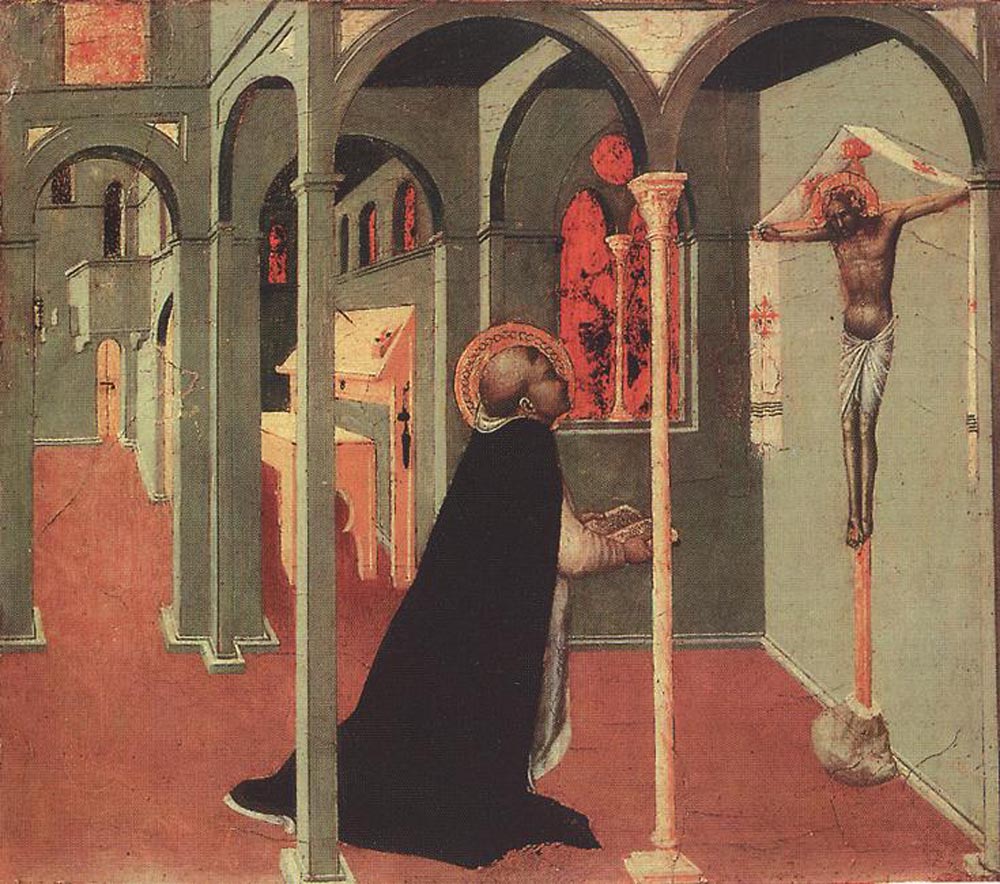
St. Thomas Before the Cross
Sassetta (1423)
Pinacoteca, Vatican
He raises the following question: Is it possible for a man who disbelieves one article of faith to have [even] lifeless faith in the other articles?1 In other words, if, for example, someone disbelieves only one article of the Creed, but believes all the other articles of the faith, then while disbelieving that one article of the Creed, does this person retain even dead faith?
St. Thomas answers that the person
who disbelieves [even] one article of faith does not have faith, either formed or unformed.2
In other words, the person who disbelieves even one article of the faith, has neither living faith nor dead faith. St. Thomas’ answer is startling to the minds of many twenty-first century Christians, and prompts many questions, among which the first is “Why? Why can’t a person have faith, even if he disbelieves one or a few articles of the faith?”
St. Thomas answers this question in the corpus of his respondeo. Here I will quote his respondeo, and then explain it below.
The reason of this is that the species of every habit depends on the formal aspect [ratione] of the object, without which the species of the habit cannot remain. Now the formal object of faith is the First Truth, as manifested in Sacred Scripture and the teaching of the Church. Consequently whoever does not adhere, as to an infallible and Divine rule, to the teaching of the Church, which proceeds from the First Truth manifested in Sacred Scripture, has not the habit of faith, but holds the [other articles] of faith by a mode other than faith. If someone holds in his mind a conclusion without knowing how that conclusion is demonstrated, it is manifest that he does not have scientific knowledge [i.e. knowledge of causes], but merely an opinion about it. So likewise, it is manifest that he who adheres to the teachings of the Church, as to an infallible rule, assents to whatever the Church teaches; otherwise, if, of the things taught by the Church, he holds what he chooses to hold, and rejects what he chooses to reject, he no longer adheres to the teachings of the Church as to an infallible rule, but to his own will. Hence it is evident that a heretic who obstinately disbelieves [even] one article of faith, is not prepared to follow the teaching of the Church in all things (but if he is not obstinate, he is not a heretic but only erring). Therefore it is clear that such a heretic with regard to one article has no faith in the other articles, but only a kind of opinion in accordance with his own will.”2
First St. Thomas explains that what distinguishes faith from the other virtues is that its formal object is the First Truth as revealed in Sacred Scripture and the teaching of the Church.3 By ‘formal object’ here he is referring to the way in which one knows. What makes faith to be faith is not merely believing the content of divine revelation, but adhering to it through the teaching of the Church, on the basis of the Church’s divinely given authority to articulate and define the articles of faith. So, says St. Thomas, if a person does not adhere, as to an infallible and Divine rule, to the teaching of the Church, this person does not have faith. If he disbelieves one article of the faith, even while believing all the others, he reveals that he believes the others not by faith, but on some other basis.
St. Thomas gives as an example the difference between a person who holds a claim to be true because he knows what makes it true, and the person who believes a claim to be true though not knowing it to be true or knowing what makes it to be true. The former person, says St. Thomas, has knowledge in the proper sense, while the latter person does not have knowledge, but only opinion. St. Thomas uses this example to contrast two types of persons in relation to faith. One person adheres to the teachings of the Church, as to an infallible rule, and therefore assents to whatever the Church teaches, precisely because the Church teaches it with divine authority. The other type of person picks and chooses from among the Church’s teachings, accepting what he wants to believe, and rejecting what he wants to reject. The former person has faith, because he adheres to the teaching of the Church as to an infallible and Divine rule, not because the teaching of the Church conforms to his own will or judgment. The latter person (i.e. the one who disbelieves even one article of the faith) does not have faith, not even in the other articles of faith, because his basis for believing them is his own judgment concerning their truth. This is revealed by his disbelief of the one article of faith, for in disbelieving it, he shows that he has placed his own judgment above the authority of the Church in her divinely established teaching and interpretive authority. If he believed the other articles on the basis of the authority of the Church, then he would also accept the one he rejects, for the very same reason. But because he rejects the Church’s authority regarding the one article, he shows that his acceptance of the others is not on the basis of the Church’s authority, but instead on the basis of his own judgment.
According to St. Thomas, such a person, if he is obstinate in disbelieving one or more articles of the faith, is a heretic.4 If, however, he is not obstinate, but upon discovering that the Church teaches otherwise than he believes is willing to change his belief, then he is not a heretic, but only mistaken. The reason why such a person still possesses faith, even though, like the heretic, he disbelieves at least one article of the faith, is that his basis for believing the articles that he believes is the authority of the Church, as shown by his willingness to conform to the Church upon being shown that one or more of his current beliefs is not in agreement with the teaching of the Church. What entails that the heretic does not have faith is not his disbelief in at least one article of the faith. That disbelief is merely a manifestation of the basis for his belief in the other articles. What entails that the heretic does not have faith is that he believes the articles he believes, on the basis of his own private judgment, instead of on the authority of the Church. A person could affirm every single article of the faith, but believe them not on the basis of the authority of the Church, but on the basis of his own private judgment. Such a person likewise, would not have faith.
Two Objections
St. Thomas considers and refutes three objections to this answer. Here I’ll discuss only the first two. The first objection is that since without the gift of faith the truths of the faith are beyond the natural power of reason to know, and since the heretic still believes the other articles of faith, therefore, it seems that so long as the heretic believes even one of the articles of the faith, he must have the gift of faith. St. Thomas replies:
A heretic does not hold the other articles of faith, about which he does not err, in the same way as one of the faithful does, namely by adhering simply to the Divine Truth, because in order to do so, a man needs the help of the habit of faith; but he holds the things that are of faith, by his own will and judgment.5
We can better understand St. Thomas’ reply by distinguishing between the content of an article of the faith, and the basis for holding that content to be true. Much of the content of the articles of faith cannot be known without God supernaturally revealing it. Think of the doctrines of the Trinity and the Incarnation, for example. Mankind could not attain to such truths on the basis of the natural power of reason. But once these articles have been supernaturally revealed to the world through the Church, a man may believe them on the basis of the divine authority by which they are revealed, or on the basis of his own private judgment. Once articles of the faith have been publicly revealed, believing them on the basis of one’s own private judgment can be done without additional divine help, just as believing the truths of mathematics can be done without additional divine help, beyond the ordinary help of God’s providential governance of the world. But adhering to the articles of faith on the basis of their having been taught by God through the Church, requires the help of the habit of faith, which habit is a supernatural gift of God through grace. Hence the heretic, who believes the other articles of faith on the basis of his own private judgment, does not have the supernatural gift of faith, even though he could not know at least some of the articles he does believe, unless they had been supernaturally revealed.
The second objection St. Thomas considers is that just as a science (e.g. geometry) contains many truths, and a man who knows some of them but not others, still possesses that science, so likewise a man who believes some of the articles of faith but not others, can still have faith. St. Thomas replies:
The various conclusions of a science have their respective means of demonstration, one of which may be known without another, so that we may know some conclusions of a science without knowing the others. On the other hand faith adheres to all the articles of faith by reason of one mean, viz. on account of the First Truth proposed to us in Scriptures, according to the teaching of the Church who has the right understanding of them [propter veritatem primam propositam nobis in Scripturis secundum doctrinam Ecclesiae intellectis sane]. Hence whoever abandons this mean is altogether lacking in faith.6
Here St. Thomas explains that within a science there are different means (or channels) of demonstration, and therefore a person who knows through one means within that science but not through other means within that same science, may still rightly be said to possess the science. By contrast, the articles of the faith are all adhered to through faith by only one means: the teaching of the Church, through whom the First Truth proposed to us in the Scriptures, is explicated in the form of the articles of faith. The Church is the divinely established means by which faith adheres to Christ (who is the First Truth), because Christ has given the Church the charism of understanding the Scriptures rightly [intellectis sane]. Therefore, concludes St Thomas, whoever abandons this means of knowing the articles of faith, is altogether lacking in faith.
We see here one more reason why “he cannot have God for his Father who does not have the Church for his mother.” The deposit of faith was given by Christ to the Apostles, who are the foundation stones of the Church.7 This deposit was then entrusted by the Apostles to their successors, both in its written and oral forms, and is adhered to by the faithful of each succeeding generation on the basis of the divinely established and divinely preserved authority of the Church, explicating that same sacred deposit. It is not the Scriptures alone through which the faithful know the articles of the faith. According to St. Thomas it is through the Church, which has the authority to determine the right understanding of the Scriptures, that the faithful know what are the articles of faith. And it is by adhering to the articles of faith on the basis of the Church’s divine authority to teach them, that one has faith, and not merely private judgment.
Implications
Does this mean that whoever (Catholic or non-Catholic) is not in full accord with the Church’s teaching is faithless, and is therefore in a state of mortal sin? No. It is true that whoever does not have faith, does not have agape. It is also true that whoever does not have agape, does not have sanctifying grace, and is thus in a state of mortal sin. But, as St. Thomas himself points out, not everyone who is not in full accord with the Church’s teaching is faithless. The person who does not know that the Church teaches otherwise, and who, when shown that the Church teaches otherwise, conforms to the Church’s teaching, is only in error; he is not faithless. He accepts the Church’s authority, but is simply misinformed about what the Church teaches. This would include those Catholics whose dissent from a teaching of the Church is due to invincible ignorance of the Church’s teaching, and who would conform to the Church’s teaching, were they to discover that their present belief is contrary to the Church’s teaching. It would also include those Protestants who, out of invincible ignorance, do not know the identity of the Church Christ founded, and who, upon discovering that the Catholic Church is the Church Christ founded, conform their beliefs to her doctrine.
How is what St. Thomas says in this article relevant to the division between Protestants and the Catholic Church? We can see the relevance in the following quotation from the Catholic encyclopedia article on “Protestantism”:
Again, it is illogical to base faith upon the private interpretation of a book. For faith consists in submitting; private interpretation consists in judging. In faith by hearing, the last word rests with the teacher; in private judgment it rests with the reader, who submits the dead text of Scripture to a kind of post-mortem examination and delivers a verdict without appeal: he believes in himself rather than in any higher authority. But such trust in one’s own light is not faith. Private judgment is fatal to the theological virtue of faith. John Henry Newman says “I think I may assume that this virtue, which was exercised by the first Christians, is not known at all amongst Protestants now; or at least if there are instances of it, it is exercised toward those, I mean their teachers and divines, who expressly disclaim that they are objects of it, and exhort their people to judge for themselves” (“Discourses to Mixed Congregations”, Faith and Private Judgment). … Where absolute reliance on God’s word, proclaimed by his accredited ambassadors, is wanting, i.e. where there is not the virtue of faith, there can be no unity of Church. It stands to reason, and Protestant history confirms it. The “unhappy divisions”, not only between sect and sect but within the same sect, have become a byword. They are due to the pride of private intellect, and they can only be healed by humble submission to a Divine authority.
Because faith consists in submitting, it cannot consist in submitting to whoever-agrees-with-my-own-interpretation-of-Scripture, as Neal Judisch and I pointed out in our article titled “Solo Scriptura, Sola Scriptura and the Question of Interpretive Authority,” for such a ‘submission’ is no submission at all. As we showed there, submitting to those who share one’s interpretation of Scripture, because they share one’s interpretation of Scripture, is only superficially, not essentially different from simply ‘submitting’ to one’s own interpretation of Scripture. But, since the basis for identifying those to whom we are to submit, in order to have faith, cannot be their agreement with our own interpretation of Scripture, the basis for their authority can only be their having received, by apostolic succession, the authorization and commissioning that Christ gave to the Apostles. Moreover, the necessary relation between faith and the Church explained by St. Thomas entails that the Church must be indefectible and infallible in her explication of the deposit of faith entrusted to her, otherwise Christ would have failed to establish a way in which faith can remain until He returns.8
What makes St. Thomas’ words so shocking to modern ears is that many persons have grown accustomed to thinking of faith as something quite entirely independent of the authority of the Church. Protestants of the sixteenth century openly defied the authority of the Church. Now, in the present time, dissent on various teachings of the Church is commonplace, even among Catholics. One can reject the authority of the Church outright, as dissenting Catholics do, or one can fashion a ‘Church’ in one’s own interpretive image, as Protestants do, and convince oneself that one is submitting to the Church. But both actions are rejections of the divinely established authority through which faith adheres to the articles of faith.9 For the reasons St. Thomas explains, where there is faith there can be no picking and choosing from among the Church’s teachings, because what makes faith to be faith is not essentially the set of articles believed, but the basis on which they are believed, namely, the authority of God, given to the Church to teach and interpret the deposit of faith.
- Summa Theologiae II-II Q.5 a.3. Latin: “discredit unum articulum fidei possit habere fidem informem de aliis articulis“. By lifeless faith we are speaking of faith without agape. Living faith is faith with agape. I explain this in more detail here. [↩]
- Summa Theologiae II-II Q.5 a.3 co. [↩] [↩]
- Regarding the formal aspect of the object of faith, St. Thomas writes, “if we consider, in faith, the formal aspect of the object, it is nothing else than the First Truth. For the faith of which we are speaking, does not assent to anything, except because it is revealed by God.” Summa Theologiae II-II Q.1 a.1 co. For a fuller explanation of what gives habits their species, see Summa Theologiae II-I Q.54 a.2. [↩]
- This term ‘heretic’ comes from the Greek αἵρεσις, which has its root in the verb ἁιρέω, meaning “I choose” or “I prefer.” Heresy has its root in the placing of private judgment over the authority of the Church in which and through which the First Truth is found. [↩]
- Summa Theologiae II-II Q.5 a.3 ad 1 [↩]
- Summa Theologiae II-II Q.5 a.3 ad 2 [↩]
- Eph. 2:20, Rev. 21:14 [↩]
- That is supported by St. Thomas’ teaching that nothing false can come under faith. See Summa Theologiae II-II Q.1 a.3 [↩]
- Here is a relevant excerpt from Pope Leo XIII’s encyclical Satis Cognitum:
For such is the nature of faith that nothing can be more absurd than to accept some things and reject others. Faith, as the Church teaches, is “that supernatural virtue by which, through the help of God and through the assistance of His grace, we believe what he has revealed to be true, not on account of the intrinsic truth perceived by the natural light of reason, but because of the authority of God Himself, the Revealer, who can neither deceive nor be deceived” (Conc. Vat., Sess. iii., cap. 3). If then it be certain that anything is revealed by God, and this is not believed, then nothing whatever is believed by divine Faith: for what the Apostle St. James judges to be the effect of a moral deliquency, the same is to be said of an erroneous opinion in the matter of faith. “Whosoever shall offend in one point, is become guilty of all” (Ep. James ii., 10). Nay, it applies with greater force to an erroneous opinion. For it can be said with less truth that every law is violated by one who commits a single sin, since it may be that he only virtually despises the majesty of God the Legislator. But he who dissents even in one point from divinely revealed truth absolutely rejects all faith, since he thereby refuses to honour God as the supreme truth and the formal motive of faith. “In many things they [i.e. the heretics] are with me, in a few things not with me; but in those few things in which they are not with me the many things in which they are will not profit them” (S. Augustinus in Psal. liv., n. 19). And this indeed most deservedly; for they, who take from Christian doctrine what they please, lean on their own judgments, not on faith; and not “bringing into captivity every understanding unto the obedience of Christ” (2 Cor. x., 5), they more truly obey themselves than God. “You, who believe what you like, believe yourselves rather than the gospel” (S. Augustinus, lib. xvii., Contra Faustum Manichaeum, cap. 3). (Satis Cognitum, 9)
[↩]

I’ve often used this passage from the ST before, Bryan. Thanks for presenting and explicating it.
You’ve put your finger on the essential difference between Catholicism and Protestantism. The Protestant as such decides for himself, utilizing scholarly resources and/or personal experience, what is orthodox and then picks a church that conforms with that version of orthodoxy. The Catholic identifies the Church as the Mystical Body of Christ, subsistent in a visible communion and sharing in his authority as her Head, and then submits his judgment about what’s orthodox to hers, where the two conflict. The choice is clear: Either the Church determines the faith of individuals, or individuals determine the faith of the Church.
Michael,
Exactly. In a way, this has always been the choice. It was the choice that faced Eve in the garden: either she would trust her divinely appointed authority (i.e. Adam) regarding how God’s command (Gen 3:17) was to be interpreted, or she would determine for herself how it was to be interpreted. This was the choice faced by Korah, Dathan and Abiram in Numbers 16. Would they trust their divinely appointed authority (i.e. Moses) over their own private judgment, or would they trust more in themselves? Would Jehosaphat trust Micaiah, the prophet of the LORD, in 1 Kings 22, or would he trust the four hundred [false] prophets, who were saying what he wanted to hear? (No doubt St. Paul is alluding to that incident, when he speaks of accumulating teachers to itch one’s ears, in 2 Tim 4.) It relates even to the reading in today’s liturgy, when Jeremiah says, “Cursed is the one who trusts in human beings, who seeks his strength in flesh” (Jer 17:5). The curse about which he speaks is the curse laid before us all, from Eve down to those present when Christ returns, the curse following upon trusting in man. When Jesus said to His Apostles, “The one who listens to you listens to Me, and the one who rejects you rejects Me; and he who rejects Me rejects the One who sent Me” (Luke 10:16), He showed the pattern to be followed until He returns. This is the choice, to follow Christ by following those with His authorization, or to follow our own judgment (either in its naked ‘solo scriptura’ form, or in its indirect ‘submitting to those who agree with one’s own interpretation of Scripture, because they agree with one’s own interpretation of Scripture’ form). The living Magisterium of the Church Christ founded provides the authoritative interpretation of what Christ has spoken, speaking in His name and with His authority. This is what ordination entails. And Christ does not contradict Himself. Hence all those who claim to be ordained, and thus claim to be speaking for Christ, but who contradict each other, cannot truly be speaking for Christ. Their contradictory teachings falsify their claim to speak for Christ.
We have a choice: we can either trust Christ by trusting the Magisterium He has authorized to explicate and define the faith (just as the early Christians trusted in Christ by trusting Christ’s Apostles), or we can rely on our own private judgment to determine what is the content of the faith. It is the same choice, down through the ages.
In the peace of Christ,
– Bryan
How might a Catholic answer the Protestant objection that such a basis for adhering to a doctrine, i.e. trusting the authorized teacher, is fideistic?
Jared,
Trusting an authorized teacher would be fideistic if one trusted him for no reason. But if by good evidence and reasons, one discovers that he has authority to speak for Christ, then it is not fideistic to trust him. Yet, only ‘trusting’ him because you agree with him, would be no submissive trust at all; it would be only trusting in oneself.
If, for example, you were living in Galilee around AD 30, and for no reason whatsoever, you ran up to a man, fell at his feet, and worshiped Him as God, that would be fideistic (among other things), even if this man happened to be the Son of God. But, if upon seeing the miracles He performed, raising people from the dead, and so on, you determined that He was at least a divinely authorized prophet, and you trusted Him as a divinely authorized teacher, that would not be fideism. You would, in that case, have followed motives of credibility, in order to discover who is divinely authorized. It would be reasonable (i.e. in accord with reason) for you to trust such a person, even when you could not independently verify his claims. So it is neither fideism, since you have good reasons for trusting Him, nor is it rationalism, since you are believing Him regarding things you cannot determine for yourself to be true. Faith is in this way between fideism and rationalism, as a virtue is between two contrary vices.
In the peace of Christ,
– Bryan
Does Aquinas explain why it is true that “the teaching of the Church … proceeds from the First Truth manifested in Sacred Scripture”. ? I assume by this statement he is presuming that the Roman Catholic Church, specifically, infallibly teaches the correct interpretation of Sacred Scripture. But what is his justification for this belief?
Another Catholic I know says that you have to accept, on faith, this same hypothesis that the RC Church has been protected from error. Not unreasonable faith, but faith nonetheless. But presumably Aquinas has logical arguments to back this up. What are his arguments?
Thanks!
Jonathan,
There are two distinct questions here, and it is important to note that they are distinct. One question is whether the one, holy, catholic and apostolic Church that Christ founded is infallible in her teaching of the deposit of faith. The other question is whether the [particular] Church at Rome (and the bishop of Rome) has some particular role in the Catholic Church’s infallibility.
Regarding the first question, that the Church is protected from error in her definitions of faith and morals, has been believed since the Apostles. It rests in the Church’s understanding of the promises of Christ. Christ not only gave Himself as a sacrifice for sin, He also gave to the Church the deposit of faith, the gospel of Truth, and the gift of the Spirit by which to guard and preserve that deposit. We can see this at the end of the Gospel of Matthew, where Jesus commissions His Apostles to make disciples of all the nations, baptizing them in the name of the Father and the Son and the Holy Spirit, and teaching them to observe all that He command them, and promising to be with them even to the end of the age. The Church has always understood this to mean, among other things, that Christ would remain with the Apostles and the successors of the Apostles, even until He returns in glory. Christ commissioned the Apostles to go to all the world, until the end of the age, showing that His promise wasn’t just to the Apostles but to their successors until He returns in glory. In commissioning them, He gave them authority to carry out that mission, to teach in His name, i.e. as His appointed representatives, authoritatively determining what is dogma (and thus binding on the faithful), and what is heretical (subject to anathema).
In the first ecumenical council, recorded in Acts 15, the Apostles recognized that the Spirit was with them, guiding them. (Acts 15:28) And subsequent councils understood the same thing, that the Spirit was with them, guiding them, so that the decisions they came to were not only their own, but also those of the Spirit, and thus were binding on all the faithful, not merely human opinions. This is one way in which Christ remains with His Church, by His Spirit (the “Spirit of Truth”), which He promised would guide them into all truth. (John 16:13) This is why the Church is the pillar and ground of truth, as St. Paul says (1 Tim 3:15).
Infallibility follows from the divinely given authority to determine truth and error in matters of faith and morals, for all the Church. There would be no dogma, if there were no such authority. There would be no heresy. There would be only various opinions, not only concerning the gospel, but also concerning the canon. About such things there would be only the various opinions of men, but neither dogma nor heresy, if the Church’s decisions about such things (e.g. in ecumenical council) were merely the opinions of the bishops. That was so well understood in the time of St. Thomas, that to the best of my knowledge he does not even argue for it. Only with the rise of modernism does the Church’s infallibility come under fire, and hence the need for the definition of the doctrine of infallibility, given at Vatican I.
Regarding the second question, see my recent post titled “St. Thomas Aquinas on the Unity of the Church,” to see how St. Thomas argued for the unique role of the bishop of Rome as the successor of St. Peter in maintaining the unity of the Church, both in doctrine and government. The Pope’s role in maintaining the unity of the Church, in conjunction with the infallibility of the Church when defining doctrines regarding faith and morals, entails that the Pope has been given a unique participation in this charism. St. Thomas says,
Christ’s prayer for St. Peter, is infallible. (All Christ’s prayers are infallible, because He is God.) And the Church came to understand that this prayer was not just for St. Peter the man, but for St. Peter in his unique office, the office by which he would “strengthen his brethren”. And so the Church’s infallibility has its focal point in the office of St. Peter, upon whom Christ built His Church, and to whom Christ gave the keys of the Kingdom (Matt 16). For more on this see Chapman’s Studies on the Early Papacy, Giles’ Documents Illustrating Papal Authority, and Fortescue’s The Early Papacy: To the Synod of Chalcedon in 451.
In the peace of Christ,
– Bryan
Bryan,
Something tells me that the Protestant would piously respond that he/she does the same thing, but simply takes “the scriptures” as the infallible rule of faith, not the/any church. How would Thomas reply to this?
Philologus –
It is not a problem that the Protestant trusts Scripture but that he trusts his own interpretation of Scripture above the Church. He has no good reason to do this. On the other hand, the Catholics do have good reasons to trust the Church. Namely that it was founded by Christ. Private interpretation of Scripture was not founded or endorsed by Christ as the sole rule of faith.
The question is not in whether or not one places trust in something, but whether one has good reason to place trust in that thing. I could say “I do the same thing as you Catholics but I trust in the Book of Mormon.” I would not be on level ground with the Catholics. My error would not be in putting faith in something, but in putting faith in the wrong thing because I have misjudged what is trustworthy. The Protestants put faith in 66 of the 73 books of the Bible; that is good. But they misjudged the canon itself based on erroneous scholarly work and based on a rejection of Church authority. Protestant belief in the Bible alone isn’t only a positive act of faith, but is coupled with an act of disbelief – an act of disbelief in the Church. By saying “scripture alone,” they set themselves up as the sole arbiter of the faith.
Catholics do not set themselves up as the sole arbiter of the faith because they submit, with good reason, to Church authority.
Philologus,
For St. Thomas, and all the Fathers and Doctors of the Church, Scripture belongs to the Church, and is understood rightly only within the Church. This is why St. Thomas speaks of the object of faith as if Scripture and the Church were hyphenated as one thing (i.e. Scripture-as-explicated-in-the-teaching-of-the-Church). To take the Scriptures outside of the Church (which is visible) is to wrench them out of the context in which they have their life. They are the sacred treasure of the Church, and are, as such hidden in her bosom. To come to them, one must go through their rightful steward, i.e. those authorized by the Apostles and entrusted to preserve and explicate them. And that means that to understand Scripture rightly, we must understand it according to the Tradition of the Church as explicated by her Magisterium, that “organ of truth.” These three (Scripture, Tradition and Magisterium) can never be separated and retain their proper function. They function rightly only together.
Christ founded a Church; He did not write any books. The foundation of the Church are the Apostles and prophets (Eph 2:20, Rev 21:14) The Scriptures were inspired by the Spirit, and are rightly understood only by that same Spirit, not by human reason alone. And that Spirit resides in the Church. Hence the authentic meaning of Scripture is given by the Spirit through those in the Church authorized by Christ to give its authentic meaning.
We can see this notion clearly in Tertullian, who writes:
The Council of Trent, in its fourth session, declared the following:
The First Vatican Council added:
The Second Vatican Council added:
As Neal and I said in our Solo Scriptura article,
To start from Scripture alone, is to fail to see that Christ founded a Church, and that Scripture belongs to that Church, and is rightly understood only within that Church, as explicated by her Magisterium, to whom Christ gave the authority to teach in His Name, by the perpetual guidance of the Spirit He promised to them.
In the peace of Christ,
– Bryan
Excellent post Bryan. I remember being floored by the reality of this very truth when I was seeking to understand the Catholic Faith. It came via Cardinal Newman’s excellent essay Faith and Private Judgment. He says almost exactly the same thing as Thomas.
https://www.newmanreader.org/works/discourses/discourse10.html
Cheers,
Derek
Bryan,
I just now had a chance to read this article – excellent!. This really is the core problem. I often wonder how so many of our estranged brothers and sisters, often staunch allies against cultural relativism and subjectivism; have such difficulty recognizing that the Protestant theological approach rests upon these very “isms”. Given the cogency of your article, I again find myself asking what it is that makes consideration of the Church’s claims so difficult for many minds and hearts? Of course, there are many explanations as to why this is so; but as we discussed over on the “Tradition and Lexicon” thread, I think a lot of it has to do with a sort of moral hesitance to attach notions of indefectability and infallibility to a communion governed by living persons (bishops/popes). Placing all of one’s “infallible” chips, as it were, on Scripture is much less “messy” – I mean a book does not sin, thus yielding the illusion of a more pure and immediate access to Divine truths. Keep up the great work!
Pax et Bonum,
-Ray
All at CTC,
This seems like an appropriate piece under which to leave this comment/question. In the last few weeks, I have noticed sedevacantism becoming more and more widespread, and expressed in quite venomous ways, on the net (Youtube in particular). Two visible, fairly well-known Catholic apologists on Youtube have recently become sedevacantists. When I have left comments, questioning the consistency of their reasoning, I have been called a heretic– basically for simply defending the current Pope and Magisterium. Are there any plans in the near future for CTC contributors to address the error of sedevacantism?
Hello Christopher,
I’m not aware of any plans here to address that topic. But I agree that it may be helpful to do so. Our primary intention here is dialoguing with persons in the Reformed tradition, so sedevacantism is not at the top of our priority list. For that reason it might be quite a while before we devote an article to the subject.
In the peace of Christ,
– Bryan
Thanks for the reply, Bryan. It’s interesting– one of the new sedevacantists on Youtube is a Catholic convert and former Calvinist. That is also the case with Gerry Metatics, who became a sedevacantist several years ago. I wonder if there is a misguided quest for a sort of pseudo-Catholic “theological purity” that leads some Catholic converts from the Reformed tradition in the direction of sedevacatism?
I know, from my own time in Reformed circles, that they tend to put a particularly strong emphasis on theological study. I can see how that tendency could, potentially, lead to error in Catholic converts from the Reformed tradition, *if* said tendency is not balanced with a proper understanding of the *ongoing* interpretative role of the Magisterium, in regard to Catholic teaching. Anyway, thanks again for replying!
Hi Bryan,
I’d like to respond to your response to my question about infallibility, the one you answered above.
I like your argument. So far, I have seen infallibility argued only from the conclusion. For instance, “If we didn’t have infallibility, we couldn’t have truth, and couldn’t have authority” – something along these lines that the positive implication of infallibility justifies the truth of it. Up until now, my problem was that those negative conclusions don’t prove infallibility is true.
You’ve got a new argument here – one I haven’t heard before. You say, basically, that Fathers believed in papal infallibility all along. In addition, you claim that the notion of fallibility of is a modern one.
Now here is something; I need to look into it. It is the first real argument I have heard for infallibility. I haven’t seen that in my own studies of the Fathers, but I am willing to go look again with the references you list, if I think it would help.
But it won’t really help. Because I just don’t understand how infallibility can be true.
It has taken me a while to nail down what really bothers me about infallibility. I can admit that at the core of it is all the nasty stories about popes. Scandal. Probably exaggerated and untrue in most cases, but there’s enough really nasty stuff to probably convince anyone that not all popes were pillars of virtues, much less saints.
Yes, I understand that the claim of infallibility don’t promise a sinless pope.
But the knowledge that popes have sinned is indeed close to the problem. As I see it, popes can sin, so popes can err as well. I don’t see how God could keep someone from error any more than God could keep someone from sin. It’s the mechanism that is the problem. How can God promise infallibility of a man without denying that man’s free will? Now, I’m not saying He couldn’t. But it doesn’t make sense to me that He would, given other things I think I know about Him.
If God is willing to redirect 2000 years of popes from officially pronouncing some error (in faith & morals specifically), wouldn’t He rather have made things simple and simply (through the Holy Spirit) redirected Eve from one ill choice in the garden?
It just doesn’t make sense. To me, believing in infallibility of a man (or in the office of a succession of men) makes God random. Sometimes He thinks free will of man is more important than the consequence of sin (thousands of years of the knowledge of evil). At other times, He’s willing to throw free will out the window?
Jonathan, (re: #15)
You wrote:
It seems to me that you are raising two objections here. One is that God cannot protect the Church from erring in her definitive determinations of matters of faith and morals. And the other is that it would not be fitting for God to do so.
Yes, I know you say “I’m not saying He couldn’t.” But, your previous questions in that paragraph seem to suggest that God perhaps could not keep the pope from erring when, speaking as shepherd of the universal Church, he declares something definitively to be believed by all Catholics in matters of faith and morals, without violating his free will. But consider how the sacred Scriptures were divinely inspired. The human authors did not become automatons during the time when they were writing the sacred books of Scripture. And yet, they were divinely protected from error while they freely wrote under the inspiration of the Holy Spirit. (See Jeffrey Pinyan’s “Vatican II and the Inerrancy of the Bible.”) So, if you believe that the human authors were not reduced to a zombie-state while they wrote the books of the Bible, and if you believe that the books of the Bible are God-breathed, then you already agree that it is possible for God to keep a person from error without violating that person’s free will, even if you don’t understand how it is possible. We believe that God is omnipotent. Unless you can find a contradiction in God keeping a person from error while that person wills freely, you don’t have an objection, only a “I don’t understand.” And that’s ok, because if you could understand it, it probably wouldn’t be true; it would be on your [merely creaturely] level. Since it is about something divine, it is a mystery; we do not fully understand how God works. But, “Hey, that’s mysterious” is not an objection, unless nothing can be true if it is not in principle capable of being understood by you, i.e. unless you are God. :-)
Regarding your second objection, you wrote:
It is not random, because Christ came to found a Church, through which to bring salvation to the whole world until He returns. If the Church could fall into error, then she could not do what Christ established her to do, because the world would not know what is the truth concerning Christ and His gospel and the way of salvation. So, it is not random for God to keep the Church from error, by protecting the rock upon which the Church is built from error.
But, your objection here is, “Well, if God can keep people from error, while not violating their free will, then why hasn’t He done this with everyone?” That is an excellent question. If sin were impossible, there would have been no opportunity for genuine self-determination, and for merit. The angels and saints in heaven do not merit further reward, and the demons and damned in hell do not demerit further punishment. The time for meriting is finite, in this present life, while the will is open or ‘flexible’ to moving toward God and moving away from God. The test in the Garden of Eden would not have been a real test, if they could not have disobeyed God. There is no merit in believing what you can see, but there is merit in faith [informed by agape], (see Summa Theologiae II-II Q.2 a.9), because we cannot see the object of faith for ourselves, and so to believe the articles of faith on the authority of Christ and His Church, is meritorious. God does not keep people from sinning, because He gives to us the opportunity to choose in a self-determining way, so that our choices are truly significant, and have the opportunity for merit and demerit.
In the peace of Christ,
– Bryan
Just putting in a comment in order to e-mail subscribe to comments on this topic.
Is there some way to do this – set up a ‘notify me of followup comments via e-mail’ on some topic – without having to put a comment in the combox??
jj
Jonathan (#15):
Addressing Bryan, you wrote:
It seems to me that you’re not quite getting the sort of case the Catholic apologist needs to make here, whether the argument is Bryan’s or anybody else’s.
If you’ll notice, Bryan’s original post expounded an argument of St. Thomas’ that made virtually no historical references. Its conclusion was that he who disbelieves even one article of faith has no faith at all. Given Aquinas’ background accounts of the virtue of faith and the nature of divine authority, that’s a valid argument. But the argument does not establish the truth of its own premises, and so cannot be certified as sound just using its own content. It’s essentially a negative argument: he who does not “adhere to the teaching of the Church as to an infallible rule…may hold what is of faith, but does not do so by faith.” That does not “prove” the Church’s claim to being infallible under certain conditions. All it shows is that, if you’re going to have what Aquinas considers “faith,” you must accept said claim. That’s an argument of the form I have long adduced. Thus, if you’re going to be able to distinguish, in a principled way, between what is de fide and what is only opinion, you need to accept the Church’s claim to being infallible under certain conditions. But that doesn’t show that one can and ought to make such a principled distinction. It presupposes that one’s audience believes that one can and ought to do so; but I have found that many Protestants refuse to do so–usually without admitting it outright. Arguments of the present sort are not going to persuade such people. All they do is expose the cost of not being persuaded. Some are willing to pay that cost. You can bring a horse to water, but you can’t make him drink.
Now when Bryan goes on to argue that “the Fathers” accepted ecclesial infallibility, he is indeed adducing further “evidence” for the Church’s claim. I share his view of the evidence, as indeed any Catholic must; for if the Fathers did not somehow believe the Church’s claim, if only implicitly, one could not say that said claim is itself part of the traditional faith of the Church. But the Catholic way of interpreting the patristic evidence on this point, or indeed on any major point, is not demonstrative from a doctrinal standpoint. Even assuming that Bryan has interpreted the Fathers rightly, he has not established that we ought to believe what the Fathers did, and many Protestants are quite willing to say that the Fathers were wrong on this-or-that point. And the Fathers didn’t even use the “i-word”. So, ascribing to them the claim that the Church is infallible under certain conditions is an interpretation of the data that few Protestants would accept. That interpretation appears inevitable only from within the Catholic “hermeneutical paradigm,” but it does not, by itself, supply a compelling reason to accept that HP. Since the patristic data do not interpret themselves any more than the scriptural data do, we must look elsewhere for reasons to accept the Catholic HP.
This is where the Thomistic argument expounded in Bryan’s original post, or the sort of argument I am wont to give, become not only pertinent but necessary. Before we can determine the best way to interpret the data from the “sources”–scriptural and patristic–we need to understand what sort of authority and what sort of assent is required for faith in general, as distinct from mere opinion. Unless and until we do that, Bryan’s or any Catholic’s way of interpreting the sources is going to appear as just one opinion among many. For purposes of faith, that’s not good enough.
Of course you can reply, and have replied, that what you call the “negative” conclusion of such an argument does not suffice to “prove” infallibility. And you’re quite right. But we do not consider that a defect of the argument. That the Church is infallible under certain conditions is, itself, an article of faith, not a conclusion of reason necessitated by an independent study of the sources, which could only yield opinions. But the negative conclusion we’ve reached–namely, that rejecting the Church’s claim is incompatible with having faith as distinct from opinion–constitutes a good reason for accepting that claim for somebody who’s committed to having faith, not just opinion. And that’s the most that “reason” can do in bringing somebody to faith.
Best,
Mike
Guys,
I found this quote from the fathers of the sixth Ecumenical Council:
Letter of the Sixth Council to Pope Agatho,
……”And we all agree both in heart and tongue, and hand, and have put forth, by the assistance of the life-giving Spirit, a definition, clean from all error, certain, and infallible”
Canadian:
I’m familiar with that quote. On its own, it does not constitute evidence for the Catholic doctrine of ecclesial infallibility, or even for the claim that the Fathers accepted a doctrine materially equivalent to the Catholic doctrine of ecclesial infallibility. All it shows is that the Fathers of Constantinople III believed themselves to be preserved from error by the Holy Spirit in propounding dyothelitism. It doesn’t show that they believed themselves to have enjoyed such a privilege just by virtue of using their office as successors to the Apostles to bind the whole Church.
Even so, when read in a much larger context going back to the 4th century and extending into the 8th, the quote definitely forms part of a “cumulative case” that a doctrine materially equivalent to the Catholic doctrine of ecclesial infallibility is at least patristic.
Best,
Mike
Hi guys,
Bryan, I think you summarized my confused question pretty well. Let me see if I can be clearer.
Take this statement:
“God can keep people from error, while not violating their free will.”
Isn’t this equivalent to saying that God can make 2+2 = 5? Isn’t “To keep people from error” exactly the opposite of “to allow error”? And isn’t a necessary consequence (or perhaps, definition) of free will that humans are allowed to err?
—
Mike, thanks, I see how the infallibility of the Church must be an article of faith. What I am hoping is that the resulting HP won’t require me to believe contradictory things.
Jonathan, (re: #21)
God has free will, and yet God cannot err (i.e. God has the intrinsic ability to avoid error necessarily). Therefore error is neither a “necessary consequence” of free will nor part of the definition of free will. But, for self-determination and merit, the will cannot have the ability to avoid sin necessarily.
In the peace of Christ,
– Bryan
@Jonathan:
If this were true, we could have no infallible Scripture, either.
jj
Jonathan (#21):
To call a doctrine D an article of faith, as distinct from one of reason, implies that reason could not suffice to establish D. That is by no means the same as implying that D involves, embraces, or commits one to what is contrary to reason. Neither Thomas Aquinas nor Catholic doctrine in general would say that it does. In fact, they insist on the harmony of reason and faith. Surely you know this. If you don’t, you can start your education with John Paul II’s landmark encyclical Fides et Ratio.
Alternatively, you might mean something I’ve heard said before by some conservative Protestants: Interpreting “the sources” according to the Catholic HP yields propositions that contradict each other; therefore, adopting the Catholic HP would be unreasonable. If that’s what you mean, you can find my reply here.
Best,
Mike
My original train of thought goes like this:
1. free will means being allowed the possibility of sin
2. the pope has free will
3. lying is a sin
4. the pope is allowed to lie as a consequence of (1) and (2)
5. the pope is allowed to lie about a matter of faith or morals.
I don’t think you guys gave away the answer, but now that I’ve written out my “proof”, I realize there are some possibilities I hadn’t (until now) considered:
1. The pope is not allowed certain types of sin, for instance, the sin of lying about a matter of faith.
2. The pope is allowed to lie about matters of faith, but if it is ever about to happen, God will prevent these lies through various external circumstances (for instance, drop rock on pope’s head)
3. The pope is allowed to lie, but God, rather than preventing or disallowing such a lie, predestines/foresees that no pope will choose to do so. (Kind of like God predestines the elect to be justified – except we know who the pope is and don’t know who are the elect)
Jonathan,
A brief note to you: In Warren Carroll’s second book in the history of Christendom series, around 540 AD Vigilius ascends to the chair of St. Peter as a puppet of the Eastern Empress who supported Monophysitism. By all appearances, papal infallibility was doomed because this man seemed to show no reason for suddenly becoming a moral and orthodox person, but inexplicably (at least from a certain view) Vigilius refused to teach Monophysitism and restore the Monophysite patriarch of Constantinople Anthimus. Instead, he reaffirmed the dual natures of Christ and Anthimus’ condemnation.
This set of events and the Arian crisis, where an Arian came within a hair’s breadth of capturing the papacy, are for me some of the strongest supports for the mysterious way that God has protected the Church from error, in particular the Pope in his special charism of infallibility, all while respecting man’s free will.
Jonathan (re. #25),
It may help to settle on some terminology. Three of your five propositions use the term ‘lie.’ It someone lies then they (1) assert something (2) that they believe to be false. It doesn’t merely mean that the proposition asserted is, in fact, false. For example, I could say that at this moment it is 78 degrees in Peru. It turns out that it is 87 degrees in Peru at the time it utter that proposition; so I’m mistaken. But it can’t be said that I ‘lied,’ because I really believed (though mistakenly) that it was 78 degrees there.
So the pay out for this distinction, in the context of the RC view of papal infallibility, is two-fold. (I’m open to correction here by my betters.) First, the pope is preserved from asserting things he believes to be true (in matters of faith and morals), but that are actually false. In this scenario, the pope is not lying, but would have erred. Second, it seems possible, at least in principle, that the pope could lie in the strict sense defined above about a matter, x, which is in fact true. For example, suppose a pope defined some dogma x when pope believed x to be false. But, objectively speaking, x is true. The pope could pronounce x as a dogma. This is because the spirit protects the pope from error in matters of faith and morals. And, in this (admittedly strained) scenario x was not error. But, of course, it was sin on the part of the pope to assert something he believed to be false.
Bryan,
In the article you said (I apologize for the choppiness of these quotations, but I’m trying to be brief),
then later you said,
and finally,
A few questions for you:
1. Are you saying that it is possible for a person to have agape and be in a state of grace, but not have faith? If so, how is this possible and what does this look like?
2. If one has invincible ignorance of the identity of the Church, then you seem to be saying that at best one does not know the basis of why he believes what he believes. Can one have faith, as St. Thomas defines it, and not know the basis of his faith, while at the same time not be in a position of exercising private judgment? If yes, then if that person later becomes aware that he is exercising private judgment, does he no longer have faith?
3. In other articles (such as the solo vs. sola article), you seem to contend that in principle all Protestants, whether they form churches or not, are doing so on the basis of their private judgment being in sufficient agreement (in their own minds) with those they form churches with. Are you saying that a person can be invincibly ignorant of the fact that they are using their private judgment, when in fact that is what they are doing? If yes, then must they be ignorant of this fact in order to not be faithless?
Last question: A Protestant who understands and believes the WCF’s teaching on Scripture knows that he is rejecting that the church, in any sense of the word, has any divine authority to make it certain that Scripture is the inspired Word of God. Is he, therefore, without faith? It certainly seems that he cannot be ignorant of what he is doing.
That’s more questions than I meant to ask, but this article really has me thinking. Thank you.
MarkS, (re: #28)
No, a person cannot have agape without faith. But, the formal object of faith is not the same thing as the material object of faith. So, a person who knows only some of the articles of faith can have the supernaturally infused virtue of faith, and then subsequently come to know and believe more articles of faith.
Yes to the first question, if by “not be in a position of exercising private judgment” we mean not be knowingly placing his own judgment equal to or above that of the Church. Regarding the second question, I would reword the question: If that person later becomes aware of the identity and divine authority of the Church, but refuses to submit and conform his beliefs to the teaching of the Church, and instead retains his own doctrinal opinions, then yes, he no longer has faith, for the reason St. Thomas explains.
Again, I would re-word the question, because what is conscience binding is not “I am using my own private judgment” but that the Catholic Church is the Church Christ founded and endowed perpetually with a magisterium to teach and interpret in His name and with His divine authority. So the question as re-worded, would be: Can a person be invincibly ignorant of the fact that the Catholic Church is the Church Christ founded and endowed perpetually with a magisterium to teach and interpret in His name and with His divine authority? Yes. But one does not need to be invincibly ignorant of the identity and authority of the Catholic Church, in order simultaneously to be both non-Catholic and have faith. A person can have vincible (and thus culpable) ignorance of the identity and authority of the Catholic Church, and at the same time have faith. However, the person who is not ignorant of the identity and authority of Christ’s Church, and who nevertheless refuses to enter her or remain in her, cannot at the same time have faith. That is why doing so is a mortal sin, and it is in this way that extra ecclesiam nulla salus (outside the Church there is no salvation) is true. “Hence they could not be saved who, knowing that the Catholic Church was founded as necessary by God through Christ, would refuse either to enter it or to remain in it.” (CCC #846)
Of course he is not ignorant of his own interpretation and his own doctrine, including his belief that “the church” (however he has defined that term) has no divine authority. But, knowledge of his own interpretation and beliefs is compatible with simultaneous ignorance (invincible or vincible) of the identity and divine authority of the Catholic Church. So, even while affirming that the church has no divine authority, he is not necessarily in a condition of rejecting what he knows to have divine authority. And therefore, he is not necessarily faithless.
In the peace of Christ,
– Bryan
For the feast of St. Thomas Aquinas, the setting is by composer (and some-time CTC commenter) Frank La Rocca, the text is from St. Thomas:
Such incredible beauty! Thank you, Frank, for your 21st-century labors on behalf of the Church’s great liturgical/musical patrimony! (Similarly beautiful, contemporary-yet-traditional, settings can be heard in my local parish at the 11 A.M. Sunday Mass, thanks be to God!)
Bryan,
Thanks for the insightful piece on St. Thomas Aquinas and the relation of faith to the Church.
A quick clarification question for you: Would the Church’s moral teachings be included in this situation? In other words, if a “Catholic” was both not in invincible ignorance and disagreed with the Church’s teaching on, for example, the immorality of homosexual acts, would such a person lack the supernatural virtue of faith?
Brian M
P.S. By the way, I’ve now been in full communion with the Catholic Church for about a year and a half. The articles on CtC have been such a blessing. Thank you for your continued dedication and service.
Brian, (re: #32)
Yes, the Church’s moral doctrines are part of the deposit of faith. I’m glad CTC has been helpful to you. May the Lord continue to guide and bless you.
In the peace of Christ,
– Bryan
Question: Is the following statement true or false?
According to the Catholic Church, faith is “the theological virtue by which we believe in God and believe all that he has said and revealed to us, and that Holy Church proposes for our belief, because he is truth itself.” (CCC 1814) Faith is “more certain than all human knowledge because it is founded on the very word of God who cannot lie.” (CCC 157) The certitude of an intellectual virtue depends in one way on its cause. (ST II-II Q.4 a.8) But in Catholic teaching the cause of faith is not monergistic. As an efficient cause, God by grace infuses into us the theological virtue of faith at baptism, and thus baptism is an instrumental cause of faith. The object of faith, i.e. God as He has revealed Himself in divine truths concerning His words and deeds, is the material cause of faith. Because these divine truths are revealed to us by God, God Himself as revealer is the lumen sub quo (i.e. the light under which) the intellect apprehends its object, and is thus the formal reason for our belief. We believe to be true what God has revealed, because God, who can neither deceive nor be deceived, has revealed it. (First Vatican Council, 3.3.2.)
But God has established a particular economy in space and time through which and by which we are to know what He has revealed. He has not chosen to reveal these truths in an unmediated way to every person, as He did with the prophets of old.
St. Thomas, for example, writes:
Christ has established a Magisterial office in His Church to serve as steward of these divine truths and to provide their authentic interpretation. (CCC 85) So the lumen sub quo (or objectum formale quo) by which we may know what God has revealed, what is orthodoxy and what is heresy, is given to us through the Church. The one sacred deposit of the word of God committed to the Church comes to us through two channels: Sacred Tradition and Sacred Scripture, not Scripture alone. (Dei Verbum, 9,10) We can most truly and completely know this one sacred deposit only within, through, and under the teaching authority of the Magisterial office Christ established and authorized.
Of course God, being omnipotent, is capable of giving to anyone the certainty of faith in the authority of the Bible, and in the classic creeds, apart from the Church, even if the Church did not have the authority she claims to have. In that respect, the easy answer to the question at the beginning of this comment is “no.” But the “certitude of faith” that, say, the Catholic canon of Scripture is false, or that “Catholic dogma x is false,” or that “Protestant belief x [condemned as heretical by the Catholic Church] is true” is not possible, because nothing false can come under faith (ST II-II Q.1 a.3). The same private judgment by which Protestants come to believe that the Catholic canon is false, or that some Catholic dogma x is false, or that some Protestant belief x [condemned as heretical by the Catholic Church] is true, is the same private judgment by which Protestants come to believe all other theological beliefs they believe to be true, including even those held as dogma by the Catholic Church.
In order to have the certitude of faith regarding any particular interpretation of Scripture, one would have to know that this interpretation was divinely protected from error. But given the economy God has established, most persons (even most baptized persons) are not given an infallible supernatural internal message that any particular interpretation of Scripture is divinely protected from error. (Hence all the schism-causing / schism-perpetuating doctrinal disagreements between persons who do not recognize the authority of the Magisterium.) Nor even do those claiming to have such internal witnesses sufficiently agree concerning the interpretation of Scripture so as to avoid being in schism from one another, thus calling into question the reliability of such internal witnesses. God chose to establish an hierarchy by which questions concerning the sacred deposit, including interpretive questions, are to be authoritatively determined, rather than dictating all doctrinal truths and interpretive answers immediately to each person without any authorized human intermediaries.
Moreover, without such an infallible supernatural internal message, if one’s basis for believing in the [subordinate] authority of creeds is that the creeds contain what one judges to be the correct interpretation of Scripture, but one does not have a basis for believing that one’s interpretation of Scripture is infallible, then one does not have a basis for the “certitude of faith” regarding the content of the creeds, because in such a case even if one could have the “certitude of faith” concerning the divine authority of Scripture, no doctrine or interpretation stated in the creed that is not a direct quotation of Scripture would be infallibly established. And thus each article of faith listed in the creeds could possibly be false, just as for Protestants each teaching of the fifth, sixth, and seventh ecumenical councils could possibly be false.
Nor can one derive the “certitude of faith” from the “consensus of believers” criterion, for the reason I have explained in my reply to Mark Galli of Christianity Today, and in my reply to Carl Trueman in comment #89 of the Brad Gregory thread.
Without an infallible supernatural internal message, one cannot have the certitude of faith even that the Bible has divine authority. One could attain moral certainty that the Bible has divine authority, and in this way the Bible serves precisely as a motive of credibility. But without any divinely authorized office known to be divinely protected from error in its teaching that the Bible is divinely authorized, one could not have the certitude of faith that the Bible has divine authority. That’s in part because the proposition “The Bible has divine authority” would not itself be a divinely revealed truth, but only a fallible human inference, and there would be no organ to establish this proposition as a dogma, and its denial as a heresy.
Faith is something social, not merely individualistic. So the “certitude of faith” is likewise a public certitude, by which dogma is publicly (nor merely privately) distinguished from heresy. But without a magisterial organ by which dogma is distinguished from heresy, there can be no public “certitude of faith,” only subjective certitude at best. Of course I want to be clear that nothing I’m saying here implies or entails that Protestants do not or cannot have the supernatural gift of faith. (See comment #29 above.) Pointing out that the denial of the existence of an infallible Magisterial authority excludes the possibility of the “certitude of faith,” (apart from an infallible supernatural internal message) does not mean or entail that the denial of infallible Magisterial authority excludes the possibility of supernatural faith. But the faith that [invincibly] denies Magisterial authority is nevertheless impoverished because it does not recognize the fullness of the sacred deposit or the divinely established organ by which that deposit is to be rightly known, or enjoy the certitude of faith resulting therefrom.
Bryan (re: #34),
How do you respond to the “tu quoque” that anything that is not a direct quotation of an infallible magisterial statement is not thereby infallibly established? Don’t logical deductions produce necessary consequences (i.e. metaphysical certitude if the premises of the arguments are true)?
What differentiates the “certitude of faith” from mere “moral certainty”? How can a greater degree of certainty (i.e. “certitude of faith”) rest on premises that are less secure (i.e. the motives of credibility which provide moral certainty)?
Peace,
John D.
JohnD (re: #35)
I don’t assume that anything not taught infallibly, is necessarily divinely protected from error. As for deductions, see the first chapter of Ott’s Fundamentals of Catholic Dogma.
See comment #177 in the “Reformation Day 2011” thread, and all the subsequent comments in that thread between myself and Nathan.
As Vatican I teaches (infallibly):
Supernatural faith is not the product of human reason, nor an inference from premises known by the natural light of reason. In this way the assent of faith is not necessarily produced or deduced from such premises. The certitude of faith is much greater than anything that can be known by the natural light of human reason, because the gift of faith is a supernatural gift, infused into our souls by the Holy Spirit, by which we are supernaturally made sharers (participants) in God’s own self-knowledge, and participate in God’s own certitude.
In the peace of Christ,
– Bryan
Bryan (re: 34)
You wrote:
Without an infallible supernatural internal message, one cannot have the certitude of faith even that the Bible has divine authority. One could attain moral certainty that the Bible has divine authority, and in this way the Bible serves precisely as a motive of credibility. But without any divinely authorized office known to be divinely protected from error in its teaching that the Bible is divinely authorized, one could not have the certitude of faith that the Bible has divine authority.
Response:
Catholics are forced back into a lower grade of certitude when they consider the office-holders. True unity supposes supernatural faith in the teachers. Isn’t faith necessary for those who represent the “mind of the church” ? If they are authorized teachers, then each have the habit of faith. It seems you can’t know, by the certitude of faith, that the teacher(s) has the habit of faith. But how can we begin to speak of a “divinely authorized office” if we don’t know the office-holders are believers ?
Eric, (re: #37)
Anything can begin to be spoken of, because speaking is easy. What you mean, I surmise, is this: how can we know that these office-holders hold a “divinely authorized office” if we don’t know that these office-holders are believers. What we need to know, in order to know that they are office-holders, is whether they have been validly ordained and at present licitly hold that office. And we can know with moral certitude that they are validly ordained and at present licitly hold that office. (The efficacy of the sacraments does not depend upon the faith, hope, or charity of the minister.)
In the peace of Christ,
– Bryan
Bryan wrote:
First St. Thomas explains that what distinguishes faith from the other virtues is that its formal object is the First Truth as revealed in Sacred Scripture and the teaching of the Church.4 By ‘formal object’ here he is referring to the way in which one knows. What makes faith to be faith is not merely believing the content of the faith contained in Sacred Scripture, but adhering to it through the teaching of the Church, on the basis of the Church’s divinely given authority to articulate and define the articles of faith. So, says St. Thomas, if a person does not adhere, as to an infallible and Divine rule, to the teaching of the Church, this person does not have faith. If he disbelieves one article of the faith, even while believing all the others, he reveals that he believes the others not by faith, but on some other basis.
Response:
If First Truth manifested itself in the OT Sacred Scriptures, and didn’t include a revealed authority like the NT Church of St. Thomas, then the so-called faith of OT Saints cannot be faith.
The infallibility of each teaching authority is presupposed here. If the transitory teaching authority, entrusted with new revelation, was sufficient to provide an interpretive rule of faith, then a permanent teaching authority comprised of non-revelators seems unnecessary. We are currently between revelations, i.e., the first and second advent of the Lord Jesus. This means we are between transitory teaching authorities (in a visible way). OT Scriptures functioned as a sufficient rule of faith between new revelation. I see no reason to exclude NT Scriptures as a sufficient rule of faith.
The former teaching authority was entrusted with new revelations. This means, if we follow the logic of Aquinas, no divine rule existed between revelations. Why ? It was the nature of progressive revelation to allow new revelations to be infallible rules of interpretation. A mere Prophet(s), according to his own will, couldn’t initiate any acts of articulating and defining. The whole deposit was not yet revealed and the freedom of God demanding it. It seems silly to think that the OT Scriptures, manifesting the formal motive of faith, couldn’t function as a sufficient rule of faith between revelations.
Eric, (re: #39)
True, but there was a divinely established teaching authority in the prophets.
The question isn’t what is absolutely necessary, as if God must be limited in any divine economy only to what is absolutely necessary. That’s rationalism presuming that God is limited to the bare conceivable minimum, as if maximizing efficiency and abiding by the principle of parsimony is God’s highest operating criterion. The question is what in fact has God established in the New Covenant.
That conclusion follows from that premise only if Christ did not establish a visible teaching authority. But that’s precisely a point in question between the Protestant and Catholic paradigms. And thus your argument begs the question, i.e. presupposes precisely what is in question.
This also begs the question, because it leaves out the role of the prophets.
That’s a statement about yourself.
Again, this begs the question, for the reason I explained above.
I agree.
It seeming “silly” to you is not a reason to believe one way or the other.
In the peace of Christ,
– Bryan
Bryan (re: #40)
You wrote:
True, but there was a divinely established teaching authority in the prophets.
Response:
True, but that’s irrelevant for three reasons: (a) It’s unlike the NT Church of St. Thomas (b) Each new revelation delivered by the prophets could be interpreted by the prophets. But, in order to be more like the NT authority, those subsequent interpretations (de fide) needed to belong to an existing body of revelation. Saying they existed in substance is not enough. Thomas said the articles grew in those periods by new revelations, which is unlike the NT authority. We would be introducing some kind of sub-formulations, which were not really new, but still under the progressive new revelations. Trying to explain it seems to difficult. (c) The Church, per se, isn’t the rule of faith because it’s teachings play that role. The same can be said of the Prophets.
My original statement stands true. It’s truth reveals a problem between two Catholic doctrines: (a) faith in communion of saints (b) the divinely established teaching authority
———————————————
You wrote:
The question is what in fact has God established in the New Covenant.
Response:
A better question is what did the OT predict or foreshadow regarding future divinely established teaching authorities. We know that Jesus acknowledged how the people were taught by God. (John 6:45)
—————————————–
You wrote:
That conclusion follows from that premise only if Christ did not establish a visible teaching authority. But that’s precisely a point in question between the Protestant and Catholic paradigms. And thus your argument begs the question, i.e. presupposes precisely what is in question.
Response:
I wrote: … transitory teaching authorities (in a visible way). The Catholic paradigm teaches that the authority established on earth by Christ was permanent. Christ, like the Prophets before him, was transitory. My conclusion stands regardless of anything Christ established.
Let me adjust something I wrote: Christ’s first advent was transitory, then he will return and no other authority will be necessary. I stress the fact that we are between revelations.
————————————–
I didn’t beg the question when I wrote: OT Scriptures functioned as a sufficient rule of faith between new revelation. The Prophets are no help because, just like the Church, they were not the rule of faith. Sure, the Prophet(s) existed between the distinct revelations, but that fact does not affect my statement.
—————————————
I didn’t beg the question when I wrote: The former teaching authority was entrusted with new revelations. This means, if we follow the logic of Aquinas, no divine rule existed between revelations. See my reasons above.
Bryan,
In #30 you posted a musical piece by Frank La Rocca.
Here is a piece performed just 24 hours ago in the church of Sao Roque in Lisbon by a quartet from the Gulbenkian Orchestra. My wife is the violist ( hard to see behind the violinist ).
It is a Lenten favorite, Haydn’s Seven Last Words of Christ. My friend recorded the last word and the closing statement about the earthquake. Haydn composed the piece at the request of the Bishop of Cadiz in rememberance of Lisbon’s great earthquake of 1755.
https://www.youtube.com/watch?v=iXlw7OgVZiE
Only because the previous post doesn’t show the church of Sao Roque in its glory, I thought I would add this one.
Sao Roque was the principle Jesuit church of Lisbon before their expulsion by the Freemasons.
Eric, (re: #41)
Two things are alike if they have something in common. Both the prophets under the Old Covenant, and the Magisterium under the New, have teaching authority. Therefore they are alike in that respect. And that’s the only respect necessary for showing that under the Old Covenant, there was a teaching authority like the Magisterium under the New Covenant.
There being differences between the OC teaching authority and the NC teaching authority is fully compatible with the truth of Catholic doctrine.
This presupposes that the Church’s teachings function adequately and properly apart from the Church’s teaching authority. But that’s something the Catholic Church denies. So this objection begs the question, i.e. presupposes precisely what is in question between the two paradigms.
You’d need to specify what that problem is. Otherwise, you’ve only merely asserted that there is a problem between two Catholic doctrines.
All of that is fully compatible with the truth of Catholic doctrine.
Just because the prophets divorced from what they said are not the rule of faith, it does not follow that the OT Scriptures functioned as a sufficient rule of faith between new revelation. Insofar as your criticism presupposes that the content of divine revelation functioned properly apart from the prophetic teaching authority, your criticism begs the question against the Catholic paradigm.
This argument presupposes that for St. Thomas the Church alone, divorced from her teachings, is the rule of faith. But that’s a straw man.
In the peace of Christ,
– Bryan
Bryan (re: 44),
You wrote this:
This presupposes that the Church’s teachings function adequately and properly apart from the Church’s teaching authority. But that’s something the Catholic Church denies. So this objection begs the question, i.e. presupposes precisely what is in question between the two paradigms.
And this:
Just because the prophets divorced from what they said are not the rule of faith, it does not follow that the OT Scriptures functioned as a sufficient rule of faith between new revelation. Insofar as your criticism presupposes that the content of divine revelation functioned properly apart from the prophetic teaching authority, your criticism begs the question against the Catholic paradigm.
Response:
I didn’t beg the question because that presupposition is not denied for each and every Church teaching. In fact, and most relevant to our discussion, is the Church teaching on the teaching authority itself.
Church Teaching: The Magisterium is the divinely established teaching authority.
Since the teaching of the Mag. is God’s revelation, and God’s revelation is the rule of faith, then the teaching on the Mag. must function adequately and properly apart its teaching authority. Without a prior knowledge of God’s Word on this truth, no Catholic can affirm the teaching authority of the Mag. I will not draw any more conclusions right now because I want to hear your thoughts.
Eric, (re: #45)
First, that conclusion does not follow from those two premises. Second, the second premise (“God’s revelation is the rule of faith”) begs the question insofar as it claims that the the rule of faith is both knowable and functions apart from magisterial authority.
Again, that conclusion does not follow from that premise.
See what I wrote in the “Virtue and Dialogue” post back in 2013 regarding why some basic skill in logic is a necessary condition for fruitful ecumenical dialogue. This sort of exchange where you throw out non sequiturs in attacking the Catholic Church, and I respond by showing that they are non sequiturs, (rinse/repeat), is not helpful or fruitful.
In the peace of Christ,
– Bryan
Bryan (re:46),
You wrote:
But that’s something the Catholic Church denies.
I wrote:
I didn’t beg the question because that presupposition is not denied for each and every Church teaching.
———————-
You wrote:
begs the question insofar as it claims that the the rule of faith is both knowable and functions apart from magisterial authority.
Response:
This time you beg the question. You assume to know what the Catholic Church denies, but Bryan Cross is not the CC. Confessing and study CC teachings doesn’t mean you are correct either. I recommend you visit your own post with me.
————————
You wrote:
First, that conclusion does not follow from those two premises.
Response:
The conclusion must follow because the following are considered true in the CC.
1. The Church, per se, isn’t the rule of faith because it’s teachings play that role. The same can be said of the Prophets.
2. At least one Church teaching does in fact “function adequately and properly apart from the Church’s teaching authority” Teaching: The Magisterium is the divinely established teaching authority.
———————
You wrote:
Second, the second premise (“God’s revelation is the rule of faith”) begs the question insofar as it claims that the the rule of faith is both knowable and functions apart from magisterial authority.
Response:
You beg the question insofar every teaching of the rule of faith [Example: The Magisterium is the divinely established teaching authority.] is unknowable unless the magisterial authority is functioning.
———————–
You wrote:
attacking the Catholic Church
Response:
You beg the question insofar as you know what the CC denies.
Bryan, you wrote:
By ‘formal object’ here he is referring to the way in which one knows. What makes faith to be faith is not merely believing the content of the faith contained in Sacred Scripture, but adhering to it through the teaching of the Church, on the basis of the Church’s divinely given authority to articulate and define the articles of faith.
Response:
Example from the Rule of Faith: The Magisterium is the divinely established teaching authority
Articulation and defining are based on the Church’s authority. My example from the rule of faith, as a truth revealed, must be known and believed before we consider it as an authoritative articulation and definition. Why ? No one can believe the example on the basis of the Church’s authority before the basis of the Church’s authority is established. The example articulates a truth about that authority ! What about believers before the Church actually articulated or defined it ? They knew and believed before the articulation and definition. Their adhering by faith was not based on the Church’s authority.
Eric, (re: #47)
Actually it is, so, yes, your claim does beg the question.
I had written, “… begs the question insofar as it claims that the rule of faith is both knowable and functions apart from magisterial authority.” You responded:
When a person is presenting an objection to his interlocutor’s position, only the objector can beg the question. The one defending his own position cannot (as such) beg the question.
These are statements about me, and as such (i.e. as ad hominems) leave untouched the truth of what I said in the post at the top of this page and in this comments.
Both of these premises beg the question against the Catholic position, for the reasons I’ve explained in my previous comments.
Again, only the objector can beg the question.
Again, only the objector can beg the question.
This objection conflates what can be known by the motives of credibility, and what can be known through the authority of the Church.
I’m putting a hiatus on the discussion for some time at least, because as I said in comment #46, this sort of discussion is not helpful or fruitful for resolving disagreements.
In the peace of Christ,
– Bryan
Reinhard Hütter, who in 2004 came into full communion with the Catholic Church from Lutheranism, and who as a professor of Christian theology at Duke Divinity School was an important factor in the conversion of CTC’s John Kincaid, gave the following lecture titled “Divine Faith and Private Judgment in Newman and Aquinas,” at the University of Chicago on November 19, 2015:
Professor Hutter’s own account can be found in “Relinquishing the Principle of Private Judgment in Matters of Divine Truth: A Protestant Theologian’s Journey into the Catholic Church.” Nova et Vetera, English Edition, Vol. 9, No. 4 (2011): 865–81.
[…] “St. Thomas Aquinas on the Relation of Faith to the Church.” […]
A very good article by my colleague, Taylor Patrick O’Neill:
“Self-Destruction and the Sin of Heresy” (November 26, 2020)
Dr. Cross, since I posted my question(#361) over at the Tu Quoque article, I have done a deep dive on this website, as well as on some of its recommended resources on the topic of faith and reason. I am learning a lot, but I have some questions.
This is the apologetic as I understand it: there is no middle-ground between solo scriptura and apostolic succession. The latter rescues the former from the realm of mere human opinion. And as this article explains, the assent of divine faith is incompatible with the assent of opinion because the “formal motive” of the latter would not be God. This is how I have been able to grasp this: when you fall in love, and your beloved tells you something intimate that you could not possibly know, you face a choice. You could believe her on account of her and on account of your love for her (faith), or you might withhold your assent and go around her back. Maybe you will scour social media for evidence of what she is telling you, or maybe you will ask her friends to see if what she is saying is true. If you only gave your assent to her after this inquiry, that would be the assent of opinion. And that’s no homage to her. I think this is what this article is trying explain, and this is the state of affairs in the solo scriptura paradigm.
Did I get that right, more or less? But if that’s the case, the assent of faith seems to be rendered impossible to non-RCs, for without the magisterium, they could only ever give the assent of opinion. This article, I understand, makes an exception for Protestants in invincible ignorance – perhaps *they* can render an assent of faith. But why would invincible ignorance of the magisterium change the fundamental state of affairs – are they not *still* operating within a paradigm of opinion, opinion which is incompatible with faith?
This is why I return to my question at the Tu Quoque article: can we really not know anything of what the Bible teaches apart from the magisterium of the RCC? Can our interpretations of the Bible be more than just opinion? If so, then I don’t see why non-RCs can’t render an assent of faith as distinct from opinion, especially if we grant that the Spirit as at work in an interior way.
Thanks, I hope to hear from you
Hello Brian, (re: #53)
No, not necessarily. A Protestant who does not know about the divinely bestowed authority of the magisterium can give assent to divine revelation in Scripture as divine revelation, and thus have faith, even though he has no principled basis for distinguishing dogma from opinion, even if he has and grasps only part of divine revelation, and even if there is error in his interpretation of Scripture. He does not know fully the divinely established means by which divine revelation is given, and so mistakenly treats Scripture alone as the way God has established for divine revelation to come to us. He, let’s say, assents to Scripture not because it conforms to his opinion, but because he believes it to be divine revelation. Nor does he deny anything he believes to be divine revelation. In that case, all other things being equal, he has faith, and is unlike the situation of the person St. Thomas describes above, who knows about the magisterium and disbelieves one article of faith. The Protestant I’m describing has the the formal aspect [ratione] of faith, because he is believing Scripture [as best he knows how to interpret it] because it is divine revelation. And in that way he has faith, even if his faith is defective with respect to the content of his faith.
In the peace of Christ,
-Bryan
St. Thomas Aquinas, pray for us. March 7, 2023.
Dr. Cross (re: #54),
Thank you for your reply! It elicits new questions from me. My first question is How is it possible for that Protestant to give divine assent in something for which he has no principled basis to distinguish divinely revealed truth from opinion? By “principled basis,” I understand a means by which to determine if you have X or not-X. As you know, without such a basis, having X and not having X are practically equivalent, even if you do have X. So I wonder how it is possible to give an assent within this state of affairs. Doesn’t this inability to truly tell the difference preclude the rational certitude that the theological manuals say are the prerequisite for divine assent?
I have a follow-up! Part of the paradigmatic argument for Roman Catholicism, as I understand it, is that it offers such a principled basis for distinguishing divinely revealed truth from opinion. Since my post above, I have read the two excellent blog posts recommended by you (this one and this one) concerning the difference between persons and texts, and they have gone a long way toward persuading me that it really is solo scriptura or apostolic succession – there is no middle ground. So far, I have understood that to mean that it is only within Catholicism that you can make an assent of faith, rather than opinion. Which is quite a selling point for Catholicism! However, the Protestant in your reply came to faith without Catholicism, which is something I thought impossible, given my understanding of the paradigmatic/epistemic argument for Catholicism. Have I misunderstood the epistemic argument? Evidently, I have in some way. Could you please help straighten me out? Thank you.
Hello Brian, (re: #55)
I agree of course that there is no middle position between “solo scriptura” and apostolic succession. But it does not follow that unless one recognizes the truth of apostolic succession one cannot have faith. The Protestant who believes that God has spoken to us in Christ, and in the divine revelation contained in Scripture, can, by the operation of grace, give assent to this divine revelation, without also being able to provide or even articulate a principled basis for distinguishing divine revelation from mere opinion. For the assent of faith, he only needs to be given good reason to believe that this is divine revelation. And this good reason can come from the very illuminating work of the Holy Spirit within him. Similarly, there are many people who have authentic faith in God, but cannot give a good argument that God exists. Being able to provide a good argument for God’s existence is not a necessary condition for believing in God, because the justifying reason for belief in God does not have to be one that the person is able to articulate as an argument. Likewise faith in Christ and the divine revelation in Scripture does not require having or being able to articulate a principled basis for distinguishing between divine revelation and mere human opinion.
In the peace of Christ,
-Bryan
In the peace of Christ,
-Bryan
Dr. Cross, (re: #56)
Ah! I think I see where I went wrong: my theory of knowledge was excessively discursive/propositional. There are simpler forms of knowing. The philosophers speak of, for example, the “connatural” knowledge of a virtuous man, who knows the good by a lifetime of discipline and good deeds. His knowledge of the good is a true knowledge, but he, I think, would not necessarily be able to account for that knowledge in a propositional way, or in a way that can distinguish his moral positions from mere opinion. I am not sure how this relates to the assent of faith, specifically, but this was, at any rate helpful to me.
One thing that I have not sorted out, yet, is how to reevaluate the epistemic argument in light of all this. Previously, as I say, I thought the epistemic argument established the need for the magisterium in order for faith to get off the ground. I see now how I was mistaken about the argument. But if faith can be obtained without the magisterium, where does that leave the epistemic argument? Why is it necessary to have a principled basis for distinguishing revealed truth from opinion? If it’s not necessary for the assent of faith, what is it necessary for?
Hello Brian (re: #57)
The epistemic argument is left intact, because the epistemic argument is not about whether a magisterium is necessary for faith without qualification, but whether a magisterium is necessary for dogma, and thus for faith as assent to dogma. See St. Newman’s “Discourse 10: Faith and Private Judgment” linked in comment #10 above.
In the peace of Christ,
-Bryan
Dr. Cross,
I have continued my research on this topic, and although I have learned a lot, I have a hard time relating it to ur conversation. So I am just going to drop my pretension at knowing anything and ask for your kind indulgence with my questions.
You said that the invincibly ignorant Protestant, all things being equal, can make the supernatural assent of faith even as he has no principled basis for distinguishing dogma from opinion. But the grounds for his faith was, apparently, basis enough to make the supernatural assent of faith in the first place. Why aren’t they also basis enough for distinguishing dogma from opinion? Or is it that he can indeed distinguish dogma from opinion, with the light of faith, but the light of faith is not a *principled* means to make that distinction? What does it mean to have a specifically *principled* means of doing this, then? It seems to me that if you can distinguish at all between dogma and opinion via the light of faith, what “extra” is implied by a specifically *principled* means of doing so?
I want to add to/clarify the above.
As far as I understand RC theology, the assent of faith can be made in extraordinary cases by invincibly ignorant non-Roman Catholics because grace is moving them to see the credibility of RC doctrines that are being proposed to them. My first question is if the light of faith is basis enough to make that assent in the first place, doesn’t the light of faith serve as a principled basis for determining dogma from mere opinion? After all, how can the individual make the assent in the first place if that basis is missing? Am I misunderstanding what is meant by a specifically *principled* basis for making the distinction between dogma and opinion?
Moreover, if the Protestant in our example is coming to faith without the Magisterium, then he is doing so without an immediate or even mediate appeal to the Magisterium, it is perfectly possible to know, through supernatural grace, a divinely revealed truth. But in other threads, you say that this is the Protestant heresy – that one can know the content of the faith apart from the Magisterium. What am I getting wrong?
I apologize for the barrage of questions, but I hope they are related enough to carry a focused conversation.
Hello Brian, (re: #59-#60)
My apologies for the delay; I’ve been out of the country, and only just returned. The internal movement of the Spirit in the heart of the listener, bringing about faith, cannot create dogma or serve as a basis for dogma. A dogma in the relevant sense of the term is a truth that has been defined infallibly by the Church’s Magisterium to be defined revealed. So a dogma by definition has a relation both to divine revelation and to the Magisterium of the Church. An internal movement of the Spirit in the heart of a listener, by which he or she makes the assent of faith, does not establish a relation between divine revelation and the Magisterium of the Church. Therefore, this movement of the Spirit in the heart of the listener cannot be the basis for dogma. The person making the act of faith can know that he ought to believe, and that because of the truth of divine revelation others also ought to believe this divine revelation. But without an epistemic relation to the Church’s Magisterium he cannot know dogma as such, nor present to others dogma as such. I hope that helps answer your question.
In the peace of Christ,
-Bryan
Sts. John Fisher and Thomas More, pray for us.