
The Catholic-Protestant Divide: A Path to Unity
Jan 23rd, 2010 | By Bryan Cross | Category: Blog PostsThe second winning essay in our essay contest is titled, “The Catholic-Protestant Divide: A Path to Unity,” written by Dave Wade. Dave is a lifelong Catholic, a catechist on the RCIA-ACI team and musician at St. Cecelia Catholic Church in Clearwater, Florida. He is also the Catholic Mentor/Moderator @ theCircle.org. Dave is planning to enter the Masters Degree program at the Institute for Pastoral Theology at Ave Maria University.
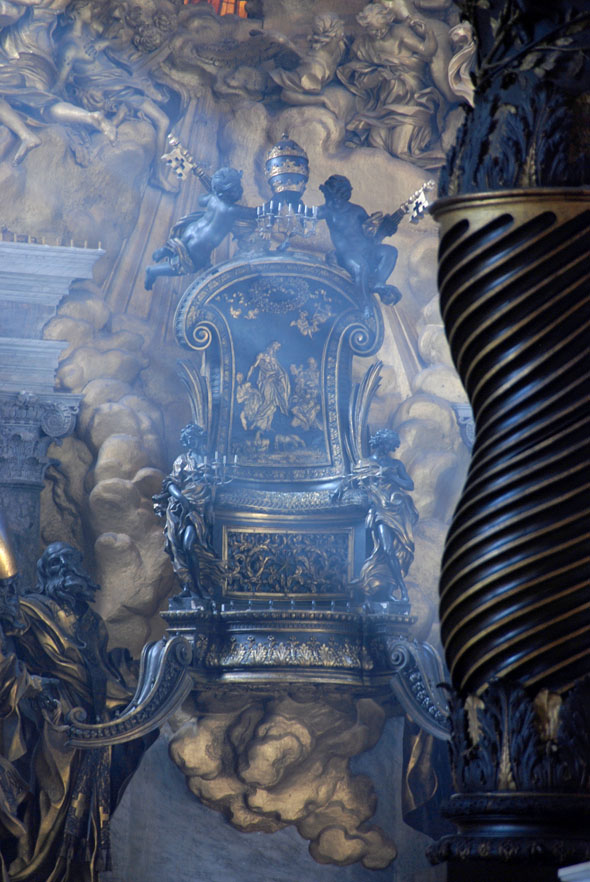 The Chair of St. Peter
The Catholic-Protestant Divide: A Path to Unity
by Dave Wade
Understanding “what” fundamentally divides Christians is not beyond the intellectual reach of the everyman. It is understanding “why” that splinters and fractures into incomprehensible and disconnected thoughts. The fundamental disagreement that underlies all the other Catholic-Protestant disagreements concerns His Church and its Teaching Authority. The Church…the one Christ imbued upon the Apostle Peter in Matthew 16:18 and its Teaching Authority referred to as the Magisterium, is understood by Catholics as clearly seen in Scripture to be created, instructed, planned and executed according to Scripture.
Why is the Church and its Authority in Christianity the fundamental point of division? The teachings of this visible Authority, The Church, headed by Christ, by Peter and their appointed and initiated chain of Apostolic successors, produce all the other Catholic practices that Protestants claim are not valid — those that fuel long standing disagreements among both. Sacraments, liturgical worship, doctrines, dogmas, sainthood, indulgences, prayer practices, papal infallibility, and all the rest that Catholics and Protestants debate are Catholic teachings from that Authority (i.e. the Church) that Protestants deny have any salvific value. Catholics rely upon this Authority to guide their worship and direct their worship practices to become and remain centered on Christ and His teachings. Reliance on this Authority provides Catholics with a universally consistent application of Fatherhood and the unimaginable benefits promised by Him. The Catholic submission to authority demonstrates an authentic understanding of worship as a permanent love relationship, one that does not dissolve from argument, but calls for obedience and parallels our tangible experience as parents and children. Some of these Catholic individual and liturgical practices are misperceived by Protestants to be heretical, giving them reason to continue remaining separate from the Catholic Church. Protestants view these practices as creating a “performance” or “works” based false salvation, which if true would be tragically misguided. Yet, studied and knowledgeable Catholics understand that salvation can only come from outside of ourselves and that these Catholic worship practices prove to remove the fallible and impure obstacles (that we as humans create for ourselves) that block a progressive personal Christ relationship which is necessary for salvation.
To make ecumenical progress, Christians on both sides of the divide must begin by treating each other with the highest level of dignity and respect possible, especially when communicating about the Faith. The unifying basis of both sides is a common knowledge and experience of relational theology in Christ’s promise of salvation by grace. As demonstrated by the Joint Declaration on the Doctrine of Justification, Catholics and Lutherans not only agree on the assurance of salvation, but also formally and publicly declare it as permanent evidence of a pre-existing unification point. Paragraph 38 of the Joint Declaration exposes this with such alarming clarity, any Christian apologist should question the very need to defend his Faith to another Christian altogether:
“According to Catholic understanding, good works, made possible by grace and the working of the Holy Spirit, contribute to growth in grace, so that the righteousness that comes from God is preserved and communion with Christ is deepened. When Catholics affirm the “meritorious” character of good works, they wish to say that, according to the biblical witness, a reward in heaven is promised to these works. Their intention is to emphasize the responsibility of persons for their actions, not to contest the character of those works as gifts, or far less to deny that justification always remains the unmerited gift of grace.1
If Catholics and Lutherans of authority can by their own free will produce a doctrine having such unifying impact, then certainly their members are able intellectually to participate accordingly.
Historically, Catholic initiated ecumenism is not without its self-inflicted misperceptions. Certain Catholics must cease observing Protestants as “privatizing the Faith” by selectively hearing that they only profess a mandatory personal relationship with Christ. While salvation begins personally and intimately in our adoption into God’s family, it cannot result in a tunnel-visioned and self-guided faith. As we strengthen a communion with Jesus, we come to receive His heart and a genuine compassion for the lost, the poor, and the sinner. Personal relationship with God begins individually, but then pours over into all of our relationships, caring for the least, loving our enemies, and exposing the fruit of that genuine personal connection. This is how Christ ministered, personally and individually. Additionally, this is how the emulation of Christ and relational permanence of Fatherhood produces visible manifestation of His love, and is universal in all the Christian faithful. Protestant ministries have this much in common with the same in Catholic ministries.
When a Catholic or Protestant finds the Christo-centric reality in his separated brother, and in that person’s Faith, a dialogue of unity can follow on the subjects of Christ’s deity, the Trinity and His own teaching of a unified body. Both sides of this divide would enter still further into fruitful ecumenical territory by discussing the progressive nature of the Church, including its human error throughout nearly two millennia. All Christians should recognize the rational truth that “the perfect is not the enemy of the good.” Man was not given religious truth as though from a Scholastic theologian, perfectly organized and tabulated with citations. Nor have we seen a perfect progression of doctrine by perfect Bishops. The Church develops its doctrine by advancement within itself, without changing the core truths. The progression of doctrine also does so in tune with current realities and cultures, and in spite of its entrusted keepers’ faults and the personal or public sin for which they will be accountable. The fact that imperfect humans may have wreaked havoc on other believers at various times throughout history never constituted a truth ending event, or a conspiracy to do so. It must be with this concrete reason and logic that the one true Church is held believable, visible and accessible for all Christians.
Once we share a view that the One Infallible God has left His fallible children a path to seek and find His love for us, the perceived differences become less daunting and we, together, can reach out to unify once again.
- Joint Declaration on the Doctrine of Justification, 38. [↩]

It’s not clear to me that “the fundamental disagreement” concerns the Roman-Catholic magisterium’s authority; at least as a *general* rule. (It may and probably is like this in particular cases with many Protestants.) As the author unpacks the claim, the impression seems to be that Protestants either reject or do not see the justification for accepting the Roman-Catholic conception of the teaching magisterium; and hence Protestants reject dogmas the only ostensible justification for which is that they are pronounced by that magisterium. In my own view, which I would imagine is shared by many Protestants, the fundamental reason to believe that Roman-Catholicism’s teaching magisterium is not authoritative when it comes to Christian dogma is not merely that I do not see the warrant for holding the Roman-Catholic magisterium to have this authority; but also – and more fundamentally – that it is clear to me that this magisterium has in fact pronounced dogma that is *contradicted by* the (agreed-upon) Scripture. As I see it, there is an incoherence in the Roman-Catholic position, in that some magisterium dogma (e.g.,, concerning the idea that “justification” is a transformative process) is simply inconsistent with other magisterium dogma (e.g., that certain Scripture that plainly presents justification as a forensic act/event is *also* authoritative).
Obviously, studied conservative Roman-Catholics will disagree with my view that there is an inconsistency between Scripture and magisterium dogma, but my point here is that there are two significantly different kinds of ways to view the “fundamental” point of division. One way, which it seems to me the author focuses his article around, is for one side to fail to see the warrant for viewing a particular teaching magisterium (embodied in what has come to be known as the “Roman-Catholic church”) as authoritative, whereas the other side does see such warrant; and hence one side fails to accept as true certain dogmas flowing from that source (or at least as to be believed in virtue of that source). But there is another way, and that is to judge not merely that there is insufficient warrant for accepting this extra source of dogma but also that this extra source has introduced incoherence and inconsistency (particularly, in light of Scripture that *both* sides allegedly accept as authoritative and inerrant) and hence cannot be a valid source of dogma.
An important upshot of this for Protestant-Roman-Catholic dialogue is this: for one who is convinced that certain Roman-Catholic dogma contradicts Scripture, arguing about Peter and the keys and the nature of the Church and apostolic succession and teaching authority and catholicity and visible unity etc., although important, is, from the perspective of what is “fundamental” to the division, beside the point. This magisterium *can’t* be authoritative (the reasoning goes), however plausible a case might be made that connects it to the apostles, or however pretty a line might be traced through history, etc., because of Scripture. For Protestants of this perspective, any hope of getting them to accept this magisterium will fundamentally have to begin with exegesis of Scripture, particularly Scripture pertaining to doctrine that has divided the two groups since Trent such as the nature of justification.
I don’t know what this sentence means; but seriously? If we are going to pick out a single unifying basis, surely it should be Scripture.
Dan- As I see it, only to the extent that we agree upon Scriptural interpretations can we be unified. And that process itself (of working toward agreement concerning Scriptural interpretation) is a Church activity. So, though the Bible will certainly be central to this process leading toward unity, it’s the “common knowledge and experience” of people, led by Christ, the Shepherd (exactly what Dave Wade describes in the article), that is “the unifying basis” of this process of Atonement. thanks.
Dan,
I can appreciate where you’re coming from. If there is an actual contradiction between Scripture and the Magisterium, as the Protestants claim, then I can’t believe in the Magisterium. And if there is actual contradiction within the Scriptures, as the atheists claim, I must reject them as well. But neither of these things are the case. I’ll convince you of the former as soon as I convince the atheists of the latter. But the atheists can make a much stronger case for their objection than you can for yours; i.e. the apparent contradictions in Scripture take a lot more “creativity” to defend than do the apparent contradictions between Magisterium and Scripture. The latter is a walk in the park.
There can be some of that, but only so much. One problem with this proposed method is that it assumes the entire foundation of Protestant theology to be true while demanding that Catholics drop half of theirs. That is, yes we believe the Scriptures are inerrant, but only as delivered by the Church. Inerrancy of Scripture is unintelligible as a doctrine without Church infallibility. The better method, I think, is for both sides to back up from their positions and examine the issues starting with the more fundamental questions. That’s exactly what we’ve been doing here at CTC.
Tim,
You clearly think that it is more difficult to show an inconsistency between the magisterium’s dogma and Scripture than to show one between Scripture and Scripture, but even so you don’t need to defend the self-consistency of Scripture (vs. the atheist or anyone else) as a step towards defending the consistency of the magisterium’s dogma and Scripture. A Protestant who holds to the inerrancy of Scripture will not challenge Scripture’s self-consistency; and the challenges a Protestant will raise (e.g., that the magisterium got justification wrong) cannot be answered by arguing that certain parts of Scripture are compatible with each other (which parts would one pick?). Further, the magisterium’s dogma and Scripture may be inconsistent whether or not Scripture is inconsistent with itself; the issues are distinct. Of course, if it were really true that Scripture’s self-consistency is easier (for you) to defend than Scripture’s and the magisterium’s consistency, then if you could defend the former you a fortiori could defend the latter; but the Protestant has no reason to accept this ab initio (since at this point he holds both that Scripture is in fact self-consistent on every point and that the magisterium’s teaching and Scripture are not) and hence won’t take your ability to defend the one (granting that you have it) as showing that you could also adequately defend the other. You’re right that my main point was that for at least this Protestant the chief obstacle towards embracing Roman-Catholicism is the view that there is an internal incoherence/contradiction in the “camp.” Yes, Protestants also have to worry about one way in which their camp(s) can fall to an internal incoherence (Scripture’s being inconsistent with itself), but Roman-Catholics have to deal with this same point too; plus several more distinct points of potential incoherence; namely, a larger canon of Scripture’s self-consistency, the consistency of this canon and the magisterium’s dogma, and consistency of the magisterium’s dogma at one point in time and its dogma at a later point in time.
I don’t understand this first sentence. Is the claim that what is inerrant, strictly speaking ,about the Scripture’s is a certain interpretation of them “delivered” by the Church? If the claim is that the Scriptures themselves, i.e., the books and the sentences comprising them, are inerrant, then I don’t understand what it would mean to hold that they are inerrant “only as delivered by the Church.” Would they not still be inerrant if nothing or nobody “delivered” them to anyone? Your second sentence seems patently false. Was any person, group of people, or bit of non-Scriptural writing or preaching of any person or group of people at the time of Christ’s birth infallible when it came to dogma; and if not how could a notion of the inerrancy of the Tanak (God’s word at that time, the Old Testament) be unintelligible without reference to (and a fortiori depend for its truth on) a notion of church infallibility?
Dear Dan,
Reformed Theological Seminary Professor, Dr. Frank James (now at Gordon Conwell) stated in his Reformation Church History class taught emphatically that Luther’s doctrine of forensic justification had never been taught in the Church before Luther. I think Dr. James realized that the sin of the Catholic Church does not justify the Reformation, therefore he wanted to stress the newness of Luther’s doctrine. He also mentioned that St. Augustine would have been “HORRIFIED” by Luther’s doctrine. If Scripture is clear about forensic justification, why wasn’t it taught for the first 1500 years of Church History? Why would Augustine, arguably the greatest theologian in Church History, been “HORRIFIED” by this clearly biblical doctrine?
Peace in Christ, Jeremy
Jeremy,
Since Dr. James, and not me, (allegedly) said Augustine would have been “horrified” by Luther’s doctrine of justification, perhaps you should ask him, and not me, why Augustine would have been horrified by it.
There is (1) a notion of justification as forensic, (2) a notion of justification as forensic that explicitly and consciously dwells on its aspect as forensic, (3) the explicit recognition/affirmation of either (1) and/or (2) as the biblical teaching, and (4) the explicit rejection of (1)/(2) as biblical teaching. From a Protestant perspective as I understand it the peculiar gravity of Trent’s problem was its doing (4); which is not equivalent with the mere absence of doing (3). Anyone who reads and understands the Torah when it says that one should justify the righteous and condemn the guilty at least tacitly grasps (1) in connection with the word ‘justify’ in such places, whether or not they grasp (2); since if one fails to at least tacitly grasp (1) in such places they would completely misunderstand the context in which the statement arises and what is being communicated.
A multiplicity of considerations can be brought to bear to weaken the intuition that were soteriological justification in Scripture forensic then it would have more explicit recognition/exposition of it as forensic in church history (e.g., the distinction between (1)/(2) and(3), between (3) and (4), the fact that for centuries other disputes were more in the forefront – e.g., Trinitarian and Christological disputes, etc.), but in order for any such intuition to be supported one thing that must be done is to make a case that Scripture itself is relatively obscure on the matter. To the extent that Scripture is perspicuous on a matter, to that extent the fact, insofar as it is a fact, that many people have failed to explicitly affirm it is not evidentially significant when it comes to assessing the genuineness of the fact. For example, supposing many people who read Scripture reject the deity of Christ, the degree to which that should lead one to doubt the deity of Christ for themselves must depend crucially on what one thinks pertaining to the clarity of Scripture itself on the matter. If one is not sure whether Scripture teaches it, a noticeable absence of believers of the doctrine in history will be more significant; but if one is certain Scripture teaches it, such an absence will fall far short of providing good evidence to abandon the belief. In other words, the amount of extra-biblical evidence against Christ’s deity (which the absence of belief in the doctrine by certain people in certain circumstances can constitute, to some degree or other) needs to at least be proportional to the apparent clarity with which the doctrine is revealed in Scripture. Since the focus of this thread isn’t whether or not in fact the Scripture teaches that justification is of a certain nature (e.g., forensic), I’ll just say that I’m very confident that Scripture (not to mention lexicons) reveal that it is forensic; and that (naturally, given its brevity and vagueness) when I apply this evidential principle your post hasn’t begun to do any work towards shifting the scales for me.
Dan,
Do you think the Catholic Church was ever a “legitimate” Church? Most of my friends and seminary Professors hold the position that it ceased to be legitimate after the 6th session of Trent when it rejected Luther’s doctrine of justificaon. It seems very strange, however, to insist that the Catholic Church ceased to be a Church for simply rejecting a doctrine which it had never taught in the first place. Furthermore, the traditional Calvinist view of justification is closer to Rome’s in the sense that it wants to insist that a person has to be regenerate in order to be saved. Do you agree that a person must be regenerate in order to be saved? Would you also agree that if a person is regenerate, then the internal disposition of their heart is fundamentally different from the nonbeliever? When we start to answer these question through the lens of Scripture it becomes increasingly difficult to articulate how the Catholic position could possibly be wrong.
Peace in Christ, Jeremy
Dan,
I have a bad habit of believing that I’m being clearer than I really am. My point really had nothing do with Scripture’s self-consistency. I’m trying to get you to see that even good evidence that there is no contradiction is often not enough to convince someone who believes there to be one. There are good reasons to believe that there are no contradictions in the Scriptures – just good luck trying to prove that to an atheist. Likewise with Protestants & the Magisterium.
I’m not trying to get into a discussion on inerrancy. Just that, like St. Augustine, if it weren’t for the Catholic Church, I wouldn’t believe the Scriptures. A fish can be removed from water, but it’s something different once you do that. Same with Scripture when you wrestle it from the bosom of the Church.
Jeremy,
The question presupposes a definite conception of “the Catholic Church,” but it’s not even clear to me what this is. The Roman-Catholic church has developed over time and space in various ways; what are its precise spatiotemporal boundaries, and can people or places be Roman-Catholic to a matter of degree? There has been a catholic church in the sense of a true redeemed people of God from Adam up till now; though as anyone can tell from reflecting on Scripture it has sometimes been relatively very small (e.g., Noah and his family, and Elijah and the 7000 who wouldn’t bend to Baal); not merely relative to all people on earth at a time but even relative to all people apparently in “the church” or “people of God”. The catholic church did not cease during the patristic era and reappear with the Reformation; it has always been here. Further, there has always been a visible ecclesiastical embodiment of the catholic church; Christ and his apostles instituted a “visible” church with public officers and public (not hidden) doctrine which those in the church are to adhere to and which the teachers are to teach. Although salvation is binary (so I claim) (i.e., one is either saved or not), one’s theological (in)competency can be a matter of degree, and so too (naturally) will the accuracy of the teachings of a church. Is there either a degree or kind of theological ineptitude such that a particular ecclesiastical body’s having it makes it not merely a relatively defective church but in fact an “illegitimate” or “false” one? Presumably there is, and it would seem that a sufficient condition for being a false church is explicitly teaching something that gets the gospel of salvation wrong in an explicit and important way, a way that is portrayed in Scripture as resulting in the teaching’s constituting “another” gospel rather than simply a variation on the same gospel. The Roman-Catholic magisterium satisfied this condition (in the traditional Protestant’s view) when it not only rejected but also anathematized the view that soteriological justification is by faith apart from works; by holding it to be by faith and works. This doesn’t imply that the catholic church lacks ecclesiastical embodiment; but it does of course imply that Christ’s true church is where the marks of a true church are, where, e.g., the teaching entrusted by the apostles is preserved and taught and the church offices instituted by the apostles are filled. Christ has a catholic church, and his church is maintained through visible and ecclesiastical institutions and offices; but it doesn’t follow either that there is a single ecclesiastical institution subsuming the entirety of this catholic church or that ecclesiastical fault-lines express vicious division or disunity in the body.
I already dealt with this point in distinguishing between (3) and (4) in my last post to you, between the explicit affirmation and denial of a doctrine. It doesn’t seem strange at all. Would you seriously maintain that there there is no significant difference between some church’s lacking a specific, precise doctrine of Christ in its teaching and such a church’s explicitly mentioning a particular Christological view (say, the duality but non-conflation of the human and divine nature) and rejecting – no, anathematizing, it? Further, suppose a church not only rejects the view, nor even only anathematizes the view, but also ascribes infallibility to itself in so anathematizing the view; such that it makes it much less likely that it will revisit and re-evaluate its decision.
Closer to Rome than what/who? I’m not familiar with anyone who holds that a person does not need to be regenerate in order to be saved.
Yes and yes.
It seems very easy to me to articulate how the Roman-Catholic position could possibly be wrong, and I don’t see how your questions about regeneration lead the other way; but feel free to explain further.
Tim,
Ok, you succeeded; I agree =]
And without a preacher the word of faith will not reach one. The inerrancy and infallibility and power of the latter hardly necessarily transmits to the former, and likewise the Scripture’s inerrancy in no way implies the infallibility of the church. Again, if you’re going to maintain this, then who/what was the infallible possessor of the Tanak when Christ was born? The word can be communicated even through bad motives (Philippians), how much more through good yet fallible instruments.
No one is trying to wrest the Scripture from the church; but to suppose that the Scriptures stand or fall with the Roman-Catholic church would obviously to beg the question in a Protestant-RC dialectic.
Dan,
Let me encourage you to read Bryan Cross’ article on sola fide. https://www.calledtocommunion.com/2009/09/does-the-bible-teach-sola-fide/
Not to be rude, but I am assuming from your post that you have not thoroughly read the 6th session of Trent on justification. You are characterizing the Catholic position as faith + works, when in reality the Church teaches that we are saved by faith, but only faith conjoined to agape. The Roman Catholic Church teaches that salvation is a gift of God’s grace. Period. How is the Catholic Catechism unclear?
2020
Peace in Christ, Jeremy
2020 Justification has been merited for us by the Passion of Christ. It is granted us through Baptism. It conforms us to the righteousness of God, who justifies us. It has for its goal the glory of God and of Christ, and the gift of eternal life. It is the most excellent work of God’s mercy.
Jeremy,
That’s a false assumption.
Instead of faith + works, faith formed by love, eh? Really? This is an utterly false dichotomy, as love is the essence of the law! Hence by characterizing the RC position on justification in terms of faith and works I in no way misrepresented it. Further, I’ll provide below some quotes from Trent’s six session presenting works as justifying, in further defense of my claim. And just to be clear, I never said initial justification was, according to Trent, by faith and works; but rather that justification was. This is simply incontestable.
Citing a catechism passage that does not demonstrate my claim hardly implies that every other piece of magisterium teaching on justification also fails to demonstrate my claim. The RC magisterium has in fact been quite clear; it is you who are being unclear in selective citation and in saying “Period” after saying that “salvation is a gift of God’s grace”. That is misleading at best and simply false at worst, though I can see why you would want to say it to non-Catholics.
Dan,
I am being as clear as words allow. Carefully read through the “causes” of justification as outlined at Trent.
Chapter VII
Of this Justification the causes are these: the final cause indeed is the glory of God and of Jesus Christ, and life everlasting; while the efficient cause is a merciful God who washes and sanctifies gratuitously, signing, and anointing with the holy Spirit of promise, who is the pledge of our inheritance; but the meritorious cause is His most beloved only-begotten, our Lord Jesus Christ, who, when we were enemies, for the exceeding charity wherewith he loved us, merited Justification for us by His most holy Passion on the wood of the cross, and made satisfaction for us unto God the Father; the instrumental cause is the sacrament of baptism, which is the sacrament of faith, without which (faith) no man was ever justified; lastly, the alone formal cause is the justice of God, not that whereby He Himself is just, but that whereby He maketh us just, that, to wit, with which we being endowed by Him, are renewed in the spirit of our mind, and we are not only reputed, but are truly called, and are, just, receiving justice within us…
Of these causes, which ones do we do and which one’s does God do? You tell me. A simple clear reading of this passage provides the context to read the rest of the document. You skipped over the first nine chapters in order to reinforce the Protestant assumption that a rejecion of “faith alone” must mean Rome teaches “Faith + Works”. Please read Bryan’s article. Thank you for the discussion.
https://www.calledtocommunion.com/2009/09/does-the-bible-teach-sola-fide/
Peace in Christ, Jeremy
Dan,
You said:
I agree that there could be an inerrant book even without an infallible institution (and vice versa). I believed in inerrancy and in sola scriptura for all of my life until I was old enough and studied enough to see that it didn’t work. The combox won’t suffice to explain all my reasons for this but one of the main ones is the canon issue. Tom Brown did a nice job of explaining the issue in our newest lead article. So far as this discussion goes, I only meant to say that given the situation, regarding the Scriptures as we have received them, inerrancy only makes sense if the Catholic Church is infallible.
I’m not begging the question. I am assuming that the Church matches the one we’ve argued for here, here, here, here, here, here, and finally, here.
I can’t expect you to read all of that, but I just wanted you to know that we’ve made a case for our ecclesiology.
Dan,
Also to back Jeremy up, Dr. James is by no means the only Protestant scholar that admits this. Heiko Oberman for one says that sola fide is found nowhere in writing before Luther and Allister McGrath says calls Luther’s doctrine a “theological novum” and also affirms that the Catholic Church, not the Reformers, preserves Augustinian soteriology. James is quite right that St. Augustine and the rest of the fathers would have rejected imputation had they been exposed to it.
You might be interested in Marshall’s “Augustine’s use of Infusion for Justification” and my post, Augustinian Soteriology.
Jeremy,
Certainly as clear as some words allow.
I have. However, it’s not clear at all to me that you have. Chapter VII does not include all that Trent has to say on the matter! Hello? It is describing “justification” in the sense of the initiation into the state of grace by baptism, but as I’ve already documented and yet you’ve ignored, in subsequent sections it is taught that justification is not merely that initiation but also an extended state or process and that good works further justify one and merit eternal life. For the 2nd time, simply citing one point of magisterium teaching that does not teach the justifying role of works hardly shows that the magisterium’s teaching as a whole, and/or in other places, does not teach it. If you want to defend the view that the magisterium does not include works in justification, then engage the quotes I’ve already provided that apparently do bring works into justification and explain how the passages are consistent with your claim.
Are you aware of the fact that for Roman-Catholicism justification is more than the initiation into a state of grace? And need I say again that I am talking about justification as a whole and not merely “initial” justification, or the initiation into that state?
If I “skipped over” the first 9 chapters, then you “skipped over” everything that came after! Instead of expecting each other to cite the entirety of the 6th session whenever we want to call attention to a part of it, one should expect one to cite the parts that are relevant for the claim being addressed. I cited parts that apparently teach that works enter into justification; and you’ve not engaged them. Apparently you thought citing chapter 7 sufficed to show that I misconstrued the parts I cited, but you didn’t explain how this is. Further, you’ve misrepresented what I said in implying here that my argument was that Trent teaches justification by faith and works because it rejects justification by faith alone. My argument was that Trent teaches justification by works too because Trent says precisely that! I didn’t cite places where Trent rejected faith alone, and then infer that it therefore must teach faith plus works; but rather I cited places where it simply brought in works.
Dan,
C.S. Lewis, in The Problem of Pain and elsewhere, often referred to the “complexity of the real” when describing Christian truth. This is certainly true of the Catholic position concerning justification. It is much more complex and nuanced than the reformed view. Why? Because Scripture is. Keep in mind, sola fide was invented by a man who had serious questions concerning the canonicity of the book of James. Luther said he would give his doctor’s barrette to anybody who could reconcile James and Paul. This is an important point. The man to first advocate your position did not believe it to be workable with what most Protestants consider to be the whole council of God.
You are right, in the Catholic Church teaches that there is a distinction between initial justification and final justification. At the heart of the distinction is scripural truth that a believer MUST grow in love for God. It sounds like you don’t believe this. Bryan Cross wrote in his article:
The problem is that you have made a doctrine, which had no place in Christianity for its first 1500 years, the only litmus test to determine whether or not somebody “gets” the gospel. This mentality is sectarian. Even C.S. Lewis, in Mere Christianity, does not try to make Luther’s view of justification part of what a person needs to believe in order to believe the basic message of Christianity. Your view is not nuanced enough. A fish needs to be put back in water if it is to be saved from death, but it must stay in the water, or it will obviously die. That is the Catholic point in the articles you have quoted from Trent. You have failed to admit that EVERYTHING, including the love Bryan speaks of required for salvation, is a GIFT of God. Nowhere does Scripture teach that we are saved by “faith alone.” Instead Scripture teaches that it is “by grace you have been saved through faith, and this is not from you; it is the gift of God; it is not from works, so no one may boast.” (Ephesians 2:8,9) This is exactly what the Catholic Church teaches.
Peace in Christ, Jeremy
Jeremy and Dan,
In the December 1999 issue of First Things, the late Cardinal Avery Dulles discusses the Lutheran-Catholic Joint Declaration which was later joined by the World Methodist Council.
Here is the link to the archived document. https://www.firstthings.com/article/2008/08/two-languages-of-salvation-the-lutheran-catholic-joint-declaration–38
Cardinal Dulles, a former Presbyterian, discusses our Catholic view of justification and merited works in terms of both the document and Council of Trent. Cardinal Dulles also summarizes the Lutheran view. Below is a section of the article that clarifies our position on justification and rewards when performing good works.
“Still another issue flagged by the Official Catholic Response was that of merit, the seventh on my list. The Joint Declaration states quite correctly the position of both churches, namely, that nothing preceding justification merits justification. In that sense justification is a totally free gift of God. But Lutherans and Catholics have disagreed about whether one can, after justification, merit the increase of grace and the reward of eternal life. Trent clearly says yes. Lutherans have denied this. The Joint Declaration attempts the following compromise:
When Catholics affirm the “meritorious” character of good works, they wish to say that, according to the biblical witness, a reward in heaven is promised to these works. Their intention is to emphasize the responsibility of persons for their actions, not to contest the character of those works as gifts or far less to deny that justification always remains the unmerited gift of grace. (para. 38)
This statement seems to fall short of what Catholics believe and what Trent teaches under anathema. The fact that a reward is promised does not make it merited, since one can promise to bestow gifts that are completely undeserved. In the Catholic view, justification makes us capable of meriting in a true sense. Yet eternal life is also a gift because our capacity to merit is God’s gift, which is itself unmerited.”
Thanks.
Jeremy,
Anyone who carefully reads my posts in this thread can see that this is a misrepresentation, a false characterization. Did you read what I said about the peculiar problem with Trent in my view?
Are you talking about according to Trent, or according to my own view? If the latter, I’ve never denied it and hence it would be misrepresentation to imply that I’ve “failed” to make such an admission (as if I had every written anything suggesting that I denied it). If you’re talking about the former, this shows that you’re confused about what is in dispute. The issue is whether according to Trent soteriological justification is in part by works; and this issue is independent of what is or is not a gift of God. One can hold that all good works are gifts, or that some are, or that none are; whether or not one holds that such works enter into what justifies one. And if you’re still talking merely about initial justification, say at baptism, then this “gifts” stuff is even more irrelevant; since, for (at least) the 3rd time, I’m talking about the whole of justification.
More misrepresentation. My view is that we are justified by faith alone.
Are you conceding that works enter into justification, according to Trent, or not? It’s really not clear. Your single sentence about fish and water further down doesn’t clarify anything or justify the claim that works do not justify according to Trent (but maybe you weren’t intending to keep defending that claim – again, I don’t know). It would be helpful if you could state in literal terms what your understanding of Trent is on the whole of justification.
Nothing I’ve said suggests I don’t believe that; and if you had implied that I don’t in fact believe it we would have had another misrepresentation. It’s too bad that the truth that a believer must grow in love for God is “at the heart” of a distinction between initial and final justification, since that Scriptural truth does not entail any such distinction. What would entail such a distinction is the idea that a believer must grow in love for God after initially being justified in order to be, in virtue of or on that basis of such growth, further justified or increase one’s justification. See the difference?
Before I turn to the article you quote, let me provide a definition of what justification actually is, in my (Reformed) view:
Note that this is a technical definition of soteriological justification; it is not a definition of the term ‘justify’ or ‘justification’, which in and of itself is not necessarily a soteriological or even theological word at all. For example, Christ says that wisdom is justified by her children. The catechism here is not giving the semantic content or meaning of the verb ‘justify’ but rather explicating a theological concept “of justification” that is referred to in Scripture with the word ‘justify’; though Scripture also contains different uses of the term.
Turning to the quotations you provide from Bryan Cross’s article, the first thing I note is that you’ve provided no explanation from the article of what justification even is; but this is central to the division between Protestants and Roman-Catholics on justification. How can one engage in a discussion about what the conditions or instruments of justification are if it’s not clear what this thing is, the conditions/instruments of which are in dispute? Is it a forensic declaration outside of one? Is it a process of renovation within one? Is it a bit of both? Is it an act, event, state; and is it punctiliar, or temporally extended? In an argument against sola fide the issue of what justification is will need to be addressed; not only what its conditions are, not only because the former is relevant for the latter but also since Protestants and Roman-Catholics differ on the former and not merely the latter.
I agree. But then this inference is made:
This is ambiguous. Is the claim that (1) faith-working-through-love is an instrument of justification (whatever justification is); or that (2) faith, in being an instrument of justification, must, if it is to be an instrument of justification, be a faith that works through love? (1) and (2) both affirm that justifying faith is faith working through love, but (1) affirms that the faith-and-love is the instrument of justification while (2) affirms that only the faith is; although the faith that is the sole instrument is indeed a faith that is inextricably part of a faith-love complex.
The clearest way to actually get a contradiction with the Reformed view of sola fide would be to go with (1); for according to the Reformed faith is clearly the “alone instrument” of justification. Does (1) follow from what had preceded, the stuff I said I agreed with? No. It hardly follows from the fact that one who is justified is necessarily also with love (and vice versa) that love is part of the instrument of justification. It could be that only one of the pair is an instrument of justification, and yet that there is a necessary connection or correlation or accompaniment between both parts of the pair. This is what the Reformed hold, since the same Spirit that gives faith also gives regeneration and sanctification. So this argument is fallacious on one interpretation ((1)) and no threat to sola fide on another ((2)). Further, if one thought the Reformed actually denied
, this would be a gross misunderstanding of the Reformed view:
The same ambiguity and lack of precision concerning (1) and (2) is shot through the rest of the quotation from the article that you provide.
Again, it would be a misrepresentation of the Reformed view to say that it holds justifying faith to be faith that is not conjoined with love (where by ‘conjoined’ I mean co-present with); and this is one potential interpretation of the claim (again, it is ambiguous).
No argument from silence is needed to demonstrate the falsity of Trent’s position. We don’t merely have passages in Scripture that say justification is “by faith” that do not add love or works (such that we would need to assume anything from silence); we also have passages that say justification is not by works as well as passages that say it is by faith apart from works. Perhaps the article addressed such verses, but what you’ve quoted does not and any robust case against sola fide would need to deal with such verses. I’m tempted to discuss some of these verses, but I think the differences between us are rooted in a great number of closely related issues that can’t be discussed briefly, pertaining to what justification even is (both in Paul and in James), what its ground is, what good works are, what faith is, what it means to refer to it as an instrument, what imputation is, what is imputed, and the difference between a pre-condition or instrument of justification and a necessary correlate of such a condition due to a common cause. But perhaps the Roman-Catholic view of justification is just too nuanced for a Reformed person to grasp anyway. Can we at least get clear on what the magisterium’s teaching is?
Dan,
These are two different paradigms. Hence, you cannot force the Catholic position into the Protestant paradigm. That’s what you are attempting to do when you say the following:
Properly speaking, there is no such thing as “the whole of justification,” because justification does not have parts. To treat it as if it has parts, is to try to push the Catholic position into the Protestant paradigm (by treating anything other than forensic [extra nos] justification as a whole composed of parts. An increase in justification, however, is not a part of justification.
In the peace of Christ,
– Bryan
Dan,
Thank you very much for the discussion. I am carefully considering your points. First, I meant, that you have failed to admit the Church’s position is that EVERYTHING is from God’s grace. (Of course I know this is your view). I appreciate you engaging the points I made in my previous post, but I am perplexed that you don’t seem to want to discuss Luther. As a Protestant seminary student, which I still am, I would not have been so alarmed by Luther’s calling the book of James into question had it not been his reason for doing so. He questioned its canonicity precisely because it contradicted his exegesis of the Pauline passages which he believed taught forensic justification. Calvin disagreed with Luther and began the long tradition of creatively interpreting James 2 in reformed thought.
I am also baffled by your last statement, “Can we at least get clear on what the magisterium’s teaching is?” It is the reformed view which is increasingly obscure as there is no established body to interpret the nearly 400 year old document with any authority that people should listen. The CREC crowd and the Westminster west crowd both believe they are best articulating the true meaning of the Westminster Standards. The problem is that those committed to the reformed faith have no option but to listen to each side and go with the better argument. The Catholic magisterium is perfectly clear as it has stated and restated the Church’s position on justification. Who do I talk to get the most accurate interpretation of the Westminster Confession of Faith?
Let me restate one last time the Catholic understanding of justification. I want to let you know though that I will not be able to keep the conversation going. Not that I don’t think its fruitful, but we just found out last night that we’re expecting #3 and I need to get off the computer and be focused on my wife right now as she deals with feeling sick. The Roman Catholic Church clearly teaches that sinful men are justified through grace alone. By grace, the Church means, “favor, free and underserved help that God gives us to become children of God” (CCC 1996). This grace “depends entirely on God’s gratuitous initiative, for he alone can reveal and give himself” (CCC 1998). Finally, justification (I think this is what you’re getting at) also “establishes cooperation between God’s grace and man’s freedom. On man’s part it is expressed by the assent of faith to the Word of God, which invites him to conversion, and in the cooperation of charity with the prompting of the Holy Spirit who precedes and preserves his assent” (CCC 1993).
So, when we are justified, we are not only forgiven, we are also transformed and brought into a state of grace. You are right, we must remain in this state of grace in order to remain God’s people. How do we do this though? By Grace! I wish I had more time, but I want to tell you that on a personal level, I am becoming Catholic not because I think I need less grace but because I know I need more! I need true access to the fruit of the cross in a sense that no Protestant group can offer. I need to remember the grace of my baptism every time I enter the Church. I need the grace of absolution for my ongoing battle against sin. I need the grace of feeding off Christ in the Eucharist. The power of a thing is measured its effect. The Catholic understands that God’s grace, when present, is always transformative, hence, to have living faith is to be in a state of grace and transformation.
You seem like a brilliant guy and I appreciate your passion for truth.
Peace in Christ, Jeremy
Hello. I have been “off the grid” for a few days performing my own personal Fatherhood application (a campout) previously committed to my kids who could not care less about “the “meritorious character of good works” other than who is making s’mores that night.
Right up front I must thank Bryan and Tim and CTC for finding my essay worthy reading. I am humbled to be more than an occasional writer among those more learned and eloquent than I, at least for once.
Jeremy, your essay is striking and provocative. As a concept, I think your Authority of Love has a great depth to go further than you were limited within the essay.
Dan, it is a privilege to take your question:
I provided an example, “The Joint Declaration”, which is black and white about how we are saved. Beyond that I cannot help you comprehend it with any more ordinary language or official content, though I really wish I could. Maybe you will find my further comments more substantial.
The remainder of the points you raise display exactly what the 2nd sentence of my essay stated. The thoughts written are splintered and fractured. Those points, mind you, may have valid intellectual territory to mine…but only one at a time. This essays’ prime trajectory is (as Tim stated)
“ I agree in keeping the main thing: the main thing.
CTC asked for a bottom line linear and sequential answer essay to the Division question. I took this to be a conceptual writing, meaning speaking in encompassing concepts (which I enjoy immensely). So my bottom line up front is this: Salvation is my personal eternal life or death matter. Is there a single modern agreement anywhere on obtaining Salvation, so impactful, that puts it to rest for me, how this Salvation gets accomplished? The JD of 99 answered this as yes. Now, many pre-dispositions were in place for me to buy into that. A) I had to be one that believes, B) I had to believe and submit to an Authority wiser and more experienced in grace than me, and C) I had to be seeking it for its benefit, not for its fault. There can be no other question for me with greater gravity….Salvation that is.
I feel my essay speaks to how one can be the true Church without being perfect…I am sufficiently provoked to share these thoughts on the Authority and the One True Church aspects of my perspective that I have found to be immensely insightful regarding the Protestant split and how the Catholic Church views its role in continuing efforts to heal it.
In an interview in 2003, Fr. Richard John Neuhaus said the following:
“The Catholic Church preserves itself as the most fully and rightly ordered through time and this in no way means that the Church is the totality of Jesus Christ. Vat II says everyone who is baptized and accepts Christ as their Savior is truly, but, imperfectly in union with the Catholic Church (sic). A lot of Conservative and Orthodox Catholics are nervous about Unity and Ecumenism and they view Ecumenism as a liberal project and a very suspect one riddled with people who want to water down the Catholic Faith in order to agree on doctrines. But In fact, JP II had one of the most striking and persistent and strongest efforts in Ut Unum Sint. The quest for Christian Unity is not a program of The Catholic Church, it is inherent in being the Catholic Church. If we have this deeply biblical Christ centered understanding of what “The Church” is, then we have the key to that door. (Neuhaus continues his take further): We should say to our Protestant friends ” Look, we’re not engaged in this quest for Christian unity because it is something we have to create, we have already a unity in Christ which is the gift of God. The reason ecumenism is necessary is NOT that we are NOT Brothers and Sisters in Christ, it is rather because we are Brothers and Sisters in Christ live, but LIVE as though we are not.”
Summarily, Bryan Cross wrote comprehensively in this Article two ecumenisms on how misunderstood the Unity effort can be, and by now should not be.
-Dave
Dave,
Excellent essay, it was a delight to read and I have emailed it to several of my friends. In addition to your solid essay I believe your clear love for Christ and the Church will do as much as any apologetic in drawing people to the visible bride of Christ.
Peace in Christ, Jeremy
Bryan,
I was not attempting to force the RC position into the Protestant paradigm there. Since on the Protestant paradigm, justification is punctiliar, and not extended through time, how could I possibly divide up justification on the RC into phases view by assimilating it to that paradigm? This makes no sense. Rather, my distinction between initial justification and justification “as a whole” flows from Trent itself. Bryan, do you deny that according to Trent justification can be increased; do you deny that according to Trent one can be further justified? Apparently not, since you seem to concede in your post that justification can be increased. Well, that’s all I was getting at with the language of “whole”.
When I spoke of the “whole” of justification, as can be seen by the context in which I said it, I was merely indicating that I was talking about everything comprehended in “justification” according to Trent rather than only the initiation into the state of grace (which is only part of what “justification” comprehends, for Trent). As can be seen by context, I spoke this way because Jeremy was focusing, apparently, on the initiation into the state of grace; and so I was trying to get him to focus on the entirety of what Trent says about justification.
Jeremy,
Thanks for the clarification. But I have not denied that everything is from God’s grace, on the Catholic view! I do think that is a disputable point (when we look at everything pertaining to justification), but that has not been relevant to my concern in this thread. My contention has been that works justify, according to Trent; this is independent of the issue of whether everything is a gift of God’s grace or not! I sense that you’re swinging at a straw man in this thread. My concern with Trent (in this thread) has not pertained to what is or is not of grace, or what is or is not God’s gift. It has simply been whether works (gifts or no, provided through grace or no) justify. Can you see why this might be a concern for me, independent of the gift/grace issue? Scripture seems to teach in places that justification is not by works. Hence, if Trent seems to teach that one is justified by works, then this seems to be a problem; whether or not they are of grace.
What more can I say on this? I’ve already quoted Trent saying that works enter into one’s justification. And Bryan, a Catholic, has conceded, it seems to me, that I am right here in his post to me wherein he mentions an increase in justification (he just took issue with my use of the word ‘whole’). The entirety of your rebuttal has been to focus on the initiation into the state of grace, which does not involve good works but rather (in the case of infants born to Catholic parents at least) baptism and love gratuitously poured into the heart. I have never challenged this. But you keep neglecting the fact, clearly attested in Trent, that justification is not limited to this initiation; but continues thereafter. And in this post-conversion phase good works do enter into one’s justification. By performing works in cooperation with grace one is further justified and increases one’s justification. And any Catholic who is not up front with you about this is not doing you any favors.
I have not discussed Luther both (a) because I am not as familiar with the history and with everything he said or allegedly said about the canon and (more fundamentally) (b) because it is a secondary or tangential matter with respect to the Protestant-Catholic divide. As far as any tensions between James and Paul that Luther perceived or thought he perceived, apparently Luther never became convinced that any Roman-Catholic had adequately squared them with each other; did he? And if we’re going to talk about justification in James and Paul, let’s talk about justification in James and Paul; not the views of Luther or Calvin on James and Paul. The former is fundamental, the latter tangential. I don’t think it’s hard at all to square James and Paul; or requiring much “creativity” at all. And if you want to engage the issue then let’s do so directly and talk about them; and not hover on the surface with these historical-anecdotal potshots which may indeed be interesting and somewhat relevant but hardly adequate in and of themselves for a meaningful, rigorous, and God-honoring treatment of the issues.
There may have been some miscommunication (based on what you say after this). I was not implying that the magisterium’s teaching is not clear. I think it is relatively clear. Though I disagree that it is perfectly clear or as clear as it can be. You are in fact a case in point. The document (specifically chapter 7) has apparently given you the impression that the initiation into the state of grace exhausts “justification.” This is an understandable conclusion, since it speaks of “justification” and not the “initiation” of justification, etc. But as the later parts of the document testify, this is an incorrect interpretation. Because of your repeated emphasis in this thread on the initiation of justification – without any admission on your part that you are only dealing with the initiation into justification – it is reasonable to infer that you mistakenly think that according to Trent this initiation is in fact the entirety of justification or justification simpliciter. And this would be a misunderstanding of Trent, which has to say something either about your reading comprehension or about the document’s clarity. (I think it is more likely that it says something about the latter.) When I asked if we could get clear on the magisterium’s teaching, though, I was not suggesting that the magisterium is unclear; but rather I was hoping that me and you could get clear on the magisterium’s teaching. That is, can me and you come to a consensus on what it is teaching about justification.
As far as your assertions about the Reformed community, well, they are not much more than a number of assertions; some of which I am dubious. But variation in doctrinal precision across space and time is a massive and unwieldy matter, and why must I carry its burden; having to answer for it all (whether it be within the Reformed camp or in the entire history of the church up to the Reformation)? In the spirit of my comments about James and Paul and history earlier, if you want to actually meaningfully engage the Westminster Confession and argue that its teaching on justification is ambiguous or unclear in an important way, then I will address that. But I’m not going to get carried into the beliefs of everyone in the Reformed community, such as concerning the federal vision controversy; especially when you’ve just made unargued and vague assertions about the matter and not given me anything concrete to respond to or rebut. As for clarity, I think the WCF is clearer than Rome on justification (which is not to say I think the latter is unclear); and furthermore, the clarity of the document is a more relevant and pressing issue in the case of Rome since only its doctrinal statements are invested with infallibility. Finally, if you think that disagreement over theological beliefs is an issue unique to the Reformed; then you haven’t taken a close look at Rome, and unless one remains in ignorance one who crosses over will eventually become disenchanted.
That’s certainly a higher priority than having an internet conversation; though whether it’s more important than a decision to become Roman-Catholic is not quite so clear.
(my emphasis) This is not a complete answer. If you think this is the entire answer then you do not fully understand the magisterium’s teaching, and any Catholic who tells you otherwise is either ignorant or being careless in speech or is being duplicitous. You remain in a state of grace not merely by grace but also by your cooperating with grace. Further, such cooperation is not merely a means of staying in a state of grace; it is a means of increasing justification and meriting eternal life. I am not even paraphrasing or extrapolating from Trent here; these very phrases are there. Final salvation is not merely staying in the water, but is swimming (with underwater currents to help push you along, to be sure) to a particular destination.
More grace than what? What, exactly, is the grace you have that is insufficient? Christ’s propitiating the Father’s wrath on your behalf? His paying the penalty of God’s law for you as your substitute? His gift of his perfect and complete righteousness to you? His Spirit in you that vouchsafes your adoption as a beloved son and co-heir with Christ? What, exactly, is insufficient about these? And what are these, or any other grace you are referring to, insufficient for? What do you need more grace for? To please God? What exactly do you think Christ did in this connection? To achieve deliverance from his wrath on the last day? What exactly do you think Christ did in this connection? To overcome the penalty of sin? Did Christ not do this in his vicarious work? To overcome the corruption or power of sin in your life? Rome can certainly offer you many things that purport to help here, but the promise of a means or channel of grace does not a genuine means of grace make.
As if any group could give you that, in and of itself. The fruit of the cross is God’s gift, and God gives it through the means that he has ordained. You may think that the means he has ordained involve the Roman-Catholic church. But this implies that seeking fruit that you think you will not find as a Protestant is not a fundamental reason to become Catholic. For, you should, rationally, only believe that you will in fact find such fruit there if you already believe that Catholicism is the true means through which God has ordained to provide such fruit. But in this case, you already have a sufficient reason to convert (God has marked this as the “true church”), independent of your desire for more access to fruit. But if you are not sure that God has ordained the Catholic church as it now exists to be the means of his grace (which would be a sensible thing to doubt, since it did not exist during the apostolic era), then how do you know that you will actually find true access to fruit of the cross there; instead of only empty promises of such access?
As if Protestantism denies this! (It doesn’t; nor do Protestants, at least as a general rule, deny that baptism is a means of grace. The WCF clearly presents it as one, in case you don’t know.)
As if Rome is the only place where you can find absolution!
As if you can only feed on Christ in the Catholic Eucharist! Have you read Calvin on the Supper, or the WCF on the supper? The Reformed have held that both baptism and the supper are means of grace; and that the supper is a means of spiritual nourishment. (Some Protestants have held that the supper (and baptism) are merely occasions for re-dedication or remembrance.) Christ will give himself to you and for your nourishment by his Spirit through the announcement of his word and your faith therein. He is as near to you as his word is to your ears, and neither you nor anyone else need to (nor are able to) bring him down from heaven. It is precisely because his sacrifice is finished and he has risen and ascended to heaven where he gives gifts and intercedes for us and gives us his Spirit that anyone can feed off him and be nourished and sanctified by him. You won’t find any genuine nourishment in re-presentations of his sacrifice, and supposing (per impossible) that any priest could actually bring him down from heaven; this would only counterproductively take him away from the place where he in fact blesses his people with grace.
As if Protestantism has a different understanding than this!
Jeremy, you may be in seminary (I’ve finished it); but I think you don’t sufficiently understand either the view you’re converting to or the one you’re converting from (or, if you were never Reformed, what the other options are in addition to (a) what you were and (b) Rome). If one realizes that one has misunderstood what one is running from, or, granting that one has sufficiently understood it, that what one is running to is not the only other place one can run to; then one should re-evaluate one’s travel plans.
Dan,
If you don’t mind my inserting myself into this exchange between you and Jeremy, I just wanted to say that I have really appreciated your last few posts. Like Jeremy, I am in the process of moving from Reformed to Catholic. I love the Church, and after some time learning about what the Catholic Church actually teaches, it’s easy to wonder why everyone doesn’t feel the same way. Your writing brings up the very legitimate reasons why many don’t, and it’s useful for me to understand the dividing points more thoroughly.
I think my experience is common: before I started considering Catholic claims — mostly because of questions about the viability of sola scriptura — I didn’t really understand what the Church taught about justification. It was shocking to me to discover that the Catholic view of justification is, like the Protestant view, that it is entirely by grace. (I think I understand the Reformed objections to this point, but as you said, that’s not what’s under dispute here.) Some of my misconceptions were due to my own failure to research the Church’s teaching, but some of it was due, I think, to misrepresentation within the Reformed camp — probably inadvertent. I appreciate your posts very much, because you really put your finger on the points that divide Protestants and Catholics without misrepresenting either side. Reading through your posts, I can remember why (though with much less knowledge and clarity than you present here) I used the feel the way I did about Catholicism. This kind of dialogue is really helpful — thanks.
Dan,
One thing that is consistently missing from this debate is the fact that the Scriptures always speak of final judgment based on “works” and never faith alone.
And again, St. Augustine says, “Indeed we also work, but we are only collaborating with God who works, for his mercy has gone before us.” (Which the Catholic Catechism quotes)
In light of the authority of a consistent language from the Scriptures, an ecumenical council of the Church, and one of the greatest doctors of the Christian faith, what reason do we have to adopt a “theological novum” from an excommunicated monk in the 16th century?
Dan,
Another thing. You said “Scripture seems to teach in places that justification is not by works.” There are one or two passages in Paul that do say that. But whatever you think of the New Perspective on Paul, he wasn’t speaking as a Southern Baptist. That same Paul would also be comfortable saying, “For he will render to every man according to his works.”
As many verses as seem to say works have no part of salvation, I can show you 20 that clearly say the opposite. We have to reconcile these and the Church does an excellent job of this.
Dan,
You wrote:
The whole of what Trent says about justification is not the same as the whole of justification. And those two things must not be confused. Part of what Trent says about justification does not translate into a part of justification.
Here’s what you wrote earlier:
You say that the issue is whether justification is “in part by works”. But justification has no parts. So you are characterizing the issue in a manner that presupposes something a Catholic cannot accept, namely that justification is partly by works. Catholics do not hold that justification is *partly* by works.
Increase in justification is not a part of justification, even if it is part of what Trent says about justification. The whole of what Trent says about justification is itself an abstraction, not a singular event or act. Justification and increase in justification are not the same thing, because their conditions and causes are different. So it would be a mistake, from a Catholic point of view, to treat the whole of what Trent says about justification as having a singular condition or set of causes. The whole of what Trent says about justification refers to two distinct soteriological types of events/acts: initial justification, and increases in justification.
In the peace of Christ,
– Bryan
Tim,
Really? Scripture always speaks of such a thing?
Is this quote supposed to contradict my view of justification; or my theology more generally? Conversely, is it supposed to imply that one’s works justify / increase justification and merit eternal life? The name may be weighty, but at a minimum its words should express that for which it is being invoked.
How many are necessary in order for it to be true? And I think there are more than two; e.g., Rom. 3:20, 28; 4:5; 10:1-10; Gal. 2:15-16; 3:6-12; 5:2-6; Phil. 3:8-9; Tit. 3:4-7.
I’m not a Southern Baptist.
You seem to think the sentence “For he will render to every man according to his works” is inconsistent with my view of justification. How is it? If you’re going to appeal to something beyond those very words in and of themselves, such as a broader scriptural context to which they are to be attached, then give specific references and examples (phrases like these come up in variegated places).
I haven’t claimed (nor intend to claim) that “works have no part of salvation.”
Ecumenical council (Trent?)? Excommunicated monk? Give me a break. If your remarks are for Catholics then address them to Catholics.
Bryan,
I didn’t say justification has parts. ‘justification is in part by works’ is grammatically ambiguous. It could mean that justification has parts and that one part is achieved through works (‘in part’ attaches to ‘justification’); or it could mean simply that justification, simpliciter, is partly through works – and hence partly something else (‘in part’ attaches to ‘by works’). I meant the latter. I admit the distinction you make between the whole of what a document says about justification and the whole of justification; but I think my last post in response to you clarified what I was talking about. I haven’t been saying that justification has parts. I have said that it is temporally extended, and that it has phases (I think; I can’t remember exactly which words I’ve used); and all I mean by this is what i think you agree to; namely, that it has an initiation and, post-initiation, it can be increased.
Dan,
I guess I have no one to blame except for myself for the escalation of rhetoric but all the same, it’s not helpful.
If scripture speaks of final judgment based on salvation by faith alone, that would be pretty easy to prove. So yes, as far as I know, until you show otherwise, Scripture always speaks that way.
I don’t know what your view is (exactly), and I never claimed to be attempting to disprove it. I think you’re being overly defensive.
I wasn’t speaking to only Catholics; I was speaking to everyone. Sometimes, we need to step back a little bit and view the whole situation for what it really is. That’s really all these remarks were intended to encourage. I didn’t say you’re wrong about justification or that I understand it better than you. I think this reaction to my remarks is unwarranted.
Tim,
I think the rhetoric is unfortunate, though not necessarily unhelpful. Look where it’s gotten us. From my point of view, expression of some frustration was warranted (even if not necessary); but I could be wrong about that. I probably was to an extent, in that many of the comments in the thread that precipitated my attitude were not made by you; and yet you were the one to whom I expressed it.
You say your remarks (at least the paragraph about Scripture, Augustine, Trent, and Luther) were really just about stepping back and viewing the whole situation for what it really is. But this fundamentally begs the question against Protestantism. An ecumenical council is a council of the true church, but whether Trent was a council that was ecumenical and legitimate or whether it was not and instead an illegitimate council propounding errors is right at the heart of the dispute. Likewise, the notion of Luther’s being an excommunicated monk implies that he is (or at least used to be) a heretic cut off from this true church, obviously in dispute. So why simply assert to me that this is the situation as it really is. Hence my remark about addressing Catholics. The only persuasive force such claims will have against the Protestant is either nonrational (say, by intimidation or fear-inducing) or irrational (the Protestant, me in this case, fails to realize the question-begging nature of the claims). As for the great doctor Augustine
, you appealed to Augustine in the paragraph just mentioned; but it wasn’t clear how the quote was expressing Catholic theology or denying Protestant theology. So why is it relevant for siding with Trent? Additionally, one might take the application of such a quote to the purpose for which it was used to imply a misunderstanding of Protestant theology; as if one thinks that according to such theology Christians don’t work in response to God’s mercy.
My view is this (from earlier):
Note that the absence of something from this definition (e.g., good works or regeneration, etc.) does not imply an absence of it simpliciter; but merely an absence from within the act that is justification.
<blockquote
If scripture speaks of final judgment based on salvation by faith alone, that would be pretty easy to prove. So yes, as far as I know, until you show otherwise, Scripture always speaks that way.
I think I misunderstood you. When you said “the Scriptures always speak of final judgment based on “works” and never faith alone,” I thought you were saying that the Scriptures always speak of final judgment based on works; as if in passage after passage in the Bible keeps hammering away at final judgment by works. And I took this to be hyperbolic on your part, to which I responded by taking the claim literally (which obviously makes it false); as if to say, I’m not going to take the time to respond to an objection that is put hyperbolically rather than carefully/precisely.
But now I think you meant that, whenever Scripture does speak of final judgment (however often it does so), it does so by works and not by faith alone. Well, in my view justification is not something that takes place at the final judgment (at least not fundamentally), but rather takes place in one’s life beforehand when one is united to Christ by faith. So why should sola fide (which, remember, is justification by faith (alone)) imply that passages on final judgment would describe it as taking place by “faith alone”? The Protestant view is that justification is by faith alone, and justification is not the final judgment; though they are intimately related. As Paul unpacks justification in Romans, he describes the justifying verdict, the judgment that one is righteous, satisfying the demands of his law, as being of a final judgment taking place proleptically. That is, there is a day of wrath coming, when God judges everyone according to his deeds; for it is the doers of the law who will be justified; but part of the nature of the gospel of grace that Paul layers on top of this backdrop (as he moves through ch. 3) is that one is declared righteous, justified, now (rather than waiting till then) by believing (ch. 3, ch. 4); this faith not itself being the righteousness but rather an instrument of receiving God’s own righteousness which is the primary “ground” (ch. 1.16-17; ch. 3 – a righteousness from God through faith; ch. 5 – the gift of Christ’s righteousness; ch. 10 – not knowing about God’s righteousness and seeking to establish one’s own). Hence, there is an intimate connection between justification and final judgment in that the former is like a proleptic version of the latter, a verdict of acquittal or righteousness that one receives now and is therefore saved from the wrath to come (even though that day is still future) and has peace in light of that (ch. 5). By faith one passes out of death into life and hence won’t come into judgment (John 5.24). One has peace and is saved from the wrath to come not merely because of the justifying verdict having been already made, but also because of Christ’s even-present (not merely past) intercession for us; (who will condemn – i.e., the opposite of justify – ? Rom. ch. 8; and who will snatch any out of his hand; or keep him from raising those whom the father gave to him? – John) So concerning justification and final judgment, (1) the former is in a sense a version of the latter that is brought about earlier, before the day of judgment itself. With passages about final judgment, there is a perfect naturalness to their being cast in terms of judgment according to works, on the Protestant view, because it is of course this basic works-principle (e.g. Rom. 2) that underlies justification by faith – faith receives a righteousness that satisfies the standard of obedience/righteousness required by the works-principle). One might think that with certain passages on final judgment, the judgment is future in the sense that the day of judgment is future; but that for those who are justified their acquittal is already accomplished or ensured (and will be more fully revealed or announced on the day of judgment itself). Further, there is every reason to speak of final judgment in the future (not as if it is already over); since both the day itself is still future and the day is not merely for believers but unbelievers who need to be told/warned about it.
Two more important facets of dealing with the relation of final judgment and works. (2) in passages on God’s rendering according to works, is what is always in view a rendering of either heaven or hell? or could other kinds of rewards/recompense be in view? Heaven or hell is not the only kind of judgment/recompense that can be made. There can be gradations in either side. E.g., some Christians may be blessed and rewarded more than others; or some works of some Christians may have more lasting value than others (e.g., 1 Cor. 3). Insofar as one takes recompense according to works to be dealing with something aside from heaven/hell itself, there is no contradiction between holding that one is justified and thus saved from hell by God’s own righteousness received through faith and yet that one’s own works may factor into other kinds of recompense.
(3) When God is said to repay one according to works, what does this mean? Does it mean that the works are the ground of the judgment? Does it mean that the judgment is according to works in the sense that the nature of the judgment is appropriately reflected or mirrored in the object of juddgment? The same spirit that gives faith that justifies also sanctifies; we are created unto God works (Eph. 2) and though sanctification is necessary (Heb. 12.14) God himself who calls and justifies also effects sanctification (1 Thes. 5.23-24). Hence, all those who are justified by faith also have hearts that reflect and works that reflect who they are in Christ. Supposing at the last day they are judged “in accordance with” their works. Does that mean that they are acquitted on the basis of those works (fundamentally) rather than merely in accordance with our reflection of their works? No. That’s certainly one reading; and in the absence of other Scripture it may even seem more natural, but it doesn’t follow and we don’t have an absence of other Scripture. So it’s possible that one is justified on the basis of God’s righteousness-gift received through faith, and yet also that on the last day there is a judgment “according to” the works of the person so justified.
So the final judgment may, in an important sense (not every sense), already be over/completed for believers, even if it is by works; and insofar as it is not completed, in some cases the reward/losses distributed in accordance with works may not be heaven/hell; and insofar as they are, eschatological rest may be given in accordance with one’s works without being fundamentally based on or in virtue of those works (being fundamentally in virtue of Christ’s works/acts for us).
Tim,
I think the rhetoric is unfortunate, though not necessarily unhelpful. Look where it’s gotten us. From my point of view, expression of some frustration was warranted (even if not necessary); but I could be wrong about that. I probably was to an extent, in that many of the comments in the thread that precipitated my attitude were not made by you; and yet you were the one to whom I expressed it.
You say your remarks (at least the paragraph about Scripture, Augustine, Trent, and Luther) were really just about stepping back and viewing the whole situation for what it really is. But this fundamentally begs the question against Protestantism. An ecumenical council is a council of the true church, but whether Trent was a council that was ecumenical and legitimate or whether it was not and instead an illegitimate council propounding errors is right at the heart of the dispute. Likewise, the notion of Luther’s being an excommunicated monk implies that he is (or at least used to be) a heretic cut off from this true church, obviously in dispute. So why simply assert to me that this is the situation as it really is. Hence my remark about addressing Catholics. The only persuasive force such claims will have against the Protestant is either nonrational (say, by intimidation or fear-inducing) or irrational (the Protestant, me in this case, fails to realize the question-begging nature of the claims). As for the great doctor Augustine
, you appealed to Augustine in the paragraph just mentioned; but it wasn’t clear how the quote was expressing Catholic theology or denying Protestant theology. So why is it relevant for siding with Trent? Additionally, one might take the application of such a quote to the purpose for which it was used to imply a misunderstanding of Protestant theology; as if one thinks that according to such theology Christians don’t work in response to God’s mercy.
My view is this (from earlier):
Note that the absence of something from this definition (e.g., good works or regeneration, etc.) does not imply an absence of it simpliciter; but merely an absence from within the act that is justification.
I think I misunderstood you. When you said “the Scriptures always speak of final judgment based on “works” and never faith alone,” I thought you were saying that the Scriptures always speak of final judgment based on works; as if in passage after passage in the Bible keeps hammering away at final judgment by works. And I took this to be hyperbolic on your part, to which I responded by taking the claim literally (which obviously makes it false); as if to say, I’m not going to take the time to respond to an objection that is put hyperbolically rather than carefully/precisely.
But now I think you meant that, whenever Scripture does speak of final judgment (however often it does so), it does so by works and not by faith alone. Well, in my view justification is not something that takes place at the final judgment (at least not fundamentally), but rather takes place in one’s life beforehand when one is united to Christ by faith. So why should sola fide (which, remember, is justification by faith (alone)) imply that passages on final judgment would describe it as taking place by “faith alone”? The Protestant view is that justification is by faith alone, and justification is not the final judgment; though they are intimately related. As Paul unpacks justification in Romans, he describes the justifying verdict, the judgment that one is righteous, satisfying the demands of his law, as being of a final judgment taking place proleptically. That is, there is a day of wrath coming, when God judges everyone according to his deeds; for it is the doers of the law who will be justified; but part of the nature of the gospel of grace that Paul layers on top of this backdrop (as he moves through ch. 3) is that one is declared righteous, justified, now (rather than waiting till then) by believing (ch. 3, ch. 4); this faith not itself being the righteousness but rather an instrument of receiving God’s own righteousness which is the primary “ground” (ch. 1.16-17; ch. 3 – a righteousness from God through faith; ch. 5 – the gift of Christ’s righteousness; ch. 10 – not knowing about God’s righteousness and seeking to establish one’s own). Hence, there is an intimate connection between justification and final judgment in that the former is like a proleptic version of the latter, a verdict of acquittal or righteousness that one receives now and is therefore saved from the wrath to come (even though that day is still future) and has peace in light of that (ch. 5). By faith one passes out of death into life and hence won’t come into judgment (John 5.24). One has peace and is saved from the wrath to come not merely because of the justifying verdict having been already made, but also because of Christ’s even-present (not merely past) intercession for us; (who will condemn – i.e., the opposite of justify – ? Rom. ch. 8; and who will snatch any out of his hand; or keep him from raising those whom the father gave to him? – John) So concerning justification and final judgment, (1) the former is in a sense a version of the latter that is brought about earlier, before the day of judgment itself. With passages about final judgment, there is a perfect naturalness to their being cast in terms of judgment according to works, on the Protestant view, because it is of course this basic works-principle (e.g. Rom. 2) that underlies justification by faith – faith receives a righteousness that satisfies the standard of obedience/righteousness required by the works-principle). One might think that with certain passages on final judgment, the judgment is future in the sense that the day of judgment is future; but that for those who are justified their acquittal is already accomplished or ensured (and will be more fully revealed or announced on the day of judgment itself). Further, there is every reason to speak of final judgment in the future (not as if it is already over); since both the day itself is still future and the day is not merely for believers but unbelievers who need to be told/warned about it.
Two more important facets of dealing with the relation of final judgment and works. (2) in passages on God’s rendering according to works, is what is always in view a rendering of either heaven or hell? or could other kinds of rewards/recompense be in view? Heaven or hell is not the only kind of judgment/recompense that can be made. There can be gradations in either side. E.g., some Christians may be blessed and rewarded more than others; or some works of some Christians may have more lasting value than others (e.g., 1 Cor. 3). Insofar as one takes recompense according to works to be dealing with something aside from heaven/hell itself, there is no contradiction between holding that one is justified and thus saved from hell by God’s own righteousness received through faith and yet that one’s own works may factor into other kinds of recompense.
(3) When God is said to repay one according to works, what does this mean? Does it mean that the works are the ground of the judgment? Does it mean that the judgment is according to works in the sense that the nature of the judgment is appropriately reflected or mirrored in the object of juddgment? The same spirit that gives faith that justifies also sanctifies; we are created unto God works (Eph. 2) and though sanctification is necessary (Heb. 12.14) God himself who calls and justifies also effects sanctification (1 Thes. 5.23-24). Hence, all those who are justified by faith also have hearts that reflect and works that reflect who they are in Christ. Supposing at the last day they are judged “in accordance with” their works. Does that mean that they are acquitted on the basis of those works (fundamentally) rather than merely in accordance with our reflection of their works? No. That’s certainly one reading; and in the absence of other Scripture it may even seem more natural, but it doesn’t follow and we don’t have an absence of other Scripture. So it’s possible that one is justified on the basis of God’s righteousness-gift received through faith, and yet also that on the last day there is a judgment “according to” the works of the person so justified.
So the final judgment may, in an important sense (not every sense), already be over/completed for believers, even if it is by works; and insofar as it is not completed, in some cases the reward/losses distributed in accordance with works may not be heaven/hell; and insofar as they are, eschatological rest may be given in accordance with one’s works without being fundamentally based on or in virtue of those works (being fundamentally in virtue of Christ’s works/acts for us).
Dan,
You wrote:
First, “justification, simpliciter” (as you mean it) is a mere abstraction, which you are treating as something concrete. The translation from mortal sin to the state of grace, and the increase in sanctifying grace, are not two parts of an actual whole. Increase in justification is not a part of “justification, simpliciter”. That’s the mistake.
There are two ways in which something can be temporally extended. One of them applies to justification, and the other doesn’t. One way is the way filling a glass (e.g. with water) is temporally extended. The other is the way the life of an organism is temporally extended. In the first ‘phase’ of filling the glass, the glass is not entirely full. But in the first moment of the life of an organism, it is entirely alive. Justification is not temporally extended the way the filling of a glass is temporally extended. The translation from mortal sin to having sanctifying grace is both instantaneous and complete. In that instant, at baptism (or reconciliation) we don’t become, say 40% justified, or 80% justified. We are 100% justified, instantly, because having sanctifying grace is a binary condition: either a person has it, or he does not have it. So [initial] justification is not temporally extended. We grow in our participation in the life of God not by moving from say, 50% justified to 100% justified, but by growing in our capacity to participate in the life of God, like expanding an already full cup such that its subsequent 100% is greater in content than its prior 100%. But it would be incorrect (and misleading) to treat [initial] justification and growth in justification as together forming some one thing that is partly by works. That’s the sort of thing that Whitehead called the fallacy of misplaced concreteness. It abstracts away the crucial order and dependence between what we do and what God does, and by abstracting that away, turns the Catholic doctrine into a kind of semi-Pelagianism. Our subsequent participation in what was already, and completely given to us, should not be treated as our participation in something called “justification, simpliciter” (where “justification, simplicter” is a conjunction of initial justification and all increases in justification). “Justification, simpliciter” (as you mean it) is a mental construct.
For this reason, saying that the Catholic Church teaches that “justification, simpliciter, is partly through works” is not an accurate representation of the Church’s teaching.
In the peace of Christ,
– Bryan
Dan,
At the time of his excommunication, no other organization was even claiming to be the Church. Do you think the Church ceased to exist at some point between the apostles and Luther? (I linked above to our series of arguments on ecclessiology. My statement was based on the arguments we made there – which no one has challenged.)
Did you read the articles I linked to re: infusion & soteriology per Augustine? I quoted him to show that he holds the Catholic view of syngergism and infusion. In fact, the catechism doesn’t quote him in support of the Catholic view, it quotes him as the Catholic view. This isn’t supposed to disprove you or make any earth shattering syllogism, but I hope it would make you pause for a moment to know that St. Augustine held the view which you (your confession) considers a false gospel.
I agree. And I also agree with the quote from Westminster catechism if we remove, as St. Augustine would, “imputed” and replaced it with “infused” and we understood the “faith” in “faith alone” to be a faith working through love (i.e. not mere intellectual assent).
Bryan said:
“We grow in our participation in the life of God not by moving from say, 50% justified to 100% justified, but by growing in our capacity to participate in the life of God, like expanding an already full cup such that its subsequent 100% is greater in content than its prior 100%.”
Wow. That is a cool analogy and I love it. Did you think of that yourself or is this an old school explanation?
Insights like this are one of the reasons I read this blog (I also liked the one where Jeremy’s wife told him about seeing a child through the mother’s eyes).
Sincerely,
K. Doran
Dan, as you are posting and getting dialogue in return, one could view this exchange as a “pile on” in response to rhetoric if all the comments being exchanged are glanced or only skimmed. But when the details are read in context and actually considered by a reader, I view there is already a significant agreement in a number issues you raised. With that, the other issues still in contention or being examined are yielding responses of unique insight and value (IE. +1 on K.Dorans comment #39).
I emphasize you are not in hostile territory, regardless of the language, and hope you see that as well.
Bryan,
I don’t understand this.
It’s hard to see how any of this is relevant. I’ve tried to make it clear, twice, that what I have meant by justification being “partly” by works is nothing more than something I think you agree with; namely, that “justification” according to Trent comprehends an initiation into the state of grace and, after that, increase of justice or justification (being “further justified”). I haven’t seen you disagree with this proposition. If you do disagree, then say so. If you agree with it, let me emphasize that that is all I was saying with the phrases and/or sentences you found troubling; so as to obviate – I would think – any reason to take issue with them.
I didn’t say initial justification is temporally extended! I said justification is. Trent subsumes both the initiation into grace and increase therein under justification. These events, all together, are drawn out through time. Hence justification, or that which Trent describes under the concept “justification,” is temporally extended. To say that justification, for Trent, is not temporally extended, would be to say either that justification does not occur in time at all; or that, occurring in time, it is instantaneous, occupying only a point or moment of time rather than an interval. Neither of these are the case.
It’s not clear to me what the reason is you refer to here. You warned against a number of things above it, but it’s not clear how I’ve actually done the things you say it would be bad to do. As for the statement that justification simpliciter is partly through works, the context (my discussion with Jeremy and my perception that he was failing to reckon with the fact that one can be “further justified”) show that by using the term ‘simpliciter’ I was simply picking out all of what Trent (not my mind) subsumes under “justification” (initiation into grace, subsequent increases of justice) as opposed to merely the initiation into grace. Suppose one wanted to refer to the entirety of what Trent includes under “justification” (i.e., both the initiation into the state of grace, and the increase or “being further justified” flowing from good works in cooperation with grace). How would one refer to it, in a precise way that made clear one was not merely referring to the initiation into grace (which ‘justification’ sometimes denotes)? Would not one use a comprehensive phrase like justification “as a whole”, or a phrase that made clear one was making no qualifications or restrictions; like justification “simpliciter”?
Tim,
If by ‘Church’ you mean the Roman-Catholic church; “the Roman-Catholic church” is too vague of a concept in my mind for it to be clear that there are determinate facts of the matter about its precise spatiotemporal boundaries and hence when it did and did not exist (and when it did, to what degree it did). If by ‘Church’ you mean the catholic church, then I’ve answered this question in the negative earlier; in #9 (first paragraph).
I generally don’t click on such hyperlinks. But you’re right that you have no obligation to re-argue for something you’ve already argued before.
But it’s not clear how the quote is supposed to endorse the Catholic view of synergism and infusion! Here is what you quoted, again:
I reject the Catholic view of synergism and infusion (at least as annexed to justification). But it seems to me I can accept what you’ve quoted from Augustine. Doesn’t that imply that the quote does not endorse this Catholic view; unless you think I’m wrong to think I could accept the quote?
Until you actually show me something demonstrating that Augustine held what I’d consider “a false gospel,” then I’m not going to form a judgment about the matter (I’m not going to take your word for it). Incidentally, it’s been said in this thread that Augustine would have rejected Luther’s view had he been exposed to it. It can’t be both ways. Either he in fact rejected the view that Luther came to espouse, or he espoused a view that has led people to infer that, were he to entertain or write about the view Luther came to espouse, he would have rejected it.
I don’t see how you can agree. Wouldn’t you reject my interpretations of ‘is justified’, ‘God’s righteousness-gift’, and ‘received through faith’, for example?
This would be no slight change, of course. Further, it’s not clear it would make sense with just those changes. For example, the thing that is imputed is Christ’s perfect obedience and full satisfaction; and it makes no sense to suppose that these are infused into one. So replacing “imputed” with “infused” brings in its wake a changing of the very ground of justification. Also, justifying faith, according to both the Reformed tradition and the Westminster Confession, is not mere intellectual assent. Theologians have traditionally distinguished between knowledge, assent, and trust as being part of saving faith; and the WCF states:
The chief faultline between the Reformed and Rome on the nature of justifying faith, as I understand it, is not whether it works through love or not
, but rather whether faith, in its justifying capacity, is construed more in terms of a theological virtue or more in terms of an instrument that takes hold of or receives something.
Dan,
If a Catholic infant dies after initial justification (the glass is 100% full of water) but before the process of increase in justification has had time to occur (the 100% full glass becomes a bigger glass), then the Catholic Church still teaches that they go to Heaven, and the reasons the Church gives for why such a person would go to Heaven (i.e., they’ve been justified, and in this case without any cooperation, apparently) would make sense in your paradigm, correct?
So is your objection that the Catholic Church teaches that:
(a) the size of the water glass can increase; or
(b) the size of the water glass can increase in a process that involves our cooperation; or
(c) we ought to cooperate in the increase in the size of the water glass; or
(d) the same word “justification” is involved in the making the glass full (initial justification) and the increasing the size of the glass (increase in justification) thus suggesting a contradiction between some of Paul’s writings and Catholic teachings if you interpret the word “works” in a particular way (that you believe is the correct way).
Sincerely,
K. Doran
Dan,
I don’t think we can progress very far in this discussion because so much is contingent upon ecclesiology. Our last discussion ended with us realizing that we couldn’t agree on what happens when one drinks a glass of water. Now we’re trying to debate how a sinner is reconciled to God? :-) We’re both being a little silly if we think we’re going to get anywhere.
No, I wouldn’t reject that. Justification is a gift and it is by faith that we receive it (per the Scriptures).
If you’re serious about getting somewhere in the discussion, I humbly suggest we start with the ecclesiological articles. Particularly, your concept of “Church” was refuted here:
Christ founded a visible Church. Or if you insist that you believe in a visible Church, we can skip to this (shorter) one:
Why Protestantism has no Visible Church.
Either way, we’re jumping into a critical discussion without seeing eye to eye on the foundation. I hope you’ll consider my invitation to revert back to the ecclesiological discussion first.
Dan,
I’m simply trying to prevent the straw man. One way to construct a straw man is to over-simplify the Catholic doctrine concerning justification, by failing to distinguish [initial] justification from increases in justification. I tried to explain that in my “Justification post. But another way to construct a straw man is to treat [initial] justification and increases in justification as together constituting a single thing (i.e. “justification, simpliciter”). Then, if “justification, simpliciter” is “partly by works”, and Scripture says that justification is by faith, apart from works, (e.g. Rom 3:28) therefore, “justification, simpliciter” must be in conflict with Scripture. And since, “justification, simpliciter” is the Catholic position, therefore the Catholic position is in conflict with Scripture.
If one wanted to refer to all that Trent says about justification, the best way to refer to it would be “all that Trent says about justification.” Aristotle points out that ‘health’ is said in many ways, though one sense is primary, and the other senses are in some sense derived from that primary sense, and take their sense from that primary sense. But that doesn’t mean that everything rightly referred to by the term ‘health’ forms one thing, i.e. health care + healthy food + healthy lifestyle + health class + health indicators + health providers” = “health, simpliciter”. The same is true here with respect to justification. [Initial] justification and increases in justification both use the term ‘justification,’ and both are treated under the subject of justification by Trent, but they are not identical, and the latter takes its name from the former, because it is an increase in what was given in the former. Moreover the role we are granted in the increase in justification is not available to us in [initial] justification. Nor do [initial] justification and increases in justification, in combination, form a single thing that can (as a whole) be compared with passages from Scripture. That would be setting up a straw man. That’s my concern. I hope you understand why it is a justified concern. :-)
(K. Doran, that cup illustration is not original with me, but I don’t know how far back it goes.)
In the peace of Christ,
– Bryan
Dan / Bryan / Tim
If I may, I would like to interject some thoughts with regard to the definition of terms as it relates to this thread. In fact, I think the last several posts are zoning in on a fundamental difference in
Protestant/Catholic (and E. Orthodox) understanding of the term “grace” and its use in relation to the terms “justification” and “sanctification”. I will ignore, for now, the equally problematic term “faith” that is being used in relation to all of the above.
Dan quoted the Westminster Larger Catechism:
Westminster Larger Catechism: Justification is an act of God’s free grace unto sinners, in which he pardoneth all their sin, accepteth and accounteth their persons righteous in his sight; nor for anything wrought in them, or done by them, but only for the perfect obedience and full satisfaction of Christ, by God imputed to them and received by faith alone.
Notice that within the Westminster Confession (WLC), justification is “an ACT of God’s free grace”. The “acting” subject of the definition is “grace” (the words “God’s” and “free” are simply qulifiers which indicate the ownership and cost of the “grace” which acts). However, watch carefully the wording of the next clause of the WLC which reads: “in which HE (emphasis mine) pardoneth”. The acting subject of the WLC has been changed from “grace” to “he” (meaning God) without explanation. The Confession goes on to describe how “God”, not “grace”, acts. He (God) “pardoneth” sins, “accepteth” and “accounteth” persons as righteous by imputing Christ’s “perfect obedience and full satisfaction” to them.
Notice that the word “grace”, having been exchanged for the word “he” (God); simply drops out of the picture after the first line; thus leaving (so far as this Reformed definition of justification is concerned) the meaning of the term “grace” undefined; since the WLC only proceeds to tell us how “he” (God) acts, not how “grace” acts, much less what “grace” IS. The only possible way in which a Reformed theologian could make sense out of this “switching of the subjects” would be to explain that the term “he” (God) JUST IS univocal with the term “grace”. But then it would make no sense to qualify the term “grace” with the word “God” in the first line. In fact, I submit that this “justification” clause of the WLC would read exactly the same if one were simply to exchange “an act of God’s free grace” for “an act of God”.
As it stands, the impression given is that “grace”, whatever it may be, has something to do with God’s “pardoning”, “accounting”, “accepting” and “imputing”. These verbs all have a strong juridical flavor. Moreover, the Confession seems to conceive of these action verbs as comprising one, immediate, and comprehensive “ACT” of Justfication. In this view, “grace” seems to be very much like a “juridical act”; a declaration that God now “views”, “sees”, “relates to” the Christian as non-guilty due to God’s “imputation” of a righteuosness that is not his own (because it is Christ’s), AS IF IT WERE his own. In short, “grace” is an “act” or choice by God to view the justified person through the prisim of Christ’s righteousness. I will not say that such a view amounts to a “legal fiction”, since if God chooses to act in this way, then in one sense (perhaps the most important) it would not technically be a “fiction”. Nevertheless, Luther’s image of justified human beings as snow covered (Christ covered) mounds of dung (fallen human nature), such that God now “sees” only an unblemished white, bumpy, landscape seems roughly descriptive of the WLC exposition. Please note that I am not here trying to make to much out of a potentially ill-worded use of terms within the WLC. I realize that Reformed theologians are not commited to the idea that this is THE most semantically accurate rendering of the doctrine of jusification. I am sure similar gramatical parsings could be brought to bear upon portions of the Catholic Catechism, showing them to be likewise capable of clearer modes of expression. I simply mean to use this “classic” statement on justification to show that the meaning of the word “grace” is quite under developed in Reformed circles.
Bryan said:
Notice a couple of things here. First Bryan says: “We are 100% justified, instantly, because having sanctifying grace is a binary condition: either a person has it, or he does not have it”. He seems to be expressing (please correct me if I am wrong Bryan) that from a Catholic perspective “justification” is intrinsically connected with, is inseperable from, “sanctifying grace”. Thus, theological terms such as “justification” and “sanctification” are ways of describing one and the same ontological reality: namely the abiding presence of “grace”. Which brings me to the next notable feature of Bryan’s comment. He says: “We grow in our participation in the life of God . . .” and again “by growing in our capacity to participate in the life of God . . . “. Bryan seems to be saying (again correct me if I am wrong) that “grace” JUST IS “participation in the life of God”. In other words, “grace” is not simply descriptive of God’s view of us, or His attitude towards us, in virtue of Christ’s work. Rather “grace” is an ontological reality. In fact, it is the greatest of all ontological realities. “Grace” JUST IS the abiding Presence of God Himself. “Grace” is God’s own divine Nature; a Nature which is capable of dwelling within or “possessing” human souls. “Grace” from a Catholic point of view is as Bryan rightly says: “participation in the Life of God”. We become “partakers of the divne Nature”. This view of grace as a participation in God’s own Life, the doctrine of “theosis”, permeates the patrisctic record (including Augustan).
Tim said:
Again, Tim’s insistence upon exchanging “imputed” with “infused” gets to the heart of the definitional problem. The Reformed position (at least with reference to justification – they often sound closer to the Catholic definition of grace when discussing “sanctification” as they understand it) seems to identify “grace” more closely with a juridical “ACT of imputation” on the part of God. Whereas the Catholic position sees “grace” as an ontological reality, the Nature of Christ Himself, which must be “infused” into the soul, NOT imputed to the soul. For a Catholic, the act of infusion, simultaneously affects imputation.
This difference, quite frankly, involves two very differnt visions of what it is that Jesus Christ was accomplishing by virtue of His passion. My experience is that from a Reformed perspective, the doctrine of justification seems to be primarily legal and juridical. We are guilty before a righteuos Judge, with no natural means of removing the guilt and the consequent judgement. Within this framework, Christ’s perfect obedience and sacrafice is seen as a legal, juridical, resoluton to our delima. His righteuosness must be “imputed” to a person as if it were that person’s own righteuosness, thereby resolving the guilt/judgement concern.
The Catholic view occurs within a familia context. The purpose of Christ’s passion (and indeed His Incarnation/life/ministry) is to facilitate an exchange of natures. To make an ontological trade, if you will. By virtue of His hypostatic union, He subsumes all of human nature (human nature as derived through Adam) and proceeds to crucify it, to put it to death. Why? in order that He can then “INFUSE” HIS divine nature (nature as derived through Christ) into human beings. His goal in justification then is to generate sons and daughters of a Divine family by way of “infusion” of His own Divinity within His children. We become sons and daughters, not merely as a legal fiction, but rather as an ontological fact; we become sharers in His very nature.
Given these two different visions, it makes sense that the “roughly” juridical outlook will align with the idea of justification as an imputation. In which case, “faith alone” as some form of assent to the fact of God’s “imputation”, makes perfect sense as a MEANS by which one existentially “get’s in on” the benefits of Christ’s passion. Thus, saved by “faith alone”. In such a view, “sanctification”, conceived as a work of the Holy Spirit must be seen as a post-justification process rather than an ontologically organic growth of justification.
On the other hand, the familial, ontological, “exchange of natures” view of Christ’s redemptive work naturally leads to an understanding of justification as “infusion”. In which case baptism, as well as the entire sacramental order, makes perfect sense as the MEANS by which one existentially “gets in on” the benefits of Christs work. If what one needs is a new Nature for justification, then sacramental infusion seems quite logical. Thus, “grace alone”.
Furthermore, if justification IS the aquisition of a new abiding Nature in the soul (“you must be born again”) which incorporates one into a new familial relationship with God; then “sanctification” will be naturally understood as a “growth in grace”. What is happening on the ontological level (as Bryan’s analogy of the expanding glass indicates), is that the human soul, BY VIRTUE OF GOD’S ABIDING NATURE, is engaging in acts of charity and sacrafice (works) which in turn expand the individual’s capacity to instantiate God’s Nature within the soul. Thus, justification precisely IS (or that which justifies IS) an ontological transfer a human being into a familial relationship with God by virtue of the infusion of God’s own life within the soul. An increased capacity to instantiate God’s life in the soul can therefore be described as both a growth in grace AND a growth in justification (which Catholics also refer to as sanctification).
Clearly, within the juridical template the idea of “growth in grace” would be unintelligable, even blasphemous, as rightly expressed by Dan in the following interchange with Jeremy:
Jeremy Said:
To which Dan resonded:
I hope the above has helped to clarify at least somewhat, the mental landscapes involved in the discussion.
For the record, my own was a 14 year journey from agnosticism, to non-denominational protestantism, to Reformed protestantism, to Anglicanism (briefly), to E. Orthodoxy, and finally (after ever posssible avoidance) the Catholic Church.
Pax et Bonum to all!
Ray,
Thank you for taking the time to write that. Your observations are spot on and I’d like to welcome you to the table of discussion at Called to Communion. I sure hope to see you around here frequently!
Dan,
I think I have to at least respond to your reply. You said that I have an “incorrect” interpretation of Trent. The problem here is that Protetants and Catholic do not normlly mean the same thing when discussing “works” in justification. It is not accuate to reduce Trent’s position on justification to “faith + works”, especially if what you mean by “works” is stricty informed by reformed concepts of faith, grace, and works. The reformed concept of grace holds to the idea that the most robust expression of God’s grace is outide of us as God declares us to be something we’re not (imputation). The Catholic position understands that the true power of grace is not in calling us something we’re not, but in making us into something we would have no hope of becoming without grace. A grace that transforms is more powerful (and loving) than a grace which allows us to rot in our sin. This is what I was getting at when I said I have found much more grace, not less, in Catholic soteriology.
Now, to be fair, I am o.k. with a Catholic interpreting Trent as “faith +works”, but only because they do not mean the same thing as the Protestant does by “works”. They are NOT the same thing. The Protestant experience and understanding of grace are, at their most powerful points, strictly declaratory and external. True, I prefer for Catholics to use “faith informed by agape”, as Bryan did in his article, but they can mean the same thing. Again, you misunderstad Trent if you are going to impose reformed concepts of grace and works into the formula.
I have not misinterpreted Trent. We really are saved by grace and yes we really do have to abide in Christ. We must be transformed. This is what James teaches. This might be more nuanced than their reformed view, but this is Biblical. Please tell me, other C2C folk, if I have misinterpreted Trent.
Peace in Christ, Jeremy
K. Doran,
This story “makes sense” in that I understand how it works. It does not make sense in my paradigm, in the sense that, according to my paradigm, it is a false story. “Justification” for Rome and for the Reformed do not refer to the same thing; and hence even if both sides were to agree that the infant “is justified” it wouldn’t mean they agree on why it goes to heaven. On my paradigm, the infant is justified because of the righteousness of Christ; not because of the inherent righteousness in the infant upon death (infused in connection with its baptism). Further, on my paradigm baptism does not itself effect justification; although of course one who is baptized may also be justified.
I don’t know what the water glass or the water or the increase-in-water really means. Can we deal with the issue of where the disagreements lie in literal as opposed to metaphorical terms? Your (d) certainly deserves comment. My objection is not merely that the same word (‘justification’) covers both the initiation into grace and the increase in justice. It is that the word is associated (both in Scripture and in Trent) with an important concept/meaning, namely, the ground or basis of one’s receiving eternal life (which Trent refers to in some places as “meriting eternal life”); and there is a contradiction between Scripture and the magisterium’s teaching between the basis on which God gives one eternal life. In other words, even if the magisterium were to revise Trent (hah!) and take out phrases like “being further justified” in connection with good works, the same fundamental problem would remain; since the issue is not Trent’s use of the term ‘justified’ there per se but what that means (its being bound up the basis on which God gives eternal life).
Tim,
=]
So where would we have “gotten” if I hadn’t responded, or hadn’t been able to respond, to all the charges that have been made to me in this thread? Presumably, that would have told well for the Catholic position and badly for mine; wouldn’t it? So it would be a difficult situation indeed if it were the case that failing to address objections is bad for me and yet answering them doesn’t get us anywhere. Even if we’re not going to get any farther, as it is (I’m not disagreeing with you on this; though we may not agree on all the reasons for why that is), certainly some ground has been traversed in this thread; and I think that a significant part of it has been a display both of misunderstandings of the traditional Protestant/Reformed position and of the giving of quick objections against the tradition that are simply dropped once rebutted. I say “a significant part;” I don’t by any means think it is the only part or only significant part. E.g., I haven’t interacted with the original post’s author’s later claims in the comments, and Bryan is raising a significant issue about how to relate the language of Trent with that of Scripture.
Maybe so; but obviously the issues I’ve been challenged on in this thread have not all been ecclesiological issues; and so we should make sure we don’t have a double standard and enforce as ground rules that there are problems with my theology that can be exposed without engaging ecclesiology and yet that problems for the contrary view can’t be exposed unless we get into ecclesiology. If you’re close enough to strike then you’re close enough to get return-fire.
Since I explained my interpretation of ‘is justified’ by reference to the Westminster Confession, and since the confession’s interpretation is different from that of the magisterium; your remark would suggest (if one didn’t know better) that you agree with me and disagree with the magisterium on how to interpret ‘is justified’.
Your sentence here may suggest (though it doesn’t explicitly say) that thus far I have fallen short of being serious about getting somewhere in the discussion. Since what I have been doing in my last few posts to you is responding to objections you’ve made (e.g., Scripture’s talk on final judgment by works, Augustine’s alleged views on the Reformed view of justification, the evidential value of Trent’s pronouncements and Luther’s excommunication); how exactly would this suggest a lack of seriousness on my part? If one’s objections are irrelevant to getting somewhere in a discussion, they shouldn’t be made in the first place; and insofar as objections are relevant responses to them are too.
I didn’t come to CTC to research; but to present an opinion and (in light of responses) interact. I don’t have the time or desire to read other articles on the site. (And I haven’t been given much reason to think they would be overly compelling.)
Yes, I’ve insisted in this thread that I believe in a visible church (#9). In my view the visibility of the church, or its embodiment in institutions, does not entail that there is one institution such that the entirety of the church is (or even ideally would be) embodied in it. Further, the lack of such a single institution, in my view, does not entail sinful division in Christ’s body (which of course does not imply that there is not in fact sinful division in many cases, and even that such division may correlate with certain institutional divisions). In my view legitimate churches are ones that meet certain criteria or “marks” given in Scripture. There is an apostolic deposit of teaching that was handed down, and the genuineness of a church is a function of its loyalty to that apostolic deposit.
I don’t think I can begin a discussion on another topic. But I hope you’ll consider that the issue of what is foundational, and of where a dispute is to be initially broached, may itself be a controversial issue that is part and parcel of the dispute itself. And I concede that obviously what you have said in this thread by way of objection to me is clearly not all that could be said in objection to me.
Bryan,
What I was after was a way to refer to all that Trent includes under “justification,” which is distinct (but closely related) to all that Trent says about it. The latter refers to statements, the former to that about which statements are made. For example, if I write about a box, and call it by the name “Box,” the box is the entirety of what I talk about when I refer to Box; but all that I say about Box comprises sentence and paragraphs. In referring to justification simpliciter or justification as a whole, I mean to refer not merely to all Trent says about justification but to all about which Trent says in saying things about “justification.” So, “justification as a whole,” as I meant it, was not the chapters and canons, but rather the events and/or processes described by those chapters and canons. And I was looking for an efficient way to refer to it, i.e., a word or short phrase (as opposed to something like “all that Trent includes under its talk about “justification”).
Getting that out of the way, let me focus on these claims of yours:
This is very helpful, and I see your concern. First, I think it’s clear that I have not identified or conflated “initial justification” and subsequent “increases in justification.” After all, my posts in this thread have been suffused with my speaking of the two distinctly, i.e., referring to one and then referring to the other. Second, I don’t think I’ve constructed a straw man. The first half of a football game and the second half (and the half-time interim), when considered together, can be treated as a “whole” (a football game); and that does not in any way imply that one is failing to respect the distinctions among the “parts” or failing to respect the ordering among them and the interrelations among them. When I refer to a football game as a whole, I am not referring to anything over and above all its parts (temporal parts/intervals) that, when considered in succession, constitute the whole. That is, referring to the whole is a way of referring to all the parts; it doesn’t mean I’m positing the existence of a new thing beyond all the parts. Likewise, when I refer to justification as a whole, according to Trent, I do not intend to posit a new thing beyond what Trent talks about, but rather to refer to all about which Trent talks in connection with justification. That is, take the event of initiation into the state of grace (which you have described as instantaneous, I think), take all the subsequent events of increase (whether considered as moments or as intervals), and consider them all together (in conjunction, not conflation). That conjunction is what I meant by justification as a whole; it is a way of referring to the totality of what is talked about, and not to some new thing over and above the totality of those things.
It may be objected that it is still inappropriate to refer to this totality or conjunction as “justification.” Trent uses the word ‘justification’ both for initiation (part of the totality) and for increase in justification (“being further justified”) (another part of the totality). Since Trent uses the term for both of these things (one instantaneous, the other temporally extended; and the two considered in conjunction temporally extended), it doesn’t seem misleading or a misrepresentation for me to refer to the conjunction of both of them as “justification”; especially when I specify what I mean by that.
I think your fundamental concern is that my talking in the way I have tendentiously favors the Protestant interpretation of Scripture over that of the Catholic interpretation. If I use ‘justification’ to refer to both initiation and increase, and increase is achieved at least in part by good works, then in virtue of the increase’s depending on works and of my using ‘justification’ to refer, in part, to the increase; I can say that “justification” on Trent is in part by works – which is obviously unbiblical (because one is justified by faith apart from works; and in other places it is said, one is not justified by works). This is my understanding of your concern.
When Paul says that one is not justified by works of the law, you of course can try to argue that what Paul is teaching is entirely consistent with Trent’s view that one can be “further justified” by good works performed in cooperation with grace. You might try to argue that, despite the verbal similarity (not justified…; “further justified…”), the two instances of the term ‘justify’ are not talking about the same thing, so as to render such passages and Trent’s claims consistent. (I do not intend to foreclose such a line of argument by my using ‘justification as a whole/simpliciter’ to refer to all Trent includes under justification.) However, due to the verbal similarity, the onus seems to be on the Catholic to actually explain how this is supposed to go, how one is supposed to interpret Paul’s statements like this so that they and Trent’s statements are harmonious.
Jeremy,
I don’t think I’ve “reduced” Trent’s position on justification to faith plus works. I’ve argued, Bryan has agreed, and I’ve quoted Trent explicitly saying, that works factor in. Bryan, a Catholic, has recently said the following:
Although Bryan and I have disagreed over certain things (maybe), we have not disagreed that works factor into Trent’s position on justification. Notice his repeated talk about justification’s being increased. As I’ve shown by quoting Trent, good works are part and parcel of how it is increased; how, in Trent’s words, one is “further justified.” Of course, no one can keep you from assuming, as you seem to have done, that I either don’t know what Trent is talking about when it mentions “good works” or have been knowingly importing some non-Tridentine conception of “works” into the discussion.
I’m sorry but these statements really suggest serious misunderstanding of Protestantism; especially the first one. It almost seems as if you think Protestant soteriology is nothing but a definition of justification; as if anything not included under that single heading does not exist.
I wonder if any of them will tell you that the explanation(s) you have given in this thread (#23, #48) for your decision to convert have revealed a serious lack of understanding on your part of what you think you are converting from.
Dan,
You wrote:
The thing is, Paul, together with James, also says that we are justified by works:
Thus, the distinctions made at Trent (which Bryan is describing) concerning justification, which employee the same term (“justification”) in the course of delineating those differences, have an unmistakable biblical precedent. St. Paul does precisely the same thing, using the term “justification” with reference to both righteousness/acquittal before God apart from works (e.g. Rom 3–4) and righteousness/acquittal before God by works (Rom 2).
So the onus is actually on everybody who accepts all the data (e.g., Rom 3 and Rom 2) “to actually explain how this [distinction made with respect to justification] is supposed to go.” This is precisely what Trent did.
Dan,
You said:
The reason that Tim’s comment about ecclesiology is so pertinent is that it points to two very different theological epistemologies. You have stated that “There is an apostolic deposit of teaching that was handed down, and the genuineness of a church is a function of its loyalty to that apostolic deposit.” I assume, given your fidelity to the Westminster Confession (WC), that you agree that this “apostolic deposit” is something God has chosen to (in the words of the WC) “commit the same wholly unto writing”. Likewise, as you were discussing the issue of justification with Bryan you say that ” . . the Catholic to actually explain how this is supposed to go, how one is supposed to interpret Paul’s statements like this so that they and Trent’s statements are harmonious”. Again, the underlying assumption seems to be that the sole determinant of whether a given understanding of justification is correct is whether or not said understanding does, or does not, comport with scripture (in this case, Pauline epistles). In other words, we analyze the wording, meaning, etc. of both the Westminster Confession on the one hand; and the Cannons and Decrees of the Council of Trent on the other. We then lay them both before the Pauline (or perhaps other scriptural) texts to see which most closely aligns with the scriptural text. In both your understanding of the locus of the “apostolic deposit”; as well as your ultimate means of arbitrating between competing doctrines of justification seems; the sole factor is sacred scripture. In fact, the Reformed view that the “apostolic deposit” is embodied in scripture alone, logically forces scripture to be the determinant of not only “justification”; but ALL doctrinal positions. Because the “apostolic deposit” is seen as synonymous with scripture; scripture alone serves as the ultimate epistemological basis for knowing/understanding the content of that “deposit” on any doctrinal front: ecclesiology, soteriology, justification, sanctification, etc.
Now a Catholic very definitively denies this epistemological framework. A Catholic will want to have an explanation from the Protestant as to why (what historical, or logical, or even scriptural reason) he has committed himself to this “scripture only” epistemological paradigm. What reason, the Catholic asks, do we have to believe that Jesus Christ intended to transmit, maintain and exclusively embody divine revelation in a textual/written format only? The Catholic will, of course, argue that one of the crucial things that Jesus did was establish a visible, tangible church; invest its leadership (the apostles) with His own authority and a special charism of the Holy Spirit; with the further intention that said authority and charism would be passed on to their successors. Christ did all of this so that divine revelation, the “apostolic deposit”, would be embodied, guarded, and infallibly transmitted in an organic historical structure. Thus, for a Catholic, the “mechanism” by which CHRIST HIMSELF intended to “hand-on” the “apostolic deposit” IS the ultimate foundational issue. For a Catholic, the epistemic basis for determining the correct understanding of any doctrine, including justification, will involve BOTH scripture AND the Church (and by definition her ecclesia) precisely because he sees BOTH authorities as intended by, and established by, Christ Himself.
This is why the very nature and purpose of systematic theology is radically different for a Catholic than it is for a Protestant. When a catholic theologian develops and publishes a systematic theology; he/she will have developed it within the constraints of two controlling authorities: scripture AND the magesterium. Moreover, his/her systematic presentation must be at the service of the Church (it can never be in the game of defining what the Church is). Thus, if some aspect of his/her understanding of the biblical text conflicts with an infallibly promulgated magisterial definition; then so much the worse for his/her exegesis. The theologian submits him/her-self to the authority of the Church’s magesterium because he/she views it as an authority derived from Christ Himself.
A Reformed systematic theologian has only one ULTIMATE infallible guide to constrain his/her theological speculations: namely scripture. Of course, the creeds, fathers, etc. may be given a serious consideration while a systematic theology is being developed: BUT it can never be given “infallible” weight; because “popes and councils can and do err”. Thus, IF he or she happened to decide, in good conscience, that a particular doctrinal understanding derived from the biblical text (despite the weight of all patristic or counciliar voices) is contrary to that espoused within his/her communion and its creeds; he/she must, in good faith, part with that communion/creed on SOME level. The extent of the parting (whether or not it entails visible exit from the communion) will be dependent upon how crucial the doctrine in question is. I would suggest that the famous “Lordship Debate” involving Macarthur, Ryrie, Hodges, etc. is a perfect example of just what I am indicating here. I might add in passing that it is quite relevant to the very topic of justification we have been discussing.
Now I realize that you strongly disapprove of the Catholic Scripture AND Church vision of doctrinal determination. I have no intention here of debating this view over against Sola Scriptura. But it is VERY crucial to point out that when we as Catholics assert that the “ecclesiology” issue is INTRINSICALLY involved in the ‘justification” discussion; we are NOT trying to sneak in some unfair “ground rule” that favors our position. Just the opposite: for us to argue justification within YOUR epistemological paradigm while pretending “for the sake of argument” that scripture alone IS the sole arbiter of doctrinal controversies is for US to abandon what we find to be MOST foundational in this or ANY OTHER doctrinal discussion.
Now, I firmly believe that the Catholic and Tridentine “infusion” understanding of justification IS the most complete exposition of the gospels, the epistles (including Romans – which Protestants mistakenly think is “home turf”), and of the entire patristic and counciliar historical record up until the time of the Reformation. Nevertheless, I and others on this blog are happy to discuss the justification issue on Reformed terms; since we believe that SOME obstacles to reunion can be removed by so doing (though admittedly limited by our epistemic concession). But be aware that it is we who have adopted YOUR ground rules in order to facilitate discussion.
Thus, when you say:
I find myself wondering at this statement. I cannot see that there really are many “foundational issue” choices to “choose from”. The issue of revelational epistemology (to coin a new phrase): the scripture ONLY paradigm versus the scripture AND Church (and by definition ecclesiology) paradigm: seems to me to be THE foundational issue, and that beyond dispute. Reformed theologians, I think, generally acknowledge this when they describe sola scriptura as THE formal principal of the Reformation.
It is for this reason that the founders of this blog, in an effort to get at the foundational, bedrock issues which divide us, in hopes of reducing the obstacles to reunion, have put the following articles up for discussion at the inception of this site:
“Calvin on “Self-Authentication”
“How Might Luther Say the Church Never Disappeared”
“Ecclesial Deism”
“Hermeneutics and the Authority of Scripture”
“Solo Scriptura, Sola Scriptura and The Question of Interpretive Authority”
“The Cannon Question”
All of which, as you can see, are aimed at facing charitably and squarely, THE foundational divide between us: a divide which centers on the authority of scripture and the authority of the Church (and by definition ecclesiology). A divide which necessarily casts all subsequent doctrinal debate in a different light depending upon which epistemic view one adopts.
You say:
So you have presented your opinion and stated your desire to “interact” in light of CTC responses. Yet, clearly, one of the most important responses you have been given is that the “rules of the game” need to be addressed up front. You see Christ as having established one authority – scripture; whereas Catholics see Christ as having established two – scripture and the magesterium. Certainly, we can have a discussion where we pre-agree that the “rules of the game” will only allow us(Catholics) to make our case in light of only one authority – scripture. But this is an agreement wherein the Catholics are making a concession in order to engage a brother in Christ on HIS own terms. But then we do this BECAUSE we Catholics are seeking a “path to unity”. As a Catholic, I see you as a very intelligent, passionate, brother in Christ. On Catholic theological grounds, I view our relationship to be that of separated brethren living in different visible homes (communions). According to Christ’s “high priestly prayer for unity”; the world would be much better persuaded toward Christianity if we lived in the same visible communion. Thus, if while discussing some doctrinal position; you were to inform me that there was a more basic epistemic issue which, unless dealt with, will place severe limits on the possible outcome of our current doctrinal discussion: I would WANT to understand what that epistemic issue might be. Since, again, I want to get to the bottom of our division. Yet, when Tim pointed this out, you said:
I totally understand your lack of time with regard to reading articles or contributing to a blog – that makes sense. We all have responsibilities which limit such activities. But to assert that you have no “desire” to read articles which focus on the deepest source of division between us: and then ad the jab that “I haven’t been given much reason to think they would be overly compelling”, seems to indicate an intention not very much geared toward actual resolution of divisions. The wording, rather, seems to indicate that you are more interested in using the responses of CTC bloggers, and your rebuttals to them (which you perceived to be adequate), as a means of affirming to yourself the superiority of your position(s).
Perhaps I am misinterpreting your words; if so, I stand ready to be corrected, and even offer my apologies in advance.
At the very least, however, I think it would be good for all to acknowledge that by continuing the conversation within a strictly sola scriptura epistemic framework; there will be intrinsic limits to the degree to which we might achieve consensus regarding the doctrine of “justification”. Most notably, the “sola” framework will force both sides into an explanatory competition wherein we each try; through a complex of copious biblical proof texts, accompanied by extensive biblical and creedal interpretation, to “prove” which creed (WC or Trent) best explains the biblical data. Perhaps the best we might hope for is that both sides will begin to see the other’s interpretation as a plausible biblical rendering, or at least “more plausible” than we at first imagined. Along the way, we might gain a fairer view of each other’s theological “dispositions”. For instance, we Catholics might find that Protestants (despite the Reformed explanation of justification) do no INTEND to express the idea that one can be saved without living a life of love and sacrifice. Perhaps Protestants might find that we Catholics (despite the Catholic explanation of justification) do not INTEND to express the idea that we can “work” our way to heaven. But all of this will be a far cry from confessional unity on the issue of justification. But then, I would argue, such limited results might be the MAXIMUM POSSIBLE benefits that a pre-commitment to the sola scriptura paradigm can EVER yield. If so, this is all the more reason why it is so VERY worthwhile to discuss the validity of the sola scriptura paradigm itself.
The peace of the Lord be with you!
Tim,
Thank you for the kind welcome to CTC. I stumbled accross your site several weeks ago and have been working through the articles ever since. I have never found a similar instance where such fundamental issues of Christian division are being hashed out CHARITABLY. The depth of the articles and the EXTENSIVE give and take which follow in the blog threads is a unique, invaluable, means of “getting to the botom line” problems. I have really been overjoyed as I have read the CTC statement of purpose and then perceived the focused, structured, way you are going about achieving that purpose. Hats off to you and the other authors who have established this site! May all our (meaning both Catholic and Protestant) hyperbole, sophistry and rhetoric give way to truth!
Pax et Bonum
Ray
Great comments.
I am not a Roman Catholic but have been on the verge of conversion for the past three years. It seems to me when I argue, charitably, with my reformed friends (of the Federal Vision persuasion), two issues that you brought up always serve as stumbling block, namely epistemology and ontology.
With regards to epistemology, the claim that the issue of the canon is epistemologically no different then discovering the Church. In other words, one does not use natural reason to determine the validity of the canon of scriptures being divinely inspired and neither does the one discovering the church. They are both matters of faith and serve for both parties claiming them as self evident axioms. In other words, for the protestant, it doesn’t matter if sola scriptura is not in the scriptures because sola scriptura must be presupposed, just like the Catholic has to presuppose the magesterium prior to any other dogmatic knowledge. Also, in regards to epistemology, is the issue of final interpretation of dogma. In other words, the charge against Protestantism having no real church authority because sola scriptura naturally leads each to submit to others who agree with their interpretation of scripture, and intrinsically, given the position of sola scriptura and the lack of an infallible dogmatic interpreter, each individual reserves the right to break from a certain church community if he has differing theological opinions. Now the Catholic position tries to show that they are not guilty of the same thing by appealing to the belief of an infallible authority which the person is required to submit to their universal teachings. The objection to this Catholic response is that even though you claim to have an infallible interpreter of divine revelation, the individual still has to interpret, privately, the interpreter and when a Catholic disagrees they do the same thing as the protestant, namely leave the Catholic Church for one the suits their theological opinions. So, to them, both church positions have the same results, private individuals either agreeing and staying in the community, or both disagreeing and leaving the communities.
In regards to ontology, I tend to think Thomistically so I have not had a huge issue understanding the Catholic view of grace. Every time I speak of the sacraments as infusing God’s grace into our souls they seem to caricature this position into the Catholic making God having some kind of grace machine that distributes grace as if it is something quantifiable, like the objections on this page that allude to Catholic saying they need more grace where the protestant, in my opinion, views grace as either strictly how we are views in the mind of God or something like fixing a broken machine where grace is not something ontological but descriptive of the act of repairing the broken human. In fact I see this objection sometimes from even the eastern orthodox when it comes to created grace as opposed to uncreated light. It seems that Thomism seems to be where most of the dividing issues between Catholics, Protestants, and Easter Orthodoxy stem from,
I was curious given your background how you resolved these issues. Hopefully this does not steer off of the posts intentions. But I am not sure, on a large scale, how communion will take place between all Christians if we don’t work out the issues with our views of being and knowledge.
thanks
Andy
hey Dan,
it’s difficult to take these accusations seriously because of the big clown shoes they’re wearing. i understand the tungsten certainty of the conviction—most of us here have held your convictions at one time or other because, like you, we weren’t looking
because we had the Catholic thing figured out. like you do. except… we were wrong.
was how you responded to Tim, and
which sounded perfectly reasonable, except that you very confidently
on the contrary, i think you have been given much reason.
Bryan, for example, pointed out that your reading of Trent is precisely only that, your reading, completely unrecognizable as Catholic, only possible in polemical Protestant circles because it is a Protestant fiction. you, of course, don’t find Bryan’s explanations very compelling because your reading of Trent is very honest—right?—very Trent-in-her-own-words. you then appeal to Bryan as unwittingly demonstrating your case because he
right, except that you’re now doing to Bryan what you’ve been doing to Trent—using him to prop up a false characterization of the Catholic Church. we see that happen a lot to Bryan around here. (qualifying Bryan as “Bryan, a Catholic,” actually made me laugh out loud) but, as you said, you don’t read CTC stuff and don’t intend to, so you couldn’t have known how it would look, from this side of the table, to twist what Bryan said to support your misconception: is humorous, the gravity of what we’re talking about notwithstanding, and if you read Bryan’s blog, especially his comments, you’ll see he’s got a wicked-good sense of humor.
anyway, i just wanted to pop my head up to say, with respect due and all, also with love, your take on Trent and so much else is a great iteration of some very classic but quite wrong Protest. you just can’t, after all, get to know the Movement by studying the Protest. i hope you stay and read, and i’m glad you’re at the virtual table.
in the peace of Christ
[and btw, Jeremy, congratulations on #3!!]
Dan,
I would say that your comments about not coming here to research or read articles or for that matter having been given no reason to think they would be compelling is, quite frankly, rude. Does one go to one’s house and complain about the dinner? It is fine if you do not think there is anything compelling about CtC but then I might ask, why would you spend your time dialoging with people you do not find compelling?
That being said, I always find it quite interesting that there is such reticence to talk about a faith that must work through love in Reformed thought.
I would like to ask you: If Paul taught that justification by faith alone, as a declaratory act by God, whereby the justified person can never lose this justification, then what is Paul’s point in 1st Corinthian 9:27, “lest after preaching to others I myself should be disqualified”?
Dan,
I don’t mind your lack of interest in our articles and blog posts, although that is a kind of strange thing to declare, especially in a combox of one of those articles. But as you say, you are busy having your say.
I do mind the suggestion in #52 that Jeremy does not understand Reformed soteriology. And I am sorry that we did not pick up on that blatant and gratuitous ad hominem before now.
I looked at the comments to which you refer, and they are focused on the Protestant understanding of justification. Of course, Calvinist versions of Protestantism posit that regeneration and ongoing sanctification accompany justification. Everyone knows that. But these have no part in justification, according to the Reformed. Couple this with the emphasis that Protestants generally place on their unique understanding of justification as part and parcel of the Gospel, and it is easy to see how someone quite familiar with Reformed theology could yearn for a Gospel that is not based upon a legal fiction wherein someone defiled by sin remains thus defiled while God is content to declare otherwise.
Now I know that this opinion is what is taught (boldly taught, I imagine) at, e.g., Reformed seminaries, such as the one that Jeremy attends, and I know that you will forgive me if I state that I haven’t been given much reason to think that that teaching would be compelling. Jeremy’s comments about transformation, et al, should be understood in light of the Reformed teaching on justification (which is what he was talking about), which remains what it is, extrinsic and non-transforming (failing to eradicate deadly sin), even after regeneration and sanctification are ushered in to rescue the position from antinomianism.
Finally, are you the same Dan that participated in the deification thread? My guess is not, but that would just be a guess.
Hi Andy,
A comment on your last paragraph first. I too take an Aristotelian-Thomistic approach to metaphysics. Your insight that much of the chasm between Protestant and Catholic theology exists due to underlying metaphysical assumptions is, in my view, absolutely correct. Luther, himself, tended toward “Ockhamism”/nominalism; which, if you are familiar with medieval philosophic history, represents a vastly divergent approach to metaphysics than espoused by St. Thomas. It has been said that one can be a philosopher without being a theologian, but one simply cannot be a coherent theologian without being a philosopher -especially where metaphysics is concerned.
BTW – if the moderators of CTC view our chat as too divergent from the thread topic, please feel free to email me: ray@nkypets.com if you would like. Until then, let’s just assume that the epistemology/ontology issue is relevant (which I think it is at this point), and keep it as part of the thread.
First, I really appreciate your concerns. From agnosticism to Catholicism, the most fundamental issue for me was the epistemological question. Let me start with the epistemic question concerning the canon and the Church. I was for many years, an agnostic of the very modern, skeptical stripe – I mean hyper skeptical – the kind of guy who spent too much time wondering if we were really just “minds in a vat” or if reality was really real, etc. What I want to say is that as a non-Christian I was not interested in whether the canon or the Church were authoritative. I was focused on whether there were reasonable, highly probable grounds, for believing that a “revelation” had been given at all. I point this out, because I want to highlight the fact that the canon vs. the canon+Church view is simply a component part of the wider “revelation” question – at least from an outsider perspective. I would argue that most reasonable people; first become Christians not because “the bible tells them so”; but because, like CS Lewis, they find strong rational/probabilistic grounds for believing in the existence of God and, in particular, for believing that Jesus of Nazareth was Himself God. Thus, the first steps toward Christianity are not based on a priori, or axiomatic assumptions; but rather, on reasonable, probabilistic evidence and argument. In fact, asking if God exists, if Jesus is God, if the Bible is divinely inspired, or if the Church is supernaturally protected from error; are all part and parcel of the wider question of whether a divine “revelation” has occurred. The first two questions refer to the possible Source of revelation; whereas the latter two issues (cannon and Church) concern the “mechanism” of transmission and maintenance of such revelation. It seems to me that ALL 4 of these “revelational” concerns are opted-for on non-axiomatic grounds.
You said:
I would simply question why you, or someone else, would hold this premise in the first place. The method by which one concludes whether the Protestant or Catholic view of “revelational epistemology” is “true”, simply is not (or should not be) a priori or axiomatic. Such a determination is based on rational, evidential, probabilistic argumentation. A Catholic is “arguing” (not axiomatically) that the historical, patristic, logical, practical, even Scriptural evidence show the organic Church + Canon model to be FAR more likely as a means by which God Himself intended to transmit and maintain divine revelation through space and time. This procedure mirrors how ANY Christian argues for the rational, evidential, superiority of theism over atheism, or for Christ’s divinity – which is never a priori, or axiomatic (unless he is a pure fidiest). BUT, even though the grounds for first believing in God or Christ are themselves rational and probabilistic; we do not “partially” or “tangentially” commit ourselves to God simply because our first approach to Him was on a rational/probabilistic basis. Instead, we exercise FAITH and fully embrace God with our whole lives. Notice that the “faith” we exercise is not a “leap”; but rational, and based on highly probable reasons and evidence. The SUPERNATURAL GIFT OF FAITH is something that God gives us to elevate our natural, probabilistic, faith to the level of an existential certainty. As Thomas says, grace builds upon nature (although grace was at work behind the scenes, as it were, even during our rational journey).
The principal Catholic challenge to the Protestant is that the Protestant has made an unwarranted fidiestic “leap of faith”. By axiomatically clinging to sola scriptura; he has made himself immune to ALL possible arguments and dialogue against his position (Luther famously called reason “the devil’s whore). The Catholic is trying to get the “sola” proponent to leave the axiomatic bubble and come discuss the issue on rational, evidential grounds. He is asking the Protestant to “back-up” and evaluate the wider “revelational landscape” BEFORE moving forward again to embrace “in faith” either the Protestant or Catholic notion of how revelation has been transmitted and maintained. Clearly, once one has evaluated these choices on rational/evidential grounds, and come to a probabilistic conclusion; the force of the arguments will lead him to embrace with natural “faith” the IMPLICATIONS of the epistemic view he has arrived at. But, again, this is no different than when we come to believe that God exists on rational/evidential grounds and then personally embrace in “faith” the IMPLICATIONS of a theistic universe. I think you will find, if you look carefully, that, in a real sense, the Catholic argument against sola scriptura can be summed up as a comprehensive accusation of fideism against the Protestant position.
The next issue you brought up relates to how the IMPLICATIONS of the Protestant vs. Catholic epistemic view play out among the faithful within the two communions. You say:
I assume you do not disagree with the logic, or the historically verifiable evidence for this charge (if not, we can discuss that). Rather, your concern seems to be, to understand how the Catholic does not fall prey to a similar charge. You go on to say:
The first thing to get clear is that there is no force which can make anyone physically stay in any communion. I mean there is currently no political/physical force to restrain a person (at least not in North America). Even St. Paul was dealing with divisions in the epistle to the Corinthians before the Protestant / Catholic epistemic divide ever developed. Paul’s goal was to show that such divisions were IN PRINCIPAL contrary to the will of God/Christ and to persuade those in schism to return to the fold. So, we are not looking for some kind of Catholic argument which can, in any sense, “force” a person to remain in the Church. As humans with free will, that simply is not a possibility. What we ARE arguing is that sola scriptura IN PRINCIPAL, by its intrinsic epistemic corollary of private-interpretation, dogmatically JUSTIFIES communal divisions.
The Catholic position does NOT, IN PRINCIPAL, lead to, or JUSTIFY such division. IF the Catholic has arrived at the authority of the Church (and by definition her magisterium) on rational/evidential/probabilistic grounds; he will have embraced the IMPLICATIONS of that epistemic view. The principal implication being that Christ-authorized magisterial pronouncements ALWAYS trump his personal doctrinal speculations. He humbles himself before Christ’s authority as embodied in the Church and recognizes his personal fallibility. IF a Catholic is in the Church for reasons which never led him to explore this crucial epistemic issue; then for all intents and purposes, he remains, doctrinally, much in the same position as a Protestant – i.e. believing that nothing (not even the Church) can trump his own doctrinal views. In such a case, Catholics like myself and others at CTC (and St. Paul :>) would be just as interested in persuading this person to “back-up” and look at the epistemic landscape, in much the same way that we are trying to converse with the Protestant. Catholics acknowledge at least two broad Christian crises: the crisis of Christian communal divisions (thus CTC); as well as the crisis of poor catechesis within the Church(a Catholic problem). Neither of these crises, however, imply that the Catholic view of doctrinal authority is IN PRINCIPAL divisive. They merely show that people have failed to look at the doctrinal authority issue, and its implications, deeply. We need evangelization on both fronts.
Lastly, it is true that Catholics must interpret magisterial pronouncements, which themselves become committed to textual canons, or decrees, or encyclicals, etc. BUT, a Catholic’s personal interpretation of a magisterial pronouncement is always subject to correction by the LIVING magisterium – an actual bishop, or in an exceptional case, the pope. Magisterial definitions actually open up fields of theological freedom wherein speculation can flourish WITHIN THE BOUNDS of infallible pronouncements. If a person (usually a theologian) begins to challenge these bounds, by way of his own personal renderings of magisterial teaching; then a LIVING PERSON (bishop or pope) can step in with Christ’s authority and correct that theologian’s understanding – and if the theologian refuses to recant, he can be excommunicated. This exact set of events has happened many times. This is why the Catholic view is so strong: because it is organic, in that ultimate authority rests in a PERSON not a DOCUMENT. When push comes to shove, we are not left with our selves and our personal interpretations of prior magisterial pronouncements – we can be met face to face by Peter. I submit that Protestantism (and to a degree, E. Orthodoxy as well), by rejecting the PERSONAL Petrine authority IS left only with fallible personal interpretations, which intrinsically lead to divisions. When considering the historic splits in Christendom, I find it striking that ALL three: Great Schism of 1054 (Orthodox), the Reformation of 1517 (Protestant), and the English split of 1538 (Anglicanism), all center around rejection of the Petrine ministry.
I hope this helps
Peace be with you!
Dan,
I would like to address one thing that you said, in your criticism of Jeremy’s comments.
In #27 you wrote:
And in #32 you listed the following passages as teaching that justification is not by works:
So you imply that Trent teaches justification by works, and you refer to these Scripture verses as teaching that justification is not by works, and you conclude that “this seems to be a problem” for the Catholic doctrine of justification.
This is precisely the straw man I was concerned about in my subsequent comments. I’ve seen it done dozens and dozens of times. This is why I cautioned about making sure you distinguish between initial justification and increase in justification. I understand that you want an “efficient” way to refer to things, but it is much more important that a position be accurately represented, than that we have an efficient (but misleading) way of referring to things, that leads to the setting up of strawmen. I hope you agree that truth is more important than efficiency.
So, let’s consider those passages, and see if any one of them is at odds with Trent. First consider Romans 3:20-28:
St. Paul is not here referring to growing in grace (i.e. increasing in justification). That’s just not what is in view here. Rather, St. Paul is here referring to initial justification (and final justification insofar as initial justification is necessary for final justification). No man can achieve initial justification by the works of the Law. For this same reason, no one can attain final justification, merely by the works of the Law. Without grace, no flesh will be justified in His sight. We are brought into friendship with God (i.e. we are justified) only by living faith, which is itself the fruit of grace, which is the gift of God, namely, a participation (by a creature) in the divine nature.
But nothing St. Paul says here (in Rom 3:20-28) rules out growing in justification by faith working through agape, or final justification being also dependent on observing the moral law (cf. Rom 2:13, Mt. 19:16-19; 1 Cor 7:19; James 2:8-13) So you can see here why what I was saying earlier is important, namely, that we must clearly maintain the distinction between initial justification and increase in justification (i.e. growth in the justice that is received through the grace of Christ). If we don’t maintain that distinction, or if we recognize the distinction but then treat the conjunction of the two as if it were a singular thing (i.e. “justification, simpliciter”) against which to compare what St. Paul says about “justification,” we’ll mistakenly construe the Catholic doctrine laid out at Trent as being at odds with St. Paul, by having constructed a straw man of the Catholic doctrine.
Consider the next passage to which you refer, Romans 4:5:
Here St. Paul is saying that Abraham was not justified by circumcision per se, but by [living] faith; his circumcision was a sign or seal of the righteousness he had by [living] faith. (Rom 4:11) His [living] faith in God, referred to in Gen 15:6, showed that he was a friend of God. That’s why he was counted righteous, because he was in a state of grace. St. Paul is not saying that we should not work, or that Abraham did not do good works. Abraham did many good works. St. Paul isn’t talking here (Rom 4:5) about whether acts of obedience, done in agape, are means of growing in justification. He is talking about the difference between the inward and the outward. (cf. Rom 2:28-29) It is not fundamentally the external, by which we are made right with God. It is the internal. The external becomes meaningful in “storing up treasure in heaven” only on the condition of living faith (i.e. including agape) in the soul of the agent.
So when St. Paul treats David, here in Romans 4:6-8, the entirety of the Psalm (Psalm 32) is in view. David explains in Ps 32:5 that he had confessed his transgressions to God, and that God had forgiven him. The happy man described in Ps 32:1 is the one who, after having confessed his sin, and been forgiven, has no deceit in his heart. (Ps 32:1) The forgiveness is not a stipulative “I accept you even though your sin remains.” This forgiveness restores friendship between David and God, and thus restores sanctifying grace and agape in David’s soul. So the covering referred to here is not a covering of what still remains in David’s heart as sin. It is a covering in the sense of the sin being removed from what stands between God and David. It is no longer present; David is now, again, a friend of God. God, being omnipotent, has not forgotten David’s sin. But by grace, David’s heart is again filled with love for God (agape), which had been cast out when David sinned [mortally] with Bathsheeba. And God sees David as he is, not as he was.
This is why Psalm 32:2 (quoted by St. Paul in Rom 4:8) “blessed is the man against whom the Lord will not reckon iniquity” should not be interpreted in a nominalist way, as though the sin is still there, and God is merely choosing to think of David as righteous, by a kind of reconceptualization of the situation such that David’s sin is not in mind. No. The reckoning (or counting) is veridical. God doesn’t count David’s sin, because David’s sin has truly been removed from his soul, and grace and agape have been restored to his soul, and thus he is in actuality, in his soul, a friend of God, and thus rightly counted as righteous in God’s [perfectly truthful and omniscient] sight. And this is how St. Paul should be understood in Romans 4:8. The reckoning in Romans 4:3, 4, 5, 6, 8, is a veridical reckoning — the person is counted according to what he actually is, in his soul. St. Paul was not a nominalist. What God says, is always true, not because He is capable of tricking Himself into seeing things in a way that is contrary-to-fact, but because God speaking is what makes the facts what they are, whatever our limited sight might tell us.
Let’s consider next the third passage to which you refer (Romans 10:1-10):
St. Paul is here contrasting the sort of righteousness that could be achieved by merely keeping the [Mosaic] Law, with the sort of righteousness that comes from God. The former is a merely human righteousness. The Law, by itself, shows us what do to, and then, by our falling short of it, shows us our sinfulness. Even if a mere man, without grace, could keep the Law, he would fall infinitely short of the righteousness of God. Why? Because of all his actions would be merely creaturely acts, having a mere creature as their motivating principle, attaining at best to the knowledge of God available through the natural power of human reason. But God is infinite and infinitely above us, and His righteousness is infinite and supernatural. Man, who is natural, cannot attain to that which is intrinsic to the supernatural, by man’s own natural power. That’s is impossible. This is why Pelagianism is false. Even Adam and Eve needed grace (i.e. participation in the divine nature) in order to attain to eternal life. The righteousness based on Law is infinitely short of the righteousness based on faith, because nature is infinitely inferior to grace, as creature is infinitely inferior to the Creator.
The [Mosaic] Law was not merely the moral law — the ceremonial Law had another function, and that was to point forward, to Christ, and the righteousness which comes through [living] faith in Christ. When St. Paul says that Christ is the end of the Law, he means that Christ is the goal of the Law. The Law points us to Christ. He does not mean that grace makes the law superfluous, in any antinomian sense. As St. Augustine said, “The Law was given that grace might be sought; grace was given that the Law might be kept.” (On the Spirit and the Letter, 34)
In short, the point of the discussion here (in Rom 10:1-10) is not about the increase in justification, but about whether [initial] justification is by keeping the Law (apart from faith), or by [living] faith. And the Catholic Church has always believed and taught that [initial] justification is by the latter. So this passage, as the others we have just considered, is fully in harmony with the Catholic doctrine of justification.
Consider then the next passage you cite:
Again, here St. Paul is not talking about the increase in justification. He is saying here that we are made friends with God (i.e. we are justified) not by works of the Law, but by [living] faith. By living faith I mean faith made alive by agape, as St. Paul says, ” For in Christ Jesus neither circumcision nor uncircumcision means anything, but faith working through love [agape].” (Gal 5:6). To treat Galatians 2:15-16 as though it is opposed to growth in justification, or our having a role in the increase in justification, is to treat these verses as referring to something to which they do not refer. One would have to presume that there is no real distinction between justification and its increase, in order to make these verses oppose the Catholic doctrine. In other words, one would have to presuppose the falsity of the Catholic doctrine, in order to construe these verses as opposing the Catholic doctrine. And that’s nothing short of begging the question, reading into the verses precisely what is in question between Catholics and Protestants.
Consider your next prooftext:
You have suggested that this passage is somehow at odds with the Catholic doctrine of justification. But this passage is contrasting those who are under the Law (and do not have faith) with those who have faith. St. Paul is saying that everyone who is under the Law, is under the curse of being bound to abide by all the things written in the book of the Law. But, says St. Paul, it has always been the case that the righteous man lived by faith. What is being contrasted here (in Gal 3) is the way of faith and the way not of faith, but of Law. St. Paul is not saying anything here about whether those walking in faith, can, through deeds done in love for God, grow in the justice they received from God through faith. So to treat this passage as somehow opposed to Trent is to misunderstand either Trent or the Scripture passage, or both.
Next you point to Galatians 5:2-6:
Notice that St. Paul is here talking about circumcision. That indicates that what is in view here not the moral law per se, but the Mosaic Law within the Old Covenant. St. Paul’s condemnation [in his letter to the Galatians] of the teaching of the Judaizers was not for believing that works done in agape (in accordance with the moral law under the New Covenant) increase our justification, but for believing that the keeping of the ceremonial law, and thus returning to the Old Covenant (and a keeping of the whole law) is necessary for justification. The Judaizers were rejecting the New Covenant, in which we are justified by sanctifying grace and [living] faith in Christ, received through the sacrament of baptism instituted by Christ. But the Catholic Church affirms the New Covenant; she is the New Israel of the New Covenant. (cf. Gal 6:16) The Catholic Church teaches that we are justified by [living] faith in Christ, a faith that we receive as a gift from God, along with sanctifying grace, in the sacrament of baptism instituted by Christ.
St. Paul’s concern in his letter to the Galatians is not excluding works from any role in the increase in justification. His primary concern for the Galatian believers is that they remain within the New Covenant, and thus remain united to Christ. By adding the requirement of the ceremonial law the Judaizers were returning to the Old Covenant, and thus nullifying the New Covenant and the sacrifice of Christ, the long-awaited Messiah and Savior. (cf. Gal 5:1ff) Of course the Catholic Church rejects the requirement of returning to the Old Covenant for justification or salvation. From the Catholic point of view, adding the requirements of the ceremonial law would be nothing less than apostasy from the New Covenant established by the blood of Jesus Christ, the Lamb of God. So the teaching of the Catholic Church regarding increasing in justification, by faith working through love, does not fall under St. Paul’s condemnation of the doctrine of the Judaizers in his letter to the Galatians.
Next you point to Philippians 3:8-9:
Of course, the Catholic position is not that we have a righteousness of our own, derived from the Law. The Catholic doctrine is that our righteousness is the righteousness of Christ, which is acquired through living faith in Christ. Our righteousness is a participation in His righteousness. It is precisely because it is His righteousness, in which we live and move as sons and daughters of God, that our deeds done in agape count on a supernatural level. They are meritorious toward heaven, only when the principle by which they are done is supernatural, i.e. only when the righteousness in which we live is not from ourselves, but from above.
The strawman you construct by referring to these verses as opposing the Catholic doctrine is to treat the Catholic doctrine as though there is no relevant principled difference between it and the position of the Judaizers. But that’s an egregiously bad strawman. It completely ignores the difference in relation to the Covenants, between the Judaizers and the Catholic Church, and what that rejection of the New Covenant meant for the Judaizers’ ‘faith’ in Christ, in contrast to what the Catholic embrace of the New Covenant means for the Catholic understanding of faith in Christ. In addition, it treats the Catholic understanding of grace as though it were nominalistic, like the Protestant notion of grace. And hence it sets up the bizarre false dichotomy by which rewards for Christians are either little trinkets God throws in like they do at the drive-in window at McDonalds when you order a Happy Meal, or else you’re a Judaizer who thinks you can earn your way to heaven with your own righteousness. Perhaps, if you consider the possibility that there are other ways of understanding what grace is (think of St. Thomas Aquinas, for example), you’ll see that as a false dichotomy. And that’s precisely what’s going on in Trent 6.10. That false dichotomy is rejected.
In saving us, Christ does not rob us. He does not take away from us the great gift of participating in our own [increase in] justification, by faith working through love. I say ‘rob’ because Adam and Eve were given this, and Christ’s salvation does not take it away from us. You’re fine with participation in sanctification. But in Catholic theology there is no actual difference between justification and sanctification. A person is initially and instantly 100% justified, and initially and instantly 100% sanctified, because of the presence of sanctifying grace (i.e. a participation in the life of God), by which we are made friends of God. So given that you agree that we participate in our sanctification, and given the Catholic understanding that justification and sanctifying do not refer to different states of the soul, you wouldn’t oppose the notion of participating in our own justification. Of course you don’t accept the identification of justification and sanctification. But then that’s really where you should be focusing your criticism, not constructing the strawman that Trent teaches justification by works.
Finally, your last citation intended to show that Trent’s notion of justification is incompatible with Scripture is Titus 3:4-7:
St. Paul is here talking about initial justification, as can be seen by the fact that he brings in baptism (i.e. “washing of regeneration”). It was the Catholic Church that condemned Pelagianism. The Church, at the Second Council of Orange and at the Council of Trent, condemned the notion that we are justified by our own works. That’s what Trent 6.1 is saying. And that’s what the first two canons of Trent 6 condemn:
Pelagianism is what these two canons of Trent are condemning, and Pelagianism is what St. Paul is denying in Titus 3:4-7. St. Paul is not saying anything about or against the possibility of increasing justification by faith working through love, once in a state of grace.
I hope that I have shown here exactly why these verses are not at odds with the teaching of the Council of Trent, and why it is so important to keep in mind the distinction between justification as the “translation from that state in which man is born a child of the first Adam, to the state of grace and of the adoption of the sons of God through the second Adam, Jesus Christ, our Savior” (Trent 6.4) and the increase in justification (Trent 6.10). Treating the two as though they are one thing, and then saying that that one thing is opposed to particular claims in Scripture, constructs a strawman by over-simplifying the Catholic doctrine.
In the peace of Christ,
– Bryan
Ray
Excellent thoughts.
I agree with your comments regarding the issue of Church authority and how it boils down to, in my opinion, an epistemological gap between Catholics and Protestants. In my journey, the inconsistency of the Protestant position regarding Church authority has shown me why I can never be Protestant again.
It seems the presuppostional method employed by modern Reformed Protestants has created an epistemological barrier that is hard for the non-presuppostionalist to penetrate.
It’s always good to hear a refreshing perspective on these issues.
Thanks
Andy
Andrew,
First of all, the distinctions which Bryan has been describing (insofar as you are referring to Trent’s distinction between initial and subsequent justification, at least) have been explicitly acknowledged by me throughout this thread. As some readers may recall, I myself brought up the distinction in response to Jeremy’s failure to admit that justification, for Trent, comprehended more than the initiation into the state of grace.
I’m not responding to everything you have said about justification, James and Paul, etc., because I think the same issues come up in other posts that I plan on responding to.
Ray,
The underlying assumption there is not that the sole determinant of whether a given understanding of justification is correct is whether it comports with Scripture. The assumption, rather, which the Catholic accepts, is that consistency with Scripture is a necessary condition for its being correct. Nothing about my statement to Bryan presupposes a distinctly Protestant or Reformed epistemology or ecclesiology.
I don’t disagree that there are significantly divergent episstemological frameworks in protestant/Catholic discussions. But it’s less clear to me how that has been relevant in the thread. In fact, my first post (comment #1) addressed this issue (implicitly). There I distinguished (I think) between an “external” and “internal” critique. The former would involve arguing that the Catholic is not justified in taking a certain thing to be an infallible source of theological belief or dogma (e.g., the RC magisteirum). An internal critique however would attempt to show an inconsistency between a view’s beliefs. It does not, in principle at least, require disagreeing over ultimate epistemology to argue that one thing a view takes as authoritative contradicts another the view takes as authoritative. For instance one can argue, without assuming any peculiarly Mormon epistemology, that Mormonism has problems because of an inconsistency between Mormon doctrine and Scripture (which the Mormon accepts as true).
I don’t disagree. In fact my agreement here has been at the heart of my concern. Scripture AND magisterium are both infallible and authoritative. Precisely because of this, if there is an inconsistency between the two then the view has a problem. If one of the two were fallible, then one could accept one an reject the other (at least on that particular point). Nor would I disagree that whether one holds to the magisterium or not may seriously influence one’s interpretation of Scripture.
In light of your admission that for the RC one’s biblical exegesis is constrained by what the magisterium has said; is it really the case that on one view there are two ultimate infallible guides but on the other only one ultimate infallible guide? Is it not rather a case of each one having one ultimate infallible guide; though one of these positions (RC) also has a derivative (non-ultimate or less ultimate) infallible guide?
Of course, this applies to anyone, RC or Prot. If a RC in good conscience is convinced that a biblical passage conflicts with a conciliar pronouncement then s/he must part with the pronouncement.
Where have I assumed, in anything I’ve said in this thread, in adjudicating the nature of justification, Sola Scriptura? I haven’t. Again I agree that there are fundamental epistemological issues at work; but it doesn’t follow that one cannot raise a concern with an alternative view without assuming a foreign epistemology. One can put oneself in the position of the other person and argue something from within their framework. E.g., I can put myself in the Mormon position and try and convince one that certain Mormon doctrine is inconsistent with Scripture that that very person believes is God’s word. I am making a methodological point here, not asserting that such an “internal” problem in fact exists for the RC.
Ray, objections have been made against me in this thread without addressing these particular “rules of the game” “up front.” Have I been entitled to respond to them or not? Must I assume a Protestant epistemology to question the relevance of a patristic quote; or to identify what I take to be invalid or question-begging arguments; or to correct misrepresentations of Protestantism; or to criticize a copy-pasted argument against sola fide; etc.? Must I assume a Protestant epistemology to explain how one might synthesize justification by faith alone with final judgment in accordance with works in Scripture? And has Bryan been entitled to respond to what I’ve said with biblical exegesis of his own; which does not hang crucially on any appeal to the RC magisterium? I think he is perfectly entitled to; and further that it is relevant and helpful for the Prot.RC divide. I think Bryan’s recent exegesis of passages I cited has been (at least for me) the most helpful thing in this thread; and the most likely way of getting me to doubt my antecedent convictions (which does not imply, in and of itself, that it is likely =]). Everything does not hang on the ecclesiological/epistemological differences between P/RC; because there is common ground. If there were no common ground, this would not work; but there is common ground. For example, a Prot. and RC can both have a basic grasp of the English language (or Greek/Hebrew, as the case may be in some cases) and reading comprehension skills such that they can interact with a Scriptural passage. I do not say there is complete overlap (for each may have different factors influencing his reading of the text) but some overlap.
In case it’s not clear, likewise! What I said earlier doesn’t imply otherwise:
You claim I asserted that I “have no “desire” to read articles which focus on the deepest source of division between us,” but this is false. What I said was I have no time or desire to read articles on this site. There is a vast difference between lacking time and desire (at the time of writing, by the way; it wasn’t a claim about a life plan) to read other CTC article and lacking time/desire to be informed, more generally, about the deepest source of division between us; especially when I already have something of a grip on these sources of division. (There is nothing in my words suggesting I was ignorant about these sources of division and yet was unwilling to discover them.)
To conclude/emphasize, I deny that the discussion in this thread has presupposed any such framework. But again I agree with much of what you’ve been saying.
wilkins,
This is a misrepresentation. You’ve omitted key words in the quotations (e.g., “on the site”), as well as inserted the quotations into different contexts than the one in which I made the statements. Anyone who was following the discussion could tell that I was saying that I was not going to (at that time) read the articles that had been hyperlinked. The context was that of some articles being hyperlinked; and of my explaining why I wasn’t going to read them. But you’ve ignored that and by reproducing my words in between your words here made it appear as if I were saying that, in general, I am not one who researches or reads Catholics. Such is hardly what I said, and it would be fallacious to infer it from what I said; since such an inference would depend on the premise that the CtC web site (and the articles therein) is the only place on Planet Earth from which one might have (either in the past, present, or future) learn(ed) something about Roman-Catholicism.
You then tried, it seemed, to point out a tension between my claim (to Tim), one the one hand, that
and, on the other, my claim that I
First of all, what is the referent/antecedent of the pronoun ‘it’ in the first quote? You don’t even say, and yet that would be absolutely crucial for the quotation’s being meaningful at all. There is no tension between these remarks at all, because one could have provided the evidence or citation in the very comment-section of this thread; and I would have read it. Hyperlinking is not the only way to convey information to me; and hence it is hardly objectionable for me to ask someone to provide evidence, rather than just an assertion, while also saying that I don’t have the time to read hyperlinked articles. For example, Jeremy quoted part of an article by Bryan on sola fide in this thread and I interacted with it.
Your accusations concerning my reading of Trent displays the same kinds of confusion. You show no recognition of the context of my discussion with Jeremy and how that relates to the meaning of what I’ve said. When I appealed to Bryan’s claims, in talking to Jeremy, I didn’t appeal to Bryan to demonstrate any point (much less “unwittingly”) that Bryan should not himself agree with. Jeremy was failing to concede that works justify according to Trent, and I quoted Bryan affirming that they do. Bryan has been clear on the matter, and I don’t see how he would disagree with my using his words to emphasize this point to Jeremy. The reason I described Bryan as “a Catholic” was because in the context of talking to Jeremy I was emphasizing that an interpretation of Trent according to which works justify was not being provided only by “the Protestant” (me).
You claim, repeatedly, that I have mischaracterized the Catholic Church and have given an “unrecognizable” (to the Catholic) interpretation of Trent; but you don’t explain any of this. How have I provided an incorrect interpretation of Trent? I have been very careful in this thread to distinguish initial justification and increase of justification, and to explain what I meant by using ‘justification’ to refer to both of these together.
Tom,
I think the second claim might have been rude, not the first (about not coming to CtC to research). Is it really that surprising? In general, is it not the case that people learn things from books, for example, and come to the internet to dialogue?
Do you really think that what I have gotten in this thread is like being served a meal?
I didn’t say there was not anything compelling about CtC. I said that, based on what I had read in the thread up to the time of my writing, I did not have much reason to think the arguments in the hyperlinked articles would be overly compelling. It may have been a bad thing to say (even if warranted), and it may have been unwarranted (and hence bad for two reasons); but let’s be clear about what I actually said. As for why would I spend my time dialoguing, your question seems to presuppose that one would not dialogue with someone unless one found him compelling. Am I to infer that you either don’t want to dialogue with me or that you find me compelling?
In this thread, I have been at pains to correct someone’s claims about Reformed thought on this score. So I don’t think this comment is warranted, even if it has been warranted for you to make in other contexts or conversations.
Andrew,
I said I did not (at the time of writing) have the time or desire to read certain hyperlinked articles on ecclesiology. Let me clarify: by lacking the desire I did not mean that I had no desire or interest, but that any such interest was outweighed by something else. I certainly “had my say” in my first comment in the thread. Much of what has followed, however, has consisted of my defending either my theology from objections or an interpretation of Trent from objections or my theology from misrepresentation. One almost gets the impression from your remarks that I have been ignoring criticisms or objections in the thread because of being busy making assertions. This is hardly the case.
In order to justify the claim that it was a “blatant and gratuitious ad hominem,” you would need to show that my suggestion was unwarranted by his words (there by making it gratuitous, and “blatant” in any objectionable sense). I haven’t seen anything to make me doubt that it was warranted; and I note that in your response to this suggestion, by way of defending him, you do not quote anything he said.
Are you sure? He said e.g. that “a grace that transforms is more powerful (and loving) than a grace which allows us to rot in our sin,” in context implying that he is contrasting the RC and Prot views. If you want to defend the idea that my suggestion was gratuitous then explain how this claim accurately represents Reformed thought. Is not Reformed thought absolutely clear on whether or not God’s grace allows us to rot in our sin?
In order for this to be relevant, it would need to be shown that this is all he was saying. But I don’t think you can do that. I think the spirit of his posts is changed if one re-casts them in a way such that all that is really being said is that the justifying act/event itself is distinct from such other (as the WCF puts it) “saving graces.”
Guess again.
Tim,
I said to you:
(bolded in my quotation now, not the original.) First of all, though it isn’t clear from my words the scope of my comment was not meant to apply to all CtC articles but to the ones that were being hyperlinked in the thread. After thinking more about it in light of other people’s responses, I think I was wrong to say this. Even if my judgment were justified, I’m not convinced it would have been appropriate to say; and I’m also not convinced it was justified. For, the nature of an article may be naturally expected to be different from the nature of (at least relatively) off-the-cuff comments in a combox; in multiple ways (e.g., length, the time put into it, etc.). One may easily find one compelling even if one does not find the other compelling. Further, part of what was in the background when I made the judgment was selections from an article, posted in the thread, that wasn’t even written by you (these selections being, in my view, uncompelling). So, I regret saying it, both because I think it was wrong (in virtue of being unnecessary and offensive in effect (though not intent)) and stupid.
Bryan,
Thanks for this post. I’m honored you took the time and care to deal with all those passages I cited. I am willing to discuss all of the passages (and I read your entire post), but I don’t see the utility (or the practical possibility, at least for me) in discussing them all at once. So I’ll just comment in this reply on the first one you quote (from Rom. 3); though doing this will inevitably bring up other passages too. Before getting to your comments on the text, I want to try to explain how my belief that the said passages are inconsistent with Trent does not imply my presenting a straw man of Trent.
I have distinguished initial justification and increase (over and over…). You need to distinguish between a straw man and a false interpretation of Scripture (and an argument based on such an interpretation). I have expressed the belief that Trent’s teaching on justification is inconsistent with parts of Scripture that says justification is not by works. This does not imply that I have misunderstood (or misrepresented/straw-manned) Trent’s teaching. It could be that I am just wrong that the Scripture are inconsistent with my (correct, one may suppose) understanding of Trent. My claim about the inconsistency between Trent and Scripture (on justification’s not being by works) would only imply a straw man if I could only affirm the said inconsistency if I misunderstood Trent. This is false. Trent speaks of the initiation into grace as justification. It also speaks of subsequent good works in cooperation with grace as justification (“being further justified”). Suppose I thought that Trent were incompatible with the relevant Scripture (on justification’s not being by works) simply because of the latter; that is, because I thought these verses were inconsistent with Trent’s teaching on increases in justification. This kind of complaint would not depend in any way either on failing to distinguish initial justification and the increases, in Trent, or in illegitimately lumping them together into one whole or one thing, in Trent. Perhaps I would be wrong in thinking the relevant Scripture to be inconsistent with Trent’s teaching here. But in such a case the problem would be in my interpretation of Scripture (or in my judgment that the interpretation of Scripture and the interpretation of Trent were inconsistent), not in an interpretation of Trent. In your posts to me in this thread it is clear that you’ve identified some potential stumbling blocks that might cause a Protestant to conclude that Trent’s teaching is inconsistent with Scripture; but there are other ways one might be led to the conclusion, ways that do not depend on the errors that you keep warning against (either (1) conflating, i.e., failing to distinguish, or (2) summing, i.e., making a new, third thing out of, initial justification and increases in justification).
(my bold) Here you illegitimately equate the idea that Galatians’ teaching here is inconsistent with Trent’s teaching on growth in justification (an idea about Galatians) with presupposing the falsity of the Catholic doctrine. One can think the distinction between initial and increased justification an unbiblical one (a belief about Scripture), yet understand that it is a Tridentine one (a belief about Trent’s teaching), and then infer an inconsistency between Trent and Scripture. One may be wrong in so doing, but it could be because one got Scripture wrong, and not because one misrepresented Trent. Here you acknowledge the distinction I have urged:
You acknowledge that the options are not limited to misunderstanding (and so presumably, to straw-manning) Trent. But then you continue, in subsequent portions of your post (which I won’t quote), to again fail to distinguish between a straw man and a misunderstanding of Scripture, accusing me of straw-manning when what you seem to really mean is either straw-manning or misunderstanding Scripture.
I don’t think anything I’ve said implies that I am setting up a false dichotomy (though the dichotomy you’ve stated here is not clear enough to me to know how to evaluate it). Is it not possible that a Protestant might actually understand the Catholic view when it comes to justification, merit, and eternal life; and yet still think it false? Or must we all just fail to see it for what it really is? Further, it’s an open question just how “legalistic” (my term, not yours) the Judaizers were.
I was going to turn to the passage now (Rom. 3.20-28), but I think I’ll go ahead and post what I have. I’ll try to post the rest in the near future.
Dan,
Thanks for your reply. I don’t think you need to go through each of those passages that I interacted with, in order to get to the bottom of our disagreement. (Maybe I’m wrong, but it seems to me that that wouldn’t be helpful; besides, it would be a lot of work for both of us.) I’m trying to figure out how we can get to the bottom of the cause of the disagreement.
Sure.
Sure. I don’t disagree. (I’ll come back to this below.)
Yes, I don’t deny that this is possible.
So, you said, “One can think the distinction between initial and increased justification an unbiblical “. I always try to disambiguate the term ‘unbiblical’, indicating whether one means “contrary to the Bible” or “not found in the Bible”. Here are my questions, to try to get to the heart, or root, of our disagreement: First, is your concern that the distinction between initial and increased justification is contrary to Scripture, or is your concern that the distinction between initial and increased justification is not found in Scripture? Second, if the former [i.e. the distinction is “contrary to Scripture”], then which verses in Scripture are incompatible, in your opinion, with the distinction between initial and increased justification? If the latter [i.e. the distinction is “not found in Scripture”], that will lead us into a different (non-exegetical) discussion. But knowing which way your concern goes, will help us put our finger on the point of disagreement.
In the peace of Christ,
– Bryan
Dan,
Go back and read the comments. Jeremy was explicitly discussing justification. In order to take his comments about grace as evidence of a lack of understanding of the Reformed position, you would have to assume that he was intending to critique Reformed soteriology as a whole. But the topic under consideration was justification, which, according to Jeremy, is what the Reformed tend to emphasize when discussing God’s grace (with this qualification, he clearly acknowledges that the Reformed do not believe that justification is the only gift of God’s grace). Charity demands that we not assume that our interlocutor is ignorant when other explanations lie ready to hand. Another explanation would hinge upon the facts that the commentor in question is a student at a Reformed seminary, and that he was clearly discussing justification, wherein the grace of God(on the Reformed view) leaves us precisely rotting in our sins (simul iustus et peccator).
And welcome back to the site.
hey Dan,
i don’t believe i’ve misrepresented your comments; at least, i didn’t omit words so as to disguise or trick and defame: bracket and ellipsis are used, in fact, to announce the removal of words, which was only meant to reduce their number but retain the tone and general intent of the material quoted; furthermore, the thread is there as a resource, as you said.
of course, i may have completely misunderstood you—being confused… failing to recognize the context and its relation to the meaning intended by the words… and all that. what i heard you saying, more or less, is that Trent preaches justification by works, in opposition to the Bible which says we’re justified apart from works—a damning incompatibility that still hasn’t been addressed in a way you find sufficiently compelling.
admittedly, i’m not the best listener, and i don’t want to hear wrong. thus, i’ll zip it, stow it, stifle it, and try to listen harder by God’s grace.
peace,
wilkins
Jeremy,
In post #48 you said
Can your explain what the Protestant and Catholic understanding of “works” is?
Can you also clarify what you meant by “strickly declaratory and external”?
Thanks
At least we agree Paul is not referring to increase in justification here =]. You’ve distinguished between initial J, increases-in-J, and final J; and you take certain instances of ‘justification’ / ‘justify’ (dikaiow) to refer only to initial J. Both with this passage and others I cited you claimed that when Paul mentioned justification he was talking about initial J. (The particular relevance of this for harmonizing Scripture with Trent is that Trent affirms that initial justification is “apart from works,” so if, when excluding works from justification, Paul is merely referring to initial J then he is not saying anything not also said by Trent.) But do you think there are any uses of the term that refer to increase-in-justification? That is, does Scripture ever use ‘justify’ to refer to what Trent is talking about when it speaks of being “further justified” Or, does Scripture every use ‘justify’ to refer to “final justification” apart from “initial justification”? This is not logically necessary for Scripture’s allowing for these distinctions; but it is something one would expect were it to do so, and it would make the distinctions much easier to defend. Off the top the only places I can think of which you might think use the term to refer either to increase-in-J or final J are Rom. 2.13 and Jas. 2.21-25. I’ll discuss the former, both because you cited it and because it’s (particularly) relevant for interpreting Rom. 3; but if you think that the latter passage includes uses of ‘justify’ that refer to one of these two things then, should you bring it in to try and defend your distinctions, we’ll discuss it too.
You say Paul is not here referring to “growing in grace (i.e., increasing in justification)”. These are not necessarily the same thing. Justification for Trent involves not only growing in intrinsic justice but also meriting eternal life thereby. Hence, the distinction between initial and subsequent justification (increases) cannot be defended merely by noting that one can grow in the grace of our Lord Jesus Christ. And, it would be unsound to object to an argument to the effect that Paul is talking about more than merely “initial justification” in Rom. 3 merely by noting/arguing that one can grow in grace.
You say that
, suggesting that Rom. 2.13 is talking about final J (as you have used it, such that it is distinct from initial J). If you take issue with the following characterizations, then provide new ones, but I take it that by “initial J” you mean a transition (which may happen more than once in the case of those who sin mortally) into a state of grace involving friendship with God, forgiveness of sins, and inner renewal; and by “final J,” God’s granting on the day of judgment eternal life to one in virtue of whatever “by” or “through” which one is (finally) “justified”.
2.13 is preceded by vv. 5-6 – “But because of your stubbornness and unrepentant heart you are storing up wrath for yourself in the day of wrath and revelation of the righteous judgment of God, who will render to each person according to his deeds… And vv. 7-8 indicate that the relevant outcomes of the rendering are only two: eternal life or wrath. Then comes 2.13, implying that the justification in view involves a verdict of eternal life (instead of wrath) on this day of wrath/revelation.
Why should we take the referent of ‘justify’ to have changed; such that in one case Paul refers to “final J” (2.13) and in another “initial J” (3.20)? Aren’t these significantly different concepts, one concerning the transition into a (mutable) sanctified state of friendship with God, the other to a verdict of eternal life on the day of wrath/judgment? Where in the context or the flow of Paul’s thought from Rom. 2 to Rom. 3 does he change the subject from “justification” in one sense to “justification” in the other? In order to sustain your interpretation (where in the relevant instances in Rom. 3 Paul is referring merely to initial J when he uses ‘justify’) you would need either to argue that Paul is also using ‘justify’ in this way in 2.13 (which I don’t think you believe, because of your citation of 2.13 in connection with final J) or to justify (no pun intended) the interpretive switch; by which we are to interpret justification in Rom. 3 in this different way. If Paul has not made such a switch (in terms of his own intention in writing), then justification in Rom. 3 includes more than merely transition into a sanctified state of friendship with God; but beyond that (though not necessarily to its exclusion) the last day’s verdict of eternal life as opposed to wrath.
The fact that “by the works of the Law no flesh will be justified in His sight” is connected to the fact that the Law closes every mouth and makes everyone accountable to God. Is this not a continuation of what Paul was doing with the Law in Rom. 2; closing mouths, so to speak? That is, is it not the case that in Rom. 2 Paul explains that the Jew (in all likelihood) who judges others is himself guilty of breaking the Law, and will therefore receive wrath rather than justification on the day of judgment, unless he repents; and that in Rom. 3 he is continuing this same point, that of guilt before the law (though universalizing it here to Jews and Gentiles – 3.9)? If Paul is continuing in the same vein, then when the indictment is made in 3.9f. ending with what we’ve quoted from 3.19-20, with “by the works of the Law no flesh will be justified in His sight,” on what basis do we conclude that the nature of “justification” has switched, so as to refer to something else (despite Paul’s using the same word (dikaiow))?
If you cannot sustain your interpretive switch, according to which in the relevant places in Rom. 3 Paul merely meant that
(my emphasis), then it seems we have a problem with Trent. For Trent is clear that by doing good works one increases one’s justification and merits eternal life (e.g., chapter 16). But if Paul’s point is that the justification by which one is granted eternal life is such that no flesh will receive it by works (not because it is not offered on the basis of works – 2.13 – but because no one keeps the Law sufficiently so as to be justified on that basis – 3.20b), then Trent seems to be affirming while Paul denying that people are “justified by works” in the sense of being granted eternal life in virtue of one’s works.
Other passages that mention recompense according to deeds (aside from Rom. 2.6) can and may come up; but for now I just note that I’ve already said something about the issue in #35.
Ah yes, justification, an act of God’s free grace whereby he alloweth one to rot in his sin. Andrew, his remarks really seem to have been made about the transformative role of grace more generally, not justification alone; and insofar as we interpret them as being about justification alone they become inane (is it more charitable to take them that way?) Obviously a verdict of righteousness declared outside of one does not itself transform one or pull them out of a state of sin. The grace God puts in one does that! How is it relevant at all to note that something happening outside one is not something happening inside one; unless, of course, one is erroneously thinking (as the remarks naturally suggest) that there is something lacking within one; for the Protestant?
Bryan,
Regarding your last post to me, by ‘unbiblical’ I would mean inconsistent with the Bible and by ‘extra-Biblical’ not taught in the Bible. Something may be extra-biblical without being unbiblical; but anything unbiblical is (trivially) extra-biblical. I think the passages I cited are inconsistent with Trent’s teaching on justification, such that Trent’s teaching on justification is not merely extra-biblical but unbiblical.
Dan, (re: #74)
You asked the following question:
Yes. In Romans 6, St. Paul begins by asking about the increase of grace, whether it is through continuing to sin. And his answer is ‘no.’ By our union with Christ we are to walk in newness of life (Rom 6:4), alive to God in Christ Jesus (Rom 6:11). Then he says,
But this term [δικαιοσύνης] is the same term translated as justification. Translating it as “instruments of righteousness” often prevents us from hearing it as “instruments of justification.” To be an instrument of justification is (among other things) to be a means by which justification (righteousness) is increased. That’s why he goes on to say:
Obedience “resulting in righteousness” is obedience that results in justification. He is not here talking about initial justification. But neither is he here talking [directly] about final justification on the Day of Judgment. In the context, it is clear that he is talking about growing in righteousness in our daily lives, i.e. increasing in justification, because he is contrasting it with continuing to live in sin. This growth in righteousness takes place [in part] through our obedience, for he says:
Becoming obedient from the heart, and slaves of righteousness, and presenting the members of our bodies as slaves to righteousness, results in sanctification. It results in a growth or increase in holiness and righteousness. And the end or goal [telos] to which that holiness and righteousness is ordered, is “eternal life,” as he explains in Romans 6:22.
The fruit or benefit or reward of our sanctification, is eternal life. So insofar as we, by our obedience to righteousness, grow in sanctification, and thus grow in righteousness (and justification), by growing in our participation in the life of God (i.e. growing in grace), we merit the eternal life that has already been given to us as a gift in Christ Jesus.
Elsewhere St. Paul speaks of cleansing ourselves from all defilement of flesh and spirit, perfecting holiness in the fear of God. (2 Cor 7:1) Perfecting holiness involves an increase in righteousness, and thus an increase in justification. And since he is saying that we are to do this, it follows that we are to participate in increasing our justification.
And this increase in justification (or growth in righteousness) is what St. James is speaking of in James 2, when he writes:
This isn’t initial justification, again, because that would be Pelagianism. Nor is it final justification, because James speaks of it in the past tense, as something that occurred at the moment Abraham (and Rahab) acted. Rather, James is talking about growing in righteousness. A true faith, i.e. a living faith, is perfected through good works, because through these good works the agent grows in righteousness, i.e. in justification.
You also asked:
If by ‘apart’ you are referring to the “speaking” and not to the justification (since no one can be finally justified who is not initially justified, though final justification can be spoken of without speaking of initial justification), then yes. We see this, for example in Matthew 12, where Jesus says:
We see this idea also in Romans 2, where St. Paul says:
There he speaks of justification in the future tense, and the sense seems to be referring to the Day of Judgment, given the context (Rom 2:3, 5, 6, 7) This same idea can be found in the gospels, when the young man asks Jesus “What good thing shall I do that I may obtain eternal life?” Jesus replies, “If you wish to enter into life, keep the commandments.” (Matt 19:16-17) Jesus wasn’t a Pelagian. Jesus was speaking the truth. Nor was Jesus commending the [moral] law to him only as a means of showing him his sin. Otherwise, the young man one-upped Jesus by replying, “All these things I have kept”. Nor does Jesus suggest that the your man is lying. The young man had, we presume, kept the commandments, not by his own power or apart from faith, but in faith, hope, and agape. Jesus taught the young man that keeping the moral law, in agape, is a way of obtaining eternal life.
Back to future justification. St. Paul speaks of future justification in Galatians 2:17, where he refers to St. Peter’s sin of hypocrisy, and then says, “But if, while seeking to be justified in Christ, we ourselves have also been found sinners, …”. The justification he seems to have in mind there is future justification, on the Day of Judgment.
Next you wrote:
“Growing in grace” and “increase in justification,” even if not conceptually identical, are different ways of describing the same thing. You can’t have one without the other. Wherever there is a growth in grace there is an increase in justification, and wherever there is an increase in justification there is a growth in grace.
Next you wrote:
That’s a non sequitur. Just because in Trent the increase in justification “involves” meriting eternal life thereby, it does not follow that the distinction between initial justification and the increase in justification cannot be defended by noting that one can grow in the grace of Christ. The “involvement” as you put it, of meriting eternal life is not essential to the distinction between initial justification and its increase. If it is possible for God to [initially] justify an infant, through the sacrament of baptism, and then in the next moment cause that child to grow in grace through the sacrament of confirmation, and thereby cause the child to [at that moment] grow in righteousness [i.e. increase in justification], even while the infant has not yet exercised his will, and thereby not merited anything, then the distinction between initial justification and the increase in justification can be defended by the possibility of growing in the grace of our Lord Jesus, without bringing in the subject of merit. The Catholic Church recognizes the confirmation of those who were confirmed as infants (after their baptism). Hence, from the Catholic point of view, it is possible to grow in grace (and hence grow in justification), without thereby meriting eternal life. The possibility of meriting eternal life (even though the person is already, by the gift of intrinsic righteousness given through baptism, deserving of eternal life) is a separate question from whether there is a distinction between initial justification and the increase of justification. If your real objection is not to the distinction between initial justification and the increase in justification, but to the possibility of meriting eternal life, once in a state of grace, then we can talk about that.
In talking about Rom 2:13 and Rom 3:20, you go on to say:
In my comment #61, I said the following regarding Rom 3:20, “St. Paul is here referring to initial justification (and final justification insofar as initial justification is necessary for final justification).” No man can be initially justified by works of the Law. That would be Pelagianism. Moreover, for the same reason no one can be finally justified merely by works of the Law. As I explained in my previous comment, they are insufficient to merit eternal life, even if the person without grace and without agape could do them (which he can’t).
St. Paul is not saying (in Rom 3:20) that works of the Law must have no role whatsoever in final justification. Romans chapter 2 helps explain Romans chapter 3. In chapter 2, as I pointed out last time, St. Paul is contrasting those who have faith, but not the Law, and yet keep the law, unto eternal life, with those who have the Law, but not faith, and do not keep the law. The former are righteous Gentiles; the latter are unfaithful Jews. Then in Romans 3 he responds to the objection that there is no benefit in being a Jew. First he establishes that the Law itself doesn’t make Jews better than Gentiles. That’s his purpose in Rom 3:9-20. The [Mosaic] Law, he says, gives [Jews] the knowledge of sin. The [Mosaic] Law per se cannot give them eternal life; rather it has the function of showing them their sin, and pointing them to Christ.
That’s why you shouldn’t read Romans 3:20 as referring to a role of good works in the increase in justification in the life of the New Covenant member, such that God rightly says of that believer on that day “Well done, good and faithful servant”. That’s not at all what St. Paul is talking about in Rom 3:20. He’s talking to (and about) Jews under the Law of Moses, and pointing out that the Law of Moses does not justify them (initially or finally). Rather, as he goes on to explain in Rom 3:21ff, justification (initial and final), even under the Old Covenant, has always been by [living] faith. That’s why he goes on to appeal to the account of Abraham and David. That doesn’t mean that good works done in a state of grace and [living] faith have no role in increasing justification or meriting eternal life with God. That’s simply not what he is addressing there in Romans 3:20.
Hopefully I have explained above that I never limited Rom 3:20 to initial justification, but pointed out that it also includes final justification.
This is, I think, a serious hermeneutical mistake. In Rom 3:20, St. Paul is not speaking about people under the New Covenant. He is speaking about those under the Mosaic Law within the Old Covenant. That’s why he says in Rom 2:12, “For those who have sinned without the Law”, i.e. without the Law of Moses. There (in Rom 2:12) he is talking about Gentiles. It wouldn’t make any sense to talk about sinning without the moral law. That would be a contradiction. Everyone who sins, does what he knows he shouldn’t be doing, i.e. acts contrary to the moral law given to him (at least) in conscience. Who are these Gentiles in Romans 2 who are without the [Mosaic] Law, but who “do instinctively the things of the Law”, and show the Law to be written on their hearts, who, by perseverance in doing good seek for glory and honor and immortality, eternal life? (Rom 2:14,15,7) They are Gentiles in a state of grace, having faith, hope, and agape. They have been circumcised in the heart, by the Spirit. (Rom 2:29) Romans 3:10-20 is not intended to deny what St. Paul just said in Romans 2 about these righteous Gentiles. Romans 3:10-20 is intended to show the Jews that it is not (and never was) by the Mosaic Law that men were justified before God. So to claim that this verse (Rom 3:20) is opposing the participation by New Covenant believers in the increase in righteousness through their good deeds done in faith, hope and agape, forbidding the possibility that by such deeds they can rightly hear the Father say on that Day “Well done, good and faithful servant; enter into the joy of your master”, is to make the verse say something that St. Paul wasn’t at all intending to say here.
In the peace of Christ,
– Bryan
Dan,
Your opening sentence in #75 adequately summarizes the classical Protestant and Reformed view of justification. The critique of this PR opinion is not “inane” in the sense that something that is actually extrinsic is faulted for not being intrinsic. Nor is the critique, in general or in the comments to which you allude, predicated upon the thesis that in PR theology there is no other act of God’s grace whereby one is inwardly changed, so to become a partaker of the divine nature. Rather, the critique of the PR view of justification is that it evinces a seriously flawed view of man’s participation in the righteousness of God in Christ Jesus.
On the theological level, the PR opinion impugns the nature of God and drastically redefines the grace of God at the heart of the Gospel, thus skewing one’s understanding of Redemption. More basically, this opinion evinces a philosophical worldview that is inconsistent with the Christian tradition, East and West, in its turn towards nominalism. Just this morning, I came across a short post by a PR historian on justification as (sola) imputation. In the combox, he was deprecating the “ontological turn” in Catholic theology, urging his fellow confessionalists not to think of sin in terms of a lack of being (link).
This problem (as Catholics see it) is further complicated by the fact that justification as (sola) imputation factors so prominently in PR self-understanding, theological reflection and spirituality. It is not uncommon to see and hear this opinion presented as the sine qua non of the Gospel. Thus Jeremy wrote:
Obviously, Jeremy’s comments are directed towards the inadequacy, on the experiential level, of the PR opinion concerning God’s grace in justification. My take on that opinion is that it drives a life-long wedge between God and redeemed man, as he really is. The teachings on union with Christ, etc., wherein the Calvinist does admit some sort of change in man (perhaps along the moderate lines that you were taking in the deification thread), are nevertheless profoundly affected by the teaching on justification, and do not sufficiently counter-act the basic nominalism of the overall scheme, so to move the believer towards a more realistic, sacramental and (I would argue) biblical awareness of his unity with the Holy Trinity in the Body of Christ. The PR opinion concerning justification (and salvation in general) undermines the power and richness of God’s grace, as a divine attribute shown forth in Christ and extended to us by the sacraments.
PR Christians are, in their theological opinions and in their objective configurations as ecclesial communities, deprived of the fullness of grace offered to those who long to be transformed by participating in the very life of God in Jesus Christ, which is extended to us in sacraments of the Catholic Church, which objectively contain and convey the power and promise of the grace of God unto justification. Therefore, I can only sympathize with Jeremy’s comments, especially his anticipation of receiving the sacraments, which are not understood to be a sort of shell-game (e.g., under which baptism did God give grace?).
Andrew,
I’m going to be charitable and assume that you’re making a joke.
I think this thesis, or something close to it, is implied by his comments. It seems to me you’ve not been vindicating what he said so much as re-casting everything in a (to you) better and more cogent light. But what is relevant for the purpose of adjudicating the propriety of my critical remarks is, after all, what he said; e.g.,:
I think it’s evident whether or not such comments imply and paint a certain picture of what the Protestant position does (and does not) espouse (often by describing the RC view as maintaining something, with the implication that it is unique or distinctive in so doing), when it comes to the existence and necessity of transformative grace in the justified, that is mistaken.
This may be your critique. You then go on to quote some of the comments and then say that “obviously” they refer to an experiential issue, when that is not obvious to me at all. You then criticize the PR position’s view of transformation because it does not involve deification, and because it does not involve the Roman-Catholic sacraments. You might as well say that the PR position is defective here because Protestantism is false. Whether any more grace is to be found in the RC church is obviously at issue; but at any rate this is to get away from the original point, which concerned how to represent the opposing side’s position.
Bryan,
You then give Rom. 6.13 and 6.16 as instances, and appeal to ‘righteousness’ in both cases. You say that the term here, which is the same in both cases, dikaiosunh (by ‘h’ I mean eta), “is the same term translated as justification.” First, this is false; and second, the main term I was interested in was the verb ‘justify’. The NAS has only three instances of the noun ‘justification’, all in Romans (4.25, 5.16, 5.18). In two cases it is a translation of dikaiwsin, and in one case of dikaiwma. As can be surmised from the fact that the NAS only has three instances of ‘justification’, in the vast majority of cases where “justification” comes up in the Bible it is actually the verb ‘justify’ that is in view, rather than a noun (‘justification’). dikaiosunh, the term in 6.13/16 translated ‘righteousness’, is neither either of the terms translated ‘justification’ nor the term for ‘justify’ in all the passages I cited (dikaiow, a verb). Hence, interpretive issues aside in the case of Rom. 6, these couldn’t be examples of places where the Scripture uses the term you took to refer, in Rom. 3, to “initial justification” (dikaiow), to refer to either “increases in justification” or “final justification.” Hence, these verses are not evidence that the semantic range of ‘justify’ (dikaiow) is such that the term can refer to an “increase in justification” or being “further justified.”
Part of the difficulty here is that the English terms ‘justification’ and ‘justify’ seem to be being used in a broad way. Hence it is often not clear how one is supposed to even understand a sentence using one of the terms. Presumably in ‘increase in justification’ ‘justification’ refers to one’s righteousness, such that ‘increase in justification’ is synonymous with ‘increase in righteousness’; and presumably in ‘further justified’ ‘justified’ refers to one’s becoming (more) righteous. In this context “justification” is righteousness and “being justified” is becoming (more) righteous. But now let us turn from ‘increase in justification’ to ‘final justification’. It seems that ‘justification’ as it is used in this phrase means something different, a judgment on God’s part that grants eternal life that is based on one’s righteousness. But then we have a “justification” (in one sense of ‘justification’, involving a rendering or verdict) that is based on “justification” (in a different sense of ‘justification’, namely, one’s righteousness). And what does ‘justification’ mean in ‘initial justification’? Perhaps it refers to both remission of sins and infusion of justice (even though these are two different kinds of things)? The fact that the English ‘justification’ is used in three different phrases, where the phrases seemed to be related to each other as if they denoted different phases on a soteriological spectrum (initial J, increase(s) in J, final J), suggests that there is a common denominator in the meaning of ‘justification’ across its various uses; but it seems that this is in fact false. For example, as just noted, it seems that “justification” when referenced in the phrase ‘final justification’ is a forensic concept (involving a verdict or reward bestowed in a tribunal – as is obviously the case with dikaiow in Rom. 2.13); but that “justification” when referenced in ‘further justified’ or ‘increase in justification’ is not forensic but refers to one’s inner moral state. Because the word seems to be used in a broad way, it is important for one to consider exactly what it means whenever it is used, and it is also important to consider whether the way it is used by one person corresponds to what Scripture means in various places when it uses the word (or the words translated as ‘justify’/’justification’).
Bypassing the problematic lexical reason you gave for treating righteousness as justification, suppose we say that ‘righteousness’ in Rom. 6 (or anywhere else in Romans) means “justification”. If ‘justification’ in this intended sense just means intrinsic or inherent righteousness, then this is irrelevant to our dispute; since of course the Protestant agrees that “justification,” as understood to mean one’s inherent justice/sanctity, can be increased. Nothing about this admission concedes anything to Trent (that is, anything that was originally in dispute), since the question is whether the inherent righteousness of the believer, as it is increased over time, provides a meritorious ground for eternal life’s being granted to one at the eschaton. The Protestant maintains (and my argument about the continuity in the nature of ‘justify’ in Rom. 2 and 3 is meant to support the contention) that there simply isn’t any more eternal life to be merited or otherwise granted in virtue of one’s good works or inherent righteousness that isn’t already secured for one through one’s being justified by faith.
But of course, I don’t think ‘justification’ is a legitimate word to use to refer to righteousness, dikaiosunh. Supposing now that ‘justification’ picks out the denotation of the verb ‘justify’ (dikaiow), the main word at issue, justification and righteousness are different things. Of course, (the term translated) ‘justify’ and (the term translated) ‘righteousness’ are cognates, and as such it is not surprising that there is an important connection between them in meaning (both involve righteousness in some way). Righteousness is righteousness while justification is something that happens with respect to righteousness/justice. E.g., it may be an acquittal (declaring one to be righteous), a vindication (showing one to be righteous), a transformation (making one to be righteous) (one might think; I am dubious as to this notion’s being in the semantic range). If uses of dikaiow in Jas. 2 refer to what Trent means by being “further justified,” then the semantic range of dikaiow presumably also allows for the term to refer to one’s becoming (more) righteous. But even in this case, there is a distinction between righteousness and being (further) justified.
I don’t want to deny that Abraham or Rahab grew in righteousness, but it’s not clear at all that “James is talking about growing in righteousness” (as in, this is the point he is after). I’ll first (1) explain why one might propose an alternative, and then (2) present negative considerations against the view that in using ‘justify’ James is talking about increase in inherent righteousness.
(1) Let’s note the broader context. “What use is it, my brethren, if someone says he has faith but he has no works?” (2.14) “…and I will show you my faith by my works.” (2.18) And then right up before the beginning of the passage you quoted (reproduced above): “But are you willing to recognize…that faith without works is useless?” Then we get the bit about Abraham and Rahab and their each being justified by works. Then afterwards, concluding the section, “…so also faith without works is dead.” So we have the phrase ‘faith without works’ bookending the bit on justification by works, and in a few places before that the issue of one’s saying one has faith and of one’s showing that one has faith. It is evident that James is not focusing on an increase in inherent righteousness in Abraham/Rahab (which does not mean there was not one) but rather on the necessary co-existence of works with saving faith. Two points are emphasized. First, that works demonstrate the genuineness of one’s faith. This fits with the meaning of ‘justify’ and answers to the contextual issue of one’s showing that he has faith. Second, that works not only demonstrate faith but are in fact necessary for its really existing. Abraham’s faith was perfected by the work; and faith without works is dead (not merely un-demonstrated). These are distinct points: works show that one has faith, but are also indissolubly connected to faith (the former would be explained by the latter).
(It may also be possible that ‘justify’ is used not in a demonstrative sense (showing/proving something to be the case) but in a more forensic sense of declaration or acquittal at a tribunal. Because of Rahab’s work she was spared the destruction of Jericho, and God’s promise to Abraham about his having descendants etc. was re-emphasized after his trial. In both cases beneficent outcomes are premised on the work done. So it’s possible that James is referring, by their justifications by works, to the favor shown them by God subsequent to the works in virtue of those works. Insofar as James uses ‘justify’ in a forensic sense of acquittal or judgment of righteousness, the ground of the justification focuses more on the inherent righteousness of the person more generally; but insofar as James intends ‘justify’ in a demonstrative sense (showing something), the thing demonstrated would seem to focus on the person’s faith. However, James doesn’t seem to bring up these broader contextual facts (about the respective trials and rewards for success), and as already noted the context involves showing that one has faith; hence making the “demonstrative” rather than “acquittal” sense of ‘justify’ more likely. But in either case we are well within the semantic range of ‘justify’, and no where near the Tridentine notion of ‘justification’ in the sense of one’s inherent righteousness’s being increased.)
(2) So there is an alternative interpretation (or two) of the passage that in no way implies that the semantic range of ‘justify’ can include either an infusion of inherent righteousness or a growth in an already-present inherent righteousness. There are further problems with such a view. The most serious one is that either the infusion of or the growth in inherent righteousness simply does not appear to be within the semantic range of ‘justify’ (dikaiow). Further, James does not speak of the relevant works (the ones that justify) as increasing one’s inherent righteousness. Rather, he speaks of works as perfecting faith, showing faith, and as being such that faith is dead without them. In every case, the idea is that the works supplement the faith somehow; he doesn’t talk about any increase in one’s state of inherent righteousness in general. If James were talking about increase in inherent righteousness in general, the focus on faith would not even be necessary. He could just talk about how in cooperating with grace in doing good works one is further “justified”; faith would of course be part of this, but not anything worth mentioning as a distinctive theme in its own right. But James isn’t doing that; he’s talking about how the works relate to faith, not inherent righteousness and its growth.
(my bold) I think that Jesus showed that the man had not kept the commandments. He had failed to keep the penultimate commandment to love his neighbor as himself, as attested by his response when Jesus calls for him to sell his possessions and give them to the poor. The man’s claim ‘All these things I have kept’, far from one-upping Jesus, simply revealed the level of his sinful state (his ignorance of the demands of the law) and further exacerbated it (by being a false and arrogant claim). This issue relates to our exegesis of Rom. 2 and 3, for a key issue is the relation of the works-principle of obtaining life (enunciated by Paul in Rom. 2 and by Jesus here and elsewhere) and justification by faith in Rom. 3 and elsewhere.
I don’t see the basis for this judgment. Both before and after this statement he refers to justification by faith and not by works of the law; and there is no contextual clue that he has briefly, simply for the extent of this phrase, switched gears to talk about a “justification” on the day of judgment that is not by faith apart from works but rather by, at least in part, works. The phrase ‘while seeking to be justified’ does not seem to necessarily imply a seeking to be justified in the future.
The necessity of growth in grace for the Christian was never in dispute in the Reformation; so how is merely noting that one can grow in grace supposed to legitimize Trent’s understanding of justification? It doesn’t.
If you’re only interested in defending the distinction without the existence of any merit annexed to one’s inherent righteousness, then I don’t need to object to anything (except the confusing and inappropriate – in my view – use of the word ‘justify’ to refer to the growth in inherent righteousness). But I think we both know that isn’t the case, since Trent’s understanding of justification and its increase only becomes relevant for the dispute with Protestantism when such increase is understood as implying more than merely that one can grow in inherent righteousness (since, again, this has never been in dispute).
Turning now to Rom. 2 and 3 and justification therein, it’s still not clear to me exactly what your view is when it comes to Paul’s use of ‘justify’ in both Rom. 2.13 and 3.20. I previously thought you were saying that justification in 3.20 refers to initial J, and therefore Paul is not denying that works enter into justification (they can enter into increase-in-J and final J). But now I am thinking that you take justification in 3.20 to refer both to initial J and final J, and that the reason this is compatible with Tridentine theology is that the works being excluded from justification are only a certain kind of works, involving the keeping of the Mosaic Law by the Jew; whereas the kinds of works that can increase justification for Trent are a different kind of works. That is, it now seems that in your view Paul is not necessarily focusing on initial J, but that, whatever he is focusing on, he is not denying that works justify but that the Mosaic Law can justify.
For the sake of understanding your view, can you explain what you think ‘justify’ means in 2.13 and what ‘justify’ (same word) means in 3.20? This is important because this word is at the heart of the discussion, and also because it’s difficult to see how 3.20 could be talking both about initial J and final J; since they are such different things. Is Paul intending to convey two distinct ideas (layers of meaning) with ‘justify’ in 3.20? Or is he referring to one thing that somehow comprehends both initial and final J?
It’s puzzling that you speak of one hypothetically doing the works of the Law without grace and love. Without love for God and neighbor one cannot do the works of the Law (as in, what the Law actually requires). Further, why is the hypothetical doing of the works of the Law necessarily insufficient for meriting eternal life? Does not Paul clearly say in Rom. 2 that the doer of the Law will be justified? Supposing someone actually kept the law perfectly, would not that entitle him to eternal life (because of God’s offer of life on that basis)? Doing the works of the Law is no slight matter; to say that one “merely” keeps the works of the Law is like saying that one “merely” lived a life of loving God with all his heart etc. and his neighbor as himself (which is unpacked in the Decalogue in specific ways, this Decalogue itself being further unpacked (and revealed to be more stringent and demanding) in Christ’s sermon on the mount)). If one did this, then by the words of Paul in Rom. 2 and of Christ, such a person would receive eternal life.
The contrast is not between righteous Gentiles and unrighteous Jews. If Paul says anything in chapters 1 through 3 it is that everyone is unrighteous! He nails Gentiles in ch. 1, and then in ch. 2 he turns to the Jews and nails them too. Then in ch. 3 he repeats both ideas, multiple times: v. 9 – “…both Jews and Greeks are all under sin…”; v. 19 – “…and all the world may become accountable to God…”; v. 20 – “…because by the works of the Law no flesh [a comprehensive term] will be justified…”. 2.12-13: “For all who have sinned without the Law will also perish without the Law, and all who have sinned under the Law will be judged by the Law; for it is not the hearers of the Law who are just before God, but the doers of the Law will be justified.” Paul is not here contrasting righteous Gentiles and unrighteous Jews, but contrasting two ways of falling under judgment (under the Law and without the Law). There is a contrast between keeping the Law and breaking the Law, but this is not a Jew-Gentile contrast. The contrast is between being justified by doing the Law (whether one is Jew or Gentile) and being condemned for failing to do the Law (whether one is Jew or Gentile).
Further, note that Paul never says that anyone from either category (Jew, Gentile) actually sufficiently keeps the Law so as to be justified in God’s sight. 2.14-15 does not say this, but only says that the Gentiles have the law written on the heart, and conscience, such that they can differentiate between when they do something good and something bad. It doesn’t say that they ever actually keep the law sufficiently so as to be considered “doers of the law” who will be justified on the day of wrath. Nor does 2.6-11 and 2.13. These places lay out the principle upon which God makes judgment on the day of wrath, according to which obedience results in justification (and thereby eternal life), disobedience condemnation; but Paul does not say that anyone actually meets the criteria of obedience required to be recompensed life instead of wrath. The fact that wrath is the anticipated consequence of the day of judgment for all people (Jew, Gentile) in Paul’s mind, were God to judge based on the works principle in 2.6 and 2.13, is conveyed in a multiplicity of ways: e.g., the whole tenor of 1.18f., the tenor of 2.1-16 (note that Paul’s focus is on sin in both of the places where he affirms the works principle of final judgment; in 2.5 immediately before 2.6 (not to mention 2.1-4), and in 2.12 before 2.13; showing that he is invoking the works principle largely as a way of revealing the plight of the hearer), and 3.9-20 wherein Paul charges Jews and Gentiles alike as being under sin and says that no flesh will be justified by the works of the Law. What is Paul saying here, but that the works principle for receiving eternal life in 2.6-13 is not satisfied by anyone? No one is (sufficiently) a doer of the law so as be justified by that doing. This is why no flesh will be justified (on the day of wrath) by works the law: all flesh is sinful (and the Law imparts that knowledge), lawbreaking rather than lawkeeping. Note the ‘in His sight’ in 3.20: Paul is clearly stating here what the divine judgment will be on the day of wrath for those whom God would judge by the works principle: condemnation, not justification.
This is essential to the fabric of the gospel that Paul unpacks in Rom. 3:21 and following. But now another righteousness has been revealed, one that does not come through doing the Law but through faith in Christ. By being credited this righteousness (Rom. 4), being justified by faith and by Christ’s blood, “we shall be saved from the wrath of God…” (Rom. 5.9; cf. 2.5). In justification by faith one receives this righteousness which saves one from the wrath (2.5) that would have been the verdict on the day of judgment were God to judge one, as to eternal life or death, based on works (3.20). This righteousness is in fact Christ’s righteousness (5.15-21), the righteousness of God (the God-man) and from God (received through faith).
So, the wrath of God is revealed against both Gentiles (ch. 1) and Jews (ch. 2), both of them (ch. 3), such that on the day of judgment all will be subject to condemnation rather than justification (3.20); for though life rather than wrath is offered as recompense to those who are doers of the Law (2.6-13) no one has in fact sufficiently been a doer so as to be justified in his sight (3.20) on this basis, all having sinned and fallen short of the offered glory (2.7; 3.23). But God has revealed a way to be saved from this wrath, an alternative righteousness (alternative to one’s own lawkeeping) that is received by faith and that saves one from this wrath (5.9), the righteousness of Christ (5.15-21).
I agree that he establishes that the Jews are not better than Gentiles, but this is parasitic on the more fundamental point that both groups are sinful and incapable of being justified by the works of the Law. That is, Jews are not better than Gentiles before God, because both are hopeless when it comes to doing the Law sufficiently so as to be justified in God’s sight unto eternal life; which is really what matters when it comes to the day of judgment.
As indicated by phrases like “Jews and Greeks” (3.9), “all the world” (3.19), “no flesh” (3.20), in ch. 3 Paul is saying that the Law cannot give anyone eternal life (not just Jews). Because the Jews have the “oracles of God” (3.2) they may be in a better position to be imparted with the knowledge that this is the case, but an asymmetry in who can acquire the knowledge does not obviate the symmetry in the knowledge acquired, namely, that all flesh, Jew or Gentile, is sinful and cannot be justified in God’s sight by works of the Law. God’s moral law inscribed on the heart of all is of course (written) in the Mosaic Law. Both Jews and Gentiles therefore have the Mosaic Law in one sense, and they both fail to keep it.
It’s amazing that you can say that meriting eternal life is “simply not” what is being addressed in Rom. 3.20. What other kind of justification by works of the Law has Paul been talking about, other than the one in Rom. 2.6-13 which is a justification unto eternal life on the basis of works at the final judgment? It is in the context of the coming day of wrath and the tribunal occurring on that day, wherein God will recompense according to deeds (condemning the unrighteous, justifying the righteous), that Paul says in 3.20 that no flesh will be justified in His sight by the works of the Law.
You say Paul is talking to and about Jews under the Law of Moses. No, Paul is talking about Jews and Gentiles; this is clear from the references I’ve already given from ch. 3 and also by the fact that the indictment in 3.9-18 has nothing peculiarly Jewish about it (i.e., peculiarly pertaining to aspects of the Mosaic law only encoded in the books and not on the heart, involving e.g. ceremonial laws). The moral law written on the heart is part of the Mosaic Law, and further it is the relevant part of the Mosaic Law in view in Rom. 2 and 3. This is seen by the nature of the indictment in 3.9-18, by the fact that in 2.6, which provides the context for what a “doer of the Law” is in 2.13, it is ones “deeds” in general that are in view, and by the fact that Paul speaks of the relevant Law as being written on the heart of the Gentile (2.14-15). Hence, even if Paul is referring to the Mosaic Law, he is referring to the moral law therein, which is available to both Jew and Gentile, and by such works no flesh (Jew or Gentile) will be justified in God’s sight. If no flesh will be justified by works in God’s sight on the day of wrath, then given that eternal life or death is what is in view in this tribunal (2.6-13), then 3.20 is most certainly relevant for the issue of good works and meriting eternal life with God: it says that they won’t do it.
You say that Paul points out that “the Law of Moses does not justify them [Jews]).” What Paul says is that the works of the Law (of Moses), which works can in principle be done by either Jew or Gentile, will not justify anyone. These are the very works that Christians are enabled to do by the grace of God. It is not as if the moral law written on the heart or encoded in the Mosaic law concerned dead works, or works done without faith, or works done without love. Love is central to this law. But no one will be justified in God’s sight unto eternal life on the day of judgment through (on the basis of) having done it. This does not mean that Christians do not come to keep the law (they do, progressively but imperfectly); but justification unto eternal life in God’s sight (delivering one from wrath) is not through this kind of righteousness in us (righteousness of lawkeeping), but through this kind of righteousness in Christ (his obedience and inherent righteousness, Rom. 5.18-21), which is a righteousness of God and from God – received by faith (5.1) and delivering one from the coming wrath (5.9).
So I agree with you when you say that the Law of Moses does not justify one, but I think you shortchange the content of the Mosaic Law and fail to see that this Law comprehends the virtues you annex to the Christian life; and hence fail to see the full scope of what Paul is saying when he excludes works from justification. He is saying nothing less than that keeping the moral law will not cut it on judgment day, not because life is not offered on that basis but because in God’s sight no one sufficiently keeps it. And the solution to this problem, for Paul, this solution being the gospel, is not an “initial” justification that puts one in a transformed state such that they can (begin to) truly keep the moral law and increase in inherent righteousness to a degree such that, eventually, one will be able to meet the criteria required by the works principle (2.6-13) and thereby receive eternal life on that basis. Rather, the solution (foreshadowed in Rom. 1.16-17) is a righteousness of God and from God received by faith, which itself perfectly satisfied the works principle and which acquires for us a verdict of justification rather than condemnation at the divine tribunal (Rom. 5.9; 8.33-34). Christ took the sin that would have condemned us on the day of wrath (so it no longer can condemn us), and he has given us the (only) obedience/righteousness that can justify us (so we are made heirs of eternal life).
The reason you give (“That’s why he says…”) seems to contradict the thesis which you seemed to invoke it to support. You say Paul is speaking about those “under the Mosaic Law within the Old Covenant.” But then you point out (in 2.12) that Paul is talking about people who are not under the Mosaic Law within the Old Covenant (namely, the Gentiles). I agree it wouldn’t make any sense to talk about sinning (of Gentiles) without the moral law. Precisely; Paul is talking here about the moral law in general, which is encapsulated in the written Mosaic Law. Hence in 3.20 Paul is not merely talking about Jews under the written Mosaic Law. He is talking about both Jews and Gentiles (“all the world”) and their failure to keep the moral law (which entails failing to keep the Mosaic Law, since the former is in the latter). Since the moral law is in the Mosaic law both Jews and Gentiles can break the Mosaic Law, even if only the Jews have the books with the law written therein.
As I’ve already pointed out, Paul does not say that there are any Gentiles who are justified by doing the law and thereby receive eternal life. In vv. 5-13 Paul affirms that God will judge on the day of wrath by an impartial standard of justice according to which the evil are condemned (whether one is Jew or Gentile) and the righteous justified (whether one is Jew or Gentile); but he does not say what the outcome of the tribunal will be for anyone. He doesn’t actually say either about any Jew or about any Gentile that he will be justified instead of condemned. He does say that the Gentile’s conscience bears witness and alternately accuses or defends, but what is in dispute is not whether a Gentile can do (relatively) good works but whether the works of a Gentile (or Jew) will be of such value as to be deserving of eternal life in God’s sight at the tribunal. Doing good works here and there (and being defended by one’s conscience in so doing) is hardly sufficient for being justified; as James says that if one fails in the law in one respect one has in effect broken it as a whole, and Paul in Galatians speaks of the fact that under a works principle of justification one is required to keep the law in its entirety and cursed if he does not do all written therein. As for the outcome of the judgment, Paul does explicitly talk about it in chapter 3, and says that no one will be justified (by such works of the law)! Hence the transition in 3.21 (“But now…”) to the righteousness of God and from God received through faith which can justify one (i.e., which can ground one’s acquittal, one’s declaration of righteousness, and consequent bestowal of eternal life instead of wrath, on the day of judgment).
As has already been discussed, the scope of the works of the law by which one will not be justified include the moral law; this applying to both Jew and Gentile.
No one has denied that God will say “well done, good and faithful servant,” in response to the obedience or the inherent righteousness of the Christian on the day of judgment; but what Paul has denied in Rom. 3.20 is that the deeds done in obedience to the moral law will justify one unto eternal life. That is, he has denied that one’s being given eternal life as opposed to wrath will be based on or through one’s own obedience to the moral law.
This conclusion is contrary to Trent’s claims about justification, for obviously according to Trent one’s own inherent righteousness is meritorious unto eternal life. That is, one’s growth in grace by the obedience to God’s law done in cooperation with grace contributes to the basis (one’s inherent righteousness) upon which God grants one eternal life. But I’ve argued that though life is offered on such a basis (in Rom. 2), Paul is clear that no life will be rendered on such a basis (in 3.20) because all fall short of what is required. Paul’s conclusion here is pivotal to the structure of his reasoning in subsequent chapters, wherein he unpacks an alternative righteousness outside us that is given to us as a gift and that saves us from the wrath on the day of judgment.
Dan,
The “original point,” so far as my part in the conversation went, was that your interlocutor was critiquing the PR position on grace and justification rather than the PR position on salvation considered more generally. I provided specific quotes to substantiate this reading of those comments. You have given me no reason to second guess that reading. The implications of my reading are that (1) your assertion that your interlocutor has failed to understand basic facts about PR theology was not justified by anything in his comments (said assertion being, therefore, an unacceptable ad hominem) and (2) given the PR teaching on grace and justification, there is ample reason to prefer the Catholic position, and indeed the Catholic Church, to one or another strand of Reformed Protestantism. None of this presupposes the falsity of Protestantism, but serves to highlight one aspect of the Gospel according to Catholicism as rather more attractive than the contrary version of the Gospel proposed by the Protestant religion. Of course, if Protestantism (perhaps the specifically Reformed version?) is true, then one must embrace it, regardless of any other consideration.
Dan,
Let’s be clear about where the burden of proof lies here. The first Protestants defied their [Catholic] bishops, and then defied the authority of the Council of Trent, by appealing to their own interpretation of Scripture. The general rule, however, is that those who seek to rebel against their God-ordained authorities have the burden of proof. Moses, for example, would not have the burden of proof in a dispute between himself and Korah, regarding the interpretation of Scripture. Rebellion is not the default position, such that leaders have the burden of proof of showing that those under their authority should not rebel. Therefore, the Protestant position has the burden of proof. And the proof has to be just that, proof. It cannot be mere speculative exegesis or probabilistic hermeneutics. That’s why every time you say “it is not clear that …” and “it is possible that” and “it may also be possible that” and ” it’s still not clear to me ” and “does not appear to be” in response to what I’ve said, you’re undercutting your position. No such speculative hermeneutics is a justification for forming or remaining in schism.
You claim that it is false that dikaiosunh “is the same term translated as justification.” Your evidence is that it is not translated that way in the NAS. But the NAS is not the only translation. The Douay-Rheims, for example, translates Rom 8:10 as “And if Christ be in you, the body indeed is dead, because of sin; but the spirit liveth, because of justification [dikaiosunh ]. But even so, my claim wasn’t about this particular cognate but about the dikh cognate group. I wasn’t clear enough. You then say:
That’s a non-sequitur. Just because dikaiosunh is not translated as ‘justification’ in the NAS, and is not the verb dikaiow, it does not follow that Rom 6:13/16 cannot be about increases in justification.
This too is a non sequitur, because it is predicated on your previous statement, which I already pointed out to be a non sequitur.
Your conception of ‘forensic’ is extrinsic whereas the Catholic conception of forensic (when used of God justifying us) is intrinsic. Because of the grace we receive from Christ through the sacraments He has established in His Church, we are righteous before God not because He sees us differently than we really are internally; by His grace we are righteous before Him when He sees us as we really are internally. So growing in justification is not an unrelated concept to final justification. In the former we grow in that grace by which we are finally judged to be friends of God, and hence worthy of being eternally united to Him in glory.
This is what I referred to above (in comment #61) as the Happy Meal conception of rewards for our good works. It treats rewards for Christians as little trinkets God throws in like in a Happy Meal at McDonalds. We want more of God (who is Eternal Life), and instead, as our reward for our acts of loving obedience, He gives us more created stuff, i.e. cars, houses, money, nice clothes, etc. That’s how many fundamentalists interpret passages like John 14:2 (i.e. “in My Father’s house are many mansion”). They think that we will receive created goods as rewards for our obedience. But that’s not what we are sacrificing for, here on earth. The martyrs didn’t endure all the sufferings and tortures they endured, just to get a bigger mansion made of gold or precious stones. To interpret it that way is to misunderstand what heaven is all about it. St. Augustine explains:
Christ explains the parable of the talents, saying, “he who has, more will be given to him.” (Matt 25:29) Our rewards are not creatures. Our reward is a greater participation in what we already have been given: grace (i.e. participation in the eternal Life of God). Our heavenly rewards for loving obedience is a greater share in the Life of God. No one in heaven has a longer life than another. But we shouldn’t conflate eternal life with everlasting life. There are different ‘mansions’ in the Father’s house, because there will be different degrees of participation in the Life of God, depending (in part) on what we do with the grace we have been given. The notion that there isn’t any more eternal life to be merited either reduces eternal life to everlasting existence, or it treats our rewards as Happy Meal trinkets, i.e. mere creatures, rather than a greater share in God Himself. That’s the Muslim and Mormon way of thinking about heavenly rewards, e.g. seventy virgins and/or a whole planet for oneself.
As for James 2, when James says that Abraham was justified by works, and says that Abraham’s works are the basis for the fulfillment of the Scripture that says that Abraham believed God and it was reckoned to him as righteousness, and then says that man is justified by works and not by faith alone, and then says that Rahab was justified by works, you assume (because of your nominalistic interpretation of St. Paul’s teaching on justification as something merely forensic and not infused) that these statements must be referring to external demonstrations of justification, and not to increases in justification. But that’s just speculative hermeneutics on your part. You can’t show that your interpretation is (more than 50%) more likely to be true than the Catholic understanding of the passage.
That’s simply straight-forward question-begging on your part. You’re assuming at the outset that (dikaiow) doesn’t include infusion. There is no point in discussing this, if you’re simply going to assume what the words must mean. We’ll have to take a step back, in order to find agreement, because pounding the table doesn’t get us any closer to agreement.
That’s precisely what he is doing when he says that they justify. You’re missing what’s right there in the text, seeing “justification by works” through nominalistic lenses, and then saying that there is no evidence here that works increase one’s inherent righteousness. If you assume that the justifying St. James is talking about is merely to show to other human beings what was in Abraham’s (and Rahab’s) heart (as if God is so concerned with that), then of course you’re not going to see the evidence here that works increase one’s inherent righteousness. The Catholic position cannot be seen from the Protestant paradigm. These [two] positions are not simply evaluated by measuring their relative hermeneutical plausibility within a paradigm. The perceivability of their respective exegetical evidence is paradigm-relative. You have to look at the Scripture from within the respective paradigms, not from within only your own paradigm.
Again, that’s a non sequitur. You seem not to imagine the possibility that James could be talking both about faith and the increase in righteousness.
That’s a non sequitur. Just because he chooses not to sell all his possessions and give them to the poor, it does not follow that he had failed to love his neighbor as himself. The law (and the requirement to love one’s neighbor as oneself) does not require us to sell all we own, and give it to the poor. If you disagree, why do you still own anything?
That’s all mere speculation on your part. If the man did in fact tell the truth, how would you know? The only reason you believe his claim to be false and arrogant, is because you’re forcing it into your theological paradigm.
Show me an example of someone seeking for what he knows he already has, and I’ll believe you.
Explain what you mean by “growing in grace”, and I’ll explain how the Catholic understanding of it differs, and relates to increasing in justification.
If you agree that we can grow in inherent righteousness, and if we can by our actions participate in doing so, and if this righteousness in which we grow is a participation in the eternal Life of God, then it follows that we, by our actions, according to the gracious order established by God, grow in our participation in eternal Life. That’s Trent 6.10.
Rom 2:13 is about final justification. Only those who keep the law (for Jews under the Old Covenant, this was the Mosaic Law; under the New Covenant this is the moral law) will be justified on that Day. That doesn’t mean that law keeping [as an external] is a sufficient condition for final justification. Grace is a necessary and sufficient condition for final justification. But, grace in the soul (and the agape it produces) make the law-keeping meaningful at the level of eternity. The one living in agape keeps (and thus fulfills) the law. This is what St. John talks about all through his first epistle. And St. Paul says this in Rom 13:8, ” he who loves his neighbor has fulfilled the law”, and again in Gal 5:14, ” For the whole law is fulfilled in one word, in the statement, “You shall love your neighbor as yourself.” And James says the same thing, ” If, however, you are fulfilling the royal law according to the Scripture, “You shall love your neighbor as yourself.” (James 2:8)
Regarding Romans 3:20, I’ll quote what I said in comment #61:
Now, let me apply that to what you said about Rom 3:20:
Rom 3:20 is referring to both initial (and final) justification. St. Paul says that no human being will be justified by the works of the Law. He is talking about the Mosaic Law, and he is saying that no one was ever justified by the Mosaic Law per se. Those who were justified under the Mosaic Law were justified by grace and the living faith that comes from grace. The Mosaic Law, without faith, justifies no one. The Mosaic Law, without faith, only shows us our sin, and thus points to Christ. Those who reject faith in Christ, and seek to be justified by Law, cannot be justified, because they are rejecting the very means by which all the saints of the Old Testament were justified, i.e. living faith. So it is not so much a certain kind of works per se (that are excluded from justification) as it is a certain mode in which they are done, namely, without living faith. But, for this reason, returning to works of the ceremonial law excludes one from justification, because doing so is a rejection of faith, because Christ and His sacrifice and fulfillment of the Law, were that toward which all the faith of the Old Covenant was implicitly directed. So to reject the New Covenant is to reject faith, even the faith found in the Old Covenant. And to reject faith, is to lose that whereby the Old Testament saints were justified.
Trent 6.10 is not claiming that faithless works are of any benefit; it is teaching that good works done out of agape are meritorious for an increase in justification, and thus for greater participation in eternal life at our final justification. Simply by being in a state of grace at the moment of death, the person will be finally justified, and thus have eternal life. But by obedience and sacrifice done out of agape, we merit a participation in the eternal life we already have. The martyr, for example, who in agape lays down his life for Christ, in doing so shows himself to be suited to being with Christ forever. That is the end befitting such an act of love. He was already a friend of God, simply by his baptism, in which he received grace and thus became a friend of God. But, by his martyrdom, he gives to God a gift of love that merits the reward that is the end (telos) of that friendship, namely, being with God forever. With the gift of grace, he then merits the end (telos) of that grace, which end is glory. You can see this implied in Rev 6:9-10.
I hope that clarifies how Rom 3:20 and Trent 6.10 fit together. Rom 3:20 is excluding Law-keeping (apart from faith) as a means of initial or final [or increase in] justification. Trent 6.10, by contrast, is talking about those who have faith in Christ, within the New Covenant, keeping the moral law, in agape, and thus meriting an increase in what they have by faith through grace.
I hope I have explained this just above. The works of the Law can be done externally, without grace or love. But the love by which the Law is fulfilled must be in the heart, external works without grace and agape are dead works.
Because, as I explained above, it is without faith, hope, and apage. And what is done by way of a natural principle only, cannot have a supernatural end (telos). Keeping the law ‘perfectly’ only externally, if one could do it, would not be sufficient for a supernatural end.
Anyone who has agape at the moment of death, receives eternal life. So, a fortiori, anyone who loves God (with agape) in keeping the law, is, seeking/pursuing, as St. Paul says in Romans 2, the reward (which is also a gift) of eternal life.
Regarding Romans 2, you say:
He is not saying that everyone is unrighteous simpliciter; he is saying that apart from the grace of God, everyone is unrighteous. But that is not the same thing as saying that everyone is unrighteous. Abraham, as he points out in Rom 3:21ff was righteous, by faith, as were all those who have been righteous throughout redemptive history. Likewise, in Rom 2 he is not saying that all Gentiles are unrighteous. If there were no Gentiles any more righteous than any Jews, then Rom 2 would not make any sense. The whole point of Rom 2 is that Jews who do not keep the Law, and judge Gentiles, are worse off than righteous Gentiles who have been circumcised in the heart, by the Spirit.
Right. All are born in original sin, not in friendship with God. But, St. Paul is not here saying that God withholds grace from everyone, and leaves all (Jews and Gentiles) in their sin.
I agree. The contrast (in Rom 2) is between those who have grace and faith (and thus live lives of graced law-keeping), and those who don’t. Gentiles who have grace and faith are pleasing to God, while Jews who do not have grace and faith, are not pleasing to God.
Mostly, however, I think you are twisting Romans 2 to deny what it actually says, in order to fit your theological paradigm. Paul speaks there of those who by perseverance in doing good seek for glory and honor and immortality, eternal life. (Rom 2:7) Your paradigm doesn’t allow such people to exist, so you have to claim that this must be merely hypothetical. Then St. Paul says, that there will be glory and honor and peace to everyone who does good, to the Jew first and also to the Greek (Rom 2:10), but again, because of your theological paradigm, you can’t accept this, and so you explain it away as a mere hypothetical.
Regarding Rom 3:20 I wrote:
You responded:
I didn’t say that meriting eternal life is not what is being addressed in Rom 3:20. Of course he is talking about meriting eternal life. Look at exactly what I said. You’re criticizing a straw man, by over-simplifying my statement. In Rom 3:20, St. Paul is not talking about persons in a state of grace and living faith. And therefore, he is not talking about persons-in-a-state-of-grace-and-living-faith meriting eternal life, even though he is talking about meriting eternal life. Law-keeping, without grace and faith, is not meritorious toward heaven, because it is not done in friendship with God.
Keeping the moral law, without grace, will not ‘cut it’ on judgment day. No one, without being in a state of grace, can do a single thing worthy of eternal life.
This a straw man. First, no one is claiming that doing good works is sufficient for being justified. Being in a state of grace is sufficient for justification. Second, the James passage is not about venial sin, but about mortal sin, the kind by which grace and agape are driven from the soul. Just because you don’t recognize the mortal/venial distinction doesn’t mean that Catholic are bound to interpret the Bible as though there is no such distinction.
Correct, if by ‘works principle of justification’ one is talking about the Deuteronomic covenant St. Paul is referring to in Gal 3, and the full content of the Law referred to in that covenant. That curse is removed in the New Covenant, as is the requirement of the ceremonial law. But under the New Covenant the requirements of the moral law are not removed.
No one has denied that. Without grace, no one can enter eternal life. Trent does not claim otherwise. Rom 3:20 does not deny that in a state of grace, acts of love [agape] for God merit an increase in one’s participation in the righteousness of God. Nor does Rom 3:20 deny that in a state of grace, acts of love [agape] for God merit the eternal life one already has by grace. In Rom 3:20, St. Paul is not talking about what works done by one having agape do. But that is what Trent is talking about. That is why Rom 3:20 and Trent 6.10 are fully compatible.
I agree that your interpretation of Rom 3:20 is contrary to Trent. But you’re reading into Rom 3:20 what isn’t there. In Rom 3:20, St. Paul isn’t saying anything about the possibility of meriting an increase in justification once already having grace, or while in a state of grace, or of meriting the eternal life that one has been given by grace. He is talking about works apart from grace.
In the peace of Christ,
– Bryan
Bryan,
I haven’t been engaging in “speculative exegesis” or “probabilistic hermeneutics”. The burden of proof does not mean one has the burden to prove; for there can be a “burden of proof” in disputes involving non-deductive manners of reasoning. The church was in an absolute mess at the time of (and preceding) the Reformation, and your retrospective assertions about how the proper chain of authority and burden-of-proof works in hashing out theological and exegetical issues seem very simplistic. The first Protestants were Protestants before Trent had even convened and attempted to exercise any authority. Even if there is a general rule such as you speak of, that doesn’t mean it holds in every case. If Moses did something crazy enough, the burden of proof would not necessarily be on those who disagreed. The burden of proof is sensitive to the circumstances and doesn’t by default swing the same way no matter what is going on. Further, even if Protestants acquire burden of proof in seceding (which they most certainly did), Catholics acquire it too in placing them and their theology under the anathema (as Trent did). Moreover, supposing a Protestant could not reasonably demonstrate the truth of his position on justification (which I am not conceding is the case), it would not follow that he ought to become Catholic; since there may be compelling reasons to not join the Catholic church other than its view of justification. Finally, it would also not follow because the Catholic church may have done things after the Council of Trent that provide compelling reasons not to join it.
No. I said things were clear more often than I said that something was not clear, and in every case where I said something was not clear the subject being addressed was not Scripture and its clarity but something else. I said “it is not clear at all” in connection with your interpretation of James. That’s a way of saying I don’t see the merit in your view. I said it’s not always clear what is meant in a sentence using the English ‘justification’, which was a remark about the nature of our debate and the way words are being used. I also said your position about justification in certain verses was not clear to me. I said ‘possible’ twice, in my discussion of James, but I wasn’t saying that my view was merely possibly right and yours wrong, but that, having laid out one interpretation, a variant on that interpretation (a very similar one) was also possible.
I mentioned the NAS because that was the translation you originally were quoting passages from (or at least you were quoting from one that exactly resembled it), and the one I was using myself – following suite. I had checked many other translations too which were the same as the NAS on this score (including the ESV, King James, New King James, NIV, TNIV, RSV, and several others). The translation of dikaiosunh as ‘justification’ rather than ‘righteousness’ is the exception and not the rule (the Douay-Rheims, which you invoke, did not translate it as ‘justification’ in either Rom. 6.13/16) and hence it would be misleading at best to say that “this term [dikaiosunh] is the same term translated as justification;” as the term is usually not translated ‘justification’ and there are other words that are translated ‘justification’. Further, righteousness, dikaiosunh, is not necessarily always inherent righteousness; righteousness also has a juridical dimension; so even were dikaiosunh translated ‘justification’ it would not follow that what is in view is one’s inherent justice per se.
The reason this is important to not gloss over is because a key issue here is the relation between “justification” in the sense of what is denoted by the verb ‘justify’, on the one hand, and one’s inherent justice, on the other; and using the English ‘justification’ in connection with the latter can misleadingly cause one to form a connection between the two that is not warranted by the use of the English term to refer to both. It is possible that one thinks like the following (I do not claim that this is your thinking, but it is what one might think): ‘justify’ denotes, sometimes, one’s entrance into grace; and we call what is denoted ‘justification’. Now suppose we also call one’s inherent justice, one’s inner moral state, ‘justification’. Now an ambiguity has been introduced in the English ‘justification’. When it is used, it may refer to the event of entrance into grace, or it may refer to a state one is in, to one’s inherent justice. By “justification”(1) one receives “justification”(2); that is, by the entrance into grace one receives inherent justice. But when we have two distinct things, (1) and (2), that are each denoted by a common word (‘justification’), there is the danger that one will, because of the common word, assume a commonality not only in name but in the things denoted. When one’s inherent justice is increased, one’s “justification” (sense 2) has been increased. But because the same term is also used to describe different things, one may think that the increase of “justification” in one sense makes a different for “justification” in another sense (e.g., that increase in “justification” in the sense of inherent justice makes a difference for “justification” in the sense of God’s declaring one righteous and entitled to eternal life). Now while there may be a connection here, and if the Catholic is right then there certainly is (that is, one’s increase in inherent righteousness is an increase and contribution to the basis upon which God finally justifies one and gives one heaven), we would have here a fallacious reason for thinking there to be a connection. That is, whether or not there is this kind of connection, it would be fallacious to infer the connection because of the use of the English ‘justification’ to refer to the two things connected. And we should not use the English ‘justification’ to refer to both things unless we have good reasons to do so; since such a use of the term introduces ambiguity and the potential for misleading and confusion (for in general it is good to have distinct words for distinct things).
We haven’t yet seen good reasons to call one’s inherent justice ‘justification’; although we are currently disputing (in connection with Jas. 2) whether the verb ‘justify’ (dikaiow) may refer to an event of one’s inherent justice’s being increased. (The latter does not entail the former; it could be that ‘justification’ can, in terms of the biblical usage, refer to one’s inherent justice’s being increased, without it being the case that one’s inherent justice itself is legitimately called ‘justification’ in the biblical usage. In other words, the legitimacy of saying “By justification one’s inherent justice is increased” does not imply the legitimacy of saying “By justification one’s justification is increased.”)
You’ve misidentified my claim. I didn’t say Rom. 6.13/16 are not about increases in justification, but that these are not places where the term translated ‘justify’ in Rom. 3 (dikaiow) is used to refer to increases in justification. That is, these verses do not provide any evidence that dikaiow can mean increase-in-inherent-justice.
I am talking about the meaning of ‘justification’ in the phrase ‘final justification’ and ‘further justified’, which is a distinct issue from the basis upon which final justification is made (e.g., something inherent in us, or not). Do you or do you not agree (this is a clarifying question) that the nature of “justification” when final justification is in view is that of a forensic declaration (based on one’s inherent state or whatever, it doesn’t matter); but that the nature of “justification” when being “further justified” is in view is not of a forensic declaration but rather of one’s inherent righteousness? I see the conceptual connection you make, but am asking about a semantic connection (or lack thereof, as the case may be).
In response to my
, you said a lot about the nature of eternal life and the nature of rewards. But I wasn’t expressing the (“Happy Meal”) view you criticized. I had a further explanation of this but I’ve cut it because of length and relevance.
You’ve misidentified the premise of the inference. I said that I thought the man’s response to Jesus’s call to sell his possessions attested that he had failed to keep the penultimate commandment. This response consisted of his departing with grieving and becoming very sad because of how wealthy he was (Mat. 19.22; Mk. 10.22; Lk. 18.23). I did not say that it followed merely (you say ‘just’) from his choosing not to sell all of his possessions and give the proceeds to the poor that he had failed to love his neighbor as himself. Nor did I say the law requires us to sell all we own. The lack of choosing to sell all one’s possessions is not demonstrative of a lack of love; but when Jesus calls for one to sell all his possessions and follow him, and the one called leaves in sadness because of how wealthy one is, that obviously does demonstrate such a lack. The man claimed that he had kept the law, and Christ then showed that he was wrong; truly keeping the law requires keeping it not merely “externally” (e.g., refraining from killing, etc.) but in one’s heart (e.g., having the right desires and affections and attitudes and thoughts) and by this standard the person failed to keep the law. He failed when he rejected Christ’s call to sell his possessions and follow him (not just the penultimate but also the ultimate commandment), and the rejection also revealed that the state of his heart before the call was lawbreaking (it isn’t as if he only became attached to his wealth when Christ called for him to sell it). Christ is not instituting as a general rule that one must sell all his possessions if one is to keep the law; rather, Christ’s particular call in this instance for a particular person to do such a thing revealed his heart’s sinful and lawbreaking state and revealed the emptiness of the man’s immediately prior claim to have kept the law.
If he told the truth, I would know (or at least have significant evidence) by his complying with Jesus’s subsequent instructions to him! The conclusion that his claim was false and arrogant flows not from any “forcing” into a “theological paradigm” but rather by attention to the details of the account, such as the man’s response, and a more general comprehension of the nature of the law and the severity of its demands as attested clearly in Scripture.
By ‘in the future’ I was thinking of something in the future to a significant extent, like on the day of judgment; rather than in the future merely in the sense of something happening immediately after one’s seeking. You mentioned this verse in connection with “final justification”, where the justification in view is on the day of judgment. I can seek for my car keys and immediately find them; examples can be given ad infinitum. “But if, while seeking to be justified in Christ, we ourselves have also been found sinners, is Christ then a minister of sin?…” (Gal. 2.17). Paul does not say that, when one seeks to be justified in Christ, that one is not then justified. He doesn’t say that there is lagtime between the seeking and the attaining of what is sought.
By “growth in grace,” I mean growth in inherent justice, knowledge of the truth, and fellowship with God. I know (at least to a significant extent) how our views differ when it comes to the relation between this and justification; and I’ve pointed out that there is nothing peculiarly Tridentine about the necessity of the growth of inherent justice in the Christian.
–
Turning to James 2.
Where to begin? You’ve misidentified my conclusion, misidentified the reasons that brought me there, and failed to engage most of the remarks and observations I made about the passage in support of my interpretation.
I did not say that the passage referred to an external demonstration of justification (and I don’t know what you mean by this, given your broad use of ‘justification’). I said that, on one interpretation, we have a demonstration of saving faith; and that on another, we have a declaration of righteousness based on inherent righteousness. The reason you give for my holding my view, involving a nominalist paradigm etc., is a chimera; pure and simple. My reasons are based on my understanding of what the word ‘justify’ (dikaiow) means in God’s word; which can be grasped to a significant extent by looking at how the word is actually used in Scripture. No peculiar philosophy need be applied.
Ex. 23.7 – “Keep far from a false charge, and do not kill the innocent or the righteous, for I will not acquit the guilty” (‘acquit’ being the Hebrew tzadak, rendered in the LXX with dikaiow).
Deut. 25.1 – “If there is a dispute between men and they go to court, and the judges decide their case, and they justify the righteous and condemn the wicked…”
Prov. 17.15K/b> – “He who justifies the wicked and he who condemns the righteous, Both of them alike are an abomination to the Lord.
Isa. 5:22-23 – “Woe to those who are heroes in drinking wine And valiant men in mixing strong drink Who justify the wicked for a bribe, And take away the rights of the ones who are in the right!”
Ps. 51:4 – “Against You, You only, I have sinned And done what is evil in Your sight, So that You are justified when You speak And blameless when You judge (quoted by Paul in Rom. 3.4).”
Mat. 11.19 – “The Son of Man came eating and drinking, and they say, ‘Behold, a gluttonous man and a drunkard, a friend of tax collectors and sinners!’ Yet wisdom is vindicated [dikaiow] by her deeds.” (cf. the parallel Lk. 7.35, where dikaiow is also used, also translated ‘vindicated’ by the NAS).
Lk. 7.29 – “When all the people and the tax collectors heard this, they acknowledged [dikaiow] God’s justice…
Lk. 16.15 – “And He said to them, ‘You are those who justify yourselves in the sight of men, but God knows your hearts…”
Rom. 8.33-34 – “Who will bring a charge against God’s elect? God is the one who justifies; who is the one who condemns?…”
1 Tim. 3.16 – “By common confession, great is the mystery of godliness: He who was revealed in the flesh, Was vindicated [dikaiow] in the Spirit…”
Anyone who looks up dikaiow in a lexicon can see that both alternatives I gave for dikaiow (demonstrating something, or declaring/pronouncing something righteous) fall under ordinary senses of the term; as can also be seen by looking at verse after verse in the Bible where the term is used (some of which I’ve just quoted). We see the forensic / declarative use (declaring/pronouncing one to be righteous) in places where being justified either occurs in the context of a judicial tribunal (wherein a verdict is rendered) and/or contexts where it is contrasted with condemnation, an obviously forensic notion (and the kind of verdict opposite to that of justification); such as Deut. 25:1, Rom. 8.33-34, and – I would argue – Rom. 2.13. Very closely related to this idea is the idea of demonstration; sometimes when something is “justified” it means that it is shown to be righteous or in the right. This is certainly a crucial part of what is in view in e.g. Mat. 11.19 and 1 Tim. 3.16. Some uses of the term may imply both ideas together; as there is obviously a close connection between a pronouncement and demonstration of righteousness (when a judge does the former he in a sense does the latter).
I reject the idea that there is, at best for me, a 50/50 toss-up here (or something close thereto) as to the meaning of ‘justify’ in James 2; where one 50 refers to my interpretation and the other 50 to what yours seems to be. I find the interpretation of ‘justify’ in Jas. 2 according to which the word means an increase in inherent justice completely outlandish and not probable at all. This is my current state, but I’m open to revision. Can you show us from Scripture that the word ‘justify’ has this meaning? I’ve produced a number of verses that patently justify (i.e., vindicate, not infuse with or increase inherent justice) the legitimacy of the meanings I invoked in my interpretation. There are two distinct issues here: (1) whether ‘justify’ (dikaiow) can plausibly be taken to mean increase-in-inherent-justice/righteousness, and, supposing it can, (2) whether that is the best candidate for what James means in Jas. 2. At this point I’m still stuck at (1), so you’ll need to help us out there first.
When James says that “[y]ou see that a man is justified by works and not by faith alone,” notice that there is a grammatical ambiguity: James’s sentence could mean that there is a justification, and it is not by faith alone but by works too (faith and works); or it could mean that there is a justification by faith and, in addition, a justification by works (or perhaps multiple justifications by works, one for every work (or every work of a certain kind)). The difference is that in the first case we have one thing that is by faith and works; whereas in the second case we have two things (at least), one by faith, and one (or two, etc.) each by works. That is, in the first case we have one thing obtained or otherwise affected through two means or vehicles; in the second case we have something obtained by one means and a distinct thing obtained through another means. In the first case, ‘alone’/’only’ grammatically attaches to faith (one is not justified by faith-alone); in the second case, ‘alone’/’only’ grammatically attaches to the verb of the sentence (such that it is an adverb: one is not only justified by faith). Here is another example of the ambiguity: suppose one says that a defendant is vindicated by DNA evidence and not by the testimony of a witness alone. On the first way of disambiguating the claim, it means: there is a vindication or acquittal in view, and a defendant does not receive it merely through the testimony of a witness but also through DNA evidence (so through both together). On the second way of disambiguating the claim, it means: one is vindicated by DNA evidence, but it is also the case that one is vindicated by the testimony of a witness. The first way supposes there is one charge, and vindication from it is received through two things. On the second way there may be more than one vindication-event in view; one can be vindicated by DNA evidence but it is also the case that one can be vindicated by testimony.
The word translated ‘alone’ by the NAS (monon) can also be translated ‘only’, and grammatically it is an adverb in Jas. 2.24 (not an adjective modifying faith, at least at the grammatical level). Further, James does not say that Abraham and/or Rahab was justified by faith-and-works; but rather he just says that each was justified by works. Moreover, in v. 24 he does not say that a man is justified by faith and works and not by faith alone; but that a man is justified by works and not by faith alone. These facts attest that James does not have in view a single justification that is effected or affected through a two-fold means, faith and works, but rather that, in addition to one’s justification by faith (a single justification-event), there are also distinct justification-events by works. That is, Abraham was justified by faith, as Paul discusses, and later on when he offered up Isaac, Abraham was justified by works. But the latter justification-event did not “increase” the prior justification; it was another, subsequent vindication or acquittal, perfectly natural and in line with what dikaiow (‘justify’) means; as if one person were to appear in court and be vindicated by a judge and then, later on, to be declared or demonstrated righteous once again in connection with a different circumstance. Suppose a judge declares a defendant innocent of the charge of murder, and then later on the person’s own outstanding character “justifies” him, i.e., demonstrates that he is indeed an upright person who would not have committed the murder he had been accused of (even though his uprightness was not the evidence upon which the judge had originally acquitted/justified him).
This idea that there are multiple “justifications”, one by faith and others by works; rather than one justification effected or affected by both faith and works, is nothing new. Herman Witsius wrote:
Actually, when I wrote that I was pounding the computer, not the table. But seriously, the assumption was not simply an assumption but was based on prior study of the term (justify/dikaiow). I haven’t found that the term’s semantic range (range of possible meaning) includes what you say it means here (increase-in-inherent-righteousness). This concern is nothing new. The very meaning of the verb (or range of meaning of the verb) is a crucial and fundamental issue in our dispute, and has been seen as such for a long time. E.g.,:
Whether that is precisely what he is doing when he says they justify (or rather, that by them one is “justified”) is precisely what is in dispute; and hence what I meant was that other things he says in the relevant passage (before and after the relevant phrases), the broader context, does not consist of James’s speaking of works as increasing one’s inherent justice (which would buttress your interpretation of ‘justify’). And I didn’t say there is no evidence here that works increase one’s inherent justice; I think it’s obvious that good works do increase one’s inherent justice. What I contended was that this is not what James is saying; that is, I wasn’t denying that it is the case, but denying that James is here talking about this or saying that it is the case. I contended, through multiple references to the passage and broader context, that James is talking about how works relate to and supplement faith. Inherent justice per se is not the subject of the passage; and this is evidence (not proof) against the thesis that when James refers to Abraham’s / Rahab’s being “justified” he is talking about an increase in their inherent justice. My contention here in no way implies that each person’s inherent justice was not increased through the work; the contention concerns what is on James’s mind, as it were, in the passage and what he meant by dikaiow.
Did I say that the justifying James is talking about is “merely to show to other human beings what was in Abraham’s (and Rahab’s) heart”? I don’t think so. Further, you’ve misidentified the point in dispute; I already agree that works increase one’s inherent righteousness. I don’t need (more) evidence for that. It’s an obvious point that could be known even had the book of James never been written. The relevant issue is whether by using ‘justify’ James means that one’s inherent justice is being increased.
I don’t deny that everyone has certain presuppositions with which they come to the text; but I deny that paradigms or presuppositions are immutable and incapable of being reflected upon, examined, and revised.
I didn’t say James could not be talking about both faith and increase in righteousness. Obviously he could be. I said that if James were talking about increase in inherent righteousness in general, then the focus on faith (which is manifestly there in the passage) would not be necessary. That is, James is talking about one thing that he would not need to talk about (to the degree he does) were your interpretation of what James is after in connection with being “justified” correct. This observation does not disprove the thesis that James is talking about increase-in-righteousness; but it makes it less likely. In other words, if what James is saying can be explained without reference to any talk on his part about increase-in-inherent-righteousness (which as I think I showed in the last post, it can be), then the thesis that he is talking about such an increase (particularly through his phrases on being “justified” by works) becomes less motivated.
–
Turning to Romans 2 and 3.
I asked what you think ‘justify’ (dikaiow) means. This is especially relevant in light of your comments about James. Don’t just explain what you think the subject matter of the verse or passage is; what does the word itself mean in Rom. 2.13? For example, if I were to ask, with respect to the sentence “Bob went to the store,” what ‘went’ means, the answer wouldn’t involve an explanation of the sentence but of the word itself; it would be something like “It means to move or travel or otherwise proceed from a point A to a point B.” I do not mean to imply that one cannot appeal to the sentence or the context of the sentence to elucidate the meaning of the word (for meaning can obviously be context-sensitive), but even in such a case one can move from the sentence to the word itself and discuss its meaning in particular. For example, one has to look at the entire sentence to tell what ‘bank’ means in “Bob went to the river bank” and “Bob went to the bank to make a deposit;” but one can then give an answer as to the meaning of ‘bank’ in each case without referring to the sentence in which it is found. And is the meaning of dikaiow different in Rom. 3.20? If so, what does it mean there?
I’ve given exegetical reasons for my conclusions; I haven’t made bare assertions (presupposing tacitly a paradigm) or appealed to a paradigm. These reasons include the fact that in 3.20 Paul says no flesh will be justified by works of the law, and the context of vv. 6-13 in chapter 2, where Paul’s focus is on sin and judgment (e.g., in v.5 before v.6, and v. 12 before v.13).
Rom. 2.6-13 is not “merely hypothetical.” That’s not a good way to describe the position, at least in a neutral or unbiased way. The view is that Paul lays out a very real and non-hypothetical standard of judgment that will be very really and non-hypothetically applied by God on the day of wrath; but that, as attested by the flow of Paul’s reasoning, including where he goes in 3.20, no one in fact meets the criteria laid out in 2.6-13, in God’s sight, to be justified (declared righteous) as opposed to condemned (declared wicked).
I’ve already given reasons for my conclusion here. In response it seems you’ve just asserted that there are people who meet the criteria and thereby (will) be justified on that basis. But show us in the text where Paul says that. The claim that the doer of the Law will be justified does not imply that there are doers; it sets forth the standard of judgment (doing results in justification). The claim that “to those who by perseverance in doing good seek for glory and honor and immortality, [God will recompense] eternal life” does not imply that in God’s sight anyone does that (and 3.9f. and 3.23 should make one cautious of assuming otherwise). It sets forth the standard of recompense mentioned in v. 6. This is the way God will recompense on the day of wrath; this is the kind of person (more saliently, the only kind) who will be given life. To repeat something I’ve already said in a prior post, the context suggests that Paul is assuming that his hearers in fact fail to meet the criteria for justification. “But because of your stubbornness and unrepentant heart you are storing up wrath for yourself in the day of wrath and revelation of the righteous judgment of God, who will render to each person according to his deeds…” (vv. 5-6). Paul accuses someone of storing up wrath, and immediately thereafter lays out the works principle (God will recompense according to deeds). So in context, Paul’s laying out the principle is kind of like a threat; its because God will only recompense eternal life to lawkeepers that the person addressed is under the danger of wrath. And now turning to v. 13: “For all who have sinned without the Law will also perish without the Law, and all who have sinned under the Law will be judged b the Law; for it is not the hearers of the Law who are just before God, but the doers of the Law will be justified.” (vv. 12-13) We have the same thing here as in vv. 5-6: Paul prefaces the invoking of the works-principle of justification with a remark about sin and guilt. Whether one sins under the Law or apart from the Law, one will perish on the day of wrath because it is the doers of the Law who will be justified. Again, as in v. 6, the principle or standard of judgment is given as part of explaining why sinners will receive wrath rather than eternal life.
I’ve explained that Paul’s merely setting out the standard of judgment, according to which good are justified and evil receive wrath, does not imply that anyone sufficiently keeps the standard in God’s sight. Further, I’ve provided evidence from the context that suggests that in fact Paul is invoking the principle of judgment by works in both v. 6 and v. 13 in large part to emphasize the plight of the hearer, or the hearer’s vulnerability to wrath on the day of judgment. That is, Jews and/or Gentiles break the Law, “store up wrath” (v. 5), whether it is under the Law or apart from the Law (v. 12); and hence it is most relevant to tell them that only the doer will be justified (and it primes them for the announcement in 3.21 with the offer of a righteousness from God that can save them from wrath – cf. 5.9; 5.15-21; 8.33-34).
I wasn’t intending to describe your view. I was explaining how Rom. 2.14-15 do not imply that there are in fact doers of the law who will be justified by that doing. Someone might think these verses do imply such, and so I was addressing that.
It is false that the James passage (Jas. 2.10-11) is merely concerning mortal sins. When James gives examples of the law against murder and the law against adultery; these are obviously examples and not the entirety of the law; and other parts of the law comprise non-mortal sins. That is, murder and adultery are examples of breaking the law “in one point”, not the only ways to break the law in one point; there are other ways to break the law in one point. Further, as Christ clearly teaches, the laws against murder and adultery comprehend more than merely external matters, but comprehend the attitudes and thoughts of the heart as well. Hence, these commandments themselves can be broken without committing mortal sin. Moreover, v. 9, providing some context for v. 10, is about showing partiality; and hence the principle James means to illustrate in vv. 10-11 (about breaking the law in one point’s resulting in being guilty of all) is being brought to bear on the case of showing partiality.
Just to be clear, I am not under the illusion that Trent claims otherwise. This is not in dispute at all. Although I am aware that many a Protestant becomes astonished when they discover this (certainly not the Reformers themselves, who well knew what the disputes were about).
–
You’ve said Rom. 2.13 concerns final justification. I take it that by “final justification” you mean God’s forensic judgment or declaration on the day of judgment that one is righteous; which judgment precipitates the giving of eternal life in heaven as opposed to wrath. You’ve said Rom. 3.20 refers to both initial and final justification. I take it that by “initial justification” you mean the forgiveness of sins and the inner renewal of the man, consisting of the infusion of justice; and the resulting friendship with God. You say that in 3.20 Paul is denying that the Mosaic Law per se can justify; where what you mean by this seems to be that works of the Mosaic Law done in a certain “mode” cannot justify; where this mode is a state without grace, faith, and love. You also suggest in a place that the improper mode (the one the doing of works through which cannot justify) involves persisting in doing ceremonial laws of the Mosaic Law. You imply that the improper mode involves rejecting faith in Christ. You say that the improper mode involves doing the law merely “externally” while the proper mode “in the heart,” and that 3.20 rules out the improper mode (as unable to result in justification) both with respect to “initial J” and “final J.”
1. How is it that 3.20 refers to both “initial” and “final” justification? These seem to be different things, different events. Does ‘justify’ have a double-meaning, or does it have a single meaning (in this verse) that somehow comprehends both events? Or, do you really think it properly refers to just one, but that we can infer from what is said about that one that the other kind of justification cannot come through works of the Law either? If so, which one is the verse referring to properly?
2. Justification in 2.13 is based on one’s works of the law done in the proper mode, being done in a state of grace, faith, and love, is it not? This is what “final” justification takes into account, right? After all, it is not the merely external and non-loving and non-faith-possessing “doer” of the Law who will be justified. So, would not the “doers of the Law” in 2.13 be those fulfilling the (1) moral law (2) in the right way/mode? Where, then, do you get from the text the idea that when 3.20 comes up, Paul is now talking about works other than works of the (1) moral law that are (2) done in the right way? Please explain the textual basis for this interpretive shift in the nature of the “works” in view; I don’t see it. It looks like Paul has been continuously talking, from Rom. 2 through 3, about genuine works of obedience to the moral law (love being a sine qua non of such), written in books to the Jews and on the heart for the Gentile; and therefore that when he gets to 3.20 he can only mean that no flesh will be justified by such works (i.e., the kinds of works he has been talking about) in God’s sight.
3. You say that the charge given in 3.9-19 is not about everyone simpliciter but about everyone apart from grace, and you say that 3.20 only denies that one will be justified through works that are done outside a state of grace. But since “initial justification” concerns the introduction into the state of grace, one can obviously not be justified in the sense of “initial justification” through works of the moral law done in the right mode (since if one were able to do such in such a mode, one would already have been “initially justified”). So, if 3.20 refers to “initial justification,” would it not have to mean that no one can be justified by any works of the Law, whether or not they be works of the moral law done in the proper mode?
Dan,
You said: “Further, as Christ clearly teaches, the laws against murder and adultery comprehend more than merely external matters, but comprehend the attitudes and thoughts of the heart as well. Hence, these commandments themselves can be broken without committing mortal sin.”
I’m no trained confessor, but I’m pretty sure that people can fall into mortal sin through thoughts of the heart. For those who believe in mortal sin, scripture attests to this when Jesus says that those who look at a woman lustfully have already committed adultery with her in their heart. Since adultery is (in general) a mortal sin, and since those who look at a woman lustfully are committing adultery, looking at a woman lustfully is also (in general) a mortal sin. One of the cool things about being Catholic is receiving the encouragement (from pastors, confessors, and friends) to take seriously the thoughts of the heart as avenues that can lead to either holiness or sin — and thus to purify the inside, instead of just the outside. An inside that gets purer over time makes for a happy life!
Sincerely,
K. Doran
K. Doran,
I’m glad you (apparently) have sources of encouragement to take seriously the thoughts of the heart, but I’m puzzled by the apparent implication that this is something distinctively Catholic or that it is distinctively Catholic to “purify the inside” “instead of just the outside.” I’m not sure exactly what you mean by your “(in general)” qualifiers. In order for the part of my argument that you quote to be rebutted, so as to maintain that James is only talking about mortal sins when he talks about being “guilty of all” in virtue of breaking the law “in one point”, it seems that one would need to maintain that every breaking of the commandment against adultery (and murder) is a mortal sin (not just some, or even most). For if it is so much as possible for one to break one of these commandments without sinning mortally, then it is possible for one, without sinning mortally, to stumble “in one point” and thereby become “guilty of all”; in which case James’s principle (breaking one point is as if you break all) does not merely apply to mortal sins.
That is, unless one supposes that when James invokes these two commandments he is only talking about “external” murder/adultery. But even if this is the case, I gave two other independent reasons to conclude that James is not talking only about mortal sins. These two other reasons assume that partiality is not a mortal sin, and that the “whole law” in v. 10 comprehends, at least in part/points, non-mortal sins. If partiality were a mortal sin, or if the “whole law” James talks about were such that every point of it concerns mortal sins, then these reasons would fail.
Dan,
I wasn’t trying to rebut your argument, or say anything about non-Catholics. I was only saying that Catholics (the people who believe in the mortal non-mortal distinction) would disagree that the very fact that the laws against murder and adultery “comprehend more than merely external matters, but comprehend the attitudes and thoughts of the heart as well,” implies that “these commandments themselves can be broken without committing mortal sin.” This statement needed to be corrected for your own understanding of Catholic moral thought, whether or not it has anything to do with your overall argument.
Sincerely,
K. Doran
K. Doran,
So you are you saying that all sins of the heart (that do not result in action), at least when it comes to murder and adultery, are mortal sins? Its true I didn’t think this was the case, and I’ll be glad to find out if I’m wrong. I didn’t mean to imply in the original claims that it was impossible to mortally sin in one’s mind/heart; but I did think that, in general, such sins were not classified as mortal.
Hi Dan,
From my interpretation of your original claim, I thought you believed that it was impossible according to Catholic moral theology to mortally sin in one’s mind/heart — thus I thought it imperative to correct this misconception, both regarding Catholic moral theology and its practical application in our interactions with pastors, confessors, and friends.
It is definitely possible to mortally sin in one’s mind/heart. Furthermore, I can say (with the important caveat that I am not an official teacher of the faith) that any sin of the mind/heart that was severe enough to be termed “murder of the heart” or “adultery of the heart” would be a mortal sin. For instance, depending on the level of intentionality, _intentionally_ indulging in a lustful fantasy in one’s heart and mind would definitely be a mortal sin. In fact I would go so far to say that if a person did this, then _even_ if they went to confession afterwords, they would still need to get this vice out of their habits (i.e., completely reject this vice so that it is essentially never part of their lives again) to make any real progress in the spiritual life (though a good confession is all that is necessary to return to a state of grace, a good confession combined with the successful development of the virture of chastity is necessary to grow in grace).
Sincerely,
K. Doran
K. Doran,
I don’t think it impossible to mortally sin in one’s heart/mind. This is not because of something I’ve read on the mortal/venial distinction (my knowledge is sparse when it comes to this), but because it just seems obvious that Catholics would hold that it is possible for a sin of the heart to be of such a level or degree that it counts as mortal. My concern has been not whether it is possible to sin mortally in the heart but whether it is possible to sin venially in the heart when it comes to murder and/or adultery. If one can break either of these commandments, as James is invoking them, venially, then one can become “guilty of all” (it being as if one broke the whole law) in virtue of breaking one part (or stumbling in one point) even “venially.”
You seem to think that anything worthy of being considered “murder of the heart” or “adultery of the heart” is worthy of being counted mortal. After quoting “you shall not commit murder” (Mat. 5.21), Christ speaks of one being angry with his brother, and calling him “good-for-nothing,” and calling him a “fool.” After quoting “you shall not commit adultery” (v. 27), Christ says that “everyone who looks at a woman with lust for her has already committed adultery with her in his heart.” Do you think that all these things can only be done mortally, or that there are venial sins under these categories (such as a venial sin of anger)? I would think a Catholic would believe that these commandments can be broken venially as well as mortally, not just mortally. And supposing someone can venially break the commandment against murder, would you then say that it does not deserve to be called “murder of the heart”? What would it deserve to be called, if it is indeed a sin of the heart and is a sin against the commandment against murder?
Dan,
I think it is possible to list both venial sins and mortal sins, of both external actions and internal actions, under each of the ten commandments. But I wouldn’t personally want to call either an internal or external sin that was merely venial “adultery of the heart”. My linguistic preference would be to reserve that particular phrase for sins (internal or external) that are mortal. Thus, I would still consider the venial sins associated with disordered sexual appetite as being usefully listed under the heading of the commandment against adultery, but I would only want to use the strong phrase “adultery of the heart” for that subset of those sins against chastity that are mortal. It may be that most other (and better informed) Catholics would want to apply “adultery of the heart” to even venial sins committed against chastity (I’ve never checked). But I am sure that they would still preserve the essential distinction between venial sins committed against chastity and mortal sins against chastity, and that is the distinction that counts.
To be more explicit, the world the flesh and the devil sometimes introduce before either your mind or your eyes (on a billboard) an image of a half-naked woman. God doesn’t punish us for the fact that this occurs, but He does expect us, as soon as we are conscious of the image, to form in our will the intention to think about / look at something else. There is a level of intention to look away that is strong enough that there is no sin whatsoever arising from this circumstance (this is the level of intention that someone with the virtue of chastity will always have in such a circumstance). There is presumably some level of intention to look the other way that is weak enough or slow enough to arise that it would be a venial sin — and a venial sin only. But it is equally clear to me that there is a level of intention to continue looking that would be a mortal sin: “Wow, I am going to keep looking at that, and start thinking lustful thoughts, even though I know its wrong to do so and my conscience tells me not to.” I wouldn’t want to call the person who is sinning venially an “adulterer of the heart,” but I would definitely call the latter person who is sinning mortally one. As such, the latter person would no longer be in a state of grace, and it would be best for that person to experience the healing grace of the sacraments as soon as possible.
But since you know that Catholics consider both external and internal sins to be capable of being either venial or mortal, I don’t know that there’s much point in us continuing to discuss the exact application of “adultery of the heart” or “murder of the heart.” My intention was just to make sure you weren’t confused about Catholic moral theology, not to arrive at a mutually-agreed-upon definition of “____ of the heart,” either as it is used in scripture, in Catholic /Protestant doctrinal statements, or in our every day navigation through the moral life. This isn’t because I think that such discussions can’t be valuable, but because I think they are only valuable when both participants in the discussion like to think lexicographically. Since I don’t, and hence have no practice in doing so, I won’t be much use to you!
But returning to your larger argument, I think you _will_ be able to find other Catholics who think lexicographically, and hence can be useful to you in seeing how a Catholic approaches the distribution of greek words and word-parts across those passages of scripture that may have to do with justification (and who will be able to continue slicing and dicing what exactly various people living today mean when they say “justification”). I hope you find such a person soon!
Sincerely,
K. Doran
K. Doran,
What does it mean to “think lexicographically”?
What I mean is to determine doctrine about a particular concept by:
(1) finding all of the passages in scripture that may refer to that concept
(2) for each important Greek word in the best available manuscript texts, writing down a set of English language words that may be associated, using primarily dictionaries, and studiously avoiding mystical or poetical possibilities for the important words.
(3) thinking carefully about sentence structure and flow of argument around these passages
(4) using the above information and analysis to construct several possible meanings that the human authors of scripture may have held for the concept in question (without focusing on the possible hidden mystical meanings of the God who inspired the text).
(5) using the above information and analysis to put probabilities on these possible meanings, ruling some out as too improbable (because they imply seeming contradictions with other very probable passages) and favoring others as likely.
There is nothing wrong with this approach in general, but I don’t personally enjoy it, so I was explaining that there are other Catholics who would be better suited to interacting with you (indeed, there were others who were interacting, until I cut in!).
I do have doubts about how much this approach can give us, since I suspect the human element in scripture’s creation has created a non-perspicuous text that contains (as a data set, though not as a source for ecclesiastical debate) limited information about important doctrines — and I have found in life that it takes a lot of very clear and clean data to tease out and distinguish definitively (rather than 70-30) between competing hypotheses with subtle differences. Since it seems the Catholic and Reformed doctrines of justification are subtly different (by my observation, perhaps not yours), I don’t think a close-reading, lexicographic style of scripture analysis on this limited data set (minus the divine help of ecclesiastical decision-making) is going to give either party enough certainty to give the discussion any closure. But it might, and so that is why I am encouraging you to interact with Catholics who like to think this way, so that you can have the kind of discussion that your detailed assertions and questions deserves.
Sincerely,
K. Doran
Dan, (re: #83)
Here’s the recap. I initiated my comments to you in comment #21, when I pointed out that you were oversimplifying the Catholic doctrine concerning justification by treating “the whole of justification” as a singular thing, then claiming that it was by works, and that it is thus contrary to Scripture. I made a few more subsequent comments to clear that point up. Then in #61, in response to your claim that Scripture teaches that justification is not by works, while Trent “seems to teach that one is justified by works,” I explained that the passages of Scripture to which you referred, are not referring to the increase in justification, whereas the role of works in Trent 6.10 has to do with the increase of justification, and therefore that these passages of Scripture are not incompatible with Trent.
Then in #69 you claimed that the distinction between initial and increased justification is unbiblical (in the sense of being contrary to Scripture). In the following discussion, it became clear that your claim is that what seems contrary to Scripture is Trent’s teaching that a believer’s works (done in agape) increase his justification. And the particular verse that seemed to you to be incompatible with Trent 6.10 is Romans 3:20. In comment #82, I provided two paragraphs in which I explained how Romans 3:20 is compatible with Trent 6.10.
Lastly, at the end of #83 you asked me the following three questions about Romans 3:20. First, you asked:
Because no one can be finally justified on Judgment Day who is not initially justified during this present life. Initial justification and final justification are related in that way. As I wrote in comment #61, “St. Paul is here [Rom 3:20] referring to initial justification (and final justification insofar as initial justification is necessary for final justification). No man can achieve initial justification by the works of the Law. For this same reason, no one can attain final justification, merely by the works of the Law. Without grace, no flesh will be justified in His sight.”
Second, you asked:
In Rom 2:7,13,26,27 St. Paul is talking primarily about the moral law being followed by a person in a state of grace, faith and agape. Final justification takes this into account. The merely external and non-loving and non-[living faith]-possessing “doer” of the Law will not be justified, because such a person will not truly be fulfilling the law. As I explained earlier, the law is fulfilled by love (which is had by grace), and therefore those who do not have grace or love do not actually fulfill the law. So I agree with you that the doers of the law in Rom 2:13 are doing it in the right way, i.e. in grace and agape and the Spirit.
What you are asking, in this second question, is how we can know, from the text, that the works being referred to in 3:20 are those not done in grace, whereas those done in 2:13 are done in grace. Here’s how we know that.
In Romans 2, St. Paul is contrasting the two ways in which works are done. He is contrasting those Gentiles who, though not having the Mosaic Law, nevertheless are keeping the moral law written on the hearts, because they have been circumcised in their hearts by the Holy Spirit, with those Jews who, though having the Mosaic Law, and though keeping at least some of the ceremonial law — cf. 2:25, are not keeping the moral law specified within the Mosaic Law. Their breaking the moral law, even while keeping (at least some of) the ceremonial law, shows that their hearts are not circumcised, entailing that they do not have grace, and agape and the Spirit.
Then, when St. Paul begins Romans 3, he raises and responds to an objection: “What advantage has the Jew? Or what is the benefit of [physical] circumcision?” He then in 3:2 states the benefit of being a Jew. But then in 3:3, he raises another objection. The objection is this. If God gave to the Jewish people His very oracles, and covenanted with them, then doesn’t the rejection of Christ by the Jews show God to be unfaithful? (That’s the objection in 3:3.) St. Paul responds to that objection in Rom 3:4, saying that our [i.e. Jewish] unfaithfulness cannot possibly nullify God’s faithfulness. It is we [Jews] who are unfaithful to the covenant and the oracles; God cannot possibly be unfaithful to His covenant with the Jewish people. Then, in 3:5, St. Paul raises a third objection. If our [Jewish] unrighteousness demonstrates God’s righteousness, then doesn’t that mean that God’s punishment of unrighteous Jews is itself unrighteous? Again, St. Paul responds sharply. That’s impossible, he says, because it would undermine an article of the faith, namely that God will judge the world in justice. Then, in 3:7 St. Paul raises the same objection again, in a slightly different form. If through our [Jewish] lie, the truth of God abounded to His glory, how can we be judged as sinners? In other words, if God’s truth is more greatly manifest when He judges our Jewish lies and infidelities, then we would seem to be benefiting God, and therefore not rightly condemned by God.
Then in 3:8 St. Paul continues the objection, taking it even one step further. If our sins bring glory to God, and it is good when God is glorified, then we should sin more. St. Paul doesn’t even countenance the objection; he merely says concerning those who say such things “Their condemnation is just.” In other words, that’s casuistry, and rationalization of sin. They know better. That God can be glorified in the judging of sinners in no way justifies sinning. God is more greatly glorified by our loving obedience and sacrifice than He is by condemning sinners. To pursue sin as a way of ‘glorifying God’ is in that respect a way of robbing God of glory. Hence those who advocate such a thing deserve their condemnation.
Then in 3:9 St. Paul turns back to the question he had asked in 3:1. Are we [Jews] better than the Gentiles? And in 3:9-18 he explains that Jews, no less than Gentiles, are all under sin, i.e. under the curse from Adam, and hence under the power of sin. He is not saying that every single person is, throughout their life, not under grace. He is talking about the fact that we all, Gentile and Jew alike, enter the world in a state of original sin, i.e. without grace and without original justice, slaves to sin. He is directing his focus, in chapter 3, on the Jews, and his point in this section (3:9-18) is that this sinful condition of men is not limited to Gentiles, but includes Jews as well.
Then, when we get to 3:19, and he says, “whatever the Law says”, he is referring back to what he has just quoted in 3:9-18, according to the distinction he made in 2:12. He is saying here in 3:19 that Jews too are all under sin, as the Law itself shows, since the passages he has just cited (in 3:9-18) show how the Jewish people themselves violate the Law given by Moses. In other words, Scripture teaches that Jews also are in need of salvation; they are not on some higher level than Gentiles who (from a Jewish point of view) obviously need salvation.
Then we get to the verse in question. What St. Paul says here, in Rom 3:20, is similar to what he says in the second part of Acts 13:39. The Law of Moses cannot free anyone from sin. The Law is powerless to free us from sin; instead it makes us even more guilty. (Rom 7:7ff) So when he says (in Rom 3:20) “because by the works of the Law no flesh will be justified in His sight, for through the Law comes the knowledge of sin”, he is talking about the limitation of the Law itself, with respect to overcoming sin. It only gives us knowledge of sin. It cannot, by itself, make anyone righteous. And that’s precisely what he is saying in Gal 2:16 and Gal 3:11. And that is fully compatible with Trent, for the reasons I have already explained in previous comments.
Your third question is this:
The moral law is contained in the Mosaic Law. St. Paul is speaking here (Rom 3:20) of the Mosaic Law as a whole. But since the Mosaic Law includes the moral law, then what you say follows. In other words, no one can be initially justified by the Mosaic Law, or by the moral law contained therein. And then by inference it would follow that no person who is not under the Mosaic Law, could be justified by the moral law that he knows by conscience. That is, Gentiles too would have to have grace, agape, and the operation of the Spirit, to be initially justified.
In the peace of Christ,
– Bryan
K. Doran,
I don’t see the connection between the elaborate system you describe and what I have been doing; though you are at least implicitly if not explicitly attempting to characterize what I have done. Do you think it is God-honoring to attempt to interpret His word by ignoring the meanings of the words and sentences he uses? Or do you think it is honoring to any secondary/proximate author of a book of Scripture to ignore what he meant by the words and sentences he uses? If you answer both questions ‘no’ (as I’m sure you will), then I’d like you to justify the idea that in my recent writing in this thread concerning the meaning of dikaiow (‘justify’) I have done anything more than simply try to establish the meaning of the word (an understanding of which being a necessary (not optional) condition for meaningfully and honestly engaging passages of Scripture that use it) so as to rightly handle the word of God. And if you don’t mind, I’ll attempt to read anything you write in accordance with the natural and intended meaning of the words and sentences you use; just as I would read anything I took seriously, by whatever author. And if you use a word or phrase that is unfamiliar to me, I’ll try to find out what it means so I can better understand what you are saying (as I recently did in asking you what ‘think lexicographically’ means).
Bryan,
In your view what does ‘justify’ (dikaiow) mean in Rom. 2.13; and what does it mean in 3.20?
Dan, (re: #95),
In Romans 2:2, St. Paul says that “we know that the judgment of God is according to the truth” [κρίμα τοῦ θεοῦ ἐστιν κατὰ ἀλήθειαν]. He is referring there to the Day of Judgment, when God sees the heart of every man, and nothing is hidden from His sight, and every man receives his reward from God, according to what he has done in the flesh, whether good or evil. As St. Paul says elsewhere, “For we must all appear before the judgment seat of Christ, so that each one may be recompensed for his deeds in the body, according to what he has done, whether good or bad.” (2 Cor 5:10) Jesus spoke of this uncovering of all that is hidden, in Matt 10:26, and in Mark 4:22, and in Luke 8:17 and 12:2. And St. Paul himself says, in a passage that is remarkably parallel to Romans 2:
The author of the letter to the Hebrews, who may very well have been St. Paul, says something quite similar:
This is the meaning of the judgment of God on the Day of Judgment, to which St. Paul refers in Romans 2:2. Then, in Rom 2:3, he refers to it again, saying,
He refers to it again in Rom 2:5 when he speaks of those who are
Then he refers to it (indirectly) in 2:11, when he says that there is no partiality [προσωπολημψία] with God. He is saying that on that Day, God will show no partiality. But He will judge according to the truth, according to what we really are, what we have thought, and said (Matt 12:37), and done. Being a Jew will not allow anyone to hide any sins.
That is what he is saying in Rom 2:12, when he says:
He is saying that we will be judged according to the standard we know. The Gentiles, who have the moral law given to them by conscience, will be judged according to that law, not according to the Mosaic Law. The Jew, however, who has (in addition to the moral law known by reason) the divine Law that was given specially to Moses, will be judged by that [Mosaic] Law.
In Rom 2:13, St. Paul is still speaking about Judgment Day, explaining that it will be of no use (on that Day of Judgment) to have received the Law of Moses, if one only hears it and does not do it. That’s what he means when he says:
This is what Jesus Himself said in John 5:29, when He said, “those who did the good deeds [will be raised] to a resurrection of life, those who committed the evil deeds to a resurrection of judgment.” Similarly, St. Paul here in Romans 2 says that on that Day, it will be the doers of the Law (not those who hear but do not do) who will be “just before God,” and so will be found by God to be just. The God who is Truth, and who judges only according to the truth (Rom 2:2), will disclose the hearts of men, bring everything to light, and judge these persons to be actually righteous, as having actually kept the Law by which they will be judged (2:12). That’s the meaning of Romans 2:13. Truth Himself will reveal the doers of the Law to be doers of the Law, to be law-keepers, and not law-breakers. He will, by uncovering everything, show them to be righteous.
As for Romans 3:20, I mentioned before that it refers both to initial and final justification, because initial justification and final justification are related to each other, in the way I explained. St. Paul says there:
With respect to initial justification, the sense of the term is to be ‘made righteous’. That is, no man will be made righteous in His sight, by the works of the Law. The works of the Law are incapable of transferring a person from the state of sin, to the state of righteousness. They simply don’t have that power, as I explained in my previous comment. With respect to final justification, the sense of the term is ‘found righteous’ or ‘shown to be righteous’. By the works of the Law [apart from grace, faith and agape], no one will be found righteous on that Day. The Law, by itself, simply cannot do it. It is powerless to save from sin; it is only capable of further damning us, unless we are given the grace through which are made friends of God, and by that supernatural love (agape) so fulfill the law that we are truly found to be righteous in His sight on that Day. It was this fact about the gospel, that we will stand before the Judgment seat of Christ, and all that we have thought, said, and done will be revealed, and those found to be righteous will enter into eternal life, and those found to be unrighteous into eternal damnation, that frightened Felix and caused him to send St. Paul away, when St. Paul was preaching the gospel to him. (Acts 24:25)
In the peace of Christ,
– Bryan
Dan,
You said: “I have done anything more than simply try to establish the meaning of the word (an understanding of which being a necessary (not optional) condition for meaningfully and honestly engaging passages of Scripture that use it) so as to rightly handle the word of God.”
I completely agree with you! And I thought your post was very interesting. I’m just explaining why I’m not the best person to interact with on that particular point, because I’m so impatient with _that particular process of_ figuring out how to rightly handle the word of God. I don’t feel any negative characterization of you for preferring your process (or any negative characterization of those who prefer the more elaborate and complete version of your process that I characterized above). In this particular instance a neutral Catholic who didn’t feel especially bored by any particular process would have good reasons to prefer your process, but also a few reasons to believe that more information that what you can find in the text itself might be necessary to distinguish subtle theological points. But I continue to express confidence that you will find better Catholics than I to do the particular type of close reading that you’ve outlined in beautiful detail in your elegant post above.
Sincerely,
K. Doran
Dan:
This rather long conversation on the subject has been very interesting and reminds me of the research I did about a year ago when I decided to reconcile myself with the Catholic Church. I still attend an Evangelical Friends Church as well as Catholic Mass on Sundays and am accepted by both communities. As I more deeply delved into the issue of justification, I was struck by how the Catholic view seamlessly tied together the teachings of Jesus with the teachings of the New Testament found outside the gospels. It is a testimony to the hegemonic influence of the Reformation’s reading of Paul’s epistles, and its assumed canonical and interpretative priority, that forensic justification colors every apparently contrary text with which I have come into contact with when studying Protestant views on justification (i.e. Shedd, Gruden, WCF). It was only when I began to reconsider Catholicism that I consulted, with an openness to be corrected, the teachings of Jesus, the larger context in which the Pauline Protestant proof-texts rested, and those New Testament passages that seemed Catholic be were often reinterpreted to fit the Reformed theological system.
I am not suggesting that it is impermissible for theologians to offer interpretations of problematic passages in order to show that these passages are in fact consistent with other passages about which he/she is more certain. It is the nature of an active mind to try to show that one’s view, in whatever discipline, accounts for the most facts and has the least problems in comparison to its rivals. That is why I do no think that the Reformed Protestant view of justification is unreasonable or that one cannot make a biblical case for it that some will find persuasive. However for me the Catholic view has more explanatory power (from reading Scripture as well as Early Church Fathers) than the Reformed Protestant view.
Bryan,
I asked what, on your view, dikaiow (the verb ‘justify’), meant in Rom. 2.13; and what it meant in 3.20. From your response it seems you take the word in 2.13 to mean to find or judge or show one to be righteous, to be lawkeeping. (Or, construed in the passive voice, for one to be justified is for one to be found to be righteous or judged to be righteous or shown to be righteous.)
With respect to 3.20, you seem to ascribe the word two different meanings that it has simultaneously; in virtue of the verse’s referring to both “initial justification” and “final justification.” As for the first meaning, you say:
As for the second:
When I asked
you replied
Your words that you re-quote from #61 did not give the impression (at least to me) that ‘justify’ in 3.20 had two different senses simultaneously; rather it seemed that you were saying that the verse referred properly to initial J and can be said to refer to final J only in the sense that what it says about initial J has implications for the nature of final J (namely, no one can receive it without having earlier received initial J). Your explanation “because no one can be finally justified on Judgment Day who is not initially justified during this present life” does not imply that ‘justify’ in 3.20 has two different senses. Paul could be referring only to initial J in 3.20, even if it were the case that, as you say, final J is impossible without initial J. But nevertheless, in light of your most recent post, it seems that you take ‘justify’ to have a double-sense in 3.20, such that it simultaneously means “make righteous” and “find righteous”; and that when the sentence is read with the former sense of ‘justify’ it is about initial J and when the sentence is read with the latter sense of ‘justify’ it is about final J.
It’s hard to see the basis to think that the word has such a double-meaning here, but at any rate it can be shown that one of the meaning-attributions you make is false.
‘will be justified’ does not mean ‘will be made righteous’ in 3.20.
1. Paul says that “by/of the works of the law no flesh will be justified in his sight…” The ‘in his sight’ is also translatable as ‘before him’ (this reflecting the Greek more literally – enwpion autou). enwpion means ‘before’ or ‘in front of’ or ‘in the presence of’. It makes sense to say “no flesh will be judged to be righteous in his [God’s] sight”, or “no flesh will be judged to be righteous before him”, or “no flesh will be judged to be righteous in his presence”; because the italicized prepositional phrase indicates the perspective from which one is being found or judged to be righteous (or, in this case, the perspective from which Paul is saying one will not be found or judged to be righteous). That is, God is the finder/judger; the man is in God’s sight/presence, and in this setting the man will not be found or judged righteous. However, it does not make sense to say “no flesh will be made righteous in his sight / before him / in his presence.” The man’s being in God’s sight, or before God, or in front of God, is irrelevant to his being made righteous; for one’s being made righteous is something happening inside or within one and not in anyone’s sight. Of course, if God makes one righteous, then he will be (consequently) found righteous in his sight, but the justifying Paul speaks of is not something resulting in something happening in God’s sight but is itself something that happens in God’s sight. It may be said that God is the agent who makes the man righteous (by infusing something); but the prepositional phrase does not mesh with that kind of reading. Paul doesn’t say that no flesh will be justified by Him/God (as if it could mean: no flesh will be made righteous by God’s exercise of power in infusing); but he says that no flesh will be justified in the sight of or before or in the presence of God. Further, there is another crucial prepositional phrase in the sentence, namely, “by/of the works of the law”, and if any prepositional phrase were to refer to a means by which one is (not) justified it would be this one. Accordingly, if ‘justify’ meant “make righteous”, then it would be the works of the law (or the doing of them) that makes one righteous (or, in this case, that will not make one righteous). Hence, the prepositional phrase ‘in His sight’ cannot be referring to the means of justification but rather (as on the ‘judging to be righteous’ interpretation) the perspective of the justification (namely, God’s perspective, his tribunal with him as judge).
2. It is commonly said that in Rom. 3.20 Paul is drawing on (not precisely quoting) Ps. 143.2: “And do not enter into judgment with Your servant, For in Your sight no man living is righteous.” The LXX translates “is righteous” with dikaiow, as “will be justified,” the same form of the word as found in 3.20; and it translates “in Your sight” as enwpion sou (before you); using the same preposition (enwpion) found in 3.20. The meaning of ‘is righteous’ or ‘will be justified’ in Ps. 143.2 is obviously that of finding or judging one to be righteous, as attested by the first part of the verse: “And do not enter into judgment with Your servant…” Hence, insofar as Paul is alluding to Ps. 143.2 in Rom. 3.20, the justifying in view is being judged to be righteous, not made to be righteous.
3. The context of being justified before God is present in Rom. 2.13 as well: “…for it is not the hearers of the Law who are just before God, but the doers of the Law will be justified.” The phrase translated ‘before God’ is not the same Greek phrase as in 3.20, but nevertheless the two verses are similar in that the justifying is situated in the context of being before God. That is, 2.13a describes one’s being just before God, 2.13b refers to the same thing in a different way (being justified), and the fact that the justifying in 3.20 is also in God’s sight or before God confirms that what is in view in 3.20 is, like in 2.13, God’s finding or judging one to be righteous (or, in the passive, one’s being found or judged to be righteous in God’s sight / before God).
4. Rom. 3.19 confirms that ‘justify’ in 3.20 means to judge one to be righteous, not to make one to be righteous. 3.19 includes “…so that every mouth may be closed and all the world may become accountable to God,” which is immediately followed by 3.20 (“because by the works of the Law…”). The language of mouths’ being “stopped” or “closed” and of persons’ being “accountable” to God indicates that the context is of a judicial tribunal: a context of people in judgment before God wherein they have no excuse or defense or counter-evidence to present that might get them off the hook in light of the charges brought against them. Hence, when Paul uses ‘justify’ in 3.20 he is referring to the judicial finding or pronouncement, not to one’s being made righteous; and in saying no flesh will be “justified” in His sight Paul is saying that, when works of the law are in view, the judicial verdict will be condemnation rather than justification; that is, a finding or judgment of wickedness rather than righteousness.
You have maintained two points: that justification in 3.20 refers to both “initial J” and “final J”, and that “the works of the law” in 3.20 comprehend works done without being in a state of grace. Since you take the doers of the law in Rom. 2.13 to refer to those doing the law in a state of grace, I asked you to provide an explanation from the text for why you change your interpretation of the nature of the works Paul is talking about when you get to 3.20; such that Paul has in mind works done the right way in 2.13 but has in mind works done the wrong way in 3.20.
You provided a commentary on the flow of thought from Rom. 2 up to 3.20, as an attempted explanation for this interpretive shift as to the nature of works of the law in view. Much of what you said is not disagreeable to me.
What is quoted in 3.9-18 is not quoted “according to the distinction he made in 2.12.” In 2.12 there is a distinction between Jew and Gentile, but it’s clear from 3.9-10 (Jews and Greeks, as it is written…) that what is quoted in 3.9-18 is about Jews and Gentiles both. Paul is not distinguishing between them here, but lumping them together under one charge. Neither is it the case that in 3.19, in saying “whatever the Law says,” that he is referring to the distinction in 2.12. The “Law” in 3.19 cannot refer to the Mosaic Law proper, because the quotations in 3.10-18 come from the Psalms and the Prophets, not the Pentateuch. However, the “Law” in 2.12 that Jews are “under” and that Gentiles are “without” is the moral law as it is written in oracles. For it is doers of this law (not “doers” of the Old Testament) that will be justified (2.13) and, and it is this law (not the Old Testament) that is written on the Gentile heart (2.14-15). Hence “Law” in 2.12 and “Law” in 3.19 are not exactly the same. Paul may be directing the quotations in 3.10-18 to Jews in 3.19 (“whatever the Law says, it speaks to those who are under the Law”), but the quotations are about both Jews and Gentiles; as shown by 3.9-10 (Jew and Greek), the nature of the charges themselves in 3.10-18, 3.19 (every mouth, all the world), and 3.20 (no flesh).
You say the quotations (in 3.10-18) show “how the Jewish people themselves violate the Law given by Moses.” I agree. And is it not the case that the Law given by Moses, which the Jews are being accused of violating, comprehends more than merely external obedience to the law, but includes loving God with all of one’s being and one’s neighbor as oneself? Is it not the case that the law written on the heart of the Gentile comprehends obedience from the heart, rather than merely externally, and that in virtue of Paul’s bringing Jews and Gentiles together under the same charge (3.9), the Jews are being accused of failing to meet God’s moral law as it was meant to be obeyed, namely, in the heart? Further, the nature of the charge in 3.10-18 concerns genuine sins against the moral law inextricably tied to the state of one’s heart (e.g., no one seeks God) rather than merely “external” sins and/or the lack of conformity to ceremonial law (ceremonial law is not even in view at all). Hence, 3.9-19 teaches that Jews (along with Gentiles), are guilty of breaking the moral law as it is meant to be followed. So there seems to me to be compelling reason to take “works of the law” in 3.20, right on the heels of 3.19 (part of the same sentence even) to include within its compass genuine obedience to the moral law. We now turn to your interpretation of 3.20 in particular:
Your conclusion is that in 3.20 Paul is talking about the limitation of the Law of Moses itself with respect to overcoming sin; where you seem to mean overcoming the power of sin (since you speak of the law’s not being able to make anyone righteous). The closest thing I see to an inference to this interpretation is indicated with the ‘So’ (my bold). However, it seems that this inference on your part is based not on the immediate context of our passage, or even the broader context of our passage, but rather on your interpretation of Acts. 13.39 and Rom. 7.7ff (and possibly Gal. 2.16 and 3.11, which you mention subsequently). Further, your interpretation seems to be based, at least in part, on the idea that ‘justify’ in 3.20 means ‘make righteous’ (for you speak of how the Law cannot make anyone righteous). However, I think I’ve already shown that ‘make righteous’ is an erroneous interpretation of ‘justify’ in 3.20, and that you should instead hold that ‘justify’ has only a single sense in 3.20, namely, the other sense you gave, which is to find or judge one to be righteous. To the extent that your interpretation of the verse depends on the ‘make righteous’ rendering of the word, to that extent the interpretation would need to be re-evaluated. So, it’s not clear to me how the interpretation comes from the passage itself, and it seems that your reasoning at least in part was based on a faulty view of the meaning of ‘justify’ in 3.20 (as ‘make righteous’). (I think this is an erroneous understanding of the word more generally, but my arguments here have only been against such an understanding in Rom. 3.20, and the arguments have not depended on any appeal to the meaning of the word more generally but on the context of Rom. 3.20 in particular.)
It may very well be the case (and I would agree with you that it is in fact the case) that the Law of Moses does not have the power to make anyone righteous. But Rom. 3.20 is not about this. What is in view is not the lack of one’s being made righteous by works of the law, but rather the fact that no flesh will (come judgment day; the day of wrath and revelation from Rom. 2.1-16) be found or judged righteous before God on the basis of “works of the law.” Since you have already said that this passage is about “final justification,” and that ‘justify’ has the meaning of find or judge to be righteous, I don’t see how you can dispute that this is indeed in view; the problem is that you want to also believe the verse is simultaneously about something else, an “initial justification” with respect to which ‘justify’ means “make righteous.” With respect to the interpretation wherein ‘justify’ means find or judge righteous and Paul is talking about the day-of-wrath verdict, we differ as to the meaning of “works of the law.” In connection with this you say:
(your brackets) With respect to “final justification,” 3.20 is allegedly consistent with God’s justifying one (judging to be righteous) on the basis of his good works and inherent righteousness because 3.20 only excludes from the basis of justification works of the Law done apart from grace, faith, and love (and the Catholic only includes in the basis works done in grace, faith, and love). The problem with this view is that the qualifier “apart from grace, faith, and love” is yours and not Paul’s. Paul makes no such restriction.
1. “…because by the works of the Law no flesh will be justified in His sight; for through the Law comes the knowledge of sin.” Earlier you said that the Law of Moses cannot make anyone righteous, but that it can only give us knowledge of sin. But in the context of a “found righteous” interpretation of ‘justify’ in 3.20a, what is the function of 3.20b? Paul says that by the works of the Law no flesh will be judged righteous before God, for through the Law comes the knowledge of sin. 3.20b is confirming or providing an explanation for why no flesh will be judged righteous on the basis of works of the law: all flesh is sinful. That is, the reason no flesh will be justified by works of the law is that no flesh has done them. The problem is not a limitation in the works of the law themselves (as if they are an insufficient basis for justification), but in the human: the human fails to do them (cf. 3.23). This interpretation of 3.20b (and 3.20a) is confirmed by the entire preceding context of 3.9-19. Paul charges (or rather repeats his charge (3.9); he has made the charge in Rom. 1 and Rom. 2 as well) all the world as being under sin; resulting in every mouth being stopped or closed and all the world accountable to God. In a context where everyone is being accused of being sinful, when it is consequently said that no flesh will be found righteous in His sight by works of the law, we are to conclude that the reason no flesh will be so judged righteous is because of the preceding information, namely, all flesh is under sin, sinful, lawbreaking. So, Paul’s reason for the fact that no flesh will be judged righteous in God’s sight by works of the Law is not a defect or shortcoming in the Law or in works of the Law, but in the human: no flesh has kept the Law. According to the standard of the law, everyone is guilty and deserving of condemnation (judged to be wicked) rather than justification (judged to be righteous).
The reason this is problematic for your view, as I understand your view, is that on your view the reason no flesh will be found righteous in His sight by works of the law is due to a defect either in the Law or the works of the Law (i.e., in the doing of them): these are works done without grace faith and love (and hence are not worthy of eternal life). But this misidentifies the reason no flesh will be found righteous by works of the Law before God in 3.20. Paul doesn’t signify any defect at all in the Law or in the works of the Law (and this is not unique to Rom. 3; in Rom. 7 Paul explains that the problem is not in the Law – which is good and holy – but in sin). The problem is that all flesh is sinful. So, Paul is not saying that no flesh will be judged righteous by works of the Law because the “works of the Law” in view would be unsatisfactory in God’s sight. Rather, no flesh will be judged righteous before God by works of the Law because all flesh has broken the Law (which is also revealed by the Law), thereby meriting a verdict of condemnation rather than justification.
2. Repeating a conclusion I arrived at earlier in this post, “Hence, 3.9-19 teaches that Jews (along with Gentiles), are guilty of breaking the moral law as it is meant to be followed. So there seems to me to be compelling reason to take “works of the law” in 3.20, right on the heels of 3.19 (part of the same sentence even) to include within its compass genuine obedience to the moral law.” We should not take “works of the Law” as referring to merely “external” works done without love, for in context the accusation being made against Jew and Greek, resulting in every mouth (Jew or Greek) being closed and all the world (Jew and Greek) being accountable to God, is that all flesh (Jew and Greek) has broken the moral law. (This is perfectly consistent with the Mosaic Law’s being broken, because the moral law is in the Mosaic Law.) Gentiles could only be brought into the accusation if the breaking of the moral law is in view; since it was the only aspect of the Mosaic Law they had written on the heart and were accountable to keep. Further, the moral law itself demands obedience from the heart, not merely external or formal obedience. In the accusation in 3.10-18, the Scripture is not accusing humans merely of failing to perform merely external obedience to the law; it is accusing them of being corrupt at the core, in the heart (no one even seeks God or does good, etc.). Hence when 3.20 says no flesh will be judged righteous by “works of the Law,” the kinds of works Paul has in view is genuine obedience to the moral law; and as explained above, the reason no flesh will be justified by such obedience/works is that in God’s sight no flesh performs it.
This point is independent of whether or not Paul is referring, in 3.9-19, only to those who are not in a state of grace. Whoever the quotations in 3.10-18 refer to, they are being accused of disobedience to God’s moral law, and hence when the accusation comes to an end with 3.20 the claim is that by such works of the law (that is, the kind Jews and Greeks are charged as lacking) no flesh will be found or judged to be righteous. Here is an alternative interpretation for you that I think preserves the spirit of your interpretation (and perhaps is closer to what you have really meant): the denotation of “works of the Law” in 3.20 is indeed not limited to works done in the wrong way (without love, etc.); but the scope of the judgment of the verse in general (that no flesh will be justified by works of the law) only pertains to humans outside the state of grace. That is, no flesh outside a state of grace will be justified by works of the law before God. On this interpretation, we may get the same, or a similar, result as the one you are after, but the “outside the state of grace” qualifier attaches to the objects of justification/condemnation (the humans, all flesh) rather than to the “works of the law.” On this interpretation, Paul is not qualifying “works of the Law” such that there is something defective about these works as such; but rather Paul is saying, for anyone outside a state of grace, there will be no justification by works of the law (because, as I’ve argued, no one performs them). My objection to this interpretation, where the qualifier is reoriented to “no flesh” rather than “works of the Law”, would proceed largely along the lines of what I say under “(B.)” below.
I’ve argued that ‘justify’ in 3.20 does not mean “make righteous” but only “judge to be righteous,” and that “works of the Law” in 3.20 are not restricted to a certain kind of works (namely, those done in an “improper mode”) but refers to the obedience demanded by the moral law. The problem these considerations pose for you view, as I see it, is two-fold: (A) no “final justification” by works is taught in 2.6 or 2.13, since the same divine tribunal in view in 2.6 and 2.13 is the one in view in 3.19-20 wherein it is made clear that no one will in fact receive a positive verdict on the basis of one’s own works (though as I’ve already argued this fact is also suggested in chapter 2 itself, e.g. in v. 5 before v. 6 and v. 12 before v. 13). (B) Just as 3.20 is referring to one’s justification unto eternal life rather than wrath (rather than merely to some “initial justification” in the present), the justification by the righteousness of God received through faith, introduced in 3.21f. as filling the gap left by the plight of everyone communicated in 3.19-20 (no one will be found righteous by one’s own righteousness), is a justification unto eternal life rather than wrath. In being justified by faith one has peace and reconciliation with God and is saved from the wrath to come (Rom. 5.1-11), the wrath threatened in Rom. 1.18f. and Rom. 2.1f. and which all flesh, due to being sinful, will be subject to according to Rom. 3.19-20 – unless there is another righteousness one can receive:3.21f. Hence, in being “justified” (judged to be righteous) by faith (3.21f.), what is in view is the verdict of judgment day of being righteous and thereby entitled to eternal life rather than wrath announced ahead of time (cf. Rom. 8.33-34). Accordingly, one is promised eternal life in justification by faith and any additional meriting of eternal life through increase in one’s inherent righteousness would be superfluous (with respect to acquiring eternal life rather than wrath). In other words, the basis or ground on which God gives one eternal life rather than wrath at the eschaton is already completely intact, in its entirety, with no room for increase or improvement, in one’s being justified by faith. This does not mean that increase in inherent righteousness is not necessary for salvation (it is and Paul says it is), but it means that no such increase can contribute to the basis that merits eternal life; or in other words to the ultimate ground upon which eternal life is bestowed.
I suppose one could either contest my claims here, or accept them but maintain that they are compatible with Catholic theology; but as I understand Trent they are incompatible with e.g. session 6 chapter 16 and canon 32.
Edward Ray,
What do you mean by “canonical priority” and “interpretive priority” of Paul’s epistles (or of the Reformer’s reading of them)? I might know what you mean by “interpretive priority” (but would like clarification), and have no idea what you mean by “canonical” priority. Or, did you mean “canonical and interpretive priority” to be getting at just one concept rather than two?
Dan, (re: #99)
Let me summarize. You think that Rom 3:20 is incompatible with Trent 6.16 and Canon 32 of Trent 6. Here are your reasons for thinking Rom 3:20 is incompatible with those two sections of the Council of Trent. First, you claim that Rom 3:20 is not about being made righteous. Your reason is:
It is precisely because the righteousness that is in question is within (i.e. in the heart), that it makes perfect sense to refer to God’s sight, because “God sees not as man sees, for man looks at the outward appearance, but the LORD looks at the heart.” (1 Sam 16:7) St. Paul has just (in Rom 2) contrasted the external law-keeping (i.e. circumcision) with the circumcision of the heart done by the Spirit. In Rom 3:20 St. Paul is saying that by the works of the Law, no one will be made righteous within (i.e. within the heart) where God sees when He looks at man.
The prepositional phrase “in His sight” does not have to refer to the means of justification, in order for “justified” here [Rom 3:20] to mean make righteous. The means in question, here, in Rom 3:20, are “by the works of the Law” [apart from grace, faith, hope, and agape]. Works of the Law, done without grace, are not capable of making us righteous in His sight, either now (at this very moment), or on that Day.
As for the possible allusion to Ps 143:2, that’s fully compatible with what I’ve said about Rom 3:20. By the works of the Law (i.e. under the Law, and not under grace), no one will be found righteous on that Day (or any day). And that’s because by the works of the Law (i.e. under the Law, and not under grace), no one will be made righteous. And for the same reason, the notion of being justified “before God” in Rom 2:13 is fully compatible with what I’ve said about Rom 3:20. The works of the Law (being under Law, and not under grace) cannot make us righteous within the heart, i.e. in His sight.
I agree with what you say about Rom 3:19 being judicial. But St. Paul is not a nominalist. So from Rom 3:19 you conclude: “Hence, when Paul uses ‘justify’ in 3.20 he is referring to the judicial finding or pronouncement, not to one’s being made righteous”. That is a non sequitur. It doesn’t have to be either/or. The reason why by the works of the Law (i.e. under Law, and not under grace) no one will be found righteous before Him is that by the works of the Law (i.e. under Law, and not under grace) no one will be made righteous. That’s what St. Paul is saying in Rom 3:20. In 3:20 he is not leaving open the possibility that the works of the Law can make a person righteous. He is explicitly denying that possibility.
Of course he does not state it explicitly in this verse (Rom 3:20). But that does not mean that he is not making such a conceptual restriction. The idea that he is talking here (in Rom 3:20) about works of the Law [apart from grace, faith and agape] can be inferred by what he says later in Romans, and in his other epistles. He is contrasting being under Law, and being under grace (and faith). That contrast more explicitly developed later in the epistle helps us know that here in 3:20 he is speaking about works of the Law under Law, and not works of the Law under grace and faith.
Exactly. The function of 3:20b is to provide the premise, explaining the conclusion stated in 3:20a. The reason no [mere] flesh will be found righteousness in His sight by the works of the Law [apart from grace], is that the Law does not have the power to make flesh righteous. Law is not grace. What the Law has the power to do, says St. Paul, is give us knowledge of sin. It does not have the power to overcome sin. As St. Paul goes on to say, only by grace [i.e. a participation in the divine Life] are we able to die to sin (Rom 6:2). The Law, however, does not kill sin; it only occasions more sin, for the person without grace (Rom 7:5-13).
I don’t think I used the terms ‘defect’ or ‘shortcoming’. The Law is holy, righteous and good. (Rom 7:12) But, the Law in itself lacks the power to make us holy. That’s what St. Paul means in Rom 8:3 “For what the Law could not do, weak as it was through the flesh, God did.” The weakness of the law is a relative term; it means weak-with-respect-to-enabling-sinful-men-to-become-righteous. It does not mean that there is a defect or flaw in the Law. The Law simply doesn’t have the power to do what grace does. The Law does not write itself on our hearts. Grace writes the Law on the heart, not in the way in which our conscience is written on our heart, but in making us doers of the Law, and fulfillers of the Law, through love, as I pointed out in comment #82, where I wrote (slightly edited):
Next you wrote:
Again, I don’t think I said there was a defect in the Law. The reason no flesh will be found righteous in His sight by works of the Law [done without grace, faith, hope, and agape] is for both reasons, namely, that apart from grace no [fallen man] can keep the Law, and that even a [hypothetical] unfallen man, apart from grace, who kept the moral law, would still not be righteous in His sight. Such a [hypothetical] man would have only human righteousness, not the righteousness of God.
Moreover, works of the Law are always done by agents. Those agents either have grace or they do not. So we can speak about the commands of the Law, or we can speak about the actions people do in [striving to] keep the commands the Law. Without grace, those attempts to keep the Law, cannot make us righteous in God’s sight, because the Law [by itself] does not have the power to make us righteous; the Law [by itself] only has the power to give us the knowledge of our sin, as he explains in Rom 7:7ff. But, the inability of those without grace to be made righteous by the works of the Law, does not imply anything about whether those having grace can, by acts done in agape, merit an increase in grace. And Trent 6.16 (and Can. 32) are talking about those persons in a state of grace. So the inability (expressed in Rom 3:20) of those without grace to be made righteous by the works of the Law tells us nothing about the truth of Trent 6.16 (and Can. 32).
Your argument is that since the moral law demands obedience from the heart, and since the moral law is included within the Mosaic Law, therefore “works of the Law” [in Rom 3:20] should not be taken as works of the Law [apart from grace, faith, hope and agape]. But you are [mistakenly] conflating “obedience from the heart” with “[having] grace, faith, hope and agape]. There are two sorts of love for God. There is natural love for God, commanded by the moral law (i.e. the natural law), and there is supernatural love for God (i.e. agape), which is poured forth into our hearts by the Holy Spirit (Rom 5:5). Agape is not commanded by the natural law. We have agape only by grace, not by nature. So, your conclusion does not follow. Just because the moral law demands obedience from the heart (and I agree that it does), that does not entail that “works of the Law” [referred to in Rom 3:20] must be referring to those done with grace, faith, hope, and agape. We see the contrast already in the next verse (Rom 3:21), where St. Paul contrasts the righteousness of God through faith, with the condemnation that comes from “works of the Law.” If faith (and grace, and hope, and agape) were included in the “works of the Law” of Rom 3:20, then the rest of the chapter (and the rest of the epistle) wouldn’t make sense.
Even if no final justification were in view in Rom 2:16 and 2:13, that wouldn’t show that Rom 3:20 is incompatible with Trent 6.16 or Trent 6 Can. 32. But if your claim is that Rom 2:6 and Rom 2:13 are incompatible with Trent 6.16 (and Can. 32), that would take us to a different discussion (besides determining whether 3:20 is incompatible with Trent 6.16 and Can. 32.
No disagreement here.
Again, no disagreement here.
I agree with this, but we’re probably going to differ about whether a person can lose faith, and have their name removed from the Book of Life. The person who dies with living faith, will be justified before Him on that Day. But the person who has living faith, but then falls away, and dies without living faith, will not be justified before Him on that Day. So, my presently having living faith, is not an infallible window into what God will say concerning me on that Day.
I understand that this is your position. But nothing here shows that Trent 6.16 or Trent 6 Can. 32 are incompatible with Rom 3:20, or with any other part of Scripture.
I have to take a break for a few weeks. So, if you reply right away, I won’t get to it until some time in March. Thanks for the careful and charitable discussion.
In the peace of Christ,
– Bryan
Bryan,
Since I reject the distinction between initial, increase-in, and final justification (as the magisterium would understand them), I reject the idea of “final justification”. But to the extent that what one means by “final justification” is one’s being judged righteous and on that basis granted eternal life I do not reject it, but maintain that this is exactly what happens when one is justified by faith. I didn’t say no final justification were in view in Rom. 2.6-13, but that no final justification by works is taught. That is, Paul does not teach here that anyone will in fact be given eternal life because of one’s being judged righteous on the basis of one’s performance of works of the law (nor on the basis of one’s inner sanctity for that matter, the having of which – I would argue – is not the same thing as being a doer of the law).
You raise two distinct issues: whether some view of Rom. 2.6-13 shows that Rom. 3.20 is incompatible with Trent, and whether Rom. 2.6-13 themselves are (on some view) incompatible with Trent. The salient view of Rom. 2.6-13 is that therein Paul sets forth a standard of judgment, or a condition for justification, without necessarily teaching that anyone will meet it. I did not mean to imply that the passage is, on this view, incompatible with Trent; but only that it is incompatible with “your view” in the sense of the view you have espoused thus far in the thread (for you have maintained that Paul is teaching that some people will meet the condition). Trent could be consistent with Scripture even on this view of Rom. 2.6-13, because it could be that even though this passage does not teach that anyone will in fact receive a final justification by works (but only sets forth a condition for such a justification) there is no passage of Scripture that denies that anyone will in fact meet the condition. If no passage denied such, then Trent’s view on the matter could be extra-biblical but not unbiblical; and if some passage taught such, then Trent’s view would be biblical and not extra-biblical. However, when we bring in Rom. 3 then my claim is that we get an inconsistency with Trent’s teaching; for on my view while Rom. 2.6-13 sets forth a condition for justification Rom. 3.20 teaches that no one will meet it.
The issue of whether one can be justified and then later have that justification revoked is important, and is relevant to the nature of justification. However, there is a distinct point that is more prominently in my view in that paragraph (which contains more than is reproduced here), one that is independent of the question of whether justification be revoked, and is the main area where I alleged an inconsistency with Trent:
You did not respond to the second portion, and with respect to your response to the first, it is not clear to me whether you are questioning the inconsistency of my claims with Trent 6.16 and/or canon 32; or whether you are admitting the inconsistency but questioning the truth of my claims and their being implied by Rom. 3.20 or any other passage.
The quotes that you say you agree with were the basis on which I came to the conclusion described in the last two quotes I’ve reproduced (“Accordingly”, “In other words”); and I think the claims I make here are independent of the issue of whether justification can be lost/revoked and are inconsistent with Trent 6.16 and canon 32. Hence, it seems you would need to either (i) re-evaluate your agreement with what you said you agreed with, (ii) reject the inference from what you said you agree with to the claims in these last two quotes, or (iii) reject the incompatibility between these last two quotes and Trent 6.16 and canon 32.
The independence of my last claims from the issue of whether one’s justification can be revoked can be shown by noting that it is conceivable that both are true. That is, it could be the case both that the basis upon which one is granted eternal life cannot be improved or contributed to by one’s good works and that it is possible for one to lose one’s justification by apostasy. One might hold that the sole ground of one’s receiving eternal life on the last day is Christ’s obedience imputed to the sinner, and yet that if the sinner meets a certain condition (such as abandoning his faith in Christ) then the imputation is “revoked” somehow; such that the person is no longer justified. Of course, I deny that justification can be revoked (e.g., Rom. 8.30); but that issue is distinct from the one I am pressing in the quotations. The relevant sections from Trent do not merely imply that one can lose justification; they imply that good works subsequent to “justification” (in the sense of initiation into grace) merit eternal life.
I do not think you can do (iii), for the relevant sections from Trent clearly teach that good works subsequent to one’s “justification” by baptism/faith merit eternal life; and this is clearly incompatible with my claim that “the basis or ground on which God gives one eternal life rather than wrath at the eschaton is already completely intact, in its entirety, with no room for increase or improvement, in one’s being justified by faith.” If the ground upon which one receives eternal life is completely intact, without capability of being improved or increased, in justification by faith, then no subsequent good works can merit eternal life. For, the claim that something merits eternal life implies that that something enters into the ground upon which eternal life is bestowed; and hence, if anything subsequent to justification by faith can merit eternal life then something subsequent to justification by faith can increase the ground upon which one is granted eternal life.
With respect to (ii), I’ve already rebutted one way someone might challenge the inference, namely, by claiming that one can “lose” justification. Trent does not merely maintain that one needs to remain in faith so as to be ultimately justified; it maintains that one merits eternal life through good works. As I’ve shown, these claims are independent; one can maintain the necessity of remaining in faith for justification without in any way maintaining that one’s good works contribute to the basis upon which one is ultimately justified.
(i) and (ii) are difficult to address independently, because of their interconnection: the validity of the inference depends on how one interprets the premises. So I won’t claim to be discussing in what follows either one of them in exclusion to the other; but I’ll just try and explain how what I meant by the claims you voiced agreement with implies the claims I’ve just argued are inconsistent with Trent.
You’ve maintained that anyone who has been justified by faith, provided he dies in that state, will be “finally justified.” I gather that this is largely why you agreed with some of my claims above. One is “saved from the wrath to come” in “initial justification,” in the sense that anyone who is in the state of grace is guaranteed to enter heaven. But I claimed more than this on the basis of passages I’ve either cited or alluded to. In justification by faith the verdict of the last day is announced ahead of time and one is then and there granted eternal life (as in, granted then and there, not granted an eternal life that itself is then and there). I don’t see how you can agree with this. On your view there will be a justification by works (or perhaps more precisely, inherent sanctity; though I’d argue this is not what is meant by sentences like “the doers of the law will be justified” and “one will be recompensed according to his deeds”) on the day of judgment. The basis for this verdict is not the same as the basis for one’s being justified in “initial justification.” As I understand the Catholic view one can be “justified” by faith, die, face purgatory, and then receive “final justification.” The distinctness of the two “justifications” (in reality not merely name) is manifest by the difference in what they are based on. The “initial justification” cannot be the “final justification” announced ahead of time, since the “final justification” will take into account something that does not even exist at the time of the “initial justification”. But what I claimed was not merely that justification by faith guarantees one’s being granted eternal life on the last day but that the justification one receives by faith is the verdict of the last day granting eternal life, announced ahead of time. More precisely, the event of justification that happens with respect to one in connection with one’s having faith in Christ is identical with a verdict/finding/declaration that, prior to a full and complete revelation of the nature of the gospel, one would appropriately have expected to be given only at the eschaton if at all.
So, the claim is that (1) Rom. 3.20 concerns a tribunal on the last day, and says that no flesh will be justified in God’s sight (judged righteous by God and thereby granted eternal life) on the basis of one’s own obedience to God’s law for human conduct; that (2) by faith in the gospel and in Christ one can be justified in God’s sight (judged righteous by God and thereby granted eternal life); that (3) by faith one is justified in God’s sight (judged righteous by God and thereby granted eternal life) now, before the last day; and therefore that (4) for one who has been justified by faith, there is no room for any further ground or basis to be subsequently supplied for one’s being granted eternal life on the last day (for it has already been granted). I take (4) to comprehend the claims discussed above that I argued were inconsistent with Trent 6.16 and canon 32, and I claim that it follows from (2) and (3). The relevance of Romans chapter 3 (particularly 3.19-31) is two-fold: first, one’s own obedience to God’s law will not provide a ground for justification on the last day (this is (1)); second, when one is justified by faith eternal life is granted and hence there is no room for any extra basis for receiving eternal life to be supplied by one’s obedience to God’s law ((2) – (4)). Hence, the relevant places in Trent are contradicted in two distinct ways: first, meriting eternal life through works is impossible because Scripture teaches that it won’t happen; second, meriting eternal life through works is impossible because Scripture teaches that in justification by faith eternal life is granted to one (making any subsequent meriting of such life superfluous).
I have argued for (1) in prior posts, and in order to maintain the consistency of Trent on this score (6.16 and canon 32) with Rom. 3.20 you have opposed (1) by maintaining that “works of the law” refers only to works done outside a state of grace. But you also need to oppose (4), which you can do either by arguing against (3) ((3) contains (2) within itself, adding that the justification received through faith can be had in the present) or by arguing that (4) does not follow from (3). (4)’s falsity would not be implied by (1)’s falsity, because it could be that, even if in Rom. 3.20 Paul only says that no flesh will be judged righteous by God on the basis of works done outside a state of grace, it is in fact the case that no flesh will be judged righteous by God unto eternal life on the basis of any other works on the part of the individual as well. The support I’ve previously given for (3) involves the fact that (i) the teaching on justification by faith in Rom. 3.21f. follows on the heels of the teaching in 3.19-20 that one will not be judged righteous unto eternal life on the day of wrath on the basis of works of a certain kind (which you have conceded in virtue of maintaining that 3.20 is about “final justification”), and that (ii) the benefits of justification by faith are described in terms of one’s being saved from the wrath to come. The connection between (ii) (derived from passages like Rom. 5.1-11, 5.15-21, 8.28-39) and (3) is rather direct. The connection between (i) and (3) is more indirect but still compelling: when the context concerns a justification on the last day unto eternal life (which will not happen through certain kinds of works), the introduction of justification by faith to fill the gap implies that the justification by faith is a justification unto eternal life as well (otherwise it wouldn’t fill the gap but would rather divert the discussion to a different topic).
—-
Regarding the alleged “make righteous” meaning of dikaiow (‘justify’) in Rom. 3.20, I think (2) – (4) can be true even if the word has that sense in 3.20; but nevertheless it is important to dispute that interpretation. For, it seems this interpretation is crucial to your distinction between “initial justification” and “final justification,” a distinction which I think is simply non-existent (one’s “initial justification” – were I to accept the phrase – is one’s “final justification” – were I to accept the phrase – given ahead of time). Although the verb ‘justify’ (dikaiow) is used in multiple ways in the Bible, when the it addresses soteriology, the issue of salvation and how one receives eternal life from God, as far as I am aware there is only one justification; it knows nothing of multiple “justifications.” Also, the “make righteous” interpretation of the word seems relevant to your restriction of “works of the Law” in 3.20 to works done outside a state of grace, for presumably you think that works done in a state of grace can make one (more) righteous, and hence a “makes righteous” interpretation of ‘justify’ in 3.20 may lead one to restrict the scope of “works of the law” therein. Conversely, abandoning a “make righteous” interpretation would remove a reason to restrict “works of the law” as you have. So the alleged “make righteous” interpretation of ‘justify’ is relevant to the distinction between initial and final J more generally and to the truth or falsity of (1) with respect to the nature of “works of Law” in Rom. 3.20 in particular.
John Henry Newman had the following things to say about the meaning of ‘justify’ (Newman is a Catholic and I’m obviously not endorsing everything he says or claiming that he is on my side more generally):
Turning to my prior arguments against the “making righteous” interpretation in Rom. 3.20 and your responses,
3.20 does not merely refer to God’s sight. It says that the justifying happens in God’s sight (“…because by the works of the Law no flesh will be justified in His sight…”). This is the import of ‘in His sight’ being a prepositional phrase appended to the verbal clause. But God’s sight does not make one righteous; rather it finds or judges one righteous. Is this not what ‘in His sight’ is doing in Ps. 143.2, indicating that God does not find/judge anyone righteous? And is this not the role of ‘before God’ in Rom. 2.13a, indicating that God does not find/judge the (mere) hearer of the Law righteous? On your gloss of the verse here you have shifted away from “in His sight” to “where God sees”; from the perspective or subject of the seeing to the object of the seeing. But the verse does not say that no flesh will be justified in the heart or where God sees but that no flesh will be justified in God’s seeing/sight. But as I’ve pointed out, unlike finding/judging one to be righteous, making one (inherently) righteous is not something that happens in anyone’s sight. That would imply that becoming righteous is a relational event, constituted by a relation between the human and something outside him (the seeing of another). Becoming righteous is intrinsic, not constitutively dependent on something outside the human; though once one is inherently righteous another may consequently see him as such (the seeing indeed being a relation).
I do see a conceivable way to maintain the “making righteous” interpretation despite the prepositional phrase “in His sight”, namely, taking the ‘in His sight’ to not modify the “being justified” but rather as describing a context in which the “being justified” takes place (or does not take place; I’m bracketing the negation operating in 3.20a). On this interpretation, the “being justified” does not happen in His sight per se, but rather, the “being justified” just happens, and, incidentally, the justification-event is also in God’s sight; that is, He sees it happen. Although conceivable, this is an implausible interpretation because it seems to make the prepositional phrase incidental or irrelevant. It’s hard to see why Paul would use it unless he meant it to modify the verb “will be justified” such that the “will be justified” happens in God’s sight. Conversely, supposing that ‘in His sight’ is important and not tangential, one is led to take it as modifying the verb “will be justified” such that the justifying happens in God’s sight.
The contrast between literal circumcision and circumcision of the heart does not provide any special support for the “make righteous” interpretation, because that contrast would be just as relevant to a “find righteous” interpretation that both of us already agree is intended by Paul. In fact, it would seem to support a “find righteous” interpretation more than a “make righteous” interpretation, because it is more plausible that Jews would take physical circumcision to be something that distinguishes them in God’s sight rather than being something that somehow imparts inherent sanctity or justice to them. I am not aware of the Jews at that time having a kind of sacramental idea of impartation of inherent justice through the medium of circumcision (which Paul would then have reason to refute in Romans) that Catholics have with respect to baptism.
It sounds like you are saying that Rom. 3.20 has two different meanings simultaneously, and that the reason Paul gives given for the sentence on one interpretation (the find-righteous interpretation) just is the sentence taken on the other interpretation (the make-righteous interpretation). This seems to be confirmed when you go on to say:
So you seem to be saying that by “by the works of the Law no flesh will be justified in His sight” simultaneously means both “by the works of the Law no flesh will be made righteous in His sight” and “by the works of the Law no flesh will be found righteous in His sight,” and the sentence construed in the first way provides the basis for the truth of the sentence construed in the second way. There is absolutely no reason to believe such a thing. It would be the height of confusing and cryptic communication for Paul to utter a sentence and, without telling us, intend to express two different propositions thereby; and further, to express two different propositions such that the reason for one of them is located in the other. Unless one uses words that are popularly known to be amenable to double entendre, when one utters a sentence it is assumed that the words making up the sentence each have a single intended meaning. If I say “Yesterday I went to Patrick’s house,” then the natural interpretation is that ‘Patrick’ has just one meaning or denotation, and that ‘house’ likewise has a single meaning as it is being used in that sentence. Even if I knew two people called ‘Patrick’, there would be no reason for one to interpret me as saying both that I went to Patrick(1)’s house and that I went to Patrick(2)’s house, unless context made it obvious; such as if Patrick(1) and Patrick(2) are both with me and a fourth person asks me what I did yesterday and I utter the above sentence in a certain way and/or with certain body language indicating that I am cleverly employing double entendre. Likewise, even if the semantic range of ‘house’ includes literal houses as well as models of houses (such as made out of legos), when I utter the sentence there is no reason to take me as simultaneously referring to two houses and thereby making two distinct claims; such that I would be saying simultaneously both that I went to Patrick’s literal house and that I went to see his lego house (again, unless there is a context and manner of communication implying double entendre; e.g., I am in Patrick’s house, in his room where his model house is, and while winking at Patrick I tell someone on the phone that I’m at Patrick’s house). Similarly, when Paul says that “by the works of the law no flesh will be justified in his sight,” there is no reason to take Paul as simultaneously making two different claims each of which depends on a completely different interpretation of ‘justified’, as if the reader/hearer is supposed to interpret it one way (make righteous) and understand him as making one claim (no flesh will be made righteous in His sight) and simultaneously interpret it in a different way (find righteous) and understand him as also making a different claim (no flesh will be judged righteous in His sight). And there is even less reason to take Paul to be both performing such a double entendre and giving the reason for one of the propositions in the other of the propositions (i.e., explaining why no one will be found righteous by saying no one will be made righteous). When people give reasons for propositions they either utter the thesis and then utter the reason next (e.g., such-and-such is the case, because such-and-such is the case) or utter the reason and then the thesis it supports (e.g., such-and-such is the case; therefore such-and-such is the case).
The reason no one will be found righteous on the day of wrath on the basis of works of the Law is that all flesh is sinful, all flesh has broken the law (cf. 2.12). This is the point of 3.9-19 and of 3.20b; in other words, the point of everything in the passage distinct from the particular clause in view (3.20a). It is true that doing the law outside a state of grace will not put one in a state of grace, will not make one righteous; but that’s not Paul’s explanation for his claim in 3.20a. He doesn’t need an explanation like that; because he’s already established in the passage that in God’s sight no one is righteous, not even one. In other words, even if certain works of the law done outside grace could make people righteous, that wouldn’t matter; because they already stand condemned in virtue of their sinful state prior to doing such transformative works. The explanation for why no one will be found righteous on the basis of works of the law is not that there is no way, from works of the law, for one to get out of his sinful state in the future; but rather because it is in fact the case (in the present, already) that people are unrighteous and hence deserving of condemnation rather than justification. The reason all the world stands accountable to God with every mouth stopped (3.19) is not because the world lacks a means, in the works of the law done apart from grace, to get out of their sinful state (even though that’s true); but because right now, in the present, all the world is sinful and hence guilty before the divine bar and deserving of condemnation. In other words, the inability to be made righteous by works of the law done outside grace is only a problem because people already are unrighteous (if people were righteous, they wouldn’t need to be made righteous), and given this state of unrighteousness, we already have our reason for why no flesh will be justified by works of the law in 3.20 (the unrighteousness); there being no need to bring in as a reason the inability to be made righteous by works done outside grace. So there is no need to appeal to a “make righteous” interpretation of 3.20 to give Paul’s reason for the claim that no flesh will be found righteous by works of the law (for the passage already clearly presents another reason); and further there is no reason to think 3.20 gives such a reason anyway, needed or not (for there is no reason to take Paul as performing double entendre and thereby expressing two different propositions through the one utterance or linguistic inscription).
I don’t know what the reason for or the point of “But St. Paul is not a nominalist” was. I don’t see how it is relevant to something I said about Rom. 3.19 or how it would challenge what I said. On my view of Paul’s argument in Rom. 3 it is precisely because all flesh is sinful (really, not in name only or nominally) that they will not be found righteous by works of the law. Regarding the judicial context of Rom. 3.19 and Paul’s referring to a judicial finding, it doesn’t logically have to be either/or (as in, it is logically possible that it is both/and here) but it is nevertheless quite obviously either/or. There is no hint that Paul is performing double entendre; and hence, having established (3.19) a judicial context wherein all flesh are before the divine tribunal revealed as guilty (mouths stopped and accountable) such that “no flesh will be justified” means “no flesh will be found/judged righteous”, there is no reason to take Paul as simultaneously talking about a different subject; namely, persons’ being made righteous in the present. So, evidence for a “find righteous” interpretation, such as I provided in the last post (e.g., the judicial context), is evidence against a “make righteous” interpretation unless one can argue that Paul is intending to give ‘justify’ a double-sense here.
And to bring back in the prepositional phrase ‘in His sight’ on this point, it would seem you would need to take Paul to be performing double entendre with this phrase as well. For, in the judicial context the phrase would seem to clearly refer to God’s sight at the divine tribunal where he sits as judge. But if the “make righteous” interpretation of ‘justify’ leads one to interpret the sentence such that it is about the present, not the future and the judgment on the day of wrath, then “in His sight” on this interpretation cannot refer to God’s sight at the tribunal of the day of wrath. Hence, ‘in His sight’ would have a double-meaning as well (or at least a double-denotation), in addition to ‘justify’. That is, it would need to have a double-denotation provided one wants the “make righteous” interpretation of the sentence to apply to the present and not the day of wrath. If one took the claim to be that no flesh will be made righteous in His sight, where that is understood as being on the day of wrath, then one would not need to ascribe a double-denotation to ‘in His sight’. However, this interpretation of the sentence (where the time of the making-righteous is on the day of wrath rather than earlier) would also be very implausible, for it is obvious that no flesh will be made righteous before the divine bar on the day of wrath; because in judicial contexts in general (and at the eschatological judgment in particular) what the judge does is pronounce one righteous, not transform one who was not righteous into a state of righteousness. Regardless, even if such an interpretation were not implausible, it would not seem to be open to you, because you have maintained that 3.20 is about “initial justification” and such an interpretation would not be about initial J (because initial J does not happen on the day of wrath).
Do you take ‘justify’ to have a double-meaning in any other instance in Rom. 2 or 3 (2.13, 3.4, 24, 26, 28, 30)? If so, where and why; and if not, why take it to have a double-meaning in 3.20?
One way one might try to bolster a “make righteous” interpretation of ‘justify’ in Romans (whether or not we are talking about Rom. 3.20 in particular) would be to point out instances of ‘justify’ in the Pauline corpus where the word clearly means “make righteous”. If one can establish from an uncontroversial case (or at least a less controversial case) that the word is used by Paul to mean “make righteous,” then one establishes some reason to take that interpretation as a viable interpretation in other cases where Paul uses ‘justify’ (such as in Rom. 3 or 4 or 5 or 8 etc.). But I don’t think this can be done. Paul doesn’t use ‘justify’ this way, which is not surprising, since the Bible as a whole doesn’t use it that way either. That’s not what the word means in Scripture (nor, for that matter, in contemporary English).
You responded to my quoting the verse but not to my own comments about it after the quoting. The reason you give, that you claim is indicated in 3.20b, is that “the Law does not have the power to make flesh righteous.” I agree that the Law does not have the power to make flesh righteous, but this is not what 3.20b says, not the reason confirming what is said in 3.20a. The confirming reason is that through the Law comes the knowledge of sin. Again, the inability for the Law to make anyone righteous is only a problem because, antecedently, people are unrighteous. If people were already righteous, the inability of the Law to make them righteous would be irrelevant. The problem is not that the Law cannot make one righteous (though it is true that it cannot do this), but that people are in fact unrighteous. The Law helps reveal this: through the Law comes the knowledge of sin (unrighteousness). The Law does this in multiple ways. For one, as Rom. 3.9-19 says, the “Law” in the sense of the Scriptures themselves tell us (and hence provide knowledge) of human sin by telling us that in God’s sight no one is righteous, etc. For another, sin working inside one produces sin on the occasion (to adapt one of your terms above) of one’s being acquainted with the Law. E.g., when Paul hears the commandment against coveting sin produced coveting in him. But in either case, whether it is the Scripture’s telling us that all are sinful or the commandments themselves providing occasions for sin to produce sin in one, the fundamental problem is sin; attested by the Scriptures or working in one on the occasion of hearing commandments. Hence, the confirmation of 3.20a by 3.20b works this way: the Law reveals (provides knowledge) that all flesh is sinful, not righteous; and therefore, since only the righteous will be found righteous, no flesh will be found righteous (justified) by works of the Law in His sight. So I re-affirm what I’ve already said and what I’ve quoted just above, that the confirmation 3.20b provides for 3.20a is that all flesh is sinful/lawbreaking. In addition to providing rational support for the claim in 3.20a, this interpretation of 3.20b is also confirmed by 3.9-19; for the point of this passage was likewise the sinfulness of all flesh as said in the Law.
No; you’ve omitted in your quotation the part of the verse that actually says what God did, and it is not “make us holy” as you claim. The entirety of Rom. 8.3 is: “For what the Law could not do, weak as it was through the flesh, God did: sending His own Son in the likeness of sinful flesh and as an offering for sin, He condemned sin in the flesh…”
This is diametrically opposed to Rom. 2. If a hypothetical unfallen man kept the moral law, was a doer of the Law, he would indeed be justified as the proper recompense according to his deeds. The reason we need a righteousness of God and from God is precisely because we are lawbreakers and hence stand guilty and deserving of condemnation rather than justification. There is nothing unsatisfactory with a merely human righteousness! It’s precisely the kind of righteousness God’s moral nature expects of humans and it is the lacking of this kind of righteousness that results in guilt and one’s deserving condemnation. The Fall was a result of a human’s disobedience to God.
My conclusion was that the “works of the Law” in Rom. 3.20 should not be taken as works of the Law done apart from or without love. You then respond:
This distinction between the “love” commanded by the law and the “love” (agape, which is a Greek word for love) poured into our hearts is illegitimate. In Mat. 19.19, wherein Christ is quoting from the Law, the verb agapaw (which is a verb meaning “love” and is a cognate of the noun “agape” which means “love”) is used for “love” in the quotation of “You shall love your neighbor as yourself.” In Mat. 22.36, someone asks Jesus which is the “great commandment in the Law,” and Jesus responds with “You shall love the Lord your God with all your heart, and with all your soul, and with all your mind.” The word for “love” is agapaw. Then in v. 39 Jesus gives the second greatest commandment, “You shall love your neighbor as yourself,” again agapaw being used for “love.” In Mk. 12.28-33, someone asks Jesus “what commandment is the foremost of all.” After this Jesus gives the same two commandments (the foremost, and the second), again with agapaw being the verb for “love”; subsequent to which his interlocutor agrees with Jesus and, in repeating those two commandments himself, agapaw is used in both cases. In Lk. 10.25-27 someone asks Jesus “what shall I do to inherit eternal life,” and in vv. 26-27 the same two commandments are quoted as being “what is written in the Law”; and again agapaw is the word for “love.” Subsequent to this exchange, we get the story of the good Samaritan, wherein Jesus gives a picture of what it means to “love one’s neighbor as yourself.” This is agape, love, being exemplified, and it is what the Law requires. Because of human sin and fallenness the love required by the law can only exist in one if God by his Spirit works it in one; but the love the Spirit works is the love required by the moral law of God, not some other kind of love. My conclusion does follow, because there is biblically no difference between the “supernatural love” infused by God and the love commanded in God’s law.
The sanctity God infuses into us causes us to obey his moral law as it was meant to be obeyed; that is, it does not cause us to obey some “new” or “higher” standard of conduct or righteousness but rather to truly obey the “old” one (which is already high enough).
Paul does not contrast the righteousness of God received through faith with “the condemnation that comes from ‘works of the Law’.” No condemnation comes from works of the law. Condemnation comes from failing to do the works of the law (Rom. 2.6-13). If one did the works of the Law in God’s sight that would lead to justification (2.6, 13). It’s not clear how the rest of the chapter would not make sense if faith (and grace, and hope, and agape) were included in the “works of the Law.” My best bet is that it seems to you that the rest of the chapter would not make sense if we do not add such a restriction only because you are assuming that one is in fact justified by certain works of the law (one’s done in grace). But this is precisely the doctrine that I’ve argued to be erroneous in this thread in connection with Rom. 2 and 3. In justification by faith one is granted eternal life; not a new beginning in sanctity with which one can then performs works of the Law in the right way and eventually be justified unto eternal life by them. Justification by faith does not begin a process culminating in justification by works of the Law; rather, Paul has claimed that there will be no justification by works of the law on the day of wrath, and justification by faith fills this gap, providing an alternative righteousness unto justification unto eternal life.
My contention is not that we should include faith grace and love in “works of the Law” in 3.20 per se. Rather, my contention is that we should not add a positive restriction to “works of the Law” such that it means works of the Law done without these things (particularly love). I am not claiming Paul has these things in mind (faith grace love) and is lumping them in with “works of the Law.” I am claiming that the kind of works of the Law Paul has in mind are the kind of works such that if they were done they would result in justification for the doer; and hence he is not making a restriction that would leave out love, for loveless works would not justify anyone. Works in love are obviously the kind of works in view in Rom. 2.6-13 and Paul doesn’t change the subject in 3.9-20; rather Paul emphasizes that no one has sufficiently done these works of the Law (there is none righteous, not even one, etc.; all have fallen short of the glory (3.23) offered through obedience to the law (2.7)). In fact, in addition to a lack of evidence that Paul is changing the subject, there is positive confirmation that he is not changing the subject; because in 3.9 he says “for we have already charged that both Jews and Greeks are all under sin.” By the “already” he makes explicit that in 3.9f. he is not making a new argument but rather summing up one that he has been developing in chapters 1 and 2.
It is true that in 2.25-29 Paul contrasts merely literal circumcision and circumcision of the heart by the Spirit, but he nowhere says that the role of circumcision by the Spirit is to put one in a position to be subsequently justified by lawkeeping. Those who are so circumcised are justified by faith, which as I’ve already argued entitles them to eternal life and saves them from condemnation on the day of wrath. In other words, once one has Christ’s Spirit there is no more eternal life to merit by walking in it; for the Spirit is a gift given in pledge of an eternal inheritance that has already been accomplished by Christ’s work and already been vouchsafed to the believer by the Spirit’s seal. Those who have and walk by Christ’s Spirit (Rom. 8.1f.) are not walking in it in order to merit eternal life and a “final justification”. Rather, those who walk by the Spirit already have been justified (5.1, 5; 8.1-2) and thereby granted eternal life and saved from God’s wrath on the day of wrath; through Christ’s blood (5.1-11) and obedience (5.15-21) and intercession (8.33-34) and love (8.35-39) that is for those and only for those who trust in him rather than their own righteousness (10.5-13 – this dichotomy’s being Paul’s dichotomy).
In the first part of the post I explained how I was posing two distinct challenges to Trent. 6.16 and canon 32 in connection with Rom. 3.19-31 ((1) and (4)). In the second part I further defended (1) by further defending the view of “works of the Law” in 3.20 according to which Paul is saying that no flesh will be justified by works of the Law simpliciter – not merely that no flesh will be justified by works of the Law done outside a state of grace. In the process of defending this view I also further argued that “make righteous” would be an erroneous interpretation of ‘justify’ in 3.20.
Likewise.
There is no rush as far as I’m concerned.
Concerning justification and works in Romans 2 and 3, here are some brief exegetical observations (more or less related to the above discussion):
Romans 2:6-16 is not a dead letter, in the sense of being an actual condition that no one actually fulfills. Note the future tense employed in these verses:
As verse sixteen indicates, this future judgment, wherein Jews and Gentiles either perish or are justified according to their deeds, is in accordance with the Gospel Paul is proclaiming. Romans 3:20 does not cancel out this Gospel, including the future judgment, which will actually take place, as described by St. Paul, “on the day when….”
Much effort has been expended in this combox by way of explicating St. Paul’s words in Romans 3:20, or else exculpating his words in Romans 2:6-16 (e.g., well, this never really happens). Much more effort has been expended to the same end in the controversies of the sixteenth century and in recent scholarly analysis of St. Paul’s teaching on justification. Talk about Paul being difficult to understand!
One thing that occurs to me, as it has to others, is that if “doing the law” is always, for St. Paul, tantamount to there being no single occasion wherein an individual does not transgress some precept of the law, then it seems to be true that no one will actually be justified at the event described by St. Paul in Romans 2:6-16 (contrary to the plain sense of the text). But this is not the only (or even primary) sense of “keeping/doing the law” that seems to be at work in Sacred Scripture (cf. 2 Kings 12:2-3). After all, the law itself provided means for the restoration of transgressors. Keeping the law is, therefore, is in one sense tantamount to covenant faithfulness, i.e., availing oneself, on the occasions of transgression, of the means of purification/restoration.
But the substance of the covenant by which the faithful live, including the real basis for forgiveness of sins, is not to be found in those works that are peculiar to the Jewish nation–for God is not the God of the Jews only (Rom 3:29). Romans 3:20 highlights the pedagogical function of the works of the law in a sense peculiar to the Jewish nation (cf., Rom 3:1). The advantage of the Jew is not that the moral law is revealed in the Mosaic Law; that would be no substantial advantage at all, since that Gentiles know the moral law by way of conscience. However, those aspects of the Mosaic Law that are peculiar to the Jews, although they do serve to distinguish the Jews from other peoples, and although they do instruct the Jews by revealing their sins in a peculiarly intense way, do not, in the mere “possession” or external observance thereof, justify the Jews in the sight of God. Justification is not the purpose of these works, and in any event lies beyond their power:
Therefore, those Jews who are justified by works in the sight of God (Rom 2), in the sense of being doers of the law (obeying the law from the heart, including making due use of the means of purification for transgressors) are not justified by the works of the law (Rom 3) in the sense of possessing and observing the distinctive aspects of the Mosaic Code(s) over and above the Gentiles (cf., Rom 3:1, 3:29). God justifies sinners on the basis of the obedience of faith, wherein the law is kept from a pure heart, and this is not a peculiarly Jewish matter.
Thus, the relevant distinction at work is not between an actual but unfulfilled condition in Romans 2 (which would utterly violate the sense of the text) versus an actual and fulfilled condition in Romans 3. The relevant distinction is between doing the law from the heart (Rom 2) and relying upon the works of the law peculiar to the Jewish people (Rom 3) as being, ipso facto, justifying.
The latter interpretation has the benefits of being a more natural reading of the text (e.g., Romans 2 describes something that will really happen, and the Jew/Gentile relation is understood as germane to the argument of Romans 3, as St. Paul clearly intended) and being in accordance with the tradition of the Catholic Church throughout the ages concerning the place of works in the gifts of justification and eternal life. The great tragedy of the standard Protestant reading of this passage is not that it is exegetically weak (though in my opinion it is), it is that this dubious (at best) private opinion has been elevated to the status of a sine qua non of the Gospel (for example), and remains to this day a pretext for remaining seperate from the Church which Christ established 2,000 years ago as the guardian and teacher of the Gospel.
Andrew,
Thanks for the exegetical comments. This has been a long thread and I don’t think you were or are obligated to respond to particular previous comments I’ve made in making your exegetical case concerning Rom. 2 and 3; but I do point out that I have addressed, earlier in the thread, many of the exegetical issues you raise.
The future tense is natural, since God recompenses people according to their deeds after they do the deeds rather than before they do them; and since the context of recompense is the Day of wrath and this day is in the future.
I obviously don’t take Rom. 2.6-16 (or vv. 1-16) to be a “dead letter,” and I don’t take it to involve “an actual condition that no one actually fulfills.” There is not just one condition in the passage, but two conditions. There is a condition for justification (vv. 7, 10, 13) and a condition for condemnation (vv. 8-9, 12); and on my view Paul does not merely set forth the conditions but also teaches that people will actually meet them. It’s just that on my view, bracketing the righteousness of God received through faith, Paul’s teaching is that everyone meets the condition for condemnation. So, my interpretation is non-hypothetical in the sense that Paul does teach the actual fulfillment of a condition set forth (not merely the actuality of the conditions themselves), and also because God will in fact judge people according to whether they have fulfilled the conditions: those who are not in Christ will be recompensed according to their deeds with wrath. But, those who are in Christ will be saved from wrath despite their deeds (Rom. 4.7-8) because of Christ’s deeds (5.6-11, 15-21; 8.31-34).
I agree that Rom. 3.20 does not cancel out 2.16. As I’ve just explained, there will be such a judgment on my view. My position does not cancel out the judgment, but rather is firmly based on it. It is precisely because there will be such a judgment that the human needs the righteousness of God received through faith (3.21f.); for otherwise, the human will be condemned in the judgment rather than justified (3.9-20).
For reasons already stated, this is not an accurate representation of what I’ve been arguing in the combox (“exculpating his words in Romans 2:6-16 (e.g., well, this never really happens”). Further, I have argued for my interpretation of Rom. 2.6-13 not only from Rom. 3 but from Rom. 2 itself. Paul’s emphasis in 2.1-16 is on judgment and wrath; and in both cases wherein he sets forth a condition for justification (vv.6-7, 10; and v.13) the statement of the condition is preceded by a statement about wrath or sin or judgment (v. 5 before v. 6, and v. 12 before v.13). I think that my interpretation of Rom. 2.6-13 is “clinched” by Paul’s statements in Rom. 3.9-20, however my conclusions about 2.6-13 have not been made merely on the basis of 3.9-20 but also on the basis of 2.6-13 itself. Paul’s focus is on judgment and impending wrath, and he sets forth the standard of God’s judgment not in a neutral setting (here is the standard: some will meet it, some won’t) but rather in a setting of warning (you – some hearer/reader – have sinned against the law, and therefore you are in peril; for only the doer of the law will be justified).
The idea that no one will be justified by works of the law is not contrary to the “plain sense of the text.” The context of the epistle from 1.18f. – 3.20 is governed in large part by the specter of God’s wrath against sin. And as I’ve pointed out this is also the case with 2.1-16 in particular. A reflective reading of 2.6 not in isolation but in its context in conjunction with v.5 (v.6 starts in the middle of a sentence) should make one very cautious about assuming that Paul is intending to teach that people actually meet the condition in God’s sight set out in vv. 7, 10; for the context in which Paul says “who will render to each person according to his deeds” in v. 6 is that of one’s “storing up wrath” (v.5). Likewise, a reflective reading of 2.13 not in isolation but in conjunction with v. 12 (v. 13 starts in the middle of a sentence) should have the same result. The contrast in v. 12 is not between keeping the law and breaking the law, but between two ways of breaking it and thereby falling under condemnation (apart from it, under it); so it is more natural to take the function of v. 13 as explaining why people will either “perish without the Law” or “be judged by the Law” (namely, only the doers – which those who have sinned against the Law are not – will be justified).
My view does not require that “doing the law” has to always mean doing it perfectly, without any transgression. We have two different sense of “law” here, for the means of restoration in the “law” (in one sense) are only necessary because people break the “law” (in another sense). Hence, anyone who keeps the “law” in the sense of availing oneself of means of restoration has, by the very nature of the case, broken the “law” in another sense (if they had not so broken the law, they would not need to make use of means of restoration). The question is what it means in Rom. 2 and/or Rom. 3 to be a doer of the law. It means to obey the commandments the disobedience to which bring about the necessity of making use of the means of restoration. For, the “law” in question is a law that pertained to both Jews and Gentiles (e.g., Rom. 2.12), and the latter did not have access to the Israelite temple cultus and sacrificial system. Further, it is a law written on the heart (2.14-15), and neither Israelite/”old covenant” nor “new covenant” means of restoration/forgiveness are written on the heart. We are dealing here with the moral law, written in the Torah and on the heart.
The real basis for forgiveness of sins is not to be found in any of our works (Rom. 4.6-8) but rather in Christ’s work (Rom. 3.26; 8.33-34; Col. 2.13-14; Hebrews). Rom. 3.20 highlights a pedagogical function of the law, not of the works of the law; and it does more than that, also saying that “by the works of the law no flesh will be justified in his sight.” A pedagogical function of the law in 3.20b (“for through the Law comes the knowledge of sin”) is not the point of the verse (or the passage) but is rather confirming this distinct, more prominent point in 3.20a.
As I’ve argued above, being a “doer of the Law” in Rom. 2 does not mean to obey the law from the heart and to make “due use of the means of purification for transgressors”; for doing the Law in the context of Rom. 2.1-16 is to do the law written on the heart and restoration-systems are not part of this. You say “those Jews,” but 2.6-13 concerns Gentiles and Jews (2.9, 12). Means of purification/restoration are necessary precisely because people are not doers of the law (in the relevant sense); restoration is required because people fail to do the law. This is indeed a very high standard, but this (as I have been arguing in the thread) is precisely part of Paul’s point, central to the argument he is developing from Rom. 1.18 – Rom. 3:20; so as to make his hearers/readers abandon any pretensions of being found righteous in God’s sight on the day of wrath on the basis of their own righteousness and to turn instead to God’s righteousness received by faith (3.21f.; cf. 10.5f.). Further, although it is a high standard, it is not an excessive one; but rather entirely natural and to be expected if one seriously considers God’s holiness and moral perfection.
Nor does doing the “works of the Law” in 3.20 mean “observing the distinctive [to Jews] aspects of the Mosaic Code(s).” Virtually everything in the context of the passage speaks against this interpretation. Paul’s charge in 3.9-20 is against both Jew and Gentile (“Jews and Greeks” (v. 9), “every mouth” (v. 19), “all the world” (v. 19), “no flesh” (v. 20)). Further, the nature of the charges themselves (in 3.10-18) have nothing to do with aspects of the Mosaic Law peculiarly commanded to the Israelites, but rather to the moral law more generally, both with respect to outward conformance (e.g., their feet are swift to shed blood) and inward or from-the-heart conformance (e.g., no one seeks God). Accordingly, when Paul says that no flesh will be justified by works of the Law, there is every reason to take the “works” he has in mind to be the kinds of works he has just mentioned, pertaining to the obedience to the moral law written on the Gentile’s heart and in the Torah; which both Jews and Gentiles are guilty for failing to do (3.9, 19).
Further, the inability for one to be justified by works of the distinctively Jewish part of the Mosaic Law would be irrelevant to the Gentiles’ standing before God with “every mouth stopped/closed.” And yet 3.20a either explains and/or confirms 3.19 (note the ‘because’ at the beginning of 3.20). Hence, given that 3.20a is relevant for all the world’s standing “accountable” to God with every mouth closed (3.19), an interpretation that restricts the “works of the Law” to works never commanded to Gentiles in the first place sabotages Paul’s reasoning. Conversely, 3.20a can confirm 3.19 (with its comprehensive scope – all the world, every mouth) because the claim of 3.20a is that no flesh (a comprehensive term) will be justified on the basis of obedience to a law to which all flesh was obligated and which all flesh has broken; namely, the moral law.
Moreover, the “law” through which comes “the knowledge of sin” (3.20b) is by no means restricted to any ceremonial or distinctively Jewish element of the Mosaic law. Rom. 7.7: “…On the contrary, I would not have come to know sin except through the Law; for I would not have known about coveting if the Law had not said, “You shall not covet”.” The commandment against coveting is central to the moral law. Since the “works of the Law” Paul has in mind in 3.20a are works of a kind of law such that that law provides knowledge of sin (3.20b), and since the moral law provides such knowledge, there is every reason to take “works of the Law” in 3.20a to be works of a kind of law that includes (the commandments of) the moral law.
Further problems for your claim about works in Rom. 3 are found by looking ahead to Rom. 4. Paul continues to explicate his teaching that one is justified by faith apart from works of the law, and in Rom. 4 it is obvious that the “works” of the law in view, works by which one will not be justified in God’s sight, are by no means limited to distinctively Jewish elements of the Mosaic law. For he gives as his prime example of justification by faith apart from works of the law the example of Abraham, whose justification occurred hundreds of years before the Mosaic Law with its ceremonial elements even existed. It might be alleged that this supports your view of “works” in Rom. 3. just as well as mine if not more, because one might say that the non-existence of the Mosaic Law at the time of Abraham’s justification supports the contention that no flesh will be justified by the peculiarly Jewish elements of the Mosaic Law. But this would be incorrect, because despite the fact that the Mosaic Law does not yet exist, there is still a meaningful faith/works contrast to be drawn. That is, despite the fact that the Mosaic Law does not exist yet, Paul draws a contrast between believing and working in Rom. 4.2-8; and shows how Abraham was justified by the former and not the latter. Accordingly, the works of the law in 3.20-31 should not be limited/restricted in the way you do. Abraham was clearly not justified merely apart from the distinctly Jewish or ceremonial aspects of the Mosaic Law, but was justified apart from works altogether. The fact that justification is by faith apart from works of the Law altogether implies that justification is by faith apart from the distinctively Jewish aspects of the Law (for the latter are a subset of the former); such as circumcision (Rom. 4.9f.).
In support of your assertion about works of the Law in Rom. 3 you cite 3.1 and 3.29. The claim of 3.20a, however, is not tied to 3.1, but rather to 3.9. That is, the claim of 3.20 is part of Paul’s argument that “both Jews and Greeks are all under sin” (3.9), not part of his argument that the oracles of God give the Jews a benefit over the Gentiles (3.1-2). The point of 3.1 has ended by 3.9, for in 3.9 Paul turns away from the topic of the distinctive advantage of the Jews (in 3.1-2) and turns (again) to the salient respect in which Jews and Gentiles are the same. (I say “again” because in 3.9 Paul indicates – with the “already” – that he is returning to a point he has made before. This is more support for my interpretation of 2.1-16, for in 3.9 by the “already” Paul confirms that earlier in the letter he had argued that Jews were under sin; and 2.1-16 is an obvious place where he would have been making this point.)
As for 3.29, I reiterate a point I made in connection with Abraham’s justification in Rom. 4, namely, that from the inability to be justified by works of the Law in general it follows that one is unable to be justified by a particular subset of them such as the ceremonial law. The works that will not justify anyone in God’s sight include obedience to peculiarly Jewish commandments, and hence it is appropriate for Paul to emphasize the unity of Jews and Gentiles in denying justification by works (as he does in 3.28-29 and other places, such as in Galatians). However, for all the reasons I’ve given we should not restrict the works of the Law that Paul excludes from justification to merely the ceremonial dimension of the Law.
Finally, in this paragraph you say “God justifies sinners on the basis of the obedience of faith, wherein the law is kept from a pure heart, and this is not a peculiarly Jewish matter.” The law is not kept by one’s having faith. Having faith is not the same thing as loving God with all one’s being and one’s neighbor as oneself. This severely truncates God’s law. Faith is not the basis of God’s justifying sinners; it is the instrument through which one receives the righteousness of God (Rom. 3.22); this righteousness being the basis of God’s justifying sinners (Rom. 5.15-21). The righteousness that is the basis of a sinner’s justification is not his faith but is rather something received by faith.
And faith is not the only thing that is universal to Jew and Gentile, that is “not a peculiarly Jewish matter.” As is amply attested in Rom. 1 – 3, there is the moral law, written in the Torah to Jews and on the heart to Gentiles (and Jews); and all humanity’s guilt before it and consequent inability to be justified in God’s sight by works.
The Roman-Catholic church itself has elevated the rejection of my interpretation to the status of a sine qua non of the gospel, thereby excluding those like me from its church; so this one-sided characterization according to which my side in particular is elevating things to being essential to the gospel with divisive consequences is absurd fantasy. I don’t need any “pretext” to remain separate from a church that wouldn’t let me in and that, incidentally, has continued to throw up walls, not only by imposing dogma after dogma on the minds and hearts of the putative faithful but also by ascribing to itself infallibility in so doing (another dogma); thereby making it even more unlikely that – were it the case that it has erred – it will ever publicly recognize and correct such mistakes so as to facilitate unity in the body. Also, it’s hardly the case that the Protestant / Roman-Catholic divide is, from the Protestant perspective, simply a matter of exegesis of Rom. 2 and 3. Your last bit here is question-begging rhetoric, since in our context it is very much in dispute both whether the Roman-Catholic church is in fact what Christ established 2000 years ago and whether the Roman-Catholic church has in fact really guarded and taught Christ’s gospel instead of guarding and teaching its own accretions and modifications to it which would be unrecognizable to Christ and his apostles themselves.
That aside, I do appreciate this exegetical discussion and conversation; which is very helpful in sharpening understanding of the Scripture.
Dan,
In brief, and in reverse order:
There is a qualitative difference between the Church’s interpretation of Scripture and an individual’s interpretation of Scripture. The latter is required to submit to the former, but not vice versa.
Paul emphasizes the sinfulness of all men in ch 3 in order to underscore his point that the Jews are not excepted from the condition and consequences of sin by virtue of the unique (though dubious) advantages that accrue to them through the [Mosaic] law.
To the contrary:
Being a “doer of the law” does, in fact, mean obeying the law from the [circumcised] heart. Of course, the concept of the circumcised heart hearkens back to Jeremiah and Ezekiel:
Regarding Romans 4, you wrote:
Paul’s argument is not limited to the unique aspects of the law, in the sense that someone who prides himself on the Mosaic Law is probably proud of having all of it, and is in the wrong for having broken any of it. But the argument in Romans 4 features an obvious and extremely significant focus upon that which is distinctively Jewish in the law, and therefore apt to be taken (as it apparently was) as grounds for justification over and above the Gentiles:
Obviously, St. Paul is still very much concerned in ch 4 to argue for the inherently non-justifying nature of circumcision (i.e., the distinctively Jewish laws). He is not arguing against justification by doing the law as in circumcision of the heart. Abraham had a circumcised heart (4.3), and was justified on that basis. Romans 4.4-5 refers, in context, to those who would claim outward circumcision as a basis of justification. By a sort of application, these verses can be taken to censure any sort of presumption of justification by means other than the obedience of faith, especially if that presumption involves justification by works apart from grace (i.e., as a matter of strict justice).
Concerning faith, you wrote:
Having living faith (faith formed by love) is the same thing as loving God with all one’s being and one’s neighbor as oneself. This is the faith that is reckoned to us for righteousness (Rom 4.5) and to which St. Paul refers as “the obedience of faith” (Rom 1.5, 16.26). Because a living faith incorporates us into Christ, there is no sense in playing off our works against his works. The latter are wrought in those who are in him, and are acceptable to God because of him. Therefore, our faith is reckoned as righteousness.
The above paragraph is relevant to your claim that:
We are saved from wrath despite our sinful deeds, which are washed away in baptism, and in confession. As regards good deeds, persons in Christ are saved by patience in well-doing, seeking for glory, honor and immortality.
Romans 2 does not describe half of the actual judgment; it describes the whole judgment, in which some are condemned and some are given eternal life. One of the keys to recognizing this is understanding the relation between Romans 2.14-16 and 2.27-29. The latter passage describes something actual (cf. Ezekiel 36.25-27, Rom 6–8), and for this reason so does the former.
Thank you, and likewise. I have followed your discussion with Bryan, but have not interjected hitherto, because I think that in exegesis, which tends to be a detailed, almost cramped kind of activity, two is already almost a crowd.
Andrew,
This changes the subject a bit. You said that Protestants took a certain interpretation of Scripture to be a sine qua non of the gospel. I pointed out that the Roman-Catholic church did the exact same thing, only picking different interpretations. When a council puts certain views and/or people under the anathema, that amounts to making certain views a sine qua non of the gospel. Your characterization would have been more apt if we had, on the one hand, Protestants seceding from the RC church on the basis of a certain interpretation of Scripture and, on the other hand, a RC church with open arms willing to accept within its flock both those who did and those who did not maintain the particular interpretation in view. This isn’t what happened; the schism was mutual, and Trent effectively gave Protestants a kick on the way out.
Your new claim here is misleading in that it suggests that the relevant contrast is between a church, on the one hand, and an individual, on the other; which is false, since my interpretation is not merely my own private interpretation but is one shared by many across space and time. And further the claim is nothing more than a question-begging announcement to the effect that the RC church’s interpretations and/or doctrine, unlike everyone else’s, are the ones having divine sanction and approval and that others must submit to.
And concerning your exegetical comments on Rom. 2 and 3, to what extent was it actually dogmatically defined as “the Church’s interpretation”, and to what extent was it your own private interpretation? Is there an official Church commentary on these passages that I can see? Supposing I thought I had heretofore misunderstood these passages, and wanted to become Catholic, where would I find the “Church’s interpretation” so as to conform my own views to it; with respect to, e.g., the structure of Paul’s argumentation throughout Romans, what Paul means in every particular place by “works” and “works of the Law”, or what “justify” / “justified” means in e.g. 2.13; 3.20, 28; 4.5; 5.1, 9; 8.33?
You’ve misrepresented what I said by problematically partial quotation. I said:
(my bold) I said that being a “doer of the Law” does not meant to obey the law from the heart and to make due use of the means of purification for transgressors. This conjunction (obeying from the heart and making use of purification) is what you had said characterized the “doers of the Law” (as can be seen by looking at your comments I’ve reproduced to which I am responding); and I was denying your characterization. So, I was denying that “doers of the Law” meant individuals characterized by this conjunction (obedience from the heart & making use of means of purification); but you omitted the second conjunct in your quotation and responded to me as if I were denying that “doers of the Law” perform obedience from the heart; an absurd thing that I would never say. I was not denying the first conjunct, but the second (and thereby the conjunction), as is shown by my explanation for my claim which you did not quote (“…for doing the Law in the context of Rom. 2.1-16 is to do the law written on the heart and restoration-systems are not part of this.” (bold added)). Because you missed the focus of my criticism, you offer no rebuttal to it. The problem with this idea that the “Law” that the “doers of the Law” in Rom. 2.6-13 are “doing” is broad enough to include making use of the systems of purification/restoration is that (1) in context this “Law” is obviously written on the heart of the Gentile; but (2) the “laws” pertaining to the Israelite means of purification (involving the temple cultus and sacrificial system) are/were not part of this Law. There is no basis for your assumption that one can be a “doer of the Law” as it is understood in Rom. 2.13 by making use of means of atonement or restoration or forgiveness. It is rather because people are not doers of the Law that they need access to forgiveness (Rom. 4.5-8).
First, you quoted vv. 9-10, not vv. 8-9. I already anticipated and responded to the line of thought you exemplify here in my last post, and you didn’t respond to what I said. Here is part of what I said:
You fixate on circumcision here as non-justifying (along with distinctively Jewish laws in general), and ignore the fact (pointed out by me) that the chapter begins with a faith/works contrast that is not a contrast between “faith” and circumcision or any other distinctively Jewish works but rather a contrast between believing and working simpliciter. I also already integrated the non-justifying nature of circumcision (and other ceremonial laws) into my more general account: these things are works, and they are no more justifying than other works of the law are. Your comments here are not erroneous so much in what they say but in the glaring omissions, what you leave out. There is no indication that Paul is restricting his teaching against justification by “works” to circumcision or other works of the ceremonial aspect of the law.
When you say that Paul “is still very much concerned in ch 4 to argue for the inherently non-justifying nature of circumcision (i.e., the distinctively Jewish laws),” by the ‘still’ you imply that Paul was also very much concerned in chapter three to argue for the inherently non-justifying nature of circumcision (and other distinctively Jewish laws). But you’ve offered no response to my responses to your paragraph, in your initial post, in support of this view of ch. 3, and have ignored the arguments I offered from the context of Rom. 3.20 against this restriction of “works of the Law” (to the keeping of commandments normative only for Jews.)
“doing the law as in circumcision of the heart”? It’s not clear what this means. One does the law by obeying its commandments; I don’t know what it means to say that one does the law “as in” circumcision of the heart.
This assertion is patently contradicted by the passage. 4.3, which you cite, says that Abraham’s believing God was credited to him as righteousness, not that he was credited with righteousness because of his heart. Abraham’s believing is not identical with his heart, whether circumcised or no; and hence the basis of his justification, in being his faith/belief, was not a circumcised heart. This is confirmed by 4.18-22 wherein Paul describes at greater length the faith by which Abraham was justified; and it is clear that the “faith” Paul has in mind is in fact faith, not something else like a pure heart or doing works through love. This is why Paul repeatedly uses the words faith / believe; e.g., in 4.11, 12, 13, 14, 16, 18, 20, 24.
Further, even if you were right here problems would remain for your claims about Rom. 2, since (1) the judgment in Rom. 2.1-16 is according to one’s deeds (v. 6) / doing (v. 13), not the state of one’s heart per se; and (2) Paul teaches that Abraham was justified during his earthly life (not on the day of wrath to which Rom. 2.13 pertains).
No it doesn’t. You’re misconstruing the import of vv.9f. on circumcision. Paul asks whether “this blessing” is “on the circumcised [alone] or on the uncircumcised also” (v. 9). The “blessing” is what he has just described, one’s being justified by faith apart from works; or one’s being credited righteousness apart from works. He asks whether this blessing is only for the circumcised or for those who are uncircumcised too; and says that it is for both groups, not just the one. Paul is not here saying that one will not be justified by circumcision (though that is true), but that the righteousness of faith (of which Abraham’s circumcision was a seal (v. 11)) is for or on both circumcised and uncircumcised people. That is, both kinds of people have access to the blessing, can be justified or credited righteousness by faith and apart from works. The blessing itself, as clearly described in the verses before v. 9, is being justified by faith apart from working, not merely being justified apart from circumcision (or other ceremonial works). This blessing of justification by faith apart from working simpliciter is for/on those who are not circumcised in addition to those who are circumcised; implying that circumcision cannot be a necessary means through which one is justified (for otherwise the blessing would not be on the uncircumcised too). Nothing about 4.9f. justifies the qualifications you’ve imposed on Paul’s words in what preceded; Paul is offering a blessing of justification apart from works to the uncircumcised, not defining the blessing itself as a justification apart from circumcision.
Then you should be censured, since you presume to be justified by means other than the obedience of faith; do you not? For example, you say later: “We are saved from wrath despite our sinful deeds, which are washed away in baptism, and in confession. As regards good deeds, persons in Christ are saved by patience in well-doing, seeking for glory, honor and immortality.” It sounds like you’re saying that one is justified by means other than the obedience of faith; e.g., perseverance in doing good.
The faith described in Rom. 4.18-22 is not the same thing as, not identical with, one’s loving God with all one’s being and one’s neighbor as oneself. One can love one’s neighbor as himself in visiting widows and orphans in their distress, and such visitations are not identical with faith in God’s promises concerning salvation. Further examples could be multiplied, where we can find an instance of one thing (either faith or love) that is not an instance of the other; entailing non-identity. They are obviously distinct things, and this is why we use different words to refer to them. “Living” faith, in the biblical sense of being the opposite of the “dead” faith described by James, is faith accompanied by works of love; but it is still faith not love.
Perhaps your claim is not that this kind of faith is love to God and neighbor but that this kind of faith is an instance of such love; that is, that in having this kind of faith one is thereby loving God and neighbor, even though one can also love God and neighbor in ways distinct from having such faith too. But this is false too, because even though it is coherent to suppose that an act of faith is simultaneously an act of love for God (it is relatively easy to see how a certain mental state could simultaneously comprehend both love for God and faith in God), faith is distinct from love to neighbor. My putting trust in God for salvation is distinct from my love, whether in thought or attitude or deed, towards my neighbor. They are distinct states/activities of the mind/soul.
No it isn’t. To imply that the “faith” by which Abraham was justified constituted his loving God with all his being and his neighbor as himself would be an abuse of language (of ‘faith’ / ‘believe’) as well as an unnatural interpretation of ‘faith’/’believe’ as it is used in the context of Gen. 15 and Rom. 4 in particular. The essence of the relevant faith is not obedience to the moral law (an adumbration of the greatest two commandments) but trust in God’s promises.
It’s unclear how this is supposed to follow (or what exactly it means).
Christ’s works cannot be wrought in us. This is incoherent. There is a difference between sanctity and deeds; the latter flow from the former, but are distinct from the former. The righteousness of Christ by which we are justified is his obedience (Rom. 5.18-21); and it is impossible for his obedience to be infused into us. What can happen is that God infuses a certain state of sanctity into us that causes us to perform obedience to his law. But it is incoherent to suppose that Christ’s works or obedience can wrought in us or infused into us; just as it is nonsensical to suppose that Tom’s act of obedience in going to the store in response to his father’s command can be “wrought” in his brother Fred. Actions cannot be infused into anyone, only states or habits can (i.e., dispositions to act). However, it is coherent to suppose that obedience is imputed to someone. Tom and Fred’s father can, it is coherent to suppose, reckon Tom’s act of obedience to Fred, viewing Fred as if he had done it himself. Likewise, our sinful deeds cannot coherently be infused into Christ; however they can be reckoned to him.
Though Christ’s works are not wrought in us, God does work sanctity in us; but the precise connection you try to make between this and one’s faith being reckoned as righteousness (with the “therefore”) is opaque. If it is our works (performed from sanctity wrought by God) that are acceptable to God, then it sounds like you are saying our works are reckoned as righteousness (or accepted as righteous). But then you say “Therefore, our faith [my emphasis] is reckoned as righteousness.”
There is only one salvation (eschatological rest) in Rom. 2. If one is saved from wrath, then one has salvation; for the only options are eternal life and wrath. Hence it doesn’t make sense to speak of persons as being saved twice as you do here; once from wrath and then a second time through perseverance in doing good etc.
I’ve never said otherwise. What I have said is that, for those given eternal life, their justification in God’s sight will not come on the basis of their own works.
So what is the relation between the two passages? You don’t say. The former is describing the moral law written on the heart in conscience which applies to all people; while the latter concerns circumcision of the heart, which applies only to justified people.
I haven’t denied that either passages “describes something actual.” Apparently you think that 2.14-16 implies that Gentiles will be justified in God’s sight on the day of wrath by their doing the things of the Law. But all it says is that Gentiles have consciences which testify when they “do instinctively the things of the Law” and accuses when they do not; it doesn’t imply that Gentiles actually keep the Law sufficiently so as to be justified on that basis in God’s sight on the day of wrath. Rom. 3.9-19 says that all the world stands before God condemned (every mouth stopped, all the world accountable); so despite the fact that the Gentiles have a conscience which alternately approves and condemns them, in God’s sight no Gentile is righteous enough to be justified. This is confirmed in Rom. 2.12 which says that all who have sinned without the Law will perish. As for Rom. 2.27-29, Paul does not say that the circumcision of the heart by the Spirit puts one in a position to be justified by works. Those who are circumcised by the Spirit already have been justified by faith (e.g., Rom. 5.1, 5; 8.1f.). I agree that those who are in Christ and have His Spirit can perform good works that are pleasing in his sight; but the issue here is whether anyone will be justified before God on the basis of one’s works. They won’t, because anyone who does good works by the Spirit has already been justified freely by the redemption in Christ Jesus and delivered from the wrath to come. One can’t be justified on the basis of works done after one has already been justified.
Dan, (re: #102)
Your reason for believing that the Council of Trent is incompatible with Scripture is that, in your opinion, Romans 2:6-13 “sets forth a condition for justification,” and Rom 3:20 teaches that no one will meet that condition. But, in your opinion, the Council of Trent teaches that some persons will meet that condition. Therefore, in your opinion, the Council of Trent contradicts Romans 3:20.
But that is mistaken in two ways: first, in assuming that Rom 2:6-13 is setting forth a hypothetical condition for justification, and second, in assuming that Rom 3:20 is talking about that [hypothetical] condition. Romans 2:6-13 is talking about the basis on which God judges at the Final Judgment, when God separates all human beings into those receiving eternal life, and those receiving wrath and fury. The basis for that judgment will be the deeds everyone has done. According to St. Paul, God’s judgment regarding whether a person receives eternal life or receive wrath and fury is not arbitrary. Rather, God will render to every man according to his works. (Rom 2:6) Only those who are doers of the law will be justified. (Rom 2:13) Gentiles who don’t have the Law of Moses, but who follow the law written in their conscience, shame those Jews who have the Mosaic Law but don’t keep it. This is not a hypothetical condition for justification. This is the actual basis on which God will judge all men on that Day.
So, to claim that Rom 3:20 is saying that no one will meet that condition, would entail that no one goes to heaven. But that’s not what St. Paul is saying in Rom 3:20. In Rom 3:20 he is making clear what the law cannot do, apart from grace. And St. Paul is saying that law, apart from grace, cannot justify anyone, because without grace we do not have faith, hope, and agape. He goes on later (Rom 10:3) to explain that certain Jews were ignorant of the righteousness that comes from God (i.e. faith, hope and agape through grace), and sought to establish their own righteousness, through the Law, apart from Christ. But those persons who are doers of the law (Rom 2:13), and who receive the reward of eternal life for their endurance in well-doing, (Rom 2:7), do so only by grace, faith, and agape. That’s what St. Paul is going on to say in Rom 3:21ff. And that is fully compatible with Trent.
One of your other claims is that [initial] justification is the verdict of Judgment Day, announced ahead of time. That claim presupposes that justification cannot be lost. But a person is only justified so long as he is in a state of grace, having agape. No one who does not love [agape] God, is in a state of friendship with God. But to be justified is to be right with God. And therefore no one who does not love God, is justified. But a person who loves God, and is thus justified, but who then ceases to love God, ceases to be justified. And since love by its very nature is free, not forced, we can freely choose not to love God, and thus lose justification. There are many passages of Scripture to which I could refer to support this. St. Augustine writes:
We can find the same teaching clearly in the New Testament. Jesus tells us:
Why is Jesus wasting our time talking about impossible hypotheticals?
St. Paul says:
In this context, he is talking to believers about them wronging each other, even to the point of taking each other to court. His statement would make no sense if it had no applicability to the Corinthian believers’ wronging to each other. His exhortation to them to stop wronging each other, by reminding them of the destiny of those who commit [mortal] sin, presupposes that they too could, by their wrongdoing, lose their possession of the kingdom of God. That is, they shall not enter into heaven.
A few chapters later he says:
What would he be disqualified from receiving? The “imperishable” prize of eternal life, i.e. salvation. (verse 25) He then goes on in chapter 10 to talk about the Israelites who were ‘baptized’ in the cloud, but then disobeyed God in the desert, and perished under God’s displeasure. They were idolaters (remember, idolaters cannot inherit the kingdom of God). Idolatry is a mortal sin. They were immoral and God killed 23,000 of them in one day. Others for their disobedience were destroyed by serpents. Then he says:
The fall that he is talking about is falling from grace. The very warning would make no sense unless St. Paul believed it is truly possible to fall, just as did those Israelites. If we couldn’t lose our salvation, then instead of warning them about taking heed lest they fall, he would be enjoining them not to worry, since they could not possibly fall.
And in his letter to the Galatians he says:
That verse makes no sense if it is impossible to be severed from Christ and to fall from grace. Again in Galatians St. Paul tells us:
Notice the warning. He is speaking to Christians. If Christians cannot lose their salvation, then there could be no warning about not inheriting the kingdom of God. It would make no sense. The warning is an actual warning, because it is truly possible (through committing the mortal sins he lists there) to lose one’s salvation, be cut off from Christ, and not inherit the kingdom of God. He gives these lists of mortal sins frequently: (Rom 1:28-32; 1 Cor 6:9-10; Eph 5:3-5; Col 3:5-8; 1 Tim 1:9-10; 2 Tim 3:2-5).
And in the book of Hebrews we find the same doctrine about the real possibility of losing one’s salvation.
These enlightened persons have tasted the heavenly gift and become partakers of the Holy Spirit (through baptism, which was early in the Fathers called the sacrament of illumination/enlightenment), and then they reject Christ. But it would be impossible for them to fall away if they were never regenerated (and hence justified) in the first place. And yet they do fall away — the warning is not merely hypothetical. Such persons cannot be restored to repentance by baptism, because in baptism we are crucified with Christ (Rom 6), and Christ died only once. The impossibility to which he refers is a qualified one; they can be restored, but only by the sacrament of penance, involving some suffering or sacrifice, not by baptism.
Later in Hebrews the author writes about the apostasy of Christians in chapter 10:
The writer speaking as a Christian to Christians, says that if “we” sin deliberately [he’s speaking of mortal sin] after receiving the knowledge of the truth, we face the fearful prospect of judgment and a fury of fire. How do we know he is talking about justified people? Because he explicitly says that a man who “was sanctified” by “the blood of the covenant,” who then profanes this blood and outrages the Spirit of grace, will deserve much worse punishment than those (Israelites) who violated the law of Moses and died without mercy at the testimony of two or three witnesses. Then he says that it is a fearful thing to fall into the hands of the living God. Under what condition is it fearful? Under this condition: when we who are sanctified by the blood of Christ, then sin deliberately [i.e. commit mortal sin]. Such a person forfeits all the benefits of the grace of the New Covenant, and, if he dies in that condition, is punished in the eternal fires of Hell. That’s something to fear. The Christian is not told not to fear this possibility because he can never lose his salvation. Rather, the warning (about falling into the “fury of fire” [i.e. Hell]) is precisely to Christians. The warning implies the real possibility of Christians losing their salvation.
And the Apostle John says:
The idea of mortal sin means a sin that brings death (i.e. loss of eternal life). He is not talking about unbelievers who have never been unregenerated. He’s talking about believers who commit venial sins. But, he makes the distinction between mortal and venial sins, and implies that someone who has fallen into mortal sin is in very different condition than someone who has fallen into venial sin. The person who has fallen into venial sin can be restored by the prayer of a brother. But the person who has fallen into mortal sin has fallen from grace, and so cannot be restored except by the Church (i.e. by the bishop or priest), through the sacrament of penance. The prayer of a brother is not sufficient to restore the one who has fallen into mortal sin — he must go to confession.
All that to say, there is good reason to believe, from Scripture, that we can lose our justification. Now back to your claim that [initial] justification is the verdict of Judgment Day announced ahead of time. Scripture nowhere teaches that [initial] justification is the verdict of Judgment Day announced ahead of time. The righteousness we receive at our initial justification is the righteousness with which we will be found on that Day only if we persevere in faith and agape to death. Only those who persevere in faith and love to death, are justified on that Day. But no one can know now that he will persevere in faith and love to the moment of his death. So no one can know now whether the righteousness he has received at his [initial] justification will be found in him on that Day.
In addition, the notion that [initial] justification is the verdict of Judgment Day announced ahead of time, would make the Final Judgment superfluous. It would in that respect be like the heresy of those who deny the Final Judgment, or those who presumptuously assume that they are elect-to-glory. That heresy was condemned at Trent (cf. Trent 6.12).
You mentioned Romans 8:30 as your reason for thinking that justification cannot be lost. But Rom 8:30 does not say that everyone who is justified is glorified. Romans 8:30 reads:
This verse is commonly misinterpreted as saying that only those who are predestined are called, and everyone who is called is justified, and everyone who is justified is glorified. But we know, for example, that many are called but few are chosen. (Mt 22:14) St. Paul is not delimiting the members of each stage according to the first or last stage. He is describing how God gets persons from the stage of predestination to the stage of glory. But it does not mean that everyone who is at one time justified necessarily will be glorified. The standard conditions apply, which he has already given in Rom 8:17 “if children, then heirs, heirs of God and fellow heirs with Christ, provided we suffer with Him in order that we may also be glorified with Him.” To be glorified requires suffering with Him, through faithfulness unto death.
Another objection you raise is that justification by faith leaves no room for meriting eternal life. You write:
In fact, our justification by faith, does not remove the possibility of our also, while in a state of grace, meriting eternal life. Here’s why. At our baptism (i.e. initial justification), we don’t receive a “promise of eternal life”; we receive that which is promised, namely, a participation in God who is Eternal Life. That’s what grace is, participation in the divine nature. That grace was merited for us by Christ’s Passion. At our baptism, we receive grace (i.e. this participation in the life of God), and are 100% justified, as I explained in comment #37:
Once we are in a state of grace, we can grow in grace, and thereby come to a greater participation in the divine nature, and a greater love for God. And we are granted the gift of being allowed to participate in our own growth in grace, through our good deeds, through prayer, and through our reception of the sacraments. An act done out of love for God, merits an increase in that love. In #77 I wrote:
Even one act of love for God, done in a state of grace, merits eternal life. That’s because an act of love for God, by one in a state of grace, merits reciprocation of that friendship from God, who by His Covenant of grace never fails to give a greater share of Himself to those who give themselves to Him. “Draw near to God and He will draw near to you.” (James 4:8) You can’t outlove, or outgive, God. But when God gives Himself to us, He is giving eternal Life, because God is eternal Life (not to be confused with everlasting existence). And in that way, there is a congruous merit of eternal life, as God graciously grants to us the privilege of participating in being found worthy of eternal Life.
As I explained previously, the rewards we receive for our good deeds done in a state of grace and agape, are not creatures. But whatever is not a creature, is God. Therefore, our rewards for our good deeds, are greater participations in God Himself. But a greater participation in God Himself is a greater participation in eternal Life. Hence, in that respect, even though a baby who dies the moment after his baptism receives eternal Life, and does not merit that eternal Life, yet we who have the opportunity in this life to do good works out of agape are thereby granted the privilege of meriting eternal Life, even though by grace alone we are already heirs of eternal Life.
And that’s how we understand Romans 2:6-13. St. Paul’s not endorsing Pelagianism there. (That would be one misreading.) Nor is he talking about some impossible hypothetical. (That would be the contrary misreading.) When he is talking about those who by patience in well-doing are seeking glory, he is talking about persons in a state of grace, participating in their own justification by their good deeds (done in agape), by which God will give them the reward of eternal life. (Rom 2:7) That’s why he says later, “He condemned sin in the flesh, in order that the just requirement of the law might be fulfilled in us” (Rom 8:4). By the grace merited for us through Christ’s Passion, the requirements of the law are fulfilled in us, not just outside of us. That’s why Christ the Judge can rightly say on that Day, based on our deeds, that we have fulfilled the requirements of the Law.
You wrote:
That is correct. It will take into account what was present at our baptism, but it will also take into account what did not even exist at the time of our baptism, namely all that we think, say, and do, between the time of our baptism and the moment of our death.
You wrote:
That’s partially correct, but it is missing a crucial qualification, because it leaves out the critical role of grace, and thus faith, hope and agape. In Rom 3:20 St. Paul is talking about works of the law done without grace, faith, hope, and agape. He is saying that such works of the law (done by those not in a state of grace), cannot justify any man. The law as such, is powerless to justify anyone. It only shows us our sin, it does not have the power to remove it. We cannot be made righteous (i.e. have our sin removed, and be restored to friendship with God) before God, without grace. In Rom 3:20, he is not talking about works of the law done in a state of grace. (The person in a state of grace is already justified, which shows that such persons are not being referred to here.)
By the sanctifying grace we receive at baptism, we are immediately made righteous inherently. That’s because we immediately have agape poured out into our heart by the Holy Spirit (Rom 5:5), and whoever has agape is justified, as I explained above. God sees the justified person as that person truly is, i.e. truly having agape in his heart, and so the declaration of righteousness (or ‘counting’ as righteous) is a veridical statement by God, based on the actual inherent state of that person. That grace was merited by Christ on the cross, but that grace and agape actually is present in the soul of the person, and that is why he is rightly (truly) said to be justified, not by a nominalistic legal fiction, where God says the person is righteousness, even though the person still hates God.
As for your appeal to Newman, you quote something he wrote in 1838, but he didn’t become Catholic until 1845. In the quotation you cite he says, “justification is counting righteous, not making [righteous].” That is true when the word ‘justification’ is used as something men do. But the word is not limited in that way, when it is used to refer to something God does. God, who is Truth, only counts righteous what in fact is righteous. And so God justifies the ungodly by making them righteous.
You seem to think that the preposition “in His sight” in Rom 3:20 either entails or is evidence for a nominalistic conception of justification. I think it is exactly the other way around. God is never deceived. He is Truth, and only and always sees truly. He never speaks contrary to fact. If someone is justified in His sight, that entails that that person is in fact righteous, even if from the point of view of men and angels that person seems not to be righteous. Let God be true and every man a liar. “In His sight” means essentially in Truth, for God who is Truth, sees all. That’s why the legal fiction, snow-covered dung-heap, simul justus et peccator, extra nos way of conceiving of justification is just another way of saying that God does not always speak the truth, that sometimes God’s speech and God’s sight do not correspond to the way reality is. And in my opinion, that’s another way of saying that God isn’t God. (See Parable for philosophers.)
Of course God’s sight does not make a person righteous. But no one is claiming that God’s sight makes a person righteous. You say:
Only a person who thinks that God is not Truth, and thus that God can be deceived, would claim that there could be a difference between being truly justified where God sees, and being justified only in God’s sight (but not in fact righteous in one’s heart).
Everything that happens, happens in God’s sight, from whom nothing is hidden. As the writer of Hebrews (possibly St. Paul) says:
Therefore, if x happens, x happens in God’s sight. Hence, if someone is made righteous, he or she is made righteous in God’s sight. If you deny that, you are denying God’s omniscience, which is basically a denial that God exists. You then note:
I’m not sure what to say to someone who thinks that God’s point of view regarding x is incidental or irrelevant, except to go back and think about what you just said. The whole point of life is to hear those words at the Judgment, from Him who is Truth and from whom alone absolutely nothing is hid: “Well done, good and faithful servant.” The whole point of life is to be found righteous in His sight on that Day. Being found righteous in His sight on that Day is the whole point of Romans 2. “In His sight” is another way of saying “as things really are” or “as things will be shown to be, on that Day.” If we are justified in the eyes of men and angels, but not in the eyes of God, it is worthless. The only thing that matters is that we are justified in His sight, i.e. in Truth, because it is to Him that we must all give an account of all that what we have done in the body, whether good or evil. That is neither incidental nor irrelevant to what St. Paul is saying here; it is at the very heart of what he is saying. It is the very heart of the gospel of Christ.
You say:
No one can be found righteous in His sight, who is not first made to be righteous in His sight. The reason why by the works of the Law (done not in a state of grace) no one will be found righteous in His sight on that Day, is given in the second part of the sentence, “since through the law comes the knowledge of sin.” Here we understand St. Paul to be saying that the Law by itself cannot make a person righteous in God’s sight on that Day or any day, even if it can make a person righteous in the eyes of men (i.e. seemingly righteous, but not truly righteous). The Law, in itself, says, St. Paul, can only give us the knowledge of sin. The Law is powerless to transform us from a state of enmity with God to a state of friendship with God. That’s not confusing or cryptic at all, if you have the Tradition as a guide. The Law is not grace. And man can be saved only by grace.
You write:
In God’s sight some people are righteous; we see in the Old Testament men found by God to be righteous. (e.g. Gen 6:9) We see this in the New Testament as well (e.g. Matt 1:19). What St. Paul means in Rom 3:10 is that apart from grace, no one is righteous; he is not saying that even those in grace remain unrighteous. He is saying that everyone is born into sin, even those born under the Law. They are all under sin, and remain that way unless they receive grace.
It is not just because of man’s sinfulness; it is also because of the nature of law. Law, by its very nature, doesn’t have the power in itself to make persons who are in a state of enmity with God, to be in a state of friendship with God. If law had that power, then by the works of the law, sinful men could be made righteous and pleasing in His sight. This is why St. Paul goes on later in the epistle to talk about the weakness of the law. (Rom 8:3) This is why Christ had to come. We could not be justified by Law, but by the Law only made more aware of our sin, and thus of our need for grace.
The Final justification is tied up with our present justification, because we cannot be found righteous at the Judgment without being made righteous here. So the two are inextricably linked. There would be no reason to bring in Law, if St Paul were speaking only of the future, and not also of the present, because there is no opportunity for Law-keeping on that Day. On that Day, we will be judged according to what we do now in this present life. Times are in that way brought together at the Judgment.
That’s a non sequitur, based on a false assumption that it must be either/or. One cannot be found righteous who has not been made righteous. And the question Rom 3:20 is answering is whether the Law (apart from grace) can make a person righteous, such that they receive eternal life on that Day, and the answer is no. By the Law, apart from grace, no one will be found righteous in His sight, because by the Law, apart from grace, no one will be made righteous.
You wrote:
This is another false either/or. God is eternal. That doesn’t mean everlasting. It means, as Boethius points out, the simultaneously-whole and perfect possession of interminable life (Consol. V) God’s sight on the Day of Judgment includes everything, including His sight of the present. Who we are, as we stand before God on the Day of Judgment, includes every moment of our existence. As St John writes, “for their deeds follow with them.” (Rev 14:13) God’s sight is not limited to either the present moment or the future, but includes all moments.
This paragraph simply begs the question. There are a number of places where St. Paul is using justify or justification to mean “make righteous” or having been made righteous. Just in Romans see 3:24, 26, 28, 30, 4:2, 5, 5:1, 9, 16, 17, 19, 8:30, 10:10. See also my post titled “The Tradition and The Lexicon,” where I talk about the presuppositions implicit in a lexical approach to Scripture.
It is implicit in Rom 3:20b. The idea is that the Law, in itself, has only the ability to give us the knowledge of sin, not the will by which sin is overcome. That requires grace and agape.
I don’t disagree with this; it is fully compatible with what I said.
Notice that that would be a non sequitur if the Law had the power to make men righteous. Therefore this idea that the only thing being said about the Law is that it provides the knowledge of sin is not sufficient to make the argument work. It must also be true (even if implicit) that the Law is incapable of making men righteous.
It may not be unsatisfactory to you, but it is insufficient to merit eternal life (which isn’t the same as everlasting existence). That’s one form of the Pelagian error, that if man never sinned, then without grace, he could merit eternal life.
I’m not sure what law you think is violated by the distinction. But it is an actual distinction, even if you don’t think it is legitimate. The love for God required by the Law of Moses goes beyond the natural love for God required by the natural law. Supernatural love for God is required of all those to whom grace is offered. Salvation for the Jews (and those from the time of Adam) was always only by faith; it was always a righteousness from above. It was never by graceless works, or by merely natural love. It was always by grace. But the works of the Law St. Paul is referring to in Rom 3:20 are graceless works, works done not in faith, but to establish a righteousness of their own (Rom 10:3), not the righteousness from above that was always only on the condition of faith.
If you are saying that if man did the works of the Law, without grace, He would be justified, that’s Pelagianism. It is impossible to know God as Father, hope for the Beatific Vision, or love God with agape, without grace. Heaven is a supernatural end, which cannot be attained by our natural powers alone. Justification is not merely being innocent of sin; it includes also friendship with God as Father. A person who only knew God as Creator, and not as Father, would not thereby have sinned, where grace had not been offered (and thus not been rejected). But that person wouldn’t have friendship with God as Father. So a person (hypothetically, not in the present dispensation of grace) could be free of sin, and yet not have friendship with God, knowing God only as Creator, not as Father.
This is question-begging. Justification by faith does begin a process of growing in grace through many works of love, by which one participates more fully in the divine nature, and by which one merits to receive, on that Day, the eternal Life God gives to those who, by patience in well-doing, seek for glory and honor and immortality. Christ’s work does not obliterate our opportunity to merit anything but trinkets. Rather, Christ’s work raises us to be able to merit a greater participation in the divine nature, that is, eternal Life itself. What Christ does for us, in giving us eternal Life, does not replace but restores to us the gift of being able to participate in attaining eternal Life. Otherwise, there would be no point to this earthly life, once a person had come to faith. St. Paul’s statement in Rom 3:20, as I have pointed out before, is much more nuanced than you seem to realize. He is not talking about persons in a state of grace. He is talking about persons who do not have grace, faith, hope and agape. That’s why what he says in Rom 3:20 in no way applies to Trent 6.10 and 6.16, and therefore is not incompatible with Trent 6.10 and 6.16.
The interesting thing here is that your hermeneutical approach to Rom 3:20, by which you object to Trent 6.16, presupposes Pelagianism. The only kind of works that would result in justification (i.e. increase in justification, and final justification) for the doer, are those done by a person already justified. No works, done without grace, could possibly result in justification. You think the problem is that man can’t do it. While it is true that [fallen] man can’t do it, that’s not the fundamental problem. Even if man who had no grace, could keep all the commands, he wouldn’t have faith, hope, and agape (these are supernatural gifts), and therefore he would only have human righteousness, not God’s righteousness. And he would not be justified, even though he would be innocent.
Same with the angels. If God had not given the angels grace, then their righteousness would have been merely angelic righteousness, not God’s righteousness. But those angels who, in a state of grace, obeyed God in love, merited the Beatific Vision. They have the righteousness of God, not merely angelic righteousness.
Careful, that’s way too fast. In Rom 2:6-13 those who by perseverance in well-doing are seeking eternal life, are doing works in love. But those who are storing up wrath and are factious and do not obey the truth but obey wickedness (Rom 2:5,8), are not doing works in love. So the “subject” in Rom 2:6-13 is not as simple as “works in love.” Rather, in Rom 2, St. Paul is contrasting those who do works in love, and those who do certain external works but without love. And it is those people, who follow certain [external] aspects of the law but without grace, without faith, and without agape, that St. Paul continues to talk about in Romans 3.
Here again you are assuming an either/or, namely, that if we are justified by the grace merited by Christ, and thereby become heirs of eternal life, then there is no room or space for us also to merit what we already have. But that’s just not true, for the reasons I have already explained. When we are justified by the grace merited by Christ, and thereby truly become heirs of eternal life, this does not thereby make it impossible for us then to merit eternal life. We can then, as a gracious gift, merit the inheritance to which we have already been made heirs by grace. Being able to participate in our eternal reward is itself a great gift to us, that we are granted the privilege of giving to Christ, in love, both in obedience and in sacrifice, such that it is not only by someone else’s act that we are brought into heaven, but also by our own free acts of love as well, as a respect for our personhood and the freedom that love requires. No longer in heaven will we have the opportunity to suffer for Christ, in love. That opportunity we have now is a great gift to us.
It is important not to mistake our growing in grace, by deeds done in agape by which we, in a state of grace, merit the reward of eternal life to which are heirs by grace, as what St. Paul is talking about when he contrasts those who trust in their own righteousness with those who trust in Christ’s righteousness. Those who trust in their own righteousness are those who are not in a state of grace. Their ‘righteousness’ is essentially their own, human works done by human initiation and natural ends. But the Christian’s righteousness is a gift of grace. No one can muster up grace, just as no one can muster up faith or agape; these are supernatural gifts. So the righteousness that we have in Christ, and which we, by our actions, increase, is a righteousness that comes to us from Christ, by the merits of His Passion. It is truly ours, but it is ours as a supernatural gift. Our deeds done in agape are a participation in a divine act ordered to a supernatural end. But that is not to be confused with the righteousness which comes not as a supernatural gift, but from the natural keeping of laws by man without grace.
I hope at this point we’re closer to agreement than we were at the start. I understand your interpretation of Scripture, and I can see how you get to it. But, I think you are leaving out the tradition. You are coming to the text without the tradition, and that’s why you take the text in the way that you do. (See my “The Tradition and the Lexicon”.) In addition, I don’t think you have shown that Trent is incompatible with Scripture. Your interpretation of Rom 3:20 is incompatible with Trent. And you will say that your interpretation of Rom 3:20 is more plausible than the Catholic way of understanding it. But ‘plausibility’ is a context relative term. You’re looking at the whole thing through nominalistic lenses, and that is why your interpretation seems more plausible to you. That’s why you’re willing to turn Rom 2 into a hypothetical, because of your either/or (non-participatory) way of thinking about justification. But, it was not my intention here to persuade you that the Church’s understanding of justification is more “plausible.” I only intended to show why Trent 6 is not incompatible with Scripture. And I hope by this point I have done that.
In the peace of Christ,
– Bryan
Dan,
More briefly, and in the right order:
(1) I introduced the topic of personal opinions, the authority of the Church, and the Gospel. You responded that this is a slightly different kind of argument/topic than that pursued hitherto. Correct. Thanks for responding. It is no new thing for the Catholic Church to hold an ecumenical council to further define dogma in the wake of controversy. Your complaint (the Catholic Church anathematized my interpretation! Ergo, she is wrong) is not new either. But there is no equivalence (in authority) between doctrine defined by a Church council and doctrine held by a private opinion, even if that opinion is shared by other individuals. As for my own interpretations, I hope that they are at least not contrary to the doctrine of the Church. If any are shown to be so, I will immediately give them up. If it can be shown that the Catholic Church is not the Church that Christ founded, then I will submit my opinions to whatever ecclesial communion can be shown to be that Church. Of course, there are “churches” whose self-conception precludes submitting one’s personal opinions to the “church’s” judgment. Those would be Protestant churches, and that is yet another slightly different topic.
(2) Adding “due use of means of restoration” does not affect my argument. Add it. The need for restoration on occasion of sin is a part of the law written on the heart, and this includes whatever means whereby Gentiles, apart from the Mosaic law, were restored to God’s grace, e.g., perfect contrition/repentance.
(3) Your remarks on circumcision miss the significance of Paul’s reference to this rite, e.g., in 3.1 ff., which is that although this and similar laws served to distinguish the Jews over and above the Gentiles, the former are not thereby justified, since they have broken the law, including the moral law. So you see that I have not limited Paul’s discussion to the ceremonial/dietary works, but I have indicated how those kinds of works “work” in his overall argument.
(4) Doing the law as in circumcision of the heart: Abraham’s faith was the action of a circumcised heart, which obeys the law. See the OT references in my last (Jer 31, Ez 36). This obedience of faith (cf. Rom 1.5, 16.26) is what is reckoned to him as righteousness. Thus, perseverance in doing good is not to be opposed to the obedience of faith, and the latter does in fact include love for God and neighbor. These are not “distinct states/activities of the mind/soul.” Agape inheres in obedient faith, and agape fulfills the whole law. God’s promises to Abram included blessings upon posterity, in fact, blessings upon all nations. Abram’s “trust in God’s promises” included an incipient form of “obedience to the moral law” respecting love (i.e., Abram, in believing, intended to be a blessing to all people, as God promised).
(5) Christ’s works wrought in us: This follows from John 14.12 and our mystical union with Christ in baptism (Romans 6), such that we are baptized with the baptism (of self-sacrificial death) with which he was baptized. It is Christ who lives in us, and the life we live is lived by means of the faithfulness (obedience) of the Son of God. I don’t think that this is incoherent, though it is mystical.
(6) The correlation between 2.14-16 and 27-29) is that those Gentiles with a circumcised heart are supernaturally enabled to keep the law written on the heart. See again Jeremiah 31 and Ezekiel 36. This is why, contrary to your assertions, there will actually be people justified by works, as Paul indicates in Romans 2. But to be justified by works is not a distinctly Jewish possibility, nor does this happen as (some of) his Jewish contemporaries apparently imagined, as St. Paul argues in Romans 3–4.
Edward Ray,
“What do you mean by “canonical priority” and “interpretive priority” of Paul’s epistles (or of the Reformer’s reading of them)?”
Dan:
By canonical I mean that Paul’s epistles were the first published, i.e. the Gospels came later in time period than Paul’s epistles. Because of this I believe that for many Protestants Paul’s letters carry greater weight in interpretive priority than Jesus’ words in the Gospels. If one read Romans and Galatians in a vacuum the theory of justification as imputed only has prominence. However if one reads the New Testament as a whole the argument for imputed only justification is not as strong. For most Catholics the Sermon on the Mount carries greater weight (along with Matthew 25). Bonhoeffer refers to “cheap grace” in his book “The Cost of Discipleship.” IMO the risk of cheap grace is far greater in Calvinism than in Armenian or Catholic thought.
Gents
I don’t know who Dave Wade is, but he is very wise, in my humble 5-point Calvinist opinion. While I have certainly enjoyed the theological discussion on sister pages of this site, I also believe that we (all of us) sometimes get “so heavenly minded that we are no earthly good”. By that, I mean that the world is waiting for Christians to reach them with the love of Christ. All of of believe that we are to do this… whether the Catholic is doing it to receive meritorious grace or the Protestant is doing it in response to salvation grace. The good news is this, “For God so loved the world that He gave His only begotten Son, that whoever believes in Him shall have eternal life.” We can all praise God for that! Let’s not keep it to ourselves!
I am not sure who he is much of the time either, but thank you for that Curt.
Isn’t the ONLY “path to unity” the Protestants’ complete repentance and acceptance into the Roman Church?
Or, to ask it this way: How far out does a Protestant have to be in order to no longer be considered (euphemistically) ‘a separated brother’?
Hugh
From a reformed point of view, consider this… The believers in the book of Acts were united by their faith, though they were members of many different churches… and long before the Roman church had any special place among the other churches. Like those early believers, our unity comes through faith in Christ, not membership in a particular church. Most reformed Protestant churches affirm both the Apostle’s Creed, and the Nicene Creed, including the part about being “one holy catholic and apostolic church”. Any division of the church is is purely manmade or “man-caused”. From the reformers’ point of view, we did not leave the apostolic church. It was, rather, the “bad popes” who departed from the teaching of Christ. The reformation was an attempt to return to the teaching of the apostles, not depart from it.
The church is not a purpose unto itself. Its role is to point us to Christ. Through the Holy Spirit, we are united into one universal (catholic) church… divided by our collective human failures… yet united by faith in Christ.
Blessings
Curt
Hugh – The “separated brother” label unnecessarily creates a “we are in, they are out” perception from the reader no matter which brand of faith they carry.
At this point in my journey the whole path to unity has little to do with our choice of religious identity. It is exactly this…
The reason ecumenism is necessary is not that we are not Brothers and Sisters in Christ, it is rather because we are Brothers and Sisters in Christ , but live as though we are not.
Gentlemen,
I am not so much a theologian as I am a pastor: though my theological reading has been extensive. I care very much for theology inasmuch as it actually teaches us about who God is, and who we are, and how we become more united with God and our Christian family.
Recently, I have been convicted that my congregation’s Eucharistic practice is seriously lacking. Well… perhaps not the practice, as it is simple and hard to screw up: but what we believe is happening when we take Communion together is seriously lacking. I have therefore undertaken to school myself on the what and why of Eucharist. Certainly, all branches of Christianity love the Apostles creed; and in it we claim that Communion is actual communion/community of the saved. But by our excommunications (East, West, Protestant, etc.) we have made a lie out of it.
I’m willing now to say that I am not a Protestant. I’m not sure what I’m protesting anymore. Certainly no one in my congregation is protesting. If they were, I would make part of their discipleship to get over it. Perhaps I am Emergent (whatever that may mean). I believe in *being* more than *believing*, if that makes any sense. Why can’t we simply be unified in our communion, and then let our theology and arguments shake out? Can’t we commit to being brothers before we hash out our differences. Can’t we be seriously mad at each other, and in serious disagreement, but still be family?
I have to preach a sermon series this summer on Eucharist, so that our understanding of our practice is more accurate. I look forward to some challenge from this community before that happens, so that I might be able to be more clear in my presentation.
Thank you for your commitment to adoption,
Palmer
What, Palmer doesn’t know what he was protesting? Why don’t you just go back to the arguments of Huss, Wycliffe, Luther Ect. Luther himself had 95 reasons as too the differences between the church and the Bible. They were burnt at the stake for their stance by this apostate church, so if they went to the flames holding to their arguments, shouldn’t we consider these arguments as important, even in this day and age? Those who forget the past tend to repeat it. And clearly This Palmer has forgotten(?) the viciousness of the Catholic system.
The arguments were/are important, but importance does not necessarily mean it’s right or true.
Can anyone at CTC explain whether Protestants are going to hell because of their failure to accept the teaching of the magisterium and their disobedience to the papacy? In other words, shouldn’t the call to communion be one that says your soul is in peril and you need to escape God’s wrath and curse?
Darryl, (re: #118)
The answer to this question depends on why a person does not accept the teaching of the magisterium, as we’ve explained in the Van Drunen thread (see especially comments #52 and #53 there).
The answer to this question depends on what exactly is meant by “call to communion” (e.g. ecumenical dialogue, overcoming schism, full communion with the Catholic Church, etc.), and what the speaker knows and does not know about the epistemic conditions of his interlocutor.
In the peace of Christ,
– Bryan
Bryan,
So what it exactly meant by this blog’s title, “called to Communion?” Is the purpose of this blog to:
To engage in ecumenical dialogue;
To help overcome schism; or
To effect Christians to full communion with the Catholic Church?
Which one primarily? Pick one.
Thanks.
Andrew B (re: #120)
I already answered that question, in a conversation of which you were a part.
In the peace of Christ,
– Bryan
Bryan,
I know wrong paradigm but it does strike me as odd that you say the church can’t know the heart of someone and yet the church can be very clear on who is a saint. Only good cop but no bad cop?
Plus, the language of separated brethren was not on the minds of 16th c. bishops. The Roman Catechism of 1566 talks of three classes of people outside the church — heretics, infidels, and schismatics. The way the church approved of the burning of heretics (I am well aware that the church herself did not except for maybe the pope who was the head of a temporal government) would suggest that at one time bishops did know who was and who wasn’t saved. Have modern Roman Catholics gone timid?
But to carry the point farther, if you can’t know whether I am or not saved, can you know about your own salvation?
Bryan,
I have never commented here before. I am in the PCA and have seen reference to this site from DG Hart and other similar sites.
I am writing to simply state that your direct answers are void of the vitriol that I find coming from some in the PCA towards C-t-C. I appreciate the charitable answers and am being challenged in my Protestant roots.
Blessings,
-Don
Darryl, (re: #122)
Well, Manicheanism is false. Evil is not another principle alongside good, but is the privation of good where good ought to be. Hence the presence of great light is in some cases virtually indisputable (not all who die in a state of grace are subsequently declared saints), whereas the absence altogether of any light in the heart of a man is something only God can determine with absolute certainty.
Sure, but that’s fully compatible with the truth of what I said.
Right, but again, this is fully compatible with the truth of what I said. The distinction between, for example, formal heresy and material heresy, and between vincible and invincible ignorance, explains why there can be different degrees of culpability, and different degrees of union with (and separation from) the Church.
That conclusion does not follow from that premise. Neither civil nor ecclesiastical punishment for religious crimes entails that the Church knew that those so punished died in a state of mortal sin.
Determining whether one is in a state of grace is part of the purpose of our daily examination of conscience.
In the peace of Christ,
– Bryan
Don (re: #123)
Thanks for your kind words. They are much appreciated.
In the peace of Christ,
– Bryan
I’m thankful for your article and hopeful for charitable unity, peace and humble understanding between Catholics and Protestants. My prayers will continue for God to guide and bless us to come together with His grace. How lovely is His olive tree, springing from the Root of Jesse, with its many grafted branches.