
Tolkien on Death and Eucatastrophe (Commemoration of the Holy Innocents)
Dec 28th, 2009 | By Andrew Preslar | Category: Blog PostsEvery story features the action of a protagonist who is hindered by an antagonist. This makes for an essential conflict, the development and resolution of which constitutes the basic structure of the story. Every human life is very much a story. Each person is the protagonist, and the enemy is death.
According to J.R.R. Tolkien, the inevitability of death is the “key spring of The Lord of the Rings.” [1] Thus, “death and immortality, and the so-called ‘escapes’, serial longevity and hoarding memory” are named by the author as what the book is “about.” According to Tolkien, myths and fairy stories are primarily to be enjoyed for their own sake, but they can also be, and among all kinds of story are perhaps most apt to be, resonant with something much larger than themselves. As those readers who love the book will know, the world of The Lord of the Rings is more than Middle Earth, because Middle Earth is more than itself, pulsating with something that is greater than both fantasy and the primary world as known by common sense and everyday experience. [2]
In a private conversation that contributed to the Christian conversion of his friend and fellow academic C. S. Lewis, Tolkien presented Lewis with an understanding of the Gospel as the “Christian myth.” Tolkien later summarized this conception:
The Gospels contain a fairy-story, or a story of a larger kind which embraces all the essence of fairy-stories. They contain many marvels — peculiarly artistic, beautiful, and moving: ‘mythical’ in their perfect, self-contained significance; and among the marvels is the greatest and most complete conceivable eucatastrophe. But this story has entered History and the primary world; the desire and aspiration of sub-creation has been raised to the fulfillment of Creation. [3]
Tolkien defined “eucatastrophe” as the opposite of tragedy and the highest function of the fairy-story. It is the “Consolation of the Happy Ending.” The eucatastrophe is the moment in a story when “we get a piercing glimpse of joy, and heart’s desire, that for a moment passes outside the frame, rends indeed the very web of story, and lets a gleam come through.” [4] The Assumption of Enoch was a eucatastrophic moment in an otherwise monotonous Genesis Chapter Five: “and he died … and he died … and he died … ” and so on until we come to Enoch: “and he was not, for God took him.” The feast of St. John the Evangelist serves (in my mind, at least) a similar purpose in the days following Christmas, falling as it does among the feasts of the martyrs St. Stephen, the Holy Innocents, and St. Thomas of Canterbury. The thing about the Gospel is that the death of Christ catches up all of these deaths, and transforms them into vehicles of eternal glory. A eucatastrophic story, real or imagined, is a participation in, or at least an echo of, the glory that was revealed in Christ, which is the eternal inheritance of all who die in him.
Our priest at St. Basil the Great Ukrainian Catholic Church said that Christmas is like a little Pascha, a winter Easter. Christmastide is a giddy moment in the story, but the conflict with death still on some level remains, as attested by the commemorations within the octave. Take up your cross and follow Me. And so they did. And so we must. Christ did not suffer and die so that we would not have to suffer and die. He suffered death and was buried and rose again in order that our own sufferings and deaths might not be the end of us. There is no denying what is written on the tombstone of C. S. Lewis: Men must endure their going hence. The difference is, now, because of Christ, we really can endure death. And we can mourn our dead in hope.
The heroic Norsemen and Anglo-Saxons who inspired Tolkien’s own work were not afraid to die; they unflinchingly faced a good death for a noble cause:
Byorthwold spoke; he grasped his shield; he was an old companion; he shook his ash spear; full boldly he exhorted the warriors: ‘Thought shall be the harder, heart the keener, courage the greater, as our might lessens. Here lies our leader all hewn down, the valiant man in the dust; may he lament for ever who thinks now to turn from this war-play. I am old in age; I will not hence, but I purpose to lie by the side of my lord, by the man so dearly loved.’ [5]
Christianity takes up this flinty resolve, elevating and purifying it according to the Gospel. Thus we pray:
Who can count the dust of Jacob, or number the fourth part of Israel? Let me die the death of the righteous, and let my last end be like his! [6]
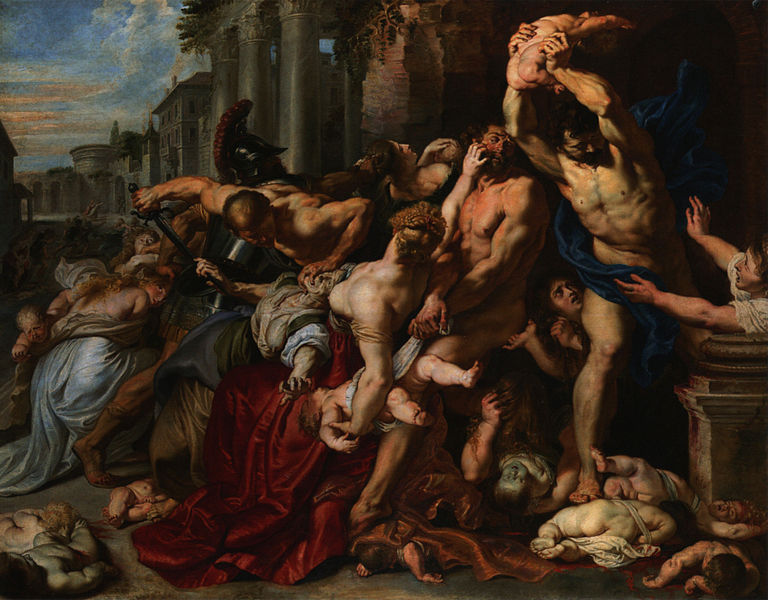
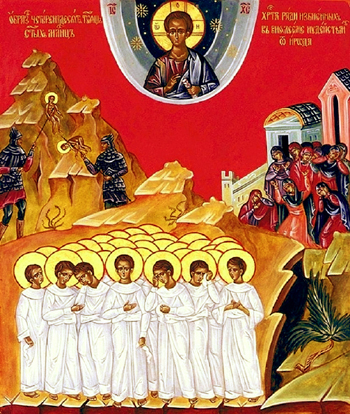
For Christians, death has become something of a paradox because it has been taken up into the Eucatastrophe. We do not desire death for its own sake, but we would, or would that we would, gladly embrace it, like so many who have gone before us, for the sake of the testimony of the Gospel, in the hope of a better resurrection. Those little children slain by Herod are alive in Christ, and they will rise up in the resurrection of the dead, proclaiming the name of their Savior and ours, Jesus Christ, King of kings and Lord of lords.
O God, whose praise the martyed Innocents on this day confessed, not by speaking, but by dying: destroy in us all the evils of sin, that our life also may proclaim by deeds Thy faith which our tongue professes. Through our Lord Jesus Christ, Thy Son, who liveth and reigneth with Thee, in the unity of the Holy Ghost, God, world without end. Amen.
____________
[1] See this interview.
[2] See this post for more along these lines.
[3] J.R.R. Tolkien, “On Fairy-Stories,” in Tree and Leaf (London: HarperCollins, 2001), 72.
[5] “The Battle of Maldon,” in Anglo-Saxon Poetry, ed. R. K. Gordon (London: Everyman’s Library, 1964), 334.

For some reason, the thing that brought my mind around to this theme was re-reading Tolstoy’s Anna Karenina. The thing that prevents such reflections from becoming morbid, or melodramatic, is, of course, hope in God. The alternatives are despair, which can only lead to futile rage or morbid acceptance of the finality of death, or an unreflective life, in which god is one’s belly.
Also, I have found something new in the Catholic faith, where the dead are very much a part of the life of the Church, through Holy Tradition (“the democracy of the dead”) and the Communion of Saints. Now I can pray for all of the people I love.
Andrew,
You continue to amaze me. With so much scholarly intellect to wrap one’s tiny brain around (I speak of my own) at CTC, you manage once again to intersect that intellect with beauty. Like Tolkien, your words bring such wonderful imagery,to those of us who think in pictures, with vivid, bright and colorful scenery.
To some these things seem silly almost, but to others, it’s the joy and hope of Our Lord we see. Yes, Anna Karenina could cause horrible despair. What waste grasping for happiness and losing it like a hand full of sand.
Thank you for the this beautiful writing today. I too understand this beauty of Communion With The Saints. They are no more dead than Our Lord. There are just some who do not have their ressurrected bodies, but their souls are with The Church Triumphant. We do not commune or “conjure up” the dead. How foolish to have thought that!
Tolkien knew the beauty of the fullness of this faith and anyone that reads him can plainly see it.
His dear Mother was rejected by her protestant family for converting to The Catholic faith, but she didn’t waver. May we all be as strong and committed to This Faith in times of anti-Catholic rhetoric and attack from the secular world as well as those from our separated brothers and sisters who do not see our common joy.
May the peace of Christ be with you, Andrew!
Hey Teri,
And with thy spirit.
Merry Christmas. Tolkien was a brilliant and complex man. Watching that video, with the scene of the warriors laying a fallen companion to rest, is especially poignant when one considers that Tolkien lost all of his dearest friends during the first World War. As his son Christopher wrote, the sprawling legendarium of Middle Earth was the vehicle of Tolkien’s profoundest reflections upon life, art, death and the unknown. He was keenly aware that his fictional work could easily be considered a huge waste of time, and he was afraid that, in its unfinished condition (i.e., the Silmarillion materials), it would prove to have been just that. But such fears did not have the final word, at least, not in the logic of sub-creation as developed by Tolkien in the essay cited in my article, and in his short story, Leaf by Niggle. All of our efforts, no matter how unworthy, can be redeemed.
Our Lord Jesus, by his heroic death, has gilded the Cross with gold, and as such it is the symbol of our unconditional victory. The world really does get turned on its head in the Church.
So perfectly worded and so timely. During this season of Christmas when many of our separated brothers and sisters call the birth of Our Lord – pagan worship, we are reminded that He really does turn everything on it’s head!
All of man’s search for God was shown to be ultimately fullfilled in Our Lord. HE made creation and it is now all subjected to Him. From a Roman execution symbol of terror such as the cross, to the Celtic Cross (dear to my Scotch/Irish heart). All were “pagan” except the Jewish believers until Our Lord tore the veil and beckoned us to come. He is The Redeemer. He Redeems all and fully.
Thanks for such a wonderful blog post. I just love Tolkien! His work is more appreciated now than ever. Our beloved Catholic storyteller!
PAX,
Teri
[…] Communion: 1st, “J.R.R. Tolkien’s Sacramental World, Part One: Memory (Nov 30th, 2009); 2nd, “Tolkien on Death and Eucatastrophe (Commemoration of the Holy Innocents) (Dec 28th, 2009); 3rd, J.R.R. Tolkien’s Sacramental World, Part Three: Language (Aug 30th, […]