
Justification: The Catholic Church and the Judaizers in St. Paul’s Letter to the Galatians
Dec 17th, 2009 | By Bryan Cross | Category: Blog PostsSteve Hays has claimed that what I recently said about justification is at odds with what Robert Sungenis has said about justification. But, in fact, there is no contradiction between what I have said and what Robert has said on this subject.
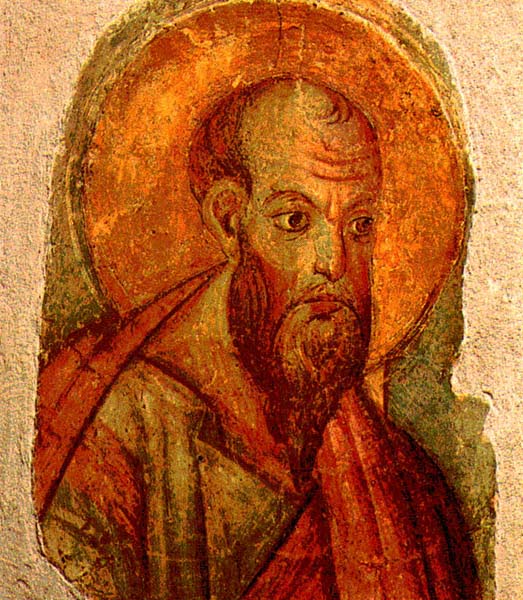
What makes this difficult to understand, from a Protestant point of view, is that in Catholic theology there is a distinction between justification and an increase in justification. There is no such distinction in Protestant theologies, and for that reason Protestants not infrequently treat Catholic statements about the increase in justification as though they are about justification itself.
Justification is defined by the Council of Trent as “translation from that state in which man is born a child of the first Adam, to the state of grace and of the adoption of the sons of God through the second Adam, Jesus Christ, our Savior.” (Trent VI.4)1 Justification takes place through the sacrament of baptism, and then, if a person falls into mortal sin, through the sacrament of penance. At the instant of justification, the person receives sanctifying grace and the theological (supernatural) virtues of faith, hope and charity (agape). This does not mean that these cannot be received prior to the actual reception of the sacrament of baptism. Even then, however, they come through the sacrament, and anticipate its reception.
An increase in justification is not the same thing as justification. An increase in justification is not the translation from a state in which one is deprived of sanctifying grace to a state in which one has sanctifying grace. An increase in justification is an increase in sanctifying grace from a condition in which one already has sanctifying grace. This is what St. Peter means in exhorting believers to grow in grace. (2 Pet 3:18) An increase in justification is not receiving sanctifying grace where there is none, but a movement of growth from grace to more grace, and thus a growth in conformity to the likeness of Christ, by an increase in the capacity of our participation in the divine nature. (2 Pet 1:4)
The reason this distinction between justification and its increase is important for understanding the Catholic doctrine concerning justification is that although a person can and should prepare for justification (Trent VI.6), he cannot merit justification by any works. But, a person who is already justified and in a state of grace, can merit an increase in justification by doing good works out of love (agape) for God. Among these good works are works in keeping with the moral law, done out of love (agape) for God. God rewards our works done in agape by increasing our capacity to participate in His divine nature, and thus by increasing our participation in His agape. He Himself is our reward, and growth in grace is growth in Him, a reward we receive already in this present life, to be multiplied abundantly in the life to come.
Does St. Paul teach that justification is by keeping the ceremonial law? No. Does St. Paul teach that justification is by keeping the moral law? No. According to St. Paul, justification is not by works of the law, and in St. Paul “works of the Law” refers to the whole law under the Old Covenant. That’s what Robert is saying, and I agree with him, and nothing I said contradicts what he said. But, as I will explain below, unless we recognize the difference between the meaning of “works of the Law” as including the ceremonial law, and the New Covenant law that does not include the ceremonial law, we can mistakenly treat St. Paul’s teaching that justification is not by the former as though it also denies increases in justification by means of the latter.
Without sanctifying grace and living faith, we cannot merit heaven; to claim otherwise would be Pelagianism. And that is why we cannot be justified by works. For St. Paul justification is by living faith, and we receive this living faith by hearing (Rom 10:17), and it is poured into our hearts by the Holy Spirit (Rom 5:5) through the sacrament of baptism (Rom 6, Col 2). But none of that condemns or denies increases in justification through good works in accordance with the moral law done out of love (agape) for God.
My comment to Jason Engwer (in the quotation Steve cites) is not about justification, but about increases in justification. Jason interprets St. Paul’s condemnation of the Judaizers in St. Paul’s letter to the Galatians as evidence that the Catholic doctrine of justification is a false gospel. Jason writes:
The apostle Paul said that one error, the adding of works to the gospel, was sufficient to create a false gospel that doesn’t save. The “only thing” Paul wanted to know from the Galatians was how they received justification (Galatians 3:2). And Evangelicals and Catholics disagree about how justification is received. The difference between justification through faith alone and justification through faith and works is the difference between a true gospel and a false gospel. Catholics can be saved as individuals, but only in spite of their denomination’s false gospel. Catholics can be Christians as individuals, but Catholicism isn’t Christian by apostolic standards.
Jason thinks that the Catholic doctrine is that we are justified by “faith and works.” But that is not true. As I explained above, in Catholic doctrine we are justified not by works, but by living faith, and living faith includes the supernatural virtue [i.e. disposition] of agape. Yet we may increase in justification by works done out of love (agape) for God, according to the order Christ has gratuitously established. In my response to Jason I said:
Jason, is it even possible, in your mind, that you have misinterpreted St. Paul’s words in his letter to the Galatians? You are not making any distinction between the works of the ceremonial law as part of the Old Covenant, and works of the moral law, done in a state of grace in the New Covenant, out of love [agape] for God. In his letter to the Galatians, St. Paul wasn’t condemning (or even referring to) growth in justification through good works done in a state of grace; he was condemning a return to the Old Covenant by Christians, because that was a rejection of the New Covenant and implicitly a rejection of Jesus as the Messiah who established the New Covenant in which the requirement of those ceremonial laws is done away. If you don’t understand the distinction between the ceremonial law and the moral law, then you have entirely misunderstood Paul’s point in his letter to the Galatians. Then your whole warrant for calling the Church’s teaching a “false gospel” is based on a misinterpretation of Scripture.
Here I was pointing out that St. Paul’s condemnation of the teaching of the Judaizers was not for believing that works done in agape (in accordance with the moral law under the New Covenant) increase our justification, but for believing that the keeping of the ceremonial law, and thus returning to the Old Covenant (and a keeping of the whole law) is necessary for justification. Jason mistakenly construes Catholic doctrine as falling under St. Paul’s condemnation of the Judaizers in Galatia. Jason does this by glossing two important differences between the Catholic doctrine of justification and the Judaizers’ doctrine of salvation.
First, the Judaizers were rejecting the New Covenant, in which we are justified by sanctifying grace and [living] faith in Christ, received through the sacrament of baptism instituted by Christ. But the Catholic Church affirms the New Covenant. In fact the Catholic Church is the New Israel, the Israel of the New Covenant. (cf. Gal 6:16) The Catholic Church teaches that we are justified by [living] faith in Christ, a faith that we receive as a gift from God, along with sanctifying grace, in the sacrament of baptism instituted by Christ. Jason’s assumption that St. Paul’s condemnation of the Judaizers’ doctrine applies to Catholic doctrine overlooks the role of the Covenants in the Galatian account. Jason thinks that St. Paul’s concern in his letter to the Galatians is simply excluding works of any sort from justification. It is true that St. Paul recognizes that works cannot justify. But St. Paul’s primary concern for the Galatian believers is that they remain within the New Covenant, and thus remain united to Christ. By adding the requirement of the ceremonial law they were returning to the Old Covenant, and thus nullifying the New Covenant and the sacrifice of Christ, the long-awaited Messiah and Savior. (cf. Gal 5:1ff) The Catholic Church rejects the requirement of returning to the Old Covenant for justification or salvation. From the Catholic point of view, adding the requirements of the ceremonial law would be nothing less than apostasy from the New Covenant established by the blood of Jesus Christ, the Lamb of God. So in this respect, the Catholic Church does not fall under St. Paul’s condemnation of the doctrine of the Judaizers.
Second, according to Jason, the Catholic doctrine is that we are justified by “faith and works.” But that is not an accurate explanation of the Catholic doctrine of justification. In Catholic theology we can and should do things to prepare for baptism. But those things are not meritorious, and they do not justify. So it would be erroneous to claim that the Catholic belief that we ought to prepare for our baptism entails that in Catholic theology justification is by “faith and works.” In Catholic theology, none of our works can justify us. Good works done out of agape for God have a role only in the increase in our justification. Jason’s claim that Catholic theology falls under St. Paul’s condemnation of the doctrine of Judaizers is based on a false conflation of justification and increases in justification. St. Paul’s condemnation of justification by “works of the Law” is not about increases in justification through good works done in a state of grace under the New Covenant. St. Paul rules out justification by works, but so does the Catholic Church. (Cf. Trent VI.1) In none of his writings, including his letter to the Galatians, does St. Paul teach that good works done in a state of grace under the New Covenant do not increase justification. Growing in grace does not mean sinning more, so as to show forth God’s forgiveness more fully. Growth in grace means growing in conformity to Christ, because grace, in Catholic theology, is a participation in the divine nature.2 (2 Pet 1:4) My point here is not to demonstrate from Scripture that good works done out of love (agape) for God merit an increase in justification. My point here is to show that claiming that the Catholic Church teaches that we are justified by “faith and works” is false, because such a claim mistakenly conflates increases in justification with justification. A role for works in the increase of justification does not entail that there is a role for works in justification proper, that is, justification as translation from the state of enmity with God to the state of grace and adoption through Jesus Christ.3
So for both of these reasons, it is not true that the Catholic doctrine of justification falls under St. Paul’s condemnation of the Judaizers in Galatia. And likewise, as I have shown, what I have said is fully in agreement with Robert’s point that “works of the Law” for St. Paul are not limited to the ceremonial law.
- This is the definition of justification I use in this post. [↩]
- St. Paul clearly admonishes the Galatian believers to keep the law by loving their neighbor as themselves (Gal 5:14), walking by the Spirit (Gal 5:25), and fulfilling the law of Christ (Gal 6:2) by bearing one another’s burdens. He teaches that those who sow to the Spirit will reap eternal life, (Gal 6:8) saying, “let us not lose heart in doing good, for in due time we shall reap if we do not grow weary.” (Gal 6:9) [↩]
- In Romans 4 St. Paul refers to Genesis 15 when Abraham believed God and it was credited to him for righteousness. It is reasonable to believe that this was an increase in justification, because Abraham seems already to have had faith in Genesis 12. And the same can be said of James 2:24 and its reference to Genesis 22. [↩]

Bryan,
There is one issue I’m wondering about with what you’ve said. You said:
I’ve often heard James 2:24 used to prove that justification is not by faith alone–“You see then that a man is justified by works and not by faith alone.” But given what you’ve said, how does this text refute sola fide? Nothing is said in James 2, or (to my knowledge) for that matter in any of Paul’s epistles about an increase in justification–so isn’t James in some way also contradicting the Catholic view? I won’t deny that James is asserting that a living faith is necessary for justification, but is it an accurate representation of the Catholic position to say that James views the works which flow from this living faith as part of how we are justified?
Pax Christi,
Spencer
Hello Spencer,
James 2 is talking precisely about growth in justification, about faith working in agape. Look at his example about Abraham. He is talking about Genesis 22, long after it was said (in Gen 15) that Abraham believed God and it was credited to him as righteousness. James 2:24 is incompatible with sola fide because a wholly forensic conception of justification cannot make sense of increase in justification, and thus for works to play any role in justification. So it must construe James 2 as though he is talking about ‘justification in the eyes of men’ sense (as though James is really concerned about how Abraham and Rahab etc. appear in the eyes of men). Only a living faith justifies, and a living faith is one that works. Hence while that initial transition from darkness to light is not by works, but by the sacrament of baptism in which we receive as a gift that living faith, every subsequent good act done in living faith (out of love for God) is meritorious [ordered to the supernatural end of heaven] and therefore increases justification, as I explained in the post.
In the peace of Christ,
– Bryan
Bryan,
The misunderstanding of “works of the law” was the concept that Martin Luther misunderstood, right? His conscience was plagued with so much doubt of pleasing God and ever attaining salvation. Many scholars say it was because of the harshness of his father and mother and his joining a monastic order that was quite rigorous – yet not even they felt as desolate as Dr. Luther.
Our Lord, in the Gospel according to St. Matthew speaks about good deeds and their rewards, as well as saying the ones HE declares in judgement to depart from Him because He never knew them were those who did not do the works of charity or love for their neighbor.
St. Paul cannot be in conflict with Our Lord in his teaching or he is teaching a false gospel. Our Lord, was and is, God in human flesh. HE establishes the New Convenant.
A careful reading of the book of Acts shows clearly that some of the Jews wanted to have the Gentile believers first circumcized and then baptize them. In essence become a Jewish convert and then a Christian.
St. Peter, using the authority that was given HIM said no and they agree only on the laws for Gentiles…the Noahide laws. Even Orthodox Jews today still say that a “righteous Gentile” is only given those laws. https://www.jewfaq.org/gentiles.htm
Isn’t it true that the only other place that the words, “works of the law” or works of Torah” is found is in the Dead Sea Scroll writings of The Essenes? It was strict observance of purity laws of Torah.
In a strange twist of fate, those who would put us back under the Mosaic law with all of the law observances – both blessing and cursing were those who followed the Reformer John Calvin.
If you cut yourself off from any belief in early church tradition or The Early Church Fathers, you have your Sola Scriptura (minus 7 books) to keep the people in line. That is how you know you are among the elect and chosen if you follow the commands of God.
Is it only Catholics who really live out the faith that Jesus was both God and Man? It’s not like saying, well, Jesus said and Paul said. Jesus IS God. What He did while in human flesh on earth is the example we must follow. HE is GOD if we believe in the Trinity.
Nothing passed from the Old Law until all was fulfilled by Our Lord. In the mind of the Jewish people – heaven and earth passed away when the Temple was destroyed in 70 A.D.
If Justification was only a faith in Our LORD alone – then no one would have been martyed for that faith. Why die for something that is a simple belief and nothing more is ever needed from you?
The Catholic Church doesn’t say we are saved by our works. We are saved by grace through faith that works in loving obedience. That was the faith of Abraham who believed God. He believed in faith and left his country. He believed in faith and took his only son Isaac to offer him as a sacrifice to God. That is a faith that is not just an agreement to some belief. That is a faith that calls for obedience knowing that GOD who loves you will be faithful to His covenant promise.
In the Peace of Christ,
Teri
p.s. I have never been handed a list of works to do to earn my way to heaven since coming to The Catholic faith. I’m not even asked to bring my tithes into the storehouse! We give out of love for neighbor. We do the works of Charity because we are the Body of Our Lord on earth and being one with Him, we follow HIS example. There is nothing like the fullness of The Catholic faith!
Bryan,
In the article, you claim that the Apostle made a distinction between initial and growth in justification by works of the law, and condemned the agitators for adhering to the former. I don’t understand how that warrants several of the statements of Paul made in the epistle, namely the assertion that misunderstanding this distinction nullifies the doctrine of the atonement (Gal. 2:21), and puts them under the curse of the Law, although the pre-Advent Jews who grew in justification through observing the Law weren’t themselves cursed, simply because they drew the distinction between initial and the increase in justification. The distinction itself seems very trivial, and if we were to place the soteriology of the agitators alongside Trent’s canons on justification, I honestly wouldn’t see a grand distinction.
I’m very confused, and I might be taking your statements out of context, so please pardon me.
Hello Ariel,
I did not claim here that St. Paul makes the distinction (in Galatians) between justification and increase in justification. It is not that he denies it here, or doesn’t teach it elsewhere; he simply doesn’t talk about it (at least explicitly) here in his letter to the Galatians.
St. Paul’s statement in Galatians 2:21 is about turning away from the New Covenant and returning to the Old Covenant, not about the distinction between justification and its increase.
St. Paul is not saying that the pre-Advent Jews who grew in justification by faith working through love weren’t cursed because they distinguished between justification and the increase in justification. Christ had not yet come. Their faithful obedience under the Old Covenant did not include a rejection of Christ and of the New Covenant. But, since Christ has come, now those who truly hear and understand the Gospel and reject Christ, and return to the Old Covenant, are accursed — not because they don’t make the distinction between justification and its increase, but because they have rejected Christ, to Whom the Old Covenant pointed implicitly. To reject Christ and go back to the Old Covenant is to reject even the faith by which those (pre-Advent) Jews were saved. It is to embrace Pelagianism, the notion that one is saved by keeping the Law, and not by grace through faith. In that respect, St. Paul is essentially saying that there is no going back. To go back to the Old Covenant, after having come to know Christ, is to become a Pelagian, by which salvation is impossible. It is therefore to fall under the curse, the curse that was always and only avoided only by faith [in Christ], though Christ was not yet explicitly revealed in those pre-Advent times.
The distinction between justification and its increase is not trivial. It makes the difference between Pelagianism and the orthodox Catholic faith. The notion that we can justify ourselves by our own works, is nothing less than Pelagianism. But the notion that when in a state of grace, none of our good deeds really matters for our eternal condition, is temporal nihilism. So the distinction between justification and its increase is essential for avoiding both of those alternatives.
The different between the soteriology of the Galatian agitators and that of Trent is like night and day. The former rejected the New Covenant, while the latter embraced it. That’s the difference between rejecting Christ and embracing Him. That’s not a trivial difference. That’s the difference that will ultimately separate all men into goats and sheep.
I hope have clarified things a bit. (If not, please write back.)
In the peace of Christ,
– Bryan
Bryan,
Thank you very much for the clarification. I believe that the heart of the issue lies in the identity of these agitators i.e. Judaizers. You claim that they ultimately embraced Pelagianism by believing in being justified by their own works, but I don’t find any indication in the epistle that they denied the necessary atonement of Christ, nor the grace of God necessarily aiding in their good works unto salvation (both denied by Pelagius).
Do you believe that the ‘false brothers secretly brought in’ denied the atonement, the necessity of grace in good works etc., or am I missing something here? I find it to be pretty clear that Paul condemned them for attempting to rely on both the Law and the Gospel, and in essence creating their own Gospel.
God bless,
-Ariel
Ariel,
These ‘agitators’ denied the necessity of the atonement by returning to the Old Covenant when the New Covenant, established by the atonement of Christ, had already been revealed. In this way they were denying that through which all post-Fall grace comes, i.e. the sacrifice of Christ. The former things were types of Christ and the New Covenant. Now that Christ has come, to try to go back to the former things is to reject both. Returning to the Old Covenant, when the New Covenant has been revealed, is to reject Christ, His atonement, and the grace that comes through His atonement. That’s just what St. Paul is saying in his letter to the Galatians.
That’s partially true, but the reason why turning to the Law for justification was a problem is that it was a return to the Old Covenant when that to which it pointed had already been revealed, not because the agitators included a role for the moral law in the increase in justification. If we leave out (i.e. abstract away) the role of the Covenants in St. Paul’s letter to the Galatians, we’ll be left with a myopic perspective of St. Paul’s argument in his letter to the Galatians.
In the peace of Christ,
– Bryan
Bryan,
Much of what you say in the article above was addressed by me in the thread at Justin Taylor’s blog that you link and quote. In that thread, I distinguish between the Catholic concepts of initial justification and the maintaining and increasing of justification. I wrote, for example, “What you have to argue, therefore, is that we attain justification by means of a combination between faith and baptism, then, immediately afterward, we must do a lifetime of works prescribed by the Catholic hierarchy in order to maintain and increase that justification.” I haven’t misunderstood the distinction.
I agree that Abraham was justified prior to Genesis 15:6. Paul’s point in citing that passage is that it exemplifies the faith through which Abraham was justified earlier. The reason why Paul would focus on that passage is because it comments on Abraham’s justification, not because he was justified at that time. Paul does make the point that Abraham was justified prior to circumcision, but that point can be made regardless of whether Abraham was justified at Genesis 15:6 or earlier. My use of the passage hasn’t been focused on the timing of Abraham’s justification, but rather the means by which he attained it. All he does is believe. And saying that the faith has love and other elements in it that would result in works doesn’t lead us to the conclusion that works are present. A faith that will later result in works isn’t equivalent to a combination between faith and works. Genesis 15:6 tells us what the Biblical authors meant by faith, and what they meant wasn’t belief accompanied by baptism or belief accompanied by any other work.
Paul applies the passage to the gospel in general, not a later increase in justification. In Romans 4, Paul is addressing the reconciliation of man to God after the universal fall he describes in chapter 3. Romans 4:3, which cites Genesis 15:6, comes in the context of a discussion of the reconciliation of sinners to God, not a discussion of increasing a justification already possessed. That’s why Paul goes on to refer to how “the ungodly” are justified “apart from works” (Romans 4:5-6). He’s addressing the “introduction by faith into this grace in which we stand” (Romans 5:2).
You write:
“For St. Paul justification is by living faith, and we receive this living faith by hearing (Rom 10:17), and it is poured into our hearts by the Holy Spirit (Rom 5:5) through the sacrament of baptism (Rom 6, Col 2).”
There’s a series of major problems with placing justification at the time of baptism. I mentioned some of those problems in the thread at Justin Taylor’s blog, linked above.
Paul and James suggest a high degree of continuity between the means of justification in the Old and New Testament eras. They cite Abraham and other Old Testament figures to illustrate how people are justified in this New Testament era. Bringing in baptism as a new means of receiving justification diminishes that continuity.
Similarly, John’s gospel emphasizes Jesus’ statements about salvation during His earthly ministry (John 3:16, 5:24, 11:25-26, etc.), and John tells us that he wrote his gospel to lead people to salvation (John 20:31), using language similar to Jesus’ language earlier in the gospel. Yet, advocates of baptismal justification often argue that baptism wasn’t added as a means of justification until after Jesus’ earthly ministry. Again, adding baptism diminishes the continuity suggested by the Biblical authors.
A reason why many advocates of baptismal justification want to place the adding of baptism after Jesus’ earthly ministry is because that ministry was characterized by Jesus’ forgiving, pronouncing peace, and healing people upon their coming to faith, without baptism. See here.
But that pattern continues after Jesus’ ministry. Cornelius and those with him are justified when they believe as they hear the gospel being preached (Acts 10:44-46). Peter cites what occurred with them as if it’s representative of the normative means of justification (Acts 15:7-11). Similarly, Paul expects people to receive the Holy Spirit, the seal of adoption and justification, “when they believe” (Acts 19:2). Though the people Paul is addressing were unusual in that they received the Spirit with the laying on of hands (Acts 19:6), verse 2 suggests that Paul considered it normative to receive the Spirit at the time of faith. The Galatians (Galatians 3:2) and the Ephesians (Ephesians 1:13-14) are referred to as having been justified through believing the preached gospel.
In Galatians 3:2, the context in which Paul places the faith (“hearing”) suggests that he’s referring to people being justified when they believe as they hear the gospel being preached. It’s a situation like that of Cornelius in Acts 10:44-46, in which justification is attained through believing the preached gospel, apart from baptism and all other works. If it was a faith that occurred as the Galatians heard the preaching of the gospel, then it probably wasn’t a faith that was accompanied by baptism or other works. It could be argued that the Galatians were working in some way as they heard the gospel being preached, but that’s a less natural way of reading the passage. We don’t normally assume that people are getting baptized or doing other works as they hear the gospel being preached.
And to use a handful of references to baptism to justify its inclusion in the large number of passages on justification in which it’s not mentioned is dubious. Baptism does unite us to Christ, including His death and resurrection, but so do other activities that occur after the attaining of justification (Romans 13:14, 2 Corinthians 4:10-11, Philippians 3:10-12).
I’ve argued elsewhere (see here) that baptism should be considered a work. It’s not faith, and there’s no reason to think that people normally don’t have faith until the time of baptism.
Paul tells us that there isn’t any law of works whereby people can be justified (Romans 3:27, Galatians 3:21-25). He uses the illustration of wages received by a worker (Romans 4:4), which can’t be limited to the Jewish law, and the “works” he refers to in Romans 9:11-12 are as broad as “doing anything good or bad” and predate Moses. It can’t be assumed that every reference to the exclusion of works is referring to works other than those Catholicism prescribes for the attaining, maintaining, and increasing of justification.
In addition to the problems with your view of baptism, which I’ve discussed above, your distinction between initial justification and the later maintaining and increasing of justification is problematic. Scripture often refers to eternal life as a free gift (Romans 6:23, Revelation 21:6, etc.), and your view is akin to saying that a car is free if the bills don’t arrive until after you drive it off the lot. I would argue that there’s even an upfront fee as well in the form of baptism. Your view of justification begins with the work of baptism and requires a lifetime of further works for maintaining and increasing justification immediately thereafter. That’s far from the most natural way to take the Biblical references to the freeness of justification and eternal life. Saying that we maintain and increase justification through works is just another way of saying that we work for justification. In reality, though, a past justification attained through faith gives peace in the present (Romans 5:1) and assurance of the future (Romans 5:9). The initial justification determines our present and future justification.
Jason,
This is not really a response to your comment, and I don’t want to derail the conversation, but I have one quick question. You refer in #8 to Gal 3.21-25 as part of your argument against the Catholic view of baptism. In light of your statements above, could you give me your exegesis of the following verses, vv. 26-29? I’m especially interested in what you think Paul’s logic is in including v. 27 in the argument if baptism doesn’t actually effect the adoption of sons that we enjoy “in Christ Jesus…through faith” (v. 26) and because of which “God has sent the Spirit of his Son into our hearts” (4.6). If you’re right about baptism, v. 27 strikes me as a highly misleading—if not actually impossible—thing for the Apostle to say at that particular point in the argument, because it does not seem to be merely an illustrative example; it does positive work to move Paul’s logic forward.
in Christ,
TC
1 Cor 14:16
T Ciatoris,
I take both Galatians 3:27 and 3:26 as expansions on what Paul has said in verse 25. We’re no longer under a tutor of any type (3:21-25), but the particular law Paul emphasizes is the one his opponents were focused on, the Jewish law. Freedom from that tutor is illustrated by the unity of people of all types in Christ. Those people are united through faith (3:26), through baptism (3:27), which is an early and prominent visible sign of Christian unity, and through the Christian life in general (3:28). It could be that verse 27 is about two aspects of the Christian life, not just baptism. When Paul refers to “putting on Christ” in verse 27, he’s using a concept that he also uses in Romans 13:14, which I cited above. In that passage, Paul is primarily addressing people who have already been Christians for a while, so he presumably isn’t telling them to put on Christ in baptism. (See, also, Ephesians 4:24, Colossians 3:12, 1 Thessalonians 5:8, etc.) It’s possible, then, that Galatians 3:27 is also referring to a post-baptismal aspect of the Christian life when it refers to putting on Christ. Or it’s referring to baptism as something comparable to the other forms of “putting on” mentioned in the other passages cited above. Whatever the putting on is in this case, it’s referred to as something Paul’s audience does. It’s not just something done to them. Regardless, Galatians 3:28, which comes just after the verse in question, surely is applicable to the whole Christian life. I don’t take the reference to baptism in 3:27 as a reference to how justification is attained, but rather to one example among others of Christian unity independent of the Jewish law.
Ronald Fung notes that “in this chapter [Galatians 3] faith is mentioned fifteen times and baptism only once” (The Epistle To The Galatians [Grand Rapids, Michigan: Eerdmans, 1988], p. 173). The difference would be even wider if we looked beyond chapter 3. And Paul placed the justification of the Galatians in a context that probably didn’t involve baptism (“hearing with faith” in 3:2), as I explained above. He then went on to cite the example of Abraham, who obviously wasn’t baptized. The Galatians’ own experience, Paul’s focus on that experience earlier in Galatians 3, and his appeal to continuity with Abraham and other Old Testament figures would have been more than sufficient indication to the original audience that verse 27 isn’t to be taken as a reference to baptismal justification.
Hello Jason,
Thanks for your comments. My purpose in writing this post wasn’t primarily to establish or substantiate the Catholic doctrine of the relation of baptism to justification, but only to show that the doctrine of the “agitators” in St. Paul’s letter to the Galatians is not that of the Catholic Church, and hence that St. Paul’s condemnation of their doctrine is not a condemnation of Catholic doctrine. In short, I wanted to show that the Catholic Church fully embraces and teaches what St. Paul says in his letter to the Galatians, and thus that the notion that the Catholic Church teaches a false gospel is not supported by St. Paul’s letter to the Galatians.
You wrote:
If in Gen 15 Abraham was already justified, then the justification referred to in Gen 15 either is a “maintaining of or increase in” justification, based on the act of faith Abraham makes in Gen 15, or is referring back to Gen 12 (or whenever was the first time Abraham believed).
Of course it wasn’t accompanied by baptism under the Old Covenant, since Christ established Christian baptism only in the New Covenant. But the absence of baptism in the Old Covenant doesn’t tell us anything about how it is to be received in the New Covenant. And it seems clear that Abraham’s faith was accompanied by works, as James points out.
Sure. A Catholic can agree with that.
I didn’t place justification at the time of baptism. In my post I specifically said, “This does not mean that [sanctifying grace and the supernatural virtues] cannot be received prior to the actual reception of the sacrament of baptism.” A person can be justified even prior to baptism, but the grace by which he is justified nevertheless has come to him through that sacrament.
A mere suggestion is not sufficient to warrant schism from the Church, or the public charge that the Catholic Church teaches a false gospel. There is continuity between the Old and New Covenants, but the New Covenant exceeds the Old Covenant, and for this reason baptism exceeds circumcision.
It is St. John who tells us at the beginning of his gospel (written later in his life, according to tradition) that Jesus said to Nicodemus, “unless a man is born of water and the Spirit, he cannot enter the Kingdom of God.” (John 3:5) Jesus is the one who “added” baptism, just as He did in Mark 16:16, and just as Peter did on Pentecost: “repent, and let each of you be baptized for the forgiveness of your sins; and you shall receive the gift of the Holy Spirit.” (Acts 2:38) It is baptism that now [in the New Covenant] saves us. (1 Pet 3:21)
Faith comes by hearing, of course. But if it comes to a person in its fullness (as a virtue), it has come to them through the sacrament of baptism, even if they have not yet been baptized. The Spirit ordinarily works through the sacrament, but the Spirit is capable of outrunning the sacrament, as John outran Peter at the tomb. This ability of the Spirit to act prior to the sacrament, should not be interpreted as nullifying the sacrament or implying that the Spirit has not come through the sacrament.
When Paul says “Did you receive the Holy Spirit when you believed?”, he is asking them if they were confirmed when they were baptized. Their reply shows that they had not even been baptized with a Christian baptism. So St. Paul baptizes them with a Christian baptism, and then lays his hands on them, and they are confirmed (and receive the Holy Spirit). St. Paul’s question shows that when the Apostles speak about believing the gospel, they are not speaking of this believing as something merely mental; ‘believing the gospel is a phrase that implicitly (when not explicitly) includes baptism. This is what St. Paul is referring to in 1 Tim 6:12 when he says, “Fight the good fight of faith; take hold of the eternal life to which you were called, and you made the good confession in the presence of many witnesses.” This was (and still is) the practice of the Church, that the catechumen makes a profession of faith immediately prior to his baptism. Faith is not merely an internal epistemic change; it is also a public profession and identification. We are inserted into the Faith through baptism.
Correct, but this believing includes baptism; it is not a merely private, internal epistemic change. It is sacramentally effected in the presence of many witnesses, by Christ.
In neither the Cornelius situation nor the Acts 19 situation is faith truly separated from baptism. Faith precedes it, but the Apostles do not take this as nullifying the need for baptism. The reception of the grace of a sacrament never nullifies the need for the reception of that sacrament. Rather, it testifies to its need, which is precisely why Peter urges water to be brought for the baptism of Cornelius, and why the disciples in Acts 19 were immediately baptized when they learned about its necessity. Likewise, when St. Paul says “hearing with faith” (in Gal 3:2) he is not saying that faith does not come through baptism. The belief in Christ that comes from hearing leads directly to the sacrament of faith, i.e. baptism. If a person believes, he will, like the Ethiopian eunuch, respond by seeking baptism, in which he is united to Christ, what St. Paul refers to as coming to “belong to Christ” (Gal 5:24)
You’re thinking of the faith in an entirely subjective, inward and individualistic way. But faith is public. It involves a public ‘yes’ to the gospel, and that public yes means the reception of baptism and incorporation into His Body, the Church. You’re also treating this passage as though St. Paul is spelling out all the details of what it means to come to faith in Christ. Since he doesn’t explicitly mention baptism here, therefore, you conclude that their faith didn’t include baptism. But that’s not a justified assumption. St. Paul isn’t intending here to lay out all the details of what it means to come to faith in Christ. They already knew that, and have been through it. His point here is to admonish them to remember how they received the Spirit: not through the Old Covenant, but through the New Covenant.
St. Paul isn’t talking about faith in this subjective, internally self-evident change-of-epistemic state manner. You’re reading the Bible as a child of the Enlightenment and the inward turn. The Galatian believers most likely received the Spirit the same way the believers did in Samaria in Acts 8, and the disciples at Ephesus did in Acts 19, through the sacrament of confirmation, by the laying on of hands by an Apostle, after having been baptized. St. Paul is essentially saying in Gal 3:2: Did you receive the Spirit through the sacraments of the Old Covenant (e.g. circumcision) or through the sacraments of the New Covenant (i.e. baptism and confirmation)?
Catholics aren’t limited to trying to determine the faith from Scripture. We have the living Tradition from the Apostles, the ‘view from the inside’ handed down to us faithfully within the community of faith, by which we understand what the Apostles were saying. We don’t read Scripture in an ecclesial or historical vacuum; we read it with the living memory of the community to whom it was entrusted.
You don’t seem to realize Who is doing the baptizing. Does the believer exercise his free will in stepping into the font? Of course. But that’s not baptism. Who does the baptizing? Christ. Christ is the Baptizer. He administers all the sacraments He has instituted in His Church.
The gift of eternal life in Christ Jesus our Lord is free in this sense — it comes to us from God without any merit on our part. But, we should not therefore think that working out our salvation (Phil 2:12) will require no sacrifice on our part. Jesus said, “If anyone would come after me, he must deny himself and take up his cross daily and follow me.” (Luke 9:23, cf. Mt 16:24, Mk 8:34) We are fellow heirs with Christ, if indeed we suffer with Him. (Rom 8:17) So the freedom of the gift of eternal life should not be conceived in an unqualified (or antinomian) way, but with respect to the utter graciousness of God’s offer of eternal life to us. On our part, it requires giving up everything. “If anyone comes to Me, and does not hate his own father and mother and wife and children and brothers and sisters, yes, and even his own life, he cannot be My disciple.” (Lk 14:26)
Assuming that simply going by “the most natural way” of reading the Bible correctly guides you to the proper understanding of the Apostolic deposit of faith is your underlying hermeneutical mistake. To understand the Bible, we need to read it in and with the persons to whom it was entrusted. In the history of the Church, we see that in many cases, the heretic’s most natural way of interpreting Scripture is to see his own heresy in it. That’s the danger of simply going by “the most natural way” of reading Scripture.
Such a claim presupposes the falsity of the distinction between justification and its increase, and thus begs the question. We work not for justification, but only for its increase. We can never merit justification. But once justified, we can, by the grace of God, merit eternal life, because in a state of grace (initiated by God), even one act done in agape for the God who is infinite Love merits an infinite reward, and this infinite reward is the eternal vision of God Himself.
Of course. That’s what the Catholic Church teaches.
Only if we persevere. All the Scriptural warnings about persevering would be heretical if past justification guaranteed future justification.
In the peace of Christ,
– Bryan
Bryan wrote:
“Of course it wasn’t accompanied by baptism under the Old Covenant, since Christ established Christian baptism only in the New Covenant.”
Christian baptism was established later, but Paul, James, and other New Testament authors suggest continuity between justification through faith in the Old Testament era and justification through faith in the New Testament era. You could argue for a diminished continuity by adding baptism for those living in the New Testament period, but that would be, as I said in my last post, a diminished continuity. The higher level of continuity that I’m suggesting makes more sense of the New Testament theme of continuity in the means of justification.
You write:
“And it seems clear that Abraham’s faith was accompanied by works, as James points out.”
It was eventually accompanied by works. But works of faith come later than faith. Genesis 15:6 is about a faith that would result in works, but the works come after the faith. When somebody trusts God in response to a promise God makes, as in Genesis 15, that’s faith in the heart (as in Acts 15:7-11 and Romans 10:10), not faith accompanied by an outer manifestation like baptism.
You write:
“A person can be justified even prior to baptism, but the grace by which he is justified nevertheless has come to his through that sacrament.”
Jesus and the apostles neither said nor implied that. And I was addressing the normative means of justification. I’m aware that Catholicism allows exceptions. But baptismal justification is the norm in Catholicism.
Are the Biblical examples of justification apart from baptism exceptional? They could be in some cases, such as the thief on the cross. But it wouldn’t make sense to dismiss all of them, or even most of them, in that manner. There isn’t a single individual who’s described as coming to faith, but having to wait until baptism to be justified. Nor is there any individual who’s described as only having a lesser, unjustifying faith prior to baptism or not having faith at all until baptism. Rather, we repeatedly see people justified as soon as they believe, prior to or without baptism. That includes people who could easily have been baptized. It’s not as though people like Cornelius and the Galatians didn’t have access to baptism, nor is there any reason to think that God couldn’t have waited until their baptism to give them the Holy Spirit and the confirming evidence of their justification. It would make no sense to dismiss a passage like Luke 18:10-14, Acts 19:2, or Romans 10:10 as an exception to the rule. Justification upon believing response to the gospel, prior to baptism, is the rule, not the exception.
You write:
“A mere suggestion is not sufficient to warrant schism from the Church, or the public charge that the Catholic Church teaches a false gospel.”
The comment you’re responding to is just one argument among many I made. I did say that my argument “suggests” my conclusion, but it wasn’t my only argument. And I, of course, don’t hold the view that Roman Catholicism is “the Church”.
You write:
“It is St. John who tells us at the beginning of his gospel (written later in his life, according to tradition) that Jesus said to Nicodemus, ‘unless a man is born of water and the Spirit, he cannot enter the Kingdom of God.’ (John 3:5) Jesus is the one who ‘added’ baptism, just as He did in Mark 16:16, and just as Peter did on Pentecost: ‘repent, and let each of you be baptized for the forgiveness of your sins; and you shall receive the gift of the Holy Spirit.’ (Acts 2:38) It is baptism that now [in the New Covenant] saves us. (1 Pet 3:21)”
Mark 16:16 is an extra-Biblical source. It has some significance as an early text, but the readers should keep in mind that it’s an extra-Biblical text. The authentic gospel of Mark says nothing of baptismal justification. (Similarly, the authentic letters of Ignatius of Antioch say nothing of it. The inauthentic longer versions of his letters, on the other hand, include reference to the concept.)
You’ve made no attempt to explain the large number of Biblical examples of justification apart from baptism that I cited earlier. As I said, such passages have moved many advocates of baptismal justification to argue that baptism didn’t become a requirement (in normative cases) until after Jesus’ public ministry. Do you hold that view? If so, then citing John 3:5 makes little sense. We know that Jesus frequently forgave people, pronounced peace to them, and healed them (often with justificatory implications) during His earthly ministry. See the examples cited here. In John’s gospel, the reasoning that Ronald Fung applied to Galatians (in my quote above) is applicable again. John refers to justification through faith many times (1:12, 3:15-16, 3:18, 3:36, 5:24, 6:35, 6:40, 6:47, 7:38-39, 11:25-26, etc.), and baptismal justification is alleged to be referred to only once, in 3:5. Three of those references to justification through faith come later in Jesus’ discussion with Nicodemus (3:15-16, 3:18). Using one reference to “water” to argue for the inclusion of baptism in such a large number of other passages that neither state nor imply its inclusion is dubious.
What does 3:5 mean, then? Jesus is speaking with a teacher within first-century Judaism and rebukes him, in that capacity, for not understanding what He was saying (3:10). Do the Old Testament scriptures or other sources a teacher in Judaism should have been familiar with teach baptismal justification? No. But the Old Testament does associate the Holy Spirit with water without having physical water in view (Isaiah 44:3), and John associates the Spirit with non-physical water elsewhere (John 7:37-39). Spiritual washing is a common theme in scripture (Psalm 51:2). Jesus probably is referring to Ezekiel 36:25-27, and it should be noted that He possibly alludes to the wind of resurrection from Ezekiel 37:9-14 in John 3:8. Jesus goes on to clarify what He’s saying by referring to justification through faith three times, without any mention of baptism (3:15-16, 3:18).
Some of the same points I’ve made about other passages can be made regarding Acts 2:38. I’ve cited other passages in Luke’s writings in which people are justified apart from baptism, including passages portrayed as normative and in which the people involved could easily have been baptized. Most likely, Acts 2:38 has a meaning similar to Matthew 3:11. The people in Matthew 3 weren’t being baptized to attain repentance. Rather, they were repenting, then being baptized on the basis of that repentance. Not only would it be irrational to think that unrepentant people would be baptized in order to attain repentance, but Josephus specifically tells us that John’s baptism was for people who had already repented (Antiquities Of The Jews, 18:5:2). Given the availability of such a reasonable understanding of Acts 2:38 (one similar to how we all read Matthew 3:11), it wouldn’t make sense to adopt some other view of the passage that would be so inconsistent with what Luke says elsewhere and what other Biblical authors say (documented above).
1 Peter 3:21 is a passage addressed to Christians in the context of discussing sanctification. Baptism saves in that sense, not in the sense of justification. Like the baptism of John the Baptist, Christian baptism doesn’t remove the filth of sin (1 Peter 3:21). Instead, it’s a public pledge made to God that commits Christians, like those to whom Peter is writing, to faithfulness to God in their present experience of persecution. As J. Ramsey Michaels observes:
“It is unlikely that the present passage [1 Peter 3:21] intends to say something so banal as that baptism’s purpose is not to wash dirt off the body. What early Christian would have thought that it was? More probably Peter, like James, has moral defilement in view, i.e., the ‘impulses’ that governed the lives of his readers before they believed in Christ…The ‘removal of the filth of the flesh’ is not a physical but a spiritual cleansing, and Peter’s point is not that such cleansing is an unimportant or unnecessary thing, only that baptism is not it. The analogy of the passage in Josephus (18.117) suggests that Peter may simply be insisting that the inward moral cleansing to which he refers is presupposed by the act of water baptism. This interpretation is confirmed by the positive definition of baptism with which the argument now continues.” (Word Biblical Commentary, vol. 49, 1 Peter [Nashville, Tennessee: Thomas Nelson Publishers, 1988], p. 216)
In other words, Peter is contradicting your position rather than supporting it.
You write:
“Faith comes by hearing, of course. But if it comes to a person in its fullness (as a virtue), it has come to them through the sacrament of baptism, even if they have not yet been baptized. The Spirit ordinarily works through the sacrament, but the Spirit is capable of outrunning the sacrament, as John outran Peter at the tomb.”
If you want people to accept your assertion, you should offer more than an analogy to John’s outrunning Peter. As I said above, there are no Biblical examples of what you consider the normative role of baptism. But there are many Biblical examples of people being justified apart from baptism, in a wide variety of contexts, including contexts in which people could easily have been baptized.
You write:
“When Paul says ‘Did you receive the Holy Spirit when you believed?’, he is asking them if they were confirmed when they were baptized.”
You’re not giving us any reason to agree with your conclusion. How are you getting baptism and confirmation from a reference to believing in Acts 19:2? You go on to cite 1 Timothy 6:12, but the fact that Timothy made a confession wouldn’t lead us to your conclusion about how baptism and Roman Catholic confirmation allegedly relate to the reception of the Holy Spirit. Acts 19:2 only mentions faith. Your additions to the passage are unreasonable.
You write:
“Correct, but this believing includes baptism”
If you want us to believe that Galatians 3:2, Ephesians 1:13-14, and other passages are including baptism when they refer to faith, you need to argue for that position rather than just asserting it. There were Greek terms available for conveying the concept of baptism. A different term is sometimes used for baptism just after belief has been mentioned (Acts 8:12-13, 18:8). We don’t begin with a default assumption that references to belief include baptism. If you want baptism included, you carry the burden of proof.
You write:
“In neither the Cornelius situation nor the Acts 19 situation is faith truly separated from baptism. Faith precedes it, but the Apostles do not take this as nullifying the need for baptism.”
It’s not just a matter of faith coming before baptism. Rather, justification does as well. Cornelius’ example and Paul’s assumed soteriology in Acts 19:2 involve the reception of the Spirit, the seal of adoption and justification, at the time of faith and prior to baptism. That’s why the Christians in Jerusalem, after hearing Peter mention Cornelius’ reception of the Spirit without any mention of his baptism, respond by saying that Cornelius had been given eternal life (Acts 11:18). Peter goes on to use Cornelius as an example of a person whose heart had been cleansed through faith, demonstrated by his reception of the Spirit (Acts 15:7-11). Peter says nothing of baptism in that context, and the reception of the Spirit that confirmed Cornelius’ justification occurred prior to his baptism. Besides, reception of the Spirit is normally associated with the beginning of the Christian life, so the description of what happened in Acts 10:44-46 would be sufficient to support my conclusion even if we didn’t have the further confirmation in Acts 11 and Acts 15.
You write:
“If a person believes, he will, like the Ethiopian eunuch, respond by seeking baptism, in which he is united to Christ, what St. Paul refers to as coming to ‘belong to Christ’ (Gal 5:24)”
As I documented earlier, many things in the Christian life unite us to Christ in many ways (Romans 8:17, 13:14, 2 Corinthians 4:10-11, Philippians 3:10-12). Something can unite us to Jesus without being a means of attaining justification, as the examples cited above illustrate.
You write:
“You’re thinking of the faith in an entirely subjective, inward and individualistic way. But faith is public. It involves a public ‘yes’ to the gospel, and that public yes means the reception of baptism and incorporation into His Body, the Church.”
Faith begins inwardly, then is manifested outwardly. That’s why scripture refers to justifying faith as something that happens in the heart (Acts 15:7-11, Romans 10:10).
And it’s not as though including baptism in faith is the normal meaning of the Greek language in question. Rather, you’re reading your Catholic theology into terms that normally don’t include baptism. Faith and baptism are different things. The relevant Greek terms have objective meaning, and that meaning isn’t determined by Catholic theology. As I said above, there were other Greek terms available if the authors wanted to communicate the concept of baptism, and they do often use such terms. The problem, for you, is that they don’t use those terms in places where you want us to believe that baptism is involved.
You write:
“Catholics aren’t limited to trying to determine the faith from Scripture. We have the living Tradition from the Apostles, the ‘view from the inside’ handed down to us faithfully within the community of faith, by which we understand what the Apostles were saying.”
I didn’t say that you have to limit yourself to scripture. But scripture is of primary importance, for a variety of reasons. It’s earlier, it’s more authoritative, etc. Other sources, like Josephus cited by me above, are relevant, but it is significant to note what conclusions scripture points to.
You write:
“You don’t seem to realize Who is doing the baptizing. Does the believer exercise his free will in stepping into the font? Of course. But that’s not baptism. Who does the baptizing? Christ. Christ is the Baptizer.”
You’re singling out the elements of the ceremony (and the arranging of it) that you attribute to Christ alone. But terms like “baptism” and “getting baptized” are often used in the sense of all of the activities combined. If a person is “stepping into the font” and taking other actions in order to be baptized by Christ, then more than faith is involved.
You write:
“So the freedom of the gift of eternal life should not be conceived in an unqualified (or antinomian) way, but with respect to the utter graciousness of God’s offer of eternal life to us. On our part, it requires giving up everything. “
Yes, justifying faith has that implication. But saying that God justifies those who are devoted to Him isn’t the same as saying that the works resulting from that devotion are means of attaining, maintaining, and increasing justification. Scripture doesn’t just say that the offer of eternal life is free. It says that eternal life itself is free.
You write:
“Assuming that simply going by ‘the most natural way’ of reading the Bible correctly guides you to the proper understanding of the Apostolic deposit of faith is your underlying hermeneutical mistake. To understand the Bible, we need to read it in and with the persons to whom it was entrusted. In the history of the Church, we see that in many cases, the heretic’s most natural way of interpreting Scripture is to see his own heresy in it.”
The fact that the Bible is relevant to and used primarily by Christians doesn’t prove that the church is to interpret scripture for us, much less that your concept of the church in particular should do so. The Old Testament scriptures were entrusted to the Jewish people, yet mainstream Jewish views of Old Testament Messianic prophecy, for example, were often wrong. Jesus had to correct a lot of misconceptions. And ancient Christians often widely disagreed with modern Catholic interpretations of scripture. See here. Do you want the earliest Christian consensus to interpret scripture for you on issues like the sinlessness of Mary and the veneration of images? If so, then you’d better reject the Catholic position on such issues. How do we even know that we should believe in Christianity, that Jesus established a church, what that church is, etc. if we don’t first interpret documents like those in the New Testament in the same manner in which we’d interpret other historical documents? Ancient Christian views of scripture should be considered, and many ancient Christians had advantages we don’t have today, but your comments above are far too vague to overturn my arguments regarding justification.
You write:
“We work not for justification, but only for its increase.”
That’s like saying “We work not for money, but only for its increase.” In Catholic theology, you do the work of baptism to attain justification, and you won’t keep it unless you do a lifetime of other works thereafter. If you maintain and increase justification through works, what are you maintaining and increasing? Justification. Thus, the justification you possess thereafter is different. And it was attained partly through works.
You write:
“Only if we persevere. All the Scriptural warnings about persevering would be heretical if past justification guaranteed future justification.”
I agree that Romans 5:1 and 5:9 can be reconciled to Catholicism if qualifications are added. But adding such qualifications is a less natural way to take the passages. Romans 5:1 attributes present peace to a past justification through faith. Catholicism, on the other hand, would attribute present peace to a combination between past justification and the ongoing maintaining and increasing of justification through a combination of faith and works.
The perseverance passages could be read as you’re suggesting, but they also could be read as Evangelicals have suggested. Works are a means of distinguishing between true and false professions of faith. Interpreting the perseverance passages as references to justification through works would explain those passages and some others, but it would fail to explain Biblical passages about the exclusion of works as means of justification, the freeness of eternal life (not just the freeness of the offer of it), the substitutionary nature of justification, etc. The Evangelical view that people are justified through faith alone, but that justifying faith results in works, is a far better harmonization of all of the data.
Jason,
My intention here, as I said above, was only to show that the Catholic doctrine concerning justification is not a false gospel, and particularly is not the false gospel condemned by St. Paul in his letter to the Galatians. Nothing you have said has shown otherwise.
First you said,
Mere suggestions do not establish anything, including your public charge that the Catholic Church teaches a false gospel. No schism from the Church is justified by a mere suggestion. If greater continuity were the criterion by which we adjudicated between competing interpretations, Ebionism would be the orthodox understanding of the New Testament. But, Ebionism is not the orthodox understanding of the New Testament. Therefore continuity does not carry the interpretive weight that you suggest. And for this reason your criteria of continuity is a kind of covenantal Ebionism.
I had written: “And it seems clear that Abraham’s faith was accompanied by works, as James points out.”
You replied:
Of course I’m not denying that living faith is first inward. If justification absolutely depended on works, then even baptized babies who die in infancy could not be saved. But we know that baptized babies who die in infancy are saved. Hence, we know that justification does not absolutely require that the living faith possessed be expressed in works, or that justification be increased.
I wrote: “A person can be justified even prior to baptism, but the grace by which he is justified nevertheless has come to his through that sacrament.”
You replied:
You don’t know that Jesus and the apostles didn’t say that. What you mean is that the NT does not explicitly say it. I grant that. I’m speaking as one guided by the Apostolic Tradition, which is a living Tradition, and in which therefore, by the work of the Holy Spirit, there has been growth in understanding of the Apostolic deposit throughout the Church age. All the grace that comes from Christ’s Passion, comes to us in the New Covenant through the sacraments He has established in His Church. That is true even when this sanctifying grace comes to a person prior their reception of the sacrament. In such a case it is not that sanctifying grace came to them apart from the sacrament; rather, the grace they received came through the sacrament, prior to their reception of the sacrament.
Catholic doctrine allows no ‘exceptions;’ Catholic theology is not built on voluntarism. Under the New Covenant, the grace merited for us by Christ’s Passion comes to us through the sacraments He established in His Church.
Prior to, and not through, are two different things. Even if most adults who come to living faith do so prior to receiving baptism, that would not mean that the sanctifying grace by which any single one of them comes to living faith does not come to them through the sacrament of baptism.
You write:
The canon is determined by the Magisterium of the Church, not by the latest opinion of academic scholars. And the Church has determined that Mark 16:9-20 is inspired and canonical. Jesus didn’t choose twelve scholars to govern His Church; He chose twelve Apostles. And those whom the Apostles chose to succeed them were not authorized to govern the Church by their scholarship, but by the laying on of the Apostles’ hands. And so it belongs to the bishops (i.e. the Magisterium), not the scholars, to determine what is the authentic canon, and which texts belong to it.
First, there are many more things I have “made no attempt” to do. But that doesn’t nullify the truth of what I have said. If I start listing out the things you have “made no attempt” to do, the list could be endless. That’s why such a claim is sophistry; genuine rational dialogue avoids it. Second, your claim trades on an ambiguity in the word ‘apart’, in the phrase “apart from baptism”. If you mean it in the sense of not simultaneous, then undoubtedly we see that in Scripture. But if you mean ‘apart’ in the sense that the sanctifying grace by which persons were brought to living faith in the New Covenant did not come to them through the sacrament of baptism, even if it came to them prior to their being baptized, then there are no such Biblical examples. The Bible nowhere says that the sanctifying grace a person received under the New Covenant did not come to them through the sacrament of baptism.
The New Covenant was not established until Christ’s Passion. Only then did Christian baptism become the means by which we receive the sanctifying grace merited for us by Christ upon the cross.
The Church Fathers frequently refer to John 3:5 to show the necessity of baptism under the New Covenant. You might think that makes “little sense”, but that is precisely how the Church Fathers understood it, and how they understood Jesus to be intending it.
It is bad reasoning, because the relative difference in the frequency of terms used in Scripture tells us absolutely nothing about the ontological relation of the referents of those terms. You are seeking to be guided by Ron Fung, published by Eerdman’s in Grand Rapids, Michigan, and by J. Ramsey Michaels published by Thomas Nelson Publishers in Nashville, Tennessee. But I am not an ecclesial deist; I am following St. Justin Martyr, St. Theophilus bishop of Antioch, St. Irenaeus bishop of Lyon, St. Clement of Alexandria, St. Cyprian of Carthage, St. Augustine bishop of Hippo and the many other Church Fathers, who consistently taught that the sanctifying grace by which we are justified comes to us through baptism. This is what is meant in the Creed by “one baptism for the forgiveness of sins.” This is the faith of the Church, handed down from the Apostles.
Without the Fathers and the Church, you are left groping about, like Nicodemus, trying to understand what Jesus could have meant in John 3:5. And, not surprisingly, your conclusion is anti-sacramental and gnostic. If you start with propositions alone, it is no surprise you end up with gnosis alone.
What is that likelihood? How low would that likelihood have to go, before you were no longer justified in publicly charging the Catholic Church of teaching a false gospel?
But Christ’s baptism (in which He is the baptizer) is far greater than the baptism of John the Baptist, for the very reason John states in Matt 3:11.
St. Luke tells us in the passage to which you already referred (Acts 19:4) that St. Paul explicitly distinguishes between John’s baptism for repentance, and Christian baptism under the New Covenant. This is why those believers there (at Ephesus) had not yet received the Holy Spirit, because the Holy Spirit is received through the sacraments of the New Covenant, specifically baptism and confirmation. Nothing about Matthew 3:11 requires reading Acts 2:38 as meaning that Christian baptism was equivalent in effect to the baptism of John the Baptist. In fact, in that very passage (Mt 3:11), John the Baptist explicitly distinguishes his own baptism from Christ’s. John the Baptist recognizes that when Christ baptizes (as He does through those whom He chose and authorized to represent Him), He does so with the Holy Spirit and [cleansing] fire; it is a baptism for the forgiveness of sins. Those who are baptized into Christ Jesus come up out of the font with no sin.
Of course, you are presupposing that justification is not an initial sanctification. The Church Fathers believed and taught that justification is sanctification. According to the Fathers, we come up from the font holy, and without sin. The notion that Christian baptism does not justify, provided the recipient places no obstacle, is not the teaching of the Fathers.
That would make Christ no better than John the Baptist. It would also contradict what John the Baptist himself says in the Matt 3:11. It would also contradict the Nicene Creed and all the Church Fathers. You can accuse the Church of teaching a false gospel, but if in fact it were you who is teaching a false gospel and the Church and the Creed were orthodox, how would you know?
I had written: “When Paul says ‘Did you receive the Holy Spirit when you believed?’, he is asking them if they were confirmed when they were baptized.”
You replied:
Again, I have an advantage in bringing the Apostolic Tradition to the Scriptures. It makes Scripture so much easier to understand. The reason Philip couldn’t administer the sacrament of confirmation, even though he could baptize, is because he was a deacon, not an Apostle. (Acts 8) This power (to administer confirmation) was what Simon the Sorcerer wanted to buy. Even to this day a deacon cannot confirm, though he can baptize. We again see this distinction between baptism and confirmation in Acts 19, where St. Paul first baptizes the Ephesian disciples (Acts 19:5), and then (being an Apostle) lays his hands on them (Acts 19:6), at which they receive the outpouring of the Holy Spirit, which had been prophesied by the prophet Joel would take place in the “last days” (i.e. the Church age).
I had written: “Correct, but this believing includes baptism”
You replied:
My intention here (in this exchange) is, as I said above, only to show that the Catholic Church does not teach a false gospel. I’m not going to take your solo scriptura point of view, and then try to establish from that limited perspective, the Catholic understanding of Scripture. I’m standing with the Church Fathers, and I seek to read Scripture through their eyes, not as though they never existed.
I’m not sure who the “we” is, but Catholics and Orthodox read Scripture through the eyes of the Fathers. And the Fathers show that [Christian] faith includes baptism.
I agree that this can and does happen.
I agree that faith and baptism are different things. In Catholic doctrine the sanctifying grace by which we receive the gift of living faith comes to us (in the New Covenant) through the sacrament of baptism.
Terms take on fuller, nuanced meanings in particular language communities. The meaning of the term for ‘faith’ in the ordinary Greek usage took on a much more nuanced meaning within the Christian community.
That would be a “problem” if I were stuck in the solo scriptura paradigm. But, Catholics don’t need to treat the New Testament as an exhaustive theology manual. We have the Apostolic Tradition by which to understand Scripture. So what looks like a problem from a Protestant point of view, is not a problem from a Catholic point of view, precisely because of the Tradition that provides the interpretive framework by which to understand Scripture.
I wrote, “Catholics aren’t limited to trying to determine the faith from Scripture. We have the living Tradition from the Apostles, the ‘view from the inside’ handed down to us faithfully within the community of faith, by which we understand what the Apostles were saying.”
You replied:
See, we’re talking past each other. When I say that we (Catholics) read Scripture through the Fathers, you respond by saying that Scripture is more authoritative than the Fathers. Of course Scripture is more authoritative than the Fathers. That’s not the question. The question is whether we come to Scripture through the Fathers, or we use our own individual interpretation of nuda scriptura to critique the Fathers, accepting from the Fathers only what fits our nuda scriptura interpretation, and rejecting what doesn’t. (And thus making the Fathers hermeneutically superfluous and irrelevant.) Because Catholics are not ecclesial deists, we don’t use nuda scriptura to critique the Fathers; we come to Scripture through the Fathers and the Tradition.
I wrote, “You don’t seem to realize Who is doing the baptizing. Does the believer exercise his free will in stepping into the font? Of course. But that’s not baptism. Who does the baptizing? Christ. Christ is the Baptizer.”
You replied:
When we speak of baptism, we can speak of it broadly, such that it refers to all the activities involved in the rite, or we can speak of it precisely, according to the essence of the sacrament. There’s a reason we can’t baptize ourselves, even though we do a number of things during the rite of baptism. Someone else has to baptize us, precisely because we can’t incorporate ourselves into Christ and His Body, and forgive our own sins. The baptizing person acts in persona Christi, because it is Christ who baptizes. Stepping into the font is a necessary condition for baptism, but it is not baptism. If you step into the font, and nobody baptizes you, you’re not baptized. Baptism in its essence consists of form and matter: the matter is water, and the form is the application of water to the catechumen while saying the Trinitarian baptismal formula with the intention of doing what the Church does in baptism. That’s why stepping into the font is not just one more “element” of the “ceremony.” It is a necessary precondition (usually), but nothing more. Even an atheist can administer a valid baptism, so long as he/she intends to do what the Church does in baptism. That’s because Christ is the one doing the baptizing. Of course, more than faith is involved in the acts surrounding and leading up to receiving the sacrament of baptism. We have to request baptism, and prepare for it, then make a public profession of faith, including renouncing Satan, and making public baptismal vows. But none of those acts is meritorious, if we are not yet justified.
I wrote, “So the freedom of the gift of eternal life should not be conceived in an unqualified (or antinomian) way, but with respect to the utter graciousness of God’s offer of eternal life to us. On our part, it requires giving up everything.”
You replied:
If you read the Greek, the word in Romans 6:23 is χάρισμα, which means gift. There is no word which means ‘free’ in the Greek text of Romans 6:23. Eternal life is the gift of God in Christ Jesus our Lord. And union with Christ requires saying yes to Christ and no to self and to the world. Living faith is not mere internal trust; it includes agape, which is love for God above all other things. The one who claims to have living faith, but does not love God above all things, is deceived. Agape, by its very nature, includes denial of self, flesh and the world. So the person who does not deny himself, flesh and the world, does not have agape, and hence does not have living faith, and hence is not justified and does not have eternal life. The denial of self, flesh, and world is in this way an intrinsic part of the cost of attaining eternal life. This is why there is no justification without repentance, for those who have attained the age of reason. Your notion that eternal life is absolutely free would make repentance entirely optional.
I wrote:
Assuming that simply going by ‘the most natural way’ of reading the Bible correctly guides you to the proper understanding of the Apostolic deposit of faith is your underlying hermeneutical mistake. To understand the Bible, we need to read it in and with the persons to whom it was entrusted. In the history of the Church, we see that in many cases, the heretic’s most natural way of interpreting Scripture is to see his own heresy in it.
You replied:
I’ve never claimed that a concept of the Church should do anything. I don’t even know what it would mean for a concept to do something. Concepts exist only in minds. Nor did I claim that “the fact that the Bible is relevant to and used primarily by Christians” proves anything. The Scriptures were entrusted by the Apostles to the Church, and in particular to those whom they had ordained. And that is why it belongs to the Church to interpret them. Heretics and schismatics have no right to interpret Scripture, or to tell the Church what Scripture means. Scripture does not belong to them. This is why Tertullian says:
And St. Vincent of Lerins (AD 434) writes:
You wrote:
Your implicit argument presupposes your Ebionitic notion of continuity of the New Covenant with the Old Covenant. Christ is the Son of God. He instituted a new and better Covenant with His own infinitely precious blood. So from some weakness in the Old Covenant, it does not follow that the New Covenant suffers from this same weakness.
You wrote:
The consensus of the Fathers is in full agreement with Catholic dogma. Of course it is possible to find dissenting figures on particular doctrines, but not as a consensus.
You wrote:
Those documents testify that Christ founded a Church, and that the gates of Hades will not prevail against it. Once we know that, then to understand Scripture rightly, we must submit to the Church’s interpretation of Scripture.
I wrote, “We work not for justification, but only for its increase.”
You replied:
No, it is not like that at all. That would be a straw man of the Catholic position. Recall the definitions I laid out at the beginning of my post (of ‘justification’ and its increase). Working for money is not different from working for more money. But justification (according to the definition at the beginning of this post) cannot be merited. The increase in justification, however, can be merited. So you analogy is not an accurate analogy, because it begs the question, by presupposing that there is no real distinction between justification and its increase.
That’s not true. In Catholic doctrine one loses justification only by committing a mortal sin. Justification doesn’t just fade away.
The person who by acts of love (agape) increases his justification is subsequently “different” only in that it is a greater participation in the divine nature. But, there is no part of our justification that is from us, as though justification could be divided into parts. The conjunction of divine and human causality in the increase in justification is not part/part, as though God does part and we do part. God justifies us, but not without our free consent. Likewise, our actions in a state of grace are gratuitously meritorious, because it is God who freely and graciously granted us this grace, and every subsequent good act, done by us in agape, is a divinely-granted gift of participation in that divine movement of justification we received through our baptism.
I wrote, “Only if we persevere. All the Scriptural warnings about persevering would be heretical if past justification guaranteed future justification.”
You replied:
Again, you’re reading Scripture without the aid of the Apostolic Tradition. First, as I explained above, there is no “maintaining” of justification. Second, as I explained just above, growth in justification is a graciously granted participation in God’s work of justifying us, an act by which He graciously grants us to be participants in the life and death of Christ. By trying to derive the Apostolic deposit from Scripture alone, when Scripture wasn’t intended to be an exhaustive theological manual, you end up taking as “the natural reading” an artificial interpretation imposed on a subset of the available data. The ‘natural’ way of interpreting a subset of data is not necessarily the right understanding of that subset, which right understanding can be seen only when the whole set of data is included.
That’s quite a “could be.” Schism and publicly charging the Catholic Church with teaching a false gospel are not justified by mere interpretive speculation.
As I said before, all the Scriptural warnings about persevering would be heretical if past justification guaranteed future justification. Nothing in your immediate paragraph above resolves that problem. If “initial justification” determined our “future justification”, all the Scriptural warnings about perseverance and apostasy would not only be misguided; they would be heretical, i.e. contradicting the doctrine that initial justification guarantees future justification.
For fifteen hundred years (and to this day) the Church believed that justification can be lost. The Orthodox also have always believed that justification can be lost. There are many places in the Fathers where we see that justification can be lost. Here’s one example from St. Augustine:
But we can find the same teaching clearly in the New Testament. Jesus tells us:
Why is Jesus wasting our time talking about impossible hypotheticals?
St. Paul says:
In this context, he is talking to believers about their wronging each other, even to the point of taking each other to court. His statement would make no sense if it had no applicability to the Corinthian believers’ wrongdoing to each other. His exhortation to them to stop wronging each other, by reminding them of the destiny of those who commit [mortal] sin, presupposes that they too could, by their wrongdoing, lose their possession of the kingdom of God. That is, they shall not enter into heaven.
A few chapters later he says:
What would he be disqualified from receiving? The “imperishable” prize of eternal life, i.e. salvation. (verse 25) He then goes on in chapter 10 to talk about the Israelites who were ‘baptized’ in the cloud, but then disobeyed God in the desert, and perished under God’s displeasure. They were idolaters (recall, idolaters cannot inherit the kingdom of God). Idolatry is a mortal sin. They were immoral and God killed 23,000 of them in one day. Others for their disobedience were destroyed by serpents. Then he says:
The fall that he is talking about is falling from grace. The very warning would make no sense unless St. Paul believed it is truly possible to fall, just as did those Israelites. If we couldn’t lose our salvation, then instead of warning them about taking heed lest they fall, he would be enjoining them not to worry, since they could not possibly fall.
And in his letter to the Galatians he says:
That verse makes no sense if it is impossible to be severed from Christ and to fall from grace. Again in Galatians St. Paul tells us:
Notice the warning. He is speaking to Christians. If Christians cannot lose their salvation, then there could be no warning about not inheriting the kingdom of God. It would make no sense. The warning is an actual warning, because it is truly possible (through committing the mortal sins he lists there) to lose one’s salvation, be cut off from Christ, and not inherit the kingdom of God. He gives these lists of mortal sins frequently: (Rom 1:28-32; 1 Cor 6:9-10; Eph 5:3-5; Col 3:5-8; 1 Tim 1:9-10; 2 Tim 3:2-5).
And in the book of Hebrews we find the same doctrine about the real possibility of losing one’s salvation.
These enlightened persons have tasted the heavenly gift and become partakers of the Holy Spirit (through baptism, which was early in the Fathers called the sacrament of illumination/enlightenment), and then rejected Christ. But it would be impossible for them to fall away if they were never regenerated (and hence justified) in the first place. And yet they do fall away — the warning is not merely hypothetical. Such persons cannot be restored to repentance by baptism, because in baptism we are crucified with Christ (Rom 6), and Christ died only once. (But they can be restored by the sacrament of penance.)
Later in Hebrews the author writes about the apostasy of Christians in chapter 10:
The writer speaking as a Christian to Christians, says that if “we” sin deliberately [he’s speaking of mortal sin] after receiving the knowledge of the truth, we face the fearful prospect of judgment and a fury of fire. How do we know he is talking about justified people? Because he explicitly says that a man who “was sanctified” by “the blood of the covenant,” who then profanes this blood and outrages the Spirit of grace, will deserve much worse punishment than those (Israelites) who violated the law of Moses and died without mercy at the testimony of two or three witnesses. Then he says that it is a fearful thing to fall into the hands of the living God. Under what condition is it fearful? Under this condition: when we who are sanctified by the blood of Christ, then sin deliberately [i.e. commit mortal sin]. Such a person forfeits all the benefits of the grace of the New Covenant, and, if he dies in that condition, is punished in the eternal fires of Hell. Yes, that’s something to fear. The Christian is not told not to fear this possibility because he can never lose his salvation. Rather, the warning (about falling into the “fury of fire” [i.e. Hell]) is precisely to Christians. The warning implies the real possibility of Christians losing their salvation.
That is part of the gospel taught in Scripture, and it is the same true gospel handed down by the Apostles and laid out in the dogmas of the Catholic Church.
In the peace of Christ,
– Bryan
Jason,
You wrote (emphasis mine):
I was raised to believe that this pretty rarified version of sola fide is part and parcel of the Gospel, wherein the Gospel excludes, among other things, baptism as an efficacious means of justification (baptism being characterized as “works”). The thing is, and I can remember the exact moment that this dawned on me, I cannot think of a single New Testament instance in which, where the subject is the person to be baptized, the verb “baptize” is in the active voice–it is always passive (so far as I can tell). That seems like some prima facie evidence that baptism is not fundamentally something that one does–it is something that is done to one, something that is really wonderful, judging by what Scripture says about the effects of baptism. If the exclusion of works and the corresponding preservation of “free giftedness” are among the criteria of the true Gospel, then the sacrament of baptism is a perfect fit, at least along such lines. So there must be some other reason for excluding baptism from justification, or else one could accept the Catholic Faith.
Interestingly, Protestantism, especially in its Lutheran and some of its Reformed strains, has insisted that saving faith is essentially passive (this is one of the reasons why Luther could sometimes accept baptismal justification). I suppose that this has something to do with (among other things) the desire to keep justification free from the taint of works. However, even if we grant the passivity of faith (flying in the face of much biblical evidence, it seems to me), it remains the case that there are certain works that one must do before he can believe; i.e., learn a language and (closer to the action at hand) try to understand what is being said in the Scriptures, or taught from the Scriptures concerning justification offered to sinners as a free gift. This understanding requires some effort, maybe a good deal of effort, but it seems to be, on your showing, necessary for justification.
So I seem to detect some inconsistency (internally and with Scripture) in your comments concerning baptism, believing, and works.
Andrew
Without desiring to start a flame war:
The New Perspective(s) on Paul scholarship — the work of E. P. Sanders, James G. D. Dunn, the Right Rev. N. T. Wright, and their precursors Schweitzer and W. D. Davies — as far as I can tell demolishes the Lutheran-Calvinist view of “righteous-making”. And when Calvinists attempted to demolish the NPP, Wright demolished them in his _Justification: God’s Plan and Paul’s Vision_, 2009. Frankly, reading these men — and I’m reading now more from them — makes me wonder if classic Protestantism has any Biblical foundation at all anymore.
Bryan Cross and Andrew Preslar have it correct.
The KEY to understanding the Protestant objection is to realize what the Protestant means by ‘faith alone justifies’. In the Protestant mind, faith acts like an arm and ‘grabs onto Christ’s Righteousness’ and is the only ‘instrument’ that can do so – THUS it makes no sense to say ‘faith plus’ because faith is the only instrument that can be used in that purpose. To Protestant ears, it’s like saying you can use a fork to eat soup, when everyone knows only a spoon is used for that purpose. This is why Protestants are forced (not out of malice, but out of sheer consistency) to drive a wedge between faith and things like baptism (contra plain texts like Col 2:11f and many others). This mindset drives all of Protestant exegesis, and forces them to read their notion of faith into every other passage in Scripture, unfortunately often twisting the meaning of a text to conform to their presuppositions. But the Bible never speaks of “Christ’s Righteousness” – a “legal righteousness” which Christ supposedly attains for us by keeping the Law perfectly (contra Gal 2:21) – which is not to be confused with the “righteousness of God the Father” which Paul mentions, which is a “moral righteousness” describing a quality of God’s Divine Nature, not a legal status humans can ‘earn’, describing God’s Providential Saving Power and Promise Fulfilling which the “Law and the Prophets testify to” (Rom 3:21) as texts like Jeremiah 33:14-18 (Rom 1:1-6 + Eph 3:2-6) beautifully describe.
When Paul says the “righteous will live by faith” (Rom 1:17), Protestants don’t realize Paul is speaking of living in faithfulness, not a one time act of faith for a one time justification. Proof that the Protestant reading is wrong is that Paul is quoting Hab 2:4, yet Hebrews 10:35ff quotes this very OT text and explains it clearly as persevering in Christian living (faithfulness). When it comes to Romans 4, Paul is saying Abraham was justified before the Mosaic Law even existed (Gal 3:15-18) and before even being circumcised – meaning justification literally was ‘apart from (works of) the Law’ (i.e. the Law played no role, not that the Law was an ‘alternative’ to faith). Protestants base almost their entire case on a narrow reading of Romans 4:3-8, singling that text out and forcing everything else in Scripture to conform to it. Not only is that methodology wrong, they badly misread that snippet of Paul. The phrase “credited as righteousness” should mean the same thing when it’s used elsewhere in Scripture, notably Psalm 106:30f, but Protestantism cannot allow that for it contradicts their exegesis of it. But to make matters worse, Protestant scholars fail to consider how ‘reckon, credit, impute, etc’ are used in the Bible, especially the NT – which actually points away from ‘alien righteousness imputed’ (consider how the same Greek word for ‘reckon’ is used in Rom 4:4 – directly opposite of how Protestants interpret ‘reckon’ in 4:3 and 4:5). And this also explains why Protestant scholars virtually ignore Romans 4:18-22 (Paul’s very exegesis of Gen 15:6, Rom 4:3) when they set out to ‘exegete’ Romans 4:3. (Bryan and others have already pointed out the serious difficulty of Abraham believing in Gen 12, long before Gen 15:6)
Now, Protestants frequently point to ‘justifies the ungodly’ and ask how can God justify an unrighteous person, thinking Paul is somehow raising a grand mystery of how God can ‘declare righteous the unrighteous’ (which is impossible), but that line of thinking is foreign to Paul’s argument. God “justifies the ungodly” just how Paul explains one verse later (verse 6ff): “Just as David says, Blessed is the man who’s sins are forgiven” – so ‘justify the ungodly’ means ‘forgive the sinner, removing his unrighteousness, and thus rendering him righteous’ (1 John 1:7-9). No ‘alien righteousness’ is needed here.
Further, as others have stated, the Judaizer heresy was not fundamentally one of Pelagianism, but rather of a sort of elitism of a ‘sola gratia’ type. The Judziers considered themselves a superior race, with their Jewish lineage attached with all these promises by God, but it was ‘grace alone’ in so far as God caused them to be born Jews. They did nothing to be born into this promised race, and they were basically the recipients of it. Paul spends Rom 9-11 demolishing this, and that’s his central thesis of those chapters and elsewhere.
Here are two solid proofs that Paul was opposing the Mosaic Law only, and works of the Mosaic Law, and not ‘works in general’ –
Acts 15: 5Then some of the believers who belonged to the party of the Pharisees stood up and said, “The Gentiles must be circumcised and required to obey the law of Moses.”
Acts 13: 39Through him everyone who believes is justified from everything you could not be justified from by the law of Moses.
Acts 15 above shows that these Judaizers were “believers” in Christ, they were Christians, but insisted the Mosaic Covenant was still binding. Acts 13 makes this even more clear.
The lines of argumentation I’m providing above get to the heart of the issue and show the Protestant position greatly lacking in terms of Biblical support.
Dear Jason,
I can see that I’ve fallen far behind on this thread in the few days since I’ve had reliable internet access. You and Bryan have already covered a number of the things I wanted to bring up in reply to your comment #10, so I’ll try to keep things narrow. And I apologize if I make you repeat yourself. I also recognize that the relationship between baptism and justification is not the main point of the post, so I don’t want to take things too far afield. Nonetheless…
As Bryan has already pointed out, doing comparative word counts of key terms is not a reliable method for gaining access into St Paul’s (or anybody’s) theology. Since I take it that both the Galatian orthodox and the Judaizers were practicing valid Christian baptism, I would have been surprised to find baptism harped on in Galatians. It wasn’t the main issue at stake. So since I don’t presume the same disconnect between “faith” and “baptism” (conceived as a “work”) as you do, your observation about their comparative frequency just makes me shrug.
I’d like to press you a little more on your exegesis of Gal 3 and the place of vv. 27-29 in the argument. You write that the unity of all people in Christ, symbolized by baptism, illustrates freedom from the tutor. You also refer to Abraham’s appearance earlier in Gal 3 as an “example” that points up a “continuity” with the Old Testament. I don’t think these claims follow St Paul’s carefully argued logic through chapter 3.
I can understand how you might take Gal 3.6-9, and maybe some other bits of the chapter, to be saying that, basically, all we need is “faith,” which means “believ[ing] God” (v. 6) like Abraham. But if you absolutize v. 7 (“So you see that it is men of faith who are the sons of Abraham.”) without inquiring into the meaning, contour, and history of that faith, it becomes difficult to understand what St Paul is on about in the rest of the chapter. Specifically, what in the world was the point of the law? If all we needed was “faith” in a bare, subjective sense, the law would have been just a cruel waste of time. But it wasn’t a waste of time, because Abraham’s faith was not just an exemplary realization of a static soteriological principle; it had a trajectory: the fulfillment of the “promise,” namely, “that in Christ Jesus the blessing of Abraham might come upon the Gentiles, that we might receive the promise of the Spirit through faith” (v. 14). But the promise is made to Abraham and his offspring, who is (exclusively, according to St Paul!) Christ (v. 16), not, in the first instance, just anybody who “had faith.” In the meantime, the law was a temporary measure “till the offspring [Christ] should come to whom the promise had been made” (v. 19), but it did not nullify or replace the promise (vv. 17-18). Thus, the law is not opposed to the promise, but it does not vivify or justify; if it did, it would have replaced the promise. Instead, it was a pedagogue unto faith in Christ (vv. 23-24). Now that we have the New Covenant in Christ’s blood, the pedagogue has done its job; we are now “all sons of God, through faith” (v. 26).
So the point is not: “Check out the example of Abraham, and try to do what he did.” The point is: “The promise was given to Abraham by faith; after having been preserved in the Chosen People under the law, the promise has been fulfilled in Abraham’s offspring Christ so that we are justified by faith, adopted as God’s sons, and made heirs according to the promise, no matter who we are.” There is a temporal progression to the unfolding of the economy of our salvation (Gal 3.8; 4.4; cf. Mk 1.15; Heb 1.1-2; 1 Pet 1.10-12; etc.). This means that your observation that Abraham was not baptized is irrelevant to St Paul’s logic.
“But,” the ancient Galatian reader might understandably object, “I thought you said Christ was the “offspring” who inherits the promise to Abraham (v. 16).” “He is,” repeats St Paul, “and none other.” He is the Beloved Son, in whom the Father is well pleased. And this is why our status as “Abraham’s offspring, heirs according to the promise” (v. 29) is contingent on our configuration to Christ. It’s not hard to see why this would be especially hard to swallow for those who, unlike Jesus, were Gentiles, and so not under the pedagogue that conduced unto faith in Christ; were slaves (cf. Gen 15.3-4); or were females. In other words, this is a pivotal moment in St Paul’s argument. It cannot be a mere ancillary illustration. It is, in fact, the hinge that connects justification by faith (for uncircumcised Gentiles of all people!) with the Heilsgeschichte of the promise to Abraham that St Paul has sketched out in chapter 3. His answer? “For as many of you as were baptized into Christ have put on Christ. There is neither Jew nor Greek, there is neither slave nor free, there is neither male nor female; for you are all one in Christ Jesus” (vv. 27-28; cf. 1 Cor 12.13). This is St Paul’s logical warrant for the chapter’s conclusion: “And if your are Christ’s, then you are Abraham’s offspring, heirs according to promise” (Gal 3.29). If St Paul thought of baptism as a “work of the law,” and therefore as in potential conflict with justification by faith, I cannot imagine why he would use it as an “illustration” at such a crucial moment in his argument. That would be misleading in the extreme.
(I should add that if baptism were a “work” extraneous to or even in competition with justification by faith, St Paul would also have been extremely misleading in Titus 3.5-7. There, he opposes baptism to “deeds done by us in righteousness”; he links baptism to the renewal of the Spirit, to justification, and to inheritance; and he does not even mention faith.)
I agree that the sacrament of baptism does not exhaust the Pauline meaning of “putting of Christ.” To put on Christ is to be configured to Him. In baptism, we are configured to Him in His death and resurrection in a definitive way (cf. Rom 6.3ff.; Col 2.12). But we continue to be united to Him by grace, especially through the sacraments. So it’s not odd at all that St Paul would use the language of “putting on Christ” (or “the new nature” etc.) in Romans 13.14 and elsewhere. (And, heck, in St Augustine’s case, that verse did lead to his baptism!) In any case, no amount of fancy dancing by R. Fung or anybody else is going to make Gal 3.27 not say what it does say: one puts on Christ when one is baptized.
Have a blessed Christmas Eve!
TC
Gal 4.4-6
Bryan wrote:
“If greater continuity were the criteria by which we adjudicated between competing interpretations, Ebionism would be the orthodox understanding of the New Testament….And for this reason your criteria of continuity is a kind of covenantal Ebionism.”
I didn’t say that continuity is “the criterion”. I said that it’s one line of evidence among others.
And the Ebionites rejected the authority of some of the apostles. To call Ebionism an “understanding of the New Testament” is misleading. They rejected most of the New Testament books.
Unlike the Ebionites, I haven’t denied that an apostle like Paul has the authority to determine that a portion of the Mosaic law has been fulfilled and no longer is applicable to Christians, for example. The issue we’re disputing in this context is how to best make sense of what Biblical authors such as Paul and James taught about continuity in the means of justification. When they cite Abraham and other Old Testament figures as examples of how people are justified in the New Testament era, we’re being told by the apostles to expect continuity. I’m not rejecting Paul’s authority, as the Ebionites did. Rather, I’m asking how to best make sense of what Paul said. Your reading of Paul (and James, etc.) involves a more qualified continuity in a context in which the Biblical authors didn’t mention such qualifications when discussing the continuity. You can argue for adding qualifications from other contexts, like the other Biblical passages we’re discussing, but the line of evidence I’m citing in this context does favor my position over yours.
Should I associate you with the Ebionites when you think there’s a higher level of continuity than I do between the Old and New Testament eras on a particular issue?
You write:
“Of course I’m not denying that living faith is first inward. If justification absolutely depended on works, then even baptized babies who die in infancy could not be saved.”
I’m aware of Catholicism’s allowance of exceptions. But I was addressing the norm. If living faith is first inward, yet the normative means of justification in Catholicism occurs when something outward is added, then Catholicism’s normative means of justification involves more than living faith.
You write:
“I’m speaking as one guided by the Apostolic Tradition, which is a living Tradition, and in which therefore, by the work of the Holy Spirit, there has been growth in understanding of the Apostolic deposit throughout the Church age.”
As I said before, I’m not denying that appeal can be made to evidence from extra-Biblical sources. But since scripture is a source we agree on, there’s some significance in discussing what the Bible teaches. If you want to add the qualification that you think we should also take source X, Y, or Z into account, then you can do so. But beginning with the Bible, a source we have in common, makes sense. And appeals to other sources would have to be argued, not just asserted.
If you want to concede that your position can’t be sustained by interpreting the Bible as we would interpret other historical documents, then that concession would be significant. You could still argue for interpreting the Bible in light of a later tradition, but the fact that you have to do so would be worth noting. On the other hand, if you think your position can be sustained by means of interpreting the Bible as we do other documents, then why not do that?
You write:
“Catholic doctrine allows no ‘exceptions;’ Catholic theology is not built on voluntarism. Under the New Covenant, the grace merited for us by Christ’s Passion comes to us through the sacraments He established in His Church.”
Yes, you do allow exceptions in the sense I was referring to. What you’re saying is that there’s another sense in which no exceptions are allowed. But that misses my point. Even if an infant’s justification or the justification of a non-water-baptized martyr, for example, is thought to have occurred through a baptism different from the sort that’s normatively prescribed (the infant doesn’t choose to be baptized, the martyr is baptized by blood, etc.), the fact remains that there are differences along with the similarity you’re emphasizing.
You write:
“The canon is determined by the Magisterium of the Church, not by the latest opinion of academic scholars. And the Church has determined that Mark 16:9-20 is inspired and canonical. Jesus didn’t choose twelve scholars to govern His Church; He chose twelve Apostles.”
To make an objective argument for your historical conclusions about the church, you would have to rely on the work of many scholars (textual scholars, translators, patristic scholars, archeologists, etc.). And your conclusions about the identity of the church, its authority, what it’s taught about Mark 16, etc. would have to be argued, not just asserted. Those are conclusions we don’t have in common.
You write:
“The Bible nowhere says that the sanctifying grace a person received under the New Covenant did not come to them through the sacrament of baptism.”
We don’t begin with the default assumption that baptism has such a role. If a passage only mentions faith, and you want us to think that baptism also has a role, the role you describe above, then you carry the burden of proof. Asking me to disprove what you’ve read into the text doesn’t make sense.
You write:
“The New Covenant was not established until Christ’s Passion. Only then did Christian baptism become the means by which we receive the sanctifying grace merited for us by Christ upon the cross.”
Why are we supposed to believe that? And if you’re going to take that position, then you would have to address the difficulties with that view that I mentioned earlier. Why does the apostle John suggest continuity between how people were justified during Jesus’ earthly ministry and afterward? And why do you appeal to John 3:5 for baptismal justification if baptism wasn’t added until after the cross?
You write:
“You are seeking to be guided by Ron Fung, published by Eerdman’s in Grand Rapids, Michigan, and by J. Ramsey Michaels published by Thomas Nelson Publishers in Nashville, Tennessee.”
I cited their arguments. I didn’t cite them as authority figures. You’re ignoring their arguments and misrepresenting my use of them.
You write:
“I am following St. Justin Martyr, St. Theophilus bishop of Antioch, St. Irenaeus bishop of Lyon, St. Clement of Alexandria, St. Cyprian of Carthage, St. Augustine bishop of Hippo and the many other Church Fathers, who consistently taught that the sanctifying grace by which we are justified comes to us through baptism. This is what is meant in the Creed by ‘one baptism for the forgiveness of sins.’ This is the faith of the Church, handed down from the Apostles.”
Appealing to later sources you agree with doesn’t explain earlier sources for whom I’ve offered evidence of their disagreement with you. Before we even get to the era of the fathers, you’re dismissing the entire Old Testament era as irrelevant, dismissing Jesus’ earthly ministry as irrelevant (except when you cite John 3:5), and arguing that later references to justification prior to baptism are achieved through baptism anyway. The Bible covers a far larger period of time than the patristic era does, and your view of baptism is highly inconsistent with the Biblical view. If I think I’ve misunderstood what a Biblical author says about justification, I can look for clarification elsewhere in his writings. If I think I’ve misunderstood that author, I can look to another Biblical author. Etc. Before we even get to the church fathers, we have multiple documents from multiple Biblical authors giving us information and clarification.
Baptismal justification was popular in the patristic era, but other views were advocated as well. See here.
You write:
“Without the Fathers and the Church, you are left groping about, like Nicodemus, trying to understand what Jesus could have meant in John 3:5. And, not surprisingly, your conclusion is anti-sacramental and gnostic. If you start with propositions alone, it is no surprise you end up with gnosis alone.”
No, interpreting John 3:5 in light of Jesus and Nicodemus’ context and the Old Testament use of similar language isn’t “groping about”. We interpret the Biblical documents as we interpret other documents, like the writings of the church fathers.
It’s difficult to discern what you have in mind when you make your vague references to the Ebionites, gnosticism, etc., but the Old Testament and gospel contexts I appealed to while interpreting John 3 weren’t produced by “propositions alone”. Those historical contexts, including the writings I cited, were produced by historical individuals and communities. And my views of justification and the Christian life aren’t equivalent to “propositions alone”. Why don’t you explain what you mean rather than associating me with something like gnosticism in such a vague manner? Maybe you prefer vagueness because your accusation wouldn’t hold up under closer scrutiny.
You write:
“But Christ’s baptism (in which He is the baptizer) is far greater than the baptism of John the Baptist, for the very reason John states in Matt 3:11.”
I cited Matthew 3:11 to address the language of Acts 2:38, not to address how the two baptisms compare. You’re ignoring what I said. And Christian baptism can be greater than John the Baptist’s baptism without being a means of justification.
You write:
“That would make Christ no better than John the Baptist. It would also contradict what John the Baptist himself says in the Matt 3:11.”
How would Christ’s greater status depend upon Christian baptism’s being a means of justification? Does the fact that both men used water for baptism prove that they’re equal? Does the fact that John’s baptism came first prove that John is greater than Jesus? Does the fact that John baptized Jesus, instead of the other way around, prove that John was greater? Christ’s superiority to John doesn’t depend upon how their baptisms relate. Even if it did, Jesus’ baptism could be superior without being a means of justification.
You write:
“Again, I have an advantage in bringing the Apostolic Tradition to the Scriptures. It makes Scripture so much easier to understand….The consensus of the Fathers is in full agreement with Catholic dogma. Of course it is possible to find dissenting figures on particular doctrines, but not as a consensus.”
Then do you agree with the widespread patristic contradictions of Catholic doctrine, such as the examples I cited earlier or the other ones cited here? Even Roman Catholic scholars have acknowledged that much of what Catholicism teaches today was absent or widely contradicted in early church history.
Klaus Schatz refers to a consensus, among both Catholic and Protestant scholars, that the earliest Christians didn’t interpret Matthew 16:18 as it would later be seen by Roman Catholicism (Papal Primacy [Collegeville, Minnesota: The Liturgical Press, 1996], pp. 1-2). Ludwig Ott, referring to the widespread opposition to the veneration of images among the ante-Nicene fathers, writes that “Owing to the influence of the Old Testament prohibition of images, Christian veneration of images developed only after the victory of the Church over paganism.” (Fundamentals Of Catholic Dogma [Rockford, Illinois: Tan Books and Publishers, Inc., 1974], p. 320) While nobody in the earliest centuries of church history refers to Mary as sinless, patristic sources in the West and East either directly or indirectly refer to her as a sinner, sometimes describing specific sins she committed and other times referring to Jesus as the only exception to the universal sinfulness of mankind. See the examples cited here. Even as late as the fifth century, Augustine, who denied that Mary was conceived without sin, refers to Ambrose’s view that Jesus was the only immaculately conceived human as “in accordance with the catholic faith” (On The Grace Of Christ, And On Original Sin, 2:48). Philip Schaff would write, “The Augustinian view long continued to prevail; but at last Pelagius won the victory on this point in the Roman church.” In these and other examples, the evidence suggests that the earliest Christians didn’t interpret passages, such as those pertaining to the papacy, the veneration of images, and the sinlessness of Mary, as Catholics later would. You wouldn’t want them interpreting for you the passages of scripture relevant to those subjects.
You write:
“I’m not going to take your solo scriptura point of view, and then try to establish from that limited perspective, the Catholic understanding of Scripture. I’m standing with the Church Fathers, and I seek to read Scripture through their eyes, not as though they never existed.”
I didn’t suggest that they “never existed”, and I cited extra-Biblical sources in earlier posts in this thread (as well as the current post and outside of this thread).
You write:
“We have to request baptism, and prepare for it, then make a public profession of faith, including renouncing Satan, and making public baptismal vows. But none of those acts is meritorious, if we are not yet justified.”
I wasn’t addressing whether you consider those actions “meritorious”. I was addressing whether there are such actions involved. Saying that the actions aren’t meritorious doesn’t reconcile them with what scripture says about justification, such as the fact that justification occurs through a means in the heart and is attained without works.
You write:
“If you read the Greek, the word in Romans 6:23 is χάρισμα, which means gift. There is no word which means ‘free’ in the Greek text of Romans 6:23….This is why there is no justification without repentance, for those who have attained the age of reason. Your notion that eternal life is absolutely free would make repentance entirely optional.”
I don’t deny that justifying faith implies repentance. Repentance is a change of mind, and faith involves repentance. See my earlier comments about how justifying faith involves devotion to God.
I don’t know why you’re singling out Romans 6:23. Translators and commentators do often argue that freeness is implied in that passage, but it’s not the only relevant passage on the subject. The freeness of eternal life is a common Biblical theme. Revelation 21:6 and 22:17 allude to Isaiah 55:1, where freeness is conveyed explicitly. (And the exclusion of works is the primary New Testament context of freeness. Who would have thought that eternal life might cost money? Not many people. The exclusion of works is a far more plausible candidate for the New Testament context.) It’s not just a matter of whether the term “free” is used. In Romans 6:23, the gift is contrasted with the wages of sin. Wages are given for work, and the implication is that eternal life is given without work. As Leon Morris noted, “his word for gift [in Romans 6:23] stresses the element of freeness, of bounty…’a gift (freely and graciously given)’ (BAGD)” (The Epistle To The Romans [Grand Rapids, Michigan: Eerdmans, 1988], p. 267).
You write:
“Heretics and schismatics have no right to interpret Scripture, or to tell the Church what Scripture means. Scripture does not belong to them. This is why Tertullian says”
The same Tertullian who wasn’t a Roman Catholic and who contradicted much of what your denomination teaches. I discussed the treatise of Tertullian you’re citing, specifically as it relates to Roman Catholicism, in some articles a few years ago. See here and here. Tertullian, like other ancient sources Catholics often cite, defined his terms differently than modern Catholics do and included many qualifications that Catholics ignore.
You write:
“In Catholic doctrine one loses justification only by committing a mortal sin. Justification doesn’t just fade away.”
And not doing something Catholicism commands is sometimes considered a mortal sin. The Council of Trent refers to justification as “preserved and also increased before God through good works” (session 6, On Justification, canon 24).
You write:
“For fifteen hundred years (and to this day) the Church believed that justification can be lost. The Orthodox also have always believed that justification can be lost.”
If “the Church” has “always” believed that, then why have so many Christians, including many before the Reformation, believed otherwise? See here.
You write:
“In this context, he [Paul in 1 Corinthians 6:9-10] is talking to believers about their wronging each other, even to the point of taking each other to court. His statement would make no sense if it had no applicability to the Corinthian believers’ wrongdoing to each other. His exhortation to them to stop wronging each other, by reminding them of the destiny of those who commit [mortal] sin, presupposes that they too could, by their wrongdoing, lose their possession of the kingdom of God. That is, they shall not enter into heaven.”
On the one hand, you don’t interact with what I say about passages like John 3:5 and 1 Peter 3:21, after you yourself cited those passages. Instead, you accuse me of “groping”, acting in a “gnostic” manner, etc. when I interpret such passages in light of their text and their closer context instead of letting the passages be interpreted for me by the more distant context of a later tradition you agree with.
On the other hand, you offer your own interpretations of passages like John 3, 1 Peter 3, and 1 Corinthians 6, trying to reason with people from the text and immediate context. You can’t claim to have gotten such detailed interpretations from an infallible extra-Biblical tradition, since there is no such extra-Biblical tradition that’s infallible by Catholic standards. Even if you think Catholicism has infallibly taught that justification can be lost, how would you know that 1 Corinthians 6 and other passages teach that concept, and how would you know the details you refer to above regarding the manner in which such a passage teaches the concept? You keep applying standards to other people that you don’t apply to yourself. When you think the Biblical evidence supports your position, you appeal to it as an Evangelical would. But when you can’t think of an argument against an Evangelical opponent’s use of scripture, you criticize him for “groping”, “gnosticism”, being too dependent on scholars, etc., and you appeal to a later tradition you agree with to interpret the passage for us.
Those who believe that justification can’t be lost have addressed passages like the ones you’re citing, and they argue for their own position (from John 10, Romans 5, Romans 8, etc.). But if the response is going to be little more than accusing them of “groping” and “gnosticism”, and pointing them to later sources in church history with whom you agree, then you aren’t giving them much reason to interact with your position.
Andrew Presslar wrote:
“I cannot think of a single New Testament instance in which, where the subject is the person to be baptized, the verb ‘baptize’ is in the active voice–it is always passive (so far as I can tell).”
The fact that baptism involves one person’s action upon another person doesn’t change the fact that the person acted upon is also doing some things. See my discussion of this subject with Bryan above. See, also, my comments on Galatians 3:27. If the “putting on” in that verse is taken as a reference to baptism, then the recipients of baptism are being described as acting. They “put on”. Similarly, 1 Peter 3:21 refers to baptism as involving the making of an appeal or pledge on the part of the recipient. There’s more than one thing going on in baptism. We are passive in some ways, but we’re active in others.
You write:
“If the exclusion of works and the corresponding preservation of ‘free giftedness’ are among the criteria of the true Gospel, then the sacrament of baptism is a perfect fit, at least along such lines. So there must be some other reason for excluding baptism from justification, or else one could accept the Catholic Faith.”
I’ve given more than one reason for excluding baptism, such as its exclusion in the many Biblical passages that describe how individuals were justified. I’ve also mentioned that baptism isn’t faith, so that claiming it isn’t a work still doesn’t justify its inclusion in passages that only mention faith, that refer to people being justified through a means that’s in their heart, etc. Baptism is excluded in multiple ways.
You write:
“At least once (Acts 16:31), ‘believe’ in is the imperative mood, which likely indicates that it is something that the individual does–believing is an action.”
I discuss the issue of whether faith is a work in an article I linked earlier. See here, particularly the comments section of the thread.
T Ciatoris wrote:
“As Bryan has already pointed out, doing comparative word counts of key terms is not a reliable method for gaining access into St Paul’s (or anybody’s) theology. Since I take it that both the Galatian orthodox and the Judaizers were practicing valid Christian baptism, I would have been surprised to find baptism harped on in Galatians. It wasn’t the main issue at stake. So since I don’t presume the same disconnect between ‘faith’ and ‘baptism’ (conceived as a ‘work’) as you do, your observation about their comparative frequency just makes me shrug.”
I didn’t just “do a comparative word count”. I explained why mentioning faith without mentioning baptism is significant, and I discussed other evidence for my reading of Galatians 3 (the reference to “hearing” in verse 2, etc.).
If the Judaizers “were practicing valid Christian baptism”, then they presumably didn’t deny the need for Christ and the need for Christian faith. Yet, Paul mentions such concepts repeatedly. The fact that two groups have a belief or practice in common doesn’t explain why that belief or practice isn’t mentioned in places where something else they have in common, in the same context, is mentioned repeatedly. Paul and the Judaizers disagreed about how justification is attained. The Judaizers wouldn’t have denied that people should have faith in Christ. Rather, they would have denied that faith has the role Paul assigns to it. They considered faith necessary, but insufficient. And if they believed that works of the Jewish law are necessary for justification, then they not only denied the sufficiency of faith for justification, but also the sufficiency of baptism. If Paul held that people are justified through faith and baptism, apart from the works of the law being added by the Judaizers, then the most likely way he’d respond to them would be to refer to justification through faith and baptism. The fact that they had baptism in common doesn’t explain why he didn’t mention it. They also had faith in common and Christ in common, for example, yet he mentions those other common entities repeatedly.
You write:
“But if you absolutize v. 7 (‘So you see that it is men of faith who are the sons of Abraham.’) without inquiring into the meaning, contour, and history of that faith, it becomes difficult to understand what St Paul is on about in the rest of the chapter. Specifically, what in the world was the point of the law? If all we needed was ‘faith’ in a bare, subjective sense, the law would have been just a cruel waste of time.”
Paul had already mentioned Christ as the object of faith, and the Judaizers weren’t arguing for “faith in a bare, subjective sense”. Paul’s focus was on the means by which we receive justification (Galatians 3:2), and Genesis 15:6 probably isn’t the illustration you would choose if you have in mind baptismal justification or any other concept of faith combined with an outward manifestation of that faith. If Paul repeatedly mentions faith without mentioning baptism, puts it in the context of hearing the gospel being preached (Galatians 3:2), and cites Genesis 15:6 as an illustration, then he probably isn’t thinking of faith combined with baptism.
You write:
“So the point is not: ‘Check out the example of Abraham, and try to do what he did.’ The point is: ‘The promise was given to Abraham by faith; after having been preserved in the Chosen People under the law, the promise has been fulfilled in Abraham’s offspring Christ so that we are justified by faith, adopted as God’s sons, and made heirs according to the promise, no matter who we are.'”
The two aren’t mutually exclusive. The “even so” of Galatians 3:6 suggests that Genesis 15:6 is meant to illustrate what Paul mentioned in verse 5. Similarly, as I mentioned earlier in response to Bryan, Paul refers to Abraham as an example of how we’re justified in Romans 4.
You write:
“There is a temporal progression to the unfolding of the economy of our salvation (Gal 3.8; 4.4; cf. Mk 1.15; Heb 1.1-2; 1 Pet 1.10-12; etc.). This means that your observation that Abraham was not baptized is irrelevant to St Paul’s logic.”
There can be change in one area and continuity in another. Since Paul cites the means by which Abraham received justification as an area of continuity, the discontinuity in other areas is irrelevant to my point.
You write:
“It’s not hard to see why this would be especially hard to swallow for those who, unlike Jesus, were Gentiles, and so not under the pedagogue that conduced unto faith in Christ; were slaves (cf. Gen 15.3-4); or were females. In other words, this is a pivotal moment in St Paul’s argument. It cannot be a mere ancillary illustration.”
The fact that Paul is making a significant point doesn’t prove that everything he mentions in the process has to be a description of how justification is attained. The Christian unity he mentions in Galatians 3:28 isn’t a description of how to be placed in Christ to begin with. Similarly, your assumption that verse 27 is describing how to receive justification is questionable and, for reasons I explained earlier, unlikely.
You write:
“If St Paul thought of baptism as a ‘work of the law,’ and therefore as in potential conflict with justification by faith, I cannot imagine why he would use it as an ‘illustration’ at such a crucial moment in his argument.”
I haven’t argued that baptism is a work of the law in the sense of the Jewish law. Rather, as I argued in my original discussion with Bryan (at Justin Taylor’s blog) and again here, my position is that Paul excludes all systems of work (all laws), even though he focused on the Jewish law because his opponents focused on it and because of Christianity’s Jewish background. I don’t think that Paul or his opponents thought that justification occurs at the time of baptism. Rather, I think some of Paul’s points have implications for baptism and other works, much as we apply New Testament passages about the deity of Christ to groups the New Testament authors weren’t directly addressing, such as the Arians and the Jehovah’s Witnesses.
Secondly, I don’t think Paul’s original audience was likely to misunderstand Paul’s reference to baptism, for reasons I explained earlier.
Third, Paul refers to Christian unity in general (Galatians 3:28), and it’s doubtful that such a reference to Christian unity in general would have led his original readers to conclude that such unity is the means by which they attain justification. To read verses 27-28 as references to additional means of attaining justification, instead of attaining it through faith alone, would be highly inconsistent with what Paul had said earlier in the letter and elsewhere.
You write:
“I should add that if baptism were a ‘work’ extraneous to or even in competition with justification by faith, St Paul would also have been extremely misleading in Titus 3.5-7. There, he opposes baptism to ‘deeds done by us in righteousness’; he links baptism to the renewal of the Spirit, to justification, and to inheritance; and he does not even mention faith.”
See my earlier comments on John 3:5. The Old Testament, from which the New Testament often draws, frequently uses water and washing language without reference to baptism, and the New Testament refers to multiple types of non-physical baptism and washing without baptism (Mark 10:38-39, 1 Corinthians 10:2, 12:13, Revelation 7:14, 22:14, etc.).
Jason (re #19),
(I went back and numbered these paragraphs just to help distinguish between the loosely related points that I am trying to make.)
(1) I looked at the post you linked to at the end of comment #19, but did not see anything about faith not being a work. Faith is characterized as a work in Scripture, John 5, for example. Also, St. Paul refers twice to the “obedience of faith” in his Epistle to the Romans, and St. John equates faith with obedience at the end of John 3. Faith is active. It is, in fact, a good action.
(2) It is particularly common in the Book of Acts to find “repent,” with no mention of “believe,” as the condition placed upon sinners who would be reconciled to God. Of course, there are occasions in which “believe,” with no mention of repentance, is the condition for salvation. Furthermore, there are occasions in which “be baptized” and “repent” are used with no mention of faith. In short, repent, be baptized, and believe are all conditions laid down in Acts for the forgiveness of sins, apparently in the sense of original justification. This does not mean that these actions are reducible one to the other, but it does seem to imply that one cannot simply assume that when only one or two of these actions is mentioned, the others are ipso facto excluded.
(3) In baptism, by faith, and through repentance, we do indeed put on Christ. This is a mysterious action, and in the cases of adults who receive initial justification, it is an intentional one, in which we purpose to do good. This purpose, which is, in the action of believing unto justification, always present with mental assent, we might call surrendering oneself to Christ, or submitting to his rule. Clearly, such good actions are not inconsistent with St. Paul’s proscriptions concerning works, since it is Paul himself who recommends these actions to us.
(4) I have already pointed out that baptism is passive in an obvious way, even more so than faith. You responded that there is an active dimension to this sacrament as well, considered from the aspect of the subject. I agree, particularly when the subject to be baptized is an adult. What I was moving towards is a kind of parity between baptism and faith, in the sense that the subject is passive in receiving something from God, but active with respect to rendering obedience to the divine command to repent, believe, be baptized. If the action of the subject in connection with being baptized disqualifies baptism as the condition for initial justification apart from works, then faith, which involves an action of the subject who believes, is disqualified as a condition for initial justification apart from works.
Anyone who tries to drive a wedge between faith, baptism and repentance with respect to the forgiveness of sins in initial justification is steering for troubled hermeneutical waters: witness the tendency of some evangelicals to read key “baptism” passages as referring to something, anything, other than baptism.
Dear Jason,
I started to compose a point-by-point reply to your comment #20, but I don’t think we’re going to get anywhere on the present terms of the discussion. As far as I can tell, our hermeneutical frameworks are incompatible. Bryan has accurately described the problems with your assumptions about the nature of “faith” in previous comments. And now Andrew Preslar (in #21) has hit the nail on the head:
Your denial that John 3.5, 1 Cor 12.13(!!), Titus 3.5, etc., refer to the sacrament of baptism instantiates Andrew’s point. Your denial is sufficiently idiosyncratic that I’m at a bit of a loss for how to counter it succinctly and in a way that remotely adheres to the subject and scope of this combox. To my knowledge, your denial is contrary to the entire Christian tradition of scriptural exegesis from the Fathers of the Church forward. And I’m including Luther and Calvin. I suppose you might be able to build a case for your reading if the Bible were interpreted in an ecclesial vacuum. But the Bible is to be read in the Church and through her eyes. As St Irenaeus wrote,
That is, the garden of the Church is the “natural habitat” of Holy Scripture.
Finally, I’ll include here a last plea for a reconsideration of the structure of Gal 3. This doesn’t necessarily require the ecclesial interpretive practices which are necessary for full-blooded Christian exegesis of Scripture. This is just a “plain reading” of the text (wink) that I’d like you to consider. In Gal 3 St Paul does not merely present us with a principle (justification by faith) which he then “illustrates” with a number of “examples.” To be sure, Abraham is an example of faith to us (cf., for example, the beautiful Isa 51.1-2, which was included in the Office of Readings just yesterday). If I implied otherwise I was in error. For that matter, Christ is an “example” to us (John 13.15; 1 Pet 2.21; etc.). But St Paul is also building a logical argument. You deny the decisive and climactic position of baptism in the argument because you begin by presuming a wedge between faith and baptism, the sacramentum fidei, and so exegetically you can’t afford to pay close attention to the development of the argument in chapter 3, because the result would violate the preconditions of your reading.
in Christ the Incarnate Word,
TC
1 Cor 16:14
Andrew Preslar wrote:
“I looked at the post you linked to at the end of comment #19, but did not see anything about faith not being a work.”
I also referred to the comments section of the thread. I do address the issue there.
You write:
“Faith is characterized as a work in Scripture, John 5, for example. Also, St. Paul refers twice to the ‘obedience of faith’ in his Epistle to the Romans, and St. John equates faith with obedience at the end of John 3. Faith is active. It is, in fact, a good action.”
As I explain in the thread I referenced earlier, I agree that faith can be considered a work in some contexts. I also agree that faith is obedience. But faith is distinguished from work in other contexts. And faith can have obedience in common with other entities, such as baptism, without having other things in common. If justification occurs at the time of faith, prior to baptism and other works, as I’ve argued, then calling faith a work and referring to it as obedience do nothing to establish that justification is received through baptism. My argument doesn’t depend upon denying that faith can be considered a work or denying that faith is obedience.
You write:
“Furthermore, there are occasions in which ‘be baptized’ and ‘repent’ are used with no mention of faith. In short, repent, be baptized, and believe are all conditions laid down in Acts for the forgiveness of sins, apparently in the sense of original justification. This does not mean that these actions are reducible one to the other, but it does seem to imply that one cannot simply assume that when only one or two of these actions is mentioned, the others are ipso facto excluded.”
I also addressed that issue in the thread linked above. And I addressed the issue of what’s normative in Acts, and elsewhere, earlier in this thread. In Acts 19, for example, Paul’s question in verse 2 is more indicative or what’s normative than what occurred in verse 6. There are some exceptional circumstances in the book of Acts, but there are some passages within the book that are likely to reflect what’s normative, such as Acts 15:7-11 and 19:2. It’s unlikely that Peter would use a description of an exceptional means of justification when addressing how Gentiles in general are justified. And it’s unlikely that Paul would have asked the people in Acts 19 whether they received the Spirit when they believed if such reception was exceptional.
Faith could exist without repentance in some contexts, such as placing faith in another person to handle your finances or repair your car. But saving faith, in the context of Christianity, has salvation from sin in view. It would make no sense to trust in a Savior to deliver you from your sin, yet have no change of mind about sin. On the other hand, there’s nothing irrational about trusting in a Savior without yet being baptized. Faith eventually results in works, like baptism, but those works aren’t part of faith. Thus, as I pointed out earlier, people are often referred to as getting baptized after coming to faith. Furthermore, as I also noted earlier, repentance is something that occurs within the heart, so passages that refer to justification as occurring through a means in the heart can include repentance, but they can’t include baptism. When the paralytic of Mark 2, the tax collector of Luke 18, or Cornelius in Acts 10 is justified prior to or without baptism, we can conclude that baptism is excluded, but we can’t conclude that repentance is excluded. Repentance can’t be separated from faith in the manner that baptism can. It doesn’t make sense to put them in the same category.
T Ciatoris wrote:
“To my knowledge, your denial is contrary to the entire Christian tradition of scriptural exegesis from the Fathers of the Church forward.”
See my comments in response to Bryan on that subject above. I explained why the Bible, which covers a longer period of time than the patristic documents do, is more significant than often assumed. I also linked to an article in which I discuss some examples of rejection of baptismal justification in sources between the apostles and the Reformation. The article, again, is here.
We find a few views of baptism and justification, not just one view, in the patristic sources. The view that justification is normatively attained at the time of baptism was popular, and I consider that popularity the best argument for the doctrine. But we also find the view that justification occurs prior to baptism and views involving at least a beginning of justification prior to baptism.
I also pointed out, above, that much of what Catholics (and Orthodox) believe on other subjects was absent or widely contradicted in early church history. See the examples I discussed in response to Bryan above. There’s far better evidence for early belief in justification prior to baptism than there is for early belief in the papacy or the sinlessness of Mary, for example.
Keep in mind, too, that we can know what people believed by a variety of means, not just how they interpreted a passage like Galatians 3:27 (the passage we were discussing). For example, if a Jehovah’s Witness were to interpret a passage in Isaiah in a manner that contradicts the deity of Christ, we wouldn’t need to have an extant document in which Athanasius comments on that passage in order to conclude that Athanasius probably didn’t view the passage as the Jehovah’s Witness does. Since Athanasius affirmed the deity of Christ, we would assume that he didn’t interpret the passage in Isaiah as the Jehovah’s Witness interprets it. Similarly, we wouldn’t judge whether a patristic source agreed with your view of Galatians 3:27 based solely on what he said when commenting on that passage in particular. Since some Christian sources of the patristic era did reject baptismal justification, we can conclude that they probably didn’t agree with your view of Galatians 3 without having any documents from them in which they comment on that passage in particular.
And I would add that the same reasoning can be applied to the New Testament itself. Galatians is widely thought to be the earliest New Testament document or one of the earliest. And Paul’s letters circulated widely early on and were highly regarded even before the apostolic generation came to a close (Colossians 4:16, 2 Peter 3:15-16, etc.). If somebody like Luke or John wrote fifteen, thirty, or more years after Galatians was written, then we can take what he wrote as an indication of how he interpreted Galatians or would have interpreted it if he’d read it (assuming apostolic unity, which conservative Catholics and Evangelicals do). It’s not as though we have to wait until the patristic era to get some idea of how a book like Galatians was being interpreted early on. A portion of the New Testament can itself be a line of evidence as to how another portion of the New Testament was being interpreted.
You write:
“You deny the decisive and climactic position of baptism in the argument because you begin by presuming a wedge between faith and baptism, the sacramentum fidei, and so exegetically you can’t afford to pay close attention to the development of the argument in chapter 3, because the result would violate the preconditions of your reading.”
I don’t deny that baptism has a role in the concluding of chapter 3. What I deny is that it has the role you’re assigning it. As I said earlier, baptism can be relevant to a major point Paul is making without baptism being a means of justification. Similarly, the next verse, Galatians 3:28, is addressing Christian unity in general, yet we wouldn’t conclude that such unity is a means of attaining justification.
Jason,
You wrote:
That clears something up. I was thinking that your idiosyncratic references to baptism as a “work” were somehow designed to indicate that, as such, baptism could not be considered as conferring justification. It seems that this was not your intention.
It looks like your objection to baptismal justification depends upon reading those promises conjoined to baptism as promising something other than justification. This is a really difficult position to be in, especially when it comes to interpreting Galatians 3.23-29 and Titus 3.4-7, where justification is explicitly linked to baptism. I see that you are already having that conversation with T Ciatoris, so I will only observe that at the end of your last comment you inadvertently (I think) open the door upon a major issue in biblical studies, namely, why wouldn’t we conclude that unity in Christ is at the heart of justification by faith? I don’t know if anyone is saying that unity in Christ is a means of justification, but such unity might be of the essence (though not the whole essence) of justification. This is indeed a very easy and natural reading of the passage, in which verse 28-29 are correlated with verse 26 (“you are all sons of God through faith”; therefore, unified), which is how Paul explains the significance of being “justified by faith” (v. 24).
The question “How is one justified?” is clearly answered: “by faith.” The further question, “How is one justified by faith?” is just as clearly answered: “By being united to Christ, and everyone in Christ, through baptism.” The still further question, “Exactly what difference does this make, and how significant is it?” is the really important one, and I suggest that the bulk of St. Paul’s Epistles are given to answering it, in terms of ontology, ethics and covenant theology–categories that ought not be placed in opposition one to another (as though, for example, a genuinely Pauline covenant theology could dispense with specifically ontological and moral questions).
On my reading of St. Paul, and Galatians 3 in particular, the ontological (union with Christ) and ethical (peace with one another) benefits of baptism are not reasons to see the latter as conferring something other than justification. Again, any reading which requires 3.28 to be about something other than justification is going to have fits with the context, and is probably based on something else.
I am glad that we at least agree that a thing not being mentioned is not the same thing as its being excluded. However, the visible objectivity of baptism is no reason to suppose that it, unlike repentance, is excluded wherever it is not mentioned. Since we know from Scripture what is promised in baptism, and since we know from Scripture that this promise is associated with justification, it seems like we ought to err the other way, and just assume that baptism is included in instances of justification where it is not expressly excluded, such that those individuals who receive infusion of the Holy Spirit by subjective faith prior to baptism do so proleptically, in anticipation of the gift of baptism.
Andrew Preslar wrote:
“On my reading of St. Paul, and Galatians 3 in particular, the ontological (union with Christ) and ethical (peace with one another) benefits of baptism are not reasons to see the latter as conferring something other than justification. Again, any reading which requires 3.28 to be about something other than justification is going to have fits with the context, and is probably based on something else.”
I’m not saying that Galatians 3:28 isn’t about justification. Rather, I’m saying that it’s about justification in a different sense than other posters in this thread have suggested. Rather than describing how justification is attained, Galatians 3:28, like verse 27, is about the implications Christian unity has for how justification is attained. Unity among Jews and Greeks, slave and free, and males and females wasn’t accomplished through the Jewish law.
You write:
“I am glad that we at least agree that a thing not being mentioned is not the same thing as its being excluded. However, the visible objectivity of baptism is no reason to suppose that it, unlike repentance, is excluded wherever it is not mentioned.”
Whether an exclusion of baptism is implied would depend on the context. And I’ve explained why baptism should be considered excluded in passages relevant to justification. For example, it’s unlikely that a baptism was held in the Jewish temple in Luke 18:10-14, and Acts 10:44-48 tells us that Cornelius and those with him were baptized after receiving the Spirit. In such passages, it’s not just a matter of baptism’s not being mentioned. Rather, it’s also a matter of the context stating or implying that baptism wasn’t involved.
You write:
“Since we know from Scripture what is promised in baptism, and since we know from Scripture that this promise is associated with justification, it seems like we ought to err the other way, and just assume that baptism is included in instances of justification where it is not expressly excluded, such that those individuals who receive infusion of the Holy Spirit by subjective faith prior to baptism do so proleptically, in anticipation of the gift of baptism.”
But whether we know that justification is associated with baptism in a relevant sense is one of the issues under dispute. See my comments above on John 3:5, 1 Peter 3:21, etc.
You refer to “those individuals who receive infusion of the Holy Spirit by subjective faith prior to baptism”, but there are no individuals who are described as receiving the Spirit upon baptism. Over and over, in a large variety of contexts, people are described as being justified before or without baptism. As I noted earlier, those examples include people who could easily have been baptized. In some cases, such as Galatians 3:2 (discussed above), entire communities are being addressed. Were they all exceptions to a rule? Were the Galatians collectively justified in an exceptional manner? Were Cornelius and those with him collectively justified in an exceptional manner, then cited by Peter to illustrate how Gentiles in general are justified (Acts 15:7-11)?
To use a small handful of passages, like John 3:5 and 1 Peter 3:21, to dismiss all of these people as exceptions to a rule, and to include baptism in such a large number of passages that neither mention nor imply its inclusion, is the opposite of what we ought to be doing. The small handful of passages that advocates of baptismal justification focus upon are far outweighed by the contrary evidence I’ve been discussing in this thread.
I’ve explained why repentance is implied in passages mentioning faith. There’s no reason to think that baptism is implied.
Jason,
You wrote:
I think that there is something to this claim, only leaving off the “Rather….” Thus, Paul begins with the fact of unity, one body, and reasons back to the cause of this state of affairs, to wit, justification by faith, and not by the works of the law. The thing is, justification by faith seems to mean, in this context, identity with Christ, and its corollary, peace and brotherhood with those who are likewise in Christ. And Paul explains that this state of affairs has come about because of baptism: “for as many of you as were baptized into Christ have put on Christ.” So this is not an either / or (how justification is attained or how a certain state of affairs implies something about how we are justified). Baptism causes the state of affairs from which Paul works back to justification by faith, which is itself explained in terms of baptism.
As for the rest, I do not think that we need to choose between say, Acts 2.38 and Acts 10.47 as to which is “normative.” It is enough that both are true. The gift of the Spirit, so closely tied to baptism, can be enjoyed before baptism, but not apart from the sacrament. I think that Bryan has made this point, and it is what I was referring to by the Spirit being given proleptically, in anticipation of baptism, wherein he is promised, and given (since God cannot break his promise). You seem to be assuming that if the Spirit is given before baptism, then he is not given in baptism. But this seems unnecessarily reductive, and has untoward exegetical side effects (i.e., viz Acts 2.38).
So you see that your claims about “dismissing” certain passages and “exceptions to a rule” are simply misplaced. I am not claiming anything about exceptions or rules, as to pick out some portions of Scripture as being more weighty than other bits. Furthermore, it is strange for you to claim that passages that do not mention baptism in connection with justification and the gift of the Spirit, and thus contain no explicit instruction about baptism, should be taken as “contrary evidence” to what Sacred Scripture explicitly says about baptism. This is actually quite a lot, and has to do with our identification with Christ, the gift of the Spirit, forgiveness of sins and justification.
So, despite your claim about what we ought to be doing, I think that I will continue to (1) go to passages that say something about something in order to learn about that something, and (2) not use passages that say nothing about something as my primary sources of understanding that something.
Since we already know that something can remain unmentioned in the great majority of justification by faith passages (i.e., repentance), and yet be necessary for justification by faith, the burden of proof falls upon anyone who would use such passages as evidence against a position that is built upon passages in which a promise is explicitly connected to baptism, i.e, forgiveness of sins, the gift of the Holy Spirit, identification with Christ and justification.
Thus, when it comes to building a habit of Bible interpretation, in which we compare all kinds of things, and seek out many relations, I will abide by the negative principle of not denying anything, least of all when it is only “contradicted” by silence.
Dear Jason (re: #24),
You wrote:
I don’t know how significant or insignificant you think I assume the Bible to be, but I can assure you that you and I agree on its supreme significance. The question is not, How “significant” is it? The question is, How shall we set about interpreting it in an authentically Christian way?
You also wrote:
I followed the link you provided, but found only two direct quotes from a primary source. As for the first, your article states:
This is a view that Tertullian is explicitly and forcefully opposing. So here the “example of rejection of baptismal justification” you’re citing is from a heretical group against whom Tertullian is arguing in On Baptism. I don’t recall anybody in this combox claiming that there weren’t heretics (including with respect to the nature and effects of baptism) in the early Church. For Tertullian’s own view of the nature and effects of baptism, read the actual treatise, especially chapters 11-13. If you prefer, I’ve already selected some pertinent quotes that I could share.
Your article went on:
Even if, for the sake of argument, we were to grant Needham’s claim here, the alleged patristic alternative to baptismal justification that he proposes is still…baptismal justification, only with a distinction posited within initial justification. I’m not sure how this helps you defend the antiquity of your own view, which separates baptism from initial justification. Nor am I sure that I would deny that this is a fair characterization of the Catholic view of the actual process normally undergone by an adult catechumen. As has been noted over and over, initial justification can precede baptism chronologically, but the grace still comes through the sacrament, precisely because the grace comes in no other way than through the death and resurrection of Jesus, and baptism is how we become configured to the paschal mystery (cf. Rom 6:3-11; Col 2:12).
What’s more, with your citation of Needham you’ve done no real leg work for me. Which passages from Origen, St Basil, and St Cyril does Needham have in mind? How am I supposed to interact with these claims? The only argument that’s actually made here is a vague one about what St Basil’s choice of imagery “may indicate.” For the time being, I’ve decided to do the leg work on St Basil. The following, of course, is by no means exhaustive.
Here’s what St Basil says:
I can only assume that this is the passage that Needham had in mind. First of all, in context, you’ll note that the emphasis is actually not on what we might call fides qua but on fides quae. The point of the passage is the necessity of holding a faith in the Holy Spirit commensurate with His invocation along with the Father and the Son in baptism. In any case, St Basil says that faith and baptism are “inseparably united.” You’re precisely trying to separate them. St Basil’s not going to help you do that.
(Incidentally, you may wish to know that just before the passage I just quoted, St Basil explicitly cites 1 Cor 12:13 as referring to the sacrament of baptism.)
Another passage from the same treatise:
Regarding those martyred during their catechumenate:
What about in other works? In Concerning Baptism, St Basil spends some time interpreting John 3:3 and 3:5 (in Book 1, Chapter 2). Regarding these verses’ references to being born again, St Basil writes, “Now, then, the word ‘anew,’ I think, clearly means the repairing of the first birth in the defilement of sin.” He goes on immediately to cite Job 14:4 (LXX), Ps 51:5, and Rom 3:23-25. It’s safe to say we’re talking about justification. A bit later he continues his consideration of John 3:3 and 3:5: “The manner of our being born anew of water, Paul states authoritatively when he says, speaking in Christ: [Rom 6:3-11 follows].” That is, St Basil clearly believes that baptism effects justification, and he clearly believes it effects the rebirth spoken of in John 3.
One more tidbit from St Basil:
I hope the foregoing is sufficient to demonstrate that you will not find in St Basil an ally for your position on the nature and effects of baptism.
As to the quote from Andreas’ Catena which is the second direct quote on this topic that you provide in your article, I don’t actually see the problem here for the Catholic view. The passage does not comment on the relationship between faith and baptism. I take it that you were pointing to the allusion to “prebaptismal faith […] by which those who believe in Christ are justified,” but that’s only a problem for the Catholic view if you (mistakenly) think it’s a question of strict chronology, which Bryan and Andrew have repeatedly (and rightly) denied. (By the way, see the comment on 1 Pet 3:21 from the same Andreas’ Catena, also cited in the volume from which you culled the passage you cited.)
To get back at least into the ballpark of Galatians 3, the real question that you still haven’t answered is: Can you find anywhere where the Fathers mention John 3:5, 1 Cor 12:13, or Titus 3:5, and say that the verse in question does not pertain to water baptism? I understand your claim for indirect reasoning, which you made by analogy with St Athanasius and Arianism. This would be a fair analogy if you could produce examples of Church Fathers who deny baptismal justification as clearly, consistently, and vociferously as St Athanasius denied the subordination of the Son. If you could, I would likely agree that they probably do not share my interpretation of John 3:5, 1 Cor 12:13, or Titus 3:5 (or Gal 3:27). But you haven’t done that. So I’m also repeating my request for you to give me some form of direct evidence.
As to the last paragraph of your comment, I second Andrew’s comments about the relationship among faith, baptism, and unity in Christ. This points up baptism’s function in the argument of Gal 3. To sum up once more: the singular “seed” who is heir to the promise, made by God to Abraham and received by faith, is Christ, full stop (v. 16). We become adopted heirs to the promise only through configuration to Christ, specifically to His paschal mystery (Gal 2:20). We know from elsewhere in St Paul’s corpus that this configuration to Jesus’ death and resurrection is accomplished precisely in baptism (Rom 6:3-11; Col 2:12). Since baptism (the sacrament of faith) truly configures us to Christ (v. 27), it doesn’t matter who we are or where we come from (v. 28); we are one precisely in our configuration to Him. And this unity in configuration to Him is justification. As Pope Benedict XVI has said, “To be just means simply to be with Christ and in Christ” and “being united to him we are just, and in no other way.”
in Christ,
TC
1 Cor 16:14
Andrew Preslar wrote:
“Baptism causes the state of affairs from which Paul works back to justification by faith, which is itself explained in terms of baptism.”
Baptism is one of the means of Christian unity, but it doesn’t follow that baptism is justificatory.
You write:
“As for the rest, I do not think that we need to choose between say, Acts 2.38 and Acts 10.47 as to which is ‘normative.’ It is enough that both are true.”
I haven’t argued that Acts 2:38 isn’t normative. Rather, I’ve argued that it doesn’t mean what advocates of baptismal justification claim it means.
And if a passage suggests that something is normative, then we should take it as normative. Acts 10:44-46 seems to be normative, given how Peter uses it to describe how Gentiles in general are justified in Acts 15:7-11. I’ve made similar comments about Acts 19:2, Galatians 3:2, etc. I’ve explained why such passages should be taken as addressing what’s normative. If we have evidence for the normative nature of such passages, then we can’t ignore that evidence when trying to reconcile those passages with others.
You write:
“The gift of the Spirit, so closely tied to baptism, can be enjoyed before baptism, but not apart from the sacrament. I think that Bryan has made this point”
Yes, Bryan made the point by stating its possibility, but not by proving its probability.
You write:
“Furthermore, it is strange for you to claim that passages that do not mention baptism in connection with justification and the gift of the Spirit, and thus contain no explicit instruction about baptism, should be taken as ‘contrary evidence’ to what Sacred Scripture explicitly says about baptism.”
No, I’ve explained how the exclusion of baptism is implied or stated. The context of Luke 18:10-14 suggests the exclusion of baptism, since it’s unlikely that a baptism occurred in the Jewish temple. In Acts 10:44-48, we’re told that baptism occurred after the reception of the Spirit. Galatians 3:2 tells us the context of when justification occurred (“hearing”), and that context is one in which baptism is unlikely to have been occurring. 1 Peter 3:21 mentions baptism and its non-justificatory function. Etc. I haven’t just appealed to the absence of any mention of baptism. I’ve also explained how the exclusion of baptism is stated or implied.
You write:
“Since we already know that something can remain unmentioned in the great majority of justification by faith passages (i.e., repentance), and yet be necessary for justification by faith, the burden of proof falls upon anyone who would use such passages as evidence against a position that is built upon passages in which a promise is explicitly connected to baptism, i.e, forgiveness of sins, the gift of the Holy Spirit, identification with Christ and justification. “
You keep ignoring what I’ve said about “passages in which a promise is explicitly connected to baptism”, and you keep ignoring what I’ve said about distinctions between repentance and baptism. You’re raising objections I’ve already addressed, without interacting with what I said.
You write:
“Thus, when it comes to building a habit of Bible interpretation, in which we compare all kinds of things, and seek out many relations, I will abide by the negative principle of not denying anything, least of all when it is only ‘contradicted’ by silence.”
I haven’t just appealed to silence. But let’s apply your reasoning to another work, foot washing. Should we take John 13:8 as evidence that we’re justified through foot washing? If we apply your reasoning consistently, it shouldn’t matter that there are so many passages on justification that don’t mention foot washing. And it doesn’t matter that it seems unlikely that the paralytic didn’t have his feet washed in Mark 2, that the tax collector of Luke 18 probably didn’t have his feet washed in the temple, that foot washing doesn’t seem to be part of the context of Galatians 3:2, etc. After all, according to what you’ve said about baptism, it would be an erroneous appeal to silence to exclude foot washing on the basis of such passages. If repentance can be included despite its not being mentioned in some passages, then why not include foot washing as well? Faith can be considered a work in some contexts, so why can’t we also include the work of foot washing? Having your feet washed is passive, not active, so why can’t we include it?
T Ciatoris wrote:
“I followed the link you provided, but found only two direct quotes from a primary source.”
The number of primary sources depends on whether you assume that baptism should be included in passages that don’t mention it. And primary sources aren’t the only relevant ones.
You write:
“This is a view that Tertullian is explicitly and forcefully opposing. So here the ‘example of rejection of baptismal justification’ you’re citing is from a heretical group against whom Tertullian is arguing in On Baptism. I don’t recall anybody in this combox claiming that there weren’t heretics (including with respect to the nature and effects of baptism) in the early Church. For Tertullian’s own view of the nature and effects of baptism, read the actual treatise, especially chapters 11-13.”
I’ve read the treatise. Tertullian is responding to a variety of views, not just the views of one group, which is why he distinguishes between the views of one group and the views of “others” in the chapter prior to the one I cited (12). He does mention some heretics he’s responding to early in the treatise, but he goes on to address other groups as well. He doesn’t identify the group in question as heretics, and his description of their beliefs is inconsistent with those of the heretics he referred to earlier. Even when he addresses those heretics, he allows for the Christian status of some of those who agree with their view of baptism (1).
If you’re just assuming that anybody Tertullian disagreed with must have been a heretic, then that assumption has some implications you’d presumably prefer to avoid. Tertullian’s view of baptism is different from the Roman Catholic view in some ways. He rejected infant baptism, for example (18). Should we assume that only heretics believed in infant baptism at the time, then?
You write:
“Even if, for the sake of argument, we were to grant Needham’s claim here, the alleged patristic alternative to baptismal justification that he proposes is still…baptismal justification, only with a distinction posited within initial justification. I’m not sure how this helps you defend the antiquity of your own view, which separates baptism from initial justification. Nor am I sure that I would deny that this is a fair characterization of the Catholic view of the actual process normally undergone by an adult catechumen. As has been noted over and over, initial justification can precede baptism chronologically, but the grace still comes through the sacrament, precisely because the grace comes in no other way than through the death and resurrection of Jesus, and baptism is how we become configured to the paschal mystery (cf. Rom 6:3-11; Col 2:12).”
The sources I cited distinguish the view of baptism in question from the views held by other sources. For instance, I cited Thomas Scheck’s comments about Origen, and Scheck distinguishes Origen’s view from that of other fathers. And these patristic sources are addressing what’s normative, so comparing one source’s view of what’s normative to another source’s view of exceptional cases is a false comparison. The fact that you allow for pre-baptismal justification or pre-baptismal entities associated with justification (the reception of the Spirit, etc.) doesn’t demonstrate that you consider such things normative.
You write:
“What’s more, with your citation of Needham you’ve done no real leg work for me. Which passages from Origen, St Basil, and St Cyril does Needham have in mind?”
Why am I supposed to do your leg work? I’ve read Needham and the other sources I cited. It’s not my responsibility to anticipate how much each of my readers will have read and what sources they will and won’t want to consult, then only cite what sources they’ll want me to cite.
You write:
“How am I supposed to interact with these claims?”
The same way you would interact with anybody else’s. Do you object to every book, article, etc. that cites something other than a primary source? Do you object to any patristic scholar who cites the work of another patristic scholar, for example?
You write:
“I can only assume that this is the passage that Needham had in mind.”
Instead of assuming, you could have consulted the book or have asked me or somebody else about it. Needham does cite the passage you mentioned, and he cites other passages from Basil elsewhere in the chapter.
You write:
“In any case, St Basil says that faith and baptism are ‘inseparably united.’ You’re precisely trying to separate them. St Basil’s not going to help you do that.”
I didn’t cite Basil as somebody who holds my view. Rather, I cited him as an example of somebody who held one of a few different views that existed in the patristic era.
You write:
“As to the quote from Andreas’ Catena which is the second direct quote on this topic that you provide in your article, I don’t actually see the problem here for the Catholic view. The passage does not comment on the relationship between faith and baptism. I take it that you were pointing to the allusion to ‘prebaptismal faith […] by which those who believe in Christ are justified,’ but that’s only a problem for the Catholic view if you (mistakenly) think it’s a question of strict chronology, which Bryan and Andrew have repeatedly (and rightly) denied.”
Again, allowing for pre-baptismal justification isn’t the same as considering it normative. And the passage I cited from Andreas can’t be assumed to carry with it all of the qualifications that Bryan and Andrew have assigned to their own position. As I’ve said in response to them, we don’t begin with such qualifications as our default position.
You write:
“By the way, see the comment on 1 Pet 3:21 from the same Andreas’ Catena, also cited in the volume from which you culled the passage you cited.”
Andreas was collecting comments from previous Christian sources. Why would you assume that a comment he collected on 1 Peter 3 is from the same source who commented on the other passage I cited?
You write:
“So I’m also repeating my request for you to give me some form of direct evidence.”
Direct evidence of what? Interpretation of a particular passage? I haven’t studied the history of the interpretation of the baptismal passages much. I know more about the history of beliefs about justification. To ignore what I documented about the latter, because it doesn’t address the former, doesn’t make sense.
You write:
“As to the last paragraph of your comment, I second Andrew’s comments about the relationship among faith, baptism, and unity in Christ.”
Then my comments in response to Andrew and my relevant comments in response to Bryan are applicable to you as well. I’ve already addressed the issue of unity in Christ. Asserting your view of Romans 6 and Colossians 2, without interacting with what I said earlier about baptism and unity with Christ, is an insufficient response.
Jason,
You wrote:
I haven’t tried to ignore anything you have said. Rather, I have tried to discern what principles underlie many of the things that you have said, and interact with those principles. In particular, I have tried to focus on the items that have been explicitly raised in our exchange, though not ignoring (as in failing to read and consider before commenting) what you have said to Bryan and T Ciatoris.
Judging from your MO here, the alternative would be to make terse claims about a large number of select sentences from your comments. On the surface, this seems more like interacting, but I do not think that it is very profitable, and often reduces to taking bits of comments out of context and providing a one sentence “rebuttal” in lieu of a considered argument. And of course one’s interlocutor is tempted to respond in kind, and so on and so on, which is, in my opinion, dreadfully dull conversation.
So no, I have not responded to everything you wrote, but I will try to respond to those claims, and positions implied thereby, that appear to be most fundamental to your position. This gives you, among other things, the opportunity to correct me if I am misunderstanding your basic position, as happened in the exchange about baptism being a “work.” I will also keep trying to state my position in a clearer way, and in a way that interacts with some of your primary concerns.
I would like to look at your handling of some passages that you point to as “suggesting” (though not actually claiming) the “exclusion of baptism” (from initial justification/reception of eternal life):
Such appeals exemplify the importance of the principle of going, in the first place, to passages that say something about something in order to understand that something. Here are my comments on the passages to which you allude:
If Our Lord intended a New Covenant context for his story of the tax collector, then we know, based upon our knowledge of the New Covenant, that the tax collector in Luke 18 would be expected to receive New Covenant baptism. When baptized, he would receive all of the gifts promised in baptism (and we know what these are from reading the passages on baptism), including whatever baptismal gifts he had received by his act of contrition.
Baptism is explicitly included in Acts 10.44-48. Cornelius and his household received, in baptism, the same Spirit they had received before baptism. We know this because we know that the Spirit is promised in baptism (Acts 2.38). Furthermore, based upon all that we know to be promised in baptism, identification with Christ (Romans 6), rebirth (John 3), forgiveness of sins/justification (Gal 3, Titus 3, Acts 2), salvation (1 Pet 3), we can conclude that the Spirit is given in baptism as a beginning of our identification with Christ in his mystical body, and all that this entails, which includes initial justification.
Baptism is explicitly included in Galatians 3. “Hearing with faith” is, therefore, not exclusive of baptism. This is further underscored (again) by the fact that Scripture explicitly teaches that “the Spirit” (Gal 3.2) is conferred by baptism (Acts 2.38). In 1 Peter 3, the topic is salvation by means of the death and resurrection of Christ. Insofar as this includes justification, then justification is not excluded in St. Peter’s teacing about salvation by baptism.
You will of course want to say (or point to where you have said) some things about what the NT says about baptism, but it is important to begin by simply affirming whatever it says about baptism, as in just reading and saying “yes, Lord, I believe your testimony concerning baptism.” It seems to me that this action is fundamental to further exegetical endeavors. No good holding certain bits at arm’s length.
Finally, it is pretty obvious that one fundamental concern of yours is the timing of justification/eternal life/new birth/etc. (in sum, the event in which a non-Christian comes to be personally identified with Christ). That is understandable, so long as one’s thoughts about chronological sequence of the supernatural event of union with Christ does not lead to imposing that concern upon a text or texts that are not addressing a matter from that angle. And it seems to me that the temporal sequence involved in an adult who believes and is baptized cannot be the determining factor in assigning specific kinds of causality (or inefficiency) to faith and baptism. After all, anything done in time can be broken down into any number of moments, such that it becomes difficult to identify any event in its totality. A single event can span any number of moments, and yet be unified. This consideration is all the more important when the event being considered involves that which is eternal (i.e., not bound by time).
So the “proleptic” justification position that I am taking does not pit justification by faith against justification by baptism, because the gifts of initial union with Christ (the Spirit, forgiveness of sins, new birth, etc.) seem to be promised in baptism, and the temporal sequence involved in repentance/faith/baptism is not sufficient reason to disassociate the gifts given in baptism from the salvific gifts given prior to baptism, such that what seems to be promised and given in baptism must be interpreted as something else.
Some of this might indicate why “justification by faith”, on my consideration of Scripture, does not denote an event that is fundamentally mental (thus potentially including other purely mental actions, but excluding anything else), but one that is fundamentally spiritual, having an ontological dimension that is inclusive of the external world, in terms of the causes and ends that belong to justification by faith.
Dear Jason,
Sorry if I haven’t handled your linked article as you intended me to. Given the specific topic we were discussing, I only attended in detail to the portion where you explicitly discuss baptism and justification. Since we’re discussing historical Christian interpretations of Scripture (between the apostles and the reformation) concerning baptism, I actually do think that primary sources are the only directly relevant ones.
I’m also sorry for the complaint about leg work. But since I’d like to keep up an amicable and constructive conversation here, I’d appreciate it if, should I offend you in the future, you refrain from berating me for it in a series of ill-tempered remarks. One reprimand is quite sufficient. I don’t have Needham’s book, but, you are right, I should have asked you for the citations. In the case of St Basil, the only figure about whom Needham’s quote provides any content, I recognized the “sealing imagery,” so I already knew where to look.
What I was trying to say is that, since your article doesn’t actually give Needham’s references for primary documents, the summary statement of Needham’s findings comes off as a bare appeal to a (secondary) authority. It might be a little like me writing to you, “Dear Jason, the extensive research of Dr. Ultramontane, PhD, conclusively demonstrates that St Ignatius and St Irenaeus show that Catholics are right about the Eucharist. He notes that St Ignatius contradicts Zwingli.” You could get his book and decide for yourself, but I haven’t given you much to chew on yet. At the same time, I have not remained rhetorically neutral in my bare appeal to a secondary scholarly authority.
Still, I do admit that I should have asked for clarification rather than complaining. Maybe it’s not too late to redress the issue. Since I don’t have Needham’s book, could you please provide me with the germane citations from Origen and St Cyril of Jerusalem?
As to Tertullian, I never claimed that he was responding to a single group. I merely noted that Tertullian opposes the view expressed in the quotation from chapter 13. Nor do I believe that Tertullian unilaterally represents the Magisterium. That Tertullian should differ from authoritative Catholic teaching on some particular point means very little. Your rhetoric here is a misdirection. I pointed out that Tertullian is arguing against a group who seems to have a view of baptism similar to yours, and that this means that you haven’t identified here an example of rejection of baptismal regeneration within Catholic tradition. You’ve interpreted this to mean that I am bound to agree with everything Tertullian says, thereby shifting the burden onto me with respect to Tertullian. That’s a non sequitur. You’ve already admitted that the most popular view of baptism was mine, so the onus is on you to produce counterexamples to show the acceptability of “alternative” views of baptism within the Church. Tertullian does not give you one.
The fact that one can distinguish among differing views of baptism among the Fathers (such as you claim for St Basil) is irrelevant to the point at issue. I agree that it’s very easy to find differing emphases, nuances, and articulations. Individual Fathers are sometimes simply wrong. To think they couldn’t be is to misconstrue the Catholic view of the Church’s history and tradition. My point, though, was that the “alternative” view proposed by Needham as that of Origen, St Basil, and St Cyril still connects baptism in a definitive and constitutive way with initial justification, and so it remains invidious to your position and agreeable to the Catholic one. With regard to the nature and effects of baptism, the quotations I provide in my last comment demonstrate that St Basil does not fall outside the parameters established by Catholic teaching. That’s what dogmatic teaching does: it gives authoritative boundaries within which faith seeks understanding. It does not insist that all Catholic theological articulations be exactly identical.
With respect to your arguments about “normative” vs. “exceptional” cases, you still haven’t produced patristic texts that show that baptism and justification are “normatively” separate. So I’ll have to withhold judgment on that pending the appearance of such texts.
As to Andreas’ Catena: I know what a catena is. I only mentioned the 1 Pet 3:21 selection as a sidebar. Probably should have left it out.
I actually disagree about whether the passage from the Catena about James 2:21 can “be assumed to carry with it all of the qualifications that Bryan and Andrew have assigned to their own position.” This is normal in theology. When I say, “Jesus is Lord,” you assume that I don’t mean that my friend Jesús owns the manor I live on. You assume that I mean, “The Eternal Word of God, the Second Person of the Blessed Trinity, consubstantial with, coequal to, and coeternal with the Father, who, without loss of His divinity took on a complete human nature for our salvation and was born in Bethlehem two millennia ago, is Lord and King of Heaven and Earth, and I declare Him to be Lord of my life, body, soul, and spirit, in preference to the prince of this world.” That’s a lot of qualification. But since you assume I’m not an Arian, a Nestorian, or whatever, you assume the qualifications. Similarly, when Scripture refers to being “baptized in the name of Jesus Christ,” you and I assume that it’s referring to a baptism that also invokes the Father and the Holy Spirit, even though they are not mentioned explicitly.
So if the received view of baptism at Andreas’ time was that it effected justification—and I think that’s precisely what it was—then of course we can assume the qualifications Bryan and Andrew have mentioned, precisely because, unlike you, the Fathers did begin with such qualifications as their default position, so they didn’t feel the need to spell them out every time they mentioned baptism.
I asked again for direct evidence that any of the Fathers didn’t interpret John 3:5, 1 Cor 12:13, or Titus 3:5 as referring to the sacrament of baptism. You replied that you can’t provide any. (That’s not a knock on you; I’m just glad we can move past that now. But I do think it’s worth considering what the fact that all the patristic commentaries on these verses do take them as referring to water baptism means for your position on baptism and for your interpretation of what the Fathers say about justification.)
My seconding of Andrew’s comments was meant to be just that and no more. I don’t see any point in heaping my own versions of the arguments atop his, especially since your conversation has already continued to progress. All I wanted to point out was that Andrew’s points elucidate my own reading of the argument of Gal 3, which I’ve given in more detail above. To clarify this I included a summary of that argument—I don’t think there was new material there, I just wanted to refresh what I’ve said in previous comments about the chapter’s structure and logical movement. If I were trying to add something new, I agree that it would have been “insufficient.” I was just trying to connect some of the dots that may (or may not) hold together this thread.
Cheers!
in Christ,
TC
1 Cor 16:14
Andrew Preslar said:
“If Our Lord intended a New Covenant context for his story of the tax collector, then we know, based upon our knowledge of the New Covenant, that the tax collector in Luke 18 would be expected to receive New Covenant baptism.”
You’re assuming a discontinuity that I argued against earlier.
You write:
“Baptism is explicitly included in Acts 10.44-48. Cornelius and his household received, in baptism, the same Spirit they had received before baptism. We know this because we know that the Spirit is promised in baptism (Acts 2.38). Furthermore, based upon all that we know to be promised in baptism, identification with Christ (Romans 6), rebirth (John 3), forgiveness of sins/justification (Gal 3, Titus 3, Acts 2), salvation (1 Pet 3), we can conclude that the Spirit is given in baptism as a beginning of our identification with Christ in his mystical body, and all that this entails, which includes initial justification.”
You’re not interacting with what I said about John 3, Acts 2, 1 Peter 3, etc. earlier. You keep assuming your reading of those passages without interacting with my contrary arguments.
And why should we think that Cornelius and those with him received the Spirit twice? Where’s the precedent for such a view? Where does Roman Catholicism teach it? And what about the later passages that discuss what happened in Acts 10, which I discussed earlier, such as Acts 11:18 and 15:7-11? Those passages refer to justification as having occurred when the people in question received the Spirit. And the reception of the Spirit referred to is described as having occurred prior to their baptism.
You write:
“Baptism is explicitly included in Galatians 3.”
You’re not interacting with what I said about Galatians 3 earlier. I addressed verse 27, and I gave multiple arguments for why baptism should be considered excluded from verse 2 and the verses following. You’re assuming your reading of the passage without interacting with my contrary arguments.
You write:
“You will of course want to say (or point to where you have said) some things about what the NT says about baptism, but it is important to begin by simply affirming whatever it says about baptism, as in just reading and saying ‘yes, Lord, I believe your testimony concerning baptism.’ It seems to me that this action is fundamental to further exegetical endeavors.”
You’re assuming that your interpretation is “whatever it [scripture] says”. I reject that assumption, for reasons I’ve explained. In the case of John 3, you don’t even believe that baptismal justification was in effect at the time. Yet, you want us to believe that it’s most natural to take Jesus as telling Nicodemus that he needs to be justified through baptism?
If you want to appeal to the simplest interpretation of the relevant passages, then that approach surely favors my view over yours. There are far more passages that only mention faith than allegedly teach baptismal justification. What could be simpler than to follow the simple meaning of the large majority of the relevant passages?
You write:
“Finally, it is pretty obvious that one fundamental concern of yours is the timing of justification/eternal life/new birth/etc. (in sum, the event in which a non-Christian comes to be personally identified with Christ). That is understandable, so long as one’s thoughts about chronological sequence of the supernatural event of union with Christ does not lead to imposing that concern upon a text or texts that are not addressing a matter from that angle.”
Paul considered the timing of justification an important issue (Romans 4:11-12, Galatians 3:2, etc.). And the Bible repeatedly uses the language of time to refer to the justification of individuals (Luke 18:14, Acts 10:47, 19:2, Romans 5:1, etc.). I’m not introducing the element of time to these passages. It’s already there. It’s not the inclusion of such time markers that requires additional argumentation, but rather their exclusion.
T Ciatoris wrote:
“But since I’d like to keep up an amicable and constructive conversation here, I’d appreciate it if, should I offend you in the future, you refrain from berating me for it in a series of ill-tempered remarks.”
I didn’t intend any of my comments as berating or ill-tempered. I think the discussion has been amicable from your end, so don’t be so concerned about offending me. I’m used to receiving much worse. This thread has been more amicable than most Catholic/Evangelical disputes I’ve followed over the years.
You write:
“What I was trying to say is that, since your article doesn’t actually give Needham’s references for primary documents, the summary statement of Needham’s findings comes off as a bare appeal to a (secondary) authority.”
As I noted in the article, in some cases I don’t know much about the subjects the scholars in question are addressing. The Catholic I was interacting with in that article had made an appeal to scholarship, so I wanted to cite scholars who reached different conclusions.
In the case of Nick Needham’s material, I’m familiar with some of the sources he cites more than others. I don’t have much familiarity with Basil of Caesarea’s view. But I had read some of the relevant passages in the patristic sources Needham cites on baptism and justification, and I had seen other scholars make comments similar to Needham’s. I wanted to note that some patristic sources seem to have held a third view of baptism, one in which justification begins prior to baptism, so I cited Needham’s comments as an example (along with Thomas Scheck’s material).
You write:
“Still, I do admit that I should have asked for clarification rather than complaining. Maybe it’s not too late to redress the issue. Since I don’t have Needham’s book, could you please provide me with the germane citations from Origen and St Cyril of Jerusalem?”
Needham cites Cyril’s Catechetical Lectures 3:4 and 5:7:3 in Scheck’s translation of Origen’s commentary on Romans. I also suggest consulting 5:8:2 in Origen’s commentary, along with Scheck’s notes on both passages. Needham and Scheck both cite passages in other fathers who take a contrary view.
I agree with you that the view in question isn’t the same as my view. But it’s also different from the Catholic view and the views of other church fathers. It’s a third view that isn’t often discussed.
Hendrick Stander and Johannes Louw see something similar in Clement of Alexandria. They write:
“Since conversion was always followed by baptism, the Church Fathers regarded these two acts as being closely related. Consequently terms such as ‘illumination’ (‘enlightenment’) or ‘rebirth’ (‘regeneration’) were used for either conversion or baptism. The latter two issues were regarded as almost simultaneous acts.” (Baptism In The Early Church [Webster, New York: Carey Publications, 2004], pp. 60)
It’s not clear to me just where they see the distinction in Clement, but one of the passages they go on to cite is The Instructor 1:6, in which Clement comments that “You cannot tell the time.” In the surrounding context, Clement does seem to apply the language mentioned by Stander and Louw to multiple events, sometimes suggesting a prebaptismal conversion and sometimes attributing such things to baptism itself. I haven’t studied Clement’s view of this subject enough to have confidence in Stander and Louw’s assessment. But I do think there’s a strand of patristic thought, apparently reflected to some degree in Clement, involving a recognition that justification at least begins prior to baptism.
Some of the patristic sources seem to have struggled with the issue. One source I’ve come across in my own reading is the anonymous Treatise On Re-Baptism from the third century. After noting the prebaptismal justification in Acts 10:44-46 and other such passages of scripture, the author concludes that justification usually occurs through baptism, yet writes:
“our salvation is founded in the baptism of the Spirit, which for the most part is associated with the baptism of water, if indeed baptism shall be given by us…From all which things it is shown that hearts are purified by faith, but that souls are washed by the Spirit; further, also, that bodies are washed by water, and moreover that by blood we may more readily attain at once to the rewards of salvation.” (10, 18)
You write:
“I merely noted that Tertullian opposes the view expressed in the quotation from chapter 13.”
I agree that he opposed it. I cited the view in question as one he addressed, not one he held.
You write:
“I pointed out that Tertullian is arguing against a group who seems to have a view of baptism similar to yours, and that this means that you haven’t identified here an example of rejection of baptismal regeneration within Catholic tradition.”
You referred to the people Tertullian describes as heretics. But Tertullian’s disagreement with them wouldn’t suggest that they were heretical.
You seem to be assuming that people who disagreed with you on the issue we’re discussing were outside of “Catholic tradition”. And you seem to be assuming that only sources within that tradition are relevant. Why should I accept those assumptions?
You write:
“You’ve interpreted this to mean that I am bound to agree with everything Tertullian says, thereby shifting the burden onto me with respect to Tertullian.”
No, I was saying that if Tertullian’s disagreement with the group in question is supposed to prove that they were heretical, then his disagreement with infant baptism would suggest the same about those who believed in that practice. When you dismissed as heretics the group Tertullian responds to in chapter 13 of his treatise, you didn’t give any reason for that assessment other than Tertullian’s opposition to them.
You write:
“You’ve already admitted that the most popular view of baptism was mine, so the onus is on you to produce counterexamples to show the acceptability of ‘alternative’ views of baptism within the Church.”
We don’t agree about the definition of the church. And we don’t know what the status of Tertullian’s opponents was relevant to membership in his concept of the church or yours. Even Protestants and other people outside of your denomination are considered part of the Catholic Church in some sense from a Catholic perspective.
You write:
“Individual Fathers are sometimes simply wrong.”
I’ve given examples of widespread patristic disagreement with Roman Catholic doctrine. The evidence suggests that much of what Catholicism teaches was absent, only a minority view, or rejected by at least a majority for multiple generations of church history. You keep objecting to a lack of post-Biblical support for my view of justification, but there’s far less Biblical support, and sometimes less early patristic support, for some of the beliefs of Catholicism. Whereas the Biblical evidence for justification through faith alone has moved you and other opponents of the doctrine to concede many Biblical cases of prebaptismal justification, I don’t have to make any such concessions on a subject like the papacy, prayers to the deceased, or the sinlessness of Mary. Much of the reasoning you’re applying against my view of justification can be applied even more to some of your beliefs.
You write:
“With regard to the nature and effects of baptism, the quotations I provide in my last comment demonstrate that St Basil does not fall outside the parameters established by Catholic teaching.”
The fact that Basil held such a high view of baptism doesn’t reconcile his comments about prebaptismal salvation with Catholic teaching. And you can’t appeal to Catholicism’s allowance of exceptions, since Basil wasn’t addressing exceptional cases. As I said earlier, Needham and Scheck both note that different fathers held different beliefs on this subject. They can’t all have been correct. Saying that Catholicism allows such diversity doesn’t prove that Catholicism allows it. And even if it’s allowed, the inconsistent views involved remain inconsistent. You’re correct in noting that a prebaptismal beginning of justification isn’t equivalent to my view, but it is a step closer to my view. That has some significance. Yes, it’s limited significance, but it is significant.
You write:
“So if the received view of baptism at Andreas’ time was that it effected justification—and I think that’s precisely what it was—then of course we can assume the qualifications Bryan and Andrew have mentioned, precisely because, unlike you, the Fathers did begin with such qualifications as their default position, so they didn’t feel the need to spell them out every time they mentioned baptism.”
The passage in Andreas is addressing how people in general are justified. It’s not addressing exceptional cases. Are you saying that it was the “default position” of the church fathers that people are normally justified through prebaptismal faith? I don’t think the passage in Andreas represents a majority view. It seems to be a minority view that Andreas considered acceptable within the spectrum of orthodoxy and interesting enough to include in his catena.
You write:
“But I do think it’s worth considering what the fact that all the patristic commentaries on these verses do take them as referring to water baptism means for your position on baptism and for your interpretation of what the Fathers say about justification.”
You haven’t demonstrated that “all the patristic commentaries” agree with you on any one of the baptismal passages, much less all of them. And the fathers themselves aren’t the only relevant sources, as I explained earlier. The vast majority of Christians living in patristic times didn’t leave us with any extant documents.
An example I often cite is the perpetual virginity of Mary. Basil of Caesarea commented that the view that Mary had other children after Jesus “was widely held and, though not accepted by himself, was not incompatible with orthodoxy” (J.N.D. Kelly, Early Christian Doctrines [San Francisco, California: HarperCollins Publishers, 1978], p. 495). We don’t need any extant documents from those people to know that they existed. And if they interpreted scripture in a manner consistent with their belief, then it wouldn’t make sense to ask only for examples of the church fathers interpreting scripture in that manner. Other sources are relevant as well.
Dear Jason,
You wrote:
Cool. I’m very pleased you’ve found our discussion agreeable, and I’ll try to grow some tougher cyber-skin. I’m very, very sorry that you’re used to seeing and receiving worse. Kyrie, eleison.
I’m going to make this my last comment on the baptism issue. Having glanced back over the original article, I felt a small pang of shame for how far afield I’ve strayed (apologies to Bryan). But please feel free to have the last word on the matter if you’d like. I’ll restrain myself from responding. :-) And sorry for the length, but I wanted to be thorough and clear.
First, let’s put Tertullian to bed. You’re quite right to point out that I can’t prove that Tertullian regarded the group we’ve been discussing as “heretics.” You can’t prove that he didn’t. It’s indeterminate. (Though I have to say that, even though he doesn’t use that word, it seems likely to me that he would have called them heretics insofar as they denied the necessity of something that Tertullian held to be necessary for salvation (ch. 13). Usually people who differ on something they deem necessary for salvation regard one another, at least materially, as heretics.)
You clarified:
As to using Needham without detailed primary citations, I understand. And thanks for passing on the citations from St Cyril and Origen.
I want to look closer, though, at your claim that the views expressed by St Basil, Origen, and St Cyril fall outside Catholic orthodoxy. I don’t think they do. (Even if they did, I’m not sure how showing diversity within Catholic tradition helps your case. It seems a little like this: Imagine I claimed that Christ was actually a cherub who took human form. When people pointed out that my Christology was foreign to the Church’s tradition, I could triumphantly point out that there had been diverse Christologies within the tradition, even some that tended toward my view. That doesn’t help me show the legitimacy of my Christology, even if Arius does give me a Christ as a “created god” that would be “a step closer” to my view, as per your claim about the alleged third position on baptism vis-à-vis your own.)
I put together the relevant primary quotations from Origen and St. Cyril in addition to the ones from St Basil that I put in comment #28, which I will not reproduce here. Here’s what I want to do: I’m going to grant Needham’s interpretation of these Fathers (though with different emphases for Origen than for St Cyril) and show that the alleged “third position” is not contrary to the Catholic view. I’ll use St Thomas Aquinas and the Council of Trent to show this.
The claim being made by Needham (and you) is that these Fathers subscribe to a view of baptism that differs from the Catholic (and majority patristic view) because it holds that “justification begins prior to baptism.”
Here’s what Origen says:
Scheck’s footnote here says:
Earlier, at 5.7.3, Scheck had noted:
Yes, I agree with Scheck that in these passages Origen exhibits a different stress than other Fathers. But, though Catholics all agree that baptism is (1) the instrumental cause and (2) the temporal terminus ad quem for the grace of justification, pinning down the precise moment of justification has not generally been a great concern for Catholic theology, patristic, medieval, or modern. I recognize that it is of great significance to you (and I’ve noted the scriptural support you give for that concern). But the significance you read into differences of emphasis among the Fathers assumes that they also shared your concern about precise timing (as you’ve noted, Clement of Alexandria obviously didn’t). As I’ve indicated before, I don’t think there’s any problem with assigning a certain “normativity” to justification temporally preceding baptism in the case of adult converts. But for adults who hear the Gospel and believe, the “normative” thing to do is to be baptized, and that’s why the possibility of salvation for those who are converted but not baptized (usually because death intervened) can be called “exceptional.”
Here’s St Thomas:
This is a pretty clear account of the Catholic view, and (I hope) it shows why we’re not as worried about sorting out what’s “normative” and what’s “exceptional” with respect to the precise temporal moment of justification. What’s “normative” is to believe and be baptized.
Next, going back to Origen, note that Scheck does say that Origen believes in the efficacy of the sacrament (cf. On First Principles I.3.2, 7; also, Exhortation to Martyrdom 30: “Let us also remember the sins we have committed, and that it is impossible to receive forgiveness of sins apart from baptism.”).
Note also that Origen’s prebaptismal emphasis is on moral conversion—prebaptismal repentance—not faith simpliciter. Why this stress? Because Origen is combating Gnosticism. It’s important for Origen to emphasize that an adult convert isn’t baptized because he is fortunate enough to have the divine “spark,” but because he has responded to grace: he has heard, believed, and chosen to follow Christ and fulfill His commandments. Interpreting “dying to sin” as moral conversion does not place Origen outside the Catholic fold with respect to baptism.
In fact, Origen’s emphasis on the necessity of prebaptismal moral conversion is by no means absent from Catholic thought on baptism. Compare Origen’s comments with these from St Thomas Aquinas:
Compare Origen’s emphasis also with the Council of Trent (Sixth Session, Chapter VI), which refers to adult converts:
Both St Thomas Aquinas and the Council of Trent agree with Origen that prebaptismal repentance is necessary for converts, and, indeed, for adults the process of justification begins before baptism (we’ll see that again shortly, this time from St Thomas). But baptism remains the sacrament of faith, and thus the means of justification. The Council of Trent (Sixth Session, Chapter VII) also states, “the instrumental cause [of justification] is the sacrament of baptism, which is the sacrament of faith, without which no man was ever justified.”
The Catholic insistence that the faith which justifies be actualized sacramentally (initially in baptism, then in penance) is quite simply because we are not Gnostics; God created us soul and body, and God redeems us soul and body. (Well, that and because Christ commanded it!) Here’s what St Thomas says (and note the clear presence toward the end of what you and Needham have claimed as a non-Catholic patristic view of “two-stage” initial justification):
I hope this shows you why I don’t think that, even if we grant Needham’s interpretation of them, St Basil and Origen are outside the bounds of Catholic orthodoxy on the topic of baptism.
As to Cyril, the passage you provided was Catechetical Lecture 3.4:
Ummm…I don’t mean to be dense, but I can’t figure out where the problem for Catholicism is supposed to be here. We would most certainly agree with St Cyril that there is both an outward and an inward aspect to the sacrament, corresponding to water and the Spirit in John 3:3. I’m guessing Needham’s pointing to the temporal separation of the two in Acts 10, but St Cyril certainly seems to be positing this as the “exceptional” case, not the norm, and he interprets it as underscoring the necessity of the sacrament of baptism. St John Chrysostom says something similar (Homilies on the Gospel of John 25.2).
If you still think that these Fathers differ from other Fathers or from Catholic teaching on more than emphases, please show me exactly where, using primary texts. (I’m willing to respond briefly to this, if possible, notwithstanding my claim that this would be my last comment on baptism.)
Finally, one more thing about Andreas’ Catena. You wrote:
The question under consideration in the catena entry on James 2:21 was not about “faith vs. baptism” but about “faith vs. works” and how to reconcile St James and St Paul on the subject. Since faith is infused along with hope and charity at baptism, this allows us to distinguish between the unformed prebaptismal faith, which does indeed play a (vital!) role in the justification of adult converts and the faith informed by charity perfectly infused by the Spirit in baptism (see the Council of Trent quotation above). That’s what the passage is doing. It’s not suggesting that baptism is unnecessary for salvation. I really think you’re over-reading the passage, and you’re doing it through a post-reformation lens, which causes you to demand a precision of language on this issue that was not yet normally employed in the patristic period, because it was not yet required. This passage is just too flimsy a hook to hang your hat on.
And sorry, Jason, but this is definitely not the right thread to get into Our Lady or the papacy! Maybe another time… :-)
in Christ,
TC
1 Cor 16:14
T Ciatoris wrote:
“Though I have to say that, even though he doesn’t use that word, it seems likely to me that he would have called them heretics insofar as they denied the necessity of something that Tertullian held to be necessary for salvation (ch. 13). Usually people who differ on something they deem necessary for salvation regard one another, at least materially, as heretics.”
Keep in mind what I said earlier about the introduction to Tertullian’s treatise (1). He allows for the Christian status of some of his opponents.
There’s more that’s relevant here than whether Tertullian would or should have considered his opponents heretics. I don’t consider those who reject baptismal justification to be heretical. It’s worth noting, then, that Tertullian’s opponents would only be categorized as heretics in a sense like you describe above, not in a sense that you and I would agree upon. The Cainite heresy that Tertullian refers to early in the treatise, for example, is something you and I would agree in categorizing as heretical. But if the only grounds for labeling some other group as heretical would be their rejection of baptismal justification or something else that I don’t consider heretical, then dismissing that group as heretics doesn’t have much significance to me. Whether justification apart from baptism is a false belief is the issue under dispute. Saying that those who believe in justification apart from baptism are heretics, or that Tertullian considered them heretics or should have, doesn’t give me reason to dismiss such sources in this context. If I’m looking for early post-Biblical support of the concept of justification apart from baptism, then Tertullian’s opponents provide that. I don’t have reason to dismiss them as heretical myself, regardless of what Tertullian would or should have done or what you would do.
You write:
“It seems a little like this: Imagine I claimed that Christ was actually a cherub who took human form. When people pointed out that my Christology was foreign to the Church’s tradition, I could triumphantly point out that there had been diverse Christologies within the tradition, even some that tended toward my view. That doesn’t help me show the legitimacy of my Christology, even if Arius does give me a Christ as a ‘created god’ that would be ‘a step closer’ to my view, as per your claim about the alleged third position on baptism vis-à-vis your own.”
Your analogy is partly accurate, but also misleading. I’ve argued for my position from scripture, from extra-Biblical sources who discuss baptism, and from extra-Biblical sources whose comments have implications for baptismal doctrine, even though they don’t discuss baptism directly. Your focus, lately, has turned primarily to the second of those three categories, and much of what I said about the other two categories hasn’t even been addressed. You’ve made more of an issue than I have of the third view of baptism, as I’ve called it, found in sources like Origen and Basil. I’ve been responding to you on that subject, but that isn’t where I wanted the discussion to focus. And “showing the legitimacy of my Christology [my doctrine of justification]” isn’t my only objective here. I’m also interacting with claims that you and other posters have made on other subjects, such as the nature of the church and post-apostolic tradition. There is some significance in pointing out that the fathers held such a variety of views of baptism (and other issues relevant to justification), even though pointing to such diversity doesn’t establish that my own view is correct. I agree that I have to do more than argue for such diversity. And I have been doing more than that.
You write:
“As I’ve indicated before, I don’t think there’s any problem with assigning a certain ‘normativity’ to justification temporally preceding baptism in the case of adult converts.”
But that isn’t what we’d expect if justification is attained through baptism. Why would baptism be made a means of justification, yet most people would be justified prior to baptism? That’s possible, but it isn’t the most likely explanation of the evidence. If even an advocate of baptismal justification acknowledges that adult converts may usually be justified prior to baptism, then that speaks well for my position.
As I said earlier, it could be argued that somebody like the thief on the cross was justified without baptism because his circumstances prevented him from being baptized. But most of the Biblical examples of justification before or without baptism occur among people who could easily have been baptized. In some cases, they could easily have been baptized just after the time when they were justified, or they did get baptized just afterward. Why, then, were they justified prior to baptism? We don’t see any comparable series of Biblical examples of God justifying people prior to faith. If justification consistently occurs upon faith, yet you have to make so many exemptions from baptismal justification, even to the point of acknowledging that a majority of adult converts may be justified prior to baptism, then which view is explaining the evidence better? There isn’t a single Biblical example of a person being justified at the time of baptism, yet you keep trying to mold the Biblical view of justification around baptism.
You go on to cite Thomas Aquinas referring to how people can be justified by “even faith and conversion of heart, if perchance on account of the stress of the times the celebration of the mystery of Baptism is not practicable”. I agree that Catholicism allows such exceptions. But is that the norm for adults under the Catholic system? I don’t think so. And are all of the Biblical examples of justification before or without baptism in the categories Aquinas refers to? No. Most of my Biblical examples don’t involve people like martyrs or those for whom “the mystery of Baptism is not practicable”.
It’s also worth noting that your citation of the Council of Trent alludes to Romans 10, yet in that chapter Paul refers to justification upon believing response to the gospel and refers to justification as something attained through a means in the heart (Romans 10:10). Trent tells us that such believing response is a step on the way to receiving justification through baptism. Paul stops at faith, but Trent puts justification off to the point of baptism.
Here are some examples of what Catholicism has said regarding the normativity of being justified at the time of baptism:
“When we made our first profession of faith while receiving the holy Baptism that cleansed us, the forgiveness we received then was so full and complete that there remained in us absolutely nothing left to efface, neither original sin nor offenses committed by our own will, nor was there left any penalty to suffer in order to expiate them….Preparation for Baptism leads only to the threshold of new life. Baptism is the source of that new life in Christ from which the entire Christian life springs forth….Baptism is necessary for salvation for those to whom the Gospel has been proclaimed and who have had the possibility of asking for this sacrament.” (Catechism Of The Catholic Church, 978, 1254, 1257)
Notice that the catechism assumes forgiveness and other effects of justification at the time of baptism as the normal experience of adult converts. While Catholicism does allow for exceptions like those mentioned by Thomas Aquinas, the implication is that such cases are unusual, not the norm. Your claim that it wouldn’t be problematic for Catholicism if prebaptismal justification was the norm seems to run contrary to what Catholicism has taught.
You write:
“Interpreting ‘dying to sin’ as moral conversion does not place Origen outside the Catholic fold with respect to baptism.”
Catholicism teaches that “If water springing up from the earth symbolizes life, the water of the sea is a symbol of death and so can represent the mystery of the cross. By this symbolism Baptism signifies communion with Christ’s death….According to the Apostle Paul, the believer enters through Baptism into communion with Christ’s death, is buried with him, and rises with him…It [baptism] signifies and actually brings about death to sin and entry into the life of the Most Holy Trinity through configuration to the Paschal mystery of Christ.” (Catechism Of The Catholic Church, 1220, 1227, 1239) In the passages I cited, Origen places death to sin prior to baptism. He doesn’t just refer to some moral reformation on the part of the person awaiting baptism. Rather, he refers to conversion in the form of the death of the old man.
And the second footnote you quoted from Thomas Scheck doesn’t just refer to a different emphasis in other church fathers. Rather, he says that other fathers placed the death Origen is referring to at the time of baptism rather than before it. In other words, their view is different than Origen’s. They can’t all be correct. There is a diversity of patristic traditions on the subject.
I would agree with you that there’s a lot of overlap between the view of Catholicism and that of patristic sources like Origen and Basil. The overlap can seem complete if we look only at their highest comments about baptism. But elsewhere they use terms like “death to sin” and “salvation” to describe what occurs prior to baptism. I think it’s most accurate to say that such views belong to a third category that’s not identical to my view or yours.
You write:
“The Catholic insistence that the faith which justifies be actualized sacramentally (initially in baptism, then in penance) is quite simply because we are not Gnostics; God created us soul and body, and God redeems us soul and body.”
Gnosticism can be refuted without baptismal justification, as you would surely agree, and Evangelicals believe in redemption of the body. Attaining that redemption through faith alone doesn’t prevent the redemption from being applied to the body. A Gnostic isn’t going to be able to further his case much from the tax collector of Luke 18, Cornelius in Acts 10, or anybody else justified apart from baptism. Gnosticism has little relevance here.
You write:
“I’m guessing Needham’s pointing to the temporal separation of the two in Acts 10, but St Cyril certainly seems to be positing this as the ‘exceptional’ case, not the norm, and he interprets it as underscoring the necessity of the sacrament of baptism.”
Where does Cyril say that it’s an exceptional case? The fact that he cites it “as underscoring the necessity of the sacrament of baptism” suggests the opposite. He thinks that Cornelius and those with him were born again through faith, then had their salvation completed through baptism. He cites that example to support his view of baptism. I don’t know what qualifications he may add in the remainder of his writings, and I don’t know how good of a choice he made in choosing Acts 10 to illustrate his view, but in the immediate context he doesn’t say that he’s citing an exception.
But Nick Needham doesn’t explain how representative he thinks this passage is of Cyril’s views in general. He may not have intended to suggest that the passage represents what Cyril considered normative. It could be that Cyril considered Acts 10 partly normative and partly not. At a minimum, I would agree with him that the people in Acts 10 were born again prior to baptism.
You write:
“The question under consideration in the catena entry on James 2:21 was not about ‘faith vs. baptism’ but about ‘faith vs. works’ and how to reconcile St James and St Paul on the subject. Since faith is infused along with hope and charity at baptism, this allows us to distinguish between the unformed prebaptismal faith, which does indeed play a (vital!) role in the justification of adult converts and the faith informed by charity perfectly infused by the Spirit in baptism (see the Council of Trent quotation above). That’s what the passage is doing. It’s not suggesting that baptism is unnecessary for salvation. “
But what’s being reconciled between Paul and James? Their views of justification, particularly justifying faith. Thus, the passage in Andreas is addressing what sort of justification is being discussed by the two sources. Paul is said to be addressing justification attained through prebaptismal faith. (If he meant faith combined with baptism, he could have referred to “baptismal faith”, for example, instead.) Justification isn’t attained through prebaptismal faith in Catholicism. The passage in Andreas doesn’t merely refer to how prebaptismal faith has a role in leading a person to justification at the time of baptism. Rather, the passage defines Paul’s concept of justifying faith as prebaptismal faith. That’s not the Catholic view.
You write:
“And sorry, Jason, but this is definitely not the right thread to get into Our Lady or the papacy!”
The thread isn’t primarily about those subjects, but they do have relevance in the manner I described.
Jason,
Your claims in #33 about what I am assuming or not considering are off the mark. E.g., If you look more closely at my comments on Luke 18, you will see that I have not assumed anything about whether this is more or less “continuous” with something else. I have considered your interpretations, or appeals to interpretations, of these various passages. I have held similar views myself, for some of the same reasons. What I am trying to do is get to the heart of why we are now reading these passages so differently.
I can pick out three fundamental differences in the way that we approach some of the data under consideration.
(1) We variously evaluate the significance of the fact that the gift of the Spirit in justification can precede the reception of baptism.
(2) This (among other things) leads to different readings of “faith” passages that do not say anything about baptism. You read them as excluding baptism. I see no logical reason to do so, given what Sacred Scripture says about baptism, in particular, baptism in relation to faith and the gifts of initial salvation. This leads to the third difference:
(3) I recommend a synthetic reading of both (a) the justification by faith and benefits of baptism passages and (b) the Spirit & forgiveness of sins given before baptism and the Spirit & forgiveness of sins given in baptism passages. In my approach, the “faith” passages are not automatic pretexts for interpreting the “baptism” passages as merely symbolizing indwelling/forgiveness/union/justification, rather than actually conferring the same. Conversely, your construal of the faith passages as excluding baptism becomes a premise in your interpretation of the baptism passages. Without this premise, you would, I think, interpret the baptism passages differently, and more naturally, in accordance with their respective contexts. You would also feel less pressure to exclude the actual sacrament of baptism from those passages that ascribe some spiritual efficacy to “baptism.”
I think that if you were convinced that the faith passages do not automatically exclude baptism then you would read the baptism passages differently. I have tried to facilitate such a reading on your part in a variety of ways, including invoking the principle of not judging the nature / efficacy of something based upon passages that do not mention that thing. Rather, we should form our views about baptism based upon what Scripture says about baptism. And the same for faith. Then, we can bring these understandings together in a synthetic reading whereby we seek out the relationships that exist between subjective faith and the sacrament of baptism. This approach, I think, is reasonable, and it yields (or at least allows for) different results than the approach you are taking, which does not seem to be as reasonable (amounting to arguments from silence, and subsequent question-begging).
A related issue is that you seem tempted to read certain “baptism” passages, including the “born of water” and “washing of regeneration”, as excluding the sacrament–which would be a really strange way to teach rebirth/justification by faith sans baptism, especially since the sacrament figures so prominently in Christian initiation in the NT and beyond. I have not focused on this tendency of yours, primarily because it seems motivated by the more fundamental tendency to read the faith passages as exclusive of baptism. I have given some reasons for not doing that, e.g., it is an argument from silence, such an approach seems to be pretty clearly falsified in the case of, e.g., repentance, and, yes, the most straightforward reading of the baptism passages seems to indicate that they really are about baptism, and that the effects of this sacrament are truly foundational to life in Christ, in terms of both inward changes and new relationships.
Now, to revert to the timing issue: My position here is the result of my synthetic reading of the passages in question, in which there is no need to pick one or another passages as “normative.” In any event, questions about the timing of the effects of the sacrament of baptism and the moment of a conscious act of faith depend greatly upon the subject of baptism, such as whether the subject is an older child/adult or an infant, or, in cases of the former, whether or not the sacrament is received with the right disposition.
If Scripture does not make a major issue of the timing of the gift of the Spirit/justification and the reception of baptism, then neither should we, at least, not in the interpretation of those scriptures. There are passages in which the timing of justification is central to an argument, but these are not addressing baptism. For instance, St. Paul makes a big deal of the timing of Abraham’s justification viz circumcision:
One reason that this is not parallel to the timing of justification and the (non)efficacy of baptism is that faith and baptism both belong to the New Covenant (“for in Christ Jesus you are all sons of God, through faith. For as many of you as were baptized into Christ have put on Christ….”), whereas circumcision did not belong to the covenant that God made with Abraham when he was initially justified. Baptism, however, does belong to the covenant in which we are justified, the New Covenant in Christ’s blood. So faith and circumcision, in the covenantal theology of Romans 4, can be temporally distinguished in a way that faith and baptism cannot.
According to St. Paul, baptism is the means by which we are identified with Christ, the foundation of our new life in the Spirit (Romans 6–8). Of course, I do not assume that this baptism passage is exclusive of faith. But I do not on that account read “baptism,” in cases were baptism is portrayed as efficacious to salvation, as something other than the sacrament, or as merely symbolizing what is given to faith. Paul simply says that we are identified with Christ by baptism, and he goes on to trace the significance of this along the lines of life in the Spirit. Thus, when I see the Spirit given prior to baptism, I conclude, not that this isn’t normative, but that this is not exclusive of baptism as the sacrament by which we receive the Spirit. This is why I speak of a “proleptic” gift of the Spirit. When an event is bound up with something eternal, its efficacy need not be in every way bounded by its temporal placement. Christian initiation, centering upon the sacrament of faith, Holy Baptism, is just such an event. Again, such considerations are brought on by the weight of the baptism passages themselves.
There is also a sense in which the full effects of initial salvation await the actual reception of baptism, without which one is not, for example, inwardly configured to participate in the Eucharist. This is a further claim, but it indicates one of the reasons that Catholics can hold that there is a distinct and foundational effect in the actual conferral baptism, even when spiritual life has already begun prior to baptism, in anticipation thereof.
Andrew Preslar,
You’re discussing issues I’ve already addressed, but without interacting with what I’ve said on those issues. You aren’t interacting with my arguments regarding the baptismal passages you’re citing. You aren’t interacting with my arguments for why baptism is excluded by more than silence. You aren’t interacting with my foot washing example, which illustrates some of the problems with your reasoning. You refer to exceptional cases, such as infants, but without addressing what I’ve written on that subject, such as in my last response to T Ciatoris.
But you do advance the discussion on some other points, and I want to respond to some of your comments on those issues. You write:
“If Scripture does not make a major issue of the timing of the gift of the Spirit/justification and the reception of baptism, then neither should we, at least, not in the interpretation of those scriptures. There are passages in which the timing of justification is central to an argument, but these are not addressing baptism.”
Something doesn’t have to be a “major issue” in order to exist and have some significance.
I wouldn’t expect baptism to be singled out, since the Biblical authors wanted to exclude more than just baptism. See my earlier comments on Acts 10, Romans 10, Galatians 3, etc. If justification occurs upon believing response to the gospel and if it occurs through a means within the heart, for example, such qualifiers exclude every post-faith work, including baptism. To dismiss such passages because they don’t single out baptism doesn’t make sense. It would be like arguing that Abraham attained justification through a work he did after his circumcision, then dismissing Romans 4:9-12 as irrelevant, since that passage addresses circumcision rather than the later work in question. If Paul tells us that Abraham was justified prior to circumcision, then it follows that he was also justified prior to that later work. The later work doesn’t have to be singled out in order to be excluded by implication. The same is true of baptism. It doesn’t have to be singled out. But some passages, like Acts 10:44-48 and 1 Peter 3:21, do exclude baptism in particular, as I explained earlier.
You write:
“circumcision did not belong to the covenant that God made with Abraham when he was initially justified. Baptism, however, does belong to the covenant in which we are justified”
Paul argues that we’re justified in the same manner in which Abraham was, as I documented earlier. Just as there’s no circumcision in Genesis 15:6, there’s no baptism either.
Paul sees people like David, who was born after the commandment to circumcise, as justified in the same manner as Abraham (Romans 4:6-9). Jesus was forgiving sins, promising people eternal life, and pronouncing peace on the basis of faith prior to the time when baptismal justification is supposed to have gone into effect, as I documented earlier. He did so even after He and His disciples began baptizing (John 4:1-2). The fact that Christians continued to baptize after the cross and the resurrection doesn’t suggest that baptism can be added as a requirement in a way that circumcision wasn’t. Circumcision wasn’t justificatory, John’s baptism wasn’t, and the baptism of Jesus and His disciples referred to in John 4 wasn’t. You’re not just proposing a discontinuity in how people were justified before and after the conclusion of Jesus’ earthly ministry, but also a discontinuity in the role of baptism.
Making the ‘debate’ about ‘baptism versus faith’ is only going to continue to take us in circles. A Catholic can affirm we are ‘justified by faith alone’ but mean something very different than the Protestant’s understanding – thus the root issue goes deeper than this. These discussions must always focus on the root of the issue, the ‘ground’ of justification, else we will be tossing verses back and forth at each other. And there is no greater proof of this than the fact Protestant Apologists and theologians will not examine how the NT uses the word “reckon” (logizomai in Greek), because the Biblical evidence is pretty damning when it comes to the ‘alien righteousness of Christ’.
Jason,
Can you succinctly outline which of your statements you think have not been addressed or received the requisite ‘interaction’ that you are seeking?
Jason,
I have not tried to address every comment you have made in this, or any other, combox. Some of my reasons for such selectivity have already been stated. On the other hand, here are the issues that you have raised which I have tried to address, viz the Gospel and the Catholic Church. These, I judged, were sufficiently fundamental to your other claims (and the topic in general) to warrant further attention:
(1) Baptism is a “work.” You raised this issue in comment #8:
I thought, quite understandably, that this rather idiosyncratic manner of referring to baptism might have been part of an effort to exclude baptism from salvation/justification on a “not by works” basis. It now looks like you do not want to pursue that line, so, progress made.
(2) In comment #23, you moved from baptism being disqualified on the grounds of its being in some sense a “work” to its being disqualified on the basis of its being both subsequent to faith (infants excepted) and extra-mental:
Bryan has already addressed your assumption that “justified by faith” refers to a purely subjective reception of Christ. (See comment #11). Your response was to appeal to the definitions of “faith” and “baptism.” The thing is, “repentance” is not part of the definition of “faith,” but you would not on that basis exclude it from the believing reception of justification. So the appeal to the lexicon is clearly insufficient to establish that “justified by faith” is exclusive of baptism.
You note that I have not responded to your query concerning how, if something is not explicitly excluded in a passage, I could take it to be implicitly excluded. I believe that the example was foot-washing. But the answer is obvious: If we have independent reasons to think that foot-washing might be an essential aspect of receiving initial salvation, then we might consider the question of whether such an act could be implicitly included in a statement about believing unto salvation. Apart from such reasons, there is no need to consider whether foot-washing, or frisbee-throwing, is part and parcel of initial salvation.
So this leaves the temporal objection, which I have already addressed.
(3) You complain that I have not addressed your efforts to explain the baptism passages. But the reason why should be evident–in fact I have stated the reason: Until more fundamental issues are resolved, or at least thoroughly addressed, we will continue to talk past one another on the baptism passages.
I have not addressed your argument from continuity between the testaments, in part because Bryan has already addressed it. It seems like you are saying that Abraham was justified in the exact same way that (e.g.) Paul was justified, such that anything that was essential to receiving justification for Paul was essential for Abraham. But that seems obviously wrong. For one thing, the objective content of saving faith was not the same thing for each man. Paul confessed “Jesus is Lord.” There is no indication that Abraham confessed the name of Jesus. If the objective content of saving faith changes, yet both men are justified by faith in Jesus Christ, thus maintaining continuity, then we can reasonably maintain that the mode of reception, i.e., how faith is exercised, also can change without prejudice to the continuity between Paul and Abraham viz justification by faith.
I think you mentioned some arguments from non-silence for the non-efficacy of baptism in initial salvation. Have I missed one that does not depend upon the notions that I have been addressing hitherto?
Sean Patrick wrote:
That would depend on the person I was responding to and the context. I made note of some of the issues not addressed as I responded to each individual. I pointed out that Bryan didn’t interact with my discussions of the text and immediate context of passages like John 3:5 and 1 Peter 3:21. I pointed out that Andrew kept assuming his view of such passages without interacting with what I had said about them. Etc. Instead of asking me to summarize those points I’ve made, it would be better for people to read what I said in my earlier posts. It takes a lot of time to read through this thread, since it’s so long. But it takes even longer for me to not only read it and write much of it, but then also produce summaries for people asking about issues I addressed earlier in the thread. I can take the time to do that if it’s warranted, but you haven’t given me any explanation for why you want a summary. Is it because you don’t want to read the thread? Is it because you read it, but don’t remember many or any of my comments on the subject you’re asking about? I would need some sufficient reason for doing what you’re asking me to do. If all you’re asking for is some examples of things that haven’t been interacted with, then I gave some earlier in this paragraph (and in my last response to Andrew, for example).
Jason,
Lets take one statement at a time.
I pointed out that Bryan didn’t interact with my discussions of the text and immediate context of passages like John 3:5 and 1 Peter 3:21.
So you you want to make sure that your exegesis of John 3:5 and 1 Peter 3:21 is addressed in this combox.
I’ll discuss your exegesis of John 3:5 in comment # 12.
Firstly you presume that justification is by faith apart from baptism and then you argue that this presumed fact makes John 3:5 pertaining to baptism make ‘little sense.’
You said:
My emphasis added.
You then say about John 3:5:
My emphasis added.
Lastly you give your exegesis of John 3:5 here:
If I could summarize your statement on John 3:5 it would be thus:
1) Justification is by faith alone.
2) Therefore saying that John 3:5 has anything to do with baptism cannot be correct.
3) Just because Jesus mentioned ‘water’ he was not referring to baptism.
4) This must be non-physical water and thus not baptism.
5) Therefore John 3:5 is not talking about baptism.
Would you make any changes to that summary? I would just like to make sure that everything you are laying out about John 3:5 is understood before I interact with your argument as I don’t wish to talk past one another or make any false assumptions about your argument.
Dear Jason,
Without adding anything substantive to my arguments above, which I believe are sufficient, I’d like quickly to clarify two things.
First, in your last comment to me, you’ve attempted to set the Catechism of the Catholic Church in opposition to what I’ve said and to what I’ve carefully and thoroughly documented using St Thomas and the Council of Trent. This is a false opposition. But I want to take my share of the blame for one sentence in my last comment, the one and only sentence on the topic that you picked out to quote in your response, as though it adequately summarized my position. I wrote, “I don’t think there’s any problem with assigning a certain ‘normativity’ to justification temporally preceding baptism in the case of adult converts.” Taken in isolation, as it is in your response, this is too strong a statement, and it is not sufficiently qualified. A careful reading of the rest of my comments and of the quotations I provided from St Thomas and Trent, however, do demonstrate that the conflict you allege with the CCC is a pseudo-opposition. It was you who introduced the language of “normative” and “exceptional” in the first place (comment #8), and I was trying to accommodate you on this score in order to foster constructive conversation. That was a mistake, for, as our discussion has illustrated, the distinctions you wish to introduce are not conducive to an accurate and robust understanding of Catholic teaching on justification and baptism.
Second, your argument about Origen’s interpretation of “dying to sin” placing him outside the pale of Catholic teaching on baptism falsely presumes that the Catholic Church recognizes one and only one legitimate interpretation of any given scriptural text. She doesn’t. So the fact that Origen offers an exegesis of “dying to sin” that points up the necessity of moral conversion for the efficacy of baptism (which I’ve shown belongs to Catholic teaching) while simultaneously asserting the necessity and efficacy of the sacrament, does not exclude interpreting “dying to sin” with reference to baptismal configuration to the paschal mystery of our Lord Jesus Christ, which effects justification, as witnessed in the CCC. Nor does that latter exclude the former. As I gestured at before, we have to remember when reading Origen that he places his mystagogical emphases in such a way as (1) to carefully and forcefully distinguish the genuine mysteria of the Christian faith from the pseudo-mysteries of Gnosticism, and (2) to prepare his congregation for the agon of being tortured or martyred for their faith in Jesus. Origen was not an armchair theologian, his great erudition notwithstanding, and he did not preach and write in a rhetorical vacuum. Thus, his emphases with respect to “dying to sin” are both readily explicable and firmly within the boundaries of Catholic teaching.
in Christ,
TC
1 Cor 16:14
Andrew Preslar wrote:
“I thought, quite understandably, that this rather idiosyncratic manner of referring to baptism might have been part of an effort to exclude baptism from salvation/justification on a ‘not by works’ basis. It now looks like you do not want to pursue that line, so, progress made.”
I do object to baptismal justification on the basis that baptism is an excluded work. I said earlier that my argument against baptismal justification isn’t dependent on an appeal to the exclusion of works from the gospel. But the exclusion of works is one line of evidence I’ve cited among others. And I agreed with you that faith can be considered a work and can be considered obedience in some contexts. I linked you to the thread here, where I discuss the subject in more depth.
As I explain in that thread, work is sometimes defined so broadly by scripture as to include anything we do. That sort of definition would include both faith and baptism, so it wouldn’t be reasonable to deny that baptism is a work at least in that sense. You would have to argue, instead, that it’s not a work under some definitions, particularly the ones relevant to our discussion here. Elsewhere, scripture seems to define work as outward manifestations of faith. Baptism would be a work in that sense. In Romans 3-4, Paul contrasts faith with work (Romans 3:27), and he refers to those who believe without working (Romans 4:5-6), so he isn’t defining faith as a work in that context. Do we have any comparable reason to exempt baptism? Not that I’m aware of. There are no passages comparable to Romans 3:27, 4:5-6, or James 2:14-26, where baptism is distinguished from working as faith is so distinguished.
You write:
“In comment #23, you moved from baptism being disqualified on the grounds of its being in some sense a ‘work’ to its being disqualified on the basis of its being both subsequent to faith (infants excepted) and extra-mental”
My discussion with Bryan began in the thread at Justin Taylor’s blog linked above. The arguments you attribute to comment 23 are ones I was already using in the thread Bryan linked and earlier in this thread. See, for example, comments 8 and 12.
You write:
“The thing is, ‘repentance’ is not part of the definition of ‘faith,’ but you would not on that basis exclude it from the believing reception of justification.”
I responded to that argument in comment 23. You didn’t address much of what I said there. Instead, you replied by saying that baptism could also be included in passages that only mention faith, since repentance is included, and you assumed your reading of the baptismal passages (John 3:5, etc.) to justify an inclusion of baptism. But assuming your reading of those passages doesn’t interact with my contrary arguments. And it fails to address the distinctions between repentance and baptism that I discussed in comment 23. Saying that repentance and baptism are both different than faith doesn’t address the differences between repentance and baptism that I mentioned.
The fact that a hand is different than a body, yet we assume the inclusion of a hand when a body is mentioned, doesn’t justify the conclusion that references to a body are also referring to a table. A body implies the inclusion of a hand, but it doesn’t imply the inclusion of a table. Merely saying that a hand and a table are both different than a body doesn’t justify placing both in the same category. You would need an additional line of evidence in order to assume the inclusion of a table when a body is mentioned. You assert that you have such evidence in passages like John 3:5 and Acts 2:38, but without interacting with my contrary arguments.
You write:
“If we have independent reasons to think that foot-washing might be an essential aspect of receiving initial salvation, then we might consider the question of whether such an act could be implicitly included in a statement about believing unto salvation.”
Which is why you need to address my arguments regarding the baptismal passages you’ve been appealing to. I could assume a justificatory interpretation of John 13:8 and apply the sort of argumentation you’ve applied to baptism. I could claim that the far larger number of passages that mention faith without mentioning foot washing aren’t thereby excluding foot washing. After all, some passages don’t mention repentance either. And I could argue that examples of people being justified before or without foot washing prior to Jesus’ resurrection are irrelevant, since foot washing wasn’t required during that era. I could dismiss later examples of justification apart from foot washing by claiming that people were justified in anticipation of a later foot washing. I could appeal to a foot washing of desire and foot washing by blood. I could claim that foot washing isn’t a work, so that passages excluding works aren’t relevant.
What would be wrong with such an approach? For one thing, there are reasonable alternatives to a justificatory interpretation of John 13:8, even though Jesus does use strong language there and a justificatory interpretation would make sense if we had no other evidence to go by. Secondly, maintaining such a reading of that passage requires accepting a less natural reading of a large number of other passages. We have to assume that multiple authors who had access to words that would explicitly convey foot washing chose not to use that language, but instead to only refer to faith in the vast majority of relevant passages. We have to assume a discontinuity between how people were justified in the past and how they’re justified today, even though the Biblical authors tell us that we’re justified by the same means by which Abraham and others of the past were justified. We have to assume that people justified prior to foot washing, including people who could easily have had their feet washed, were justified in anticipation of foot washing. We have to assume that foot washing isn’t excluded as a work, even though it so much resembles other entities defined as work and even though scripture nowhere exempts it from being classified as a work. We have to assume that John 13:8 was referring to justification through foot washing, even though foot washing wasn’t required yet when Jesus spoke with Peter. The Biblical passages about being justified through a means in the heart are inconsistent with justification through an outward means, like foot washing. Etc.
You keep claiming that your reading of the baptismal passages is the most natural way to take those passages. But accepting your reading of those passages requires us to accept a long series of less natural readings of a far larger number of other passages. You seem to be so focused on the alleged advantages of your reading of a small handful of passages, that you’re overlooking a series of far weightier disadvantages your view brings to a much larger number of other passages. And the small handful of passages you’re focused on are problematic even when considered in their own context. You have Jesus telling Nicodemus that he must be justified through baptism before baptism became a means of justification.
Early in this thread, I cited Ronald Fung’s comments on how little baptism is even mentioned in Galatians. The relevance of his point seems to have been largely missed or underestimated in this thread. We shouldn’t just ask what the most natural reading of Galatians 3:27 is. We should also ask what the most natural reading is of the fifteen prior references to faith without any mention of baptism, some of which imply the exclusion of baptism by more than just not mentioning it (for reasons I explained earlier). To focus on how unnatural my interpretation of Galatians 3:27 allegedly is, while assigning so little weight to the problems your reading of that passage creates for so many other passages, is drastically unbalanced.
You write:
“It seems like you are saying that Abraham was justified in the exact same way that (e.g.) Paul was justified, such that anything that was essential to receiving justification for Paul was essential for Abraham. But that seems obviously wrong. For one thing, the objective content of saving faith was not the same thing for each man.”
No, I’m saying that Abraham and Paul have in common what Paul says they have in common: faith. The object of faith isn’t the same as faith. Paul says that we’re justified through faith, as Abraham was. Is it more natural to conclude that Paul means we’re justified through faith, though with a different object to that faith? Or is it more natural to conclude that Paul means we’re justified through faith, though with a different object to that faith and with baptism accompanying the faith? You’re suggesting an additional kind of discontinuity. A discontinuity between the objects of faith still leaves faith as the means of justification. But adding baptism as a means of justification adds a further discontinuity that the passages in question don’t imply.
You write:
“I think you mentioned some arguments from non-silence for the non-efficacy of baptism in initial salvation. Have I missed one that does not depend upon the notions that I have been addressing hitherto?”
Yes, you haven’t addressed my appeal to the normalcy of justification apart from baptism. Cornelius, the Galatians, and others justified prior to baptism are described as if their means of justification was normative. And I’ve argued that Catholicism treats such a means of justification as exceptional, not normative, which is the opposite of how scripture approaches the issue. See my discussion of Thomas Aquinas and the Catechism Of The Catholic Church in comment 36 above. As I said earlier, justification through faith alone makes better sense of the normativity of justification prior to or without baptism.
Even if you were to argue that such cases are the minority rather than the majority, you’d still have to address the nature of those minority cases. Why were people justified prior to or without baptism when baptism was easily available to them? As I noted earlier, most of the Biblical examples of justification prior to or without baptism don’t involve circumstances like those of the thief on the cross. You can speculate about how every one of those cases might involve exceptional circumstances that we’re not aware of, but justification through faith alone explains all of those passages consistently, without the need to multiply speculative qualifications and make so many exemptions.
You’re also not addressing what I said about how baptism is defined in a non-justificatory manner in 1 Peter 3:21.
You’re not addressing what I said about the non-justificatory nature of Jesus’ baptism during His earthly ministry (John 4:1-2). You could argue that the nature of His baptism changed later, but adding yet another discontinuity to your view would make it even more problematic.
And while you appeal to Bryan’s posts on some of the issues we’re discussing, an appeal to those posts doesn’t explain how you would respond to what I said in response to Bryan. It’s not as though I haven’t provided a counterargument.
Sean Patrick,
You’re accurately describing some of my arguments concerning John 3:5, but you’re leaving out other arguments, and I disagree with some of your language. I’ve argued for my “presumed fact” of justification apart from baptism in my discussion with Bryan at Justin Taylor’s blog, in this thread, and elsewhere. Your use of terminology like “presumed fact” shouldn’t be taken as an indication that I haven’t argued for my position. And your use of terms like “cannot be correct” and “must” would be accurate only if understood in a probabilistic manner. The interpretation of documents, including the Bible, is a matter of probability, not certainty.
In addition to the evidence I’ve cited for my reading of the passage, I’ve argued that the timing of the passage is problematic for those who claim that baptismal justification didn’t go into effect until later.
T Ciatoris wrote:
“Second, your argument about Origen’s interpretation of ‘dying to sin’ placing him outside the pale of Catholic teaching on baptism falsely presumes that the Catholic Church recognizes one and only one legitimate interpretation of any given scriptural text.”
No, I wasn’t presuming that “the Catholic Church recognizes one and only one legitimate interpretation of any given scriptural text”. Rather, I was saying that Origen speaks of death to sin as if he’s addressing the death to sin, not some lesser moral reformation.
Jason.
I don’t accept the expectation that all invovled should track down previous arguments you’ve made in previous blogs in order to adequately interact with your arguments about John 3:5. I, for one, have never been to the blog of ‘Justin Taylor.’ Nor should we be expected to track down everything you’ve ever written about baptism and/or justification ‘elsewhere’ in order to adequately interact with your statements here about John 3:5.
Could you just succinctly outline your argument about John 3:5 here and now and in one comment without making reference to something you’ve written elsewhere that we are expected to track down and interact with before we interact with your argument here?
Further, after reading through all the comments again, I noticed that you claimed that nobody had ‘interacted’ your statement on 1 Peter 3:21 but I then noticed that Bryan indeed interacted with those statements in some detail in # 13. And even further I’ve noticed you have failed to interact with many of the statements made in response to your arguments here. I don’t think that throwing many arguments out at once in a comment and then keeping track of which precise statements were not addressed to one’s liking is a very good way to have dialog. Because if we were keeping score….
Nevertheless, I’d like to see your concise argument about John 3:5, in particular, because you have claimed that it has not been interacted with here. I tried to lay out your argument and you said that you agreed with my summary but that I didn’t include all your arguments but you didn’t bother to tell me the arguments I left out.
Rather than direct me to other blogs ‘elsewhere’ why don’t you lay out a concise argument about John 3:5 here?
I have come to this thread late. I have neither the energy nor time to carefully read through everybody’s comments, both here and on the other linked blogs, so I ask your advance forgiveness if the following seems an irrelevant intrusion.
First, regarding the alleged conflict between baptism and justification by faith advanced by Mr. Engwer, I would simply like to point out that Engwer’s problem is not just with the Catholic Church, but it is also with Martin Luther and the Reformation he initiated. I refer everyone specifically to Luther’s Large Catechism and his discussion of Holy Baptism. Baptism, Luther writes, is not our work but God’s work:
“But if they say, as they are accustomed: Still Baptism is itself a work, and you say works are of no avail for salvation; what then, becomes of faith? Answer: Yes, our works, indeed, avail nothing for salvation; Baptism, however, is not our work, but God’s (for, as was stated, you must put Christ-baptism far away from a bath-keeper’s baptism). God’s works, however, are saving and necessary for salvation, and do not exclude, but demand, faith; for without faith they could not be apprehended. For by suffering the water to be poured upon you, you have not yet received Baptism in such a manner that it benefits you anything; but it becomes beneficial to you if you have yourself baptized with the thought that this is according to God’s command and ordinance, and besides in God’s name, in order that you may receive in the water the promised salvation. Now, this the fist cannot do, nor the body; but the heart must believe it. Thus you see plainly that there is here no work done by us, but a treasure which He gives us, and which faith apprehends; just as the Lord Jesus Christ upon the cross is not a work, but a treasure comprehended in the Word, and offered to us and received by faith. Therefore they do us violence by exclaiming against us as though we preach against faith; while we alone insist upon it as being of such necessity that without it nothing can be received nor enjoyed.”
Luther rightly understood that to posit a conflict between justification by faith and the sacramental order of the Church would utterly destroy the gospel. Faith requires an embodied word to which to cling. For this reason Luther saw that the anti-sacramental views of the Swiss “reformers” and enthusiasts were even more dangerous than the Catholic views he was more than willing to attack.
Second, at this point in my life I confess that the relationship between justification, Church, baptism, and union with Christ is so obvious to me that I do not know quite how to respond to exegetical arguments like the ones offered by Mr. Engwer. Why does baptism justify? Because through baptism we are incorporated into the Church. Why does incorporation into the Church justify? Because the Church is the Body of Christ. Why does incorporation into the Body of Christ justify? Because to be united to the Body of Christ is to be united to the Second Person of the Holy Trinity and to share in the divine life–and one can’t get any more justified than that! Until one grasps the profound unity of these divine realities, one will never exegete Scripture properly.
Finally, I believe that Catholic apologists make a mistake when they attempt to explicate and defend the Catholic understanding of justification exclusively within Thomistic and Tridentine categories. Not only does this strategy ignore significant Catholic reflection of the past 150 years on justification–reflection that helped to produce the Lutheran/Catholic Agreement on Justification–but it keeps us trapped within the polemical debates of the 16th century. Sometimes it is necessary to step outside those debates in order to acquire a fresh and perhaps deeper perspective.
Sean Patrick wrote:
“I don’t accept the expectation that all invovled should track down previous arguments you’ve made in previous blogs in order to adequately interact with your arguments about John 3:5. I, for one, have never been to the blog of ‘Justin Taylor.’ Nor should we be expected to track down everything you’ve ever written about baptism and/or justification ‘elsewhere’ in order to adequately interact with your statements here about John 3:5.”
I didn’t say that you have to “track down everything you’ve ever written about baptism and/or justification”. I can explain that I’ve argued for my position in other places without thereby saying that you have to interact with everything I’ve written on the subject. And Justin Taylor’s blog was relevant from the start of this thread, since this thread is a continuation of a discussion there, and Bryan mentions, quotes from, and links to that thread at the beginning of this one.
You write:
“Could you just succinctly outline your argument about John 3:5 here and now and in one comment without making reference to something you’ve written elsewhere that we are expected to track down and interact with before we interact with your argument here?”
You quoted some of my comments on the passage in your last post. Why don’t you interact with what you quoted there? I don’t know why you would read what I wrote about the passage, and quote me commenting on the passage, then ask me to reword what I said in summary form. Why not just interact with what I’ve said already? If I think you’ve overlooked something, I can say so at that point, and the discussion can progress from there. That’s how the thread has been proceeding so far. We usually don’t ask each other to reword our comments in a summary form before we interact with what’s been said. My comments on John 3:5 were brief to begin with. I don’t think they need to be further summarized. But in the process of commenting on my view, you said that I “presumed” my view of justification in general. I responded by noting that I’ve argued for my view here and elsewhere rather than just presuming it. That view of justification has some relevance to how John 3:5 will be interpreted, and other factors might be relevant as we discuss the passage. I can’t anticipate and summarize every relevant factor, partly because I don’t know what issues you’ll raise in response, but what you quoted from me in your last post would be a good place to start.
You write:
“Further, after reading through all the comments again, I noticed that you claimed that nobody had ‘interacted’ your statement on 1 Peter 3:21 but I then noticed that Bryan indeed interacted with those statements in some detail in # 13.”
As I said earlier, my comments on interaction vary depending on who I’m responding to and the context in which I’m responding to him. Some posters have responded to arguments that others haven’t responded to. Bryan ignored what I said about the text and immediate context of 1 Peter 3:21 and appealed to later tradition and the fact that my interpretation allegedly would “make Christ no better than John the Baptist”. He also said that I’m “seeking to be guided by J. Ramsey Michaels published by Thomas Nelson Publishers in Nashville, Tennessee”. I’ve responded to those claims, and Bryan has since left the discussion. As I explained in comment 18, I was addressing Bryan’s interaction with “the text and immediate context”. My points about the text and immediate context of 1 Peter 3:21, such as what I cited from J. Ramsey Michaels, aren’t addressed by appealing to the church fathers or claiming that my view would “make Christ no better than John the Baptist”.
You write:
“And even further I’ve noticed you have failed to interact with many of the statements made in response to your arguments here.”
I didn’t claim to have interacted with everything. Whether we should address something somebody has said depends on factors such as whether we disagree with the person’s comment and how significant we think the issue is. Some of the posters in this thread are depending on a small handful of passages to make a Biblical argument for baptismal justification, and they aren’t interacting with my counterarguments about those passages much, if at all. Where have I neglected the relevant issues in a comparable manner? You aren’t even citing any examples.
Jason.
.
Because you said that my summary wasn’t accurate and I don’t want to waste any time addressing your statements if I do not even properly understand them.
Father Kimmel.
Good words and I confess that I often fall into the ‘trap’ you describe.
Fr Alvin Kimel,
I’ve explained why I consider baptism a work and why I don’t think it’s a means of justification, and your appeal to Martin Luther isn’t much of a response and doesn’t have much relevance to what I argued. I disagree with Luther on other issues as well, much as you disagree with many Roman bishops, church fathers, Roman Catholic scholars, and other individuals you would consider part of your Catholic tradition.
Jason,
I think that we are making some progress, little though it may seem.
Your objection to the efficacy of baptism in initial salvation is not that it can be considered a work, but that it can be considered a particular kind of work.
Likewise, your objection to the efficacy of baptism in initial salvation is not that it introduces some differences between the justification of Abraham the justification of Paul, but that it introduces a certain kind and amount of difference.
It is good to see these further qualifications of your views.
I also notice that you are refusing to interact with many of the things that I have said. Since I am doing the same with many of your comments, this gives us something in common. I have (more than once) stated the reason for my own selectivity (these statements, by the way, are among the things you are refusing to interact with).
After further qualification, it seems that your basic objection to baptism is that it necessarily occurs in a place that is external to the mind, i.e., the material world. Something about this fact renders baptism, in your mind, an unacceptable “work” (as regards initial salvation). I wonder if, on your criterion, confessing with the mouth that “Jesus is Lord” is an unacceptable work for purposes of initial salvation? After all, this is an outward manifestation of an inward faith, having a tangible existence in the external world through producing “a traveling wave which is an oscillation of pressure transmitted through a solid, liquid, or gas, composed of frequencies within the range of hearing and of a level sufficiently strong to be heard” (from Wikipedia).
I notice that you are attempting to ground this criterion (outward manifestation of faith = work unacceptable in initial salvation) on Abraham’s works in James 2. I still have not seen how you move from a particular affirmative, some S (external works) is P (excluded from initial salvation) to the universal affirmative, all S (external works, including the external “work” of baptism) is P (excluded from initial salvation).
You have appealed to the fact that we “put on” Christ in baptism as indicating that it is a work (falling in your sub-category of works unacceptable for initial salvation). However, I notice that St. John claims that “our faith” is “the victory that has overcome the world.” Now that is a “work.” So, the notion that putting on Christ makes baptism a work (unacceptable in initial salvation) really doesn’t do any work (pardon the pun) in your argument against the efficacy of baptism in initial salvation. The real objection is that baptism occurs in the external world. Since I do not have anything against the external world, including matter, this objection just doesn’t register at all.
Your further comments concerning the continuity of justification admit that a certain discontinuity obtains. You stipulate that the propositional content of faith (and there is no faith without content) can change, but the manner in which faith is exercised unto initial salvation cannot change. I see no reason why not. The content of faith is even more critical than the mode in which faith is exercised. Thus, if the former can change without introducing an unacceptable amount of discontinuity, then so can the latter. As to the change in the mode of faith, i.e., baptism as an exercise of faith that receives the gifts given in initial salvation, so long as baptism is still a mode of faith, there is continuity between Abraham and Paul viz faith. The fact that this constitutes one more difference does not entail that it constitutes an unacceptable difference, unless one is presupposing that receiving baptism is not a mode of believing unto salvation.
That leads me to the discussion about repentance. You got a little hasty there. I did address your counter-argument. Your response suggests that John 13 could plausibly be mistaken as a reference to justification by foot-washing:
Here is what Jesus said about what he was doing:
Our Lord clearly expected Peter to receive foot-washing, and he attached great significance to the event. If Jesus does not wash us, we have no part in him. But the Scripture-references to foot-washing are significantly different than the baptism passages and the faith passages. Our Lord explicitly stated that the benefits of foot-washing depend upon the previous, and greater, benefits bestowed in another kind of washing (i.e., baptism). We are given definite commands and instructions about baptism and faith, with definite promises attached thereto. It is salutary to inquire into the significance of foot-washing for all persons who wish to have a part in Christ. But the data is too limited, and the applications thereof too implicit, to draw any definite soteriological conclusions from exegesis alone.
I need to clarify a misunderstanding on your part (for which I am partly to blame): I am not assuming a certain interpretation of the baptism/water/washing passages as a part of my argument. I am assuming a certain interpretation of these numerous passages for the sake of argument. Scripture undeniably, in many places, says initial salvation-like things about baptism, and even correlates baptism with faith (Gal 3, Col 2), which you admit to be a means of receiving justification.
My approach has been this: What arguments or assumptions is my interlocutor making whereby, in each and every case, he interprets these passages as not teaching the spiritual efficacy of baptism in initial salvation? I am trying to see what common factors crop up in your explanations of these passages, and then addressing those factors in their own right. Thus, I am interacting with your interpretations, just not in a drive-by commentor sort of way. I do assume as a part of my argument that the passages which speak of baptism, water or washing could plausibly refer to washing with water in the sacrament of baptism. This does not seem like a huge stretch, even if it is actually a wrong step.
Last thing: Contrary to your assertion, I addressed your claim that salvation by baptism in 1 Peter 3.21 is “non-justificatory.” So I am doing better than you think, even where you think that I am doing badly.
Fr. Kimmel said:
But is this really true? There are plenty of people who have been baptized and have not been “incorporated” into Catholicism or Protestantism. They were baptized and have rarely if ever darkened the halls of any church since. They weren’t incorporated into anything as baptism was an act external to their hearts, which never underwent a spiritual renewal. They were sprinkled or dipped and went right on going about their lives as if nothing happened.
Baptism such as this makes would seem to me to make a mockery of the church as the supposed body of Christ. We’ve got millions of baptized, supposed members of the body of Christ wandering around and we don’t know who they are except that they are some name on a church list somewhere. They don’t mean anything to us because we don’t know them, and the church doesn’t mean anything to them because got baptized because they were infants (not to open that can of worms), or just went through the motions when they got older for due to expectations, emotionalism, etc.. Baptism doesn’t seem to have done much for them at all to me.
So how can we say baptism does anything without faith? And if we can’t, then isn’t it faith which leads to repentance (or change the order if you prefer, I can see it happening both ways or simultaneously for that matter) which leads to the outpouring of the Holy Spirit what really matters? Is anyone here going to say that if I hear the gospel, believe in faith, repent of my sins, and ask God’s forgiveness that he’s going to deny me just because I haven’t been or wasn’t baptized? Sure as a sincere Christian, I will want to be baptized in obedience to Christ’s command, but how can you say that it’s baptism that saves me when there are millions of baptized people running around lost without a thought about God entering their minds on a daily basis?
Jason,
Concerning St. John 3, allow me to explain why the Catholic Church has always understood Jesus’ words to Nicodemus to refer to the sacrament of baptism.
Firstly, here is the passage in its entirety:
I’ll start by pointing out that the context of the first four chapters of St. John demonstrate that ‘water and Spirit’ refer to baptism. We know from Jesus’ baptism that the Spirt ascended over Jesus in the water as he was being baptized by John.
Here we see that ‘water’ and ‘Spirit’ explicitly refer to baptism. (Also see St. Matthew 3:16-17 which explicitly joins the water of baptism with the Holy Spirt. And also Mark 1:10)
I am not aware of any Reformed exegesis that would deny that John 1, Mark 1:10 and Matthew 3:16-17 are speaking about baptism. John 3 uses the exact same language.
Furthermore, right after discussing being born again in ‘water and Spirit’ with Nicodemus we see that Jesus and the disciples immediately set out baptizing. (John 3:22, John 4:1)
So, John 3 is book-ended by explicit references to baptism.
This is followed by St. Peter the Apostle’s command to be baptized in order to receive the forgiveness of sins and the gift of the Holy Spirit (Acts 2:38) and also (Acts 10:47):
Peter also recognizes water to be associated with the Spirit in the sacrament of baptism.
It must be admitted that scripture, in every other instance where ‘water’ and ‘Spirit’ are discussed, is referring to the sacrament of baptism.
It must also be mentioned that John 3:5 is unique among the church fathers in that the Catholic interpretation of the passage is utterly unanimous in the church fathers. The first extant record of exegesis of this passage is from Justin Martyr AD 150:
This orthodox interpretation of John 3:5 continued throughout the ages:
This is why the Creed says, “We believe in one baptism for the remission of sins.”
That the church fathers were unanimous on baptismal regeneration and in particular the Catholic interpretation of John 3:5 is not even a matter of debate. JND Kelly, Schaff, Pelikan and others admit this. Zwingli even famously admitted that it was his belief that ‘all’ of the doctors of the church erred on baptism.
There is a lot more to scripture and baptism that the Church draws upon in Her teaching on baptism.
I realize I did not directly interact with your view on John 3:5 here. The reason is that your argument is merely an assertion.
Your argument summarized: Baptism is a work and works of any kind are excluded from justification therefore John 3:5 must not be talking about baptism.
I respond by saying that John 3:5 is clearly referring to baptism and therefore some of the underlying presuppositions behind your understanding of justification are not true.
Jason writes: “I’ve explained why I consider baptism a work and why I don’t think it’s a means of justification, and your appeal to Martin Luther isn’t much of a response and doesn’t have much relevance to what I argued. I disagree with Luther on other issues as well, much as you disagree with many Roman bishops, church fathers, Roman Catholic scholars, and other individuals you would consider part of your Catholic tradition.”
Fair enough about Luther, Jason, but it’s important for the readers of this thread to understand that the man who turned the Western Church upside down by his assertion of justification by faith alone understood justification by faith alone as essentially related to and indeed grounded upon Holy Baptism. In Luther’s eyes, the anti-sacramentarianism that you are espousing inevitably and necessarily generates works-righteousness of the worst sort, which is why Zwingli and the enthusiasts earned some of Luther’s most violent polemic.
In any case, you got me curious about your denial of baptism as a work of God, so I followed up on the links where you supposedly present your argumentation. Perhaps I missed it, but I did not find a sustained argument against the catholic position that baptism is a work of God. So let me reiterate: if baptism is God’s work, if the risen Christ is the minister of the sacrament (as Catholics, Lutherans, most Anglicans, and Eastern Orthodox believe and confess), then baptism is not, and cannot be, a work that we do to justify ourselves. This, I hope, you will at least concede, even if you are not persuaded that baptism is a work of God.
Long, long ago that our reading of Scripture is conditioned by our prior sacramental commitments and presuppositions. I remember heated arguments in seminary on the sacramentality of baptism. How is it that two fine Protestant biblical scholars like G. R. Beasley-Murray and James D. G. Dunn can reach such contradictory conclusions about baptism? Beats me. In any case, if you aren’t persuaded by Beasley-Murray’s and Oscar Cullmann’s books on baptism, then there’s absolutely nothing I can say to persuade you that you are reading Scripture wrongly.
It’s so easy to get lost in the thicket of biblical exegesis. Clarity on justification is achieved when we think together three things things–the unconditionality of the love of God, the Church as the body of Christ, and salvation as participation in the divine life of the Father, Son, and Holy Spirit.
Steve writes: “But is this really true? There are plenty of people who have been baptized and have not been “incorporated” into Catholicism or Protestantism. They were baptized and have rarely if ever darkened the halls of any church since. They weren’t incorporated into anything as baptism was an act external to their hearts, which never underwent a spiritual renewal. They were sprinkled or dipped and went right on going about their lives as if nothing happened.”
Yes, it is true. The fact that so many baptized individuals never come to personal faith in the living God is tragic, but it does not affect the status of the baptismal sacrament as a work of God nor the identity of the Church as the body of Christ. The preaching of the gospel is itself work of God (if it weren’t, then we could justify ourselves simply by our preaching), but many hear the Word of God but do not believe. Does disbelief cause us to doubt that the gospel proclaimed is the same Word that created the universe? I hope not.
There are several different way to formulate the objectivity of the sacraments and their subjective realization in the life of believers. Some formulations are better than others. But I have yet to run into an argument against the justifying power of baptism that didn’t also apply to the justifying power of the preached gospel.
That’s an assertion without an argument. But that’s not what you claimed. You said:
You said that baptism incorporates people into the body of Christ. Yet you just agreed that many never come to personal faith in the living God despite baptism. So it would seem that baptism doesn’t do what you claimed it does, at least for many people. Of what good is baptism to them? It would seem that whatever grace was conferred to them by baptism was ineffectual. Without a living faith it was worthless, perhaps even worse than worthless because I suspect a number of them believe because they were baptized by “the church” they warrant salvation. The same with the other sacraments – if I’m baptized, go to mass, confession, etc., I’m saved. It would seem that something more than mere baptism/sacrament is required to be incorporated into the church, as you admit when you say they never developed a personal faith.
Are you now qualifying your statement that baptism incorporates a person into the church? That they also need a living faith behind the act? And that the act accomplishes nothing on its own without a living faith?
That’s irrelevant. No one is claiming that the preaching of the gospel “incorporates” everyone that hears it into the church, or justifies everyone that hears it. It’s not the same argument. People reject the gospel, as many end up “rejecting” their baptism by not having a living faith. Yet you claim that baptism justifies and incorporates a person into the church without qualification – at least you did originally. Again, are you now qualifying that statement?
That’s not an argument.
So? Why should that bother me? I’ll give you the argument myself. Baptism without faith is no benefit – it does not justify. The gospel preached is of no benefit without faith – it does not justify. I don’t have any problem with this argument being applied to both.
Fr. Kimmel said:
That’s certainly standing things on their head. Let me introduce you to all of the former Catholics attending my church who before they became Protestants practiced “sacramentalism-righteousness” by being baptized, going to mass, going to penance, etc. They all thought that those things “saved” them, and they had no personal living faith in the living Christ. I think they would all love to talk to you about works-righteousness from the Catholic side of things.
Going further, Luther is just plain wrong. I attend a non-sacramental church and I can assure you that nowhere is works-righteousness preached. Salvation is God’s free gift to man and it cannot be earned. Our response is to seek to take up our cross and follow him out of love, but we can never earn our salvation. It may happen in some places, but non-sacramental theology certainly does not “necessarily” generate works-righteousness.
Going further, Luther is just plain wrong. I attend a non-sacramental church and I can assure you that nowhere is works-righteousness preached. Salvation is God’s free gift to man and it cannot be earned. Our response is to seek to take up our cross and follow him out of love, but we can never earn our salvation. It may happen in some places, but non-sacramental theology certainly does not “necessarily” generate works-righteousness.
Luther may of course be wrong on the sola fide and the essential sacramentality of the gospel, just as he was wrong on many other matters; but one has not understood the Reformation doctrine of justification by faith until one has understood why Luther insisted that justifying faith must have an external word, an embodied word, to which to cling. It is precisely this externality that rescues us from condemning dialectics of conscience. When Luther found himself attacked by the voice of Satan, he found his peace in the simple affirmation “I am baptized!” One cannot read “The Babylonian Captivity of the Church” only and think one has understood Luther on justification by faith. One must continue on and read his Small and Large Catechisms, his writings against the Enthusiasts (esp. “Against the Heavenly Prophets”), and his two important eucharistic tracts against Zwingli. Evangelicals who rip the sola fide from its sacramental context create a doctrine that Luther would have roundly repudiated (see, e.g., Phillip Cary’s “Why Luther is Not Quite Protestant,” as well as Robert Jenson’s discussion in Lutheranism).
As far as I know, no church formally teaches that we earn salvation by our works. It is also possible to teach justification by faith and generate all kinds of works righteousness, and this is true for both Catholic and Protestant preachers. Catholics preachers have indeed made it seem that we are saved by doing good things and being a good person. But evangelicals have their own works-righteousness problem: when the gospel is not firmly anchored in sacrament, faith necessarily becomes the one WORK I must perform in order to be saved, and it doesn’t matter one whit if one then goes on to explain that faith is but an empty hand and nonmeritorious instrument.
Andrew Preslar wrote:
“After further qualification, it seems that your basic objection to baptism is that it necessarily occurs in a place that is external to the mind, i.e., the material world. Something about this fact renders baptism, in your mind, an unacceptable ‘work’ (as regards initial salvation). I wonder if, on your criterion, confessing with the mouth that ‘Jesus is Lord’ is an unacceptable work for purposes of initial salvation? After all, this is an outward manifestation of an inward faith, having a tangible existence in the external world through producing ‘a traveling wave which is an oscillation of pressure transmitted through a solid, liquid, or gas, composed of frequencies within the range of hearing and of a level sufficiently strong to be heard’ (from Wikipedia)….The real objection is that baptism occurs in the external world. Since I do not have anything against the external world, including matter, this objection just doesn’t register at all.”
If you have Romans 10:10 in mind concerning confession with the mouth, see the article I linked earlier on that subject, the one here.
And your last comment above is misleading. Saying that you “do not have anything against the external world” doesn’t address the Biblical passages I cited about justification through an inner means. The external world is a good creation of God, not something evil in itself, but scripture tells us that we’re justified through a means in the heart.
You write:
“I notice that you are attempting to ground this criterion (outward manifestation of faith = work unacceptable in initial salvation) on Abraham’s works in James 2. I still have not seen how you move from a particular affirmative, some S (external works) is P (excluded from initial salvation) to the universal affirmative, all S (external works, including the external ‘work’ of baptism) is P (excluded from initial salvation).”
I think you’ve misunderstood what I said about James 2. I referenced the passage with regard to how scripture defines work. I didn’t deny that you can exempt baptism from being excluded as a work by appealing to other passages. Rather, I was addressing how James 2 describes work. I also referred to how other passages define the term. As I said, we know that faith is exempted from being considered a work because some passages tell us so. I gave a few examples. And I asked you for a comparable exemption of baptism. You haven’t provided one. If baptism seems to be a work according to the definitions of work that some passages of scripture give us, and it resembles other works (participation in other ceremonies, like hand washing and foot washing, for example), and if there are no Biblical passages that tell us that baptism isn’t a work (unlike faith, which scripture repeatedly exempts from being considered a work), then why should we conclude that baptism isn’t a work?
You write:
“You have appealed to the fact that we ‘put on’ Christ in baptism as indicating that it is a work (falling in your sub-category of works unacceptable for initial salvation).”
No, you’re missing the context in which I commented on that term in Galatians 3:27. You might want to reread the opening of comment 19. I was addressing whether we’re active or passive in baptism. I would argue that we’re also active in faith. This isn’t an issue of whether baptism is an excluded work. I was addressing something else. I was making the point that baptism does involve the recipient’s activity. It’s both active and passive.
You write:
“You stipulate that the propositional content of faith (and there is no faith without content) can change, but the manner in which faith is exercised unto initial salvation cannot change. I see no reason why not….The fact that this constitutes one more difference does not entail that it constitutes an unacceptable difference, unless one is presupposing that receiving baptism is not a mode of believing unto salvation.”
Baptism isn’t belief. Different Greek terms are used to refer to two different concepts. Abraham believed when he was circumcised, but we wouldn’t say that his circumcision was just “a mode of believing”. Similarly, post-baptismal Christian works are done with faith, but we would distinguish them from faith.
The fact that your reading of Paul involves “one more difference” does make it a less natural reading. The recipient of baptism is partly passive in the ceremony, but he’s also partly active. To say that a person can believe, yet have to wait until he participates in baptism to be justified, is a less natural way of taking Paul’s use of Genesis 15:6 as an illustration of the gospel. Abraham didn’t believe, but then have to wait until he was later exercising his faith in the context of a ceremony in which he was physically participating in order to be justified. “Faith exercised in baptism” isn’t the most natural way to take “faith”.
And you have to apply such a less natural reading to a large number of passages in order to maintain baptismal justification. Additionally, you have to assume that baptism isn’t a work. And you have to assume that Biblical examples of people being justified before or without baptism involve justification through an anticipated baptism in the future or something like a baptism of desire or blood. Etc. I don’t deny that such interpretations are possible. But they aren’t the normal way we would interpret language. We wouldn’t interpret so many passages in such a manner unless there was some other factor involved that was persuading us to do so. But you haven’t been arguing for such a factor, much less demonstrating that such a factor is sufficient to justify a less natural reading of so many passages of scripture.
You write:
“Our Lord explicitly stated that the benefits of foot-washing depend upon the previous, and greater, benefits bestowed in another kind of washing (i.e., baptism).”
John 13 doesn’t mention baptism. And, once again, as with John 3, why should we think that Jesus was speaking of the necessity of baptism at a time when baptism wasn’t yet required? You’re doubling your problem. Now you not only have to explain such an unlikely reading of John 3, but also such an unlikely reading of John 13. Where do we read of Peter’s baptism? Where are we told that it was justificatory? I’ve already argued that Jesus forgives people, pronounces peace, and offers eternal life on the basis of faith, without baptism, in the gospels. That’s one reason why advocates of baptismal justification often argue that baptism didn’t become necessary until after Jesus’ resurrection. And you seemed to affirm that position or one similar to it when you referred to the tax collector of Luke 18 as somebody justified in a different manner than we are today. The Catechism Of The Catholic Church tells us:
“In his Passover Christ opened to all men the fountain of Baptism. He had already spoken of his Passion, which he was about to suffer in Jerusalem, as a ‘Baptism’ with which he had to be baptized. The blood and water that flowed from the pierced side of the crucified Jesus are types of Baptism and the Eucharist, the sacraments of new life. From then on, it is possible ‘to be born of water and the Spirit’ in order to enter the Kingdom of God.” (1225)
If Jesus can refer to Peter as having been washed clean in John 13, at a time when we agree that baptismal justification wasn’t in effect, then that passage is another example of how water and washing language can be used in contexts in which baptismal justification isn’t in view. In chapter 15, Jesus attributes the cleansing of His disciples to His word (15:3).
You write:
“We are given definite commands and instructions about baptism and faith, with definite promises attached thereto.”
And I deny that justification is promised as a result of baptism. In order to distinguish between foot washing and baptism on the grounds that justification is promised for baptism, but not for foot washing, you have to assume your reading of the baptismal passages in question. Yet, you keep denying that you’re assuming such interpretations.
Sean Patrick wrote:
“We know from Jesus’ baptism that the Spirt ascended over Jesus in the water as he was being baptized by John….Also see St. Matthew 3:16-17 which explicitly joins the water of baptism with the Holy Spirt.”
Was Jesus justified in baptism? No, He wasn’t. Did He receive the Spirit in the manner in which you think baptized individuals receive the Spirit? No. You’re applying language John uses in one context to another context in which the terms are being defined differently.
And not only do you deny that Jesus was justified through baptism, but you presumably would deny that baptism was required of Nicodemus at that point in time (see section 1225 in the Catechism Of The Catholic Church and my earlier documentation that Jesus forgave people without baptism during His earthly ministry). You’re using non-justificatory language about Jesus’ baptism to interpret Jesus as teaching that Nicodemus must be justified through baptism at a time when baptism wasn’t yet a means of justification. That doesn’t make sense.
You write:
“It must be admitted that scripture, in every other instance where ‘water’ and ‘Spirit’ are discussed, is referring to the sacrament of baptism.”
That’s false. I’ve already cited Isaiah 44:3, Ezekiel 36:25-27, and John 7:37-39. Jesus expected Nicodemus to understand what He was referring to. It’s doubtful that Nicodemus would interpret Jesus in light of Jesus’ non-justificatory baptism mentioned in John 1 or in light of the two baptisms discussed in chapters 3 and 4, both of which you acknowledge to have been non-justificatory at that time. It’s more likely that Jesus would hold Nicodemus responsible for being familiar with Old Testament texts like Isaiah 44 and Ezekiel 36. Jesus not only uses Ezekiel’s water and Spirit language, but also goes on to use language reminiscent of Ezekiel’s reference to the Spirit and wind (Ezekiel 37:9-14, John 3:8).
You write:
“Furthermore, right after discussing being born again in ‘water and Spirit’ with Nicodemus we see that Jesus and the disciples immediately set out baptizing.”
Actually, as I mentioned earlier, the more relevant context is Jesus’ allusions to Ezekiel 36:25-27 and 37:9-14, His comment that a Jewish teacher like Nicodemus should understand what he’s referring to (John 3:10), and His mention of justification through faith three times (John 3:15-16, 3:18) without any mention of baptism. The later references to baptism, in chapters 3 and 4, refer to two different baptisms, John’s and Jesus’ pre-resurrection baptism, neither of which you consider justificatory. Baptism was a common practice in ancient Israel. It’s to be expected that you can find references to it by going back earlier in John’s gospel and by going forward to later passages. (And water in general is common. Thus, chapter 2 of John’s gospel refers to pots of water at the wedding in Cana.) But the evidence I’m citing in support of my interpretation comes from the more immediate context. If you want to go out further, to contexts before or after Jesus’ discussion with Nicodemus, then I can go to a passage like John 4:7-24 or 7:37-39. The more immediate context that I’ve cited is more relevant, though.
You write:
“This is followed by St. Peter the Apostle’s command to be baptized in order to receive the forgiveness of sins and the gift of the Holy Spirit (Acts 2:38) and also (Acts 10:47)”
I’ve already commented on both passages. I interpret Acts 2:38 similar to how you and I would both interpret Matthew 3:11. And Acts 10:47 comes too late to make baptism justificatory. See my earlier comments on that passage, as well as Acts 11:18 and 15:7-11, where Peter and others comment on what had happened in Acts 10.
You write:
“It must also be mentioned that John 3:5 is unique among the church fathers in that the Catholic interpretation of the passage is utterly unanimous in the church fathers.”
I’ve already addressed the appeal to the church fathers. For a summary of some relevant points on the subject, see my article at Triablogue here.
You write:
“I realize I did not directly interact with your view on John 3:5 here. The reason is that your argument is merely an assertion. Your argument summarized: Baptism is a work and works of any kind are excluded from justification therefore John 3:5 must not be talking about baptism.”
No, that’s not an accurate summary of my position. Earlier, you quoted my comments on the Old Testament’s use of water language, what Jesus goes on to say about justification through faith in John 3:15-18, etc. Why would you ignore such comments I made and summarize my position as inaccurately as you do above?
Fr Alvin Kimel wrote:
“How is it that two fine Protestant biblical scholars like G. R. Beasley-Murray and James D. G. Dunn can reach such contradictory conclusions about baptism? Beats me. In any case, if you aren’t persuaded by Beasley-Murray’s and Oscar Cullmann’s books on baptism, then there’s absolutely nothing I can say to persuade you that you are reading Scripture wrongly. It’s so easy to get lost in the thicket of biblical exegesis.”
Catholics often disagree with each other in their interpretations of church tradition, such as which council rulings and papal teachings are infallible and how to interpret them. Even issues as foundational to Christianity as whether God exists and whether Jesus rose from the dead are controversial matters that scholars widely disagree upon. We can be confident in our conclusions even if other people disagree with us, including highly regarded scholars.
Jason.
Jesus is God and did not require to be justified.
Lets assume that the reformed articulation of justification by ‘faith alone’ is accurate. If that were the case than the fact that Jesus was not justified by faith, because he needed no justification, would not alter the need for everybody else to be justified by faith alone. Neither does Jesus not being justified by baptism mean that we are not justified by baptism.
Further to your previous comment, Ezekiel 36:25-27 is fully compatible with understanding John 3:5 to be about baptism.
Ezekiel 36:25-27 “I will sprinkle clean water upon you, and you shall be clean from all your uncleannesses, and from all your idols I will cleanse you. A new heart I will give you, and a new spirit I will put within you; and I will take out of your flesh the heart of stone and give you a heart of flesh. And I will put my spirit within you, and cause you to walk in my statutes and be careful to observe my ordinances.”
In fact, I’ve heard this passage cited many times by Reformed teachers as a foreshadowing of baptism in support of sprinkling vs. immersion. It was Reformed teaching that first proposed to me that Ezekiel’s promised purification to enter the Kingdom is the Scriptural source of the future sacrament of baptism.
In just about every ‘sprinkling vs immersion’ debate I’ve ever witnessed the Presbyterian invokes this Ezekiel passage in speaking about baptism. Check out this Presbyterian website here for just one example.
Similarly, Isaiah 44:3 is often cited by Catholic and Protestant alike and the contention is that baptism fulfills this promise. In fact, Acts chapter two draws on Isaiah 44:3 right as Peter preaches, “Repent, and let each of you be baptized in the name of Jesus Christ for the forgiveness of your sins; and you shall receive the gift of the Holy Spirit.”(Acts 2:38
To see what I mean, compare Acts 2:17-18 to Isaiah 44:3.
For Peter, the promised ‘pouring’ is found in baptism which according to Acts 2:38 means that the ‘gift of the Holy Spirit’ has been given.
See further in Acts:
Pouring. Water. Spirit….Baptism.
Jason, I followed your link. I don’t mean to sound contentious but your appeal on your blog regarding John 3:5 and the church fathers is definitely not convincing. If all you can do is appeal to the silence of some early fathers who never wrote anything explicit about the sacrament in the first place than I stand pretty comfortable in my original statement.
I sincerely did not mean to inaccurately summarize your position. I asked you to succinctly provide us with your position on John 3:5 in this thread and you didn’t do it.
The invitation to fully provide your position on John 3:5 is still on the table. If you can do that and if after doing that I see something that I missed regarding your position than I’ll be happy to interact with it.
Sean Patrick wrote:
“If that were the case than the fact that Jesus was not justified by faith, because he needed no justification, would not alter the need for everybody else to be justified by faith alone. Neither does Jesus not being justified by baptism mean that we are not justified by baptism.”
I didn’t cite a passage about Jesus’ faith or the Spirit coming upon Him to interpret passages about the believer’s faith and the believer’s reception of the Spirit. You, on the other hand, did cite Jesus’ baptism and reception of the Spirit to interpret a passage about how sinners are born again.
You write:
“Further to your previous comment, Ezekiel 36:25-27 is fully compatible with understanding John 3:5 to be about baptism.”
The question is whether the passage suggests baptism or, instead, you’re choosing to read baptism into the passage in order to reconcile it with your view. You didn’t cite Ezekiel 36 (or Isaiah 44) in your last post. You’re only claiming that it supports your view now, after I’ve reminded you of its relevance. Early Christian baptism was primarily by immersion, not sprinkling. The most natural way of taking Ezekiel 36 is as a reference to a form of sprinkling that Ezekiel’s Jewish audience would have been familiar with, not later Christian baptism. As in Psalm 51:2 and 51:7, the cleansing would be spiritual, without physical water. Likewise, John 4:7-24 and 7:37-39 refer to water within, not an outer water of baptism. The one who does the cleansing in Ezekiel 36 (and Isaiah 44) is God, not a human baptizer or a combination between God and a human baptizer.
You write:
“To see what I mean, compare Acts 2:17-18 to Isaiah 44:3.”
Acts 2:17-18 doesn’t mention baptism. You have to assume your own reading of verse 38 and read it back into verses 17-18. But I reject your interpretation of verse 38, for reasons I explained above.
And Acts 2:17-18 is referring primarily to Joel 2:28-32, not Isaiah 44:3.
The book of Acts says a lot about the reception of the Spirit. The Spirit is normally received at the time of faith (Acts 15:7-11, 19:2), with some exceptions. But reception at the time of baptism isn’t even one of the exceptional cases. What you’re suggesting is normative isn’t even mentioned as an exception, much less as what’s normative.
You write:
“Pouring. Water. Spirit….Baptism.”
Yes, the people in Acts 10:44-48, which you just cited, received the Spirit before baptism. Peter goes on to refer to how they were justified through faith, a means in their heart, not through the outer work of baptism (Acts 15:7-11). You’re citing a passage that contradicts your view rather than supporting it.
You write:
“Jason, I followed your link. I don’t mean to sound contentious but your appeal on your blog regarding John 3:5 and the church fathers is definitely not convincing.”
The difference is that I argued for my position there, whereas all you’re doing here is dismissing what I said in two sentences, sentences in which you misrepresent what I argued and don’t offer any refutation.
You write:
“If all you can do is appeal to the silence of some early fathers who never wrote anything explicit about the sacrament in the first place than I stand pretty comfortable in my original statement.”
I didn’t just “appeal to the silence of some early fathers”. And I explained why what you’re referring to as “silence” constitutes evidence for my position.
You still aren’t explaining why we should think that Jesus was teaching Nicodemus the necessity of baptism at a time when you don’t think baptism was necessary yet. I’ve raised that issue many times in this thread, and nobody is addressing it.
You also aren’t addressing what Jesus says about the means of justification in John 3:15-18. My interpretation of verse 5 is consistent with Jesus’ three references to faith, without any mention of baptism, later in His discussion with Nicodemus. Your view, on the other hand, has Jesus mentioning baptism without any reference to faith, then mentioning faith three times without any mention of baptism. It’s more likely that Jesus would consistently mention the full means of justification three times (John 3:15-18) than that He would mention a partial means once (John 3:5), then mention a different partial means three times (John 3:15-18).
Jason,
Thanks for you comments.
I cited Jesus’ baptism to demonstrate that in the context of Jesus’ conversation with Nicodemus we have just seen Jesus be baptized with ‘water and Spirit.’ I did not cite Jesus’ baptism with the intention of showing that Jesus was justified by His baptism. The fact that I do not believe such a thing should be self evident.
My purpose and aim in comment # 55 was not to tackle baptism from every possible scriptural angle but to discuss John 3:55. Thanks, however, for bringing Ezekiel 36 and Isaiah 44 into the conversation. I do not see how those passages prove anything about John 3:55 in your favor but I am reminded about the connection to baptism that those passages invoke.
Jason, this is mischaracterization of Catholic teaching and Father Kimel already addressed this claim (see #56).
Bryan address this early in the thread.
I am perfectly comfortable with allowing you the last word on what the church fathers taught about John 3:5. Any interested person can go to your article about it and judge for themselves.
The gospels are filled with teachings that pointed to the post resurrection reality of the faith when those things technically were not necessary yet. We are all saved by Christ’s meritorious work on the cross. Jesus preached about his dying before it happened. Does this mean that he wasn’t talking about his eventual death and resurrection? No, it doesn’t. But if I wanted to look it at from your perspective I could ask, “Why was Jesus talking about dying and rising again and the necessity for believing at a time when it wasn’t necessary to believe in that?”
The rabbit holes that one could go on with that sort of tangent are endless and this is probably why nobody is addressing that portion of your argument.
The only way that Jesus does not mention baptism in that context is if you insist that John 3:5 is not talking about baptism, obviously that is something that I do not grant.
Thanks for the dialog, Jason.
Jason,
I appreciate your affirmation of the goodness of the material world. And I am glad to find that your comments about putting on Christ in baptism were not said in the context of trying to prove that baptism is a work. I thought that that was the context in which you raised the point, and that it was intended to help substantiate that claim.
The pressing question about baptism (in this regard) is not whether it is a work in some generic sense–there is a loose sense in which it can be so considered (i.e., having the good intention to be baptized, stepping into the baptismal pool). The question is whether it is a work in some sense specifically proscribed as being a means of initial salvation. James 2 gives us an example of external and socially verifiable works (which are not, of course, the only kinds of good works), but these are not in that context excluded from justification (quite the opposite).
In Galatians and Romans, the kinds of works that are explicitly excluded as a means of initial justification are the “works of the law” (specifically circumcision) and works that demand a commensurate wage as a matter of strict justice (Romans 4). Baptism does not appear to be anything of the kind. Christian baptism is not part of the law. It is nowhere recommended as a means of earning a wage.
Since baptism is not disqualified merely because of its use of matter, and since it is unreasonable to consider baptism a proscribed work, that interpretive dispostion whereby salvation-like “baptism” passages must refer to something other than baptism and / or something other than initial salvation, is driven to seek grounds in the timing of baptism relative to inward faith in the cases of those who did not receive the gift of baptism before making an intentional act of faith.
Allow me to respond and re-respond to some points that you have raised and repeated along those lines.
I maintain that (1) some of the gifts given in baptism can be enjoyed through inward faith prior to baptism, and (2) the sacraments of the New Covenant can be discussed and even celebrated prior to Pentecost. As to (1): Some events in Scripture have a proleptic aspect. The entire Church dispensation is often understood as a present enjoyment of that which is yet to come (i.e., the eschaton). So it is entirely commensurate with biblical thought patterns to understand some gifts of initial salvation as enjoyed (already) by inward faith and conferred (not yet) by baptism. Also consider that Our Lord gave his disciples “my Blood which is poured out for many” even though his Blood had not yet been poured out. (2) We do not know exactly when the sacrament of Christian baptism was instituted, but it is reasonable to suppose that Our Lord, who is in himself the substance of the New Covenant, could have conferred this gift, or commissioned his disciples to confer this gift, at any time after his own baptism. Thus, the baptisms performed by the disciples in John 3 could have been Christian baptisms. I am not entirely sure if there is a definite teaching on when, after Jesus’ baptism, we first find Christian baptisms.
Our Lord’s conversation with Nicodemus does not necessarily indicate that he expected him to pick up on the reference to the sacrament of baptism (but remember that Our Lord’s discourses, mediated through the evangelists, are intended for more than a single audience). Rather, Nicodemus’ question “How can this be?” expresses incredulity at the very possibility of rebirth, not about the instrumental cause of rebirth. In this case, Jesus is indicating that Nicodemus should have been aware of the necessity (hence, possibility) of rebirth in order to enter the Kingdom of God.
The specific mode of rebirth is alluded to in John 3 and the OT passages from which Jesus draws, but it is not explicitly revealed to Israel before the coming of Christ.
That, in brief, is my take on what I think are the fundamental concerns that are driving your interpretation of the disputed baptism passages. Such reservations are understandable, but unfounded. Rarified or non-soteriological interpretations of these baptism passages are not required by anything we have considered from other Scripture passages concerning faith, works and salvation.
I really enjoyed Sean’s comments on John 3. I would like to register my own exegetical comments about some of the key baptism passages at some point. That will probably have to be a new post.
Pip pip.
Sean Patrick wrote:
“I cited Jesus’ baptism to demonstrate that in the context of Jesus’ conversation with Nicodemus we have just seen Jesus be baptized with ‘water and Spirit.’ I did not cite Jesus’ baptism with the intention of showing that Jesus was justified by His baptism. The fact that I do not believe such a thing should be self evident.”
I realize that. My point is that there are multiple contextual references to water and the Spirit. Passages like Isaiah 44, Ezekiel 36, John 4, and John 7 refer to water and the Spirit in the context of the conversion of sinners. They’re more relevant than Jesus’ non-justificatory baptism or the non-justificatory baptisms mentioned later in John 3. Furthermore, the non-justificatory nature of the two baptisms discussed later in chapter 3 would underline the fact that Jesus’ earlier discussion with Nicodemus wasn’t referring to baptism. Nobody would think Jesus was referring to the water at the wedding in Cana in chapter 2, since such water isn’t a means of justification. Similarly, when Jesus’ baptism is non-justificatory and refers to a different type of reception of the Spirit than Jesus was addressing in His discussion with Nicodemus, that context has less relevance than something like Ezekiel 36 or John 7.
You write:
“Jason, this is mischaracterization of Catholic teaching and Father Kimel already addressed this claim (see #56).”
The Catholic view of baptism involves a human baptizer. Viewing that baptizer as an instrument of God doesn’t change the fact that a human baptizer is involved as well. You could take passages like Isaiah 44 and Ezekiel 36 as referring to God baptizing people through a human baptizer, but the issue here is which view is more likely, not whether a given view is possible.
And I’ve mentioned some other problems with seeing such passages as references to baptism. The audiences of Isaiah and Ezekiel would have thought of terms like “sprinkling” in a pre-Christian Jewish context. Such a term wouldn’t be the most natural way to refer to Christian baptism, which was primarily done by immersion. The people in Ezekiel 36 and Isaiah 44 weren’t physically filthy, physically thirsty, etc. The spirit is in view. The concept of inner cleansing was familiar in that Jewish context (Psalm 51:2, 51:7), and John repeatedly refers to inner water in his gospel (John 4:7-24, 7:37-39).
You write:
“Bryan address this early in the thread.”
And I responded. Again, the issue here is probability, not possibility. The people in Acts 10:44-48 receive the Spirit prior to baptism. The most natural way to take that occurrence is to conclude that the Spirit is received through a means prior to baptism. We don’t begin with the default assumption that they received the Spirit in anticipation of a later means. That’s a possible reading, but a less natural one. And when we see, furthermore, that the people in Acts 10 could easily have been baptized before receiving the Spirit, and that Peter could easily have refrained from referring to their means of justification as normative, it becomes even more difficult to explain why they would receive the Spirit prior to baptism and be described as representing the norm under your view.
You write:
“I am perfectly comfortable with allowing you the last word on what the church fathers taught about John 3:5.”
One of the points I made was that there’s better early evidence for justification apart from baptism than there is for some of your beliefs as a Catholic. See the examples I cited in comment 18.
For example, are you aware that every patristic source you cited in support of your view of John 3 in comment 55 also either directly or indirectly denied the sinlessness of Mary? See my documentation here and here. One significant source in this context is Tertullian. He repeatedly says that Jesus is the only sinless human, and he accuses Mary in particular of multiple sins, without any indication that anybody would disagree with him, much less that he’s opposing some established church tradition. In contrast, though he believed in baptismal justification, Tertullian was aware of people in his day who rejected that doctrine and interacts with them in his treatise On Baptism (discussed above).
You write:
“The gospels are filled with teachings that pointed to the post resurrection reality of the faith when those things technically were not necessary yet. We are all saved by Christ’s meritorious work on the cross. Jesus preached about his dying before it happened. Does this mean that he wasn’t talking about his eventual death and resurrection? No, it doesn’t. But if I wanted to look it at from your perspective I could ask, ‘Why was Jesus talking about dying and rising again and the necessity for believing at a time when it wasn’t necessary to believe in that?'”
Remember, the issue here is probability, not possibility. When Jesus tells Nicodemus that he must be reborn through water, is it more natural to take him as referring to a future requirement or a present one? Even if we take the examples you go on to cite at face value, in accordance with your description of those passages, you’re only referring to a minority of cases. In the vast majority of instances, we assume that language of time has its most natural meaning, not the sort of less natural meaning you’re appealing to. There are time references in many places in the gospels, and we don’t usually assign them the sort of meaning you’re appealing to here.
The relevance of the other passages you’re alluding to would depend on what passages you have in mind, and you haven’t explicitly cited any. You refer to “preaching about His dying before it happened”, but speaking about a future event isn’t the same as claiming that it’s a current event. And if you’re going to appeal to the backward and forward application of Jesus’ work on the cross, then we would have to ask whether Nicodemus’ situation is comparable. Was there a future baptism through which Nicodemus had to be justified? As I documented earlier, Catholicism refers to justification at the time of baptism as if it’s normative. Receiving the benefits of baptism prior to baptism would be exceptional, not the norm. If you’re arguing, then, that John 3:5 is referring to an exceptional means of justification, then citing it to argue for what Catholicism considers the norm wouldn’t make sense. On the other hand, if you’re arguing that Jesus isn’t even addressing Nicodemus’ situation, but is instead referring to the future status of baptism, then you have two problems to address. Not only do you have a less natural reading of the time language of the passage, but you also have Jesus discussing with Nicodemus a means of justification irrelevant to him. In contrast, my interpretation of the passage avoids those problems. The water and Spirit reference is explained by contexts such as Ezekiel 36 and John 7, what Jesus says is applicable to how Nicodemus would be justified at that time, the means of justification described there is also applicable to the readers of John’s gospel, etc. Your reading of the passage is possible, but isn’t preferable.
Keep in mind, too, what I said earlier about the continuity of the role of faith in justification. While the advocates of baptismal justification in this thread have to keep making exceptions for multiple forms of discontinuity in the means of receiving justification, we don’t have to take such an inconsistent view of the role of faith. God justifies through faith consistently, whereas those who want to include baptism have to make a long series of exceptions in which they appeal to the anticipation of baptism, a baptism of blood, etc. Those exceptions include cases in which the person justified before or without baptism could easily have been baptized.
You write:
“The only way that Jesus does not mention baptism in that context is if you insist that John 3:5 is not talking about baptism, obviously that is something that I do not grant.”
Assuming isn’t the same as mentioning. Your view involves an assumption of baptism in John 3:15-18, not a mentioning of it. Your view has Jesus mentioning a partial means of justification in verse 5 and a different partial means in verses 15-18. My view, on the other hand, sees verse 5 as a reference to the agent of justification and His work, not as a reference to the means by which we receive justification, and my view has Jesus consistently mentioning the full means of receiving justification in verses 15-18.
In summary, passages like Ezekiel 36 and John 7 sufficiently explain John 3:5 without any inclusion of baptism. Why, then, should we think that Jesus was referring to the need for baptism at a time when, you and I agree, baptismal justification wasn’t in effect?
Andrew Preslar wrote:
“James 2 gives us an example of external and socially verifiable works (which are not, of course, the only kinds of good works), but these are not in that context excluded from justification (quite the opposite).”
Baptism is an “external and socially verifiable work”. If you agree with Bryan’s earlier argument that James is addressing the maintaining and increasing of justification, not initial justification, then what are we to make of the fact that James’ description of such works is applicable to baptism? If such activities can be identified as “work” in James 2, then why not classify baptism as a work? You would have to give some reason for not classifying baptism as a work in the context of initial justification, despite its qualification as a work in other contexts. I’ve cited Biblical exemptions of faith, passages telling us that faith isn’t a work in the relevant contexts, but you haven’t provided anything comparable for baptism.
You write:
“In Galatians and Romans, the kinds of works that are explicitly excluded as a means of initial justification are the ‘works of the law’ (specifically circumcision) and works that demand a commensurate wage as a matter of strict justice (Romans 4).”
See my earlier comments on Romans 3:27 and Galatians 3:21-25. Paul primarily discusses the Jewish law, since Christianity came out of Judaism and since Paul’s primary opponents were arguing for justification through those works. But he also tells us that there isn’t any system of works whereby we can be justified. Since baptism so much resembles other entities we classify as works, since it would fall under the definitions of work that we see in passages like Romans 9:11-13 and James 2:14-26, since the Biblical authors don’t make any exemption for baptism as they do for faith, and since Paul tells us that we’re not justified through any system of works, why are we supposed to think that baptism isn’t an excluded work?
And the alternative Paul offers to work isn’t faith combined with baptism or faith exercised in the context of baptism. Rather, all he mentions is faith, and he cites Genesis 15:6 as an illustration. Interpreting “faith” as something like “faith exercised in baptism” is possible, but not the most natural way of taking the term. And adding discontinuity between Abraham and Christians by requiring our faith to be combined with baptism is a possible way of reading Paul, but not the most natural way of reading him.
So, baptism seems to be excluded as a work and absent in the alternative Paul discusses (faith). Asking us to exempt baptism from the works exclusion and include it in the references to faith is a possible interpretation, but not probable. It would be awkward to exclude baptism from references to work while including it in references to faith. If baptism, an outward ceremony involving the bodily activity of the recipient, resembles either category more, that category is work.
You write:
“So it is entirely commensurate with biblical thought patterns to understand some gifts of initial salvation as enjoyed (already) by inward faith and conferred (not yet) by baptism.”
See my comments above, in my last post responding to Sean Patrick, concerning issues of time.
You write:
“Rather, Nicodemus’ question ‘How can this be?’ expresses incredulity at the very possibility of rebirth, not about the instrumental cause of rebirth.”
Either way, we’d expect the rebirth to be discussed in some source Nicodemus was familiar with. That’s why Jesus rebukes him. The evidence indicates that Jesus is alluding to Ezekiel. And Ezekiel doesn’t just discuss the fact of rebirth, but also the instrumental cause. If Jesus is holding Nicodemus responsible for knowing what’s taught in Ezekiel (and Isaiah, etc.), then He presumably would expect Nicodemus to know about the instrumental cause that’s also discussed there.
Jason,
The thing I was trying to do was to establish the possibility that, given what we know elsewhere, the key “baptism” passages can refer to the sacrament of baptism. Thus, we have a greater range of interpretive options in those passages than is often allowed by non-sacramental sola fideists. It is the data found in those passages themselves that renders my analysis of the various faith passages more plausible than not. Kind of like a symbiotic relationship thing going on.
I am pretty sure that I have not expressed my intentions, or made my arguments, as clearly as I would like. Sorry about that. These holidays have me all befuddled in general. I was glad to interact with some of your arguments, at least those bits that I found most crucial. Like I said earlier, my take on the various baptism passages will have to occur in another post, someday future. I would like to work in an occasional “exegetical moment” on this site, just interacting with various interpretive views and throwing in a few opinions of my own. Some of the baptism passages would be a great place to start.
Fr. Kimmel said:
I already have an “external word”, God’s promises of salvation through scripture. I don’t need sacramental baptism to know that I am justified/saved.
And I know many ex-Catholics who thought they were saved because they focused on externalities – baptism, mass, confession, etc. who later discovered that they really knew nothing of salvation, no personal faith. They were locked into the sacramental treadmill leading nowhere. I guess clinging to that external, embodied word didn’t work so well for them, did it?
I will say that this is an interesting paper you linked to and helped me understand somethings I didn’t understand previously about sacrementalism. For that I say thanks.
That said, Luther’s not my pope and I’m not Lutheran. Luther wasn’t the only reformer of the Reformation and I am not bound to Luther’s formulations.
A lot is “possible” so I’m not sure what that proves. For example it is also “possible” to teach sacramentalism and generate a false sense of security because people trust in the act rather than God.
Actually, that’s not what I said – I wasn’t speaking about good works. I can’t speak as to what Catholic preachers teach as I have never been to a Catholic service, but my point was that many ex-Catholics I have met believed they were saved by participating in the sacraments. Be baptized, go to mass, go to confession, etc. and that made them “good” Catholics and saved. Yet they admit, they had no personal faith, their faith was in the power of the sacraments.
Again, that’s an assertion, not an argument.
I can just as easily turn this all around and say:
” But Catholics have their own works-righteousness problem: when the gospel is tied to a sacramental system, sacraments necessarily becomes works I must participate in in order to be saved, and it doesn’t matter one whit if one then goes on to explain that the sacraments are really God’s works.”
I suggest that the Bible does not in fact function as that external Word upon which your faith relies. The Bible is not an external Word in the direct personal way that either preaching or sacrament is. None of the biblical books were written personally to you or to me. We may read them AS IF they are first- and second-person discourse addressed directly to us–and we are not wrong to do so–but in fact they were written for people who lived and died 2,000 years ago. A complex interpretive step has to occur to transform the general promises of salvation found in the Scripture into promises spoken to us directly and personally. There is a world of difference between reading about Jesus in the gospels or reading the salvation promises spoken by Paul to the church in Rome and hearing the preacher speak directly to me “Christ died for YOU” or the priest declaring to me in the confessional “I absolve YOU from all your sins: in the Name of the Father and of the Son and of the Holy Spirit.”
This is why Scripture cannot function as an external Word in the same way that baptism and the other sacraments can. Baptism gets done to me and becomes an inescapable item in my history. I am reminded of an episode of “All in the Family.” Archie Bunker wants Michael and Gloria to get their baby baptized. Michael refuses. Archie retorts, “What’s the matter, you were baptized, weren’t you.” “Yes,” Michael says, “but I renounce my baptism.” Archie, being the astute theologian that he is, replies, “You can’t do that. You can renounce your belly button, but it’s still there.” At some point in time, God claimed me as his own and spoke to me his baptismal Word of salvation. I can ignore this. I can deny this. I can run away from this. But that Word is always there, summoning me to faith, repentance, and conversion. There is nothing impersonal or mechanical about the sacramental life, though of course it’s easy to go through the motions; but this is true for all of us in every aspect of our lives.
Precisely how do you know that you are justified? How do your parishioners know they are justified?
Steve, I do not know who you are, and I know nothing about your religious and ecclesial background. But I will say that I find your generalizations about Catholicism, based on a very limited experience with ex-Catholics, to be offensive, thoughtless, and ignorant. There are 1 billion Catholics of the world, and over 60 million Catholics reside in the U.S. I daresay that a large proportion of these Catholics only have a nominal faith, but this is a problem for any church that’s been for more than a couple of generations (and the Catholic Church has been around for 2,000 years!). Perhaps your ex-Catholic converts (how many have you actually met? 10? 100? 1,000?) belonged to this nominal group. Perhaps they did not receive a proper catechesis. Perhaps they never got spiritually engaged in the faith in which they were raised. Perhaps they simply were not personally prepared to enter into a deeper spiritual relationship with God during their time in the Catholic Church. Or perhaps they were already living a personal faith but began to negatively assess the quality of their faith after exposure to your anti-sacramental and anti-Catholic teachings, perhaps coupled with a powerful born-again experience. And please let’s not pretend that evangelical churches do not have analogous problems with nominal faith or people slipping out the backdoor never to be heard from again. And how many ex-Catholics converts ultimately return to the Catholic Church? But surely this is a fruitless and unedifying line of discourse, and I suggest we both return to the theological issues at hand.
I agree with Fr. Kimel. In summary, we should not blame one’s spiritual laziness on their ecclesial community unless such laziness/ignorance/whatever is consistent with what that church teaches. Obviously this is not the case either for Catholic or Protestant churches. I second the request to return to the theological issues.
A complex interpretive step has to occur to transform the general promises of salvation found in the Scripture into promises spoken to us directly and personally.
Fr. Kimel,
We Reformed agree with you here! Scriptures don’t stand alone uninterpreted Niether does Church tradition either – they both have to be interpreted.
At some point in time, God claimed me as his own and spoke to me his baptismal Word of salvation. I can ignore this. I can deny this. I can run away from this. But that Word is always there, summoning me to faith, repentance, and conversion.
Once again, I have to agree. Baptism pictures and demonstrates this union with Christ and we cannot just pretend like it did not happen. But to say that baptism does these things and to say that it affects justification are two different things. We see in the classic Pauline texts on justification a causal relationship between faith and justification. But does God use baptism to affect justification as He uses faith? If that’s true we cannot see it demonstrated in Scripture.
Fr. Kimmel said:
And why does it not function so?
As for the Bible not being written directly to me, I really don’t see how that is relevant. Is not a promise made by God through the writers of the scripture as applicable to me as a 21st century Christian as they were to a 1st century Christian? Are we not encouraged by scripture itself to read it, meditate upon it, rely upon it? Are we not told that God is faithful to keep his promises? That seems very powerful to me. After all scripture itself says:
Paul wrote this to Timothy, but surely you’re not saying that this doesn’t also apply to Christians today? If so, then the gap between us is deeper than I first supposed but I hope the answer is no. Paul here says that scripture makes me “wise for salvation” and “equipped for every good work”. I find this quite powerful myself. Why do you think I need something more – at least along the lines of sacramental baptism?
First you say I can’t read the scripture as if it were addressed to me, now you say it is not wrong to do so. Sorry, this leaves me confused as to what you are trying to say. Secondly, once again, this is assertion about a “complex interpretive step” is without any supporting argument. You’ve given me no reason to believe this statement. And even if we both assume it is true, how do you know I haven’t made that “interpretive complex step” myself, whatever it is, since you did not specify what you meant?
True. One I get directly from Christ himself or an apostle through scripture, God’s Word, the other comes second hand through a priest – though I suspect that’s not the conclusion you wanted me to draw :) I already know God forgives me, I don’t need a priest to tell me that. You’re operating out the Catholic paradigm when you make these statements, but you’re giving me no reason to believe it is true.
Again, you’ve given me no reason above to believe this is true.
The scriptures call to me with God’s promises of forgiveness and redemption. I find that just as powerful as what you claim about baptism. Indeed, while scripture urges us and encourages us to study/meditate on it, I can’t find anywhere in scripture that it says to recall/meditate upon my baptism, or to find assurance of my salvation through remembering my baptism. But then again, I’m just a Protestant – I can’t help myself! :)
God’s actions in history, his external promises as recorded in scripture and the internal witness of the Holy Spirit in my heart.
Agreed. Same here.
And there’s the problem. Nowhere did I make a generalization. If you can show me where I did that, then I will gladly apologize and say that I was wrong. But looking back over my comments several times I don’t think I did. Nowhere did I say you, the Catholics on this forum, or Catholics in general were not Christians nor did I say that you mindlessly partook of the sacraments. All I did was share a common issue regarding sacramentalism that ex-Catholics have shared with me, and I specifically limited my comments to those people, and/or to the nominal Catholics that we both agree exist.
You mentioned in another post to Jason that Protestants have a works-righteousness problem and I said, whoa, you’ve got one yourself you need to look at. I’m not sure what’s wrong with that.
I agree and in my very first post where we began our interaction I said:
I’ve never denied both have problems here. But the issue is that most Protestants don’t make the claims about baptism that Catholicism does. You claimed baptism incorporated people into the church, I said, hold on, you’ve got an awful lot of people who don’t seem incorporated at all into the church, and there we went.
All of these could be reasons, but they only prove my point where this all began. That baptism alone didn’t seem to do all that much for them as I stated at the very beginning where you said that baptism “incorporated” one into the church. Where’s the faith, I asked? Doesn’t it have to play a role? Remember that conversation?
If I’m “anti-Catholic” does that mean you are “anti-Protestant? :)
Seriously, I don’t know where you are getting this from. I don’t believe that I am “anti-Catholic” as I understand the term is generally used. I don’t go around proselytizing Catholics nor do I go around exposing them to “anti-sacramental and anti-Catholic teachings” but I will share the gospel as I understand it if they ask. I’ve not condemned Catholicism or Catholics nor have I generalized from the ex-Catholics I know to Catholics as a whole. Again, if I have, show me and I’ll gladly apologize.
Again, I explicitly admitted this at the beginning of our interaction as I reminded you above.
Given the documented large number of Catholics joining Protestant churches, not many I’d say.
Agreed. But I’ve asked a number of questions that you never addressed. Let me go back and find them and I’ll post them again.
Andrew Preslar wrote, “I would like to register my own exegetical comments about some of the key baptism passages at some point. That will probably have to be a new post…I would like to work in an occasional “exegetical moment” on this site, just interacting with various interpretive views and throwing in a few opinions of my own. Some of the baptism passages would be a great place to start.”
Yes, providing your exegesis of the pertinent baptism passages would be great. I look forward to reading your exegesis and Jason’s interaction with it (if that is how things play out).
Hi, Andrew. You wrote:
But where does Scripture actually say that “baptism pictures and demonstrates” our union with Christ? You know, of course, all the texts that I (or hopefully someone who knows Scripture a lot better than I) might invoke at this point. Do these texts plainly and unequivocally support your construal of baptism? Let’s put aside the question of justification for the moment and simply focus on the questions of regeneration, filial adoption, and union with Christ. Can the baptismal texts be plausibly read as supporting the instrumental construal of baptism (consider, e.g., Gal 3:25-4:7 and 1 Cor 12:12-14)? I’m not sure if the word “instrumental” is really appropriate when speaking of the sacraments, but I’m willing to stick with it for our discussion.
As noted previously, I do not believe that “neutral” biblical exegesis (is there such a thing as “neutral” biblical scholarship?) can prove beyond a reasonable doubt the instrumental construal of baptism, though I can certainly cite lengthy and respectable studies by numerous biblical scholars (Protestant and Catholic) that argue for this construal. My claim is more modest. Can the NT be plausibly read as supporting the instrumental view? I believe that it can be.
Are you willing to concede that my sacramental reading of Scripture is at least plausible? Can you acknowledge that the New Testament can reasonably be interpreted as supporting the view that through baptism God “effects” our incorporation into Christ and our adoption as sons?
Dear interested reader,
You wrote:
I do not know how great the provision would turn out to be. Like most dudes, I tend to cherish my own opinions, but I do try to keep my opinion of my opinions in check (call it, “meta-humility”). However, if you have enjoyed the exegetical interaction in this thread, I trust that you will enjoy any further action along such lines.
But where does Scripture actually say that “baptism pictures and demonstrates” our union with Christ?
Father Kimel,
From your statements above I thought we were both saying sort of the same thing about baptism being a representation of salvation. I think you said that it calls you to faith, conversion, etc. The way I read it you are saying that baptism is supposed to make you think of what it represents and calls you to it. So I was stating this in a different sort of way but I thought we were saying something similar. Now the question then is whether baptism actually affects rather than just representing the elements of salvation. And it is here where the Protestants does not see the case the RCC makes. We see the distinct causal relationship between faith and justification in Paul, and between works and justification in Peter (whether Paul and Peter are using the term “justification” the same way is a difference between us but one that I think outside the context of the present discussion). So the fact that there is no similar association of baptism and justification makes us think that one was not meant to cause the other.
Are you willing to concede that my sacramental reading of Scripture is at least plausible?
Yes, if we are looking at passages that speak of being baptized for the remission of sins, the first thing that might pop into our head is that baptism was meant to be in some sense a means for obtaining salvation and thus a means to affect the elements of that salvation. So then we have to dig into the details of the elements of salvation and determine what it is that God is using to obtain justification, sanctification, etc on our behalf.
Just one other thought about this. Trent speaks of a secondary justification as “a second plank after the shipwreck of grace lost.” But it seems to me that we are all part of this shipwreck, we all loose this initial justification. So unless we are speaking of a special case like a child dying in infancy, isn’t this baptismal justification just academic? If we loose this initial justification we end up in the same place as if it did not exist to begin with. From the standpoint of Trent we will all have to rely on this second plank of justification, won’t we?
Jason,
Im curious. In post #69 you wrote:
If baptism, an outward ceremony involving the bodily activity of the recipient, resembles either category more, that category is work.
Why do you believe Paul’s (or anyone’s) definition for “work” is any “bodily activity”? Does not faith itself require “bodily activity” at some level? If so, then wouldn’t faith be a “work” under your criteria? Why should any Catholic (or anyone) believe that when Paul uses the term “work(s)” he means “any bodily activity”, and how do you know? Is it supported by the Fathers? Can you please explain this?
In Christ,
Jared B
Dear Andrew,
I fear that my previous must have been unclear, for I clearly do not believe that baptism (or any the sacraments of the Church) are merely symbolic representations of salvation. Clearly baptism is a symbolic action, but I learned long ago during my Anglican catechetical lessons that sacraments effect what they symbolize. Or as the old Prayer Book Catechism puts it: a sacrament is “an outward and visible sign of an inward and spiritual grace given unto us; ordained by Christ himself, as a means whereby we receive the same, and a pledge to assure us thereof.”
With others I have argued that baptism is a work of God. Let me suggest another way of looking at it: baptism is the Word of God, a word that is both audible and visible, verbal and embodied. “The word comes to the element,” writes St Augustine; and so there is a sacrament, that is a sort of visible word.” Every sacrament is a divine word that accomplishes what it promises: “So shall my word be that goeth forth out of my mouth: it shall not return unto me void, but it shall accomplish that which I please, and it shall prosper in the thing whereto I sent it” (Isaiah 55:11).
Baptism, therefore, is not just a symbolic pouring of water that points us away from itself to something else: it is God speaking to us now and God accomplishing what he speaks. And this is the solution to the problem of faith with which you are struggling. Precisely because baptism is divine Word, spoken to us directly and personally in the form of first-person discourse, it summons us to faith, bestows faith, and sustains faith. The fact that it is a word spoken to us in the form of symbolic action involving material elements does not alter its character as divine Word. Baptism is the gospel simultaneously proclaimed and enacted.
Again I ask you to put aside the question of justification and focus instead on baptism and our union with Christ. Catholics, Orthodox, Lutherans, and Anglicans believe that baptism sacramentally but effectually effects union with the risen Christ and his mystical body the Church. We see this clearly taught in the New Testament and confirmed in the ancient baptismal liturgies of the Church, as well as the writings of the Church Fathers. Can you concede this belief as at least a plausible and reasonable reading of the New Testament? I do not ask you to agree with it. I simply ask whether you can see how the baptismal texts in the New Testament might be interpreted in this way. I’m not trying to trick you here. I find it helpful, though, to establish the connection between baptism and union with Christ before speaking of justification.
Fr K
I might add to Jared’s question for Jason in comment #80 that being justified by faith doesn’t eliminate all action or bodily movement.
Take a look at Mark 5:24-34
Jesus insists that her faith has healed her, but she wasn’t healed until she actually came into contact with Christ, which required some kind of action. This didn’t eliminate faith as the cause at all, so baptismal regeneration does not necessarily eliminate justification by faith either.
Jared Brattoli wrote:
“Why do you believe Paul’s (or anyone’s) definition for ‘work’ is any ‘bodily activity’? Does not faith itself require ‘bodily activity’ at some level? If so, then wouldn’t faith be a ‘work’ under your criteria? Why should any Catholic (or anyone) believe that when Paul uses the term ‘work(s)’ he means ‘any bodily activity’, and how do you know? Is it supported by the Fathers?”
I’ve argued for different uses of the term “work” in different contexts, much as other words are defined differently from one context to another. Apparently, you haven’t read the whole discussion. I won’t repeat everything I said earlier, but you can find an overview of my position on how work is to be defined in the thread here, especially the comments section. I’ve written about the fathers’ (and other pre-Reformation sources’) views on justification here.
Stephen wrote:
“Jesus insists that her faith has healed her, but she wasn’t healed until she actually came into contact with Christ, which required some kind of action. This didn’t eliminate faith as the cause at all, so baptismal regeneration does not necessarily eliminate justification by faith either.”
What faith might be referring to (faith alone or faith in the context of some outward activity) is just one relevant line of evidence among others. Even if we were to accept your argument about Mark 5, baptismal justification would still be problematic for other reasons, which I’ve discussed above.
You’re concluding that the woman in Mark 5 was healed through more than faith because the text tells you so. I haven’t denied that faith could be defined in such a manner if the surrounding context justified that definition. What I’ve opposed is the assumption that more than faith is involved in contexts that don’t tell us so. A reference to faith without qualifications like what you’re citing in Mark 5 should be taken as faith alone, not faith accompanied by something else. The burden of proof rests with those who want a reference to faith to be taken as more than faith. The same is true in any dispute over terminology. We don’t begin with a default assumption that more than what a term normally refers to is involved. As I’ve explained above, we don’t have sufficient reason to conclude that baptism is meant to be included in the relevant passages that only mention faith.
But I address a more significant problem with your argument in an article I linked earlier, the one here. As I explain in that article, some of the healing passages in the gospels suggest that salvation, not just healing, has occurred through faith. I cited the same passage from Mark that you’ve cited, along with other passages. Jesus sometimes tells the people involved in these passages to go in peace, which would be unlikely to occur if something less than justification had occurred. Different translations render Jesus’ comments differently, but the same term sometimes translated as “healed you” can also be translated as “saved you” or “made you well”, for example. In the passage you’ve cited, Jesus refers to more than one benefit the woman has received. She’s to go in peace and be healed. She’s been “made well” both physically and spiritually (Mark 5:34). In Luke 17:19, the leper Jesus is speaking with is distinguished from the others. They were all healed, but Jesus tells the one leper that his faith has healed him and that he can go (presumably meaning that he can go in peace, as Jesus says in other contexts). In other words, more than healing is involved. If more than faith is involved in a person’s physical healing, as in Mark 5, the fact remains that Jesus is addressing both the physical and the spiritual, so only faith is mentioned. Faith is what the two forms of healing have in common. Touching Jesus’ clothing, to use the example of Mark 5, is relevant to the physical healing, but not her spiritual healing. As James Edwards notes regarding one of these healing passages (Mark 10:46-52):
“The word for ‘healed’ (Gk. sozo) also means ‘saved,’ combining both physical and spiritual dimensions. In Bartimaeus’s case the word is doubly appropriate, for ‘he received his sight’ and ‘followed Jesus along the road.’ The latter description designates the model disciple for Mark.” (The Gospel According To Mark [Grand Rapids, Michigan: Eerdmans, 2002], p. 331)
Jason,
So Paul says that Abraham was justified by the faith he had before he was circumcised. What do you believe would have happened to Abraham’s justified status if he did not circumcise himself when God commanded him to?
In Christ,
Jared B.
Yesterday I came across mention of an essay that might be particularly germane to the subject at hand: “Justification, Sanctification and Divinization in Thomas Aquinas” ” by Daniel Keating in *Aquinas on Doctrine*, ed. Weinandy. The essay does not appear to be available online, and I do not have ready access to a seminary library, but a few pages of the essay (just enough to whet one’s appetite) can be found through Google book search:
https://books.google.com/books?id=KqPgD9lEz64C&pg=PA139&lpg=PA139&dq=daniel+keating+justification+aquinas&source=bl&ots=ikJwmQAJAX&sig=qCTtAWvenOawUzKlShGNHx-DdJI&hl=en&ei=9kJGS9iIN5OwswO44rH2Dw&sa=X&oi=book_result&ct=result&resnum=6&ved=0CCAQ6AEwBQ#v=onepage&q=daniel%20keating%20justification%20aquinas&f=false
Jared Brattoli wrote:
“So Paul says that Abraham was justified by the faith he had before he was circumcised. What do you believe would have happened to Abraham’s justified status if he did not circumcise himself when God commanded him to?”
There would be consequences similar to what happened when he committed other sins, including ones recorded in scripture. Loss of justification wouldn’t be one of those consequences, however. But God knew what would happen and predicted the future and established the consequences for various sins in accordance with what He knew would happen. Sometimes He works through the disobedience of His people, as with Abraham’s fathering of Ishmael, and other times He works through their obedience, such as Abraham’s obedience in circumcising himself.
Jason,
If Abraham refused to be circumcised according to the command of God, would that make him agreeable or disagreeable with the almighty? If disagreeable, wouldn’t that make him a deliberate enemy of the His will? And if a deliberate enemy of his will, by refusing circumcision, doesn’t that mean he loses friendship with God? And isn’t justification described in some places in scripture as friendship with God? If so, then how can Abraham remain a friend of God, i.e. justified, if he has put himslef at emnity with his will? And likewise, with baptism, wouldn’t a person who hears the Gospel and believes it’s message, yet refuses baptism upon the prompting of the Holy Spirit/Church, for any potential reason (why anybody would do this is hard to know, but maybe on account of fear of persecution, for example), forfeit his status as justified at that time? It appears that is what St. Peter believes is the case when he says baptism now saves us, as an appeal to God for a good conscience! For does not Christ himself say that any man who denies him (Christ) before men, he will deny before the father? Is not denying Christ the thing that is happening when one denies baptism? How does one remain justified, therefore, who is being denied to the father by Christ himself. In such a circumstance it appears without a doubt that a person’s justified status *may* involve something he did or didn’t do, and, at the least, that obedience or disobedience is a necessary component of the increase or decrease of it’s grace.
In Christ,
Jared B.
Jared Bratolli wrote:
“If Abraham refused to be circumcised according to the command of God, would that make him agreeable or disagreeable with the almighty? If disagreeable, wouldn’t that make him a deliberate enemy of the His will? And if a deliberate enemy of his will, by refusing circumcision, doesn’t that mean he loses friendship with God? And isn’t justification described in some places in scripture as friendship with God? If so, then how can Abraham remain a friend of God, i.e. justified, if he has put himslef at emnity with his will?”
You haven’t lived a single day of your life without being a “deliberate enemy of God’s will”. Neither have I. It’s not as though we don’t know that behavior like pride, lust, and impatience are wrong when we do such things. We know that they’re wrong, and we do them anyway. Consider the example from Abraham’s life that I cited above. God’s promises to Abraham weren’t so difficult to understand that Abraham might honestly make the mistake of thinking that he should pursue the fulfillment of those promises by having sex with Hagar in order to impregnate her. And it’s not as though Abraham’s lies and his other sins were on matters he didn’t know to be inconsistent with God’s will. Similarly, David’s adultery, John the Baptist’s questioning of Jesus’ Messiahship, Peter’s denials of Christ, the many sins of the Corinthians, the Galatians’ unfaithfulness to the gospel, etc. were sinful forms of behavior that should have been recognized as such by the people engaging in that behavior, before they engaged in it. Mistrusting God is a sin that goes against the heart of the gospel message of justification through faith, and Jesus’ disciples are frequently rebuked for a lack of faith during Jesus’ earthly ministry. But it would be implausible to argue that they were unjustified or kept going in and out of justification during the course of Jesus’ ministry. In some of the cases I’ve cited in this paragraph, we’re told (in a variety of ways) that these people remained justified while they were in the process of committing the sins in question. Even where we’re not told that, their ongoing justified status seems more likely than not.
In the case of denying Christ, which you mentioned, Jesus is addressing circumstances in which no mitigating factors are involved. When mitigating factors are involved, such as in the case of Peter, we take those into account. Or when Paul condemns those who teach a false gospel, yet allows for the Christian status of the Galatians (including teachers in the Galatian churches) who had been involved in promoting a false gospel, he’s taking into account the qualification that he knew these Galatians had believed the true gospel earlier. Paul’s condemnation of the promoters of false gospels carries with it the assumption that there are no mitigating factors involved. Similarly, you would yourself add a qualification to Jesus’ comments by noting that Jesus will only ultimately deny the person who denied Him if that person doesn’t repent, dies outside of grace, etc. In other words, even from a Catholic perspective (assuming that you’re Catholic), the general principles Jesus lays out have to be taken in their larger context, and one principle can qualify another. The atheist who quotes what Jesus said about plucking your eye out or turning your cheek, without taking into account the qualifications present in the larger context, is misrepresenting what Jesus said in His historical setting. Similarly, atheists and other critics of Christianity often distort the book of Proverbs, for example, by ignoring the qualified nature of the book and its literary genre.
These are some of the many problems with the view that justification can be lost, and critics of the preservation of the saints (or eternal security or whatever you want to call it) often seem to underestimate such evidence. They’re so focused on the alleged evidence for their own position, that they tend to underestimate or not even be aware of large amounts of evidence pointing in the other direction.
Keep in mind that an analogy between justification and friendship is, like other analogies, partial. Justification and friendship aren’t identical in every conceivable way. Think of Jesus’ parables and the problems that are created if we assume that every detail of every parable is meant to have some theological significance or an identical parallel in the larger subject matter the parable is addressing.
You write:
“And likewise, with baptism, wouldn’t a person who hears the Gospel and believes it’s message, yet refuses baptism upon the prompting of the Holy Spirit/Church, for any potential reason (why anybody would do this is hard to know, but maybe on account of fear of persecution, for example), forfeit his status as justified at that time?”
But the Catholic position isn’t that justification is lost if you don’t get baptized. Rather, the Catholic position is that justification is normally attained through baptism.
Why would a person without faith want to be baptized for any good reason? And (focusing on non-infants and setting aside infant baptism for the sake of argument) why would a responsible Christian individual or church baptize a person who didn’t have faith? If the baptized person had faith prior to baptism, as ought to be the case, then why did he have to wait until his baptism in order to be justified?
Basil’s use of ‘seal’ imagery may indicate that he regarded baptism as the public and official declaration of a justification that until then has been private and unofficial.
Conspicuously enough, that’s precisely the traditional Eastern Orthodox exclamation and expression used at/for Chrismation (which is done in our Church exactly after Holy Baptism, as it was done in both East and West before the Great Schism — which means that it was done precisely this same way in St. Basil’s time as well). — So it’s a good thing we didn’t go extinct, otherwise Jason (and his favorite authors) would spread such untruths about us as well…
Thanks for the article,
I am just having a look and trying to understand the article, and have a few questions about some phrases used in the article, and other related questions.
1) What does it mean to ‘merit eternal life’?
2) What is the relationship between this and actually going to heaven?
3) Can one go to Heaven if they did not, ‘merit eternal life’? Must there be some ‘merit’ on our part if we are to go to Heaven?
4) Does ‘merit eternal life’ mean something different from ‘merit justification’?
5) What does ‘works’ mean? Also, are performed works (if any, of which sort) meritorious of eternal life?
6) I heard Dr. William Lane Craig say (about the Catholic view of justification) something like the following- [He infuses into us his justifying grace- this grace gives us the power to perform good works- which in turn merit eternal life.] Would you consider this a correct explanation of the Catholic view of justification, or salvation?
7) Also, what was the situation of the dying thief? How did he go to heaven, and how is his situation an example of what the Church teaches? Was there merit involved in his salvation? Was there works involved in his situation?
Hi Mark,
The term “merit” has historically been a touchy one when it comes to Catholic-Protestant disputes. One of the biggest problems that has surrounded this has been the fact most people don’t know what Pelagianism or Semi-Pelgianism even mean. Most Protestants think it means cooperating with God in any sense, including by His enabling grace, but that’s not Pelagianism by definition and thus is really a phantom problem.
The Council of Orange is one of the most authoritative condemnations of (Semi) Pelgianism in history, going back to the time of Augustine. And while many Protestants will affirm Orange did this, they don’t realize that Orange actually affirmed many very “catholic” teachings that were not semi-pelgaian at all but in fact orthodox and true “Augustinianism” (since the Reformed have been historically fond of Augustine’s anti-Pelagianism).
Here is a quote on merit from the Council of Orange:
“CANON 18. That grace is not preceded by merit. Recompense is due to good works if they are performed; but grace, to which we have no claim, precedes them, to enable them to be done.”
This is essentially the Catholic notion of “gracious merit,” where God’s grace enables us to do the works that He is pleased to reward (cf Heb 11:6). There is nothing “Pelagian” about this, and to deny this notion is to simply *misunderstand* the real issues.
Another popular text some Protestants point to, thinking the Catholic Church is teaching Pelagianism, is the Catechism of the Catholic Church paragraph 2010:
“2010 Since the initiative belongs to God in the order of grace, no one can merit the initial grace of forgiveness and justification, at the beginning of conversion. Moved by the Holy Spirit and by charity, we can then merit for ourselves and for others the graces needed for our sanctification, for the increase of grace and charity, and for the attainment of eternal life. Even temporal goods like health and friendship can be merited in accordance with God’s wisdom. These graces and goods are the object of Christian prayer. Prayer attends to the grace we need for meritorious actions.”
Most focus on the second sentence, in total isolation to the context. Can man graciously-merit other graces for themself and others? Of course! What does the Catechism quote as the most definitive proof of this? PRAYER! In Prayer, we ask God for things, and God is pleased to respond to that request (in whatever way He deems best). That cannot be (semi)Pelagianism, and since all Protestants agree that God answers prayer means they’re forced to admit gracious-merit is not only possible but part of Christian life.
Nick,
So…at the moment of initial justification, would it be correct to say that one has ‘attained eternal life’. If so, then I am confused when I read phrases like ‘merit eternal life’, when it seems like eternal life is what one receives when they are justified- and this is not merited (right?).
Also, when a practicing Catholic falls into mortal sin and repents, is the forgiveness they receive similar to the initial justification- in that it’s unmerited. And if this is so…then when exactly do people ‘merit eternal life’.
To be honest, this is probably just two different ways of asking what does ‘merit eternal life’ mean. Do you know what it means?
Mark
“When Catholics affirm the “meritorious” character of good works, they wish to say that, according to the biblical witness, a reward in heaven is promised to these works. Their intention is to emphasize the responsibility of persons for their actions, not to contest the character of those works as gifts, or far less to deny that justification always remains the unmerited gift of grace” (Lutheran/Catholic Joint Declaration on Justification).
I think it is fair to say that the employment of merit-language has become more than problematic today. One can understand why Latin theologians incorporated merit in their formulations of the doctrine of justification, but it has always been vulnerable to misinterpretation, often with serious consequences, as the Reformation protest bears witness. Thus Hans Urs von Balthasar”
‘The gospel may promise a “reward in heaven” to a faith that is rightly lived out, but faith itself is very far from calculating any “merit” that may bring about such a reward. The word “merit,” insofar as it concerns some value conferring a right to something, is theologically an unhappy term that would be better dropped. (In tradition it very often has a quite different sense, namely, “being found worthy” by God: tu quae meruisi portare …) We need have no qualms about dropping the word, for there is a biblical word ready to replace it: fruitfulness. God responds to Abraham’s faith in this way: “I will make you exceedingly fruitful; and I will make nations of you” (Gen 17:6). The Lord is always using the word in his parables. In John it is the grain of wheat, which dies in the earth, that brings forth much fruit. The metaphor of the vine is even clearer. Apart from Jesus a man can do “nothing,” but if he abides in him he brings forth “much” fruit. If he fails to do this, he is removed; if he succeeds, he is “cleansed,” cut back in order to produce “even more fruit.” ‘(In the Fullness of Faith, pp. 74-75)
In my humble and very private opinion, the language of merit is a way to speak of that necessary transformation in the Spirit that must occur if we to authentically participate in the life of the Holy Trinity. Theosis is not a fiction: it takes place in our the concrete reality of our personal lives. Incorporation into this divine life is never a matter of persuading God to forgive us; it is never a matter of earning God’s love; it is never a matter of quid pro quo. But we must be born anew in the Holy Spirit. We must repent of our sins. We must walk in the life of grace and love–not in order to earn God’s love but simply because this is what it means to participate in the life of the Father, Son, and Holy Spirit. If adult believers do not, in some way and in some measure (however small), embody faith and repentance in their lives, how can their be justification? I believe this is brings us to the heart of the Catholic concern about the typical Protestant construal of forensic justification: it seems to say that one can participate in the life of God without actually participating in the life of God. This may not be a fair interpretation of the Protestant position, but it is within this light that one must, I believe, understand the Tridentine reassertion of merit.
Mark,
It depends on how you’re using the term “eternal life,” is it being used legally or ontologically?
In John’s writings, he generally uses the term “eternal life” in an ontological sense, such that in virtue of the Holy Spirit indwelling in one’s soul, they’re literally participating in eternal life (since God is the epitome of eternal life). This is why John says things like how a Christian who hates his brother no longer has “eternal life abiding in himself” (1 Jn 3:15).
In Paul’s writings, he generally uses the term “eternal life” as a legal status bestowed upon the faithful individual at the end of their life. It’s worth noting that Paul doesn’t really use the term “eternal life” in places where he’s speaking on justification (e.g. Rom 3-4). Instead, Paul says initial justification puts one in a position to keep God’s commandments and thus become worthy of eternal life when they’re judged (see texts like Gal 6:7-9, Rom 2:5-8, where Paul uses the term “eternal life”).
Eternal life is not merited in the ontological sense, and it is graciously merited in the legal.
Does this help?
Mark, (#93),
At the moment of initial justification (or repentance after mortal sin), the person is made a participant in eternal life, because he has received Divine Life into his soul. But during this present earthly life, we have not yet entered into the fullness of that participation. Entering into that fullness takes place in the beatific vision. But grace is the seed of glory. Now we have grace; then we shall have glory.
Regarding merit, as Nick explained, supernatural ‘merit’ refers to what the second Council of Orange says: recompense due (by justice) to good works if they are performed in grace. The Council of Orange declared: “The reward given for good works is not won by reason of actions which precede grace, but grace, which is unmerited, precedes actions in order that they may be accomplished meritoriously.” Apart from grace, we cannot merit anything pertaining to heaven, because heaven is supernatural, and our merit would at most be at the level of nature. But once in grace, we can merit a reward at the supernatural level, because it is Christ who is working in and through us, by His Spirit.
Absolutely speaking, no man can make a debtor out of God, because every good thing we have has come from Him as a gift. All we have is a gift from God. Man’s debt of obligation to God is one of commutative justice. Because God has given us everything we have, we therefore stand in a relation of obligation to Him, by way of commutative justice, even if we can never give back all that we have been given. It is a relation of unequals, to be sure, but still a case of commutative justice (not distributive justice). This is why religion is a virtue under justice. (See Summa Theologica II-II Q.81) That’s all true even apart from grace. But God, by a free and tremendous gift of grace, elevates us such that we are proportionate to God as our supernatural end, and thus capable of meriting a supernatural end. By the infusion of sanctifying grace, and thus by our participation in the divine operation in us oriented toward God as our supernatural end, the very works which we do in God, fully satisfy the divine law according to the state of this life and truly merit eternal life. (cf. Council of Trent, Session 6, Decree 16)
The key to understanding how our acts can be truly meritorious for salvation (i.e. eternal life) is found in the three word phrase “done in God.” Without grace, our acts can be more or less meritorious or demeritorious, not for heaven (which is supernatural) but for our degree of punishment and reward in a state of separation from God. Without grace, none of our acts would be “done in God,” and hence none of our acts could be meritorious for heaven, because of the infinite gap between what can be done in the power of our own finite nature as creatures, and God. But by the infusion of supernatural Life (not just a co-spatial indwelling of the Holy Spirit, but an actual infusion such that we are truly made partakers in the divine nature) Christ works in and through us, and our acts done out of agape are not just ordered to God as our Creator and natural end, but to God as our Father and supernatural end. That is, by infused grace our acts done out of agape take on a supernatural character, directed toward heaven as our supernatural end. And this is what explains Trent 6.16, what underlies those three words “done in God.” This is why St. Thomas explains that man in grace can merit eternal life condignly. (cf. Summa Theologica I-II Q. 114 a.3) This condign merit for heaven as our supernatural end is based on commutative justice, but made possible only by the infusion of divine grace. Without the infusion of grace, there could be no merit for eternal life. Even Christ Himself, without the infusion of grace, could not have merited eternal life in His human nature.
Jesus speaks of heavenly rewards all over the gospels. The Beatitudes are one example. We see this also in Matthew 25, where Jesus shows that heaven and hell are given as rewards for (among other things) the way we treat others. Jesus elsewhere says, “For whosoever shall give you to drink a cup of water in my name, because you belong to Christ, Amen, I say to you, he shall not lose his reward.” (Mk 9:40) See also Mt 19:29, and Luke 6:38. The Holy Spirit, through St. Paul, teaches that God “will render to every man according to his works” (Rom 2:6) and that “every man shall receive his own reward according to his own labor.” (1 Cor 3:8) See also Col 3:24, Hebrews 10:35, 11:6. St. Paul writes in 2 Tim 4:8 of the “crown of justice, which the Lord, the just Judge, will render,” indicating that the eternal reward is not only a gift, but also a just recompense for St. Paul’s labors in grace, which is Christ working in and through Him.
The Council of Trent likewise addresses this, declaring:
In other words, those who claim that the just man sins (either venially or merits eternal punishment) in every good work, are opposed to the orthodox doctrine of religion. Those also are in error, according to Trent, who claim that the just sins in all their good works if these just persons do these good works while having in view the eternal reward.
In chapter XVI of Session Six, the Council of Trent teaches:
Notice that eternal life is both a gift and a reward. It is not either/or. It is a gift, because without grace, we could never attain it. But it is also a reward because, by grace, it is also a reward for works done in grace.
The following three paragraphs from Trent 6.16 are worth quoting in full:
The relevant canons are:
For more on ‘merit’ see the Catholic Encyclopedia article on merit.
It is de fide, i.e. something that must be believed with divine and Catholic faith, that by his good works, the justified man really acquires a claim to supernatural reward from God. This is something that all Catholics must affirm, and to deny this dogma obstinately is formal heresy.
In the peace of Christ,
– Bryan
Hey Bryan I agree with most of what you say here but your interpretation of Romans and works of the law is a bit off and contradicts what Aquinas said. This is what Aquinas said about the law in Romans:
317. “Then when he says, For we hold, he shows how the Jews’ boasting is excluded by the law of faith, saying: For we apostles, being taught the truth by Christ, hold that a man, whomsoever he be, whether Jew or Gentile, is justified by faith: “He cleansed their hearts by faith” (Ac 15:9). And this apart from the works of the law.
Not only without the ceremonial works, which did not confer grace but only signified it, but also without the works of the moral precepts, as stated in Titus 3(:5), “Not because of deeds done by us in righteousness.” This, of course, means without works prior to becoming just, but not without works following it, because, as is stated in Jas (2:26): “Faith without works,” i.e., subsequent works, “is dead,” and, consequently, cannot justify.” (pg. 162)
So Aquinas clearly views the moral law also to be exempt for justification, so let me know what you think about this.
Vincent, (#97)
Thanks for your comment. Where, exactly, do you think what I said “contradicts what Aquinas said”?
In the peace of Christ,
– Bryan
Because you said that the moral concepts of the law are still to be kept, where as Aquinas excludes both the moral and ceremonial requirements of the law for justification. A lot of things you say contradict Aquinas even though you are fond of quoting him. For example you fail to appreciate the distinction that Aquinas made between infused righteousness and acquired righteousness.
Vincent (re: #99)
According to St. Thomas, the moral and ceremonial requirements of the law, as external, do not justify, in the sense of transfer a person from the kingdom of darkness to the kingdom of light. But St. Thomas, like all the Church Fathers, maintains that “the moral precepts of the law are still to be kept.” See his section on the New Law, in Summa Theologica I-II . By them we grow in justification, and merit eternal life. (See ST I-II Q.114.)
You wrote:
If that is so, please list out the things I have said that contradict him. Hand-waving accusations are easy, but not helpful.
In the peace of Christ,
– Bryan
For example on one of your blogs you fail to mention that for Aquinas our justification is formally based on the infused habit we receive as a gift in baptism and this is distinct from the inherent righteousness we accomplish in our progressive justification whose source is that infused habit. Therefore for Aquinas Justification includes moral renewal but is not based on it. The divine acceptation for Aquinas hinges on the infused disposition we receive as gift.
Vincent, (re: #101)
In at least 95% of the posts and articles I’ve written here at CTC over the last four years, I have “failed” to mention what for Aquinas our justification is based on. But failing to mention x is not contradicting anything. Again, hand-waving criticisms are entirely unhelpful. If you want to criticize something I said, then please quote it, provide its source, and explain how it is erroneous.
In the peace of Christ,
– Bryan
I just want to know if you’re aware of what Aquinas position on justification is? Because what he said our justification was based on is different from what Trent or modern Rome says. I remember emailing you about this a few weeks ago and asked for your take on it. So there are those 5% of posts where you do mention what Aquinas said our justification was based on?
I don’t have the exact quote but I remember that in one of your justification posts I think it was the one which deals with Trent, you do not make the distinction that Aquinas makes between infused and inherent righteousness or even acknowledge such a distinction, which furthers my belief that modern Rome at least since Trent has not been faithful to Aquinas when it comes to the cause of our formal justification.
Vincent (re: #103),
Wanting to know whether I know St. Thomas’s position is quite different from claiming that I have contradicted St. Thomas. Yes, I’m aware of St. Thomas’s position on justification.
Where, exactly, do you think Trent “has not been faithful” to St. Thomas on justification? Please provide quotations of the specific relevant paragraphs from both (Trent and St. Thomas), and show how Trent was [allegedly] not faithful to St. Thomas. Again, general hand-waving criticisms are not helpful.
I’m sorry I couldn’t answer your email. I receive so many emails from CTC readers that I simply cannot answer them all.
In the peace of Christ,
– Bryan
Here is were i think Trent contradicts Aquinas on the formal cause of justification, “The Catholic idea maintains that the formal cause of justification does not consist in an exterior imputation of the justice of Christ, but in a real, interior sanctification effected by grace, which abounds in the soul and makes it permanently holy before God (cf. Trent, Sess. VI, cap. vii; can. xi). Although the sinner is justified by the justice of Christ, inasmuch as the Redeemer has merited for him the grace of justification (causa meritoria), nevertheless he is formally justified and made holy by his own personal justice and holiness (causa formalis).” Thats from the sanctifying grace article in newadvent which directly quotes Trent. So Trent taught that our own personal justice instead of the justice of Christ infused into us is the formal cause of our justification. That goes against Aquinas.
Vincent (re: #105),
You wrote:
There’s the problem. You’ve misunderstood Trent and the Catholic Encyclopedia article. The statement “his own personal justice and holiness” is referring to the infusion of sanctifying grace and agape.
In the peace of Christ,
– Bryan
So its not talking about the personal righteousness that we accomplish in progressive justification which belongs to us?
This is what I wrote to somebody else which summarizes what i believe Aquinas taught and Rome that supposedly followed him,
Vincent (re: #107)
When it says “his own personal justice and holiness” it means that it *really* belongs to him internally, not an extra nos imputation that counts him as having something that internally he does not have. So the encyclopedia article’s statement is true even of baptized infants who have not yet exercised their will.
The paradigm you are bringing to these texts is not the same as the Catholic paradigm, according to which there is no either/or with regard to our righteousness in Christ, as though this righteousness is either entirely and only Christ’s, or entirely and only ours. The righteousness that is infused into us at baptism was merited for us [by way of satisfaction] through Christ’s sacrifice, and yet is also, by infusion, truly ours. And the increases in righteousness through acts of love flowing from that infused agape are Christ’s because they are the dynamic expression of that infused agape, and are ours, because they are our cooperation in that agape. This is one implication of the ontology of participation.
In the peace of Christ,
– Bryan
But that whole way of thinking is foreign to Aquinas because he makes a distinction between infused righteousness that belongs to God and is infused in us and our own inherent rightousness that we accomplish in progressive justification which has its source in the infused righteousness of God. I suggest you read Theophilogue’s (Bradley’s) paper on Aquinas were he explains this in detail. so in essence Trent is contrary to Aquinas.
You have also not engaged with the quote about Aquinas if I may add.
Vincent (re: #109)
You wrote:
Where, exactly, do you think St. Thomas makes this distinction so as to be incompatible with what I said in #108?
I’ve read the paper, and do not see in it any statement by St. Thomas contradicting what I wrote or what is contained in Trent. This is your seventh comment on this thread, in which you are claiming that I or Trent contradicted St. Thomas. But you have yet to show any contradiction between anything I wrote (or contained in Trent), and something St. Thomas wrote. Once again, hand-waving criticisms are unhelpful. If you want to offer such a criticism, you need to present both the quotation from Trent, and the quotation from St. Thomas, and then explain why/how there is a contradiction between them.
Let’s deal with the alleged contradiction first.
In the peace of Christ,
– Bryan
I already quoted to you the paragraph from Trent where i sensed there was a contradiction. Are you at least aware of Aquinas position on justification to at least admit the truth of my statement concerning his view of justification. How familiar are you with the entire Summa? My statement is primarily based on McGrath’s book History of Justification were he makes such a statement concerning Aquinas distinction and modern Rome upholding such a distinction. He states that Aquinas held that the infused righteousness we receive in baptism belongs solely to God and Theophilogue’s paper states that for Aquinas this righteousness belongs to both God and us not either or, which is similar to what you have said. So maybe i misunderstood McGrath or he misunderstood Aquinas. However McGrath is quick to point out that for Aquinas this infused habit leads to acquired righteousness in progressive justification but is somehow distinct from it. Have you read McGrath’s book by any chance?
Hey Bryan I am engaging in a dialogue with Theophilogue and he is stating that Aquinas viewed justification only as an event and not also as a process. He states this as well in his paper which you claimed to have read and seem to agree with everything in it. This is what Bradley said to me, “When Aquinas talks about justification proper (as a technicus terminus), he has in mind initial justification only and does not go out of his way (anywhere that I know of) to emphasize another “sense” of the word that would cover what Protestants would call “sanctification” (something that is progressive as opposed to instantaneous).” He also said this to me, “Inasmuch as the grace bestowed in justification continues to operate, sanctify, and progressively make one more and more “righteous,” Aquinas would of course agree there is also this aspect to the Christian life, he just didn’t use the term “justification” proper to refer to this dynamic.” If all this is true then this problematic because Trent in its councils and decrees clearly viewed justification as compromising much more that just an event. What are your thoughts on this?
Vincent (re: #111-112),
If you are unwilling to present the alleged contradiction as I have repeatedly requested [i.e. present the statement of St. Thomas side by side with the allegedly contradictory statement of Trent], then your claim of a contradiction is unsubstantiated, and I will have to disregard it, since I cannot make your case for you (since I don’t believe there is any contradiction). Nor do I accept secondary sources as proper substitutes for primary sources when claiming that there is a contradiction. Nor do I debate with persons through intermediaries.
You wrote:
That conclusion does not follow from the premise. It would follow only if Trent were bound to use terms in exactly the way St. Thomas used them. But St. Thomas is a son and servant of the Church; the magisterium is not subject to St. Thomas. Moreover, even if St. Thomas does not use the term ‘justification’ for what Trent refers to as the “increase in that justice received through the grace of Christ” (Sess. 6, Chap. 10), nevertheless, there is no substantive difference here between St. Thomas and Trent. That’s because justification, for St. Thomas, is a movement toward justice. And this movement can occur from different starting points, as St. Thomas explains:
The movement toward justice from a state of no justice, or from a state of justice, is not a difference in end (i.e. terminus ad quem), and thus in species, but in terminus a quo, i.e. that from which. (For St. Thomas every movement takes its species from its terminus ad quem.) Thus since justification from a state of mortal sin is by the infusion of sanctifying grace and agape, and since for St. Thomas the infusion of sanctifying grace and agape is precisely what those already in a state of grace receive through the sacraments (see Summa Theologica III Q.62), and through good works done in a state of grace (see Summa Theologica I-II Q.114 a.8), this spiritual growth through the reception of the sacraments and through good works done in a state of grace can be understood even within St. Thomas’s theology as a kind of justification, namely, an increase in the supernatural justice already received. That he uses the term to refer to initial justification does not mean that his theology opposes understanding growth in grace as an increase in justification.
In Protestant theology justification is by extra nos imputation, and sanctification is by a progressive inward work of the Holy Spirit making us more and more conformed to the image of Christ. In St. Thomas, by contrast, there is no essential difference between the movement by which we come into a state of grace, and the movement by which we grow in grace, because both are by the infusion of sanctifying grace and agape. For this reason, what Trent Sess. 6 Chap. 10, and Canons 24 and 32 say concerning the increase in justice/grace, is fully in keeping with St. Thomas’s theology.
In the peace of Christ,
– Bryan
Hey Bryan I see that you have responded i am now willing to provide you with the quote from Aquinas which I consider contradictory to Trent here it is:
“On the contrary, The justification of the ungodly is caused by the justifying grace of the Holy Spirit. Now the Holy Spirit comes to men’s minds suddenly, according to Acts 2:2: “And suddenly there came a sound from heaven as of a mighty wind coming,” upon which the gloss says that “the grace of the Holy Ghost knows no tardy efforts.” Hence the justification of the ungodly is not successive, but instantaneous.”
For me this is very problematic because Aquinas is here using justification in a very narrow sense which excludes it from possibly being a process. You actually admitted that Aquinas did not use the term justification for what Trent speaks about an increase in justice. This leads me to conclude that he distinguished the event of justification from the lifelong process of being conformed to the image of Christ. That’s the whole point Theophilogue tried to make with me in our debates when he said that Aquinas used the term much more narrowly than Trent. So either Aquinas is wrong or Trent is wrong.
Vincent (re: #114)
When St. Thomas says “hence the justification of the ungodly is not successive, but instantaneous,” he is referring to the justification of the “ungodly.” He is not referring to the increase in justice by those already in a state of grace. Using the term ‘justification’ to refer to initial justification (or justification-as-translation) does not exclude the term from being used to refer to the process of growing in the justice received, for the reason I explained in #113. So there is no conflict here between St. Thomas and Trent.
I think this conversation has run its course, so I’m closing the discussion. Thanks for your comments.
In the peace of Christ,
– Bryan
Hey Bryan I found the Aquinas quote where he makes a distinction between the two different types of justices in justification. Here it is:
….justification [properly so called] may be taken in two ways. First, according as man is made just by becoming possessed of the habit of justice; secondly, according as he does works of justice, so that in this sense justification is nothing else than the execution of justice. Now justice, like the other virtues, may denote either the acquired or the infused virtue….. The acquired virtue is caused by works; but the infused virtue [of the execution of justice] is caused by God Himself through His grace. The latter is true justice, of which we are speaking now, and in respect of which a man is said to be just before God, according to Rom. 4.2. (10)
St. John Chrysostom taught that the “righteousness of God” that Paul speaks of as a “gift of grace” is not the “habitual” sense of doing righteousness, but rather is the quality of status of being “righteous” that is conferred upon us through the one sacrifice of Jesus our Lord.
Per Dr. Cross’s request, I am following up to comments #74, 75, and 77 on this thread:
https://www.calledtocommunion.com/2013/01/holy-church-finding-jesus-as-a-reverted-catholic-a-testimonial-response-to-chris-castaldo/comment-page-2/#comment-47301
In response to God seeker, I believe that you have missed my original point. You said:
However, when I am reading Paul’s letter to the Romans, I understand that Paul has more of a reference to the exterior remission of sin, while in other places of Scripture he brings in the interior dimension. When Paul says that we are “justified by His blood” or “reconciled by His death”, I think he is not speaking, in his working, about the interior transformation of man, however this is not dislodged or denied.
My point was that these are inseparable in the combinations that St. Paul lays out. There is no such thing as “exterior remission” of sins. When Paul says that we are justified by his blood or reconciled by his death, he means in the context of receiving that justification and reconciliation by means of the sacraments. In other words, even though Paul talks about separate *aspects* of justification, they are not separate *things*. So it is not a case that the interior transformation is not dislodged or denied, but rather, that it is essential for this to be grasped as present to understand Paul.
Since you mentioned Catholic exegetes above, you may find the contributions of Joseph Fitzmyer and Margaret M. Mitchell to Re-Reading Paul Together helpful. Both Catholic exegetes give similar explanations, and while they are different, they reinforce the idea of the inseparability of these aspects for Paul. In other words, the Catholic view is that Paul teaches the same thing that St. Thomas does in that respect.
I am going to re-introduce the topic of “justification” which was transpiring over at the https://www.calledtocommunion.com/2013/01/holy-church-finding-jesus-as-a-reverted-catholic-a-testimonial-response-to-chris-castaldo/ thread starting at #60 I believe. It is between myself, God seeker, which is from now on going to be my name Erick Ybarra, and Bryan Cross.
I am going to list out some clear points which are essential to my understanding of justification from the New Testament as well as the early Fathers.
1) God has chosen a fixed penalty for sin, and it is eternal death.
2) All mankind, by reason of their being in Adam (and all that that means), are in a state of original sin and corruption, which is basically the absence of the divine life which supplies sanctifying grace. This being the case, human being are born under the fixed penalty of eternal death.
3) All mankind, by reason of the fall of man, are helplessly enslaved to the power of sin, such that without divine grace, they would remain slaves to sin and therefore slaved to death.
4) The Pauline discussion of justification is directly against the backdrop of the Judaizer heresy which infiltrated the Gentiles in the early inception of the Church. If you read the book of Acts carefully, you will notice that by the time we get to the complaints of the Pharisees which say “It is necessary that they be circumcised and required to keep the Law of Moses” (Acts15), that they are referencing gentile believers who have, for a long time now, turned away from pagan idolatry to serve to true God, have repented, have believed in the truth of Jesus Christ, have been baptized, have received the Holy Spirit, and were displaying miraculous signs and wonders. For the Judaizers, it didn’t matter how much these gentiles were walking in love, perseverance, service to one another, etc,etc,etc……they were still not “justified” and they would only be “justified” when they receive circumcision and adhere to the stipulations of the law of Moses, which has a direct reference to the outward ceremonial aspect of the Torah.
5) Paul’s argument is the “faith” is all that is need for one to be justified, precisely because “faith” is the conduit for the regeneration, the new creation, moral cleansing, the remission of sin, and the inner sanctification of the human being. When Paul refers to the “believing” (1 Cor 1), he has implied many things at one time. For instance, when he speaks of those who “believe” (Rom 1:1-16) he has packed in this the assumption that the people are the temple of the Holy Spirit. Therefore, believing in the gospel is more than mental assent, at least for Paul, since it assumes repentance, conversion, and sanctification (1 Cor 6:11). The fallen human being is “made alive through faith” (Col 2:11-13), and therefore “faith” in saving program is the instrument, as well as the sacrament of baptism, for the human being to become dead to sin and alive in righteousness.
6) The issue of justification has to do with one’s relationship to God, primarily in the sense of one’s right-standing or wrong-standing. Ever since the beginning of the world, God in his mercy has justified man by repentant faith which has hope in His promises. Abraham was justified by faith, which in a sense was giving His life over to God. He could have packed his bags and went his own way, but he denied himself and gave his life into the hands of God, and said in his heart “Let it be according to thy word”. This is credited as “righteousness”. It is not perfection, but God nevertheless accepts it as grounds for being friends with man. David sinned grievously before God, but then was brought to a deep repentance, on which ground God blotted out his transgressions (Psalm 51). Therefore, the forgiveness of sin, which is awarded only to the repentant person, which involves the movement of the will away from sin toward justice, makes up the act of justifying sinners.
7) Paul utilizes various metaphors and different words to describe salvation. Sanctification is one. Repentance is another. Conversion is another. Justification is another. Adoption is another. Dying and Rising with Christ is another. Resurrection is another. Baptism is another. Regeneration is another. Faith is another. All of these are conditions for salvation. In other words, no man is saved without having all of these together (minus of course those situations only known to God). What I find Catholics doing is overlapping “justification” and “sanctification” so that these are basically the same thing with the addition of the forgiveness of sin. This is not the case. For instance, see how the word “justified” is used in the following: “All who have sinned without the law will also perish without the law, and all who have sinned under the law will be judged by the law. For it is not the hearers of the law who are just in the sight of God, but the doers of the Law who will be justified….on that day when, according to my gospel, God judges the secrets of men by Christ Jesus”. It would be difficult to understand a later an eschatological sanctification which occurs on the day of judgement. But Paul has no difficulty envisioning an eschatological justification which occurs on the day of judgement, because for Paul, justification is not about a moral change in the human being, but rather it is the pronouncement that one is righteous; and so this can be done either in this life or at the final day of judgement. Whereas the idea that sanctification, particularly the idea that a wicked man is interiorly renewed to be truly and actually righteous, is impossible on the day of judgement (of course with God anything is possible). Therefore, we already have a distinction here in the definition of the words. Similarly, when Paul says in Romans 3:4 “By no means! Let God be true through every man be false, as it is written: That thou mayest be justified in thy words, and prevail when though art judged”. To have God be “sanctified” is a bit difficult, and so the words “justified” and “sanctified” in this verse cannot be interchangeable, which also means they might have a different definition.
8) Since justification is dealing fundamentally with one’s standing before God, whether that be enmity or friendly fellowship, it makes it’s own definition distinct with Sanctification, which is the act of making one holy. Sanctification might be the necessary pre-condition or pre-requisite for being “justified”, but nevertheless the words are not interchangeable like say “think” and “ponder”.Catholics want to argue against the idea that man is not justified by merely being reputed as righteous because of an exterior holiness which is imputed to him and rather argue that justification requires the interior man to be renewed in justice. Well, this is acceptable, but it still does not equate the meanings of the words justification and sanctification. In this case, one must be sanctified, interiorly renewed, in order to be justified, forgiven for sins.
9) For Paul, justification is basically the covering of sin. It has been yet that anyone has argued against this since Paul himself, right in the midst of his argument in Romans, says “So also David pronounces a blessing upon the man to whom God reckons righteousness apart from works: Blessed are those whose iniquities are forgiven, and whose lawless deeds are covered; blessed is the man against whom the Lord will not reckon his sin” (Rom 4:6-8). To miss the parallel between the non-imputation of sin and the imputation of righteousness is to defy the logic of Paul’s argument. Now, the person who wishes to quickly point out that David has been interiorly transformed and brought from his rebellion into a deep state of repentance has every right to do so. But as necessary as that is, Paul is not paralleling the imputation of righteousness with internal renewal, rather he is paralleling the imputation of righteousness with the forgiven state of man, granted that this state has pre-requisites, one of which is a turning away from sin to the life of obedience. So we can conclude rightly that for any man to be justified, which is basically forgiven of his sin, he must repent. Peter said this to Israel “Repent and let everyone of you be baptized in the name of Jesus Christ for the remission of sin and you shall receive the gift of the Holy Spirit” (Acts 2:28). Who would argue that repentance is not required for the forgiven state? I’ve never even heard a protestant argue against that. I think of Sinclair Ferguson’s little work titled “Repentance”, where he goes in-depth with Psalm 51, explaining how all this internal renewing of the mind and heart were necessary for the blotting out of iniquities.
But then someone wishes to argue that if this internal sanctification of the mind and heart are necessary conditions for the forgiveness of sin (or justification) than it is necessarily part of the act of justification. This is exactly where I see many Catholics erring. Instead of understanding justification as the result of repentance, sanctification of the inner man, the merit of Christ’s passion, and baptismal regeneration, they include these events in the act of justification. They argue that since all these must be there to effect justification, that means that they are all included in the meaning of the word, in our doctrine of salvation. And this is simply not necessary. It is possible that a fallen human being is sanctified by the Holy Spirit, through the voluntary reception of divine gifts from God, brought to a movement where he/she turns away from sin to live for the glory of God, incorporated into the benefits of Christ’s passion/resurrection by becoming part of His body, to only then be finally “justified”. Therefore, my argument is stated simply, when Paul says justification, he is not using the definition of the word as “make someone righteous through sanctification” but rather he means that one is declared to be forgiven and in a right-relationship with God, which has necessary pre-conditions of interior renewal, sanctification, the passion/resurrection of Jesus. Does this make sense?
With regard to St. John Chrysostom, if one reads his commentary on Romans/Galatians/2 Corinthians, it is doubtless that one will notice the striking agreement between his logic and the protestant exegesis. For instance let’s read a comment St. John Chrysostom makes about 2 Corinthians 5:21 “For he made him who knew no sin to be sin for us that we might become the righteousness of God in Him”
Reflect therefore how great things He bestowed on you. For a great thing indeed it were for even a sinner to die for any one whatever; but when He who undergoes this both is righteous and dies for sinners; and not dies only, but even as one cursed; and not as cursed [dies] only, but thereby freely bestows upon us those great goods which we never looked for; (for he says, that we might become the righteousness of God in Him;) what words, what thought shall be adequate to realize these things? ‘For the righteous,’ says he, ‘He made a sinner; that He might make the sinners righteous.’ Yea rather, he said not even so, but what was greater far; for the word he employed is not the habit, but the quality itself. For he said not made [Him] a sinner, but sin; not, ‘Him that had not sinned’ only, but that had not even known sin; that we also might become, he did not say ‘righteous,’ but, righteousness, and, the righteousness of God. For this is [the righteousness] of God when we are justified not by works, (in which case it were necessary that not a spot even should be found,) but by grace, in which case all sin is done away. And this at the same time that it suffers us not to be lifted up, (seeing the whole is the free gift of God,) teaches us also the greatness of that which is given. For that which was before was a righteousness of the Law and of works, but this is the righteousness of God.
Do you see how St. John refers the “righteousness” not as the “habit” or “practice” of righteousness? And then he goes on to say that justification is the ending of sin. But the modern Catholic will want to argue that this “ending of sin” is more ontological and requires the internal ending of sin in the person which denotes the person is made holy…..or they might say that this is an essential component. But for John Chrysostom, as any other simple reader of Paul, understands justification to be the forgiveness of sin, while at the same time acknowledging that there are other conditions for salvation, which is broader than justification, such as the interior renewal of man, repentance, good works, etc,etc.
Jonathan P,
Good to hear from you! I am real appreciative of your book recommendation, this is a desert for me:)
We have to remember that Abraham was justified without the sacraments, and so whatever Paul means by justification will have to have a meaning which can overlap at any time in salvation-history, whether it be of necessity through the sacraments or not. I believe that baptism is the instrumental cause of justification, but only because I believe the baptism is the instrumental cause for the forgiveness of sin. And this logic would work well with the need for a salvation-history overlap in the case of Abraham. When Abraham believed God he counted to him as righteousness, in other words he held him blameless. Was there an internal change of Abraham? Absolutely! Was there the infusion of faith, hope, and love! I think that is implicit. He gave his life, yet again, wholly up to the will of God, and God counted it to him as righteousness. Therefore Abraham was justified (held as blameless) through his faith, and not by material works.
Paul believes that the death of Jesus provides a justification for sinners. Now why is that? Well, as I said, God has made a fixed penalty for any and all sin, and that is eternal death. Jesus, being a sinless Man, suffers the pain of death. The seeming contradiction can be explained by the fact that He was not dying for sins which he committed, but rather he was suffering death for the sins which other people committed. Therefore Jesus is a sin-bearer.
If you read the early Fathers on justification, you will notice that their reference is almost always this issue of having our guilt removed. Now, are other things removed and other things installed along with the removal of guilt? Absolutely! Can there be a remission of sin without the renewal of the inner man in holiness? Absolutely not! But it remains that, for Paul, justification refers to a small sliver of what God does in the salvation process, rather than how the medeival theologians gave it a broad meaning.
It would be kind of a running car. There are a number of components which are essential that make up a car. If a car does not have an engine, then it is not really a car….yet. But the engine itself is not the car. In the same way, salvation is made up of several ideas and components. Adoption IS NOT justification, even though they are closely related, actually directly related. Justification IS NOT sanctification, even though the latter is the condition for the former.
Erick, (re: #119)
Justification in the sense of vindication (judgment) is not the same as justification in the sense of making righteous. Justification in the sense of making righteous, is sanctification.
See what I just said above.
You infer from the fact that justification-as-vindication is not semantically equivalent to sanctification, that therefore justification-as-making-righteous (particularly in its justification-as-translation sense) is distinct from sanctification. But that conclusion does not follow from that premise.
You assert an opinion (“For Paul, justification is basically the covering of sin”) and then claim that no one has argued against this position. Well, I beg to differ. Many books have been written arguing against that position. But even so, the one objecting to the Church’s doctrine has the burden of proof, for the reasons I explained in comment #18 of the “Some Thoughts Concerning Michael Horton’s Three Recent Articles” thread, and in the very last paragraph of the “Does the Bible Teach Sola Fide?” post. Your argument here goes like this.
(1) In Rom 4:6-8 Paul, in explaining justification, presents a parallel between the non-imputation of sin and the imputation of righteousness.
(2) Paul is not paralleling the imputation of righteousness with internal renewal.
Therefore,
(3) Justification is merely the covering of sin.
The problem with that argument is that the conclusion does not follow from the premises. I explained the sense of “whose sins are covered” (Rom 4:7) in comment #69 of the “Holy Church” article. The covering is not merely by not counting these sins while their stain remains, but rather by cleansing the heart and cancelling their debt. To argue from an extra nos sense of covering in Ps 32 to an extra nos of the imputation of righteousness in Romans 4, would be to beg the question, i.e. presuppose precisely what is in question, by presuming that what is taking place in the covering of Ps 32 does not include internal renewal.
For Ferguson, repentance follows only upon justification. As I explained in comment #69 of the “Holy Church” thread, in Reformed theology dead persons can’t repent, and only justified persons are alive.
The question is not whether it is necessary, but whether it is true.
I understand what you’re saying, but it is simply a non sequitur. Just because it is *possible* (from the perspective of exegesis alone, uninformed by Tradition) that justification [as translation] follows repentance and sanctification, it does not follow that this is what St. Paul means by justification.
I explained this in comment #236 of the “I Fought the Church” post. Nothing St. Chrysostom says here entails that justification is only forgiveness, and not also the infusion of righteousness.
In the peace of Christ,
– Bryan
Bryan Cross,
I can say the same thing to you. Just because you say justification means ontologically make righteous does not make it mean that. Moreover if Paul uses the word to mean vindicate in a few places just prior to using the word in the context of salvation, Romans 3-5, why give it a different meaning. I think the burden of proof is to show how such a same word can be used in totally different ways within a few sentences. Romans 3:4, 2:13, 3:24, 4:1-5, 4:25, 5:9, 8:34
Erick/GS (re: #122)
Of course. However, I’m not basing my claim on my having said it, or on my own interpretation of Scripture, but on the Church’s authority.
First, you are presupposing that authors cannot use the same term in different senses in the same work. But that’s not a safe assumption, especially not to ground one’s reason for denying the Church’s doctrine or remaining in schism from the Church Christ founded. Second, the senses of ‘justify’ here are not “totally different,” but are intrinsically related. Only persons who in this present life are made righteous by God will be found righteous on the Day of Judgment by the Judge who will judge the secrets of men through Christ Jesus (Rom 2:16). That’s one of St. Paul’s points in his epistles; by human works, without the righteousness of God, no one will be found righteous on that Day. Third, St. Paul uses the word ‘justify’ in different senses, precisely because there are different contexts to which it applies. When he is speaking of future judgment, he uses the term in the sense of being shown or found to be righteous. That’s why he uses the term in that sense in Romans 2:13 and 3:4, because there he is speaking of the future Judgment. But when St. Paul is speaking of the present (of what God does in the present), he uses the term in the sense of making righteous. That’s why the term has that sense in Romans 3:24, 4:1-5, and 5:9, because in those contexts St. Paul is speaking of what God is doing in the present [in this present life]. And when St. Paul is speaking generally, neither focusing on the present or on the future, he uses the term so that it can refer both to what God does in the present, and what He will do on Judgment Day. That’s how he uses it in Romans 4:25 and 8:33. So the Catholic doctrine does not entail that St. Paul arbitrarily switches senses of the term ‘justification,” but takes account of and fits with the temporal context and scope of each of St. Paul’s uses of the term.
In the peace of Christ,
– Bryan
Bryan Cross,
If Paul means to use justified in the present as make righteous, then what of Romans 8:34, where justification is present and moreover is contrasted with condemnation. Who shall bring a charge against Gods elect? It is God who justifies! Which one condemns? It is Christ who died. Here we are justified logically in arguing that justification is the dropping of charges, guilt, reasons to condemn. Through Christ’s death we are freed. Why would the church have a problem with this interpretation if I affirm that internal regeneration precedes justification?
It would seem that this argument does not depend on the logic of exegesis, but simply what the church says. I find that almost all the patristic works which mention justification refer to it as the forgiveness of sins, minus Augustine. If you can provide a reference where they do otherwise, or teach a forgiveness which is an ontological cessation from sin, please do so out of patience.
Erick (#120):
Glad to have such a pleasant and civil discussion as well.
With respect to Abraham, I think we have a bit of a theological disconnect there. As in 1 Macc. 2:52, Abraham was considered a righteous man by God, i.e., his faith in God was reckoned to him (by God) as righteousness. But that did not give Abraham salvation. He still went down into Sheol, into the “limbo of the fathers,” until Christ’s death, descent into Hell, and resurrection. Nonetheless, he was spared from final judgment, because God reserved unto Himself the final judgment of the world and the final accounting, when Christ will stand as the Just Judge over all creation (1 Cor. 15:20-28; Phil.2:9-11; John 6:38-39, referring to Christ’s ultimate dominion over the entire creation on the last day).
That speaks directly to the two senses of justification that Dr. Cross mentioned: Abraham was justified in the sense of his actions showing his true character as a righteous man, but he was not justified in the sense of his alienation from God on account of sin being removed (the sense in which no man is righteous without the salvation of Christ). This is why Jesus says of him “Your father Abraham rejoiced that he was to see my day; he saw it [i.e., he received sure knowledge of the coming of Christ after his death] and was glad” (John 8:56). Abraham was in no sense pre-justified in the sense of justification-as-translation. Rather, he had sure knowledge that his hope was not in vain, so that he rested in Sheol in confidence of the coming of Christ with all of the other righteous (i.e., faithful) souls of the Old Testament.
With that in mind, let me speak specifically to a point you raised:
Paul believes that the death of Jesus provides a justification for sinners. Now why is that? Well, as I said, God has made a fixed penalty for any and all sin, and that is eternal death. Jesus, being a sinless Man, suffers the pain of death. The seeming contradiction can be explained by the fact that He was not dying for sins which he committed, but rather he was suffering death for the sins which other people committed. Therefore Jesus is a sin-bearer.
To understand the Fathers on this point, you must understand that they did not think of death as a “fixed penalty” for sin so much as a natural consequence from Adam’s sin. The fact that men die is not a penalty enforced, but a result of being in the state of alienation from God (for ordinary men). This is because Adam, by his sin, sold humanity in slavery to the Devil, and this gave in turn gave the Devil the ability to work evil (i.e., non-being, death) on humanity, which was created from non-being (Wisdom 2:24 “by the envy of the Devil, death entered the world”). This is the entire point made in the contrast in John 8 between Abraham (who was faithful but died) and the Pharisees (who are willing slaves of their father, the Devil), which parallels the contrast by Paul between slaves of sin and slaves of righteousness in Romans 6. Abraham was obedient to God, and this faithfulness was reckoned to him as righteousness (i.e., he was willing to be a slave to God and not the Devil), but because of Adam’s first sin and Abraham’s own past sins, he could not escape the Devil’s power of death.
But for Christ, death is not a *natural* state but a *voluntary* state. It is in no sense natural for Christ to die; He owes the Devil nothing. In that sense, Jesus is the anti-Adam: Adam was a man who wanted to be God, while Christ was a man who did not exercise his divine power to defeat the Devil but instead humbled Himself on the cross. So the Scripture says (Phil. 2:6-8) “[Christ] who, though he was in the form of God, did not count equality with God a thing to be grasped, but emptied himself, taking the form of a servant, being born in the likeness of men. And being found in human form he humbled himself and became obedient unto death, even death on a cross.” And just as you said, by killing an innocent man, the Devil forfeited his title over Christ, including those who are in Christ and form His Body with Him, those who are conformed to His life. Thus, Christ made humility, faith and obedience (the same characteristics that exemplified the righteous man in the Old Testament) a path to salvation for those united to Him. If you want to see this in Pauline terms, 2 Cor. 4 and Col. 1 are amazing summaries of the Christian life in this regard.
From this perspective, you can see that Adam was an anti-type of Christ, and Abraham was a type of Christ. Abraham was an exemplar of the kind of person Christ would be: a righteous man humble, obedient, and faithful to God. But as one still under the dominion of the Devil, this righteousness could not save him, so he still died and went down to Sheol. Yet his soul was preserved from final judgment by God (and this is why we have to be so careful about describing death as a “penalty”) on account of God’s promise of vindication yet to come, which promise Abraham believed before death and saw coming in the afterlife.
As to why these concepts get mixed up, the immediate gut-level reaction for those from Protestant backgrounds is to see “righteous” and think “saved,” because in their understanding, that is precisely the thing of which salvation appears to consist. God’s wrath and judgment against sin is the thing from which we need to be saved, but this is inescapable for human beings, so salvation comes from God seeing (imputing) us as righteous (meaning perfect under the law in this context) rather than sinful. (N.B., I recognize that there are, of course, other related aspects of sanctification that Protestants do not deny, but I am just speaking of salvation in terms of that from which we must be saved.) But Abraham was truly counted by God a righteous man, and yet this was not enough to save him from death, nor could it have saved him from eternal judgment, as if he were somehow pre-saved by Christ under the Old Covenant. Rather, God gave him “deferred adjudication” on account of his foreordained plan (“predestination” in the Biblical parlance) to vindicate His justice against the Devil and to exalt Christ, including all those who endure in Christ and all the righteous men in the Old Covenant, above all creation (2 Tim. 2:12 “if we endure, we shall also reign with him”).
The takeaway is that Abraham was NOT “saved by faith” and was NOT “justified” in the sense of salvation, and that is not the point of the description in Romans 4. Rather, the point there is that God can see both followers of the Law (Jews) AND non-followers of the Law as righteous, apart from questions of salvation. This point is further reinforced in Romans 9 and 11: the fact that God has given great blessings to Israel in the Law and the Covenant does not mean that they are the only elect group and that God cannot reject them or elect non-Jews. God made Esau the elder, but this did not stop him from choosing the younger Jacob for the blessing. God made Pharaoh a great ruler, but this was not a sign of God’s favor but rather so that God’s glory in striking Him down would be all the greater. Likewise, the Jews who complain about God unjustly giving their blessing to Gentiles should instead be looking to the fact that the Gentiles in question exceed the righteousness ofmany Jews. But if you mix up what Paul is saying about Abraham (which relates to the election of Gentiles and the non-election of Jews) with the mechanics of salvation generally, which the description of Abraham doesn’t directly address, then you can get the concepts crossed up. That’s not to say that Paul doesn’t talk about the plan of salvation in Christ too; he does that extensively in Romans 5-8 and 10. But it’s important that we don’t take the discussion specific to the election of Jews and Gentiles (particularly Romans 4, 9, and 11) as necessarily speaking to that topic.
That’s a very long answer. But as I mention above, if you reflexively see things in the Protestant way (God’s wrath bad, salvation = perfect righteousness), you really miss the entire context of the patristic commentary and (I would argue) St. Paul himself.
I forgot to mention that if the *penalty* for sin were eternal death, then it would obviously be absurd to say that Christ could suffer that penalty. That is the other side of why thinking about sin as a penalty enforced by God just can’t be right. Instead, as I said, death is a consequence. Penalties are only enforced when God exercises judgment over souls, and God never stands in judgment over Himself (nor would He ever need to do so).
Erick/GS (re: #124)
I referred to Romans 8:33 in my previous comment, i.e. comment #123. St. Paul’s argument in this passage (Rom 8:31-39) is that if God justifies us through Christ, then since nothing is higher than God, only something less than God could attempt to condemns us, and would for that reason be proved false by God’s more perfect judgment, in which case the justification we receive through Christ is one that cannot be overturned on Judgment Day. Nothing trumps God’s judgment, and therefore nothing trumps the justification we receive through God’s Son.
You refer to “arguing,” but you don’t actually provide the argument. So I cannot evaluate the argument to which you refer, because you do not provide it.
The whole “why would the church a have a problem with [my] interpretation” approach is already misguided, because it presupposes that there is no such thing as magisterial authority. We submit to the Church rightly not because she conforms to our interpretation of Scripture; that would be ecclesial consumerism. We submit to the Church because of her divine authority, and for that reason conform our understanding and interpretation of Scripture to her teaching, and then seek understanding of her teaching. So the why doesn’t the Church accept [my] interpretation of Scripture question already presupposes Protestantism, and in that respect is question-begging, as I explained in comment #60 of the “Holy Church” article. The real question is why aren’t you accepting the Church’s teaching?
Exactly. The Church’s doctrine is not derived from exegesis itself or exegesis alone. That’s the Protestant paradigm. The Church had already received her doctrine from the Apostles before any of the NT books were written. In the Catholic paradigm, therefore, exegesis operates under the light of Tradition, not autonomously. I’ve written about that in “The Tradition and the Lexicon.”
That’s fully compatible with everything I’ve said, since referring to justification by its terminus (i.e. the forgiveness of sins) does not preclude its including the infusion of grace by which it is brought to that terminus. If, however, there were a unanimous consensus of Church Fathers who *denied* that justification includes the infusion of righteousness, or defined justification in such a way as to be *incompatible* with it including the infusion of righteous, that would be a problem for the Catholic doctrine. But that’s not what we find in the Church Fathers. Instead we find things like this:
In the peace of Christ,
– Bryan
Thank you all for your comments. One could spend hours meditating on what you both have said. But I am confused. Where have I denied anything you are arguing, minus Bryan’s arguement about church authority over exegesis?
Jesus told Paul ” I am sending you to open their eyes, so that they may turn from darkness to light and from the power of Satan to God, so that they may receieve the remission of sins and an inheritance among all those who are sanctified by faith in me” (acts 26). Obviously baptism is implied. There is alot going on here, but the remission of sin IS NOT ONTOLOGICALLY equal to the turning from darkness and the power of Satan, these are grammatically prior condition to the remission of sin. Therefore I believe the infusion of of divine grace which creates this regeneration, as Chrysostom says, is something WHICH EFFECTS the forgiveness of sin, which I think Paul calls justification. Where is the contradiction to either of halls theological argumentation? And jonathan, where have I argued a protestant conception of merely I.outed righteousness?
Jonathan, the soul that sins shall die. Whether this is a penalty inflicted hy God or man himself, or if it is a divine reaction or natural consequence. Is beside the point, I think. I never said the mere removal of penalties constitute salvation. Peace
Erick/GS (re: # 127)
I don’t know what you mean by “halls theological argumentation;” presumably that’s a typo. Also, please refrain from using all caps, which is the internet equivalent of shouting.
Here your argument is that because in this verse turning from darkness to light is grammatically distinct from remission of sins, therefore turning and remission are ontologically distinct. But, in addition to the fact that that conclusion does not follow from that premise, the distinction of the two [i.e. the turning and remission] is fully compatible with Catholic doctrine, as I explained in comment #76 of the “Holy Church” article.
Justification does include the forgiveness of sin, but in no place does St. Paul state anything entailing either (a) that justification is only the forgiveness of sin or (b) that justification does not include the infusion of sanctifying grace and agape.
In the peace of Christ,
– Bryan
Bryan,
Sorry for the caps, was not intending to shout.
What Jesus says here speaks to support the argument that I have posed, namely, that internal sanctification where the soul is given ”faith” (opening of the eyes) and the human person turns (is converted) away from sin (darkness and evil) and the authority of Satan (captivity to sin and death) to the light (justice) and God in order that the human person receives the forgiveness of sin. As far as logic is concerned, the ”in order that” perfectly shows how ontologivally distinct (Yet sequentially and functionally related) sanctification and faith is from the forgiveness of sin. The logic of thus small dispute is simply not in your court, I’m afraid to say. In addition, if you read just a bit further in acts 26, Paul interpreted this commission by proclaiming repentance and conversion. This sounds familiar. Peter also preached that by repenting and being baptized that one would receive the forgiveness of sin. For the hearers to think that the effect was equal to the cause is difficult to believe or hold with any intellectual integrity. All of this is much more simple than what it is made to be. The prophets all heralded that remission of sin is granted to all who turn to God in repentance. And truly this agrees with human experience. I do not act out the forgiveness of sin in order to be forgiven. Repentance is my job, forgiveness comes from God gracious mercy. To think that we forgive ourselves is a mistake in object for the subject. We repent. God forgives us. This is what Peter preached twice in the book of Acts, its what Jesus told his disciples when he said that repentance for remission of sins would be preached to all nations, its what Paul preached in all his recorded sermons, and it is what the patristics believed. Without having to cite them all, Justin martyr calls baptism the laver of regeneration and says one of the effects is the cleansing of our sins. We do not clean away our sins. God does.
Hippolytus spoke of remission of sin in baptism. John Chrysostom speaks of the remission of sin effected through baptismal regeneration, and actually speaks to the fact that the remission of sin is only a component of regeneration, where other graces come about such as the whole recreation of the person to be sanctified and holy.
Erick/GS, (re: #130)
That’s not an argument. That’s a claim. If you’re going to make a judgment about logic not being in my court, then you need to avoid treating claims as arguments.
Thanks for your fear on my behalf, but the “in order that” is perfectly compatible with Catholic doctrine, as I explained in comment #76 of the “Holy Church” article, nor have you provided an argument showing that it is incompatible.
Every time you suggest that the Catholic position is that “the effect [is] equal to the cause,” you set up a straw man of the Catholic position, for the reasons I explained in comment #76 of the “Holy Church” article. No one is claiming that the infusion of grace, our will cooperating in turning away from sin and toward God in love, and the forgiveness of sin are “equal” or identical. Rather, they are all what takes place in justification-as-translation.
We do not clean away our sins, but God does not drag us down into the laver. Hence we cooperate in regeneration. This act is a turning away from sin, and a turning to God in love. But other than that, what you say in this paragraph is fully compatible with Catholic doctrine.
Yes, that’s exactly what the Church teaches, and that’s what the Church Fathers taught as well, as I explained in “The Church Fathers on Baptismal Regeneration.”
In the peace of Christ,
– Bryan
Bryan Cross,
I noticed you said justification by translation, do you mean the translation from our adamic state to the Christic state? Also, Jonathan mentioned that Abraham was not justified in this sense. Could you explain this or reference a work? Also, I noticed Jonathan recommending Joseph Fitzmyer, is he considered orthodox, ? For I have read protestants quoting his commentary on Romans for support for forensic justification in terns forgiveness of sin, maybe not including the idea of making one righteous.
Erick/GS:
I wasn’t saying that you were arguing in favor of the Protestant understanding of justification, only that your exegetical method went along those lines. I apologize for not conveying that more clearly.
I think where I am having difficulty is your statement that these phases are ontologically distinct. What Brian and I are saying is that they are only logically distinct. In other words, you can talk conceptually about them as if they are separate, but it is a single reality for the person: sanctifying grace through the indwelling of the Holy Spirit by which Christ makes us righteous. That is one metaphysical “thing,” and it is not composed of parts like a car would be.
A similar problem obtains with the account of death as a consequence versus a penalty. In the latter case, it is an act of divine will (and more specifically, wrath). In the former, it is a condition that does not entail any positive divine action. So it matters that justification is a positive act of God, while the condition of death after sin is not. Those are different *kinds* of things.
Jonathan,
That you say the remission of sin and the inner sanctification of the human person (through regeneration) is ontologically equivalent do not make sense to me. For Jesus speaks of turning one from darkness and the power of Satan to light and the power of God (through baptismal regeneration) as a condition which effects the remission of sin. Causes and effects cannot be ontologically the same, only in matter. Repentance into life is the work of God through regeneration, and forgiveness is effected.
Also, can you explain how Abraham’s. Justification is different than ours?
Erick/GS, (re: #132)
Yes, that’s what the post at the top of this page is about, namely, the distinction between justification-as-translation, and justification-as-increase.
I can’t speak for Jonathan regarding his reasons for believing this, but I don’t share his opinion regarding Abraham not being in a state of grace. See footnote 3 above, or the more extended explanation in the last half of comment #140 in the “Imputation and Paradigms” post. All the saints in Abraham’s bosom died in a state of grace (i.e. already justified), but heaven was not yet open, because Christ had not yet offered His sacrifice, as Lawrence Feingold explains in the lecture at “The Harrowing of Hell.”
I disagree with some things Fitzmyer says, but his commentary on Romans is very much worth reading.
In the peace of Christ,
– Bryan
Re: Dr. Cross’s #133, I have to plead ignorance, and thanks for the links, because it cleared up the confusion I had.
In terms of the argument, I made above, it will not make much difference. As I said, the relevant chapters there are not intended to make Abraham’s path to salvation normative. In that respect, the argument is intact.
I agree with Dr. Cross on Fitzmyer. His attitude toward inerrancy and historical methods can be shaky at times, but his writing on Pauline justification is just good scholarship.
Jonathan and Bryan,
The following quote comes from Joseph Fitzmyer:
When, then, Paul in Romans says that Christ Jesus “justified” human beings
“by his blood” (3:25; cf. 5:9), he means that by what Christ suffered in his
passion and death he has brought it about that sinful human beings can stand
before God’s tribunal acquitted or innocent, with the judgment not based on
observance of the Mosaic Law. Thus “God’s uprightness” is now manifested
toward human beings in a just judgment, one of acquittal, because Jesus “our
Lord . . . was handed over (to death) for our trespasses and raised for our justification” (4:25).
This was done for humanity “freely by his grace” (3:24). For
God has displayed Jesus in death (“by his blood”) as “a manifestation of his
[God’s] uprightness . . . at the present time to show that he is upright and
justi˜es [= vindicates] the one who puts faith in Jesus” (3:26; cf. 5:1). Thus God
shows that human activity, indeed, is a concern of his judgment, but through
Christ Jesus he sets right what has gone wrong because of the sinful conduct
of human beings. Paul insists on the utter gratuity of this justification, because
“all alike have sinned and fall short of the glory of God” (3:23). Consequently,
this uprightness does not belong to human beings (10:3), and it is not something
that they have produced or merited; it is an alien uprightness, one belonging
rightly to another (to Christ) and attributed to them because of what
that other has done for them. So Paul understands God “justifying the godless”
(4:5) or “crediting uprightness” to human beings quite “apart from deeds.”
Now I understand Catholics can try to make this sound compatible by saying that the alien righteousness of Christ is given to us apart from works, by the infusion of divine grace. But this is not what Fitzmyer is saying here. In fact he is saying exactly what I was saying, and that is justification is basically acquittal. The sacrifice of Jesus has to do with wiping away our sins, and this is apostolic (Acts 1-26). To say that justification is the whole explanation on salvation is quite another error. There are other necessities which are essential to being saved on the last day, like being filled with the fruits of righteousness (Matthew 7). But it remains that when Paul uses the word justification, he has a peculiarly unique reference to the divine aquittal that believers receive out of grace because of the removal of guilt which comes through the cross of Jesus. The sanctification of the inner man is not equated with this, however simultaneous it is with it.
Erick / GS (re: #137)
When Fitzmyer says “this uprightness does not belong to human beings (10:3),” he is not denying infusion, as can be shown by his inclusion of the reference to Romans 10:3, which contrasts the righteousness that comes from God with the righteousness established by man. Rather, he is merely saying that this righteousness does not belong to us as something merited or produced from ourselves. And that’s the sense in which it is an alien righteousness. To treat non-merited as if it meant non-infused, would be to misunderstand and distort Fitzmyer’s words.
I agree. Fitzmyer is not talking about infusion. He is talking about the distinction between righteousness received, and righteousness merited.
No, he’s not, because he, unlike you, is not denying that justification includes infusion.
That’s an assertion on your part, but you have provided no argument demonstrating it to be true. Nor does any verse in St. Paul entail it.
Again, these are mere assertions. Anyone can assert anything, but that gives no reason to believe it to be true. And the Church teaches explicitly that justification is not merely the remission of sins:
If you intend to refute the doctrine of the Church Christ founded, you need more than mere assertions.
In the peace of Christ,
– Bryan
Bryan Cross,
I have provided good reasons for believing that justification, a peculiar word in the Pauline Corpus which does not always correlate with Scholastics and their understanding of it, refers to divine acquittal from guilt, condemnation, and the sentence of eternal death. I am not sure if you believe that I am supporting the protestant schema, which says that we are the same sinners and yet justified by the exterior righteousness of Jesus Christ, but it sure does seem like you are. But even if you are not, it seems as if you count me alongside the most fundamental error which exists in all Protestantism, the rejection of the authority of the Papacy. Be that as it may, I am simply trying to find the perimeter of the Catholic teaching, to determine whether I really do stand under the anathema’s of the Council of Trent.
I have read each and every single Canon, and yet I agree with them all. But interestingly enough, you say I am not within the boundaries of communion, specifically in the case of this doctrine of justification. I confess, alongside with Catholics, that repentance and faith, which involves the movement of man’s will away from sin to a life lived to the glory of God, and the sacrament of baptism, are both conditions for the justification of sinners. I confess, alongside with Catholics, that through baptism God creates the neophyte, the new man created in true righteousness and holiness. I confess, alongside with Catholics, that by this bringing to “life” (made alive) with Christ, God has forgiven us all of our trespasses and sins. Therefore, I do not believe that I stand shoulder to shoulder with those who would want to say justification is involving the exterior without any condition of interior sanctification. Those protestants who wish to say that the internal sanctification of the human being is not a condition for justification, but that it is a separate work not related to justification, do not agree with me on the view I have presented. I believe it is through the our participation in Christ’s crucifixion and resurrection that we are simultaneously forgiven and made new.
I have sat down with a RCIA instructor who has been Catholics far longer than you have, and he has not noticed the major difference between my view and the Tridentine view. I believe that justification increases through our life lived to God, and that through mortal sin, we lose it though we might not lose faith. I simply believe that Paul himself, in the special case of his own writings, he means to communicate that God works his own justifying of the sinner, which is basically his way of removing the enmity which existed between man and Himself, in the form of the remission of sins. I never denied the inner sanctifying work of God as a pre-requisite, not just an accompanying grace.
If Trent is saying that Paul himself is aligning perfectly with what they are definining in their sessions and canons, then I disagree with them. However, if Trent were giving an overall systematics definition of justification, which to them is the whole scope of salvation, then I agree word for word. But to insist that intellectuals who engage with the greek of Romans has to submit to the way of Trent defines what Paul says I think is to ask man to surrender his ability to think and reason. I thought the Catholic Church invited human reason, instead of setting it aside.
You claim that they are mere assertions. This is not the case, for I have described to you how Paul parallels the forgiveness of sin and the imputation of righteousness by King David’s Psalm. To stretch this in a way to mean that Paul was finding some description of infusion, or that by the term “sin-covering”, more is implicated, particularly the infusion of divine justice, and not just the forgiveness of sin, is simply not warranted logically from the text. One can assert that Paul and King David were speaking to the effect of internal transformation, but this is simply not what is said. I repeat, this does not mean that Paul or King David do not understand internal purity and repentance to be the condition for the remission of sin, but it is to separate the acts of God from man, namely, we are the ones converting to God (grant that this is by His power and grace) and God alone is the one who forgives our sins. To say that both happen simultaneously and that there is no distinction in their realities, is just not defensible logically.
Erick,
You wrote: “If Trent is saying that Paul himself is aligning perfectly with what they are definining in their sessions and canons, then I disagree with them. However, if Trent were giving an overall systematics definition of justification, which to them is the whole scope of salvation, then I agree word for word. But to insist that intellectuals who engage with the greek of Romans has to submit to the way of Trent defines what Paul says I think is to ask man to surrender his ability to think and reason. I thought the Catholic Church invited human reason, instead of setting it aside.”
I don’t think any Catholic is required to believe that the content of the human reasoning of any of the biblical authors was exactly identical to the content of the theological truths that the Holy Spirit was inspiring in them. In fact, I suspect that many of the prophets did not know the deepest meanings of what they wrote, and it therefore seems natural that Paul did not see all of the implications of what he wrote. It is indeed possible that some of Paul’s conscious theological reasoning was fairly obtuse and that it was obtuse precisely because the Holy Spirit allowed him to write what was necessary without fully informing his mind of the truths he was inspired to communicate.
That’s the great thing about tradition and the magisterium getting thrown into the mix. All of that stuff can get worked out over time, and we’re not tied down to the probabilistic calculus of the lexical method and all of its unverifiable assumptions and crippling limitations.
So, I’m glad you’re really really confident that Paul says something so specific about the word justification that you can be incredibly sure that he doesn’t mean exactly what Trent means by that word. I’m never that confident about what the human authors of scripture wanted to say because I think there are too many unknowns and too small a data set. But that’s great that you’re confident about what Paul meant; let’s assume, for the sake of argument, that the probabilities are on your side: let’s assume that there is a 80% chance Paul meant what you said and that his definition of justification was very specific and precise and didn’t include some other stuff that is closely related to it. The question is then whether you are using that confidence as a reason to delay entering the Catholic Church. If you are, then I think we should discuss the source of your confidence in what Paul humanly meant to say, and whether that adds up to a reason to reject the Church. If you are not, then that’s great news, and you’ve made the right decision: whatever he meant by that one specific word, he sounds pretty darn Catholic in his overall viewpoint. And that’s the key point. We have a set of New Testament letters that to a first approximation sound magnificently Catholic, and then we have people (not you, I hope) who come up with excuses not to enter the Church based on incredibly complicated reasoning with lots of moving parts that supposedly give them enough certainty to over-rule all of the evidence in the Church’s favor. It just isn’t right. To a first approximation, the letters are quite Catholic, and to the extent that third-degree or fourth-degree lexical issues sound different, we can explain how the Catholic view is not ruled out by these tensions. And, for a third of fourth degree issue, explaining how the Catholic view is not ruled out is enough, given the correspondence the Church enjoys on all first-degree issues.
If the Catholic view holds beautifully to a first approximation, and the third and fourth degree issues create tension but don’t rule out the Catholic view, then how can one justify being in schism from the Church whose ordained ministers have passed the authority to forgive sins from person to person back to Jesus Christ Himself? On every important issue, including justification, the Catholic doctrine matches both the New Testament and the documents of the early Church to a first degree approximation, whatever your estimates of the beliefs of individual authors. The same cannot be said of any Protestant Church: on several issues, they don’t match even to a first degree approximation what the early Church taught.
So I think we have to treat the question of what Paul believed the word “justification” meant as a third or fourth degree issue. A first degree issue is: “what kind of doctrines about ‘how to be forgiven and do what God wants and get to Heaven’ are consistent with the New Testament as a whole?” The Catholic doctrines on this big picture question are beautifully consistent with the New Testament as a whole, as well as the Church Fathers; not so for the protestant doctrines. A second degree question is: “What did the Holy Spirit intend when it allowed Paul to use the specific word ‘justification’?” The Catholic Church has a teaching on this that scripture does not explicitly contradict. A fourth degree question is: “what are the precise bounds of what Paul meant in his human conscious reasoning when he used the word ‘justification’ in his letter to the Romans?” This is a question we should try to answer right away, to use as data that helps us address the previous two, but even though it’s a good question to answer first, it cannot in itself be as important as the answers to the big picture first and second degree questions. And, in fact, it can never be really known by us for sure anyway. So, we have to put these issues in their place in order to follow God’s will and avoid being our own personal Pope and founding our own personal Church.
Sincerely,
K. Doran
Erick (#137 & 139):
I think that the miscommunication may be in the distinction between whether St. Paul is talking about something specific and whether that something can exist by itself. If your interpretation of St. Paul is that justification (meaning what he means by it) can happen without the infusion of righteousness, then that interpretation runs afoul of Catholic dogma. Please consult the following link:
https://www.ewtn.com/library/councils/Trent6.htm
r
In Chapter VII on the causes of justification, we find that “the single formal cause is the justice of God.” The chapter goes on to make clear that this justice is received within us, i.e., infused. This means that the remission of sins literally cannot come without the infusion of righteousness, for there is a *single* formal cause for both effects. This is not to say that we cannot talk about the remission of sins separately; the introduction to Chapter VII does just that. But to say that God remits sins, for example, without infusing righteousness would mean that there are separate formal causes of justification, which is forbidden. There is no difficulty with thinking that Paul is talking about a specific effect, but it would be erroneous to conclude that this effect can take place separately.
Erick / GS (re: #139)
If so, that’s fully compatible with Trent 6. If, however, you are claiming that justification does not include infusion of grace and agape, that’s not compatible with Trent 6, Canon 11.
Each of those avoids the point in question, however, which is whether justification itself is merely the remission of sins, or whether justification includes the infusion of sanctifying grace and agape.
Again, this avoids the point in question. The point in question is not whether internal sanctification by the infusion of sanctifying grace and agape is a “pre-requisite” for justification, but whether this is part of what justification is, as Trent says:
Justification itself, says the Council, is not only the remission of sins, but also sanctification and interior renewal.
It depends what you mean by “aligning.” If you are saying that in Scripture St. Paul (and the Holy Spirit) teaches that justification does not include infusion of sanctifying grace and agape, that contradicts what Trent says. What I’ve been pointing out in this discussion is that there is no good evidence in Scripture that St. Paul believes justification does not include infusion of grace and agape. The verses to which you have pointed are fully compatible with Trent 6 chapter 7.
Or, it requires man to submit to an authority higher than his own reason, like being a theist.
I have already explained in previous comments how what St. Paul says there is fully compatible with justification including the infusion of grace and agape.
And now we get to one of the reasons underlying the disagreement. You’re still using the lexical paradigm, as if what St. Paul must mean, is only what can be “warranted logically from the text” considered apart from Tradition. But the Catholic paradigm is different, as I explained in “The Tradition and the Lexicon.”
Given the lexical paradigm, sure. But to use the lexical paradigm is to presuppose the falsehood of the Catholic paradigm, as explained in “The Tradition and the Lexicon.”
So far as I know, no one in this thread, myself included, has said that repentance and forgiveness are not distinct. But repentance as a preparation for justification is distinct from the movement of the will that takes place in justification.
In the peace of Christ,
– Bryan
Thanks for all of your interaction. Now to respond.
The way St. Paul understands “salvation” is of such a broad scope that at times he can reference one specific thing in particular, which has a definition of it’s own that is not equal to other essential components, without denying other aspects which are likewise essential. In other words, the concept of Adoption, the taking of human beings and making them sons of God and brothers to Jesus Christ, is not equal to the definition of justification. I have heard Scott Hahn say “Justification is nothing less than divine Sonship”. This is a case of category error. It is like saying “The color blue has the smell of a blueberry”. Colors do not by definition have scents, and vice versa. Sonship is not the same definition as Justification, otherwise there would really be not need to change the words and letters. If Adoption communicated the same exact definition as justification, then this would make adoption and justification absolute synonyms. This brief summation here is simply to demonstrate that words do have meanings, and since they have meanings, they have something which distinguishes them from other words, else all words would have the same meaning, which would make the varying spelling of words completely superfluous.
The same is with regard to justification. If justification is simply sanctification, then these two words become absolute synonyms, and there is no other reason than the style of the writer to use both at different times to communicate the same message. If we are going to use reason, one which does not base itself totally and completely on human reason, but is co-operating with the perspective which opens up faith in God, we must find a consistency in the objective for which we are using that reason. If for instance, we read a letter written in English, we must assume that the writer understood English, rather than the author only knew Alien and some other alien, who knows english, wrote it down in English only after hearing the author speak, despite the possibility. There are certain assumptions which are unhealthy and which are healthy.
Nowhere does Paul explicitly say that “justification” includes the divine infusion of faith, hope, and love. We must first be aware that such a thing is not needed for the truth itself to be true. Paul does not need to make anyone aware of anything in order for it to be true. However, if we are going to read Paul and make arguments to what he meant when he writes, we must work within the most reasonable parameters which can be logically utilized.
Paul, however, does speak explicitly of justification as a direct result of God’s action in the death and resurrection of Christ. I think of the time he says “….who was delivered up because of our offenses, and was raised because of our justification” (Rom 4:25) or “now having been justified by His blood” (Rom 5:9) or “being justified through the redemption which is in Christ Jesus, whom God put forth as a sacrifice of atonement” (Rom 3:24) or “He made him who knew no sin to be sin for us, that we might become the righteousness of God in Him” (2 Corinthians 5:21).
Now, Paul could have in his own mind that when he makes such grammatical connections between Jesus’ death and the justification of sinners that such justification, by itself, involves the infusion of divine grace (the three virtues), but again nowhere is this explicit, or even hinted. One can point out Paul’s statement that physical fleshly circumcision does not avail with God but faith working through love clearly shows that here he means to communicate the dichotomy between justification by works and justification by God’s grace through faith, which includes the co-op of divine agape, but one would have to assume this equation, and then parallel that meaning with Paul’s other statement concerning this distinction when he says “circumcision nor uncircumcision does not avail , but keeping the commandments of God” to somehow mean that keeping the commandments of God is equivalent to justification.
But it is true that when Paul connects the justification of sinners with the death of Jesus’, what is in mind is the eradication of that enmity which existed and killed the fellowship of God and humanity. Essential to this reconciliation is the remission of sin. One can make a valid argument that the infusion of faith, hope, and love is equally essential to that same reconciliation, for one cannot have his/her sin remitted, but then continue in their hatred for God. Therefore both these elements, forgiveness of sin, and the re-entry of the slave role under God are both equally necessary to justification. However, the wording of justification is one which has to do with the effecting of forgiveness and sin-covering. While it can be assumed that Paul has “in mind” the internal change of the human being, and that to remove this element from the program is to domesticate Paul from his own though, it remains that Paul’s basic wish is to communicate that in justification, our sins are being covered and forgiven, and we are back into friendship with God.
Jonathan,
I understand you wish to preserve the fact that one can confess the remission of sin is justification as long as this one understands this is not separated from the sanctification of the inner man. But you see I have joined these two together by saying that as we are baptized into Christ’s crucified and risen body, we are simultaneously sanctified in the inner person and our sins are washed away. This is why justification is grounded in what is termed the “laver of regeneration”, because this renewal is a washing away of our past sin as we become newly created persons in the sight of God through the power of the Holy Spirit.
It sounds like Bryan Cross is saying that this really matters nothing, for justification itself is the process of making one internally just through divine infusion, and that remission of sin together with this in the process of justification.
What I believe is that justification can be considered that process of which God makes us just internally, but that this is not what Paul has in mind when he says justification. So this desperate hold that Catholics wish to preserve that we are actually made righteous by God in salvation is maintained, yet Paul does not use the terminology this way, although he would agree in principle.
Brothers,
St. Paul said the following , “Therefore, if any one is in Christ, he is a new creation: the old has passed away, behold the new has come. All this is from God, who though Christ reconciled us to himself and gave us the ministry of reconciliation, that is, in Christ God was reconciling the world to Himself, not counting their trespasses against them, and entrusting to us the message of reconciliation. So we are ambassadors of Christ, God making his appeal through us. We beseech you on behalf of Christ, be reconciled to God. For our sake he made him who knew no sin so that in him we might become the righteousness of God” (2 Corinthians 5).
Notice the parallel between what king David said “Blessed is the man to whom the Lord does not impute sin” (Pslam 32) and St. Paul here “God was reconciling the world to Himself, not counting their tresspasses against them….he made him who knew no sin to be sin for us so that in Him we might become the righteousness of God” (2 Cor 5:21). We have here four contexts in which this “righteousness of God” is further explained.
“Just as David speaks of the man to whom God imputes righteousness apart from works” (Romans 4:6)
“Blessed is the man whose transgressions are forgiven, whose sin is covered, blessed is the man to whom the Lord shall not impute sin” (pslam 32)
“God was in Christ reconciling the world to Himself not counting their trespasses against them ” (2 Corintihans 5:18-19)
“For He made him who knew no sin to be sin for us that we might become in Him the righteousness of God” (2 Corinthians 5:21)
Do you see the very close connection between “righteousness of God” and the “non-imputation of sin”? Paul never comes out and speaks to the fact that this “righteousness of God” is an internal sanctity which God infuses into our souls. Rather this righteousness is directly related to Christ’s sacrificial death whereby he bears our sins in his body on the cross and dies to make satisfaction for us, giving God the way to remit our sin. Righteousness of God then is His gift of divine acquittal, the righteous-status that we as sinners need in order to be brought into a right-relationship with God. Obviously, this gift is only for the penitent, those who have converted themselves to God in repentance, a true turning to holiness.
Erick,
In the last paragraph of your last comment, you come close to admitting that the Catholic view of Paul cannot be ruled out by his own words. But then you end your last sentence with an assertion that Paul’s basic wish is to communicate something else.
I don’t see any evidence that definitively proves that “Paul’s basic wish is to communicate that in justification, our sins are being covered and forgiven, and we are back into friendship with God.” The case can be made that this is his basic wish; and the case can be made that his basic wish is a little more rich than that, and even more highly attuned to Catholic reasoning. So why insist upon claiming that Paul’s own words can provide more certainty about his beliefs than they really can?
Why do you insist on this? What difference does it make? No one, including the magisterium of the Catholic Church, knows exactly what Paul was thinking when he wrote the letter to the Romans. All we know with certainty (through the letter itself, the tradition, and the magisterium) is that the Holy Spirit intended for us to learn the kind of things about justification that the tradition and the magisterium says we were intended to learn. And here is the key point: since these things are consonant with much of what Paul obviously said, and since these things are not contradicted by anything he said, even if they may be in slight tension with one or two word choices here or there, then why for goodness’ sake do you care so much about it?! The Catholic Church is calling you to come home, and she is not asking you to contradict Paul, so what is the big deal?
If all you want is for someone to accede that the case can be made that Paul meant something very restrictive about the word justification, then I am happy to accede to that. The case can be made, and you have made it. I don’t personally know enough Greek to evaluate the case, and so I have to leave you with the unhappy news that I am not capable of evaluating your case thoroughly. I also cannot evaluate the counter-claim thoroughly. From my layman’s perspective, it seems that there is a case to made on both sides, and that we cannot know for sure what Paul wanted to say. Why not leave it at that and move on? The Catholic Church doesn’t have a problem with leaving it at that; do you?
The Catholic Church is content with expounding a teaching that is consonant with the overall scope of the bible, including verses about divine infusion, and being saved not by faith alone, and being judged according to our deeds, and being capable of falling away after believing for a while, etc. This teaching is in apparent tension with a few verses that are taken out of the context of scripture as a whole and interpreted according to a lexical method. But so what? It still fits the overall data better than any Protestant theory I’ve seen. And that better fit is only massively strengthened when we throw in the Church fathers, as I am sure you know.
Sincerely,
K. Doran
K Doran,
I hope you do not misunderstand me. I goal here has not been to disprove the established truth which Catholics believe from the Council of Trent. Rather, just as Paul, Peter, John, and others have different ways of explaining justification, I was curious if the Catholic Church has some flexibility, not so much what portions to submit to or not submit to, but in varying “ways” in which one understands basically the same thing. I believe I have heard from Catholic Scholars that the bishops allowed for some flexibility as long as someone confesses certain non-negotiables .
The Council of Trent was a statement in history, as much as it was an “infallible” work of the Holy Spirit. These bishops were responding to the various protestant conceptions of justification and salvation at this point. It is a sad thing that argumentation needs to go this far when there are seeming disagreements between two people of the same faith. But this is precisely why we have the Councils.
Bryan Cross asserts that the Church will not flex on the fact that “justification”, particularly representing the way it is used in Paul’s corpus say in the following, “…having now been justified by His blood, we shall be saved from the wrath of God through Him ” (Rom 5:9), is dealing with the single formal cause of being interiorly sanctified and actually moved to an ontological justice, and the justification act is quantitatively measured exactly by this interior justice. To put it more simply, justification happens when God infuses justice (which is the virtues of faith,hope, and love) into the interior person of the human and it is this justice, which is infused, which causes the person to be made just.
There is one outstanding problem with this. There is no direct relationship to a blood-sacrifice. Paul says we are “justified by His blood” (Rom 5:9) and it is most helpful and reasonable, and attested by the Fathers, that this here has to do with the washing away of sin. There is absolutely no hint that by merely asserting justification is the remission of sins through Christ’s blood that one is thereby no longer needed to be interiorly renewed. But the simple fact of the matter is that the most logically robust argument shows that this “justification” has to do with a forensic matter, no matter how ontological the transformations have to be for justification to actually happen. I understand that some have argued that there is a very nice Tridentine way of connecting the blood-sacrifice of Jesus’ body and the interior renewal of the human person with holiness, but they have no direct connection, unless someone wishes to insert in 5:9 that this is an implicit reference to our dying and rising with Christ.
I guess the best way to demonstrate my argument is with a brief example of understanding Processes. Can God take a wicked Adamic sin-enslaved human being and infuse into him the virtues of faith, hope, and love so that the person is instantaneously moved from living in sin to living in justice, WITHOUT (emphasis) forgiving any of his sins of the former life? I answer Yes! It is absolutely possible for a fallen human being to be made ontologically righteous and holy in his behavior and soul, and yet not have any of his sins remitted or covered in God’s sight. The behavior of the person has changed, but the satisfaction for justice has not happened, in this example. Therefore, to assert that justification is the interior infusion of justice does not immediately and automatically imply that this justified person has been forgiven, precisely because the justification act is understood in terms of a merely ontological change. This would be unlike Paul who can argue the forgiveness of sin DIRECTLY (emphasis) from the notion of being “justified” (rom 4:6-8).
Now, if the Catholics wishes to say, “But wait! We do not believe it is a merely ontological change but that the remission of sins is also included and therefore justification includes this dimension as well!”. Ah, but this notion of the forgiveness of sin is not implied by the definition given by Catholics itself, because “Just-IF-ication” (being made just) has to do with the interior changing of the person, which does not automatically imply the forgiveness of sin. One who wishes to maintain the catholic definition of justification as merely being made just (by faith,hope,and love) has to either verbally or graphically ADD (emphasis) this other component which is the forgiveness of sins by saying “And this(being made just by faith, hope, and love) occurs together with the remission of sin”…….Do you see? The process of being made just (by faith,hope,and love) by itself does not imply the remission of sins, and therefore one has to add this extra and additional act of God in covering sin in order for it to even be confessed.
This is not the way in which Paul spoke about justification, as I have already said. For Paul, he reads Pslam 32 “Blessed is the man whose transgressions have been forgiven” and he sees implied here the imputation of righteousness without works! For the Catholic this verse only refers to the extra additional notion of forgiveness, which has to be logically put alongside their definition of justification which is strictly the process of being made ontologically just with the infusion of faith, hope, and love. Rather Paul reads about God forgiving sinners and he can see right from the fact that this is the process of justification.
Now, by saying all of this, am I supporting the idea that when we are “justified” we can remain living in sin? Or that we are intrinsically still dead in sin? Or that justification does not require the inner sanctification of the person? Absolutely not! Rather I am giving the reference which Paul wishes to reference when he says “justified” it’s proper reference, while still affirming the Tridentine requirement that a sinner cannot be justified without the divine infusion of faith, hope, and love and that this garment can be thrown off through the act of mortal sin.
To add some clarity of my own understanding of this subject matter of “salvation”, I wish to add some broader concepts. Paul contrasts the old covenant and new covenant in 2 Corinthians 3 in terms of a “ministry of condemnation” versus “ministry of righteousness” or the “letter kills” versus “Spirit gives life”. In the Old Covenant, God had written His divine will on stones, exterior to the human person. The problem with this program is that the human person is radically afflicted with a fallen nature, one deprived of the original holiness and righteousness of Eden, and terribly enslaved to the commission of sin and transgression. The divine will remaining an exterior reality while maintaining the nature of the Adamic human will only serve to provide a killing-mechanism. The Divine Will is pronounced and the Fallen Human agrees with it, but the inner man fights with this “other will” (if you could say) which fights against the mind’s agreement, and it has passion to do other than the will of God (Rom 7). This is why Paul simplifies this concept with “The Letter Kills”.
God, however, promised the inauguration of a new covenant, one which takes clear note of the problem of distributing the divine will exterior to the fallen human person, and plans to execute a saving miracle whereby the fallen human person has the “law of God” written on their hearts! This is an Old Testament way of referring to “new-creation” or the process of “regeneration”. The fallen human creature is put through a re-birthing process and the former condition is cancelled by this new situation where he is “alive to God” (Rom 6). This new person has been created in true righteousness and holiness (Col 3), in the image of God and in the likeness of Christ Jesus, and the will of God is written in the heart! This is accomplished by the Baptism of the Holy Spirit and the bath of regeneration.
But there was an additional promise attached to this internalization of the will of God in the heart, and that is that the remission of all sins would be given to this renewed people. God himself has to actually add this notion of forgiveness after heralding the internalization of the divine will in the human heart.
33 But this is the covenant that I will make with the house of Israel after those days, says the Lord: I will put my law within them, and I will write it on their hearts; and I will be their God, and they shall be my people. 34 No longer shall they teach one another, or say to each other, ‘Know the Lord’, for they shall all know me, from the least of them to the greatest, says the Lord; for I will forgive their iniquity, and remember their sin no more. (Jeremiah 31:33-34)
The forgiveness of iniquity and the non-remembrance of sin is not automatically implied in the internalization of the divine will in the human heart, and therefore the LORD adds this additional component. When Paul speaks of justification, this is precisely what he is referring to, the forgiveness of sin. And I believe I have shown this well in the Pauline literature. But do you see how my understanding does not conflict with the Tridentine emphasis on the need for internal sanctification of the human person and how this is a pre-condition for justification? God’s internalizing of the divine will in the human heart is a pre-condition for his forgiving iniquity, and so I do not believe that I can be charged with the legal fiction implied by the phrase “simul ustus ek peccator”.
Erick,
Your reading of St. Paul is like the description of an elephant given by a person who can perceive dimensive properties but cannot apprehend any other aspect of reality. Yes, I want to tell that man (gently, coaxingly): “Elephants are huge. You are very right to point this out, and it would be wrong to deny it.” Now, no one in this discussion denies that elephants are huge. Nor do we affirm that the property of being large is the same as the property of being grey or of having tusks. But noting that (adult) elephants are large, grey, and in some cases tusked does not yet give us the definition of an elephant. Much less do we have that definition by picking out any one of these properties to the exclusion of the others.
To recur to the topic at hand: Justification, like elephants, is not primarily a matter of words but of things and actions; namely, God who justifies, and human beings who are justified. In this case “working within the most reasonable parameters which can be logically utilized” is going to include, as a hermeneutical factors, more broadly theological considerations as well as recourse to the Church Fathers and the Magisterium. Given your hermeneutical criterion (just quoted, which seems pretty good to me), and granted that Sacred Scripture is the word of God to the whole Church for all time and not only the words of St Paul to the local church in Rome for one specific point in time, these ecclesial authorities can be set aside only on pain of irrationality. Failure to heed them would be to read Sacred Scripture, including Paul’s letter to the Romans, out of context.
Catholic hermeneutics has to be way more nuanced than critical exegesis, not for polemical or apologetic purposes, but because of the unique nature of the matter at hand, which is not simply a critically reconstructed presentation of manuscripts originally written ages ago. Don’t get me wrong: St. Paul was, in the first century as now, an Apostle of Jesus Christ, with a word from God to particular churches. For that reason, and also as a matter of intellectual curiosity, I am all for critical interpretation of his letters. But for reasons that K Doran has raised, I don’t suppose that the results of such exegesis constitute the rule of faith. To assume that my reading of the Bible does constitute that rule, such that my historical-critical interpretation trumps Church doctrine whenever they diverge, would be quixotic at best.
Like K Doran, I appreciate your reading of St Paul, even though I find it to be a bit cramped; for example, in light of Romans 4 and Galatians 3, you might want to revisit Hahn’s take on justification as sonship. I even kind of appreciate your brashness and self-confidence–expressed here in the form of rather declamatory exegesis. Its kind of a heady thing to dive into the letters of Paul, they are so rich and we discover all kinds of things that are so important and meaningful and we just want to say to everyone–hey! have you seen this? Look! Believe me, I get it. I’ll even admit that, all things being equal, I prefer my own reading of Paul to anyone else’s. Of course, I also admit that all things are not equal.
I know that there is not really space here to write the commentary that is just welling up inside you, so I’m not too upset that your exegesis consists mainly of conclusions that do not follow from your premises, as Bryan has repeatedly pointed out. You obviously see something there in the text, i.e., the non-imputation of sin, and it really is there, and its great. But you might consider that there is more to St Paul on justification than you have yet discovered (cf. 1 Corinthians 6:9-11), and you might further consider whether your narrow reading of justification as discussed by Paul is partly based on something like the word-concept fallacy, since you seem to be trying to understanding the nature of justification by means of an atomistic analysis of words rather than a synthetic understanding of things (cf. Jason Stellman’s excellent series of posts on justification in the New Testament, beginning here).
Finally, in reference to your previous two comments, it should be pointed out, again, that Trent did not teach that internal sanctification of the human person is a precondition of justification. Trent taught that this sanctification is an integral part of justification (Session VI, Chapter VII).
Andrew
Erick / GS (re: #143, #145, #147, #148)
Notice that “nothing less than” does not mean “is formally identical to.” Scott isn’t saying that justification is conceptually identical to adoption. He is saying that justification is nothing less than adoption. The notion that justification is the extra nos imputation of an alien righteousness makes justification less than adoption. But the Catholic doctrine makes adoption intrinsic to justification, because by insertion into the Body of Christ and the infusion of sanctifying grace and agape we become sharers in the divine nature, sons within the Son.
First, the distinction of concept is not the same as a distinction of referent. The fact that the Morning Star is the Evening Star (i.e. Venus) does not mean that there is no reason to use both terms. Different aspects of the same act can correspond to different concepts and thus different terms. The concept of justification picks out being right with God, whereas the concept of sanctification picks out being holy and pure, dedicated to God or being indwelled by God. These two concepts can both refer to different aspects of what takes place in justification, but that does not entail that these are two separate divine acts.
As I pointed out above, here you seem to be presupposing the lexical paradigm, which is not the same as the Catholic paradigm. See “The Tradition and the Lexicon,” linked in the comments above.
All those are fully compatible with the Catholic doctrine.
I beg to differ. This is what he means by the gift of “the righteousness of God” that we receive by faith, that is poured out into our hearts by the Holy Spirit (Rom 5:5). St. Paul never claims that justification is simply having no sin, because that would entail that rocks and trees are justified. Throughout his works he contrasts the righteousness that comes through the law with the righteousness that comes as a gift of God through faith. But in such cases he is not talking merely about the forgiveness that comes through the law vs. the forgiveness that comes through faith. And in the Greek this is clearer, because the same dikaiw root is used for the verb (to justify) and righteousness.
The power of the cross is not only that by which our sins are forgiven, but that by which we receive the righteousness of God into our hearts, through the infusion of sanctifying grace and agape. I pointed this out in comment #64, comment #69, comment #76 and comment #78 of the “Holy Church” article.
Yes, but also with making righteous.
Regarding 2 Cor 5:18-21, Ps. 32, Rom 4:6, those are all fully compatible with the Catholic doctrine.
First, St. Paul does speak of the righteousness of God as something in us, as I have explained above. Second, you seem to think that the cross has only the sin-removal function in Catholic doctrine, whereas, as I have explained in the comments (and links) at the “Holy Church” post, in Catholic doctrine it is by the cross that we also receive the gifts of sanctifying grace and agape, and thus the righteousness of God. Third, your conclusion “Righteousness of God, then is His gift of divine acquittal” does not follow from your premises, because the notion that the righteousness of God is not only the divine acquittal but also having sanctifying grace and agape is fully compatible with those premises.
Actually, there is, as I pointed out in comment #64, comment #69, comment #76 and comment #78 of the “Holy Church” article.
I have not yet seen this argument.
No Catholic here, so far as I know, is claiming that justification does not include forgiveness of sins. In fact many times already we have stated that justification includes the forgiveness of sins.
The “definition given by Catholics” does entail the forgiveness of sin, because as the Council of Trent explains, the remission of sins is included in justification. You are working with a definition of your own making, rather than with the definition provided by Trent.
Again, this is a straw man of the Catholic doctrine; in comment #142 I quoted from Trent in saying that justification is not only the remission of sins. That does not mean that justification does not include the remission of sins, but that it does include the remission of sins.
So does the Catholic Church, as I have explained already in our conversation. David’s reconciliation to God, by which he was justified, was not by works, but by living faith, which was a gift of God infused into him.
No, that’s a straw man of your own making.
Again, this is a mere assertion.
I know you do, but you have provided only assertions for your thesis that for St. Paul justification is only forgiveness; you have provided no sound argument for that thesis.
If you are claiming that justification is only the remission of sins, then you are directly contradicting Trent 6 chapter 7, as I pointed out in comment #142 above.
This conversation has been going on non-stop for twelve days, and I’m seeing a re-occurring pattern, and a great deal of repetition, involving reassertion, rebuttal, reassertion, rebuttal, … That’s not getting us any closer to agreement. So, let’s table the discussion, and take a few weeks (at least) to reflect, before continuing.
In the peace of Christ,
– Bryan
Bryan I would like you to clarify this canon for me. If confidence is not what justifies us than what is justifying faith according to Trent?
Canon 12 "If anyone says that justifying faith is nothing else than faith in divine mercy, which remits sins for Christ's sake, or that it is this confidence alone that justifies us, let him be anathema."
Does faith mean more than trust?
Vincent (re: #151),
Yes, faith is more than trust, because trust has no necessary connection to divine revelation or articles of faith, whereas faith is that by which we yield our entire assent to whatever has been divinely revealed, because God has revealed it. One could “trust in divine mercy” while rejecting what God has revealed. That wouldn’t be true faith, because one could trust God in that way even if there were no divine revelation at all. Divine faith, by contrast, is assent to what is supernaturally revealed. See “St. Thomas Aquinas on the Relation of Faith to the Church.”
In the peace of Christ,
– Bryan
Bryan when God accepts us into heaven because of our works, does he do so on a strict quad pro basis? Or does he do so only on account of his mercy and promise? I think that man can never put God under strict obligation to him. It can never be an employee-employer relationship. Also I would say that God accepts into heaven according to our works not because.
Notice that Trent relates, as does Paul, that we do not work to earn salvation, or God ‘owing’ us salvation. Our only means of being justified before God, is God’s sheer gratuity. We can never put ourselves on equal terms with God,as though we are on contract, saying, “God gives me a job to do, I do it, and then God gives me as payment as salvation.” This is not only what Paul is arguing against, but exactly what the Council of Trent argues against in chapter 8.
Vincent, (re: #153)
I’m not sure what you have in mind by “quad pro,” but perhaps you mean “quid pro quo.” The way you have framed these two questions presupposes a dichotomy that the Church does not hold, namely, that salvation is either by human works alone, or by mercy alone such that human actions have no role at all. No creature by his own power or actions can place God under any obligation. But God can freely establish an economy of salvation under which God obligates Himself by His own promises, and by grace gives to man a genuine role in his salvation. For the person who is not in a state of grace, his works have no merit toward eternal life, because they are not ordered to a supernatural end. This is why there is no salvation by keeping a law that is not internal to us, but only external. Those in a state of grace, i.e. those in whom the law is written on their heart, can truly merit, because by the grace of God within them their actions are ordered by a supernatural principle (i.e. sanctifying grace and agape) to a supernatural end, as explained in “The Doctrine of Merit: Feingold, Calvin, and the Church Fathers.”
To treat merit as merely contractual would leave out the role of grace in the very acts by which the saints merit. God works in the saints all their righteous deeds. We do not merit coming into a state of grace, or justification-as-translation. That’s what St. Paul is teaching, and that’s what Trent Session 6 Chapter 8 is saying. Neither St. Paul nor Trent are excluding merit for those in a state of grace, as I explained in the link provided just above. If you wish to discuss the subject of merit, please do so under that thread.
In the peace of Christ,
– Bryan
Bryan can you can explain how one infusion of agape makes us perfectly righteous? I don’t remember Aquinas saying that, even he admits that we are imperfect. Plus this idea of venial sins not being sin proper can you provide me with a quote from Aquinas which explains this?
Its also important to consider that Aquinas held to a law-gospel distinction before the reformers did. He knew of no such thing of love fulfilling the law.
Vincent, (re: #155)
I have explained this in the comments under the post titled “Imputation and Paradigms: A Reply to Nicholas Batzig.”
You can find it in my post titled “Why John Calvin did not Recognize the Distinction Between Mortal and Venial Sin.”
Regarding the claim that St. Thomas held the “law-gospel” distinction, see Summa Theologica I-II Q.106, in which he explains that the new law written on the heart justifies. For my critique of the law-gospel paradigm, see “A Response to Darrin Patrick on the Indicatives and the Imperatives.”
You can find St. Thomas’s discussion of love fulfilling the law in paragraphs 1044ff in his Commentary on Romans and in his third lecture on Chapter 5 of St. Paul’s letter to the Galatians.
In the peace of Christ,
– Bryan
I have explained this in the comments under the post titled “Imputation and Paradigms: A Reply to Nicholas Batzig.”
I understand Bryan but does this idea have any support in the writings of Aquinas and the Catholic Catechism? Because both sources admit that we are always imperfect in this life regarding God’s perfect standard. So your agape paradigm contradicts both Aquinas and Trent. Augustine even seems to contradict your idea as William has demonstrated.
Vincent, (re: #157)
Yes, and yes. This doctrine (that justification is by a making righteous within, through a writing of the law on the heart by infusion) is what the Catholic Church has always believed; the notion of extra nos imputation of an alien righteousness is sixteenth century novelty, as McGrath has pointed out. Regarding St. Thomas, as I mentioned in my previous comment, see, for example, Summa Theologica I-II Q.106 a.2. And the Catechism of the Catholic Church says the same in its section on justification:
You wrote:
That’s fully compatible with what I’ve said, because of the distinction between mortal and venial sin. Again, see “Why John Calvin did not Recognize the Distinction Between Mortal and Venial Sin.”
Not only is that claim false, but it does not follow from your previous statements.
In no place does St. Augustine contradict this. See the statements by St. Augustine cited in the footnote under “Did Trent Teach that Christ’s Merits Are Not Sufficient for Salvation?.” Nor has William demonstrated otherwise.
In the peace of Christ,
– Bryan
So divine love is God himself? I have a hard time wrapping my head around such a concept because God cannot be broken into pieces as Calvin himself said. Your concept of agape justification sounds very similar to the Eastern concept of Theosis. So the idea that we are imperfect in this life is compatible with the agape paradgim becasue of the venial/mortal sin distinction?
Bryan you have said the following with regards to this bible verse:
“You have been severed from Christ, you who are seeking to be justified by law; you have fallen from grace”
I think that verse makes it clear that Paul is condemning someone who was once part of Christ not somebody who was never in a state of grace. So this verse cannot be referring to justification as translation.
Vincent, (re: #160)
Referring to something I wrote elsewhere, you wrote:
That conclusion does not follow from your premise. Just because St. Paul is here referring to someone who was once in a state of grace (and thus once justified in the justified-as-translation sense), and has since fallen from grace by having returned to the Old Covenant even after having been brought into the New Covenant, and thereby departed from justification by faith, but is instead seeking to be justified by law-rather-than-faith, it does not follow that here ‘justification’ does not mean a translation from enmity with God to acceptable to God. The person St. Paul is addressing can be seeking to make himself righteous (apart from faith, or in opposition to faith), and thus seeking to justify himself in the translation sense, even though in fact he was once already justified (in the translation sense) by grace through faith.
In the peace of Christ,
– Bryan
Bryan I have a serious objection with this idea of venial sin not being sin proper. Bryan I have to say that this idea of venial sin not being sin proper is very Peligian. Like Peligius it denies that man continues to have a sin nature even after baptism. This idea like Peligianism agrues that man can satisfy the divine law in this life without ever falling into serious sin, and that his venial sins are just defects but not sin proper. But this conflicts with Augustine’s understanding of sin in his writings. Trents account of sin does not match the biblical doctrine of sin and it doesn’t square with Augustine’s (mature) doctrine of sin against the Pelagians and semi-Pelagians. Rome is implicitly perfectionist. This idea that venial sin is not sin proper is peligian in origin and I have to object to it because it conflicts with Augustine and the bible. Maybe this whole idea of yours has its origins in Rome’s denial of total depravity.
Hello Brian, just thought it should be noted that statements of Augustine such as those quoted in “Did Trent Teach that Christ’s Merits Are Not Sufficient for Salvation?” are already addressed in the Imputation and Paradigms thread. That said, I understand that you sincerely hold a different interpretation of the Scriptural and patristic data on this point. Anyhow, I’d love to address the issue further but I don’t have time for writing more posts at this point, so we’ll have to agree to disagree.
God Bless,
W.A. Scott
Bryan this idea of agape making us truly righteous by God’s perfect standard is not mentioned by Aquinas in the links you gave me. It seems that Aquinas denied that God demands perfection, and frankly that is the only way that your agape paradigm can work. The idea that with one little squirt of agape we are counted as completely righteous is equivalent to the doctrine of us being counted completely righteous by an imputation of righteousness. Both are legal fictions. So the only solution is for God to not demand perfect obedience from us. Also all the fathers understood venial sins to be sin proper. The idea that venial sins is not sin proper is pelgian in origin. Perkins point this out:
Rome teaches, he argued, that, in baptism, original sin is “taken away” so completely that “it ceases to be a sin properly” so that it is now, after baptism, only a “want, a defect, a weakness” which leaves the potential of sin “like tinder” that is ready to burst into flames. They take this position in order to make it possible for them to “uphold some gross opinions of theirs namely, that a man in this life may fulfill the law of God: and do good works void of sin: that he may stand righteous at the bar of God’s judgement by them.”
In contrast, the Reformed teach that though “original sin be taken away in the regenerate” nevertheless it remains in them after baptism not only as “a want and weakness” but “as sin….”
Bryan I have a question on the last section of this decree. Is Trent saying that Grace is a habit instead of divine favor?
CANON XI.-If any one saith, that men are justified, either by the sole imputation of the justice of Christ, or by the sole remission of sins, to the exclusion of the grace and the charity which is poured forth in their hearts by the Holy Ghost, and is inherent in them; or even that the grace, whereby we are justified, is only the favour of God; let him be anathema.
Vincent, (re: #165)
No, not “instead of.” See the second-to-last paragraph in “Why Did Adam Originally Need Grace?,” and the section of the Summa linked there. See also comment #3 in the “Pelagian Westminster?” thread.
In the peace of Christ,
– Bryan
So it is safe to say that for Trent grace is both divine favor and an infused gift, not either or right? How exactly is it divine favor though? Is it because this divine gift is given to us freely? I also found the following from RC Sproul JR who argued that In like manner, any “church” that says that anyone who teaches we are justified by faith apart from the works of the law should be damned, as Rome says in the sixth session of the Council of Trent.” Is what he said a caricature of Trent?
Vincent, (re: #167)
If one’s goal is to state without error what Trent taught, then it is safe to say only what Trent said, or the semantic equivalent.
Because that’s one meaning of the term ‘grace.’
I can’t say, without seeing the quotation in its broader context.
In the peace of Christ,
– Bryan
Bryan I find the following scriptural verses highly problematic for Roman catholic soteirology. Take Romans 6 for instance:
Therefore, there is now no condemnation for those who are in Christ Jesus, 2 because through Christ Jesus the law of the Spirit who gives life has set you[a]
In Roman Catholic theology if someone commits a mortal/venial sin God continues to hold ut against you even after you have been forgiven in the confessional. Or am I wrong?
Then there is Romans 10 which demolishes the whole concept of inherent righteousness:
Brothers and sisters, my heart’s desire and prayer to God for the Israelites is that they may be saved. 2 For I can testify about them that they are zealous for God, but their zeal is not based on knowledge. 3 Since they did not know the righteousness of God and sought to establish their own, they did not submit to God’s righteousness. 4 Christ is the culmination of the law so that there may be righteousness for everyone who believes.
Here the righteousness that e have is said to be a gift and not something coming from within us and accomplished by our efforts. How does Rome reconcile these verses with its theology. I am having trouble seeing how you can.
Vincent, (re: #169)
Nothing in Romans 6 is problematic for Catholic doctrine, though if you don’t see how Catholic doctrine is compatible with Romans 6, please feel free to ask. I don’t know what you mean by “hold out against you.” The person absolved in the confessional is truly forgiven, if he is contrite for his sins.
As for Romans 10, the distinction between “righteousness of God” and a righteousness of “their own” is not between extrinsic righteousness and intrinsic righteousness, but rather between that which has its source in God (but is infused and worked out in us), and that which has its origin in man without grace (ala Pelagianism).
In the peace of Christ,
– Bryan
Bryan by hold against us I mean that the priest will not forgive us our sins until we have completed our acts of penance, Also the fact that we still have temporal punishment shows that we still stand condemned and not forgiven.
Bryan the following was said by Michael Horton in a justifcation debate and it comes from here:
https://www.graceonlinelibrary.org/doctrine-theology/justification/are-we-justified-by-faith-alone-what-still-divides-us-a-protestant-roman-catholic-debate-by-michael-s-horton/
He is referencing Romans 4 and how contradicts RC theology on justification. Can you tell me if what he says is accurate or just a caricature? This is what he said:
Vincent, (re: #171/171)
You wrote:
Except that is not true. We walk out of the confessional already forgiven. Forgiveness is immediate, not withheld until one completes the prescribed act of penance.
No, it doesn’t, because to be forgiven (in the Catholic paradigm) does not entail the removal of temporal punishment, and the presence of a debt of temporal punishment does not entail that one stands “condemned” (which refers only to those in a state of mortal sin, not in a state of grace). So your claim simply begs the question against the Catholic paradigm, by using Protestant conceptions of these terms.
Next you quoted Horton:
We do not merit (in any way) justification-as-translation. We cooperate in that justification. Subsequently, we merit justification-as-increase, and merit of that sort is not excluded in Romans 4 or anywhere else in Scripture.
The Catholic Church also teaches that justification is a gift. Horton’s unwritten premise is that if justification is a gift, then in no sense can it be merited. But St. Paul does not say that. That’s an assumption Horton is bringing to the text. What St. Paul says is fully compatible with the Catholic teaching that justification-as-translation is unmerited and that for those in a state of grace through faith, their acts of love merit justification-as-increase, which increase is at the same time a gift of grace (since we could not attain it if not for God’s unmerited gift grace), and merited (since by His gift, part of the gift is the very opportunity to participate truly in its increase).
Horton here conflates the distinction between justification-as-translation and justification-as-increase. He also assumes [mistakenly] that any cooperation with justification-as-translation is ruled out by St. Paul’s teaching that [justification-as-translation] is not by works, when in actuality St. Paul is teaching that justification-as-translation is not by works of the law, but by receiving in faith the gift of grace through baptism.
That’s a caricature of the Catholic doctrine. God justifies only those who are inherently wicked. He does so, however, by making them “truly holy inherently.”
First, here Horton again conflates the Catholic distinction between justification-as-translation, and justification-as-increase. Justification-as-translation is instantaneous, not a process. Second, St. Paul never says that justification is a declaration, nor does he say that justification is an extra nos imputation of righteousness, which is what Horton means by “declaration of imputed or ‘credited’ righteousness.”
In the peace of Christ,
– Bryan
Bryan justification-as translation is merited according to RC theology. It is merited congrously so to speak.
Vincent (re: #174)
No, that’s not true.
In the peace of Christ,
– Bryan
Bryan I found the following from John Grestner from this website: https://www.ligonier.org/blog/roman-catholicism/
This is what he said:
“Rome’s most obvious error, implicit in her false doctrine of justification, is the position of the works before and not after justification. There is no “minus” before works; that is good. But there are works before justification, and that is fatally bad. Works have become the foundation of justification. How so? Justification is by faith, says Rome, attempting to be loyal to Scripture. Faith is the radix or root of justification according to her Council of Trent. That means that true faith leads to good works (which is a correction of the antinomian error); but, alas, the good works become the title to etemal life.
In other words, through Christ the believer is enabled to achieve his own justification. That teaching is absolutely false in two ways. First, it depreciates the perfection of the atonement. By insisting on our works as the title to justification, it denies it to Christ’s work alone. Second, supposing that our works could ever entitle us to eternal life grossly overestimates our most perfect works—if we could do such, which we cannot. Christ, in the parable of the worker in the field who then serves his master in the house (Luke 17:7ff.), accentuates this point. If a man served his heavenly Master perfectly all the time he should say, “I am an unprofitable servant. I have only done my duty.” Man’s obligation is to be perfect. For so being, he would not even deserve thanks, much less a reward, not to mention an eternal reward. Yet Rome, turning her back on the all-sufficiency of the work of Christ for everlasting felicity, trusts in the works of men who could not earn thanks if they were perfect. (Incidentally, if he as a person thought he were perfect, he would, as John said, deceive himself and could not pray, as his Lord tells him, “Forgive us our debts.”)
So all Rome’s error is in putting works before justification, but how fatal the error! The theological cart is hopelessly before the theological horse. Neither works nor justification can function. Meritorious works are no works and an achieved justification is no justification.”
RC Sproul said the following from this website: https://www.ligonier.org/learn/devotionals/romes-analytic-view-of-justification/:
“Theologians say Roman Catholicism has an analytic view of justification because Rome teaches that we must have some kind of inherent righteousness in order to be justified. In this view, righteousness may be rooted in the grace of God, but the good works that flow from this grace are taken into account in the pronouncement of a righteous status. When discussing justification, a Roman Catholic basically says that “the righteous person is a righteous person.” God only declares people righteous when they have their own righteous deeds to show for it.”
My question to you is this, are both of these scholars accurate in their portrayal of RC justification or are they creating caricatures?
Vincent, (re: #176)
I’ll just add a few comments on these excerpts from Gerstner and Sproul. Regarding Gerstner’s claim:
It is not the case that our works prior to baptism are the “title” to justification. Repentance is a prerequisite for baptism, not a title to baptism. And baptism is the divinely established sacrament of regeneration and incorporation into the Church. Baptism is not a “title” to justification, but the very means by which the grace merited by Christ’s Passion is applied to us. So his “title” language sets up a straw man of Catholic teaching, because in no place does the Church teach that justification is owed to or merited by any man on account of his repentance and baptism; justification always remains a free gift.
Moreover, notice that Gerstner here uses philosophical reasoning to support monergism. If we cooperate in any way, claims Gerstner, it “depecreciates the perfection of atonement.” But then either we don’t believe, and we don’t repent, and we don’t “work out our salvation in fear and trembling,” or Gertner’s position is ad hoc, arbitrarily allowing some works not to “depreciate the perfection of the atonement” but insisting that others do. I have addressed this *philosophical* argument in “The Gospel and the Paradox of Glory.” The rest of the excerpt from Gerstner is built on these two mistakes.
Next, the Sproul quotation:
It is not the case that “God only declares people righteous when they have their own righteous deeds to show for it,” because otherwise, baptized infants could not be righteous. But baptized infants are righteous, by the infusion of sanctifying grace and agape into their hearts through baptism. Moreover, God doesn’t have to “take into account” good works that flow from grace in order to determine the condition of a person’s heart. He sees the heart directly. So He knows, without taking into consideration a person’s works, whether that person is in a state of grace (i.e. justified), or in a state of mortal sin. The person who, in a state of grace, acts in love for God receives in reward a greater measure of love for God, and thus grows in justification. But again, God does not need to look at external deeds to see the measure of agape within a man’s heart. As for his statement, “a Roman Catholic basically says that the righteous person is a righteous person,” that is correct, as is his statement, “Rome teaches that we must have some kind of inherent righteousness in order to be justified.” A person who has no internal righteousness is not justified, because he does not have the infused gifts of sanctifying grace and agape, by which Christ makes us righteous.
In the peace of Christ,
– Bryan
Bryan:
Sorry to reawaken a long-dormant thread, but this seems to be the correct conversation in which to ask the question….
It seems to me that there are a lot of good reasons to consider faith to be a work. Or, at least, that “having faith” is a work. “Holding on to one’s faith during difficulties” is sometimes particularly hard work.
Is there any definition of what a “work” is, in the relevant usage, that doesn’t necessarily include faith?
Or, is there any definition of what “faith” is, in the relevant usage, that doesn’t qualify it as a work?
It would be gnostic, wouldn’t it, to introduce a divide between the mind or soul or will (on the one hand) and the body (on the other) and act as if the former matters but the latter does not?
So I think we must not claim that there is this crisp distinction between “having faith” (which starts from grace, is impossible apart from grace, and only continues through cooperating with that grace by acts of the will) and “doing good works.” For “doing good works” also starts from grace, is impossible apart from grace, and only continues through cooperating with that grace by acts of the will.
The only distinction I can think of which allows “having faith” to not be an example of a “good work” is mere externality: You can’t necessarily observe someone persisting in belief against difficulties, because it’s mental; whereas you can observe someone feeding the poor.
Fine, but a person with a spinal injury who is unable to feed the poor can still desire to do so, and for lack of being able to do so, he might opt instead to pray for the poor. In such a case the praying for the poor would certainly be a good work…but it’s an interior one. If we are allow this not-externally-observable act to count as a “good work,” how can we disallow the not-externally-observable act of “having faith?”
And anyway, doesn’t Jesus specifically teach that believing in Him is a good work, in John 6:28-29?
Am I missing something, here? Doesn’t the Venn Diagram of Justification have “faith” as a wholly-contained subset in the larger subset of “good works made possible by grace?” Isn’t the type of grace God gives us, in order that we might not reject the gift of faith, actual grace? And aren’t Protestants, when they insist that “salvation is by faith alone, and in no way involves works,” really saying something like “orange juice is by oranges alone, and in no way involves Valencias?”
I don’t want to be in error about this, so please tell me if I’ve departed from orthodoxy in some way.
Thanks!
R.C.
R.C. (re: #178)
Supernatural Faith as an act is both a divine gift and a free human work (not part divine, part human). Supernatural faith as an act is to be distinguished from supernatural faith as an infused virtue.
In the peace of Christ,
– Bryan
Brian:
Thank you for your reply, and for the links.
I have two follow-up questions:
Q1: Difference Between “Act” and “Infused Virtue”: You say, “Supernatural faith as an act is to be distinguished from supernatural faith as an infused virtue.” Can you clarify that for me?
My unclearness lies in this: I think of infused virtue as a gift from God which a person can willfully reject, not something he’s forced to passively accept. But, I think the way a person rejects it is by not using it, so that it atrophies instead of growing, or, by willfully sinning in a fashion which is directly opposed to that virtue. I must, therefore, be failing to make some important distinction, because this makes “supernatural faith as an infused virtue” sound exactly like “supernatural faith as an act”: They both are made possible by a gift of God, and the gift may be resisted in both cases.
What am I missing? (I did read your two links, but if Aquinas answered this, I don’t understand it.)
Q2: How The Sola Fide View Can Make Sense, Even To A Protestant, If Faith Is A Work: You say, “Supernatural Faith as an act is both a divine gift and a free human work.” I take it, then, that Protestants, who insist that salvation is by faith alone, are using a very different definition for the word “faith,” which denies that it is a free human work?
For if Protestants believed that “Supernatural Faith as an act” is any kind of work (as you say), then it seems to me that they could not mean anything by saying that “faith” (a kind of work) is the grounds for salvation but “works” (the superset of faith) are not.
Unless they are saying that most works are not grounds for salvation, but this particular work is different…for some reason. (But what reason? How could they possibly distinguish between grace-enabled movement of the mind to believe truth, and grace-enabled movement of the muscles to act charitably, placing all importance on the former and calling the latter irrelevant, without becoming gnostic?)
Or, are they saying that “the work called faith” is different, merely because God selected it to be different for His own inscrutable reasons, or “just because He says so?”
Or, are they making a distinction, as you do, between “Supernatural Faith as an act” and “Supernatural faith as an infused virtue,” and claiming that (a.) the former isn’t the grounds of salvation, but is only a consequence which follows from the latter, and, (b.) the latter is always irresistible, and thus can’t be attributed to us as a work, but only passively received by those to whom God grants it?
In your kindness please pray for the repose of the soul of Steve Hays, who recently died of cancer at the age of 61. Since around 2008 he wrote many criticisms of my writing, and also of that of others at CTC. While I disagreed with these criticism and with his approach, I am grateful to him for his criticisms, because they were beneficial to me in many ways. So I would be grateful if you (our readers) would remember his soul in your prayers.
Thanks so much for that Bryan. I had a few discussions with Steve Hays myself. He was very sincere in his faith and very intelligent and energetic in his defense of what he saw as the truth. It was refreshing when so many just decide doctrine does not matter and refuse to dialogue with other Christians. God bless Steve. I am sure he now covets our prayers.