
Augustine on the Perpetual Virginity of Mary in Scripture
Dec 19th, 2009 | By Taylor Marshall | Category: Blog PostsSaint Augustine famously interpreted the “closed gate” through which passed the “prince” in Ezek 44 as a type of Mary’s perpetual virginity. Mary is the closed city and the prince miraculously passed through the closed gate.
Here is the beautiful passage from Augustine describing from Scripture why Saint Joseph and Saint Mary did not consummate their marriage:
“This gate shall be shut, it shall not be opened, and no man shall pass through it. Because the Lord the God of Israel hath entered in by it” (Ezek 44:2).
What means this closed gate in the house of the Lord, except that Mary is to be ever inviolate? What does it mean that ‘no man shall pass through it,’ save that Joseph shall not know her? And what is this:
“The Lord alone enters in and goeth out by it,” except that the Holy Ghost shall impregnate her, and that the Lord of Angels shall be born of her?
And what means this – “It shall be shut for evermore,” but that Mary is a Virgin before His birth, a Virgin in His birth, and a Virgin after His birth.”
Saint Augustine was one of history’s best Bible scholars and his interpretation of Ezekiel’s prophecy has been followed by the Catholic Church ever since.
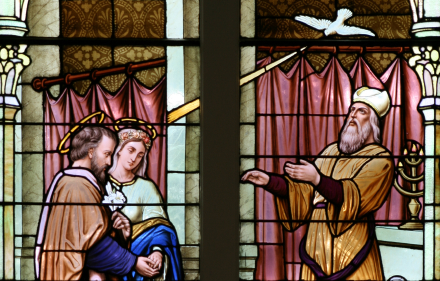
We know that sexual continence, in both the Old and New Covenants, is holy and sacred. Saint Joseph, as Augustine explained, would not have violated the Blessed Mother’s womb which had become a sacred shrine of God’s presence.
Moreover, sexual continence is holy in itself. For example, the sexual continence of David and his companions qualify them to eat the Bread of Presence, which was restricted to Levites. (1 Sam 21:4). David and his men were not Levites, but they were allowed to eat the sacred bread because they had not been with their wives. Hence, their sexual continence loaned them the status of priesthood.
The Catholic Church reads this Davidic account as teaching that sexual continence makes a man into a warrior-priest, one consecrated to the Lord…even Uriah the Hittite understood this:
Uriah said to David, “The ark and Israel and Judah dwell in booths; and my lord Joab and the servants of my lord are camping in the open field; shall I then go to my house, to eat and to drink, and to lie with my wife? As you live, and as your soul lives, I will not do this thing.” (2 Sam 11:11).
Saint Joseph (a son of David) was also a warrior-priest who is a dream-prophet like Joseph the Patriarch. Saint Joseph led the true Israel (Christ) into Egypt and back again to the Promised Land. He is the chaste one, just as Joseph the Patriarch remained chaste in the house of his master. Joseph dared not enter the womb that God had already indwelt. Just as the utensils of the Temple in Babylon remained holy to the Lord after the exile, so Mary’s womb remains holy and consecrated.

I am afraid that there are a few of things here that I disagree with:
“We know that sexual continence, in both the Old and New Covenants, is holy and sacred. Moreover, sexual continence is holy in itself.”
Is that really true? Certainly sexual continence per se is not holy and sacred. Certainly it has to be the reason for the withholding that makes it holy, not the abstention itself. After all, if I withhold sex from my spouse to punish them, I wouldn’t think that’s holy. But if I wanted to abstain for a while to spend time in meditation and prayer that would be.
Perhaps that’s what you meant, but if so then that meaning is unclear to me.
“For example, the sexual continence of David and his companions qualify them to eat the Bread of Presence, which was restricted to Levites. (1 Sam 21:4). David and his men were not Levites, but they were allowed to eat the sacred bread because they had not been with their wives. Hence, their sexual continence loaned them the status of priesthood.”
I think that’s an overstatement. One didn’t have to abstain from sex to become a levitical priest so abstaining from sex couldn’t make David and his men priests. But sex could make one ritually impure for a limited time according to OT law. Instead it appears that Ahimelech is willing to make an exception to the normal rule of only priests eating the bread if the men are ritually pure due to David’s apparent dire need. All David is doing is assuring the priest that he and his men are ritually pure.
“The Catholic Church reads this Davidic account as teaching that sexual continence makes a man into a warrior-priest, one consecrated to the Lord…even Uriah the Hittite understood this:
‘Uriah said to David, “The ark and Israel and Judah dwell in booths; and my lord Joab and the servants of my lord are camping in the open field; shall I then go to my house, to eat and to drink, and to lie with my wife? As you live, and as your soul lives, I will not do this thing.” (2 Sam 11:11).’ ”
That appears to me to be a misreading of what is going on. Uriah refers not only to abstaining from sex but also eating and drinking. As an officer in the army he wants to share in the circumstances of his men, not enjoying himself at home. His simple point, one made by many military commanders through history, is that while the army is out in the field, he’s not going to enjoy the benefits of being home “on leave”. So while he has to be in Jerusalem because the king called him, he’s not going to enjoy the benefits of being there while the army is in the field.
Steve,
Yes, only sexual continence to the glory of God is good and holy.
Perhaps I wasn’t clear enough about David. David and his men didn’t actually become Levites. However, the sexual abstinence allowed the priest to reckon David and his men as Levites. The hinge of this story is that they were sexually continent and this made if “okay” for them to eat the sacred bread.
Your point about Uriah the Hittite stands. However, it also proves the Catholic point. Asceticism (fasting and sexual continence) signifies a deeper commitment to battle. This is why Christ says that some men choose to become eunuchs (not married) for the kingdom of heaven:
Catholic priests are warriors in battle.
It is not clear to me as to why Joseph having sex with his wife after Christ’s birth would violate her. There’s absolutely nothing wrong with sex within marriage so there is nothing to violate. God created sex and blessed it. Surely if one of the metaphors for the church is the Bride of Christ, there could be nothing wrong with the physical expression of love with in a marriage..
I mean, seriously, was Joseph affectionate with Mary? Did they hold hands, kiss, embrace one another? Wouldn’t it be more healthy, more “human” for Jesus to see his parents experiencing the complete gamut of human love and affection, including the physical side.
I don’t see why Joseph and Mary had to become the equivalent of monks.
Steve,
Good point, loving sex in marriage is not sinful.
Here is an analogy. Touching a wooden box is not sinful in itself. However, in the OT a man was punished by God with death for touching the Ark of the Covenant, which happens to be a wooden box. The context makes the difference. It is not sinful for a husband to have relations with his wife. However, if she had given birth to God Himself (as Mary did) then it would be very unfitting to presume a husband’s right to enter what is now a holy shrine. Remember, in the OT, male semen rendered the woman as “ceremonially unclean.” Would it be appropriate for Saint Joseph to render the Mother of God “unclean” in accord with OT ceremonial law? Of course not.
You write:
Undoubtedly they held helds and showed affection. They were married! The problem here isn’t intimacy. Rather the issue at hand is that Mary’s womb is the portal between heaven and earth. It the location of the incarnation of God.
in Christ,
Taylor
A few points/questions:
1) Why is it holy? Once Christ was born, there’s no holiness. The whole point of holiness is to be made separate, set apart. But once Christ was born, there’ no need for her womb to be “set apart”.
2) Mary’s womb is a shrine? Seriously, you mean a shrine? A place of worship and veneration?
But there were lots of things in Jewish life that could make on ceremonially unclean. That didn’t mean you couldn’t do those things (engaging in sex with your spouse, s0mebody had to handle the dead, women menstruated, etc), it just meant that before going to the sanctuary you had to do certain things to purify yourself. Indeed giving birth to a child meant Mary had to go to the temple as noted in Luke for the “time of her purification”. Just having a baby made her unclean which creates a problem there, don’t you think? :) Being unclean did not equal “bad” or else God would have told people to not do these things. Instead he gave them provisions for making themselves ritually clean because in many cases it just couldn’t be helped as a part of everyday life.
But what purpose does her continued virginity serve? You and don’t worship her womb, we don’t venerate it. Sorry, I just don’t “get it”.
Steve,
You write:
Not quite. The Sacred Scriptures say (Luke 2:22) that “the days of” Mary’s purification were accomplished according to the law of Moses.” The law of uncleanliness in childbirth requires receiving seed from a human father:
Saint Thomas Aquinas observed that Moses’ words exclude the Mother of Christ from this ceremonial uncleanliness, given the lack of seed in the conception of Christ:
Mary submitted to the law to fulfill all righteousness. Christ submitted to the tevilah (baptism) of John, but that doesn’t mean that He had original sin or personal sins. Same goes for Mary regarding the purification.
The reason the Catholic Church objects to the ceremonial uncleanliness of Mary after childbirth is that it would mean that Christ made someone “unclean” – something rather shocking since Christ’s ministry entailed making people clean and pure…
Kevin,
To pick up on your question (#246) under Fred Noltie’s excellent post Ancient Marian Devotion, you wrote:
Would you provide the New Testament reference that tells us Jesus’ mother Mary had other children?
Jason,
Here are the references: Matthew 13:55-56, Mark 3:31-32; Mark 6:3; John 2:12; Galatians 1:19
Taylor said ” it isn’t unlawful for a man to have relations with his wife.” I agree Joseph was under the full blessing of God to have relations with Mary. Her womb isn’t a holy shrine. Where does it say Mary’s womb was preserved as a holy shrine?
Jason, you know the references to brothers in the Gospels. I am a language expert. And the word for cousin is completely different. This is the specific word for brother. She is simply called the mother of Jesus in Scripture. Never the mother of God.
Pat,
Thank you for supplying the passages from the NT you had in mind. In reading over them again (and the others you didn’t included— Matthew 12:46; Luke 8:19-20; John 7:3, 5, 10; Acts 1:14; 1 Cor. 9:5), I’d like to begin our discussion by pointing out that none of them say that the brothers and sisters of Jesus were the children of Mary, Jesus’ mother.
Will you agree that Kevin’s statement,”Scripture says Mary had other children. Not cousins or kinsmen, children,” claims more than the passages you referenced will allow?
Kevin,
I don’t mean to impugn your language expertise but I have not encountered your claim among Hebrew, Aramaic, or Greek linguistics scholars.
A few biblical examples of the term “brother” referring to someone other than a sibling may be helpful.
1. Lot is called Abraham’s “brother” (Gen. 14:14) though he is clearly his nephew (Gen. 11:26-28).
2. Jacob is referred to as his uncle Laban’s “brother” (Gen. 29:15).
3. Brothers, brother, and sister can refer in the Bible to nearer or more distant relatives. Other factors in the context in which the terms occur must be considered to understand the precise relations of the relatives to whom they are applied.
These are just a few quick examples that could be multiplied if I wasn’t pressed for time at the moment. If you’d like more instances of this type of thing in the Bible, I’d be happy to provide those for you.
Now you’ve piqued my interest, would you be kind enough to demonstrate the special term for “cousin” in Hebrew, Aramaic, and Greek?
Jason,
How am I to understand Matt 12:46-47–46 While He was still speaking to the crowds, behold, His mother and brothers were standing outside, seeking to speak to Him. 47 Someone said to Him, “Behold, Your mother and Your brothers are standing outside seeking to speak to You.” ????
I do think that Scripture says that Mary had other children after Jesus was born.
Jason,
I’d like to address your question: “…demonstrate the special term for “cousin” in Hebrew, Aramaic, and Greek?”
“10 Aristarchus, my fellow prisoner, sends you his greetings; and also Barnabas’s cousin Mark (about whom you received instructions; if he comes to you, welcome him); ” Col 4:10
“11 Mahlah, Tirzah, Hoglah, Milcah and Noah, the daughters of Zelophehad married their uncles’ sons.” Num 36:11
“36 And behold, even your relative Elizabeth has also conceived a son in her old age; and she who was called barren is now in her sixth month. ” Luke 1
Another point:
Isaiah 7:14 says:
“Behold a virgin shall conceive, and bear a son, and his name shall be called Emmanuel.”
Here we have:
1. A virgin will conceive. This is uncontested by all here.
2. A virgin will bear a son, implying as St. Augustine says, “A Virgin conceiving, a Virgin bearing, a Virgin pregnant, a Virgin bringing forth, a Virgin perpetual.” That is to say, not only was Mary a virgin when she conceived, but during and after the birth of Jesus. Do you deny this? If this was not the case, then what attest to Mary have conceived virginally?
3. “He shall be called Emmanuel.” This sign is a continual sign of His being “God-With-Us”. The sign is not that a virgin conceived, but that the Mother of Jesus, even after giving birth, is still a virgin. That is, her physical integrity was not violated, requiring the birth of Jesus to have been miraculous.
So we can see that, if this is so, it is the continued virginity of Mary that is the Sign. So, like the empty tomb to the Resurrection (imagine if Our Lord, instead of Ascending, went back, laid down in the tomb, and died), it is the fact that Mary is both Mother and Virgin that is the sign. Not that she conceived as a Virgin, but that she remained a virgin after bringing forth Her Son, and is a Virgin still.
Following from this, we can see how it would be an insult to the miracle God worked in the virgin birth if, after having Her virginity preserved by a miracle, it was violated by St. Joseph. Imagine if, after Jesus rose from the dead, Joseph of Arimathea (since it was his) used the tomb for himself.
To state it again, the Perpetual Virginity is the sign of Isaiah, for it is the proof that Jesus came from beyond this world. The empty tomb shows He transcended the limits of this world, and the Virgin Mother shows He came from beyond it.
Kevin (#10)
Is Jesus not God? Since He is, then to be the Mother of Jesus is to be the Mother of God.
Frank
Friar Charles,
Here is what the word virgin means “Particularly in the sense of one who has not known a man (Matt. 1:23: “A virgin shall be with child,” quoted from Is. 7:14; Luke 1:27″
Zodhiates, Spiros: The Complete Word Study Dictionary : New Testament. electronic ed. Chattanooga, TN : AMG Publishers, 2000, c1992, c1993, S. G3933
The word meaning itself has no connotations of being a virgin perpetually or that she was ” after the birth of Jesus”. That is reading into the text. She was a virgin when the Holy Spirit would come upon her and overshadowed her. Luke 1:35
I don’t see anything in Scripture that leads me to believe that “the continued virginity of Mary that is the Sign”.
I still get the impression from RC’s that sex among to married people is unholy and sinful. Why else would you say–“…we can see how it would be an insult to the miracle God worked in the virgin birth if, after having Her virginity preserved by a miracle, it was violated by St. Joseph..” Sex among married people is not a violation. After all, God designed sex and approves of it for married couples.
What proved Jesus came from beyond this world was His life, ministry, death and resurrection. The Scripture never tells us that Mary “shows He came from beyond it.”
Pat (#13)
If it said “your mother and her sons…” your case would be closed. But that is not what it says.
The burden is on you to prove that those brothers are uterine brothers. Provide some Scripture that shows that, and you’re on stronger ground.
Frank
Pat (#13),
Don’t you find it odd that these “brothers” of Jesus are never in any of the Gospel passages you’ve cited (nor in the ones I’ve included above) actually called the children of Mary the mother of Jesus? Jesus obviously is (Jn. 2:1; 19:25; Acts 1:14). Why are they not?
Consider also that when the names of the “brothers” are given in Matt. 27:56 (James and Joseph), they are unmistakably the sons of a different Mary. Not Mary the mother of Jesus.
You are correct that there is a term in Greek that may be used of cousins. In my quickly written response I was thinking specifically of the Septuagint’s adoption of the Hebrew practice of employing the one term “brother” for both siblings and more distant relatives. As per your citation Paul uses a distinct term for “cousin” in Col. 4:10. Is this then a slam dunk for reading the “brethren of the Lord” in the Gospels as a reference to the children of Mary? The answer is simply, no.
Why? One major reason is mentioned above. When the “brothers” are named it is easily seen that they are the brothers from another mother, namely Mary the wife of Clopas, for instance. That’s why context is king.
Another reason is the undeniable presence of Hebraisms present within the four Gospels. This is not surprising given such idioms and ways of expression were preserved in the Septuagint translation of the Hebrew Scriptures, which was the working Bible of the apostolic Church. The fact remains that “brother” is a more inclusive term that can apply to cousins as well. Would more examples satisfy your skepticism?
So, yes, Paul can write that Mark is Barnabas’s cousin without damaging the constant teaching of the Church that the Blessed Virgin was the mother of Jesus. Period.
Jason,
You didn’t answer my question on “Matt 12:46-47–46 While He was still speaking to the crowds, behold, His mother and brothers were standing outside, seeking to speak to Him. 47 Someone said to Him, “Behold, Your mother and Your brothers are standing outside seeking to speak to You.”
Notice the connection–“His mother and brothers “. This shows there is a natural family connection here between Mary and His brothers. We know His mother’s name is Mary and not some other Mary.
In Matthew 13:55-56 it mentions by name who His brothers and sisters are. When brothers and sisters are used in connection with father or mother then it does not mean cousins but actual blood brothers and sisters.
It is also, as I said in a comment on the ‘Ancient Marian Devotion‘ thread, the fact that in Luke 1:34, despite the tendency of modern translations, Our Lady does not say “how can this be, since I am a virgin” – ‘virgin’ being state that can change – but rather she says, as the King James very accurately translates it, “How shall this be, seeing I know not a man?” As I point out in the comment linked above, the Greek very definitely is in the present, not the aorist. For those who do not know Greek, if it were aorist, it would simply say that that is her present state, with no indication about past or future. The Greek present can only properly mean either something like the English present progressive – “seeing I am not presently in the act of knowing a man” – which would be absurd – or else what, I believe it does mean, “I don’t do that; knowing a man is not something that I do.” And she doesn’t ask how can it be – which would be a bit silly, since she must have known what normally produces babies – but how shall it be – how will there a future like this, since I don’t have sexual relations. The most natural translation of the Greek there – and Luke’s Greek is widely acknowledged as being very good – is that she is taking for granted the state that the Church has always said was hers: a vow of perpetual virginity.
jj
Apologies for jumping into this thread, but I wanted to show a different take on the issue.
There is no word for cousin, nephew and the likes in most of the indigenous languages of Nigeria, the same word being used for brother, cousin, nephew, etc. Now despite the official language of Nigeria being English, an odd thing happens when most Nigerians converse in English. They carry over this lack of distinction from their native tongue to English, referring to half-brothers, cousins, nephews and even relatively distant members of their community as brothers, despite the fact that there are specific words for these relationships in English. This is mostly because brotherhood is seen as the only relationship that exit between people of the same group. So my half-brother is my brother. My cousin is my brother. My nephew is my brother. The son of my uncle ten times removed is my brother. Every male from my community is my brother. I believe a situation like this is what presents itself in the biblical verses on the brothers of Jesus.
Also Jesus’s ‘father’ is the Holy Spirit, Mary His mother. Except we are saying the Holy Spirit also ‘fathered’ these other ‘brothers and sisters’, then they were at most his half-brothers (if we were to grant the theory that they were Mary’s children). So to be technically precise the New Testament writers should have used the Greek word for half-brother to describe the relationship. And such words do exist; homopatôr (half-brother by the father) or homomêtôr (half-brother by the mother). But they did not. Why? Because like in the Nigerian situation above, the word brother (adelphos) described all relationship that existed among people of the same generation.
Pat (#20),
The fourth paragraph of my comment #19 suggests briefly an explanation to your question. Let’s explore the idea presented there a bit further.
You wrote:
The named brothers belong to to Mary the wife of Clopas. This becomes apparent when the Gospel accounts are compared:
Immediately it may be seen from Matthew 27 that James and Joseph are actually the sons of another Mary. This means your conclusion that “When brothers and sisters are used in connection with father or mother then it does not mean cousins but actual blood brothers and sisters” is incorrect.
Clearly James and Joseph are not siblings of Jesus, even though they are called “brothers” and that in a context closely connected with Mary as mother of Jesus in Matthew 13.
Similarly the crucifixion accounts give us insight into the matter:
These parallel accounts indicate that the mother of James and Joseph is not Mary the mother of Jesus, but Mary the wife of Clopas.
Jason,
Where is Mary the wife of Clopas even mentioned in chapter 13 of Matthew?
We know that the Mary mentioned here is His mother because in verse 55 it first mentions His father i.e. “Is this not the carpenters son?” Both of His parents are mentioned here. That is why James and Joseph and Simon and Judas and His sisters are mentioned because it describes His immediate family.
It is not incorrect that “When brothers and sisters are used in connection with father or mother then it does not mean cousins but actual blood brothers and sisters”. When the words brothers and sisters are used together it means that they are of the same parents and are siblings.
There are Greek words for cousin—anepsios as in Colossians 4:10 or kinsman = sungenis which is used in Luke 1:36. The bible never uses these two Greek words anepsios or sungenis reference to Jesus brothers.
Frank,
If I said to you that your mother and your brothers are standing outside and want to see you (assuming your mother and brothers are alive) who do you think I would be talking about?
Pat (#24),
Yes, the Mary mentioned in Matthew 13 is Mary the mother of Jesus. The James and Joseph in Matthew 13 are explicitly identified as the sons of Mary’s sister, Mary wife of Clopas in Matt. 27:56 and Mark 15:40.
James and Joseph while referred to as Jesus’ “brothers” are never once referred to as the sons of the Virgin Mary, nor is it ever said that the Virgin Mary is their mother.
While there are Greek words that may be used for more distant relatives, the Gospel writers appear to carry over the Hebrew and Aramaic cultural custom of using the Greek term adelphos in a more inclusive way so as to include both blood brothers and cousins. Not surprising given the natively Jewish content and context of the Gospels. Certainly something not relevant in Paul’s context in Colossians 4:10.
Lest you think this is an argument peculiar to Catholic teaching, consider the thinking of the protestant reformers on the matter:
Martin Luther:
John Calvin:
Ulrich Zwingli:
May I ask why you find it necessary to reject the Church’s constant teaching on the perpetual virginity of Mary? What compelling reason do you have other than insisting against better information that the NT terms “brother” and “sister” must always refer to one’s siblings?
An alternative to the “brothers are cousins” argument is the ancient tradition that Jesus’ brothers are actually Joseph’s children from a previous marriage.
Jason,
So we agree that Mary wife of Clopas is not mentioned in Matthew 13. Also, it is not improbable that she had the same names for a couple of her children as did Mary the mother of Jesus did. In fact, Matthew 27:56 mentions Mary with her 2 sons James and Joseph and then mentions “and the mother of the sons of Zebedee.”
If the brothers and sisters were really cousins then the the gospel writers would have used specific Greek words for them as I pointed out. The context many times can help us to understand how these words are used. Brothers can be used in a spiritual sense when referring to other believers in the church. When Mary visits Elizabeth in Luke 1:36 she is called a relative of Mary. Luke qualifies the relationship. There is no such qualifications for Matthew 13:55-56 and other passages where it mentions His mother, brothers and sisters.
I never claimed that “the NT terms “brother” and “sister” must always refer to one’s siblings”. I know it does not. Context determines how it should be understood.
If the gospel writers intended brothers and sister to mean cousins then why didn’t they use the words for cousin in those verses?
I reject the teachings of the RCC on this issue because the Scripture does not teach the perpetual virginity of Mary. If it did, I would accept it.
Let me ask you this:
Can you tell me how Mary having any other children via her relationship with Joseph would have any negative impact on the person and ministry of Christ?
Do any OT passages forbid the mother of the Messiah from having her own children? Any that the Messiah would be an only child?
Can you think of any reasons why sex between Mary and Joseph would be unclean, unholy or sinful?
Jason,
Major problems with Jesus’ brothers are actually Joseph’s children from a previous marriage. Here would one of many:
Protestant scholar D. A. Carson points out, if “brothers” refers to Joseph’s sons by an earlier marriage, not Jesus but Joseph’s firstborn would have been legal heir to David’s throne.
Pat (referencing Jason’s comment):
Keeping in mind that Joseph would have been a widower in that context, not a divorced-and-remarried man…,
One of the powerful pieces of information that Jesus’ “brothers” are older than he is, not younger, is the fact that these “brothers” (whether they were cousins or sons of Joseph-the-widower by his deceased wife) acted AS ELDERS: Notice that in Mark 3:21 and in John 7, these “brothers” not only don’t believe in Him but are apt to give him pushy instructions like “Go to Judea” or even to go “take charge of Him” because “He is out of His senses.”
Now even in our own society in most families we might think it a bit cheeky for a younger sibling to deal with his eldest brother in this way. But we’re talking about a Semitic society: A society in which the firstborn gets great respect. Before the Mosaic covenant, the heads-of-households were priests for their households (e.g. Abraham, Job) and the eldest brother was responsible for undertaking that priestly/head-of-household calling for the clan once the father died. There was a very strong “primogeniture” kind of tradition and attitude.
Thus Jesus’ “brothers,” if they were His younger brothers by Mary and Joseph, would not have acted in this way. They would have said, “He is our older brother and head of our family; our father Joseph is dead; what can we do about it?” and they would have only said something like that in private, IF they had been so shockingly blunt about it as to admit that they thought Jesus was doing anything inappropriate, even in private. For even that would have been viewed as a nasty act of disrespect for one’s elders.
There is also the matter of Jesus giving the care of His mother, Mary, over to His disciple John, from the cross.
What a horrendous act of disrespect for His younger brothers by Mary that would be! …if there WERE any sons of Mary around to undertake the traditional role of caring for their widowed mother after the death of both her husband and of her firstborn son. Jesus instructing John to care for her would be (in that society) a sin against His younger siblings who were also sons of Mary …IF any existed.
BUT,
It makes perfect sense that Jesus’ cousins (not sons of Mary), who were older (in human lifespan terms) than He, would “take charge” of their “little cousin” who was “going a little off the rails.”
And of course they’d want to bring along His mother on the trip as additional emotional leverage over Him. (Granted, the lady in question wasn’t saying much and certainly wasn’t helping them to “talk down” her Son, but it couldn’t hurt to haul her along.)
Now THAT explanation of the story fits with Semitic society: The elder cousins are expected to rein in the excesses of the younger cousins, and typically would have no scruples about hauling along a widowed female relative without bothering to ask her opinion of the matter. (Even relatively good men in that society might have chuckled a bit at the notion of bothering about a female relative’s opinions.)
And likewise, if Jesus had no younger siblings who were also sons of His mother, it would be perfectly normal to entrust Her to a faithful close friend (John). This would be expected, under such circumstances. But if Mary had any sons of adult age other than Jesus, it would be a horrendous breach of protocol for Jesus to commit her to the care of John.
The Bible thus tells us firmly that:
1. If Jesus did have any younger siblings by Mary, they must have all been dead by the time of the crucifixion…yet the Gospels do not record them getting killed or even dying;
2. The “brothers” of Jesus who came to “take charge of Him” were older than He was;
3. Yet, Jesus was the “firstborn” of Mary, meaning that He “opened the womb” in the Old Testament phrasing;
4. Therefore, the “brothers” of Jesus who came to “take charge of Him” were either sons of Joseph but not of Mary (stepbrothers, sons of Joseph’s deceased first wife), or they were elder cousins.
That’s what the Bible says.
But you have to read it like a first-century Jew, to know that.
Pat (#25)
The problem with your question is that you pose it in English in the year 2014, not in Aramaic in the year ca. 30 A.D. There’s a difference in what the word “brother” can mean in those two instances.
Show me where in Scripture it clearly states that these were uterine brothers – i.e. the “sons of Mary.” That will provide the evidence you need.
Frank
Pat:
Regarding Mary having sexual relations with Joseph:
Sexual relations are, of course, good and holy. Indeed they are in many ways Eucharistic: An imaging in nature of how the High Priest comes into the Holy Place in the temple, and of how Christ pours Himself out in life-giving love to produce life within His Church. It seems likely that God invented sexual reproduction partly for the purpose of teaching human beings about these more important matters by analogy.
But, there’s “holy” and then there’s HOLY.
It’s perfectly normal for a man who sees spilled water on the temple stairs to want to wipe it up, lest someone slip. But it is not normal, nor is it wise, to ask if he may use the cloth from the High Priest’s turban-crown to wipe it up! (It bore a golden badge labeling the garment and the priest as “Holy To The Lord” as you may recall.)
It is perfectly normal for a man to have a nice feast with his friends and family. But it is not normal, nor is it wise, to use the temple vessels from the Temple of Solomon as serving-dishes.
It is perfectly normal that a man might wish for a cradle for his newborn baby. But it is not normal that he should expect to be allowed to use the Ark of the Covenant for that purpose.
It is perfectly normal — even holy and heavenly and a divinely-instituted mystery — that a man should marry and have children by his wife. But if, instead, the woman given into his care is the Theotokos, it is hard to imagine that any faithful Jew would expect marital norms to apply!
Now I must admit: A ignorant 21st-century slob like me, who grew up in a de-sacralized and materialistic culture, poisoned by positivism and the denial of “meaning in things,” is not going to FEEL instinctively much inappropriateness of saying that Joseph expected to have children through Mary in the normal fashion.
But why should I …why should WE, given when and where we live, expect to feel such things instinctively? In our culture, our sensitivity to what is “appropriate” in such matters has been almost entirely killed-off. We are perhaps the most sexually and maritally ignorant civilization imaginable (were it not for hints of similar ignorance at the apex of Roman and Greek decadence).
Everything normal and healthy has been trashed and stained in our imaginations. A man whose ancestor would have felt insulted or sick at the suggestion he might use a condom when having sexual relations with his wife — whose ancestor would have shouted that he was not a pervert, nor was his wife a prostitute! — now thinks nothing of it. Consequently many persons caught up in the main current of our culture can see no difference between the marital embrace which produces grandchildren and great-grandchildren, and two men engaging in mutual masturbation. I am afraid our senses are very dulled by the sludge in which we daily swim.
Pat, you probably know that there is a tradition in some cultures — prominently including Jewish culture, I think? — that a bride and groom, after toasting one another, shatter the glasses thus used “lest those glasses ever again be used for any lesser purpose.” One supposes they could also set the glasses aside, perhaps in a display case, and achieve the same effect.
God, being good, did not “shatter” — which I suppose would mean kill or destroy — Mary; but the Early Christians (and modern Christians who value their opinion) believe that she was “set aside” in a reverent way. Persons from saner and more sophisticated cultures than our own, for the last two thousand years, have generally thought it sacrilegious that she would have borne other children to Joseph. NOT because children are not very good; and NOT because sexual relations are anything less than the holy consummation of a sacrament! …but, because “Holy To The Lord” is a thing which applies to more than just the crown of the High Priest and the temple vessels.
Indeed, it applies to the Ark: To whatever God selects for bearing the Bread from Heaven, the High Priestly Authority, and the Word of God. Uzzah touched the Ark of the Old Covenant and died; how would a faithful Jew treat the Ark of the New?
Anyway, this is the instinct of folks from, as I say, saner and more sophisticated cultures than ours. I don’t mean that they had more sophisticated iPhones than we: Our technology is more advanced. But I think our appreciation of the sacred is far inferior to theirs; hence the dullness and untrustworthiness of our own instincts.
So I’m willing to take their judgment and value their healthy instincts, over-and-above the crude guesses of us barbarians.
Oh, and also: The ancient tradition of the Christian faith is that Mary was ever-virgin. And Scripture says nothing to suggest otherwise, if you read it like a First-Century Jew.
Pat (#28),
Yes.
Improbable based on the fact that the Gospel writers go to the trouble of telling us that a certain James and Joseph are “brothers” of Jesus and then elsewhere in their writings specify that a certain James and Joseph are also the sons of Mary wife of Clopas. If this were not the case, your suggestion would have greater weight.
Are you suggesting that “Mary the mother of James and Joseph” is Jesus’ mother? Would not the synoptic writers designate Mary as the mother of Jesus as does John in his Gospel (“But standing by the cross of Jesus were his mother, etc.”)? I see John lists four women, as I look over his account again: Jesus’ mother, his mother’s sister, Mary the wife of Clopas, and Mary Mag′dalene, which very likely makes “his mother’s sister” to be Salome from Mark 15:40, also making her the mother of the sons of Zebedee.
Precisely. And here the broader contextual features of the Gospel narratives, coupled with the well-known cultural custom of ancient Jews including more distant relatives under the umbrella terms “brother” or “sister”, require us to look elsewhere than the Virgin Mary’s womb when the NT speaks of “the brethren of the Lord.”
You have not established that Scripture does not teach the perpetual virginity of Mary. I have maintained that the doctrine is consistent with the Bible. You have insisted “mothers and brothers” require the brothers to be siblings, but you have not proven that claim. Other contextual and textual factors mentioned above undermine your thesis.
More significantly, you are proceeding with the assumption that any doctrine to be believed should be explicit in the Bible. But where is that principle itself taught in Scripture? Please answer this question as it gets to the heart of our disagreement.
1) Greater opportunity for naysayers to deny the supernatural birth of Jesus knowing she had given birth to her other children by natural means.
2) Potential for the diminishing of the extraordinary miracle the Virgin Birth was. As Ever-Virgin, Mary’s whole existence buttresses the reality of the Virgin Birth.
3) Unfitting that Jesus should have siblings. Mary’s womb had been consecrated forever by the very presence of God Almighty. Things could never be business as usual after that reality.
4) Historically only heretics have denied Mary’s perpetual virginity. The quotes I’ve provided by the protestant reformers testify to the normalcy of this doctrine as Christian orthodoxy.
Frank,
The gospels were written in Greek and not Aramaic. The gospels writers would have been aware of this and knew how to communicate in their gospels the relationships that Jesus had and how they were understood. When brothers and sisters are used in connection with father or mother then it does not mean cousins but actual blood brothers and sisters. See Matthew 13:55-56, Mark 3:31-32; Mark 6:3; John 2:12; Galatians 1:19
Luke in 1:36 tells us what the relationship is between Mary and Elizabeth i.e. relative. If the gospel writers intended us to understand that Jesus brothers and sisters were really cousins then they would have used words such as anepsios as in Colossians 4:10 or kinsman = sungenis which is used in Luke 1:36.
Luke 21:16 also shows distinctions. “But you will be betrayed even by parents and brothers and relatives and friends, and they will put some of you to death..” Relatives is in a different class than brothers and sisters. They are not the same things.
Jason,
If something is not found or grounded in Scripture then its not apostolic. It is very explicit in the Scriptures that Mary had other children. There is nothing in the NT that would lead anyone to conclude that after Jesus was born they did not have normal sexual relations. There is nothing in the OT that says the Messiah would not have blood siblings. Nothing from the angel the forbade Mary to have sexual relations with Joseph after Jesus was born. In fact it was expected that they would given that a vow of perpetual virginity is unheard of Biblically. There is no indication from the OT or NT that it would be acceptable to be married and yet chose to be a perpetual virgin. Married Jewish couples were to be fruitful and multiply. This is what the OT taught.
Where does it say–“James and Joseph are also the sons of Mary wife of Clopas”? Its not in Matt 27:56.
There are other reasons that show Mary had other children: Acts 1:14 and Gal 1:19.
No writer of the NT based the virgin birth of Christ on the idea that Mary had to be a perpetual virgin. No writer of the Scripture that “Unfitting that Jesus should have siblings. Mary’s womb had been consecrated forever by the very presence of God Almighty. Things could never be business as usual after that reality.” This pure speculation that has no grounding in Scripture. Children are a gift from God as is sex between husband and wife. In fact the husband is to fulfill his duty to his wife as his wife is to him. They are not to continually deprive each others bodies. I Cor 7:3-5. Unconsummated marriages is not only unsupported by Scripture but is averse to the teaching of Scripture on this.
What better way for the Savior to experience humanity to the full by having brothers and sisters?
RC,
Another problem for the view that Joseph was previously married and had children is that there is no direct evidence for this claim in the NT.
Pat, (#35)
Ironically, I used this very reasoning in explaining to you why Mary was the Spouse of the Holy Spirit. Since the Holy Spirit united with her in a procreative act, the Holy Spirit was her true spouse — all the more reason she would remain chaste with Joseph.
And yes – the NT never calls her the “Spouse of the Holy Spirit”, but it also never calls Jesus “the second Person of the Trinity.” Inference, reason, and the promised teaching of the Holy Spirit to the Church enables us to make both these statements – even though they are not found in Scripture.
Pat – at this point, if you choose to respond, fine. But I find your case unpersuasive, having been disproven by both Scripture and Tradition, and I am no longer interested in going around in circles with you on this topic.
May God richly bless you and your family and lead you into all truth.
Frank
Pat (#35),
Where does the Bible teach this?
You have yet to demonstrate this claim.
In Luke 1:34 Mary asks “How can this be” in response to the angel Gabriel’s announcement regarding a miraculous conception (1:31). Her perplexity makes no sense unless she intended to preserve her virginal purity even as a married woman.
No. But Mary’s response to the the angel makes no sense unless she intended to abstain from sexual relations even as a married woman. She’s genuinely confused. Why? If she intended to have sexual relations with Joseph why would the words of the angel perplex her?
Saint Gregory of Nyssa asks: “For if Joseph had taken her to be his wife, for the purpose of having children, why would she have wondered at the announcement of maternity, since she herself would have accepted becoming a mother according to the Law of nature?
But just as it was necessary to guard the body consecrated to God as an untouched and holy offering, for this same reason, she states, even if you are an angel come down from heaven and even if this phenomenon is beyond man’s abilities, yet it is impossible for me to know man. How shall I become a mother without [knowing] man? For though I consider Joseph to be my husband, still I do not know man.”
There is nothing in the OT that says the Messiah would not get married.
There is no indication from the OT or NT that it would be unacceptable to be married and yet choose to be a perpetual virgin.
Where does it say–”James and Joseph are also the sons of Mary the mother of Jesus”? Its not in Matt 27:56.
Neither NT reference require the interpretation that Mary had other children.
This gets back to you proving “If something is not found or grounded in Scripture then it’s not apostolic.”
Mutual.
Reformed Scholastic Francis Turretin says: “Although copulation had not take place in that marriage, it did not cease to be true and ratified (although unconsummated) for not intercourse, but consent makes marriage. Therefore it was perfect as to form (to wit, undivided conjunction of life and unviolated faith, but not as to end (to wit, the procreation of children, although it was not deficient as to the raising of the offspring.”
Ditto for marriage.
Pax Christi
Pat,
To put your argument in premise – conclusion forms (I am sure there is a better term for it, sorry).
1. Scripture is the inerrant, inspired word of God.
2. Various verses in the New Testament refer to the “brothers of Jesus” using the term “adelphoi’ and not the word most proper for the projected relationship of “cousin”.
3. Ergo, Mary gave birth to at least 6 (4 brothers and sisters) children other than Jesus, therefore she is not Perpetually Virgin.
Your argument is standing, not on premise one, but on premise two. You are not positioning yourself as a defender of Scripture, but of a defender that “If the brothers and sisters were really cousins then the the gospel writers would have used specific Greek words for them.” Your position is based, not on the authority of Scripture, but on a Greek word (which is not exclusively used for uterine brothers throughout the Bible) being used to mean one of its possible definitions over another. Also, the authors who use this word, even if they wrote in Greek, spoke Aramaic, and would likely use the same word constructions that come from Aramaic. See the example in #22.
Perhaps you could say that since Scripture is inerrant, it will always use the most proper term in any situation. But this is countered by the comment by Mikel (@22), who pointed out that even if they were the uterine brothers of Jesus, there is a proper term for “half-brother by mother” in Greek. Also, this is countered by the preceding words describing Joseph as the Father of Jesus, and not the “Foster Father”. Or when Mary referred to Joseph as the father of Jesus in Luke 2 (I don’t think she forgot he wasn’t). Finally, it would posit that scripture doesn’t reflect the cultural and linguistic backgrounds of the inspired authors.
To support this against counter-arguments you have suggested:
Which is without basis, the only evidence you give is quoting the contested passages. Do you realize that you can’t proffer a verse as a clarification of that same verse?
You are also arguing that we should ignore:
The universal and vigorous agreement between every Christian before 1600 or so.
The scriptural points we have pointed out.
The arguments from “fittingness” we have presented.
The arguments from OT typology.
You are also arguing that from the Church fathers through several generations into the Reformation, nobody ever noticed these verses, or at least never considered them (and these aren’t particularly subtle verses either).
You will need to prove that “ἀδελφοὶ” absolutely means uterine brother. Even a doubt would move this into an area of scriptural ambiguity, which you are unwilling to permit.
This is destroyed by Matthew 27:56 and Mark 15:40. All we need to do is demonstrate that one of the four men mentioned in Matthew 13 is not the uterine brother of Jesus and your second premise is broken. Matt. 27/Mark 15 show both James and Joseph as being the children of another Mary. QED.
An anecdote. A friend of mine was at Dordt College, and in a theology class the question “Is Mary the mother of God.” It was vigorously denied, and my friend asked, “If Jesus is God, and Mary is the Mother of Jesus, why can’t we call her the Mother of God?” After hemming and hawing, one student gave the answer, “Because that’s what the Catholics say.”
Just to clear this up and get it out of the way. It seems to me you have another premise which is not stated. Would you affirm or deny that this is another premise you are employing.
@ Frank in 37
I would argue this is a misunderstanding of Mary as “Spouse of the Holy Spirit”.
Are we not all “spouses” of God, even if Mary is in an entirely unique way?
To understand Mary as “Spouse of the Holy Spirit” we need to think of the incomparable intimate union she had with the HS since she was created Immaculate. This is a spiritual relationship, and one that didn’t start at the Annunciation. There was no “Divine Insemination”.
The second part of this article by one of our priest makes this point very well:
https://dawneden.blogspot.com/2009/06/virgo-redacta-christopher-west-and.html
And for understanding more about our Lady as spouse of the Holy Spirit, I would suggest this book about St. Maximilian Kolbe’s insights (it is incredible):
https://www.amazon.com/Immaculate-Conception-Holy-Spirit-Maximilian/dp/0913382000
Jason,
You wrote-“In Luke 1:34 Mary asks “How can this be” in response to the angel Gabriel’s announcement regarding a miraculous conception (1:31). Her perplexity makes no sense unless she intended to preserve her virginal purity even as a married woman.”
Here is what the New American Bible (RCC) translation says on its footnote:
“Mary’s questioning response is a denial of sexual relations and is used by Luke to lead to the angel’s declaration about the Spirit’s role in the conception of this child (⇒ Luke 1:35). According to Luke, the virginal conception of Jesus takes place through the holy Spirit, the power of God, and therefore Jesus has a unique relationship to Yahweh: he is Son of God.”
Notice that these RC scholars say nothing about her being a perpetual virgin. It is claimed by RC’s that she made some kind of vow to be a perpetual virgin. The problem is that there is nothing in this to even suggest this. The earliest affirmation of the perpetual virginity of Mary appears in the heretical work call Ascension of Isaiah which is a “late 1st century AD to the second half of the 2nd century AD. As for its authorship, it is believed almost universally to be a compilation of several texts completed by an unknown Christian scribe.” https://en.wikipedia.org/wiki/Ascension_of_Isaiah.
What this shows it was not the official teaching of the church.
Gregory of Nyssa who lived 335 – c. 395 did not exegete the passages to support his claims nor does he speak for the entire church.
Do we agree that ” Unconsummated marriages is not only unsupported by Scripture but is averse to the teaching of Scripture on this”?
fra Charles,
You wrote:”You are also arguing that we should ignore:
The universal and vigorous agreement between every Christian before 1600 or so.
The scriptural points we have pointed out.”
Major problems with these points. It is not true that “The universal and vigorous agreement between every Christian before 1600 or so”.
Consider this: “Some early writers, Tertullian, Helvidius and Eunomius of Cyzicus, interpreted Matthew’s statement to mean that Joseph and Mary did have normal marital relations after Jesus’ birth, and that James, Joses, Jude, and Simon were the biological sons of Mary and Joseph, a view held by Helvidius and Eunomius.”
https://en.wikipedia.org/wiki/Perpetual_virginity_of_Mary
“The scriptural points we have pointed out” is not on any exegetical but on denying the plain reading of the texts that shows she had other children. There are only 2 possible meanings for “for adelphos, namely, “either ‘physical brotherhood’ in the strict sense or more generally the ‘spiritual brotherhood’ of Israelites or Christians” (Kittel, 1964, 1:144). A broadened meaning for adelphos (to refer to a cousin) does not exist in the New Testament.”
People,
My Hungarian immigrant mother in law says that Hungarian doesn’t have separate words for uncle, cousin, brother, etc. etc.
A couple of days ago Kevin wrote, ” Her womb isn’t a holy shrine. Where does it say Mary’s womb was preserved as a holy shrine?”
Ezekial 44:2. But does one really need to give a Bible verse? Of course Mary is a holy shrine!
Taylor, Fred, Jason ( I can’t ell who is Der blog miester here )
As we are approaching the 13 of May, here in the Lisbon area its all about Fatima. Our Irish Dominican parish is no exception. Upon singing the words in English,”To three shepherd children the Virgin then spoke a message so hopeful, with peace for all folk” my mind drifted to the fact that Francisco never heard the Angel or Mary ever speak. However, the encounter with heaven was so sublime that he lost all interest in this world stopped going to school and anxiously awaited his death and entry into heaven. Little Jacinta experienced more of the Fatima event than her brother and she too shortly thereafter went to heaven. Lucia, who was the principle seer was so transformed by the visitation of an Angle and later Mary, that, like Bernadette before, retired from the world to hide in a cloister.
This seems to be the “normal” response to a visitation from heaven. This world is seen as nothing but a preparation for the next.
Like the three shepherd children, Mary was visited by an Angel. Our Protestant friends would have us think she forgot about it as I often forget my glasses or keys. After all, angels visit them on occasion too. They even say that later, when Jesus started saying strange things, she and her other kids started thinking Jesus was not only just an ordinary boy, but maybe even a bit crazy!
Over the past few weeks copious quotes from the Bible, from the Fathers, from Tradition, and from Magisterial documents have been presented to our Separated Brethren, but all to no avail. Our brethren have remained unmoved and won’t have any nonsense. Mary, who was not only visited by an Angel but became the dwelling place of God, went on to live a normal, healthy, life. She got her degree in software engineering, joined an aerobics club and, along with her husband, Joe relocated and started an on-line consulting firm. Along with their five boys, Jimmy, Jude, Jesus, Simon and Joe Jr. enjoyed visiting Disneyland in the Summer and snowboarding in the Winter.
Am I serious? Is this absurd? About as absurd as the idea that Mary ( and Joseph )would ever again do anything normal.
I spent years in Mental Health. I am here to testify, no girl, no matter how beaten down, no matter how addicted to glue sniffing or heroin, no matter how many suicide attempts, abortions or sexual encounters for money, drugs or love, no matter what, under her belt, should that girl have been told she was set aside for such an awesome purpose as bearing the Savior of the World, I guarantee you she would have been transformed into an angel then and there.
These repeated assertions by our Protestant friends are getting absurd.
Pat,
It is a team effort, although some members (not me) are more equal than others. :-)
Fred
Pat (#41),
If Mary was planning on having normal marital relations with Joseph her question (“How shall this be, since I do not know man”) was odd.
St. Augustine comments: “Mary answered the announcing angel: ‘How shall this be done, because I know not man?’ She would not have said this unless she had already vowed her virginity to God.” (On Holy Virginity, 4)
It was an accepted Church teaching as can be seen by consulting the Fathers of the Church.
In ancient Judaism betrothal was the first stage of a two-stage marriage process. In the first stage the man and woman would exchange consent in the presence of witnesses. At betrothal the parties were considered legally married but would not begin to live together until the second stage. Betrothal could be terminated only by death or divorce. Joseph and Mary were betrothed. So . . . no, I don’t agree with your statement.
Jason,
“How shall this be, since I do not know man” is not odd nor is it a vow of virginity or to be a perpetual virginity. Rather this should be understood that up to this time in her life she was a virgin.
Church fathers do no speak for the entire church and not all fathers thought see was a perpetual virgin.
Are you saying that Joseph and Mary were just betrothed and never married?
Pat (#47),
Mary does not respond “How can I bear a son? Since I have not yet known a man” but rather “How shall this be, since I do not know a man.” She does not speak in the past tense regarding her virginity, as one would expect if your “up to this time in her life” interpretation were correct. Instead, she speaks in the present tense (“I do not know a man”). If she intended to have martial relations with Joseph her confusion at the angel’s declaration is inexplicable. She would have understood immediately how she could and would have a baby with her husband Joseph.
I haven’t argued that her question is her vow to remain a virgin.
There is a consensus regarding Mary’s perpetual virginity in the Fathers both East and West. And, as it has been show, the protestant reformers embraced the doctrine.
They were already married at the time of the angel’s message.
Pax Christi,
Pat
Read Jerome’s scathing “Letter to Helvidius”. It is indicative that the opinons of those men were not in line with the general convictions of the Early Church. This letter is readable just for St. Jerome raking him over the coals, imagine if St. Jerome was alive today and blogged!
https://www.ccel.org/ccel/schaff/npnf206.vi.v.html
You are arguing that there is no ambiguity in these texts. We are arguing that they are ambiguous, other texts suggest they were not Mary’s children, and that other forms of reasoning (such as fittingness) and appeals to the tradition of the Church demonstrate that Mary is perpetually virgin. We don’t need to present an air-tight exegesis, you do, and you should, to be fair, present an explanation of why some many Biblically literate Christians err so grievously.
We are not denying the plain reading of the texts, we are denying that “A broadened meaning for adelphos (to refer to a cousin) does not exist in the New Testament.” We would say it does, it is rendered such in the debated passages that we have presented. Do you realize we have listed other passages that bear upon Matthew 13, etc? Could you list them back to us? Do you deny that the use of words from the OT are useful for determining their meaning in the New?
As for the NAB, it presents the reflections of theologians generally employing the historical-critical method. It may be approved by the Church, but that simply means they are falling into heresy, not that they are correct in their scholarship. If you desire a commentary that pulls more heavily from the Christian tradition, I would suggest the commentary from Cornelius a Lapide (gospels in English: https://www.catholicapologetics.info/scripture/newtestament/Lapide.htm, full Latin:https://cdigital.dgb.uanl.mx/la/1080014741_C/1080014741_C.html) or the Catena Aurea of Thomas Aquinas, which complies quotes from the Church Fathers on the Gospels (which, by the way, he wrote from memory): https://www.veritasbible.com/commentary/catena-aurea, or the Haydock Commentary: https://www.veritasbible.com/commentary/haydock .
Jason,
Her virginity certainly include her past as being a virgin up to the moment the angel spoke with her. You just assert that “If she intended to have martial relations with Joseph her confusion at the angel’s declaration is inexplicable.” is not true. What is confounding her most likely is why she would be so favored by God. This is an expression of a humble person. It is one who is poor in spirit.
Just because people embraced something in the past as being true does not mean its true. Even Augustine nor any church father could exegete the Scripture and come up with the idea of perpetual virginity.
So we are back to my question: Do we agree that ” Unconsummated marriages is not only unsupported by Scripture but is averse to the teaching of Scripture on this?
If they were married then they would have consummated their marriage.
Dear Fra. Charles,
I will read the materials you’ve linked to and thank you for your help.
I was using a certain reasoning to help buttress the tradition of Mary’s perpetual virginity, based on the form of the sacrament of marriage, specifically the consummation, which act has as its end not just the unitive but the procreative. Mary’s spousal relation to the Holy Spirit is unique since it was procreative as well as unitive, whereas for everyone else it is only unitive.
Blessings,
Frank
Pat (#47)
Except that as I have pointed out in this comment, the Greek here is wrong for that meaning. She doesn’t say “I am a virgin” nor does she say “I have not known man” – she says, in a Greek (and you have insisted elsewhere that we must pay attention to the Greek of the Scriptures regarding ‘brothers’ and not infer things from an underlying Aramaic substrate) which cannot mean either of those things, “I know not man” – as I have pointed out in the linked comments, the Greek could mean I am not at this moment engaged in sexual relations – which would be absurd – or else it can mean that knowing man is not something I do. If your understanding of her marriage to Joseph were correct, she would have used the aorist – or possibly the perfect. She would not use the Greek present.
Either Luke got his tenses wrong – and it would be a brave man who accused Luke of bad Greek! – or Mary’s statement here implies a habitual, and, by implication, permanent, state of affairs.
jj
Jason (plus whoever else wishes to chime in):
Regarding your statement that…
…what am I to understand that you mean by your use of the word “married” in that sentence? Clearly you don’t mean “consummated”; but I’m confused as to what you could mean. What other difference exists between “already married” and “merely espoused/betrothed,” apart from whether the marriage is consummated? Is it a matter of whether the final wedding feast has been held? Whether the husband already has “marital rights?” Or what?
I ask, because while I know that…
(a.) …in Jewish custom there is no distinction between “betrothed” and “married” for the purpose of divorce — they are both sufficiently “married” to require the betrothed woman to be called “wife” and to require a divorce certificate for a man to put his wife away; nevertheless,
(b.) …my understanding is that a “betrothed” woman is called “betrothed” and not “married” specifically because the marriage ceremony and feast have not yet been held and the marriage has not been consummated…and I assume that the husband is supposed to hold off on consummating the marriage until then.
I don’t know what the Hebrew has as terms for “betrothed” and “married,” or whether in fact the same term is used for both.
I know that the Greek for “betrothed” is emnesteumene. I don’t know if any other word exists in Greek for someone who is “married” (meaning “betrothed and consummated”) other than to comment directly on whether the marriage has been consummated.
I do know that the word “engaged” is misleading in our modern translations; there is no state corresponding to “engagement” in first-century Jewish practice. Ideally no translation should using such an anachronistic term.
So it seems to me that confusion is arising because there are multiple English terms (engaged, betrothed, espoused, married) corresponding to different states of a couple, and there are also multiple states a couple passed through in Jewish custom…but some of the states in Jewish custom don’t correspond to ANY of the English terms, and at least one of the English terms (“engaged”) has no corresponding state in Jewish custom.
Confusing!
I guess there are several questions here:
1. Does more than one Hebrew/Aramaic words exist distinguishing between two states of the couple, en route to marriage? And what does each term signify?
2. Does more than one Greek words exist distinguishing between two states of the couple, en route to marriage? And what does each term signify? (I already the one used in Matthew 1/Luke 1 is emnesteumene.)
3. How many possible states were there for a normal Jewish couple, and which of those states corresponded to the state of Mary and Joseph, so far as we can tell from Scripture?
…and then, as a separate but less important question,
4. Is “married” the term in English which best corresponds to Mary and Joseph’s status at the time of the visit of Gabriel to Mary?
Looking for clarity here.
R.C. (#52),
Deuteronomy 22:23-27 catalogues specific laws pertaining to betrothal. Those laws presuppose that the couple is by betrothal already married in a legal sense. Which even means conjugal relations between the betrothed couple were lawful, though to my knowledge discouraged until the couple actually lived together as husband and wife.
It seems to me that in ancient Judaism there was only one state of marriage that proceeded in a two phase progression. As you’ve noted in your comments the betrothal phase is ended when the woman leaves her father’s household and is received by the man to form a new household. Of course in ordinary circumstances this entailed consummating the marriage.
Joseph and Mary entered the second phase of marriage as it existed in ancient Judaism, minus, of course, the consummation. Recall the words of the angel in Matthew 1: “Do not fear to take Mary your wife . . . . When Joseph woke from sleep, he did as the angel of the Lord commanded him; he took his wife, but knew her not until she had borne a son . . .”
Joseph did as the angel commanded and took (claimed) his wife Mary into his household. With that action a new family unit had been formed in Israel. By this act of Joseph they transitioned from betrothal in the married state to co-habitation in the married state.
Does this help? Perhaps others can offer their thoughts on the subject.
Pat in comment 29 you stated:
I do not think anyone responded to this statement. It does not appear that this statement is accurate, for Solomon was not the firstborn of David. As it says in this commentary[ https://biblehub.com/commentaries/guzik/commentaries/1101.htm%5D:
kimd:
I had wondered about the matter of succession, myself.
“The throne of Israel was not left only to the rules of hereditary succession; God determined the next king.”
Yes, but how?
Certainly if more than one descendant of David existed he could be considered a candidate. Assume for a moment that Jesus had elder stepbrothers who, being sons of Joseph by a deceased wife, were candidates. What would be required for them to have a right to the office above Jesus?
The first thing which occurs to me is that they’d have to seek it, not to leave it unclaimed. Jesus did; I imagine that if any of his “brothers” did likewise we’d have heard about it. Not every detail about which we might become curious is mentioned in the gospels, but close kin of Jesus being slain — after all, how else could such a claim turn out? — for claiming the throne of David would seem a likely thing to be included.
But I suppose the main thing to indicate which descendant of David was meant to take the throne was anointing: God would send in a prophet, or else some erstwhile Zadok would do the job.
I’m not sure, in the line of Davidic kings, by what procedure the people were supposed to know who was authorized to do the anointing or when. That would seem important, for what if two or more prophets or priests rushed up at the news of the death of the king and anointed two different sons from the royal line? The people would have to know which anointing “counted”; what, I wonder, was the criterion for that?
Nor am I sure how the guy authorized to anoint the next king was supposed to know whom to anoint. Samuel was a prophet, a priest, and a judge; God told him to anoint David as the next king rather than someone from the line of Saul, even though at the time plenty of sons of Saul were still alive. But I suspect that was an extraordinary event: Most of the time there would NOT be a priest and prophet with a proven supernatural track-record and explicit instructions from God available.
I suspect usually the prior king had selected the heir-apparent prior to his death to reduce the likelihood of a civil war. That would probably mean he’d discussed it with the priests and set it up with either the High Priest or the Al Bayith (“Head of House”) who, as I understand it, was also the “Prefect of Priests.”
At any rate I have no idea if anyone was anointed during all the 70 years in Babylon and all the hundreds of years thereafter when they’d returned to the land but the kingship had not yet been restored. If anyone was anointed, I think we’d have to suppose that Joseph was, but that none of his sons were.
But I think it more likely that nobody was anointed because it didn’t look like they’d actually be on the throne any time soon: Until the 490 years set out in the prophets were complete, a faithful Jew would know it wasn’t yet time for the kingdom of God to be established and the son of David to come.
As for Jesus, I should think His moment of anointing was quite obvious: By the Holy Spirit Himself, at His baptism.
Fred/Jason,
As Pat has had sufficient evidence over the past two weeks to either convince him/her, he/she is either not convinced or, more likely, not ever going to be convinced. Why not agree to disagree and move on? Protestants smooth over differences in the mode and age of Baptism, musical instruments in church, free will, the extent of the Atonement, etc.
Why is Pat adamant on this? Because, as Dave opine, they are defending scripture?
I ain’t buying it. As I posted previously, Mary=Church. For Mary to have remained a Virgin means she never took her eyes of Jesus. Not for a minute. It means the Church never took her eyes off Jesus, never fell into heresy or apostatized. Protestants need to be able to say the one Church, at some point ( Constantine melding paganism with the Faith, Sabbath changed to Sunday,Roman Bishop usurping authority, indulgences, etc. ) Therefore they need a Mary to have had a good, healthy, normal, all American sex life. She had to have had a balanced life complete with time for herself, girl talk, and a break from being a haus frau.
I am not saying this is up front in the mind of Protestants. But I think I am on to something. Pat has drawn a line in the sand. There will be no compromise on this one.
Fred/Jason,
No sooner had I logged off than I thought of another reason Protestants cannot have a Perpetual Virgin Mary. The idea of a consecrated life, the Evangelical Counsels are anathema for them. Smacks to much of a life dedicated to good works rather than relying on Christ’s work. What I have read of Luther, he raved more against monks and vows than he did against indulgences. He married a nun himself and his followers called “holy robbers” would sack convents and carry off the nuns. We see in Jerome contra Helvidius that part of the issue was consecrated virginity. No, for Protestants, Mary being a consecrated virgin presents a dangerous precedent. The issue is not just about the integrity of scripture.
Jim (#55):
I just discovered your comment in the moderation queue. I sincerely apologize for the delay.
Our hope is to encourage dialogue between Protestants (the Reformed especially) and Catholics, with an aim of mutually pursuing the truth. Occasionally there comes a time where some conversations need a break for one reason or another; at other times impasses are reached and there is no particular benefit to be had in attempting to move forward. Such events are disappointing of course (for both sides) but in the end they are not going to be entirely avoidable. So we trundle forward as best we can, seeking to follow our own posting guidelines as well as we can and praying for our mutual pursuit of the truth, that it may be fruitful.
Fred
I am joining this thread very late — as a result of looking for support of the long-standing prevaling tradition in the early Church that St. Joseph was NOT a widower — but, was himself, also, perpetually virgin. We see this symbolized in early statues, paintings and iconography of St. Joseph holding a lily, the symbol of purity and consecrated virginity. We also see this in the tradition of the early Church of “Josephite marriages,” wherein, in Christ, men and women would marry with the clear and stated intention of remaining consecrated virgins.
Sadly, the comment in #59 above seems to be at the crux of the matter, regarding why Protestants often have a problem with both the perpetual virginity of Our Lady and of St. Joseph:
“No, for Protestants, Mary being a consecrated virgin presents a dangerous precedent. The issue is not just about the integrity of scripture.”
Here is one of the great tragedies of the Reformation. Namely, the loss of the long-standing teaching/mystery/reality of the Indwelling of the Divine Bridegroom in the souls of those consecrated to God with a vow of perpetual virginity. Once someone has really experienced and lived into this Reality, which is a foretaste of the heavenly Banquet of eternal Communion with the Blessed Trinity, there is no way that even those who are not the Mother of God will allow themselves to enter into a sexual relationship with another human being. In the wake of the true Encounter with the Divine Bridegroom, all human relationships pale by comparison. Is this not what is behind the Lord’s Own saying in the scriptures that in the next life, no one will be given to anyone in marriage — but all will live/be like angels? MT 22: 23 -28.
And, furthermore, is not the loss of this teaching/reality/mystery on the Gift of the Divine Indwelling intended for each human soul the direct consequence of the Protestant reduction of the Mystery of the Lord’s Real Presence in the Holy Eucharist from a True Adorable Presence, under the veil of Bread and Wine, into a mere symbol of His heavenly Presence?
In the Catholic Faith, all of the teachings and traditions are integrally connected — and all can be summed up in the truism: “Lex orandi, lex credendi.” The loss of the ancient and long standing understanding of the Gift of the Lord to us in the Blessed Sacrament has led to the attempt to discard and even demonize the ancient teaching on the perpetual virginity of Our Lady — and has even forced people to conclude that St. Joseph must have been a widower — because how could a true “man” not have known sexual pleasure. How tragic! Of course, St. Joseph was perpetually virgin and had himself made a vow of perpetual virginity to the Lord God. Otherwise, why would he have ever consented to marry the Queen of heaven and earth, Who had Herself taken the same vow? And, why would he have been so shocked /disturbed to learn that Mary had conceived a child in Her womb? He was so disturbed that it took an angelic intervention to calm him down!
May we all re-think this and instead of trying to reduce the Blessed Virgin and St. Joseph to the categories of our natural lives, let us pray that through Their Holy Examples and Intercession, we may receive the Grace to be raised to living/ longing for life on the supernatural level — i.e, the life of heaven. If we haven’t honored and appreciated the gift of consecrated virginity in this life, what makes us think we will enjoy it in the next?!
Blessings to all,
Veronica
P.S. I must add that, sadly, in our day, even many Catholics have lost their Faith in the True and Adorable Presence of the Risen Lord in the Holy Eucharist, Body, Blood, Soul and Divinity. It is no wonder that so many Catholic Doctrines and Dogmas are now questioned by Catholics. Lex orandi, Lex credendi.
“In this video, Dr. Brant Pitre discusses the so-called brethren of Jesus, and asks the fundamental question as to whether or not — given both the biblical evidence and the early Church fathers — the gospels speak of biological brothers of Jesus or not. He will also explain who these so called brothers were and the positions they held in the early Church.”
The "Brothers" of Jesus: A Fresh Look at the Evidence from Catholic Productions on Vimeo.
For those wishing to go into this subject in more depth, Professor Lawrence Feingold of Kenrick-Glennon Seminary gave a lecture in 2010 titled:
“Mary’s Perpetual Virginity: Before, During, and After the Birth.”
Prof. Feingold’s lecture on the perpetual virginity of Mary
Q&A
Update: See also the following helpful video:
Dear Taylor Marshall:
Forgive me for commenting so late on this thread.
I noticed you did not the reference for the Augustine quote; and after reading through the 62 previous comments (some I skimmed after around comment 36) I could not find anyone asking you for the reference (maybe I missed it); so I spent some time googling and trying to find it, and the best I could find was this:
Upon being referred to the statements of Thomas Aquinas in Summa Theologia:
It is written (Ezekiel 44:2): “This gate shall be shut, it shall not be opened, and no man shall pass through it; because the Lord the God of Israel hath entered in by it.” Expounding these words, Augustine says in a sermon (De Annunt. Dom. iii): “What means this closed gate in the House of the Lord, except that Mary is to be ever inviolate? What does it mean that ‘no man shall pass through it,’ save that Joseph shall not know her? And what is this–‘The Lord alone enters in and goeth out by it’–except that the Holy Ghost shall impregnate her, and that the Lord of angels shall be born of her? And what means this–‘it shall be shut for evermore’–but that Mary is a virgin before His Birth, a virgin in His Birth, and a virgin after His Birth?”
So, it seems Augustine’s sermon, “De Annunt. Dom. iii” has not been translated into English yet fully; and it is not a part of the newadvent or ccel.com early church fathers compilations.
My question is this – it seems that Aquinas is the actual extant source for this. Is the Augustine sermon in existance in Migne’s Patrology Latin or is the only evidence for this, the quoting of it by Aquinas?
I noticed other quotes using Ezekiel 44:2 from Ambrose and others, after googling it.
It seems to me to provide the reference would have enhanced your article.