
St. Thomas Aquinas on Assurance of Salvation
Aug 3rd, 2009 | By Andrew Preslar | Category: Blog PostsIt is not uncommon for people to suppose that one of the main differences between Protestantism and Catholicism is that according the former the believer can be assured of his salvation, while the latter denies that the faithful can enjoy assurance. But this is not the case. As a matter of fact, assurance of salvation is provided for in Catholic doctrine, as will be shown in this post. I will focus on Thomas Aquinas’ analysis of the theological virtue of Hope, together with the closely related articles on Fear, Despair and Presumption. I will also briefly consider the Sixth Session of the Council of Trent, which is completely and (in my opinion) quite purposefully consistent with St. Thomas’ position on hope and assurance. [1]
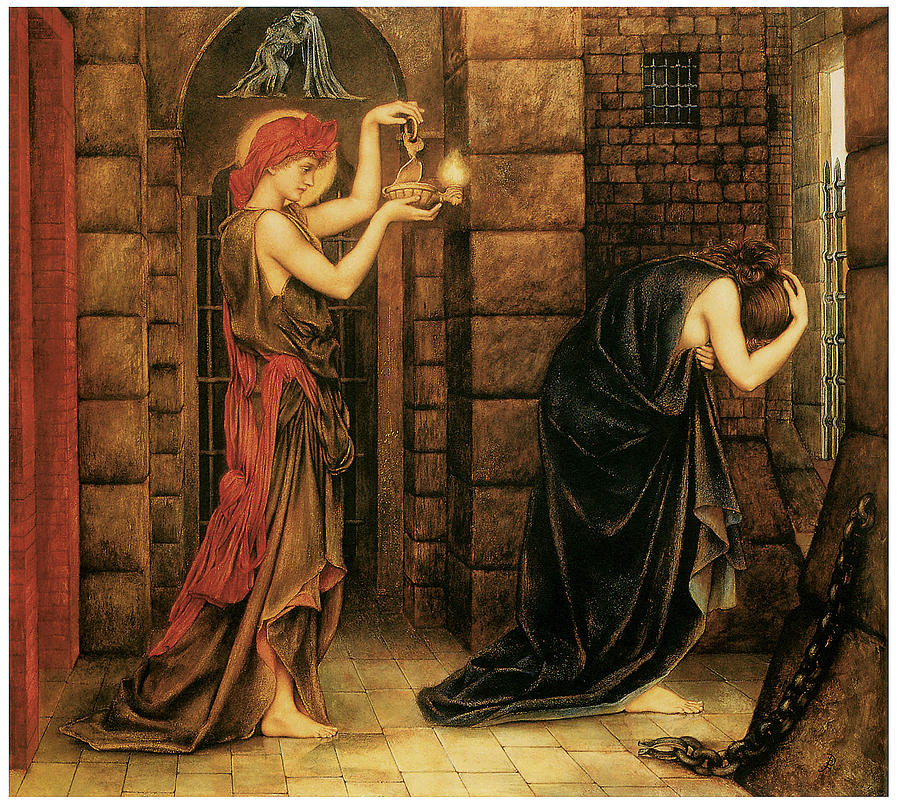
In his treatise on the theological virtue of hope, Aquinas clearly affirms that the hope of the “wayfarer” is certain. Here is the entirety of this remarkable article:
Whether there is certainty in the hope of a wayfarer?
Objection 1. It would seem that there is no certainty in the hope of a wayfarer. For hope resides in the will. But certainty pertains not to the will but to the intellect. Therefore there is no certainty in hope.
Objection 2. Further, hope is based on grace and merits, as stated above (Question 17, Article 1). Now it is impossible in this life to know for certain that we are in a state of grace, as stated above (I-II, 112, 5). Therefore there is no certainty in the hope of a wayfarer.
Objection 3. Further, there can be no certainty about that which may fail. Now many a hopeful wayfarer fails to obtain happiness. Therefore a wayfarer’s hope has no certainty.
On the contrary, “Hope is the certain expectation of future happiness,” as the Master states (Sent. iii, D, 26): and this may be gathered from 2 Timothy 1:12, “I know Whom I have believed, and I am certain that He is able to keep that which I have committed to Him.”
I answer that, Certainty is found in a thing in two ways, essentially and by participation. It is found essentially in the cognitive power; by participation in whatever is moved infallibly to its end by the cognitive power. In this way we say that nature works with certainty, since it is moved by the Divine intellect which moves everything with certainty to its end. In this way too, the moral virtues are said to work with greater certainty than art, in as much as, like a second nature, they are moved to their acts by the reason: and thus too, hope tends to its end with certainty, as though sharing in the certainty of faith which is in the cognitive faculty. This suffices for the Reply to the First Objection.
Reply to Objection 2. Hope does not trust chiefly in grace already received, but in God’s omnipotence and mercy, whereby even he that has not grace, can obtain it, so as to come to eternal life. Now whoever has faith is certain of God’s omnipotence and mercy.
Reply to Objection 3. That some who have hope fail to obtain happiness, is due to a fault of the free will in placing the obstacle of sin, but not to any deficiency in God’s power or mercy, in which hope places its trust. Hence this does not prejudice the certainty of hope. [2]
Furthermore, the object of this certain hope is nothing less than eternal happiness:
As stated above (Article 1), the hope of which we speak now, attains God by leaning on His help in order to obtain the hoped for good. Now an effect must be proportionate to its cause. Wherefore the good which we ought to hope for from God properly and chiefly is the infinite good, which is proportionate to the power of our divine helper, since it belongs to an infinite power to lead anyone to an infinite good. Such a good is eternal life, which consists in the enjoyment of God Himself. For we should hope from Him for nothing less than Himself, since His goodness, whereby He imparts good things to His creature, is no less than His Essence. Therefore the proper and principal object of hope is eternal happiness. [3]
Thomas Aquinas, the greatest and most representative Catholic theologian of all time, taught that we can enjoy certainty of eternal life. I was an Evangelical Protestant seminarian when I first read this bit of the Summa. I must confess that finding such a simple and unabashed affirmation of assurance from such a source took me by complete surprise. After all, assurance of salvation was supposed to be a Protestant thing, one of the really big benefits of not being Catholic. It is true that Aquinas teaches, in language echoed by Trent, that one cannot know with “indubitable knowledge” that he is either in a state of grace or among those predestined to glory. Furthermore, he insists that we should fear the possibility of falling away from God, and that many a hopeful wayfarer does indeed fall away. St. Thomas goes on to argue, however, that certain kinds of fear are not intrinsically evil, that the fear of losing God’s friendship (filial fear) is in fact a good kind of fear, and that this fear is completely consistent with the assurance of hope. [4]
Hope, according to Aquinas, proceeds from faith in the mercy and omnipotence of God, who wills all men to be saved. [5] Filial fear is based upon an awareness of the possibility that we can choose to reject God’s friendship. [6] However, the certainty of hope is not opposed to such fear, but to despair. Therefore, unless we despair of our own salvation (and to do so is a mortal sin), we can and should live in hope. In hope, we enjoy the assurance that we will receive all the help necessary to attain final salvation. Thus, hope does not only look to the end to be obtained (final salvation/eternal happiness), in which case it would be indistinguishable from fortitude, but also to the present divine help by which we are enabled to obtain that end. In other words, there is an immediate as well as an eschatological aspect to hope. Those who faithfully receive the divine promises are to rejoice in the assurance of eternal life as a work that God has already begun in us and which he will bring to completion on the Day of Judgment. [7]
Catholics believe that the seven sacraments of grace are the principle means by which we receive the promises of God in Christ Jesus and are enabled to obtain eternal life. Neal Judisch has recently pointed out the advantages of sacramental assurance over the typical Evangelical/Reformed construct of “reflexive” assurance. In the first half of the article, Neal addresses the content of assurance, distinguishing between the various things, with respect to their own salvation, that Christians claim to be certain about. He then considers the grounds of assurance, suggesting that assurance is better grounded upon the objective criteria of the sacraments (he focuses upon Baptism) than upon the subjective criterion of one’s own faith.
Concerning the role of the sacraments in our salvation, Aquinas writes:
Since, however, the death of Christ is, so to say, the universal cause of human salvation, and since a universal cause must be applied singly to each of its effects, it was necessary to show men some remedies through which the benefit of Christ’s death could somehow be conjoined to them. It is of this sort, of course, that the sacraments of the Church are said to be. [8]
Since sacraments conjoin us to Christ’s Passion, which is the “universal cause of human salvation,” it stands to reason that they are a proximate source of assurance. When directly addressing the question of assurance, however, St. Thomas simply appeals to the ultimate source of assurance: God’s omnipotence and mercy. This leads him to make that most interesting affirmation about the certainty of hope:
Hope does not trust chiefly in grace already received, but on God’s omnipotence and mercy, whereby even he that has not grace, can obtain it, so as to come to eternal life. Now whoever has faith is certain of God’s omnipotence and mercy. [9]
St. Thomas here affirms the necessity of sanctifying grace, which makes us holy, and enables us to do works pleasing unto God for salvation. One must “obtain it, so as to come to eternal life.” However, for Aquinas, it is not “grace already received,” but “God’s omnipotence and mercy” that is the object of faith by which we arrive at the certainty of hope. Although he need not arrive at any definitive conclusions about his own interior disposition towards salvation (i.e. whether he is in a state of grace), the man who looks to God in hope must not presume that reconciliation with God does not include being translated into a state of grace, whereby we are cleansed from our sins and enabled to do good works.
To be truly assured of salvation, one must desire that salvation which God promises to give, which essentially includes withdrawal from sin and service to God. [10] St. Thomas equates a presumptive hope–one that desires an antinominian form of salvation–with “the sin against the Holy Spirit.” [11] Unlike genuine hope, presumption is contrary to the intellectual virtue of faith:
Moreover [presumption] is conformed to a false intellect, just as despair is: for just as it is false that God does not pardon the repentant, or that He does not turn sinners to repentance, so is it false that He grants forgiveness to those who persevere in their sins, and that He gives glory to those who cease from good works: and it is to this estimate that the movement of presumption is conformed. [12]
Therefore, St. Thomas’ claim that the assurance of hope is not founded upon “trust … in grace already received” ought not be taken to mean that sanctifying grace and good works are not necessary for salvation. Clearly, they are. And just as clearly, they are not the object of hope by which we enjoy assurance of salvation.
What, then, is the relation between the assurance of hope and the possession of sanctifying grace with the virtue of charity (which is the principle of good works)? I will attempt a brief answer with reference to the three theological virtues:
Faith that gives rise to the assurance of hope is focused upon God, not (primarily) upon the subject who has faith, nor upon any condition of that subject (e.g., being in a state of grace). God as revealed in Christ Jesus is the object of saving faith. Thus, hope does not trust chiefly in grace already received, but in the promise of grace. Hope, in this God-oriented sense, disposes the believer to love God. When a man turns to God in desire for and expectation of the good that God actually promises to give, the good that he seeks to enjoy is God himself, which good is an end in itself. When one enjoys God as an end in himself, he is in a state of sanctifying grace, which includes the gift of charity. This is a foretaste of eternal happiness. Even though the object of hope is not sanctifying grace, nor inhering charity, the exercise of hope subjectively tends towards such grace and charity, since it tends towards God in his offer of eternal friendship. [13]
God is love. Charity begins with God, and is poured into our hearts by the Holy Spirit of God when we turn to him in repentance and faith. Through faith, hope finds assurance in the love of God as it is expressed “for me” in the promise of the Gospel. The love of God poured out in our hearts, i.e., sanctifying grace, including the gift of charity, is not the proper object of hope, but it is objectively related to hope in that the love of God poured into our hearts is the Holy Spirit in us, the same Spirit who, as the third person of the omnipotent and omnibenevolent Holy Trinity, is the object of our hope.
If we keep in mind the distinction between God for me (the object of hope) and God in me (sanctifying grace, the gift of the Holy Spirit, infused charity), we can better understand how St. Thomas can unequivocally affirm both full assurance of eternal life while denying that one can know, with the full certainty of faith, that he is in a state of grace. Simply speaking, the state of one’s own soul is not the direct object of the assurance of hope. God is. We look to God in the hope that he will do a good work in us, as he has promised. That hope does not disappoint, for God is merciful and powerful on our behalf. Faith is the beginning of hope, hope is the beginning of charity, and charity perfects faith and hope by directing them to their goal, which is eternal happiness in friendship with God. [14]
Thus, the hope that looks to God for the good that God actually offers is a hope that is tending towards the virtue of charity but not focused on the virtue of charity (or any other inherent quality or virtue), precisely because it is focused on charity as embodied in Christ and offered by God in the promised gift of the Holy Spirit.
The Council of Trent is quite compatible with St Thomas’ teaching on this point. Trent is sometimes taken as the “anti-assurance” Council because it teaches that one cannot know with the certainty of faith that he is in a state of grace or has been given the gift of final perseverance. But this is just to say that no quality in ourselves is the object of faith by which we come to the assurance of hope. This is identical to the teaching of St. Thomas, who affirmed the certainty of hope. I conclude with the following affirmation of the Council of Trent, which, it seems to me, strikes a definite Thomistic note:
Now, they [the adults] are disposed to that justice when, aroused and aided by divine grace, receiving faith by hearing, they are moved freely toward God, believing to be true what has been divinely revealed and promised, especially that the sinner is justified by God by his grace, through the redemption that is in Christ Jesus; and when, understanding themselves to be sinners, they, by turning themselves from the fear of divine justice, by which they are salutarily aroused, to consider the mercy of God, are raised to hope, trusting that God will be propitious to them for Christ’s sake; and they begin to love Him as the fountain of all justice, and on that account are moved against sin by a certain hatred and detestation, that is, by that repentance that must be performed before baptism; finally, when they resolve to receive baptism, to begin a new life and to keep the commandments of God. [15]
______________
[1] I must note at the outset that my thinking on this topic has been stimulated by Fr. Stephen Pfurtner’s insightful contribution to ecumenical theology, Luther and Aquinas on Salvation (New York: Sheed and Ward, 1964). For an overview of Thomistic soteriology, as well as an analysis of the influence of St. Thomas on the Council of Trent, see Bryan Cross’s series of articles at Called to Communion, Aquinas and Trent, Parts 1–7, beginning with this article.
[2] Summa theologiae, II-II, q. 18, a. 4.
[3] Ibid., II-II, q. 17, a. 2.
[4] Ibid., II-II, q. 19.
[5] Ibid., II-II, q. 18, a. 4.
[6] Ibid., II-II, q. 19, a. 9.
[7] Philippians 1:6; 2 Timothy 1:12
[8] Summa contra Gentiles, trans. Charles J. O’Neil (Garden City, NY: Image Books, 1957), 4:56, 1.
[9] Summa theologiae, II-II, q. 18, a. 4.
[10] Acts 26:20
[11] Summa theologiae, II-II, q. 21, a. 1.
[12] Ibid., II-II, q. 21, a. 2.
[13] Ibid., II-II, q. 23, a. 8.
[14] Ibid., II-II, q. 17, a. 8.
[15] The Council of Trent, Session VI, Chapter 6.

This Work from Thomas Aquinas on Assurance, is so well placed into todays discussions, with non-Catholics. I have always enjoyed reading Thomas Aquinas. He does a great job on explaining the for and against each question using reason and explaining Divine Revelation of God. Thank You God for using your servant Thomas for your work.
Andrew,
Your post on Thomas is fascinating, to say the least. Some of the topics covered in it (i.e. “assurance is better grounded upon the objective criteria of the sacraments (he focuses upon Baptism) than upon the subjective criterion of one’s own faith”) bring to mind this fabulous presentation from Phillip Cary (an Anglican):
https://www.scribd.com/doc/2269563/Sola-Fide-Luther-and-Calvin-by-Phillip-Cary
That said, I must confess that Thomas is quite hard to understand for me, as his thought-categories are often quite foreign to mine. As if Aristotle was not difficult enough to comprehend! I know we don’t remain children (childish) in one sense, but we are always to remain child-like (hence the title of my blog and this latest post complements of First Things (of all places! : ) ) : https://infanttheology.wordpress.com/2011/12/01/to-train-children-we-must-become-children-with-them/ )
I tend to think that even if Thomas was largely on the right track here (interestingly, one of the greatest of the Lutheran theologians, John Gerhard, really did like St. Thomas – it would be interesting if he uses Thomas’ views on confidence of salvation vs. Rome in his magnum opus, which argued *only from RC sources* that the Lutheran church was the true Church [to my knowledge, people from Rome never really responded to this, like they had with Chemnitz’s magnum opus, the Examen of Trent, before ]), Trent sounds a much different note on this topic of the confidence of faith (even if “If any one saith, that justifying faith is nothing else but confidence in the divine mercy which remits sins for Christ’s sake… let him be anathema” is true, why not clarify that it is not true insofar as we are talking about the forgiveness, life, and salvation that is freely given in confession and absolution for those broken souls who seek it and the revitalization if offers?) Again, I realize that all of the statements of Trent need to be taken together, but it seems to me that the treatment of Luther himself is evidence that Thomas’view, if it is what you say it was, was not the view of the Roman curia by the early 16th century. The reason for this, I suspect, is that the legalisms and complicated intricacies of the Roman penitential system had clouded the perhaps better thinking of Thomas. That said, the RPS (for short) largely had its grounding in Thomistic thought, which of course, was a fusion of Scripture and Aristotle (can I get you to at least admit that this *could* lead to problems? : ) )
Do “We can enjoy certainty of eternal life” and “one cannot know with “indubitable knowledge” that he is either in a state of grace” go together? Well, of course Lutherans insist that as we grow in our Christian life, faith only continues to live in repentance as regards God’s laws. And of course, we would reject the “sinful presumption” that Thomas rejected (but do Trent, Bellarmine, etc. have the same definition of “sinful presumption”? I have real doubts here: it seems “antinomian” now has come to mean “anyone who does not submit to the Roman curia”!). In any case we would deny the second phrase just for the reasons Thomas cites: because even in the midst of our doubts, we know that children simply take people at their words (even if we can’t not reflect on our faith as adults, we know we ought to be like children, and it is Satan, who, using our intellect, tempts us not to – for more on this see the posts below, particularly the second one).
Maybe there is more compatibility here than I realized, but I hope you will understand that, given that I feel that Rome has been less than forthcoming in many ways (i.e. the failure to deal honestly with the importance of the different definitions of terms in the Joint Declaration on Justification: yes, the Lutherans involved are culpable to for this) I really have my doubts. If you have time, I wonder if you might be willing to look at and respond to these two posts (not at my blog) as it relates to what you have written here:
https://infanttheology.wordpress.com/2011/11/23/forgiveness-free-and-true-the-crux-of-the-reformation-the-essence-of-the-christian-life/
https://infanttheology.wordpress.com/2009/07/31/babies-in-church-part-v-the-arrogance-of-the-infant-a/ (part b, which would not be as important is here: https://infanttheology.wordpress.com/2009/07/31/babies-in-church-part-v-the-arrogance-of-the-infant-b/ )
Nathan,
Thanks for reading the post. I will check out the links you provided. I do think that on some points, assurance being one of them, Catholics and Lutherans are closer together than is sometimes supposed. For more along this line, I recommend the book by Fr. Stephen Pfurtner, Luther and Aquinas on Salvation.
In its teaching on assurance, Trent had in mind the assurance of faith (apart from a special revelation), not the assurance of hope (which is the subject of this post). Furthermore, the Council did not rule out the possibility of arriving at some kind of certainty that one is in a state of grace. Catholics can take great comfort in the promise of the Gospel, being assured that it is indeed “well with my soul.” That has a lot to do with taking God at his word, both in the hearing of scripture (e.g., “he who believes in me has eternal life”; “there is therefore no condemnation to them that are in Christ Jesus”) and in the reception of the sacraments (“I baptize you in the Name of the Father, and the Son, and the Holy Spirit”; “I absolve you of your sins…”; “this is my Body, which is given for you”; etc.) The difference between this sort of confidence, and the certainty of faith, is that the latter rests upon a proposition as having been divinely revealed, whereas the former is more of an inductive certainty, based upon a variety of factors (both objective and subjective) other than what has been explicitly revealed.
One of the reasons that St. Thomas, and his philosophical guide, Aristotle, seemed strange and difficult to me was the unfamiliar and at times off-putting emphasis on the virtues (and the opposing vices) in their description of the good life (i.e., authentic happiness). However, once I began to pay more attention to similar language throughout Scripture, especially in the New Testament, those treatises began to click a bit more. The crux that brought it all together, the Gospel and the virtues, faith and obedience, was the Catholic doctrine of grace. (See Sean Patrick’s article, Sola Gratia, for a comparison of the Catholic doctrine of grace with the Protestant Reformed doctrine.)
I thought the assurance of hope comes from and is based on faith, so how can you have one without the other?
“Furthermore, the Council did not rule out the possibility of arriving at some kind of certainty that one is in a state of grace.”
Right, by special revelation. :) Seriously, your evidence?
“The difference between this sort of confidence, and the certainty of faith, is that the latter rests upon a proposition as having been divinely revealed, whereas the former is more of an inductive certainty, based upon a variety of factors (both objective and subjective) other than what has been explicitly revealed.”
I’ll be interested in your response to my links.
Andrew,
Interestingly, the White Horse Inn recently had a show related to this: https://www.whitehorseinn.org/blog/2011/11/27/whi-1077-repentance-personal-transformation/
Of course, I am Lutheran, but they make some good points, especially as regards how the doctrine of penance (in RC and some strains of Protestantism) causes us to look inward again as regards the issue of confidence of peace with God.
+Nathan
Nathan,
One cannot have hope, in St. Thomas’s sense, without faith. Hope is based upon faith, but not reducible to faith. Faith accepts the Gospel as divine truth, and hope receives that truth as good news “for me.”
Chapter XII of Session VI (Trent) refers to the possibility of “absolute certainty” of predestination to life, which knowledge can only come by special revelation. In my last comment, I had primarily in mind assurance of being in a state of grace, though I did not mean to rule out assurance of predestination. The evidence from Trent for a kind of “moral certainty” or comforting assurance other than the absolute certainty of faith lies in the phrases and adjectives that qualify the noun “certainty,” both in Chapter XII and in the Canons that touch upon the matter of assurance (emphasis added):
Among other things, this is to say that our faith is not in faith (Canons 13 and 14), and that the status of one’s own soul and eternal destiny are not among the articles of faith (Canons 15 and 16), to which pertain “absolute and infallible certainty.” The qualifying language (which I emphasized), furthermore, would be entirely gratuitous if the Church denied that, apart from special revelation, Christians could enjoy some form of certainty, and corresponding assurance, about their spiritual condition and eternal destiny.
Concerning the last bit of your comment, where you quoted me: Taylor Marshall fleshes this out a bit in his post Signs of Predestination — A Catholic Discusses Election. Tom Brown also raises a relevant point in Conditional or Unconditional Assurance. Their focus is on the “conditional,” “internal,” or “subjective” aspects of assurance, which complements the “objective” aspect discussed in Neal Judisch’s post on assurance and St. Thomas’s analysis of the virtue of hope.
(Sorry to bombard you with links. Its just that there are many aspects to this topic, and I wanted anyone following this thread to be aware of some of the related discussions that have taken place here.)
Andrew,
I may not be able to get to this for a while. But we are discussing on a two-year old post, so I think that will be OK. : )
+Nathan
Andrew,
All of the following I wrote before reading the Neal Judisch essay:
First things first. You wrote:
“It is true that Aquinas teaches, in language echoed by Trent, that one cannot know with “indubitable knowledge” that he is either in a state of grace or among those predestined to glory.”
Let’s not worry about a person having “indubitable knowledge” that they are “among those predestined to glory”. Some Lutherans did think this, but in our Confessions we learn that any double predestination that Luther some people assert that he must have held is rejected and that Christians can indeed lose their faith, or fall away from God (like Thomas). We certainly should have the filial fear (or fear of losing God’s friendship) that he speaks of. So we are a different animal than the reformed. Let us only deal with the idea that one can, in the present, know that they are at that time in a stable relationship with God (i.e at peace with Him). Such that, if they were to drop dead at that moment, they would die in a state of grace and obtain the blessed eternal life that is in His Presence.
Now, in your last comment you said:
“Among other things, this is to say that our faith is not in faith (Canons 13 and 14), and that the status of one’s own soul and eternal destiny are not among the articles of faith (Canons 15 and 16), to which pertain “absolute and infallible certainty.”….
I think we agree with these. From my viewpoint, these anathemas do not “hit” the Lutherans.
You go on to say:
“..The qualifying language (which I emphasized), furthermore, would be entirely gratuitous if the Church denied that, apart from special revelation, Christians could enjoy some form of certainty, and corresponding assurance, about their spiritual condition and eternal destiny.”
Yes, as you pointed out, one can have a “moral certainty”. My beef is with all the distinctions Roman Catholics make among the kinds of certainty. Where are the specifics definitions for what these kinds of certainties are, how they play out on the ground, and what is the underlying reasons (presuppositions) for these definitions?
I don’t doubt for a minute that these distinctions can be useful in this or that situation, but when Jesus says that we won’t enter the Kingdom of Heaven unless we become like a child, I suggest that He is giving us a clue that such philosophical thinking should not cloud the more basic issue. Can a person falsely be confident that they are in a state of grace? Of course. That does not mean that all persons have a false confidence. If I say I have confidence – what I would be willing to call “indubitable knowledge” – that I am in a very strong and healthy and stable relationship with my wife, you can either disbelieve me or take my word for it. If you believe me, you are putting your trust in my judgment of the situation. Is this something I can know? Of course it is – even as other marriages around us drop like flies/go to hell. The situation is analogous with God. Well, there is no reason that things like “indubitable knowledge” and confidence/certitude/ psychological certainty need be opposed. The question is what constitutes warrant for certainty in one’s personal relationships, period. And here, as I said earlier, I think you are on the right track in recognizing that Luther said that we should not look inward, but put our trust in the rock-solid promises of God applied to us.
Some questions about your initial essay:
Thomas says that an objection to the certainty of *hope* is that “there can be no certainty about that which may fail, but notes that certainty is found not only in discovering the essence of things (I think this is what he means), but also by participation (note he also says that another objection is that “hope resides in the will” and “certainty pertains not to the will but to the intellect”, and I am not sure in any case I would fully agree with him here – it’s hard for me to know where he gets this or what he really means by it…).
Can you explain in different words his answer to the first objection? It seems to me that Thomas is saying that one can have the certainty of hope if one participates in the whole teleological structure that God has established: bringing things to certain completion as He has planned to do. In other words, it is in one’s continual participation in this process by which one has hope. Is this correct?
I think this is what you are saying when you say the following about Thomas’ view:
“In hope, we enjoy the assurance that we will receive all the help necessary to attain final salvation. Thus, hope does not only look to the end to be obtained (final salvation/eternal happiness), in which case it would be indistinguishable from fortitude, but also to the divine help by which we are enabled to obtain that end.”
I think we would definitely say something similar – although we would talk about the importance of retaining a living faith that continues to look outward to Christ’s objective Promises (which one can’t really do apart from the presence of true repentance). We would look at a passage like the end of Romans 8 as being written precisely to encourage believers in this kind of hope.
In reply to Objection 2 Thomas says: “Hope does not trust chiefly in grace already received, but on God’s omnipotence and mercy, whereby even he that has not grace, can obtain it, so as to come to eternal life. Now whoever has faith is certain of God’s omnipotence and mercy”
And here, I suspect that Trent means that one is certain, by faith, of God’s omnipotence and mercy, but not necessarily in one’s own case, period. But is seems you are saying there is actually a legitimate debate among interpreters of Thomas regarding what he means here… In my simple reading of what you have provided here, it seems clear that he is talking precisely about certain individuals being certain of God’s mercy [and omnipotence] ***in their case****. Of course, you say, “Hope is based upon faith, but not reducible to faith. Faith accepts the Gospel as divine truth, and hope receives that truth as good news “for me.”
You see, we would call that faith itself. We would say that faith, which is basically trust, knowledge and assent (with infants it would be almost all trust, with the other things developing as the spiritual life grows), is that which receives the truth as good news “for me”. Hope might be the confidence that we not only have faith now, but that God will give us all we need to persevere, because all is rooted in the work of Christ that He has shared with us in the seed of our baptism. As you say: ““Hope, according to Aquinas, proceeds from faith in the mercy and omnipotence of God, who wills all men to be saved. (ST, II-II, q. 18, a. 4.)”
Also, I assume here it is safe to say that in RC theology, faith is more about what the intellect knows, and assents to (it is not that trust is not an element of faith here, but…). In our view, faith, in order to be real faith, needs to have trust as a component, and needs to be trusting the right thing (so the faith James talks about, which the devils share, is not really true faith) – and faith is living and active – where there is smoke (faith) there is fire (love and good works).
In reply to Objection 3 he says: “That some who have hope fail to obtain happiness, is due to a fault of the free will in placing the obstacle of sin, but not to any deficiency in God’s power or mercy, in which hope places its trust. Hence this does not prejudice the certainty of hope.”
What does he mean when he talks about hope placing its trust in God’s power or mercy? Is it not the person who trusts God’s mercy? Or, if we are going to talk about these things that occur in persons apart from the persons, do we not still say that *faith* places its trust in God’s power and mercy (for me), before hope does? Is not our hope based on our faith, or trust in God’s mercy? (maybe this is what he is saying?)
St. Thomas:
“Since, however, the death of Christ is, so to say, the universal cause of human salvation, and since a universal cause must be applied singly to each of its effects, it was necessary to show men some remedies through which the benefit of Christ’s death could somehow be conjoined to them. It is of this sort, of course, that the sacraments of the Church are said to be. (Summa contra Gentiles 4:56, 1, trans. Charles J. O’Neil [Garden City, NY: Image Books, 1957].)”
Right. And this is why, for example, when a pastor pronounces absolution – and we really trust His words – we can have certainty of salvation at that moment. It is not “special revelation” in the same way the Scriptures are, but it is a revelation that is personally applied to us, and is to be believed/trusted in. This, as best as I can tell, was one of the main reasons that Luther was excommunicated. This arrogant monk had a confidence in God’s mercy – and God’s desire to spread His mercy – in a way that undermined the goals and desires of the RC church in his day.
To touch on the other concerns in your essay, Luther did not presume that one could obtain pardon without repentance. He also would have never said that a person who was not sanctified would be saved. His concern was pastoral: that persons who had a deep knowledge of their sin (i.e. like the wicked in Romans 4:5) would not trust in themselves or their own merits God had put in them before His seat, but would look outside of themselves to the merits of Christ and His mercy, given in His Means of Grace. Again, Luther would have never said that the justified man (reconciled with God and having the future Promise of glory) is not cleansed from sin by the Holy Spirit (and also saved to do good works, which are certainly necessary for the Christian). He simply wanted to focus person’s eyes on the mercy of God to cover their sinfulness and all the sins they knew they had commited before God (and regretted). Is this the sin against the Holy Spirit, which Scripture seems to say is attributing the good works of God to Satan? Evidently not, because you conclude: “Faith that gives rise to the assurance of hope is focused upon God, not upon the subject who has faith. God as revealed in Christ Jesus is the object of saving faith” and “The love of God poured out in our hearts (i.e. sanctifying grace) is not the proper object of hope”
But again, I am by no means convinced that Trent would agree with you.
We will persevere in sins though – although this is not what we want. The Christian is the one who knows their sin, confesses it, and longs to be rid of it. We do not “continue to sin” in this way (per I John). We also know that we will not be rid of it until we die or Christ returns (per I John). Our whole life is one of repentance. If you search for “Transformation Failure” and “theology like a child” you will pull up my post that deals with the struggle here.
+Nathan
Andrew,
Here’s that post I mentioned in my last paragraph: https://infanttheology.wordpress.com/2009/12/23/transformation-failure-3/
Andrew,
After I had read Dr. Judisch’s *first paragraph*, I quickly wrote down the following (as I thought that I knew where he was going):
“ the author says, “By ‘strict certainty’ I mean a kind of epistemic certainty implying the impossibility of being wrong given the internal evidence before you – given, that is, the evidence accessible to your consciousness and/or instrospective awareness – and not necessarily a form of certainty which deals in psychological feelings of confidence or certitude.)”. I don’t doubt for a minute that these distinctions can be useful in this or that situation, but when Jesus says that we won’t enter the Kingdom of Heaven unless we become like a child, I suggest that He is giving us a clue that such philosophical thinking should not cloud the more basic issue. Can a person falsely be confident that they are in a state of grace. Of course. That does not mean that all persons have a false confidence. If I say I have confidence – what I would be willing to call a “strict certainty” (when Dr. Judisch says “Everybody seemed to agree, at least at various points in their reflections, that you might not have (do not have?) strict certainty regarding… whether you are currently justified (or “saved”)” I fundamentally disagree with him – ) -that I am in a very strong and healthy and stable relationship with my wife, you can either disbelieve me or take my word for it. If you believe me, you are putting your trust in my judgment of the situation. Is this something I can know? Of course it is – even as other marriages around us drop like flies/go to hell. The situation is analogous with God. Well, there is no reason that “strict certainty” and confidence/certitude/ psychological certainty need be opposed. The question is what constitutes warrant for certainty in one’s personal relationships, period. I would be interested in knowing what Dr. Judisch considers to be things that we can have “strict certainty” about.
BUT then I read on to see him say:
“It’s possible that a person who is justified at a time is able to have strict certainty that he is justified at that time, without its being the case that he can have strict certainty that he is among the elect.”
!!!
…and many other amazing statements in support of Luther and his views! Remarkable. I have *never* seen such an endorsement of Luther’s views on these issues from a Roman Catholic.
That said, at the end of my last post to you, I noted the following:
“Luther did not presume that one could obtain pardon without repentance. He also would have never said that a person who was not sanctified would be saved. His concern was pastoral: that persons who had a deep knowledge of their sin (i.e. like the wicked in Romans 4:5) would not trust in themselves or their own merits God had put in them before His seat, but would look outside of themselves to the merits of Christ and His mercy, given in His Means of Grace. Again, Luther would have never said that the justified man (reconciled with God and having the future Promise of glory) is not cleansed from sin by the Holy Spirit (and also saved to do good works, which are certainly necessary for the Christian). He simply wanted to focus person’s eyes on the mercy of God to cover their sinfulness and all the sins they knew they had commited before God (and regretted). Is this the sin against the Holy Spirit, which Scripture seems to say is attributing the good works of God to Satan? Evidently not, because you conclude: “Faith that gives rise to the assurance of hope is focused upon God, not upon the subject who has faith. God as revealed in Christ Jesus is the object of saving faith” and “The love of God poured out in our hearts (i.e. sanctifying grace) is not the proper object of hope”
But again, I am by no means convinced that Trent would agree with you.”
Even if, as Dr. Judisch notes, Alister McGrath says the following:
“Trent’s point seems to be that the reformers seemed to be making human confidence or boldness the grounds for justification, so that justification rested upon a fallible human conviction, rather than on the grace of God. The reformers, however, saw themselves as stressing that justification rested upon the promises of God; a failure to believe boldly in such promises was tantamount to calling the reliability of God into question.”
…I maintain that this is very likely not the case. I think this is what a lot of people *want* to be true (this reminds me of many of the things that find man, Al Kimmel [the Pontificator] would write about n his blog many years ago), but that it really is not. Luther had made it very clear in his writings that what he and the Lutherans were talking about was alien righteousness and even alien faith. It seems to me that this is precisely what got him condemned, over and over. If Luther did in fact agree with Thomas, Trent did not.
I’d rather this not be the case, but I’m quite confident that it is. I think it would take some very, very solid evidence to convince me otherwise. Though not as confident as I am that I am in a state of grace via the external Promise of God alone. : )
Best regards,
Nathan Rinne
Nathan,
Thanks for the responses. I’ll try to read and reply later this week.
(By the way, though I first posted this more than two years ago, it has recently been much revised, so to tie up some loose ends. The current version reflects a bit of the thinking that I have done on this subject over the past two years. The main thesis is the same, but the details are, I hope, better understood and expressed. Again, I look forward to interacting with your comments and reading the material to which you have referred.)
Andrew
Nathan,
I read the material on your blog and listened to the White Horse Inn podcast. Let me just say that we have many of the same concerns, though perhaps significantly different (not completely different) ways of addressing those concerns. Here are some replies to your comment #8:
You wrote:
Certainty, or perhaps more accurately, certitude, is a subjective condition relative to a variety of factors. Perhaps some examples will convey my meaning, and at least by implication address the several aspects of your question:
1. I am certain that God is love, and that God loves me. These certainties are based upon what I know (through reason and revelation) about the nature of God and the operations of God. This is what gives rise to the certainty of hope, regarding God’s provision for my own salvation.
2.I am certain that he who has begun a good work in me (at Baptism) will bring it to completion on the Day of Judgment. This is the certainty of hope.
3. I am certain that the law of non-contradiction is true, because it is impossible to deny it without invoking it. It is rationally inescapable.
4. I am certain that Adam and Eve are historical persons, because this has been revealed by God in Sacred Scripture, as interpreted by the Catholic Church (this interpretation being evinced by the unanimous consent of the Fathers and the explicit teaching of Pope Pius XII).
5. I am certain that the country of Canada lies immediately to the north of the contiguous United States. This certainty is the result of overwhelming and virtually undisputed testimony. (Granted, the idea of Canada does sometimes seem far-fetched to us Americans, but only a real kook would deny that that country actually exists!)
6. I am certain that my brother does not intend to murder me. This certainty is founded upon long, personal experience, including knowledge of his character.
7. I am also certain that the dispatcher in Pittsburgh whom I call each evening when I have finished work does not intend to murder me. This certainty is pretty much founded on a “no reason to think such a thing” basis.
The different kinds or classifications of certainty / certitude (however many they might be; on the one hand: knowledge, faith, hope, moral certainty; on the other hand: presumption, delusion) correspond to the different things of which one is certain, together with the conditions under which certainty obtains, and perhaps the differing significance and subjective “feel” of each instance of certainty (although the latter can vary somewhat from person to person and time to time). My confidence in God regarding salvation is an instance of the certainty or assurance of hope. My confidence in my brother is an example of what I mean by “moral certainty”; that is, although in the realm of logically possibility his intentions could be otherwise, and though God has not revealed my brother’s intentions to me, I am certain that he means me no mortal harm.
This same kind of certainty, moral certainty, to be distinguished from the certainty of the rationally inescapable, the certainty of faith, and the certainty of hope, can legitimately be enjoyed by Catholics with respect to being in a state of grace, at least in the sense that Trent seems not to disallow such moral certainty of grace, as indicated in comment #6. Of course, being morally certain of being in a state of grace is not a necessary condition of actually being in a state of grace.
I can have doubts about myself, and still trust in God for deliverance from sin and sustenance in a state of grace, so long as I make faithful use of the means of grace, especially going to Confession and Mass. For me, one usual result of this religious activity, especially right after a double dose of the sacraments–Reconciliation and Communion–is a kind of confidence, a moral certainty or certitude if you will, of being in a state of grace. Among the conditions or presuppositions underlying this sacramental certainty are a constant reliance on the mercy of God (“Lord, I am not worthy that you should come under my roof, but only say the word and my soul shall be healed”), the intention to obey his will, and a right understanding of the difference between mortal and venial sin.
It looks like your comments immediately following the above question track pretty well with my idea of moral certainty. The reason for making these distinctions is that the distinctions are there in reality. Not to see or not to acknowledge them could be a kind of ignorance and/or carelessness. Good philosophy is a remedy for such ills.
“Moral certainty” is not a logically inescapable kind of certainty. There could be cases in which one should be morally certain of something but is not. This might be due to incredulity, or scrupulosity, or some other contingent factor. Conversely, the credulous or presumptuous person might hope for or be morally certain of something that he should not be certain about. Some have argued that Martin Luther fit into both categories: the first as a Catholic, the second as a Protestant. I don’t know enough about Luther to opine on that.
Regarding the relation of faith and hope, I think that Protestants tend to include the latter in the definition of the former, while Catholic theology distinguishes these virtues by definition, and relates them psychologically. Such distinguishing and relating is the hallmark of St. Thomas’s Summa Theologica. You ask me to clarify or restate Thomas’s reasoning on the nature of hope and its relation to faith, and the relation of each to the faculties of intellect and will. For now, I will refer you to Thomas himself, in Question 17 of the section on hope, particularly Articles 6–8. That might help.
You wrote:
Well, I encourage you to read again the concluding quote from Trent, in the post. This seems to perfectly cohere with what St. Thomas says about the virtue of hope as related to faith and charity, focused upon God in Christ Jesus, for salvation.
Nathan,
A quick note on your comment #10:
You wrote:
Neal can speak for himself on this, but my perception is that he was not intending to affirm the Lutheran view of strict certainty of justification. Rather, he was affirming that it is logically consistent to be strictly certain of justification while not being strictly certain of being among the elect, granted the thesis that the two categories–(1) those who have been justified at some point in time, and (2) those who have been elected to final salvation/perseverance–are not coextensive.
Andrew,
Thanks for doing this. It might be a while before I can write again (but then again, I said that before… : ) ).
I’m guessing a week or so.
+Nathan
Andrew,
I have not read everything you wrote above yet, but I did notice this:
“Neal can speak for himself on this, but my perception is that he was not intending to affirm the Lutheran view of strict certainty of justification. Rather, he was affirming that it is logically consistent to be strictly certain of justification while not being strictly certain of being among the elect, granted the thesis that the two categories–(1) those who have been justified at some point in time, and (2) those who have been elected to final salvation/perseverance–are not coextensive.”
I hope you understand my frustration in talking with RCs about this issue. It is precisely things like this inability to be clear that make this discussion so difficult. Maybe he should go clarify his post as well (by the way, I think it might be better to re-issue the post as a 2nd, [or 3rd] edition, so people can compare how what you thought in the past has changed)
I’m hoping after I read your other comments I don’t feel the same way.
+Nathan
Nathan,
Sorry that you’re frustrated. The details of the doctrinal matters that separate Christians can be complicated. But in these discussions, it is necessary to move beyond popular generalization, especially to avoid caricature of positions other than one’s own. Also, it is necessary to be patient, in order to understand the theological framework that gives context to the various views of particular doctrines. Of course, there is a sense in which everyone who has faith apprehends the whole of the faith, simply and implicitly. This is a blessed truth, but the fact remains that those who have faith, in this sense, are not completely united in the faith. There are schisms among Christians. Figuring out why this is the case, trying to understand one another, and fostering the hope that these wounds can be healed in this life, so that the world might believe in Jesus, can involve some frustration. But I think that pursuit of the goal is worth that price.
Of course, it is good to express oneself as clearly as possible. I think that the distinction that Neal is drawing is quite clear. In fact, it is one that a Lutheran should be very comfortable with; i.e., the difference between strict certainty of justification right now, and strict certainty of being among the elect. After all, you guys, like Catholics, affirm that not every person who is at some point justified will finally be saved. As for my own post, I would rather modify one version than post multiple versions side by side. And I know that I am not always as clear as I could be in expressing my views. Sorry about that. Part of the function of a comment box is to give folks the opportunity to ask for clarification of claims and arguments, so to foster mutual understanding. If anything that I have written remains unclear to you, a cause of frustration, just point it out and I’ll do my best to clarify, as I am sure you would do for me.
Andrew
Andrew,
Not sure when I will have time to respond again (the Thomas thing you linked me to will take a while). I’ve got some questions though.
Do you know if the understandings of certitude found here (https://www.newadvent.org/cathen/03539b.htm) have their roots in St. Thomas? If so, can you help me locate this in his writings? If not, do you know about the time this way of distinguishing certitude arose?
Thanks for your patience.
+Nathan
Nathan,
St. Thomas, as a student and expositor of Aristotle, was familiar with the distinction between science and opinion, and with the kinds of certitude that pertain to the respective sciences, but I do not know if he distinguished between the kinds of certitude mentioned in the Catholic Encyclopedia article. As a Christian, he was of course familiar with the certitude of faith, which is again distinct from science. (For Thomas, following Aristotle, “science” is a strictly defined knowledge. This should not be confused with the modern sense of the term “science.”)
So far as I can tell, St. Thomas would correlate “metaphysical certitude” with science, and “physical certitude” and “moral certitude” with opinion, since he defines opinion broadly as pertaining to that which could be otherwise (i.e., the contingent).
What seems to be the case is that the article, without going against the basic distinctions enunciated by Aristotle and St. Thomas, discerns two “epistemic conditions” between science (strictly speaking) and opinion, namely, physical and moral certitude. Although these pertain to that which is contingent, they are in a certain sense immune to misgiving or doubt. Aristotle and Thomas pointed out the simple distinction between what is absolutely immune from doubt and what is not thus immune. The article discerns a further distinction, i.e., that which is practically immune from doubt, and thus builds upon the work of these great philosophers.
Thomas discusses these matters in his Commentary on Aristotle’s Posterior Analytics (see especially ch. 44, “Science Compared with Other Modes of Knowing”).
Update: You also asked when this sort of distinction, between metaphysical, physical, and moral certitude, is first found in philosophy. I did not mean to overlook that question. Others can give a more informed and therefore specific answer. In general, a lot of modern philosophy, Descartes being the fountainhead, focuses on the inward experience of the subject as a starting point for inquiry. This approach has its drawbacks, some of them serious, but with it has come an emphasis on epistemology unlike anything found in previous periods. Thus, philosophers in general, even those who think that modern philosophy gets off on the wrong foot, have paid close attention to variations in certitude. One can see the fruits of this inward turn in Christian thinkers ranging from Blessed John Henry Cardinal Newman (e.g., Grammar of Assent) to American analytic philosophers such as Alvin Plantinga (e.g., Warranted Christian Belief).
Andrew,
Hopefully, I will have another response soon.
In the meantime, I am wondering if you could clarify something for me:
“…As a Christian, he was of course familiar with the certitude of faith, which is again distinct from science. (For Thomas, following Aristotle, “science” is a strictly defined knowledge. This should not be confused with the modern sense of the term “science.”)
So far as I can tell, St. Thomas would correlate “metaphysical certitude” with science, and “physical certitude” and “moral certitude” with opinion, since he defines opinion broadly as pertaining to that which could be otherwise (i.e., the contingent).”
The certitude of faith, according to the Catholic Encyclopedia article, it says “It should be noted, too, that in the common opinion of theologians there is a greater certitude in divine faith than in any human science.” In other words, we can be even more certain about what the [Roman Catholic] Church teaches than any human science, including “metaphysical certitude”, correct?
Thanks again!
+Nathan
Nathan,
You asked:
Yes, that is correct.
This is why: The object of divine faith is nothing other than God himself. We believe in God by means of divine revelation, which in the fullest sense is God himself, the Word made flesh, who in turn sends the Holy Spirit of God, who testifies through the prophets and apostles. Because the Church is the mystical Body of Christ, whose animating principle, or soul, as it were, is the Holy Spirit, we believe the Church with the full assent of faith, just as we confess in the Nicene Creed, even though the Church is not the object of faith (the Holy Trinity is). The Church is the custodian of divine revelation, the “place” where we meet God as revealed in Jesus Christ. Therefore, we believe in God through believing the Church, and this includes the faithful reception of that which has been divinely revealed as made explicit by a doctrinal definition of the Church. If such a definition could be contrary to divine revelation, then the mystical Body of Christ with its animating principle, the Holy Spirit, would be a kingdom divided against itself. But a kingdom divided against itself cannot stand. The Church, however, cannot fall. So the Church, when expounding the meaning of divine revelation through a doctrinal definition intended to be binding upon all the faithful, cannot contradict the actual meaning of divine revelation. Nothing is more certain than the word of God, because God is truth itself. This is the basis of the certitude of faith, as well as the reason that this certitude surpasses even metaphysical certitude (the CE article reflects St. Thomas’s teaching on this matter). The certitude of faith encompasses “what the [Roman Catholic] Church teaches” because of the Church’s unique relation to divine revelation, as just described.
Andrew,
Thanks again for your comments. A couple quick points/questions
“We believe in God by means of divine revelation, which in the fullest sense is God himself, the Word made flesh, who in turn sends the Holy Spirit of God, who testifies through the prophets and apostles.”
Yes, I would simply add that when we trust God’s Word, we can see the visible manifestation of God in Christ for what it really is. Right hearing is critical here, because this is how we see God in Jesus in the concrete.
“we believe the Church with the full assent of faith, just as we confess in the Nicene Creed, even though the Church is not the object of faith (the Holy Trinity is).”
I do believe that “The Church is the custodian of divine revelation” and that we trust the Church (we go different places from here though…how this plays out on the ground). That said, of course Augustine says you are not reading Nicea correctly here.
“If such a definition could be contrary to divine revelation, then the mystical Body of Christ with its animating principle, the Holy Spirit, would be a kingdom divided against itself. But a kingdom divided against itself cannot stand.”
I see where you are going here, I think. What would you say about Paul talking about how there must be divisions to see who has God’s approval? How do you read that?
“The Church, however, cannot fall.”
Agreed. And it is visible. How big does it need to be do you think? : )
Nathan,
I wouldn’t want to oppose St. Augustine’s understanding of that article of the Nicene Creed. However, you didn’t specify where the opposition lies, so I cannot respond to your claim about the correct reading.
In any case, my gloss on the Creed was more of an inference than an interpretation; i.e., given that we “believe in one, holy, catholic, and apostolic church,” and given the nature of that church, it is unconscionable to reject the teaching of the church, when she declares and defines something as belonging to the deposit of faith.
In 1 Corinthians 11, St. Paul is addressing factions within a local church, not a supposed division of the universal Church.
The visible Church that Christ founded needs to be large enough to merit the adjective “catholic,” which is how the Fathers referred to that one Body spread throughout the known world, as distinct from schisms and the proliferating sects. In addition, the visible Church that Christ founded needs to be old enough to be traced back to Christ, obviously.
Andrew,
I may be able to make time to track down the Augustine quotation. As I recall, it is very clear though: he explicitly says the Creed is not to be understood in the way you put it.
I remember reading it here: https://www.amazon.com/Church-Theological-Commonplaces-Numbered/dp/0758618670 Gerhard is usually very careful with his quotations.
Your take on I Corinthians 11 I find to be interesting. We would say that this can certainly be extrapolated.
+Nathan
Andrew
“we have many of the same concerns, though perhaps significantly different (not completely different) ways of addressing those concerns”
I am interested in what overlap I have found by talking with you.
First of all, in the article I recently read at Brian Cross’ suggestion (New Advent on “certitude” which we have discussed here) two kinds of certainty were addressed, objective and subjective (also called “certitude”). I think both of these need to be addressed here, since this has to do in part with God’s objective promises made to an individual – things that have been explicitly revealed to that person by means of God’s messenger. In general, when those in the Apostolic ministry speak of revealed truth that applies to all, they are to be believed. And in general, when those in the Apostolic ministry *reveal* that God has forgiven *this or that person* – which brings “peace with God” (Romans 5:1) – they are to be believed. Before this is about the subjective this is about things that are objective.
First, I will comment on some of your kinds of certainty:
*I am certain that God is love, and that God loves me. These certainties are based upon what I know (through reason and revelation) about the nature of God and the operations of God (the second certainty is what gives rise to the certainty of hope, regarding God’s provision for my own salvation).
Yes, I understand and share.
*I am certain that he who has begun a good work in me (at Baptism) will bring it to completion on the Day of Judgment. This is the certainty of hope.
Yes. Are you saying you know you are currently saved (i.e. in a stable relationship with God, i.e. a state of grace) or, are you only saying that you know that if you have faith and love – and continue to follow in His paths – that you can have *a* moral certainty that you will be saved?
*I am certain that the law of non-contradiction is true, because it is impossible to deny it without invoking it. It is rationally inescapable.
Yes. It makes no sense to say it is raining and not raining in the same place at the same time.
*I am certain that my brother does not intend to murder me. This certainty is founded upon long, personal experience, including knowledge of his character.
OK. I believe you.
“My confidence in my brother is an example of what I mean by “moral certainty”; that is, although in the realm of logically possibility his intentions could be otherwise, and though God has not revealed my brother’s intentions to me, I am certain that he means me no mortal harm.”
Here may be where we disagree. Although you may think that it is in the realm of logical possibility that your brother may intend to kill you, would you agree that it is possible to know a person well enough that such “logical possibilities” cease to become logical? If not, why not? Just because every person who might have such confidence might not prove to be right? In addition, your example of certainty within the realm of relationships here is pretty weak, as mine dealt more with confidence in the stability and strength of a marriage relationship, i.e. a desire to continually love and forgive the other, not just a lack of a desire and intention to kill them.
You go on to say:
“This same kind of certainty, moral certainty, to be distinguished from the certainty of the rationally inescapable, the certainty of faith, and the certainty of hope, can legitimately be enjoyed by Catholics with respect to being in a state of grace, at least in the sense that Trent seems not to disallow such moral certainty of grace, as indicated in comment #6. Of course, being morally certain of being in a state of grace is not a necessary condition of actually being in a state of grace.”
“Amen” to the last sentence. Still, your first sentence: distinguished in what sense? Obviously in the sense that while a person who is certain of being in a state of grace may not be, a person who is certain about the teachings of the Catholic Church cannot be wrong (in your view). But how else is this moral certainty really to be distinguished from the certainty of faith and certainty of hope? Any other ways?
The quote from Trent you have been using says:
Now, they [the adults] are disposed to that justice when, aroused and aided by divine grace, receiving faith by hearing, they are moved freely toward God, believing to be true what has been divinely revealed and promised, especially that the sinner is justified by God by his grace, through the redemption that is in Christ Jesus; and when, understanding themselves to be sinners, they, by turning themselves from the fear of divine justice, by which they are salutarily aroused, to consider the mercy of God, are raised to hope, trusting that God will be propitious to them for Christ’s sake; and they begin to love Him as the fountain of all justice, and on that account are moved against sin by a certain hatred and detestation, that is, by that repentance that must be performed before baptism; finally, when they resolve to receive baptism, to begin a new life and to keep the commandments of God. (The Council of Trent, Session VI, Chapter 6.)
I will admit this sounds alright. But then again, in other places the content of this statement seems to be expanded on in ways that are less than helpful.
For example:
For even as no pious person ought to doubt of the mercy of God, of the merit of Christ, and of the virtue and efficacy of the sacraments, even so each one, when he regards himself, and his own weakness and indisposition, may have fear and apprehension touching his own grace; seeing that no one can know with a certainty of faith, which cannot be subject to error, that he has obtained the grace of God.
“no one can know with a certainty of faith…that he has obtained the grace of God.” Here we would say that whatever the pastor looses is loosed as if God Himself had done it. This is not a revelation from God applied personally?
Again, if Bellarmine said this: “The doctrine that in the present life men cannot attain to an assurance of faith regarding their righteousness, with the exception of a few whom God deems worthy to have this fact revealed to them by a special revelation – this doctrine is a current opinion among nearly all theologians,” and if Cajetan said to Luther that “one could never be certain that one’s contrition was sufficient to effect the forgiveness one hoped to receive” (Hendrix, Papacy and Rome) it seems to me that I can have no certainty that Rome meant Trent to be taken in the way you are reading it – or, given the lack of clarification from on high – they are doing this now.
“I can have doubts about myself, and still trust in God for deliverance from sin and sustenance in a state of grace, so long as I make faithful use of the means of grace, especially going to Confession and Mass. For me, one usual result of this religious activity, especially right after a double dose of the sacraments–Reconciliation and Communion–is a kind of confidence, a moral certainty if you will, of being in a state of grace. Among the conditions or presuppositions underlying this sacramental certainty are a constant reliance on the mercy of God (“Lord, I am not worthy that you should come under my roof, but only say the word and my soul shall be healed”), the intention to obey his will, and a right understanding of the difference between mortal and venial sin.”
We have a different understanding of the nature of sin than you (and this influences what we say may or may not be mortal sin), but as regards certainty, it seems you pretty much have a Lutheran view – my question now is, or course, how your view of confession and absolution differed from the one of Luther that Cajetan, the Pope, and Trent condemned (I know you don’t think you know enough about Luther here…). It sounds like you would not say you *know* you have eternal life or “peace with God”, like John or Paul says – do you think this is a difference? My position would be that you can know and may know – but that the teachings of the RC church on this issue at the very least cause confusion on this issue and at worst mitigate the certainty that you are meant to really have here. I know a little bit about philosophy, and I’m not so sure that what is happening here with Rome is always “good philosophy”.
A pastor I know said the following: “”assurance and certainty about salvation and election are not abstract philosophical truths that can be considered apart from faith and the gospel. If and as long as there is genuine faith in the gospel, there is blessed assurance. May that assurance abide with us always.”
Those are the kinds of words I consistently need. I want to still talk – I am sorry if you feel like I am being unfair to you, but I hope my concerns seem reasonable and make sense.
“Regarding the relation of faith and hope, I think that Protestants tend to include the latter in the definition of the former, while Catholic theology distinguishes these virtues by definition, and relates them psychologically…. For now, I will refer you to Thomas himself, in Question 17 of the section on hope, particularly Articles 6–8. That might help.”
Helpful. Thank you. For now, let me point out that we Lutherans also distinguish faith and hope.
In sum, here is where I am right now with all this: https://infanttheology.wordpress.com/2011/12/19/knowledge-first-and-foremost-baby-king-david-vs-adult-st-thomas/
+Nathan
Andrew,
I am spending some time working through the “certainty” issue w/regard to the faith & reason “epistemic joint”. Nathan asked you:
In #20, you responded in the affirmative, and followed that affirmation with an explanation. I agree with everything you wrote in that explanation, but I remain a little hesitant (at least from one angle) about the notion that Catholic dogma is known with greater certainty than truths known through metaphysical demonstration. The crucial portion of your explanation (at least from my perspective) is the following:
I agree that whatever is revealed by God is more certain than that which can be known via metaphysical demonstration; for God, by nature, cannot error; whereas, we – even in a metaphysical demonstration – might (especially as one approaches the most abstract domains of that science). So in that respect, yes; in so far as the teachings of the Catholic Church are known to be authorized by God, those teachings surpass metaphysical demonstration with regard to certitude.
However, God’s revelation passes into the public domain via some proximate instrumentality, such that we can only be certain that a given teaching is from God (and, therefore, more certain than truths known via metaphysical demonstration) to the degree that we are certain that the proximate instrument, through which we received that teaching was (or is), in fact, an instrument used by God. But this forces us, ISTM, to focus in on the central role played by the motives of credibilty (MOC), in establishing the fact of the Catholic Church as the instrument through which God’s revelation is definitively promulgated.
Now, let me set aside both the “motives of faith” (i.e., influence of grace on the will, leading one to desire the goods set forth in the proclamation of divine revelation), as well as the infusion of supernatural faith wherein grace elevates the intellect to see or apprehend the MOC with a clarity and connectivity that produces supernatural certainty regarding the Church’s claim to be the “custodian of divine revelation”. With these set aside, we are left with natural reason and its native resources. Within this resource set, I am not sure I would affirm that the demonstrative or persuasive power of the MOC issue in the same level of certainty as attaches to metaphysical demonstration.
I am not saying (lest I find myself in opposition to Vatican I) that no certainty attaches to the MOC. I think the MOC are certain in such a way that one is culpable for rejecting the conclusion to which they lead (asuming one has rightly understood the MOC); for culpability, ISTM, can attach to rejection of truths which are known on grounds less certain than metaphysical demonstration. Folks are convicted in human courts so long as the evidence affirms a guilt-proposition beyond a “reasonable doubt” – a criterion hardly rising to the clarity of metaphysical demonstration.
Where, exactly, the type of certainty affirmed for the MOC by Vatican I falls along the spectrum of certainty (say from moral certainty to metaphysical certainty) I am not yet clear about. Still, the historical nature of the MOC seems to introduce elements for consideration which make me doubtful that the conclusions will produce a certainty as sharp and vivid to natural reason as those arrived at by metaphysical demonstration. Of course, the game changes if we introduce the effects of actual or sanctifying grace, supernatural faith, etc. into the mix. But I am thinking about the question within the ambit of natural reason alone (the way one might explain the epistemic situation to a pagan while awaiting and praying for the Holy Spirit’s active influence upon his mind and will).
Anyhow, I know this question has been kicked around a few times here at C2C, but I wonder what your thoughts are on these concerns I raise w/regard to the comparison of human certainty regarding the MOC (and indirectly Catholic dogma) with human certainty in metaphysics.
Pax Christi,
-Ray
Ray,
You wrote:
That is pretty much my understanding–though I cannot put a fine point on it. For Aquinas, scientific knowledge, like faith but unlike opinion, excludes doubt, so in that sense they are equally certain:
Regarding the motives of credibility and certitude, Lamentibili Sane (1907) seems to be more relevant than Vatican I (the Council focused upon the extreme of rationalism, and therefore emphasized the distinctiveness of faith, as resting upon divine revelation, cf. Session III.). LS, for example, condemned the following propositions:
In might be interesting to note, in connection with proposition 25 (condemned) in LS, that in 1864, in his famous Apologia, Newman gave the following account of the broad contours of his intellectual journey from Anglicanism to Catholicism:
At first blush, Newman seems to affirm what would later be condemned (in 1907). And by his own account, Newman would be fine with that, and simply admit that in fact the certitude of faith does not rest on a “mass of probabilities,” even though, taking each argument in itself, he failed to see them as more than probable. And that pretty much sums up my predicament, unless there is some way to distinguish between Newman’s sense of “probability” and the sense in which that term is used in LS. For the motives of credibility surely include historical arguments, and historical arguments (e.g., for the authenticity of the Gospels, the historicity of the Resurrection, the establishment of the Church, the Apostolic Succession, etc.) by the nature of the case (pertaining to the contingent) do not yield metaphysical certitude. Of course, as I have been arguing in previous comments, there is a kind of certainty distinct from both the certainty of scientific knowledge and the certainty of faith, and this would be moral certainty.
There might be several ways of reconciling LS 25 with Newman’s account, especially since Newman would surely deny that the assent of faith “ultimately” rests on a “mass of probabilities.” For example, perhaps there is a relevant distinction between a collection of probable arguments that taken together cannot (or ought not) render one morally certain of the motives of credibility (this would be what is condemned by LS) and a collection of probable arguments that taken together do (or should) render one morally certain of the motives of credibility (this would be the sense affirmed by Newman). This distinction allows us to affirm LS, while denying that the motives of credibility (at least, those involving historical inquiry) are indubitable by way of demonstrative argument, and therefore not probable arguments. Of course, as Newman himself admitted, his analysis in the Apologia could be theologically incorrect. But because it tracks pretty well with my own interior process in evaluating Catholic claims (while still a Protestant), and also with the points you raise in your comment, I am interested to know if there is a sense in which Newman is theologically correct, despite the seeming conflict with LS.
Andrew
[By way of clarification, for readers who may not be familiar with some of the foregoing terminology:
CatholicCulture.org provides the following definition of the “motives of credibility”:
“Moral certainty” (e.g., regarding the motives of credibility) is not the same thing as the certainty of faith, which believes divine revelation on the basis of authority, not argument (demonstrative or otherwise). However, since there are motives of credibility of which we can be morally certain, the assent of faith is not a leap into the dark; it is, rather, a step into the light (as one of my apologetics professors used to say). Faith goes beyond, not against, reason.]
Andrew, thanks for your post and comments. Ray, thanks for your recent question.
I, too, am musing on these questions, and it took me awhile to dig up a recent, related question by a commenter named Eric and response from Bryan Cross. It seems appropriate to link it here, from Comments 76 – 77 in the Wilson vs. Hitchens thread.
–Nathaniel
Andrew,
Fascinating. I have been thinking about that very quote by Newman in his “Apologia”. You wrote:
Startling how close this comes to the position I have been moving towards. Let me elaborate a bit on your proposed distinction.
First, a few words about “certainty”. Certainty seems to be a subjective concept. Conclusions, based on evidence are not more or less certain, they are true or false. Certainty, or lack thereof, resides in the intellect on account of its grasp, or not, of the nature/truth of the evidence (premises), and their interrelations as concluding to truth or falsity. This is why mathematical and metaphysical certitude are generally more free from the subjective experience of doubt; because the truth of the premises (through greater degree of abstraction) and the interrelation of these premises (through first principles) are more immediately clear to the intellect.
Moreover, freedom from the subjective experience of doubt can been understood along a moving scale from less doubt (or practically zero) at the level of first principles, mathematics and metaphysics; to some minimal doubt at the level of other scientia (because grasp of the premises in other sciences involve lower levels of abstraction, and the interrelations are more complex; and therefore, the conclusions more tenuous relative to math and metaphysics – though still relatively certain due to the employment of a tested method). Next, moral certainty would entail a more significant subjective experience of doubt; however, given knowledge of moral principles, knowledge of aggregate circumstances would yield a certainty sufficient for moral action. A sufficient certainty, such that, given the principles and the known circumstances, one would be morally culpable for not acting in a particular way. Finally, there would be opinion, least certain of all, for its conclusions are un-vetted by exposure to any strict methodology or set of known principles.
Given something along those lines with reference to the spectrum of subjective certainty in relation to various kinds of knowledge, the first question I have is whether Catholic dogma requires us to hold that any sort of subjective certainty (even moral certainty) necessarily attends to the motives of credibility prescinding entirely from the assistance or grace. In other words, I am not clear that Catholic dogma holds that the motives of credibility, assessed strictly within the resources of natural reason, necessarily bring about some level of certitude. Consider the following from Dei Filius:
And again,
It seems as though, DF is indicating that the subjective experience of certainty regarding the claims of the Catholic Church is a function of both objective, non-probabilistic motives of credibility plus the internal assistance of the Holy Spirit. If that is so, then Newman’s position is not problematic in the least, as I will explain shortly.
Could we not divide the question into two parts: Firstly, what does Catholic dogma require regarding the subjective state of persons in relation to the MOC – the question of certainty? Secondly, what does Catholic Dogma requires regarding the objective, non-probabilistic nature of the MOC as concluding to the fact of the Catholic Church as God’s instrument for the definitive promulgation of divine revelation? Whether or not someone is, subjectively, more or less certain of a conclusion has no bearing on whether or not the conclusion is true or false in reality. Further, whether or not the MOC as relating to the divine authority of the Church are “probable” or not, can be taken in two sense: subjectively according to the internal disposition of the subject and objectively according to the state of reality. It seems to me that Lamentibili Sane (LS) must be referring to the objective sense. Here is why. Firstly, the Church cannot control the subjective disposition of any person. If a person thinks that the MOC are only probably true, rather than certainly true, there is nothing the Church can do about that; for the term “probable”, in that sense merely say something about the person’s internal attitude. Secondly, LS must be saying something like this:
The term “probably” here, seems very much directed at the state of the evidence (MOC) and its conclusion as considered distinct from subjective considerations (i.e. the one potentially making an “assent of faith” based on the MOC). So it seems to me that the MOC may be held as objectively non-probable, and true; leading (not probably) but truly to the conclusion that the Catholic Church is the guardian of divine revelation. Yet, without holding that everyone who assess them with the resources of natural reason alone, inevitably comes to see that conclusion with certainty. Think of Sherlock Holmes and Watson. A vast set of complex circumstances, evidences, and interrelations exist, which, when known and seen according to their objective aspect, lead certainly (inevitably) to one conclusion – whodunit. Holmes, “sees” all the circumstances, evidences and their interrelations clearly, so that he knows with certainty that one, and only one, culprit can have been responsible for the crime. Watson, however, scratching his head, and ostensibly considering the same circumstances, evidences and interrelations cannot reach Holmes’ conclusion. The difference? Holmes sees with a clearer light. His powers of deduction are sharper and better developed.
Now the key to this analogy is that the circumstances and evidences considered objectively, outside of their subjective assessment by any one person (one might almost say – considered ontologically), entail one, non-probabilistic truth. This affirmation – on the objective side of the question – would suffice to meet the demands of LS.
Nevertheless, on the subjective side of the equation, the subjective experience of certainty will only attach to the MOC (and their conclusion), if the subject is granted an elevated power of “sight”, which is just what the gift of faith is in its relation to the intellect. It is the “light of faith”, a supernatural “seeing” which illumines the evidence, and “connects the dots” so to speak in such a way that one “sees” the truth. This can (and often is) accompanied by the effects of the gift of supernatural faith on the will, which is to impress upon the will the “Motives of Faith” (MOF), whereby the will desires (wants to believe) the supernatural goods which the doctrine of the Church presents to it. Now, given that the MOC objectively entail the truth of the Church’s claims (LS), it will certainly be the case that prior to the gift of faith, different men of differing moral and intellectual powers and experience will find themselves viewing the claims of the Church as more or less probable (more or less certain) subjectively. And on my reading, this would pose no conflict with LS. Further, if Catholic dogma does not hold that the MOC yields subjective certainty without the internal assistance of the Holy Spirit (supernatural faith); then there is no need to worry over the subjective certainty of persons not yet influenced by the gift of faith with reference to the MOC. This solution would enable us to better understand Newman in a way consistent with Catholic dogma. Early Newman (initial Newman?), possessed of a powerful natural intellect, as he first surveyed the MOC, came to this:
Not that the MOC lead to mere “probable” conclusions in themselves (LS); but that Newman, according to his natural powers of intellect could only hold them subjectively as most probable. Actual grace was leading him along, giving him peeks and glimpses of the truth, but he had not yet received the gift of faith with grants that certitude which Catholic dogma affirms attaches to the MOC for the Christian. But later Newman, after cooperating with actual grace, ultimately experiences something beyond probabilities:
So, in short, my proposal is this. The MOC are not probabilistic, objectively. Considered apart from subjective assessment – as they stand in the real world – they lead truly to the conclusion that the Church is the guardian of divine revelation (sic LS). However, considered subjectively, certitude only attaches to the internal disposition of the subject toward these MOC and their conclusion after the subject is infused with the gift of supernatural faith. Hence, faith is not fideism, or contrary to reason, because the MOC, when seen in the proper light, and as they stand objectively, conclude to the claims of the Catholic Church. Nevertheless, supernatural faith is that proper light which enables the subject to see what is objectively there with a clarity rising to certitude. In this way, grace elevates nature, rather than destroying it. Without that gift, the MOC will seem more or less probable to human beings according to their intellectual and moral powers, opportunities and dispositions. This solution would fail if Catholic dogma demands that the MOC entail certitude, absent the gift of faith. But I do not see – as yet – that it does.
Pax Christi,
Ray
Nathaniel,
In Eric’s comment he writes:
It seems to me that such a situation (assuming it were unavoidable clear that the pope WAS speaking ex cathedra) would undermine the Church’s claims for herself and show that the “certainty of faith” was at the least, mis-placed. So the Catholic Church really does put herself “out there” so to speak. If we find, in the entire history of the Church, one undeniable example of where the Magisterium has taught doctrine X as irreformable with the force of infallibility, and then later, with the same irreformable and infallible force, taught non-X; then the Catholic Church’s claim for herself as the divine agent for the definitive promulgation of divine revelation falls apart.
However, I think for many people, that bold (actually incredible precipice) turns out to be one of the greatest MOC for the Church; because in 2000 years there are only a handful of dogmas and historical events which even qualify as a possible candidates for such a contradiction, and when one carefully explores these, one finds that these too are free from contradiction. Given the history of merely natural societies and institutions, we might expect to find countless irresolvable contradictions during a 2000 year course. Luther knew what he was doing when asserting that “popes and councils can and do err”. If that claim can be substantiated with regard to irreformable dogma, the Reformation gains a footing (but the grounds of orthodoxy also become hopelessly subjectivized). Yet, Luther’s claim cannot be substantiated – he was wrong.
I would also point out that the same siutation applies for Christianity more generally. If someone were to find a 1st century tomb with a corpse and artifacts clearly identifying the tomb’s occupant as Jesus of Nazareth (maybe even some scrolls about how the disciples secretly stowed the body away and started the rumor regarding His resurrection), I think that would undermine the claims of Christian theism generally. There is a sense in which the entire Judeo-Christian tradition puts itself “out there”, precisely because it so clearly grounds its claims in the historical record open to public investigation. But again, that is why the Judeo-Christian tradition has such a strong intellectual appeal over against other more esoteric or shorter lived, or non-falsifiable religious claims.
Finally, I wonder what you think about my proposal in #28 as a solution to Eric’s second concern.
Pax Christi!
Ray
Ray,
You introduce some important distinctions, and I agree with many of your points. I would only add that it seems to me that a kind of certitude (moral certitude) regarding the motives of credibility does not depend upon the gift of faith, but perhaps may require, as you put it towards the beginning of your comment, the assistance of grace, which of course all men receive. On reflection, I tend to agree that LS refers to the objective state of the evidence. The result of that evidence as brought to bear upon an individual subject varies from subject to subject, for a variety of reasons, as you indicate in your comments on Newman. That is a different way of reconciling Newman with LS than the way that I proposed, as you pick out the objective/subjective dimensions of evidence/probability.
One of my concerns throughout, even apart from the discussion of certitude of being in a state of grace (to which I will return in another comment), is that Protestants who are considering the claims of the Catholic Church, or more generally people who are considering the claims of the Christian faith, do not get tripped up on some particular point of inquiry, concluding that one is justified in doubting rather than believing, in cases where an argument for an essential point of the faith, or arguments for several points, each considered in isolation, only seems more or less probable. I am not convinced that Newman’s certitude regarding the motives of credibility depends on the gift of faith. Rather I think (and at least I can appeal to my own experience here) that this certitude is a moral certainty (distinct from faith) that results from “accumulated probabilities” (in the subjective sense), that with the assistance of grace leads to the assent of faith, which is a divine gift that also involves an act of the human will.
Nathan,
You raise several points in your comment. I hope that you don’t mind if I respond bit by bit, putting your comments in block quotes.
I agree with this statement. It needs to be born in mind, however, that salvation (in one or more of its many aspects) is tied to a condition, e.g., be baptized and your sins will be forgiven; believe and you will be justified; persevere to the end and you will be saved. There are a few places in Scripture where an individual is specifically named as having fulfilled these conditions. Otherwise, groups are addressed more generally. Of course, as we have seen in Neal’s Lutheran-friendly post referred to earlier in this thread, baptism is an objective marker of Christian identity, of belonging to the people of God. But we both agree that not all the baptized remain in a state of grace, so certitude that one is in this state does not normally depend upon baptism alone.
Both. Consistent with Catholic principles, one may without presumption, though not without filial fear, enjoy a moral certitude that he is in a state of grace, and that he will be finally saved. (2 Timothy 1:12)
I think that here we actually agree. I am using logical possibility in the broad sense as pertaining to a contingent fact; i.e., though my family and I do in fact enjoy a loving relationship, we are not necessarily in a loving relationship. Our human nature, especially as wounded by sin, is such that we could hate one another, although in fact we love one another. My example does not depend on the relative strength of absence of hate versus presence of love. It depends upon the category of “personal relationships” as pertaining to certitude. Substitute “a desire to continually love and forgive the other” for “does not intend mortal harm” and my point remains the same.
The certainty of faith pertains to that which has been revealed by God. The certainty of hope corresponds to the mercy and omnipotence of God as related to his will for the salvation of all persons, including myself. Moral certainty pertains to matters that have not been revealed, and are not rationally inescapable or proved by demonstrative argument, but for which I have sufficient reason to be confident. As we have seen, this confidence can pertain to personal relationships, both human to human relationships (e.g., loving and being loved) and human to divine relationships (e.g., being in a state of grace).
These quotations have to do with the certainty of faith. I am discussing the certainty of hope and moral certitude. Therefore there is no contradiction between these statements and the way that I am reading Aquinas and Trent.
I completely agree with the first statement. The second statement seems to imply that assurance is of the essence of saving faith. But I thought that we had already agreed that this is not true, since in your last comment you responded with an “Amen” to this sentence (quoting an earlier comment of mine): “Of course, being morally certain of being in a state of grace is not a necessary condition of actually being in a state of grace.” But this implies that blessed assurance is not a necessary condition or component of having genuine faith in the gospel. I agree that we can enjoy blessed assurance, but would add that due to both sin and human frailties there may be, even for one who has faith, times of doubt and fear, though in no case should one ever despair of salvation.
(I have not had the chance to read your blog post yet. I look forward to reading it. In case we don’t have a chance to pick back up before the 25th, allow me to now wish you a very happy, merry Christmas.)
Andrew
Andrew,
Just caught your last sentences there for now. I will hold off until you are finished responding.
Merry Christmas to you (and all) as well.
+Nathan
Nathan,
I read your post, and I agree with much of that last quote from Luther. For the rest, it seems that you are drawing a false dichotomy between faith in divine revelation–simply taking God at his word–and the kind of understanding that can come from careful reasoning. You claim that the distinctions made by Catholics regarding kinds of certitude seem wrongheaded to you, without giving us any reason to think that they are in fact wrongheaded. Again, you seem to think that there is some sort of incompatibility between careful thinking and simply believing. But you have given us no reason to think that you are right about this; in fact, if you did give us such a reason, you would be undermining your own position!
As things stand, I think that you are already somewhat inconsistent. Notice that throughout this exchange, you have been using reason, and I presume that you have been careful, in order to understand and critique my views, as well as to set forth your own views. So reason is not the problem. The misuse of reason is the problem, as when one makes bad arguments, or supposes that reason can dispense with faith, or that only really smart people can rightly apprehend divine revelation.
We both agree that bad arguments are to be avoided, and that faith is necessary for salvation, and that even a little child can believe the Gospel. Furthermore, as a Catholic, I believe that the habit of faith is infused into babies at Baptism, such that the promises “he who believes in me has everlasting life” and “…now the righteousness of God has been manifested apart from law, although the law and the prophets bear witness to it, the righteousness of God through faith in Jesus Christ for all who believe” apply to infants who cannot even understand those words, much less reason discursively about the truths of revelation and the human sciences.
Concerning assurance, you wrote:
The part of this statement following “but” is simply not true, as anyone can see from reading St. Thomas’ account of the virtue of hope, my post on this subject, and the subsequent comments. The announcement and promise of the Gospel in Sacred Scripture and Tradition, the reception of Baptism, the pronouncement of absolution in sacramental Confession, receiving Communion, and continual reliance upon God’s mercy are all factors in assurance of salvation (as a moral certainty). Catholic assurance therefore depends upon a variety of external things. It is manifestly not determined only by evaluating one’s own moral character and conduct.
The second part of your statement, with the parenthetical material, raises a dilemma: If you are clinging to the external promise alone for assurance, then why bother considering sin, i.e., that in us (not external to us) which separates us from God? I think that at the end of the day we both want to depend upon the external Promise and to take seriously the fact that sin separates us from God. We both agree that the popular adage (based on a kind of Calvinism), “once saved always saved” is simply not true. So we both need to take into account how personal sin can affect one’s relationship with God, as well as the implications of this for assurance.
Andrew,
Thank you. Probably after Christmas.
+Nathan
Andrew,
First of all, I rejoice in the things we seem to agree about.
I asked:
“Are you saying you know you are currently saved (i.e. in a stable relationship with God, i.e. a state of grace) or, are you only saying that you know that if you have faith and love – and continue to follow in His paths – that you can have *a* moral certainty that you will be saved?”
You said:
“Both. Consistent with Catholic principles, one may without presumption, though not without filial fear, enjoy a moral certitude that he is in a state of grace, and that he will be finally saved. (2 Timothy 1:12)”
Wow! I have never heard another RC say things this clearly- even though you did not use the word “knowledge” in your reply, I think I should assume this. And why do you think you are justified in saying this? I think this gives a clue:
“Moral certainty pertains to matters that have not been revealed, and are not rationally inescapable or proved by demonstrative argument, but for which I have sufficient reason to be confident. As we have seen, this confidence can pertain to personal relationships, both human to human relationships (e.g., loving and being loved) and human to divine relationships (e.g., being in a state of grace).”
I understand what you are saying here. Still, it seems strange, that strictly speaking, we cannot call this knowledge. Judging from the Catholic Encyclopedia article on “certitude”, this would also seem to be the matter about even the most general statements about what has occurred in the past. With the categories inherited from Aristotle here (of which, I will admit, seem to be quite justifiable on the face of it), things such as these are relegated to the category of “opinion”. I would think the reason this seems wrong to me (“wrongheaded”, I said in my post) would be clear. Just because I cannot prove something to be rationally inescapable to another person by means of a demonstrative argument – does this mean that I, at least, cannot be said to know (i.e. to have knowledge) something? To say the least, this seems to go counter to all of our regular human experience I think (there really are historical events that we can be sure of – we might have less confidence of this if we are a North Korean, but nevertheless….) Here, the personal element of inter-human trust seems thrust out of the equation, and the only knowledge is that which everyone can and should share and be convinced of…. But even here, we run into issues I think: who is to determine when the label “contingency” obtains and when it does not? (all of this should give you more of a sense about why “the distinctions made by Catholics regarding kinds of certitude seem wrongheaded to [me]” – you talk about the “kind of understanding that can come from careful reasoning”, but I carefully reason about ( : ) ) and go on to talk about the sure knowledge we can have that comes in part as a result of trust which is indeed warranted – i.e. many do indeed prove themselves to be trustworthy, and further, many of these are careful observers of the world and its evidences, even if they do not always have explicit methodologies, by which they justify their knowledge… indeed using reason itself is not the problem….)
I had said:
“I think both of these need to be addressed here, since this has to do in part with God’s objective promises made to an individual – things that have been explicitly revealed to that person by means of God’s messenger. In general, when those in the Apostolic ministry speak of revealed truth that applies to all, they are to be believed. And in general, when those in the Apostolic ministry *reveal* that God has forgiven *this or that person* – which brings “peace with God” (Romans 5:1) – they are to be believed. Before this is about the subjective this is about things that are objective.”
You replied:
“I agree with this statement. It needs to be born in mind, however, that salvation (in one or more of its many aspects) is tied to a condition, e.g., be baptized and your sins will be forgiven; believe and you will be justified; persevere to the end and you will be saved. There are a few places in Scripture where an individual is specifically named as having fulfilled these conditions. Otherwise, groups are addressed more generally. Of course, as we have seen in Neal’s Lutheran-friendly post referred to earlier in this thread, baptism is an objective marker of Christian identity, of belonging to the people of God. But we both agree that not all the baptized remain in a state of grace, so certitude that one is in this state does not normally depend upon baptism alone.”
Although faith, baptism and perseverance are necessary for salvation (repentance to), they are not always – nor should they be – presented as conditions. If I say: “if you believe in Jesus Christ you will be saved”, I can say that in a “you-need-to-do-this” kind-of-way, or I can say it to comfort someone who does believe, i.e. to assure them. Often in the New Testament, statements such as this are used in this latter sense. All of this relates to the purpose of absolution as well: to assure the believer and to strengthen faith, even as it also really offers forgiveness of sins. “Certitude that one is in this state [of grace] does not normally depend upon baptism alone”, but it would not be bad if it did (assuming the person was remembering their baptism in the fullness of what it means). See below for more.
I had quoted a pastor friend:
“assurance and certainty about salvation and election are not abstract philosophical truths that can be considered apart from faith and the gospel. If and as long as there is genuine faith in the gospel, there is blessed assurance. May that assurance abide with us always.”
You said:
“I completely agree with the first statement. The second statement seems to imply that assurance is of the essence of saving faith. But I thought that we had already agreed that this is not true, since in your last comment you responded with an “Amen” to this sentence (quoting an earlier comment of mine): “Of course, being morally certain of being in a state of grace is not a necessary condition of actually being in a state of grace.” But this implies that blessed assurance is not a necessary condition or component of having genuine faith in the gospel. I agree that we can enjoy blessed assurance, but would add that due to both sin and human frailties there may be, even for one who has faith, times of doubt and fear, though in no case should one ever despair of salvation”
It is true that “Of course, being morally certain of being in a state of grace is not a necessary condition of actually being in a state of grace”, but this is not to say that such moral certainty is not desirable or is not to be encouraged in the Christian. Because of the persistence of sin within us, human frailties, doubt and fear – it is appropriate to call these things what they are and to flee to the solid word of the One who absolves and gives peace. Since this is not about a person’s own righteousness, but the forgiveness and righteousness of another, it is completely appropriate and even necessary for pastors to urge their troubled flock to set their eyes on Jesus, and the forgiveness, life, and salvation He brings. We need to keep in mind that before faith is reflective (i.e. faith thinking about itself and what it obtains), it simply is. The faith of a child is not of the reflective type. See this post: https://infanttheology.wordpress.com/2009/07/31/babies-in-church-part-v-the-arrogance-of-the-infant-a/ , which should help.
I had said:
“Again, if Bellarmine said this: “The doctrine that in the present life men cannot attain to an assurance of faith regarding their righteousness, with the exception of a few whom God deems worthy to have this fact revealed to them by a special revelation – this doctrine is a current opinion among nearly all theologians,” and if Cajetan said to Luther that “one could never be certain that one’s contrition was sufficient to effect the forgiveness one hoped to receive” (Hendrix, Papacy and Rome) it seems to me that I can have no certainty that Rome meant Trent to be taken in the way you are reading it – or, given the lack of clarification from on high – they are doing this now.”
And you responded: “These quotations have to do with the certainty of faith. I am discussing the certainty of hope and moral certitude. Therefore there is no contradiction between these statements and the way that I am reading Aquinas and Trent.”
Here is where I feel our conversation goes nowhere. I can see how the Bellarmine quote might have to do with the certainty of faith. That said, I am not sure why you feel justified in being so confident about the Cardinal Cajetan quote. If you read my most recent posts (see https://infanttheology.wordpress.com/2012/01/02/the-roman-penitential-system-and-the-emergence-of-reformation-doctrine-part-i-of-ii/ and https://infanttheology.wordpress.com/2012/01/03/the-roman-penitential-system-and-the-emergence-of-reformation-doctrine-part-ii-of-ii/ ) detailing (I hope you will find it fair) the Roman Penitential system (or RPS), it becomes hard to believe – almost impossible in fact – that Cajetan’s words could mean anything else! Assuming that Hendrix has accurately reflected his position, it seems to me rather inescapable that he is talking about a concrete person’s concrete ability to have concrete confidence that the concrete words of absolution can be applied to one’s self – and that the negative position he takes makes complete sense in light of Roman penitential teachings and practices.
I concluded in my post: “In RC theology a person may have a “moral certainty” that they are in a state of grace – but this can only be determined by evaluating of one’s own [moral] character and conduct – not by clinging to the external Promise alone (of course after calling what God calls sin “sin”– ie. that thing and those particular things which separate us from Him).”
You replied:
“The first part of this statement is simply not true, as anyone can see from reading my post and subsequent comments. The announcement and promise of the Gospel in Sacred Scripture and Tradition, the reception of Baptism, the pronouncement of absolution in sacramental Confession, receiving Communion, and continual reliance upon God’s mercy are all factors in assurance of salvation (as a moral certainty). Catholic assurance therefore depends upon a variety of external things. It is manifestly not determined only by evaluating one’s own moral character and conduct….”
Andrew, even if you do think that the first part of my statement is not true, can you at least admit that what I wrote above is not another seemingly legitimate interpretation (that it seems clear Cajetan held to)? I have talked about this discussion much before in other contexts, and many other RCs – some who seem to be capable apologists – have not taken your view, but one that seems more akin to the one Cajetan seemed to clearly express. Also, you say that “Catholic assurance….. does not depend only by evaluating one’s own moral character and conduct”, but I highlight that *only* – this shows that it is dependent on this to some extent, and I think that this can have disastrous consequences for those who take God’s Laws – and the Roman Church’s penitential practices – most seriously (this is not to deny that I John does not offer the Christian assurance based on their works, namely, their love – it does, but when it comes to terrified consciences, the passages in I John that point people to God being bigger than our doubts and the primacy of His love over ours need to be emphasized). Again, please read my posts above for the details of the RPS in Luther’s day.
Then you said:
“The second part of your statement, with the parenthetical material, raises a dilemma: If you are clinging to the external promise alone for assurance, then why bother considering sin, i.e., that in us (not external to us) which separates us from God? I think that at the end of the day we both want to depend upon the external Promise and to take seriously the fact that sin separates us from God, which seems to imply that the external Promise, though essential for assurance of salvation, is not alone sufficient for assurance of salvation. We both agree that the popular adage (based on a kind of Calvinism), “once saved always saved” is simply not true. So we both need to take into account how personal sin can affect one’s relationship with God, as well as the implications of this for assurance.”
As regards your first couple sentences above, I can see why you would think this. I should have left that part about considering sin out of there. In fact, this is, strictly speaking, not necessary. The point is that if I, as a Lutheran, express confidence that I am saved, some may wonder whether or not my confidence is really false presumption – and that an underlying antinomianism lurks. At this point, I explain that it is not, and talking about “calling what God calls sin ‘sin’ and calling what God calls gift ‘gift’” is one ways of demonstrating this: by way of offering a good “confession” (in the sense that I confess I believe to be sin what God calls sin, meaning I want to flee from this relationship-destroying thing and desire forgiveness for it and its manifestations in my life). So, the external Promise is sufficient for the assurance of salvation, but when we are made to doubt that it is, this is one way of calming those doubts and answering those who would insist that we can’t rest in the fact that repentance and faith are fully gifts from God that are received by hearing His word (Romans 10, Isaiah 55). Again, all of these questions are related not to direct faith, which clings to the Promise in confidence in real time (see the post above about arrogant infants again), but “reflective faith” which we realize will always produce doubt due to the sin within us (here is another example of working through this doubt – I believe I linked you to this earlier: https://infanttheology.wordpress.com/2009/12/23/transformation-failure-3/).
+Nathan
Andrew (and Ray),
Thanks for a most interesting discussion. You guys, with your desire to talk about truth, certainty, and evidence, are my kinds of fellows. The kinds of things you are talking about I resonate with a lot (I have read widely in evidential and presuppositional apologetics – less reading of RC folks like Peter Kreeft)
The thing is, I see the desire to seek and understand these things – from the Christian perspective – as being bridled by the relational certainties created in baptism and nurtured in the Church. I do not deny that they do not have their use though in evangelism. As John 16 makes clear, the Holy Spirit, in His love, is always looking to convict not only the Church, but the world of sin, that they may see Christ. Therefore, when Ray says things like “In other words, I am not clear that Catholic dogma holds that the motives of credibility, assessed strictly within the resources of natural reason, necessarily bring about some level of certitude”, we would certainly say that unaided natural reason is an oxymoron. Just as the “laws of nature” should not be understood as things exist apart from the persistent activity of the Creator in His creation, likewise, conviction of sin (whether for false thoughts, words, or deeds) only occurs because of the work of the Holy Spirit. We would also agree that “miracles and prophecies… are the most certain signs of revelation and are suited to the understanding of all”, but would point specifically to these things in the Bible as they give witness to the promised Messiah, the focal point of the Church.
Further, while Ray wants to talk like this:
“Certainty, or lack thereof, resides in the intellect on account of its grasp, or not, of the nature/truth of the evidence (premises), and their interrelations as concluding to truth or falsity.”
We would disagree with the focus on the intellect here (while certainly agreeing about the distinction between certainty and certitude). We must get straight what knowledge is, fundamentally (as I said before: https://infanttheology.wordpress.com/2011/12/19/knowledge-first-and-foremost-baby-king-david-vs-adult-st-thomas/ )
It is fascinating to me how much our different ecclesiastical views relate to these points.
Ray said: “However, God’s revelation passes into the public domain via some proximate instrumentality, such that we can only be certain that a given teaching is from God (and, therefore, more certain than truths known via metaphysical demonstration) to the degree that we are certain that the proximate instrument, through which we received that teaching was (or is), in fact, an instrument used by God. But this forces us, ISTM, to focus in on the central role played by the motives of credibilty (MOC*** – see below), in establishing the fact of the Catholic Church as the instrument through which God’s revelation is definitively promulgated.” (bold mine)
I want to note that from the Lutheran perspective, the only real difference here would be that God uses all men as His instruments, even when they rebel against Him. Even legitimately ordained pastors of God, in bodies that are truly Church can, of course, resist the work that He gives them to do, in which case, they are used by Him for other purposes, though not necessarily that which they were meant to accomplish. In other words, even if it can be established that a particular church body is a chosen instrument of God (this has to do more with the “eyes of faith” though then it does what our eyes can see: clinging to the Gospel we hear purely proclaimed and the sacraments rightly administered – blind human sight, on the other hand, leads not to Jerusalem, but to Babylon – “catholicity” does not in any sense mean big and outwardly conspicuous, but universal, in that there are *at the very least* faithful believers and groups of believers spread throughout the world who agree with one another in the doctrines that brings life and salvation, even if it means they are hidden in caves, deserts and prisons), and hence meant to definitively promulgate His Word, persons in this body can resist this charge (living falsely AND teaching falsely), and the direction of this particular body be sabotaged. That said, the Church as a whole is indefectible, and God will always at the very least retain a remnant (the Church, of course, is determined not by counting sheep, but by listening to the Shepherd).
On the one hand, we have statements like this from the RC church (in Dei Filius):
“To the Catholic Church alone belong all those things, so many and so marvelous, which have been divinely ordained to make for the manifest credibility of the Christian faith. What is more, the Church herself by reason of her astonishing propagation, her outstanding holiness and her inexhaustible fertility in every kind of goodness, by her Catholic unity and her unconquerable stability, is a kind of great and perpetual motive of credibility and an incontrovertible evidence of her own divine mission. So it comes about that, like a standard lifted up for the nations she both invites to herself those who have not yet believed, and likewise assures her sons and daughters that the faith they profess rests on the firmest of foundations.”
On the other hand, John Gerhard, one of our great theologians, said the following: “In the same way, in the mystical body of Christ, which is the Church, these same two states may be observed. One is of emptying or humiliation, when the force of persecutions, the cleverness of heretics, or the large number of growing scandals oppress the church. The other is of exaltation or glorification, when the church enjoys the peaceful administration of its holy things, when it shines with the splendor of an uncorrupted ministry, when it gleams publicly with the quiet exercise of pure divine worship. In this state the church is visible, manifest, and glorious; in the other it is invisible, hidden, and shameful….“Even though the church can be reduced to such scarcity that it is not glorious and visible in its external splendor in the way the Papists claim, yet one cannot infer from this that the church is not visible, speaking absolutely and simply, because even if those few confessors are not known publicly to the entire world, they still can be known to one another, and even if they are not visible actually, still they are visible potentially. Just as the sun does not cease being visible even if it is not actually seen at times when clouds cover it – since its radiance later shines with very brilliant splendor – so the church does not cease being visible even if the true confessors are hidden in caves and secret places, because they will again come into public when the madness of their persecutors cools and the darkness of heresy has ended” (On the Church, 146, 185).
In other words, though the Church in council in Acts 15 did not fail, it could have failed due to sin, as the Church in the Old Testament so often did, leaving only a very small remnant. When does any “church body” cease to become truly Church? The position of the Confessional Lutheran Church, it seems to me (here I channel Gerhard, one of the great teachers of our Church) is that we have, by faith, certitude that we are truly Church (no matter how small the remnant) – and we know with certitude that many are not – but as regards who is a true visible Church on earth there is much that we cannot really definitively determine and pronounce on. Although we might be persuaded that some in these bodies are believers, we cannot commune with them – even though they seem much closer than others to what we believe (for example, the Christological doctrines and the sacraments as means of grace and channels of God’s Real Presence in a special way). See my second response with RC apologist Dave Armstrong for more about pertinent issues related to this, like, does God always preserve a Church that is conspicuous without error (see section on indefectibility[IV] and infallibility [V] here: https://infanttheology.wordpress.com/2011/11/01/round-2-with-rc-apologist-dave-armstrong-the-unattractive-body-of-christ/) or how should we think about essential and non-essential doctrines (see section VII there).
+ Nathan
*** NOTE: Andrew clarified re: the MOC:
“For the motives of credibility surely include historical arguments, and historical arguments (e.g., for the authenticity of the Gospels, the historicity of the Resurrection, the establishment of the Church, the Apostolic Succession, etc.) by the nature of the case (pertaining to the contingent) do not yield metaphysical certitude.”
And
“CatholicCulture.org provides the following definition of the “motives of credibility”:
The rational grounds for accepting divine revelation in general, or of the divine establishment of the Catholic Church in particular. These grounds are also called the preambles of faith. They include the evidence from reason that God exists; that what he reveals is believable because he is all-wise and true; and that he did actually make a revelation because he performed and continues to perform verifiable miracles testifying to his having spoken.
“Moral certainty” (e.g., regarding the motives of credibility) is not the same thing as the certainty of faith, which believes divine revelation on the basis of authority, not argument (demonstrative or otherwise). However, since there are motives of credibility of which we can be morally certain, the assent of faith is not a leap into the dark; it is, rather, a step into the light (as one of my apologetics professors used to say). Faith goes beyond, not against, reason.”
Men,
Please know that though I wish it were not so, it will be at least one week before I can comment again. Must limit self!
Blessings in Christ,
Nathan
Nathan,
Take your time. I have not had the chance to read your comments, and it might be a while before I can read, digest, and respond. (I am working on the “digest” part. My nature is to be hasty–may God help me.) In any event, it is best not to rush these things.
Peace,
Andrew
Nathan,
re #35:
Contemporary philosophers are usually content to count as “knowledge” what Aristotle and St. Thomas would have classified as “opinion.” But so long as we define the thing the same way, as having the same causes and accompanied by the same degree of certitude, then I don’t think that it is necessary to dispute over which word is more apt.
I did not see a quote from Cardinal Cajetan in the posts to which you linked, so I cannot evaluate your claim that his understanding of the sacrament of penance is incompatible with the certainty of hope.
You wrote:
I agree that this is a comforting statement. But in any case, it remains a conditional statement: if/then. Since there is no proposition in divine revelation stating “Andrew has saving faith,” then the certainty that I have fulfilled the condition cannot be the certainty of faith (i.e., faith that I have faith), since faith corresponds to what God has revealed. (Its worth remembering, at this point, that the certainty of hope, according to St. Thomas, does not depend upon knowing whether one has personally fulfilled the condition of any such conditional statement.)
re #36: My recent post, A Response to Scott Clark and Robert Godfrey on “The Lure of Rome,” addresses, in a general way, some of your comments about the nature of the Church.
Andrew,
It is not specifically a quote, but a secondary source. It is found here:
https://infanttheology.wordpress.com/2011/11/23/forgiveness-free-and-true-the-crux-of-the-reformation-the-essence-of-the-christian-life/
“Luther had asserted that Christians approaching the sacrament of penance should not trust in their own contrition but in the words of Christ spoken by the priest in the absolution. If they believed in these words, then they could be certain of forgiveness, because these words were absolutely reliable, whereas the sufficiency of their contrition was never certain. In reply, Cajetan upheld the prevailing theological opinion: although it was true that contrition was never perfect, its presence still made one worthy to receive the grace conferred by the sacrament. Still, one could never be certain that one’s contrition was sufficient to effect the forgiveness one hoped to receive. To hold the contrary, said Cajetan, was to teach a new and erroneous doctrine and to “build a new church…”
So again,
“If you read my most recent posts (see https://infanttheology.wordpress.com/2012/01/02/the-roman-penitential-system-and-the-emergence-of-reformation-doctrine-part-i-of-ii/ and https://infanttheology.wordpress.com/2012/01/03/the-roman-penitential-system-and-the-emergence-of-reformation-doctrine-part-ii-of-ii/ ) detailing (I hope you will find it fair) the Roman Penitential system (or RPS), it becomes hard to believe – almost impossible in fact – that Cajetan’s words could mean anything else! Assuming that Hendrix has accurately reflected his position, it seems to me rather inescapable that he is talking about a concrete person’s concrete ability to have concrete confidence that the concrete words of absolution can be applied to one’s self – and that the negative position he takes makes complete sense in light of Roman penitential teachings and practices. ”
We say that you can know that you have eternal life, with I John 5:12. The Catholic Church, it seems to me, in effect says “know” doesn’t really mean “know”.
I admit that an examination of Cajetan’s work may be revealing. But I see no reason to doubt Hendrix’s analysis. I guess I need good reasons to doubt what he says at the very least.
+Nathan
Andrew,
It doesn’t need to be phrased as a conditional statement. If saying “Jesus says if you believe in Him you can have forgiveness of sins and have eternal life” does not bring comfort to a person, but makes them think it is up to them to produce their own faith or make their faith sufficiently strong, it is basically synonymous to say “Jesus forgives you all your sins”. And if they sigh in relief, have they not believed?
+Nathan
sorry – Hendrix is the guy who made the statement about what Cajetan told Luther….Scott Hendrix: Luther and the Papacy, Minneapolis: Fortress, 1981, p. 62
Nathan,
Your secondary source refers to faith (“if they believed these words”), so in context Cajetan should probably be interpreted as referring to the certainty of faith. One should of course believe the Catholic doctrine of the sacrament, but he should not believe that he is, by his verbal confession together with the pronouncement of absolution, absolved of sins for which he is not sorry and which he intends to keep committing, for this would be contrary to the Catholic doctrine, which states that the benefits of this sacrament are related to certain conditions of a subjective nature, namely, that the sinner be sorry for his sins and that he be resolved to sin no more, as well as the objective parts of the sacrament: verbal confession of sin, pronouncement of absolution, and doing the prescribed penance.
But the fact that there is a conditional aspect to the sacrament is perfectly consistent with its being a source of comfort and assurance, just as the conditional nature of the proposition, “If you believe in Christ, then you will have eternal life,” is perfectly consistent with its being a source of comfort and assurance. But, once again, the assurance of faith pertains to divine revelation, and divine revelation does not included any proposition to the effect that you or I or most anyone else has met the condition for eternal life. This does not leave us without assurance of personal salvation, however, since there are also the assurance of hope and moral certitude, both of which are distinct from the certainty of faith.
We have been over this ground in some detail already. So, I find it deeply disappointing when you write:
I addressed the matter of arguing over words in my last comment, where I indicated the sense in which Catholics can maintain that assurance is a kind of knowledge (as the term is commonly used in modern parlance). If you want to mount a substantive argument to the effect that the Catholic Church denies that we can know that we have eternal life, then you will have to, for starters, define the term “know” as used in that proposition. Scare quotes do not constitute a definition, nor does saying what “seems” to you to be the case indicate anything at all about what is actually the case as regards Catholicism and assurance of salvation.
The Catholic Church maintains that we can enjoy assurance of salvation, in the forms of the certainty of hope and moral certitude. We have spent some time discussing the differences between these kinds of certainty, the certainty of faith, and the certainty of what Aristotle and St. Thomas referred to as scientia, which is translated “knowledge.” I cannot recall you ever claiming that assurance of eternal life amounts to knowledge in the sense of scientia, nor do I recall you ever claiming that everyone who repents and believes knows, by special revelation, that they have saving faith. So, I cannot yet see any disagreement between us regarding the sense in which a person can know that he has eternal life.
In your next comment, you wrote:
I am not talking about how things “need to be phrased,” because I am not disputing with you over words. My interest is in what things are in reality. However you phrase it, the offer of eternal life is conditional. I agree that we can know that we have met that condition, both in the sacrament of penance (contrition) and in the hearing of the Word (faith). But I deny that this knowledge is either the certainty of faith or scientia, in which there is no possibility of the contrary. This knowledge is more like the knowledge that we have in regard to personal relationships–which is also something that we have already discussed at some length. If there is something in that discussion that remains unclear to you, please let me know. Until then, you should know that Catholics can know that we have eternal life, and that we have been absolved of our sins in the sacrament of reconciliation.
The Council of Trent, Session XIV, Chapter 3, teaches the following concerning the effects of the sacrament of penance:
I can testify to such effects in my own life, on several occasions when I have received this wonderful sacrament.
Andrew,
Thanks for commenting again. I hope to get back to you early next week.
Best regards,
Nathan
Andrew,
First of all, thank you for our continual dialogue. Though I have disappointed you a bit in my responses, I thank you for continually trying to help me to better understand what you are saying what you think is true. I will try to be as patient and kind as you have been.
Let me start with something that you said at the end of your message to me.
“Until then, you should know that Catholics can know that we have eternal life, and that we have been absolved of our sins in the sacrament of reconciliation.”
Andrew, it fills my heart with joy that this would be your view – and that this is the view that you promulgate with your fellow Catholics. In this short little statement I see much reason for hope. That said, as you know, I am skeptical that your church officially allows this kind of talk – and I think what we can find in history backs me up, as I have already argued…. and in your comments to me, it does not seem to me that you have convincingly argued otherwise (more on this below)
Earlier, you said:
“But, once again, the assurance of faith pertains to divine revelation, and divine revelation does not included any proposition to the effect that you or I or most anyone else has met the condition for eternal life. This does not leave us without assurance of personal salvation, however, since there are also the assurance of hope and moral certitude, both of which are distinct from the certainty of faith.”
You then write:
“We have been over this ground in some detail already. So, I find it deeply disappointing when you write:
We say that you can know that you have eternal life, with I John 5:12. The Catholic Church, it seems to me, in effect says “know” doesn’t really mean “know”.”
You follow by saying that here I am arguing over words, and then say:
“If you want to mount a substantive argument to the effect that the Catholic Church denies that we can know that we have eternal life, then you will have to, for starters, define the term “know” as used in that proposition. Scare quotes do not constitute a definition, nor does saying what “seems” to you to be the case indicate anything at all about what is actually the case as regards Catholicism and assurance of salvation.””
Andrew, I guess I thought I had made it clear from what I had written what kind of knowledge I thought John was talking about here: namely knowledge in the sense that most everyone uses it in everyday life. If I know someone, I know them to some degree. If I know a subject I know a subject. If I know I have eternal life, I know I have eternal life. I may have that knowledge in some kind of “embryonic form”, but I really have it. I’ve argued that the philosophical definitions that philosophers use may have some use, but that they do not belong in the Church’s understanding of knowledge here (more on this right below)
You then say:
“The Catholic Church maintains that we can enjoy assurance of salvation, in the forms of the certainty of hope and moral certitude. We have spent some time discussing the differences between these kinds of certainty, the certainty of faith, and the certainty of what Aristotle and St. Thomas referred to as scientia, which is translated “knowledge.” I cannot recall you ever claiming that assurance of eternal life amounts to knowledge in the sense of scientia…. [later on in the post:] …. I deny that this knowledge is either the certainty of faith or scientia, in which there is no possibility of the contrary. This knowledge is more like the knowledge that we have in regard to personal relationships–which is also something that we have already discussed at some length…..
Well, I was implying that knowing we have eternal life is an even more certain knowledge than the sense of scientia, even if that was not said so explicitly. In two of the blog posts of mine I linked you to (here: https://infanttheology.wordpress.com/2009/07/31/babies-in-church-part-v-the-arrogance-of-the-infant-a/ and here: https://infanttheology.wordpress.com/2011/12/19/knowledge-first-and-foremost-baby-king-david-vs-adult-st-thomas/), I said the following:
“In sum, there is nothing greater than the certainty – the knowledge of eternal life – that the received Promise creates in the individual believer. Here of course we are not talking about mathematical certainty, or that certainty which can be derived from axioms or discerned patterns (based on repeated experiments and observations), but rather personal certainty, personal knowledge – knowing a Person. And borrowing the language of law courts, one may believe that one’s parents truly love them ‘beyond a reasonable doubt’, but the Promise brings us into a realm beyond even that – into the realm of a loving and secure relationship that exists ‘beyond a shadow of a doubt’.“
A: “…nor do I recall you ever claiming that God has told you, by special revelation, that you have saving faith…”
I am not sure why you are saying this now – or why you think this point is pertinent. All throughout this argument, I have never even hinted at such a thing. Your colleague, Bryan Cross, emphasized this same point, and built on the argument this way: ““(a) the words of absolution are not infallible because the priest does not have absolute certainty regarding the contrition of the penitent, and (b) that therefore the penitent cannot derive absolute certainty (but only moral certainty) from the words of absolution that he is in a state of grace.”
I responded by saying:
“First of all, there really is no need to focus on infallibility here, although I don’t think the issue is out of place completely. Even if a pastor is incorrect in his assessment that a person is penitent the real concern here is that actual penitent sinners would be able to trust – have faith in – the Words that the pastor says. And assuming the pastor does what he is supposed to do – namely, pronounce forgiveness on those who *by their confession indicate* that they recognize their relationship-destroying sin, desire to flee from it, and want a restored relationship with God – the pastor acts according to God’s will (call it “infallibly” if you please – guided by the Spirit, following the Word to forgive 70×7, He does not error…). Further, let us recognize that even if the pastor does pronounce someone who is actually impenitent “forgiven” (because they have said all the right words, but have done so only because they falsely believe that this mere external action of absolution amounts to a “get out of jail free card” – and hence they desire it for this reason) this still does not mean that the pastor has said something false. The reason for this is because it is indeed true that God is reconciled to this man through Christ because He is reconciled to the world through Christ. The tragedy is that this man is not reconciled to God however, because He does not have faith. Therefore, the wrath and judgment and vengeance of God remains on him as it says in the Gospel of John. So, this person might “know” that they have peace with God, but they would, in fact, be deceived. My point would be that Christians who are genuinely worried that they have not repented enough (quality-wise or quantity-wise) or who are genuinely worried that they do not actually have any repentance – would be given the comfort of the Gospel. As regards to absolute vs moral certainty as regards being in a state of grace, the point should be that the penitent can be certain – namely, there is no need for him to have any doubts – that he is. Doubt is not a necessary part of faith – it is the antithesis of faith.”
A: “…So, I cannot yet see any disagreement between us regarding the sense in which a person can know that he has eternal life.”
Well, I think its pretty clear there is – others will have to make their own judgments..
Back to the beginning of your last message. You said:
“Your secondary source refers to faith (“if they believed these words”), so in context Cajetan should probably be interpreted as referring to the certainty of faith. “
Here is what the quote said:
“Luther had asserted that Christians approaching the sacrament of penance should not trust in their own contrition but in the words of Christ spoken by the priest in the absolution. If they believed in these words, then they could be certain of forgiveness, because these words were absolutely reliable, whereas the sufficiency of their contrition was never certain. In reply, Cajetan upheld the prevailing theological opinion: although it was true that contrition was never perfect, its presence still made one worthy to receive the grace conferred by the sacrament. Still, one could never be certain that one’s contrition was sufficient to effect the forgiveness one hoped to receive. To hold the contrary, said Cajetan, was to teach a new and erroneous doctrine and to “build a new church…” (Hendrix, Luther and the Papacy)
“If they believed these words” refers to the pastor specifically applying words of forgiveness to an individual (a “performative utterance”), so I am not sure at all what you mean when you say Cajetan should be interpreted as referring to the certainty of faith (i.e. general RC dogma). I honestly don’t understand how you think it is reasonable to think that this is about the certainty of faith. If you want to make this case, it seems to me that you have to form an argument that in part addresses the fact that, on the face of it, Cajetan and Luther are discussing something far more concrete. Concrete forgiveness by concrete pastors to concrete penitents resulting in concrete peace with God. By the way,Bryan Cross’ argument here is not that Cajetan is talking about the certainty of faith, but was only “denying that we can have absolute certainty of the genuineness of one’s contrition and that one is in a state of grace, but not denying that we can have moral certainty of the genuineness of one’s contrition and that one is in a state of grace.”
You go on to say:
“One should of course believe the Catholic doctrine of the sacrament, but he should not believe that he is, by his verbal confession together with the pronouncement of absolution, absolved of sins for which he is not sorry and which he intends to keep committing….”
Of course. This person may “know” they are saved, but their knowledge is clearly false. We are not arguing about this. But let me say more to make things crystal clear. First of all, a Christian is a person who does not want to continue in sin, but wants to turn from its guilt and power to God for forgiveness and new life, as I John makes clear. As Luther never tired of emphasizing, from the 95 theses on, our whole life is one of repentance. Faith only lives in repentance. It is more significant that we say “I am baptized” (i.e. this is how we see ourselves – this is our ultimately true identity) than saying “I was baptized”. Second, I can indeed have confidence that God does not hold my unknown sins against me – for who can number his faults, the Psalmist asked? (and Luther never tired of repeating). Again, in case one suspects lurking antinomianism here, all I can say is that if I confess specific sins that trouble me and also want to confess all my sins – all those things, known and unknown to me – whereby I have failed to love God and neighbor, as I ought, I need not doubt that Christ’s words of forgiveness specifically applied to me do in fact deliver that forgiveness…. No one should tell a Christian that he should doubt the veracity and power of these words of grace and mercy to him. The whole point of the absolution is to create the confidence of God’s overwhelming grace and mercy so that the Christians is more motivated than ever to “love God and do what you will”, as Augustine said. This is the whole point of Christian proclamation and its sole charge: to say this is not to build a new church but to uphold the old one.
“….for this would be contrary to the Catholic doctrine, which states that the benefits of this sacrament are related to certain conditions of a subjective nature, namely, that the sinner be sorry for his sins and that he be resolved to sin no more, as well as the objective parts of the sacrament: verbal confession of sin, pronouncement of absolution, and doing the prescribed penance.””
Again, we acknowledge that repentance must be present. As did the Lutheran reformers following Luther. We simply treat this matter as the Scriptures do though: i.e. by not fretting over the sincerity of the repentance, as judged by its quality or quantity. According to our understanding, this, along with the Roman understanding of penance, is precisely what causes the kind of despair that Luther, who took both the Bible and RC teaching super seriously, suffered.
“But the fact that there is a conditional aspect to the sacrament is perfectly consistent with its being a source of comfort and assurance, just as the conditional nature of the proposition, “If you believe in Christ, then you will have eternal life,” is perfectly consistent with its being a source of comfort and assurance.”
Again, as I said, “It doesn’t need to be phrased as a conditional statement. If saying “Jesus says if you believe in Him you can have forgiveness of sins and have eternal life” does not bring comfort to a person, but makes them think it is up to them to produce their own faith or make their faith sufficiently strong, it is basically synonymous to say “Jesus forgives you all your sins”. And if they sigh in relief, have they not believed?” Again, we are not denying that repentance must be present, we are just not obsessing about the details like Rome does, because that way leads to despair. If a man is hungry and I give him food, chances are that he is not going to understand much when I insist to him that this whole situation is actually essentially of a conditional nature: “I say if you eat you can have your hunger satiated…. But only *if* you eat” he will look at me like I am crazy and gladly eat the food he desires. True repentance is true hunger for God.
And both repentance and faith are a gift of God. We can choose to reject both these things and this teaching. I know you would agree with the statement that both of these things are a gift. But we have very different ideas of how that gift plays out in real life. (again, see this: https://infanttheology.wordpress.com/2012/01/02/the-roman-penitential-system-and-the-emergence-of-reformation-doctrine-part-i-of-ii/ and this: https://infanttheology.wordpress.com/2012/01/03/the-roman-penitential-system-and-the-emergence-of-reformation-doctrine-part-ii-of-ii/ ) All of this factors in to how we view the word “know” in I John 5:12. I don’t think we are disputing over words alone, but deeper issues. Again, as best I can tell, official Roman Catholic doctrine (where one’s certainty of being in a state of grace depends on an evaluation of the quality and quantity of one’s heartfelt confession as well as these notions of penance discussed in the posts) turns all of this on its head.
Finally, you said:
The Council of Trent, Session XIV, Chapter 3, teaches the following concerning the effects of the sacrament of penance:
But that which is signified and produced by this sacrament is, so far as its force and efficacy are concerned, reconciliation with God, which sometimes, in persons who are pious and who receive this sacrament with devotion, is wont to be followed by peace and serenity of conscience with an exceedingly great consolation of spirit.
So it “sometimes” works – for the “pious” and devoted (the wording is such that you can’t tell whether or not this happens all the time in the pious and devoted or only sometimes in them also). Well, we say this peace is for the sinners, not just the pious. To the one who does not work but trusts in the Promise – that person to gets peace with God. If the “sometimes” does not apply to the “pious” and “devoted” – and “pious” and “devoted” can be interpreted to mean someone who simply genuinely fears God and His wrath (and does not necessarily mean they must have love for him in their hearts), than this would be fine. But, in the context of the rest of Trent, we can’t say this.
And again, I don’t think that you can say what you say about Cajetan. . This will take more research on our part – maybe I will try to carve out time for this in the future. It seems to me that even if Cajetan did think that a person could have assurance of salvation, Luther, evidently, was not sufficiently pious and devoted enough for him (given that this “builder of a new church” was pious or devoted at all). Maybe Thomas might have agreed with Luther, but Thomas also laid the groundwork for the intricate labyrinth of the faith-killing Roman Penitential system, which I described in detail in my posts above.
Best regards,
Nathan
Nathan,
You wrote:
What I have said is predicated upon the teaching of St. Thomas and the Council of Trent. Your appeal to history consists, so far as I can tell, on an ambiguous reference to a remark made by Cardinal Cajetan in his controversy with the Lutherans, which I have argued, based on context, is concerned with the certainty of faith, not the certainty of hope nor moral certitude.
Concerning this, you wrote:
The reason that I raise this point is that the quote you provided dealt with *trust* and *belief* in the words spoken by the priest in absolution. However, these words are not divine revelation, so they should not be received with the certainty of faith, which is a kind of absolute certainty (to which Bryan referred; hence, he and I are in agreement on this point). Now, we can trust and believe the pronouncement of absolution in the more colloquial sense of those words, as indicating an act of assent accompanied by moral certitude.
You wrote:
Then, once again, we are in agreement.
You wrote:
Agreed. The subjective condition that you have just described nicely captures what can be experienced by a Catholic who enjoys the absolute certainty of hope regarding the mercy of God together with moral certitude that he is in a state of grace.
You go on to say that the kind of assurance which you are advocating does not depend upon a special divine revelation. Since you have already ruled out mathematical/rational and empirical certainty, this leaves you with… moral certitude and the certainty of hope. Once more, we are in agreement.
But you seem determined to disagree with me. I think that I can pinpoint the reason why: Your Christian identity, from a theological and ecclesiological viewpoint, is vested in the rhetoric to which you occasionally resort, as against the Catholic Church. You are ideologically Protestant, and the thesis that Catholics cannot enjoy certainty of salvation is the lynchpin of your protest. You want Catholics to enjoy certainty of salvation–but only in such a way that they cannot with consistency remain Catholic. So when I offer a consistently Catholic affirmation of assurance, instead of rejoicing in this common ground between our traditions, you scramble for ways to undermine my affirmation.
Thus, you conclude your last comment with the curious (and rhetorically charged) claim:
Perhaps you should allow for the possibility that someone of the spiritual and intellectual stature of St. Thomas did not in fact make the (anachronistic) blunder of “agreeing with Luther” (i.e., affirming the certainty of hope) in such a way that would be deeply inconsistent with the sacramental theology so carefully set out in his theological writings.
You wrote:
I think that you are going to have to define “fretting” and “obsessing over the details.” Otherwise, you might give the impression that Lutherans do not take repentance seriously, and that they do not understand how it is operative in salvation.
Christians had without despair been performing assigned penances for 1,500 years before Luther, as an expression of their repentance and to make amends for their sins, as we are instructed to do in Sacred Scripture. For an analysis of penance, from a Catholic perspective, see Bryan’s article, St. Thomas Aquinas on Penance.
You wrote:
Nevertheless, it is *true* that if he does not eat, then he will die (Luke 13:3-5). In fact, given that you enjoy (as do I) the biblical references to receiving salvation like little children, perhaps you will not think it amiss if I modify the analogy: Have you ever tried to administer medicine, or even just vegetables, to a recalcitrant child? The child thinks that you are crazy for insisting that he take the proffered medicine/nutrients. But the child is wrong, and needs to be convinced to change his mind, and eat.
Finally, in response to Trent’s indication of the serenity and consolation that can come with a good confession, you wrote:
But in context (sacramental confession) the pious/devoted and the sinners are the same persons.
The Catholic Church also maintains that imperfect contrition (marked primarily by fear of divine punishment), with the reception of the sacrament, suffices for forgiveness of sins.
The overwhelming sense of peace and consolation to which the Council refers does not necessarily attend every reception of the sacrament, even where there is genuine contrition on the part of the penitent. But forgiveness and grace are not reducible to nor dependent upon the individual’s subjective experience of assurance.
Andrew,
Thanks for responding again.
You say:
“But you seem determined to disagree with me. I think that I can pinpoint the reason why: Your Christian identity, from a theological and ecclesiological viewpoint, is vested in the rhetoric to which you occasionally resort, as against the Catholic Church. You are ideologically Protestant, and the thesis that Catholics cannot enjoy certainty of salvation is the lynchpin of your protest. You want Catholics to enjoy certainty of salvation–but only in such a way that they cannot with consistency remain Catholic. So when I offer a consistently Catholic affirmation of assurance, instead of rejoicing in this common ground between our traditions, you scramble for ways to undermine my affirmation. ”
You are playing the psychologist here. I think I really do want the truth Andrew, wherever that may lead. As best I can tell, the reason I do not rejoice so quickly is because I have a very hard time trusting Rome, as I believe, they have given me many reasons not to trust them. Of course I think you honestly believe what you are saying – as you clearly have strong convictions about this – but I don’t think that historically this works. Look – if you can direct me to a great study on the writings of Lutheran and Roman apologists of the 16th and 17th c. that focuses on their understandings of certainty – either philosophically speaking or as regards one’s state of grace – I would be *extremely* happy to read it.
I don’t know – maybe I will have to do my own study. For now though, I, rightly or wrongly, trust Luther’s judgment more than yours:
“What kind of church is the pope’s church? It is an uncertain, vacillating, and tottering church. Indeed, it is a deceitful, lying church, doubting and unbelieving, without God’s Word. For the pope with his keys teaches his church to doubt and to be uncertain… It is difficult enough for wretched consciences to believe. How can one believe at all if, to begin with, doubt is cast upon the object of one’s belief? Thereby doubt and despair are only strengthened and confirmed.” (Luther, 1530, quoted at the beginning of one of the chapters in Hendrix, Scott, Luther and the Papacy, Minneapolis: Fortress, 1981).
Also: “There hasn’t been a more destructive teaching against repentance in the Church (with the exception of the Sadducees and the Epicureans) as that of Roman Catholicism. In that it never permitted the forgiveness of sins to be certain, it took away complete and true repentance. It taught that a person must be uncertain as to whether or not he stood before God in grace with his sins forgiven. Such certainty was instead to be found in the value of a person’s repentance, confession, satisfaction, and service in purgatory.” Luther, Martin. Antinomian Theses, Disputation #4, 1938 (translated by Pastor Paul Strawn) Minneapolis: Lutheran Press, Inc., 2005 (The whole book is available for free at: https://www.lutheranpress.com/)
I know you say that his judgment – and those of all the other Lutherans at the time – is wrong, but in order to find out the truth, it is going to take more than your assurances, I think. It is your word against Luther’s. And I have come to trust this Luther…. rightly or wrongly… Every time I am challenged and compelled to dig further, I just get more and more confirmed that he is right (and most everyone who wrote against him in the early years was not only wrong, but slandered and misrepresented him beyond belief).
Hopefully more later. Christ’s blessings to you.
+Nathan
One more thing – of course the Lutherans acknowledged the practice of penance in the early church, but they interpreted it far differently than Rome. Take the time to read the Apology to the Augsburg Confession, which goes into a good amount of detail about the practice of penance and how it gradually became something far different than what it was.
https://bookofconcord.org/augsburgdefense.php
+Nathan
Nathan,
You wrote:
Indeed I am. Being mystified by your recent responses to my thesis, I have ventured to speculate what might be your motivation in so responding. Fortunately, since the subject of such speculation is known to yourself better than anyone else, you are able to provide clarity with authority. Thus, I accept at face value your claim that you really want the truth. But the rest of your response prompts me to further inquiry. This time, I will express my speculation in the form of a question: Could it be that at least a part of your purpose here is to vindicate Martin Luther and the early Lutherans?
The reason why I ask is that this would explain your particular interest in the dispute with Cardinal Cajetan and the specifically 16th and 17th century accounts of certitude and assurance, and your occasional zinger, sometimes by proxy, towards the Catholic Church (e.g., your last citation of Luther’s opinions concerning the Church). The vindication (or otherwise) of Luther is undoubtedly an interesting undertaking in its own right, but I want to make sure that it doesn’t distract us from my thesis, i.e., that Catholics can, or their own theological ground, enjoy assurance of salvation.
This thesis does not depend upon an evaluation of the thought and actions of Martin Luther. I have not criticized him here, and I agree with much of what he wrote about salvation and with many of his criticisms of the Catholic Church. But my thesis in this article concerns the Catholic doctrine itself, as it is authoritatively set forth by the Magisterium (especially at Trent) and as discussed by the most representative Catholic theologians (particularly St. Thomas Aquinas). Luther could not have responded to the relevant teaching of Trent (which was promulgated after his death), though he could have addressed the teaching of St. Thomas on the certainty of hope (I do not know if he ever did).
Nor is the matter of trust in anyone but God at all relevant to this discussion. You are free to put your trust in anyone you like, including Luther. But please note that I never asked you to trust me. In fact, I quite purposefully staked my claim upon the *evidence* (from Aquinas and Trent) that the Catholic Church does indeed teach that Christians can enjoy assurance of salvation, and an *argument* (constructed mainly in my comments to you) to the effect that this teaching does in fact refer to a substantial form of assurance, one that comports well with the biblical data, such as the promise of the Gospel and the comfort and peace that comes with knowing Christ as one’s Savior from sin.
In order to challenge my thesis, you only need to do one of three things:
1. You could argue that I have misinterpreted my evidence, and that the affirmations of Aquinas and Trent are not in fact affirmations of assurance of salvation.
2. You could argue that even if these are affirmations of assurance, they do not do justice to the biblical data concerning the promise of the Gospel and the knowledge that one has eternal life.
3. You could argue that even if these are affirmations of assurance that do justice to the biblical data, they are logically inconsistent with other teachings of the Catholic Church, as these are manifestly understood by the Catholic Church.
Notice that none of these things depends at all upon an evaluation of Martin Luther or Lutheranism. I have tried to indicate how the Catholic understanding of assurance resonates with some of Luther’s concerns (e.g., that the Gospel be a source of comfort and peace), though of course I acknowledge the differences between Luther’s understanding of the Gospel and that of the Catholic Church. But you have not been particularly receptive of this indication of common ground, and regardless of the reason why, it is largely beside the main point of my post.
If Luther or any Lutheran has made an *argument* to the effect of 1, 2, or 3, that would be extremely relevant to my thesis. But all you have offered in your quotations are Luther’s (or Lutheran) assertions, not arguments. Since I do not trust Martin Luther (submitting instead to the teaching of the Catholic Church), quoting these assertions is of no service. You have offered some arguments of your own against my position, but so far as I can tell, my thesis remains unrefuted:
Aquinas and Trent do affirm assurance of salvation. The kind of assurance to which they refer does justice to the biblical presentation of the promise of the Gospel and the comfort that this brings to those who are baptized and continue in the sacramental life of the Church, with faith and repentance. Nothing in Catholic doctrine, including the Catholic doctrine of penance (authoritatively set forth by Trent), is inconsistent with this assurance.
If you disagree, please specify where this thesis is mistaken, bearing in mind the relevant details that have already been discussed hitherto. These have been accumulating for some time, so please, feel free to take your time in responding. For my part, I will revisit your comments, to see if I am failing to properly consider some point you have made (and of course you can re-raise such points yourself, if you suspect that I am missing something).
Andrew
Andrew,
Thanks again. I am delighted that you continue to make the time for me. I don’t have much time to speak this morning, so more stuff from me will have to wait…. still, a few comments/questions
I said: “Thomas might have agreed with Luther, but Thomas also laid the groundwork for the intricate labyrinth of the faith-killing Roman Penitential system, which I described in detail in my posts above.”
You replied: “Perhaps you should allow for the possibility that someone of the spiritual and intellectual stature of St. Thomas did not in fact make the (anachronistic) blunder of “agreeing with Luther” (i.e., affirming the certainty of hope) in such a way that would be deeply inconsistent with the sacramental theology so carefully set out in his theological writings.”
Andrew – I am not sure I quite understand what you are getting at here. Could you explain these words a bit more? Perhaps what I need to know the most is how you see Luther necessarily undermining Thomas’ sacramental theology….
I said: “Well, we say this peace is for the sinners, not just the pious.”
You said: “But in context (sacramental confession) the pious/devoted and the sinners are the same persons.
The Catholic Church also maintains that imperfect contrition (marked primarily by fear of divine punishment), with the reception of the sacrament, suffices for forgiveness of sins.
The overwhelming sense of peace and consolation to which the Council refers does not necessarily attend every reception of the sacrament, even where there is genuine contrition on the part of the penitent.”
Andrew, 4 questions:
1) where does the RC church say that imperfect contrition suffices for forgiveness of sins? (I don’t doubt you – just want to know where…)
2) can a person have “forgiveness of sins” but not necessarily eternal life/salvation?
3) can and should *this* fearful person you describe have certainty of being in a state of grace?
4) although the peace and consolation does not necessarily attend every reception of the sacrament, is it the charge of the pastor, observing what seems to be repentance, to create in the sinner peace with God in Christ (i.e. confidence, certainty) by stating the words of absolution?
Andrew, you said:
“Nor is the matter of trust in anyone but God at all relevant to this discussion. You are free to put your trust in anyone you like, including Luther. But please note that I never asked you to trust me. In fact, I quite purposefully staked my claim upon the *evidence* (from Aquinas and Trent) that the Catholic Church does indeed teach that Christians can enjoy assurance of salvation, and an *argument* (constructed mainly in my comments to you) to the effect that this teaching does in fact refer to a substantial form of assurance, one that comports well with the biblical data, such as the promise of the Gospel and the comfort and peace that comes with knowing Christ as one’s Savior from sin.”
3 questions:
1) would you agree that usually, in creating faith in persons hearts by the hearing of the Word (Gal. 2,3 ; Romans 10), God uses messengers who serve as his masks?
2) if this is the case, does not trusting in God, generally speaking (unless we are St. Paul), involve trusting in men to?
3) do I not have to trust that you are interpreting the evidence you speak of rightly – i.e. the truth about Rome has always believed about this topic – and by extension, I need to trust you?
You say I could challenge you in 3 ways:
“1. You could argue that I have misinterpreted my evidence, and that the affirmations of Aquinas and Trent are not in fact affirmations of assurance of salvation.
2. You could argue that even if these are affirmations of assurance, they do not do justice to the biblical data concerning the promise of the Gospel and the knowledge that one has eternal life.
3. You could argue that even if these are affirmations of assurance that do justice to the biblical data, they are logically inconsistent with other teachings of the Catholic Church, as these are manifestly understood by the Catholic Church.”
Andrew, re: 1, could I also not say that they are assurances of salvation – but are really only for very special and holy people? (that is what I think). I am going on my experiences of interacting with many RCs over the years who would think this way as well as the writings I have read from other RC apologists on these topics… if this is the case, than I would be arguing 2 as well.
Again, thank you for all of your kindness and patience. I am very thankful that a person of your intellect is interested in this topic – and interested in conversation with me as well….
+Nathan
Nathan,
Thanks for the response. I look forward to your more considered reply to my previous comment. In the meantime, I will try to answer the questions posed in your last comment.
You wrote:
Nathan, I thought that your whole point here was that Luther, et al, were undermining Thomas’ sacramental theology; e.g., “Thomas also laid the groundwork for the intricate labyrinth of the faith-killing Roman Penitential system.” The Catholic doctrine of penance is a part of the sacramental theology of St. Thomas. My point is that it would be far better not to suppose that Aquinas contradicted himself, in what he wrote about the certainty of hope and what he wrote about the sacrament of penance. At least, if you are going to maintain that there is a contradiction here, you need to provide an argument to that end. Thus far, you have harangued the Catholic understanding of the sacrament of penance, but you have not demonstrated that this understanding is incompatible with assurance of salvation.
You then asked the following questions:
1. Just to be clear, I never said that imperfect contrition suffices for the forgiveness of sins. I said that imperfect contrition *with the reception of the sacrament of penance* suffices for the forgiveness of sins. The Council of Trent, Session XIV, Chapter 4, says of imperfect contrition:
2. Forgiveness of sins in the sacrament of penance cancels the debt of eternal punishment. Therefore, a baptized person that has fallen into mortal sin, and who has then rightly (i.e., with at least imperfect contrition) received the sacrament of penance, is saved from the eternal penalty of sin and enjoys eternal life. (1 John 1:5-10; 2:24-25.)
3. Since imperfect contrition suffices, with the reception of the sacrament of penance, for forgiveness of sins (and the reception of the grace of the sacrament), then yes, it seems that this person can enjoy moral certitude that he is in a state of grace, though this kind of certitude, as indicated by Trent [XIV.3], especially pertains to those who receive the sacrament with particular piety and devotion. This stands to reason, given (as we have discussed before) the *relational* nature of this kind of assurance.
4. The priest, having heard the confession, being satisfied that the person is genuinely sorry for his sins and intends to sin no more (as indicated by the act of contrition), and having pronounced the absolution, will often say something like “be at peace, your sins have been forgiven.”
You go on to ask:
1. I do agree that God uses messengers in the service of the Gospel. I would not, however, characterize these messengers as God’s “masks.” Rather, I would call them his representatives.
2. In a sense. It would be an act of perfidy towards God to disobey and dismiss his authorized representatives. So in this sense we trust God by way of trusting what he says to us through his authorized representatives in the Church (whether by revelation or the authoritative interpretation of what has been revealed).
3. No, you do not have to trust me, at least, not in the sense given above. I do not have, nor do I claim to have, the kind of authority that would call for such trust. You can simply evaluate my arguments, though I hope that these will lead you to trust the Catholic Church as God’s authorized representative on earth, and thereby to deepen and expand your trust in God. You may, however, trust me in the sense of accepting me as a genuine partner in this conversation; i.e., you can accept (and I hope you do) that my intentions are good, that my goal (like your’s) is to come to unity in truth by way of respectful and reasonable dialogue. (There are of course other, subtler and more profound, ways towards unity, but these ways complement the dialectical way, rather than cancelling it out.)
You concluded by writing:
I look forward to interacting with whatever evidence and arguments you might offer along these lines.
Andrew
Andrew,
Thanks. I will take my time in answering.
+Nathan
Andrew,
Hello again.
Before I say anything else, let me make sure I have this straight (we’ve covered a lot of ground, as you have said):
A person who embraces the absolution – God’s forgiveness in Christ – as a result of fear of God and His wrath can have certainty that he is in a state of grace (i.e. that he has eternal life now) because of these words (even though according to Trent, the Holy Ghost is not dwelling in the penitent at a time like this, but only moving him…. preparing the penitent for justice and justification) – as long as all of this is understood in the wider context of doing penance. This means that he also needs to use grace to merit eternal life – whereby further mercies of the Lord can be obtained – by performing the necessary acts of penance in perfect love for God. In other words, in this way the scale tips in our favor and we are justified by our perfect works of love – by grace alone.
Is that right?
+Nathan
Nathan,
No, that is incorrect and convoluted.
The parts of the Sacrament of Reconciliation are: Contrition, Confession, Absolution, and Penance.
One does not “embrace the absolution” … “as a result of fear of God and His wrath.” Rather, fear of God’s just punishment for sin is a part of contrition, which motivates the sinner to make use of the sacrament of reconciliation.
The Holy Spirit does not indwell someone who is not in a state of grace. Yet one cannot be in a state of grace apart from the indwelling Holy Spirit. Therefore, someone who does not have the Holy Spirit dwelling in him cannot rightly enjoy moral certitude that he is in a state of grace, precisely because he is not in a state of grace.
The penitent might enjoy moral certitude that he is in a state of grace after having received absolution, because he knows that the power of God in the sacrament is the power to forgive sins and bestow sanctifying grace. The absolution is a moment of unfathomable mercy, on God’s part, to which we respond with humble gratitude. Perfect contrition is not necessary for receiving the grace of the sacrament, so even one who receives absolution with imperfect contrition might enjoy a moral certitude of being in a state of grace, though this assurance is more likely to come to, and be profoundly felt by, those who approach the sacrament with particular piety and devotion (e.g., motivated more by the fear of losing God’s friendship, and the corresponding desire to abide in fellowship with him, than by the fear of eternal punishment).
Sorrow for one’s sins and purpose to amend one’s life are necessary for even imperfect contrition. It would be useless, in fact contradictory, to seek reconciliation with God and at the same time be resolved upon carrying on in the same way by which one separated himself from God. For this reason, both contrition and doing the prescribed penance are parts of the sacrament. By means of the former, we prepare ourselves for reconciliation (and this preparation is itself an “impulse” from the Holy Spirit, moving from without), and by means of the latter we make satisfaction for the temporal penalties due to our sins, and are guided and guarded in that new way of life which we purposed to adopt when first approaching the sacrament of reconciliation.
These actions are rarely done “in perfect love for God,” but the acts of penance, and subsequent good works, are done in a state of grace by those who have received absolution and have not subsequently fallen into mortal sin. There is no question of a scale tipping in anyone’s favor. There is no scale in justification, as to whether one will enjoy eternal life with God, or else be condemned to hell. One is either in a state of grace, or not. You cannot get to a state of grace by adding pebbles of good works to one side of a scale.
There is the Son of God, who died for our sins that we might be reconciled to God the Father. There is the Holy Spirit dwelling in those who are reconciled to God, in the Son, by grace through faith. There are those who have thus received the grace of God unto salvation, which both leads to eternal life (as consummation) and is already eternal life (as participation). Our current participation in eternal life yields those good works which merit eternal life in the consummation, when we will all be judged according to our works. And there are those who, having received the gift of eternal life, nevertheless commit mortal sin. By the grace of God, grace upon grace, even these may be reconciled to God, and restored to a state of grace, by means of the Sacrament of Reconciliation.
Andrew,
Thanks again for your patience and your careful explanation. I will take a little time is responding to this…probably with some more questions (and I eventually hope to take up your challenge above as well).
+Nathan
Andrew, thanks for that wonderful description of the Sacrament of Reconciliation. It’s one of my favorite parts of being Catholic.
Andrew,
Again, thanks for your patience.
“One does not “embrace the absolution” … “as a result of fear of God and His wrath.” Rather, fear of God’s just punishment for sin is a part of contrition, which motivates the sinner to make use of the sacrament of reconciliation.”
Perhaps I am not seeing the distinctions that you see here. It sounds to me like we are saying the same thing. FYI, I am assuming that absolution is just one part of the sacrament of penance here, per RC teaching.
“The Holy Spirit does not indwell someone who is in a state of mortal sin. Yet one cannot be in a state of grace apart from the indwelling Holy Spirit. Therefore, someone who does not have the Holy Spirit dwelling in him cannot rightly enjoy moral certitude that he is in a state of grace, precisely because he is not in a state of grace.”
OK, I’m sorry I messed this up. Is this right then?: All the stuff about the Holy Spirit guiding someone but not indwelling them must take place before the absolution, at which point, the Holy Spirit fills the person (does it say this specifically in any official RC document?) and the forgiveness of sins is merited and eternal life granted – even in the attrite (and of course – if a person *only* believes, teaches and confesses that their sins are forgiven through Christ via the absolution – and not also by their subsequent acts of penance – they are under the anathema of Trent [Chapter III, Canon IV])
The next two paragraphs of your response are very helpful. Thank you.
“These actions are rarely done “in perfect love for God,” but they are done in a state of grace.”
Understood. This, however, from the Catholic Encyclopedia, is interesting:
“if a priest be not at hand to administer the sacrament, the sinner must make an effort to elicit an act of perfect contrition. The obligation of perfect contrition is also urgent whensoever one has to exercise some act for which a state of grace is necessary and the Sacrament of Penance is not accessible. Theologians have questions how long a man may remain in the state of sin, without making an effort to elicit an act of perfect contrition. They seem agreed that such neglect must have extended over considerable time, but what constitutes a considerable time they find it hard to determine (Schieler-Hauser, op. cit., pp. 83 sqq.). Probably the rule of St. Alphonsus Liguori will aid the solution: “The duty of making an act of contrition is urgent when one is obliged to make an act of love” (Sabetti, Theologia Moralis: de necess. contritionis, no. 731; Ballerine, Opus Morale: de contritione).”
“There is no question of a scale tipping in anyone’s favor. There is no scale in justification, as to whether one will enjoy eternal life with God, or else be condemned to hell. One is either in a state of grace, or not.”
Well, when I said, “in this way the scale tips in our favor and we are justified by our perfect works of love – by grace alone” I think that we can definitely talk about the elimination of temporal punishments though, if not eternal ones. After all, if I understand correctly, satisfaction by good works requires that there be a “just exchange of things” and “compensation”. (see St. Thomas 4, dist.16, art. 1), and “just as Christ by His suffering made satisfaction for our sins, so also we, in making satisfaction, suffer for sins.” In other words, a “balancing of the scales” with God by good works, or acts of virtue.
When it comes to eternal punishments though, I still struggle to see how this is not true as well though – in a sense. When a RC person repents, they are not returning to their baptism (this is what we would say), so to speak (if I understand correctly), but are in fact turning to the second plank, the sacrament of penance. There is no doubt that in Baptism remission of sins is given gratis, without our works, on the account of the merit of Christ, and is accepted by faith. But again, we are not turning to this. Rather, we are turning to this other sacrament, and I thought that penance obtained forgiveness in part through and on account of the works of penance (along with contrition and confession – these three are the “material” of the sacrament, I believe – again, Chapter III, Canon IV). In other words, absolution in this sacrament is really first and foremost a judgment in which the sins are compared with the work of penance (and traditionally at least, over and above this a certain penalty was also imposed for satisfaction). It seems pretty clear that for those fallen into mortal sin, there is no forgiveness without this satisfaction of their own. Is this not how reconciliation with God is promised? (see Chapter II of the Council of Trent) What am I missing here?
Thanks again – will take a while longer before responding to you about the challenge you laid before me (maybe I will come up with more questions before I even get to doing that).
+Nathan
Andrew,
I wanted to wait until you had replied to my last message before I posted what follows, but since it looks like it may take some time (or perhaps you have grown tired with the conversation), I will post now. I took up your gauntlet, and looked at this in more depth than I ever thought I would need to. I thank you for that.
I do not think that this is the last word by any means. In fact, I’d like you to have the last word – though I would like to reserve the privilege (not right) to comment again in about 6 months (since you have noted that there is no rush here in the past) – if you would be so gracious.
Again, I thank you for this extended conversation. It has been most helpful, informative, and enlightening to me.
Here is my response, in several parts…
First of all, regarding trusting you, you are right that I can evaluate your arguments here, and I do. That said, it seems to me that 3 things at least can occur: first, I can find myself swayed by you and gradually come to trust you and believe the things you are telling me – here, you would shape my will even though I do not necessarily make a conscious choice to believe you. Second, I may more consciously weigh your arguments and evidences and decide that I am going to trust you – here, a decision of my will is more involved. Third, I may decide in this most important matter that I need to take the time to turn over every rock myself, to be assured that what you are telling me about these matters is indeed an accurate interpretation of the facts. Maybe there are more ways that this happens – I do not know. In any case, God is always involved in the discussions people have and I do look forward to speaking with you and to come to unity in truth.
Your thesis:
“Aquinas and Trent do affirm assurance of salvation. The kind of assurance to which they refer does justice to the biblical presentation of the promise of the Gospel and the comfort that this brings to those who are baptized and continue in the sacramental life of the Church, with faith and repentance. Nothing in Catholic doctrine, including the Catholic doctrine of penance (authoritatively set forth by Trent), is inconsistent with this assurance.”
You go on to say: “If you disagree, please specify where this thesis is mistaken, bearing in mind the relevant details that have already been discussed hitherto. These have been accumulating for some time, so please, feel free to take your time in responding.”
First of all, as I expressed above, given that certainty that one is in a state of grace is permitted (even this, I suggest, is shaky, as I will go on to argue) this certainty is for some, but not for all. Second, the statement “Christians had without despair been performing assigned penances for 1,500 years before Luther, as an expression of their repentance and to make amends for their sins, as we are instructed to do in Sacred Scripture” is a gross oversimplification of the matter. And third, Lutherans and Catholics operate with fundamentally different epistemological viewpoints.
I will put forward three theses then:
First – given that there is a certainty that may be had by the Christian that he is in a state of grace, it is not for all Christians but only those who meet certain requirements. Even so, given clear testimonies from history, the idea that most persons can or should have certainty is based on very questionable premises.
Second – the Roman Penitential System (R.P.S.), if taken seriously along with Scripture, will almost certainly necessarily undermine certainty in those with highly sensitive consciences. All assurances from others that they may have certainty of salvation apart from an actual declaration that their sins are forgiven period – apart from any further requirements to do penance – will ring hollow. The true purpose of Christian penance was misunderstood by Rome….
Third – in our discussion we have both noted areas of agreement. Nevertheless, in the Roman Catholic view, as regards the matter of certainty, the certainty of faith (including the certainty of hope) reigns supreme, followed by matters of science, followed by matters of “moral certainty”. In the Lutheran view of knowledge, the certainty of the Christian faith in general, and the forgiveness and salvation of God in Christ for the world, and hence the individual believer in particular, is the highest and most indubitable knowledge.
…
Before beginning to look at these theses however, I am going to take a bit of a “bunny trail” to address some of the other things that have come up in our conversation (that won’t get covered otherwise in the three theses I mentioned). Back to some of your comments to me from a couple posts ago:
I said: “If a man is hungry and I give him food, chances are that he is not going to understand much when I insist to him that this whole situation is actually essentially of a conditional nature: “I say if you eat you can have your hunger satiated…. But only *if* you eat” he will look at me like I am crazy and gladly eat the food he desires.”
You replied:
Nevertheless, “it is *true* that if he does not eat, then he will die (Luke 13:3-5). In fact, given that you enjoy (as do I) the biblical references to receiving salvation like little children, perhaps you will not think it amiss if I modify the analogy: Have you ever tried to administer medicine, or even just vegetables, to a recalcitrant child? The child thinks that you are crazy for insisting that he take the proffered medicine/nutrients. But the child is wrong, and needs to be convinced to change his mind, and eat.”
I think you are making my point for me, which is that this is about the keys and how pastors should treat various kinds of sinners. The full quote of mine ended with “True repentance is true hunger for God.” If a pastor does indeed discern that a person is impenitent (based on his evaluation of their external behavior), then and only then would it become necessary to change the persons mind, i.e. bring them to repentance by talking about conditions. Here though, in my quote, we are talking about those who are repentant, hungering and thirsting for righteousness…. Again, you don’t talk about “conditions” with those who have true hunger for God. You don’t need to and you should not, because if you do, you will encourage them to put their trust not in Christ, but somewhere else.
You also say:
“Could it be that at least a part of your purpose here is to vindicate Martin Luther and the early Lutherans?
The reason why I ask is that this would explain your particular interest in the dispute with Cardinal Cajetan and the specifically 16th and 17th century accounts of certitude and assurance….”
Andrew, again, I am quite sure I simply want the truth. Am I currently Lutheran? Yes. Does this influence how I interact with you? Yes. Likewise with you and your R. Catholicism. So therefore, of course, on occasion I will feel like I should “vindicate” Luther/Lutherans/Lutheranism – but I am hardly interested in doing this at the expense of truth. I do not want my biases to blind me to things that God may want to show me.
So… to me this is all rather obvious. Don’t we all have to constantly ask ourselves these questions about our own biases? Do you not do the same? From my perspective, it seems so obvious that I would never think to bring it up – because I don’t think it moves the discussion forward… (I confess though that it does make me want to psychologize you and perhaps wider Roman Catholicism in general though… thoughts of projection, etc… but let’s not go there).
Again, I find the way you think to be confusing. If I am interested in 16th and 17th century accounts of certainty and assurance as well as Luther’s dispute with Cardinal Cajetan (which, from his own evaluation, was eye-opening and formative as regards his increasingly tough stance vs. Rome – see above), why would you assume that this has more to do with my desire to “vindicate” than a desire to seek what is true and real? Based on the things I am interested in looking at – things that go right to the crux of what Rome and Lutherans believe (seeing as how they both uphold their writings from this time as authoritative) it seems to me you should be assuming the exact opposite – my primary desire is for the true and real. Were those two quotations from Luther about how Rome encouraged faith-destroying doubt justified? How should the Lutheran Confessions and Trent be interpreted as regards these issues? We both believe the true faith doesn’t change, even if the way we express it might.
…
…
Now, on to the theses. First, the matter of certainty of salvation for the attrite.
In response to one of my questions about whether a fearful person receiving absolution could and should have certainty of being in a state of grace you said: “Since imperfect contrition suffices, with the reception of the sacrament of penance, for forgiveness of sins (and the reception of the grace of the sacrament), then yes, it seems that this person can enjoy moral certitude that he is in a state of grace, though this kind of certitude, as indicated by Trent [XIV.3], especially pertains to those who receive the sacrament with particular piety and devotion. This stands to reason, given (as we have discussed before) the *relational* nature of this kind of assurance.”
On the contrary, I contend that this certainty is not meant for everyone – the question is whether the certainty is for all and *especially* for some, or whether it simply does not include the attrite.
You had said: “The Council of Trent, Session XIV, Chapter 3, teaches the following concerning the effects of the sacrament of penance:
“But that which is signified and produced by this sacrament is, so far as its force and efficacy are concerned, reconciliation with God, which sometimes, in persons who are pious and who receive this sacrament with devotion, is wont to be followed by peace and serenity of conscience with an exceedingly great consolation of spirit.”
I had replied: So it “sometimes” works – for the “pious” and devoted (the wording is such that you can’t tell whether or not this happens all the time in the pious and devoted or only sometimes in them also). Well, we say this peace is for the sinners, not just the pious. To the one who does not work but trusts in the Promise – that person to gets peace with God. If the “sometimes” does not apply to the “pious” and “devoted” – and “pious” and “devoted” can be interpreted to mean someone who simply genuinely fears God and His wrath (and does not necessarily mean they must have love for him in their hearts), than this would be fine. But, in the context of the rest of Trent, we can’t say this.
You then quoted my words: “Well, we say this peace is for the sinners, not just the pious.”
And went on to say:
“But in context (sacramental confession) the pious/devoted and the sinners are the same persons.
The Catholic Church also maintains that imperfect contrition (marked primarily by fear of divine punishment), with the reception of the sacrament, suffices for forgiveness of sins.
The overwhelming sense of peace and consolation to which the Council refers does not necessarily attend every reception of the sacrament, even where there is genuine contrition on the part of the penitent. But forgiveness and grace are not reducible to nor dependent upon the individual’s subjective experience of assurance.”
My question: so you are saying that the one who is attrite is “pious” and “devoted”? I don’t think Trent is saying that. In his work “Faith and Works – Against the Lutherans”, written in 1532, Cardinal Cajetan, whom I have learned since we last spoke was probably the RC most willing to seriously listen to and make concessions to the Lutherans (liberal! : ) ), said that the Lutherans wrongly extolled faith by saying “it attains the forgiveness of sins before the sinner has charity…It is intolerable that one’s sins would be forgiven before charity is infused in the person forgiven…an enemy cannot be made a friend unless he have the attitude of friendship…” (p. 220, 224, Cajetan Responds, 1979). After all, about the attrite Trent says the following:
“As to imperfect contrition, which is called attrition, since it commonly arises either from the consideration of the heinousness of sin or from the fear of hell and of punishment, the council declares that if it renounces the desire to sin and hopes for pardon, it not only does not make one a hypocrite and a greater sinner, but is even a gift of God and an impulse of the Holy Ghost, not indeed as already dwelling in the penitent, but only moving him, with which assistance the penitent prepares a way for himself unto justice.” (Council of Trent, Session XIV, Chapter 4).
Based on these words, I don’t see how the attrite could be certain of their salvation. Certainty of some hope in and for the future, yes! – but not certainty of being in a state of grace at that moment. In other words, it would seem that if they feel some, they should not.
Further… I note that this, of course, talks about how the sacrament of penance (not just the pronouncement of the absolution) produces reconciliation with God… (as you have consistently been taking care to note) How can you be sure that Trent does not mean to say that there are “attrite” people who receive the sacrament and believe the Words of absolution who nevertheless are not sufficiently “pious” and “devoted” – and therefore they should by no means be certain of their state of grace? In light of the whole of Roman Catholic theology, this seems to be the clear meaning to me.
And if this is indeed the case, then one also must recall the words of the Lutherans in their confessions about the difficulty many pious monks had in determining whether or not they were really contrite – or just attrite (quote from Smalcald Articles: see bold below):
12] And of such repentance they fix three parts, contrition, confession, and satisfaction, with this [magnificent] consolation and promise added: If man truly repent, [feel remorse,] confess, render satisfaction, he thereby would have merited forgiveness, and paid for his sins before God [atoned for his sins and obtained a plenary redemption]. Thus in repentance they instructed men to repose confidence in their own works. 13] Hence the expression originated, which was employed in the pulpit when public absolution was announced to the people: Prolong O God, my life, until I shall make satisfaction for my sins and amend my life.
14] There was here [profound silence and] no mention of Christ nor faith; but men hoped by their own works to overcome and blot out sins before God. And with this intention we became priests and monks, that we might array ourselves against sin.
15] As to contrition, this is the way it was done: Since no one could remember all his sins (especially as committed through an entire year), they inserted this provision, namely, that if an unknown sin should be remembered later [if the remembrance of a concealed sin should perhaps return], this also must be repented of and confessed, etc. Meanwhile they were [the person was] commended to the grace of God.
16] Moreover, since no one could know how great the contrition ought to be in order to be sufficient before God, they gave this consolation: He who could not have contrition, at least ought to have attrition, which I may call half a contrition or the beginning of contrition; for they have themselves understood neither of these terms nor do they understand them now, as little as I. Such attrition was reckoned as contrition when a person went to confession.
17] And when it happened that any one said that he could not have contrition nor lament his sins (as might have occurred in illicit love or the desire for revenge, etc.), they asked whether he did not wish or desire to have contrition [lament]. When one would reply Yes (for who, save the devil himself, would here say No?), they accepted this as contrition, and forgave him his sins on account of this good work of his [which they adorned with the name of contrition]. Here they cited the example of St. Bernard, etc.
Moving on, even if it were true that Trent does teach that moral certainty is permissible for some pious and devout Catholics, it now seems to me more clear than ever that this was not the mainstream teaching in the day up until that point, and below I will demonstrate why. I said: “I am not sure at all what you mean when you say Cajetan should be interpreted as referring to the certainty of faith (i.e. general RC dogma).”
You helpfully replied: “The reason that I raise this point is that the quote you provided dealt with *trust* and *belief* in the words spoken by the priest in absolution. However, these words are not divine revelation, so they should not be received with the certainty of faith, which is a kind of absolute certainty (to which Bryan referred; hence, he and I are in agreement on this point). Now, we can trust and believe the pronouncement of absolution in the more colloquial sense of those words, as indicating an act of assent accompanied by moral certitude.”
I wonder if this interpretation of these events works. Again, you are saying that Cajetan, when he says (according to Hendrix) that one can’t be certain one’s contrition is sufficient to effect the forgiveness one hopes to receive, is simply saying that one cannot have the same kind of confidence that one can have about the correctness of Catholic dogma – but can nevertheless have some confidence (a moral and/or practical certainty) nonetheless. I am not convinced of this at all, and you will see why in a few moments.
First of all, let us make sure we are clear on some central points. It seems quite clear that both Cajetan and Luther understood that Luther was not talking specifically about consciously trusting in “the faith”, meaning the whole of the recognized Apostolic deposit, but “special faith”, i.e. trust in the Words of Absolution…. Always keeping a simple, child-like faith in mind, Luther distinguished between this trust in the words of absolution (the faith which believes) and that summary of dogma we would call “the faith” (i.e. the faith that is believed). The difference is perhaps analogous to an immature child-like faith (which nevertheless possesses the whole in embryonic form) and a mature child-like faith (that happily realizes all that unfolds from it). In short, the words from the priest would indeed be divine revelation, but not the whole of it – and not giving an absolute guarantee of perseverance in the faith throughout one’s life – and not even necessarily being effective/efficacious (for without true repentance and faith the words would be of no avail).
Let me explain more. We would say that the absolution is indeed divine revelation personally applied, but without true faith (which lives in repentance) it is of no avail. Why can we say it is divine revelation? The Scriptures say that Christ’s death was for all persons (the whole world), that He desires all to be saved, that whoever believes in Him will have eternal life, and that pastors are called to forgive sins of those who at least give an outward indication that they are penitent. So, a pastor really can say something like “God so loved Nathan…” and even “Nathan, as a called and ordained servant, I forgive….” because ***I am a part of the whole world – and Christ is indeed reconciled to the whole world***. I can and should have absolute confidence/certainty in these words – just as I do when I recite the Nicene Creed (this goes along my “beyond a shadow of a doubt”) – to say the Creed rightly is necessarily to believe that the reality it describes is fully “for me” (to touch on my third thesis, nothing in the world is as certain as this).
But we must ask: is there not a distinction here between the certainty of my salvation and the Apostle’s Creed (“the faith” that Cajetan speaks of, or what I have also been calling the Apostolic Deposit), for instance? After all, is not the Creed true whether a person believes it or not while a person may believe they are saved (or others may believe them to be saved) while they are not? Yes. As believers in Christ we know the Creed to be true and we also know that some – even some who recite this same Creed – embrace “another Jesus”, meaning a “Jesus” that is not able to save. There are all kinds of false Jesus’, which are antithetical to the One revealed in the Apostolic deposit. One of these would be a “God loves you anyway”/antinomian Jesus. Still, for the maturing child-like believer in Christ, their certainty of salvation and the Apostle’s Creed are of one cloth, and say the same thing. They know what they believe, even if upon reflection, they are tempted to doubt the salvation that is theirs in Christ. They recognize that theoretically, someone might think that the Apostle’s Creed is true, but not trust in God, i.e. have only “historical faith” – but this “skating on the surface” is really an indication of a faulty understanding the true meaning of the Creed. Why? Because it is the historical narrative meant to be ***continually personally applied and administered*** to each and every person in the world – even if not in these exact words… for this is that which is behind the Words of Absolution.
Here is a more complete quote from Hendrix’s book:
“Although the controversy over Unigenitus clarified the already existing disagreement between Cajetan and Luther over papal authority and credibility, Cajetan’s second objection revealed a substantial difference which had serious consequences for Luther’s ensuing attitude towards the papacy. Luther had asserted that Christians approaching the sacrament of penance should not trust in their own contrition but in the words of Christ spoken by the priest in the absolution. If they believed in these words, then they could be certain of forgiveness, because these words were absolutely reliable, whereas the sufficiency of their contrition was never certain. In reply, Cajetan upheld the prevailing theological opinion: although it was true that contrition was never perfect, its presence still made one worthy to receive the grace conferred by the sacrament. Still, one could never be certain that one’s contrition was sufficient to effect the forgiveness one hoped to receive. To hold the contrary, said Cajetan, was to teach a new and erroneous doctrine and to “build a new church.”… “Part of the reason for Cajetan’s sharp reaction lay in the different concepts of faith which he and Luther espoused. For Cajetan, faith was one of the virtues infused with grace, and it entailed belief that the doctrine of penance itself was correct. For Luther, faith was not this general confidence in the correctness and power of the sacrament but “special faith” in the certain effect of the sacrament on the penitent Christian who trusted the word of Christ. Cajetan quickly perceived the difference but failed to appreciate Luther’s underlying concern. To him Luther’s “special faith” appeared to be a subjective human assessment which undermined the objective power of the keys at work through the pronouncement of absolution. It imposed a new condition on the efficacy of the sacrament beyond that most recently defined at the Council of Florence; therefore, Luther was again challenging an explicit decree of the church. Luther, however, was striving for just the opposite: to put the sacrament on a more objective basis. He was trying to remove the uncertain, subjective element of human contrition as a basis for the efficacy of the sacrament and to replace it with the objective, certain words of Christ pronounced in the absolution” (Hendrix, Scott, Luther and the Papacy, Minneapolis: Fortress, 1981, p. 62).”
I quote all of the above, because I think this event is momentous in the Reformation. Here is what I wrote a while back summing all of this up:
“I heard this objection with grief, because I had misdoubted nothing less than that this matter would be called into question”. These were Martin Luther’s words following Cardinal Cajetan’s pronouncement towards Luther’s view of confession and absolution. Luther also said that he would not become a heretic by recanting the opinion that had made him a Christian, but that he would rather die and be burned, exiled, or cursed. Exsurge Domine, the bull written against Luther shortly after this, condemned this statement of Martin Luther: “By no means can you have reassurance of being absolved because of your contrition, but because of the word of Christ: ‘Whatsoever you shall loose, etc.’ Hence, I say, trust confidently, if you have obtained the absolution of the priest, and firmly believe yourself to have been absolved, and you will truly be absolved, whatever there may be of contrition.” One may make a strong case that, for Luther, the Reformation was primarily about this very matter. According to historian Scott Hendrix, after hearing Cajetan’s pronouncement on his view, Luther had determined that the question at stake was not merely the formal issue of authority in the church, but the essence of the Christian life and the heart of his own religious experience. Christians, of course, had always assumed that the ultimate reality of the universe is a rational Person who became in-fleshed among us and who communicates with people in the world using meaningful words. And for Luther, this communication in particular – the living voice of God which proclaimed, “I forgive you – be at peace my child” – was not to be silenced.” (end quote)
I also add that after his conversation with Cajetan over this issue, he indicated to his friends in December of that year that he was beginning to suspect that the Antichrist was now reigning in Rome (see p. 268, footnote 17, Cajetan Responds [from now CR],)
This interpretation of Cajetan’s view accords well with his views in his “Faith and Works” writing from1532. There he said trust in the words of absolution was not like trust in the Apostolic deposit (i.e. what we’d call the “certainty of faith”) specifically because “this conviction can be deceived, since it concerns a particular effect here and now. This conviction arises in part from the faith that is necessary for salvation and in part from human conjecture. Concerning the merit of Christ and the sacraments, it is faith that calls for such a conviction; but concerning the effect here and now in one’s own case, it is human conjecture that gives rise to the conviction. It is a matter of Christian faith that anyone trusting in the merit of Christ and inwardly and outwardly receiving the sacrament correctly is justified by divine grace. But Christian faith does not extend to the belief that I am at this moment inwardly and outwardly receiving the sacrament correctly.” (CR p. 220-221).
Again, I let Cajetan, the foremost expositor of Aristotle in his day, speak (from the same 1532 work mentioned above):
“A person devoutly approaching any sacrament does believe that by receiving it he is justified by the merits of the passion and death of Christ, or else he would not so approach. But this conviction is not the same in all, since one person may believe more than another that he is justified. Generally, the devout join to this conviction a doubt, namely, that the contrary may be the case. They do this since no text of Scripture and no document of the Church teaches us that we must hold this conviction against all doubt. The reason for doubt is that generally no one knows whether on his part something impedes reception of the gift of forgiveness of sins. Generally, one does not know whether he is lacking the grace of God. Hence such a doubt entails no despising of the divine promise. One is not doubting about God, not about the merit of Christ, and not about the sacrament, but one is doubting about himself. It is written [Psalm 18:13] , “Who understands his own sins?” (CR, p. 222)
So the devout doubt. The best faith has a “healthy” doubt. Doubt is part and parcel of faith for the devout. It is a significant and essential part of it. In other words, the kind of doubt and uncertainty about his standing with God that Luther experienced for all those many years, taking both the Bible and teachings like this as seriously as they possibly could be, was something he should have simply nurtured and refined. Luther, however, saw something different in the Scriptures.
Cajetan’s views above seem to be the same as they were in 1518, when he caused Luther such angst with the view that Hendrix correctly summarized: “one could never be certain that one’s contrition was sufficient to effect the forgiveness one hoped to receive”. In the treatise that Cajetan wrote about Luther’s views shortly before their momentous meeting, here is what he said: “Since the ambit of faith must not include error, but only most certain truths, we do conclude that infused faith is roused and in fact rendered certain about the effect of absolution by the words, ‘….will be loosed in heaven,’ as applied to a disposed recipient. But this does not apply to me, since I am perhaps not disposed and hence faith would be believing error…[those texts do not enable infused] faith to be infallibly certain of its object, namely, that I am absolved in a manner effective before God. On this everyone remains in doubt in this life, in accord with the ordinary norm that one does not know whether he is in God’s grace or not. Nor is anyone certain he is sufficiently disposed through the grace of God granted through absolution…..when faith regards me as a recipient, there may well be some doubt about the effect of the sacrament on me. The Church teaches this when in the prayers after Communion the priest begs that the sacrament received not lead to a debt of punishment and to condemnation, and the like. Hence the Church also teaches every single believer to say after confession and absolution ‘Lord, I am not worthy….’ As I see it, the failure to take notice of this distinction is the cause of this novel teaching… Clearly almost all come to the sacraments of penance and the Eucharist in reverent fear of the Lord and uncertain of being in grace. In fact theologians praise their continuing uncertainty and ordinarily attribute its opposite to presumption or ignorance” (CR, p. 51, 52, 66 ; re; some history of this “ordinary norm” up through Trent, see p. 267, footnote 14 )
And according to Wicks, the translator of these works of Cajetan, this most respected of Thomistic scholars (and often right-hand-man of the Pope) was Luther’s and the Lutherans most thoughtful and sophisticated of opponents! Not only this – as regards persons of some influence in the Roman Church he made more concessions to them than did anyone (see page 41 (!), CR). Further, in his later years, when he did several New Testament commentaries, Luther said Cajetan had “become Lutheran” (36, CR) – obviously an exaggeration given what we read above, but still an indication of what kind of “liberal” (in the best sense of the word!) theologian we are dealing with. Gregory Sobolewski, in his “Martin Luther: Roman Catholic Prophet” (Marquette University Press, 2001), writing of Lutheran-Roman Catholic ecumenical endeavors in the late 21st century, says, “The fact that Luther taught novel theology, so central in the mentality of the Catholic reformation, is displaced increasingly by a deep concern for what Luther taught, a concern previously matched only by Cardinal Cajetan at Augsbug” (147). I’d say “and evidently beyond”. Still, Cajetan was a man of his time. According to footnote 36 on p. 269 (CR), Johann Altenstaig stated in his Vocabularius theologiae (Hagenau 1517) that the devil led people astray by making them think there was good evidence for being saved. “No one, no matter how righteous he may be”, he said, “can know with certainty that he is in the state of grace, except by a revelation”. According to footnote 14 on p. 267, at Trent some Franciscans used the writings of Duns Scotus (who, rather uniquely, it seems, did “not think that a person had to doubt whether his disposition was sufficient for justification through the sacrament”) to argue for “a certitude of a higher order than Aquinas’ conjectural knowledge” (for Aquinas this was arrived at by certain signs – for example, when one experiences delight in the things of God) – especially when receiving the sacrament of penance – but the footnote does not say how the treatise presented at Trent (Antonio Delphinus, O.F.M., Pro cetitudine gratiae praesentis (Concilium Tridentinum, XII, 651-658) fared. It does, however, say this: “In 1518…Cajetan could feel justified [writing against Luther] in appealing to a scholastic consensus, since the most respected recent Nominalist, Gabriel Biel (died 1495), had not developed the Scotist view, but had sharply rejected any certitude of grace and had attenuated the conjectural knowledge Aquinas had thought possible (Sent. II, D. 27, Q. 1).”
In the Catholic Encyclopedia entry on certainty/certitude it talks about how some certainties, though they cannot strictly speaking be called knowledge, are nevertheless of such a nature that they ought not be doubted, because it is not practical or fitting to do so. Is one of these certainties moral certainty? I do not believe the article ever asserts even this. But even if it did, Cajetan’s views, seen above, would seem to even exclude this kind of certainty (again, re; some history of this “ordinary norm” up through Trent, see p. 267, footnote 14). As in line with Thomas, the conviction of certainty required conjecture, or good-guesswork, but as we have heard, the pious were not those, who, thankful for God’s grace in the sacraments, guessed they were saved, but were rather those who, on the basis of their evidence, doubted they were saved! We must ask: How could the foremost interpreter of St. Thomas in his day – and one who is still respected for his insight into Thomas in our day – get him so wrong when it came to his view of certainty? If Trent actually does simply put forth the teaching of Thomas on this matter, as you say it does, it begs the question: Cajetan’s Thomas? Why would we assume otherwise?
Therefore, it seems clear to me that the reasons for the clash between Luther and Cajetan then – and Luther’s statements about where Rome stood on this matter of certainty (which I quoted to you earlier) – are not hard to understand. It is more than reasonable to conclude that the denial of any kind of moral, or practical certainty was widespread at this time, in an environment where Thomas’ views got more than just a hearing but drove much of the theological reflection and teaching (culminating at Trent). This denial of good and salutary Christian confidence and certainty was the turning point for Luther. We all know what happened with that *suspicion* that the Antichrist had begun to reign in Rome. This is precisely why he concluded as he did.
….
…
Second – let us begin looking more deeply at how this matter of penance affects all of the questions that we have been examining.
I said: Again, we are not denying that repentance must be present, we are just not obsessing about the details like Rome does, because that way leads to despair.
You said: I think that you are going to have to define “fretting” and “obsessing over the details.” Otherwise, you might give the impression that Lutherans do not take repentance seriously, and that they do not understand how it is operative in salvation.
I say: Well, I address these kinds of things in the two posts about the R.P.S. (which evidently, are an accurate representation of it – I have read Bryan’s article that you referred me to as well – I think my posts go into more depth, addressing the questions that necessarily arise in this system for those who consciences are particularly sensitive, as the Christian’s conscience should be…). Further, all of the specific details are found in the Augsburg Confession and its Apology, and the Smalcald Articles. I think the R.P.S. posts are more or less a tight summary of the more detailed evidences and arguments those Confessional documents contain.
Chemnitz says: “it is certain that God wants to receive the fallen, but only if they repent. Therefore it is a burning question how one can repent in such a way that we may be sure we are receiving reconciliation and remission of sins. For if one does not repent rightly, then even though the sinner seeks remission of sins, he nevertheless does not attain it” (p. 575, Kramer, ed., Examen, vol. II)
It all seems to come down to the penance… enumerating all known mortal sins. Questions like the following arise: How do I know for sure that sins I might convince myself are venial are not really things that I have actually done with “full knowledge and consent”? Aren’t small sins big sins when they are considered small? If I am told that “confession of forgotten and unknown sins is beyond human ability”, but that I should confess all sins as lie within my human abilities, how do I know whether I have not forgotten some sins because of more sin and not innocent forgetfulness? Also key to penance: not coming to communion if you’ve committed a mortal sin, fully trusting that the particular works of penance prescribed to you will do the job (in spite of the fact that they are not found in God’s Word!), fully trusting that one was in the right state of mind when doing what was required in the sacrament: i.e. that an accurate description of the circumstances of all mortal sins was given so that the pastor’s evaluation would be accurate…, and finally, trusting that the penitence performed was done in sufficiently pure love for God…
Christian maturity means being very aware of one’s sin and sinfulness (as well as one’s Savior and His grace). Who can insist that it is unbecoming or inappropriate or wrong for the above questions and considerations to arise in Christian consciences? Again, if I am right to insist that Cajetan said that no one could be certain (at all) that they were in a state of grace (because they could not tell if they were properly disposed), it would hardly be surprising if persons who were deeply immersed in both the Bible and an understanding of this penitential system also had questions like those I have just listed above. Surely it is good, right and salutary that sins are revealed in confession, weighed specifically, “very carefully examined, explained, uncovered, enumerated, etc.” Surely sins are loosed through confession and we can’t be saved without confession… But men like John Chrysostom, thought they did talk much about such matters, also understood these things in terms of inner confession made to God, but not outward confession before men (which would not be a bad thing – just, strictly speaking, not necessary). (Chemnitz, 594, 607).
Chemnitz: “Up to this time many papalist writers have tried, especially in Germany, to mitigate the harshness of the papalist law about confession with various remedies. Bu the council renews, confirms, and establishes the harshest conditions of papalist confession without pity” (611)
Regarding Thomas and Luther I do not think that absolutely everything that was required in the Roman Penitential System in Luther’s day was there in Thomas’ day or was necessarily there because of what Thomas wrote, and this is the reason that I said that Thomas “laid the groundwork” – in other words, the penitential system gradually evolved and took shape, becoming what it was in Luther’s day, which was a tight and intricate system of requirements (that of course also was in large part fueled by the dollars coming in to avoid purgatorial fire – again, here one is reminded of the prayer for long life, obviously so that people could decrease their years of purgatory while they had the chance…).
So what is the Lutheran view of penance as it was practiced in history? Note what is said in the Apology of the Augsburg Confession:
16] And from this rite of public repentance there has been left the word “satisfaction.” For the holy Fathers were unwilling to receive the fallen or the notorious, unless, as far as it was possible, their repentance had been first examined into and exhibited publicly. And there seem to have been many causes for this. For to chastise those who had fallen served as an example, just as also the gloss upon the decrees admonishes, and it was improper immediately to admit notorious men to the communion [without their being tested]. These customs have long since grown obsolete. Neither is it necessary to restore them, because they are not necessary for the remission of sins before God. 17] Neither did the Fathers hold this, namely, that men merit the remission of sins through such customs or such works, although these spectacles (such outward ceremonies] usually lead astray the ignorant to think that by these works they merit the remission of sins before God. But if any one thus holds, he holds to the faith of a Jew and heathen. For also the heathen had certain expiations for offenses through which they imagined 18] to be reconciled to God. Now, however, although the custom has become obsolete, the name satisfaction still remains, and a trace of the custom also remains of prescribing in confession certain satisfactions, which they define as works that are not due. We call them canonical satisfactions. 19] Of these we hold, just as of the enumeration, that canonical satisfactions [these public ceremonies] are not necessary by divine Law for the remission of sins; just as those ancient exhibitions of satisfactions in public repentance were not necessary by divine Law for the remission of sins. For the belief concerning faith must be retained, that by faith we obtain remission of sins for Christ’s sake, and not for the sake of our works that precede or follow [when we are converted or born anew in Christ]…. (continue to read about this here: https://bookofconcord.org/defense_11_satisfaction.php , for much more detail, including an examination of this in historical perspective, also see Chemnitz, “Concerning Penance” [Confession], Examen, part II, Kramer [translator]. A sample, regarding the public nature of some confession [also think about how this relates to satisfaction] that was practiced in the Church before the days of Augustine [and definitively with Leo]: “…lest the church be in bad repute among the Gentiles on account of certain manifest crimes, and lest these bad examples [grave public sins] either be a cause of offense to weaker Christians or infect the whole flock by contagion, also in order that the others, admonished and frightened by these sights, might beware of similar misdeeds and in order that the mind of those who returned to the church might be investigated, whether they had come to their senses in earnest (for the church had been deceived by the levity and dissimulation of many), therefore they observed the custom of public confession and repentance with great strictness”, p. 598, also see 601 and 602 for a great quote from Leo)
None of this means that Lutherans do not believe that not doing good works or doing bad works is not harmful to our faith or does not affect our faith and its vitality. Again, we can act in such a way that faith-destroying and doubt-inducing sin gets a foothold in our life.
…
…
Third, let us tackle the matter of the nature and kind of certainty that we should possess.
Now, as we have discussed, it is true that when we reflect on faith, we may indeed have doubt. But this does not mean that we should not also realize that Christ desires us to fully believe the divine promise like a young child would. If a person calls all the Scriptures have called “sin”, why should one object to this kind of child-like trust that God really does give peace? Further, it is not wrong to say that God *requires* this child-like faith in the divine promise. If we do not have the kind of faith to take God at His word like we should, this to, is something that we should ask for forgiveness for (it is like an infinite regress). God desires that we would be confident in His mercy and not doubt.
To my statement: “In sum, there is nothing greater than the certainty – the knowledge of eternal life – that the received Promise creates in the individual believer. Here of course we are not talking about mathematical certainty, or that certainty which can be derived from axioms or discerned patterns (based on repeated experiments and observations), but rather personal certainty, personal knowledge – knowing a Person. And borrowing the language of law courts, one may believe that one’s parents truly love them ‘beyond a reasonable doubt’, but the Promise brings us into a realm beyond even that – into the realm of a loving and secure relationship that exists ‘beyond a shadow of a doubt’.”
You say: “Agreed. The subjective condition that you have just described nicely captures what can be experienced by a Catholic who enjoys the absolute certainty of hope regarding the mercy of God together with moral certitude that he is in a state of grace.
You go on to say that the kind of assurance which you are advocating does not depend upon a special divine revelation. Since you have already ruled out mathematical/rational and empirical certainty, this leaves you with… moral certitude and the certainty of hope. Once more, we are in agreement.”
First of all, when I say a “special divine revelation”, I am talking about someone like Paul (who, though converted on the Damascus road did not receive any special assurance that he was definitely saved, as I believe Rome has taught). Further, the “subjective” stuff I talk about derives from the empirical, i.e. particular words God uses in particular contexts God puts us from particular persons outside of us whom God ordains. So knowing a person here may not have to do with “empiricism” as regards “laws-of-nature” kinds-of-things, but it is definitely empirical in that the knowledge of the person – knowing them – directly results from us hearing and believing particular words – and not just at “initial conversion” – but throughout the Christian life, and especially for the “failing” Christian. So it is a specific kind of empirical certainty.
Again, as I said, in the Roman Catholic view, as regards the matter of certainty, the certainty of faith (including the certainty of hope) reigns supreme, followed by matters of science, followed by matters of “moral certainty”. In the Lutheran view of knowledge, the certainty of the Christian faith in general, and the forgiveness and salvation of God in Christ for the world, and hence the individual believer in particular, is the highest and most indubitable knowledge. Nothing in the world is as certain as this. Cajetan said that “it is uneducated persons who demand the certitude of mathematical proof in matters of morality and the wider fields of our human actions” (quoted in Wicks, 217). But again, the Gospel gives us “peace with God” (Romans 5:1), and it truly is the greatest of all certainties, and influences how we see everything else. For the young child, there is nothing that is more important and defining than being in a stable and secure relationship with their forgiving parent, in spite of their evils. Likewise, a child may be even more certain of being in a stable and loving relationship with the forgiving parent (based on their concrete words and actions) than he is of other empirical matters. And we are to imitate the child, where the relationship with our forgiving Father (by the blood of His Son, the Mediator) is more certain than that 2+2=4 – and certainly more certain than many of the things that pass as “science”, where things are often labeled “contingent” and “necessary” when they are not necessarily so. Lutherans do not deny the importance of reason or mathematical certainties – common ground with all human beings that certainly point to God’s existence and power – but reason serves theology, not vice versa. Reason’s use is, as we Lutherans say, ministerial, not magisterial.
Finally, let us try to review and sum up things in the light of this initial blog post. The Lutheran does not say that reconciliation with God and the promise of glory occur apart from sanctifying grace, but this is not to be our focus, which should be on providing confidence in the present to the sinner who knows how far they fall short of God’s standard – even the one who has no love of God in their heart. It seems that for Trent, the faith that an adult, for example, receives is simply the “disposition to justice” that occurs before they begin to love God, hate and detest sin, and resolve to keep the commandments of God before they are finally baptized and able to be given any real certainty. This is tragic because if “moral certainty” is arrived at in any part due to our actions/behavior, many of us, will always find ourselves determining that we do *not* have sufficient reason to be confident (in light of God’s Law, how could we be?) Roman Catholic assurance may not be determined only by evaluating one’s own moral character and conduct, as you have pointed out, but insofar as this is simply another essential factor to be considered and not one that can ultimately be trumped by the external, forgiving word, it seems to me that the harmful yeast has been injected. Have I done enough? Have I done my best? If I haven’t really done my best, how can I begin to think that this is not serious? (and the questions and concerns will multiply more and more, if one takes the Law of God as seriously as they should, as discussed above in the second thesis regarding penance). Further, it seems to me now, that for St. Thomas, presumptive hope would be that which chiefly banks on the “grace already received” in the present, as opposed to God’s “omnipotence and mercy” – i.e. that He will provide all the sanctifying grace we need to merit eternal life. If we think in this way, it seems clear to me that because of the demands of God’s law and the sin which inheres in us, we will lose the true confidence God means for us to possess, and this can potentially leave us with only false confidence not placed where it should be – which is the true “sin of presumption”.
Christians should count on the “grace already received” as sufficient for saving them in the present moment. And again, here, of course, we are not talking about “reflexive” or “reflective” faith, but about the faith that trusts directly in the promise (“direct faith”). For if God provides sufficient grace in the present, and will do so in the future (70 x 7), we have His word that we stand before Him, confident, in a state of grace.
…
Again, thank you for the privilege to discuss openly with you this most important of topics. And thank you for providing the forum for honest conversations such as these.
In Christ,
Nathan
Nathan,
I combined your introductory comment and “rabbit trail” comment into one, followed by the three separate comments corresponding to your three main points. I will respond when I have the opportunity.
Andrew
Andrew,
Thank you. Again, I will be happy to hear your response and, as I said, won’t be commenting again for a while (probably will be best to let your next comments be digested over a long period of time before responding again).
+Nathan
Andrew,
Was re-reading what I wrote. In thesis 2 I said: “Again, I let Cajetan, the foremost expositor of Aristotle in his day, speak (from the same 1532 work mentioned above)”
I meant St. Thomas, not Aristotle….
+Nathan
Andrew,
If interested:
https://infanttheology.wordpress.com/2012/04/21/joan-of-arc-faith-vs-infant-faith-part-1-of-2/
https://infanttheology.wordpress.com/2012/04/23/joan-of-arc-faith-vs-infant-faith-part-2-of-2/
…but maybe you will prove me wrong. May the Lord bend our hearts always to the truth.
In Christ,
Nathan
P.S. – Again, I will not comment again for at least 6 months after you reply – again, if you would be so gracious to allow this conversation/debate to continue.
Nathan (re #57),
Earlier in this thread, I made the following distinction:
To this, you responded:
The distinction is between God’s justice and his mercy. Fear of punishment is a subjective response to the former, embracing the absolution is a subjective response to the latter.
In reformulating your take on the Catholic understanding of the relation between assurance of being in a state of grace, the indwelling Holy Spirit, mortal sin, and absolution, you wrote:
The Catechism of the Catholic Church (1459) teaches that:
Hence, the Catechism instructs that “works befitting repentance” should be performed after absolution has been received. This is in accordance with Sacred Scripture and Tradition. See, for example, St. Paul’s testimony before Agrippa:
But these works (i.e., the third part of the sacrament of penance–satisfaction) would be of no avail, i.e., not “worthy of repentance” if not done in a state of grace; therefore, as the Catechism teaches, “absolution takes away sins.” What remains after absolution is the need to make satisfaction, because God, being a good Father, does not give us a false peace which masks the harm that we ourselves caused by our sins, but gives us the true peace of reconciliation, whereby we, as sons of God, participating in and imitating his life, work out our own salvation with fear and trembling. This is why Trent issues those anathemas to which you referred above.
Concerning these works worthy of repentance, the Catechism of the Council of Trent teaches the following:
In response to my claims about the absolute, either/or nature of being in state of grace, you wrote:
The “just exchange of things” and “compensation” that pertain to the satisfaction component of Penance are only possible for one who is in a state of grace. Such rectitude is not a means of coming to be in a state of grace. Thus, the Catechism of the Council of Trent teaches:
However, for one who is in a state of grace, it is possible to render service unto God and others that is acceptable and pleasing in the sight of God, thus satisfying the demands of justice. It is wonderful to be justified in Christ–not by faith only, but also by works (James 2:14-26)!
You went on to write:
The last part of your surmises here was addressed above, where I showed that forgiveness and restoration to a state of grace are presupposed by the works of satisfaction performed by the penitent, which complete and perfect the reconciliation with God and neighbor by way of the penitent’s participation in the work of reconciliation. As regards the relation between Baptism and Penance, what you are missing is that the Sacrament of Baptism is the beginning of the Christian life, while the Sacrament of Penance is the means of grace for restoration in the Christian life, during which we all sin, and therefore require some means of forgiveness and healing. Thus, St. John writes in his First Epistle:
The Sacrament of Penance differs from the Sacrament of Baptism by providing for the cooperation of the believer in God’s work of restoration, by way of allowing the penitent to make satisfaction for his sins. In this way (among others), we grow up in Christ, and do not remain perpetually in spiritual infancy. According to the writer of the Epistle to the Hebrews:
Some have taken this passage to refer to the impossibility of reconciliation after a Christian commits mortal sin (e.g., apostasy), but the Church has declared that there is in fact a means of reconciliation after mortal sin, namely, the Sacrament of Penance. In this case, I take it that the phrases “foundation of repentance from dead works,” “ablutions,” “the laying on of hands,” and “restore again to repentance” refer to Christian initiation; i.e., Baptism and Confirmation (cf. Acts 2:38; 8:14-17). Thus, there is a sense in which “returning to Baptism” is distinctly unbiblical. Of course, in various ways we recall our Baptism and renew our baptismal vows and in general live in the light of our Baptism, but this is not a return so much as a carrying forward, a building upon the foundation whereby original sin and (in the case of those who are baptized after the age of accountability) whatever actual sins we had committed up to that point were washed away, and we were indelibly marked with the sacramental character.
Andrew
Nathan (re #58),
Thank you for responding (at length!) to my thesis (as clarified in response to your comments). Just in case anyone else is reading this thread, here it is again:
The second sentence indicates the minimal sense in which a Catholic *must* affirm at least the possibility of some kind of personal assurance of salvation. I have foremost in mind passages in the First Epistle of St. John (1 John 2:5; 4:13-17; 5:13-15) that speak of knowing that one has eternal life. The fruits of this knowledge include confidence in prayer (5:15) and fullness of joy (1:4). It is standard practice to mount a reductio argument against Catholicism by stipulating that the teaching of the Catholic Church makes it impossible for any faithful Catholic to pray with confidence or have his joy fulfilled through knowing that he has eternal life in Christ. By the same token, Catholic faith and practice is supposed, for those who follow the Church faithfully, to yield spiritually crippling doubt, as we are prevented, by the supposed necessity of contrition and performing good works, from really trusting that God, in Christ Jesus, has saved us from our sins.
This post, now almost three years old, is one possible response to that objection. It is specific and theoretical in nature, dealing with the theological virtue of hope and the object of the assurance of hope, as these are presented in St, Thomas Aquinas and (briefly) the Council of Trent. What I did not do in the post is to describe the paradigmatic differences between Catholicism and Protestantism on the nature of our salvation in Christ. I did allude to these in my last comment, though I did not say how these differences affect the matter of assurance. Perhaps more along that line will be forthcoming, as I read and respond to your comments 59-61. Anyway, those are the basic whys and wherefores of the topic, as I have been considering it.
In pursuit of a “bunny trail,” before setting out your “three theses” (comments 59, 60, 61, respectively), you wrote:
By “true hunger for God” you mean “true repentance.” By “conditions” for reconciliation I mean “true repentance.” Thus, your claim that “you don’t talk about ‘conditions’ with those who have true hunger for God” amounts to “you don’t talk about conditions with those who have met the conditions.” This is sort of like not giving directions to your house to someone who is standing on your doorstep. I cannot disagree with such an observation, but I am not sure why you are making it. If the priest discerns that the person in the confessional is penitent (the objective marks being the confession and the act of contrition, together with the answers given to whatever clarifying questions the priest asks) then he does not remind him of the need to be penitent. He simply pronounces the absolution (welcomes the person home with an embrace) and prescribes the penance (by which the person takes up again his part in promoting the good life of the household).
In response to my surmise as to why you continually refer to Lutheran sources and the debate with Cardinal Cajetan, you wrote:
Maybe your confusion stems from my failure to adequately express my concerns. You see, my post specifically dealt with the teaching of St. Thomas Aquinas and, to a lesser extent, the Council of Trent. An evaluation of the accuracy of my claims re Aquinas and Trent should, therefore, focus upon the same. The benefit of focusing upon Aquinas is that he sets out in detail his understanding of the theological virtue of hope, in itself and in relation to faith, fear (in various forms), and the vice of presumption. The benefit of focusing on Trent is that it is the most authoritative statement by the Catholic Church on the soteriological questions that continue to divide Catholics and Protestants.
Constantly appealing to Lutheran sources and the debate with Cajetan has the appearance of changing the subject of my post, which specifically deals with the virtue of hope according to St. Thomas Aquinas and the Council of Trent. In honest dialogue, one must make an effort to understand his interlocutor’s position on the interlocutor’s own terms. In my case, the terms are Aquinas and Trent. You have repeatedly and at length claimed that Trent’s teaching on the sacrament of Penance undermines St. Thomas’s teaching (or my extrapolations from that teaching re assurance) on the certainty of hope. You have pulled up quotes from Luther and Lutherans by way of arguing that the Church’s teaching and sacramental practice for some time before the Reformation, and as codified by Trent, has untoward implications for the Christian life. This is fine if your goal is simply to state Lutheran objections to Catholicism. But it you want to engage my thesis, then you will have to consider my sources.
To that end, I encourage you to read and in the future refer to an actual Catholic commentary on Trent, and Session XIV in particular. The good news is that a readily available and impeccably Catholic resource on Trent exists; namely, The Catechism of the Council of Trent. There is a version of this Catechism online, in print, and in e-book format. The section on the sacrament of Penance is over 40 pages long, and quite instructive.
Andrew
Andrew,
Will look – thank you (no lengthy comments from me for a while, as I promised : ) )
+Nathan
Andrew,
6 months is up. I’m back.: )
For Reformation day, I have a new series starting that I’d love to discuss with folks like yourself: https://wp.me/psYq5-pR
And regarding, the issue that we are discussing…
Thanks again for writing. I appreciate the ongoing and cordial dialogue.
First things first:
“The distinction is between God’s justice and his mercy. Fear of punishment is a subjective response to the former, embracing the absolution is a subjective response to the latter.”
No argument here. We’re good.
I read the bit on penance from the Trent Catechism. I’m not sure it changes anything here in our conversation. Although there are some good, right, and salutary things said there, the frame in which these good bits are put is, in my view, very unbiblical. In short, reading through the Trent Catechism confirms to me that I have – through all the reading I have done during the course of this conversation in the primary sources – been rightly understanding and accurately reflecting things up until now.
I’ll be very honest. Not only do I sometimes feel like we are reading a different Bible – I also feel like we are reading different RCC documents.
Here, it now seems to me, is the crux:
“Does absolution, the moment a repentant person hears it, really deliver God’s very own forgiveness, life and salvation or not? Is it fully sufficient to both create and renew faith – which goes on to “sin no more”– including joyfully doing appropriate penance as circumstances allow – or not?”
You’ll notice that I don’t say anything in particular about certainty there – even though certainty certainly does, we insist, go hand in hand with this.
So, I think that is the main question. After reading the Trent catechism and the CCC, it seems clear to me that the pastor’s absolution always simply announces the reality – the forgiveness – that has already occurred. In other words, the absolution is never meant to actually directly give forgiveness, life, and salvation from God and before God. This means that it is not for evil persons without love who hate their sin perhaps primarily because they fear God. No, strictly speaking, the power the pastors have to forgive sins is to “reconcile sinners with the Church” (CCC, 1444) When it comes to reconciliation with God Himself, the sinner is the one who *must* reinstate the favor and friendship of God first: “If, then, (the pastor) happens to encounter those who seem to distrust the infinite goodness and clemency of God, let him endeavour to inspire their minds with confidence, and raise them up to the hope of obtaining the grace of God”. Note the kind of hope that is given. On the contrary, although things like “abandoning all hope of salvation” and “conceiving a sorrow which bears no proportion to their crimes” are certainly not fitting and are sinful in themselves, this kind of demonic attack is not first to be met by requiring persons to overcome said sins before absolving them, but by actually persuading the sinner that God forgives them and restores them in the midst of their struggle.
Theologically speaking, as regards the matter of the sacrament of penance you basically laid things out according to the traditional RC framework (as best I can tell). You sum up this view nicely here:
“forgiveness and restoration to a state of grace are presupposed by the works of satisfaction performed by the penitent, which complete and perfect the reconciliation with God and neighbor by way of the penitent’s participation in the work of reconciliation”
Again, this is a framework which I submit would more or less mitigate the seemingly clear statement from the catechism (1459) you mention:
“Absolution takes away sin, but it does not remedy all the disorders sin has caused.”
First of all, this statement from the new RCC catechism (1459) derives from the Council of Trent from 1551. It is actually a brief summary of Canon 12, which can be found in Enchiridion symbolorum (Ed. Heinrich Denzinger/A. Scho”nmetzer) – I have an English translation (Denzinger, Heinrich,The sources of Catholic dogma, Herder, 1957). That statement, Canon 12, says: “If anyone says that the whole punishment, together with the guilt, is always pardoned by God, and that the satisfaction of penitents is nothing other than faith, by which they perceive that Christ has made satisfaction for them: let him be anathema.”
Therefore, in truth, this seems to have little to do with the issue we are discussing – i.e., whether or not any individual may know, via the absolution, whether or not he is in a state of grace (even in the context of the sacrament of penance). This statement is not about the certainty of faith that forgiveness offers within the Sacrament of penance so much as it is about making satisfaction within the Sacrament of penance. As I said in my last round of posts to you:
“for St. Thomas, presumptive hope would be that which chiefly banks on the “grace already received” in the present, as opposed to God’s “omnipotence and mercy” – i.e. that He will provide all the sanctifying grace we need to merit eternal life. If we think in this way, it seems clear to me that because of the demands of God’s law and the sin which inheres in us, we will lose the true confidence God means for us to possess, and this can potentially leave us with only false confidence not placed where it should be – which is the true “sin of presumption”. “
Regarding this making of satisfaction in RCC theology, it seems to me that we can basically say that for each sin, the recovery is threefold: In view of self, in view of the neighbor, and in view of God. Therefore there is a threefold reparation which must take place for each and every sin. I think it is safe to say this is somewhat like a “recommended prescription and exercise regiment which remains somewhat in doubt, not simply because its complexity and extent must be so great, but in the end, because it finally depends on the will of the individual to complete the tasks at hand” (quote from a pastor friend – who also said this: “And of course, the priests forgiveness is conditional and at times doubtful–Why the need to bring in a higher office (bishop) to forgive greater sins?!”)
But what if that statement from the new RCC catechism (1459) did simply stand alone, and was not really about making satisfaction but about the power of forgiveness instead?
Even if we were to grant that this statement is primarily about the absolution and not the satisfaction (this should not be granted), there is still no reason for us to think that it is about a performative word of God that brings life and salvation (i.e. that it was about the power the pastor’s absolution has to give persons certainty they are in a state of grace), but rather a word of judgment that determines that forgiveness has already been granted by God – enabling a person to be brought back into the Church with its sacraments. While I do not see this kind of language (“Absolution takes away sin”) in the Trent Catechism specifically, I think it could have been there, although it would have been interpreted in the same way that the new CCC interprets it (read the whole of 1459 and the surrounding context as): that is again, in the context of being reconciled with the *Church* (in an everyday practical/legal sense), not necessarily being *fully reconciled* with God when that word is spoken (that is, having the peace before Him that is a result of our being put in a state of grace by the word).
On the other hand, this statement (again, realize again that we are totally neglecting its original context here!), if it were to mean that the pastor speaks the word of God that creates forgiveness, life and salvation, sums up nicely our view – which of course we believe to be thoroughly biblical. Please note, of course we to believe in Hebrews 5:12-6:6 and I John 1:6-9 (Rome is the one who does not – saying that there really are some persons who may be without sin on earth). And we believe that good works are absolutely necessary in the Christian life – and that this includes works of penance which follow absolution. Again, faith cannot exist apart from repentance, and repentance entails really calling “sin” what God calls “sin” (sin=something that is not desirable and is relationship-killing and therefore should be fled from). Apart from this, embracing the merciful absolution cannot take place – and apart from continuing to do this after the absolution, we cannot be confident that we will remain in the faith.. We also believe that baptism is a “carrying forward” as you say, as Romans 6:1-11 tells us who we are in Christ and what we were called to (therefore, reckon yourself dead to sin…) – this is precisely why we remember, or “return” to our baptisms. When we sin, whether it be by sins of omission or commission, we are not being true to the proper identity that we have in, with, and through Christ.
In addition, in reading the Trent Catechism, it seems people hope to obtain pardon through “the mercy” (encompassed in both receiving the absolution and doing the necessary penance), but I see no evidence that they can ever know for sure – or again, even that they can ever actually hear ***God’s forgiving voice**** that really does deliver just this. There is certainly no doubt in the mind of the faithful Roman catholic that the Sacrament of penance as conceived by the Church is correct and God-pleasing (hence it can “tranquilize [the] conscience”), and there is no doubt that the RC church believes Jesus does not want us to doubt that the remission of sin is promised to those who “do penance” (of course, this means for persons in general – not us specifically). People are therefore “assured that our sins are pardoned by the absolution of the priest” – that is, not that the priest actually gives us God’s real forgiveness, which creates life and salvation in our hearts, but that the priest gives us confidence that we have been forgiven by God, as he, using his expertise through the power of the Holy Spirit, evaluates our confession and rightly judges on it (since we have “good reason to distrust the accuracy of [our] own judgment on [our] own actions, and hence we could not but be very much in doubt regarding the truth of our internal penance”). But again – what is this confidence? Again, even if we could say of the quote from above (1459, CCC) that the pastor’s absolution is the very life-creating absolution of God – and not simply a ratification of what God has already done for the person based on their works (and again, I don’t think we can say this) – why would this, given the rest of the legal requirements necessary for obtaining forgiveness, necessarily mean that a particular individual should have confidence instead of doubt that he is saved? Here I simply recall my most recent responses to you. So, in sum, is forgiveness enough, or must there not be a good store of positive righteousness?
I reiterate once again – it seems the words the pastor speaks are not actually God’s life-creating voice but rather are like, as the Trent catechism says, Jesus saying to the paralytic “Son, be of good heart: thy sins are forgiven thee” – even if Jesus could know for sure, but the priest might err (see “Why Christ Instituted This Sacrament”).
This is true even for this statement:
“According to the doctrine of the Catholic Church, a doctrine firmly to be believed and constantly professed by all, if the sinner have a sincere sorrow for his sins and a firm resolution of avoiding them in future, although he bring not with him that contrition which may be sufficient of itself to obtain pardon, all his sins are forgiven and remitted through the power of the keys, when he confesses them properly to the priest. Justly, then, do those most holy men, our Fathers, proclaim that by the keys of the Church the gate of heaven is thrown open, a truth which no one can doubt since the Council of Florence has decreed that the effect of Penance is absolution from sin.”
Here, we see that the straw that breaks the camel’s back – securing grace – is actually confessing sins properly to the priest (in order to do this to be confident that you are right before God, make sure you see the other rules in the documents as well: “Confession should be entire”, “Sins concealed”, “Sins forgotten”, “Confession Should be Plain, Simple, Sincere”, “Confession Should be Prudent, Modest, Brief”, “Confession Should be Made Privately and Often”) . This is the work by which these persons in general are fully reconciled to God (which the priest then recognizes and announces) – although (NOTE!) no individual, in particular, may be sure that this is really the case with him/her.
In addition, when in the section “Penance is a Sacrament” we read that:
“In any event, the words of our Saviour furnish a clear proof: I will give to thee the keys of the kingdom of heaven whatsoever thou shalt loose upon earth, shall be loosed also in heaven. The absolution announced in the words of the priest expresses the remission of sins which ***it*** accomplishes in the soul.”
…the “it” does not refer to the absolution itself, but to the Sacrament of Penance as a whole. This is abundantly clear elsewhere in the document, for example, in the section “The Form of Penance”. The pastors of the New Law “truly absolve from sin” (instead of simply declaring persons absolved, they say “I absolve”) because those partaking in the Sacrament rightly have “already obtained remission of sins from God”. Again, it is a judicial word that notes right faith and action, not a performative word that creates right faith and action in, for example, the wicked who possess no true faith but are fearful of God and look to Him in groping and desperate trust when thrown the merciful lifeline of a forgiving and salvation-bringing word. In sum, the power the pastors have to forgive sins is to “reconcile sinners with the Church” (CCC, 1444), and even though reconciliation with the Church is inseparable from reconciliation with God (CCC, 1445 ; also see 1462), this almost certainly means that they are now within the living institution whereby they might most easily, by the graces attained in the Presence of God, merit eternal life and salvation, not necessarily that they can be confident that they have it right now, or even that they have it right now (i.e. “state of grace”) but simply can’t fully know this.
Or do you see this document saying something else? I know paragraph 1462 in the CCC says that “Forgiveness of sins brings reconciliation with God, but also with the Church” right after saying that bishops and priests have the power to forgive all sins, but it seems to me the rest of the context in 1462 – and not to mention the rest of the Trent Catechism and the CCC in general – that we are still talking about the primacy of reconciliation within the Church being given by the Church’s ministers here. They recognize that since God has forgiven someone for their sins (as evidenced by their outward actions), this person is also reconciled with the Church – hence they absolve.
Regarding certainty, you also say: “). It is standard practice to mount a reductio argument against Catholicism by stipulating that the teaching of the Catholic Church makes it impossible for any faithful Catholic to pray with confidence or have his joy fulfilled through knowing that he has eternal life in Christ. By the same token, Catholic faith and practice is supposed, for those who follow the Church faithfully, to yield spiritually crippling doubt, as we are prevented, by the supposed necessity of contrition and performing good works, from really trusting that God, in Christ Jesus, has saved us from our sins.”
I suspect that the first part of your statement is indeed accurate (for Roman Catholics of particularly sensitive consciences) but I do not like the way you phrase the last part of your last sentence above. Remember – we also say that contrition, or repentance, is necessary for faith to exist, that one might receive forgiveness, life and salvation. Further, we also believe that good works are absolutely necessary in the Christian life. Therefore, while refusing to say that good works are necessary for salvation – for to say this would mitigate the truth that God truly does justify the wicked (Rom. 4:4-5) – Melanchton could write in the Apology to the Augsburg Confession (one of our Church’s documents to which all pastors subscribe) that people need to be urged to bear good fruits lest they lose the Holy Spirit (Article IV. Justification; 220)
You say elsewhere that “a Catholic *must* affirm at least the possibility of some kind of personal assurance of salvation” and “This post… is one possible response to [the objection that Catholic faith prevents persons from knowing a person has eternal life in Christ]… it is theoretical in nature….”
I salute you for doing this, but I will stay with the Church I believe has faithfully held on to the Apostolic truth and proclaims it boldly – particularly regarding this most fundamental and important of issues (i.e. we are talking about the very thing that makes true Christians and the Church!) – rather than theorizing about it. If the trumpet does not sound a clear call, who will get ready for battle?
You say: “By “true hunger for God” you mean “true repentance.” By “conditions” for reconciliation I mean “true repentance.” Thus, your claim that “you don’t talk about ‘conditions’ with those who have true hunger for God” amounts to “you don’t talk about conditions with who have met the conditions.” This is sort of like not giving directions to your house to someone who is standing on your doorstep. I cannot disagree with such an observation, but I am not sure why you are making it.” (end your quote)
It is a “condition” in that contrition is necessary (an acknowledgement in one’s core that one has done wrong), but not in the sense that it is something that we can produce (when then we or others can measure according to quality or quantity). It is actually to be understood as something God does to us, via his messengers. In other words, it happens to us, and all we can really actively do is try and suppress it’s effects. Here is how Luther puts it (from the Smalcald Articles, also in our Confessional docs):
[Part 3] III. Repentence:
This, then, is the thunderbolt by means of which God with one blow destroys both open sinners and false saints. He allows no one to justify himself. He drives all together into terror and despair. This is the hammer of which Jeremiah speaks, “Is not my word like a hammer which breaks the rock in pieces?” (Jer. 23:29). This is not activa contritio (artificial remorse), but passiva contritio (true sorrow of the heart, suffering, and pain of death).
This is what the beginning of true repentance is like. Here man must hear such a judgment as this: “You are all of no account. Whether you are manifest sinners or saints, you must all become other than you now are and do otherwise than you now do, no matter who you are and no matter how great, wise, mighty, and holy you may think yourselves. Here no one is godly,” etc.
To this office of the law the New Testament immediately adds the consoling promise of grace in the Gospel. This is to be believed, as Christ says in Mark 1:15, “Repent and believe in the Gospel,” which is to say, “Become different, do otherwise, and believe my promise.” John, who preceded Christ, is called a preacher of repentance — but for the remission of sins. That is, John was to accuse them all and convince them that they were sinners in order that they might know how they stood before God and recognize themselves as lost men. In this way they were to be prepared to receive grace from the Lord and to expect and accept from him the forgiveness of sins. Christ himself says this in Luke 24:47, “Repentance and the forgiveness of sins should be preached in his name to all nations.”
But where the law exercises its office alone, without the addition of the Gospel, there is only death and hell, and man must despair like Saul and Judas. As St. Paul says, “the law slays through sin.” Moreover, the Gospel offers consolation and forgiveness in more ways than one, for with God there is plenteous redemption (as Ps. 130:7 puts it) from the dreadful captivity to sin, and this comes to us through the Word, the sacraments, and the like…” (end quote from Luther)
You said: “Constantly appealing to Lutheran sources and the debate with Cajetan has the appearance of changing the subject of my post, which specifically deals with the virtue of hope according to St. Thomas Aquinas and the Council of Trent. In honest dialogue, one must make an effort to understand his interlocutor’s position on the interlocutor’s own terms. In my case, the terms are Aquinas and Trent.”
I am absolutely flummoxed by your viewpoint that I have not considered your sources (even before this most recent round where I read the Trent Catechism you told me to read), or that the things that I discussed above were irrelevant to the discussion, or were in some way attempting not to deal with the issues at hand. We are talking about the biblical nature of the Roman Catholic view of absolution (and with that, necessarily, the Sacrament of penance, correct?). Before Luther was condemned and excommunicated, we was a Catholic priest in good standing, I believe. I do not see how the things I am discussing could not be more relevant (I am more than eager to closely examine any sources that you believe are pertinent to our discussion – it may take several months, but I think that I have a responsibility here now, and so will stick things out). Again, I am very surprised that you would think this way – but I also want to be open to hearing you more on this if you would be so kind and patient to further explain the thoughts and feelings that you have here. Also, you claim I “have repeatedly and at length claimed that Trent’s teaching on the sacrament of Penance undermines St. Thomas’s teaching (or my extrapolations from that teaching re assurance) on the certainty of hope”, but I think if you – or any other fair reader who may be lurking here – re-read what I wrote you will find out that this is not the case. As the discussion has progressed, you can see that I suspect that Cajetan may well have interpreted Thomas correctly as regards this issue, and that there is no reason to think that Trent does not carry forward views of Thomas which are similar to his (which again, I now think may very well have been correct – i.e. both Cajetan and Trent got Thomas more or less right). Finally, I note that you did not refute anything I said – nor the textual evidence I cited. In other words, there were no errors in what I wrote. That said, I think I am very open to correction not only as regards factual errors, but as regards entire ways of looking at things (i.e. my frame or worldview). If God’s Spirit needs to break me through His truth and key evidences, I am confident that He will do just that.
That said, my view right now is that your view regarding whether or not one may be sure he is in a state of grace seems, on the face of it, to offer up an unjustified historical revisionism which I could never convince myself is true. I think that what I need from you is more concrete evidence that your Trent and your Thomas do not deviate from the ones that can be determined from the texts that we have available to us.
Again, I thank you for the ongoing dialogue. It has cleared up this issue immensely for me – and I still hope to learn more, if you desire to continue the conversation.
I hope you do – in spite of my relentlessness – or, perhaps, because of it. The truth sets us free…
+Nathan
Nathan,
Your glosses on the Catechism are hard to understand. For example, you maintain that a confessor encouraging a penitent to have confidence and hope in the mercy of God amounts to the sinner being the “one who *must* reinstate the favor and friendship of God first” [i.e., before the absolution is pronounced]. But the natural reading of those words is that the confessor is supposed to remind the penitent of God’ mercy, especially if he or she seems to be overwhelmed with sorrow for the sins being confessed. This is common practice in the confessional. Its like a father telling his troubled child: “Please don’t be afraid. Whatever it is, you can tell me, and I will forgive you.” In fact, its pretty much 1 John 1:9–encouraging confession by appealing to the nature of God, who is faithful, just, and forgiving.
As for what is effected by the pronouncement of absolution, it seems safe to say that it is nothing less than absolution, that is, forgiveness of sins. Furthermore, this absolution is given by Christ himself, the priest being merely his visible instrument. But Jesus is God. So I would be careful about opposing “God’s life creating voice” to Jesus’ words to the paralytic in the Gospels.
You wrote:
This overlooks the difference between the eternal punishment for sin (which is removed by absolution) and the temporal effects of sin, which we help to counteract by means of performing penance. With this distinction in mind, it should be evident how what I wrote is compatible with CCC 1459.
Your thoughts on contrition as a condition for forgiveness do not seem to me to be necessarily in conflict with Catholic doctrine. Contrition for sin is a gift from God.
Its good that we can agree that St. Thomas (on the virtue of hope) is consistent with Trent, particularly because St. Thomas affirms assurance of salvation, in the form of the certainty of hope. It would be good if we also agreed that Trent is consistent with Trent, especially with regard to the excerpt that I cited from the Session XIV, Chapter 3 on the Sacrament of Penance:
The material from Catholic sources that you attempt to interpret in your recent comment is also, presumably, consistent with these affirmations of assurance from St. Thomas and Trent. As least, they have not been shown to be inconsistent. I will have to go back to check your claim of inerrancy for what you wrote about Cajetan’s views on assurance. I don’t remember any quote from him that was an interpretation of St. Thomas on the certainty of hope, or a commentary on Trent’s affirmation (cited above) concerning penance, so I still suspect that the quotes from Cajetan are beside the point.
I am sorry that you could never convince yourself that my thesis about assurance of salvation–that per the teaching of the Church Catholics can enjoy, in a personal way, absolute certitude of God’s mercy and redemptive goodness, and relative certitude about being in a state of grace–is true. But the perception of unjustified historical revisionism could be due to your own (mis)interpretations of some of the official sources of Catholic doctrine (particularly the CCC). In any event, I didn’t make up St. Thomas’ article on hope, nor Trent’s affirmation about what is wont to follow a good confession.
Andrew
Andrew,
Great to see you’ve responded already! I am sorry that I am not able to respond for a while here (a few days at least). I look forward to digesting and considering it.
Blessings in Christ,
Nathan
It seems that St Thomas held that you couldn’t know if you were saved. This can be most clearly seen in PRIMA SECUNDÆ PARTIS Ques. 112 Article 5.
I pasted it here from New Advent
Here’s the link: https://www.newadvent.org/summa/2112.htm
Article 5. Whether man can know that he has grace?
Objection 1. It would seem that man can know that he has grace. For grace by its physical reality is in the soul. Now the soul has most certain knowledge of those things that are in it by their physical reality, as appears from Augustine (Gen. ad lit. xii, 31). Hence grace may be known most certainly by one who has grace.
Objection 2. Further, as knowledge is a gift of God, so is grace. But whoever receives knowledge from God, knows that he has knowledge, according to Wisdom 7:17: The Lord “hath given me the true knowledge of the things that are.” Hence, with equal reason, whoever receives grace from God, knows that he has grace.
Objection 3. Further, light is more knowable than darkness, since, according to the Apostle (Ephesians 5:13), “all that is made manifest is light,” Now sin, which is spiritual darkness, may be known with certainty by one that is in sin. Much more, therefore, may grace, which is spiritual light, be known.
Objection 4. Further, the Apostle says (1 Corinthians 2:12): “Now we have received not the Spirit of this world, but the Spirit that is of God; that we may know the things that are given us from God.” Now grace is God’s first gift. Hence, the man who receives grace by the Holy Spirit, by the same Holy Spirit knows the grace given to him.
Objection 5. Further, it was said by the Lord to Abraham (Genesis 22:12): “Now I know that thou fearest God,” i.e. “I have made thee know.” Now He is speaking there of chaste fear, which is not apart from grace. Hence a man may know that he has grace.
On the contrary, It is written (Ecclesiastes 9:1): “Man knoweth not whether he be worthy of love or hatred.” Now sanctifying grace maketh a man worthy of God’s love. Therefore no one can know whether he has sanctifying grace.
I answer that, There are three ways of knowing a thing: first, by revelation, and thus anyone may know that he has grace, for God by a special privilege reveals this at times to some, in order that the joy of safety may begin in them even in this life, and that they may carry on toilsome works with greater trust and greater energy, and may bear the evils of this present life, as when it was said to Paul (2 Corinthians 12:9): “My grace is sufficient for thee.”
Secondly, a man may, of himself, know something, and with certainty; and in this way no one can know that he has grace. For certitude about a thing can only be had when we may judge of it by its proper principle. Thus it is by undemonstrable universal principles that certitude is obtained concerning demonstrative conclusions. Now no one can know he has the knowledge of a conclusion if he does not know its principle. But the principle of grace and its object is God, Who by reason of His very excellence is unknown to us, according to Job 36:26: “Behold God is great, exceeding our knowledge.” And hence His presence in us and His absence cannot be known with certainty, according to Job 9:11: “If He come to me, I shall not see Him; if He depart I shall not understand.” And hence man cannot judge with certainty that he has grace, according to 1 Corinthians 4:3-4: “But neither do I judge my own self . . . but He that judgeth me is the Lord.”
Thirdly, things are known conjecturally by signs; and thus anyone may know he has grace, when he is conscious of delighting in God, and of despising worldly things, and inasmuch as a man is not conscious of any mortal sin. And thus it is written (Apocalypse 2:17): “To him that overcometh I will give the hidden manna . . . which no man knoweth, but he that receiveth it,” because whoever receives it knows, by experiencing a certain sweetness, which he who does not receive it, does not experience. Yet this knowledge is imperfect; hence the Apostle says (1 Corinthians 4:4): “I am not conscious to myself of anything, yet am I not hereby justified,” since, according to Psalm 18:13: “Who can understand sins? From my secret ones cleanse me, O Lord, and from those of others spare Thy servant.”
Reply to Objection 1. Those things which are in the soul by their physical reality, are known through experimental knowledge; in so far as through acts man has experience of their inward principles: thus when we wish, we perceive that we have a will; and when we exercise the functions of life, we observe that there is life in us.
Reply to Objection 2. It is an essential condition of knowledge that a man should have certitude of the objects of knowledge; and again, it is an essential condition of faith that a man should be certain of the things of faith, and this, because certitude belongs to the perfection of the intellect, wherein these gifts exist. Hence, whoever has knowledge or faith is certain that he has them. But it is otherwise with grace and charity and such like, which perfect the appetitive faculty.
Reply to Objection 3. Sin has for its principal object commutable good, which is known to us. But the object or end of grace is unknown to us on account of the greatness of its light, according to 1 Timothy 6:16: “Who . . . inhabiteth light inaccessible.”
Reply to Objection 4. The Apostle is here speaking of the gifts of glory, which have been given to us in hope, and these we know most certainly by faith, although we do not know for certain that we have grace to enable us to merit them. Or it may be said that he is speaking of the privileged knowledge, which comes of revelation. Hence he adds (1 Corinthians 2:10): “But to us God hath revealed them by His Spirit.”
Reply to Objection 5. What was said to Abraham may refer to experimental knowledge which springs from deeds of which we are cognizant. For in the deed that Abraham had just wrought, he could know experimentally that he had the fear of God. Or it may refer to a revelation.
Any thoughts?
Timothy,
The relation between St. Thomas’ position on knowing that one is in a state of grace and his position on the certainty of hope is discussed in the article.
A Catholic can, consistent with the teaching of the Church, be assured that he is in a state of grace, although as Aquinas explains and as the Church teaches, this assurance (apart from a special revelation) is distinct from the certitude that pertains to scientific knowledge and matters that have been explicitly revealed. You can find a discussion of this distinction (and related matters) in the comments following this article, beginning at comment #31.
Andrew
Andrew,
Delighted to continue the conversation – thank you again for your undying patience and hospitality. It is an honor to speak with you again.
I said:
“…the “it” does not refer to the absolution itself, but to the Sacrament of Penance as a whole. This is abundantly clear elsewhere in the document, for example, in the section “The Form of Penance”. The pastors of the New Law “truly absolve from sin” (instead of simply declaring persons absolved, they say “I absolve”) because those partaking in the Sacrament rightly have “already obtained remission of sins from God”. Again, it is a judicial word that notes right faith and action, not a performative word that creates right faith and action in, for example, the wicked who possess no true faith but are fearful of God and look to Him in groping and desperate trust when thrown the merciful lifeline of a forgiving and salvation-bringing word. In sum, the power the pastors have to forgive sins is to “reconcile sinners with the Church” (CCC, 1444), and even though reconciliation with the Church is inseparable from reconciliation with God (CCC, 1445 ; also see 1462), this almost certainly means that they are now within the living institution whereby they might most easily, by the graces attained in the Presence of God, merit eternal life and salvation, not necessarily that they can be confident that they have it right now, or even that they have it right now (i.e. “state of grace”) but simply can’t fully know this.
Or do you see this document saying something else?….”
In your response, you, responding in part to what I wrote above, say,
“Your glosses on the Catechism are hard to understand. For example, you maintain that a confessor encouraging a penitent to have confidence and hope in the mercy of God amounts to the sinner being the “one who *must* reinstate the favor and friendship of God first” [i.e., before the absolution is pronounced]. But the natural reading of those words is that the confessor is supposed to remind the penitent of God’ mercy, especially if he or she seems to be overwhelmed with sorrow for the sins being confessed. This is common practice in the confessional. Its like a father telling his troubled child: “Please don’t be afraid. Whatever it is, you can tell me, and I will forgive you.” In fact, its pretty much 1 John 1:9–encouraging confession by appealing to the nature of God, who is faithful, just, and forgiving.” (end your quote)
Well, one might think. Again, I’d again suggest that in the Roman Catholic context, being reminded of God’s mercy basically means that “they are now within the living institution whereby they might most easily, by the graces attained in the Presence of God, merit eternal life and salvation, not necessarily that they can be confident that they have it right now, or even that they have it right now (i.e. “state of grace”) but simply can’t fully know this.”
For as I have repeatedly been saying:
“for St. Thomas, presumptive hope would be that which chiefly banks on the “grace already received” in the present, as opposed to God’s “omnipotence and mercy” – i.e. that He will provide all the sanctifying grace we need to merit eternal life. If we think in this way, it seems clear to me that because of the demands of God’s law and the sin which inheres in us, we will lose the true confidence God means for us to possess, and this can potentially leave us with only false confidence not placed where it should be – which is the true “sin of presumption”.”
And as I most recently pointed out:
“Regarding this making of satisfaction in RCC theology, it seems to me that we can basically say that for each sin, the recovery is threefold: In view of self, in view of the neighbor, and in view of God. Therefore there is a threefold reparation which must take place for each and every sin. I think it is safe to say this is somewhat like a “recommended prescription and exercise regiment which remains somewhat in doubt, not simply because its complexity and extent must be so great, but in the end, because it finally depends on the will of the individual to complete the tasks at hand” (quote from a pastor friend – who also said this: “And of course, the priests forgiveness is conditional and at times doubtful–Why the need to bring in a higher office (bishop) to forgive greater sins?!”)”
You say I am overlooking the difference between the eternal punishment for sin and the temporal effects of sin, but do not believe I have done this, and would appreciate it if you would demonstrate to me specifically where I have done this. Rather, I contend that Roman Catholicism indeed teaches that freedom from eternal punishment for sin is indeed made possible via the Sacrament of Penance. If a person is truly in a state of grace (which does not mean they will still not have some time in purgatory), I think this is obtained as I have described above.
“St. Thomas affirms assurance of salvation, in the form of the certainty of hope.”
Yes, again, this hope is that God will provide all the sanctifying grace we need to merit eternal life. One dare not and must not chiefly bank on the “grace already received” in the present, as opposed to God’s “omnipotence and mercy”. There is much work to be done.
Your quote from Trent about “peace and serenity of conscience with an exceedingly great consolation of spirit” deals with the Sacrament of penance as a whole and would not preclude the interpretation of Thomas above. Good workers will be rewarded with the knowledge that even they to, can have a firm hope that they *will* obtain the grace of God if they consistently strive – by the grace He provides (“omnipotence and mercy”) to achieve perfect love for God and neighbor. Such is this promise that Rome insists gives peace of conscience and consolation of spirit.
It seems rather clear to me that in Rome the emphasis is almost always on this and not where you think it should be. Of course you are right. From where I sit, that’s why your article stands out like a bright shining light in a sea of darkness.
It may be a while before I can comment again.
Christ’s peace to you.
+Nathan
Andrew,
Would you compare this particular certainty to the certainty one might possess in a marital relationship? No one can be scientifically certain that his or her spouse will be faithful, nor can he or she be certain the same way one is regarding revealed dogma. Instead, the certainty of spousal fidelity is grounded in a relationship of trust in the character of the Lover.
So, too, as Catholics do we possess a certainty with regards to being in a state of friendship (grace) with God. Our certainty is grounded in a relationship of trust in the character of The Lover, but also correlative (like in a marital relationship) to the honesty of the beloved. This aspect, as a Catholic, is what I find most interesting with regards to my own personal spiritual experience — pre & post Catholic. As a Catholic, I am constantly aware of my relationship — not an extra nos relationship — but a relationship between me and God. The more honest I am with my sin and my rebellion to The Lover of my soul, the more certainty I possess, because The Lover is faithful and just to forgive our sins and cleans us from all unrighteousness.
“Catholic guilt” does not lead me to dispair, but to find mercy…and mercy is what I have found. It is the mercy of the Lord that conquers judgement and drives out all fear causing us to grow in grace and love in the power of the Holy Spirit. That is “blessed assurance”.
Amen.
Andrew,
Hoping to get the ball rolling in this conversation again.
I was reading one of Bryan Cross’ articles about Augustine (https://www.calledtocommunion.com/2010/07/st-augustine-on-law-and-grace/ ). In it he says the following:
“The New Testament is the “ministry of righteousness” because through the Spirit we work righteousness, and thereby are delivered from the condemnation due to transgression. Our deliverance is not that Christ fulfills the law in our place and then imputes His obedience to us, but that by His work He merited for us the grace of the Spirit whereby we are empowered through agape to work righteousness and so no longer fear the condemnation of the law.”
(the quote from Augustine he uses to illustrate this is this: “Let no Christian then stray from this faith, which alone is the Christian one; nor let any one, when he has been made to feel ashamed to say that we become righteous through our own selves, without the grace of God working this in us — because he sees, when such an allegation is made, how unable pious believers are to endure it — resort to any subterfuge on this point, by affirming that the reason why we cannot become righteous without the operation of God’s grace is this, that He gave the law, He instituted its teaching, He commanded its precepts of good. For there is no doubt that, without His assisting grace, the law is “the letter which kills;” but when the life-giving spirit is present, the law causes that to be loved as written within, which it once caused to be feared as written without. (chapter 32)”)
What Bryan – not Augustine – says here more or less sums up what I have understood to be RCC doctrine, and I think this is compatible with what I said right above, namely:
“Good workers will be rewarded with the knowledge that even they to, can have a firm hope that they *will* obtain the grace of God if they consistently strive – by the grace He provides (“omnipotence and mercy”) to achieve perfect love for God and neighbor. Such is this promise that Rome insists gives peace of conscience and consolation of spirit.”
In the grace of our Lord Jesus Christ, which teaches us to say “no” to sin,
Nathan
Brent,
Yes, I believe that is an apt comparison. I made a similar point in comment 12, when listing various kinds of certainty/certitude.
Nathan,
Because God’s grace precedes and is the principle of all good works done by the Christian, those who persevere in good works can enjoy a moral certitude that they have already obtained the grace of God that brings salvation. And not only these persons, but anyone who has faith, can enjoy the certainty of hope, as explained in the above article.
Andrew
Brent and Andrew,
Make no mistake about it: I’m pleased by your assertions and the way you speak. I do however, think that you are Lutherans, and that most anything that you can find from the past that speaks to these issues will vindicate my viewpoint.
+Nathan
Nathan,
And I am pleased that you are pleased! In fact, I am even pleased that you think I am a Lutheran (I won’t venture to speak for Brent), because my primary sources throughout this discussion have been St. Thomas Aquinas, the Council of Trent, and the Catechism of the Council of Trent. These are not typically considered to be Lutheran sources, but it augurs well for ecumenism that a Lutheran can find congenial an exposition of assurance based upon these sources.
Andrew
Well, you know my response to that. : ) I don’t doubt that many current RC leaders and apologists will sign on to the “a moral certitude” language (I’ve read all the JDJ stuff), but as our lengthy discussion here demonstrates, there is certainly a lot there that needs to be unpacked (what I mention in post #74, for example), discussed, explored, researched, and meditated on – we owe those from the past who were ever concerned about “the sin of presumption” as much, don’t we?
+Nathan
Nathan,
I think that I will leave it to readers to judge whether your repeated glosses of the Catholic position are accurate or at least plausible readings of the sources, or not. Folks can refer to my comments in response to those glosses as well as (what is much to be preferred) the Catholic documents themselves. Most relevant to my thesis concerning assurance are: St. Thomas on the virtue of hope and the vices of despair and presumption, the Council of Trent on justification and penance, and the Catechism of the Council of Trent on justification and penance. Modern resources are also helpful, of course, but I have not appealed to them in making my case.
Andrew
Nathan,
I’m a Roman Catholic, the whole Pope thing and all. : )
Andrew,
I am re-reading all of our previous correspondence, again and again. : )
In post #18 you said:
“St. Thomas, as a student and expositor of Aristotle, was familiar with the distinction between science and opinion, and with the kinds of certitude that pertain to the respective sciences…
….As a Christian, he was of course familiar with the certitude of faith, which is again distinct from science. (For Thomas, following Aristotle, “science” is a strictly defined knowledge. This should not be confused with the modern sense of the term “science.”)…
…So far as I can tell, St. Thomas would correlate “metaphysical certitude” with science, and “physical certitude” and “moral certitude” with opinion, since he defines opinion broadly as pertaining to that which could be otherwise (i.e., the contingent)…
…Aristotle and Thomas pointed out the simple distinction between what is absolutely immune from doubt and what is not thus immune….”
Forgive me if I already asked this (there is a lot to re-read and remember!), but do you know where I can find more information about “the kinds of certitude that pertain to the respective sciences” that Thomas spoke of? Also, “the certitude of faith” is distinct from science (certain knowledge) by virtue of its being Divine revelation, I believe. Do you know if Thomas was one of those theologians who said that there is a greater certitude in divine faith than in any human science?
+Nathan
Andrew,
I have now read and re-read your original post several times – and looked over our correspondence again as well. We have covered a lot of ground! Once again, I thank you for your willingness – and eagerness – to discuss these very weighty matters.
In addition to your article and our discussion, I have also looked more closely at Thomas himself (spurred on by the quote Timothy provided in 72), the Pfurtner book you noted as an inspiration, as well as the current Roman Catholic catechism.
In addition to the questions I posed to you above. I now have some more. Although I am aware of what you, organizations like Catholic Answers, and the Joint Declaration of Justification (which of course was never officially endorsed by the Magisterium) say about this topic (i.e. talk of a “moral certainty”) I have struggled to find anything resembling these teachings in the new Roman Catholic catechism.
Instead, I find this passage:
2005 Since it belongs to the supernatural order, grace escapes our experience and cannot be known except by faith. We cannot therefore rely on our feelings or our works to conclude that we are justified and saved.56 However, according to the Lord’s words “Thus you will know them by their fruits”57 – reflection on God’s blessings in our life and in the lives of the saints offers us a guarantee that grace is at work in us and spurs us on to an ever greater faith and an attitude of trustful poverty.
A pleasing illustration of this attitude is found in the reply of St. Joan of Arc to a question posed as a trap by her ecclesiastical judges: “Asked if she knew that she was in God’s grace, she replied: ‘If I am not, may it please God to put me in it; if I am, may it please God to keep me there.'”58
In other words, as far as practical application goes, “the devout doubt”. Are there other places in the Catechism you would recommend I look at – at least to find information about whether “a moral certainty” is even a category the Church officially recognizes?
I know these requests might seem like splitting hairs to you, but I really would like some more factual information about these things. In reading Pfurtner, I see he basically admits that since the Reformation at least, Thomas’ teaching on the assurance of hope has been basically sidelined or misunderstood not only by the Reformers, but by most all Roman Catholic theologians up until recent times. Of course this makes us wonder if it is really modern Rome (or at least modern RC apologists who have an interest in promoting its teachings, and Roman theologians who have the understandable desire for ecumenical relations) has actually been the one to misunderstand Thomas. Can you find any Roman Catholic theologian prior to 1950 who expounds on Thomas and Trent in the manner you do? Or at least starts to go in this direction? Again, I note that the idea of a “moral certainty” does not even seem to have been on the radar until about one hundred years ago.
Thank you again for your continuing dialogue.
+Nathan
Nathan,
Concerning the category of “moral certitude,” it is important to note once again what the Council of Trent, Session XIV, Chapter 3, teaches about the effects of the sacrament of penance:
Since the Council has already denied that one can know, with the certainty of faith, that he is elect and / or in a state of grace (this point is being re-affirmed in CCC 2005, cf. footnote 56), there must be another kind of assurance regarding salvation, which is characterized by “serenity of conscience and exceedingly great consolation of spirit.” What some philosophers and theologians refer to as “moral certitude” would seem to be an appropriate category in which to classify the kind of assurance that the Council here affirms. But whether one chooses to invoke “moral certitude” or some other phrase, the important thing is to take stock of this teaching of the Magisterium.
As I have already argued in the preceding comments, moral certitude, as distinct from faith or strictly defined knowledge, admits the possibility that what one affirms could in fact be otherwise. That is why the quote from St. Joan of Arc is apropos. But in order to more fully account for the teaching of the Catechism here, re certitude, it is important to notice that it refers to a “guarantee that grace is at work in us.”
So what we find in CCC 2005, regarding the possession of grace, is the possibility of the contrary (illustrated by St. Joan’s remark) together with a guarantee that grace is working in us. Thus, your gloss of this paragraph, “in other words … ‘the devout doubt’,” appears to be too simplistic. (I am reminded of Bryan’s excellent advice to you in this comment.)
As with the Council of Trent, it is implied that there is an epistemic and / or psychological state between doubt and the certainty of faith. Thus, the idea of moral certitude is on the radar, even if the words are not used. Sometimes, the Church does put her stamp of approval upon a particular word or phrase as particularly appropriate to use of a mystery of the faith (“transubstantiation” is the most obvious example). But more often, for obvious reasons, this does not and cannot happen. The explicit articulations of Church dogma cannot be co-extensive with the thoughts and language required to further understand, explain, and defend the Church’s doctrine.
Andrew
Andrew,
Good morning. I hope this latest entry from me finds you doing well. I have been thinking and reflecting and praying on these matters very much, and you’ll be happy to know that I condensed a 6 page response to you down to about two and a half!
I think I am beginning to understand St. Thomas much better (getting used to the vocabulary he uses, the grooves along which he thinks, and the way his “filing cabinet” is organized). I recently finished reading and re-reading him regarding the theological virtue of hope (II, II, Q 17, and 18), and related articles (primarily presumption, Q 21).
At one point, Thomas says that when we say “I expect the resurrection of the dead and the life of the world to come” that future happiness pertains to hope. Hope is fundamentally about the goal of future happiness, which correlates with God Himself as the one who perfects us. Hope is indeed distinct from faith, and in this case “expectation is mentioned in the creed of faith, not as though it were the proper act of faith, but because the act of hope presupposes the act of faith”. “Hence an act of faith is expressed in the act of hope.” (II, II 17, Art. 6)
It is interesting here to unfold the logical implications of this. As regards not just an act of faith but the act of faith, this means that when we freely choose to assent to God’s words, we begin to have faith and with this, knowledge of revealed truth (logically speaking there is no knowledge before the act of faith, which also need not be justifying faith, or faith “formed by love”). On the other hand, as regards the act of hope, here knowledge of divinely revealed truth is presupposed, and the act of the will is likewise important, but also important is the expectation of future things.
This expectation is surely something that is certain, even if, since it has to do with future expectation, it is not “the proper act of faith” but instead the act of hope. This is something that hope can be certain of, namely that Christ will resurrect all people and the give “life of the world to come” to the sheep – those with justifying faith. In like manner, we can say with certainty that those who, in love, continually unite their wills (“hope resides in the will”) with God in this earthly life will be partakers of this “life of the world to come”. As Thomas says, “by leaning in His help”, “moral virtues” “are moved to their acts by the reason”, and therefore “hope [which resides in the will] tends to its end with certainty”
When it comes to the confidence of the believer in his own case (since he cannot have the certainty that he is in a state of grace, either by divine revelation [“the certainty of faith”] or otherwise), the dilemma is the following: is the believer’s hope of eternal life certain as it pertains to the present moment? Or only as it pertains to taking into account “the whole life lived”? Here, we might think of N.T. Wright and his approach to the matter of justification by faith alone. Wright insists that he holds to the doctrine of faith alone as regards the matter of justification in the present. For Wright, the believer can know that he is justified by faith alone in the present as a certain guarantee of his future: God’s final judgment is revealed beforehand. As it regards the actual future justification however, the believer is well aware that the final judgment will be not be simply according to one’s present faith, but will take into account the “the whole life lived”, as Wright puts it (here, many in the Reformation tradition see Wright smuggling in works, thereby undermining the purpose of the doctrine of justification, namely comforting terrified consciences who look to God for mercy). It is clear from Thomas that the believer looks to God – and not himself – for all grace and help. The question is simply whether the believer’s hope of eternal life can be certain as it pertains to the present moment. In other words, for all intensive purposes, can the Roman Catholic, in the midst of the dark night of the soul, say “hope alone!” and gain peace?
As best I can tell right now, this whole matter is at the very least ambiguous and needs further clarification from the Magisterium. That said, right now, I have read very little of St. Thomas’ corpus. If he did not explicitly address distinctions like those I have laid out above, I wonder if there are things that he has written that would count as very clear evidence pointing in one direction or the other? As it stands now, I must lean with the second option – the certainty of hope pertains to the whole life lived – taking the whole thing into “account”. My reasons and arguments for this are the following:
• Thomas never says we can have “certainty of eternal life” – rather, wayfarers “apprehend happiness as a future possible thing”
• hope does not look to the present but the future
• Thomas is not focusing on a certain word of absolution in the present moment but rather the big picture – a hope that is found in the entire context of man’s nature being brought to ultimate supernatural fulfillment according to God’s arrangement.
• Thomas saying that the future good hoped for is “arduous but possible to obtain”
• it is the blessed in heaven, not those with justifying faith on earth, who “do not hope for the continuation of their Happiness”, “eternal life”, “but are in actual possession of it” (Q 18, Art 2)
• “many who are damned, in this life hoped and never despaired”
• Thomas’ handling of the matter of certainty of one’s “state of grace” – he leads towards and not away from doubt
• It seems that with Thomas, we only know there is certain knowledge (“indubitable knowledge”) and there is opinion (“conjectural knowledge”, guesswork) – and nothing in between
• the Trent passage above uses language pertaining to the emotions and affective aspect of life (i.e. the “sensitive”, “accompanied by passion” for Thomas), not the language of reason and the intellect (“without passion”)
• further, in that same passage, it the phrase “reconciliation with God” could mean two things: either the partial reconciliation with God given in the absolution (eliminating the eternal consequences of sin) or full reconciliation with God [and neighbor] after performing penitential acts (eliminating the temporal consequences of the sins that were at issue).
• I am aware of no RC theologian prior to 1900 (or even 1950) who advocated views like the ones you put forth in this post
• again, the recent catechism, as far as concrete advice regarding this matter is concerned, offers up Joan of Arc’s confession as our model, where doubt is part and parcel of faith
Andrew, I hope that you do not see this conversation as drawing to a close. Do you think that we can go anywhere else from here? What do you think might be the next productive steps? Do you agree with me regarding what I have said about the importance of some good historical research looking into this area in a more in-depth fashion?
Here is a bit more along those lines: “…in Mirror of a Christian Man[, on the ‘eve of the Reformation’,] a German priest named Dietrich Kolde lamented: ‘There are three things I know to be true that frequently make my heart heavy. The first troubles my spirit, because I have to die. The second troubles my heart more, because I do not know when. The third troubles me above all. I do not know where I will go.’” (Denis Janz, Three Reformation Catechisms: Catholic, Anabaptist, Lutheran (New York: Mellen, 1982), 127, quoted in Kolb and Arand, The Genius of Luther’s Theology, p. 35)
How common was this? Were cases like this isolated and simply exploited by the Reformers of the various stripes? If these cases were not isolated, should they have been, on the basis of the kinds of words you speak? (i.e. perhaps there was a widespread misunderstanding among the church’s priests – including among Thomistic experts like Cajetan – of what the church actually taught?) Or perhaps Thomas’ actual teachings really could have contributed to this lack of confidence? Perhaps Luther understood Thomas much better than some have said?
Again, it seems to me that if we want to really overcome the barriers that divide us, a more in-depth look at the realities on the ground is necessary… showing that the claims of the Reformers about Rome’s promotion of uncertainty as regards the individual’s salvation were false.
In the meantime, here are some more of my most recent thoughts and reflections on our conversation and what it means…. (these posts are a sort of tribute to you: https://infanttheology.wordpress.com/2013/02/10/hope-alone-christs-roman-catholic-candles-part-ii-of-ii/)
+Nathan
Nathan,
According to St. Thomas, the certainty of hope pertains both to future happiness and to the present. Otherwise, as he points out (I cannot remember the exact reference) “hope would be indistinguishable from fortitude.”
In the Second Part of the Second Part of the Summa Theologiae, Question 17, Articles 5 (ad. 3) and 6 (ad. 3), St. Thomas specifically says that hope pertains both to the future and the present:
Andrew
See objection 3 and the response to it: https://www.ccel.org/ccel/aquinas/summa.SS_Q17_A5.html
My conclusion: He most definitely does not delay in offering us His help so that we may work to seal our future life with Him. Again, Thomas himself never says we can have “certainty of eternal life” – rather, wayfarers “apprehend happiness as a future possible thing”.
+Nathan
Nathan,
According to St. Thomas, the certainty of hope corresponds to the offer of eternal life (Summa Theologiae, II-II, q. 17, a. 2). In other words, what the believer hopes to receive from God is eternal life, and St. Thomas affirms the certainty of this hope.
By virtue of hope, eternal life is certain with reference to the promises and power of God, and in this sense the believer can enjoy certainty of eternal life. However, it remains possible, in this life, for the believer to fall from grace and thus in the end fail to obtain eternal life. It is in this sense that future happiness is a possible thing, rather than a necessary thing, for the believer.
Andrew,
We agree that the hope has to do with the future goal of eternal life *and* the present help to get there (if we cooperate in love) – you emphasize the first, I think, while minimizing the importance of the second. It is certain for those, who throughout the course of their life cooperate with God and strive for certain love – and whether one is among those who do this cannot be known in one’s own case. No certainty of eternal life in the present moment can be had. That, I believe, is your gloss on Thomas.
Again – I do not think Thomas is saying what you think he is saying. Further, I don’t think any Catholic before the 20th century did either.
+Nathan
Nathan,
Instead of telling me what you think my gloss on St. Thomas is, you should just ask me to restate or clarify my understanding of St. Thomas.
As indicated by the citations that I provided, St. Thomas, who wrote well before the 20th century, says that the hope of the wayfarer for the good of eternal happiness is certain, and that this hope includes reference to the divine help by which we are enabled to obtain eternal happiness. I certainly do not minimize the importance of the latter.
According to Aquinas, hope precedes charity, though it tends towards charity, as explained in the Summa Theologiae, II-II, Q. 17, A. 8. So in St. Thomas’ view, charity, as a virtue that loves God and other people for their own sake, is not a prerequisite for the certainty of hope, nor are the works that are done in charity.
Andrew,
My apologies. Oye. Re-read! When I said ” That, I believe, is your gloss on Thomas”, I meant to say “What you have written above is your gloss on Thomas” – not what I had just written previously!
“According to Aquinas, hope precedes charity, though it tends towards charity, as explained in the Summa Theologiae, II-II, Q. 17, A. 8. So in St. Thomas’ view, charity, as a virtue that loves God and other people for their own sake, is not a prerequisite for the certainty of hope, nor are the works that are done in charity.”
True, but the question is over whether or not one can know this to be true in one’s own case – whether one is in a state of grace. Thomas says no. And on the other hand, in order to even have justifying faith and hope one must have some love. Our love – which God gives by grace no doubt but we can reject by not actively uniting our wills with His – must inform and form faith in order for it to be justifying faith (according to Rome)
+Nathan
Nathan,
The question raised and answered in this post is whether or not Catholics can enjoy assurance of salvation. The question is not whether one can know, with the certainty of faith, that he or she is in a state of grace, because the Council of Trent already answered that question in the negative. However, this does not preclude assurance of salvation via the certainty of hope and in other ways, as explained in the post and discussed in this thread.
Towards the end of comment #86, you asked a series of questions, the gist of which is whether or not Catholics throughout history have commonly lived with heavy hearts because they doubted what would be their eternal destiny (Heaven or Hell), after the manner of the German priest, Dietrich Kolde, whom you quote.
In order to discover whether doubt and heavy hearts, relative to final salvation, have been common among Catholic Christians for the past 2,000 years, one would have to look at the evidence from tradition. What we find handed down in tradition, relative to the matter at hand, corresponds to both (1) the certainty of hope, as evidenced by confessions of faith and songs of praise to God for his love and mercy in Christ Jesus, and (2) filial fear (which is discussed in the post), as evidenced by confessions of our sinfulness and prayers for forgiveness, appealing to the divine mercy. Obviously, if it were not for faith in God’s love and mercy, we would be left in despair over our sins. But Catholics have not commonly despaired. We have trusted in God, which trust is inclusive of faith and hope, and therefore assurance. It is not from a heart heavy with doubt that confessions of faith in the mercy and love of God spring forth. Such confessions, in the form of dogma and more profusely in the form of liturgical prayers, spring from hearts which, being enlivened by the Holy Spirit, are certain of God’s love and mercy for us in Christ Jesus. So, to discover what has been the common experience of Catholics through the ages, look to what we have been confessing and what we have been praying–especially the latter (lex orandi, lex credendi).
Andrew,
I know what you’re saying – I think I’m aware of the distinctions you are making between the certainty of faith and hope, as should be clear in post #86. There are great words in your liturgy, and I don’t doubt that many simple Catholics simply trust these good, sustaining words (Lord, I am not worthy…but only say the words and I will be healed…) and have the joy you speak of. Again though, I think what Thomas and the new catechism say mitigates words such as these and throws even them into doubt. And for those who have highly sensitive consciences – for whatever reason (whether this is just the way they are or whether they actually understand and value God’s word of Law more than the rest of us) – the official theology is not helpful (as I go into detail about in my posts I linked you to: https://infanttheology.wordpress.com/2013/02/10/hope-alone-christs-roman-catholic-candles-part-ii-of-ii/)
Thanks again for the words. I can’t talk more today but wish you God’s blessings.
+Nathan
Nathan,
The words that you claim are “mitigated” by St. Thomas and the new Catholic Catechism are embraced not only by simple Catholics, they are embraced by St. Thomas himself and other learned Catholics, including those who compiled the Catechism. The theology and prayers of the Church, concerning the love and mercy of God, are most helpful precisely for persons with highly sensitive consciences, because those persons tend to be most aware of their own sinfulness, and therefore most aware of their need for the love and mercy of God, which is precisely what is confessed and celebrated in the theology and liturgies of the Catholic Church.
Hello Nathan, my name is Vincent and I am interested in dialoguing with you via email about Luthernism and Catholicism (I am neither). My email is vincentvdweerden@gmail.com. What is your email?
[…] Years ago, Andrew Preslar of the Roman Catholic Called to Communion blog, wrote a post called St. Thomas Aquinas on Assurance of Salvation. I had quite a conversation with him here, to say the least (it went on for many […]
Andrew, I think you have misrepresented St. Thomas on this point. He does not teach certainty of salvation, but certainty that God will give the grace necessary for salvation. And there is a big difference. Without the proper disposition, those graces we can be certain God will give will be of no effect. Thus, the highest certainty we can have of both present grace and future salvation is at the very most moral certainty. Because according to Catholic dogma, we can never be absolutely certain we have met the criteria for imperfect contrition.
Taylor,
In the articles cited at the beginning of this post, Thomas explicitly affirms certainty of salvation; specifically, he affirms the certainty of hope with respect to eternal happiness. You also, in your comment, affirm certainty of salvation in the form of moral certainty. Contrasting this with absolute certainty does not nullify the affirmation. Whether or not I have in some way misrepresented Thomas’s articles on the certainty of hope is a further question, as is the relation between the certainty of hope and other kinds of certainty. If I am mistaken on any of these matters I would be glad of correction, with specific reference to his texts and my arguments in this article.
All the best,
Andrew