
A Catholic Reflection on the Meaning of Suffering
Aug 9th, 2009 | By Bryan Cross | Category: Blog PostsIf God is all powerful, and truly seeks our good, then why does He allow bad things to happen to people? Why does God allow all the suffering we experience in this life, if He loves us and is all-powerful and all-knowing? What does the Catholic Church say about the meaning of suffering?
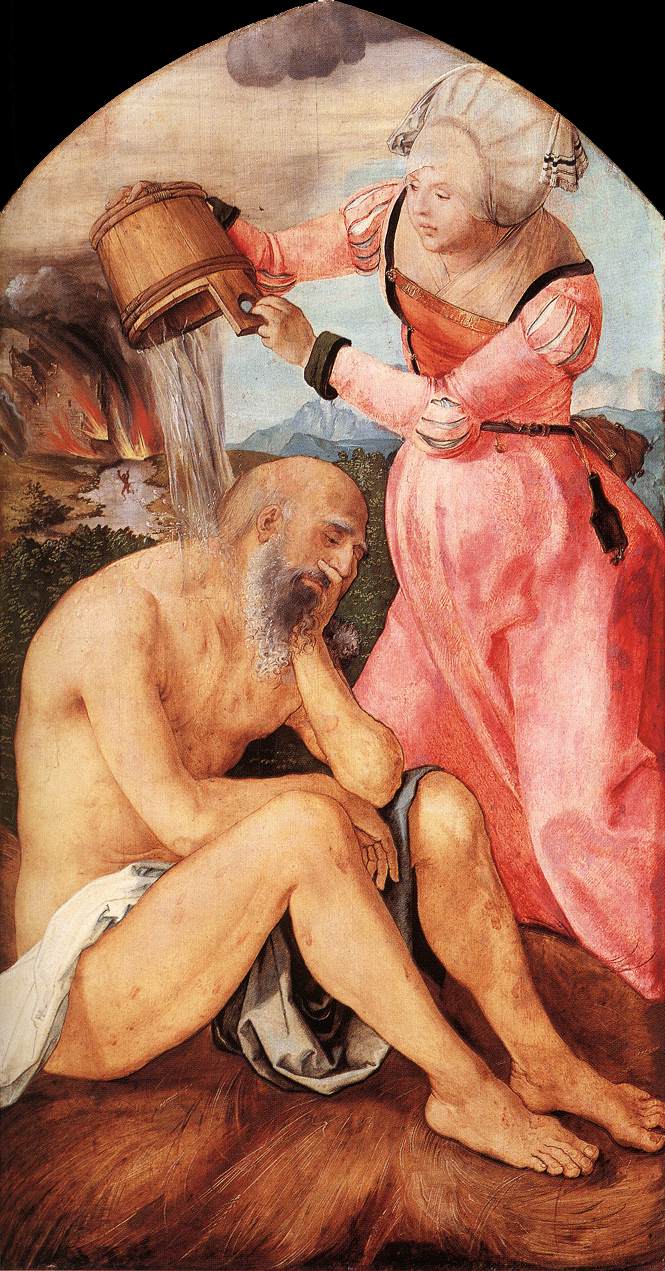
Job and his Wife (c. 1504)
Albrecht Dürer
Städelsches Kunstinstitut, Frankfurt
We believe in an all-loving, all-power God. Not only does all love come from God, but the Apostle John says that God is Love.1 And we know that genuine love seeks the good for the beloved.2 If you love someone, you want that person to have what is truly good for him, what truly and most perfectly makes him happy. But God loves us infinitely more than we love each other. Therefore we know that God wants us to have what is good for us, what truly makes us happy.
But that is just what makes the sufferings of this present life so odd, perplexing, even apparently contradictory. If God is all powerful, and truly seeks our good, then why does He allow all the suffering we experience in this life?
Recently a young man I know survived a plane crash. Upon hearing the news, some of us responded by thanking God that he survived. Another person responded to our thanksgiving by objecting that if God existed, He would have prevented the plane crash.3
This is the same objection we find in “the new atheism.” The atheist directs us to observe all the evil and suffering around us. Obviously there cannot be a good God, argues the atheist, because if God existed, He would not allow such meaningless, pointless evil and suffering to occur. The common hidden assumption is that if we cannot see for ourselves any justifying reason, then either there cannot be any such reason, or it is not reasonable to believe that there is such a reason. In other words, the objection presupposes that a Being infinitely greater than ourselves either does not exist or has not revealed His goodness and love to us, and in that respect the objection assumes precisely what it is trying to show.
It follows from atheism that suffering, tragedy, and loss are ultimately meaningless and pointless, and hence to be avoided at all costs unless some outweighing good can be anticipated.4 In the midst of suffering, there is the additional despair of believing that there is no higher meaning or purpose for this suffering, nothing redemptive about it. And that is precisely why in this atheistic philosophy, if we find ourselves or others suffering without the foreseeable possibility of coming to a quality of life that outweighs this suffering, it is better to end that life, all other things being equal.5 This is why atheism tends to lead toward euthanasia, the selective killing of the aged, the terminally ill, infants born with Down Syndrome, and others judged to be incapable of attaining a quality of life that outweighs their suffering so far as we can tell. But that is not the Christian understanding of suffering.
I. The Origin of Evil and Suffering
As with most theological questions, we need to go back to the beginning.6 The Apostle Paul says that death came into the world through sin.7 So, according to the Church, what was man’s original condition?
“God saw all that He had made, and behold, it was very good.” (Genesis 1:31)
Everything that God made, was very good. God made all things such that they were in harmony, as the Catechism explains:
The first man was not only created good, but was also established in friendship with his Creator and in harmony with himself and with the creation around him, in a state that would be surpassed only by the glory of the new creation in Christ. … [O]ur first parents, Adam and Eve, were constituted in an original “state of holiness and justice.” This grace of original holiness was “to share in. . .divine life.” By the radiance of this grace all dimensions of man’s life were confirmed. As long as he remained in the divine intimacy, man would not have to suffer or die.8 The inner harmony of the human person, the harmony between man and woman, and finally the harmony between the first couple and all creation, comprised the state called “original justice.”9
Notice the fourfold harmony: the harmony of friendship between man and God, the harmony within man himself (his various appetites and reason, even between his soul and body),10 the harmony between man and woman (or social between human persons), and the harmony between man and the rest of creation. By the original justice God gave to our first parents, they were able to remain in these ordered harmonies. The lower powers of their soul were held subject to their reason, without any disorder whatsoever. Even their bodies were entirely subject to their soul, without any bodily defect.11 All created beings, excepting the angels, were subject to man in the state of innocence. In this state, man did not have to suffer or die. God did not design man to be in a condition of suffering or death.
So what happened? Man sinned, and by doing so forfeited the four-fold harmony by which he was protected from suffering and death. “This entire harmony of original justice, foreseen for man in God’s plan,” says the Catechism, was “lost by the sin of our first parents.”12 What we now see around us is not the original perfection and harmony of God’s creation, but a fallen world. It is still a good world — that is how we are able to recognize the resulting disharmony, against the background of the goodness and natural order of creation — but there is now disharmony in our world, a disharmony that God did not put here.
Through man’s sin, all four harmonies were lost. Man’s friendship with God was lost, because his will was turned away from loving God, and toward loving other things more than he loved His Creator. Man’s internal integrity was lost: the lower appetites were no longer perfectly ordered to man’s reason (hence concupiscence), and man’s body was no longer perfectly subject to man’s soul (hence physical suffering and death).13 And man no longer enjoyed perfect, harmonious dominion over the rest of creation.
The teaching of the Catholic Church is quite different from that of the atheists with regard to the origin of suffering. For the materialist atheists, nature is ultimately impersonal, indifferent and apathetic; suffering just is. We do not like suffering, but ultimately, suffering is neither evil or good, because ultimately there is no good or evil; there is just matter and energy and the fundamental laws of physics. Some suffering is the result of the actions of other people, but much suffering is simply gratuitous, pointless, and outside the bounds of human control.
For Christians, by contrast, the Creator of all things is a perfectly good, perfectly just,14 and perfectly loving Father. Suffering and death, and all the evils we experience in this life, have their origin in human sin against God our Father. From a Christian point of view, the finger that the atheist points at God, blaming Him for all the suffering we experience, or using our suffering as an argument against God’s existence, is man blaming God, for what man freely did in disobedience to God.15
II. The Purposes of Suffering
While the atheist thinks his suffering is ultimately meaningless and pointless, the Christian believes that no suffering is ultimately meaningless or pointless. Why? Because we believe that a loving God is providentially orchestrating all things, in a way that upholds our freedom. For that reason we believe that when God allows us to suffer, He is doing so to protect us from a greater evil, or to lift us to a far greater and outweighing good. “Faith gives us the certainty that God would not permit an evil if he did not cause a good to come from that very evil, by ways that we shall fully know only in eternal life.”16 God always has a good purpose in allowing suffering, even when that purpose is inscrutable to us. As is written in the first century work called the Didache, “The workings that befall you receive as good, knowing that apart from God nothing comes to pass.” We always have a choice in our suffering, whether to trust God as our loving Father, and receive the good gift that He is giving us, or to rail against God in distrust and anger, as though we know better than He does what is ultimately good for us.
What purpose or purposes does God have in allowing suffering? To answer that question, we need to review, why, according to the Church, man is here.
We are made for eternal Life with God
God made man to be with Him in perfect happiness forever. This is what we call Heaven, or the Beatific Vision. The Beatific Vision is the perfection of our participation in the divine nature.17 It is eternal life. Eternal life does not mean mere perpetual existence; that in itself would be entirely unsatisfying. Eternal life means to participate in the very Life of the Eternal Triune God. It is the immediate [unmediated] knowledge of God, the intuitive face-to-face vision of the divine essence.18 To see God, who is all-perfect, and from whom all good things come, entails that the deepest longing of our heart (i.e. our rational appetite) is perfectly satisfied. We cannot desire anything more than God, because there is not and cannot be any good that is not found in God.
So what is the purpose of this present life? The purpose of our present life is the very same purpose for which Adam and Eve were placed in the Garden. This present life is for us a period of testing, to determine where we shall be for eternity, either with God or separated from God. So what does that have to do with suffering?
All the suffering that God allows us to experience in this life, is ultimately medicinal, i.e. for our good in some respect, even when we do not see that we need any treatment. God, our Father, is like a loving parent who agrees to subject his child to a regimen of chemotherapy to cure a cancer, though the child does not see the need for the chemotherapy, because the child does not see the cancer or its danger.19 The comment by the person who said of the plane crash, “God would have kept them from crashing” is like the child who says to his parent, “If you loved me you wouldn’t be putting me through this chemotherapy.” The parent is thinking, “If only you could see the danger of this cancer, you would understand that I am subjecting you to this painful treatment only because I love you, and want you to live.” And this too, is the heart of our heavenly Father, when He allows us to endure the sufferings of this life.
What is the great cancer, the one infinitely worse than physical cancer? According to the Church, the great cancer is sin, and it leads to hell, i.e. eternal separation from God. There is no greater evil than that one, nothing worse to suffer than eternal separation from God. It is far worse to be comfortable in this life, and suffer eternal separation from God in the life to come, than to suffer in this life, and yet enjoy the Beatific Vision with God eternally.20
So, here let us consider some of the reasons God allows us to suffer.
(1) To awaken us to reality
Sometimes God allows suffering in order to awaken us to the fact of our sin, our impending death and judgment, our emptiness apart from God, or to help us repent and turn to God.
Consider the prodigal son. His suffering got to the point where he realized that things were not the way they were supposed to be — that he was miserable. His awareness of his misery apart from his father helped provoke him to return to his father. In the Catechism we see this:
Illness and suffering have always been among the gravest problems confronted in human life. In illness, man experiences his powerlessness, his limitations, and his finitude. Every illness can make us glimpse death. Illness can lead to anguish, self-absorption, sometimes even despair and revolt against God. It can also make a person more mature, helping him discern in his life what is not essential so that he can turn toward that which is. Very often illness provokes a search for God and a return to him.21
Notice that suffering is not a magic bullet or a panacea. We can respond to it in two ultimate ways, either by turning toward God in trust, or by turning away from God in distrust and anger. St. Thomas Aquinas, drawing from St. Gregory the Great, says, “the evils which bear us down here drive us to go to God.”22 But we can harden our hearts and turn away from God even more, in our suffering.23
God sometimes allows suffering into our lives to provoke us to search for Him, and to realize that this present life is not our final end, but a temporary test in which our eternal destiny is determined.24
(2) To test us
The Catechism teaches: “Faith in God the Father Almighty can be put to the test by the experience of evil and suffering.25 We see this in the example of Job.
Now there was a day when the sons of God came to present themselves before the LORD, and Satan also came among them. The LORD said to Satan, “From where do you come?” Then Satan answered the LORD and said, “From roaming about on the earth and walking around on it.” The LORD said to Satan, “Have you considered My servant Job? For there is no one like him on the earth, a blameless and upright man, fearing God and turning away from evil.” Then Satan answered the LORD, “Does Job fear God for nothing? Have You not made a hedge about him and his house and all that he has, on every side? You have blessed the work of his hands, and his possessions have increased in the land. But put forth Your hand now and touch all that he has; he will surely curse You to Your face.” Then the LORD said to Satan, “Behold, all that he has is in your power, only do not put forth your hand on him.” So Satan departed from the presence of the LORD.26
The test of Job is an example of a test among the larger test that is this present life. These tests are opportunities for us to choose whom we will serve. They demonstrate whether we truly love God, or whether we only have a ‘friendship of utility’ with God. If we continue to trust and serve God, even in the midst of suffering, we show that our friendship with God is not one of utility. But if in response to the removal of the comforts of this life we turn against God and curse Him, we show that our ‘love’ for God is only for what He gives us, and not a “love of friendship.”27
(3) To discipline us, to teach us humility and trust, and to work righteousness into us
“But when we are judged, we are disciplined by the Lord so that we will not be condemned along with the world.” (1 Cor 11:32)
“My son, do not regard lightly the discipline of the Lord, nor be weary when reproved by him. For the Lord disciplines the one he loves, and chastises every son whom he receives.” It is for discipline that you have to endure. God is treating you as sons. For what son is there whom his father does not discipline? If you are left without discipline, in which all have participated, then you are illegitimate children and not sons. Besides this, we have had earthly fathers who disciplined us and we respected them. Shall we not much more be subject to the Father of spirits and live? For they disciplined us for a short time as it seemed best to them, but he disciplines us for our good, that we may share his holiness. For the moment all discipline seems painful rather than pleasant, but later it yields the peaceful fruit of righteousness to those who have been trained by it. (Hebrews 12:5-11)
Commenting on this St. Thomas Aquinas says, “All the saints who have pleased God have gone through many tribulations by which they were made the sons of God.”28 As sons of God, through our union with Christ the Son, we expect to be disciplined by God our Father. We recognize that our loving Father has some good reason for disciplining us, even when we cannot see what it is. Because we know that God has some good reason for allowing us to suffer, we respond to this suffering by seeking to learn what He is trying to teach us.
In Salvifici Doloris, Pope John Paul II wrote:
“Suffering must serve for conversion, that is, for the rebuilding of goodness in the subject, who can recognize the divine mercy in this call to repentance.29
But we should not assume that all instances of suffering are punishment for specific sins. That was the error of Job’s ‘comforters.’30 It was also the error of Jesus’s disciples when they saw a blind man:
As He passed by, He saw a man blind from birth. And His disciples asked Him, Rabbi, who sinned, this man or his parents, that he would be born blind?” Jesus answered, “It was neither that this man sinned, nor his parents; but it was so that the works of God might be displayed in him.31
Or consider Jesus’ reply in Luke 13:
“Now on the same occasion there were some present who reported to Him about the Galileans whose blood Pilate had mixed with their sacrifices. And Jesus said to them, “Do you suppose that these Galileans were greater sinners than all other Galileans because they suffered this fate? “I tell you, no, but unless you repent, you will all likewise perish. “Or do you suppose that those eighteen on whom the tower in Siloam fell and killed them were worse culprits than all the men who live in Jerusalem? “I tell you, no, but unless you repent, you will all likewise perish.” And He began telling this parable: “A man had a fig tree which had been planted in his vineyard; and he came looking for fruit on it and did not find any. “And he said to the vineyard-keeper, ‘Behold, for three years I have come looking for fruit on this fig tree without finding any. Cut it down! Why does it even use up the ground?’ “And he answered and said to him, ‘Let it alone, sir, for this year too, until I dig around it and put in fertilizer; and if it bears fruit next year, fine; but if not, cut it down.’32
What do we learn here? Jesus is teaching the people that in response to the deaths of the victims of Pilate and the falling tower in Siloam, the proper response is not to consider such persons to be more guilty than those who survived, but rather to consider that it was only by God’s mercy that we were not among them, so that we may repent, and pursue righteousness, before our approaching death. Jesus is less concerned about the deaths, and far more concerned about preparing for death. That is because Jesus recognizes that the second death (i.e. eternal separation from God) is infinitely worse than physical death.
(4) To give us an opportunity to love God, to give God glory, to merit glory, and to participate in His work of redemption
With respect to suffering and evil, Christianity turns the atheistic position on its head. While the atheist sees suffering as evidence that God does not exist, the Christian sees suffering as a great gift from God. It is a gift of mercy by which we are being led to repentance and eternal life.33 It is also a gift by which we know that God is working some great good in us. In addition, it is another sort of divine gift, an opportunity to give something great to God, just as Christ did in accepting His sufferings. Finally, for a Catholic, suffering is an opportunity to participate in Christ’s sufferings, sharing in the fellowship of His sufferings.
Here is an example of the way Christianity turns suffering on its head. St. Gregory the Great, commenting on the book of Job, writes that God’s providential ways, though difficult to understand, are
still more mysterious when things go well with good people here, and ill with bad people . . . . When things go well with good people here, and ill with bad people, a great uncertainty arises whether good people receive good so that they might be stimulated to grow into something [even] better or whether by a just and secret judgment they see the rewards of their deeds here so that they may be void of the rewards of the life to come. . . . Therefore since the human mind is hemmed in by the thick fog of its uncertainty among the divine judgments, when holy people see the prosperity of this world coming to them, they are troubled with a frightening suspicion. For they are afraid that they might receive the fruits of their labors here; they are afraid that divine justice detects a secret wound in them and, heaping external rewards on them, drives them away from internal ones. . . . Consequently, holy people are more fearful of prosperity in this world than of adversity.”34
For the Christian, says St. Gregory, one should be more concerned when things go well here, than when one faces suffering and loss and trials. Sufferings and trials in this life are evidence that God our Father loves us, and is working in us to prepare us for Heaven, and the rewards to be received in the life to come. But the one who comes into prosperity and ease in this life, should be concerned that he is receiving his reward in this life, instead of in the life to come.
Here is more turning of suffering on its head: In Colossians, St. Paul writes,
“Now I rejoice in my sufferings for your sake. (Col 1:24)
“through many tribulations we must enter the Kingdom of God”(Acts 14:22)
“The apostles left the Sanhedrin, rejoicing because they had been counted worthy of suffering disgrace for the Name.” (Acts 5:41)
“Not only so, but we also rejoice in our sufferings, because we know that suffering produces perseverance; perseverance, character; and character, hope. And hope does not disappoint us, because God has poured out his love into our hearts by the Holy Spirit, whom he has given us. (Romans 5:3-5)35
The early Christian martyrs all had the same attitude. Why did the early Christians rejoice in their suffering? Notice the contrast with those who think that suffering is pointless. Atheists cannot rejoice in their sufferings, because they have no reason to do so. But the early Christians saw things quite differently from those around them. They saw this present world already, as it were, from the perspective of the life to come. Suffering for Christ, in this present life, is a great honor, when seen from the divine perspective. And this is the Catholic perspective, that when we suffer, our suffering is an opportunity both to grow in our faith and love for God, but also to honor and glorify God, by loving Him in the midst of our sufferings, and so storing up an incomparable reward in the life to come. Suffering itself is nothing we desire, but sharing in Christ’s sufferings is a gift.
Contrast the Catholic perspective on suffering with that of what is called the “Health and Wealth” gospel. According to that position, since Christ on the cross paid the full price for the salvation of our soul and body, therefore, all Christians should be wealthy and healthy in this life. There is no point to suffering, because Christ has already suffered for us. All suffering must therefore be of the devil, due to a lack of faith. This is a logical extension of the error of monergism. The monergistic idea is that since Christ suffered for us, therefore we do not need to suffer. And since Christ’s suffering was redemptive, therefore our suffering is not redemptive. This position fails to recognize that in our suffering we are given the great gift, through our union with Christ, of participating in Christ’s own sufferings. Our suffering is not meaningless, but meaningful precisely because it is joined to Christ’s own sufferings, as a sharing in His suffering.
In Romans 8, St. Paul writes:
Now if we are children, then we are heirs—heirs of God and co-heirs with Christ, if indeed we share in his sufferings in order that we may also share in his glory. I consider that our present sufferings are not worth comparing with the glory that will be revealed in us.36
This is the gospel; it is a gospel of suffering. “If any man would come after me… let him take up his cross daily.”37 Elsewhere Jesus says, “Be faithful, even to the point of death, and I will give you the crown of life.”38 Only when we take up our cross can we begin to understand the meaning of redemptive suffering. We cannot see its meaning in the stance of resistance or distrust. And this is why the atheist cannot see it. Only from the stance of humble trust does the possibility of its meaning come into our field of vision.
For a Catholic, suffering is even an opportunity for merit. What do we mean by ‘merit’? St. Thomas Aquinas writes,
“Merit implies a certain equality of justice: hence the Apostle says (Romans 4:4): “Now to him that worketh, the reward is reckoned according to debt.” But when anyone by reason of his unjust will ascribes to himself something beyond his due, it is only just that he be deprived of something else which is his due; thus, “when a man steals a sheep he shall pay back four” (Exodus 22:1). And he is said to deserve it, inasmuch as his unjust will is chastised thereby. So likewise when any man through his just will has stripped himself of what he ought to have, he deserves that something further be granted to him as the reward of his just will. And hence it is written (Luke 14:11): “He that humbleth himself shall be exalted.”39
In this way, by embracing the cross of suffering given to us in this life, those in a state of grace may merit an eternal reward. In 2 Thessalonians St. Paul says,
“We ourselves boast of you… for your steadfastness and faith in all your persecutions and in the afflictions which you are enduring. This is evidence of the righteous judgment of God, that you may be made worthy of the Kingdom of God, for which you are suffering”40
Notice that by being steadfast in faith, in the midst of their persecutions and afflictions, the Thessalonian believers were being made worthy of the Kingdom of God. Pope John Paul II says of this passage, “Thus to share in the sufferings of Christ is, at the same time, to suffer for the Kingdom of God. In the eyes of the just God, before his judgment, those who share in the suffering of Christ become worthy of this Kingdom. Through their sufferings, in a certain sense they repay the infinite price of the Passion and death of Christ, which became the price of our Redemption.41
Christ did not remove concupiscence from us at baptism. Why?
Yet certain temporal consequences of sin remain in the baptized, such as suffering, illness, death, and such frailties inherent in life as weaknesses of character, and so on, as well as an inclination to sin that Tradition calls concupiscence, or metaphorically, “the tinder for sin” (fomes peccati); since concupiscence “is left for us to wrestle with, it cannot harm those who do not consent but manfully resist it by the grace of Jesus Christ.” Indeed, “an athlete is not crowned unless he competes according to the rules.”42
Baptism, by imparting the life of Christ’s grace, erases original sin and turns a man back towards God, but the consequences for nature, weakened and inclined to evil, persist in man and summon him to spiritual battle.43 According to the Church, one reason Christ does not remove concupiscence from us at baptism is precisely to allow us a greater opportunity for merit. By manfully resisting our disordered lower appetites, out of love for God, we merit a greater reward than would those without concupiscence.
III. How do we participate in Christ’s Sufferings?
Because we are joined to Him, as members of His Body. Pope Pius XII wrote:
Because Christ the Head holds such an eminent position, one must not think that he does not require the help of the Body. What Paul said of the human organism is to be applied likewise to the Mystical Body: “The head cannot say to the feet: I have no need of you.” It is manifestly clear that the faithful need the help of the Divine Redeemer, for He has said: “Without me you can do nothing,” and according to the teaching of the Apostle every advance of this Mystical Body towards its perfection derives from Christ the Head. Yet this, also, must be held, marvelous though it may seem: Christ has need of His members. First, because the person of Jesus Christ is represented by the Supreme Pontiff, who in turn must call on others to share much of his solicitude lest he be overwhelmed by the burden of his pastoral office, and must be helped daily by the prayers of the Church. Moreover as our Savior does not rule the Church directly in a visible manner, He wills to be helped by the members of His Body in carrying out the work of redemption. That is not because He is indigent and weak, but rather because He has so willed it for the greater glory of His spotless Spouse. Dying on the Cross He left to His Church the immense treasury of the Redemption, towards which she contributed nothing. But when those graces come to be distributed, not only does He share this work of sanctification with His Church, but He wills that in some way it be due to her action. This is a deep mystery, and an inexhaustible subject of meditation, that the salvation of many depends on the prayers and voluntary penances which the members of the Mystical Body of Jesus Christ offer for this intention and on the cooperation of pastors of souls and of the faithful, especially of fathers and mothers of families, a cooperation which they must offer to our Divine Savior as though they were His associates.44
Because we are joined to Christ, our suffering is joined with His, and participates in the Redemption He accomplished. The New Testament authors teach this same thing.
“If one part suffers, every part suffers with it; if one part is honored, every part rejoices with it.”45
“For as we share abundantly in Christ’s sufferings, so through Christ we share abundantly in comfort too.”46
“We are afflicted in every way, but not crushed; perplexed, but not driven to despair; persecuted, but not forsaken; struck down, but not destroyed; always carrying in the body the death of Jesus, so that the life of Jesus may also be manifested in our bodies. For while we live we are always being given up to death for Jesus’ sake, so that the life of Jesus may be manifested in our mortal flesh …. knowing that he who raised the Lord Jesus will raise us also with Jesus.”47
“That I may know him (Christ) and the power of his Resurrection, and may share his sufferings, becoming like him in his death, that if possible I may attain the resurrection from the dead.”48
“Now I rejoice in my sufferings for your sake, and in my flesh I do my share on behalf of His body, which is the church, in filling up what is lacking in Christ’s afflictions.49
Does that mean that Christ’s work was insufficient? No, Christ’s work was sufficient for its purpose. But God has graciously allowed us to participate in Christ’s work of redeeming the world, the greatest of all God’s works. Pope John Paul II writes:
For, whoever suffers in union with Christ— just as the Apostle Paul bears his “tribulations” in union with Christ— not only receives from Christ that strength already referred to but also “completes” by his suffering “what is lacking in Christ’s afflictions”.50
Those who share in the sufferings of Christ preserve in their own sufferings a very special particle of the infinite treasure of the world’s Redemption, and can share this treasure with others.51
Mary is the exemplar of suffering in union with Christ, as she was told by Simeon, “and a sword will pierce even your own soul.”52 When St. Paul writes, “For we are God’s co-workers”53 that is not just for Paul or for the Apostles, but for all of us who are joined to Christ through baptism. By our union with Christ, our suffering gets to count, as a participation in His suffering; our suffering becomes meaningful in the realm of eternity.
Pope John Paul II writes:
In the Cross of Christ not only is the Redemption accomplished through suffering, but also human suffering itself has been redeemed,. … Every man has his own share in the Redemption. Each one is also called to share in that suffering through which the Redemption was accomplished. He is called to share in that suffering through which all human suffering has also been redeemed. In bringing about the Redemption through suffering, Christ has also raised human suffering to the level of the Redemption. Thus each man, in his suffering, can also become a sharer in the redemptive suffering of Christ.54
Offering it up
Spend enough time with Catholics, and you will hear the phrase, “Offer it up.” The phrase is typically heard as a reply to a list of personal woes. So what does this phrase mean? We are priests of God by our baptism.55 We (lay people) are not ministerial priests, who offer up the sacrifice of Christ upon the altar at holy Mass. But, as non-ministerial priests, we do offer something to God: our bodies, our actions, our labor, and even our sufferings.
“I appeal to you therefore, brethren, by the mercies of God, to present your bodies as a living sacrifice, holy and acceptable to God, which is your spiritual worship.”56
We offer up our lives and our sufferings formally, in the Mass, by consciously offering ourselves up with our sufferings, along with Christ to God the Father during the Offertory. Informally, we “offer it up” simply by asking God, in the midst of our suffering, to join our suffering to Christ’s, and to use our suffering.
How should we respond to suffering?
By worshiping God:
Then Job arose and tore his robe and shaved his head, and he fell to the ground and worshiped. He said, “Naked I came from my mother’s womb, And naked I shall return there. The LORD gave and the LORD has taken away. Blessed be the name of the LORD.” Through all this Job did not sin nor did he blame God.57
By examining our hearts: “Examine yourselves, to see whether you are in the faith. Test yourselves.”58
By offering our sufferings up to God: “Is anyone among you suffering? Then he must pray”59
By giving thanks: “in everything give thanks; for this is God’s will for you in Christ Jesus.”60
By rejoicing that we have been counted worthy to suffer for Christ: “Now I rejoice in my sufferings for your sake.”49
By looking to Christ’s example, who suffered for us to demonstrate to us both the magnitude of our sin and the greater magnitude of His infinite love for us. He received the cup of suffering from His Father, in humble obedience, and in doing so perfectly demonstrated His love for the Father:
And He also says, “Shall I not drink the cup which the Father has given me?”61
“My Father, if it be possible, let this cup pass from me; nevertheless, not as I will, but as thou wilt”, … “My Father, if this cannot pass unless I drink it, thy will be done”62
By looking to Christ’s return and the life to come:
“Fix your hope completely on the grace to be brought to you at the revelation of Jesus Christ.”63
Therefore, since we have so great a cloud of witnesses surrounding us, let us also lay aside every encumbrance and the sin which so easily entangles us, and let us run with endurance the race that is set before us, fixing our eyes on Jesus, the author and perfecter of faith, who for the joy set before Him endured the cross, despising the shame, and has sat down at the right hand of the throne of God.64
And I heard a loud voice from the throne, saying, “Behold, the tabernacle of God is among men, and He will dwell among them, and they shall be His people, and God Himself will be among them, and He will wipe away every tear from their eyes; and there will no longer be any death; there will no longer be any mourning, or crying, or pain; the first things have passed away.65
Conclusion
The relation between our present life and the life to come is the condition for the meaningfulness of our sufferings in this present life. The gospel shows us that suffering is an opportunity given to us to participate in our future blessedness by offering our present sufferings, in union with Christ’s sufferings, to God in self-giving sacrifice. Our suffering then takes on a whole different dimension, transformed from the occasion of a fist-shaking interrogation of God or cause for doubting His goodness or existence into the greatest opportunity to show Him trust and self-donation, without the least futility, knowing that it will be repaid a hundred fold. (Matt 19:26) This is why the Christian martyrs rejoiced when they were chosen for martyrdom, and why after being flogged the Apostles went away “rejoicing that they had been considered worthy to suffer shame for His name.” (Acts 5:41) Apart from the gospel, much of our suffering would seem gratuitous and even sinister. But in the light of the gospel we see that our suffering is a gift, a gift of the same sort as this present life, but even greater. It is the gift of an opportunity to give ourselves entirely to God in the greatest possible expression of love, i.e. sacrifice: “Greater love has no one than this, that one lay down his life for his friends.”
Jesus Christ, when He redeemed us with plentiful redemption, took not away the pains and sorrows which in such large proportion are woven together in the web of our mortal life. He transformed them into motives of virtue and occasions of merit; and no man can hope for eternal reward unless he follow in the blood-stained footprints of his Saviour. “If we suffer with Him, we shall also reign with Him.” Christ’s labors and sufferings, accepted of His own free will, have marvellously sweetened all suffering and all labor. And not only by His example, but by His grace and by the hope held forth of everlasting recompense, has He made pain and grief more easy to endure; “for that which is at present momentary and light of our tribulation, worketh for us above measure exceedingly an eternal weight of glory.” (Rerum Novarum, 21)
- 1 John 4:8. [↩]
- As Aristotle says (Rhet. ii, 4), “to love is to wish good to someone.” Quoted in St. Thomas Aquinas, Summa Theologiae II-I Q.26 a.4. [↩]
- That response reminded me of Martha’s statement to Jesus: “Lord, if You had been here, my brother would not have died.” (John 11:21) It is possible that Martha was simply making a statement of faith in Christ’s power. But it is also possible that Martha was indirectly chiding Jesus for not arriving sooner. In her mind, Lazarus died because of Christ’s absence, since if Christ had been present, Christ would have done what Martha thought should be done. The third option: Christ, being God, stayed away on purpose, because He had a higher purpose, did not enter her mind. [↩]
- “Without the vision of faith one has a sense of the uselessness of suffering.” Pope John Paul II, Salvifici Doloris. [↩]
- This is not stoicism, which sought to endure suffering. In this philosophy, suffering is the greatest evil. But in Christianity, sin is the greatest evil. [↩]
- Jesus does this when asked about divorce. Cf. Matthew 19:4ff, and Mark 10:6. [↩]
- “Therefore, just as through one man sin entered into the world, and death through sin, and so death spread to all men, because all sinned …” (Romans 5:12) [↩]
- “for in the day you eat from it, you shall surely die.” (Gen 2:17) [↩]
- CCC 373-376 [↩]
- The “mastery” over the world that God offered man from the beginning was realized above all within man himself: mastery of self. The first man was unimpaired and ordered in his whole being because he was free from the triple concupiscence that subjugates him to the pleasures of the senses, covetousness for earthly goods, and self-assertion, contrary to the dictates of reason. (CCC 377) [↩]
- The four preternatural gifts had by our first parents were: infused knowledge, immortality, impassibility, and integrity (human appetites being completely submitted to the human intellect. How did the loss of immortality result from sin? St. Thomas Aquinas explains in Summa Theologiae II-I Q.85 a.6 that just as iron is breakable and disposed to rust, so likewise the body is corruptible due to a condition of matter (for matter is naturally corruptible) though its corruptibility was not the reason it was chosen to be that which the soul informed. In forming man, God supplied the defect of nature [defectum naturae], and by the gift of original justice, which ordered the corruptible body to the incorruptible soul, gave to the body a certain incorruptibility [incorruptibilitatem quandam], one that is extrinsic to the body as such, and dependent upon its ordered relation to something else. By the gift of original justice the body was not made intrinsically incorruptible, but by this gift the body was made incorruptible-by-relation to the soul. So when Adam and Eve forfeited their original justice through sin, they thereby forfeited the mediated incorruptibility their bodies had enjoyed. Death thus entered into the world, through sin. [↩]
- CCC 379 [↩]
- St. Augustine wrote, “For it certainly was not just that obedience should be rendered by his servant, that is, his body, to him, who had not obeyed his own Lord.” (On Marriage and Concupiscence, I.7.) [↩]
- “For thou art just in all that thou hast done to us, and all thy works are true and thy ways right, and all thy judgments are truth. Thou hast executed true judgments in all that thou hast brought upon us… for in truth and justice thou hast brought all this upon us because of our sins.” (Daniel 3:4-5) [↩]
- Ultimately there are three options. (1) There is no God; there is ultimately no reason for suffering and death. (2) God is evil, in which case there again is ultimately no good reason for suffering and death. (3) God is good and loving, and thus has a good reason for allowing us to suffer and die. [↩]
- CCC, 324. [↩]
- 2 Peter 1:4 [↩]
- Cf. Benedictus Deus [“On the Beatific Vision of God”], Pope Benedict XII, 1336. [↩]
- I have drawn this illustration from Eleonore Stump. [↩]
- As Jesus said:
If your right eye makes you stumble, tear it out and throw it from you; for it is better for you to lose one of the parts of your body, than for your whole body to be thrown into hell. If your right hand makes you stumble, cut it off and throw it from you; for it is better for you to lose one of the parts of your body, than for your whole body to go into hell. (Matthew 5:29-30)
[↩]
- CCC 1500-1501 [↩]
- St. Thomas Aquinas’s Commentary on First Thessalonians. [↩]
- “They were seared by the intense heat and they cursed the name of God, who had control over these plagues, but they refused to repent and glorify him. The fifth angel poured out his bowl on the throne of the beast, and his kingdom was plunged into darkness. Men gnawed their tongues in agony and cursed the God of heaven because of their pains and their sores, but they refused to repent of what they had done. (Rev 16:9-11) [↩]
- We see this already in God’s response to the first man’s sin:
Then the LORD God said, “Behold, the man has become like one of Us, knowing good and evil; and now, he might stretch out his hand, and take also from the tree of life, and eat, and live forever. (Gen 3:22)
It was merciful of God to allow us to die, so that we might be resurrected, rather than live forever in a sinful condition. [↩]
- “God can sometimes seem to be absent and incapable of stopping evil. But in the most mysterious way God the Father has revealed his almighty power in the voluntary humiliation and Resurrection of his Son, by which he conquered evil. Christ crucified is thus “the power of God and the wisdom of God. For the foolishness of God is wiser than men, and the weakness of God is stronger than men.” It is in Christ’s Resurrection and exaltation that the Father has shown forth “the immeasurable greatness of his power in us who believe.” (CCC, 272) [↩]
- Job 1:6-12. [↩]
- For Aristotle’s distinction between ‘friendship of utility’ and ‘true friendship,’ see Nicomachean Ethics, Book VIII. For St. Thomas Aquinas’ distinction between “love of concupiscence” and “love of friendship,” see my “Love and Unity: Part 3.” [↩]
- St. Thomas Aquinas, Commentary on Hebrews. [↩]
- Salvifici Doloris, 12 [↩]
- St. Thomas Aquinas writes: “If in this life human beings are rewarded by God for good deeds and punished for bad, as Eliphaz was endeavoring to establish, it apparently follows that the ultimate goal for human beings is in this life. But Job intends to rebut this opinion, and he wants to show that the present life of human beings doesn’t contain that ultimately goal ….” Expositio super Job, 7.1-4. [↩]
- John 9:1-3. [↩]
- Luke 13:1-9 [↩]
- “Or do you think lightly of the riches of His kindness and tolerance and patience, not knowing that the kindness of God leads you to repentance?” (Romans 2:4) [↩]
- St. Gregory the Great, Moralia in Job, book 5, introduction. [↩]
- Commenting on this passage in Romans 5, St. Thomas Aquinas writes, It is a sign of the ardent hope which we have on account of Christ that we glory not only because of [our] hope of the glory to come, but we glory even regarding the evils which we suffer for it. And so Paul says that we not only glory (that is, in our hope of glory), but we glory even in our tribulations, by which we attain to glory. [↩]
- Rom 8:17-18. [↩]
- Luke 9:23 [↩]
- Revelation 2:10. [↩]
- Summa Theologiae III Q.49 a.6 [↩]
- 2 Thess 1:4-5. [↩]
- Salvifici Doloris, 21. [↩]
- CCC 1264, quoting 2 Tim 2:5. [↩]
- CCC 405. [↩]
- Pope Pius XII, Mystici Corporis Christi, 44. [↩]
- 1 Cor 12:26 [↩]
- 2 Cor 1:5 [↩]
- 2 Cor 4:8-11, 14 [↩]
- Phil 3:10-11 [↩]
- Col 1:24 [↩] [↩]
- Salvifici Doloris, 24. The sufferings of Christ created the good of the world’s redemption. This good in itself is inexhaustible and infinite. No man can add anything to it. But at the same time, in the mystery of the Church as his Body, Christ has in a sense opened his own redemptive suffering to all human suffering. In so far as man becomes a sharer in Christ’s sufferings—in any part of the world and at any time in history—to that extent he in his own way completes the suffering through which Christ accomplished the Redemption of the world. Does this mean that the Redemption achieved by Christ is not complete? No. It only means that the Redemption, accomplished through satisfactory love, remains always open to all love expressed in human suffering. [↩]
- Salvifici Doloris, 27 [↩]
- Luke 2:35 [↩]
- 1 Cor 3:9 [↩]
- Salvifici Doloris, 19. See also Pope John Paul II’s General Audience of November 9, 1988, titled “The Meaning of Suffering in the Light of Christ’s Passion.” [↩]
- 1 Peter 2:9-10 [↩]
- Romans 12:1 [↩]
- Job 1:20-22 [↩]
- 2 Cor 13:5 [↩]
- James 5:13 [↩]
- 1 Thess 5:18 [↩]
- John 18:11 [↩]
- Matthew 26:39, 42 [↩]
- 1 Peter 1:13 [↩]
- Heb 12:1-2 [↩]
- Revelation 21:3-4 [↩]

Less of a comment and more of a question…. I read recently that when Jesus asked that the cup be passed from him (as referenced in you essay) it wasn’t necessarily the pain of crucifixion he was fearing but the separation from God that he would endure by taking on all past and future sins that we may be redeemed. The premise is that if sin separates us from God, and Jesus was assuming our sins, that would be the first and only time he was separated from God and that was what he “feared.” Inasmuch that we, as humans, can understand would this be an accurate depiction in respect to the teachings of the Catholic Church?
Hello Will,
Jesus could not possibly be separated from God, because He is God. The greatest suffering Jesus endured was not the physical pain of the crucifixion (though of course that was excruciating); it was the sorrow for all the sins of the world, inasmuch as they offended God. We have to be careful to understand rightly what it means for Jesus to “assume” our sins. He did not become sinful. He was perfect and sinless through His entire life, including His agony in the garden and His passion and death. He assumed our sins in the sense that He grieved for them as a man, as the sins of His fellow men. In other words, He grieved for them in solidarity with us. That’s the sense in which He assumed them. Professor Feingold gave an excellent lecture last week on the suffering of Christ in the Passion. You can listen to it here:
Or download it here.
In the peace of Christ,
– Bryan
I have actually been thinking a lot about this lately. I don’t know how the Church interprets this text, but what then does it mean when Christ says, “My God, my God, why hast thou forsaken me?”(Mat 27:46), if not that he was forsaken by the Father at one point in time (i.e. seperated in some sense) as God “made him to be” sin for us? (2Cor. 5:21) In what way did God forsake him that is not the same kind of forsaking God does to sinners? And what is the reason for the difference?
Hello Jared,
Professor Feingold explains this in the lecture I linked to in comment #2. He starts his section on Christ’s interior suffering at 29’23”. And then in the subsequent section, he addresses the question, “How should we interpret these words? (“My God, My God, why have you forsaken me?”) I could type out an answer, but I think you would get a much better answer listening to the lecture. The hypostatic union was not lost. The Second Person did not lose His union with His human nature. Nor did God the Father turn His back on God the Son. Nor did the Son in His human nature cease to see the Father (i.e. lose the beatific vision). Professor Feingold explains that Christ was abandoned in two ways: “in the exterior man and the interior man.” But neither of them is the separation from God that is experienced by those in hell.
As for 1 Corinthians 5:21, there St. Paul is speaking about Christ becoming a sin offering, one who makes atonement for sin. He isn’t saying that the Son of God literally became sin (or changed into sin); that would be blasphemous, as well as metaphysically impossible.
In the peace of Christ,
– Bryan
Bryan,
Thank you for your explanation and the link to the lecture. Hopefully my question didn’t distract from the context of the essay above, which was excellent and very insightful. Incidentally, my mom’s favorite saying to us growing up when things weren’t going our way was “just offer it up” which at that time used to drive me nuts.
Thanks again,
Will
Bryan,
I have very much enjoyed your thoughts (and all that I have seen so far on CTC) I am wondering, completely off this post’s topic (sorry) if there is any plan to post on the praying to saints. I was born and raised in the reformed tradition and have recently been exploring some of the fundamental conflicts between the RC and Protestant churches. So far, I must admit, I find the Catholic point of view quite compelling. Though I am far from understanding all (if any) of their unique doctrines or practices to a degree that I find satisfactory.
I am hoping that one of the very well informed and quite thoughtful contributers might be inclined to enlighten me regarding the RC doctrine on praying to saints. Perhaps addressing how a saint is able to hear the prayers and intercede for many people at once. I had always thought that this was an attribute of God alone. I am unclear on the idea of a patron saint or a saint representing a specific need. It appears to be superstitious, but based on what I have discovered in my limited explorations of Catholicism, I know that this cannot be the case. Why travel to see the relics of saints or their shrines? Is this to pay respect, to offer penance, or to just to be close to those Giants who have gone before us? Are their prayers more effective than the living? When did this become a practice?
Just to be clear, I have a great deal of respect for the RCC and ask these questions with the hope of learning about (not challenging) their understanding of what it means to follow our Lord.
In Christ,
Elliot
Hello Elliot,
I’m glad you’ve found CTC helpful. Welcome. Yes, we have posts planned on these subjects. But they might not be coming for a while. I’ll answer a couple of your questions, here briefly. And invite you to stick around for better answers in the future, when we get to those articles.
How can a saint in heaven hear our prayers? Saints are not omniscient or omnipresent; only God is omniscient and omnipresent. So how can they seemingly have such abilities?
The saints in heaven can hear/see our requests to them, though not with physical ears/physical eyes (since they are not embodied, Mary excepted). In three places in the gospels, Jesus tells us that in the resurrection we will be like the angels. One of the ways in which we will be like the angels is that we will not marry. But another way is that we will know, not only by our physical senses, but in a supernatural way, i.e. a way that exceeds the capacity of our epistemic faculties. All the angels and saints presently enjoy the Beatific Vision. (See Benedictus Deus.)
When a person has the Beatific Vision, he not only knows God; he also knows what pertains to himself, through God. St. Thomas Aquinas explains:
As St. Thomas explains, anyone who sees the face of God sees also in God all things pertaining to himself, through God. The petitions of the members of the Church militant, pertain to the saints in heaven. And for this reason they see these petitions supernaturally, through the Beatific Vision. Notice also in the selection from St. Thomas that he points out that “it pertains to their glory that they assist the needy for their salvation.” God doesn’t need the saints to intercede for us. He has given them a great gift, in allowing them to participate in this glorious way, in His work of redemption.
Because God is love, He does not do everything Himself. He created us, and gave us real causal powers. So, He doesn’t operate by the principle, “If I can do it, then there is no point in having anyone else do it.” He works by love, which is the very opposite of such egoism, because by love He gives to us the dignity of participation in His glorious activity. This is what we mean in speaking of His love as self-effusive. Strictly speaking, God did not need to give us causal powers of any sort. God could have done everything, entirely, Himself. He loves to give to us the opportunity to participate as real [secondary] causes in His work. That’s one of the gifts He has given to the saints in heaven, by allowing them to be genuine intercessors on our behalf.
For an explanation of the notion of “Patron Saints,” let me refer you to this article. (Feel free to ask follow-up questions on that, if that is unclear to you in any place.) As for the practice of praying to a particular saint for a particular type of need, we just discussed this in this comments of this thread, see especially comment #64.
Next you asked:
The denial of the practice of venerating the relics of the saints, and denying their ability to hear our prayers was part of the heresy introduced by Eunomius and followed by Vigilantius in the fourth century, as St. Jerome tells us in his work against Vigilantius:
Not only do the saints in heaven see God (as I explained above), but they retain a relation to their body. It is an ontological relation (i.e. a relation of being — this body does not merely belong to that saint, as he might have possessed a book or a cloak; this body is that saint, not the entirety of the saint, of course, but nonetheless his bodily component). The relation of the saints in heaven to their bodies is also an eschatological relation. They wait patiently to be reunited to their bodies, at the resurrection. To stand before the body of a saint is to stand before a part of someone who is presently enjoying the Beatific Vision, and is presently related (by an ontological relation of identity and an eschatological relation) to this body; it is to stand before something that we know (by the authority of the Church) will be in heaven forever. (We do not know that, with the same certainty, about any other material object, including our own bodies, because “that I [insert your own name] will persevere in faith until death” is not part of the deposit of faith.)
To ask for the intercession of a saint, in the presence of his or her body, is to do two things: (1) to honor that saint, by implicitly recognizing his heroic virtue and present glory, and (2) to draw near to that saint. If that saint’s body had no relation to the saint’s soul, then drawing near to his body would not in any way draw us near to the saint. But because of the body-soul relation, both ontological and eschatological, to draw near to his body is to draw near to the saint. We are not gnostics, who believe that we are all spirits trapped in bodies. A human soul is the form of a body — this particular body. (This is why reincarnation is metaphysically impossible.) The soul is incomplete in itself, as is the body. They are complete only when united as one substance, i.e. the body-soul composite. That is why human death is not natural, but contrary to nature, because the soul is made to remain the animating principle of this body. All this is why coming into the physical presence of the body of a saint, is to come into the presence of that saint who, at that very moment, is in heaven beholding the face of God. So, that is why the early Christians honored the relics of the saints, because they understood Christian anthropology, the communion of the saints, and the implications of the doctrine of the resurrection. (Update: I have discussed this in more detail in “Heroes of the New Covenant.”)
Lastly,
Yes. St. James tells us that the prayer of a righteous man availeth much. (James 5:16) But the saints in heaven are perfectly righteous, while even the most holy saint on earth still sins venially. Hence the prayers of the saints in heaven are more effective than the prayers of those on earth.
If you stick around (i.e. put CTC on your RSS feed), we’ll have some better posts and articles in the future that address these specific topics. For the moment I’m just giving you the quick answers to your questions. Please feel free to comment or ask questions on any of our posts.
In the peace of Christ,
– Bryan
Bryan,
Thank you for your response. I am trying to look at each of these many conflicting interpretations and doctrines as objectively as possible. I appreciate the effort and intention (as I understand it) of CTC. I find it to be a welcome resource in this very convoluted and somewhat frightening endeavor.
I am looking forward to the articles to come.
In Christ,
Elliot
Elliot,
I discussed the question of the intercession of the saints, in a post titled “Heroes of the New Covenant.” There you will also find a link to a post written by Matt Yonke, on the subject of relics.
In the peace of Christ,
– Bryan
Today is the anniversary of the death of our son Joshua, and so our family’s thoughts turn to him, and also to Christ’s suffering in the garden and on the cross, and to His victory over death, and to the joy of the reunion in heaven that awaits us by the gift of God’s grace. When I reflect on Joshua’s life, marked by suffering, I recall clearly how seemingly gratuitous it was to me, at the time. I understood that others had been moved by his story, but, his suffering and death still seemed far worse than pointless; it seemed gratuitously evil, given the fully accomplished nature of Christ’s work on the cross. Of course I knew and believed that “God works all things together for good …,” but there was simply no room or space for this suffering to have any outweighing value, any eternal value. If Christ has already fully accomplished our redemption in monergistic fashion, then even though I could anticipate our son’s resurrection, how could I possibly have any good reason to take spiritual joy in his suffering and death? How could I, with good reason, (and not just by divine stipulation) truly be thankful to God for it?
Those questions remained unanswered for a number of years, but continued nagging at me. Only when I began to understand salvation as participation in Christ, explained in the post above, and in David Anders’ comment, did I begin to understand how the saints and characters in the New Testament could truly (not just by divine command) take joy in their suffering. That understanding is portrayed beautifully in the life of Philip Johnson, a Catholic seminarian, diagnosed with inoperable brain cancer in 2008, who tells his story in this recent video:
Philip understands that for those in Christ, suffering is an opportunity to participate in Christ’s suffering, in love, and thus to lay down one’s life for the salvation of the world. This is union with Christ. Now, as a Catholic, I am thankful not only for the gift of Joshua’s life, but also for the gift of his suffering and death, which in no way was gratuitous, but was a participation in the life and death of his Savior.
(I’m grateful to Richard Miserendino for directing me to the video of seminarian Philip Johnson.)
Bryan, thank you for sharing these thoughts, my brother in Christ. My prayers are with you and your family today.
Man, Bryan, I didn’t know about your children. I am so sorry. God bless you and your family.
I remembered you guys and Joshua in my rosary today, Bryan. God bless.
Sincerely,
K. Doran
Bryan,
Sorry about your loss. Your sons prayers likely instigated your journey home. I saw his picture, he was a handsome lad. : )
We lost our first child (before we were Catholic). Roses were on her gravestone. Later, after we converted, we gave our oldest daughter to Saint Rose of Lima. Just two weeks ago we learned that our first daughter (Grace) died on the Feast of St. Rose of Lima (we cried). The irony is that at the birth of our oldest daughter (Leah), my searching for the truth about the Church really began. It was as if at the moment Grace entered heaven, she joined in prayer with Rose of Lima to bring us home to the Catholic Church. St. Rose is the patroness of our family now.
A prayer for you this evening,
In Christ through Mary,
Brent
Christopher, Devin, K. Doran, and Brent,
Thank you very much for your kind words and prayers. Please remember seminarian Philip Johnson in your prayers. Brent, thank you for sharing this about your daughter, and about the patronage of St. Rose of Lima. The communion of the saints is also a great comfort in loss, for we know that our brothers and sisters who now see God face to face are not indifferent to us, but are joined to us in a mystical communion, and delight to intercede on our behalf.
In the peace of Christ,
– Bryan
Bryan:
Until now, I had entirely missed references to the death of Joshua. My belated condolences. I will remember him in my prayers for the dead at Mass.
Best,
Mike
Regarding an earlier question asking the meaning of Christ’s words, “My God, My God, why have you forsaken me” – Jesus was quoting Psalm 22 – describing himself & praising God in the midst of His suffering. Pretty powerful to read! God bless!
Thank you for this excellent resource!!! It is very helpful in ministry!!!
How much time have you spent providing pastoral care to sick or dying people? I urge you to enroll in a chaplaincy program for one semester and perhaps your views on suffering may evolve.
Allen,
I am not sure to whom your question is directed, but I did complete a unit of CPE, during which I was with dying persons and bereaved family members on numerous occasions. This kind of ministry is difficult, more a matter of presence than words, but my experience, and particularly my experiences with devout Catholics (I was an Anglican at the time), did not teach me anything contrary to what Bryan writes in this article. Perhaps you could pinpoint what you find problematic in the article, and we can discuss that.
(Also, Allen, I hope that you will read Bryan’s most moving testimony concerning his own family–see the comments above. I can only assume that you did not see that before you posted your comment.)
Andrew
Bryan,
First of all, i want to express my appreciation for these articles you have written. I went through my own prolonged bout with suffering over the past year and found this article in particular to be very helpful to put some meaning to it.
Rereading it tonight, i realized there is something that i do not fully understand and i was hoping you could graciously take some time to help me through it.
Referring to Adam and Eve prior to original sin, you stated “As long as he remained in the divine intimacy, man would not have to suffer or die.” What i need help with is, i have heard other interpretations of Genesis 3 (namely by Scott Hahn). I have heard it said that the serpent was a great dragon (the hebrew word used for serpent in Genesis 3 is the same as that used in Revelation when referring to the great dragon). Therefore Adam’s mortal life was threatened by this great beast. He shrank from his priestly duty to standing up and protecting the garden sanctuary and his wife, Eve by keeping quiet and eating the forbidden fruit, because he feared the dragon would make him suffer and die. God was testing Adam’s love by allowing the serpent to enter the garden. Without a test of love, how could we know if Adam’s love with authentic? As Adam shrank from the prospect of suffering and death and ultimately said “No” to God, Jesus, the new Adam said “Yes” and suffered and died.
So i was under the impression that Adam did in fact fear suffering and death. God’s plan for him was not to remain in the garden of Eden forever, but was for him to eventually die and be raised up to heaven and participate in the Beatific Vision just as we all are. God did not come up with a plan B when Adam and Eve committed original sin. His plan for us was to share in his glory in heaven from the very beginning.
This is the understanding i have carried with me the past several months…that suffering and death did in fact exist before original sin.
What are your thoughts?
God Bless,
~Rick
And again, thank you so much for all these articles. They have been a wonderful resource to me. :)
Forgot to add, that it’s my understanding that when God said to Adam, “on the day you eat of it, you shall surely die,” he was referring to Adam’s spiritual life. When the serpent said “you will not die,” he was referring to Adam’s physical life. In other words, the serpent was saying “read my lips, you eat this fruit or you are going to pay a price for your obedience to God.” This price would have been physical suffering and death at the hands of the great dragon. So if Adam was faithful to the Lord and refused to eat the fruit, he would have remained in the divine intimacy, but he would still have had to physically suffer and die before being raised to new life in heaven.
Andrew,
I was responding more to the doctrines discussed in this blog. Of course, I have the utmost compassion for Bryan.
I took four units of CPE, so I am glad we have some shared perspective. As an RC, I also wondered about role of suffering in our lives and I find it difficult to embrace the idea of a test of faith or a disciplining some of the people I have known. Also, I hope that when we discuss our brothers and sisters of different denominations or those who do not share a religious belief that we do so with humility. I accompanied people of all faiths( and some with none), and at times their spirituality was exquisite in dealing with suffering.
Allen,
You may have intended to respond to the doctrines discussed, but your original comment was an ad hominem, addressed to the man, not to the doctrines being advanced:
There are many ideas that are difficult to embrace, but the criterion for whether or not to accept those ideas is truth, not ease. God does permit people to experience physical infirmity as a means of spiritual strengthening (2 Corinthians 12:7-10), and he also chastises every son whom he receives (Hebrews 12:5-8). [Of course I do not think that people who are sick or wounded are normally being punished.]
Certainly we should treat all people with respect, in a spirit of humility, even when we disagree with their doctrine.
Allen,
As Roman Catholics, we at CTC believe what the Church teaches about suffering, including that suffering is a profound entering into the suffering of Christ (Col 1) which in some mysterious way contributes to the salvation of the one suffering and the world itself. Blessed John Paul II wrote Salvifici Doloris and in it reflected on the redemptive power of suffering. With Andrew, I have to say that your original comment came across as an ad hominen. I am glad to see that is not what you meant.
Though I can be terse sometimes, I never mean to offend. I apologize for the personal nature of my comment, but I hope that my comments are not dismissed either.
I spent 1 and 1/2 years ministering to suffering people in a major hospital, and proudly, as a Roman Catholic. Though I will never disclose names or personal details of those I served, I will say without a doubt that I have seen suffering that is far beyond anything that would be an appropriate challenge or test for someone’s faith or to give an opportunity for glory. If a child is born without a frontal lobe, then who is being tested? Is the mother of the dying addict able to give glory to God? The victims of a small plane crash? I found some of these ideas fell flat in the room of a suffering person and my peers who relied on them seemed less able to listen to a person’s suffering, rather than moreso.
Secondly, the comments about the fallability of others’ spirituality are less than charitable. I understand you( you all) are speaking more about doctrine here, but I want to inform you that the most spiritually sound person I ever served was a Protestant woman who told me of her gratitude toward God for her life and her willingness to die now that her time was done. Would that any of us had such grace.
These are just food for thought. I am not a theologian and I benefit from your comments, but I hope that you also will consider my comments as a brother in Christ.
Allen,
I certainly take your comments as intended in the brotherly love of Christ and I can assure you that all of us at CTC do as well. Suffering is deeply vexing and leaves us deeply wounded, a wound that can only be healed and redeemed by our suffering, dying and risen Lord. In the face of the Holocaust Memorial, Blessed John Paul II remarked that in the face of such suffering there must be silence, the haunting silence of Holy Saturday. I will say that as a Catholic, the Church’s reflections on suffering through the ages in her saints and her teaching, provides a foundation in which one can enter into suffering not merely as a test, or even as punishment, but rather into the very depths of the mystery of Christ. I would recommend the late Father Richard John Neuhaus’ books As I Lay Dying and A Death on a Friday Afternoon for your consideration, as well as the aforementioned Salvifici Doloris.
As faith groups go, we are more accustomed to suffering and more accepting of it than many. It’s not in our nature to run from it. I will consider the books you suggested but I am also disappointed that I have not heard a respectful comment about my input.
Allen, I can’t come at this from a very scholarly aspect, so perhaps this isn’t what you are looking for but here goes anyway. The question of suffering, for me, goes to the root of everything about God and creation. If I can’t find a way to make sense of suffering in the world – why it exists and how I am supposed to deal with it and what purpose it serves (I am using “make sense” loosely – meaning accomodate as opposed to understanding in a rational sense) then my whole concept of God and Creation requires shuffling. Just how it seems to me. If there is no God then suffering is just a random feature of the universe and humans are especially equipped to feel it just by bad luck. However, if there is a God, I have to make sense of that.
Unbelievable suffering obviously exists in the world in many ways. War, disease, tyranny, slavery, abuse, drugs, gangs, crime, hate, racism etc. etc. etc. We can find so much suffering. And in our modern American world we do a pretty good job of pretending that suffering is the exception rather than the rule. In that I think we develop a fear of suffering that is sometimes out of proportion.
I’m sorry if I’m taking a long time to get to a point, but I’ve wrestled with this for a long time myself.
I have come to find this the #1 reason to remain Catholic, because as a Catholic I have the beauty of the Church’s doctrine on the redemptive value of suffering and the economy of salvation. God allows us to participate in his suffering. Through that participation God allows us to participate in the economy of salvation and the flow of grace to all who suffer. God does not cause the suffering, but he allows it, but the real source of suffering is sin. The more sin abounds, the more suffering abounds. However, God’s grace overcomes all in the end and God brings about good through grace.
Still, this answer doesn’t always satisfy me. Why did Jesus have to suffer on the cross? Why does God require a sacrifice? For me, it seems that is partly to do with how God created Man and also our fallen nature. The suffering and the sacrifice can’t do God any good – he doesn’t need or benefit from it – the psalms even make that clear. However, the way we were created we need to be able to sacrifice and suffer in order to be able to know God. That is the best answer I’ve got.
I struggle with this most when I read the stories of “Victim Souls” which are truly disturbing. The idea of young children accepting God’s offer of suffering, and even asking for suffering for the benefit of others strikes me as very creepy, yet when I read and pray about such saints I find that there is incredible depth and peace there. The children of Fatima and their desire to save souls from hell and purgatory and their willingness to fast and suffer for souls seems relevant.
I guess I would suggest balancing your scholarly doctrinal approach to this question with reading spiritual writings of the saints and mystics and the lives of the saints. Even try reading “God is Read” stories of Christians in China by Liao Yiwu. Which I just finished. Maximilian Kolbe comes to mind as well.
Finally, I suspect you will think this out of line, but I really must question your CPE program for not making sure that you have decent spiritual direction during this experience. I admit, I’m prejudiced by reports I’ve heard (hearsay) that such programs are sometimes used by ‘liberal’ colleges and seminaries to break down orthodox and “dogmatic” students. My apologies if I offend you by that line of thinking. If you find that my suspicions are ill founded, I’d be happy to hear that your experience is to the contrary.
Prayers for you in your journey. God Bless
Praise God for your questions. I hope you find answers. My guess is no one can give you an answer “on paper”
Allen, P.S. I was just listening today to a homily which mentions JPII’s encyclical on suffering which he wrote immediately after the assassination attempt. Perhaps that would be a useful read.
Allen,
Please know that I hear and feel the pain in your words, my brother. I know the struggle of daily suffering.
I was born with Cerebral Palsy, and at nine years old, I lost my mother to suicide. In my experience, as a former Protestant, some forms of Protestant Christianity have more helpful things to say about suffering than other forms. Some of the greatest messages that I have ever heard on suffering were from my Reformed Baptist pastor. I still think about him and about those sermons.
As deep and helpful as those Protestant sermons were though, the Catholic Church has been thinking and writing about, and actually experiencing, suffering for 2, ooo years. The Church simply has an advantage here, partially because she has simply *been here* much longer than Protestantism.
As a person who experiences suffering every day of my life, I am grateful for the Catholic teaching that my suffering can be united with Christ’s on the cross. My suffering is not that of Christ’s salvific suffering for the world (I am not God, obviously!)– but mine can be united with His, mysteriously. I am unspeakably grateful for that fact. Now, I am not very *good* at “offering it up,” I admit. However, the option is there. I did not have that option as a Protestant. It is simply not there in Protestant theology. No offense meant to Protestants whatsoever. I was a Protestant, happily, for years.
God bless you, my brother in Christ.
Allen,
Could you point me to a disrespectful comment?
I think your insights into suffering are great, and I’m glad God has given you the opportunity to share with those who suffer greatly. I, too, have experienced great suffering in my life (death of a child, close friends, personal loss, etc.) <—– respectful comment. I highly recommend St. Theresa Benedicta of the Cross (formerly Edith Stein). She was an agnostic Jew turned Carmelite nun. Like many of her other German compatriots at the time, she left the academy to work as a nurse during WWI. That experience shaped her understanding of empathy, suffering and really her entire philosophy. It was in reading St. Teresa’s Interior Castle that the suffering she had been first-hand witness to gained meaning (really grotesque suffering without the possibility of relief). None of us discredit the experiences of others. However, like Edith Stein, we desire a religion grounded on the experience of the person of Jesus Christ. We are all fallible creatures, thus, we seek the firm foundation of Jesus Christ and the Church He personally founded–like St. John of the Cross, St. Teresa and St. Teresa Benedicta of the Cross (Edith Stein) have before us.
I love my grandmother. Her ignorant Protestant faith (yes, very ignorant–low church pentecostal) is precious to me. She suffers even now, and I am amazed at the redemptive power of that suffering both in her life and in others (despite them not being aware of it).
Pax Christi!
Brent
2 Timothy 2:12
GNY, Christopher and Brent, I’m humbled by the truth and the poignancy of what you’ve said. I know I could learn a lot from you, Christopher and Brent, about suffering’s true nature as an experience and as a spiritual path. You’ve faced so much. All I meant by my comment was that I wondered why no one had said, “Wow, Allen, great points” but that has been rectified and I thank you for all the suggestions. I will take you up on many of them, especially the “old school” stuff like Interior Castle because that’s my favorite stuff.
GNW, I was in a public hospital and was supervised by a High Lutheran who had no agenda toward me. As I am liberal but pretty knowledgable of my faith, he was respectful and occasionally gave me tidbits when he felt I needed it. But, as I have had life experience and exposure to our brothers and sister in Buddhism and some other venues, I was able to excel to the work of a chaplain, hopefully mirroring the mind and compassion of Christ, until the last unit, which was quite painful after a time. I will be frank in saying that when I go to seminary, all I learn and take away will have to pass the gate of reason and faith inside me and match all my experience has shown me.
I think many of the comments above are applicable to those who are able to choose and embrace a spiritual path that suffering may provide. And I absolutely do concur that we do have a deep well of spiritual thought and theology available, unlike some newer paths. I am happy to be able to soon embrace a path to learn and grow. However, as a witness to others’ suffering, or plumbing the real reasons for it, I go with you, GNW, I can be with the mystery.
As I struggled, I returned to this: though our brothers and sisters in various other faiths were given wisdom and ways of addressing suffering, our God chose to reach us through Jesus, who came to us as a man and suffered. God could have chosen any way, but a man was His way, so perhaps there is something holy just in that.
Brent, clearly you and I see this whole thing a bit differently. My main adversaries in my peer group were Pentecostals, but that you throw these judgemental terms around is just beyond me.
Allen,
What do you mean? I used the word “ignorant”. Is that judgmental? I’ve known my grandmother my entire life. Anyone that knows her would describe her as ignorant–but that is because she only has a 5th grade education. I was a low-church Pentecostal my entire life. So, I’m just not sure what you mean by judgmental. Also, when you wrote “adversaries” did you mean something else?
“Her ignorant Protestant faith (yes, very ignorant–low church pentecostal) ”
By the traditional meaning of the term, yes, I do find it judgemental. Yes, the Pentecostals in my group were adversaries, as in “opponents in a conflict” about the verasity of my faith against theirs,( which I could have cared less about engaging as it is not the subject of CPE ) but I would not be willing to call them or their faith ignorant. Just style, I guess, but it sounds harsh to me.
Allen,
I’m sorry that I offended you.
Accepted. Not so much personally offended, just pointing out a style difference about how we think and speak of others.
Anyhow, you guys are a welcome help to my journey and I hope my input contributes to yours as well.
Allen,
I appreciate that. I’m a bit gruff around the edges at times. As iron sharpens iron!
Through the Immaculate Conception,
Brent
[…] Från Called To Communion Av Bryan Cross […]
I believe without a doubt and I am no theologian and no expert in scared scripture. That suffering is the greatest gift or grace from God.It is the highest of grace. Like I said I am no expert, but without the Holy Spirit and his gifts you look at suffering so different. Suffering is giving Glory To God and to His Kingdom, also it helps so many souls and for others who can not suffer. Suffering is not directly related to sin today. If God the father could nail his son to the cross, what does that say about our suffering. It should unite us with Christ in all aspects of his passion, if it doesn’t then you cannot go forward in your journey. Suffering is also a test. A test to see how far we will stay with God. Some of us, hear the words but do not listen, some believe and listen but after while can no longer handle the suffering and give up. Others know how bad the suffering is that the best thing is to keep your faith, grow your faith stronger and completely put your trust in Jesus without a doubt. He is the only one you can count on. He will never let you down. As you know, our prayers are not answered as we like,nor in the time we want. We must sit and wait patiently. Check out Sirach Chapter 2,1:6. These speaks volumes. I myself have know horrific suffering and still I am going through it and you cannot imagine what I have learned, how I am loved and how my trust in Jesus is never ever in doubt. All fear disappears. That is a miracle. I’ve come to suffering, though it’s very hard to understand St. Paul telling us pray for suffering. That I cannot due, but God has given me amazing gifts during this process. My suffering I believe does not have to do with sin. It was a profound conversion with God stripping me of everything in this world that I have loved. I have lost everything and it does not matter. It’s not about people or things….it’s all about God.
This is not complicated to understand nor should it be. There are many passages in the Bible that explains this. St. Paul knew all about the goodness of it.
Diane,
Thank you for telling us how your sufferings have brought you greater faith; your words are encouraging. In all honesty, because I have suffered a lot in this life already, I have so much fear of what will happen next. I waver between doubt and faith and do not know how to rest, though it’s the thing I want most!….and I have been a Christian for 28 yrs. I question…..”If grace to even have faith comes from God, why is it that I feel that I am the one who must persevere?” At these times I worry that I am “working” for my salvation and am commiting the Protestant’s unpardonable sin. My scrupuloucity is what drove me to Catholicism( a Martin Luther 360 ) ; I was also concerned that when I did something good I was incurring God’s wrath “if” I felt good about the thing I did. Everything would be ok as long as I reminded myself of “the gospel”, but I worried also if this “reminder” would suffice when it came time to give an account of myself in the end. I didn’t want to be thrown in with the chaff heap or numbered among the goats. It’s very very hard for me to hold onto the love of God, when I look at the evil in this world and so I seem to let those facts indicate to me what I will face when I leave this earth. I also carry the burden of worrying about my children’s faith and final salvation too. I’m exhausted ;) I have had a dark night of the soul and I believe that I experienced what it is too have grace taken away. I do not ever want to experience that again, yet I do each time I am not docile to God’s ways. I am a struggler. Pray for me:) Again, thank you for telling some of your experience.Christianity is not just about what you know but also how you live. Thanks for your imput Diane. I like it when another women comes in to say something. Blessing to everyone for a wonderful Thanksgiving!
Susan
Hi everyone,
Well, I am now working on my Masters in Pastoral Theology, so I guess I can say I am a theologian now! I have read some of the responses, especially the most recent , with concern and love. To be so critical and judgemental of our brothers and sisters in other denominations not only is hurtful to them, it reveals that we are still not focusing on the mote in our own eyes. All I can say is that there are many Christian mystics, particularly women, who have inspired me and shown me a way that fills me with satisfaction, knowing that I am on the right path. Read Gertrude of Hefta, Therese of Liseux, Raissa Maritain and Theresa of Avila. All of them suffered, but all of them were embraced by God with compassion and love, which is at the heart of our faith.
Hi Susan,
Thank you very much for your appreciation. I’m so glad I could be encouraging. I understand what you are going through and how you are feeling. My conversion happened about 3 years ago and it has been profound, and I believe it is still ongoing. What I have learned through this process is a few different things. I have had such fear of what is going to happen to me. I’ve lost my home and my job and had a small stroke. The fear was overcoming. Finally, I let go of everything and that included allot or praying. I know it must sound odd, but I believe in praying very much, but so much was happening in my life that when it came time to pray I had such anxiety. I had to let some of it go and I felt that it was at that time a good decision and it was. I just said Jesus, you can have it all…take it, I don’t want it at all. I have let it go. Let Go, Let God. Now the fear is gone because I know without a doubt that my trust in Jesus is so strong HE WILL NOT LET ME DOWN and he has proved it, when I could not see it. I have a son that is 27 yrs. old and we haven’t spoken in 2 years. I don’t worry about it at all. I’ve reached out to him and he replied with nasty comments and no I did not feel hurt, why? Because I gave it to God a while ago and said I can’t handle this. I can’t even pray for him. I surrendered it to God and asked him to handle it until I can. YOU can rest I promise you can get rest and get peace and have your faith grow stronger. Be patient, which I have never had, but God has graced me with patience and perseverance. Please surrender all to him. Don’t force anything that you are just doing to please God. We all want to please God, but let it come from your heart and let it make you happy. That will be doing God’s work, no matter how small it is. Just opening a door for someone, a smile, a hello to others is more important than you will ever know. If you doubt, that’s ok, it’s perfectly natural and can last awhile. Your intentions are for the good of God and he knows that and he loves that. He knows your heart. So let it all go…..it’s ok. If you have a tiny speck of faith….YOU have faith. Please don’t worry. Jesus knows your worries and does not want that for you. You are fine. Your intentions are from your heart. Relax, don’t worry about about your children’s faith or their salvation. You cannot force it upon them. You say you are not docile to God’s way, but I think you really are. I hate repeating myself again, but remember your intentions come from goodness and you do have faith. We all struggle at times. Can I feel God’s love, no, not all the time, but I know without a doubt he loves me.
Your suffering is not in vain. You are giving God glory and to his kingdom, also, your suffering is so good for your salvation and eternal life. Jesus suffered here on earth. God’s only son suffered with such extreme. If God is willing to let his own son suffer, just think what it means when we endure extreme suffering. It brings us closer to him, don’t let him go even if your faith is hanging by a thread. It doesn’t matter how little faith you have. Read Matthew 14:22-33. This is one of my favorite passages. “O you of little faith”, why did you doubt? Jesus is saying this to Peter. Look at the disciples they just did not get it. Sometimes they reminded me of the 3 stooges, they were very simple men, but at times I thought they were funny. They knew Jesus was the son of God, but yet they were always questioning him and I remember reading in one of the Gospels (I forgot which one) Jesus said something like this, after all you have seen and after all I have told you and you still don’t get it. Obviously, those won’t his exact words but you get the picture.
So don’t relax, don’t worry. God knows your heart, he knows your intentions. You do have faith and whatever you do as a Christian make sure you are doing it for the right reason and not because you are a Christian. If it makes you happy, it makes God happy. No one is perfect in faith or in grace. I don’t even know when I have grace. I really don’t know. I even wonder if I really know what grace is. I can’t feel it. I go with my heart.
Your suffering is only for the good. Sometimes we have to step away and take a long look. There is always good in suffering. Always take away something positive. Look at your intentions. They are so very good. Look at the good. Try to embrace the good and just sit think about how much God loves you, just let it come to you….don’t force it. Just sit for a few seconds, a few minutes when you want to.
Please let me know how you are doing. I will keep you in my prayers. I know you will be fine. Please keep in touch and may God Bless you and give you great peace.
Diane
Fr. Vitali
For anyone who’s able to help,
At Gethsemane, Jesus was anxious and fearful as He knew He was about to suffer for humanity. The martyrs throughout the ages on the other hand would embrace any suffering thrown upon them voluntarily and fearlessly. I understand that the degree and severity of suffering Jesus endured was much more than all of the martyrs’ combined, but it seems like the martyrs “did better” in terms of their reaction to impending suffering. I know that should not be the case but I can’t think of a good explanation for this.
Julian
The explanation lies in the nature and purpose of the stories of the martyrs, as with most of the stories of the saints. They were told in such a way as to venerate the saint and provide inspiration to the faithful. The term is hagiography. Skeptics and critics go so far as to call it “mythmaking” but a more reasonable interpretation is that,just like when we tell a story of a deceased loved one or friend to comfort another, we talk about how wonderful they were, not any of their weaknesses. This was especially true to continually encourage the faithful.
The Gospels were different in their intention and their nature. We all understand( I hope) that the Gospels were written by 4 separate people, at least, in four separate communities who saw Jesus through a somewhat different lens. This scale of Jesus’ deity, knowledge and acceptance of His sacrifice is different in relationship to how the Gospel writer sees His deity. Also, the faith’s sense of Christ’s humanity shifts over generations and cultures.
I recommend reviewing this: https://www.vatican.va/holy_father/john_paul_ii/apost_letters/documents/hf_jp-ii_apl_11021984_salvifici-doloris_en.html
Julian (re: #45)
The difference is that Christ did not merely face physical suffering, and death. His suffering was greater than any person has ever experienced, because in solidarity with us He took on Himself the sins of the whole world, and grieved in contrition on our behalf over the evil of each sin ever committed, and its offensiveness to God. No martyr ever bore the sins of the whole world. Jesus, in His soul carried the weight of each sin every human being has committed and will commit. That was the cup He asked the Father to take from Him, and why He sweat drops of blood. It wasn’t cowardice in the face of death.
Although I do agree that there have been instances of exaggeration in hagiography, only skepticism (and egalitarianism) would discount all the accounts of the courage of the martyrs as falsifications, rather than as veridical testimony by persons who love the truth and are committed to preserving the truth and faithful accounts of the events they witnessed or the accounts they received from those who came before them. A hermeneutic of suspicion is an epistemic stance that presupposes a particular philosophy, not a default means of arriving at truth.
In the peace of Christ,
– Bryan
I’m trying to find where in my post I advocated dismissing the accounts in any way, Bryan. I explained the nature of the literature, which is common knowledge in any theology program and germaine to Julia’s question.
Allen and Bryan,
Thanks for replying! That helped.
Peace be with you.
Julian
Bryan (re: #47),
You said:
Since I know you do not affirm penal substitutionary atonement, what do you mean by “took on himself”? Perhaps the rest of the sentence is your explanation of that?
JohnD, (re: #50)
I have explained that in “Catholic and Reformed Conception of the Atonement” (and in the comments following it) and in the second paragraph of comment #120 in the “John Calvin’s Worst Heresy” thread.
In the peace of Christ,
– Bryan
Eleonore Stump is the Robert J. Henle Professor of Philosophy at Saint Louis University, and the author of Wandering In Darkness: Narrative and the Problem of Suffering. In the following videos she provides a brief but helpful answer to a question about suffering and the problem of evil:
“Does Evil Disprove God?”
“Does Evil Abolish God?”
Eleonore Stump, “Wandering in Darkness: The Problem of Suffering” (Veritas Forum)
Other Veritas lectures by Eleonore Stump on the problem of evil are available here.
Suffering, Evil, and the Desires of the Heart (Eleonore Stump)
Biola interview, March 19, 2018
“What is the Meaning of Suffering?” by Prof. Eleonore Stump, given at University College Dublin October 8, 2019.
“There are days I go home with tears in my eyes because suffering is real. But sharing suffering is a gift . The depth of that love, the depth of that commitment, the depth of working with individuals like that, that’s the privilege.” – Dr. Joseph Dutkowsky
Watch Medical Ministry on PBS. See more from Religion & Ethics NewsWeekly.
Bryan,
Your article above , Catholic Reflection on the Meaning of Suffering is one of the most excellent articles I have read on the subject. I share it often with anyone who I know brings up the topic. I have an MA in theology and your article is clear, concise and well thought out. You should definitely publish it as a small booklet and make it available. I think it would be of great service to many catholics. Please look into this.
Bob Todaro
Can someone please comment on the intense suffering of mental illness (depression, panic, dread, despair, etc.) and whether this kind of suffering also qualifies to be united with the suffering of Christ and therefore be redemptive? I ask this because my mental suffering, which is extreme, is so dramatically different from other kinds of suffering (physical illness, tragedy, accidents, etc). The suffering of mental illness is rarely mentioned even in Catholic books that deal with the meaning of suffering. Please respond.
Dear Joie,
I believe that depression, panic, and dread can be especially united to Christ’s agony in the garden, the night before He was crucified.
I am reminded of a beautiful post by a Catholic who suffers from mental illness here: https://catholicexchange.com/catholic-but-mentally-ill/
You have my prayers, Joie. God bless you!
Sincerely,
K. Doran
Joie,
Depressed & Catholic addresses this sort of suffering and may be helpful to you. The short answer to your question is Yes, your suffering may be united to Christ’s. Remember also that St. Dymphna is the patroness of mental illness and will intercede for you; there is a shrine to her in Ohio.
Peace in Christ to you,
Fred
Thanks to everyone who responded to my original post about my suffering with mental illness. I very much appreciate the suggestions and prayers.
Huh. I’ve read plenty of things on the role of suffering in the spiritual life, but it never occurred to me include mental suffering in the equation. As someone who suffers from both depression and ADHD (a highly misunderstood condition, especially in adults), this really gives me something to think/pray about.
Rick, (re: #21,22)
I have addressed that question (whether Adam and Eve would have suffered and died had they not sinned) briefly in comment #5 of the “Lawrence Feingold on Original Justice and Original Sin” thread.
In the peace of Christ,
– Bryan
I mentioned my son Joshua in comment #10 above. Today I’ve published a short post at Strange Notions titled “God in the Dock: Tragedy and Trilemma” for his twenty-first birthday.
Thanks for sharing this reflection “God in the Dock: Tragedy and Trilemma”. I found it very helpful. It applies both with the tragedy the Philippines is experiencing and individual tragedy that some of my friends and family are experiencing. Thank you for ministering to us in this way.
Bryan (re:#61),
Thanks for sharing “God in the Dock: Tragedy and Trilemma”. Truly a faith-inspiring reflection.
Peace,
John D.
Pope Francis to the Philippines: “Don’t be afraid to ask God, why?”
Pope Francis, “Through your suffering, your inexplicable suffering, you do much good for the Church.”
(source)
sir bryan cross
I would like to express my kind words of gratitude for this article, I am asking for your permission if I can use your article for my thesis. I am a seminarian. Thank you very much I am writing about human suffering. Thank you once again. Godbless
Jambo, (re: #67)
Thank you. Yes, you may quote from my post, and any other post I’ve written here. May God bless your seminary studies.
In the peace of Christ,
– Bryan
thank you very much.
Bryan,
Your understanding in suffering is amazing. This is my favorite topic of discussion. What I would like to ask you is, have you written a book on this subject and have you gone on tour speaking about this? If everyone understood a bit about suffering I believe this world would be a more understanding place.
PEACE,
Diane
Bryan, I don’t know if you have seen this–it is a very beautiful short video giving testimony to this subject:
Thanks Kim! – Bryan
“Jesus did not take away suffering, he transformed it” – Archbishop Aquila
Pope Leo XIII (Rerum Novarum, 21)
sir
i am truly blessed by your article on suffering it was so insightful
God bless
vilbert
India
Thank you for posting this article… When I joined the Catholic church almost four years ago, I didn’t understand what people were telling me about how suffering was a gift and I should give up my suffering to help someone else. I was raised in a Protestant home so I had never heard of this. We are now doing the study “Consoling the Heart of Jesus” and this week we talk a about suffering. Your article was well written and gave me new insight and understanding. Thank you so much and thank you to the Holy Spirit for guiding me to your article… I don’t even know how I found it…but I am sure the Holy Spirit was the reason.. God bless.
Dear Bryan,
Thank you so much for this article. You are a blessing from above. This has added to my knowledge about the authentic meaning of suffering & how we as earthly pilgrims can all benefit from it, eternally speaking. I have watched many videos by Ven. Fulton Sheen and this article reminded me of a poem that the good bishop mentioned in his video, “His Last Words”. This was by Edward Shillito entitled, “Jesus of the Scars”.
If we have never sought, we seek Thee now;
Thine eyes burn through the dark, our only stars;
We must have sight of thorn-pricks on Thy brow,
We must have Thee, O Jesus of the Scars.
The heavens frighten us; they are too calm;
In all the universe we have no place.
Our wounds are hurting us; where is the balm?
Lord Jesus, by Thy Scars, we claim Thy grace.
If, when the doors are shut, Thou drawest near,
Only reveal those hands, that side of Thine;
We know to-day what wounds are, have no fear,
Show us Thy Scars, we know the countersign.
The other gods were strong; but Thou wast weak;
They rode, but Thou didst stumble to a throne;
But to our wounds only God’s wounds can speak,
And not a god has wounds, but Thou alone.
I’ll be leading an apologetics session for undergrads at a local university in a couple of weeks, so I’m looking forward to reading this essay in preparation for it. It will be an excellent complement to Salvifici Doloris, which I’m already familiar with.
Thanks for writing it, Bryan.
Amen!
Thank you so much for the great post… I am a convert, and my family is protestant.
You can picture how difficult it is.
I’ve been experiencing unthinkable difficulties… yet I’m learning to be thankful and offer them up for the great glory of God the Father and Our Jesus… Thank you and thank you, that’s all I can say.
Ave Maria +++ <3
Therese,
I pray for you as you carry these difficulties. Be blessed!
Peace in Christ,
Tom B.
Fr. Barron’s “Stephen Fry, Job, and the Cross of Jesus.”
The heaven, even the heavens, are the LORD’S, but the earth hath he given to the children of men. Psalm 115:16
Jesus, when he ascended, gave the church power over all the power of the enemy.
I find in my own personal life, or have found, and this is a principle I believe exists, that when I am waiting for God, it is He that is waiting for me.
I have to grow enough or hear from the Lord or obey something or do something or believe something or speak something or pray something for the answer the come.
People say “Why did God allow this?”
The question is…are there sins of commission or omission. Things I do or fail to do can affect my life.
Did we pray prayers of protection? Did we tithe? Did we pray the rosary? And there are many more examples that could be given. Did we speak the word against satan like Jesus did in the wilderness? Did we speak to the mountain? Did we pray the prayer of faith?
There are things we do or don’t do that affect our lives, and likewise, nations do the same.
For those of us who suffer, a bit like Job, we have to look at the mystical side of our faith and the words of the Saints. I have spent many a day in the study of the meaning of suffering. In conclusion, I am so relieved I am Catholic and look to the Saints before me, for their enlightenment and wisdom. I choose to believe in a loving God. I have been trained by the Holy Spirit to offer my suffering with the Passion of Jesus Christ, so as Paul says, “my suffering, joined with Christ, will complete what is lacking…”
For me, I believe I must have stumbled onto a great reservoir of graces for myself, my family and any others I offer up my suffering for. As there is no other way to explain that a 51 year old woman, with Lupus and chronic pain (a severe headache 24/7 from an auto accident), would contract pneumonia the week of her daughter’s wedding, followed by such an acute, long lasting pain from her ribs, on top of all the other normal suffering…if the Good God, did not know that His daughter would use every ounce of her suffering for graces for the Wedding couple, and Mass attendants, and the return to the Catholic faith of all of the family members that have walked away from it. In order for those of us who really do suffer, at times beyond what we can bear, when surviving a day seems miraculous. God would not allow a child He loves, so dearly to withstand these trials, if He were not able to make good use of them. I have been truly amazed, when I look at the answers to prayers in my Prayer Journal, that this method is surly true and useful for the kingdom of God.
Glad I stumbled upon this article. I am always curious and open to learning about other belief systems and the ways in which people draw strength and purpose from them. It was very insightful. I must say, however, that the article completely mis-characterizes atheism and paints it with a single, two-dimensional brush. That is a shame, because the rest of the article seems to be trying for a deeper insight that it then denies to atheism.
Thanks Carla, (re: #83)
Would you care to elaborate?
In the peace of Christ,
– Bryan
I think perhaps the biggest concern I have with the characterization of atheism in the article is that it portrays it as something that it isn’t. Atheism is simply lack of belief in the existence of God. There is no creed beyond that is shared among atheists, but the article attributes a fundamental belief about suffering to atheism. From that false premise, a lot of mis-characterization follows.
The article states repeatedly that suffering is meaningless within atheism. This is simply false. Nehillism deals with meaninglessness. Atheism says nothing at all about the meaning of suffering per se. As a matter of fact, many atheists can and do see meaning in suffering. From the atheist perspective, without the supernatural, it would be the job of each person to seek meaning from experience (or not). Some atheists may choose not to seek meaning from suffering, but my experience is that most do. Believing that humans are responsible for finding meaning in suffering is not the same thing as saying that suffering is meaningless; suffering can be very meaningful to an atheist, and my experience is that most atheists do find meaning in it.
Secondly, the article suggests that atheists believe the presence of suffering proves God does not exist. This is also a false understanding of what many atheists believe and how many atheists approach questions about the existence of God. Atheists do not see evidence for the existence of God. An atheist’s orientation is to believe that for which there is evidence. There does not need to be any negative evidence to disprove God’s existence for atheism; the lack of positive evidence for God’s existence is a sufficient basis for atheism. As a matter of fact, many atheists understand very well the impossibility of proving a universal negative—Russell’s celestial teapot argument. So, most atheists don’t spend any time trying to find evidence for the non-existence of God, but seeing no evidence FOR the existence of God, they do not believe. This doesn’t mean that there aren’t some atheists who go around trying to disprove the existence of God, but in general atheists neither need nor seek such evidence because they recognize that it is a false pursuit.
Atheism doesn’t say whether or not suffering should be avoided. Remember, all atheism says is that, absent evidence of God’s existence, the atheist does not believe. Atheists can have widely divergent thoughts about suffering because beliefs about suffering are not what unite atheists.
Finally, there is this idea in the article that there is no redemption to an atheist. It is true that there is no supernatural redemption for an atheist, but redemption to an atheist can take many forms—redemption from ignorance, from selfishness, from close-mindedness, from hubris, etc. Sometimes suffering can help a person find redemption from these struggles. Many atheists find suffering redemptive.
So, athests can and do rejoice in the gifts that flow from suffering. The article denies atheists this experience, and it does so under the guise of describing the Catholic position on suffering. I understand that it may be hard to see the full depth of the atheist experience through a Catholic lens, but I would have liked to see more effort to do so. I was drawn to the article in an effort to understand, but the reading was clouded by an unnecessarily pejorative tone toward atheism. I would have preferred if the article focused on what a Catholic finds beautiful about Catholicism, not what a Catholic thinks atheism gets wrong.
I hope this helps, Bryan. I really do try to read broadly about perspectives that are both similar and different to my own, and I do find the description of Catholic perspective on suffering to be interesting. Contrasting it with atheism was unnecessary and detracted from what was otherwise a positive message.
Thanks again for asking. I appreciate the dialog.
Excellent!!! Just Simply EXCELLENT!!!
Carla, (re: #85)
Thanks for your clarifying comments. By ‘atheism’ I do not mean “simply lack of belief in the existence of God.” As the term has been used historically, babies, puppies, and trees are not atheists. Atheism, according to the historical use of the term I am following, is a belief that there is no God. In this way atheism is distinct from agnosticism, which is a rational agent’s epistemic condition of not knowing whether God exists, but remaining epistemically open to it being true that God exists.
In my claim about suffering in relation to atheism, I’m not speaking of what self-described atheists might say about suffering. I’m speaking of the conceptual relation between atheism and suffering. I should have been clearer about that. I agree that atheists as atheists can and do find meaning in suffering. But the term ‘meaning’ has different senses, and it is important not to equivocate between them. One kind of meaning is meaning in the sense of benefit or utility, a source of inspiration or growth or enlightenment. That’s the sense in which the atheist can find meaning in suffering. One can find meaning in that sense in this earthly life, even if it were true that each person permanently ceases to exist at the moment of death. But the sort of meaning I am speaking about in the article is meaning in the sense of an ultimate teleology, a role in a transcendent narrative of the whole cosmos, a narrative that extends beyond our death, and in which our choices make an ultimate difference in what we and others become and enjoy, rather than a philosophy in which our choices ultimately make no difference. By definition, no such meaning would be possible if atheism were true. And likewise, when speaking of redemptive suffering, I’m also speaking of a redemption that transcends death, not one that is lost to the person at death.
Second, regarding whether atheists use suffering as evidence that God does not exist, I’m not claiming that all atheists do this. Rather, among the reasons given in opposition to theism, and for atheism, the existence of suffering in the world is at the top, especially in the academic literature. And that is fully compatible with the truth that many atheists, especially in an age ensnared by the philosophy of scientism in which metaphysics is generally assumed to be some irrational superstition, do not see or know of evidence for the existence of God. I hope that clarifies what I was and wasn’t saying. As for any negative tone I may have had, please forgive me. I believe atheism to be a false and deeply harmful philosophy, but I love and admire and respect atheists as persons, and hope through dialogue to overcome divisions and peacefully work through disagreements. So please do not take my opposition to atheism as an opposition to atheists as fellow human beings.
In the peace of Christ,
– Bryan
On August 10, my wife, Carol, gave a talk titled “Suffering as a Gift?” at our parish. Here’s a video recording of the talk:
CEO August 2016 from Blue Sky Productions on Vimeo.
Thank you, Carol, for sharing your experience of sufferings as a mother.
Except for about a year of my son’s infancy with unexplained breathing problems, trips to the ER, and having to sleep upright with him on my chest so that he could breath, most of my suffering has been living in fear as I’ve borrowed from the future time and again,imagining all the “what if’s” that lie before me.
When I was protestant I used to almost superstitiously beg God not to take my children from me, even while I knew that the promises of God could not include such a guarantee. I always wondered what the promises of God meant. When I became Reformed, I begged God that even though I might lose them in this life, that all four of my children would be specially chosen by him, so that at least we wouldn’t be eternally separated. I then started considering the statistical odds that my four could likely be chosen. In two different ways, I tried hard to trust God, but couldn’t understand, in relation to their earthly lives and eternal lives, exactly how I was supposed to trust. I believed that God could surely understand the special attachment a mother feels for her children, even though the creator wasn’t admiring the dimpled fingers and sweet breath of my sleeping angels.
I once cried to a friend on the phone who had lost her own infant daughter and was trying to help me cope with her loss, that I could only fathom because of my almost paralyzing empathy, saying what I hope was true in some way: “God has a maternal heart!”
Little did I know that he must; for he chose his own mother and gave her to us.
Your articulation of what it feels like to love and grieve deeply, along with suffering confusion and doubt, helps me not feel isolated in my own interior sufferings. I feel a bit propped-up for whatever the future holds.Your calm sanity, and resolve not to let yourself ” go there” in your thoughts, showed me a way grief is patiently carried.
Thank you and bless you. I’m trying harder to see with eternal eyes and asking God for a deeper devotion to Our Blessed Mother.
To Olivia: Your voice is so lovely. Thank you for sharing your talent and gift.
Blessings to the Cross family.
You’re in my prayers.
Susan
Thank you Susan. God bless and keep you always close to the Sacred Heart of Jesus!
in Christ,
Carol
The seminarian Philip Johnson, whose situation I discussed in comment #10 above, has completed seminary.
Thank you very much
“And when a child has been born to one of them, they give thanks to God; and if moreover it happen to die in childhood, they give thanks to God the more, as for one who has passed through the world without sins.”
– St. Aristides (AD 125)
Source: The Apology of Aristides the Philosopher
Hello Jared. Jesus, as a learned teacher of the scriptures was able to quote from scripture. “My God, my God, why have you forsaken me?” is the opening verse of Psalm 22. In Jesus’ time, learned men just need to quote the opening line and those around him would know the scripture passage he was quoting from and the corresponding meaning. Psalm 22 opened with what appears to be somewhat negative, but it concludes by praising God.
“Evil and the Goodness of God,” a lecture by Prof. Gloria Frost, given at Williams College on September 19th, 2018.
All praise and glory, honor, and love be to Jesus Christ through Mary Our Holy Mother!!!
I read this and wept….I wish I could always weep by never forgetting all I just read. I was beginning to despair in the seemingly meaninglessness that too easy floods over my tiny brain in the day to day misery of my own secluded life….but at least for this one moment, as a Catholic convert, I can truly thank God for the terrifying feelings of seemingly meaninglessness added to my original mental anguish….He has made every road possible for me it seems. No, not seems, but has done so. Even in what I fear is no suffering at all, whether it be rational or not, He uses that very hopelessness and even irrational fear, perhaps the hopelessness He felt in His Willful Abandonment on the Cross, to instill that hope He began in me. O Mother Mary O Brother Jesus, let me never forget to hope when there is no found reason to hope.
Totus Tuus Maria!
JMJ
St. Augustine:
[…] “A Catholic Reflection on the Meaning of Suffering.” […]
Bryan,
It is difficult to understand how Adam feared suffering/death when confronted by the serpent if Adam had the preternatural gifts of impassibility and immortality. If he remained faithful to God, he COULD NOT suffer or die. Pain and death would only enter if Adam disobeyed. So why would he have such fear?
The Problem of Evil (Aquinas 101) – Fr. Dominic Legge, O.P.
A small snippet of a longer debate between Bishop Barron and atheist Alex O’Connor that took place on April 2, 2021:
“Bishop Barron vs Alex O’Connor: God, evil and the Covid pandemic”
Update: “Bishop Barron on Should Suffering Shake Our Faith?” (April 22, 2021)
What “offer it up” really means. Fr. James Brent:
Thank you for this article on Suffering and how God wants to use our suffering to purify us and allow us to share in His divine nature which He died to give us I believe that too however I also have
several Qs.
1) Do we still pray for the sick and suffering then if God allows their suffering?
I have seen many sick people healed through Prayer and Jesus Himself Healed ALL who came to him.
2) I believe not only forgiveness of sin but also healing of our body’s, Souls and Minds are in the Atonement, when Jesus died for us Isaiah 53:5-12 ……and by the stripes that wounded Him we are Healed and made whole.
Also what does the Scripture mean that says “He became sin for us who knew no sin, that we might become the Righteousness of God in Him”?
Thank you for helping me to understand these Scriptures and also the place of Healing because of Jesus Sacrifice for us.
Maureen
Hello Maureen (re: #103)
Yes, we do. Our responsibility and God’s sovereignty are not in competition. Our responsibilities include caring for the sick and suffering, seeking to alleviate their suffering if possible, and praying for them. That responsibility is not diminished by God’s ability to bring good through suffering, just as God’s ability to bring good out of our sin does not mean that we should sin.
True, but the healing of our will and the healing of our body are not equally important, because the will is more central to and determinative of our identity, goodness, and true happiness than is our body. That’s why Jesus says that it is better to lose our eye or hand in this life, than to lose our soul. (St. Matthew 5:29-30) So God often withholds healing of our bodies in this present life, in order to help bring about healing of our soul, and especially our will.
For the answer to this question see the lecture linked in comment #2 above, and see also comments #17, #19, and #157 under the “Catholic and Reformed Conceptions of the Atonement” essay.
In the peace of Christ,
-Bryan
I am having a heart diseases for several years and cannot take a decision to take open heart surgery due to financial crisis and not sure whether i can be fully recovered Or not beside my children still kids.but after reading this articles i feel comfort and feel that being a Christian i should be part of Jesus suffering, This made me more strong enough faith in the church teaching .
With all in Christ Amen
Gabriel Sohlang
“The Mystery of Christian Suffering” by Dr. Brant Pitre (April 13, 2022):
For a Catholic perspective on suffering, read Letters 11 through 15 of Brother Lawrence’s (1605-1691) “The Practice of the Presence of God.”