
Inspiration and Infallibility
Jul 2nd, 2009 | By Andrew Preslar | Category: Blog PostsThese thoughts are prompted by some comments made over at Green Baggins, which is hands down the best blog name that I have ever seen. The topic is also related to the ongoing discussion under Neal Judisch’s post, Calvin on ‘Self-Authentication.’ The question at hand is whether or not the Catholic Church’s claim to infallibility is significantly distinct from a claim to inspiration. If not, then it seems that the Church effectively equates the authority of infallibly taught (though putatively non-inspired) ecclesial dogmas with the authority of Sacred Scripture (which is inspired as well as infallible).
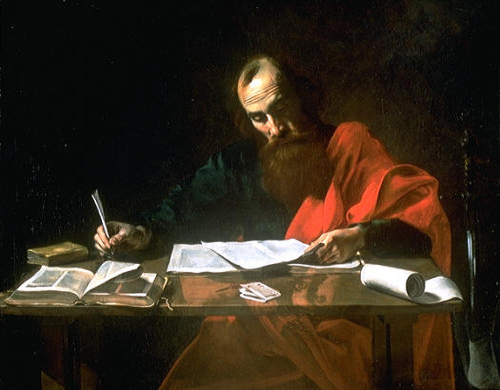
It is not necessarily easy to see the difference between divine inspiration and ecclesial infallibility. Each of these involves a mysterious, pedagogical activity of the Holy Spirit, working in and through fallible men so that we might know the truth about God and salvation. There are, however, significant differences between inspiration and infallibility. Here is my very fallible attempt to explain what those differences are:
1. All inspired teaching is infallible, but not all infallible teaching is inspired.
2. Divine inspiration is an act of God whereby a human being is so moved by the Holy Spirit that the words which he utters or writes are (in a mystery) the very words of God. The work of God, in this case, pertains directly to the words spoken or written by inspiration.
3. Ecclesial infallibility is a gift of God, such that, when the whole Church expresses her mind in an ordinary or extraordinary way on matters of faith and morals, she is protected from error by the Holy Spirit. The Church’s infallible teachings are not the very words of God.
4. In the case of inspiration, the Spirit is directing someone to speak or write something, i.e., God’s word. In the case of ecclesial infallibility, the Spirit is preventing someone from saying or writing something, i.e., error.
5. A text or utterance given by inspiration is a divine revelation. As such, its content need not be either explicitly or implicitly contained in the deposit of faith (also called the “treasury of revelation”) received up to that time. A text or utterance promulgated infallibly, though not by inspiration, merely explicates the deposit of faith, and must be at least implicitly contained therein.
6. God’s word is radiant and delectable, a light unto the path, food for the soul. The Church’s non-inspired teachings, even those which have been taught infallibly, are mere eye drops applied to wash away confusion that would be foisted upon the faithful by those who misapprehend the word of God.
7. The basic distinction is between divine revelation given to the Church and the Church’s unerring exposition of the revelation so given. This ecclesial exposition of the word of God does not belong merely to the natural order because the Church has the mind of Christ (1 Corinthians 2:16)—together with the mandate to express that mind (Matthew 28:18-20)—and the Holy Spirit of truth (John 14:26), whereby she is constituted and maintained as “the pillar and foundation of truth” (1 Timothy 3:15), such that we are obliged to receive her dogmatic teaching with the full assent of faith.

Andrew:
Two points need emphasis here. First, the doctrine of the Magisterium’s infallibility (DMI) does not mean that anything the Magisterium says is divinely inspired. The Church has never taught that the Holy Spirit is the primary author of Magisterial documents, as he is of the Bible. DMI means that when teaching something definitively, with its full authority binding the Church, the Magisterium is protected by the Holy Spirit from teaching a falsehood. What is so taught might be defective in various other ways: it could be incomplete, inopportune, or capable of better formulation. But its being infallibly taught means that we can be sure it is true. It is also and thus “irreformable,” which means that all subsequent formulations must be logically compatible with what it says.
Second, in Dei Verbum §10, Vatican II said:
Unlike Scripture, to which “inspiration” applies, the Magisterium is not a fontis of divine revelation. It is only the “authentic interpreter” thereof. Given DMI, it follows that what’s “infallible” are the Magisterium’s definitive interpretations of revelation. As I’ve implied, that is only a negative constraint; but it is essential to the transmission of divine revelation, of which Scripture and Tradition are the two primary means.
Best,
Mike
The Church has never taught that the Holy Spirit is the primary author of Magisterial documents, as he is of the Bible.
Mike, this observation is helpful. I had thought of trying to capture the difference between the two activities of the Spirit in terms of active (inspiration) and preventive (infallibility).
Dear Michael,
Thanks for the excellent and helpful comment. I wonder if you could help me with one part.
You said: “What is so taught [that is, DMI] might be defective in various other ways: it could be incomplete, inopportune, or capable of better formulation.” By these characteristics, do you mean to make distinctions between DMI and Sacred Scripture? I had never thought of the question until now, but is it right to say that our infallible Scripture is capable of no better formulation? As one who waxes Catholic and wanes Reformed, I’ve often been frustrated that Scripture wasn’t just a teensey bit clearer on the more Catholic-distinctive teachings.
Looking forward to a response if you have the opportunity.
Peace in Christ,
Tom
Tom:
Is it right to say that our infallible Scripture is capable of no better formulation?
I think that it is indeed right to say that. The law of the Lord is perfect. Every word of Scripture pertains to Jesus Christ, the Word. If we struggle to perceive the fullness of the revelation of Christ Jesus in the inspired, written word, the fault lies with us.
As individuals, our tendency is to fall away from the perfection of the inspired word into confusion and / or error. This is why we must read Sacred Scripture within the sacred community of the Church, which is the Body of Christ, which has the mind of Christ, and knows the things of Christ intuitively, the way the spirit of a man knows the things of a man.
This is why the Church, in her infallible formulations of Christian doctrine, is not completely dependent upon discursive reasoning from the letter of Sacred Scripture. She has privileged access to the subject of Sacred Scripture. As a word of testimony, I can say that reading the Bible with the Church is the most wonderful experience in the world, with the exception of receiving absolution and a good Communion.
I hope that Michael and others will also address your question.
Tom:
Scripture and the Magisterium are quite different. Scripture and Tradition together transmit to us the full material content of the deposit of faith, whereas the Magisterium is only the “authentic” interpreter thereof. Thus the Magisterium is not on the same level as Scripture or Tradition, but serves them by securing their proper interpretation by the faithful.
As to your question: “[I]s it right to say that our infallible Scripture is capable of no better formulation?”, I’d answer by invoking a distinction. Scripture is “perfect” inasmuch as, given that the Holy Spirit is its primary author, it conveys all and only the truth that the Holy Spirit wills to convey by means of it. But Scripture is not perfect in the sense that it makes everything perfectly clear by itself. It can be properly understood and interpreted only together with Tradition and the Magisterium. That’s why Vatican II said that none of the three can stand without the others.
Best,
Mike
Tom wrote: “Is it right to say that our infallible Scripture is capable of no better formulation? As one who waxes Catholic and wanes Reformed, I’ve often been frustrated that Scripture wasn’t just a teensey bit clearer on the more Catholic-distinctive teachings.”
In some sense, the Scriptures would have been “better” formulated as a catechism which spelled out explicitly each and every important doctrine. For instance, Baptism does X, Y, and Z but does not do A, B, and C. Instead we get passages like “no one can enter the kingdom of God without being born of water and Spirit” which earnest Christians can interpret differently.
Wouldn’t it have been a “better” formulation–not just for Catholic-distinctive teachings but for every teaching–to have things made explicit? For instance, Jesus says, “The Father is greater than I” (John 14:28) which played right into the hands of people like Arius in the 4th century; why didn’t Jesus follow-up by saying: “But the Father and I are one in being with each other, consubstantial, and by the way, so is the Holy Spirit, who is also God, and who proceeds from both the Father and I”?
Obviously I do not claim that the Holy Spirit could have done a “better” job of inspiring Scripture–as Michael said above, He did what He did and accomplished what He wanted to through it. But to me, it demonstrates the need for “something else”, a complement to the Scriptures if you will, by which we could know what is true and what is false. You know that, as a Catholic, I believe these “complements” are the full apostolic Tradition with the Magisterium faithfully interpreting them.
Devin – Good point. We take revelation as it comes.
Andrew,
Forgive me if this comment doesn’t stick strictly to your current post, but I composed it before seeing this article. Having read this post, I would like to comment on it separately. For everyone else, this comment is part of an ongoing dialogue that Andrew and I have been having. To see previous posts for context please see this link https://www.calledtocommunion.com/2010/01/the-canon-question/.
1. Where in scripture has the infallibility of the church been revealed? Mattew 16? If so, you are importing that into the text, not drawing it out. And it is not valid to appeal to Tradition on this point, because that is what is being questioned. Incidentally, most of the early church fathers would agree with me (James White, “The Roman Catholic Controversy”).
2. When I say that faith is necessary for any knowledge I mean there are certain axioms that are necessary for knowledge that cannot be proved by reason. My reason for bringing it up was to point out that I don’t think your distinction between certainty of faith and natural knowledge is helpful for this particular discussion. Any kind of knowledge requires some faith.
3. You said you have a certainty of faith with regards to the canon, and, I surmise, that faith is based on your faith in the infallibility of the Roman church. But that only raises the question, what is your faith in the Roman church based on? Now, you have said that your faith in the Roman church is based on reason. Therefore, your faith in the canon is at least indirectly based on reason. By the way, if the authenticity of the claims of Rome are within the purview of reason, why isn’t the question of the canon? To clarify, I don’t think one could prove the canon beyond a doubt, but I do think we can use reason and historical analysis to arrive at a very comfortable level of assurance. So then, faith can bridge that gap to give the Christian certainty.
Roman Catholics seem to miss a very important point here. You rest your certainty in the canon, and many other points of doctrine, on the infallibility of the church and thus avoid the Protestant “dilemma” of having to use reason to settle doctrine. But in doing so you make two great errors. First, you misunderstand the Protestant position, which rests it certainty on faith in Christ who affirmed the clarity, reliability, and authority of the scriptures. We also acknowledge a fallible canon, and simply remind you that there is no reason to think we need an infallible canon (by RC standards the church didn’t have one for 15 centuries), and also that a fallible canon does not equal an uncertain canon (the mistake Tom made). Second, the RC position fails to achieve the certainty it seeks with an infallible magisterium, because although you may accept what the church says as certain because the church is infallible, you only believe the church to be infallible because you have evaluated their claims, and concluded based on your own judgment that it is true. By doing this the Papist becomes guilty of the very thing he often accuses the Protestant of doing, namely, becoming a rogue arbiter of truth. But since neither one of us thinks of himself in this way, the only fair answer is to ask, what are our respective authorities we subscribe to? Mine is Scripture. Yours is the Roman Catholic Church.
4. This brings us to my assertion that you practice sola ecclesia. There is certainly a difference between expounding Scripture with authority or being certain of what Scripture teaches, and claiming to be infallible in doing so. If I may digress, here again, you seem to fail to recognize the distinction between infallibility and certainty. I take no issue with Rome expounding Scripture with authority or claiming certainty in its interpretations. Indeed, I applaud Rome for teaching with certainty the full deity of Christ, for example. But to claim infallibility is altogether different, for that is to claim she CANNOT err, and there is no support for that either historically or Biblically. Back to sola ecclesia; Rome puts itself on par in terms of authority with Scripture. This in itself does not elevate the magisterium above Scripture, however, when it is added that the magisterium both determines what is Scripture, and what Scripture means, the authority of Scripture is rendered toothless. An analogy may be helpful. Let us say we are going to devise a new game. It will be like basketball, and a rule book is written to govern how it is played. We may agree on the rule book. But if I say, “Wait, one more thing, I will have equal weight as the rule book, and I will decide what parts of the rule book are authoritative, and I will decide how to interpret those rules, and my decisions and interpretations thereof are final and authoritative. In fact, it is impossible for me to err in my decisions and interpretations. I am infallible in my execution as rule maker.” I think you would rightly perceive that I was the sole authority that mattered and the rule book is comparatively unimportant. If very much were riding on the outcome of the game, you would object to the arrangement. This is what Rome has done. Jesus condemned the Pharisees for doing just that. Their traditions had become the de facto rule of faith, and Jesus said, “you… make[ing] void the word of God by your tradition,” – a charge I believe is aptly applied to Rome.
5. Nowhere does Scripture teach that salvation is by grace alone, through faith alone, in Christ alone? My friend, that is the whole tenor and tone of the New Testament, even, although not fully explicated therein, the Old Testament! So much so, it is hard to pick only a few passages to reference, since they are so abundant and clear! Nevertheless, here are some references…
Romans 3:20-28, 4:2-5, 5:17-20
Ephesians 2:8-9
Titus 3:5
Galatians 3:1-3
Philippians 3:9-10
Any one of those passages is worth spending some time on, but they all clearly teach that none of our works help to merit salvation. You wrote, “your inadvertent arrogation of infallibility to a doctrinal claim of your own devising does illustrate the importance of the gift of ecclesial infallibility; Scripture is not self-interpreting, and one cannot live and die or hang his hopes upon doctrines that necessarily come with an asterisk attached.”
First, I did not claim infallibility for myself, I claimed it for Scriptures. My being certain of something Scriptures infallibly teach is not an arrogation on my part – over and over you conflate infallibility and certainty. I can be certain of what Scripture teaches because the word of God is clear. To say otherwise is to make it void. Second, the New Testament writers used Scripture to interpret Scripture frequently. Yes, they also gave authoritative and infallible interpretations de novo, but their authority to do so derived from their being Apostles, inspired by God. To claim that the Papal Bulls or Counciliar statements are equally infallible is to claim Scripture is still being written essentially. Third, no asterisk need be attached to any essential Protestant doctrine. Again, Scripture is clear on foundational doctrines. It would be very strange indeed if God’s perfect word were obscure, esoteric, or misleading. Such a position makes mincemeat of God’s special revelation, and contradicts it to boot (Psalms 12:6). If I can be certain of what you are saying (and although articulate, your writing is not perfect ;), why couldn’t I be certain of what God says about salvation and holiness in his perfect word? It seems to me, the Roman position is untenable.
Patrick,
1. The infallibility of the church can be inferred from several passages of Sacred Scripture, including those I cited in point 7 at the end of this post. It is also my contention (though not in the above post) that the infallibility of the church is implied by the notion that the canon of Scripture is an article of faith in the sense of something that can be legitimately accepted with the full assurance of faith.
2. I agree that there are certain axioms necessary for knowledge that cannot be proved by reason, but I disagree that these axioms are necessarily supplied by special revelation, in which case knowing them would depend upon an act of faith. Rather, said axioms are self-evident, as can be discerned by reason apart from faith. The canon of Scripture, however, is not self-evident, nor can it be demonstrated with certainty by reason alone. Thus, given that it is important to know with certainty which writings are inspired, the distinction between faith and reason is indeed crucial to this discussion.
3. My belief that the Catholic Church is the Church that Christ founded is fundamentally a divine gift (cf. Ephesians 2:9). That Christ founded the Catholic Church is a matter that has been divinely revealed (cf. Matthew 16), which is why it is something that can and should be received by faith. However, given that grace is not opposed to nature, this fact is compatible with there being motives of credibility for faith which motives can be discovered by reason. This does not imply that my faith, in whole or in part, is based upon human reason, only that it can be shown to be reasonable.
For Catholics, reason does not settle doctrine. The Church settles doctrine. Accepting the definitive (irreformable) teaching of the Church in matters of doctrine requires an act of faith, and as I have just pointed out faith is not based upon reason, it is based upon divine revelation (for its object) and grace (for its life in the subject). But since Protestant doctrines of the church do not legitimate an act of faith in the teachings of the church, no Protestant can consistently accept the church’s teachings by faith. Those teachings must either be proven by reason, or where this is not possible, be held as matters of opinion. And that is a problem, I maintain, particularly with regard to the identity of Sacred Scripture, which is supposed to be the Protestant’s sole (infallible) authority in matters of faith.
4. See my post for a more accurate explanation of the authority of the Church in relation to the authority of Sacred Scripture.
5. If you wanted to refer me to what the passages you cited infallibly teach, then you could have simply given the references. Your interpretive gloss is not infallible, nor is it particularly good even as merely human opinion about the meaning of those texts; at least, I think my interpretation of those texts is better than yours! Also, there are many other texts that are just as clear as the ones you cite (Romans 2 and James 2 come to mind), but as you know it can be difficult to discern, i.e., unclear, just how all of these texts on salvation and related matters are consistent with one another.
Finally, there are at least two distinct senses in which certainty can apply to our reception of a communication. First, in cases of inspiration and infallibility, we can be certain that what is communicated is true, even if we are not sure that we understand all of it. Thus, by faith, we “stick with” the teachings of Jesus, the Apostles and Prophets, and (for Catholics) the Church, even if we do not fully understand or in some cases much understand those teachings. We believe, and seek understanding. Second, given the right conditions and using sound principles of interpretation, we can be certain that we understand at least some of what is communicated, whether by God or by a fellow human being, whether or not that human being is specially protected from error in that particular communication. Of course, some things, both divine and human, are difficult to understand, and it seems to me no good stipulating a priori what is easy and what is hard to understand. We have to take things as they come.