
Ecclesial Deism
Jul 6th, 2009 | By Bryan Cross | Category: Featured ArticlesSt. Irenaeus and St. Clement of Alexandria, who both lived during the second century, tell us that after the Apostle John returned from exile on Patmos, he remained at Ephesus “till Trajan’s time.” Trajan became emperor in AD 98. According to the tradition, St. John was the last of the twelve Apostles to die. When the angels carried his soul into Heaven, was the Church then left to fall into heresy and apostasy?
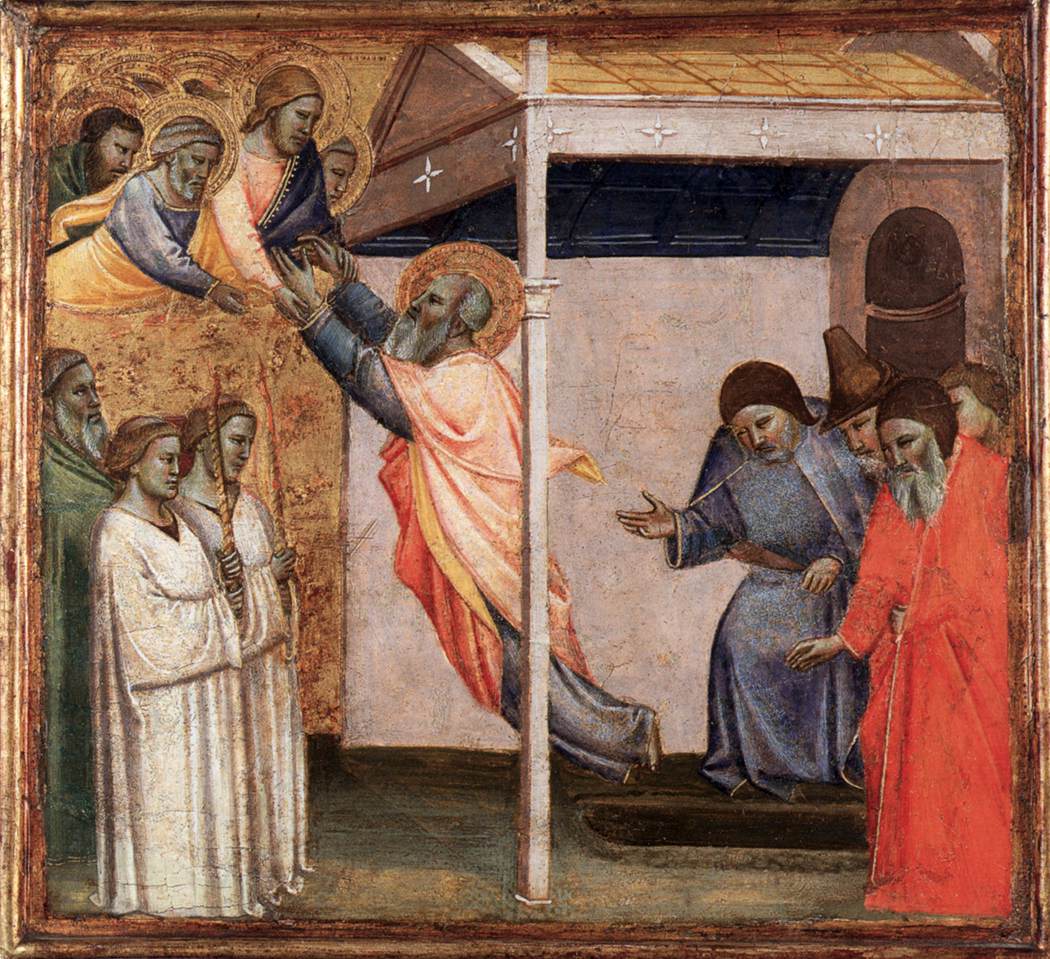
Assumption of St. John the Evangelist
Taddeo Gaddi (1348-1353)
Collezione Vittorio Cini, Venice
Contents:
I. A Dilemma
II. Ecclesial Deism
III. Ecclesial Faith
IV. Indefectibility of the Mystical Body
V. An Objection
VI. Conclusion
A few weeks after I graduated from seminary, some Mormon missionaries came to our door. My wife invited them in, and we started talking. But we were just getting into the important questions when we ran out of time. So we agreed to meet with them the following week. They ended up coming weekly for the rest of the summer. Since I had just completed four years of training in biblical theology, Greek and Hebrew, I was quite confident that I could persuade these teenage missionaries by exegetical arguments from Scripture that Mormonism is false and that the Gospel, as we understood it then, is true.
Over the course of our discussions with these Mormon missionaries, when I argued that their teachings were contrary to Scripture, they would counter by appealing to the Book of Mormon, and I would respond by saying that the Book of Mormon is contrary to Scripture. But they viewed Scripture through the Book of Mormon, that is, in light of the Book of Mormon. They claimed that very shortly after the death of the Apostles (or maybe even before the death of the last Apostle) the Church fell into utter apostasy, and that the true Gospel had been preserved in North America where Jesus had come to preach to certain peoples living here at that time. For that reason, according to the Mormons, the Bible had to be interpreted and understood in light of this additional revelation that Joseph Smith had recovered, and not according to the teachings and practices of the early Church fathers. That was because in their view the early Church Fathers had corrupted Christ’s teaching by incorporating into it both Greek philosophy and pagan rites in syncretistic fashion. So our conversation at some point reached fundamental questions such as: “Why should we believe the Book of Mormon over the early Church fathers?”, and “How do you know that the Church fathers corrupted Christ’s teaching?”
I realized at the time that I too, as a Protestant, could not appeal to the early Church fathers or the councils in a principled way to support my position against that of the Mormons. Of course, at that time I agreed with Nicene Trinitarianism and Chalcedonian Christology, but like the Mormons I too believed that shortly after the death of the Apostles the Church had begun to fall into various errors, minor at first but progressively more serious. So in my mind, everything any Church father said had to be tested against [my own interpretation of] Scripture.
Where did I think the early Church had gone wrong? I agreed with the Mormons that the early Church had been influenced by Greek philosophy. The Church had made use of Greek philosophy with terms such as homoousious, hypostasis, and physis to explain and defend the doctrines of the Trinity and the Incarnation. Of course, I believed those doctrines to be true, but the use of such Greek notions worried me because it suggested an implicit syncretism. Protestants I respected had told me that they questioned or rejected parts of the Nicene Creed (e.g., saying that Christ was “eternally begotten”) as being both extra-biblical and based on Greek philosophy. I knew that Greek philosophy had been quite influential in Alexandria, and I believed that this is where the allegorical method of interpretation was introduced. This was a method, in my mind, that was at least in part responsible for the Church’s departure from the Gospel, and the subsequent need for the Reformation. From my sola scriptura point of view, there was no difference between bishop and elder, no basis for the papacy or even Roman primacy, not even a real distinction between clergy and laymen. So the whole hierarchical organization of the early Catholic Church seemed to me to be a corruption, a departure from what was taught in the New Testament.
Similarly, I believed that the Catholic liturgy, holy days, almost everything in the liturgical calendar, vestments for clergy, veneration of saints and their relics and icons, prayers for the dead, and prayers to departed saints were all accretions from pagan holidays and practices. Even the idea that some Christians are saints in some greater way (with a capital ‘S’) than that in which all Christians are saints was, in my opinion, a corruption, because I thought that egalitarianism followed from our being saved by grace. This was epitomized, in my view, by the Catholic Church’s veneration of Mary, treating her as “Mother of God,” and claiming that she remained a virgin after the birth of Jesus, as though marriage and sexual intercourse were evil.
From my point of view at that time, the early Church had somehow been led astray from the finished work of Christ and come to believe in what I thought was a magical conception of the sacraments, presumably also imported from paganism. This magical way of conceiving of the sacraments explained why the bishops who wrote the creeds treated baptism as forgiving sins, why at some point they came to believe that the bread and wine really became the Body and Blood of Christ, and why they transformed the agape love-feast into the “Eucharistic sacrifice.”1 That, along with their failure to adhere to sola scriptura, explained why they treated things like confirmation, marriage, penance, and ordination as sacraments. From the sola scriptura point of view, all these ‘additions,’ like purgatory, the exaltation of celibacy, mysticism, monasticism, and asceticism, had to have come from paganism, and were therefore a corruption of the purity of the Church and the Gospel, just as Israel of the Old Testament had played the harlot with the gods of the other nations. As I saw it, the Church had started to deviate from orthodoxy by the second century, and the pace of that deviation only accelerated when, according to this narrative, Constantine made Christianity the official state religion.2 Christ had said that His Kingdom was not of this world, but in my mind the Catholic Church had tried to turn it into an earthly kingdom, with bishops and popes assuming monarchical prerogatives.
So when the Mormons claimed that a great apostasy had overcome the Church by the time of the death of the last Apostle, I had no ground to stand on by which to refute that claim. The Mormons believed that the true gospel was recovered in the early nineteenth century by Joseph Smith. I believed, as a Reformed Protestant, that the true gospel was recovered in the early sixteenth century by Martin Luther. But we both agreed (to my frustration) that the early Church fathers and the councils were suspect and not authoritative in their own right. Over the course of our meetings with the Mormon missionaries that summer I realized that with respect to our treatment of the early Church fathers and ecumenical councils, there was no principled difference between myself and the two young Mormon missionaries sitting in my living room.3
This same problem can be seen clearly in a debate hosted by Beliefnet.com in 2007 between Orson Scott Card, who is a Mormon, and Albert Mohler, who is a Reformed Baptist and also the President of Southern Baptist Theological Seminary. The debate centered on the question, “Are Mormons Christian?” Mohler rightly claims that Mormonism is incompatible with “traditional Christian orthodoxy.” He writes:
According to Mormon teaching, the church was corrupted after the death of the apostles and became the “Church of the Devil.” Mormonism then claims that the true church was restored through the Prophet Joseph Smith in the 1820s. This restored church was, Mormon theology claims, given the keys to the kingdom and the authority of the only true priesthood.
[W]e do have an objective standard by which to judge what is and is not Christianity, and that is the very “traditional Christian orthodoxy” that Mr. Card and Mormonism reject.4
According to Mohler:
Christianity is rightly defined in terms of “traditional Christian orthodoxy.” Thus, we have an objective standard by which to define what is and is not Christianity. . . . Once that is made clear, the answer is inevitable. Furthermore, the answer is made easy, not only by the structure of Christian orthodoxy (a structure Mormonism denies) but by the central argument of Mormonism itself – that the true faith was restored through Joseph Smith in the nineteenth century in America and that the entire structure of Christian orthodoxy as affirmed by the post-apostolic church is corrupt and false. In other words, Mormonism rejects traditional Christian orthodoxy at the onset – this rejection is the very logic of Mormonism’s existence. A contemporary observer of Mormon public relations is not going to hear this logic presented directly, but it is the very logic and message of the Book of Mormon and the structure of Mormon thought. Mormonism rejects Christian orthodoxy as the very argument for its own existence, and it clearly identifies historic Christianity as a false faith.5
Mohler claims that we have an “objective standard” by which to define what is and what is not Christianity. That objective standard is “traditional Christian orthodoxy.” But this subtly pushes back the question: What is the objective standard for what counts as “traditional Christian orthodoxy”? Mohler appeals to the early creeds, and the first four ecumenical councils. He seems to think that the end of the fifth century is roughly the cutoff for “traditional Christian orthodoxy.” But picking the fifth century as the cutoff for “traditional Christian orthodoxy” is no less ad hoc than is picking the first century. If one thinks that the Church fell into heresy or apostasy, there is no more principled reason to think the ‘apostasy of the Church’ did not begin for five hundred years than there is to think it began in the first century.
Moreover, the first five centuries of Christian tradition are replete with beliefs and practices that Mohler rejects. I described some of them above in laying out those points concerning which I, as a Protestant, believed that the Church had been corrupted. The bishops who wrote the Nicene Creed, which Mohler treats as part of the orthodox tradition, were the bishops at the First Ecumenical Council of Nicea in AD 325 and at the Second Ecumenical Council of Constantinople in AD 381. But Baptists such as Mohler reject both the doctrine of apostolic succession and the episcopal form of Church polity that all those bishops believed and practiced.6
Baptists reject what all those bishops believed and taught as being essential to the Christian faith regarding baptismal regeneration: “one baptism for the forgiveness of sins.”7 Many of the canons of the Council of Nicea (AD 325) do not even make sense from a Baptist point of view. Mohler is critical of the Third Ecumenical Council of Ephesus (AD 431) in its declaration of Mary as the ‘Theotokos,’ claiming that doing so “brought ill effects upon the Catholic Church.”8 He accepts the Christology taught by the Fourth Ecumenical Council (Chalcedon, AD 451), but rejects the teaching of the Fifth Ecumenical Council (Constantinople, AD 553) which affirmed the perpetual virginity of Mary,9 claiming that it “moved Roman Catholic theology and devotion increasingly away from the Holy Scriptures and toward human innovation.”10 And he rejects the Seventh Ecumenical Council (Nicea, AD 787) in its condemnation of iconoclasm.
The problem here is that Mohler’s position faces a serious dilemma regarding the tradition to which he is appealing as the basis for “Christian orthodoxy.” On the one hand, Mohler cannot reject the tradition of the early Church, because that would make his own position fail to count as “traditional Christian orthodoxy,” and thus fail to count as “Christian,” by the very same argument he uses to claim that Mormonism is not Christian. On the other hand, Mohler cannot embrace the tradition of the early Church, because, as shown above, in many important ways that tradition is incompatible with his own Baptist theology.
How does Mohler deal with this dilemma? He adopts a pick-and-choose approach. This approach attempts to avoid the dilemma raised above by methodologically, though not explicitly, counting as ‘traditional’ [as in “traditional Christian orthodoxy”] only whatever the Church said and did that agrees with or is at least compatible with his interpretation of Scripture. By this approach ‘tradition’ becomes whatever one agrees with in the history of the Church, such as the Nicene Creed or Chalcedonian Christology.
This pick-and-choose approach to the tradition shows that it is not the fact that an Ecumenical Council declared something definitively that makes it ‘authoritative’ for Mohler. What makes it ‘authoritative’ for Mohler is that it agrees with his interpretation of Scripture. If he encounters something in the tradition that seems extra-biblical or opposed to Scripture he rejects it. For that reason, tradition does not authoritatively guide his interpretation. His interpretation picks out what counts as tradition, and then this tradition informs his interpretation.
The problem with the pick-and-choose approach is that it is ad hoc insofar as one picks and chooses from among Church Fathers and councils only those statements one agrees with, to be ‘authoritative.’ In this way Mohler is engaging in special pleading: he criticizes Mormonism for selectively rejecting the Christian tradition, while he himself selectively rejects the Christian tradition. So in order to serve as the standard for “Christian orthodoxy,” the distinction between what counts as tradition, and what does not, must be principled. Yet Mohler’s theology has no conceptual space for a principled basis for this distinction. The result is that Mohler identifies tradition in the same way that an archer might paint a target around an arrow he has already shot into a wall.
So the dilemma is this: either he makes an ad hoc appeal to tradition, and thus commits the fallacy of special pleading, or he gives up his appeal to tradition, and thereby loses that by which he tries to draw a principled distinction between the methodologies whereby Baptists and Mormons determine whether particular traditions are in line with Scripture or are ungodly accretions.
A further and particularly significant implication of this ad hoc approach to the tradition is that it undermines the basis for believing the canon of the Bible to be correct. If the Church erred in so many doctrines and practices, then we have no basis for believing that the Church got the canon right. It would be ad hoc to trust that the Church got the canon right while believing that the Church got so many other things wrong during that same period of time.11
In that case we cannot justifiably use our interpretation of Scripture to determine which traditions agree with our interpretation and which traditions do not, because we do not know which books are Scripture. Nor, for the same reason, can we use our interpretation of Scripture to determine which books of the Bible belong there, because that would be to assume at the outset precisely what we do not know, i.e., the canon. As a result, those who claim that the Church deviated from orthodoxy at an early point in history, and use Scripture to show this, undermine the very basis for their assurance that the book they hold in their hand is canonically inerrant. They must either turn to critical scholarship, or resort to some internal voice that they perceive to be from the Holy Spirit, in order to verify the canon, before they can use the canon to evaluate the tradition of the early Church.
My point in considering Mohler’s example is not to pick on Mohler or Baptists. This particular dilemma is not unique to Baptists; it follows from the very nature of Protestantism, because Protestantism, like Mormonism, presupposes what I came to see as ecclesial deism. Deism refers to a belief that God made the world, and then left it to run on its own. It is sometimes compared to “a clockmaker” winding up a clock and then “letting it run.” Deism is distinct from theism in that theism affirms not only that God created the world, but also that God continually sustains and governs all of creation. Ecclesial deism is the notion that Christ founded His Church, but then withdrew, not protecting His Church’s Magisterium (i.e., the Apostles and/or their successors in the teaching office of the Church) from falling into heresy or apostasy. Ecclesial deism is not the belief that individual members of the Magisterium could fall into heresy or apostasy. It is the belief that the Magisterium itself could lose or corrupt some essential of the deposit of faith, or add something to the deposit of faith, as, according to Protestants, allegedly occurred in the fifth, sixth, and seventh ecumenical councils.
Why is ecclesial deism intrinsic to Protestantism and Mormonism? Because any person who chooses to leave the Catholic Church or remain separated from her, while intending to remain a Christian, has to claim that the Catholic Church has fallen into heresy or apostasy, so that separating from her is justified. We can find this idea throughout the history of the Catholic Church. The Gnostics of the second century justified being separated from the Catholic Church by claiming that even the Apostles had perverted Christ’s teachings. St. Irenaeus (d. AD 200) writes:
But, again, when we refer [the heretics] to that tradition which originates from the apostles, [and] which is preserved by means of the succession of presbyters in the Churches, they object to tradition, saying that they themselves are wiser not merely than the presbyters, but even than the apostles, because they have discovered the unadulterated truth. For [they maintain] that the apostles intermingled the things of the law with the words of the Saviour; . . . It comes to this, therefore, that these men do now consent neither to Scripture nor to tradition.12
Of course ecclesial deists typically do not describe their own position as a form of deism, nor do they see it as such. From my own experience inside this point of view, one significant factor preventing ecclesial deists from seeing their own ecclesial deism as such is an implicit gnosticism (anti-sacramentalism) regarding the nature of the Church. The Church, according to this conception, is not a unified body with a visible hierarchy, but is something in itself purely spiritual in nature, visible only in the sense that one can see and touch embodied Christians (and their children) who are, by their faith alone, presently joined to it.13 Conceiving of the Church as in itself spiritual and invisible allows a person to believe that Christ has always faithfully preserved His [invisible] Church, even while allowing the leaders of the Catholic Church in total to fall into heresy, apostasy, or perversion of the Gospel.14
This conception of the Church makes it conceptually impossible for the gates of Hades to prevail over the Church, no matter what happens to the hierarchy of the visible Church. According to this notion, even if at some point in history there were no [embodied] believers, this would not entail that the gates of Hades had prevailed over the Church, because the Church is fundamentally a spiritual entity existing in the spiritual realm. Yet most people holding this conception of the Church as invisible believe that there has always been at least some remnant of Christians who believed the true faith, the true faith that was rediscovered by some later figure such as Martin Luther 1,500 years later or Joseph Smith 1,800 years later.
Given this gnostic (anti-sacramental) conception of the Church, none of the biblical promises concerning the Church apply to the Catholic Church. These include not only Christ’s aforementioned promise that the gates of Hades will not prevail against the Church,15 but also that He will be with her even to the end of the age,16 that the Holy Spirit will guide her into all truth,17 and that the Church is built upon a rock and cannot be washed away.18 In the Old Testament the prophets looked forward to the Church age. From their writings we see that the Church enjoys an everlasting covenant that cannot be revoked,19 that the Church is everlasting and indestructible,20 and that David’s throne will exist for all time.21 For all these reasons, the Apostle Paul teaches that the Church is “the pillar and bulwark of the truth.”22 But given the gnostic conception of the Church, these promises do not apply to the Church in relation to her visible unified hierarchy; they apply instead to some invisible entity to which all Christians are spiritually joined through faith.
Furthermore, given this conception of the Church as something in itself invisible, being excommunicated from the Catholic Church is no more reason to believe that you have been separated from the Church Christ founded than it is to believe that you are the continuation of the Church Christ founded, and that the Catholic Church is the apostate ‘schism from’ the Church Christ founded. This is why heresies and schisms must either maintain that the Church Christ founded is invisible, or, if they acknowledge that the Church is essentially a visibly unified hierarchical body, they must claim to have more ecclesial authority than does the episcopal successor of St. Peter.
Ecclesial deism tends to see the changes over the first fifteen hundred years of Church history as corruptions, not developments. That is why it seeks to jettison all these ‘accretions’ and return to the “purity of the Scriptures.” In combination with a sola scriptura approach, it is inclined to view anything in the Christian tradition that is not explicitly stated in Scripture or does not necessarily follow from it as a corruption or paganization of the Church. In that respect it is fundamentally pessimistic, skeptical of the possibility of a providentially-guided deepening of the Church’s understanding of the deposit of faith, until some later restoration is initiated. We find this notion of ecclesial deism quite clearly in the Restorationist movement that arose in nineteenth century North America. This includes the Churches of Christ, Disciples of Christ, Jehovah’s Witnesses, Seventh-day Adventists, and the Latter Day Saints.23 The Restorationists are unequivocal about what they believe to have been an early apostasy and a long spiritual ‘dark age’ followed by a restoration to the true and primitive Christian faith in their own group in the nineteenth century. That idea epitomizes ecclesial deism.
But it is not only self-described Restorationists who hold this position. Contemporary Presbyterian theologian Robert Reymond, for example, writes, “[T]he church in many areas of the then known world rather quickly departed from the pure gospel and teaching of the apostles and began to espouse defective views of the Trinity and the person and work of Christ, and to advocate Pelagian and sacerdotalistic version of salvation.”24 Calvinist theologian Louis Berkhof writes, “Some of [Gnosticism’s] peculiarities were absorbed by the Church and in course of time came to fruition in the Roman Catholic Church with its peculiar conception of the sacraments, its philosophy of a hidden God, who should be approached through intermediaries (saints, angels, Mary), its divisions of men into higher and lower orders, and its emphasis on asceticism.”25 Scottish Presbyterian Thomas Torrance likewise published The Doctrine of Grace in the Apostolic Fathers in 1948 to explain the “enormous difference that exists between the faith of the New Testament and that of the second and third centuries.”
Some Protestants try to distance themselves from the foundational assumption of the Restorationists.26 These Protestants seek to avoid claiming that the Church fell into apostasy, while also claiming that the Gospel was recovered by the Reformers in the sixteenth century. For example, Charles Hodge, the principle of Princeton Theological Seminary in the middle of the nineteenth century, wrote:
We do not hold to an entire apostasy of even the outward Church before the Reformation. It is an historical fact that (excepting the Arian heresy), the inspiration of the Scriptures, the doctrine of the Trinity, the true divinity and humanity of the Savior, the fall of man, redemption by the blood of Christ, and regeneration and sanctification by his Spirit were held by the Church universal. These are not the doctrines of Romanism as distinguished from Protestantism. These are not the points against which the Reformers protested, and as to which they proclaimed Rome apostate and anti-Christian.27
Notice that Hodge is making two distinctions here. One is between “the outward Church” and [presumably] the “inward Church,” which for him is the invisible Church. The “outward Church” can suffer at least ‘partial apostasy’ while the ‘inward Church’ cannot suffer any apostasy. This division of the Church into an outward Church and an inward Church is an ecclesial Nestorianism which necessarily collapses into ecclesial Docetism for the following reason. The error of Nestorianism was treating Christ’s human nature as a complete or whole created being that was united to a divine Person. The notion that Christ’s human nature (which is a rational nature) was a complete created being entails that there was a created person. And so the ontological result of this error is two persons, one created and one uncreated, united by an extrinsic union. The human being is not divine, but closely united to the divine. That is why Nestorius refused to acknowledge that Mary is the Mother of God, preferring instead to designate her the mother of Jesus. But since it had already been established at Nicea in AD 325 and Constantinople in AD 381 that God is a Trinity of Persons: Father, Son, and Holy Spirit, then if Jesus is a human being closely connected to God, but not God, what follows is some form of Docetism — the Son only seemed to be Jesus. That is why the Council of Ephesus (AD 431) had to condemn Nestorianism.
Likewise, and for the same reason, ecclesial Nestorianism necessarily collapses into ecclesial Docetism. Here is why. Given that Christ is the Head of the Mystical Body, then treating the Mystical Body as something distinct from, even if extrinsically united to, the Catholic Church, reduces the Catholic Church to a merely human institution, just as Nestorianism reduces Jesus to a mere human being. The real Church (i.e., the one that Christ founded), given ecclesial Nestorianism, is the invisible Church that may or may not be in some way related to the Catholic Church. That is ecclesial Docetism.28 The real Church, for Hodge, is the inward or invisible Church; there is no “visible Church” per se, nor do the promises of Christ apply to it. There are many visible churches, but no universal visible Church.
The second distinction Hodges tries to make here is between partial apostasy and “entire apostasy.” Entire apostasy would be the loss of all true doctrines of the deposit of the faith, while partial apostasy [apparently] would be the loss of only some part of the deposit of faith, and/or the wrongful addition of something to the deposit of faith.29 Given that definition of “entire apostasy,” any Restorationists who shared even one common point of doctrine with the Catholic Church would agree with Hodge. But then with respect to the “apostasy gap” assumed by Restorationists, there is no principled difference between Restorationist Protestants and Protestants who distance themselves from Restorationists. The difference is only a matter of degree with regard to what percentage of the deposit of faith was lost, and the rate at which that loss occurred.
If the Catholic Church did not apostatize, then Protestants would not be justified in separating from her. So in order to justify separating from the Catholic Church, Protestants must hold that the Catholic Church apostatized, either earlier in her history, or later. Hodge seeks to distinguish his position from the Restorationists by delaying and diminishing the degree of apostasy. But his position faces a dilemma. The first horn of the dilemma is this: if he claims that the Church apostatized early on, then his position is equivalent to that of the Restorationists. The second horn of the dilemma is this: if he claims that the Church faithfully maintained orthodoxy for 1,500 years, then there is a much greater likelihood that (a) the Church has continued to preserve orthodoxy and he is mistaken than (b) that he is correct and that the Church, after a millennium and a half, has finally fallen into apostasy. The second horn of the dilemma is not open to Hodge, because his theology would be unchanged if he claimed that the Church fell into utter apostasy by AD 500. That is because his theology is for the most part not formed and shaped by the rulings of the ecumenical councils between AD 500 through AD 1,500. So that leaves him on the first horn, with no principled difference between his position and that of the Restorationists.
Because there is no principled difference between Hodge’s position and that of the Restorationists’ with respect to the apostasy of the Church, Hodge faces the very same dilemma described above regarding Mohler. He can appeal to tradition only in an ad hoc manner, picking and choosing what he thinks is orthodox, and passing over what he thinks is not, according to his own interpretation of Scripture. And like Mohler, that completely undermines his ability to appeal to “traditional Christian orthodoxy” when responding to Mormons and other self-described Restorationists.
How did I come to recognize my ecclesial deism for what it was? I first began to see it when taking a graduate seminar on St. Thomas Aquinas. Aquinas continually appeals to the tradition of the Church, and to the Church Fathers. I found myself frustrated by his theological method. I wanted him to be doing exegesis from Scripture when making theological arguments, not appealing to the Church Fathers. The professor teaching the seminar responded to my objections by explaining that Aquinas believed that divine providence guided the Church Fathers and the development of the Church. This professor pointed out that Aquinas was not a deist about the Church. That short answer provoked me to do a great deal of reflecting, because I realized then that I did not share Aquinas’s non-deistic way of conceiving of the development of the Church.
Of course I firmly believed in divine providence, but I distrusted all the Fathers to whom Aquinas appealed. That is why, in my mind, appeals to the Fathers did not establish anything at all, because if the Church were being corrupted and falling away from the purity of the Gospel, then appealing to the Fathers was like appealing to heretics. But for Aquinas, if the Church Fathers taught something, especially if they were Doctors of the Church or if the claim in question was held and taught widely by the Church Fathers, that showed it to be authoritative for us as a kind of patrimony, precisely because the Holy Spirit was unfailingly guiding the development of the Church into all truth. On this point I discovered a very deep difference between myself and Aquinas. The more I studied his writings, the more the difference was noticeable to me. Aquinas believed that faith in Christ necessarily involves trusting the Church, because Christ cannot fail to guide and protect the development of His Church.
I came to see that I did not fully trust Christ, not because I thought Him untrustworthy, but because I had not understood that Christ founded a visible hierarchically organized Body of which He is the Head, and which He has promised to protect and preserve until He returns. I had not apprehended the ecclesial organ Christ established through which the members of His Body are to trust Him. I came to see that faith in Christ is not something to be exercised invisibly, from my heart directly to Christ’s throne, as though Christ had not appointed an enduring line of shepherds. Inward faith was to be exercised outwardly, by trusting Christ through those shepherds Christ sent and established. Jesus had said, “The one who listens to you listens to Me, and the one who rejects you rejects Me; and he who rejects Me rejects the One who sent Me.”30 This is the sacramental conception of faith, not simply belief that, but belief through. This is the sacramental conception of the Church, the basis for the priest speaking in persona Christi.
As I began to grasp that, I began to grasp that my Church-less faith was too small. Apart from the Church, I had conceived of faith in Christ as something entirely inward. But upon coming to understand that Christ founded a visible hierarchically organized Body of which He is the Head and which He promised to preserve, I came to see that the way to trust Christ is to trust His Church of which He is the Head, just as the early Christians trusted Christ precisely by trusting the teaching of the Apostles. Trusting the Apostles did not subtract from (or compete with) their trust in Christ. On the contrary, when Jesus tells the Apostle Thomas, “Blessed are they who did not see, and yet believed,”31 He implies that greater faith is required and shown in those who trust in Christ not by seeing Him, but by believing the testimony of the Apostles. Jesus refers to this way of believing when He prays, “I do not ask in behalf of these alone, but for those also who believe in Me through their word.”32
The difference between these two ways of understanding faith can be seen in this quotation from the late Fr. Richard Neuhaus:
[T]here are two kinds of Christians: those whom I would call ecclesiological Christians, and those for whom being a Christian is primarily, if not exclusively, a matter of individual decision. There are those for whom the act of faith in Christ and the act of faith in the Church is one act of faith. And those for whom the act of faith in Christ is the act of faith, and the act of faith in the Church, if there is one, is secondary, or tertiary, or somewhere down the line.33
The distinction between these two kinds of faith follows from the distinction between the gnostic conception of the Church and the biblical conception of the Church as a living and hierarchically unified Body. When we come to see “the act of faith in Christ and the act of faith in the Church [as] one act of faith,” then we have to let go of ecclesial deism. In that respect ecclesial deism is a ‘hermeneutic of suspicion,’ a form of unbelief, a stance of doubt, and hence a defect in faith. But that does not mean that everyone holding some form of ecclesial deism is doing so because he or she consciously or culpably distrusts Christ. It may simply be because, as in my case, this person does not recognize or grasp what it is that Christ founded when He founded His Church. In the history of the Church we can find this stance of doubt in the early heresies, including the Montanists, Novatians, and Donatists. Their distrust expressed itself as distrusting the legitimate shepherds whom Christ had appointed to feed and govern His flock. But the Catholic exercises faith in Christ by trusting and serving those shepherds whom Christ has appointed and authorized to govern in His name. In doing so the Catholic is not replacing faith in Christ with faith in the Church, but trusting in Christ precisely by and through trusting Christ’s Church.
Does this mean that we do not need to have a relationship with Christ Himself? Not at all. There are two possible errors here, like two vices in relation to a virtue. These two errors are possible with any sacrament, because every sacrament has both a material and formal principle, and either one can become the focus to the exclusion of the other. One error is the one discussed above, the Gnostic or Montanist error of disregarding the Church, as though Christ did not establish the Church precisely to be that through which we come to Him and receive grace from Him in the sacraments. The other error is the rationalistic or ritualistic error of disregarding who it is that is the Head of the Church, and whose Life is given to us through the sacraments, and whose fellowship and comfort we enjoy in prayerful communion with Him. In both errors, the eyes of faith are lost, but in a different way: one by losing sight of the matter through which we receive the Life of Christ, and the other by losing sight of the Life of Christ offered to us in this matter.
IV. Indefectibility of the Mystical Body
What is the alternative to ecclesial deism? How would the integrity of the Gospel be preserved while it was taken to all the world over hundreds and now thousands of years? God graciously arranged that the things He had once revealed for the salvation of all peoples should remain in their entirety, throughout the ages, and be transmitted to all generations.34 He did this by entrusting them to the Church, and providing the Church with a gift or charism by which she would be protected from losing or corrupting any part of the deposit of faith. St. Irenaeus speaks of this charism when he writes:
They [the bishops] have received the certain charism of the truth [i.e., gift of truth] according to the pleasure of the Father, with the succession in the office of bishop.35
The Church has this charism because the Church is the Body of Christ, and He, the Truth, is the Head of the Body. That ontological reality underlies Christ’s promise that the gates of Hades will never prevail against His Church,36 that His Holy Spirit will guide her into all truth,37 and that He will be with her to the end of the age,38. It underlies the Apostle Paul’s statement that the Church is the pillar and ground of truth.39
The indefectibility of the Church is a gift from Christ to the Church by which she is preserved to the end of the age as the “institution of salvation.” She can neither perish from the world nor depart from “her teaching, her constitution and her liturgy.”40 The gift of indefectibility does not imply that the members of the Church, even members of the Magisterium, cannot sin or err. But it does entail that the Magisterium of the Church can never lose or corrupt any part of the revelation of Christ, which includes both matters theological and moral. This gift of indefectibility is essential to Christ’s purpose in establishing His Church as the means of continuing His saving work to all the nations and peoples of the world until the end of the age. Regarding this purpose, Pope Leo XIII wrote, “What did Christ the Lord achieve by the foundation of the Church; what did He wish? This: He wished to delegate to the Church the same office and the same mandate which He had Himself received from the Father in order to continue them.”41
The commission Christ gave to the Apostles in Matthew 28:19 did not end with the death of the last Apostle, because this commission was given not only to the Apostles, but to their successors and the whole Church. The task of taking the Gospel to all nations and the ends of the earth goes beyond what the Apostles could accomplish in their own lifetime. In the same way, the promises of Christ do not extend only to the Apostles, but to their successors and all in union with them. This understanding of Christ’s promise to the Church provided a basis of assurance for the Fathers that Christ would preserve and guide the Church through apostolic succession. The pattern revealed through Christ’s relation to the Father is the pattern that is to endure until Christ returns.
St. Clement of Rome (d. circa AD 100) wrote:
The apostles have been dispatched to us by the Lord Jesus Christ like the bearers of good-tidings. Jesus Christ was sent by God. Christ, therefore, comes from God, and the apostles from Christ; these two acts result fittingly from God’s will.42
St. Ignatius (d. 107 AD) wrote:
As therefore the Lord did nothing without the Father, being united to Him, neither by Himself nor by the apostles, so neither do ye anything without the bishop and presbyters. Neither endeavor that anything appear reasonable and proper to yourselves apart; but being come together into the same place, let there be one prayer, one supplication, one mind, one hope, in love and in joy undefiled.43
Not only is succession the rule for appointing leaders in the Church, it is also the rule and pattern for accepting Church leaders. The second century Church faced this very challenge from Gnostics who claimed to have the true knowledge of the gospel. But the Church responded to this challenge by appealing to apostolic succession. St. Irenaeus refers to the Apostolic Tradition which is preserved by apostolic succession.44 These heretics, says St. Irenaeus, consent neither to Scripture nor to tradition. St. Irenaeus explains how the Apostolic Tradition was to be found, to whom it was entrusted, and how it was preserved:
It is within the power of all, therefore, in every Church, who may wish to see the truth, to contemplate clearly the tradition of the apostles manifested throughout the whole world; and we are in a position to reckon up those who were by the apostles instituted bishops in the Churches, and [to demonstrate] the succession of these men to our own times; those who neither taught nor knew of anything like what these [heretics] rave about. For if the apostles had known hidden mysteries, which they were in the habit of imparting to “the perfect” apart and privily from the rest, they would have delivered them especially to those to whom they were also committing the Churches themselves. For they were desirous that these men should be very perfect and blameless in all things, whom also they were leaving behind as their successors, delivering up their own place of government to these men; which men, if they discharged their functions honestly, would be a great boon [to the Church], but if they should fall away, the direst calamity.
Since, however, it would be very tedious, in such a volume as this, to reckon up the successions of all the Churches, we do put to confusion all those who, in whatever manner, whether by an evil self-pleasing, by vainglory, or by blindness and perverse opinion, assemble in unauthorized meetings; [we do this, I say,] by indicating that tradition derived from the apostles, of the very great, the very ancient, and universally known Church founded and organized at Rome by the two most glorious apostles, Peter and Paul; as also [by pointing out] the faith preached to men, which comes down to our time by means of the successions of the bishops. For it is a matter of necessity that every Church should agree with this Church, on account of its preeminent authority, that is, the faithful everywhere, inasmuch as the tradition has been preserved continuously by those [faithful men] who exist everywhere.45
According to St. Irenaeus, the faith of the Church is preserved by trusting the Apostles and those whom they ordained to succeed them. The particular Church having the preeminent authority is the Church at Rome, because its successors have their authority from the Apostles Peter and Paul. This appeal to apostolic succession would make no sense as a standard for orthodoxy unless it carried with it the implicit belief that Christ would surely protect the successors from corrupting or losing the deposit of faith. The greatest authority regarding the faith is located where there is the greatest divine assurance of preserving the faith, namely, with the episcopal successor of St. Peter.
The Catechism expounds on this when, drawing from Dei Verbum, it writes:
In order that the full and living Gospel might always be preserved in the Church the apostles left bishops as their successors. They gave them their own position of teaching authority.” Indeed, “the apostolic preaching, which is expressed in a special way in the inspired books, was to be preserved in a continuous line of succession until the end of time.”46
The indefectibility of the Church follows from the nature of the union of Christ with the Church, His Body. Because of this union of Christ with the Church, the Church is indefectible. St. Augustine shows this when he says:
The Church will totter when her foundation totters. But how shall Christ totter? . . . . [A]s long as Christ does not totter, neither shall the Church totter in eternity.47
And in his Sermon to Catechumens on the Creed, St. Augustine writes:
The same is the holy Church, the one Church, the true Church, the catholic Church, fighting against all heresies: fight, it can; be fought down, it cannot. As for heresies, they all went out of it, like unprofitable branches pruned from the vine: but itself abides in its root, in its Vine, in its charity.48
And elsewhere he writes:
There are many other things that most justly keep me in her [i.e. the Catholic Church’s] bosom. . . . The succession of priests keeps me, beginning from the very seat of the Apostle Peter, to whom the Lord, after His resurrection, gave it in charge to feed His sheep, down to the present episcopate. And so, lastly, does the name itself of Catholic, which, not without reason, amid so many heresies, the Church has thus retained; so that, though all heretics wish to be called Catholics, yet when a stranger asks where the Catholic Church meets, no heretic will venture to point to his own chapel or house.49
In these quotations we see the indefectibility of the Church grounded in the Church’s ontological union with Christ as His Mystical Body. Because the life of Christ is indefectible, and because the life of the Church is the life of Christ, therefore the Church is indefectible. Those who deny the indefectibility of the Church are denying that this union of Christ with His Church is anything more than extrinsic. They imply that Christ’s Mystical Body can become corrupted such that He may abandon His Body and take on a different body. By their denial of the indefectibility of the Church they imply that Christ can abandon the Bride with which He is “one flesh,”50 and find a different bride. But such claims are contrary to the intimate and ontological union of Christ with His Body, which is also His Bride. In virtue of this union She can be neither defeated nor corrupted nor destroyed, since the risen Christ Himself can neither be defeated nor corrupted nor destroyed, and since His Spirit lives within her as her Soul.51. If a man cannot leave his spouse upon discovering that she is infertile, a fortiori Christ cannot leave His spouse (the Church), were she ever in any time to be infertile.52
One possible objection to my argument against ecclesial deism is that God in His providence might allow the Church to fall into heresy or apostasy in order to bring about a greater good. According to this objection, by letting the Church fall into heresy or apostasy God could be teaching the Church a lesson. This is a good objection, but it does not undermine the fundamental reason why ecclesial deism must be false. It presupposes some form of ecclesial Docetism, as though the Church is a merely human institution to which Christ is related extrinsically. The Church is not a merely human institution; it is the Body of Christ, who is divine. He is the greatest good, the good than which there can be none greater. So God could never separate Christ from the Church in order to lead the Church to something greater than Christ. The promises of Christ to the Church are not accidentally tacked on to the Church; they flow from the very identity of the Church as the Body of Christ. The Church cannot fall into heresy because she is the Body of Christ, and Christ cannot fall into heresy or apostasy. The Holy Spirit, who is the very Soul of the Church, cannot be led into heresy or apostasy. The essential holiness (i.e. purity of doctrine) and unity of the visible hierarchy of the Church53 entail that God will never allow the Church to fall into heresy or apostasy. The four marks of the Church are not accidents that can be variously gained or lost; they are intrinsic to the very nature of the Church.
When I began to recognize my ecclesial deism for what it was, I found myself taking a much greater interest in the early Church Fathers. If they were not corrupting the faith, but being guided by the Holy Spirit to preserve and expound it, then I wanted both to know what they said and to understand Scripture through their eyes. The beliefs and practices of the early Church that had seemed to me to be accretions or corruptions I came to see in a whole different light, as the blossoming of the deposit of faith guided by the all-powerful Holy Spirit who is the Soul of the Mystical Body.54 As I studied the Church Fathers, I did not find evidence of apostasy; I found evidence of a faith and devotion committed to preserve the faith once for all handed over to the saints.55 Over time, by a process of tracing that visible Body through history up to the present, I came to the conclusion that the Catholic Church today is the same Body as the Catholic Church of the first five centuries. As a result, I was received into full communion with the Catholic Church in 2006.
The more deeply we understand the mystery of Christ’s incarnation, the more clearly we see that God comes to us human beings as human, through our own humanity, even through the very matter of which we are composed. That is why the grace of Christ comes to us through the matter of sacraments. But the Son of God did not become a human being; rather, the Son of God took on a human nature. Yet human nature is not merely the nature of human individuals as individuals; human nature is fully manifested only in society, because man is a social animal. Thus in entering our human society as human, Christ not only became a human individual, He became the Head and Life of a truly human society. For this reason, in His incarnation He took on not only a physical body, but also a Mystical Body, i.e., a truly human society which is the Church. This truly human society is not something essentially invisible or spiritual; it is the family of the New Covenant, the Kingdom of God on earth here and now in its present stage. Christ is not only the second Adam, He is also the Second Moses, who leads the New Covenant people through the desert of this age into the promised land. But the Second Moses is not only leading His people; He is one with them. They are incorporated into His Body and share in His divine Life, which He feeds them through the sacraments. Because this is a human society, it is a visible body with a unified visible hierarchy and a visible head.56
The Church Christ founded can never be defeated, because the unconquerable Christ is Her Cornerstone; He is the Head of this Body. Members of His Mystical Body may commit grave sins or fall away into heresy or even apostasy. But the Church Christ founded can never apostatize or fall into heresy, because the Truth Himself is the Life in which the Church lives. The whole history of the Church is God’s providential preparation of a Bride for His Son, formed from the water and blood that flowed from His side while ‘asleep’ on the cross. Through His Mystical Body Christ remains here with us, as He promised. Just as men looked upon Christ’s physical body and doubted that this physical body was truly God, so throughout the history of the Church men have looked upon the Catholic Church and doubted that this is truly the Mystical Body of Christ. And then, having construed Her as a mere human society, their lack of faith begot further doubt, and they succumbed to ecclesial deism, and the confusion and blindness that is the result of not recognizing the Church.
While the angels came to carry the soul of St. John the Evangelist to Heaven around AD 98, the Church all over the world carried on with the same faith, the same gifts, the same life and the same promises it possessed under the Apostles. The bishops who succeeded the Apostles understood that Christ’s divine promise to be “with you always, even to the end of the age”57 makes sense only if the promise extends to the successors of the Apostles. Pope Pius XI shows just how much trust we can put in this divine promise:
Christ our Lord instituted His Church as a perfect society, external of its nature and perceptible to the senses, which should carry on in the future the work of the salvation of the human race, under the leadership of one head, with an authority teaching by word of mouth, and by the ministry of the sacraments, the founts of heavenly grace; for which reason He attested by comparison the similarity of the Church to a kingdom, to a house, to a sheepfold, and to a flock. This Church, after being so wonderfully instituted, could not, on the removal by death of its Founder and of the Apostles who were the pioneers in propagating it, be entirely extinguished and cease to be, for to it was given the commandment to lead all men, without distinction of time or place, to eternal salvation: ‘Going therefore, teach ye all nations.’ In the continual carrying out of this task, will any element of strength and efficiency be wanting to the Church, when Christ Himself is perpetually present to it, according to His solemn promise: ‘Behold I am with you all days, even to the consummation of the world?’ It follows then that the Church of Christ not only exists to-day and always, but is also exactly the same as it was in the time of the Apostles, unless we were to say, which God forbid, either that Christ our Lord could not effect His purpose, or that He erred when He asserted that the gates of hell should never prevail against it.58
Christ our Light has come into the world to bring Light to the whole world,59 for He is not a God of confusion.60 For this purpose He established His universal Church on a man He re-named ‘Rock,’15 and promised that the gates of Hades would never prevail against it. This Catholic Church is the household of faith, the family of God, the pillar and bulwark of truth. He did not abandon it or let it see decay, as ecclesial deism suggests.61 Rather, His sure and unbreakable promise finds its fulfillment in His Church to whom He says “I will never desert you, nor will I ever forsake you.”62
Memorial of St. Maria Goretti
- Cf. Didache 14; 1 Clement 44; St. Justin Martyr, Dialogue with Trypho, 41; St. Irenaeus, Against Heresies IV.17; St. Cyprian, On the Lapsed, 26; St. Cyril of Jerusalem, Catechetical Lectures V.18. [↩]
- In fact it was Emperor Theodosis who did this in AD 380. [↩]
- Of course there are very important theological differences between Protestantism and Mormonism. And for this reason Protestantism is much closer to Catholicism than is Mormonism, and has much more common ground with regard to our shared understanding of Scripture, common doctrines and common baptism. The doctrinal differences between Mormonism and Protestantism are significant enough that the Catholic Church does not recognize Mormon baptisms as valid baptisms, though it does recognize Protestant baptisms as valid. See Congregation for the Doctrine of the Faith, “Reponse to a ‘Dubium’ on the validity of baptism conferred by The Church of Jesus Christ of latter-day Saints, called Mormons,” June 5, 2001. [↩]
- R. Albert Mohler, Jr., The “Church of the Devil”?, beliefnet (July 5, 2007), available here. [↩]
- R. Albert Mohler, Jr., Mormonism Is Not Christianity, beliefnet (June 28, 2007), available here. [↩]
- One might object that Catholics too are not bound by what was not explicitly contained in the conciliar decrees, and thus that Mohler’s position is in this respect no different from that of Catholics. But Catholics are not only bound by the formal definitions of popes and ecumenical councils. Catholics are also bound by what is called the ordinary and universal Magisterium. Pope John Paul II stated that the ordinary and universal Magisterium is the “normal expression of the infallibility of the Church.” Discourse to the Bishops of the 2nd Ecclesiastical Region of the United States, in L’Osservatore Romano, p. 18 (54) (Jan. 22, 1989). The teaching of the Church was infallible prior to the First Ecumenical Council in Nicea in AD 325 by way of the ordinary and universal Magisterium. Lumen Gentium speaks of the ordinary and universal Magisterium as follows:
They [the bishops] nevertheless proclaim Christ’s doctrine infallibly whenever, even though dispersed through the world, but still maintaining the bond of communion among themselves and with the successor of Peter, and authentically teaching matters of faith and morals, they are in agreement on one position as definitively to be held. ( Lumen Gentium, 25. )
Doctrines such as apostolic succession and episcopal government were not merely held by all the bishops. Those doctrines were universally taught by the bishops as definitively to be held by all the faithful. And therefore the doctrines of apostolic succession and episcopal government fall under the ordinary and universal Magisterium, and are therefore both infallible and binding on all Catholics. And thus Mohler’s selective approach to the doctrines held by the bishops of the Council of Nicea is not equivalent to that of Catholics. [↩]
- Nicene Creed. [↩]
- R. Albert Mohler, Jr., Blessed Art Thou Among Women: The New Debate Over Mary, available here. [↩]
- Cf. capitula 2. [↩]
- Mohler, supra note 6. [↩]
- One would be left trying to establish the inerrancy of the canon by way of critical scholarship. That seems quite impossible, because it would require establishing both a clear and objective standard for canonicity and discovering clear objective criteria within each canonical book for its own canonicity. For principled reasons both of those seem impossible to attain for every book of the Protestant canon, and would seemingly lead to a smaller canon than the Protestant canon. [↩]
- Adv. haer. III.2.2. [↩]
- For an explanation of the distinction between the Catholic understanding of the Church as something visible per se, and the Protestant conception of the Church as something invisible per se, see our previous article titled “Christ Founded a Visible Church.” [↩]
- The gnostic conception of the Church treats the “holy catholic Church” of the Apostles Creed and the “one, holy, catholic and apostolic Church” of the Nicene Creed as something in itself invisible and spiritual, and not as referring to the actual Catholic Church whose visible head is the episcopal successor of St. Peter in the Apostolic See. [↩]
- Matthew 16:18. [↩] [↩]
- Matthew 13:24-30, 36-43, 47-50; 28:20. [↩]
- John 16:13. [↩]
- Matthew 7:24-25. [↩]
- Isaiah 55:3; 61:8; Jer. 32:40. [↩]
- Isaiah 9:7; Dan 2:44; 7:14. [↩]
- Psalm 88:37 [which is Psalm 89:37 in Protestant Bibles]. [↩]
- 1 Timothy 3:15. [↩]
- See Wikipedia, “Restorationism,” available here. [↩]
- A New Systematic Theology of the Christian Faith, p.838 (Thomas Nelson Publishers, 2nd ed., 1998). [↩]
- The History of Christian Doctrines, p.49 (Banner of Truth, 1937). This quotation raises a question about how Berkhof distinguishes “the Church” from “the Roman Catholic Church.” Exploring that question is beyond the scope of this present paper. [↩]
- See Neal Judisch’s recent argument here, regarding the implication of a “disappearing Church” for Martin Luther and R.C. Sproul on account of their positions on the doctrine of justification. [↩]
- “Dr. Schaff’s Apostolic Church,” 26 Princeton Review p.191 (1854). [↩]
- Ecclesial Docetism is equivalent to the ecclesial gnosticism I discussed above. [↩]
- The deposit of faith is such that no part can be subtracted from it without the loss of the whole, because each part is essential. Hence if the Catholic Church were to deny even one part of the deposit of faith, she would by that very act have apostatized from the faith which was once for all delivered to the saints. (Jude 1:3.) So the very concept of ‘partial apostasy’ is a misnomer. [↩]
- Luke 10:16. [↩]
- John 20:29. [↩]
- John 17:20. [↩]
- “That They May Be One,” Touchstone (July/Aug. 2003), available here. [↩]
- Dei Verbum 7. [↩]
- Adv. haer. IV 26.2. [↩]
- Matthew 16:18 [↩]
- John 16:13 [↩]
- Matthew 28:20 [↩]
- 1 Tim 3:15 [↩]
- Ludwig Ott, Fundamentals of Catholic Dogma, p. 296 (TAN, 1955). [↩]
- Satis cognitum 4. [↩]
- Epist. I ad Cor. 42.1-2. [↩]
- Epist. ad Magn. 7. [↩]
- It would not make sense to appeal to apostolic succession as preserving the Apostolic Tradition if ‘apostolic succession’ simply meant ‘agreement with the Apostles.’ [↩]
- Adv. haer. III.3. [↩]
- Catechism of the Catholic Church, 77, drawn from Dei Verbum, 8. [↩]
- Enarr. in Ps. 103 [104], 2, 5. [↩]
- Sermons to Catechumens on the Creed, 1.6. [↩]
- Against the Epistle of Manichaeus Called Fundamental, 4. [↩]
- Eph 5:31-32; Mt 19:6 [↩]
- Catechism of the Catholic Church, 797, 809. [↩]
-
If we wish with all reverence to inquire into the intimate reason of this divine decree, Venerable Brethren, we shall easily see it in the mystical signification of Christian marriage which is fully and perfectly verified in consummated marriage between Christians. For, as the Apostle says in his Epistle to the Ephesians, the marriage of Christians recalls that most perfect union which exists between Christ and the Church: “Sacramentum hoc magnum est, ego autem dico, in Christo et in ecclesia;” which union, as long as Christ shall live and the Church through Him, can never be dissolved by any separation. And this St. Augustine clearly declares in these words: “This is safeguarded in Christ and the Church, which, living with Christ who lives for ever may never be divorced from Him. The observance of this sacrament is such in the City of God . . . that is, in the Church of Christ, that when for the sake of begetting children, women marry or are taken to wife, it is wrong to leave a wife that is sterile in order to take another by whom children may be hand. Anyone doing this is guilty of adultery, just as if he married another, guilty not by the law of the day, according to which when one’s partner is put away another may be taken, which the Lord allowed in the law of Moses because of the hardness of the hearts of the people of Israel; but by the law of the Gospel.” (Casti Connubii, 36)
[↩]
- See Bryan Cross & Thomas Brown, “Christ Founded a Visible Church,” Called to Communion (June 7, 2009), available here. [↩]
- “What the soul is to the human body, the Holy Spirit is to the Body of Christ, which is the Church.” Catechism of the Catholic Church, 797. [↩]
- Patrick Madrid provides a helpful article on this subject titled In Search of ‘The Great Apostasy.’ [↩]
- Bryan Cross and Thomas Brown, “Christ Founded a Visible Church,” Called to Communion (June 7, 2009), available here. [↩]
- Matthew 28:20. [↩]
- Mortalium Animos 6. [↩]
- John 12:46. [↩]
- 1 Corinthians 14:33. [↩]
- Ecclesial deism comes not from faith but fear. [↩]
- Hebrews 13:5. [↩]

Excellent! I noticed that you made the Mormon analogy, which I have found particularly useful in conversations with Protestants. But the nomenclature of Ecclesial Deism is simply dynamite. I have not had a chance to finish this (it’s pretty long! – I’ll likely come back to it after work) but what I did read was excellent. To distinguish between mainstream Protestantism and the more blatant forms of Restorationism is a merely academic exercise. All forms of Restorationism are equal in merit. If I have to reevaluate my religion every time a new sect comes out, I will never increase in faith. Only doubt can follow. Good work, as usual guys.
Very good, Bryan. I especially like this:
The problem of verifying the Scriptural canon is just one more reason why Protestants cannot consistently maintain sola Scriptura for the sake of identifying a unique and supreme criterion of orthodoxy. To verify the canon, the alternatives for Protestants are either (a) a scholarly magisterium; (b) “bosom-burning”; or (c) reliance on the tradition of the Church. The more “rationalistic” Protestants adopt (a); the more “charismatic,” (b); the more “high-church,” (c). But none of that permits sola Scriptura, and it all remains just a matter of opinion.
Best,
Mike
These are formidable arguments and challenges. I hope that Mormon and Protestant readers will engage in a discussion; I have sent an email to several friends to invite them to read this article.
I made a post on my blog a few days ago that posed a related question regarding the canon, except toward Mormons rather than Protestants:
I hope this might add some more food for thought for Mormon readers of this article.
Nice work, Bryan. This is worth more than one read.
God Bless,
Zach
Dave,
Thanks very much for your comments. I didn’t put it in future-oriented terms as you did, but that kind of present uncertainty would follow from ecclesial deism. If the Church of the past fell away and didn’t know it, then how do I know that the present Church hasn’t fallen away and doesn’t know it?
Michael, I agree those are the only three options. Option (a) doesn’t have the resources to determine the authoritative criteria for canonicity, as I argued in a footnote in the article. Option (b) is just “private judgment.” And option (c) is Catholicism, unless one picks-and-chooses from tradition, in which case it is ad hoc.
Devin, that seems to me to be a very formidable objection to Mormonism. I’d like to see how Mormons reply to that.
Zach, thanks very much for your compliment. I started thinking about ecclesial deism about ten years ago, so the idea for this article has been in the back of my mind for a quite a while.
I also want to say that the other members of the CTC team gave me many helpful comments, criticisms and suggestions. The rest of the team was a significant part of this article, and deserves to share in the credit.
In the peace of Christ,
– Bryan
[…] am encouraging the contributors of Boar’s Head Tavern to engage in the discussion in this post at Called to Communion to refute Bryan’s arguments and answer the questions he poses rather than cavalierly […]
This is an excellent article and thanks to Devin Rose for pointing it out to me. It is nice to get a better understanding of Catholic beliefs.
There are several clarifications that I would make about Mormon doctrines. I would like to make it clear that I am in no way an expert in Catholic doctrine and I make every attempt to not make assumptions. I also present my beliefs as a Mormon with no desire to offend or start an argument but to be understood.
1- The infallibility of the church of Christ
You offered the following definition:
‘Deism refers to a belief that God made the world, and then left it to run on its own. It is sometimes compared to “a clockmaker” winding up a clock and then “letting it run.”’
You also indicated that this term as defined was implicit to Mormon beliefs.
Nothing could be further from the truth. In fact the majority of our faith, doctrines, and behavior are founded on the knowledge that man can receive revelation directly from our Heavenly Father through the Holy Spirit. The church of Jesus Christ cannot be run by any other means than direct guidance from Him. In fact Mormonism is often differentiated from other faiths, in particular Protestant, by our belief in modern miracles and revelations. We directly rely on God’s involvement in our missionary work. No effective missionary will ever attempt to convince someone that Joseph Smith was called as a prophet or that The Book Of Mormon is inspired scripture. We present that information and invite the listeners to pray to the Lord with an open heart to find out for themselves whether it is true.
You indicated that Mormons must implicitly believe in an uninvolved God because we believe that the church of Christ fell into error. This is a misrepresentation of our beliefs. It was not because of God’s unwillingness to intervene that the church fell into error. We do not believe that anyone, save Jesus Christ, is infallible. We also believe strongly that a defining characteristic of God’s plan for His children is that we have freedom to make our own choices. God will never force man to be obedient.
God never failed to lead His church. The Apostles were rejected and killed, their authority was not conferred. The Bishops had only a subset of that authority necessary to serve in their own area and not to lead the church as a whole. Without the authority and revelation necessary to receive revelation for the whole church from Christ, doctrines were lost or altered. It was man, not God, who failed. God did not fail to lead His church and when the time was right He restored all that had been lost.
I understand that my last paragraph might seem inflammatory to Catholic readers. Again my intent is not to offend but to try and communicate the difference in our beliefs.
2- Mormons view the Bible through the lens of The Book of Mormon
This statement is slightly semantically inaccurate. Our interpretation of the truth in the Bible is viewed through the lens of modern revelation not the Book of Mormon. The Book of Mormon was also obtained through that revelation. Thus, it is through revelation through modern prophets that we interpret both the Bible and The Book of Mormon.
3- The authority of the compilers of the Bible
The letters and records that were compiled into the Bible were written under the inspiration of God. This is, of course, what makes them scripture. It is not necessary to believe in the authority or infallibility of the compilers of the Bible to recognize the truth in the Bible. Obviously we do not recognize the authority of the compilers to declare the Bible as canon. However we do believe that they researched well the authenticity of the writings that they had and were undoubtedly led by the Spirit in the books that they chose. I am grateful for the work of those faithful men because there is so much truth in their compilation. It is because of their efforts that we have the record of the life of The Savior. Their work, however, was not infallible and does not imply that the Catholic church as a whole maintained the authority to act in the name of God. It is through modern revelation and personal revelation through the Holy Ghost, that we understand truth in the Bible or any other scripture.
Again thank you for your article. I appreciate the frank and un-hostile tone in which it was written as well as for the insight that it gives me in understanding the beliefs of my Catholic friends. I apologize for the excessive length of this post- I was unable to say it all in fewer words.
Nathan,
Thanks for your comments. I only have a few minutes at the moment, so I’ll try to respond in more detail to your comments a bit later. For now, I’d like to understand your own position better. For example, you say that “the church fell into error” and that “the Apostles were rejected”. Do you mean that the Apostles were rejected by their successors (e.g. St. Linus of Rome, St. Clement of Rome, St. Ignatius of Antioch, St. Polycarp of Smyrna, etc.)? If so, how do you know this? How do you know, for example, from the writings of St. Ignatius, bishop of Antioch, that he has rejected the Apostles, and not faithfully preserved the teaching of the Apostles? You say also that “their authority was not conferred.” How do you know this? You also say, “doctrines were lost or altered.” Again, how do you know this?
I think you have misunderstood my thesis regarding ecclesial deism. In order to understand the ecclesial deism paper, it is essential to understand what it means that Christ founded a visible Church. (See the previous article, titled “Christ Founded a Visible Church.”) The position you seem to be advocating is very similar to Gnostic Montanism. The Montanists claimed that the Holy Spirit spoke directly to them, and in this way they did not need the visible hierarchical Church. God did not come to them through matter; in this way they were denying the incarnation. The work of the Spirit, for them, bypassed the visible Church, as though the ordinary means of grace were invisible (non-sacramental) channels of the Spirit running straight from Heaven to each individual, rather than coming sacramentally through the [visible] Church, through the physical succession from the Apostles, and through the sacraments. As I said in the article, no one claims to be an ecclesial deist. Ecclesial deists hide their deism from themselves by resorting to a ‘dematerialized’, invisible, conception of the Church. It is the invisible Church that has been constantly preserved, in their view, no matter how many “men” fell into error. That’s what the Gnostics of the second century argued against St. Irenaeus, bishop of Lyon. And in response the bishops pointed back to apostolic succession. See Tertullian and St. Irenaeus. It is precisely the visible Church that God has preserved. Denying the preservation of the visible Church is ecclesial deism.
I have to run at the moment. We’ll talk more later. Hopefully this gives you some initial thoughts regarding your comments. Thanks again for posting it.
In the peace of Christ,
– Bryan
Thanks for the clarification. I apologize if I misunderstood your thesis.
My response was not to the term, ecclesial deism, in general but only to the short definition that I posted as an excerpt. I agree that a visible church is vital. I agree that the sacraments must be administered within a church with a real hierarchy of authority. I agree whole heartedly that an actual physical succession from the Apostles is essential. I do not deny the importance of a visible church. I do not believe, however, in the preservation of the ancient visible church through the Bishops without Apostles. If you say that this is called ecclesial deism then I’m happy to take your word for it. I feel it may simply have been misleading to attribute Mormon beliefs to the short definition that I excerpted because it was the opposite of what I personally believe.
You asked how I know various things. My faith stems from a personal witness from the Lord as an answer to my prayer that Joseph Smith was truly called as a prophet and that the things he taught truly were scripture because they came from God Himself. Everything else that I believe has to be understood in that context.
I can comment on matters of faith or to what I believe but I’m afraid I have to leave historical discussions to those more educated than myself.
Thank you again for your enlightening discussion.
Hi guys!
I’ll post as a someone who grew up and was baptized in the Church of Christ and most recently attended a Quaker meeting here in Austin. My wife and I are now “homeless” Christians and we desire desperately to enter back into the Body of Christ, if the idea of that even makes sense given the fractured mess of the Christian Church today.
I know Devin Rose and Nathan Kingsley from work. I found Nathan’s post particularly relevant to me. When I attended the Church of Christ, I was taught that prophecy had indeed “ceased” as fortold in the Bible.
However, when I joined in worship with the Quakers after college, one thing I was really attracted to was the idea of “waiting on the Lord” and the idea that “Christ had come to teach His people Himself”. It made a lot of sense that the Holy Spirit would be my own personal Counselor. I hoped I could have a personal relationship with Christ. It seemed like so much of a fuller, more personal, more true faith than what I had believed in the Church of Christ.
After feeling like being in church was like watching TV, worshipping with the Quakers was what I needed. It was quiet but intense. No one planned a sermon. No one sang songs that they didn’t believe. Worship was about sitting before the throne of God and just waiting.
There were so many times when God spoke to me through someone else (usually someone I didn’t know) who felt called to speak. And there were times when I felt called to speak too. Prophecies were revealed. People came to tears and their lives were changed.
For a while, when I was a Quaker, I really felt the Light of Christ had finally illuminated my life. God had finally shown me the True Faith and how I could follow Him. My life was changed. I tried to live a Holy, righteous life not just during worship, but also throughout the day. I tried to make my life a constant prayer to God.
But it wasn’t all good. I had a lot of trouble with the Bible. On the one hand, it said God was Love, and on the other hand, it condemned gay people to death. It may have been God’s inspired word – but it had obvious errors – it said in one place that 600 men were at a battle – in another place, it said 800 men were at the same battle. I concluded the the Bible had some good parts, but it certainly can’t be “authoritative” with those kinds of contradictions. The claim that the Bible is “obviously” true seems ridiculous to me.
There are different branches of Quakerism, but in liberal unprogrammed Quakerism, the only authority comes from the Light of Christ, or the Holy Spirit. And God says radically different things to different Quakers. I pretty quickly found out that Quakers believe all sorts of things. Everyone was a true seeker, but some are Christian, many are Buddhist, you could say most were Unitarian. Many were anti-Christian. Some believed Christ was resurrected – some believed he was a good teacher (mostly).
If God truly speaks to all of us, then God works in mysterious ways indeed. But if we are being misled, that leads to a different question. How can a God who is supposedly good, allow different people, who are truly seeking Him, to be misled and just “think” we hear His voice speaking?
George Fox (the founder of the Quakers) heard a voice talking to him saying ‘There is one, even Christ Jesus, who can speak to thy condition’. After that moment in his life, he became of preacher of sorts, God continued to speak and work miracles through him for the rest of his life.
Juan Diego not only heard, but _saw_ the Virgin Mary (our Lady of Guadelupe) in Mexico. Mary showed him some miraculous flowers and asked him to build a church.
Nathan Kingsley heard God say that Joseph Smith’s teachings are true.
I have to say that all these things sound good. They all sound like the way that God should be – to be there for us when we come to Him. But I am really disillusioned.
I want to pray like Nathan Kingsley did and ask God what is True. How can Amy and I can find the Church that is the True Body of Christ? In fact, I have asked God that very question. But how can I believe the result? Will it be from God or am I being deceived? What can I really believe?
I have to say I really like the idea that God protected His Church from error. Maybe he let some pretty immoral people lead his Church at times, but even if what they taught by example was wrong, at least what they taught “from the chair” was true. But really, isn’t this just hopeful thinking, just like my hopeful thinking that Christ will teach us all Himself, without misleading us?
I’m hope you guys have answers to these questions. I would really like to hear Bryan and Nathan’s response. Sorry if this is a bit off topic.
——
PS Bryan, I really like your blog.
One more thing, while I’m at it.
The Orthodox Church makes a pretty bold claim, that it is a continuation of the Church founded by the Apostles and that the bishops have inherited the authority of the Apostles.
The Orthodox say that the Catholics went awry with the “Filioque clause”, which was added to the original Nicene Creed – which was previously declared dogmatic and unchangeable in a council of the Magisterium.
The Orthodox critique of the folks who added Filioque sounds a lot like your critique of Martin Luther, who thought he had the authority to remove 7(?) books from the Bible.
What is the Catholic position on the Filoque? Both of these events split the Church. How are they different?
Nathan,
Thanks for your reply. Just a couple thoughts. You wrote:
I’m glad to find we have this much common ground. Next you wrote:
I think by “through the Bishops without Apostles” you are referring to the bishops who succeeded the Apostles. In order for us to come to agreement (and thus come to full communion as Jesus prays in John 17 that we show to the world), we’ll need to examine together the evidence for the fidelity (or lack thereof) of the early Church Fathers.
Next you wrote:
I agree that this is the fundamental building block in the whole Mormon system. I was raised Pentecostal, and I saw a lot of people do crazy things, always claiming to be led by the voice of the Holy Spirit. Of course, none of them were Mormon. But it is rather strange, don’t you think, that the Holy Spirit (the Spirit of Truth) tells contradictory things to different people. Of course, as Pentecostals, when the Mormons would come to our door and claim to be following the Spirit burning in their bosom, we always knew that they were following a deceiving spirit. But, the odd thing is, when my Pentecostal relatives would tell the Mormons that the Spirit was telling them [i.e. my relatives] to be Pentecostal and not Mormon, I’m sure the Mormons were thinking that my Pentecostal relatives were following a deceiving spirit. So the bosom-burning system works like this: Everyone whose bosom-burning agrees with mine is [by definition] hearing from God. Everyone whose bosom-burning does not agree with mine is [by definition] either not hearing from God or is hearing from a deceptive spirit. The system is set up to be entirely unfalsifiable, and capable of simultaneously supporting multiple and contradictory claims in different persons. You can see that by examining the case of the poor Pentecostal, whom you believe to be in error. Notice that because of his epistemology, he can’t get out of his error. His bosom-burning continues to testify that Pentecostalism is true and that anyone who denies it is of the devil. (I’m not kidding; I won’t name names, but I’ve known Pentecostals who think like this.) So he is trapped in his error because his epistemology doesn’t allow him to see that he is actually mistaken. But the Mormon bosom-burning epistemology is no different. Yet the fact that both of them have the same methodology, and one them believes false beliefs (according to you), should raise a major red flag in your mind concerning the reliability of the method in your own case. If it is clear that the method is not reliable when others use it, then it would be ad hoc to assume that it is reliable when you (and those who agree with you) use it.
So the preliminary question is this: Why should we think that bosom-burning is a reliable way of determining truth? We can’t use bosom-burning to answer this question, because that would just beg the question (i.e. assume precisely what it is we are trying to determine). The evidence suggests that bosom-burning is affected greatly by the power of suggestion. When Mormons come to the door and suggest bosom-burning as a means of determining whether Mormonism is true, a higher percentage of persons will bosom-burn in the Mormon direction. But when other sects come to the door and use the same method (even if not the same terminology), a higher percentage of person will ‘feel led by God’ to join those other [non-Mormon] sects. All this implies that the method itself is a not a reliable way of determining truth, but is a psychological tool to get people to follow their own feelings while making them believe that it is not their own feelings that they are following but the leading of the Spirit. (They don’t stop to ask, “If this were just my feelings, and not the Spirit, how would I know?” They can’t answer that question, because the method prevents the person using it from discovering his error.)
This bosom-burning methodology (and the Gnostic philosophy behind it) is what led many people out of the Catholic Church and into the heresy of Montanism in the late second-century. It is strange, isn’t it, that when they used this method, they didn’t become Mormons. Perhaps you would just conclude (quite conveniently) that they must not have been hearing from the Spirit. But you’re using the very same methodology, so how do you know that you (unlike them) are truly hearing from the Holy Spirit, and not a deceiving spirit, or your own feelings?
In the peace of Christ,
– Bryan
Dear Bryan,
What exactly do you mean when you say that Christ’s body was God? “Just as men looked upon Christ’s physical body and doubted that this physical body was truly God…” I have an orthodox Catholic Christology, I’m just somewhat confused by this. I’m only asking because I read St. John of Damascus say the same thing in his First Treatise on the Divine Images: “I am not speaking of the flesh of the incarnate Son of God; for that is called God immutably by hypostatic union and participation in the divine nature” (19). Is it called God because it is attached to the divine nature in one person, but not because it has been converted into the divinity in essence? Or in the same way that all saints are “God” by virtue of participating in God’s energies?
God bless,
Ben.
Jonathan,
Thanks very much for your comments, and your account of your religious history and present situation. What you describe is quite familiar to me, and much of it is very common. It is another example of the unreliability of the bosom-burning approach to following and finding the truth about God. Your first question is:
Christ has established a way for us to know Him. That way is not through bosom-burning. It is through the Church that He established, the very same Church that He will be with to the end of the age. Where did Mary and Joseph find the 12 year-old Jesus? In the Temple. And likewise, all peoples of the world can find Jesus in the household of God, the New Covenant temple, which is the Church that He founded, and which is His Mystical Body. The Church is the pillar and bulwark of truth. (1 Tim 3:15) Jesus said to His Apostles, “He who listens to you listens to me, and the one who rejects you rejects Me.” (Luke 10:16) If we use another method than the one He prescribed, then He is not responsible for our resulting confusion; we are (and/or others who misled us).
Christ’s sheep hear His voice, but how? Not by following a burning in the bosom, but by following the shepherds Christ appointed. That doesn’t mean that God cannot or does not speak to some people in a miraculous way. But that is extraordinary, and it never contradicts what He has already given through the ordinary means. The ordinary way for us to hear Christ is through the shepherds that He has appointed.
How do we find these shepherds? We follow the succession. We do not follow those who have not been sent by the Apostles or by those whom the Apostles sent. The notion that one could send oneself, appealing directly to the Holy Spirit and bypassing the authority of the Apostles or those whom the Apostles had appointed, is a form of Montanistic Gnosticism; it is a Gnostic revision of ‘apostolicity’. That’s why St. Paul says, “How shall they preach unless they are sent?” (Rom 10:15) The question wouldn’t make sense if being sent out by the Church wasn’t required to preach with legitimate apostolic authority and mandate. Those who preach without having been sent by the Church are the thieves and robbers who do not enter by the door. (John 10)
St. Francis De Sales, who came to Geneva at the end of the 16th century, and became its bishop, began his response to the Protestants by saying the following:
Jesus warns of Gnostic attempts to subvert apostolicity when He says, “yet if another comes in his own name, you will accept him.” (John 5:43) To come “in his own name” means to come without being sent by Jesus, but being sent by oneself. It also applies to the ‘thieves’ and ‘robbers’ Jesus describes in John 10:1-5.
Jesus goes on to say that He Himself is the gate (vs. 7) and the good shepherd (vs. 11). The Church, as the Body of Christ, images Christ in this respect, especially the bishops and presbyters (cf. Acts 20:28; 1 Peter 5:2,4) and most especially the successor of Peter (cf. John 21:15-17). They are not only the shepherds; they are also the gate, because they are His representatives on earth. So ministers must come with the authorization and commission and blessing of the Church. That is why apostolic succession is essential.
St. Francis de Sales writes:
Christ appointed and authorized the Apostles. These Apostles authorized successors. The Christians in the generation after the Apostles were not to follow self-appointed ministers. Christians recognized false teaches (thieves and robbers) precisely by their not having been authorized by the Church. Christians were to follow only those whom the Apostles had authorized and commissioned to lead the Church. These were men such as St. Timothy and St. Titus, St. Clement of Rome and St. Ignatius of Antioch. And, again, in the third generation, Christians were still to follow only those shepherds whom the authentic second-generation bishops authorized and appointed. This was the practice of the early Church. This apostolic succession is not only what set apart the one, holy, catholic and apostolic Church from all the other heresies and sects; it was one of the four marks of the Church by which Christians could determine where is the Church that Christ founded. As St. Augustine says:
Your last question was:
There is a difference between wishful thinking, and hope that is grounded on a divine promise. God has not promised that bosom-burning will infallibly lead us to truth. But He has promised that the gates of Hades will not prevail against His Church. We can do more than merely hope that God has preserved His Church; we can bank our eternal life on it, because nothing is more certain and sure than God’s promises.
In the peace of Christ,
– Bryan
P.S. Thanks for your comment about my blog!
Jonathan,
Regarding your question on the Filioque, it is important to understand that no definitive Magisterial ruling has declared the Filioque to be part of the Creed. Eastern Rite Catholics, in full communion with the bishop of Rome, do not include the Filioque in the Creed. Last year Pope Benedict recited the Creed in Greek with Patriarch Bartholomew, without the Filioque. And, on the other hand, at times in the past, the Orthodox have come very close to agreeing that, properly understood, it could be affirmed. So, it is important not to magnify the point of disagreement on this subject. The Nicene Creed that resulted from Nicea in 325 is not the same one that came out of Constantinople in 381. There were additions. But the faith taught is exactly the same. So the unchangeability must be understood in a way that allows development, but never corruption or denial of what has already been declared and established. So, from a Catholic point of view, the Filioque is in keeping with the requirement not to change the Faith that was defined at Nicea in 325. Regarding the comparison to Luther, Luther was not the pope. He was a monk, not even a bishop. The successor of St. Peter has an ecclesial authority that a monk does not have. So the comparison breaks down. Moreover, the Filioque did not “split the Church.” It was appealed to later, as a justification for splitting. We can hope and pray that the resolution of the disagreement concerning the Filioque will take place through the ongoing Orthodox-Catholic dialogue.
In the peace of Christ,
– Bryan
Ben,
If you had lived in Galilee in AD 31, and gone down by the Lake and seen a crowd, and pushed your way through to the source of the attention, what exactly would you be looking at? A body? Yes, but more than a body. A man? Yes, but more than a man. A nature? Yes, but more than a nature. You would be looking at God. Jesus was not a human nature extrinsically connected to God. Nor was He a human being or human person extrinsically connected to God. Both of those are Nestorianism. They fail to recognize that what came forth from the womb of the virgin Mary was not a nature, but a divine Person in two natures. Jesus is the Logos. The ‘is’ is not one of extrinsic unity. A greater unity takes up within itself lesser unities. The divine Person (i.e. the Second Person of the Trinity) took human nature upon Himself, such that its act of being was His Person.
To touch Jesus, was to touch God, just as to give birth to Jesus was to give birth to God (Theotokos). And it is equally true that God suffered and died on the cross, even though God in His divine nature cannot suffer or die. Yet Christ in His human nature can and did suffer and die. To touch Jesus was to touch something eternal. But wasn’t the matter composing His body created? Yes. But what is in front of you (on the shore of Galilee) is not merely matter. Nor is it merely matter and a soul (both of which were created). What is in front of you is the eternal Second Person of the Trinity. That is because the act of being, i.e. the act of existence, in which those created things (body and soul) have been taken up into, is the Eternal Logos. Just as when you eat an apple, and it becomes you, so the body and soul of Christ (though they didn’t exist before the moment of conception) were taken up into the Logos such that their identity and act of being is the identity and Being of the Logos.
Your other question is:
I wouldn’t use the word ‘attached, because that it is an extrinsic union. The hypostatic union is not one of attachment. It is not extrinsic. Attachment would entail Docetism or Nestorianism. The hypostatic union is an intrinsic union, as explained above. It is not that God has a human nature. (He has the whole world.) God is this man, though He is not merely a man. Human nature and divine nature are not identical, and never can be. That would be monophysitism. Either grace would destroy nature (wipe out human nature), or there would be no divine nature, only human nature (which is metaphysically impossible).
As regards our deification, we never become identical to the divine nature. That would, again, mean that grace destroys nature. We participate in the divine nature. How we do so is a mystery. Christ took on human nature, in such a way that this man (Jesus) is God. We are deified by sharing in the divine life, particularly in the life of Christ. But we are not hypostatically united to God in the sense that I (the human person) become [identical to] one of the three Persons of the Trinity. That would make grace destroy nature. We are deified by way of participation, not absolute identification. There is an ontological asymmetry between God and man, so that the hypostatic union is not the same as our participation in the divine nature. When Christ became man, that human nature was given not created being, but His Being, as explained above. However, when we are deified, we do not give being to God, but are elevated to participate in His inner Being. Christ has divine nature by ontological necessity, and human nature by a free choice of humble self-giving love. In the deified state, we have human nature by creation, as a gift from God in the natural order, and we participate in the divine nature as a glorious gift of love from God in the supernatural order.
There are not two acts of being in Christ (i.e. the existence of His human nature, and the existence of His Person). His Person is the act of existence of His human nature. But participation involves two acts of being: the being of the participant, and the being of that in which he is participating. So the hypostatic union is not human nature participating in God. But since in the deified state we participate in the divine nature, therefore our act of being is not identical to the divine act of Being (for then grace would destroy nature). We remain always creature, even while divinized through participation in the divine nature. So our participation is not equivalent to the hypostatic union. Rather, our union with Christ in His divine Life is a participation in the divine life through His hypostatic union, not through a hypostatic union of our own.
In the peace of Christ,
– Bryan
Hi Bryan,
Thanks for your responses. You said:
“Regarding your question on the Filioque, it is important to understand that no definitive Magisterial ruling has declared the Filioque to be part of the Creed.”
According to what I have read, the Council of Florence agreed on the filioque (with the exception of a famous Orthodox bishop did not sign), and Pope Eugene IV decreed the filioque through a papal bull:
https://catholicism.org/cantate-domino.html
(hopefully this is an accurate source)
I don’t claim to be an expert on what Catholics declare is infallible or dogma but doesn’t a papal bull meet the criteria?
It seems to me that for the Orthodox to come back into communion with the Catholics, they would have to believe the Filioque clause, if not say it.
Jonathan,
The procession of the Spirit from the Father and the Son was taught by the Council of Toledo in AD 447, but that council was not ecumenical. The Athanasian Creed likewise includes the claim that the Spirit proceeds from the Father and the Son. The Creed of the Council of Toledo in AD 672 also taught that the Spirit proceeds both from the Father and from the Son. But that council was not ecumenical. The Fourth Lateran Council (which is the Twelfth Ecumenical Council) in AD 1215 taught that the Spirit proceeds from both the Father and the Son. The Second General Council of Lyons (1274) [the one that Aquinas was supposed to intend, but he fell sick on the way], which was also the Fourteenth Ecumenical Council, taught that the Holy Spirit eternally proceeds from the Father and the Son as from one principle and by one spiration. The Council of Florence (AD 1439), which is the Seventeenth Ecumenical Council, taught that the Holy Spirit eternally proceeds from both the Father and the Son as from one principle and one spiration. And the Bull Cantata Domino, in 1442, taught likewise that the Holy Spirit proceeds from the Father and the Son. (And yes, that meets the conditions for infallibility.)
So, the eternal procession of the Spirit from the Father and the Son, is infallible and irrevocable dogma. It will be the Church’s dogma when Christ returns on the clouds in glory. And reunion with the Orthodox will require the Orthodox to affirm it in the sense according to which it is binding, and not in any other sense, but not necessarily to recite it in the Creed. I say “in the sense according to which it is binding” because it should not be understood as implying that there are two Fathers, i.e. that the Spirit proceeds from the Son just as the Son proceeds from the Father, half from each, or that the Spirit is a double-Person. The Filioque shows why there are not two Sons, i.e. that it is not the case that the Spirit proceeds from the Father just as the Son proceeds from the Father. Nothing would differentiate two Sons, and so there could only be one Son and no Holy Spirit, and hence there would be no Trinity.
The early Christians had to explain how there could be three divine Persons, that is, what differentiated the three Persons from each other. Each divine Person has to have (or lack) something the other two do not, while each being the one God. Otherwise, the theological position reduces to a form of Sabellianism. But it does no good to propose “generation” and “spiration” to explain the differentiation of the three Persons, if nothing differentiates “generation” and “spiration.” And because divine procession is total and not partial [e.g. the Son is everything the Father is, except paternity], therefore if both “generation” and “spiration” were from the “Father alone,” nothing would differentiate “spiration” from “generation.” That would entail either (a) that there could be only generation, not spiration, or (b) that spiration was not an internal divine procession, but an external act in which the resulting entity was given as its being something less than the divine essence, and thus that the Holy Spirit is a created being. Option (a) would entail that there could not be three divine Persons, only two. It would thus undermine the positing of generation and spiration as explanations of the differentiation of thethree divine Persons. And option (b) is just the Pneumatomachian heresy condemned by the Second Council. So the Filioque (understood correctly) is a theological safeguard both of the doctrine of the Trinity and of the divinity of the Holy Spirit. And when this doctrine (i.e. the Filioque) is understood correctly, I think the valid concerns and objections raised by the Orthodox can be adequately addressed.
What is necessary in accepting Catholic dogma is to affirm the provenance of the Son in the eternal procession of the Spirit. The Orthodox accept the notion that the Spirit proceeds from the Father through the Son. So the disagreement is, in part, about what concept of ‘proceed’ is intended, whether the Filioque means that the Spirit proceeds from the Father and Son in the very same way, and what degree of precision (or imprecision) is allowable in the credal description of the Spirit’s procession. When those three factors are considered, it is possible to conceive (theoretically) of reaching an agreement that addresses the concerns of the Orthodox while maintaining the truth of the Filioque according to the sense in which it is binding. The Orthodox have no dogma denying the Filioque, since no ecumenical council has denied it. So the only possible direction for movement is from denying it to affirming it, as it is properly understood. In other words, it is possible for the Orthodox to come to accept it, without violating any Orthodox dogma. But it is not possible for Catholics to come to deny it, without denying Catholic dogma.
In the peace of Christ,
– Bryan
Bryan,
Just for a small clarification: My understanding is that a papal bull is generally any missive from the Pope and so not every bull even covers matters of faith and morals; therefore, not every papal bull contains a teaching which would be considered infallible. So, a bull is not the equivalent of the Pope speaking ex cathedra. for example. Is this an accurate understanding?
Bryan,
Thanks for that good capsule summary of the filioque’s dogmatic history. It is of course true that the Orthodox have no defined dogma denying the filioque. But it doesn’t follow from that fact alone that “it is possible for the Orthodox to come to accept it.” That would only follow if “the sense in which the filioque is binding”, i.e. that of Lyons and Florence, is logically compatible with doctrine that the Orthodox consider irreformable even though not formally defined.
We Catholics have such a category of doctrine ourselves: that which is infallibly taught by the “ordinary and universal magisterium.” According to the present pope when he was head of the CDF, the teaching that the Church is not authorized to confer priestly ordination on women is an example of such a doctrine. There are of course others; but few have been explicitly identified as such by the Magisterium itself, and I don’t want to invite here and now a discussion of what the others are. My point is that the Orthodox have a similar category of irreformable doctrine, even though they hate using the term ‘infallible’ for reasons it would take too long to explain. Many of those doctrines are set forth in the Divine Liturgy or in the Synodikon. Most pertinently, adult converts to Orthodoxy are generally expected to forswear, formally and in detail, “the errors of Rome,” one of which is said to be the filioque. The question whether Orthodoxy could come to accept the filioque, then, hinges on that of whether the sense in which they reject the filioque is logically equivalent to the sense in which we consider it binding.
I’ve done a lot of work on the filioque, and I’m still not sure how to answer that latter question. My tentative opinion is this: it would be logically compatible with the Lyons-Florence definition to say that the Father breathes forth or “spirates” the Holy Spirit as something analogous to the Spirit’s sole efficient cause, yet only as the Father of the Son. The Son would be “equally” a cause of the Spirit inasmuch as he is, as Son of the Father, something analogous to the final cause of the Spirit. That would yield a workable sense of ‘through the Son’ acceptable to both sides. And I think that’s about as far as we can go, ecumenically speaking. The Orthodox will never accept any account of the Trinitarian interrelations according to which the Son is also something like an efficient cause of the Son; nor will they ever accept the common Western belief that the Holy Spirit just is the love between the Father and the Son. To them, the former would be incompatible with the doctrine of the “monarchy of the Father,” which is certainly irreformable for them; and the latter would be incompatible with their doctrine that no divine Person can be identical with any “energetic” operation within the Godhead, as distinct from contributing to such operations.
Of course that leaves open the question whether my ecumenical reformulation of the filioque is logically compatible with the rejection of the filioque in the non-dogmatic but irreformable sphere. I see no consensual answer to that question in Orthodoxy. Some Orthodox, like the Patriarch Photios who first made this an issue, are monopatrists. They believe that the Son has nothing to do as “cause” with the spiration, but at most as occasion. Others would be more amenable to my proposal, but would reject setting it forth as dogmatically binding. So we’ll probably just have to wait on the intercession of the Theotokos to see this thing resolved.
Best,
Mike
Devin,
When the pope speaks definitively (and that is essential) on a matter of faith and morals, as universal pastor, then it is infallible. The key word here is ‘definitively.’ So, in a given papal encyclical, or bull, much of it may not be definitive (and hence isn’t infallible, even though it requires religious consent of intellect and will), yet one paragraph or even one sentence in it may be definitive, in which case that paragraph or statement meets the conditions for infallibility, and thus is infallible.
So it is not true that all papal encyclicals or bulls are infallible, or that all papal encyclicals and bulls are fallible. We have to look at the contents of each one, and find out whether and where they meet the required conditions for infallibility, by teaching something definitively to be held by all the faithful, on a matter of faith or morals.
Many people think that the pope has spoken infallibly only two times (the Immaculate Conception and the Assumption) but that’s not true, because the conditions for papal infallibility have been met in many other cases.
Mike,
Thanks for your very helpful comments. I should have added the “irreformable even though not formally defined” qualification. But the only principled basis for irreformability, for something not formally defined, is longstanding consensus. And there’s the rub. Consensus is only achieved on this question by defining Rome (and the West) out. Toledo already was affirming “and from the Son” before Chalcedon. So the basis for the claim that the denial of the Filioque is irreformable is ad hoc. And that leaves theoretical space for Orthodox movement on this point. The problem manifest in the anti-Magisterial appeal to “all the faithful” (where ‘faithful’ is defined in an ad hoc way) is the same problem with appeals to the sensus fidelium regarding not formally defined matters, when there is an ad hoc pre-selection regarding who gets to count as among the faithful.
In the peace of Christ,
– Bryan
Mr. Cross,
Thank you for writing an excellent article. Your rich descriptions of various Christian heresies and terminology of ‘ecclesial deism’ for me conjure up allusions to the similar argumentation of Voeglin and his unique terming of Calvin’s Institutes as a “Gnostic Koran”*. I believe Pope Benedict XVI has spoken in this way as well (I can’t recall where), although gnosticism is a very broad topic so perhaps not with the same intention.
I’ve read some of Called to Communion (the book), and this post strikes me implying an ideology behind the Reformer’s theology and reading of scripture. In CTC, Benedict writes “the chief exegetical models are borrowed from the thought pattern of the respective period.” Did the exegesis of Luther and Calvin borrow from the ideologies of the Enlightenment? Or did ‘eccelsial deism’ support Enlightenment deism? I suppose heresies do not spring from their surrounds (or do they?). It is a very interesting topic to research, nonetheless.
Another comment I would add are references to common Reformed objections to the assertion of Apostolic succession. I’m not going to re-write all the arguments out here, but they are based on Ephesians 2:19-20:
“So then you are no longer strangers and aliens, but you are fellow citizens with the saints and members of the household of God, built on the foundation of the apostles and prophets, Christ himself being the cornerstone”
(See Richard Gaffin’s recent Modern Reformation article, “Where Have all the Spiritual Gifts Gone?” –free online)
Also, this article seems to adequately rebut many of the apostolic succession arguments made: https://www.gracesermons.com/robbeeee/tim3.html
And more rebuttal by giving an answer to what defines a true church for a Protestant (interestingly, it employs a comparison of Rome to Mormons’ and Jehovah’s Witnesses’ claims to a true church. For a more indepth comparison, see James White, AOmin.org):
https://www.monergism.com/RomanCatholicism.htm
Please forgive me if this is too long. I attempted to show the arguments that came to mind (a Reformed, protestant mind) when I read this article.
Thanks again for your charity and concern for Truth.
-Joy
Joy,
Thanks for stopping by and for your comments. You might be interested in Dr. Judisch’s recent post that deals with the issue Dr. White brought up in the second link you posted.
https://www.calledtocommunion.com/2009/06/how-might-luther-say-the-church-never-disappeared/
Also, we will be dealing with apostolic succession in depth before very long and we already have a post scheduled for tomorrow that will address it.
Joy,
Thanks for your comments. If you think that the Church immediately fell into the ‘error’ of apostolic succession, then how does your position avoid ecclesial deism? Do you posit the continual existence of an unknown remnant, preserved for 1500 years, that didn’t believe in apostolic succession, but simply preserved the apostles’ doctrine, and then finally handed it on to Luther? Why wasn’t there some great controversy or debate, as the ‘heretical’ practice of apostolic succession universally swept over the Church in the first and second centuries, and swallowed up the original notion that ecclesial leadership was based entirely on agreement with the Apostles’ doctrine? Or do you posit that there was such a great controversy, and that the winners later blotted out all records of it from Church history? Or did the Apostles so poorly transmit to the churches their instructions regarding the basis for Church authority, that nobody made a peep as the ‘heresy’ of apostolic succession swept over the entire Church, because no one even realized that it was wrong?
In the peace of Christ,
– Bryan
Bryan,
Awesome article. This term, “Ecclesial deism” nails it. I’ve often been perplexed at how our own tradition, which so highly affirms God’s sovereignty, can essentailly suggest that God failed to preserve the Church from heresy. Great post.
Peace in Christ, Jeremy
Bryan,
These are unanswerable questions, for several reasons.
–You said, “If you think that the Church immediately fell into the ‘error’ of apostolic succession”
No, I don’t think this. I’m sorry if I gave that impression.
–You said, “Do you posit the continual existence of an unknown remnant”
No, I don’t. Actually, the authors you provided can be argued for as known supporters of apostolicity. The link I provided above covers some popular Catholic apologetics passages, as well as sections of Against Heresies.
–“the ‘heretical’ practice of apostolic succession universally swept over the Church in the first and second centuries”
Can you prove or substantiate this claim? Can you provide a list of unbroken apostolic successors for that time period as well?
–“the winners later blotted out all records of it from Church history”
The records are for everyone to see. I’ve read some of them, and they’re quite fascinating and edifying.
–You said, “nobody made a peep as the ‘heresy’ of apostolic succession swept over the entire Church”
I don’t claim omniscience, do you? Would you like to substantiate this claim?
–You said, “how does your position avoid ecclesial deism?”
(“Ecclesial deism is the notion that Christ founded His Church, but then withdrew, not protecting His Church’s Magisterium (i.e., the Apostles and/or their successors) from falling into heresy or apostasy.”)
You haven’t proved or substantiated apostolic succession. You quoted some early church fathers, imposed Roman doctrine on them. I provided alternative views.
I provided a link to Richard Gaffin’s article on cessationism and this provides argumentation from scripture for our position. The aforementioned link covers the scripture you covered.
You’ve then defined heresy/apostasy incorrectly, based on an inflated view of common heresies and a false understanding of church history.
I suppose this is akin to Alice calling your position Madhatterism. That term may have sway with people who believe in Wonderland, but it doesn’t make any sense to you. (However, the explanation makes for a fascinating, imaginative story.)
There are many other erroneous (or unproven) assumptions in this article, but I don’t want to dialogue on this in any great depth. (I go to a Catholic university, my pastor has a Ph.D in ecclesiology, etc.) The questions are just there, and probably will be answered or accounted for in the future.
I really did like the article, though, and this website in general. If you would like to, I’m sure James White would love to debate you.
Sincerely,
Joy
Joy,
Thanks again for your reply. I’m assuming you’ve read the epistles of St. Ignatius, and St. Irenaeus’ Against Heresies and Tertullian’s The Prescription Against Heretics. If so, you’ve seen that the Church Fathers at the end of the second century speak and write as though apostolic succession is the universal belief and practice of the Church, and has been so since the Apostles. (The whole idea of apostolic succession wouldn’t even make sense unless it went back to the Apostles.) And of course this was the universal practice of the Church at Nicea in AD 325, as we can see in the canons of that council. And it can be seen in Eusebius’ Church History as well.
Can you provide a list of unbroken apostolic successors for that time period as well?
St. Irenaeus does just that in his Against Heresies. And Eusebius does as well. Each of the Apostolic churches preserved the list of their bishops, as Rome has done, where Peter and Paul are buried.
My argument was that if a person denies apostolic succession, then he or she faces a difficulty. The difficulty is that the record of the Fathers at the end of the second century indicates apostolic succession to be universal, and of course it wasn’t an issue at Nicea in 325, precisely because it was universal. So, if a person denies apostolic succession, he or she must believe that the Church not only universally fell into error on this point by the end of the second century, and clearly by 325, but that this universal falling into error was entirely silent. Either that, or we must posit that the history books were scrubbed by the victors. Now, a person might still wish to claim that apostolic succession wasn’t present yet, even at Nicea in 325. But again, that just pushes back the problem. Because there is no denying that at the time of the Protestant Reformation, the Catholic Church universally believed and practiced apostolic succession. (Otherwise the Protestants wouldn’t have argued against it.) So, then, at some point, between AD 325 and AD 1517, in a silent way such that there was no protest (or the record books were scrubbed by the victors) the whole entire Catholic Church (East and West) adopted the belief and practice of apostolic succession. And the problem is that this is just an incredible hypothesis, because there is no historical evidence for either a universal transition from ‘mere apostolicity’ to the doctrine of apostolic succesion, or any scrubbing of the history books, or of any protest that this was contrary to the teaching and practice of the Apostles. Do you see the problem that I’m raising?
You’ve then defined heresy/apostasy incorrectly, based on an inflated view of common heresies and a false understanding of church history.
Why exactly do you think I have defined heresy/apostasy incorrectly? What is the correct definition, in your opinion, and why?
There are many other erroneous (or unproven) assumptions in this article, but I don’t want to dialogue on this in any great depth.
Here’s my policy on that sort of thing. I think it is only fair that if you are going to tell someone he is in error on something, you have to be willing to say where. It is uncharitable to do anything less. And, I’m all ears. :-)
I’m glad you like the website. So do I. (I didn’t design it, so I can say that without boasting!) As for debate, I prefer to *discuss* things with people, not debate, because debates tend to be (though aren’t necessarily) about winning. And I prefer to pursue the truth together in a mutual way with people, not in a competitive way, if you understand what I mean.
Thanks again for your comments.
In the peace of Christ,
– Bryan
Hi Bryan,
When you say “biblical promises regarding the Church”, it seems to me that you are presupposing a particular interpretation of these scripture verses.
When you read that the gates of Hell will not prevail against the Church, you are interpolating this promise to mean that the Church will not fall into heresy.
When you read in Timothy that the Church is the pillar and bulwark of truth, it seems like you are proposing this means that the infallible truth will _eventually_ be revealed to the Church in a particular way. (council of magisterium, ex cathedra by pope, etc)
When you read about the promise of the Holy Spirit in John 14, it seems to me that you are interpreting that to mean that the Holy Spirit will lead these men (and their successors) into infallible truth, when they meet and discern in a particular way.
Above all, I think you are presupposing Biblical infallibility. If Biblical infallibility comes from Church infallibility, like you are saying, then if you try to prove Church infallibility from Biblical infallibility, that’s circular. (but I’ll give you it would be a good argument if you can prove that all other possibilities are inconsistent).
I can see how it’s possible that these scriptures mean what you are saying, but I don’t think it’s obvious (at least not to a Protestant) that your interpretation is correct. From my point of view, your point of view could be true or it could be wishful thinking.
Jonathan
Hey Jonathan,
I’m not sure if you are speaking of John 14 or John 16:13 about the Holy Spirit leading the Apostles into all truth, but regarding John 16:13, I made a comment on another post on this site a few weeks back about some different possible interpretations and my take on them: https://www.calledtocommunion.com/2009/06/play-church/#comment-1306
You might find that a short but interesting exploration. I will leave the other questions to Bryan.
Jonathan,
When you say …. , it seems to me that you are presupposing a particular interpretation of these scripture verses.
Yes, because I’m building on our previous article: “Christ Founded a Visible Church.” The order of the articles was planned back in February or March, and so each successive article does not need to start from scratch. So if you want to see the argument for understanding these promises in this way, then I recommend carefully reading that post.
Regarding Biblical infallibility, my article presupposes it, because the primary purpose of this website is to reconcile Reformed Protestants and Catholics. So, we’re starting from shared common ground about the infallibility of Scripture, which has God (who cannot lie or err) as its divine author.
In the peace of Christ,
– Bryan
Protestants always say to Catholics, “Tell us, by what authority does your Church interpret the scriptures? Who is it who gave you this authority?” The Church replies, “I will also ask you a question, and you tell me: do you condemn other interpretations of scripture because your own interpretations come from heaven, or because they come from human origin?” The Protestants discuss with one another, saying “If we say, ‘From heaven,’ the Church will say, ‘Why do you then criticize others for claiming such teaching can be from heaven?’ But if we say, “Of human origin”, then the Church will say, ‘then why do you shut your ears to those who ask you to give them up?’” So the Protestants answer that they don’t know the authority of their own scriptural teachings. Then the Church says to them, “Neither will I tell you by what authority I do these things.”
The only way that they can come to see the Church’s authority is for them to open up their souls to the reality of what the Church really is. Your article, Bryan, may help begin that opening. We must all pray more fervently, and offer up sacrifices to God for the conversion of our hearts.
Bryan, you said: “As a result, those who claim that the Church deviated from orthodoxy at an early point in history, and use Scripture to show this, undermine the very basis for their assurance that the book they hold in their hand is canonically inerrant.”
This reminds me of the great response from Saint Augustine when the heretical Manichæans tried to convince him that the Catholic Church’s own scriptures pointed to Manichæus — even though the Catholic Church’s own Magisterium had rejected Manichæus. Augustine says the same thing you do but spills a little more ink:
“Perhaps you will read the gospel to me, and will attempt to find there a testimony to Manichæus. But should you meet with a person not yet believing the gospel, how would you reply to him were he to say, I do not believe? For my part, I should not believe the gospel except as moved by the authority of the Catholic Church. So when those on whose authority I have consented to believe in the gospel tell me not to believe in Manichæus, how can I but consent? Take your choice. If you say, Believe the Catholics: their advice to me is to put no faith in you; so that, believing them, I am precluded from believing you—If you say, Do not believe the Catholics: you cannot fairly use the gospel in bringing me to faith in Manichæus; for it was at the command of the Catholics that I believed the gospel;— Again, if you say, You were right in believing the Catholics when they praised the gospel, but wrong in believing their vituperation of Manichæus: do you think me such a fool as to believe or not to believe as you like or dislike, without any reason? It is therefore fairer and safer by far for me, having in one instance put faith in the Catholics, not to go over to you, till, instead of bidding me believe, you make me understand something in the clearest and most open manner. To convince me, then, you must put aside the gospel. If you keep to the gospel, I will keep to those who commanded me to believe the gospel; and, in obedience to them, I will not believe you at all. But if haply you should succeed in finding in the gospel an incontrovertible testimony to the apostleship of Manichæus, you will weaken my regard for the authority of the Catholics who bid me not to believe you; and the effect of that will be, that I shall no longer be able to believe the gospel either, for it was through the Catholics that I got my faith in it; and so, whatever you bring from the gospel will no longer have any weight with me. Wherefore, if no clear proof of the apostleship of Manichæus is found in the gospel, I will believe the Catholics rather than you. But if you read thence some passage clearly in favor of Manichæus, I will believe neither them nor you: not them, for they lied to me about you; nor you, for you quote to me that Scripture which I had believed on the authority of those liars. But far be it that I should not believe the gospel; for believing it, I find no way of believing you too.”
The key to this whole passage for me is that Augustine sees two choices: believe in the gospel and the Catholic Church, or reject both. The picking and choosing performed by our separated brethren today was obviously self-contradictory to him back in the fifth century. But what did he know — he was just a participant in the great apostasy, wasn’t he?
Bryan,
Here are some claims you’ve made:
(1) “The difficulty is that the record of the Fathers at the end of the second century indicates apostolic succession to be universal”
(2) “there is no historical evidence for either a universal transition from ‘mere apostolicity’ to the doctrine of apostolic succesion[sic], or any scrubbing of the history books, or of any protest that this was contrary to the teaching and practice of the Apostles.”
(3) “there is no denying that at the time of the Protestant Reformation, the Catholic Church universally believed and practiced apostolic succession”
I’ve read Against Heresies and sat through several catholic university history classes and I contest (1) and (2)’s factuality and assumptions, and many protestant church historians do too. I also reject the three choices you’ve set up in (2). Consider R. Scott Clark’s view of church history stated briefly here: https://heidelblog.wordpress.com/2009/07/16/on-perspicuity-and-the-power-of-the-word/#comments —or in his book, Recovering the Reformed Confessions.
I’m fine with (3). The reformers recovered and fully developed the Gospel during that time as well. I suggest replying to Dr. Clark’s post or taking up this issue with another protestant church historian.
You said, “Why exactly do you think I have defined heresy/apostasy incorrectly? What is the correct definition, in your opinion, and why?”
My opinion doesn’t matter. What the Word of God and the church community have spoken matters. I suggest you refer to the Westminster Standards or the myriad of references to the presence of heretics and antichrists made in Scripture. *(It also has to do with your assumed definition of the church, which is too large of an issue to address here.)
I’m sorry if you perceived my comment as uncharitable. I reject the Catholicism’s dogma of the visible church, which is assumed in your article, but this is not a personal or willful deception on your part. The reason I don’t want to get into dissecting it is that I see it a virtue not to re-hash arguments that have been made by ministers of the Word gifted and called to defend such things. I suppose I was slightly annoyed that this and other articles on this website ignore or present shallow examples on protestant scholarship and views of church history.
Anyways, thanks for replying. Have a good weekend, and take heart — God is sovereign and truth will reign.
Joy
Joy,
You say that your opinion doesn’t matter. But all you do in these comments is to assert your opinions. When asked to back up your opinions with evidence and arguments, you say “I do not want to do that here.” So it seems that your only purpose is to register your personal disapproval of the Catholic Faith and your personal approval of the opinions of certain Reformed scholars. Noted.
In your last comment you also asserted, without argument, that we ignore Protestant scholarship or present shallow examples of Protestant historical scholarship. It might make you feel good to say things like that, and this may be your sole reason for commenting here, but it is not a very productive thing to do.
We want to engage in dialogue, not just make assertions. So, when and if you are ready to move beyond the latter, we will be most pleased. Otherwise, well, if it makes you happy….
Andrew,
I’m happy you’ve read my comment. You’ve also noted that I’m having a hard time answering questions that have premises I don’t agree with. I’m also asking for historical evidence for the claims Bryan is making and I’m not satisfied with the answers (and assertions) hes presented.
I’ve provided links that do address some of the factual parts, but you’re right, not exhaustively at all. I wanted to point to men that would speak clearer than I do, and I assumed that Bryan has a knowledge of Reformed perspectives on heresy, and the Westminster Standards.
I’m sorry you’ve gotten hung up on that comment I made. “Shallow” was a poor choice of words;
“popular” or “informal” would have been better.
I’m sorry I didn’t understand rules for commenting on the article. I assumed that you wanted feedback/suggestions from your target audience. I guess I’m still also having a hard time understanding what exactly the problem with the Reformed doctrine of the visible church/apostolicity is from a historical perspective.
Thanks for replying. I’m not going to be commenting anymore, so if anyone wants to have at my statements, go ahead, its alright with me.
Joy
Joy,
Feedback is great, and I don’t mind the all the links. But if you are not going to set out arguments for your own position, then it might be better to simply ask questions about our own questions, statements and arguments rather than just positing your disagreement and asserting the contrary.
Admittedly, many of our posts have been “big picture” kind of jobs, in the sense of laying out some alternative answers to important questions and arguing for what seems to be the overall best answer. One of our over-arching goals is to cover a lot of ground. Admittedly, this approach might offer breadth at the expense of nuance and detail. But be patient–it is a work in progress.
One of the reasons that we have comment boxes and a blog in addition to the articles is that it gives us a forum were we can take up “feedback” in a considered, if not an exhaustive, way. Sometimes a satisfying answer is ready to hand, sometimes not. This is the thing about good questions (and you have raised several), especially when they are of a historical nature: they do not always admit of pat answers.
Dear Joy,
I hope you don’t feel driven off. And I do think it’s acceptable to support your claims by referencing other, available work, that you believe to provide support for your claims (or misgivings, etc.). It is interesting to me that you’ve isolated the problem as one that centrally concerns the “premises” with which Bryan’s article begins, and not necessarily with the inferences derived from them. At the same time, those premises are not without their support, and have not (I think) entirely been appropriated and deployed without any attempt at justifying them in various ways.
I thoroughly understand and appreciate the presuppositionalist strategy which beckons us to look for the assumptions and guiding principles at work. That’s in fact vital, as you know. I do notice, though, that very often (in my own experience) Reformed Christians will more or less just point to the undeniable presence of “premises” or “assumptions” or “presuppositions,” and then move on from there to reject criticisms of various Reformed positions, without feeling the need to engage directly with the offending presuppositions. (I say this, I should add, not exactly from the outside looking in, or at least not merely in that capacity; it was something that I noticed, and something that much bothered me, back when I was quite happily Reformed without a nice thing in the world to say about Catholicism.)
As long as you’re willing to move back a step and give some fresh thought to those “presuppositions” — as no doubt we all need to do from time to time — then I think everyone here will be happy to admit that we haven’t yet produced on this site the kind of rigorous historical work you especially (and rightly) wish to see. So this is just an appeal: please be patient with us! The site is kind of new, and we haven’t written up everything that we think can be written on these issues. Your overall criticism, though, is duly noted.
Thanks for chiming in, and peace to you.
Neal
Hello Joy,
Thanks for your comment. It is late, so I’ll keep this short. You suggested that I reply to Scott Clark’s post “On Perspicuity and the Power of the Word”. You can find my reply here.
I do look forward to your future comments here. The hope of Protestants and Catholics being reconciled in full communion rests in large part in our humble willingness to continue ecumenical dialogue.
In the peace of Christ,
– Bryan
To Joy and others:
I would like to see the historical evidence suggesting that any of the following three possibilities actually occurred:
(1) “a universal transition from ‘mere apostolicity’ to the doctrine of apostolic succession”
(2) “any scrubbing of the history books”
(3) “any protest that the apostolic succession was contrary to the teaching and practice of the Apostles”
I haven’t seen any evidence for this in the Didache, in the letter of Clement to the Corinthians, in the epistles of Ignatius of Antioch, or in Irenaeus. I haven’t heard that such evidence is present in the the Shephard of Hermas or in the fragments of Papias. I don’t want to dismiss your claims, Joy, but I think your claims would be more reasonable to me if you could produce some evidence for any of the three possibilities above. Do you see why I would find your claims to be more reasonable if you could produce evidence for any of the above?
K. Doran,
I wasn’t going to comment again, but God must want you to know something because two ministers of the Word have independently confirmed Irenaus on what true apostolic succession is (–and Clement, and I’m sure if you took some time to look, Ignatius of Antioch).
https://aomin.org/aoblog/index.php?itemid=3394
https://heidelblog.wordpress.com/2009/07/20/irenaeus-on-apostolic-succession/
“Do you see why I would find your claims to be more reasonable if you could produce evidence for any of the above?”
No, I don’t think I do. Its obvious you haven’t read what I’ve linked to, or what I’ve said concerning those statements. Let me say it again: the Reformed make no such claims.
Thanks,
Joy
Hi guys,
It’s interesting here to see a bunch of ex-Presbyterians equating Baptists with Mormons…. but seriously, I’m about 1/3 of the way through and see a straw-man or two here–(having to do with SOLO-Scriptura confused with Sola-Scriptura…), but I’m going to read the whole thing, and venture some comments.
FYI, I’m a recent RTS graduate, who is Presbyterian-going-Anglican (yes, the conservative non-Episcopal Church ones) who has sat under Richard Pratt, Doug Kelly, John Frame, H.O.J. Brown, Bob Cara, & etc., if those guys mean anything to you)
The true peace of Christ to you,
Ralph
Ralph,
Thanks for your comments. A couple years ago I wrote a post on Mathison’s book, so we’re not unaware of the solo/sola distinction. The article after our next one will be on that very subject.
I do look forward to your thoughts on this article.
In the peace of Christ,
– Bryan
Ralph,
Welcome! I gather from the professors you listed (Dr. Kelly, Dr. Cara, and the late Dr. Brown) you attended RTS Charlotte, which, if you did, I attended, as well. Are you considering going AMiA?
OK, finished. I followed your arguments however, in classical reasoning, I don’t believe your conclusion follows: That the visible Roman Church is the only gauranteur of truth.
First off, a few straw men: While Mormons, and perhaps a few fringe Protestants (who haven’t really thought about it) believe that the light of the gospel, the Holy Spirit and orthodoxy departed the universal Church after the Apostles (or more typically, after Constantine & the state-mingled-politically powerful & wealthy Church) this is by no means a typical Protestant understanding. Luther and Calvin too were serious students of the Church Fathers, and depended on them greatly for their attempts at reform. They saw the Fathers as serious, though fallible, authorities–men who acknowledged the supreme authority of the Apostles–as communicated in their writings, the New Testament.
What I see throughout this paper is what I call “digital thinking.” (I have an avatar elsewhere I call “AnalogReigns”). This is a kind of false dichotomy. Either the Church universal (under Rome) is indefectable…or…it’s completely degraded. Either it’s Christ’ Body….OR…nothing but a whore (no offense….using 16th Century language). Either you buy into what Rome has claimed for itself–including its own version of history…OR its NOTHING but a human (and totally fallible and fouled) organization. This is a bit like saying the command, “Honor your father and your mother” means you treat them as if they are God Himself….or else you pay them no attention at all.
Of course we humans don’t live that way. We honor our parents–they are AN authority for us–even as adults–but, we know they are also fallible, and as adults too, they don’t always have to be obeyed now…since, indeed, we are adults responsible for ourselves. However, “honor” always means respect–and a recognition of them as provisional authorities–under God’s authority. They have SOME authority in our life–derivative from God, as shown in His word in the Commandments–but they don’t have absolute authority–as God is the highest authority.
We treat other authorities in our lives like this; our employers, our government officials, a policeman or a judge. Romans 13 makes clear these are appointed by God as our overseers in certain realms–but–these authorities power is not absolute–they do not have rightful authority to command us to disobey God in His word. At the birth of the Church, in Acts 4, St. Peter made this clear when he asked the (legitimate, God appointed, religious) authorities a rhetorical question, “”Judge for yourselves whether it is right in God’s sight to obey you rather than God. For we cannot help speaking about what we have seen and heard.” (Acts 4:19b, 20)
My point is this: The idea that Protestants as a whole are like Mormons–and see a large time period (either 1800 years or 1500) when God the Holy Spirit left the Church alone in error, is simply a straw man–and is not taught or believed by classical conservative Protestants. Some backwoods types (as Joseph Smith and many of the 19th C. reconstructionists were) may have taught this, but, this is fringe, not classical Protestant teaching.
The idea that gives this power—that the Church visible is either indefectable (and therefore absolutely authoritative) — or — wholly corrupt (and so to be ignored–as it was HS abandoned) is also a false dilemma. Do Mahler, and other classical Protestants pick and choose which beliefs of the Fathers to accept? Yes of course–and so does (and did) the Roman (and Eastern Orthodox) churches. There are no Churches that I know of which accept the whole theology of Origen for example (in the extreme) or even that of a Turtullian as authoritative–this is why councils were adopted. OK, so now individuals can be corrupted, but not the whole institution (guided by ecumenical councils…right?) of a visible Church.
Poppycock! Councils too have been overturned and edited. St. Athanasius himself was excommunicated by THE VISIBLE CHURCH (yes, yes, under political pressure) at least once…and banished several other times. But hey, the Church universal is indefectable–only individuals in it (even leaders) can err…. (hmmm, last I checked the Church visible IS made up of erring people).
You’re a Roman Catholic? So do you believe every word and phrase of the Council of Trent documents? So all your Protestant family members and friends from seminary are forever cursed…..because they accept the Pauline teaching of justification by faith alone? Wait….that’s not what Vatican II said, is it? So which is authoritative, Trent or V2?
Oh, wait, the Church can make errors…just not on issues of faith and morals. So who decides whether a previous action or decision of the Church was about faith and morals–and therefore a part of sacred Tradition? Well umm, errr, the current leadership of the Church. So authoritative and sacred Tradition is only what the curia says it is…. (doesn’t sound too solid to me). Is there an authoritative list of sacred Tradition?
Hmmmm, Pope Benedict is now saying Luther was correct about justification by faith alone (I read it myself, from a sermon he preached last November). So the clear assertions of Trent on this subject are not no longer considered wholly valid? I’m confused….
I’ll challenge you with another assertion: If the Church is not a spiritual (but very real–not “Gnostic” as you assert) invisible organization, with Jesus Christ as its one Head, but rather the visible organization of the Roman Catholic Church with a pope as its head, then logically, all Eastern Orthodox and Protestant Christians–who do not accept the authority of the Bishop of Rome–are damned to the Hell (since we are not part of your “visible Church.”). Trent follows that logic very clearly.
Are you willing to make that assertion?
Tom and Bryan,
Thank you for your welcome. Yes indeed I went to Charlotte RTS. And yes, I’m prayerfully looking at AMiA (and CANA too).
Please forgive in advance my pugnacious argumentative style–I’m a student of the 16th Century, after all. Because of that, (and I studied with Dr. Brown 3 summers in a row in Wittenberg) I find it hard to conceive of Reformed types swimming the Tiber.
I would like to hear your replies. Matthison’s book “The Shape of Sola Scriptura” I found masterful, btw–and a big reason why I’m going Anglican. Hierarchies of authority make total sense to me.
Mr Davis:
Bryan and the authors of this blog are quite capable of speaking for themselves; but I hope to spare them a bit of trouble by replying to your last few paragraphs.
First, as to what B16 said about Luther, which can be found here. The Pope was not rescinding or contradicting any of the dogmatic canons of Trent, which named nobody in particular. He was saying that Luther’s claim that Christians are justified ‘by faith alone’ can be understood in an orthodox sense. Thus:
All of that is logically quite compatible with the dogmatic canons of Trent. So, one of the difficulties you cite as such is not a difficulty.
You also write:
Such a hermeneutic of Catholicism instances the very sort of “digital thinking” for which you criticize Bryan.
First, the Catholic Church has never taught that all non-Catholic Christians are damned to hell. The Council of Florence, which Trent reaffirmed, taught infallibly that non-Catholics must attain unity with the Catholic Church “before death” in order to be saved. That’s because previous general councils had dogmatized the Cyprianic doctrine extra ecclesiam nulla salus. But the question what is necessary and sufficient for union with the Church was not clearly and irreformably addressed by Florence or any other instrument of the extrarordinary magisterium. Therefore, there was some room for development of doctrine on that question—and Rome used that room in subsequent centuries.
Like most ecclesiastics since Augustine, the Fathers of Florence believed that formal membership in the Catholic Church is generally necessary for salvation. But in addition to the usual means of water baptism and a confession of faith either by the baptisand or their proxies, the tradition accepted baptism by “explicit desire” (Aquinas’ phrase) as sufficient in the case of catechumens who, through no fault of their own, die before baptism. Also accepted as sufficient was baptism by “blood,” which meant martyrdom for adults; but the case of the Holy Innocents indicated that such baptism need not be accompanied by any sort of desire in those who were not guilty of actual sin; and the case of the OT “righteous,” liberated by Christ from the underworld, indicates that the desire itself need not have been explicit in life even among those who had sinned but somehow repented. That permitted the question, broached explicitly by Catholic theologians after the discovery of the “New World,” whether some people who had never heard the Gospel could be “baptized” by “implicit” desire, and thus joined to the Church before death, rather than having to suffer the bad moral luck of going to hell just because they had never heard the Gospel. Note well: that question was broached before, during, and after the Council of Trent.
By the mid-19th century, Rome recognized that “invincible ignorance” of the Gospel was exculpatory, so that the invincibly ignorant who nonetheless sought and loved truth by grace could be saved; by the time of Vatican II, it was recognized that such ignorance could obtain in the case of pagans, Jews and schismatics. To be sure, that is not entirely compatible with the prevailing view of the Fathers of Florence. But since that view had itself had neither been held and taught with diachronic consensus from the Church’s beginning, nor been formally defined, it could not be considered irreformable doctrine and, in fact, has never been presented as such by the Church. Hence, Rome’s development of doctrine on this question, culminating in Vatican II’s Lumen Gentium and Unitatis Redintegratio, does not negate any irreformable doctrine.
For reasons I lack time to explore here, what it does logically negate is the underlying view, also generally prevalent between Augustine and Trent, that original sin involves personal fault. But that view was never irreformable either, as I’ve shown here; and CCC §405 now repudiates it.
Second, the Catholic Church teaches that the Church is both spiritual and visible. The Church not only contains the blessed in heaven or the “Church Triumphant”, which is not as yet visible; there are also people who can be salvifically joined to her without anybody but God knowing as much. If Vatican II’s account of “imperfect communion” with the Church is correct, that probably includes an appreciable number of Orthodox and Protestants.
Hi Ralph,
Just to correct one aspect of your criticism of Bryan’s (in my opinion) excellent article…
You write: “So do you believe every word and phrase of the Council of Trent documents? So all your Protestant family members and friends from seminary are forever cursed…..because they accept the Pauline teaching of justification by faith alone?” The Council of Trent anathematised heretics, which means, not that it forever damns them (this is God’s responsibility), but that they are to be cut off from the community of the faithful (the Catholic Church). Don’t confuse the two things. For a good article explaining what “let him be anathema!” means, read this by Jimmy Akin: https://www.catholic.com/thisrock/2000/0004chap.asp
We, of course, don’t agree that extrinsic forensic justification of man by Christ’s alien merits, applied by faith alone, is the Biblical (or Pauline), or traditional, teaching. Because that could turn into a massive debate in itself, best to leave it alone here. :)
It is, nevertheless, a defined dogma of the Catholic Church that “extra ecclesiam nulla salus” (there is no salvation outside the Church). It has been defined at the Fourth Lateran Council, by Boniface VIII in “Unam Sanctam”, and by Eugene IV in “Cantate Domino”. Bl. Pius IX also condemned the error that “Good hope at least is to be entertained of the eternal salvation of all those who are not at all in the true Church of Christ”. Therefore, sorry to say, we do believe that all Protestants, in ordinary circumstances, are considered highly likely to be damned for schism and heresy. I’m not trying to be polemical, but yes, we would be willing to make such an assertion.
You imply that Vatican II backtracked and reversed this dogma. Not true. It merely clarified other aspects of it. The logic goes like this: (1) there is no salvation outside the Church (dogma); (2) all outside the Church are damned (dogma); (3) however, someone can be invisibly within the soul of the Church by spiritual union, if not within her physical body; (4) it is therefore possible for such a person to be saved. Think, for example, of a Buddhist monk who has never heard the name of Jesus, yet rises to a high level of holiness by God’s grace and obeys his commands as much as he is aware of them. Such a man could be saved: not because he is outside the Church, but because, seen with God’s eyes, he is actually within it. He is saved not by Buddhism, but by the seeds of Catholicism implanted in his soul; not by Buddha, but by Christ.
In fact, Vatican II has quite a strong repetition of the traditional dogma. Read Article 14 of Lumen Gentium, which I will copy here for you: “14. This Sacred Council wishes to turn its attention firstly to the Catholic faithful. Basing itself upon Sacred Scripture and Tradition, it teaches that the Church, now sojourning on earth as an exile, is necessary for salvation. Christ, present to us in His Body, which is the Church, is the one Mediator and the unique way of salvation. In explicit terms He Himself affirmed the necessity of faith and baptism(124) and thereby affirmed also the necessity of the Church, for through baptism as through a door men enter the Church. Whosoever, therefore, knowing that the Catholic Church was made necessary by Christ, would refuse to enter or to remain in it, could not be saved.”
So, I would respectfully submit, that your argument that the Church contradicted herself and is therefore fallible in faith and morals, is based on bad examples, and therefore fails.
I’ll leave it to Bryan to criticise other aspects of your criticism.
God bless you and yours,
Ben Gordon.
P.S. I’m close to 100% certain that Benedict XVI did not accept Luther’s teaching. Please point me towards the sermon/speech/whatever where he does so. In fact, I know that he had to correct the Joint Declaration on Justification (Lutheran/Catholic) because it didn’t reflect Catholic teaching enough.
Sorry Mr. Liccione. You answered the same thing while I was typing! And also answered my question.
Ralph,
As Dr. Liccione said, Bryan is more than capable of speaking for himself here but I’ll say at least one thing that he wont: he is a philosophy professor and a Thomist; it will be hard for you to catch him making an error in “classical reasoning.”
It’s also helpful for these types of conversations to be careful about tossing out straw men accusations unless you’re sure that one exists.
On the false dichotomy: I understand where you’re coming from but there’s an important part of the puzzle missing in your analysis. First, no one here believes the dichotomy as you stated it. It is conceivable that a body could be fallible and not be completely degraded. The Mormon “church” is an example of that. It is fallible and yet not completely degraded. The question at hand is, even if she was fallible, how could the visible Church that Christ founded lose her authority to individuals?
When we talk about visible Church, we mean something quite different than what Calvin meant. Just because the Calvinist tradition also uses the phrase “visible Church”, it doesn’t mean that they believe the same thing. Here’s what we mean. So given that definition, Calvin establish a new community outside the visible Church. What he and Luther thought they were doing is irrelevant. What actually happened is something else.
So there is no false dichotomy in the paper nor a straw man argument. There is no principled reason to trust Calvin rather than Joseph Smith.
Mr. Liccione,
A very erudite and concise reply, I thank you.
The point in the article about the absolute necessity of one visible Church (which is naturally assumed must be Rome) seems to be severely weakened, if not eviscerated by your explanation in the last paragraph:
~~~~~~~~~~~~~
Second, the Catholic Church teaches that the Church is both spiritual and visible. The Church not only contains the blessed in heaven or the “Church Triumphant”, which is not as yet visible; there are also people who can be salvifically joined to her without anybody but God knowing as much. If Vatican II’s account of “imperfect communion” with the Church is correct, that probably includes an appreciable number of Orthodox and Protestants.
~~~~~~~~~~~~~
My understanding of the the classical distinction between the Church visible and invisible is more involved than simply those who have died and are hence invisible in Purgatory or Heaven, and those who are visibly within the Roman Church today (or who are in “imperfect communion” with it as with myself and many others). Rather, it includes those who only appear to be in the Church—from our outward, human capacity to know—as distinct from those who both appear to be in the Church, AND whom Christ Jesus knows as His own—that is sincere Christians.
Even the twelve had one whom the Evangelists make clear was “not of us,” (and never was) (I Jn 2:19) hence of the visible twelve, only the invisible eleven were His true disciples.
I think you would admit that not all baptized Roman Catholics are (now, or will be) a part of Christ’ eternal Church. Whether or not one says some lose their place in the Church—or they never really had it—is not the point, the point is, the present-day organization—no matter how pure, holy, or well taught—is not synonymous to the eventual complete Church Triumphant. This is the distinction we classical Protestants make, that the human organization of the visible Church—while it overlaps, and contains the invisible Church, is not the same as that eternal Church Triumphant. To say that is not to be Gnostic, or to spiritualize things into non-reality—its simply to be realistic. Your, and the Roman Church’s, admittance that many are a part of the Church who don’t know they are (even though the admittance of Jews, pagans, (and agnostics or atheists?) would seem to make Rome officially Universalist now) seems very much like a tacit understanding of the present day reality of an invisible Church…crossing denominational lines.
I forgot the other thing I was going to mention…
So given the visible Church as Catholics believe it, remember that she taught Transubstantiation and had been explicitly for a long time by the time Calvin came around. So the body of the visible Church was openly teaching not just heresy but idolatry. That’s pretty serious. So if Calvin is right, it’s not that the visible Church is just fallible and made a few mistakes along the way and he helped her see the light; she had become an instrument of destruction for God’s word and a catalyst for idolatry.
Dear Joy,
I have looked at the documents you linked to. Indeed, you don’t make the claim that there was a great apostasy, or a scrubbing of the history books. You make the claim that the church fathers taught that the scriptures themselves required no authoritative and irreformable interpretation. Thus, you claim that no great apostasy is necessary for you to believe that the apostles and their immediate successors knew that scripture does not require an authoritative and irreformable interpretation.
The people who run this blog could probably do a much better job than I could responding to this claim. But suffice it to say that I am happy to present evidence that puts beyond all doubt that the Church Fathers did not believe that it was impossible for the hierarchy of the Catholic Church to make authoritative and irreformable interpretations of the truths of revelation that had been passed down to them through the scriptures and the liturgy. Maybe you should email me at KBDh02@yahoo.com. But, as I said, the people who run this blog would do a much better job than I, and they seem to be eager to engage with you and with all the visitors here. So why don’t you email them? We can talk about each of the fathers in turn, and read translations by protestants that show that the fathers did not believe what White and Webster et al. have claimed.
Saint Augustine loved scripture as much as you do, and said so using adjectives that, interpreted by themselves, would make him sound like a protestant today. But he also claimed, in his letter against one of the Manicheans, that if anyone used the scriptures to present an argument that contradicted an interpretation of the scriptures that had been authoritatively taught to him by the Catholic Church, then he would stop believing in both the scriptures and the Catholic Church — he wouldn’t believe in the scriptures without the authority of the Church. . .that wasn’t even one of the options. He goes through each step of the logic here, to make it unambiguous what he means. It is much easier to interpret his logic in such an argument than it is to interpret his use of certain adjectives to describe scripture. And hence, it is clear that the best description of his attitude towards authoritative interpretation of scripture is that he did not believe in the lack of authoritative interpretation that you believe in.
The same can be said for many church fathers, and I would be very happy to go through them one by one with you. Don’t be afraid to read good translations yourself rather than relying on arguments of others that piece together quotations. https://www.newadvent.org/fathers/ has a good set of translations. But better yet, contact the people here! They will do a great job, I am sure.
Sincerely,
K. Doran
There is certainly a sum total of people who will end up in Heaven. We don’ t know who they are but that’s not what we mean by “Church.” That is the Protestant model of an essentially invisible Church having visible manifestations. Do we believe all baptized Catholics are part of the Church? Yes we do. Will they all end up in heaven? No. Those are two separate things. In the apostles Creed we confess faith in the Communion of Saints and the Catholic Church as separate things for a reason. I think you should read the visible Church article I linked to above so you can understand where we’re coming from. This article is built on the premises of that one.
Tim,
I don’t have any idea who Bryan is, how much education he has, or that somehow he is my authority……or that somehow Thomists are incapable of logical mistakes. I don’t mean any disrepect here, but I stand by my claim of a straw men argument.
If you want discussion however, I will call things as I see them, and you haven’t addressed the straw men I saw: Namely that classical Protestants regard Roman Catholicism as corrupt in essentials for long periods of time (they don’t, and never have) and secondly, that a visible body must be indefectable in essentials in order for Jesus promises not to leave His Church alone to be true.
If by “principled” argument Bryan and you mean some universal outside of God’s word, then yes of course–Calvin is no better than Joseph Smith–but that’s the point. For Calvin, and all classical Protestants, the final and full authority is the holy Scriptures–NOT because Rome (and the Eastern Orthodox Churches…) canonized them, but, simply because God’s Word needs no other authority to give it authority…..recognized by the Churches, yes, but not given it’s authority by their lessor authority.
For Mohler and other Protestant bible scholars to look at the teachings of the Fathers–and the various accretions added by (often by very corrupt and powerful politician/businessmen popes–in the high middle ages at least) Tradition, and to reasonably weigh and judge them by an objective standard–God’s holy Word–is not the same as a Joseph Smith coming along with a new (and quite evidently bogus) “revelation” which very clearly–in the judgment of Christians all over the denominational spectrum–contradicts that holy Scripture.
Mohler is FAR from painting a target around an arrow he’s already shot in the wall… On the contrary, when a body takes upon its current leadership the same status as the founders (the Apostles) as expressed in the New Testament, this makes it much easier for it to innovate–according to the spirit of the age. It is Rome that paints a target of biblical-weighted authority around its decisions–even if these have not one iota of connection or support in the sacred Word.
Don’t get me wrong, I’m not a Baptist–and I have trouble with “bible alone” evangelical Christianity–because of it’s inevitable individualistic interpretations–this is why I choose to be part of a confessional Church body. Protestant confessions–some of the earliest things they did, by the way, show as fallacy the notion that all Protestants reject any authority other than scripture, including that of a Church body. The best understanding is that of a hierarchy of authority–with the holy Sciptures unrivaled at the top–not a divided authority of present Church AND scripture–where in that visible church, the visible authorities always win…
Ralph,
I’ll write a longer reply a bit later, but at the moment I have a quick question. You wrote:
Namely that classical Protestants regard Roman Catholicism as corrupt in essentials for long periods of time (they don’t, and never have)
How many years (approximately) prior to 1517 was the Catholic Church “corrupt in essentials,” according to “classical Protestants”?
In the peace of Christ,
– Bryan
I don’t have any idea who Bryan is, how much education he has
If I thought you knew who he was, why would I tell you about him?
or that somehow he is my authority…
This sort of thing doesn’t advance the dialogue. I never said or implied that he was your authority.
As for the first straw man accusation, Bryan’s question, and where that leads, will demonstrate its falsity. As for the second:
Do you agree with Augustine?
If you say you agree with Augustine, then you’ll have to deny the visibility of the Church since you believe that the visible Church has tottered.
No one claims that Protestants don’t believe in any authority. They certainly did believe in their own authority to interpret the Scriptures. But this is the problem: they were never given that authority. It was given to the visible Church – the one they defected from.
Ben,
In #47, you wrote:
Therefore, sorry to say, we do believe that all Protestants, in ordinary circumstances, are considered highly likely to be damned for schism and heresy. I’m not trying to be polemical, but yes, we would be willing to make such an assertion.
The Church does not put a likelihood (“highly likely”) of damnation on any particular person or any particular groups of persons. It is a defined dogma that those persons who die in a state of mortal sin, cannot be saved. And schism and heresy are objectively grave sins. But, the Church does not speculate concerning who died in a state of mortal sin, or which particular person or particular groups of persons are likely to die in a state of mortal sin. So it is not the teaching or belief of the Catholic Church that “all Protestants, in ordinary circumstances, are considered highly likely to be damned for schism and heresy.” The Church recognizes the possibility of invincible ignorance, which removes culpability, as Michael carefully explained above. Those who through no fault of their own do not know that Christ established His Church as necessary for all men to be saved, are not culpable for not entering her or from not conforming to her doctrine.
In the peace of Christ,
– Bryan
Of course I agree with invincible ignorance etc. And I also agree that you can’t judge any particular person, with the possible exceptions of Judas and Stalin :-) That’s why I said that it’s “highly likely” that Protestants are damned. It is far from certain that any particular Protestant is damned, it is nevertheless also likely that, given that schism and heresy are mortal sins, and that Protestants are guilty of both, they are likely to be damned. It is equally impossible to say to what extent any particular Protestant man/woman, or any Protestant denomination in general, is guilty of these sins. We leave that up to the Almighty. I don’t really think we’re disagreeing in this.
St. Alphonsus Liguori taught: “How many countries there are in which there are scarcely any Catholics, and all the rest either infidels or heretics! And all of them are certainly on the way to being lost.” He also said: “All infidels and heretics are surely on the way to being lost. What an obligation we owe God! for causing us to be born not only after the coming of Jesus Christ, but also in countries where the true faith reigns! I thank Thee, O Lord, for this. Woe to me if, after so many transgressions, it had been my fate to live in the midst of infidels or heretics!” Or St. Teresa: “I had the greatest sorrow for the many souls that condemned themselves to Hell, especially those Lutherans.”
I think I am in agreement with these saints and the Church in general to say both (1) it is not my task to say that any person or group is damned, (2) nevertheless, it is likely that one in mortal sin (e.g. heresy) is, in principle, likely to be damned.
God bless.
Ben,
The Catholic Church nowhere teaches that Protestants are “highly likely” to be damned. The quotations from St. Liguori and St. Teresa do not establish it, not only because of their fallibility, but also because those statements could include an unstated but assumed qualifier regarding invincible ignorance. These saints weren’t ignorant of Romans 2.
When you say that “schism and heresy are mortal sins”, that needs to be qualified, because strictly speaking, they are “grave matter”. Only when committed with full knowledge and deliberate consent do they become mortal sins. Otherwise, you blur the distinction between formal heresy and material heresy. (See here.)
In the peace of Christ,
– Bryan
Yes, as I said, I agree that heresy and schism are mortal sins only when they are both objective and subjectively acted on; i.e. the will must freely and knowingly consent to remain separated from the Catholic Church. Therefore it is obvious that when committed in invincible ignorance, it is not a sin. If that it is what you are trying to get me to agree with, I can say unreservedly: yes, invincible ignorance is an “assumed qualifier”. What it seems to me that you’re trying to say (forgive me if I’m wrong) is that we should assume invincible ignorance as the usual condition of most people, when in fact it is an exception to the rule, not the rule itself. Take a 4th century Arian. Because he adheres to a heresy, even if he does so for noble and “biblical” reasons, it is more correct to assume that he is in a state of damnation, rather than to assume that his invincible ignorance. It is a rather difficult thing to be invincibly ignorant: it must be “unconquerable”, i.e. ignorance which cannot be reasonably overcome in any normal way (as in a Maori tribe before European colonisation). Are most Protestants today in such a situation? Hardly. There are Catholic Churches all over the world. Most have heard of her and what she teaches. At the same time, invincible ignorance undoubtedly does apply to at least some Protestants.
That’s why Bl. Pius IX solemnly (infallibly) condemned the heresy that “Good hope at least is to be entertained of the eternal salvation of all those who are not at all in the true Church of Christ” (17, Syllabus of Errors). Clearly Protestants are not at all in the true Church. Therefore, we cannot maintain good hope of their salvation. This is the same thing as saying that we should assume that (most of them) are damned, with the exception of the invincibly ignorant.
God bless,
Ben.
Ben, it’s not that we should assume that most Protestants are saved or damned – we simply shouldn’t be making speculations about things we don’t know about and have not been revealed. Protestants, and all men without the sacraments, are at a disadvantage when it comes to salvation. But we don’t know what that means in precise statistical terms and it’s best not to speculate.
Ben,
What it seems to me that you’re trying to say (forgive me if I’m wrong) is that we should assume invincible ignorance as the usual condition of most people, when in fact it is an exception to the rule, not the rule itself.
I’m not saying that we should assume invincible ignorance as the usual condition. I am saying that we should not assume that Protestants are “highly likely to be damned.” I could ask you how you know that the majority of Bible-believing Protestants are so culpable for not being Catholic that they are in a state of mortal sin, but there is no point asking you that question, because you have no way of knowing the answer. You don’t know that the majority of Bible-believing Protestants are so culpable for not being Catholic that they are in a state of mortal sin, and therefore you don’t know that Bible-believing Protestants are “highly likely to be damned.” Nor does the Catholic Church teach that “Protestants are highly likely to be damned.”
Pope Pius IX’s statement in the Syllabus of Errors, “Good hope at least is to be entertained of the eternal salvation of all those who are not at all in the true Church of Christ” needs to be interpreted in light of Pope Pius XII’s condemnation of Feeneyism, where he shows that there are two ways of being “in” the true Church of Christ, making reference to Mystici Corporis Christi. Therefore, the statement in the Syllabus of Errors does not properly apply to baptized Protestants, because it is not true of them that they are “not at all in the true Church of Christ.”
You write:
It is a rather difficult thing to be invincibly ignorant: it must be “unconquerable”, i.e. ignorance which cannot be reasonably overcome in any normal way (as in a Maori tribe before European colonisation). Are most Protestants today in such a situation? Hardly.
This is too fast, because you are making unjustified assumptions about what is “reasonable.” Jimmy Akin points out:
A Protestant who has no idea that there is such a thing as “the Church Christ founded,” and no idea that the Church Christ founded is a visible unity, is in a completely different conceptual paradigm, as I explain here. The very notion of such a thing may have never entered into his mind. You cannot search for what you do not in some sense know, as Plato points out. Just because there are Catholic churches all over the world, that doesn’t mean that most Protestants know what she teaches, and understand the paradigm difference between the invisible Church and the visible Church. In fact, just from my own experience, I would say that most Protestants do not understand the paradigm difference. Most would think of the Catholic Church as simply another denomination. And they have no reason (of which they are aware) to think otherwise. And of that small percentage who do know that the Catholic Church claims to be the Church Christ founded, many, if not most, would have been taught (by people they trusted, who taught them the Bible and introduced them to Christ) that the Catholic Church is an apostate institution that has abandoned the gospel and corrupted the truth. A person who has been taught such a thing by those he has good reason to trust, may not see any reason to investigate the Catholic Church and her claims. And so his ignorance is not invincible in the “unconquerable” sense, but in the sense of exceeding what counts as reasonable deliberation given his epistemic situation.
In the peace of Christ,
– Bryan
Ralph,
I would like to reply to this statement you made:
“My point is this: The idea that Protestants as a whole are like Mormons–and see a large time period (either 1800 years or 1500) when God the Holy Spirit left the Church alone in error, is simply a straw man–and is not taught or believed by classical conservative Protestants. Some backwoods types (as Joseph Smith and many of the 19th C. reconstructionists were) may have taught this, but, this is fringe, not classical Protestant teaching.”
Whether it is “classical Protestant teaching” or not, every Evangelical Protestant I have met believes that the Church fell into error in her teachings (became “corrupted”) sometime between 300 AD and the Reformation (usually they choose sometime between 300 AD and 500 AD).
On my blog last week, a Reformed Baptist apologist named James White dismissed my mention of the communion of saints being believed and practiced in the 7th century because “by the 7th century all manner of unbiblical traditions” were being taught and practiced.
The people who believe in this corruption theory are not “fringe” groups; they probably represent tens of millions (even hundreds of millions) of Protestant Christians.
Dear Bryan,
That’s an interesting point re. Pius XII. We cannot maintain good hope for those not in the Church, but we are also not certain who is “in” the Church invisibly and who is not. Yes, I think I agree now that “it’s best not to speculate.” Perhaps I should rephrase my original statements: good hope shouldn’t be maintained for the salvation of Protestants in their present condition, but not hoping isn’t the same as positively asserting that they are damned.
God bless.
I’ve replied for Joy regarding the claim that there is no evidence for a “great controversy or debate, as the ‘heretical’ practice of apostolic succession universally swept over the Church in the first and second centuries”.
reply to Ecclesial Deism. I think this argument is taking advantage of the fact that most Protestants are ignorant of early church history.
I did the reply on my blog because I find this blog too rude for discussion of issues, it is far to focused on personal attacks.
CD Host.
I’ll go ahead and copy the substance of your reply here:
CD Host’s reply –
This website is guided by posting rules which seek to foster respect and genuine dialog. Personal attacks are strictly banned.
CD,
Specific to your comment…
The claim is not being made that there was never controversy in the early church or that there were never those that sought to challenge the authority of the church.
One only needs to read a work like Irenaeus’ “Against Heresies” to know that the early church faced heresies and usurpers.
The question for us is how did the early church respond to these issues?
Let us look at Irenaeus himself. From Chapter 10 of “Against Heresies”, The Church, though dispersed through our the whole world, even to the ends of the earth, has received from the apostles and their disciples this faith…As I have already observed, the Church, having received this preaching and this faith, although scattered throughout the whole world, yet, as if occupying but one house, carefully preserves it. She also believes these points of doctrine just as if she had but one soul, and one and the same heart, and she proclaims them, and teaches them, and hands them down, with perfect harmony, as if she possessed only one mouth.
You listed 10 different episodes of people claiming to have the true faith against the church. Irenaeus was specifically preaching against many of them. His prescription is to flee to the faith which is rightly preached by the successors of the apostles and detest the innovators who flee from the Church.
CD,
In a previous thread, you showed that as a result of having rejected the authority and infallibility of the Catholic Church in the determination of the canon, many people are now looking to the Gnostic Gospel of Thomas as something that [in their view] quite possibly should have been included in the canon.
Here you do something quite similar. You point to the second-century opposition between the successors of the Apostles on the one hand, and the Gnostics on the other hand, as evidence that Apostolic succession was a novel doctrine/practice that caused great controversy when it swept through the Catholic Church, displacing the primitive Gnostic Christianity that Christ had originally taught. The true Church, you are claiming, was not that of St. Clement of Rome, St. Ignatius, St. Polycarp, or St. Irenaeus, or St. Hippolytus, or St. Cyprian, or St. Athanasius. Those were men who had co-opted the Church by smuggling in this doctrine of Apostolic succession. The real second-century Church can be seen, in your view, in those who rejected Apostolic succession, namely, the Gnostics. The historic precedent for the 16th century Protestant rejection of Apostolic succession is found, in your view, in the second century Gnostics, such as Cerinthus, Valentinus, Marcion and Cerdo. (See here.) They are the real ‘Church fathers,’ in your view. Your claim thus creates the following dilemma for Joy: Either the real ‘Church fathers’ were the second-century Gnostics, in which case the Nicene Creed and Chalcedon and the canon of Scripture were all products of a heretical sect, and we should all embrace the Gnostic writings to which you refer, or the real ‘Church fathers’ were those who possessed authorization by succession from the Apostles, in which case the great second-century controversy to which you refer was between the Church on the one hand, and Gnostic heretics on the other. So you have offered Joy the choice between Catholicism and Gnosticism. And that indeed is the choice.
In the peace of Christ,
– Bryan
Sean —
I’ll take it by your comment about personal attacks you intend to stay civil so, I’ll give it a shot here. It has not been my experience that Called to Communion bans personal attacks, however.
The original claim was that there was no record of Christians denying apostolic succession in the early church. I’m contending that there is such a record a large and substantial one. And these are examples. And I certainly will agree there were people on both sides of the issue, and that in the end Irenaeus’ “One God one Bishop” faction won the power struggle. To put this in contemporary terms consider the two statements:
1) There is no one who disagreed with 2009 stimulus package.
2) There were a large number of people who disagreed with the 2009 stimulus package, they had many elected officials who voted their way, they held large protests but still lost the vote and the stimulus became law.
These are very different claims, not at all the same. What I’m saying is that these 2 ideas were being conflated. Now if you agree that there were lots of Christians and whole schools that rejected the notion of apostolic succession and/or rejected the Catholic system as actually teaching what the apostles taught then it just comes down to who you believe. But the question was one of existence not correctness. Which leads to…
If you, CD Host, lived under the Bishopric of Irenaeus in A.D. 180-199 how would you have determined the true faith?
Before we start going down this path you’ve switched from a question of history (did these people exist) to one of theology (were they right). So lets make clear my comment was one about history not about theology.
Since you picked Irenaeus lets pick the Valentinians as our counter group who were worshipping in the same churches. These Valentinians would reject the very notion of a single true faith. Let me give you an analogy from math.
The purpose in math instruction is not that you memorize
13 x 4 = 52, 17 x 11 = 187…. but rather that you have mastered a system such that faced with any problem you know how to resolve it. “Learning multiplication” is not about learning some particular facts, a deposit of faith but rather understanding a system for deriving truth by yourself. A really really thick book of correctly answered multiplication problems might allow you to answer many problems well but it might just as well hinder you from ever learning to multiply yourself. Teaching or books are an assist not a replacement for saving knowledge. That is to say if you are still wondering which book has the best list of multiplication problems you don’t know how to multiply at all; and once you know how to multiply which book you learned it from is irrelevant.
So the way you are asking the question in terms of a single “true faith” is essentially begging the question about which one is right. It presupposes that winning the game is about picking the right book to teach you how to multiply, and the big question is how do you make sure you have the right book. Once that becomes the question, sure then you have the Reformed Protestant vs. Catholic debate. Which is what this form is about, so I get that. I’ll end with a quote from Valentinus himself (Gospel of Truth) on this point:
Bryan —
Lets stop here. Your claim to Joy was these people didn’t exist and there was no debate. If you now agree there was an active debate and you just like one side better that’s fine but it is a totally different position. Again I’ll refer back to my analogy about the 2009 stimulus package. Even though Republicans lost the vote Republicans do exist.
As to my beliefs I appreciate the link to the conversation which is accurate and I’ll stand behind. You are putting some words in my mouth here. I can see where you are making this mistake but:
1) displacing the primitive Gnostic Christianity that Christ had originally taught.
2) The real second-century Church can be seen, in your view, in those who rejected Apostolic succession, namely, the Gnostics
3) [Cerinthus, Valentinus, Marcion and Cerdo] are the real ‘Church fathers,’ in your view.
Are all statement I would reject or heavily qualify. But ultimately who cares what my theology is?
What is more interesting is a revised version of (2)
There was an active debate during the 2nd century of whether scripture (defined loosely), personal inspiration and revelation or teaching of recently alive great teachers would be authoritative for the Christian religion. And if it was to be based on scripture then which scriptures. If to be based on recently alive great teachers, collecting their works and determining which ones became important. The key outlines of this debate formed during the 2nd century but it there was no resolution. The literature of the 2nd century displays a rapid hardening into schools and a deterioration of the wide open amorphous definitions that the century opens with.
CD,
Your claim to Joy was these people didn’t exist and there was no debate.
My claim to Joy, if you wish to know, was that there was no debate within the Church regarding Apostolic succession, where those preserving orthodoxy stood up and protested the sweeping importation of this novel doctrine “apostolic succession” over the whole Church. Of course there was debate between the Church and the heretics outside the Church, such as the Gnostics. But if your evidence against Apostolic succession is to point to the Gnostics as the true heirs of the Apostles, then I rest my case, and greatly appreciate your help in making my case.
In the peace of Christ,
– Bryan
CD-Host,
Firstly, I appreciate your recent comment over on my blog.
My experience here with Called to Communion has been that, unlike most other sites discussing ecumenical issues (or apologetics), personal attacks have not occurred nor are they accepted. Even when a Catholic commenter began making more polemical statements, he was quickly corrected and encouraged to avoid such statements. I have read every blog post and article thus far on the site and most of the comments, and I have not witnessed personal attacks in any of them. That is not to say that no one has gotten frustrated with the discussion or made some imprudent remarks potentially, but no one has resorted to “you’re a dishonest liar and do not even believe in Jesus!” type statements.
CD,
I think our Reformed and Evangelical friends do not appreciate this kind of help for their position but you do make the point, better than I can, that, as Bryan pointed out, the choice is between the Church established by Christ and intended by Him, and gnosticism, or as Bart Eerhman might say, “Christianities”.
Today, on the radio, I was challenged to prove Catholic doctrine on the Bible alone, (a hard task to do on a radio show where one has about 45 seconds to answer a question). The caller then preceded to attack the Trinity as a Catholic innovation. Which was helpful to me, unintended by him to be sure, to prove the necessity of the Church and her infallibility or you end up down the slipper slope of, what Pope Benedict has called, theological relativism. As was stated some time ago, after the Reformation, heresy becomes, “Heresy according to Whom?”
Devin – thanks for the vote of confidence. One of our goals from the beginning was to avoid any kind of ad hominem attacks and or discourteous dialogue. If anyone ever thinks we are not enforcing that, they are welcome to contact us and demonstrate the violation. CD-Host is, to date, the first to accuse us of that.
Bryan —
Epiphanius distinctly states that Valentinus was regarded as orthodox so long as he was at Rome. Tertullian places his excommunication at 175 (he left for Cyprus around 160 and most scholars believe he died in 161). Which means that even the church fathers agree when he was preaching the message I just quoted he was in the church and part of the church. They were subsequently booted out of the church, which was primary point of Irenaeus mission to get them out. If they had already been outside the church Irenaeus and Tertullian wouldn’t have had to fought to get them expelled.
It is very much like the SSPX today. Are members of SSPX inside or outside the church? Are catholics who identify with “traditionalism” inside or outside the church? Clearly there are some the church considers outside like the SSPV, some like the SSPX that are considered inside but near the border and some like the Latin Mass Society of England and Wales that are sympathetic to these ideas but not quite outside the church.
Now there are right now in the church and have been for a generation people who want to exacerbate the fight. If they were successful and ended up pushing everyone out from the Latin Mass Society it would not have been the case that in the 1980s, 1990s, 2000s that the “traditionalist Catholics” were outside the church.
CD a person is not “orthodox” or “heretical” by their nature only by what they believe. Even after excommunication, Valentinus retained some orthodox beliefs. When someone is excommunicated for heretical beliefs, it’s not valid to turn around and say, after the fact, that those beliefs, for which he was excommunicated, were potentially orthodox or that the orthodox Church herself at one time wrestled with the question. Persons within the orthodox Church may debate questions of particular doctrine but the Church qua Church never wonders whether something is orthodox or heretical – she knows because it is her business to know.
A person today may believe in women priestesses and eventually get excommunicated for his obstinate persistence or participation in an invalid ‘ordination’, but that wouldn’t indicate to future generations where there was a time when the orthodox Church wrestled with the question.
Tom —
Ref #74. I’d agree that Protestants have the same problem. Yesterday with a fundamentalist protestant I was discussing the 19th century Arianist movement. In many ways an easier case to talk about since:
1) The literature is in English not Greek, Coptic….
2) The literature is mostly intact
3) The underlying philosophy are 19th century American not 1st century Alexandrian
And on the other hand it happened to/within Protestant church the movement (to the best of the my knowledge) had no influence within the Catholic church. Right now there is a big debate on “The Shack” which hints at modalism. Lots of evangelicals are asking: if modalism makes more sense and is biblical than why can’t I believe in it? At the same time KJVonlyism is starting to get called a heresy.
And this gets to the real power of heresy. A heresy is a belief rejected by the membership of the church as being incompatible with the church. In other words heresies become relative not absolute. And if you familiar with Ehrmann, I’d consider myself part of the same movement as Ehrmann (New School. Walter Bauer). I think the Arminian Baptists are moving in the right direction here. The Emerging Church is a good example which doesn’t have to consider their to have been a great apostasy, or identify the RCC with the whore of Babylon to justify itself. Rob Bell just gave a great speech quoting docetic fathers and pulling their wisdom. It allows one to embrace parts of rituals, parts of doctrines and consider Augustine and Justin Martyr and Marcion to all be church fathers.
In 2008 we successfully reconstructed Galatians from the Apostolicon (Marcion’s bible). This is an early textual witness. There are going to be brackets in the NA28 based on it, those brackets most likely will make their way into bibles based on the NA28 (say the ESV or whatever they call it in 2020). Roll a few centuries and Ehrmann’s ideas will be accepted throughout protestantism. The daVinici code has a blockbuster movie and sold almost 100 million copies, 5 years ago. Pagels wrote Gnostic Gospels 30 years ago. Braur wrote Orthodox and Heresy 70 years ago. Mead wrote Fragments of a Faith forgotten 100 years ago. Look at the speed at which this idea is traveling one huge step forward per generation.
Cd – Your definition of heresy presupposes the Protestant notion of an invisible Church which we reject. But if the definition of Church is the visible body in union with the See of Peter then heresy is that which has been formally rejected by the one, holy, catholic and apostolic Church.
Tim —
Your essentially mixing a historical with a theological position. If you want to assert that the church in some absolute sense never had a debate, fine. Under the definition you are giving Arianism was never a debate, because there can’t be a debate.
I’m going to keep this very material when we talk about the church. There were lots of people, including people in positions of leadership attending the same churches you want to consider to have been part of the historical catholic church that held these views. Those people and the people they were arguing with believed they were taking part in a debate and believed the outcome was uncertain, that their actions were effectual. I would assert you can go back further a huge percentage of the New Testament is debate against different views. Galatians, Hebrews, Colossians, I would call those debates. And in the Gospels we ever see debate against Pharisaic Judaism.
So if you want to say the church didn’t actually debate in some supernatural sense, just the people in it I’ll let other people argue that. When I say “congress debated” I mean the people in Congress debated each other.
Tim —
My 80 was written before I read your #79 I was in 80 responding to #77. In response to #79, I agree with you on , “Your definition of heresy presupposes the Protestant notion of an invisible Church “. You are absolutely right I see that definition of the church as begging the question. We can’t ask what is the doctrine of apostolic succession in the early church by assuming the consequences of it. In particular a perfect church unified via. apostolic succession.
Let me clarify though that I don’t actually don’t need the Protestant definition. I can talk about the church the same way I would about any organization, I don’t need to presuppose anything supernatural.
Arianism was an issue of less clarity than the issues which separated the Gnostics from the Christians. e.g. it was less clear that Arius was wrong than it was that Valentinus was wrong. So the debate was much longer, perhaps more heated, and definitely left better records. But from a Catholic standpoint, the same thing was happened in both: an individual split from the orthodox Church via heretical beliefs (regardless of how long that process took or how many people were involved).
This presupposes:
1. an objective apostolic faith (which I assume you believe in but I’m not sure)
2. the potentiality of that deposit to be reliably passed to succeeding generations
3. the reasonable assumption following from 2 that it was in fact passed on to someone.. i.e. someone in the second generation faithfully retained the truth from the first generation.
4. that the available means of determining who that was all point to sources which we now call orthodox
5. that that body continued organically, canonizing the Scriptures which testify of the existence of that body, its principle of unity (Matt. 16:18-19) etc…
6. following from 1-6, this is the visible church
7. its visibility does not imply or entail that it is not supernatural
8. as a supernatural body, this church never, as itself, in the absolute sense, ‘wrestled with heresy’ only its members have.
Thats what I meant and I know you don’t share all of my presuppositions and that we could debate those points until infinity. So yes my claim is theological but it is also historical because it fits with what we see in history.
Tim —
I don’t know how we can assume #1 if we are discussing the Gnostics. One of the few things that gnostics and the orthodox agreed on was that some of the writings from the apostles were fraudulent.
1) Was Simon Magus an apostle (or a peer) to Jesus? What is the status of his revelations?
2) What about the secret teaching of Mary?
3) What’s Paul’s status? Did he get this special revelation or is he a fake apostle?
4) What about all the books attributed to James by the Ebionites? Are his teachings part of the apostolic tradition at all, only the book of James or all of them?
5) What about John the Baptist? What are the status of his teachings?
6) And as long as we are on Apostles what about other people had direct revelations like Enoch and Seth?
etc…
I see no evidence at all that the people we call apostles agreed on much of anything. Nor were people in general even agreed on who were apostles. Nor were 2nd century people agreed on which writings were authentic to these apostles. If Paul is an apostle is 1Tim one of his books? And if so why didn’t Marcion or Valentinus know about it? Is Hebrews one of his books?
We don’t have much from the 1st century, but what we do have is a mess which makes the 2nd century look comparatively vastly more unified. There were some points of agreement: the crucifixion, the eucharist, focus on salvation but beyond that; the apostles, at least what we know of them are AFAICT on different sides of the issues. All the 2nd century sides seem to be able to point to first century (or earlier) figures as having been their intellectual fathers.
And just as an aside Jesus doesn’t make this better. There is dispute whether there are any teachings. For those who believe there are, the teachings of Jesus / the Savior are incredibly divided So I don’t know if you want to consider that disagreement with #1 or #4.
The most I would be willing to say is (following your pattern):
1) There were a collection of faiths which were authentic in what merged to become Christianity
2) Succeeding generations evolved these faiths
3) Most of these sects died out but some passed their faiths on or gave birth to multiple other sects
4) As these sects dialogued with one another their views got closer together. Starting in the late 2nd century and continuing until the 5th century there was a huge fight to draw hard boundaries, that was not just accrete new groups but to also exclude those too far from the center. This power struggle is called “orthodoxy”.
5) As part of the inclusion / exclusion process status were given to various religious texts; including the canon.
and I can’t follow your pattern for 6-8.
Arianism is a better example to work than gnosticism because there is clearly a Catholic church responding to Arianism. But even here I don’t see any evidence for their being a knowledge of what the right answer was. They look like they are figuring it out not reaching back into an apostolic tradition.
CD,
Regarding #76, I’m not denying that these Gnostics were at one time in the Church. Almost all heretics were at one time in the Church. I’m saying that there was no debate among the leaders of the early Church regarding whether what the Gnostics were claiming was true. There were no synods or councils held to determine whether Gnosticism was orthodox or heretical. Local dioceses excommunicated these heretics without needing to call a council, precisely because the error of Gnosticism was already known to be an error by all the [particular] Churches. That’s what I mean in saying that there was no debate within the Church regarding Apostolic succession. Even while the Apostle John was still alive, the heretical nature of Gnosticism was known to the Church. This is why St. John would have nothing to do with Cerinthus, and may even have written the fourth Gospel in response to the errors of Cerinthus. (See here.) “They went out from us,” says John, “because they were not of us, for if they had been of us, they would have remained with us; but they went out, so that it would be shown that they all are not of us.” (1 John 2:19) This is why Eusebius, in chapter 14 of Book 4 of his History of the Church, writes:
In the peace of Christ,
– Bryan
CD – 6-8 aren’t in logical sequence, just points I wanted to make.
Well our disagreement is definitely on #1 but I meant it in a more abstract sense. I don’t mean, as an absolute starting point, that what we now call orthodox is the original apostolic truth. You are right that would beg the question (at least between you and I). But what I mean is that there was something that was true and someone possessed it. First we know Jesus did, (modern scholars quibbling about it is irrelevant). We know that what Jesus said was true whether or not we know for certain what that was. We know that the apostolic truth exists or Christianity itself is patently false. That’s what point 1 was.
So if you don’t agree that there is any apostolic truth at all, then this conversation is began at the wrong starting point and will not get anywhere.
Tim —
I’m hesitant about being this flippant about the notion of apostolic. I’d also like to put a bow on Joy’s question since I’m not sure clearly even what the thesis of discussion is at this point. You seem to have something in mind but I’m not sure what it is.
But to keep moving forward lets pick one “truth” I agree with the Eucharist ritual. Develops first apparently around 100 BCE in a few of the sects that will become Christian. As they contact one another they all seem to agree this is “true”. To this day it is a defining characteristic of the Christian faith. OK so we have an example of an original truth that meets criteria 1-4. But note that both the heretics and the orthodox agree on it. They all disagree about what it means but they all agree that it is a central Christian rite.
Then lets take someone who is out of bounds on the Eucharist, like the Collyridians. They believe that because male priests do it in honor of Jesus, female priestess should do it in honor of Mary and hence the trinity is Allah, Jesus and Mary. They believe in the Christian scriptures (Diatessaron) as well as other holy books. They last for a few hundred years and burn out. OK so at their high point, how do I determine their understanding is heretical? Unless I assume there is a lot of apostolic truth then I don’t see how it helps. And I’m picking what is very much a worst case example.
Bryan —
I ‘m saying that there was no debate among the leaders of the early Church regarding whether what the Gnostics were claiming was true.
The gnostics were leaders of the early church. That’s the point, large number of people followed them. We’ve been talking about Valentinus and even Tertullian (not his biggest fan) says in 136 he almost became Pope (Valentinianos, iv,) which would mean he came in second to Pope Telesphorus. Coming in 2nd for Pope makes you a Catholic leader in my book.
Cerinthus has followers among the Druze and the Ishmaili even today. And quite a few Muslim scholars would argue that Cerinthus influenced Montanus then Mani then Muhammed on the doctrine of the Paraclete which is one of the core doctrines of Islam, Shia Islam in particular.
As far as my personal opinion of the actual history I don’t think we know enough about the relationship between John ben Zebedee (hero of the Sepher Refu’ot), Cerinthus, Polycarp, Marcion (who was arguably John’s secretary for his Gospel), Paul (to whom this gospel was attributed), Montanus (later), Papias. When the canon was being argued but revelations and Gospel of John has associations with Cerinthus. But given John (14:16, 14:26, 15:26, 16:7) I have trouble seeing this as countering Cerinthus. So again (IMO) Cerinthus is a reasonable candidate for the author of the Signs Gospel, that is far from being the target of John he wrote the earlier version.
IMHO Eusebius is a terrible source of this. He is writing a very non historical apologetic after the fact. Oversimplifying greatly. Pretending that lines that were clear in the 4th century were clear in the 1st and 2nd. A catholic source that I think is very good on this is Raymond Brown’s The Epistles of John. That’s a fair starting point IMHO, Catholic but historically accurate.
Wow rereading that, I was writing in fragments. Let me try and break that out a little more logically on Cerinthus..
1) He is amazingly influential even today. The idea that he was not a leader is refuted by his influence.
2) We don’t have a clear understanding of the whole group of people that were leaders from that region
3) The authorship of the 4th gospel is very uncertain.
3a) The dating makes it unlikely that John was written to counter Cerinthus.
3b) Cerinthus has been claimed as a possible author for Revelations and John
3c) There are some modern writers who seem him as a possible author for Signs (earlier version of John).
4) In terms of 1John
4a) There are problems with the phrasing of 1John 5:6 if it is aiming at Cerinthus. It is contradicting a heresy he didn’t preach.
4b) The issue of sinless perfection is a major theme but not a theme of Cerinthus.
This group is really really complicated. 1st century is a messy and we have little to go on. Which is what I was saying to Tim. However bad the 2nd century is, the 1st century is worse.
Sorry for the mangled language I was writing what I was thinking, which is pieces of an argument.
CD-Host,
The answer for determining what is apostolic and who were Church leaders, who were saints, which was the authentic canon, etc. is very simple: whatever the Church of Rome believes is the truth. This is so based on Jesus’ promises to Peter and his successors that their faith cannot fail, thus standing out as a clear light when everything is a mess and there are heretics everywhere. Yes, Cerinthus, the Gnostics etc. were all influential and in that sense could be considered part of the early church. But did they agree with the apostolic teaching of Rome? No. Ergo, they were heretics outside of the Church. Is it certain that John wrote the Gospel attributed to him? Yes, because Rome teaches so. Everyone in communion with Apostolic See and believing in her faith is per se orthodox. Is this a sola ecclesia position? No, because what Rome teaches doesn’t come from herself, but from Scripture as commonly accepted by the majority (who were the “orthodox”) and from apostolic Tradition, as passed down to her. Both of these are historically verifiable, and it can be seen that Gnosticism was being castigated as a heresy, by those who faith matched what can be found in the very earliest sources.
Just my opinion,
Ben.
CD,
In comment #87, you wrote:
The gnostics were leaders of the early church. That’s the point, large number of people followed them.
That’s not careful reasoning or a justified conclusion. Just because a significant number of people followed them, it does not follow that they were “leaders of the early church”. St. Irenaeus, in the Preface to his Against Heresies, writes of the Valentinians:
As St. Irenaeus shows, it is possible to draw many people away from the true faith, without being a leader of the true Church, simply by means of alluring and beguiling words, not with any legitimate authority from the Apostles.
You then wrote:
We’ve been talking about Valentinus and even Tertullian (not his biggest fan) says in 136 he almost became Pope (Valentinianos, iv,)
Actually, Tertullian does not say that Valentinus almost became Pope. Tertullian writes:
Valentinus was an Egyptian who taught philosophy in Alexandria, and came from Egypt to Rome, hoping to be elected bishop. He arrived in Rome during the pontificate of Pope St. Hyginus (c. 136-140) and remained in Rome until the pontificate of Pope St. Anicetus (155-166). The Catholic encyclopedia article says of Valentinus:
And St. Ireneaus (c. 130-200), bishop of Lyon, who himself had sat at the feet of St. Polycarp (AD 69-155), who was an auditor of the Apostle John, wrote the following concerning St. Polycarp and Valentinus:
St. Polycarp refuted the errors of Valentinus and Marcion. So did St. Justin Martyr (c. 100 – 165), as Tertullian points out in Against the Valentinians, 5. There is no evidence that Valentinus was a leader of the Church in Rome. He was, as a teacher of philosophy, well-educated and eloquent, as Tertullian points out. And that was the basis for his hope, upon leaving Alexandria and coming to Rome, to become the bishop of the Church at Rome. But there is no evidence that he was even ordained a priest or deacon, let alone bishop. Due to his continual efforts to bring his heretical system into the Church, he was, in fact, eventually excommunicated from the Catholic Church, by the successor of St. Peter, to whom Christ had promised, “whatever you bind on earth shall be bound in heaven.” (Matthew 16:19)
You then write:
which would mean he came in second to Pope Telesphorus. Coming in 2nd for Pope makes you a Catholic leader in my book.
There is no evidence that he “came in second.” So the premise from which you are deducing that he was a “Catholic leader” is based on mere speculation.
Investigating and debating the nature of early Gnosticism is outside the scope and purpose of this particular article on ecclesial deism, and hence outside the scope of this thread. But the contemporary enamorization with Gnosticism, and what “could have been” (had the Gnostics won over the Church) is precisely an expression of ecclesial deism. It presumes that in the second century Christ did not guide the Church into truth and away from falsehood, but rather allowed the Church to fall into the ‘falsehood’ of apostolic succession and Catholic orthodoxy, and a rejection of the ‘truth’ of Gnosticism. Mormonism posits a first century apostasy of the Church from “Mormon orthodoxy” to the “error of Catholicism”; contemporary Gnosticism posits a second century apostasy from “Gnostic orthodoxy” to the “error of Catholicism.” What Mormonism and contemporary Gnosticism have in common is ecclesial deism, and that is why they both reject apostolic succession. And once one rejects apostolic succession, then in principle, everything is up for grabs, nothing has been definitively established, and hence the truth about Christ and the gospel becomes a cloud of confusion and uncertainty.
That’s precisely what Satan intends. But that’s not what Christ the Good Shepherd, who is the Way, the Truth, and the Life, intends.
In the peace of Christ,
– Bryan
Bryan —
You are absolutely correct this isn’t the right thread nor likely the right board for an extended discussion of gnostic history. The point was originally a much simpler one that we do see a debate about apostolic succession. It seems like we have agreement that:
1) This debate was happening during the 2nd century (and to some extent the 1st)
2) The people who did not believe in it had large followings inside the church (in terms of bodies)
3) The people who did not believe in it were thought by lots of people inside the church to be Catholic leaders
There is some argument about whether they are really “in the church” whether they are really “leaders” but 1-3 seems to me to be enough to address Joy’s point. When the church began asserting apostolic succession, “Why wasn’t there some great controversy or debate, as the ‘heretical’ practice of apostolic succession universally swept over the Church in the first and second centuries, and swallowed up the original notion that ecclesial leadership was based entirely on agreement with the Apostles’ doctrine?” My point was that there was a great debate. In other words we do see precisely what Joy was positing. So if we stick to the basic point, this debate about apostolic succession happened historically. And you seem to be willing to grant that 1st century figures like Cerinthus and Simon Magus were rejecting it then there is a tradition going all the way back of rejecting apostolic succession, and just to add to that we can point to the Mandaeans which (if you accept their base history) gets us back to at least John the Baptist. In other words we can’t argue it is historically improbable that there never was a doctrine of apostolic succession because we don’t see any evidence of the ripples caused by its introduction. We see ripples.
As for Joy’s (and mine certainly) being ecclesial deism, I’m in 90% agreement, which is to say I’ll disagree with some of the details but agree with the general thrust. I absolutely agree that there was nothing particular about 16th century “abuses” like indulgences. The church of the 16th century is not engaging in activities that are in a fundamental way any different than the church of the 5th century. If a revolution was justified against the 16th century church than it was justified against the 5th century church. And in general the form of the 5th century church was determined by history and which factions won in the fight for dominance in the 2nd century. So if you going to posit a great turning away its either in the 1st or 2nd century. Far more of the edifice collapses than your typical conservative Reformed Protestant wants to admit. And I agree that what you call “Restorationist”. I agree that if you look at the Protestant masses they are by huge margins restorationist in their philosophy. Just to pick an example, since you used the example of Mormons when asked if Mormon’s are christian Protestants answer:
52% = yes; 31% = no; 17% = don’t know
which is a pretty clear rejection of the Nicene creed as a minimal definition of Christian.
I can respond if you want to the gnosticism stuff in detail. But this is going to get very lengthy and ultimately I’m not sure terribly relevant to the main theme, and I agree it basically takes the thread down a path of which is irrelevant for Reformed Protestants. ,So lets refocus a bit to the main theme and away from biography (though again I disagree with the presentation of the biography).
Take Origin’s commentary on John which quotes Hereacleon’s as an important Catholic work. Heracleon is a student of Valentinus writing 160-180. If Valentinus is expelled, his ideas completely rejected, then why is one of the foremost commentaries on John written openly using his ideas? Ptolemy (Ptolemaeans) founds an entire school, Theodotus , Marcus (marcosians) are all very important. Also we have a 3rd generation: Alexander, Secundus, Theotimus, Florinus, Axionicus. If you look at Eusebius V.20 where he talks about this problem he’s talking about multiple books having to be written to attack a problem within the Roman church. I think you are trying to have it both ways in asserting that people like Irenaeus, Eusebius, Tertullian should be believed and that Valentinus was a minor problem of no serious consequence completely unlike the debate with Arianism. This debate seems to have started early in the 1st century and not really been resolved completely until about 476. Lets not forget the Nag Hammadi Library was preserved by Catholic monks in 326. Was Irenaeus right that Valentinians were the greatest danger facing the church or was he of not a leader at all?
If you agreeing that he is drawing Catholics into his camp then he is a Catholic leader. I understand that you don’t like his cause. I don’t like Wayne Grudem but that doesn’t mean he’s not a leader among reformed protestants. Or to pick one from your team I didn’t like Cardinal Joseph Ratzinger, that certainly doesn’t mean he didn’t get promoted. Legitimate authority from the apostles is begging the question, Valentinus rejected the notion of authority and apostolic succession. He never claimed nor asserted authority. I think you are begging the question when the debating the legitimacy (or existence) of these people as leaders to assume their teaching false and their opponents teachings true. This is a “presuppositional apologetic”, to use reformed language.
Ben —
I don’t know how much of that response was tongue in cheek, but it is not clear what the very earliest sources are. You can make pretty strong case for early Sethian stuff like: Apocryphon of John, Apocalypse of Adam, Hypostasis of the Archons and Gospel of the Egyptians being 1st century or earlier.
The Dead Sea Scrolls: The Messiah of Heaven and Earth, 4Q521
The Pierced Messiah text, 4Q285
Habakkuk Commentary
etc…
And then if you want to talk the canonical stuff don’t forget the earliest bible we have is Marcion’s Apostolicon. You can make a good case for Epistle to the Hebrews. The Orthodox Odes to Solomon works well here.
Gospels? That’s been well discussed for 150 so I won’t rehash this topic.
Well, you didn’t address my main point that apostolic tradition is visibly defined by the authority of the foremost See, and those in communion with her. That was the main thing I wanted to point out, that even when heretics are many and it is very difficult to see where the truth and the original Gospel lies, here you have the clear belief. This is based on our Lord’s promise to Peter and his successors.
Anyway, in regards to the Sethian Gnostic material, it can be seen by historical-critical methods that these could not have come from a 1st century Jewish milieu. Their dualism, their belief in divine emanations (aeons), the Pleroma, the evilness of matter and the lesser god who created it, etc. etc. do not come from Judaism at all. In fact, they would have been anathema to Jews in the Old Testament. In contrast, the Gospels of Matthew to John are deeply Jewish–in theology, in practice, in social background, etc. Jesus and the Gospels continually present him as the perfect fulfillment of everything in the OT: the Temple, Moses, Joseph, etc. In contrast, e.g. in the Apocryphon of John, we have Jesus discoursing extensively and semi-coherently on Barbelo:
“The Holy Spirit
Brought his and Barbelo’s divine autogenes Son to completion
In order that he could stand before the great Invisible Virgin Spirit
As the divine autogenes Christ
And honor Him with a mighty voice.”
It’s clear, as Irenaeus says, that these works are forgeries freely created by Gnostics in the 2nd century. They didn’t have the least concern for historicity–only invisible spiritual ideas. That’s how they could do this. It didn’t matter what Jesus really taught. Likewise the Hypostasis of the Archons. It’s freely mythological, and bears no comparison with the historicity or sheer Jewishness of the 4 orthodox gospels.
Just because there are powerful heretics in the Church doesn’t put them in the same level as the orthodox leaders, and it doesn’t mean we have to be pessimistic about the fact that it was St. Polycarp (et al) who maintained the faith of the apostles.
(Not sure what’s happening with the submit button I’m going to break into 2 posts):
(submitting a 2nd time since it didn’t seem to go through)
Hi Ben.
The problem is whether such a promise was made to Peter, is one of the points in question. Again the “heretics” would have denied it. Lets pick a passage that is a bit later from the Gospel of Mary:
9-3 Peter answered and spoke concerning these same things.
He questioned them about the Savior: Did He really speak privately with a woman and not openly to us? Are we to turn about and all listen to her? Did He prefer her to us?
Then Mary wept and said to Peter, My brother Peter, what do you think? Do you think that I have thought this up myself in my heart, or that I am lying about the Savior?
Levi answered and said to Peter, Peter you have always been hot tempered.
Now I see you contending against the woman like the adversaries.
But if the Savior made her worthy, who are you indeed to reject her? Surely the Savior knows her very well.
That is why He loved her more than us. Rather let us be ashamed and put on the perfect Man, and separate as He commanded us and preach the gospel, not laying down any other rule or other law beyond what the Savior said.
Who got the real revelation is one of the points in question. This passage, is meant symbolically and literally with Peter representing “orthodoxy” which “lays down rules and other laws beyond what the Savior said” and Mary representing secret revelations (5:7 What is hidden from you I will proclaim to you). Even Protestants reject the notion that Peter got this protection from error or that his church has it.
First let me recommend an excellent book Gnosticism, Judaism, and Egyptian Christianity By Birger A. Pearson about 1/3rd of it is online. It is on precisely this topic and it how Pearson made his reputation. The first essay is (Friedlander Revisited) is all online at that link. Historical critical methods would say the opposite.
EDITED BY MODERATOR
In contrast, the Gospels of Matthew to John are deeply Jewish–in theology,
The issue there is different. Matthew is ranging against the Pharisees not the Jewish God. There is strong sectarian frustration and a sense of breaking free: the temple curtain torn, his blood be on us and are children. …
John is already at least proto-Christian. This community has a more mature relationship to Judaism. That’s not a sign of John being an early Gospel but rather a late one. In the same way Wicca’s much more subdued anti-Christianity indicates its maturity relative to the black mass movement. 3 weeks after a divorce people don’t have a mature subdued feeling about their X.
Look at the Apocryphon of John again:
And it happened one day, when John, the brother of James – who are the sons of Zebedee – had come up to the temple, that a Pharisee named Arimanius approached him and said to him, “Where is your master whom you followed?” And he said to him, “He has gone to the place from which he came.” The Pharisee said to him, “With deception did this Nazarene deceive you (pl.), and he filled your ears with lies, and closed your hearts (and) turned you from the traditions of your fathers.”
So you see exactly what you are seeing in Matthew. A debate with the Pharisees. In Matthew it is about the proper interpretation of the law, while in Apocryphon of John it is about, “ that you may know the things which are not revealed and those which are revealed, and to teach you concerning the unwavering race of the perfect Man. ” salvation. Who is loved by God still. Exactly the sort of book one might expect from people watching their community slip. The language about aions sounds a great deal like a Hellenized Essence Judaism. I don’t see anything non Jewish about it at all.
The lack of historical awareness is what we see in most of the 1st century work. Look at Paul. Paul is either incredibly ignorant or incredibly disinterested in the historical Jesus. There is almost no historical detail even when the text is screaming for it.
1 Thessalonians 4:9 — Why not mention this teaching came from Jesus?
1 Thessalonians 2:2 — Why the gospel of God and not the gospel of Jesus Christ?
1 Corinthians 15:12-16 — Why not mention of Jesus having risen or Lazarus
Romans 6:2-4 — How can he not mention Jesus’ baptism
Same thing with Hebrews.
Hebrews 9:19-20 — The Eucharist is being initiated by Moses
(Incidentally the 9th chapter of the Didache has a similar silence)
Same thing with all the Epistles. Same thing with the other books that are likely early. We don’t see much discussion of Christianity as a faith based on a historical revelation until the 2nd century.
James 5:15 — How could he not mention Mark 2:1-12?
This is taking us very afield of Joy’s question. So lets bring it back. Take a look at 1 John 4:1-3 and the Didache 11 neither of which corresponds to a fixed apostolic teaching having come from Jesus. You can make a fairly good case that when confronting teachings in the 1st century Christians didn’t feel they could rely on some apostolic teachings. That faith seems to be 2nd century, for the orthodox.
So when you point to the early books as ahistorical, bunch of ahistorical philosophy is what we see in 1st century texts. In the first century (and earlier) the gospel is a revelation os scripture. In the 2nd century among the orthodox the gospel is becoming a revelation in history.
Which apostles? Which faith? Maintained from where? You have to stop assuming Catholicism when trying to prove Catholicism. You are assuming there was an obvious orthodoxy passed down, which is begging the question.
We have a gospel of Thomas which claims to be from Thomas? Is it? Should I believe it?
I’ve quoted to you from the Gospel of Mary. Was she an apostle should I believe her revelations?
Can I ask Bryan, Tim, or anyone else to respond to these posts? I’m not really sure what CD-Host is actually claiming because his writing is not very clear, or, if it isn’t too much of a personal attack, not entirely coherent. From your points that I think I did understand, let me respond:
(1) Of course Paul’s writings are not historical (and the others’ Epistles). Not because they are ahistorical, but because they are addressing Church problems, not writing history. That’s obvious. Gospels are history, Epistles are not history. Nor are the gnostic gospels history. Their authors wouldn’t have claimed they were.
(2) “We don’t see much discussion of Christianity as a faith based on a historical revelation until the 2nd century.” Only if you beg the question by assuming that the Gospels aren’t history and they aren’t intending to give a historical revelation. But they are.
(3) How can you demand that these authors mention certain historical details? Can you get into their minds? Can you discover their intentions, their thought processes, and their intended audience? After 2,000 years? Obviously not. Therefore, it is fallacious to claim that they “should have” metioned x or y. Maybe you would have. Since you don’t know what Paul (et al) were thinking, so it’s only question begging to assume they had little interest in history.
I hope Bryan will defend his essay from your other attacks (whatever they are).
Ben,
In 36 hours, CD has posted over 6300 words in 15 comments on this thread. I simply don’t have that kind of time. We CTC authors have jobs and families and other responsibilities; today, for example, was my younger daughter’s birthday.
I’ll try to get to it, but it might be a while, or never. Given that the purpose of this website is to host a dialogue between Reformed Protestants and Catholics with the aim of reconciliation in full communion, defending the Catholic tradition from the criticisms of a follower of the second-century Gnostics is not at the top of the priority list. On the contrary, CD’s comments constitute “Exhibit A” for Protestants as a depiction of the wider implications of rejecting apostolic succession. And if the Church’s conflict with the second-century Gnostics is the best evidence against apostolic succession, that only makes the Catholic Church’s claim that much stronger. In that respect CD has made my case to Joy far better than I could have.
In the peace of Christ,
– Bryan
Of course. Thanks and God bless. A happy birthday to your daughter.
CD-Host,
I don’t think you realize that Joy has rejected the claim that there was necessarily argument within the Church about the apostolic succession. She is basing her claims on a continuous early teaching of sola scriptura that was eventually recovered during the Protestant Reformation.
Also, I think that your claims are very interesting, but I am wary because:
(1) This isn’t the right thread for them, which makes it hard for people to have the conversation that they wished to have (and no, you’re not helping Joy, so that is not a sufficient reason).
and,
(2) You haven’t responded to Bryan’s point that you were exaggerating regarding Valentinus being second in the running to become Pope.
and,
(3) A little internet research of my own is suggesting that you are going to need to place some of these gnostic teaching specifically in the context of Samaritan Judaism, not more central forms of Judaism — and furthermore, you are going to have to place some of their writings more firmly in the 2nd century, as opposed to Paul’s which were we have good reason were from the first.
(4) Finally, I think you can reconstruct most of the important points of orthodox Christianity directly from Paul’s letters (I bet Joy would agree with me!) and that these letters are definitely earlier witnesses that the majority of gnostic christian writings.
In light of these facts, I bet your claims would work better being published in another context than this thread, to a group of people who have a chance to check each of your statements one at a time. Sorry, but I sense some exaggeration in your posts, and exaggeration needs time to uncover.
But, as a loyal reader of this blog, I do appreciate your input — it is quite interesting. I didn’t even know any of you guys were still around, at least in English-speaking countries.
Sincerely,
K. Doran
CD.
CD-Host, this discussion is not what CtC is about. Contributors to this site are agreed: 1. Christ came in the flesh and is the second Person of the Trinity 2. That the Church has a role to play in the communication of that message 3. The four Gospels are inspired by God, as well as the Old and New Testaments (while there is disagreement upon the extent of the Old Testament canon) 4. There is such a thing as heresy.
We are not kicking you out. Just letting you know that further posts on this topic may not be accepted.
I also direct you to the posting guidelines.
CD-Host,
If you are right in you beliefs, then it seems that all of Christianity is wrong and has been wrong (and deceived) for 1900 years. In other words, 99.99% of people who consider and considered themselves Christian believed in twisted misrepresentations of who Christ really was and what he really taught. At this point, why not completely ditch Christianity (our version or your version) and become a Hindu, Buddhist, or Muslim, since Christ isn’t who Christians said he was anyway?
Dear Readers,
One more point — and this is not an attack on CD-host or on the scholars he/she admires, but simply a warning to faithful Christians who may have been scandalized by CD-host’s posts. . .
I have found that both Pagels and Bart Ehrman are unreliable. An excellent piece that suggests this strongly was recently published in the Chronicle of higher education:
https://chronicle.com/article/The-Betrayal-of-Judas/14746
I was at Princeton for five years (Princeton is Pagel’s teaching post and her home town), and while I was there the Aquinas Institute invited Luke Timothy Johnson to come and present a more balanced view on Early Christianity. My wife tells me that Pagels showed up to the event (I did not, so this is second hand through her) and most emphatically did not succeed in rebutting his claims. Thus, I suggest that a first source for evaluating the Pagels claims should be Johnson’s work. Judge for yourselves who is more reliable.
For a shorter written critique of her work that is freely available on the internet, check out the work of the esteemed Father Paul Mankowski, SJ:
“Re-reading Pagels’s putative quotation, you may have noticed that the word “unspiritual” corresponds to nothing in the Latin. It too was supplied by Pagels’s imagination. The reason for the interpolation will be plain from the comment that immediately follows (page 44 in The Gnostic Gospels). Remember that she wants to argue that Irenaeus was interested in authority and the Valentinians in the life of the spirit:
[Pagels writes:] ‘ Irenaeus was outraged at their claim that they, being spiritual, were released from the ethical restraints that he, as a mere servant of the demiurge, ignorantly sought to foist upon them.’
Put simply, Irenaeus did not write what Prof. Pagels wished he would have written, so she made good the defect by silently changing the text. Creativity, when applied to one’s sources, is not a compliment. She is a very naughty historian.
Or she would be, were she judged by the conventional canons of scholarship. At the post-graduate institute where I teach, and at any university with which I am familiar, for a professor or a grad student intentionally to falsify a source is a career-ending offense. Among professional scholars, witness tampering is no joke: once the charge is proven, the miscreant is dismissed from the guild and not re-admitted.
The Gnostic Gospels, like those portions of Pagels’s later work with which I am familiar, is chock-full of tendentious readings and instances where counter-evidence is suppressed. The example of “creativity” here discussed may fairly be called a representative specimen of her methodology, and was singled out not because it’s the worst example of its kind but because it’s among the most unambiguous. No one who consults the source texts could give Pagels a pass, and that means she forfeits the claim to reliability as a scholar. Attractive as her ideological sympathies may be to many persons — including many academics — she does not deserve to be ranked with serious textual scholars like Claremont’s James Robinson, and her testimony on the accuracy of inventions such as Dan Brown’s The Da Vinci Code cannot be solicited without irony.
I am not calling for academic sanctions but, more simply, for clarification. Pagels should be billed accurately — not as an expert on Gnosticism or Coptic Christianity but as what she is: a lady novelist. Her oeuvre is that of fiction — in fact, historical romance.”
https://www.catholicculture.org/news/features/index.cfm?recnum=43736
I have to add that none of my friends and colleagues at Princeton seemed convinced that the administration cared one whit that there were serious problems with reliability in her work. As Mankowski suggests above, she seemed to have been hired for another purpose, which she fulfilled admirably — to defend a particular political and theological viewpoint through historical “poetry.”
Sincerely,
K. Doran
This started as a discussion about a historical fact if there was or was not a debate in the early church about apostolic succession. And to do that you need to read what the church was writing about the battles at the time. If someone argued that the Revolutionary war never happened, one way I would disprove it would be to quote literature from the 1770s, British and American participating in the war.
As an American I have no problem saying there were a group of people called “the British” and they had a different vision for how America should look. I have no problem as a patriotic American admitting that the revolution had weak support in 1776 Americans were:
1/3rd in favor of independence and most of those not strongly
1/3rd indifferent
1/3rd in favor of remaining a colony
Which is very different than the situation today.
In no way do I cease to be an American or patriotic to admit that political debates in the past really happened and there really were 2 sides and there were good reasons that people supported remaining a colony. And even, that it was not inevitable that the Washington’s forces won the war. Now take this metaphor to the 2nd century battles. Most everything you see above is of 3 types:
1) The British really existed
2) The were a lot of people in England
3) It was unclear to people in 1776 which was the better path
EDITED BY MODERATOR AS PORTION OF POST WAS NOT RELATED TO TOPIC
Nobody claimed that Gnosticism didn’t exist. We are very aware of heresies in the early church as were the church fathers.
Any further comments about Gnosticism will be deleted.
You are welcome to participate here as long as you abide by the posting guidelines which include: keeping comments as short as possible and not deviating from the subject.
Devin, and anyone else who has read my posts,
Of course there are many Protestants–particularly American evangelical ones–who have little or no serious knowledge of Church history, and have a simplistic understanding of it. It’s helpful to discern from the educated and informed from those who are not.
However, I like most if not all of people who have studied Church history know that it is a complicated story–and not any more pure–than the Christians are of any particular generation. Yes, I agree with the idea that along with growth and clarity in orthodoxy, corruptions and wrong innovations also came along–the good and the bad came along together–and the good was never extinguished, even if for a time it was (and still is) oppressed.
The logic of the article is though that:
1) Protestants, like Mormons say Rome has been corrupt for a long time.
2) a visible Church (based in Rome, of course) indefectable in essentials is the only kind that is legitimate.
Therefore:
3) Protestants must logically conclude God left the Church alone before Luther & Calvin et al.
If either 1) or 2) is wrong, 3) simply does not follow.
My understanding of the Church is like that of an individual Christian: It’s a collection of sinners saved by grace…(and that special salvation covenant, makes them set apart…hence, we as a body are called saints). Therefore every generation has its errors, its sins, its heresies, because Christians as a whole body are not perfect, just like no individual Christian is perfect. Some of these errors were much more serious than others–and some true things, like the doctrine of the Trinity, were worked out and clarified over time too. Even a few of the popes, particularly in the Renaissance era–by any measure of Christian morality and charity–were not righteous men, who appeared not to actually be sincerly Christian, in any normal sense of the word. Does this mean that the Holy Spirit left the Church alone? No, of course not—any history of the Middle Ages is filled with reform movements–and practically every monastic order started as a reformation attempt. So God raised people up to reform….and up to Luther these were either made into orders, or, like Jan Hus, they were killed.
Reformers like Calvin (and especially Luther) were extremely polemic. They had to be hard nosed men because of the horrible opposition they underwent. In Calvin’s lifetime for example, somewhere between 5, 000 and 30,000 (possibly 100,000) Calvinist civilians were killed by the Medici King, Charles IX in France (in a period of a few weeks) –for which action he received a medal from the Roman pope Gregory XIII. This is not legend, this is history.
Luther, like all the leading Lutherans, had a death warrant on his head from his excommunication on…if he were caught in Roman Catholic controlled lands. If you choose to think these things done with the blessing of the Roman Catholic Church, were that of an indefectable Church body….go ahead, but I think you’re having faith in the absurd.
People tend to get all excited about transubstantiation for example. Rome claims (revisionist history defined) that it taught transubstantiation all along. It did not—the Church unified East and West taught the Real Presence of Jesus in the Eucharist all along….but it took Aristotelian categories–not fully introduced to Europe until the 12th Century–to distinguish between substance and accidents–an essential part the doctrine of transubstantiation. So to accept the post- 4th Lateran Council (1215…that is just 300 years before Luther) article of faith of transubstantiation, one must accept–in a limited but very important way–a pagan philosopher’s speculations on reality. Luther interestingly enough considered an individual believing in transubstantiation as acceptable–as long as the Church did not require it–since the Apostles who wrote the New Testament did not require it.
Yes, yes, your Baptists, and 90% of American evangelicals will claim that holy Communion is only symbolic–and Jesus is not in any real way present. However only Zwingli and to the left believed that amidst the Reformers. Both Luther and Calvin believed in a form of the Real Presence–as the Church everywhere had taught from the beginning–and as supported in holy Scripture.
Do I think a misunderstanding of Jesus’ Presence in holy Communion is damning? No. Would I agree with Calvin that transubstantiation is by definition idolatry? No. However, when Latin American villagers have festivals carrying around the host and bowing down to it, and very obviously treating it–bread and wine–as a god….that does seem to cross the line of “you shall not make a graven image….you shall not bow down to it…” doesn’t it? Such practices are rare amidst North American Roman Catholics–but not so in other parts of the world, and not so in 16th Century Europe either. So that was the context of early Protestant objections to transubstantiation.
Back to the first points though: If one makes Roman Catholic assumptions on the nature of the Church only then can point 3) make sense. I know of no thoughtful scholarly Protestant who thinks the Holy Spirit left His Church during any generation since Jesus. Right doctrine doesn’t save, Jesus in His mercy does–so there is no reason to say, if a Church body has error, it cannot be a Church…It all depends if the error rises to the level of heresy. The Holy Spirit is continually renewing, teaching, rebuking and reforming all bodies of believers the world over. His primary tool in that is His word understood in the assembly.
In another 1000 years I have no doubt people will look on this generation and say about some things, “Why couldn’t they see how wrong that was? Were they that ignorant?”
I still maintain that the only objective and fully and finally authoritative standard we have, is that of the words of the Apostles, recorded in Holy Scripture. Should we weigh and listen to generations past in Tradition? Yes, most definitely–by that we can avoid a lot of mistakes– but scripture alone is supreme–all other authorities must submit to the Word of the Lord.
Shalom,
Ralph
Correction: The Saint Bartholomew’s Day Massacre occured in 1572, 8 years AFTER Calvin’s death, not during his lifetime. Still….many (many) Protestants were burned to death during Calvin (and Luther’s) lifetimes–and everyone was well aware of that–it was a very tough, bitter time.
Ralph,
The argument in the article is more accurately summarized as follows:
(1) In order to justify separating from the Catholic Church, Protestantism, like Mormonism, must claim that Catholic Church corrupted certain essentials.
(2) Claiming that the Catholic Church is defectible in essentials presupposes ecclesial deism.
(3) Therefore, Protestantism, like Mormonism, presupposes, ecclesial deism.
So to accept the post- 4th Lateran Council (1215…that is just 300 years before Luther) article of faith of transubstantiation, one must accept–in a limited but very important way–a pagan philosopher’s speculations on reality.
Likewise, to accept the fourth and fifth century doctrines of Nicea and Chalcedon, one must accept the pagan philosophical concepts of ousious, physis, hypostasis. Once affirmed by the Councils, they are no longer merely a “pagan philosopher’s speculation,” but have been given the Holy Spirit’s seal of approval, at least in that particular theological application. (I’m assuming you don’t think the Church was corrupted in essentials by AD 325.) For more on theology’s dependence’s on philosophy see Diogenes Allen’s book Philosophy for Understanding Theology (which we read in Esther Meek’s class at CTS), or to see a Mormon point of view of the same subject see Richard Hopkin’s just published book How Greek Philosophy Corrupted the Christian Concept of God (2009). From an Evangelical point of view read Viola and Barna’s Pagan Christianity?: Exploring the Roots of our Church Practices (2002). I don’t recommend that book, but it does provide a clear example of the fleshing out of ecclesial deism. For a Catholic point of view, see Fides et Ratio, and Pope Benedict’s Regensburg address, especially the section on dehellenizing Christianity.
Right doctrine doesn’t save, Jesus in His mercy does–so there is no reason to say, if a Church body has error, it cannot be a Church…It all depends if the error rises to the level of heresy
In my article, I’m talking about the one, holy, catholic and apostolic Church, the Bride of Christ, the one Church of Christ that He promised to build upon “this rock” and which the gates of hell would not overcome. (Matt 16) (Our article on the visible Church is an essential prerequisite for rightly understanding this article.) The only way Protestantism can justify separating from (and remaining separated from) the Catholic Church is by claiming that she is corrupted in one or more essentials, i.e. the error rises to the level of heresy. Otherwise, there would be no justification for the schism. Protestantism must claim that at some point prior to the Reformation, the Catholic Church fell into apostasy, and hence Protestantism must presuppose ecclesial deism. As soon as Protestants retract the claim that the Catholic Church fell into apostasy, they then lose justification for separating from (and remaining separated from) the Catholic Church. Hence, ecclesial deism is intrinsic to Protestantism.
In the peace of Christ,
– Bryan
Ralph, a couple of additional items… The Catholic Church wasn’t using the term Transubstantiation but the teaching can clearly be seen in the West from an early date. See St. Ambrose, Augustine’s mentor, for some of the clearest examples. Further, the term “transubstantiation” was in use before the re-introduction of Aristolte to the West.
Further, you said Calvin was wrong on one of the things he was right about – transubstantiation certainly does amount to idolatry if it’s wrong. And you mentioned the Eucharistic procession being something some crazy latin folks do… all Western Catholics do that and have done it since the middle ages.. You still in Charlotte? Sept 25th & 26th if you want to see some “idolatry” in your own town.
Ralph,
Thank you for your reply; I only want to address a few points you brought up: that Catholics killed Protestants during the Reformation. On balance, I also bring up a fact of history, that untold numbers of Catholics were killed by Protestants during and after the Reformation. I would assume that you knew that, but perhaps you did not since you didn’t mention it, as it seems to be much more rarely talked about.
You followed up with “If you choose to think these things done with the blessing of the Roman Catholic Church, were that of an indefectable Church body….go ahead, but I think you’re having faith in the absurd.”
I also assume you also know that “indefectible” does not mean that members of the Church won’t do evil things or wrong things. You could list a million sins of a million Catholics and yet not have said anything against Christ’s gift of indefectibility to His Church. My faith in Christ’s Church is not that her members won’t commit sins, make bad decisions, do stupid things even, but that the gates of Hell will not prevail against her and that she will never teach error as truth with respect to faith and morals, and that Christ will never abandon her.
I would also point out that heretical groups today do not pose the same level of threat to the entire society that they once did (for example, that the Cathar heretics posed to Christendom circa 1200 AD in France). Reading history through our modern understanding and sensibilities can do injustice to those–both Protestant and Catholic–who lived hundreds of years before, in a society markedly different and even unrecognizable in many ways to what we have today.
“Yes, yes, your Baptists, and 90% of American evangelicals will claim that holy Communion is only symbolic–and Jesus is not in any real way present. However only Zwingli and to the left believed that amidst the Reformers. Both Luther and Calvin believed in a form of the Real Presence–as the Church everywhere had taught from the beginning–and as supported in holy Scripture.”
So who is right, Zwingli and his symbolic teaching, Calvin’s teaching, or Luther and his sacramental union teaching? You call upon the witness of “the Church” from the beginning as supported in Scripture, but baptismal regeneration was also universally witnessed to by the Church from the beginning and is supported in Scripture, yet I bet you don’t believe in baptismal regeneration (or do you?). So how do we know whether baptism regenerates or not?
https://www.gracesermons.com/robbeeee/tim3.html#5
From the link I provided:
It is very important that we follow Irenaeus’ progression of thought, for it impacts not only the idea of apostolic succession, but of the authority of the Scriptures as well. In this section of Against Heresies (Book 3) Irenaeus tells us his reasons for speaking of an unbroken line of successors to the apostles. In Chapter 1, he writes, “We have learned from none others the plan of our salvation, than from those through whom the Gospel has come down to us, which they did at one time proclaim in public, and, at a later period, by the will of God, handed down to us in the Scriptures, to be the ground and pillar of our faith.” (emphasis mine). In Chapter 2, he shows us how the Gnostics devalue those Scriptures: “When, however, they are confuted from the Scriptures, they turn round and accuse these same Scriptures, as if they were not correct, nor of authority, and [assert] that they are ambiguous, and that the truth cannot be extracted from them by those who are ignorant of tradition. For [they allege] that the truth was not delivered by means of written documents, but viva voce…”. (emphasis mine). Finally, in Chapters 2 and 3, he begins his argument from a succession of bishops. I note with some irony that the Scriptures appear first in Irenaeus’ line of reasoning and the institution of successive bishops second. In Roman Catholic apologetics, the order is generally reversed. 5
5-
Indeed, the Catholic argument for the interpretive authority of the Church almost exactly mirrors that which Irenaeus said the Gnostics used: “When, however, they are confuted from the Scriptures, they turn round and accuse these same Scriptures, as if they were not correct, nor of authority, and [assert] that they are ambiguous, and that the truth cannot be extracted from them by those who are ignorant of tradition. For [they allege] that the truth was not delivered by means of written documents, but viva voce…” (emphasis mine). Church historian Ellen Flessman-van Leer expands on this idea:
For Irenaeus, the church doctrine is certainly never purely traditional; on the contrary, the thought that there could be some truth, transmitted exclusively viva voce (orally), is a Gnostic line of thought…If Irenaeus wants to prove the truth of a doctrine materially, he turns to scripture, because therein the teaching of the apostles is objectively accessible. Proof from tradition and scripture serve one and the same end: to identify the teaching of the church as the original apostolic teaching. The first establishes that the teaching of the church is this apostolic teaching, and the second, what this apostolic teaching is (Ellen Flessman-van Leer, Tradition and Scripture in the Early Church (Van Gorcum, 1953, pp. 184, 133, 144).
Earlier, the author states:
“the key question is, “What authority is being transmitted?” Does this passage give us any reason to believe that the succession of teachers it is speaking of would themselves in their persons possess the same kind of authority as did the Apostles? ”
Soli Deo Gloria,
Joy
Joy:
The question with which you close your comment, which presumably comes from Ellen Flessman-van Leer, is indeed the right question. But before I get to it, I want to point out an error in her characterization of “the Catholic argument for the interpretive authority of the Church.”
Unlike the 2nd-century Gnostics, the Catholic Church has never claimed that the Scriptures can only be correctly interpreted in terms of a esoteric tradition which contradicts the interpretation of the Scriptures prevalent in the “universal” Church. According to Irenaeus, the bishops in apostolic succession during his time interpreted the Scriptures in terms of a public “rule of faith” whose content itself developed over time, from the simple trinitarian profession recorded in the NT to a version, introduced at Rome in the mid-2nd century and defended by Irenaeus, that later came to be called “the Apostles’ Creed.” Hence, the way the bishops in apostolic succession interpreted the Scriptures coincided with a “tradition” that was just as accessible to ordinary believers as the Scriptures themselves.
With that in mind, the Catholic doctrine of the interpretive authority of the Church is stated by Vatican II in Dei Verbum §10:
Whether or not that doctrine is true, it is decidedly not the doctrine of the Gnostics, either of Irenaeus’ day or our own, such as one finds in the works of Elaine Pagels of The Gnostic Gospels fame, with whom I studied New Testament.
Now note the following statement from Irenaeus; Against the Heresies III, 3, 1:
So the question really is, as Flessman-van Leer suggests, whether the bishops as successors of the Apostles, referred to as such by Irenaeus, had the same kind of teaching authority as the Apostles themselves. For our purposes, her question actually bifurcates into two: (1) Did Irenaeus himself claim that the successors of the Apostles in the bishoprics had the same kind of authority as did the Apostles? (2) Whether or not Irenaeus himself claimed as much, is that what he would have had to claim in order to successfully make the case he strove to make against the Gnostics?
Given what I’ve quoted from Ireneaus, I believe the answer to (1) is yes. So does the Catholic Church, which is why Dei Verbum §7 footnoted the same passage from Irenaeus that I’ve just quoted. But even if the answer is no, what about (2)?
If Irenaeus would not have ventured to claim that the bishops in apostolic succession, taken collectively, enjoyed the same teaching authority as the Apostles, then his argument against the Gnostics would reduce to an argument that, given the publicity of the the sources endorsed and utilized by the bishops, it is more reasonable to accept their version of tradition than that of the Gnostics. But that would have been to beg the question totally against the Gnostics. For the Gnostics argued that the tradition handed on by the bishops, in both written and oral form, was internally inconsistent, inasmuch as the loving Father of Jesus Christ could not, logically speaking, have been identical with the vengeful God of the Old Testament. If that charge were valid, then the complete publicity and universality of the Tradition and Scriptures of the Church would irrelevant to the question of their truth. For no set of doctrines which is internally inconsistent can all be true, whereas that which was handed on from Christ himself was taken by all sides to be completely true. But how could the Gnostics’ charge be rebutted?
Part of the rebuttal would have had to consist in showing that the Church’s way of reconciling the God of the Old with the God of the New Covenant was in fact internally consistent. Indeed we find that Irenaeus undertook just that task, though with debatable results. But even if he had done a better job than he did, that would not have sufficed; for the Gnostics too had an internally consistent “hermeneutic” that they argued was necessary for overcoming the difficulties of the standard hermeneutic. The only way to rebut the Gnostics decisively would have been to show that the standard hermeneutic was propounded by the same kind of authority as that of the Apostles, so that whatever hermeneutical difficulties it might present, it had to be the correct one. And the only way to achieve that result would have been to argue that the successors of the Apostles had the same kind of authority as the Apostles. If that were not the case, then the question what the deposit of faith actually was would have been left to mere opinion; and that in turn would have been incompatible with presenting it as an object for the assent of faith as distinct from opinion.
In sum, even if Irenaeus was not actually claiming that the bishops had the same kind of authority as the Apostles—even though Vatican II believed he was claiming as much—that’s what he would have had to claim in order to achieve his aim.
Hello all!
My Catholic friend is planning a post on his blog inspired by Bryan’s essay. Today I followed his link and found much great discussion so I thought I might provide some of my thoughts. I hope my lateness to this thread is not offensive. BTW, I am a LDS.
Also, now that I have gotten though most of the comments, it seems that the first few comments were the ones that most interested me. If the return to dialogue from 1 month ago is not wanted, I am fine with deleting what I wrote (part of what I was doing was trying to get some of my thoughts together for the other thread).
From the initial essay:
I was ready to offer as an objection the objection discussed by Bryan in his initial essay under the header, “An Objection.” I believe there is some truth to the accusation that LDS (this LDS) and Protestants embrace some form of invisible church concepts. I am unsure how becoming a Catholic would rid me of embracing a form of invisible church though.
Vatican II was the clarification of many years of tradition that taught that there was no salvation outside the Catholic Church and yet there were things like “Baptism of Desire.” As I understand the developed Vatican II position, salvation is in and through the Catholic Church, but Protestants and other non-Catholic Christians may be part of the Catholic Church.
In response to me, I think you have and/or would say that the invisible church and the visible church are simply the same thing. To bifurcate them is to succumb to heretical thinking.
In addition to this, as a LDS I would say the visible church is the principle of unity in a far more concrete way than I see within Catholicism. James White could die, be saved, and learn that he really was a Roman Catholic united to the Body of Christ. This is how I read Vatican II and “no salvation outside the Catholic Church.” As a LDS I would say that James White may be a sincere seeker of Christ. During his time on earth he may have fought against Christ’s Church, but he became a sincere seeker of Christ and a lover of God. After death his person will continue to seek the truth and find that it was the CoJCoLDS. This post mortal education will unite White with Christ’s church (outside of which there is no salvation). I also think the principle of orthopraxy (I think LDS are orthopraxic) is a more visible way of defining communion than orthodoxy.
Charity, TOm
To Devin Rose 6Jul09 1401:
I believe the LDS canon (open canon) is an effective collection of profitable books inspired by the Holy Spirit. I believe the selection of the KJV of the Bible was done via revelation and through Common Consent, but not because the KJV of the Bible is inerrant. I believe that the KJV of the Bible OR the Book of Mormon contains the gospel fully such that one can become united with Christ through studying the principles taught within these scriptures. I do not believe the Catholic Church when it compiled the scriptures selected perfectly the only inspired books or perhaps even the best inspired books. The Catholic Church merely sufficiently selected inspired books. I OF COURSE do not believe that King James’ scholars perfectly produced an inerrant Bible. The KJV of the Bible is simply the best bible available to the CoJCoLDS (in 1830’s). The purpose of the KJV of the Bible was to edify the saints and to provide common ground from which to convert OR lift up non-LDS Christians.
BTW, I hope the above does not lead you to believe that I do not have a “high view of the Bible.” As a LDS, I believe the Bible is “functionally inerrant.” This means that I take no passage of the Bible and say, “this is where the Bible was not ‘translated correctly.’” Instead, I read the Bible through the “tradition” of the CoJCoLDS. In many places I think the LDS view of Biblical truth is a better Sola Scriptura read of the Bible than Catholic or Protestant orthodoxy, but in some places I think it is not. Nowhere to I believe the LDS view of Biblical truth is in contradiction with the Bible.
Charity, TOm
If I am not discouraged from doing so, I might post a few more things later today. Then I will wait to see if everyone has moved on or not. I will try to post a link to the blog post my Catholic friend is going to put up when he does.
Tom,
Welcome to Called to Communion. I’ll try to address some of your points.
I am unsure how becoming a Catholic would rid me of embracing a form of invisible church though.
I recommend carefully reading our article titled “Christ Founded a Visible Church.”
In addition to this, as a LDS I would say the visible church is the principle of unity in a far more concrete way than I see within Catholicism.
What exactly are you referring to by “visible church”?
After death his person will continue to seek the truth and find that it was the CoJCoLDS.
How do you know that CoJCoLDS is not a heretical schism from the true Church that Christ founded?
In the peace of Christ,
– Bryan
Bryan,
Thank you very much for your welcome.
I read most of the linked essay. Let me comment on it and what a “visible church” is within the CoJCoLDS as I see it together.
The ordinary means one becomes a member of Christ’s church (assuming that His church is the CoJCoLDS) is through Baptism and Confirmation (which LDS call “receiving the ‘Gift of the Holy Ghost,’” but the similarities are too significant to not see the parallel). We also have a hierarchical structure like the Catholic Church.
Now, as a LDS we respond to the query about the fate of the unbaptized Ghandi follower by appealing to a post mortal education process and proxy baptism/confirmation. I personally suggest that our salvation is generally predicated upon our mortal time (based on some passages in the BOM and the Bible), but that this post mortal education process enables those who have become God’s people to embrace Christ and His Church when they did not have a perfect opportunity to do so in mortal life.
I see the recognition that some become ones who will accept the fullness of the gospel post mortally during there time on earth as an acceptance of a form of invisible church. The Ghandi follower has become saved, but we cannot see it.
I think the Catholic concept of “Baptism of Desire” when extended the way that it is most commonly extended post VII is a very similar acceptance of a form of invisible church.
The essay you linked to did not comment on “Baptism of Desire” or unbaptized babies or …. It seems that one might say those special circumstances are not really about what a visible church is or is not when dialoguing with a Protestant because the Protestant denies there is any visible church to be connected to or separated from at all. If so, the LDS and Catholics are in substantial agreement concerning the presence and importance of a visible church.
I will try to respond to your question in bit.
Charity, TOm
Bryan,
You asked:
“How do you know that CoJCoLDS is not a heretical schism from the true Church that Christ founded?”
My intellectual conclusion and my spiritual witness both point to the CoJCoLDS as the most likely solution to the question of where is the fullest expression of Christ’s church on earth found.
In response to your comments to Nathan and Jonathon, I already wrote most of a post. Since I anticipate your response to the question, “How do you know that the Catholic Church is Christ’s church?” will involve much that I already wrote, I will include it here.
You in response to Nathan and Jonathon commented about looking to the visible church handed down from the apostles to bishops and to the Pope.
I came to expect something from the ECF as I read books like Jesus, Peter & the Keys by Butler, Dahlgren, and Hess AND read tracts from Catholic Answers AND …. When I read the ECF I simply did not find what I thought these folks claimed would be there. What I found is best summarized in three books (2 by Catholics and one by a LDS).
Father Sullivan in From Apostles to Bishops argues that the Apostles ordained co-workers and local leaders. The groups of local leaders coalesced/copied Jerusalem and monoepiscopal Bishops emerged. Robert Eno The Rise of the Papacy tracks the development of the primacy of Rome over other apostolic seas. Apostles and Bishops in Early Christianity by Hugh Nibley has two sections that present some of the same evidence discussed by the two Catholic authors, but argues that this is the apostasy of authority (as opposed to the development of the authority structure in/for Christ’s Church).
When I first discover that it looks like Peter would be shocked to hear that he was “Bishop of Rome” and it looks like Clement of Rome would be shocked to hear that he was Pope, I thought surely this was the end of any truth claims for Catholicism. Of course Newman’s essay on development provides a way to understand the facts. Still, Newman’s essay though almost always praised by Catholics (I have a Sedavacantist friend who condemns Newman) seems to be so far from Catholic self understanding that most Catholic apologist refuse to acknowledge development when it is so clearly present.
(LDS deny development in our thought too, but usually from pulpit or pew rather than from our version of Catholic Answers. Most LDS scholars possess a self understanding of Mormonism that would not deny development, but without an emphasis upon “Tradition” even the pulpit and pew folks would not be too scandalized by most of the development ideas.)
So, when you suggest that instead of the “burning in the bosom” one should look to the continuity of church from the apostles to today, I say I do not see it. The doctrine of the Trinity developed from a subordinationism. The Papal office and the Bishops as apostolic successors developed from no clear primacy for Rome and from groups of leaders in local churches.
Though it is probably too complex to defend here, I would say that the movement from apostles to bishops appears far more human than does the Book of Mormon (both its coming forth and its content). I find it much easier to believe that humans guided the doctrine and hierarchical developments within Catholicism than I do that humans (or a human) produced the BOM. So, before my burning in the bosom, I was a LDS (both literally and figuratively BTW).
None of the above should be construed as denying the toughest question I still see for the LDS about the apostasy. Why did Christ establish a church with Apostles who selected co-workers and then Episcopes/Presbyters and then let the Apostolic office cease to be at the head of the church? I do not believe this is a simple question, and I am not 100% satisfied with the answers I have found. The book Early Christians in Disarray (online here: https://mi.byu.edu/publications/books/?bookid=42 ) presents some ideas and is a jumping off point, but we LDS have more work to do. (I offer this because the intellectual case for the apostasy and the restoration is not IMO a simple slam dunk and I do not want to suggest that it is. I find it compelling however).
The above should also not be read as saying that I deny the value of a Spiritual Witness. I recognize the fact that many claim spiritual witnesses that seem to contradict the one (ones) I have received. I have never received the spiritual witness communicated from God to another. I also cannot share my spiritual witness with anyone else. It is simply mine and I feel obligated to God to act upon it. That being said, my spiritual witness is not of the strength necessary to lead me to do something like Abraham was asked to do in the Bible. If such a command came to me with clarity and strength similar to my spiritual witness from God, I would not be able to overcome all of my preconceptions about God and about right and wrong such that I could act upon this revelation. This does not mean that I do not believe God communicated with me clearly and forcefully such that there is doubt that His communication was from Him to me. Instead, I believe there is a very human component in the communication of God to man. I lean generally toward the view that God’s communication to us while being 100% true is specifically for us as individuals. I am completely convinced that the human that received communication from God can lay there own human preconceptions over the top of the divine communication and produce individual interpretation even if God’s message was absolutely identical (to two or many individuals). Surely God could if He chose communicate in a way that humans absolutely understood Him in a single divine way, but I suspect that is not done in order to allow us to exercise faith (and grow in our ability to “hear” God). God could have prevented the Reformation, the Inquisition, Mountain Meadows Massacre, or … too.
That is enough for now (prolly too much).
Charity, TOm
Hi TOm,
I think it would be interesting if you would consider taking a shot at answering the questions Bryan Cross posed to (my Mormon friend) Nathan Kingsley way up in comments 8 and 12. (Nathan did not answer many of these questions.)
Thank you also for responding about the questions about the canon of Scripture. I may reply later on that.
Devin Rose,
I anticipated a need to respond to 8,12, and 14. I included my general thoughts in my post in response to the question from Bryan, “How do you know that CoJCoLDS is not a heretical schism from the true Church that Christ founded?”
My post is presently in some moderator queue. I suspect this is a product of my newness to this site (and not because my arguments are so powerful ). When my post emerges from the queue, I would be happy to respond more directly to queries from you or Bryan.
I have also produced something on Deification born of reading post #16 and something on my thoughts on Infallibility in response to post #18 and #21.
Thanks for reading.
Charity, TOm
Somewhat emboldened by my last post appearing immediately, I am going to try to re-post this post. If it appears immediately, then perhaps my other post didn’t appear because I do not know what I am doing. If not, then hopefully whatever moderator action occurs will result in only one of these long posts appearing. Here goes:
Bryan,
You asked:
“How do you know that CoJCoLDS is not a heretical schism from the true Church that Christ founded?”
My intellectual conclusion and my spiritual witness both point to the CoJCoLDS as the most likely solution to the question of where is the fullest expression of Christ’s church on earth found.
In response to your comments to Nathan and Jonathon, I already wrote most of a post. Since I anticipate your response to the question, “How do you know that the Catholic Church is Christ’s church?” will involve much that I already wrote, I will include it here.
You in response to Nathan and Jonathon commented about looking to the visible church handed down from the apostles to bishops and to the Pope.
I came to expect something from the ECF as I read books like Jesus, Peter & the Keys by Butler, Dahlgren, and Hess AND read tracts from Catholic Answers AND …. When I read the ECF I simply did not find what I thought these folks claimed would be there. What I found is best summarized in three books (2 by Catholics and one by a LDS).
Father Sullivan in From Apostles to Bishops argues that the Apostles ordained co-workers and local leaders. The groups of local leaders coalesced/copied Jerusalem and monoepiscopal Bishops emerged. Robert Eno The Rise of the Papacy tracks the development of the primacy of Rome over other apostolic seas. Apostles and Bishops in Early Christianity by Hugh Nibley has two sections that present some of the same evidence discussed by the two Catholic authors, but argues that this is the apostasy of authority (as opposed to the development of the authority structure in/for Christ’s Church).
When I first discover that it looks like Peter would be shocked to hear that he was “Bishop of Rome” and it looks like Clement of Rome would be shocked to hear that he was Pope, I thought surely this was the end of any truth claims for Catholicism. Of course Newman’s essay on development provides a way to understand the facts. Still, Newman’s essay though almost always praised by Catholics (I have a Sedavacantist friend who condemns Newman) seems to be so far from Catholic self understanding that most Catholic apologist refuse to acknowledge development when it is so clearly present.
(LDS deny development in our thought too, but usually from pulpit or pew rather than from our version of Catholic Answers. Most LDS scholars possess a self understanding of Mormonism that would not deny development, but without an emphasis upon “Tradition” even the pulpit and pew folks would not be too scandalized by most of the development ideas.)
So, when you suggest that instead of the “burning in the bosom” one should look to the continuity of church from the apostles to today, I say I do not see it. The doctrine of the Trinity developed from a subordinationism. The Papal office and the Bishops as apostolic successors developed from no clear primacy for Rome and from groups of leaders in local churches.
Though it is probably too complex to defend here, I would say that the movement from apostles to bishops appears far more human than does the Book of Mormon (both its coming forth and its content). I find it much easier to believe that humans guided the doctrine and hierarchical developments within Catholicism than I do that humans (or a human) produced the BOM. So, before my burning in the bosom, I was a LDS (both literally and figuratively BTW).
None of the above should be construed as denying the toughest question I still see for the LDS about the apostasy. Why did Christ establish a church with Apostles who selected co-workers and then Episcopes/Presbyters and then let the Apostolic office cease to be at the head of the church? I do not believe this is a simple question, and I am not 100% satisfied with the answers I have found. The book Early Christians in Disarray (online here: https://mi.byu.edu/publications/books/?bookid=42 ) presents some ideas and is a jumping off point, but we LDS have more work to do. (I offer this because the intellectual case for the apostasy and the restoration is not IMO a simple slam dunk and I do not want to suggest that it is. I find it compelling however).
The above should also not be read as saying that I deny the value of a Spiritual Witness. I recognize the fact that many claim spiritual witnesses that seem to contradict the one (ones) I have received. I have never received the spiritual witness communicated from God to another. I also cannot share my spiritual witness with anyone else. It is simply mine and I feel obligated to God to act upon it. That being said, my spiritual witness is not of the strength necessary to lead me to do something like Abraham was asked to do in the Bible. If such a command came to me with clarity and strength similar to my spiritual witness from God, I would not be able to overcome all of my preconceptions about God and about right and wrong such that I could act upon this revelation. This does not mean that I do not believe God communicated with me clearly and forcefully such that there is doubt that His communication was from Him to me. Instead, I believe there is a very human component in the communication of God to man. I lean generally toward the view that God’s communication to us while being 100% true is specifically for us as individuals. I am completely convinced that the human that received communication from God can lay there own human preconceptions over the top of the divine communication and produce individual interpretation even if God’s message was absolutely identical (to two or many individuals). Surely God could if He chose communicate in a way that humans absolutely understood Him in a single divine way, but I suspect that is not done in order to allow us to exercise faith (and grow in our ability to “hear” God). God could have prevented the Reformation, the Inquisition, Mountain Meadows Massacre, or … too.
That is enough for now (prolly too much).
Charity, TOm
BTW, Post #118 included the word “grin” in this parenthetical, “(and not because my arguments are so powerful)” unfortunately I set apart the word grin with greater/less than marks which probably designated it as HTML and it was thus not recognized. This omission makes it appear that I take myself way to seriously.
Sorry, TOm
Hi TOm,
You wrote: I do not believe the Catholic Church when it compiled the scriptures selected perfectly the only inspired books or perhaps even the best inspired books. The Catholic Church merely sufficiently selected inspired books.
Narrowing the focus to the New Testament (NT) canon of Scripture, the Catholic Church in the 300s discerned that 27 books were inspired by God, and those 27 are in every Bible I am aware of (Catholic and Protestant as well as Mormon). If the Catholic Church did not select these 27 books “perfectly”–in other words, there were some in the set that were not inspired or were not the “best” inspired (whatever that might mean), then I would be surprised if God (directly or through an angel) would not have pointed that out to Joseph Smith when he was being given the revelation of the Book of Mormon. Is it correct that you still have these exact 27 books in your New Testament?
The Catholic Church during that same century (the 300s) also dogmatically defined the Father and the Son to be “one in being” with each other, consubstantial, which is of course a core tenet in the understanding of the Holy Trinity as three Persons, one God. Mormons deny this doctrine. If the Catholic Church, two hundred years deep in the Great Apostasy, made such a grievous error in this crucially important decision (concerning the nature of God in the Trinity), why should you give any credence at all, let alone completely accept, the 27 books of the NT that she chose around the same time period?
(NB: I only listed one of the doctrines that the Catholic Church taught by this time–there are many others which Mormons reject as well, but this one is example enough to make my argument.)
Hello Devin,
Let me see if I can offer some things from my perspective that respond to what I think you are suggesting. First, I guess it would be important for me to try to outline the position you are espousing.
As I read your post, you suggest that LDS, Protestants, and Catholics all use the 27 books (and only those books) for their New Testament. You respond to my earlier point that the 27 books are not used by LDS because they are inerrant, complete, or perfect (in a de fide way) by saying that if this was the case Joseph Smith guided by God would have corrected the errors. Then you proceed to suggest that since the 27 books were defined at a period of time when the Trinity was defined, surely this must be a problem for all Trinity rejecters (in particular and I would extend such to all rejecters of the authority through which such declarations were offered). I hope I have understood your point and please correct anything I might have missed.
It is clear that you read my post about not declaring the New Testament to be divine perfection in either its compellation or transmission to today. It is my perception that you tried to continue with your point rather than deal fully with my view of what the Bible is within a LDS paradigm (it is vitally important that you do not import Catholic paradigms into the CoJCoLDS when you attempt to conclude that there are inconsistencies within the CoJCoLDS) . You did say, “I would be surprised if God (directly or through an angel) would not have pointed that out to Joseph Smith when he was being given the revelation of the Book of Mormon.”
I would respond that it seems to me that we can err when we try too hard to anticipate what God would or would not do in such a case. As I indicated in my post, God could have recognized the value of the New Testament books as scripture AND as common ground with the rest of Christianity. If the LDS rejected various books of the New Testament it would be far more difficult to dialogue with folks who claim to be Sola Scriptura Christians. As a LDS the Bible is only one of our books of scripture. In addition to this, scripture is only one of the ways through which God communicates His will for His church and for the individuals in His church. Like Moses and Peter and … of old, LDS believe that God can present REVELATION to our earthly church leaders. So, I disagree that it is obvious that God would have corrected an imperfect canon when He revealed truths to Joseph Smith. And even were I to think it was likely God would …, I would think it concerning to put too much weight upon what “God (directly or through and angel) would” do (God simply doesn’t do things the same way I would were I Him –Thank God!!!).
In addition to the above, it seems that God has not ensured that the Bible has been preserved with the degree of perfection Christians once thought He did. The Comma Johanneum was long believed to be part of the original apostolic writings, but virtually ALL Biblical scholars today view it as a scribal addition. I would suggest that if God is as concerned about scripture being absolutely perfect rather than merely gloriously sufficient for His divine purposes, God would have prevented the Comma Johanneum from being added to the Bible by an over zealous scribe (I might add a Trinitarian Scribe).
So, if I can reasonably believe (and believe I do) that the 27 books were not chosen via an infallible authority, then I would suggest that I can also reasonably believe that the Nicene/Constantinople definition of the Trinity was not an infallible definition.
If it is important I could also quibble about the idea that the Trinity was firmly established doctrine “during the same century (the 300’s).” The Trinity finally overcame the semi-arians in the later half of the 300’s (which truth be told was the timeframe of the defining of the Canon in a fairly dogmatic way). There was a time (after Nicea) when virtually all of Christianity was semi-arian (you know Athanasius against the whole world and all).
Now, I myself am a Social Trinitarian. Here is a bit about this in the journal Modern Reformation:
Are Mormons Trinitarian?
https://www.modernreformation.org/default.php?page=articledisplay&var1=ArtRead&var2=236&var3=issuedisplay&var4=IssRead&var5=24
I think Nicea was an attempt by good men to explain how a number of very difficult things were simultaneously true. I think much of the difficulty grew from embracing a number of things that I do not consider Biblical. Still three person who are one God is my view and IMO a good one. We can leave this here, focus on our similarities, or delve into our differences.
So, I think you suggested that there was an inconsistency within the CoJCoLDS in that the vitally important 27 books of the NT were selected by the same folks who defined the Trinity.
I respond that I think there is much room for a LDS to revere the 27 books of the New Testament without believing them to be absolutely inerrant, complete, and perfect (they exist as part of a collection of scriptures and along side continuing revelation). As such, I think there is much room for the LDS to reject the authority that defined those books. Rejecting this authority, I see no reason to embrace an ontological oneness as the unifying principle that leads to three persons being one God.
Charity, TOm
TOm,
I plan to respond to a subset of the things you mentioned:
I would suggest that if God is as concerned about scripture being absolutely perfect rather than merely gloriously sufficient for His divine purposes, God would have prevented the Comma Johanneum from being added to the Bible by an over zealous scribe (I might add a Trinitarian Scribe).
It is my understanding that Catholics do not hold that the Scriptures are “absolutely perfect” nor would we say that they are “gloriously sufficient”, both of those phrases being vague in meaning. What does “absolutely perfect” mean exactly? We hold that the Scriptures are “materially sufficient” to build the doctrines that the Church teaches but not “formally sufficient”, as most Protestants believe (see this article https://www.mark-shea.com/tradition.html).
So, if I can reasonably believe (and believe I do) that the 27 books were not chosen via an infallible authority, then I would suggest that I can also reasonably believe that the Nicene/Constantinople definition of the Trinity was not an infallible definition.
I agree with you there. Once you believe that the Great Apostasy began around the time of the death of the Apostles, anything and everything is fair game.
But you set yourself up for a problem here, because you later stated (regarding Nicaea and the Trinity) that:
I think much of the difficulty grew from embracing a number of things that I do not consider Biblical.
But how do you know what is “Biblical”? You just conceded that you don’t believe that the New Testament of the Bible, the 27 books primarily in which the Trinity is revealed, were chosen infallibly, which means that they could all be wrong and full of errors because God did not inspire them. You do not know what is Biblical and what is not until you know what books make up the Bible.
I respond that I think there is much room for a LDS to revere the 27 books of the New Testament without believing them to be absolutely inerrant, complete, and perfect (they exist as part of a collection of scriptures and along side continuing revelation).
Why revere books which weren’t inspired by God, that is, which are not God-breathed? I suppose I could revere my copy of the Lord of the Rings, but I don’t because I don’t believe it to be inspired. I certainly enjoy reading it and think it is good literature, but it is not the revelation of God Himself to us, as the sacred Scriptures are. It doesn’t make sense to add even one book that is not “Scripture” to the “collection of Scriptures”. And books which God did not inspire are not Scripture.
What is the principle by which you believe that any of these 27 books should be revered?
The Church teaches that: “107 The inspired books teach the truth. “Since therefore all that the inspired authors or sacred writers affirm should be regarded as affirmed by the Holy Spirit, we must acknowledge that the books of Scripture firmly, faithfully, and without error teach that truth which God, for the sake of our salvation, wished to see confided to the Sacred Scriptures.””
We believe that the Scriptures are inerrant within the constraints mentioned above, but we would not say they are “absolutely inerrant and perfect” in an unqualified sense, since one could claim to find some small typist error and declare the Bible imperfect.
Devin,
I am not sure how familiar you might be with various scholarly assessments of LDS doctrine and practice. Some of your questions screamed their answers to me, but I am rather immersed in this. In addition to that, I am quite convinced that if somehow the CoJCoLDS were eradicated (didn’t exist and never had) that I would be a Catholic (in fact I would be at confession as fast as possible and partaking of the Eucharist immediately following). So, I hope I can relate some of my LDS thought to the Catholic paradigms with which you are more familiar.
I am familiar with the formally vs. materially sufficient distinction that you offer. I would not however suggest that the material sufficiency of the scriptures within a Catholic paradigm is directly related to inerrancy or non-inerrancy. I would say, the Catholic believes the scriptures are inerrant and materially sufficient. The Protestant believes the scriptures are inerrant and formally sufficient. This actually well illustrates one of my points to you. Somewhere in the history of dialogue surely a Protestant has accused a Catholic of rejecting Biblical inerrancy merely because the Catholic believed scripture was not formally sufficient. To the Protestant, this likely sounded like a denigration of scripture. But, the Catholic was just recognizing (from their Catholic paradigm) that God’s purpose in bringing forth the Bible was not to provide a formally sufficient book, but to provide a materially sufficient book. Similarly, as a LDS, I believe that 27 books of the New Testament are sufficient for use by God’s Church (the CoJCoLDS in my opinion). The fact that I do not believe the New Testament is dogmatically inerrant does not mean that it is not profitable and revered within the LDS paradigm.
Now, you asked how I KNOW that we as LDS should be using the 27 books of the New Testament. God restored the apostolic charism of Peter to Joseph Smith (through Peter, James, and John). Joseph Smith as the head of God’s restored church taught principles one of which was the idea of Common Consent. After the canon of scripture was approved via revelation by those with divine authority over the church (the whole world actually as General Authorities), it was presented to the body of the church and accepted by Common Consent. This formal and we believe Holy Spirit guided action lets all LDS know that our scriptures are profitable “for teaching, rebuking, correcting, and training in righteousness.” LDS believe the Bible is inspired by God. The authors were inspired men who wrote under the direction of God. I would merely suggest that such does not produce an absolute inerrancy AND that there were other inspired utterances and writings that we may not have from Christ’s ministry (in fact the Bible tells us that this is the case).
Now, you suggested that for a LDS who embraces the great apostasy, “anything and everything is fair game.” That is not quite fair. LDS on occasion suggest that Catholics are the ones who believe “anything and everything is fair game” because the rite of reconciliation wipes away sins so readily. But that is not fair either.
We as LDS believe Joseph Smith was ordained by Peter to lead God’s Church on earth. We believe that God called Joseph Smith to this position. We also believe that Peter’s authority is held by the prophet, President Thomas Monson. So we like Catholics look to President Monson and the other General Authorities (world-wide authorities as opposed to local authorities) to guide God’s Church. I actually believe that our scriptures (the larger canon of LDS scriptures) are materially but not formally sufficient (though it might be noted that orthodoxy is not the same type of principle within the CoJCoLDS as it is within the Catholic Church. We have no Catechism of the Catholic Church and do not seem to feel the need for one).
There are many similarities between the LDS concept of “The Prophet” and the Catholic concept of “The Pope.” Likewise, there are many similarities between LDS teachings from a General Authority and Catholic teachings from the Magisterium. The biggest difference IMO is that there is no principle of infallibility within LDS paradigm. Another interesting similarity and difference concerns Common Consent. Eastern Orthodox have a somewhat developed idea of Common Consent. Catholics are not completely absent this idea (Cardinal Newman appealed to it –two or more occasion I think- by quoting Augustine, “Securus judicat orbis terrarum” – The secure judgement of the whole world). But among LDS scholars I think Common Consent has more force than in either EO or Catholic thought. In the LDS pew this might not be fully recognized, but I think it is still present.
I will close here and put up a few of the words I prepared on infallibility. I would like to get a better grasp on this concept within Catholic thought and Bryan Cross and I do not agree perfectly on this so hopefully I can be enlightened (by either of you BTW).
Charity, TOm
Bryan (and Devin),
I am among the many people who think that the Pope has only definitely used the Charism of Infallibility outside the confines of an Ecumenical Council two times (the Immaculate Conception and the Assumption).
Fairly recently Pope John Paul II said,
“Wherefore, in order that all doubt may be removed regarding a matter of great importance, a matter which pertains to the Church’s divine constitution itself, in virtue of my ministry of confirming the brethren (cf. Lk 22:32) I declare that the Church has no authority whatsoever to confer priestly ordination on women and that this judgment is to be definitively held by all the Church’s faithful.”
It would seem by your words the above would be an exercise of the Charism of Infallibility by then Pope John Paul II. (BTW, the liberals have said or may have said that perhaps this was not concerning faith and morals, but since the Priest is “in persona Christi” during the mass, my understanding is that this is concerning faith and morals and not merely practice –like celibate priests).
To be honest, I cannot figure out exactly what would and would not constitute a perfect test to determine when the Pope is using the Charism of infallibly. My best idea currently is that Catholics must find room for authoritative declarations from the Pope. Over years it is possible to discover that this authoritative declaration was in fact infallible. This process may be very quick if the self-understanding of the Church has already adopted the Pope’s position and all that is left is the formal declaration (this seems to be the case for the two Marian statements).
Cardinal Newman quotes a phrase from an untranslated (as of about 3 years ago, but ???) work by Augustine that I do not think has absolutely zero Catholic application (and if very important within Mormonism). “Securus judicat orbis terrarum” – The secure judgement of the whole world.
According to Vatican I, the Pope speaks infallibly when he speaks:
1. Concerning faith and morals.
2. From the Chair of Peter
3. In alignment with sacred Tradition
The difficulty I see is knowing when “from the chair of Peter” is the case. Did Honorious think he was speaking from the chair of Peter. John Paul II knowing Vatican I and the charism he held uttered the above words I captured. It is interesting to me that he could have chosen his words as he did and not clarified that he was not exercising his charism of infallibility. But my understanding is that he wasn’t.
I have come to be a minimalist when it comes to assigning infallibility and irreformablity to various Catholic teachings (from a Catholic paradigm, I am a LDS so I do not accept the authority of councils or the Pope, but if I where Catholic …). If you can convince me it is inappropriate for a Catholic to be such a minimalist, then it will open up a whole new bucket of worms, but I am listening.
Charity, TOm
Tom,
After the canon of scripture was approved via revelation by those with divine authority over the church (the whole world actually as General Authorities), it was presented to the body of the church and accepted by Common Consent.
When you say “the church’ here, I assume you are referring to the Mormon church in the 1800s and not to the Catholic Church in the early centuries of Christianity. Is that correct?
If so, then I don’t think there is much more to talk about with regard to the canon, since you believe on faith that Joseph Smith was given divine revelation in the 1820s to know what the canon was, without reference to the historical Church.
The only comment I would make would be to point out that it is “interesting” that it was revealed to him that the Protestant OT canon was correct, that is, that the 7 deuterocanonical books–accepted by the Church since the 300s until the Reformation removed them from their Bibles in the 1500s–were not inspired. He was, after all, surrounded by a Protestant milieu in his place and time in American society, so this is perhaps not so surprising from my Catholic perspective. It is additionally interesting that all of the particular 27 NT books were confirmed by the revelation given to him, since there was much debate over many books of the NT, with even Luther questioning several in his first Bible edition. Ultimately of course, the Protestants kept all 27 (and the Mormons did too by what you believe to be revelation.)
It seems that we need to back further and discuss the reasons for the Mormon claim that the Church immediately fell into Apostasy after the deaths of the original Apostles. But I do not wish to do that in this forum, since it is beyond the scope of this site. So, if we meet again on the internet or otherwise, perhaps we can discuss it then. May God bless you!
Devin,
First, I wanted to thank you for the link to the Mark Shea article. It was very good. I have been searching for a way to express what “Tradition” is within the Catholic paradigm and Shea’s way was very good.
Yes, I am/was referring to the CoJCoLDS in the 1800 and 1900’s when I speak of accepting the scriptures.
In response to your “interesting” comment I only want to remind you what I already said. I believe the selection of the LDS Biblical canon was specifically a bow to the Protestant canon and the Christian milieu present when Christ’s Church was restored. Many Protestants (and LDS) find it “interesting” that Catholics have adopted numerous Pagan aspects into their worship. I find Cardinal Newman’s explanation of this satisfying. I merely suggest that the Protestant Canon (shared by the Catholic Church with the exception of a few books that I generally agree with Catholics were removed by Protestants) was sufficient as scripture AND beneficial for providing common ground. So this point of contact is not an interesting coincidence, but an important feature for the LDS Canon. Certainly there was non-LDS debate, but the Biblical canon while important within a LDS paradigm is not the lynchpin upon which Christ’s true gospel can either shine through or wither away as it is for Protestants and to a lesser extent for Catholics.
I agree that the apostasy is a big deal. If you didn’t read my post (#116 or #119 they are identical) to Bryan about finding the church through unbroken succession, then it briefly outlines my thoughts on this matter.
Anyway, thank you for the discussion and may God bless you too!
Charity, TOm
Does anyone know why Luther said this?
“Unless I am convinced by the testimony of the Scriptures or by clear reason (for I do not trust either in the pope or in councils alone, since it is well known that they have often erred and contradicted themselves), I am bound by the Scriptures I have quoted and my conscience is captive to the Word of God. I cannot and will not retract anything, since it is neither safe nor right to go against conscience. May God help me. Amen.”
As I haven’t read any of his writings, I clearly don’t know what he was talking about. Did he have some evidence for the Magisterium having “often erred or contradicted themselves”? Did he elsewhere write down what were some of those errors or contradictions?
If Luther had some sure knowledge of the corruption of the teachings of the Church, (and if that corruption happened after the canon was established), then it would be easier to forgive his invention of sola scriptura.
Jonathan,
Luther believed what he said to be true. There were also a number of Catholic Bishops opposed to the definition of Papal infallibility at Vatican I that believed that Popes had taught error and contradicted each other.
Cardinal Newman was opposed to the pressing to a decision on Papal infallibility but was happy with what he viewed to be an appropriately nuanced position. (It should be noted that Cardinal Newman seemed to always believe that the Pope was infallible in some sense, it was just that he thought the church was not read yet for the formal declaration yet).
My post #125 is actually built upon my belief that it is essential to be a minimalist when defining what Papal infallibility is and when it has been exercised. I think Luther has a point, but that there is likely a consistent way to get through the SEEMING contradictions and problems.
BTW, I am not a Catholic, but a minimalistic view of Papal Infallibility would not be a big issue for me as a Catholic.
Charity, TOm
When Vatican 1 set up a committee to conduct a thorough investigation the historicity of the papal infallibility claim, the committee found only two incidents requiring such investigation. That is significant. Protestants and other detractors from the Catholic claim of Papal infallibility often insist that the definition extend far beyond what the Church herself has claimed thereby setting up a straw-man to knock down.
Tom, we appreciate your fairness as a non-Catholic. We don’t get this often, especially not on the issue of papal infallibility!
Tom,
I’ll do this in parts.
Part I:
Can you check out what I wrote about Clement in the comments section to the “Commentaries not included” article on this website?
https://www.calledtocommunion.com/2009/07/commentaries-not-included/
Remember that Clement acted in this authoritative manner regarding the interior affairs of a Church that was much closer to the Apostle John’s residence than it was to Rome — at a time when the Apostle John was likely still alive! This tells us that the transfer of authority from the apostles to their successors was much cleaner than we would expect if there had been an immediate apostasy.
Since you are willing to read Catholic stuff, may I suggest that you read someone other than Eno on the early papacy. I would recommend work by Dom John Chapman. I have links in the comments section to the article above to excerpts from his book “Studies on the Early Papacy.”
I also recommend his work: “Bishop Gore and the Catholic Claims” which can be read for free at the following link (just look in google books if this link to google books doesn’t work):
https://books.google.com/books?id=pSkQAAAAIAAJ&dq=bishop+gore+and+the+catholic+claims&printsec=frontcover&source=bl&ots=pdT2YLjKEe&sig=pDvCxx3kFB-aVKaET9gOW_0BFLA&hl=en&ei=MZiKSqq7GYq-MIruwMAP&sa=X&oi=book_result&ct=result&resnum=3#v=onepage&q=&f=false
Regarding Honorius, I don’t think he did think that he was making a definitive teaching. There already was a formula of sorts for definitive papal teaching in the early church. I suspect that the reason Chapman didn’t think that Honorius had made a definitive teaching according to the standards of the early church will be sufficiently explained in his work “The Condemnation of Pope Honorius” found at the following link:
https://books.google.com/books?id=O1b2PhfrUpQC&pg=PA3&lpg=PA3&dq=dom+john+chapman+%22condemnation+of+pope+honorius%22&source=bl&ots=IKG60RHBDL&sig=EtupFGfa83rj8yTof05-EKfbNcg&hl=en&ei=iqmKSrrKOoGTtgfeveUl&sa=X&oi=book_result&ct=result&resnum=3#v=onepage&q=&f=false
Sincerely,
K. Doran
Part II:
A thing to remember about Newman and development: he made an argument that explained how it was legitimate for later periods to teach refined versions of earlier teaching that would not have been recognized as needed refinements in those earlier periods. He did not make an argument that allowed for, presupposed, or proved any contradictions in definitive teachings over time in the Church.
A few final points:
(1) The Catholic Church has a large body of definitive teaching on both theology and morals.
(2) This definitive teaching can be recognized reasonably surely by specific formulas.
(3) It is a historical fact that if you use the formulas in (2) to obtain the teaching in (1), you receive a set of doctrines that have never contradicted each other. Catholics believe this to be miraculous.
(4) The formulas in (2) were only in part developed ex post in order to obtain the non-contradiction result in (3). Much of the formulas developed through scriptural witness and the witness of the early Church.
(5) It is an existential fact that if you live the doctrines in (1), you will become a better man who is closer to his neighbor and closer to his God. This existential fact can be witnessed historically by a constant stream of saints and martyrs from the time of the apostles, without any break, until the present day.
(6) This constant stream of saints and martyrs were connected intimately to the hierarchical Church from the beginning until now.
(7) This hierarchical Church is connected through _overlapping_ generations (that was my attempt at emphasis) to the hierarchical Church today.
So I close with the invitation to read more reliably Catholic sources (rather than Eno) on the history of the Church. You will definitely find that there was no great apostasy, but that there was a holy Catholic Church from the beginning until now. I believe that God wants you to be a Catholic. When you do, it will be a day of celebration for all of us!
Sincerely,
K. Doran
Jonathan,
The Catholic Encyclopedia article on Martin Luther is extensive and I think a pretty balanced account of the events, including the context of the exact statement you reference: https://www.newadvent.org/cathen/09438b.htm
You wrote If Luther had some sure knowledge of the corruption of the teachings of the Church, (and if that corruption happened after the canon was established), then it would be easier to forgive his invention of sola scriptura.
I do not understand what you mean by “after the canon was established”. Do you mean in the 300s when the Church defined the canon (but not dogmatically) or at the Council of Trent when it made it dogmatic? If Trent, that was decades after Luther’s statement was made.
Tim (and K. Doran),
I want very much to be fair.
I have a Catholic friend who when exploring the various options before him he adopted a methodology where he placed himself in the shoes of the adherent to any given religion so as best he could he would be able to evaluate it from that perspective. My imperfect version of this leads me to a few conclusions.
First, Catholicism is clearly my second choice by it seems a large margin (relative to 3rd and probably relative to 1st BTW). With the exception of liberal Protestantism (which I still do not know exactly what to do with), I would have a much easier time embracing the problems with Catholicism than I would the problems with various stripes of Conservative Protestantism. I have even given some thought to the Bahai faith and very minimal thought to Judaism and Islam. Perhaps I am too Christian for them.
Second, the problems I have with Catholicism are not sufficient to make me a “Restorationist in waiting.” I do not believe the case for the apostasy that I presently embrace is a slam dunk. I do not believe the philosophical problems I have with various dogmas are so solid, so concrete, so certain in my non-divine (indeed in my deeply flawed) mind that I can out of hand reject Catholicism for them. This means that I would embrace the church it seems most likely is Christ’s original and current church (if I didn’t have the CoJCoLDS to embrace).
Third, there are IMO adequate reasons to reject any form of Christianity. I would like to believe that I could better illustrate why one should not be a LDS than could James White. At least my list would be based upon what LDS can (and IMO should upon study and prayer) believe rather than upon certain gotcha things. I probably cannot do quite as well illustrating the reasons not to be a Catholic as some of you here, but I have thoughts on these.
Finally, I once thought I might be moving toward a return to Catholicism and I am still somewhat flattered when a Catholic suggests that this is the path I am on. However, I do not believe I am on this path and I do not want to deceive anyone here. Part of me wants to be fair, part of me wants to truly let the best of Catholicism lure me with all of its greatness, and part of me wants to be the person who having done this continues to embrace Mormonism. And all of me wants to align my life to God’s will for me.
Charity, TOm
Tom,
So, when you suggest that instead of the “burning in the bosom” one should look to the continuity of church from the apostles to today, I say I do not see it.
Are you saying you see no continuity? Or are you saying that you see development?
The doctrine of the Trinity developed from a subordinationism.
How do you know? Which of the Church fathers taught subordinationism, and in which of their works did they teach it?
The Papal office and the Bishops as apostolic successors developed from no clear primacy for Rome and from groups of leaders in local churches.
How do you know?
Though it is probably too complex to defend here, I would say that the movement from apostles to bishops appears far more human than does the Book of Mormon (both its coming forth and its content).
Here, we’re interested in truth, not mere appearances. How do you know that the establishment of bishops was not from the Apostles? Do you think the NT references to bishops are mere second-century interpolations? If so, what evidence do you have for this?
I find it much easier to believe that humans guided the doctrine and hierarchical developments within Catholicism than I do that humans (or a human) produced the BOM.
The relevant issue when pursuing truth, is not what you find it easier to believe, but where the evidence points, even when it is difficult to believe. As St. Helena by faith found the true cross, so may you find the true Church.
In the peace of Christ,
– Bryan
Bryan (and K. Doran),
It seems likely it will take me a while to get through (read his posts and look through the books on google books –I love google books!) K. Doran’s reading list. I am going to try to do this so I can respond with my thoughts.
I thought I would leave a more detailed response to Bryan for later. However, if possible I wanted to ask for clarifications concerning the questions Bryan asked me.
I was left with a few possible impressions based upon the form of some of the questions vs. the form of others of the questions vs. the context of the discussion we were having.
How do I know XYZ?
1. Is this a question about KNOWING? The process through which we as humans come to know things. This process is certainly interesting and in context of saying that to know via burning in the bosom is unreliable may be what you had in mind (though I was trying to suggest that “I know” things independent of direct communication with God).
2. Do you question that there is reason for one to believe XYZ such that you think nobody should believe XYZ. I guess this would mean that you have either seen little reason to believe XYZ (which I doubt is the case) or you think that you possess a greater volume of information that makes believing XYZ unwise.
3. Do you recognize that rational Protestant, Catholic, and LDS scholars (and educated folks) believe XYZ, but wonder if my reasons for believe XYZ are easy to respond to and/or should be more nuanced than I seem to have presented them (even though I think I have said that I do not consider them to be “slam dunk” reasons).
Or some combination of 2 &3 or 1,2&3 or ….
I regularly find folks who have read various apologetic sources but have not read much scholarly sources or ECF documents who believe I am out to lunch when I say the things I did. And I also believe it is quite possible to read the ECF as if they are 21st century Catholics or 21st century Mormons and they were neither. I doubt very seriously that you or many of the folks here have not explored the ECF beyond some of the more simple reads. K. Doran is familiar with Eno. Eno presents a lot of information. Has everyone read his book? BTW, I came upon Eno because Father Sullivan (the author of From Apostles to Bishops ) recommended him to me. I was later disappointed to find that James White is a big “fan” of Eno.
Charity, TOm
Tom,
My questions to you are not about epistemology, but about evidence. They are asking you to provide the evidence substantiating the statements you made (which I quoted in #134).
In the peace of Christ,
– Bryan
K. Doran (with a little for Bryan),
I will try to respond to what you have said. I am sorry for the delay. I was working then traveling and now back to working, but …. Also, I hope posting shorter bits in a row is an acceptable practice.
After reading your post on Clement’s exercise of Papal Primacy, I am not far moved. Eno and Sullivan both negatively assess 1st Clement when the question is “was this an exercise of Roman primacy?” Sullivan tells us that the majority of scholars, including Catholic scholars, agree that 1st Clement is not the first exercise of Roman Primacy. Nibley references a Dutch Benedictine (a Catholic), R. Van Cauwelaert who has done a lot of research on the relationship between Corinth and Rome and claims that it would only be natural for Corinth and Rome to enjoy a linkage. Cauwelaert also concludes that 1st Clement is not an exercise of Roman Primacy.
There are many reasons that 1st Clement has been judged by most scholars as not being an exercise of Papal primacy.
The fact that Clement did not even mention himself but wrote from the Roman Church has been mentioned.
When I was reading 1st Clement I was struck in two places by Clement’s omission of his responsibility. In Chapt 53&54 Clement (who sits in the chair of Moses) claims someone in the Corinthian Church must act like Moses. Clement is not the guilty who must accept responsibility, but it was an usual appeal coming from the person with Moses’s authority on earth. In Chapt 42 the “Order of Ministers in the Church” is outlined, but there is no mention of the Pope or a “bishop of bishops.”
Finally, if First Clement is believed to be an exercise of Papal Primacy what happened for the next 200+ years were we find some reasons to not believe there is a Roman Primacy (I can offer some of these if you like), but virtually no reason to believe there is.
Continued …
Where I to start from the position that Clement of Rome was in fact the Pope in a way similar to the way Benidict XVI is the Pope, I would very likely point to the passages you mentioned in your posts and call them evidence that Clement spoke as the Pope (and knew he was the Pope). It is my opinion that it is far over reaching the data to draw this conclusion if you try to look at Clement in the history that we have from the surrounding couple hundred years. You might disagree with me, but many Catholic scholars do not. It is certainly possible that there are other examples that more clearly show Papal prerogative in the first, second, or third centuries that we have lost, but what we have does not show a primacy exercised by Rome.
In response to Father Sullivan, I read a Catholic scholar that said as Catholics one cannot just look at the historical documents from a completely neutral reference. To be Catholic is to know things about the history of the church. To the knower, these things are obvious in the historical record. I am not Catholic and I do not think these things are obvious. I however will readily admit that I am biased by my own presuppositions. Surely if I could be perfectly neutral, the break in authority from Peter to the Bishop of Rome would not be so “obvious” to me.
The primacy of Rome seems to me to have been sealed by the blood of Peter and Paul. While most modern Catholics speak of Peter as prime and the first Pope / Bishop of Rome, many of the earliest sources that place Rome in an important position site Peter and Paul. Antioch traditionally was Peter’s first see. Jerusalem seemed to hold a prime position in the eyes of some, early in the church. The Psuedo-Clementine literature appeals to the importance of the Jerusalem Bishop even while trying to establish the Peter to Clement succession (which in itself is unusual because supposedly Peter’s authority went to Linus after Peter’s death).
Continued …
One more Papacy thing. Peter possesses an apostolic Charism that the Pope even in Catholic thought does not. Peter wrote scripture. Peter received revelation (visions about clean and unclean food and …). The Pope cannot write scripture and does not receive PUBLIC Revelation (at least not like Peter did). This is an important point for a LDS. Many LDS cannot leave their paradigm of the Apostles and Prophets receiving revelation from God and the Pope’s inability to do this is a simplistic game over. IMO it is not so clear, but it is worth noting.
On to more stuff
The books you linked to were about later history. I am not married to the idea that Pope Honorius simply must have been a heretic. Certainly some of his successors believed ultimately that he was. It seems unlikely to me that earlier Popes knew they possessed the Charism of Infallibility and that this is a development. As I said before I very much liked the Mark Shae article. I believe that one simply must understand Tradition as a way of addressing / responding / developing answers to vexing questions that while faithful to the past (“if it is new it is not true” being a small force in this view / use of Tradition) is ultimately the ordained authorities of God’s church working with the Holy Spirit to determine eternal truth previously not expressly defined.
Newman’s seven characteristics of true developments are potentially a very powerful apologetic. The argument as I understand it is that when you look at heresy and development you can trace the valid development through the seven characteristics and see how the heresy does not align and therefore must not be part of the “deposit of the faith.” I have not been able to evaluate how well delineated this true path is by the seven characteristics and thus how powerful this apologetic is. It seems to me this is the gist of your 18Aug 0926 post.
I do however see a great deal of anti-Newman in Catholic thought especially popular apologetics. Orestas Bronson I think well represented the scholarly Catholic position on the idea of development before it became so clear that one MUST embrace development (I can link to a couple of his essays if you like). I have a Sedavacantist friend who is openly anti-Newman (and anti-Vatican II and …). The reason he is a radically misinformed Catholic is because one cannot view Tradition as he does and get to Vatican I, through Vatican I, or to Vatican II. He may be deep in Vatican II history, but I think he is lacking in his pre-20th century history. The general Catholic self understanding is not one in which development is embraced openly. There seems to be a need to see the developed (might I say co-equal) Trinity in Tertullian or Irenaeus or the New Testament, but I do not think it is there. There is a need to see First Clement as an exercise of Papal Primacy, but I do not think it is there. Without a robust Newman theory of development, there is IMO no Catholicism.
Charity, TOm
Bryan asked:
Are you saying you see no continuity? Or are you saying that you see development?
TOm:
I am not saying that there is “no continuity.” I believe that Apostles ordained co-workers and likely some local leaders. I believe co-workers ordained local leaders. In this way I believe Clement, Ignatius, Polycarp, and … were apostolic. I think history shows us that Apostles and local leaders existed side by side in the early church. I do not adopt some of the more radical Protestant views that there is no such thing as ordained leaders in the early church. I merely suggest that there is a hole in the data. I think the development from local leaders into Metropolitans, Patriarchs, and the Pope is a type of human development where gifted (and in religious pursuits often good and honorable) men gravitate to positions of greater responsibility and influence. So the Peterine charism to lead the world wide church was not passed formally/directly/clearly to the Bishop of Rome (the Psuedo-Clementine documents attempt to fill this absence as it was felt very early in church history more acutely than it is now). Perhaps John had this charism or perhaps he didn’t. The idea that the Bishop of Rome possesses this is a development. It may be a divinely ordained development for the purpose of preserving Christ’s authority on earth (in which case I should be a Catholic) or it may be a human development. But, it is a development.
Bryan asked:
How do you know? Which of the Church fathers taught subordinationism, and in which of their works did they teach it?
TOm:
“Subordinationism was pre-Nicene orthodoxy.” – Bettenson, The Early Christian Fathers
I know of a few other scholars who say similar things, but I doubt that is what you want.
The term deutero-theos certainly implies a subordinationism. In the “second place” implies a subordinationism.
Are you denying that pre-Nicene orthodoxy involved much greater subordination of Christ to the Father than did post-Constantinople (post-Augustine) orthodoxy?
The tension between monotheism and a divine Jesus was not resolved for quite some time, but generally while speaking of a divine Jesus pre-Nicene ECF subordinated (in a stronger way than Augustine or Athanasius) Christ to the Father.
The Bible and the ECF speak of “the one God” who is the Father. Jesus is never referred to as “the one God” unless the “one God” reference includes the Father (and perhaps the Holy Spirit and perhaps the deified). This is not quite as close as what I was thinking, but here it is:
Irenaeus – Adv. Her. 4.Pref.4/ 4.1.1 …there is none other called God by the Scriptures except the Father of all, and the Son, and those who possess the adoption. Since, therefore, this is sure and steadfast, that no other God or Lord was announced by the Spirit, except Him who, as God, rules over all, together with His Word, and those who receive the Spirit of adoption.(ANF 1.463).
Continued …
Bryan asked:
Here, we’re interested in truth, not mere appearances. How do you know that the establishment of bishops was not from the Apostles? Do you think the NT references to bishops are mere second-century interpolations? If so, what evidence do you have for this?
TOm:
The NT reference Bishops because the first century church had Bishops and Apostles. The Bishops were established by the Apostles. This is just like the Church of Jesus Christ of Latter-day Saints does today. The Catholic Church is the church that no longer has a separate Bishoprick and Apostolate.
I hope in my response to K. Duran I have offered evidence that does not indicate I am interested in “mere appearances.” Can you see how evidence might incline me towards “knowing” something different than what you know?
But, how do you know that Bishops are the successors of the Apostles such that they have more than just the authority to lead local congregations? Apostles were traveling authorities with responsibilities for the world-wide church. Bishops were local authorities with local responsibility (see the Didache).
Bryan asked:
The relevant issue when pursuing truth, is not what you find it easier to believe, but where the evidence points, even when it is difficult to believe. As St. Helena by faith found the true cross, so may you find the true Church.
TOm:
Perhaps we are having difficulty communicating because our word choice is foreign to one another. When I said that I “find it easier to believe,” I was saying that the EVIDENCE better aligns with a human guided Papal development than does the EVIDENCE align with a human produced Book of Mormon.
As an engineer I find the evidence for miracles and divine intervention in my work life to be less than compelling. Generally electrons flow from low potential to high and depletion regions form in ways governed by physics.
When I seek contact with God and when I look for evidence of divine contact with others, I find the case for the supernatural to be far more compelling. Do I think the evidence suggests I should believe that the development of the Papacy was God’s plan for His church? No, I do not. Do I think the evidence suggest God was integral to the production of the Book of Mormon? Yes, I do. Is my KNOWING of these two things a product of my spiritual witness of the truth of the CoJCoLDS? As best I can tell no, it is as objective of a weighing of the evidence I am capable of producing.
Now, perhaps you are certain that no reasonable person could look at the evidence for the Papacy and not KNOW what you KNOW. I no longer believe that all reasonable persons who look at the evidence for the Papacy will simply come to KNOW what I KNOW. Thus, I speak in ways that acknowledge such limitations present in the evidence. If you know that reasonable folks will KNOW what you do, then I suspect my lack of certainty is more a product of who I am than the evidence I possess. And if instead this is just a different way of talking then that is certainly understandable.
And that is what I KNOW!
Charity, TOm
Tom,
Nothing that you said shows that the Church Fathers taught subordinationism. The only Church Father you cite is St. Irenaeus, and he didn’t hold subordinationism. If it were true that “subordinationism was pre-Nicene orthodoxy”, that would require that suddenly, at Nicea, all the bishops ‘switched positions’, abandoning their previous universal belief that Jesus was a mere creature, and suddenly proclaiming together that Jesus was God. But there is no evidence that all the bishops switched positions. The evidence is just the opposite. Pre-Nicene Christians always worshiped Jesus as God, even though they hadn’t worked out the Nicean understanding of the Trinity. Read the writings of St. Athanasius. See also The Trinitarian Controversy, by William Rusch.
No one denies that there was development in the Church’s understanding of the role of the bishop. The Church is the Body of Christ; it is living. Living bodies grow and develop. And so does the Church. Development is not the same thing as apostasy. In fact, they are opposites. Mormons believe that the early Church fell into apostasy. Some Baptists are explicit that the “early Fathers were mostly heretics”. What’s their evidence? Development that goes against the Baptist understanding of Scripture. But that simply begs the question (assumes precisely what it is trying to prove). If one rejects ecclesial deism, then that same development is properly seen as the work of the Holy Spirit unfolding the Church’s understanding of the deposit of faith, leading the Church more fully into all truth. So in order to show that the early Church fell into apostasy, you would need a principled distinction between development and apostasy, and you would need to show, in a non-question-begging way, how what happened during the first century after Christ was not development but was instead apostasy.
But, how do you know that Bishops are the successors of the Apostles such that they have more than just the authority to lead local congregations?
I hope you wouldn’t split the Church based on the semantic range of the word ‘local.’ If a five mile radius can be local, then there is no principled reason why a bishop can’t have a diocese with a 50 or 100 mile radius — it would be unthinkable to divide the Church based on an arbitrary limit to the range of a diocese.
I was saying that the EVIDENCE better aligns with a human guided Papal development
If the development of the papal office were divinely guided, what would be different, and how would you know? You can’t justify the claim that the evidence better “aligns” with a human guided papal development unless you can compare that alignment with the alignment of the evidence with a divinely guided papal development.
In the peace of Christ,
– Bryan
Hello Bryan,
I will try to respond in detail to what you have written about the Papacy. For Subordinationism, I will link to the Catholic blog that brought me here. Ten posts have been largely devoted to demonstrating what Bettenson claimed. Here is the link:
https://articulifidei.blogspot.com/search/label/Subordinationism
You said:
If it were true that “subordinationism was pre-Nicene orthodoxy”, that would require that suddenly, at Nicea, all the bishops ’switched positions’, abandoning their previous universal belief that Jesus was a mere creature, and suddenly proclaiming together that Jesus was God. But there is no evidence that all the bishops switched positions. The evidence is just the opposite. Pre-Nicene Christians always worshiped Jesus as God
TOm:
You are actually attacking a position that I do not hold.
I wrote before:
The tension between monotheism and a divine Jesus was not resolved for quite some time, but generally while speaking of a divine Jesus pre-Nicene ECF subordinated (in a stronger way than Augustine or Athanasius) Christ to the Father.
TOm:
So the issue is not moving from “a mere creature” (a word selection I doubt Arius would have used to refer to Jesus Christ) to God, but moving from divine Christ subordinate to the Father to the co-equal structure advanced by Athanasius and Augustine.
You said:
Mormons believe that the early Church fell into apostasy.
TOm:
There are many different beliefs associated with “apostasy” with the CoJCoLDS. Among the most prevalent present within scholarly LDS today is what I call “an apostasy of authority.” I believe my theology has numerous points of contact with Catholicism and Protestantism. I also am quite convinced that LDS theology lacks the structure necessary to define what a theological departure from Christ’s Church would look like. Instead, the more common thoughts on apostasy are that the authority of Peter was not passed to the Bishop of Rome either in unrecognizable seed form or in fully developed Office of the Pope form.
cont…
You said:
I hope you wouldn’t split the Church based on the semantic range of the word ‘local.’
TOm:
The CoJCoLDS does not “split the Church based on the semantic range of the word ‘local’” and neither did the Didache. While the apostles lived, history suggests that there were Presbyters and Episcopes (terms used somewhat interchangeably) who existed as ordained folks within a leadership groups tending to churches in one location like a Parish Priest or a LDS Bishop might do today. In addition to this there were Apostles and Co-workers of the Apostles who traveled through various areas and were in contact with these local leaders. This does not lend itself to the belief that a 1st century deacon would not know the difference between an Apostle (like Paul, Peter, or Thomas) and a Presbyter from Antioch or some locale. Do you really doubt this to be the case? I do not think this 1st century deacon would be confused at all.
Cont …
You said:
you would need a principled distinction between development and apostasy, and you would need to show, in a non-question-begging way, how what happened during the first century after Christ was not development but was instead apostasy.
And you said:
If the development of the papal office were divinely guided, what would be different, and how would you know? You can’t justify the claim that the evidence better “aligns” with a human guided papal development unless you can compare that alignment with the alignment of a divinely guided papal development with the evidence.
TOm:
I am going to offer a number of thoughts here, but I first want to grant that there is something to your objection. I do not know the ways of God and I do not believe God does things within human history in specifically non-human ways. I do not believe Jesus is the Christ because it is so absurd to believe that a sinless man died for the sins of all therefore it must be a divine truth. So, as I indicated in my post, I cannot say that the idea of development means that the absence of the exercise or recognition of Papal authority means that the seed was absent and the development was therefore human.
1. When I first explored the writing of the ECF, I literally yelled to myself, “he has no idea he is the Pope.” The idea of development presented by Sullivan and Eno, was very foreign to anything that I ever expected to see as a faithful Catholic way of looking at the Early Church.
2. This way is very foreign to Catholic self understanding as evidenced by numerous attempts to read developed Catholic theology and authority back into the writings of the ECF. Orestas Bronson presented a well thought out criticism of Newman’s development theory and many Catholic intellectuals were of the opinion that Newman’s ideas were not Catholic ideas. I really think that your reluctance to see the subordinationism that numerous scholars claim is present in the pre-Nicene Fathers is a symptom of this.
3. The Bible does not IMO witness to the process of acquiring more and more broad powers via development. It seems to me that God typically chooses folks who then enlist others to work with them. Moses and Aaron and the Levitical Priesthood. Jesus, the Apostles, and the co-workers and the Episcopes and Presbyters and … I do not see where a Bishop becomes a Metropolitan over other Bishops. Then a Metropolitan becomes a Patriarch over other Metropolitans and Bishops. Then the Bishop/Metropolitan/Patriarch in Rome becomes (is recognized as) the Pope.
4. Moses and Abraham and Peter and Adam and Noah all claimed to receive revelation to develop/define God’s truth. The Catholic Church does not follow this pattern. Instead groups of Bishops get together and dialogue about truth. One can argue that the Holy Spirit guides such things, but there are clearly abuses associated with these groups of Bishops that would be hard to assign to the workings of the Holy Spirit.
5. There are numerous aspects of Roman Primacy that seem to turn upon secular happenstance. Certainly a sovereign God may use the secular prominence of a city, the fact that the there was one Western See and 2-3 Eastern Sees of great prominence (after Jerusalem ceased to be of great prominence), the fact that the Roman government took people to Rome to kill them, and other things to aid in the development of His divinely selected authority; but this also appears very human.
6. While I try to removed myself from a LDS paradigm when I assess other paradigms, it is worth noting that from a LDS paradigm the development of centralized authority rather than the divine selection of a Prophet/Apostle is not God’s way. The leading of a church via an appeal to Tradition teased out of history by scholars rather than a direct appeal to God’s ongoing revelator guidance is not God’s way. From a LDS paradigm it is easy to see the apostasy of authority in the early church.
cont…
Now, let me ask this. How would you know that the development we see and Catholic scholars NOW acknowledge is present within the Early Church is a divine rather than a human development. How would you distinguish the two? It is easy for me to come at the Early Church from a LDS paradigm and see the apostasy (and as I point out above I think it can be found without a specific LDS paradigm). I think it is worth noting that a pre-Newman Catholic understanding would be problematic when applied to the types of developed authority (and doctrine) we find in the Early Church. And I think the Bible points to God’s actions placing a leader at the head of His Church not the gradual development of that structure. But, without a Catholic frame of reference how do you even get to the idea that God orchestrated the development of Roman Primacy?
I would not be a Protestant because Protestantism is integrally connected to the development of the Catholic Church. I could not believe that this development was so perfect in so many ways and so completely flawed in other ways (I also see authority in the New Testament and early church that is absent in Protestantism). And I could embrace a robust theory of development if that was what it took to place my relationship with Christ in a proper real world context. (I know that Christ lives and I could be a Catholic). But, I know that Christ lives, I cannot place the Book of Mormon in a non-supernatural context, and I can see plenty of reason to believe that Peter’s (Christ’s) authority was not transmitted from Peter to the Bishop of Rome.
It is possible to take many of the divine signatures I see in the development of Mormonism into a secular bucket. Other things I could place in a “devil did it bucket.” And I would be happy to not have to explain how the Book of Abraham does not mean that Joseph Smith was a false prophet. But on the whole, IMO, the evidence (before my Spiritual witness) suggests that God did start the CoJCoLDS because there was something lacking (most likely an apostasy of authority that begun when Peter’s authority was not passed to the Bishops of Rome) in the churches that Joseph Smith could have embraced.
I believe it is easy to point to things within Protestantism, Catholicism, and Mormonism that taken alone evidence that these religions are unlikely to be God’s religion. I also think that everyone who ever was a seeker brought prejudice and preconceptions with them on their journey. I am not immune to this. So, I too hope that I commune with “the true Church.” But, I also hope that I have communicated to you why I say the evidence points to various claims I have made. I do not need to convince you I am right (or really I am reasonable), but I do think I have cause to embrace what I claim is true.
Charity, TOm
P.S. I have one post waiting moderation?
Tom,
Regarding your link, I have followed Dave’s blog on my reader, and I agree with Dave’s argument. I thought you were using the term in an LDS sense. But the sense we find in the Fathers is not Arian, in that the Son is begotten, not created ex nihilo. Hence the doctrinal development at Nicea does not make what was thought to be not divine into something now thought to be divine, but clarifies the nature of His divinity (homoousious) and His relation to the Father (eternally begotten).
but moving from divine Christ subordinate to the Father to the co-equal structure
The two are not mutually exclusive. Co-equality is fully compatible with being eternally begotten. We don’t want to equivocate on the word ‘subordinate’. There is subordination with respect to essence (that would be Arianism), and there is a kind of subordination with respect to procession, in the sense that one Person comes from another Person.
When I said, “I hope you wouldn’t split the Church based on the semantic range of the word ‘local.’” I wasn’t referring to the LDS splitting anything. I was referring to you not being Catholic, on the grounds that bishops “have more than just the authority to lead local congregations”; otherwise, I don’t see why you would raise the issue.
Before I go on, perhaps you could briefly say something about your purpose here. That would be helpful to me.
In the peace of Christ,
– Bryan
Bryan said:
I thought you were using the term in an LDS sense. But the sense we find in the Fathers is not Arian, in that the Son is begotten, not created ex nihilo.
TOm:
I do not think the Arian sense is the LDS sense. I do not think I posted about Christ’s subordination in a “mere creature” sense in any of my posts. LDS certainly do not believe that Christ was created ex nihilo.
Bryan:
There is subordination with respect to essence (that would be Arianism), and there is a kind of subordination with respect to procession, in the sense that one Person comes from another Person.
TOm:
Catholics must believe the Father unlike the Son or the Spirit is unbegotten and non-proceeding. Still, the co-equal language was not present before Nicea. The modalism (neo-modalism if you like) that is intimated by some of Athanasius’s, Nicea’s, Augustine’s and Aquinas’s language was almost only condemned pre-Nicea.
I liked this quote and thought I would offer it:
Indeed, until Athanasius began writing, every single theologian, East and West, had postulated some form of Subordinationism. It could, about the year 300, have been described as a fixed part of catholic theology. (R.P.C Hanson, “The Achievement of Orthodoxy in the Fourth Century AD” in Rowan Williams, ed., The Making of Orthodoxy, New York, NY: Cambridge Univ. Press, 1989, p. 153.)
In the past I have said that if we define a spectrum of subordinationism then post Nicene theology is either at the extreme end of the pre-Nicene spectrum OR it is outside of that spectrum. I once thought for Nicene orthodoxy to be outside the spectrum of pre-Nicene thought was a departure from Tradition. Mark Shea give another way of think about this.
Bryan:
I was referring to you not being Catholic, on the grounds that bishops “have more than just the authority to lead local congregations”; otherwise, I don’t see why you would raise the issue.
TOm:
I raise the issue because I think it is part of the evidence that the bishops in the early church do not have the authority to lead the world wide church like Apostles did. In the CoJCoLDS there are General Authorities that have authority over the entire church (like the Early Church Apostles and co-workers). There are Bishops and local authorities that have specific local stewardships. Nibley’s book is about Apostles AND Bishops. Father Sullivan’s book is about Apostles TO Bishops. I think Nibley’s view is correct.
While bishops possessing the apostolic authority is foreign to a LDS concept of the church and by appearances it is not the 1st century concept of church, it is not something that I could not believe to be true as a product of development. It is something that IMO is a negative for the Catholic Church’s truth claims, but it is not by itself disqualifying. I am not a Catholic because I am a LDS. I am a LDS believing that the CoJCoLDS makes better sense of history (Adam to today) than does the Catholic Church. This piece of evidence is part of that “better sense of history.”
Bryan:
Before I go on, perhaps you could briefly say something about your purpose here. That would be helpful to me.
TOm:
My first post #112 and my post #134 say something about this. I hope my presence at various message boards and blogs serves a number of purposes. In very simple terms, I want to learn from others (mostly about Catholicism since as I mentioned in #134 is the second choice for me) AND I want in my own small way to educated others about Mormonism.
Towards learning, the term “Ecclesial Deism” is a good Catholic way of dialoguing about what I called the toughest question concerning the apostasy in posts #116 (and #119 which is a copy of #116). The Mark Shea article I was linked to has placed in context ideas I have tried to vocalize about what Catholic Tradition is in light of doctrinal development.
Towards informing others about Mormonism, I doubt very seriously that as you became aware of the inability of Protestantism to respond to Mormonism’s claims that you seriously considered that this might mean Mormonism was in fact God’s church or at least far more likely to be God’s church than any church built directly upon the reformation schism. Within Christianity it is well accepted that Mormonism is weird, built upon feelings (not reason), and …. This IMO is hugely unfortunate and a product of misinformation and/or unchecked preconceptions.
Charity, TOm
Hi TOm,
I just saw your posts. Yes, I have looked at Father Sullivan’s arguments. I don’t find them convincing.
Part I:
I am not a historian. But it is my profession, as an empirical economist, to think carefully about what data can and cannot say. Now, as far as I can tell, the second century lists of Bishops for cities such as Rome are the clearest evidence we have about the existence of individual presiding members of the most important communities of early Christians. The other evidence seems either limited in geographic scope (Ignatius’ letters, a close second in importance to the second century lists of bishops) or is simply an argument from silence.
Now, I think there are three kinds of silence. There is damning silence, the silence you hear when you definitely would have expected a response; there is ambiguous silence, the silence you hear when you’re not sure whether you should have received a response; and then there is innocent silence, the silence you hear when you had no reason to expect a response.
In my opinion, the silence of other, earlier documents, on the existence of a single, most important presbyter is usually of the latter two varieties. In my field, therefore, we would rely most on the later lists of the mid-second century. We would see that they were consistent with Ignatius’ letters, and we would furthermore see that tradition-loving and truth-loving communities were unlikely to fabricate such a list or be seriously mistaken about the existence of the very _type_ of individual who was supposed to be included in such a list (i.e., a bishop who had headship over other presbyters). Thus, we would conclude that the best evidence suggests that there were Bishops in the major sees from the apostles up to the mid second century.
After all, there were people alive at the time that these lists were developed who knew the apostles, or who knew men who knew the apostles. This is not a long game of telephone at this point! If the very existence of a special presbyter who was more important than the other presbyters was an invention of the mid second century, is it likely that the oldest members of the community would have remained silent, while these lists were used to combat heresies across the Christian world? Of course, honest people couldn’t have made such lists during such an early generation if they didn’t have a good basis in fact.
I agree that there is a possibility that the most important sees originally had colleges of presbyters without any single Bishop, and hence that the lists compiled in the mid second century were mistaken. But we must admit that this possibility is still a minority probability. None of the earlier evidence is as telling as the later evidence is, and we have strong reasons to argue for continuity of important structures and honesty of important witnesses.
Part II:
In particular, the existence of a monoepiscopate from the beginning seems to me the only way to preserve the honesty of all of the witnesses. It is occasionally surprising, but nowhere telling, that works such as the “Shepherd” don’t emphasize one presbyter above others. It is consistent with a plea for unity and obedience to all authority (Ignatius also asks us to obey the presbyters, after all). It is consistent with the special holiness of apostolic fathers, who did not usually find it necessary to call upon the most senior member of their college to forcefully use his authority on unwilling presbyters. And it does not deny the existence of one presbyter above others. Thus, it can be harmonized with the mid-second century lists of Bishops without assuming that the authors of either were being intellectually dishonest or were simply confused. Avoiding having to make assumptions of dishonesty and confusion is useful considering the sort of holiness alive in these early communities.
But the only way to advance the theory that Rome itself had no single Bishop even until the mid second century (this is one of the liberal protestant Harnack’s howlers, I believe) is to assume that makers of the lists were essentially lying to the gnostics. The Christians around 150 AD who made these lists of Bishops wanted to prove a line of teaching and authority from the apostles to their present leaders. And so, according to liberal Protestants and the Catholics who have rather blindly followed them, the Christians of around 150 AD made their argument by falsely claiming that individual men from earlier periods stood out in such a special way — when in fact the earlier periods had no such rulers. I don’t see a way to get around assuming dishonesty and still affirm that the city of Rome didn’t have a bishop until the mid second century (yes, I’ve read the protestant quote that Sullivan uses here to make such an argument — it simply avoids the obvious problems). Again, it is important to remember that the mid second century still preserved the eyewitness testimony of a number of men who were alive during the time of the apostles, or who knew very well those who did. And it is impossible that the majority of the older “cradle Catholics” of the Church in Rome in the mid second century did not bear in their own memories the knowledge of who was in charge of their Church in their youth (i.e. around 110 AD)! That means that the makers of these lists couldn’t have pulled a fast one very easily regarding the early second century / late first century popes. Unless, of course, not just the makers of these lists, but the communities themselves that received them and used them repeatedly to fight gnostic heresy were also dishonest or damnably confused.
Part III:
In short, I don’t believe that I can claim development of the office of bishop from a ‘seed’ of equality between all early presbyters. This kind of development is mere contradiction (and thus not development at all), and furthermore the only evidence that demands that sort of development is very sloppy use of the argument from silence combined with unrealistic casualness about the second century lists of bishops. What I do think is consistent with the evidence is that early colleges of presbyters existed in some communities, with one presbyter more important than the others while still retaining the name and most of the usual functions of a presbyter (while other communities called that presbyter specifically a bishop). This is also consistent with real development, in which, over about 50 or 60 years, one presbyter is called a bishop in every community – without such development being a mere contradiction.
As far as Clement is concerned, what do you have to say about the fact that John was likely still alive when Clement wrote his letter? And please don’t use the argument from silence to say that he didn’t assign blame to himself for the errors of the Church at Clement. I explained in my posts that he did positively assign blame to himself on at least one occasion should he not do his duty to bring order to their community. You need to attack that positive evidence, not merely point out an occasion where it would have been nice for him to have said this, but he didn’t bother saying it. Here is the positive evidence for that assertion again:
“If, however, any shall disobey the words spoken by Him through us, let them know that they will involve themselves in transgression and serious danger; but we shall be innocent of this sin, and, instant in prayer and supplication, shall desire that the Creator of all preserve unbroken the computed number of His elect in the whole world through His beloved Son Jesus Christ . . .”
Can you, in reference to my argument regarding this post, explain why this is not evidence that Clement is only free from sin because he took responsibility over the Church at Corinth – i.e. he is the sort of person who would have been in sin had he not tried to help restore order at Corinth, and hence the sort of person who had some type of responsibility over them?
Finally, regarding Clement: please explain what sending his legates was all about, with reference to the language he used in sending them:
“We have sent men faithful and discreet, whose conversation from youth to old age has been blameless among us—the same shall be witnesses between you and us. This we have done, that you may know that our whole concern has been and is that you may be speedily at peace.”
Part IIIb:
And:
“Send back speedily to us in peace and with joy these our messengers to you: Claudius Ephebus and Valerius Bito, with Fortunatus; that they may the sooner announce to us the peace and harmony we so earnestly desire and long for [among you], and that we may the more quickly rejoice over the good order re-established among you. The grace of our Lord Jesus Christ be with you, and with all everywhere that are the called of God through Him, by whom be to Him glory, honour, power, majesty, and eternal dominion, from everlasting to everlasting. Amen.”
Do you really think that the sending of such legates, with the indication that they will be witnesses between you and us, doesn’t indicate that Clement believed he had authority of some sort over the Church at Corinth?
Part IV:
As for the opinions of modern Catholic historians: I have to say that some modern historians simply exaggerate the argument of silence beyond all proportion (see my post above). They simply assume that if something from 150 AD contradicts what can be learned from ambiguous silences in 95 AD, then a change must have taken place in those 65 years. The more natural way to approach the evidence is that ambiguous silences aren’t evidence at all – only really damning silences are. This approach reveals something interesting:
I can find no positive statement that all the presbyters were truly equal in all levels of authority in the first or second century AD! I can, however, find positive statements that indicate that some presbyters have more authority than others over certain areas as early as 107 AD (Ignatius). Shall we use ambiguous silences to discount the only positive evidence we have about whether or not some presbyters (bishops) were more important and had more legitimate authority than others? Shall we assume dishonesty or damnable confusion among the makers and users of the mid-second century lists of bishops? Eno and Sullivan are the type of analyzers of evidence who can do so without blushing. I am not. And I am just as capable of admitting non-contradictory development over time as any Catholic who has read history.
If you read Chapman’s list of early evidence for the papacy in “Bishop Gore and the Catholic Claims,” you will see that it does not take an exaggerated reading of history to see evidence for various types of jurisdictional and doctrinal primacy of the Church of Rome (and its Bishop) in the early Church. For the benefit of all here, I will quote some passages at length in the posts below.
Part V:
We will not, however, pass over the fragmentary evidence which is supplied by the precious remains of earlier writers. But I must premise that it would not in the least preju¬dice my case were there extremely little evidence to be found in the first three centuries, and this for two reasons. In the first place; because we know so little about those times. In the second place, it is not a priori to be expected that the Roman primacy should appear at once on the face of history developed in its modern form, or even to its full extent. St. Peter was certainly not accustomed to order the Apostles about. We should not suppose that his immediate successors would at once exhibit the full consciousness of their relation to the Church. They would be aware that Rome was the first See, and consequently the centre, and that it must share in some degree the infallibility with which Christ willed his Church to be endowed. But the precise way in which this primacy was to be brought into play, the manner and method of the exercise of Roman authority in faith and government, would need time for their unfolding. One would imagine that a whole system of canon law would be needed before it could be seen when and where the Pope ought to step in, and where the rights of the episcopate should be upheld.
Now, as a fact, there has been a continual evolution of canon law with respect to these difficult questions. Different customs have obtained in different centuries. But what seems to me exceedingly striking is the fact that the whole theory which underlies all the later varieties of practice can be traced as soon as we have any evidence at all. Instead of being distressed at the small amount of evidence for the Papal claims in the earliest times, I stand amazed at the extraordinary celerity with which the Papal idea came to maturity. I have only gradually arrived at this feeling, as the result of prolonged study, and in spite of deeply rooted anticipations of the contrary. The most eminent Protestant scholars in Germany take a view of the development of the Roman Church which in some cases, I think, exaggerates its rapidity and its import. But when all allowances are made, the facts, few as they are, present us with a surprising development in an age when the relation of the Son of God to the Father, and the Divinity of the Holy Ghost (to take instances from cardinal doctrines), were ill understood, or misunderstood, or incorrectly stated, by Catholic writers. A swift sketch will illustrate my meaning.
Part VI:
In the first place, we have the authoritative letter of the Church of Rome to the Church of Corinth, the authorship of which is given by early and repeated testimony to St. Clement (c. 96). It is truly extraordinary to find a bishop of Rome in the lifetime of the Apostle St. John writing as a superior to a Greek Church of Apostolic foundation.
Dr. Gore says that St. Clement “writes with a tone of considerable authority” (p. 94), but suggests that he “speaks with authority as one of the chief order—the apostolic order of bishops—writing to a Church in which as yet there were no officers higher than presbyters.” But surely St. Clement was not the nearest bishop. It is curious that Dr. Gore has not further seen that this suggestion is in fiat contra¬diction with his thesis. . . that for two centuries “the importance of the bishop of Rome is merged in the importance of his Church.” In this one really crucial instance of this “merging” Dr. Gore is afraid to accept the view, because of the vast authority it already implies in that Church! It is surely somewhat wild to attempt to separate this remarkable letter from the long series of “papal aggressions,” of which it is, according to Bishop Lightfoot, the first instance (Clement of Rome, vol. i. p. 70). Dr. Gore would have done well to follow such good Protestants as Lightfoot, Harnack, Sohm, etc.
A few years later St. Ignatius writes to the Church of Rome with extraordinary veneration. St. Ignatius begins his letter to the great Church of Ephesus with a longer address than in the case of the other Asian Churches ; but when he addresses Rome his magniloquence finds the Greek language insufficient, and he coins a series of long words to express his love and admiration. Also for the simple “to the Church which is in Tralles,” “to the Church which is in Ephesus,” etc., of the other letters he substitutes ” to the Church which presides in the place of the region of the Romans” (the pleonasm being merely for grandeur), and adds, ” who presides over the love.” The explanation of this last expression by Lightfoot (so Dr. Gore, p. 94, note) “pre¬siding in love” is improbable. I follow that of Funk. Harnack’s view is impossible (see my article, Revue LIZnid., 1896, and F. X. von Funk, Kirehengesch. Abhand., vol. 1. 5897). The meaning seems to be “presiding over the union of Christians.”
About half a century later Dionysius, bishop of Corinth, sent a letter to the Romans, in which he says that the letter sent by them will be read publicly from time to time like the former one written “through Clement”; but he also speaks of the new letter as “the blessed words of Soter, your bishop,” “as those of a loving father to his children.” Ile tells us of the generous almsgiving of the Roman Church as even then (c. 170) a custom handed down from their fathers; so that the Roman Church is represented as having been very rich by the end of the first century. The same almsgiving is noted by St. Dionysius of Alexandria in the middle of the third century; and Eusebius tells us that it remained a custom of the Roman Church up to the persecution in his own day. This generosity must have assisted to increase and establish the importance of the Church of the capital. But there is no reason to doubt that when St. Clement appealed to the martyrdom of Peter and Paul as an example of virtue he was recalling a glory which, to the Christians of the second century, outshone the greatness of the Roman city and the riches of the Roman Church. St. Ignatius could not but mention the two Apostles when begging the Romans not to use the influence which some Christians seemed to have possessed in high quarters to procure the mitigation of his sentence. He says: ” Not as Peter and Paul do I command you,” implying that these were the former rulers of the Roman Church.
Part VII:
Our knowledge of the second century is unfortunately but a succession of small scraps. We know various out-of-the-way details, but of the everyday life of Christians and of the constitution of the Church we hear little or nothing. Yet we find that Rome was throughout that century, so far as we can tell, the centre of Church life; in fact, we do not learn much of any other Church, except for glimpses of those of Asia Minor. The second century is chiefly remarkable for the broods of heretics it brought forth, and of these we often know more than we do of the Catholics whom they opposed. Most of these teachers and their disciples came to Rome to make proselytes, ” but,” says Caspari, “they desired besides to gain importance in the great, highly thought of, and very influential Church community of the capital of the world, and, indeed, partly to obtain recognition from her, in order thereby to get easier access elsewhere, and to be enabled to spread with more force. The dignity of the Church of Rome was to cover them in their efforts; she was, so to speak, to stamp them with the hall-mark of Christianity and Catholicity, or orthodoxy.” So far this illustrious Protestant scholar. Valentinus came to Rome under Pope Hyginus (c. 140), and Cerdo came about the same time, and after him Marcion. Thus the first two heresies of any importance, Valentinianism and Marcionism, tried to make the Church of Rome their headquarters. Under Anicetus came Marcellina, foundress of the Carpocratians (c. 16o). Two priests of Rome, Florinus and Blastus, were deposed by Pope Eleutherius for their heretical teaching. Before and after the year 200 came Apelles an Potitus, Basiliscus and Syneros, and a crowd of “Adoptianists ” and Monarchians. Under Eleutherius, Theodotus, the leather-seller of Byzantium, was in Rome with his disciples Asclepiodotus, Hermophilus, and Theodotus the banker, who was excommunicated by the next Pope, Victor. This sect made the first anti-Pope. They got hold of a confessor called Natalius, and bribed him to be their bishop, at a salary of 150 denarii a month. He was warned by visions not to consent, but not having hearkened to them, ” he was beaten all night by the holy angels ” (so we are informed by a contemporary writer), so that in the morning he was fain to put on sackcloth and ashes, and cast himself weeping at the feet of Pope Zephyrinus, and “with many prayers and showing the marks of the stripes, he was with difficulty restored to communion.”
Another follower of Theodotus, Artemon, was probably in Rome, and to Rome about 18o came the leader of the Monarchians, Praxeas, and after him came Epigonus, Cleomenes, and the more famous Sabellius, with whom we dip some twenty years into the next century. About the same time took place at Rome a famous discussion between a certain Caius and Proclus the Montanist. Long before this, Pope Soter is said to have issued a writing against Montanism, and Eleutherius or Victor, after seeming to favour the Montanists (so says Tertullian), condemned them.
Tertullian, when a Montanist, writes as follows: “For when the Bishop of Rome (Victor?) was just acknowledging the prophecies of Montanus, Prisca, and Maximilla, and by that very recognition was bringing peace to the Churches of Asia, Praxeas, by telling falsehoods about the prophets and their Churches, and defending the precedents set by the bishop’s predecessors, induced him to revoke the letters of peace which he had already sent and to recede from his intention of accepting the truth of the gifts”. The Montanists, it appears, tried to get their “gifts” approved at Rome. Asia was disturbed and divided. The news that the Pope was sending letters of peace to the Montanist prophets and their Churches was sufficient to unite the orthodox with them and to bring peace to the Churches of Asia. This is an illuminating episode.
If we turn to the first quarter of the third century we find the rigorist doctrines of Montanists and others condemned by Zephyrinus and Callistus. From Syria to Rome come the Elkesaites, Alcibiades of Apamea arriving after the martyrdom of Pope Callistus.
Part VIII:
So far, we have seen Rome simply as a great centre of Church life, and positive action of the Popes has only appeared in the letter of Clement and in the condemnation of heretics. About 196-7 a phase of the Paschal question affords us a brilliant flash of light upon the relations of Rome with foreign Churches, a subject on which it must be remembered that our information is otherwise practically nil for this period.
Pope Victor initiates a movement in favour of unity of observance. Councils are simultaneously held at his request 2 throughout Christendom, and all publish decisions that Easter must be celebrated only on Sunday. The Asiatic Churches alone resist this decision. St. Victor “tries to cut them off from the common unity.” Some other bishops think this too harsh, for the Bishop of Ephesus had pleaded a tradition received from the Apostle St. John, and they “took Victor to task somewhat sharply.” Amongst these St. Iremeus “becomingly” urged Victor to consider that the difference in the custom of the fast only brought the unity of faith more clearly into relief. Especially he dwelt upon the precedent set by the former Popes in permitting the divergence. Eusebius, who is our sole informant (H. E., v. 24), cannot relate the sequel. It is pretty certain that, not only in the time of Tertullian’s Montanist writings, but some three years after these events, when he wrote his De Prascribtionibus, there was no division between Rome and Asia. Did Victor give way, as we should expect, when he found that his action was not popular nor effective? Or is it possible that Asia relinquished her peculiarity then and there at the sight of the consensus against her? She altered her custom at some time, and it may well have been now, as we hear of no further troubles.
However this may be, we find in this incomplete story a Pope conscious that it is he who is to see to uniformity in the Christian Churches. We see councils assembled everywhere at his demand. We see him claim to have the right to excommunicate not, as before, merely individual heresiarchs, but numerous and populous Churches of Apostlestolic foundation. His action “did not please all the bishops,” so we see that many were, in fact, satisfied. But he was precipitate, and naturally drew down remonstrances upon his head, and was unable to carry out his intention. Dr. Gore seems to think this implies that his right was not recognised. There is no trace of any denial of the right, but only of the justice of its exercise. It is particularly to be noticed that St. Irenaus’s argument is based on the practice of Victor’s predecessors. I must admit that a priori I should not have expected the papal authority to have reached so high a point of evolution at so early a date, but our information, though meagre, is precise. Taken together with the rest of the few contemporary facts which bear upon the subject, the Papacy appears as a practical factor of the first importance in Church life, and not as a mere theoretical primacy, as we might well have anticipated.
Part IX:
We need not dwell long upon the third century. We learn from Tertullian that Pope Callistus issued a decree on the subject of penance to the whole Church, “this bishop of bishops and Pontifex Maximus,” as the heretic derisively entitles him. The author of the Philosophumena makes this Pope answerable for the appointment of persons who had married twice to the Episcopate. Under Zephyrinus Origen went to Rome, “desiring to see the most ancient Church of the Romans.”
We have already heard enough of St. Cyprian’s views,’ but it is now apparent how they fall into line with the rest of the evidence. The peremptory decree of Stephen was similar in character to those of Victor and of Callistus. How many more there must have been of which we have no record, and how familiar such Papal action must have been in St. Cyprian’s day.
The great St. Dionysius of Alexandria was accused of heretical teaching. It was to his only superior in the Church, his namesake, Dionysius of Rome, that he appealed. Our informant is his successor, Athanasius, who himself made a like appeal. When Paul of Samosata, bishop of Antioch, was deposed by an Eastern council, he kept possession of the episcopal residence, relying on the protection of Queen Zenobia. The matter was brought before the civil courts, and the heathen emperor, Aurelian, decided that the house should be made over to whichsoever party was recognised by the bishops of Italy and Rome, that is, the Pope and his Council. It had clearly been pleaded that the test of orthodox communion lay in union with the centre.
Part X:
I have once again taken more than my fair share of space. TOm, will you continue to claim the following: “It is my opinion that it is far over reaching the data to draw this conclusion if you try to look at Clement in the history that we have from the surrounding couple hundred years. . . . It is certainly possible that there are other examples that more clearly show Papal prerogative in the first, second, or third centuries that we have lost, but what we have does not show a primacy exercised by Rome.”
Really, Tom? In light of the papal actions (and their reception) outlined above, am I really exaggerating the evidence from the first three centuries when I claim that some sort of primacy was exercised at Rome? I haven’t even emphasized the evidence from the third century in my posts above. Your position will get even more insupportable if we emphasize the third century evidence.
It is a historical fact that some sort of primacy was exercised by Rome during the first three centuries. I don’t know how to communicate with someone who denies this fact.
Sincerely,
K. Doran
I have not been able to read most of the discussion here (it’s really, really long). But I did note someone asking what the Mormon response to the LDS Church using the Protestant-derived canon is.
Well, I can’t speak for others, but for this Mormon, it’s not that troubling. Since Mormonism believes in an ongoing and open-ended relationship between God, his Church, and us, my view is that we can always remedy any mistakes later if there is sufficient reason to. We can always adopt the Shepherd of Hermas if we want later, for example. And if a particular passage in Romans, or anywhere else proves to be incorrect, we’re open to changing that too.
We don’t have a closed-book. Nor do we view the Bible as closed. So I don’t feel any particular need to feel bad about our current choice of canon.
P.S. In my entire 34 years of life in the Mormon Church, I have never – not once – had a “burning in the bosom.” My conviction is based on reason, appeal of the theology, and my confidence in Mormon theology’s power to harness all human ideas, all truth, and all systems into a unified whole (based on past experience). It is total enlightenment of mind.
No heartburn needed.
I am a little late in coming to this confabulation. But I would suggest that Protestants don’t at all hold to “ecclesial deism” as suggested, but rather hold to “ecclesial theism”. God is certainly sovereign over His universal Body. He also keeps His truth alive and well in the members. Christians are all over the world, doing many different things for and in the kingdom. However, if you only look at these things through the lens of Roman understanding, you will miss the glory of the Body. Of course, you have to support your position of your magisterium – I understand that. However, consider that God is actively governing over His universal Body sovereignly and you will see more. I encourage deep readings of Ephesians here, in tandem with regular and prayerful readings of Scriptures. You can perhaps supplement this with reading various Christian authors over the ages, and you will see…the Body is well and alive. This practice takes time, to be sure. A few books over a few years may not even be enough. You have to keep at it.
Try not to be so locked into a Roman centrist position. You will find yourself in the same frustrated perspectives. Your exchanges and conversations will become rather unsatisifying, even to yourself. Honestly.
Matt
Matt, you didn’t address any point brought up in the article or in the comments. In order to convince others that your points are valid, you need to argue for them. Which particular argument in the article do you disagree with and why?
Matt,
The article lays out an argument showing why ecclesial deism is intrinsic to Protestantism. And it is an undisputed fact that most Protestants do not accept any ecumenical councils beyond the fifth century. And almost none accept all eighteen ecumenical councils prior to Trent. (Also, the posting guidelines say something about the use of imperatives and patronizing forms of address, because we are trying to ensure that this is a respectful context for working out disagreements and coming to agreement through civil discourse and careful reasoning.)
In the peace of Christ,
– Bryan
Tim,
I am sorry, I guess I really don’t have that kind of time for engagement. I am being serious when I say you have a right to that (arguments from various sources, reasoned application of logical principles, etc). If that what this forum is structured around and that is made known, I will truly rethink my participation on this list. (Not said with anything but practical evaluation of time, commitment, etc.).
Bryon, it is good you labor for a repectful context and civil discourse. I try to match the tone and measure I find in the articles and on the list. While I am big on civil discourse, I do make my fair share of assertions (don’t we all?). Anyway, let us press on to the perfection or ‘telos’ in the grace of the Lord. His way is best. May we all labor this way.
Gentleman, that is all for now from me. If I swing by and read later and want to comment, I will see if I have time for something more developed. (It’s just that in my tradition, it is okay to give a few words here and there. lol.)
Hope everyone is enjoying the cooling temps and changing of the seasons. This really is Maryland at its best. Don’t spend too much time on the Internet, especially you married guys (that would include me and this imperative also includes me).
Over and out,
Matt
Sorry, that should be “Bryan, it is good you labor…”
Didn’t mean to misspell your name, Bryan.
Dear Bryan
I read your article with interest, and read many of the comments. I take a similar position to Mohler, and here is (briefly) why:
1 The church that Christ founded was not limited to any human institution as far as a centralised government goes. With the ascension of Christ, the government of worship by men moved from earth to heaven. It is now out of Satan’s reach and thus incorruptible. Local churches, as in Rev 2-3, are frequently assessed by Christ, and either nursed back to health, or, if consistently rebellious, he “snuffs” them out. Whether or not they remain as institutions, they are no longer part of the body – just as the cicada shell of Judaism is today.
2 I, too, trust the Canon of Scripture according to the early church. But I also believe the canonical books are self-evident. With the renewed emphasis on literary structure and typology (among Protestants and thus something I have read), this has become even more obvious. The strange traditions that were added are not deductible from these canonical books without some eisegesis.
3 This is the most crucial point. True reformation is always a call BACK TO SCRIPTURE. That is how the Holy Spirit of Christ works. Thus any call to stay true to any church tradition that is not easily deductible from the Holy Scriptures, or is a call to “new” Scriptures like the book of Mormon, the Watchtower, or to a lesser extent, the odd doctrines of Seventh-day Adventism, Darbyism and Pentecostalism, is not a true reformation. The Scriptures alone are the rule of faith for the church, whose ultimate authority is centred in Christ, not in any central human governing entity.
I have some posts that may interest you:
Solo Scriptura
https://www.bullartistry.com.au/wp/2009/09/30/solo-scriptura/
Upon This Rock
https://www.bullartistry.com.au/wp/2009/07/30/upon-this-rock/
Kind regards,
Mike Bull,
Australia
Mike,
Welcome to CTC, and thanks for your comments. I agree with you that the Church that Christ founded is not “limited to any human institution”; we believe that it is a divine-human institution, because its founder is both divine and human. But its being a divine-human institution does not mean that it is a “merely human” institution, nor does it mean that it is not a human institution. To deny that it is a human institution is, in that respect, to deny Christ’s humanity. It is to assume (mistakenly) that the only kind of human institution there can be is a merely human institution. That’s like claiming that the only kind of human there can be is a mere human, not a divine human.
Before Jesus ascended, He gave the keys of the Kingdom to Peter. Christ still governs the Church, of course, but He does so through those to whom He gave authority. That is why it is right for us to “Obey [our] leaders and submit to them, for they keep watch over [our] souls, as those who will give an account.” (Heb 13:17) That would not make any sense if only Christ governed His Church from heaven.
As for the canon of Scripture, you claim that you trust the canon of Scripture according to the early church. That canon is the canon of Scripture found in the Catholic Bible. Look at canon listed by St. Damasus in 382, the Council of Carthage in 397, and the Council of Carthage in 419. This same canon was confirmed again during the eight and ninth centuries at Nicaea and Constantinople, and by the Council of Florence in 1442, and again at the Council of Trent in 1546.
You claim that the books are self-evident. Why then did it take four centuries for the Church to come to reach consensus about the canon? Why wasn’t the Protestant canon self-evident to St. Damasus in 382, to the Councils of Carthage, Florence and Trent? Do you really believe, that if you had never read the Bible before, and I sat before you the book of Esther, and the books of Maccabees, 1 Clement, Sirach, Ruth, Judges, Baruch, 3rd Esdras and the Prayer of Manasseh, you would be able to determine which are canonical and which are not? Really?
Your presupposition that the Catholic Church needs to be radically “reformed” reflects the deistic error explained in this article. Ecclesial deism assumes that the Holy Spirit has not been guiding and protecting the Church in her growth and development, and that therefore the task of the one who wants to follow Christ is to scrape away all the foul accretions and corruptions of 2000 years, and find in the Bible the original pristine apostolic message. You will find only a dead letter, not the Church that Christ founded 2000 years ago, and which continues to exist to this day, according to the words of St. Augustine in his Sermon to Catechumens on the Creed (1:6) where he writes:
If you want to return to the Scripture so as to understand what it means, you can only do so in and with the Church, to whom the Scriptures were entrusted by the Apostles, and to whom the task of giving the authentic interpretation of the Scriptures was entrusted. (See our article “Solo Scriptura, Sola Scriptura, and the Question of Interpretive Authority“.) Scripture has its life and function only in the bosom of the Church.
The problem with the claim that “any call to stay true to any church tradition that is not easily deducible from the Holy Scriptures … is [false]” is that it itself is not deducible from Scriptures, and so is self-refuting.
Again, this either/or is a false dichotomy, as though either Scripture has authority or the Church has authority. Scripture itself teaches that the Church was given authority. This is why, according to Jesus in Matthew 16, the Church has the keys, and in Matthew 18 the Church can excommunicate, and whatever the Church binds is bound, and whatever the Church looses is loosed, and if the Church forgives someone’s sins they are forgiven, and if the Church retains someone’s sins, they are retained. (John 20:23) And the Church teaches that Scripture is authoritative. See Dei verbum. With respect to the authority of Scripture and the authority of the Church, it is not either/or, but both-and.
Let’s keep pursuing this, for the sake of attaining the unity that Christ wants all His followers to have.
In the peace of Christ,
– Bryan
Dear Bryan
Thanks for the careful reply – and I appreciate your attitude.
I agree with this statement, but my point about it being a heavenly institution makes it impossible to be outside of the “true church.” Wherever believers meet together, and live and teach according to the Scriptures, they are the true church. Your view sees the true church as being under the authority of Roman Catholics. Those wine skins were burst long ago. And even at that time, there were the eastern churches. The Roman claim to a central divine authority is false, as demonstrated by history.
The Roman church has authority only as long as it obeys the Scriptures. But it set itself above them. Just like the first century Jews who added their own traditions and basically ignored mercy and justice, the power of the Papal kingdom was taken and given to others who would bring forth the fruits of the kingdom. That is how God works. He is not in a Roman, or human, box.
John 3:8 “The wind blows where it wishes, and you hear the sound of it, but cannot tell where it comes from and where it goes. So is everyone who is born of the Spirit.”
Regarding authority, the great synods of history, though not infallible, are exactly the kind of maturity expected of the saints in this Spirit-filled era. Old Covenant priests just had to do what they were told. The saints are now not only priests but kings, allowed to drink the cup, and therefore to make governmental decisions on earth. This also includes a willingness to die as a witness. This includes all the saints, not just Peter, though he was definitely a leader. That is what my post “Upon This Rock” was about. The New Covenant throne, this side of the grave, is a cross, not a throne. How did Jesus receive the keys of death and the grave? By passing through them in “obedience unto death.” As in Eden, as in the wilderness (for both Israel and Christ), there is no true kingdom without obedience first. The Roman church ended up “seizing” the kingdom without submission to the Word. The same could be said of many modern Protestants as well.
I do believe many are self-evident. There are some doctrines and events in the Apocrypha that ride against the clear character and doctrines of the Scriptures. You are clearly way ahead of me in your understanding of this one. Judges, Ruth and Esther all have the same literary structure/s, which I cover in my book. It is a structure that can be traced back to Genesis 1. I haven’t looked at the Apocrypha so I can’t comment on those. I would be very surprised to find them there. Please correct me if I’m wrong, but didn’t the Roman church always consider those other books to be Apocryphal to some degree in its earlier history? I know Luther hated Esther! Also, was it not clear to the Jewish scribes that many of these books were Apocryphal? Before Christ, they were the “church.”
Excuse me, Bryan, but the Reformation was part of that guiding. The Roman church was crucial in those early days but made herself irrelevant through false teaching. God’s judgment upon her was plain. It followed exactly the same pattern as the first century destruction of Judah under Rome, the destruction of Judah under Babylon, and even the destruction of the sons of Korah and those who worshipped the golden calf. God follows the same patterns over and over. He plants seed, so does Satan, then God sends rain on both the just and the unjust so they grow to maturity. However, he also comes at the right time to harvest. When he does, there is a “Day of Atonement”. The world is divided. Just as Moses did, and the prophets did, and Christ and the Apostles did, the Reformers called “Who is on the Lord’s side?” How was this decided? It was the Scriptures versus Papal traditions. By no means were the Reformers perfect, but they stood and died for the Bible. This was not a false dichotomy. I, too, would burn at the stake if your church were in control today simply because I abhor her many self-serving, coercive doctrines.
I believe Revelation chapters 1-19 are about the fall of the curses of the Covenant upon first century Judah and her rulers (the kings of the Land), so the Reformers were wrong to interpret the “harlot” as Holy Rome. However, I believe they were totally correct in application. The Roman church at the time was guilty of exactly the same sins, and came under the curses of the New Covenant. Read the letter to Sardis.
Once again, I agree wholeheartedly, but disagree with your definition of “the church”. God has moved on, and so should you. Are Chinese Christians outside of the “the church.” Are the many, many South Americans (who have turned from perverse Catholic traditions that offer no hope to the true gospel of Christ) outside the church? This work is bigger than the Pope’s paddock, or the Protestant paddock for that matter. Many Protestant churches are falling under similar condemnation. Same goes for all. We are all subject to the same assessment under the sanctions of the Covenant. God is consistent throughout the Bible. The church is always being renewed by the Spirit through the Word.
One of my favourite theologians wrote:
“Claims of apostolic succession by themselves, then, are not only meaningless, they can easily become idolatrous, substituting temporal continuity for the discontinuous new-creating work of the Spirit. According to the Creed, only the Spirit is the “Lord and Giver of life.” Thus, we should not be surprised when it turns out to be relatively new churches that are the true heirs of the wealth of the past. It is what we should expect, when we realize that our God “makes all things new.”James B. Jordan, The Sociology of the Church, p. 132.
With respect,
Mike
Mike,
Thanks for your comments. This is quite long, so I’ll try to be as brief as I can. The difficulty is that we are coming at this from different starting points. So you say:
I don’t know exactly where you are getting this notion — from your own interpretation of Scripture? Around AD 107, about seven years after the Apostle John died, St. Ignatius of Antioch, in his epistle to the Magnesians, wrote:
And St. Irenaeus, writing less than 100 years later, writes,
To be in the Church, it was not enough to believe in Jesus and meet with other people who believed in Jesus. All the various heretical sects ‘believed in Jesus’. But they did not subject themselves to the successors of the Apostles. Instead they met in what St. Irenaeus calls “unauthorized meetings.” To be in the Church was to be in communion with the Catholic bishop of one’s city.
It is even more than that. The Catholic position is that the true Church is the Catholic Church, i.e. all those in full communion with the successor of St. Peter. Every other group or institution or denomination or sect is something that split off from the Church that Christ founded, and is thus in schism from the Church Christ founded.
You simply assert that “those wineskins were burst long ago”. How do you know that the Catholic Church does not remain what it has always been since Christ gave the keys of the Kingdom to St. Peter? The Eastern Churches are in schism from the Church that Christ founded. History does not demonstrate that they are not schism. If you disagree, I’d like to see what evidence you have that demonstrates that the Eastern Churches are not in schism from the Church Christ founded.
Says who? If ‘you’, then who are you to set the conditions under which the Church Christ founded has and retains authority? My point is that you are begging the question in stipulating the conditions under which the Church retains its authority.
The Church does not “set itself above the Scriptures”. That is a common misunderstanding. The Church is the authorized interpreter and teacher of Scripture, but it is not superior to Scripture, but is its servant:
You wrote:
How do you know this? (Keep in mind that you better have a way of being absolute certainty about this, because if you are wrong, then you have rejected God’s rightfully appointed authority, just as many of the Jews during Jesus’s ministry rejected Him.)
The gifts and calling are irrevocable. (Rom 11:29) Christ gave the keys to Peter’s line. For that reason, God has bound Himself to Peter’s line, a line that is carried on where St. Peter spilled his blood: Rome. This is the seat of the Kingdom of God prophesied in the book of Daniel, which would overturn the last man-made kingdom (i.e. Rome) and from there fill the whole world. (Daniel 2)
When exactly do you think this happened, and what event indicates for sure that it happened? In other words, how do you know that the “Roman church” seized the kingdom, rather than that Christ gave the keys to Peter, and that he in turn passed them on to his successor in Rome, and that the present successor of St. Peter remains the steward of those keys, and that those who rejected the authority and doctrine of the Catholic Church thereby showed themselves to be heretical, just as the Arians who rejected the Council of Nicaea in AD 325 thereby showed themselves to be, and the Pneumatomachians who rejected the Council of Constantinople in 381 showed themselves to be heretical?
Regarding the canon of Scripture, you say that many of the books are self-evident. Which ones are not self-evident, and how do you know that they belong in the Bible? If you are not certain regarding which books belong to the Bible, then you have no way of knowing what is true of Christ, and therefore who is a believer, and where is the Church.
How do you know that? In other words, how do you know that the Reformation was not a schism from the Church Christ founded and which had avoided all heresies for 1500 years?
Which teaching of the Catholic Church was false, and how do you know it was false?
To what “judgment” are you referring? And how does this ‘judgment’ show that the Catholic Church ceased to remain the Church Christ founded, the “pillar and bulwark of truth” and standard of orthodoxy? The reason I am asking you to clarify, is because you are making many accusations without clarifying or specifying the nature of the alleged error.
Which papal traditions both (1) contradicted Scripture and (2) justified making a schism from the Church Christ founded, rather than laying down one’s life within the Church to reform her from within?
What authority did the Reformers have, to say what is the true canon of Scripture and what is the authentic interpretation of Scripture? Which bishop of the Church authorized and sent them?
Certainly many persons in the Catholic Church during the sixteenth century, even members of the clergy, were guilty of egregious sins. So, how does that demonstrate that schism from the Church is justifiable?
The Church at Sardis was a “particular Church”; it was not the Catholic Church, which is universal. Nor was it the Church at Rome, in which the one holding the keys resides. The error of the Donatists was to assume that the authority had by bishops through their ordination was contingent upon their personal holiness. St. Augustine helped show that the sacramental authority of the bishops did not depend on their sinfulness (or lack thereof), just as Christ required the people (prior to the birth of the Church at Pentecost) to obey the Pharisees, even though the Pharisees were hypocrites. (Matthew 23)
How do you know that God has “moved on” from the Catholic Church? If God has remained in the Catholic Church, and instead it is the Protestants who have departed from the Church, and are in schism from the Church, how would you know?
There are well over 20 million Chinese Catholics in China. The non-Catholic Christians in China are not in full communion with Christ’s Church, though through their baptism (which is a sacrament of the Catholic Church) they receive the grace that comes from Christ, and which leads toward full communion in Christ’s Church.
That’s like asking “have you stopped beating your wife yet”? :-) Which Catholic traditions do you think are “perverse”? The South Americans who believe in Christ but are not Catholic, are not members of the one, holy, catholic and apostolic Church, even though, through their baptism, they have a certain imperfect communion with the Church through the operation of the Holy Spirit.
The keys given to St. Peter were not for only a part of the Kingdom, nor for a segment of the Kingdom. They were the keys to the Kingdom, period. Those who are not in full communion with the holder of the keys of the Kingdom are in schism. Our effort here at CTC is to help bring all Christians back into full communion with the Church Christ founded on St. Peter the rock, with one faith, one baptism, and one Lord.
In the peace of Christ,
– Bryan
Bryan
Thanks for your answers. I appreciate your time.
It is very clear that your arguments are based on a view that the church has all authority, whereas I believe that the Scriptures do and that the church gets her authority and identity (from Christ) through the Scriptures.
Firstly, in the day of St Ignatius, I don’t believe the church authority was corrupt. If it were, believers meeting “in schism” would have been full justified in doing so. In the days of the Reformers, the bishops of Rome had abandoned their post as shepherds and become wolves.
Secondly, the true apostolic succession is made quite clear in history. It is not a succession of men but the succession of the gospel through the Spirit. My big point was that government is from heaven, not from Rome. Sure, we must have human government within churches, but this centralised Roman government is in direct contradiction of the events until AD70. The whole purpose of Christ’s ascension was that the central authority was out of reach of Satan. The earthly temple was destroyed, so building another one in Rome (in practice if not in doctrine) rides against the authority of Christ. Earthly temples do become corrupted. Satan always begins his temptation in the house/garden of God. And Rome eventually succumbed to it, hook, line and sinker.
I do not believe Irenaeus was inspired. Didn’t the apostles themselves come up with an argument like this? Someone preaching outside of their authority? Christ is the authority. For sure, we must obey those in authority in our church, and over our church. But that has nothing to do with Rome. And it applies only until they disqualify themselves.
The true church is the catholic church, but that is not the Roman Catholic church. It is all those in full communion with a body of Bible believers under Christ. Wherever two or three are gathered in His name.
The Scriptures, and the life of Christ contained therein (both typologically and historically), are our rule of faith. To judge whether a person or an institution is in schism with the true catholic church, one simply holds them against the rule. When this is done with the foundational doctrines of Rome, the Bible remains straight and they are shown to be crooked. Quite simply, there is very little correspondence. Technically, this makes it, in its current form, a cult. Please understand I am not name calling. There are many true believers within the Roman church, and the church’s revived interest in the Scriptures is a promising sign (I just wish they’d drop the footnotes!)
“Says who?” is exactly the response I would expect! As above, we have the Bible. If bishops start selling indulgences, or teaching false doctrine (read the apostles on this!) or lobbying for homosexual bishops to be ordained (as Anglicans are doing), schism is the way forward. God always divides the old to make something new, as in AD70, as at the Reformation, as at the last judgment. I am not an authority, but I can read the Bible. The Bible is the authority and it is very clear concerning false teachers.
But the Roman church replaced Bible teaching with the traditions of men.
In practice, the Roman church did set itself above the Scriptures. It was like the first century Jews, and indeed the Jews in Josiah’s day, who hid it in a box and, literally, sat on the lid, withholding the truth in unrighteousness. Like the Jews, it claimed to be a faithful steward of this “single deposit of faith” but in reality was withholding bread from God’s children and giving them serpents and scorpions instead. Some Holy “Father.” It was abominable and Jesus brought it to an end, in both the first century and the sixteenth.
I know this because the kingdom was taken away and it allowed the spread of the true gospel – and the Holy Scriptures – once again.
It is being taken away from liberal Protestant churches in our own day. The writing on the wall is the Bible. That is where the sanctions of the Covenant are found, for all to read. Well, all can read them now, thank God.
I know this because the Roman church butchered holy men who stood for the truth of the Scriptures, just as the Jews murdered their own prophets. Remember, many of these men wanted Rome to reform, but like Jezebel she refused. Jesus came in His chariot, just like in AD70, and Rome was thrown down.
This verse has nothing to do with the Roman church, but can be applied certainly. Paul’s context is the Jews who were provoked to jealousy by the salvation of Gentiles and their inclusion in the Covenant. The Gentiles were to understand that the Jews were being made jealous precisely because God loved them. God did exactly the same thing with the prophets before the exile. When Israel wouldn’t listen, He sent them to the Gentiles – who listened! This is why Jonah refused to go to Nineveh. It meant the doom of Israel was at hand. Jonah had read Deuteronomy, where God promised to speak to His hard-hearted people through people of another lip.
So, instead of being jealous of churches that are “in schism”, the Roman church should rejoice in the spread of the true gospel.
I am sorry but I think Peter’s “line” is a fabrication. To clarify my earlier statement, the key to the kingdom is obedience unto death. It is not a kingdom of this world, although it will be by the end I believe. The whole lump will be leavened. The Land is always bought with blood.
We have no evidence Peter ever went to Rome, and if he could see the Pope’s palace today he would grieve. I think the painting there of Mary enthroned over the Father and Son would sadden him the most. He would probably plait a whip.
The godly, rightful role of bishop of Rome eventually became a re-enactment of the Herodian line, the man of sin proclaiming himself as Solomon, but controlling all things like a spider in a web. That is not the line of Peter, plain as day. It is anti-Christ.
BTW, Christ is the rock, not Peter. Peter was a small stone, part of the foundation, as were the other apostles, as Revelation makes clear. He is one of twelve gates, not the only gate. And those gates are currently in heaven not in Rome.
What was the reason for Jesus ascension? So He could be everywhere at once in us by His Spirit. He needs no vicar other than His Holy Spirit. This is plain and simple.
No, that seat is the seat of Christ at the right hand of the Father. The fourth beast, Rome, was removed from its guardianship over the church. In Daniel’s day, the Lord set up Gentile kingdoms to guard his people. Whenever one turned bad, it was deposed. Throughout the book of Acts it is Roman officials who protect the Christians from the Jews who rejected the gospel.
But then, Revelation 13 shows Satan, after failing to destroy the church with Jewish persecution and with false Judaising doctrines, finally turning Rome against the church in the days of Nero. The Gentile “Sea Beast” and Herodian “Land Beast” formed a brief alliance, just as Herod and Pilate became friends, and the church was massacred. This was the great tribulation. The church will never see such a massacre again. After this, at the parousia of Christ, all the dead saints received the kingdom, including the apostles (Daniel 7). With the end of Jerusalem and its temple (pictured as Egypt, Sodom and Jericho), the gospel conquest then moved out into the world. (See James B. Jordan’s excellent commentary on Daniel, “The Handwriting on the Wall.”)
But the Popes, just like Herod, sit themselves in the Temple of God and claim to be god. But that throne is in heaven. Its counterpart on earth is a cross, or a stake, or a prison cell. See my post Twelve Thrones: https://www.bullartistry.com.au/wp/2009/04/10/twelve-thrones/
All history flows from Genesis 1-3. God calls a man to obedience, priestly bread. “Just follow the rules, by faith”. If he refuses Satan’s offer of counterfeit kingdom – easy, early kingdom, kingdom with death – the Lord gives Him the kingdom on a platter. We see this in Cain, Abraham, Joseph and Jesus. We see the opposite in Cain, Nimrod, Judah and Judas/Herod. Men are impatient for power and build their kingdoms quickly through robbery and slavery and oppression. But the kingdom of God takes time to build, to grow to maturity. Very often, the kingdom of God is given the “quick” kingdom of men as plunder, just as the Hebrews plundered the Egyptians.
The Roman church, like the Herods, became more concerned with political power and wealth. It turned stones into bread, jumped off the temple pinnacle and bowed to Satan for power over the kingdoms of the world. It called fire down from heaven like the prophets of Baal. It sold its soul. Same old, same old. What does God do with unfaithful stewards? He casts them out and there is gnashing of teeth. This is not rocket science. It is life. The shepherds became hirelings and were fired. That was the Reformation. It was a work of God. It has all his hallmarks: saints martyred and ascending to God as the first goat sacrifice, and the “prophets of Baal” cast into outer darkness as the second. It was a day of reckoning for Rome.
I believe you are far more knowledgable on this subject than I, but this is hardly an argument for some Roman world authority, particularly one that failed. The apocryphal books are not only apocryphal but peripheral. I do not wonder whether Esther or James or the Revelation belong in the Bible. The consistency among canonical books is astounding enough to be considered supernatural. And no one disputes the canonicity of the gospels.
Because the Reformation was the church that Christ founded calling the corrupted Roman bishop to task for his failure to avoid heresy. Then, just like the first century Jews concerning the first century prophets, they started to slay them to silence them, hardening their hearts like Pharaoh. (That is Paul’s context by the way.) By shedding innocent blood, they filled up their sins and the kingdom was taken away.
If the Roman church’s teachings are aberrant, it is actually the Roman church that is in schism from the true kingdom. This will be no different when the Anglican communion splits and the Bible haters are left behind. It is God’s way.
I read my Bible without the apologetic Catholic footnotes. I think you would be familiar with the Roman doctrines that Protestants find unscriptural, if not repulsive.
I recently saw a video where someone walked the streets of an Irish city asking its citizens if they had any hope for heaven. All based their hope on their own good works, or the ministrations of priestcraft, like good Catholics. It was tragic. None mentioned the death and resurrection of Christ or His free grace. It is more than tragic, it is abominable. Many Roman bishops shut the gates to those who want to enter and fail to enter in themselves. That is not to say there are not true believers within the Roman church of course, just as there were true believers within corrupt Judaism in Jesus’ day.
“By the deeds of the law shall no flesh be justified in His sight.”
“Therefore, we conclude that a man is justified by faith apart from the deeds of the law.”
The Roman church’s doctrines are like the Jewish oral law. They bind heavy burdens upon men when the yoke of Christ is easy. Those who desire power require methods of coercion, whether Jews or Catholics or Protestants.
Her loss of power over the minds and hearts of men. Her authority limited to poor nations. However, I believe we are seeing exactly the same judgment fall today upon apostate western culture. China is the future as she embraces Christianity.
See above. Also, murder, theft, and an unwillingness to repent. Same as the first century Jews, Rev. 9:21. That’s what the Jezebel/harlot symbol describes. Tax collectors and harlots repent and come into the kingdom. But a church that becomes the greatest tax collector and harlot and refuses to repent, God will always judge.
Their authority came from the Scriptures. The gospel is not hard to understand. They could see the church was in error. I do realise the Roman church had good reason (gnostics) to control copies of the Bible in the earlier days, but they turned this into something evil, ie. no Bible for the common man, and instead teachings and penances from the pit of hell, direct from the desk of the accuser of the brethren.
The church at Sardis, the church at Rome, the church at Ephesus, the church at London. This is exactly my point. The Roman church is not the universal church, just another see but with delusions of grandeur. That is not how the New Covenant era works. Her central government is in heaven.
Kind regards,
Mike
Mike,
Have you read Congar’s The Meaning of Tradition? He writes:
“Exactly the same value, therefore, should not be attributed to tradition and to the holy Scriptures, even if they are paid the same respect. The holy Scriptures have an absolute value that tradition has not, which is why, without being the absolute rule of every other norm, like the Protestant scriptural principle, they are the supreme guide to which any others there may be are subjected. If tradition or the Magisterium claimed to teach something contradicting the holy Scriptures, it would certainly be false, and the faithful ought to reject it. Scripture is always the supreme rule and is never submitted to any other objective rule. It is, however, not the sole prinicple regulating the belief and life of the Church. To this end God has established two other principles: tradition and the Church, with her pastoral Magisterium.”
Mike,
Many, if not most of your comments assume precisely what is in question between us, and assert your position to be true and the Catholic Church’s doctrine to be false. In other words, most of your comments beg the question. If you are serious about ecumenical dialogue (and I assume you are), then you need to try to avoid begging the question. Otherwise, we will not be able to reach agreement about the truth — and reaching agreement about the truth is precisely the goal.
Before we continue, I recommend that you read our article titled “Solo Scriptura, Sola Scriptura, and the Question of Interpretive Authority,” because your position seems to be quite explicitly that of solo scriptura.
From what you have said in your comments, you are treating yourself as though you have more interpretive authority than do the successors of the Apostles. But from everything I have seen in my study of the Church Fathers that was not the position of any Christians in the early Church. When we read St. Ignatius of Antioch, it seems quite clear that the authority of the bishops was not based on their being in agreement with the laymen and the laymen’s interpretation of Scripture (as though every layman in the ‘pew’ had their own Bible). Rather, the orthodoxy or waywardness of the layman was based on his [i.e. the layman’s] being in union (or disunion) with the bishop. And in St. Irenaeus we see that the orthodoxy (or waywardness) of the bishop was based on his being in union (or disunion) with the holder of the keys in succession from the Apostle Peter, the See to which was thereby given the “certain charism of truth.”
The point is that the early Church’s understanding of the authority of the bishops does not seem to be based on their agreement with the people’s interpretation of Scripture. There was not even a clear determination at that point of the books that now belong to the New Testament canon. But your position, by contrast, seems to be that ecclesial authority is based on agreement with your own interpretation of Scripture. So your position seems to be at odds with the early Church’s understanding of the authority of the bishops in relation to Scripture. The only place we find the notion that the bishops’ interpretation can be trumped by the individual layman’s own interpretation of Scripture, is among the early groups of heretics. The general means by which the heretics did this was by calling into question the teaching of the bishops: “Did God really say …?” And that is why it should concern you greatly, in my opinion, that your position is based on the same kind of second-guessing of the bishops on the basis of your own interpretation of Scripture, according to your own determination (based on what is self-evident to you) of which books are canonical.
Let me say, with all charity and sincerity, that from the point of view of the Catholic Church which Christ founded and which retains the keys entrusted to St. Peter, you are presently in heresy and schism, and have been deceived into believing a false gospel that teaches that people can never lose their justification no matter how grave their sin, and so deceives them into not repenting for mortal sin, because they are told that it has already been taken care of in the finished work of Christ. In other words, the stakes are very high here, not only for ourselves (i.e. you and me), but for all those hear our words and are influenced by us. It is of the utmost importance therefore, that we get to the bottom of our disagreement, and help each other find the truth (you helping me see the truth, if I am wrong, and I helping you see the truth, if you are wrong). So, first, I hope you read the “Solo Scriptura, Sola Scriptura, and the Question of Interpretive Authority” article, and perhaps we can find some common ground there, and work forward from there.
In the peace of Christ,
– Bryan
Richard
I haven’t read that, but I agree with the quote, as, I believe, would the Reformers. The issue here is church traditions that either blatantly or subtly contradict the clear teachings of Scripture, not whether church tradition is wrong per se. That must be clarified.
Bryan
I am not alone in condemning the heresies of the Catholic church. This is not my private interpretation. My point in my last post was that, as always, God raised up “prophets” to speak the truth to power. These reformers were not motivated by power or greed but by a love for the Word of God. The bishops of Rome had disqualified themselves from office, and from interpreting the Scriptures. You see this as impossible, but this is because your definition of “the church” is errant. The church is a work of God much wider in scope than the church of Rome.
The church moved on, and this is the church whose interpretation of Scripture I trust, “re-founded” by the blood of godly men motivated by the Spirit of God, who risked their lives to oppose a church that had become, in its leadership, a synagogue of Satan. Like you, I do not use these terms lightly. From how many millions has the Roman church withheld the gospel of free grace and instead fed them a hopeless diet of fear and condemnation. Luther himself was a victim of the constant accusations of the devil under this system. Which made his discovery of the true gospel all the more sweet: “There is therefore now no condemnation to those who are in Christ Jesus, who do not walk according to the flesh, but according to the Spirit.”
Concerning a “false gospel”, if salvation cannot be gained by works, it cannot be lost by works. However, a tree is known by its fruit. If there are no works, then there was no true faith. After all, the gifts and calling of God are irrevocable, are they not? The Father calls and disciplines those who are His. This idea of a gospel that allows us to sin that grace may abound is dealt with by Paul. But he does not deal with it the way Rome does. The exact opposite in fact. Works are a sign of faith, as James describes, not the basis of justification. Salvation by works Paul describes as witchcraft, related to the sorceries of Jezebel described in Revelation. This is serious stuff, but it is not hard to understand.
When Christ said, “It is finished” there was no Papal asterisk directing us to read the fine print. There were no penances, no indulgences, no prayers-by-rote. That is exactly the evil the cross destroyed.
Questioning bishops is not the same as questioning God, particularly when, like Luther, we can stand united with a Bible that contradicts the Bishop of Rome. Who is the serpent then? Not the Bible. Rome.
Private interpretation is not the issue here. I am part of the holy catholic church, and I trust her interpretation of the Scriptures. It was the faithful of this church whom God called out of Rome. This truly catholic church is not the church of Rome. She is unified by the Spirit of God, not the written words of an Italian or a Pole. She is above, the mother of us all. Like first century Jerusalem, Rome and her children are in bondage to a law that cannot give life, but can only kill, and the traditions of deceived or conniving men. The Roman church might offer unity, but it is unity in error. I pray the Spirit of God will open your eyes to this.
Yes, there is bad schism. There are churches who split over whether or not women should wear open-toed shoes. But the split with Rome was a work of Christ. It was a split over the very nature of the grace of God demonstrated in the cross.
Yes, good works are supposed to be an outgrowth of conversion via grace in Christ.
But my experience is that, on the ground level, it usually amounts to the same thing.
People who believe that good works are necessary to obtain something from God are worried about doing stuff in order to get stuff (that doesn’t necessarily imply “merit”).
But on the other hand, my experience is that grace-only Calvinists, for example, are just as susceptible to a focus on doing good works. The simple reason is that their belief teaches that good works flow from a “true conversion.” Therefore, in order to prove to themselves that their conversion was valid in the first place, they end up focusing just as much on righteous works as any “works-based Mormon” that they are so fond of criticizing.
So really, I see the difference as purely a theoretical one with no real-world impact to speak of.
Mike,
I think we’re going to wrap this up, because you don’t seem willing to reason with me; you seem to prefer to preach to me (i.e. offering me series of question-begging assertions), as though I have not heard before the things you are saying.
Apparently, in your opinion, when two or more private interpretations agree, the interpretation is sufficiently authoritatively to rebel against the divinely appointed interpretive authority. You’ve simply redefined ‘private interpretation’ to mean that only one person in the world holds that interpretation. The problem with private interpretation is not that only one person in the world holds a unique interpretation; the problem with private interpretation is that it ignores the divinely established interpretive authority. When two or more people commit the same sin, that doesn’t make it right; sin loves company.
Please name one “prophet” among the Protestants, and list the supernatural miracles he did demonstrating himself to be a genuine prophet of God.
And that good motivation was sufficient to guarantee that they were not in error when rejecting the divinely established authority in the Church, just as Saul’s good motivation of love for God’s Word protected him from persecuting Christ by imprisoning and killing Christians. Good motivation does not right action make, nor does it demonstrate that the action taken was right. Many great evils are done with good motivations.
That claim begs the question, i.e. assumes precisely what is in question between us. Your merely asserting that the bishops of Rome had disqualified themselves does not demonstrate your assertion to be true. It assumes it.
Once again, you are begging the question, by merely asserting your position to be true, without demonstrating or substantiating the truth of your claim. There is no point in table-pounding assertions. If you want to reason with me, I’m willing to do so. But if you just want to pound the table and assert your position, it doesn’t move us any closer to agreement. That’s not what CTC is for.
Again, your claim that the “church moved on” begs the question. (You do know that begging the question is a fallacy, do you not?) You claim that you trust the interpretation of the church. Which ‘church’ is this? Who are its leaders? How did you pick out this group of people as the Church, except by selecting those who share your interpretation of Scripture? In that case, how is your claim to be “trusting the interpretation of the church” anything other than trusting the interpretation of those who share your interpretation, i.e. trusting your own interpretation?
First, that’s a non sequitur. But second, was it not by a work (i.e. their disobedience) that Adam and Eve lost their salvation? If so, then salvation can be lost by disobedience.
All heretics quote Scripture. All heretics stand “united with a Bible.” All heretics (e.g. Arians, Nestorians, Monophysites, Pelagians, Sabellians, etc.) think Rome is the serpent. By asserting that Rome is the serpent, you’ve just placed yourself in their company. You are standing on your own interpretation of Scripture (along with those who agree with your own interpretation of Scripture). The problem is that no one authorized you (or any other Protestant) to give the authoritative interpretation of Scripture. That authority belongs to those whom the Apostles authorized, and to those whom they in turn authorized, down to the present day. You have merely asserted that they lost this authority, but you have not demonstrated that they lost this authority. Before one rebels against a divinely established authority, it behooves one first to establish (not merely assert or assume) that this authority no longer has authority. This was the error of Korah and all his followers, when they rebelled against Moses.
As I said before, let me recommend that you read the “Solo Scriptura, Sola Scriptura, and the Question of Interpretive Authority” article, and then we can talk further.
In the peace of Christ,
– Bryan
Seth
Good comment. Scripturally, a righteous life means God hears our prayers of intercession. It is always about others.
Bryan
Apologies if I appear to be pounding the table. I am not. To me, it seems all you have is a claim to authority for the Pope based on one verse, which can be interpreted in other ways. If Jesus gave this authority to Peter, why was there a dispute among the disciples later on, one which Jesus does not sort out by pointing to Peter? The burden of proof actually falls upon the Roman church, which is why they resorted to “discovering” the bones of Peter in Rome in 1939. This, like the assumption of Mary, would be laughable if it were not such a misuse of power.
In mentioning “prophets”, I meant men who bring the Covenant lawsuit to the leaders, like Nathan to David, like Jeremiah to Zedekiah. Not all the prophets did miracles (typical Roman view of things!)
The New Covenant is no different. This “authority” that Rome claims could only work if this church were, in fact, infallible. It would not then need prophets. It only answers to itself. This is not how God works, which brings me to my next point:
God works in surprising ways, but in hindsight we can see that He is terribly consistent. We can only understand history in the light of the Word of God. Rome’s narcissism makes it unable to discern the true meaning of the Reformation. After all, Rome can’t possibly be at fault! Your loyalty is to a fallible institution, instead of to the Word of God and to institutions plainly founded upon it.
You claim that those who oppose Rome’s interpretations are heretics. But Rome’s interpretations disagree with the plain meaning of the Scriptures. You have the rebellion of Korah around the wrong way. It was Korah who disobeyed the Word of God. So, when reformers stand up to any church and call it back to the Bible, it is the reformers who stand with Moses and Aaron. This is how it was in the first century. Whom did Jesus challenge? The religious authority who thought they could do no wrong.
I am sorry, but your repeated assertion of Rome’s authority to my ears is also just so much table-pounding. I have responded to your arguments with a reasonable understanding of the repeated patterns of Bible history. You have replied with claims written by Rome itself and one out-of-context Bible verse. I stand with Moses and Aaron. You stand with some self-interested, power hungry Italians who believed their own press releases.
Then I am not alone.
Rome’s “interpretations” are actually not interpretations but negations of plain statements of Scripture. That is the problem. That is why Rome disqualified itself. God’s ways are consistent.
I will read that article and get back to you with my thoughts.
Thanks,
Mike
Mike,
You say “if salvation cannot be gained by works, it cannot be lost by works”.
How do you reconcile this claim with the fact that Paul repeatedly appeals to baptized Christians to sin no more, with harsh consequences if they do not stop sinning?
Romans 8: “those who are controlled by a sinful nature cannot please God”, and “if you live according to a sinful nature, you will die”
1 Corinthians 3: “Don’t you know that you yourselves are God’s temple and that God’s Spirit lives in you? If anyone destroys God’s temple, God will destroy him; for God’s temple is sacred, and you are that temple.”
1 Corinthians 5: “But now I am writing you that you must not associate with anyone who calls himself a brother but is sexually immoral or greedy, an idolater or a slanderer, a drunkard or a swindler. With such a man do not even eat”
2 Corinthians 5: “For we must all appear before the judgment seat of Christ, that each one may receive what is due him for the things done while in the body, whether good or bad.”
Galatians 5 (verse 20) “I warn you, as I did before, that those who live like this will not inherit the kingdom of God.”
Ephesians 5, James, 1 Peter, etc.
What is your interpretation of all these passages, and why is it the true one?
Jonathan
Jonathan
We let Scripture interpret Scripture.
For sure, God is not mocked. We reap what we sow. And yet, no flesh can be justified in God’s sight by the works of the Law! Sin still brings death in this life. For those who keep sinning without remorse, without discipline from the Father, it is doubtful the Spirit of Christ is in there at all. See the next verses in Galatians 5. The presence of the Spirit always bears fruit – eventually.
The verse about not eating with a brother concerns church discipline. If the brother does not return and shows not desire to, it is doubtful he was a brother.
All of these can be taken in such a context. The free grace verses cannot. Only blood can justify, and that being sinless blood. These things are abundantly clear. Our only boast is in the blood of Christ.
I would also add that the context of both Peter and James is the first century Judaisers. This must be taken into consideration as we interpret them.
Mike,
I see that in post #74 you suggest that when Christ said “It is finished!” it was actually, at that point in time, finished. However, due to the fact that the Resurrection had not yet taken place, I wonder how you (and others) could interpret Christ to actually be referring to “it” actually being finished. Christ obviously hadn’t even died yet. How, then, could “it” be finished?
When He said “it” is finished, to what exactly was Christ referring?
I know you’re going to be busy reading the sola vs. solo article and gettting back to Bryan… But any interpretations would be appreciated.
thanks. herbert
Hi Mike,
The Catholics also say that we cannot merit grace on our own, that grace is freely offered by God. https://www.vatican.va/archive/ccc_css/archive/catechism/p3s1c3a2.htm
But the Catholics also say (seemingly in agreement with you), if, after baptism, we keep sinning without repentence, without reconciliation, then we will not be justified.
I am having a hard time seeing the difference between your belief about grace and justification and the Catholic belief.
I would also add that the context of both Peter and James is the first century Judaisers. This must be taken into consideration as we interpret them.
Are you saying this to distinguish Peter and James from Paul? Weren’t the “first century Judaisers” also the context for Paul?? At least in Galatians that is pretty obvious.
Herbert
“It is finished” referred to the payment for sin. It brought an end to the sacrificial system (which has implications for the Mass as well I guess – Christ is not reoffered every week.) We are to “fill up” Christ’s sufferings as a demonstration of His love to the world, but our blood cannot atone for sin in that sense.
Jonathan
Perhaps there is not much difference on paper, but how it plays out practically in Christian living can be very different. See my reference above to Irish Catholics interviewed in the street. None had a sure hope. They were looking to themselves or to priests but not to the finished work of Christ. We can be confident in His work, and that confidence allows us to live godly lives out of gratitude instead of fear (although of course, we still fear God but as a loving Father).
Herbert
Yes, you are correct. I only mentioned those two because Bryan did. Paul’s epistles were written in a similar context, although by the time of the later epistles the issue had heated up. In AD64, with Nero blaming Christians for the torching of Rome and the Herods finally completing the Temple in defiance of Christ’s words (ie. to prove Jesus was a false prophet) it is no wonder many Jewish Christians were looking back to “Sodom.”
Mike,
It sounds like it is your theology that does not provide “sure hope”.
You said:
“For those who keep sinning without remorse, without discipline from the Father, it is doubtful the Spirit of Christ is in there at all.”
If I accept God’s grace and am baptized and it’s still doubtful whether the Spirit of Christ lives within me at all – I sure don’t have sure hope in that case.
It sounds from your comments that those Irish Christians had sure hope. If they accepted God’s grace through baptism and avoided or repented of mortal sin, the Catholics teach they have sure hope of salvation.
Jonathan,
I’ve never gotten a straight answer from a Protestant yet on this.
What makes you so certain that your conversion to Christ was actually sincere enough that you are assured salvation?
I’m not talking about Christ’s saving power here. I’m talking about whether YOU really accepted Christ or not.
How do you know?
Jonathan
Thanks for your remarks.
On the first one, I meant it objectively. If you see someone else who claims to be saved yet can still delight in sin without remorse, we would doubt their faith. If they did in fact belong to God, His discipline would become evident. As Thomas Watson wrote: “When sin is your burden, Christ will be your delight.”
If however, I have received God’s grace, I rest in the perfect obedience of Christ. “Nothing makes assurance so sue as knowing that God gets honour by accepting a sinner.” – Andrew Bonar
Regarding your second objection, these people clearly had no assurance whatsoever. Many of them said they would “find out on the day.” They trusted in their own works.
I am confident I stand justified before God because I have Jesus as my Advocate. I struggle with sin, as saints must, but even now when I look back I see that any progress whatsoever was all by God’s grace. Without His disciplining, comforting Spirit I would have no desire to persevere. We must not look to ourselves for anything at all, even faith. Faith is an outward look to someone who is totally trustworthy. Are you looking within or looking away to Christ?
Regarding baptism, I am afraid I am a baptist. Baptism is not about being born but being born again. It is a mature sacrament for a more mature people of God. I have some posts on this:
https://www.bullartistry.com.au/wp/2009/09/28/protesting-the-draft/
https://www.bullartistry.com.au/wp/2009/07/12/comparing-apples-with-apples/
Kind regards,
Mike
Mike,
Thanks for the response. I am still a bit confused, though, about your position. You said that the “It is finished” was Christ’s declaration that sin had been paid for. Then you went on to say that “It is finished” was the statement marking the end of the OT sacrificial system, as if these things are necessarily one and the same. Just because the “old system” had met its end/fulfillment in Christ, doesn’t mean that sin had been paid for, does it? thanks. herbert
Mike,
If you see someone else who claims to be saved yet can still delight in sin without remorse, we would doubt their faith. If they did in fact belong to God, His discipline would become evident. As Thomas Watson wrote: “When sin is your burden, Christ will be your delight.”
I am assuming from your comments you believe in once-saved-always-saved. Correct me if I am wrong.
The problem that I see with what you say is the read people who were really Christians for years and decades and then who seem to have truly fallen away from the faith or the practice of it. I have a friend (now a Reformed Baptist pastor in Houston) whose father after 20+ years of marriage to their mother left her (divorce) and then married another woman. It broke all their hearts, but the injunctions of Christ against divorce and remarriage seemed to fall on deaf ears to him.
He is not an isolated case. Many people truly follow Christ for a long time but then fall away, perhaps and hopefully to turn back to Jesus in repentance and love before they die. The answer that “well, they must have never been truly saved in the first place” does not seem to correspond with reality.
Hi Seth,
That’s a good question. I was baptized in the Church of Christ, and I thought I was saved until I met Catholics!
But, that’s a joke,
Seriously, I am really quite unsure about my own salvation at this point. Presbyterians, Baptists, Church of Christ, and Catholics all describe the conditions for justification in different ways, and I’m not sure who to believe.
I was just reading a Church of Christ website that says one of the conditions for a valid baptism is that I subsequently “change my life”. I can’t really disagree – Paul obviously calls for Christians to live a new life – but how am I supposed to know whether I did that?
I pray God has mercy on you all, and me too!
BTW, I really enjoy this website, and I hope no one gets me wrong. I am totally onboard with working towards the unity of all Christians in the Body. I appreciate all the time you guys are spending here.
Sorry Jonathan, I think I may be having a bit of trouble keeping everyone’s denominations straight. Thanks for the polite answer.
I’d open my previous question up to anyone who feels like taking a shot at it.
Devin
You make a good point. I do believe that once we are saved, God will finish the good work He has begun. But I also believe that if we continue in sin God with discipline us and that may include taking our lives. I have also seen and read about cases of this. In my own case, I know I got off the rails many years ago and the Lord brought me back. It was tough love, but in hindsight also very tender. I do not believe God would abandon something Jesus calls a new creation. But I agree, some people are tragic puzzles.
Jonathan
If you are concerned about your salvation and sin grieves you, that is the work of the Spirit. Be assured.
Bryan
I read the article on sola and solo Scriptura. I agree with much of it, but once again it boils down to Rome’s errant definition of the church.
Interpretation has moved beyond Catholic teachings in many beneficial ways, despite the sad divisions.
I agree with Stevens that the Creeds are interpretations and only have authority derived from their correspondence with the Scriptures. But that does not give any individual the right to question them without presenting a Scriptural case. I wrote a book to demonstrate that preterist postmillennialism flows naturally out of the repeated structures in the Old Testament (it also shows hyperpreterism does not!). Should I consult Roman bishops on this, who promote many unscriptural doctrines and practices?
I agree that making any individual the final authority is unscriptural but this also applies to the Bishop of Rome. The church is bigger than that.
The Reformers would certainly reject solo scriptura. As I have repeated a few times, they were calling the church authorities to obey the higher authority of Scripture and to amend their doctrines accordingly. Why is this so hard to understand?
Concerning advances in biblical theology, we live in a very exciting time. Great progress is being made in understanding the structure of the Scriptures and their inspired types. Some Presbyterians, Anglicans and Baptists are against any new developments, especially when they contradict, even minutely, their confessions, such as the Westminster Confession. In this, they, like the Roman church, are holding their “creed”, which is a human interpretation, above the Scriptures. Such attitudes actually retard the maturity of the church. Yes, there are divisions, but learning to feed yourself is always messy.
This is the New Covenant and we are asked to think. I am a big fan of Peter Leithart and James Jordan because they wield the Scriptures with incredible dexterity and cause me to think in biblical terms. I don’t agree with all of their theology, being a baptist, but they and men like them have been attacked for daring to think and move forward within the bounds of Scripture. If that means we modify a creed, so be it. But this creedal update is not something individuals do.
So, yes, the saints must respect the interpretive authority of the church. But, binding the saints by human creeds and traditions makes our theology retarded. Under the church’s authority we all potentially have something to contribute and are also called to tear down false doctrine, which is what the Reformers did when Rome fumbled and dropped the ball. The Reformation was not the sound of one hand clapping. It was a resurrection.
I googled the Greek Orthodox arguments against Peter being the “first pope” and they are wonderfully logical and Scriptural. Rome isn’t big on logic or Scripture.
A dubious claim to apostolic succession does not a good interpreter make. Biblically, the apostolic church finished in AD70 at the foundation of the New Jerusalem. The events of the first century follow a structure repeated throughout the Old (particularly the Restoration era). Rome’s self-serving traditions once again defy both logic and the Bible.
So this “Call to Communion” under the errors of Rome is not a solution to Protestant division at all. Unity always comes through death, through laying down petty divisions and uniting around the true gospel, and many Protestants are doing this. But the Reformation was not a petty division. God called holy men to stand against Rome but she refused to “die” and submit to the Word. The unity of Rome is the unity of unbroken Adam and unbroken Saul. It is a unity that will not go to the cross to be broken and resurrected. It is a unity that would not confess when confronted by Nathan.
Thanks, I enjoyed the read.
Kind regards,
Mike
Mike, I googled the Protestant arguments and they’re all stupid. (Just joking with you, but I hope you see how lame of an argument that is.)
You said Rome isn’t big on logic or scripture but most of the great logicians and theologians have been Roman Catholic. I’m puzzled as to why you would say this. Also, the Catholic Church has far more Scripture embedded in her liturgy, reads more Scripture during worship than Protestants, and has a more logical system of Scriptural interpretation than any Protestant system. There are some fights you might be able to make a stand in against the Church, but this isn’t one of them.
What verse says that the apostolic church ended in 70 AD?
You compared the Reformers to Nathan but the difference is that Nathan was a prophet of God. None of the Reformers were prophets and none of them had any signs to back up their claims.
Howdy Tim
There’s a lot of truth in what you say, for sure.
I thought the Eastern Church’s arguments were very scriptural, and based on logical deductions from the historical order of events.
I have been following a debate about the eternal virginity of Mary, and on this one the RC arguments have neither scriptural basis nor OT typological basis. There was some talk of Mary being a “prophet, priest, king” as well, bringing forth the Word. It is a total distortion.
The end of the apostolic church is based upon a reading of the New Testament that adheres to the structures laid down in the old, beginning in Genesis. Way too much to go into here, but I can send you a book I wrote if you are interested. There is a lot of info in it that you would probably agree with and find interesting. It’s called Totus Christus. Details here: https://www.bullartistry.com.au/wp It costs me about $50 to print and send but if you’ll read it I’m happy to send it. Peter Leithart has read it and Scott Hahn requested a copy (don’t know what he thinks of it yet). So I don’t think it’s total rubbish. Not total, anyway.
Prophets call sinning Covenant people back to the Word of God. Yes, many prophets did miracles, but not all. In this office, I don’t believe prophets need to be “inspired” in the strict sense. Conforming to the Word is the key, and the practices and traditions and doctrines the Reformers were fighting were violations of the Word.
Re the Scripture use, I agree with you! You just need to get rid of the RC footnotes. JWs use a lot of Scripture, too.
Kind regards,
Mike
Mike,
You googled the Greek Orthodox arguments against Petrine Primacy vis a vis universal juridstiction. That being said, why put forward the Greek Orthodox rebuttals to Petrine Primacy if you are not seriously considering the claims of the Greek Church as it pertains to Apostolic Sucession? So often Protestants will use the Greek Church as an argument against the Church of Rome, but do you embrace the doctrines of the Greek Church, the seven sacraments, the sacrifice of the Mass, the necessity of holy orders rooted in apostolic sucession?
Hi Tom
Good question. No I don’t. Same as I agree with the Roman church on women’s ordination and not certain Protestants. The Bible is the authority, not tradition.
Mike,
Thank you for the generous offer. I would be willing to read your book but I can’t say yes at this point because I have a long reading queue and I don’t want to accept a book that is so costly to you without being ready and willing to read it right away and put some serious thought into it.
Re: the Catholic arguments on Mary’s perpetual virginity, I don’t know what arguments they were making so I can’t disagree with you. Have you read the Reformers’ arguments in favor of her perpetual virginity? Luther, Zwingli, and Wesley all upheld it. Calvin rejects it on the basis of the Scriptural reference to Jesus’ brothers and sister but this misreading had already been refuted by St. Jerome against Helvedius. If you want to read some good arguments, I would start there.
Hi Tim
Thanks – I’ll check them out. Jim Jordan has a couple of posts on this, dealing with the Reformers, here:
https://biblicalhorizons.wordpress.com/
Kind regards,
Mike
Correction: Calvin also affirmed Mary’s perpetual virginity and mocks Helvidius* (not Helvedius) for his “excessive ignorance” on that point. Thanks to Dave Hodges for pointing that out to me.
Mike,
I am surprised that you do not think that perpetual virginity of Mary has no typological basis in the Old Testament. Here is a case where you use the Greek Orthodox against the Church of Rome and yet here is a case where the Greek Church would say to you, “bite your tongue.”
Surely the travel narrative in Luke’s Gospel, of Mary traveling to Elizabeth in the Visitation, follows the pattern of the travel narrative of the Ark in 2nd Samuel 6. The comparisons are astounding and if Luke did not intend this, then the happy hand of providence surely made sure that he would do this. The early Church almost unanimously acclaimed Mary as the New Ark of the Covenant and with good reason, as the Ark under the Old Law carried the Word (Tablets), the Manna, and the budding rod of Aaron (as Hebrews informs us).
As I am confident you know, typology works from the lesser to the greater and if that is the case, and it is, then if the lesser covenant Ark was pure, holy and immaculate and not to be touched (Uzzah) then why should we should expect that under the New and greater covenant that the Ark is pure, holy and immaculate.
Tom
I’m afraid this is an instance of starting with a “doctrine” and then looking for typological evidence to support it. The exodus/return pattern is common throughout Scripture, but observing these leads us to see Christ as the Ark, not Mary. He is the Law incarnate (in a box), not Mary. He is the mediator that protects us from coming face to face with the Law of God, not Mary. He was the One speared so the good things hidden in the Ark could be poured out (Word, Sacrament, Government). He is the box carried on human legs. His was the sinless blood that allows us to approach the heavenly throne of grace, not Mary’s. The whole thing is back to front. This is where the “eternal virginity” is imposed on the text.
As for lesser to greater, yes, I agree. But Mary is a type of the faithful Old Covenant remnant. She is lesser, and as Jordan points out, we hear nothing of her after Acts 1.
Kind regards,
Mike
Mike
I do not agree with your Christology. You are explaining the incarnation in a dualistic manner. The incarnation is the hypostatic union of the human nature and divine nature fully united to the Second Person of the Holy Trinity. His human nature is not a box that contains his divine attributes. So given the traditional Christological position, given that the one’s who defined it also had an understanding of Mary as both the new Eve and the Ark of the New Covenant, how could Christ both be the living manna, the eternal law, and the true priesthood and also be a container of these things without proposing a dualistic understanding of the incarnation. Also someone on here can correct me if I am wrong, but Catholics do not teach that Mary mediates between us and God, but because of Christ’s mediation between us and the Father and Christ being the source of grace, that Mary and the saints mediate grace to us. We also can administer grace to one another (Ephesians 4:29), but Christ is the source.
Andy
Mike,
I would recommend reading the two stories side by side (2nd Samuel 6 Luke 1) and reflect on the comparison between the Ark and Mary.
That being said, saying this is a case of reading one’s theology or doctrine and then finding the typology, undercuts almost ALL typological connection to theology. Why? Because in order to make the connection the reader has to connect them. For example, Luke does not write his story of Mary visiting Elizabeth and interject, “ok do you see what I am doing, I am connecting Mary with the Ark”. For example, when our Lord says to his opponents in John 8, John does not write “here I have just connected the words of Jesus with the words of the LORD in Exodus 3, thereby identifying Jesus with God.”
Typology involves subtlety, it is an art form employed by the biblical author.
Mike,
In addition to what Tom just said, see my post titled “The Early Church Fathers on Mary as the New Eve,” and listen to Prof. Feingold’s lecture linked there. Also, I highly recommend Luigi Gambero’s book Mary and the Fathers of the Church: The Blessed Virgin in Patristic Thought, as well as Hugo Rahner’s book Our Lady and the Church.
In the peace of Christ,
– Bryan
Another recommendation, if y’all have access to it: Gary A. Anderson, “Mary in the Old Testament,” Pro Ecclesia 16 (2007), 33-55. I don’t think that this article is an entirely unmitigated home run, but Anderson is an excellent scholar, and I do think he demonstrates here the validity of Andy’s concern in #202, viz., that insistence on limiting Ark/Tabernacle/Temple typology to Christology and totally excluding Mariology from this typology lends itself all too easily, even inevitably, to Nestorianism.
peace.
TC
1 Cor 16:14
Mike,
The Ark under the Old Law carried the presence of God within it. The Ark under the New Law carries the One who is God from God, light from light, true God from true God. Pope Benedict spoke beautifully of the Visitation of Mary to Elizabeth as the first Eucharistic Procession!
I love what I heard a priest friend of mine once say, “Where the Ark was, God was, where Mary is, God is.”
Mary can do no other than bring Her Son. As the ancient Christian poet said, “God from His Father, Man from His Mother.”
Hi gents
I appreciate your answers.
Seeing Christ as the Law written on tablets of flesh is not inevitably Nestorianism. I believe Jesus was/is in fact more truly human than you or I. His glory was temporarily veiled. The contents of the box were both as divine and as human as the box. Jesus was the Word, Sacrament and Government man. Is there a name like “Nestorianism” I can call the error of giving Mary the obvious symbolic divinity of the Ark?
The Ark lid was a symbol of the throne of God (see Leithart https://www.biblicalhorizons.com/biblical-horizons/no-50-the-footstool-of-his-feet/). Adding Mary into the mix is foreign to the Bible, whatever the fathers or church tradition says.
So, yes, Mary’s journey was like the Ark’s journey, but so was every exodus throughout the OT (and my book outlines most of them). We don’t give this divinity to anyone else. Concerning typology, it should be largely systematic. By this I mean symbols contained in repeated structures, which allows us to verify the connections. I can say Judas being sent out from the last supper is both type of the coming destruction of Judah and an antitype of the scapegoat because all three events follow the structure of the seven feasts in Lev. 23. None of these Marian claims meet such a criterion. They are one-offs and drive-bys.
Your priest friend’s comment is wrong and entirely extrabiblical in its very idea, as is the idea that Mary was a new Eve. You guys need to understand the difference between a mother and a bride, and how the process of Covenant succession flows through the OT. I read the summary of that link on the church fathers concerning Mary as New Eve and the “unveiling” of the doctrine of the immaculate conception. But Mary isn’t the New Eve, the church is, so that whole construct is a very badly built house of cards. Mary is, if anything, the antitype of the Old Eve. Her Son begins a new creation, and creation comes before Eve does. Rome has this whole nutty Oedipus thing going.
On Mary and the saints as mediators of any kind, the Scripture is silent, as it is on her sinlessness and assumption (a ridiculous idea). She was a faithful woman like Hannah. The Covenant head is sinless and we are justified and sanctified in Him.
I doubt you are going to see where I’m coming from in this as you are starting with an assumption and looking for proofs. These ideas about Mary are foreign to the thinking of the OT and totally absent from the New.
I highly recommend Jordan’s three recent posts at https://biblicalhorizons.wordpress.com/
“Typological “evidences” for Mary as perpetual virgin, queen of heaven, etc. etc. I assert here that these have never been the reasons for Marian doctrines, but that they have been brought into consideration by those who are already completely convinced of those doctrines because of their traditions. As the previous discussion demonstrated, I believe, there is no Biblical warrant for the notion that Mary remained a virgin after the birth of Jesus Christ. The Bible explicitly states that Joseph did not routinely have sex with her until after her purification.”
Kind regards,
Mike
Hi Mike, I can appreciate your frustrations about Mariology, I really can. As a Protestant, I was completely sold on the ideas that you’re sold on right now – Mariology is completely unbiblical, the fathers were influenced by pagan religions., Jesus disrespected her to her face, etc. But if you’ll just step back for a second and listen to yourself… You’ve just discounted the testimony of the Fathers and the Apostolic tradition in favor of your opinion:
St. Irenaeus was ordained and tutored by St. Polycarp who was ordained and tutored by St. John the apostle! You distrust him but you trust guys like Leithart and Jordan? It’s impossible not to be very emotionally involved in this, but try to step back and look at the big picture. Is your position reasonable? (Prooftexts won’t help answer this question.)
Tim,
I pray that you had a wonderful Thanksgiving!
I too, understand the Protestant thought about the Blessed Virgin. To me she was simply “Mary” a nice Jewish girl chosen to give birth to the Savior of The World, Jesus Christ, Our Lord. After He was conceived by the Holy Spirit and born in the flesh from Mary, she became just a Jewish mother who took care of Him until He could be on His way.
As you said, I believed Our Lord even showed his annoyance with her when He called her, “Woman” at the wedding in Cana.
But why would he disrepect her from His cross? In His last moments on the cross, Our Lord once again called His mother, “Woman”. He must have really wanted to show everyone that she was just a “woman” and make sure they got it correct. Just for good measure, you didn’t need to call her blessed throughout all generations because you would be Catholic and that was evil.
My heart breaks when I realize what I said without any understanding.
I’ll pray for you in this discussion tonight.
PAX,
Teri
Tim
I’m not emotional about it. I just hold the Bible as an authority over church tradition, including the fathers. Jordan and Leithart deftly identify the “universals” that we find in biblical types. I call it “systematic typology.” If we practice our scales enough on the actual biblical structures, errant ideas like Mariology stick out like a sore thumb. They rub the Bible’s fur the wrong way.
I should say that an identification of biblical structure is also the reason I strongly disagree with Jordan and Leithart concerning paedobaptism, but that’s another story. That’s where they get fluffy and rely on tradition and read biblical types the wrong way! That’s where they see typological “support” for an extrabiblical practice. I have plenty of posts on this on my blog. This too rubs the Bible’s fur the wrong way. Mariology and paedobaptism get childhood and maturity round the wrong way, and I can demonstrate from the Scriptures that this is so. It is no one-off or drive-by type.
So, again, I’m not against Irenaeus, but when anyone disagrees with the Bible (doesn’t Irenaeus at one point say Jesus lived into his 40’s?), I’ll stick with the Bible every time.
Kind regards,
Mike
Mike,
Jordan’s stance viz-a-viz the Church Fathers is a paradigm case of ecclesial deism. That’s why he refers to the Church Fathers as “Church Babies.” I wrote about that in January of 2008 in this post (I refer to it in one of the links there). From my point of view, this stance toward the Fathers is contrary to the Fourth Commandment, as applied to our spiritual parents in the Church. Treating the Church Fathers as though they are “Church Babies” is likewise akin to David Cloud’s treatment of the Fathers as though they are “mostly heretics.” Twenty-first century Christians treating the early Church Fathers as “Church Babies” and “mostly heretics” is not too unlike Zeus binding his father Chronos, and Chronos castrating his father Uranus. As I said elsewhere regarding Cloud’s stance toward the Fathers:
In addition, I’ve argued that Jordan’s epistemology is fundamentally flawed, for the reasons I explained here.
In the peace of Christ,
– Bryan
Mike, I didn’t mean to say that you’re emotional or that emotion is driving your opinion just that it is involved (as it is involved in mine as well). Emotion affects us all. That aside, this conversation is far off on the wrong foot and will not yield anything either for us or for you; I’m sure you already know that.
Mariology is a difficult topic even for those who hold the Church fathers as authoritative. For those who do not hold it authoritative, it’s like discussing whether beef or chicken is better with a vegetarian. It’s simply not on the playing field at this point. If you want to have a real discussion, we need to start over. This link shows our ‘lead articles’ where we have laid out a careful case (or the beginning thereof) for the Catholic Church. You’ll notice that we plan to address Mariology, and there’s a reason it’s far down the list. We need to agree on the basics first.
I see that Bryan suggested a wrap up in #176 and for good reason. I’m seconding that motion. We would love to continue this dialogue, but we need to agree on the basics first.
Bryan / Dr. Liccione
I would like to ask a question concerning an issue directly related to Bryan’s article: an issue which began to emerge early in this thread, but trailed off amidst the “gnostic” interchange. I am a Catholic in full agreement with most of what Brayn has written in the lead article (excellent by the way). I simply remain confused about Bryan’s comments surrounding the “invisible” church paradigm and its relation to ecclesial Docetism. To clarify my question, I will show part of Bryan’s article; followed by a comment by Dr. Liccione (whose posts I great enjoy); followed by a response from Ralph, a non-catholic. I will sum-up my question thereafter.
From the lead article:
several posts into the thread Dr. Liccione said:
Then Ralph responded to Dr. Liccione:
I am trying to gain clarity in my own Catholic thinking. Bryan seems to be saying (and I may have this very wrong), that to include any sort of “invisibile” church conception within the Catholic definition of “The Church” amounts to ecclesial Docestim. I had the impression that he was explicitly defining the Catholic Church as being strictly “visible” in its “this-world” reality. My impression may be quite wrong.
Dr. Liccione stated that Catholicism supports an understanding of the Church which is both “spiritual and visible” since it must include not only the historically visible Church; but also the Church in heaven – the Church Triumphant. Since one cannot physically “see” the Chuch Triumphant, I wondered if Dr. Liccione’s comment “spiritual and visible” might equally be rendered “invisible and visible”. Again, my interpretation of Dr. Liccione’s statment may be wrong.
Ralph then added another dimension to the puzzle by stating (what I think is an obvious fact) that not every member of the “visible” Catholic Church is currently in a state of grace, nor is it likely that every person who dies a “visible” Catholic will attain to the Church Triumphant.
Finally, Vatican II seems clear that a person found outside the “visible” structure of the Catholic Church, might, nonetheless, be in a state of grace (known only to God). Potentially such a one might die in such state; hence achieving attainment to the Chruch Triumphant.
So, there are:
1.) persons in heaven who are part of the Church Tiumphant (by definition, invisible to us)
2.) persons inside the “visible” Church; but NOT in a state of grace (an ontological reality which is, again, invisible to us)
3.) persons outside the “visible” Chruch, but who ARE in a state of grace (again a condition not visible)
It would seem then, that the Catholic understanding of “The Church” as established by Christ MUST be elastic enough to coherently explain/integrate two realities: a.) the space-time reality of the “visible” Catholic Church and b.) the ontological reality of persons inside/outside the “visible” Church who are either out/in a state of grace. Thus, when we say that Christ established the Catholic Church; how exactly does the term “Church” relate to these two realities visible/invisible (or if you prefer historical/ontological)? Or does the Catholic Church propose that the word “Church” (as established by Christ) only refer to the “visible” historical Catholic Church; but recommend use of a different term to refer to all those currently (whether in heavan or on earth) in a state of ontological union with Christ? Lastly, how does the term “mystical body of Christ” relate to either or both of these dimensions? It seems to me that clarity among Catholics on this issue is crucial when contending with the “invisible” church paradigm defended within Protestantism.
I would be most grateful for your insights, as well as any recommendations for study on this issue.
Pax et Bonum,
-Ray
Ray:
I know Bryan’s thinking well enough to know that he would not substantially disagree with what I said, though he may prefer to have put this or that point differently. Rather, I believe you’re misinterpreting him.
He and I both accept Vatican II’s teaching that the one, true Church of Christ “subsists in” the Catholic Church. This means that all the elements of the one Church founded and willed by Jesus Christ exist, despite sins and schisms, in that unitary, perduring whole we call the Catholic Church. Other ecclesial bodies lack such elements in varying degrees. The Orthodox churches lack only unity with the first see of the Church; Protestant churches, even those that consider themselves catholic, lack apostolic succession and thus do not have, or in many cases even recognize, all the sacraments. But the action of the Holy Spirit is clearly present in all assemblies of those who are validly baptized, yielding “elements of truth and sanctification” outside the visible boundaries of the Church, which as such “tend toward Catholic unity.” The same action, though to less clear degrees, are active even among many people who are not baptized believers at all.
Yet the “one, true Church” spoken of here is necessarily visible, in the sense that it can and must include a particular, visible body: the communion of churches in communion with the Church of Rome. The ordinary means of incorporation into that body is sacramental baptism, which is itself a visible action of the Church. But God is not limited to that means, and the body in question is bigger than her visible part: she is the Mystical Body of Christ, his Bride, one body with him in a mystical marriage. Hence she includes the Church Triumphant, invisible to most of us until the Eschaton, and others on earth known to God alone. Membership in that Body is necessary for salvation; that is the meaning of the dogma extra ecclesiam nulla salus. But that membership is not limited to those visible to mortal eyes. Nor is formal membership is a guarantee of perseverance in grace and adherence to the Lord.
The difference between such an ecclesiology and the one Bryan has been criticizing is that the latter refuses to allow that the Mystical Body of Christ necessarily includes a particular, visible body historically continuous with the Church of the Apostles. The “real” Church is not identifiable with any such identifiable body, be it a particular church or a communion of churches; it consists only in the “true disciples” of Christ, whoever they are. People who subscribe to such an ecclesiology always feel free to judge and reject any particular, historical, visible church. No such church is seen as the indefectible subject of Christ’s promises that the gates of hell will not prevail against her; any such church can go off the rails, where the rails are laid down and defined by the judgment of this-or-that scholar or charismatic leader. That is ecclesial deism.
[…] 10, 2010 by bryce1618 I’m taking inspiration for this notion from the post Ecclesial Deism over at Called to Communion. Read that post, by all means, but here I’m hoping to distill the […]
Hi Bryan,
Thanks for the article. I came across the following statement on page 66 of a book called The Story of Christianity by Justo L. Gonzalez:
This appears to me to be the antithesis of what you say in endnote #42:
Or do you think these two statements can be harmonized in some way? It may help to explain the problem with apostolic succession simply meaning ‘agreement with the Apostles.’
Peace in Christ,
Casey
Why would God establish an exclusivist cult of ceremonies and secret decoder rings to begin with? He has put the knowledge of good and evil within all mankind, even if most try to drown it with booze and drugs and are largely successful. God published his word in our heads, in our very beings. We don’t need any book, nor do we need an organization of pervert priests or of protestant ministers in fancy suits to tell us what God wants (which from them will always be for use to give them our money and our veneration as if they were God himself). We know what God wants because he revealed it to the whole race on the inside when he forged the innate hereditary time release capsule of the knowledge of good and evil with the innate concept of a just God who created the world. This knowledge is enough, when properly exercised. If God has any plan for churches and synagogues and mosques it is only as an aggravant to fine-tune our understanding of the revelation he has already made within us. He uses these worn out and hypocritical human institutions to force us to wear down our credulity to every manmade doctrine and force us to look deeper and focus our common sense more acutely to understanding him and our purpose in the universe. The church is there only to goad us with its quaint mythology and its intolerable tendency to put ceremony above morality, so they we will exercise our consciences in the logic of contemplating God’s justice, and finally leave the furrowed traditions of our fathers for what God was saying all along but what we could not understand him as saying until the manmade religions had tyrannized us to the point that we were finally able to receive the revelation that had been within us all along.
Josh, (#217)
Jesus is the Son of God, born of the Virgin Mary in Bethlehem. His coming was predicted by hundreds of prophecies, which He alone fulfilled. He performed many miracles, signs that He was sent by God. For our sins He was crucified, died, and was buried. On the third day He rose again. Forty days later He ascended into Heaven, and is seated at the right hand of God the Father. He will come again, to judge the living and the dead. In order to understand the what, where, and why of the “one, holy, catholic and apostolic Church” Christ founded, you first have to understand who Jesus is, and why He came to earth. His coming into the world is something we celebrate each year at this time, for God came into the world as a man, one with us. He did not come to teach us only what we could know by reason alone. He came to give Himself for us, and thus to be the way for us to enter heaven, i.e. eternal life, i.e. the eternal and perfect happiness of the inner Life of the Triune God.
In the peace of Christ,
– Bryan
Josh,
There is a lot of truth in what you say. God has revealed Himself to every person in his or her heart. But there is also evil in the heart of every person. So we can get confused. Now if every man and women in history has been discerning God and discerning evil in their own hearts what would you expect? Would you expect all religion to be worthless and properly dismissed? I would think some people somewhere would have come up with some valuable insights. What would they look like? Somebody teaching some old ideas about faith and morals. Maybe based on some writings about some guy from long ago.
But not everyone will focus on the same ideas. Will they all be just as good or will one be the best of the bunch? How can you evaluate them? It is hard. Really choosing a religion is like choosing a wife. You can’t really try them all out because it is a matter of long term intimacy. But you can look at them rationally and allow yourself to fall in love. Look at Jesus. He is more than a teacher like Mohammad or Buddha. He was a healer like they never were. But most of all he came to die and to rise. There really is nobody like Him.
Another example of ecclesial deism — in this case by Jehovah’s Witnesses.
HT: David Pell
Their version of Church History fits very well with what I was taught as a Protestant. The Jehovah’s Witnesses simply go one step further and apply the same methods to their evaluation of both the ancient Church and the Protestant Reformation that Protestants only applied to the ancient Church.
I’ve just read this excellent paper again, and it struck me that, if the ‘Church’ (Apostles, etc.) became apostate at time X, then doesn’t this have to be applied to the the WHOLE Church, including the laity? Or did it, as implied, become a Dan Brown-like secret invisible sect until the 1500s?
In either case, if we take the doctrine of sola scriptura to it’s logical conclusion, surely all of those are mentioned ‘who met together’ in the New Testament are dead, too, so there’s no ‘Church’ to go to on Sunday?
Doesn’t Sola Scriptura, using the apostasy argument, actually abolish any requirement to meet with anyone at all, as it requires the denial of ANY continuity with the past whatsoever?
That is, if Christians do meet, isn’t any attempt at membership or participating in anything outside simply Bible-reading putting the ‘Church’ above Scripture, because it’s extra-biblical activity because the only valid Church fell away and is no more?
And therefore, doesn’t it require more than just a Martin Luther or Joseph Smith, but the restoration of a whole Church simultaneously, or did he merely make the invisible visible, and if so, how can the the invisibility argument still be used? Didn’t Martin Luther, John Calvin, etc., make visible ‘churches’, and from where did their authority come? Weren’t they appropriating to themselves an Apostolicity as authoritative as the Apostles themselves?
Sorry, I’m no theologian, and so not very articulate, but can you see what I’m getting at, and does any of it make sense?
Paul, just a historical point of order on the whole Mormonism attempt.
My experience is that outsiders tend to focus more on Joseph Smith than we Mormons ourselves do. Joseph the man, is incidental to our theology and our concept of the Restoration of the Church.
We believe that an entire CHURCH was restored under the administration of Joseph Smith – under God. Not just some new theological ideas and a new book of scripture. Any new scripture we produced was incidental to this concept of Restoration. We felt that the entire Church of Christ was being restored. Not a course correction, like Martin Luther, not just some new theological ideas.
Our founding mythology in Mormonism has more than just an angel leading a young prophet to an ancient book of heretofore undiscovered scripture. It has him being visited by John the Baptist and being given the Priesthood of Aaron directly by laying on of hands. Then it has the apostles Peter, James, and John themselves visiting and bestowing the Melchizedek Priesthood upon Joseph and his companion Oliver Cowdrey. After receiving both Priesthoods, Joseph considered himself authorized to re-initiate the full working Church. There is also account of a sort of Day of Pentecost taking place in the newly built temple in Kirtland, Ohio where Joseph and his fellow Church leaders were visited by a series of ancient figures, such as Adam, Noah, Abraham, Moses, Elijah, and Elias – each of them bestowing “keys” of authority upon Joseph and the Church.
So if you’re going to be talking about Joseph Smith, anyway, you have to be looking at the assertion that Joseph Smith actually did restore the full package deal, just like you’re talking about.
I’m not writing to evangelize here. I’m just making a historical point of order.
Seth,
First, when I was going through a series of conversions, I looked seriously at the Mormons. I found them as persons on the whole to be trustworthy, family oriented, often quite open and considerate. Many of the personal characteristics of Mormons were exemplary. A friend of mine who had been a Mormon missionary allowed me to read the Book of Mormon, Doctrines and Covenants, Pearl of Great Price, and unless my memory fails me (and it has been roughly 35 years) and another official book.
It was not the people that failed to bring me in, it was the documentation. For me it was unbelievable, the aid of my missionary friend not withstanding.
There are places that Mormonism can identify, such as Kirtland OH, and Salt Lake City UT which can be proven historically. That Mormons in general or specific Mormons were in those places at specific times is documented and historically provable.
Then there are occurrences that cannot be historically proven, such as visits by John the Baptist, Peter, James, John, Adam, Noah, Abraham, Moses, Elijah and Elias, all bestowing various awards such as priesthoods and keys of authority to various personages in the Mormon mythology.
Last item: I believe, if I have read the Mormon material correctly, that Joseph Smith is the key to the Church of Jesus Christ of Latterday Saints. No Joseph Smith, no LDS or reformed LDS. As you noted so eloquently, “Joseph considered himself authorized to re-initiate the full working Church,” and “if you’re going to be talking about Joseph Smith, anyway, you have to be looking at the assertion that Joseph Smith actually did restore the full package deal, just like you’re talking about.”
If I understand those statements correctly, Jesus failed and Joseph Smith succeeded. If that is correct, Joseph is worthy of your honor and praise. If that is not correct, if Jesus did not fail and Joseph was not required to “reinstitute the Church” another position must be examined.
Donald, as a guest here commenting on a very old thread, I am not going to be sucked into debate over whether Mormonism is or is not true, or how it’s historical claims stack up with those of primitive Christianity.
However, I do have one problem with your characterization.
Why would an apostasy be a failure automatically attributed to Jesus Christ? I see no reason to conclude that. And if Joseph Smith’s claims are true, then the credit for any accomplishments of Mormonism belongs not to Joseph Smith, but to Jesus Christ anyway.
Seth,
I did not place an apostacy on Jesus. My point is that if Jesus failed to save the Church – which is your position – His divinity is in severe doubt because He could not do what He said, re the gates of hell not prevailing . It is not my position that Jesus failed to save the Church He founded, it is yours; and further that it took about 1800 years for Him to re-institute it.
I am a Catholic and certainly hold that He lived up to His promises for the Church which He founded to save sinners. That is a different position than you hold.
Oh that verse?
We read that verse differently than you do. I would assert that Matthew 16:18 is not at all a promise that apostasy would never happen.
Jesus told Peter, “upon this rock I will build my church; and the gates of hell shall not prevail against it.” (Matthew 16:18)
It all depends on how you read the word “it.” What is “it” referring to? The “rock” or the “church”?
Catholics interpret the “rock” to be Peter himself – and the priesthood line that came from him.
Protestants equate the rock with the Christian Church generally – tied to notions of the “Priesthood of all believers,” etc.
Mormons have generally read this verse as referring to the only true, unmovable rock that exists – REVELATION from God. That is the “rock” upon which any Church must be built. As we see in the verse just before this one.
In Matthew 16:13-17, the subject is literally revelation given to Peter as to who Jesus Christ really is. This knowledge came by revelation from God (Matthew 16:17), and Christ taught Peter that this revelation is the “rock” upon which He would build His Church.
So as long as you have revelation, the gates of hell do not prevail. But if you don’t have revelation, then all bets are off.
Another issue with this verse is the word “prevail.” What does that word mean? Gates are meant to either keep people out or keep people in. The Greek word here for hell is actually “Hades” – a place for departed spirits.
I would point out to you that the idea of a set of gates leaping off their hinges and stomping across the land to defeat Christ’s Church is absurd – even as a metaphor. The “prevailing” that these gates would be doing would be to either keep Jesus and his followers out of Hades where the captive spirits are – or to keep the captive spirits in. That’s what gates do.
Mormons are fine with either interpretation – keeping spirits in, or keeping the proper servants of Christ out, makes no difference to us – those gates shall not prevent us from ministering to those spirits after death. Nor shall they hold those spirits captive who have been freed in Christ. Thanks to that which has been revealed of Christ, we have a greater hope. So we Mormons have two coherent ways of reading this passage.
Whereas the Catholic and Protestant readings hardly make any sense at all. The idea of a set of gates doing battle with the Church doesn’t work, even as a piece of imagery.
Seth #227,
Wow, yet another interpretation of Matt. 16:18 I have never heard of with yet another interpreter thinking his interpretation is the only one that makes any sense at all. I think most of us are trying to interpret it correctly and desire the truth, so I wonder why we end up not agreeing in our interpretation?
Like Donald, I have looked into Mormonism in my past, I have relatives who are all stripes of Protestants, a JW grandmother, and even a Pantheist father. I have studied their views and listened long and hard to their heartfelt interpretations of scripture and reality. I have even joined some of the Protestant ones at various times in my life. So I just want to ask, what makes you SURE that you are right about Mormonism? I am a recent convert to Catholicism, so I ask “whadaya got that I ain’t got?”
One thing I respect about Mormons is at least they have a claimed apostolic succession. They seem to know intuitively that that is something the true Church should have. So bravo for that. It is something most Protestants can’t stomach, but Mormons can. I like that. Of course claiming it and having an even slightly plausible claim to it are two very different things. What about Mormonism’s claim to succession seems more plausible to you than that of Catholicism or Orthodoxy?
But setting that elephant in the living room in the closet for the moment, what I don’t understand, and would be interested in your explaining is how you stomach the whole “1800 years of utter apostasy” thing in an intellectually satisfying way. For me, just a cursory glance at the writings of the church fathers, let alone the writings of hundreds of Saints like Augustine and Francis make it pretty clear there are a COUPLE MILLENIA of what sure looks like a pretty vibrant “church” before the Mormon church was “restored”. What do you do with those millenia of saints and their allegiance to what they saw as a church with succession from the apostles? Were these masses just decieved? If so, what is your best evidence of that mass deception?
I’m not here to proselyte for Mormonism. That has nothing to do with this thread.
But one thing about the LDS view of apostasy – there are a lot of views on it. Some more scholarly or compelling than others.
My own personal view is that apostasy was never a total affair. The Roman Catholic Church and the Reformation came up with plenty of useful and valid points. Did a lot of good things with what they have. So the phrase “utter apostasy” is a bit misleading.
Anyway, we claim the authority to lead the church was lost after the deaths of the apostles. Sure, there were some local bishops left over, but none of them was authorized for the entire church. The mere fact of the church community persisting doesn’t really mean much to us – there was no unifying authority left in it.
Hi, Seth,
Thanks for your input. It’s been very helpful.
I have links with Arbinger, and have gained several LDS friends through it which I value highly… :-)
Seth,
Not knowing much about the LDS Church (other than some sci fi novels by Orson Scott Card), why do you believe the apostles did not pass on their authority to the bishops they ordained?
Another way of asking this – why wouldn’t the apostles have passed on their authority?
Most Mormons haven’t really thought through that question – and official LDS dogma (such as it is) does not say anything on the subject.
The official Mormon line is simply that it was lost with the death of the apostles, and leaves it at that.
That said, Mormon scholars have their own ideas on the matter. Based on my own reading of them, my own feeling is simply that the apostles didn’t pass the authority along out of a combination of disorganization, logistical limitations, and naive neglect.
This is an unorthodox “Mormon” view. I doubt most of the people I go to church with would suggest such a thing. But it’s the conclusion I’ve been moving toward.
My sense is that the original apostles had little idea that the church they were founding was going to have to last as long as 2000 years, or even 200 years. They seem to have felt that the “Second Coming” of Jesus Christ was right around the corner. So did many early Christians – as evidenced by the Christian reactions to the apocalyptic events during the Roman siege of Jerusalem, and the stunned confusion of the primitive Christian community when Christ did NOT show up. I think the apostles (especially Paul) were gearing their ministry more for rapid expansion than for real consolidation of a lasting Church.
As a result, the apostles wound up scattered to the four corners of the Mediterranean rather than consolidating power bases in key locations. The early Church was, therefore, fragmented and disorganized. You get a bit of a sense of this from Paul’s desperate epistles in the Bible attempting to correct for a church-wide drift that was probably already completely out of his hands at that point. Nothing Peter or Paul could do at that point could correct for the inevitable dissolution.
And who would they have passed the authority to? The bishops were already consolidating their own localized spheres of influence. But that did not necessarily make them worthy to receive the keys for guiding the entire Church. Some congregations had completely gone astray – even Roman Catholic versions of the historical narrative will admit that much.
Everything was in confusion, the Church was falling apart without any likely candidates to reverse the inevitable, and the apostles themselves were scattered to the four winds, imprisoned, persecuted, hounded, and killed (or exiled).
That’s the narrative I’ve come to. It sheds the common Mormon starry-eyed view of 1st century Christianity as some sort of utopian ideal, but it makes sense to me.
Seth,
Do you believe your narrative is actually what happened or just the best story that makes the most sense to your tradition? Also, why would the apostles be ignorant/nieve of their mission and 1,800 years later in north America appear to a guy from Ohio and say “we kind of screwed up, but here’s our chance to get it right”? Isn’t there something about that story outside of the Mormon tradition that seems a little odd? Ohio has a lot of great football coaches, my mother is from there, but the site of restoring the universal Church? (plus the whole more + mon (egyptian for good) thing seems a little random).
Just wondering how someone inside that tradition reconciles these issues. As a Catholic, the historical continuity and preservation of the Church in spite of schism and heresy is consistent with the a New Covenant that is greater than the old. How could God hold together a fragile nomadic people (and still does by the way) yet had no plan for preserving his new covenant people? David Anders has made a comment about this here. The historical evidence for the fragmentation of the pre-Nicene Christians cannot be conflated with the idea that the Church wasn’t progressing in her apostolic unity. It wasn’t “spinning out of control” although society as a whole in the Roman empire certainly was. If you read the beginning of the history of the United States you get anything but a united front. Whigs were watching colonists fight while eating tea and crumpets. However, you have to keep reading the story to find out how it develops.
Even more, unlike the USA, the Church was not established by a group of forward thinkers but by the God-man Christ. She has survived 2,000 years of rebellion, infighting, schism, heresy, revolt, and yet hell has not prevailed against her. This narrative is available to all those within and without Her tradition to judge, and although one may not come to the same conclusion, there is no historical or mental trampoline needed to jump from one era to the next. From Pentecost until today, She has been with us: One, Holy, Catholic and Apostolic.
Peace to you on your journey.
“Do you believe your narrative is actually what happened or just the best story that makes the most sense to your tradition?”
A bit of both Brent. I don’t claim to be unbiased here.
“Isn’t there something about that story outside of the Mormon tradition that seems a little odd?”
More than one or two things. It’s an odd faith tradition. But you get used to it after a while.
“She has survived 2,000 years of rebellion, infighting, schism, heresy, revolt, and yet hell has not prevailed against her.”
Duly noted. And I salute both the Roman and Eastern Orthodox traditions for the monumental work they have done in preserving the Gospel of Jesus Christ for so long.
Seth:
God bless you Seth. I love your honesty. And like I said before, I love that Mormons see the need for real apostolic authority. And being loyal to the home team is a commendable thing. But we can all think of people that we wish would question things a bit more. (Muslims for instance) We can’t help what we are born into, but I often wondered how much traction that excuse will give me on judgment day. It scares me. Setting down team loyalties for an objective look at things became a must for me. It was hard, because I had to set things “on the table” to get that hard look. I set everything on the table, including theism, and in the end, I found that I was able to keep what I really wanted (Christ), but had to give up some things that I could see were just man’s wisdom like sola scriptura. It stings the pride, but just like the spring rain outside my window right now, it is a very clean feeling to put everything on the line, to do whatever it takes to follow the Lord. Even when it means forcing (as much as possible) an unbiased look at my tradition.
And for all the confusion you mention after the death of the apostles, there sure was a lot of agreement about succession in theory and in practice. They didn’t seem too confused about how and if authority is passed down. And nobody complains to them that they are getting the whole “apostolic succession” thing all wrong. Not a peep.
https://www.calledtocommunion.com/2011/02/the-chair-of-st-peter/
2000 years later, the same list of succession given in the generation after the apostles leads to a Church of 1.2 Billion people with one faith and doctrine. They could be wrong, or they could be a mustard tree. When I set down my team affiliations, it became clear as glass to me which one it was.
What do you do with the piles of references in the early church fathers to succession which go unquestioned? As someone outside your tradition, this fact seems to not square with Mormonisms claim that things fell apart… not even a little.
-David Meyer
That’s a pretty big topic David, and worth it’s own discussion thread.
Do we really want to start that on the tail end of a thread that’s close to two years old?
I just ask because I’m aware that some blogs don’t appreciate “necro-posting” and stuff like that.
Alternatively, I could just point you to some Mormon sources and let the matter drop.
If things are on topic (which I believe this is), this site seems (in my experience) to not care about the date on a post. The site is linear and they have a set path they will go down. (see the “note” at the top of page)
My question was mostly rhetorical anyway. If Mormons are right the only option would seem to be a complete mass apostacy where the ECFs were just gravely mistaken about succession. In that I think Mormons have a certain consistency at least compared to mainstream Protestants. What got me curious is that Mormons have a doctrine of succession (unlike most Protestants) yet they reject tons of early references to it. Seems ironic to my mind to reject Ignatius, Irenaeus, Cyprian who all wrote in the 200’s or earlier, but then accept a similar claim of succession 1500 years (!) later made by Smith.
Here is Cyprian in AD251 as taken from the article cited above:
So it seems Cyprian was either gravely mistaken and decieved -or- Mormons are. Now I love Mormons, I lived in Idaho as a kid surrounded by them, they are great people who love much, but for ecclesiology why should people listen to Mormons instead of Cyprian and the rest of the ECFs? It doesnt seem to be even a slightly equal choice. Do you really believe Cyprian was wrong and Mormons are right?
-David M.
PS- Nothing here is meant in a bad spirit or to upset anyone, If I offend, please correct me and forgive, thx
[…] central problem with the Protestant conception of the Church is that it leads to ecclesial deism: Ecclesial deism is the notion that Christ founded His Church, but then withdrew, not protecting […]
Brantly, a Wheaton grad, observes “How Quickly Catholic Heresy Took Over the Church (Immediately).”
Hi Bryan,
I realize this article was posted a while ago, and there has been MUCH discussion on it since then. I spent a long time reading through the article, and I began to realize that I need to do a lot of reading up on early church history. Since I have no background in the Catholic Church, where would you suggest that I begin?
The ad hockery inherent in the Protestant schema is maddening.
Hi Lee, I am starting with JDN Kelly and St. Augustine and plan to study the church fathers chronologically. However, the authority is already clear as daylight. We don’t know where we can properly shave off an accretions….if they are accretions.
I am a Lutheran, and the sort who thinks of my tradition as more ‘evangelical catholic’ than protestant. I enjoyed this article immensely, but the further I read into it the more I got the nagging suspension, maybe wrongly, that Mr. Cross was systematically removing any possibility of nuance, ambiguity and mystery.
If I understood correctly, there is no visible or invisible Church, only the Church; they are ontologically one; its magisterium must be inerrant in the same way conservative evangelicals regard Scripture; and there are no differences in kind between apostasies.
I finished reading with a couple of impressions and a question. I get the impression that there is no reason for me to bother reading the Bible, only believing what the Church tells me it says and practicing it: “All Scripture is useful for ‘the magisterium.’
Many Protestants argue that the Spirit infallibly guided the Church into choosing the Canon so that once the Canon was established the Spirit could use Scripture as a more reliable guide than Tradition, though not dispensing with it, for all believers and as a way to ensure “more eyes make for better security [or surety],” to borrow a maxim from open source software. Thus, in the Scripture-Tradition dialogue the entire Church in conversation about the Word takes primacy over Tradition, while being both informed by it and contributing to it.
It seems Mr. Cross is arguing that to believe this is to completely negate Tradition, even if one does not understand that it does so. Tradition must be either of complete and sufficient value or it has none whatsoever. Not only can there be no distinction between the visible and invisible Church there can be no distinction between Scripture and Tradition, then. In which case, I’m not sure I understand the point of the Spirit establishing the Canon except to make the education, instruction and training of the magisterium easier.
If the Church has always and only ever been 200 proof doctrinally pure, there are no ontological distinctions between the Church visible and invisible and there are no differences in kind among apostasies then Scripture is not useful for correction, at least of the Body . Error, apostasy and heresy can not been seen as a cancer (which, like leukemia, often develops from no discernible external factors, unlike drawing smoke into one’s lungs) caught early or late, the extent of which determines the scope of the treatment, but which is always curable (in this metaphor) by the Spirit working both within the Word and the Body. They must be seen as more like a viral assault from completely outside the body which is always prevented from infecting the Body by the Spirit within the magisterium.
One cannot say prevented from infecting the ‘true’ body (invisible Church) because there is no distinction (any more than there is a different relation between skin to body and liver to body) nor, it seems, can one say some individual believers (cells) get “infected,” for this is to make the body ontologically different, from within its systems. In which case, the magisterium can not be seen as an uninfectable immune system protecting the body, and as such, as different “kind” of bodily system or organ, ontologically, than the rest of the body. In ontologically unified bodies immune systems break down and also get infected.
Also, if Mr. Cross’s arguments–not to be confused with my impressions above–are sound and valid then I think he made a stronger case for Eastern Christianity than for Western. From my admittedly limited reading it really does seem to me that the Church Fathers considered the Bishop of Rome as a first among equals.
My question, which is hypothetical, and some would argue of no value because impossible, is this: If a Council was called in which it were decided to modify the Nicene position on the Trinity which Council would be right?
Bo,
The topic of the Catholic’s relationship with the Bible versus the Protestant’s relationship with the Bible has been on my mind lately (and I’ve written a bit about it too). Often, Catholics are charged by Protestants with the accusation that they don’t read the Bible (not that you did in your comment, just expanding upon this idea coupled with your question). And, compared to Protestants especially, it’s true, many don’t. Many Catholics may not even own a Bible. This is simply outrageous for our Protestant brethren. However, the spiritual life of a Catholic reaches back 2,000 years, and thus for the majority of history, for lay Catholics Bibles weren’t even available. It wouldn’t have mattered much anyway, as also illiteracy was wide spread. (Average) Modern Catholics don’t appeal to the Bible first because historic Catholics didn’t. Historic Catholics appealed to the Church for teaching. Historic Catholics also had to attend mass to even be exposed to Sacred Scripture. For the historic Catholic, the Church taught him Truth first, and it was supported and further explained by the Sacred Scriptures in mass. Such is still the structure of the Catholic Church. We as literate, educated, first world persons are not so spiritually evolved that we need a new structure such that individuals get to appeal to the Bible first then to the Church second (which seems to be the Protestant structure – post printing press and common place literacy). The Church as the first place to turn for Truth is a very different thought process from the Sola Scriptura tradition, I know. In conclusion, it’s not that there’s no reason for a Catholic to read the Bible, instead Scripture reading is strongly encouraged. However the heart of the matter isn’t best expressed in the question of whether or not there is a need to read the Bible. The Church’s teachings and Sacred Scripture exist to support each other wholly. The Church has Her teachings in order to represent Sacred Scripture as truthfully as possible… Her teachings protect Sacred Scripture. And Sacred Scripture supports and further explains the Church’s teachings. It is a beautiful relationship. I hope my many words might have helped someone reading see the question in a new light.
Peace be with you,
Adrienne
Bo (#242),
You wrote:
We confess “One, Holy, Catholic, and Apostolic Church”; there cannot be a radical distinction between the visible and invisible Church so as to introduce a separation into the Body of Christ, so they must be ontologically the same. I’m not sure what you mean by “differences in kind between apostasies”; could you elaborate?
You wrote:
We read the Bible because we are told it is profitable for all holiness. The Catholic Church (and the Eastern Orthodox, etc.) teaches, though, that we cannot read it apart from the Tradition of the Church (what our forerunners in the Faith have said, ecumenical councils, and the teachings of the Magisterium [ordinary and extraordinary]), because Scripture is part of Tradition. For a Catholic to refuse to read or hear the words of Scripture would endanger their soul.
You wrote:
That guidance by the Spirit is exactly what Catholics are talking about when we refer to Tradition. To say the “conversation about the Word takes primacy over Tradition” is to assume what divides us: namely, whether we can so separate Tradition and Scripture. What you advocate sounds to the Catholic like an attempt to domesticate the Spirit. The central question is: what do Christ’s promises that both He and the Spirit will be with the Church even to the end and that the gates of Hades shall not overcome her, mean? The Fathers understood it to mean that the Church can never fall into error. Thus, anyone who denies that the Church is protected from error is an ecclesial deist.
You wrote:
I don’t think he was presenting a case specifically for Rome as opposed to the East, but what the East believes on this subject is substantially the same as what we do, so they would sound similar or the same. As for the bishop of Rome, his was never just a primacy of honor but also of authority (read the early ecumenical councils, especially), as was Peter’s among the Apostles.
You wrote:
A new ecumenical council could not “modify” the definition of the Trinity laid down at Nicaea I-Constantinople I because that was in response to Arianism. If a new Trinitarian heresy happened to emerge (not just a rebranding of an old one), then a new council could issue a decree further defining what we believe about it, but I doubt that will happen. That definition, though, could not contradict Nicaean Trinitarianism or anything in Tradition. Your hypothetical assumes a contradiction between the two, which is impossible in our paradigm, so we can’t answer your question.
IC XC NIKA
Garrison
There is another option to Ecclesiastical Deism in describing Christ’s relationship to the Church through history.
It is Ecclesiastical Judgment, the personal presence of Christ walking among the lampstands assaying each individual church.
Read Revelation 2-3. Five of seven receive negative remarks, some quite severe. He isn’t distant or removed from church history. Instead, church history bears witness to the Apostle Peter’s prophecy:
“For it is time for judgment to begin with the household of God; and if it begins with us first, what will be the outcome for those who do not obey the gospel of God?” (1 Peter 4:17)
Much more could be said here, but suffice it for the moment to claim the author here has read history through rosy lenses. The Apostle Peter simply won’t have those who take his words seriously do that.
Ted,
I’m not sure that you’ve engaged with Bryan’s article. He said that “[e]cclesial deism is the notion that Christ founded His Church, but then withdrew, not protecting His Church’s Magisterium (i.e., the Apostles and/or their successors) from falling into heresy or apostasy.” And you’ve said that you have another option to ecclesial deism, specifically, that Christ walks among the lampstands assaying the local churches (the churches represented figuratively in the book of Revelation).
But in what way does Christ’s walking among the lampstands assaying (analyzing, examining) them — as depicted in Revelation and as understood from a Protestant frame — show another way than ecclesial deism?
And please state how Bryan’s historical analysis is a rosy read of history. It is important to qualify criticism, or else the criticism is like an unwatered, soilless seed.
Peace in Christ,
Tom B.
Thanks Tom.
Brian leaves one with the impression that Protestantism is ecclesiastically deistic while RC is ecclesiastically incarnate, and in return offers a vision of church history that tunes out how Christ actually relates to churches as declared in His own word in the last book, both historically and canonically, of the Bible.
For starters, BC never mentions this. The omission is both glaring but revealing of his source of knowledge (or it could be ignorance).
So if you want to know what Jesus Christ left His church with as to both His presence in it, going forward with no more apostles, and how to analyze church and its place in church history so you can understand from His perspective, read Revelation, and be not unbelieving. For starters, Revelation portrays a very involved Christ not walking among “One Holy Church” over Asia minor, but among 7 distinct and unaffiliated churches. Nor is His solution for their problems to bring them together ecclesiastically under a single bishop. He deals with sin and unbelief in the churches and rebukes all false knowledge and men who try to make the church framed after their ideas.
Further, we see Christ as Judge in Revelation as He walks among the lampstands. This is how He wants us to see Him. But this reality opposes Brian’s positivism in the Magisterium’s development. You’ll have to choose Tom. Christ the Judge, or Christ the author of RC. You can’t have both.
Ted (#247),
I just wanted to point out a couple of things in reference to the 7 Churches in Revelation. They are indeed 7 distinct regional churches, but there is nothing in the text that would suggest they are unaffiliated. In fact Jesus speaks to them via this writing of St. John who all 7 churches must clearly recognize as an Apostle, a leader whom they should heed. If they were just like Protestants there would be no appeal to the same authority. If these 7 Churches were Presbyterian PCA, Presbyterian OPC, Lutheran, Methodist, Southern Baptist, American Baptist, and Assemblies of God do you think they would heed a warning letter from the local Anglican Bishop?
This makes much more sense in a Catholic context. In fact there are 22 churches within the Catholic Church.
If the Archbishop in my Archdiocese writes a letter commending or calling out local parishes in seven different cities in this Archdiocese it would be similar to what happened in Revelation. It would also work with the Pope sending a letter to 7 different sui iuris (autonomous) churches within the Catholic Church.
Dave,
It isn’t John who walks among the lampstands, and you find not a word from John in Rev. 2-3.
There are 7 distinct churches we agree. But it isn’t my burden to assume your affiliated ecclesiastical paradigm under an overseeing bishop and attempt to prove he isn’t there. No, the burden is on you to prove from the text they are affiliated and under a bishop.
Have at it.
Ted (re: #249),
You wrote:
Actually, it is your burden. Here’s why. In #247 you made several claims, one of which was that the 7 churches in Revelation 2-3 are unaffiliated. You wrote:
(emphasis added)
But nowhere in Revelation 2-3 do we find the text clarifying that the 7 distinct churches [about whose distinction there is no argument] were not only distinct, but also unaffiliated. Nor did you substantiate your claim with an argument. It was specifically your [unsubstantiated] claim [in #247] that the 7 distinct churches were unaffiliated that Dave [in #248] has now questioned, explaining both:
1. the absence of any warrant in the text for adopting such a position [that the churches are not only distinct, but also unaffiliated]; and
2. that there is little warrant to suppose that 7 distinct churches would all heed the written messages John was instructed to send to them if they were unaffiliated–that is, if they did not each acknowledge John’s apostolic authority over them [which would itself portray an affiliation–i.e. all acknowledging the same authoritative figure, John–beyond what 7 distinct Protestant churches which bear no other mark of affiliation can present in our time].
So now that your claim–which so far is only an unsubstantiated assertion–has been challenged, it is your responsibility to defend your claim beyond mere [re]assertion, or withdraw it.
In the grace of Christ,
Chad
Dear Ted (#247),
I’m trying to identify your argument for how the Protestant can avoid ecclesial deism. I understand you to be saying: The book of Revelation portrays Christ “very involved”, e.g., by judging and doling out rebuke, with “7 distinct and unaffiliated churches” not “One Holy Church” under a single bishop. You are basing your position on the lampstands analogy of Revelation 2-3.
Regarding your objection that Christ is involved because he removes the lampstands of the wicked churches: consider what Bryan has said above in the “Objection” section. You are right to note from Revelation that Christ is involved in his Church in this way. But, like Bryan said of a similar point, the objection “does not undermine the fundamental reason why ecclesial deism must be false. It presupposes some form of ecclesial Docetism, as though the Church is a merely human institution to which Christ is related extrinsically. The Church is not a merely human institution; it is the Body of Christ, who is divine.” Understanding Christ’s relationship with His Church by looking at the lampstands analogy in isolation leads to a form of ecclesial Docetism, and it also likely would lead to a position of [corporate] works-righteousness.
Regarding your objection that Christ walks among seven churches, not one: First, the objection does not relate to Bryan’s argument about ecclesial deism, but rather is handwaving by taking a drive-by shot at a Catholic teaching. Second, your observation that Revelation disproves the Catholic one-church model is correct only if we presume the Catholic distinction between the particular churches and the universal Church to be false. But you cannot prove the Catholic position false by way of arguments that presume the Catholic position to be false — that’s begging the question. Since the Catholic Church does teach that there are particular churches (each under a bishop — and indeed this is the Catholic understanding of Revelation 2-3), there is no problem with this section of Revelation for the Catholic.
Peace in Christ,
Tom B.
Chad – “But nowhere in Revelation 2-3 do we find the text clarifying that the 7 distinct churches [about whose distinction there is no argument] were not only distinct, but also unaffiliated.”
If the churches were affiliated then the rebuke given one distinct church would, due to affiliation, be spoken to all in affiliation (in some measure). When people say “the RCC needs to repent of immoral priests” – they speak not of the St. Peter’s Basilica only, but of all the many parishes around the globe with immoral priests.
But you do not see Jesus addressing the problems of 7 distinct churches by speaking to anyone in leadership over those 7 churches. And yet, who is accountable before Christ to effect change in the local churches but the bishop who oversees them (I speak as a RC)?
In other words, if John the Apostle were bishop over those churches, and those churches were under such heavy indictment, then so would John. He would be in some measure both responsible, and accountable, for their moral condition. Yet John is never addressed or rebuked for those church you believe we under him in an episcopal arrangement.
Instead, all evidence proves the churches were unaffiliated since they each individually bear Christ’s judgment. They share nothing in this regard.
An affiliated church solves it discipline/reform issues at the top – among the bishops, a synod, etc. But Jesus does not rebuke a bishop who is responsible for multiple churches in Rev. 2-3. Every word of His is only spoken to the angel (messenger) of that local church. It is all local church, and this unaffiliated and independent reality is the only ecclesiastical structure given in Scripture.
Since you who believe in an episcopal structure you believe bishops are responsible before Christ for the churches they oversee. The question for you is, why then does He ignore them utterly in Rev. 2-3 and speak instead to their churches?
Chad – “ that there is little warrant to suppose that 7 distinct churches would all heed the written messages John was instructed to send to them if they were unaffiliated”
Some RC writers keep wanting John to be the authority figure in Revelation commanding moral reform. But in this they show their hand. The truth is that Christ forced each local church to be directly accountable to His spoken judgments, not to their apostolic leadership, or any ecclesial leadership above each local church. Those who want such leadership choose to be distanced from such direct accountability. Why? Because Christ walks among the lampstands in judgment.
Tom – “Understanding Christ’s relationship with His Church by looking at the lampstands analogy in isolation leads to a form of ecclesial Docetism, and it also likely would lead to a position of [corporate] works-righteousness.”
It is only docetic if you believe in the necessity of a visible body identified by specific historic attributes which may or may not conform to Scripture.
What is painfully apparent in Rev. 2-3 is that there sure are a lot of people in churches, and leading churches, who are going into eternal judgment of hell.
Now, shall Christ the Head be separated from such a large part of His body forever? Not the Lord Jesus Christ I worship. The elect will for certain be “holy and blameless” before God the Father forever and ever (Eph. 1:4).
Tom – ” Since the Catholic Church does teach that there are particular churches (each under a bishop — and indeed this is the Catholic understanding of Revelation 2-3), there is no problem with this section of Revelation for the Catholic.”
Jesus Himself does not speak to bishops in Rev. 2-3, but to “the angel” of each church – an angellos, a messenger, who carried a copy of Revelation from Patmos to his respective church. The moral condition of the messenger matches that of his church. In 2 it is quite high, but in others it is sinful.
Should sinful bishops (as sinful as some of these messengers) remain in authority over churches? I hope you would say no.
OK. Then who has authority to remove them? You should say, “the overseeing bishop over them.” But Jesus says nothing to overseeing bishops, nor does he command any of these sinful messengers to step down from any position. This fact makes the “angel = bishop” supposition unlikely.
Dear Ted (#253),
You say that the ecclesial docetism charge is only a problem for one who believes in the necessity of a visible body [the church]. So I take it that you do not believe in the church having a visible body. For that reason, in the context of the discussion of whether you have escaped Bryan’s ecclesial deism argument, I would reply with his own words:
Peace in Christ,
Tom B.
Tom (#255
That was precisely what I believed, until my Reformed pastor and elders convinced me that the Church was a visible reality. Then I began to think of the implications of this: that if Christ had promised to protect His Church, there must be a continuance of the original visible body into the present. Newman’s writings, particularly his Essay on the Development of Christian Doctrine, led me to believe that continuation was the Catholic Church.
jj
Ted, (re: #252),
Thank you for your response. You wrote:
The position of most Protestant and Catholic Revelation scholars is that what St. John recorded in his letters in Revelation 2-3 was indeed ‘spoken to all’ of the 7 churches in Asia minor, and probably to more besides, by virtue of their affiliation. For example, Richard Bauckham, Joseph Mangina and Greg Beale all take for granted that the letters to the 7 churches–and in fact the book in which they sit–constitute one large circular letter to the Church community in Asia minor as a whole (in the same way the Pauline corpus constitutes a set of circular letters addressed to and shared among dioceses beyond the one specified in each letter’s salutation). In other words, this small but diverse cross-section of Protestant scholarship takes for granted that the 7 churches are affiliated, a) because they represent the Christian community together; and b) because they receive commendation and rebuke from the same pen (i.e. St. John’s).
That one can posit ‘some measure’ of affiliation among the 7 churches is what you need to disprove in order to defend your claim (and you’ll be attempting it against the majority of Protestant scholarship). Note too, it is a much more difficult task to disprove each and every possible example of affiliation than it is to establish some affiliation (however small). That is, in order to falsify the claim that there is no affiliation among the 7 churches, I have only to produce a single example of affiliation. But in order to falsify the claim that there is, in your words, ‘some measure’ of affiliation, you would need to disprove every possible instance of every “measure” of affiliation.
You wrote:
On the contrary, this is precisely what we see in Revelation 1:19.
You wrote:
There is a difference between episcopal responsibility toward those who sin on the one hand, and personal agency with respect to sin itself on the other. But in your sentence above, you have collapsed responsibility and agency. From St. John’s responsibility toward those whom he is commissioned to address, it does not follow that he himself committed the sins for which the churches receive their rebuke. And so it does not follow that he should be rebuked as though he had committed such sins.
You then wrote:
On the contrary, not only is St. John addressed, he is himself commissioned to address them via the angels to whom he is to write, as we read in Revelation 1:19.
You wrote:
I addressed this in my remarks above. In short, it is by virtue of the churches’ corporate reception of the message of the book of Revelation, by the same hand [St. John’s], that the evidence given by the text itself supports the position that they are affiliated under the same leadership [St. John’s], rather than being unaffiliated under different leaders.
You wrote:
The answer to your question is that He [Christ] does not ‘ignore [the office of the bishop] utterly in Rev. 2-3 and speak instead to their churches’. Rather, Christ addresses all of his words directly to St. John, whom he commissions to write to the angels of the churches, and he [Christ] never addresses any of the churches directly at all, since the entire monologue in chs. 2-3 is a dictation given solely to St. John himself.
Finally, you wrote:
Christ’s authority as it is portrayed in Revelation is fully compatible with St. John’s authority as it is portrayed in Revelation [and in the history following the reception of the book] or else we would have no reason to expect that Christ’s commission to St. John to write and send the Letter[s] would accomplish anything, since the individual churches could have received the Letter[s] and decided that since they hadn’t heard from Christ directly, they were at liberty to ignore what they had received by courier from St. John. But pitting Christ’s authority against St. John’s authority as a bishop is a false dichotomy, as passages like Luke 10:16 and Revelation 1:19 make clear.
Revelation 2-3, as it turns out, is a splendid example of the opposite of ecclesial deism precisely in the picture of episcopal oversight it presents to the faithful.
In the grace of Christ,
Chad
JJ,
Right, and how can something called “the Church” be invisible, and yet serve as the “pillar and foundation of the truth”? What good is a pillar or a foundation which supports and uphold truth if in seeking the truth, no one can locate or identify the pillar upon which it rests?. Here I am looking for truth. Where is the truth? Well, you’ll find it resting upon the pillar or foundation which Christ established. Great, where can I find, identify or locate that pillar or foundation? Umm, you can’t because “the Church” is the “pillar and foundation” and its invisible. But if I can only find the truth if I find the pillar, but the pillar is invisible, what’s the point in seeking out the truth?
-all that strikes me as rather problematic with respect to the thesis that the Church christbuilt and founded is fundamentally invisible.
Pax Christi,
Ray
Hi,
Hopefully not sounding too simplistic here, but …
When Pilate asked “What is truth?”, the answer thundered in silence by standing before him: God Incarnate. If Truth is incarnate, and will never leave us, truth must somehow still be incarnate and present in the world. If the Church is truly the Bride of Christ and Christ is the perfect, unfailing bridegroom, will He not fulfill His own revelation that a bride and groom are “one flesh”? Is this not at least part of the “great mystery” Paul refers to?
For what reason do the early creeds include the church in them? Creeds are statements of faith …why would the marks of the church be included in statements of what must be believed by faith, if not that there is something beyond the natural in the church? The creedal formulations talk first about God, the nature of each person of the Trinity and as such the Trinity itself; but then follows immediately: the Church, then baptism (the means by which one enters the church), the communion of saints (the participation of all those living on earth and those who have passed on in Christ-i.e. the entire body of the church), and resurrection to eternal life (the final destination of all those who are in the Church). One might consider working backwards for this last section: Is the resurrection something just natural, or supernatural? If so, then it requires faith because it cannot be believed or proven by science and reason alone. Likewise that there is a communion with those who have passed from this life. Likewise then for baptism (i.e. its effects). Likewise then for the church.
I know some Protestants who hold a high view of the church, but when it comes to the details, to having FAITH in the church, they struggle to articulate what the implications of that are in the lives of individual believers.
In Him,
Bill
JJ wrote: “Then I began to think of the implications of this: that if Christ had promised to protect His Church, there must be a continuance of the original visible body into the present. Newman’s writings, particularly his Essay on the Development of Christian Doctrine, led me to believe that continuation was the Catholic Church.”
Yes, I get it. If a Prot denomination is the visible evidence of Christ’s saving accomplishments on the cross and in His resurrection, then why stop at a Prot church denomination? I applaud you for consistency.
But my hands stop clapping because Christ exercises judgment in shutting down churches – see how many times he promises to remove a lampstand in Rev. 2-3. Have you been to the church in Ephesus lately?
RC ecclesiology assumes He does just the opposite in their case, and that, my friend, is Christological Deism.
Chad Steiner: “That one can posit ‘some measure’ of affiliation among the 7 churches is what you need to disprove in order to defend your claim (and you’ll be attempting it against the majority of Protestant scholarship). “
There’s affiliation, and then there’s affiliation. We’re discussing ecclesiology in this thread, and thus affiliation in this context refers to ecclesiastical affiliation in which separate churches share the same leadership and are bound by decisions made in other churches and or synods. This thread doesn’t discuss the more general affiliation in which all churches profess to be Christian since that seems rather obvious.
Rev. 2-3 gives no evidence of this ecclesial affiliation, and I’ve offered reasons why.
You wrote: “On the contrary, this is precisely what we see in Revelation 1:19.”
Yes, John is indeed the pen, but not the bishop. Read the verse again. Nor is John ever once addressed in Rev. 2-3, which is the very text where the churches are addressed. In other words, he is given no instruction from the Head of the Church except to write.
You wrote, “From St. John’s responsibility toward those whom he is commissioned to address, it does not follow that he himself committed the sins for which the churches receive their rebuke. And so it does not follow that he should be rebuked as though he had committed such sins.”
These churches were filled with false teachers, and John has been in authority over both them and the churches they teach in for years as their bishop. So, we should learn from this that bishops aren’t culpable for false teaching under their purview? They can do what, just write letters and hope it gets better?
You wrote: “ Christ addresses all of his words directly to St. John.”
You misunderstand Revelation. There is a 5 person path of communication going on from God the Father to God the Son to His angel to John to the churches (Rev. 1:1, 4). There is an intermediary between Jesus and John, but there is none between John and the churches (no leadership structure that shared authority over these 7 churches).
You wrote, “But pitting Christ’s authority against St. John’s authority as a bishop is a false dichotomy, as passages like Luke 10:16 and Revelation 1:19 make clear.”
John is an apostle, not a bishop. You are presuming that because he wrote to these churches he is their bishop, but this is Scripture being written here, my friend.
You wrote, “Revelation 2-3, as it turns out, is a splendid example of the opposite of ecclesial deism precisely in the picture of episcopal oversight it presents to the faithful.”
John hasn’t the authority to remove a lampstand. When has a RC bishop ever threatened to remove a RC church’s lampstand for which he was responsible? He can’t do this because to remove a lampstand is a spiritual act, not a physical act.
There are a lot of physical and visible churches in the world that have had their lampstand removed.
On the one hand, R. Scott Clark recently denied ecclesial deism, writing:
On the other hand, regarding the doctrine of justification, which is, according to Protestants, the articulus stantis et cadentis ecclesiae (the article by which the church stands or falls), Reformed apologist John Bugay argues:
So according to Bugay, St. Augustine, who held a Catholic understanding of justification as I have shown here, “goofed” on the very article by which the Church stands or falls, teaching something directly opposed to the allegedly apostolic doctrine of justification by extra nos imputation. Everyone throughout the Catholic Church subsequently adopted St. Augustine’s ‘goof’ and nobody noticed it as a ‘goof’ for a thousand years. The “novum” reference is to Alister McGrath, who has shown that the Protestant notion of justification by “faith alone” was unknown from the time of St. Paul to the Reformation, calling it a “genuine theological novum.” According to McGrath, the Council of Trent “maintained the medieval tradition, stretching back to Augustine.” (Reformation Thought, 1993, p. 115) And that is correct. The prevailing notion of justification throughout the Church Fathers is one in which a person is justified by being made righteous internally, which entails that justification must be by living faith. (Update: see the material on St. Augustine’s understanding of justification in “Did the Council of Trent Contradict the Second Council of Orange?.”)
Not only that, but according to Bugay, even St. Clement, the first century bishop of Rome, held a Pelagian conception of grace. And in attempting to answer the question “Did the Fathers Know the Gospel?” RTS professor Ligon Duncan cannot find a single Church Father who held that justification is by extra nos imputation, and denied that justification is by the infusion of agape.
So if the Protestant doctrine of justification is truly the articulus stantis et cadentis ecclesiae, and no one held the Protestant doctrine of justification for at least a thousand years, maybe even fourteen hundred years, then either (a) Clark’s position is a form of ecclesial deism, and he is unaware of it, or (b) Clark doesn’t think the Protestant doctrine of justification is the articulus stantis et cadentis ecclesiae, or (c) Clark thinks Bugay is wrong about St. Augustine and the whole medieval Church, or (d) Clark thinks that there was some hidden and historically invisible remnant of persons during that thousand (or fourteen hundred year) span who affirmed the Protestant doctrine of justification according to which justification is by the extra nos imputation of an alien righteousness, and not by the infusion of agape. This remnant, entirely absent from the record of history, was for a thousand or even fourteen hundred years the continuation of the Church Christ founded, connecting the first century Church Christ founded to Martin Luther in the fifteenth century.
Bryan,
You are wise to engage the Reformed theologians on the matters of the Fathers. It is a soft underbelly, and as JJ expressed above, convincing to the point of conversion.
Indeed, if Augustine is an infusion and not a forensic theologian, you have now pushed their ecclesiastical deism to Nicea, and hopefully you can then push them all the way back to AD 96.
I think that’s good, cause that where theologians like myself want them. We share a common authority in Scripture alone and of necessity that means all that comes after AD 96 must be interpreted by it. In other words (and as you can more eloquently put it) all ECFs must be interpreted by Scripture, which in turn is interpreted by us human and fallible readers of Scripture.
Bryan,
RE: #263
My experience with Reformed teaching at RTS with Dr. Frank James was the historical invisible remnant theory, thus avoiding Ecclesial Deism. They can do this by taking little quotable snippets of early church teaching out of context as “proof” that the Reformed position of grace and justification was always present but obviously suppressed by the despot nature of the pope and the Magisterial authority that was only seeking prestige and self-adulation. Therefore, only a few were bold enough to teach the true meaning of salvation but had to do so very casually lest they be removed from their pastorates or worse burned at the stake like Huss who was the “voice crying out in the wilderness” for the savior Luther.
Bryan, regarding your 262, I don’t hold your view of a “hierarchical visible church”. And I agree with Dr. Clark: “As far as I know the Protestants, held (and hold) that the true church was always present.”
And a goof by Augustine is not the same as a disaster. It just disproves the notion of infallibility on doctrinal issues.
Perhaps you can show us which Protestant confession has articulated this precisely in the words that you have used, instead of simply providing your interpretation of it.
Bryan,
I have to think that John Bugay is in the minority position in his view of St. Augustine. When I was Reformed, I remember the maxim being said many times, including by me, that the Reformation was the victory of Augustines soteriology over his ecclesiology. I always considered Augustine to be firmly on the Reformed team on justification. Is this standard belief somethning that is changing with modern Reformed Christians? Or is John Bugay in the minority here?
If it is a trend, I would have to welcome it as a move toward the truth. But the brazeness is really amazing I think. To look Clement and Augustine in the eye and dismiss them as wrong on such a fundamental point. I wonder what RC Sproul would say to Bugay?
Ted (re: #261),
St. John is directly commissioned nine times throughout Revelation 1-3 by Christ himself, with no intermediary. Here they are:
Revelation 1:10-11
Rev 1:19
Revelation 2:1
Revelation 2:8
Revelation 2:12
Revelation 2:18
Revelation 3:1
Revelation 3:7
Revelation 3:14
Nowhere in Revelation 1-3 does Christ address the churches directly in the same way he addresses St. John directly. Rather, Christ addresses the churches indirectly, through the dictation he gives directly and solely to St. John. In this way, Revelation portrays a situation in which the seven churches all share a common episcopal authority: St. John. If this weren’t the case, then as I explained in #257:
Feel free to present a rebuttal to my argument that this arrangement [in which Christ vests St. John with the authority to speak on His behalf] presupposes the affiliation of the seven churches by virtue of the common episcopal oversight they share.
Quoting me, you also wrote and then responded:
Being an apostle is fully compatible with being a bishop, so asserting that St. John isn’t the latter because he is the former is a false dilemma. What I am presuming is that the events described in Revelation 1 happened in history, and that in front of any discussion about whether he reckoned what he was writing to be canonical, St. John wrote what he did from exile, as an authoritative figure vis-à-vis his addressees, commissioned by Christ, to commend and rebuke the seven churches representing the Christian community in Asia Minor. As such, the seven churches had this in common [that they were subject to the same human authority commissioned by Christ], and were therefore ‘ecclesiastically affiliated’ in that ‘measure’. And it is this ecclesiastical affiliation which militates against a deistic model of the Church, since the two natures of Christ continue to persist in the Church’s life, in which both divine and human oversight are at work.
In the grace of Christ,
Chad
Ted (#260
One problem, it seems to me, with this “Christ walking amongst the lampstands” approach, is that either you mean that those churches that still exist are the ones whose lampstands He has not removed – which sounds pretty deistic to me! – or else you must have some other criterion to decide which of those that actually do exist have, in fact, had their lampstands removed.
jj
Right, and without getting into the criteria yet, my point is that visibility is not an indication of viability, or sheer existence an indication of a lampstand being lit.
IOW, I am laying the foundation for the claim that visibility of the true church has nothing to do with historic age and/or continuity. None of the 7 churches He walked among are around today because He cut them off. But churches that are spiritual cousins to them certainly are.
Which means it is only a matter of time, if the Lord does not return, before they too will be removed.
This is what is meant by the Christ who walks among fallen and unrepentant lampstands (Rev. 2:5).
Ted (#269)
Which raises the interesting question whether the Roman Catholic Church, if Protestants are correct about its corruption, will still be there at some future time. Brings to mind Macaulay’s famous words:
Deeply moving to me, both as a Catholic convert and as a New Zealander :-)
jj
Dear Ted,
I have not left a comment until now, so as to avoid the phenomenon of the “combox pile on.” However, since no one has brought it up (unless I missed it), I thought I might.
In response to your interpretation of Revelation 2, especially as it relates to the concept of the bishopric, I would say that Revelation 2 affirms the concept of a bishopric. It affirms this notion especially if we consider that all of the churches in question came from a particular region. Full stop. Repeat: they were regional churches. Now, consider the Protestant notion of church, your very own baptist notion, and consider the multiple “churches” in various cities in America. Now consider Revelation 2 written today: “To the church in Birmingham, Al…” Which baptist church in Birmingham, AL would our Lord be speaking to (vs. say, this)? This is important to consider as we contemplate God’s Holy Scriptures in this instance.
Instead of what you propose and argue it implies, the regional nature of the “churches” seems to directly allude to the unicity of the church in a region. Such unity would be impossible, unless there were a regional head of each church — a manifestation of that unity. If not, then “the church in Smyrna” would be undeterminable, if, for example, the “church in Smyrna” were merely the collection of “true believers” in Smyrna. Why? Because that is the entire point of the message in Revelation 2: the church in ___________ was not just a bunch of “true believers” but a collection of wheat and tares — identifiable by region, and thereby identifiable in that region as “church” vs. “not-church”. If one could not identify “the church” in Smyrna versus schismatics, then the letter would have fallen on deaf ears — or at least arrived at an indeterminable address. Neither of which was the case.
By the way, the Church in Smyrna does still exist. And lastly, the manifestation of the Church in the local/regional area-diocese in relationship to the bishop is completely compatible with Catholic theology — thus, also compatible with the unity of the entire Church (unity of the bishops and faithful), and the principle of unity proffered and secured through the Chair of St. Peter — given to the Church by our Lord (along with other gifts) until His glorious return. So, I find nothing in Revelation 2 that excludes a Catholic ecclesiology, but I do find evidence that would exclude ecclesiology wherein there is not, at the least, regional unity. The latter is the case for Protestantism — especially low church variety.
Peace to you on your journey,
Brent
For what it’s worth, I always thought the ‘angels’ of the seven churches were – well, when I was a Protestant, I would have said their ‘pastors’ – thinking of ‘church’ as ‘congregation.’ As I learned more about Church history, whilst still a Protestant, I thought they must mean the bishops of the church in each city. Doesn’t seem to me an unlikely conjecture.
Certainly, I never thought of any of the ‘churches’ as ‘the collection of true believers’ in the area – I did know at least enough of Church history to see that we are talking about an organisation here, not just a concept.
jj
Regarding what Ted Bigelow asserts in #247 and defends above:
I am contemplating the implications of this, if true.
Revelation dates to the last half of the first Century between ~65AD and ~100AD, and traditionally is considered to have been written in 95 AD. In Col 4:16 St. Paul directs that his letter be read to the Laodiceans, so at least they must have had some ecclesial affiliation with the Church in Colossae. Paul wrote a letter directly to the Ephesians. Paul moved around the Churches of Asia collecting funds to help Christians in Jerusalem (shows that local Churches considered helping other local Churches an obligation). Lydia of Thyatira (one of the 7 Churches) is mentioned in Acts. 16 and hosted St. Paul and St. Philip as they traveled between Churches showing that Thyatira knew Paul and was connected with other Churches through him.
So there is clear biblical evidence that there was direct communication between at least some of these 7 particular Churches both by sharing of letters and by direct contact with the Apostles traveling from one local Church to another. Further, it is clear from the Bible that the Apostles maintained authority over all the Churches together and individually held authority over the Churches they personally founded as long as they lived. On the other hand, there is no statement or account in the Bible of the various local Churches separating, nor is there any clear instruction that they should organize independently.
Also, the Bible does in both the words of Jesus himself and in the directions of the Apostles to the followers firmly direct that they should be united in all things. 1 Cor 1:10 , Col 3:15 and Ephesians 4:13 as just a few examples. {notice one of these passages is written to one of the 7 Churches of Revelation and another, Colossians, was directed to be read to another of the 7 Churches, Laodicea}.
So, Ted’s claim entails on the one side that in spite of the Biblical exhortations towards unity among Christians and the one true Faith preached corporately by all the Apostles, that even while St. John was still alive to write the Book of Revelation, at least those 7 Churches had already become entirely independent at an Ecclesial level. Further, as Ted writes in #269 he intends to prove that independent Churches was, and was meant to be, acceptable and common, if not the norm.
But there is another side. We have St. Igantius writing in ~108AD letters to the various local Churches including 3 of the 7 Churches of Revelation – Ephesus, Smyrna and Philadelphia clearly expecting them to recognize his authority as a Bishop, although not an authority over them as their local Bishop. By the late first Century you have clear evidence from Polycarp and Irraneus, who knew St. Ignatius, among others that the various local Churches are connected ecclesiastically and that there is a visible Catholic Church. In fact St. Ignatius’ use of the word Catholic in the letter Smyrna is the first known use of the word in connection with the Church.
So the Claim that the 7 Churches were entirely independent in Ecclesial Structure requires believing without any Biblical evidence that even during the lives of the Apostles the local Churches interpreted instructions for Unity as merely symbolic and not visible, and further than by probably 110AD and without any doubt by 250AD the idea of independent Churches disappeared and was replaced with the Catholic Church. Which again, three is not evidence for. There are no early letters (extant) arguing for independence, or freedom from the hierarchy. Is there is any extant written evidence at all that local Churches ever thought they were Ecclesiastically Independent? If any exists I’ll bet it is of gnostic origin.
John (re: #265)
What I’m laying out is an argument.
(1): From a Reformed point of view, justification by faith alone is the article by which the Church stands or falls.
I don’t think I need to defend this premise, because no Reformed person I’ve ever met contests it. Luther said it, and prominent Reformed people say it all the time (see, for example, here). Or just google it.
The meaning of “justification by faith alone” here is not “justification by fides caritate formata, i.e. faith informed by agape. Therefore, “justification by faith alone” is here referring to justification by the extra nos imputation of Christ’s righteousness. So from unpacking (1) we can see that:
(2) From a Reformed point of view, justification by the extra nos imputation of Christ’s righteousness is the article by which the Church stands or falls.
(3) Augustine goofed on justification by claiming that justification was by infused righteousness; the whole medieval world followed him in his goof for a thousand years, and the Council of Trent ratified this error infallibly. (source)
(4) As soon as the whole Catholic Church adopted Augustine’s goof, the Catholic Church fell, and remained fallen for a thousand years. [from (2) and (3)]
But
(5) “The truly catholic church has always been.” [R. Scott Clark (source)]
So this leaves us with a Reformed version of the Baptist trail of blood, in which ecclesial deism is denied by positing a continuous but historically invisible succession of persons holding “justification by the extra nos imputation of Christ’s righteousness” for a thousand years, even though there is no historical record that any such persons ever existed during those thousand years. In this way, history (at least between Augustine and Luther) becomes irrevelant to the identity and development of the Church. Whether the Church existed secretly in unbroken continuity for a thousand years, or it suddenly popped back into existence in the time of Luther, looks exactly alike from an historical point of view. That is, the historical evidence looks the same on either thesis. So positing a thousand year invisible secret unrecorded group of Christians who believed in justification by the extra nos imputation of Christ’s righteousness is a way of dealing with historical data that is exactly what would be expected if ecclesial deism were true, and some sort of Restorationism were true.
The question is whether ‘dealing’ with the historical data in this way is intellectually honest. At this point, it seems to me, the burden of positing a thousand year continuous sect of Christians entirely unnoticed by history seems so heavy that it calls into question either the veracity of “the Reformed view” [in premises (1) and (2)] or the veracity of the “Augustine goofed on justification and the whole world followed him” thesis [in premise (3)]. But if Augustine got justification right, and the whole world followed him, then not only does this call into question the Reformed view; it entails that the Reformed view of justification is in error. So in short, if the only way to salvage Clark’s claim is by way of a Reformed version of the “trail of blood,” then this at least calls into question the veracity of the Reformed view.
In the peace of Christ,
– Bryan
Hi Brent!
I couldn’t agree more! BTW, there are 20 RC churches in Birmingham, the buckle on the bible Belt if there ever was one. So the question comes back to you – which one of them would the Lord have been speaking to?
Again, I agree. But one’s schismatics is another’s heretics.
And there are 7 Catholic churches in Izmir (Smyrna). So, same question back at you.
Ted (re: #245)
You wrote:
I hope it was clear in my article that I was setting down an argument against ecclesial deism, and therefore affirming “another option to ecclesial deism.” And the thesis I defend in the article is fully in keeping with 1 Peter 4:17. Christ’s judgment of particular Churches is fully compatible with His faithful preservation of His one, holy, catholic and apostolic Church, of which St. Matthew speaks in Matthew chapters 16 and 18.
In the peace of Christ,
– Bryan
Chad, thanks for all you wrote. I think you missed my point about there being an intermediary between Jesus and John.
You wrote: “As such, the seven churches had this in common [that they were subject to the same human authority commissioned by Christ], and were therefore ‘ecclesiastically affiliated’ in that ‘measure’.”
Yes, the churches were under the apostle John, but no, they were not under the bishop John. Why? He’s never labeled a bishop in the letter, and in distinction to what you say, there is quite a bit of difference between a bishop and an apostle (Eph. 2:20, 3:5).
Furthermore, it doesn’t add to your point to list out the occurances of the imperative “write” to John and call each a commission. They are resumptive and likely indicate John was given time between letters to perhaps rest from the labor of both writing and receiving the prophetic words from the angel.
Lastly, you reiterated ” since the individual churches could have received the Letter[s] and decided that since they hadn’t heard from Christ directly, they were at liberty to ignore what they had received by courier from St. John.”
Actually, the words of Jesus Christ, Himself the Word of God, prototokos of the Father, King of Kings and Lord of Lord, eternally begotten and not made, have never been improved by a bishop’s authority, but rather always diminished. The power of Jesus’ words have always been self-attesting in order that they not be trampled on by sinners.
Hi Bryan,
Yes, inasmuch as you presented an option (alternative) to ED, so do I see another in Scripture.
I confess to thinking you may be confusing episcopal governance as executed in RC history with the flesh and blood people who actually make up the One Church for whom Christ died (Ephesians 5:25). I can imagine the day the gates of Hades could swallow up RC episcopal polity, but never the day when that happens to the people from every generation whom the Father gave to Jesus before the world began (John 17:2).
It would also like to suggest that it would be helpful to understanding the mind of Christ on the ecclesial matters to read Rev. 1:12 and discover if Jesus spoke to one lampstand with 7 branches (c.f. Zechariah 4:2) or to 7 distinct and separate lampstands?
I enjoy reading very much what you are writing, Bryan. I think you are brilliant and persuasively passionate about what you believe.
But I’m not RC since Scripture offers not one instance of episcopal governance, but instead always presents a plurality of qualified elders as the universal apostolic practice. I am inclined rather to see all forms of episcopal governance in church history as evidence that Christ still walks among the lampstands in judgment. I don’t want to sound unnecessarily strident to you and your dear readers, but i thought that since the Reformed are getting a bit black and blue, I would try to step in with a bit more bite from the Bible instead of challenging yours, and their, strong suits of logic and ecclesial history.
Thanks for allowing me the privilege of posting.
JJ, 272
You wrote: “As I learned more about Church history, whilst still a Protestant, I thought they must mean the bishops of the church in each city. Doesn’t seem to me an unlikely conjecture.”
If by bishops you mean the elders of the one church in the city, then we agree (c.f. Acts 20:17). But if you mean bishops as in “this bishop oversees this church in the North End of the city, this bishop oversees the 4 churches in the south end of the city….” then no, there is no evidence for such polity in the NT.
When Titus went to Crete, he was required by an apostle to appoint elders in every city – not in every church. Why? “For there are many rebellious men, empty talkers and deceivers” (Titus 1:10). IOW, there were likely already many churches led by factious rebellious men in a number of the towns – the gospel had been on Crete for about 30 years (Acts 2:11). Christ’s solution was to remove the unqualified leaders from each church in every town and coalesce those who would submit to apostolic instruction into one church with only qualified men in plurality and in leadership (Titus 1:6-9).
GNW, 273
As I wrote to Bryan above, “I would also like to suggest that it would be helpful to understanding the mind of Christ on the ecclesial matters to read Rev. 1:12 and discover if Jesus spoke to one lampstand with 7 branches (c.f. Zechariah 4:2) or to 7 distinct and separate lampstands?”
Check it out yourself, my friend.
Ted,
Just to clarify for myself. Are you suggesting that Romans 1:12 is to be interpreted as primarily being about ecclesiology and that we ought to interpret the many other verses in the new Testament about Christian Unity and One Faith in the light of this verse? And you are basing your interpretation of Rev 1:12 on contrast with Zechariah 4:2?
I prefer an interpretation that is well used in history and which both explains the two passages and also fits well with what Paul and Jesus teach regarding unity in the Church. Israel was ONE People of God – 1 Lampstand but there were 7 lights with 7 lips. In Christ and the new covenant the Church is the new Israel and the message of God has been sent to the whole world. The 7 Churches of Rev 1:12 are represented by 7 Lampstands (not lamps) because Christ is the one Light. The 7 lampstands primarily represent the entirety and wholeness of Christ’s Church (it’s Catholicity) but secondarily the inclusion of the Gentiles and the whole world in God’s plan of salvation. The seven lampstands have gone out from (The lamp) Israel to carry Christ’s light to the world.
Interestingly, in his “Commentary on the Apocalypse” Victorinus of Potovium who wrote around 270AD did write commentary on both passages. On Zech 4:2 in his “On the Creation of the World” he explicitly references Rev. 1:12 and also the 7 churches of Revelation but in his “Commentary on Revelations” he doesn’t reach anything like the interpretation you propose, Ted. Rather writing on Rev. 1 Victorinus writes :
Just for reference this is what he writes regarding the Lamp of Zech 4:2:
Although this is only one source and not a well known one, I think the thoroughness of his commentary reflects a rather well developed school of interpretation that clearly recognizes some connection between the two passages. Therefor I would think that this probably reflects an interpretative tradition somewhat older than 270AD.
The oldest writing I can find that expounds on Rev 1:12 is from Irenaeus in Against Heresies and he doesn’t make any mention in that passage of the 7 lampstands but we also know that Irenaeus was Catholic.
Bryan (262 and https://www.calledtocommunion.com/2009/07/ecclesial-deism/#comment-37072):
I get that you are laying out an argument.
1. Yes, we say this, and in fact I have said this, but it’s not a doctrinal articulation. In the same way that “Sola Scriptura”, “Sola Fide”, Soli Deo Gloria” were slogans. They were short-hand for things. They were sound-bites. They were not doctrinal articulations.
So no, “you don’t need to defend this premise”, except that — and this is the thing you frequently do — you need to take on the best theologians of Protestantism — and that means someone like Turretin, or the WCF, or Bavinck — folks who are thinking through all the ramifications of these doctrines. And not the articulations of the popular masses
You would have a conniption if James White put together an in-depth “argument” on the phrase “To Jesus through Mary”. It is a popular slogan, not the articulation of a doctrine.
2. I’m not denying it was important. But you need to “unpack” the doctrine as it exists in the confessions, not a popular understanding of it, or worse, your own caricature of it.
3. Augustine clearly misunderstood the Hebrew notion of hasdiq; as the LXX translated it (there is a range of meanings in any translation) Augustine stepped further away from the original meaning, the term “make righteous”. And yes, the net effect was that the concept of “infused righteousness” became a concept in Christian understanding for the first time. (Why don’t you make a big deal about this theological novum?)
And I’m not the one saying this, it is Alister McGrath, at Oxford, who spent years studying this in the original languages, and whose work was checked by some of the most knowledgeable scholars in the world.
If you want to contest this, it would seem to me that the “logical” thing to do would be to contest McGrath’s findings at a factual level. Simply saying, “this doesn’t fit with our paradigm so it’s wrong” … I’m sure you are aware of a named logical fallacy named for this.
4. As I said above, the church did not fall. Christ did not become inoperative in the world because of Augustine’s mistake. No doubt he worked around it. Your characterization “the Catholic Church fell” is a straw man in several respects. First, it assumes that “the Catholic Church” structure is the one that Christ put in place; it assumes that the whole church is dependent upon the word of one theologian; and it assumes that “the church” is dependent upon doctrinal articulations.
5. I agree with Clark. And keep reading what he says: That it has not always been visible as it was in the Reformation does not mean that there has not always been a remnant or that the church has not at times been profoundly corrupted. There is an developmental understanding of the church that avoids both the trail of blood historiography and its Romanist alternative.
* * *
Then you say:
So, when Clark says there is a church “that avoids both the trail of blood historiography and its Romanist alternative”, and you omit that part of his sentence, but immediately say “this brings us with a Reformed version of the baptist trail of blood”, how is it that you are not being the dishonest one here?
We are far from agreed on what your definition of the church is, or should be.
And as for your characterization that “there is no historical record that any such persons ever existed during those thousand years”, do you believe that the dogma quoad se [doctrines in themselves] and dogma quoad nos [as they have to do with us] are identical with one another and perfectly correspond at every single point?
If you believe that, you have to make that argument.
If Augustine truly made an error, it is more intellectually honest to say that he made that error, than to explain it away. You are the one trying to explain it away.
David (266):
Warfield didn’t have the benefit of the historical research that Alister McGrath has done. I’m sure that if Luther and Calvin and Turretin and the other Reformed Orthodox had the benefit of today’s historical research, your statement about me being in “the minority position” would have to be modified significantly.
And I’m not talking about “skeptical” scholarship. New Testament scholarship today is very much thoroughly conservative and even confessional, while adhering to those things that make it “scholarly”. It’s true, some of these take on the language of critical scholars, but that’s because they interact with critical scholars. I’m thinking of someone like Howard Marshall, who had to interact with Bultmann and others like him, in staking out a scholarly position for conservative NT scholarship.
But there is a whole tide of conservative NT scholarship that you gentlemen seem not to be aware of, names like George Eldon Ladd, Donald Hagner, I. H. Marshall, Darrell Bock, Thomas Schreiner, David Garland, Michael Kruger, Andreas Kostenberger, and many, many more, who are teaching at conservative seminaries, and who are investigating not just the New Testament, but early patristics, and with the 500th anniversary of the Reformation coming up, these and others like them will be more motivated than ever to investigate the age-old disagreements we talk about and apply the latest historical research where they are able.
I’m neither a scholar nor am I “in the minority”. I’m a reporter, and I’m reporting on the coming tide.
I don’t know what Sproul would say, but I have to think he has some regard for the scholarship mentioned.
And I don’t simply “look” Clement and Augustine “in the eye and dismiss them as wrong”. As I mentioned above, I am reporting on the work of others (scholars) who have done the hard leg-work of, for example, finding out what the NT teaches on “grace” vs the way that Philo (and other hellenistic culture) used the word “grace”, and made the comparison.
You guys are fond of using the phrase “not inconsistent with”. It would be interesting to plot a graph with all of these “not inconsistent with” points and
In the case of the examples I am bringing up, there has been a thread in Christianity for which there is a straight line — from Philo and Hellenistic culture through Clement (who is not necessarily, or not even close, to who you say he is), through Pelagius (and touched by Augustine) that the Reformation has now sorted out (i.e. bondage of the human will, grace not as a substance but as “divine favor” (as it was in the OT and NT), and has worked somewhat unsuccessfully to extract that Philo-to-Trent thread and show it for what it is.
As you can say, I welcome this as a move toward the truth.
Critical scholarship has in no way “defeated” what we know about Christ, and in many ways, has confirmed it. However, “critical scholarship” has “set to flight” what we know about early church history. I can live with that.
Ted,
There are not 20 churches in Birmingham, AL. If you followed my link, you would see there is one Church, manifested firstly through the sent one — the bishop. Each parish serves the one Church of that region. So, if Christ commissioned John again to write to the “church in Birmingham, AL”, he would have an address for the envelope in our case.
Hello again, GNM (281)
The verse I meant to reference is Revelation 1:12, sorry if I confused things.
Revelation 1:12 introduces to the reader the right way to understand the 7 churches as distinct and not part of a single visible organization under one group of human leadership, and is further clarified in Revelation 1:20 where each is held in Christ’s hand. He does not hold one lampstand, but 7.
You quoted Victorinus’ commentary:
However, both 1 Timothy and Titus are also written to entire churches (see the plural “you” in 1 Tim. 6:21, Titus 3:15). He gives an example of a “spiritualizing hermeneutic” in which numbers are supposed to lead to a deeper meaning, but in this case led him and his readers astray from being precise with Paul’s writings.
It also leads to “creative” reading: “In these seven churches, therefore, we are to think of the one church.” But the path he takes to get there is simply subjective and not according to the text as written. At the end of the day, Jesus still hold 7 lampstands, not one.
Brent (284)
“There are not 20 churches in Birmingham, AL.”
Perhaps i counted wrong – did I miss one or two? https://www.bhmdiocese.org/directory.asp?catID=1865
The point being that not every one of those 20 parishes, as you refer to them, has the exact same problem and issues. Each parish manifests distinctives in shades of virtue, theological nuances, and history.
So, if Christ were to write a letter to the church in Birmingham, what might be perfectly apropos for https://www.bhmdiocese.org/directory.asp?action=showbiz&bId=1091363 would not be perfectly apropos for https://www.bhmdiocese.org/directory.asp?action=showbiz&bId=1091369.
And Jesus Christ always communicates perfectly.
Ted,
You could make your distinction all the way down to the level of the person. For example, one Sunday school class might have “manifest distinctives in shades of virtue, theological nuance, and history” versus another Sunday school class. Christ would not communicate imperfectly if he wrote a letter to your baptist church but failed to make distinctions at the level of Sunday school class, would he?
Of course not.
Look at parishes somewhat like your Sunday school classes. The parishes in the diocese of Birmingham, AL are a part of One Church, manifest firstly through her singular bishop in union with all the bishops in union with the Chair of St. Peter. If Christ were writing a letter to Birmingham, AL, I’m sure He could cover the bases of 20 different parishes.
He’s God, after all.
Ted, Re: #285
Sorry for the confusion that was a typo I thought I had corrected it to Rev 1:12 (I had seen the mistake even). Mea Culpa, I am prone to many errors.
You did not answer my two direct question to you.
You then insist:
But you provide no reason I should accept you interpretation. You believe these 7 lampstands must be understood to represent 7 distinct churches with no single organization. There is nothing in the text that says this. This is your opinion which you insist upon, but provide no evidence for (except perhaps Zech 4:2 which is far from obvious).
Yesss! Absolutely both 1 Timothy and Titus are written to entire Churches but Paul does not address any Church by name in those letters. That is exactly the point. Those letters are to the whole Church as are all of Paul’s epistles in the canon. But they are addressed to individuals. Paul addressed letters to 7 Churches. Exactly 7 churches.
The path Victorinus takes is only subjective if he did not already know that Christ founded one visible Church and he did not already know that the 7 Churches were affiliated. You are begging the question by presuming your conclusion. I would suggest your interpretation might be just as easily accused of being “simply subjective” in light of verses like John 17:21 and Rom 12:5.
I would really appreciate an answer to my 2 direct questions to you directly related to this discussion.
In peace,
GNW_Paul
Ted,
I’d like to re-open another line of discusion. Going back to your #247. I don’t see how your claims regarding Rev. 1:12 and Rev. 1:20 and the seven lampstands ultimately lets you escape from Byran’s charge of Ecclesial Deism.
If your interpretation is correct how does a Christian identify a Church that is part of Jesus Church that he is guiding and avoid joining an apostate Church?
John Bugay,
You said:
I am saying you are in the minority position of what it is to be traditionally Reformed. Luther was not Reformed by any stretch (and Calvin would not be considered Reformed if he were alive today) And Luther fully agreed with you about St. Augustine’s (whose feast day is in 4 days) failure on soteriology, and without the “benefit of today’s historical research” which you find so revolutionary. If it is such a revolution, why could Luther come to the same conclusions, for the same reasons, without the benefit of it?
From the first Lutheran himself:
Luther managed to get the picture pretty clear in the 16th century that he was going against not only Augustine but all the doctors of the Church. This is the brazenness I was referring to, and it is a brazenness that I would have fought against even as a Reformed. At least the traditional Reformed view of Warfield and Sproul does not consciously see itself as a novum. Honestly, if I had ever been convinced of your view on Augustine, that he and all the other fathers got the gospel “wrong” for a millennium (ouch!), I would have just gone back to being an evangelical or I would have converted immediately to Catholicism or Orthodoxy. This is just the same old restorationist nonsense I though the Reformed were above. If they are sinking into it, then it is even more reason for a continued Exodus to traditions that believe in a continuity of faithful fathers of the Church through history.
And in the context of this post (ecclesial deism), I don’t see how you can possibly be trying to maintain that you are not an ecclesial deist, and even a restorationist, while also maintaining that the Church “misunderstood justification for a 1000 years”. Have it either way, but you can’t have it both. If the Church “misunderstood justification for 1000 years”, then like many other Christians have, you must accept the ecclesial deist label and move on. At that point I would just want to point out to my other former Reformed brothers who have a high view of the fathers of the Church and their competence to describe how Christians are saved, that they might want to stick with what Augustine says over what John Bugay and Alister McGrath say.
And again, I just want to point out that you have conceded to being an ecclesial deist as described by Bryan in this article. Or if you havent conceded, there must be some very complex reasoning I am missing. Just want you to know what it looks like from up here in the cheap seats.
Ted, (re: #278)
You wrote:
I have not the authority to absolve you. :-) But whether what you’re talking about is a confusion on my part, or a confusion on yours, is something you have yet to demonstrate. I suggest addressing the argument Tom Brown and I co-wrote in “Christ Founded a Visible Church” and putting your related comments in that thread.
I’ve had students tell me that they can imagine a world in which God does not exist. My reply is that what you can imagine, is not necessarily a good guide to what is possible. Other unknown factors may close off possibilities that in our imagination are left open.
His speaking to seven distinct lampstands is fully compatible with their belonging to one Body of Christ.
I hear you. Before addressing that question, we would need to discuss the assumption underlying your objection, namely, that everything we need to know about how the Church is to be governed must be explicitly stated in Scripture or logically deducible from Scripture, and the basis for that assumption. Subsequently, we could discuss the episcopacy under Tim Troutman’s article “Holy Orders and the Sacrificial Priesthood.”
How do you know that the universal practice of episcopal governance throughout the whole Catholic Church by at least some point in the second century, was not part of the Apostolic Tradition or a truth into which the Holy Spirit guided the universal Church?
Well, that’s fine in my opinion. I don’t think the Reformed are getting “black and blue.” I think we’re just in the process of beginning to learn each other’s paradigms, and clear away misunderstandings. And that’s an important step, in my opinion, toward ending almost five hundred years of Protestant-Catholic schism.
Thanks for your comments.
In the peace of Christ,
– Bryan
Hi Again Brent, (287)
Indeed, but in doing so, He would clearly communicate that He was writing to some, all, or just one of the parishes.
Your problems are several, friend. Jesus didn’t write to parishes collectivized together under one bishop. He wrote to individual churches. “”To the angel of the church in Ephesus write…” etc. Further, the documents written by the apostles and collected in the NT never in a single instance advocate or exemplify a parish system. They always reflect an eldership system. 3rd, your own churches in Birmingham are each called “church.” There’s “Blessed Sacrament Church,” “Holy Family Church,” etc. Each one self-identifies itself to the world and to the RC faithful as “church.” All you’ve done, imo, is to ignore the obvious. Christ wrote to individual churches, not a collectivized “Church” under a single bishop.
I could but it would be meaningless, by which I mean that my distinction wouldn’t reflect the mind of Christ as to what He teaches an ecclesia is and is not in His Book.
Hello again GNW (288)
No, I am presenting an argument against Bryan’s ED document.
No, I am just drawing a distinction. The RC interpretation that the 7 churches of Asia Minor (Rev. 2-3) reflect the kind of lampstand of Zec. 4:2: one lampstand, 7 branches. But the system of churches in Revelation are each autonomous: 7 separate lampstands.
If it were any more obvious it would bite you! If rebukes were delivered to the 7 churches of Asia Minor, and those 7 churches were organized into a single entity, the single entity would be rebuked since that is where the leadership of those churches would reside. I alluded to this above, but who is responsible to remove false teachers in churches in an episcopal system? The Bishop. But who gets rebuked for it in Rev. 2:14 (for instance)? The church.
Thanks for your interaction.
Hi again Bryan, (291)
“I have not the authority to absolve you. :-)”
But you know someone who can? ;)
Two reasons. First, because the writings in the NT were written under the administration of the Holy Spirit in response to Jesus’ words in John 16:13-15, while those of Irenaeus and other Fathers were not.
Two, these apostolic writings present a cohesive and consistent theology of ecclesial polity that necessarily rules out Episcopalianism. It is called eldership.
Thanks for the links to the other articles. i look forward to learning much from them.
Ted, (re: #294)
Actually, I do know someone who can, but I’ll put that on the back burner.
If you mean that the Scriptures are divinely inspired (i.e. God-breathed), while the Fathers are not, then the Catholic Church agrees, in which case this first reason isn’t a good reason to reject the episcopacy. But, if you mean that the Holy Spirit was not protecting and guiding the Catholic Church, and thus that the Church Fathers are not an accurate or reliable testimony of what the Apostles handed down and how the Holy Spirit guided the Church, then your reason is a question-begging reason, because it presupposes precisely what it is intended to show.
How exactly does eldership “rule out” the episcopacy? That is, why do you think that a plurality of presbyters rules out the possibility of a bishop? If you wish to discuss this, let’s do so under the “Holy Orders and the Sacrificial Priesthood” article.
In the peace of Christ,
– Bryan
Hi again Ted. Thanks for the reply and your clarification in #293 does help.
Argues against a straw man. No one says they were a “single entity.” You claim that they were “7 distinct and completely unaffiliated” churches in #247. 7 Churches can be affiliated and part of a larger organization without being a “single entity.”
I’ve restrained myself from jumping into your discussion with Brent since Brent is more capable than I anyway, and I don’t want to pile on, but now our conversation has turned to the same point. You claim that the 20 Catholic Churches in Birmingham demonstrate that there is not a single Catholic entity in Birmingham but rather 20 different entities (you don’t use these words). At the same time you insist that because the 7 churches in Rev. 1:12 are not one entity they must be entirely unaffiliated.
Well, the 20 Catholic Parish Churches in Birmingham are 20 separate entities with separate local leadership and separate financing, etc. Yet, they are closely affiliated. They are all Catholic in union with Vicar of Christ Benedict XVI. They are all chartered under the Diocese of Birmingham and acknowledge Archbishop Robert Baker as their Bishop and recognize his authority over them. The 20 parishes are distinct entities AND they are affiliated. Which is equally viable for the 7 Churches in Revelation.
Peace,
GNW_Paul
Bryan (295),
“Actually, I do know someone who can, but I’ll put that on the back burner.”
Funny guy ;)
But my Priest absolved me by grace when he said, “It is finished” (John 19:30). i hear His voice, and follow because I am in one flock with one shepherd (John 10:16). Thanks for the offer, though; i trust its sincerely offered.
It’s sort of like schism/heresy and the law of non-contradiction. If the RC is the One True Church, none other is. If eldership is the One True Church Polity of the apostles, then episcopacy isn’t.
If you’ll kindly allow I’d like to stay posting here on Ecclesial Deism because my argument from Revelation 2-3 is logically tied into this assertion of eldership. I started off remarking that your view on Ecclesial Deism doesn’t properly take into account the role of Jesus Christ walking among the lampstands (245). That is, I am asserting that episcopacy is Scripturally undone in Rev. 2-3. Eldership is the same argument: it is witnessed in the NT to the exclusion of episcopacy. I am thus only adding to my original argument.
I would write more but am taking a 15 year old son to the movies tonite. Something about a bunch of over-the-hill actors called “Expendables.” I’ll try to respond more tomorrow.
Again, thanks for the privilege of posting.
Hi GNW, 296
Hey, my friend, if you’ll follow my thread with Bryan perhaps it will be clearer that we’re specifically talking about polity. So when I say affiliation, I mean official connectionalism in which leadership is above the level of the local church. And no, I recognize how Catholics organize churches in terms of finances and leadership, but thanks for the clarification all the same!
Ted (re: #297),
You wrote:
Which is why you skip over the line “forgive us our trespasses” when you say The Lord’s Prayer?
Most persons in schism from the Church think the same thing. So this pushes us back to the preliminary question: How reliable, exactly, is this internal bosom-burning thing? Lot’s of people relying on an internal witness or internal leading or internal prompting are ‘led’ in many directions and positions contrary to and incompatible with your own. They also believe that the Holy Spirit is leading them, and that everyone else who claims to have the Holy Spirit, but believes differently from themselves, is self-deceived about being led by the Holy Spirit. So what makes you special, among all those others, that you can be so confident that you really and truly are following the Holy Spirit, and are not one of those who is mistaken about the voice of the Holy Spirit? Given the large number of people using this method, and given that that your position is a very small minority among those people, it follows already that the success rate is low. So why think that you’re one of the lucky ones, and that you are among the ones successfully utilizing this method while the majority of persons utilizing this same method come to conclusions different from your own?
That conclusion follows only if the two are mutually exclusive. But in every particular Catholic Church there are many elders (i.e. priests), and one bishop. So in these cases, there is both eldership and episcopacy.
I know that you are asserting such. But I have yet to find anything in Rev 2-3 that is incompatible with episcopal polity.
Enjoy your film!
In the peace of Christ,
– Bryan
Ted,
Perhaps Jesus, being born Jewish, is aware of an artifact known as a menorah? A lamp stand which holds seven candles, and yet all are united as a single lamp? Perhaps John, also Jewish, is aware of this too? Perhaps you could offer an explanation [not necessarily in this thread] of why history is silent (or documentation where it is not) during the period of supposed corruption occurring with the rise of an episcopal polity? Where is the outcry? Where are the martyrs for the cause of eldership? Where is the post-apostolic witness that those after the apostles understood the inspired writings as you posit? If the church of Christ is a living thing, surely there will be extant post-apostolic witnesses of the truth of this polity throughout from that time on and its stand against the false notion of episcopacy?
In Him,
Bill
Thanks for the reply Ted, I will step back and let you hash things out with Bryan.
God Bless
GNW_Paul
Ted,
You wrote:
Change the word “parishes” to “parts of a local church”. Then, I get the same meaning you want — thus what you read and I believe are completely compatible. Unless of course one holds to ecclesial deism, whereby any development in the Church must be rejected prima facie since Christ is no longer working in His Church.
To not advocate for “x” is not the same as to advocate for “not x”. I think this is a case of you trying to get more out of a text than is there. Further, your position assumes Bryan’s definition of ecclesial deism, or namely, that upon the closing of the Scriptures, Christ left His Church alone to follow His Word (‘Good luck’!). On this view, any development henceforth cannot be the Holy Spirit guiding His Church, especially if such development is not explicitly enunciated in Scripture — a position that the Scriptures themselves do not evince.
Your position, as articulated here, seems to be that Christ only walks among his churches. I say, he does that and more. More specifically, I think Bill Beacom has helped bring clarity and context to the issue of “7” and its apparent incompatibility with the “1”.
Yes, we are the Catholic Church, I am the Church, I go to St. Mary’s Catholic Church, etc. These are all compatible just like it is compatible that I’m the Stubbs’ family and there is a Stubbs’ family at my family reunion that is more than just me and my team of 7. Do you think these are incompatible? If so, how?
All you’ve done is to assume the non-obvious: that “church” is understood as you understand it, and therefore not compatible with episcopal governance. That assumption, as is the point of Bryan’s article, assumes ecclesial deism. The only other option would be to demonstrate what Bill Beacon has asked of you.
Pax Christi,
Brent
Hello Bryan, (299)
Good jab!
For the Christian judicial forgiveness is complete and forever (Rom. 4:7), while Fatherly forgiveness is daily and relational (1 John 1;9, Luke 15:18-19). He is already my Father even when I sin (Mat. 6:14-15) based on the fact that I been born of Him (John 1:13). But, when I sin I curtail and hinder fellowship with Him until I come to Him humbly confessing my sins, which I do daily.
God’s grace. He opened my eyes to see my sin as exceedingly sinful, but to also see His own love in Jesus atoning sacrifice for my sins. I had nothing to do with it, actually.
The leading of the Holy Spirit has nothing to do with inward impressions, but rather daily mortification of the fleshly lusts: “Now those who belong to Christ Jesus have crucified the flesh with its passions and desires. If we live by the Spirit, let us also walk by the Spirit. Let us not become boastful, challenging one another, envying one another” (Gal. 5:24-26).
This walking by the Spirit is my life, daily.
Hi Brent (302)
Umm, not quite. Laodicea was not part of a local church, it was a local church. Jesus Christ called it a church (Rev. 3:14). It was accountable to Christ’s word as a church. Philadelphia was not part of a local church, it was a local church. Jesus Christ called it a church (Rev. 3:7). It was accountable to Christ’s word as a church. Sardis was not part of a local church, it was a local church. Jesus Christ called it a church (Rev. 3:1). It was accountable to Christ’s word as a church. You get the picture, no?
And to make the picture clearer, Jesus tells each church: “’He who has an ear, let him hear what the Spirit says to the churches.” Simply put, He who walks among the lampstands does not regard the churches of Asia Minor as “the Church” but “churches.” The RC position assumes Jesus was really saying, “’He who has an ear, let him hear what the Spirit says to the (One True) Church.” In fact, it’s fundamental to Bryan’s Ecclesial Deism claim assertion. It’s just not what the One who walks among the lampstands says.
Well, no, not compatible, because you aren’t the Catholic church (sorry). You can be a member of a Catholic church, but you can’t be the church. Beside, membership and church are defined by Scripture, right?
Same holds true for your relationship to your family too. When you were single you weren’t a family because that definitionally requires a wife! – and aren’t you grateful ;)
When it comes to church, a guy named Diotrophes tried to be the church once and it didn’t work out so good for him. So please don’t be the church, OK?! (3 John 10).
Whoa there, friend! The Word of God shows that Jesus dictated 7 distinct letters to 7 distinct churches, not 7 letters to one (episcopal) church in 7 distinct locations. It’s as obvious as counting the number of times Jesus uses the word “church” and “churches” in Rev. 2-3 and deriving our understanding of ecclesial organization directly from what He does (and doesn’t) say.
Ted,
You are missing my point. There is nothing in Revelation 2 that precludes the possibility that the “church in Ephesus” was not something more than just St. Thomas’s Catholic Church vs. The Church in Birmingham (which could be described as a diocese or whatever you may wish to call it — terminology is not important here, the meaning of the concepts are). In other words, the 20 parishes in Birmingham could constitute the “church in Birmingham”, and the referent for “church” would be left undamaged in relationship to the way it is used in Revelation 2. It would only be troublesome if what the referent is for “church” was what you want it to be — something like a singular parish (i.e. baptist church) — but nowhere in the text is such a meaning necessitated or required. This is a case of a semantic fallacy (equivocation).
As to your second comment, I am “the Church” and a “Stubbs” in a very important way. I understand that I am not an island unto myself nor the church in toto, so I don’t see any point addressing the rest of your comment.
You wrote:
It is your “derivation” that is unwarranted and likely the result of a semantic fallacy (thinking that “church” and “churches” corresponds to your ecclesial situation, and therefore incompatible with the Catholic position). Further, your position assumes Bryan’s definition of ecclesial deism, or namely, that the development of church ecclesiology (for example in the second century) was not guided by the Holy Spirit — but left up to men to try their best to follow some particular ecclesial structure for which you think Scripture specifically and clearly evinces. To put it one way, your view would seem to be that Christ wound up the clocks of the church, and then walks around His clock-stands seeing which clocks have gone bad.
In other words, Bryan’s argument is left untouched.
God bless,
Brent
Ted:
I am curious if you had any comment on what seems to me a real logical problem with the “Christ walking amongst the lampstands defines the true church” approach – I suppose a sort of circularity issue – which I comment on above in 268 and 270. Apologies if you have commented on that and I missed it – and apologies if I haven’t understood your approach.
To make it clear what I think you are saying:
– There are individual churches
– The Church just means all of those individual churches
– Christ ‘walks amongst the lampstands’ and judges them
– I should seek an individual church that is faithful to Christ
– I can know the one that is faithful to Christ because He has not judged it and condemned it
Maybe this is not a fair description of your approach? I emphasise that for me, this is not a discussion aimed at knowing the truth in the abstract, but a very practical need to do the truth. Since, as I said above, I am convinced that Christ’s Church is a visible, not merely a notional, entity, I want to know what (local) church I must join. How can I know which one is faithful to Christ because He has not judged and condemned it?
jj
Ted – a PS to my 306 – again, I may completely misunderstood your approach, but if I have understood it correctly, I just don’t see how it differs from the approach I would have recommended when I was an evangelical – before I was Reformed, I mean, much less Catholic. That approach was based on the concept of sola Scriptura and private interpretation: find the (local) church that preached the Word of God faithfully and practises the Sacraments correctly and join it.
Implicit in this is that there is no God-defined ‘right’ local church. There are only de facto assemblages of Christians. If, indeed, you can’t find a local church that is sufficiently faithful then you can just worship at home.
Maybe this isn’t what Bryan meant by ‘ecclesial deism’ in his original article, I wouldn’t know – but it seems pretty close to it.
But, as I said, I may be totally off on what you mean. Are you offering me a principled way of choosing a local church – by ‘principled’ I just mean one that doesn’t depend on my own understanding of Scripture?
jj
Hi again JJ,
I still have to write a response to Bryan above, which is sort of hard to do. Not because the answer to his questions are hard to answer; they’re just hard to justify in a comm box!
Here’s my quick answer to you – find a local church where the biblically qualified elders are appointed in the manner the NT teaches – by other qualified elders (1 Tim. 5:22, Titus 1:5). If you want more info than a comm box gives you, buy the book, The Titus Mandate.
Brent (305),
Not so. The church is Ephesus is just one assemblage under one group of elders (Acts 20:17, 28; Rev. 2:1). And Ephesus was the 2nd largest city of the ancient world. The same truth is in 1 Peter 5:2, where Peter teaches elders to “shepherd the among-you flock” (lit. trans). They don’t shepherd a flock they are not among.
Please either accept what I am saying, or show me from Scripture the “one-church many-parish” paradigm you keep insisting on. Otherwise it is time to move on, friend.
Ted (#308
OK, thanks, that’s pretty much what I thought you were saying. It finally depends on me to know what ‘…the NT teaches.’ There is a principle involved here – but it seems to me the principle is ‘private interpretation.’
Whereas – as you will understand – it seems to me the right principle is that Jesus established one Church which consists of many churches in Communion with the See of Peter. That one Church is organised into parishes. I now know, without having to consult my understanding of what the NT teaches, where the right (local) church is.
And as it is 7:30 Sunday morning here in New Zealand, and as that parish has Mass at 8AM, I will now go get into the car and head for it! :-)
jj
JJ – I appreciate your keen humor!
When it comes to Scripture don’t let anyone take it away from you by asking you for a private interpretation. Peter wrote, “But know this first of all, that no prophecy of Scripture is a matter of one’s own interpretation, for no prophecy was ever made by an act of human will, but men moved by the Holy Spirit spoke from God” (2 Peter 1:20-21).
Only the Holy Spirit can give an accurate understanding of Scripture. Jesus confronted His own generation with the truth that man is hard-wired to intentionally misinterpret His words with private interpretation:
“Why do you not understand what I am saying? It is because you cannot hear My word. You are of your father the devil, and you want to do the desires of your father. He was a murderer from the beginning, and does not stand in the truth because there is no truth in him. Whenever he speaks a lie, he speaks from his own nature, for he is a liar and the father of lies. But because I speak the truth, you do not believe Me” (John 8:43-45).
Private interpretation is simply another phrase for wrong interpretation.
Ted (#311
Huh? I wasn’t sure what you meant about humour – but even more, by dissing private interpretation. If I am not to follow my private interpretation, whose am I to follow? The Spirit’s? How can I tell which beliefs that I have are His and which my private ones?
I had thought, you know, that the Spirit was telling me that the (Roman!) Catholic Church is Christ’s Church; that the Pope is infallible when he speaks ex cathedra; that I could not be obeying Christ by belonging to any (local) church that was not in full Communion and agreement with, and submission to, the Catholic Church.
I suppose that’s not what the Spirit tells you! So … can the same Spirit be telling us conflicting things??
jj
Ted, (re: #303),
As for the compatibility of Reformed theology and the Lord’s Prayer, let’s set that on the backburner too, because I would like to keep the topic of discussion here on ecclesial deism. (I have discussed it previously in “Reformed Imputation and the Lord’s Prayer.”
In #278 you wrote:
So we were talking about knowing where is the Church Christ founded. Then in #297 you wrote:
I responded by asking what makes you special, that you know you are truly following the voice of the Spirit when so many other people, using that very same method of attempting to listen inwardly to His voice, come to different conclusions, you replied:
Well, I readily believe you that you practice daily mortification of the fleshly lusts. But, it seemed to me that you were claiming that by listening to this inner voice of the Spirit, you know you are in the one flock that Christ established, and not in a state of schism from His Church. So I don’t see how your daily practice of mortification shows that following this internal voice is a reliable method for determining what the Spirit is saying, or at least shows that in your case it is reliable. Many other people also practice daily mortification, and come to different theological conclusions than do you, by allegedly following the inner voice of the Spirit. So I still don’t see how you know that you are special, and that the voice you hear within really is the voice of the Spirit, even though so many other people using that same method, and claiming likewise to follow the Spirit’s voice, and practicing daily mortification, come to theological conclusions contrary to your own.
The second century Montanists also claimed to be following the voice of the Spirit, because they claimed to have a direct ‘pipeline’ to the voice of God, by way of the internal voice of the Spirit, and thereby making void the magisterial authority of the Church. They were, essentially, claiming to be prophets. Even Tertullian was led into their heresy. How would you distinguish your way of following the Spirit from theirs?
In the peace of Christ,
– Bryan
Hi Bryan, (295)
Here’s my overdue answers to your excellent questions.
In Eldership all human authority in each local church is held by a plurality of elders in that local church whose power to function in the office comes by conformity to all 26 Scriptural qualifications, rather than by human appointment (1 Timothy 3:1-7, Titus 1:6-9). After the passing of the apostles there is no authority above the local church elders. Acts 11:30, Acts 14:23, Acts 15:4, Acts 16:4,Acts 20:17, Acts 21:18, Titus 1:5, 1 Thess 5:12-13, 5, 1 Tim. 3:4-5, Titus 1:7, Acts 20:28.
As such there is no human authority above the local church as elders are commanded by Scripture to rule (1 Tim 5:17), shepherd 1 Pet. 5:2, oversee (Acts 20:28), steward (Titus 1:7), keep watch (Heb 13:7), preside over (1 Tim. 3:5) and have charge over (1 Thess 5:12). At the same time those in each church are to submit, obey (Heb. 13:17, appreciate and esteem highly in love (1 Thess 5:12-13).
I should also add that Eldership is broadly attested in the NT documents. There is more instruction in the New Testament on it than there is on communion, baptism, marriage, child-raising, and work, combined. The larger passages on eldership, if you want to check this out for yourself, are Acts 15:1–29; Acts 20:17–38; 1 Timothy 3:1–7; 1 Timothy 5:17–22; Titus 1:5–9; and 1 Peter 5:1–4. The smaller passages are sprinkled throughout Acts and the letters to the churches. If you start studying it you will discover it everywhere in the New Testament. So if this is your first time looking at eldership the vast amount of verses could be overwhelming.
In contrast, there is not a single instance of local church authority being governed by a single bishop in the NT writings of the apostles, nor is there any instance in Scripture of a bishop being over multiple churches.
In the Fathers, Clement asserts that the apostles “appointed their first fruits to be elders and deacons over such as should believe, after they had tested them in the Spirit” (1 Clement 42:4, my translation). In fact Clement never once refers to a “Bishop” (sg) either in himself of in others, but always uses the word “presbyters” in the plural. You have to wait until Irenaeus before you come to the idea of a single bishop in Christendom. Considering the subject matter of 1 Clement, that is significant.
Lastly, Here’s another way you can see just how clear it is. The first book written in the New Testament cannon is the epistle of James, a letter sent to every church in the Roman Empire around 45 A.D (James 1:1). That means it was written within fifteen years of the Lord’s resurrection. James instructs Christians to “call for the elders of the church, and let them pray over him” (James 5:14). That means every church he wrote to had a group of elders, and it’s easy to see why this is so. If even one of those churches didn’t have elders, his command would have been meaningless: “What does James mean, ‘call for the elders?’ We don’t have elders!” James’ words could only puzzle his readers unless he knew every Christian had elders in their church they could call on.
We see this again in one of the last books written in the New Testament, 1 Peter. Peter also wrote to hundreds of churches over a vast region of the Roman Empire (1 Peter 1:1) these words: “I exhort the elders among you…” (1 Peter 5:1). Peter would have been exhorting thin air if even one church didn’t have eldership. Confused, those Christians in any church without elders would have read his words, “I exhort the elders among you” and said, “Huh?… what elders?”
But never once is any appeal or encouragement in the apostolic canon made to Christians to go to their bishop, or to submit to a single ruler in any one church or over any number of churches.
Episcopal polity places authority for each local church above the elders of each local church, thus making it impossible for them to do what they are commanded in Scripture, namely “rule, shepherd, oversee,” etc., and at the same time making it impossible for the flock to “submit, obey, appreciate,” etc., to the elders among them.
Lastly, in the NT documents we see the titles “bishop,” “shepherd,” and “elder” describe the same office but with differing nuances that are part of the same office (Acts 20:17 and Acts 20:28) and (1 Peter 5:1 and 5:2).
Ted, regarding Bryan’s comment (#313)
I think this underscores the problem I have with your “Spiritual” approach. Your answer to Bryan might, I suppose, be that you confirm the Spirit’s inner testimony by that of the Word. But I just really don’t see how this doesn’t boil down to private interpretation.
jj
Hi Bryan, (313)
When Jesus says in John 10:27, “”My sheep hear My voice, and I know them, and they follow Me” He isn’t speaking of an audible voice such as that of a public speaker, nor an internal feeling such as might be confused with a merely subjective impression.
The voice of Christ is the life-giving Word of God that awakens the spiritually dead, even as Jesus’ word alone physically raised Lazarus. His voice results in personal regeneration from spiritual death to spiritual life, and is available to any who will have faith in Him alone as Savior.
The apostle Paul picked up on this and referred to Christ’s sovereign voice as a “call.” See Gal. 1:15, Romans 1:7, Romans 8:30, 1 Cor. 1:2, 1 Peter 1:15, or 2 Timothy 1:9.
Ted (re: #314)
If you read Tim’s article (linked in #291 above), you’ll see that some of your objections are answered there.
But let me focus on one thing you wrote:
Here’s the line from c. 42 of St. Clement’s letter to the Corinthians:
I discuss St. Clement’s ecclesiology in more detail in “St. Clement of Rome: Soteriology and Ecclesiology.”
Regarding your claim that we must wait till St. Irenaeus before coming to the idea of a single bishop in Christendom, I recommend reading the epistles of St. Ignatius (d. AD 107). I have discussed his ecclesiology in “St. Ignatius of Antioch on the Church.”
In the peace of Christ,
– Bryan
Ted (#316)
Hmm… But the Spirit appears to have conflicting messages for you and for me – or else perhaps I am not listening to the right Spirit?
jj
Ted (re: #316)
You wrote:
I understand that, but it doesn’t answer the question I asked you in #299 and then asked you again in #313, regarding how you know that you are not one of those who thinks he is following the Spirit but is actually in many ways following his own beliefs, interpretations and reasoning.
In the peace of Christ,
– Bryan
Bryan,
Thanks for the corrections to my use of Clement – “ἐπισκόπους” s/b translated “overseers” not “bishops” since it is plural, and since due to history the idea of a plurality of bishops in the same church is confusing, but not the idea of deacons in the same church.
As well, Clement claims both offices came after “dokimasantes, testing, proving” (left out of your block quote) which ties Clements words to 1 Timothy 3:10, which requires that all future overseers and deacons in the church of Ephesus be tested according to Scriptural standards before appointment to office.
So my point stands. The plural “overseers” here in 1 Clement referring specifically to the churches planted by the apostles is coupled with “deacons” so that the resulting sense is exactly what is in Phil. 1:1: “overseers and deacons.” Multiple “bishops’ or “overseers” in the same local church.
And you are also right about Ignatius, not Irenaeus. Thanks. i was writing hastily.
Poor Ted – the piled-on syndrome! Nevertheless, I am truly puzzled.
Since I became a Christian – at age 27, in a sort of street-Christian context – I have sought to follow the Voice of the Spirit at every moment. I have, during that time, been convinced of having been wrong about various things. I decided I was wrong that infant baptism was incorrect. I decided that I was wrong that the Baptist church was the place all Christians should be (and became Reformed). I decided that I was wrong about Dispensationalism. I decided, most happily, to me, that I was wrong that the Catholic Church was a Synagogue of Satan – and became a Catholic.
So I must have been mistaken at some of the times that I believed the Spirit was telling me “this is the way; walk in it.”
It seems to me that saying that His sheep hear His Voice isn’t enough – unless, indeed, you conclude that I cannot be one of His sheep since I keep making mistakes.
Have you never decided you were wrong about what the Spirit was saying to you? Wouldn’t that mean that we need some additional interpretive method to know just when our thoughts come from the Spirit and when they are just … private interpretation??
jj
Bryan (313),
“how you know that you are not one of those who thinks he is following the Spirit but is actually in many ways following his own beliefs, interpretations and reasoning.”
The only actual epistimology certainty comes from God imparted directly by the Holy Spirit (Rom. 8:14-16). It’s quite a lavish gift, actually, and is always accompanied with the wisdom of the cross.
Jesus said, “”It is written in the prophets, ‘AND THEY SHALL ALL BE TAUGHT OF GOD.’ Everyone who has heard and learned from the Father, comes to Me.”
I am one of those taught by God about the perfection of Christ before His Father, and my coming to Him derives by that gift of grace alone. Where I am wrong on doctrine and morals it is due to ignorance or willful suppression of truth. But those things I know with certainty come from God imparted by His Spirit.
Paul told Timothy, “from childhood you have known the sacred writings which are able to give you the wisdom that leads to salvation through faith which is in Christ Jesus.” That’s just how it works. Scripture is the Word of God that gives wisdom that results in salvation.
Once you’ve tasted the perfect power of Scripture everything else is foolishness.
JJ (321)
“Have you never decided you were wrong about what the Spirit was saying to you? ”
I’ve never had the Spirit talk to me in audible voices, or subjective impressions. Just Scripture. Sorry
David Meyer 290
Whatever it is to be “traditionally Reformed”, historical research is discovering new things about old eras, and it behooves everyone, the “traditionally Reformed” included, to incorporate those new things into our understanding.
Luther faulted Augustine for something else. Not this particular datum (translations). To my knowledge Luther never made the comparison from the Hebrew to the Greek to the Latin.
What McGrath has done is simply to confirm Luther’s understanding on this point, “The Righteousness of God”. It’s true that Luther came to his conclusions through a different route, but McGrath’s work confirms Luther’s work.
Your statement here, “going against”, is true, but it’s not because Luther was being bull-headed. It was because he genuinely had taken time to work through what all of these “doctors of the church” were saying on specific points. And all of that needs to be clarified.
Your generalizations here are not helpful.
You don’t know what my view is on Augustine. I brought up a specific error that’s been traced through the Old and New Testaments and into Augustine’s writings, which (inconveniently for Rome) served as the foundation for all of its later discussions on Justification. You don’t need to consider “my view on Augustine”. What you need to consider is how this error made its way into Roman doctrine.
Frankly, you would be better served by looking at individual issues and asking yourself, “what’s the real truth here?” rather than simply following a particular school of thought. You are coming off here as an “I go with the flow” kind of guy. But no one school of thought is going to be 100% right on everything (especially not Roman Catholicism). If you really want to understand what’s going on, you need to analyze the details of things.
First of all, given the understanding of God’s sovereignty (and I believe I mentioned this), the concept of “deism” with respect to the church is just a contradiction. So I fully reject the concept of “ecclesial deism”.
Second, I’m not trying to be anything – I’m pointing out specific details of things that Augustine said, which (a) can be traced backward from the Latin through the Greek and original Hebrew concepts, and (b), which can be traced through the Medieval writers right into the doctrines written at Trent.
So there is a paper trail here. And it’s that paper trail that you need to contend with. Not whether I’m a “this” or a “that”. And if that paper trail holds up, then my statement “the Church misunderstood justification for a 1000 years” can be verified or rejected on its own, factual merits. But for you to reject such a statement because it would make me a “this” or a “that” is just completely to miss the point.
You are missing something that’s not very complex at all. And you are cheating yourself by looking at this issue the way you do.
Bryan, unless I missed it, you have not addressed my #282.
Ted,
I’m bowing out so as to reduce the pile-on effect. I think Bryan is more or less going in the direction I would go.
Sincerely,
One less on the pile
Ted (re: #320, #322)
You wrote:
It is not confusing for Catholics. There are three bishops in my own diocese. A plurality of bishops in a particular Church does not indicate that they all have the same jurisdictional authority over that diocese.
Regarding #322, I still do not see how your method differs from that of the Montantists. It seems like such a method eliminates the need for Heb 13:17, and eliminates the need for Apostles, as well as overseers and deacons.
In the peace of Christ,
– Bryan
John B., (re: #325)
Nothing in #282 refutes my argument in #262, so I see no need to address anything in #282.
In the peace of Christ,
– Bryan
Bryan 328: Your (1) and (2) are faulty as I described — questionable at best, and for someone who is going to be somewhat cynical, even dishonest. Your #4 is just plain wrong (nobody “fell”). If you want to go with that, and let the world see how you operate, then have at it.
John, (re: #329)
Concerning my argument in #262, you wrote:
Your criticism of (1) is that it is not a doctrinal articulation. Yet in #282 you acknowledge that you yourself believe that (1) is true, and provide a link to a place where you yourself have asserted the truth of (1). But regarding premise (1), all my argument needs, to be sound, is that (1) be true, not that it be a doctrinal articulation. And you have not falsified premise (1), so your criticism regarding (1) does not refute my argument.
Your criticism of (2) is likewise, that, although it is an “important” truth, it is not phrased “as it exists in the confessions.” But again, regarding premise (2) all my argument needs, to be sound, is that premise (2) be true. And you have not falsified premise (2), so your criticism regarding (2) does not refute my argument.
Your criticism of (4) is that it is “just plain wrong.” But as I explained in #262, (4) follows from premises (2) and (3). So, merely asserting the falsehood of (4) does not refute my argument. To do so with respect to (4), you would have to show how the falsehood of (4) is compatible with the simultaneous truth of the conjunction of premises (2) and (3).
So, again, nothing in #282 (or #329) refutes my argument in #262.
In the peace of Christ,
– Bryan
Bryan 330:
The word “fell” is absolutely not correct here. We do say the Roman Catholic Church “fell” in 1546 when it anathematized “extra nos imputation”, but up to that point, (for the thousand years up to that point), “the church” as defined by Protestants was still there was still some hope for Rome, and even under the Roman understanding of “church”, nothing had fallen.
John, (re: #331)
If justification by the extra nos imputation of Christ’s righteousness is the article by which the Church stands or falls, and if for a thousand years the whole Church followed St. Augustine in believing that justification is by infused righteousness, and not by the extra nos imputation of Christ’s righteousness, then it follows logically that as soon as the whole Catholic Church adopted Augustine’s position on justification, the Catholic Church fell, and remained fallen for a thousand years.
In the peace of Christ,
– Bryan
Bryan 332, are you suggesting that Augustine’s word on something was sufficient to create a doctrine for the whole church?
And John, see # 290.
John (re: #333)
I’m not suggesting anything. I merely presented an argument — the one in #262.
In the peace of Christ,
– Bryan
Ted (#323)
Ah. Well, neither have I. And that is my point. You said, in 322:
So whether you want to call it private interpretation, or ignorance or wilful suppression of truth, it still seems to me that this Voice of the Spirit can be no more certain than your own level of knowledge or of willingness to follow the truth.
The decisive question is: who is to tell me whether my belief that the Voice of the Spirit, speaking through Scripture, has led me to the Catholic Church as the Church ordained by God for all men, whether this belief is:
(a) true
(b) mistaken because I am ignorant
(c) mistaken because I wilfully suppress the truth
My Reformed friends pretty much to a man say it is (c).
We have got fairly far from ecclesial deism, so perhaps I should shut up.
jj
Bryan and John Bugay,
I’d like to point something out on this question of whether or not Augustine “goofed” in describing justification as infused righteousness, rather than imputation of righteousness extra nos.
As Bryan has remarked in his post on Ireneaus and justification, and as I pointed out in my post “Tradition I and Sola Fide” – Augustine is by no means the source of the doctrine of infused righteousness. (I’d like to say its the New Testament – but leaving that aside for the moment) – infusion, sanctifying grace, theosis, transformation – this is the presupposition behind every bit of theology in the first 300 years of the church. The whole sacramental economy, penitential system, disciplinary rulings, canons, liturgy, ecclesiology – they all presuppose and explicitly articulate an “infused righteousness” view of salvation.
The only thing novel about Augustine was the way he read St. Paul in light of that background. He was the first father (apart from Ambriosiaster) to attempt a systematic explication of the Pauline corpus, and especially justification, with these questions in mind.
-David
Bryan (327),
In your diocese, is one of those bishops “over” any others? If not, what is their organizational relationship to each church (parish)?
Thank you kindly.
Ted, (re: #338)
One is the diocesan bishop, and the other two are auxiliary bishops. Auxiliary bishops are no less bishops than diocesan bishops (their sacramental orders are the same), but they do not have jurisdiction over the diocese. They answer to the diocesan bishop, and help him carry out episcopal functions that he (being only one man) cannot do, but which require episcopal orders to do.
In the peace of Christ,
– Bryan
John Bugay wrote (331),
Hi John,
Does this answer to Bryan not support his Prot ecclesial deism charge since “the fall” is really defined not by what was being taught for justification (infusion) but instead the fall comes about by an official ecclesial decision (Trent)?
iow, if the RCC fell only when it made an official ruling, in whose “eyes” did it fall, ours, or God’s? If ours, then it means nothing, but if God’s, then that means He anathematized the RCC not based the doctrine of justification, but on their ecclesiastical decision instead. Hence even while Rome was promulgating infusion all those years, they were still “God’s Church,” and hence imputation is not the doctrine by which the church stands of falls.
Thanks Bryan (339),
So, from a hierarchy perspective, its diocesan, auxiliary, then priest, with each submitting to the one above?
How many levels of authority are above the diocesan?
Ted, (re: #341)
The first important distinction to keep in mind here is the difference between the grades of [sacramental] orders on the one hand, and the hierarchy of jurisdiction on the other hand. With respect to grade of sacramental order, the diocesan bishop and auxiliary bishops are the same; by their sacramental order, they can ordain men to the office of deacon, priest, or bishop. The priest, however, does not have that power, nor does the deacon. As for jurisdiction, this belongs to the diocesan bishop; the auxiliary bishops and the priests do not have jurisdictional authority, but answer to the diocesan bishop. The Catholic Encyclopedia articles on “Hierarchy” and “Auxiliary Bishop” are helpful, in my opinion.
In the peace of Christ,
– Bryan
David (re: #337),
I agree what you said about the ubiquity of the notion of infused righteousness (theosis) in the Church Fathers, and the complete absence of the idea of justification by an extra nos imputation of an alien righteousness. For that reason, in light of my argument in comment #262, what Sproul says in reply to Mark Driscoll’s question at 2’10” in the video below seems to imply either that Christianity ceased to exist for close to 1,500 years, or that the “trail of blood” position is true:
Moreover, if as Driscoll says at end of the video (3′ 08″ff) the message that we receive by extra nos imputation the alien righteousness of Christ is life-giving and transformative, then actually receiving the life and agape of God by infusion is all the more life-giving and transformative.
In the peace of Christ,
– Bryan
Bryan,
It’s hard to read too much into non-answers on blog threads, but judging by the lack of a Reformed response to the meat of your article, I’m going to assess you a theological victory here, although I know you are looking for much more than mere verbal silence from your Prot interlocutors. You want rapprochement.
At the same time I feel the same victory, hollow as it may be. You did not respond at all to the substance of my challenge in either my charge that your position ignores the One who walks among the lampstands (plural) (post 245), or my more substantive post on eldership in post 314. Instead, you only mentioned something about Montanism in post 327, along with an observation: “It seems like such a method eliminates the need for Heb 13:17, and eliminates the need for Apostles, as well as overseers and deacons.” Obviously I wouldn’t agree with that ;).
My essential charge to your claim of Deism is that it relies entirely upon a view of apostolic succession that is blatantly contrary to what the apostles both did and wrote, and therefore is itself a form of Christological Deism derived from the writings of fallible men, who themselves were subject to the Christ who walks among the lampstands in judgment.
This charge I attempted to prove by showing that only ecclesiastical structure that comprehends Revelation 2-3 is a non-episcopate structure, for the Lord of the Church holds in His hands 7 distinct lampstands, and He addresses each as a distinct ecclesia, and not one ecclesia as RCC polity truly demands.
Further, in post 314 I showed how Eldership and Episcopate are 2 distinct polities and could not have co-existed (this is the post you asked me for, i answered, and whose substance has yet to be challenged).
On top of that, i issue one more challenge for you. Acts 14:23:
Questions:
Who did the appointing? 2 Apostles, Paul and Barnabas.
Who did they appoint in each church? A plurality of elders.
Did they appoint a bishop in any one church, or over multiple churches, who in turn appointed individual bishops? No, they did not.
Did any of the elders appointed have more authority in the church than any other elder likewise appointed? No.
So the question for those like you who are convinced that the apostles established the episcopate of Rome is, why did Paul and Barnabas actually do something that is contrary to episcopacy, and why do you claim episcopacy is the visible form of the apostolic church when the practice of the apostles was not what you claim?
Ted, (re: #344)
You wrote:
In #276 I explained that Christ’s judgment of particular Churches is fully compatible with His faithful preservation of His one, holy, catholic and apostolic Church, of which St. Matthew speaks in Matthew chapters 16 and 18, and that therefore there is no incompatibility between the Revelations passage, and the content of my article.
Addressing a particular Church is fully compatible with there being a universal Church, just as addressing a particular person is fully compatible with there being a particular Church.
And in response I explained (pointing in #291 to the “Holy Orders and the Sacrificial Priesthood” article) that eldership and episcopacy are fully compatible if one understands that both priests (i.e. presbyters) and bishops are elders.
You’re using an argument from ignorance. Because all bishops are also elders, therefore all these men could have been bishops. Or, the elders appointed in each church could have consisted of one (or more) bishops as well as [mere] presbyters, as I explained in comment #81 of another thread. The relevant point is that nothing St. Luke says here is incompatible with the apostolicity of episcopal polity.
Again, that’s an argument from ignorance. Just because St. Luke doesn’t distinguish between bishops and elders in this passage, it doesn’t mean that the group was not composed of bishops and [mere] presbyters, or multiple bishops (only one of which had jurisdiction over each particular church). So again, nothing St. Luke says here is incompatible with episcopal polity. In order to make what he says here incompatible with episcopal polity you would have to bring in extra-biblical assumptions such as (a) that these were all [mere] presbyters or (b) that this involved establishing sets of bishops, each set with joint and equal jurisdiction over a particular church, and that joint and equal episcopal jurisdiction over each particular church was intended by the Apostles to be the permanent governing structure of the Church not only until the Apostles died, but until Christ returned.
Because as I have shown above the biblical data is fully compatible with the episcopacy and because the whole Catholic Church clearly exhibits episcopal polity by the second century (see the apostolic succession section of my reply to Michael Horton’s final comment in our dialogue in Modern Reformation) – something that couldn’t have happened without a great controversy and host of Christians dying rather than accept the non-Apostolic episcopal polity, as I pointed out in comments #24 and #27 above.
In the peace of Christ,
– Bryan
Hello again Bryan,
Thank you for allowing me to post on your blog. I have profited from the interaction with you and several other very intelligent and well-meaning men.
But Bryan, that is exactly what Revelation doesn’t show. At least, not to me. Perhaps my presentation of the differences, as I see them, has been cloudy and unclear, so please allow me one more try.
In Revelation there is no “one, holy, catholic and apostolic Church.” I mean, I’ve read the book hundreds of times and never seen anything in there that even hints as such an entity, and I also own many commentaries on the book and not one of them see anything like either. Could that be why you reach back to Mat. 16 and 18 for help even though that passage too doesn’t teach “one, holy, catholic and apostolic Church.” If it did, it would have been “the one, holy, catholic and apostolic Church” from the very beginning, meaning in Jerusalem where the Spirit of Christ birthed the Church under the preaching of the Apostle Peter! Talk about Catholic! People from every nation believed there, right?
As it pertains to Revelation 1-3, it rests upon the shoulders of anyone proposing an episcopal structure to explain the reality of a Jesus walking among the “churches” and yet no mention in any way of those churches being connected under a bishop. It simply won’t do to say “His speaking to seven distinct lampstands is fully compatible with their belonging to one Body of Christ” as you do in 291. It isn’t, because words have meaning.
Why is this critical? Because the One speaking to the churches in Revelation is Jesus Christ, not the bishop (in spite of what one or two posters thought about John the Apostle). If episcopal structure were of Christ’s own doing then He would address the churches according to that episcopal structure were it of His origin! But how different is Revelation, all the way through! Even at the end of the book (Revelation 22:16-17) He says,
Here again Jesus does not testify the things of the book of Revelation for the “the one, holy, catholic and apostolic Church.” His statement, placed as it is in the invitation section of Revelation and thereby applicable to all people everywhere of every generation, references all the churches everywhere numbering by that time in the many thousands. Each one was to Him a distinct entity, – each a church, none over another or under another. None were to Him amalgamated into a “Church.”
Who is this One who walks among the lampstands, who doesn’t ever speak in Scripture to the “one, holy, catholic and apostolic Church, but only “to the churches?” Is He ignorant of RCC theology which mandates a Christ who speaks to the “Church” through the See of Rome!? If so, in Revelation you must choose the Christ you will serve. Is the disobedient Christ skipping over those who are the “True Church?” Or is He a confused Christ who isn’t sure who exercises the three forms of authority over the “Church” and thus orders individual churches to do what He says without referencing the one bishop He allegedly appointed over them! Or is it true that we simply witness a biblical polity that never once references a single bishop being over anyone! This is what I wrote in post 314 (and was never challenged): “In contrast, there is not a single instance of local church authority being governed by a single bishop in the NT writings of the apostles, nor is there any instance in Scripture of a bishop being over multiple churches.”
One would think that if Jesus Christ wrote letters to the churches through His chosen apostles and He preferred the RCC to all others He might think it important to include this little detail which is the single most important point of theology in all of RCC ecclesiology: apostolic succession through the bishop of Rome!
This omission is all the more apparent when we reason that since Jesus was calling for 5 of 7 churches to repent in Rev. 2-3, such calls would necessarily include the episcopate leadership of those churches. Yet there is none. Why is this? Were the bishop(s) above the reproach of Christ? Just confirm this yourself. In RC theology, when Christ speaks to the Church He does so through the bishops. The only infallible authority allowed in RC is an addition to the Magisterium authorized through the college of Cardinals or the Pope speaking ex-cathedra. Why would He not speak that way in Revelation?
In order for your episcopal claim to have biblical relevance there would need to be some text, some note, some indication by John that the churches in Revelation are connected by some bishop who holds authority over them. But we don’t have that because facts are stubborn things. Fact is, we have 7 distinct churches, as I have repeated in posts 277, 278, 280, 285, 304, and 344.
The responses to this point have several. At first someone claimed John was a bishop, but since nowhere does the text ever claim this, it is simply speculation and supplants his more authoritative role as apostle. Then one gentleman (281) claimed that “The 7 lampstands primarily represent the entirety and wholeness of Christ’s Church (it’s Catholicity) but secondarily the inclusion of the Gentiles and the whole world in God’s plan of salvation. ” until it was pointed out that is exactly what the Jesus Christ DOES NOT say. He says “the seven lampstands are the seven churches” (Revelation 1:20).
Then it was claimed that the 7 churches in Revelation are analogous to the 20 churches in the diocese of Birmingham. However, even the RCC wants to call the individual churches parishes to differentiate them from the “Church of Birmingham.” This is of course exactly what Jesus does not do in Revelation, for there are no “parishes” in Scripture, anywhere. Again, this supports the reality that is there is not a single instance of local church authority being governed by a single bishop in the NT writings of the apostles.
Another gentleman said (288) “There is nothing in the text that says” the 7 lampstands must be understood to represent 7 distinct churches with no single organization. “This is your opinion which you insist upon, but provide no evidence for.” So I asked him to read the text, telling him if it was any more obvious it would bite him! (293).
These sorts of exchanges ended at 309 when I wrote, “Please either accept what I am saying, or show me from Scripture the “one-church many-parish” paradigm you keep insisting on. Otherwise it is time to move on.”
And so here we are, at odds. You claim “there is no incompatibility between the Revelations passage, and the content of my article.” I claim there is, and that its clarity is so obvious it doesn’t even require argumentation. It just requires a reading Scripture that accepts it as written.
If we believe that authors write words intended to explain their meaning, and that the Bible is written by God and communicates exactly what He wanted to say, then you have yet to grapple with the One who walks among the lampstands in Revelation who doesn’t speak to the “the one, holy, catholic and apostolic Church” but the “churches.” Until you can accept the difference that “Church” does not mean “churches” when spoken by the One who walks among the lampstands, and not early church fathers, we may not be able to continue our discussion.
And I was hoping we could, because His judgment of all that call itself church, from RCC, to EO, to Prot, to the most isolated fundy Baptist and wackadoo Pneumatalogical group (OK, I’m making that one up) is the only way to biblically understand church history. This, my friend, is where the book of Revelation really has something to say that will search the heart, teach doctrine that can never fail, and cleanse the soul from inner defilement.
Ted, (re: #346)
You wrote:
I agree that particular term is not there, but Revelation is not the whole Bible. If the universal Church is not mentioned in a particular book of the Bible, that doesn’t mean the universal Church doesn’t exist, especially when it is mentioned in Matthew 16 and Matthew 18.
Yes, the Church has been the one, holy, catholic and apostolic Church from the beginning, from the day of Pentecost. (See “Pentecost, Babel, and the Ecumenical Imperative.”) The absence of a term does not mean the absence of a concept. What was born on the Day of Pentecost was first the universal Church, and from it the particular Church in Jerusalem.
Again, you seem to be appealing to an argument from silence. The argument goes something like this: (1) There is no mention of a bishop. (2) If there were a bishop, the author would have mentioned it. Therefore, (3) there was no bishop. The problematic assumption in that argument, of course, is premise (2). You don’t know that if there was a bishop, the author would have mentioned it. That’s an assumption you are bringing to the text. You could use that same argument to eliminate the offices of elder and deacon, because those offices are not mentioned in Christ’s words to those seven churches. Ergo, it is not a good argument.
I agree, of course, that words have meanings. But that doesn’t make Christ’s speaking to seven distinct lampstands incompatible with their belonging to one Body of Christ. You’re mistaking the conclusion of an argument from silence for an incompatibility with the text.
I agree.
Again, that’s an assumption you’re bringing to the text. Christ using an Apostle, such as the author of Revelation, to communicate His message to the seven churches is fully compatible with the Apostles ordaining bishops over the particular churches.
Once again, you’re using an argument from silence.
The same One who doesn’t speak of elders and deacons in those seven churches in Revelation.
That’s a straw man of the Catholic position. For Catholics, Jesus can speak anywhere and any way He wants. He’s God.
Nor does he mention the elders and deacons you think He appointed over them. In this way your argument is incompatible with your own position.
Again, this is an argument from silence based on the presumption that when Jesus speaks of churches, he must necessarily speak of its bishop if it has a bishop. That’s not a safe assumption.
Because He’s God; He can do what He wants, how He wants. In this case, He is speaking through His Apostle John, so it isn’t all that odd, because that’s one of the primary reasons He chose and commissioned Apostles.
There’s the extra-biblical assumption you are importing to the text.
Your claim is based on an extra-biblical assumption that you are bringing to the text, namely, that if there were bishops, Jesus would have mentioned it.
I believe every word of the book of Revelation. You’re trying to make an argument from silence do major ecclesiological work, but it only does this work if you bring in an extra-biblical assumption that no one else in the early Church held.
I already agree that “Church” (as in universal Church) does not mean “churches” (as in particular churches). They are part of the universal Church, the Church Jesus spoke of in Matthew 16 and Matthew 18.
But it does seem to me that we have reached an impasse.
In the peace of Christ,
– Bryan
Ted,
I’m curious, if you don’t mind answering a few questions:
1-Are you able to grant that your understanding of church polity in light of your interpretation of the passages of Rev you have cited are just that, yours, and not God’s?
2-Are you able to grant that the understanding of church polity you have proposed proceeds along the lines of the types of argument Bryan has proposed?
3-Are you able to grant there are other ways to understand church polity according to the whole corpus of revealed written inspiration, and that your is perhaps viewing all of church polity through the lens of one set of biblical passages?
4-Are you able to grant that the passages you have used in support of your understanding are perhaps not the best locus for understanding the intent of God with respeectg to the organization of the body of His Bride, the Church?
5-What would it mean for you personally if you came to see that episcopal polity was indeed an acceptable understanding of biblical revelation?
For me personally, the biblical and historic witness regarding church polity is pretty much overwhelmingly in favor of episcopacy, which drew the choices down to only a few options. If you were to get to a point where you could grant episcopal polity for the church, would that be a conclusion you would likewise draw?
In Him,
Bill
PS. Do you have any refutation for the understanding of the passages in Revelation in light of the Jewish artifact of a menorah?
Hi Bryan,
You wrote, “But it does seem to me that we have reached an impasse.”
Sigh. Perhaps you are right. I would simply like to interact with your charge that I am arguing from silence.
I thank you for writing the following:
Thank you for agreeing that Revelation does not bear witness to the RCC (unless you wish to present an argument that it does). I thank you for granting that, and I totally agree with you that doesn’t mean other books of Scripture could not bear witness to the RCC elsewhere. As you said elsewhere, “The absence of a term does not mean the absence of a concept.”
Now let’s flip that around and state the more obvious: the use of a term likely means the assertion of that concept. And such is exactly what we have in the book of Revelation, where the word “ecclesia” is used 20 times. Compare that to Matthew where this word is used 3 times and hopefully we can agree on the importance of ecclesiology in this, the final book of the NT. In fact, in only Acts and 1 Corinthians is the word ecclesia used more frequently (23x and 22x respectively). If one were to ask, ‘which book of the NT, Matthew or Revelation, has more material on the doctrine of ecclesiology, hopefully one would agree Revelation is the “weightier” book on this doctrine. To view it otherwise could easily earn the charge of special pleading.
Hence developing one’s doctrine of the church without granting a place of immense authority to Revelation is simply irresponsible. In both Matthew and Revelation it is the same Christ speaking, except in Matthew there was no existing church in existence (Jesus spoke those words in ~AD29?), while in Revelation the church had existed for over 60 years (~AD95?).
You see, the people who received the book of Revelation existed in living, breathing churches. Had Jesus wanted them to relate theri church experience to a structure like the RCC He would have spoken to them in terms that reflected that structure. However, as I’ve proven and you’ve now agreed, He did not.
This makes your argument that I am arguing from silence moot. My argument is not, “If there were a bishop, the author would have mentioned it.” My argument is positive: the text itself does indeed tell us the structure of the churches – they are independently autonomous. Is it not in fact your argument that bishops were in existence over the churches of Revelation? I’ve only tried to point out the positive – that what is taught in Revelation is 7 distinct lampstands, each spoken to by the Lord of the Church independently, and that this positive evidence contradicts your claim of what you assume but for which there is no evidence – the existence of bishops.
Which brings us to this which you wrote:
It most certainly does when you define the “one body of Christ” as the RCC visible church but not when you accept that the “one body of Christ” is invisible and is found distributed among those already in heaven and in many churches here on earth that are not under the See of Rome.
Since I’m guessing you aren’t giving up on your RCC use of that term, I can only wonder at how you accept a book like Revelation to be from Jesus Christ and therefore written to the one body of Christ, and yet maintain your confidence in the RCC? Here He is, speaking to His one body over and over and over again, giving her instruction on the present and on the future, and never referencing your form of ecclesiological structure. Your inconsistency here is why I have claimed since the beginning that your charge of Ecclesiastical Deism is your own Christological Deism. You have simply recast His positive words to the lampstands to fit your ecclesiological framework. You simply don’t believe that He who walks among the 7 lampstands, as He defines lampstands in Revelation, has the authority to walk among your alleged 1 Lampstand. You have already He is absent in Revelation vis-a-vis the ““one, holy, catholic and apostolic Church.”
You wrote:
My argument in no way depends on the type of leadership structure within each church, but that each lampstand is an independent church that is not under a connectional authority. Revelation bears pure witness to this exactly.
Thank you, Bryan. I look forward to reading other fine posts you have written.
Hi Bill,
Nice to hear from you again.
Would it be overly rude of me to ask you to assess a statement I made several times above? I’ve written a fair mount on this excellent blog, perhaps even outstaying my welcome, so i think it apropos for you to wrestle with the block quote below. If you do, it will answer your serious and probing questions.
Hi Ted,
Your lack of response to my questions is disappointing. As others have mentioned, arguing that the absence of a term means the concept behind its later use is an argument from silence. The same could be said of the term, entirely absent from Scripture, used by the bishops at Nicea to defend the nature of Christ. the converse is also true: the most frequest use of a term does not necessarily mean that term is best understood using that as the lens. Once again, in my opinion, the Catholic perspective that takes all of written revealation into account.
You are welcome to understand the book of Revelation as you wish, and to use that as the lens through which you choose to view church polity. However, in order to avoid the charge of novelty – that it is just your opinion- it would be helpful to show how others believed likewise, were willing to die for that belief, fought against those advancing heretical understandings, etc. Ignatius of Antioch, taught by the apostle who wrote the book of Revelation, was pretty clear about the role of epsicopacy in the church and of those who were pastored by them. Ignatius was martyred, fed to lions in the colesium. I invite you to do one thing for us: give us the first instance in post-apostolic history where the understanding of Revelation you have proposed here is used against the rise of epsicopal governance, so no one, including myself, can hide from the historic fact that it is not just your opinion.
In Him,
Bill
Ted, (re: #349)
You wrote:
The number of times the term ‘ecclesia’ is used in the NT to refer to particular churches does not show that this term cannot also be used in the NT (e.g. in Mt 16, 18) to refer to the universal Church.
That’s fully compatible with everything I’ve said being true.
It does reflect their structure, but you’re assuming that it must explicitly reflect the entirety of their structure in their relation to the universal Church. And that’s the question-begging and extra-biblical assumption you are bringing to your interpretation of Revelation, as I explained in my previous comment.
Except that the text never says that they are “independently autonomous.” Again, that’s one of the assumptions you are importing to the text, and imposing on the text.
There being distinctions between particular Churches is fully compatible with them each being members of the universal Church, just as the distinction between your hands and feet is fully compatible with them being members of your body.
Actually, it in no way whatsoever contradicts the notion that these churches were under bishops.
Because the truth of every single verse in Revelation is fully compatible with the truth of every Catholic doctrine.
There’s your argument from silence, i.e. you are inferring from Christ’s not mentioning the universal Church there to the conclusion that it doesn’t exist. That’s a bad argument, especially because from other places in the NT we know that He did found a universal Church, to be His Bride. And He is not a polygamist.
Except that there is no inconsistency between what Jesus says in Revelation, and Catholic ecclesiology. There is only an inconsistency if one imports into the interpretive process the extra-biblical assumption that Jesus must say in Revelation everything that is true of the structure of His Church.
I have no idea where you got this notion about my position, but it is not true. Of course Christ is present in His universal Church; the universal Church is His Mystical Body. See the article Tom Brown and I co-wrote, titled, “Christ Founded a Visible Church.” And Christ has the same authority wherever He is.
But as I said in my previous comment, it seems to me that we have reached an impasse, and perhaps should take a recess and reflect on the matter.
In the peace of Christ,
– Bryan
Hi Bill,
Sorry to disappoint you but your lack of appreciation for my position likely has more to do with a difference in where you and I find religious authority: I in the Bible, you in the writings of fallible men (but who say they aren’t).
You can recreate my basic ecclesiastical position historically from the Donatists or more recently, the Baptists, if you wish. However, i do believe in a universal church. It is invisible because it is added to by the Holy Spirit whenever a person believes “the word of truth”, not because they are sprinkled with water. Look up Eph. 1:13. Its a dry verse.
I thought we had put that one to bed ;). No? Well, please read 349. As well, my assertions are not terms merely, but concepts the words of Scripture assert.
So let’s not compare the episcopacy to the hypostatic union and the homoousia, OK? The latter 2 are exemplified in Scripture over and over and over again in 4 glorious books! Now please, give us even just one example of the RCC in the Scripture. I’m beggin’ ya.
Who said Revelation was the lens? It’s not. But boy, it sure is utterly consistent with all the rest we see in the book of God. Where shall we start? Acts, 1 Corinthians? Name the book and let’s go. Oh, that’s right, you want the Fathers. Well, sorry, I won’t go there except to give all sorts of quotes for my side. But at the end of they day, they prove nothing and the Holy Spirit doesn’t bear them witness.
And since that is so, why would you want them for your authority?
Hi Again, Bryan,
I am ready for the impasse, but I do want to respond something that you wrote that misrepresents, imo, what I’ve written. That’s OK, right?
You write that the book of Revelation,
You are far too quick, my friend, to dismiss the textual data of Revelation by asserting question – begging.
If I were to claim that the churches of Revelation were under the central authority of aliens on Mars, and you pointed out to me that the evidence is only that of autonomous churches, I could just come back and say, “well of course it shows distinct churches. All sorts of distinct churches exist under the central authority of Mars. You saying that there is no evidence of Martian control is begging the question, since there is nothing that claims they aren’t under the authority of aliens.”
Then, imagine again, you come back at me and say, “yes but Ted, if Jesus wanted the churches under the authority of aliens, then when He wanted to speak to them authoritatively He would also speak to that alien authority.”
So then I come back and say you are begging the question, that you are assuming Revelation negates alien Martian control. Silly, isn’t it?
Then you take my words and put a little spin them:
Of course the text never says the churches are “independently autonomous.” Nor do I say it does. What I do say, and which you have refused to really acknowledge, is that the text does say they are all distinct churches, and all evidence in the book of Revelation is that they are without any central organization of oversight, and are independently autonomous.
Why is this critical? Well, the book of Revelation is the final word on all doctrines, or to put it differently, all the streams of doctrine in Scripture coalesce in Revelation: the Church, Israel, redemption, the eternal state, the fate of men, demons and angels, the end of this world and the installation of the next, etc.
Therefore it speaks authoritatively to the church about the church. The words to the churches not only reflect Christ’s final word to the churches about moral and ethics, but also reflect His final words on the structure of churches. To disagree is to divest His words of positive meaning and to miss the uniqueness of Revelation.
To claim, as RCC theology does, that churches are to be under the bishop of Rome, is simply in conflict with the words of Him who walks among the lampstands. Does He speak to The Church? No. He speaks to the churches (Rev. 22:16).
This is why your statement here is invalid:
It would be like me saying the individual churches are compatible with central alien oversight. Now who’s begging the question? Your “fully compatible” is speculation. My statements about autonomy are not – that structure is the only conclusion that can be drawn from the data of Revelation.
But then things get a tad ludicrous when you accuse me of denying a universal church, and speak of Jesus not being a polygamist. Evidently some of my statements from previous posts have escaped you, like the one you are responding to here (349):
Just keep in mind when I refer to a universal church I refer to an invisible body of invisibly sealed believers who are sealed when they believe (Eph. 1:13), and not a visible body here on earth. Feel free to read my post 353.
Ted, (re: #354)
You wrote:
For the record, I have not dismissed any textual data of Revelation.
That comparison is disanalogous because although we have no evidence that the particular churches were under the authority of aliens on Mars, we have in Scripture (and in Tradition) evidence that they were under the authority of the Apostles and the apostolic council (e.g. Acts 15).
Actually I fully affirm that the particular churches are distinct; see my comment #352. If they weren’t distinct, there would be only one particular church.
The only ‘evidence’ you have for that (in Revelation) is an argument from silence.
No disagreement here.
Except you haven’t established that He had any intention of delineating in the book of Revelation the entirety of ecclesiological structure. If He had no intention of doing so, and did not do so, then the fact that this is His final word on the subject of ecclesiology is fully compatible with both positions.
The only problem with that claim is that everything Jesus says in Revelation is fully compatible with the successor of St. Peter holding the keys of the Kingdom. Not a single verse in the whole book of Revelation contradicts the doctrine that the successor of St. Peter uniquely holds the keys of the Church.
His not speaking to the universal Church or to the successor of St. Peter in Revelation is fully compatible with the universal Church being visible, and the bishops being in communion with the successor of St. Peter. There were also many other particular churches that Jesus did not speak to, but that doesn’t mean that they didn’t exist.
Actually, the “fully compatible” is not speculation; it is logic. But, I think you mean that my claim that there is a unified hierarchical structure to the universal Church is speculation. Regarding that, see the article I mentioned above in my previous comment, “Christ Founded a Visible Church.” See also “The Chair of St. Peter.”
And if Revelation was the entirety of the deposit, that could be a justified inference. But the positive evidence elsewhere for the visibility of the universal Church shows that we shouldn’t draw such a conclusion from Revelation.
I never accused you of denying the universal Church. I was talking about your argument. But I apologize insofar as I implied that you denied the universal Church. I should have been more careful in my wording. And I’m glad that we agree that there is a universal Church. Now we need to determine whether it is a visible Church or an invisible set.
As I said in my previous two comments, I think we’re repeating the same things to each other, and generally whenever that happens, it means that the conversation has run its course. So, let’s step back and give it some space and reflection.
In the peace of Christ,
– Bryan
Hi Ted,
I’ve been following this conversation and it’s been hard to resist chiming in…
You’re saying that the Holy Spirit doesn’t bear witness to what was written by the Fathers. But how is this claim any different from believing that the Holy Spirit abandoned the Church shortly after John finished his contribution to the sacred scriptures? Isn’t this attitude exactly what Bryan is calling “Ecclesial Deism”?
You seem to find it necessary to “weigh” Matthew against Revelation and it seems you similarly like to juxtapose scripture against the writings of the Fathers, as if, since the Fathers believed in some things that you don’t, then their interpretation must be incorrect.
And what you call this is the fallible men vs. infallible scripture. But if you can’t address Ignatius, then a Catholic can’t see this as anything but Ignatius’s interpretation of scripture vs. Ted Bigelow’s interpretation of scripture.
It’s not like you were a disciple of John. Do you really think John failed to explain Christ’s intended ecclesial structure to his disciple Ignatius? Do you really think Ignatius, bishop of Antioch, didn’t read and understand the writings of an apostle whom he knew personally?
Do you see how this might come across to a Catholic? Imagine you’re Peter, and I’m a Pharisee, and I’m telling you that you need to make all your arguments from scripture. And I won’t believe any of your eyewitness testimony about a man named Jesus because all the stuff you’re saying about it being OK to heal on the Sabbath contradicts my interpretation of scripture.
You would have some legs to stand on if you were to bring some scriptural statement which explicitly condemns or disallows a visibly unified Church. But, so far, the best you can do is a vague extrapolation that since Jesus was addressing “distinct lampstands”, that implies these churches were independently autonomous.
The real question here is do you really think that your argument from silence is going to convince a Catholic to believe your interpretation of ecclesiology vs. Ignatius’s interpretation? Maybe you could start by defending something more basic, like why a Christian should never take into account what was written by the disciples of the apostles.
By all means, keep up the discussion, but I would like to encourage you to move it over to the article “Christ founded a visible church”, because it seems like your real argument is against a visibly united Church. You’re not really arguing against Ecclesial Deism at all. So the best you could do to further your exposition that churches should be independent/autonomous is to defend your invisible believers-only paradigm (where “believers” means your definition of a believer) against the arguments in that article. To do that, you’ll need to explain, among other things, what “schism” and “excommunication” mean in an invisible Church. You’ll need to explain how an invisible church-goer should identify heresy vs. orthodoxy in his selection of a congregation. You’ll need to explain how independently autonomous congregations with differing interpretations of scripture is a better witness to the world than a visibly unified institution with a single interpretation. You’ll need to explain, in the case of a schism, whether each congregation gets its own lampstand, or just one. And you’ll need to explain what happened to all the lampstands for the 1500 years between the writing of the New Testament and the “revival” of an autonomous/congregational model somewhere between 1500 and 1850. Can you name even one congregational lamp that has stayed lit since the time of the apostles?
Jonathan
Bryan,
Thank you for entertaining my points and responding to them with patience and care.
I have all other articles you’ve pointed me too – some more than once. They are all excellently written, cogently argued, and I am persuaded they are weighty to many who find Protestantism lacking historical witness and central authority.
I still don’t think the Prots, most of whom are my brothers in Christ, have a good answer to your Ecclesial Deism. In that sense, well done.
At the same time, I would simply ask readers to consider my arguments which are sadly, poorly written and argued. Given that, you have been over-the-top gracious in allowing me posting privileges.
Hi Jonathan,
Thanks for your searching post of challenging questions.
I don’t believe so. Bryan’s position is that Prots are Deists ecclesiastically by skipping 1500 years of church history under the RCC, which he avers are 1500 years of. Given their acceptance of connectional polity, he is correct. Now, your first question here relates to how the Holy Spirit bears witness through church history.
His own answer in Scripture is essentially, “through what I’ve revealed to the apostles and inspired them to write!” John 16:13-15.
Ephesians 2:19-22: So then you are no longer strangers and aliens, but you are fellow citizens with the saints, and are of God’s household, having been built on the foundation of the apostles and prophets, Christ Jesus Himself being the corner stone, in whom the whole building, being fitted together, is growing into a holy temple in the Lord, in whom you also are being built together into a dwelling of God in the Spirit.
The question of Ephesians 2 here is one of means. How precisely are Christians “built on the foundation of the apostles and prophets, Christ Jesus Himself being the cornerstone. RCC theology answers through the bishops appointed by the apostles, who were appointed by Christ. Problem with this though is that Christ is pictured here as a cornerstone of the foundation, not the foundation itself.
A better answer is to understand that saints are built on the teachings of the cornerstone, who’s teachings are the measure of the apostle’s and prophets teachings. The teachings of Christ, and the apostles and prophets, are collected in the Bible.
So the Holy Spirit indwells those who abide by the teachings of the cornerstone and apostles, written in the Bible. All those who are born of God are born by Scripture, and this is the beginning of the Spirit’s works of witness: “for you have been born again not of seed which is perishable but imperishable, that is, through the living and enduring word of God. For, “ALL FLESH IS LIKE GRASS, AND ALL ITS GLORY LIKE THE FLOWER OF GRASS. THE GRASS WITHERS, AND THE FLOWER FALLS OFF, BUT THE WORD OF THE LORD ENDURES FOREVER.” And this is the word which was preached to you” (1 Peter 1:23-25).
Regeneration is the result of the Word of God being heard and believed (see also Eph. 1:13). As a result every regenerate person looks to Scripture alone for authority. The writings of the church fathers or the Magisterium don’t have this supernatural power. No one is born again by the Holy Spirit by reading and believing them.
As a result this isn’t Deism but intense association and presence. The word of God is “living and abiding,” thus it can’t be accused of Deism. The Holy Spirit gives birth to the church through the word of God and then continues to build the churches of the regenerate through the word of God – Acts 20:32. Thus we aren’t Deists.
All I can say is I don’t – Matthew 16 and 18 speak of the universal church and local church respectively. And yes, the Fathers do sometimes go astray from Scripture, and often disagree with each other too.
I would answer that you will be judged by God not for how you read and obeyed/disobeyed Ignatius or the church fathers, but for how you read and obeyed/disobeyed Scripture. And your judgment will be individual. See 2 Peter 3:16.
Thus far I’ve asked Bryan and all others(2 or 3 times) here to answer this, and have yet to have a single response:
“there is not a single instance of local church authority being governed by a single bishop in the NT writings of the apostles, nor is there any instance in Scripture of a bishop being over multiple churches.”
If you still find my words vague, please overlook my poor communication skills or feel free to reprove me, and demand of me a better clarification.
I thank you for your patience with me, but my argument is originally against Bryan’s ED, and only tangentially against the visible universal ecclesiology. My point has always been that his charge of ecclesial Deism only makes sense if Christ doesn’t judge the lampstands as He does in Rev. 2-3.
Well, I’m not out to overturn the RCC on this thread. I’m just here to expose that the book of Revelation positively answers and overturns Bryan’s ED accusation.
Hi Ted,
thanks for the reply to my post.
Let me ask you this: Does scripture forbid a local church having a single bishop governing a church? Does scripture say a local church must have more than one bishop? Does scripture explicitly explain the relationship between bishops/presbyters in cases where there is more than one mentioned? I think the answer is “no”, but I’d like to see if you disagree.
Regarding one bishop having jurisdiction over others, we can look at the relationship between the apostles and the churches. Paul indicated in his letters that he and some of the other apostles had authority over the churches he founded. Peter was the leader of the apostles and showed authority both at Pentecost and the Council of Jerusalem. The very fact that the churches received the letters of the apostles indicated that they believed the apostles had authority, even before there was such a thing as the “canon”. Peter calls himself a “fellow” presbyter in 1 Peter 5:1, yet his letter was still considered authoritative by the leaders to whom it was written.
I think most Catholics would agree that ecclesial structure and jurisdictional authority developed somewhat over time in response to certain challenges in the Church. Perhaps there were multiple bishops at first, but it’s clear that only a few years later, the churches tended to have a single governing bishop. If jurisdiction over multiple congregations was limited to the apostles at first, maybe it was only after they passed that certain successors inherited cross-church jurisdiction. Perhaps the successor to Peter took on more responsibility in appointing bishops as time progressed. But development in jurisdiction or governance is only anathema if it contradicts the faith. It’s only a problem if scripture (or the Church) condemns it.
Clement wrote his letter to the Corinthians after some in that congregation had thrown aside the appointed leaders and self-appointed their own leaders. Somehow, though he was a bishop of a separate congregation, according to history, his letter was received as authoritative, and the schism in Corinth was healed, presumably after the authority of the appointed leaders was confirmed.
Ignatius wrote his letters emphasizing adherence to the bishop, in a reaction to the Docetists who were attracting members of the apostolic congregation in Antioch. Did his letters achieve a favorable result? History shows that Docetism didn’t catch hold in Asia. Like other early schisms, it died out (with the exception of Islam, which still retains some similar beliefs about Christ).
In scripture, Paul and Peter condemn schism. Peter says we must submit to one another, and Paul says we must never cause division. (Schism is listed as one of the deadly sins). Their words sufficiently explain the teachings of the Church on this issue. But looking at the successors, we find how this teaching played out in practice. Sure, Clement’s and Ignatius’s letters weren’t included in the canon (however, Clement’s letter was included in some canonical lists before the Church standardized the list). But there’s no reason to believe that by their writings, they were able to further clarify the apostolic teachings handed down by word of mouth, and by letter.
Where scripture is silent, or unclear, or seemingly contradictory (like, Ephesian 2:8 and James 2:24), then we start interpreting. We like our interpretations, but we don’t want just some interpretation. You agreed that scripture doesn’t explicitly say the seven churches were independently autonomous, only that (in your opinion) the overall sense of Revelation is that the seven churches seem independent. But what you have presented, since it’s not explicit, is an interpretation. That’s not to say you don’t have some reasons for your interpretation. You do. I think you have made a good point that there is nothing which clearly and explicitly affirms a visibly united Church in what John wrote of his Revelation.
But the problem when scripture is not clear and explicit one way or another is that there are 33000 different denominations interpreting scripture differently in these situations. And many of them have come to compelling reasons for their interpretations. Since we’re looking for truth, we want to know what is the right interpretation. We’re looking for is what the apostles received from the Holy Spirit on the day of Pentecost, and thereafter. We’re looking for some understanding which they had but maybe didn’t write down too clearly. We’re looking for what the Church affirmed, in its mission to always uphold the Truth. And among the things we can do on our way to understanding better the Truth is to check out the writings of the folks who knew the apostles personally. Unlike scripture, we can’t be sure they got it right. But we can see if what they say sheds some light on something we’re reading. If we find a contradiction of something explicit in scripture, we should worry. But there’s no reason to assume dishonesty or misunderstanding. So we should be open to their arguments. Sure, we’ve got our systematic theology books, 2000 years of reflection, lifetimes of study & writings, internet searching, hundreds of translations and study guides, and the persuasive arguments of James White. But in the case of Ignatius, Clement, and Polycarp, these guys knew the apostles personally AND they were personally selected by the apostles (perhaps by explicit indication of the Holy Spirit, as when Paul and Barnabus were selected in Acts). AND to top it off, we know their faith was strong enough for them to willingly suffer martyrdom for our Lord.
Think about it, when you received faith in Jesus Christ, did you receive that faith through scripture alone? Or did you ever listen to any preacher, listen to any Christian friend or parent, or read anything which inspired you? When the apostles handed on the gospel to the early Christians and passed on the Holy Spirit, they were handing it on personally, by word of mouth, by laying on of hands, etc. The gospel wasn’t just communicated in their writings. The essence of the gospel, the word of God, was a man, Jesus Christ, whom they knew personally, received in the person of the Holy Spirit at Pentecost, and consumed in the form of bread. Everyone received and still receives what they need to know Him, – by hearing, by reading, or by experience. We know Him a little at first, and deeper later. He works through scripture, and also through our friends, our family, our “fathers in Christ”, even in our daily experience of life and Creation, but especially through all the work of the Church, His bride.
My request is – don’t be so quick to dismiss the successors to the apostles as apostates or confused believers.
I was once Church of Christ, and my wife was once Baptist. I attended Disciples of Christ, Quaker, Lutheran, Presbyterian, and Episcopal churches in my search for answers. I became more and more depressed by the disunity and contradictions in Christianity. Everyone claimed scripture as an authority, but everyone interpreted it differently. Is that how we are supposed to witness to the world? No wonder they laugh at us.
But once I read the writings of the apostolic Fathers collected in The Four Witnesses by Bennett (The Early Church in Her Own Words), my eyes were opened to a new possibility. I was appalled at how the churches I had attended had never mentioned these heroes of the early church. When I was growing up in the churches of Christ, we constantly talked about the early church, but never, ever, questioned the vision of the early church which was promulgated by tracts coming out of places like David Liscomb university. Anything not absolutely explicit in the New Testament was condemned. I’m surprised we were allowed to breathe or even sit during worship, since we weren’t allowed instrumental music.
It’s obvious now why these guys were never mentioned. Clement, Ignatius, Polycarp, Justin, and Irenaeus believed some stuff which was not explicit in scripture (at least, most Protestants think it’s not explicit). And they believed some stuff that was pretty explicit in scripture, but ignored or reinterpreted by all Protestants. Well, now that I know about this stuff, I can see this understanding all over scripture. But Protestantism had to cut out these guys, because Protestantism is based on schism, and these guys absolutely condemned schism.
Well, now I (and my wife) are joyously Catholic. We get to witness real anointing of the sick and real laying on of hands on a regular basis. I’m really encouraged to confess my sins, and I hear Christ’s forgiveness (or retention) of my sins, spoken by someone who was given authority by Christ to do so. I finally understand what it means to “discern the body and blood of the Lord” when we break bread together. The Spirit seems to be changing our lives in more ways than I can mention. And contrary to popular belief, I study scripture more than I ever did as a Protestant. The Liturgy is amazing, how it pulls together readings scattered across scripture and shows you all the connections. I never really loved the Psalms before, I just didn’t get them until now. I’m amazed at how often the Old Testament refers to Christ.
Anyways, I’m going a little off topic here. But I’ll be glad to read your responses.
Jonathan
Hi Jonathan,
Nice to hear from you again. Here’s my response…
No, 1 Peter 2:25.
Yes, Titus 1:5-6.
Yes. Acts 20:17-32, 1 Pet. 5:1-4, and many others.
Jonathan, it is unbelief to form the church by asking, “since Scripture doesn’t forbid ‘x’, let’s do it that way,” when Scripture plainly teaches ‘y’.
It is “the obedience of faith” to ask, “what does my Lord want me to do” and then do it. The Bible is written to elicit submission to the revealed will of God, not to sanctify the unbelief of man.
Hi Ted,
In Titus 1:5, the greek word used here is presbyteros, not episkopos. So that verse is not referring to the appointment of bishops. An episkopos can be considered a presbyteros, but going the other way doesn’t work.
The excerpt from Acts is also addressed to presbyteros, not episkopos.
In 1 Peter, he is addressing multiple churches, so that doesn’t seem to relate to our question at all. He refers to himself as “presbyteros”, but that’s ok because any episkopos can refer to himself as a “presbyteros”, (but it doesn’t go the other way because not all elders are overseers).
The problem with the Titus verse about “husband of one wife” is that Paul, and many of the leaders in the early church, were not married. Paul himself recommended to Christians to stay unmarried. So either Paul and many of their appointees were invalid, or you have to interpret this. What I think it means is “husband of no more than one wife”. That would make total sense with the rest of scripture. In any case, this verse is not talking about bishops.
2 Peter 2:23 uses the word episkopos in relation to Christ – maybe you want to explain how you think this verse allows for a congregation to have a single appointed bishop.
And you need to show where Scripture “plainly teaches ‘y'” in a way that forbids ‘x’.
Hi Again Jonathan –
Scripture is so very clear that a pastor is a shepherd is a bishop is an elder. Read the following passages and notice how the terms are used interchangably, always describing the same people: Acts 20:17, 28, 1 Peter 5:1-2, Titus 1:5-6, and also how Titus 1:6 is synonymous to 1 Tim. 3:1-2.
If this is your first time seeing this I’m sorry. It used to be that people tried to make the case that an episcopos (overseer) was a different office from a presbyter, but no more, really. Scripture just doesn’t allow it.
And there is no problem with “husband of one wife.” Please obey it :). Paul only recommends Christians who do not desire sex to not get married, not all Christians (as your words imply). Obviously, many who take vows of chastity are far, far from pure in that area. I’m sure I don’t need to explain more to you, lest I be forced to provide you a link to today’s latest story in the Philadelphia Inquirer?
Yes, 1 Peter 2:24 (not 2 Peter 2:23!) uses the word bishop to describe Christ. I was hoping you might catch my meaning.
Sure. glad to.
In Titus 1:5 Paul “decrees” Titus to appoint elders. Of the 6 words in the NT, this word is the strongest. My version translates it “as I directed you” but notice this word used for an Imperial decree in Acts 18:2, or translated “commanded in Luke 17:9 – an inflexible command from a superior to an inferior.
So, my friend, for Titus to have appointed only a bishop in each town on Crete (instead of elders) would have been high-handed rebellion against not only Paul, but Christ.
That’s why my book is titled “The Titus Mandate.” It wasn’t optional, and it is abiding.
Thanks for the interaction, Jonathan.
Hi Ted,
I totally agree that the word presbyteros is sometimes used in places which could refer to men with the office of episkopos, because the Church has always considered a bishop to also be an elder. And it’s totally valid to use the word shepherd or pastor for either office (this is still common in the Catholic Church). But despite what you are claiming the scholars are saying, the Catholic Church, and in fact, the Coptic Orthodox, the Eastern Orthodox, and the largest Protestant group (meaning Anglicans), in total making up the majority of Christendom, have never agreed that these two offices are the same, any more than you would say that all “elders” were also “apostles” (although all apostles would have been considered elders). Historically speaking, your interpretation doesn’t show up in history until 500 years ago.
The biggest problem with this interpretation is that we have in history multiple examples of the apostles appointing singular bishops with unrivaled jurisdiction over a local church. Ignatius, Polycarp, and Clement are the foremost examples. And, in addition, all their writings and what we know about them from history, seem to indicate that these men were unmarried, in the tradition of Paul. Men, without wife and children, who joyously accepted martyrdom for their Lord, with no regrets.
Another problem with your theory is that these same men, although you would consider them to be in “high rebellion”, they are the ones who so vigorously revered, preserved, and defended the apostolic teachings and writings which they were taught by word of mouth and by letter. Their letters pour forth their love for Christ, even unto death, and yet, according to your theory, they rebelled against the “clear” ecclesiastical commands of the one they supposedly loved so dearly. It’s almost unimaginable that such hypocrits (as your theory would have them) would so joyously look forward to martyrdom for their Lord, but I suppose it’s not impossible.
But, the fact is, there is another way. It’s an interpretation which is not a tradition of men, but the Apostolic Tradition, revealed by God Himself through the Holy Spirit, given to the Church, and passed down by the apostles to their successors the bishops. It is the same Tradition which preserved both the writings and oral teachings of the apostles and kept these inerrant, inspired writings sacred and set apart from all gnostic and apocryphal texts. It is the Tradition which stood the test of time against Arianism, Nestorianism, Donatists, Pelagianism, and all other heresies incompatible with the true gospel. It is a Tradition, which by assent of the Church, preserves the visible unity of the Church in one faith, in witness to the world, in the unity of the Holy Spirit.
I ‘ll conclude by asking St. Paul, St. Ignatius, St. Clement, St. Polycarp, and all the martyrs of the early church to pray for us to the same Lord in whom we are one. Let’s pray He will show us the Truth upheld by the Church, and thereby heal the divisions caused by our enemy through sin (on both sides). Let’s pray He will bring our Church, his bride, ever more fully in unity, to be a living witness to the world, one in faith, hope, love, worship and action. Lord Jesus Christ, heal our schisms by which your Body has been wounded. Bring us into the fullness of faith, hope, and love.
Ted, if you’d like to add the last word, please do by all means. Thank you for the conversation.
Jonathan
Hello Jonathan,
Just a few words, and then we’ll close it off, my friend.
Thanks for making my point. All of those defending the “two offices” perspective have “an axe to grind” and none of them are apostles. Their own ideas of church rest upon seeing the two offices as distinct, something we don’t ewer see once in Scripture, right?.
BTW, Anglicans for the most part have given up the “two offices” idea as being in Scripture, but they could care less for other reasons, :)
The point you are helping me make is the Bible testifies to something quite different in the matter of human authority in the churches than the vast majority of Christendom through her history. This is evidence, I claim, that Christ is faithful to walk among the lampstands and to justly remove lampstands when they impenitently depart from His ways. Ephesus was a great church, but He who walks among the lampstands took it away in fulfillment of His promise (Rev. 2:5). They forgot from where they were founded, and were now “fallen” (2:5). And what is that they were fallen from? Apostolic teaching, the foundation for any church. And of course, that fallen condition applies to rejecting what the apostles taught on church leadership as much as any other apostolic doctrine. Therefore, He who walks among the lampstands is faithful to remove any and every church that replaces apostolic doctrine for its own.
So not only do we see radically different visions of human authority over churches between the times of the apostles (as witnessed in Scripture) and the times of “not-apostles” (as witnessed in church history) but we are left to explain the difference.
But how? What source of authority will enable to gain “God’s perspective?”
My explanation rests upon the faithful and sure testimonies given in Scripture. It is a circular argument, to be sure, but a circular argument that rests upon one with all knowledge and wisdom, so i feel safe. I say Scripture, being itself a book of prophetic value from first to last, authoritatively teaches us how to interpret church history.
Your explanation relies on man’s writings within Christendom’s history to explain “God’s perspective” of human history in the church. It too is circular (as is Bryan’s) only it rests upon men’s insights and arguments. Men who are fallen. And it can never leave this fallen circularity.
Let me make it practical for you, or try, anyway ;). How do you know that the claims of apostolic appointment of single bishops are not themselves the evidence of Christ walking among the lampstands, and evidence that either that that church the bishop represents has been, or is is like Ephesus, about to be removed from its place?
Your best answer will always depend on a source of authority apart from Scripture, thus evidencing unbelief in Scripture’s authority (or really, apostolic authority) to explain church history.
Clement 44:1-2, written about 96 AD, claims the apostles appointed elders under the authority of Christ, exactly as Acts 14:23 and Titus 1:5 teach.
But the bigger point is this. The canon is closed with the book spoken by Him who walks among the lampstands, is it not, and it says something quite opposite to your claim in the above block quote.
If you believe the canon is closed then believe it submissively. If not, then go ahead in the direction you wish to go. Only know that you will be judged individually for how you accepted or rejected the words of Him who walks among the lampstands.
Thanks for this article, it brought up many interesting points that are certainly helpful to me in my personal journey.
Wow, so many comments. Going through some of them, I did notice that at least two Mormon posters brought up the issue of apostolic succession and the issue of apostles vs. bishops. I’m not sure if they adequately articulated the LDS position on that issue as related to the Catholic viewpoint, hence why I don’t think the responses really engaged the issue (unless they did later on and I missed it, as there are SO many comments!). Please allow me to give my view on that, and I definitely would appreciate a Catholic/Orthodox perspective on it:
Catholics (correct me if I’m wrong) believe that apostolic succession means that Jesus Christ established His Church, and selected apostles to lead His Church, with Peter being the chief Apostle. When there was a vacancy amongst the apostles, another was chosen to replace Judas. The apostles then appointed bishops as their successors, with their apostolic teaching authority. These bishops were not termed “apostles” because they couldn’t fulfill the apparent requirements given in the NT as to who could be an apostle. However, they were given apostolic teaching authority, and are regarded as the leaders of the Church, in the place of the apostles after they died.
Mormons agree with much of that. Mormons believe that Jesus Christ established His Church, and selected apostles to lead it, with Peter as chief apostle. When there was a vacancy, it was filled, which is certainly an example of apostolic succession right from the beginning, however, we see that it is a succession with…another apostle. Bishops are seen alongside apostles in the Bible, nowhere implying that they had the same authority as the apostles that appointed them. From the LDS point of view, bishops had different authority and responsibilities from the apostles. Apostles were higher than bishops. Apostles were general authorities over the entire Church of Jesus Christ, while bishops were local authorities. Apostles had various apostolic charisms and gifts. Were bishops given those gifts too? And for Mormons, the key is also that the Church was guided by revelation from God given to the apostles. Catholics seem to claim that revelation has ended. Do Catholics believe in continuing revelation from God to guide His Church, as He did with the New Testament Church? It seems that even in the post-NT ancient Church, prophets were referred to and were certainly a part of the guidance of the Church on earth, as we read in the Didache, for example. What happened to the prophets? What happened to the gifts of the Spirit given to God’s people? As other Mormon posters have alluded to, LDS claim that such things were restored in the 1800s.
So for Mormons, the key to understanding the Catholic perspective on the Church and God’s involvement in it is understanding how He set it up. We see apostles as guiding the Church as its leaders. After they died, there were no more apostles. It is claimed that bishops were their successors, yet we don’t see where the bishops were given the authority of the apostles (unless I haven’t seen it yet). Bishops are seen alongside Apostles in the New Testament, and there is no implication, even amongst the earliest ECF writings, that they had the same authority as the apostles, or that they were to be the leaders of the Church in place of them. Do Catholics believe that bishops are apostles? LDS believe they are not. Apostles are higher in authority. It is the Mormon view that the loss of apostles, along with the lack of the belief in (and the existence of) the necessity of Divine revelation to guide the Church of Jesus Christ, believing it to have ended, point to the apostasy of the Church.
Thanks for reading my thoughts, I certainly welcome Catholic views on this matter.
Hi Jason Johnson,
Since no one else has replied to your comment on this old post, I’ll speak my own Catholic views of your comment. I work with a number of LDS folks, but because it’s work, we all tend to keep these matters private, and I’m just as curious as you are about alternate points of view.
First of all, the word “apostle” derives from a Greek word used in the New Testament. It refers to someone who is sent on a mission, in other words, a “missionary”.
In the Catholic Church, we don’t ordain “apostles”, but we still use the word “apostolic” when referring to an activity with a specific mission. For instance, when the Vatican decided to investigate Catholic women religious in the US, they sent a task force on a mission to do this. The task force was called an “apostolic visitation”. Another example is when a lay Catholic (non-clergy) wishes to establish some missionary or evangelization work. Such a mission is called a “lay apostolate”.
In the New Testament, the word “apostle” is reserved for someone who is both (1) on a mission from Jesus Christ, and (2) an eyewitness to our Lord – or accompanying someone who is an apostle, on their mission. So, Peter, Paul, Barnabas, Silas, Timothy all qualify as apostles in the New Testament. Pope John Paul II even called Mary Magdelene “the apostle to the apostles”, because she was the first to see the risen Lord and tell the apostles about this.
With this understanding, the Catholic Church does not “ordain” apostles, because the Church can’t make someone an eyewitness to Jesus Christ unless he or she is really an eyewitness. But, the Church _can_ recognize someone as an apostle. If you take a case like St. Maria Faustina Kowalska (a 20th century nun), she is called the “Apostle of Divine Mercy” because over the course of her life, Jesus Christ appeared to multiple times asking her to spread the message of His Divine Mercy. She saw and was sent, therefore she is an apostle.
All this being said about how we understand the word “apostle”, I should make a few further points to correct a few misconceptions you have about the Catholic faith:
1. Apostle and bishop were complimentary, not competing, roles in the early church. Bishop means “overseer” and apostle means “eyewitness/missionary”. Apostles acted as the first bishops of communities they founded. Some bishops were also called apostles because they served on mission with the apostles.
2. There was no essential power given to the apostles which is not also possessed by the bishops. Bishops can confirm, ordain, forgive and retain sins, excommunicate, anoint the sick, and confect the Eucharist – just as the apostles could. Bishops also had the authority to order the faithful within a certain jurisdiction, just as the apostles could.
3. Hierarchical jurisdiction (one bishop in jurisdiction above another) is necessary to maintain order in the Church, so that we can act as one Body (the Body of Christ), and not as separate distinct entities. The early Church had Christ, and then Peter after the ascension. Now, we have Peter’s successor, the bishop of Rome.
4. God’s revelation to man, what we call the “deposit of faith”, is complete, and we can expect no further revelation until Christ’s return at the second coming. It’s a complete revelation because the revelation itself is a person – Jesus Christ, the Word of God. We can’t accept revelations that claim to “surpass” or “correct” this revelation. Now, this doesn’t mean that prophecies have entirely ceased. There are still prophets in the Church, and the Church has recognized some of these prophecies as worthy of belief (such as St. Faustina’s visions). The difference is that Jesus Christ is THE revelation and THE prophet. Whereas, these private prophecies (when not false prophecies) are always harmonious with and subordinate to the larger revelation.
5. The Holy Spirit and the gifts of the Holy Spirit (knowledge, understanding, wisdom, counsel, courage, perseverance, fear of the Lord) are passed on to every member of the Church through the sacraments, especially, and initially, through baptism and confirmation.
6. The Magisterium of the Catholic Church (made up of all the bishops in communion with the successor to Peter) is guided and protected by the Holy Spirit in such a way that the complete revelation of Jesus Christ is preserved and such that they cannot lead the Church astray in matters of faith and morals.
Please let me know what you think of this.
One thing I am also curious about with LDS beliefs is this – what specific authority or power do you believe the apostles had that the successor bishops did not have? And did the bishops mistakenly believe they had this authority/power, or did they recognize that they did not have it?
Jonathan
[…] Read the rest of the essay here. […]
Sigh. Another nail in my coffin of Protestant beliefs. I feel compelled to keep reading on this website, and am horrified by what the natural progression of events may be. I will be standing on my fully, nailed-shut Protestant coffin, about to be buried alive because I’m too afraid to step off it in faith towards the Catholic Church I’ve always been warned against.
And now I keep sharing my findings with my son, who is getting more and more curious. Zeal for my faith already lost me my original family and friends; recognizing truth took me away from my abusive husband and that second family; and now what? I fear I will lose everything a third time because there is no way the bulk of my evangelical friends will EVER accept me becoming Catholic.
Oh, God, let me just see the truth and give me courage to do whatever needs to be done with it.
Jennifer (#368),
You are in my prayers today! May the risen Christ, who is the way, the truth, and the life, lead us all to Himself!
He is risen indeed.
–Nathaniel
Dear Jennifer,
I, and may others who visit this site, as well as those who founded this site, completely understand what you are going through. Where do you live? Please ask someone here for my email.
Praying for you!
Susan Vader
I live in Niagara Falls, Ontario, Susan. I’m okay, and will be okay in the end. I’ve given up much over the years, and have had much too much happen to me, but God has always been faithful, and so will I be as well. It’s the very least we can do for Him, right? He says that if we are faithful with the little He gives us, then He will give us more…step by step. All we have to do is be faithful with the small bits, and eventually, they will add up to where He wants us to be by the end of our lives on this earth.
Bryan,
Ok, do you guys take emails? I wrote my corrections in “track changes” in Microsoft Word. Anyhow, a major mistake in your premise is an “all or nothing” thought process, i.e., if the Church Fathers are wrong, then the Church must have been in apostasy or heresy all these years. No, we Protestants don’t believe this (or at least the more clear thinking ones I know don’t…what kind of Protestants were you hanging out with before you joined Rome??).
The Roman Church burdened its people with extra stuff but the Holy Spirit protects His followers (like I said in my other post). So the Church never went into apostasy. I suppose if it started putting golden calfs on its alters, then yeah, but it never did that at least. So need to go overboard. This allows us Protestants or Scripture First Christians to claim that history as ours too. Things weren’t so bad…just the Gospel was buried underneath excessive nervous devotions to saints in the form of rote prayers, venerations dangerously approaching latria to relics and stuff like that.
So you build a strawman and blow it down, making it an “all or nothing” proposition. With Mormons this works, but not Scripture First Protestants that know the Holy Spirit protected even the Catholic Church from going way off the reservation.
Blessings,
David
David, (re: #372)
So if the Catholic Church was not (and is not) in apostasy and heresy, then why are you separated from her? That is, why are you still in schism from her? Why are you not in full communion with the Catholic Church? If the point of disagreement (between you and the Church) is only on adiaphora, then schism from Christ’s Church is not justified, as I explained in comment #90 in the “Pope Francis, Atheists, and the Evangelical Spirit” thread, and in “Michael Horton on Schism as Heresy.” If you think the Church stayed true for 1500 years, but then fell into heresy/apostasy at Trent, then you do hold a delayed ecclesial deism. But if you think the Church has never fallen into heresy/apostasy, then you don’t have justification for remaining in schism from her.
In the peace of Christ,
– Bryan
Bryan,
Thank you for teaching me a new word, “adiaphora”.
In your comment #90 you quote St. Ignatius coming down hard on schismatics…basically saying folks are damned if they follow a schismatic.
First, it’s beyond reasonable doubt that the RCC keeps and recirculates almost only the opinions of its bishops and theologians that strengthen its hold on folks. He’s one bishop, and I’m sure others wrote much more mildly. But their statements never made it to the copy desks of the monks because it didn’t support the power structure. Courts do this in case law.
Second, you assume the Church government was an absolute monarchy rather than a voluntary confederation. Everybody knows Peter was the first among equals, but this quickly got out of hand with Pope Victor trying to excommunicate folks for celebrating Easter according to the custom of Apostle John. Good heavens it didn’t take long for the Church to veer off course did it!
What you may call schism, I may call another congregation forming to worship God. This only becomes a problem if we think anyone outside communion with Rome is damned. Unfortuately Rome ensured the monks copied only these Fathers down…so we see a pretty much one sided interpretation of Extra Ecclesium Nulla Sallus: the strict Feenyite one up until recently.
Thirdly, it’s not really schism if someone has a good reason. Schisms apply to only separations for silly or bad reasons…adiaphora, to use your word. But why do you try to make the bar so high that the reason must be apostasy…because you are frightened by what St. Ignatius said? I would be more frightened by what our Lord and St. Paul said when they spoke so often about how man made rules burden consciences and muddy true worship. Colossians 2:16-23. The Pope should remember this passage before imposing any new rules on Catholics, who if, very significantly, they do not obey, find themselves in mortal sin (!) Good heavens that is a lot of power the Pope thinks he has.
So no, RCC need not be in apostasy, but the fact that it practically buries the simple Gospel message with so many time consuming and nervous things that veer Christians away from what’s central, (remember that image I linked to?) all the relics, shrines, partial indulgences, novenas, scapulars, saints for the eye, saints for the feet, prayers on 1st Friday of every month to not die in mortal sin etc etc etc… would be enough to justify remaining separate (separate in communion but not invisibly).
But I don’t think you guys are in apostasy, just burdened down by man’s accretions.
Scripture First,
Peace,
David
David, (re: #374)
This is a place for dialogue, not for table-pounding assertions. If you don’t know or appreciate the difference, then you’re not prepared to participate here. Your assertion simply begs the question by presupposing precisely what’s in question. Another possibility, which you simply hand-wave away as “beyond reasonable doubt” is that St. Ignatius was simply stating what the Church had received from the Apostles regarding the error of schism. Handwaving is not argumentation. Your conspiracy-theory hypothesis that the writings of other early bishops accepted or approved of schism, but their writings were later suppressed by the Church is precisely an example of “trail of blood” type ecclesial deism I’m writing about in this article.
No they didn’t. There is no known case of even one example of a Church Father downplaying the gravity of the sin of schism, or claiming that schism from the Church is ever justified.
Again, this just begs the question. You dismiss the evidence that *does* exist, and propose in its place evidence that does *not* exist.
My comment above made no such assumption.
Of course you’re free to come up with your own definitions of terms. But then you can’t claim to be following the early Church. When you depart from the received (patristic) conception of schism, and invent your own conception of schism, you’re the one holding the ‘accretion.’
Again, your conception of sinless schism is the novelty/accretion. No one in the early Church held that conception of schism.
Like I said in my earlier comment, personal attacks are not allowed here. See our comment guidelines.
One difference between Catholics and Protestants is that we don’t boss our leaders around, or tell them what they need to do in order for us to submit to them, as if we’re the one’s in charge, or as if they must submit to our interpretation of Scripture. We believe they have a teaching and interpretive authority that we don’t. Hence we follow Heb 13:17 regarding them. Again, question-begging criticisms are unhelpful, because they presuppose precisely what is in question. In this case, you’re presupposition that Church precepts are merely man-made, or are violations of this passage, simply presupposes that your interpretation is correct.
Your belief that teachings and practices concerning relics, shrines, etc. justifies schism is the accretion/novelty. You will not find it in the Fathers.
I think this form of dialogue is not helpful or fruitful, so I’m ending the discussion. May God help us find unity in the truth through charity.
In the peace of Christ,
– Bryan
David,
As I wrote over at “The Witness of the Lost Christianities,” the above article speaks much more to your concerns about unBliblical “accretions” in the Catholic Church. After I left the Church and became a conscious, committed Protestant, I had those same concerns about the Church, in an even stronger way than you have articulated here, to the point of being convinced that Catholicism had “lost the true, Biblical Gospel” by adding so many “accretions.” I really do hear your concerns, because for years, I believed very similar things about the Church and her “accretions.”
I was very concerned for the eternal state of the souls of serious, practicing Catholics, because I perceived them to be focusing on so many other people and things (in Catholic tradition) other than Christ and His perfect Sacrifice for us. As you seem to believe now, I thought that if and when any Catholics are saved, it is *in spite* of their being Catholic and not *because* of it. In the same vein, I believed that Catholics who are truly serious about understanding and studying Scripture would eventually reject the Magisterium’s teachings, and, probably, leave the Catholic Church for a more “Biblically-faithful” church.
However, as a Reformed Baptist Protestant, I was very, very serious about understanding and studying the Bible, and yet, those very things played a large role in my ultimate return to the Catholic Church. How could this be the case? I would like to answer this question, from my perspective as a former Protestant and a “reverted” Catholic, but before we begin a substantive back-and-forth discussion here, I want to ask you to please read the “Ecclesial Deism” article above, as it speaks to some of the major concerns you have raised about “accretions.” I look forward to hopefully engaging with you more, brother. God bless you, and thanks for your time and effort here at CTC!
Hello Christopher,
I have read the above article, and you’ll notice some of my comments in the thread. I basically informed Bryan as I have other Catholics here, that they err with the false dichotomy premise. This throws off their conclusions. You yourself said you used to think Catholics had lost the true Biblical Gospel entirely. I do not. This allows me (and all Reformers) to claim the years before the Reformation as our history just as much as Roman Catholics do. RCC never went in apostasy. I have frequently had to restate this to Catholics because they want to see it as a black and white simplistic choice. That is a Roman Catholic or “restorationist” approach.
I am convinced the strawman false dichotomy approach is what trips up many former Protestants and leads them into Rome.
Blessing to you as well and may the Lord guide us all~
David – in at least one case (mine), your reading of the motivation for conversion is incorrect. I became a Catholic because I believed it true, not because of a two-way dilemma – indeed, I did not conclude the binary opposition to exist until I had been a Catholic for some time. And you have not shown the dilemma to be false; you only asserted it.
jj
David (re:#377),
Thanks for the reply, brother. I did see many of your comments in the thread here to Bryan. However, from the content of those comments, I could not ascertain if you had read the full article and seriously considered the claims therein.
David, I used to hold the same beliefs about “accretions” that you currently do. However, I learned, from hard study and humbling experience, that much of what you describe as “accretions” in the Catholic Church is actually just the faith of the early Christians– including apostolic succession, the primacy of the Church at Rome and the Bishop of Rome, the Real Presence of Christ in the Eucharist, devotion to Mary, prayers for those who are in Purgatory, the Communion of Saints, and more. The early Christians simply did not interpret the Bible as you do on many *serious* matters– including the Christians who lived just after the deaths of Jesus and the first apostles.
You may certainly continue to characterize Catholicism as consisting largely of accretions, *but* such a claim means that, if you want to be *historically* accurate, you really should closely examine the faith of the early Christians in the first few centuries after Christ died. Why not look at some of the historical evidence of what the early Christians believed and practiced (i.e. the faith that *they themselves* understood to be in accordance with Scripture), and see if you still want to claim that you are in fundamental agreement with the Christianity that was actually believed and practiced in the years before the Reformation? https://www.churchfathers.org/
Let’s walk through an example:
We *agree* that John was inspired when he wrote his Gospel.
We *disagree* about whether John taught the Real Presence of Christ in the Eucharist in John 6.
It is either true or not-true that Christ taught His Real Presence in the Eucharist when He spoke the words recorded in John 6.
John had disciples – men who he personally taught and entrusted with leadership over churches. One of them was named Ignatius. Ignatius knew John personally. He knew how John’s voice sounded. He knew what John’s hair looked like when he got up in the morning. Ignatius knew John.
Ignatius wrote numerous letters to different churches. Some of them directly address whether the Real Presence is true of false. The letters are not Scripture, but they are darn good evidence of what Ignatius learned directly from John, and therefore, what John directly learned from Christ.
In 107 A.D., Ignatius wrote:
If you conclude that the Real Presence is *true*, please select from the following churches that teach the doctrine: (1) Catholic, (2) Orthodox.
Dear David,
What does it mean to you when you say that you claim the history of the Catholic Church as an equally Protestant history up to the point of the Reformation? Does that only mean that you agree with portions of writings that agree with your paradigm, or does it mean that you will allow your own interpretations of Scripture and Church teaching to be informed by what the Church taught prior to the Protestant Reformation?
Peace in Christ,
Tom B.
Christopher and Tom,
Christopher, I am very familiar with the Church Fathers. But thank you for the link, I had not been to that site before. A common mistake Catholics make is to point to the 4th century onwards, but this is hundreds of years after Christ. Imagine the changes in Disney company just in the past years. Or the accretions in ancient Israel after King Solomon. Or tower of babel built not 400 years after the Flood (if Roman Catholics still believe in the global Flood). It doesn’t take long.
We know this to be the case on a personal level. A grandfather passes on knowledge to his son (once removed) who in turn passes it on to his son (twice removed) and the message and gist get watered down and confused significantly from there because they didn’t experience or know the source. The Scriptures are accurate because the Holy Spirit ensured the once removed writers captured everything necessary for salvation. After the last Apostle left the scene, the Holy Spirit no longer worked the same way. The Spirit ceased inspiring so publically and authoritatively, which is why nothing followed the book of Revelation. It was a unique short period of time (a real infallible Magisterium) necessary to produce the Scriptures which would guide man thereafter. Polycarp and Ignatius were twice removed and still reliable but after this things get more superstitious, such as when people rushed to venerate their bones, *despite* clear warnings from these very men not to do just that.
By the second half of the 2nd century, accretions were growing with a new sense of a sacrificial priesthood and the Mass dropping the figurative sense and becoming more mystical. And Pope no longer “presiding in love” but trying to excommunicate Eastern Christians over what day to celebrate Easter. But this doesn’t equate to apostasy which is what I keep trying to explain. These appear to be accretions that God tolerates, likely because they are not too evil, just off quite a bit, and besides the Church didn’t have the luxury of careful analysis of the Scriptures to weed out the accretions. It was too busy dodging bloodthirsty pagans. During this suffering time and even later wealthy periods there were very many Spirit-filled Christians. By the 4th century the Church does appear fairly Roman Catholic, but not until the 11th century do we see Rome cracking down on its members who had Proto-protestant strains.
Johannes Scottigena in the 9th century could still deny transubstantiation and be considered orthodox. He was popular at the height of the Carolingian Renaissance, even succeeding the great Alcuin. This was no dummie or isolated incident. This proto-Protestant strain was always there, but like I tried to tell Bryan, their works never made it to the copy desks of the monks because they would probably have been seen as a threat to the power structure: likely to de-mystify the priesthood and break down barriers between heirarchy and laity. We only have a fraction of ancient writings and but a tiny window in how the common man and priest thought.
Remember the RCC didn’t stop encouraging the burning of heretics because it was guided by the Holy Spirit. It stopped for the same reasons the LDS stopped polygamy: because it had to. Both claim a glorious Magisterium and infallible teaching authority. But the record isn’t befitting for either one. I digress, however I was asked to explain how Protestants can claim history as their own too. Johannes Scottigena and the controversy with Rabanus Maurus and company clearly show the strain existed and yet was considered acceptable. Even Augustine seems to allow for an either or approach on transubstantiation. Most of the early Church Fathers do appear to slide towards the transubstantiation scale, but not dogmatically or definitively so. The first thousand years has room for proto-Protestantism/Scripture First Christians who focus on the essentials. The Spirit guided and protected these laity and hierarchy from going overboard with the accretions, while it seems a large strain began putting Church and Magisterium above Christ and His Word.
Soon the RCC would be punished by losing a lung and then 500 years later, part of its heart.
Markesquire posts an Ignatius quote but interestingly doesn’t provide the context that Ignatius was talking about true real heretics…folks that didn’t even believe Christ had a real body on earth. So naturally they wouldn’t have even a proto-Protestant view of the Eucharist, which I remind this poster that we too call the host the Body and Blood of the Lord and certainly do not abstain from the Eucharist.
We also follow our bishop. Neither Polycarp nor Ignatius says anything more than what my Anglican or Lutheran Bishop would. Try reading their epistles without Roman Catholic goggles.
Tom,
It means the 1500 years before Luther is just as much our history as yours because there always existed some true believers (varying in proximity to the Truth) in the Roman Catholic Church despite its accretions. It’s not what agrees with my paradigm but what agrees with the plain reading of the Word of God guided by the Spirit (1 John 2:27).
Pax Christi,
David
David,
As an alternative to my comment at #380,
If one concludes that the Real Presence is *false*, he or she must explain how Ignatius came to proclaim the doctrine within just 7 years of John’s death to churches with members who very likely heard John personally.
It seems that one who denies the Real Presence must affirm one of the following:
(1) the Apostles (or at least John) fell away from the truth and taught false accretions to Ignatius between 33 A.D. and John’s death in 100 A.D. (in spite of the Holy Spirit and Christ’s promises to the Church).
(2) Ignatius suddenly, personally, and unilaterally invented the Real Presence as a false accretion within 7 years of John’s death, impugning the Apostles’ own leadership decisions (in spite of the Holy Spirit and Christ’s promises to the Church).
Both of these scenarios suggest that the Holy Spirit allowed the Church to become seriously infected and corrupted during the Apostolic age itself. To even consider this as a possibility, one must assume Ecclesial Deism.
If Reformed believers have equal claim to early church history, honestly consider the following: Would a Reformed pastor stand in front of a Protestant congregation, read John 6 and the quotes from Ignatius verbatim, then sit down without feeling compelled to offer qualification/explanation? A Catholic priest could comfortably read John 6 and Ignatius, and could expect an enthusiastic “Amen” from the congregation.
Hi David,
You said this:
This is a common Protestant myth that the Mass was considered a sacrifice only by the late 2nd century. Actually, the Eucharist was believed to be a sacrificial offering even before the death of the apostles. Consider these quotes from early Christian writings:
From the Didache (~A.D. 70):
From Clement’s letter to the Corinthians (80 to 100 AD):
From Ignatius’s Letter to the Philippians (~110 AD):
When I read Justin and Irenaeus writing about the sacrificial nature of the Eucharist in the late 2nd century, it seems to me they were simply continuing to express the faith passed on by the apostles almost 100 years earlier. The writings of Clement and Ignatius are particularly important, because we know both these men were taught directly by the apostles Peter and John.
David (re:#382),
Thanks again for the continued discussion here. You wrote to me:
If you are very familiar with the Church Fathers, then you know that long before the 4th century, in 189 A.D., St. Irenaeus wrote these words about apostolic succession and the importance for *all churches, everywhere* to agree with the specific church *in Rome*:
(Source: https://www.churchfathers.org/category/the-church-and-the-papacy/apostolic-succession/)
David, do you agree with the above words from St. Irenaeus? Is the way that he identified the apostolic faith also how you identify it?
This is the late 2nd century here, and a well-known defender of Christianity against heretics is pointing to apostolic succession and the teaching authority of the Church, and *not* to Sola Scriptura, as the means by which one can securely identify the apostolic Christian faith. If this is an “accretion,” then in order to be consistent, you would need to characterize most of historically documented pre-Reformation Christianity as a bunch of unnecessary, harmful, anti-Biblical “accretions.” Indeed, that used to be my perspective as a committed Protestant Christian. However, As a “reverted” Catholic, I now believe that the Reformation unfortunately jettisoned important parts of the apostolic Christian faith– not so much so that Protestants cannot be considered brothers and sisters in Christ; I happily embrace you as such!– but still, Reformational Christianity is missing important parts of the early Christian faith.
Also, from 189 A.D., well before the 4th century, St. Irenaeus writes on the importance of Mary to our salvation, in strong terms that I cannot imagine most modern Reformed Protestants accepting:
(Source: https://www.churchfathers.org/category/mary-and-the-saints/mary-without-sin/)
Through her obedience to God in consenting to bear the Incarnation, Mary “was made the cause of salvation for herself and for the whole human race.” Again, these are the words of a well-known defender of Christianity against heretics in 189 A.D.
David, as a Protestant Christian, are you comfortable with speaking of Mary as St. Irenaeus does here? This is the pre-Reformation Christian faith. Devotion to Mary was an intrinsic part of it in 189 A.D.. If you are not willing to claim devotion of Mary as part of your faith, then you cannot consistently claim pre-Reformation Christianity as much as Catholics do. I’m not meaning to be harsh here. It’s simply a matter of historical record of what the early Christians believed and practiced. There is much more evidence for that early faith in the articles at CTC, and on this site, and at many others: https://www.churchfathers.org/
I’m just going to jump in here again. I’ve been reading the Early Church Fathers and I can see that they are certainly not Protestant, whatever they are. I’m beginning to look at Catholic theology and think that the Reformers threw out a lot of the baby with the bath water in terms of theology, and probably for many of the wrong reasons, but I keep tripping up on Catholic theology vs practice. When I look at the theology it seems right to me, but when I look at that theology put into practice, it seems off the wall to me.
As a Protestant, I certainly see how important Mary is. I don’t have too many hangups with Catholic theology about her (perhaps the Immaculate Conception gives me the most trouble), but Marion practice and devotion to me seems way, WAY over the top. I really don’t have too much trouble with prayers for the dead or to the dead, but again, the practices of the Catholic church in this regard do strike me as being accretions at worst and just way over the top at best.
I’m not sure how to reconcile all this at the moment. The theology of the RC I’m mostly okay with, but the emphasis and practice in reality seems hugely unnecessary and down right foreign to me at this point.
Markesquire, Jonathan and Christopher,
Mark,
Many Bible believing churches believe in the real presence. I can read Polycarp and Ignatius and Didache in the same way their original audience did. Certainly our pastor could speak edifyingly on John 6 about the need to “feed” on Christ, just as Christ intended: John 6:35 and John 4:13-14.
Jonathan,
Similar to above. Early accretions from the third-removed generation confused and convoluted the meaning of “sacrifice” in opposition to the Holy Word as spoken in the book of Hebrews. We hold to the Word of God’s interpretation of the term: Isaiah 1:11-17 and Hebrews 13:15.
Christopher,
Yes I am familiar with that passage. Much of what Irenaeus says is very good, but this is approaching the time when accretions were settling in. Like Roman Catholics reject his belief of the millenial kingdom on earth, so do we see him a bit off with his view of Rome, if he meant to say everyone must always agree with Rome. Scripture and those who knew the Apostles indicate nothing more than Peter’s prerogitve to “preside in love”. But as I’m sure you are aware, we don’t have the original Greek of Irenaeus and the Latin itself is quite confusing for this key passage. Ante-Nicene Fathers offers this translation as well:
Page 1061 pdf version: “The Latin text of this difficult but important clause is, “Ad hanc enim ecclesiam propter potiorem principalitatem necesse est omnem convenire ecclesiam.” Both the text and meaning have here given rise to much discussion. It is impossible to say with certainty of what words in the Greek original “potiorem principalitatem” may be the translation. We are far from sure that the rendering given above is correct, but we have been unable to think of anything better. [A most extraordinary confession. It would be hard to find a worse; but take the
following from a candid Roman Catholic, which is better and more literal: “For to this Church, on account of
more potent principality, it is necessary that every Church (that is, those who are on every side faithful) resort;
in which Church ever, by those who are on every side, has been preserved that tradition which is from the apostles.” (Berington and Kirk, vol. i. p. 252.) Here it is obvious that the faith was kept at Rome, by those who resort there from all quarters. She was a mirror of the Catholic World, owing here orthodoxy to them; not the Sun, dispensing her own light to others, but the glass bringing their rays into a focus. See note at end of book iii.] A discussion of the subject may be seen in chap. xii. of Dr. Wordsworth’s St. Hippolytus and the Church of Rome.”
Christopher, I would even point you toward another accretion in the late 2nd century: Pope Victor who tried to excommunicate the Eastern Christians who celebrated Easter on the day the Apostle John did. Clearly by then accretions were underway as expected since eye-witnesses died off. Rome no longer “presided in love” but shamefully almost caused schism, because by focusing too much on its prerogative it forgot the Word of God: Colossians 2:16.
As far as Irenaeus’ quote on Mary being the “cause of salvation”, and whether I feel comfortable with this language, I would say this can lead to accretions much like calling her “Mother of God” may lead to accretions if not very very carefully clarified and over-venerations squelched immediately. Instead it seems imprudent descriptions like these led to accretions, and may in fact be too subtle for man. I feel the same about “theosis” when the Orthodox say “God became man so man can become God.” Again, bad idea. Better not to even use expressions like these. Stick to the Word of God when teaching people.
These types of things slowly built up sidelong the more simple pure understanding of the Faith and Word. I’m sure individual parishes varied widely on this, and each leader of the parish must answer to God if he let too many accretions in. Some RCC parish leaders could de-emphasize accretions during the first thousand years, and to a lesser degree, still can even today. That is why Reformed Catholics/Protestants can claim the church’s first 1500 years just as much as Roman Catholics can. It wasn’t as monolithic as Rome likes to present, even with the few preserved writings that have come down to us.
Here is a passage from Irenaeus we can hopefully agree on now that the RCC is no longer as restrictionist as it used to be: “For where the Church is, there is the Spirit of God; and where the Spirit of God is, there is the Church and every kind of grace”.
Truly believe the Word of God, and that with the Spirit, It is enough. (1 John 2:27)
David
Jennifer,
Thanks for speaking up here. That takes some courage. Please know that I will be including you and your discernment in my daily prayers! Praise God in all things.
Regarding Catholic practice and particularly marian devotion. I don’t know how much direct experience you have with Catholicism. I will try not to assume too much and answer briefly, please feel free to offer a little more detail on your experiences with Catholicism if we can continue this discussion.
I can agree with you that Catholic practices can at times seem “off” and sometimes in particular places and at particular events they are actually off – as in clown masses and liturgical dance and in a very different way in some of what one encounters regarding a lack of charity and joy in the lives of people (like me sometimes) who take too much of the details and themselves too seriously. So one critical element here is clearly distinguishing between an aberration (even a fairly common aberration) and both the actual intention of the Church as a whole and also the main-stream of what is correct worship and practice. Another aspect of this is getting perspective on what is “going on” in the whole Church as opposed to a few parishes, the local diocese, and specific events that are getting attention on social media.
Observational bias can be a real problem both in ignoring problems and in evaluating the scope and significance of bad practice. Just for a touch of what I mean, I live in a deanery (Local area of a large diocese) with 14 Parishes, only 5 of which I have any regular contact with and know more or less what they are like. My diocese has 144 parishes of which only about a dozen have I ever attended, and some of those over 30 years ago. I live very close to the seat of another Diocese with 124 parishes and within 3o minutes drive in that direction there are another 60 or so parishes, of which I am pretty familiar with about a half dozen. All told these parishes range in size from small mission churches in rural towns 40 miles outside the cities, and an urban parish that has a special focus on serving the street people and homeless out of an old bank building, to 4,000 family modern suburban parishes with pretty much the whole gamut of liturgical practices from liturgical dance and puppet (yes actually yes) and gender inclusive language, to 1 parish that is 100% extraordinary form (old latin mass) traditional and my parish which has occasional EF masses, full time Gregorian Chant and lots of latin in the usual Ordinary Form mass with Gothic architecture.
All of that is to say, even if your previous exposure to Catholicism is extremely extensive, it is still very difficult to know in perspective how big of an issue the practices you have seen are in the scope of things.
Specifically regarding Marian devotions I will make some guesses. Perhaps you are thinking about something like the devotion to Our Lady of Guadalupe where pilgrims crawl the last few miles on their knees to the Church on her feast day? I would agree that that is extreme and a little bit disturbing and I am not anxious to do it, nor do I think it is really necessary. On the other hand, I don’t say its wrong, and I have an admiration for those that do practice it. Overall, I guess I mentally classify this with things like physical mortification, pillar sitting monks, hermits, and cloistered Poor Clares, it is a form of spirituality that is valid and has it’s place, but it isn’t for everyone.
One that thought and I hope you are still reading because it is really the most important thought ( I know bad writing put the most important idea last). When I fully consider the entire Catholic perspective all of these practices and devotion fall into place somewhat in a way that they don’t when looked at in isolation. For the Marian devotions, I am guessing that a big part of your discomfort is the signs of devotion and focus on Mary and how to put that in perspective with Jesus Christ and God while Mary is “merely human? The Church is Christ’s body, the Eucharist is Christ, the Mass make present again the whole Passion, Death and Resurrection, Jesus really is fully present in every single tabernacle of every single Catholic Church all the time, every day (except Holy Saturday). When experienced from the inside, the idea that the Catholic Church could ever fail to be Christ centered begins to sound oxymoronic. So even the people that go way, way overboard on Mary (and I agree I don’t fully get that – even though I do love Mary and pray the Rosary) as long as they stay connected and within the Catholic Church and attend Mass regularly, Christ is still the main focus of their lives and Mary really is the Queen of Heaven and really is the Mother of God and Jesus is really happy that his followers recognizer and honor his mother.
Peace be with you Jennifer, may your trust in Jesus grow in this journey wherever it may lead you.
GNW_Paul
Jennifer,
I echo everything that GNW_Paul wrote above to you. I will be praying for you too, sister. Please know that everything the Catholic Church teaches about Mary is based on what the Church teaches about Christ. The Catechism literally states it in that exact way. Christ is the context for every form of official Marian teaching in the Church.
Of course, you wrote that you don’t have a problem with much of the *teaching*. It is the Marian *practices*, or, at least, many of them, that seem to go “overboard” to you. I had a similar perspective when I first returned to the Catholic Church. Even though it was not my intention to do so, I think that I was still judging Marian practices with “Protestant eyes” that came from years of having saturated my Christian worldview in Protestant theology. Within that context, it was very difficult for me to *not* have an uncharitable view of Catholic Marian practices, because in my former Reformed Baptist world, there simply *were* no Marian practices (and very little teaching on her, period).
Now, though, having been back in the Catholic Church since 2010, I am more able to view most Marian practices, in general, charitably, and as *the Church* views them– i.e. as not mandatory for Catholics but as proven, helpful aids to growing closer to Christ and His Sacred Heart by getting to know the loving heart of the Blessed Mother who gave birth to Him and who loved Him all the way from her womb, to the stable, to the Cross and the Resurrection!
Hi David,
Maybe you could elaborate on these assertions and we can get to the bottom of why you think the Eucharist is an accretion and in opposition to scripture.
For the Catholic, the Eucharist is one and the same as Calvary. It’s not another a sacrifice, and it’s not a repeat either. In the Eucharist, we participate in the cross just as John and Mary did at the foot of the cross. In union with Christ our High Priest, we offer Him as the sacrificial victim, and we offer ourselves to God in union with Him. (We pick up our own cross and follow Him). In completion of the sacrifice, we feast on the sacrificial offering, just as the apostles did at the Last Supper, and just as was done in every Jewish temple sacrifice up until Christ.
Jesus’s death at Calvary is an eternal event, and thus the Eucharist is offered at all times, all over the world. It is a fulfillment of the prophecy in Malachi 1:11.
Hello Jonathan,
“Sacrifice” in the New Covenant is pure thanksgiving and praise as well as loving God and neighbor as I cited in my previous post. God does not need a “re-presentation” of His Son’s death to atone for our sins. Roman Catholics see the Eucharist as an opportunity to get the punishment of sin removed, just as did the priests before Christ (Hebrews 10:11).
It is typical RCC doublespeak to say Christ died once and for all, but we still must by the power invested in a priest “re-present” His actual death on an alter to atone for sins. This is an attempt to control the diffusion of God’s grace.
David
And where is something similar done for Jesus? Also are there more shrines to Jesus or Mary?
Hi David,
The Eucharist is not a re-presentation of Calvary to God. You could properly understand the Eucharist as a perpetuation of the sacrifice of Calvary. CCC 1323 says this:
Folks, please keep the position/argumentation of the article above the topic of conversation in this thread. Thanks!
Hello Jonathan,
But CCC 1366 says re-presented.
Also is it the Roman Catholic understanding that the Mass forgives sins or just temporal punishment?
If the first, this would seem to replace confession; if the second it’s a partial indulgence.
Per Bryan’s request, getting back to the topic:
Just as Protestants aren’t deists, so too is our ecclesiology not deist.
Invisible/Mystical Body of Christ can’t be contained in neat systems of theology despite man’s hardest efforts.
D
Re #382
“After the last Apostle left the scene, the Holy Spirit no longer worked the same way. (…) It was a unique short period of time (a real infallible Magisterium) necessary to produce the Scriptures which would guide man thereafter.”
David,
That seems like almost a perfect definition of the ecclesial deism referred to in the leading article.The problems with this position are at least fivefold:
– You could certainly argue that SOME Fathers started to depart from the “true” message very early; however, the problem is that with respect to issues like the Real Presence or baptism, they are ALL quite uniform in what they write, and there is really no pro-protestant strain which you could identify with respect to these specific issues.
– The Scriptures did not guide men right since the death of the last apostle. It took a number of generations of Christians to come up with a uniform canon, as we know it. Until then, the faith was still transmitted in a quite different way. Even today, I don’t believe that you could imagine planting mission churches just by distributing Bibles among the converts.
– Had God really planned the transmission of faith to be based purely on the Bible (with no body authorised to interpret it infallibly), would Jesus have not explicitly asked his apostles – instead of or at least as part of the Great Commission – to write down clearly, orderly and extensively what he had taught them? They did rather poorly in this respect, leaving us just four brief booklets and a bunch of pastoral letters addressing quite random issues. Nothing even close to precise and well-organised content of the Pentateuch or detailed step-by-step historical descriptions in the OT.
– The Scripture alone seems to fail in guiding men thereafter, as demonstrated by differences in interpretations even among those who approach it with adequate knowledge, pure heart and openness to the Holy Spirit (e.g. Lutheran vs. reformed vs. anabaptist (baptist) doctrines in such fundamental issues like Eucharist, baptism or OSAS).
– The Scripture alone does not seem so clear as you indicate. For example, for me, the words of Christ during the Last Supper have clearly the literal meaning (as there are absolutely no parallels elsewhere in the Gospels; our Lord sometimes says symbolically that He is ‘something’, but never that ‘something’ is Him), while you, having the same text, prefer a much more convoluted interpretation.
PS. Actually, there are more shrines to Jesus than to Mary, because each Catholic chapel, church, basilica or shrine is primarily to Jesus (for enabling participation in His eternal sacrifice offered by Him as the eternal high priest – see Heb), while only a limited number of them also – secondarily – commemorate some of the great things the Mighty One has done for Theotokos.
Jan,
1) Apostolic Fathers were on the right track. Later we begin seeing heavy real presence teaching. But this can be interpreted as Calvin, Luther and Anglicans do. I’ve demonstrated by the 9th century it was still possible to have varying opinions on what happens at the Mass. I grant the power structure favored what was eventually called transubstantiation, but I contend even this isn’t apostasy, and that enough good was still intact for God to work with this church.
2) The very early church did not need a full Bible since it had the Apostles who had power not even the Pope has today (Pope cannot heal on demand or add to Bible). The Apostolic fathers point to Scripture, so they had what they needed.
3) The Holy Spirit inspired men to write exactly what He willed. It was absolutely not “poorly done”, and I hope this view of yours on the Word of God is not typical of Roman Catholics.
4) Perspicuity of Scripture on the essentials. Just as Roman Catholics don’t have an infallible list of dogmas, so too we do not need an infallible list of essentials. The Spirit guides us and has protected Protestant churches from rejecting core truths like the Trinity. OSAS is the only one that is problematic, and I admit this is one of Protestant’s negative contributions, however even OSAS is secondary to believing the plain teaching from Christ that one should “go and sin no more”.
5) See #4.
Clever to say more shrines to Jesus than Mary by counting practically every single Catholic building as a vote for Jesus. I’m afraid that won’t fly. Where is the 2 mile crawl on knees for Jesus?
Word of God first,
D
Re: David,
OK thanks for pointing out CCC 1366. I didn’t realize that’s what you were talking about. I think what it is saying is that in the Eucharist Calvary is re-presented to us, (as a memorial of the one sacrifice). What I meant in agreeing with you that the Eucharist doesn’t re-present Calvary to God, is that God is eternal and foreknows all things. So, you’re absolutely right, He doesn’t need us to re-present Christ to Him. Rather, His work on the cross is perpetuated through the Eucharist so that we receive the grace of offering the sacrificial lamb to the Father.
But … getting back to the point of the article, I think your core point is you have asserted that these beliefs about the Eucharist are “accretions” or that they contradict scripture, but you haven’t actually argued for this. My question is – how would you know whether these teachings are true and derive from the apostolic faith, or whether such beliefs were invented along the way?
If you really think these beliefs contradict scripture, then we could hash that out, but probably not on this thread. No Catholic can believe something that contradicts what scripture teaches (when scripture is understood in the right way). But this is problematic because it is impossible for the Church to teach heresy without Ecclesial Deism being true.
Otherwise, if what you mean by “accretion” is that these beliefs are “added to” scripture, then we should talk about whether these beliefs are false inventions, rather than true derivations or, deeper understandings of what the apostles taught.
It seems to me that if you can’t prove something is a contradiction, then there are three options – either, (1) what is taught is an opinion and not actually a teaching of the Church, (2) it is a teaching of the Church, and it is true because the Holy Spirit prevented the Church from teaching error as she developed her understanding of the apostolic faith – OR, (3) it is a teaching of the Church, and the Holy Spirit allowed the Church to teach heresy, through the succession of leaders chosen by the apostles.
Of these options Option (1) is problematic if it is a teaching which the Church Herself says is dogmatic (binding on the faithful). And Option (3) is Ecclesial Deism. That leaves Option (2).
David,
Re: 397
1) Sure Calvin, Luther and Anglicans can interpret differently but that does not mean any of their interpretations are good or legitimate. Calvin’s enjoys no biblical support – neither does the “in, with and under” of Lutheranism. In, with and under misses the key word Jesus uses “is”. And Anglicans are all over the map. My former Anglican community believed in transubstantiation.
Also the language and context of the Apostolic Fathers writings leaves no room for even the highest Calvinist understanding.
2) So if the very early church did not need a full Bible what did all those poor, dispersed Christians do after the Apostles died? They certainly did not have a completed Bible either.
Of course the AFs point to scripture. God gave the church the scriptures for a reason.
4) Who determines what the essentials are? Baptismal Regeneration is clear so is that on your list?
You need to understand that you are anachronistically reading your Protestant Paradigm back into pre-Protestant history.
If you had a time machine and went to any church from AD 33 to AD 1500 you would only find a concept of church foreign to you… you would find the Divine Liturgy, the Mass. If any Catholic joined you on your trip they would find the familiar. They would find the Church they know.
Please take this in all charity – the spirit in which it is intended, but what you are doing with the Fathers is exactly what liberal Christians do with scripture.
David (re:#387),
Thanks for the continuing discussion, brother. I admit to not being (previously) aware of the situation which you mentioned between Pope Victor and the Eastern Christians. I will do research on it. Do you have any historical documentation that would be helpful?
Please know, though, that the Catholic Church freely admits that Popes have made seriously unwise and mistaken decisions at various points in history. The Church does not claim that all public decisions of Popes are infallible, any more than St. Peter was infallible when St. Paul rightly rebuked him for temporarily regressing (in terms of his actions, not on any official teachings) on Jewish/Gentile matters in the early Church. Papal infallibility on teaching concerning faith and morals does not equate to wisdom and correctness in all Papal actions. This is obviously true from the historical record, and while the Catholic Church claims the former for the Papacy, she does *not* claim the latter. With all of this said though, I will look more into the situation between Pope Victor and the Eastern Christians. I have nothing to fear from the historical truth(s), both in Scripture and in early Church history. Study of both led me from Protestantism and back to the Catholic Church!
As our discussion continues, I’m noticing three over-arching themes in many of your comments here:
1. That, in your perspective, very early on, the Church began adding distracting-at-best and seriously-harmful-at-worst “accretions” to the Christian Gospel. Apparently, this happened as early as 189 A.D, according to your view on the passages which I provided from St. Irenaeus on apostolic succession and the pivotal role of Mary to our salvation.
2. You also seem to believe that, even with these “accretions,” there was still room in the Church, for many centuries, for interpretations of Scripture which fundamentally agree more with your interpretations than with those of the Catholic Church of the last several centuries. Therefore, in your view, for many centuries, and even up today, the Catholic Church, while adding many harmful “accretions,” has never gone completely “off the rails.” Is this an accurate summation of your perspective on these matters?
In this latter vein, on the subject of the Real Presence of Christ in the Eucharist, you wrote to Mark:
It is certainly true that some non-Catholic and non-Orthodox churches claim a belief in the Real Presence– but how many of those churches would comfortably speak of the Real Presence as St. Ignatuis of Antioch does in this letter from 110 A.D.?
Again, this is 110 A.D.– not long after the death of the Apostle John, and major Christian figures are affirming that the Eucharist *is* the flesh of Jesus Christ which suffered for our sins. Here, too, is St. Justin Martyr from 151 A.D.:
(Source for both passages: https://www.churchfathers.org/category/sacraments/the-real-presence/)
David, do these words from St. Ignatius of Antioch and St. Justin Martyr (two famous defenders of the Christian faith, very early in Christian history) fit with your interpretation of the Scriptures on the Eucharist? Do these men sound, to you, in their blood-earnestness on this matter, as though they are defending the Christian faith as you understand it from Scripture? Do they sound as if they hold that a “plurality of views” is acceptable on the nature of the Eucharist?
I ask the above questions, because these historical records from the early Church *vividly show us* that it was considered to be an “essential” to believe the Eucharist to be the actual flesh of Jesus, the flesh which suffered for our sins and rose again, in the pre-Reformation Christian faith of *110 and 151 A.D*. Can you comfortably claim *this* Christian faith as your Christian faith?
I’ve noticed from your comments that you do seem to believe that the Catholic Church was increasingly marred by “accretions* by the 3rd century. However, the complete canon for the New Testament was not even formally stated by a Church council (i.e. the sort of councils which settled questions of orthodoxy and heresy in the early Church, and which still settle them in the Catholic Church today) until the 4th century. In your perspective, the Church was already filled with “accretions” by this point. How, then, can you trust the Church, as guided by the Holy Spirit, on its 4th-century Council statement settling the canon of the New Testament, when you do not trust the Church on what she was saying about Mary in the 2nd, 3rd, and 4th centuries?
I’ve already provided the excerpt from 189 A.D. in which St. Irenaeus writes of Mary, being the bearer of the Incarnation, as “the cause of salvation, for herself and the whole world,” and you judged such words to be unwise. However, this was well before the Church even formally settled the New Testament canon! Why trust them on the NT canon and not on Mary? St. Ambrose of Milan writes in 387 A.D.:
Similarly, from twenty years earlier, there is Ephraim the Syrian:
St. Augustine writes on Mary in his “Nature and Grace” from 415 A.D.:
(Source for the above early Church passages on Mary: https://www.churchfathers.org/category/mary-and-the-saints/mary-without-sin/)
David, even though you are not a full “ecclesial deist,” you do definitely distrust the wisdom of the early Church on certain matters that, even in those early years, *the Church* believed to be very, very important. Why, trust, then that the Church was guided by God correctly on the NT canon?
Also, you have exhorted us here, repeatedly, to “stick with the (written) word of God.” However, 2 Thessalonians 2:15 tells us to hold to *all* of the apostolic traditions, whether they be those handed down by letter (in Scripture) *or* by word of mouth. To which word-of-mouth (not by letter) apostolic traditions do you hold? Catholics hold to many, because we have both Sacred Scripture and Sacred Tradition. The Magisterium fully affirms the truth of 2 Thessalonians 2:15 and all of Sacred Scripture (just not all of it according to *your* interpretation!).
From 390
1) John and Mary did not participate in the cross in the same way as Jesus. Whatever one’s view of the Atonement (or the sinlessness of Mary, for that matter), Jesus died for the world. Our death in the waters of baptism; that is, our participation in His death, is genuinely real (and not symbolic). but it is qualitatively different. Just as:
2) The priesthood of Jesus Christ Himself is qualitatively different from that of Aaron, being of the “order of Melchizedek.” The author of Hebrews thought this was so important to understand that when he ended what we call “Chapter 4” by referring to Jesus as our great High Priest he spent much of the next two “chapters” expounding on it.
So I don’t think “In union with Christ our High Priest, we offer Him as the sacrificial victim.” First, who is we? All believers or a RC priest. Second, as Jesus is the only worthy lamb He is the only High Priest in the “order of Melchizedek,” who “brought out bread and wine.”
Just as Melchizedek, freely, of his own accord, brought out bread and wine, so Jesus said: “No one takes [my life] from me, but I lay it down of my own accord.”
We do not offer Him up. Instead, our sacrifice is “a broken spirit; a broken and contrite heart,” through which we participate in, but don’t represent, the death of Christ our Lord.
Ave Maria!
I need to start putting more time into my studies and personal prayer, so I will likely not post here very much from now on, if at all. The internet is one of those area’s abstinence is easier than moderation.
That said, @ Jennifer in 386,
Consider the role of Our Lady as the New Eve cooperating with the New Adam for the redemption of Mankind. As Eve contributed to the fall, but it was Adam, as the head of humanity, who caused the Fall, so it was a greater than Adam that redeemed us, and He choose to associate with Himself a new Eve greater than the first. One can see many of the Marian dogmas and devotions fitting in here.
It is a whole different perspective than Protestantism “Sola-ism”. I don’t have to time to reflect on this further, but I will comment that meditating over the Redemption itself, and the difference between Penal Substitution vs Substitution simply proved fruitful for me.
Also, there will be some culture shock for sure!
In my own journey from Protestantism to Catholicism, I found this collection of articles very helpful: https://www.fordham.edu/halsall/mod/newman-mary.asp . Also, St. Louis de Montfort and St. Maximilian Koble are good resources for the underpinning of Marian Devotion.
Finally, I can’t suggest enough to ask in prayer to be shown the role and person of Our Lord’s Mother, and even to ask Her. Getting a rosary and becoming familiar with it will show that Marian Devotion is centered around bringing us closer to Jesus.
Friar Charles (re#:402),
Ave Maria!
Your presence will be missed here, my brother in Christ. I have been personally helped by your posts. At the same time, I completely understand the need to devote more time to studies and to personal prayer. (I’m being convicted by the Holy Spirit in the latter area myself– and what good are convictions without actions to follow them?) God bless you and be with you in your studies and your prayers!
Bo Grimes:
When you ask “First, who is we? All believers or a RC priest…” are you denying that “we” are the body of Christ?
It seems to me that any time one sets up a contrast between the faithful of the Church and the Head of the Church, one is either “decapitating Christ” or adopting a gnostic understanding of the body.
What my body does, I do…unless I have a malfunctioning muscle which is in spasm, or necrotic tissue which is dead. When the muscle is in spasm, I don’t say, “I am clenching my muscle” but “my muscle is misbehaving”: It isn’t me if the command didn’t come from my head, my intent. But if the intent did come from my head, and my fist responds by punching someone, I can’t claim innocence by saying, “It wasn’t me, it was my fist!” No, when the body acts in concert with the head, it is true to say that the person did XYZ.
Now Christ is the Head of His body, which is the Church. When the Church does something at His command we say that He did it. And we speak truthfully, for His body is Him, just as my body is me. We’re not gnostics that we should view the body of a person as incidental to the person. Insofar as it is responding to commands from the head, it is the person.
Now not all of the body is an eye or a hand or a nerve fiber or a lymph node. And not just every part of Christ’s body is permitted to offer up Christ sacrificially. Christ gives His priests a share in His High Priestly ministry and thus they are true priests: When the Head commands the limbs to offer up Christ, and they do so, then it is correct and truthful to say that Christ is offering Himself up.
This is almost Paul’s whole ecclesiology and his constant refrain: Understandably so, because it was declared to him in person by Jesus Himself when Jesus asked why Saul was persecuting Him. (Not His followers; HIM. How could Saul be persecuting Him when He is in Heaven at the right hand of the Father? Easy: By attacking his muscles and nerves and other bits of His body.)
If you believe Paul’s ecclesiology, then you acknowledge that whatever Jesus Himself can do, He may assign to members of His body to do and, when they do it, it’s still Him doing it.
That’s the fundamental principle which seems to me to be lacking in your question “First, who is we?” Pardon the grammar mismatch, but the answer is, “We is Christ.”
The only distinction to be made is between different parts of the body and the roles assigned to them and the authority given to them. Just as not all of the body is a hand, not all of the Church is a bishop in apostolic succession. But that is a separate issue; I was primarily concerned to address the seeming gnosticism in your original question.
Jonathan, Dave, and Christopher,
Peace in Christ. Jonathan you said:
Now that I learn more about RCC view on the Mass, I am finding things troubling. I posted on Tim Troutman’s thread on the Eucharist. Perhaps we can continue over there to keep this thread focused. Suffice to say I agree with Bo Grimes #401. The accretion would be the creation of a sacrificing office/priest which the RCC uses to control the dispensing of grace and forgiveness of sins.
Dave H:
I used to think this too, but upon closer examination and trying to see the quotes from a non-RCC way, I found this not to be the case. I will grant that proto-transubstantiation shows up in many of them, but again this is after (and secondary) to the sacrificing priesthood development. It’s perhaps a logical conclusion that must be created to support the priesthood. I believe those witnesses of the Apostles (Ignatius et. al.) could easily be read as Calvin did. But again, hopefully Tim will post my comment on his thread to discuss this more over there.
They didn’t need a full Bible. By the time John left the scene the canon was complete so many more Scriptures were in circulation which the Holy Spirit ensured were protected in a special way. Protestants also believe “the gates of hell will not prevail”, just differently than RCC do. The Spirit ensured there was great uniformity on the NT, just as the Spirit ensured great uniformity on essentials like this with Protestants today. Your question on who determines what essentials are is a common RCC question. The answer is the Spirit working through Godly men and women. This is evidenced by the core Gospel message being kept by all Protestants that love His Word. It’s not perfect, but neither is the RCC model which suffers from overdefining things and binding consciences. It’s like confederacy vs Absolute Monarchy :) Each have their advantages, but NT seems to favor a confederation, which is far from “ecclesial deism” and closer to how God seems to prefer interacting with man. (1 Samuel 8:7)
Christopher,
You present a good case for RCC historical continuity, perhaps the best that can be made. But history is not the best way to understand how God views His Church.
You state:
May I suggest you do so without assuming the RCC is right or viewing this through RCC lenses? Catholics will have answers to everything. I found this out years ago, but then I started asking if the answers themselves make sense and are fair, especially if the answers given match up with what was believed historically in the RCC. I believe there is a lot of sophistry and doctrinal re-interpretation going on. Some of the arguments employed to “tie loose ends” are quite amazing. Truth doesn’t need such tangled answers and the Holy Word of God is clear on the essentials. Some Roman Catholics say the Word of God needs elaborate/tangled answers to answer some inconsistencies, but I do not think to the extent RCC needs it. Pardon my frankness but the more I talk with Roman Catholics, the more it becomes apparent the name of the game is rationalizing away problems by creating great edifices of philosophic answers. It really is quite something to behold.
Christopher, I will continue my reply to you in a separate post to prevent this one from becoming too long.
~David
David,
The gospels and Paul are, to me, profoundly clear in describing the apostles’ ministry, and Paul’s ministry, as priestly ministries. It follows that either Jesus wanted this ministry to die out from the Church with the death of the last apostle, or else Jesus expected them to pass this ministry on to their successors (“faithful men” as Paul says), and they to their successors, and so on. Since the latter view is both more logical and accords with the tradition of the Fathers from Ignatius onward, I naturally hold that Jesus expected them to pass the ministry on.
(BTW, I say “the gospels and Paul…are profoundly clear” instead of saying “the New Testament is profoundly clear” not, of course, because I think that James or Jude think any differently (!) …but rather because the phrase “the New Testament” is used in those 27 books to refer to the Eucharist, not to the books themselves. We Christians call those 27 books “the New Testament” as a shorthand for, “the books which tell us about the New Testament.” But the authors (and the Author) of those books never use that phrase to refer to a book. According to the authors of those 27 books, it is the Eucharist which is “the New Testament” or “New Covenant”: The New Covenant (diatheke) in Christ’s blood, as He Himself declares when He offers the cup.)
At any rate, whenever the apostles offer up the “Eucharist” (they themselves, being Jews, might have used the Hebrew term “Todah” when Gentiles were not present, though the Hebrew words for Passover Offering or Memorial Offering would be equally applicable) they are not, of course, to be thought of as people separate from Christ who are, on their own authority, offering up the body and blood of Christ. How could that be the case? For Christ says that nobody takes His life, but He lays it down of His own accord. Only Christ can offer Christ.
Instead, they are to be understood as being in Christ. When they do this at the command of Christ they have a share in His priestly ministry: When Christ’s hands lift the cup, it is Christ offering the sacrifice. (Is Christ a priest, or not, David? I know you believe that He is. How then, could His body be anything other than the body of a priest?)
That is why it is entirely in accord with the Scriptures that a priest (validly ordained by a bishop in Apostolic Succession) should say, “I absolve you of your sins” or “this is my body.” If He does this at Christ’s command, then he is (not “represents,” not “symbolizes,” but is) a group of muscles in Christ’s body responding to nerve signals from The Head.
And when a man’s hands do something in obedience to nerve signals from the man’s head, we don’t say that the man’s hands have done it; no, we say that the man himself has done it. So too with Christ: When the priest lifts the cup, Christ offers up His blood. It is the eternal wedding feast of the Lamb, a heavenly reality, wherein the Lamb slain from before the foundation of the earth offers Himself to the Father eternally in self-giving love. That’s why the book of Revelation is structured like the Mass writ large: Beginning with the opening of the scrolls in the Liturgy of the Word and concluding with the Heavenly Feast. The earthly Mass merely connects us invisibly with the Heavenly one: Time and eternity touch at that altar.
Returning to the topic of Christ’s body being Christ: This is why the suffering undergone by a person who is in Christ can be meritorious and redemptive: Christ’s suffering is always meritorious and redemptive.
It is not that there is any other redeemer. Christ is the one redeemer. Anyone in Christ is in the one redeemer; their sufferings are His. When the martyrs laid down their lives, eaten by wild beasts or burned or crucified, it is the body of Christ which suffered.
The martyrs were aware of this and viewed their martyrdom as a miniature Eucharistic liturgy: The suffering of Jesus Christ, offered up to God the Father for His glory. This is why (from the perspective of the Roman interrogators) their responses when tortured always seemed so strange! A Roman torturer would ask them to denounce Christ and they would answer with some apparently unrelated statement like “Blessed are you, Lord God King of the Universe” or “I lift my heart up to the Lord” (phrases from the liturgy, you see). Martyrdom was an opportunity to unite even more closely to Calvary. Since Calvary was a sacrifice, it only made sense that they would utter phrases from the sacrificial liturgy of the early Christians.
So the Eucharist is the Golden Key which unlocks the mysteries of not only those 27 books which are named after it, but also the behavior of the early Christians who were living a Eucharistic-centered existence. They were astounded by the generosity of the God who allowed Himself not only to be eaten by ditchdiggers and slaves and sailors, but who not only didn’t blast them for eating Him, but actually made them part of Him by doing it! (“That which we eat, which is less than ourselves, becomes part of us; that which we eat, which is greater than ourselves, we become part of.”)
David,
I’d like to respond to another statement you made in which, it seems to me, you cite Scripture in a way that’s deeply insensitive to the whole context and meaning:
“It’s like confederacy vs Absolute Monarchy :) Each have their advantages, but NT seems to favor a confederation, which is far from ecclesial deism and closer to how God seems to prefer interacting with man. (1 Samuel 8:7)”
This is a bit like saying that I hope for my children to finish high school and college and move out of my house and start families of their own…therefore, I’ll be delighted if they run away from home when they’re thirteen! (I do hope for independence for them, which will involve them living outside my house…but not at that time, and not like that!)
The shape of salvation history is: Man was initially God’s family and Adam a sort of under-king, a viceregent over the earth, but the Fall severed the family bond, scattering men away from God and into emnity with one another, and left the dominion of man a wounded and often-overturned thing. But God promised Abraham a worldwide blessing through his descendant and the promises of God began to pile up over time: That from the line of Abraham and Jacob would come a kingdom, and from Judah a royal line (“the scepter shall not depart from Judah”) and from that royal line a King who would sit upon the throne of his forefather David forever, and through whom the worldwide blessing promised to Abraham would be fulfilled.
Meanwhile, in the time of the Judges (which ends in the first chapters of 1 Samuel, which you’ve cited), there is one oft-repeated refrain: “In that time, there was no king in Israel, and everyone did what was right in his own eyes.” Please examine the various times that phrase is stated by the author of the book of Judges and ask yourself: Is the author pleased about this fact? Is he commenting on something good?
Hardly! When, in the time of the Judges, some group of Israelites did something nasty or wicked or thoroughly ridiculous, this is the exasperated comment of the chronicler, anticipating the reaction of his readers/listeners: “Yeah, yeah, I know. Our forefathers were often a disaster, a shambles, a mess. What can I say? In that time, there was no king in Israel, and everyone pretty much sashayed around the countryside doing whatever dumb **** occurred to him.”
The point is that, as always, human beings were longing for what God would eventually give to them, in the right way, at the right time; but pursuing it early, in the wrong way, in the wrong time.
Had they not begged for a king, God would have given them a King anyway: Jesus, of the line of David. The whole focus of salvation history is towards the Messianic Kingdom, and the promises to Abraham, Issac, and Jacob had already long been made when the people were complaining to Samuel.
But they wanted a king sooner than that, and for all the wrong reasons: “We want to be like the other countries. We want a Schwarzenegger-like warlord to strut out who compares favorably to the other nearby kings.”
And Samuel is angry on God’s behalf since God has been their king and warleader, but God says, “No…give them what they want: They’re being evil, wanting the wrong kind of king and at the wrong time. And I’ll let them have a taste of that…enough that they regret it! But I was always going to give them a King anyway! Although their desire is warped, I’m planning to make good use of it.”
And thus we get Saul — the people’s idea of a king — and then David, God’s idea: Who dances before the Ark in a priestly garment suited to someone who, like Melchizedek, is a prophet, priest, and king in Salem.
And of course the recurring beat and motif of the longing of the world for the coming of the Messianic Kingdom is the continuing thread through the remainder of the Old Testament. Look at the prophecies in Daniel! The Son of Man comes to the Ancient of Days and is given…what? A chance to serve a short term as an elected chancellor in a loose confederation? The stone cut out (“not by human hands”) destroys the human kingdoms of this world and then, starting from the place where the 4th kingdom (of iron and clay) stood, expands outward to fill the whole world. It thereby becomes…what? A confederacy? A conglomerate of separate nations?
And when King Messiah came, what happened next? Jesus did not proclaim the confederacy of Heaven was at hand. He did not say, “On this rock I will build my churches.”
From Adam’s day, the people/family/tribe/nation/kingdom/empire of God had been ripped to pieces; the whole story of salvation history is in many ways the story of God’s plan to restore family unity not merely between God and men, but between all men: One Lord, One Faith, One Baptism, One God and Father of All. One Church.
Please revisit the Scriptures on this. Revisit the Fathers and the Messianic hopes of the first-century Jews. It would be a tragedy — like that of the Pharisees not recognizing Jesus’ identity — to be able to quote Scripture and be familiar with much of it, and yet miss so much of what it was all about.
Hello Jonathan, Christopher and RC,
Jonathan,
My #91 post explains why the Eucharistic sacrifice as RCC soon came to understand it conflicts with the Word of God. This goes hand in hand with the installation of a priesthood that continues to present Christ crucified as a propitiatory sacrifice for remitting sins, which similarly, also conflicts with Hebrews 10:10.
Also I carefully re-read your posts to refresh our discussion. I noticed in #84 you quote a spurious writing of Ignatius. Are you aware this letter to Philippians is not accepted by scholars as genuine? I would like to know why you chose to quote that to me.
Finally I noticed many of your posts years ago sound very “protestant” or searching at least. When did you become Roman Catholic?
RC,
You appear to see everything in terms of the Eucharist. Scott Hahn does this a lot too – especially with the book of Revelation. I have spoken to a RC priest who shares my skepticism that this is the accurate and balanced intention of the inspired authors.
Christopher Lake,
I will admit I was not aware the Immaculate Conception seems to have been floating around in some circles that early. This is however the late 4th century, which is still in line with my understanding that institutionalism kicked in by the latter 2nd century. Relatedly, I also found out today that John Chrysostom wrote pre-communion prayers that included intercessions to the Theotokos around the same time.
You ask how I can trust the canon of Scripture when I suspect the early church to have added accretions and misdirected its attention away from the clear Gospel. I answer by faith I believe the Holy Spirit would not fail to guide pastors of the churches to ensure only inspired writings made it into the canon. This was done as early as the Apostolic Fathers (who I believe would have come to the same conclusion of the 27 NT books had they been asked. I also believe these books were probably universally recognized until institutionalism kicked in where a proto-historical critical method likely led by Origen put some into question).
As for the OT I think men like Jerome and Cajetan have a good point that we can only be certain about the 66. The other 7 we are free to believe as we see fit, seeing the Holy Spirit never made it abundantly clear these were inspired as even Catholics had to wait until Florence and Trent to get a definitive answer. But I do not wish to debate this further since this would only drive us off topic. Suffice to say, it is not ecclesial deism if one believes the Spirit guides His followers in diverse and creative ways.
You also asked me what traditions I keep, citing 2 Thessalonians 2:15. Whatever traditions Paul implied to be on par with Scripture ended, as did the inspired letters, with the last Apostle. These probably included things like celebration of liturgy, meeting on Sunday, exercising the gifts of the Spirit, signing of the cross and perhaps even Apostles Creed. I follow all of these. This is not a blank check to develop dogmas such as the recent Marian additions.
The bottom line is that I trust the Holy Spirit would ensure His Word was divinely protected. I do not place such trust in a so called magisterium that puts itself on par with His Word by claiming similar infallibility. Such unique and awesome power belongs to God’s Word alone – ceasing with the last Apostle but preserved and made known before institutionalism and accretions manifested.
Word of God first and last.
God bless and guide us all closer to Him,
David
Hi David,
I am Catholic, but I have been Catholic for less than 3 years now. I grew up in the churches of Christ and Disciples of Christ denominations, and since college I spent 15 years of visiting and attending many different Protestant communities. One thing that drove me to become Catholic was a period of questioning about the inspiration of the books of scripture, and about whether the gospels really did portray the historical Jesus – His life and His teachings. I had to go back to the early church to discover the “motives of credibility” which I had up to that time taken for granted. In the period before I became Catholic, I read Called to Communion a lot, and asked a bunch of questions here. When I was questioning a lot, I spent a lot of time on the internet, and this is one of the places where I found compelling arguments and answers.
I looked at your post #391, but your argument that Catholic teaching about the Eucharist contradicts Hebrews 10:10 is not a complete argument. What I read in your post is an assertion that “God does not need a re-presentation of His Son’s sacrifice”, but you don’t connect this assertion to the content of Hebrews 10:10 or the surrounding chapter. If you would like to elaborate on this allegation, then let’s go over to Tim Troutman’s post about Holy Orders and the Sacrificial Priesthood. That’s a good spot to discuss how the early church understood the Eucharist as a sacrifice.
This article on Catholic Answers may also address your allegations.
Re: David (#407)
I made a mistake with the quote from Ignatius’s letter. It comes from the letter to the Philadelphians, not the letter to the Philippians. The full text of the letter in the J.B. Lightfoot translation can be found online in various places.
Greetings to all,
I have been lurking here at CTC for a couple of months and reading many articles and the discussions in the comboxes, but this is my first time posting.
Thank you Bryan for this article; your interactions with the Mormons really resonate with me. My father and I have had many discussions about theology where I found myself appealing to the fact that the church never taught the doctrines that he believes and asserts (he still holds to many of the doctrines taught by the World Wide Church of God under Herbert W Armstrong, more on this below).
I am currently a 26 year old Protestant, I attend a Reformed Church (PCA) and I have been seriously considering the claims of the Catholic Church for a couple of months. I was raised in a very heretical Christian environment (World Wide Church of God and a couple of the off-shoots still under Herbert W. Armstrong’s theology) which actually taught openly that the Catholic Church was apostate and had gone apostate sometime just after the death of John, but rather than teaching that there was no True Church on earth, they taught that the church was small and persecuted (even at times by the Catholic Church) but always there. Never-mind that there is no historical evidence of this, it is merely fiction. When I came to faith in Christ and became Reformed in October 2012 I threw out that idea (along with the rest of the heretical theology of the World Wide CoG) but I did not really think about it at the time that I was replacing one form of Ecclesial Deism with another. One thing that I noticed more and more until I really began questioning the Protestant system was the fact that R.C. Sproul and other Reformed Theologians would only really quote from Luther, Calvin or other Reformed Theologians with the very occasional quote from Augustine. I started to ask ‘What happened to 1500 years of theology before the Reformation?’ Most of the materiel that I read on Church history tried to paint the early church like it was basically like the Reformed churches or, at least, anything but Catholic. A lot of the data was false (such as Leo I was the first real ‘pope’) and almost none of it was actually supported by references.
I started reading more of the Early Church Fathers, and realized that they were far more Catholic than I expected. I initially just disregarded some of the differences in Clement of Rome, Ignatius, Polycarp, Didache and The Shepherd of Hermas as just minor errors, after all, they were not Apostles. It wasn’t until I read Augustine, the ‘proto-reformer’, that I realized that my whole thought system on Christian history was based on a lie. I read the story of his dying friend that was baptized and ‘changed’ in Confessions Book 4 Chapter 4. ‘What? Augustine believed in baptismal regeneration!?’ was the question that ran through my head. This was right around the time that I was studying Baptism in preparation to officially join my PCA church (I had always been taught believers baptism and the PCA teaches infant baptism). My studies online brought me to CTC and to some other Catholic sites where I came to realize that it wasn’t just Augustine, but all of the early church fathers taught baptismal regeneration, I also learned that none of them taught sola fide, sola scriptura or any of the other Protestant specific doctrines. I have been reading hundreds of discussions on CTC, continuing my reading of the Fathers, and also rereading Scripture with a more open mind. I find many of the arguments for the Catholic doctrines very convincing and many of the things that I thought I knew about the Catholic Church were either straw-man conceptions of the real doctrines, or outright lies. But for me, Ecclesial Deism is not even an option; Christ said of his church that the ‘gates of hell shall not prevail against it’ and ‘I will be with you to the end of the age’ it makes zero sense that the church immediately fell into heresy and lost the gospel either contra God’s will, or that God deemed it profitable that his Church fall into heresy for 1500 years contra His seemingly obvious promise. Since the only real viable options are the Catholic Church and the Eastern Orthodox Church (from what I can see now), if they are wrong (and have always been wrong) about the Gospel, then they are not Churches at all and if the only viable options are wrong then there is no Church and it’s either Ecclesial Deism or time to find another religion. Ecclesial Deism ultimately entails that we accept the notion of a nebulous ‘invisible’ only church that just happens to be visible sometimes, which ignores both the context and the content of many Scriptures which seem to speak in a fashion that requires a visible institution. I can’t accept this.
However, for me it is not as simple as just joining the Catholic Church; at this point I find myself stuck. I can no longer, as it stands now, affirm the Reformed doctrines (not only because of history, but because I now see many of the primary doctrines to be unbiblical), but I am still not yet convinced that the Catholic Church is right on many points. So, here I am, trapped in this limbo, this hell on earth. I have always wondered what the ‘Dark Night of the Soul’ felt like, and now I am in it. Attending my PCA church, which used to be as sweet as honey to my soul, is now like a mouthful of sand. All of the preaching seems to be empty conjecture built to reinforce a couple of erroneous or misapprehended doctrines. I only reluctantly discuss theology with people now because I myself cannot make up my mind if I am Protestant or Catholic, sure I can accurately discuss doctrine from an objective standpoint, but subjectively (e.g. what I believe) I hit a wall, because I am not sure anymore. I feel completely alone in this, there is no one that I can talk to about this; most of my friends are Reformed, a few are non-religious/atheist, and a couple are heretics by almost anyone’s standards. My best friend is Catholic, but he is non-practicing and not really informed when it comes to theology. If I expressed much of what I have written here, I would be immediate anathema to them and my ‘salvation’ would be in question, as I admit, I have questioned it myself. I question everything now, like some skeptic, and at times I just wonder if it is all a lie. If it were not for the fact that I still seriously believe that Jesus of Nazareth is the Christ and was raised from the dead, I would have already become an agnostic, or perhaps, a Jew. The past two years (especially the past six months since I have been out of work) have been devoted to studying to discover the Truth, but right now I can’t seem to study my way out of this hellish miasma. I want to be convinced of the truth.
I am sorry for the length of this post, and if I rambled on a bit I apologize for that as well. After lurking here for a while, I intend to join in on some of the discussions from time to time. The only thing I am confident about anymore is that if I keep on seeking I will find and if I keep on knocking it will be answered.
I want to thank all of you, both Protestant and Catholic that participate in the discussions here; maybe through continued discussion and mutual charity we can find the Truth and achieve peace and unity with each other.
Pax Christi
-Joshua M
Joshua M (#410)
You remind me of my situation in late 1993, early 1994, Joshua. I will add you to my daily prayer. You can contact me off-list if you wish at:
j
dot
jensen
at
auckland
dot
ac
dot
nz
jj
Please join us! Trust in Jesus. John 16:13. There is great peace in trusting that Jesus didn’t leave it to us to “figure it all out for ourselves.” The visibility of the Church is our rock and our refuge — the Body of Christ Himself in time. Jesus did not leave us orphans.
Please join us!
Joshua M #410
Thank you for your letter, and having come from a slightly different direction but experiencing the same difficulties I would offer you a consideration: Most of us coming home (eg, becoming Catholic) don’t arrive fully formed. We have arrived at a place where we recognize a great deal of the truth of Catholicism about God and man, and see its conformity to scripture and history, but… and yet find what we have learned is compelling. We cannot go back, but having been our own guides and decision-makers we now stand in a place where we have to trust that Someone Else is going to be our champion and protector.
When I arrived, I wanted to make a good confession, per John 20:23. It was only later that I was able to grasp the truth about the Eucharist. It took me a while. It was all there and I recognized it in one sense but not in others.
He did not bring you to this place to abandon you but, as Jesus said to the Twelve, “What about you, do you want to go away too?” John 6:67. Peter’s response, immediately following, is instructive. I am reasonably certain that Peter did not understand how Jesus could do what He said, but it was not understanding that was needed, it was faith.
Joshua,
Thank you for reading the website and joining the conversation by sharing a bit about your situation. Like John, I can empathize with your plight. I was stuck for a while in no man’s land, no longer Protestant but not yet prepared, in good conscience, to join the Catholic Church (or one of the historical Churches, Eastern or Oriental Orthodox, not in full communion with the Catholic Church). Yet like you, I still had faith in Christ and longed to be more fully united to him in his mystical Body, particularly in the sacramental life of the Church. If you so desire, please feel free to contact us (CTC members) privately by clicking the Contact tab at the top of the page. By way of general advice, I would say keep asking, keep knocking, keep seeking, and eventually the way will become open to you. At that point, to switch biblical metaphors, do not hesitate to sell all that you have for the sake of obtaining the treasure! (Matthew 13:44-46)
Andrew
Joshua (#410):
You mentioned reading the early Church Fathers, hundreds of CTC discussions, re-reading the Bible – haha, that’s *exactly* what I was doing at this point a little over a year ago! I’m now safe in the arms of Holy Mother Church. The best parts have been kneeling again and again at the foot of the Cross at Holy Mass, and remaining in the quiet gaze of Love in front of the tabernacle. It is truly home. Praying for you!
Michael
Thank you all for your comments, I really appreciate it. I do not intend to give up, however tempting it may be to just throw in the towel. I remember the time before I came to faith, the darkness in my heart, the sorrow and hopeless despair; the thought of returning to that mindset is worse than death to me. However, as I said previously, I am trapped between two paradigms; I must deny one by necessity and I cannot yet affirm the other. I do not even need full understanding of everything before I am convinced to join the Church, but I cannot in good conscience join before I have cleared some of the main stumbling blocks that are before me. Most of them, I would wager, are common stumbling blocks for Protestants. Namely, (some of) the Marian doctrines, prayers to the saints, Images, justification, predestination, and the Eucharist.
Many of the doctrines on Mary I see as very plausible and in-fact beautiful (Mary as the ark of the covenant for example), but there are a few, such as the Immaculate Conception and the Assumption that I have some trouble with. Prayers to the saints I do not have a huge problem with, but I am not yet comfortable with it, and it seems like it conflicts with a few Scriptures. Images I am also uncomfortable with; I do not mind most art, or even statues (and this is coming from someone that used to despise any religious art, and wrote a polemical paper for some friends on Christmas and the trappings thereof because of the perceived pagan origins), but I am most definitely not comfortable with bowing down or adoring statues or images, even with the understanding that such an act is not worship. I just can’t do it, and I am not comfortable even being around such things. Justification is only really an issue because it is central to the gospel. I am now pretty sure that it is not sola fide, and I am pretty certain that the Once Saved Always Saved doctrines are wrong as there are too many Scriptures that directly contradict it (2 Peter 2:20-22 and Hebrews 10:29 to list two right off the top of my head), but I am not really sure if the Catholic doctrine fits either, especially with the falling in and out of justification and the distinction between mortal and venial sins. Don’t get me wrong, it makes perfect sense, but I don’t think it matches the Scriptures either… Perhaps I am still too entangled in the Protestant concepts. Predestination is in a similar boat to Justification in my mind. I can see how the Catholic conception of it makes perfect sense, but I don’t think it matches with the Scriptures, perhaps it just hasn’t clicked with me yet. The last item, the Eucharist, does seem to match the Scriptures, and intellectually I can understand the doctrine, the technical layout of transubstantiation and all of that. To be sure, I have even been longing for a Sacrament with more meaning than the Protestant version (even before I began considering Catholicism), which is relegated to a secondary status and just tacked on to the end of the service a couple of times per month. My main issue is adoration of the Host. I get that if the bread is the Body, then it isn’t a problem, but if it isn’t actually fully and really the Body, then it is manifest idolatry to adore it. In any case, I realize that none of these things are the topic of this post, so I do not wish to dig into them here, but there are some real stumbling blocks before me, and I just can’t clear them away. I just pray God’s patience with my unbelief if this is the Way.
Thank you Andrew, I will probably be contacting you guys on some issues at some point or another. One of the things that I love about this site is that you guys came out of the Protestant (and especially the Reformed) tradition, so you understand where I am coming from. Whatever transpires, know that your efforts are appreciated.
John J, thank you for your prayers. I am really touched that you would pray for me daily. Thank you!
–Joshua
Joshua-
My heart goes out you. Feel free to e-mail me if you could use another person to help you carry this burden!
herbert.vanderlugt(at)gmail.com
Joshua, I am in the same place you are. I feel like I am tearing my old Protestant structures down (I who used to speak AGAINST the Catholic Church!), but I’m not quite seeing and believing the structure of the RCC. The fear of having no structure to my beliefs at all is palpable. Not to mention that I raised my 4 kids as evangelical Christians, and they will be entirely confused and probably start to doubt their own beliefs if and when I switch.
I’m also reading the Church Fathers, as well as reading through the entire chatechism, and even yet, I feel as if I’m only skimming the surface. I keep wondering when the “no man’s land” is going to end, and until it does, I am compelled to read, and read, and read. It’s tiring and slightly frightening, BUT, I know this! God has always lead me faithfully onwards. I do not doubt that He will also lead me through this, and if I don’t become Catholic, I am still learning so much. I don’t fear Catholicism anymore, and I am quite convinced that the faithful amongst them are brothers and sisters in Christ. I think my next step is to attend a mass…..if I get my courage up. :P
Joshua,
I experienced a similar in-between period in my transition to the Church. You wrote: “I am still not yet convinced that the Catholic Church is right on many points.” For me, I felt similarly in that I came to understand that various difficult doctrines (like the Marian ones) were not contradictory to Scripture, but yet I was not convinced that they were in fact actually true. What helped me move past this stage was focusing on whether in fact the Catholic church really was what it claimed to be (the Church Christ founded), and if so, it was simply my duty to submit in faith. Waiting until I came to agree with everything the Church taught would have made me still a Protestant at heart, in essence, whereas submitting in faith where I was not convinced made me into something different.
Peace,
Jeff
Joshua,
Those “stumbling blocks” that you mentioned are all huge, important issues, and there are various ways to approach them. Of course I will not try to go into detail here, but I do think that there is a simple way to understand many of these things, namely, the cultus of Mary, the saints, images and icons, and the Eucharist, which is at once both paradigmatic and concrete; namely, the Church’s liturgy.
So far as I can tell, the biblical perspective on Christian liturgical worship is that it is a family gathering centered upon the Lamb of God. Perhaps it will help to start with an earthly analogy: When I gather with my biological family, we exchange greetings and hugs and kisses, and some (namely, the oldest among us) receive special deference and attention. We celebrate any special achievement by a family member and ask one another to offer up prayers on behalf of each other. None of this conflicts at all with prayers we collectively offer to God before the meal–in fact, such things are very much joined to our prayer to God.
In a similar way, when I go to liturgy later this morning, I will greet those physically present, showing special deference and honor to the clergy, and kiss the images of my heavenly family members who are not physically present except by way of their icons, showing special deference and honor to the Mother of Our Lord. We (the visible and invisible congregation) will then join with one another in commemorating the virtues of the saints (after the manner of Hebrews 11), Mary in particular (cf. Luke 1:41-43), and offering up praise, entreaty, and thanksgiving to God, culminating in the Eucharist.
The chain of Bible verses that paints this picture and points to the real presence of Christ in the Eucharist–the Lamb of God who is to be worshiped and adored–is comprised of the passages cited below; for convenience I will give the quotes in full, please pardon the length. Of course I don’t intend this to be an argument, in the strict sense, for the Catholic view on these matters, but I hope that it will at least be of help towards seeing “the big picture” as many Catholics (as well as many Orthodox) see it:
Hope that helps a little. I will remember you in my prayers at church this morning.
Andrew
Joshua and Jennifer,
I understand your struggle. Jesus loves you and his Church loves you too. If you are properly baptized- that is with water, and in the name of the Father, Son, and Holy Spirit, the Church is your spiritual mother and the home to which you are called, even if you have been living in the backyard and throwing stones at the windows.
Continue to study and pray, but go to Mass and ask Him for his grace. You don’t have to receive the Eucharist; you can go to the front, cross your arms on your chest, and just receive a blessing. Or just sit quietly and observe if you prefer. The Church is the normal means by which God communicates grace to mankind.
Two works you might find helpful:
“The Spirit of Catholicism” by Karl Adams
“The Catholic Church and Conversion” by G.K. Chesterton
Jennifer (418),
You mentioned your concern to not confuse your children. I , also , went through what you are now going through in your life. I have 3 adult children. I would urge you to share what you are currently experiencing with your children (if the opportunity comes up) before you make any “switch” as you have called it. My husband and I shared with 2 of our children our readings of the early church Fathers and how these readings had jolted us into examining our Christian beliefs. Because of this, these 2 adult children began examining the Catholic Church at the same time as we were doing this. We talked regularly with each other about these things. We read books together, along with the catechism. We prayed for each other and challenged each other. When my husband and I started visiting the Catholic Church and then going to RCIA , these 2 children who lived in other areas also started visiting and going to RCIA programs. This was all helpful as we were searching for the truth and going through these things together , although at a distance from each other.
On the other hand, my third adult child was not aware of what we were doing. We did not tell this child until we were converting to Catholicism. This , I think was more difficult for this individual since this one had not been informed earlier on our thinking.
I don’t believe we should fear explaining to our children the concept of seeking truth and what we are going through (I am presuming your kids are adults—this may be a false presumption on my part!).
My prayers go with you, Kim
Jennifer # 418
I feel your pain; it seems like all I do is read nowadays, sometimes I read 8 hours or more a day (since I am out of work and job hunting right now). I have read many articles on this site and other sites, and read a number of the works of the early church fathers, plus reading through the Catholic Church Catechism, and like you I seem to have just scratched the surface. I feel for your situation with your children, it must be very tough when there are others that will be affected by your choice. In a way I am fortunate in that I have neither children, nor a wife, nor even a girlfriend, but I do have friends that are new converts, with a fragile faith, that I fear may be affected if I convert.
I will be praying for you. May God lead you, me, and all of the others that are trapped in this ‘no man’s land’ to the Truth.
Jeff # 419
I understand that I can’t wait until I have tested every doctrine and agree with it, because as you say, that would make me still Protestant at heart. But, on the other hand, I can’t in good conscience affirm something that I believe is wrong; the difference is subtle, but there is a difference. That is part of the reason I am here, I think there is good reason to believe that the Catholic Church is who she says she is, but there are primary doctrines that I am still struggling with.
Bob # 421
I have been thinking about finding a local parish and attending one Sunday. I would not receive the Eucharist until I am convinced due to Paul’s admonition in 1 Corinthians 11:29; I do not even receive the Lord’s Supper at my PCA church anymore for the same reason (aside from the fact that I don’t think it is a valid sacrament).
Andrew # 420
Thank you for the references and the analogy, I will give it some thought and prayer. I realize that the ‘stumbling blocks’ are more important issues, which I why I am not in the process of joining the Church this moment; ‘minor issues’, if there is such a thing, would not be reason to be in schism.
I have limited access to the internet where I live (other than my phone, which is not very good for carrying on a lengthy discussion) so it may be a few days before I will have another good chance to dialogue in detail with you and some of the other folks at CTC, but I do want to get into a few of the details regarding the aforementioned doctrines. I will try to gather my thoughts and work up a coherent list of the issues that are giving me trouble. Thank you again for your interaction and your prayers.
Pax Christi
-Joshua
Joshua M (#423)
Wow – not good! I will make that part of my daily prayer for you, Joshua. Do you do (or want to do) any particular kind of work?
jj
John J. # 424
The bulk of my experience is in office / clerical work and management. My previous job was for a large sporting goods store; I did the data entry, price changes, and inventory ordering. I also managed a small office staff. I would like to find something in that field for now, but I am open to any opportunities that come up, even if they are in other fields.
Fortunately, my monetary situation isn’t too bad right now. I live with my dad and brother and we split everything three ways. The house is paid for, so the only expenses are food and utilities. Before I left my last job, I had some money saved up. I left my last job for a variety of reasons, one of which was to continue my studies in theology and history (as it turns out not working has given me plenty of time to work through these issues, so it has been a blessing in disguise). For the past year or so, I have been thinking about going to college to learn Greek and Hebrew (I am already learning Latin on my own). I have been wanting to perhaps teach theology, or one of the languages. However, I have no idea how this recent crisis of faith that I am going through will affect these goals.
Thank you again for your prayers, John.
Pax Christi
–Joshua
Joshua, you said to Jeff:
“I understand that I can’t wait until I have tested every doctrine and agree with it, because as you say, that would make me still Protestant at heart. But, on the other hand, I can’t in good conscience affirm something that I believe is wrong; the difference is subtle, but there is a difference. That is part of the reason I am here, I think there is good reason to believe that the Catholic Church is who she says she is, but there are primary doctrines that I am still struggling with.”
I am somewhat in the same boat on many things, but I have found this saying tremendously helpful in this area:
“A man is most often right in what he affirms and wrong in what he denies.” F. D. Maurice
I don’t know why it’s helped me as much as it has, but it’s given me tremendous peace about certain things. I find that as I affirm even just partially some of the doctrines or even just affirm the vaguest understanding of a troublesome one, it gives me peace to let the more confusing part go and just concentrate on the piece that I affirm. It means that I don’t have to worry about the bit I can’t affirm at the moment. Little steps will get me there if that is where God intends me to go. (This can be easier said than done though, depending upon how my neurotic little OCD tendencies are behaving that day :P )
And Kim, thank you for sharing your experience with your own children. Two of mine know that I’m looking into this, the other two are unaware. You’ve given me food for thought.
The more I think about this idea of ecclesiastical deism, the more I see the truth of what the article is saying. It makes no sense at all that 1500 years after the fact, a relatively unknown and unremarkable monk from Germany suddenly “gets it” and finally the idea of what the Church is supposed to be is revealed. It’s preposterous in so many ways. And yet I cannot fathom why, if what I just said is true, so very many people “jumped ship” to follow after him? What was it about that time and place that was so conducive to this most awful of schisms?
Joshua (423),
Hi Joshua, I wanted to explain why it was helpful for me to go to mass before I became a Catholic. Bob (421) encouraged you about this, and I think you may have misunderstood what he was saying. Some people feel that because they can not partake of the Eucharist as a non-Catholic then they should not attend the Mass. Bob was not suggesting you could take the Eucharist (I know Bob personally ;-)– He was explaining that one does not have to take the Eucharist to receive some benefit from going to the Mass (perhaps he did not make this clear). Secondly because Christ did establish a Church , God uses the Church, including the liturgy of the Mass to convey grace to us.
I found there were many blessings for me in attending the Mass before I became a Catholic. First of all, in relation to the subject of this post–ecclesial deism, since God did not leave his church but continued to guide it through the ages, the liturgy of the church and how one worships God is important. I found that the entire Mass was full of worship in a way I had not experienced in non-liturgical churches. But even more than this, it was an even fuller worship for me than the non-Catholic liturgical churches because of the special presence of Christ in the Eucharist. As Scott Hahn mentions in his book , Rome Sweet Rome, after he had gone to Mass for the first time,
(end of quote) This all was before Scott could physically partake of the Eucharist.
I found this so true for me as well . The Mass , as the Catechism states in 1090
,
and in 1112
I found that the Protestant churches and liturgies had some seeds of the fullness, but that the Mass was the fullness of worship here on earth. As Scott discovered, and I too, there was a longing for or a supernatural hungering for the bread of life in the Eucharist. His presence is special in the Eucharist and although some people don’t like me to mention a burning in the soul—;-) –there was this deep desire for the physical partaking of the body and blood of our Lord.
Last of all, I will just say, I understand your feeling of being in a state of limbo at this time in your life. When you feel like your heart and mind are going crazy with the burden of this, remember to cast yourself into the Father’s hands trusting Him to lead you and trusting Him with your soul. My comfort during this time of questioning and transition, was that He knew my heart and he knew I was seeking Him and His truth.
My prayers are also with you, Kim
[…] Bryan Cross, Roman Catholic apologist, has been putting Protestants to flight with his article “Ecclesial Deism.” Through its arguments he has been persuading them to abandon their schismatic ways and fly home […]
Ted, (re: #429)
Some of what you bring up in your article has been addressed in my comments above (i.e. 276, 291, 295, 299, 313, 317, 319, 327, 339, 342, 345, 347, 352, 355). In your article you write:
One biblical problem for the position that the universal Church Christ founded is only invisible, is that it does not fit with Jesus’s teaching about Church discipline in Matthew 18. Excommunication from the local visible church is not exclusion from the sacrament if the person can just go down the road to the next local church, or start his own. Excommunication from the Church Christ founded is intelligible as a divinely prescribed practice only if the Church Christ founded is visibly one, such that excommunication from that Church necessarily means that one is excommunicated from every particular (i.e. local) church belonging to that one universal Church. Tom Brown and I have explained that in Section II. “Why visible unity is a mark of the Church: Discipline & Schism” in our article titled “Christ Founded a Visible Church.” And PCA pastor Terry Johnson gets this exactly right in comment #33 here.
Regarding John 16:13, just to be clear, I was not quoting the verse, as your use of quotation marks might suggest. The promise is not limited to the Apostles, but extends to the Church of which they are the foundation stones. (Rev. 21) This is the patristic understanding of the verse. To reject the patristic understanding is, again, a form of ecclesial deism, and to use that rejection against my argument therefore begs the question by presupposing precisely what is in question, i.e. ecclesial deism.
In the peace of Christ,
– Bryan
Hi Bryan,
Agreed, for the apostles never define it as such in passages such as Eph. 1:22. As I said in my article,
The invisible church theory of Protestantism is a theologically derived ecclesiology unknown to the apostles (as I discuss in Apostles and Protestants). So too is the upper case C “Church on earth” theory of Roman Catholicism you allude to in your comment. The ascended Jesus speaks only to a local church (Rev. 2:1) or to the churches as seen in passages such as Rev. 1:20, Rev. 2:7, and Rev. 22:16. He never speaks to a “universal catholic church” of all saints on the earth, as I’ve written on here and here.
You don’t think this happened in the days of the apostles? Those disciplined out of churches founded by apostles, or those who simply left them, likely started their own churches, if for no other reason than Paul warns the Christians of a city about them and their false leaders, even after they have been excommunicated (1 Tim. 1:20, 2 Tim. 2:16-18, Phil. 3:18-19). So too these disobedient persons would have copied the obedient practices including ordinations, baptisms, and eucharists in the apostolically founded the church in order to give them a cover of righteousness and to attract more followers to themselves from that apostolically founded church. But as always in the NT, the issue is not “who administers the sacrament” but “who is taking it” (1 Cor. 10:16-17, 11:17-34).
Did you not label the phrase “the Holy Spirit will guide her into all truth” as John 16:13 in footnote 16?
Go to the prior verse and follow the pronoun “you”: “I have many more things to say to you, but you cannot bear them now.”
John 16:12 rules out the recipients of the Christ’s “all the truth” promise in the next verse as being correctly interpreted as future Christians beyond the apostles. If you wish to read why, please read Apostolic Succession, Tongues, and Prophecy.
Ted, (re: #431)
I agree, not only because it is not in Scripture, but also because it is not in the Church Fathers, or anywhere else. One would have to presuppose ecclesial deism in order to hold it.
Tom and I have laid out the evidence that Christ founded a visible Church in “Christ Founded a Visible Church.” I have laid out the evidence that this visible Church is “catholic” in comments #17 and #21 of this thread. If you disagree, and wish to show where and how we’re wrong, then you’ll need to refute the evidence and argumentation we’ve presented there.
Here again you’re presupposing “solo scriptura,” and thus begging the question against the Catholic paradigm, as I pointed out in our discussion in comments #3 through #137 of “Clark, Frame, and the Analogy of Painting a Magisterial Target around one’s Interpretive Arrow,” as if Tradition has nothing to say regarding this question, does not exist, or has no authority.
But even in Scripture, your position would have Jesus using the word ‘Church’ in two different senses within two chapters: using it in Matthew 18 to refer to a local-but-not-catholic Church, and using it in Matthew 16 to refer to a universal-invisible-but-not-visible-local Church, i.e. the set of all the elect. But Jesus was not saying “on this rock I will build my set of all the elect,” as I explained in the penultimate paragraph of “Why Protestantism has no visible catholic Church.” In such a sense of the term, there is no actual Church. The ‘set’ is only a mental construct, i.e. the mental sum of the plurality of elect individuals. In other words, there is no actual one thing Jesus is building. If, however, you think Jesus founded a visible Church, and that Church is local, then it could only have been the particular (local) Church in Jerusalem, of which (problematically) you are presently not a member. It follows thus from your own premises that either you’re not a member of the Church Christ founded (i.e. the local Church of Jerusalem), or Christ (the Truth) did not found a Church at all, but spoke of it as though He did.
Furthermore, none of the early Church Fathers taught that the Church Christ founded was merely the set of the elect. They all taught a visible Church; they recognized that weeds and tares are both in the Church, because not everyone in the Church dies in a state of grace. So, again, because the Tradition found in the Fathers is contrary to your position, your position entails the embrace of ecclesial deism – Christ (and the Holy Spirit) allowed all Christians (except the posited ones hidden from history in your analogous “trail of blood”) to fall almost immediately (and without any controversy) into error regarding what the Church is, and what “I believe in one, holy, catholic, and apostolic Church” means, until the correct notion was recovered after the sixteenth century. That’s a large bullet to bite.
That’s what were then called heretical sects and schisms from the Church Christ founded. Joining a sect or schism does not get one out of a state of excommunication from the one Church Christ founded.
No, I did not label it “as” John 16:13. The footnote is the reference for the claim made in the body of the article.
Just because the Apostles could not “bear them,” at the time Jesus was speaking it does not follow that the promise Jesus gives in the following verse must be limited only to the Apostles, and does not include the successors of the Apostles, and all those in communion with them.
We cannot move forward in resolving this disagreement simply by citing Scriptures, for reasons I’ve explained in the Clark discussion mentioned above. Such an exchange would be futile, because biblicism leads precisely to the promiscuous proliferation of intractable interpretive disagreements. So until you’re willing to compare paradigms (and our previous discussion indicated that you are not), there is no point continuing the exchange. Thanks Ted.
In the peace of Christ,
– Bryan
Bryan (432),
You wrote,
I disagree. It is not biblicism that leads to interpretive disagreements, but human sin and frailty. The Book is holy, but we are filled with sin and error.
You and I have differing foundations and hence differing paradigms. My foundation is positively identified by the apostle Paul as the teachings of the apostles and prophets (Eph. 2:20-21) which are given to us on in the New Testament. John 16:13 is the promise from Jesus Christ that makes that foundation, alone, worthy of my soul’s trust. My faith rests in Jesus Christ’s actual words, not a recasting of them.
Your foundation for your Roman Catholic faith is a belief that men who lived after the apostles are the foundation of the Church. That allows you to recast the words of Jesus Christ to suit your paradigm. As I’ve argued here, beginning in #344, your paradigm is contrary to that found in the words of Jesus Christ and the writings of His apostles.
So we are at an impasse, for we have two different religions with two different sources of authority. Thank you for the privilege of posting.
Ted, (re: #433)
The Bible is holy, but biblicism is an erroneous human philosophy produced by human sin and ignorance, through a rejection of the authoritative Tradition and a rejection of the authority of the Church. Even holy people who in invincible ignorance adopted biblicism from others before them will, because of their biblicism, reach many different intractable interpretations. In such a case it is not the sinfulness of these biblicists that leads to the multiplication of incompatible interpretations of Scripture but the hermeneutically underdetermined character of the biblical data itself approached by itself, apart from Tradition and apart from the doctrinal guardrails laid down by the Magisterium of the Church.
It is convenient for a biblicist to say that everyone who disagrees with his own interpretation of Scripture is blinded by sin, and in that way explain away that disagreement and justify his own interpretation. But that explanation works to an intellectually honest person only insofar as he lives in a hermeneutical bubble without knowing he is living in a hermeneutical bubble, sealed away from the thousands of other biblicists whom, upon encountering personally, he would recognize to be holier than himself, but who also hold interpretations altogether different from and contrary to his own. Insofar as he knows that the very nature of sin involves an attempt to justify itself, and thus hide its sinfulness from the one sinning, he has to acknowledge to himself that this same pervasive sinfulness he attributes to all others who hold interpretations contrary to his own, could be at the root of his own idiosyncratic interpretation. So the more he is exposed to persons holier than himself, who hold interpretations incompatible with his own, the more he realizes that his explanation for the interpretative disagreements between himself and other biblicists is a case of special pleading of precisely the sort the noetic effect of sin would lead him to commit in order to prop up and hide from himself the erroneous nature of his sin-produced position, as I have described in the last paragraph of comment #256 of “Why Protestantism has no visible catholic Church.” As Christian Smith says in The Bible Made Impossible: Why Biblicism Is Not a Truly Evangelical Reading of Scripture, (Brazos Press, 2011), “The very same Bible – which biblicists insist is perspicuous and harmonious – gives rise to divergent understandings among intelligent, sincere, committed readers about what it says about most topics of interest.” (p. 17).
You wrote:
The Catholic position does not “recast” Jesus words; it understands them according to the fullness of the Apostolic deposit, what in the “Pontificator’s Third Law” is summed up nicely as reading Scripture “through the Fathers.” Leaving the Fathers out of one’s interpretation of Scripture presupposes that what they received orally from the Apostles was already lost, and thus in this way the “solo scriptura” of biblicism presupposes ecclesial deism.
The problem with biblicism is that it leaves the biblicist with only part of the Apostolic deposit, not only in lacking the rest of the Canon of Scripture, but also in lacking the oral part of the Apostolic Tradition handed down in the Church Fathers. So the biblicist, no matter how holy and upright and intelligent he or she is, is hermeneutically flying blind.
You wrote:
That’s a straw man of the Catholic position. Our foundation is not the Church Fathers per se, but Christ and the Apostles as illumined by the Church Fathers who were (mostly) the successors of the Apostles, precisely because we don’t presume ecclesial deism, as biblicism does. I’ve laid out the Catholic understanding of the relation of Scripture and Tradition in VIII. Scripture and Tradition” in my reply to Michael Horton’s final response in our Modern Reformation interview. Moreover, a person constructing or criticizing straw men of his interlocutor’s position is not yet in a position to criticize that position, because he does not yet understand what he is criticizing.
You wrote:
And as I’ve shown in each case, your argument begs the question precisely by presupposing the biblicism that is in question. So in each case your argument engages in circular reasoning, which is futile as a way of resolving a disagreement. I don’t see how you infallibly determine that it cannot be because of your own sinfulness that you are unwilling to examine the truth of the biblicist paradigm, and must therefore always presuppose it. If, however, you are willing to examine the truth of the biblicist paradigm without presupposing it, I have not seen from you any indication of that willingness. Again, as I said before, until you’re willing to compare paradigms, rather than engage in circular reasoning through presupposing the biblicist paradigm, there is no point continuing the exchange.
In the peace of Christ,
– Bryan
Rod Bennet, author of the book Four Witnesses: The Early Church in Her Own Words, explains his realization of his own ecclesial deism:
I wrote an article responding to my friend Rod’s lecture.
apologeticsandagape dot wordpress dot com – “Rod Bennett’s lecture”
Rod Bennett’s new book, titled The Apostasy That Wasn’t: The Extraordinary Story of the Unbreakable Early Church (CA Press, 2015), addresses this very subject.
An interview with Rod Bennett regarding his book The Apostasy That Wasn’t, which “explores the widely-accepted myth of the Great Apostasy, a cornerstone of American Protestantism, and the early Church’s struggle to preserve Christian Orthodoxy.”
[…] believe that the concepts from Ecclesial Deism by Dr. Bryan Cross are so important, that I put them into a table for easy reference. The blog […]
[…] As St. Epiphanius explains, the Church’s long-standing and universal practice carries an authority that Aërius as a newcomer does not have. Regarding the patristic witness in support of the doctrine of purgatory, see the “Tradition” section of the Catholic Encyclopedia article on the topic of ‘Purgatory.’ Rejecting this universal practice and patristic testimony would require positing some form of ecclesial deism.] […]
[…] Ecclesial Deism (blog article) by Dr. Cross […]
[…] believes, teaches, and proclaims to be revealed by God.” Because faith does not presume eccleisal deism, faith submits to the Church that has always been there, even before the sixteenth century and all […]
[…] Ecclesial Deism […]
– Scott Hahn
“One of the biggest “red-pills” behind my conversion: The Protestant-Mormon Connection” by Joshua Charles. (His tweet.)
Hello Bryan
The Protestant view in this respect, as I see it, is not that immidiately after the Apostolic age the Church completely apostasized, but that over the centuries the Catholic Church distorted the Gospel by adding novelties. Among these are the sacrament of penance, the concept of purgatory and the concept of indulgences. Interestingly, in his “An Essay on the Development of Christian Doctrine” John Henry Newman provides evidence for this charge, as can be seen from the following quotes:
“When the nations were converted and offences abounded, then the Church came out to view, on the one hand as a temporal establishment, on the other as a remedial system, and passages of Scripture aided and directed the development which before were of inferior account. Hence the doctrine of Penance as the complement of Baptism, and of Purgatory as the explanation of the Intermediate State.”
(Chapter 2, Section 1, 7)
“Of the Sacraments, Baptism is developed into Confirmation on the one hand; into Penance, Purgatory, and Indulgences on the other; and the Eucharist into the Real Presence, adoration of the Host, Resurrection of the body, and the virtue of relics.”
(Chapter 2, Section 3, 2)
Added to these novelties can be the practice of infant baptism:
“As is well known, it was not unusual in that age of the Church for those, who might be considered catechumens, to delay their baptism, as Protestants now delay reception of the Holy Eucharist. It is difficult for us at this day to enter into the assemblage of motives which led to this postponement; to a keen sense and awe of the special privileges of baptism which could only once be received, other reasons would be added,—reluctance to being committed to a strict rule of life, and to making a public profession of religion, and to joining in a specially intimate fellowship or solidarity with strangers. But so it was in matter of fact, for reasons good or bad, that infant baptism, which is a fundamental rule of Christian duty with us, was less earnestly insisted on in early times.”
(Chapter 4, Section 1, 5)
“Even in the fourth century St. Gregory Nazianzen, St. Basil, and St. Augustine, having Christian mothers, still were not baptized till they were adults. St. Gregory’s mother dedicated him to God immediately on his birth; and again when he had come to years of discretion, with the rite of taking the gospels into his hands by way of consecration. He was religiously-minded from his youth, and had devoted himself to a single life. Yet his baptism did not take place till after he had attended the schools of Cæsarea, Palestine, and Alexandria, and was on his voyage to Athens. He had embarked during the November gales, and for twenty days his life was in danger. He presented himself for baptism as soon as he got to land. St. Basil was the son of Christian confessors on both father’s and mother’s side. His grandmother Macrina, who brought him up, had for seven years lived with her husband in the woods of Pontus during the Decian persecution. His father was said to have wrought miracles; his mother, an orphan of great beauty of person, was forced from her unprotected state to abandon the hope of a single life, and was conspicuous in matrimony for her care of strangers and the poor, and for her offerings to the churches. How religiously she brought up her children is shown by the singular blessing, that four out of ten have since been canonized as Saints. St. Basil was one of these; yet the child of such parents was not baptized till he had come to man’s estate,—till, according to the Benedictine Editor, his twenty-first, and perhaps his twenty-ninth, year. St. Augustine’s mother, who is herself a Saint, was a Christian when he was born, though his father was not. Immediately on his birth, he was made a catechumen; in his childhood he fell ill, and asked for baptism. His mother was alarmed, and was taking measures for his reception into the Church, when he suddenly got better, and it was deferred. He did not receive baptism till the age of thirty-three, after he had been for nine years a victim of Manichæan error. In like manner, St. Ambrose, though brought up by his mother and holy nuns, one of them his own sister St. Marcellina, was not baptized till he was chosen bishop at the age of about thirty-four, nor his brother St. Satyrus till about the same age, after the serious warning of a shipwreck. St. Jerome too, though educated at Rome, and so far under religious influences, as, with other boys, to be in the observance of Sunday, and of devotions in the catacombs, had no friend to bring him to baptism, till he had reached man’s estate and had travelled.”
(Chapter 4, Section 1, 6)
Hi Patrick,
Without getting into too much depth for a response, none of the quotes you have provided serve as proof that the Catholic Church “distorted the Gospel” in the way it developed over the first millennium and a half. It certainly changed in many ways, as Newman and any other historically literate person could tell you, but it does not mean that the Church concocted any contra-biblical novelties.
For example, when Newman says that “Baptism is developed into Confirmation…” etc., that means that the grace conferred in Baptism is brought to a completion and perfection in the subsequent sacrament. It does not mean that Confirmation/Chrismation was a later invention (a position that Newman certainly did not hold).
In fact, it is distinctively Protestant doctrines (such as “once saved, always saved”) that mark a clear rupture and substantial change from what the early Church taught, as well as what the Bible teaches.
God bless,
Hello Sam
What these quotes from Newman prove or at least strongly suggest is that some of the distinctly Catholic doctrines or practices rejected by Protestants were not there from the beginning, but were later additions. Now, in connection with the topic of this post what is of interest here is not whether or not these additions are distortions of the teaching of the apostles, but simply the fact that we have indeed before us later additions, and it is this fact that refutes the charge that Protestants must take the view that the Church apostasized immidiately after the Apostolic age.
As for the example of confirmation/chrismation, originally it was part of the rite of baptism, and this is still the case in Eastern Orthodoxy. In Catholicism, however, baptism and confirmation were later separated. So, the institution of confirmation as a sacrament completely distinct from baptism is clearly a later addition.
Hello Patrick, (re: #448)
You wrote:
At the end of 1844 St. Newman decided to write the work from which you are taking these quotations, An Essay on the Development of Christian Doctrine. He began writing this work early in 1845, and finished it in October of that same year. He wrote the advertisement (like a preface, printed in the front of the book) on October 6, 1845. Two days later, on the evening of October 8, 1845, Fr. Dominic Barberi arrived at St. Newman’s home in Littlemore and began hearing his confession. This went on so late into the night that they decided to resume it in the morning. The next morning, October 9, when St. Newman had completed his confession, he was received into the Catholic Church. So you are claiming (without any argumentation) that these three quotations from St. Newman’s book “show” that some Catholic doctrines “were later additions.” What you are overlooking, and have not demonstrated to be false, is another possibility, what in fact St. Newman argued in this very work regarding these doctrines, namely, that they were authentic developments of what had been received from the Apostles. On the development of doctrine see the “Development of Doctrine” section of our essay on the Commonitory in AD 434 written by St. Vincent Lérins.
If there were additions (i.e. accretions) to the Apostle deposit, this would be a corruption of the faith, and thus a falling away from the truth faith.
The Orthodox Churches hold seven sacraments, just as does the Catholic Church. For them as for the Catholic Church confirmation/chrismation is a distinct sacrament from baptism. The distinction in the timing of the celebration of the sacrament is not a difference in dogma. If you are appealing to the Orthodox as an indicator of what originally was the case, does your Protestant ecclesial community recognize those same seven sacraments? If not, then by your same line of reasoning this seems to indicate that your Protestant ecclesial community departed from what originally was the case. But if you think your Protestant ecclesial community is right, and the Orthodox are wrong, then you can’t without contradiction appeal to the Orthodox as the standard from which the Catholic Church has wrongfully departed.
In the peace of Christ,
-Bryan
Hello Bryan
You wrote: “What you are overlooking, and have not demonstrated to be false, is another possibility, what in fact St. Newman argued in this very work regarding these doctrines, namely, that they were authentic developments of what had been received from the Apostles.”
In this connection I am not dealing with the question whether or not Catholicism (or Eastern Orthodoxy or Protestantism) is true, but whether the Protestant view concerning the history of the Catholic Church implies the view that after the Apostolic age the Church completely apostasized, and my point is that the historical evidence does not support such a view.
Thanks Patrick, (re: #450)
If the Catholic Church did not apostatize, then Protestants are not justified in being in schism from the Church Christ founded. The only [alleged] justification for Protestants leaving the Catholic Church and remaining in schism from her is and has been that the Catholic Church had apostatized and lost the gospel. That’s the dilemma: either the Catholic Church apostatized, or, if not, then being in schism from her is unjustified. My purpose in this article is not to talk about the latter horn of that dilemma, but to talk about the presuppositions of the former horn.
In the peace of Christ,
-Bryan
Hello Bryan
To me “apostasized” is not the appropriate word. What I think is that over a long period of time in the Catholic Church the gospel became more and more distorted, however not distorted beyond recognition, and that’s why there were certainly during the whole time true Christians. By the late Middle Ages the gospel had become distorted to such an extent that, as I think, God had to take action and call men such as Martin Luther who would restore the gospel in its original form. A particularly striking example of this distortion is in my view the concept of indulgences, a concept that appeared quite late. The following book contains an overview of the history of the concept of indulgences and an evaluation of it from a Protestant point of view:
https://www.thomasschirrmacher.info/wp-content/uploads/2018/01/Thomas_Schirrmacher_Indulgences_2nd_edition.pdf
The author of the book is by the way a friend of Pope Francis’.
Hello Patrick, (re: #452)
Let’s avoid the word-concept fallacy with semantic debates. Whether or not we use the word ‘apostatize,’ the dilemma I laid out in #451 still stands. If you think the Catholic Church “distorted” the gospel, so much so that what Luther came up with was the restoration of the original gospel, then everything I’ve argued in the article at the top of this page follows, because Luther’s teaching departs in so many ways from that of the Church Fathers. If you want to argue that the Catholic doctrine of indulgences was not an authentic development of the Apostolic deposit, but an accretion or corruption of the gospel, you should do so over at the “Indulgences, the Treasury of Merit, and the Communion of the Saints” post.
In the peace of Christ,
-Bryan
St. Agatha, pray for us.
Hello Bryan
You wrote: “Let’s avoid the word-concept fallacy with semantic debates. Whether or not we use the word ‘apostatize,’ the dilemma I laid out in #451 still stands.”
I am not committing the word-concept fallacy. There is a difference in meaning between “having apostasized” and “having erroneous views with respect to a certain Christian doctrine”. One can have the view that a denomination has erroneous views without charging it with apostasy. With respect to soteriology Eastern Orthodoxy like Protestantism rejects Catholic concepts such as purgatory, indulgences, the distinction between eternal punishment of sin and temporal punishment of sin, or the treasury of merits, but I think most Eastern Orthodox don’t from this fact draw the conclusion that the Catholic Church has apostasized.
You wrote: “If you want to argue that the Catholic doctrine of indulgences was not an authentic development of the Apostolic deposit, but an accretion or corruption of the gospel, you should do so over at the “Indulgences, the Treasury of Merit, and the Communion of the Saints” post.”
Quote from your post “Indulgences, the Treasury of Merit and the Communion of Saints”: “In the treasury of merit are (1) the merit and satisfaction only from Christ, by which the debt of eternal punishment is paid, and (2) those merits and satisfactions from Christ and the saints through the merit and satisfaction of Christ, by which our temporal punishment is reduced or removed.”
Here I see a clear distortion of the gospel. First, I don’t think that there is a distinction between eternal punishment and temporal punishment, and there is no such distinction in Eastern Orthodox theology, either. However, even if there were a temporal punishment of sin distinct from the eternal punishment of sin, in my view faith in Christ frees one from both kinds of punishment.
In a nutshell my view how the gospel was distorted in the Catholic Church can be summarized as follows:
(1) Biblical view: If a person repents of his sins and put his trust in Christ, this person attains God’s forgiveness of his sins and avoids being punished for his sins.
(2) First distortion: Repenting of one’s sins and putting one’s trust in Christ are not sufficient to attain God’s forgiveness and to avoid being punished for one’s sins, but there is the need of the sacrament of penance.
(3) Second distortion: While making use of the sacrament of penance is sufficient to attain God’s forgiveness, it is not sufficient avoid being punished for one’s sins. The latter can only achieved by doing good works or by making use of indulgences.
(1) is the Protestant view, (2) as far as I can see the Eastern Orthodox view and (3) the Catholic view.
Dear Bryan,
You provided a long list of beliefs that supposedly demonstrates the continuity of Catholicism with the post-apostolic Church in #444. My response is in brackets:
(1) The Real presence of Christ (Body and Blood) in the Eucharist [but none of the philosophical or Aristotelian definition and explanation as embodied by medieval scholasticism, i.e., transubstantiation – whereas the Protestant as in Lutheran understanding of the sacramental union comports better]
(2) The Eucharist as the Sacrifice of the New Covenant [but none about a priestly offering of the Sacrifice as propitiatory and expiatory *in and of itself*, i.e. as *act* alongside contemporaneous participation in the timeless Crucifixion – instead the Sacrifice or Offering simply makes present – which is the meaning of memorial – Our Lord]
(3) Baptismal regeneration [but none of the distinction between habitual and actual grace]
(4) Apostolic succession [but none of the absolute requirement for *Petrine* Succession]
(5) The necessity to maintain the Unity of the Church [but none regarding submission to the papal see]
(6) Necessity of Bishops for a valid Eucharist [but none regarding Petrine Succession and submission to the papal see]
(7) Prayers for the Dead [but no direct imprecation involved – only comprecation]
(8) Relics [but rejection of relics doesn’t make one less Christian or sub-catholic]
(9) The formal designation of Catholic for the One Church [but not necessarily identical and coterminous with Rome]
(10) Demonstrations of papal primacy [but not papal supremacy with all the implications]
(11) Sign of the cross at prayers [but the practice isn’t essential to one’s catholicity]
(12) Examples of prayers to the saints [but none of the early liturgies contain that]
Whatever this early church was, it wasn’t Protestant [but it wasn’t Roman Catholic either].
This was St John Henry Newman’s point: there is no meaningful way to deep dive into the history of the Church and come away with it as having any semblance of Protestant faith and practice. Catholicism, on the other hand, can walk backward through history and arrive at the pre-Constantinian church and find substantive continuity [but this cannot be definitively and conclusively proven. The East is living proof of this].
Hello Patrick, (re: #454)
That’s fully compatible with the truth of the dilemma I laid out in #451. Moreover, your attempt to use the Orthodox to justify Protestantism is problematic for the reason I explained in the last paragraph of #449.
As for your objection regarding the doctrine of indulgences, that belongs on the thread I linked to in comment #453. Any additional comments here on that topic will not be approved. See the “Note also that the comment boxes …” paragraph in our posting guidelines.
In the peace of Christ,
-Bryan
Hello Jason, (re: #455)
Which proposition in my article above do you think is false, or, why do you think that my conclusion does not follow from my premises?
In the peace of Christ,
-Bryan
In response to Matthew Bates’ recent book Beyond the Salvation Wars (Brazos Press, 2025), Albert Mohler, Tom Schreiner, Jim Hamilton, and Steve Wellum emphatically deny that the Church has misunderstood the Gospel for 2000 years. If you’re pressed for time, just listen to the first 3 minutes, and replace Bates with Luther, and replace 2000 with 1500. Then see comment #262 above.