
Christ Founded a Visible Church
Jun 7th, 2009 | By Bryan Cross | Category: Featured ArticlesOne of the most fundamental differences between the Protestant and Catholic ecclesial paradigms concerns the nature of the Church that Christ founded. According to the predominant Protestant paradigm, the Church itself is a spiritual, invisible entity, though some of its members, namely, all those believers still living in this present life, are visible, because they are embodied.
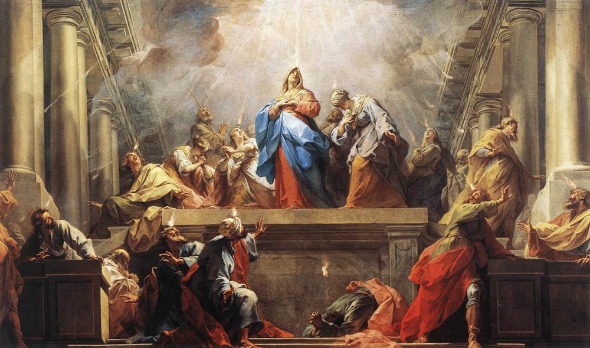
Pentecost
Jean Restout II, 1732
Musée du Louvre, Paris
In the Protestant paradigm, anyone who has true faith in Christ is ipso facto a member of the one Church that Christ founded. This Protestant paradigm does not acknowledge that Christ founded a visible hierarchically organized Body.1 By contrast, the Catholic Church for 2,000 years has believed and taught that the incarnate Christ founded a visible, hierarchically organized Body. In the Catholic paradigm, faith in Christ is not sufficient by itself to make a person a member of this Body; a believer is incorporated into this Body by valid baptism, but is removed from this Body either by heresy, apostasy, schism, or excommunication.
The Reformed confessions affirm the visibility of the Church, so that raises a particular question: with respect to visibility, how is Reformed ecclesiology distinct both from the common Protestant ecclesial paradigm and from Catholic ecclesiology? In this article we first show that Christ founded His Church as a visible Body, and why He did so. Then we present the various positions and argue that the Reformed ecclesiology is equivalent in essence to the common Protestant ecclesial paradigm. Finally, we draw out some important implications following from the visibility of the Church.
Contents:
I. The Body of Christ is a Visible Unity
II. Why Visible Unity is a Mark of the Church: Discipline & Schism
III. Denial of Visibility is Ecclesial Docetism
IV. What the Catholic Church Teaches About the Visibility of the Church
V. Reformed positions, and critique
VI. Implications
VII. Conclusion
I. The Body of Christ Is a Visible Unity
A. The Church Is the Body of Christ; He Is the Head of His Mystical Body
And I say to you, that you are Peter, and on this rock I will build my Church, and the gates of Hades shall not prevail against it. (Matthew 16:18.)
One reason Christ came into the world is to build His Church, that through and in His Church men might ultimately come to eternal life, that is, to the beatific vision of the Triune God.2 In the New Testament we find different terms used to show distinct aspects of the Church. One such term is “the Body of Christ” [σώματος τοῦ Χριστοῦ]. To distinguish the Body of Christ which is the Church, from the body of Christ that was born of the Virgin Mary 2,000 years ago and now sits at the right hand of God the Father, we refer to the former as the “Mystical Body of Christ” and the latter as the physical Body of Christ.3
Concerning the Mystical Body of Christ, St. Paul writes to the saints in the church at Rome:
For just as we have many members in one body and all the members do not have the same function, so we, who are many, are one Body in Christ, and individually members one of another. (Romans 12:4-5)
St. Paul writes to the church at Corinth:
For even as the body is one and yet has many members, and all the members of the body, though they are many, are one body, so also is Christ. For by one Spirit we were all baptized into one Body, whether Jews or Greeks, whether slaves or free, and we were all made to drink of one Spirit. For the Body is not one member, but many. If the foot says, “Because I am not a hand, I am not a part of the body,” it is not for this reason any the less a part of the body. And if the ear says, “Because I am not an eye, I am not a part of the body,” it is not for this reason any the less a part of the body. If the whole body were an eye, where would the hearing be? If the whole were hearing, where would the sense of smell be? But now God has placed the members, each one of them, in the Body, just as He desired. If they were all one member, where would the Body be? But now there are many members, but one Body. And the eye cannot say to the hand, “I have no need of you”; or again the head to the feet, “I have no need of you.” On the contrary, it is much truer that the members of the Body which seem to be weaker are necessary; and those members of the Body which we deem less honorable, on these we bestow more abundant honor, and our less presentable members become much more presentable, whereas our more presentable members have no need of it. But God has so composed the Body, giving more abundant honor to that member which lacked, so that there may be no division in the Body, but that the members may have the same care for one another. And if one member suffers, all the members suffer with it; if one member is honored, all the members rejoice with it. Now you are Christ’s Body, and individually members of it. And God has appointed in the Church, first apostles, second prophets, third teachers, then miracles, then gifts of healings, helps, administrations, various kinds of tongues. All are not apostles, are they? All are not prophets, are they? All are not teachers, are they? All are not workers of miracles, are they? All do not have gifts of healings, do they? All do not speak with tongues, do they? All do not interpret, do they? But earnestly desire the greater gifts. (1 Corinthians 12:12-31.)
To the saints at Colossae St. Paul writes:
He [Christ] is also Head of the Body, the Church; and He is the beginning, the firstborn from the dead, so that He Himself will come to have first place in everything. . . . Now I rejoice in my sufferings for your sake, and in my flesh I do my share on behalf of His Body, which is the Church, in filling up what is lacking in Christ’s afflictions. (Colossians 1:18,24.)
And to the saints at Ephesus St. Paul writes:
And He [God the Father] put all things in subjection under His [Christ’s] feet, and gave Him as Head over all things to the Church, which is His Body, the fullness of Him who fills all in all. (Ephesians 1:22.)
Rather, speaking the truth in love, we are to grow up in every way into Him, who is the Head, Christ, from whom the whole Body, joined and knit together by every joint with which it is supplied, when each part is working properly, causes the growth of the Body for the building up of itself in love. (Ephesians 4:15-16.)
For the husband is the head of the wife, as Christ also is the Head of the Church, He Himself being the Savior of the Body. (Ephesians 5:23.)
In these passages St. Paul teaches that the Mystical Body of Christ is a unity; it is one Body. God has composed it so that there would be no division in it. Yet, in another sense, the Body is a plurality, because it has many members. And yet the members are joined together in one and the same Body. Each of the members of the Body has a different place and function in the Body. They do not all have the same function or role. Some are apostles, some are prophets, some are teachers, etc., each according to his gifts. And St. Paul teaches that some gifts are greater than others, even while each member is dependent on the others. This mutual dependency is true not only of the hands and feet, but even of the Head; the Head cannot say to the feet, ‘I have no need of you.’4 In this way, the Body is hierarchically organized, each of the subordinate functions contributing to the unified activity of the whole Body.5 If the Body were not hierarchically organized, there would be many different activities, but not one unified activity. There would be many different individuals, and not one Body.
At the top of the hierarchy is Christ, the Head of the Body. The Head and members together form one Body, with one shared divine life. The life of a body is its soul, in which all the members of the body are made to be alive and to share in the same life of the body. So likewise, the Life of the Body of Christ is the Holy Spirit, who is the Soul of the Church.6 This is why St. Paul says that by one Spirit the Corinthian believers were baptized into one Body and all made to drink of that one Spirit. This incorporation into Christ’s Mystical Body is what is meant by union with Christ. When St. Paul says, “It is no longer I who live, but Christ lives in me,” (Gal. 2:20) this should not be understood in an individualistic ‘me-and-Jesus’ sense, but as referring to our union with Christ in His Mystical Body, the Church. Our union with Christ is accomplished through our incorporation into His Mystical Body, the Church, which is composed of many members. Likewise, when St. Paul says in Galatians 3:27-28 that those who have been baptized into Christ are all one in Christ, he is referring to believers being incorporated into the unity of Christ’s Mystical Body, the Church. Concerning that union, St. Augustine wrote:
Let us rejoice and give thanks that we have become not only Christians, but Christ. Do you understand, brothers, the grace of Christ our Head? Wonder at it, rejoice: we have become Christ. For if He is the Head, we are the members; He and we form the whole man . . . the fullness of Christ, therefore; the head and the members. What is the head and the members? Christ and the Church.”7
Notice the strong language that St. Augustine uses. Because of our union with Christ the Head in His Mystical Body, we are not only Christians, but, in a true sense, Christ. How is that possible? Because the members and Head form one “whole man.” Of that “whole man” St. Thomas Aquinas wrote:
The Head and members are as one mystical person [quasi una persona mystica] and therefore Christ’s satisfaction belongs to all the faithful as being His members.8
St. Augustine and St. Thomas both maintained that through baptism we are incorporated into Christ’s Mystical Body, and that this union is not extrinsic, but intrinsic.9 Through baptism we are incorporated into a unity greater than ourselves, and so become one with the Head and other members, yet without losing our individual identity.10 This unity of the Mystical Body is a visible unity, precisely because it is the unity of a Body. Bodies are visible and hierarchically organized, not invisible.11 Because the Church is a Body, the Church is essentially visible.12 The visibility of the Body is not reducible to the visibility of certain of its members; the Church per se is visible, just as your body per se is visible. Because the Church is a Body, “it must also be something definite and perceptible to the senses.”13 In order to understand how the Body is visible, we need to consider the ways in which a living body is unified.14
B. The Three Ways in Which a Body Is Unified
An organism is unified fundamentally in three ways. First, an organism is unified in its essence. Each of its parts shares the very same essence. All the cells of our human bodies are human cells. All the cells of a sunflower plant are sunflower cells. They all share the very same formal nature. And so, as St. Paul says in Ephesians 4:5, in the Church there is “one faith.” We all believe the same thing with respect to the faith of the Church. Throughout the history of the Church, when a catechumen is incorporated into the Mystical Body of Christ through baptism, he publicly affirms the Creed, which is the faith of the Church. We are formally unified in the Mystical Body of Christ because we all believe the same doctrine. If the Church has not pronounced any decision regarding some question of doctrine, we may have different opinions about such questions. But the members cannot be formally unified as a Body if they are divided on doctrines concerning which the Church has definitively ruled. This is why Pope Pius XII wrote:
Hence they err in a matter of divine truth, who imagine the Church to be invisible, intangible, a something merely ‘pneumatological’ as they say, by which many Christian communities, though they differ from each other in their profession of faith, are united by an invisible bond.15
To be one in essence, all the members of the Body must believe and profess all that the Church believes, teaches, and proclaims to be revealed by God.
Second, an organism is unified in its activity. Each part of an organism is performing some specific task, but each of these specific tasks is part of a larger unified activity, the activity of the whole organism. Likewise, in the Mystical Body all the individual activities of the members must be coordinated to the overall activity of the living organism that is the Church. What is the overall activity of this Mystical Body? It is the activity of the Head; it is the life of Christ. We all, in union with Christ, offer ourselves up to God as living sacrifices. We do so most fully in the sacraments, especially the Eucharist, when we offer ourselves up to the Father in union with Christ’s sacrifice, and in return are nourished by His grace. The Mystical Body is one by its unified sacramental life: “Since there is one bread, we who are many are one body; for we all partake of the one bread.” (1 Cor. 10:17.) The members of the Mystical Body are dynamically unified because, through their partaking of the same sacraments, they all are engaged in one and the same liturgical activity. The dynamic Life of Christ the Head comes to the members of His Body through the sacraments. St. Paul refers to this in Colossians 2:19, where he writes, “and not holding fast to the Head, from whom the entire Body, being supplied and held together by the joints and ligaments, grows with a growth which is from God.” The sacraments are the channels or arteries Christ has established in His Body by which the members of His Body receive the grace of divine life that flows from the Head.16 This is precisely why those who do not participate in the sacraments or in all the same sacraments are “deprived of a constitutive element of the Church” and “cannot be called “Churches” in the proper sense”.17
Third, an organism is unified in its hierarchy. Not every part of the organism is the head. The parts of a body are ordered hierarchically, in systems, organs, tissues, and so on. We saw this above in 1 Corinthians 12 in St. Paul’s description of the Mystical Body of Christ. If there were no hierarchy, then the whole would not be a body; it would be like a pin-cushion, Christ being the cushion, and all believers the pins, each one individually, directly, and independently of the others, connected to Him. That is why the Church, since it is a Body, must be hierarchically ordered. Members serve the Head (and whole) by serving the part of the Body proximate to themselves, according to the gifts and capacities with which they have been equipped, and under the authority of the hierarchy according to their place within it. The hierarchy of a body must be unified in the sense that each member of the hierarchy must be ordered to the head. If there were two or more hierarchies–that is, if there were two or more ultimate ends toward which members were ordered–there would either be two distinct organisms present, or something equivalent to a cancer within an organism.18 Because the existence of a body requires hierarchical unity among its members, so likewise the existence of the Mystical Body of Christ requires hierarchical unity among its members.
These three modes of unity correspond also to Christ’s three roles as prophet, priest, and king, respectively. Christ is the perfect prophet, and this entails that the members of His Mystical Body share one faith. Christ is the perfect high priest, and this entails that the members of His Mystical Body participate in the same liturgical activity, and thus in the same sacraments. And because Christ is the perfect king, this entails that the members of His Mystical Body share one visible hierarchy, and thus one visible magisterium. In this way, Christ’s perfect fulfillment of the roles of prophet, priest, and king entails the three “bonds of unity” in the Church.19 These are also the three ways in which the Church is visible. She is visibly united in her shared profession of faith, her shared celebration of the same sacraments, and in her shared ecclesial hierarchy, each of these three having been received and passed down by succession from the Apostles.20
C. Visibility and Unified Hierarchy of the Mystical Body
“Other sheep I have, that are not of this fold: them also I must bring, and they shall hear my voice, and there shall be one fold and one shepherd.” (John 10:16.)
When we are talking about the visibility of the Church in the context of an ecumenical discussion involving Catholics and Protestants, we are talking primarily about the third mode of unity, because in the ecumenical dialogue the relevant question concerning visibility is this: When Christ founded His Church, did He establish the Church with essential unity not only in doctrine, and in sacraments, but also in its visible hierarchical government? In other words, is visible hierarchical unity part of the essence of Christ’s Mystical Body? Protestants and Catholics, though disagreeing somewhat regarding the content of the one deposit of faith, at least agree that Christ established the Church with unity of doctrine, that is, with one deposit of faith. Likewise, though Protestants and Catholics do not agree about the number and nature of the sacraments, they do agree that Christ instituted one sacramental order and gave it to the Apostles as part of the deposit of faith entrusted to the Church. Essential unity of faith and sacraments can be seen in Ephesians 4:5, where St. Paul says that there is “one faith, one baptism.”
But when we come to the question of unity of hierarchy, Protestants and Catholics do not agree. Protestants either claim that the visible hierarchical unity Christ initially provided to His Mystical Body was accidental (i.e., non-essential) and hence capable of being lost (and was in fact eventually lost), or they claim that Christ’s Mystical Body was never given visible hierarchical unity in the first place. The Catholic position, on the other hand, is that visible hierarchical unity belongs to the essence of Christ’s Mystical Body.21 For that reason, according to Catholic doctrine, hierarchical unity cannot be lost unless the Mystical Body ceases to exist. But since the Mystical Body cannot cease to exist, because it shares in the very life of the Son of God over whom death is powerless, therefore the visible hierarchical unity cannot be lost.22
For there to be a visible hierarchy, it is not enough for each member to be ordered to an invisible Head. Merely being ordered to an invisible Head is fully compatible with having no visible hierarchy. Yet for there to be a visible hierarchy, some visible human persons need to have an ecclesial authority that others do not. According to Catholic doctrine, the authority Christ gave to His Apostles and their successors is three-fold: the authority to teach, the authority to lead men to holiness by way of the sacraments, and the authority to govern the Church.23 These also correspond to Christ’s threefold office of prophet, priest, and king. Furthermore, for a visible hierarchy to be one, it must have a visible head. Only if each member of a visible hierarchy is ordered to one visible head can the visible hierarchy itself be one. And only if the visible head is essentially one can the visible hierarchy be essentially one. If the visible head of the hierarchy were plural, then the visible hierarchy would not be essentially unified, but at most only accidentally unified.
Since Christ, having ascended into Heaven, is no longer visible to us (“and a cloud received Him out of their sight,” Acts 1:9), therefore He appointed a visible steward (or ‘vicar’) before His ascension, to be the visible head of His visible Body. The single visible head of the visible hierarchy is implied when Jesus says, “there shall be one fold and one shepherd”. (John 10:16) Regarding Christ’s establishment of a visible head of His Body, Pope Pius XII wrote:
But we must not think that He rules only in a hidden or extraordinary manner. On the contrary, our Redeemer also governs His Mystical Body in a visible and normal way through His Vicar on earth. You know, Venerable Brethren, that after He had ruled the “little flock” Himself during His mortal pilgrimage, Christ our Lord, when about to leave this world and return to the Father, entrusted to the Chief of the Apostles the visible government of the entire community He had founded. He was all wise; and how could He leave without a visible head the body of the Church He had founded as a human society. Nor against this may one argue that the primacy of jurisdiction established in the Church gives such a Mystical Body two heads. For Peter in view of his primacy is only Christ’s Vicar; so that there is only one chief Head of this Body, namely Christ, who never ceases Himself to guide the Church invisibly, though at the same time He rules it visibly, through him who is His representative on earth. After His glorious Ascension into Heaven this Church rested not on Him alone, but on Peter, too, its visible foundation stone. That Christ and His Vicar constitute one only Head is the solemn teaching of Our predecessor of immortal memory Boniface VIII in the Apostolic Letter Unam Sanctam; and his successors have never ceased to repeat the same. ((Mystici Corporis Christi, 40.))
When Christ ascended, there would not have been visible hierarchical unity among the twelve Apostles had Christ not given unique authority to one of them to be the visible head. Before His ascension Christ gave to Peter the keys of the Kingdom, charged him to strengthen his brothers, and appointed him to feed Christ’s sheep until He returned.24 If Christ had not established an essentially unified visible head, any schism at the vertex of the visible hierarchy would separate His Mystical Body into two or more Bodies. Hence St. Jerome says:
But you say, the Church was founded upon Peter: although elsewhere the same is attributed to all the Apostles, and they all receive the keys of the kingdom of heaven, and the strength of the Church depends upon them all alike, yet one among the twelve is chosen so that when a head has been appointed, there may be no occasion for schism.25
And Pope Leo XIII, says,
Indeed no true and perfect human society can be conceived which is not governed by some supreme authority. Christ therefore must have given to His Church a supreme authority to which all Christians must render obedience. For this reason, as the unity of the faith is of necessity required for the unity of the church, inasmuch as it is the body of the faithful, so also for this same unity, inasmuch as the Church is a divinely constituted society, unity of government, which effects and involves unity of communion, is necessary jure divino. “The unity of the Church is manifested in the mutual connection or communication of its members, and likewise in the relation of all the members of the Church to one head.”26
We see here that grace does not destroy nature, but builds on it and perfects it. This is why villages and cities have mayors, and even why our country has a president. Just as in a natural society there needs to be a unified hierarchy and a visible head, so in the society of the faithful there must be a unified hierarchy and a visible head. For the same reason that virtually every Protestant congregation has a head pastor, the entire visible Church also requires a visible head. The Church as a visible organism preserves the visible head established by Christ, and thus retains all three marks of unity. Without a visible head, the Mystical Body would be reduced to the ontological equivalent of visible pins invisibly connected to an invisible pin-cushion. That is because without a visible head, a visible hierarchy is only accidentally one, because intrinsically it is potentially many separate hierarchies. Many separate hierarchies are not a visible unity; they are ontologically equivalent to many separate individuals. They are a mere plurality, not an actual unity.
A ‘visible Church’ made up of separate visible hierarchies would be equivalent in its disunity to a merely invisible Church having some visible members.27 Therefore a visible head belongs to the essence of the Mystical Body, since a body cannot have mere accidental unity, but must have unity essentially. In other words, an ecclesiology that is analogous to visible pins invisibly connected to an invisible pin-cushion is equivalent to a denial of the visibility of Christ’s Mystical Body because such an ecclesiology denies the essentially unified hierarchy necessary for a body to be a body. It makes no difference whether the pins are individual Christians or individual congregations. Without an essentially unified visible hierarchy, a composite whole cannot be a body, let alone a visible body. And when hierarchical unity is abandoned, nothing preserves unity of faith or unity of sacraments. In this way each one of the three “bonds of unity” depends on the other two.28
II. Why Visible Unity Is a Mark of the Church: Discipline & Schism
A. Discipline.
The Church must be one, because Christ is one, and God is one. Scripture repeatedly proscribes divisions, an imperative that makes no sense in an “invisible church” ecclesiology. Likewise if the Church per se were not visible, then our “call to communion” would be both impossible to achieve and already achieved, so not much of a “call” at all. Here we can point to passages of Scripture that show the importance of church discipline, and obedience to ecclesial authority:29
And if he refuses to listen to them, tell it to the Church; and if he refuses to listen even to the Church, let him be to you as a Gentile and a tax-gatherer. (Matthew 18:17.)
Jesus had just said in Matthew 16 that He would build His Church, a singular thing. Now here, in Matthew 18:17, through what He says about Church discipline, He shows us that the Church has a visible hierarchy, something to which we can tell things, and (perhaps more importantly) to which we can listen. This verse shows that the Church can excommunicate those in sin. (Cf. 1 Corinthians 5:1-5.) But since communication is a visible thing, only a visible hierarchy can excommunicate those in sin. For an “invisible church” to be able to excommunicate, communion would also have to be invisible.
Furthermore, the imperative to excommunicate makes little sense in the denominations-are-mere-branches ecclesial view, since an excommunicate can simply go down the street to the next church agreeing with or tolerating his doctrine or moral conduct. This ability runs against the Church’s duty to “deliver such a one to Satan for the destruction of his flesh, that his spirit may be saved in the day of the Lord Jesus.”30 The visible Church therefore must have one visible hierarchy. There is no small irony in the Protestant notion of discipline as a “mark of the Church,” when discipline requires precisely the hierarchical unity that Protestantism lacks.
B. Schism.
There is nothing more grievous than the sacrilege of schism . . . (St. Augustine, Contra Epistolam Parmeniani, lib. ii., cap. ii., n. 25.)
If Christ had founded the Church without a unified visible hierarchy, then schism could be at most only a deficiency in charity towards other believers. Schism would be the equivalent of one of the pins in the pin-cushion failing to be charitable to another pin. And that would be the case whether those pins represented individual Christians or local congregations or denominations. Schism per se would always be visibly symmetrical with respect to the boundaries of the Church, even if culpability were not. That is, neither party in the schism would ipso facto be visibly departing from the Church, unless it were also abandoning the faith or the sacraments. But abandoning the faith or the sacraments is heresy or apostasy. So the separation of parties per se would not be schism from the Church; the separation from the Church, if there were any separation from the Church, would be due only to heresy or apostasy. Perfect ecclesial unity would be fully compatible with remaining divided in many different visible hierarchies, denominations, etc. So long as Christians shared the same faith and the same sacraments, and had charity toward one another, separation into distinct autonomous organizations would not detract from perfect ecclesial unity. When a congregation would split into autonomous bodies, this would not necessarily be a schism; it could be a mere branching, so long as the new congregations retained the same faith, sacraments, and charity toward each other.
One obvious problem here, however, is that visible separation is almost always predicated on (or rationalized by) disagreement in faith or sacrament. The unity of faith and sacraments cannot be preserved apart from the unity of ecclesial government, i.e., a shared visible hierarchy. Apart from visible hierarchical unity, fragmentation of faith is inevitable. But another problem is that this ecclesiology in effect eliminates the very possibility of schism understood as separation from shared visible ecclesial authority. And when an ecclesiology has no conceptual room for the possibility of schism, the many warnings about schism in Scripture raise a red flag that ecclesial unity has been defined down.
. . . that they may be one, even as We are . . . . that they may all be one; even as Thou, Father, art in Me, and I in Thee . . . that they may be one, just as We are one . . . that they may be perfected in unity, that the world may know that Thou didst send Me, and didst love them, even as Though didst love Me. (John 17:11,21-23.)
I urge you, brothers, to watch out for those who cause divisions. (Romans 16:17.)
Now I exhort you brothers through the name of our Lord, Jesus Christ, that all of you confess the same thing, and there be no schisms among you, but you be united in the same mind and in the same purpose. (1 Corinthians 1:10.)
God has composed [the body of Christ] … that “there should be no schism in the body. (1 Corinthians 12:25.)
Now the deeds of the flesh are evident, which are: . . . disputes, dissensions, factions. (Galatians 5:19-20.)
Forbearing one another in love, endeavoring to keep the unity of the Spirit in the bond of peace. (Ephesians 4:3.)
In the last time there shall be mockers, following after their own ungodly lusts. These are the ones who cause divisions. (Jude 1:18-19.)
Given an essentially unified visible hierarchy, schism can never be visibly symmetrical. It will always consist of the Church and the party in schism from the Church. We know that separation from shared visible ecclesial authority never results in two Mystical Bodies. Obviously there cannot be two Mystical Bodies, since the clear answer to St. Paul’s question “Has Christ been divided?” is ‘No.’31 St. Cyprian writes:
God is one and Christ is one, and one is His Church, and the faith is one, and one His people welded together by the glue of concord into a solid unity of body. Unity cannot be rent asunder, nor can the one body of the Church, through the division of its structure, be divided into pieces.32
But what makes that to be so? There are only two possible answers: the invisible pin-cushion conception of the Church, since what is invisible cannot be divided, or a visible principium unitatis, i.e., a perpetual visible head of the visible ecclesial hierarchy. We have shown above why the pin-cushion conception of the Church is incompatible with the Church being a Body. Thus only if there is a principium unitatis can there be such a thing as “schism from,” which is not reducible to heresy or apostasy. This idea of “schism from” can be seen both in Scripture and in the Church fathers:
They went forth from us, but they were not of us; for if they had been of us, surely they would have continued with us. (1 John 2:19.)
Does he think that he has Christ, who acts in opposition to Christ’s priests, who separates himself from the company of His clergy and people? (St. Cyprian, Bishop of Carthage, d. AD 258, On the Unity of the Church, 17.)
We think that this difference exists between heresy and schism: heresy has no perfect dogmatic teaching, whereas schism, through some Episcopal dissent, also separates from the Church. (St. Jerome, Comment. in Epist. ad Titum, cap. iii., v. 10-11, emphasis added.)
See what you must beware of — see what you must avoid — see what you must dread. It happens that, as in the human body, some member may be cut off — a hand, a finger, a foot. Does the soul follow the amputated member? As long as it was in the body, it lived; separated, it forfeits its life. So the Christian is a Catholic as long as he lives in the body: cut off from it he becomes a heretic — the life of the spirit follows not the amputated member. (St. Augustine, Sermo cclxvii., n. 4.)
And this is how ‘schism’ has been understood and defined in the Catholic Church: schism is defined as “the refusal of submission to the Roman Pontiff or of communion with the members of the Church subject to him.”33 No other definition makes sense, in part because no other definition distinguishes schism from excommunication. Otherwise each party in the schism could with equal warrant say, “No, I excommunicated you.” No other definition shows why schism is always wrong, even while excommunication is sometimes required. Thus we see that both discipline and schism do not fit into a conception of the Church in which there is lacking an essential visible hierarchical unity. A model of ‘church’ in which both discipline and schism are not possible does great violence to the imperatives of Scripture on both these matters, and is completely at odds with the first fifteen hundred years of Church tradition.
III. Denial of Visibility is Ecclesial Docetism
A. Ecclesial Docetism
In Catholic ecclesiology, the ground of the Church’s unity is Christ, who is both spirit and flesh. We are united to Christ by being united to His Mystical Body through the sacrament of baptism. We are more deeply united to Christ and the Church through the sacraments of Confirmation and the Eucharist. An act of schism separates a person from the Church, and hence from Christ, because the Church is Christ’s own Mystical Body. Catholicism is sacramental, in that it looks for the spiritual through the material, just as we know Christ’s divine nature only through His human nature. We do not, as in gnosticism, attempt to bypass the material, and try here in this life to skirt the sacramental and see directly the divine nature or take the God’s-eye point of view, because that is presently beyond us as material creatures. If we want to know our status in heaven, we inquire concerning our status in His Mystical Body on earth. This earth-to-heaven direction of faith’s epistemology is seen in what Jesus says to the Apostles: “whatever you bind on earth will be bound in heaven.”34 The visible and the invisible are bound together because of the incarnation, wherein what is done to the flesh of Christ is done to the Person of Christ. That is precisely why excommunication has teeth; it truly cuts a person off from Christ.
Consider one common Protestant position, according to which all Christians are equally united to Christ by faith alone, and therefore equally united to the Church. I have described this position above as the pin-cushion model. According to this notion of the Church, schism does not do anything to the unity of all Christians, only to the outward manifestation of our otherwise intact spiritual unity. This is a de-materialized (i.e., spiritualized) ecclesiology that in this respect is both gnostic and docetic. Since the incarnate Christ is both spirit and flesh, the visible unity of His Mystical Body is not merely an “outward expression” of the Church’s real spiritual and invisible unity, just as sexual union is not merely a physical expression of the inward/spiritual unity of husband and wife. Sexual union truly should be a bodily expression of a spiritual union. But sexual union is not merely an outward expression of spiritual unity; it is itself a real union of husband and wife. Likewise, the visible unity of the Church (including hierarchical unity) is a real unity of the Mystical Body, not merely an outward expression of the real unity which is spiritual and invisible.
The root problem here is a kind of dualism that treats the spiritual as the really real, and the material as a mere context for the expression of the spiritual. This reduces the Mystical Body to a spirit having some visible members, an invisible pin-cushion with some visible pins. Wherever schism is treated as not separating a person (to some degree) from Christ, there the Church is being treated as fundamentally and intrinsically invisible, with some visible members. Denying the essential unity of the visible hierarchy treats the Mystical Body of Christ as though it is not actually and essentially a Body, because visible hierarchical unity is essential and intrinsic to a body. If a body ceases to be visibly hierarchically one, it ceases to be. This is why a human being cannot survive disintegration of his body. So if visible unity is only accidental to something, that thing is not a living body; it is, at most, only the appearance of a body. Hence those who claim that the Mystical Body of Christ is invisibly one and visibly divided are treating the Body of Christ as though it were merely an apparent Body, not an actual Body. That is why this position is rightly described as ecclesial docetism, because docetism is the heresy which claimed that Christ only appeared to be a man.
That does not mean that we must fall into some kind of ecclesial Eutychianism. Eutychianism, which is also called Monophysitism (meaning “one nature”), was condemned at the Fourth General Council, the Council of Chalcedon in AD 451. According to the Monophysites, Jesus’ humanity was absorbed into His divine nature such that He no longer has a human nature, having only His divine nature (hence “Monophysitism”). Docetism and Eutychianism both deny that Christ has a human nature. For that reason, both docetic and Eutychian notions of the Mystical Body of Christ treat the Church as in itself invisible, spiritual, and immaterial, only visible in the sense that it makes use of embodied human believers in much the same way that the Logos (i.e. the Second Person of the Trinity), according to a docetic conception, perhaps made use of material elements in order to appear as though having a physical body, but was not actually made up of those material elements, nor were they parts of Him. Chalcedonian Christology, with its affirmation of two distinct natures united without mixture in one hypostatic union, entails that the Church as the Mystical Body of Christ is in itself visible and hierarchically organized as one corporate entity.35
The charge that Catholic ecclesiology is Eutychian asserts that the Catholic claim [that the visible Body of Christ is essentially one] mistakenly attributes to the visible aspect of the Church what is only true of the invisible aspect of the Church, and in that way falsely attributes what is only true of the divine nature of Christ to His human nature, as Eutychianism does. But this charge is based on the mistaken notion that visible hierarchical unity is not intrinsically essential to a living human body. The real distinction between Christ’s divine nature and His human nature does not imply that the Mystical Body of Christ is not necessarily visibly one any more than it would imply that Christ’s physical body could continue to exist even if all its parts were separated. Rather, because Christ truly possesses human nature, His Mystical Body is necessarily visibly one in its hierarchy, just as his physical body is necessarily visibly one its hierarchy. A living human body is essentially visibly one. If it ceases to be visibly one, it ceases to be. Hence, its visible hierarchical unity is essential to its being. That is why the Catholic doctrine that the Mystical Body of Christ is essentially visibly one in its hierarchy is not Eutychian.
B. What Does Ecclesial Docetism Look Like in Practice?
The spirituality and visibility of the Church are no more opposed to each other than the soul and body of a man, or, better, than the divinity and humanity in Christ. . . . It is because it ignores this inseparable twofold character of the Church that Protestantism, Lutheran and Reformed, has never succeeded in resisting the temptation to distinguish, by opposing them, an invisible and sole evangelical Church, on the one hand, and, on the other, visible, human, and sinful Churches.36
In practice, ecclesial docetism entails ecclesial consumerism, because it eliminates the notion of finding and submitting to the Church that Christ founded. In the mindset of ecclesial docetism, what one looks for, insofar as one looks, is a community of persons who share one’s own interpretation of Scripture. In ecclesial docetism the identity of the Church is not determined by form and matter, but by form alone. Which form? The form of one’s own interpretation of Scripture. This reveals why there are so many different Protestant denominations, worship centers, and ecclesial communities, none of them sharing the three bonds of unity with any of the others. Just as the practical effect of docetism is a Christ of our own making, disconnected from the historical flesh-and-blood Christ, so the practical effect of ecclesial docetism is a Church made in the image of our own interpretation, disconnected from the historical Church.
This is expressed doctrinally as a denial of the materiality or sacramentality of apostolic succession. Ecclesial docetism redefines ‘apostolic succession’ as preservation of form, i.e., preservation of the doctrine of the Apostles. But without the material component of apostolic succession, the individual becomes the final interpretive arbiter of what the apostolic doctrine is. And so the ‘church-shopping’ commences. And where there is a great variation of demand, a great variation of supply arises. ‘Church’ is reduced to a consumer-driven enterprise, based on each person’s own internal perception of his own spiritual needs and how the competing organizations, institutions, or communities meet those needs. This turns ‘church’ into something egocentric rather than God-centered.
Another necessary effect of ecclesial docetism is apathy regarding visible divisions between Christians, communities, and denominations. If the unity of the Church is spiritual, insofar as each believer is invisibly united to Christ by faith alone, then pursuing visible unity is superfluous, even presumptuous in its attempt to outdo Christ.37 If there is no essentially unified visible hierarchy, then while there may be certain pragmatic reasons for ecumenical cooperation, as there are within political parties, there can be no divine mandate that there be no schisms among us. Ecclesial docetism redefines the term ‘Church’ to refer to an invisible entity into which all believers are perfectly joined no matter to which visible institution (if any) they presently belong.
Herein lies a noteworthy point. Ecclesial docetism conceptually eliminates the very possibility of schism. It does so not by reconciling separated parties, but by defining unity down, as something merely spiritual, and so de-materializing schism as something invisible, and spiritual, i.e., merely a deficiency in charity. Ecclesial docetism treats visible divisions of separated hierarchies as branches. Ecclesial docetism denies the sinfulness of schism, not openly or explicitly, but definitionally and thus surreptitiously. It calls what is actually evil (i.e., schisms) innocuous, if not good. It hides from schismatics their state of not being in full communion with the Mystical Body of Christ, depriving them of the fullness of grace they would receive in full communion with Christ’s Church.
IV. What the Catholic Church Teaches About the Visibility of the Church
A. Church Hierarchy and Unity
From the first century, the Catholic Church has always taught that schism is sinful, and that it is not merely a deficiency of charity, but a separation from the visible hierarchy of the Church. This is evident in the letter of St. Clement of Rome to the Corinthians at the end of the first century, just a few years after the death of the last surviving apostle. We can see it also from St. Ignatius, Bishop of Antioch (d. AD 107), who wrote:
Where the bishop is, there is the community, even as where Christ is there is the Catholic Church.38
and
As therefore the Lord did nothing without the Father, being united to Him, neither by Himself nor by the apostles, so neither do anything without the bishop and presbyters. Neither endeavour that anything appear reasonable and proper to yourselves apart; but being come together into the same place, let there be one prayer, one supplication, one mind, one hope, in love and in joy undefiled. There is one Jesus Christ, than whom nothing is more excellent. Therefore run together as into one temple of God, as to one altar, as to one Jesus Christ, who came forth from one Father, and is with and has gone to one.39
We can see it too in St. Cyprian, Bishop of Carthage (d. AD 258):
It must be understood that the bishop is in the Church and the Church in the bishop and he is not in the Church who is not with the bishop.40
St. Jerome writes most plainly:
Between heresy and schism there is this difference, that heresy perverts dogma, while schism, by rebellion against the bishop, separates from the Church. Nevertheless there is no schism which does not trump up a heresy to justify its departure from the Church.41
Pope Leo XIII, in unambiguous language, teaches that the notion that the Church is “hidden and invisible” is a “pernicious error”:
[T]hose who arbitrarily conjure up and picture to themselves a hidden and invisible Church are in grievous and pernicious error: as also are those who regard the Church as a human institution which claims a certain obedience in discipline and external duties, but which is without the perennial communication of the gifts of divine grace, and without all that which testifies by constant and undoubted signs to the existence of that life which is drawn from God. It is assuredly as impossible that the Church of Jesus Christ can be the one or the other, as that man should be a body alone or a soul alone. The connection and union of both elements is as absolutely necessary to the true Church as the intimate union of the soul and body is to human nature.42
Pope Pius XII says something quite similar about the notion of the Church’s being invisible:
Hence they err in a matter of divine truth, who imagine the Church to be invisible, intangible, a something merely “pneumatological” as they say, by which many Christian communities, though they differ from each other in their profession of faith, are untied by an invisible bond.43
From what We have thus far written, and explained, Venerable Brethren, it is clear, We think, how grievously they err who arbitrarily claim that the Church is something hidden and invisible, as they also do who look upon her as a mere human institution possession a certain disciplinary code and external ritual, but lacking power to communicate supernatural life. On the contrary, as Christ, Head and Exemplar of the Church “is not complete, if only His visible human nature is considered…, or if only His divine, invisible nature…, but He is one through the union of both and one in both … so is it with His Mystical Body” since the Word of God took unto Himself a human nature liable to sufferings, so that He might consecrate in His blood the visible Society founded by Him and “lead man back to things invisible under a visible rule.44
For this reason We deplore and condemn the pernicious error of those who dream of an imaginary Church, a kind of society that finds its origin and growth in charity, to which, somewhat contemptuously, they oppose another, which they call juridical. But this distinction which they introduce is false: for they fail to understand that the reason which led our Divine Redeemer to give to the community of man He founded the constitution of a Society, perfect of its kind and containing all the juridical and social elements – namely, that He might perpetuate on earth the saving work of Redemption, – was also the reason why He willed it to be enriched with the heavenly gifts of the Paraclete. The Eternal Father indeed willed it to be the “kingdom of the Son of his predilection;” but it was to be a real kingdom in which all believers should make Him the entire offering of their intellect and will, and humbly and obediently model themselves on Him, Who for our sake “was made obedient unto death.” There can, then, be no real opposition or conflict between the invisible mission of the Holy spirit and the juridical commission of Ruler and Teacher received from Christ, since they mutually complement and perfect each other – as do the body and soul in man – and proceed from our one Redeemer who not only said as He breathed on the Apostles “Receive ye the Holy Spirit,” but also clearly commanded: “As the Father hath sent me, I also send you;” and again: “He that heareth you, heareth me.45
The constant teaching of the Catholic Church is that Christ founded a visible Church with an essentially unified visible hierarchy. Some people incorrectly think that Vatican II denied the essential unity of the visible hierarchy of the Church. Vatican II did not deny the essential unity of the visible hierarchy of the Church. The issue here is not whether grace and the work of the Holy Spirit can extend beyond the visible boundaries of the Mystical Body of Christ. Of course it can, otherwise no one would ever enter the Church. The issue has nothing to do with invincible ignorance and salvation.46 God could have given grace directly, but He wished to give men also the gift of collaborating with Him in dispensing the graces of Redemption, and so He founded His visible Church.47
B. The Church and the Kingdom
Many Christians do not realize that the Catholic Church is and claims to be the Kingdom of Heaven on earth, in the Kingdom’s nascent stage. They mistakenly think of the Kingdom as either entirely invisible, entirely spiritual, or entirely future. Lumen Gentium specifically affirms that the Church is Christ’s Kingdom:
The Church, or, in other words, the kingdom of Christ now present in mystery, grows visibly through the power of God in the world.48
By “present in mystery” the Council meant that the Catholic Church is the Kingdom of Heaven in its beginning or seminal stage, i.e. the stage prior to the return of Christ. We do not now see the fullness of the Kingdom. But the Catholic Church is the present rule of Christ on the earth. Jesus did not say to Peter, “I give you the keys of the Church, but I retain the keys of the Kingdom.” Rather, Jesus said to Peter, “I will give to you [singular] the keys of the Kingdom of Heaven.”49 The keys of the Kingdom of Heaven are the apostolic authority over the Church. That is why the Catechism says,
The Church is the seed and beginning of this kingdom. Her keys are entrusted to Peter.50
To fulfill the Father’s will, Christ ushered in the Kingdom of heaven on earth. The Church is the Reign of Christ already present in mystery.51
The Church is ultimately one, holy, catholic, and apostolic in her deepest and ultimate identity, because it is in her that the Kingdom of heaven, the Reign of God, already exists and will be fulfilled at the end of time.52
In the Gospels Jesus refers to the Kingdom of Heaven (or Kingdom of God) over eighty times. He compares the Kingdom to a mustard seed that grows into a tree, and to leaven that comes to leaven a whole lump.53 Those examples do not fit with a merely eschatological conception of the Kingdom. Nor does Christ’s teaching that the Kingdom of Heaven is at hand. (Matthew 4:17) Nor does His claim that the Kingdom of Heaven suffers violence at the hands of violent men. (Matthew 11:12, Luke 16:16) Nor does His claim that the Kingdom of Heaven may be compared to the parable of the wheat and tares, (Matthew 13:24ff) or to the laborers in the vineyard. (Matthew 20:1ff) Christ’s teaching that the Kingdom of Heaven is like a dragnet that gathers fish of every kind is paralleled in the account in John 21 where the disciples catch 153 fish and draw the net upon the land. That account clearly refers to the Apostles, as fishers of men, bringing all the nations into the Church, and in this way we again see that the Church is the Kingdom in its present stage. That is why Jesus says, “I say to you, among those born of women there is no one greater than John; yet he who is least in the kingdom of God is greater than he” (Luke 7:28), because John was martyred before Jesus inaugurated the Kingdom, i.e. the Church.
A number of “Kingdom” passages in the Gospels refer to the Kingdom in its final state, but some interpreters mistakenly conclude from that fact that all Gospel references to the Kingdom are eschatological. One Protestant reading of Jesus’ statement, “For behold, the kingdom of God is in your midst” (Luke 17:21), interprets the Kingdom as something in itself internal, spiritual, and invisible, in our hearts. But the notion that the Kingdom must be either internal or external is a false dilemma. Christ now governs His people through His Church, through the Apostles and the bishops they appointed.
The New Testament authors understand the Church as the fulfillment of the Davidic covenant.54 The angel Gabriel tells Mary that the Lord God will give her Son the “throne of His father David; and He will reign over the house of Jacob forever, and His kingdom will have no end.”55 God had promised to David that his throne would be established forever, and that he would not lack a man on his throne.56 This promise was fulfilled when Christ the King, the Son of David, conceived by the Holy Spirit, established the Kingdom that will never end. Likewise, God had promised David that his son would sit on his throne in his place, and build the house for God’s name.57 But Solomon was a type of Christ, because Christ is building the Church, which is the true and everlasting temple of God. That is why St. Paul, quoting Isaiah, refers to Christ as the “root of Jesse” who “arises to rule over the Gentiles.”58 This ruling over the Gentiles is taking place now, through the Church. And at the Jerusalem Council, St. James, the bishop of Jerusalem, quotes the prophet Amos regarding the Church age as “that day” when God raises up the fallen tabernacle of David, so that “the rest of mankind may seek the Lord.”59 We have come, says the author of Hebrews, not to Mount Sinai, but to Mount Zion, the city of David, the heavenly Jerusalem. That city is the Church, the house of God, a kingdom that cannot be shaken.60
The prophet Isaiah had written of Christ’s Kingdom:
“Of the increase of His government and of peace there will be no end, upon the throne of David, and over his kingdom, to establish it and to uphold it with justice and righteousness from this time forth and forevermore.”61
His kingdom will continue to increase, will never be overturned, because it is divinely established. The prophet Daniel also wrote of Christ’s Kingdom. Speaking to Nebuchadnezzar, Daniel says:
“As you looked, a stone was cut out by no human hand, and it struck the image on its feet of iron and clay, and broke them in pieces … But the stone that struck the image became a great mountain and filled the whole earth. … And in the days of those kings the God of heaven will set up a kingdom which shall never be destroyed, nor shall its sovereignty be left to another people. It shall break in pieces all these kingdoms and bring them to an end, and it shall stand forever.”62
When would God set up this Kingdom that will never be destroyed? At the time of the fourth kingdom of men, namely the kingdom of Rome. This was fulfilled at the time of Christ. A Protestant who conceives of Christ’s Kingdom as something invisible or spiritual may agree that Christ introduced His Kingdom two-thousand years ago, but not see that this Kingdom is the Catholic Church. But Jesus said the following:
“As My Father appointed a kingdom for Me, so do I appoint for you that you may eat and drink at My table in My kingdom, and sit on thrones judging the twelve tribes of Israel. Simon, Simon, behold Satan demanded to have you, that he might sift you like wheat, but I have prayed for you that your faith may not fail; and when you have turned again, strengthen your brethren.”63
Christ shows His Apostles that they will eat and drink in His Kingdom and sit on twelve thrones. Eating at His table refers in the present age to the Eucharistic table. Sitting on thrones judging the twelve tribes of Israel refers to their governance of the Church, because the Church is the New Israel, the universal (i.e. catholic) reign of the Messiah. This term for throne (θρόνος) is where we get the word cathedral, which derives from the Latin cathedra, meaning ‘chair of the bishop.’ From this passage in Luke we also see that Christ prays especially for Peter, and charges him to strengthen his brothers. In Matthew 16:18-19, Christ, the Chief Cornerstone, designates Simon to be Peter, the rock upon whom Christ will build His Church. This is the Kingdom that will never be defeated, but will prevail to the end of time.
“And I say to you that you are Peter, and upon this rock I will build My Church; and the gates of Hades will not prevail against it. I will give to you the keys of the kingdom of heaven, and whatever you bind on earth shall be bound in heaven, and whatever you loose on earth shall be loosed in heaven.”64
What are these “keys of the Kingdom”? They are the keys of the house of David, which Isaiah prophecies about as being entrusted to the King’s steward.65 Christ has given the keys of the Kingdom to Peter, His steward. This is the Petrine office, the chair of St. Peter the Apostle. Jesus refers to this role in a parable, when He says,
“Who then is the faithful and sensible steward, whom his master will put in charge of his servants, to give them their rations at the proper time?”66
Christ rules the Church through the men He has entrusted with the keys of His Kingdom, and given the authority to speak in His name. The Church has always understood herself to be the present stage of the Kingdom of Heaven on earth. Christ does not have two Brides: His Church and His Kingdom. He has one Bride, which is His Church and His Kingdom. He and His Bride are “one flesh”, that is, one Mystical Body. For this reason, the Catholic understanding of “advancing the Kingdom of God” is to bring people into the reign of Christ, that is, into the Catholic Church. The Lord’s Prayer does not ignore the Church; when we pray “Thy Kingdom come”, we are praying for the growth of the Catholic Church, the increase of Christ’s reign within her, and the final glorious return of the King. Understanding that the Church is the present form of Christ’s Kingdom helps us understand why the Church must have a unified visible hierarchy; it also helps make sense of the way St. Ignatius of Antioch exhorts Christians to follow their bishops, as a general might urge his troops to follow their commanders. When the centurion said, “I too am a man under authority, with soldiers under me” (Matthew 8:9, Luke 7:8), his words applied not only to the Roman army, but to the enduring Kingdom Daniel saw in his vision, that is, to the Catholic Church.
V. Reformed positions, and critique
A. Positions
Here we will consider two Reformed positions on the visibility and invisibility of the church.
1. Position: The Visible Church Is the Church as People See It
One Reformed perspective maintains that by “church” a distinction must be drawn between that which people see and that which God alone sees. This distinction has historically been coined in the two terms “visible church” and “invisible church.” In this use, the “invisible church” is not completely without parts that can be seen; rather, its exact boundary is not perceivable or knowable to us. That is because in this ecclesiology, “invisible church” refers to the set of all persons elected to glory. Only God knows which members of the earthly congregations are elect and inwardly born again,67 and thus belong to the eternal and spiritual fellowship of the Church. Contrariwise, we can perceive, and thus know who is a part of the “visible church,” that is, who is a member of an Evangelical body, whether that be a denomination or a local congregation unaffiliated with any denomination. But this affiliation provides no guarantee about the affiliant’s inward conversion. Jesus taught that in this organized church there would always be members, not excluding its leaders, who seemed to be Christians but were nevertheless not renewed in their heart and would be rejected at the Last Judgment.68
These terms do not mean that there are two churches, one visible and another hidden in heaven. Rather, in Reformed ecclesiology there is only one church, and it is known perfectly to God and known imperfectly on earth.69 This church on earth is one in Christ despite the great number of local congregations and denominations.70 It is holy because it is corporately consecrated to God,71 just as each Christian is individually. It is catholic, meaning “universal,” because it exists worldwide. Finally, it is apostolic because it is founded upon apostolic teaching.72 All four qualities may be seen in Ephesians 2:19-22.73
2. Position: Christ Founded a Mere Plurality of Believers Without a Shared Hierarchy
Luther, Calvin, and the other Reformers taught that the visible church was merely the “multitude” of believers spread over the earth. Martin Luther described the visible church as “the holy Christian people.” He wrote:
If the words, “I believe that there is a holy Christian people,” had been used in the Children’s Creed, all the misery connected with this meaningless and obscure word (“church”) might easily have been avoided…. Ecclesia … should mean the holy Christian people, not only of the days of the apostles, who are long since dead, but to the end of the world….74
John Calvin wrote:
How we are to judge the church visible, which falls within our knowledge, is, I believe, already evident from the above discussion. For we have said that Holy Scripture speaks of the church in two ways. Sometimes by the term “church” it means that which is actually in God’s presence, into which no persons are received but those who are children of God by grace of adoption and true members of Christ by sanctification of the Holy Spirit. Then indeed, the church includes not only the saints presently living on earth, but all the elect from the beginning of the world. Often, however, the name “church” designates the whole multitude of men spread over the earth who profess to worship one God and Christ.75
The church universal is a multitude gathered from all nations; it is divided and dispersed in separate places, but agrees on the one truth of divine doctrine, and is bound by the bond of the same religion. Under it are thus included individual churches, disposed in towns and villages according to human need, so that each rightly has the name and authority of the church.76
Finally, and helpfully explicit, the Westminster Confession of Faith says of the Church visible:
The catholic or universal church, which is invisible, consists of the whole number of the elect, that have been, are, or shall be gathered into one, under Christ the Head thereof… The visible Church, which is also catholic or universal…consists of all those throughout the world that profess the true religion; and of their children: and is the kingdom of the Lord Jesus Christ, the house and family of God, out of which there is no ordinary possibility of salvation.77
Instructing on this section, PCA Pastor TM Moore explains that “the most important institution that God has ordained for His people is, in fact, no institution at all. Rather, it is His own Body – the Church.”78
In sum, this visible church is the non-hierarchical collection or plurality of all professing Christians, some of whom are elect and others of whom are not; there are no elect outside of this visible church.79
B. Evaluations
These two Reformed ecclesial positions are essentially equivalent because there is no principled difference between them. For both, what is called “the visible Church” is a mere plurality of visible things. In the first description, the members are individual congregations not hierarchically united under a single visible hierarchy. In the second description the members are individual believers not hierarchically united under a single visible hierarchy. Therefore under both descriptions what is absent is a unified visible hierarchy, and that is why the result can be nothing more than a mere plurality of visible things, united at most by their invisible union to the invisible Christ.
To understand why it cannot be that Christ founded a “visible church” consisting merely of a multitude of believers spread across the world, we need to consider the difference between a mere plurality and an actual composite whole. A mere plurality is not an actual entity, but only a conceptual entity, i.e. an abstraction of some sort. Imagine the set of all the objects on my desk. The members of that set include books, a printer, some photos, some coins, pens, prayer cards, a toy space shuttle, a piece of hard candy, a lamp, etc. I can refer to these things with a singular term: “set” (as in, “The set of all the things on my desk”). But on my desk there is no single thing consisting of the books, the printer, the photos, the coins, pens, etc. There is no set-of-things on my desk, only individual things that can be referred to collectively as belonging to a set. Though the members of the set are actual, the set itself is only a mental construct, not an actual entity.
Contrast that with the parts of my body. The parts of my body are not a mere plurality, or a mere set. They compose an actual whole, namely, me. In that respect, the parts of my body are not like the objects on my desk. The parts of my body are a plurality, but they are not a mere plurality like the objects on my desk. The parts of my body compose an actual whole.
So when a person claims that the visible Church is the set of all embodied believers, he is reducing the visible Church to a mental construct. He seems to be affirming the existence of the visible Church, but he has adopted an ecclesiological position in which there is no such thing as the visible Church — there are only embodied believers, just as in actuality there are only objects on my desk, and not, in addition to the objects on my desk, one more item, namely, the set of objects on my desk. That is why those who claim that the visible Church is the set of all embodied believers hold a position in which there is no visible Church per se; there are only visible believers, invisibly connected to the invisible Christ. And that is why those who claim that the visible Church is the set of all embodied believers hold a position that is equivalent in principle to that of those who deny that the Church is visible, and who affirm that the Church per se is invisible. For this reason, the claim in the Westminster Confession of Faith that “the visible Church … consists of all those throughout the world that profess the true religion,” is equivalent in principle to the claim of those who deny that the Church is visible .80 In other words, even though the Reformed confessions refer to a “visible Church”, this is only semantically different from those Protestant ecclesiologies that explicitly deny the visibility of the Church. But neither the pin-cushion ecclesial model nor the mere plurality ecclesial model are compatible with St. Paul’s teaching that the Church is the Body of Christ.
Catholic ecclesiology is not subject to this problem precisely because the Catholic Church is hierarchically unified. Reductionism treats actual composite wholes as though they were mere pluralities of smaller simples, and in this way fails to account fully for the being, unity and activity of actual composite wholes.81 Because the hierarchical structure of the Catholic Church is analogous to that of an organism, it is for this same reason not subject to eliminative reductionism. The visible hierarchical unity of the Catholic Church unites all its dioceses, parishes and members not in a mere plurality or in a pin-cushion model, but in an actual composite whole, i.e. a visible unity.
A. The Identity of the Church
Given that the Church Christ founded is visible, and has an essentially united visible hierarchy, it follows that the identity and extent of the Church can be known, by tracing its visible hierarchy through history. When the early Church fathers write about the Catholic Church, they are referring to a definite Body. They are not referring to a mere plurality of persons or congregations, without an essentially unified visible hierarchy. They are referring to the visible Body picked out precisely by the essential unity of its visible hierarchy, and especially the visible head of that visible hierarchy. This involves two of the four marks of the Church as specified by the Nicene Creed: unity and apostolicity. “We believe in one, holy, catholic and apostolic Church.” This Church referred to in the Creed (as an article of the Christian faith) is the Catholic Church. We saw above the visible hierarchy of the Church treated as the locus of the Church’s identification in St. Ignatius of Antioch, who wrote, “Where the bishop is, there is the community, even as where Christ is there is the Catholic Church.”38 St. Irenaeus (d. c. AD 200) likewise speaks of this Church:
The Catholic Church, having received the apostolic teaching and faith, though spread over the whole world, guards it sedulously, as though dwelling in one house; and these truths she uniformly teaches, as having but one soul and one heart; these truths she proclaims, teaches, and hands down as though she had but one mouth.82
St. Eusebius of Caesarea (AD 263-339) speaks of her:
But the brightness of the Catholic Church proceeded to increase in greatness, for it ever held to the same points in the same way, and radiated forth to all the race of Greeks and barbarians the reverent, sincere, and free nature, and the sobriety and purity of the divine teaching as to conduct and thought.83
St. Augustine (AD 354-430) writes:
This has been brought to pass [Hoc factum est] by the Divine Providence, achieved through the prophecies of the prophets, through the Incarnation and the teaching of Christ, through the journeys of the Apostles, through the suffering, the crosses, the blood and death of the martyrs, through the admirable lives of the saints, and in all these, at opportune times, through miracles worthy of such great deeds and virtues. When, then, we see so much help on God’s part, so much progress and so much fruit, shall we hesitate to bury ourselves in the bosom of that Church? For starting from the apostolic chair down through succession of bishops, even unto the open confession of all mankind, it has possessed the crown of teaching authority.84
Perhaps St. Ambrose (340-397), bishop of Milan, sums it up best, when he writes:
“It is to Peter himself that He says, “you are Peter, and upon this rock I will build my Church.” Where Peter is, there is the Church. And where the Church, no death is there, but life eternal.”85
In short, given this analysis of the essential unity of a visible ecclesial hierarchy, the only plausible candidate for the Church Christ founded, identified by an essentially unified visible hierarchy tracing its succession back to the Apostles, is the Catholic Church. Given that the Church Christ founded is visible, and so has an essentially unified visible hierarchy, it thus follows that the Church Christ founded is the Catholic Church, i.e. that society of faith in full communion with the episcopal successor of St. Peter.
B. The Promises to the Church Are to the Visible Church
If the Catholic Church is the Church Christ founded, then the promises Christ makes to the Church are not promises to a merely invisible entity having visible members, but are promises to the Catholic Church. The gates of hell shall not prevail against the Catholic Church.86 Christ has promised to be with the Catholic Church to the end of the age.87 Christ has promised that the Holy Spirit will guide the Catholic Church into all truth.88 Whatever the Catholic Church binds on earth will be bound in heaven.89 The Catholic Church is the pillar and ground of truth.90 All these promises would be superfluous and unhelpful if intended only for the set of all the elect. Only if they refer to a Body with a visible hierarchy do they even make sense. Once we see what it means for the Church to be visible, then we see precisely why we can trust Christ by trusting the Catholic Church. Grasping the visibility of the Church, and thus the identity of the Church, and thus the divine guarantees concerning the Church, we can then understand how it follows that the Catholic Church is indefectible.
Christ’s promise to the Church that the Holy Spirit will guide her into all truth grounds the possibility for the development of doctrine. “But when He, the Spirit of truth, comes, He will guide you into all the truth.”88 The possibility of development of doctrine depends on an essentially unified visible hierarchy. Otherwise there is no definitive determination of the canon, or of orthodoxy and heresy. No mere association of denominations or congregations has the authority to bind the conscience of followers of Christ. Every decision of every synod or session or council or assembly would remain ‘up-for-grabs’, subject to subsequent refutation. Development requires the definitive resolution of disputes, so that the Church as a whole can recognize a question as definitively settled, and then build upon the Magisterial answer. Without an essentially unified visible hierarchy, we are left with biblicism. And that is why Protestantism, lacking an essentially unified visible hierarchy, must trace a path of decay through one of two paths: liberalism or a biblicism that fades into what Michael Spencer calls “the post-Evangelical wilderness.” Christ’s promises to the Catholic Church built on Christ the Cornerstone, and the rock of Peter, insure that ecclesial deism is false; they ensure that when the Magisterium speaks definitively, it is the Holy Spirit speaking.
The essentially unified visible hierarchy of the Church allows her to be not only Magistra (i.e. teacher) but also Mater (mother). This is the meaning of the phrase “Mater et Magistra.” John Calvin maintained that the holy Catholic Church is our mother.91 He writes,
But because it is now our intention to discuss the visible church, let us learn even from the simple title “mother” how useful, indeed how necessary, it is that we should know her. For there is no other way to enter into life unless this mother conceive us in her womb, give us birth, nourish us at her breast, and lastly, unless she keep us under her care and guidance until, putting off mortal flesh, we become like the angels [Matthew 22:30]. Our weakness does not allow us to be dismissed from her school until we have been pupils all our lives. Furthermore, away from her bosom one cannot hope for any forgiveness fo sins or any salvation, as Isaiah [Isaiah 37:32] and Joel [Joel 2:32] testify. … By these words God’s fatherly favor and the especial witness of spiritual life are limited to his flock, so that it is always disastrous to leave the church.92
Calvin was not intending to speak of the Catholic Church in union with the successor of St. Peter. However, without an essentially unified visible hierarchy, what Calvin says here about the Church as our mother, makes no sense. That is because without an essentially unified visible hierarchy, there is no visible catholic (i.e. universal) Church; there are only visible Christians, and visible congregations and provincial denominations. None of these is our mother. Nor are they, without being under the essentially unified visible hierarchy, part of the one, holy, catholic and apostolic Church. They may be invisibly joined to Christ, but they do not form a unified visible entity; they remain only a visible plurality indistinguishable from a plenitude of schisms. Without an essentially visible hierarchy, there is no visible Church, and thus there is no Church as Mater.
C. Ecumenicism
If Christ founded a visible Church, and His promises refer to this visible Church, then the goal of ecumenicism is not only agreement on doctrine and agreement on sacraments, but full communion under the same visible hierarchy, the one authorized by the Apostles and their successors. Christ’s prayer in John 17 concerning our unity, “that the world may know” entails that we are called to full visible unity. Yet these three bonds of unity are so related that each depends upon the other two. Just as we cannot maintain unity of faith and sacraments without visible hierarchical unity, so we cannot determine or discover precisely what faith it is that we are to hold, apart from this unified visible hierarchy. Insofar as the ‘mere Christianity’ form of ecumenicism seeks to determine some set of essential doctrines, apart from the essentially unified visible hierarchy, this form of ecumenicism is intrinsically incapable of attaining its goal.93 For this reason the success of ecumenicism depends not on first finding doctrinal agreement, but on locating the ground and basis of magisterial authority. As Fr. Jeffrey Steel recently said, “on whose terms does this reunion take place?”94 This metalevel question lies at the very center of the ecumenical endeavor.
Without reference to the unified visible hierarchy, the “mere Christianity” form of ecumenicism is indistinguishable from a call to settle for common ground between the Church, heresies and schisms. And that is what makes the Catholic Church’s approach to ecumenicism almost intrinsically offensive to all other Christians. It makes the Catholic Church stick out among all the Protestant demoninations, because none of them claim to be the Church that Christ founded. For example, when the Holy See released Responsa ad Quaestiones in July of 2007, the World Council of Churches expressed its disagreement, claiming that “Each church is the Church catholic and not simply a part of it. Each church is the Church catholic, but not the whole of it.” To the “World Council of Churches” (of which the Catholic Church is not a member), the very notion that one visible Body individuated by one visible hierarchy is the one true Church that Christ founded, is offensive. But the exclusivity of the claims of Christ’s Church should be no more surprising than the exclusivity of the claims of Christ Himself, who said, “No man comes to the Father, but by Me.”95
We have provided evidence and argumentation here that Christ founded a visible Church, and that this Church is visible not merely because some of its members are embodied, and not because local congregations and denominations exist. The Church Christ founded is visible because, as His Mystical Body, it necessarily has an essentially united visible hierarchy; this is the hierarchy of bishops and priests united under the episcopal successor of St. Peter, the visible head appointed by Christ. Without an essentially united visible hierarchy, Church discipline would not be possible. That is because only Catholic ecclesiology is sacramental, i.e. non-gnostic. Any ecclesiology in which members, whether these be individual Christians or congregations, are said to be fully united to Christ’s Church through an internal invisible connection, nullifies the spiritual consequences of visible excommunication. Yet every ecclesiology denying that Christ founded an essentially united visible hierarchy must posit an invisible connection between the members and Christ. Likewise, denying that Christ founded an essentially unified visible hierarchy reduces schisms to branches, and treats them as innocuous or even desirable, falsely construing them as much-needed diversity. If that seems inconceivable, ask yourself this question: If these were not branches, but schisms, what would be different about them? Treating schisms as mere branches calls ‘good’ what is evil, so it is essential that we be able to distinguish a branch from a schism, and yet nothing short of Catholic ecclesiology makes sense of the distinction. Every ecclesiology short of Catholic ecclesiology falls into some form of ecclesial docetism, since it treats the universal Church per se as though it were not visible, not having an essentially unified hierarchy, and thus not as a Body. The bodily nature of the Church allows the Church to be both Mater et Magistra. It makes sense of Scripture’s teaching regarding the locus and universal nature of the Kingdom of Heaven presently on earth. This Kingdom is not invisible, but visible, present in the mystery of the Catholic Church. Though the Kingdom (i.e. the Church) will achieve its fullness only when Christ returns, even now the thrones of its stewards are visible, not invisible, and its law is canon law. Reformed ecclesiology attempts to avoid denying the visibility of the Church, but without a unified visible catholic hierarchy, what Reformed ecclesiology refers to as “the visible Church” cannot be a Body, only a mere plurality of members (whether individual persons or congregations) each invisibly connected to Christ. The ‘visible Church’ terminology in Reformed ecclesiology is for that reason merely semantical, not substantive. A mere plurality of congregations is no more of a unified Body than is a mere plurality of persons. That is why Reformed ecclesiolgy in essence is indistinguishable from the ecclesiology of those who deny the visibility of the Church per se. The visibility of the Mystical Body of Christ implies that it is a definite Body that can be traced through history, that the promises Christ made concerning the Church apply to it, and that the key to the ecumenical endeavor centers not around some shared minimum of doctrinal common ground, but around the identification of the Church’s unified visible hierarchy in succession from the Apostles.
May God grant all Christians the joy of being in full communion with His Mystical Body. In the name of the Father, the Son, and the Holy Spirit. Amen.
Bryan Cross and Thomas Brown, Octave of Pentecost, 2009.
- Some Protestants grant that Christ founded a visible, hierarchically organized Body, but believe that at some point in history it ceased to exist. [↩]
- “This is eternal life, that they may know you, the only true God, and Jesus Christ whom you have sent.” (John 17:3.) See also Matthew 5:8; 1 John 3:2; 1 Corinthians 13:12; Revelation 22:4. “[T]he divine essence immediately manifests itself to [the souls in heaven], plainly, clearly and openly, and in this vision they enjoy the divine essence. Moreover, by this vision [i.e. the Beatific Vision of the divine essence] and enjoyment the souls of those who have already died are truly blessed and have eternal life and rest.” (Benedictus Deus, from AD 1336.) [↩]
- Cf. Mystici Corporis Christi, 60. [↩]
- Pope Pius XII wrote:
It is manifestly clear that the faithful need the help of the Divine Redeemer, for He has said: “Without me you can do nothing,” and according to the teaching of the Apostle every advance of this Mystical Body towards its perfection derives from Christ the Head. Yet this, also, must be held, marvelous though it may seem: Christ has need of His members. First, because the person of Jesus Christ is represented by the Supreme Pontiff, who in turn must call on others to share much of his solicitude lest he be overwhelmed by the burden of his pastoral office, and must be helped daily by the prayers of the Church. Moreover as our Savior does not rule the Church directly in a visible manner, He wills to be helped by the members of His Body in carrying out the work of redemption. That is not because He is indigent and weak, but rather because He has so willed it for the greater glory of His spotless Spouse. Dying on the Cross He left to His Church the immense treasury of the Redemption, towards which she contributed nothing. But when those graces come to be distributed, not only does He share this work of sanctification with His Church, but He wills that in some way it be due to her action. (Mystici Corporis Christi, 44.)
[↩]
-
Again, as in nature a body is not formed by any haphazard grouping of members but must be constituted of organs, that is of members, that have not the same function and are arranged in due order; so for this reason above all the Church is called a body, that it is constituted by the coalescence of structurally untied parts, and that it has a variety of members reciprocally dependent.” (Mystici Corporis Christi, 16.)
[↩]
- “What the soul is to the human body, the Holy Spirit is to the Body of Christ, which is the Church.” CCC 797. Similarly, Pope Leo XIII wrote, “Let it suffice to say that, as Christ is the Head of the Church, so is the Holy Spirit her soul.” Divinum Illud Munus, 6. [↩]
- In Ioan. 21.8. [↩]
- Summa Theologica III Q.48 a.2 ad 1. [↩]
- An extrinsic union is one in which, for example, a mere plurality is conceived in the mind as if it were an actual unity, though it remains in actuality a mere plurality. An intrinsic union, by contrast, is one in which individuals, in their very being, become parts of something else. [↩]
- “In a natural body the principle of unity so unites the parts, that each lacks its own individual subsistence; on the contrary in the Mystical Body that mutual union, though intrinsic, links the members by a bond which leaves to each intact his own personality.” Mystici Corporis Christi, 61. [↩]
- Even Christ’s resurrected physical body was hierarchically organized. Jesus said “See My hands and My feet, that it is I Myself; touch Me and see, for a spirit does not have flesh and bones as you see that I have.” Luke 24:39. [↩]
- “[P]recisely because it is a body is the Church visible.” Satis Cognitum, 3. [↩]
- Satis Cognitum, 3. [↩]
- If we were to have touched Christ’s physical Body, we would truly have touched God, because His physical Body is truly united to Him through what is called the hypostatic union. Likewise, when we touch His Mystical Body, we also touch God, because by the union of members and Head, the Body of Christ is Christ. This is how we understand Christ’s own identification with us in verses such as Matthew 25:35 and Acts 9:4. We are members of His Mystical Body, and this union of members and Head is so intimate that we form one Mystic Person, just as the cells in a body form one organism. [↩]
- Mystici Corporis Christi, 14. [↩]
- See also here. [↩]
- Responsa ad quaestiones. [↩]
- This is why Jesus says, “No one can serve two masters; for either he will hate the one and love the other, or he will be devoted to one and despise the other.” (Matt. 6:24.) We cannot be oriented fundamentally toward two (or more) distinct ends, unless one end is ordered to the other. [↩]
- Catechism of the Catholic Church 815. [↩]
- Ludwig Ott writes: “A threefold sensible bond binds the members of the Church to one another, and makes them known as such: the profession of the same Faith, the use of the same means of grace, and the subordination to the same authority.” Fundamentals of Catholic Dogma 301 (1952). [↩]
-
Hence as the Apostles and Disciples were bound to obey Christ, so also those whom the Apostles taught were, by God’s command, bound to obey them. And, therefore, it was no more allowable to repudiate one iota of the Apostles’ teaching than it was to reject any point of the doctrine of Christ Himself. . . . But . . . the Apostolic mission was not destined to die with the Apostles themselves, or to come to an end in the course of time, since it was intended for the people at large and instituted for the salvation of the human race. For Christ commanded His Apostles to preach the “Gospel to every creature, to carry His name to nations and kings, and to be witnesses to him to the ends of the earth.” He further promised to assist them in the fulfillment of their high mission, and that, not for a few years or centuries only, but for all time – “even to the consummation of the world.” Upon which St. Jerome says: “He who promises to remain with His Disciples to the end of the world declares that they will be for ever victorious, and that He will never depart from those who believe in Him” (In Matt., lib. iv., cap. 28, v. 20). But how could all this be realized in the Apostles alone, placed as they were under the universal law of dissolution by death? It was consequently provided by God that the Magisterium instituted by Jesus Christ should not end with the life of the Apostles, but that it should be perpetuated. We see it in truth propagated, and, as it were, delivered from hand to hand. For the Apostles consecrated bishops, and each one appointed those who were to succeed them immediately “in the ministry of the word.” Nay more: they likewise required their successors to choose fitting men, to endow them with like authority, and to confide to them the office and mission of teaching. “Thou, therefore, my son, be strong in the grace which is in Christ Jesus: and the things which thou hast heard of me by many witnesses, the same command to faithful men, who shall be fit to teach others also” (2 Tim. ii., I-2). Wherefore, as Christ was sent by God and the Apostles by Christ, so the Bishops and those who succeeded them were sent by the Apostles. “The Apostles were appointed by Christ to preach the Gospel to us. Jesus Christ was sent by God. Christ is therefore from God, and the Apostles from Christ, and both according to the will of God. . . . Preaching therefore the word through the countries and cities, when they had proved in the Spirit the first-fruits of their teaching they appointed bishops and deacons for the faithful . . . . They appointed them and then ordained them, so that when they themselves had passed away other tried men should carry on their ministry” (S. Clemens Rom. Epist. I ad Corinth. capp. 42, 44). On the one hand, therefore, it is necessary that the mission of teaching whatever Christ had taught should remain perpetual and immutable, and on the other that the duty of accepting and professing all their doctrine should likewise be perpetual and immutable. “Our Lord Jesus Christ, when in His Gospel He testifies that those who not are with Him are His enemies, does not designate any special form of heresy, but declares that all heretics who are not with Him and do not gather with Him, scatter His flock and are His adversaries: He that is not with Me is against Me, and he that gathereth not with Me scattereth” (S. Cyprianus, Ep. lxix., ad Magnum, n. I).
Satis Cognitum, 8. [↩]
- St. Paul, speaking of Christ, writes in Romans 6:9 that Christ, “having been raised from the dead, is never to die again; death no longer is master over Him.” [↩]
- Mystici Corporis Christi, 38. [↩]
- Matthew 16:19, Luke 22:32, John 21:15-17. [↩]
- St. Jerome, Contra Jovinianus I.26. [↩]
- Satis Cognitum, 10. The last sentence is a quotation from St. Thomas Aquinas, Summa Theologica, II-II Q.39 a. 1 [↩]
- Not only that, but if the Church were the accidental unity of separate hierarchies, the only remaining essential unity would be that of each individual. The separate hierarchies would each be reduced to accidental unities when not either themselves essential or part of another hierarchy that is essentially unified. [↩]
- “The bishop of the diocese is the only official teacher, guardian, and interpreter of the Catholic tradition (cf. Catechism of the Catholic Church, 888, 894, 895, 1560; Code of Canon Law 375.1, 392.1, 393, 394.1, 394.2) While the bishop may appoint others, i.e. priests, deacons, lay people, to work and act on behalf of the Church, the task of authentically transmitting the deposit of Faith belongs to the bishops of the Church.” Source [↩]
- e.g. Hebrews 13:17 [↩]
- 1 Corinthians 5:5. [↩]
- 1 Corinthians 1:13 [↩]
- St. Cyprian, Bishop of Carthage, d. AD 258, On the Unity of the Church, 23. [↩]
- Catechism of the Catholic Church 2089. [↩]
- Mathew 18:18 [↩]
- Cf. Mystici Corporis Christi, 16. [↩]
- Charles Journet, Theology of the Church, 13. [↩]
- Cf. “Institutional Unity and Outdoing Christ.” [↩]
- Epistle to the Smyrnæans, 8.2. [↩] [↩]
- Epistle to the Magnesians, 7. [↩]
- Epist., lxvi, 8. [↩]
- In Ep. ad Tit., iii, 10, emphasis added. [↩]
- Satis Cognitum, 3. [↩]
- Mystici Corporis Christi, 14. [↩]
- Mystici Corporis Christi, 64. [↩]
- Mystici Corporis Christi, 65. [↩]
- For a more detailed explanation, see Baptism, Schism, Full Communion, Salvation. See also Thomas Storck’s very clear answer to the Vatican II charge, What is the Church of Jesus Christ? Finally, Responsa ad Quaestiones gives the Church’s own recent clarification. [↩]
- Mystici Corporis Christi, 13. [↩]
- Lumen Gentium, 3 [↩]
- Matthew 16:19 [↩]
- Catechism of the Catholic Church, 567 [↩]
- Catechism of the Catholic Church, 763 [↩]
- Catechism of the Catholic Church, 865 [↩]
- Matthew 13, Mark 4, Luke 13 [↩]
- I wrote about this earlier this year; see “Feast of the Chair of St. Peter the Apostle.” [↩]
- St. Luke 1:32-33 [↩]
- 1 Kings 9:5 [↩]
- 1 Kings 5:5 [↩]
- Romans 15:12 [↩]
- Acts 15:16-17 [↩]
- Hebrews 3:4-6, 12:22-28 [↩]
- Isaiah 9:7 [↩]
- Daniel 2:34,35,44 [↩]
- Luke 22:29-32 [↩]
- Matthew 16:18-19 [↩]
- Isaiah 22:15-23 [↩]
- Luke 12:42 [↩]
- 2 Timothy 2:19 [↩]
- Matthew 7:15-23; 13:24-30, 36-43, 47-50; 25:1-46. [↩]
- See The Reformation Study Bible, “The Church.” Cf. Belgic Confession, art. 27 (“We believe and confess one single catholic or universal church—a holy congregation and gathering of true Christian believers.”). [↩]
- Ephesians 4:3-6. See also PCA BOCO ch. 2-2 (“This visible unity of the body of Christ, though obscured, is not destroyed by its division into different denominations of professing Christians; but all of these which maintain the Word and Sacraments in their fundamental integrity are to be recognized as true branches of the Church of Jesus Christ”). [↩]
- Ephesians 2:21. [↩]
- Ephesians 2:20. [↩]
- The Reformation Study Bible, “The Church.” [↩]
- Martin Luther, On the Councils and the Church – Part III (1539). [↩]
- Institutes of the Christian ReligionIV.1.7. [↩]
- Institutes of the Christian Religion IV.1.9. [↩]
- Westminster Confession of Faith XXV 1-2. The Book of Church Order for the Presbyterian Church in America defines the “Visible Church” as consisting of “all those who make profession of their faith in the Lord Jesus Christ, together with their children.” Ch. 2-2. [↩]
- T.M. Moore, A Foundation of Truth: Studies in the Westminster Confession of Faith, 50 (1993). Notice that the invisible church transcends time, which can be considered as vertically universal, and the visible church transcends place or nation, so can be thought of as horizontally universal. [↩]
- Scott Clark, a professor of Church history and historical theology at Westminster Seminary, refers to ‘connectionalism’ in his article on ecclesiology. There he writes:
Closely related to the Biblical understanding of the relationship of the Church Universal to the Church individually considered is the question of connectionalism in the New Covenant. It is often assumed in the American Church that the New Testament Churches were independent of one another and autonomous, that is, subject to no one’s authority but their own. In fact this is less a New Covenant picture than an amalgam of the historic Anabaptist view of the Church with traditional American self reliance. Connectionalism is sometimes portrayed by its opponents as a Roman Catholic corruption of the true Church. Nothing could be farther from the truth.
This thesis would require its adherents to treat the visible Church as either their own denomination or the group of denominations having some minimal level of formal relations with one another. In Prof. Clark’s case, the implication would seem to be that the visible Church Christ founded is NAPARC. [↩]
- Cf. Westminster Confession of Faith, XXV.2 [↩]
- See Leon Kass’s “The Permanent Limitations of Biology.” [↩]
- Adv. Haer., 1.x.2 [↩]
- Ecclesiastical History, 4.7.13 [↩]
- De Utilitate Credendi [↩]
- Commentary on Twelve Psalms of David 40.30 [↩]
- Matthew 16:18 [↩]
- Matthew 28:20 [↩]
- John 16:13 [↩] [↩]
- Matt 16:19, 18:19 [↩]
- 1 Timothy 3:15 [↩]
- Institutes IV.1.1-4 [↩]
- Institutes IV.1.4 [↩]
- Cf. Here and here. [↩]
- “Journey Home to the Catholic Church: I Have Jumped into the Tiber to Swim Across“ [↩]
- John 14:6 [↩]

A great article!
I have often thought that our separated brethren have inherited an ecclesiology which emphasizes the “mystical” in opposition to the “visible” because so many contradictory systems of doctrine developed out of the Reform. The only way to transcend the differences is to diminish the importance of certain doctrines, making the Church a loosely knit spiritual union with a bias towards minimalism to keep the peace between denominations. Once there is no head of a local church with an historical line of succession going back to Christ and the apostles, Acts 2:42 risks becoming an ideal which can only be partially achieved. The sheer range of differences around styles and structures of worship among denominations is a manifestation and fruit of a fractured ecclesiology. How can one truly believe that the same God of OT Israel is unconcerned about the unity & structure of leadership & worship in the NT Church? Without a unified Tent of Meeting, there is always the risk of descending into tribalism.
This one was especially timely, guys, in view of Pentecost and Trinity Sunday. As I read this my mind was drawn particularly to St. Cyprian’s budding ecclesiology as expressed in the Unity of the Catholic Church, which reflects an understanding of the Body of Christ as deriving from the fundamental mysteries of the Faith. That is, his vision of the Church — as the one visible, material organism uniquely invested with the Holy Spirit — had crystallized not only around the doctrine of the Incarnation, but also around the developing doctrine of the Trinity.
To the minds of the early Fathers, the essential unity of God who is Father, Son and Holy Ghost was the thing that guaranteed the objective and continuing unity of all the different members constituting Christ’s Body on earth, because the Church’s unity was precisely a sharing in, or partaking of, the indivisible unity of God the Three-In-One. In other words, the Church was the place where people who were by nature divisive and closed-off from one another got swept up into the life of the Triune God, where they could then be “patched up” together again in one and learn how to love.
What that meant for the Fathers was that the Church – in her capacity as sacrament – was marked by a visible, objective unity which flowed from the invisible unity of the Godhead as its source. That was a reality, a given. But to whom much is given much is expected: it also meant that the Church – in her capacity as the Body and thus the collective Image-Bearer of God – had to reflect the Trinitarian image of unity-in-diversity-in-love before the watching world (Jn 17). That was both the Church’s nature and her vocation: she was to be the earthly thing which realized and exemplified physically both the plurality and the indivisible unity of the One Triune God, whose Temple and visible reflection she really was.
And that was also what made her a specifically Christian Church. She was the Church of Incarnation, of Sacrament, of Trinity. Far from mere theological abstractions, these things were as practical as potatoes and as real as eighteen-wheelers.
Seen from this perspective it becomes easier to grasp why folks like St. Cyprian (in AD 250-ish) could speak as though the indivisibility of God and the indivisibility of the Church almost amounted to the same thing:
For those guys, the notion that the Church could be visibly chopped up into a gazillion disunited bits was quite as inconceivable as the Father splitting up with the Son, or either one of them filing for a divorce with the Holy Ghost. And I think in this case the Fathers can be seen as faithfully carrying forward the spirit of the Scriptures to which you advert in this article.
Sorry for hijacking the article and getting preachy. But I guess if I’ve got a hotbutton issue this is it! Thanks for writing this.
Neal
Brothers and Fellows,
The discussion of ecclesiological docetism and the relation between kingdom and Church, together with the Trinitiarian reflections, have also reminded me of this nice passage in the late Fr. Neuhaus’ Catholic Matters:
More fuel for devotion or food for thought, as the case may be.
Excellent article, Bryan and Thomas. I look forward to digesting it more thoroughly as time allows. Am I incorrect to quibble with your prefatory statement that a Catholic is removed from the Church “either by heresy, apostasy, schism, or excommunication”? My understanding — and it’s a point that arises often in my discussions with Reformed brethren — is that neither heresy nor excommunication necessarily revokes one’s membership in the Church.
The quotation that you twice note from St. Jerome seems to speak to heresy’s inability, in and of itself, to do so. And although excommunication is the most serious medicinal penalty that the Church can dispense to its members, I think that an excommunicated person remains a Catholic (albeit one with severely diminished rights). Thanks to you all for the important work that you’re doing here.
Hello Zach,
The word ‘member’ is used in different senses, and that creates the ambiguity to which you are referring regarding membership. So, let’s define some terms.
By ‘heresy’ here we are speaking of formal heresy, as it is defined in the Catechism:
This is the definition used in Canon Law (see Can. 791).
Notice the repeated word ‘obstinate’. This involves a person who isn’t merely accidentally or unknowingly denying something that the Church teaches must be believed with divine and catholic faith. (Doing so unknowingly or without an awareness or understanding that the Church taught otherwise, would be material heresy.) In a case of formal heresy, the person is told clearly what the Church teaches must be believed with divine and catholic faith (the phrase ‘divine and catholic faith’ is a technical term, and refers to that which requires the highest level of assent — see Canon 750 in the Code of Canon Law), and he obstinately denies it or obstinately doubts it.
Formal heresy incurs automatic (latae sententiae) excommunication:
The word ‘heresy’ there is being used as it was defined in Canon 791. In other words, it is referring to formal heresy, not material heresy. In light of that, now consider what Pope Pius XII says in Mystici Corporis Christi:
So this gives us the definition of the word ‘member’ as we were using it in the article. A member (in this sense) of the Catholic Church is a person who has been baptized and professes the true faith (i.e. and therefore is not a formal heretic), and has not separated himself from the unity of the Body (by entering a schism), and is not in the excommunicated state. Clearly then, a formal heretic is not a member of the Catholic Church, in that sense of the term ‘member’, because he does not profess the truth faith, and on account of his [formal] heresy has incurred latae sententiae excommunication, according to Can. 1364.
But does the formal heretic remain under the jurisdiction of the Church? Yes. Excommunication does not take the excommunicated person out of the jurisdiction of the Church. So in that sense, the formal heretic remains a Catholic, but not a Catholic in full communion with the Catholic Church, and thus not a member according to the necessary conditions listed in Mystici Corporis Christi 22.
I hope that helps answer your question.
In the peace of Christ,
– Bryan
Thanks, Bryan. Your answer is very helpful, and I agree that we’re coming at the term “membership” from slightly different perspectives. When these topics come up in ecclesiological conversations with my Reformed friends, they are fond of pointing to dissident theologians and arguing that there are “schisms within the Catholic Church”. My reply is that although a dissident may be guilty of many sins (heresy, perhaps, being among them), so long as he does not depart the Catholic Church for some other communion, schism is the one sin of which he is not guilty.
I find that many Protestants think excommunication does (or should) entail “kicking the bums out”, but that’s not how the Church operates. The continued presence “within” the Catholic Church of excommunicated persons (whether latae or ferendae sententiae) is baffling–even scandalous–to these Protestant brothers. I like to point out that despite the errors that Luther and Calvin espoused, the Church did not force them into schism (as is often claimed). Schism was a step that they took in addition to their prior errors. Thanks again for your explanation.
“Indeed no true and perfect human society can be conceived which is not governed by some supreme authority. Christ therefore must have given to His Church a supreme authority to which all Christians must render obedience. For this reason, as the unity of the faith is of necessity required for the unity of the church, inasmuch as it is the body of the faithful, so also for this same unity, inasmuch as the Church is a divinely constituted society, unity of government, which effects and involves unity of communion, is necessary jure divino. “The unity of the Church is manifested in the mutual connection or communication of its members, and likewise in the relation of all the members of the Church to one head” Leo XIII
A futher point…
For the Fathers, the Head of the Church was ultimately Christ with the Bishop of the local Church as the visible sign of unity for all Christians within his fold, the icon of the Father (cf. St. Ignatius of Antioch’s ecclesial typology). The Petrine ministry exercised by the Apostolic See of Rome and its bishop who presides “in love” (“Roma presides in amor”) is one which must uphold the service of of his brother bishops, and not undermine them. “Unity of governance” cannot and should not be equated with the notion of the local bishop simply acting as the Pope’s delegate. He is the Pope’s equal in ministry as a bishop. That said, as Patriarch of the Latin Church the Pope is the proper head of the sui juris Latin Church, responsible for all matters pertaining to the disciplines, practices and governance of that particular Church, the largest of all the 21 or 22 autonomous Churches that form the communion of the Catholic Church. As Successor of St. Peter (the Vicar of Peter, as he was called for centuries) he stands as head of the college of Catholic bishops throughout the world, exercising the power of the Keys when and where necessary, but always (it is hoped) to uphold the ministry and unity of his brother bishops and, ultimately, the one flock of Christ. To the extent that a Pope fulfills this mission of feeding the flock and strengthening his apostolic brethren, he is fulfilling his proper role within the communion of the Catholic Church.
Historically, however, this has not always been the case. There has sometimes been a “union with confusion” of these roles (Bishop, Patriarch and Pope), a fact bemoaned by then Joseph Cardinal Ratzinger, now Pope Benedict XVI. The imposition of all sorts of Latin disciplines upon Eastern clergy and faithful is just such an example. (e.g., the imposition of mandatory celibacy and fasting rules and regulations) In acting in this manner, various Popes have attempted to be “more than a Pope,” acting like a monarchial head and ultimately undermining both his ministry and the ministry of his brother bishops.
I say this because the pendulum appears to be swinging back regarding the need for unity within the Latin Church. Such a “swing” is a welcome one on many levels, since it will mean a return, hopefully, to liturgical and doctrinal sanity within that jurisdiction. The much smaller Eastern Catholic churches can only stand to benefit from this shift, since it means the strengthening of our brethren in the West, SO LONG AS the traditions of the East that differ from the West are protected, vigorously defended and upheld. The push towards unity in principle can often be corrupted in practice and turned into a push towards uniformity.
Ultimately the Church cannot descend, as I said before, into rank tribalism, which, I am sad to say, has often become the fate of the Protestant communities and Orthodox churches. The Church’s unity must reflect the Divine Unity which is ultimately a Tri-Unity of Persons (unity and diversity). The Catholic Church with its representatives of East and West, is a vast mosaic which forms the icon of Christ to the world and can speak prophetically and polyphonically with “one voice,” much like a liturgical choir. The unity of the Church can only be strengthened by a corresponding commitment to its organic and orthodox diversity.
Thanks for the useful info. It’s so interesting
Hi guys,
I have read this article again and again over many months, (ever since Brian referred me to it from the Ecclesial Deism article), and I really am trying to understand your argument. But the fact is I am still not getting it.
It seems to me that Christ can be the invisible head of an invisible Church without requiring a “visible” head of a human hierarchy/institution.
Is Christ’s body divided? No, because Christ knows the members of His Body. But are we in perfect unity with one another? No, far from it. But why would we be urged by Jesus and Paul to work for unity if we were already perfectly united?
Is believing that unity in the Church is currently imperfect a contradiction with Jesus’s prayer in John 17? I don’t see how that is necessarily so. I think it is only in heaven that our unity will be perfected.
Can we be ordered to a common purpose without a visible hierarchy? I think so. All members of the Church can be ordered to a common purpose because of their living faith in the living Christ. We cannot see Christ, but we can still follow Him.
Here’s a couple things that seem inconsistent in the RC position:
Putting the pope in place of Christ as a “visible” head seems to contradict Paul’s declaration that Christ (though invisible) is the head. Doesn’t it make more sense that Christ, even though invisible, is the head, and the Church is therefore invisible as well (currently, at least)?
It seems these three beliefs are inconsistent when taken together:
1. Baptism is the sacrament by which one enters the Church
2. Vatican II recognizes trinitarian baptism outside the RC Church
3. The Church is the RC Church
How can someone enter the Church and be in schism from the Church at the same time? Is the visible Church made up of all the Saints, or just some of them?
As for these last two points, I am sure you have an explanation that is consistent – I would just like to understand it.
Thanks for your consideration here.
PS I am still eagerly awaiting the article on apostolic succession…
Jonathan,
You wrote:
The question is not what Christ could do, but what Christ did. Tom and I have provided much evidence and argumentation in the article that Christ founded a visible Church. Is Christ the Head of the Church? Of course. But a visible Church cannot lack a visible head, just as every society on earth has a visible leader, from the family, to the local community, to the state. Grace does not destroy nature, but builds upon it. Hence the supernatural society founded by Christ does not nullify the natural principles of a human society. It belongs to human nature to be ordered in societies, and thus to be unified under visible unified leadership. This belongs to human nature in the way that marriage belongs to human nature. So the Church, being visible, needs a visible head. And Christ was not unaware of this. This is why He gave the keys of the Kingdom to St. Peter, to be the steward (i.e. visible head as Christ’s representative) until He returns.
You wrote:
Christ’s Body is not divided. But the basis for its unity is not that Christ knows the members of His Body. He knows all human beings, but not all human beings are members of His Body. So the basis for membership in His Body cannot be that Christ knows them. Nor can the basis be that He knows they are members, because that just pushes the question back: On what basis does He know that those who are His members are His members, and know that those who are not His members, are not His members? Something about the members must make them members, and on that basis He knows them to be members, and knows that others not having it are not members.
You wrote:
I’m not sure who the ‘we’ here refers to, whether only Catholics, or all Christians. Catholics who hold the same faith, participate in all the same sacraments, and submit to the same government, are in perfect unity, because this is the peace and unity of the Spirit of God, our participation in the unity of the Trinity. The bond of charity is expressed through each of these three bonds of unity (i.e. same faith, same sacraments, same government). But insofar as we [Catholics] do not love one another, our union with each other is less than perfect. Regarding this, we are urged to love another, and to abound further still in our love for one another. And insofar as some dissenting Catholics reject certain doctrines of the Catholic faith, they remove themselves from the Church’s perfect unity; it is part of our task to help them be brought back into that perfect unity of the one faith of the Church. And insofar as others (e.g. Protestants) are separated from us by schism, heresy, or ignorance or unbelief, we are to seek their reconciliation with the Church, in Christ’s Name, that we all may be brought into full communion within Christ’s Church, to the glory of God the Father and an incontrovertible testimony to the whole world that Christ is the Light of the world, the only One through whom all men of good will may have true peace with one another.
You wrote:
There is one Lord, one faith, one baptism, one body, and one Spirit. St. Paul tells us this in Ephesians 4. Jesus’ prayer recorded in John 17 is infallible, because He is God. The Church has always maintained the three bonds of unity (i.e. same faith, same sacraments, and same government), and those who have fully embraced all that the holy Catholic Church believes, teaches and proclaims to be revealed by God enjoy this perfect unity with each other, a unity which will be perfected still further in the age to come, when concupiscence is done away, and we behold Him face to face.
It is one thing to say that there are many who believe in Christ who are in schism from the Church. That is true, and in that sense, Christians are divided. But it is not true to say that the Church is divided or fragmented. If that were so, there would be no visible unity into which, by incorporation into it, those now divided could be united. The unification of men would be into a unity that is not now present on earth, and which therefore remains to be established by men. But, any unity established by mere men is a natural unity, not a supernatural unity. And no natural unity is capable of uniting all men. Only the God-man, Jesus Christ, could establish a supernatural unity. And this is exactly what He did, when He founded the one, holy, catholic and apostolic Church and gave to St. Peter the keys of the Kingdom. This unity is supernatural, and cannot be lost or destroyed by men or devils, because it is a divine unity, and God cannot be divided. This supernatural unity is located in the Church, which is His Mystical Body. And men are truly and divinely united to each other through being incorporated into this supernatural unity, by being incorporated into His Church.
You wrote:
That’s like saying that societies and nations can function in an ordered way without a government. This is a common notion among twenty-something anarchists and anarchist-leaning libertarians, and hippies. But it is naïve. In reality, throughout the entire history of civilization all societies have understood that without a visible hierarchy, the immediate result is that each man does what it is right in his own eyes, and the short-term result is chaos, which inevitably and shortly leads to tyranny. (See Plato’s Republic, Bk VIII) No country sends out an army that has no hierarchy. An army has a hierarchy, precisely so that they will work together as one body. And that is why Christ established Apostles in His Church, and gave them authority. And it is why they ordained bishops to succeed them, in a perpetual succession until He returns, so that His Church is never left as sheep without a shepherd.
You wrote:
Without a shared visible hierarchy, what it means to “follow Him” will be different for every man, and in many cases, contradictory, in part because who “He” is, will be different for every man. This is why there had to be ecumenical councils in the fourth and fifth centuries, regarding who Christ is. If you don’t believe me, just look around. Think about all the contradictory claims the world is hearing about Christ and His Church, from all the thousands of sects each divided from all the others in matters of doctrine, sacraments, morals, and practice. Imagine if all Christians were truly united under the Pope, all holding and teaching the same faith, sharing all the same sacraments, and submitting to the same visible leadership. For example, instead of millions of people hearing Benny Hinn teach that there are nine members of the Trinity, they would hear the teaching of the Nicene Creed on the Trinity. Or instead of this:
The Prosperity Gospel from The Global Conversation on Vimeo.
they would hear what the Church has always taught about suffering for Christ (here and here).
You wrote:
There is no contradiction between Christ being the Head of the Church, and the pope being the head of the Church, so long as we are very clear that the word ‘head’ is being used in two distinct senses here. Christ is the Head of the Church, because He is the Church’s source, life, highest authority, and end (i.e. telos). But the pope is the vicar of Christ, that is, the visible representative of Christ, under Christ’s authority but acting in His authority as steward of the Church until Christ returns. So the pope is the head of the Church in a different sense than Christ is the Head of the Church. The pope is subordinate to Christ. But we are subordinate to Christ by being subordinate to the pope, as Jesus said, “The one who listens to you listens to Me, and the on who rejects you rejects Me; and he who rejects Me rejects the One who sent Me.” (Luke 10:16) But if it were true that no one could speak for Christ without undermining Christ’s unique authority, this verse could not be in the Bible. This verse (along with others) shows how Christ’s delegation of authority in His Church does not undermine His unique authority, but allows others to participate in it, in a subordinate way.
You wrote:
Baptism is that sacrament by which one enters into sacramental communion with the Church and by which, if one publicly affirms the faith of the Church one is incorporated into full communion with the Church. But those who do not publicly affirm the faith of the Church are not, by their baptism, brought into full communion with the Church. As the Catechism teaches:
They reason why such men have only an “imperfect” communion with the Catholic Church is because, though they are baptized and believe in Christ, they do not hold the Catholic faith, but depart from it in some respect. For a fuller explanation of this, see my “Baptism, Schism, Full Communion, Salvation.”
Lastly, you wrote:
Pope Pius XII explains:
Does that mean that all these members are in a state of grace? No. Nor does it mean that all members die in a state of grace. There are wheat and tares together as members in the visible Church. (cf. Matthew 13)
In the peace of Christ,
– Bryan
Jonathan,
If I may suggest, I would encourage you to read Lumen Gentium (Vatican II document on the Church). As Bryan stated the Church believes and knows Christ to be the Head of the Church. The Pope does not rule in the place of Christ but on behalf of Christ as His Vicar. The Apostolic structure of the Church is of its essence for it was willed and instituted not by men but by Christ. Thus, the structure of the Church, the hierarchy, the magisterium is something given by Christ and without this structure it would be impossible to know where the Church is and what the Church believes and teaches. Doctrine would be reduced to mere opinion and could have no binding authority. As DeLubac once said, “An invisible Church is no Church at all.”
Bryan,
Thanks for the explanation about the pope and baptism. Is it correct then that Catholics believe that someone enters the Church through baptism only if the baptism includes a statement of faith?
You said:
“Tom and I have provided much evidence and argumentation in the article that Christ founded a visible Church.”
I should have clarified. The article doesn’t have a _convincing_ argument why the Church is _necessarily_ visible.
Here are the arguments I see in your article:
1. The Church is a Body (by Paul’s analogy), and Bodies are always visible.
— But I think Paul wasn’t necessarily saying that the Church is in _every way_ like a human body. He was making an analogy to say in what ways the Church is like a Body. And a Body is not always visible, if you include Christ’s body, which is invisible to us mortals.
2. In the Church there is “one faith”.
— OK, but that doesn’t mean the “one faith” is the creed of the RC Church. When Paul says “faith” is he saying one set of beliefs, or a shared following of Christ? I think the latter.
3. “We who are many are one body; for we all partake of the one bread.”
— I agree, but lots of Christians, not just Catholics, partake the bread. Surely you would consider Orthodox at least as participating in the same sacraments? Does that not make them part of the one Body, by Paul’s very statement?
4. Bodies are unified in hierarchy. There is one head.
— I agree, but I would disagree with the Pope being the head, and I would say the head of that Body is Christ.
Regarding your new argument, I see how it is possible that Christ worked with human nature to structure a Church that was structured like a human society, but I do not see how that is necessarily so. The gospels go on and on talking about the Kingdom of Heaven and how things are different in the Kingdom. So it would be more obvious to me if the Church were quite different from a human society. I do not disagree that the Church is hierarchical. But the straw man I am proposing (which is only what I have believed for a long time) is that the hierarchy of the Church is pretty flat. There is Christ, on top, and then there are the members, united in an invisible way directly below Him.
Jonathan,
Very interesting points. Here are a few questions
1. What do you think are the practical consequences of a Church which is purely invisible?
2. What are the principles which define the nature of the (presumably universal) “shared following” of Christ? What is the origin of these principles and who determines them?
3. Orthodox and Catholics share a common understanding as to the nature of the “One Bread” that most Protestants do not share and in fact in many cases explicitly reject. What are the implications of this as it pertains to the unity that is supposed to be signified and effected by the “One Bread”? What unity does it signify then? I’m also curious if you see any relationship between the understanding of the One Bread and Acts 2:42?
As to your 4th point, I am inclined to agree with you in certain respects. Christ is the head of His Body and the Pope is the Petrine head and spokesperson of the College of Bishops (just as Peter was for the apostles). As Vatican II affirmed quite properly, every bishop is the Vicar of Christ and, according to Ignatian typology, the “icon of the Father” to his local Church, but the Pope alone is the Vicar of Peter serving his brother bishops and through them each of the local Churches, without neglecting, of course his own diocese.
I think a more balanced ecclesiology would recognize the need to properly weigh the concerns of the local Church with the regional and the universal. Each Bishop is the apostolic head of the Catholic Church within the jurisdiction he has been called to serve. To the extent that the Pope in essential matters serves his brother bishops’ headship defined by service, he is fulfilling his Petrine ministry. To the extent he undermines or overpowers it in the interest of his own sui juris (self-governing) Church – (and there are examples of this historically, especially with the Eastern Catholic Churches) he weakens his brethren and fails to fulfill his vocation. Local, Regional and Universal dimensions of the Church must always work to maintain the balance of its dual hierarchical and conciliar nature.
Jonathan,
You wrote:
No, because that over-simplifies what it means to “enter the Church.” As I said in my previous comment, those who do not publicly affirm the faith of the Church are not, by their baptism, brought into full communion with the Church, but are brought into an imperfect communion with the Church. When a man is validly baptized in a heretical sect, for example, he does obtain an imperfect communion with the Catholic Church, but he does not thereby enter into full communion with the Catholic Church.
The article doesn’t contain any argument that the Church is necessarily visible. The article argues that Christ founded a visible Church, and that He did so for good reasons.
Christ’s physical body is not invisible per se, but only because He ascended into Heaven. When He ascended His physical body did not turn invisible; it departed, with the result that His physical body is not visible to us, though it remains visible in itself. The ascension is thus not a defeater for the claim that bodies are visible. If the Church were not visible, then it would not be like a physical body; it would be like a pile of amoebas. What makes the Church visible is its hierarchy. If the Church’s only hierarchy were Christ the Head, then the Church would not be visible, since Christ is now invisible to us. But in order to adopt such a view (i.e. that the Church’s only hierarchy is Christ), you have to be an ecclesial deist, because all the Church Fathers believed and taught that Christ established a perpetual hierarchy, being themselves members of that hierarchy. (Just read the seven epistles of St. Ignatius, bishop of Antioch, who died around AD 107.) And that is because they believed that Christ authorized and commissioned Apostles, who then authorized and commissioned bishops as their successors.
Consider Jesus’s statement to the Apostles in John 20:23, “If you forgive the sins of any, their sins have been forgiven them; if you retain the sins of any, they have been retained.” He is not saying that any Christian can forgive any other persons sins, or retain a persons sins. He is talking about an authority He gave especially to the Apostles (and through them to their successors) to forgive and retain men’s sins in His Name and as His authorized representatives. So the idea that the only hierarchy in the Church is Christ, is contrary to all the Fathers, and contrary to much of the New Testament, insofar as it denies the special authority of the Apostles, and thus denies that they are part of the hierarchy of the Church. It denies that the Apostles authorized bishops and presbyters and deacons. But this is what all Christians have believed from the beginning, so the burden of proof is on the person who denies that the Apostles had any unique authority in the Body of Christ, and denies likewise that the bishops, presbyters, and deacons had any unique authority.
The heretics would have loved that. That way, fidelity to Christ would allow them to deny any line of the Creed, and still be ‘following Christ.’ They could deny any line of the Bible too, and still claim to be following Christ. Nobody in the history of the Church has ever believed this. The Church has always taught that believing in Christ included believing certain truths revealed by Christ and about Christ. Before anyone was baptized, he had to affirm publicly the articles of the faith. And this is still the practice in the Church to this day, which you will see if you witness a Catholic baptism. The catechumen must affirm all the articles of the Apostles Creed, a Creed which we can trace back, in nascent form, to late first century / early second century Rome. Here’s an excerpt from St. Hippolytus, describing the baptismal rite, in the early third century in Rome:
It is done almost exactly like that to this day.
You wrote:
Lots of Christians partake of bread. Lots of non-Christians partake of bread too, whenever they eat a sandwich or toast. Eating bread doesn’t make us one. Only where men are validly ordained is the bread by consecration transformed into the Eucharistic Body of Christ, such that by eating His Eucharistic Body we are incorporated into Him and thus unified. Regarding your question, yes, the Orthodox participate in the same sacraments. But as I explained above, Protestants who are validly baptized also have the same sacrament of baptism, and yet that it is not sufficient for full communion with the Catholic Church. Schism and heresy prevent full communion. Sharing in the same sacraments is only one of the bonds of union. The other two bonds of union are sharing in the same faith, and sharing in the same ecclesial government. Without all three bonds of union, there is not full communion. And the Orthodox do not share the other two bonds of unity with the Catholic Church, though with respect to “one faith” it is very close.
If you don’t believe in the visible Church, then not only can you not recognize the Pope as in any sense being the head of the visible Church, but you cannot recognize any pastor of any local congregation as having any authority. It is just you and Jesus.
I agree that God was not bound to do it this way. God, being omnipotent, could have done it other ways. God could have set up His Church such that it had no visible hierarchy, and each man was guided entirely by the Holy Spirit through his own reading of Scripture. But, that would be entirely unfitting to human nature. We are social beings, and our nature is expressed in societies, as Aristotle explains in his Politics. In addition, God delights in allowing us to participate in His work, and by setting up a hierarchy, Christ has given men the gift of participating in many unique ways in the extension of His work, with His authorization. The Body is an extension of the Head. The Apostles and their successors have been given the great gift of participating in a very special way in the work of Christ, governing Christ’s Church, sharing in His priesthood ministerially, and guarding and providing the authentic interpretation of the deposit of faith.
The difference is that it is from above, not from below. That is, the authority is supernatural, not natural. But the general principle in theology is that grace perfects nature; grace does not destroy nature. So the Kingdom does not destroy or obliterate human nature; it perfects human nature. The same God who made us, is the same God who glorifies us. To deny that grace perfects nature is to adopt a kind of Manicheanism, wherein the God of Jesus acts in a way contrary to the God of Genesis chapter 1.
Start noting the Apostles in the New Testament, then the bishops, presbyters, and deacons. Then read the epistles of St. Ignatius (read them slowly, out loud), the letter of St. Clement, the writings of St. Justin, St. Irenaeus, Tertullian, etc., and ask yourself if anything even remotely resembling gnostic egalitarianism can be found in Scripture and in the Fathers. Such a notion is entirely foreign to Scripture, the Fathers and Church history.
In the peace of Christ,
– Bryan
Bryan,
You wrote:
“And the Orthodox do not share the other two bonds of unity with the Catholic Church, though with respect to “one faith” it is very close.”
Not just simply close in matters of faith, but in matters of ecclesiastical governance (many of their Churches are as ancient as – and some more ancient than – Rome and have maintained apostolic succession and governance since the time of the apostles), and the full sacramental life of the local Churches which is perfectly Catholic. These Churches are in fact Catholic Churches, albeit in an imperfect communion with the Apostolic See of Rome. Their union with the Catholic Church is much more profound then I think you acknowledge here. It is for this reason that Dominus Jesus ascribes the title “Sister Churches” to them alone, and does not extend it to any Protestant communion or ecclesiastical body. And Pope John Paul II of blessed memory made it clear that the term “schism” is perhaps too drastic to apply to the Orthodox Churches not in full communion with Rome. I am in inclined to agree.
God bless,
Fr. Deacon Daniel
Fr. Deacon Daniel
I won’t quibble about how close is close, or debate about informal comments made by any Pope. I agree that many of the Orthodox Churches are ancient, but the age of particular Churches does not in itself demonstrate anything about the degree of closeness between them and Catholics with respect to faith or governance. The Anglican Church, for example, is also quite old, but there are now significant differences between the Anglican Church and the Catholic Church, with respect to faith and governance.
Regarding schism, the Catholic Church’s definition of ‘schism’ is:
Since the Orthodox Churches satisfy this definition, it follows that according to this definition they are in schism. If they weren’t in schism, there would be no point in trying to reconcile with them, because we would already be reunited. The Catholic Church doesn’t have two definitions of ‘schism,’ one for the Orthodox, and one for all other non-Catholics. And if we don’t call a schism what it actually is, we won’t properly understand it or rectify it. The intention of the Pope’s comment was, I suspect, to emphasize the mutually shared hope of reunion, and the desire to avoid insinuations of culpability. That was probably prudential and conducive for furthering reconciliation. But it doesn’t change the fact that logically there are only three options: the Catholic Catechism’s definition of schism is false, the Orthodox Churches are submitting to the Roman Pontiff, or the Orthodox Churches are in schism from the Catholic Church.
In the peace of Christ,
– Bryan
Bryan,
You wrote:
“I agree that many of the Orthodox Churches are ancient, but the age of particular Churches does not in itself demonstrate anything about the degree of closeness between them and Catholics with respect to faith or governance.”
Yet you completely ignore my second (and more critical) point that these are infact true Churches which have in fact maintained apostolic succession which would include the charism of governance and sactification shared with their Catholic brethren (a claim Cantebury can’t possibly maintain). Orthodox Churches are in fact true Churches, albeit suffering from what the clarification of Dominus Jesus describes as certain defects.
I think your point about Pope John Paul II’s assigning culpability for the break in communion between the Orthodox and Catholic Churches through the application of the term “schism” or “schismatic” is true. While I certainly do not disagree with the definition of the Catechism as to the “canonical facts” which define schism (drawn from the Code of Canon Law), I would not limit my understanding of “schism” or “schismatic” in its moral sense to this rather one-sided definition.
Sectarianism and schismatic attitudes and behaviors can even be ascribed to the activities of certain Popes in history, and more recently by certain liberal (even heterodox) theological and liturgical elements in contemporary Western Catholicism. Schism is at its heart an attack upon the communion of the Church, and there is plenty of historical guilt to be spread around with hierarchs in East and West in this regard. That we have inherited a history none of us helped to create I think should inspire some reticence on our part to label as “in schism” those who are members of the Orthodox Churches. It is perhaps more accurate to say that we all function as “schismatics” to the extent that we are indifferent to or actively opposed to the reconciliation of our Churches. I certainly would include in that those Orthodox (many monastics) who radically and sometimes violently oppose any effort to dialog with the Catholic Church. But for the average faithful Orthodox Christian in the pew or Orthodox cleric who does not suffer from an explicit anti-Catholicism as referenced by Vladimir Soloviev, I am far more sympathetic to Pope John Paul’s attitude that the term “schism” is not appropriate.
God bless,
Fr. Deacon Daniel
Hi Bryan and Father Deacon,
Thank you for the comments. Bryan, I agree with the implications of an invisible Church, which are explained and discussed pretty well in your Ecclesial Deism article. What I am unsure of is whether those implications are better or worse than the concept of a Church structured as a human hierarchy. It is really unclear to me whether the hierarchical RC Church of today is what Christ intended to establish.
As for your suggestion, I have read, out loud, parts of Ignatius’s and Irenaeus’s epistles, as described in Rod Bennett’s book the Four Witnesses. (My wife and I read that book together some months ago).
Fr. Deacon Daniel, (re: #17)
I think we are talking past each other. You are focusing on ‘schism’ in its moral or formal sense which includes the notion of culpable defiance, and I’m talking about schism in its material sense, according to the definition provided in the Catechism. Just as true Christians can be in schism from the Catholic Church in that latter sense of the term, so also true particular Churches can be in schism from the Catholic Church in that sense of the term. And that’s where the Orthodox Churches are. My point is not at all about the attitudes or behaviors that led to (and perpetuated) this schism, but about the present standing of the Orthodox Churches in relation to the visible Church that Christ founded, i.e. that they are not in full communion with the Church Christ founded, but are in schism from her.
In the peace of Christ,
– Bryan
Jonathan –
You said: “It is really unclear to me whether the hierarchical RC Church of today is what Christ intended to establish.”
Stay tuned. We will be publishing a major article arguing for this very thing shortly – probably within the week.
Bryan,
Christ is Risen!
Yes, I think you are indeed correct. Thank you for making such a helpful distinction.
BTW, you (and Jonathan and other readers) might find this article extremely insightful regarding the 2008 incident where a Romanian Orthodox Metropolitan received communion at a Greek-Catholic Divine Liturgy.
https://bekkos.wordpress.com/2008/05/29/fr-paul-on-the-timisoara-incident/
The blog where this is posted is a wondrous source of insightful dialog on matters pertaining to East-West unity, and the author of the article is known only as an English (Latin) Catholic priest, Fr. Paul, currently studying the thought of Patriarch John Bekkos. (I have my own speculation on this point…it could possibly be Fr. Paul McParltan who authored “The Eucharist Makes the Church” which compares the Eucharistic ecclesiologies of Henri Cardinal de Lubac and Met. John Zizoulas. ) The blog is owned by Orthodox theologian, Dr. Peter Gilbert, who is one of the most lucid and balanced authors on matters pertaining to East-West unity, most especially the “divisive” issue of filioque.
I think that there are some intersting connections here to our discussion on the One Bread, the Church, Christian Unity and Schism and the One Faith in Christ.
Hope you enjoy it!
God bless,
Fr. Deacon Daniel
Hi Father Deacon,
Thanks for the post. You said this in the post “Since that Church is indeed one, and since it has to be visible on earth if Christ’s will is to have been efficacious, then you are either in it or you are not.”
Why do you believe a visible Church is Christ’s will?
Thanks,
Jonathan
Jonathan:
I can’t speak for Fr. Deacon, but I’d answer your question thus: “For the same reason God became a man.”
Best,
Mike
Fr Deacon:
I concur with your view of Peter Gilbert and his blog. I stop in there regularly, though I rarely comment unless the Orthodox start piling on.
Best,
Mike
Mike,
You took the words right out of my mouth…
Because the Word was made flesh and “pitched His tent” in our midst. The Church lives in this Divine Tent of Meeting – a communion of all the saints in heaven and on earth.
Jonathan,
I’m not sure that I wrote that particular quote…at least I cannot find it!
Nevertheless, bear in mind that the Catholic position is that the Church has both invisible and visible, divine and human, heavenly and earthly dimensions to it.
You might consider reading the Catechism of the Catholic Church which identifies the relationship between all of these dimensions.
https://www.usccb.org/catechism/text/pt1sect2chpt3art9.shtml
God bless!
Fr. Deacon Daniel
When I was reading through this, including the comments, I was reminded that the Church was the fulfillment of both Israel and the Temple, as well as being the successor to both. Israel was a kingdom, with a King, a Queen (the King’s mother), and a chamberlain or major domo who held the keys, representing access to the king. The description of King David’s chamberlain and of Jesus’ chamberlain read a lot alike; one is tempted to say almost verbatim.
This is important because, like both Israel and the Temple, the Church is a visible (as contrasted with invisible) manifestation that God has involved Himself in the world He created for our use, in order to reveal His salvation to mankind. We are invited into His Kingdom, and we are invited to participate in His Sacrifice.
The Temple was the site for the sacrifice to be performed. The High Priest and His associates would handle that function, which was reserved for them. The old covenant sacrifice was limited to the Temple in Jerusalem. The new covenant is universal and there are altars all over the world on which the perfect Sacrifice is offered. The new Sacrifice is a visible Manifestation of God, even as the animals offered on the altar at the Temple in Jerusalem were visible. No invisible animals were sacrificed at the Hebrew Temple in Jerusalem. No symbolic animals were sacrificed at the Hebrew Temple in Jerusalem. No symbolic blood was sprinkled on the people or the altar.
Peter and his successors have a dual role as both the chamberlain, who is responsible for access to the King (hence the keys); and as the senior member of the priestly caste who is responsible for the maintenance of the Sacrifice (the altar).
Peter and his successors are the symbol of unity within the universal Church, tying all those altars together in unity in a Kingdom Whose Head is also the Head of the Church, and are generally the Church’s most visible member on earth. Peter is not Jesus’ replacement as the Head of the universal Church, but rather His servant. I pray for Peter each and every day. I pray to Jesus each and every day. It is a major difference in focus relating to the ability of each. Should Peter be moved to pray for me, it is most welcome. Should Jesus decide that something needs to be done to my internal or external circumstances, may it be according to His word.
Hey Bryan!
An excellently-argued article, and one that I’ve reread slowly a few times to at least (try to) diligently seek out the meat of your position. I’m saddened at the (relatively) few comments this work of yours has received – definitely find myself hoping the fellow who refers to himself as a fan of Turritin, Bugay, or some actual Protestant academics would respond to the challenges you give. No doubt such persons are busy putting out Catholic brushfires on other blogs, or (gasps!) perhaps spending time with their families. It’s crazy, I know…
Regardless, your thesis not having been refuted thus far, I’d like to inquire about the implications of your position. First, do you think that this question (of the visibility of Christ’s church) should be resolved prior to, posterior to, or simultaneously with the topic of sola scriptura? I can see both sides, after their own fashion (If one doesn’t decide on whether or not sola scriptura should be accepted, one can’t decide whether or not the church is visible. But, alternately, if one decides the church is (in)visible, that would seem to have massive implications as to whether or not one accepts sola scriptura). Thoughts/suggestions?
Secondly, in your implications section, I didn’t notice something roughly like the following: If Christ founded a visible church, it seems to me that one should then ask which one (among the many visible churches) is the one that Christ founded. Would something like that indeed be an implication of your thesis, or have I misunderstood something?
Thanks, and I hope your semester is wrapping up well!
Sincerely,
Benjamin Keil
PS: Bryan, I’ve found out what you do in your spare time. ;-)
Benjamin:
In my experience, adherents of the Protestant hermeneutical paradigm (PHP) see little need to engage directly the claim that “Christ founded a visible Church.” The PHP itself excludes it. And its inherent methodology explains why.
It goes roughly like this. The way to learn the Christian religion is to study and interpret “the sources”–primarily Scripture, and secondarily the documented evidence from the post-apostolic church–independently of the claim of any visible church to be “the Church” Christ founded. Assuming further, as most Protestants do, that one ought to be “churched,” one must accordingly pick or found a church on the basis of the interpretation one’s study has led to. Since no church is ever infallible, however, its orthodoxy always remains subject to assessment according to the criteria that one’s favored interpretation of the sources establishes as such. Of course, if that interpretation changes enough, then one’s ecclesial affiliation changes with it. What that entails, among other things, is that no visible church has the authority to propound doctrines that bind the consciences of believers as de fide. Hence, no visible church can be “the” Church Christ founded, if by ‘the Church’ is meant a body that speaks with his full authority. “The Church” is simply the collection of individuals, across time as well as space, who share a certain fallible interpretation of the s9urces faithfully enough. That collectivity can intersect with, but can never be identified with, any visible, hierarchical body. Some Protestant churches call such a collectivity “the saved”; others, “the elect.” But those are just the conservatives. The more liberal the church, the less likely its members are to believe that strict adherence to the sources, or to any particular interpretation thereof, is necessary for salvation. But liberals are at one with conservatives in denying that one can identify a visible body of people simply as “the Church.”
When Protestants argue for that position, they do it in two ways: by pointing out that the Catholic Church’s claim to be “the Church” cannot be logically deduced from the sources, and by pointing to the many sins of Catholic hierarchs, especially popes. From the Catholic standpoint, of course, both arguments are profoundly question-begging. But the notion that any visible body can just be The Bride of Christ, one body with him in a mystical marriage, and bearer of his full teaching authority, seems absurd to committed Protestants as such. So a case such as Bryan’s above seems to them hardly worth refuting on its own. For somebody operating within the PHP, the evidence of logic and history amply suffices.
Best,
Mike
Mike,
I tried to find your email to contact you, but I will ask here.
Can I have permission to quote some of your remarks on the PHP?
Not as my own, of course, but for both written and verbal interaction with my Protestant brethren.
Could you also “nutshell” some remarks like you have for the PHP, but as if adressing the Eastern Orthodox. I could probably glean it from the “I love the Orthodox too much” post, but I will have to go back and re-read it first.
Pax Christi.
Benjamin, (re: #27)
You wrote:
The two questions (visibility of the Church, and sola scriptura) are not entirely separable. If sola scriptura is true, then the Church is not visibly one (in which case the Church is not visible). On page 319 of his book The Shape of Sola Scriptura, Keith Mathison writes:
Likewise, if the Church is essentially visible, then the Church is essentially visibly one, and this requires not only a necessarily unified hierarchy, but also a charism of truth, in which case sola scriptura is not true. So the two questions cannot be separated.
You wrote:
Yes it is. One finds the one, holy, catholic and apostolic Church Christ founded by starting in the first century from the time of the Apostles, and then tracing it forward, decade by decade, to the present day. As one traces it forward through the centuries, one encounters schisms from the Church (e.g. Novatians, Donatists); in each case, one notes the criterion by which the party in schism is the one in schism from the one, holy, catholic and apostolic Church Christ founded, and not the other way around.
St. Augustine said concerning the Donatists:
Such a statement makes sense only if there are genuine criteria by which to distinguish schism within the Church from schism from the Church.
One of the primary purposes for Christ founding a Church is to undo the division of men against men, the divisions of the human family effected by sin. These divisions began when Adam sinned, but were manifest in a universal way at the Tower of Babel. Pentecost is the supernatural reversal of Babel, and this is why the Church is the anti-Babel. (I discussed this more in “Pentecost, Babel and the Ecumenical Imperative.”) This is why it is fitting that she is built on Rome, which Peter refers to as Babylon (1 Pet 5:6), and which is the natural kingdom taken over by Christ’s supernatural Kingdom, according to Daniel’s prophecy in Daniel chapter 2. All the nations of the world are to stream into her doors (Isaiah 2:2), into one household, the household of faith. And so any candidate for being the visible Church Christ founded must be universal (catholic), not ethnically or politically defined, and must be intrinsically one, having a principium unitatis that does not allow the Church to lose her visible unity, even as it allows schisms from her.
Sinful man cannot form such a unity, though he thinks he can. But sinful man’s attempt to do so is the mission of the Antichrist, to form by the mere natural power of man the whole of mankind into a universal social and political unity ordered to this present world as man’s final end. By contrast, the Church that Christ founded is a supernatural unity, coming down from Heaven, in Christ, and by His Spirit, at Pentecost. And this is why this [supernatural] unity is the first of the four marks of the Church, specified in the Creed: one, holy, catholic and apostolic Church. The Life of the Church is the supernatural Life of the Trinity, not from man, but from the God-man, and not ordered to natural earthly bliss, but to the supernatural end which is the very perfect and eternal communion of the Three Divine Persons. If the Church were founded by mere men, it would have earthly, natural happiness as its end. Heaven would merely be a return to an earthly paradise, without disease, suffering or death, on and on forever without end, grace without glory.
But Heaven is infinitely beyond the natural happiness of paradise, as the Life of the Creator infinitely transcends the life of mere creatures. Heaven is the eternal inner Life and Happiness of the Triune God, into which we are graciously called to participate. To have Heaven as its end (i.e. its telos), the Church must have Heaven as its principle and source, which is why the Church must be founded by the God-man, Jesus Christ. This is why no society founded by mere men can be the Church. Because the Church has a supernatural origin, it therefore has a supernatural end. And this is why apostolic succession is essential to the Church, because only by apostolic succession is the activity of the Church the continuation and extension of the supernatural Life and mission of the incarnate Christ, oriented toward a supernatural end. Hence the necessity of the third mark of the Church: apostolic.
In the process of tracing the Church from the first century forward, when we get to the end of the eighth century and the beginning of the ninth, I think we will still be agreed concerning what and where is the one, holy, catholic and apostolic Church that Christ founded. (I went into that in more depth in comment #12 of the Tu Quoque post.) When tracing apostolic succession in an effort to find the one, holy, catholic and apostolic Church Christ founded, it is not that difficult to make a good deal of progress in short order, and narrow the question down to Orthodoxy or Catholicism. Those are the only two real candidates. Even if it were a toss-up at that point, needing to examine in greater depth only two possibilities to determine the identity of the one, holy, catholic and apostolic Church Christ founded is a very different situation than just picking (or forming) a denomination or confession that most closely agrees with one’s own interpretation of Scripture and calling it a branch of the Church.
You wrote:
Must be some other person with the same name; I’ve heard of WOW, but I’ve never seen it or played it.
In the peace of Christ,
– Bryan
Bryan,
Your comments are very helpful.
Great quote from St. Augustine as well!
The King James translation of 1 Corinthians 12:25 uses the terminology “that there should be no schism IN the body”. According to the Catholic view of schism, is this an incorrect translation? Would it be a more correct for this to be translated “that there should be no schism FROM the body” ? Or is it incorrect to use the word “schism” here?
The RSV uses the word “discord” instead of schism. Other translations (NIV,ESV) use the word “division”.
Hello Jonathan, (re: #32)
Schism is of two sorts: in and from. This can be seen even in the definition of schism given in the Catechism:
Refusal of submission to the Roman Pontiff is schism from the Church, because it is a separation from the visible head of the Church. Christ gave the keys of the Kingdom to St. Peter in Matthew 16, and thus being in communion with the one holding those keys determines the visible extension of the Church. But the second part of the definition of ‘schism’ shows us another form of schism, namely, schism in the Church. In such a case, there are two parties who are each in communion with the Pope, but one or both of the parties refuse communion to the other party. Such a situation is necessarily short-lived, precisely because the Pope will issue an order of some sort either to one or both parties, requiring that they repent and restore communion to each other. If they comply, the schism is healed. But if one or both parties refuses to comply, then what was schism in the Church turns into schism from the Church, and the unity of the Church remains intact. So, translating 1 Cor 12:25 as “that there be no schism in the body” is fully compatible with Catholic doctrine.
In the peace of Christ,
– Bryan
Hi Bryan,
Hmm… if you say “schism” in scripture may refer to schism “in the Body”, then that weakens the argument you made in the schism section, since a symmetrical schism “in the Body” is compatible with the invisible Church paradigm.
Each of the schism references above (John 17:11,21-23; Romans 16:17; 1 Corinthians 1:10; 1 Corinthians 12:25; Galatians 5:19-20; Ephesians 4:3; Jude 1:18-19),
could easily refer to a schism “in the Body”, as opposed to a schism “from the Body”.
Hi Bryan,
Oh – I see –
1 Corinthians 12:25 is indeed referring to schism “IN the Body”, but it is saying that schism “IN the Body” is not possible, because of the way God has put the body together.
I totally missed the point before. Thank you for your response.
By way of critique:
1/ To be fair, you are reading the text through your prior commitment to Roman Catholic theology. Protestants read the scripture through their prior commitment to their particular Protestant theology. Each hermeneutical approach is a wash unless one is committed to have their presuppositions challenged by exegetical work. Thus, which ever “tradition” is assumed the only way each generation can determine which tradition is faithful, more faithful, less faithful, or unfaithful is careful exegesis of scripture. If that is the case, and I am convinced it is the only way to proceed in determining what is true, then sola scriptura stands. (2 Timothy 3:16-17)
2/ Assuming your premise that the church needs a “visible head” (which I am not persuaded is biblical), mutual submission to one another solves the philosophical problem of needing a “visible head”. That is, the corporate nature of the covenant provides for corporate submission to one another without sacrificing authority or visible ecclesial connection. In the Presbyterian form of government, for example, the mutual submission of the courts of the church to one another provides for visible accountability, visible authority, and visible connection while preserving sola scriptura.
Tobey:
You wrote:
There’s a pretty elementary problem with that argument: it assumes that one can conduct “exegetical work” adequate for the purpose at hand without first settling on either “hermeneutical approach,” or some other that would be equally controversial. We don’t accept that premise, and you have said nothing to show why we should. Thus your argument begs the question.
There are two difficulties with that argument. The first is elementary: Bryan does not “premise” that the Church needs a visible head; he argues for it, and you have not addressed his argument. The second is subtler. “Mutual submission” on the Presbyterian model addresses the issue at hand only if the authorities submitting to each other have the authority of Christ to begin with; otherwise, their mutual submission is by merely human agreement, which is not divine authority, and therefore can only propound doctrinal opinions that no Christian is bound to accept. The Catholic Church claims such authority; you deny that claim; yet you have said nothing to show that Presbyterian churches have the requisite authority.
Best,
Mike
Mike
Related to the question of by “whose” authority does one speak…
Your statement “the Presbyterian model addresses the issue at hand only if the authorities submitting to each other have the authority of Christ to begin with… the Catholic church claims such authority.” Two thoughts:
1/ Obviously and historically, many people disagree with Rome’s claim on scriptural grounds. There is a long well documented history of that. Protestants for example disagree with Rome’s reading of Matthew 16:18 and there have been exegetical reasons offered in doing so. To say Rome has authority and Protestants do not is analogous to the authority a girlfriend claims when explaining to her longtime boyfriend why she is breaking up with him. “I prayed about it and I don’t believe God wants us to date.” His retort, “I prayed about and I believe God does want us to date.” Who is to mediate that?!?
2/ The authority Protestants claim is apostolic teaching as God has preserved it in the Scripture. When pastors, elders or any Christians restate apostolic teaching they speak with Christ’s authority (Matthew 28:18-20). Sola Scriptura is the requisite authority. When pastors, elders, any Christians, or even Apostles for that matter, are unfaithful to Scripture they are in league with Satan (Matthew 16:23).
3/ Regarding hermeneutics, I don’t claim anyone comes to the text without presuppositions, including a presupposition about hermeneutics. We all do. My point is that the text has authority over those presuppositions regardless of time and place and thus is, at least in theory (and I would affirm in practice when it comes to Scripture) able to confront and correct those presuppositions.
4/ “Premise”… wrong choice of words. I stand corrected. Bryan “argues” for a visible head. The point I was trying to make in a brief amount of space though is still the point – “That is, the corporate nature of the covenant provides for corporate submission to one another without sacrificing authority or visible ecclesial connection.” One person (the Pope in this case) filling the role is not required to fulfill the condition. Thus, even though disagreeing with Rome’s exegesis of Matthew 16:18 it does not mean that the visible church (in this case the Presbyterian form of government) cannot have a visible authority. The Elders of the church exercise the authority of Christ as they are faithful to the Scripture. Otherwise, they have no authority. Christ is the Head of His church. (For the sake of space I’ll just assume for now the reader of this blog has some familiarity with the Presbyterian form of government or at least is interested enough to research it.)
Tobey –
It seems like you’re accepting an awful lot a priori in the statement, “My point is that the text has authority over those presuppositions regardless of time and place and thus is, at least in theory (and I would affirm in practice when it comes to Scripture) able to confront and correct those presuppositions.”.
Coming to a text with a presupposition that that text alone is able to determine whether or not our presuppositions are in need of correction is a pretty difficult presupposition to disprove.
Can you think of any type or argument or line of reasoning that would disprove it?
Tobey,
If you think deeply about that statement, I think you will begin to see the unavoidable problem in your approach. No “text” – as a text – can “confront and correct . . . presuppositions”. Texts simply do no such thing. People interpreting texts might attempt to do so. Yet the act of interpretation itself, entails fundamental cognitive presuppositions brought by the reader to the text through which he attempts to understand (i.e. interpret) and perhaps communicate what he reads. Your statement inadvertently glosses the necessary role of the interpretive agent, making it seem as though the “text” has some ontological life of its own by which it might do something so marvelous a correct a presupposition. Therein lies the central interpretive problem for Protestantism; any “authority” putatively assigned to the Scriptural text – as text – really amounts to nothing other than the fallible authority of the textual interpreter himself, since the meaning of the text makes its way to the reader’s mind ONLY through a fallible act of interpretation. There is no such thing as the text – simplicter -standing outside of the human interpretive process declaring a universal meaning capable of guiding the interpretive process. The notion that the Scriptural text “acts” as an independent, solitary, arbiter of presuppositions or interpretations results from an unreflexive semantic slight of hand.
Pax et Bonum,
Ray
Tobey (#38):
That overlooks a crucial distinction. If the Catholic Magisterium’s claims for itself are true, then it just does have divinely bestowed authority to “mediate”–better, “adjudicate”–between conflicting interpretations of the sources by which divine revelation is transmitted to us. Accordingly, when you ask “Who is to mediate that?,” you’re only begging the question—unless the word ‘that’ refers to the debate between Catholics and Protestants about which understanding of authority is the more reasonable one to adopt. But if that’s what the debate is about, nothing you’ve said so far has managed to contribute to the debate.
I say so not despite the following, but because of it:
The problem with all that can be exposed with a pair of questions which are by no means rhetorical: Why believe that all and only what’s in Bible is “apostolic” teaching? And why believe that only “apostolic” teaching is normative for Christians? Answers to such questions can only be supplied by Tradition. But if Tradition and/or those who appeal to it are always fallible, then the answers to the questions are just posed are also fallible. If so, then their authority is defeasible; and if their authority is defeasible, it can’t be divine. They are only human opinions. What we really need is a way to distinguish between divine revelation and human opinion about how to interpret the sources. You have offered no such way.
You may think you have, by asserting that
That faces the difficulty which Ray Stamper has just described, and therefore contributes nothing to the debate about authority. Again, you might think you’ve avoided that difficulty by asserting that “When pastors, elders or any Christians restate apostolic teaching they speak with Christ’s authority (Matthew 28:18-20).” But that just brings us back to the difficulty I described in my previous paragraph.
With your last paragraph, you compound your difficulties:
First of all, the Catholic Church does not teach that only “one person” has teaching authority in the Church. Every bishop does, and the college of bishops as a whole can teach infallibly even when the papacy has not formally ruled on a question (cf. Lumen Gentium §25). Second, you’re assuming that we may label as “the visible church” just any church with an authority structure, which begs the question by assuming what Bryan argues against. Third, when you imply that elders have authority only when they are “faithful to Scripture,” you’re dodging the question: “According to whose interpretation of Scripture,” which cannot be answered with a prior knowledge of which church actually has divine authority to adjudicate between conflicting interpretations of Scripture. Finally, nobody denies that “Christ is the Head of his Church.” The question at issue is which churchmen speak authoritatively for Christ. For the reasons already stated, the answer “those who are faithful to Scripture” does not help us answer that question.
Best,
Mike
Oops, that’s “Third, when you imply that elders have authority only when they are “faithful to Scripture,” you’re dodging the question: “According to whose interpretation of Scripture?”, which cannot be answered without a prior knowledge of which church actually has divine authority to adjudicate between conflicting interpretations of Scripture.
Ray & Mike,
Actually… I do affirm that Scripture as the Holy Spirit uses it and works in us does have an “ontological” life of its own. The reason Protestants want people to read Scripture is because it is not just another text. It is the text of all texts! Scripture is sufficient for confronting and saving the reader… despite the spiritual, cognitive, emotional psychological condition of the reader!
Hebrews 4:12-13, “For the word of God is living and active, sharper than any two-edged sword, piercing to the division of soul and spirit, of joints and of marrow, and discerning the thoughts and intentions of the heart.”
1 Peter 1:22-25, “Having purified your souls by your obedience to truth for a sincere brotherly love, love one another earnestly from a pure heart, since you have been born again, not of perishable seed but of imperishable, through the living and abiding word of God; for ‘All flesh is like grass and all its glory like the flower of grass. The grass withers and the flower falls, but the word of the Lord remains forever.’ And this word is the good news that was preached to you.”
1 Corinthians 2:10-13, “These things God revealed to us through the Spirit. For the Spirit searches everything, even the depths of God. For who knows a person’s thoughts except the spirit of that person, which is in him? So also no one comprehends the thoughts of God except the Spirit of God. Now we have received not the spirit of the world, but the Spirit who is from God, that we might understand the things freely given us by God. And we impart this in words not taught by human wisdom but taught by the Spirit, interpreting spiritual truths to those who are spiritual.”
2 Timothy 3:14-17, “But as for you, continue in what you have learned and have firmly believed, knowing from whom you learned it and how from childhood you have been acquainted with the sacred writings, which are able to make you wise for salvation through faith in Christ Jesus. All Scripture is breathed out by God and profitable for teaching, for reproof, for correction, and for training in righteousness, that the man of God may be competent, equipped for every good work.”
Acts 17:10-11, “The brothers immediately sent Paul and Silas away by night to Berea, and when they arrived they went into the Jewish synagogue. Now these Jews were more noble than those in Thessalonica; they received the word with all eagerness, examining the Scriptures daily to see if these things were so.”
Q: Does Scripture have an “ontological life of its own”?
A: Yes.
Q: Can Scripture overcome the presuppositions of the reader?
A: Yes.
Q: Does Scripture have authority over the visible church?
A: Yes.
Q: Does God instruct His people to use Scripture to discern truth from error?
A: Yes.
Since you closed in latin I will too.
Sola Scriptura. Soli Deo Gloria.
Tobey
Tobey,
Of course all Catholics affirm the Scriptural passages you cite above. Nevertheless, you have in no way established that the text has an “ontological life of its own”. On the contrary, you explicitly affirm otherwise:
I must point out that you are no longer proposing that the text simply taken as a text (which was your initial claim) is capable of somehow speaking to human interpretations and presuppositions. Rather, your re-tooled position is that Scripture carries out such a function only insofar as the “Holy Spirit uses it and works in us”. How does this in any way support your position concerning the manner by which interpretive presuppositions might be adjudicated? How is one to determine when the Holy Spirit is working “in the reader” such that any faulty presuppositions or interpretations are being overcome?
You are attempting to alleviate the intrinsic problem of fallible private judgment by adding the notion that the problem is resolved by an appeal to the assistance of the Holy Spirit during the interpretive act. Yet, given the vast array of conflicting interpretations of holy writ among persons all claiming to be guided by the Holy Spirit, what criteria do you propose for adjudicate mutually exclusive interpretive claims? Who has the Spirit and how do you know? Again, any subjective claim that one’s interpretation of Scripture is Spirit-guided, and therefore free from errant presuppositions or interpretations must always be experienced by the one evaluating such a claim as subjective and non-verifiable. It amounts to table-pounding for the veracity of one’s own (or one’s confession’s) particular interpretation over against the many others which contradict it.
All I am trying to point out to you is that your employment of notions such as
1.) Scripture (considered strictly as a text) being able to confront or correct presuppositions
or else your modified edition
2.) “Scripture as the Holy Spirit uses it and works in us” is able to confront or correct presuppositions
are both instances of the employment of semantic terms whose effect is to obscure the problem of personal subjectivism in Protestant exegesis. Whether you hold up the text by itself, or else the text as mediated by the Holy Ghost; in both cases, there are absolutely zero non-subjective means by which to determine when any given person or Christian communion is – in fact – accurately interpreting Scripture according to the “mind of the Spirit”. One’s personal insistence that his or her interpretation – just is – the Spirit guided interpretation is manifestly unverifiable and haughty – unless one is prepared to offer some motive(s) of credibility as to why anyone should accept such a claim (say performance of miracles or verifiable prophetic utterances, etc).
Pax Christi,
Ray
Tobey,
An honest question: In your above scriptural citations, why do you assume that “word of God” exclusively equals your Bible?
Thanks for your response.
Sebron
Ray & all,
In reading the “About Us” section of this blog the gentlemen who are highlighted take pains to make clear they have some type of Reformed or non-Catholic background. That being the case, I haven’t been going into great detail because I am assuming a Reformed understanding of Scripture, the nature of the church, the office of Elder and Deacon, the place the confessions and creeds have in the life of the Reformed church, soteriology, etc. If that is not the case I can take the time to be more precise.
The Inspiration of Scripture – in addition to 2 Timothy 3:14-17, I would add 2 Peter 1:20-21, “No prophecy of Scripture comes from someone’s own interpretation. For no prophecy was ever produced by the will of man, but men spoke from God as they were carried along by the Holy Spirit.” Scripture comes from the mouth of God.
The Inerrancy of Scripture – truthful in all that it affirms in its original manuscripts. Since God authors His Word and because God does not lie, His Word as originally given is without error. Proverbs 30:5, “Every word of God proves true; he is a shield to those who take refuge in him.” As 2 Timothy 3:16-17 states, “All Scripture is breathed out by God and profitable for teaching, for reproof, for correction, and for training in righteousness, that the man of God may be competent, equipped for every good work.” Because it is inerrant and inspired by God this is true.
Regarding the issue of the Clarity or Perspicuity of Scripture – the Bible is “clear” that some things in the Bible are “unclear”. 2 Peter 3:15-16, “…as our beloved brother Paul also wrote to you according to the wisdom given him, as he does in all his letters when he speaks in these matters. There are some things in them that are hard to understand, which the ignorant and the unstable twist to their own destruction as they do the other Scriptures.” However, that does not mean ALL Scripture is “hard to understand”. 2 Timothy 2:7, “Think over what I say, for the Lord will give you understanding in everything.” In general the emphasis and expectation in the Bible as well as the emphasis and expectation of Jesus, (Matthew 12:3, “He [Jesus] said to them, ‘Have you not read…'”) is that the Scripture is clear and is to be understood. Thus, when there is a disagreement over what the Bible teaches we are to assume the problem does not lie in the text but in the interpreter.
This is why as Protestants and Catholics discuss these issues, particularly issues on which we disagree, the only source to turn to in light of its inspiration, inerrancy, and perspicuity is Scripture. Misunderstandings of Scripture are due to many factors but the emphasis in Scripture is that God’s people can read and study God’s Word and understand it. Certainly God provides teachers of His Word to help His people understand the Scripture, (Ephesians 4:11-12, “And he gave the apostles, the prophets, the evangelists, the shepherds and teachers, to equip the saints for the work of ministry, building up the body of Christ.) And since some of those connected to this blog have Reformed backgrounds I’ll simply assume some understanding of the place and role of the Teaching Elder in the Reformed church.
So Scripture is inspired, inerrant, clear, and thus sufficient for its God-given purpose (2 Timothy 3:15-17). Scripture contains everything that we need to know in order to know God, for salvation, for trusting God, for obeying God.
Since Scripture has these characteristics it also contains a warning not to add anything to it that it does not teach.
Deuteronomy 4:2, “You shall not add to the word which I commanded you, nor take from it; that you may keep the commandments of the LORD your God, which I command you.”
Deuteronomy 12:32, “Everything that I command you you shall be careful to do; you shall not add to it or take from it.”
Proverbs 3:5-6, “Every word of God proves true; he is a shield to those who take refuge in him. Do not add to his words, lest he rebuke you, and you be found a liar.”
Thus, no other writings nor any other teachings are of equal value to Scripture. We are not to believe anything about God or His church that is not taught in Scripture. And that is the crux of this debate… What does Scripture teach and what is the place of Scripture?
Because the Roman Catholic Church (I know, thankfully, you will correct me if I am wrong) would add that we cannot understand Scripture until we have listened to the official teaching of the Roman Catholic Church throughout its history, those in the Reformed camp would say that the RCC is adding to what the Scripture clearly says about itself – the addition being, Scripture + official teaching of RCC = understanding. Reformed people would gladly affirm the value of church history in helping us understand God’s Word, but no where in the Scripture does God require us to believe or obey anything that has been added to it.
Having stated that, I want to address a couple of the points that were raised by others.
1/ To Deacon Bryan’s question, “Coming to a text with a presupposition that that text alone is able to determine whether or not our presuppositions are in need of correction is a pretty difficult presupposition to disprove. Can you think of any type or argument or line of reasoning that would disprove it?”
I’m not trying to disprove it, I’m trying to prove it. The proof lies in understanding the Fall of man and the nature of Scripture. Because of sin man is in rebellion against God. His/her presuppositions about everything are thus tainted by sin. All of us need the confronting and correcting ministry of Scripture. 2 Timothy 3:16-17 says Scripture serves that very purpose; “…profitable for teaching, for reproof, for correction, and for training in righteousness.” Scripture itself, being God’s Word has power inherent in it (Hebrews 4:12-13, “For the word of God is living and active, sharper than any two-edged sword, piercing to the division of soul and spirit, of joints and of marrow, and discerning the thoughts and intentions of the heart.”) to accomplish all that God intends for it to accomplish. Isaiah 55:8-11, “For my thoughts are not your thoughts, neither are your ways my ways, declares the LORD. For as the heavens are higher than the earth, so are my ways higher than your ways and my thoughts than your thoughts. For as the rain and snow come down from heaven and do not return there but water the earth, making it bring forth and sprout, giving seed to the sower and bread to the eater, so shall my word be that goes out from my mouth; it shall not return to me empty, but it shall accomplish that which I purpose, and shall succeed in the thing for which I sent it.” And because it is God’s Word it does that very thing, whether for salvation, 1 Peter 1:23, “Since you have been born again, not of perishable seed but of imperishable, through the living and abiding word of God.” Or for condemnation, John 5:45-47, “Do not think that I will accuse you to the Father. There is one who accuses you: Moses, on whom you have set your hope. For if you believed Moses, you would believe me; for he wrote of me. But if you do not believe his writings, how will you believe my words.”
So my question in to Deacon Bryan would be, “If not the text of Scripture and in light of what the warnings of Scripture not to add anything to it, what other text would you point someone to?”
2/ To Michael’s question, “Why believe that all and only what’s in Bible is “apostolic” teaching? And why believe that only “apostolic” teaching is normative for Christians? Answers to such questions can only be supplied by Tradition.”
Because the Scripture itself defines the qualifications to be an apostle. As Peter says in Acts 1:20-26, “For it is written in the Book of Psalms, ‘May his camp become desolate, and let there be no one to dwell in it’; and ‘Let another take his office.’ So one of the men who have accompanied us during all the time that the Lord Jesus went in and out among us, beginning from the baptism of John until the day when he was taken up from us–one of these men must become with us a witness to his resurrection.” And they put forward two, Joseph called Barsabbas, who was also called Justus, and Matthias. And they prayed and said, ‘You, Lord, who know the hearts of all, show which one of these two you have chosen to take the place in this ministry and apostleship from which Judas turned aside to go to his own place.’ And they cast lots for them, and the lot fell on Matthias, and he was numbered with the eleven apostles.”
To be an apostle one had to be appointed by Jesus (Mark 3:13-19), with Jesus from his baptism to his ascension, and an eyewitness to Jesus’ resurrection, or according to the process described in Acts 1 as it relates specifically to and only to Matthias. Paul of course was uniquely chosen as recorded in Acts 9, and as Paul himself described it was as one “abnormally born”, 1 Corinthians 15:8. That is, Paul understood that he fell outside the normal process and qualifications of being an apostle except for one very important qualification – Paul was a witness to the resurrected Jesus.
So, the answer is that to qualify as an apostle is to meet certain very specific conditions that would be impossible for anyone after the first century to meet. Your claim, that answers are “only supplied by Tradition” is a false claim. Scripture is clear who and who is not an apostle. Any other teaching contrary (i.e. “Tradition”) to that is a new teaching added on to Scripture and would be found to be both false teaching in light of what Scripture teaches as well as disobedient to the warnings of Scripture not to add anything that Scripture does not teach.
3/ To Ray’s point about subjectivity… I tried to address some of that when I discussed the nature of Scripture – inspiration, inerrancy, clarity, sufficiency. More directly to your point regarding the “problem of personal subjectivism”… I would simply add that if a person were to claim that Jesus was incarnate as a dog, because God spelled backwards spells dog… none of us would take that person seriously. When Benny Hinn claims the Trinity is 9 persons, only a fool who does not know the Scripture would believe that lie. The reason being, Scripture is in general clear and consistent in what it teaches, and God preserves orthodox belief in the church – intramural debates within the church not withstanding.
4/ To Sebron’s question, “An honest question: In your above scriptural citations, why do you assume that “word of God” exclusively equals your Bible?”
If your question is, “What is the canon of Scripture?” there is a lot of stuff out there to read. I’ll make one book recommendation and 4 brief points. The book addresses the four gospels but it is also helpful in considering the canon of the New Testament. “Jesus and the Eyewitnesses”, by Richard Bauckham.
Four brief points (as summarized by Wayne Grudem in his “Systematic Theology”):
The Apocrypha should not be regarded as Scripture: (1) they do not claim for themselves the same kind of authority as the O.T. writings; (2) they were not regarded as God’s words by the Jewish people from whom they originated; (3) they were not considered to be Scripture by Jesus or the New Testament authors; (4) they contain teachings inconsistent with the rest of the Bible. Thus we must conclude that the Apocrypha were just human words, not God-breathed words like the words of Scripture, and thus have no binding authority.
I want to close by saying that the Bible itself then teaches us how to interpret the Bible. Hermeneutics is not a philosophical science. It is part of doing theology. We know how to handle the Bible because the Bible teaches us what it is and how it speaks. Thus, I gratefully conclude with the five solas:
Sola Scriptura, Sola Fide, Sola Gratia, Solus Christus, Soli Deo Gloria!
Tobey
Tobey:
You’ve just written:
I’ve left out what follows because your very first sentence shows you have not even understood my questions. You’re assuming the very things I asked you to show. That’s why your answers, to me and others, are useless.
Best,
Mike
Mike
Thanks for the grace and the benefit of the doubt in our correspondence. It’s real manly of you. I appreciate it.
If I misunderstood your point its either because I misunderstood your point or you weren’t clear. If you’d like a thoughtful reply take the time to give a better explanation of your question. It’s a blog. Not a verbal conversation.
And if you find my posts to be “useless”…. The solution is simple. Don’t respond.
Tobey
Ray,
Q: How would do you or the RCC understand what is taking place in Acts 17:10-11, “The brothers immediately sent Paul and Silas away by night to Berea, and when they arrived they went into the Jewish synagogue. Now these Jews were more noble than those in Thessalonica; they received the word with all eagerness, examining the Scriptures daily to see if these things were so.”
Isn’t this an example of the proper use of Scripture? “Examining the Scriptures daily to see if these things were so.” Even if it comes from the mouth of the Apostle Paul?
It’s the use of Scripture I am arguing for.
Tobey
@Tobey:
Not sure this will work for everything, Tobey.
(1) Does, to take an example, Esther claim to be Scripture? In fact, I would say that most books of the Bible, except some of the prophets, don’t say “this is the Word of the Lord.”
(2) What you are calling the ‘Apocrypha’ – which Catholics refer to as the Deutero-canonical books (thus recognising their secondary nature) – were part of the Septuagint, which was the Greek translation of what the Jews in – what? 120BC? – thought were Scripture.
(3) Again, some of the OT books aren’t quoted in the NT, which is how I suppose you think that Jesus and the NT authors considered them Scripture – and doesn’t St Paul quote from a pagan writer in one of his letters? Don’t know how you know which books Jesus considered Scripture. And of course to say that what a New Testament writer considers Scripture must be Scripture already assumes that the NT writer in question had the authority to say.
(4) Even the consistency of, say, Paul and James on salvation by faith (alone?) needs some explanation. And though I have read the ‘Apocrypha,’ I don’t know of anything in them that is inconsistent with the other books.
I confess that this issue of the Canon – of what books are and what are not Scripture – was one of many that finally brought me out of the Reformed Church (that I had helped to found, here in our part of New Zealand) and into the Catholic Church.
jj
Tobey,
I’m not a Catholic (yet?) but a fellow Protestant. However, my question was not concerning the canon of Scripture. My question, perhaps I’ll be more specific, was why do you assume in your scriptural citations that the “word of God” equals the words of any Bible? In the quotes from I Peter and I Corinthians, it seems that “word of God” does NOT equal the words of your Bible, but rather “word of God” equals the spoken words of divinely authorized men (namely, Peter and Paul). To grant that, at least for the sake of argument, unloads some of my Protestant uneasiness that “word of God” could also equal the spoken words of other divinely authorized men (namely, Pope Pius IX, Pope Pius XII, et al.)
It is not my intention at all to derail your conversation with Mr. Liccione or Mr. Stamper. Just curious.
Thanks for your response.
Sebron
Sebron,
Your question might be to broad for me to answer in detail. And I’m not entirely certain what you mean by “words of any Bible.” I don’t know what you are stating/implying by that phrase.
I’ll post this as it relates to the N.T. and the apostles and the implications for the church.
I quote from a lecture given by David Chapman, Associate Professor of N.T & Archeology at Covenant Theological Seminary.
“In the context of Jesus’ teachings He conveyed that same [prophetic] authority to His apostles. Note that I said “to His apostles.” I did not include His church, His followers, or His disciples. This authority was conveyed to His apostles because they are the ones who testified and witnessed to the revelation that is in Jesus. They did so in a special way that no one else could do. A couple of passages show this theologically in the New Testament. John 14:26 says, “But the Counselor, the Holy Spirit, whom the Father will send in my name, will teach you all things and will remind you of everything I have said to you.” Very often when people are interpreting this passage in John 14, we want to see ourselves everywhere in Scripture that we can. We often interpret “He will teach you” to include all of God’s disciples, and therefore it includes us. But if you look at the context in John 14, He is speaking to His apostles. Therefore it is an argument that the Holy Spirit will teach the apostles all things, and they will remember the things that Jesus said to them. It is not that they will remember because it has been passed down through time. They will remember because they were there, and the Holy Spirit is inspiring them to remember what they account to be of Jesus. Jesus Himself says that the Holy Spirit is the One Who will bring them into the special apostolic authority of remembrance and teaching. John 16:13 says, “But when he, the Spirit of truth, comes, he will guide you into all truth. He will not speak on his own; he will speak only what he hears, and he will tell you what is yet to come.” In context, this has more to do with apostolic mandate than the authority that we have in the church today.” That is, the same does not apply to those who came after the Jesus’ apostles. See my point above on how Scripture defined the boundaries of who qualified as an apostle.
@Sebron:
Just a sort of additional comment on your comment. The Word of God – as I am sure you would agree – is Jesus Himself. The written Word of God is, of course, the Scripture. But as you suggest, the words (if I may put it that way) of God may include things like, for example, the understanding through the Church, illuminated by the Holy Spirit, of the two Natures of Christ, of the three Persons of the Trinity, and other doctrines – doctrines which, I believe, are clearly in the Scripture, but which I would suggest – and my Jehovah’s Witness friends would agree :-) – are not there in so obvious a way as to be unanswerable.
Newman, whilst still an Anglican, concluded that the Bible is not to be used to deduce doctrine, but to prove and test it. Many Catholics – the convert from Reformed religion Louis Bouyer is one – would say that Sola Scriptura is right, if by it you mean that all the teaching of Christ is contained in it at least implicitly – but that is not the same as saying it is explicit.
I think Tobey would agree. He did say that not everything is as obvious as everything else. I was just thinking today that Protestants (most of them :-)) worship on Sunday – yet there is little enough in the New Testament to make a forceful case for that, and the Seventh Day Adventists say – correctly enough as a matter of history – that the Roman Church is the reason Sunday is the new Sabbath. Sunday worship is clearly, I would say, not in conflict with Scripture; it would be difficult to make a case for, at least, its obligatory status, though the Reformed Church I belonged to before becoming a Catholic thought there was.
jj
Tobey –
Thanks for your responses to the questions being asked of you. The questions pile up fairly quickly for the reformed commentators here, and anyone who patiently answers all of them earns my respect.
Not to pile even more on you, but a couple of points:
I agree with you when you said, “Because of sin man is in rebellion against God. His/her presuppositions about everything are thus tainted by sin,” and that is actually what I was sort of getting at with my question. What I’m curious about is how you know that your presupposition that scripture alone is the word of God is somehow not tainted by sin in the same way that you allege my presupposition might be tainted by sin.
The purpose of my question was to hopefully get you to think about whether or not your presupposition is falsifiable. I’m not sure that it is, and would like to know if you can help me figure out the type of argument that would persuade you so we can (hopefully) learn from each other.
You posed a question to me as well: So my question in to Deacon Bryan would be, “If not the text of Scripture and in light of what the warnings of Scripture not to add anything to it, what other text would you point someone to?”
While affirming that the Bible alone is the word of God written, I would use non-scriptural historical texts to try and show you that the “Word of God” may have been a broader concept than the Bible alone and included things passed on orally (2Thess 2:15) through legitimate human authorities.
Tobey:
Forgive me for assuming that my questions and their importance were clear. It’s all clear to me, but of course I shouldn’t assume that it would be to a Protestant.
My point in raising the questions I put to you was this: unless and until you answer them with an argument, not just with a repetition of your own assumptions, none of your appeals to Scripture can present themselves as anything more than some people’s fallible opinions, as distinct from authentic expressions of the faith “once delivered to the saints.” The most obvious example of the difficulty that poses for you is your evident belief that “the text” itself can enable us to adjudicate between competing hermeneutical paradigms. If the text alone could do that, we could get beyond our respective HPs, so that the true and relevant “meaning” of the text would emerge clearly enough to enable us to adjudicate between competing HPs—such as mine and yours–without itself standing in need of interpretation. But as you yourself have acknowledged, we all bring hermeneutical assumptions to the text whenever we read and interpret it. So we can’t eliminate HPs. All we can do is discuss, on grounds outside the text, which HP is the more reasonable.
But given your version of sola scriptura, you don’t do that. You just assume that your own HP is unproblematic, by virtue of being identical with “the meaning” of the text. That assumption is unwarranted. It’s what’s called “glossing over the role of the interpreter.” You need to acknowledge and come to grips with that problem before we can have a useful discussion.
Best,
Mike
Mike,
It does sometimes seem that when Catholics are invited onto the exegetical battlefield, we are expected to there do exegesis as though we were solo scripturists, with the latter conceiving of SS as a hermeneutically neutral point of view. Of course, we don’t want to do that, or grant that, but it might not be that the only other option is to discuss the rationality of various HPs. Do you think that there is a way to resolve our difference with Protestants thorough reading and discussing the texts together, such that the discussion is not only hermeneutical / philosophical but also exegetical?
Andrew
Andrew:
In my experience, one can sometimes get a Protestant to see the reasonableness of a Catholic interpretation of this-or-that biblical passage. But I have also found that that just isn’t enough. For if one leaves things there, then everything remains on the level of opinion, so that the Catholic “opinion” appears as just one among others. That’s playing the Protestant game of treating the Catholic Church as just one denomination among others.
To get beyond that, we need to have a discussion about how one is to identify the doctrinal content of “the faith once delivered” as distinct from mere opinions. To make progress with that, one needs to show that it just isn’t enough to take a certain set of sources and draw from them conclusions that seem plausible, or even irresistible, to this-or-that individual. That is often helpful, but never sufficient. What we need to show is that limiting oneself to that method leaves us unable to make the necessary distinction.
About that, I agree with Bryan’s comment here.
Best,
Mike
@Michael Liccione:
That sounds reasonable and I have assumed it in discussions with Protestants. But I was just reading what you wrote and reflecting that, at least in my own case, although calling into question the Sola Scriptura assumptions I had was probably important, it was really ecclesiology and then history that were the key.
It was from my own Reformed Church and its traditions that I learned the importance of the visible Church idea – and it was from history that I realised that the Catholic Church was that continuation of the Church Jesus established.
I think this was Newman’s experience also.
In terms of what I was to believe, once I concluded that the Catholic Church was the Body of Christ in the world, I then had to look at what it had taught – and to reason that either there was at some point a charism of infallibility given to that Church – I had not got so far as the Pope – so that I could trust what it trusted, or else there was no way I could be certain of any religious doctrine in the world.
jj
Mike,
I agree with you about the need to step beyond the specific exegesis of particular texts and deal with the bigger, paradigmatic type questions. I tried to argue for this kind of approach here:
https://www.creedcodecult.com/2011/01/paradigmatic-hermeneutics.html
Cheers,
JJS
JJS:
Thanks, I read that post. It’s a step in the right direction, but still not out of the Protestant HP. Of course you knew I’d say that. :)
It’s still not out of the woods because it remains at the level of speculation and opinion. Yes, it is a useful exercise to inquire what aspects of Tradition the sacred writers were operating out of. Many Catholic scholars have done that. It weakens the perspicuity-of-Scripture bubble. But unless a Tradition that is not only older but wider than Scripture is identified in normative as distinct from speculative fashion, such an inquiry is just more grist for the sola scriptura mill. What’s really needed is to identify an abiding and living interpreter that can get us beyond mere opinions about what the pre-NT Church believed, and into what the Church of all times and places ought to believe, because those saying it are divinely authorized to say it.
Best,
Mike
JTJ:
I agree that identifying the visible Church is pivotal, and have said so on many occasions, most recently here.
Best,
Mike
@Michael Liccione:
Thanks for that, Mike. Yes, I was just really commenting on my own experience – that finally it was the beginnings of the discovery that there was a Body in the world that made all the difference. I didn’t first discover the inadequacy of my own Protestant HP, and then discover the Catholic Church. It was almost the other way around.
I remember saying to my wife once, when were in via, that I had felt my life as a Christian, which only started when I was 27, had been like a man walking through a fog – occasionally glimpsing some Shape appearing through the mists, and then disappearing – and wanting to know more about It – then one day things cleared more than usual and I realised that what I had seen all along was the Catholic Church.
jj
Jason, (re: #59),
In addition to what Mike said in #60, hermeneutical presuppositionalism applied to particular passages still underdetermines the choice of hermeneutical paradigms. Whether a passage would likely have been written from within a paradigm is not a view-from-nowhere question, but depends on theological assumptions one brings to the likelihood calculation process, such as whether one includes the data from the Fathers, or implicitly assumes ecclesial deism. Moreover, there are cases even within a paradigm that wouldn’t have been humanly predicted from within the paradigm, and yet truly belong to the paradigm. The Ameriquest commercials come to mind as examples; the reason why the judgment of the onlookers is wrong in those cases is because the appearances have a low probability relative to the actual paradigm but a higher probability in a counterfactual paradigm. In such cases, in order to come to the true judgment (and avoid false judgment), one needs more data, i.e. the bigger picture, etc. That’s why I think that rather than trying to apply the paradigm comparison to particular passages of Scripture in piecemeal fashion, it is better to compare the paradigms as a whole, which, in the case of the Catholic paradigm, includes the data from the Fathers and Tradition.
In the peace of Christ,
– Bryan
Gentlemen,
Thanks for allowing me the opportunity to post a different perspective on your blog. I do appreciate it.
I’ve been thinking the past couple days about a number of points that have been raised, as well as spending some time reading a number of different articles on this site. The information that is presented and the thought and detail that has gone into the articles and posts is impressive. You all have clearly given a lot of time and thought to this. No small task.
I have been trying to hone in on the primary issue as it relates to Bryan’s article upon which I and many other Protestants differ and here is how I would express it as succinctly as I can (on a blog).
In Bryan’s dialogue with Michael Horton, Bryan states that handling the deposit of faith and entrusting it to faithful men is both instructed in Scripture and the means by which the authoritative teaching office in the church would passed on through time within the visible church.
Bryan writes,
“Regarding the apostolic office and its closure, obviously because seeing the incarnate Christ was required in order to be an apostle, there could be no more apostles after the apostle John died at the end of the first century. On that we agree. But the point of disagreement, I think, is what kind of authority their successors had and how these successors acquired this authority. Catholics believe that these successors of the apostles were authorized to be such by the apostles themselves. This authorization gave them the authority to teach and govern, bind and loose. No one could take this authority to himself; it had to be given to him by those already having it. When St. Paul writes to St. Timothy, he tells him to guard the treasure that has been entrusted to him and urges him to entrust the things he has heard from St. Paul to faithful men who will be able to teach others also (2 Tim. 1:14, 2:2). So we see in Scripture this apostolic understanding of handing on the deposit of faith and entrusting it to faithful men. We believe also that this ordination involved the laying on of hands, by those having the authority to confer such authority (cf. Acts 6:6; 1 Tim. 4:14).
Those not having this authorization could not speak for the church or provide the authoritative interpretation of the deposit of faith. Believers who did not have this authority were to be subject to those having this authority. As the author of Hebrews says, “Obey your leaders, and submit to them; for they keep watch over your souls, as those who will give an account” (Heb. 13:17). What is meant by “leaders” here is not “those who agree with your interpretation of Scripture.” The “leaders” referred to are only those authorized by the apostles. The laymen’s understanding of Scripture was to be conformed to that of those authorized teachers. This shows that it wasn’t only Scripture that was normative but also the instruction and teaching by those authorized to explicate the deposit of faith. In that sense, the apostolic office continued after the death of the apostles—not occupied by apostles, of course, but occupied by those authorized by the apostles.”
Bryan, I believe, rightful states, “When St. Paul writes to St. Timothy, he tells him to guard the treasure that has been entrusted to him and urges him to entrust the things he has heard from St. Paul to faithful men who will be able to teach others also (2 Tim. 1:14, 2:2). So we see in Scripture this apostolic understanding of handing on the deposit of faith and entrusting it to faithful men.”
Using that as a standard then, here is where Protestants take issue. 2 Timothy 2:1 tells us what the primary qualification and definition of “faithful men” is – those who are “strong in the grace that is in Christ Jesus.”
2 Timothy 2:1, “You then my son, be strong in the grace that is in Christ Jesus.”
This is the first and primary qualification for those holding the teaching office in the church. “Be strong in the grace that is in Christ Jesus.” Because it is, this is the first (not the only but the first and most primary) point where the doctrine of justification prevents Protestants from supporting the Roman Magisterium. Rome fails to preach justification by grace alone, in Christ alone, through faith alone. The doctrine of justification is THE central component of the deposit of faith that is to be guarded. Because Rome fails to guard this doctrine, Protestants looking at Scripture conclude that at best the Magisterium is teaching error, at worse the Magisterium is unfaithful in guarding the deposit of faith and thus unqualified.
Like Jesus, Protestants do not believe that the “deposit of faith” is necessarily protected simply because of the existence of the visible community. In John 8, Jesus is confronting the visible people of God and their leadership for 1/ failing to guard the deposit of faith, and 2/ trusting in the “authority” they believe was rightfully theirs because of their visible descent from Abraham. John 8:31-32, 37-39, “To the Jews who had believed him, Jesus said, ‘If you hold to my teaching, you are really my disciples. Then you will know the truth, and the truth will set you free…. I know you are Abraham’s descendants. Yet you are ready to kill me, because you have no room for my word. I am telling you what I have seen in the Father’s presence, and you do what you have heard from your father.’ ‘Abraham is our father,’ they answered. ‘If you were Abraham’s children,’ said Jesus, ‘then you would do the things Abraham did.'”
Visibile descent is not a guarantee of faithfully guarding the deposit of faith. Abraham was strong in the grace that is in Christ Jesus, Genesis 15:6, “Abram believed the LORD, and he credited it to him as righteousness.” The Jews and Jewish leadership were not strong in the grace that is in Christ Jesus, thus Jesus rebuked them with the strongest of terms, John 8:44, 47, “You belong to your father, the devil, and you want to carry out your father’s desire…. He who belongs to God hears what God says. The reason you do not hear is that you do not belong to God.”
Point – visible descent, even visible authoritative descent does not guarantee that the deposit of faith has been faithful preserved.
2 Timothy 2:2 then, has a qualifying ground – those who are “strong in the grace that is in Christ Jesus.” This is why the battle over justification through faith alone, in Christ alone, by grace alone is so important. Who is it among God’s people who are speaking faithfully on the first, most central, and most primary qualification related to the authoritative teaching office? Protestants have been “protesting” for centuries that it is not the Magisterium.
Justification by grace alone, in Christ alone, through faith alone is not an example of someone’s “own interpretation of Scripture.”
It is THE central teaching of the Bible from Genesis to Revelation. Luke 24:27, 44, “And beginning with Moses and all the Prophets, he explained to them what was said in all the Scriptures concerning himself….He told them, ‘This is what I told you while I was still with you: Everything must be fulfilled that is written about me in the Law of Moses, the Prophets and the Psalms.'”
It is THE central promise of God the Father. John 3:16, “For God so loved the world that gave his one and only Son, that whoever believes in him shall not perish but have eternal life.” John 6:28-29, “Then they asked him [Jesus], ‘What must we do to do the works God requires?’ Jesus answered, ‘The work of God is this: to believe in the one he has sent.'”
It is THE central work of Jesus Christ. Romans 3:21-28, “But now a righteousness from God, apart from law, has been made known, to which the Law and the Prophets testify. 22 This righteousness from God comes through faith in Jesus Christ to all who believe. There is no difference, 23 for all have sinned and fall short of the glory of God, 24 and are justified freely by his grace through the redemption that came by Christ Jesus. 25 God presented him as a sacrifice of atonement, through faith in his blood. He did this to demonstrate his justice, because in his forbearance he had left the sins committed beforehand unpunished– 26 he did it to demonstrate his justice at the present time, so as to be just and the one who justifies those who have faith in Jesus. 27 Where, then, is boasting? It is excluded. On what principle? On that of observing the law? No, but on that of faith. 28 For we maintain that a man is justified by faith apart from observing the law.
Thus, it is THE central truth that the church must proclaim and live out. 2 Timothy 2:1-2, “You then, my son, be strong in the grace that is in Christ Jesus. And the things you have heard me say in the presence of many witnesses entrust to reliable men who will also be qualified to teach others.”
Bryan almost gets it right in his dialogue with Horton:
“Galatians 1:8-9 is not about the authority or infallibility of the church; it is about the established permanence of the deposit of faith within the New Covenant. Because that foundation is fixed forever, the church can never depart from it and can only build upon it.”
I would agree that “that foundation is fixed forever”. I would disagree (unless one is talking about how gospel-centered sanctification works) with the notion that the church “can only build upon it” (particularly as Rome describes “building upon it.”) The atoning work of Jesus Christ is sufficient to save completely those who hope in Christ. 1 Thessalonians 5:23-24, “May God himself, the God of peace, sanctify you through and through. May your whole spirit, soul and body be kept blameless at the coming of our Lord Jesus Christ. The one who calls you is faithful and he will do it.”
This then is the response I would offer as a rebuttal to what Bryan proposed in the article. If the teaching office is occupied by men who fail in the first and primary qualification, “be strong in the grace that is in Christ Jesus”, then those men visibly robed or not, fail in their qualification to hold the teaching office in Christ’s visible church.
Sola Fide, Sola Gratia, Solus Christus, Sola Scriptura, Soli Deo Gloria!
Gentlemen, thank you again for the space to dialogue. Although I have enjoyed the interaction I can’t promise I’ll be posting much in the future. I do have a family and a job!
As Bryan so rightfully offers,
In the peace of Christ,
Tobey
Tobey,
I’m looking forward to a response to you from Bryan or someone better qualified than myself, but in the meantime could you clear something up for me brother? You said:
Ok, I am assuming we both are thinking of the same meaning behind your definition of justification (I am assuming you mean the Reformed definition, which as you know has significant differences from many other definitions of the 3 solas you mentioned, namely TULIP), are you saying that (A) your definition of justification is NOT an interpretation? Or are you saying it is (B) an interpretation but that it is so self evidently true that basically it does not need interpreting?
Either A or B are proveably and quite obviously false, so perhaps I am missing your option C?
Peace,
David Meyer
Tobey,
I too am a protestant working through this site and I share your appreciation for the thoughtfulness and work that has gone into the articles, blogs, and accompanying dialog. As I wrestle with this stuff, here are some thoughts that hit my mind while reading your comments.
You said,
Of course many of us Protestants do and have concluded this. But, how can we be sure that our formulation is without error and must be believed? We have really smart people who study and do research and offer informed opinions and interpretations, but all along our people (including our church councils) contend that their opinions are not protected from error. Further, one of our really smart people, Alister McGrath, contends that Luther’s definition of justification is nowhere to be found in church writings prior to Luther’s time. That gives me pause. I believe McGrath also shows in that work that Luther believed in progressive justification throughout the life of Christian. Add this to the work between Lutheran and Catholic scholars that resulted in the “Joint Declaration” and I think we have serious reasons to consider whether your or my particular standard for defining justification is the standard by which to judge the church.
I don’t think Catholics believe that visible descent, per se, does this. What does it is what they believe to be the promise and according faithfulness of God to the church as they believe God defines the church.
You then go on to cite examples from Jesus confronting Jewish leaders to support your point. Of course, this doesn’t prove that your point is valid within the new covenant. Even Paul’s confrontation of Peter, recorded in Gal’s, does not prove your point b/c, as I understand it, Cath’s believe that God’s promise of faithful preservation only applies when the magisterium in communion with the pope, or the pope himself, declares that a position is de fide. They do not deny that there have been bad popes. This confidence that the Catholic church has in the force of its teaching is similar to the confidence and force behind the council of Jerusalem. Even though Peter had made personal errors (denying Christ, being wishy/washy in the face of the Judaizers) the council still taught definitively and with binding force. Now these were the actual apostles, along with elders, but this fact doesn’t disprove the Cath claim.
Every statement about the teaching of Scripture that is not a direct quote from Scripture is an interpretation of Scripture. See the article on Sola vs. Solo Scriptura, and the very long comments section, if you have not done so already. I don’t think one can prove Matthison wrong on this point. The question is, can any fallible opinion, no matter how well informed or scholary, have de fide binding authority and if not, where does this leave us?
I agree with you that there have been men in the teaching office of the Cath church who have failed this and other qualifications. But, have they taught anything as binding that is contrary to the gospel? I’m struggling with that one. I also struggle with whether the protestant response to unfaithfulness (real or perceived) on the part of church leaders has been appropriate. I think the Bible clearly teaches that believers are to submit to the church. As was argued in the Solo/Sola article, there is no actual submission going on and no actual authority, if the basis of my “submission” is agreement with my own interpretation of Scripture. I believe that submission must be real, that church authority must be superior to private judgment (no matter how many people share the same private judgment), and that God wants us to know what we are bound to believe as opposed to opinions about what we are to believe. I struggle with how the pronouncements and binding statements of all the early ecumenical councils that I accept as a Protestant can be understood as binding (as the council fathers certainly understood their pronouncements to be) if the church does not have authority over my private judgments, whether on justification or any other matter.
I appreciate you sharing your thoughts. Let’s keep pressing on in this search.
Mark
Tobey (re: #64)
There are four assumptions that you are bringing to the table, and these assumptions underlie the division between you and the Catholic Church.
First, you are using your interpretation of Scripture regarding the subject of justification, to conclude that the Magisterium is in error regarding this doctrine, rather than allowing the authoritative teaching of the Magisterium concerning justification to show you that you have misinterpreted Scripture regarding this doctrine. In this way, you are begging the question, by presuming precisely what is in question between you and the Catholic Church, namely, that you have as much or more interpretive authority than does the Magisterium of the Church Christ founded. That’s the first assumption you are bringing to the table.
That stance toward the Magisterium is something all heretics throughout the history of the Church have had in common, from the Arians to the Zwinglians. Heretics were heretics not merely because they did not reach your interpretation of Scripture, but because they denied what the divinely established Magisterium of the Church, drawing from sacred Scripture and the Apostolic Tradition, formally determined to be the orthodox doctrine on the doctrinal matters in question. Regarding this assumption, I recommend reading The Catholic Controversy, by St. Francis de Sales, who was the bishop of Geneva in the early seventeenth century.
You wrote:
Actually it is, because Scripture does not include that statement, and any attempt to deduce that statement from Scripture requires bringing non-neutral theological and ecclesiological assumptions to Scripture, assumptions that you may not even be aware that you are bringing to the interpretive process. That’s the second assumption that you are bringing to the table, namely, that the Reformed doctrine of justification is not an interpretation of Scripture. See my “The Tradition and the Lexicon.” We haven’t yet posted articles (on CTC) explaining and defending the Catholic doctrine of justification, and how it fits with Scripture, though we intend to do so in the near future. But your statement about justification is not entailed by any or all of the verses [taken together] you cited (i.e. Lk 24, Jn. 3:16, 6:28, Rom 3, 2 Tim 2, and 1 Thess 5. In fact, Catholics affirm all those very same verses as divinely inspired by the Holy Spirit, and therefore as the very words of God. You are using a Reformed conception of grace (which differs from the Catholic conception of grace), in conjunction with 2 Tim 2:2, to argue that Catholic bishops do not qualify as leaders of Christ’s Church. But that argument begs the question, by presuming precisely what is in question between you and the Catholic Church, namely, that the Catholic Magisterium does not provide the authentic understanding of grace. In other words, if you are going to use a Reformed conception of grace, in your argument that Catholic bishops don’t have ecclesial authority, there is no point even making the argument, because you have already assumed your conclusion in your premises. It would be more transparent simply to pound the table, and assert that your interpretation is the correct one, and that all those who disagree with your interpretation ought to conform to your interpretation.
Third, you are also assuming that if the Pharisees were in error, then the Magisterium of the Church in the New Covenant can formally teach false doctrine. That’s the third assumption you are bringing to the table. But that conclusion does not follow. There is no a priori reason to believe that on this matter there is no change from the Old Covenant to the New Covenant, rather than that on this matter the New Covenant is better than the Old Covenant. The Catholic Church in the second and third and fourth centuries, believed and taught that Christ would never allow the Church to lose the faith. See “Indefectibility of the Mystical Body,” and “The Indefectibility of the Church.” So, one would have to assume some form of ecclesial deism in order to defend the assumption that the early Church was wrong about indefectibility. And that would just beg the question, i.e. assume precisely what is in question. But there is no good reason to believe that ecclesial deism ought to be the default position.
Fourth, you are assuming that the preservation and authentic explication and development of the deposit of faith within the New Covenant is not through apostolic succession, but through whoever (in the past) agreed, or presently agrees, with your interpretation of Scripture. That’s the fourth assumption you are bringing to the table. The problem with that assumption is that you have no authority to determine for the people of God who has authority over Christ’s Church; your opinion on such matters is subordinate in authority to that of those who received such authority in succession from the Apostles. There is good reason from the record of the Church Fathers not to take the denial of apostolic succession as the default position, as though the Church just is whoever generally agrees with one’s own interpretation of Scripture.
If you had lived during the time of the Apostles, presumably you would defer to the Apostles regarding the proper interpretation of their writings. But, now put yourself (mentally) in the Church at Antioch in the late first-century under the authority of the bishop of Antioch at that time, St. Ignatius, who wrote the epistles to various Churches in Asia Minor on his way to martyrdom in Rome in AD 107. He was the second bishop of Antioch, after Evodious, and according to St. John Chrysostom, who grew up in Antioch, St. Ignatius had been ordained at the hands of Apostles, including St. Peter. If you have read the epistles of St. Ignatius, you have some sense of his understanding and teaching regarding the authority of the bishop. If at that time you held your conception of ecclesial authority, you could not have been a member of the Church at Antioch (or any other Catholic Church), just as you couldn’t have been a member of the Church during the time of the Apostles, if you insisted that they conform to your interpretation of Scripture, rather than allow their teaching to inform and shape your interpretation of Scripture. What St. Ignatius says does not fit with your conception of ecclesial authority. He taught that the bishop has his teaching authority from Christ, through the Apostles, not from agreement with your (or any other lay-person’s) interpretation of Scripture. The lay person is to be subject to the bishop; see all his epistles, and also see Heb. 13:17. You are assuming that magisterial authority died with the last apostle, but that’s not what we find in the Church Fathers, as I explained in “Apostolic Succession.” A bishop could be heretical, and in that case the people ought not to follow him. But heresy and orthodoxy was not determined by one’s own interpretation of Scripture, but by the Tradition that had been received and upheld throughout the Catholic Church all over the world, wherever the Apostles had preached and taught.
In the peace of Christ,
– Bryan
Bryan
Thanks for your reply. A couple brief points
1/ What Keith Mathison says in his essay “Solo Scriptura, Sola Scriptura, and the Question of Interpretive Authority. Ditto.
2/ Regarding the identification of my first assumption… I’m not claiming greater teaching authority than the Magisterium. I am claiming that a Christian can understand the self-attesting teaching of Scripture because the Spirit of Christ loves His child and desires to be known in spirit and truth by His child. I am claiming that throughout the history of the church a significant portion of the church has read the Bible as teaching justification through faith alone by grace alone in Christ alone, so I’m not flying solo with the solas. So, I don’t deny the first assumption. It’s a conclusion, and I’ve yet to hear anything to persuade me otherwise. It’s easy to drop the word heretic in a rebuttal, and the word certainly carries a lot of weight, but as one professor of mine would have asked when trying to clearly understand one’s argument, a heretic “in regard to what?” Failing to submit to all the teaching of the Magisterium? But I don’t see what you see in Scripture and Tradition that would support your conclusion about the teaching authority of the Magisterium.
3/ Regarding the identification of my second assumption… Of course the conclusion that the Scripture teaches justification by grace alone, in Christ alone, through faith alone is an interpretation of Scripture. Following the lead of my former professor, the proper question would be, “Tobey, what do you mean that justification by grace alone, in Christ alone, through faith alone is not an example of someone’s ‘own interpretation of Scripture?'” What I mean is what I stated above. That I and millions of other Christians throughout the history of the church have understood Scripture to be teaching justification by grace alone through faith alone in Christ alone. My “in regard to what” than, is to confront your view of what at least reads as an accusation of out of control subjectivism regarding the individual along with those outside of Rome, and his/her/their reading of Scripture. You fault me for overcoming that apparent subjective reading by using a Reformed conception of grace. Yet you are free to overcome your subjective reading of Scripture by appealing to the authority of the Catholic Magisterium. Using your own argument, how does that not beg the question by assuming precisely what is in question between you and the Reformed church, namely that the Reformed interpretation of Scripture is wrong because the Magisterium says so? If there is going to be any “pounding of the table” why don’t you and I at least have some fun and play “rock, paper, scissors” to decide who’s right and who’s wrong? The question really comes down to this, “Is there an agreed upon starting point to have this conversation?” Your appeal to the Magisterium isn’t working any more than my appeal to Scripture. So what would that starting place be?
4/ Regarding the identification of my third assumption… Actually, there is reason to believe that the religious leaders in the church could be in error just as religious leaders in Israel could be in error. The N.T. warns the church to beware of false teachers and false prophets. Jude addresses this head on. I don’t think I need to belabor this point because the warnings in the N.T. are so obvious. (However, I would be happy to identify more Scriptural teaching on this if needed.) Again, appealing to the teaching of Rome to support the position of Rome is begging the question. Do you want “rock”, “paper”, or “scissors” on this one?
5/ Regarding the identification of my fourth assumption… My assumption of the preservation of “the faith that was once for all delivered to the saints” (Jude 3) is not rooted in “whoever (in the past) agreed or presently agrees, with my interpretation of Scripture. God has revealed Himself in the Scripture and in His final Word, the Lord Jesus. Hebrews 1:1-3, “Long ago, at many times and in many ways, God spoke to our fathers by the prophets, but in these last days he has spoken to us by his Son, whom he appointed heir of all things, through whom he also created the world. He is the radiance of the glory of God and the exact imprint of his nature, and he upholds the universe by the word of his power. After making purification for sins, he sat down at the right hand of the Majesty on high.” (By the way, the Reformed believer affirms Hebrews 1:1-3. Nothing heretical about that.) God’s Word interpreted in God’s community (the church) is how God has and does preserve His revelation in Scripture and in Jesus Christ. I am unaware of any serious teaching in the Reformed tradition that the Church is “just whoever generally agrees with one’s own interpretation of Scripture. The very nature of the covenant and promises of God would defeat that view and it is certainly not held by anyone in the Reformed camp that I know of (although I’m sure if there is someone will find it and point it out. For the record than, I reject that view and characterization.)
By God’s grace, yes, if I lived during the times of the Apostles I would have submitted to the teaching of the Apostles… but only if it conformed to the teaching of Scripture, as was modeled by the Bereans (Acts 17:10-15) who the Scripture describes as “more noble” and received the word of Paul “with all eagerness, examining the Scriptures daily to see if these things were so.” Before I move on… that is an amazing text of Scripture and an amazing account of people who received the word of an Apostle… but only as it was in line with what the Scriptures taught AS THEY READ IT IN COMMUNITY. And yes, to the degree that Ignatius was faithful to teach what was recorded of the Apostles teaching (the N.T. Scriptures) by God’s grace I would have submitted to that teaching… but always keeping in mind the warnings of Scripture that false teachers were possible in the church. Reformed folk do not deny that there is authority in the teaching office or deny that some creeds and confessions properly interpret the Scripture and is thus the teaching of Scripture. We affirm that. But we ultimately affirm that Jesus loves His church and will protect and preserve “the faith that was once for all delivered to the saints.” Ultimately the authoritative Interpreter is the authoritative and faithful Author who is also the authoritative Preserver – the Spirit of Christ. And that, even in the midst of all the fallenness and fallibility and finiteness of His people, is truly the Rock the church is built on.
I want to close with two final points:
A. I really appreciated Keith Mathison’s essay. I agree with it. Thank you for posting it.
B. I always thought in light of the history of Christ’s holy catholic church, in light of all the disagreements and differences, that the Lord Jesus’ command in John 13:34-35 is the key to our witness to the redemption we have in Jesus Christ. “A new commandment I give to you, that you love one another: just as I have loved you, you also are to love one another. 35 By this all people will know that you are my disciples, if you have love for one another.”
With that command in mind, I do wish you the peace of Christ.
Tobey
P.S. Can we go best out of seven on “rock, paper, scissors”?
Tobey, (re: #68)
When a person contradicts Magisterial teaching, he is implicitly claiming greater teaching authority than the Magisterium. As for your claim that throughout the history of the church, a significant portion of the church has read the Bible as teaching justification by faith alone [where “faith alone” is understood in the Protestant sense as making repentance, agape and baptism have no part in justification], there is no good evidence that that is true, and much that it is false. See “St. Clement of Rome: Soteriology and Ecclesiology.” See also “The Church Fathers on Baptismal Regeneration,” “Ligon Duncan’s ‘Did the Fathers Know the Gospel?,” and my post titled “St. Augustine on Law and Grace.” See also my “Does the Bible Teach Sola Fide?” Also, to better understand the Catholic doctrine of justification, listen to Prof. Feingold’s lecture titled “St. Paul on Justification”:
My reason for pointing out (in #67) the four assumptions you were bringing to the discussion was not to persuade you that you are wrong about them (although I do think you are wrong about them), but to highlight the fact that these assumptions underlie your criticisms of the Catholic Church, so that in order to begin to attempt to resolve the disagreement between you and the Catholic Church, we may discuss those underlying assumptions.
Regarding your question concerning the “Reformed conception of grace,” that conception of grace arose in the sixteenth century. Prior to that, in the works of all the Church’s theologians going to back to St. Augustine and earlier, grace was never a mere divine favor (see the quotation from Scott Clark in comment #3 of the “Pelagian Westminster?” thread.) The mere divine favor conception of grace is in part the result of nominalism, which developed in the fourteenth century, and culminated in de-ontological [and hence stipulative, extrinsic, declarative] conceptions of grace and justification in the sixteenth century. So, it is not question-begging to recognize the older conception of grace as the traditional conception of grace, and the novel conception of grace as the one bearing the burden of proof.
You are assuming that the fact of there being false teachers means that the Magisterium could fall into heresy. But that’s not a justified assumption. Just because some bishops could (and can) fall into heresy, it does not follow that the Magisterium could do so. Their heresy is known to be such not because they don’t conform to the individual’s interpretation of Scripture, but because they don’t conform to the faith of the Church (where ‘Church’ isn’t defined in terms of one’s own interpretation of Scripture, but in terms of the Magisterium — as St. Ambrose said, “Where Peter is, there is the Church,” and as St. Ignatius said, “Where the bishop is, there is the Church.”)
Of course it is not worded that way. Instead, it is worded in terms of “the gospel” as a mark of the Church, [a notion unknown to the early Church] where “the gospel” refers to a set of doctrinal propositions that summarize one’s own interpretation of Scripture, typically in the form of a list of solas. And for that reason, in the Reformed tradition only those count as “the Church” who sufficiently conform to one’s own interpretation of Scripture concerning its primary message. (See section IV.A. of the “Solo Scriptura, Sola Scriptura, and the Question of Interpretive Authority” article. See also PCA elder Andrew McCallum’s claims about who counts as ‘church’ in the comments of this thread.
The Bereans
You claim that had you lived in the time of the Apostles you would have submitted to the teaching of the Apostles … but only if it conformed to [your interpretation of] Scripture, “as was modeled by the Bereans.” I add “your interpretation of” because that’s the crux of the issue. Presumably the Apostles wouldn’t have been contradicting the actual statements of Scripture, just as the Catholic Church fully affirms the truth of every verse of Scripture. (See “Vatican II and the Inerrancy of the Bible,” and the exchange between TF and myself in the Solo Scriptura thread, beginning in comment #957 and continuing almost to the end.) So the actual question is what you would have done if they had affirmed the truth of Scripture, but you disagreed with their interpretation of Scripture. Would you have you presumed interpretive authority over them, or would you have submitted to their interpretation?
This passage [i.e. Acts 17] doesn’t say that we should submit to the Apostles only if we agree with their interpretation of Scripture. One would have to bring certain assumptions to the text in order to draw that conclusion from it. One way to learn from a teacher of Scripture is to take the stance: “I won’t believe what you say until I determine for myself that this is in Scripture.” Another way is fides quaerens intellectum (faith seeking understanding). The former is not noble when the speaker is divinely authorized. But the latter is noble when the speaker is divinely authorized. Moreover, stating that something is referred to in Scripture, is not the same thing as giving an authoritative interpretation of Scripture. The Bereans were searching the Scriptures primarily to see whether they contained the claims St. Paul said they contained, not to verify or falsify his interpretation of those claims. The Bereans were praised because they were truth-lovers, not because they eschewed apostolic authority and preferred the rule of private judgment.
In addition, the practice of Jewish non-Christians being evangelized by a Christian should not be taken as normative for Christians already incorporated into the Church. Non-Christians would not yet have recognized St. Paul’s authority as an Apostle, since they did not yet recognize Jesus as the Son of God. But those persons already incorporated into the Church recognize the authority of the Apostles and their successors. That’s not to say that Christians should not search the Scriptures, but Christians search the Scriptures not in order to come to faith, but to grow in the faith, not to determine whether the dogmas of the faith are true, but to seek to understand how they are contained and presented in Scripture. This passage in Acts 17 is about the truth-seeking open-mindedness of the [non-Christian] Jews of Berea to the preaching of the gospel. St. Paul was explaining to them that Jesus Christ fulfilled the prophesies and covenant of the Old Testament, and as Jews, they were examining the Scripture to see whether what he was saying about the OT was true. They didn’t yet recognize the authority of St. Paul as an Apostle. The truth-seeking open-mindedness of the Bereans is a model for us all. But their way of verifying what St. Paul said is not a model for how baptized Christians should relate to the Apostles or to a bishop or to the Jerusalem Council (of Acts 15). That’s because becoming a Christian means to come into the Church, and thus come under the authority of the Apostles and bishops. Of course coming under their authority doesn’t mean that one can’t look up verses if an Apostle or bishop says, for example, “The prophet Jeremiah tells us in Jeremiah 31 that in the New Covenant, God will write His law on our hearts.” But it does mean that the Church’s determination of what the Bible says (i.e. what is orthodoxy and what is heresy) is authoritative for us, rather than our interpretation of Scripture being the standard by which the Church is judged to be orthodox or heterodox. For another Catholic analysis of the Berean passage, see Steve Ray’s article titled “Why the Bereans Rejected Sola Scriptura.” UPDATE: See also Jimmy Akin’s article “Sola Scriptura & the Bereans,” Patrick Vandapool’s “The Berean/Catholic Model Is More “Noble” than the Thessalonian/Protestant Model (Acts 17:11), and Joe Heschmeyer’s “About Those Noble Bereans.”
You wrote:
Protestantism came about when certain Catholics in the sixteenth century denied the authority of the Catholic teaching office, and presumed that authority to themselves, in some cases by attempting to exercise it themselves, and in others by choosing as their ecclesial ‘authority’ other unauthorized and heretical Catholics who most closely agreed with their own interpretation of Scripture. (See Bossuet’s History of the Variations of the Protestant Churches, Hughes’ A Popular History of the Reformation, Belloc’s How the Reformation Happened, St. Francis de Sales’ The Catholic Controversy, and Carroll’s The Cleaving of Christendom.) For this reason, the ‘authority’ of a Protestant teaching office is an illusion, for the reasons we explain in the “Solo Scriptura, Sola Scriptura, and the Question of Interpretive Authority” article.
In the peace of Christ,
– Bryan
Bryan,
There are so many areas where we disagree that for me at least it’s time to wrap up the interaction. I want to reference one final thing you said as an example where I don’t think we will ever find agreement, frankly, because your view and Rome’s view is indefensible based on the observable work of Jesus in the world.
You write,
“But it does mean that the Church’s determination of what the Bible says (i.e. what is orthodoxy and what is heresy) is authoritative for us, rather than our interpretation of Scripture being the standard by which the Church is judged to be orthodox or heterodox.”
Bearing in mind what I have already written on this post, your claim (I take “Church” to mean “Rome”) is contrary to the observable work of Jesus Christ in the world. All of us have a moral responsibility to question and know and love the truth. This nonsensical idea repeated ad nauseam that Christians cannot properly read and understand their Bibles apart from Rome in my view is one of the most farfetched claims one could make. God didn’t give us a mysterious book that only a select few connected to Rome could read and understand and the rest of us just follow “their” interpretation like lemmings.
Millions and millions and millions of Christians can and have given testimony to the life transforming and saving power of God’s Word experienced in their lives and in their church communities apart from Rome. As long as Jesus is pleased to be known and save His people and fellowship with them and transform them through His Word and through the many different church communities that exist and have existed, frankly, I don’t see how anyone on this site or from within Rome itself can with any integrity make the claims for authority that she is making. The work of Christ around the world and throughout history is strong evidence against such claims. Jesus has shown time and time again that He is pleased to be known and continues to make Himself known within many different Protestant communities and in the lives of His children. Rome is demanding an authority that it was never given and that the church universal does not need her to have. At least Jesus has shown and is showing He does not need Rome to have that authority in order to pour out His saving work, life and joy on His people through the teaching of His Word. The historical and current witness to the mercy of Jesus poured out on His people through the ministry of the Word is strong evidence that what you are arguing for is false.
May Jesus Christ have mercy,
Tobey
Hello Tobey,
The issue is not whether the Bible is, on the whole, “understandable”. The point is that Christians disagree on what the Bible means in many places. These disagreements have fractured Christianity so that we don’t believe the same thing, and the result is we are not a unified witness to the world.
Is Christ divided? Did God design the Church so that it would not be divided?
If God did this, how did He intend us to be united?
Did and does God intend unity to be achieved through humility, by asking us to submit to Christ, to one another, to our elders?
Did the apostles actually work to maintain unity?
Did they establish elders who continued on this work?
Did God protect these elders from error in some way?
Is the Roman Catholic Church the continuation of the unified Church which God built on Christ’s foundation, through the apostles?
Tobey,
You are right, God loves those that love him. The Holy Spirit is interested in the people in those ecclesial communities, but he has no interest in preserving the churches. That is the history of those communities, God’s gratuity to them yet their churches ending in ruin and apostasy.
Also, I would be interested in how you would confront the “work of the Spirit” in the Mormon church and Jehovah’s Witnesses”? Are they real Christian communities, alive by the spirit?
I think what you hear in this forum, and it is not what we are saying, is that God is not working in your “group”, but he’s in ours. No, that is wrong. He is working in the lives of people in your group because he cares intimately for all his children. The Holy Spirit goes “to and fro” where he wishes (Gen 1:2).
What we are saying is that the Reformation was misguided, not a work of the Holy Spirit, has led to 38,000 denominations, division and that Christ established one Church. That looks like cancer to me. We are saying that sola scriptura, the principal that you can interpret scripture authoritatively as an individual is misguided, fails historically, and is harmful to souls (see Mormons). We are not saying that you cannot understand your Bible. In fact, the Church encourages it and reads it to her people in every Mass. Read PBXVI latest exhortation in the reading of scripture here.
God bless,
Brent
Tobey, (re: #70)
No one here claimed that apart from the guidance of the Catholic Church, Christians cannot read and understand Scripture to some degree, a degree that allows them to have a conscious saving faith in Christ. Thankfully, they can. All of us at CTC were Christians for many years before becoming Catholic. Part of the reason why Protestants get Scripture right in certain areas (e.g. the Trinity and Christology) is that Protestantism still enjoys a great deal of its interpretive framework by way of inheritance from the doctrines and Tradition of the Catholic Church and the early ecumenical councils — things it brought with it when it separated from the Catholic Church. But sadly, every decade that the Protestant-Catholic schism continues, the memory, inertia and implicit authority of that Tradition dims within Protestantism. This is why the make-up of Protestantism has shifted: confessional Protestantism has mostly all gone liberal, and non-confessional Protestantism has fractured into everything from Benny Hinn and TBN to Brian McLaren and Joel Osteen.
The more unreasonable, and farfetched claim, would be that the Bible is sufficient for keeping all Christians in the one Church that Christ founded. History and a quick glance around are sufficient to falsify such a claim. The Bible was never intended to be in itself the sufficient means by which Christians are preserved in unity of faith, sacraments, and ecclesiology. That’s precisely why Christ gave the keys of the Kingdom (i.e. the Church) to St. Peter, and said that He would build His Church on him, so that the Church throughout the whole world could be one in faith, one in sacraments, and one in visible authority. And even a cursory study of the early Church Fathers shows that the early Church looked nothing like non-confessional Protestantism. Take the mass, for example:
In addition, no one here has claimed that Protestants cannot experience the “life transforming and saving power of God.” Thankfully, they can and do, through the sacrament of baptism, through prayer and the study of Scripture. But, it wouldn’t be a good argument to reason from the fact that non-Catholics experience the transforming and saving power of God, to the conclusion that the Catholic Church isn’t what she claims to be, and that Protestants needn’t be reconciled to her, and united in full communion with her. Thinking that the work of Christ outside the Catholic Church is evidence against the Catholic Church’s claim to be the Church Christ founded, would be the inverse of the mistake St. Cyprian made in the third century, when he argued that heretics who had been baptized outside the Catholic Church needed to be baptized upon entering the Catholic Church, because in St. Cyprian’s mind, the boundaries of the Church coincided with the saving and transforming saving power of God in the sacraments. St. Cyprian was arguing that there is no saving activity of God outside the visible boundaries of the Catholic Church, but Pope St. Stephen stood firmly against him (see “The Chair of St. Peter“). Pope St. Stephen understood that the mercy of God extends outside of the Church, precisely in order to lead souls into the Church, not to nullify the necessity of the Church. It would be a very serious error to nullify the necessity of entering the Church by appealing to the Holy Spirit’s activity outside the Church, just as the reception of the Holy Spirit by Cornelius and his family did not make his subsequent baptism superfluous. (Acts 10) The extension of God’s work of grace and mercy in the world does not ipso facto determine or set the extension or boundary of the Church, because Christ is presently working even outside His Church to bring people into His Church. Those who have experienced His mercy should not presume on His mercy by neglecting either to receive His sacraments or to enter His Church. If you want to understand the ground for “the claims for authority that [the Catholic Church] is making,” then read Fortescue, Giles and Chapman in the Papacy section here.
Yes Protestants can experience grace outside of the Church Christ founded, but there is so much more grace available within the Church, with all seven sacraments and the fullness of the Tradition, the saints, and the sacramentals. It is much more difficult to be saved outside the Church, than it is inside the Church. Moreover, it has always been a doctrine of the Church that no one who, knowing that the Catholic Church is the Church Christ founded as necessary for salvation, refuses to enter her or remain within her, can be saved. (CCC #846)
In the peace of Christ,
– Bryan
Amen Bryan. Growing up in a “full gospel” tradition (as I believe you did), it is wonderful to actually have the FULL GOSPEL now. Not having Confession, Confirmation, and Holy Eucharist handicapped my spiritual progress. I have truly experienced the transforming power of the grace of those sacraments in my life in terms of freedom from sin and a deepening awareness of Christ’s presence in my life. Further, being alienated from my Mother and spiritual family (Saints) made the Christian life unnecessarily an unaided one.
Note: St. Augustine converted to Christ in 386, yet his baptism (reception into the Church) at the hands of St. Ambrose wasn’t until Easter of 387.
Hi Bryan
Nice work, though I disagree! Let me follow up… You state…
“Each of the members of the Body has a different place and function in the Body. They do not all have the same function or role. Some are apostles, some are prophets, some are teachers, etc., each according to his gifts. And St. Paul teaches that some gifts are greater than others, even while each member is dependent on the others. This mutual dependency is true not only of the hands and feet, but even of the Head; the Head cannot say to the feet, ‘I have no need of you.’ In this way, the Body is hierarchically organized, each of the subordinate functions contributing to the unified activity of the whole Body. If the Body were not hierarchically organized, there would be many different activities, but not one unified activity. There would be many different individuals, and not one Body.
In my humble opinion, you make an intellectual jump from “one body, many parts” to ‘the body must be hierarchically organized’. From the verses cited, one can only reach this conclusion if you assume that “greater gifts” implies a literal organizational hierarchy. I would suggest that this Scripture says precisely and clearly that there is NO hierarchy in the body, based on three principles:
1. First, I would postulate that there is no concept of hierarchy implied in the term “greater gifts”. The term rather refers to “greater” in the sense of God’s economy, ie, “the love and care of each other”. Paul says “faith, hope and love, but the greatest of these is love”. Paul’s concept of the body is clearly one of mutual equality, not worldly hierarchy. The very verse you quote says, “On the contrary, it is much truer that the members of the Body which seem to be weaker are necessary; and those members of the Body which we deem less honorable, on these we bestow more abundant honor, and our less presentable members become much more presentable, whereas our more presentable members have no need of it. But God has so composed the Body, giving more abundant honor to that member which lacked, so that there may be no division in the Body, but that the members may have the same care for one another.” Paul is saying that we should go out of our way NOT to model the church after a worldly hierarchy … that an emphasis on hierarchy is the CAUSE of division within the body.
2. You postulate that, without a human hierarchy, there would be disunity. One can only arrive at this conclusion if you accept that unity comes from human hierarchy, not from God. I quote the precursor of the 1 Corinthians 12 scripture that was skipped over when you quoted…
“Now there are varieties of gifts, but the same Spirit. And there are varieties of ministries, and the same Lord. There are varieties of effects, but the same God who works all things in all persons. But to each one is given the manifestation of the Spirit for the common good. For to one is given the word of wisdom through the Spirit, and to another the word of knowledge according to the same Spirit; to another faith by the same Spirit, and to another gifts of healing by the one Spirit, and to another the effecting of miracles, and to another prophecy, and to another the distinguishing of spirits, to another various kinds of tongues, and to another the interpretation of tongues. But one and the same Spirit works all these things, distributing to each one individually just as He wills.”
This Scripture clearly indicates that the Holy Spirit orchestrates the gifts and activities of the body, not some human hierarchy. Further, this orchestration of humans by the Holy Spirit accomplishes the will of God.
3. Christ Himself and others subsequent say many times that whoever would be first should be the servant of all, and other similar paraphrases of this concept. Any hierarchy that might be espoused in the Kingdom is called by Christ to be up-side-down from a literal worldly hierarchy. In the up-side-down hierarchy, the Pope would be servant to all. This is clearly antithetical to the current reality… one does not generally kiss the ring of a servant, nor would an apostle of Christ permit this. Could you imagine someone kissing the ring of Peter or Paul? They would go nuts! Even Jesus demanded to wash Peter’s feet. The Kingdom of God has but one head and that is Christ.
I agree with the notion that we should avoid schism and I confirm with you the verses cited in this regard. However, when the Church leaders leave the faith, it is not the believers who create schism, it is the Church leaders. Sadly, this has been the case. What are we to do in such a case? Ephesians 4:14-16 give us a picture… “As a result, we are no longer to be children, tossed here and there by waves and carried about by every wind of doctrine, by the trickery of men, by craftiness in deceitful scheming; but speaking the truth in love, we are to grow up in all aspects into Him who is the head, even Christ, from whom the whole body, being fitted and held together by what every joint supplies, according to the proper working of each individual part, causes the growth of the body for the building up of itself in love.” So in such cases, the body is to “grow up” in Christ, and function as a body, taking its lead from Christ who is the head, for the growth and building of the body in love. What we are NOT to do is follow every wind of doctrine… from any source. Christ is the head of the church, as you quoted from Scripture. We are the body, He is the head. The Holy Spirit is our guide.
I believe in both a visible and invisible church… ie, the body of all who believe that Christ died for their sins. I support missionaries all over the world who are being Christ in the flesh to people in need. I work in my community to do likewise. Obviously, so does the RC church. I would collectively call this the visible church. Likewise, you and I believe in and would agree (I think) on the basics of the doctrine of salvation… we are both saved by Christ. I would call us members of the church invisible, that is, the Holy Spirt is working through us to accomplish the will of God. I do not believe that a visible church means a hierarchy with a guy on the throne at the top (other than Jesus, who is the head of both churches, visible and invisible).
It would be great if the church could be reunited in polity and affirmed theology. In the mean time, I think we are called to work together for the glory of God in any way we can. If we are truly seeking God, the Holy Spirit will do what man cannot.
Highest regards
Curt
One other thought, as I scanned back up through your previous comments, you say…
“What we are saying is that the Reformation was misguided, not a work of the Holy Spirit, has led to 38,000 denominations, division and that Christ established one Church. That looks like cancer to me. We are saying that sola scriptura, the principal that you can interpret scripture authoritatively as an individual is misguided, fails historically, and is harmful to souls…”
I would postulate that a singular apostolic succession eventually led to Papal failures which looked like a cancer to the Reformers. I would further say that, while the reformation church retained the early theology of the orthodox church (The Creeds et al), the RC church has also undergone internal reformation that was spurred by the Reformers. And I would close by saying that if sola scriptura fails historically, then so does Papal succession by the same logic.
The reality is that, from Abraham through the Pharasees, from Peter to Sixtus IV, from Calvin to Joel Osteen… every church that has been ordained by God has been found to be corruptible by man… no exceptions. This is not due to lack of knowledge, it is due to willful disobedience. This is the power of the body of Christ as previously discussed… that if we “grow up” in Christ, and function as a body, taking our lead from Christ who is the head, guided by the Holy Spirit who is give to each of us, we are less likely to be blown around by every wind of doctrine, no matter where the wind blows from. If Scripture and the Holy Spirit are insufficient, then no manmade institution based on them can be found stronger.
Cheers
Curt
Curt #76,
I’m sure Bryan will give you an answer that should right the ship, but you said a few things that made me want to comment:
Were the failures moral or theological? Yes, we cleaned house during and after the counter-reformation, but a couple fixing their marriage doesn’t justify the affair before or after the marriage.
Also, I don’t think the Reformers saw it as a cancer, but rather as a complete failure, “let’s re-do” situation. 38,000 sounds like a cancerous tumor to me. Lastly on this point, how do you understand, “I will build my church…and the gates of hell will not prevail”?
The Catholic IP isn’t Papal succession. The Catholic IP is Sacred Scripture, Sacred Tradition, Magisterium (apostles in union with the Holy See). I would recommend reading Mike’s post here. How has Papal succession failed? We have a fantastic Pope with an unbroken lineage to St. Peter which provides visible unity for 1.2 billion people; dare I say a human phenomenon unrivaled in human history? Hardly a failure. Now, about sola scriptura, even if there were only 5 denominations, the fact that the major denoms (Methodist, Presbyterian, Pentecostal, Anglican, Lutheran) all teach so dramatically different about the “essentials” demonstrates sola scriptura’s lack of ability to produce even nominal unity but rather evidences its principal effect of schism and theological chaos.
Yes, human history is marked by sinful people. However, that would encompass all of human history both Christian, pagan, jew, gentile. In the OT, the children of Israel by covenant were preserved despite schism (south/north), idolatry, war…
The New covenant, mediated by Christ, embues his Church with a promise to not fail (gates of hell shall not…), to be the pillar of truth, for Christ to be with her until the end of the age (Eucharist), and for her to grow in holiness (internal reformation). Even when she has teetered on the verge of failure, Christ was faithful to protect her. This is the story of the Catholic Church for 2,000 years. As Newman perceived, every other church squirms at her title, “universal”, and no other church even tries to holds that title. They won’t claim it because they know they cannot. Every other church merely claims a regional, nominal, or or paternal heritage (Lutheran, Baptist, Anglican). Also, your quote demonstrates just how confusing it is outside the Church. Joel Osteen? If we include him, let’s include Arius, Pelagius, Montanus, Eutyches…
Peace to you on your journey.
Through the Immaculate Conception
Curt,
In what sense is this church visible? Can we see who believes Christ died for their dins and who does not? We can make assumptions. Some people we can feel pretty confident about. But for the vast majority we just don’t know. People can have true faith in Jesus despite publicly professing bad theology. They can publicly profess true theology and have no faith.
There are some organizations we call Christian. But Christians differ on how to define that. There is not easy way to tell if a person or an organization is part of this “visible” church. That seems to mean it isn’t really visible at all. It is something we see in a limited way with the discernment of the spirit. In other words it is what Catholics would call the invisible church.
Hello Curt, (re: #75-76)
Welcome to Called To Communion.
In the article, we wrote:
“Each of the members of the Body has a different place and function in the Body. They do not all have the same function or role. Some are apostles, some are prophets, some are teachers, etc., each according to his gifts. And St. Paul teaches that some gifts are greater than others, even while each member is dependent on the others. This mutual dependency is true not only of the hands and feet, but even of the Head; the Head cannot say to the feet, ‘I have no need of you.’ In this way, the Body is hierarchically organized, each of the subordinate functions contributing to the unified activity of the whole Body. If the Body were not hierarchically organized, there would be many different activities, but not one unified activity. There would be many different individuals, and not one Body.”
You replied:
Tom and I are not arguing merely from “verses cited.” We are also drawing from the early Church Fathers and from the relation of members of a body to each other and to a whole body. So, we are not jumping from “one body, many parts” to “the body must be hierarchically organized.” Grace builds on nature. Every body is hierarchically organized, and St. Paul wasn’t unaware of this. It is easy to see in the writings of St. Ignatius of Antioch, for example, as I showed in “St. Ignatius of Antioch on the Church.” The only alternative, for explaining what St. Ignatius says, is some sort of ecclesial deism.
You wrote:
He’s not saying that hierarchy is the cause of division, otherwise, that would contradict what he says in 1 Cor 11:1-10, where he says that the hierarchy of man and woman is based on the woman coming from the man, which event preceded the fall, and therefore preceded division. Hence hierarchy per se cannot be the cause of division since it is fully compatible with unity. What you call “worldly” is what God calls “good,” since everything He made is good, and He made hierarchy when He made man and woman (and when He made the angels, since they too are in a hierarchy — this is why some are archangels). Of course man and woman are equal as persons. And yet because of the order of creation, there is a natural hierarchy. This natural hierarchy should not be confused with the domination God speaks of resulting from the fall, when he tells Eve, “your desire shall be for your husband, but he will *rule over* you.” (Gen 3:16)
Likewise, you are assuming that if there is equality, then there is not hierarchy. That’s not a good assumption. Again, a husband and wife are equal as human persons, but there is an hierarchical order between them, on account of the natural order by God’s design. The verse you cite does not claim that hierarchy is bad or worldly; rather, it speaks of the importance of the strong helping the weak. And that is the purpose of the hierarchy, that those have God-given authority, might serve those entrusted to them. The worldly (fallen) notion of authority is one of domination and tyranny. That’s not the way God has created hierarchy in the family, and in the Church.
You wrote:
No, that conclusion does not follow. You are positing a false dilemma: either ecclesial unity comes from human hierarchy, or it comes from God. Ecclesial unity comes from God, but grace builds on nature; grace does not destroy nature. Human societies are naturally hierarchical, as shown in Genesis. (The more that society loses sight of the hierarchical nature of husband and wife in marriage, the more difficult it is to see that any human society must be hierarchical to be unified. Otherwise, it is a mere plurality, for the reasons I explained in Why Protestantism has no “visible catholic Church”. The notion of an invisible unity that does not depend on visible unity, and therefore does not depend on hierarchy, is a case of the Emperor’s New Clothes. If such a ‘unity’ were in fact disunity, nothing at all would be any different. Such a ‘unity’ is fully compatible with a plethora of schisms and factions. But that’s not the sort of unity the Church Fathers conceived the Church to have. They spoke about schism frequently, as something contrary to the unity of the Church. For example, look at what St. Cyprian and St. Augustine say about the Novatian and Donatists schisms. These Church Fathers wrote a great deal about these schisms as schisms from the unity of the Church. St. Cyprian and St. Augustine did not think that the Novatians and Donatists remained in the unity of the Church, as the those two schism were still divinely joined to the Church. For St. Cyprian and St. Augustine (and the other Church Fathers) to separate from the visible Church is to form a schism, and no schism can justify itself by claiming that it is invisibly united to the Church than the excommunicated person can justify himself by claiming that he is still invisibly united to the Church. That would make excommunication of no consequence at all. The Church is visible, not invisible.
Once more, a false dilemma. That should be self-evident? Notice the Apostles in the book of Acts. To the question: Who was leading the early Church in the years following Pentecost, the Holy Spirit or the Apostles? The answer is, both. He makes the Apostles the foundation stones of the Church Eph 2:20, Rev 21:14. We are to submit to the leaders of the Church: “Obey your leaders and submit to them, for they are keeping watch over your souls, as men who will have to give account.” (Heb 13:17) Does your church have a pastor? If so, then your practice contradicts what you are saying, because then I could say back to you: you should follow the Spirit, not some human hierarchy. Somehow, it seems, it is permissible to follow your own hierarchy, but not the one that Christ founded. But the one Christ founded has divine authorization, whereas no Protestant minister has authorization in succession from the Apostles.
You wrote:
Indeed the leaders of the Church have been called to serve the sheep, and that is what they do, through their teaching, and their prayers, and their sacramental ministry. The Pope is the servant of all Catholics. He is also the servant of Christ. You seem to think that if someone is a servant, then no one would rightly honor him. But that is precisely why we honor our leaders, because they serve us. We honor the pope and our bishops because they stand in the place of Christ to us, as the Apostles did when Jesus had ascended. Jesus Himself said, “The one who listens to you listens to Me, and the one who rejects you rejects Me; and he who rejects Me rejects the One who sent Me.” (Luke 10:16) And “He who receives you receives Me.” (Mt. 10:40) So, we honor our leaders as a way of honoring Christ, because they represent Him and serve in His Name and in His place until He returns in glory.
You wrote:
The Magisterium of the Church has never left the faith, but has always maintained the faith. Of course I understand that the Magisterium has perhaps not followed your interpretation of Scripture, but that is not the same as “leaving the faith.” Their teaching authority entails that it is their interpretation of Scripture and of the deposit of faith that the sheep of Christ’s Church must believe and confess, just as the early Church did that of the Apostles. It never was the case that the Church was beholden to each individual person’s interpretation of Scripture.
Many people who follow their own interpretation of Scripture claim that the Holy Spirit is guiding them; they do so because it gives [at least verbal and psychological] support to their interpretation. Many Pentecostals claim that the Holy Spirit is guiding them to do many different things — you can watch Benny Hinn if you want to see what this looks like. The problem is that they are all going in different theological directions, even while all claiming to follow the Holy Spirit. It testifies that they are not all following the Spirit, but are merely co-opting the ‘approval’ of the Holy Spirit to justify following their own opinions and interpretations.
There are visible believers, of course, but Protestantism has no visible catholic Church, for the reasons I explained here. Nor can there be a local Church without apostolic succession, for the reasons explained briefly in Responsa ad quaestiones. Without apostolic succession there is no Eucharist, and without the Eucharist, there can be no Church, only a community of like-minded believers.
If you can accept that the Church has twelve Apostles as foundation stones (Rev 21:14), and that does not compete with Christ being the Chief Cornerstone and Head of the Church, then there is no principled reason why Christ could not make one of those Twelve Apostles to have a unique authority in relation to the others (Mt 16:18-19), and make him the Rock on which Christ builds His Church, without this in any way competing with Christ. This is what the Church Fathers believed Christ had done in giving the keys of the Kingdom to Peter — see “The Chair of St. Peter.”
The Church is united, in the three ways we describe in the article. Unity is a permanent mark of the Church. Many schisms have departed from the Church, and that is why you think that the Church is divided, because you are counting the schisms as though they too are part of the Church. But those in schism have gone out from us, as St. John says. “They went out from us, but they were not really of us; for if they had been of us, they would have remained with us; but they went out, so that it would be shown that they all are not of us.” (1 John 2:19) Jesus commanded us to seek first His Kingdom, the same Kingdom whose keys He gave to St. Peter. Yes we are called to work together for the glory of God, but we are also called to seek out and find the Church He founded, and enter it without delay.
You are conflating moral failures with doctrinal failures. See the Donatist controversy, where St. Augustine and others showed that we cannot rightly rebel against a divinely ordained leader of the Church merely because of a moral failure. Moral failure on the part of leaders never justifies schism from the Church.
Yes, the early Reformers retained the early creeds, but they changed the meaning of the some of the terms. They changed the meaning of “one, holy, catholic and apostolic Church.” They changed the meaning of “one baptism for the forgiveness of sins” (see “The Church Fathers on Baptismal Regeneration.”) And they came up with an entirely novel soteriology in claiming that justification was by faith alone (see “Does the Bible Teach Sola Fide?“), and an evacuated conception of ordination and the Eucharist, and eliminated the other sacraments.
No, the Church remains firm, now almost 1.2 billion, almost two thousand years from its inception. The succession of popes continues unbroken, from Peter.
No, the Catholic Church has never been corrupted, even though there have been corrupt men who have existed in her.
Fortunately, the Catholic Church is not a merely man-made institution; it was founded by the God-man, Jesus Christ. And hence it is indefectible (See “Ecclesial Deism.”)
In the peace of Christ,
– Bryan
Hi Brent… thanks for the resonse! To make this easier to follow, I will use “You” and “Me” to identify who said what (since I don’t know how to do the nifty white inserts) I may also use caps as I would to underline or bold something… not to scream :-)
You: Were the failures moral or theological?
Me: Well, take your pick. Sixtus IV murdered the previous Pope and then seated himself. I would call that moral failure. Teaching that sins were forgiven through the payment of indulgences… I would call that theological failure.
You: Yes, we cleaned house during and after the counter-reformation, but a couple fixing their marriage doesn’t justify the affair before or after the marriage.
Me: I’m not sure I understand your point, but I WOULD understand that having an affair might cause a schism in the marriage.
You: Also, I don’t think the Reformers saw it as a cancer, but rather as a complete failure, “let’s re-do” situation.
Me: Well, I wouldn’t personally presume to speak for Luther or the others, but from their writings, I think they took the sinful nature of man and his dire need for salvation pretty seriously. Anyone or thing that was a massive impediment (even if only in their mind) for the common man to access grace would be a serious disease… life threatening… eternal life threatening.
You: 38,000 sounds like a cancerous tumor to me.
Me: Well, let’s be a little more practical… there are a handful of denominations that make up the vast majority of Protestant believers. Let’s also remember that there are a handful of denominations that claim apostolic succession right along with the RC church. The church is comprised of people. People are sinful. Schisms happen because of sin.
You: Lastly on this point, how do you understand, “I will build my church…and the gates of hell will not prevail”?
Me: Exactly what it says. The only difference between your view and mine is that I view the church as the body of ALL believers… you (I assume) view the church as one particular sub-set of my definition. That’s the first part. The gates of hell have not and are not and will not prevail against the church… that is, again, the body of all believers. Every person that Christ calls is protected and cannot be snatched from His hand. If you want my humble opinion, I believe this is precisely WHY the Reformation happened. The church had been corrupted, but God’s purposes could not be corrupted. God provided the Reformation to maintain communion with the common man even when the Churh had failed in its responsibility so to do.
You: The Catholic IP isn’t Papal succession. The Catholic IP is Sacred Scripture, Sacred Tradition, Magisterium (apostles in union with the Holy See). I would recommend reading Mike’s post here. How has Papal succession failed?
Me: First, please understand that I do not want to be a basher of any church. I agree, the RC church has made incredible reform from within. But there were times when the church was led by murders, fornicators and money grubbing thieves who perverted the Gospel at best, or ignored it totally at worst. If this isn’t failure, then I guess you are right. I hope you would agree that most reasonable Christians would pose that Christ probably did not ordain these particular Popes to be His voice on earth.
You: We have a fantastic Pope with an unbroken lineage to St. Peter which provides visible unity for 1.2 billion people; dare I say a human phenomenon unrivaled in human history? Hardly a failure.
Me: We should probably try to avoid using numbers as a measure of success, lest we have to become a Muslim at some point to remain intellectually honest. :-) It also kind of smacks of a “might makes right” philosophy which is antithetical to the Christian view.
You: Now, about sola scriptura, even if there were only 5 denominations, the fact that the major denoms (Methodist, Presbyterian, Pentecostal, Anglican, Lutheran) all teach so dramatically different about the “essentials” demonstrates sola scriptura’s lack of ability to produce even nominal unity but rather evidences its principal effect of schism and theological chaos.
Me: First, I would not consider Anglicans to be “Reformed”… they are basically Catholic Lite. Their reason for leaving the church had nothing to do with theology… it had everything to do with Henry VIII wanting a divorce. Regarding your argument against sola scriptura, I would counter that the Roman Church had first crack at maintaining the unity of the church and it failed. There were schisms of the various orthodox churches and ultimately the Reformation churches. This was primarily due to the sin nature of man, manifested in the aforementioned apostolic succession. Had they not been corrupted, many of the schisms would not have occurred. And even if you make the case that it was the fault of the departers, who picked those guys to be leaders? Was it not the aforementioned apostolic succession? This would indicate that not all apostles chosen by men were, by inference, chosen by God.
You: Yes, human history is marked by sinful people. However, that would encompass all of human history both Christian, pagan, jew, gentile. In the OT, the children of Israel by covenant were preserved despite schism (south/north), idolatry, war…
Me: Well, not really. You had, for example, the Saducees and the Pharisees who had different theological views. The Pharisees were descendents of the house of Levy, whom God ordained to be the class theologians. One could argue that they were akin to being the first “apostolic succession”. And look where they were by the time Christ arrived… keepers of the Word in their own mind, but hardly in tune with God. Sadly, they took down many of the people of God with them. How? Through abuse of authority.
You: The New covenant, mediated by Christ, embues his Church with a promise to not fail (gates of hell shall not…), to be the pillar of truth, for Christ to be with her until the end of the age (Eucharist), and for her to grow in holiness (internal reformation). Even when she has teetered on the verge of failure, Christ was faithful to protect her. This is the story of the Catholic Church for 2,000 years. As Newman perceived, every other church squirms at her title, “universal”, and no other church even tries to holds that title. They won’t claim it because they know they cannot. Every other church merely claims a regional, nominal, or or paternal heritage (Lutheran, Baptist, Anglican).
Me: Well, we say the Apostle’s Creed and claim to believe in the “holy catholic church”. We’re not squirming. The universal church encompasses all who believe in the saving grace of the ressurection, like you, like me. We are not arrogant enough to believe we have a monopoly on the purposes of God. Pardon the directness, but you made a direct affront on other denoms.
You: Also, your quote demonstrates just how confusing it is outside the Church. Joel Osteen? If we include him, let’s include Arius, Pelagius, Montanus, Eutyches…
Me: On this we shall agree. You might not have picked up on it, but my examples were intended to represent “good start, bad finish” in the three time segments of the church (Jewish, pre-Reformation, post-Reformation) when I listed “Abraham through the Pharasees, from Peter to Sixtus IV, from Calvin to Joel Osteen”. However, your point is taken. The problem is reconciling theologies, and while I think the churches are much closer than they were, even when I was a child, I don’t see any chance of reunification of the body in my lifetime.
So what are we to do? I believe that we should work together to present a unified Christian front to the community… and that is happening more now than ever before. I have certainly participated in anti-abortion rallies that were organized by the RC Church. We have RC members who work with us on Habitat houses. As opposed to the disunity that existed when I was a child (I couldn’t go to church with my buddy next door cause he was Catholic… that was my mom’s rule… and he couldn’t come to church with me… that was his church’s rule), we now see Christians of all stripes work for the good together… that’s the message that rings true with folks… while they are different, they are united in Christ.
As a sidenote… One of the things I love about my church (a Presbyterian USA denom) is the diversity. We are an evangelical church (theologically conservative) in a liberal denom. We have chosen to stay in the denom to be salt and light. Our senior pastor was raised Catholic… our associate pastor was raised Greek Orthodox. We live in Maryland so our church has more members who were raised Catholic than were raised Presby (Maryland was founded as a Catholic colony and is the home of the first cathedral in the US). We have political liberals, conservatives, libertarians and everything in between. All of that, yet I have never seen a body of believers function better as a body. I believe that unity in Christ exists and is a beautiful thing. Actually, its quite amazing. Its something that I pray for in the church regularly.
Cheers
Curt
Hey Randy… great questions! As I did with my responses to Brent, I will use “You” and “Me” to identify who said what (since I don’t know how to do the nifty white inserts)… I may also use caps as I would to underline or bold something… not to scream :-)
You: In what sense is this church visible? Can we see who believes Christ died for their dins and who does not? We can make assumptions. Some people we can feel pretty confident about. But for the vast majority we just don’t know. People can have true faith in Jesus despite publicly professing bad theology. They can publicly profess true theology and have no faith.
Me: True… for everyone, I might add! Jesus said, “you will know them by their denomination”… No He didn’t! He said, “you will know them by their FRUIT”. That is the visibility Jesus wants the world to see. Lord knows we have enough institutions… but the world is asking, “what have you done for me lately?” Jesus said, “Feed my sheep”. Hitler claimed to be a Christian, but I don’t think anyone else thought so. If I stand in a garage, it doesn’t make me a car. Likewise, if I go to a church, it doesn’t make me a Christian. In Maryland, we have a Senator who is RC, and she always votes pro-choice. I’m pretty sure that you would stand with me (and my friends both Presbyterian and Roman Catholic) and say she is a woman of little faith. Our chuch is linked up with a number of churches in Baltimore doing a variety of urban missions from aids ministries to habitat houses to battered women shelters, etc. We work with churches from other denoms, and I don’t think the recipients of God’s grace in these ministries really care that we differ denominationally… we are united in purpose. When the Presbys join the RCs at an anti-abortion rally, they speak with one voice… the voice of Christ. That’s what fruit looks like.
You: There are some organizations we call Christian. But Christians differ on how to define that. There is not easy way to tell if a person or an organization is part of this “visible” church. That seems to mean it isn’t really visible at all. It is something we see in a limited way with the discernment of the spirit. In other words it is what Catholics would call the invisible church.
Me: The RC church puts great emphasis on faith AND works, the theology of which we won’t jump into now. But that is the very thing I’m talking about… people of faith will produce works (fruit). God has a plan for every person and every church. If a particular church is invisible, then they are not producing fruit. So, ironically, if a church is not visible, there’s a good chance its not invisible either. I think its pretty easy to see examples if you look. I work with an organization called the Helping up Mission. They own a whole city block in Baltimore and provide housing, meals and drug/alcohol rehab for 450 men who have lost everything in life to their addiction. I ran my entire manufacturing plant with guys who came through the mission program (its a year long program of spiritual renewal and physical healing). They have one of the best success rates in the country. The organization is run entirely on the charity of Christian churches around Baltimore. Before I sold the company, I ate lunch every day with guys from the mission and their stories were unbelievable. Men back together with their families… kids going to college…absolute love of God. Not only were we helping them, they were helping us become more Christ-like. What impact do you think that had on the other employees? Let’s just say the Spirit was moving.
Cheers
Curt
Ok… last but not least, its Bryans turn… Thanks for the welcome!
Me: First, regarding the whole discussion on 1 Cor 12… I would not argue that God does not establish hierarchy. My point was that this particular verse is not an establishment of hierarchy … it is a warning against the human tendency toward hierarchical abuse. The two primary points made are: All gifts are equally important, and hierarchical abuse will sow discontent. Beyond that, I will concede that I overstated the case. I believe that God organizes through hierarchy, though I also believe that Jesus established an up-side-down hierarchy. The problem with the early church was that the only organizational model they had was the Kingdom model. And this was often not good. When we read the aforementioned Scripture and others like it, it seems to me that both Jesus and the Apostles were trying to get a message out… this is the Kingdom of God, but it needs to look different than other kingdoms. The first shall be last, et al.
I’m jumping past that discussion and picking up on this:
You: Notice the Apostles in the book of Acts. To the question: Who was leading the early Church in the years following Pentecost, the Holy Spirit or the Apostles? The answer is, both. He makes the Apostles the foundation stones of the Church Eph 2:20,
Me: I would observe the following: Eph 2:20-22 “having been built on the foundation of the apostles and prophets, [PAST tense] Christ Jesus Himself being the corner stone, [present continuing tense] in whom the whole building, being fitted together, is growing into a holy temple in the Lord, [PRESENT CONTINUING tense] in whom you also are being built together into a dwelling of God in the Spirit. [PRESENT CONTINUING tense]”. So the church WAS built on the apostles and prophets, and CONTINUES with Christ as the cornerstone, while WE CONTINUE to be built IN THE SPIRIT.” This is an excellent verse showing the birth of the church through the work of the apostles, being now built by the Spirit working in and through the body.
You: Rev 21:14.
Me: This verse confirms that we are all spiritual descendents of the apostles. No surprise there. The apostles were the foundation on which the church was built. All true.
You: We are to submit to the leaders of the Church: “Obey your leaders and submit to them, for they are keeping watch over your souls, as men who will have to give account.” (Heb 13:17)
Me: The NASB Heb13:17 says, “Remember those who led you, who spoke the word of God to you; and considering the result of their conduct, imitate their faith.” I believe that we honor our Spiritual parents by honoring God, not the man… the Creator, not the creation. Jesus said time and again, “My Kingdom is not of this world”. He did not establish Himself as a worldly king, much to the dismay of the Jews and the apostles. Why, then, should we assume that He wants His church to look like a worldly kingdom, with someone who looks a lot like a king sitting on the throne?
You: Does your church have a pastor? If so, then your practice contradicts what you are saying, because then I could say back to you: you should follow the Spirit, not some human hierarchy. Somehow, it seems, it is permissible to follow your own hierarchy, but not the one that Christ founded.
Me: First, I am a Presbyterian. By this, you will know that the pastor serves at the will of the elders, of which I am one. So I do follow the Holy Spirit, as I am supposed to. The purpose of the Pastor is to serve the pastoral duties, not be a dictator. He is ordained (set apart) for that purpose. On Christ’s hierarchy, I’ll see you and raise you one: Here is the hierarchy that Christ founded… 1 Cor 11:3 “But I want you to understand that Christ is the head of every man”. So the hierarchy that He established was: Christ, me. Now, you show me a Scripture that say Sixtus IV was ordained by God to be someone’s spiritual leader. Eph 1:22-23 “And He put all things in subjection under His feet, and gave Him as head over all things to the church, which is His body, the fullness of Him who fills all in ALL.” Christ is the head. The following is stated to members of the body, not leadership: Eph 4:14-16 “As a result, we are no longer to be children, tossed here and there by waves and carried about by every wind of doctrine, by the trickery of men, by craftiness in deceitful scheming; but speaking the truth in love, we are to grow up in all aspects into Him who is the head, even Christ, from whom the whole body, being fitted and held together by what every joint supplies, according to the proper working of each individual part, causes the growth of the body for the building up of itself in love.” Christ is the head and builder of the body. Col 2:18-19 “Let no one keep defrauding you of your prize by delighting in self-abasement and the worship of the angels, taking his stand on visions he has seen, inflated without cause by his fleshly mind, and not holding fast to the Head, from whom the entire body, being supplied and held together by the joints and ligaments, grows with a growth which is from God.” To summarize, your view of the Holy Spirit, is weak in my opinion. You seem to argue that the common man is incapable of being guided by the Holy Spirit, or worse, that the Holy Spirit is incapable of guiding the common man.
You: Indeed the leaders of the Church have been called to serve the sheep, and that is what they do, through their teaching, and their prayers, and their sacramental ministry. The Pope is the servant of all Catholics. He is also the servant of Christ. You seem to think that if someone is a servant, then no one would rightly honor him. But that is precisely why we honor our leaders, because they serve us. We honor the pope and our bishops because they stand in the place of Christ to us, as the Apostles did when Jesus had ascended. Jesus Himself said, “The one who listens to you listens to Me, and the one who rejects you rejects Me; and he who rejects Me rejects the One who sent Me.” (Luke 10:16) And “He who receives you receives Me.” (Mt. 10:40)
Me: Again, that’s all well and good… I believe we are all descendents of the 12 apostles and accept the teaching of the apostles. Where it goes off the tracks is when you reach the not-so-good popes. The succession and preserving the purity of the church argument goes right out the window.
You: So, we honor our leaders as a way of honoring Christ, because they represent Him and serve in His Name and in His place until He returns in glory.
Me: I suggest that we are to honor our leaders by honoring God, not the other way around. God is the One who deserves praise and glory… we are scum, but by His grace. Proverbs says “He who builds his door high seeks destruction.”
You: The Magisterium of the Church has never left the faith, but has always maintained the faith. Of course I understand that the Magisterium has perhaps not followed your interpretation of Scripture, but that is not the same as “leaving the faith.” Their teaching authority entails that it is their interpretation of Scripture and of the deposit of faith that the sheep of Christ’s Church must believe and confess, just as the early Church did that of the Apostles. It never was the case that the Church was beholden to each individual person’s interpretation of Scripture.
Me: I agree… actually. I just believe in a bigger Magisterium… one that is not bound by your interpretation of “the Church”. I further believe that the Holy Spirit exists for a purpose, a position I find missing in your doctrine.
You: Many people who follow their own interpretation of Scripture claim that the Holy Spirit is guiding them; they do so because it gives [at least verbal and psychological] support to their interpretation. Many Pentecostals claim that the Holy Spirit is guiding them to do many different things — you can watch Benny Hinn if you want to see what this looks like. The problem is that they are all going in different theological directions, even while all claiming to follow the Holy Spirit. It testifies that they are not all following the Spirit, but are merely co-opting the ‘approval’ of the Holy Spirit to justify following their own opinions and interpretations.
Me: I heartily agree. However, that in no way negates the true work of the Holy Spirit. To believe that would be to believe that one bad cop means all cops are bad. I would further observe that that is exactly what the Catholic church did during its “bad years”, only they had power that Benny Hinn could only dream of. “I’m right and if you don’t like it, we’ll burn you at the stake.”
You: There are visible believers, of course, but Protestantism has no visible catholic Church, for the reasons I explained here.
Me: With all due respect, you started with a hypothesis and then developed your definitions to support it. I thought your example of the various crosses was an excellent representation of the opposing view. For though there are many shapes and types they are all visibly identifiable as a symbol and conjure up a unity of purpose… just like the body of Christ. Your example of the apples was lacking because it was inanimate, which the body of Christ is not. Now, if you took a box of clock parts that were all different, designed for a specific purpose by a creator, and assembled the into a working clock, then you might have a better model of the body of Christ. Further, you state, “This shows that the term ‘visible catholic Church’ does not refer to an actual unified entity (i.e. the visible catholic Church), but is merely a name used to refer to what is in actuality a plurality of things having something in common.” In saying this, you minimize the oneness we have in Christ through the Holy Spirit to nearly worthless status. The Protestant church has a vibrant visible church that is fully part of the universal church… we don’t exclude you like you exclude us.
You: Nor can there be a local Church without apostolic succession, for the reasons explained briefly in Responsa ad quaestiones. Without apostolic succession there is no Eucharist, and without the Eucharist, there can be no Church, only a community of like-minded believers.
Me: Ok, I read the links and pardon me again, but lol. The argument is, “The Pope said so”. Oh… ok. Reality check… Historically, the apostolic succession, if any, fell apart due to the sin of man. The church is what God creates, not what man ordains. I’m a little disappointed in your line of reasoning. It reads like, “my Dad can take your Dad.” To say that there can be no Eucharist is to say that you have the power to deny Christ to me. Sorry friend, your dog ain’t that big.
You: If you can accept that the Church has twelve Apostles as foundation stones (Rev 21:14), and that does not compete with Christ being the Chief Cornerstone and Head of the Church, then there is no principled reason why Christ could not make one of those Twelve Apostles to have a unique authority in relation to the others (Mt 16:18-19), and make him the Rock on which Christ builds His Church, without this in any way competing with Christ. This is what the Church Fathers believed Christ had done in giving the keys of the Kingdom to Peter — see “The Chair of St. Peter.”
Me: Again, I read the link. If you want to place the entire foundation of your doctrine on a legend corroborated by people the church excommunicated as heretics… well ok. In a similar story, God gave the Levites the “Keys to the Jewish kingdom”… they were the only of the 12 tribes authorized to be priests. When Jesus arrived, they were better known as Pharisees. Seems to be a pattern here. I accept that the church had 12 apostles and upon their foundation, the Church was built… the whole Church… everyone called of Christ.
You: The Church is united, in the three ways we describe in the article. Unity is a permanent mark of the Church. Many schisms have departed from the Church, and that is why you think that the Church is divided, because you are counting the schisms as though they too are part of the Church. But those in schism have gone out from us, as St. John says. “They went out from us, but they were not really of us; for if they had been of us, they would have remained with us; but they went out, so that it would be shown that they all are not of us.” (1 John 2:19)
Me: First, I don’t think the church invisible is divided, you do. I do think the church visible is divided, because it is. In your quote, you conveniently skip over the operative verses… “Do not love the world nor the things in the world. If anyone loves the world, the love of the Father is not in him. For all that is in the world, the lust of the flesh and the lust of the eyes and the boastful pride of life, is not from the Father, but is from the world.” Yes, this defines the fallen Popes… but there was a problem… they were wrongfully given the full power of the church. From this many schisms were formed, but the bad guys were the Popes, not the ones seeking Gods righteousness.
You: Jesus commanded us to seek first His Kingdom, the same Kingdom whose keys He gave to St. Peter. Yes we are called to work together for the glory of God, but we are also called to seek out and find the Church He founded, and enter it without delay.
Me: Yes, we are to seek His Kingdom and His Righteousness… exactly what Martin Luther WAS doing and the Pope WAS NOT doing. Your view of the church is limited… mine is not.
You: You are conflating moral failures with doctrinal failures. See the Donatist controversy, where St. Augustine and others showed that we cannot rightly rebel against a divinely ordained leader of the Church merely because of a moral failure. Moral failure on the part of leaders never justifies schism from the Church.
Me: I’ve read about the Donatists, Novations, et al. Ok… so if Satan takes over the church we should just go along. I agree with Augustine’s argument… we cannot rightly rebel against a divinely ordained leader of the Church. I don’t agree that these guys were divinely ordained… in fact it is patently obvious to me. Further, i believe we are calledto maintain the purity of the Church by excommunicating the bad leaders. Hard to do when they have the keys.
You: Yes, the early Reformers retained the early creeds, but they changed the meaning of the some of the terms. They changed the meaning of “one, holy, catholic and apostolic Church.” They changed the meaning of “one baptism for the forgiveness of sins” (see “The Church Fathers on Baptismal Regeneration.”) And they came up with an entirely novel soteriology in claiming that justification was by faith alone (see “Does the Bible Teach Sola Fide?“), and an evacuated conception of ordination and the Eucharist, and eliminated the other sacraments.
Me: I read “Does the Bible teach sola fide?” and came away even more convinced that it does. What it does not teach is the Church dogma which says, “if we add a few words in here or there, then it means what we say it means,” which was the argument attempted. What the Reformers did was revert to the plain, unamplified meaning. When Paul says, “For by grace you have been saved through faith; and that not of yourselves, it is the gift of God; not as a result of works, so that no one may boast.” That’s what he meant. God’s grace is sufficient. He loves us too much to leave any part in our hands.” Matt 9:28-30 “When He entered the house, the blind men came up to Him, and Jesus said to them, “Do you believe that I am able to do this?” They said to Him, “Yes, Lord.” Then He touched their eyes, saying, “It shall be done to you according to your faith.” And their eyes were opened. And Jesus sternly warned them: “See that no one knows about this!” Matt 15:27 “But she said, “Yes, Lord; but even the dogs feed on the crumbs which fall from their masters’ table.” Then Jesus said to her, “O woman, your faith is great; it shall be done for you as you wish.” And her daughter was healed at once.” I could quote ad nauseum. Salvation is the result of grace through faith, and even that is a gift from God (not the church). Works are the result sanctification, a holy Spirit process that occurs after salvation. To say that salvation is, in part, dependent on works is to say that God’s grace was insufficient… and we have to make up the difference. This is not my understanding of grace defined in Scripture.
You: No, the Church remains firm, now almost 1.2 billion, almost two thousand years from its inception. The succession of popes continues unbroken, from Peter.
Me: I would caution, as I did in a previous post… using numbers to claim “rightness” is dangerous… to maintain intellectual honesty using that argument, you might need to convert to Islam. I claim the same 2000 years. And the succession of Popes is severely marred, bringing into doubt whether the succession was God ordained.
You: No, the Catholic Church has never been corrupted, even though there have been corrupt men who have existed in her.
Me: Corrupt men did not just exist in her, they led her. Your argument always poses this mutually exclusive dichotomy: The basis of the entire doctrine rests on the apostolic succession through all of the Popes in the physical realm. Yet when there is a flaw in the physical realm, you revert to the mystical realm which relies on the physical realm for its logical being. You can’t have it both ways and be intellectually honest. Either God ordained ALL of the Popes including the bad ones, or the succession argument falls apart. Either way there is a problem with the doctrine. I would agree that the (entire) church invisible has never been corrupted, but that all of the church visible has been corrupted… we’re all sinners… how could it not?
You: Fortunately, the Catholic Church is not a merely man-made institution; it was founded by the God-man, Jesus Christ. And hence it is indefectible (See “Ecclesial Deism.”)
Me: God did not create the Roman Catholic Church. He created the Church. I defer to the aforementioned story of the Levites. God creates… man corrupts. This is a Biblical truth as old as Adam, and the only one that explains the schisms.
Thanks for all your thoughtful responses!
Pardon my typos… it was late when I was writing this.
Curt
Curt,
I would recommend reading Bryan’s post about indulgences. Tetzel’s teaching were rebuked by the Church. He represents a local issue, not an issue worth throwing out 1,500 years of history.
As a PCA, I would recommend becoming more acquainted with his writings.
No, the largest Protestant denomination is Pentecostals only half of which can be accounted for by one group (Assemblies of God) the other half of which is constituted by a vast array of sects and even non-Trinitarian heretics.
So does the Catholic Church. We just believe in a visible Church too.
Yes, and those men very much wounded the body by their actions. Praise be Jesus Christ that the Petrine seat was preserved from teaching error during those times.
Think Newman’s “convergence of probabilities”. The mere size of the church isn’t the sin qua non of her claims. But, we are comparing Christian churches and not merely all religions. Let’s assume we’ve decided upon Christianity. Now what? The preservation of the CC from the beginning of time and her size has to be assigned some value. You may value you it less than I, but it would be intellectually disingenuous to simply disregard this fact because “I want to avoid using numbers”.
All this evidences is that schism is not a response to virtue but a response to sin. God required Hosea to marry a whore to demonstrate God’s commitment to his people. How much more should we stay committed to the new covenant Church he established?
No need to apologize about being direct. I’m very direct. It affords the opportunity for understanding. Saying the creed and believing in the universality of the Church is good, but doesn’t per se prove anything since Archer’s Farm Community Church down the street started by Billy Bob who had a vision of the God’s real people could do the same. Nonetheless, notice how what you said has meaning for you. Why? Because you (not you per se but your ecclesial community) inherit your doctrine prima facie from Mother Church, and then after suckling at her breast for 1,500 years, threw her off like the arrogant son who wanted his father’s inheritance now. Further, if the CC is the Church Jesus established, we are not being arrogant to defend her but rather loyal.
As to your other comments:
Curt, I too appreciate Christian unity towards the common purpose of upholding the dignity of the human person. That is good. The difference between PCA and CC diversity is that the vast theological landscape you describe in the PCA is due to her doctrine and leadership, but in the CC it is in contradiction to her doctrine and leadership. Private judgment ruling the day is a sign of the times, not a sign of unity. Unorthodox Catholics, especially those called to teach, will be held accountable for leading the flock astray. This life isn’t just about standing shoulder to shoulder and working to eradicate the world’s problems (this is a distorted humanism that PBXVI speaks about often), but rather true humanism emanates from the God-Man, Christ, and the truth about Him proclaimed by His Church. As society gets stripped of those teachings (Confession, Mary, Purgatory, Contraception, etc.) society searches for ways to replace those truths with their own version (psychoanalysis, feminism, etc). As our Holy Father said during his visit to the USA at the Ecumenical Prayer Service, “Even within the ecumenical movement, Christians may be reluctant to assert the role of doctrine for fear that it would only exacerbate rather than heal the wounds of division. Yet a clear, convincing testimony to the salvation wrought for us in Christ Jesus has to be based upon the notion of normative apostolic teaching: a teaching which indeed underlies the inspired word of God and sustains the sacramental life of Christians today.” You can find the rest here
Peace to you on your journey
Curt,
The format issue is easy. The instructions are here:
https://www.calledtocommunion.com/about/comment-formatting/
Now you said you believe in a visible church? Are you saying you don’t believe in a visible church just the fruit of individual Christians? The trouble is Jesus talked about a church. Mat 18:15-18 says:
Was Jesus referring to the fruit of individual Christians when He used the word “church” here? That would make no sense. So Jesus must have foreseen some visible entity that any two Christians would recognize and be able to appeal to. He also expects that entity to get the right answer when they have a dispute. He never says if you disagree with the church’s answer go start your own church.
The rest of what you say I pretty much agree with. But you imply that if the Catholic church is the church Jesus is referring to then it must be perfect. You seem to think not only its leaders should be perfect but every member as well. But Jesus never says that about His church. Quite the opposite, he says the church has wheat and tares. He says we won’t be able to tell the wheat and the tares apart, mostly because even the wheat sin.
This sounds wonderful. This would be a good example of an invisible church. The fruit is visible but the church is not. It is no less the work of God. It is just that not everyone will see that. People with spiritual eyes will but if a news network did a story on this they likely would not mention faith at all.
The other reason it is not the visible church is because not every Christian will be involved. Many will focus their attention elsewhere. That is just fine. But the visible church is intended to include all Christians no matter what ministry they are called to. It might not fulfill that perfectly. Jesus said He would build His church. He didn’t say we would use it right. We know Jesus has done His part. It is just a matter of finding that church he built and then responding to that in obedience.
Well, let me start by saying I love your honesty, devotion and desire for unity. After spending many hours reading many of the pieces on this and sister sites, I think prayer may be the only answer. I struggle with the mental gymnastics (for me) required to accept the divine inspiration of the apostolic succession as you and others have described it. Without that, it becomes hard to end up at the same place regarding the Church. I also struggle with the volume of extra-Biblical verbiage required to explain doctrine and dogma. Jesus said that all of the law of the prophets could be boiled down to two things: Love the Lord your God with all your heart, soul, mind and spirit, and love your neighbor as yourself. We do this by following the teachings of the apostles as laid out in Scripture… it just doesn’t seem that complicated… not necessarily easy, but not complicated. I agree with you that doctrine is important, but struggle to agree with the doctrine you defend.
To your point about the reformation: “Because you (not you per se but your ecclesial community) inherit your doctrine prima facie from Mother Church, and then after suckling at her breast for 1,500 years, threw her off like the arrogant son who wanted his father’s inheritance now.” It was not the Reformer (Luther) who threw off the church, it was the church that threw off the Reformer. The church was the arrogant King who threw the pesty (God seeking) priest under the bus.
This point, I want to understand: “The difference between PCA (I’m actually PCUSA) and CC diversity is that the vast theological landscape you describe in the PCA is due to her doctrine and leadership, but in the CC it is in contradiction to her doctrine and leadership.” Are you saying that all Catholics speak with one voice in all matters of life? ie all are liberal, or all are conservative? That’s how it reads, but you must be saying something different? And I’m not sure what vast theological landscape I described. We have probably the most specific theology in the protestant realm, but we consist of a diverse human realm. This is because we take seriously the call to evangelize people into the Kingdom, and we don’t care where they are starting from, just as Christ did not. Anyway, if you could clarify what you meant for me.
Regarding Archer’s Farm Billy Bob Church… would they be any worse off than those who lived under the domain of the fallen Popes? It seems the Catholic dogma just allows no room, and I mean none, for the Holy Spirit to work in the life of a believer, except when its convenient to the dogma of the church. I’m not talking about fringe whackos, just normal God fearing believers. Do people run amok? Sure. Did the Popes? Sure. At least an errant individual believer is only wrecking his own life. The errant Pope is wrecking lots of lives.
And then, this: “Yes, and those men very much wounded the body by their actions. Praise be Jesus Christ that the Petrine seat was preserved from teaching error during those times.” So the important thing is the seat of the Pope… not the parishoners? This in my view is a fundamental problem. Jesus said “Feed My sheep.” He did not say, “Save My seat”. This is an example of the mental gymnastics and extra-Biblical dogma I struggle with.
I don’t mean to beat the horse, I’m just telling you how it reads to me. When I compare these concepts to the Westminster Confession, the latter seem straight forward from Biblical Scripture. The dogma of the RC Church seems like, well, mental gymnastics.
Gotta go…
Peace in Him
Curt
Dear Curt,
I don’t have time to respond to your whole comment, and there are plenty of others who have been conversing with you. I just want to mention one thing. You said:
I’d like merely to offer for your consideration the possibility that the WCF seems straightforwardly biblical to you for the simple reason that it substantially agrees with your own interpretation of scripture. As you know, there are many avid Bible-readers — Catholic, Orthodox, and also a great many Protestants — who would firmly disagree with your assessment of the WCF. (I’m one of them.)
The “mental gymnastics” you find in Catholic dogma are the result of twenty centuries of handing down the deposit of apostolic faith in a way adequate to its full preservation in the face of the challenges and possibilities of each age’s philosophies, politics, and heresies. If mental gymnastics were a sign of doctrinal falsity, incidentally, all of us who confess the Divine Trinity and the hypostatic union are in for it. I suspect that you just happen to have been inoculated against objecting to those particular doctrinal brain-wrackings. (And I ‘m glad you have been!)
in Christ,
TC
1 Cor 16:14
Good comments Randy
To clarify, of course I believe that there is a visible church… there are multiple parts to it. Part of it is embodied in the visible good works that are done by the body of believers in the name of Christ. Part of it is the cathedral or church down the street where the believers meet to worship, pray and even exercise discipline within the body. Of course, there are blind people who cannot see the visible church in any form. And there are also those whom Christ touches begin to notice it in all its forms. What I was trying clarify earlier is the question of a Protestant visible church. You had asked, “Can we see who believes Christ died for their sins and who does not?” My answer was specific to this question… yes, we can see the by the fruit of their walk with Christ. To complete the thought, I would add that we see them in the church on the corner as well.
Regarding the Helping Up Mission, you might regard it as the invisible church and I can see where you are coming from. BUT I can tell you that none of the guys whose lives have been saved from the torment of drug or alchohol addiction would say that, nor their families, nor the communities from which they come. Its as visible as it gets, and Christ is the central focus. Invisible to the news cam maybe, but not invisible to lost folks in need of love.
I’m not sure I understood you last point… where is the visible church in which every Christian is involved? Are you referring to the Catholic Church as you would perceive that Christ would want it? If so, then I get your drift.
Cheers
Curt
Curt,
I’ll put this in real simple verbiage:
1.You said it requires mental gymnastics to accept authority the authority of the Church. Simply put: either your belief is grounded between your ears or in Mother Church. It is one or the other. How do you know what you believe is true? I know because the Church teaches it, was invested by Christ was the authority to do so, and is empowered by the Holy Spirit to teach the Truth. You know what you believe is true because you believe you have interpreted the Scriptures correctly. My epistemic situation isn’t against common experience either. We both submit to the epistemic authority of doctors, lawyers, and teachers of all stripes. It is natural to believe something because an authority teaches it. Those experiences don’t affirm the authority of the Church per se, but they do affirm the notion that we rely on authority for vast amounts of what “we know”. I would go as far as to say that you likely accept sola scriptura because at some time you submitted your will to a learned theologian you trust (maybe a pastor or teacher).
2. Luther was given ample time to recant. He did not. Further, Paul evidences that if anyone preaches another Gospel they should be anathema. Doesn’t it make sense that only the Church could do that? I mean if every believer could anathematize someone, where would that leave us? Maybe the state of Protestantism today?
3. I’m not saying every Catholic in the world speak with one voice, I’m saying every Catholic’s voice can be compared to the teaching authority of the Church and what you might describe as accepted liberalism in the PC USA, the authority of the Church would call heterodox in Catholicism. Take contraception or abortion for example. PC USA position on abortion vs. The Catholic Church position. I’ll let you compare. No mental gymnastics needed. In other words PCA theology allows for the diversity wrought by sin, CC theology does not. Truth cannot be “A”, and “not A” at the same time. That is the most self-evident proposition, and as Scotus says one must be subjected to “sense and punishment” if he cannot obtain to the meaning of the principal of non-contradiction.
4. Curt, the believer is very important. And as you note, his or her well being is tied to Peter feeding the sheep. The subject of his command is Peter, but the object is us. The Petrine seat safeguards the Gospel (feeding) until the King returns to establish His Kingdom forever. We will admit that some of our Popes may not be in heaven, because God will judge even more harshly his servant(s) who were set in charge of His church, especially the prime minister.
5. I would encourage you read the Catechism of the Catholic Church and then Cardinal Ratzinger’s “Introduction to Christianity.” Make a judgment about the WC vs. Catholicism based upon formal communications not the WC vs. a Protestant/Catholic blog or series of links. Regarding the catechism, I will buy you one for you if would like to have a hard copy. My email address is blessedsacrament2010@gmail.com and we can work out the arrangements.
Peace to you on your journey.
Thanks TC… and someone should have warned me that this was a team sport!
First, I agree with you that the Trinity is more mystery than humans like to endure in their doctrine. I’d love to hear your thoughts on the WCF when you have time…. off line if that’s the necessary protocol.
To this one quote:
“The “mental gymnastics” you find in Catholic dogma are the result of twenty centuries of handing down the deposit of apostolic faith in a way adequate to its full preservation in the face of the challenges and possibilities of each age’s philosophies, politics, and heresies.”
One could equally make the argument that the Reformation was part of preserving the Church against the heresies of that time.
Cheers
Curt
Curt,
Thanks for the honesty. I shall pray for you. Do you believe in a visible church? I understand what you believe. I used to think that was the visible church. I still believe it. I just now see it as the invisible church. Invisible because only God knows the boundaries of it. You can’t ask that church a question. You can’t get that church together for worship. It can’t conduct sacraments. It’s can’t ordain leaders. You can define it only in vague generalities. Once you get specific the questions get hard. You talk about the church on the corner but the church on my corner is a Mormon church. Is that part of the invisible church? It depends who you ask.
This article on the topic is good
https://www.calledtocommunion.com/2009/09/why-protestantism-has-no-visible-catholic-church/
That does not make this church unimportant. Your example shows just how important it is that Christians who right now cannot be in the same visible church can at least live out their faith in the same invisible church. It is a sad second choice but it is better than fighting.
I think you got it. Eph 4 talks about one faith, one baptism. John 17 talks about Christians being united as closely as the trinity is united. Throughout scripture unity is assumed and division is bad. Protestants sacrificed unity in pursuit of truth. Guess what? They have neither. Jesus said He would build the church (Mt 16:18). We don’t have to built it. That is His job. We are just called to be united with it. Yes, that means Jesus wants all believers to be Catholic. Not all will. But that is God’s heart and that is the path of greatest blessing for each of us and for society as a whole.
Whew gettin steamy in her Brother Brent! Its ok, I like the mix. Simple language is good.
1.You said it requires mental gymnastics to accept authority the authority of the Church. Simply put: either your belief is grounded between your ears or in Mother Church.
Only if you believe the Holy Spirit has no impact on individuals… perhaps even individuals outside of your church. Yes I submit to the learning of others… That does not, therefore, imply that everyone who knows more than me is always right.
2. Luther was given ample time to recant.
True, but he was right … and he was ordained by those “in the know” … or was he?
Paul evidences that if anyone preaches another Gospel they should be anathema.
True again… the question is: who was preaching the “other gospel”?
3. I’m not saying every Catholic in the world speak with one voice, I’m saying every Catholic’s voice can be compared to the teaching authority of the Church and what you might describe as accepted liberalism in the PC USA, the authority of the Church would call heterodox in Catholicism. Take contraception or abortion for example. PC USA position on abortion vs. The Catholic Church position. I’ll let you compare. No mental gymnastics needed. In other words PCA theology allows for the diversity wrought by sin, CC theology does not
True again. The PCUSA is in sin on the abortion issue, and trying to be on others. There have been time when the Catholic Church was in sin doctrinally as well. As I have stated in other posts, man is given the option to do good or ill. There are evil people who are using the PCUSA to push a social agenda, just as there were evil popes who had their own agendas. No church ordained by God from Adam til now has escaped the ills of man’s corruption. By the way, our church is very conservative theologically, but has chosen to stay in the denomination to be salt and light… a principle I think you would agree is good. In the Presbyterian church, we can compare every Presbyterian’s voice to the Scripture. Fortunately, because the Presbyterian church is governed from the bottom up, we are not forced by the denomination to follow wrongful teachings. You would have no such option. Score one for the Holy Spirit.
4. I would not argue with your understanding here. If I were to assume that the Petrine seat was God ordained I would see it the same way.
5. I think there is a copy in our church library. As I mentioned berfore, our senior pastor was raised RC. We also have more former RC members than those raised Presbyterian. Not making a point here other than we are pretty close with the RC church.
Cheers
Curt
Randy… best post yet… I’d like to comment, but not on line. Email me at curtrussellse(at)verizon.net if you want to continue the thought.
Cheers
Curt
Brother Curt,
I’ll put some cold water on it to keep things all cordial (I’m Irish/German/American Indian with just enough english to keep me civil). I apologize if I offended you personally in any way, but I do understand that Catholic dogma and PC dogma are repugnant to each other on many points which is what we are here to discuss.
Can the Holy Spirit lead and guide the Church and lead individuals to submit to that authority? It’s not one or the other (HS and me–or–HS and CC ) is it?
Agreed and that is not what I’m saying. I’m saying from common experience we can recognize that it isn’t against reason to submit our wills and intellects to authorities. We do it all the time. Late medievalist Regine Pernoud in Those Terrible Middle Ages makes the argument that the scientist has taken place of the cleric in our society. You can disagree with the Church’s authority, but it is not necessary to fight this general premise. Is it? What I am saying is that a Protestant has no authority other than themselves. That’s why there are so many schisms in Protestantism. The history of Protestantism (which was my formal undergraduate training), particularly in the last 100 years, is one where private conscious has ruled the day. At this point, I’ll defer to your offline conversation with Randy and your reading of Bryan’s post about the visible church. God bless.
I’m not sure a “you too” argument works. All it would prove is we are both in the wrong church. But, I’m not certain you can produce one dogmatic proclamation to that effect. What you can demonstrate is where your interpretation of Scripture/Tradition is in opposition to the Magisterium’s. Which dogmatic teaching of the CC is sinful? Inherently disordered?
Are you saying the Holy Spirit hasn’t taught you this or something else?
Peace to you on your journey.
Curt (#89),
Yes, sorry for the pile-on effect. If you wish to discuss the WCF or anything else further with me, please feel free to request my email address from the moderators. I should mention, though, that if you want a really well informed Catholic critique of the WCF, you’ll probably have better luck with the regular contributors to the blog, who were all Reformed in the past. (I never was, though I was a Protestant.)
Well, yes, obviously. That’s exactly what I assume virtually any Protestant would want to argue? Of course, I don’t think that argument can be made equally well, not by a long shot. But I’m certainly aware that there are those who make it.
in Christ,
TC
Curt,
Glad to see you are getting good discussion going here. I would point out one item you mentioned above (and from our own correspondence):
2. Luther was given ample time to recant.
True, but he was right …
But I recall that you do not think he was right on many issues: sacramental baptism (his sola fide was inextricably linked to one’s baptism), his understanding of Christ’s presence in the Eucharist, his views on the canon (many Lutherans today still hold to a “canon within a canon” for the NT books Luther dismissed), and so on.
You may say he was right on “salvation by grace” but my challenge to you was to research and try to find where the Church ever taught salvation by works in her doctrine.
Hey man, not to worry! I am 100% Scottish, so maybe it was the N Ireland thing… my bad :-)
Can the Holy Spirit lead and guide the Church and lead individuals to submit to that authority?
Here’s what Peter had to say about it:
Acts 5
29But Peter and the apostles answered, “We must obey God rather than men.
30″The God of our fathers raised up Jesus, whom you had put to death by hanging Him on a cross.
31″He is the one whom God exalted to His right hand as a Prince and a Savior, to grant repentance to Israel, and forgiveness of sins.
32″And we are witnesses of these things; and so is the Holy Spirit, whom God has given to those who obey Him.”
So apparently the Holy Spirit is big enough to figure it out? The holy Spirit is given to those who obey… for what purpose? If its not to activate our conscience for God, then it seems a little pointless. If we are all in the Spirit, there will be harmony. When we are not in harmony, someone must be in sin. You would say its the Protestant Church now. I would say the it was the Catholic Church at the time of the reformation, and maybe we’re both right?
What I am saying is that a Protestant has no authority other than themselves.
Nothing could be further from the truth. We have Scripture informed by systematic theology and the Holy Spirit. What you have is one guy, good bad or indifferent who is said to be elevated above my three. We would argue that he is one of “themselves” too. The problem is you define authority as one man. We define authority as Christ and the revealed Scripture. We act on that authority through the power of the Holy Spirit.
The history of Protestantism (which was my formal undergraduate training), particularly in the last 100 years, is one where private conscious has ruled the day.
I’m not sure I would go that far. In some it has and others not. But I would cede the point for the most part, there is too much division. However, if you look at the doctrine of the PCUSA church, it has probably changed less overall than the dogma of the Catholic Church in the past 100 yrs… its just been a few bad things. Presbyterians are like the RC church in this regard, slow to change I mean.
I’m not sure a “you too” argument works. All it would prove is we are both in the wrong church. But, I’m not certain you can produce one dogmatic proclamation to that effect. What you can demonstrate is where your interpretation of Scripture/Tradition is in opposition to the Magisterium’s. Which dogmatic teaching of the CC is sinful? Inherently disordered?
Acts 8:20 But Peter said to him, “May your silver perish with you, because you thought you could obtain the gift of God with money!” Monetary payment for the remission of sin. I am fully confident that this teaching was not based on Biblical doctrine, and so said the Church in the Council of Trent. This teaching denies the doctrine of complete grace. You can argue that it was “localized” which would imply a partial Magisterium… only part of the Church is protected… not buying any of that :-) I’m not sure how you could have a magisterium that was meaningful tied to the Papal seat of an egregious sinner… and I hope we agree there were at least a few of those. Let me be clear though, I do believe in the Magisterium concept… only in my version, Christ is the head, the Holy Spirit and Scripture are our source of information, also informed by learned theologians.
Are you saying the Holy Spirit hasn’t taught you this or something else?
I’m saying that I don’t buy the Papal succession theory, but if i did I would agree it would be about “feeding the sheep”.
Cheers
Curt
Curt
Thanks for the compliment. I tried the e-mail and it came back Undeliverable. Is the address right?
Hey Devin
No jumping in and out… your page is over there somewhere :-)
Seriously… this forum gives new meaning to “You’ve got mail”
You are right… I was thinking of the payment of indulgences for the remission of sin. I’m not accustomed to the multilevel Hell/Purgatory/Heaven way of looking at salvation. When Jesus says “your sins are forgiven,” I take that to mean “its done”. “Christ died once for all” means what it says.
Nonetheless, on this rather important doctrinal issue, Luther was right and the “keepers of the Magisterium” were wrong.
Cheers
Curt
Hey Randy… it looks like I had a typo… curtrussellsr(at)verizon.net
Thanks
Curt
Curt,
Thanks for your response. You said:
So why does your church not agree with the church down the street who says the same thing? No, the authority of the Church is three-fold (Book-Sacred Scripture, Sacred Tradition, and Magisterium-by charism). Authority implies finality. In other words, once we are finished arguing, whose right? The PCA’s scripture informed by systematic theology and the HS has produced getting it wrong on abortion as you admit. We can talk about indulgences on Bryan’s post.
I know you’ve made references to your church being full of fallen away Catholics, but there are just as many fallen away Presbyterians filling up other churches (according to Pew). All this evidences is the modern epidemic of private judgment being the rule of life. Also, the state of adult catechesis in the RC in the USA.
I thought you were informed by systematics and the Holy Spirit. What do you mean by “buy the Papal succession theory”? By “buy in” do you mean the Holy Spirit and systematics shows you it to be true? How convincing would the argument have to be for you to accept that teaching? Can we establish some type of threshold of belief or disbelief? How do you go about generally accepting one PCA doctrine or another?
Gents… If you scroll back up, you will see that I have been blogging on this site for 22 hours straight. My brain is done for now. Thanks for all the insight. I’m sure I’ll be back!
Cheers and good night
Curt
Hi Brent
So why does your church not agree with the church down the street who says the same thing? No, the authority of the Church is three-fold (Book-Sacred Scripture, Sacred Tradition, and Magisterium-by charism). Authority implies finality. In other words, once we are finished arguing, whose right? The PCA’s scripture informed by systematic theology and the HS has produced getting it wrong on abortion as you admit.
The same reason that your church does not agree with the church down the street. I assume that you believe that the Pope is guided by the Holy Spirit. The difference is that in my denomination, we are not bound to follow decisions made by the general assembly. Thus if the Holy Spirit and Scripture lead us to the conclusion that abortion is wrong, we are free to teach that in our church. The Holy Spirit is not, therefore, bound by the potential errors of any one man or group. In the Catholic church, you must follow the teaching of the church or risk being cut off from Christ. First, I don’t believe that any man or institution has the power to cut us off from Christ. Second, Scripture clearly teaches that Christ was the only perfect human… all others are sinful. So if the one person with supreme authority happens to fall into sin, the entire church is at risk. Further, it leaves no door open to work for reform from within. Our church is very conservative theologically, and we have chosen to stay put to be salt and light within the denomination. This allows us to work, over time, to seek reform within the denomination. When Luther tried to do this, he was told to recant or leave. Yet clearly from subsequent activities at the council of Trent, the church admitted he was right on at least one point. I would conclude this way… Supreme authority is great when the guy at the top is living unto Christ. If he is not, as some of the Popes were not, then it is not so great. Is the Presbyterian system better? It is still subject to the sin of man, however, it does provide for internal correction and freedom to dissent when sin interferes with doctrine.
In terms of the Papal succession… if we look at history, there were certainly some Popes who were not “living unto Christ”… that is, they led very sinful lives. Even if you argue that they had no impact on church doctrine, which I find hard to believe but will not try to confirm or deny, it calls into question the whole concept of an apostolic lineage of men who were chosen by God to be the voice of Christ on earth. There just seems to be an inherent logic problem with this concept. I believe in a big God. I believe that if the apostolic lineage was what He intended, He would have seen to it that these “problem Popes” would never have been seated so that it was clear and obvious that this is what He intended. We also see in Biblical history that God allows for the corruption of the church and then provides corrections. For example, the Levites were chosen by God to be the keepers of Scripture for the entire Jewish church. They had absolute authority over all things related to God. Yet, by the time Christ came, they had become the Pharisees, whom Jesus called a “brood of vipers”. Wow! They were selling “special” doves for a high price to the commoners who came to offer sacrifices for the repentence of their sins… sounds eerily like what Luther complained about. This is why Jesus overturned the tables in the synagogue. Then the correction… Jesus called us to a new church… one in which we would worship God, as Jesus put it, “in spirit and truth”. Sounds a lot like the Bible and the Holy Spirit to me.
Blessings,
Curt
Curt,
First, are you the famous actor? That would be cool..
You say,
and then…
1. You show that your church has no authority and that it is led by the private judgment of the parishioners to study the word, pray, and hope they come up with the best answer. In the mean time, it would be possible that your church could teach things intrinsically evil because the study of scripture and prayer didn’t get the conclusion you came to. You admit this by saying you are not bound by the teachings of your church. Therefore your church cannot be “the ground and pillar of Truth” Paul is talking about when referring to “The Church”.
2. You say you believe in “a big God”, but is that God apparently too small to keep the Magisterium free from teaching error on morals and faith? It appears you have a God who conveniently will affirm whatever your prayer and study produces for you.
3. If no “institution can cut you off from Christ”, and you are right if you mean nothing can separate you from the love of God, but how do you understand Matt 18:17 and I Cor 5:5. These passage instruct the Church to treat a “brother” as a pagan and to “turn him over to Satan for the destruction of the flesh”. I would recommend reading David Anders comment here about <a href="https://www.calledtocommunion.com/2011/03/tradition-i-and-sola-fide-2/#comment-16369".small God/big God.
4. If “Christ was the only perfect human” than why do you always harp about the sinfulness of our bad Popes? Which is it? Further, you have two ways to look at the “problem Popes”. Either you see it as a reason to “jump ship” or a reason to see the Glory of God revealed in our weakness. You and I were born on different ships (I wasn’t born Catholic either). Nevertheless, when your own ship pulls close to the Mother ship it would be time to jump off and ride on the one God built and not your own. What Luther did, and every willful Protestant since, is instead of purifying the temple, they built their own. Jesus didn’t tell the people in the synagogue, “Go away from here.” No he cleaned the house. That’s what he did at the counter-reformation, only sadly some left to start their own thing.
Peace to you on your journey.
Curt,
I’d be interested in your perspective on where the Council of Trent gave in to the calls of Luther. The Catholic Church has always understood salvation by grace if that is what you mean to imply. I would argue that the declaration of the Council of Trent is simply an affirmation of what was already within the Catholic Church’s teachings and grasp.
God bless,
-Steven Reyes
Hey Brent
Fortunately, I’m not the actor… my wife is much better looking than Goldie Hawn (and we’re married)!
I’m going to lump all of our comments together, because they all go to the same point in the end. In the biggest sense, what we are talking about is Godly authority. Your church has a top down approach with one guy at the top who has absolute authority. My church has 12 elders (like the apostles) who have absolute authority. Both your guy and my 12 are sinful humans. I’m not harping on the sinful popes, I’m pointing out that both authority models can be affected by sin. Again, the difference is in what we can do about it. An analogy would be living in a democratic republic versus a kingdom. A good king makes for a good kingdom… a bad king, not so much. In a republic, you can vote the guy out. This is why the govt of the US was modelled after the govt of the Presbyterian church… and why King George called the Revolutionary War the Presbyterian uprising.
Regarding your question #3, you apparently see the church as Christ. I see the church as the bride of Christ. We, as elders, exercise discipline within the church, just as it is defined in Matt 18, up to and including expulsion from the church. We do not assume that, through this action, they are cut off from Christ. That’s between God and them. And, as an observation, I have seen people repent later and come back into the fold, so God was obviously working on them, even as they were cut off from the body.
I like your reasoning in #4, but I’m not sure what you mean ” instead of purifying the temple…”. If you have no voice, no power, how can you purify the temple? If you speak up and are told to recant or leave, what impact can you have?
Cheers, Curt
Hi Steve… thanks for jumping in!
In the 25th session of the Council of Trent, a ban was placed on the sale of indulgences. The sale of indulgences was one of Luther’s greatest complaints against the church.
However, in the sixth session, justification was declared to be offered upon the basis of faith and good works as opposed to the Protestant doctrine of faith alone. This flew in the face of Luther’s call for reform, (and Ephesians 2:8-9 for that matter). So no, the Church did not believe in salvation by grace… but rather salvation by grace plus works. Protestants see this as a big difference. Was the cross sufficient or wasn’t it? Is there really something I can add to what Christ did? We say no. Is faith without works dead? Absolutely! Works are the RESULT of salvation, not the cause.
Cheers
Curt
Good evening Curt.
You said:
The CC has over 5,000 bishops. They have authority in their respective diocese. However, the Petrine office isn’t the way you describe it. Who settles disagreement amongst your 12? We have the gift of the See of Rome, St. Peter’s descendent to do that.
You mentioned the USA. Our own government allows for an executive branch. Why? Wouldn’t a congress be good enough? Couldn’t they shake-off the monarchal tendencies of their ancestors? Let’s cast a ballot for everything! The fundamental difference between the PCA, USA, and the CC is the first two are man-made authorities without the protection of the HS to keep from error and the later is a God-made authority, empowered by the HS to keep from error.
How do you understand the church to be the ground and pillar of truth? To put it another way, how do you interpret this passage?
I re-read and re-read my post and I cannot see how that follows. I’ll wait for an explanation.
Nevertheless, Christ himself when addressing Paul on the road to Damascus alludes to the mystery of the the Church as The Body of Christ. Jesus says, “Why do you persecute me?” When had Paul, then Saul, ever touched Christ? All he had done was throne stones at the Church.
What does the word anathema mean to you? How does that term function inside your PCA tradition?
Luther’s movement did not lead to increased holiness, but rather the opposite (from his own mouth)nor was that his goal per se as it was him asserting his understanding of the faith. Regarding the temple cleaning, think about it like this. If I run into my bosses office and notice things don’t look right, and I try to “fix things” and then I come in 2 hours later and find out the place has been professionally cleaned, what follows is that it wasn’t my job.
Regarding works (from Trent, Session 6):
CANON I.-If any one saith, that man may be justified before God by his own works, whether done through the teaching of human nature, or that of the law, without the grace of God through Jesus Christ; let him be anathema.
CANON VII.-If any one saith, that all works done before Justification, in whatsoever way they be done, are truly sins, or merit the hatred of God; or that the more earnestly one strives to dispose himself for grace, the more grievously he sins: let him be anathema.
CANON IX.-If any one saith, that by faith alone the impious is justified; in such wise as to mean, that nothing else is required to co-operate in order to the obtaining the grace of Justification, and that it is not in any way necessary, that he be prepared and disposed by the movement of his own will; let him be anathema.
….the rest can be found here.
Curt, you are at liberty to isogete Ephesisans 2:8-9, although I’m not sure that makes such a compelling case by itself. Verse 10 says we are made for “good works” and that we “should walk in them.” Leading up to Chapter 2, Paul address the letter to the “faithful”, that we should be “holy and blameless”, and that his Church is “the fullness of him who fills all in all”. Following verses 8-10, he says that this faith is “rooted and grounded in love” (action/obedience), that God’s glory be found “in the church”, that we should “walk in a manner worthy of the calling”, eager to maintain “Unity”, and that we “must no longer walk as Gentiles do” (they were given to sensuality, greed and impurity). But then Paul says, “This isn’t the way you learned Christ!” (4:20). Apparently we have to “putt off” (v.22), “put on” (v.24), “not sin” (v.26), “don’t give the devil an opportunity” (v.27), not steal but do an honest days work (v.28), be careful what we say (v.29) don’t grieve the Holy Spirit (v.30), don’t be bitter (v.31), and be kind (v.32). Ephesians 5 continues, “no sexual immorality” (v.3), “no filthiness or foolish talk (v.4), because those who do these things will not inherit the kingdom of Christ and God (v.5). Lastly, I should, “Let no one deceive (me) with empty words, for because of these things the wrath of God comes upon the sons of disobedience” (v.6). But rather I should discern “what pleases the Lord” (v.10).
Does this look like Luther had it right?
Curt, (re: #82)
You have written much, so I’ll respond to it a bit at a time, over time, rather than respond to the whole of your comment at once. You wrote:
Implicit here, it seems to me, is a lack of trust of the Apostles, on your part. You apparently think you know better than the Apostles, how the Church is to be organized. They, foolish men that they were (after having spent three years walking around listening to God-in-the-flesh) mistakenly assumed that the Church was to follow the “Kingdom model,” perhaps like the Roman Empire. But, you have figured out that there wasn’t to be hierarchy, only service.
If, however, you can’t trust the Apostles with respect to the structure of the early Church, then you cannot trust anything they said or did. If your own reason is to be the judge of whether what they said and did was truly what Jesus intended, then you don’t need the Bible at all, and you can just follow your own reason. That stance reminds me of those Protestants (just some, not all) who claim that Peter and the other Apostles made a mistake in choosing Matthias to replace Judas in Acts 1; they claim that this was a merely man-made effort to replace Judas, when God’s own choice was Paul. (They tend to overlook 1 Cor 15:5)
But if Peter and the other Apostles were not being guided by the Holy Spirit in selecting Matthias to replace Judas, this then calls into question everything the book of Acts shows the Apostles to have done and said. And that’s a form of rationalism. The Scripture becomes mere fodder for one’s own judgment, rather than that to which one must submit. The whole of the New Testament can be dismissed (in principle), because the Apostles and the early Church didn’t really know what they were talking about; they were still unenlightened regarding servant-leadership, and were thinking as men of their times. Such a notion eliminates the possibility of faith. Jesus is then what one wants Him to be, a person made in one’s own image, since those whom He trained, authorized and sent out to speak in His Name and on His behalf cannot be trusted. However, faith in Christ is possible only through faith in those whom He authorized and sent.
Regarding the hierarchy of the Church, you seem to think that what is heavenly or supernatural, must be the opposite of what is human and of nature. So, if hierarchy is natural, then you conclude that since the Kingdom of Heaven is supernatural, therefore the Church must have no hierarchy. The problem here is the premise, namely, that what is heavenly or supernatural is the opposite of what is of nature. Implicit in that premise is the dualism of Manicheanism, namely, that nature has an evil source other than God. But, as St. Augustine argued, Manicheanism is contrary to the Christian belief that creation is good, because creation comes from God who is goodness itself, and who said that it is good. Because creation is good, therefore what is heavenly or spiritual is not contrary to nature, but instead perfects and elevates nature. Hence the principle “grace builds on nature” is an expression of the Christian affirmation of the goodness of nature and matter, and the Christian rejection of Manichean dualism.
Of course a tyrant does not serve those whom he rules. But tyranny is an abuse of government, not the proper use of government. The true ruler of any society serves that society through his leadership. Hence, when Jesus says that the Apostles should not “lord it over” them, as the Gentiles do, Jesus is not contrasting leadership in the Kingdom with the way leadership in the state should be (as though civic leaders should not serve those whom they lead). Jesus is instead contrasting leadership in the Kingdom with the way leadership in the state often is, i.e. tyrannical.
Next you wrote:
Again, you are reading “in the Spirit” as if it means apart from divinely established Church authority. But the Spirit works primarily and ordinarily through those having divine authorization to lead the Church. That is one aspect of the sacramental character of the Church. Your position seems to imply that when the last Apostle died, then there was no more human leadership in the Church, and that every believer followed the Spirit by following the burning in his bosom, as each one read the Bible for themselves. But that’s not what the Church looked like (or believed or practiced) when the last Apostle died at the end of the first century. See the section on Apostolic Succession, especially the Evidence from Scripture” for Apostolic Succession, and David Anders’ recent post on that very subject: “Sola Scriptura vs. the Magisterium: What Did Jesus Teach?.” The reason Jesus ordained Apostles before He ascended is the same reason the Apostles ordained bishops to succeed them before they died. It would have been irresponsible and imprudent to leave the Church without designated shepherds, leaving the believers like sheep without a shepherd.
I had written: We are to submit to the leaders of the Church: “Obey your leaders and submit to them, for they are keeping watch over your souls, as men who will have to give account.” (Heb 13:17)
You replied:
First, what you quote is (I think) the 1995 version of the NASB, not the older versions of the NASB which read, “Obey your leaders, and submit to them; for they keep watch over your souls, as those who will give an account.” (NASB, 1971) And that is in line with the Greek, which reads:
Πείθεσθε τοῖς ἡγουμένοις ὑμῶν καὶ ὑπείκετε, αὐτοὶ γὰρ ἀγρυπνοῦσιν ὑπὲρ τῶν ψυχῶν ὑμῶν ὡς λόγον ἀποδώσοντες, ἵνα μετὰ χαρᾶς τοῦτο ποιῶσιν καὶ μὴ στενάζοντες, ἀλυσιτελὲς γὰρ ὑμῖν τοῦτο.
The first word should not be translated ‘Remember.’ These are present leaders, because they are presently “keeping watch” over our souls, as those who will have to give an account. The first word should be translated “Obey,” and the next phrase is not rightly translated “who spoke the word of God to you”. That’s not even in the Greek. Rather, the Greek says that we are to submit [ὑπείκετε] to them.
When Jesus says, “My Kingdom is not of this world,” He means that His Kingdom does not come from this world, nor is it ordered to a merely natural end, but rather to a supernatural end (i.e. the beatific vision, seeing God). It is not a merely human Kingdom, because He is not merely human. But it is a truly human Kingdom, because He is truly human (and divine). This is why Christ give to only some Christians the authority such that whatever they bind on earth is bound in heaven, and whatever they loose on earth is loosed in heaven (Mt 18:18). Only to some did He give the authority to forgive sins and retain sins (Jn 20:23). He authorized only some to speak in His Name, such that to listen to them is to listen to Him, and to reject them is to reject Him (Lk 10:16). Those to whom He gave this authority constitute the hierarchy of His Church.
Notice what Jesus says to His Apostles:
He is speaking here of the time of the Church. (Or do you think that there is only hierarchy in heaven as the Apostles govern the glorified saints, but no hierarchy in the Church Militant?) The Old Covenant had Moses and the continuing “seat of Moses” (Mt 23:2), and the faithful Jews were to obey what has taught from that seat. The New Covenant has the Chair of St. Peter, and we are to obey what comes from that chair. What is ad hoc about your position is that you either say that the Apostles got it wrong (as I explained above) in thinking of the Church as a worldly kingdom, or if they were right about all this hierarchy stuff, it was all intended to vanish when the last Apostle died. But why would Christ institute a hierarchy, only to remove it all in less than a hundred years? That makes no sense. If Christ instituted a hierarchy (and He did), then we should expect that hierarchy to be perpetuated through the ages, and the gates of hell never to prevail over it.
In the peace of Christ,
– Bryan
Hi Bryan
I follow your logic, but would observe: The seat of Moses followed with Joshua and then to the Sanhedrin which was a council of elders… there was no singular lineage of persons who became the voice of God down through the history of the Jewish church. Following on then, using your translation, we are to obey our leaderS, not singular, but plural. This means we should follow the teaching of those 12 apostles. We also learn from the subsequent guys like Timothy, but the authority goes only so far as any subsequent teaching is in alignment with what Jesus and the early apostles taught.
You also make the comment, “But the Spirit works primarily and ordinarily through those having divine authorization to lead the Church.” To this I would say “Really?” In my humble opinion, this is a very small view of the Holy Spirit. I had an elderly friend who want to go to China as a missionary in the late 40’s. The week before he was to set sail in 1949, China closed its borders, and he was not able to go. In the early 1990’s he finally got to visit China and found that, even though the churches and missionaries had been forced out 50 years prior, the Chinese Christian Church had grown dramatically. The gates of hell shall not prevail… God chooses whom He will and the Holy Spirit moves with or without us.
Yes, Jesus grants that all twelve disciples will sit upon the twelve thrones, with Christ at the head. He does not call out one to be above the others. Neither does He resolve their numerous arguments when they debate “who is the greatest among them”. If He intended a particular hierarchy, these would have been great opportunities to provide clarity, particularly at the last supper.
Cheers
Curt
Curt,
(continuing my response to your comment #82)
You wrote:
You are reasoning from the fact that Christ is the head of every man, to the conclusion that Christ is the only ecclesial authority over any man. That is a non sequitur, as can be shown by the fact that the verse you cite is fully compatible with there being an ecclesial hierarchy that includes Apostles, bishops, priests and deacons. Otherwise, Jesus would have been contradicting Himself when teaching that “The one who listens to you listens to Me, and the one who rejects you rejects Me; and he who rejects Me rejects the One who sent Me.” (Lk 10:16) Not only that, but St. Paul would have been contradicting himself when teaching that everyone is to be subject to the governing authorities (Rom 13:1). The Roman Christians could have responded, “Sorry, Paul, but you wrote elsewhere that Christ is the head of every man; therefore, we don’t have to submit to anybody but Christ, according to our own interpretation of Scripture, guided by the moving of the Spirit in our bosoms.” St. Paul’s response to such a claim may well have been, “Their condemnation is deserved.” (Rm 3:8) When St. Paul says that Christ is the head of every man, he means that Christ is the ultimate authority over every man, not that He is the only proximate authority over men. Otherwise, when the centurion said, “For I also am a man under authority” (Mt 8:9; Lk 7:8), then instead of praising him, Jesus should have condemned both him and the soldiers under him for idolatry, for not recognizing that military hierarchy is incompatible with Christ being the head of all men.
Again, you seem to think that Christ being the head over all things is somehow incompatible with ecclesial hierarchy. But the two are fully compatible. Otherwise, Christ’s being the head over all things would be incompatible with any government authority, or with the authority of a father over his children. It would make all children equal in authority to their fathers. But if it doesn’t do that, then it is fully compatible with ecclesial hierarchy. Christ is the head of all men as our Creator and Judge, and He is the head of the Church through the hierarchy He established. Hierarchy does not compete with Christ’s authority; it is the means by which Christ exercises His headship over His Church. He established that hierarchy when He commissioned the Twelve and gave to one of them (i.e. St. Peter) the keys of the Kingdom (Mt 16:19), and prayed for one of them (i.e. St. Peter) that his faith would fail not (Lk 22:32), and entrusted to one them (i.e. St. Peter) the responsibility of feeding His sheep (John 21:15-17) The authority of the Apostles is handed down through apostolic succession, and so likewise is stewardship of the keys of the Kingdom handed down in the succession from St. Peter. See Stephen Ray’s Upon This Rock, and Adrian Fortescue’s The Early Papacy.
In the peace of Christ,
– Bryan
Bryan
OK you got me with a fine theological arument right up through Peter and the twelve. Beyond that, I don’t follow the Scriptural argument for a particular devine succession. I have no problem with the concept of Biblical hierarchy defined as elders, deacons and the like. Every time the apostles argued about “who was greatest”, Jesus declined to answer, telling them all to be servants. In Matthew 19:28, Jesus offers the reward to the twelve, “And Jesus said to them, “Truly I say to you, that you who have followed Me, in the regeneration when the Son of Man will sit on His glorious throne, you also shall sit upon twelve thrones, judging the twelve tribes of Israel.” He does not call out one particular disciple as “the one”. This is clear evidence that Jesus called the twelve to a specific purpose, and we know from history that the purpose was different for each one, ie, they went to different places and ministered to different groups. If Jesus wanted one particular authoritative apostolic lineage from one of the twelve, He could have called it out clearly here or when the disciples were arguing about it. But He didn’t.
Cheers
Curt
Curt,
As an aside to your conversation with Bryan, it might be interesting for you to know that the Pope, whom many think of as the “head honcho” who decides everything and calls the shots, is actually called “the servant of the servants of God.” In other words, we are the servants of God and the Pope serves us, which inverts in a paradoxical way the normal understanding of hierarchy. Like Christ who said “I came not to be serve, but to serve.”
While Bryan and you ponder further responses, I would suggest reading some of St. Ignatius of Antioch’s letters, focusing on what he said about the three-fold hierarchy of bishop, priest, and deacon. Keep in mind while reading that he was a contemporary of the Apostles, a direct disciple like Timothy and Titus, men who you conceded (on my blog) had rightful authority to lead the Church.
Hi Devin
Point taken on the Popes… particularly the current and recent Popes, as well as other good ones along the way. I might have a problem finding that same point of view in the actions of some of the earlier Popes, which, in fairness, you have not denied, but in fairness to me, you have circumvented.
I’ll take a closer look at Ignatius.
Thanks
Curt
Curt,
I appreciate your response, thank you for taking the time to discuss this with me.
You wrote:
Catholics don’t believe in salvation by grace plus works. They believe in salvation by grace through faith and good works (which are necessary in order to maintain proper faith and to be living a life of grace). If I may suggest the writings of St. John the Apostle:
As St. John the Apostle is exhorting in his first epistle it is that he who does not love others and is not filled with a love towards God that completes and fulfills his commandments, whether they are of the old moral precepts of the Law (the Ten Commandments) or the new commandments to love our neighbor as ourselves and love God with all our heart that we commit sin and our hearts reprehend us. If our hearts reprehend us then we do not have as much confidence towards God because we are living contrary to God’s law and are not servants of righteousness as we are supposed to be after our regeneration in Christ:
In this regards this matches up almost perfectly I think with St. Augustine of Hippo’s theology, and consequently the Medieval Church which is highly Augustinian, and hence the Council of Trent.
I highly suggest you look at Bryan Cross’ work in showing how St. Augustine shows that the life of faith must be a life of fulfilling the commandments through grace and charity. St. Augustine extensively analyzes the Pauline literature and comes out with the current Catholic understanding of salvation by grace. St. Augustine on Law and Grace
In Catholic theology the cross is sufficient for salvation, and it brings about everybody’s salvation, however the distinction is that Christ’s perfect mediation in the crucifixion wins over the grace for all men to be saved, however men must accept and co-operate with this grace so as to receive it’s effect, perfect sanctity and righteousness in every deed, thought, and action, so as to be made like angels and saints. It is not that Catholics believe in grace plus works, but they believe in a transformative grace that moves the free will to living a saintly life.
Perhaps if I may suggest this excerpt from St. Augustine’s “On the Letter and the Spirit”
-God bless
Steven Reyes
Whoops, should have re-read some of my sentences:
“As St. John the Apostle is exhorting in his first epistle it is that he who does not love others and is not filled with a love towards God that completes and fulfills his commandments, whether they are of the old moral precepts of the Law (the Ten Commandments) or the new commandments to love our neighbor as ourselves and love God with all our heart that we commit sin and our hearts reprehend us.”
Let me rephrase, “St. John the Apostle here is telling believers here that the person who does not love others and is not filled with a love towards God, that is a love that fulfills the commandments (old and new), does not really know God, that is his faith is not true faith. As such true Christians must fulfill the commandments in all their works as obedience to God and the must do works filled with charity to be saved, otherwise God does not abide in them.”
Hi Steven… thanks for coming back in!
“It is not that Catholics believe in grace plus works, but they believe in a transformative grace that moves the free will to living a saintly life.”
I would absolutely agree with this statement in terms of my own theology, and for that matter, the theology of the Presby church to which I belong. All of your John verses confirm this view. Doesn’t this go back to my point that works are the result of grace, not the cause of it?
God gave us the law through Moses to show us that we were sinful and in need of salvation … that we could not earn that salvation through good works. Jesus fulfilled the law by giving us salvation from the doom we faced under the law. That work was completed on the cross and in the resurrection. That grace is transformative, thus we seek to live “as Christ” in the world. Thus, we are saved “by grace through faith, not as a result of works” Eph 2:8-9 but also, “faith without works is dead” (James 2).
Other support for this view:
Romans 3:27
Where then is boasting? It is excluded By what kind of law? Of works? No, but by a law of faith. For we maintain that a man is justified by faith apart from works of the Law.
Romans 9:32
but Israel, pursuing a law of righteousness, did not arrive at that law. Why? Because they did not pursue it by faith, but as though it were by works. They stumbled over the stumbling stone,
Romans 11:6
But if it is by grace, it is no longer on the basis of works, otherwise grace is no longer grace.
Galatians 2:16
nevertheless knowing that a man is not justified by the works of the Law but through faith in Christ Jesus, even we have believed in Christ Jesus, so that we may be justified by faith in Christ and not by the works of the Law; since by the works of the Law no flesh will be justified.
Galatians 3
1 You foolish Galatians, who has bewitched you, before whose eyes Jesus Christ was publicly portrayed as crucified? 2 This is the only thing I want to find out from you: did you receive the Spirit by the works of the Law, or by hearing with faith? 3 Are you so foolish? Having begun by the Spirit, are you now being perfected by the flesh? 4 Did you suffer so many things in vain–if indeed it was in vain? 5 So then, does He who provides you with the Spirit and works miracles among you, do it by the works of the Law, or by hearing with faith? 6 Even so Abraham BELIEVED GOD, AND IT WAS RECKONED TO HIM AS RIGHTEOUSNESS. 7 Therefore, be sure that it is those who are of faith who are sons of Abraham.
2 Timothy 1:8-9
Therefore do not be ashamed of the testimony of our Lord or of me His prisoner, but join with me in suffering for the gospel according to the power of God, who has saved us and called us with a holy calling, not according to our works, but according to His own purpose and grace which was granted us in Christ Jesus from all eternity,
Hebrews 6:1
Therefore leaving the elementary teaching about the Christ, let us press on to maturity, not laying again a foundation of repentance from dead works and of faith toward God,
Eph 2:8-9
For by grace you have been saved through faith; and that not of yourselves, it is the gift of God; not as a result of works, so that no one may boast.
When you say “however men must accept and co-operate with this grace so as to receive it’s effect, perfect sanctity and righteousness in every deed, thought, and action, so as to be made like angels and saints” you are making God’s grace dependent on man’s actions. I would offer, based on the verses cited above, that those attributes (righteousness in every deed, thought, and action) are the sanctification process that is the RESULT of God’s grace, not a precurser to it.
Thanks
Curt
Steven
Thanks for the correction. Following on, you say, “As such true Christians must fulfill the commandments in all their works as obedience to God and the must do works filled with charity to be saved, otherwise God does not abide in them.”
I would change this slightly, “As such true Christians must fulfill the commandments in all their works as obedience to God and they must do works filled with charity to INDICATE that they are saved, otherwise God APPARENTLY DOES not abide in them.”
Curt
Steven
One other important point to consider is this… The most amazing thing that sets Christianity apart from every other religion is the concept of “salvation through grace”, a doctrine found only in Christianity. Every other religion is based on some form of “works righteousness”… that somehow, we have to earn our way into heaven. As Christians, we have the assurance that “God so loved the world that He gave His only begotten Son, that whoever believes in Him shall have eternal life” period, end of statement. No other religion can claim this. If we tack on anything that smells like works righteousness to this amazing doctrine, we denegrate what God did through Christ, and throw the Christian faith on the pyre of all other works righteousness religions. What, then, would be the Good News of the Gospel?
Cheers
Curt
Curt and gents,
I would just point out for clarification purposes that when Catholics speak of justification they can mean it in two senses:
1. initial justification: by grace through faith (works play no part)
2. ongoing justification: ala the book of James, where the works done in love by God’s grace increase our justification
Protestants in my experience always just mean #1 when they say “justification” and then confusing ensues.
Bryan Cross can correct me if I am in error here.
Devin
I’m with you, we would call it salvation and sanctification. Salvation is by grace alone. Sanctification is the “working out” of our faith, as I believe Paul put it. The James doctrine, to me, says “if you claim to be saved by faith in Jesus, we better see some works, or we won’t be believing you” (New Curt Translation).
I probably would not go so far as to call it “ongoing justification”, as this would imply a works righteousness doctrine of “continuing salvation”. I believe “once saved, always saved”. No one can be snatched from the arms of the Savior, nor can we wiggle our way out of His arms. If there is a failure to produce works, I would postulate that salvation never really happened for that person. This follows the principle that what God binds cannot be subsequently loosed by man.
Cheers
Curt
Devin, Curt, and Steve,
I’m tied up right now, because this is mid-term week, and I have a heap of grading to do, and there is no way for me to keep up (as a contributor) with the pace of your comments. Let me suggest that on this thread we stay on topic (i.e. ecclesiology). If you wish to discuss justification, perhaps you could do so at either “Justification: The Catholic Church and the Judaizers in St. Paul’s Letter to the Galatians” or “A Reply from a Romery Person,” or “Does the Bible Teach Sola Fide?.” Also, I recommend reading “The Church Fathers on Baptismal Regeneration,” “St. Augustine on Law and Grace,” and the comments at The Protestant-Catholic Divide: A Path To Unity.” Finally, I recommend the following lecture by Prof. Feingold titled “St. Paul on Justification.”
The Q&A for that lecture, as well as the mp3s, can be downloaded here.
In the peace of Christ,
– Bryan
Gents,
I also recommend the http://www.catholic.com article here
A word study on St. Paul’s use of the three tenses of salvation: I am already saved, I am being saved, I will be saved (past, present progressive, future)
(I’m sure Prof Feingolf goes into)
Peace to you on your journey,
Brent
Hey Bryan
Oh nooo……. I’ve been excommunicated from the Called to Communion page! Just kidding… I was beginning to wonder if any of you guys had real jobs! Now I know.
I’ll take a look at some of the other pages.
Cheers
Curt
Curt (re#116-118)
I appreciate your replies. I am not a theologian here nor a philosopher so I defer completely to Bryan Cross on the proper understanding of Catholic justification, but perhaps I may be able to put in my own input on the subjects touched upon. We really should move the soteriological questions to another page though.
You wrote:
Coming from my perspective, it is that we are saved by Christ’s cross through regeneration as per baptism which unites us to His cross (as per Romans 6). Within this regeneration we are renewed and begin to partake in the divine nature, that is our hearts are renewed and the law, both old and new commandments, are written in our hearts as a law of faith as you cited in Romans 3:27. The writing of the laws of God on the heart is predicted by the Old Testament and stated in the New:
Jeremiah 31:33
33 But this shall be the covenant that I will make with the house of Israel, after those days, says the Lord: I will give my law in their bowels, and I will write it in their heart: and I will be their God, and they shall be my people.
Hebrews 8:10, “For this is the testament which I will make to the house of Israel after those days, says the Lord: I will give my laws into their mind: and in their heart will I write them. And I will be their God: and they shall be my people. ”
2 Corinthians 3:3 Being manifested, that you are the epistle of Christ, ministered by us, and written: not with ink but with the Spirit of the living God: not in tables of stone but in the fleshly tables of the heart.
In this sense as is seen in 1 John, we are bound to keep the commandments by charity that abides in our hearts, it is this adoption that saves us, that indwelling of God in our hearts and the manifestation of supernatural charity in our hearts which makes keeping the commandments possible. Only by grace and our participation in it are we able to keep all of the commandments, or so is my interpretation. This is how I interpret St. Paul’s understanding of being servants to righteousness and St. John’s discussion that he who refuses to keep the commandments and does not repent of sin does not have charity living in him. There is a certain necessity to being obedient to God as you point out, and there comes a certain chastisement for breaking the law of faith unless one repents and rectifies his heart. I do not take this to be works-righteousness, it’s justification by grace in that God justifies us by cleansing us of all sins in baptism where we are united to Christ’s Passion, buried with Him, and given the hope of final resurrection, and by grace makes us truly just in all of our ways, hence by Romans 6:16, “Know you not that to whom you yield yourselves servants to obey, his servants you are whom you obey, whether it be of sin unto death or of obedience unto justice.”, we either live in obstinancy to grace and commit sins unto death (mortal sins) or co-operate with grace in obedience unto justice. In this sense I take the approach of St. Augustine (or so I hope) that we are not justified by the law alone because the law offers no means of forgiving our sins and truly making us just before God, but it is by grace and faith that we are forgiven our sins and made truly just before God, that is we truly become just in our ways and this is the process of an ongoing justification by grace.
As you cite Galatians 3 emphasized that Abraham was justified by believing in God, but it is also in James 2 that Abraham was justified by his faith and his good works, indicating perhaps that not only were his sins forgiven him upon his faith but that grace worked in him to do good works so that he could remain just and truly be just in all of his actions, hence a justification that proceeds along his life as he strives with the assistance of grace to be just in all his actions.
Your citation of Hebrews 6:1 seems to me to mean that a repentance of dead works is not that works are dead and have no meaning, otherwise all of Jesus’ words in the Gospel about rewarding us according to our acts of mercy seems void, but rather that we repent of works that are dead or in other words repent of our sins.
In reference to perverting the Gospel by an idea of works-righteousness, I would reply that Christianity’s grand appeal is in that Christians extend a hand of mercy to all individuals and are not short in acts of corporal and spiritual mercy. It is our willingness and complete subjection to God in piety and loving sacrifice that makes us so much more different from non-Christians. I don’t see works-righteousness in believing that our works are rewarded in Heaven by God because all of these works are only achieved by the grace of God. The Good News of the Gospel to me is that our hearts are miraculously regenerated and transformed so that no longer do we feel an outer compulsion and dread for doing the commandments of God but now we long for God’s commandments and in the greatness of charity truly love God and doing all that He wills for us to do. This is the Good News, to be offered mercy and the forgiveness of sins so that we can truly cleave and be united to God in every word and deed.
I hope I have spoken according to orthodox Catholicism, somebody correct me if I’ve gone astray in reflecting the Catholic faith.
God bless,
-Steven Reyes
Bryan,
Sorry for de-railing the post. Thanks for the posts and links.
I’ll stop discussing justification now on this thread.
Sorry!
God bless,
Steven Reyes
Curt,
(continuing my reply to your comment #82)
You wrote:
Neither of those conclusions follow from Catholic ecclesiology, for the same reason that neither of those two conclusions follows from the fact that Presbyterians have elders, or that Christ appointed twelve Apostles. The Holy Spirit’s omnipotence is not impugned when Christ chooses to use a divinely established hierarchy by which to lead and govern His Church. Of course Christ could have set it up such that there was no hierarchy, such that every individual followed the Spirit through a direct internal witness. That He did not do so can be seen not only in Scripture, and in the Church Fathers, but also in the massive fragmentation that has taken place within Protestantism since its inception less than 500 years ago — they all claim to be being led by the Holy Spirit, but they are each claiming something incompatible with the claims of the others, such that they are divided. The Spirit, however, is the Spirit of peace and unity. The notion that we are directly led by the unmediated movement of the Spirit, and not through the divinely established Magisterium of Christ’s Church, is a form of the late second-century heresy of Montanism. (See “Solo Scripture, Sola Scriptura, and the Question of Interpretive Authority,” for Mathison’s helpful critique of what he calls “solo scriptura.”)
The primary point is that when Christ deigns to work through mere creatures, this does not entail a weakness of the Spirit; rather, it manifests the love of God, by which He graciously allows men to participate in His work, in the role and office to which He calls us. It shows His power that He is able to govern the Church even through the finite, fallen and fallible men He has appointed, and graciously lets them share in the work He is doing to bring men from every tribe, tongue and nature to salvation (cf. Col. 1:24).
Anyone can claim to be a “descendant” of the Twelve. But only those having succession from the Apostles are the successors of the Apostles. That’s just what is meant by apostolic succession. Everyone who believes in Christ as the Son of God has received an important part of the Apostolic teaching. Apostolic succession, however, does not merely mean having something from the Apostles’ teaching. It means having the Apostles’ authorization to govern the Church Christ founded, to ordain others to so do, and to administer the sacraments Christ entrusted to the Apostles.
Here is a video of a recent episcopal ordination conferred by Pope Benedict XVI upon Savio Hon Tai Fai of Hong Kong:
In that video you will see Pope Benedict lay his hands on the candidate’s head. And two other bishops do so as well. (That there are at least three bishops present at an episcopal ordination has been the requirement from at least the second century.) The laying on of hands by the bishop, with the prayer of consecration, is the essential element on the sacrament of Holy Orders, by which apostolic succession takes place.
You wrote:
I understand why it might appear that way, but rebellion against a divinely ordained leader is not justified by that leader’s moral failings. This is why David refused to usurp the throne of Israel so long as Saul sat on it. And it is why he punished the man who killed Saul. (2 Sam 1) In the fourth century after Christ, the Church had to wrestle with this very question when certain bishops gave in (in certain ways) during the Roman persecution, and handed over sacred texts to the Roman authorities. The Donatists separated from the Catholic Church in AD 311, over this very issue. They maintained that the Catholic bishops were not pure enough, and that their sacraments were therefore void. (The issue was very similar in the Novatian schism in the third century). But St. Augustine and others argued against the Donatists that the validity of the sacraments does not depend on the moral state of the bishop or priest. In part due to St. Augustine’s efforts, the Donatists were reconciled to the Catholic Church during St. Augustine’s episcopacy. (See, for example, St. Augustine’s Answer to Petillian the Donatist.”)
The indefectibility of the Church from the faith is not undermined by the moral failures of priests, bishops, or even popes. Christ preserves the Church even in spite of the failings of such men, and preserves intact the faith handed down from the Apostles. That is why we must not allow the moral failings of any member of the Church to be a stumbling block to prevent us from entering His Church and remaining in her.
Again, you are presuming that if we give any honor to any human being, then we are detracting from the praise and glory due to God. But, how then could we be commanded to honor our parents? How could we be commanded to love our neighbor, if doing so detracted from love for God? You are using this either/or mentality that is foreign to the Judeo-Christian tradition. Just as God is not the only cause, even though He is the First Cause and all other causes are secondary causes (i.e. occasionalism is false), so even though every good comes from God, and therefore He is to be thanked and honored and praised for every good, nevertheless, those created persons whom God has given responsibility, virtue, and authority rightly deserve our obedience and respect, under God. To honor a creature God has made honorable, is, in that way simultaneously to honor the One who made that creature. Likewise, to obey one to whom God has entrusted authority, is to obey Him from whom that authority came, all other things being equal. When we love our neighbor for God’s sake, we are loving both our neighbor and God, in the same act. Likewise, when we obey and honor our bishop, because of the ecclesial authority given to him by Christ through the Apostles, we obey and honor Christ Himself.
The Apostles’ statement that we should obey God rather than men (Acts 5:29) is not a rejection of divinely established hierarchy. It is rather the claim that when human authorities oppose divine authority, then we must obey divine authority. Thus, rightly interpreted, the truth that we should obey God rather than men is not a justification for rebellion against divinely established authority; it is rather a recognition that rebellion against God on the part of those who have been given such authority does not require those over whom they have been given authority to follow them in that rebellion; indeed, we must not follow rebellious leaders in their rebellion against God. At the same time, the standard for obedience to God isn’t one’s own interpretation of Scripture, such that any Church leader who doesn’t conform to one’s own interpretation of Scripture is ipso facto in rebellion and therefore can rightfully be disregarded. That notion would eliminate the very possibility of Magisterial authority. See “Solo Scripture, Sola Scriptura, and the Question of Interpretive Authority.”
In the peace of Christ,
– Bryan
Bryan
Thanks for your comprehensive response. I was following along with your logic … until you got to the last paragraph. You concluded from Acts 5:29, “Thus, rightly interpreted, the truth that we should obey God rather than men is not a justification for rebellion against divinely established authority;”… That’s exactly what Peter is doing in Acts 5:29. The Sanhedrin brought these “rebels” in and had told them to stop preaching in the name of Jesus. Peter basicly told them to stick it… ““We must obey God rather than human beings!” He was invoking the Holy Spirit over the accepted authority who had been ordained by God.
You also said, “Anyone can claim to be a “descendant” of the Twelve. But only those having succession from the Apostles are the successors of the Apostles…” I would add “to you”. If I study and agree with the works of John Maynard Keynes, I am a Keynesian economist. I don’t need to be a direct descendent to claim this. The claim that God requires this absolute direct lineage from Peter to now is self-proclaimed by the Roman Church, but not overtly defined in Scripture. If God wanted it to be that way, why did He not make it clear in Scripture, as He did with the Levites in Numbers?
Cheers
Curt
Curt,
I’m sure Bryan will give you a thorough response, but this one hit close to home.
Is this really all we get to vouchsafe the truth? Study up. This was actually one of the crucial “moments” for me in my intellectual journey to Catholicism. As someone who was born into a Christian tradition almost post-protestant, non-creedal, our only stake at Christianity was to do what you are suggesting. The only problem is that it doesn’t help you get outside of your mind to the Incarnational truth of Christ. God in flesh. Apostolic succession follows the Incarnational pattern and grants me access to the Apostles. What you suggest leads to a skeptical reading of Church Fathers whereby we have just as much right to get it right as they do. I can be every bit as Keynesian as Skidelsky. Once you lay that sword down and realize the ECF had Apostolic Succession, then it follows that Apostolic Succession is orthodox.
Christ undid the authority of the Sanhedrin. That’s the old guard. However, in Galatians and in numerous other places Paul explicitly mentions the importance of deference to human authorities established by God. Even Paul, who says he received his revelation from Christ “went to Jerusalem to see Peter” for 15 days, and that Peter, James and John, after perceiving the grace on Paul, gave him the “right hand of fellowship”. Why would Paul mention that? Because he is demonstrating that he is one under the authority that God established not just in concept but in person. Who? The Apostles.
And then there is this verse from Galatians 2:
11 But when Cephas came to Antioch, I opposed him to his face, because he stood condemned.
12 For prior to the coming of certain men from James, he used to eat with the Gentiles; but when they came, he began to withdraw and hold himself aloof, fearing the party of the circumcision.
13 The rest of the Jews joined him in hypocrisy, with the result that even Barnabas was carried away by their hypocrisy.
14 But when I saw that they were not straightforward about the truth of the gospel, I said to Cephas in the presence of all, “If you, being a Jew, live like the Gentiles and not like the Jews, how is it that you compel the Gentiles to live like Jews?
15 “We are Jews by nature and not sinners from among the Gentiles;
16 nevertheless knowing that a man is not justified by the works of the Law but through faith in Christ Jesus, even we have believed in Christ Jesus, so that we may be justified by faith in Christ and not by the works of the Law; since by the works of the Law no flesh will be justified.
17 “But if, while seeking to be justified in Christ, we ourselves have also been found sinners, is Christ then a minister of sin? May it never be!
18 “For if I rebuild what I have once destroyed, I prove myself to be a transgressor.
19 “For through the Law I died to the Law, so that I might live to God.
20 “I have been crucified with Christ; and it is no longer I who live, but Christ lives in me; and the life which I now live in the flesh I live by faith in the Son of God, who loved me and gave Himself up for me.
21 “I do not nullify the grace of God, for if righteousness comes through the Law, then Christ died needlessly.”
So I am confused. I thought Peter was the Apostle-in-Chief. Here, Peter gets called down by Paul for false teaching over, of all things, a works-righteousness doctrine… hmmm… sounds familiar. I guess I’m not the only one who questioned the “Peter is King” point of view.
I am also therein reminded of 1 John 1:9… “If we confess our sins, He is faithful and righteous to forgive us our sins and to cleanse us from all unrighteousness.”… No intermediary required? Amen!
Cheers
Curt
Curt,
Can we put aside our disagreement about how to exegete Galatians for a moment? (Don’t get me wrong, its fruitful and I would be happy to do it @ blessedsacrament2010@gmail) Rather can we talk about:
I’m very interested in your thoughts about this and I think it ties into the thread here about visible vs. invisible Church. We could say a visible Keynesian school vs. and invisible Keynesian school to go with your analogy.
God bless,
Brent
Brent
I can understand your frustration with, as you call it, “a Christian tradition almost post-protestant, non-creedal, our only stake at Christianity was to do what you are suggesting.” I would be frustrated with that as well. I am, for sure, not into the Billy Bobism that some denoms have become, though I am also very careful not to pass judgment… only God knows what He is doing. There are some mega churches in my area that are very good at getting people pointed toward Christ, but not so good at deeper theological teaching. Some people stay, and others move on to churches that have a stronger theological basis. But not all Protestant denoms are like that, certainly not the Presbyterians. We are a creedal church rooted in Scriptural teaching, apostolic teaching and an understanding of theology based on the work of Reformation theologists. We require that all of our pastors have advanced degrees in theology from premier institutions like Princeton Seminary, not just a web based certificate from some self acclaimed “seminary”. We believe that, as gentiles, we have been grafted into the New Covenant as described by Jesus, Paul and others. When we ordain people into the ministry, we (the elders) lay hands on them and commit their work to Christ by the authority that was granted to us as elders in the New Covenant. We also believe that Christ calls all people to a particular purpose which he has ordained. We spend a lot of time helping folks discern their gifts and their sense of call to plug them into ministries that fit. We believe that we are saved by grace and our sins are forgiven but we are called to serve Christ with our lives as a result of His great sacrifice.
You also say, “What you suggest leads to a skeptical reading of Church Fathers whereby we have just as much right to get it right as they do.” This might surprise you, but that is one of my pet peeves with the modern church. In fact, I was just teaching a bunch of 9th graders about this in their Sunday School class last week. Its what I call generational snobbery… the concept that we are somehow smarter than generations who lived before us. Any serious student of history knows this to be rediculous, yet, particularly in politics, it is common place. Back to the church… if you look at the Presby church, the doctrine is to this day rooted in Reformation doctrine which evolved from Luther to Calvin to Knox in the 1500’s. Our theological doctrine is exactly the same now as it was then. Yes, there have been assaults on our polity by socialists who are trying to use the church as a platform for social change. And yes they have had a few wins, but not many. All churches deal with these pressures… we read about them in Paul’s letters to various churches in the beginning. We read about various movements within the Catholic church as well. For example, over the years the Catholic church has changed its stance on divorce. Yes, they do the hokie pokie around the issue by calling it an annulment, but the reality is that the position is different now than when Henry VIII was king. No one is in favor of divorce… God hates it, according to Scripture… we all recognize that. But the church was never intended to be a rest home for saints… it is a hospital for sinners, and that will always be messy if we are evangelizing new sinners into the faith. So regarding doctrine, yes we believe that the Reformers had valid reasons for breaking with the church, and we believe that a Biblical systematic theology evolved out of that break. We do not take lightly any deviations from the Reformed theology that was adopted by the Presbyterian church in the 1500’s. We believe it is rock solid theology that has served the body well for 500+ years.
Finally, you wanted to tie the principles above back to the discussion of the visible and invisible church. From my study of your thoughts and others on these posts, I think we have a semantics difference that cannot be decided through an argument process. We can only seek to understand the other point of view from its frame of reference and agree to disagree. As I read you and others here, the only visible church is the Catholic church, plus (according to Catholic dogma) some of the other orthodox churches. It does not recognize reformed churches. As I have posted before, I believe the visible church includes the body of all believers in Christ. To me (and other reformed church types), “the church” does not refer to a building or an organization. When Christ comes back to take His Bride, He will gather His sheep together as in John 10:27-28… “My sheep hear My voice, and I know them, and they follow Me; and I give eternal life to them, and they will never perish; and no one will snatch them out of My hand.” He will not ask for our Club Card, He knows who we are, and we know Him. The visible church is the sum total of those who are the hands of Christ in the world. “I was hungry and you fed me, I was in prison and you visited me”… doing these things in the name of Christ … that is the visible church.
Example: I was speaking with a guy at church this morning. For the last 20 years, he has been a missionary in China. He has developed covert ways to build the church in China and more recently in N. Korea (much more difficult). Next month he will be smuggling 10,000 Bibles into N. Korea to support churches he has started there (they have 60,000 members now, all underground). If caught, he and his helpers will be executed. To those people, he is the visible church. One of my best friends moved his family to Kiev after the fall of communism. The underground church could finally surface, but they had no trained pastors to carry forward the building of the “visible church”. Rather than sending outsiders in to pastor the fledgling churches, the Presby denom sent my friend and some others to found a small seminary that began training native pastors to build the Ukrainian church from within. There are now well-established churches throughout the Ukraine that continue to grow as people are drawn to Christ. I could list lot more, and my point is not that the Catholic church doesn’t do these things… of course, they do. I’m just pointing out my view of the visible church… its all of the things that we all do in the name of Christ… its how the world perceives Christ … through our cumulative good works.
Would it be nice if we were all joined under one banner? Of course. Will it happen? Probably not in my life time. (But we’re offering group rates, if you’re interested). :-)
Cheers
Curt
Curt,
Just a couple of quick comments. You claimed that Paul challenged Peter for teaching a works righteousness, which is not exactly what the text says. The text says plainly that Peter, because of certain men from James, refrained from eating with the Gentiles. It was precisely because Peter knew better and taught that the Gentiles were full members of the Church with the Jews based on Christ that Paul rebuked him, not for teaching false doctrine, but for living like a hypocrite. This, as you know, does not really present a problem for the Catholic understanding of the Petrine Office. The Pope can err in practice of the faith as the witness of many saints in history, most notably, St. Catherine of Siena, rebuking wayward Popes.
As for your next comment about the Church not being a building or an organization, we are certainly agreed that the Church cannot be reduced to a building. Last May our Church building burned down and Father sent a letter reminding the faithful that our parish community will go on and press forward because the Church is a living reality united by our baptism in the Holy Trinity empowered by the Holy Spirit. The Church also is not an organization in the way a corporation is an organization. The institutional structure of the Church is a given. That is to say, it is of Divine and not human origin. The then Cardinal Ratzinger wrote a wonderful article in Communio (Theological Journal) some years back entitled, “Ordo, Charism, and Pneuma” in which he wrote about the fact that the Institutional order of the Church is a charism empowered by the Holy Spirit. Recently, the Pope gave a beautiful reflection on the priesthood to priests of the diocese of Rome about the priesthood not being a career choice but a vocation in which a man embraces the call of God to lend himself to Christ.
Now, certainly, you, as a Presbyterian cannot deny that institutional structure for why then do you have Presbyteries which license men and ordain men for the ministry? In fact, a man technically does not preach a sermon in the PCA until he has been licensed and he cannot administer the sacraments or give a benediction until he has been ordained, which is why the first act of a newly ordained teaching elder is to give the benediction at his ordination.
The difference it seems is that we believe as Catholics that this institutional structure is of the essence of the Church and of divine origin and you think it is of human origin.
Tom:
As Scott Hahn has pointed out, most Protestants (save perhaps some high-church Anglicans) either deny that the visible church has a unitary structure, or view the structure of visible church bodies as the product of human judgments rather than of divine institution. Thus “the Church,” as Mystical Body of Christ, is the collection of individuals with the right religious beliefs and/or dispositions, not a supernatural organism greater than and antecedent to the sum of its individual parts. The Church Militant and Triumphant does not comprise, with the risen Christ, “the whole Christ” as St. Augustine thought, but is rather an assembly of convenience for those of us still working out our salvation. She is not an extension of the Incarnation.
In my experience, the paradigm shift needed for becoming Catholic cannot take place until a Protestant questions that view of the Church.
Best,
Mike
Mike,
Very well put. The Church, in most Protestant conceptions of the Church, reduce the Church to a community of like minded individuals. I love how the beloved late Father Neuhaus put it in his work Catholic Matters (paraphrasing) : “For the Catholic faith in Christ and faith in His Church is one act of faith. For the Protestant it is faith in Christ and then after that finding a Church that best agrees with his understanding of the faith.”
I find it so ironic that Catholics are accused of putting their trust in a man (the Pope) or men (the Bishops), yet, most Protestants embrace a human/social understanding of the Church. The faith, in a Catholic understanding, is truly gift, something given, something received, not something made.
Mike,
I would add that a Protestant should also question on what epistemic ground they hold that view of the Church.
Curt,
First, the Reformation gave me a “non-creedal, post-protestant, Billy Bobism”. Even though “not all are like that”, they did not exist on the scale before the Reformation. Second, I don’t need a Bible Church grounded on theologians from prestigious, heretical seminaries. The Apostles didn’t have such pedigrees. I need a Bible Church grounded on Christ. When Christ called Mark, Matthew didn’t speak up and say, “Where’s this guy’s credentials?”(I’m not saying education isn’t important, but we have Doctors in the CC without it). Further, he didn’t give us a Bible so that must mean Tradition is important too. Since I notice he did grab 12 disciples, I’m interested in seeing where they go, and if they hand that ministry off to anyone in a ceremony like you describe. Now, I need to find a Church founded on Scripture, Tradition, and Apostolic Leadership. I’ve got a couple options, but I’m not going to air my reservations about EO here because that’s an in-house quabble.
Nothing wrong with farthingales, but I’m not falling in love with the 1500’s. You said, “So regarding doctrine, yes we believe that the Reformers had valid reasons for breaking with the church.” Did the Reformers understand the Church to be visible as you understand it or as a Catholic does? Were they looking to “reform” the invisible Church but protest the visible one? Further, if they were able to “protest” the Church, leave it, and start over the new work of God, wouldn’t it be possible for that new work to go through the same type of reform/renewal in the future? So, for example, you wanted to protest/reform Protestantism. Where would you go? What would you do? Wouldn’t the reformers want it to be such a Church that could undergo the same dynamic sanctification that was wrought at their hands?
I think the answer is telling and proves that it isn’t a matter of semantics, but rather of ontology. Protestantism has no visible Church because it has no positive existence. It’s existence is in contradiction to an ontological reality, namely the Catholic Church. So, for example, I could be anti-American, but that doesn’t tell me what I am, it tells me what I am not (American) and it also implies what is (America). I can then became a type of anti-American (Marxist, Stalinist, etc.). In the same way I can be a type of anti-Catholic (Calvinist, Lutheran, Anglican).
It is sad to hear that Ukrainian Greek Catholics may have to fight to keep their sheep instead of being aided in that fight. Nonetheless, your examples of Christian courage are moving. I pray for the peace of all Christians. You find those stories in all Christian groups. The charismatic/pentecostal, non-creedal, almost post-protestant ecclesial bodies do more than most. They, too, see themselves as the visible church. The problem isn’t in our perceptions but in the vantage of that perception. A local view can always render the visible unity of me and a group of people holding a bible study together as the “visible church”. However, when you move that vantage to a universal/catholic scale, the picture is far from ontic. Which would lead to two possible conclusions: (1) there is no macro visible Church or (2) there is and its one of them (the other are somehow out of communion with it). I’m Catholic which implies how I voted here.
Peace to you on your journey.
Tom
Thanks for joining in. I would agree with most of what you have said including the last two paragraphs, remembering of course, that in the Presbyterian church, the hiearchy serves at the will of the members. So there is institutional structure with accountability to the elders who are, in turn, elected by the members. We believe that the institutional structure is human occupied and divinely ordained. The other big difference is that we believe that all who accept Christ as their Savior are members of “the Church” even if they are not members of our church. The Catholic church does not.
Cheers
Curt
Brent
Oh boy … here we go again. I’ve been trying to play nice, but you keep throwing darts. No the reformation did not give you the Billy Bob church, Billy Bob gave you the Billy Bob church. Its up to you and me to know the difference between Billy Bob theology and Biblical theology. The same applies to the Catholic Church, which brought you the Reformation due to the sin of the alleged “perfect ones”. To ensure that we don’t go down the same path as the Pharisees, following ordained corrupt leaders, Jesus gave the Holy Spirit to all believers to recognize errors in teaching. While I’m sure that Christ did not want the church to split in the 1500’s, I am equally sure that He did not want the church to die unified as the Jewish church had, by following leaders who were corrupted by wealth, power and greed. We also are reminded that Luther and other reformers were not educated in “heretical protestant seminaries”, they were educated in Catholic institutions. The reformers were given no opportunity to reform the church from within due to its absolute top down power structure which had been corrupted. OK… darts removed… enough said.
The Protestant church has its own ontology. Just because the Catholic church does not recognize its existence as part of the universal church doesn’t negate its existence. I could argue that you don’t exist because I have never seen you… that doesn’t make it true. To your second point, the Protestant church does not see itself as the anti-Catholic church. Thats like saying Americans see themselves as anti-Europeans. No, we’re Americans. We have our own identity. Yes there are doctrinal differences, but that seems to bother Catholics a lot more than it does most Protestants. We’re not trying to control the world… we’re just trying to bring Christ to a world that’s hurting… we’re just feeding His sheep wherever we can. Others can think what they want, and that’s just fine with us. We can join together to feed His sheep or we can do it individually. Together is better, but that can’t happen if one group doesn’t recognize the existence of the other.
Finally, regarding the universal Church… The reality that the Christian church is not unified under one government does not negate the Church universal any more than the fact that there are 50 states negates the unified power of the United States. God has the power to work through His Church, the entire Church, as He sees fit, and he does. If the church has flaws on the outside… well He probably knew it would or else he would have not have chosen humans to run the thing… but he did. We see those flaws in the Biblical accounts of the early apostles, the early church and on through its history. We can pretend that it is perfect, but reality plainly shows us otherwise. That is the macro view of the visible church… a hospital for sinners, run by sinners. That’s the way God built it. I’m happy that He did. I’m also glad that He called me to be a part of it, sinner that I am.
Lovin you brother,
Curt
One more point of clarification…
You said, “It is sad to hear that Ukrainian Greek Catholics may have to fight to keep their sheep instead of being aided in that fight.’
The folks that the seminary were working with had long since left the orthodox church, primarily because it had come under overbearing and dominanting rule of the communist party… not necessarily their fault, but reality nonetheless. Over the years, certain protestant denoms have gotten pretty good at working underground in closed countries. Once liberated, its not unusual for them to approach the “outside church” for help, and that’s how this story began. Further, their mission was not and is not to suck people away from the orthodox church, but rather to evangelize new people into a faith in Jesus Christ. Lord knows, the fields are plentiful after so many years of communist dominance.
Cheers
Curt
Curt,
Could you explain what you mean when you say that the Protestant reformers had no chance to pursue change within the Church? Just on the face of it, this assertion seems to be easily refuted by noting first the presence of Reformers in the Church prior to the 16th century who brought about real change without causing the denominational disaster that is Protestantism; second, the fact that the Catholic Church of Luther’s time was receptive to and in agreement with many of the criticisms that he made in the beginning of his career; and third, the fact that the Catholic Church was full of reformers of its own throughout the 16th century, who sought to reform the moral failings of the Church but sought to distinguish between correcting moral failings and overthrowing the Church’s actual teaching. Again, given these facts, how can you say that the Protestants had no chance to seek reform from within?
Secondly, how is it that you believe that the evil of divisions justifies whatever good the divisions brought about? Surely you would agree that the bible categorically condemns disunity and division. I would hazard to guess that your preference for an invisible Church allows you to skirt this issue, since schism is impossible within a Church that is fundamentally invisible.
Third, you say that Protestants don’t mind as much as Catholics that they disagree amongst themselves over any number of doctrines. This could not be further from the truth. It seems to me that Protestants only ignore their many doctrinal differences when they need to defend their schism from the Catholic Church and when they have taken a modern, “emergent” approach to theology that downplays the latter’s importance. I converted to Christianity as a non-denominational Protestant at age 17, was Reformed in college, and there was not a moment when I didn’t feel the harmful effects of Protestants’ bickering and arguing with each other about every issue under the sun. Practically, this disunity affects Christian mission in very serious ways, even though you act like it doesn’t really matter. As Christ says, it is by our love for one another that the world will know we are His, and a house divided cannot stand. The history of Christianity since the Reformation is a history of the house not standing because of its disunity. Aside from the lack of credibility that Christian disunity brings, the fact that churches at home and on the mission field are constantly fighting for each others’ parishioners (whether consciously or consciously) is another big impediment to mission. I have a Protestant missionary friend in Southeast Asia who was just telling me about these difficulties recently.
Finally, I’d like to quote something you said in your last paragraph:
Maybe you meant to add something here or I’m reading it incorrectly, but this statement actually corroborates what we’re trying to say about the way human societies function by nature. The reason that the existence of the 50 states does not negate the unified power of the United States is that we have 50 state governments all united under one federal government. To draw a crude analogy, the state governments would be like regional synods and governors like patriarchs, with the federal government being like the college of bishops convened in an ecumenical council, with the Pope as prime minister. Protestantism does not have the equivalent of a federal government, which is why its many factions are not able to work together. More often than not, it does not even have the equivalent of state legislatures and governors. In the vast majority of cases (and the trend is growing), it only has individuals with their bibles pontificating to everyone and claiming, in the fashion you are describing, that they have the authority of the Holy Spirit behind them.
Hi David
Thanks for jumping in. As to your first paragraph, Martin Luther was told to recant or leave. Here is the brief history: On March 16, 1517, the Fifth Council of the Lateran closed its activities with a number of reform proposals (on the selection of bishops, taxation, censorship and preaching) but not on the major problems that confronted the Church in Germany and other parts of Europe. A few months later, October 31, 1517, Martin Luther issued his 95 Theses in Wittenberg. It took a generation for the council to materialize. Pope Paul III (1534–49) —seeing that the Protestant Reformation was no longer confined to a few preachers, but had won over various princes, particularly in Germany, to its ideas— desired a council. Yet when he proposed the idea to his cardinals, it was unanimously opposed. Nonetheless, he sent nuncios throughout Europe to propose the idea. Paul III issued a decree for a general council to be held in Mantua, Italy, to begin May 23, 1537. Martin Luther wrote the Smalcald Articles in preparation for the general council. The Smalcald Articles were designed to sharply define where the Lutherans could and could not compromise. However, the council (Council of Trent) was delayed until 1545, and convened right before Luther’s death. The Council of Trent lasted 18 years, long after most of the early reformers were dead. Though a few reformers were invited to attend, they were given no vote and other than a few obvious abuses that were stopped, the church basically took an anti-reformation stand. So no, the Catholic Church was not recpetive to discussion and waited so long that Luther and others died before they even convened a meeting to discuss the reform issues.
As to your second paragraph… I could ask you the same question. You believe that the Catholic church is the only church which can supply unity, yet I would argue that this is historically inaccurate, not just with the reformation, but with the earlier departure of what, 20-30 different orthodox denominations? Perhaps the problem of unity rests with the Catholic church. I’ve said this several times, but for the sake of those who did not see earlier posts, consider the Pharisees. They were the “rightful keeper” of God’s Word, appointed and ordained throughout pre-Christ Judaism to that post. Yet when Jesus came, they were so corrupt in their teaching, they did not recognize Him nor did He submit to their authority. The Jewish church spiritually died in their unity. The reformers believed that it was better to be divided and spiritually alive than to lead people with false doctrine and overt moral turpitude.
As to your third paragraph… I am not in favor of disunity any more than you are. But it was the failure of the Catholic church that brought about the disunity, and continues to this day to reject some basic Biblical principles that all protestant churches would affirm. It more than a little self-serving to say disunity is bad so come on and join us, we’re the only one who could possibly be right … just ask us. Our church sponsors missionaries all over the world. Every Sunday, we have missionaries visting from far and wide. We also support a number of local missions in cooperation with other churches from various denoms. Maybe you just had a bad experience, but I see denominational distinctions falling by the wayside as Christians are uniting to be Christ unto the world. I have personal friends who are missionaries in China, Burma, Thailand, Ukraine, Uganda and Kenya. None of them have mentioned denominational issues as being an issue, and they are all cross denominational missionaries.
As to your final paragraph… In your analogy, the Pope would not be Prime Minister (who could be voted out)… the Pope would be King (all powerful, corruptible, and permanent). In the US, we got rid of the concept of King, and installed the Presbyterian form of government… elected representatives. Its worked pretty well… not perfectly, but pretty well. Not sure if you noticed, but kingdoms lately are taking a hit… democracies are rising. I wonder why? You conclude by saying, “In the vast majority of cases (and the trend is growing), it only has individuals with their bibles pontificating to everyone and claiming, in the fashion you are describing, that they have the authority of the Holy Spirit behind them.” The difference is, in Protestantism, we don’t have to listen to individuals pontificate claiming the authority of the Holy Spirit if their doctrine is wrong. How about in your church? Oh.
Blessings
Curt
Curt,
Dear brother in Christ. I’m going to respectfully exit stage left. I think it will be better for there to be less side conversations, detractions, and more fruitful dialogue. I hope none of my words have been unnecessarily offensive. Obviously some of these issues are visceral and offensive by nature. Further, blessings upon your friends who are helping to convert lost sinners to Christ. Whether they are with us officially or not, the gospel is preached so praise be Jesus Christ.
Peace to you on your journey.
Curt (#140),
I don’t want to butt in to your conversation too badly here, but I was curious about something. By the way, I like your style, great conversation going on here. And I liked Tango and Cash by the way. ;-) As background, I just converted to Catholicism and the main reason was the disunity and lack of objective authority to define doctrine as I see it in Protestantism.
You said to David Pell:
There is not a little irony in that statement. You say you are not in favor of disunity, and say that the reason for the continuing disunity is the Catholic rejection of some Protestant basic “biblical” principles, then say it is self-serving for Catholics to say “disunity is bad so come on and join us, we’re the only one who could possibly be right … just ask us.”
Yet you do exactly the same thing you accuse the Catholic Church of doing. You basically say that unity would improve if they only would accept some “basic Biblical principles that all protestant churches would affirm”. So, in other words, if they only agreed more with certain basic Biblical principles as seen by “certain” Protestants, the cause of unity would be improved. So in other words you basically have said “disunity is bad so come on and join us, we’re the only one who could possibly be right … just ask us.” The only difference between your view and the Catholic view is they fully admit to their exclusive claims, while your exclusive claims are couched in language that seeks to make your claim more humble and “just so”. As if it is just … well, obvious to anyone that there are basic “Biblical” principles that are being ignored. It is quite obvious that both you and the Catholic Church are each making very exclusive demands on the other. My only question is “who to listen to?”, the one who admits that exclusivity, or the one who denies it. I have been on both sides of this divide, and there are absolutely not basic, obvious principles that are being missed on either side. (and you MUST admit that for any semblance of reasonable conversation to continue) There is sincere disagreement on what you call basic. Both sides have genius theologians that disagree. And the many “sides” within Protestantism each have their geniuses as well. The basic principles you mention are not obvious, and if they aren’t obvious, who decides what is the truth?
I have a few questions:
1. What are these “certain basic Biblical principals as seen by some Protestants”. If they are basic, it should be easy to name them.
2.Which “certain Protestants” should Catholics model in their acceptance of these principles? Feel free to be specific.
3.Can you see how from my perspective (someone desiring objective truth above all else) that the Catholic claim at least fits with Jesus’ claims of exclusivity? (“I am the way, the Truth…”) because they have a unity of government/doctrine?
4. Can you see how from my perspective (someone desiring objective truth above all else) your claim of exclusivity might not appear to fit with Jesus’ claims of exclusivity because the churches you point me to (“basic Biblical principles” in “certain” Protestant churches) are self consciously subjective on truth claims(self consciously= they have a “agree to disagree” doctrine on many important issues).
Peace to you,
David Meyer
Hi David… Thanks for butting in! You got my point precisely. This whole discussion is about being called to communion. The Catholic perception is: we are the only true church, thus the only way to be unified is through the Catholic church. The problem is that Protestants are willing to discuss our understanding of theology and admit that we might be wrong. The Catholic church has hung a millstone around its neck with the doctrine of infallibility, and thus cannot discuss theology… it can only parrot the theology that the supreme authorities project as infallible truth. This makes unification impossible for people of conscience, unless you accept the infallibility of leadership argument, which none of the Protestant denominations do.
So now to your questions:
1. What are these “certain basic Biblical principals as seen by some Protestants”.
The first and most obvious Biblical principle that Protestants as a group reject, as i just mentioned, is the concept of apostolic succession and the resulting doctrine of infallibility. While this is a convenient way to maintain unity, Protestants do not accept that there is a Biblical mandate for apostolic succession nor most critically, a doctrine of infallibility resulting from it. Dictators can command unity, but that’s not always a good thing. As we have discussed earlier on this page, there were certainly numbers of Popes who were evil people. The church has conveniently tried to slide around these guys, but many of us see that as self-serving rather than honest.
A second major area of disagreement is in the area of salvation. Protestants believe that our sins are forgiven when we accept Christ as our Savior, that is we are justified through faith. Good works are the result of the Holy Spirit working through us, and are a reflection of God’s grace, not a requirement for it. The Catholic Church says that we are saved by grace, but that we must atone for our sins through good works. It further claims that the Church is the only dispenser of this atonement. Now, if we look at this central point of the Reformation, the reformers had no gain to make by espousing this theological point… they were simply trying to clarify a Biblical principle. The Catholic church, however, had everything at stake. They had built a power and control system that was based on their monopoly over matters of faith and salvation. At worst, they used this power to net lots of money through the sale of indulgences. Unfortunately, at the Council of Trent, they could not therefore reverse themselves, as this would have neutered their power system and given further creedance to the reformation movement. Had they, instead, worked with the reformers to come to a unified understanding of the important Biblical principles, perhaps the disunity could have been avoided. By they did not.
2. “Which “certain Protestants” should Catholics model in their acceptance of these principles? Feel free to be specific”
Well, on the two I cited, pretty much any of them. Again, I said there are basic principles to which essentially all protestants subscribe… these two would fit that bill.
3. “Can you see how from my perspective (someone desiring objective truth above all else) that the Catholic claim at least fits with Jesus’ claims of exclusivity? (“I am the way, the Truth…”) because they have a unity of government/doctrine?”
I can. But the Bible also tells us that we are all sinners… failure to admit the word ALL is a serious rejection of Biblical truth. God chose to build the church through sinners, for sinners. We see this in the selection of the twelve, who were sinners. We see this in the errors of Papal leadership along the way. It just is the reality. I too desire objective truth above all else. Can you see how, from my perspective, that I cannot accept Sixtus IV as an apostle ordained by Jesus? He murdered the sitting Pope and placed himself of the throne of the church. There comes a point where certain things are so obvious, we cannot ignore them. Unity at the expense of truth took the Pharisees and the Jewish race down. Is that somehow better than the division that occurs when fallible humans seek after the heart of God?
4. Can you see how from my perspective (someone desiring objective truth above all else) your claim of exclusivity might not appear to fit with Jesus’ claims of exclusivity because the churches you point me to (“basic Biblical principles” in “certain” Protestant churches) are self consciously subjective on truth claims(self consciously= they have a “agree to disagree” doctrine on many important issues).
First, I don’t think I claimed exclusivity… I claimed the right to inclusivity… that protestants have something to bring to the table, but the table is not open for discussion by the Catholic Church. I think the balance of this question was answered in item 3.
David, thanks again for your comments.
Cheers
Curt
Hey brother Brent
The depth of our discussions has been very worthwhile, and the depths to which we defend our beliefs is joyfully an indication of the the infinte depth to which the calling of Christ reaches within each of us. There can be no harm nor foul in the search for the heart of Christ and His truth… in this, I believe, we stand united! Praise be Jesus Christ.
Blessings
Curt
Curt,
I see that the first part of your reply to me in #41 is a stringing together of various sections from the Wikipedia article on the Council of Trent.
Putting that aside, it is important to note that your patchwork, anecdotal reply does not reply directly to my question. The thrust my of my question was: based on the three facts of history that I mentioned (successful reform movements before Luther that didn’t devolve into vast schisms and divisions from the Catholic Church and amongst themselves; the Church’s willingness to concede that Luther was correct in many of his theses; the existence of a host of Catholic reformers during the 16th century who were willing to reform what needed to be reformed but not overturn fundamental Christian theology or send Christianity into a spiral of dissensions in order to get what they wanted), how can you maintain the simplistic (yet, I suppose, common) Protestant narrative that the Church just didn’t give a rip about Luther and his concerns? Is it not possible that Luther’s protestations began innocently and were in line with the current of interest in reforming the Church, but eventually became less than innocent when his concerns about abuses turned to condemnations of established things-in-themselves? It should be plainly obvious that Luther was not excommunicated for protesting the sale of indulgences. He seems to have become a theological loose canon, and it was his insistence that major doctrinal changes take place in the way he sought fit that led to his excommunication. And, in like fashion, the movement that he began immediately imploded on itself as each took upon himself the mantle of theological reformer, demanding that everyone see the correctness of his interpretations of scripture.
This attitude is reflected in your dismissive treatment of the Council of Trent, where, according to you, “Other than a few obvious abuses that were stopped, the church basically took an anti-reformation stand. ” You pass over the few “obvious abuses” that were condemned, the great change that actually took place, and move directly to the accusation that the Church was “anti-Reformation.” This comes across to me as, “The Protestants didn’t get what they wanted, so the Catholci Church was wrong.” Of course the Church was against letting a few individuals with novel intepretations of scripture dictate to everyone what they should believe. In the 4th century, the Arians could have said that the Council of Nicaea “basically took an anti-Arian stand.” The christological heretics of the 5th and 6th centuries could have done the same thing. Heretics can always pound the table, demanding that everyone conform to their interpretation of scripture and complaining that their concerns are not being taken seriously enough by the Church. But since apostolic times the Church has not operated by allowing individuals with novel opinions about what scripture means to dictate to the entire Church what it should believe. The Church of the 16th century, then, wasn’t against true reform, the kind of reform that the Catholic reformers before, during and after Trent sought. And this is the reform that actually took place.
Moving on, the schism between the Catholics and the Orthodox no more proves that the Catholic Church doesn’t hold the principles of unity than the existence of sectarian Protestantism does. If either of these things were true, then the existence of Donatists, Arians and Nestorians in the early Church would do the same, but none of this is the case. The existence of sectarians does not detract from the Church’s claim to be the Church. On the contrary, the existence of the One Church establishes the fact that the sectarians are just that. And just to be clear: the Eastern Orthodox maintain apostolic succession and all of the sacraments. We consider their particular churches to be true churches, and full communion in the (near?) future is a real possibility that our leaders are actively discussing.
As for this statement:
…it shows how seriously deficient Protestant ecclesiology is. As Paul says, we are not to answer evil with evil. We must overcome evil with good. It is not better for a husband and wife who cannot get along to divorce so that they can both be “happy” in new marriages. At many times throughout history it has been necessary to suffer greatly for good, often without seeing the fruits of that suffering in one’s own lifetime. If the Protestants had remained obedient to the Church instead of instigating their theological revolution, and if they had remained steadfast in prayer and, when necessary, the suffering of not seeing the change they wanted to see as quickly as they demanded to see it, I can only imagine what Christianity today might look like. As for overt moral corruption, we know that this cannot be the reason for their introduction of division since the Church was concerned about it and that reform happened.
As to your final paragraph, which responded to my comments about your state-federal analogy, you are focusing very narrowly on what you consider to be a breakdown or innacuracy of my analogy rather than responding to the actual point of my comments. If you re-read my paragraph, you will see that I was saying that the analogy doesn’t work at all for Protestantism because Protestantism has no “federal government.” You end with a rather sarcastic remark about Catholic obedience to authority. You are right that, as a Protestant, you do not have to listen to anyone. You can simply put them in the category of “preacher of false doctrine” and ignore them. You do not actually need to be in relationship with anyone. You can assert the validity of your interpretations of scripture, associate with whoever agrees with you, and part ways with whoever doesn’t without any recourse to maintain unity when there is major disagreement. You are also right to imply, however sarcastically, that this is not possible for a Catholic. I have made a commitment that requires submission and obedience on my part, but that is what the New Testament calls us to, in passages like Hebrews 13:17, which I know has already been referenced for you.
I know that the authority of the Catholic Church sounds scary to you because it sounds like a trap waiting to spring when the Church gets it wrong. Let me just encourage you, though, to consider the possibility that what we’re saying about it is right. The Church may err morally, but it is protected by the Holy Spirit from teaching heresy as dogma. Isn’t that a wonderful gift? It means that you and I have a recourse to unity without having to debate esoteric theology. Coming to see the Church this way is, I think, like the revelation that the one thief on the cross had when he decided to look past Jesus’ exterior. How fitting since the Church is Christ’s body. We can see it with natural eyes, or with the eyes of faith.
Curt, (re: #143)
I’ll get to some of your other comments when I get a chance, but I want to comment on one thing you said in #143. You wrote:
I discussed that objection in a prior post titled “Two Ecumenicisms.
In the peace of Christ,
– Bryan
Hi David
“…successful reform movements before Luther that didn’t devolve into vast schisms and divisions from the Catholic Church and amongst themselve…”
Well, the fact is that there were also a number of schisms that occured prior to the reformation. That is the history. There are 20-30 orthodox denominations in existence today that parted company with the Pope prior to the reformation. So if we want to be factually correct, there were some reform movements prior to the reformation that were successful, and some not successful.
“the Church’s willingness to concede that Luther was correct in many of his theses”
Would you be specific here? Luther had 95 that he nailed to the door, and that was just Luther. What were the “many” that were conceded?
“And, in like fashion, the movement that he began immediately imploded on itself as each took upon himself the mantle of theological reformer, demanding that everyone see the correctness of his interpretations of scripture.”
No, it exploded into the Reformation all across Europe. Yes there were theological discussions (finally). The Catholic Church was still internally debating theology 1500 years into its existence, why would you expect that the Reformers would leave and get everything perfect from day one?
“You pass over the few “obvious abuses” that were condemned, the great change that actually took place, and move directly to the accusation that the Church was “anti-Reformation.” This comes across to me as, “The Protestants didn’t get what they wanted, so the Catholic Church was wrong.”
Well, you don’t like wiki so I’ll quote from the Catholic Encyclopedia… “The nineteenth ecumenical council opened at Trent on 13 December, 1545, and closed there on 4 December, 1563. Its main object was the definitive determination of the doctrines of the Church in answer to the heresies of the Protestants; a further object was the execution of a thorough reform of the inner life of the Church by removing the numerous abuses that had developed in it.” That is exactly what happened… they dealt with the obvious abuses, but rejected theological reform, calling them heresies. I point out again that it took the Church so long to get around to these conclusions that the original Protesters were all long since dead… so they weren’t complaining about anything. The remainder of the reformers saw this conclusion as an outright refusal of the church to seriously consider its own theology or consider the points the reformers had brought forth. It essentially made permanent the us vs them schism that had been festering.
“it shows how seriously deficient Protestant ecclesiology is. As Paul says, we are not to answer evil with evil. We must overcome evil with good.”
Exactly the reason for the reformation. Let’s finish the verse: I Thess 5:15… “See that no one repays another with evil for evil, but always seek after that which is good for one another and for all people.”
Its the seeking after good for one another and for all people. Other thoughts… Matt 7:15-16 says “Beware of the false prophets, who come to you in sheep’s clothing, but inwardly are ravenous wolves. You will know them by their fruits. Grapes are not gathered from thorn bushes nor figs from thistles, are they?” I guess the reformers were looking at the corrupt leadership of the church and applying this principle. Rather than submitting to corruption, they responded to evil with good. John 3:20-21 “For everyone who does evil hates the Light, and does not come to the Light for fear that his deeds will be exposed. But he who practices the truth comes to the Light, so that his deeds may be manifested as having been wrought in God.” Rom 12:9 “Let love be without hypocrisy. Abhor what is evil; cling to what is good.” Rom 16:18-19 “For such men are slaves, not of our Lord Christ but of their own appetites; and by their smooth and flattering speech they deceive the hearts of the unsuspecting. For the report of your obedience has reached to all; therefore I am rejoicing over you, but I want you to be wise in what is good and innocent in what is evil.” etc etc You can say that the protestant ecclesiology is deficient, nut others might disagree. To use your marriage analogy, would you insist that a woman stay with her husband if he were physically abusive? I hope not. In the same way, the reformers could not stay in a church that was morally and theologically abusive.
“As for overt moral corruption, we know that this cannot be the reason for their introduction of division since the Church was concerned about it and that reform happened.”
So this is not true… the reform you speak of happened years after Luther and other were dead.
“You are right that, as a Protestant, you do not have to listen to anyone. You can simply put them in the category of “preacher of false doctrine” and ignore them. You do not actually need to be in relationship with anyone.”
Again, not true. I am in two relationships, first with Christ, and second with fellow believers. Do I agree with all believers on every doctirnal issue? No. Do you? No. Can I point to my church and say it is alway correct? No. Can you? No. Do I say that there are some who teach false doctrine? Yes. Do you? Yes. The question always comes back to the authority issue. You say that the Catholic Church is perfected in theology because of divine apostolic succession. I say that history proves otherwise. Sure, it would be nice to believe… I just can’t get around evidence to the contrary.
” I have made a commitment that requires submission and obedience on my part, but that is what the New Testament calls us to, in passages like Hebrews 13:17, which I know has already been referenced for you.”
Hebrews 13:17 self-refers to faithful leaders. “…for they keep watch over your souls.” If the leaders are unfaithful, why would Christ want us to follow them? I refer again to the Pharisees and to the numerous verses I listed above warning about false teaching. This warning was given to the common man, inferring that God expects the common man to act upon the warning.
“I know that the authority of the Catholic Church sounds scary to you because it sounds like a trap waiting to spring when the Church gets it wrong. Let me just encourage you, though, to consider the possibility that what we’re saying about it is right.”
I love and appreciate this encouragement, and I am here to consider the claims of the church… otherwise I would be wasting my time. The banter is how we learn… iron sharpening iron, to put it Biblically.
“The Church may err morally, but it is protected by the Holy Spirit from teaching heresy as dogma. Isn’t that a wonderful gift?”
Yes it would be… if I could only see it that way. Unfortunately, when I read the Bible, I see too many discrepancies between church dogma and Scripture. Man, I don’t like saying that here… I’m going to be called to spend the next 30 years of my life defending that statement.
Love in Christ
Curt
Curt @143,
Given that all sides w/in Protestantism argue their positions with intelligence and in good faith, and admit they are fallible, when do these discussions ever move forward? This is a frustration I have as a Protestant. At what point do we start to question the whole Protestant endeavor given these things: 1. God wants us to know what we are to have faith in as essential truths. 2. Really smart and well-intentioned people on the Protestant side do not agree about these matters.
Because of my background, I have no personal loyalties to any particular Protestant tradition. So consider a distinctly Christian practice like baptism. If I choose to baptize my children, within the paradigm you present, I cannot do it with a solid sense of faith about the reality of what is taking place. What if the Missouri Synod Lutherans are right, or the Presbyterians, or the Methodists, or the Anglicans, or the Baptists (meaning I shouldn’t be doing infant baptism at all)? Am I really exercising FAITH if I baptize my children and think (as you would seem to require me to think), “Lord, this is my best understanding of what you want, but I recognize other groups don’t agree with me so I might be wrong.” I think faith is supposed to involve confidence and assurance in what we are hoping for, but this doesn’t sound like confidence or assurance.
What about eternal security? Do I teach my children that it is possible to fall away from the faith, even though God’s grace is more than abundant to keep us in the faith? Or do I teach them that no true Christian will fall away and if you ever do fall into a serious sin, like what Gal’s 5 talks about, then that is just evidence you may have never been a Christian to begin with. In my mind, these are such serious questions that maybe we need more than fallible, well-informed, and good-intentioned opinions on these matters.
The obvious retort to all of this back at Catholics is what this site has referred to as the Tu Quoque objection. And I am working through the arguments about that.
Your paradigm (and I’m not disputing that it’s a truly Prot paradigm) seems to require that we Protestants turn faith into either our best opinions about the truth or into whatever fits most closely with our experiences. That is ever bit as much of a problem for me as is the matter of the Catholic belief that the faith has been faithfully preserved in the church in spite of some really bad people having held the office of the papacy.
All the best to you on your journey through these important matters.
Mark
Hey Bryan
Thanks for popping in. I read the Two Ecumenicisms piece and principly agree with the point. However, short of a divine council of theology that brings all Protestant denominations together with all the Catholic orthodox churches to reach full harmony as to the interpretation of revealed Scripture, I think we’re stuck. (I know you disagree, but you have to convince me that you are right to get unstuck… until then, we’re stuck). :-)
The movement in protestant churches recently has been toward “majoring in the majors”, in other words, being the body of Christ in unity when it comes to “feeding the sheep”, while setting aside our bickering over theological points. Its not that theology isn’t important, its that the theological differences in protestantism tend to be sideline issues that are not more important than our commandment to serve the flock. Let me give several examples. Our Presby church works with a large independent church to provide an aids ministry in Baltimore City (the aids capital of the US). Together, we bring a message of hope in Christ to those whose lives might otherwise wither on the vine of sin and hopelessness. Our church has partnered with several Black Baptist churches in the city, sending members of our congregation to join those churches, and providing financial stability and core leadership to help re-establish vibrant Christian communities in drug infested neighborhoods. I could go on, but you get the idea. We are active cross-denominationally in many things we do in the name of Christ. Now we could choose instead to argue with the Baptists over infant vs adult baptism, or the pentecostals over the speaking in tongues. Would Jesus want us to do that in lieu of joining together to feed His sheep… I don’t think so, and I don’t think you do either. We don’t have to agree on every theological point as a preamble to successful ministry in the name of Christ.
However, I do agree that we have to be vigilant not to let ecumenism devolve into “least common denominator” theology. Yuk! While you and I disagree on some pretty important theological points, I don’t think anyone reading this board would accuse either of us being milktoast on our theological views.
Blessings,
Curt
Bryan
I would like to tackle your thesis under Section V Reformed positions and critiques. Ironically, you quote TM Moore who was the pastor of the church where my wife grew up and we got married.
First, I will agree with your assertion that the two Reformed views you outline are fundamentally the same, and are fundamentally embodied in the Westminster Confession which you quoted.
Then you say this, “Therefore under both descriptions what is absent is a unified visible hierarchy, and that is why the result can be nothing more than a mere plurality of visible things, united at most by their invisible union to the invisible Christ.”
I agree that the visible unified hierarchy is not evident, but disagree with the balance of the statement. When you say, “united at most by their invisible union to the invisible Christ,” are you saying that the “invisible union to the invisible Christ” has no value? It sure reads that way.
You go on to postulate that, “A mere plurality is not an actual entity.” This is true if you assign no value to the “invisible union to the invisible Christ”, but far from true is there is a mystical value to the “invisible union to the invisible Christ”. Your example lists a plurality of inanimate objects on your desk that have no particular connection to each other. This is hardly representative of individuals chosen of Christ for a particular purpose, indwelt a bound by the Holy Spirit into the body of Christ. You conclude that, “Though the members of the set are actual, the set itself is only a mental construct, not an actual entity.” Again, I would counter that this is true only if you assign no value to the “invisible union to the invisible Christ”, and if you ignore the physical body of the church in action. Your position presumes that there must be a singular hierarchy to claim visibility. That’s like saying there are no visible gas stations because they are not all the same brand.
You continue, “The parts of my body are a plurality, but they are not a mere plurality like the objects on my desk. The parts of my body compose an actual whole.” Using this analogy, you presume to know how God is intertwining all of the church visible into a functioning body to accomplish His purposes. That’s a very big assertion.
You continue… “He seems to be affirming the existence of the visible Church, but he has adopted an ecclesiological position in which there is no such thing as the visible Church…” only by your definition, not ours.
Then you assert… “Catholic ecclesiology is not subject to this problem precisely because the Catholic Church is hierarchically unified.”
Yes, but the Catholic Church has a different and more egregious problem in my humble opinion… by denying that protestants are part of the visible church, you must admit that you are hacking off huge parts of the body, unless you are asserting that no protestants are called of Christ. Which is it?
Blessings
Curt
Mark
Thanks for contributing to the discussion! I am a Presby who has been bantering on this site trying to gain a further understanding of the RC position, but if you don’t mind, I’d like to consider your comments as well.
You state… “Given that all sides w/in Protestantism argue their positions with intelligence and in good faith, and admit they are fallible, when do these discussions ever move forward?”
First, your question implies that there is a need to move forward, thus pehaps implying that God is not fully capable of redeeming us even if we make mistakes. I believe God is big enough to weave those whom He calls into His holy tapestry, even in our brokenness. Is this not the Good News of the Gospel… that while we were yet sinners, He has saved us? Do we trust in that, or doubt it? Whether we come through different paths is, I think, much less important than whether we come at all.
“This is a frustration I have as a Protestant. At what point do we start to question the whole Protestant endeavor given these things: 1. God wants us to know what we are to have faith in as essential truths. 2. Really smart and well-intentioned people on the Protestant side do not agree about these matters.”
Of course structural unity would be better, but this would require agreement of the Catholic church and all denoms of the Protestant church, plus the non-submissive orthodox churches. I don’t believe that any one of those can lay a claim to the whole truth and nothing but the truth… so yes, we remain frustrated. Further, unity does not imply rightness. It only implies a leadership structure which prohibits the ability to question rightness.
“Because of my background, I have no personal loyalties to any particular Protestant tradition. So consider a distinctly Christian practice like baptism. If I choose to baptize my children, within the paradigm you present, I cannot do it with a solid sense of faith about the reality of what is taking place. What if the Missouri Synod Lutherans are right, or the Presbyterians, or the Methodists, or the Anglicans, or the Baptists (meaning I shouldn’t be doing infant baptism at all)? Am I really exercising FAITH if I baptize my children and think (as you would seem to require me to think), “Lord, this is my best understanding of what you want, but I recognize other groups don’t agree with me so I might be wrong.” I think faith is supposed to involve confidence and assurance in what we are hoping for, but this doesn’t sound like confidence or assurance.”
That is only true if you stake your salvation and forgiveness on a rules-based faith. I don’t believe Christ called us to do that. Our salvation is based on faith in Christ alone, and we are given endless assurances of this in Scripture from Christ Himself, as well as confirmation from the apostles. What you postulate doesn’t sound like faith at all… it sounds like a cookbook. Just tell me the right answer and I will mimic it. Neither Jesus nor the apostles said being a Christian was easy. We are called to know the Scripture, as in I Pet 3:15 “but sanctify Christ as Lord in your hearts, always being ready to make a defense to everyone who asks you to give an account for the hope that is in you, yet with gentleness and reverence.”
How do we do that? First Jesus said, “Man shall not live on bread alone, but on every word that proceeds out of the mouth of God.” So God’s Word is the foundation for all that we believe.
Jesus further taught in the parable of the sower, “And the one on whom seed was sown on the good soil, this is the man who hears the word and understands it; who indeed bears fruit and brings forth, some a hundredfold, some sixty, and some thirty.” Apparently we have the ability to hear God’s Word AND understand it.
Rom 8:26-27 says, “In the same way the Spirit also helps our weakness; for we do not know how to pray as we should, but the Spirit Himself intercedes for us with groanings too deep for words; and He who searches the hearts knows what the mind of the Spirit is, because He intercedes for the saints according to the will of God.” So God has also given us the Holy Spirit as an intercessor.
I Cor 2:12-13, “Now we have received, not the spirit of the world, but the Spirit who is from God, so that we may know the things freely given to us by God; which things we also speak, not in words taught by human wisdom, but in those taught by the Spirit, combining spiritual thoughts with spiritual words.”
1 John 4:1-4, “Beloved, do not believe every spirit, but test the spirits to see whether they are from God, because many false prophets have gone out into the world. By this you know the Spirit of God: every spirit that confesses that Jesus Christ has come in the flesh is from God; and every spirit that does not confess Jesus is not from God; this is the spirit of the antichrist, of which you have heard that it is coming, and now it is already in the world. You are from God, little children, and have overcome them; because greater is He who is in you than he who is in the world.”
Eph 4:14-16 “As a result, we are no longer to be children, tossed here and there by waves and carried about by every wind of doctrine, by the trickery of men, by craftiness in deceitful scheming; but speaking the truth in love, we are to grow up in all aspects into Him who is the head, even Christ, from whom the whole body, being fitted and held together by what every joint supplies, according to the proper working of each individual part, causes the growth of the body for the building up of itself in love.”
So we are equipped and expected to rely on Scripture and the Holy Spirit to discern God’s will. Do we do this perfectly? Nope. Does God understand? Yep.
“What about eternal security? Do I teach my children that it is possible to fall away from the faith, even though God’s grace is more than abundant to keep us in the faith? Or do I teach them that no true Christian will fall away and if you ever do fall into a serious sin, like what Gal’s 5 talks about, then that is just evidence you may have never been a Christian to begin with. In my mind, these are such serious questions that maybe we need more than fallible, well-informed, and good-intentioned opinions on these matters.”
These are serious questions, and you do have more than fallible, well-informed, and good-intentioned opinions on these matters. You have Scripture:
John 10:27-30, “My sheep hear My voice, and I know them, and they follow Me; and I give eternal life to them, and they will never perish; and no one will snatch them out of My hand. My Father, who has given them to Me, is greater than all; and no one is able to snatch them out of the Father’s hand. I and the Father are one.”
Are we His sheep? If we hear His voice and follow Him, then yes. Can we be snatched? Not a chance. That’s what Jesus said. That’s what I teach my children.
I’ll let the others chime in about the balance of your comments as they were addressed to them.
Blessings
Curt
Curt (@151),
I appreciate your response.
I’m not implying what you say about redemption at all. My question only implies that intelligence, knowledge of the Scriptures, and good intentions may not be enough for discerning the essentials of the Christian faith among the competing claims out there.
Regarding my comments about infant baptism you say:
I take your statement to mean that either you think baptism plays little or no role in salvation or that we cannot know for sure that it does. But this does not deal with the question I raised. Again, think of all the Anglicans, Lutherans, EO’s, RC’s and others that believe baptism is a means of receiving God’s grace, including for children. Have these people just not read their Bibles closely enough? Or do they have ill intentions? Some combination? They tend to think that baptism is used by God in the salvation process, that we can know this is a doctrine of the faith, and that we are not accepting God’s best for our children if we do not have them baptized. Why are you so sure that you and your army of church leaders, scholars, and everyday believers is right and their army of the same is wrong?
I don’t know what you mean by “mimic.” What I’m talking about is tell me the right answer and I will believe it and follow accordingly.
So I take it that you think you and people who agree with you are hearing God’s Word, but others who disagree with you about what counts as an essential doctrine of the faith and the meaning of those doctrines, are not hearing the Word. Again, that does not answer my question. I’m asking, how are we to discern among competing intelligent, reasonable opinions about the meaning of the Word. On the flip side, the Catholic position, as I understand it from what the guys on this site are saying, is not to deny that your position (and that of those who agree with you) is intelligent, informed, or well-intentioned. It’s to say that we need, and God has provided, an authoritative interpreter to clarify what is in error from what is not in error.
This sounds like a “solo-scriptura” position, which is loaded with problems like those articulated by Keith Mathison and the operators of this site.
I’m glad you agree that eternal security is a serious matter. You said,
That seems to me to be a pretty good argument from a commonly cited verse on this issue. Yet, I’ve met and read numerous Christian teachers and writers who make very strong arguments for the opposite view. And they can play the proof-text game ever bit as well as you do.
Some hear my concerns and say that I must not believe in the sufficiency of Scripture. I’m sorry, but it just puzzles me to hear this when the Protestant traditions that believe in the formal sufficiency of Scripture do not agree on the list or meaning of the essentials of the Christian faith. To illustrate what I mean, consider this article from a fellow Presbyterian: https://www.ligonier.org/learn/articles/we-believe-bible-and-you-do-not/
Here Mathison takes offense at a Missouri Synod Lutheran who does not think Presbyterians believe the Bible when it comes to Baptism. I don’t see how Mathison can take offense and hold to the sufficiency of Scripture. Consider also that this same Lutheran’s tradition does not teach eternal security.
Curt, I understand that we are impacted by sin, and that it affects our ability to understand God’s truth. But, I take it you would agree that this applies to Presbyterians just as well as Christians from other traditions. So is there any alternative for resolving disagreements over the content and meaning of the teaching of the Scriptures apart from appealing to fallible, sin-impacted, opinions? The guys on this site argue the alternative is authority via apostolic succession and that this paradigm is preferable because it takes us beyond opinions to de fide explications of the truth. I agree that this view does this, IF it is true. My problem has been (and Michael Liccione has helped me understand this more deeply), that even if the Protestant paradigm is true, we are still only left with opinions about many essential doctrines. That is, unless everyone who disagrees with you is either uninformed or ill-intentioned.
Blessings to you. And thanks again for the interaction.
Mark
Mark
You bring up some great discussion points. Since this site is not my site, I’m a little reluctant to go further in a Protestant to Protestant discussion in deference to others here. However, I’d be happy to go further off line if you like. My email is curtrussellsr(at)verizon(dot)net. Shoot me an email if you want to continue.
Thanks
Curt
Curt,
(continuing my response to your #82)
You wrote:
There is no “bigger Magisterium” — that is, other than the Catholic Magisterium, there is no unified teaching authority that makes doctrinal decisions to which all Protestants are subject. Nor can there be multiple magisteria, each being led by the Holy Spirit, and each contradicting the other. (That would imply some form of polytheism.) So the appeal to a “bigger Magisterium” is like an appeal to the tooth fairy; there is no such thing. The term “bigger Magisterium” is a term without a referent. If you disagree, then please point out this bigger Magisterium, and explain why all Christians should submit to it.
Catholics do not believe that the “Holy Spirit exists for a purpose.” The Holy Spirit is God, and God has no end or purpose. He is not for something else, the way teeth are for chewing, and eyes are for seeing. God is the end to which all other things are directed. If He too had a purpose, then there would be something higher than Himself to which He was directed or ordered. But there is nothing higher than God. Therefore God does not have a purpose. And since the Holy Spirit is God, therefore the Holy Spirit does not have a purpose.
Of course what I said “in no way negates the true work of the Holy Spirit.” But, I was responding to your claim that “The Holy Spirit is our guide.” I was pointing out that this is something that lots of people who disagree with you in many various ways, also claim. And that fact calls into question the truth of your claim, and the reliability of the method of “following the internal witness in one’s heart,” as a way of following the Holy Spirit. If the internal witness goes against the teaching of the Church, then the internal witness is not the Spirit, because the Spirit is speaking through the Church (Acts 15:28); Montanism is a heresy.
I never said that Protestants had *no* oneness, nor did I say that Protestants have less unity than they actually have. Insofar as all Protestants believe that Jesus is the Son of God, they are united in sharing that belief, and any other beliefs all Protestants might share. But consider the fact that the Pelagians and Donatists also believed that Jesus is the Son of God, and yet their unity in that belief did not make them “fully part of the universal Church.” So having some beliefs in common, even articles also held by the Catholic Church, is not sufficient to make one’s sect “fully part of the universal Church.” If Protestantism were in fact a heresy, and were in actuality presently separated from the visible Catholic Church Christ founded, what exactly would be different? How would you know?
No, it never “fell apart.” It continues on; see, for example, the video in comment #126. The sin of a bishop does not remove Holy Orders from him; “the gifts and the calling are irrevocable.” (Rom 11:29) This is the continuous Tradition of the Church. Otherwise, one would never know whether one’s baptism was valid, because one would not know whether the person who administered the baptism was in a state of grace, or in a state of mortal sin.
That’s the heresy of Docetism, because it denies that the divine Person who established the Church is also true man. In order for your dilemma to be true, Docetism would have to be true. But Docetism is a heresy. Therefore, your dilemma is a false dilemma. The Church is what the God-man (Jesus Christ) created and continues to build up, through the men He appointed and authorized. When divinely authorized bishops ordain candidates, it is Christ who ordains those candidates. This is the same principle that Jesus speaks of in the gospels, when He says “Whatever you bind on earth will be bound in heaven, and whatever you loose on earth will be loosed in heaven.” What divinely authorized men ordain, God ordains, on account of His divine promise to be with the Church and operate through the sacramental and magisterial acts of those to whom He has entrusted divine authority, who speak in His Name, with His authority, by His authorization.
Of course I don’t have the power (or wish) to deny you the Eucharist. I wish to share the Eucharist with you. But, just because a person asserts that he has the Eucharist does not mean that he has the Eucharist. There are necessary conditions in order to have a valid Eucharist, just as there are necessary conditions for a valid baptism. If I am right, that only those persons validly ordained to the priesthood by a bishop having valid apostolic succession, can consecrate the Eucharist, and therefore that Protestants do not have the Eucharist, how would you know? I mean, just for the sake of argument, say I’m right. In that case, your objection that those having apostolic succession don’t have the power to deny you the Eucharist, would just beg the question (i.e. assume precisely what is question), and keep you in the darkness of error on this point. So that’s not a truth-seeking response, since a truth-seeker wouldn’t wish to remain in error if he might presently be in error. I discuss in more detail why Protestantism does not have the Eucharist in comment #311 of the Keith Mathison’s Reply thread.
In the peace of Christ,
– Bryan
Hi Bryan
Thanks for your response. As I am still learning about the Catholic dogma, can you answer this for me: I came across the following quote on Catholicism.org…
“The most Holy Roman Church firmly believes, professes and preaches that none of those existing outside the Catholic Church, not only pagans, but also Jews and heretics and schismatics, can have a share in life eternal; but that they will go into the eternal fire which was prepared for the devil and his angels, unless before death they are joined with Her; and that so important is the unity of this ecclesiastical body that only those remaining within this unity can profit by the sacraments of the Church unto salvation, and they alone can receive an eternal recompense for their fasts, their almsgivings, their other works of Christian piety and the duties of a Christian soldier. No one, let his almsgiving be as great as it may, no one, even if he pour out his blood for the Name of Christ, can be saved, unless he remain within the bosom and the unity of the Catholic Church.” (Pope Eugene IV, the Bull Cantate Domino, 1441.)
Is this still the dogma of the Church? If not, when did it change?
Thanks
Curt
Curt, (re: #155)
Regarding Cantate Domino, see comments #322, 326, 327, 329 of the post titled “Keith Mathison’s Reply.”
Also, Comment #1128 of the Solo Scriptura thread (give it a minute to load) contains references to the other comments in that thread addressing Unam Sanctum.
In the peace of Christ,
– Bryan
Hi Bryan
I tried navigating around to some of the previous discussions you pointed me to, but it was a little hard to follow. Could I just get a “yes, it is still part of the Church dogma” or “no, it was modified/superceded by X”?
Thanks
Curt
Having come out of Protestantism, what I left behind was chaos, not simply an admission that I could be wrong, but rather that Jesus could be wrong.
He founded a Church (as opposed to a Jesus and me movement), guaranteed it against the powers of hell, gave it the authority to confect His Body and Blood under the guize of bread and wine, gave it the authority to forgive – or retain – sins, and never abandoned it. He promised to send His Holy Spirit to guide the Church into the Truth. (That presupposes that there were things not yet understood or in need of development, such as the Trinity, the divine humanity of Jesus, and other such vital truths which needed to be clarified for us.)
Early in my Christian walk, I was aware of the profound differences in Protestantism. We agreed on scripture alone, but in fact virtually nothing else. Trinitarians. Unitarians. Oneness. Pentecostal / non-Pentecostal. Churches practicing a rite (Anglican/Episcopal, Lutheran, Presbyterian) and churches operating in a low church motif. Scripture alone as I/we interpret it.
We parsed everything through Paul in Romans, being saved by grace through faith and not by works lest any man boast. It often led to a minimalist response. We were saved. Period. End of sentence. We were sure that He had us and it hardly mattered how we responded. We were very conscious of not being a “works” oriented group. He did all the work and nothing was required of us. There was not much need of a response to grace. We were saved.
We parsed the words of Jesus through Paul. We parsed Peter, James, John and Jude through Paul. Paul became our touchstone, yet it is Paul who noted that the party spirit which was animating one of the churches (I am for Cephas, I am for Paul, I am for Jesus) was the wrong spirit to be animated by.
It was not that there weren’t people in my old denomination who loved God, it was that God was no longer in charge. Scripture alone means that I/we are interpreting scripture as I/we want to. “Our fathers worshiped on this mountain, while you say that Jerusalem is the place where one ought to worship.” God would have to settle for what we were willing to do for Him/on His behalf. If He wanted to take exception, tough. You God will take what You get from us and nothing else. And don’t try anything funny. We won’t have it. You are not permitted to do anything we don’t agree with. So communion ended up as a symbol, not a reality. No wine because wine has an alcoholic content and God is against imbibing alcohol. A lot of negative prohibitions on God.
The best we could do for our competitors in Christianity was to see “sincerity” in them. Not truth. How does a Pentecostal see truth in a non-Pentecostal? How does someone whose pastor wears a business suit recognize someone in a vestment? Sincerity, but not truth.
If the Catholics of the age of the reformers found that members of the Church were sinfully wrong, and they did, they are joined by the Catholics of other ages – including our own age – who find that Catholics can be sinful in a huge way. That was not a surprise to me. As a Protestant I read about Judas Iscariot, an apostle, taking money to sell out our Lord. Bad popes? No surprise there, but the Church is not saved by Peter or his successors, it is maintained and saved by Jesus.
Jesus came to save sinners. Thanks be to God for that or I would be condemned with no hope of the remission of sin, which is a hell of a place to be. How does He intend that this normally occur? Through the Church He founded. The one that confects the blessed Sacrament and forgives sins in His Name. The one which encourages a response to the grace He gives.
So the question for me became one of who I really trusted. Did I trust me? Being a fallible human being, and finding myself truly incapable of determining and maintaining the truth, I opted out.
Did I trust my denomination? Much too often the very words of Jesus were contravened. But we were filtering them through Paul, so long as Paul represented what we wanted said – Paul had to agree with himself in order for us to agree with him. When he did not, such as when he told us to “work out our salvation in fear and trembling,” we saw “work” and negated that directive.
Did we agree with the non-Pentecostal bodies? Nope. Did we agree with the Oneness Pentecostals? Nope. Did we agree with those churches practicing a rite? Nope, we expected God Himself to animate our Sunday fellowship (although after a time I recognized a sameness about it from one Sunday to the next).
That is what I left. The Church which He founded and which He maintains and protects is what I came to. The generosity of God is truly beyond me comprehension, but everything I can comprehend is most welcome.
I suspect that many of the people reading this website, and hopefully contributing to it are asking the same questions I did, and praying mightily to God for answers. If He puts a trail of bread crumbs out for you to follow, please do. The crumbs are food for this particular part of the journey. They are intended to open your intellect and heart to what He does.
When I got to the water, He extended His hand to me and I was able to transit the Tiber. He is trustworthy. He never let go of my hand.
Curt, (re: #157)
Once a dogma, always a dogma. The Church has no power or authority to rescind, renounce or abrogate any of her dogmas. But she does continue always to grow in her understanding of the deposit of faith, including her understanding of her own dogmas. This growth is the work of the Spirit, who searches out even the depths of God. (1 Cor 2:10) In the course of this growth, no dogma is rejected, but the Church acquires a deeper understanding of her dogmas, retaining their immutable truth but situating them in a fuller understanding of their meaning, and relation. This we call “development of doctrine.” In addition, it is important not to impose on previously defined dogmas a meaning the Church herself has never believed them to hold, as a way of opposing development of doctrine. A very good book to read on the subject of development of doctrine is Blessed Cardinal Newman’s An Essay on the Development of Doctrine.
In the peace of Christ,
– Bryan
Bryan
Responding to 154…
Bryan, stop and think of the magnitude of that statement. To say that “God has no purpose” is to say “I know the mind and the will of God”. That’ a very big statement! What we do know is God’s revealed will as in John 14:26?… “But the Helper, the Holy Spirit, whom the Father will send in My name, He will teach you all things, and bring to your remembrance all that I said to you.” This sounds like a purpose to me. True, God does not exist for some higher purpose, but God purposes to do particular things, as this and other Scriptures point out, that are consistent with His will and desires. He is a God of action which means He is a God of purpose… He intends to do certain things… He has a will which He, in His own purposeful way, is working out… and which none of us fully comprehend.
This is not my claim… The truth of the claim is affirmed by Peter in Acts 11:15-17 when he speaks of the Gentiles: “And as I began to speak, the Holy Spirit fell upon them [the gentiles] just as He did upon us at the beginning. And I remembered the word of the Lord, how He used to say, ‘John baptized with water, but you will be baptized with the Holy Spirit.’ Therefore if God gave to them the same gift as He gave to us also after believing in the Lord Jesus Christ, who was I that I could stand in God’s way?” Peter claims that we, the average gentile, have the same gift of the Holy Spirit as the apostles. This is the same Helper that Jesus speaks of in the John verse I quoted above. The Helper that “teaches us all things”. Peter further confirms this in Acts 15:7-10 “After there had been much debate, Peter stood up and said to them, “Brethren, you know that in the early days God made a choice among you, that by my mouth the Gentiles would hear the word of the gospel and believe. And God, who knows the heart, testified to them giving them the Holy Spirit, just as He also did to us; and He made no distinction between us and them, cleansing their hearts by faith. Now therefore why do you put God to the test by placing upon the neck of the disciples a yoke which neither our fathers nor we have been able to bear?” This is one of Peter’s best and most all inclusive testimonies to the Gospel message. He makes three points:
1. We are saved by faith
2. We are given the Holy Spirit, just as the apostles were
3. We are no longer under the law
If we affirm Scriptures above including John 14:26, then it is clear that the purpose of the Holy Spirit is to guide us.
Yet the Church says… “The most Holy Roman Church firmly believes, professes and preaches that none of those existing outside the Catholic Church, not only pagans, but also Jews and heretics and schismatics, can have a share in life eternal; but that they will go into the eternal fire which was prepared for the devil and his angels, unless before death they are joined with Her; and that so important is the unity of this ecclesiastical body that only those remaining within this unity can profit by the sacraments of the Church unto salvation, and they alone can receive an eternal recompense for their fasts, their almsgivings, their other works of Christian piety and the duties of a Christian soldier. No one, let his almsgiving be as great as it may, no one, even if he pour out his blood for the Name of Christ, can be saved, unless he remain within the bosom and the unity of the Catholic Church.” (Pope Eugene IV, the Bull Cantate Domino, 1441.)
That is a definitive statement, and you articulate that it is still the dogma of the Church.
I would know from Scripture… I John 5:11-13 “And the testimony is this, that God has given us eternal life, and this life is in His Son. He who has the Son has the life; he who does not have the Son of God does not have the life. These things I have written to you who believe in the name of the Son of God, so that you may KNOW that you have eternal life.” Clear to me… I know that I have eternal life through Christ (not the church). My sins are forgiven, even if I chose the wrong denomination. By the way, the same would hold true for you, should you be wrong about apostolic succession.
This is an unusual reading of this verse. Paul is speaking of the ultimate salvation of the Jews… the verse has nothing to do with the apostles or any concept of apostolic succession.
First of all, since we know that there were Popes who lived in states of mortal sin, we could make the same argument about the Catholic church. But the concept is a false argument because the “validity” of baptism is not seated in man, but in the promise of God. It would be a frightful thing if our baptism (and resulting salvation, by Catholic dogma) were dependent on the particular life of the individual who is baptizing!
To argue this point fully would require rehashing the entire question of apostolic succession, which I won’t submit you or me to at this point. My original point was simply that God’s development of the “Church universal” in time and space might actually exceed the Catholic understanding of the Church. Just as you allow that the understanding of dogma may evolve over time, so might God reach out in ways we don’t fully understand to bring others to Himself as He sees fit. I’m sure it was a shock to the Jews when the apostles took the Messiah’s message to the gentiles… after all, they weren’t a part of “the Church”.
Since I am Presby and you are Catholic, we have different understandings of the sacrament of Communion which would impact on this line of discussion and would require pages to unpack. I won’t go there for now. The simpler crux of my point was that no man or institution can separate us from communion with Christ.
Rom 8:33-39
“Who will bring a charge against God’s elect? God is the one who justifies; who is the one who condemns? Christ Jesus is He who died, yes, rather who was raised, who is at the right hand of God, who also intercedes for us. Who will separate us from the love of Christ? Will tribulation, or distress, or persecution, or famine, or nakedness, or peril, or sword? Just as it is written, “FOR YOUR SAKE WE ARE BEING PUT TO DEATH ALL DAY LONG; WE WERE CONSIDERED AS SHEEP TO BE SLAUGHTERED.” But in all these things we overwhelmingly conquer through Him who loved us. For I am convinced that neither death, nor life, nor angels, nor principalities, nor things present, nor things to come, nor powers, nor height, nor depth, nor any other created thing, will be able to separate us from the love of God, which is in Christ Jesus our Lord.”
Blessings
Curt
Hi Donald
Thanks for your thoughts…
Yes, unfortunately there are protestant churches that have very little rudder. Of course, not all protestant churches are like that.
This you know by what you’ve been told, similar to your last church.
Yes the denominations differ… is your point that if the protestant churches have differences, the Catholic church must be right? That is a non-sequitur.
This is a sad commentary on the church you left… I would have left too. Nothing could be more anti-Scriptural than “He did all the work and nothing was required of us.”
Again this is obviously poor theology… but it has nothing to do with my church.
Again just really bad theology.
Again just really bad theology, but not much different that the Catholic position.
Thank God!
Amen to that my brother!
Hmmm… so you KNOW what God intends? How have you come by that knowledge? Pleas share it with me so that I may KNOW as well!
But opting out isn’t a Biblical response. I again refer to Eph 4:14 “As a result, we are no longer to be children, tossed here and there by waves and carried about by every wind of doctrine, by the trickery of men, by craftiness in deceitful scheming; but speaking the truth in love, we are to grow up in all aspects into Him who is the head, even Christ, from whom the whole body, being fitted and held together by what every joint supplies, according to the proper working of each individual part, causes the growth of the body for the building up of itself in love.” We are to mature spiritually and guard against false doctrine, being a part of the body with Christ at the head.
Again, bad theology.
Again, bad theology.
I certainly can’t blame you for leaving! But again, having a bad experience in one protestant church does not make the Catholic church right.
That’s why I am here… to investigate the claims of the Catholic church.
Amen!
Curt
Curt,
I would just interject briefly to point you to read Bryan’s comment #10 (up above a ways), where he talks about Protestants being in a real, though imperfect communion with the Church. So the Catholic Church isn’t separating you from communion with Christ; rather, in the Catholic Church you would be in full communion and have the fullness of the means of salvation.
Thanks Devin
With all due respect, that sounds like double speak to me. The quote I cited in #155 above seems pretty clear… (Pope Eugene IV, the Bull Cantate Domino, 1441).
Can you unpack your comment a little more? Is there a partial means of salvation and a partial communion?
Curt
Curt,
I don’t want to side-track things, but I would suggest reading Vatican II’s Decree on Ecumenism (Unitatis Redintegratio) if you haven’t already. You (and most Protestants) have valid baptisms, which (in the Catholic Church’s understanding) is a sacrament instituted by Christ as an important part of our salvation. But you don’t, for instance, have a valid sacrament of Confirmation (since you lack valid Holy Orders), and that sacrament, too, was instituted by Christ (as was the Eucharist, Confession, etc.). So you are lacking in the fullness of the means of salvation, but you have some of the means, including the Holy Spirit (and His gifts) through your baptism.
I think C.S. Lewis’ quote is applicable: “We do know that no man can be saved except through Christ; we do not know that only those who know Him can be saved through Him.” I would say a similar thing in regard to Christ’s Church (given that the Catholic understanding is Christ and His Church not “Christ, yes; the Church, no.”). So there are those who are in some communion with Christ’s Church through their valid baptisms and faith, yet are not in the full communion He desires. The wording is important, and I wouldn’t presume to change the Church’s verbiage to say it is “partial” communion instead of “imperfect”.
Again, not to side-track, but it may be helpful to note that the Catholic Church several years ago, after a long investigation, determined that Mormon baptism rites were invalid. They are therefore (in my understanding) not in any communion with the Church (whereas Protestants are), which shows a significant difference.
Curt,
re your response to my comments.
I don’t know what church you are part of, so it would presumptuous of me to get overly particular in responding by any other way than what follows.
When I was working this through, which took me about four years, I was caught by the idea that scripture was the touchstone. A common difficulty in evangelicalism is that while we prided ourselves on knowing the scripture, we did not hold to the “plain meaning” of scripture anywhere it conflicted with our idea of what was right.
So when Jesus says, “this is My Body,” we said it was a symbol. At the end of John’s gospel where Jesus tells the apostles “whose sins you forgive, they are forgiven them; and whose sins you retain, they are retained” it conflicted with the idea that we could go directly to God for the forgiveness of sins. Who was right? Me, my denomination, or Jesus? If Jesus set up a mechanism through which He – using His people – would hear confessions and provide or deny absolution, could I deny it?
Luther saw a particular position of Paul’s given in Romans as the focus for everything. You are saved by grace through faith and not by works lest any man boast. However if one follows Paul in Acts and in the letters he writes (Hebrews being the exception) he addresses the Jews first, and then the Gentiles. There is theme that reoccurs throughout Paul, as he contests the Jews who want Christians run through Moses before being given to Jesus.
When Paul writes in the early part of Romans, he is writing to Jews. He is writing about the works of the law, such as circumcision. Circumcision is no longer required, the dietary laws are no longer required, however a lot of Jews who converted want the Law maintained. They are used to it (see Peter’s failure in regard to sharing meals with the Gentiles for which Paul corrected him) and like a lot of us, we want to hold on to what we are used to.
We are saved by grace through faith, Paul tells us, and later tells us to “work out our salvation in fear in trembling.” That is consistent with James who tells us that he will show us his faith through his works, because faith without works is dead. The apostles are both consistent with Jesus Who tells us to feed the hungry, clothe the naked and visit the sick and those in prison. Grace, it appeared to me, needed to be acted upon. But I wasn’t required to be circumcised to acquire that grace.
John is also aware of all of this, and tells us that we cannot love God Whom we cannot see if we don’t love our neighbor who we can see. Love of neighbor is related to love of God, which is consistent again with what Jesus told us.
However Luther depicted James’ epistle as an epistle of straw. The conflict between you are saved by grace through faith and I will show you my faith through my works is obvious, unless one recognizes the difficulties that Paul was having with the Judaizers and their call for maintaining the works of the Law.
So what I was seeing, working my way backwards through Protestantism, was problematic. If the scripture doesn’t fit my/our beliefs, the scripture took the hit.
I was seeing a Being of immensity, the Lord and Creator of everything. Matter from nothing. Matter maintained from moment to moment by His choice. When I first read about Moses’ extending his staff and the parting of the Red Sea, I had no difficulty with it.
When a virgin woman conceived and bore a Son, I had no problem with it.
When I read about Jesus’ turning water in to wine (with no intermediate steps such as planting a grape vine and bringing it to maturity, harvesting and pressing the grapes and allowing them to ferment into wine), I had no problem with it.
When I read about the five loaves and two fish feeding the five thousand and generating a dozen baskets of leftovers, and about the seven loaves used to feed the four thousand and generating seven baskets of leftovers, I had no problem with it.
When Jesus told me that I had to eat His Body and drink His Blood, I had no problem with it, but my denomination did. Evangelicalism as a whole did not accept that statement, and it appeared to me to be exactly what I saw at the end of John 6. A lot of the people who heard Jesus speak grumbled, denied and departed.
The Lutherans had a different idea of communion, but it seemed to require the faith of the congregation. The Calvinists listed a sacrament, but in fact it was very obscure to me. The Anglican/Episcopalian Churches held that the believer could believe anything, from the Real Presence (very Catholic sounding) to a symbol. Given that the Anglican communion is made up of both high church and low church congregations, it tailored its beliefs to accommodate the individual.
However that was the problem I was having. I did not believe that the scripture I was reading was subject to dismissal. God did not give me the veto. I was not in charge. So I was caught. I took Him at His word. His word included the founding of a Church which He maintains and through which He saves. (Is He limited by His Church? He is not limited by the laws He set up, as the water into wine or the few loaves sufficient to feed the multitudes indicates. Should He decide to operate outside of those laws, He is fully capable of doing so.)
That is how I ended up becoming Catholic. It turned out that the Catholic Church believed all those things like the Real Presence, the forgiveness or retention of sin, even as it is written in the Book that the Catholic Church actually defined at one early ecumenical council and reaffirmed at the next council. Luther might not like James’ letter but the Church recognized its validity and kept it.
I have gone back and looked at my conversion repeatedly. Like Paul, I am not my own judge. I am dependent on the Church Jesus founded and maintains for my direction. I found it to be the fulfillment of Israel and of the Temple, of governance and the rites surrounding the sacrifice. I found Jesus to be the King of the Jews, and the High Priest Whose sacrifice is the only acceptable sacrifice. I found every type and theme of the Old Testament fulfilled by Jesus, by the Church, by Mary, by Peter.
God is no longer bound by me. He is capable of surprising me.
There is actually a lot more, should you want it. If so, let Bryan Cross or one of his peers know and we can do this directly.
Keep me in your prayers.
Cordially,
dt
Curt,
In #136 you wrote: “We believe that the institutional structure is human occupied and divinely ordained.”
Then you write in #160: “no man or institution can separate us from communion with Christ.”
Now, if you meant that the institutional structure of the Church is divinely ordained, then, failure to obey that institutional structure would be failure to obey God, and as such could separate us from communion with Christ, for Christ established that institutional structure and endowed it with His authority and empowers it by the Holy Spirit.
Curt,
I would recommend re-reading Bryan’s response in #159 to your question in #155.
Gentlemen,
Thanks for all the responses. So I’m getting two conflicting messages, both Papal, as follows:
Unitatis Redintegratio, Paul VI
“The children who are born into these Communities and who grow up believing in Christ cannot be accused of the sin involved in the separation, and the Catholic Church embraces upon them as brothers, with respect and affection. For men who believe in Christ and have been truly baptized are in communion with the Catholic Church even though this communion is imperfect.”
Bull Cantate Domino, Pope Eugene IV
“The most Holy Roman Church firmly believes, professes and preaches that none of those existing outside the Catholic Church, not only pagans, but also Jews and heretics and schismatics, can have a share in life eternal; but that they will go into the eternal fire which was prepared for the devil and his angels, unless before death they are joined with Her;”
Can you understand the difficulty I’m having here?… Particularly with the “infallibility of the church teaching” doctrine.
Curt
Tom
Regarding #166
What you say is true except for one little thing. I said, “We believe that the institutional structure is human occupied and divinely ordained.” It the human occupied thing. If there is sin in the leadership, I am not bound to follow in that sin. For sin, too, is disobedience to God.
Thanks
Curt
Curt,
I understand the difficulty you’re having. I’ve had to wrestle with it too.
Curt,
(This is my reply to the last part of your comment #82.)
You wrote:
It is not clear to me what this “legend” is to which you are referring, and to whom you are referring when you say “people the church excommunicated as heretics.” If you want to read the patristic evidence concerning Christ’s giving the keys of the Kingdom to St. Peter, and its ecclesial implications, see Adrian Fortescue’s The Early Papacy, and Dom John Chapman’s Studies on the Early Papacy. Also, Steve Ray provides an accessible and ordered examination of the biblical and patristic evidence in his book Upon This Rock, as do Butler, Dahlgren and Hess in Jesus, Peter & the Keys.
First, it would be unwise to assume as a working presupposition that the New Covenant is no greater than the Old Covenant. Such an assumption would nullify Christ’s reason for coming and suffering. Moreover, Scripture teaches us that such an assumption is false. (Heb 7:2, 8:6, 12:24) Second, Jesus teaches the people under the Old Covenant (for our benefit and application within the New Covenant) that they are to submit to what the scribes and Pharisees teach from the “chair of Moses,” (Mt. 23:2) even when those men do not do what they teach. Jesus didn’t teach that their teaching authority was abrogated by their hypocrisy. Therefore, the Church has always believed and taught that in the New Covenant, as St. Augustine argued to the Donatists, the magisterial and juridical authority of bishops is not lost when they sin. We cannot justifiably rebel against the Lord’s anointed when he sins, except if he were to command the faithful to believe or do something that contradicted prior Magisterial teaching, or the natural law, in which case the laity must not follow him. To submit to the teaching of the Magisterium Christ established in His Church, is to submit to Christ, not only when they are righteous, but even when members of that Magisterium are in a state of sin. If you, as a Calvinist believe that the Apostles were sinners, then when Jesus said, “The one who listens to you listens to Me, and the one who rejects you rejects Me; and he who rejects Me rejects the One who sent Me” (Lk 10:16), then, for you, this must mean that the early Christians ought to have listened to the Apostles, even though the Apostles were sinners. And so it is with the successors of the Apostles.
If “called of Christ” means believing truths of faith about Christ, then schismatics too are “called of Christ.” Likewise, excommunicated persons often retain belief in Christ. Invisible-church ecclesiology makes schism from the Church impossible, and likewise eliminates the possibility of excommunication, because given that ecclesiology, so long as the ‘excommunicated’ person is “called of Christ,” he remains in the Church, even if he separates himself from the communion of the Church by schism or by excommunication. But that implication testifies to the falsehood of invisible-church ecclesiology. It is truly possible to be separated from the Church by an act of excommunication, and by an act of schism. Hence any ecclesiology that eliminates the very possibility of excommunication or schism from the Church (as something distinct from heresy), is ipso facto shown to be false. (Tom and I discussed this in the article above.)
No, I don’t think the “Church invisible” is divided. That’s because there are not two catholic Churches, one visible, and the other invisible. Christ founded only one Church, the Church referred to in Matthew 16 and 18. This Church He founded is essentially visible, but it has an invisible dimension, just as the incarnate Christ was visible, but also had an invisible dimension, in His human spirit and His divinity, which was not visible to the human eye. The invisible dimension of the Church is the Holy Spirit and the grace that comes to us by the Spirit, through the sacraments of the Church; it also includes the souls of all the saints who have gone before us (though in their relics they remain visible to us in a certain respect — see here).
An ecclesiology in which the “visible Church is divided” is an ecclesiology that has no visible catholic Church, and is therefore merely an invisible-church ecclesiology. It has no [conceptual] place for schism from the Church, and for excommunication. Excommunication is merely an opportunity to start another branch, even a ‘branch-of-one’ if necessary. And that is no excommunication at all.
The popes were not “wrongfully given” the authority they received in the keys, by way of succession from the Apostle Peter. Christ is overseeing the handing on of authority in His Church, and ensuring in each case that it is received by the man He has chosen, according to His divine providence.
An immoral pope is an occasion for stumbling. They will answer to God on the Day of Judgment. But, two wrongs do not make a right, and for that reason separating from Christ’s Church, because of the sins of its leaders is never justified. The right thing to do, in such a case, is to remain in the Church, praying for her, making reparations, and urging those in sin to repent, even if we are required to suffer for it. Better to suffer within the Church and not sin, than to create a schism or lead others into a schism by one’s own example of entering a schism, and enter into hell. On the Day of Judgment such persons will not be able to justify their sin of schism, by pointing to the sins of popes, any more than Adam got off the hook by pointing to Eve.
Whatever Luther’s intentions may have been, and however immoral Pope Leo X was, one cannot find the Kingdom by starting a schism from the Kingdom. What matters is not whether my “view of the church is limited;” what matters is whether it is true.
Satan cannot take over the Church. Jesus has promised that the gates of hell shall not prevail against it. Aren’t you a Calvinist? Why do you believe in divine providence in every area of life except the Church?
They were each ordained through the same sacrament shown in the video in #126. That a man sins after receiving such a sacrament does not show that he did not receive the grace of the sacrament, anymore than that a person sins after being baptized shows that he wasn’t validly baptized and didn’t receive the grace of regeneration.
The laity do not have the authority to excommunicate anyone. The laity can request (of the Magisterium) that a bishop be replaced. But the laity have no authority to excommunicate anyone, let alone a bishop. If just anyone could excommunicate anyone else, then excommunication would have no authority and no meaning. It would not “hand anyone over to Satan,” as St. Paul describes (1 Tim 1:20). As St. Ignatius of Antioch said in his epistle to the Smyrnaeans, “where the bishop is, there is the Catholic Church.” To separate oneself from the local bishop, if that bishop is in full communion with the episcopal successor of St. Peter, is not to separate one’s bishop from the Catholic Church, but to separate oneself from the Catholic Church. This is the sort of rebellion St. Clement of Rome addressed at the end of the first century, in his letter to the Corinthian believers, who had created a schism which he describes as a “shameful and detestable sedition,” in which the laity (or some portion of them) cast out the elders (presbyters) of the Church at Corinth.
You are assuming that Scripture is to be understood apart from the Apostolic Tradition, rather than within and through the Apostolic Tradition. If Scripture were designed to be understood apart from the light of the Apostolic Tradition, and apart from the guidance of the Magisterium, then there wouldn’t be thousands upon thousands of different denominations and sects, all deriving their various incompatible belief systems from Scripture, and each claiming that they have it right and everyone else is wrong. The Scripture, which is supernatural, can be rightly understood only by the light the Apostolic Tradition in which it was written, within the same community to whom it was given, for the reasons I have explained in “The Tradition and the Lexicon.”
Of course that’s what he meant. But you are presuming you already know the meaning of the terms ‘grace’ and ‘saved’ and ‘works’. And in order to know what those mean, it is not enough simply to look in the lexicon, for the reasons I explain in “The Tradition and the Lexicon.”
Of course, but again, you have to fill in the “with respect to what.” Sufficient for what? Sufficient for the truth of antinomianism? By no means. You make interpretation seem easy, only by glossing over the hard questions, and overlooking your assumed answers that function as hermeneutical presuppositions to which all others are supposed to tacitly assent. But, in practice, that just doesn’t work, as a quick glance around shows.
Scripture never says that. If you have children, you may understand how we (parents) need to resist the temptation not to entrust any responsibility to our children, so to protect them from ever failing. If you, as a parent, were to imitate what you think God is and does, you would still be dressing your teenagers in the morning, and brushing their teeth, and doing all their homework for them.
Let’s take a look at the possibility that someone can apostatize. For fifteen hundred years (and to this day) the Church has believed that one can lose salvation. The Orthodox also have always believed that grace can be lost. There are many places in the Church Fathers where we see that grace can be lost. Here’s one example from St. Augustine:
But we can find the same teaching clearly in the New Testament. Jesus tells us:
Why would Jesus be wasting our time talking about impossible hypotheticals?
St. Paul says:
In this context, he is talking to believers about their wronging each other, even to the point of taking each other to court. His statement would make no sense if it had no applicability to the Corinthian believers’ wrongdoing to each other. His exhortation to them to stop wronging each other, by reminding them of the destiny of those who commit [mortal] sin, presupposes that they too could, by their wrongdoing, lose their possession of the kingdom of God. That is, they shall not enter into heaven.
A few chapters later he says:
What would he be disqualified from receiving? The “imperishable” prize of eternal life, i.e. salvation. (verse 25) He then goes on in chapter 10 to talk about the Israelites who were ‘baptized’ in the cloud, but then disobeyed God in the desert, and perished under God’s displeasure. They were idolaters (recall, idolaters cannot inherit the kingdom of God). Idolatry is a mortal sin. They were immoral and God killed 23,000 of them in one day. Others for their disobedience were destroyed by serpents. Then he says:
The fall that he is talking about is falling from grace. The very warning would make no sense unless St. Paul believed it is truly possible to fall, just as did those Israelites. If we couldn’t lose our salvation, then instead of warning them about taking heed lest they fall, he would be enjoining them not to worry, since they could not possibly fall.
And in his letter to the Galatians he says:
That verse makes no sense if it is impossible to be severed from Christ and to fall from grace. Again in Galatians St. Paul tells us:
Notice the warning. He is speaking to Christians. If Christians cannot lose their salvation, then there could be no warning about not inheriting the kingdom of God. It would make no sense. The warning is an actual warning, because it is truly possible (through committing the mortal sins he lists there) to lose one’s salvation, be cut off from Christ, and not inherit the kingdom of God. He gives these lists of mortal sins frequently: (Rom 1:28-32; 1 Cor 6:9-10; Eph 5:3-5; Col 3:5-8; 1 Tim 1:9-10; 2 Tim 3:2-5).
And in the book of Hebrews we find the same doctrine about the real possibility of losing one’s salvation.
These enlightened persons have tasted the heavenly gift and become partakers of the Holy Spirit (through baptism, which was early in the Fathers called the sacrament of illumination/enlightenment), and then rejected Christ. But it would be impossible for them to fall away if they were never regenerated (and hence justified) in the first place. And yet they do fall away — the warning is not merely hypothetical. Such persons cannot be restored to repentance by baptism, because in baptism we are crucified with Christ (Rom 6), and Christ died only once. (But they can be restored by the sacrament of penance.)
Later in Hebrews the author writes about the apostasy of Christians in chapter 10:
The writer speaking as a Christian to Christians, says that if “we” sin deliberately [he’s speaking of mortal sin] after receiving the knowledge of the truth, we face the fearful prospect of judgment and a fury of fire. How do we know he is talking about justified people? Because he explicitly says that a man who “was sanctified” by “the blood of the covenant,” who then profanes this blood and outrages the Spirit of grace, will deserve much worse punishment than those (Israelites) who violated the law of Moses and died without mercy at the testimony of two or three witnesses. Then he says that it is a fearful thing to fall into the hands of the living God. Under what condition is it fearful? Under this condition: when we who are sanctified by the blood of Christ, then sin deliberately [i.e. commit mortal sin]. Such a person forfeits all the benefits of the grace of the New Covenant, and, if he dies in that condition, is punished in the eternal fires of Hell. Yes, that’s something to fear. The Christian is not told not to fear this possibility because he can never lose his salvation. Rather, the warning (about falling into the “fury of fire” [i.e. Hell]) is precisely to Christians. The warning implies the real possibility of Christians losing their salvation.
That is part of the gospel taught in Scripture, and it is the same true gospel handed down by the Apostles and laid out in the dogmas of the Catholic Church.
You wrote:
Salvation is the result of grace through faith, but faith is not only a gift from God, it is (at the same time) a gift of the Church, because, as St. Paul teaches, “How will they believe in Him whom they have not heard? And how will they hear without a preacher?” (Rom 10:14) The gift of faith is from God, but it is mediated to us by the Church, because Christ delights to involve us in His work, through union with Him. This dignifies us, and glorifies Him who, like a loving parent does not insist on doing everything Himself, but entrusts to men many things, such that St. Paul could say, “Now I rejoice in my sufferings for your sake, and in my flesh I do my share on behalf of His Body (which is the Church) in filling up that which is lacking in Christ’s afflictions.” (Col 1:24) This is how what men on earth bind, is bound in heaven, and what men on earth loose, is loosed in heaven.
There is no “difference” that has to be made up. The problem here is a kind of conceptual deficiency such that the only two conceivable options are (1) Christ does everything or (2) He only does some percentage, and we have to make up the difference. The Catholic teaching is neither (1) nor (2), and that is something many Protestants do not realize. There is much more to say about this, but this isn’t the thread to discuss soteriology. I have pointed you to the relevant threads in comment #121.
Christ’s Church is the stone that struck the statue in Daniel 2, and becomes a great mountain and fills the whole earth. It is like a mustard seed that is very tiny, but grows up to becomes larger than all the other plants, and the birds (i.e. the nations) come and nest in its branches. So, we should expect to find the Church Christ founded to be very large and spread out throughout the whole world, unlike the sects and schisms.
Of course, but look at the desperation in trying to make the Fathers even be aware of the Reformed ‘gospel.’ Look at them deny the unanimous testimony of the Fathers regarding baptismal regeneration. Look at them deny apostolic succession (universally attested and practiced for the first fifteen years of the Church). Look at them deny that the bread and wine become the Body and Blood of Christ, all the ecumenical councils after Chalcedon, etc. I could go on, and on. It is one thing to claim “the same 2000 years,” but in practice, Protestants believe that the Church fell into the darkness of error in the first centuries after Christ, and didn’t resurface with the truth until Martin Luther in the 16th century. So the claim to those 2000 years is rather disingenuous and mostly semantics; you can only claim those 2000 years only by rejecting most everything from 451 to 1517. (See “Ecclesial Deism.”) But the Catholic mass can already be seen in what St. Ignatius of Antioch says about the Eucharist in AD 107, and what St. Justin Martyr says in the middle of the second century:
You wrote:
Indeed they did, but again, we are not deists. It was not they alone who led the Church, but always Christ working through them, even in spite of them. You said earlier that the Catholic view of God made Him seem weak. No, He is so powerful, that He is even able to lead the Church through sinful men.
Yes, God ordained all the popes. We are not “reverting” to the spiritual realm. God (who is immaterial) is always leading and guiding His Church. This notion that we cannot “have it both ways,” i.e. God leading the Church, and men leading the Church, is, once again, a form of Docetism, for the reasons I explained above. The very existence of the incarnate Christ shows otherwise. It shows that two wills (one human, and one divine) can act together.
As I explained above, Jesus did not found two Churches (one visible, and one invisible). Persons in the Church have been corrupt, but the Church herself is holy; this [i.e. holiness] is one of the four marks of the Church [“one, holy, catholic and apostolic”]. No one can mar the holiness of Christ’s Church, just as no one could mar Christ’s holiness. When a member of the Body commits a mortal sin, he separates himself from the Holy Spirit, the grace, and the agape located in the Church and received through her sacraments. By returning to the sacraments, he returns to the holiness that has remained inviolate in the Church, and was not destroyed by his sins. To see the holiness of the Church, look carefully at the lives of the Church’s saints; that’s where it is most visible, even though in another respect it is most hidden.
God did create the “Roman Catholic Church” when He said to St. Peter, “Upon this Rock I will build My Church, and the gates of hell shall not prevail against it.” The Catholic Church is made up of twenty three sui juris particular Churches in union with the successor of St. Peter. Only one of those twenty-three particular Churches is the Latin Church. So the rest are not “Roman” in that sense. But the Catholic Church is Roman in the sense that the bishop of Rome, as the successor of St. Peter, is the steward of the keys of the Kingdom, and serves as the touchstone for communion with, or schism from, the Catholic Church Christ founded. As St. Ambrose said,
In the peace of Christ,
– Bryan
Curt,
Your confusion about those two passages stems from not having a well-formed understanding of the concepts found in Cantate Domino (CD) and their place in the history of Catholic theology. This is only to be expected and I don’t mean to fault you for it. The Church has been reflecting on these issues for a long time, but the fullness of meaning of each word and concept is not always found in every document. This is a natural fact about communication. People who know each other or, on a wider scale, people who share a cultural context, can talk to each other in an idiom that they both understand without always having to qualify and nuance each statement (this is not to say, of course, that clarification and nuance are never necessary. See below.). I have only been a Catholic for 11 months and am still learning the “language” of Catholicism. Anyway, my point is that there is behind CD a long history of Catholic reflection on the relationship of the sacraments to salvation, the question of salvation for those who never have access to the Gospel, those who express interest in Christianity but die before being able to receive the sacraments, etc. The Church is not ignorant of the thief on the cross, the tribesman on an island somewhere who never met a missionary, or the person who has grown up their entire life in an anti-Catholic culture being fed prejudices and misinformation about Catholicism. We have to understand this when we read the Church’s documents. It’s a real problem when we try to read them without that background. It’s the exact same problem that Protestants run into when they try to read the Bible without being a part of the community in which the Bible was written and to which it was written. Bryan, I think, already pointed this out above.
Underlying the Church’s condemnation of heretics and schismatics is its understanding of sin generally. Therefore, while it is possible for lots of people to be “formally” heretics, not all non-Catholics are knowledgeably and obstinately non-Catholic. To give a personal example: when I converted to Christianity at the age of 17 in the Protestant South, Catholicism was not even an option for me because I was taught indirectly by my culture that it was wrong. I knew what Catholics were: they worshiped Mary, believed the Pope never did anything wrong, had pagan ritual practices, etc. As I grew and learned, an even more anti-Catholic attitude rubbed off on me from my friends and congregations, but CD didn’t apply to me at that time, and it doesn’t apply to people in similar circumstances now. Documents which have been written latter, like the one you cite, are a living example of the Church reflecting on the tradition and clarifying it (not changing it). We certainly know that, while we believe the Church’s dogmatic pronouncements to be infallible, this doesn’t mean that each statement is the last word on the subject, or that the thing couldn’t be stated more clearly and with more nuance, even though we share the same idiom! But this is part of the beauty of the Catholic Church. We don’t change what we believe, but we have the genuine possibility of clarifying and further expounding our belief in each generation. The Church’s leadership is a living, breathing voice that addresses new topics as they come up; it can respond to questions and correct misunderstandings. We have a solid foundation that we are building on. The Lord continues to build on that foundation as the Holy Spirit leads us into all truth, in spite of the occasional morally corrupt leaders. This, as Bryan pointed out, shows how powerful God is in keeping his promise to the Church, and it is this incarnational union of the human aspect of the Church and its divine soul (the Holy Spirit) that keep the Church from being just a human institution as likely to run itself into the ground as Enron. We don’t choose between the false dichotomy of having visible, audible human leaders, and having Christ and the Holy Spirit as our leaders.
Donald
Thanks for your heartfelt comments. I really appreciate the thoroughness and the time you spent. In turn, I would like to express some of the struggles I am having with concepts expressed here, using your comments as a springboard, as they embody those struggles and you have spent considerable time wading through the same stuff.
So just for the record, I am Presbyterian.
This really caught my eye, for this is one of the biggest struggles I have in my conversations with defenders of Catholic theology. It seems to me that when I ask questions, I almost always get referred to this guy or that guy, or some dogma statement, etc etc. At best, the use of Scripture is sparce and the reliance on what the Church says is overwhelming. This works fine if you buy into the apostolic succession concept, but I have not seen evidence that convinces me this is accurate. It seems to me fundamentally that theological positions should speak loudest from Scripture, augmented when necessary by Church teaching.
I have had communion at a Catholic Church … we got chipboard wafer and wine just like the Presby church. No flesh, no blood. In my book that is symbolic. Further, in terms of the concept of transubstantiation, I can show a LOT of verses that indicate that our sins are forgiven, period. No need to crucify Christ over and over. He died once for all. This again goes to the plain meaning discussion. I have no problem accepting that some Biblical verses are symbolic and some are literal. The plainest meaning of this verse would be… as often as you eat and drink, think of Me.
This is a much better verse to substantiate your point above. The tension of this verse with so many other verses that claim justification by faith in Christ, and sometimes only faith in Christ, demands a much closer look at this particular verse. We know that Scripture must agree with itself, so a standout verse such as this
must be conguous with the others. Since the plain meaning of all of the other verses is justification by Christ alone, this verse must not mean justification by the apostles… otherwise it would be in contradiction with the balance of the New Testament (no one comes to the Father except by me, etc etc.). If we look at the previous verses, Jesus is handing off His ministry to the apostles. He fills them with the Holy Spirit and He is sending them out to minister to the masses, just as He had been doing. Jesus had told them before that they would be able to do even greater things than Jesus had. I think in this he was not talking so much about miracles as He was referring to the numbers of people who would come to saving grace in Christ as a result of their ministry. Sins would be forgiven, or not, as a result of those ministries. This is congruous with the other verses.
OK, first I am not a huge fan of Luther’s theology. However, I have no problem with the congruity of the various Scripture references you made, nor your context. I also do not have a problem with the reformed understanding of these verses, which would go something like this: We are saved by grace and grace alone. Our sins are forgiven by Christ and Christ alone. We are not justified by works, but we are spurred to works by the Holy Spirit as a result of grace working within us. Thus, the credit all goes to God, and we cannot add to His infinite grace. We can and will, however, reflect His grace if we are truly saved. This is why Jesus said “you will know them by their fruit”. He never says “they will be saved by their fruit”, or “by their fruit, their sins will be forgiven”. Don’t you think that Jesus would have said something like this if it were to be the crux of the entire justification doctrine?
We all see things from the vantage point we have started from… you from a Pentacostal perspective, me from a Presby perspective. As I have conversed on this web site, I have found the use of Scripture to be light, relative to what I’m used to, and references to dogma or “read blah blah blah by So In So” to be the primary voice for theological discussion. Between your comment and my observation, it seems to me that the reformed theologians rely deeply on Scripture and have to therefore have to deal with all of the theological implications, while the Catholic church can simply create a dogma and hold everyone to it. I know this is a brash statement, and I don’t mean to offend, but that’s what I have observed.
Well, again, I have attended mass and taken communion. My wafer was a wafer, and my wine was wine. Being of the Presby persuasion, we believe that Christ is with us always, not just at communion. We don’t believe that we are sacrificing Christ over and over through transubstantiation. Jesus said, “Do this in remberance of Me”, not do this to Me over and over. So our communion looks like His, we break bread and share the cup to remember in a special way all that Christ has done for us through His body and His blood.
And that is a very cool place to be! I get all of your previous struggles with your old church and their unusual theology, and I get your thoughts, struggles and comments along the way. I am still trying to understand your “therefore” (as in, therefore I ended up at the Catholic church). To me, solid reformed theology has answers to the things you were struggling with. Personally, I am still struggling with the apostolic succession question, the “bad popes” problem and the answers to these and other uniquely Catholic doctrines that come, in my view, more from dogma than Scripture.
Thanks again for sharing your humble and candid story.
Blessings
Curt
David
Great explanation! Honestly, it still feels a little double-speaky to me, but you certainly closed a lot of the gap.
Thanks
Curt
Bryan
Thaks for taking the time to formulate such a lengthy response! I know you are a busy guy right now, and I appreciate it. I’m going to take a sabbatical and try to digest it all.
Peace
Curt
Curt,
If I may politely take up one point of tension in your post:
It isn’t faith alone that justifies, but love justifies too and is one of the causes for the forgiveness of sins. Love is characterized by works. Take the situation in this situation in the Gospel of Luke, 7:36-50)
Jesus says that many sins were forgiven her because she loved much, and less is forgiven to those who love less. Yet at the same time it is her faith that Jesus says makes her safe. Perhaps is it possible that faith as used here in the Gospel indicates not only a trust and belief in Christ as Savior but also the works of love that branch out of faith? That would entail what you suggested that “by their fruits shall their sins be forgiven” since it seems that those who love more will have more forgiven of them, while those who love less will have less forgiven of them. So there does seem to be an indication by Christ that our salvation and forgiveness of sins is dependent on how much we love and show that love.
Curt, I think if we want to talk about justification, that we should shift it over to one of the articles on justification.
God bless,
-Steven Reyes
Curt,
Your comment in #173 has many misconceptions of what the Church believes, especially in regards to the Sacrifice of the Mass and what Catholics mean when we say that. I think it is good for you to take a break and try to digest it all, there is much to consider and I believe the investment is well worth it, considering what is at stake; the possibility of the fullness of the faith and communion with the whole Christ. I will say a prayer for you as you do that.
Tom
Thanks for your prayers… in the mean time, can you point me to a better understanding of the Catholic concept of the Sacrifice of the Mass?
Curt
Steve
Thanks for your comment, and guys, I really am trying to take a sabbatical… but Steve, I wanted to think your comment through. The NASB translation (regarded by many as one of the most literal translations) of the Luke 7 passage you cited says the following:
47 “For this reason I say to you, her sins, which are many, have been forgiven, for she loved much; but he who is forgiven little, loves little.” 48 Then He said to her, “Your sins have been forgiven.” 49 Those who were reclining at the table with Him began to say to themselves, “Who is this man who even forgives sins?” 50 And He said to the woman, “Your faith has saved you; go in peace.”
In the last verse, Jesus says it was her faith that saved her. The love she exhibited was the result of that faith, as expressed in verse 47. This, to me, is consistent with the reformed concept, saved by grace, love (or works of love) are the result of our response to that grace, not the cause of it. It is also conceptually consistent with verses like “Abraham’s faith was reckoned to him as righteousness”.
Thanks!
Curt
Hebrews 11:8-19:
By faith Abraham:
“obeyed” (v.8) “sojourned in the promise land” (v.9) “received power to generate” (v.11), “when tested. offered up Isaac” (v.18) ”
They were saved by faith, but apparently they did not inherit what we receive but they only saw at a distance. So Ch. 12 continues…
“Therefore, since we are surrounded by so great a cloud of witnesses, let us rid ourselves of every burden and sin that clings to us and persevere in running the race that lies before us” (12:1). If it followed that the New Covenant would be one of faith, where works (as demonstrated in the old covenant) were irrelevant, we would expect 12:1 to talk about how in the OC Abraham had to obey (faith + works animated by love) but in the new we must simply but our faith in Jesus. Further, if perseverance is assumed, I’m not sure why he describes it as something we do contingent on something external to us (the witnesses, “therefore…”). In fact Paul describes this prize as “not that I have already taken hold of it ” and “do not consider myself to have taken possession” (Phil 3:12,13). And so he concludes, “Keep on doing what you have learned and received and heard and seen in me. Then the God of peace will be with you” (Phill 4:9).
Hebrew 12 goes on to talk about the necessity of discipline, correction, and suffering. Further, v.14 says that we should make an effort towards “that holiness without which no one will see the Lord”.
We can disagree about how to interpret these passages. But the case isn’t a slam dunk against the Catholic understanding nor is her teaching foreign to the language of scripture.
Peace to you on your journey.
Brent
I’m not sure we’re that far apart, but it must be noted that all of the works done were the result of faith… hammered home in verses 20 and on… but I agree that the consequence and evidence of faith cannot be mute, as you point out in Heb 12… we must discipline ourselves to service in Christ. Whether we see those works as you do or I do in terms of justification, we would both agree, nonetheless, that works of love that are reflective of grace are necessary to the Christian walk.
Cheers
Curt
Thanks Curt,
I think perhaps we should stop Scripture slinging now, I think we’ve established that each side has a reasonable or at least possible interpretive framework that matches the Scriptural data. I feel like I’ve read what I just wrote before from the heavy hitters on this blog like Bryan Cross, Michael Liccione, Tim Troutman, and many of the others. I’m not quite sure where it is that we move on from here.
I think it might be good for you to take a sabbatical for a while (we all could probably use one).
One might interpret the story in Luke as the woman coming in faith and showing much love in Christ. Yet Christ does mention different degrees of forgiveness, he who loves much is forgiven much and he who loves little is forgiven little. Is there a Reformed understanding to which one can be forgiven a different variation of sins, or is it simply forgiven for all sins through imputation?
A similar problem may occur in reading Jesus’ prayer on the Mount, “forgive us our trespasses, as we forgive the trespasses of others”, which seems like a conditional statement, your trespasses are forgiven if we offer forgiveness to others. There is actually a brief article on the statement here on Called to Communion if you are interested:
Reformed Imputation and the Lord’s Prayer
There seems to be a similar trend when Christ tells us: “23 If therefore you offer your gift at the altar, and there you remember that your brother has anything against you; 24 leave there your offering before the altar, and go first to be reconciled to your brother, and then coming you shall offer your gift. ” (Matthew 5:23-24)
There almost seems to be a conditional in various places in the Gospel where people who forgive and love others hold more favor with God, than those who fail to do so.
Just an interesting suggestion, that may help you to see where perhaps Catholics are coming from.
We really ought to move the justification discussion to another thread. So if I may ask, please make comments about justification on the other threads on this site, so no need to reply to my post Curt, even if you disagree with me. You can make your disagreements with me on the other threads and I’ll be sure to see them on the sidebar of recent comments :-).
God bless
-Steven Reyes
Re 173
Curt,
This is about appearances and, reading 173, it was you who chose it.
Of Jesus it was said:
“From Nazareth? Has anything good come out of that place?”
“Is this not the carpenter’s son?”
“Is He not a Samaritan.”
You noted that you took communion in a Catholic Church and it was a wafer and wine.
The synoptics are in agreement. And as they were eating, He took some bread (noting that this is the Passover and it is unleavened bread), and when He had said the blessing He broke it and gave it to them. “Take it,” He said, “this is My Body.” Then He took the cup, and when He had returned thanks He gave it to them, and all drank from it and He said to them, “This is My Blood, the Blood of the Covenant which is to be poured out for many.” Mark’s gospel
I have no doubt that the apostles saw, smelled, and tasted the Passover bread and wine with which they were familiar, but something had changed radically.
Paul had the same recognition and he wrote it out in 1st Cor 12. For this is what I received from the Lord, and in turn passed on to you; that on the same night that He was betrayed, the Lord Jesus took some bread, and thanked God for it and broke it, and He said, “This is My Body which is for you.”
The appearance and taste are those of bread and wine. It is the underlying quality that has changed. The bread-ness of bread has been replaced by the Lord’s Body and the wine-ness of wine has been replaced by the Lord’s Blood. The accidents of taste, smell, texture, and color remain.
Who did this? The Person through Whom matter came into existence and by Whom matter’s continued existence is maintained. The Person Who by a divine act was conceived in the womb of a virgin and of whom He was born. The Person Who, without planting a vineyard, raising grapes to maturity, harvesting, squeezing and fermenting them into wine, caused water in stone jars to become wine. The Person Who fed approximately 5000 men (and untold numbers of women and children) with five loaves and two fish, and fed approximately 4000 men (and untold numbers of women and children) with seven loaves, with baskets full of scraps left over from each of those feedings. The Person Who walked on the water, and permitted one of His best friends to do the same. The One Who rose from the dead.
He is the Passover. The fulfillment of an idea coming to us from Moses that would have a much larger fulfillment than most of us would ever have guessed. As the Baptist tells us, Jesus is the Lamb of God Who takes away the sins of the world. Each Mass is a Passover meal.
Jesus appears to me to be unlimited by any measure that I am aware of. I have no desire to hold Him back. In this, my understanding is not required, but my agreement is. Like Mary, who did not understand how she would beget a son because she had not had a man, it was not reason or under- standing that was required, it was assent. As he did with Peter, it is Jesus saying to us, “follow Me.”
That is what I had to deal with. Did I believe Him when He said that I needed to consume Him to have everlasting life? Did I believe Him when He said that He would found a Church which would not fail? Note that he did not guarantee the individual, but rather the Church He founded.
The Protestants and the Mormons use a common idea: The church had to be reformed (or re-instituted). It contains the idea that Jesus failed. He could not control either diabolical or human beings who were contending with Him. The Person Who created spirit and matter out of nothing could not protect a part of His creation from another part of His creation?
That men fail is a surety. The best of us have to deal with sin in our lives. However the existence of His Church was not dependent on a particular man, even such worthies as Peter and Paul, or a group of men such as the apostles. The Church was dependent on Him. The question was and is do I believe Him?
I worked back through the Great Awakenings, back through Henry the VIII, back through Geneva and Germany, and got back to the early Church fathers and that history. Those men and that history convinced me to become Catholic. God did not fail. Neither did He abandon His Church. Jesus asked, “Will you now leave Me?” That is the question that I had to ask myself. Will I give up a lot of good things to become Catholic? Will I lose family and friends to become Catholic? Will I limit some career choices to become Catholic? Will I love something else so much that I would refuse to become Catholic?
You already know the answer to each of those questions. Becoming Catholic had a cost for me. It was not the cost that Jesus bore while being beaten in the Temple or whipped and crucified to death by the Romans. It was however a real cost. If you love father or mother more than Me…
It seems to come down to what one loves the most. Based on what Jesus did, He loved God the Father the most, and in an act of obedience redeemed His creation.
If we judge by what we see, such as a wafer and wine, we might be missing the reality that is grasped by faith (not caused by faith, which I believe was one of Luther’s misunderstandings). If that wafer and that wine are in reality the Body and Blood of the Second Person of God, the Word, the Lamb of God, the Son of Mary, the Messiah, then Something new has happened, as in the remaking of a fallen creation by means much beyond my comprehension. I don’t have to understand it, I have to receive it. But only if Jesus is trustworthy.
Hopefully that will answer at least one of your questions.
dt
Curt,
I do not want to send this thread off the rails discussing the Holy Sacrifice of the Mass. But it would be my privilege to respond privately via email. You can reach me at tomriello@gmail.com
Gentlemen
I need to go run my business for a while … four kids in college aint cheap. Thanks for all your contributions to the discussion! Steven, I had to chuckle… telling a Calvinist that you want to discuss theology, but he can’t use Scripture… there’s a challenge! My personal opinions aren’t worth the blog space, so off I go…
Blessings to all
Curt
Curt,
I didn’t mean to imply that you couldn’t use Scripture, I was just saying that the varying interpretations do have some amount ability to conform to the Scriptural data. Catholics and Protestants read the Bible in different ways. Catholics try to read it in light of the Tradition, Protestants typically refer to modern lexicons and don’t use much Tradition.
God bless,
-Steven Reyes
Wasn’t sure where to put this, but just want people to know that Fr. Robert Barron’s series, Catholicism will be shown on EWTN starting tonight. Check your local listings and set your DVRs. If you don’t have EWTN you can stream it online at ewtn.com.
I’ve been watching the DVDs and I think it is quite good – even moving at times. So please check it out!
Here here to what Fr. Bryan said above. Today I made a post that has the complete schedule for the week, with episode descriptions, along with links to the streaming all on the same page. I wanted to make it easy for family and friends to watch. I cant wait!
https://newchristendom.blogspot.com/2011/11/catholicism-series-tonight.html
William W. Goligher, the senior minister at Tenth Presbyterian Church in Philadelphia, recently wrote a short article titled “What Kind of Unity?” at Ligonier. But, his article does not say anything about schism, or how one would know whether a particular group is a branch within the Church, or a schism from the Church (see “Branches or Schisms?.”) Nothing in the article says anything about visible unity. In short, Goligher’s article is fully compatible with a denial of the visibility of the Church, and a denial of the very possibility of schism as something distinct from heresy (see “Michael Horton on Schism as Heresy.”) That’s part of the problem Tom and I describe in the body of the article above, namely, that even though WCF XXV.2 affirms the visibility of the Church, Reformed ecclesiology in essence is that of a Church that is not visible, but fundamentally invisible. (See “Why Protestantism has no visible catholic Church.” )
Dear friends,
This is a good place to announce that my wife and I have been received into full communion with the Catholic Church. We were confirmed on Saturday, Dec. 3rd of this year. Devin Rose, a good friend and guest writer on this site, was my sponsor.
We grew up baptist (her) and church of Christ (me). Since our marriage in 2002, we attended Friends meetings, Episcopal Churches, quite a few churches of other denomination, and a fair amount of bedside baptist. As adults, we never found a home in Protestantism, partly due to our unwillingness to conform to a specific denomination. Ultimately, I became frustrated with the “search for a church” in the wilderness of Protestantism, and became open to the idea that Christ intended something better. When I finally “discovered” the Catholic Church, my wife with great humility was willing to go deeper with me.
The Catholic Church was at first like visiting another planet. But now, it seems like a new adventure and a new spring. We are quite overjoyed to feel a renewed sense of unity with the Church, with Christ (in prayer and in the sacraments), and in our marriage.
I want to thank the writers on this blog for their writings and prayers. The arguments here were very good, but they were not enough. It certainly took a gift of faith before we were able to take this step.
I hope Peter will catch some more fish with the help of your work here. I pray God will continue to bless your writings.
O Come, King of the Nations!
Jonathan
Woo-hoo, Jonathan!
Awesome News Jonathan – God Bless you and your family and I’m glad you’ve come aboard the Barque of Peter
Jonathan,
Congratulations! You and your wife’s story is similar to my wife and I’s. We are aiming to be received at Easter!
Shalom,
Aaron Goodrich
Jonathan,
Welcome home and amen. I rejoice with you and your wife. Also, cool to hear that you had a great sponsor!
Andrew
Jonathan,
Thank you for sharing the great news. Welcome home!
Brian
Turretinfan has responded at length to this article:
https://turretinfan.blogspot.com/2012/10/the-one-visible-church-argument.html
# 196.
John.
I read his response. I would not call it a response ‘at length’ as he really only had two things to say.
1) That since Christ is invisible to us right now that the Church could also be invisible to us right now.
2) That Catholics should give up the doctrine of Transubstantiation because Christ’s body is invisible to us in the host.
Here is what I responded:
“Christ’s body is not currently invisible. He ascended into Heaven. When he ascended His body did not turn invisible; it deparated with the result that His body is not visible to us.”
(From the comments on Called to Communion. Much of your arugument was covered in the comments, by the way)
You are more than welcome to make your observations on Called to Communion by the way that way your arguments would find some more interaction.
*Also, the Eucharist is visible to us. It is a indeed a visible sign of our unity. The substance is invisible to us but think of your body. Your body is visible but your soul (substance) is invisible. Likewise, the host is visible but the substance is invisible.
Today, on the Feast of the Holy Innocents, when the Church recognizes the sacrifices of the children who were murdered by Herod in his attempt to kill Jesus, like many others my thoughts also cannot but turn to the recent tragedy in Newtown. The event itself was shockingly horrific in its evil, and was so painful that perhaps it is still too recent to discuss. But it is hardly an exaggeration to say that when the Westboro Baptist Church announced plans that same day to picket a vigil in Newtown and subsequently protest at the funerals of the victims, the whole nation and many around the world were rightly angered, and many people responded by organizing to prevent the protest. Firefighters, for example, lined the street and locked arms near the funeral, as shown in the photograph below:
This photograph angers me as well. Why should the world have to protect the funerals of murdered people from protests by Christians? The petition to the White House to designate the Westboro Baptist Church as a hate group has already received more signatures than any other petition has ever received. (See here.)
From the perspective of most Christians, the Westboro folks are deeply misguided. It seems clear that they need to be reigned in by some kind of Church discipline, under threat of excommunication if necessary. This is a situation, it seems, where Matthew 18:15-18 should be applied, and these Christians should either be reigned in by the universal Church, or if they refuse to comply, be excommunicated from the “one, holy, catholic and apostolic Church.” The problem, however, is that under the invisible-catholic-Church ecclesiology intrinsic to Protestantism, wherein the various denominations and independent churches are not “schisms from” the Church but are all “branches within,” the “catholic Church,” (see “Branches or Schisms?“) no such discipline is possible, because merely not belonging to one’s own Protestant denomination is not ipso facto excommunication from the “one, holy, catholic and apostolic Church.” Nor, according to this ecclesiology, is there a unified hierarchy governing the “one, holy, catholic, and apostolic Church,” and capable of excommunicating anyone from it. (See “Why Protestantism has no “visible catholic Church”.”)
The dilemma then takes the following form. On the one hand, because the Westboro Christians are Calvinists (see here), and from the Protestant perspective Calvinism denies no essential of the faith, therefore there is no Protestant basis for claiming that the Westboro Christians are not another branch of the one, holy, catholic and apostolic Church. On the other hand, given the invisible-catholic-Church ecclesiology intrinsic to Protestantism, there is no way to discipline them or excommunicate them from the one, holy, catholic, and apostolic Church. So given Protestant ecclesiology the Westboro folks must continue to appear before the world as un-excommunicated Christians, as a “branch within” no less legitimate than any other Calvinistic “branch within.” That is, the Westboro folks provide an example of one consequence of Protestant ecclesiology: they get to speak and act before the whole world as though they are simply one more branch within the universal Church, eccentric to be sure, but neither unexcommunicated from nor even reprimanded by the “one, holy, catholic and apostolic Church,” since there is no one who is authorized to speak officially on behalf of the “one, holy, catholic, and apostolic Church.” The consequence then of this ecclesiology is membership in the universal Church without the possibility of discipline by the universal Church. And that’s ironic given that “discipline” has long been considered by Protestants to be, as Al Mohler says, “the third mark of the Church.” (Source.)
By contrast, given the Catholic visible Church ecclesiology Tom Brown and I described in the article above, the Westboro folks can be seen as not in full communion with the “one, holy, catholic and apostolic Church” Christ founded, but as acting independently of and contrary to the leadership of the Church Christ founded, as rogue persons following their own unauthorized interpretation of the Bible, under a leader who does not even have valid Holy Orders, and is not subject to the pope in his role as shepherd of the universal Church. Of course a potential Protestant rejoinder is that there are or have been certain Catholics in the public eye who should be excommunicated but have not been excommunicated. And that may very well be true, particularly for persons who have publicly acted contrary to the teaching of the Church and who have obstinately remained unrepentant. But the difference I’m pointing out here is that at least in Catholic ecclesiology such persons can be excommunicated if the Church decides that doing so would be pastorally beneficially to the souls of such persons and to the overall good of the Church, whereas in Protestant ecclesiology excommunication from the “one, holy, catholic, and apostolic Church” is impossible, because in Protestant ecclesiology there is no unified hierarchy over the “catholic Church.” Any Christian who might be excommunicated from a denomination can join or start his own denomination or church, and thereby remain another “branch within.” That was the point of the section titled “Discipline” in the article above.
Bryan
Please, brother. To call the folks at Westboro Baptist Church “Christians” is like calling me a car because I am standing in my garage. You and I may have theological differences, but we are united by the love of Christ… and we both are trying to exemplify His love in the world. Not so with the Westboro group. Jesus was clear when He said, “By this all men will know that you are My disciples, if you have love for one another.” (John 13:35). By this measure, the Westboro group does not meet the criteria of disciples of Christ. In fact, quite the opposite… they exude hatred in every public venue. They are, in my humble opinion, demon-possessed people masquerading as Christians … which Catholics and Protestants alike certainly deplore. Using the Westboro group as an example of Baptists, or Protestants, or Christians reflects poorly on all Christians. We should stand united in our disgust… and not try to make doctrinal hay out of non-starter like this.
Regarding church discipline… the depravity of man will always be an issue. It has been an issue in the Catholic church, and it has been an issue in the Protestant church. Both have methods of discipline, and both have been susceptible to failures of discipline at different times. Failure in one does not make the other any more or less right. It only proves that man is universally sinful, and sin can affect any church.
Blessings… and Happy New Year
Curt
Curt (re#199),
I am not attempting to speak on Bryan’s behalf. But I would say that the viewpoints held by the Westboro folks are, in certain pretty fundamental ways, not much unlike the doctrines held by many “fundamentalists.” The thing that makes the Westboro folks different is, I daresay, really just their brazen willingness to shout from the rooftops the notion that God hates sinners. My old pastor would probably disagree with their “marketing” but find himself quite in agreement with them as to who will end up in Heaven and also just what God thinks about the non-Christians of the world. Just 2 cents… herb
Curt (re#199), Just a quick example of what I am asserting- this is taken directly from my old church’s website. This Church would be considered your average run-of-the-mill Baptist church (w/ strong Calvinist influences):
That pretty much comports w/ the Westboro message, doesn’t it? The only difference is that the Westboro folks feel compelled to shove these truths in others’ faces at the most insensitive of times. Whereas, my former pastor just lives his life in silent self-assurance that he is one of the chosen ones. Thanks for your time. herb
Herb
Re 200: Any church that teaches “God hates sinners” is reading a different Bible than the one I know. If God hated sinners, then why did Christ come? Matthew 9…
Re 201: Your blockquote simply states the truth of the human condition and the consequences thereof … something most Christians agree upon. The question is, “So, therefore, what do we do?” The Westboro clan chooses hatred where other churches choose grace. For example, our church is strongly opposed to the gay lifestyle, yet has one of the largest compassion ministries to gay AIDS patients in our city. In no way do we condone the lifestyle, yet in every way we try to be Jesus to those who are suffering… just as Jesus was to prostitutes, tax collectors and many others. I’m pretty sure the hatred exhibited by Westboro is not what Jesus would do.
Blessings
Curt
Curt (#202
But Curt, the problem seems to me to be that, indeed, these people are, in fact, reading the same Bible the rest of read – yet they think it teaches the God hates sinners. If the Bible is perspicuous, isn’t this a problem? You must, it seems to me, then impute their misreading to their sinful hearts. But then … isn’t the perspicuity of the Bible not going to help us here? If our hearts are so sinful we can’t understand it, then (you – and I! – would say), they need the Spirit.
But, would they not claim also to be being moved by the same Spirit?
It really seems to me that the fundamental claim of this post – that Christ established a visible church – and one with dependable authority – is strengthened by situations like this.
jj
Curt, (re: #199)
I think you and I have different definitions of what it means to be a Christian. For you, it seems, to be a Christian is to love Jesus and love others. But I’m using the traditional concept of Christian, as exemplified in St. Augustine, who wrote:
Only catechumens or (validly) baptized persons who have not renounced the Christian faith (i.e. committed apostasy) are Christians. According to this definition, therefore, to be a Christian does not entail being in a state of grace. A person who has been validly baptized, and has not committed apostasy (i.e. renounced the faith), and then goes on a rampage of adultery and murder, does not thereby cease to be a Christian. Rather, he is in that case a Christian in a state of mortal sin, no longer in a state of grace. Likewise, a Christian who falls into heresy or schism is still a Christian, even if in doing so he ceases to be in a state of grace. He hasn’t become a member of another religion or ceased to belong to any religion. In other words, being a Christian is not synonymous with being in a state of grace, or loving Jesus, but involves belonging to Christ by baptism (or the desire thereof in the case of catechumens). So you can see, I hope, why from a Catholic point of view the Westboro Christians are nevertheless Christian. That doesn’t mean that they are orthodox or that they are in a state of grace. It means simply that they are validly baptized and have not renounced the Christian faith.
I imagine that all the Westboro folks think they are loving Jesus, and if you were to ask them whether they love Jesus I imagine that they would say “yes.” They might point to what all they go through, in order to obey [their interpretation] of what He commands in Scripture. And it wouldn’t be loving to assume that they are lying when they say they love Jesus. So your claim that they are not Christians comes down to how they treat others in an unloving manner. They are not Christians, in your view, because even though they claim to love Jesus, they aren’t being loving to others. But then according to this definition of ‘Christian,’ a Christian would cease to be a Christian during the day every time he was unloving in some way: short with his wife, impatient with his children, selfish with his in-laws, etc. And then he would again become a Christian whenever he was loving again. He would be changing religions whenever he sinned, and whenever he repented. And if Calvinism is thrown into the mix then either he would retain his justification while going from Christian to non-Christian to Christian again (since according to Calvinism justification can never be lost), or all Christians would always remain loving (which doesn’t fit with my experience, unless I’ve never met a true Christian).
I’ll refrain from quibbling about the definition of ‘Christian;’ I’ll just add the qualifier that my comment #198 was written with the traditional definition of ‘Christian’ in mind, and to those who share that definition or at least recognize that definition. And if we cannot even agree on the definition of ‘Christian,’ that seems to me only to support my point concerning the need for a magisterium.
In the peace of Christ,
– Bryan
Curt (re:202),
Check this link out: https://carm.org/does-god-hate-anyone
The author there is a pretty highly regarded fellow among “Evangelicals.” What I am saying is that plenty of people really believe that God hates all non-Christians. And the Westboro people are just being over-the-top enough to go out and announce it to the world. As I said, I was a Baptist and the essential views of those I grew up around are really quite like the views of the Westboro folks in my experience. I can easily imagine, in a private Bible study environment, a member of my former church saying “God hates so and so.” Just like the Westboro people do on the street corners. So again, it’s application of a message, not the essential doctrine that distinguishes Westboro from my experience as a Baptist (I was reconciled with the Catholic Church @ the age of 30). Further, the idea that tragedy befalls us as God’s retribution for our (national) sinfulness was also a common theme among these fellow believers. Thanks, Curt.
jj
If we agree that the Bible is both perspicuous and authoritative, and if we agree that the Church is both perspicuous and authoritative; and if people choose to ignore certain teachings of Scripture, then they would, presumably, ignore certain teachings of the Church.
Jesus says, (Matt 7) “22 Many will say to Me on that day, ‘Lord, Lord, did we not prophesy in Your name, and in Your name cast out demons, and in Your name perform many miracles?’ 23 And then I will declare to them, ‘I never knew you; depart from Me, you who practice lawlessness.’”
He also says, (Matt 7) “15 “Beware of the false prophets, who come to you in sheep’s clothing, but inwardly are ravenous wolves. 16 You will know them by their fruits. Grapes are not gathered from thorn bushes nor figs from thistles, are they? 17 So every good tree bears good fruit, but the bad tree bears bad fruit.”
Note, He does not say “you will know them by their church affiliation”. In fact, He is saying quite the opposite. Fruit is the key… So we look at Westboro and see bad fruit and discern from that.
Blessings
Curt
Bryan
Yes, I believe we disagree on the definition of “being a Christian”. I do not believe that “Christian” is a label we slap on people the moment they are baptized. Acts 11 gives a view into this:
So Christians are disciples of Christ… those who learn and follow His teaching. This does not mean they never sin. Nevertheless, as I mentioned in 205, Jesus tells us
So, yes there are people who claim to be Christians who are not, in fact, Christians. And we will not necessarily know who is who by their church affiliation. Jesus says we will know them by their fruit.
If you want a theological concession from me… here it is: The Catholic theology of agape infusion and salvation by grace in cooperation with acts of good works should scream loudly that the Westboro folks are not Christians by any definition. Their actions fly in the face of the Sermon on the Mount, and assail every principle of evangelism that Christ (and the RC Church) has taught and modeled.
That said, it does not seem to me that we need a Magisterium to discern this. We simply need to read Scripture and believe what it says. In fact, we are commanded in Scripture to “test the spirits” … 1 John 4:1
This Scripture does not say, “go ask your priest” … it tells us to be on guard and discerning individually…
Blessings
Curt
Curt (#206)
The problem with this is that the word ‘perspicuous’ is not something you can say about the Church. ‘Perspicuity’ means that I myself can know the meaning of something – I don’t need someone else to explain it to me nor to set it right.
The Church isn’t a kind of supplement to Scripture, that we all, still, must go and read (or listen to or whatever), and then, still, interpret for ourselves. The Church is a personal authority – with emphasis on the word personal.
I do not for a moment deny that men may disobey the Church, just as they disobey the Scripture. The problem here is, if there is no external personal authority, who is to say that the Westboro people are bearing bad fruit? Who is to say they are disobeying the Scripture? These people would say they are obeying Scripture. They would say – and would quote Scripture (see Psalm 139:21-22 – “21 Do not I hate them, O Lord, that hate thee? and am not I grieved with those that rise up against thee? 22 I hate them with perfect hatred: I count them mine enemies.”, for example) – that it is they who are bearing good fruit.
jj
jj
The external personal authority is Scripture… and so to answer your question, WE are to say that the Westboro people are bearing bad fruit. As I pointed out in 207 above…
This Scripture does not say, “go ask your priest” … it tells us to be on guard and discerning individually. Had more of the Jews been discerning at the time of Christ, perhaps fewer would have rejected Christ as their “rightful authorities” (the Pharisees) did.
Blessings
Curt
Herb (re: 205)
Herb, I think I get what you are saying, and don’t disagree… there are those who believe as you say (and worse). And what I am saying is this… they are wrong! If God hates non-Christians, why are we commanded to evangelize the world? The CARM piece refers only to OT Scripture… life under the old covenant. It totally ignores the new covenant.
God is perfectly just and perfectly loving. Both natures of God are true. In fact, we find that God loved sinners so much that He gave of Himself on the cross to fulfill the justice requirement on our behalf. He paid the price for our sin. Thus, both the requirement for perfect justice and the outpouring of perfect love were completed in one merciful action of Christ on the cross. If God loves sinners that much, who the heck are we to hate them? And if we are the beneficiaries of that much grace, who are we to deny the same grace to others? Our job is to be the arms of Christ to the world… period. Will we get hurt, spat upon, rejected, ridiculed? Yes… and so was Jesus.
In summary, people who believe God hates non-Christians are wrong… and the Westboro group is over the top wrong.
Blessings
Curt
Curt (#209)
Well, yes, exactly. If the Church is not authoritative, then, indeed, ‘we’ are to say … we are to say the Westboro people are bearing bad fruit; and the Westboro people are to say that those who don’t agree with them are bearing bad fruit. And … well, I think we are in complete agreement here. Every man, therefore, does what is right in his own eyes – referring it, to be sure, to the ‘external … authority … Scripture.’ But, you see, that authority is not personal in the sense that I meant. It is not a person, nor a body that can speak to me as a person; it is a record.
So the Westboro people, referring to that impersonal (my word, of course, but I cannot see how it can be other) authority of Scripture – and, I am sure, invoking the divine Person of the Holy Spirit, say that those who are not willing to say with Scripture that God hates certain persons – the Westboro people say that it is we who are bearing bad fruit.
And how am I to gainsay them, except by saying the same thing back? And who is to judge between us?
jj
PS – by saying that I think we are in complete agreement, I mean this: that if there is no one we can ask, whose answer we can trust precisely because of who it is we are asking – then it is up to us to decide what constitutes good fruit and what bad. And I think an excellent case could be made for the Westboro’s position – which is pretty much the same that would have been made by the Reformed church I used to belong to – from the same Bible you and I read. So that when you say it is up to us to decide – and if you and I decide differently – we must be content to leave the final judgement to God.
Unless God has provided a way for that judgement to be made here on earth, by providing someone we can both ask – and whose answer we can trust not because it corresponds to what each of us thinks the Bible teaches – for we may disagree – but because that person’s answer has been authorised as trustworthy by God.
Just getting ready to go off to the beach – sympathies with those of you whose Christmas is in the northern hemisphere :-)
jj
jj (#210),
Thanks you very much for your answer. It is a good example how scripture alone works. And of cause the opponents are led by the same Spirit?
jj
I disagree… the Westboro folks would be unable to make a case for exuding hatred in the name of Christ from Scripture you and I read. Thus the Scripture is sufficient to make a discerning judgment.
Sorry you were unable to enjoy the white Christmas! ;-)
Blessings
Curt
Curt (#214
They certainly couldn’t convince me – or you! – but they appear to have convinced themselves – from Scripture.
Just back home now – 24C at the moment. I’ll open the ‘fridge door just to remember :-)
jj
jj
Agreed! Of course, Hitler claimed to be a Christian too… people can claim anything they want. But again, standing in a garage does not make you a car. We should also keep in mind that this “church” consists primarily of one guy and his extended family… not exactly a large movement. It shows us how much noise a small group can make in an age of media saturation.
From Romans 12
We can “prove what the will of God is, that which is good and acceptable and perfect.” Verses 14-21 address the problem with Westboro.
Blessings
Curt
Curt (#216
Here, after all, we are simply arguing about the definition of a word. That there is some meaning to the word ‘Christian’ apart from the way people use the word will not work. Evangelical Protestants use the word to refer to persons who say they believe in the Bible and trust in Christ alone for salvation – and, in fact, who live, pretty much, a certain pattern of life. When I was a Protestant, I so often heard said about some person that he was not a ‘real Christian’ – and, indeed, I heard it said about Catholics, because (the sayer believed) the Catholic in Christian did not really rely for salvation on Christ alone.
Sacramental churches – the Catholics, of course, many Anglicans, Lutherans – use it to refer to a person who has received valid Trinitarian baptism. A person living a bad life is a bad Christian – but still a Christian.
And I will allow anyone – including Hitler – to say he is a Christian if he wishes to.
I don’t think this business of whether the Westboro Baptist people are ‘really’ Christians or not. The point is that I do not, for the life of me, see what principled way, independent of the person doing the interpretation, there can be for saying that Westboro is wrong to say that the Bible says God hates sinners. They certainly claim that the Bible teaches that. There are plenty of Scriptures to back them up. To be sure, a large part of explicit Scripture to that effect is in the Old Testament. But I suppose you would not want to be a Marcionite, to talk about different OT and NT Gods. They think the Bible teaches that God hates sinners – at least some classes of sinner (cf their awful website!); you say it does not (and so do I, by the way). How will we prove them wrong independently of our own understanding of the Bible?
jj
jj
First, one does not have to believe in a different OT vs NT God to understand that there is a difference between the OT and NT covenants. Further, there are new commandments in the NT and behavioral requirements in the NT that are clarifications and amplifications of the commandments under old covenant. The simplest and yet most poignantly applicable example might be this:
So… no matter what OT examples might be quoted, Jesus Himself has now set straight any misunderstanding with extreme clarity. Love God… Love your neighbor. The whole of the Law and the Prophets are structured upon this foundation. If you are not loving God and your neighbor, you’ve missed the whole point.
First, your question implies that the only principled way to prove something is “independently”. There are, of course, plenty of ways to convince someone in a principled way without independent authority. People make agreements every day without a third party.
Secondly, your argument implies that Scripture is insufficient as an independent authority. I have made several Biblical arguments herein which show clearly that the Westboro folks are wrong. I believe these to be principled arguments, and in fact, I think you agreed with me. But they do not. Ok. That does not mean I did not make a principled argument based on the authority of Scripture. It just means they choose to ignore the authority of Scripture in this case. Of course they would say otherwise, but they would obviously be wrong… not in my opinion, but by the very words of Scripture. That is a principled argument. It begins with an agreement that Scripture is the authoritative Word of God, and concludes with the words of Scripture speaking clearly for themselves. There is no mystery here… the message is clear.
If we cannot make a principled proof using the very words uttered by Jesus, then on what possible authority may we rely?
Blessings
Curt
Curt (#218)
Quite. This is, as I understand it, exactly the Protestant view. People make agreements. What is certainly not true is that all those who agree that Scripture is the authoritative Word of God believe that Scripture’s message on this point is clear. Certainly many in the Reformed Churches of New Zealand, of which I was a member for 25 years, and one of whose churches I helped establish, did indeed agree with the Westboro people, that God hates at least one category of sinner – homosexuals. And whilst Westboro Baptist may be a personality cult, it would be hard to maintain that about the Reformed Churches of New Zealand. I vividly recall the debates in, I think, about 1986 or -7, when New Zealand decriminalised homosexuality.
That is exactly the point, Curt. Those who agree on the status of Scripture are far from agreeing about Scripture’s teaching at this (and, of course, many, many other points – baptism, relation of faith and works, even the Trinity itself – you are surely aware of these).
Curt, those words are straight out of the same OT that stoned homosexuals, witches, adulterers, to death. My Reformed friends were very big on the idea that “love the sinner, hate the sin” was jesuitical garbage. If the man did those evil actions, loving him meant loving his sinfulness. Love thy neighbour meant, they said, hating him if he is in unrepentant sin, precisely because love wants what is best for the neighbour.
These are not interpretations that are in some obvious contradiction to Jesus’s words – not according to them. These are interpretations that are precisely what – they say! – Jesus means by talking about the outer darkness and gnashing of teeth and so forth.
If, indeed, God has provided no authoritative interpreter, then, indeed, we have no authority. Scripture alone is a weak reed. Jesus’s words include the statement that not one jot or tittle of the Law will pass away until all is fulfilled. The Seventh Day Adventists think this includes Saturday worship. I just don’t think your appealing to ‘differences’ between OT and NT is going to help.
jj
jj
So what, then, is your point? That the RC magisterium is the authority? By what authority? The Scripture? Itself? The very disagreements which cause you to make an argument for needing an “independent” authority to settle these questions are essentially the same disagreements that preclude us from conformity on which authority to obey. This logic problem would lead us to the need for an independent independent authority. Then where do we go?
Blessings… and Happy New Year
Curt
Curt (#220)
Stipulating, for the moment, that the magisterium is, indeed, the authority, we avoid the infinite regress because the authority – the interpretive authority – is personal and is continuous.
The doctrine of the Trinity is a classic example. Is Scripture clear? Not clear enough that many convinced Arians, palaeo- and neo-, think that it does not teach the Trinity. The Church meditated this question for a long time, with growing clarity on the answer. And if I need to know about something new – the living Church is still there. I can ask it. This is the (scandalous to some) idea of ‘development of doctrine.’
Note that what I have said is that it is the Church that meditated. The idea of the magisterium is often supposed to refer exclusively to the bishops, and maybe only to the Pope. It does not. ‘Magisterium’ means ‘teaching authority,’ not ‘teacher.’ And that authority belongs to the Church.
But, you see, this is why I have said, in other comments (not on this post), that people often seem to me to make the mistake of deciding, first, what things are true – which implies some external canon – and then looking around for the body that teaches that.
I think things are the other way around. Christ is truth. His Body is the Church – and, in order for that Body to be able to teach me, I must be able to discern when the Body is teaching as His Body. Thus the whole structure of authority within the Church – including, yes, the final buck-stops-here point: union with the successor of Peter. But one cannot, I think, start with ‘the Pope is Peter’s successor and is infallible, so I must be a Catholic.’ Rather, it is, ‘Christ, and His first followers, the apostles, intended me to learn from His Church; that Church must be discernibly one; there is no historically plausible candidate for that Church but the Catholic Church.’
It could be that the whole thing is a dream. It could be that Christ did not intend such an earthly authority. In that case, I do not see how it is possible to point to a particular collection of writings, called the Scriptures, and say that there is something ‘specially unique about them. And, supposing that I did accept such a concept, the Westboro case – and the case of my Reformed friends – seem to tell me that I am still on my own.
jj
JTJ:
You wrote:
And that is the very essence of Protestantism. One assumes that the deposit of faith is knowable independently of ecclesial authority, and that one knows its content. Then one chooses a church whose teaching conforms with that. Since, however, individuals operating that way have no divine authority, their beliefs are mere opinions, and their choice of church remains as provisional as opinions inherently are.
I think it’s pretty clear that things were never supposed to work that way.
Best,
Mike
Mike
OR… One could believe that ecclesial authority existed with early church leaders, and that there were obvious corruptions of that authority in later times.
Blessings
Curt
jj (221)
Exactly! So when we look at early ecclesial authority, we see conformity with the teachings of Christ, and are able to discern that they are, in fact, authoritative. Equally, when we look at the many corruptions of later “authorities” in the church, we must rationally discern that these are not authoritative because they are not in conformity with the teachings of Christ. From these factual observations, we must deduce that the Church Christ is building is a spiritual body … those who are called to the faith and guided by one mediator who is Christ… and not a particular organization that claims authority for itself in spite of obvious grievous corruptions across its history. When the Pharisees (ecclesial authorities of the time) told Jesus to silence His disciples, Jesus answered them, “I tell you, if these become silent, the stones will cry out!” Thus the magisterium exceeds the boundaries of mankind.
So when you say…
I would agree, but only with the stipulation that the Church is made up of the body of believers that are chosen by Christ… not some particular organization of man. Thus, the magisterium is fluid to move as the Spirit sees fit, and believers can be united across the man made denominational barriers. All denominations have experienced corruptions in some way. The Spirit is bigger than the corruptions of man, and sometimes the stones must cry out.
So yes, “Christ is truth. His Body is the Church – and, in order for that Body to be able to teach me, I must be able to discern when the Body is teaching as His Body.”
Blessings
Curt
Curt (re223),
If the original authority conferred upon the Apostles was indeed passed on and retained by the bishops of the Church, and was later corrupted (and therefore lost- as it seems you are suggesting), what guarantee do you have of holding to sound doctrine today in 2013? Do you simply accept the early Church teachings up to some mysterious point at which that Apostolic authority was lost? when did such apostasy take place? If it could have occurred in 1517, how do you know it couldn’t have occurred in 325? It seems that the suggestion that the Church (due to corruption) could altogether lose the authority you grant that it once had entails not that men failed God, but that God failed man (in that He didn’t uphold His end of the bargain, that His divine promises to the Church were not kept- or rather were granted conditionally, and therefore, not surprisingly, were lost!). Thanks.
Herb
I did not grant that the “Church” (as you define the Church) ever had that authority. I granted that “ecclesial authority existed with early church leaders”. I do not assume that this implies an unbroken chain of divinely inspired apostolic leaders stemming from one particular church organization of antiquity. The obvious cases of apostasy within said chain seem to deny the concept of the unbroken chain unless we agree that Jesus chose to give the Church apostate leadership. Call me crazy, but this seems unlikely to me.
WOW! God bargains with man? How presumptuous! God does not bargain with man. Further, I would postulate the exact opposite to your point… It was not God who failed man… it was man who failed his obligation to God. Did God fail man when the Levites, who were entrusted with the Word of God, devolved into the Pharisees of Biblical times? They were so lost, they couldn’t even recognize the Messiah when He stood right in front of them.
So, to accept the RC concept of the apostolic succession, one must believe that in numerous cases, Christ chose to lead His Church with apostate leaders. If we believe that God loves His sheep, why would He send wolves to lead the flock?
Blessings
Curt
Curt (#223):
I had written:
And you replied:
That statement is pretty ambiguous. Taken in one sense, it poses no problem for me; taken in another sense, it simply begs the question.
If by “corruptions” you simply mean abuses of authority in church history, I must of course agree there have been many. But I must also agree with the observation made by Cardinal Consalvi, Pius VII’s secretary of state, when informed that Napoleon was threatening to destroy the Catholic Church: “He can never succeed where we bishops have always failed.” One of the reasons I’m convinced of the divine origin and authority of said Church is that she manages to survive so many individual leaders so well. So this “corruptions” theme can cut both ways.
If, however, you mean “corruptions” in the sense of heterodox doctrine, then we’re back to square one. If you think you know the deposit of faith independently of ecclesial authority, then on your showing, you get to judge the Catholic Church as heterodox, with the result that the real “Church” consists simply in the body of people who agree with you about what’s orthodox. But of course, you and the people who agree with you lack not only infallibility but also authority over anybody else. So all you have to offer are the opinions of yourself and your set. That plus a good dash of charisma might get you a megachurch, but you can’t expect us to believe that your opinions about the Bible or church history convey divine revelation.
Of course, you might think you’re relying in part on the authority of the early Church for your knowledge of the deposit of faith, and that in light of the knowledge so gained, you can readily judge for yourself that the Catholic Church in later times corrupted said deposit, thus losing her authority. But cessationism like that just kicks the can a bit down the road. For your position would be, in effect, that the authority of the Church is indispensable only up to the point in time where you think it’s gone wrong, and from hence has proven itself unreliable. That entails holding that your interpretation of the deposit of faith, as preserved and expounded by the early Church, trumps that of the later Church. But you can offer no principled reason for holding that your interpretation of the deposit of faith, and your corresponding view of ecclesial authority, is a touchstone of orthodoxy while mine is not. For once again, all you’re really offering is your opinion and that of your set.
It won’t do to retort that all I have to offer are the opinions of myself and my set. That would just be the tu quoque objection so often heard and rebutted on this site before. If that objection were valid, then there would be no principled way to distinguish theological opinions from divine revelation. I’m sure you believe there is such a way; at least I hope you do. But yours is not it.
Best,
Mike
Curt (re226),
You said:
Even if this is as far as you’ll take it, I am interested to hear:
1. which leaders held this authority
2. how this authority was conferred upon them
3. how they exercised this authority
4. where, when and why they lost it
5. where it went once they lost it
That series of questions may sound patronizing. But I ask it with all sincerity because it seems like in the minds of many non-Catholics a public institutional Church was good enough only until it was no longer good enough… That is, the public, hierarchical church is something perfectly fine to accept as authoritative as long as it’s neatly tucked away in the dusty corners of the history books. And, as I see it, the way that such a transition from authoritative & public AND mystical to strictly mystical is, by these non-Catholic Christians, usually just glossed over. For me, as a person who was reconciled to the Catholic Church as an adult (I grew up Baptist) this particular issue meant a lot. As a result, I am still genuinely interested to hear how other Christians (who are not Catholic) explain their perspective.
As far as my use of the term “bargain” in that context goes, I mean no disrespect. God does, in a certain sense, however, bargain with us (1st John 1:19, Gen 18:26, Deuteronomy 28:1 vs. Deuteronomy 28:15 among others). And what I am suggesting is that your position (as I currently understand it) grants the idea that God allowed for a certain authority to be exercised in the early church which was at some point, due to human failure, lost. In other words, God granted real authority to some mysterious set of early bishops and then as things became corrupted He stripped the of that authority. What’s most confusing to me is the idea that corruption within the church hierarchy (which God most certainly would have foreseen) is what would invalidate ecclesial authority. That is why I said that it seems your position calls God into question more than it does corrupt men. For if church authority would be contingent upon impeccability among the clergy, certainly the whole endeavor was bound to fail from the get-go! Thanks.
Mike
Since you are right by your standard and I am wrong by your standard, then I must be wrong. Thanks for your insight.
Blessings
Curt
Curt,
Mike’s argument concerning the consequences of your standard and approach are logically valid. Your approach logically prevents you from arriving at a principled distinction between orthodoxy and heterodoxy in a non-question-begging way. Even if Mike’s standard were wrong (which I deny), that would not change the situation with respect to the logical consequences which follow upon your approach. All that situation would entail is that neither one of you possess an approach which facilitates a principled distinction between heterodoxy and orthodoxy. In such case, you would need to either a.) seek different approach which might facilitate that goal, or b.) embrace the inevitability of doctrinal relativism.
Pax Christi,
Ray
Herb
Your questions are great, but if you are asking me to write a book on the first millennium of the church, I’m not the guy. But nested in your comments are a couple of thoughts that might get us to the crux of the conversation. Let me take a stab at these two, which seem to be the key thoughts:
I won’t speak for others, but would phrase my understanding as follows: Leaders of the early Christian churches were entrusted with an authoritative role to point people to Christ. When later Church leaders stopped pointing people to Christ, they abdicated their authoritative role. The public institutional church never ceased. But it did fracture by necessity as a result of the sin of the apostate leaders.
This comment works on a fundamental assumption. Namely, it is predicated on the view that Christ intended the “church” to be solely a physical institution led by man. I don’t subscribe to that view. We know from Scripture that Christ Himself is the head of the Church and the church belongs to Him. Jesus said to Peter, upon this rock I will build MY church… not Peter’s church. Since Jesus knew He would not be here in the flesh, He must have envisioned the church as a spiritual institution. Yes that spiritual institution had (and continues to have) a physical realm, but the physical realm is only a subset of the entirety of the church, with Christ at the head. Each person in the church has direct access to Christ as He is the shepherd of His flock. Thus we have Paul’s teaching of the “priesthood of all believers”. Christ is our intermediary, and the Holy Spirit is not only our guide, but also the guide for authoritative leaders in the physical church. Yes, Jesus also knew that man was and is susceptible to sin and error. This is why Christ by necessity is the head of the church… not Peter or any other man. He loved us too much to leave the church solely in our corruptible hands. And when corruption became rampant in the Roman church, He raised up other men (fallible as well) to correct the errors and preserve the church.
Throughout history, God has raised up leaders of the flock. Some were stellar, some were corrupt. Nonetheless, Gods will moves onward. Scripture says that all authority comes from God. If absolute apostasy does not invalidate ecclesial authority, then we would necessarily have to assume that Christ wants us to follow apostate leaders. I just can’t get there. I’m more inclined to view the church as described in Hebrews 11…
Jesus is the high priest of the church. We have confidence to enter the holy place by the blood of Jesus. God promises us that “I will put My laws upon their heart, And on their mind I will write them”. For by one offering He has perfected for all time those who are sanctified. We should hold fast the confession of our hope without wavering, for He who promised is faithful. Finally, the church meets together to stimulate one another to love and good deeds.
Out of time for now….
Blessings brother
Curt
Ray
I love how the term “principled” gets thrown around on this site. What principles are you referring to? That Jesus was unable to do anything about apostate leaders in the church? That Jesus didn’t care about apostate leaders in the church? That Jesus intended to have apostate leaders in the church? That Jesus was somehow bound / stuck with / hamstrung by Roman authority?
As I stated above, the head of the church is Christ… not Peter or any other man. This is a Biblical principle. Christ will lead the church as He sees fit. That is my principled argument. Doctrinal relativism only exists in the minds of those who believe that Christ is not the head of his church and that He and the Holy Spirit are powerless and ineffective in leading the church. Yes, we all err in our doctrinal exegesis… but God is big enough to have His will be done in spite of us. He is also big enough to change horses when it suits His purposes.
Blessings
Curt
Michael Liccione (222): “the very essence of Protestantism [is that] one assumes that the deposit of faith is knowable independently of ecclesial authority, and that one knows its content….”
If that’s the case, then God first articulated this principle.
Over at Triablogue, I’ve been working with Beale’s A New Testament Biblical Theology: The Unfolding of the Old Testament in the New, (Grand Rapids, MI: Baker Academic ©2011) in looking at the question, “what is the church?”
Here’s God’s creation of, and charge to the first Adam:
Beale notes that this breaks out into the following separate elements:
Adam being made in the image of God “is what enables Adam to carry out the particular parts of the commission” (30).
After a brief discussion of how “image” and “function” were related in the ancient Near East (ANE), and noting that “Adam represents God’s sovereign presence and rule on earth”, Beale expands this to say “there is an additional ontological aspect of the “image” by which humanity was enabled to reflect the functional image”:
Roman Catholics are fond of asking, “where is Sola Scriptura in the Bible?” The first instance of it is right here, at the beginning, establishing the principle from the start. Adam and Eve had a word from God (though no “infallible canon”), and they were simply expected to understand and obey.
One should note that, according to Michael Liccione, this is “the very essence of Protestantism. One assumes that the deposit of faith is knowable independently of ecclesial authority, and that one knows its content.” So we have the formal principle of the Reformation right here starting with God’s word to Adam. One might say that God himself was the first to articulate the principle.
With respect to Roman Catholic ecclesiology, this requirement to know what God’s word was saying, perspicuously, and in an unmediated way, was taken for granted. There is no provision for an “infallible interpreter” at this point.
In effect, Eve has given us the very first instance of “the development of doctrine”, and the consequences of an improper “interpretation” are quite severe.
God expected the first man to be able to hear, understand, and obey his word, without the benefit of a “fixed canon”, without the benefit of an “infallible interpreter”. Perhaps you can remind us all again precisely when the need for these things entered into God’s plan?
John, (re: #233)
I noticed that in your comment you refer to Michael in the third person. Speaking as the moderator of this thread, please see the first paragraph in our Posting Guidelines. I’ve let your comment through, but any future comments referring critically to other participants in the third-person will not be approved. This is a place for dialogue, not a plurality of monologues.
In the peace of Christ,
– Bryan
Brian, you are so kind. This is something that I also posted at Triablogue. The phrase, “according to Michael Liccione” appeared the original blogpost. I had intended to remove third-person references, but that is one that I missed. My apologies.
Curt @ 224: “Exactly! So when we look at early ecclesial authority, we see conformity with the teachings of Christ, and are able to discern that they are, in fact, authoritative. Equally, when we look at the many corruptions of later “authorities” in the church, we must rationally discern that these are not authoritative because they are not in conformity with the teachings of Christ.”
Before discussing this further, are you a Mormon?
Curt (re231),
Thanks for taking the time to respond to me. I must admit, though. Things still seem fuzzy. That’s alright for now, of course. It’s just that these issues are so fundamental to our current identity as Christians, it doesn’t seem to me that the fundamental details should be left to the historians. For example, when you say:
I come up with a whole new set of questions. For example, if the responsibility of early church leaders was only to “point” the flock to Christ, rather than speak authoritatively on God’s behalf (that is, to deliver binding doctrine concerning matters of morality), so much for any real ecclesial authority. So now it becomes clear that we were talking past one another as far as our definitions of “authority” were concerned. Because as I see it any “authority” that I can choose to disregard (such as an authority that simply “points” to Christ rather than casting me out from the community and treating me “like a heathen or a tax collector.”) isn’t really an authority at all. An often-quoted phrase here at c2c goes something like this “When I submit only when I agree, the one to whom I submit is me.”
Also, although Catholics acknowledge the priesthood of all believers, we do not do so in such a way as to delegitimize or render superfluous the ministerial priesthood. We hold to a Church constitution that is BOTH mystical AND public/visible. We don’t hold the view, as you indicated, that the church is solely a physical institution led by a man.
Finally, you said:
First off, it seems to me the Church’s reaction to the Donatists focused upon the effect that an individual’s sins do or do not affect his ordination. 2nd, I would say that the Teachers of the Law during Christ’s time were quite apostate in their personal hypocrisy. However, Christ instructed His followers to submit to the teachings of these corrupt individuals by virtue of their occupying Moses’ seat. Christ warned them, however, to do as they say but to not do as they do. So the idea that a corrupt leader can still occupy a seat of authority despite personal failure is actually quite a Biblical notion, I would say.
And as far as your citing the Letter to the Hebrews goes, I find that letter to have come alive for me as a Catholic. Its frequent mention of Melchizedek especially carries with it unique Catholic meanings concerning the nature of Christ’s Priesthood.
So anyways, I do truly appreciate the time you invested in your responses to me and I enjoy following your comments here. Thanks and have a blessed 2013!
Jim
Lol… no :-) … No disrespect to my Mormon friends… if you knew me, you would lol too! :-)
Blessings
Curt
Hey Herb
When I said that, it was not intended to be an exhaustive description of the role of church leaders. But it is the primary purpose. Speaking authoritatively regarding doctrine is a subset of pointing people to Christ, as that is the primary purpose of doctrine. I am in full agreement that the church requires authoritative leadership. I come from a Presbyterian background. We are an apostolic church… that is, we believe in that we are part of the apostolic lineage of the church catholic. We have church discipline up to and including casting one out of the community. However, in the Presby church, both apostate members and apostate leaders are subject to church discipline. Church leaders cannot act any way they want and then claim immunity under the authority banner, as did the apostate popes of the middle ages.
Nor do we.
But it is limited in scope to the RC church… which I find interesting because a high percentage of the RC posts on this site are written by folks who came to Christ through the work of Protestant churches.
Quite right… but Jesus goes on to say a few more things in subsequent verses of Matthew 23…
Jesus is telling them that the law the Pharisees taught was still valid and to be followed. And He continues with identification of the true authority… the One, the only… Christ. He also says, “Do not call anyone on earth your father; for One is your Father.” Hmmm….
Apparently, not permanently… unless you believe that the Pharisees are still authoritative. Assuming you don’t, and since you have asked me a similar question, I would ask you, “when did the Pharisees lose their authority?”
Thoughts?
Blessings,
Curt
Curt (#229):
You wrote:
In effect, then, your response to my argument that you’re begging the question is that I’m begging the question. That misses the point altogether. Why?
The question is not who’s right by whose standard–we already knew the answer to that–but whose standard is the better one to adopt for the purpose at hand. The purpose at hand is to distinguish, in a principled way, divine revelation from human theological opinion. Given as much, Ray’s response to you (#230) is quite apt. Your reply to him (#232), on the other hand, shows that you don’t understand what we mean by ‘principled distinction’. So I shall now explain what such a distinction would be, why yours does not provide one, and why ours does.
A principled distinction contrasts with an ad hoc distinction. For instance, defining justice as conformity to the law and injustice as violating the law is a merely ad hoc distinction, because even though it’s normally valid in the context of legal proceedings, it doesn’t address the question whether the law being applied in such proceedings is itself just or not. Thus it leaves open the possibility that some laws are unjust, so that obeying them would also be unjust. The needed, principled distinction between justice and injustice would arise from a philosophical account of what justice in general is, for all purposes. That would at least give us a principled way of addressing the question left open by the ad hoc distinction, even if the way we address that question later turns out to be wrong.
Let us now apply the principled/ad hoc distinction to the matter at hand. You wrote to Ray:
The reason why your view offers no principled distinction between divine revelation and human theological opinion is that, even supposing it’s true, you have no explanation why it is anything more than your interpretation of biblical data, and thus only your opinion. But opinions and four bucks will get you a decent latté: They are not expressions of divine revelation, and thus bind nobody. The explanation you need would tell us why we must regard the biblical canon as inerrant, and why your interpretation of it is not only better than ours, but also expresses what God would have us believe, not merely your opinion. Even if the explanation you go on to give turns out to be wrong, at least it would be principled, and thus an improvement over what you’ve said so far.
As Catholics, on the other hand, Ray and I do offer a principled distinction between divine revelation and human theological opinions. We say that Christ established a living, human authority in the Church that speaks in his name when teaching with its full authority, and is thus infallible under that condition. So when that authority teaches with its full authority that such-and-such writings are divinely inspired, and thus inerrant, we believe it for the reason that an living, divinely established, and thus infallible agency says so. When that authority formally endorses a particular interpretation of the Bible, we accept that interpretation as an inerrant expression of divine revelation because a divinely established, infallible authority endorses it. Of course, the mere fact that said authority says it’s infallible does not make it so. The mere fact that Catholics accept that authority’s claims for itself does not make them true. But even supposing–as you do–that the Catholic doctrine of the Magisterium is false, at least it supplies a principled, not a merely ad hoc distinction of the sort needed in this context.
I await your own principled distinction. Of course, I’m prepared for the possibility of disappointment. When I’ve had this conversation with some Protestants in the past, they simply admit that, on their view, religion is only a matter of opinion, and then challenge me to explain what’s wrong with that. But I hope you can see by now that that is just another way of missing the point.
Best,
Mike
Hey Mike
I hope I don’t disappoint, but I’m not optimistic.
This is, of course, an opinion based your (corporate) interpretation of Scripture which, at its core, says that the RC Church has determined that it is solely authoritative and infallible, and we know this because the Church teaches it authoritatively. Can you see why some might think this is circular logic? Certainly if one accepts the fundamental premise that the RC church is the sole infallible authority, then the principled conclusion you espouse makes sense. But your argument is only principled if you accept the fundamental premise. It took the RC church 1800 years to institute the dogma of infallibility, so apparently they weren’t so sure about it either.
Blessings
Curt
John, #234
I am a brand new convert to the Catholic Church(12-16-2012) and I honestly struggled with the doctrine of sola scriptura——honestly—–struggled!, because all I could see……and I didn’t want to be in an epistemological conundrum…….was that Protestantism was terribly fractured. I wanted to know exactly what constituted orthodoxy, because I wanted to be sure that I wasn’t sinning, if I could help it. I put this dilemma to my pastors( smart and good, Reformed pastors of the URCNA in Southern Ca.), and they couldn’t define the pale of orthodoxy. From their view, if I had gone over to Rod Rosenbladt’s Lutheran church I would have material idols before my eyes and, yes, that would be a violation of the 2nd Commandement; however, I would still be regarded as a nonerring Christian because Calvinists and Lutheren’s agree on the “essentials”. I was at a loss at what to do because I could be perpetually bouncing back and forth among sacramental Protestant congregations depending on my interpretation of the day, OR I could keep attending a URC and debate the opining topic( which it has become) of idols to my heart’s frustration without ever finding agreement. But that would be ok, as long as I didn’t go outside the pale of orthodoxy……..huh? I asked my pastors directly, “which church should I submit to?”, and everytime they answered my question with the question, ” So you believe that Rome has an infallible interpreter?” Well, I hope somebody’s got some definate answers otherwise Christ left us oprhans! I went as far as to assert that they(Reformers) were relying on Reformed formularies much in the same way that Catholics rely on bishops and popes, for they are absolutely not relying on scripture to serve as the sole informant of their doctrines, but on men who believe that they were interpreting correctly whether you say they are infallible(not erring) or not. Further, if Reformers are not interpreting without any error in regards to faith and morals, why should I trust them and be required to submit to their authority? Also, when Reformers do consult the church fathers, they do so according to the paradigm they are obliged to operate within.
Now, I have nothing on your learning. You are a man who is years ahead of me in study, so I feel completly out of my league:) But as a lay person trying with all her intellect and prayerfully pleading for the Holy Spirit to guide me, I could see that sola scriptura has never worked in practice. Everyone is sure that they are interpreting correctly, but I hear many, many voices all claiming the same.
You said: “So we have the formal principle of the Reformation right here starting with God’s word to Adam. One might say that God himself was the first to articulate the principle.”
How does this become a formal principle of the Reformation? God always acts first before man can respond. How long did it take for this manifestation to become inscripturated? What happened to a church where we are supposed to obey those who rule over us? I was told that I must submit to my church. On what grounds should I have submitted to their authority? How does one refute Catholic doctrine if they too are using scripture to develop their dogmas? Tradition is just doctrine that linearly precedes the present….so how does one adopt or throw-off a particular doctrine in a principled way using scripture alone? Try to account for a Reformed liturgy by using scripture alone.
Appreciate you thoughts,
Susan
Herb
Just a postscript to your comment at 237. You stated:
I did not understand the point you were trying to make here. Are you speaking of the original Donatists (ca 300ad) or the “neo-Donatists” of reformation times?
Thanks
Curt
Curt (#224)
I am away on holiday at the moment and have only brief and limited access to a computer, so won’t be able to respond in detail. I did just want to make one comment In your response you said:
I think you are putting the cart before the horse, here – begging the question, in fact. When we “…look at early ecclesial authority…” Which authority? That is my (undoubtedly badly expressed) point. You speak as though you knew in advance what the teachings of Christ are – and then you know which are the (real) authorities by seeing which teach in conformity with what you understand.
But as you know from the New Testament itself, there were many authorities teaching that Christ intended His followers to be circumcised; that Christ taught a different God from the Old Testament; that Christ taught, in fact, many things that we call heresies.
It is because those who truly had His authority teach us that these are heretical that we know that they are. We are not Ebionites or Marcionites because the true authorities taught us that Christians need not be circumcised and that the God of the Old Testament is the God of Jesus Christ. We do not discern which are the true authorities because we already know those things are wrong.
In the word of Monsignor Ronald Knox, Christ left us, not Christianity, but Christendom.
jj
Curt – a PS to this. You said you could follow those authorities whose teaching is in conformity with the teachings of Christ. But you know which are the teachings of Christ only through authorities. Jesus wrote nothing (except some words in the sand :-)). Matthew, Mark, Luke, and John tell you that He said certain things. The author of such works as the Gospel of Thomas tell you He said other things. You have already decided that you will believe certain things about Jesus because of which authorities you have followed.
But it is evident that simply having words of Christ testified to by those authorities doesn’t settle very many questions. Do His teachings mean we should baptise infants or not? Some subsequent authorities say they do, others that they do not. Do His teachings even imply that He is God substantially (as opposed, say, to His being God in the sense that He Himself says Old Testament judges were gods)? Some say yes, some no. Do they imply that He is fully man?
Either you follow those who are authorised to teach in His Name – and then believe things to be true because they say so – or else you believe that you can discern from reading those words that were passed on by those first authorities – Matthew and Co – what is the truth about these and other questions – and then you judge the authorities according to whether they agree.
Clearly you are doing the latter. But then what about all those men, apparently in good faith, who study the same Words of Christ as you, but draw different conclusions? What of the Arians, the Monophysites, the Nestorians – not to mention the adherents of lesser differences, such as paedobaptists vs confessional baptists? Someone’s intellect is clearly darkened here. How can you know it is not yours?
jj
Curt, 239
You wrote:
“We have church discipline up to and including casting one out of the community.”
But to have the power to bind or lose for ever and ever, to have the power over human souls is quite different Curt.
jj
True enough… and all I am saying is that I at least agree on the “accepted” authorities chosen by Christ in Biblical times, and perhaps for some period after that per the Church. But when we fast forward to the “bad times”, something obviously went horribly wrong. Where, when and how could be debated ad nauseum. But Christendom found itself numerous times with popes and bishops who were corrupt.
I am reminded of Edmund Burke’s famous quote… “All that is required for evil to prevail is for good men to do nothing”. Well, good men did not do nothing. Eventually, they sought reform within the Church, which used its corrupted authority to protect itself and expel the reformers. Suddenly, there were two competing churches… the corrupt Roman church and the reformed church. Christians had to choose… who has true authority? The corrupt leaders of the Roman Church, or those who sought to reform their errors?
Perhaps they read Titus 1 and decided…
Enjoy your holiday!
Curt
Curt (re239),
I feel like we have a shotgun approach to conversation going on here. There are way too many irons in this fire. Not to mention the fact that I am just one of many people asking questions of you! Either way, let me attempt to respond to a couple things here. You said:
Whether or not a given community goes so far as to cast out an unrepentant sinner has little or nothing to do with the question of whether or not that particular community is doing so on behalf of Christ. If a merely human-made organization casts me out, I couldn’t care less. Whereas, if the rightful successors of the Apostles, acting on behalf of Christ, cast me out of the one and only organization established by the divine man, Jesus, I should be seriously concerned. If a presbytery or synod casts me out (whatever that would look like), I can just go to another man-made organization and find a home there. This is why true apostolic succession, not mere “doctrinal apostolicity” is a necessary component of ecclesial constitution. This is also why ecclesial claims to apostolic lineage based solely on doctrine fall short of providing any basis for meaningful excommunication.
Also, when I said that Catholics do not understand the priesthood of all believers in such a way as to render the ministerial priesthood superfluous, you said “Nor do we.” However, when a person places himself in a position to judge his ministers upon the basis of his own reading of Scripture (and his own determinations of what counts as “apostolic doctrine”), it seems he’s not really submitting to them because of the authority they represent by virtue of their office, but b/c of what he already believes. Thus, his association with them fluctuates as he changes his mind, or as they change theirs. This model for ecclesial “authority” seems to me nothing more than farcical. Because, as John Thayer Jensen said elsewhere, it puts the cart before the horse. If I retain the right to leave my church whenever I come to disagree with its leaders, I am fooling myself. I am my own teacher in such a case and have simply selected like-minded figures under whose authority I’ve falsely placed myself.
As far as Christ’s subsequent comments there in Matthew’s Gospel are concerned, I realize they’re important and meaningful. But they don’t, as I see them, shed a new light on His preceding statements that force them to be reinterpreted in a manner at odds w/ what I was drawing from them initially.
And finally, the Church was born on Pentecost. In Christ’s sacrifice and resurrection all the promises of God are fulfilled and a new and everlasting Covenant is established. Christ, His Apostles, and the prophets provide the foundation for the church. It is in light of this new and perfect covenant that we recognize the fulfillment of all that the Pharisees’ laws foresaw. So you asked me directly when I believe the Pharisees lost their authority. Maybe it would be possible to pinpoint a day. Was it that 1st Easter morning when death was overcome? Was it on Pentecost? I do not know exactly. But I prefer to look at it this way: The Pharisees’ authority wasn’t lost as much as it was properly exercised in the Rabbi, Christ. And through His satisfaction, all was settled and is now accessed through this perfect everlasting covenant.
Thanks for the continued conversation!
jj re 244
So by this logic, I am to believe that the decrees of Pope Urban IV, (1378–1389, who complained that he did not hear enough screaming when Cardinals who had conspired against him were tortured) is the inerrant word of God? Or perhaps Pope Benedict IX was speaking the inerrant truth even as he was a rapist, homosexual and murderer? So no… I would not follow such as these if they are “authorized” to teach in His name. If God strikes me dead, I will go with a clear conscience.
Yes… what of Pope Benedict IX, Pope Urban IV and numerous others. As you said, “Someone’s intellect is clearly darkened here. How can you know it is not yours?”
Yes. Hebrews 5:14…
And the first letter to the Philippians, Paul prays for us…
And finally Ephesians 4…
We are not to be mindless dummies following every wind of doctrine. We are to speak the truth in love and grow up in all aspects of Christ who is the head.
Will there be disagreements? Yes. But that is for God to sort out.
Blessings
Curt
I understand the difficulty in allowing the option for varying interpretations but simply appealing to an infallible teacher does not solve the problem either because there is no history to that method. Just read the early fathers, if they thought the simple solution was to consult the bishop of Rome tonsertle all disputes, why did they feel the freedom to interpret the scripture.? Based on the principles you have put out, they were wasting their time exegeting scripture.
John (#233):
I had written:
And you replied:
The rest of your post is your biblical argument for that assertion. Trouble is, that very procedure begs the question entirely, and is thus a waste of time in this context. Why?
What you’ve done is interpret some biblical texts and present that as evidence that the Bible supports your interpretive paradigm (IP) over against the Catholic. Now I could reply by offering my own, Catholic interpretation of the texts you select. But I can find no good reason to so. For when the very question at issue is which IP, the conservative-Protestant or the Catholic, supplies a principled way to distinguish divine revelation from human theological opinion, neither of us can answer the question just by offering our own favored interpretation of selected biblical texts. You have interpreted, and I would be interpreting, the texts already in terms of our own respective IPs, which begs the question and gets us nowhere. So it is incumbent on anyone debating said question to argue, on grounds independent of the particular biblical interpretations he adopts, that his IP has a principled distinction between divine revelation and human theological opinion, so that by deploying it, he at least has an argument that his particular interpretations are reliable expressions of divine revelation, not just opinions. But if you deny that you or anybody else enjoys the gift of infallibility, and thus admit that you could be wrong, you have no way of making that argument.
For several years now, I’ve been waiting for you to engage the essentially philosophical issue I’ve posed for you. If and when you do, our discussions might move forward.
Best,
Mike
Mike re 247
Unfortunately, your position has the same problem. You presume that infallible ecclesial authority rests solely and eternally with the Roman Catholic Church, and thus you claim to have independent distinction of divine revelation and human opinion. Yet that very claim requires interpretation. It is possible to claim infallibility, but in fact, not be infallible… which leaves us back to stalemate.
Blessings
Curt
Curt,
You wrote:
.
That the term “principled” is merely “thrown around”, rather than used in a specific, non-question-begging way is merely an assertion. If you hope to argue that point, you will need to do so in a principled way! Mike has already noted that you seem to misunderstand the concept of a “principled means”, and has rightly responded to you by showing the difference between an ad hoc assertion and a principled argument. Perhaps an analogy will ad something to the discussion.
Suppose you and I are given a poem by a famous poet and asked to explain what primary message or meaning the author hoped to convey to the reader through his poem. Antecedently, we suppose that basic English reading and comprehension skills, when applied to the terms and grammar of the poem, will suffice to lead each of us to an interpretation which is substantially the same. Here, implicitly, basic English reading and comprehension skills serve as the initial “principled means” which we both suppose will enable us to arrive at the author’s intended message. Yet after reading the poem, we substantially disagree about the primary message or meaning the poet intended to convey. We discuss the poem and its stanzas together at length and even agree on the meaning of many or most of the terms used by the poet. Still, we continue to disagree profoundly about the primary point or message the author intended the reader to take away from his poem.
However, we note that the two of us are amateur literary critics. We understand that our respective interpretations are simply not-so-educated opinions; hence, it is not difficult to suppose that one or even both of our interpretations of the author’s intent might be wrong. We have come to see that basic English reading and comprehension skills are an insufficient “principled means” by which to determine the author’s intended meaning. If at this point, either one of us were to simply assert that his interpretation was correct and the other wrong, that assertion would be manifestly ad hoc, since neither one of us have any greater discernable claim to better English reading or comprehension than the other. Accordingly, we can either agree to disagree and leave the question of the author’s meaning perpetually open, as unavoidably a matter of opinion; or we can seek some new mutually recognized “principled means” by which to establish the author’s true intent over against mere interpretive opinion.
Suppose we take the later course, and both pursue and achieve graduate degrees in literature. Greater education, a transition from amateur to expert literary criticism, we suppose will provide the new and true “principled means” by which the author’s intended message may be distinguished from various interpretive opinions. Having now been exposed to thousands of poems and having mastered all the linguistic and hermeneutical tools of the literary critic, the author’s intended message will become clear to each of us, leading to mutual agreement – or so we hope. But alas, after applying our newly acquired skills to the poem, we continue to find ourselves in substantial disagreement, perhaps holding interpretations of the author’s message which are mutually contradictory on one more points. We now possess two divergent “educated” opinions concerning the author’s intended message. Again, if at this point, either one of us were to simply assert that his interpretation was correct and the other wrong, that assertion would be manifestly ad hoc, since neither one of us have any greater discernable claim to being a better educated literary critic than the other. Extensive education, as a principled means by which to distinguish false interpretations from the author’s true intent, continues to leave us with mere opinion, even contradictory opinions, even if highly educated contradictory opinions. Failing some discovery of some new principled basis by which to determine the author’s intended message, we must again admit that the best we can do is agree to disagree and leave the question of the author’s meaning perpetually open, as unavoidably a matter of opinion.
By imperfect analogy, that is essentially the Protestant situation vis-à-vis the effort to distinguish between orthodox (God intended) and heterodox (contrary to God intended) interpretations of sacred scripture; and such is the case not only with respect to peripherals, but also with respect to penultimate essentials, such as the doctrine of justification. There are, as a matter of fact, many well educated Protestant exegetes who show no discernable differences in moral virtue or docility to the Holy Spirit, who yet disagree profoundly on essential matters of Christian doctrine. Accordingly, assertions by this or that scholar, or this or that Protestant community (perhaps relying on this or that scholar or set of scholars), to the effect that their particular interpretation of some essential doctrinal matter is the one God intends (i.e. orthodox), is again an ad hoc assertion. There is no principle, no basis, no objective ground by which – and upon which – the distinction between orthodoxy and heterodoxy might be made which does not reduce to ad hoc table-pounding.
Doctrinal relativism within Protestantism simply follows, as a matter of logical consequence, from the inherent deficiencies of principles such as ‘biblical perspicuity on essential matters of salvation”, or “exegetical training”, or “Illumination by the Holy Spirit”. None of these establish any discernable difference in interpretive accuracy between those offering incompatible doctrinal interpretive schemas. At best, educated exegetical opinion by virtuous scholars is all that can ever be hoped for. But with respect to knowing the essential doctrines which God would have us know here and now on the basis of His past revelatory efforts in space and time, with a knowledge that transcends mere human opinion, Protestantism’s own principles make that impossible. That is doctrinal relativism. One can, of course, bite that bullet and live with the personal and evangelistic dissonance of embracing that reality.
The principled means in Catholicism for distinguishing orthodoxy from heterodoxy rests with arguments from scripture, patristics and history that Christ established a Church and invested Peter, the apostles and (through them) their successors with His own authority and Spirit so as to protect them from teaching doctrinal error (not from sinning personally or even grossly) when definitively addressing a doctrinal controversy on behalf of the whole people of God. Infallibility is the counterpart – like glove to hand – of Inspiration. The later being the gift by which God, for the sake of his people, used specific sinful men (even grossly sinful) to originally promulgate His truth without error (inerrancy) in scripture; the former being the gift by which God, for the sake of his people, protects the sinful men who govern His Church from error when teaching definitively on revealed matters. If the Catholic claim is true, the principled means proposed would indeed enable men to distinguish between orthodoxy and heterodoxy in a manner transcending human opinion. But as I indicated before, even if one thinks the biblical, patristic and historical claims which are offered as motives of credibility for the claims of the Catholic Church to be insufficient, that does not alter the fact that Protestantism – on its principles – entails doctrinal relativism.
You wrote:
Every sentence here presupposes that you have some principled means of distinguishing when church leaders are apostate (since apostasy is a doctrinal matter formally entailing abandonment of the faith, not just moral failure). But that is the very question at issue; therefore, to the extent that these questions imply a prior knowledge of what does and does not constitute apostasy, they are question-begging.
You wrote:
None of that is a principled argument. It is not even an argument. It is question-begging table pounding.
You wrote:
Not only is the assertion that “we all err in our doctrinal exegesis” question-begging; even assuming it were true (i.e. the denial that God has gifted His Church any infallible authority to decide doctrinal controversies definitively), it would simply affirm my argument that Protestantism entails doctrinal relativism. God can certainly do His will in spite of us or change horses when it suits Him; but given Protestant principles, as it pertains to doctrine; there is no way to know what His will is, or if and when He has changed horses – with anything other than mere human opinion. Protestantism is doctrinally relative.
Pax Christi,
Ray
Curt (#241):
In response to my brief statement–and only to my brief statement–of the “principled distinction” Catholics employ between divine revelation and human theological opinion, you write:
You are quite correct to suspect that I would be disappointed by that. For one thing, it completely ignores what I said immediately after the brief statement you’re responding to, which was:
So I’m not making the “circular” argument you try to saddle me with. The argument I’ve making is that the Catholic approach supplies a “principled distinction” of the sort needed, and yours does not. And as part of that argument, I need not and did not base the Catholic approach on any interpretation of Scripture.
To my actual argument, your pertinent response seems to be this:
Both of those sentences are simply false. As to the first, I do not need to show, or even assume, that Catholicism is actually true. All I need to show is that Catholicism contains the sort of distinction that’s needed. It does–whether or not Catholicism is true. That is not sufficient to show that Catholicism is true, but it does show that Catholicism has something of the sort necessary for a revealed religion to be true.
Second, it took the Catholic Magisterium a long time to get round to defining its infallibility not because it thought it might be wrong about things until then, but because it didn’t think such a definition necessary until then. Its talk of infallibility was never intended to add a truth materially absent from the original deposit of faith. It was intended simply to make formally explicit what was always materially present in the original deposit of faith.
What I was hoping for from you was an explanation of how your approach supplies a better version of the sort of distinction that’s necessary. You have not provided it. Instead, you have gone on missing the point.
Best,
Mike
How would David have used this principled distinction on the old testament? Was the theocracy of Israel infallible?
Curt (re243),
I was speaking of the Donatist Rebellion of the 4th and 5th centuries during which the sacraments celebrated by those who, under persecution, had renounced the faith and had subsequently returned to the faith were considered valid by the Catholic Church. In other words, failure on the part of the clergy to act in a manner consistent with their calling was NOT determined to invalidate the sacraments they celebrated.
Thanks again…
Erick (re #255),
The first thing that occurs to me, in response to your question, is that David and the other Old Testament prophets were infallible when writing Sacred Scripture and prophesying.
Andrew
Mike (251), your appeal to “philosophical issues” is an evasion, and your concept of “interpretive paradigm” is a subterfuge.
Here’s why.
Consider the world of math. Math has rules, and you can, if you make up your mind that you are going to be as honest as possible in your understanding of math, it won’t take you long to understand that 2+2=4. With a bit more work, you’ll find out that 9×9=81, and with not too much more difficulty, you can go to a smart guy and understand that a2xb2=c2 and someone may even be able to figure out the square root of a number like 5,237.
This is because we are talking about numbers, and numbers have properties that are constant, and they can be learned.
Keep in mind that God is a God who created math, with its properties unique to math.
Knowing what I do about math, it is very hard for me to imagine an “interpretive paradigm” (IP) in the universe that is going to make 2+2=5 a true statement. If there is one, it is going to be something very twisted and counterintuitive.
Even such concepts as “relativity”, as complicated as they are, are merely extensions of the “paradigm” that causes 2+2=4 to be true.
That’s the problem with the Roman Catholic “IP”.
If you consider, too, that God has properties, he tells us what these properties are, [we know them because he reveals them], and that he honest with us and is not some kind of loon, then understanding God’s revelation to us is not too different from understanding math.
Further, since we live in the universe that God created, and that he created us, it is no stretch at all to consider that he has made us with “receptors” to what he is “transmitting”. Turretin said it with a bit more precision:
God is not going to make creatures that can’t hear and understand him. That’s the point of my comment 233 above.
Let’s look at this. God reveals something to Adam; Adam does something, and there is a consequence. God says more. Then he talks to different people – Noah, Abraham, Jacob. There is more history. We know the words, and we know the history.
If your “interpretive paradigm” is to be as honest with those statements, and with the history, as you can possibly be (and knowing that our understanding of both the languages of those statements, and the history, especially moving closer to our time), you are not going to have a difficult time understanding the basics.
The fact that many people aren’t good at math doesn’t make math untrue.
Now Mike, you want an “interpretive paradigm” that runs extremely counterintuitive to not only the “relativity” that has been calculated out, but counterintuitive to the 2+2=4 and the 9×9=81 statements.
Look at the other side of this: What kind of “interpretive paradigm” does the “infallible magisterium” use to come up with the things it comes up with.
The deliberations over the Trinity and Christology required no “infallibility”. It required [and Athanasius and others are clear about this] an honest look at Scripture. Athanasius Contra Arianus contains Athanasius’s “proof” of the Trinity. But
We know too the sources of some of the uniquely “catholic” items and the uniquely “Roman” doctrines that you say are “materially present” “in the original deposit of faith” [and one might add, “somehow”, “implicitly”].
We know, for example, that there is no historical record for the Assumption of Mary. There are no numbers of any kind that add up to “Assumption of Mary”. Assumption of Mary is a 2+2=5 statement. Consider:
Tertullian, who was one of the most well-informed of the writers of the early (late 2nd, early 3rd century) church. If anyone had the slightest hint in his day that it had happened, he would have known about it.
And yet, the “infallible Magisterium” of the 20th century knows enough about this event to include this non-event in the “formal proximate object of faith”. There is now no question, it was a true event. Even though, as my source says, “this idea first made its appearance in the fifth-century Coptic Christianity under marked Gnostic influence.”
What kind of “paradigm” gives the “infallible Magisterium” the “authority” to make a non-event into a dogma? What’s in that thought process? What kind of magic dust makes “2+2=5” into a true statement?
This is one event, and one of the most egregious, but it is standard operating procedure for the Roman “teaching authority”.
Do we start with simple math and work our way up to calculus? Or do we commit our lives and eternal destinies to the “interpretive paradigm” that makes 2+2=5?
Susan 242, please see my response to Michael Liccione immediately above this one. I’ll try to answer more specifically in the morning.
Kind regards,
John Bugay
One more thing Mike. I’m sure you have kids. You don’t “define” the “formal proximate object of” what it takes to be a Liccione kid, before you have a relationship with them and tell them “don’t play in traffic”. You simply say, “don’t play in traffic”, you put down the rule, irrespective of what “the total deposit” of your other rules might be. You expect it to be done, and you observe the consequences when your word on that one thing is not heeded.
Curt (#(a href=”https://www.calledtocommunion.com/2009/06/christ-founded-a-visible-church/#comment-42768″>247)
If the ‘something’ that went wrong is the undoubted moral corruption that happened, and that – may God forbid it! – may happen again – indeed, has in the case of some bishops – then this has nothing to do with whether Christ established a visible Church whose word we can trust. If it means that you think that word could no longer be trusted, then you don’t believe they were authorities in the sense that you must trust them. Their authority only lay in their agreeing with some independent standard – and that agreement is up to you to judge.
And #249
I am sure you know enough Catholic teaching to know that the Word of God (in the sense of inspired utterance) ended with the death of the last Apostle. I don’t know what the decrees of Urban IV are, but are you saying that he defined teaching as to be held with divine faith that you consider untrue? Or is it simply the case that you would not obey someone whom you knew to be ordained by God to have authority over you if you knew him to be a grievous sinner?
My only point here is that, either there is a God-ordained authority (in the Catholic sense of the word), or it is every man doing what is wise in his own eyes. I think the latter describes the world outside the Catholic Church. It seems to me a logical necessity. If I cannot trust the Church (again, in the Catholic sense), I must rely on my own judgement – reading, to be sure, what men call the Scriptures, but with only my own judgement to rely on that these particular books are Scripture – and so forth.
jj
Yes but would the average Israelite be able to identify the infallible pricipalized distinction. In order to justify his opinion in the divinity of Israels faith and belief in the canon. If so was this infallibility realized
Ray
Beautifully said, but unconvincing. A principled argument is simply one that is based upon an mutually agreed (or widely recognized) set of principles or assumptions. Not that complicated.
This is the corporate interpretation of one church. Again, it is only a principled argument if it is based on mutually agreed or widely recognized underlying principles. But many others have a different opinion… that the means in Catholicism for distinguishing orthodoxy from heterodoxy rely on claimed authority that is not universally regarded. Since your underlying premise is not mutually agreed nor universally regarded, your position reduces to one more ad hoc assertion. You say Protestants are wrong … Protestants say you are wrong.
Ok… If certain popes commit ongoing heinous acts including murder, rape, homosexuality, torture, and selling the papal seat … can you honestly say that they are just morally bad and not apostate? Even if you said no, can you really believe that Christ intended for these popes to be the spiritual caretakers of His bride? Is there no Biblical standard for a church leader? Of course there is… and a number of the popes did not come close to any reasonable understanding of those Biblical qualifications. How then, under the inerrant authority of the church could these guys become the headmaster of said church… unless…. unless maybe there is a flaw in the concept inerrant authority doctrine. I suppose it is possible for some to just overlook the obvious, but some of us find it hard to ignore.
Of course one can claim a principled means of interpretation without reliance on human opinion if one can claim inerrant authority from God. Its much simpler to just claim inerrant authority and then exercise that authority absolutely. But claiming authority does not necessarily prove authority to anyone other than those who just choose to accept the notion. We can claim to know what God’s will is by invoking absolute authority… but that does not make it so. And in the absence of that authority, Catholicism becomes just one more doctrinal opinion.
Since I cannot claim inerrant authority, I’ll turn it back to you so you can tell me I am begging the question and table thumping. :-)
Blessings
Curt
Curt (#252):
I had written to John Bugay:
To that, you reply:
That particular version of the tu quoque objection evinces once again that you’re missing the point. First of all, I do not “presume,” for purposes of the argument I’ve been making, that the Catholic Magisterium is infallible. My argument, rather, is that some infallible agency is necessary if we are to have a principled distinction between divine revelation and human theological opinions. That neither assumes nor proves that there actually is such an agency, still less that it is the Catholic Magisterium; all I’m indicating is one of the necessary conditions for making and deploying the kind of distinction I’ve been talking about. For all I’ve said so far in this discussion, no such distinction might be available–which is what many of my Protestant interlocutors actually believe, thus reducing religion to a matter of opinion. But that is a separate discussion.
Second, my “claim” certainly does require “interpretation”; if it didn’t, you would have understood it by now. But that is not an objection to the claim. The mere fact that a claim requires interpretation is no evidence that the claim is false; although it’s logically possible that my claim, when duly interpreted, is false, that is no reason to believe that it actually is false. It is logically possible that the world came into existence five minutes ago with all the features it had five minutes ago, but that is not evidence that it did, or even evidence that we should seriously reconsider our belief that it did not.
Unless and until you cease setting up and knocking down strawmen, and instead attend to what I’m actually saying, our discussion will continue to go nowhere.
Best,
Mike
Mike … re 241
Well I am sorry brother. I had hoped to do better. From your last post, I think the problem is that your point is so obvious, I was looking beyond your point for something more.
As I read it, your bottom line is this:
Clearly stated and I agree. It is rather obvious that, if one claims to have inerrant authority from God, one does not need to rely on human interpretation. And since Protestants do not claim such inerrant authority, there is a distinction. I guess at this point, I was hoping for a little more meat.
The problem is that the truth does matter. So arguing that the church holds a superior method for discernment in a vacuum of whether or not Catholicism is true in kind of an empty discussion, is it not? But that’s not all you said…
Your statement is technically true, but is also a red herring. Yes there is a principled distinction. Yes one can point out that distinction without Scriptural interpretation. But the salient points of that distinction absolutely rely on Scriptural interpretation to substantiate their validity.
In the final analysis, I would agree that there is a distinction, and would even go as far as to say that the Catholic method of divine revelation would be the superior method… if it were true. But we’re not addressing that, apparently.
Blessings
Curt
John (re: #258
You wrote:
Your claim that since human reason can understand math, therefore human reason can understand supernatural divine revelation, presupposes a denial of the nature/supernatural distinction (which distinction I explain in “Nature, Grace, and Man’s Supernatural End“), and falls into the error of hermeneutical pelagianism, which I explained in comment #68 of “The Commonitory of St. Vincent of Lérins” post. When you claim that “God is not going to make creatures that can’t hear and understand him” you show that what is doing the work in your argument is a philosophical premise concerning what God would or wouldn’t do. Since, in your opinion, God would not make a creature who could not (without the aid of a divinely established Magisterium) understand divine revelation correctly, therefore the Magisterium is superfluous with respect to understanding Scripture. The problem here is that this assumption makes God in man’s image, by determining a priori that whatever God is capable of revealing to man must be something that each man is capable of understanding correctly on his own. In this way this assumption discounts the possibility that God could reveal something transcending man’s ability to understand correctly on his own, and discounts the possibility that God could establish an economy of revelation according to which the world is to receive and understand this divine revelation through a divinely established organ such that apart from this organ, men fall short of understanding Scripture rightly, and arrive instead at a myriad of diverse opinions concerning its meaning. So underlying your argument is an ‘unsafe’ philosophical assumption, i.e. one that is not necessarily true. Moreover, the widespread disagreement among Protestants concerning the meaning of Scripture shows that this is an unsafe assumption, because the only way for you to attempt to save your assumption in light of this evidence is to posit that every person who interprets Scripture contrary to your own interpretation is doing so for malicious reasons, unrighteously suppressing in their minds the truth of your own interpretation. And that is both ad hoc and implausible.
In the peace of Christ,
– Bryan
jj 261
To your first point… perhaps there can be God ordained authority outside of the direct lineage of the catholic church. For example, elders selected per the standards in I Timothy. I disagree with the either/or in your first sentence. In my view, you have totally ignored the Biblical concept of Christ as the head working in the rest of the body through the Holy Spirit. While I agree that this is less absolute than “divine authority” as defined by the Catholic view, it is nonetheless a real possibility in terms of methods of discernment.
Regarding the “trust the church” issue… If someone murdered the existing pope and then installed himself as the new pope, would you accept his papal authority as a rightful heir to the seat of Peter? Just curious.
Thanks
Curt
Bryan 266
You are so black and white!
Or perhaps the assumption is just a reflection of the jillion or so verses that speak of our ability to understand the things of God, like…
Colossians 2
2 For I want you to know how great a struggle I have on your behalf and for those who are at Laodicea, and for all those who have not personally seen my face, 2 that their hearts may be encouraged, having been knit together in love, and attaining to all the wealth that comes from the full assurance of understanding, resulting in a true knowledge of God’s mystery, that is, Christ Himself, 3 in whom are hidden all the treasures of wisdom and knowledge.
1 John 5:20
And we know that the Son of God has come, and has given us understanding so that we may know Him who is true; and we are in Him who is true, in His Son Jesus Christ. This is the true God and eternal life.
Proverbs 9:10
The fear of the LORD is the beginning of wisdom, And the knowledge of the Holy One is understanding.
etc
etc
Curt
Curt, (re: #268)
Statements about me do not refute what I said, or show it to be untrue.
All these verses are fully compatible both with the Catholic paradigm, and with the truth of my statement that you quoted. None is incompatible with what I said, because none denies that the hierarchy of the Church is necessary for rightly understanding the deposit of faith. The NT passages you cite were written to members of the Catholic Church. They were not written to persons who had separated from the hierarchy of the Church.
In the peace of Christ,
– Bryan
Bryan
A little levity… geesh!
And for that matter, they are fully compatible with the Protestant paradigm and the truth of individual discernment.
Curt
Curt (#267
As I think you can see, you are using the word ‘authority’ in a fundamentally different sense from the Catholic. The authorities you mean – the elders – are precisely the sort of thing I mean. If they err – meaning if you judge they err – then, to that extent, they are no longer authorities. You are the authority.
I’m sure you can see that this is straining at gnats. How would I know he was the Pope? The Church would have accepted him. As you know, for 70 years in the 14th Century there was doubt as to who was the Pope. The simple answer is, that, of course, if it was obvious that he was the Pope, then … well, then he is the Pope. I believe Christ has ordained the Pope as the centre of unity in the Catholic Church – which, of course, includes authority, though not authority as personal authority. I think you have an exaggerated idea of papal authority – cf. Catherine of Siena.
And I think you can see that asking extreme hypothetical questions doesn’t really advance the argument much.
jj
Susan 242, you said:
I am very sorry to hear this. It’s not too late for you to leave. I did leave, too, after a number of years. Those years now seem like wasted time, much damage having occurred, except that, you know, God has a purpose for everything. I did manage to learn where the exits are, in such a way that I could help people find them.
You asked:
Susan, we are not orphans in the world that we should run around blindly with our arms raised, asking, “who is my rightful parent, who is my rightful parent?”
God created us “in his image”, with the capacity to understand what He says to us [whether you know it or not] and with the ability to reflect His glory in the world.
We do have the ability to understand Him if we will stop and focus on Him, on hearing His voice.
Your pastors were right to ask you to give a thumbs-up or thumbs-down on Rome. If Rome’s story is not true, all the disorganization in the world does not make Rome’s story about itself true. I’ve written elsewhere, “Too often, an argument is put forth in this form: “Protestantism has lots of problems. Therefore, Catholicism.”
That’s not what they’re saying here, precisely, but that was how you looked at it.
In defense of Roman Catholicism, now, you see a philosophy professor positing that “it is incumbent on anyone debating said question to argue, on grounds independent of the particular biblical interpretations he adopts, that his IP has a principled distinction between divine revelation and human theological opinion, so that by deploying it, he at least has an argument that his particular interpretations are reliable expressions of divine revelation, not just opinions”
That’s gobbledygook. What he is saying is that you (nobody) can understand what God is saying to you. You can’t trust your own judgment as to what God’s word is and what it is saying to you. What he is saying further is that God does not have the ability to communicate directly with you. Now, you may still be confused, but is that your fault, or God’s fault?
At it’s heart, the Gospel is the reporting of an event. I like to cite some of the sermons in Acts because they’re so straightforward:
No epistemological conundrum there. Was it because Peter had some kind of mysterious “authority” to “define” a “formal proximate object of faith”? Or was he just simply telling folks about Jesus, the one the Jews had been waiting for. [Is Acts not a book of the Bible?]
Or Paul:
Roman Catholics have this concept of a “formal proximate object of faith” as if it had some kind of hard-edged boundary that you dare not cross, lest you miss out on “the fullness of the faith”. But do you know what “the faith” is?
Jesus Christ was the one who was prophesied and promised to the nation of Israel. He died for your sins; therefore, trust and believe, turn and be healed.
Yes, learn everything that Jesus did and said. Then “go and do likewise”.
Then what should I do, what should I do? Should I get baptized by sprinkling or dunking? When I bless myself, should my hand cross from left to right or right to left? Sola Scriptura doesn’t tell me!!!!
Well, as Paul says in Ephesians 2:10, we “get to” do good works, not “we got to”. Continuing that thought:
We are at peace, end of story. Yes, we live our lives in tension; we are healed but we carry around sinful flesh.
The Lutherans have a concept, adiaphora (from the Greek ἀδιάφορα “indifferent things”). You have very many questions – “when I fold my hands, which way do I cross my thumbs?” – but these are adiaphora. That’s a fancy way of saying, “who cares?”
I’ll tell you who cares. Rome cares. The Roman Catholic Church is not descended from the Apostles who said “Believe in the Lord Jesus, and you will be saved, you and your household.” It is descended from the Roman empire, which, to say it bluntly, “wants to be the boss of you”. The Roman tendency is just the tendency of sinful man. “I want to be in charge”. I’m the authority, I’m the boss of you, you have to listen to me. Only I can tell you the boundaries of “the formal proximate object of faith”. “Only I can tell you whether to bless yourself left to right, rather than right to left”.
Someone has to tell you that, if you are an orphan in the world, running around blindly with your arms raised, asking, “who is my rightful parent, who is my rightful parent?”
But if you know God is your Father, and Christ has made things right for you, that you are not a blind orphan, you need not run around looking for “the right” parent. You simply need to look to the one true parent that you have, the Father, and his ONE mediator, Jesus Christ, and understand with your heart and turn and be healed, and know that He is a God who is good for His Word, which you now conveniently [thanks to Godly and careful believers before you, who worked to understand the calculations needed to discern the canon of Scripture, to learn the languages that others, who had heard directly from God, spoke, to trace the history of how it occurred] have in the form of a single book, “God’s word to mankind”.
There is your “formal proximate object of faith”. If you believe God’s word tells you to cross yourself left-to-right, and some other believer says “no you must do it right-to-left”, when you stand before God to give an account, do you think He really cares about that?
Meanwhile, thumbs-up or thumbs-down on Rome. Is the story of their “authority” a true one? Or is it full of falsehoods?
Does Rome really get to retrospectively say what happened in history, even if it didn’t? Is retrospectively determining what happened in history a matter of authority? Or is it a matter of understanding? Nevertheless, they will tell you they have the authority to take a non-event and make it a dogma that you must believe lest you “incur the wrath of Almighty God and of the Blessed Apostles Peter and Paul.”
Peter and Paul had no knowledge of such an event, and the Scriptures say that God is rather angry with people who inventively “tie up heavy burdens, hard to bear, and lay them on people’s shoulders, but they themselves are not willing to move them with their finger” to say precisely where the authority comes from to create such a heavy burden in the first place.
Susan (re242),
I missed your comment. John’s response to it brought it to my attention. I just wanted to say that I rejoice in your reconciliation with the Church. My wife and I and our children were received into the Church in 2008. It has been a real blessing being Catholic. Keep reading here at called to communion. This resource has meant a lot to me as I have encountered challenging questions over the past 4 years. Blessings to you.
Curt, (re: #270)
I agree. But because these verses are compatible with both paradigms, it does no good to prooftext them as evidence for the Protestant paradigm. That is, prooftexting them does not help resolve or answer the Catholic-Protestant question, or show the truth of the Protestant paradigm over that of the Catholic paradigm.
(Levity is fine, but please not at the expense of others.)
In the peace of Christ,
– Bryan
An interesting conversation going on here.
In case any one is interested, here is how one of Lutheranism’s brightest lights, John Gerhard, explained the visibility of the Church:
“In the same way, in the mystical body of Christ, which is the Church, these same two states may be observed. One is of emptying or humiliation, when the force of persecutions, the cleverness of heretics, or the large number of growing scandals oppress the church. The other is of exaltation or glorification, when the church enjoys the peaceful administration of its holy things, when it shines with the splendor of an uncorrupted ministry, when it gleams publicly with the quiet exercise of pure divine worship. In this state the church is visible, manifest, and glorious; in the other it is invisible, hidden, and shameful….“Even though the church can be reduced to such scarcity that it is not glorious and visible in its external splendor in the way the Papists claim, yet one cannot infer from this that the church is not visible, speaking absolutely and simply, because even if those few confessors are not known publicly to the entire world, they still can be known to one another, and even if they are not visible actually, still they are visible potentially. Just as the sun does not cease being visible even if it is not actually seen at times when clouds cover it – since its radiance later shines with very brilliant splendor – so the church does not cease being visible even if the true confessors are hidden in caves and secret places, because they will again come into public when the madness of their persecutors cools and the darkness of heresy has ended” (On the Church, 146, 185).
One of our great teachers of this century has a good line that goes along with this: the Church is determined not by counting sheep, but by listening to the Shepherd.
It is interesting to note that the classical Lutheran teaching on the Church really developed first with Flacius (who other Protestants used as a model in some ways, ignoring his Lutheran/Catholic distinctives), and then was expanded on by Chemnitz and Gerhard.
+Nathan
Curt (#265):
I appreciate that you’re beginning to get the point, but you’re not quite there yet. You wrote:
Since I’m not even sure what that means, I do not find it “obvious.” It should be obvious that all theological statements, including those of the Magisterium, require “human interpretation.” The question at issue is whether there’s a principle necessary for discerning which human interpretations are only that, and which are also authentic conveyances of divine revelation. My argument has been that the Catholic interpretive paradigm (IP) contains something that qualifies as such a principle, and that yours does not.
You write:
There is no such vacuum. If the argument of mine you’ve referred to is sound, then for a Christian who believes that we can distinguish in a principled way between divine revelation and human theological opinion, it yields a good reason to believe that Catholicism is true. It is not the only reason, and of course no convergence of reasons suffices to “prove” any truth of faith, in the sense of compelling assent. But it is a good reason nonetheless.
You write:
On the Catholic IP, Scripture, Tradition, and the Magisterium “are so linked that none can stand without the others” (Vatican II, Dei Verbum, §10). So yes, the Catholic doctrine of the Magisterium does require support from Scripture. But since the Magisterium is also “the sole authentic interpreter” of Scripture, (ibid.), the kind of support required is the kind the Magisterium’s interpretation of Scripture provides. Interpreting Scripture apart from the Magisterium sometimes yields truths, but those truths cannot be held as anything beyond opinion without the endorsement of the Magisterium.
Bryan’s article at the top of this thread is a good example of how the method works.
Best,
Mike
John Bugay # 272.
Here is your basic argument whittled down to one sentence (as I see it): “The Catholic Church is wrong that God created a divinely guided Church to teach the faith because God tells each and every one of us the faith when we read the bible if we try hard enough.”
You said, “God created us “in his image”, with the capacity to understand what He says to us [whether you know it or not] and with the ability to reflect His glory in the world.”
When God says that we are created ‘in his image’ it does not mean that Jesus did not build a church and leave apostles to deliver the gospel to the world. Those two are not mutually exclusive. In fact, scripture testifies that Christ founded a visible church (read the original post again) and history confirms it.
You said, “We do have the ability to understand Him if we will stop and focus on Him, on hearing His voice.”
I suppose you’ll claim that you ‘stopped and focused’ on Him and therefore you ‘heard His voice’ and this is why you are now a Reformed Calvinist Presbyterian. You guys on “Triablogue” spend almost as much time going after Arminians as you do going after Catholics. Arminians are Protestant Christians who also claim to have ‘stopped and focused on Him’ and therefore ‘heard His voice.’ How can two groups of professing Christians who have ‘stopped and focused on Him’ come to very different doctrines of the gospel itself? What do you say about those Arminians John? Your whole argument is that if we try hard enough and are sincere than we don’t need the Church to teach us the faith.
Multiply the Calvinist/Armenian divide by about 20,000 and we have empirical evidence that your argument does not stand.
As Bryan wrote above,
John (#258):
The arguments you give for calling my approach an “evasion” and a “subterfuge” make at least one assumption that is clearly false, another that is at best questionable, and a third that simply begs the question.
1. You cite mathematics and the natural law as fields in which we don’t need “interpretive paradigms,” and you present those as analogues to theology. Now I don’t happen to agree that some fields of human knowledge require no IPs, but I’ll grant that assumption anyhow for argument’s sake. The real problem with your argument is that it assumes there is no relevant difference between what’s knowable by natural reason and what can be apprehended only by the supernatural gift of faith. But that assumption is false. We can know truths of mathematics and precepts of the natural law by natural reason, but we cannot know divine revelation by such means. In the very nature of the case, we can only accept and believe divine revelation by faith, which entails trusting some authority as divine. Since we have no firsthand exposure to the Christ-event witnessed and preached by the Apostles–and still less to the inner mind of God–we can accept and believe the revelation in Jesus Christ only by means of trusting some ensemble of secondary authorities as the primary means by which that revelation is transmitted to us. There can and should be reasons for trusting such authorities, but those reasons do not yield theoretical knowledge of the sort we attain in mathematics, or practical knowledge of the sort we attain by grasping the precepts of the natural law. Divine faith is not relevantly the same as human knowledge. Since your argument requires that it be, that argument is a non-starter.
2. You write:
St. Athanasius’ argument from Scripture happened to be correct, but it does not follow that any “honest look at Scripture” would make that obvious. If that did follow, then it would also follow that any thoughtful dissent from Nicene orthodoxy is simply dishonest. If Athanasius believed that–which I rather doubt–then so much the worse for him. Since there is no independent reason to believe that all heresy–whether about the divinity of Christ or anything else–is based on dishonesty, there is no good reason to believe that Scripture is so perspicuous that interpreting Scripture wrongly can only be explained by attributing dishonesty to the erring.
You write:
and you say about Tertullian:
For somebody who’s just committed the fallacy of argumentum ad silencium, you are far too confident in your employment of the concept of knowledge. It is true that we have no written record of widespread belief in the Assumption prior to the 5th century. But in the 4th century, Eusebius of Caesarea does refer to said belief, pointing out–correctly–that it cannot be deduced from Scripture; so we may infer that at least some Christians believed it. All that follows here is that widespread profession of belief in the Assumption in the early Church cannot be deductively inferred from the documentary evidence available to us. But that’s only a problem if you believe that the only legitimate basis of doctrine is deductive inference from early written sources. I do not share that belief, and those who do have no authority to bind Christians to it. The appeal of such a belief is that it encourages the more general belief that faith can qualify as knowledge. But that belief is at best questionable. It is certainly not obvious.
3. You write:
Since you cannot know that the Assumption was a “non-event,” your rhetorical question is simply empty. The Magisterium says that the Assumption belongs to Tradition. You reject that because you assume that such a statement could only be justified by documentary evidence from early written sources. But that simply begs the question.
Best,
Mike
jj
The problem is that these are not extreme hypothetical questions. The reality is that the Seat of Peter has been bought and sold, overrun by apostates who tortured Cardinals, raped, pillaged and murdered, engaged in homosexual behavior, set up brothels in the Vatican, etc, etc. If one is going to argue for an authoritative apostolic lineage chosen by Christ to lead the flock from Peter to the present, one has to accept that Christ would have chosen people of such character to fill the seat… As Bryan said in his article above “The Church Christ founded is visible because, as His Mystical Body, it necessarily has an essentially united visible hierarchy; this is the hierarchy of bishops and priests united under the episcopal successor of St. Peter, the visible head appointed by Christ.”
So to believe the RC paradigm, we must believe that Christ appointed men of abject spiritual poverty to lead His church. That is not hypothetical… it is historical reality.
Blessings
Curt
Susan 242,
Where do the Scriptures say to seek orthodoxy? The Pharisees and scribes were orthodox.
The Scriptures say to seek the Lord, to seek His kingdom.
Church is not the kingdom of God for His kingdom is not of flesh and blood. Flesh and blood can submit to His kingdom, and we should, but flesh and blood cannot contain it or direct it. This is a kingdom which cannot be shaken. RCC, EO, and Protestant churches obviously can be shaken.
Christ is king! Shall we who know this not live according to it?
John (#272):
Addressing Susan, you write:
Your characterization of my argument as “gobbledygook” might be excusable if your interpretation of it were not so clearly off base. What “he” is saying is not that “nobody can understand what God is saying to you.” What I’m saying is that, without the sort of authority the Catholic Magisterium claims for itself, we have no way of making a principled distinction between divine revelation and human theological opinions. The problem with lacking such a distinction is precisely that we cannot distinguish between what God is saying to us and what we are saying to ourselves. And if we can’t make that latter distinction, we can “understand” what’s said all we want, but have no way of telling that we’re listening to God or just talking to ourselves.
Moreover, I would be the last to deny that God can communicate directly with us. If he could not, then we could not learn anything from him in private prayer and could not be inspired by the Spirit to act. But that does not affect the question how we are to receive the public, once-for-all revelation in Jesus Christ. I argue that, for those of us who did not experience the Christ-event firsthand, receiving that revelation requires trusting some ensemble of secondary authorities purporting to transmit it to us. I do not believe that is even controversial. You believe it yourself, by virtue of believing that the books of Scripture are divinely inspired records of said revelation. Our disagreement is simply about the question whether the ensemble of secondary authorities–what I call “the formal, proximate object of faith”–contains more authorities than that.
Best,
Mike
Curt,
You wrote:
You have missed the point of the analogy. That two persons agree to a common principle as capable of yielding a distinction (such as the distinction between the intended message of the poet and faulty interpretations) is a minimum requirement for dialogue that transcends ad hoc, assertion making (I am right – no I am right – nu-uh I am right – ad infinitum). But the minimum necessity that the two parties accept a theoretical “principled means” in order to launch a meaningful dialogue, exists in order to determine whether or not the theoretical principle proposed (and provisionally agreed upon) actually delivers the goods. IOW, when applied, does the “principled means” actually yield the distinction for which it was employed? In my analogy, neither simple reading and comprehension skills (perspicuity), nor extensive education – though both were provisionally agreed upon – left either party in a position to say which interpretation of the poet’s intent was correct without resorting to ad hocery. Why? Because in both cases, when the provisional principle(s) was fully applied by both parties, no resolution to the problem of determining the author’s intended message ensued. In short, the principles offered to deliver the desired distinction, were seen to be insufficient to do so.
A “principled means” in abstraction from the object or job for which it is employed can be loosely defined as some principle or basis which parties in a dialogue recognize or propose as capable of yielding some mutually accepted result. Mere agreement to some principle(s), though dialectically necessary as a starting point, in no way ensures that the principle(s) agreed upon will actually yield the results hoped for. When they don’t, the principles must be recognized as insufficient for making the distinction originally sought.
The only argument I have been making is that the various principled means which Protestants typically bring forward as capable of distinguishing between orthodox and heterodox doctrine (such as qualified perspicuity, exegetical training, or Spirit illumination), are demonstrably incapable of completing the job for which they are employed. Both in theory and in practice, they do not and cannot yield any definitive distinction between orthodox doctrine and heterodox doctrine that does not amount to ad hoc assertion, since persons employing some or all of the proposed principles continue to disagree concerning orthodox doctrine on essential matters.
My analogous point, with respect to the Catholic principle, is simply that if Christ the Revealor (the divine poet), through His own Spirit, ensures that the Catholic Magisterium speaks His mind when resolving doctrinal controversies on behalf of the people of God, then one can readily see how that principle – should it be true – would certainly enable men to know the distinction between orthodox (God-intended) and heterodox (non-God intended) interpretations of divine revelation. In the Catholic paradigm there is no question that the principle proposed would do the job; the key is to present the evidence and counter prejudices so that men recognize the truth of the proposed principle. For those who think that the God-intended message of divine revelation (at least on essential matters) should not reduce to human opinion, one a priori reason for giving the Catholic claim a fair hearing is the recognition that the Catholic principle – if true – would achieve the goal. Hence, a logical step is to ask: “is the claim true”?
The ultimate goal of the argumentation here is to achieve some background clarity and perhaps save theological time. One can state the options this way:
a.) Persons who bite the bullet and embrace the position that one can never know the God-intended contents of divine revelation on a ground transcending human opinion -but there are pragmatic personal and social consequences for holding to doctrinal relativism.
b.) Persons who insist that the God-intended message of divine reveleation (at least on essential matters) should not reduce to human opinion.
b1.) Must look elsewhere than Protestantism (since the principles proposed are insufficient)
b2.) Should fairly consider the Catholic claim, since – if true – its principle would do the job
b3.) Failing that, look for some other principle means (i.e. neither Protestant nor Catholic).
You wrote:
I realize this is a serious stumbling block. But I worry about the danger of disproportionate exaggeration and perspective. There are 6, maybe 10, popes that are known for having committed gross sins. There have been hundreds of popes over roughly 2000 years and the first 30+ (I believe) were martyrs; whereas many others have been saints or else good and able men. The same could be said for the proportion of wicked-to-good bishops and priests. We are talking about an ecclesial society that stretches over 2 millennia in the midst of diverse times and places and extraordinary conflicts. There is sin – yes, but there is also great saintliness. Moreover, it is not hard to argue that the Catholic Church has also been the greatest vehicle for good and charity in the history of the world, despite her well known historical blemishes which occupy almost all the time and attention of many historians (and frankly some who are propagandists). Good news is not sexy, so unsurprisingly, folks hardly think or hear about it.
When one steps back and looks at the big picture, the perspective changes. Christ did not remove free will when founding the Church (what level of impeccability do we require of Christ’s Church across two thousand years, and who are we to set that bar?). Consider that He knowingly chose Judas as one of the twelve. As early as the first century, fully 1/12 of the episcopate was in gross sin! Christ foresaw the fact of wheat and tares, sheep and goats, within the Church. None of that, though it is a scandal and a tragedy, entails that Christ withdrew His promises to preserve His Church from error – through the weakness of sinful men and leaders – across space and time. The argument you make here could just as easily be brought against the doctrines of inspiration and inerrancy by someone considering the Protestant (and Catholic) claims about scripture. God is conceived as supervening – through His Spirit – upon the minds and writing of men composing the sacred books, though many of those men committed exceedingly gross sins before and after their divine calling! If you spend all your time looking at someone’s warts, your picture of the larger whole – often beautiful – will inevitably be obscured. The Church triumphant is and will be spotless. The Church militant has warts, but she is still the bride of Christ.
Pax Christi,
Ray
Susan (re #242),
Welcome home! I was right there with you, looking for a reason to flat out believe the doctrines of the faith, rather than remain on the hinge of opinion, ever and in principle somewhere between doubt and merely human certitude. Many folks on this site have tried to express this dilemma, and why it begs to be definitely settled, for the good of one’s soul, the Christian community as a whole, and the world. What follows is my most recent attempt to express the matter. Your comment prompts me to reproduce this here, not as an original thought, but as an expression of solidarity in our communion as members of the Catholic Church, which offers the solution to our former plight:
From a Catholic point of view, every proposition that calls for the assent of faith (i.e., as having been divinely revealed or infallibly expressing the meaning of divine revelation) is certain (the evidence being divine authority), although the believer’s subjective certitude can waver, because many of the propositions that call for faith cannot be grasped by the power of natural reason. As St Thomas Aquinas observes, the mind naturally tends to entertain doubts about what it cannot comprehend by its own native powers. However, because these propositions are objectively certain, in faith we remain “infinitely open” to subjective certitude–by an act of the will we give ourselves over entirely to the Truth which is expressed by the proposition. Doubts come and go, but the will remains firmly oriented to the Truth which is expressed by the objectively certain proposition, the intellect being strengthened and confirmed in the assent of faith as we continue to participate in the means of grace.
The problem that I see for the Protestant position is that there are any number of doctrinal propositions, not expressly affirmed or denied in Sacred Scripture, and which do not follow by a simple, deductive argument from all of the relevant propositions that are explicitly contained in Sacred Scripture, which nevertheless seem to be critical to Christian identity and experience, i.e., as determining our orientation to God in faith and worship, and to one another as covenant members. The examples are well-known and often debated (among Protestants and between Protestants and Catholics).
For the Protestant, these matters must remain perpetually matters of opinion, as not being certain in themselves. Now, one can define faith so that such opinions fall under the rubric of “faith.” And one can choose to remain firmly committed to one’s “faith” so defined. But this simply replaces divine revelation (which is certain in itself) with human opinion as the (express, propositional) object of faith. One result of this move is that one no longer remains infinitely open to the subjective certitude of faith; instead, doubt, which we all (Protestants and Catholics) experience as a psychological event and spiritual conflict, becomes ensconced as part of the essence of “faith,” thus leaving the intellect, as a matter of principle, perpetually hinged between two sides of a contradiction. Someone in this position cannot (in all consistency) simply and wholly give himself to the Truth.
Ray:
You wrote:
Bingo, my friend.
Best,
Mike
This might be interesting to follow.
John, on “Triablogue” you’ve reposted some of your comments in this thread.. I’ve noticed that another Protestant interloctor has made a comment that ‘Out Protestants’ you. He says that the ‘age of the Church’ has ended, completely and we don’t need the Church at all (any church apparently) but we only need Jesus.
Do you agree with him or do you disagree, John? If you disagree, on what basis? Maybe you should ask him if he has ‘stopped to focus on Him’ and ‘heard His voice’ through the reading of scripture?
Pardon what will surely sound like an inflammatory comment, but this is what this honestly sounds like to me: if internal disagreement is denied or effectively shut down through the hard or soft power of a centralized figure – and, importantly, you are very big – you must be truly representing Christ’s will on earth…
+Nathan
Mike (276)
Ok.
Not OK. Sorry Mike, but breaking circular logic into two semi-circles and then using one to support the other is still circular logic.
Yes the Catholic IP does provide a principled way to distinguish between divine revelation and human theological opinion… but that, in and of itself, does not establish that the Catholic IP is true. It only establishes exactly what it says; that the Catholic IP is defined by the Church a certain way. The statement does not speak to its truth. For the Catholic IP to be shown true, one must accept the Catholic interpretation that establishes the Catholic IP as true. So to end up with your statement, “it yields a good reason to believe that Catholicism is true”, one would have to use this circular logic…
1. If Catholicism is true
2. Then the Catholic IP is true
3. Therefore Catholicism is true
This reasoning fails for obvious reasons, thus we cannot say “it yields a good reason to believe that Catholicism is true”.
Blessings
Curt
Ray (281)
Excellent analysis. And I agree… a logical step is to ask: “is the claim true”?
This is a fair assessment of the options. However, B1 assumes that dissension between Protestant denominations implies that none of them are true or divinely accurate. I do not (necessarily) subscribe to that assumption. So perhaps a subset of B3 would entail a fair assessment of various Protestant denominations. We have established, I think, that Protestant denominations generally do not ascribe to the absolute divine authority method of interpretation … I get that. But that does not mean that they do not have an acceptable means of interpretation. By what measure, one might ask? Scripture tells us we will know who the Christians are by their fruit. That could be one measure. There are others.
A couple of observations…
First… I get the sense that many here who have joined the Catholic Church accept the basic logic that the Catholic IP provides a definitive answer to interpretive questions, so it must be true. In my humble opinion, this is a non sequitur. It is convenient, but that does not mean it is true.
Secondly… An argument that is made in various forms herein is that Christ would not have established His church and then left it leaderless to founder on the rocks of human interpretation (I agree). He established an authoritative means to lead the Church on essential matters of doctrine. This argument gives rise to several questions… 1) Why did He then allow for such a mess in the middle ages? 2) Why did He allow the Reformation to happen? 3) Why does He continue to work mightily through both Catholic and Protestant churches?
The last question creates, for me, a point to ponder… Does God love us so much that He overlooks our denominational squabbling, preferring instead to look at the heart of each individual and each church in search of faithful servants wherever they may be?
Thanks for your lengthy thoughts and observations!
Blessings
Curt
Sean Patrick 285,
You have rightly pinned John.
Now, the question for you to answer is, “Where will you stand if John acknowledges my point?”
How can Jesus vote on the issues of our life (i.e. exercise His lordship) if some organization is claiming to have His proxy?
Curt (#279)
The hypothesis was that I myself have been in a situation in which the new Pope had murdered the old. As I said, if the Pope is the Pope, it is not up to me to accept or reject him. I am convinced that the Catholic Church is the Body of Christ and that all salvation comes through that Church. You seem now to be proposing a new hypothesis: suppose I had lived during one of the times you refer to – and, by the way, that such times existed I do not deny; that everything you think happened happened as you think is not something I know to be true – but supposing I had lived in such a time, what would I have done? Again, a hypothetical question. I have answered it. The Pope is the Pope. If I believe the Church to be His Body, then, no, I would not leave it. But I really do not think these hypothetical questions help understand what we are talking about here.
There was once a Pope of such abject spiritual poverty that, under the pressure of fear for his life, he denied his Lord three times. And if the quo vadis story is true, he was ready to do so again later in life. That is the Church I belong to. That is, I believe, the Church Christ inhabits in His fulness. That is the Church through which you, also, will be, by God’s grace, saved.
jj
jj,
As a Lutheran, I can fully i.d with what you say. If the Pope is indeed the vicar of Christ that is true – even if there would be difficulties from time to time in establishing who the real Pope is, for example.
After all, God uses all men as His instruments, even when they rebel against Him. I think that we can say that even legitimately ordained pastors of God, in bodies that are truly Church can, of course, resist the work that He gives them to do, in which case, they are used by Him for other purposes, though not necessarily that which they were meant to accomplish. In other words, even if it can be established that a particular church body is a chosen instrument of God*, and hence meant to definitively promulgate His Word, persons in this body can resist this charge (living falsely AND teaching falsely), and the direction of this particular body be sabotaged. That said, the Church as a whole is indefectible, and God will always at the very least retain a remnant.
Such is the Lutheran position.
+Nathan
* – this has to do more with the “eyes of faith” though then it does what our eyes can see: in other words, clinging to the Gospel we hear purely proclaimed and the sacraments rightly administered. Blind human sight, on the other hand, leads not to Jerusalem, but to Babylon – “catholicity” does not in any sense mean big and outwardly conspicuous, but universal, in that there are *at the very least* faithful believers and groups of believers spread throughout the world who agree with one another in the doctrines that brings life and salvation, even if it means they are hidden in caves, deserts and prisons
jj (289)
Fair enough. Though your assumptions defy me, your logic follows clearly, and your loyalty is commendable.
Enjoy whats left of your holiday!
Blessings
Curt
Curt (#287):
You write:
No, my reasoning is not circular. I teach logic and critical thinking; I know what a circular argument is and is not. As you recognize, a circular argument is one that uses its conclusion as a premise. But I do not do that.
Go back over our dialogue. My reasoning so far consists of two separate arguments; the first has been completed, and the second has not been. They go like this:
Argument 1: The Catholic IP has a principled distinction between divine revelation and human theological opinion, and the Protestant IP does not. Having such a principled distinction is necessary for identifying divine revelation as such. Therefore, the Catholic IP has something necessary for identifying divine revelation as such, and the Protestant does not. Therefore, a Christian who believes we can identify divine revelation as such has good reason to prefer the Catholic to the Protestant IP. Therefore, such a Christian has at least one good reason to believe that Catholicism is true.
Argument 2 (building on 1): The Christian who believes we can identify divine revelation as such has at least one good reason to believe that Catholicism is true. There is also a set of reasons specified by Bryan in his article. And there are further reasons (as yet unspecified) as well. Therefore, there is very good reason, albeit not compelling reason, to believe that Catholicism is true.
Notice that the second argument uses the conclusion of the first as a premise. That is not circular, because the conclusion of the first argument has already been established by that argument, without benefit of the second’s conclusion.
Of course I have no intention of completing the second in this thread. To do so adequately would be the work of a lifetime. Even then, no amount of argumentation, no matter how good, can compel the act of divine faith. So I’m not surprised that you are unconvinced that Catholicism is true. All I’ve accomplished in this thread is to specify and defend one good reason for believing that Catholicism is true. And even that has required a considerable effort to overcome your misunderstanding.
Best,
Mike
Yes, but it takes divine revelation to assert the Catholic IP (unless we say that someone just decided it on their own). Thus the first argument is circular in and of itself. “I had a divine revelation that I can assert divine revelations.” Therefore, Argument 2 is a non-starter … it is based on a circular Argument 1.
Blessings
Curt
Curt (#292)
I am spending my holiday with a man who was once my co-worker in Auckland. I am now at his office (with him) working on stuff for him.
I guess it shows that I can run but I can’t hide :-)
jj
Curt (#294):
I had written:
And you reply:
Your mistake is that you have reverted to misunderstanding the very first premise. The proposition ‘…the Catholic IP has a principled distinction between divine revelation and human theological opinion’ neither assumes nor implies that there is such a thing as divine revelation or that Catholicism is true. For all the proposition says, the principle it alludes to could be false, and the distinction accordingly inapplicable.
I thought I had made that clear in #241 and that you had indicated, in #264, that you agreed. Maybe you just forgot. Or are you taking it back?
Best,
Mike
Mike (296)
Ok… I admit to reading ahead to Argument 2.
Logic: If you believe the Catholic IP doctrine, then you have a good reason to believe Catholicism is true. Part A is a subset of Part B. The circle continues.
Blessings
Curt
Curt (#297):
The sentence of mine you quote is the first premise of Argument 2, which is logically equivalent to the conclusion of Argument 1. It is quite true, as you say, that “if you believe the Catholic IP doctrine, then you have a good reason to believe Catholicism is true.” In fact, that proposition is trivially true, because one who adopts the Catholic IP is, by that very fact, a Catholic at least de facto. But that trivial proposition forms no part of either Argument 1 or Argument 2. Therefore, neither argument can be faulted for including it.
Best,
Mike
Curt (#<a href="https://www.calledtocommunion.com/2009/06/christ-founded-a-visible-church/#comment-42874")297)
I don’t think Mike meant the believing in the Catholic IP gave you a reason to believe in Catholicism. I thought he meant that the fact that if Catholicism is true, then it has a reasonable IP. Protestantism’s IP – it seems to us Catholics – is not so reasonable, because it depends on the idea that reasonable men will come to congruent conclusions. That idea doesn’t seem (to us) reasonable, so the Protestant IP is, we think, an argument against the truth of Protestantism.
The Catholic IP is reasonable – so it is an argument in favour of Catholicism. It does not prove it. The truth of Catholicism is not (circularly) proven by its having a reasonable IP.
Compare Mormonism. It has a similar IP to Catholicism (if I understand it correctly – that its Apostles have the gift of continued revelation). So far that is an argument in its favour. However, the postulate of the divine origin of the Book of Mormon seems to us (and, I do not doubt, to you) very unreasonable. And so, the reasonableness of the Mormon IP notwithstanding, we are not moved to investigate Mormonism.
Mike, perhaps I have got you wrong, but this is how your argument seems to me to run.
jj
jj:
Part of my overall argument is that, if the Catholic IP supplies a principled distinction between divine revelation and human theological opinions and the Protestant IP does not, then that is a good reason for a Christian to prefer the Catholic to the Protestant IP. That does not depend on Catholicism’s actually being true, but it is itself a reason for a Christian to believe that Catholicism is true. Not a sufficient reason, but a good reason.
Does that help?
Best,
Mike
[…] discussion comes up. Back in June of 2009, Bryan Cross of the Called to Communion blog published a remarkably long (over 14,000 words) article entitled “Christ Founded a Visible […]
Mike (#300)
Well … maybe :-) I guess I was trying to say why I think the principled nature of the Catholic IP (what I call its reasonableness) – why that constitutes an argument in favour of Catholicism. That is why I talked about the Mormon IP, which is, if anything, even a stronger one – if it were true. So what I am asking is whether you think I have understood you.
jj
Hey Mike
Sorry to beat the horse, but I really am trying to understand your logic. From your digest to jj (300), which was a very succinct digest of prior posts…
If I accepted Premise 1, I would agree with Conclusion 1. The stumbling block is Conclusion 2 which is circular with Premise 1. Why? Because one must believe Catholicism is true to accept the Catholic IP and thus, the Catholic IP would only be evidence that Catholicism was true to one who was already Catholic.
Blessings
Curt
jj:
There are two reasons why I’ve never been able to take Mormonism seriously as an intellectual option. Neither has anything to do with the claim of its founder and elders to infallibility.
The first is that Mormonism posits a Great Apostasy that lasted at least 1,700 years, and to which only a further revelation to Joseph Smith was the solution. But Jesus had said that the gates of hell would not prevail against the Church. So if the Church abandoned the truth soon after her founding, and if a new revelation was required to correct that, Jesus’ promise was void. I don’t think so. If Jesus was and is God, then the revelation in him was complete and definitive, and his Church indefectibly transmits it by his authority.
The other reason is that the alleged “revelation” to Smith does not even pretend to monotheism. So Mormonism cannot even plausibly claim continuity with Judaism and Christianity, which even Mormons admit are revealed religions. My conclusion? The “revelation” to Smith was phony,
Best,
Mike
Mike and Curt – I am generally not very good at expressing things, but let me put what I think you (Mike) are saying a different way – please do correct me if I misunderstand:
Is that what you meant, Mike?
In other words, the existence of a principled way of making that judgement constitutes one of the ‘motives of credulity’ for Catholicism.
Infamously (as Curt has brought up) the existence of undoubted moral scandals in the recent and more ancient history of Catholicism constitutes a prima facie argument against Catholicism. One of Newman’s ‘difficulties,’ in fact.
These are arguments of the same sort. The first cannot prove the truth of Catholicism; it can and, we think, does, add to its credibility. The second cannot disprove the truth of Catholicism, but does bring forward a problem that must be solved – one of those exceptions that prove (in the sense of ‘test’) the rule.
Or am I ‘way off?
jj
Mike (#304
Yikes! I wasn’t for a moment suggesting there was anything plausible about Mormonism! I was only trying to say that the IP of Mormonism constituted – all other things being equal – an argument in its favour – and that it was in this same way that the Catholic IP constituted an argument in favour of Catholicism.
Sorry – my goodness, I had no intention of diverting this into a discussion of the plausibility of Mormonism! I am only saying that I think I see the way in which your statement about the Catholic IP is an argument in favour of Catholicism, without being circular. Please forgive me if I am simply not understanding, and if, in fact, all I have managed to do is to muddy the waters!!
jj
Curt (#303):
You assert:
That assertion is ambiguous. I think you’re tripping over your own ambiguity.
One possible meaning of your proposition ‘[O]ne must believe Catholicism is true to accept the Catholic IP’ is
(1) Accepting the Catholic IP is logically equivalent to believing that Catholicism is true.
That is, if one believes that Catholicism is true, then once accepts the Catholic IP, and if one accepts the Catholic IP, then one believes that Catholicism is true. And on that construal, your proposition is quite true. But (1) forms no part of my argument, and in fact does not even track my reasoning. Rather, my argument is that–for a reason I specified–the Christian who believes that we can identify divine revelation as such has a good reason to prefer the Catholic IP to the Protestant. But I did not say that such a reason is sufficient reason. And having a good reason to prefer the Catholic IP is therefore not logically equivalent to believing that Catholicism is true.
Of course, by your proposition ‘[O]ne must believe Catholicism is true to accept the Catholic IP’, you could mean
(2) One can have good reason to accept the Catholic IP only if one already believes that Catholicism is true.
But (2) is simply false. I’ve already explained why.
Best,
Mike
Ok Mike
Let’s leave it at that. I think we’ve boiled it down as far as we can, and my fly speck picker is wearing out :-)
Blessings
Curt
Mike (#300)
You said:
“Part of my overall argument is that, if the Catholic IP supplies a principled distinction between divine revelation and human theological opinions and the Protestant IP does not, then that is a good reason for a Christian to prefer the Catholic to the Protestant IP. That does not depend on Catholicism’s actually being true, but it is itself a reason for a Christian to believe that Catholicism is true. Not a sufficient reason, but a good reason.”
You’re right in saying this is not a sufficient reason to believe that Catholicism is true, but you’re wrong to say that the Catholic IP is sufficient to *prefer* Catholicism over Protestantism. There is a certain benefit to having the so-far-determine deposit of doctrine handed to you. But this is just one factor in determining which type of church Christ established.
Let’s suppose that a person has determined that Jesus established a church and deposited doctrine to the Apostles, but doesn’t know which church it is and what the doctrine is. That person is at an original position, being neither Protestant or Roman Catholic (or Orthodox, Mormon, Jehovah’s Witness, etc.). The convenience of having much of that deposit handed to you via a ecclesiastical authority seems like a reason for choosing Roman Catholicism (or Orthodox or Mormonism or JW). But there are plenty of considerations that make the Catholic IP a nonstarter or give it little weight. One could read the secondary sources and find it much more reasonable overall that Christ established a church without a Magisterium or a Pope. One could determine that the continuity between the the Old Testament and the New Testament gives good enough reason to think that Scripture is communicable to the individual and that Scripture is sufficient. One could find that one is justified logically prior to entrance in the Church. There are many considerations for the person in this original position. The convenience of the Catholic IP is only one of them.
Curt was hitting on something. The belief in the Catholic IP must require a prior commitment to the fundamental aspects of Roman Catholicism, namely, the Magisterium and the papacy. Otherwise, your good reason for holding the Catholic IP is reduced to an argument of convenience. When someone is evaluating what church Christ established they must accept the ecclesiology they find present in the secondary sources. If this includes the Magisterium and the papacy, then they can hold to the Catholic IP. But they shouldn’t simply look for convenient ecclesiology. As I said before, perhaps they conclude that the typical Protestant already-not-yet unity theology is true. This excludes any consideration of the Catholic IP. My point is that the Catholic IP is not relevant until one determines which Church Christ established from the evidence of the secondary sources.
In my estimation, the Catholic IP is irrelevant until the person in the original position determines what Christ actually established. Otherwise, you’re making an argument of convenience.
Stephen
To anyone,
For a latecomer trying to understand the conversation taking place, please explain what “IP” means in the expressions “Catholic IP” or “Protestant IP.”
To elaborate further:
The original position is a state of neutrality. The person initially doesn’t even know which question to ask first. Should his first question be ecclesiological or should it be soteriological? Or should it be some hybrid?
When at the original position, the individual must collect evidence, reason through it and come to a judgment. Among other conclusions, he can conclude one of the following two. Christ established the Church with a Magisterium and Pope and through this ecclesiology he is saved. Or by faith in Christ he is forensically justified and therefore the Church is theologically diverse yet unified at the cross.
Both of these judgments are individual and private, and fundamentally the same *type* of choice. Both are determined based upon consideration of the evidence and both are thought to establish one’s relationship with God and fellow believers. Most importantly, both are performed from neutrality. The two choices have the same starting position, the same type of evidence evaluation, and the same type of result (i.e., establishment in the New Covenant). Though ecclesiastical authority might be included in the object of assent, all of this process is prior to the authority issue.
In a sense, the choices are different. One determines the rest of the deposit of doctrine and other merely provides implications for the rest of doctrine. But the choice is the same type in the sense that the method by which one comes to them are the same. Determining the superiority of one or the other is based the same methodology and the same body of evidence.
Looking at conversion from a starting position of neutrality really demonstrates that the claim of Catholic IP superiority is begging the question. It assumes that all theological systems resulting from the process above will find the Catholic IP logically compatible and preferable. But, clearly, this isn’t the case.
Apart from choosing Protestantism or Catholicism, the original position or the position of neutrality means that people must make a private judgment concerning all the available evidence. In this case, the choice for Catholic ecclesiology is the same type of choice as the choice for Protestant soteriology.
If you’ve finished reading this and you think I made the typical tu quoque objection, then read what I’ve written again.
Stephen
Michael Liccione 278:
Name-calling will get you nowhere. Maybe the folks here like that.
Interesting the way you oppose “the supernatural gift of faith” with “what’s knowable by natural reason and what can be appended”.
My point is that God [though there is a distinction between what is “special revelation” and “general revelation”] has given man the capacity to be a direct receptor of that revelation. This is not something that God has left to chance, although, your model assumes that God can only mediate his revelation through the Roman Catholic Church. That is false. Rather, Rome has set itself up as an idol, claiming to represent God, but really only getting in the way.
Bavinck notes, “The revelation that appeared in Christ as such is absolutely not opposed to nature but only to sin, which as an alien element has insinuated itself into the world. Revelation and creation are not opposed to each other, for creation itself is a revelation.”
Thus Adam in his world knows God not only by speaking personally with him, but by correlating that knowledge with what he perceives of God in the world around him (Romans 1). These two things are consonant, not separate. Bavinck continues:
This is what makes entirely superfluous your positing some sort of “authority” which can mediate “the formal proximate object of faith”.
In reality, “the formal proximate object of faith” is “Christ alone”. “The Church” in Roman Catholic doctrine is a substitute for Christ. As such, it is an idol.
This is my main objection to Roman Catholicism. You deflect the believer’s mind from God, and focus it on “the Church”. “The Church” in the Roman view is not “the sacrament of salvation”. It is an idol that leads people to focus on things other than God in Christ.
That is what I’m saying all along. God has created human beings with a direct capacity not only to understand him but to be in direct union with him. If we really believe that we are in “union with Christ”, then, this direct union with “the Mediator” makes every other relationship secondary. This includes the relationship with other Christians, including “the church” as Protestants describe it, and particularly “The Church”
You may have heard Bonhoeffer’s famous statement, “When Christ calls a man, he bids him come and die”.
Here is how that works:
Communion with Christ is thus a form of isolation from the rest of the world – even from other Christians. Bonhoeffer continues with this concept:
The Roman Catholic Church says you can only come to Christ in a way that is mediated only through [or only in “fullness”] “the Church” and its sacraments. And this is why, as I’ve posted prominently at my site, “The Reformers’ forensic understanding of justification … the idea of an immediate divine imputation [of righteousness] renders superfluous the entire Catholic system of the priestly mediation of grace by the Church.”
But Paul says, “For you did not receive the spirit of slavery to fall back into fear, but you have received the Spirit of adoption as sons, by whom we cry, “Abba! Father!” And also, “for God gave us a spirit not of fear but of power and love and self-control.”
This is a one-to-one relationship. Your fear is, as you said in 281, “The problem with lacking such a distinction is precisely that we cannot distinguish between what God is saying to us and what we are saying to ourselves.”
But God himself does not leave this to chance. Your notion that we must accept some earthly authority “as divine” is a poor and idolatrous substitute for the one, unmediated (or “mediated by Christ alone) divine authority.
Thus, as you build your argument:
You deny the very power of God. You remove God in Christ from the direct sight of the believer, and you place “the Church” as an alternative “divine authority”. A secondary “divine authority”.
It is simply an idol.
Stephen (re: #311),
For the sake of clarity, it may be worth pointing out that your claim, namely, that “Looking at conversion from a starting position of neutrality really demonstrates that the claim of Catholic IP superiority is begging the question,” is not the tu quoque to which I responded in 2010. The objection to which I was responding there was not that the Catholic interpretive paradigm is not “superior,” but rather that if Protestant confessions have no authority, then neither does the Catholic Church.
In the peace of Christ,
– Bryan
Sean Patrick 277:
Here is your basic argument whittled down to one sentence (as I see it): “The Catholic Church is wrong [to say] that God created a divinely guided Church to teach the faith because God tells each and every one of us the faith when we read the bible if we try hard enough.”
There is no “trying hard enough”. God himself effects this teaching throughout our lives. This is not to say “we know instantly and completely”. But in the course of our lives, as we grow older, the Lutheran model seems very appropriate.
For Luther, this meant “reception” from God, through prayer, meditation, and temptation. All three revolved around faithful attention to God’s word. The order of these is significant. It is a cycle: prayer for the gift of the Holy Spirit, meditation on God’s word, and then spiritual attack. Thus it is not self-development, but a process of reception. Self-sufficient individuals become beggars through God and before him.
But on top of this Sean, yes, the Roman Catholic Church is wrong about saying it is “divinely instituted” and “divinely guided”. Such claims are not merely wrong, but idolatrous.
See my comment in 312, or as I’ve elaborated here.
Sean Patrick and John Bugay,
Which does God want more: 1) for us to belong to the right church, or 2) for us to live lives of moral excellence, conformed to Jesus’ example?
Mike Gantt (#310):
Around here, the acronym ‘IP’ stands for ‘interpretive paradigm’–a phrase I coined. To understand what it means and why I coined it, please read my CTC article here.
Best,
Mike
John.
For Luther, this meant “reception” from God, through prayer, meditation, and temptation. All three revolved around faithful attention to God’s word. The order of these is significant. It is a cycle: prayer for the gift of the Holy Spirit, meditation on God’s word, and then spiritual attack. Thus it is not self-development, but a process of reception. Self-sufficient individuals become beggars through God and before him.
So what do you say to the Arminian who prays and meditates but believes Arminian doctrines?
Michael Liccione (#316),
Thanks.
Sean, the Luther quote was in response to your comment about “trying hard enough”, and is not relevant to the question of whether Rome is wrong and even idolatrous about being “divine” in any way (either as a divinely-instituted authority or as an “instrument”.) Thumbs-up or thumbs-down on that first. That is my “main point” that you were trying to get at above.
Hey guys,
A lot of these comments should be moved to other sections. Not many of them directly address Bryan’s argument that Christ founded a visible Church.
Sincerely,
K. Doran
Stephen:
In #309, you argue for this thesis:
In #311, you argue:
As to the first thesis, I’m unsure what you mean by “an argument from convenience” or why you believe such an argument would be a bad thing. I shall explain what I mean by that phrase, and why I don’t find such an argument a bad thing. That calls for a bit of autobiography.
As a college student, I made a long trek back from agnosticism to theism to monotheism to Christianity. When I was in something resembling what you call “the original position,” I made an extensive study of the different versions of Christianity for the purpose of determining which I should embrace. It did not take me very long to learn that Catholicism, Protestantism, and Orthodoxy were each operating with different and mutually incommensurable ways of interpreting the data from Scripture and the early Church. Using any of their respective interpretive paradigms (IPs), one could come up with a rationally plausible way of viewing the pertinent data so as to justify their corresponding ecclesiologies. So the question for me became which IP to adopt. That question would only have been begged by appealing directly to the data of Scripture and the early Church, because the question at issue was precisely which systematic way of interpreting the data should be adopted. So I began to see that question as philosophical rather than historical.
From that standpoint, it seemed to me that the best way to answer that question was to answer another question: Which IP best facilitates distinguishing, in a principled rather than an ad hoc way, between divine revelation and human theological opinions–regardless of the actual content of either? When confronted with three different traditions, each plausibly claiming to convey divine revelation to us better than the others, reaching an answer to that question seemed the only way for me to judge between them. I became sure that the answer to that question, if attainable, would give me good reason to prefer the IP that turned out to be the best facilitator.
Now I soon ceased taking Protestantism as an intellectual option, because it seemed to me that Protestantism as such–regardless of which among its many brands–just didn’t have a principled way of distinguishing between divine revelation and human theological opinions. If every human person and agency is always fallible, then any particular theological commitment could be wrong, thus reducing the content of revealed Christianity to a matter of opinion. So I turned my attention to Catholicism and Orthodoxy, each of which were professed by ecclesial authorities that saw themselves as infallible under certain conditions.
I gave Orthodoxy very serious consideration, but for reasons I don’t want to distract people with, I eventually concluded that Catholicism had the superior IP and thus the superior ecclesiology. That conclusion was certainly supported by considering some historical facts of the sort you think so important; but ultimately the question for me boiled down to this: Which IP best enables the ordinary believer to distinguish between teaching propounded infallibly and teaching not so propounded? God would not leave us up in the air about that. You know my answer.
Now you might well want to say that the train of inquiry I’ve described yielded only “an argument from convenience.” But I don’t see what’s wrong with that. The pivotal question throughout for me was: Which tradition best facilitates the assent of faith, rather than of mere opinion, to what God has revealed? For me, the answer had to be limited to those claiming some sort of ecclesial infallibility; here and elsewhere, I’ve long been giving the reasons why. That of course was not sufficient for deciding between Catholicism and Orthodoxy, but it certainly did suffice to exclude Protestantism.
That is why I reject the following statement you made in #311: “It assumes that all theological systems resulting from the process above will find the Catholic IP logically compatible and preferable.” I make no such assumption about “all theological systems,” nor do I even argue for it as a conclusion. I’m quite prepared to concede that a conclusion other than the one I’ve reached can be adopted consistently with reason and historical fact. My claim is simply that the neutral inquirer has good philosophical reason to prefer the Catholic IP to others. That of course is a human opinion, and no human opinion can suffice to generate or secure the assent of faith. But I would argue that, for people who believe that God has revealed himself to us in Jesus Christ, there can be no assent of faith without accepting the claim of some church to be divinely authorized to teach in Christ’s name and to be preserved from error when doing so.
Best,
Mike
John Bugay.
I’d like to see you explain how so many Christians have very different views of the gospel itself, like the Arminians that are called out on “Triablogue” for starters. If understanding and receiving God’s word in scripture is just like 2 + 2 = 4, we would think that “five point Calvinism” would be representative of a larger number of Christians.
That’s my question. As Bryan said to you,
You told Susan that she did not need the divinely institute Church. She only need the bible and the Holy Spirit. What would you tell her if after leaving the Catholic Church she became an Arminian was was constantly a target on ‘Triablouge?’
K. Doran (320)
I am interested in this line of discussion and believe it relates directly to the “Christ founded a visible Church” because the definition of the “visible church” in Bryan’s article is the Roman Catholic Church. He asserts:
The discussion goes exactly to this point… Just my humble opinion.
Blessings
Curt
John, (re: #312)
No one is claiming that propagation of the apostolic deposit has been “left to chance.” And the fact that there is no opposition between nature and grace, (or between the natural and the supernatural) does not entail that necessarily all men are independently capable of understanding rightly God’s self-revelation. Moreover, just because God chooses to speak through a prophet does not entail that that prophet is an idol.
You point to God speaking directly to Adam in the Genesis narrative, as if therefore that unmediated mode of divine communication to Adam must be exclusive and normative for all time. But that conclusion does not follow, as can be shown by the very fact of the existence of the prophets in the Old Testament. The unsoundness of your argument from Adam to the necessary superfluous character of any living “authority which can mediate the formal proximate object of faith” can be shown by the fact that Korah could have made the same argument to Moses. Korah said the following to Moses:
You are making the very same argument, claiming that since we are all united to Christ, therefore we don’t need any secondary authority having a mediatorial role regarding the right understanding of divine revelation. And we all know that Korah was wrong, dreadfully wrong. The fact that all the people were holy did not entail that Moses did not have a unique authority as God’s chosen prophet to the Hebrews. And the same is true today with respect to the magisterium.
This also shows why your claim that any living organ having the role of mediating divine revelation is ipso facto an “idol” is false, since it would make all the prophets and apostles “idols.” Ultimately, the position you are advocating is a form of Docetism, because Christ’s human nature, through which the Apostles received revelation from Christ, was created. Claiming that any created thing through which we are to receive revelation is ipso facto an idol that deflects us from God is in this way a denial of the incarnation, because it denies that God can speak to us through a created nature. Just as Christ’s created human nature does not deflect us from God, but is instead that very instrument through which we know God, so also the Apostles appointed by Christ, and the bishops authorized by them, do not necessarily deflect us from God, but are that very instrument through which we receive and understand rightly the revelation of Christ. Here we can see the importance of the dogma of the Theotokos, according to which the Virgin did not merely provide a womb, and was not merely an incubator, but as a creature gave to Christ His human nature, by which He became truly a son of Mary, a son of David, and a son of Adam.
You wrote:
This notion epitomizes the essence of Protestant (as Protestant) ecclesiology (or lack thereof). Catholic ecclesiology, by contrast, is portrayed in 1 Corinthians 12:12ff, wherein we see that when one member suffers, all the members suffer, and when one member is honored, all the members rejoice. In Catholic ecclesiology, greater union with Christ entails greater union with His Body, and greater union with His Body entails greater union with Christ.
You wrote:
Nothing any Catholic here has said entails that God is not omnipotent. No Catholic is saying that God cannot speak directly to an individual. Such a claim would make even the Catholic position impossible, since in that case nothing could be revealed even to the Apostles. The claim, rather, as I pointed out in comment #266, is that a divinely authorized magisterium is part of the economy of revelation God in His wisdom has established in the New Covenant, not a Montanist version, according to which each believer is guided entirely through bosom-burning (whether text-mediated or not).
In the peace of Christ,
– Bryan
Stephen,
You wrote:
When discussing this issue it is very important to distinguish between the fact, locus, and interpretive principle of revelation on the one hand, and the doctrinal content of that revelation on the other. Knowledge of the latter depends on a prior knowledge that a revelation has in fact been given, of what sources that revelation is located, and by what means those sources can be definitively interpreted so as to render the doctrinal content of revelation knowable in the here and now. One does not reach the God-intended (orthodox) content of revelation in the present moment until these prior issues have been settled. With respect to the means and tools by which the fact, locus, and interpretive principle(s) of revelation are determined; both Catholics and Protestants are indeed in the same epistemic situation. I have never argued otherwise, nor am I aware of anyone on this site arguing otherwise. Certainly, the tu quoque as that is understood and rebutted here at C2C (as Bryan pointed out), does not challenge that point. In that respect, what you are arguing in somewhat non-controversial.
However, notice that you have (I am sure inadvertently) run two themes together without making the crucial distinction I am pointing out here. The Catholic, using his reason to assess the motives of credibility (philosophical, historical, exegetical-taking-scripture-as- reliable-history, etc) for thinking that God has broken into human history with a definitive, public, self communication; comes to the conclusion that Christ is from God, the Catholic Church is from Christ, serving as the depository and Christ-authorized interpreter of God’s revelation to man. At this stage, on the side of reason, the doctrinal content of that revelation does not come into play. The thought “through this ecclesiology he is saved” (besides not accurately describing Catholic soteriology), does not enter into the picture, because soteriological doctrines are part of the doctrinal content of faith – articles of faith proper. Doctrines about how men are saved are embraced with and in the act of the assent of faith itself. But the intellect and will cannot explicitly know what doctrinal content at which to point the assent of faith, without knowing that a revelation has in fact occurred, where (or in what sources) it is located, and how that revelation, seated in historical sources, is to be definitively interpreted so as enable a knowledge of the God-intended content (orthodox doctrine) of that past historical revelation in the here and now.
In the Protestant case, what reason claims to discover in light of the motives of credibility, is that Christ is from God and that the scriptures are from God, and possibly (depending on the particular community) that Christ founded a visible Church; but negatively denying that Christ granted said Church infallible interpretive authority, and positively affirming that only scripture is authoritative. All of this, the Protestant claims, is derived from an assessment of the same philosophical-historical-exegetical data that the Catholic is looking at, and with intellectual tools and aptitude equivalent to that of the Catholic. With respect to available data and tools of assessment, I readily admit the equivalency. But the further thought: “he is forensically justified and therefore the Church is theologically diverse yet unified at the cross”, is an interpretation of the source(s) of revelation, distinct from, yet dependent upon, a prior decision regarding the fact and locus of revelation. Notice that the Protestant epistemic approach, while sharing two features with the Catholic (fact and locus of revelation), says little about an interpretive principle at least within the ambit of an initial rational assessment of the data. It acknowledges the fact of revelation, affirms a locus (scripture) and then immediately starts theologizing, attempting a determination of revealed content. But there is an initially implicit assumption in that move (later to be addressed by theories of perspicuity or Spirit illumination); namely that the individual, or a group of individuals – all denying any explicit authorization from Christ to speak definitively about the God-intended content of His revelation – go on to propose doctrines regarding soteriology and all other theological matters which are ostensibly to be embraced in faith. Confessedly fallible persons, working with a codex thousands of years ago, work individually or in tandem to synthetically assemble diverse texts and conclude to a meaning on any given theological matter (such as forensic justification, or one-saved-always-saved, or Lordship vs. free gift salvation, etc). This theologizing is a necessity because the fact and locus of revelation are seated in the past, but the Christian needs access to the God-intended doctrinal content of that revelation in 2013.
How will the gap between the deposit given in the distant past and the God-intended contents, definitively known here and now, be bridged? The Catholic response, of course, and in light of his rational assessment of the motives of credibility, is that God, through Christ, seated the deposit of revelation within a Christ-constituted divine-human society (Scripture and Tradition being features of that society just as any society possesses a written and traditional heritage) which, continuing across the centuries and geography, preserves and definitively interprets that deposit on behalf of men in every age, including our present time.
The Protestant, having denied that the motives of credibility establish the fact of a Christ-established Church as interpreter of revelation, finishes the work of rational assessment with the conclusion that scripture alone is authoritative. When faced with the “gap” between a codex completed in the past and the need for definitive doctrinal content in the present – and in light of Protestantism’s denial of and divinely authorized interpreters in the present – it is not surprising that recourse must immediately be made to principles such as full or limited scriptural perspicuity, or direct Spirit illumination, or some combination of the two. But the deep divisions among Protestants over the last 500 years, even on essential matters, very much undermines the plausibility of these proposed principles as vehicles for making known the God-intended doctrinal contents of revelation to modern man.
You seem to acknowledge that the assent coming at the end of a rational assessment of the data, and leading to an embrace of the definitive doctrinal contents of revelation (the deposit), are very different between Catholic & Protestant when you write:
I largely agree with this statement and have never denied it; although I think your phrase “merely provides implications for the rest of doctrine” is ambiguous and possibly skirts or covers the very real interpretive gap difficulty I have just discussed. The “implication” that follows on the interpretive principles put forward within the Protestant IP, I argue, is that the orthodox-heterodox distinction, can never be made. The key is to recognize that an IP is an interpretive paradigm. Its final goal is definitive interpretation of the revelation. It has two aspects;
a.) discovering, through a reasoned assessment of the data, the fact of revelation, locus of revelation, and means-of-interpretation (if any) by which that revelation’s content might be known as God intended.
b.) Considering whether the discoveries made in a.) enable fulfillment of the IP’s job description ultimately requires that the IP yield access to the definitive, orthodox, God-intended content of divine revelation.
No doubt, b.) depends upon a.) and both the Catholic and the Protestant have access to the same data and utilize equivalent tools in coming to conclusions of in a.). So far so good, we are – I think – in agreement on that point. But the point you are missing is this: dependency does not entail dispensability. That b.) depends upon a.), does not entail that b.) can be dispensed with when considering the parity between IP’s, precisely because a crucial (in fact the crucial) end goal of the IP is to arrive at definitive interpretation. Unless, upon consideration of .b), the IP in question can theoretically and practically complete the task for which an IP is employed, then no matter what can be said for that IP’s assessment of a.), it is a failed IP. It does not solve the problem for which an IP is employed and by which the relative value of any two IP’s are compared; namely, their ability to yield a definitive distinction between orthodox and heterodox doctrine.
My argument is simply that in the Protestant IP, attention to b.) shows that the overall IP, regardless of how it is arrived at, or what it says about a.), fails to provide the goods hoped for. But an assessment of the Catholic IP with respect to b.) shows that it CAN produce those goods – provided that the discoveries in a.) turn out to be true. The advantage to this argument is that it can save a man theological time.
Insofar as we insist that it must be possible to distinguish in the present between the God-intended content of divine revelation and mere theological opinion, any overall IP which can be shown as theoretically and/or practically incapable of achieving that goal can be set aside, in order to focus upon those IP’s which can – at least in theory – make that crucial distinction. That focus, of course, will entail a good hard look at a.) in each of those theoretically workable IP’s (of which there are not that many). Hence, given that an analysis of b.) within the Protestant IP shows that it precludes the ability to achieve the goal of an interpretive IP, one can set it aside as; but again, only insofar as one insists that it must be possible to distinguish in the present between the God-intended content of divine revelation and mere theological opinion. If one gives up on this insistence, the picture changes, and in fact, largely removes the importance of looking at IP’s altogether. However, given an analysis of b.) in the Catholic IP, its theoretical ability to do the job which an IP is employed to do, clearly provides a reason for preferring the Catholic IP over the Protestant – at least at the level of theory. It is also a good reason to take a good, fair, hard look at the rationale behind a.) in the Catholic IP. That is why the following argument is wrong:
What demonstrates that the Catholic IP is superior (not that it is true – that’s not what is being argued), is not that “the process” or the data involved in rationally assessing the foundations of divine revelation are different between Catholics and Protestants – they are not – we all agree on that. What makes the Catholic IP superior (though not necessarily true), is that its proposed interpretive principle as considered in part b.) of an assessment of its overall IP – is at least theoretically capable of fulfilling the job for which any overall IP is deployed; whereas the Protestant IP fails – even on theoretical/practical grounds as an IP. So gain, as long as we are keeping in view the very goal which any proposed IP is employed to achieve (namely a principled distinction between orthodoxy and heterodoxy), the theoretical viability of the Catholic IP entails that the motives of credibility which are said to support its discovery of its interpretive principle are worth exploring. Insofar as we are keeping in mind the purpose of an IP, and given that the interpretive principle(s) proposed within Protestantism are shown to be incapable of enabling its IP to fulfill that purpose, there is less value in attending to the motives of credibility which are said to give rise to its unworkable principles.
I wrote an article here at C2C called ”The Catholic and Protestant Authority Paradigm Compared” which discusses this issue in further detail.
Pax Christi,
Ray
John Bugay (#312)
I think the very heart of the difference between Catholicism and Protestantism lies right here:
The difference is in Christology. This is what Newman called the ‘Sacramental principle’ – that the normal way of grace to come into the world is via material objects.
I remember how horrified I was, as a new Christian (at age 27) when I began to educate myself in the ways of this Christian business I had fallen into, and discovered that Catholics called the Church the ‘continuation of the Incarnation.’
“What in the world do they think they are doing??!! This is idolatry! They are calling themselves Christ!!”
Yes. Yes, that is right. The Church is Christ’s fullest presence in the world. It is Him walking amongst men.
All else – all other differences between Catholicism and Protestantism – derive from this.
jj
John (#312):
You concluded:
In addition to seconding Bryan’s sound reply, I shall start by recalling your attention to a passage from my previous comment addressed to you, adding bold emphasis where appropriate:
You yourself believe that the Bible has “divine authority,” and that accepting it as such is the opposite of idolatry. But the Bible was written by men, and is itself a medium of transmission for the primordial and primary Word, which it identifies as God the Son. It thus belongs to “the formal, proximate object of faith” (which FPOF, on the Catholic view, includes Tradition and the Magisterium as well as Scripture). Of course I agree that the Bible was also and chiefly written by the Holy Spirit. It was written by the Holy Spirit through men; thus God speaks to us through the medium of men. But I see the Church in a similar (I do not say identical) way. Scripture identifies the Church as “the Body of Christ” and “the pillar and foundation of truth.” She is not those things instead of Christ, anymore than the Bible is the word of men instead of the word of God. Rather, she presents and embodies the same authority as the Bible, but in different and complementary ways.
Doubtless you’ll want to reply that you interpret biblical statements about the Church, such as the ones I’ve quoted, in a way different from and better than mine. There are others who interpret them differently from either of us, and they believe their ways are better than ours. But that brings us to the heart of the matter, which is the question: “How to tell whose interpretations authentically convey divine revelation, as distinct from just their own opinions?” Your answer to that seems to be that if we just work hard enough at exegesis and early church history, we can and will come to understand the plain meaning of the Bible–a meaning so plain that anybody who doesn’t accept it is either congenitally or willfully blind. But if the history of Protestantism shows anything, it shows that such a methodology is never going to yield criteria of orthodoxy that command general assent. Of course you can respond to that by digging in and insisting that everybody who accepts different criteria from yours is either congenitally or willfully blind. But there is no independent evidence that everybody who disagrees with you is duller or more malicious than people who do agree with you. Hence your way of distinguishing between divine revelation and human opinion is a merely ad hoc and self-serving, rather than a principled, way of making the needed distinction.
Best,
Mike
Bryan 324, you said:
Perhaps you can be more consistent in the way you bring up “ecclesial deism”, especially with respect to the Reformed doctrine of the church.
I disagree. A God who makes “all men”, and who desires to speak to them, can and will do so (Romans 1). Unless they are impaired in some way, but even then you see stories of kids with Down’s syndrome, who are incredibly loving children.
Of course not. Your suggestion that I may be suggesting that there is any kind of “entailment” at all in that situation is way out of line. I am talking specifically in the instance of the Roman Catholic claims regarding authority, infallibility, and specifically to be “the sacrament of salvation”. That is what is idolatrous.
My pointing to Adam is the first in a long line of individuals to whom God spoke directly, with virtually the same “commission”. I am not through with Beale’s account. Beale shows not just Adam, but a history. Stay tuned for a more sustained argument in that area.
If you are hoping to compare Roman authority somehow to that of a prophet, you should be consistent and note the conditions that God placed on prophets; you should also be consistent and note the behavior of the prophets, vis-à-vis Rome:
Hebrews says of the Old Testament prophets, “They went about in skins of sheep and goats, destitute, afflicted, mistreated—of whom the world was not worthy—wandering about in deserts and mountains, and in dens and caves of the earth”.
The world was not worthy of these Godly prophets. On the other hand, Rome must constantly make excuses for the excesses and pure evil to be found in the lineage of the popes. That they had to be popes because of the office; that they “never issued any teachings”, so therefore, there is an “unbroken succession”. This is not how God talks about the prophets.
The prophets, again, are an indication that God deals with individuals as individuals. Not as “a succession”.
You bring up Korah, suggesting that a rejection of Moses’s authority was a rejection of God’s authority. And rightly so.
I am not rejecting “secondary authority”. If I recall, Turretinfan has argued with you that church leadership IS merely a “secondary authority” compared with Scripture. I am on board with that.
But Moses’s “commissioning” wasn’t done in a corner, to borrow a phrase. Moses’s commissioning is done via whole books of Scripture; Moses’s relationship to God was unquestionable; Both the degree and the kind of his authority were unquestionable. And when Moses died, there was no “succession”. Yes, someone was in charge, but he didn’t have the authority that Moses had. Moses’s authority died with Moses.
The Scriptures were careful, too, when any supposed “succession” was to occur, there was one “Prophet” to come who would be greater than Moses. No other prophet in the history of Israel carried the authority of Moses.
On the other hand, the Roman Catholic claim to authority is based on a questionable interpretation of three vague phrases, for which entirely different understandings are not only plausible, but which are far more likely.
God is careful about whom he chooses, and he is explicit about why he chooses them.
No early church fathers claimed to have “apostolic authority”. Such a claim came later. This is where the usurpation occurred. The Apostles (and the apostolic call to “mediate divine revelation” was unique and unrepeatable. The early church recognized this. Think of Ignatius saying “Peter and Paul commanded you; I am but a slave”.
That is not an attitude that persisted for long. I’ve expanded on this at great length, using exegetical and historical examples provided by Oscar Cullmann, Michael Kruger and others. It was the urge for leaders of the church to say “we are important” or “I am important” that is where the corruption starts.
The WCF is very clear that those authorized as leaders of the church have that “secondary” or “ministerial” authority.
This is the right way to view “secondary authorities”. Rome has taken itself out of the role of “secondary authority” and has put itself uniquely in the place of Christ. It makes dogmas and claim to speak for Christ: Something like “the Assumption of Mary” is neither “consonant to the Word of God” nor consonant with history.
You have never, yet, [nor has Rome] made a sound case for the authority of the papacy. You’ve put up a “papacy roundup” which says “Peter was important”, with neither an exegetical nor a “from tradition” case about just how his “office” was anything like what the later papacy became. You simply make the assumption [following Newman] that the authority in place today is precisely that of the early church [after the apostles], except that they didn’t know about it.
And yet, in “proof” of the papacy, you say that “Peter was important”, and then you have a half a phrase from Ignatius stating that Rome was important, Peter was thought to have died in Rome, therefore there was a papacy.
This is laughable, and the history of the papacy would be genuinely funny if it were not so tragic.
There was no figure of the papacy during the harshest and cruelest persecutions that the church ever faced. Even then, they held as the WCF does, “There is no other head of the Church but the Lord Jesus Christ”. No vicar, either of Christ or Peter. Christ alone got them through those persecutions.
As I’ve related above, God called and dealt with the Prophets as individuals, and so if it “epitomizes Protestant ecclesiology”, it also has Biblical warrant. This is how God dealt, and this is how God deals with people.
Rome has no monopoly on 1 Cor 12:12ff, and in fact, this verse contradicts the notion that there must be a hierarchy – “all the members, one body” —
That we are treated as individuals is what Paul actually says: “Now you are the body of Christ and individually members of it.” If there is a hierarchy, it is Paul’s: “God has appointed in the church first apostles, second prophets, third teachers, then miracles, then gifts of healing, helping, administrating, and various kinds of tongues”.
There is no mention of “greater union” or “lesser union”. That is a neo-Platonist concept that has no precedent in Scripture. Union with Christ is effected by God, and there are not degrees to it.
Neither is there mention here of popes and cardinals and “patriarchates” etc. There is some serious morphing going on between the time of Paul and the 4th century. This is where the corruption begins to occur (corruption which is perfected in the Medieval popes).
How again is it that you want to claim all of this as somehow the epitome of “Catholic ecclesiology”?
I didn’t say that anyone here said things that “entail that God is not omnipotent”. What I accused you of is placing God into a position where he doesn’t communicate directly with the believer. In spite of many examples I have given to the effect that He does deal directly [in terms of making his will known to people].
I’m not talking about “bosom-burning”. I’m talking about God’s ability to guide individual believers through their lives, to Christ, and through Christ, to their ultimate place with Him.
To this end he gave the Scriptures.
Contrariwise, where, again, in “the economy of revelation”, is the need for (if not an actual instance of) a “divinely authorized magisterium” that is infallible, [if not “infallible in spite of being a horribly corrupt institution”]?
John, (re: #328)
Twice in comment #312 you claimed that the reception of revelation is not something God has left to chance. So in comment #324 I pointed out that no one is claiming that propagation of the apostolic deposit has been left to chance. Then in #328 you replied:
Whether I am or am not inconsistent in the way I bring up ecclesial deism does not mean that the Catholic position leaves the reception of revelation up to chance. Implying that the Catholic position leaves the reception of revelation to chance is setting up a straw man of the Catholic position, because in no way does the Catholic position claim or entail that the reception of revelation is left up to chance. Moreover, if you think I am inconsistent in the way I bring up ecclesial deism, please point out the inconsistency. (Hand-waving criticisms are unhelpful.)
In #324 I pointed out that the fact that there is no opposition between nature and grace, (or between the natural and the supernatural) does not entail that necessarily all men are independently capable of understanding rightly God’s self-revelation. In #328 you replied:
Nothing you say here shows that the absence of opposition between nature and grace (or between the natural and the supernatural) entails that necessarily all men are independently capable of understanding rightly God’s self-revelation. I agree, of course, that God is capable of speaking directly to any individual, and that each person is capable of understanding whatever God chooses to speak *directly* to that person, since God would not speak directly to a person (with the intention of communicating to that person) in a way that that person could not understand. But that does not entail that God has chosen to give the public revelation of Christ *directly* to each individual person.
In #324 I pointed out that just because God chooses to speak through a prophet does not entail that that prophet is an idol. In #328 you replied:
Because a human instrument of divine revelation is not ipso facto idolatrous, then the mere fact that the Catholic magisterium claims to be that instrument authorized by Christ does not show it to be idolatrous. You have merely asserted that the magisterium is idolatrous, but you have not demonstrated it to be so.
You wrote:
Ok, but nevertheless, what I said is still true, namely, that from God’s speaking directly to Adam, it does not follow that that unmediated mode of direct divine communication to Adam must be exclusive and normative for all time.
You wrote:
Christ and the Apostles fulfilled those conditions, and this established their authority, and thus also the teaching authority of those whom they ordained to succeed them, and those whom they in turn ordained to succeed them not as instruments of new revelation, but as those designated to preserve and explicate the revelation given once and for all in Christ. The persons who sought to usurp the successors of the Apostles did not fulfill the conditions God had established for prophets, as St. Francis de Sales pointed out in his Catholic Controversies. (See Chapter 3 here. )
You wrote:
Going about in skins was not a necessary condition for possessing the prophetic gift. As for being despised and afflicted, where is the petition to the White House to declare your denomination a “hate group” for its opposition to homosexual ‘marriage’? (See here.) None of the prophets was sinless. Since you deny the distinction between mortal and venial sin, and claim instead that “there is no sin so small but it deserves damnation” (WCF XVII.4), you have no non-arbitrary basis for turning a blind eye to the sins of the prophets and accepting their authority, while using the sins of popes as incompatible with their possessing prophetic teaching authority in the New Covenant.
If God always and only spoke directly to individuals, there would be no prophets (as distinct from non-prophets), because necessarily every Christian would be a prophet. The Montanist heresy would be true.
Moses was commissioned by God long before the book of Exodus was written, or any books of the Bible were written.
The Catholic claim to authority is not “based on a questionable interpretation of three vague phrases,” because it is not “based” on Scripture at all. It can be seen in Scripture, but it is not based on Scripture, as if the authority of St. Peter and his successors comes from their interpretation of Scripture. Rather, the authority of the magisterium was received directly from Christ Himself, and then directly from St. Peter himself, and so on.
Here you’re conflating the distinction I explained in comment #89 of the “John Calvin’s Worst Heresy” thread, regarding the two senses of apostolic authority. Regarding the evidence for apostolic succession, I’ve presented a brief overview of that evidence in “XI. Apostolic Succession,” in my reply to Michael Horton’s last comment in the Modern Reformation interview.
The problem, however, is that the authors of the WCF had no authority to determine for themselves (or for anyone else) what authority leaders of the Church have.
You wrote:
Of course I never claimed that “Rome has a monopoly on 1 Cor 12:12ff.” But this passage in no way contradicts the existence of a hierarchy in the Church, and nothing you say shows any contradiction. The members of the hierarchy are also members of the Body, and so ecclesial hierarchy is fully compatible with each person being “individually” a member of the Body. The bishops are the successors of the Apostles, which office St. Paul explicitly mentions in the verse you cite.
The “there is no mention of …” is an argument from silence, which is a fallacy. The reason you think there are no degrees of union with Christ is because you think of it as a legal relation only. In the Catholic perspective, by contrast, our union with Christ is one of love; it is a personal relation. And we all know what it means to be more deeply united to another person in love, as we grow in love with another person.
Again, that would be an argument from silence.
God can and does communicate privately to individuals; this we call private revelation. But that is different from public revelation, the revelation of God through Christ to the whole world. God does not directly give *public* revelation to each individual, in an unmediated way. So the fact that God gives private revelation to individuals, and gives public revelation through prophets (in the OT), and through the Apostles (in the New Covenant), is fully compatible with everything I’ve said.
The problem with this thesis is that the inability to Protestants to come to agreement and union through Scripture alone, over five hundred years of attempting to do so, shows either that God is incompetent in His attempt to come up with a way to communicate His self-revelation to the world, or that this thesis [i.e. that Scripture alone is the way God intended to communicate His public revelation to the world] is false.
By “economy of revelation” I’m not speaking of Scripture, but of the order Christ established by which His gospel is to be propagated to the ends of the earth and preserved until Christ returns. As for the need for an infallible magisterium, one need only look around at the state of division between Christians who do not accept the authority of the magisterium to see why God established it.
In the peace of Christ,
– Bryan
John,
You said:
Jesus said:
God bless,
Devin
Devin 330, so you’re saying that there was an actual person who occupied “Moses’ seat” from the time of Moses till the time of Jesus, with the exact same authority?
@ Michael Liccione, in #278, you claimed that my use of Tertullian is “an argument from silence”, and you even falsely reported that it was a fallacy, withholding that the instance in which I used it met the conditions making the argument a valid one.
In 258, I gave this citation from R.P.C. Hanson, “Tradition in the Early Church” (pgs 258–259):
Hanson prefaces this statement by saying “If the dogma of the corporeal assumption of the Blessed Virgin Mary involves the belief in an historical fact (as well, of course, as the interpretation of fact), in some manner analogous to the dependence of the doctrine of the resurrection of Christ upon historical fact, then it can have no support whatever in the tradition of the Church of this period. If it is a fact, it is a fact wholly unknown to the writers of the second and third centuries.”
And I made the further statement, And yet, the “infallible Magisterium” of the 20th century knows enough about this event to include this non-event in the “formal proximate object of faith”. There is now no question [for Roman Catholics, this historical non-event was to be now] a true event. Even though, as my source says, “this idea first made its appearance in the fifth-century Coptic Christianity under marked Gnostic influence.”
You then, in #278 dismissed this as “the fallacy of argumentam ad silencium”, with a wave of your philosophy-teaching hand, but you failed to mention that arguments from silence are not always a logical fallacy, and that my citation of Hanson meets the conditions by which this is a valid argument.
According to Gilbert Garraghan (A Guide to Historical Method, 1946, p. 149), in order to be valid, the argument from silence must fulfill two conditions: the writer[s] whose silence is invoked would certainly have known about it; [and] knowing it, he would under the circumstances certainly have made mention of it. When these two conditions are fulfilled, the argument from silence proves its point with moral certainty.
As to the first condition, Tertullian was certainly one of the most prolific writers of the second and third centuries. We know very little about the early church that he did not know. Tertullian is an author whose works Bryan accepts (see his comment #14, for example).
And Tertullian certainly knows who Mary was, as the mother of Christ. Tertullian.org gives this summary of the ways that Tertullian mentioned Mary:
If Mary were held with any kind of esteem during the period when Tertullian lived and worked, he certainly would have known about it. And yet there is no mention of Mary in his works.
Second, Tertullian’s clear intention was to describe every instance [“sixty three chapters”!] instance “On the Resurrection of the Dead”, certainly provided a comprehensive overview in every other person who came close to a near-death experience and was revived, mentioning a large number of individuals, both from the Old Testament (Enoch, Elijah, Daniel and Jonah) and from recent memory (Jesus and Lazarus). That fulfills the first condition.
Thus, the argumentam ad silencium that I presented (via Hanson) was not a fallacy, but a valid argument. Under those conditions, we can certainly say that “the Assumption of Mary”, as it appeared in later Gnostic works, was certainly a non-event in history.
Hanson’s work is still a standard monograph on the topic of tradition in the early church. His argument did not get laughed out of town, but it met with all scholarly controls and I have seen this work quoted heartily by other respected authors.
You don’t mind to flash your credentials when it suits your purposes. You said in 293, “I teach logic and critical thinking; I know what a circular argument is and is not.”
But here you are, making the assertion (one of several) that the information I present is somehow fallacious, when it is not.
There are two choices here. The first is to say, you really didn’t know how there can be a “valid” argument from silence. But for you, the “professor”, it seems unlikely that you were unaware of this option.
The second is more sinister: that you purposely withheld information for the purpose of giving people here the wrong impression about what I am saying.
This second alternative certainly seems more plausible. It is an illustration of a technique called “mental reservation”. I have written about it in a number of different places.
I’m asking you now if you’d like to make a public retraction. If not, I’m sure your readers would be interested in learning about this facet of how you go about in your profession of insulting some and fooling others in the defense of “Holy Mother Church”.
Bryan 329:
Then first of all, Bryan, perhaps you need to read more carefully. My reply in 312 was in response to Michael Liccione, who earlier had chided me for not responding to his “philosophical issue”. His challenge to me:
Note here, that I am addressing him and his comment that the Protestant paradigm does not leave one with “a reliable expression of divine revelation”. I infer that this is Mike’s way of saying further, God does not give the Protestant a way of knowing reliably that he is “receiving” “divine revelation” compared with something that is “just opinion”.
So, perhaps you ought to read a little more carefully before you accuse me of “setting up a straw man of the Catholic position”.
And likewise, my comment to you that “perhaps you can be more consistent in the way you bring up ‘ecclesial deism’ with respect to the Reformed doctrine of the church, is a reflection of a straw man (which you seem to be so attuned to, that you posit straw men where there are none), is a caution to you of setting up straw men of your own – in this case it is a straw man because the Reformed hold that God, in his sovereignty, cannot possibly have stepped away in a deistic fashion, leaving later church developments to chance.
This site is populated by individuals with PhDs, who are quite vocal in some instances about their superior education (see Michael Liccione’s comment in 293, “I teach logic and critical thinking; I know what a circular argument is and is not.”).
The two of you rather have demonstrated the truth of Chesterton’s comment about the dangers of taking educated people seriously.
John (re: #332)
You wrote to Michael:
Our “Posting Guidelines” include the following statement: “That means that you may not criticize or insult or belittle or judge or mock any person, his character, intelligence, education, background, or motivations.” I’ve allowed your comment through, because you might not be fully aware of the commenting rules here. But any future comments that personally attack another participant’s intentions or motivations will not be approved.
In the peace of Christ,
– Bryan
Solemnity of the Epiphany of the Lord, 2013.
John (#332):
There are absolutely no references in the authentic works of the Fathers or ecclesiastical writers to the death of Mary. Nor is there any mention of a tomb of Mary in the first centuries of Christianity. That is rather odd, since the same cannot be said of the Apostles and certain other known companions of Jesus, yet is natural to expect there would have been some such interest in Mary’s fate. She was not only Jesus’ undisputed parent, but stood with him at the foot of the Cross when most of the Apostles would not, was present with them when the Holy Spirit descended on them at Pentecost, and lived with the Apostle John for a time, probably at Ephesus. Given all that, however, you would be among the last to infer that there was no death or tomb of Mary. You would presumably say that such an inference would be a fallacious argument from silence. And you would be right: One cannot infer, just from the silence about them, that there was no death or tomb of Mary. All one can infer is that, if the Assumption did occur, that would largely explain the silence about the death or tomb of Mary.
The same goes, mutatis mutandis, for the doctrine of the Assumption itself. In the early Christian writings that have come down to us, there is no mention of widespread belief in the Assumption prior to the 5th century. But neither the Eastern nor the Western Church inferred that the Assumption never occurred. Quite the opposite: in the two subsequent centuries, both the Eastern and the Western Church came to profess in their public liturgies that Mary’s body was taken up into heaven. By the criteria of the discipline of history alone, we know of no way they could have justified that. But it doesn’t follow that there wasn’t any justification. There might have been early writings professing the Assumption, or at least mentioning belief in it, that for one reason or another did not survive. Or the subject might have been seen, in the first several centuries, as imprudent to mention. Of course, neither does it follow from such possibilities that there actually was widespread belief in the Assumption prior to the 5th century, or that the Assumption actually occurred. But that’s the point: as a matter of deductive logic, nothing in particular follows one way or the other. Hence the argument you make is a fallacious argument from silence.
In any case, I find it strange that you have chosen to make an issue of this. As I constantly argue, the fundamental issue is what we need in order to distinguish, in a principled way, between divine revelation and human theological opinion. Unless and until that question is settled, debates about the relative importance of a historical basis for any particular dogma are just wheel-spinning.
Best,
Mike
Michael Liccione (#335),
Regarding your last paragraph, Jesus seemed content with heaven as the court of appeal for such decisions. Why do you seem to insist on an earthly arbiter?
Mike 336:
There are absolutely no references to some of the deaths of some of the other apostles, either. So it is not odd. And it is not “natural to expect there would have been some such interest in Mary’s fate,” if her continuing role in the church was less important than that of the apostles who actively were spreading the Gospel during those first decades.
She was his mother, so naturally she would be there at his death. This is not anything that any mother would not do, and is unremarkable.
One might have seen this event to be a miraculous event to give strength to the saints in a time of great difficulty, on par with the Resurrection.
There is a saying in sales that “the second sale is the most important one”. If the early church were to see two of its early figures ascending, that would have been a HUGE verification of what was going on, in the vein that someone like De Sales used “the miraculous” as evidence of Rome’s authority in the 16th century.
There was also, as Protestant writers have written at great length, [and especially in the light of the work of Bart Ehrman, who vigorously contends that there were many “forgeries” in the ancient church], that it was incredibly important to the Apostles and their generation to be honest with their facts (see Carson and Moo, “Introduction to the New Testament”, for a lengthy discussion on “Pseudonymity and Pseudepgraphy”. It simply didn’t pay for these folks to have kept such a thing silent if indeed it occurred.
You are being loose with the facts here. Not only was there “no widespread mention”; there was no mention of it at all.
Maybe you can say precisely how the message of “Christ and him Crucified” was central, but mention of a similar event involving Mary might have been “imprudent to mention”?
You, as a Roman Catholic, don’t have permission to make such an allowance, however. For you to do so would be to bring unspeakable wrath on your head.
We are not talking here about the realm of logic. You can’t “prove” to me, “as a matter of deductive logic”, that there are no green men on Mars. Such an effort means nothing, however, in the real world.
This dogma is not only an “outlier” as far as history is concerned, but it’s the one and only instance of “papal infallibility” as it was defined in 1870. Of course it’s something to make an issue out of.
As for your question about “distinguish[ing], in a principled way, between divine revelation and human theological opinion”, the principled way for Protestants is to say “the Scripture alone contains divine revelation; everything else, including “tradition”, and especially Roman Catholic “Tradition”, is human opinion”.
The “canon issue” is off the table, if you recall. As Michael Kruger says:
We know, in a principled way, how to “distinguish, in a principled way, between divine revelation and human theological opinion”.
The warrant that Kruger describes is not “infallibility” that you desire, but then, we reject “infallibility” as a category, and thus the “warrant” that Kruger describes, in conjunction with the notion that I have been describing above that God has placed individually, with each human, an ability to receive His word as such, together provide the principle that you say is lacking.
And just as you would say “the fact that individual Catholics aren’t obedient to the Magisterium is no reason to doubt the infallibility of what is said”, in the same way, the fact that all Protestants don’t actually obey the Scriptures (even in doctrinal statements) is no reason to doubt that the Scriptures encompass, in totality, the “formal proximate object of faith”.
Hi John. Forgive my intrusion on your conversation, but I’d like to know more about how you distinguish between Protestants who obey the Scriptures and those that don’t.
In #337 you say:
Can you help me see how you principally distinguish between the two? Or perhaps how you distinguish this apart from your interpretation of Scripture? I’m sure there are obvious cases… Maybe when one Protestant decides murder is licit. But I expect you could list hundreds (thousands?) of examples where credible and outwardly faithful Protestants hold contrary doctrines. In these cases, how should we distinguish between the one who is obeying the Scriptures and the one who isn’t? Especially given their apparent reluctance to do so already.
John (re: #333),
If your statements in #312 that the reception of revelation is not something God has left to chance were not intended as criticisms of the Catholic position, but were instead intended as defenses of the Protestant position, then I misunderstood you, and the fault is mine.
Nevertheless, so far as I know, no Catholic here is claiming that the Protestant position leaves the reception of revelation to “chance.” That is, the absence of a principled way of distinguishing between dogma and opinion does not entail that the right reception of revelation is left to chance. Epistemic claims shouldn’t be confused with ontological claims. So when you repeatedly say here (in a conversation with Catholics) that the reception of revelation is not left to chance, you imply that we are claiming that in the Protestant system the right reception of revelation is left up to chance. And in doing so you set up a straw man of the Catholic critique of the Protestant position.
You wrote:
You seem to be claiming here (in this conversation) that if I claim that neither Catholics nor Protestants believe that the right reception of revelation is left to chance, then it would be inconsistent for me to claim that Protestantism presupposes ecclesial deism. But belief that the very doctrine on which the Church stands or falls was lost for a thousand years (as you seem to hold — see comment #262 in the Ecclesial Deism thread) does not entail that the reception of revelation is left to chance, because it does not deny divine providence. That is, ecclesial deism does not entail that the right reception of revelation is left to chance.
You wrote:
John, may Jesus Christ bring us all to full communion in the truth, through the burning Charity of His precious blood that ran down the wood of the cross for our reconciliation to Him and to each other.
In the peace of Christ,
– Bryan
Again, I think that the Assumption of Mary questions should be in an Assumption of Mary thread. But, in any case, the first distinction between good arguments from silence and bad arguments from silence comes about because of the size and comprehensiveness of the data. Only once we’ve considered the size and comprehensiveness of the data can we even think about the argument’s persuasiveness in other dimensions.
So, how large and comprehensive is the dogmatic data set from the first three or four hundred years of Christianity? Which topics does it cover repeatedly from multiple view points and geographic areas? Which topics does it merely brush upon? For how many writers do we have a relatively complete record of their correspondence, or of their theological writing?
An argument from silence on this early data will only have the potential to be a good one if it addresses a topic which the data set discusses extensively, and if the relevant part of the data set is fairly comprehensive. For instance, if Saint Augustine’s data set repeatedly discusses ecclesiology, and if we have a relatively comprehensive set of his theological writings and a very intricate set of his letters, then we can make some pretty good arguments from silence about ecclesiology. For example, if Saint Augustine’s data set does not include a complaint that the Bishops of Rome had recently claimed a level of doctrinal authority that is in major opposition to the original deposit of faith, than that is probably because Saint Augustine didn’t believe this.
Likewise, I understand that we have a copious set of ancient claims about where almost all the major figures of the new testament are buried and/or relics from their bodies are preserved, with all such claims dating from fairly early in the history of the Church. With such a comprehensive data set, the distinctive lack of one of the most important such new testament figures is quite telling. It wouldn’t be telling if the majority of the new testament figures had not had any claims made regarding burial / death / or bodily relics. But, as I recall (correct me if I’m wrong), all of the apostles had such claims made of them, as well as most of the other New Testament figures of note, and even many of the minor figures.
An example of an unconvincing argument from silence is one in which we try to make our claim in an area where the data is sparse and was insufficiently preserved (or even insufficiently created) to provide evidence on this hypothetical belief one way or another. My understanding is that Tertullian is likely to have written much much more than we have preserved in his body of writing. So we do _not_ know that Tertullian never mentioned Mary’s assumption. We only know he didn’t mention it in the subset of his writings that have been preserved.
Finally, even apart from major data set problem with your argument, Tertullian addressed his “On the Resurrection of the Flesh” to heretics who claimed to believe in Scripture, but certainly did not believe in the traditions of the Church or Her authority. So what possible point could Tertullian have scored by mentioning something which all agree is known primarily because of the tradition of the Catholic Church, and not because it is unambiguously recorded in scripture? If the heretics believed our traditions and our authority, the whole document would have been unnecessary in the first place!
Sincerely,
K. Doran
Mike Gantt (#336):
You ask:
If’ you’ve read the article of mine to which I linked in my previous comment addressed to you, then you already know my answer to that question.
Best,
Mike
MIchael Liccione (#341),
Person 1: Where were you born?
Person 2: If you had read my biography you would know my answer to that question.
John (#337):
Regarding the silence about the Assumption in the pre-4th-century Christian written sources that have come down to us, I had written:
To that, you reply:
Assuming, charitably, that you’re not throwing all logic out the window–which would end the possibility of reasoned dialogue–you have now conceded my main point. How? Because once you admit that (deductive) logic does not apply in the present case, then we’re discussing not what follows deductively from the data available to us–nothing of interest does follow–but what the likeliest explanation of the data is. That is a question of inductive logic, not deductive. More specifically, and as K Doran’s comment (#340) implies, the type of induction in question is what logicians call “inference to the best explanation.”
In this case, as in every other involving inference to the best explanation, the answer is going to depend in part on what overall data-set is relevant to the matter to be explained. Obviously, the silence about the Assumption in the pre-4th-century Christian written sources that have come down to us is relevant; but so is the silence about Mary’s death and tomb, and so is the celebration of the Dormition (Assumption) that developed in the Eastern and Western churches after the 4th century. Those three facts constitute the most salient data to be interpreted and explained in this matter.
In view thereof, the question becomes which facts are to be interpreted as having the greatest explanatory weight. You interpret the first as having greater explanatory weight than the other two; I interpret the other two taken together as having the greater explanatory weight. If your interpretation is correct, then we can explain the silence about Mary’s tomb and death by inferring that nobody thought those matters worthy of mention, and we can explain the belief in the Dormition as a relatively late pious fantasy which church authorities, for some flimsy reason, took seriously enough to make a liturgical feast. If my interpretation is correct, then we can explain the early silence about Mary’s Assumption in any of several ways, two of which I mentioned in my previous comment, and all of which are consistent both with the rest of the data and with affirming the doctrine of the Assumption as the Church in the East and the West came to affirm it.
Now the question becomes: How should an objective inquirer determine which of our interpretations is correct, so that he can decide which data have the greater explanatory weight? Part of what I’ve been arguing for years is that there is no way to answer such a question without first answering the more general question which IP, yours or mine, is the most reasonable one to adopt for the purpose of distinguishing between divine revelation and human theological opinions. Accordingly, it will not do for you to insist that the only legitimate form of doctrinal development is logical inference from relatively early written sources, mainly but not limited to Scripture. For that is the salient methodological assumption of your IP, whereas the question at issue is precisely which IP should be adopted quite generally. Thus, any such insistence on your part would be purely question-begging.
That is why I wrote, in my previous comment addressed to you:
To that, your reply is this:
Before I get to the chief difficulty with that, I note that, as an expression of what Catholics profess, it is false to say that the dogma of the Assumption is “the one and only instance of “papal infallibility” as it was defined in 1870.” In Catholic theology, it is not even a matter of dispute that the definition of 1870 applies to Pius IX’s definition of the Immaculate Conception in 1854, and indeed to every papal ratification of conciliar dogmatic decrees set forth to bind the whole Church, going back to the 4th century.
But the chief difficulty is with your statement that this dogma is “an outlier as far as history is concerned.” Suppose that it is: By the criteria of the discipline of history, we cannot infer from the documentary record available to us that the Assumption occurred. That constitutes a defeater for the dogma only if the salient methodological assumption of your IP is correct. But that, of course, is precisely what is at issue. Hence your reply does nothing to establish even the relevance of your objection. It begs the question.
The same goes for another issue you have just introduced into this discussion, namely, “the canon issue.” Quoting yourself, you write:
And from that, you infer:
But not only does that inference not follow deductively; it doesn’t even address the issue it purports to address. I grant for argument’s sake that Kruger is right: that given the evidence available to us, the early Church was rationally “justified” or “warranted” in discerning the canon exactly as she did. That fact–if it is a fact, and not just a well-supported opinion–does not show that a somewhat different decision would not also have been rationally justified or warranted. Why? Because we don’t know that we now have all the evidence that would be relevant, and even if we did, we would not thereby know that the criteria the Church used to make her discernment were the only criteria she would have been justified in using. The only basis for accepting the criteria the Church used is to take as normative what the authorities of the Church, following what they took to be the relevant tradition, took be those criteria. Thus the basis for accepting the Church’s criteria for discerning the canon as anything more than a matter of opinion is Tradition and the teaching authority of the Church. And that basis cannot itself be established as normative by the sort of method Kruger uses to make his case. So the “canon issue” is by no means “off the table.”
Nevertheless, I have no intention of pursuing the matter in this thread. That issue has already been pursued in other threads more directly relevant to it–including by yours truly–and that’s where it belongs. My only purpose here is to help you see that, for all you’ve said in this thread, the fundamental issue remains just as it has been. Disputing about the Assumption or the canon is not going to change that.
Best,
Mike
Mike Gantt (#342):
False analogy. I could answer the question where I was born in a very few words you would easily understand. I cannot answer your original question that way.
As Bryan has already indicated, you need to do the work of studying what we have written on the relevant topics. On matters as complex as this, giving thumbnail summaries of what we have already written would only raise further questions that are already answered in what we have written.
Best,
Mike
MIchael Liccione (#344),
If you can only give a complex answer to so simple a question, your rationale is suspect already.
As for your essay, I began reading it for a answer but in the process was inundated with subjects not directly relevant to the question that I asked you. I am happy to read your material and Bryan’s material to the degree that it is reasonably necessary to interact with you. However, the reasonableness of your request in this case is not readily apparent to me.
We have a prima facie case in the gospels for interlocutors to be direct and straightforward with each other. This includes summarizing one’s position. Sure, there may have been times when someone referred to a longer work to be read. But even then, it’s courteous to explain why a summary cannot be sufficient without having to be asked first.
Since you don’t seem wiling to engage on this topic, perhaps we can engage on another at some point in the future (wading through 8,500 words to find an answer to a simple question which is not the immediate subject of the article is just insufficiently appealing to me; by contrast, I was able to find your definition of IP rather quickly, probably owing to the novel term). Maybe next time around the subject matter will allow easier digestion.
As for this topic, to close it off I’ll simply say that Jesus gives us the example that we do not need an earthly court of appeal for the kingdom of God. As He was content to let God judge between who had divine revelation and who had human theological opinion, so we should be content to let Him judge between those two positions where each of us is concerned. Church is merely a man-made institution as your ongoing feud with the Protestants demonstrates.
John @ #272
John, I can be sure that I am not being heard by you just in the same way that my previous pastors did not hear me either. I’m gauging this by your response that completely misses what I am trying to say. Just like them, I don’t believe that you are doing this purposely, but at least, grant that if I say I am experiencing a epistemological crisis, I am not exaggerating. You may not agree that I have any reason to be perplexed, but it is not a matter of opinion.
Listen to your reply to me:
My response: I was told by my pastor to read Romans, Galatians and Ephesians and to pray. I did and I do read those epistles. I believe every word. I cannot argue with them because the scriptures are self-authoritative. My dilemma, that you made light of, is “What do I do with those aspects that are being debated within Protestantism?” Do I “bite the bullet” as Ray Stamper says, and hang out in a URC even when very learned men like NT Wright, and Alister McGrath do not believe that there is no such thing as forensic justification? Sure I could stand on this doctrine in the way the Reformers articulate it, preaching it to myself when my conscience condemned me. ( a whole other problematic issue with the Reformed schema), but I am left wondering “how do I know if this is what Paul meant when there is disagreement on this point?” But then other questions came pouring in that make it difficult to stay in a particular Reformed congregation. And they have nothing to do with adiaphora, but with important things like idols, confession, and sacraments….. most especially the Eucharist. There is not universal agreement within Protestantism concerning these things. Surely, you can see that as soon as one recognizes that there are many voices saying, “this is what scripture says”, that a person will wonder if anybody can rightly divide the divine oracles? Your saying to me that “all the disorganization in the world does not make Rome’s story about itself true” does not help me discover the church where the essentials are taught.
If I were to walk away from Rome today, please tell me which church should I go to? You truly don’t see the dilemma. I like my old congregation, but they don’t practice communion the way the scriptures instruct, and they don’t permit incense, or crucifixes…..but I like those. I guess I could become Lutheran in order to get those aspects or hey maybe High Church Anglicanism….they have priests, elevate the Host, practice confession, honor Mary in their liturgy… I believe that scriptures teaches seven sacraments and that the book of Revelation is, at least, partially describing the Eucharistic Mass. I really like sola fide, though, so maybe I should start my own thing.
Mike Gantt (#345):
You conclude:
I entirely agree that we should let Jesus be the judge of any theologically significant dispute, because I believe that Jesus is God the Son–a belief which itself was rejected by some Christians, such as the Arians, and is rejected today by others. But the question how to determine when it’s God who’s doing the judging is another way of framing the very question that’s at issue. If you’re content to leave every theological matter to opinion pending our respective appearances before the Judgment Seat, where we will hear God’s judgment of matters we dispute, that is your prerogative. But then you cannot say that you have any principled way to distinguish between divine revelation and human theological opinions. You are simply postponing that issue to the afterlife, where you hope God will provide it for you.
Moreover, it does not follow from anything you’ve said that “Church is merely a man-made institution.” In fact, the evidence suggests otherwise. For instance, Jesus said: “You are Peter, and on this rock I will build my Church, and the gates of hell will not prevail against her” (Matthew 16:18). Now in this thread, I have no interest in disputing what Jesus meant by “on this rock.” Many have addressed that question elsewhere, and in any case we are not going to agree. The relevance of my quoting that statement by Jesus is that it clearly implies he was founding a “Church.” And that’s what the Apostles thought, since the apostolic writings contained in the New Testament often speak of “the Church.” So if you believe that Jesus was and is divine, you have to say that God founded a Church, and that the question for us is simply which church today, if any, is that Church. That is quite relevant to the topic of this thread.
If any church today is that Church, then when she claims to be teaching with her full authority, and thus in Christ’s name, she just is giving us Jesus’ resolution of the theological point at issue. From that, it follows that your dichotomy between the divine authority of Jesus and the “man-made” authority of the Church is a false dichotomy. So the point is this: until you produce an argument for the dichotomy you draw, that dichotomy is a mere assertion supplying no reason to reject what Bryan wrote in his article above, or what I argue in mine.
Best,
Mike
MIchael (#347),
Thanks for the response.
1) My principled way to distinguish between divine revelation and human theological opinion is the witness of the Holy Spirit in my heart to the truth of Scripture. (1 John 2:27; 2 Pet 1:20-21). Further, I don’t have to wait until I die to stand before the judgment seat of Christ as I’m standing before it right now.
2) As to the illegitimacy of today’s churches, I have made that argument in full on my blogs. I will not, however, insist you go there. Rather, I will summarize my argument as follows: the New Testament church was commissioned by Jesus as His vehicle for transitioning from ancient Israel to the kingdom of God as the cocoon is His vehicle for transitioning a caterpillar to a butterfly.
Jesus promised the coming of the kingdom of God in the lifetime of His apostles. This is the reason there is no succession plan for apostles described in the New Testament, and, consequently, why the arguments between the the EO, the RCC, and Protestants are interminable. The only connection any of you have to the New Testament church is wishful thinking.
The kingdom of God is in our midst, and it’s that kingdom – not church – that we should be seeking. This means purity of heart, word, and deed. The path to the kingdom is thus paved with repentance. That so few are traveling it explains why our country is decaying before our eyes.
The Lord’s kingdom demands of us righteousness – not hierarchical organizations.
Mike (#348):
Very well. Rather than wait for the next life for God to tell you the difference between theological opinions and divine revelation, you hold that you’ve got a principled way of telling the difference now: “the witness of the Holy Spirit in my heart to the truth of Scripture.” Well, as a Catholic I can and do say the same for myself. Yet my grounds for saying that, and what I mean by saying that, are as different from your grounds and meaning as are our respective interpretations of Scripture itself. You have cited no principle that would enable you, me, or anybody else to determine whose view of the Holy Spirit’s influence, of Scripture, and of its meaning is the one God wants us to adopt, as opposed to a human opinion. Therefore, you have no principled distinction of the sort needed. You have simply your opinion–which could conceivably be true, but which your “principled distinction” supplies no reason for preferring to the view I hold, which on some points is incompatible with yours.
You write:
As a Catholic, I like that metaphor–as far as it goes. But what I mean by it, and how I apply it, is somewhat different from what you mean by it and how you apply it. How do you propose that an uncommitted inquirer determine whose interpretation is the one God wants us to adopt? For the reason I’ve just given, the sort of bosom-burning you’ve appealed to is not going to help.
An answer to that question suggests itself in what you write next:
Of course I agree with the first sentence in that paragraph. But I disagree with the second. First and Second Timothy speak clearly of “overseers” (bishops) as successors to authority in the Church, and give criteria for selecting them. The letters of Sts. Clement and Ignatius of Antioch speak clearly of the importance of obeying such authority, as do Sts. Polycarp and Irenaeus. To be sure, you interpret such data differently from how Catholics, Orthodox, and some Protestants do. But again, you have presented only your opinion. You have not explained, either here or elsewhere, why your opinion should be accepted as what God would have us believe, not just one opinion among many. In view of that, you have given us no reason to reconsider our beliefs about what God would have us believe.
I say that despite the appearance of a reason in your proffered explanation of ecclesiological dissensus. You say that “the arguments between the the EO, the RCC, and Protestants are interminable” because there was no “succession plan for apostles” in the NT. But of course I reject your premise, and I have good reason to do so. I’ve already given one reason; another is that, by the time the pertinent data-set becomes rich in the Church–from the start of the 3rd century onwards–it is plain that the doctrine and the importance of apostolic succession were relatively uncontroversial. Of course you can reply–as cessationists always do–that the Church from that time onwards had just got Scripture wrong. But you cannot plausibly claim that “the witness of the Holy Spirit” in your heart is a reason for your view that everybody ought to accept. Heretics often claim such a witness, yet they all disagree not only with the Church but also with each other. It would be unreasonable to believe that the Holy Spirit thus leads people to contradict each other. Inductively, we may infer that most of them are wrong. You have given no cogent reason to believe that you are not one of them.
I explain the ongoing ecclesiological dissensus more plausibly, by citing sin: specifically, the sin of pride. Without repenting of that first and deadliest of sins, men are never going to agree about anything of spiritual importance, let alone which church is the Church.
Finally, you write:
I agree with much of that. But I reject two dichotomies you draw: that between the “kingdom” and “church,” and that between “righteousness” and “hierarchical organizations.” As a Catholic, I hold that the Church–as “Body of Christ” and “pillar and foundation of the truth”–still exists today, and is thus where the Kingdom is ordinarily embodied. As a Catholic, I hold that attaining righteousness requires incorporation into Christ, which is the same as incorporation into his Body, the Church. It is in the bosom of the Church that countless saints, only a few of whom have been canonized, have attained “purity of heart, word, and deed” and “repentance.” And they believe themselves to have made such spiritual progress as they have not only in but partly through the Church. You will understand why I prefer their word to yours.
Best,
Mike
Mike Gantt (#348
If I read you correctly, it almost seems that I can draw the conclusion that if I am puzzled on a particular question – distinguishing, in regards that question, between divine revelation and human theological opinion – I need only ask you, and the Holy Spirit will witness in your heart and you can tell me.
I realise that you will not accept that responsibility – and rightly so! But I don’t see how I can’t draw that conclusion from what you say.
jj
John Thayer Jensen (#350),
You are quite right that I will not accept that responsibility for you…or for anyone else. God has not made me judge over anyone. He is Lord and Judge and we all must answer to Him (Rom 14:4-9).
The conclusion you should have drawn from what I wrote is that you are able to, and must, distinguish for yourself what is divine revelation and what is human theological opinion. God gives His Holy Spirit to those who ask Him (Luke 11:13).
Many people are receiving the church (whether EO, RCC, or Protestant) in place of the Holy Spirit. This stifling to life with Christ.
When I was a student in school, the only time I ever had a substitute teacher was when the regular teacher was sick or otherwise unable to be present. Our Teacher never gets sick and is always present (1 John 2:27). We should not, therefore, accept substitutes who claim to take His place.
Besides, who else can teach righteousness and holiness as He does?
Michael (#349),
You have characterized my view as “opinion” – “which could conceivably be true.” Alright then, let us proceed for a while with your term and definition.
I am a human being with an opinion. You are a human being with an opinion. Every human being aware of the topics we are discussing has an opinion on them. The EO, RCC, and Protestant churches are aggregations of people who have agreed to coalesce, respectively, around certain of those opinions.
Does the number of people holding a particular opinion have anything to do with whether or not that opinion is the truth?
By your logic, the apostles should never have believed Jesus because there was no authoritative body representing God present to give its imprimatur to Him. Likewise, your logic would have discouraged Israelites from believing Jeremiah or any of the prophets because such prophets were lonely voices.
True faith in God is a personal individual conviction (Rom 14:22). Organized Christianity is mere social Christianity. It’s horizontal – not vertical – in orientation, and therefore has no power to ward off sins of the heart.
True repentance requires the cleansing of our lives from the inside out. Faith in Christ begins the cleansing of our hearts. Continued faith brings continued cleansing. Our land is defiled with many abominations, but we will not be able to persuade our brothers to forsake their abominations if we do not first remove the abominations of our own hearts.
Peter was able to walk on water not because he had the support and encouragement of other human beings around him but because he heard and obeyed the voice of the Lord.
John Thayer Jensen (326):
There are several things muddled together here, notably the way the hierarchy fits in with “the body of Christ”.
“The one true church” I’m sure is “the body of Christ”, and this begins with the Reformed doctrine of “union with Christ” – “individual members” as Paul says in 1 Cor 12:27 who “are the body of Christ and individually members of it”. No question.
The “wildcard” here is the Roman hierarchy. The notion of “succession”. As I’ve written here, Whatever else the “definition of the word church” contains, it must be purged of Roman conceptions of Rome .
Hello all,
I’ve caught up on this whole thread. Interesting that the most recent conversation started with the Westboro protests. I think both jj and Curt made terrific points. The God whose love does not change really does say He hate sinners – but he also gives us very specific ways of dealing with them, because He loves them as well and sent Jesus because of this love.
What I think is fascinating is that what we have here is many zealous Christians all making good points (I find myself nodding with some of Mike Gantt’s comments, Susan’s [especially Susan’s!], John Bugay’s, John Jensen’s, Curt, Herb, Michael L, Bryan C. and Andrew Preslar….) but hopelessly at odds. Might I offer a suggestion? Consider what the confessional Lutheran churches teach. Really consider it. How about a conversation?
If you take up that challenge, I invite you to consider the following….
In 221, jj wrote: “But, you see, this is why I have said, in other comments (not on this post), that people often seem to me to make the mistake of deciding, first, what things are true – which implies some external canon – and then looking around for the body that teaches that.”
ML in 222, said, “And that is the very essence of Protestantism. One assumes that the deposit of faith is knowable independently of ecclesial authority, and that one knows its content. Then one chooses a church whose teaching conforms with that.”
In which case, us Lutherans are not Protestant by this definition. As John (#233) points out, God spoke to Adam directly, but in general, it seems that God speaks to his people through His appointed leaders and people, who teach others with God’s true, eternal life-creating Word (hyper-Protestant Barthian-sounding quotes from Bonhoeffer notwithstanding [John in 312], Lutherans do not deny that, in general, it is God’s will that persons “come to Christ in a way that is mediated only through … ‘the Church’[, the Word!,] and its sacraments”, although He certainly could mediate his revelation through any means He would desire), who will then be able to discern the truth from other teachers (false prophets, may, after all, perform miracles, and are not to be accepted on this basis alone, but what they teach is critical…). At the point in Church history when the canon was not complete, things may have been further unveiled about divine revelation (accompanied by *prophecy-fulfilling* miracles, or “signs”), but nothing that would fundamentally contradict what God had revealed up to that point about His character (esp. his unchanging disposition of love towards his whole creation), man’s sin, and the coming Savior (Gen. 3:15). When John in 312 quotes the gentleman saying “every human in the core of his or her being is a supernaturalist and believes in a direct operative presence of God in the world” we Lutherans would agree but would also see this as a major problem of fallen man, insofar as it can be conceived as meaning we should believe people will (and should?) find God apart from His revealed Word and Sacraments.
In Luther’s time, he never claimed to hearing from God directly, in an unmediated fashion (as the Apostle Paul did on the Damascus road), but that he learned from the Scriptures and the authorities of the Church – in other words, because of *this*, he knew “in advance what the teachings of Christ are” (jj #244 – and no, the doctrine of justification was not lost for a thousand years)! Here, he was hearing God’s voice, albeit in a mediated fashion (in this way, Luther had been nourished in the bosom of Mother Church by some relatively excellent teachers, and had the true rule of faith imparted to him). As Herb says (228) we need a public institutional, hierarchical Church (while pastors are unique in their authority, carrying on the Apostolic ministry while not Apostles, there is no “greater union or lesser union” as John says) that really is seen to be a part of the body connected with its Head. We can’t avoid this enfleshed communion (“spiritual institution” and a “physical institution”), for we are embodied creatures who really are capable, in some way, of uniting Christ with a prostitute. Of course we need authoritative interpreters as well (Acts 8). I’ll add that I don’t see why having one head of the church (even if only by *human rite*) would necessarily nullify the “spiritual” aspect, detracting from Christ’s Headship. See the summary of the series I recently wrote on the coming vindication of Martin Luther, this post about “a church within a church”.
I start the summary of the series with this:
“Ideally, the Church should not only be a vehicle for faith but an object of faith, as Richard John Neuhaus once put it . This is easy for children of course. In other words, we should be able to have confidence in the Church and what it teaches at all times. History, however, has shown us that what ought to be is not always what is. The Lutheran Reformation is all at once an event to be celebrated and a tragic necessity.”
In other words, corruption within the church hierarchy does not fully invalidate ecclesial authority in that they cease to be those chosen by God to purely preach and teach his word. Authorities can error and remain authorities (regarding the priests in Jesus’ day: they should have realized that their authority should now work with and conform to the authority given to the Apostles by Jesus). They simply may not be doing their function the way they should. Also note, that while a person may indeed speak infallibly as God enables them to utter His oracles, there are no prophets or apostles we can find in the Bible who ever said “you should listen to me because I am infallible” or said “I have the infallible charism – that can never be lost in certain circumstances – for infallibly interpreting the words all we believers recognize as God’s very words to us” (divine revelation).
Herb in 248 said: “If a merely human-made organization casts me out, I couldn’t care less. Whereas, if the rightful successors of the Apostles, acting on behalf of Christ, cast me out of the one and only organization established by the divine man, Jesus, I should be seriously concerned.”
Yes, you should. But here’s the deal: even the rightful successors of the Apostles can error in this, quenching the Spirit of God and making bad judgments.
Herb continues (speaking to Curt): “If a presbytery or synod casts me out (whatever that would look like), I can just go to another man-made organization and find a home there.”
Yes, and this is why there should be one visible church, as Jesus clearly desires. Us confessional Lutherans – who are right in the middle in case some of you haven’t noticed (teaching a true visible church with hierarchy [i.e. shepherds and sheep] and the sacraments [including the authority to bind and lose as regards salvation and damnation depending on the presence of repentance or not] as well as the doctrine of justification, the ongoing importance of good preaching, and the Scriptures in the vernacular for all laity) – are waiting for the rest of you to start seriously talking with us!
Curt says: “Thus, the magisterium is fluid to move as the Spirit sees fit, and believers can be united across the man made denominational barriers.”
Yes and no. While we may subjectively discern that we are truly, in fact, dealing with another true believer in Christ, we ought not willingly commune with another who contradicts the true confession of faith. And, if over the course of time it becomes clear that the one we discerned as a brothers absolutely condemns the true doctrine carefully and kindly explained, a re-evaluation of our original subjective appraisal may indeed become necessary – it is serious life and death business to deny any aspect of God’s Word. (see the part on essential doctrines at the end of this especially long discussion with Dave Armstrong: https://infanttheology.wordpress.com/2011/11/01/round-2-with-rc-apologist-dave-armstrong-the-unattractive-body-of-christ/ ) There really is supposed to be just one visible church.
ML in 227 said to Curt: “For your position would be, in effect, that the authority of the Church is indispensable only up to the point in time where you think it’s gone wrong, and from hence has proven itself unreliable.”
As a serious Lutheran, I would point out that many of us do not believe this is true. The Church as a whole would be poorer without Rome. Those who make up Rome should remain. That said, Rome should heed Luther’s wisdom as well (see notes about some of my posts below).
ML in 276 said: “The question at issue is whether there’s a principle necessary for discerning which human interpretations are only that, and which are also authentic conveyances of divine revelation. My argument has been that the Catholic interpretive paradigm (IP) contains something that qualifies as such a principle, and that yours does not…. the Catholic doctrine of the Magisterium does require support from Scripture…”
Also in 321: “Which IP best facilitates distinguishing, in a principled rather than an ad hoc way, between divine revelation and human theological opinions–regardless of the actual content of either?”
And in 327 to John Bugay: “’How to tell whose interpretations authentically convey divine revelation, as distinct from just their own opinions?’ …. Of course you can respond to [the RC IP] by digging in and insisting that everybody who accepts different criteria from yours is either congenitally or willfully blind. But there is no independent evidence that everybody who disagrees with you is duller or more malicious than people who do agree with you. Hence your way of distinguishing between divine revelation and human opinion is a merely ad hoc and self-serving, rather than a principled, way of making the needed distinction.”
Here, I suggest, is the meat we should be chewing on:
1. While all essential doctrines may not be explicit in Scripture (like infant baptism), when we see, for example, that our church practices infant baptism (and then go and read the early fathers and see that infant baptism is taught!), we can then go back and also check the Scriptures (whose function it is, as Luke tells us, to “safeguard” the truth, the Apostolic teaching, containing everything that is necessary for our salvation, justification and sanctification) and find out it is *clearly implicit* here. One of the principals then is that whatever we might want “Sola Scriptura” to mean it does not mean that anything not taught explicitly in Scripture cannot be essential doctrine.
2. Another key principal is that even a committed atheist carefully reading the Bible the first time can understand – and be more honest about – what the Bible actually teaches in the main (because it is sufficiently clear to do at least this), than, for example, a particular mainline Protestant who, though more familiar with the Bible, has been taught not so much the Bible, but a rather an untenable interpretive paradigm which is applied to the Bible. I would go so far as to say that even the late Christopher Hitchens would be able to tell you that there is something seriously wrong with the Mormons and JWs’ interpretations of the Bible’s content, and that other views are much more tenable – although he doesn’t believe any of it of course (Ray Stamper’s insights here about interpretation as related to poetry, although interesting, fail largely because in the Scriptures we are not generally dealing with obscure poems – and not only poems but historical literature meant to be rather straightforward!).
3. Another principal would simply be the validity of accepting the same Scriptures as divine revelation that the undivided early church unanimously recognized and hence accepted as such (if you accept more, fine – but do not exclude from fellowship those who only call “Scripture” or “canon” what was universally received). In other words, the “antilogomena” do not necessarily rise to the same level of authority as the others.
4. Along with this, we can also say that all manner of traditions can be followed in the visible church that are not in Scripture so long as they do not contradict or detract from the core Apostolic teaching – one component of the true rule of faith is that it always tests the Spirits by checking those Scriptures that have been accepted by God’s people and that safeguard the truth (see response 3 vs. Dave Armtrong, which addresses in great depth the issue Curt talked about in #231: “….Christ wants us to follow apostate leaders. I just can’t get there” and Herb in 237: “the Teachers of the Law during Christ’s time were quite apostate in their personal hypocrisy” [there is more to it than this Herb!]: https://infanttheology.wordpress.com/2011/11/16/round-3-with-rc-apologist-dave-armstrong-a-few-good-pharisees/ ).
5. Finally, as is implicit above (since I speak of “essential doctrine”) there is also the principal that there is indeed adiaphora (i.e. “things indifferent”), and there is also room for there to be things that are deemed necessary or simply helpful for preserving unity in the Church (where we, as in any good marriage, willingly give up certain things we would otherwise be free to do without sin) but not for salvation per se (although a loss of unity in the Church may eventually lead to a loss of salvation, as love for one’s Christian brothers – inevitably due to a lack of love for God! – grows cold). This is where I found Jason Stellman’s initial argumentation about his conversion to be problematic, namely his view of the Acts 15 council: https://infanttheology.wordpress.com/2012/07/26/rc-convert-jason-stellmans-perception-of-lutheranism/ (practical application: if you accept the Assumption of the Virgin Mary, I think that is fine – until you make this a matter of fellowship in the true church of God [where believing in such a doctrine and one’s salvation go hand in hand].)
These would be aspects of the Lutheran IP. Some of our key historic premises – the goal of which is indeed a principled distinction between orthodoxy and heterodoxy – between that which delivers real forgiveness, life and salvation in Christ (this is the knowledge that we start with: devotion to the traditions of the Church, including the Apostolic Scriptures and the true Rule of Faith always go hand in hand and can never be separated) – and that which does not.
Now, here is where we should talk about whether these things are true of not (I have done this quite a bit with Dave Armstrong and Nathaniel Cunningham, and appreciate the willingness of those men to seriously engage me on those issues). And here, I think a principled and careful discussion of historical sources – and more in depth knowledge of such – is necessary. As Mark Patison said, “the German Reformation is imperfectly described when it is considered an appeal to scripture vs tradition. It was rater an appeal to history” (Isaac Casaubon, 1559-1614. 2nd ed. Oxford: Carendon Press, 1892) (ML in 321 said, “I began to see that question as philosophical rather than historical”, but I don’t think these can be separated like that for our purposes).
Let’s not talk about whether or not it “works” – as I said earlier: ““catholicity” does not in any sense mean big and outwardly conspicuous, but universal, in that there are *at the very least* faithful believers and groups of believers spread throughout the world who agree with one another in the doctrines that brings life and salvation, even if it means they are hidden in caves, deserts and prisons.”
The gates of hell will not prevail against these. That said, of course Jesus wants us to be one, and even if His words seem to imply that in the last days the flock with be small, scattered, and thrashed about by persecution, of course we want to the Church to be as big and as rightly unified as possible. Perhaps things would have “worked” quite a bit better had the Church actually heeded the prophetic voice among it in the 16th century? Yes, both RCC and EO, “[see] themselves as infallible under certain conditions” (ML in 321), but again, when in the Bible do you *ever* see anyone asserting infallibility to their listening audience as a basis for taking them seriously? (in fact, we find the opposite in both the OT and the NT: calls to flee to the Law and testimony [in Isaiah 8:20] and calls to examine the Scriptures [Acts 17]). We all know you don’t. Further, we see Luke in particular talking about “safeguarding” the Apostolic deposit (see part II of my discussion with Dave Armstrong where I discuss the purpose of the Scriptures, indefectibility, and infallibility). It only makes sense that this is a primary function of the Apostolic Scriptures.
In any case, the Lutherans never said that they were not people who spoke infallibly under certain condition (like faithfulness to the Word and a refusal to quench the Spirit of God perhaps?). I happen to believe that quite a bit of this has been going on (again, see my discussion with Dave). So when ML in 321 says “Which IP best enables the ordinary believer to distinguish between teaching propounded infallibly and teaching not so propounded? God would not leave us up in the air about that. You know my answer” I agree. And all we can say is “come and see”. If you are someone who is very familiar with the Scriptures already, I think that checking out our Church’s doctrinal content (I’m LC-MS Lutheran by the way, a body that is in fellowship worldwide with many other confessional Lutherans) before trying to determine if there is a good reason we might be infallible makes sense.
Ray Stamper says to Curt about ML’s response to him: “Mike’s argument concerning the consequences of your standard and approach are logically valid. Your approach logically prevents you from arriving at a principled distinction between orthodoxy and heterodoxy in a non-question-begging way.”
Yes regarding Mike’s own “principled distinction”, but as I pointed out, from another perspective, it does sound a bit like this: “if internal disagreement is denied or effectively shut down through the hard or soft power of a centralized figure – and, importantly, you are very big – you must be truly representing Christ’s will on earth” (282)
But in spite of this reflection-worthy statement, will I get a response similar to the one John got from Bryan in 329?: “The problem with this thesis is that the inability to Protestants to come to agreement and union through Scripture alone, over five hundred years of attempting to do so, shows either that God is incompetent in His attempt to come up with a way to communicate His self-revelation to the world, or that this thesis [i.e. that Scripture alone is the way God intended to communicate His public revelation to the world] is false.”
Because we know Rome is big and “united” therefore the true Church Christ founded? Why not consider that the Lutherans, the first and most conservative of the Protestants (again, we can’t even really call them that based on the definitions being used here), are indeed in the right, in spite of the fact that everyone else basically talks over them and treats them and their position as if it does not exist (not whining by the way – just observing)?
Susan @ #346: “If I were to walk away from Rome today, please tell me which church should I go to? … I really like sola fide, though, so maybe I should start my own thing.”
I think I exactly understand what you are saying to John. Check out a good LC-MS Church (not one trying to be somewhat innovative in liturgical matters). Come and see!
By the way, although I am eager to converse, please understand my time this week is severely limited. I will be checking this thread however, keeping up with it, and commenting every few days (I hope!).
+Nathan
Nathan (re: #354)
You wrote:
The statement may be worthy of reflection, but it is not an argument any Catholic here has made. Any well-catechized Catholic would reject it as unsound, because the conclusion does not follow from the premise. That’s why making use of a “does sound a bit like” caricature is generally not helpful in ecumenical dialogue; it is better and more charitable to use the actual words of one’s interlocutor as much as possible if you want to understand and represent his or her position accurately and fairly.
In the peace of Christ,
– Bryan
Mike Gantt (#352):
You wrote:
That very way of understanding church is characteristic of a Protestant IP, and thus begs the question. And I would find it woefully inadequate even as a merely empirical description of ecclesiological differences.
Protestant churches are indeed as you say: “aggregations of people who have agreed to coalesce, respectively, around” opinions. And there are as many different denominations as differences of opinion. But no Protestant church can plausibly claim, and few actually do claim, to be “the” Church that Christ founded and with which he shared his teaching authority. Thus none may be thought of as infallible under any conditions. But the RC and EO communions each do claim to be the Church Christ founded, with his teaching authority, and thus to be infallible under certain conditions. Accordingly, when one chooses to join a Protestant church, one’s assent to its theology is merely provisional, because its claims are rarely presented as anything more than opinions, and cannot plausibly be seen as anything else. Moreover, one would not be making the assent unless one already held those opinions for other reasons, and would accordingly withdraw one’s assent if and when one’s opinions changed. But when one chooses to become Catholic or Orthodox, one is not assenting provisionally to what one sees as opinions. One is accepting the claim of some authority to be divine, and thus to be divinely protected from error under certain conditions. Such assent is not provisional, but unreserved.
It is quite true, of course, that what might lead a person to accept the Roman or the EO communion’s claims for itself could only be opinions. The point, however, is that once the assent is made, one can no longer see what’s presented as dogma as a matter of opinion; if one does, then one hasn’t really made the assent of divine faith, as distinct from that of human opinion. For one is assenting to the communion’s principled way of distinguishing between expressions of divine revelation and human theological opinions, and thereby assenting to what that communion presents, with its teaching authority, as the former.
The mere fact that you reject the distinction I’m drawing suggests once again that you have no way of making it yourself and may not even desire to do so. Accordingly, I cannot take your ecclesiology seriously as an intellectual option.
You write:
Both of those sentences are false. On my account, the Apostles should have believed Jesus, because his person, teaching, miracles, passion, and resurrection just were God’s revelation to mankind, and the Apostles’ direct experience of all that supplied them with reason enough see them as such. But we who are not direct recipients of divine revelation must rely largely on its means of transmission: Scripture, Tradition, and the teaching authority of the Church Jesus founded. If the content and meaning of the first two, and the authority of all three, are only matters of opinion, then they cannot be effective vehicles for divine revelation’s transmission, because we would, like you, have no principled way of making the needed distinction between divine revelation and human theological opinion.
The case of the Old Testament prophets is different. Divine revelation was still in the process of unfolding and had not yet reached its culmination in Christ Jesus. On my account, then, even though those who wrote the Scriptures were infallible when doing so, there was no divinely authorized agency claiming infallibility, because it wasn’t yet clear what there was to be infallible about: the fixed, once-for-all deposit of faith. Hence the Jews were not in a position to make what they could see as an assent of divine faith, as opposed to that of human opinion, to what the prophets said contemporaneously with them, even though what the prophets said happened to be inerrant. But events showed in due course that there was reason enough all the same for them to accept what the prophets said, which is why Jesus implied that it was blindness and malice that prevented many from doing so at the time.
Finally, I agree that repentance and inner transformation are necessary for receiving and cultivating the gift of divine faith. My only point is that your position makes it impossible to distinguish the object of the assent of divine faith from mere opinion, and thus precludes the very thing it calls for.
Best,
Mike
Nathan,
Thank you for your thoughtful post which responds to many folks at once. I’ll just reply to those parts wherein I am referenced.
You wrote:
Of course, the poet/poem motif is just an analogy, but its analogical values arises from the fact that poetry – like scripture – is a textual medium wherein various literary techniques and tools are utilized by one/One author to convey a message or meaning to the reader which can only be grasped by attention to the poem as a whole. So also with the vast biblical codex in relation to the specific goal of determining the de fide doctrinal content which God intends for us to gasp therein – as distinct from mere theological opinion. The key analogy is between the author-intended message of the textual poem and the God-intended message of the textual canon.
Your note that atheists can read the bible and make sense of it, or that scripture generally deals with historical literature, simply skirts the problem. In fact, scripture deals with many forms of literature (not just historical narrative), and among the various forms one encounters events and words which (so Christianity claims) are meant to convey truths which God wishes to reveal to men for the sake of their salvation. Hence, divine revelation – in its textual dimension – comes to us through multiple writers, writing across diverse cultural and historical epochs, and using different literary genres, techniques, and expressions.
Nevertheless, Catholics do not argue that scripture is just non-perspicuous. For instance, many moral precepts (“Thou shall not kill”, steel, etc), due to their simple structure, require little in the way of exegetical effort to understand; likewise with whole sections of historical narrative, which in the nature of the case, sometimes have minimal relation to doctrinal questions anyway. Nevertheless, there remain many crucial truths which God ostensibly intended to convey through the medium of the biblical codex, which do not readily lend themselves to easy understanding; and this is true not only with respect to peripherals, but essentials also (St. Peter says as much about the writings of St. Paul in the NT canon itself!). Indeed, this is the crux of the problem, and your comments seem to treat the issue as if it did not exist. One way to save time and avoid argument about peripherals and essentials is to focus on the doctrine of Justification as I did in an article I wrote for C2C last year, since everyone recognizes the essential significance of that doctrine. There I explained:
.
You wrote:
A Couple of remarks:
First, given what you say in the first sentence of the second paragraph, you apparently agree that Mike’s logic is valid with respect to the following consequence; namely, that the various Protestant approaches to making a principled distinction between the God-intended content of divine revelation and mere theological opinion are question-begging. But as Mike, myself, and others have pointed out in the very context of the form of argument he makes, the proposal of full-or-limited-biblical perspicuity (along with other proposals such as advanced exegetical training and/or Spirit illumination) is precisely one such question-begging approach (the most common, in fact). Hence, as a theory about how we in 2013 – nearly 2000 years removed from the finished deposit of divine revelation – might today make a principled distinction between the God-intended doctrinal content of that completed revelation and mere theological opinion about the same; the notion of biblical perspicuity is not only an evident historical failure (as Bryan points out in the last section of the above quote), but also fails at the theoretical level. Yet, you seem to defend some notion of biblical perspicuity (see first quote & discussion above). But that seems incongruous with this later admission with respect to the validity of Mike’s argument; unless, perhaps, you reject the notion that it is important (or possible) to make the sort of here-and-now principled distinction between the de fide contents of divine revelation and theological opinion that Mike, myself, and others think so crucial?
Secondly, no Catholic in this thread has even remotely argued that:
“if internal disagreement is denied or effectively shut down through the hard or soft power of a centralized figure – and, importantly, you are very big – you must be truly representing Christ’s will on earth”.
I, for one, have not even been arguing for the truth of the Catholic interpretive principle, but only that if supported by the evidence the proposed Catholic principle (a Christ-established and protected, ongoing, living, Magisterium) could theoretically make the crucial distinction between de fide doctrine and mere theological opinion in the here-and-now. Conversely, I argue that all the Protestant principles so far put forward can be shown as inadequate to that task on the theoretical (and historical) level – even before exploring the evidential grounds for the principles brought forward. That, I say, and to the extent that one thinks such a principled distinction between de fide doctrine and theological opinion is fundamental to both Christianity and the very notion of divine revelation, is a good reason for bypassing Protestantism and looking at the evidential grounds for Catholicism. Give up on the need for that distinction and I concede that the argument loses much of its force; but there are substantial theoretical and practical consequences for biting that bullet.
Pax Christi,
Ray
Nathan (#354):
Although you cite me several times, I have time to focus on only one core issue in your lengthy and rather rambling reply, which seems overall to be a case for joining your particular Protestant denomination.
I had written in #222:
To that, you replied:
followed by a long paragraph presumably explaining your reasons for saying so. But I can find nothing truly pertinent in that explanation. You make a number of theological claims, but you do not tell us why, or even whether, you see those claims as reliable conveyances of divine revelation rather than just as your opinions and/or those of your denomination. In particular, it isn’t clear whether you hold those opinions primarily because your church teaches them, or whether you belong to your church primarily because you already held them anyway. If the former, is that because you regard your church as infallible under certain conditions? If so, is that because it claims to be and has good reasons for making such a claim? If not, then the latter is the only answer you can give, because you accept your church’s authority not because you see it as divinely preserved from error under certain conditions, but because its teachings coincide with opinions you hold for other reasons. But in that case, you have not told us why we should see your Lutheran views as objects for the assent of divine faith, as distinct from just another set of opinions to be held provisionally. You can cite no authority other than your own.
In #321, I had written:
To that, you respond:
I have never before heard the claim that your particular denomination–the Lutheran Church-Missouri Synod–is either infallible or the one, visible Church Christ founded. Does the ordained leadership of LCMS actually make such claims, and make acceptance of them a condition of membership? Since Luther said that “even councils and popes err,” and never claimed infallibility for himself, I would find it strange and ironic indeed for a group of his spiritual descendants to claim that, under certain conditions, they cannot err.
Best,
Mike
Mike G (#351)
OK – no surprise here :-) But – surely! – this reduces to each man doing what is right in his own eyes?
I mean, it seems to me that the Holy Spirit witnesses to me that the Scriptures teach that the Catholic Church is uniquely the fulness of the presence of Christ in the World; that the Catholic Church has the charism of teaching the distinction between divine revelation and human opinion, without failing me – and this same Spirit teaches you something different. Indeed, on every religious question, I think you would fail to find agreement amongst even a majority of men – all of whom believe that the Spirit teaches them truth through the Scriptures.
Your principled canon, it seems to me, reduces to the Quaker ‘inner light.’ It can tell you what is of God and what is not – but it means that I can never know that this or that group of Christians is one I should adhere to because they are right; I have to, in effect, allow them to adhere to me because I am right.
jj
John B (#353
What seems to me to be going on here is a kind of individualism – a determination that the Church should have no internal structure that is God-ordained. But I read St Paul as saying that it has a very definite structure and order – including one of internal authorities. Whoever wrote Hebrews talked about “those who have the rule over you.”
Apostolic succession seems to me simply the passing on of that authority.
jj
Michael Liccione (re 356),
Your belief that EO and RC claims to divine sanctioning which results in infallibility at certain points distinguishes them from the opinions put forth by Protestant churches may or may not be true, but in neither case would the issue be relevant to my point which is that claims of divine sanctioning by any church – EO, RC, Protestant – after the apostolic period are false per the Scriptures.
The coming of the kingdom of God brought the day of the Lord Jesus Christ, and it is He alone who is to be exalted in this day (Is 2:11, 17; Ob 1:21; Phil 1: 6, 10; 2:16). Further, your logic places the church as the object of an individual’s faith – thus usurping the place of the Lord. At least the Protestant churches don’t err quite this badly.
I propose no ecclesiology other than that the apostolic church of the New Testament was the only true visible church. Again, the day of church has been over since the first century; we are living in the day of the Lord. We have no need of ecclesiology because we have no need of church. What we need is to study and practice the ways of the Lord. We have no need of a divinely authorized infallible agent; we only have need of the Scriptures and the Holy Spirit.
Church professes its obedience to the Lord but what it is really seeking is obedience of others to itself.
John Thayer Jensen (re: #359),
Each man doing what is right in His own eyes? God forbid. There is a King in Israel; every man should do as He says and does. The kingdom of God is all about imitating Christ – not about joining the right group.
Mike G (#361):
You write:
On the contrary, my “belief”about what Catholicism and Eastern Orthodoxy claim–a belief that is not an opinion, but an expression of fact–is supremely relevant to the issue I’ve posed. You hold that all such claims are “false per the Scriptures,” but you have hitherto supplied no reason, other than “the witness of the Holy Spirit” in your “heart,” for holding that position as anything more than one interpretive opinion among others. I’ve already explained why the reason you give is no reason at all, and thus irrelevant, but I shall do so again in case the point was missed: Many who disagree with you can and do cite the same reason for their own position, but you cannot explain why their citation of such a reason is a false opinion while yours is a communication from God. By the same token, you have given no reason for holding, as anything other than an opinion some share, your view of what books the biblical canon contains and why we should regard the biblical canon, whatever it actually may contain, as an inerrant expression of divine revelation. By contrast, the Roman and EO communions do give a reason for their doctrinal claims that has something other than a purely subjective, and thus nugatory, basis: namely, that by virtue of divine commissioning and apostolic succession, they have divine authority to make such claims and bind believers to them. Their citing that basis does not of course suffice to prove it’s authentic, but at least it counts as a reason worth considering. You have not got one for your own opinion.
For all I know, that may be true of some particular bodies calling themselves churches, but your claim is that it’s true of any such body. That claim is not only baseless for the reasons I’ve already given, but also insulting to my intelligence as a Catholic. You have neither reason nor authority on your side.
Best,
Mike
Michael Liccione (re: #363),
Is it not the opinion of RC and EO communions that they have been divinely commissioned through apostolic succession?
Mike G:
Not if it’s true. And if one also believes it, one is making the assent of divine faith, not of opinion.
Of course, that doesn’t establish that it’s true. But I was not trying to argue that it’s true. All I’m arguing is that such a claim, even if it’s false, is the only basis any Christian might have for making a principled distinction between divine revelation and human opinion. So if the claim is false, there is no such basis.
Best,
Mike
Michael Liccione (re: #365),
So the only basis for a “principled distinction” is a human entity outside of oneself?
Mike Gantt, what do you do when someone who disagrees with you also claims he is being inspired by the Holy Spirit? Further upthread, Mike Liccione said that the Holy Spirit led him to the truth of the Catholic faith.
MG (#366):
For those who have not been vouchsafed direct experience of the public, once-for-all revelation in and through Jesus Christ, the only basis for making the needed distinction is whatever Church he founded and authorized to teach in his name. As His Body, that Church is human, but not merely human.–just as he is human, but not merely human.
Best,
Mike
Mike G (#362)
But when each man – or each group of men, at least – says that he or they are doing as He says and does – and they all say that He says and does different and conflicting things – then no one can tell which man or group is right.
So I am to believe that I, at least, am right, because the Spirit testifies to the truth in me – and the rest of you lot are just misled. My mother used to express this by saying that my motto was, “all the world is out of step but my Johnny.”
jj
Brian (re: #367),
What have you seen me do with Michael Liccione?
Michael Liccione (re: #368),
In that case, isn’t “you have no basis for making a principled distinction between divine revelation and human opinion” simply another way of saying, “you do not submit to a church which claims to be divinely commissioned through apostolic succession”?
Mike G (#372):
No, it is not. I’m saying: “The reason why you have no basis for making a principled distinction between divine revelation and human opinion is that you see certain churchs’ claim to be divinely commissioned through apostolic succession as merely as one more opinion on an epistemic par with others.”
Best,
Mike
“
Mike (re: #370),
I have seen you assert and re-assert your radical anti-ecclesiological views, supporting them only with your interpretations of some scriptural passages. This does not help me towards an answer, though.
John Thayer Jensen (re: #369),
If we all sought to imitate Jesus we might find ourselves doing different things (but that would be okay because love does different things in different circumstances), but there’s no reason that those different things would necessarily conflict.
Beyond this, we are each judged according to the grace given to us – that is, according to what we do with that grace. This judgment begins here while we are on earth, and is rendered in final form when we die. It matters not whether other men think we are obeying God; it only matters what He thinks.
Jesus walked in a way not approved by the respected religious leaders of His day, yet things worked out for Him. Likewise, things will eventually work out for us if we imitate Jesus without a human support group to pat us on the back.
Mike G (#374)
Well, but in fact the differences between Christian groups are major. Perhaps you mean by ‘do’ simply and purely that. You might mean that it doesn’t matter if I think people who get re-baptised are wrong; doesn’t matter if my Calvinist friend thinks that I am wrong when I believe Jesus died for all men – so long as we don’t actually ‘do’ something bad to one another?
I dunno, Mike, it seems to me that every aspect of a man ought to be in conformity to Christ – and I don’t see how that could be even in principle possible on based on your ‘inner light’ idea.
jj
Brian (re: #373),
I am offering Michael Liccione reasons for the hope that is within me (1 Pet 3:15). If I am insincere, if I am haughty, if I am harsh, if I am unloving in any way, and, of course, if I am wrong in what I am declaring to be the word of God, I will be judged by God. This is a fearful thing. But since I will also be judged if I do not share with others what God has shared with me, I keep sharing.
What Michael Liccione, you, and other readers do with the truths I share is a matter between each of you and God. I have no say in that matter.
The result I most hope and pray for in all my sharing here, on other blogs, and on my own blogs, is that Jesus Christ will be glorified – that more and more of us will turn fully from our self-centered lives to live completely for Him, His kingdom, and His love.
Does society need to repent? Absolutely. Our culture is crumbling right before our eyes. But it is we who profess to know the Lord Jesus who must first repent…and most deeply repent. For if we who have the grace of knowing Jesus do not respond appropriately and fully to that grace, how can we expect those who have not yet embraced that grace to do what they should? Let me say that again: If we who name the name of the Lord do not abstain from wickedness, how can we expect the worldly-minded to repent of their wickedness?
It is long past time for us to wake up to the righteousness and holiness of our Creator and Redeemer. He is a patient, but a wrathful Judge.
MG (#376):
If you could give a relevant reason to see your opinion as what God has shared with you, I would agree.
Best,
Mike
Mike L. (377)
Just curious… Do you believe the Holy Spirit provides any meaningful guidance to individuals? If so, how does one know it is the Holy Spirit?
Thanks
Curt
Curt (#378):
You ask two questions. My answer to the first is yes. My answer to the second is to make a few distinctions.
I would never claim to “know,” in any specific instance, that the Holy Spirit is guiding me, unless I had overwhelming external validation that would justify being morally certain I wasn’t just talking to myself and/or deceiving myself. That could take the form of a miracle, or a visitation from above like that which knocked St. Paul off his horse. But such things are rare; they certainly have not happened to me. The only instance in which I’m sure that the Holy Spirit is guiding me is my assent to the Catholic Church’s claims for herself, with all that implies for various doctrinal points. That’s not because my reasons for having come to make that assent are themselves enough to compel such assent. It’s because, having freely chosen to make the assent for such reasons, I can no longer see what I’ve assented to as a matter of opinion, but as God’s revealed truth. And God can neither deceive nor be deceived. But even that is not “knowledge.” It is faith–divine, not human faith. The certainty of divine faith is as great as that of knowledge, but it is not the certainty of knowledge.
Best,
Mike
Mike (379)
So… just trying to understand … are you saying that, outside of your assent to the Catholic Church’s claims for herself, with all that implies for various doctrinal points, that:
1. The Holy Spirit is guiding you, but you cannot know it, or
2.The Holy Spirit only guides you through your assent to the Catholic Church’s claims etc., or
3. Some option I’m not thinking of?
Thanks
Curt
Michael Liccione (re: #372),
How do you define “principled” in that context?
John Thayer Jensen (re: #375),
Neither could the apostles imagine following Christ without a hierarchy to keep them in order. Thus they would ask the Master, “Who is the greatest?” Note Jesus’ answer and how it disallows hierarchy.
Human governments require human leaders, how the kingdom of God is not human and needs only Christ as its governing authority as far as we are concerned.
The Israelites begged that a man be placed between them and God because they did not want to hear His words directly. Christ is that man, and there is no other.
Michael Liccione (re: #377),
1) God has promised to give understanding to those who fear Him (Ps 111:10; 2 Tim 2:2:7; and elsewhere). 2) I read and study the Scriptures in the fear of God. 3) I now understand Scriptures that previously puzzled me. 4) No human being mediated this understanding. 5) I conclude that God has been faithful to His promise (Luke 1:45).
Curt (#380):
The third. Here’s how I’d frame it: “I haven’t yet found myself in a situation when I’d be justified in saying that I ‘know’ the Holy Spirit is guiding me, but I’m morally certain all the same that the Holy Spirit is guiding me when I assent to the Catholic Church’s claims.”
Best,
Mike
Mike G:
As to your #381, see my #240.
As to your #383, your argument is logically valid, but it is poor nonetheless, because you have yet to give any reason why somebody who disagrees with you should believe your premises (3) and (4).
Best,
Mike
Mike, I find your perspective fascinating. Can you tell me how you would go about discussing a particular doctrine (that you find essential) with another who also claims to hold your 1-5 (in #383), but who holds a mutually exclusive position? It seems to me that you would have to assume that either she doesn’t really fear God (2), or she doesn’t really understand the Scriptures that previously puzzled her (3), or God has not been faithful to His promise (5). Or I suppose instead you (or even both of you) could qualify for the aforementioned reasons. Do I have that right? How would you suggest getting to the Truth on said doctrine? (Assuming mutually exclusive positions is unacceptable)
Michael Liccione (re: #385),
What then is the difference between saying on the one hand, “You have no basis for making a principled distinction between divine revelation and human opinion,” and, on the other, “You have no equivalent of the RCC Magisterium”?
Michael Liccione(re: your second point in #385),
On my blogs, I lay out the biblical case for the truths I have seen in the Scriptures. Moreover, I respond to all the questions and challenges put to me in the comments boxes. Beyond this, whether or not a person agrees is their business, not mine. My business is to be faithful to the Lord in all that I say.
Michael Liccione (re: #384),
By what means have you become “morally certain all the same that the Holy Spirit is guiding me when I assent to the Catholic Church’s claims”?
Eva Marie (re: #386),
My blogs demonstrate the answer to your question. That is, I proclaim truth, show the biblical support, and then interact with those who question or challenge.
How is this any different than the environment in which the apostles worked? That is, they preached the truth, refuted opponents, and lived with the consequences.
I am not an apostle or a prophet. I am just a human being who knows how to read. And I read the apostles and the prophets, relating what they said to my own generation.
Mike G:
As to your #387, the “difference” you ask me about is this: From the fact–if it is a fact–that “you have no basis for making a principled distinction between divine revelation and human opinion,” it does not follow that you lack such a basis simply because “you have no equivalent of the RCC Magisterium.” Hence, asserting the first quoted proposition is not the same as asserting the second quoted proposition: They are neither logically equivalent nor identical in meaning. But as I’ve pointed out before, so far you have presented no plausible alternative to the Magisterium as a candidate for the basis of the principled distinction you need. I suspect that’s because you haven’t got any.
As to your #388, I’ve scanned your blogs, but I can find nothing there that’s relevant to my argument. I’m willing to admit that I might have overlooked something, but the argument you need to make is that your views are not merely your interpretation of Scripture and early church history, but God’s very truth. So far, I haven’t seen such an argument from you, either here or there. If you want me to take your position seriously, you need to cite a clear basis for making a principled distinction between the two.
Best,
Mike
Mike G (#389):
Assenting to the Catholic Church’s claims entails, in particular, assenting to her claim to be protected from error by the Holy Spirit when teaching with her full authority. So I believe that she is infallible by the gift of the Holy Spirit when teaching with her full authority. To believe a teacher when she says she’s infallible by the gift of the Holy Spirit is to be morally certain that what she thus teaches as divine revelation is true. And that is logically equivalent to being morally certain that one is being guided by the gift of the Holy Spirit.
Best,
Mike
Moderator:
Sorry, I omitted doing some pastes into my #392. It should read as follows:
Please replace my #392 with the above self-quotation.
Best,
Mike
Curt (#380
(jj butting in here :-) – FWIW, I don’t think it’s different for the Catholic than for anyone else. I may feel that Spirit is leading me to X, Y, or Z – but I also am aware that these feelings can be deceptive. I mean, what do we mean when we say the Spirit is guiding us? We might mean remarkable external occurrences in the world, coupled with an inner inclination – I need a job. I think I am going to do IT support – but I have always also had a kind of affection for, I don’t know, the hospitality industry. I get an offer as a lower-level manager in a hotel, and I feel a strong feeling that, yes!, this is what God is providing for me.
But I test it. Is this particular hotel a bit dodgy? I talk to the other guys there. Hmm… They are often into providing suites for porn movies to be made. They sometimes are shady with the law.
IOW, I test the spirits. Most of the time, inner leadings do not come with a tag saying “this is from God!” Sometimes they do, I do not deny. But I think it rare. Most of the time – whether we are testing these leadings by the Bible, by common sense (can I be responsible to my family?), by the Church teaching – we are, indeed, led by the Spirit; often we know that we were only after the fact.
FWIW :-)
jj
Michael Liccione (#391, 392, 393),
As best I can tell, central to your perspective is the belief that a “human court of appeal” (i.e. the RCC Magisterium or a “plausible alternative candidate”) must be in place for any discussion of biblical interpretation to proceed. My court of appeal is the kingdom of God – that is, the Lord Himself. Since I do not meet your standard, I do not see how any truth or argument for truth I would present to you would receive your consideration. That saddens me, but that seems to be where we are.
As for your only being sure of Holy Spirit guidance when it comes to having assented to the RCC’s claim of divine sanction, well, at least I know where you stand. I must say, however, that I never visualized the Holy Spirit’s guidance activity being so limited in a believer’s life. (I wonder what He does with all that free time?)
To my mind, you have abdicated your God-given individual responsibility to discern truth by outsourcing this responsibility to your church. This hardly makes you unique, for there are even many Protestants who do this, though, obviously, to different churches. There is nothing wrong with trusting experts when they have more knowledge than we do, but there is something dangerous about giving a proxy on matters of conscience. When I read the Bible and my conscience tells me it says “A,” I can’t defend myself before God by saying, “I would have acted on that, Lord, but so-and-so said it meant ‘B’.”
jj (394)
So it works kind of like this…
And so what provision did Jesus make for us?…
The Holy Spirit teaches us all things. By this, we have peace.
And when you say…
These are all true in the human sense, but Jesus gives us more. If we love Him and keep His commandments, the Holy Spirit will teach us all things. We can trust this because of His trustworthiness, and thus we have peace. Believing that we are led by the Holy Spirit is, therefore, an act of faith. Yes, we often get confirmation after the fact, but we can still trust God prior to the confirmation. Often times, our fallen nature just doesn’t want to let us be that trusting.
Blessings
Curt
Mike G.,
The peace of Christ manifested to the nations be with you!
A conscience is not an interpretive faculty. One’s conscience does not interpret the Bible nor any other text for him or her — your conscience can’t tell you what the Bible says. Perhaps you’re speaking loosely here?
In Him,
Nathaniel
Mike G: (#395):
There are so many distortions, misconceptions, and question-begging assumptions in your comment that I hardly know where to begin. So all I can offer for now is what’s called, in Netspeak, a “fisking”: a line-by-line rebuttal.
I hold no such belief at all, never mind making such a belief “central” to my “perspective.” Much biblical interpretation is conducted without reference to the Magisterium by people who do not accept the Magisterium’s claims for itself. I’m quite willing to grant, from my own perspective as a Catholic, that some of that activity leads such people toward truth God has revealed. What I’m not willing to grant is that such people can explain, without reference to the Magisterium, why their interpretations are not merely their own opinions–even those opinions of theirs which happen, from my perspective, to be true.
For reasons I’ve explained to you before, I can and do say the same for myself. Our disagreement is about what recourse to that court consists in.
You could produce an argument for a principled distinction, different from and more reliable than mine, between divine revelation and human theological opinions. But so far, you have not done so. Accordingly, we cannot discuss, in a non-question-begging way, whose account of how to identify divine revelation as such is the better one. But that is not my doing; it is yours. I’ve already produced the sort of argument I’ve invited you to produce.
As you can and should infer from my replies to Curt on the topic, I do not hold that “the Holy Spirit’s guidance activity” is “limited” in my life to my Catholic faith. Given the truths of my Catholic faith, I do not doubt that the Holy Spirit guides me in prayer and through providential events in my life, as well as in doctrine and the sacraments. Indeed, I’ll add here that, given my Catholic faith, I could hardly say otherwise. But it does not follow that I “know,” in any particular case of prayer or events, that I am being guided by the Holy Spirit rather than just by my own thoughts. All I claim to be morally certain of is that there are such instances. If you want to understand me at all, you need to attend to such epistemological distinctions.
I do not trust the Catholic Magisterium because I think that the Catholic clergy have better “knowledge” of doctrine and theology than I do. My long experience has led me to believe that I have more in-depth knowledge of those topics than many priests, and perhaps even than some bishops. But that is irrelevant. I trust the Catholic Magisterium because I believe its authority is God-given, not attained by human study or genius. Thus its authority is charismatic, not academic. And I believe that because it’s the only basis I’m aware of for distinguishing, in a principled way, between divine revelation and human theological opinions. I’ve been prepared to listen to whatever basis you may have, but so far the only one you’ve cited is your own belief that you, personally, are being guided by the Spirit and most of the rest of Christendom is not. I’m sorry that I can’t take that seriously, but I simply cannot.
Once again, I can and would say the same for myself. But I have chosen, in good conscience, to accept the Catholic Magisterium’s claim for itself. That entails that, when a theological opinion of mine turns out to conflict with the definitive teaching of the Church, I conclude that I’m the one who’s wrong, not the Magisterium. That is what the assent of faith means, as opposed to the assent of opinion or puffed-up “knowledge.” So I’m not being irresponsible, according to any criteria of moral responsibility I recognize. I’m just being self-consistent.
Best,
Mike
Hi Mike G. # 395
You Said: When I read the Bible and my conscience tells me it says “A,” I can’t defend myself before God by saying, “I would have acted on that, Lord, but so-and-so said it meant ‘B’.”
What I hear you saying is that your conscience is formed by your interpretation of what you have read in Scripture. If this is true and I have no doubt that you believe it is, haven’t you set yourself up as your own magisterium? You believe your interpretation to be true and all others that do not agree with you will naturally be false. You have become your own infallible interpreter and as your conscience is formed by that belief you act upon it. But other than it’s your belief, how can you know it’s really the truth?
Blessings
Nelson
Nathaniel Cunningham (re: #397),
You are right that to read the Bible and understand something it is saying does not involve the conscience. My point was that if I read something and understand it, my conscience will subsequently bother me if I say, even if only to myself, that I did not understand it.
Mike L (398)
Two points here, Mike. First, you cannot take seriously the “belief” of Mike G, but you take seriously your own “belief”. The reason you give for your belief is that, “[the Catholic Magisterium] is the only basis I’m aware of for distinguishing, in a principled way, between divine revelation and human theological opinions. But you yourself said several times in previous posts that acknowledgement that the Catholic IP is the only principled means to determine divine revelation does not mean that it is true. Thus you are asking us to accept your “belief” which has no more merit than Mike G’s. ???
Curt
Nelson (re: #399),
No, I am not a magisterium. The Magisterium says, “Believe because we say it the Bible says it.” I say, “Believe because the Bible says it.” The Magisterium also says, “We are the only ones who can say what God means in a Bible passage.” I say, “Anyone can say what God means in a Bible passage if the Holy Spirit is giving the interpretation.”
Do you not believe God can make truth known to an individual human being? Romans 1 says every human being has resident within knowledge deposited by God. What then has changed since biblical times that only a church can dispense truth?
Curt (#401):
You conclude by asking:
I do not concede, nor is it reasonable to conclude from anything I’ve said, that my “belief” has “no more merit” than Mike G’s. At this stage I’m rather mystified that we keep having to go over the same ground again and again, but it is evident that we do. So here goes.
When we last covered this ground, I argued for each of three points:
(1) The Catholic IP is preferable to the Protestant IP because the former, unlike the latter, supplies a principled distinction between divine revelation and human theological opinions.
(2) That truth–i.e. (1)–is a good reason to believe that Catholicism is true, but it is not by itself reason enough to believe that Catholicism is true.
(3) There are reasons beyond (1) to believe that Catholicism is true, so that given (1) also, there is reason enough to believe that Catholicism is true.
Now, since I did not elaborate much on the additional reasons cited by (3), in no way did I establish that Catholicism is true. But it does not follow that (1) is a mere “belief” on an epistemic par with Mike G’s. For Mike G has proposed no relevant basis for making some sort of principled distinction between divine revelation and human theological opinions, whereas my argument for (1) proposed just such a relevant basis.
At the moment, there’s no need for me to expand and defend my argument for (1), though I will (again) if and when that’s called for. All I need do here is point out that I’ve provided a relevant argument for adopting my IP–namely, what’s summarized in (1)–whereas Mike G has not proposed a relevant argument for adopting his. All he’s done is cite his personal belief that the Holy Spirit is witnessing to his interpretation of Scripture as a conveyance of God’s revealed truth, even though that interpretation is at odds with what most Christians, Catholic or otherwise, believe. To put it another way: He has no argument other than the burning in his bosom, even though the burning in the bosoms of many other Christians lead them to altogether different conclusions. There is no objectively applicable “principle” in that at all. There’s just the confidence of one man set against others. Hence his appeal is irrelevant.
I suspect the problem here is that you’re confusing the meaning of the phrase ‘the Catholic IP’ with the meaning of the word ‘Catholicism’. That, it seems to me, is why you think that my not having demonstrated the truth of Catholicism entails my not having established (1), i.e. that the Catholic IP is preferable to the Protestant. What you’re overlooking is the fact that an IP, taken simply as an IP, is neither true nor false, but rather better or worse than some other, competing IP used for the interpretive purpose at hand. That is why the mere fact that the Catholic IP is preferable to the Protestant, for the reason I gave, is not itself “reason enough” to believe that Catholicism is true. That fact supplies only one reason, albeit a good one, for believing that Catholicism is true.
Now you might well disagree with that reason, or doubt that it’s as good as I think it is. But at least I have supplied a relevant reason for preferring the IP I use. Mike G has not supplied a relevant reason for thinking that his IP is preferable to mine.
Best,
Mike
Michael Liccione (re: #398),
Yes, I acknowledge once again that you’re not willing to grant this. (Maybe if I acknowledge it without trying to paraphrase your words it will stop the loop.)
Again, I don’t want to produce the sort of argument you’ve produced. I acknowledge that you are saying it would be helpful, but I’m unconvinced.
I understand that.
I understand that, too.
I’ve not said this, nor do I think it. There is far more to life with the Holy Spirit than having the right doctrine on given subject.
Yes, I understand that you have a much higher regard for your good-conscience decision to accept the Catholic Magisterium’s claim for itself than you do my good-conscience decision to not accept it. If our discussion has convinced me of anything, it has convinced me of that.
Mike G (#404):
This time, I shall not take things in exact textual order, but in order of importance.
I had written:
To that, you replied:
I stand corrected. Would my adding qualifiers to my statement yield a more accurate representation of your view? Note the italics:
If I’m still misinterpreting you, I stand open to further correction.
You wrote:
That ignores something important. My argument has supplied what counts as a relevant reason for anybody to adopt the IP I use, whereas you have supplied no such reason for yours. Thus I have at least given an objective reason for my decision that would enable somebody else to evaluate my decision in light of it. As a purely subjective conviction, the reason you’ve given for yours does not do that.
To be sure, I now understand a bit better why you have not. You write:
I understand that. Until you become convinced, we really have nothing useful to debate.
Best,
Mike
Mike G ( # 402)
You stated: The Magisterium says, “Believe because we say the Bible says it..
Well, not necessarily, The Magisterium says it because it is true. Not because they say the Bible says it is true. The Church is the pillar and mainstay of the truth.
Jesus instructs us to regard the Church as the arbiter of right and wrong.
If one of my followers sins against you, go and point out what was wrong. But do it in private, just between the two of you. If that person listens, you have won back a follower. 16 But if that one refuses to listen, take along one or two others. The Scriptures teach that every complaint must be proven true by two or more witnesses. 17 If the follower refuses to listen to them, report the matter to the church. Anyone who refuses to listen to the church must be treated like an unbeliever or a tax collector. ( Math. 18:15-17)
If someone who does not listen to the Church is to be treated like an unbeliever then the Church must have the power to determine the truth of the matter at hand. It is the pillar and mainstay of the truth. If what it teaches can be Not true, then how is truth determined other than by private opinion? It seems to me that Jesus was saying do not leave it to private opinion.
Certainly God can make truth known to an individual human being. That is private revelation. But God Himself commissioned to Church to teach and empowered her by the Holy Spirit to do so. He did not say that all men should determine for themselves what the truth is and teach it.
You say you teach what you teach because the Bible says so but I dispute what you teach. So who is to decide If you or I am right? I know, let’s take it to the Church. If the Church makes the decision will you abide by it? Now there is the rub. We might both be wrong, but the Church will be right.
Blessings
Nelson
Michael, is there a parallel example outside of issues of faith where you can illustrate a principled distinction between ones opinion and truth? I’ve been reading CTC since the beginning and have come a long way in understanding this philosophical / epistemological approach to faith, but when I have conversations with friends (and even Mike G today), I’m met with a perplexed answer when I ask for a principled reason for their beliefs. I’m hoping a non-faith parallel would help (both me and my interlocutors).
Mike, in #402, you say:
I believe I am in agreement with you here. Yet I’m sure you’ll acknowledge that there exists well meaning people who believe the Holy Spirit is giving them the interpretation of Scripture, who are really distorting it — instead mistaking the Holy Spirit’s influence for their own opinion. In your previous answer to my question about how you respond to those who disagreed with your understanding of Scripture, you humbly acknowledged you do the best you can with what The Lord has given you — implicitly acknowledging that you may be wrong at times too.
My question is, how do you distinguish between people who the Holy Spirit is really guiding to accurate interpretations of Scripture and those who mistakenly believe so? How about a particular doctrine or passage — if you hear two faithful friends of yours debating mutually exclusive positions about a passage you feel know particular divine guidance on, how do you discern which is orthodox, if any?
Further, I really appreciate your patience in addressing everyone here. I find your perspective fascinating and share Bryan’s belief that you are in some ways more consistent than our more confessionally Reformed brethren. In fact, I’ve often used a version of your perspective as a reductio example with my Reformed friends to explain where sola scriptura ends up (to their disbelief). So it’s especially interesting to learn from one who has obviously put a lot of thought into your position. Thank you.
Mike (403)
What makes an IP “preferable”? Can I assume (hopefully) that you would only accept an IP that conveys what God intends us to understand? You accept the Catholic IP because you believe the Catholic Magisterium speaks for God. If you did not believe this, it would not matter how self-authoritative the IP was… you would not call it “good” or “preferable”.
An IP is only “good” or “preferable” if it interprets as God wills… that is the purpose of an IP. This can only be claimed for the Catholic IP if one accepts the Catholic concept of the Magisterium. Thus to all who do not accept the Catholic concept of the Magisterium, the Catholic IP is not more or less preferable than any other IP since, outside of the Catholic concept of the Magisterium, it is no more or less capable of accurate interpretation than any other IP.
Blessings
Curt
Cur (#396
Absolutely – but when the teaching of the Holy Spirit comes, it is still possible for us not to listen. And, on the other hand, it is possible to have that sense of peace, when, in fact, I am being led by my own desires. It is perfectly true that the more we love Him and keep His commandments, the less likelihood there is of our not listening – and the less likelihood of our mistaking our own desires for His leading.
That’s all I meant when I talked about testing the spirits. What goes on in my mind does, in fact, go on in my mind – even when it is from God.
jj
Michael Liccione (re: #405),
This is how you concluded your last post to me:
Very well then, let’s narrow our discussion to just this point. I want to give you more opportunity to convince me about the validity of your “basis for making a principled (as opposed to ad hoc) distinction between divine revelation and human theological opinions.”
Every time I’ve tried to paraphrase this back to you to see if I understand what you mean by it, you have found my paraphrase wanting and challenged me again to come up with a “different and more reliable” basis. If I am not properly understanding what you mean by this statement, how could I possibly offer you an alternative to it even if I wanted to?
Therefore, let’s narrow the focus even more to making sure I understand what you mean by this statement. If we achieve success there, then I may become convinced of its utility and thus be able to either 1) offer you a superior alternative, or 2) accept your statement as the superior position.
My questions:
1. Do I have the principle stated properly above?
2. At what point in time did your principle become practicable. For example, could believers in the book of Acts practice it? Could Jews in the intertestamental period practice it?
Please keep in mind that I am focused very narrowly here on your “basis” and moving very slowly. I expect to have follow up questions to whatever you say to me in response. This may require more patience than you are accustomed to exercising. I say this not because I think you lack patience, but because I lack your education and vocabulary.
Eva Marie (re: #408),
Yes, I acknowledge this.
Of course, any human being can be wrong at times: me, Michael Liccione, Martin Luther, Robert Barron, James Dobson, the pope, anyone. Fortunately, it is also possible for each of us to be right at times. However, only Christ is right all the time.
Please bear with me. Each of us as humans is given a conscience. It is a faculty we must treasure and cultivate. Sad to say, many of us do not. For those of us who do properly care for and follow conscience in the sight of God, it is the means through which God guides us. Because of our frailty, however, even with the best of intentions our conscience can misguide us. Saul of Tarsus dramatically illustrates how far off track following conscience can sometimes lead, and the apostle Paul dramatically illustrates how true to God we can become when His grace infuses and redeems our conscience.
Here’s the vulnerability of being human: following conscience is not a guarantee that we are right, but not following conscience is a guarantee that we are wrong (for even if we do the right thing, if we do it for the wrong reason, we have done wrong). Thus we always have to follow conscience, knowing that God is a higher court where every act is ultimately judged. Therefore, no issue is ever fully and finally settled until God’s final judgment on the matter. Nonetheless, we do not have be without confidence in life. Faith in Christ allows us to follow conscience with confidence that God will correct us when and as needed as long we keep tender hearts toward Him.
If persons A and B differ on an interpretation of a passage, I have to follow my conscience and agree with A or with B…or perhaps C (if I think A and B are both wrong). Or I may not currently be able to come to a conviction on any answer. God is not judging me according to whether I am holding the right doctrine, but how faithfully I am following my conscience. One of the reasons God could shed His grace so extravagantly on Saul of Tarsus was that he was a man of conscience. Infused with faith, Paul followed his conscience in faith with the same vigor he had previously followed it in unbelief.
I recognize that the RCC has what it thinks is a tidy solution to the A v. B dilemma, but I think God’s solution is better. I think it is better in many ways, but the most important is probably that His solution encourages intimacy with Christ rather than intimacy with human emissaries of Christ.
Nelson (re: #406),
If you and I were both living in the time of the apostles, I would agree with practically everything you say here. That church was indeed “the pillar and the support of the truth.” Here’s the problem:
One of the truths that this church proclaimed was that all were to look forward to the imminent coming of the Lord, the kingdom of God, the new creation, the new covenant in which “they shall all know Me, from the least of them to the greatest.” I only know this because I have read from documents that church left behind (what we call the New Testament). Because I believe what that church teaches, I believe that the kingdom of God came when they said it would. For this reason I seek the kingdom of God preached by that church and not churches which profess to know more about the coming of the Lord than that church did. You see, I believe that there is only one true, holy, catholic, and apostolic church: the one we read about in the New Testament.
As for your position that today’s RCC is the same entity as the one we read about in the New Testament, how do you live with the fact that because pedophile priests were not “outed” in the Matt 18 way, many of them went on to perpetrate repeated acts of child molestation? Lest you think I’m picking on the RCC, let me hasten to add Protestant churches have had the same sort of problems – just publicized less dramatically, owing to their lack of a central authority to blame.
I attended church – both RCC and Protestant – for close to thirty years all told and cannot at this moment recall a single instance in which the Matt 18 passage was followed. Nor did I ever attend any church services that resembled 1 Cor 12-14. I know the RCC differentiates itself from other churches by claiming fidelity to 1 Cor 11, but wouldn’t you be more impressed if the fidelity were to 1 Cor 11-14?
Curt,
You said:
This leads to either (a) theological relativism or (b) theological nihilism. Note, the CIP is only preferable because it can distinguish between theological opinion and theological fact (dogma). Simply brushing aside the claims of the Magisterium does not level the playing field, because on the PIP, your view of the Magisterium is only opinion.
Eva Marie,
This is a very good question. Let’s think about it this way: for every species of knowledge there is a principled method for distinguishing between fact and opinion. Think of the physical sciences and compare the scientific method to anecdotal conjecture. One obtains to what we would call scientific fact, the other scientific opinion (some might suggest the later is not “scientific” because the concept “scientific” entails the former methodology, nonetheless, the content of both would be “scientific” to use the term broadly). In the classical approach to knowledge, there is a hierarchy of the sciences, terminating in those sciences that are more certain, or namely metaphysics and theology. To put it another way, those sciences that share more in the concept of “being” directly are more certain sciences.
The classical approach to theology, as a science (species of knowledge), is that since it is revealed religion, it is more certain than other domains of knowledge. Specifically, since its object is God and not that which is passing away, it obtains to that which is more certain than what we can learn in biology, for example. Moreover, since we can only know God if He reveals himself, and since God stands outside of naturally observable data (i.e., cannot be proved by physics, per se), then his nature is known by that which is more certain (metaphysics and revelation).
Regarding revealed religion, we either:
a. Know it directly
or
b. Know it indirectly
In the case of Scripture, we know its contents indirectly, through the pens of its authors. So how do we know dogma? It is certain that the New Testament alludes to certain dogmatic practices of the Church, and the early histories of the Church the same. How do we know this content? We either:
a. Know it directly
or
b. Know it indirectly
In the case of dogma, we know it indirectly through the Church. If the Church can err in Her dogma, then we do not know anything — for revealed religion becomes just as tenuous as biology, and since there is no natural means to correct the theologian — basic grammar and reading aside — because theology is a supernatural science, we should never hope to obtain to trustworthy dogma. For those who claim that the Church can err, then they must know dogma directly, and thus it leads one inevitably back to the reduction of sola to solo, and to the real possibility of the carte blanche rejection of major Christian dogmas in the name of “personal witness”, “the Holy Spirit”, or “the Bible says so”.
Peace in Christ,
Brent
Ray,
“The hard truth is that scripture is only partially perspicuous and that perspicuity – quite frankly – does not cover all the essential doctrines of salvation. For however the “essential” doctrines might be defined, justification is clearly one of those essential matters, if not the penultimate case. Yet, the biblical data pertaining to the doctrine of justification, perhaps more than any other doctrine, requires assimilation and coordination of more texts from more authors and from more biblical books than any other. Moreover, each one of those texts, in turn, are open to serious scholarly disagreement as to the proper “context” in which the text itself is to be interpreted. Hence, from a strictly exegetical point of view, the doctrine of justification is possibly the most synthetically difficult doctrine known to theology – but it lies at the soteriological core of Christianity!”
Ray, there are different levels of understanding justification. However, at the simplest level, one only need to know that it gives peace with God – really and truly – through the forgiveness, life, and salvation found in Christ by faith (please see these two posts: https://infanttheology.wordpress.com/2012/04/21/joan-of-arc-faith-vs-infant-faith-part-1-of-2/ and https://infanttheology.wordpress.com/2012/04/23/joan-of-arc-faith-vs-infant-faith-part-2-of-2/ . The *only* function of the doctrine of justification (the reason for distinguishing it from sanctification) is to make that clear.
“Yet, you seem to defend some notion of biblical perspicuity (see first quote & discussion above). But that seems incongruous with this later admission with respect to the validity of Mike’s argument; unless, perhaps, you reject the notion that it is important (or possible) to make the sort of here-and-now principled distinction between the de fide contents of divine revelation and theological opinion that Mike, myself, and others think so crucial?”
No, I do think it is important (see my message to Mike for more detail). I do defend some notion of biblical perspicuity only in that I think that most persons with a reasonable amount of education and a desire to learn about Christianity are able, given a careful reading (they must not miss the import of John 5, John 8 and Luke 24, for example!) of the whole Bible, to discern what its main theme and message are – and how it pertains to them – even if they reject it. That does not mean that all will, or that those who don’t are necessarily more evil than others. It also does not mean that Christopher Hitchens, for example, will be able to produce the Book of Concord, which contains the Lutheran confessional documents.
“the proposed Catholic principle (a Christ-established and protected, ongoing, living, Magisterium) could theoretically make the crucial distinction between de fide doctrine and mere theological opinion in the here-and-now. Conversely, I argue that all the Protestant principles so far put forward can be shown as inadequate to that task on the theoretical (and historical) level”
I agree with the first sentence. The Lutheran IP is the true Catholic principle, and does not deny the importance of the “a Christ-established and protected, ongoing, living, Magisterium” that distinguishes between essential and non-essential teachings (opinions). Regarding your second sentence, see my response to Mike.
+Nathan
Mike,
In 321 you said, “I began to see that question as philosophical rather than historical”. That, I suggest, is the core problem here. This is not right. Do we want air-tight logic, systematization, and consistent methodologies to come to rule the day – to rule everything? Or are we talking more about “rules of thumb” here? Is this ultimately about really understanding principals and processes or is it about understanding persons and their purposes? I vote the latter. Things can’t be “boiled down” to set of “fundamental principles”. This is fundamentally about persons, their purposes, real history and real trust. And it involves knowledge not just opinion. The Catholic Church, following Aristotle, ends ups saying that some of the most seemingly basic and known facts of history are not knowledge. On the contrary, we certainly can know a lot about history. And further, a man can indeed be confident that he is in a totally secure relationship with his wife – even if he can’t logically or philosophically or scientifically or methodologically prove it to anyone – and even if there are other men who make the same claim who really should not have such confidence. Yes, this is knowledge.
I think a person can only begin to grasp the Lutheran IP I speak of when they realize that it is utterly historical. It involves a deep reverence for evidences from the past, particularly, but not limited to the Scriptures that past believers universally embraced (we can do this in part by dealing with the living histories of persons formed by bodies revering these Scriptures in the present).
It is highly likely that someone who has grown up with this perspective is going to find all of their questions answered satisfactorily – given good teachers who know their Bible and their Church history very well. Even though since childhood they have “heard the Shepherd’s voice” (again, His sheep hear His voice – that’s how we get the Church… not by counting sheep, but hearing the voice of the Shepherd!) they may wonder – given all the other persons from other bodies affiliated with the man Jesus Christ who seem or claim to have heard the same – whether what their community claims (namely that knows itself to be truly [catholic] church – and that holding on to the Apostolic deposit it has received is absolutely critical) – is in fact the truth. I submit that the reasons that can be given to such a person in order to answer any questions they might have are rather exemplary – and in fact, are likely even enough to convert persons outside of the Lutheran cradle as well.
I think what you say makes sense to some degree – but from a more abstract philosophical perspective. For example, you say “Which IP best facilitates distinguishing, in a principled rather than an ad hoc way, between divine revelation and human theological opinions–regardless of the actual content of either?” It seems strange that we should ever venture to think that the content that we have previously received [i.e. our formation due to the inculcation of teaching] should necessarily be removed from our consideration of – and reasonable discussion of – these issues. Could we even do this? (even as I recommend, in order to better understand the issues, we do prayerfully *try* to “walk in others people’s shoes” – or IPs as the case may be). Again, I also wonder about your idea that we should see this question as primarily philosophical rather than historical. What reason – other than the fact that there are many “denominations who disagree” – do you have for saying this to be the case? Of course I agree we all have interpretive paradigms and that some might be more reasonable than others. That said, I also want to emphasize that what ultimately makes one IP more reasonable than another is inextricably related to the evidence on the ground (not just the mind and pure logic). This is one of the things our IPs should be trying to accomplish in a way that is consistent, and not ad hoc as you say. Particularly important I think is that one must realize that adopting an IP too soon – without much knowledge of past and (perhaps present) histories of God’s people – may put one at a disadvantage (not saying this is you, but your testimony of sorts noted the futility of looking at history without an IP).
Again, the Lutheran “I.P.” is largely based on this emphasis on history and real evidence outside of us. It is in evaluating this evidence outside of ourselves where the importance of logic comes into play). We are not as skeptical of what historical inquiry is capable of accomplishing as many moderns seem to be (many scholars who have looked into the matter see the discipline of modern history getting started in more or less its current form with Flacius, for example), and I don’t see how the Church can’t focus its ecumenical discussions here – on what we can say with certainty about the past that God – through His prophets, Apostles, Fathers (I should trust God’s messengers, period. This means those legitimately ordained pastors today whose voices jive with the legitimately ordained pastors of the past whose voices jive with the prophets and Apostles, whose voices are contained in the Scriptures, which is the sum and substance of the Apostolic deposit) and other loyal servants (like Flacius and Gerhard) – has given us and unearthed for us to remember. Swimming in history and ruminating on how it does or doesn’t work with our theology can’t help but make us more mature and nuanced persons (and teach us that “hard and fast” distinctions between nature and grace, or the natural and supernatural, for example, are often not very helpful)
So yes – I would contend that the evidence that we have of the Church’s activity throughout history and today – provided via the Scriptures themselves and via the Church Fathers and other documentation thereafter, affirms a doctrinal and ecclesiological viewpoint that is neither Protestant or RC, strictly speaking. In my message, I noted several ways that Lutherans had distinct view from other Protestants. The key points are that we never definitively pronounced just what constitutes the “external canon” (and we did not deny that essential doctrines may not be explicit in the Scriptures) – nor did we deny that there are persons who can teach infallibly in particular circumstances (although no one teaching infallibly is going to be focusing on whether or not he is doing so nor will he use this as a reason for why others should listen to him or others! – see Gerhard’s “On the Church” here, c. mid 17th c.) nor did we consciously break (or desire to do so) with the Roman Church and “start anew”, from “Scripture alone” (see https://infanttheology.wordpress.com/2012/11/27/a-church-within-a-church/ ). Therefore, when jj (221) says:
“people often seem to me to make the mistake of deciding, first, what things are true – which implies some external canon – and then looking around for the body that teaches that.
I think things are the other way around. Christ is truth. His Body is the Church – and, in order for that Body to be able to teach me, I must be able to discern when the Body is teaching as His Body.”
I agree with him 100%, and therefore, by your definition, which responded to him here (“And that is the very essence of Protestantism. One assumes that the deposit of faith is knowable independently of ecclesial authority, and that one knows its content. Then one chooses a church whose teaching conforms with that.”), I am not Protestant. There is only one Body. There is only one Church. It must be visible. But what will it look like? Of course if we are talking about “discerning when the Body is teaching as His Body” we are inevitably dealing with the matter of truth again… and I am saying that generally speaking, the person who has grown up in this true body – and been nurtured in the true faith by its best authoritative (and authorized) teachers – is going to have a real advantage here. I seriously doubt that anyone apart from the help of teachers in this body (Acts 8) is going to be able to figure out the full content of the deposit of faith! (I’ll go all out: determining what is essential and non-essential doctrine can not be done satisfactorily without the true rule of faith [which is present in persons]). In the message of jj’s you responded to, he goes on…
“Thus the whole structure of authority within the Church… ‘Christ, and His first followers, the apostles, intended me to learn from His Church; that Church must be discernibly one; there is no historically plausible candidate for that Church but the Catholic Church.’”
Why is this? Just because of Apostolic Succession, especially as pertains to Peter? Would this argument work if the RC church was far, far, smaller than the Confessional Lutheran Churches I know in fellowship with one another? Honestly now! Is the admittedly impressive structure of the RCC church held together more by the love of truth freely received, given and shared – or more because they are under a centralized authority who uses not only indoctrination to nourish the flock (a good thing, provided the teaching is orthodox, including the reality of essential and non-essential doctrines) but also uses particular kinds of subtle political and financial pressures and even the raw arm of power to determine the fate of persons and property – sometimes even using the sword (historically the case) – in order to keep the whole flock in line via the “fear of God”?
I agree with Bryan that none of you teach that Rome is right because Rome is big (him responding to my comment that the RC IP sounds like this ““if internal disagreement is denied or effectively shut down through the hard or soft power of a centralized figure – and, importantly, you are very big – you must be truly representing Christ’s will on earth”), nevertheless, when he says that Protestants inability to come to agreement or union over 500 years of trying to do so shows either that anything other than the RC IP [i.e. something “Protestant”] is false or that God is “incompetent” (also note Ray Stamper in 357: “, I argue that all the Protestant principles so far put forward can be shown as inadequate to that task on the theoretical (and historical) level”), are all of you really telling me that you are convinced that size has absolutely nothing to do with your considerations – even though we all know that we shouldn’t be thinking about this as a measure of truth? (since Jesus tell us that in the last days, the love of many would grow cold….)
An examination of the Scriptures and Church history shows that there has always been a faithful remnant who has held on to the truth, and seen written expressions of the faith as not only divine revelation, but divine revelation written down specifically in order to “safeguard the truth” (Luke) – something to continually flee back to, in order to “test the Spirits”.
Note that once I have framed things this way, the answers to your statements and questions will easily fall into place: “You make a number of theological claims… it isn’t clear whether you hold those opinions primarily because your church teaches them, or whether you belong to your church primarily because you already held them anyway”. The answer to this question does not need to be clear – it’s not clear to me even. What does history show us about these teachings among God’s people, particularly, but not limited to the accounts that we have in the Bible that the whole early Church believed were divinely inspired? “If the former, is that because you regard your church as infallible under certain conditions? If so, is that because it claims to be and has good reasons for making such a claim?” I do not insist that LC-MS to be infallible – only that perhaps it alone can contain and deal with persons who may speak infallibly. I make the claim that there is always a remnant (within larger institutional bodies claiming and trying to show in their own way some measure of devotion to Yahweh [OT] and Christ [NT] and those things He commanded) and those who speak infallible words – which are truly saving words – among them…. even if they refuse, on the basis of the true emphases of the Scriptures, to focus on the issue of the infallibility of any person or body. “[Y]ou have not told us why we should see your Lutheran views as objects for the assent of divine faith” You’re right – I have invited you to search the Scriptures universally received by the Church carefully, and to thoughtfully test the Lutheran confessions against them. All while not denying the concept of infallibility. The Church can err. But God has promised that it will not error in such a way that the foundation will be overthrown. It is indefectible, and in a sense, infallible. Generally speaking, myself and others very grounded in our churches teachings, traditions and history are not sitting around worrying that we are wrong. What a person knows is what they have yet to be shown is false.
But instead of giving you all homework, here are some more things to chew on about why my “Lutheran views are objects for the assent of divine faith” (not sure exactly what you mean by “divine faith”, but I assume you mean true faith in the true God):
First of all:
“The Reformer [Luther] never permitted his impassioned protest against the Rome of his day to blind him to the ongoing presence of Christendom within that jurisdiction: “We on our part confess that there is much that is Christian and good under the papacy; indeed everything that is Christian and good is to be found there and has come to us from this source. For instance we confess that in the papal church there are the true Holy Scriptures, true Baptism, the true Sacrament of the Altar, the true Keys for the forgiveness of sins, the true Office of the Ministry, the true catechism in the form of the Lord’s Prayer, the Ten Commandments, and the Articles of the Creed” (Luther AE 36:16)” — Dr. John R. Stephenson, *Eschatology* p. 8.
Also:
“[Lutheran theologian Martin] Chemnitz’s enumeration of the Scriptures as the first of eight types of traditiones clearly reflected, and generated, an optimistic assessment of the non-apostolic writings of the church. The basis for such a construction, the pre-biblical, co-biblical, and post-biblical verbal transmission of the Word of God assured a dynamic interaction between the verbally transmitted Word, and the Word committed to writing. The concepts of source and norm therefore do not violently tear the Scriptures away from the fabric of the theological writings of the Church, but in fact the opposite: they assure their continual interaction and help to retain the apostolic witness in its dominant position….” (217, P. Strawn, Cyril of Alexandria as a Source for Martin Chemnitz, in Die Patristik in der Bibelexegese des 16. Jahrhunderts, Wolfenbu”ttleler Forschungen, Bd. 85, Hrsg. v. David C. Steinmetz, Wiesbaden 1999213)
And, as I’ve said elsewhere:
“All doctrines are to be tested against the Scriptures, and while this may be able to be done to a certain degree by unbelievers, or even simple believers, one should never forget that God has also provided an authoritative church to *rightly interpret* the Scriptures. The right interpretations of the Scriptures are those in line with the unwritten Apostolic teachings that are known from the writings of the early Church fathers and are also contained in the Scriptures themselves, since Scripture interprets Scripture. Although Scripture interprets Scripture, it should not be assumed that the early Church Fathers are unnecessary, nor an authoritative interpreter. Of course, since the Apostolic Fathers themselves insisted that their teachings be tested against the those writings in the Church that were known to be the Scriptures in their times, the writings of the Church fathers must themselves be considered in reference to the received corpus of the Apostolic Fathers, since this corpus was composed precisely to preserve and safeguard the Apostolic teaching, and the Church received it as the very Word of God.”
And
“The New Testament Scriptures conform to the rule of faith in those faithful (not just those with weak, but strong faith) who have been since Adam and Seth (think Melchizedek outside of Abraham as well), who previously had recognized and confirmed the Old Testament Scriptures as being the truth (miracles and prophecy at times, but not always, accompanied true teaching ; some faithful sat in Moses’ seat, and others were laypersons, but all of these recognized the true teachers and teaching [reading at least the first part of my round 3 debate with Dave “A few good Pharisees”, would be most helpful here] ; the Apostolic deposit was written down to secure the truth and ended with the death of the Apostles). Whatever did not conform to the Rule of faith was not Scripture (miracles and prophecy alone could not establish the authenticity of the prophet: again, the people needed to recognize the *voice*) and could not be used in conjunction with the rule of faith to norm doctrine in the future (here is where Luther, following many of the early church, relegates James, Hebrews, and Rev. for example, to Apocrypha-like status). The Rule of faith is also tacit itself, and so can become further refined (more specific) through the interactions with heresies which are tested vs. the Apostolic deposit.”
That is “Sola Scriptura” for you (also note my previous comments about the antilegomena!). Like I said, not Protestant.
More:
“Lactanius said: “For the contest [over who is the true Catholic Church] is respecting life and salvation, which, unless it is carefully and diligently kept in view, will be lost and extinguished.” (as you quoted him) So again, where is the Church? I like how Douglas Johnson puts it: “Salvation by grace through faith in Jesus Christ is at the heart of all the great controversies that shook the Early church as it tried to work out its own self-understanding”. Indeed, and in the Reformation, we simply see the continuing of this process…. The real problem, as Chemnitz would see it, is going beyond that proper Rule of Faith, in the sense that this means insisting that certain traditions without sufficient Scriptural warrant (this does exist for infant baptism – it is unacceptable to deny the wealth of evidence implicit in Scripture, as well as the consensus of antiquity [save Tertullian] here) need to be adhered to with the same level of devotion as those revealed in the Scriptures (with the implication that, for those who know better, salvation is at stake if the Magisterium is refused). Furthermore, things become especially problematic when these said traditions clearly mitigate the Gospel comfort that God means to provide. In other words, this would, in effect, actually be mitigating the Rule of Faith itself, that central truth in the creed: that God, in His grace, promised to, and was, reconciling man to Himself through His Son Jesus Christ, rescuing us from sin, death, and the devil by the confidence-creating proclamation of His forgiveness, life and salvation won by His life, death, and resurrection (the Gospel in its narrow sense, particularly comforting to Christians who are struggling against the sin that continues to best them [see Romans 7])”
And this (from one of my debates with Dave A.):
The RC Rule of Faith is not the true one. By insisting that all Christians adopt what are, in all honesty, doctrines that on the face of it seem less than Biblical (i.e. using any definition of “proof” it is hard to see how they are really contained in the Scriptures), the Roman Catholic Church is binding consciences in a way they ought not. They are insisting on a foundation which many devout and simple Christians, in their consciences, cannot readily embrace. When Jesus says, “it is written”, and when ****Paul says “do not go beyond what is written…. Test all things”****, they are going to take this very, very seriously. Many so much so that they will never even consider your arguments that you present – they know their Bibles well (granted this is not the majority of those in some sense claiming the name “Evangelical” today), and they see that what you’re saying is at the very least a stretch. Now: if these doctrines were not insisted on, matters might be quite different. Again, as Gerhard said “If the confession of true doctrine and the legitimate use of the Sacraments had been left free for us, perhaps we would not have departed from the external fellowship of the Roman church.” (Gerhard, On the Church, 139)
Finally:
“the rule of faith, or oral teaching, not only has particular content (i.e. presuppositions), but that it also presupposes operating in a certain way as regards right teaching (i.e. it knows there are practices which safeguard right teaching, namely, prophets and apostles writing the main things down, and continually going back to those writings) This may not initially be clear in the first 3 centuries of the Church, but when heresies like Arianism or Pelagianism come to the fore full boar, this has the potential of becoming clear to those with eyes to see, as clearly those in these circumstances were driven back to the Apostolic Scriptures (in the case of Irenaeus, vs those gnostics with the secret, i.e. unknown oral tradition). At this point, it is possible for one to then notice (if they had not already!) the passage that Chemnitz notices in Luke, for example, about the necessity of safeguarding the teaching via writing. Also how Jesus does nothing but explain his mission in Luke 24 from the Scriptures. Also how Paul commends the Bereans for challenging him by making sure what he says in accordance with the Scriptures. Also how Jesus upheld the written Old Testament strongly. And how Paul talks about not going “beyond what was written” and “testing all things”. Etc, etc….”
On the other hand, St. Ignatius of Loyola:
“To arrive at the truth in all things, we ought always to be ready to believe that what seems to us white is black, if the hierarchical Church so defines it.”
Peace in Christ (by the way, here is something that may help you put my IP into an even bigger perspective – I mentioned it above in my long response, but forgot to link to it: https://infanttheology.wordpress.com/2012/10/31/the-coming-vindication-of-martin-luther-summary-and-conclusion-part-v-of-v/ )
+Nathan
PS – I know I am likely to get the “rambling” comment again. I will confess that it takes me a very long time to be able to boil things down into succint statements that convey everything I mean to cover here. When I am able to get one of these I rejoice – at the same time, for now, lest I be misunderstood or misinterpreted, I error on the side of saying the same thing in different ways, with different emphases, from different angles…
I’m sorry – of the last 3 quotes I shared, the first two were from me in my debate with Dave Armstrong.
Mike,
There is another issue I want to bring up with you.
You said:
“it took the Catholic Magisterium a long time to get round to defining its infallibility not because it thought it might be wrong about things until then, but because it didn’t think such a definition necessary until then. Its talk of infallibility was never intended to add a truth materially absent from the original deposit of faith. It was intended simply to make formally explicit what was always materially present in the original deposit of faith.”
If I am correct, I believe you have been making this argument for a while now. It is this very argument I had in mind when in this post (here, I thank Nathaniel Cunningham for our ongoing ecumenical dialogue!), I said the following:
“…intellectual honesty requires us to admit that some Popes of the 15th and early 16th century who put forth authoritative documents would surely take exception to the idea that their pronouncements were not solemn, ex cathedra exercises. When this doctrine was formally defined in the late 19th century, it was not a new doctrine, but was one (namely, the Pope’s voice is more or less God’s when he says it is) that had had some currency for a while.”
In other words, conveniently, ad hoc.
That said, I recently have been reading some freely available dissertations and came across the following one: https://gradworks.umi.com/3397289.pdf Now, both of us would undoubtedly find much to quibble with in this paper, particularly the conclusions. However, the historical detail that she discusses does seem to put your assertion in doubt. I have not read the dissertation as thoroughly as I would like to, but one of the points it brings up is that this issue was being debated in the 15th century pretty vigorously, and that many did not want the Church to pronounce the Pope infallible – including Popes I believe – because they realized what a problem this would pose for the actual historical facts.
I am wondering if you have heard of this dissertation and what you might think of its arguments. Obviously, we may not be able to easily discuss this here if we both are not as familiar with the author’s writing as we could be.
+Nathan
Sorry again! The post I mentioned above (which resulted in the great discussion with Nathaniel Cunningham) can be found here:
https://infanttheology.wordpress.com/2011/11/03/reformation-history-what-would-you-have-done
+Nathan
Mike G. (re: #412)
One element is missing from this description of conscience. We are morally obligated to seek continually to inform our conscience, so that it becomes a better guide. Our conscience informs us of this very obligation. One way of suppressing the truth in unrighteousness is rejecting what we know to be true. Another way is to avoid searching out truths we presently do not know, choosing not to investigate ways we might be ignorant and misguided. Following conscience requires actively searching out such truths, not merely passively waiting to be corrected at the Judgment Seat regarding our [culpable] ignorance and error, or carrying on in this present life under the contrived assumption that if we are wrong a voice from heaven will correct us or enlighten us of our nescience. No one who in this present life has the opportunity to seek out such things, but chooses not to do so, can excuse himself on the Day of Judgment, not least by blaming God for not breaking in with supernatural private revelation to inform him of his ignorance and error. In such a case his own conscience condemns him for refusing to search out what was within his reach.
In the peace of Christ,
– Bryan
Bryan (re: #421),
Such is the way of a “tender heart toward Him.” Nonetheless, I welcome your drawing out this aspect and making it clearer for all of us to see.
Curt (#409):
I now think it likely that the problem we have here is not that you don’t follow my argument–the structure of which I’ve now laid out several times, one of them in considerable detail–but that you believe my argument is not the argument I should be making. To explain why I don’t agree with that belief, I’ll take your points in small steps and respond at each step.
You ask:
Answering your first question depends on the IP’s specific purpose. The general purpose of IPs is to help us learn something from what’s being interpreted by means of the IP, so that the preferable IP is the one that best helps us learn from the content being interpreted. But achieving that purpose will depend on a number of factors, the most important of which is the nature of the subject matter itself.
Ordinarily, for example, when you’re first learning a new language, your IP is going to consist primarily of your normal language. You learn the meanings of words and phrases in your new language by relating them to the corresponding words and phrases in your normal language through the things both refer to. To become fluent, however, you’ll need to learn to think less in terms of your normal language and more in terms of the features characteristic of your new language. So in this case, your IP will best serve its purpose by helping you make it more and more redundant, i..e. less and less necessary for learning your new language. Some people, of course, are in a position to learn a new language by a “total-immersion” method that dispenses with their normal language as much as possible from the start. That involves using a somewhat different IP from that used in the ordinary case. But that works better for some than for others, and in any case is not available to everybody. So which IP is “preferable” for learning a new language depends on your learning style, resources, and opportunities.
Another example of an IP’s purpose is that most commonly pursued by historians: to explain the relationships, primarily causal ones, between the events recorded. The greater the amount of relevant data an historical IP can incorporate and explain, the better–and part of an IP’s ability to do that will depend on the assumptions it contains about which data are relevant to begin with. Thus many debates about Scripture and early-church history center on the question which among several competing IPs does that explanatory job best. Sometimes the answer becomes clear enough over time; sometimes, it does not. So here, the question which IP is preferable can be easily answered in the abstract by citing the criterion I’ve stated, but in the concrete it’s not always clear which IP meets that criterion best.
Now in theology strictly speaking, the primary purpose of an IP is to enable us to distinguish in a principled way, not a merely ad hoc way, between authentic expressions of divine revelation and human theological opinions. But it’s all too easy to adopt IPs ill-suited to that purpose, because the subject-matter of theology is divine revelation, which by definition cannot be discovered by human reason alone. Sometimes the problem is that an IP’s philosophical assumptions are too narrow or questionable to do justice to the subject. Thus, e.g., since the 18th century many biblical scholars have brought to their study an IP which either excludes miracles a priori or does not accept miracle stories at face value if ways of interpreting such stories as something other than miracles are at least rationally plausible. With the use of such an IP, many miracle stories in the Bible are not so much understood as explained away. The texts themselves often do not call for that; it’s simply the result of the philosophical theses that the IP is bringing to the table. Since the IP in question includes assumptions which, theologically speaking, simply beg the question, it’s a bad IP.
Let us now turn to the issue at hand. I shall first describe how the Catholic IP aims to achieve the primary purpose of a theological IP.
The CIP assumes that Scripture and Tradition, not Scripture alone, are the normative means by which divine revelation is transmitted to us. In the CIP, the role of the Magisterium is to ensure that we correctly identify and interpret their pre-given content, so that the theological expressions we come up with are authentic expression of divine revelation, not just human opinions. But if the content and the interpretation of Scripture and Tradition were only matters of opinion, we would be simply unable to make that distinction in a principled way, even assuming that Scripture and/or Tradition are the authentic means by which divine revelation is transmitted to us. And if the Magisterium were not infallible under certain conditions, it too could offer only its opinions, which would get us no further. But on the CIP, the Magisterium is seen as infallible under certain conditions, so that when, under those conditions, it tell us how to identify and interpret Scripture and Tradition, we can’t go wrong.
So far, of course, I’ve only described how the CIP works, without arguing for it. And so far, my chief argument for preferring the CIP is simply that it enables us to make the principled distinction required by the purpose of a theological IP, whereas no Protestant IP does. Why?
A salient assumption of most PIPs is that the more closely related to the experience and generation of the Apostles a given text, interpretation, practice, or artifact is, the likelier it is to be an authentic expression of the once-for-all revelation given to all people in and through Jesus Christ. But Catholic scholars can, may, and do adopt that too as a working assumption. What differentiates any PIP from the CIP is that PIPs always adopt such a working assumption as the primary way, and in some cases the sole, way of distinguishing between divine revelation and human theological opinions. But even those Protestants who hold that the Apostles were given divine, and thus infallible, teaching authority from Jesus Christ deny that such authority was inherited by the leadership of the Church after the Apostles were gone. Therefore, no matter how well-supported our theological and doctrinal opinions may be at any given time–by means of the sort of evidence PIPs admit as relevant–any could turn out to be false. But authentic expressions of divine revelation must be true; they can never turn out to be false. Therefore, no PIP has a principled way of distinguishing between divine revelation and human opinions. PIPs sometimes yield rationally warranted accounts of what the early Christians, including those of the New Testament, meant by their writings or practices, but no PIP can tell us how to decide which expressions and practices are doctrinally normative as true and authentic expressions of divine revelation.
Accordingly, I answered the second question of yours I quoted above with this:
and I’ve just explained both what I mean by that and why I said it. That answers your second question in the affirmative.
Now here’s where you go wrong:
Given all I’ve been saying, both above in this comment and elsewhere, that does not correctly represent my reasoning. I do not find the CIP preferable because I accept the Magisterium’s claims for itself. I accept the Magisterium’s claims for itself in part because I find the CIP preferable for the purpose I’ve stated, and for the reasons I’ve stated. Since I’ve explained that many times already, and since you are by no means a dullard, I can only conclude that the problem you’re having with my argument is not that you don’t understand its content and structure, but that you simply can’t take it at face value, because you assume that I simply must be arguing as you say. Why? Well, it seems to me that you make that assumption because you can’t think of any argument other than the one you attribute to me as even relevant for the purpose, and you know that I’m not clueless enough to make an argument that’s simply irrelevant.
I suggest that you drop said assumption. For when you say:
that is roughly true, but it does not follow, nor is it even true, that
I realize it’s hard to drop an assumption like that. When we at CTC were debating the prominent Reformed scholar Keith Mathison about the solo/sola scriptura distinction, he insisted that the distinction is visible and applicable only from within his IP, and that we rejected his distinction simply because we were assuming Catholicism is true, and thus working with a different IP, so that we were simply begging the question. That is a standard Reformed argumentative strategy against Catholics, and I hear echoes of it in how you conclude:
What you’re trying to do there is step back into the position of the uncommitted inquirer and characterize that standpoint. That is laudable, but you’re still characterizing it according to your own IP. That is why you do not succeed in understanding and appreciating the argument I actually give. I suggest you drop your IP temporarily, if only for argument’s sake, and simply take my argument at face value.
Best,
Mike
Brother Brent… (414)
Good to hear from you! How are you and yours?
I said:
You replied:
No, my statement does not lead to either of these…
With regard to theological relativism… We all begin with theological relativism because your view of the RC Magisterium is a matter of your opinion. You believe that the RC concept of the Magisterium and apostolic succession is true. Others do not hold that opinion. Neither position can be proven absolutely. Thus, we all start with the problem of theological relativism.
With regard to theological nihilism… The word nihilism implies nothingness. If one believes that God’s will is accomplished in spite of man (“even the stones will cry out”), nihilism is not an option. This argument implies that one must accept Catholic theology or nothing. Some might consider this a one-sided view.
Blessings to you brother
Curt
Eva Marie (#407):
Thank you. Your request is met by my reply to Curt, #423).
Best,
Mike
Eva & others,
The notion of a “principled distinction” entails that there is some “principled” way to make a distinction between (i.e. objectively recognize the difference between) two things; between “this” on the one hand, and “that” on the other.
In the case of the current discussion, the distinction being sought is as follows: given that the deposit of God’s revelation to man has been completed in the distant past (at the close of the apostolic age) and is imbedded in certain sources which come down to us, such as scripture (or scripture and Tradition if you are a Catholic); when it comes to interpreting those sources here-and-now so as to extract from them the message which God meant for men to know through the original giving of His revelation; how can we (if we can) make a “principled” distinction between those interpretations which are merely theological opinions, and those interpretations which represent the original God-intended message?
What does it mean to say a distinction has been made in a “principled” way? For two or more people to recognize a distinction as being “principled” there must be some objective-public standard, outside of the individual subjects themselves, which all parties agree can arbitrate or settle disputes about the matter at hand.
For example, suppose two people have a pumpkin placed before them and the question is asked: “how much does it weigh”? Suppose each person looks at the pumpkin, picks it up, views it from different angles, etc. They each bring their subjective faculties to bear upon the pumpkin and then assert two different weights. Person one says the pumpkin weighs about 35 pounds; person two says it weighs about 40 pounds. In the absence of some objective, publicly recognizable means of arbitrating between these two asserted weight estimates, the best one can do is say that the asserted weights are more or less educated opinions. Suppose person 1 is an avid weight-lifter and has handled dumbbells of various weights for years. In that case, there is a reason for thinking that person 1’s assertion about the weight of the pumpkin is likely to be more accurate or closer to the true weight than the estimate of person 2. Still, person 1’s assertion will remain an opinion, even if there are grounds for granting that his estimate might be closer to the truth based on what we know about his subjective skill set. Given that the approach to the pumpkin is thus far entirely subjective, there remains no way to absolutely distinguish between the two asserted opinions about the weight of the pumpkin, and the pumpkin’s actual weight in reality.
However, if both parties recognize that a scale can yield the true weight of the pumpkin as it stands in reality – objectively, outside of mere subjective guesses about its weight – then there is a way (or means) by which a “principled”, non-subjective, distinction might be made. It is precisely because both parties recognize something about the ability of a scale to render a true weight that they hold their prior weight assertions (which were based solely on subjective experience alone) as provisional and revisable by the eventual readout of the scale. The scale is a “principled means” for making the “principled” distinction between the actual weight of the pumpkin (in reality), and between mere opinions about the pumpkin’s weight, based only upon subjective experience in the absence of the scale (the principled means). It is the mutually recognized capacity of a scale to determine or yield the truth about weights and measure in a way which transcends subjective guess-work, which enables the scale to function as a recognized “principled means” by which a “principled distinction” might be made between guesses about weight and actual weight in reality.
The type of argument that I and others have been making can be restated as follows. It should be non-controversial that the deposit of revelation was completed in the distant past and comes to us in 2013 in the form of sources which must be interpreted in order to extract the God-intended message which they contain. Everyone, both Catholic and Protestant, can recognize that if God protects the Catholic magisterium from teaching doctrinal error under certain conditions, then the doctrinal definitions it teaches under those conditions would be, not merely human theological opinions, but the very God-intended message that God wanted mankind to know by virtue of giving a past revelation. In other words, anyone can see that if the Catholic “principled means” for making the “principled distinction” between theological opinion and the God-intended message is true, then by its very nature (i.e. in light of God’s supervening protection of the magisterium when teaching definitively), men could know here-and-now, in an objective-public way, what God intended for us to know with respect to this or that point of revelation, as distinct from mere human theological opinion. If the Catholic principle is true, then it would function much like the scale in my pumpkin-weight analogy. Those if/then couplets seem to follow.
By contrast, in Protestantism, all of the proposed “principled means” for interpreting the sources of divine revelation so as to distinguish between the God-intended message and mere human opinion (such as theories of biblical perspicuity, exegetical training, or Spirit-illumination), by their very nature are subjective. They are subjective because each of the proposed Protestant principles I just listed (or any combination thereof) are all seated within individual interpreting subjects, all of which deny that their theological assertions – even when utilizing those principles – are protected by God from error. Accordingly, they cannot server as an objective-public, “principled” means of arbitrating between diverse assertions about the God-intended meaning of revelation. Doctrinal assertions made on the basis of these principles cannot – even in theory – possibly rise above the level of more-or-less probable theological opinion. It is like the two subjects guessing at the weight of the pumpkin (by analogy the sources of revelation) based only on their own subjective experience and in light of their subjective qualities, no matter how well developed those qualities might be (compare the weight lifter with the trained exegete).
In light of all of the above, let us assume that (for the purposes of the current discussion) the primary job which any IP is employed to do, is make possible a “principled” (objective, publicly recognizable) distinction between human theological opinions and the God-intended content of revelation. In that case, one can ask some theoretical questions about various IP proposals before delving into the evidential basis for thinking the IP’s are true. In particular, when the two IP’s are assessed entirely at the level of theory, and before exploring the evidential grounds for thinking that either paradigm is true, it can be shown that at least the Catholic IP (with its “principled means”) could in-theory get the job done; whereas the Protestant IP (with its various “principled means”) could not – even in theory – make the needed distinction.
The result of that discovery yields the following clarifying and useful knowledge. Protestantism, on any account, can never – even in theory – yield a principled (non-subjective) distinction by which men could recognize the difference between human theological opinion and the God-intended message of revelation. Therefore, anyone who clings to the Protestant IP, either explicitly or implicitly (because many have not carefully thought through the implications of their position vis-a-vis the problem of interpreting a revelation made in the past) embraces a position of doctrinal relativism (even if they do not recognize it yet).
Accordingly, for those who find doctrinal relativism to be inimical to both Christianity and the very nature and purpose of divine revelation itself; the evidential basis for the Protestant IP is not even worth investigating. The only remaining option is to look at IP’s which do have the theoretical capacity to make the crucial distinction, and investigate the evidential basis which those IP’s put forward in support of their claims. Since the Catholic IP is one such IP that can – if true – yield the distinction needed, it is worth investigating the evidential basis for the claims of the Catholic IP. If one finds the evidential basis for the Catholic IP to be unconvincing, he must then look for an alternate IP, or else resign himself to the inescapability of doctrinal relativism as an intrinsic feature of Christianity – and face up to the consequences of that fact.
Pax Christi,
Ray
Brent (#415), Ray (#426), and Michael (#423),
Thank you all! This is exactly what I needed. With as much as this is discussed and rehashed through nearly every article, may I suggest you all collaborate on a single article to point people to in the future?
When we entered into full communion with the Catholic Church and had those tough conversations with our Fundamentalist and Reformed friends and family we were consistently frustrated (everyone) in debating interpretations of Scripture. They might use Romans to interpret James and accuse me of poorly using James to interpret Romans, in light of Church teaching. There were a lot of (extra) tears due to lack of patience and not solving second order questions first. And even after years of reading CTC and seeing this conversation hashed and rehashed I’m still only just beginning to be able to communicate it to others. Since this is so central to many of your thoughts, I urge you to consider a brief article deliberately pointing this line of thought out. At least for all of us in the cheap seats, and those soon to join us here.
Brent, your step by step “indirect vs. direct” knowledge made so much sense.
Ray, your pumpkin weight example made it entirely approachable.
Michael, your sola vs. solo scriptura article, introduced a whole new way of understanding our differences and hope for reconciliation. And your patience in explaining this approach is extraordinary.
Thank you all for your continued patience and care in communicating your faith in ways we can understand.
Peace,
Eva
Mike G. (re: #280)
You wrote:
Your claims here entail that Christ is no longer embodied, since you say that He is King (and thus “directs” His Kingdom), and yet you say that “flesh and blood cannot … direct [His Kingdom].”
The traditional understanding (i.e. the interpretation guided by Tradition, rather than reading Scripture in vacuo ala “solo scriptura,”) is that Christ’s Kingdom is not a merely human endeavor aided by divine providence as were the kingdoms preceding, i.e. those of Babylon, the Medes and Persions, the Greeks, and the Romans. This Kingdom came down from heaven, through the incarnation and birth of the Son of God, who is its King, and who forevermore is flesh and blood. So the passage does not mean or entail that flesh and blood cannot direct Christ’s Kingdom, and thus does not teach that the Church is not the Kingdom. The Church is the Kingdom that Christ founded.
The very notion of the coming of the Kingdom would not make sense if it had nothing to do with the incarnation, because God has been King from the beginning of creation; He didn’t start being King at the incarnation. But Christ’s Kingdom is present on earth through His incarnation, i.e. taking on flesh and blood. And Christ’s Kingdom would have disappeared (or been just as it was before His incarnation) at His ascension, if His Kingdom were not continued visibly in the hierarchy of the Church after His ascension. That is why you lose the Kingdom as something that came at His incarnation and remains to this day, if you deny that the Church is the Kingdom. And if you claim that flesh and blood cannot direct the Kingdom, this entails either that Christ is not the King of His Kingdom, or that if He is, He never had flesh and blood. The former position doesn’t fit with your anti-Trinitarianism (since it would require another divine Person to be King of Christ’s Kingdom); and the latter position is the ancient heresy of Docetism.
These are just a few of the many bullets one must bite if one is committed to the “solo scriptura” route, and thus to groping in the dark by the dim light of one’s own understanding in interpretation.
Back in 2009 I wrote:
For more on this, I recommend Taylor’s new book The Eternal City.
In the peace of Christ,
– Bryan
Quick addendum… I would love to learn a credible answer to this from the Protestant perspective. I seem to recall answers from our Reformed brethren along the lines of “you are seeking certainty that isn’t available this side of Heaven.” (from John B., TFan and/or James W. if I recall) Perhaps a focused article would bring such dialogue out. After all if this is a faulty way to view our faith, it would jeopardize (what appears to me to be) the central arguments of many articles on this site.
Mike G (#411):
You wrote:
Fair enough. I shall respond for the moment by quoting my own description (in #423) of what the Catholic IP (CIP) is and how it’s supposed to achieve its purpose:
Again, that is simply a description of what the CIP is and how it works; it is not an argument for adopting the CIP. I hope that, as such, it provides at least some of what you need for comparing the CIP with your IP.
You ask:
If I understand (1) correctly, my answer is that you do not have such a principle yourself. I’ve explained why in my reply (#423) to Curt, beyond the mere description I’ve just quoted. But in order to forestall further misunderstanding, I point you to Ray’s #426. There he carefully explains, in a manner I entirely agree with, what the needed sort of “principle” is, why the CIP has one, and why no Protestant IP does.
As to (2), you ask two questions. On the CIP interpretation of the NT, I would answer the first by saying “Yes, in part.” I say yes because the Apostles had been given authority by Jesus Christ to teach in his name. Since that is divine authority, the Apostles just were the divinely authorized Magisterium in their day, and they can be seen to exercise it in Acts. Indeed, the council at Jerusalem recorded in that book is the prototype for all subsequent ecumenical councils. But I also say “in part” because my reasons for saying “yes” do not address the question whether the church leaders who succeeded the Apostles inherited the kind of teaching authority I’ve just attributed to the Apostles. Indeed, I would argue that that question cannot be settled simply by a study of the biblical texts.
I don’t know how to answer the second question you pose in (2), because the phrase ‘the intertestamental period’ is unclear to me. It could be taken to denote the entire period between when the ink dried on the last book written in the Old Testament and when the ink dried on the last book written in the New. That’s more than a century, but given our current state of knowledge, its edges are fuzzy. Or it could be taken to denote the period between the last prophet of the Old Testament, whom Catholics take to be John the Baptist, and the beginning of Jesus’ public ministry. The former period is of course much longer than the latter. And for all I know, there are other ways to construe the phrase as well. I suppose you’ll just have to tell me what you mean by it.
Best,
Mike
Eva,
“Quick addendum… I would love to learn a credible answer to this from the Protestant perspective. I seem to recall answers from our Reformed brethren along the lines of “you are seeking certainty that isn’t available this side of Heaven.” (from John B., TFan and/or James W. if I recall) Perhaps a focused article would bring such dialogue out. After all if this is a faulty way to view our faith, it would jeopardize (what appears to me to be) the central arguments of many articles on this site.”
417: https://www.calledtocommunion.com/2009/06/christ-founded-a-visible-church/#comment-43364
Mike L. #430: “I point you to Ray’s #426. There he carefully explains, in a manner I entirely agree with, what the needed sort of “principle” is, why the CIP has one, and why no Protestant IP does.”
That’s right. But I suggest people deal with the confessional Lutheran “IP”, which is not Protestant.
Ray’s response about a standard measure is creative, but it makes things too easy (way too easy – see my comment at 419 and John’s comments here on his blog: https://triablogue.blogspot.com/2013/01/papal-infallibility-is-cause-for.html ) This isn’t about measurement. This is about seriously taking into account all of the history that we all consider relevant. That takes serious and prayerful study of the history (starting with the Scriptures the whole early Church recognized as divine revelation) and the history of doctrine.
+Nathan
Ray, thank you for the beautiful explanation you offered in comment 426. Given that one has determined that the CIP is one that provides a principled distinction between divine revelation and human theological opinion, would you point me to a source that goes into more detail with re: the evidential basis for the claims of the Catholic IP?
Mike L, Thank you too for your succinct explanation:
I am learning so much from all you guys here (Brian Cross too) as I watch you make careful, reasoned arguments in defense of your faith.
Thanks for all you do!
Dan
Eva Marie (#429):
Thank you for the compliments on my work and that of others here at CTC. About our arguments, you write:
You have indeed described one answer that Reformed thinkers give to our arguments, but that answer in no way “jeopardizes” those arguments. In fact, it only undermines their own position. Why?
If Christians cannot have the sort of “certainty” in matters of faith that Catholicism purports to offer, then we can never be sure that any interpretation of Scripture and/or Tradition is an authentic expression of divine revelation, and thus inerrant, as opposed to a merely human opinion that might be wrong. In that case, even the Reformed can only be offering their own, possibly erring opinions. The only way they can defend those opinions
against others incompatible with them is to argue that Scripture is perspicuous to such a degree as to make it plain that their opinions are the best-supported, at least so far. But even on their account, that argument yields only an opinion there is no principled way to validate as an authentic, inerrant expression of divine revelation. It rules out even saying that the very content of the biblical canon itself has been infallibly identified. Thus the very content of divine revelation’s means of transmission is itself reduced to a matter of opinion. Accordingly, they have no principled distinction between divine revelation and human theological opinion at all. And if they don’t, they can only cite a provisional academic authority, not divine authority, for what they believe. That precludes the assent of divine faith, as distinct from that human opinion, to any theological statement whatsoever. And that result, I should think, constitutes a strong reason to reject their IP–at least a strong reason for anybody interested in making the assent of faith rather than of opinion.
Best,
Mike
Dan (#432):
Thank you for your encouragement and support. You ask:
I see two possible ways to construe that question. One way would be to construe it as asking for “raw data” that are neutral with respect to competing theological IPs, so that by accumulating such data and considering it, an uncommitted inquirer can determine, without begging the question, which IP has the best support. If that is how you mean your question, then my answer would be that what you seek isn’t really possible for us. Why?
In the very nature of the case, and regardless of the discipline being practiced, an IP brings to the study of raw data a set of assumptions and methods that will determine which data are relevant and which data have cognitive and explanatory priority over other data. Thus an IP predetermines, to some extent, how the overall data-set is going to be interpreted. In the discipline of theology, nobody can avoid using some such IP to interpret the data he studies. Accordingly, one cannot settle the question which theological IP to adopt just by taking the raw data-set and asking which IP it best supports. If one tries to do that, one will only be begging the question against other IPs whose assumptions and methods are, to some extent, incompatible with those of others, and which thus lead those IPs to interpret the data quite differently. And that leaves the whole enterprise as a matter of opinion, in which the opinions all beg the question against each other. So in order to determine which IP is best, one must first consider which IP’s assumptions and methods are best suited to achieving the general purpose of theological IPs, which is distinguishing between divine revelation and human theological opinion, regardless of the actual content of either. Only then can one have a reasonable basis for adopting one IP over others.
Of course, one could construe your question in another way. One could take it to be asking: “Given that the CIP is preferable, for the sort of reason already stated and explained, what further evidence can be adduced for showing that Catholicism is actually true?” The only way to provide such evidence is to show that adopting the assumptions and methods characteristic of the CIP enables one (a) to identify as much of the relevant data-set as possible, and (b) to show that the CIP incorporates and explains that data-set to the best degree possible, given the general norms of inductive reasoning.
Bryan’s article at the top of this thread is a good example of how to do that. But of course, there’s a vast literature out there doing the same sort of thing to an even greater degree, ranging over all the relevant topics. If you stick around here and keep reading the articles, you’ll be pointed to much of that scholarship.
Best,
Mike
@Nathan (re: 431),
You wrote:
The argument that Mike, Ray, and Bryan have all been advancing doesn’t depend on whether a given paradigm is “Protestant” or not, but rather if it provides a principled means to distinguish between human opinion and divine revelation. My Lutheran theology is a bit antiquated but so far as I recall Confessional Lutheranism holds in common with Reformed theology the belief that Popes (and all other church leaders [DPs, etc.]) are always fallible, church councils (including that which drafted the Augsburg Confession) are always fallible, individual believers’ interpretations of Scripture are always fallible, etc. Thus, no way to distinguish between human opinion and divine revelation. If this is false, I’d love to see the quote from Augsburg, or the Smalcald articles, or Luther’s catechism, etc, that states who in the church of the LC-MS can infallibly distinguish between human opinion and divine revelation, and under what circumstances. In other words, who’s your Pope? (Also, if you manage to come up with such a quote from a Confessional source showing that someone in the LC-MS does meet the criteria, I know some Wisconsin Synod people who will be really ticked off…)
You also wrote:
I strongly disagree. Whether or not an IP allows us to distinguish between human opinion and divine revelation doesn’t require us to look at history at all – it’s a purely philosophical/theological question. We can know without even cracking a history book that one IP provides no way to distinguish between human opinion and divine revelation, and that others do (the Catholic IP, the Eastern Orthodox IP, the Mormon IP). We will then have to look at history to consider which of those IPs is a better explanation of the most data, but as soon as an IP acknowledges that it is under all circumstances fallible (ie, that its leaders, its church councils, and its members provide no principled way to distinguish between human opinion and divine revelation), then the IP doesn’t do the work that is needed (needed, of course, insofar as one thinks that we should be able to distinguish between mere human opinions and that which has been divinely revealed).
In other words, to find out if an IP does enable one to distinguish between human opinion and divine revelation, we don’t need history books. I just need to open the Augsburg Confession, the Westminster Confession, the Catechism of the Catholic Church, etc. and see what they have to say for themselves. So we need theology and philosophy to answer this particular query, not history.
Yours Sincerely,
~Benjamin
Nathan (#417, #419):
When I read your stuff, I feel as though an entire river is washing over me. I hardly know where to find my feet and focus; everything is coming at me at once. So once again, all I can hope to do here is focus as narrowly as possible on the issue I previously raised for you, so that I can have some chance of picking out and fairly evaluating what’s most relevant in your responses. Please note that I’m not sure I will have succeeded in doing that.
I had written:
To that, you reply in #417:
You will not be surprised to learn that I find that utterly unsatisfactory. And that reaction has nothing to do with the content of what we can learn by means of the discipline of the historian. My objection is to the very Protestant interpretive paradigm (PIP) that you use to interpret historical data, and that you advocate in other parts of #417. I know you don’t consider your IP Protestant, but by my definition that’s exactly what it is. Thus, my substantive response is the same as what I wrote to Curt in #423:
The debate we’re having, therefore, is not about what data we can glean from history, but about how to interpret that data for the purpose I specified. If you care to continue in such terms, please confine yourself to them.
Following up on the previous question of mine that I quoted, I asked:
To that, you reply in #417:
There are two difficulties with that. The first is that, by declining to make the claim I asked about, and instead leaving the question of your church’s infallibility to mere speculation, you render ecclesial infallibility useless as a criterion for distinguishing between divine revelation and human theological opinions. Thus on my account, you continue to leave everything to opinion. In any case, you do not even address the difficulty I pose for PIPs in general, including yours, which is precisely that they have no principled means of distinguishing between divine revelation and human theological opinions.
The second difficulty is that what you say about the “remnant” is incompatible with your claim that Christ founded one, visible Church and with your suggestion that some church today–i.e., yours–might be that Church. If the people who reliably identify and interpret divine revelation as such, as distinct from merely generating their own opinions about it, are just a remnant scattered among various bodies, then even if Christ founded one, visible Church, no church today is that Church. And if so, then the only way we can identify “the Church” Christ founded, going back even to the apostolic generation, is to first learn how to reliably identify and interpret divine revelation as such, and then identify “the Church” as whatever set of people has done the same. But in that case, there neither is nor was one, visible body that just is the Church Christ founded, so that it cannot give us guidance on the matter at hand, which is how to identify and interpret divine revelation as such. There is, and there has been, only a collection of people who happen to have got things right, even though we can never be quite sure who those people are. That result lands you squarely back on your PIP, which I’ve already rejected for the reasons stated.
You need to realize that all the difficulties I’ve outlined for you so far are real, and that you need to address them.
Your #419 consists chiefly of a brief case against the Catholic Magisterium’s claims for itself. Thus I had written:
To that, you reply in #419:
Your conclusion, which is that Vatican I’s definition of papal infallibility is “conveniently ad hoc,” does not follow from your premises. If that definition is an authentic expression of divine revelation, then it expresses in precise form a truth that has always belonged materially to the deposit of faith. Accordingly, it does not matter that some Catholic authorities prior to that definition had doubts about the wisdom of issuing such a definition. All that matters is whether we should believe it to be true, and if so why. That question cannot itself be settled, even in principle, by any sort of historical inquiry alone. It can only be addressed by asking whether the CIP, by including a claim to ecclesial infallibility along with co-ordinate claims, supplies a better candidate than other IPs for making a principled distinction between divine revelation and human theological opinions, so that we can identify divine revelation as such, rather than just our own opinions about it. If the answer turns out to be yes, then we have a principle that is the very opposite of ad hoc.
You close #419 by citing, in criticism of the CIP, a dissertation that you admit you haven’t read “thoroughly” and have some “quibbles” with. I do not take that seriously as a criticism. Since I don’t have time to read the dissertation myself, you’ll have to do better if you want to press its criticisms.
Best,
Mike
Benjamin,
You wrote:
Exactly! Thanks!
Pax Christi,
Ray
Mike :
With regard to your response in 434, I am referring to the second option you outlined. I am convinced about the CIP. And you are right — I will just have to take my time and read through all the articles here at CTC and elsewhere.
There are no shortcuts, right? :-)
Again,
Thank you!
Dan
Bryan (re: #428),
You seem to have departed from your previously stated desire to go slow and pay careful attention to respective paradigms, but, in any case, I’m happy to respond.
You begin by quoting me. I presume your intent was to challenge my statement. Here’s what I had said:
Oddly, you never address the central point I was making, which was that the kingdom of God cannot be shaken (Heb 12:28) and since RCC, EO, and Protestant churches have all been shaken, they cannot be the kingdom of God.
Jesus was submitted to the kingdom of God and thus demonstrated what life within it looks like. We are to imitate Jesus. As Jesus submitted to His Father (the King of the kingdom of God for Him) so we submit to Jesus (who is the King of the kingdom of God for us). This is why in Luke 17:20-21 Jesus could confirm to the Pharisees that the kingdom was present but also coming. That is, it was present in Jesus, but would be coming to all those who were faithful to Him at His coming.
If the kingdom of God were going to involve human beings as leaders there was no need to depart from the model of the nation Israel. They had synagogues all over the world which welcomed God-fearing Gentiles. They had a system of succession and all the privileges and powers of a nation. To abandon that only to try to reproduce the same thing but with a multinational Gentile-oriented organization would only create the kind of Jew-Christian rivalry we see to this day. God is not the author of division. He is the God who sought to make the two (Jew and Gentile) into one new man.
A few other thoughts. You said:
There was no hierarchy in the New Testament church; the Lord was truly head. The bishop or chair for each city came later – as a consequence of the apostasy. You also said:
As I said above, the kingdom came in Jesus. When He ascended into heaven the kingdom went with Him and the church was set to the task of preparing to receive the kingdom at His coming which would occur before that generation completely passed away. You also said:
“For though we have known Christ according to the flesh, we know Him thus no longer.” – 2 Cor 5:16 Christ is not now directing the kingdom of God as a human being – He’s directing it as God…because He is God.
By the way when you use words like “traditional” and “heresy” it’s not really helpful. “Traditional” doesn’t always equate to true and “heretical” doesn’t always equate to false. We are to seek truth, and the Lord has promised that we will find it in Him.
Mike, others
Thanks for the responses. I’m eager to take a look at it, digest, and hopefully respond by Monday at the latest.
+Nathan
Mike G. (re: #439)
You seem to have missed the point of the argument I made in #428, namely, that what you say there entails that Christ is no longer embodied. Do you believe that Christ is no longer embodied?
Also, you said the following:
What does an anti-Trinitarian even mean in claiming that “Jesus submitted to His Father”? If Jesus’s submission to Himself is supposed to be an example for us, then we should each submit to ourselves, i.e. not submit at all, but do whatever we like.
In the peace of Christ,
– Bryan
Mike G #413
What you are doing is setting up the Church in opposition to the Scriptures ( New testament). When you do that you end up corrupting the very reason for their existence. This is like saying that a child is a different species from her mother. It is an impossibility. The child is of the same nature as the mother and reflects that nature. The Church is the mother of the New Testament. It was the Church who gave birth to those Scriptures and they reflect each other as in a mirror. The Church was in fact brought into existence by Jesus before any of the New Testament was written, but you don`t need to be told that I`m sure you already know it.
Sometimes we do not like what the Church has to say that does not mean that the Church has no right to say it. She is the teaching authority as the living Word of God. Her teachings are reflected in the written Word of God. There is no contradiction. If we find a contradiction then it is in our understanding that we have erred.
I do not say that you don`t have the right to believe what you wish. Everyone has that right. You stated that you seek the Kingdom of God preached by the Church of the Apostles. That Church exists yet today and preaches the same message of the Kingdom as she did when she put the teaching into written form. She is the Kingdom on earth. She is the Body of Christ, the Living Church.
I don’t pretend to be able to convince you of it, many on C2C ( Bryan, Mike, Ray etc.) have argued the point much better than I will ever be able to I just felt that I might have a little something to contribute.
You argue against the viability of the Church because some of her members have sinned and sinned grievously but we all sin and Jesus came to save us from our sins. The Church exists for that very reason. She is Christ. Her mission is to teach, forgive sins and to sanctify.
It is only my opinion, FWIW but I think you might have missed the forest for the trees. Thank you for interacting with me.
Blessings
Nelson
Mike G. (re: #289)
You wrote:
He can do this by acting through those whom He has authorized to act in His stead. He teaches this when, speaking to His Apostles, He says:
If Jesus could not exercise His Lordship through those whom He authorizes to preach and teach on His behalf, He could not have said truthfully “The one who listens to you listens to Me, and the one who rejects you rejects Me.” His own statement reveals that in His omnipotence He is able to do this, i.e. exercise His Lordship through persons He has authorized to speak and act on His behalf.
Applying an anti-Trinitarian paradigm to the last part of that verse [“and he who rejects Me rejects the One who sent Me”] entails either Nestorianism (in which case Jesus was not God) or divine schizophrenia. How do you avoid both those alternatives?
In the peace of Christ,
– Bryan
Nelson (re: #442),
I agree that the New Testament can be likened to offspring of a mother – the New Testament documents being the “child” of the New Testament church.
What I cannot understand is how any churches today – whether EO, RCC, or Protestant – can lay claim to being the New Testament church. And it is not just grievous sins like pedophilia by priests that distinguish today’s churches from the one in the New Testament.
Another difference is that the New Testament church was not divided. At the first sign of division, it was vanquished (see 1 Cor 1).
Another difference is that the New Testament church had an eschatological mindset and saw the Second Coming of Christ as imminent.
Yet another difference is that the New Testament church was led by apostles. Granted, there are some minor Protestant denominations (usually Charismatic or Pentecostal) which claim to have apostles but it doesn’t take much inspection to realize that they are cut from a different bolt of cloth than were Paul, Peter, John, and the rest.
Thus I see the New Testament church as the mother – a mother with no peer today – who died in labor while giving birth to the kingdom of God – as Rachel died giving birth to Benjamin.
Once you understand the kingdom of God and that it has come, you will understand the distraction that church is. And you will want to seek this kingdom for the blessedness of being like Jesus and walking with Jesus.
In it’s simplest terms the kingdom of God is imitating Christ in the presence of Christ. The Catholic who had the best handle on this was Brother Lawrence, who is considered the author of “The Practice of the Presence of God.” (You can google this and find a free copy of this small classic online)
Bryan (re: #441),
I didn’t miss the point of your argument. It just didn’t have any bearing on the point of mine you said you were challenging. Nevertheless, I will happy to respond to this separate argument now.
Jesus has not been limited to a physical body since He ascended into heaven in Acts 1. Commencing at Pentecost, the church was His body. And at the coming of the kingdom He reassumed the throne as God Almighty and was no longer limited to that church body. Thus the age of church ended and the age of the kingdom of God (that is, the day of the Lord) commenced. It will never end.
You don’t seem to understand what I mean when I say that Christ is the truth and the trinity is not. I’ve written extensively on this so I refer you to my blogs (an overview on the subject; an index of posts on the subject). You are misunderstanding the incarnation, which was when God became flesh. You are thinking that part of God became flesh, but the reality is that all of God became flesh. “The Father” is who Christ was before He became the Son. And in the coming of the Lord, the Son became the Father. Isn’t it natural for a son to grow up and become a father?
As Jesus submitted to His Father, so we should submit to Jesus.
Michael Liccione (re: #411),
I want to keep in my that my goal here is first to be sure that I understand the idea you are promoting, and second to give you more opportunity to convince that the idea is worth embracing.
As for being sure I understand your idea, I read your entire post including your #423 to Curt and Ray’s #426. Notwithstanding your rejection of my previous attempts to paraphrase your idea, Ray’s explanation (particularly the scale to weigh pumpkins) was completely consistent with my perception. Therefore let me restate your idea and then give a few fresh paraphrases and see if you can now bless my understanding of your idea.
First, here’s my statement of your idea in, as much as possible, your own words:
Here’s one paraphrase that occurs to me:
Here’s a second paraphrase:
And here’s a third:
Again, my only goal here is to make sure that 1) I understand your idea, and 2) you agree that I understand your idea. Once we’ve achieved those two goals, we can move to the second step of giving you more opportunity to convince me of its value.
If I have either quoted you incorrectly, or paraphrased inappropriately, please edit what I’ve written accordingly. In other words, please don’t just tell me I’m wrong about your idea. Help me to get it right.
As for my question about when the idea first became practicable, there’s no need for us to digress into a discussion about precisely how long the intertestament period was. You were clear in your answer that it could be practiced from Acts 2 onward. What I’m wanting to know is if it was practicable before that, and, if so, how long before that.
Bryan (re: #443),
Indeed the Lord gave authority to the apostles to speak for Him. But even the apostles allowed the Lord to speak through Holy Spirit when they weren’t present (1 Cor 12-14 and 1 John 2:27).
You will say to me then, “But didn’t the apostles insist that ostensibly Holy Spirit utterances should be judged by fidelity to apostolic teaching?” Yes, I say, by all means! What you are introducing, however, is a required fidelity to a non-apostolic authority. This is adding to the word of God, and is therefore not to be condoned.
You said:
Jesus is God, to be sure. He does not, however, suffer from schizophrenia. (By the way, if the idea of schizophrenia in God bothers you, why are you comfortable thinking God is a trinity?)
Messiah was an identity God constructed for Himself to live a life on earth as one of us. While He lived in that identity, He lived with the same limitations we face and enjoyed the same means of enlightenment we enjoy: most prominently, the Holy Spirit and the Scriptures. Thus Jesus was trusting the God of Israel without omniscience and thus without apparent awareness, or at least assurance, of His previous state as God. Of course, all that changed subsequent to His resurrection and ascension as He was restored to His former glory. Thus the Father became the Son that He might become the Father once again.
As we are “anti-abortion” only that we might be “pro-life,” I am “anti-trintarian” only that I might be “pro-Christ.” Further I would say, that it does absolutely no good to be anti-Trinitarian if one is not pro-Christ. Christ is the purpose of our existence. Let us give Him “first place in everything” (Col 1:18).
Benjamin,
From what I understand, the WELS have some real issues with their doctrine of the ministry. I hope we can be one soon, and am hopeful.
“I’d love to see the quote from Augsburg, or the Smalcald articles, or Luther’s catechism, etc, that states who in the church of the LC-MS can infallibly distinguish between human opinion and divine revelation, and under what circumstances.”
Look, that’s just flat out silly and shows you have not been listening to a word I’ve said. Persons who may speak infallibly never say “believe me because I speak infallibly”. The Word of God itself is what kills, destroys, uproots, and gives life, restores, and plants. If we speak of anything we talk about how the clear Word of God the faithful have recognized is infallible – ***we know it is divine revelation*** (and this is no small thing! Rejoice!) because that is what the early undivided body accepted (so in one sense, we do have a “way to distinguish between human opinion and divine revelation”, even if *we* are talking about who decides what claims about ***this divine revelation*** are now out of bounds and how we determine that…). And I can pretty much speak the Word of God if I simply read it out loud to someone (in this way we can all speak the oracles of God) who is willing to listen to it.
“I just need to open the Augsburg Confession, the Westminster Confession, the Catechism of the Catholic Church, etc. and see what they have to say for themselves.”
I’d suggest the whole Book of Concord. And you won’t find them denying infallibility there. Again, as I have said before, we have never denied that there is, or even must be, an infallible Church. We just maintain that it is smaller and less impressive and grand than the RCs – and think the Scriptures say this will be the case to boot (as do many RC theologians, like Bellarmine himself, who speak about the Last Days) In any case, it seems to me that the major difference between RCs and Lutherans is that they start thing from the get go wanting certainty. Jesus amazed the people, because He spoke as one having authority (and later we hear from the Pharisees: “Have any of the rulers believed in Him? But this crowd that does not know the Law is accursed” [John 7:48,49]) But you want to know who that [reliable] authority is right up front. From my perspective, this is not the way it has ever been with the Church (see history!), nor ever will be. This radical discontinuity needs to be justified. The Scriptures simply do not really focus on the concept of infallibility. In reality, it is a non-issue. This is not to say that the concept is unimportant, or worth discussing, it’s just that the emphasis is in the wrong place. Nowhere is the Church ever told to assert its authority or infallibility. It is to preach the Gospel.… As a matter of fact, writers like Ireneaus and Tertullian and Cyprian all talk about the possibility of the Church failing (to preach truthfully, that is). It seems that indefectibility, rather than infallibility, might be a better way to discuss things. The point here, would simply be: can an indefectible church be small?
Here is what 17th c. church father (Lutheran) John Gerhard says: “The catholic church of the called includes all the faithful or confessors of all times and places. If the question is about it, whether it can err, we respond that it does not err as a whole, something we explain in respect to both times and places. Although times of this kind can happen, and at times actually do happen, when corruptions take hold of the public exercise of religion, nevertheless the entire church catholic of all times does not err. This is because God again and again, raises up prophets and other faithful ministers to reprove those corruptions of doctrine, to reform divine worship, and to restore the church to its pristine splendor. There are, indeed, times when corruptions take over the entire visible church and its public ministry in all the particular churches of all places in such a way that the ministry nowhere remains pure and uncorrupted. Yet the entire church never errs in such a way that there are not any who follow the simple leading of the Word and who are sanctified by the direction and effectual operation of the Holy Spirit in truth and faith such that they retain the foundation of salvation, persevere free of fundamental errors, and are preserved by the power of God through faith unto salvation. However, sometimes they are few, and when persecutions and corruptions rage publicly, they hide in such a way that they are not noticed publicly in the world.” (On the Church, 189)
For those of you here who really know your Bibles, what do you think? Is that some real ecclesiology or what?
+Nathan
Mike,
Again – thank you for the engagement here. In 436 you addressed my questions about infallibility, but I think the real answer to my dilemma was found earlier:
“So when that authority teaches with its full authority that such-and-such writings are divinely inspired, and thus inerrant, we believe it for the reason that an living, divinely established, and thus infallible agency says so.” (432)
In that case, does the fact that the Pope is teaching something from the chair need to be made explicit by that Pope, or can it be implicit? Hasn’t it always been implicit – even in the “infallible events” that all RC apologists can agree on? And if it is only implicit, who has the authority to interpret the Pope’s remarks (undoubtedly, according to the Tradition, the rule of faith)?
In 434 you said to Dan: “an IP brings to the study of raw data a set of assumptions and methods that will determine which data are relevant and which data have cognitive and explanatory priority over other data. Thus an IP predetermines, to some extent, how the overall data-set is going to be interpreted.”
Exactly the point I have been making. And there is nothing wrong with this. This is why we are both going to be arguing from our “I.P.s” (which are more or less reflected upon, of course), even as we can both make a serious effort to consider the other’s perspective. Here is what I would suggest however: we can only determine which data are “relevant” (our “the raw data-set”) when we are in conversation with one another. …and when we consider that while the CIP might seem sound, it may be that it actually is wrong. If that is indeed the case, the fact that it seems so logically compelling and is so security-giving makes it all the more deadly! It is very tempting (outward visible unity of all these persons!)… But the reasonable person realizes that in our discourse logic is only a tool, and one that can be abused at that (while logical contradictions can’t be accepted, there is the matter that syllogisms are tempting and can be very deceiving in their power, and the realities of paradox and mystery remain).
What it comes down to is this: you think that we determine which IP is best (preferable) by logic: by “first consider[ing] which IP’s assumptions and methods are best suited to achieving the general purpose of theological IPs, which is distinguishing between divine revelation and human theological opinion, regardless of the actual content of either” (434 again)
Again, there are several problems with this: a) you admit that the content which forms and shapes us is part and parcel of this process to start with (which means you can’t actually do your I.P.!) – how are your assumptions here not inextricably bound up with the content? ; and b) human theological opinion can accurately reflect divine revelation – and speak it appropriately in the moment where it is needed – without itself being divine revelation ; and c) this ignores my claim above: that this is ultimately about persons and purposes and not principals and processes (methods). This means it is determining, from what we *all acknowledge that He has revealed to us*, how God has worked in past with His people, and recognizing what we can learn about it. Again, I may be in a totally secure relationship with his wife – even if I can’t logically or philosophically or scientifically or methodologically prove it to anyone. It is still knowledge I possess (and if you get to know me and her really well, you might even think you can have totally secure knowledge about it – possibly…)
Rather, we determine which IP is best (again, taking into account that it is impossible to do your I.P. anyways since it cuts “content” [inextricably bound up with assumptions] out of the equation even though you also [indirectly?] acknowledge this is impossible) by looking at the past, what those interested in this topic say about it, and try to determine what IP fits the best exactly like Dan wanted to do (in 434) – even as we acknowledge the real challenge in prayerfully suspending I.P.s we previously have not considered suspending… But perhaps you entirely agree with Benjamin (as Ray Stamper does [#437]): “Whether or not an IP allows us to distinguish between human opinion and divine revelation ***doesn’t require us to look at history at all*** – it’s a purely philosophical/theological question” (of course our theology is formed by what God has done in history, no?) – I appreciate though how Ben makes it unmistakably clear that there is theological content front-loaded into the I.P.
But I think that that would not be to the advantage of your viewpoint.
I suppose it all comes down to this: 1) we need to take the past very seriously and 2) when we do so, it becomes obvious that in order to adopt the Catholic IP we need to completely lose all faith in our ability to understand what seems obvious – both in terms of historical evidences and in terms of understanding human language.
To be deep into history, starting with God’s own history revealed in His word, is indeed to cease to be “Protestant” . But it is also to cease to be Roman Catholic – at least in terms of the magisterium’s teachings (as for the E.O., there I.P. seems rather “ad hoc” as well, particularly when one reads about situations like this [see bold]: https://infanttheology.wordpress.com/2012/11/02/the-coming-vindication-of-martin-luther-athanasius-augustine-cyril-maximus-luther-part-iv-of-v/ ) In short, I think the more that someone studies history, the more this becomes absolutely clear – I simply cannot fathom why so many educated folks find Rome’s claims to be even close to tenable (though I still try). Rome’s contradictions with the Bible and itself seem to abound (but maybe so much of that was not infallible after all?…).
ML: “The debate we’re having, therefore, is not about what data we can glean from history, but about how to interpret that data for the purpose I specified.”
Well, I am interested in doing this. But won’t you give me the same answer you gave Dan in #434?
Also, I do consider the LC-MS and those in fellowship with it to be a *sure expression of the remnant*, and a sure expression of the one visible church on earth (I will not say this about other bodies or those in other bodies – I won’t say this yet that is [ongoing conversation is always necessary!]), as they have been preserved by church-destroying error (which means salvation-destroying error: the foundation the Apostle Paul speaks of has not been damaged…), especially by those within it who have spoken infallibly. I can be quite sure of where this humble and beleaguered true visible church is, and I’ve been in this church my whole life, so I didn’t need to find it. What I know is what I have yet to be shown is false. Come and see. No PIP for me.
+Nathan
Mike G:
Given what you’ve written in #446, I believe you have understood my main point correctly. Whether you’ve correctly understood my case for it is another matter still pending.
As for “the intertestamental period,” I believe I now understand a bit better what you mean by that phrase. It appears to mean the period between the death of John the Baptist, the last prophet of the old dispensation, and the birth of the Church at Pentecost. That period is at most a few years. If that is what you mean, then the substance of my answer to your original question about that period has already been given in this, from my #356 :
Best,
Mike
@Mike G (re: #444):
You wrote
My first thought upon reading this was “My Mom’s not named Rachel!” :-p Then I understood. Yep, I’s real smurt!
Sincerely, and Jestingly,
~Benjamin
Mike G., (re: #447)
You wrote:
As soon as you concede this, then you have the solution to the question that puzzled you in #289, “How can Jesus vote on the issues of our life (i.e. exercise His lordship) if some organization is claiming to have His proxy?” It would be ad hoc to grant that Christ is able to do this through His Apostles, but unable to do this through their successors.
Of course, but you are not distinguishing between public revelation and private revelation. (See comment #329 above.) Private revelation cannot contradict the public revelation given once and for all through the Apostles. St. Paul makes this quite clear in Galatians 1:8. If it does contradict the public revelation given through the Apostles, it shows itself to be from a false spirit.
Regarding 1 John 2:20 and 1 John 2:27, they do not mean that we are to have no human teachers in the Church. That would involve the Apostle John in a contradiction, in the very act of teaching those to whom his letter was written. A very good explanation of the meaning of these passages is given in the first five minutes of the following Q&A period by Prof. Feingold (Professor of Theology at Kenrick-Glennon Seminary):
Prof. Feingold: Sacrament of Confirmation Q&A
You wrote:
The question-begging premise in your argument is “This is adding to the word of God.” The Protestant assumption is that the word of God is limited to Scripture alone. But the Catholic Church believes and teaches that the deposit of faith was transmitted not only in writing, but also orally. That’s why we speak of both Scripture and Tradition. (See “VIII. Scripture and Tradition” in my reply to Michael Horton.) And according to the Apostolic Tradition, we are to be faithful to the successors of the Apostles. We are to obey them and submit to them, because they are keeping watch over our souls. (Heb 13:17) To reject them is to reject the Apostles. And to reject the Apostles is to reject Christ. And to reject Christ is to reject God the Father.
You wrote:
You refer to the Holy Spirit. But given your anti-Trinitarianism, the “Holy Spirit” has to be Jesus too, right? So when you say that Jesus’s means of enlightenment was the Holy Spirit, I don’t know what you mean, except that Jesus was Jesus’s own means of enlightenment. And when you say “Jesus was trusting the God of Israel,” I don’t know what that means, given your denial of the Trinity, except either that Jesus was trusting in Himself, or Jesus was trusting in something that did not exist at that time. Apparently, in your view, Jesus thought He was trusting in an omnipotent Person other than Himself, but while Jesus was incarnate there was no omnipotent Person other than Himself (and even Jesus was not omnipotent while He was incarnate). So Jesus (i.e. the Way, the Truth, and the Life) was deceived about God, the whole time Jesus was incarnate. While Jesus was incarnate, and under the same limitations we’re under, who was upholding the whole universe? Your position seems to entail deism, in that it makes the universe entirely independent of God for its being, subsequent to its initial creation. But St. Paul, quoting one of the philosophers, teaches that in Him we “live, and move, and have our being, and the author of Hebrews teaches that Christ “upholds all things by the word of His power.” (Heb. 1:3) Given your anti-Trinitarianism, either Jesus had someone to ‘cover’ for Him while He was incarnate in order to uphold all things by the word of His power, or the universe does not depend upon Jesus at every moment for its continued existence.
Because there is nothing disordered or defective in the idea of one God in Three Persons. But schizoprenia is a disorder in which one person does not maintain a unified personality.
Not only is it unnecessary to be anti-Trinitarian to be “pro-Christ,” your Sabellianism is anti-Christ, because it denies that Christ is the Word of the Father and the Son of God. It entails that God has no Son, and no eternal Word, and thus that God is not eternally Father, but only so by having created rational creatures. It denies the communion of the Father and the Son, reducing it to an illusion, or a divine malady. In this way it denies that God is love, for there is no true love where there is only a monad. In this way it eliminates heaven, reducing it to a terrestrial paradise. In Catholic doctrine, by contrast, we are called to communion, not a created communion, but the uncreated communion of the divine Persons. Entering into the fullness of that communion is the beatific vision. That’s what heaven is. But that hope and promise is eliminated if there is no divine communion.
But this is the consequence of placing your own interpretation of Scripture above the belief of the whole universal Church handed down over two-thousand years, and thinking you know better than the wisdom of all the Christian saints and doctors of all the centuries. No, the Catholic Church cannot be “shaken.” The term there does not mean something like “rocked by scandal.” It means collapse, fall and disintegrate. (See the patristic quotations in the “Ecclesial Deism” article.) The Catholic Church has weathered persecutions and scandals for two-thousand years. She cannot be shaken not because of any superior strength or wisdom of those who have been engrafted into her, but because of her Head, who is Christ the King, and her Soul, who is the Holy Spirit. You cannot fight against the Church and win, for the same reason you cannot fight against God and win. In His providence He always uses the free choices of those who fight against Him to advance His plan. We will either advance His Kingdom by desire or in spite of ourselves. Hence to fight against His Church is always inadvertently and indirectly to aid her in spite of oneself. Gamaliel recognized that if the Church is of God, then to fight against her is to be found fighting against God, which is futile. But he also understood that if the Church were not of God, it would pass away on its own. And yet here we are, still, twenty centuries later, 1.2 billion, and growing at 34,000 per day. Whether one chooses to support her or oppose her, either way the Church wins in the end, because Christ wins in the end, and His Church is His Body and Bride. Why did St. Paul know himself to be unworthy? Because he fought against “the Church of God.” (1 Cor. 15:9) Whether one fights the Church in her first decades or fights her by opposing what she has believed and taught for two-thousand years, one has always picked a losing fight, one that must always end either in the humiliation of defeat, or the humility of repentance.
In the peace of Christ,
– Bryan
Bryan 452: It would be ad hoc to grant that Christ is able to do this through His Apostles, but unable to do this through their successors.
It is begging the question to suggest that the Apostles and “successors” had the same rights, authority, and responsibilities.
John (re: #453),
I didn’t “suggest” such a thing. In fact, in #329 I already distinguished between the apostolic authority had by the original Apostles, and the apostolic authority had by their successors.
In the peace of Christ,
– Bryan
Bryan, I disagree with your presentation in 329 for reasons I’ve strenuously outlined elsewhere. That, in fact, is the thing that you merely assume, yet that is the lynchpin of your whole “IP”.
I really do not see the need for this interpretive principle. I think that it is quite appropriate that God inspires and reveals to people through the instrumentality of the Holy Spirit the truth of the gospel which beings man to salvation which is in Christ.
It is extremely difficult to think that Paul was not relying on the normal, greek speaking, literary methods of the churches that he wrote to. If St. Paul was concerned about this IP, why would he be addressing the church? He does not specify who in the Church has the infallible interpretive principle. He expected them to simply read the epistle, and he obviously saw to it that it was clear enough for the readers to comprehend the message and to bring it to obedience.
I believe that St. Paul really did rely on normal human means of obtaining information from written sources. He took the risk of writing these letters with the confidence that the Holy Spirit would bring wisdom and knowledge to the readers. IT IS REALLY THAT SIMPLE.
Why is there a diverse amount of interpretation? Well, this is overblown a bit too much! In the first place, there were many groups who were interpreting scripture differently than the apostles right from the very beginning of the Church. Just because we do not have a series of church brochures of all the churches that existed from the 1st century, does not mean that there were not schismatic groups right from the beginning. Consider Tertullian, he speaks against a variety of heretics who all were trying to interpret Scripture. It is something to not look over that we hear about so much diversified groups prior to the council of Nicea, and then after the Imperial settlement of the church, we do not hear anymore about different groups reading the Scripture and trying to start their own church. Think about how the secular power of the Church had a mighty influence on deterring people from reading the Scriptures for themselves to believe what they see in the Scripture. Finally, when the Church loses it’s imperial power during the times of the reformation, we then see again the diverse interpretations of Scripture and the consequential schisms.
In other words, there was a time when each person interpreted the Scripture for what is written and they concluded what was meant by themselves; this was when the Church was not in such a high secular power. Secondly, when the Imperial and Secular power of the Papacy dwindles upon the nations, the interpretations of Scripture come out again.
What does this mean? This means that if the Church did not reach it’s secular position that it did in 313 AD, there would have continued a varied amount of known schismatic groups interpreting Scripture. So the insistence that varied interpretation didn’t start until Sola Scriptura came out is just a lie and it is simply dishonest. If people had the freedom and the press to have a binded bible in their home, of course there would have been schisms! But during the middle ages, there was not the freedom to have a bible in the home and the freedom of religion. If you have had this during the middle ages (400 AD-1400) you would have the same thing we have today with the denominations.
How do we know who is right? Those who are evidencing the power of the Holy Spirit in good works, love, selfless knowledge, those who risk their lives for the gospel, those who practice faithful church discipline, those who can show reasonably from the Scripture that they are teaching what is taught there. And guess what? the main groups of protestantism agree with the Nicean Creed and agree on the trinity, the atonement, the resurrection, and have preserved many of the essentials of the faith. And really the point is that their lives display the life of Christ.
The simple fact that many protestants walk like Christ walked is a testimony against the sectarianism of Roman Catholicism; especially when many Catholics are liberal, not walking with the Lord, and who rely on the secular parade of papal power in history.
The problem with going back into history and finding support for the Catholic faith is that we do not have the minds and voices of those hands which wrote the things down which Catholics go to in order to find support for the modern day Vaticanal papacy. Could you imagine what the 12 apostles, Jerome, Augustine, etc,etc would be saying if they just glanced at the Vatican today?
Bryan (re: #452),
The only thing that Christ is unable to do is violate His own word.
On this point you and I are in complete agreement. Where we differ is that you believe that the RCC has inherited the apostles’ authority, while I believe this claim is evidence of a false spirit (because it contradicts the public revelation given through the apostles).
The 5-minute audio clip from Prof. Feingold is a textbook example of how the RCC uses it traditions and the commandments of men to make the word of God of no effect.
I will let the Protestants speak for themselves. As for me, I do not say that the word of God is limited to the Scripture alone. The Bible is to the word of God as the jar of manna in the ark of the covenant was to 40 years of daily manna in the desert. That is, the Bible is but a fraction of what God has said, is saying, and will say. However, we can always be sure that any supposed word from God that contradicts the Scripture is not from God.
No. Why would that be? There is no need to seek another identity for the Holy Spirit. As He had been the agent of the Father in the Old Testament, so He became the agent of the Son from Acts 2 onward. This shall never change.
The word of God endures forever. Jesus was trusting God by specifically and immediately trusting the word of God. When you trust God’s word, you’re trusting God. The Old Testament scriptures contained in mysteries the word of God regarding Christ, and Jesus perceived and followed it.
Deism is false. Just because God doesn’t personally have to attend to every detail of the universe does not mean He isn’t actively overseeing it. God has more angels than the CEO of WalMart has employees. Does the CEO of WalMart have to be present for you to buy your lawnmower?
On the contrary. He was playing His designated part in “the predetermined plan of God” as Peter put it. During that period of time, there would be no need to make decisions on the fly. Angels just executed the plan.
It’s utterly illogical, but centuries of bombast and intellectual intimidation has practically beaten the will out of Christians to question it.
Christ is indeed the Word of the Father and the Son of God.
With regard to your symphonic closing paragraph, I don’t know whether to be amused or embarrassed. Amused, because it sounds like a commercial for McDonalds (“billions served!”) or what they used to say about Elvis (“40 million fans can’t be wrong”). Embarrassed, because it is quintessentially idolatrous to ascribe to any human being or group of human beings that sort of praise and honor which is due only to the Lord Himself.
Your interpretive paradigm is suffocating you.
Erick,
“Those who are evidencing the power of the Holy Spirit in good works, love, selfless knowledge, those who risk their lives for the gospel, those who practice faithful church discipline, those who can show reasonably from the Scripture that they are teaching what is taught there. And guess what? the main groups of protestantism agree with the Nicean Creed and agree on the trinity, the atonement, the resurrection, and have preserved many of the essentials of the faith. And really the point is that their lives display the life of Christ. ”
Sure. But add faithful confession – including the Keys (John 20), the Lord’s Supper (I Cor 10,11, all the Gospels: “This is my body”, “This is my blood”) ; and the baptism of infants (Acts 2, Matthew 28). And water baptism being discussed as being directly connected with regneration. The EO, the RCC, and the Lutherans are more or less united here. I am not saying that no one who does not believe in these things will be saved, but I am saying that these are serious matters of disobedience to Christ. The baby is thrown out with the bathwater with Protestantism. Serious Lutherans are concerned about all the things you talked about above. We also have, from the beginning, fighting for the truth that the Gospel brings real peace with God – and real *knowledge* of eternal life (not just a “moral certainty”). We have been fiercedly Christological (actually our Christology is more or less the same as the EO).
Luther talked about the drunk man on the horse. He falls off one side and then gets on again only to fall off the other side. Why not take a closer look at this narrow way – this “middle way”?
Love in Christ,
Nathan
Mike G. (re: #457)
Trying to understand your anti-Trinitarian paradigm, I had written: …the “Holy Spirit” has to be Jesus too, right?”
You replied:
Here’s your dilemma. The Holy Spirit is either uncreated or created. If the Holy Spirit is uncreated, and is not Jesus, and (as you maintain) the Father is Jesus, then you are a Binitarian, because then in your theology there are two divine Persons (i.e. Jesus and the Holy Spirit) in one deity (assuming you’re not a polytheist). In that case, all your claims about the “illogicality” of the Trinity belong no less to your own Binitarian position. On the other hand, if the Holy Spirit is created, and therefore not divine, then you have fallen into the error of the Pneumatomachians, and you have Jesus command (in Matthew 28:19) that we be baptized in the name of God (under two modes, i.e. Father and Son) and then also in the name of a mere creature (i.e. the Holy Spirit).
In the peace of Christ,
– Bryan
Bryan Cross,
Just an informational question, please: After 1054 we have the RCC and the EOC. Is there a term considered proper for the combined entity prior to that date? And is this term used by the RCC, the EOC, and Protestant churches alike – or are there various terms for the same entity?
Bryan (re: #459),
This is one of the big problems with churchianity. It’s more intellectual adherents want to debate the ontology of the Holy Spirit more than they want to follow His lead. Search the Scriptures and see how much time the apostles spent on dissecting the Spirit versus how much time they spent following.
Since the Old Testament Jews knew of God and of the Holy Spirit which do you consider them to have been: Binitarians or Pneumatomachians?
Nathan,
Yes, the Roman Catholics and Eastern orthodox are united on those issues, but if you read the attitude and doctrine of Jesus when he speaks to the churches in the first 3 chapters of revelation, you see how much concern he has for the moral status of each church. In fact, he threatens the church with total destruction at their expiring the time for repentance and changing of life. And notice how Jesus is concerned with individual local churches, which kind of justifies (at least in this regard) the baptistic model of autonomous independent churches who are judged on their own footing for faith and practice.
If you think about it, if a baptist church rejects baptismal regeneration and the real presence of Christ in the Eucharist, but the community is morally rigorous and full of joy, peace, righteousness, evangelism, love, and service, then how would God reject them? Just like the Catholics believe that if a catechumenate dies in the process is saved out of the desire for baptism. What if God transforms the substance of bread and wine in a baptist church despite their ignorance so that they do benefit from it anyway. This would make a lot of sense since we see so many baptist families who shine with the righteousness of Jesus Christ.
Concerning confession of sin, I know alot of protestant churches that require this during excommunication, which is usually done when mortal sin is committed.
Mike G. (re: #457)
You wrote:
And now you have the answer to the question you asked in #289.
You wrote:
Mere assertions are easy. Anyone can assert anything. That does not resolve disagreements. You assert that the Catholic Church “contradicts the public revelation given through the apostles,” but you provide not even a single example of an alleged contradiction. If assertions are sufficient to demonstrate truth, I’ll just assert that you’re wrong, and let the power of my mere assertion refute your assertions. Or, we can agree to a *rational* conversation, in which claims are substantiated, and not merely asserted.
This again, is a mere assertion. You’re using your own paradigm as the standard by which to judge an entirely different paradigm, and thus begging the question.
But because (in your view) there is only one divine Person (i.e. Jesus), when you say “Jesus was trusting God by … trusting the word of God” what that entails is that Jesus was trusting Himself … by trusting His own word.” He was not trusting in someone other than Himself, because (on your view) there is no other divine Person other than Himself. Either that, or He thought He was trusting in someone else (i.e. God the Father), but then at some point later learned that He (i.e. the Truth) had been deceived, and that there is no other divine Person except Himself.
Angels are not able to create ex nihilo or give to something its being. This is why they cannot fundamentally sustain a creature’s act of existence. Only the One who is Being (“I Am”) can give being to another, both at its initial moment of existence and at every subsequent moment of existence. Deism is the denial that creatures depend upon God at every moment to uphold their act of existence; it denies that for every creature necessarily God is at every moment giving to that creature its being. And if you think angels took Jesus’s place in upholding the whole world, during the 33 years while He was on earth, then your position is either deistic regarding the independence of creatures on God for their being, or mistakenly ascribes to angels a power God alone can have, since angels are creatures, and have their being as a gift from God, i.e. they have only participated being. They are not the “I Am.”
Regarding the Trinity, you say:
Again, this is a mere assertion. Please show that there is a contradiction in the doctrine of the Trinity.
I had claimed, ” …your Sabellianism is anti-Christ, because it denies that Christ is the Word of the Father and the Son of God.” You replied:
In order to claim truthfully and non-tautologously that Christ is the Word of the Father, there must be a distinction between the Word of the Father and the Father Himself. Otherwise, the statement is a tautology (i.e. “the Word of the Father is the Word of the Father,” or “the Father is the Father”). Likewise, in order to claim truthfully and non-tautologously that Christ is the Son of God the Father, there must be a distinction between the Son of God the Father, and God the Father. Otherwise, for the same reason, the statement is a tautology.
In the peace of Christ,
– Bryan
Why is it that the keys of the kingdom must be transmitted through human flesh to human flesh, why cannot this be given to those who are proven through good works, good doctrine, and a faithful family life. This seems to satisfy Paul
Mike G. (re: #461)
It seems to me that your response does not resolve the dilemma I presented in #459. Your response seems to suggest that the question of the deity of the Holy Spirit is unimportant. How such a question can be unimportant escapes me. But if you believe that the Holy Spirit is divine and uncreated, surely you wouldn’t be ashamed to say so, since He is God and you owe Him your obedience and loyalty. Yet if you believe the Holy Spirit to be a mere creature, surely you would not want to imply by silence regarding the question that you commit idolatry by worshipping a mere creature as God, as you think Trinitarian Christians do when we give adoration to the Holy Spirit.
So, which is it? Is the Holy Spirit God or a mere creature?
In the peace of Christ,
– Bryan
Bryan (re: #463),
You demonstrate in your first paragraph what you rail against in your second paragraph.
Look, I agree that trading assertions is not productive. May I suggest you and I turn our attention back to the place you had it when you noticed the dramatic differences between our respective paradigms, to use your word. It seems to me that the key to your paradigm is that the RCC is divinely-sanctioned, the rightful representative of, and ruler fo, Christ on earth. If you are right about that, practically everything else you claim follows. If you are wrong about that, you’ll obviously have some re-thinking to do. Therefore, if I were to focus on one area with you, it would be this one.
On the other hand, you might wish to focus instead on some specific element of my paradigm. If so, I”m okay with that. My main request is that we try to focus on a single, but important, point.
# 461.
Mike.
Please don’t make rash and unsubstantiated comments about people simply because they care about the ontology of the Holy Spirit.
Sean Patrick (re: 461),
Am I wrong in thinking that the Scriptures describe the faithful as interested in following the lead of the Spirit, and hardly say anything favoring discussions about the ontology of the Spirit?
Mike.
The Scriptures do not say that if one cares about knowing the truth about the Holy Spirit that they don’t follow the Holy Spirit. .
Sean Patrick (re: #469),
Nor do I say such a thing. What I do wonder is how people in the Bible managed to follow the Holy Spirit without first having to establish His ontology when it seems the primary issue people today want to discuss when His name comes up. Forget about people today – just please tell me why it was not front and center when His name came up in Ps 51 or John 14-16 or Acts 2.
Mike G – I think we would all like to know whether you believe the Holy Spirit to be God or not – certainly I would.
jj
Mike G., (re: #466),
I’m doing what I recommended some time back that we do, namely, comparing the ability of our respective paradigms to explain the data. Right now I’m showing multiple ways in which your paradigm does not fit with the evidence.
One example where that is the case has to do with your belief that the Holy Spirit is a mere creature. This belief implies that Jesus is confused in Mt. 28:19 when He says that believers are to be baptized in the Name [ὄνομα] [singular] of the Father, and of the Son, and of the Holy Spirit. If “Father” and “Son” are different names for one divine Person, but the term ‘Holy Spirit’ refers to a mere creature, it would make no sense to say that “Father, the Son, and the Holy Spirit,” is one Name. On the other hand, in my paradigm the data fits perfectly, because the three divine Persons are one in Being.
In the peace of Christ,
– Bryan
Bryan (re: #472),
No biblical data can fit your paradigm because your paradigm is a contradiction in terms. (And please don’t ask me why, as you know very well why.)
Mike.
This is a little tiring. You said, “This is one of the big problems with churchianity. It’s more intellectual adherents want to debate the ontology of the Holy Spirit more than they want to follow His lead.”
That looks a suggestion that people here do not want to follow the lead of the Holy Spirit. That is fallacious.
I’ll second JJ’s # 471.
Mike G. (re: #473)
Out of charity, please don’t attempt to read my mind, and I will do the same to you. No, I do not know of any contradiction in the Catholic paradigm. Assertions are a dime a dozen. If you know of a contradiction in the Catholic paradigm, please specify it. Hand-waving criticisms are entirely unhelpful.
In the peace of Christ,
– Bryan
Bryan (re: #475),
I was referring to the trinity, not the Catholic paradigm.
Erickk,
“If you think about it, if a baptist church rejects baptismal regeneration and the real presence of Christ in the Eucharist, but the community is morally rigorous and full of joy, peace, righteousness, evangelism, love, and service, then how would God reject them?”
Its a great question. Surely, what is most important here is trust in the simple words of Christ. As I said elsewhere (from my post linked above about “Joan of Arc faith vs. infant faith”):
“…when a Christian who sees his sin says the words “Lord, I am not worthy that you should enter under my roof, but only say the word and my soul shall be healed,” they really should believe the words they speak, and receive the real peace with God that Christ delivers. In other words, they should be as infants, who in simple, unassuming, unpretencious, and unreflective faith receive the wonderful words of absolution freely, and resist alternative voices that tell them not to be formed, shaped, and driven by these words.”
My father is an LCMS minister. When Baptists have joined his churches he has often found that when he directly talks to them about what we believe about the sacrament, the Baptist will say something like “well, yes – isn’t that just what Jesus said”? I think that is beautiful. That said, what of the one who has studied the issue deeply (with the Bible and Church history) and yet heaps scorn on that true teaching? This is still a serious matter. As for Rev. 3, I would say those verses are reason for concern, yes. I’d also point out that in the O.T. times of judgment were also followed with times of grace and mercy. I believe there are many RC and EO congregations where Christ is preached quite well really, perhaps avoiding the emphases and bunny trails of RC and EO theology.
Erickk, I will be posting something in a minute that I will probably be blogging about on Monday. I’d be honored if you’d take the time to carefully read it. I appreciate your good insights here on this blog!
+Nathan
This Sunday, the Roman Catholic church celebrates the baptism of our Lord Jesus Christ.
Mike G, what is your interpretation of Luke 3:21-22 in light of the fact that you do not believe in the Trinity?
It seems to me that in this passage, while the word Trinity is not used, three distinct persons are referenced. As Jesus prays, The Father blesses Him and the Holy Spirit descends on Him in bodily form of a dove.
I am interested in your understanding of this passage that hints of a Triune God.
Thanks,
Dan
Mike Gannt,
I understand your concern that we be led by the Spirit. Amen! That said, who is the Spirit? Is the Spirit a force or person? If a force, why do the Scriptures talk about grieving the Spirit (sounds personal!). (I confess I have not been following everyone of your posts, so if you said this already, you could refer me to those places)
The way I understand it, the doctrine of the Trinity seems to be the best way of explaining all of the biblical data we have. It may not be perfect, but what else can we do? In physics, is light a wave or a particle? It seems to be both… and physicists use both models to help them explain the observable data. I’ve heard the Trinity also explained in this way. There is one what (a God) and three whos (persons, or particular instances). I have also heard (and used – to explain it to confused persons) the idea of a Tri-Personal Being.
Do you think like your model accounts for all of the biblical data? I agree that sometimes this seems like hairsplitting when we simply ought to just get out there and do it! I used to ask about Jesus when I studied Christology: Why are we dissecting Him! This is crazy (actually remember crying about this in the presence of a fellow seminarian). But what is it really all about? This, I suggest:
“Salvation by grace through faith in Jesus Christ is at the heart of all the great controversies that shook the Early church as it tried to work out its own self-understanding” (Douglas Johnson)
That’s it! We simply want to remain faithful to this saving message we’ve been given – and this means saying sometimes “That is out of bounds”!
Blessings in Christ, in whom are hidden all the treasures of wisdom and knowledge,
Nathan
Mike,
I really hope that you will at the very least address my questions above about infallibility.
All,
I would be honored if you would take a look at my [concise! – as much as possible] summary of this discussion (though I hope its not over yet). I plan on posting it on my blog, but before I do that would really appreciate some feedback. Thanks!
In Jesus the King,
Nathan
Here it is:
A man named Mark Patison said, “the German Reformation is imperfectly described when it is considered an appeal to scripture vs tradition. It was rater an appeal to history” (Isaac Casaubon, 1559-1614. 2nd ed. Oxford: Carendon Press, 1892)
A conversation at a Roman Catholic blog has shown me how little importance these things have for at least some Roman Catholics (perhaps this is a reaction vs. Hans Kung, who said “Christianity is the activation of memory”!). One prominent online Catholic apologist, Michael Liccione, says that the question of which church can really discern divine revelation is philosophical, not historical (321)
Earlier in the thread, in post #221, a man named John Thayer Jensen wrote: “… people often seem to me to make the mistake of deciding, first, what things are true – which implies some external canon – and then looking around for the body that teaches that.”
Michael Liccione, responded to that in post # 222 saying, “And that is the very essence of Protestantism. One assumes that the deposit of faith is knowable independently of ecclesial authority, and that one knows its content. Then one chooses a church whose teaching conforms with that.”
In which case, Lutherans are not Protestant by this definition. We like to quote Luther saying “thank God, a child seven years old knows what the Church is, namely, the holy believers and lambs who hear the voice of their Shepherd.” True enough! The key content of this faith is simply the Gospel pure and simple – and by this all who believe will be saved. And yet, in our Christian lives, we live by every word that comes from the mouth of God – from the whole counsel of God. But just what is that Word of God that has been divinely revealed to us – that was provided for us to “safeguard the truth” (Luke)? The Scriptures! This is how we discern when the Body of Christ is teaching as His Body, and distinguish between human opinion and divine revelation (even if we always must keep talking about who decides what claims about this divine revelation are now out of bounds and how we determine that).
And yet, we dare not say that we would surely know what in fact Scripture was apart from the fact that there were certain books of the Bible that our spiritual fathers (i.e. the undivided early Church – those in fellowship with the Apostles and one another) unanimously accepted as being the infallible, divine revelation of God. In short, because there is “a dynamic interaction between the verbally transmitted Word, and the Word committed to writing” (Paul Strawn), whatever did not conform to the Rule of faith was not Scripture (miracles and prophecy alone could not establish the authenticity of the prophet: again, the people needed to recognize the *voice*). Lutherans often forget that Luther himself was hesitant to give the book of James, II Peter, Hebrews, and Revelation full canonical status. After all, there were congregations early on who had never recognized these books as being divine revelation.
Mike also says some interesting things about how we can discern what the true visible church is:
“The question at issue is whether there’s a principle necessary for discerning which human interpretations are only that, and which are also authentic conveyances of divine revelation. My argument has been that the Catholic interpretive paradigm (IP) contains something that qualifies as such a principle, and that yours does not….(276) [In short], “Which IP best facilitates distinguishing, in a principled rather than an ad hoc way, between divine revelation and human theological opinions–regardless of the actual content of either?” (321)
In addition, he thinks that all Protestants (he includes Lutherans here), by virtue of their divisions, show they cannot make a tenable claim to knowing divine revelation and that his principle shows that infallibility in the Church is necessary. In which case, I point out that we have never denied the concept of infallibility for the Church today. Here is what I said about that:
“…while a person may indeed speak infallibly as God enables them to utter His oracles, there are no prophets or apostles we can find in the Bible who ever said ‘you should listen to me because I am infallible’ or said ‘I have the infallible charism – that can never be lost in certain circumstances – for infallibly interpreting the words all we believers recognize as God’s very words to us” (divine revelation).’ I also note that this need not be synonymous with Divine revelation per se, which is given to the whole Church by God for teaching all persons and is public knowledge. The Holy Scriptures were given to “safeguard” (see Luke 2) the Apostolic deposit, “putting in writing” that which Jesus and the Holy Spirit taught the Apostles for the benefit of all persons.
There are other issues with Mike’s “interpretive paradigm” (I.P.) however.
The biggest problem is that the I.P. is not “logically neutral” in that it assumes a particular view (theology) of infallibility up front – a view of infallibility that has been formed in persons (by God or not) during the course of history. Therefore, we cannot say, as one commentator does, that the Catholic IP “allows us to distinguish between human opinion and divine revelation [and] doesn’t require us to look at history at all”. The point here is that the idea that this I.P. is not logically neutral and free from historical considerations and this needs to be freely acknowledged. When the rubber hits the road, we can only determine which I.P is best or preferable by actually taking the time and effort to look at the past with others who will point out things to us we may have missed. The second problem is that human theological opinion can accurately reflect divine revelation – and speak it appropriately in the moment where it is demanded – without itself being divine revelation. In other words, it is true knowledge – perhaps even authoritative public knowledge – even if it is not, strictly speaking, Divine Revelation.
Finally, this ignores the Lutheran contention that this is ultimately about persons, their purposes, real history and real trust – and not principals and processes (methods). And it involves the knowledge that can be attained through historical study and not just opinion – the Lutheran view here involves a deep reverence for evidences from the past outside of ourselves, particularly, but not limited to the Scriptures that past believers universally embraced (we can do this in part by dealing with the living histories of persons formed by bodies revering these Scriptures in the present).
Other things to point out here that are related to this discussion:
• Whatever we Lutherans might want “Sola Scriptura” to mean it does not mean that anything not taught explicitly in Scripture cannot be essential doctrine (infant baptism is clearly implicit).
• To give just one example, the teachings of the early Church Fathers are necessary, for making an irrefutable case (persons may still deny this) for infant baptism.
• While the Scriptures are so clear a genuinely curious atheist could discern their main message (on a careful reading), he could not, for example, produce by himself the theological content of the Lutheran Book of Concord – determining what is essential and non-essential doctrine cannot be done satisfactorily without the true rule of faith (Acts 8 – teachers to guide).
• One component of the true Rule of faith is that it always tests the Spirits by checking those Scriptures that have been accepted by God’s people and that safeguard the truth (see, for example, Isaiah 8:20, Acts 17:11 and I Corinthians 4:6).
• Aspects of the Rule of faith are often tacit, meaning it can become further refined (more specific) through the interactions with heresies which are tested vs. the Apostolic deposit .
• All manner of traditions can be followed in the visible church that are not in Scripture so long as they do not contradict or detract from the core Apostolic teaching.
• Adiaphora (“indifferent things”). Given uncoerced deliberation among Christian bodies, there may be things deemed necessary or simply helpful for preserving unity in the Church (where we, as in any good marriage, willingly give up certain things we would otherwise be free to do without sin) but not for salvation per se (although a loss of unity in the Church may eventually lead to a loss of salvation, as love for one’s Christian brothers – inevitably due to a lack of love for God! – grows cold, and faith falters.
When it comes to the One Holy, Catholic and Apostolic Church, the Lutherans never left. I do not insist that LC-MS to be infallible – only that perhaps it alone can contain and deal with persons who may speak infallibly. I make the claim that there is always a remnant (within larger institutional bodies claiming and trying to show in their own way some measure of devotion to Yahweh [OT] and Christ [NT] and those things He commanded) and those who speak infallible words – which are truly saving words – among them…. even if they refuse, on the basis of the true emphases of the Scriptures, to focus on the issue of the infallibility of any person or body. “Catholicity” does not in any sense mean big and outwardly conspicuous, but universal, in that there are *at the very least* faithful believers and groups of believers spread throughout the world who agree with one another in the doctrines that brings life and salvation, even if it means they are hidden in caves, deserts and prisons.” (John Gerhard).
Mike G.,
Following up Dan’s comment in #478, here’s another problem with your paradigm. Consider the passage:
In your paradigm, at this moment (when Jesus is being baptized), there is no Father in heaven. The throne in heaven is empty (as you’ve said on your blog), because the only divine Person is Jesus, and all of Him is embodied and on earth. But in your paradigm Jesus is not the Son of the Holy Spirit, and is not the Son of any angel. So, either the Holy Spirit lied (or an angel lied), in saying “This is My beloved Son,” and Jesus accepted this false testimony, or Jesus Himself miraculously projected His own voice like a ventriloquist so that it sounded like God the Father was speaking in testimony of Christ, when in reality it was just Jesus deceptively testifying on His own behalf. In either case, Jesus engaged in deception.
In the Catholic paradigm, by contrast, there is no such problem with this evidence. God the Father speaks truthfully from heaven, the Spirit descends in the form of a dove, and Jesus rightly receives their testimony.
Similarly, in Matthew 17:5 we find the following in the account of the Transfiguration:
In your paradigm, this is either more false ventriloquism on Jesus’s part, or more false testimony by a mere creature (either the Holy Spirit or an angel) which Jesus allowed His Apostles to believe to be true.
In the Catholic paradigm, by contrast, there is no such problem with this evidence; it fits perfectly.
In the peace of Christ,
– Bryan
Mike G. (re: #476)
On one of your blog posts you say that there are only two things wrong with the doctrine of the Trinity. You write:
The first objection can be resolved by noting that there is no contradiction between something being one in one sense and three in another sense. So there is no contradiction between God being one in substance (being/nature), and three in Person. The Son is God the Father’s own perfect self-understanding. That’s why the Son is the perfect image of the Father, because He is the Father’s perfect Concept of Himself, or internal Word of Himself. That’s also why He is eternal, because God is never without perfect self-understanding. There is no contradiction between you existing, and you having a concept of yourself in your mind. Nor is there a contradiction between God existing and God having a perfect Concept of Himself within Himself. God’s self-understanding is so perfect that His Concept of Himself is a Person, as is the Father. If the Father’s Concept of Himself were less than a Person, it would not be a perfect image of the Father, who is a Person. Likewise, the Holy Spirit is the Love of the Father for the Son, and of the Son for the Father by the very same divine will. This Love is perfect, and is perfectly self-giving, not giving merely a part of oneself, but the entirety of oneself. But the perfect and entire mutual self-giving of the Father and His perfect Concept of Himself is nothing less than a Person of that same divine nature. If this Love were anything less than a Person, it would not be a perfect (complete) self-giving by Persons.
Regarding your second objection, namely, that the doctrine of the Trinity is “unbiblical,” first, there is no passage in Scripture that contradicts the doctrine of the Trinity, nor have you provided one. Second, there are many passages in Scripture (such as the passages I have mentioned in the discussion above) that make the most sense within the Trinitarian paradigm. Third, every passage that unitarians use to support their position is fully compatible with the Trinitarian doctrine. Fourth, the “I don’t see it clearly spelled out in Scripture” objection presupposes that divine revelation must be clearly laid out in Scripture in order to be divine revelation. But that presupposition is not part of the Catholic paradigm (as I explained in comment #452 above, where I provided a link to the Catholic understanding of the relation of Scripture and Tradition.) So that’s not a problem in the Catholic paradigm, and thus not a reason (in the Catholic paradigm) to reject the doctrine of the Trinity.
In this way, neither of these two problems is a problem in the Catholic paradigm.
In the peace of Christ,
– Bryan
Nathan (#480):
Addressing me, you wrote:
I thought I had addressed them. Please specify, as concisely as possible, what I missed.
In the “concise summary” you address to all, however, you do raise an issue I did not detect in your previous comments. Thus about the CIP, you write:
That repeats the two most common criticisms of my argument, which are that it (1) begs the question, and (2) is ahistorical. Both criticisms reflect a misunderstanding of how my argument is structured, even in this thread.
As to (1), my argument does not beg the question because it does not assume, as a premise, that Catholicism is true in order to show that the CIP has a principled means of distinguishing between divine revelation and human theological opinions, whereas no PIP does. The CIP contains such a means whether or not Catholicism is true, just as the Eastern-Orthodox and Mormon IPs do whether or not those religions are true. Thus the CIP contains something necessary for a theological IP to attain its most important purpose, whereas no PIP does. That is reason enough to prefer the CIP to any PIP, but it is by no means sufficient reason to believe that Catholicism is true as opposed, say, to Eastern Orthodoxy or Mormonism. So adducing said reason does not require assuming that Catholicism is true. To be sure, as professing Catholics, we assume the Church’s infallibility under certain conditions. But it would just be wrong-headed to criticize my argument by saying that I must be begging the question because I’m Catholic. Purely for purposes of argument, I must and can suspend the assumption in question, treating is a mere thesis rather than as the truth, so that I can argue for it without assuming it. And that’s exactly what I do.
As to (2), some of the additional reasons needed for supplying reason enough to believe Catholicism is true are indeed historical, and I have acknowledged as much before, even in this thread. But one must be very careful with historical arguments. For theological purposes, nobody can approach historical data without bringing some sort of IP to the data and interpreting them in light of it. Hence nobody is in a position to argue that the “raw” data can be viewed neutrally in such a way as to confirm that any one IP is preferable to the others. All the objective inquirer can do is apply various IPs to the study of historical data, so as determine which best does two jobs: incorporating and explaining the widest range of data, and distinguishing what various people have said and done about divine revelation from truths expressing divine revelation itself. I have already argued that the CIP does the second job best, though of course I have not done the first in any detail, because one only has time for so much in one thread. But Bryan’s article at the top of this thread is a good example of how a Catholic can and should do that job.
Best,
Mike
Mike,
Thanks for keeping this up. More from me on Monday.
“I thought I had addressed [your questions about infallibility]. Please specify, as concisely as possible, what I missed.”
The first 3 paragraphs of 439:
“…In 436 you addressed my questions about infallibility, but I think the real answer to my dilemma was found earlier:
[ML:] “So when that authority teaches with its full authority that such-and-such writings are divinely inspired, and thus inerrant, we believe it for the reason that an living, divinely established, and thus infallible agency says so.” (432)
In that case, does the fact that the Pope is teaching something from the chair need to be made explicit by that Pope, or can it be implicit? Hasn’t it always been implicit – even in the “infallible events” that all RC apologists can agree on? And if it is only implicit, who has the authority to interpret the Pope’s remarks (undoubtedly, according to the Tradition, the rule of faith)?”
More on Monday, God willing.
+Nathan
Nathan (#484):
Thank you for your concision. I’m not looking forward to Monday because I suspect I won’t get concision then. But perhaps my saying that will motivate you to be concise!
In #439, you asked three questions that I missed. I number them for convenient reference.
My answers follow.
1. In Catholic tradition, the criteria for determining when a pope is speaking ex cathedra and unilaterally are clear. A pope so speaking will use phrases such as “I define” to preface a definition D, and will append to D a traditional form of words such as this: “If anyone denies D, let him be anathema” or, more recently, “If anyone denies D, let him know that he has fallen away completely from the divine and catholic faith.” But the vast majority of cases of ex cathedra teaching are not unilateral. They consist of papal ratifications of dogmatic canons issued by general councils meant to bind the the whole Church. Those canons are typically appended to chapters of decrees, and are couched in the latter, traditional form of words. By such means, dogmatic definitions, whether unilateral or collective, must explicitly manifest themselves as such in order to count as dogmas. And they typically do. Whether purely papal or conciliar, such definitions are exercises of the “extraordinary magisterium” of the Church, and thus require the assent of faith from all believers. They are set forth infallibly.
2. For the reasons just given, the answer is “No.” That said, ecclesial infallibility is not limited to papal infallibility. Vatican I’s definition of the latter clearly says that, when a pope teaches ex cathedra and thus infallibly, he is exercising “that infallibility which Christ willed his Church to enjoy in matters of faith and morals.” Papal infallibility is just a special case of that. There’s also the infallibility of the college of bishops as a whole. So what about that wider case?
In Lumen Gentium, Vatican II says (bold emphasis added):
For the first time in history, that gives an explicit criterion for episcopal infallibility: “definitively held.” But when what’s at stake are teachings not dogmatically defined by a general council of bishops, there is sometimes disagreement about which specific teachings meet that criterion. Everybody agrees, for example, that the doctrine of bodily resurrection of Jesus meets that criterion; though it’s never been formally defined by means of a dogmatic canon, it’s been infallibly taught by the “ordinary and universal magisterium” of the bishops. But Catholic theologians do not agree, for example, about whether the teaching against contraception meets that criterion. About 15 years ago, a document for confessors issued by a Vatican dicastery called the latter teaching “definitive and irreformable,” but many theologians reject that, and there has been no formal papal ruling on the topic. So this is one of those issues on which we await further clarification from the Magisterium. I have no doubt that the teaching will be upheld in the terms stated, but we’re not there yet.
3. Since the “if” part of your question is false for the reasons just stated, your question is loaded and thus poor. But it is evident nonetheless that all formal magisterial statements call for “interpretation.” Generally speaking, the interpretations of theologians and informed believers are demonstrably sound, but there always remain disputed cases. In such cases, further clarification from the Magisterium itself is necessary, and that is often provided. The development of doctrine is an ongoing, never-completed process; but we can say that doctrines which have clearly been set forth infallibility, by the criteria specified, are “irreformable”–i.e., can never be retracted.
Best,
Mike
Mike G.
Here are some thoughts in response to one of your blog posts, titled “There is no Trinity; There is only Christ.” There you wrote:
It is true that God is not illogical or contradictory. And it is true that God cannot in the same sense be one and three. But you are leaving out the “in the same sense.” Without that qualifier, your claim is not necessarily true, because otherwise it would eliminate the possibility of three-course meals, three-person teams, three-movement symphonies, three-wheeled tricycles, etc.
No, it is not, because there is no contradiction within it, nor have you shown there to be any contradiction within it.
True, but human nature isn’t the measure for the divine nature. We ought not insist, as a theological method, that God be made in our image. That would be idolatry. Moreover, a personality is not the same thing as a person. It being a disorder when one person has disintegrated personalities does not show that it is a disorder for there to be three Persons in one divine essence.
Again, you are mistakenly using a theological methodology in which human nature is the exemplar to which God must conform. Not only are humans each one person by nature, but demon possession is the intrusion of a distinct external person into the soul of another person. The Trinity, by contrast, is the internal procession of two Persons from one Person, as I explained in comment #482 above.
Again, humans are each individual persons by nature. So of course three-headed humans (or three-headed dogs) are hideous, because they are disorders in relation to our nature (and the nature of dogs). But it is not proper theological method to assume that God must be made in our image (or in the image of dogs), and that since we are uni-personal beings, therefore God must also be a uni-personal being. We have to allow God to be greater than ourselves, and submit to His revelation of Himself, rather than try to make Him conform to us.
Except it wasn’t proposed in philosophy until Christ came. Moreover, as I have just shown, you are the one using philosophy (i.e. we are uni-personal, therefore God must be uni-personal). The doctrine of the Trinity was developed by the Church to explain the revelation of God in Christ, who has revealed to us that the one God is three Persons. (See, for example, comment #481.)
Many people have pointed to different triadic aspects in nature. St. Augustine does this in his De Trinitate, in which he points to the three-fold faculties of the rational soul: understanding, will, and memory. Others have pointed to the three dimensions in our geometrical space. Others have pointed to our three-fold relation to time: past, present and future. Others have pointed to protons, neutrons, and electrons. Others have pointed to the three-fold composition of families in fathers, mothers, and children. And the list goes on. But even if there were no such things in nature, nature does not exhaust the supernatural revelation given in Christ, for in Christ we have the fulness of God’s own internal Word, which is His perfect image. Every created thing falls infinitely short of Christ in the degree to which it images God. If Christ reveals that there are three Persons in God, then we should believe it, even if there were no analogies to it in nature.
True, but that’s fully compatible with the doctrine of the Trinity.
That claim has no historical basis. The doctrine of the Trinity as it was formulated at Nicea in AD 325 and then at Constantinople in AD 381 was developed in response to the criticisms and challenges by pagans, who (like yourself) accused the Christians of holding an incoherent position in claiming that God is one, and yet worshipping the Father and the Son and the Holy Spirit, and being baptized in the Name of the Father, and of the Son, and of the Holy Spirit.
All of this mistakenly presupposes that the Church is not the Kingdom in the Kingdom’s present form on earth. See section “B. The Church and the Kingdom” in the article at the top of this page.
The divine Persons are not “parts” of God; the Son and the Holy Spirit are processions within God. The Son is the perfect image of the Father, for the reason I explained in #482, having the very same divine nature. An image is distinct from that of which it is an image; this is why the Son is not the Father. But a perfect image does not fail to reflect anything of that of which it is an image. Hence the Son does not reflect only a “part” of the Father.
The doctrine of the Trinity is mysterious, but it best explains what Christ has revealed to us about God. The requirement that nothing about God be mysterious is a mistaken attempt to make God in our image, rather than acquiesce in humility to His own self-revelation. If God is God, and we are mere creatures, (and thus God is greater than us), surely it shouldn’t be surprising that in certain ways He should be mysterious to us. So we don’t have to choose between mystery and explanation. That would be a false dilemma.
In the peace of Christ,
– Bryan
Mike G (re Bryan’s post 486)
The concept of Trinity can, I believe, be explained in even simpler terms. Using myself as an example: I am Curt the father (to my children), Curt the son (to my parents), Curt the husband (to my wife), Curt the boss (to those who work for me), Curt the Elder (to those at church), etc etc. I am one being, yet I exist in multiple “personages”. To accomplish specific purposes, I take on different personages in different situations… with my kids I act like a father, with my wife, I act like a husband, etc. I do this, hopefully, to the benefit of those around me. Likewise, God is God. For our benefit, He took on the personage of Christ to sacrifice Himself for our sake. At Pentecost, He took on the personage of the Holy Spirit to aid us in the sanctification process. God is one being who reveals Himself in three personages. I realize that some will quibble over details of the theology here, but I think the analogy, nonetheless, helps us understand the trinity concept.
Blessings
Curt
Curt,
That sounds like this: https://en.wikipedia.org/wiki/Sabellianism
+Nathan
Nathan,
You wrote:
I am not sure you have followed the argument I and others have been making closely. You say this is the “biggest problem” with the Catholic IP. Yet, nowhere here or on your blog have you shown that a comparative analysis of the Catholic IP with the Protestant IP cannot be made solely with respect to the ability of those two IP’s to distinguish between divine revelation and mere theological opinion on the theoretical level, and prior to considering the evidential historical basis for those IP’s. But I and others have so far succeeded in doing just that. In other words, one can for the sake of argument set aside all of the evidential grounds by which Catholics and Protestants conclude to the truth of the interpretive principle(s) which support their interpretive paradigms, and evaluate the ability of those principles, strictly taken as principles, to perform the function for which an IP is employed in the first place. In the above quote you merely assert a problem, rather than argue for it.
One can for the sake of argument grant that the interpretive principle(s) which underwrite both the Catholic and Protestant IP’s are true, and ask one crucial question:
“Even assuming their truth, can those principles be applied to a past revelation from God located within sources handed down to us, in such a way that modern men, after applying the principles to those sources, will be able to distinguish between: a.) interpretations of those sources which reflect God’s intended message to humanity and: b.) those interpretations which merely represent human theological opinion”?
It is simply a fact that one can ask that question and arrive at a non-trivial conclusion prior to assessing the background evidence which each IP offers as reasons for adopting their respective principles.
I explained this very carefully in the last 5 paragraphs of #426, and Benjamin Keil highlighted this fact again in #435. All you have done so far is assert that Mike, myself, and others cannot really be accomplishing the sort of pre-evidential, functional/theoretical argument that we are attempting, without somehow presupposing the truth or evidential basis of the Catholic IP. But we can, and have, accomplished just that. You have given no argument whatever for your assertions to the contrary. The argument in question here is a purely philosophical/logical analysis carried out in view of the very nature of the principles themselves – as proposed by their respective supporters – with zero dependence on the evidential basis for those principles.
The next two sentences which follow your above quote read as follows:
Your “Therefore” has no object. In the first sentence you have made no argument, only an assertion. There is no conclusion to be drawn which justifies saying “Therefore” anything. Your second sentence repeats the first sentence, again with no argumentative bridge between the two. Your two sentences amount to this:
Proposition 1:
“The biggest problem is that the I.P. is not “logically neutral” in that it assumes a particular view (theology) of infallibility up front. . .” [assertion 1]
Proposition 2:
“The point here is that the idea that this I.P. is not logically neutral and free from historical considerations . . .” [assertion 2 – identical to assertion 1]
Conclusion:
“Therefore, we cannot say, as one commentator does, that the Catholic IP ‘allows us to distinguish between human opinion and divine revelation [and] doesn’t require us to look at history at all’”.
Your conclusion does not follow because you have made no argument from which any conclusion could follow; you have only made two assertions.
Because myself and others have made detailed arguments (see the last 5 paragraphs of my #426) as to why one can establish the theoretical superiority of the Catholic IP to the Protestant IP prior to, and without reference to, historical evidence (P1); and because neither you nor anyone else have yet shown what is wrong with those arguments (P2); I conclude that those arguments remain sound until such time as they are shown to be otherwise (C).
Benjamin’s fine summary of the situation stands, despite your assertions:
Pax Christi,
Ray
John Thayer Jensen (re: #471) and Sean Patrick (re: #474),
If you guys don’t want me to think that you are preoccupied with the ontology of the Holy Spirit in a way that biblical people weren’t, you might want to reconsider your current line of questioning.
Dan Soares (re: #478),
If you’ve been trained to accept that God is a trinity, it’s hard to read a passage like this and not “see” the trinity in it. But are you really seeing it, or are you just reading the passage through “trinitarian glasses”?
The passage certainly doesn’t contain the word “trinity” or “triune.” Nor does any other passage in the Bible, for that matter.
What is clear is that a voice was heard, a dove was seen, and that dove was descending on someone very, very special. Subsequent events would – with increasing emphasis – reveal just how special. So much so that a tension would be created in our minds between the status of the Son vis-a-vis that of His Father.
In the jargon of Israel’s prophets and apostles, such developments are called mysteries – which God promises to reveal (“Nothing is hidden except to be revealed”). The trinity doctrine is a declaration by church doctors to the effect, “We can’t figure it out so we’re going to philosophically justify the contradiction we see.” Thus they confess that God has not reveal this mystery to them, but that they want us to accept their non-explanation just the same. Meanwhile, Jesus promises, “No one know the Father except the Son, and anyone to whom the Son wills to reveal Him.”
Thus if you want to know the Father, follow the Son.
Nathan (re: #479),
Jesus speaks of the Holy Spirit in personal terms, so we should feel comfortable doing the same. As the Father sent the Holy Spirit to Jesus, so Jesus sends the Holy Spirit to us. Thus, the Holy Spirit is our personal manifestation of Jesus as the angel of the Lord was a personal manifestation of the Lord. To grieve the One whom God sent is to grieve God. Thus when we grieve the Holy Spirit, we grieve Christ our Lord.
I did not rebel against the concept of the trinity. Just like everyone else, I accepted it because practically all the people I knew who loved Jesus accepted it, too. I accepted it when I was a Roman Catholic, and I accepted it when I was a Protestant. Only when God showed me that it mischaracterized Him did I search the Scriptures about it.
What brought me to this understanding was seeking to follow Jesus more completely and faithfully. Of course, I do not think that I am the first person to sincerely want to follow Jesus in greater devotion. That would be a ridiculous and pathetic thing to think. Yet just because I am unworthy does not mean I can deny what He has shown me…and His Scriptures have confirmed.
The biggest problem with the trinity concept is that it clouds the absolute clarity of the New Testament’s focus on the Son of God, Jesus Christ. The more clearly you see Jesus, the more effectively you can follow Him. Thus trinitarian teaching distracts from Christ.
“Anyone who goes too far and does not abide in the teaching of Christ does not have God; he who abides in the teaching has both the Father and the Son.” – 2 John 1:9
The doctrine of the trinity “goes too far” and does not abide in the teaching of Christ. Let us therefore return to Him who loved us and released us from our sins by His blood, for only in Him do we have life.
Bryan (re: #481),
Before I proceed to address your challenges to God being one, I must say that it is rich irony indeed for a proponent of trinitarianism to criticize any other view on the basis of logical inconsistencies…for trinitarian doctrine is unabashedly founded upon them. Just out of a sense of fair play, you ought to let all other views use logical inconsistency. Nevertheless, we don’t need to violate logic to understand God.
Here’s the logic you’re missing in Matt 3 and 17. Does a king read all his own decrees? Does he not have servants to do these things for him? What requirement was there for God to be on the throne if His predetermined plan called for this decree to be read on these occasions? Did you not notice that in both passages it says “a voice” spoke and not “the Father” spoke?
Ray (#489):
Addressing Nathan, you write:
Thanks for showing that—again. I think you’ll agree that Nathan’s move is by far the most common one made in criticism of what we do here. A few other Protestants have made it in this very thread, and I’ve responded to them as well as to Nathan. I’m thinking of doing a separate article on the subject.
Best,
Mike
Mike G (#490
I have no objection to your thinking I am preoccupied with the ontology of the Holy Spirit in any way whatsoever. I just wonder if you can (and are willing to) answer a fairly simple question: is the Holy Spirit God?
jj
Mike G.
In reply to your my question, you answered (among other things) #491 :
Actually, Luke and Matthew both report that it was the Father whose voice was heard saying ‘This is my Son in whom I am well pleased’ and it was the Holy Spirit who descended on Jesus in the form of a dove. It wasn’t ‘just’ a voice or ‘just’ a dove.
Do you believe their testimony? Never mind my presuppositions. How do you explain their account of three different persons in this important event at the beginning of Jesus’ ministry? Can you reconcile it with your understanding of the Father, Son and Holy Spirit? If so, I’d love to hear your exegesis of this passage.
Thank you,
Dan
Mike G.
I erred in saying that Matthew and Luke specifically attributed the voice from heaven to the Father. However, since the voice said of Jesus, This is my son… it points to the Father. The Holy Spirit on the other hand is specifically mentioned .
Thanks,
Dan
Mike G.
Peter the apostle clarifies in 2Peter 1:17 that it was God the Father who spoke those words to Jesus:
Peace,
Dan
Bryan (re: #482),
Regarding the objection to trinitarian doctrine on the basis of its logical incoherence, you not only never dealt with the objection – you actually demonstrated what is objectionable about it. That is, you semantically sidestepped the issue with the artificial distinction between person and being, and then used flowery language employing the logical inconsistencies.
Regarding the objection to trinitarian doctrine on the basis of its lack of biblical foundation, you gave no biblical justification for it. On the contrary, you essentially stated that the Catholic Church has the right to declare it as divine revelation without its being “clearly laid out in Scripture.” As for the fact that God is one, even the Jews know this truth about Scripture and recite the Shema from it every day.
Bryan Cross (re: #486),
You said:
No, I’m just denying that “being” and “person” are different senses. When Jesus, in Mark 12, confronted the Pharisees about the riddle of Ps 110, He asked them “in what sense” could the Messiah be David’s lord if he was David’s son. The answer, of course, is that the the Messiah was David’s son according to the flesh and David’s Lord according to the spirit (Rom 1:3-4). Flesh and spirit are clearly different senses. Being and person are not.
Earlier in the chapter, Jesus had confronted them with another of God’s scriptural riddles (“mysteries” as they were called by the apostles): Ps 118:22. That is, how could the stone which the builders rejected become the chief cornerstone? It’s an apparent contradiction. The answer to this riddle, of course, is that the builders who did the rejecting were men, and the choosing of the cornerstone was done by God. The two different senses: by men and by God. Clearly, different senses. (By the way, we see the pattern of this riddle being played out today as church leaders reject Christ’s invisible kingdom and build a physical one in His name, while Christ accepts every person who humbly approaches Him, and lives for Him, as King.)
The answer to a riddle seems perfectly obvious…once you know it. Until you know it, you have an seeming contradiction on your hands. The trinity concept is a philosophical concept designed to preserve the contradiction rather than explain it.
Agreed, but neither should we forget that we were made in His image.
Indeed, God is greater than we are. Far greater. And, yes, we should submit to His revelation of Himself. And He was the One who said to us, “The Lord is one.” (Deut 6:4 and elsewhere). Therefore, if men say, “He’s three in one sense and one in another,” we have to choose the revelation of God over the arguments of men.
You simply list out examples where we find three of something in creation. I could have added “Bad news comes in three’s,” or “Three strikes and you’re out,” or “Third time’s a charm.” We see lots of pairs in creation, too – should that mean God’s a pair?
Not one of the examples of “threeness” that you mentioned is a case of three persons co-existing as one being – which is what you should be looking for. And, in fact, there is no analogy in the biblical or natural world to the trinity. It is a philosophical construct wherein specialized definitions of “being” and “person” are employed to sustain the construct. The way to God is not found through philosophy; it is found through who Him who said, “I am the way.”
Curt (re: #487),
I don’t believe that apologists for the trinity concept would accept your explanation as representing their position, as Nathan’s comment (#488) indicates.
Mike G (#500):
You wrote:
Since I can’t speak for Bryan here, I won’t, but that pair of statements perfectly illustrates why I can see little use in discussing the details of your theology. I shall explain.
The fact is that greater minds than either of ours would reject your first statement outright, and have given broad accounts of the relationship between faith and reason from which it follows that your second statement, even if true, does not constitute an objection to the orthodox doctrine of the Trinity. Of course you have your reasons for disagreeing with them, even as they would have their reasons for disagreeing with you. But the purpose of the doctrine of the Trinity, and indeed of any “article of faith,” is to interpret the content of certain vehicles–i.e., Scripture and Tradition–believed to transmit divine revelation to us who have not directly experienced it. The purpose of such interpretations is to make that content clearer and more explicit for us, by resolving disagreements about what that content means. But divine revelation cannot be reliably identified and understood as such by human reason alone. Therefore, no set of criteria regulating the use of human reason alone can suffice to establish which interpretations of the content of Scripture and Tradition–and thus, ex hypothesi, of divine revelation–are valid expressions thereof. Such criteria are useful, and some are even indispensable, but taken collectively, they do not suffice even in principle. What’s also necessary, as a principled means for reliably distinguishing between expressions that authentically convey divine revelation and expressions that are only (true or false) opinions, is recourse to some agency divinely authorized for the purpose. So unless and until such an authority has been mutually agreed upon in a context such as this, there is no way, even in principle, to resolve disagreements about which concepts, and which expressions using such concepts, convey the content of divine revelation as such, as distinct from conveying merely how some people happen to interpret it.
As Catholics, we have such a means and use it. As yourself, you do not. Thus we have an authority we have good reason to appeal to for the purpose, whereas you have none to appeal to for the purpose. Hence your way of limning such concepts as “person” and “being,” and your corresponding view of what can and cannot count as an analogy to the interrelationship of Father, Son, and Holy Spirit, is only your opinion, which has no authority of the sort needed. And as far as I’m concerned, that means that their only interest consists in illustrating the basic epistemological problem with your theology–the same problem faced by anybody who does not accept the sort of authority that’s necessary.
Best,
Mike
Mike G.,
In #493 you wrote:
That has yet to be shown.
Those four questions you ask don’t show that I’m missing any logic. Nor do they refute what I said in #481. If Jesus had one of the angels speak those words, then He still engaged in deception, by implying that Jesus was the son of God the Father, and distinct from God the Father. As I showed in #463, your position does not allow for God to have a Son. It allows only for “Son” to be a mask God wears.
In #499 you wrote:
If there were no distinction between person and being, then it would be logically incoherent to claim that God is one being in three persons. But you have not demonstrated that there no such distinction. Merely calling it “artificial” does not show it to be false. And, since you are going up against the whole of Christianity, the burden of proof is on you.
I pointed to three places in Scripture that make no sense in your paradigm. In comment #472 I pointed to the Great Commission in Matthew 28, and in comment #481 I pointed to Jesus’ baptism in Matthew 3, and the Transfiguration in Matthew 17.
That’s true.
That’s true, but it is fully compatible with the truth of the doctrine of the Trinity, because Christians too affirm that God is one (in being).
Right, but that’s just a mere assertion on your part. Someone who simply lacked the conceptual capacity to grasp the distinction between them might make the same claim, but that would not show that there is no distinction.
Again, this is a mere assertion.
That’s not a contradiction. A contradiction is claiming that at the same time and in the same sense, both x and ~x.
You’re asserting that there is a contradiction, without yet having established that the doctrine of the Trinity contains a contradiction.
I had written, “We ought not insist, as a theological method, that God be made in our image.” You replied:
True, but the problem with your method is that it insists that God be made in our image, by insisting that since we are one person per being, therefore God must be one Person per being.
The premises of that argument are true, but the conclusion does not follow from the premises, and is a straw man of the Catholic position. It is not that mere men have said that God is three in one sense and one in another. God has revealed this in Christ. To characterize it as coming from mere men is to construct a straw man of the Catholic position.
I had said, “Many people have pointed to different triadic aspects in nature.” You replied:
Notice what you’ve done here. I was answering your question, “Can you find any analogy to it in the visible universe?” I pointed to numerous examples of triads in nature, and you respond first by pointing to triads such by mere convention, and then pointing to pairs in creation. The fact that there are triads by mere convention, and pairs in nature, is fully compatible with the fact that there are triads in nature. You’re the one who asked whether triads in nature can be found. I showed you some. You had said, “Rest assured that if the trinity were a true description of the way God is, He would have put analogies to it in the physical creation.” But then when triads in nature are pointed out to you, you quickly point to triads by convention and pairs in nature. So you are rejecting your own test.
You asked for an “analogy.” If there such cases of three persons in one being in nature, they wouldn’t be an “analogy.” Only God can be a Trinity in that sense, because only God’s self-knowledge and self-love are so perfect that they are Persons, as I explained in #482.
You cannot avoid doing philosophy. You will either do it well, or do it poorly. And the way to God is not through theology done with the aid of poor philosophizing. Nevertheless, nothing you have said here demonstrates that there is no distinction between person and being, and thus that there is a logical contradiction or incoherence in the doctrine of the Trinity.
In the peace of Christ,
– Bryan
John Thayer Jensen (re: #495),
I do not know the ontology of the Holy Spirit, but I do not think of Him as God. Rather, I regard Him as the manifestation of God to creation – just as the prophets and the apostles regarded Him in biblical times. “Do not take Thy Holy Spirit from me.” – Ps 51
As He was the agent of the Father to Christ, so He is the agent of Christ to us.
Mike Gantt –
Forgive me if this has been asked. Is there anyone else in the world that you know of who believes exactly what you believe about Jesus and what it means to be a disciple of Jesus?
Dan Soares (re: #496, #497, #498),
2 Pet 1:17 does not say that the voice was the Father’s voice but rather says it was “the Majestic Glory.”
Regardless of who gave voice to those words (in Matt 3 and 17), it is clear that they are indeed the sentiments of the Father. That does not require that He was the voice in these instances. After all, when we quote God it’s our voices, not His, that are expressing the sentiments that are His.
The question is, have we read too much into the Scripture by assuming that it was portraying God as “co-existing as three persons and one being”? I think the answer is undoubtedly, yes. And all the more so because the Scripture nowhere distinguishes for us between being and person, and nowhere tells us that God is simultaneously three and one. And certainly in this verse, makes no such case. And even if you wanted to argue that this passage was implying it, it could not have been implying God’s oneness – only His twoness or His threeness.
How then should we react when we read Scriptures that perplex us? We should be perplexed, but not despairing.” (2 Cor 4:8) And we should keep pondering – and obeying His commands that we do understand – that He might give us the understanding of perplexing things in due time. (2 Tim 2:7; Ps 111:10; Deut 29:29)
Being and person are definitely different. ‘Being’ is what something is; ‘person’ is who someone is.
What I am is a human being; who I am is John Jensen.
The Father, Son, and Holy Spirit is God (the singular is intended) – that is what God is. Each is a different ‘who.’ Since God is necessarily infinite, each Person being God means each Person is the same being.
The Three are necessarily distinct Persons, because God is love. Love requires both a lover and a beloved – and their love is itself a real entity.
I have not, you will note, quoted Scripture. I see no reason, and, indeed, nothing in your theology so far, even to require quoting Scripture. There are many verses that say all the same thing, but there is no one Scripture that says what I said above. This is because Scripture is not intended as a systematic theology, but as a selection of snapshots into the interaction of God with the world.
jj
Mike G (#504
Thanks, Mike!
I note that, though you do not think of Him as God, may I infer that, since you refer to Him as ‘He’ (rather than ‘It’), that you do think of Him as a person?
jj
Michael Liccione (re: #502),
You are herein simply repeating what you believe to be superior about your interpretive paradigm (IP). I will therefore merely repeat my disdain for it – though I’ll try to do so with some fresh expression.
Had the Bereans (Acts 17) believed as you, they could have saved time by not examining the Scriptures themselves regarding what Paul was saying but rather by turning to whatever version of [Scripture, Tradition, Magisterium] was available to them, look for a thumbs up or thumbs down on Paul. Of course, that probably would have led them to the wrong conclusion, but, hey, who cares as long as they have a superior IP, right?
The Protestants reading here, who do not share your IP, do not get off so easily – though many of them actually employ your IP unwittingly, substituting on their own versions of tradition and magisterium. I wonder how many will “examine the Scriptures carefully to see whether these things are so.”
Remember that after Jesus asked Peter, “Who do men say that I am?” He got to the much more important question, “Who do you say that I am?” In every generation Christ is looking for an individual answer from individuals.
“He has shown thee, O man, what is good and what does the Lord require of Thee, but to do justice, to love mercy, and to walk humbly with thy God.”
Mike G. (re: #509)
I’ve addressed the Berean passage in comment #69 above.
In the peace of Christ,
– Bryan
Bryan Cross (re: #503),
Rather than going statement by statement, I’ll summarize the key points.
You act as if you’ve never before heard the challenge that the trinity is self-contradictory, as if everyone, upon hearing it explained the first time, says, “A being different from a person? Sure, everybody knows that; why are you wasting my time on something so obvious?”
Concomitant with that attitude, you try to throw the burden of proof onto me to demonstrate that being and person are not the same thing. You might feel that this is effective for you rhetorically or polemically, but it’s unreasonable to think that normal people wouldn’t struggle with the idea of three persons in one being – even if you had reason to believe it was the truth.
Along the way, you give examples of triads as if they are examples of trinity. Surely, you know that a mere triad does not meet the definition of trinity. That is, none of the examples you gave consists of three persons in one being. At best, they were examples of when three of one thing can also be considered one of something else. For instance, a triad of a father and a mother and a child can constitute a family. But to exemplify the trinity, in addition to what was stated, the father would also have to be a family, the mother would have to be a family, and the child would have to be a family. That is, the trinity concept states that each person is God and is one, and the whole of them is God and is one. Your list of examples includes nothing like this. I think you’re too smart not to know this.
Then you appeal to the whole of Christendom, as if they all agreed with you about the trinity, and say, “Hey, they think the emperor’s clothes are pretty cool; who are you to say there’s nothing there?”
Well, I am saying there’s nothing there and I’d be lying if I said there was. Even though it’s you who should carry the burden of proof, I have nonetheless taken it on and given extensive explanation on my blogs.
Father Bryan O (re: #505),
I do not know, nor am I seeking to know.
“What we preach is not ourselves but Christ Jesus as Lord.” – 2 Cor 4:5
Thanks Mike, though I’m not sure what point you were trying to make by quoting Corinthians.
Fr. Bryan O (re: #513),
That I am not the point. He is.
John Thayer Jensen (re: #507),
Truly no offense meant, but your comment is not logically coherent, at least as a defense of the trinity.
I can understand your first sentence. And your second. And your third. After that, however, the wheels come off. By your third sentence, you’ve described yourself as the person John Jensen, belonging to that class of beings called human – one being who is a person. It sounds like you’re setting up an analogy, but then you start talking about three persons as one being. Where’s the analogy?
John Thayer Jensen (re: #508),
I don’t think of Him in that binary or precise a fashion. Since He is the manifestation of Christ’s activities in my life, I think more of Christ when I perceive the Holy Spirit to be doing something.
Mike G., (re: #511)
You wrote:
That’s a claim about me. That claim about me (i.e. how I “act”) is fully compatible with the truth of the doctrine of the Trinity, and does not provide any demonstration of a contradiction within the doctrine.
The situation is much worse than merely struggling to believe it. It is so far above the range of the natural light of human reason that no one can believe it, unless aided by the Holy Spirit. But again, that shows no contradiction within it.
On the contrary, I provided not “examples,” but analogies, because you asked for analogies. There is a world of difference between an example of x, and an analogy to x.
Indeed. See above for the distinction between example and analogy.
A person who breaks with the Church has the burden of proof, for the reasons I explained in comment #18 of the “Some Thoughts Concerning Michael Horton’s Three Recent Articles” thread, and in the very last paragraph of the “Does the Bible Teach Sola Fide?” post.
So far, you have not shown there to be any inconsistency in the doctrine of the Trinity. You have only asserted there to be an inconsistency, by asserting that there is no difference between person and being. But that there is such a difference can be shown by the fact that not all beings are persons.
In comments #482 and #486 above I explained the reasoning mistakes in two of your blog posts on this subject. And having looked through your other posts on this subject, I see the same mistakes repeated there as well.
In the peace of Christ,
– Bryan
But you have it backwards, Mike. Under your Solo Scriptura position, you submit to your own interpretation of scripture. Its all you. You’re making it up as you go along by interpreting the scripture in ways it hasn’t been interpreted before. And what happens when it is all you is that you wind up totally alone – the only one in the whole world and across time that believes what you believe about Jesus and discipleship – living the Christian life.
It is under the Catholic position that we “are not the point.” Under the Catholic position – in which the Truth of Christ is preserved through the Church – the Truth of who Christ is remains constant. I am not the only one who believes what I believe about Jesus and being his disciple. I have fellowship with other people around the world and across time.
Jesus prayed that all his disciples might be one. If you can’t locate one other person who believes what you believe than either 1) you’re doing it wrong or 2) you are the only disciple in the world. Which is it?
Bryan Cross (re: #510),
I just read what you wrote in comment #66 about the Bereans. What you wrote, however, was entirely from the context of what you call your Catholic interpretive paradigm – that is, you assume that the RCC stands analogous to the apostles in that narrative. As we’ve discussed, I don’t agree. So your reference to it has no bearing on the Protestants to whom I was commending the Berean example – unless they forsake their Protestantism and join you.
By the way, I also watched the video by Jimmy Akin that you inserted. He argues against a straw man. To be specific, he argues against non-Catholics who hold up the Bereans an an example of divinely-sanctioned skepticism about spiritual authority. Most people I’ve ever heard who commend the Bereans have not done so on the basis of Berean skepticism. Rather, they commend the Bereans for regarding Scripture as authoritative, worth their time to read, and useful as a guide for making important decisions about spiritual issues. More specifically, they did not abdicate their responsibility for taking a position on an important claim by kicking the decision upstairs to a higher rung on a religious ladder.
Jesus said that the angels of God would be ascending and descending on Him, not on some human ladder to the heavens.
Mike (#515)
Being person
Being = ‘what something is’
Person = ‘who someone is’
My being is that of a human nature.
Who I am is John Jensen.
Only point was that being and person are not the same idea.
jj
Bryan Cross (re: #517),
If you think you’ve refuted what I’ve written on my blogs and that’s the best you’ve got, then I simply rest my case. I am content to let people read your views and mine, and make their choice (Berean-style) as to what the Scriptures actually say.
PS – the point is that you and I are different persons. We have the same nature. To be sure, we also have different beings, because human nature is finite. But because the nature of God is such that it is Unity, if God is three Persons, then they must be the same being as well as nature.
This is not an attempt to demonstrate that God is three Persons, only to say that I do not think your objection “Being = Person” holds. It does not hold for finite beings, such as humans. There is no reason to suppose it holds for God.
jj
Fr. Bryan O (re: #518),
If I stand up and shout to the world that Jesus is Lord and we should follow Him as disciples, and you will not say “Amen” until I also proclaim the authority of the church, then 1) who is standing aloof? and 2) who is making the point something other than Christ Jesus our Lord?
Mike G., (re: #519)
Fair enough. But in that case, one must presuppose the Protestant paradigm in order to use the Berean passage in support of (and in opposition to) the Catholic paradigm. And that just begs the question, i.e. presupposes precisely what is in question. Hence your appeal to the Berean passage (in #509 above) is question-begging. And since the person leaving the Church has the burden of proof (see comment #517), therefore your position isn’t justified by your question-begging appeal to the Berean passage.
All of that is compatible with what Akin says being true. People who rebel against authority typically do not describe their position as one of rebellion against authority. That’s especially the case when the persons in question do not even realize that they are in an objective state of rebellion against divinely established authority.
That’s an argument from silence, which is a fallacy. Jesus also told us, through the Scriptures, to “obey your leaders and submit to them, for they are keeping watch over your souls, as men who will have to give account.” (Hebrews 13:17) He isn’t speaking there of angels, but of those leaders whom the apostles had appointed and authorized, and who therefore became responsible under God for the well-being of the souls under their pastoral care.
In the peace of Christ,
– Bryan
John Thayer Jensen (re: #520 and 522),
I appreciate your trying to skinny down the point to distinguishing a being from a person. Still, I don’t see how you’re advancing me to a logical grasp of the trinity concept. Yes, I can see that “what” you are (a being) is different from “who” you are (a person). But isn’t there a one-to-one correspondence between human beings and persons? That is, don’t we have the same number of human beings in the earth as we do persons? And, if so, how does that lay a foundation for logically comprehending the apparent contradiction of three persons consisting in one being?
Bryan Cross (re: #524),
But I don’t need the Protestant paradigm to take my position. The RCC taught me as a boy that the apostles had authority from the Lord, and that the RCC had authority from the apostles. I read the Scriptures as an adult, cognizant of those claims, and found the first to be reasonable and the second one inconsistent with what the apostles taught and therefore false.
That’s only according to your paradigm. In my paradigm the church is obsolete and it’s the kingdom of God that matters.
That knife cuts both ways. What you’re suggesting is that if you are wrong about the church and the kingdom of God being one and the same entity, you’re not likely to realize that you are in an objective state of rebellion against divinely-established authority (i.e., the kingdom of God).
Again, and to borrow your language, you are just asserting here what would be true if your assertion of RCC authority were true. My counter assertion is that ecclesiastical authority was temporary until the kingdom of God came. And it came. Therefore, ecclesiastical authority is anachronistic and counter-productive to the purposes of God and His kingdom.
Mike G. (#525)
It is true that each human is a distinct being. But this is because human nature is finite. You and I have the same nature, but differ – in time of existence, location of existence, ancestry, etc. But if God is three Persons, He must, nevertheless, be one Being. If God were three Persons and three Gods, each God would have to differ from each of the other two by some differentium. What could it be? God is eternal, immense, immaterial – all the other negatives we ascribe to God. Otherwise He would not be God; He would be a great being amongst other beings, and we would be pantheists.
But I know that it seems to you nonsense to ascribe Trinity to God. I know where you are at. All my Jewish, Jehovah’s Witness, Mormon and Muslim friends are in the same boat – and for the same reason. You have decided that you must make sense in your terms of God – and in those terms, the Trinity does not make sense.
I just wanted to say that being and person are not the same thing, which you (in a careless moment, no doubt :-)) said somewhere ‘way above – too lazy to look for it :-)
jj
Mike G. (re: #521)
You wrote:
That’s fine. My secondary purpose in allowing a conversation about the Trinity, in the combox of an article about ecclesiology, was to document a non-hypothetical case of “solo scriptura,” and thereby demonstrate the non-perspicuity of Scripture regarding even the articles of the Nicene Creed, when the authority of the Tradition is rejected. That has sufficiently been demonstrated, and so with that I’m bringing this rabbit trail to an end.
May Jesus Christ bring us to unity in the truth.
In the peace of Christ,
– Bryan
Mike G (#509, #519):
As a way of exhibiting your “disdain” for my Catholic IP, you write in #509:
The case of the Bereans is a standard one that solo-scripturists cite against Catholicism. For a reason I shall give below, and for reasons he’s already given, Bryan’s rebuttal in #69 is quite adequate for dealing with that case. What I shall do in the rest of this comment is present and criticize the broader sort of argumentative strategy that your use of that case illustrates.
You also write in #509:
That is not even a relevant reason to question the need for Tradition and the teaching authority of the Church. From the fact that each individual needs to make a personal assent to the divine revelation in and through Jesus Christ, it does not follow that individuals who have not experienced it directly like Peter should, or even can, make that assent by the same means available to people who did. We who have not experienced that public, divine revelation directly face the question how to identify and interpret that revelation correctly, and a clash of opinions about how to answer that question is not going to move the ball. And it’s no good appealing to the Bible, if the proposition that the Bible is a divinely inspired, and thus inerrant, record of divine revelation is only an opinion that might be wrong. My argument is, among other things, that the only principled basis available for saying that such a proposition is not an opinion that might be wrong is some public, divinely authorized, and thus infallible agency that sets forth that proposition with its full authority. Burnings in individual bosoms are not such a means, and citing the Berean story as an example of such a means does not help either. For we accept that story as true because it’s in the Bible, yet it is only by virtue of Tradition and the teaching authority of the Church that the Bible itself has come down to us and has been presented to us as a bearer of divine authority. And that holds even granting, as the Catholic Church does, that the divine inspiration of the Bible took place independently of her teaching authority. I believe the story about what happened to the Bereans because I trust St. Paul and the authors of that story as transmitters of divine revelation to us; but I know of no good reason to trust them as such if there is no public, divinely authorized agency to be the authoritative bearer and interpreter of Scripture and Tradition. Nor have you presented any.
The same issue presents itself even more clearly with another pair of examples you cite against me in another thread. In response to my claim that some public, collective agency is necessary for us to identify and interpret divine revelation reliably, you wrote:
That doesn’t follow. The problem with those examples is that we are not relevantly similar even to Elijah, never mind Jesus. That Elijah was a prophet of the Lord was a truth made manifest by a public, principled means: what he did, miraculously, to the prophets of Baal. Since divine revelation was still unfolding in the OT, partly by means of prophets such as Elijah, the issue of how to identify and interpret divine revelation reliably did not arise for the Israelites in the same way it does for us, because they were still experiencing its unfolding, so that it was not yet complete, definitive, and once-for-all. That is why none even claimed to be transmitting divine revelation infallibly, even though some were doing just that. What there was to be infallible about had not yet fully formed.
As for Jesus, he just was, and is, the public, definitive, once-for-all revelation of God for us. So the notion that individuals today should imitate his example by setting up their own judgment against today’s putative equivalent of the “Sanhedrin” is just ludicrous. There is no relevant analogy whatsoever.
The basic argumentative strategy you keep using is to cite examples from within a putative record of divine revelation, in which the sort of agency Catholics say we need does not function as Catholics say it does for us, as examples of how we can and should dispense with such an agency. I have just explained why that strategy is fatally flawed.
Best,
Mike
Mike G.,
I have been watching this lengthy discussion from a distance, but with great interest, especially given that I have a non-Trinitarian friend whose beliefs seem to virtually mirror yours. Thank you for your engagement here.
I have two serious questions. 1. Does it concern you that, in your assertion that the Trinity is not an orthodox Christian doctrine, you are, in effect, saying that most persons who profess to be Christians have been gravely wrong about the nature of God for the last 1, 700 years? What I mean is this: Catholics, Orthodox, Anglicans, and Protestants are *all* Trinitarians. In your interpretation of the Bible, they are all seriously wrong about this doctrine that they (i.e. most professing Christians) believe to be an “essential.”
The “non-Trinitarian Christianity” which you espouse not only has no visible Church; it doesn’t even have a denomination large enough to provide an even *partially* unified and visible Christian witness to the world. Therefore, my second question: 2. How is the ecclesial outworking of your theology helping to fulfill Christ’s prayer that His followers would be one, so that the world would *see and know* that He was sent by the Father?
Michael Liccione (re: 529),
By “disdain” I simply mean that while your interpretive paradigm (IP) impresses you positively, it impresses me negatively. “Disdain” is how I would describe your attitude toward all interpretive paradigms other than your own, so that it why I used the word – so that you might stop wasting your time by insisting I give you one you’d like better. I see what appeals to you, but I don’t think it’s good for your faith so I certainly don’t want to give you more of it.
The main flaw of your IP is that you can’t show warrant for it from the Scriptures. But then, in your IP it’s not possible, desirable, or lawful to even search for one. That’s the real genius of the Catholic IP – the RCC can profess allegiance to the Scriptures without ever being encumbered by them. For these three remain: the Scripture, Tradition, and the Magisterium; but the greatest of these is the Magisterium.
In response to my reference to Matt 16, you said:
It is relevant in that it demonstrates the degree to which you do not understand one of the texts you consider foundational to your interpretive paradigm and claim to authority on behalf of the RCC.
Yes, I understand that you want someone to tell you that it’s okay to trust God, and that I do not fill that bill. I’m just surprised you don’t think the apostles can fill it either.
Christopher L (#530
FWIW, the Oneness Pentecostals do have a significant church presence. Unitarianism in one form or another has cropped up wherever Solo Scriptura has been followed. Milton was a Socinian. In Newman’s day, there were many Unitarians around.
All of which may make Mike G not feel so lonely :-)
jj
JJ (re:#531),
I do appreciate your point about the Oneness Pentecostals. They don’t help Mike G. much though, because his interpretation of the Bible’s teaching on the nature of “church” seems to be too anti-ecclesial to allow him to join, and submit to, even their leadership!
Christopher #533,
Yes, Mike only accepts the Bible, and, therefore in a certain way he submits to the authority of the Catholic Church.
Mike G. (re:#525)
You are using “human beings” in the same sense as “persons” here, so of course there is the same number of both. But there is a single human nature that all human beings share in common. There is only one human nature, but billions of persons who have that single human nature. We have our “being” specifically as humans because of our human nature. Just like cats have their “being” specifically as cats because they all have a cat nature.
God has a divine nature. God has his being as God because He has the divine nature, whose very essence it is “to be” (“I am that I am”). He is the only being who has this divine nature. Each of the three Persons of the Trinity share in that single divine nature. Each Person of the Trinity is therefore “God” – sharing in the one divine nature – yet each is a distinct Person.
Pax Tecum,
Frank La Rocca
Christopher Lake (re: #530),
You asked:
I actually feel more affinity with Trinitarians than I do with Unitarians. This is because for most believers in Christ, the trinity is the only readily-acknowledged, socially-acceptable way of confessing the deity of Christ. Thus the trinity is, practically speaking, the only way most Christians have been taught to say, “Jesus is God.”
Unitarians, generally speaking, consider Jesus less than God and I completely reject such a view. On the other hand, even though Oneness Pentecostals confess the deity of Christ, I feel almost as estranged from them as I do from Unitarians. OP’s seem to just flatten the trinity into modalism rather than speak of the glory and work of Christ; and their devotion to church and its hierarchy is no less unsettling than that of Catholics and Mormons. That’s not to say that plenty of Protestants aren’t wrongly devoted to church, too. I used to be chief among them. It never entered my mind that one could be a disciple of Jesus without attending church. And I certainly preached with this understanding as a pastor.
As I was saying, I don’t think the majority of Christians are as wedded to the trinity as they are to the deity of Christ. And this is, of course, entirely appropriate in my view. When presented with the scriptural alternative to tradition, I believe those who love Jesus deeply will take it (because they truly want to imitate and please Christ) in spite of the significant social cost they will have to pay. Sadly, the greatest persecution they will face will come from trinitarians who love tradition more than they love God.
Why has it taken us 2,000 years to get to this point? You might as well ask, why did it take us 1,500 years to get to the Protestant Reformation? The hardness of our hearts just speaks to the patience of our loving Creator.
The Protestant Reformation should have thrown out the trinity when they threw out statues, rosaries, and indulgences, but movements get compromised (as we saw most classically in the first-century Christian movement we call church) and lose energy along the way. By the time the dust had settled, Protestant churches were just a bunch of little Romes – each with the Bible, its own traditions, and its own version of magisterium.
Yet God does not give up on us. Each generation is to take the revelations to generations past (Deut 29:29) and seek the Lord that He might add to it. There is no telling how much more our wonderful God has to reveal of Himself to us. One thing is for sure: we will never find the ends of Him.
While I have lost my conviction that church is important in the plan of God, the process of that loss only deepened my conviction that Jesus is Lord and the Bible is the word of God. And such is the way of drawing closer to a God who is a consuming fire. That is, He purifies us, removing the worthless from the precious.
You also asked:
Our unity must be in Him. If it’s in anyone or anything else, it will not be genuine or lasting. My point is to proclaim Christ and let the rest go. I came to a point in my own pastoral ministry that I had to proclaim Christ and let my church go.
In church life, you will notice that there is always a trade-off between ecumenism and doctrinal purity. To pursue ecumenical ends, you have to compromise doctrine. When you try to purify doctrine, your ecumenical ties are weakened. You need to ask why this is. If church in our day were in the plan of God, we should be able to seek doctrinal purity and unity simultaneously and with just as much vigor as the New Testament church did. The fact that we can’t is a sign that these are the days of the kingdom of God and not of ecclesiastical structure.
American society is in an advanced stage of moral decline. And the rate of decay is increasing dramatically. Church structures are not only powerless to stop this, they themselves are being corrupted by it. What is capable of stopping this decline? Individuals acting like Jesus, proclaiming Jesus. Some would call it revival, some would call it awakening. What it would consist of is our ceasing to cease theorizing about God’s omnipresence and start living by it. Brother Lawrence had it right.
Which discussion item in a work or neighborhood gathering will generate the most resistance? Inviting someone to church…or telling them that Jesus is present in that gathering and everywhere else as well? It is the name of Jesus that polarizes. It inspires love, and it incites rebellion. I’m not saying we should all carry placards for Him. We should mediate the Lord’s presence to this world as winsomely as He mediated the Father’s presence in His time. One individual acting like Jesus and telling others about Jesus will do more to slow and even reverse the moral decline of our society than a hundred Evangelism Explosion programs designed to increase church attendance.
And if the world sees even as few as two or three people acting that way – though they be separated by continents – the world will know, in a way that it does not know now, that Christ is real.
Frank LaRocca (#535
I am no philosopher, but it seems to me you have to differentiate between being and nature. You and I and Mike all have the same nature, but we are not the same being. We differ one from another. We are different beings and different persons – but have the same nature.
The key, nevertheless, to the thing is the fact that God’s nature is unique, because the nature of the Godhead is infinite in every respect. Thus there can be exactly one being with that nature.
That God is one being with one nature is undeniable, and Mike would not, I think, deny it. But that God is three persons he does, indeed, deny. And his puzzlement is quite understandable. We cannot imagine a being that is multiple persons whilst being one being.
That is true, but, again, that is because the very idea of an infinite being – of, necessarily, the infinite Being – is something that we cannot imagine, either. Its existence is, however, unavoidable, if anything exists. And that It can be three Persons in one Being is … well, something we can and ought to believe.
Maybe someone who is actually trained in philosophy can tell me if my differentiation of nature and being is correct – it seems right to me.
I have the greatest sympathy with Mike’s puzzlement. I do not think that if I were asked to explain, from the Bible alone, what the nature of God is, I would come up with much different – probably some form of Sabellianism. But I don’t think I am stuck with understanding things from the Bible alone.
jj
Mike G (#531):
You wrote:
I didn’t expect you to give me more of it, and I didn’t ask you to. What I was seeking from you is some explanation of why we should believe that your way of regarding and interpreting the Bible is a more reliable way of receiving divine revelation as such than the many others–not just the Catholic one, not even the Christian ones–that are incompatible with it. I didn’t expect to hear anything Catholic, or even anything “infallibilist.” You might, for example, have argued that Scripture is intrinsically perspicuous in such a way that you could show, on textual grounds, that any approach other than your own is not only unreliable but also demonstrably unreasonable. That’s what some of the Reformed try to do on behalf of their own position. But you did not. One hopes that’s because you retain enough instinctive prudence to know that such an approach would not be credible. For one logical consequence of it is that any Christian who disagrees with you is either congenitally or willfully blind, which not even you are presumptuous enough to maintain, because there is no independent evidence of it. Or you could have argued on extra-biblical grounds that there is publicly accessible evidence, other than your own inner conviction that the Holy Spirit is with you, that the Holy Spirit is with you. That could take the form of miracles, outstanding holiness, or the approbation of others better-educated and holier than yourself. But needless to say, you have adduced no such evidence. That you have offered no explanation of the sort I described at the top of this paragraph suggests to me that you haven’t got any. And I don’t think you can get away with saying that the sort of explanation I’m after is just a Catholic thing. You might be content with such hand-waving, but be assured there are other non-Catholic readers here who know better. The request I made of you is reasonable, not sectarian.
But your case gets worse. In another thread, you wrote:
Anybody with a capacity for critical distance on himself would understand how little credibility such a statement has with others, even had you provided the sort of explanation I’ve sought from you. Incredibly, you do not even distinguish your personal interpretation from “what the Bible says.” But what the Bible says is not what you say, even if what you say were true. What the Bible says is what’s written on the pages of its codices, and what you say is by no means identical with that. Bible translations, which are what most people read to gain access to the Bible, are interpretations of what’s written on those pages. There are principled means of judging the accuracy of those translations, and thus of judging the validity of those interpretations. What you say the Bible says, however, is not a translation; it’s a non-standard interpretation you’ve developed yourself, by an involved process of reasoning whose quality I would charitably call “uneven”–especially after reading your exchange with Bryan about the Trinity. All I’ve been seeking from you is some reasoned appeal to principled means of judging the validity of your interpretation, so that people may determine whether it’s an authentic conveyance of divine revelation, not just one eccentric opinion among the many incompatible with it. The basic problem with your stance is not merely that you have cited no such means, but that you do not even see the need to do so. There’s nothing especially Catholic about pointing that out.
You say that my Catholicism is “bad for my faith.” Needless to say I don’t agree, but that’s not what’s of interest here. What is of interest, and not to your benefit, is your caricature of Catholicism in general and of my own attitude in particular.
As to the first, you write:
Now Bryan’s article at the top of this thread is a good example of how to supply “warrant” for Catholicism in the Scriptures. Of course you disagree with how he interprets the Bible to do that. But so what? You are assuming that the Catholic IP–i.e., the Catholic methodology for identifying and interpreting the data of divine revelation–is defective because it yields conclusions that you don’t believe are warranted. But that is just question-begging. One way to avoid begging the question would be to argue that we ought to find “warrant” for Catholicism in the Bible in a way that doesn’t rely on any particular IP, be it the Catholic or any other. Yet for philosophical reasons I’ve already explained to Curt Russell and many others, that is not possible for anybody’s theology. To suppose that people ought to find warrant for their theology in the Bible independently of some IP is not only naïve but blinds you to what you yourself are doing. Thus one thesis characteristic of your own IP is that the Bible is a divinely inspired, inerrant record of divine revelation; another such thesis is that we can reliably identify and interpret divine revelation as such by means of the Bible alone. The Catholic IP shares the first thesis, but of course not the second. You criticize it for not sharing the second. But the way to uphold your theological IP over against others is not to criticize others for failing to share all the assumptions of your own; that would just beg the question. The way to do it is to show how your IP is better-suited than its competitors for distinguishing, in a principled way, between divine revelation as such and human opinions about its content and meaning. That you see no need to do that only goes to show that you don’t even grasp the terms of the discussion. You don’t see that as a disadvantage, but others can, should, and will.
Moreover, it is false to say that the CIP is “unencumbered” by Scripture or that, on the CIP, the Magisterium is greater than either Scripture or Tradition. The Bible says, for example, that Jesus is Lord. The CIP is constrained by that; no pope would presume to rule that Jesus is not Lord, because no pope has the authority to do so, even on the CIP. Similarly, even before the Magisterium formally defined it, Tradition said that the Bible is a divinely inspired, inerrant record of divine revelation. No pope would presume to rule otherwise. The fact is that, on the Magisterium’s own account, the “Word of God” is given to us in Scripture and Tradition, without the Magisterium’s having produced it, and that the Magisterium’s role is simply to serve the Word by ensuring that we identify and interpret their content as God would have us do, not as we ourselves would. In another thread, I already quoted for you the passage from Vatican II showing that such is the Magisterium’s view of its own authority. That you disagree with it, and instead characterize it in the pejorative terms you’ve used, only shows that you are offended by it–not that it isn’t true.
Characterizing my own attitude, you write:
That’s ridiculous. I don’t need anybody to tell me “it’s okay to trust God,” because I already knew that on philosophical grounds. Yet, since I have no authority, I need the right sort of authority to tell me when it’s God, not myself, that I’m trusting. I find such an authority in Scripture, Tradition, and the Magisterium, understood in such a way that none can stand without the others. You claim to find such an authority in Scripture alone. The result for you is that you think you know not only better than I, but also better than nearly everybody else, what the Gospel means. I leave to others to decide whose attitude is more likely to facilitate trusting God as opposed to self.
Best,
Mike
A.H. (re: #534),
I accept what the Catholic Church accepts – that is, the Bible. I just don’t add what the Catholic Church adds – that is, a tradition and a magisterium.
Frank La Rocca (re: #535),
I appreciate your willingness to help, but I don’t see how your suggestion advances us toward the trinitarian view that Bryan Cross is promoting. You seem to be setting aside the term “being” and arguing for one “nature” of God – stating that there are three persons who have this single nature. Yet there is no logical struggle with the idea of three persons having a common nature; the struggle is with how three persons can amount to one being. Thus you have merely avoided the problem rather than solved it.
I hasten to add that the whole purpose of getting this doctrine right is to be able to better imitate Christ. I’d rather see someone cling to the trinity idea and try to follow Christ than see someone insist that God is one while following his own desires in life.
John Thayer Jensen (re: #537),
You said:
I know that you hold to the trinitarian view of God and therefore disagree with me on that subject. Nonetheless, I appreciate your willingness to acknowledge what Bryan Cross has thus far been unwilling to acknowledge – that even reasonable people who accept it as true can struggle with comprehending how three persons can be one being.
Michael Liccione (re: #538),
You said:
I am not suggesting that you should accept my perception of what the apostles have written. Rather, I’m suggesting that you should accept your own perception of what they have written. When you read the Catholic Catechism you may not understand everything that it says, but you understand enough of it to make a decision (something I think you call an “assent of faith” in the RCC) about what you have read. All I’m saying is that I don’t understand why you can’t read the apostles and do the same thing (making an “assent of faith” in what they have told us about God).
God forbid that I should intentionally caricature Catholicism or your attitude. When I paraphrase your views back to you, I am telling you what I hear so that you might 1) correct me if I wrong, or 2) reconsider your position if it’s as unreasonable and unscriptural as it sounds to me. If I should emphasize this point or that, it is for the purpose of clearing communicating with you – not caricaturing you. There is no benefit to me in misrepresenting your position.
I don’t hold to the second thesis. The Scriptures alone are not enough; we need the Holy Spirit as well if we are to 1) sufficiently appreciate the things which the Scriptures tell us about God, and 2) properly receive other communications from God (including the sort of “spiritual insights” you yourself have testified to receiving).
Now let me repeat what you said above, adding the next sentence you wrote so that I may respond to it as well:
No (as I have just shown). Rather, I criticize it for exalting itself above the Scriptures instead of submitting itself to the Scriptures. The RCC rightly tells us to submit to the Scriptures, but does not do so itself. By virtue of its “Tradition,” and “Magisterium” it can shape its interpretation of the Scripture to its organizational purposes.
The RCC is not encumbered by the Scriptures’ claim that “Jesus is Lord.” On the contrary, the RCC enhances its own authority with that statement by appending to it the notion that the RCC is His only true representative on earth. Thus, in practical terms, the declaration “Jesus is Lord” turns out to mean, “The RCC is boss.” Some encumbrance.
It’s less a question of authority than of responsibility. That is, do you have the responsibility before God to trust, with the Holy Spirit’s help, what you understand He has said through His prophets and apostles (that is, the Scripture)…or can you transfer that responsibility to a third party? I maintain that if you are capable of making the latter decision, you are capable of making the former. Equally important, I maintain that you have the responsibility to make the former decision…and you lack the authority to make the latter.
MG (#542):
The theologically substantive parts of your comment are a massive exercise in question-begging, for reasons I set forth in my previous comment. I believe that, if this discussion is to go anywhere, we need to focus on the following question: Why should we believe that the biblical canon, whatever its contents, is a divinely inspired, inerrant record of divine revelation?
Best,
Mike
Michael Liccione (re: #543),
1. What is commonly called the New Testament (NT) consists of those historically-reliable, first-century documents attributed to the apostles of Jesus Christ (that is, those disciples of Jesus of Nazareth commissioned by him to spread his message).
2. In these NT documents, Jesus and His apostles declare, and demonstrate, what we call the Old Testament (OT), or Hebrew Bible, to be the word of God – that is, communication from God by His Holy Spirit through holy prophets of Israel. Thus we may, by Jesus’ authority, consider the OT to be divinely-inspired and commensurately authoritative.
3. The OT, having conferred divine status on Jesus Christ by virtue of His resurrection and ascension, implicitly confers the same status on Jesus’ apostles as Israel’s prophets had held. Thus we may, by Jesus’ authority, consider the NT to be divinely-inspired and commensurately authoritative as well.
4. The OT and NT – being the product of ancient Israel, the unique testimony of Jesus Christ, and written before the final transition from the old age to the eternal age – are effectively a closed canon of such materials. In other words, nothing else written can be assigned to that class.
[…] Christ Founded a Visible Church – Called to Communion. […]
Mike, 539
You wrote:
“I accept what the Catholic Church accepts – that is, the Bible. I just don’t add what the Catholic Church adds – that is, a tradition and a magisterium.”
The Bible is a part of the apostolic Tradition, you received the Bible through the apostolic Tradition.
That Tradition holds firm the collection of traditions which has been taught by mouth or by scripture. That is why a sacramental Magisterium is necessary to preserve the apostolic Tradition throughout the ages until this very day. You are cherry picking Mike, don`t you!
MG (#544):
You’ve gone right to the point. Good start.
What you’ve done is assert four theses. I have some serious questions about each of them, but we can leave those aside for the time being. There are now two key issues to note about them taken as a whole. After I note and describe them, I shall pose what I see as the basic problem.
Let ‘B’ designate the belief that the biblical canon is a divinely inspired and thus inerrant record of divine revelation. First, (1)-(3) rationally warrant B only to the extent that believing each of those theses themselves is itself rationally warranted. But you have, as yet, made no effort to show any to be itself rationally warranted. Hence you have not yet shown why we should believe B. Second, if and when rational warrant for all three theses is supplied, thus supplying rational warrant for B, that does not show that such theses qualify as knowledge, rather than as just reasonably well-supported opinions that could turn out to be wrong. To show that each qualifies as knowledge, one would have to show not merely that each is rationally warranted, but that there could be no rational warrant for denying them. Those two things are not the same; to see why, consider an example. That the Earth is roughly spherical is not just a rationally warranted belief; if that’s all it were, then it might be just be a well-supported opinion that could turn out to be wrong in light of further, unanticipated evidence. That’s just what the Flat-Earth Society used to say, and they were right. We are justified in saying that it’s a fact, and thus an item of knowledge, that the Earth is roughly spherical because the mutually convergent kinds of evidence we now have for that belief also show that none of the alternatives are reasonable. But it took a very long time to accumulate all that evidence.
Now I could consider and assess the evidence for each of (1)-(3), and the rather peculiar logic of (4), but I don’t want to do that now, because it would make this one comment far too long. We might not even get to that at all, because the basic problem is still more fundamental, and must be dealt with first.
The subject matter here is what theologians call “special” divine revelation–i.e., what God has manifested to us not just in and by means of creation generally, which is called “general” revelation, but by showing and telling us because we could not, even in principle, have figured it out for ourselves. Thus the existence, content, and meaning of special divine revelation cannot be “known” as facts by human reason alone, even assuming good rational warrant for each. Faith in required: specifically, trusting the divine authority by which special revelation has been given to us, and which is itself manifest in that revelation. But we who live after the apostolic age do not typically experience that divine authority directly; to encounter it at all, most of us have to encounter it in the vehicles that hand it down to us. But if the existence, content, and meaning of divine revelation so encountered are not items of “knowledge” for us, but must be accepted on faith, then rational warrant for faith can never, even in principle, show that unbelief cannot be rationally warranted. Accordingly, the most one could show concerning the Bible in particular is that B has enough rational warrant itself to supply reason enough for deciding to have faith that it is true.
But how is that “reason enough” to be supplied? Plenty of people look on the Bible simply as a fascinating collection of ancient literature that has contributed much to our thought and culture, but not as what B says it is. And for the reasons just given, the disciplines of history, logic, comparative religion, etc., taken either severally or collectively, could never suffice, even in principle, show that such people are being unreasonable. That’s because, for the reasons just given, (1)-(4) are theses belonging to the subject-matter of special revelation, and thus cannot qualify as items of knowledge, but only as articles of faith. Hence, using the resources of human reason alone, we can never establish that (1)-(4) are anything more than well-supported opinions that could turn out, for this-or-that set of reasons, to be wrong. Even if the assent of faith in them is rationally warranted, there is always room for reasonable doubt from the standpoint of human reason alone. But harboring such doubt is not faith, and indeed tends to corrode faith if matters are left at that. And such is what we see in “liberal” Christianity.
Given all the above, I would argue that B cannot be given sufficient rational warrant, by means of evidence accessible by human reason alone, when considered in isolation from Christian tradition and the teaching authority of something calling itself “the Church.” For one thing, it’s just a matter of historical fact that both the biblical canon and B itself have been formed and handed down to us by means of Christian tradition and the teaching authority of something calling itself “the Church,” so that B in particular has neither more nor less credibility than what they present, like B, as articles of faith. Thus to hold that, having done their job of giving us the biblical canon, tradition and the teaching authority of the Church immediately became dispensable as vehicles for transmitting divine revelation to us, lacks sufficient rational warrant for two reasons.
The first is the reason I’ve just given: the sort of evidence we might have for B depends necessarily on the sort of evidence we might have for the credibility of the other two vehicles quite generally. Hence, the rational warrant for B stands or falls with the rational warrant for the other two vehicles. Second and accordingly, if those other two vehicles do not embody and present to us the same divine authority that the biblical canon does according to B, then nobody’s interpretations of the Bible can present themselves as authentic expressions of divine revelation, as distinct from opinions that could turn out to be wrong. Thus, although we can and do have knowledge of what the Bible says, we cannot have knowledge of, as distinct from opinions about, what the Bible means, and cannot even treat interpretations thereof as articles of faith, as opposed to plausible but possibly errant opinions. And that holds as much for B as for any other proposed article of faith.
Of course, all I’ve done by saying that is outline that argument, without by any means marshaling everything necessary to make it cogent. But I think it poses the fundamental issue we need to consider. And that’s what I look forward to your considering. If you do consider, that will put us into a position to compare and assess our respective IPs against each other.
Best,
Mike
Hey mike,
I relly like your number 547. Can you make it even clearer, divide it into sections, and ask the Ctc to post it as an article?
Sincerely,
K. Doran
Mike G. (re#540, 541)
I should not have waded out into these deep philosophical waters because explaining things takes both more education than I have and more time than is reasonable in these comments. I will try just once to clarify a little (I know Bryan Cross has declared this rabbit trail “closed”.)
“Being” is an individual act of existence. All “Beings” of a certain kind are what they are in virtue of their essence (another way to describe nature). “Being” is an individual act of existence had by each human person – and therefrom arises the perfectly logical one-to-one ratio of human “beings” to human “persons” you cited.
In humans, each individual act of existence (“being”) is one person. With God, a single being exists as three persons, sharing the one divine nature. Each is a distinct person sharing fully in the infinite divine nature. Of course you cannot see the “logic” in there – there is none. But it is a truth to be received by faith.
Bryan Cross did, in fact, state that understanding the Trinity is so far above the powers of natural reason that it can only come to us as revelation to be accepted by faith. I suggest you use more faith and less logic. You too might be able to accept this great Mystery of the Christian faith (Prov. 3:5) revealed to us in Scripture and explained (within the limits of rational thought) to us by Tradition. Have you read the Athanasian Creed?
Pax Tecum,
Frank
A.H. (re: #546),
Actually, I received the Bible not through Catholic tradition, but through Protestant tradition. Though I was raised Catholic and heard about the Bible, it was the Protestants who showed me how to find Jesus in it. Thus, in my experience, Protestant tradition has done more to preserve and promote apostolic teaching and tradition than has Catholic tradition.
The good news is that once we have seen the purity of Jesus in the Bible, we no longer need any tradition – whether it be RCC, EO, or Protestant.
“When the perfect comes, the partial is done away.”
If by “cherry picking” you mean my choice of the perfect over the partial, I confess you are right.
Michael Liccione (re: #547),
The rational warrant for my four statements should be self-evident – especially to someone familiar with the Bible. I suppose they seem inadequate to you – even when viewed in their best possible light – because you require a third party to validate such statements before you can feel you have sufficient warrant to trust them. While I thank God for all the third parties who have told me about Jesus and the Bible, there came a time when I began to trust Him for myself. Once I did that, the time for trusting others passed away.
If an alcoholic – even with alcohol on his breath, speech that is slurred, and a gait that is wobbly – gives me a copy of AA’s Big Book, it does not thereby invalidate the book’s contents. Neither does the act invest that alcoholic with authority equal to – much less greater than – the book itself. The alcoholic is surely the vehicle by which I received the book, but, if I am to be free of alcoholism myself, I must cling, not to the alcoholic who handed it to me, but to the book itself. Yes, I knew the alcoholic before I knew the book about how to be free from alcoholism, but once I have the book I am no longer dependent on the alcoholic for access to it. And this would be true even if he had not fallen off the wagon. As the Samaritans of Sychar said to the woman who had brought them news of her encounter with the Messiah,
The alcoholic’s behavior – whether it later turns good or remains bad – only serves to validate the contents of the book…one way or the other. If we come to truly understand the book’s contents we will realize that its authority does not stem from the one who handed it to us or even from the human hands that wrote it, but rather from the degree of truth that it conveys.
You said you had serious questions about each of my four theses. I’d be glad to entertain them.
Frank La Rocca (re: #549),
I am not certified to either wade or swim in philosophical waters. Most people aren’t.
If philosophy is the way to understand God, then most of us will drown in the attempt to understand Him.
And if greater minds than ours can get closer to that understanding than we can, then philosophy reigns and grace is nullified. And 1 Cor 1:18-31 will need to be re-written.
Ray,
Thanks for your message. Very helpful. I have been following everything closely, but it takes a while for things to sink in! : ) I won’t answer your message directly, because you and Mike are saying the same thing, but in different ways, to help me.
Here is how I would put it now (from my post, located here: https://infanttheology.wordpress.com/2013/01/14/babies-in-church-part-ix-divine-revelation-and-infallible-human-opinion/):
“… we simply note that the I.P. assumes a particular view of infallibility up front – i.e. there is theological “content” in it. It has a view of infallibility that has been formed in persons during the course of history – whether by God or not (note of course that even if it “doesn’t require us to look at history at all” it itself is formed by considering history). In other words, I would say that it is imperative for “separated brethren” (Rome’s current description of other Christians) compelled to explore Rome’s claims (which may seem compelling on the face of it), first be mature and knowledgeable in the practice of their own faith. All should be aware that one may not be able to “walk in a Roman Catholic’s shoes” via this I.P. in a “neutral” way, whereby one can be sure of being unaffected. “
+Nathan
Mike,
Thank you again sir. I appreciate the fact that you are taking this time with me.
“As to (1), my argument does not beg the question because it does not assume, as a premise, that Catholicism is true in order to show that the CIP has a principled means of distinguishing between Divine revelation and human theological opinions, whereas no PIP does.”
The point is that we need to look at the past (history) to see if your I.P. is indeed true, and the way you have set things up, the past is a secondary matter.
“The CIP contains such a means whether or not Catholicism is true, just as the Eastern-Orthodox and Mormon IPs do whether or not those religions are true.”
Right.
“Thus the CIP contains something necessary for a theological IP to attain its most important purpose, whereas no PIP does.”
In the Lutheran I.P., as I explained above, we certainly do know on a principled basis what Divine revelation specifically. This has been made more clear now in what I posted at my blog. Your I.P. would be “superior” simply because it can give us, in principal, *more* Divine revelation than what we have, which you think is necessary (as opposed to humans simply accurately reflecting and representing what God has already said, sometimes in “new” or developed forms to be sure) and also the reason why you think the Catholic Church is one and Protestants are not (i.e. because it “works” – producing a large, unified, conspicuous body of persons who claim devotion to the man Jesus)
“That is reason enough to prefer the CIP to any PIP…”
No – because of what I’ve written above. History is the key. And the claims of your I.P. are so all-encompassing (and hence the consequences if you are wrong so monumental) that history must not be minimized. Here’s what I put in my new post: “we note that if this I.P. is wrong, it will be particularly harmful to the Church because of the all-encompassing claims that it entails – convinced that only one person in particular (who at times in history has wielded great worldly power as well) may always speak infallibly under certain discernible circumstances, i.e. convinced that God means for us to possess this kind of certainty in this kind of way, persons may be unable to accept that God’s rightly appointed leaders may err as they in fact did throughout the Old and New Testaments. On the contrary, Acts 17 indicates that leadership that follows in the Apostolic train should be eager to have its claims tested by previously recognized (i.e. the past, i.e. history) Divine revelation – specifically the Apostolic deposit. While doctrine “develops”, should not all claims at least be clearly implicit in these writings, since they were given to safeguard the truth? Also consider this: just because one concludes that Mike’s I.P. is the best option because it is the most useful and powerful at giving certainty regarding God’s will for us since Jesus’ ascension (in other words, the I.P. itself is a good reason for a Christian to believe that [Roman] Catholicism is true), one might just as easily conclude that it is the “best” option because it is the most powerful for concentrating unifying political force in one person!…”
That is my principled argument vs. your I.P., and it holds, even if I do not provide something of comparable power.
“…but it is by no means sufficient reason to believe that Catholicism is true as opposed, say, to Eastern Orthodoxy or Mormonism. So adducing said reason does not require assuming that Catholicism is true.”
No, it does not – but the way you have framed things still makes unimportant issues that are clearly important. Is your view of the unimportance of historical inquiry here a distinctly Catholic viewpoint? See the summary of this book to see how I am thinking here: https://www.lutheranpress.com/mfslc.htm I think God cares deeply about the truth of certain historical details, and I say this on the basis of the Scriptures. Faith is always grounded in things that God revealed on the ground in real history, and He always told persons to test the Spirits by what they already knew to be from Him.
“To be sure, as professing Catholics, we assume the Church’s infallibility under certain conditions. But it would just be wrong-headed to criticize my argument by saying that I must be begging the question because I’m Catholic.”
Right – and my point is that we all beg the question and can’t not. We need to consciously try not to, but the average person might be forgiven for thinking that considering what has happened in the past might be an important part of “walking in another’s shoes”.
“Purely for purposes of argument, I must and can suspend the assumption in question, treating is a mere thesis rather than as the truth, so that I can argue for it without assuming it. And that’s exactly what I do.”
Which is fine. What is not fine is your response in to Dan in #434.
“As to (2), some of the additional reasons needed for supplying reason enough to believe Catholicism is true are indeed historical, and I have acknowledged as much before, even in this thread.”
Additional reasons? You are saying that since you insist that the LIP is one with the PIP and there is no way it can work (in spite of what I say in my blog post, now revised for clarity) the CIP is clearly to be favored – all without history. This is quite extraordinary.
“But one must be very careful with historical arguments. For theological purposes, nobody can approach historical data without bringing some sort of IP to the data and interpreting them in light of it.”
Of course. That’s why real conversation about history and the history of doctrine – with people who know it and can handle such conversation – is essential and not periphery to the issue at stake.
“Hence nobody is in a position to argue that the “raw” data can be viewed neutrally in such a way as to confirm that any one IP is preferable to the others.”
Of course.
“All the objective inquirer can do is apply various IPs to the study of historical data, so as determine which best does two jobs: incorporating and explaining the widest range of data, and distinguishing what various people have said and done about Divine revelation from truths expressing Divine revelation itself.”
Right. But this is all under the category of “additional reasons” to accept the Catholic I.P. For us, this is the show. By the way, again, the “Lutheran I.P.” would be dealing with materials that all of us clearly know and acknowledge to be Divine revelation already (on principle, we accept as Divine revelation that which all early Christian congregations knew to be catholic, orthodox, and apostolic, using these things in their worship from the beginning).
“I have already argued that the CIP does the second job best…”
I think I understand what you mean by “from truths expressing Divine revelation itself”. I hope so. You’ve been very generous with your time already though so I won’t ask for further clarification.
“…though of course I have not done the first in any detail, because one only has time for so much in one thread. But Bryan’s article at the top of this thread is a good example of how a Catholic can and should do that job.”
Well, as I skimmed it (before reading the hundreds of comments starting a couple weeks ago), I actually *agreed* with most all of it, based on that skimming. Thank you.
In any case I find it very curious that, when it comes to determining the true visible church, you say what Bryan takes great effort to show is really, in the grand scheme of things, secondary (“additional”). It all seems so peripheral and not really that important to look at. And I do not see Bryan saying “Hey Mike – I think you are off base here”. Which does not really give me any more assurance that those in Rome really care one whit about what really happened in the past and the truth of the matter. I’m sure many others who really care about the truth of the past feel the same way.
Thanks again for the conversation.
+Nathan
Mike,
Re: Infallibility issues. I will try to be concise. First, thank you for trying to explain it to me so accurately and concisely. What you say seems to make sense.
Let me see if I have this right. If what you say about unilateral papal infallible statements is true, then ***everyone in Rome who is educated in their faith*** knows (people outside it can know if they look into this) that it is essential for Popes who are speaking infallibly to say *both* “I define [definition D]” (or analogous phrases thereof) and something like “If anyone dies D let him be anathema”. If these are both present, ***then and only then*** can you be sure (infallibly certain?) that you are dealing with an infallible (and binding ) statement regarding “faith and morals” spoken from the chair of Peter. We must add: even though the perimeters you lay out here are not mentioned explicitly anywhere, educated persons should be able to figure this out.
First of all, does Rome make any efforts to show that this kind of thing has precedent in writings the entire early church believed to be biblical (or in the antilegomena or apocrypha)? After all, some very simple Christians believe that their leaders should be willing to have their statements tested against what is in the Scriptures, as Paul was.
Further, if I am correct, you have said that the formal teaching of the infallibility of the *Catholic magisterium* (1870, I believe) was intended to make explicit what had always materially been present in the original deposit of faith.
If that is the case, I bring up this statement that I wrote sometime ago: “…intellectual honesty requires us to admit that some Popes of the 15th and early 16th century who put forth authoritative documents would surely take exception to the idea that their pronouncements were not solemn, ex cathedra exercises.” After all, in Luther’s day, canon law stated that the statute of the pope should be regarded as if it came from the mouth of God or of St. Peter himself. First, according to what you have written above, would you say that there are only two infallible statements from the Pope, and that all others are to be excluded because they do not contain your two requirements above? Second, do you honestly believe that there were not times prior to this when the Pope believed that he was speaking for God – and that others of some significance did as well – and that this definition conveniently eliminates those previous incidents? If not, why not? Third, are you able to concisely respond to John Bugay’s objection here?: https://triablogue.blogspot.com/2013/01/papal-infallibility-is-cause-for.html
I would say that these are the kinds of difficult questions I think anyone seriously considering Rome needs to be asking themselves.
+Nathan
K Doran (#548):
Thanks! I’m disinclined to turn my #547 into an article at the moment because I didn’t actually make the argument I outlined at the end, so that I need time to think it through more carefully and marshal all the evidence needed. I don’t have that time this week, and am not sure yet when I will. But I agree it’s well worth doing at some point.
Cheers,
Mike
MG (#551):
For everybody’s convenient reference, I designate as ‘B’ the belief that the biblical canon–whatever its exact contents–is a divinely inspired and thus inerrant record of divine revelation, and I designate as ‘T4’ the four theses you adduce as reasons we should hold B. Those are:
Now I’m actually rather pleased that you say that the “rational warrant” for T4 “should be self-evident –especially to someone familiar with the Bible,” even though I disagree with that statement. Here’s why.
Throughout this thread, I have repeatedly sought from you a principled means for distinguishing authentic expressions of divine revelation as such from merely human opinions about how to interpret it. In #538, I suggested a few candidates for such means that you, a non-Catholic solo-scripturist, might want to consider. Since I didn’t get anywhere with that request, I decided instead to raise the issue of B. By raising that issue in the way I did, I was hoping to hear from you a principled means for distinguishing divine revelation as such from merely human opinions about how to identify it through some means of its transmission. That issue is still more basic than the one I had originally raised. And you have now essentially offered such a “principled means,” even if that was not your actual intent.
Thus on your account, it can fairly be said that the principled means we have for distinguishing divine revelation as such from merely human opinions about how to identify it through some means of its transmission is to point out that the grounds for holding B–namely T4–should be “self-evident, especially to someone familiar with the Bible.” If that’s really true, then T4 qualifies as knowledge, not merely as a set of opinions, so that anybody who denies one or more of the theses T4 contains is simply being unreasonable. Perhaps they just lack the intellectual capacity to understand T4; or if they have that capacity, they are simply choosing, for some disreputable reason, not to exercise it, so that they won’t find themselves compelled to adopt B. On your account, then, B is like the fact that the Earth is roughly spherical: the evidence for it is so cogent that it would be unreasonable to deny it, so that people who do deny it are either unable or unwilling to understand the evidence for it.
If so, then the many people who reject B are not simply wrong, but are actually being unreasonable. But there is no evidence, independent of their rejection of B, that such people are less reasonable people than people who hold B. So in order to show that people who reject B are being unreasonable, one would have to show why T4 should be considered “self-evident.” But you have not done that–presumably because T4 is so evident to you that you conclude it must be self-evident in itself, so that others ought to see it as self-evident. But of course, that conclusion does not follow.
Now I will give you this much: For many followers of Christ, B and T4 are psychologically equivalent. That is to say, if one believes T4, then one believes B, and if one believes B, then one believes T4. But of course, from that psychological fact–if it is a fact–nothing follows about whether such people have any rational warrant for believing T4, let alone warrant that is self-evident. And I’ve already noted that you have yet to show us just why we should agree that T4 is self-evident. Yet it’s important that you do so. I can show my critical-thinking students why the law of non-contradiction is self-evident, and if I were teaching geometry, I could show them why the Pythagorean Theorem should come to be seen as self-evident. But I can’t do that with T4–even as one who has studied the Bible with internationally-acclaimed scholars, who has taught Bible himself, and who reads the Bible every day. That is why I’ve declined to supply evidence for believing T4. Although I happen to accept T4, I don’t believe I can prove that the theses it comprises constitute knowledge; hence, I could only see any attempt of mine to argue for T4 as the retailing of my own opinions; and as we know, opinions plus a few bucks will get you a gallon of milk. Nor have you yet given any reason to believe that you can do what I don’t think I can do.
The lesson to be learned here is that we’re dealing with a clash of IPs. On your IP, T4 comprises the reasons to believe B, and those reasons are supposed to be self-evident and sufficient, so that B itself emerges as self-evident knowledge. On my IP, neither B nor T4 is self-evident, and no evidence I could cite for T4 could suffice to show that T4, and therefore B, qualify as knowledge, as distinct from just reasonable opinions. Rather, B is an article of faith, and the reasons one might have for holding it can show only that there is reason enough, not compelling reason, to justify making the assent of faith that B is true.
Accordingly, the neutral inquirer who wants to compare and assess our respective IPs must determine whether it’s more reasonable to treat B as an item of knowledge or as an article of faith. And for that purpose, he must determine whether my account of the general relationship between faith and reason–an account I sketched in #547–is more reasonable than yours. That is an essentially philosophical task, and as such, it cannot be carried out by taking either IP for granted and then showing how one fails to meet the standards of the other. But so far, all you’ve done is assume your own IP, profess that some of its characteristic theses are self-evident, and found mine wanting on that basis. That does not even address the task. So far, then, you have merely begged the question.
It is true of course, as I’ve already said, that you have now at least offered ” a principled means for distinguishing divine revelation as such from merely human opinions about how to identify it through some means of its transmission.” And that’s helpful. So another way to describe the “philosophical task” I’ve just described would be to say that the neutral inquirer should assess which is the more reasonable: the principled means you offer for the purpose indicated, or mine. I now look forward to seeing your argument as to why such an inquirer should prefer yours.
Best,
Mike
A.H. (546)
You said to Mike G….
The Bible is God’s Word given to us through the apostles and recognized by early church leaders. Subsequent “tradition” is a collection of man’s word evolving through history, subjected at numerous times to egregiously sinful men who were an abomination to God and clearly not part of any “apostolic succession”.
Just my humble “opinion”.
Post tenebras lux,
Curt
Mr. Neutral Inquirer,
I offer you four statements of what I have learned and become convinced of about the Bible. You may judge for yourself whether or not I have spoken truly. Or you can join Michael Liccione’s church, and they will tell you what you are to believe about these four statements.
Curt –
Do you use all the writings accepted and recognized as scripture by the early Church leaders? Or have you followed a tradition that has added to or subtracted from the canon?
This is nothing more than an Ad Hominem fallacy. Which specific traditions are rooted in “the words of men?” Who are the “egregiously sinful men” that you speak of?
The answer to this question depends on who the men are that you referred to above? If you are referring to bishops then, yes, they are “part of apostolic succession.” Whether or not one has received apostolic succession has nothing to do with whether or not they lived a perfect life. It has everything to do with whether or not they had hands laid on them from by a successor to the apostles.
The Catholic way of looking at the Church differs from the protestant way of looking at the Church in this regard. A protestant locates legitimate leaders based on whether or not they teach proper doctrine, which is crazy. It basically means every Christian needs to understand doctrine before they attend the Church that is supposed to teach the doctrine. The Catholic, on the other hand, locates true doctrine by first locating legitimate leaders in his own time and in times past – people who have literally been given authority in the Church.
Irenaeus writing in 189 AD:
Notice how, in Irenaeus’ understanding, that he doesn’t judge heretics based on what they believe – he makes no mention of it here. He judges them based on whether or not they are meeting under the guidance of people who possess the succession from the apostles.
Now here is what I’m curious to know: Who are these people, Curt? If you lived in 189, where would you have taken your family to Church? What would be your criteria for you to attend the Church you attend? How would you make that decision? Would a Church that you wanted even have existed then? And if not, would you have started your own Church?
For the record, if I lived in 189 I would use the same criteria I use now. I would go to Church with the people who received the right to teach, govern, and guide the Church through apostolic succession.
Curt (#558),
The sinful acts of sinful men do not nullify the historical fact of apostolic succession. St. Peter denied Christ three times, yet he was still an apostle. After Judas betrayed Christ and subsequently committed suicide, another apostle was chosen. This was apostolic succession in action. Any decent encyclopedia should have a list of the Popes, from the 60s A.D. until the present day. Such a list is evidence of apostolic succession in operation to this day. While it is true that, through investigation of church history, one does find abominable behavior among certain leaders in the Church, that behavior does not change the fact that one can actually trace the historic line of apostolic succession. This line is actually one of the four marks of the Church from the Nicene Creed: “one, holy, catholic, and apostolic.” As Dr. Peter Kreeft has written, “The Church is holy, not because she is perfect, but because she is Christ’s.” This is a list of all the Popes: https://www.facts-about.org.uk/famous-people-list-popes.htm
Also, with the writings of the early Church Fathers, beginning in the late 1st and early 2nd centuries A.D., we have historical documents which attest to apostolic succession. The site provides some (but by no means all) of that historical attestation: https://www.churchfathers.org/category/the-church-and-the-papacy/apostolic-succession/
Curt #558
“So then, brethren, stand firm and hold to the traditions which you were taught by us, either by word of mouth or by letter.” 2 Thessalonians 2:15
Scripture clearly reflects what A.H. stated. The Bible is a part of Tradition along with oral teaching. You just happen to disagree about the contents of that Tradition and use the “tradition of men” label where you feel appropriate.
Fr. Bryan O., I believe you hit the nail on the head for me in #560, when you say,
I asked a Protestant friend of mine recently how he found a church when he moved out of state. He said it’s a long process. First, he listens to sermons for a couple months to discern whether the pastor “teaches the Bible”. At the same time he carefully observes how the pastor and the leadership (elder board in this case) to determine holiness. If any of the above fail, he visits another church in the community. He’s just over a year in his new town and currently discerning church #3. And he’s no theological neophyte either… he seminary trained, he’s memorized large portions of Scripture, and has even been a jeopardy contestant (seriously ;) ).
I would be curious how Protestants reading here would advise friends to find a church. Or former Protestants, how did you find a church given your previous paradigm?
Curt, #558
That`s the Protestant point of view, but I admit there were evil popes in the so-called Dark Ages.
As you wrote: Post tenebram lux.
Let it be: Lumen Christi!
Nathan (#554, #555):
In #554, you write:
That statement reflects no less than three elementary misunderstandings of what’s really at issue in this discussion–misunderstandings that are also evident in the arguments you give.
First, no IP is either true or false in itself. IPs can only be more or less useful for achieving whatever purposes they might have, and those purposes will vary with the subject matter. In my #423 addressed to Curt, I explained what I mean by that and gave detailed examples of how IPs can work, or fail to work.
Second, and in that same context, I indicated that the most important purpose of theological IPs is to supply “principled means” for distinguishing between authentic expressions of divine revelation as such and merely human opinions about how to identify and interpret it. Along that line, I have argued that (a) the CIP has a such a “principled means,” that (b) no PIP does, so that (c) the CIP is preferable to any PIP, regardless of whatever “historical” case can be made in terms of anybody’s theological IP. All you’ve done, however, is argue that we must “look at the past,” i.e., history, to determine whether my IP is “true.” For the reason I gave in the previous paragraph, however, that response doesn’t even address my argument, let alone rebut it. It is not only question-begging; it is also irrelevant.
Third, and more than once in this thread, I have expressed my agreement that historical considerations are relevant for determining whether Catholicism is true, as opposed to some other religion whose IP contains the sort of principled means needed. But they are not relevant for determining which IP contains such a means in the first place. Historical considerations become relevant when the question is how to decide between the several religions whose IPs contain such a means. Since you have not rebutted my argument that no PIP contains such a means, insisting instead that “history is the key,” you are just marching on your own spot. You have not yet understood what history is and is not the key to.
For all the above reasons, I shall not here spend time considering the details of your arguments, in #554, against the CIP and on behalf of your PIP. Until you have understood the terms of discussion, doing so would be pointless. Once you’ve shown me–if you show me–that you have come to understand the terms of discussion, then and only then we can proceed in a potentially fruitful way.
Of course you do assert:
which is where I explicitly explained what you do not understand. That you reject that explanation, however, does not show it to be invalid.
In #555, you object to my claim that the CIP’s criteria for identifying teachings that have been infallibly set forth are clear and explicit. Thus:
But we must not “add” that statement, because it isn’t true. As I indicated, my claim is not even controversial among Catholic theologians; if you care to, you can verify that for yourself. Nor will it do to object that the Magisterium itself has not explicitly said that the explicit criteria I cited are in fact the applicable criteria. For my claim was only that the criteria in question belong to “Catholic tradition,” and on the CIP it is not necessary, to justify saying that Catholic tradition contains clear criteria for distinguishing between irreformable dogma and other sorts of teaching, that the Magisterium explicitly say what those are. All one need do is point to the consensus of those Catholics whose education actually puts them in a position to know. And that’s what I’ve done. To give a reason to reject what I’ve done, you would have to show there is no such consensus. You have not done that–which is understandable, because it can’t be done.
You also object to the criteria I’ve cited. Thus:
But that is just another exercise in begging the question. You’re assuming that, in order to justify the criteria I’ve cited, we must be able to show explicit precedent for them in the written sources from the early Church that have come down to us. But that assumption is characteristic of your IP, not of mine. So until you show, on independent grounds, that your IP is better suited than mine for achieving the general purpose of theological IPs, you’re just begging the question. You have not as yet made that case, because for the reasons I’ve given above, you have not yet understood what’s involved in making such a case.
Now I had claimed, in your fair-enough words, that
To that, you reply with three questions:
As to the first, I’ve already indicated in #485 why the answer is “No.” Since you missed that, I repeat it here:
It is necessary to add only that the sort of “papal ratifications” I was talking about go back to the 4th century.
Your second question is really two questions. My answer to the first is that, although there were certainly times when popes were mistaken in thinking that their theological opinions are God’s, how popes taught those opinions did not satisfy Vatican I’s criterion for papal infallibility. Accordingly, my answer to the second is “Yes.” I would add only that the “convenience” to which you allude is not an argument against Vatican I’s definition, because that definition was drawn up partly by taking account of such cases.
Your third question asks how I would deal with John Bugay’s objections. My reply follows.
From the fact that some Catholic “apologists” are confused about how to apply Vatican I’s definition to specific cases, it does not follow that there is no standard for applying it, or that Catholic tradition does not contain one. As even Bugay admits, apologists are “not the standard.” So the mere fact that some Catholics, be they “conservative” or “liberal,” are confused on the matter is neither here nor there. All it shows is that some Catholics are not as well-informed as others.
Now John goes on to say:
The problem with that argument is that it hinges on a non-sequitur. From the fact, if it is a fact, that many Catholics are confused about how the criteria for “infallible” teaching are to be applied, it does not follow that such criteria are unclear in themselves or that Catholics cannot successfully apply them. All that follows is that catechesis in the Catholic Church is nowhere near as good as it should be–which I would be among the first to admit.
Best,
Mike
Mike G. (re:#536),
I have to give you this, and I give it sincerely: in your response to me, you certainly did provide a rousing “solo Scriptura” sermon! One major problem with your view, though, is that in order to accept it, one must posit that virtually all of visible, professing Christianity succumbed to serious heresy right after the deaths of Jesus and the first apostles, *and* that true Christianity has only survived, thereafter, in extremely small groups of people throughout the world, *while* virtually all of *professing* Christianity has taken a heretical road (in affirming the Trinity, and the need for a visible Church with visible leaders, and so on).
Your basis for your doctrinal and ecclesial views is, simply (at least from what I can tell), your personal interpretation of the Bible– and very little else. Given that there is a good bit of historical documentation that your doctrinal and ecclesial views have been been considered heretical from the 1st century A.D. to the present day, why should I, or anyone, trust your personal interpretation of the Bible? That is a genuine question, not meant in a snarky way at all.
MG (#559):
In reply to my #557, you wrote:
Tossing the ball to the neutral inquirer (NE) would be fair enough on your part, had you tossed the actual ball in the first place. But you have not. I shall explain why.
While it is certainly the case that the NE “may judge” for “himself” whether T4 is true, the real issue is whether he can do so in a way that will yield anything more than one opinion among others. That is the real issue because, as I said, “opinions and a few bucks will get us a gallon of milk,” whereas the task is to identify divine revelation as such, not just human opinions about where its means of transmission is to be found. Now if your IP serves that purpose, then for the reasons I explained in #557, he can use it to establish B as an item of knowledge, not just of opinion, from which it would follow that anybody who disagrees is not merely wrong, but is being unreasonable. If my IP serves the purpose, then he can use it to establish that B is an article of faith, so that he may go on to cite the principled means contained in my IP for showing why such an article of faith should be accepted with the assent of faith, not just of opinion. That would not of course show that those who disagree are being unreasonable, but exploring how each IP works would put the NE in a position to determine whose IP is the more serviceable for the purpose at hand, and thus is the more reasonable one to adopt.
Now I argue that the NE can do a better job of finding the grounds for believing B if he uses my IP than if he uses yours. I make that argument because I do not believe that either T4 or B can be established as knowledge rather than opinion, so that if there is any principled basis for believing T4 and B, that would have to be whatever principled basis there could be for adopting them as articles of faith, not just as opinions. But the NE does not have to “join” my church in order to do that job. On my account, rather, if he does that job successfully, then he will have come up with one good reason to join my church. That would not in itself be sufficient reason to become Catholic, but at least it would be one reason of the sort necessary for making the decision which brand of Christianity, if any, to adopt.
I’d be quite happy to toss the ball to the NE myself, once I could be sure he’d be getting that ball. Most of the work I’ve been doing in this thread is that of getting people to understand what it is.
Best,
Mike
Fr. Bryan O. (560)
Thanks for your response! Here we go…
St Jerome, author of the first Vulgate Bible, did not want the deuterocanonical books included in the canon. These books were not present in the Hebrew Bible. These books were not canonized until Trent in the 1500’s. So I ask you… “Do you use all the writings accepted and recognized as scripture by the early Church leaders? Or have you followed a tradition that has added to or subtracted from the canon?”
Everything other than Scripture are the words of men to anyone who does not accept the RC concept of the Magisterium. The burden of proof for said concept lies with the RCC, since it is impossible to prove that something does not exist (“unfair burden” of proof). Thus, it is not an ad hominem fallacy.
Pick any of the 10 worst popes for example. Are we to believe that the Vicars of Christ on earth… chosen by God… are murders, sexually immoral, torturers, etc, etc. John XII was accused of committing many acts of adultery (even with his own niece), turning the Vatican into a whorehouse, blinding his confessor, castrating and then murdering a subdeacon, invoking demons and foreign gods. If you want to believe he was chosen of Christ to shepherd the church, feel free. I don’t believe it. An unrepentant church leader is to be challenged and, if he remains unrepentant, he is to be expelled from the church. The laying on of hands does not negate the requirement for church discipline… no get-out-of-jail-free cards. Peter sinned when he denied Christ, but he lead a repentant life thereafter.
LOL… call me crazy! Heaven forbid that our church leaders might be required to teach proper doctrine!
No, it does not mean this at all. Further, you cannot lump all protestants denoms together. There are some who consider themselves apostolic and some that do not. This does not mean apostolic in the sense of the direct lineage that the RCC believes. It means apostolic in the way defined in Acts, Timothy and Titus, etc.
And the final statement from the Irenaeus quote tells me what Irenaeus might have thought of later Popes who were absolutely “acting thus for the sake of lucre and vainglory. For all these have fallen from the truth”.
In 189ad, I would have been a member of the local church. Prior to the corruption of the church (ie departure from Biblical leadership), there was one church. Clearly, when we look at “the bad popes”, there was at some point a departure from Biblical leadership. This was not an event in time, but was rather a process over time. If I had lived during Reformation times, I would have departed with the church leaders who were attempting to return to Biblical leadership (after they tried to reform the church from within).
Blessings,
Curt
Christopher Lake (re: #566),
The church missed Christ’s second coming in the same way that the synagogue missed His first coming. That is, just as rabbinic Judaism says that Messiah did not come in the person of Jesus, so organized Christianity says that Jesus did not come again in the person of God. Put another way, Judaism and Christianity are complementary forms of organized unbelief: the former for Jews and the latter for Gentiles.
Of course, Jewish synagogues today do not confess Christ but does this mean that if you walked into one of them that you would hear only falsehood? On the contrary, I think you’d hear a lot of truth. After all, there could be no such thing as a “Judeo-Christian ethic” if the two views did not have much in common. Similarly, if you walk into a church today – EO, RCC, or Protestant – would you hear nothing but falsehood? Of course not. You hear a lot of truth.
How then is God determining who is obeying Him and who is not, who is pleasing Him and who is not, who is faithful to Him and who is not? I can assure you that His determination is not performed at the group level. On the contrary, He sifting the hearts of every human being according to the measure of truth each human has heard. That’s why possessing right doctrine is not as important as being faithful to the doctrine you believe to be the truth. If you are faithful to the truth you have, God will give you more. If you are unfaithful, even what you think you have will be taken from you.
Thus faithful ones have existed in all generations, inside and outside of all sorts of churches. One of the chief reasons that the kingdom of God is a superior administration to that which was used in Old Testament times is that, through the revelation of Jesus Christ, God can related personally to every human being and not be restricted to the limitations of having to work through a peculiar organization. Thus I would not say “extremely small groups” have gotten it right, but rather individuals have pleased God with their faithful devotion to His revealed truth. Not everything the Pharisees said was wrong. And remember that while the name “Pharisee” carries negative connotations for us, it carried positive connotations in New Testament times. We live in “the day of the Lord,” the kingdom of God – the eternal age in which God is judging not just the words and deeds of men, but the very secrets of their hearts (Rom 2:14-16).
I can, for example, look at the life of John Hus and be deeply stirred. I can read Martin Luther and be challenged. I can meditate on The Practice of the Presence of God, attributed to Brother Lawrence, and be affected like no other book outside the Bible. These people acted according to the grace given them, and I can learn from them. It is not as though all that time since the coming of the kingdom has been wasted effort. Consider the times of Israel’s judges. It was a time when sin and perversion of God’s truth abounded…but also where faith abounded.
Moses taught, and Jesus affirmed, that “out of the mouths of two or three witnesses, every fact ought to be established.” I am but one witness. But the Scripture is another. And the Holy Spirit is yet another. Since you don’t know me and my character, you can’t even count me as a witness. To you, I’m just words on a computer screen. However, you still have the Scripture and the Holy Spirit to consult – and that’s two.
One of the deleterious effects of the “Catholic Interpretive Paradigm” and even the generic “superior interpretive paradigm” itself which are promoted so vigorously on this blog is that they lead people to think that it is better to trust people who claim to represent God than to trust God. Therefore, if one person tells you a spiritual truth you have not heard before it is ipso facto probably false. By this mindset prophets, and even Jesus, were condemned by crowds. Yet the Scriptures warn us about putting our trust in flesh rather than in the Lord.
Yes, I am but one person. You will have to decide for yourself if I am telling the truth – unless you embrace an “interpretive paradigm” that lets you transfer that decision to a third party. But if you do decide I’m telling the truth, it won’t be because of me – it will be because of the Scriptures and the Holy Spirit.
Eva Marie( #563)
It’s all very odd, isn’t it? :) I recently asked a young seminarian how he has come to know that the church he is in is a true church. His response was that it teaches the sovereignity of God and has infant baptism. He goes on to reject the other sacraments even though I gave him the Catholic biblical data for the doctrine. They( Reformed) will not allow Catholic doctrine to inform their views at all unless it has been give the seal of approval by the Magisterial Reformers, yet they continue to claim that they are allowing scripture speak for itself. I’m dumbfounded:/
Further, they consider themselves theologians but many have not even investigated the theology of the Catholic Church. How is this doing science? To my thinking Protestant theologians should consider themselves only a little more informed and nearly on the same playing field as, say ,the Calvary Chapel seminarian, being that they sift through the material keeping what supports the view they already hold. I have had someone say that every single article that I have presented from this site is intellectually unconvincing. Seriously? Am I from another planet?? I want to know what makes the ordination of a Reformed Minister any more valid than that bestowed on the Calvary Chapel pastor. They are both say that they are using scripture as their sole authority. The Reformed tradition isn’t an authority by its own admission yet a person is required to submit to it.
It’s possible that four hundred years from now Chuck Smith will be hailed the rightful heir of biblical Christianity. And why not? Everyone else, *except*the Cathlolic Church is the correct interpretive authority!
Susan
Michael Liccione (re: #567),
In the last sentence of your penultimate paragraph, you said:
By this statement you reveal that what Fr. Bryan O (in #560) and Eva Marie (in #563) consider as problematic for Protestants is just as problematic for Catholics. For you acknowledge that an adult makes a decision about which church to join – whether it be Catholic or some other. Your “interpretive paradigm” is but a means of making that decision. Your “IP” is, in fact, a preliminary decision to the larger one. Thus an adult who adopts Catholicism – regardless of whether he first adopts your interpretive paradigm or not – is his own interpretive authority in that process, albeit forever yielding his interpretive authority thereafter. And, in this exchange, the church turns his “opinions” into “knowledge” and “divine revelation.” (Now there’s some transubstantiation for you.)
But your interpretive paradigm is really all alchemy. What is “opinion” cannot be transformed into “knowledge” by the imprimatur of many opinionholders armed with organizational might and a history behind them – no matter how great the might or how long the history. Neither can “knowledge” be reduced to mere opinion just because the number of people holding to it dwindles to one…or even less. Truth is truth, and humans can neither create it nor destroy it. They can only seek it, and hope to find it.
Presumably, the Neutral Inquirer is seeking truth. Our Lord said, “If you abide in My word, you are truly disciples of Mine; and you will know the truth, and the truth will make you free.” (John 8:31-32) If the Lord has described a straight path, let us not prescribe a circuitous one. And if the Lord has made Himself the object of that search, let us not make anyone or anything else the object of that search.
Eva Marie (563)
You asked…
I’m glad you asked this question. I’ll tell you how my wife and I found our church. When we got married (30 years ago), she was a member of one church and I was a member of another. Both churches were good churches, but we didn’t want to get into the “let’s go to my church… let’s go to your church” conundrum. We decided to find a church together that would be “our church”. We were both Presbyterians, so there was no denominational issue. We set roughly the following criteria:
1. The church needed to have a strong systematic theology rooted in Scripture and centered on Christ.
2. The church needed to have a strong body of believers who functioned like the body of Christ.
3. The church needed to exhibit hands-on care for the spiritually and physically needy.
4. The church needed to see its mission as both inside and outside the walls of the church.
5. The church needed to have a track record of bringing in new believers.
6. The church needed to be a place where our gifts could be used to glorify Christ.
7. We wanted a church where we would be spiritually fed.
8. Finally, we wanted a church that would provide ministry opportunities for our (eventual) kids.
The church we joined has met those criteria and much more. Our mission statement is “Moving people toward Christ by being a community of faith that loves, encourages, and equips people in Christ, sending them out to serve others.” That is exactly what we do. We have raised five kids in this church, all committed Christians who are the hands of Jesus to others they touch. They have served in missionary capacities all over the world, and at home where they live, work and play. Our church is not perfect… we would never claim that! But it has been and continues to be a great body of believers, at all stages in the Christian walk, from all corners of life, loving the Lord, each other and the “least of these”.
Now I will turn the table on you. If you moved to a town that had one small Catholic Church with weak ministry, no real outreach… nothing to speak of for family or youth ministry (please don’t tell me they don’t exist… they do), would you want to raise your children in that church? What option would you have?
Eva Marie, I am not anti-RC. We live in Maryland which is historically RC (the first US basilica), and there are some great RC churches around us. Many of my friends are solid Catholic. Our senior pastor is former RC and our associate pastor is former Greek orthodox. More than half of our church is former RC. We all love and serve Christ, each to the best as we are called. Yes, I have some issues with RC theology, and my RC friends have some issues with mine, but I believe that God is big enough to redeem and bless all who seek to serve Him, no matter whether it is RC, EO or protestant in origin.
Thanks again,
Curt
Bryan O (562)
Traditions can be deceptive as well…
We can both quote verses… and we can look at the obvious. Traditions that rationalize church leaders who are morally bankrupt fall into “empty deception” in my book.
Post tenebram lux,
Curt
MG (#571):
Addressing me, you write:
Those two paragraphs contain both insights and confusions about what is at issue in this discussion. One insight is this: “An adult who adopts Catholicism – regardless of whether he first adopts your interpretive paradigm or not – is his own interpretive authority in that process, albeit forever yielding his interpretive authority thereafter.” I have often and happily granted that in past discussions with others. All the same, it by no means follows from that truth, and indeed is not true at all, that “…in this exchange, the church turns his “opinions” into “knowledge” and “divine revelation.”” For one thing, we agree that no church can turn mere opinions into either knowledge or divine revelation. Nor does the Catholic Church in particular even claim that the articles of faith she presents as truths are the sort of truths that qualify as “knowledge” for us. The purpose of the CIP is to enable the neutral inquirer is determine (a) what is and is not an article of faith, as distinct from either opinion or knowledge, and (b) to explain how articles of faith are to be recognized as authentic expressions of the pre-existent, public, and once-for-all divine revelation in and through Jesus Christ. So while it is quite true, as you say, that
that truth has no bearing on the question which IP to adopt, because both IPs assume that truth. And that’s why your statement to me:
is just rhetorical trumpery. Every bit as much as the CIP, your IP contains a principled means of identifying and interpreting divine revelation as such, so that it may be distinguished from mere opinion. The two most obvious differences between the CIP’s “principled means” and that of your IP are (a) Yours aims to show how B and T4 (see above) are items of, precisely, “knowledge,” and (b) Yours aims to show how any individual, equipped with only “the Bible and the Holy Spirit,” is supposed to acquire such knowledge.
Now (a) and (b) are closely linked to each other. For if the aim specified in (a) were achievable, then theology would be a lot like natural science. In the latter, most of us defer to the authority of experts, but we are justified in doing that, because the methods used by those experts enable them to show any individual with the requisite intellectual capacity just how to justify their conclusions in the same way they have. Thus the aim specified in (b) is not only achievable in principle on your IP, but ought to be achieved by any individual with the needed intellectual capacity, so that he won’t need to defer to any authorities in the event that he isn’t already satisfied with their conclusions. That is why, in several places, I’ve observed you arguing, in effect, that the individual has a moral responsibility to find out for himself that B and T4 are “knowledge,” not merely opinions.
But leaving the CIP aside for the moment, your IP is inherently credible only to the extent that you can show how both aims are achieved within it. If you do that, then you will have shown that anybody who rejects what you present as “knowledge” is not merely wrong, but also unreasonable. But that’s a big bullet to bite, and as I’ve said before, you have not yet bitten it. So you can express your disdain for the CIP all you want, but until you bite the bullet in front of you, your disdain is merely disdain–not an argument against adopting the CIP.
Best,
Mike
Mike G. (re:#569),
Thank you for the reply. You wrote:
Mike, if what you are *appearing* (at least to me) to say above is actually true– that both organized, “institutional” Judaism and organized, “institutional” Christianity are ultimately “complimentary forms of organized unbelief: the former for Jews and the latter for Gentiles,” then I am compelled to ask you: from your understanding of the Bible, exactly what is the *belief* to which we should be subscribing, if we want to be orthodox, faithful followers of Jesus Christ?
I am honestly curious here. What is the ground of your confidence that God has led *you* to the truth (or at least the greatest *amount* of truth) about both Christ and the Church, from the Scriptures (the Church of which you believe we no longer have a need)– that truth which Catholics, Orthodox, Anglicans, and Protestants have not been able to find in those Scriptures?
You seem to have a very strong confidence that, at least on certain doctrinal and ecclesial matters, you are interpreting Scripture correctly, whereas Catholics, Orthodox, Anglicans, and Protestants are *all* interpreting Scripture incorrectly on those matters. What is the ground of your interpretive confidence? If you reply, “The Holy Spirit and sound exegetical principles,” then you give essentially the same answer that many “organized, institutional Christians” would give– people whom you seem to claim are participating in “organized unbelief!” However, how is it that you are so very confident that you are not (unknowingly) participating in *unorganized unbelief*?
Again, these are all honest questions– no snark intended at all. I honestly just find your apparent confidence in your own Biblical interpretations a bit shocking, when almost of all visible, professing Christianity disagrees with those interpretations.
Later in your reply, you wrote:
I agree with you that we should be faithful to the truth that we currently have. I also agree that it is true, in a general sense, that if we are faithful to the truth we currently have, God will give us more truth. However, on the subject of truth, there is a statement above from you that I find puzzling. You write that “possessing right doctrine is not as important as being faithful to the doctrine that you believe to be the truth.”
As you well know, equally sincere professing Christians believe very, very different things through reading of the Scriptures. Many Christians read Jesus’s words about eating His flesh and drinking His blood in John 6, and, at least partially through this reading, they are led to either become, or remain, Catholic or Orthodox. Other Christians read those very same words and interpret them purely symbolically, and they are led (not by God, I am convinced) to either leave the Catholic or Orthodox Churches and become Protestant, or, if they are already non-Catholic or non-Orthodox Christians, they are “led” by their reading to become further convinced in their Protestantism. How could it *not* be a matter of the *utmost* importance which of these groups is doctrinally correct, given that Jesus states in John 6 that if we do not eat His flesh and drink His blood, we have no life in us?
Personally, for yourself, where do you draw the line in saying that having right doctrine is not as important as being obedience to what *we believe* to be the truth? How wrong can we be before that error becomes seriously dangerous to our souls? Do you believe that our souls *can* be in serious danger through what we do, or don’t, believe? Obviously, what we believe deeply impacts how we think *and* how we live!
Mike G.,
P.S. I apologize for any typos or other mistakes in my above reply to you. I was in a car accident Saturday night (hit by a car while crossing the street in my wheelchair– I had the right-of-way), and while thanks be to God, I am physically ok, I am still a bit shaken up and dealing with sleeplessness. In other words, I’m not currently operating at my best. :-) I hope that what I’ve written has been both intelligible and charitable.
Mike L (565)
You said…
Are you saying that Catholicism can only be compared to another religion if that other religion has a comparable IP to the theoretically accurate Catholic IP? If so, why is that?
Curt
Curt #573
I am well aware of your position. I was merely pointing out the A.H.’s statement is consistent with Scripture. I even alluded to the “tradition of men” verses you subsequently quoted in my comment.
Susan (570)
The very fact that there are Reformers here refutes your first comment. Secondly, there are many posters here who are not Catholic nor reformed in theology. I won’t lump them with you if you refrain from lumping them with me.
Again, this is refuted by the very fact that there are reformers here, so you comment is purely an ad hominem argument without basis in fact. I love science, but I’m not sure what science has to do with it???
Well, your “way of thinking” is simply ignorant of the educational requirements of Protestant denominations. The Presbyterian church has always required advanced degrees in theology, beginning with St. Andrews in Scotland, continuing with Princeton and others here. Sure, there are billy bob denoms that have no systematic theology nor educational requirements… and there are Mormons… and there are Jehovah’s Witnesses. Please don’t confuse these with traditional reformed theology. They have about as much in common with reformed systematic theology as they do with Catholic theology.
The difference is that a Reformed Minister has actually studied Scripture … and the history of the church from its inception … and the writings of the church fathers … and has advanced degrees … just as the Catholic priest has. Again, there are numerous posts on this site by non-Catholics that are just as theologically unsettling to Reformers as they are to Catholics. They are no more “ours” than they are “yours”.
Again, I don’t know what “Reformed tradition” you are talking about. In the Presbyterian church, we submit to Scripture and the Book of Confessions, which include the same creeds used by the Catholic Church. We submit to the authority of the elders, just as you submit to the authority of the bishops. We use the laying on of hands in the ordination of pastors, elders and deacons, just as the Catholic Church uses the laying on of hands in the ordination of its leaders. You argument strikes me something like this: I can’t believe the United States has no king. How can you submit when there is no authority? Well, there is an authority, but its power runs from the
bottom up, not the top down. It uses Scripture as its foundation, the creeds as theological and confessional guides, elders as the shepherds of the flock and pastors as the educated trainer.
Again, Susan, you are showing a total lack of knowledge when it comes to reformed theology. Chuck Smith is NOT a reformed theologian… nor even close. He even wrote a book called, “Calvinism, Arminianism, and the Word of God: A Calvary Chapel Perspective” which basically trashes reformed theology.
I think we may have a log and speck problem here. I am an adherent to reformed theology, here to wrestle with Catholics, trying to understand Catholic theology. We do this through a debate format. On the other hand, you are a Catholic adherent, sitting on the sidelines, taking pot shots at reformers without really understanding their side. This isn’t helpful.
From Scripture….
This scripture is not addressed only to priests, bishops or popes. It is addressed to all of us. Perhaps that is precisely what Luther and the other reformers did when they tried to reform the church from within.
Post tenebram lux,
Curt
Curt (re:#579),
Susan can obviously reply herself, but I can tell you that she is not ignorant of Reformed theology and the Reformed confessional tradition(s). She only recently became Catholic after years of being a member of an historic Reformed church and denomination.
With the many comments flying back and forth on this thread, you might have missed my reply to you at #561. I’ve missed replies from people here before, I’m sure– maybe even you. (If so, I apologize!) I just wanted to let you know. God bless.
One more thought, actually– have you read the CTC article on “Solo Scriptura, Sola Scriptura, and the Question of Interpretive Authority”? Some of the issues that you have raised, in this thread, and perhaps others here as well, are addressed in that article. https://www.calledtocommunion.com/2009/11/solo-scriptura-sola-scriptura-and-the-question-of-interpretive-authority/
Curt:
Before I address the question you posed to me in #577, I can’t resist remarking on something you said to Susan in #579. Thus:
If the plans I’m currently executing work out, I will be at Princeton this fall to begin work on an MDiv. One could see what I’m doing here as a warmup exercise. :-)
You asked me:
I am not saying that, because I believe it would be false even on my own account of the matter. Given what I addressed to you in #423, and to Nathan in #565, I would clarify the matter as follows.
When the question is how to successfully identify and interpret divine revelation as such, rather than just entertain opinions about how to identify and interpret it, a given religion’s characteristic IP must contain principled means of making that distinction. I have argued that Catholicism contains such an IP, and that Protestantism does not. So in just that vital respect, I have compared Protestantism with Catholicism and found it wanting. But that still doesn’t establish that Catholicism is actually true; all it establishes is that Catholicism’s IP has a feature necessary for any revealed religion to be true, and Protestantism does not. There are several other religions whose respective IPs also contain such a feature. At that point, other sorts of considerations enter the picture, such as how well their respective IPs incorporate and explain the relevant data of history.
I really hope that clarifies the matter for you. That paragraph is just the latest in a series of efforts I’ve made to do so.
Best,
Mike
Curt (@579)
I am not on the sidelines taking pot shots. My comments reflect what I have noticed pertaining to the confusion brought about by the Protestant Reformation. I was in a Reformed church for 10 yrs up to the 16th of last month where I was taught that The Canons of Dort were a true and biblical refutation to the Remonstrants. They are a good refutation of the Arminian positions, IF the Calvinist has the true scriptural rendering. Before that I was in a nondenominational church that scripturally opposed the Calvinism that I did eventually adopt as being the scriptural.
I understand that Reformed ministers go through a very rigorous education, that is not to be equated with the curriculum that it used at Murrieta Bible School( those in this school don’t know that their education is not fully orbed both biblically and tradionally). I respect the education of a Reformer far more( just for the record;) ) My former pastor knows the history of the Reformation and the Reformed formularies extremely well. I thoroughly enjoyed his teaching and it was a pleasure to watch him lecture from memory. I am not saying that Reformers don’t master the material that they are given, but that they are not given the same theological education that a Catholic is( think of unknowingly being in the position of the Murrieta student). If I am wrong here, I apologize. But on what grounds would a seminarian accept, as certain, that there are two sacraments rather than seven other than on the information that they are fed? I have read Lois Berkhof’s *Reformed* Systematic Theology and here is my beef with Reformed Schools…….they don’t employ the whole of whats available. The Catholic positions are not lunatic…they are drawn from scripture. This is what is so maddening; Reformed Seminaries are nearly on par with Catholic Seminaries, even proudly proclaiming this affinity, but they also disavow only those aspects that do not fit their schema. They rightfully liken themselves with Rome as people who also respect tradition and appeal to church history, but then they have some interpretive principle that lets them know that St. Athanasius wrote correctly “On the Incarnation” but mistakenly on “The Life of St. Anthony”( maybe it depends on the church but asceticism is not generally liked).What they allow in appears, to me, to be ad hoc. Maybe you can explain why both the EO and Rome have the doctrine of “theosis” but Protestants consider it heresy.
When I said science I was speaking of divine science. You cannot call yourself learned in the study of God if you are not including all the knowledge available.
Curt, you quoted First John 4:1 and I too aknowledge that Jesus Christ has come in the flesh. The next logical step is to locate His church, that will not lead his children into error.
If I am unclear please ask me clarify and I will try again.
Susan
Michael L.,
I will be praying for your MDiv plans! Great to hear!
Curt –
This has been discussed a lot in the comments to The Canon Question. There was no agreed upon Hebrew Bible. There were many different sects of Judaism, and they had different Canons. Taylor Marshall’s brief article on the book of Sirach also makes a couple interesting points, including a point the book is alluded to and quoted in the New Testament.
But the Canon of scripture itself is a Tradition, Curt. You simply cannot seperate the Bible from Tradition. I know you’ve seen it said here many times that, if protestantism is true then the best you can have is a fallible collection of infallible documents – unless you believe that there is Tradition outside the Bible which can guarantee the Canon. Even if the Early Church’s reception of the Canon was a simple process, it does not change the fact that the list of books in the Bible is a Tradition.
I never intended to convey that this was an ad hominem fallacy. I intended to convey that dismissing doctrine because they were taught by “egregiously sinful men who were an abomination to God” is an ad hominem. It is attacking or dismissing an argument by attacking the character of the person making it. Like you do here:
Still doesn’t change what Catholics mean by apostolic succession. John XII still had hands laid on him by other bishops and received apostolic succession. I really wish he hadn’t because then I wouldn’t be up later than I should trying to explain to you that God is stronger than the sins of these bad leaders, and that’s the point here, Curt. God is stronger(!) than the sins of John XII. God is stronger than all the human weakness in his Church. To say that a Pope could commit a sin so bad that it nullified the authority given to the Church is to say that God is weaker than sin.
But how do you explain all the good popes, good bishops and good priests that the Catholic Church has produced?
I obviously have no problem with Church leaders teaching proper doctrine. My problem is that if I were protestant I would have to figure what doctrines are orthodox in order to judge the pastors competing for my attendance at their Church. Who am I to do that? I can’t imagine God would expect that of me. So I say it again – as a Catholic, I locate orthodox doctrine by locating who is truly qualified to teach it.
When I said, “It basically means every Christian needs to understand doctrine before they attend the Church that is supposed to teach the doctrine,” you responded by saying:
How does it not mean this? In your response to Eva Marie, you explained how you joined the Church that you joined. You were able to choose that church because you knew what you were looking for when you went searching for it. You proved my exact point. How is somebody who is brand new to Christianity supposed to know what to look for in a church? No person should have to do what you did to find your Church. They should just be able to go to Church without having to worry about all that other stuff.
You have made my point again that protestants locate legitimate leaders by first locating orthodox doctrine. This is doing it backwards! I, stupid Christian, should not have the burden placed on me of determining which of the many Christian leaders in my town are teaching me correctly, but that is exactly how it would be Sola Scriptura was God’s idea. Thank goodness it wasn’t.
.
No, it isn’t clear because I don’t see that “the bad popes” taught any heresy. It isn’t clear at all, unless I determine what is orthodox doctrine and hold leaders hostage to my understanding of the scripture. As Catholics, we know that Popes have messed up. But, we believe that God is stronger than these Popes’ sins. But what about all the Holy Popes? What about all the Holy bishops and priests around the world?
Is that solution biblical? Can you find any place in the Bible where breaking off and causing schism is mentioned as a way to solve problems in the Church? I sure can’t. If you can, then where is it? If not, then this means that your solution would be a departure from the Bible and you would be no different then the men you accuse of departing from the Bible.
Bed time. Also, for anyone interested, I saw Les Miserables tonight and it was outstanding. I highly recommend it. As you know, its a very Catholic story, and the production was fantastic.
Michael Liccione (re: #574),
You said:
May I suggest that you carefully re-read what you have written here. For what you begin to challenge midway through it, you concede by the end (note the portions made bold). That is, you want to deny that the neutral inquirer, in his adoption of the “Catholic interpretive paradigm” (CIP), gets to exchange his set of opinions for divine revelation, but admit in (b) that this is exactly what happens. Of course, it’s all happening only in his mind, as the truth was the truth before he made his decision, and it was neither increased nor decreased by his decision-making process. Your CIP, however, allows him label in his mind as “divine revelation” certain ideas that your CIP would only allow him to call “opinion” prior to his adoption of the CIP. It’s verbal sleight of hand. The CIP’s alleged benefit – to give him moral certainty – is achieved only at the high cost of having him transfer to an institution the faith that belongs only to the Lord who died for him.
So much for your “interpretive paradigm.” Now let’s turn to what you call mine.
Before I do, let me suggest parenthetically that you publish, if you haven’t already, a glossary of the terms to which you may at times give more specialized or narrow meaning than exists in normal human usage. For example, you sometimes seem to use “opinion,” “knowledge,” “articles of faith,” divine revelation,” “faith,” “assent,” and so on in very particular ways – not always found in common social discourse – and yet whose narrowly-assigned meanings are not always clear from the context. Let me further suggest that you make this glossary as small as possible. The use of specialized vocabulary impedes the word-of-mouth flow of truth between human beings, and it is especially problematic in discussing biblical issues (I haven’t been able to find “interpretive paradigm” in Strong’s). Now back to this discussion.
I have no bullet to bite but to decide for the Lord and not for men. Elijah challenged his countrymen, asking them, “How long will you hesitate between two opinions? If the Lord is God, follow Him; but if Baal, follow him.” (1 Kings 18:21) In T4 I have made decisions about what I believe to be true based upon reading the Scriptures. Having done so, I have an obligation to give others my reasons for choosing as I did (1 Pet 3:15-16); this includes refuting those who contradict (Tit 1:9). Even so, it is not my responsibility to prove to the opponent’s (or even the observer’s) satisfaction that I am right and he is wrong and unreasonable. That is God’s place, and He fulfills His part by the Holy Spirit. If I am speaking rightly for the Lord, then those who oppose me are resisting the Holy Spirit. If I speak in error, then the Holy Spirit will not defend me.
Keep in mind also that there are 7 billion people in the world. I am interacting only with a tiny fraction of them. Everything I’ve said is in regard to those who’ve heard me. It would be foolish to think that everyone who has not yet heard me (or someone else saying these same things) will disagree with me (or that someone else) just because, for example, they are not currently professing that the kingdom of God has come. I, too, used to maintain that it had not arrived…until God showed me that it had. If I can change my mind based on hearing good news from God, so can others. Whether the instrumentality of that transformation is the Spirit of God through the Scriptures or the Spirit of God through a human being is secondary to the point. Thus the disciples who received knowledge that Jesus was the Messiah through preaching were no less saved than those who received it through direct revelation (cf. Acts 2 and Matt 16).
As I have said before, this is not primarily an issue of interpretive authority but rather of interpretive responsibility. God holds every human being accountable for an appropriate response to the truth revealed to him. “To whom much is given, much is required.” The means by which the truth comes (reading of the Scripture, vision or dream, flash of insight, or human declaration) is secondary. What is primary is that the human conscience is designed to apprehend truth when it is encountered. Each of us, having been endowed with conscience, is held accountable for our respective encounters with truth. In the exercise of this duty, we can consult with third parties for their views, but we have no authority to transfer our decision-making duty to them.
You and I are each claiming to stand for truth and have the Holy Spirit’s support. Most specifically, I am claiming that to trust any church other than the one we read about, and from, in the New Testament is a failure to trust the Lord and is to miss the kingdom of God. You are claiming that in the world today there is a church that we should trust as the appropriate expression of our trust in the Lord. At the very least, we have provided two opinions between which readers may hesitate or choose.
Christopher Lake (re: #575),
You asked me a series of questions:
That He is Lord. There’s no need to make it more complicated than that (2 Cor 11:3).
It is hard for church bodies to see the truth about the kingdom of God because their continued well-being as church bodies depends on not seeing it. I know what it cost me to see it. Most church leaders are not willing to pay that price.
This question is partially answered above. I will also say that this is a question I must answer every day because, yes, I can lapse into unbelief as easily as anyone else. I must do today what God expects of me today. The fact that I may have done yesterday what God expected of me yesterday may have positioned me well for today, but it does not exempt me from needing to do today what God expects of me today. And if I have grown in my understanding of Him as I should have, then He will expect more from me today than He did yesterday. My fondest hope is to one day grow up enough that He will think I have become like Him. Until then, I am simply trying today to be more like Him than I was yesterday.
As for my confidence about His truth, Ps 16:11 says “Thou wilt make known to me the path of life,” indicating that God is able to make things known to us. Ps 138:3 says “Thou hast made me bold with strength in my soul,” indicating that God is able to make us confident about the things He has made known to us.
Am I ever concerned that I might be wrong in the things I say about God? Of course. It is the question I ask myself every time I open my mouth for Him or sit at a keyboard as I am doing now. Woe to me if I speak wrongly for Him. But woe to me also if I do not speak at all for Him. What then am I to do? Speak for Him truly and according to the dictates of my conscience. In all of this questioning of myself, however, it is the fear of God driving me – not the fear of man. For if I refrain from speaking the truth on His behalf because I am afraid of what it will cost me in terms of my relations and reputation with others, how can I say I love Him more than anyone or anything else?
How is that different (i.e. one against many) from where Noah stood? How is that different from where Abraham stood? How is that different from where Isaiah stood? How is that different from where Jeremiah stood? How is that different from where each of the prophets stood? How is that different from where John the Baptist stood? How is that different from where Stephen stood? Most importantly, how is that different from where our Lord stood?
Did Jesus not tell us that we would be persecuted as the prophets were? (Matt 5:12) The dichotomy of a one voice against many may be shocking to many people, but it should not be shocking to anyone familiar with the Bible.
Having the right doctrine matters…but it is not all that matters. Following conscience matters every bit as much – and in some sense more. I know the Lord’s Supper as a practice that was intended to last only until the coming of the kingdom of God (1 Cor 11:26). Therefore, if I were to go to a Catholic church and partake of communion like everyone else, I will have sinned in the eyes of the Lord and invited His judgment on me. However, to someone else in that church who has never had any other instruction, knows only the Catholic way, and partakes sincerely, he finds that God smiles on Him. Even though my doctrine is more right than his, I would get punished and he would get blessed. Having more accurate doctrine (Luke 1:4) does no good if we don’t live according to it.
Does this mean that we’re better off with inaccurate doctrine? Of course not. God expects us to grow in grace. That means seeking truth and acting on it as we find it. Any person who does not daily want to learn more of the ways of God is not hungering and thirsting for righteousness. That person would be inviting judgment, too.
Now, when you consider that the world has 7 billion inhabitants, you also have to consider that some have more access to the Bible than others. Some have more education with which to take advantage of that access. And some have more time to apply that education to take advantage of the access. God, of course, sees all these factors and take them into account. Therefore, God expects more from those of us who have more access, education, and time for the Scriptures than He does those who have less.
Irrespective of access to the Scriptures, everyone has a conscience and is expected to 1) live according to it, and 2) keep appealing to God for its health. This, of course, includes confessing our sins to Him.
If I have left any of your questions unanswered, just ask again. I will never cease to be honored by questions.
Mike,
Thanks again for your response. I’ll take infallibility first.
First of all, when I said “even though the perimeters you lay out here are not mentioned explicitly anywhere, educated persons should be able to figure this out” it was admittedly, a bit snarky, but I really thought that was your position (i.e. it was not an objection), and what you say in reply goes to show I was right – educated persons do know this oral tradition of the two main things that need to be in an infallible statement.
Second, you said, “You’re assuming that, in order to justify the criteria I’ve cited, we must be able to show explicit precedent for them in the written sources from the early Church that have come down to us.” Actually no. Clearly implicit would be sufficient. Yes, I understand I’m assuming my I.P. is true. But so are you (I know you say I can’t say this but read on).
Third, I forgot to put unilateral in this statement: “would you say that there are only two [unilateral] infallible statements from the Pope, and that all others are to be excluded because they do not contain your two requirements above?”
It is two unilateral statements, right?
Fourth, all I have to say about the “convenience” of the Vatican I statement is that it is too bad those old Popes did not know that all they had to do for their “voice-of-God” statements to be taken seriously in the future as well as the present would be to simply insert “I define [definition D]” and “If anyone denies D”! It is too bad that Luther did not know this either – it would have helped him to counter the absurdity that is Exsurge Domine.
Now, the meat of our issue… Mike, I think I understand exactly what you are doing. You are trying to have a discussion where history is only important if you are trying to decide between something like the MLRC (Michael Liccione Roman Catholic) I.P. and the Morman I.P. and not otherwise. That is part and parcel of you I.P. And yet here I come along saying that your I.P. is not “useful” because it ends up subordinating God’s purposes to your own (and hence it really is false, wrong, bad, etc.) It’s not wrong because the “glove” of you I.P. does not fit the “hand” of real history (it doesn’t do this either!) – but because sets the rules of the game so that history has a very small role to play. Hence the Mormons seemingly get more serious consideration than the Lutherans! There is a true I.P. – a true and principled way to know what Divine revelation is and it is to *look at the past* and recognize what the early, undivided Church accepted as Scripture – i.e. the Apostolic deposit. In other words to take everyone from the Catholic Apostolic Orthodox church seriously – when I as a cradle Lutheran and throughout my life find myself marveling at how the words from the Scriptures really are God’s powerful and life-transforming words, I find this confirmed when I look back in the past at those early fathers and mothers of the faith (and hey – some of them also thought James and Hebrews were not as awesome as the rest either…). It is also wrong to presume up front that there is more “Divine revelation”, or Apostolic deposit after the canon is closed – and not simply persons accurately (infallibly) reflecting that Divine revelation in today’s contexts (here the Lutheran I.P. is very unsatisfactory to you because it locates infallibility not in one place you can always know about and discern with the eyes, but elsewhere)
At the this point you may indeed be tempted to slap the “radical Protestant” label on me until you realize that I also believe in a visible church that is identifiable on earth (I only know it to be a lot smaller), believe the rule of faith picked the Bible books, uphold a teaching magisterium that includes infallible voices, and uphold baptism and the Lord’s Supper and absolution in pretty much the same way you do.
In the spirit of the importance of history, I’d also like to add the following catalog of witnesses (Paul was on to something [via the Holy Spirit] when he talked about the “pattern of sound words”:
“When they are proved wrong from the Scriptures, they…[say] the truth cannot be found from Scripture by those who do not know the tradition; for (so they say) the truth was not given though epistles, but through the living voice….”
–Irenaeus, Against Heresies, chapter 2
“Not all things that the Lord did have been written, but what the writers believed would suffice both for morals and dogmas.”
–Cyril of Alexandria, In Johannem, bk. 12
“Whatever Christ wanted to have us read concerning His works and sayings, that He commanded the evangelists to write.”
–Augustine, De consensus evangelistarum, bk. 1, ch. 35
“We do not wish to prove our church from the succession of bishops nor from the authority of councils nor from the frequency of miracles nor from dreams and visions. All such things that happen in the catholic church must be proved for this reason, because they happen in her: they do not, therefore, prove her. The Lord Jesus Himself, when He rose from the dead, sent His disciples back to the Scriptures of the Law and the prophets.”
–Augustine, De Unit. Ecclesiae, ch. 16
“You must listen to those who are seated upon the throne, for by sitting upon the throne they are teaching the Law of God. Therefore, God teaches through them. But if they are teaching their own things, do not listen, do not do.”
–Augustine, On John, tractate 46
“…let God-inspired Scripture decide between us; and on whichever side be found doctrines in harmony with the word of God, in favor of that side will be cast the vote of truth.”
–Basil, Letter 189, 3
“The sword of God, which is the living Word of God, strikes through the things which men of their own accord, without the authority and testimonies of Scripture, invent and think up, pretending that it is apostolic tradition.”
– Jerome, as cited in Martin Chemnitz, Examination of the Council of Trent, Part 1, trans. Fred Kramer (St. Louis: Concordia, 1971), pp. 228–229.
“Wherever Christ Jesus is, there is the catholic church.”
– Ignatius of Antioch, Letter to the Smyrnaeans.
“The apostles handed down many things orally; apostolic men received many things from the apostles by oral tradition which they on their part later delivered to their own disciples. But Irenaeus says that all these things were “in agreement with the Scriptures”.
– Martin Chemnitz, Examination of the Council of Trent, Part 1, trans. Fred Kramer (St. Louis: Concordia, 1971), p 226.
+Nathan
Mike G (#585):
I had written (this time, with my emphasis added):
To that, you reply:
I like that reply because it focuses precisely on the sorts of epistemological issues that are foundational to understanding and comparing theological IPs. Unfortunately for you, it hinges a simple fallacy.
Let’s start with the obvious and then draw an analogy. In human life, we recognize as items of knowledge many facts that were not always known as such. E.g., it was always a fact that the Earth is roughly spherical, but until the gradual convergence of data made that truth so evident that it would be unreasonable to deny it, the belief that the Earth is roughly spherical could only be held as a rationally warranted opinion, not as an item of knowledge. Now for the analogy. On my IP, it is quite possible for the neutral inquirer (NE), without recourse to ecclesial authority, to reach many theological conclusions whose content is actually the same as that of the Church’s “articles of faith.” Examples of such conclusions would be B and T4 (see above)–theses you do in fact hold, while vigorously rejecting an ecclesial authority that also holds them. But until the NE adopts and employs some sort of principled distinction between authentic expressions of divine revelation and merely human opinions about it, he can hold to those conclusions only as more-or-less reasonable opinions, even if their content actually was and is always more than that. Once he has the right distinction–whatever that may be–then theses he hitherto held only as opinions, he can now hold as authentic expressions of divine revelation, and thus as either items of knowledge or articles of faith–depending on which IP, your sort or my sort, is the one he’s adopting. But it’s not as though any “principled means” for making the needed distinction–be it the Church, scientific biblical study, or whatever–can itself “convert” theses that were once only opinions into either articles of faith or items of knowledge. Rather, the one who believes them now sees why what he once held only as opinions were something more than that all along, so that he now can identify what that more is, and thus understand a truth he didn’t before. So it’s just a fallacy to accuse the CIP of purporting to “turn” or “convert” certain beliefs that were only opinions into something they weren’t before. On my account, the content of those beliefs was always something more than opinion, and the purpose of the CIP is simply to enable the believer to see them as such, so that he can come to hold those beliefs as something more than opinion. On the CIP, that is the difference between the assent of divine faith and the assent of human opinion. And that difference makes all the difference in the world.
I realize, of course, that you think I’m just playing a mental game, and that the difference I think so important is in fact of no practical consequence at all. And I don’t think you’re being unfair in adopting that attitude, because it seems to me that you treat your own IP just as cavalierly. Thus, when you said several comments back that biblical inspiration and inerrancy, and the four theses supposedly supporting that doctrine, “should be self-evident,” I took you to mean that said doctrine and the corresponding theses are items of knowledge, so that you could show any NE why it would positively unreasonable, not just wrong, to deny them. I then invited you to do just that, warning you that it’s a “big bullet to bite.” But you reply:
So you don’t believe it’s important after all for you to show anybody that your approach yields knowledge as distinct from mere opinion. All you propose is to lay out your argument for others to accept or not, and let God be the judge of whether you’re right or wrong. That’s all very convenient, but it consists simply in taking away with one hand what you’ve given with the other. It’s not as though you don’t have a principled basis for showing that your beliefs are more than merely opinions; rather, you don’t think it’s important for you to show how that principled basis works to identify the content of those opinions as items of knowledge.
You are, of course, well within your rights to adopt that attitude. All I’d point out is that it means giving up on demonstrating that your opinions are anything more than that. I understand why you don’t consider that a disadvantage. I hope you understand why I do consider it a disadvantage. Since opinions plus a few bucks will get you a gallon of milk, all you’re doing is adding to what even you see as a cacophony. Good luck.
Best,
Mike
Nathan (#587):
What you’ve done, essentially, is reject what I consider to be the “terms of discussion,” and advocate substituting what you take to be better terms of discussion. But I’m sure you realize why the reasons you give for doing so are not the sort I would find cogent. They fall largely into two categories: (a) Making claims on your church’s behalf that I don’t believe the evidence justifies, and (b) cherry-picking patristic evidence and interpreting it, according to your own IP, as evidence against the CIP. For reasons I’ve explained before, both moves are profoundly question-begging. They do not move the discussion in a fruitful direction.
All the same, I’d be encouraged to continue our discussion if I had evidence that you care enough about engaging my position to describe it fairly rather than distort it. At this point, I don’t believe that you do.
For example, your comment proceeds as though I find the Mormon IP the only alternative to the CIP worth considering. But in #487, I had explicitly said that the Eastern-Orthodox IP is at least one other such alternative, and in #554 you yourself quoted me to that effect. Moreover, in my #304 addressed to John Thayer Jensen, I explained why don’t take the Mormon IP very seriously either. This is not the first time you’ve missed something I wrote that’s highly pertinent to what you write. Here I would add, to what I had said, that I consider the EO-IP the alternative to the CIP that is most worth considering. By characterizing my position as if that were not the case, you distort that position.
I could adduce other examples of distortion, but at this point I don’t believe they would be worth the effort to explain. I conclude that, for whatever reason, you’re less interested in having a fair and fruitful discussion, at least with me, than in using this dialogue as a rhetorical platform for your tooting your own church’s horn. I’m not interested in that. Unless and until your attitude becomes more constructive, I’m done with our dialogue.
Best,
Mike
Friends, in #528 I said I was bringing the rabbit trail to a close. I allowed some additional comments so participants could wrap up on-going conversations. But at this point no further off-topic comments will be approved. If you wish to continue any conversations unrelated to the topic of the article above, please do so on a thread related to the subject you wish to discuss, or by email. Thanks!
[…] saw your comment (#242) on Called to Communion. It is today, as I write this, exactly one month after you […]
Bryan,
Concerning the leadership of the Church, Paul says the following: “There is one body and one Spirit, just as you were called in one hope of your calling; one Lord, one faith, one baptism; one God and Father of all, who is above all, and through all and in you all. But to each one of us grace was given according to the measure of Christ’s gift. Therefore He says ‘When He ascended on high, He led captivity captive and gave gifts to men’. (Now this, ‘He ascended’- what does it mean but that He also first descended into the lower parts of the earth? He who descended is also the one who ascended far above all the heavens, that He might fill all things). And He Himself gave some to be apostles, some prophets, some evangelists, and some pastors, and teachers, for the equipping of the saints for the work of ministry for the building up of the body of Christ, until we all come to the unity of the faith and of the knowledge of the Son of God, to a perfect man, to the measure of the stature of the fullness of Christ; that we should no longer be children, tossed to and fro and carried about with every wind of doctrine, by the trickery of men, in the cunning craftiness of deceitful plotting, but, speaking the truth in love, may grow up in all things into Him who is the head- Christ- from whom the whole body, joined and knit together by what every joint supplies, according to the effective working by which every part does its share, causes growth of the body for the edifying of itself in love” (Ephesians 4)
I am sure you are extremely familiar with this passage. But what sticks out as a question for me, given the argument in your article, is the fact that in verse 7 Paul says “But to each one of us grace was given according to the measure of Christ’s gift” (Ephesians 4:7). And then, Paul goes on to explain the “gifts” given to man from Jesus Christ in terms of the gifts to be apostles, prophets, evangelists, pastors and teachers, for the equipping of the saints for the work of ministry, for the building up of the body of Christ”.
Couple of points of observation:
1) The “gifts” are given from Jesus Christ to the “us” of verse 7, which puts a constraint on the objects who receive these “gifts”, and this constraint is that Christ give “gifts” to real members of His body. If this is the case, then someone who is not a member of His body is not able to receive any gift from Christ.
2) Some of these “gifts” are the pastorate and the teaching office. Therefore, if (1) is true, that would mean that someone who is not a member of the body of Christ cannot receive the gift of being a pastor or teacher.
A point of concern
1) What of the Catholic teaching that the ministers who are duly ordained, though they themselves be excommunicate, are still holding within themselves the gift of the sacraments?
Erick, (re: #592)
Questions of the “What of x?” or “What about x?” form do not specify in particular the actual question to which the questioner wants an answer, leaving it up to the respondent to guess what exactly is in the questioner’s mind. Sometimes the context is sufficiently clear to allow the respondent to infer the actual question, but often the context is not sufficiently clear. My usual response to questions of this form is, “What about it?” And then the questioner asks the actual question he had in his mind. So, perhaps you could clarify your question.
In the peace of Christ,
– Bryan
[…] The Church itself can be thought of as the sacrament of salvation as it is the New Israel and the visible Kingdom of God on Earth, commissioned with bringing about the salvation of souls through the preaching of the Gospel and […]
Dear Bryan,
In this article, it seems you are implying that Matthew 18:17 refers to the universal church, instead of a local church. I recently read a book by Reformed Southern Baptist pastor David Platt, “Follow Me,” in which he described church discipline as a local matter done by local churches, and he cited this verse in reference to that. I was wondering how this passage could support either view. Do you think this passage is referring to the universal church, or a local church?
–Christie
Christie (re: #595)
Of course discipline must be done at the local level, but it would not be *discipline* as anything more than mere inconvenience if excommunication were only from the local Church, and not from the Church Christ founded. If the disciplined person could simply go to the next local Church and receive the Eucharist, his discipline would involve no spiritual deprivation (and thus no handing over to Satan), only the inconvenience of traveling (or moving) to the next nearest local Church.
In the peace of Christ,
– Bryan
Bryan (596)
Of course, he could go to the next local Catholic Church, take the Eucharist, and who would know?
Curt
Curt, (re: #597)
Indeed he could. But the penalty is not fundamentally that others know he has been excommunicated. To receive the Eucharist illicitly while knowing oneself to be excommunicated is to commit the sin of sacrilege, and thus to eat and drink judgment upon oneself. That wouldn’t be the case if the jurisdiction of the excommunication were limited only to the local Church.
In the peace of Christ,
– Bryan
Bryan (598)
If one drinks judgment upon oneself for taking the Eucharist while being in a state of unrepentant sin, then it seems that this would be the case no matter what authority has called out his sin. The judgment is between the man and God.
Blessings
Curt
Curt (re: #599)
That’s true, but excommunication is more than “being in a state of unrepentant sin” and more than an ecclesial authority “calling out” a man’s sin. It is exclusion from the communion of the universal Church and its benefits. A local Church as such has no such jurisdiction, and therefore cannot make it illicit for a person to receive the Eucharist in every particular Church.
In the peace of Christ,
– Bryan
Bryan,
You asked: In other words, is visible hierarchical unity part of the essence of Christ’s Mystical Body?
Consider this example. Every visible marital union is a hierarchical ordered body. Since Christ is the invisible head of every man, then he is invisible head of the marital union. For there to be a visible hierarchy, it is not enough for each member to be ordered to an invisible Head. Merely being ordered to an invisible Head is fully compatible with having no visible hierarchy. Yet for there to be a visible hierarchy, some visible human person needs to have domestic authority that others do not.
Should we conclude that a plurality or body of marital unions require one visible head.? What is the ontological status of a plurality or body of marital unions ?
Thanks,
Eric
For those who have followed the Mark Driscoll story, I would like to point out a recent development that demonstrates the need for a visible Church. Recently, news has leaked that Mark Driscoll was going to be put under a restoration plan by the Elders of Mars Hill, but he resigned instead of agreeing to the restoration plan. In other words, he decided he didn’t want to be under the authority of the people who had the authority to enforce disciplinary action, so he left.
Well, just a few days after Mark Driscoll resigned from his preaching ministry and Mars Hill Church, he was back in the pulpit preaching at a conference. He didn’t like the authority he was under, which told him he couldn’t preach for a while, so he found someone that told him what he wanted to hear.
Even if the information reported by Warren Throckmorton and other commentators turns out to be false, this situation at the very least exposes an interesting hypothetical that protestants have to grapple with. This is yet another example that shows that Church discipline is not possible with a protestant understanding of the church.
Fr Bryan 602, The Roman Catholic Church is so un-serious about discipline (think about the bishops letting the abuser priests off the hook — for decades, for example), that this one incident of Mark Driscoll, who never molested anyone, is infinitely small by comparison.
John –
I’m not making an argument for the Catholic Church. I’m making an argument for a visible Church, of which there are many different claimants. I made the argument by demonstrating that at is impossible to have Church discipline with an invisible Church structure. Do you deny this? How do you reconcile the protestant paradigm with what is happening in the Mark Driscoll situation? Simply saying his sins weren’t really that bad is to completely miss the point and dodge a question that is very difficult to answer.
Perhaps you’re right that the Catholic Church is un-serious about discipline, or at least has been for the last few decades. That’s a valid opinion and I know many Catholics who would agree with you. But it’s also argued that the Church has been too serious about discipline at other times. I’ve known many who argue against the Catholic Church because they excommunicated “good Christians” in the past. But the church’s degree of “seriousness” is something that can change during different times. Perhaps the Church isn’t using her authority well right now, but will learn in the future. With that being the case, I don’t think you advance a very good argument.
So the best question to evaluate isn’t, “Who is the best at enforcing Church Discipline,” but rather, “which Church has the authority to enforce discipline in the first place?”
Fr Bryan (604) — is impossible to have Church discipline with an invisible Church structure. Do you deny this?
I think this whole issue is a non-starter (and I know that Calvin thought highly of the practice).
How do you reconcile the protestant paradigm with what is happening in the Mark Driscoll situation?
I honestly have not cared about the “Mark Driscoll situation” and have not followed it at all (except for the bits of it that get put in front of my nose in my day-to-day activities). I still don’t know what he’s accused of — that’s how little I have cared about it.
Simply saying his sins weren’t really that bad is to completely miss the point and dodge a question that is very difficult to answer.
I’m not saying that his sins weren’t that bad (although I wouldn’t say that — in the Protestant way all sin merits death, unlike the Catholic way in which some sins aren’t so bad).
What I’m saying is first of all, I don’t care to rehearse his sins publicly (whatever they were) — and second, his church did have the ability to “discipline” him — to be expel him from their pulpit. For comparison purposes (since we are comparing things), what about the Parish that has a predator-priest assigned?
Perhaps you’re right that the Catholic Church is un-serious about discipline, or at least has been for the last few decades. That’s a valid opinion and I know many Catholics who would agree with you. But it’s also argued that the Church has been too serious about discipline at other times … Perhaps the Church isn’t using her authority well right now, but will learn in the future.
Going beyond that, I think it’s fair to say that “the Roman Catholic Church has never gotten ‘church discipline’ right” — and nor do those “visible” churches that say “the invisible churches can’t do church discipline”.
On the Roman Catholic side — why can’t they ‘get it right’? Why did the world have to tolerate 2000 years of Roman Catholicism’s errors, only to have a hope that, well, “maybe it will learn in the future?”
Remember, the papacy had a big impetus from “Pope” Damasus, who hired gravedigger/thugs and actually murdered 137 supporters of his opponent? Oops, that’s a whoops on the “discipline” thing. How about turning the Crusades on Europe (the Cathars)? How about the inquisition? What does it take to get “church discipline” right?
Actually, it seems as if the “Driscoll” model of discipline is “just right” — so what if Driscoll goes down the road? He’s got his conscience and his reputation to have to live with. Would your intention be to punish him in some other way? To “compel” him to go through “restoration”? It seemed that his church made a gracious offer, and he refused it.
I think I advance a very good argument here.
“which Church has the authority to enforce discipline in the first place?”
I think that asking this question in the first place, is the root of very many evils.
John and Fr. Ochs,
Your discussion is off the topic of the article, and doesn’t seem fruitful. So if you wish to continue it, please do so off the thread. Thank you.
In the peace of Christ,
– Bryan
Sorry, Bryan. I thought I was making a similar point to the one you made in #198.
Thanks for the brief interaction, John. All the best.
Hi, I was sent a link to this only now by a Catholic friend.
I’m amused by your treatment of the Reformed critiques of the Catholic definition of the Church because it doesn’t address serious objections that Protestants have raised for some time.
https://www.ccel.org/ccel/hodge/theology1.iii.v.vii.html
So long as you define the true Church as a visible, hierarchical institution, and that the promise of salvation is made to that visible institution, then it simply doesn’t work to say that a spiritually dead Catholic is not saved. He is part of the very Body of Christ. I’m yet to see a Catholic face that question head on without bifurcating the church into the visible, which may have both wheat and chaff, and the invisible true Church which is true believers only.
Obviously no Catholic wants to say the spiritually dead members of the congregation, or the false teachers (Acts 20:30) within Catholicism are saved. But making a distinction between the local congregation and the universal community of believers is something Catholicism cannot do. CCC #752 says these various meanings of the Church are “inseparable”. And that’s necessary because Catholic authority would die in a puff of logic if the true Church is said to be only true believers.
So, by all means define the Church as a visible entity. But if you do:
1. Tease out the consequences in particular for the spiritually dead, the heretics, the false teaches within the RCC.
2. Do this without separating the definitions of “church”. It’s no good saying the heretic is both in the true Church but not in the true Church.
Stephen (re: #608)
Thanks for your comments. I’ll address them individually:
This objection equivocates on the word ‘salvation.’ There is no promise that every individual who becomes a member of the visible Church Christ founded will die in a state of grace, and thus will go to heaven. There is, however, a promise to the visible Church Christ founded, that the Holy Spirit will guide her into all truth, and that the gates of hell will not prevail against her. But that promise (to the visible Church) does not guarantee heaven to every individual member of the visible Church, because it does not guarantee that every individual member of the visible Church will die in a state of grace. The promise of salvation to all who die in a state of grace is not the same promise of salvation to the visible Church. Hence the objection is based on an equivocation.
Next you wrote:
The Church is not “bifurcated” into the visible and invisible, just as Christ is not “bifurcated” into the visible and invisible, because this concept (of bifurcation) implies division; there are not two Churches, just as there are not two Christs (i.e. a visible Christ and an invisible Christ). However, just as Christ has a visible aspect and an invisible aspect, so too does His Body, the Church. Hence the Catechism teaches that the Church has both dimensions:
And I have written about that in “Among You Stands One Whom You do not Know.”
Because there is a difference between incorporation into the Church through baptism, and sharing in the divine Life of the Church by being in a state of grace, a person can be a member of the Church through baptism, and yet be separated from the divine Life of the Church by mortal sin.
You wrote:
Yes, we can. Of course there is a difference between the local congregation and the universal community. The universal community is much more than the local congregation, although the latter belongs to the former.
The meaning of each sense of the term ‘Church’ cannot be “separated” from the other, because they are conceptually related, and cannot be fully understood apart from the other. But that does not mean that these three meanings are synonymous, or that there is no difference between them, or between that to which they refer. The inseparability of the three concepts is not based on a need to preserve Catholic authority.
The consequences for those who die in a state of mortal sin are hell.
Already done. See above.
That would be true if the Church did not, like Christ, have two natures, a human nature and a divine nature. But she does. And therefore it is possible to be united to her in one respect (i.e. through visible membership) while separated from her in another respect through lacking the Holy Spirit Who is the divine Life of the Mystical Body of Christ, just as it is possible already to share in that divine Life of the Spirit without being fully visibly united to Christ’s Mystical Body, as I explained here.
In the peace of Christ,
– Bryan
Hi,
Thanks for the quickly reply. I know it’s an old thread.
So is the spiritually dead Catholic part of the Body of Christ? (As Paul uses the term in the NT, it refers to believers alone. You’re welcome to argue otherwise.)
If you say “yes”, then salvation is dependent on anything but faith. It’s more of a club membership. And not even you will fight the many references in Scripture linking faith to salvation.
If you say the Catholic is not part of the Body of Christ, then Rome’s magisterial authority is necessarily weakened. Fundamental to your beliefs is that the Church to which the promise of divine guidance is given, is an external, visible organization. But even you in your post above don’t keep to it strictly enough, and start introducing more abstract definitions of the Church. These help you make sense of the heretical and spiritually dead Catholics, because as we both know you’re not going to equate the visible with the invisible, but a more abstract (Protestant) definition cannot bear the weight of those Catholic claims to authority.
There is no teaching office I need to implicitly respect if the visible church is not strictly equivalent to the invisible community of believers. Surely that’s obvious.
Stephen
Stephen (re: #610)
Yes, but again, if you presuppose that there is only one sense of being “part” of the Body of Christ, then you’re presupposing something denied by the Catholic Church, and thus both begging the question and criticizing a straw man.
I agree. As I explained at the link at the end of my previous comment, heresy separates one from full membership in the Body of Christ. So if a person (who has reached the age of reason) rejects some article of the faith, he thereby separates himself from full membership in the Body of Christ. He must therefore be a believer, to be a full member. But that does not entail that every believer is ipso facto in a state of grace. There are other mortal sins besides [formal] heresy and apostasy.
The problem with that claim is that it does not follow from your premise. Just because a spiritually dead Catholic (i.e. a Catholic who still affirms the articles of faith, but who is presently in mortal sin) is still a visible part of the Body of Christ, it does not follow that salvation is “dependent on anything but faith.” If you disagree, you’ll need to show how your conclusion follows from your premises.
Again, your either/or is a straw man because as I explained in my previous comment, the Body of Christ (like Christ Himself) has two natures. So it is possible to be joined to this Body in one respect, while not joined to this Body in another respect.
Correct.
Which two definitions [of the Church] provided in the article above do you think are incompatible with each other? If none, then the various descriptions of the Church we provide in the article above should be understood as giving a complete and coherent picture of the Catholic understanding of the Church, rather than construed as competing or incompatible with each other.
Again, your objection applies likewise to Christ and orthodoxy Christology. It would be like saying that by describing Christ as having a human nature, and then describing Him as having a divine nature, I’ve somehow not kept to my original definition “strictly enough.” But that’s just to fail to see that the first description (i.e. that Christ has a human nature) is not intended to be exhaustive. In other words, the claim that Christ has a human nature, is not the same as the claim that Christ has only one nature, namely a human nature. Likewise, the claim that Christ’s Mystical Body, the Church, is a visible organization is not the same as the claim that Christ’s Body is only or merely a visible organization.
That’s like saying that unless Eutychianism is true (and Christ has only one nature), then I don’t need to listen to Christ’s human will. Hence the importance not only of the Council of Chalcedon in which Christ’s having two natures was affirmed, but also of the Sixth Ecumenical Council, in which monothelitism was condemned, and dyothelitism affirmed:
If we must listen not only to the divine will of Christ, but also to His human will, then just because the visible Church (i.e. the Church as visible) is not identical to or defined as the set of all persons in a state of grace, it does not follow that there is no (or can be no) divinely authorized ecclesial teaching office that we ought to respect and to which we ought to submit.
In the peace of Christ,
– Bryan
But you cannot with any certainty then that the pope is even Christian. You know what the fruits of the Spirit in Galatians 5 are. Was Alexander VI part of the Body of Christ? By any biblical standard the answer must be “no”. The Body of Christ, the Church, the elect, the “called-out ones” doesn’t refer to a visible society that contains both saved and unsaved. It’s the people joined in Christ through their salvation, not according to some brute club membership.
That’s your paradox. Rome claims that it, a visible institution *is* the Body of Christ, and it must say this in order to have any authority over Christians. I’m a little underwhelmed that the leader of the Body of Christ might not be Christian. Ex-cathedra statements are so rare as to be of negligible importance in the day-to-day life of a faithful Catholic, guided by the church. Those are the only times he is allegedly protected from error. The rest of the time, however, one still ought to submit to the gentleman in Rome, who you’re saying might not even be a Christian. And so Catholic authority begins to unravel. At every turn one can second-guess the pope as not even being part of the Body of Christ. That’s why is necessary for Rome to not allow you to make the distinction between the visible and invisible Church. When CCC #752 says the meanings of the of the ‘church’ are inseparable – legislative body from community of true believers, it’s logically necessary. There’s just no way Rome can allow you to think that it’s leaders are not in Body of Christ. Authority would disappear. But any distinction you make in order to allow for the presence of the spiritually dead and heretical Catholics, will have that consequence. You really ought not to make the distinction you do.
Is the Catholic church the Body of Christ, the Church with a capital “C”? You agreed with me that the Body of Christ refers to believers alone. Is it a one-to-one equivalency, or are those concepts overlapping circles in a Venn diagram? It’s a straightforward question, and given what you said I will be deeply unsatisfied with anything but the straightforward answer: “no, the Catholic church is not the Body of Christ”. At which point you, Mr Cross, cease to be Catholic.
Protestants do not deny that there is a visible “Church Catholic” on earth, consisting of all those who profess the true religion. But they are not all included in any one external society. It’s just an empirical fact that Catholicism is not the true Church. Because, like any visible earthly church it has both wheat and chaff. In the NT, the true Church is clearly equated to the Body of Christ. A body of true Christians. As you know.
God bless.
I won’t keep this thread going unnecessarily. And quit here.
Stephen, (re: #612)
The difference between Protestantism and Catholicism is not merely disagreements about particular interpretations of Scripture. The difference is paradigmatic; namely, they are two different paradigms, and in order to be evaluated rightly against each other, they have to be understood as paradigms rather than viewed only through the lens of one of the two paradigms. Your objection that Catholics cannot with any certainty know that the pope is even a Christian presupposes a Protestant conception of what it means to be a Christian, and in that respect presupposes the Protestant paradigm. That’s because one of the differences between the two paradigms is the notion of what it even means to be a Christian. I’ve addressed/explained that difference in comment #204 above. So yes, we can’t with absolute certainty know the pope is in a state of grace, but in the Catholic paradigm that does not entail that we cannot know with moral certainty that the pope is a Christian, because in the Catholic paradigm to be a Christian is to have been baptized, and not formally renounced the faith. You also cannot know with absolute certainty that any fellow Protestant (including any Protestant leader) is in a state of grace (or elect-to-glory) because you cannot with absolute certainty see into another man’s heart. But you don’t think this subverts the possibility of Protestant leadership. So to accept Protestant leadership without being able to know with absolute certainty the heart of these leaders, while claiming that Catholic leadership is undermined by our not being able to know with absolute certainty whether they are in a state of grace, is to commit the fallacy of special pleading.
The second way in which your objection presupposes a Protestant paradigm is its implicit assumption that someone who is not in a state of grace cannot be or hold office in Christ’s Church. But in the Catholic paradigm, that notion is just a form of the Donatist error that St. Augustine rightly fought, just as he fought against the Manicheans and the Pelagians. And that Donatist error is itself a form of the error of rigorism, exemplified in the Montanists, the Novatians, and later the Cathars as well. So addressing your objection requires stepping back to those prior paradigm level differences. You can’t presuppose the truth of rigorism in an argument against the Catholic Church, because that presupposition simply begs the question, i.e. presupposes precisely what is in question, by presupposing the falsity of the Catholic paradigm.
That’s the Protestant claim. The problems with that invisible-church ecclesiology have been laid out in the article at the top of this page.
It would be a paradox (or, more properly, contradiction) only if the Catholic Church held Protestant invisible-church ecclesiology, and then at the same time claimed to be a visible society. But she doesn’t. Hence there is no paradox in Catholic ecclesiology, nor have you shown there to be a paradox in Catholic ecclesiology.
That’s an uncharitable assumption regarding why the Catholic Church claims that she is the Church Christ founded. A more charitable explanation is that she claims this because she believes this to be true.
See above, regarding the paradigm difference concerning the meaning of the word ‘Christian.’
Again, your objection presupposes a Protestant conception of what it means to be a Christian, and in that respect begs the question (i.e. presupposes precisely what is in question between the two paradigms).
Again, the Donatist error was hashed out fourteen hundred years ago. In the Catholic paradigm, even if the pope commits a mortal sin, he does not thereby cease to be a Christian, lose the charism he received through ordination, lose custody of the keys, or lose legal jurisdiction over the universal Church. If you presuppose the truth of rigorism in your argument against Catholicism, you’re presupposing the falsity of Catholicism. And that’s circular reasoning.
Again, this is an uncharitable (and entirely unsupported) assumption regarding why the Catholic teaching is that the Church is visible, and that there are not two Churches (one visible, and one invisible), but only one Church (the one Church referred to in the Creed). A more charitable explanation is that this is what the Church believes about herself, namely, that the one Church has two dimensions (i.e. visible and invisible), just as Christ has two natures (i.e. human and divine).
How so?
Again, this is an uncharitable assumption on your part. You are assuming, without any evidential support, that the reason why the Catholic Church teaches what she is teaches is to prop up the [false] authority of her leaders. Another possible explanation, however, is that this teaching is what she received from the Apostles. The fallacy you are falling into here is what C.S. Lewis called bulverism, i.e. offering [psychological] explanations for why x is wrong, without first demonstrating that x is wrong.
That’s where your conclusion is a non sequitur. You are claiming that any distinction we make that allows for the presence of spiritually dead and heretical Catholics entails that the authority of the Magisterium disappears. But that conclusion does not follow from that premise.
You’ll need to give me a good reason, if you want this imperative to carry some weight. Anyone can issue imperatives.
Yes.
What I agreed to in comment #611 above is that as St. Paul uses the term ἐκκλησία, it refers to believers, and that for persons who have reached the age of reason, being a believer is necessary to be a full member of the Church.
In order to answer this question, I would need to know what your pronoun “It” refers to.
In order for me to answer your “straightforward question” you’ll need to specify precisely what is your question, because I don’t know what your question is.
I have addressed that in “Why Protestantism has no “visible catholic Church.”
Here your argument goes like this:
(1) The Catholic Church has both wheat and chaff.
(2) In the NT, the true Church is equated to the Body of Christ.
(3) The Body of Christ consists only of true Christians.
Therefore,
(4) The Catholic Church does not consist only of true Christians.
Therefore,
(5) The Catholic Church is not the Body of Christ.
The problem with this argument is that the third premise begs the question, i.e. presupposes precisely what is in question between Protestants and Catholics. As I have explained in my previous comments, because Christ has two natures, therefore His Body the Church has two natures. Therefore it is possible to be joined to her according to one nature, while not united to her according to the other nature. So as I said at the end of #609, it is possible to be a visibly joined to the Church, through having received baptism, professing the same faith, and submitting to her Magisterium, while at the same time being in a state of mortal sin, and thus being separated from the divine Life of the Church, and thus being disconnected spiritually from the Body of Christ. Conversely, it is possible to be spiritually joined to the Church by sharing in that same divine Life, while not yet in full visible communion with the Church, through, for example, remaining in schism from her while in a condition of non-culpable ignorance regarding the obligation not to be in schism from her. So if you are defining “true Christians” as being only persons in a state of grace, then premise (3) begs the question, i.e. presupposes the truth of the Protestant paradigm, and thus presupposes precisely what is in question between the two paradigms, and thus engages in circular reasoning.
I don’t mind the continuing of a discussion on an old thread, so long as the discussion is profitable and fruitful. It seems to me that the discussion so far is profitable insofar as it shows the paradigmatic nature of the Protestant-Catholic disagreement, and how we have to be diligent to avoid basing our arguments against the other paradigm on premises that presuppose the falsity of that other paradigm.
In the peace of Christ,
– Bryan
The Solemnity of Our Lord Jesus Christ, King of the Universe
Bryan,
But you don’t think this subverts the possibility of Protestant leadership. So to accept Protestant leadership without being able to know with absolute certainty the heart of these leaders, while claiming that Catholic leadership is undermined by our not being able to know with absolute certainty whether they are in a state of grace, is to commit the fallacy of special pleading.
It’s not a problem for Protestants because we are not required to believe whatever our leaders say just because they say it. As a Roman Catholic, if the pope says something, you are required to believe it even if it seemingly contradictions 2,000 years of church teaching. Of course, you will try to make it all fit, which evidences the presuppositional nature of your apologetic. The pope simply cannot err. But that is not an objective judgment.
Robert, (re: #614)
No, first, if the pope says something that contradicts a matter of faith or morals that has been taught by the universal Church for 2,000 years, then we must not accept it, as I’ve explained in the last two paragraphs in section XI here. So you’re criticizing a straw man. Second, nothing about not knowing with absolute certainty whether a pope is or is not in a state of grace is problematic in relation to any other Catholic doctrine. Again, your objection implicitly includes the Donatist presupposition, and thus presupposes precisely what is in question between the Catholic and Protestant paradigms, and in that way engages in circular reasoning.
This is both inaccurate and uncharitable. First, the paradigmatic nature of a position does not entail that the position is presuppositional in any fideistic sense, as I’ve explained at the link in this post. That’s the way your statement is inaccurate. Second, your statement is uncharitable because it presupposes that instead of intending to present the truth, I’m merely intending to defend my position in spite of the truth. Genuine dialogue requires that we extend the principle of charity to each other, rather than assuming that the interlocutor is merely an ideologue.
That’s not the Catholic position, though it is a common straw man. The doctrine of papal infallibility includes a number of important qualifications, as I’ve explained in various places here – see, for example, comment #211 in the “From Calvin to the Barque of Peter” thread.
In the peace of Christ,
– Bryan
Bryan,
Second, your statement is uncharitable because it presupposes that instead of intending to present the truth, I’m merely intending to defend my position in spite of the truth. Genuine dialogue requires that we extend the principle of charity to each other, rather than assuming that the interlocutor is merely an ideologue.
What I assuming is that you really think you are defending the truth but that your presuppositional commitment to the Roman Magisterium entails that no contrary evidence to your position can bet truly entertained. That’s what submission to the RCC in a non-Protestant sense finally entails.
Robert, (re: #616)
And once again that’s an uncharitable assumption. Imagine if I assumed the same thing about you. E.g. you would accept the truth indicated by the evidence and become Catholic if you weren’t already committed to your particular interpretation of the Bible. E.g. The only thing holding you back from the truth is your ideology-serving precommitment to being your own pope, etc., etc. It is obvious, I hope, that assuming such a thing about you would be uncharitable (because contrary to the principle of charity) on my part. Such an assumption is, in essence, an ad hominem because it claims that the interlocutor loves something else more than the truth. As I said in “Virtue and Dialogue,” “Dialogue does, however, require that each participant’s love for the truth be greater than his love for his present position as such, even if his present position happens to be true.” Accusing your interlocutor of loving ideology over truth, is a serious personal attack. And as our comment guidelines make clear, we don’t allow personal attacks here, precisely in order to make genuine dialogue possible.
In the peace of Christ,
– Bryan
Thanks, everyone. Great analysis of the problem with the Westboro people, Bryan!
Here are my thoughts on the idea of ‘invisible church’. Sola Scriptura was assumed in my Lutheran catecheses (there were 2, LCMS & LCR), but I don’t think ecclesiology was ever directly addressed. (Also, I wondered why, given the Sola Scriptura idea, there wasn’t any one translation that anyone was sure was completely correct! So I guessed older versions would probably be more accurate & began reading the Wycliffe Bible in Middle English, studying Latin, & wondering if I could ever learn Greek!) I assumed the Church would be visible, but I guess the Church being invisible was assumed by everyone else. It seems there were a lot of these misunderstandings. Maybe I had been expected to have had a Protestant background, but I actually had practically no background. Still, even if only the Scriptures were to be taken at only face-value, invisibility of the Church would still be proven impossible. Col 1:15 says Christ ‘is the image of the invisible God’, so obviously He is not invisible, so how could He have 2 bodies including a secret invisible body? Also, how could His Body not be divided (Mt 12:25, 1 Cor 1:13), how could there be one fold (Jn 10:16), how could we tell who enters it by climbing rather than by the (invisible?) gate (Jn 10:1), how could one tell his brother’s trespass to the (whole) church (Mt 18:17) & how could one know IF he even were a brother (i.e. in the invisible church) (1 Cor 6:6) or an unbeliever (ibid. & 1 Cor 14:23-25), how could the one who doesn’t listen be as a heathen & a publican to an invisible church, how could an invisible pillar & foundation (1 Tim 3:15) be discovered or useful, how could we judge all them that are within & how could anyone be expelled (1 Cor 5:12-13), how could anyone discern what is a good reputation with those outside the church (1 Tim 3:7), how could sinners be rebuked before the whole church (1 Tim 5:20), how could the unrepentant be delivered unto Satan (1 Tim 1:20), how could the old leaven be purged out (1 Cor 5:7), how could anyone have discovered false brethren in the church (Gal 2:4) & how could they even exist in an ‘invisible church’ consisting of the true believers, how could we know if there is a wise man among us (1 Cor 6:5), how could we greet all the brethren with a holy kiss (Rom 16:16 &c.), & how could episkopous (i.e. bishops) take heed to ALL the flock (Ac 20:28), or how could presbyterous (i.e. priests) feed the flock (1 Pt 5:2), if no one is able to know who is even IN the flock? It was all incomprehensible to me.
Nathan said, ‘Check out a good LC-MS Church (not one trying to be somewhat innovative in liturgical matters).’ The need for such disclaimers I found disturbing as a Lutheran (well, proto-Lutheran, since the more I learned the less Lutheran I became, over 3 yrs): I wondered, ‘Why should I have to church-shop? Why shouldn’t I be able to find THE Church, & no matter where I go, the practice is of the greatest antiquity, done exactly as the Apostles instructed? And why when I discovered the Apostolic Constitutions & brought them up did no one want to discuss them, maybe as if I had brought up something embarrassing?’ I don’t know if there are any Lutherans in the country being less innovative (as Lutherans) than St. Paul’s in Ft Wayne: they have a reredos, statues of saints, all vestments…everything except incense (so disappointing about the incense!), at least when I was there. Still, I found many things in Lutheranism did not fit with what I was reading, e.g. the necessity of bishops, priests, deacons, anointing, & the Sign of the Cross, the last of which was in the catechism but ignored. Nobody would call Mass ‘Mass’ even though Bach, an ideal Lutheran, wrote Masses. Luther said baptism should be by immersion, since that was the meaning of the word, but it was by pouring. Even the Book of Concord says Lutherans do not prohibit ‘prayers for the dead’, but I was told in catechism they WERE. Then I found out about vv. such as 2 Thess. 2:15, & understood that if any tradition taught by spoken word (i.e. dia logou) was missing, there was something wrong. So, sorry to have to disappoint you, but I had to leave Lutheranism.
[…] For sacramental Protestants however, the nature and authority of the Church is a very important question. Most of these would only accept Baptism and Eucharist as valid sacraments, but given that all the other sacraments tend to flow from these two (especially the Holy Eucharist) there is enough common ground here to illustrate the point. In the case of Baptism, if one accepts that it effects regeneration, then this requires the nature of the Church to be more than just the sum total of those who have truly saving faith in Christ – as well as this (necessarily invisible) aspect, the Church must also have a visible aspect; and as it is highly impractical to survey the number of those who have been baptised, this also requires the visible aspect to be institutional – there must be somewhere we can point to and say ‘this is the Church.’ Indeed, the New Testament itself assumes that the network of various local churches are subsumed under the unity of the one Church (a point well argued here) and that this wider body is something plainly visible to the world. […]
I don’t know if the author will read this, but thank you for your informative writing. I’m a seminary student at Redeemer University in Dallas, Texas. I’m actually doing research (on my own, apart from school) on the Visible Church on the protestant side here. Reading your paper on the Visible Church is quite helpful to me to understand the Catholic Church’s view of the Visible Church. I’ll probably reread it several times to fully digest all the information. Thank you for your respectful perspective of the protestant view of the Visible Church.
Jerry Walls (who teaches at Houston Baptist University) just wrote an article titled “What I Want From Catholics: Don’t Overreach.” There he critically addresses the claim that “Protestants have no honest or truthful interpretation of the phrase “tell it to the church” (Matthew 18:17).” Walls writes:
Setting aside the question-begging problem of presuming that the lexicon is the determinative way of resolving interpretive questions, Walls’s answer also presupposes that excommunication is only from the local church, or from a particular denomination, not from the universal Church. If, however, the Church to which the matter is told in Mt. 18 is the one Church Christ says in Mt. 16 He will found, and thus if excommunication is excommunication not merely from the local Church, but also from the universal Church, then not only must the local Church to whom the matter is told in Mt. 18 be part of the universal Church Christ refers to in Mt. 16, but the universal Church must necessarily have hierarchical unity, for reasons explained in Section II of our article above. Otherwise, the excommunicated person could just walk down the street to the next branch, or simply start his own branch.
Everything I said in comment #198 above about the Westboro Baptist Church following the 2012 shooting in Newtown, Connecticut, applies likewise to Baptist pastor Steve Anderson’s comments (here and here) following the recent Orlando shooting.
K. Albert Little asks, “Is the Church Just an Invisible Collection of Believers?“
“The Church as a Visible Reality – Insights – Seth Paine”
[…] Christ Founded a Visible Church – Dr. Bryan Cross […]
Matt Whitman (a Protestant) has a conversation with Jeremy Holmes (a Catholic theologian). This is a good example of what charitable tone looks and sounds like, and it makes possible a genuine and fruitful conversation.
“A Protestant Talks With a Catholic Theologian”
[…] Christ Founded a Visible Church (blog article) by Dr. Cross […]
[…] For claims about the Holy Spirit leading “the Church” to determine something to be objective claims, rather than merely self-serving attempts to co-opt the Holy Spirit to support the emergence of one’s own interpretations and theology, the Church must be visible and visibly one. Yet the Church can have a visible unity as a single institution only by way of a hierarchical unity, i.e. only if there is a magisterium, for the reasons Tom Brown and I explained in “Christ Founded a Visible Church.” […]
[…] Step one, that God wills the Church to be visibly one (as opposed to merely spiritual, invisible) is supported by philosopher and Catholic convert Brian Cross here. […]
[…] Original: Bryan Cross, Christ Founded a Visible Church. […]
[…] Christ Founded a Visible Church (article) by Bryan Cross (I) […]