
Augustinian Soteriology
Jun 17th, 2009 | By Tim A. Troutman | Category: Blog PostsSt. Augustine, God rest his soul, can’t be happy about how Western Christians have been fighting over the rights to his theological legacy for the last five hundred years. This in-fighting notwithstanding, a few issues make Augustine stand out as decidedly Catholic. Recently we discussed the issue of the canon, and Augustine clearly supports the books now called ‘Deutero-Canonical’ as Scripture, but it’s also important to point out his views, which stand in such sharp contrast to the Protestant worship, on the sacrifice of the mass. I won’t be dealing with those here but I’m sure, at some point, we will. This is merely a brief and inadequate survey of Augustinian soteriology.
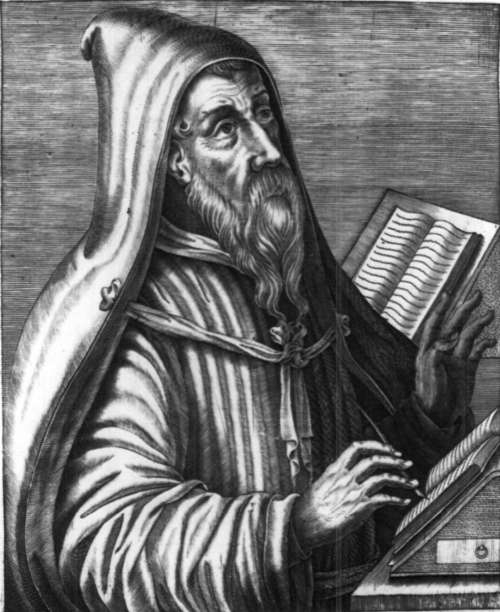
Growing up Reformed, I took it for granted that Augustine belonged to us. In a sea of obscure Christian history, possibly clouded with pagan influence, Augustine stood towering as a great beacon of the true gospel. Everyone else may have missed it, but daggonit – Augustine got it right. If he were alive today, he just might be another R.C. Sproul writing books which would find warm reception amongst the PCA faithful.
In our featured articles on Soli Deo Gloria and Sola Gratia, Sean Patrick and I argued for the Catholic (and Augustinian) understanding of our cooperation with God’s salvific grace. I brought out this point forcefully here:
And so it does no good to quote the Catholic Catechism saying, “Our justification comes from the grace of God,” or “Grace is first and foremost the gift of the Spirit who justifies and sanctifies us,” if Christians in the Reformed tradition object on the ground that the Catholic Catechism also says, “Indeed we also work, but we are only collaborating with God who works, for his mercy has gone before us.” But this is not a quotation from the council of Trent or Vatican I or even Aquinas; this is St. Augustine! At this fateful point where Reformed theology and Catholic doctrine collide with uncompromising force, the Catholic Church unambiguously preserves the ancient and precisely Augustinian doctrine, and this should not be lightly dismissed by anyone who claims that the Bishop of Hippo was a forebearer of Reformed soteriology.
I also supported it by a quote from Protestant scholar, Alister McGrath:
“it will be clear that the medieval period was astonishingly faithful to the teaching of Augustine on the question of the nature of justification, where the Reformers departed from it,” and later, “The Reformation understanding of the nature of justification – as opposed to its mode – must therefore be regarded as a genuine theological novum.”1
McGrath also says: “Luther erected a specific understanding of justification that departs significantly from Augustine at two points of major importance-the notion of justifying righteousness as alien (rather than inherent) to the believer, and a tendency to treat justification as involving two notionally distinct elements. This late trend eventually led to the development of forensic notions of justification in the writing of Melanchthon and others.”2
Now Calvin is a bit trickier. Calvinism certainly shows some strong points of congruency with Augustine’s predestination and this sometimes leads Calvinists to believe that Augustine would be ok with their soteriology. Not so. The Calvinist would insist, I think, just as strongly as the Lutheran on the forensic/alien nature of salvific grace and Augustine would reject that as shown above.
The point I want to draw out is that the Reformation’s favorite early saint sharply disagrees with the Reformers on what they called the central issue. The other points where Reformed thought diverges from Augustine are important too; but let’s start here.
If it is true, and Augustine, the supposed proto-Reformer, holds the Catholic view of cooperation, then what does that mean for the case of the Protestant community? After all, notice above that the Catholic Church doesn’t quote Augustine in support of the Catholic view, she simply quotes Augustine as the Catholic view itself.

It was Warfield who said the Reformation was the triumph of Augustine’s soteriology over his ecclesiology. It appears that Warfield was wrong on that one.
The real divergence is in the fact Lutheranism-Calvinism are founded upon Pelagian and Manicaean anthroplogy. Their view of Adam’s original state is wrong, thus leading to a wrong “diagnosis” and thus a wrong solution to salvation. St Pius V condemned these points more clearly (see Denzinger) against Michael du Bay who espoused these views. Note what the Catholic Encyclopedia says:
“A mere glance at the above sketch cannot fail to reveal a strange mixture of Pelagianism, Calvinism, and even Socinianism. Baius is a Pelagian in his concept of the primitive state of man. He is a Calvinist in his presentation of the downfall. He is more than a Lutheran and little short of the Socinian in his theory of Redemption.”
https://www.newadvent.org/cathen/02209c.htm
Where the Pelagians saw nothing for man to “fall from” because they saw Adam as only consisting of a sound nature, they concluded no ‘original sin’ could exist. The Reformers started off with the same wrong foundation, but took it to the other extreme, they saw human nature itself as going ‘bad’ like a rotten apple, but that’s a form of Manicheanism. This explains why Protestants speak of “sin nature.” The Catholic view is that Adam had a sound nature but was endowed with a super-added grace, and at the fall and afterwards this grace is stripped away. This is rooted in Augustine.
And check out this AWESOME article that Dave Armstrong wrote called “Augustine was CATHOLIC, not Proto-Protestant”:
https://socrates58.blogspot.com/2007/11/st-augustine-was-catholic-not-proto.html
Thanks for the links Nick. You’re right, I am a long way from exhausting the Reformer’s departure from Augustine.
Whatever the Reformers agree with Augustine on, the Catholic Church pretty much does too.
Well, at least pace a lot of recent Protestant’s (Gerstner comes to mind), who claim that Augustine was Reformed in soteriology, Luther and Melanchton both agreed that they differed from the great Augustine in principle. Comments such as:
Ever since I came to an understanding of Paul, I have not been able to think well of any doctor(of the Catholic Church).They have become little value to me. At first I devoured, not merely read, Augustine. But when the door was opened for me in Paul, so that I understood what justification by faith is, it was over with Augustine. (Luther, LW 54:49).
Luther thus confidently asserts without any shame whatsoever that his novel interpretation of Pauline soteriology is correct over that of even Augustine. And what of the other Catholic fathers on his pet theory? Luther:
Jerome can be read for the sake or history, but he has nothing at all to say about faith and the teaching of true religion. Origen I have already banned. I have no use for Chrysostom either, for he is only a gossip. Basil doesn’t amount to anything; he was a monk after all, and I wouldn’t give a penny for him. (LW 54:33-34).
Melanchton can be similarly quarried for the same view on the fathers.
The bottom line is that it is a no win situation for the Protestant. If he agrees with Luther then he must admit that the Protestant articulation of justification sola fidei is a novel interpretation with no historical precedent. On the other hand, if the Protestant goes the route of those such as Gerstner and claim that justification sola fideidoes have historical backing vis a vi Augustine, he can be summarily refuted by Augustine’s own primary writings as well as a mountain of Protestant scholars that have denied the Protestant formulation of justification on Augustine, (or any Catholic father for that matter).
___________________
R. E. Aguirre
(Blog) Regulafide.blogspot.com
(Journal) Paradoseis Journal
___________________
Tolle Lege! Tolle Lege!
R.E.
Great quotes that reveal, despite all the talk of a reform of the one, holy, Catholic and Apostolic Church, that the Reformation was a rupture from the ancient Church.
R. E. Aguirre,
Great quotes showing the non-Augustinianism of Luther!
Another good article on this subject is by Matt Heckel, who went to Covenant Theological Seminary with me. He published “Is R.C. Sproul wrong about Martin Luther? An Analysis of R.C. Sproul’s Faith Alone: The Evangelical Doctrine of Justification with respect to Augustine, Luther, Calvin, and Catholic Luther Scholarship” in JETS in 2004.
There is one historic figure I do know of whose relevance to this particular discussion is paramount, as he is one who lived not only in a land replete with corrupt clergy but even under one of the most vile and wretched popes in all of papal history.
It was because of this (along with other seemingly unsavory things concerning the church of that period) that this particular individual sought legislation against the ecclesial administration of the time and even initially considered quite seriously that the Pope assume the more fitting status of Primus Inter Pares, so as to give the current constitution more balance.
That individual went on to take it upon himself a remarkably scholarly survey of the Great Matter and subsequently engaged in a very intimate and comprehensive in-depth study of early Christianity, utilizing his prodigious knowledge of both Latin & Greek that was highly characteristic of his erudition for which he was excellently renowned (by even the great Humanist, Desiderius himself — the very same who dedicated a popular work to him by employing a pun to his name in its title as well as bestowing upon the man the apt description of “vir omnium horarum” or, better yet, “Man for All Seasons”).
This prominent scholar went on to read (in the original language) the whole of not only New Testament Scripture but also the patristic writings of such Greats like Jerome, Cyprian, Gregory, etc. as well as examining entire records of the General Councils of early and later Christendom.
The conclusion he reached after having immersed himself in an extensive catalog of documents and investigation into church history was that the Primacy of the Pope (along withi other elements of inherited Tradition) had been instituted or established by the core of Christendom, manifested through General Council of the whole of Christendom, or the Catholic Church proper, lawfully gathered together in general council, which was itself governed by God’s Holy Spirit.
These, as well as other elements of the genuine Faith, which had been handed unto subsequent generations of the Church comprised the inherited Tradition and Belief of the Church entire (i.e., a case of consensus & authoritative Tradition), which have historically been transmitted by whether word of mouth or through even the written word amongst the Christian people, from one earlier generation to the following next.
That is, this is a matter of public Truth rather than some private or individual truth which is claimed by the “New Men” to be found only in secret musing, by the likes of Luther et al.
He stated henceforth that the Catholic Church, therefore, is a Visible Church rather than a fleeting sect of believers; it is a Church with a proven Tradition of Faith, reaching back for more than 1500 years, (at least, this was the calculation then when written at that time) transmitted in both oral & scriptural form, possessed by the Authority of the Apostles & the Church Fathers themselves, guided by the Holy Spirit since the Resurrection of Christ; an historical faith established by a consensus of the Faithful, its teachings which are manifested in papal and conciliar decrees whereby general opinion & traditional belief were given dogmatic force, and so come on down to our days by continual succession.
It matters not the sinfulness or folly of certain individuals in the church, even the wickedness of a bad pope, as these in no way affect the divinely instituted sanctitas of the Church herself.
When this scholarly gentleman had confronted Luther with extensive evidence, attacking interalia the individualism & subjectivism of his heresy, and invoking rightly in the force of his argument, the very Authority of the Apostles and the Early Fathers themselves, Luther could only muster the poor reply, “It does not matter if there should be a thousand Augustines or Cyprians who stand against me!“
Ultimately, this same scholar would end up giving his very life to these very principles to which he became one of its most illustrious martyr.
To ADD to the quotes above from Luther’s thoughts in relation to St Augustine, here is a quote I consider very important from Luther’s famous “Tower Experience” (the moment Luther “recognized” the long lost true understanding of the Gospel):
“I exalted this sweetest word of mine, “the justice of God,” with as much love as before I had hated it with hate. This phrase of Paul was for me the very gate of paradise. Afterward I read Augustine’s “On the Spirit and the Letter,” in which I found what I had not dared hope for. I discovered that he too interpreted “the justice of God” in a similar way, namely, as that with which God clothes us when he justifies us. Although Augustine had said it imperfectly and did not explain in detail how God imputes justice to us, still it pleased me that he taught the justice of God by which we are justified. ”
https://www.fordham.edu/halsall/pgc.asp?page=mod/1519luther-tower.html
Note that to Luther, even St Augustine didn’t “get it” on this all important understanding of “righteousness of God” and that it is “imputed” at justification. It’s also been a long standing Protestant error that St Augustine’s “On the Spirit and Letter” is compatible with imputed alien righteousness, when nothing could be further from the truth. One of my favorite conversion stories is from Dr. Robert Koons who was a Lutheran but was stunned to find that Augustine was not a Protestant in regards to justification:
https://www.scribd.com/doc/11214897/A-Lutherans-Case-for-Catholicism
“St. Augustine, God rest his soul, can’t be happy about how Western Christians have been fighting over the rights to his theological legacy for the last five hundred years.”
The above sentence says that both Catholics and Protestants are Christians and fight against each other regarding the matter of Christian faith.
But St. Ignatius of Loyola wrote these words to St. Peter Canisius: “Whoever calls the heretics Evangelicals should pay some kind of fee, so that the Devil may not rejoice at having the enemies of the Gospel and the Cross of Christ being given a name contrary to their works.
Heretics should be called by that name in order to raise horror of those who are such and cover their deadly venom with the veil of a name of salvation. “. (Obras completas de San Ignacio de Loyola,
Biblioteca de Autores Cristianos, Madrid, 1952, carta 111, p. 880)
After this, who of the truth would call the enemies of the Gospel and the Cross Christians?
Would anyone of the truth dare to say that what St. Ignatius of Loyola and St. Peter Canisius did (counter-reformation) against Protestants, who pretend to be Christians and are not Christians but are anti-Christians and anti-Christs (1 John 2:18-19), would have been opposed by St. Augustine had he lived in their age?
Aren’t the words of St. Paul i.e. of The Holy Spirit perfectly clear: “Is Christ divided?” (1 Corinthians 1:13)?
And isn’t it obvious to anyone who thinks rightly that no two contradictions can both be OK?
Thus it is obvious that if anyone wants to avoid sinning against God, saints and the truth and paying dearly for that horrible sin he will forever stop calling “Christian” anyone who is not a Catholic (subject to the pope) or intends to become one.
Re,
You are correct in saying that heretics should not be called Christians, for being heretics they have been anathematized. However, implicit in your argument is that all protestants are heretics or, more precisely, all protestants involved in the errors of heresy are heretics (which would be all protestants).
Your argument goes like this:
1.) No heretic can be a Christian, and
2.) All protestants are heretics, therefore
3.) No protestant is a Christian
Formally your argument is sound, but the Catholic Church would reject your second premise as false. Properly speeking, a heretic is only a Christain who is nurtured within the bosom of the Catholic Church and, knowing what the correct teaching of the Church is, presumes to defy the authority of the magesterium and promote and teach false doctrine. Though a protestant may be involved in the same error, they *may* be innocent because of their ignorance, and because of their faith in Christ they remain within the sanctifying power of Christ’s blood–his faith is sufficient to save him despite his theological error. We want to avoid the exclusivist position in the scope of salvation which says no man can be saved without abiding within the walls of a “Catholic” Church.
(See paragraph 838 in the Catechism of the Catholic Church)
In Christ,
Jared B
Thanks Jared.
Also my thanks to Jared for the thoughtful response to the comment by “Re.”
To “Re” I say that your ambition for calling a spade a spade is partly (but only partly) to be admired. You must walk with all due caution when making such sweeping and serious charges. I admire the making of sweeping and serious charges when they are supported by appropriate authority, but your claim seems to contradict the Catholic Church’s teaching (as Jared pointed out). Therein lies a sad irony.
But insofar as you are saying that we should not make light of our deep divisions, I agree. It is a great tragedy when we pretend to be one where we are not one. It is also a great tragedy when we deepen the division by unsupported allegations of heresy.
Peace in Christ,
Tom
St. Ignatius of Loyola and St. Peter Canisius didn’t have so “refined” a view of Protestants as you have, Jared: it is a fact which no syllogism can deny that counter-reformation was directed against all Protestants whatsoever (Lutherans, Calvinists etc.) because, well, well, well, they were all looked upon by those two saintly Catholic men as in imminent danger of eternal damnation.
If you have an evidence that can back up your claim that they looked upon some of Protestants (which of them?) as non-heretical then it is your duty before God to provide us with it as soon as possible.
Counter-reformation is the infallible proof that your claim cannot be anything but false.
As to The Catechism: the last Catechism contains an unbelievably audacious lie about Mohammedans as allegedly adoring the same God as Catholics do (point 841), although even little children know that they categorically deny The Holy Trinity, the one and only God. Thus The Catechism of John Paul II is not to be trusted if you want to know the truth.
Re: Sarcasm is not appreciated here nor welcome (at least when it is used in a derogatory fashion). You’re asking Jared to back up claims he never made. Go back and re-read his comments. This kind of arguing never gets anywhere.
Furthermore, “proof” cannot properly be called “infallible”. Infallible belongs to processes, persons or charisms, not facts, statements or objects, etc…
So it is not correct to call a certain proof “infallible”.
Without going into details I admit my style was not perfect.
But let’s not lose sight of the real issue here. I would like to see if I erred regarding it since errors there are much more costly.
“Re,”
This all seems off-topic, so mindful of that drift, I will take up only one point.
You say that the Catechism “of John Paul II” is not to be trusted as a source of truth. You earlier said:
“Thus it is obvious that if anyone wants to avoid sinning against God…will forever stop calling “Christian” anyone who is not a Catholic (subject to the pope) or intends to become one.”
Do you see a contradication here, in saying that one is only properly a Christian if one is subject to the pope, but that the Church’s Catechism is not trustworthy for obtaining truth? You seem to prefer your interpretation of the view of two Saints over the understanding of the Magisterium. Please help me understand how my conclusion is wrong that this would make you *not* subject to the Pope (and thus, under your own rule, not a “Christian”).
Peace in Christ,
Tom
“Re”,
“If you have an evidence that can back up your claim that they looked upon some of Protestants (which of them?) as non-heretical then it is your duty before God to provide us with it as soon as possible.”
I never claimed (as Tim pointed out) that such men (back then) “looked upon some of protestants as non-heretical”. I was simply saying that the mind of the Church on the matter *today* (which is posessed of the mind of Christ, who is its head) is such and such, as I explained, and was affirmed by both Tim and Tom. However, since you are claiming that such and such saints viewed all Protestants as heretics, can you provide evidence that they did (burden of proving is on you, by the way)? And if you can, how does it follow from this evidence that we should view Protestants the same way today, all of whome are not first generation Protestants. Are you aware that a first Generation Protestant necessarily falls under the category of “heretic” and “anathema”, and not a second (and so on) generation of Protestants? We are not dealing with first generation Protestants today as much as they did back then–the majority of them were born in Protestant communities, ignorant of the truth of the Catholic faith.
Counter-reformation is the infallible proof that your claim cannot be anything but false.
Not true. The mission of this Blogg-site is to continue “counter-reform”. Since those men who have produced this sight do not believe all Protestants are heretics, it follows that it is not a necessary characteristic of “counter-reforming” to believe all Protestants are heretics. You simply don’t know what those men back then believed comprehensively in regard to Protestants, so just because there was a “Counter-Reformation” does not imply that all Protestant’s were heretics, even if they believe them to have been. And if you could prove such a thing, then you would also have to prove that this was a proper mindset. Not everything the Church has ever done is “infallible”, you know. Just because Ignatious believed such and such doesn’t mean that it is true, or that the Church must. Of course, however, it would be reasonable to view them as such because the majority were first generation Protestants, I will grant you.
As to The Catechism: the last Catechism contains an unbelievably audacious lie about Mohammedans as allegedly adoring the same God as Catholics do (point 841), although even little children know that they categorically deny The Holy Trinity, the one and only God.
Your line of reasoning runs like this:
1.) Only those who believe in the “one and only God” adore the true God
2.) The “one and only God” is a Holy Trinity
3.) Only those who understand the “one and only God” as a HOly Trinity adore the true God
4.) Christians understand the “one and only God” as a Holy Trinity, and Mohammedans “categorically deny” the Holy Trinity.
5.) Therefore, Christians adore the true God, and Mohammedans don’t adore the true God.
This is a sound argument, but it’s truth value rests on which basis the Mohammedans “categorically deny” the Holy Trinity. There are two options:
1.) Mohammedans deny the Holy Trinity because they deny Christ as Lord, or
2.) Mohammedans deny the Holy Trinity because philosophically and conceptually they do not undertsand how One God can be three in unity as one.
If #1 is the basis for their denial, then your argument is true, but if # 2 is the basis, then your argument must be rejected. Not all Mohammedans are knowledgeable of Christ. Since this is so, not all Mohammedans deny the Holy Trinity on the basis of denying Christ. Since not all Mohammadens deny the Holy Trinity on this basis, it then follows that there are some who deny the Holy Trinity on the basis that they do not conceptually understand it. This, however, cannot be a justifiable reason to conclude that the Mohammadens do not adore the true God, because all of Isreal before Christ did not understand God to be a Holy Trinity, and perhaps many would have conceptually and Philosophically rejected the idea, but they nevertheless adored the true God. If there is a Mohammaden who does not deny the Holy Trinity on the basis of denying Christ, but rather on the basis of philosophical and conceptual limitations, due to their ignorance, but nevertheless believes God exists, and that he is merciful and rewards those who diligently seek him, and therefore does seek him, then he adores the true God and may be saved just as the saints in the Pre-Christian dispensation of grace were saved.
In Christ,
Jared B
Re: I think perhaps we should make a distinction between Protestantism and Protestants. I would agree that Protestantism is indeed a heresy, as it has arisen from the bosom of the Church, denied part of her teachings and left her altogether. Reading “The Great Heresies” by Belloc and his definition of heresies as a deviation in vital doctrine from the orthodox, we can see Protestantism as no other.
But definition is key when discussing Protestants as heretics, and using the definition in the catechism that they must have first been within the Church and left her to be heretics, then you must agree that most are not heretics. If you are using a different definition, then it may help to write it out for us so we can all be on the same page.
Again, we have to use care to judge others as to whether or not they are Christians. I myself am in the midst of conversion from Protestant to Catholic and am finding it difficult not to rage against Protestantism as an evil lie. There is a lot of truth there, and many can be saved by faith in Christ and through ignorance of the true Church when this is the only gospel they will ever hear. I really don’t know if the half-truth and misconceptions there cause more to fall away from Christ than to bring people to Him, but I am in no position to judge that.
I’m surprised to see someone who seems fiercely loyal to the Church denigrating the latest catechism from John Paul II. Isn’t that a little contradictory?
Reading Augustine was key in my realization that the Early Church was indeed Catholic, and it was him who best explained the balance between grace and free will to me. I was having a lot of trouble understanding in Catholic theology how our cooperation is necessary although we are saved only by God’s grace. Then Augustine said:
As far, then, as lay in our power, we have used our influence with them, as both your brethren and our own, with a view to their persevering in the soundness of the catholic faith, Which neither denies free will whether for an evil or a good life, nor attributes to it so much power that it can avail anything without God’s grace, whether that it may be changed from evil to good, or that it may persevere in the pursuit of good, or that it may attain to eternal good when there is no further fear of failure.
[Augustine, Letter to Valentinus, No. 215:4]
Now for the commission of sin we get no help from God; but we are not able to do justly, and to fulfill the law of righteousness in every part thereof, except we are helped by God. For as the bodily eye is not helped by the light to turn away therefrom shut or averted, but is helped by it to see, and cannot see at all unless it help it; so God, who is the light of the inner man, helps our mental sight, in order that we may do some good, not according to our own, but according to His righteousness.
[Augustine, On the Merits and Remission of Sins, and the Baptism of Infants, Bk. 2, Ch. 5]
Here is the post I put up after I had investigated the balance between grace and free will: https://soimarriedacatholic.wordpress.com/2009/02/22/on-grace-and-free-will/
Also in reading Augustine, I came to better understand the importance of the sacraments and the bishops, and the Real Presence and the presence of God.
Tom, St. Peter was already the pope when he was publicly rebuked by St. Paul (Galatians 2:11-14). But no one pious can deny that St. Paul was always subject to St. Peter i.e. the pope.
So when the pope sins (as John Paul II did by signing and approving the lie in the Catechism) no one who opposes him loses subjection to him because no one is bound to be subject to anyone’s sin whatsoever, including the pope’s sin.
What is the holiest of all things in Christian religion? The Holy Sacrifice of the Mass.
Every Protestant doctrine and every single Protestant rejects to believe in the holiest of Christian religion!
This belief of each and all Protestants is not a “theological error”, Jared, this is unbelief pure and simple and another, man-made and non-salvific, faith.
And Jared and co. dare to call such unbelievers and offenders of God “Christians” and support them!?
The magnitude of each of these two offenses is so enormous that Jared and co. would instantly be damned for any of them and already in Hell if good, gracious and merciful God didn’t give them chance to repent.
“Bear not the yoke with unbelievers. For what participation hath justice with injustice? Or what fellowship hath light with darkness? And what concord hath Christ with Belial? Or what part hath the faithful with the unbeliever? … Wherefore: Go out from among them and be ye separate, saith the Lord, and touch not the unclean thing: and I will receive you. And will be a Father to you: and you shall be my sons and daughters, saith the Lord Almighty.” (2 Corinthians 6:14-15, 17-18).
I have another works to do. Goodbye.
So long, Re. May you be much occupied in your other works.
Re,
Hey, we’re just speeking for the Church here. Don’t kill the messengers. This is *probably* not the place to vent your scruples over the catechism. If you have some problems with what the Church teaches, perhaps you should write a letter to the Pope, asking him.
As far as your argument goes, you are begging the question by continually asserting that Protestants are unbelievers, which is exactly what we are challenging (with the magisterium on our side of things). You cannot succeed in your position if this is your tactic.
And Jared and co. dare to call such unbelievers and offenders of God “Christians” and support them!?
We hold that not all Protestants are heretics, so yes. But, true unbelievers we wouldn’t call Christains–we would call Protestants Christians as long as they are not heretics. Dare to say Christ will deny himself of those who genuinely call on his name for mercy? I don’t think so. He is faithful and just to forgive our sins; God is not a respector of persons.
In Christ,
Jared B
Dear “Re,”
I agree with Jared, but would say that you should speak with your own Bishop. If you are Catholic, then he is your prelate and has jurisdiction over you. Petition to him to take up your complaint against the catechism with the other prelates.
You make an argument common to Protestants: even Peter was rebuked by Paul. But your lesson by analogy only works if you are an equally fit judge over John Paul II as Paul was over Peter. Unless you are a bishop, the analogy does not work. What authority do you have to determine that a pope in exercise of his magisterial office is in error and sin? How does this differ in principle from my (hypothetically) saying that I will agree with Catholicism except for its view of the mass, which “is most abominably injurious” to Christ’s one sacrifice (to use the Westminster Confession)? Imagine the confusion and disunity we would have if any Christian could disbelieve any teaching of the Church because he personally has concluded the teaching is sin.
This is serious; I believe you are in great error, and you believe I am damned.
Peace in Christ,
Tom
For Re: as well,
I suggest you read Vatican II’s Decree of Ecumenism: Unitatis Redintegratio. Here is a relevant paragraph:
Protestants are our separated brothers; we are in imperfect communion with them, but they, too, by their valid baptisms, have been given the Holy Spirit by God.
One thing that should be added to this conversation is the important distinction between material and formal heresy. I discussed formal heresy here, although I wasn’t specific there about the nature of material heresy. Material heresy is error about some truth which must be believed with divine and catholic faith. Protestantism contains various material heresies, and those who believe those errors could be (unhelpfully) said to be ‘material heretics.’ It is unhelpful to refer to present-day Protestants in this way because few people are aware of the distinction between material and formal heresy, and so it would be misleading by way of connotation. But they are not formal heretics unless they meet the conditions laid out in the comment at the link given earlier in this paragraph. Most Protestants do not meet those conditions, for various reasons. Error based on not knowing that the Catholic Church is what she claims to be (even if that ignorance is vincible ignorance) is not sufficient to entail formal heresy, even if it is culpable error.
As for the question regarding whether Muslims worship the same God Christians do, see my comment here.
In the peace of Christ,
– Bryan
Greetings!
I come as a young theologian wrestling with the enormous topic of justification, and thus, Augustinian soteriology. I just typed up this whole thing and I decided for convenience you can skip down to the bottom line in bold to get the gist of what I’m saying and then read through this monstrosity if you have the time to help me figure this out!
So far, I’ve come across arguments that sola fide/imputed righteousness comes straight from Augustine. Let me quote, wholesale, someone who has argues this. I initiated the discussion because I noticed this online bookstore quoting Augustine: ”If you shall be paid what you deserve, you must be punished. What then happens? God has not rendered you the punishment you deserve, but bestows undeserved grace. If you would be estranged from grace, boast of your own merits.”
I stated, Why quote Augustine if he wasn’t Reformed/believed in imputed justification?
Then followed a long conversation, with the final response (emphasis mine):
@Maim, I don’t quote understand the argument you are making. Go back to the beginning. This whole conversation started because you criticized us simply for quoting Augustine, as if it were inappropriate, and there is actually nothing inappropriate about it. The quote we posted was entirely scriptural and had nothing to do with the whole topic you brought in from the outside. You found it questionable that a Reformed site had quotes from Augustine. I find this totally at odds with history and anything resembling sound reason. You might as well throw out the whole Protestant Reformation without Augustine’s influence. That’s how deeply imbedded his theology of salvation was to that movement in the 16th century. Look in to it. Read Calvin’s Institutes. He quotes him more liberally on grace than any book you will ever read.
Next, You said, ‘Even Roman Catholics believe salvation is through Christ alone and man does nothing to deserve saving faith.’
No they don’t actually. On the contrary, this is the very first reason the Reformers opposed them. Roman Catholics indeed may believe in the NECESSITY of Jesus but not the SUFFICIENCY of Jesus Christ >> exactly the main point the Reformers and Augustine went out of his way to make. If one rejects the sufficiency of Jesus Christ then, by definition, they reject salvation by Christ alone. If Christ is not sufficient then something else must be added. The opposite of Christ alone. To Catholics what Jesus accomplished was not enough.. But I am thankful to God for sending his servant Augustine to be an early witness for sovereign grace to refute the errors of the Pelagians. … he clearly did believe in grace ALONE in the same way the Reformers did… and so does the early Council or Orange. But The Council of Trent contradicts everything written by Orange and Augustine on salvation.
I would encourage you to take your time to research on this, before you really choose to criticize Augustine too much. I admire your zeal but think you are missing the mark on this one. Augustine is a patriarch whose shoulder we all stand upon in the gospel of grace.
Augustine once said ‘To will is of nature, but to will aright is of grace.’ & ‘We know that God’s grace is not given to all men. To those to whom it is given it is given neither according to the merits of works, nor according to the merits of the will, but by free grace. To those to whom it is not given we know that it is because of God’s righteous judgment that it is not given.’
Thank you Maim for the time but I am sorry that I cannot continue this conversation further than here. May the Lord open eyes and ears to the gospel of grace. Shalom.
Clearly, with the arguments before us, we see an undeniable distinction between Augustinian soteriology and sola fide. I see the distinction, that Luther and others depart from Augustine. I was this close from saying, “Aha! I got it! Infused justification is where it’s at.” Indeed, I found R.E. Aguirre’s statement most agreeable:
The bottom line is that it is a no win situation for the Protestant. If he agrees with Luther then he must admit that the Protestant articulation of justification sola fidei is a novel interpretation with no historical precedent. On the other hand, if the Protestant goes the route of those such as Gerstner and claim that justification sola fideidoes have historical backing vis a vi Augustine, he can be summarily refuted by Augustine’s own primary writings as well as a mountain of Protestant scholars that have denied the Protestant formulation of justification on Augustine, (or any Catholic father for that matter).
I thought that was it. But here’s the problem in quoting Alister McGrath: His own stance on Augustine. James Swan responds to Catholic apologists on “theological novums.” The first link contains a shorter bit, the second goes into greater detail about the problem with citing McGrath’s work.
https://www.aomin.org/aoblog/index.php?itemid=1854
https://beggarsallreformation.blogspot.com/2006/08/alister-mcgrath-on-augustine-and.html
Of course McGrath thinks the Reformation departs from Augustine… but McGrath doesn’t believe that Augustine had or expressed the proper soteriology in the first place! If Reformed thought presents a theological novum from Augustine, okay!–McGrath has no issue with that because Augustine also brought a theological novum. Sola fide, while clearly departing from Augustinian soteriology as any Catholic apologist and McGrath himself would agree, turns out to become the proper theological formulation of Scriptural exegesis anyway.
To summarize:
Some Reformers (as the one I engaged in discussion with and quoted in length earlier) believe Augustine was a proto-Protestant who believed in imputed righteousness. Clearly, as shown in this discussion, their arguments fail to defend the Reformation.
However, others such as Alister McGrath and James Swan acknowledge that Reformed thought departs from Augustine, but they have no problem with it because they didn’t think Augustine had it right in the first place. And even if sola fide could not be found in patristic thought, Swan argues,
Sola Fide is based on grammatical and exegetical work on the Biblical text, not on the testimony of history.
I would eagerly contest with him on that as I happen to think imputed righteousness can be found neither in Patristic soteriology nor in critical exegesis of the Biblical text.
Bottom Line: You can’t just say Augustine wasn’t Reformed and call it a day (especially citing McGrath). While that might be true, what if Augustine had it wrong in the first place?; while the Reformation might appear as a “theological novum,” what if sola fide actually points to the right direction in Biblical exegesis regardless of the testimony of the Church Fathers? How do you argue against those who don’t care about showing their ancestry in Augustine or proving some sort of historical basis for imputed righteousness?
Sincerely,
Maim
Maim – I’m having a little trouble following the comment – not sure who is saying what.
In reply to your bottom line — if someone agrees that St. Augustine was not Reformed (and that no early Christian was), and still wants to be Reformed, I wouldn’t really argue with them; at least not as far as the point in this post goes. It could be the case that everyone misread the gospel up until Calvin and that Calvin misread most of those who misread the Scriptures, thinking they agreed with him, but at the same time, he correctly read the Scriptures. That’s possible on face value. But it’s also pretty silly. I’m not real excited about trying to argue with anyone who thinks that.
Tim,
I’m sorry the quote tags didn’t appear properly as I would have liked. How inconvenient!
First quote:
“@Maim, I don’t quote understand the argument you are making…
…Thank you Maim for the time but I am sorry that I cannot continue this conversation further than here. May the Lord open eyes and ears to the gospel of grace. Shalom.”
Second quote, from R.E. Aguirre:
“The bottom line is that it is a no win situation for the Protestant. If he agrees with Luther then he must admit that the Protestant articulation of justification sola fidei is a novel interpretation with no historical precedent. On the other hand, if the Protestant goes the route of those such as Gerstner and claim that justification sola fideidoes have historical backing vis a vi Augustine, he can be summarily refuted by Augustine’s own primary writings as well as a mountain of Protestant scholars that have denied the Protestant formulation of justification on Augustine, (or any Catholic father for that matter).”
Last quote, from James Swan:
“Sola Fide is based on grammatical and exegetical work on the Biblical text, not on the testimony of history.”
^Any words not in these quotes, are mine.
I appreciate your response. Would you please elaborate why that’s “pretty silly”? Just that it simply seems improbable?
Well, probability is a factor, but the point I’m getting at is that that view of Christianity is, in my opinion, entirely untenable. As a Protestant, I believed that the ‘sola fide’ / ‘imputed righteousness’ reading of the NT text was tenable, and I still think it’s reasonable at face value. But as I studied more (just the text itself) I also came to believe that there were or could be other readings every bit as tenable. When I learned that the Catholic Church had always taught a different reading and still does, it became clear which reading was correct.
But the ‘silly’ comment, although it might come off as dismissive, is the conclusion of a number of arguments, many of which have been studiously presented in other places on this site. The core tenet of our religion cannot be left to probabilities, or to which readings seem most likely in our own eyes. This is the ultimate realization that has led many like myself to become Catholic. The academy can never demand the assent of faith, no matter how persuasive its argument is. (In this case, the arguments aren’t very persuasive anyway.) But even if they were, my conscience can only be bound by someone with divine authority. I don’t have that authority, so I cannot put my faith in my own ‘best reading’ of Scripture. The academy doesn’t have it, and neither did the original Protestant leaders. The Church has it, or no one has it.
I will do what I can to examine other arguments on this site about justification. I grew up believing sola fide in Scripture for almost my whole life, but over the past seven months I have actively tried to examine what I believe. Soon, I will have to consider things outside my Protestant box and consider Eastern Orthodoxy, Roman Catholicism, and just about everybody else. Thank you for your clear, honest response.
All glory to God,
Maim
Maim,
Just let us know if we can be of any help. You might be interested in Bryan Cross’s article – “Does the Bible Teach Sola Fide” which is a little more – hands-on with the text.
“Not so our father Abraham. This passage of scripture is meant to draw our attention to the difference. We confess that the holy patriarch was pleasing to God; this is what our faith affirms about him. So true is it that we can declare and be certain that he did have grounds for pride before God, and this is what the apostle tells us. It is quite certain, he says, and we know it for sure, that Abraham has grounds for pride before God. But if he had been justified by works, he would have had grounds for pride, but not before God. However, since we know he does have grounds for pride before God, it follows that he was not justified on the basis of works. So if Abraham was not justified by works, how was he justified?” The apostle goes on to tell us how: What does scripture say? (that is, about how Abraham was justified). Abraham believed God, and it was reckoned to him as righteousness (Rom. 4:3; Gen. 15:6). Abraham, then, was justified by faith. Paul and James do not contradict each other: good works follow justification
3. Now when you hear this statement, that justification comes not from works, but by faith, remember the abyss of which I spoke earlier. You see that Abraham was justified not by what he did, but by his faith: all right then, so I can do whatever I like, because even though I have no good works to show, but simply believe in God, that is reckoned to me as righteousness? Anyone who has said this and has decided on it as a policy has already fallen in and sunk; anyone who is still considering it and hesitating is in mortal danger. But God’s scripture, truly understood, not only safeguards an endangered person, but even hauls up a drowned one from the deep. My advice is, on the face of it, a contradiction of what the apostle says; what I have to say about Abraham is what we find in the letter of another apostle, who set out to correct people who had misunderstood Paul. James in his letter opposed those who would not act rightly but relied on faith alone; and so he reminded them of the good works of this same Abraham whose faith was commended by Paul. The two apostles are not contradicting each other. James dwells on an action performed by Abraham that we all know about: he offered his son to God as a sacrifice. That is a great work, but it proceeded from faith. I have nothing but praise for the superstructure of action, but I see the foundation of faith; I admire the good work as a fruit, but I recognize that it springs from the root of faith. If Abraham had done it without right faith it would have profited him nothing, however noble the work was. On the other hand, if Abraham had been so complacent in his faith that, on hearing God’s command to offer his son as a sacrificial victim, he had said to himself, “No, I won’t. But I believe that God will set me free, even if I ignore his orders,” his faith would have been a dead faith because it did not issue in right action, and it would have remained a barren, dried-up root that never produced fruit.”
~ Saint Augustine of Hippo