
Predestination: John Calvin vs. Thomas Aquinas
May 23rd, 2009 | By Taylor Marshall | Category: Blog PostsIn his third book of the Institutes of the Christian Religion (chs. 21-24), Calvin articulates his developed doctrine of predestination and reprobation. In chapter 21 in particular, Calvin denies that God’s prescience (“foreknowledge”) is the cause of predestination.
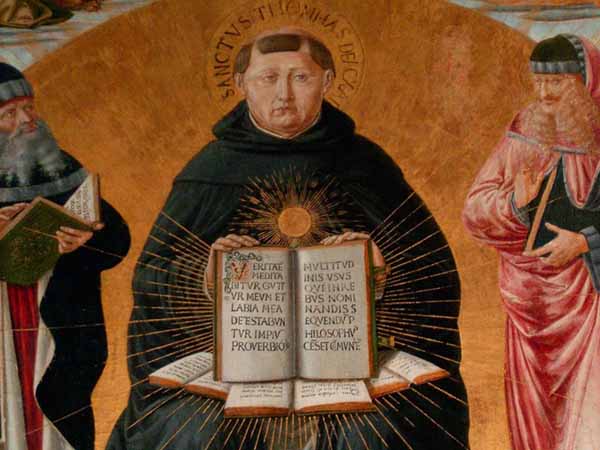
Thomas Aquinas makes a similar argument in Summa theologiae I, q. 23, a. 5. First, Thomas refutes three versions of predestination in light of God’s foreknowledge of human merit. The first he identifies with Origen, namely that souls pre-merited their final states before becoming embodied in time. The second he identifies with the Pelagian error holding that good begins within us and receives its consummation in grace by God. Both theories of predestination are incorrect according to Thomas because each confuses the order of causality. The final cause is always prior in the order of execution and not conditional on intermediary causes. A third option is put forth and also rejected, namely that God gives grace to those whom he knows will rightly use it. This seems less Pelagian, but this theory also places the cause of salvation in us and not in God. Here also grace fails to be grace.
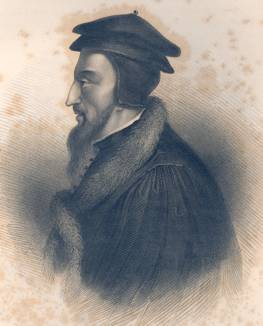
Before appealing to God’s will, Thomas secures the goodness of God by appealing to his previous understanding of providence as it relates to primary and secondary causes (I, q. 22, a. 3). Free will is a secondary cause flowing out from predestination. This distinction ensures that God is not the direct cause of murder or final damnation. This is where Calvin departs from Saint Thomas. In chapter 23 of Book III of the Institutes, Calvin seems to deny the distinction between primary and secondary causation. Calvin mocks those who want to wedge in the claim that the wicked perish by the permission of God and not by the will of God. “The first man fell because the Lord deemed it meet that he should: why he deemed it meet, we know not.” Calvin then asserts: “It is certain, however, that it was just, because he saw that his own glory would thereby be displayed.” It seems contrary to justice, but Calvin confirms the decree to sin was just because God obviously cannot be unjust. This argument is circular and rather unsatisfying.
Compare Calvin to Saint Thomas Aquinas. In his reply to the third objection (I, q. 23, a. 5, ad. 3), Thomas states: “The reason for the predestination of some, and reprobation of others, must be sought for in the goodness of God.” Thomas centers his discussion of predestination on God’s goodness. Appealing back to his discussion on divine providence, Thomas writes: “God allows some evils, lest many good things should never happen, as was said above” (i.e. I, q. 22, a. 2).
I still find Thomas’ solution somewhat troubling, but it does seem to track with Pauline passages that discuss election and predestination. It is troubling because it seems to indicate that God loves some more than others. The now deceased priest and theologian Rev. William Most recently proposed a modified Thomistic solution. Most suggested the following logical order in the decree of God’s predestination. First, God wills all to be saved (1 Tim 2:4). Next, God foresees only those who will reject grace persistently and finally. Third, he predestinates all those not in this number to final glory. The beauty of this solution is that God does not predestinate the elect for their own foreseen merits and only damns the reprobate for their sins and their rejection of grace. No one is chosen because he would have done anything of merit. The predestinate are still predestined ante proevisa merita. The decree of predestination is negative with respect to the final state of the predestinate. I find this opinion a bit more satisfying, because it protects the Thomistic emphasis on the gratuity of grace. The predestinate are not strictly chosen for anything they have done. Rather, the elect are predestinate because they are not reprobate. God only foresees the demerits of the damned and then makes his decision based on his own standard of justice. We might even say that the predestinate are chosen only because of God’s goodness, as He is under no obligation to save them since they are sinners. Thomas does not entertain this objection, nor does he offer it as a solution. I wonder whether he would have found it compelling.
I’d love to hear your thoughts on Father Most’s position or on the distinctions made by Thomas Aquinas and/or John Calvin.
Follow Taylor Marshall @TaylorRMarshall or visit his blog at www.taylormarshall.com

One interesting critique of “God loves some more than others” is that it gives no explanation for why God loves X more than Y…apart from a purely random choice (and yet God is not random). If Bob and Sam are both equally in sin, and nothing in them or done by them is taken into account, then the choice of one over the other is purely random. It’s like reaching into a bag of marbles.
Another interesting point is that chapters like Romans 9 are often seen as unconditional election passages, yet reading 9 carefully, along with 10 and 11 (and looking back to the context of their OT references), reveals a more balanced view, which is that Israel had a long history of stubbornly refusing to submit to God and thus were rejected. It is interesting to note that Paul saying things like “it is my desire that they be saved,” along with “those branches broken off can be grafted in again,” among other comments, that have caused me to consider this issue more carefully.
I think it can be reasonably doubted, without danger to faith, that the New Testament actually teaches anything regarding the election and predestination of individuals as such. These terms are only used in the context of explaining how a previously “non-chosen” people have become “chosen” and vice versa.
If Jacob and Esau are understood as types, then Romans 9-11 need not be read as containing any metaphysical claims about the destiny of individuals. Rather, the discussion addresses questions about salvation history and God’s relationship toward the people of the old Covenant in light of the new one.
That said, I also appreciate Fr. Most’s take on predestination. I simply wonder whether the problem he’s attempting to solve even needs to exist as a theological problem. If we approach Paul on his own terms, which are rather more typological and Jewish than metaphysical, the problem may in fact disappear.
What actually made Romans 9-11 clearer to me, odd as it may sound, was reading Paul’s argument backwards– that is, reading the chapters in reverse order, 11/10/9. (Not “backwards” by verse, of course, but only by chapter.) The purpose of the entire discussion was made much clearer this way.
After I began to read these passages differently, Jacob Michael’s articles (“The Riddle of Romans 9” and “Rescuing Romans from the Reformers”) helped me put together the Old Testament background and really appreciate Paul as the (literally) “ultimate” Jewish theologian. These can still be found through https://web.archive.org/web/*/https://www.lumengentleman.com
Marshall,
How can you possibly leave out Augustine in this discussion? His views on predestination and the contrast he sets up against the foreknowledge of the Greek Fathers is well known and fascinating. I would rather agree with Augustine’s reading of the Pauline texts (1 Tim 2:4, et al) which he is clear refers not to all people but rather to the class of people that are ultimately elect over against Most’s formulation. Augustine was immensely influential on the “magisterial” Reformers (granted they went much further than Augustine in downplaying free-will) on the doctrine of predestination and the link should be made.
________________________
R. E. Aguirre
Paradoseis Journal
Taylor,
It seems to me that the most important question in this context and in relation to our aim of reconciling Reformed Protestants with the Catholic Church is this: What positions does the Catholic Church allow, and what does the Catholic Church condemn, with respect to this subject of predestination?
Given that within those guidelines, there remain open (unresolved) questions and different permitted answers, it seems to me important first to lay out those guidelines, because everything that is *within* those guidelines is not cause for schism, but can be an open question as an in-house matter.
The Catholic Church does teach definitively that some people are predestined to heaven through grace. We can see this in the canons of Trent 6. She also teaches that some are destined to hell, on the basis of their foreseen sin and free rejection of God, as just retribution for their sin. But she teaches that no one is predestined to sin. (See the Second Council of Orange.) God’s foreknowledge imparts no necessity on man’s free will. Likewise, man’s will remains free under the influence of grace. (Trent 6 can. 4) Grace is resistable. No one perishes because he is unable to be saved, but because he is unwilling to be saved. God desires all men, without exception, to be saved. God gives sufficient grace [for salvation] to all men, yet not all men are saved.
As for the question concerning why in some persons sufficient grace is efficacious, and in other persons, sufficient grace is not efficacious (is it because of a qualitative difference in the grace given, or because of a difference in the willed response), the Church has (for now) left that question open. That entails that a Catholic may believe that God gives sufficient grace to all, but gives efficient grace only to some. A Catholic may, alternatively, believe that what makes sufficient grace efficient is the free acceptance by the will, and what makes sufficient grace not efficient is the free rejection by the will. A Catholic may, alternatively, prescind altogether from answering this question. This question (in this paragraph) is an open-question within the Catholic Church, and therefore need not be a cause for division.
In the peace of Christ,
– Bryan
I second Bryan’s observations about the doctrine of predestination’s place in the bigger discussion of our being called to communion. But as the Calvinist position is outside the permissible bounds of the Catholic faith, the discussion is vital. I look forward to the articles section of this site getting there in due time.
In reading about Aquinas’ position on predestination, I found it difficult to articulate with precision the difference between his view and Calvin’s. There certainly is a difference, but not one that is easy to articulate (because the subject is so nuanced, perhaps). I believe that Aquinas’ view is close to Calvinism in the ways that are so important to Calvinists, ways that were ‘non-negotiables’ for me: grace is unmerited, God’s sovereignty will efficaciously see His elect reach Heaven, et cetera. This should be an area for agreement before it is an area for division.
And when Aquinas says that God loves some more than others (predilection), he does not say God randomly loves some over others. Was (the often rebellious) David a man after God’s own heart because God randomly selected him? I think not. Artists and musical composers can create a variety of fine works with some that are particularly dear to them. The reason for the difference is the mystery involved in this doctrine.
Peace in Christ,
Tom
Taylor,
Not all the Reformed agree here with Calvin as some seem like Thomas or Augustine. For example, a Systematics professor taught us that we should believe and teach a “passive reprobation” where God damns the reprobate for their demerits but predestines the elect out of his love for them (at least). This would be consistent with the Reformed infralapsarian view of predestination, where God permits the fall of mankind but having foreseen it he predestines some to glory while some others he passes over and leaves them in their sins. I recall Dordt speaking with an infralapsarian twang while the Westminster confession is somewhat ambiguous.
I do not think, however, that Catholics would agree with Westminster that Adam’s guilt was imputed to the fallen mass of humanity. Feel free to correct me if I’m wrong on that.
Tom,
I agree that in certain respects Calvin’s theology of predestination is similar to that of Aquinas. But if there were no significant differences between Aquinas and Calvin on the subject of predestination, then Calvin’s position wouldn’t be “outside of the permissible bounds of the Catholic faith”, given that Aquinas’s position is within the permissible bounds of the Catholic faith.
The Catholic Encyclopedia article on ‘predestination’ gives three limiting conditions for any orthodox theory on predestination and reprobation:
For Calvin, God predestined men to hell and sin in the same ‘positive’ way He predestined the elect to heaven. (See Institutes III.XXII.11; XXIII) So, that would put Calvin’s doctrine at odds with the second and third conditions directly above. But Aquinas’s doctrine would satisfy all three conditions.
In the peace of Christ,
– Bryan
Jeremy,
There is a certain (unfortunate) ambiguity in the term ‘partial cause’ in the context of a discussion on predestination. Perhaps I can clear it up. Consider all the passages in the New Testament about receiving an eternal reward in heaven for the good we do in this life. You know them. If this reward did not contribute to our eternal happiness, then it wouldn’t be a reward because we wouldn’t want it. Our actions are eternal, in a certain respect, in that they redound into eternity. Our history is always part of who we are, and is always carried with us. At the Final Judgment, everything we have ever done will be laid bare for all to see, eternally. Those who have led many to righteousness will shine like the stars forever and ever. (Daniel 12:3) The greater the righteousness of our lives, the more will be our share in His glory. You’ve seen the bumpersticker: “He who dies with the most toys wins.” But the analogous Catholic bumpersticker would be: “He who dies with the most charity wins.” The greater our charity here, the greater our happiness and joy there. We are in a race, surrounded, as it were, by a great cloud of witnesses. There are heroes in many earthly battles and wars. There are lauded athletes in many sports; simply flip on ESPN. But these are all merely earthly types of the greatest heroes of all time: the saints. The Catholic doctrine is that not all persons in heaven are equally happy, even though each person in heaven is as happy as he or she can be. Last year, in On Imitations and the Gospel, I wrote:
That’s what the first of the three conditions in the selection I quoted from the Catholic encyclopedia article is saying. The good deeds of those having sanctifying grace, are a partial cause of their eternal happiness. In other words, our choices, our actions, our words, our acts of charity, really and truly contribute to (increase) our eternal happiness. Grace does not destroy nature. Grace does not wipe out justice, or wipe out the Final Judgment. Grace does not give us an end-around on the Day of Judgment, so that we slip around the backside of the Judge, or hide behind Christ. He is the Judge! Grace (which was merited for us by Christ) allows us in this life truly and genuinely to merit on that Day those everlasting words than which no other words in any time or place can compare in worth: “Well done, good and faithful servant; enter into the joy of your Master.”
In the peace of Christ,
– Bryan
Bryan,
(A) At least in the order of execution in time (in ordine executionis) the meritorious works of the predestined are the partial cause of their eternal happiness;
This seems to really contradict the purposes given for election in Romans 9 concerning Jacob and Essau. 10 And not only that, but also when Rebecca had conceived children by one husband, our father Isaac,
before they had yet been born or had done anything, good or bad, in order that God’s elective plan might continue, not by works but by his call–she was told, “The older shall serve the younger.”
NAB
This verse seems to specificially be saying that (at least in the case of Jacob and Essau), there is no consideration of the “meritorious works of the predestined.” I’d love some insight.
Thanks, – Jeremy
Dear Bryan,
No argument from me. I realize that the conclusion (positive election to damnation or not) is dramatically different. I would have a hard time articulating the premises and nuances that led to that conclusion or flowed from it.
Peace in Christ,
Tom
Bryan,
Trent does say that grace is resistible but one could argue that that resistibility is only temporal – that, in the end, God will always have his way. Hebrews 12 teaches us that God chastens his people and that we may even know that we are his by this chastening. We may resist God’s grace but he will continue to chase us until we surrender.
Also, thank you for the point you made about Calvin’s comment about God predestining both the elect and the damned in the same ‘positive way.’ God does not desire or “predestine” that people go to hell it’s simply the only other place to go.
Mike
Gentlemen, I would love to add something intelligent to this discussion, but it seems to be all hammered out. Quite frankly, I am looking up at giants in this arena. Many thanks to each of you for schooling me. I thought the article was interesting and the discussion following it made it even better.
Brian, your 5 cents as per usual knocked me right out of the ballpark, and I landed a little closer to the jumping off point. I am regularly amazed at your thorough knowledge, which you hand over in a concise fashion.
Be blessed for the sake of Christ brothers,
-g-
Bryan Cross:
One could also believe that God’s grace is always efficacious because God’s grace is never wasted. If a person rejects the saving grace that is offered to him, that grace is then given to another person that accepts that grace.
It’s so great what this website is doing!
I know this is old, but I wanted to throw my hat in the ring…
We should not be too quick to assume that what Calvinists actually believed was outside the bounds of Catholic Orthodoxy. Trent’s job was not to interpret the writings of the Reformers, but to state dogmatic truth and reject error. So, it takes more work to show that a particular Protestant position is actually condemned by Trent.
During the Synod of Dordt, where Arminianism and Calvinism definitively parted ways, the Calvinist side (even the most rigorously orthodox Counter-Remonstrants) drew not only on Aquinas but on post-Tridentine Dominican theologians like Domingo Banez and others. They saw the harmony between their position and that of the Thomists (which is obviously within the bounds of Catholic orthodxy, as the Congregatio de Auxiliis made quite clear). This is significant for this discussion I think.
Unfortunately, the Dominicans of this period rarely addressed the writings of the Reformed theologians, especially the ones that came a few decades after Calvin. When they did, they emphasized that the key problems were that Calvin’s position made God the author of evil. But this is where history gets interesting again. A number of Calvinist theologians in later decades explicitly stated that they needed to clarify Calvin’s view of free will and demonstrate that God is absolutely not the cause of evil; they were quite clear that, while God’s will is infallibly efficacious (something any Thomist would agree with), there are still genuine secondary causes, including the human will!
Look at these words from the Westminster Confession, Chapter III:
“I. God from all eternity, did, by the most wise and holy counsel of His own will, freely, and unchangeably ordain whatsoever comes to pass;[1] yet so, as thereby neither is God the author of sin,[2] nor is violence offered to the will of the creatures; nor is the liberty or contingency of second causes taken away, but rather established.[3]”
So, I’m not really sure that, when it comes to predestination itself, there is any fundamental difference between Calvinism (particularly as it developed in later centuries) and Thomism (particularly in its clearest Banezian form) and, consequently, Reformed views of predestination (I am not talking about justification here, etc.) are within the bounds of Catholic orthodoxy. Thoughts?
Concerning predestination I would think we should take a long look at the flood account in the Old Testament. God predetermined before hand the measurements of the Ark. This act of God resulted in a complete redemption of the cosmos (world). Argue as you may… Our Creed states, “Who for US and our salvation He came down from heaven”. The purpose of God is clear…”He came to seek and SAVE that which was lost”. Admittedly it is a difficult doctrine, especially when multitudes of unorthodox preachers have been let loose to pervert our Lord’s gospel. In the garden we see man hiding and God seeking…..man covering himself and God covering man. Again, it is God who applies the atonement….not man’s free will.
Randy,
So man does nothing?
It is true that God’s grace is all in all, but God’s grace enables man to act. There is a response. God initiates it, of course. He also gives us the grace to respond and persevere. That’s the Catholic Faith.
Where we Catholics differ with the Calvinists is that we don’t presume to call ourselves predestinate. Instead we live so as to make our calling and election sure. This is the teaching of Christ, Paul, and all the saints.
in Christ,
Taylor
Taylor,
Sure, Man does something. He responds to God’s call through the regenerating power of the Holy Spirit. The Spirit makes alive those who are dead in trespasses and sins. I certainly agree that we must make our calling and election sure….by working out our salvation with fear and trembling….for it is God who is at work in us both to will and to do His good pleasure. My argument rest on the design of God’s atonement….which doesn’t include all therefore it is predetermined…If indeed the whole creation groans and travails for their redemption…and will receive it effectually (through God’s design and with out volition) Then the atonement for the elect stands by design and not by man’s decision. I simply state as a Anglo Catholic…..that my prayer is for unity….If we deny the unity of the Trinity in salvation then as Catholics how can we expect to win unity in His Church? St. John 17.
God’s Peace
Randy
Randy,
You write:
He responds to God’s call through the regenerating power of the Holy Spirit.
I say, “Amen!”
You write:
The Spirit makes alive those who are dead in trespasses and sins. I certainly agree that we must make our calling and election sure….by working out our salvation with fear and trembling….for it is God who is at work in us both to will and to do His good pleasure.
Again I say, “Amen!”
You write:
My argument rest on the design of God’s atonement….which doesn’t include all therefore it is predetermined…
I say, “Wait a second. That’s not biblical!”
Where does it say in Scripture that the atonement doesn’t include all?
On the contrary Scripture says that Christ died for all men:
The atonement does effect every man, woman, and child. All shall rise from the dead on account of the New Adam’s resurrection. Some shall go to glory. Some shall go to perdition. Christ shall raise all by the virtue of his death and resurrection. He died for all.
Scripture states that the Father, the Son, and the Holy Spirit desire that all men be saved. The economy of salvation includes all – each and every. Christ died for every single human from Adam to the last baby to be born. Each goes to Hell for rejecting the Logos that illuminates every man, not because the Logos didn’t die for each and every. Limited atonement is the heresy of the Jansenists – condemned by the Church.
in Christ,
Taylor Marshall
Taylor,
Thank you for your response…..funny you should mention the phrase “that’s not biblical”. That is usually a charge the Protestant gives to a Catholic. Anyway, as I read further into the context of Christ suffering and tasting death for all men…I also read “His death bringing many sons into glory”…”He that sanctifieth and they who are sanctified, are all one…so He is not ashamed to call them brethren”. “For verily He took upon Him the seed of Abraham (not Adam) Wherefore it behooved him to be made like unto his brethren that He might become their High Priest to make reconciliation for the sins of the people”. Finally, you commented on Christ making a sacrifice through His death” from Adam to the last baby born”. But we read in 1Sam. 3:14 that “And therefore I have sworn unto the house of Eli that the iniquity of Eli’s house shall not be purged with sacrifice nor offering for ever.”
It does us no good to take this disputed topic blow by blow….greater minds than we… have beaten the hell out of each other over the ages. We both want God to be Glorified. I’m sure you have done your homework on this and many more important doctrines. I truly enjoy our conversation and this format. I too want and pray that the Latin, Greek, and English Church will soon become one. This website is a wonderful start!
God Bless
Randy
Randy,
The last biblical quote is a good one showing that Christ is a high priest for those who aren’t necessarily in the Church. Christ took hold of the seed of Abraham and is the high priest of “the people.” Here the author speaks of the Hebrew nation and yet not all Hebrews are saved. Thus, the intercessory vocation of Christ is not infallible. A good example of this is when Christ proclaimed on the cross as priest: “Father forgive them they know not what they do.” This did not immediately entail that everyone involved in the crucifixion was justified on the spot.
Christ redeems. Christ initiates with grace. Christ sends His Spirit. Man, through grace, must respond. I’m not claiming how this mysterious tension is resolved…I am saying (with the Holy Church – East and West) that limited atonement is NOT the orthodox solution.
Let us continue to pray that all baptized Christians enjoy full Eucharistic communion with one another and with the See of Peter.
Godspeed,
Taylor Marshall
Again, sorry for barging in late in the game, but I was reading this Question in the Summa, and I was wondering how well it does (or doesn’t) square with the views of most Calvinists on Limited Atonement:
https://www.newadvent.org/summa/4048.htm
This work also seems to muddy the waters a bit, suggesting that there was not much (if any) space between the views of Calvin and the scholastics on this matter, accepting “sufficient for all, efficient for the elect.”
[Link]
God bless and Happy New Year!
Taylor,
Very anti climatic… So, “God gave Christ to die for all men, but upon this condition: that they perform that which of themselves, without Christ, they cannot perform.” Gary Long from the book Definite Atonement. Well, as Luther stated “Free Will or no Free Will is the hinge wherewith the whole doctrine of salvation swings….thus the Church remains divided…..I’m surprised how precise and accurate men penned the Word of God….let’s hope they got it right….you know God would never impose his Will on anyone. I’ve never meet a healthy family yet who insists that they (individual) were right beyond fault. I’m not close to being out of bullets….but I can’t hit a target as elusive as the Roman Church. So, go ahead with your next round….I’m sure you want the last word…I mean the Church’s last word.
your brother in Christ,
Randy
Taylor,
Didn’t mean to sound so snotty….now that I think about it I was a little bent. I too have made a tremendous journey since I first believed. I would never say that I have arrived or comprehended the vastness that surrounds the mysteries of God. It seems a lot of the writers at this site have journeyed much the same road that I am on now. My wife and I are Episcopalians and attend the Church of the Incarnation Dallas. I have attended RCIA classes and considered crossing the Tiber. I found myself with more questions than solid answers when attending St. Thomas Aquinas Dallas. I’ve also attended Believer’s Chapel Dallas early on during my Christian growth. I say all that to say this…I find your website intriguing but not compelling. Again, I apologize for the last post….have a blessed New Year and pray that I will grow in Grace and truth.
In the name of our King,
Randy
Good dialogue!
Grace is person! We are saved by grace.
Here’s the solution to the matter:
We are therefore Christ’s ambassadors, as though God were making his appeal through us. We implore you on Christ’s behalf: be reconciled to God. God made him who had no sin to be sin for us, so that IN HIM we might be come the righteousness of God.”
Taylor,
I appreciate your well thought out article and the site. The mission statement of uniting the church is great. I started out on my christian journey as a Pentacostal and have been a Presbyterian for 10 years. More recently I have been convinced by the “federal vision” brand of Reformed theology and along with this, I have a desire for more liturgy and less self in my religion.
I find it ironic that reformed protestants (myself included) deny free will in the initiation of justification, but claim it for themselves in other matters such as interpretation of the scritures and church authority. Having been reformed for 10 years (in the PCA) I can say that people in my church that seem to really love Truth and devote themselves to theology don’t hang around too long. Like good protestants they LEAVE to attend a fellowship that satiates whatever small disagreement they have or, more true to form, make a new denomination that is tailor made (CREC). Having said this, I think Catholiscism errs in the same way by PRONOUNCING to often as opposed to simply denouncing real heresy. This topic (calvinism) is a good example of one that does not need to be commented upon by the Church in an official way. It is a topic that concerns profound MYSTERY and to dice it down to the point where we are saying what is in the mind of God is just silly. (supra and infra lapsarianism for instance). These are mysteries to be meditated upon, not pronounced upon by anathemas of popes or books by overly intelectual reformers.
Now for my real point, there is a total contradiction in the following statement from your post in the quote of Rev. William Most:
First, God wills all to be saved (1 Tim 2:4). Next, God foresees only those who will reject grace persistently and finally. Third, he predestinates all those not in this number to final glory. The beauty of this solution is that God does not predestinate the elect for their own foreseen merits and only damns the reprobate for their sins and their rejection of grace.
“God does not predestinate the elect for their own forseen merits” contradicts “God predestinates all those who do not reject grace persistently and finally” (my restatement)
Sorry, but this is the same arminian argument about foreknowledge that christians need to get over. The fact is, anything that happens is because God wants it to happen. This is a profound mystery that we do not like, but it is reality.
In my opinion if we have a proper view of the extent of mans condition in sin, and how that sin affects his will, The question quickly becomes “why does God save anyone at all?” instead of our presumtuous “why does God choose some and not others?”
The fact is, He chooses some and not others. If this was not the case, we would all be bound for hell.
Praise God he chooses some to make alive by His spirit so they can THEN freely choose Him.
The best analogy of how all this works that helps me harmonize all that the scripture has to say about God’s sovereignty is this:
As Doug Wilson would say, does Hamlet have free will? of course. Does Shakspeare have free will and total sovereignty over Hamlet? of course. Can Hamlet complain his will is being violated? no. Is he responsible for his choices? yes.
This is God’s story we are living in, our choices matter for eternity, but without God FIRST quickening our heart into new life by the Spirit, we will not and cannot choose life through Christ. If He does quicken our hearts, who would be so bold to say that he would then leave it up to a sinner to decide his own fate? As sinners we would always choose death. Only by his Spirit do we have hope.
Here is to christians leaving some things to mystery and not making these more minor mysteries matters of anathemas.
Sorry for writing a book here!
Love in Christ,
David
David,
Two points. First, there is no contradiction in Fr. Most’s statements. Not resisting grace, is not meritorious. And since it is not meritorious, it is not a foreseen merit. And therefore it is compatible with the truth that God does not predestine the elect for their own foreseen merit.
Second, if God were to offer sufficient grace (for salvation) to some, but not to others, then it could not rightly be said that He truly desires all men to be saved, and does not wish for any to perish. But Scripture teaches that God desires all men to be saved, and come to a knowledge of the truth (1 Tim 2:4), and does not wish for any to perish but for all to come to repentance (2 Pet 3:9). Therefore, we believe that God offers sufficient grace to all men.
I assume you have either read the book Lorna Doone, or seen the film. If you have, you know the intense hatred between John Ridd and Carver Doone. Carver had killed John Ridd’s father in cold blood when John was a child. (Spoiler alert) At the end of the story, John is finally marrying the woman he truly loves (Lorna), and Carver Doone enters the church and shoots Lorna as they are at the altar, just after exchanging vows. Carver then runs away, and John goes after him, presumably intending to kill him. They fight, and then Carver steps into a bog (like quick-sand). John sits there for about four seconds, and then, even though everything in him hates Carver and wishes to see him die, he looks around for a stick. And seeing no stick, he reaches out his hand to Carver, offering to pull him out of the bog. Here’s the scene (it is the first four minutes of the video):
Could you really worship a being who was morally inferior to John Ridd, i.e. a being who purposely refused to offer the grace of repentance to some persons sliding into eternal hell, but instead just sat and watched them sink into eternal hell, without throwing them the rope of grace? If so, why would you worship such a being? If John Ridd had fallen into the bog, rather than Carver, Carver would not have pulled him out. (To know this about Carver’s moral character, you have to know the story.) If we think John Ridd has greater moral virtue than does Carver Doone, then why would we worship a being who is more like Carver Doone than like John Ridd?
In the peace of Christ,
– Bryan
How could he hold the rope…..being without strength?
How could he see the rope…..being without sight?
How could he position himself near the rope…..being deaf?
How could he prevail….being dead?
Man doesn’t need a rope to grab on to…..He needs a net to grab him….”Such is the Kingdom of God”
God’s Peace
Randy
Being a lifelong Presbyterian I have wrestled with Calvin’s views on Election much of my adult life. I recently spent some time reading our denominations Book Of Confessions and now understand its position on this question to parallel those of Rev. Most — a view which I understand preserves man’s free will and which I now find very satisfying. wdm
“Dead in your trespasses and sins” is a metaphor, not literal. The sstandard question, “How could a dead man do anything?” is sorely mistaken. In fact, the “dead” are able to do many things. The question of the transaction by which grace is applied to each individual who comes to Christ is not the subject of Eph. 2. The subject is the saving of the Gentiles (who were far off) and the Jews (who were near) into one new man. True, this salvation applies individually. But that is not Paul’s point here. At first, it would appear that either universal atonement or limited atonement can be read into the text (contrary to John’s Epistles where context demands all means all).
Here, Calvin runs into trouble. For if Christ atoned for (at least some) Jews and Gentiles, and grace is irresistable, how did (and do) many Jews and Gentiles resist the gospel when first they hear it, or second they hear it, or third they hear it before getting saved? Does grace “fail” (as Calvinists oft say regarding limited atonement) over and over until God ceases to resist applying it? How can God resis his application of his atoning work if it is, by its very nature, effectual? If God can resist application of his own grace to others, why would one assume fallen men (made in his image) are unable to resist it?
Paul, having seen Christ, and so, had revealed to him that he is Lord (and it seems Paul makes mental assent to it at that time, and waiting in sincere prayer), does not even count himself saved until his sins were washed away in baptism. How does he manage that?
Hmm. Calvin’s “logic” is fishy. As with certain early Christian doctrines, Calvin sees what he wants to see, specifically what is in agreement with the beliefs that seem to make sense to him. Of course, we all do that, and he, like us, with a bit of gamesmanship. We wink at contradiction and appeal to “mystery” instead of intellegent faith when things don’t seem in our favor.
In my humble opinion, all objections to God’s election/reprobation from the massa perditionis have lost sight of the biblical testimony regarding that “lump” out of which God fashions both kinds of vessels (R0.9:21). This overlooked testimony is that although God created man “very good” (Gen.1:31), fallen man is described by God not too long thence as being such that “ALL the thoughts and intents of his heart are ONLY evil CONTINUALLY….from his youth up.” (Gen.6:5; 8:21; cf. Ps.51:5; 58:3f; Eph.2:3; Ro.3:12). Moreover, fallen mankind is corporately CONDEMNED (Gr. katakrima) for Adam’s sin before they are even born (Ro.5:18). If the interpreter of Scripture begins at this beginning of fallen man’s actual ontological and juridical standing before God, he can no more credibly object to God’s reprobation of some justly condemned sinners than he could to the punishment of an actually guilty convicted murderer. No one is condemned for not being elect, but solely for their sins (personal and Original). If you can bring yourself to say that all men are justly condemned in Adam, then your objections to reprobation will vanish (cf. Ac. 13:48; 1Cor 1:26-31). Finally consider that every argument brought against what is perhaps regrettably called the Calvinistic understanding of election is designed to prove the postulate that God’s election
“IS according to the man who wills.” (cp. Ro.9:18).
Robert
Former Roman Catholic and current seminarian a Reformed seminary.
PS. With respect to the question of whether God is the author of sin if he in fact “ordains whatsoever comes to pass,” (Westminster Confession of Faith, III.i), or as Paul puts it, “works all things according to the counsel of his will,” (Eph.1:11), I offer for your consideration the argument that thought God brings all things to pass, including what is regarded as sin on the part of secondary causes, he is not responsible for the sinful aspects of the event. Our holy God as a primary cause and sinful men and devils as secondary causes will the same events, but for different reasons/motives: God’s reasons being just and salutary for bringing about the event, the reasons/motives of men and demons being evil the sin for performing the act of the event is regarded as sin. God wills the event, but not the sin tied up in the event, which comes from the secondary causes only. Consider the following passages from Scripture:
(1) God wills the event of Joseph’s being sold into slavery by his brothers for good motives, while it is the will of the brothers in bringing about the event that was malicious and “evil:” “As for you, you meant evil against me, but God meant it for good, to bring it about that many people should be kept alive[.]” Gen. 50:20 (cf. Gen. 45:5, 7).
(2) Herod, Pilate, the Jews, and the Gentiles conspired together to murder our incarnate God, the greatest crime ever committed, for wholly wicked motives, but the event was also willed by God for the salvation of all who would believe (Ac. 2:23; 4:27f).
(3) God condemns and punishes the Assyrians though it was merely an axe in his own hand against his faithless covenant people (Isa. 10:15-16), and he does so, even though they were performing Yahweh’s will unwittingly, because “he [,the Assyrian,] does not so intend, and his heart does not so think, but it is in his heart to destroy, and to cut off nations not a few…” (10:7).
God employs the fallen nature of wicked men and devils in the same manner in which the skillful Engineer channels water, whose nature is to seek the lowest point, for his own ends, and in so doing does not offend the nature of that water, but in his wisdom uses it. When God seeks for good reasons to cut a jagged edge, he reaches for a crooked instrument, and the rough edge is due to the crookedness of the instrument, and the salutary end is credited to the wisdom of the Craftsman.
Finally, please consider that the “freedom to do the contrary” as the only legitimate principle for preserving man’s moral responsibility is a principle that preserves the blameworthiness of man to the degree that it undermines the praiseworthiness of God, for if God is praiseworthy for being by nature and of necessity holy and righteous and truthful (for he “CANNOT lie”, Ti.1:2; Heb.6:18), then fallen men (and devils, see Jn. 8:44 in NASB) are likewise blameworthy for being by nature and of necessity sinful and wicked. For a fuller discussion of this line of argument, please see part II of my paper, “Select Questions on the Doctrine of Predestination of Thomas Aquinas,” at academia.edu.
Warm regards in Christ,
Robert
Robert’s last point does not seem to be a fair reading of Thomas with regard to divine free will and His ability to sin:
Prima Pars, Q. 19
Article 10. Whether God has free-will?
Objection 1. It seems that God has not free-will. For Jerome says, in a homily on the prodigal son [Ep. 146, ad Damas.]; “God alone is He who is not liable to sin, nor can be liable: all others, as having free-will, can be inclined to either side.”
Objection 2. Further, free-will is the faculty of the reason and will, by which good and evil are chosen. But God does not will evil, as has been said (9). Therefore there is not free-will in God.
On the contrary, Ambrose says (De Fide ii, 3): “The Holy Spirit divideth unto each one as He will, namely, according to the free choice of the will, not in obedience to necessity.”
I answer that, We have free-will with respect to what we will not of necessity, nor by natural instinct. For our will to be happy does not appertain to free-will, but to natural instinct. Hence other animals, that are moved to act by natural instinct, are not said to be moved by free-will. Since then God necessarily wills His own goodness, but other things not necessarily, as shown above (Article 3), He has free will with respect to what He does not necessarily will.
Reply to Objection 1. Jerome seems to deny free-will to God not simply, but only as regards the inclination to sin.
Reply to Objection 2. Since the evil of sin consists in turning away from the divine goodness, by which God wills all things, as above shown (De Fide ii, 3), it is manifestly impossible for Him to will the evil of sin; yet He can make choice of one of two opposites, inasmuch as He can will a thing to be, or not to be. In the same way we ourselves, without sin, can will to sit down, and not will to sit down.
Looking forward to clarification.
1. Whereas John Calvin taught “double predestination,” Aquinas taught “passive reprobation.”
2. Whereas John Calvin simply says reprobation is “just,” Aquinas uses the word “goodness.”
3. It will not do to say that with Aquinas, God’s grace simply “enables” a person to respond, for in Aquinas’s theology, this “response” (man’s “part” or “co-operation”) is an effect of God’s “infallible” grace (as he puts it) and is considered a part of this grace. God does not give grace for man to either respond or not respond. For Aquinas, God’s gives the kind if efficacious grace that is inclusive of (not just preceding in time) man’s free will response. In other words, in Aquinas God’s grace is inclusive of free will, not a coercion or violation of it.
4. Furthermore, it is most helpful to remember that Aquinas says that God loves some more than others because God’s love is nothing more than his willing good for that person. Aquinas therefore concludes that if there be anyone who possess some greater good (regardless of whether this is conceived as man’s response, his free will response, or his merit, or his eternal happiness, etc.) it is because God loves them more. This is what he says.
If you challenge me on this, I will gladly quote from the Summa. If we are going to discuss what Aquinas taught (not what amendments someone else made to his teaching) we cannot cherry-pick from his teachings, but must give his theology the clarification he himself gave it (that is, if we are to stay faithful to the discussion at hand—namely, John Calvin vs. Thomas Aquinas).
In light of all that, I find Thomas to be even more appealing than Calvin on this, and more grace centered, and more thoroughly defending what Calvinists tend to deem as most important. To make this point, I even say that Aquinas is a better Calvinist that John Calvin.
For these reasons, I don’t think Aquinas would find the amendments made by Rev. William’s amendment “compelling.”
If Aquinas’s views are acceptable to the Catholic Tradition, this removes a *huge* stumbling block for Calvinists (although obviously Aquinas was not a “five pointer”).
Pax,
Bradley
Salutations, all.
Since this thread has been graciously revitalized, I’ll join in. It seems weird to reply to years-old posts, but Barrett (#7) and Robert (#31) will be interested to know that the Council of Trent says (I think, as a Reformed Protestant 22-year old interpreting the council’s documents on a Catholic apologetics website – surely not what the drafters had in mind) in its Fifth Session on Original Sin the following regarding Adam’s sin and our subsequent guilt:
1. If any one does not confess that the first man, Adam, when he had transgressed the commandment of God in Paradise, immediately lost the holiness and justice wherein he had been constituted; and that he incurred, through the offence of that prevarication, the wrath and indignation of God, and consequently death, with which God had previously threatened him, and, together with death, captivity under his power who thenceforth had the empire of death, that is to say, the devil, and that the entire Adam, through that offence of prevarication, was changed, in body and soul, for the worse; let him be anathema.
2. If any one asserts, that the prevarication of Adam injured himself alone, and not his posterity; and that the holiness and justice, received of God, which he lost, he lost for himself alone, and not for us also; or that he, being defiled by the sin of disobedience, has only transfused death, and pains of the body, into the whole human race, but not sin also, which is the death of the soul; let him be anathema:–whereas he contradicts the apostle who says; By one man sin entered into the world, and by sin death, and so death passed upon all men, in whom all have sinned.
3. If any one asserts, that this sin of Adam,–which in its origin is one, and being transfused into all by propagation, not by imitation, is in each one as his own, –is taken away either by the powers of human nature, or by any other remedy than the merit of the one mediator, our Lord Jesus Christ, who hath reconciled us to God in his own blood, made unto us justice, sanctification, and redemption; or if he denies that the said merit of Jesus Christ is applied, both to adults and to infants, by the sacrament of baptism rightly administered in the form of the church; let him be anathema: For there is no other name under heaven given to men, whereby we must be saved. Whence that voice; Behold the lamb of God behold him who taketh away the sins of the world; and that other; As many as have been baptized, have put on Christ.
-break-
It seems that, according to Trent, we are justly condemned in Adam, since his sin “which in its origin is one, and being transfused into all by propagation, not by imitation, is in each one as his own.” The language of free will and death, mixed here and in the famous Sixth Session on Justification following, is a perplexing case, to me, and perhaps better-discussed elsewhere. Now, this sin from Adam “which is the death of the soul” (probably) justifies the reprobation of all men apart from any of their individual sins, per Robert #31 and the Bible, but raises the eye-rubbing question of why God elects some to salvation and not others (whether electing them to damnation or simply passing over them, I confess I know not). You know what? The whole thing is just wild, isn’t it? So, I’m going to now attempt an amateur’s public reading of Aquinas to see what he says.
I admit that Aquinas quickly becomes slippery to my mean intellect in Section 1, Question 23, Articles 2 and 3 on the subjects of predestination (active in the Divine Mind and passive in the subject) and reprobation (not predestining to eternal life). But Aquinas explodes into my unknowable in these and the following articles where he distinguishes between necessity and contingency in providence (fully elaborated in Section 1, Question 22) which is sure to come about regardless of it being a necessary or contingent, being, after all, providence. Predestination to salvation and reprobation are called contingent, preserving the action of the free will of man and thereby his responsibility in (at least) his reprobation (1.23.6.answer). In 1.23.5.reply 3, Aquinas addresses the Potter analogy Robert brought up and places the reason for making some pots honorable and some dishonorable safely and pleasantly (and thankfully) within the hidden Divine Will. But with his claim of the contingency of this providential decree (thereby infallible) of predestination, Aquinas manages to place the guilt associated with reprobation squarely within the guilty, exactly as Robert stated in #31, while avoiding the stomachache I sometimes get from Calvin.
1.23.3.reply 3: Reprobation by God does not take anything away from the power of the person reprobated. Hence, when it is said that the reprobated cannot obtain grace, this must not be understood as implying absolute impossibility: but only conditional impossibility: as was said above (Question 19, Article 3), that the predestined must necessarily be saved; yet a conditional necessity, which does not do away with the liberty of choice. Whence, although anyone reprobated by God cannot acquire grace, nevertheless that he falls into this or that particular sin comes from the use of his free-will. Hence it is rightly imputed to him as guilt.
1.23.5.reply 3 (Potter portion from Romans above in this reply): Neither on this account can there be said to be injustice in God, if He prepares unequal lots for not unequal things. This would be altogether contrary to the notion of justice, if the effect of predestination were granted as a debt, and not gratuitously. In things which are given gratuitously, a person can give more or less, just as he pleases (provided he deprives nobody of his due), without any infringement of justice. This is what the master of the house said: “Take what is thine, and go thy way. Is it not lawful for me to do what I will?” (Matthew 20:14-15).
-break-
Angelic Doctor, indeed. I love this guy! To my humble sensibilities, Aquinas is preferable to Calvin in that he’s just nicer in his descriptions of hard but Biblical truths that are probably better termed mysteries. Too, even if just with wordplay (that’s all I can offer up about these deep subjects, at least), he avoids nailing God with (what I am going to poorly phrase) actively predestining the reprobate to hell by appealing to the contingent nature of albeit-infallible providence hidden in the will of God. An infallible providence that is contingent upon the free will (though “there is no distinction between what flows from free will, and what is of predestination” 1.23.5.answer) of a non-providence-defining individual is a doozy, but we’ll go with it.
For me, the theological rubber really meets the cerebral road with how Aquinas’ sufficient/efficient grace distinction (which has been well-addressed above, thank you) is to be viewed in light of the atonement. It seems that I can be within Bryan’s boundaries in #5 and believe in an effectively limited atonement, which I know has been discussed elsewhere at great length. I know that Aquinas neither espouses this view nor penal substitution that closely accompanies it (3.48.2), though I can’t for the life of me figure out why, when he’s got all (pretty much) of the preceding pieces of a “Reformed” soteriology leading up to these high views, he doesn’t hold them – unless, of course, they aren’t in the Tradition. Wink. Nudge. Let me know if I’m misreading anyone in the last 2000 years, here. If someone cares to comment on this rambly mess – any of it, at all – please do. I wanted to put my thinking out there and finally brave-up enough to comment here after many moons of reading and heavy shoulders. I also need to learn how to format my posts.
So, semper idem, do I hand my Calvinist cloak to this welcoming doorman of Catholicism named Thomas, beckoning me come join in with the fair doctrines of the sacraments, the reverent liturgy I so appreciate, and a (decently) coherent history? Time will tell, of course, but in the mean time, I’ve got no excuse not to work. Thanks, and keep it up.
Peace and hope.
Drew Avery
Thanks for your post, Bradley. I want to state clearly that Aquinas’ views are acceptable to Catholic tradition (without Rev. Most’s emendations). The Congruists–some of whom were instrumental in writing the influential Old Catholic Encyclopedia–sometimes suggested that Thomist or Banezian views were somehow dangerous. But even as views more-or-less close to the Thomists were condemned (like Jansenism), the orthodoxy of Thomism was affirmed by the papacy.
Furthermore, the closeness of Thomism and the Reformed tradition on predestination and reprobation is not invented by modern ecumenists. I can point to a number of eighteenth-century Dominicans who appreciated the Gomarist position in the Synod of Dordt! They didn’t like Calvin’s position, but they thought (rightly or wrongly) that later Reformed theologians had embraced key concepts (like necessity of consequent vs. necessity of the consequence, composed and divided sense, etc.) which Calvin had rejected to his peril. OK, I should stop–thanks!
Bradley,
While we can speculate whether or not St. Thomas would have been compelled personally by Rev. William’s amendments, we can know that St. Thomas would have hoped that in the spirit of his theology/philosophy, there would be development that would benefit from further contemplation of divine Truth. Thomism is marked by its openness to development and correction. In this way, one can affirm an amendment as being within the Thomistic tradition without affirming that St. Thomas, in his life, would have affirmed it.
Does that distinction make sense? (It’s something I learned while taking a class on Scholastic Tradition from Dr. Philipp Rosemann at the University of Dallas). Another example of this would be the counter-intuitiveness of the 24 Thomistic thesis. : )
@Matthew,
Thanks for the encouragement. I find Aquinas to be an exemplary “both and” theologian that characterizes the Catholic Tradition (see my post on this at my blog).
@Brent,
I don’t think of it as mere “speculation,” since Aquinas is exceptionally perspicuous.
Your distinction makes all the sense in the world. But the title of the post was “Aquinas vs. Calvin” not “Amendments to Aquinas’s Doctrine of Predestination.” Aquinas would have prayed “Lord let whatever I write that is in error be surpassed and amended, but whatever is Truth be apprehended and cherished.”
As Aquinas might have said, the Thomistic Tradition can be considered in two ways. First, as that which adheres to Thomas’s intention in some particular question. In this sense, the Thomistic Tradition can be considered as adherence to whatever Thomas taught on some particular question. And in this sense, as Aquinas says, “God loves some more than others.” In another sense, however, the Thomistic Tradition can be considered as in some way consistent with the spirit of Thomas’s intension. In this sense, we might disagree with Aquinas in some particular, but only in a way that seems consistent with what he taught or exemplified on some other particular.
Pax,
Bradley
Bradley,
Agreed about the two senses of Thomism and also that he is very perspicuous. He led me out of the epistemological shadows, so to speak! After I typed my comment and pressed submit, I thought about the sense of Thomism you were getting at which was the premise of the article and thought, “Oops”.
And to your point, I know many Calvin scholars (I was trained by one) who argue the TULIP is a plant that he never planted which would speak to the two-senses of Calvinism–autographic and developmental-and would apply to St. Thomas as well. (Distinguish to unite!)
Thanks for your charity.
Doctor Communis, pray for us!
Bryan Cross (reply to comment #5),
A quick couple questions concerning something you wrote concerning various positions that can be held within the Church on the nature of predestination, free will, hell, etc.
You wrote:
I’ve heard and read from such people as Fr. Barron (Word on Fire) that the Church has not declared that anyone is in hell. This could lead one to the notion that there is a possibility that all human beings make it to heaven. In fact, we pray that God would lead all souls to heaven when praying the rosary, especially when it comes to those that are in most need of God’s mercy.
But at the same time, hell is a real possibility for human beings. In other words, we cannot presume upon the mercy of God and act as if we know that everyone makes it to heaven. Here is Fr. Barron’s video in which he explains this position, which he claims is in line with Catholic theologian, Hans Urs von Balthasar, as well as the Church in general.
https://www.youtube.com/watch?v=dmsa0sg4Od4
Wouldn’t this position be contrary to the notion that the Church teaches that some are predestined to hell? If the Church has not declared that anyone is in hell, how can the Church claim that some are predestined to hell?
I understand that probably many Calvinists would be very uneasy with Fr. Barron’s position, but is his position allowable within the Church?
Thanks for all the work you do in service to our Lord.
Blessings,
Brian M
Brian, (re: #40)
Thanks for your question, which is a good one. I’ve been at a conference the last four days, and haven’t had a chance to reply. It is true that the Church has not declared that any particular person is in hell, although some early statements seem to imply that Judas was not saved. And it is true that we may pray and hope for the salvation of any particular person, because the state of his soul at the moment of his death is hidden to us. (I’m not speaking of those whom the Church has beatified — in those cases we know the state of their soul at death, not by seeing into their soul, but by way of the declaration of the Church.) Also, I have deep respect, admiration and even affection for Fr. Barron, for his work, and for the gifts he brings to the Church, and the ministry God has given him. I think of him as our generation’s Bishop Sheen. In my mind, he is a tremendous gift to the Church, and I strongly support him and his ministry. I pray that God continues to bless him and his work. So, please keep that in mind. On this particular question, however, I respectfully disagree with him (and I am not presuming to speak for anyone else at CTC; I’m speaking only for myself, and I’m open to correction from the Magisterium.)
That we may hope for the salvation of any particular person, even one who has died, does not mean that we have reason to hope that hell will have no human population, given the Tradition of the Church found in the unanimous testimony of the Church Fathers concerning the teaching of our Lord on this subject, revealed in the New Testament, and especially in the Gospels. Christianity is a revealed religion, and therefore even if in our mind it would be better for God to ensure that every person goes to heaven and no person goes to hell, if by divine revelation we have reason to believe that not every person goes to heaven, and that some people go to hell, then we must recognize that God’s plan is better, even if (perhaps) we, in our finite human reason cannot see how His plan is better.
Concerning the interpretation of Scripture, I have in mind the relevant decree in the Fourth Council of Trent:
There are many relevant passages from Scripture. Jesus said “the gate is wide and the way is broad that leads to destruction, and there are many who enter through it.” (Matt 7:13). When the Apostles asked Jesus, “Lord, will those who are saved be few?” He answered “Strive to enter through the narrow door; for many, I tell you, will seek to enter and will not be able.” (Lk. 13:24), and “Many will say to Me on that day, ‘Lord, Lord, did we not prophesy in Your name, and in Your name cast out demons, and in Your name perform many miracles?’ “And then I will declare to them, ‘I never knew you; depart from me, you who practice lawlessness.” (Mt 7:22-23) “But the sons of the kingdom will be cast out into the outer darkness; in that place there will be weeping and gnashing of teeth.” (Mt 8:12) “These shall go into everlasting punishment.” (Mt. 25:46) In the context of the parable of the wedding guest who seeks to enter without the proper garment, Jesus says, “Many are called, but few are chosen.” (Matt. 22:14) And in explaining the parable of the wheat and the tares, Jesus explains that the tares are the “sons of the evil one,” and then says, “So just as the tares are gathered up and burned with fire, so shall it be at the end of the age.” (Matt. 13:40) The parable wouldn’t make sense if every person goes to heaven, especially since the “sons of the evil one” cannot be referring to believers who are in need of purgatorial cleansing. And Jesus says, “The hour is coming when all who are in the tombs will hear [the Father’s] voice and come forth, those who have done good, to the resurrection of life, and those who have done evil, to the resurrection of judgment.” (John 5:28-29) Jesus’ statement wouldn’t be true if everyone was saved, because there would then be no “resurrection of judgment.” The Apostle John writes, “As for the cowardly, the faithless, the polluted, as for murderers, fornicators, sorcerers, idolaters, and all liars, their lot shall be the lake that burns with fire and brimstone, which is the second death.” (Revelation 21:8) And St. Jude writes, “Likewise, Sodom, Gomorrah, and the surrounding towns, which, in the same manner as they, indulged in sexual promiscuity and practiced unnatural vice, serve as an example by undergoing a punishment of eternal fire.” (Jude 1:7)
And the Church Fathers unanimously understood these passages in the traditional way, as teaching that some persons do go to hell. In my study of the Church Fathers, I have not found any Church Father who denies that these passages mean that some human persons go to hell, or who interprets these passages in such a way as meaning that no one goes to hell. On that particular question (whether Christ taught that some persons go to hell) we have a unanimous interpretive tradition in the Church Fathers, and that gives it a certain weight of authority.
I should mention here the notion of universal restoration (apokatastasis [from ἀποκαταστάσεως πάντων “restoration of all things” in Acts 3:21]), which was the opinion by some Greek Fathers not that no one would go to hell, but that eventually those in hell would be reconciled to God. We see this in Origen (not a Church Father), and in certain qualified respects in Gregory of Nyssa and Gregory Nazianzen. Origen’s proposed universal restoration was not that no one would go to hell, but that the damned in hell, and the demons would eventually return to God. In the sixth century Pope Vigilius condemned the notion that the punishment of hell is temporary:
If he anathematizes those who deny that the punishment of impious men in hell is everlasting, how could he not also anathematize the notion that possibly in the end, there are no impious men? It would seem arbitrary to condemn the notion that eventually every man who goes to hell gets out of hell, while embracing the notion that possibly no human ever goes to hell on account of a posited possible efficacious [cannot ultimately be successfully perpetually resisted] divine work in the soul of every man in mortal sin, at the moment of death. Practically, they amount to the same, except the hopeful universalism position actually makes hell even less of worry or negative incentive, since if it were true, no man ever even goes to hell, whereas in the Origenistic notion, those who die in mortal sin suffer greatly in hell, before finally being released from hell.
Since that time (i.e. the sixth century), the question whether hell is everlasting or only temporary has been settled in the Catholic Church. Once a person is in hell, he cannot ever come out of hell. He has for eternity separated himself from God by his free choice during this life. (See my “The Gospel and the Meaning of Life.”) In fact, the person who dies in mortal sin immediately goes to hell. In the fourteenth century Pope Benedict XII wrote:
This statement presupposes that there are such souls who die in mortal sin; it is implicit in the very statement. Pope Benedict XII does not need to state that some people go to hell, because it was understood that some people go to hell. Here, he is answering questions concerning what takes place between the moment of death and the Final Judgment, for those who die in mortal sin.
But, it is important to note that the fact that some fourth century Eastern Fathers held to the notion of apokatastasis is fully compatible with what I said above about the unanimous consensus of the Church Fathers regarding the teaching of our Lord that some people do go to hell, because the apokatastatis dispute was about whether persons who are already in hell eventually get out of hell, not whether no human ever goes to hell. The latter was never in dispute, because it was understood to be part of the Apostolic teaching and the universal belief of the Church.
Two councils are relevant here as well. They are not ecumenical councils, but they reveal the mind of the Church in relation to this question. The first is the Council of Quiersy, held in AD 853, which taught:
Two years later, in AD 855, the third Council of Valence taught:
The last statement of that canon refers to the statement of the Second Council of Orange (AD 529), which anathematizes the notion that some persons are predestined to evil by divine power. What was in dispute (and being addressed by the Second Council of Orange) was not whether some persons are reprobated, but whether they are so by divine power, or by their own evil choices. That particular statement (by the Council of Orange) would make no sense if no one was reprobate. Again, the Second Council of Orange was not an ecumenical council, but it was confirmed by Pope Felix II, and reveals the mind of the Church on this doctrine at this time in Church history. The Council of Valence in AD 855 is in continuity with the Council of Orange regarding both the fact of reprobation, and the nature of reprobation. That some are reprobate (though not by divine power) has been the general teaching of the universal Church from the beginning of the Church until it began to be contested in the twentieth century. And that consensus carries a certain doctrinal weight, because of the authority of Tradition.
This obligation to Tradition is fundamental to the Catholic theological method, as opposed to typical Protestant approaches to Scripture, where Tradition is subjected to our own interpretation of Scripture, and we take from Tradition only what passes that test. That method undermines the authority of Tradition. But the authority of Tradition is itself part of the Catholic Tradition, because the book and the community to which it was entrusted and the spiritual life, practice and understanding of that diachronic, organic community can never be separated; the community can never be abstracted from its past, but is always beholden to its past, in order to understand and develop rightly what it has received from all those who preceded. (See Verbum Domini.)
Tradition, even in matters that have not been formally defined, has authoritative weight. Otherwise for any theological question that had not been formally defined, we would not be able to distinguish genuine development from corruption and liberalism (i.e. a departure from Tradition). To make that distinction we not only need to be steeped in the Tradition but also reverently be subject to that Tradition. It is crucial especially for anyone who teaches Catholic theology to be able accurately and in a principled way to distinguish between what is theological liberalism and what is authentic, orthodox theological development.
Balthasar, in my opinion, incorrectly treats the authentic developments of Vatican II as a warrant for rejecting the Tradition regarding hell having a human population. The authentic developments of Vatican II do not justify or give reason to believe that the Tradition’s teaching that some humans go to hell is false, or that such teaching was never part of the Tradition.
Moreover, the consequences of ‘hopeful universalism’ are, in my opinion, devastating, because it undermines evangelism, sacrifice for the lost, the gravity of mortal sin, and the importance of always remaining in a state of grace. It reduces practically to a kind of monergism, as when Balthasar writes:
In effect, this is, like Calvinism, a denial of the resistibility of grace, and thereby a denial of the probationary nature of our present time on earth, and the meaningfulness of our present choices (again, see “The Gospel and the Meaning of Life“). That is because Balthasar’s claim proposes that before each person dies, God will find a way to overwhelm that person with [essentially] irresistible grace, such that it is “infinitely improbable” that any human who has ever lived or ever will live, ends up in hell. In that respect, it is Calvinism except without limited atonement. It therefore removes the real possibility of choosing against God definitively, and thereby eliminates the free choice of choosing definitively to love God. In this way it removes the very reason for our probationary existence on earth (rather than being created already in the Beatific Vision). And in doing that, it denies the great dignity God has given to angels and men, namely, the dignity of self-determination, out of horror at the consequences of choosing wrongly. Given the reasoning Balthasar lays out in the quotation above, there should be no demons, because God’s love should have made their rebellion against Him “infinitely improbable.” But there are demons. Therefore, God’s love does not make definitive rebellion against Him infinitely improbable.
One problem with Balthasar’s hopeful universalism is that it is based on an abstraction. Yes it is possible for me to be saved, and for you, and, if we ask that question for each individual person who has ever lived, abstracting from all other relevant divine revelation, the answer in each case is yes. In the same way, it is possible, in the abstract, that every baptized Catholic could avoid all venial sin for the rest of their lives. But, in the concrete (i.e. when we don’t abstract from the full context of relevant information), it is not possible for every baptized Catholic to avoid all venial sin for the rest of their lives. So the truth of a possibility based on an abstraction, is not equivalent to a possible truth in reality. For this reason, treating what is a possibility only in the abstract, as if it is a possibility in the concrete, is to be not rightly related to reality. It is to be deceived. And what I see in Balthasar’s hopeful universalism is the treatment of an abstract possibility as though it is a concrete possibility.
The notion that we have theological grounds for hoping that all can be saved trades on the ambiguity in the term ‘all,’ because ‘all’ can mean “all without distinction” or “all without exception.” Thus in the former sense it means that we have theological reason or grounds for hoping that for any person, that person can be saved. In the latter sense, however, it thus means that we have theological reason or grounds for hoping that every person without exception will be saved. But if by the word ‘all’ is meant “all without distinction,” then we don’t hope it; we know it, since we know that for any person it is possible for that person to be saved. So in that sense of the of the term ‘all,’ the statement is false. That leaves the other sense of the term ‘all’ (i.e. all without exception). But if the word ‘all’ means all without exception, then it is not true that we have theological reason or grounds to hope that all without exception will be saved. In fact we have good reason to believe it is not true, as I have shown above. Nor is that claim entailed by our knowing that all without distinction can be saved, because that sort of inference would be guilty of the fallacy of composition (i.e. what can rightly be said of each member cannot necessarily be said of the set). Hopeful universalism conflates hope for each person with hope that all persons will be saved. Divine revelation gives us a basis for the former, but not a basis for the latter.
Moreover, the supernatural virtue of hope is not fideistic, because supernatural hope is not based on a fideistic faith. (On the non-fideistic character of faith, see “Wilson vs. Hitchens: A Catholic Perspective.”) The supernatural virtue of hope is rational because it is the anticipation of what Christ has revealed [in the deposit of faith] regarding what is to come. But the “hope” that all persons who ever lived will be saved is not based on divine revelation. Nowhere has Christ revealed or the Tradition taught that all will be saved. So this ‘hope’ [in “hopeful universalism”] is not part of the supernatural virtue of hope. It is a fideistic hope that is wrongly treated (by its proponents) as though it is part of the “blessed hope.” It is a mere human wish, treated as though it were part of the Christian hope. And because it is fideistic, it is not rational. We have no reason in the deposit of faith to hope that all will be saved. Rather, we have very good reason to believe that not all will be saved. In fact, the ‘hope’ in “hopeful universalism” is, as I have just shown, contrary to the Tradition. So this ‘hope’ is not even compatible with the Tradition.
Pope Clement XI condemned the following Jansenist error: “All whom God wishes to save through Christ, are infallibly saved.” (Denz. 1380) That wouldn’t be an error if universalism were true, given the Catholic doctrine that God wishes all men without exception to be saved. (See here.) And the seventeenth error in the Syllabus of Errors promulgated by Pope Pius IX is: “Good hope at least is to be entertained of the eternal salvation of all those who are not at all in the true Church of Christ.” If it is false that good hope is to be entertained of the eternal salvation of all those who are not in the true Church of Christ, then a fortiori it must be false that good hope is to be entertained of the eternal salvation of all persons, since the latter category contains the former.
Lumen Gentium 16 contains the following line:
The English translation reads:
The “some there are” is not explicitly stated in the Latin, but it seems to be implied, and the ‘vel’ makes better sense translated as “even,” rather than as an exclusive disjunct. Thus in English the section would read, “But often men, deceived by the Evil One, have become vain in their reasonings and have exchanged the truth of God for a lie, serving the creature rather than the Creator; among these are even some who, living and dying without God in this world, are exposed to final despair.” Implied, of course, is that there are some who die without God, and are exposed to final despair.
Because Christ’s teaching (recorded in Sacred Scripture) regarding hell has been understood unanimously by the Fathers, by the local councils, and by all faithful Catholics until the middle of the twentieth century to be teaching that some humans will not be saved, therefore the teaching that some are in hell carries an authoritative weight, the weight of the Tradition. In my opinion, no good evidence or argument has been provided by those who reject this teaching (i.e. that some humans are in hell), to show that it is not part of the Tradition. What is needed (by those advocating hopeful universalism) is an answer to the following question: If hopeful universalism were an inauthentic development that in fact contradicted the Tradition, what would be different?
So, even though we cannot now know who is in hell, it does not follow that we have reason to hope that hell will have no human population, or that no one is reprobate. Likewise, our awareness that God desires all men to be saved does not justify hoping that all men will be saved, because the revelation cited above shows that His antecedent will and His consequent will are not identical, and therefore what is contrary to His revealed consequent will cannot be treated as an object of hope. Yes there has never been a single person conceived whom God does not will to be saved, but that claim in itself does not distinguish between God’s antecedent and consequent will, and so does not show that we have good reason to hope that all men will be saved.
So, statements such as “It is necessary to keep these two truths together, namely, the real possibility of salvation in Christ for all mankind and the necessity of the Church for salvation” (Redemptoris missio, 9), are not support for “hopeful universalism.” The “real possibility of salvation in Christ for all mankind” refers to the genuine offer of actual sufficient grace to each person who has ever lived. Every single person is offered the real possibility of salvation. But that does not mean, in light of the whole of Tradition, that universalism is possible. Likewise, the statement in Gaudium et spes “[T]he Church has a single intention: that God’s kingdom may come, and that the salvation of the whole human race may come to pass”, (Gaudium et spes, 45) this too is not an endorsement of hopeful universalism. The “salvation of the whole human race” refers to the salvation of all persons living on earth, by way of conversion, as the gospel is brought to every corner of the earth. Similarly, some people use Pope John Paul II’s statement in a General Audience on July 28, 1999, “Eternal damnation remains a possibility, but we are not granted, without special divine revelation, the knowledge of whether or which human beings are effectively involved in it” as evidence that John Paul II supported (or held open) “hopeful universalism.” But in fact the words “whether or” are not in the official (Italian) version of the talk, but were inserted by the translator. The correct English translation (now available on the Vatican site) reads, “Damnation remains a real possibility, but it is not granted to us, without special divine revelation, to know which human beings are effectively involved in it.”
Also, the Catechism’s statement, “In hope, the Church prays for ‘all men to be saved” (1 Tim 2:4) does not support “hopeful universalism,” because the prayer of the Church is not (and has never been) that hell would be empty of humans, but rather that each person who may yet repent will do so and be saved. Praying that each person who may yet repent will do so is very different from praying that hell will be empty. The former prayer is not equivalent to the latter prayer, nor does the former prayer logically justify the latter prayer or the doctrine implicit in the latter prayer. Hoping that no particular person goes to hell is not the same thing as hoping that hell remains permanently devoid of humans. And this is the same way to understand the prayer of the Rosary “lead all souls to heaven, especially those most in need of thy mercy.” The prayer is not an endorsement of “hopeful universalism,” because the persons to whom it refers are only those who may yet repent, not those who have already died and gone to hell.
Except, perhaps in the case of Judas, the Church has never taught that some particular person has gone to hell. (See James Akin’s “The Reality of Hell.”) So for any particular person (again, except, perhaps, in the case of Judas) we may pray and hope that that person goes to heaven. But the longstanding and authoritative Tradition of the Church in her understanding of the teaching of our Lord in Sacred Scripture, has been that some persons go to hell. And therefore, hoping that hell will contain no humans denies what Jesus taught about hell, as interpreted by the Church for nineteen centuries. We don’t have to adopt hopeful universalism in order to pray for the salvation of every person who may yet repent and the purification of every person presently in purgatory. Nor does praying for the salvation of each person who has died provide evidence that hell may be or remain perpetually devoid of humans. Nor does anything in the teaching of Vatican II entail that the traditional teaching that some humans will go to hell, is false, or could be false.
So, when I wrote that the Church teaches that “some are predestined to hell, on the basis of their foreseen sin and free rejection of God, as just retribution for their sin” I was referring to the Tradition of the Church, as seen in the evidence above. This doctrine has not been formally defined, but it has authoritative weight none the less (for the reasons I have explained), and Balthasar’s arguments against it are not good arguments. And so for these reasons I think Balthasar was in error on this point. I hope that helps answer your question.
In the peace of Christ,
– Bryan
UPDATE: See Monsignor Pope’s review of Ralph Martin’s book Will Many Be Saved?: What Vatican II Actually Teaches and Its Implications for the New Evangelization. See also the video below:
Fr. Barron responded to Martin’s book in “Saving the Hell Out of You,” also posted as “How Many are Saved?.”
Martin responded to Fr. Barron’s response in “Comments by Dr. Ralph Martin on Fr. Robert Barron’s Review of Will Many Be Saved?”
Regarding the disputed passage in Spe Salvi, it seems to me too hasty to assume that Pope Benedict is teaching there in paragraphs 45-47 that most persons will be saved. When Pope Benedict says “the great majority,” (Spe Salvi, 46) he seems to be speaking of (1) what we may suppose [i.e. from the human point of view, based on our experience of others] regarding (2) the will remaining flexible and open to receiving the love of God. These persons are to be understood as distinct from those persons who have “totally destroyed their desire for truth and readiness to love” (Spe Salvi, 45) on the one hand, and on the other hand from those “utterly pure persons who are completely permeated by God, … whose journey towards God only brings to fulfilment what they already are.” (Spe Salvi, 45) This “great majority” does not necessarily refer only to those in a state of grace, or only to those in a state of mortal sin. It may very well refer to the set of persons whose will remains open and flexible, composed of persons in a state of grace and persons in a state of mortal sin, whose life choice does not become definitive until death. (Spe Salvi, 45)
Then, upon encountering Christ at Judgment, Pope Benedict says that “our defilement does not stain us for ever if we have at least continued to reach out towards Christ, towards truth and towards love.” (Spe Salvi, 47, my emphasis) The set of persons [i.e. “the great majority”] whose will remains flexible and open to the love of God in this present life so far as we can tell through our experience, need not be assumed to be identical to the set of persons who “continued to reach out towards Christ, towards truth and towards love.” A person’s being open to receiving the love of God, to the best of our human judgment, does not necessarily entail reaching out towards Christ, towards truth, and towards love. The former is a potentiality; the latter is an actuality. Even a person in a state of mortal sin may retain flexibility of will, the potential for repentance, at least until death, which is why we rightly hope for repentance when we reach out to such persons with the love of Christ. But movement toward Christ, toward truth, and love is a positive response to actual grace, not merely the potential to do so. Obviously this needs clarification (as Martin says), but the distinction between the set of persons in this present life who in our experience remain open to the love of God [i.e. have not definitively and permanently closed themselves off to repentance and reconciliation with God], and the set of persons who in a positive response to grace are reaching out toward Christ, toward truth and love, is a way of reading this section such that it does not entail that Pope Benedict is teaching that “the great majority” of persons are saved. (Update: Boniface addresses the Spe Salvi passage here.)
Also, some people have argued that if God desires all men to be saved (1 Tim 2:4), then we have good reason to believe (or hope) that all men will be saved. But this argument fails to distinguish God’s antecedent will from His consequent will. See “Lawrence Feingold on God’s Universal Salvific Will,” especially footnote 5.
Father Ryan Erlenbush makes a similar case; see his “Can we hope that all men be saved?.” See also Monsignor Pope’s comments. See also Christopher Blosser’s Balthasar, Universal Salvation, and Ralph Martin’s “Will Many Be Saved?”. See also Christopher Malloy’s “Balthasar’s Delirious Hope that All be Saved.” James Chastek has laid out the dilemma for the “hopeful universalism” position here.
[…] […]
Just out of curiosity, is there anything actually in Scripture, in the indicative mood, that would justify the notion that the will of man is something that may not be “violated,” whatever that means?
Interesting, and ubiquitous, word choice for this context.
Robert
[placeholder]
hey y’all
Don’t overlook the texts in chapters 2 and 4 of Acts. The most heinous, wicked, sinful acts by humanity were perpetrated against the Lamb of God, Yeshua HaMashiach, according to YHWH’s immutable, determinate counsel of His good pleasured will from the foundation of the world. Isn’t it awesome that our Sovereign God determined that when humankind would be at its evil worst, Almighty Yah would be at His righteous best!
YaHWeH’s plan of salvation will accomplish “exactly” everything He determined it will, and He will be 100% successful in saving ALL (of every race and rank) that “HE CHOSE” to save!
For He is long suffering towards “US” (His beloved, elect children of the PROMISE of promises), not willing that any (of “us”) perish, but that all (of “us”) will come to repentance! In spite of “SOME” other ungodly, scoffing mens’ chiding – who shall be justly damned by GOD.
The T-U-L-I-P is beautiful in its strong, SOUND, peaceful, GRACE.
Those who hold to the doctrines of Arminianism will have to admit that they believe it is what man “rightly does” according to his so-called “free will” (independent of YHWH’s sovereignty) that ACTUALLY saves himself, and that it is not what Christ did. This is SELF RIGHTEOUSNESS – “I done a good thing!”
They have to make man the “savior” to be consistent with their other doctrine ( GOD wants each and every person to be saved), in order to be able to blame man for any failure.
God did not try to make it easier for man to save himself by reducing the Ten Commandments to obedience to one – “obey the gospel.” Our obedience to the gospel is a RESULT of the regenerative, miracle working power of the Holy Spirit, not the CAUSE of it. He supernaturally delivers “us” out of Satan’s house of BONDAGE (read Luther’s – “The Bondage of the Will”). His resurrection power raises “us” from spiritual death, opens our blind eyes, unstops our deaf ears, enlightens our dark minds, creates a “new heart” within “us” and a new creature born of incorruptible Seed which WILL love and obey the TRUTH.
This is the “FREED WILL” of man, and it is FREE indeed!
Does GOD the Father “fail” to save ALL whom He determined to save?
Does GOD the Son “fail” to atone for ALL for whom He shed His blood and died?
Does GOD the Holy Spirit “fail” to unite ALL for whom Christ died to their Savior?
If you hold to the ERROR of Arminianism (semi-Pelagianism), you will have to answer, “YES!”
Almighty Yah is NOT an impotent, foolish failure! Those are the attributes of a “false” god.
“We” love GOD because He first loved “us”.
“We” seek HIM because He first sought “us”.
“We” choose Him because He first chose “us”
“We” receive Christ because He first received “us”
You shall call His name Yeshua (Savior), for He SHALL SAVE HIS PEOPLE from their sins! (not maybe will)
GOD the Father gave Jesus power over ALL FLESH to give eternal life to as many as He “had given” to His Son. (John 17)
Who are the “believers” that John 3:16 AND 17 refer to? “…and as many as were (had been – past tense) ordained (appointed, determined, predestined) to eternal life, “believed”.
GOD’s LOVE for His Elect children from the foundation of the world is why He chose to save “us” and is what distinguishes “us” from the reprobate (vessels of wrath). He “KNEW” us intimately as the objects of His love be”FORE” the world was – FOREKNOWLEDGE.
To the unrepentant workers of iniquity, which He hates, he declares “….depart from Me, … I never “KNEW” you!”
love, GRACE, peace,
___paul (a GOD saved sinner)
Hey Bradley #34,
I am not a Calvinist, but I believe that Calvin and other Reformers are not as bad as they are often made out to be, and are, in fact, in general accordance with the teachings of St. Augustine and St. Aquinas.
Point #1. “Whereas John Calvin taught “double predestination,” Aquinas taught “passive reprobation.”’
Aquinas says that:
“…reprobation implies not only foreknowledge, but also something more…Therefore, as predestination includes the will to confer grace and glory; so also reprobation includes the WILL to permit a person to fall into sin, and to impose the punishment of damnation on account of that sin.” (see Question 23, Article 3 of Summa Theologica)
Aquinas affirms thereafter that “anyone reprobated by God cannot acquire grace” (even in the context of affirming free-will). (see Question 23, Article 3 of Summa Theologica)
Although Aquinas doesn’t use the same language as the reformers, Aquinas’ reference to the active “willing” of reprobation is not clearly distinguishable from the Calvinist definitions, such as “ordain[ing]…dishonor and wrath” to the reprobate “for their sin.” Westminister Confession:
“By the decree of God, for the manifestation of His glory, some men and angels are predestinated unto everlasting life; and others foreordained to everlasting death (iii). The rest of mankind God was pleased, according to the unsearchable counsel of His will, whereby he extendeth or withholdeth mercy as he pleaseth, for the glory of His sovereign power over His creatures, to pass by; and to ordain them to dishonour and wrath for their sin, to the praise of His glorious justice (vii).”(Westminster Confession of Faith, Chapter III, Articles iii and vii)
Point #2 This is not a point of disagreement between Calvin and Aquinas.
Point #3 “For Aquinas, God gives the kind of efficacious grace that is inclusive of (not just preceding in time) man’s free will response. In other words, in Aquinas God’s grace is inclusive of free will, not a coercion or violation of it.”
Aquinas’ position is completely compatible with the position of Calvin, who says “it is not violent, so as to compel men by external force; but still it is a powerful impulse of the Holy Spirit, which makes men willing who formerly were unwilling and reluctant” Commentary on John.
God Bless,
William Scott
William, (re: #46)
The divine will to permit a person to reject actual grace even unto death is based in part on the foreknowledge of that person’s free choice to reject actual grace even unto death. Hence St. Thomas explains that “Reprobation … is not the cause of what is in the present–namely, sin; but it is the cause of abandonment by God.” (ST I Q.23 a.3 ad2) The abandonment by God is not the cause of the sin; otherwise, divine reprobation would be the cause of the person’s present sin. Instead, the abandonment by God is the result of the perpetual free resistance of actual grace even unto death. Otherwise, if the person’s perpetual rejection of actual grace were caused fundamentally (and without foreknowledge) by God’s choice to withhold an additional grace from that person, such that the person could not but perpetually reject actual grace, the person could not be justly blamed for perpetually rejecting actual grace, since he could not possibly have done otherwise. Nor, in that case, could it be said that God truly desires all persons to be saved.
Also, when St. Thomas says that “anyone reprobated by God cannot acquire grace” we have to understand the ‘cannot’ properly. Here’s the statement in context:
When St. Thomas says that the reprobated cannot obtain grace, the sense of the ‘cannot’ is not that God withholds actual grace from the reprobated such that they cannot but sin. Rather they ‘cannot’ obtain sanctifying grace in the sense that God’s foreknowledge of their perpetual refusal of actual grace cannot be mistaken. The ‘cannot’ therefore is not an absolute impossibility, but a conditional impossibility, i.e. given their own perpetual rejection of the actual grace offered to them, it is impossible for them to obtain sanctifying grace and persevere in it till death. (On the distinction between actual grace and sanctifying grace, see here.)
This position differs essentially from that of Calvin who taught positive double predestination as explained above, and who denied that Christ died for the reprobate, and who denied that God offers sufficient actual grace to the reprobate, and who denied that grace is resistible, and who did not distinguish between actual grace and sanctifying grace.
So with regard to point #2 (i.e. whether reprobation is just or good), St. Thomas and Calvin do not mean that same thing by the term ‘reprobation,’ so the fact that they both believed that ‘reprobation’ is just or good does not show that St. Thomas thought that the Calvinistic doctrine of reprobation is just or good.
Regarding Bradley’s claim:
To the best of my knowledge, St. Thomas never uses the term or concept of efficacious grace. That’s a later development. But, yes, for St. Thomas, actual grace does not coerce or violate free will. This is why grace is resistible, because grace does not nullify free choice.
I recommend the following three lectures: “Lawrence Feingold on God’s Universal Salvific Will,” “Lawrence Feingold: A Catholic Understanding of Predestination and Perseverance,” and “Lawrence Feingold on Sufficient and Efficacious Grace.”
In the peace of Christ,
– Bryan
William (re: #46),
Thanks for the charitable comments. My two points were intended to list the two differences I can discern between Aquinas and Calvin in order that we might see how similar they are, not to emphasize their differences. In that vain I continue …
Again, I think Aquinas actually teaches what is most important to Calvinists, but captures these concerns even better than Calvin (or any subsequent Calvinist for that matter). Much (although not all) of the differences lie in the sophistication of philosophical strategy, choice of words and degrees of emphasis. For example, Bryan argues that Aquinas (to the best of his knowledge) never used the word or concept of “efficacious,” so he proposes that this is a later development. With all due respect to Bryan’s familiarity with Thomistic theology and his exceptional acumen on so much Catholic theology, I disagree with his reading of Aquinas on this point. The concept of efficacious grace goes all the way back to Augustine. Aquinas may not have used the word, but the concept is ably captured by his word “infallible” and consistently applied to saving grace in an Augustinian way (read: the way Calvin was doing his best to capture also, but Calvin’s self-imposed limitations resulted from his failure to dialogue faithfully with Catholic Tradition—that is, Augustine and Aquinas). The fact is that Augustine, Aquinas, and Calvin have a key perspective in common on the question of grace and predestination, a commonality that appears (from what I can tell) to be unpopular (even if technically “acceptable”) in modern Catholic theology.
Also, while Aquinas captures what I judge to be important in Calvin’s notion of reprobation, he does so with a different and more balanced emphasis. We might treat predestination and reprobation under the rubric of “double predestination” (as did Calvin) to highlight or emphasize what is similar between predestination and reprobation; both refer to persons and their inevitable destiny, which God wills in some way, whether passively or actively, whether by God’s “antecedent will” or “consequent will” (see link below on “Aquinas the Calvinist”). On the other hand, we might (as did Aquinas) separate these two doctrines and deny “double predestination” by teaching predestination on the one hand, and reprobation on the other in order to emphasize the relevant differences between God’s activity in each. God is passive in man’s continual rejection of Him, but in predestination God’s grace “infallibly” causes those who were predestined to repent and believe (in the latter case, it is not man’s will that is the decisive cause of genuine Christian faith and salvation, but God’s “infallible” grace).
When I say Aquinas believed that grace is inclusive of free will, I don’t simply mean that God doesn’t coerce people against their will (although that is implied), but also that Aquinas believes God’s grace decisively causes the ungodly to freely and salvifically will Him.
I find that whatever words I use to describe what I think is the right way to understand the way grace works, Aquinas’s language captures the distinctions I have in mind more deftly than I could’ve anticipated. His language, in other words, is more efficient, even if tedious to follow, since he is willing to explore so many different “senses” in which things might be true or untrue depending on the meaning we give to words and the larger theological/anthropological assumptions we are making to do our interpretive work in the case of a particular question. When asking, “Did Aquinas believe in Free Will?” for example, the answer is always something like “Yes and No,” with a long explanation that follows. Aquinas (for example) believed that a choice can be made out of necessity yet also be free. This is important for understanding how Aquinas can believe that once we possess the beatific vision of God, we cannot not habitually love him above all else. cf. Nicholas E. Lombardo, O.P., The Logic of Desire: Aquinas on Emotion (Washington D.C.: The Catholic University of America Press, 2011), 81.
There is a calculated compatibility in Aquinas between certain types of necessity and what he takes to be the type of human freedom that makes us culpable for our decisions and actions. Thus, asking whether Aquinas believed in free will or whether God offers “sufficient” grace to the reprobate, etc., it may be misleading to simply put Calvin on one side as giving a “no,” and Aquinas giving the “yes.” But Aquinas would say humans are free and culpable, that they yet often choose out of different kinds of necessity, that God’s grace “infallibly” causes faith in the predestined, that “if God intends” grace to be accepted (rather than refused) it will happen “infallibly” (see above quote again), that God’s “consequent will” does not desire for all to be saved (see “Aquinas the Calvinist”), etc.
Aquinas’s “Calvinistic” way of viewing grace (and yes, I realize this is an anachronism) is also confirmed when I read his interpretations of certain passages of scripture that tend to be problematic for Calvinists (you know, the one’s about God’s willing to save everyone?). See “Aquinas the Calvinist”: https://theophilogue.com/2011/07/18/aquinas-the-calvinist-via-eastern-orthodoxy-how-could-it-be/
Pax,
Bradley
Bradley, (re: #48)
I agree that a concept of ‘efficacious grace’ can be found in St. Augustine. But St. Thomas did not restrict himself to St. Augustine’s theology of predestination. He was informed on this question by a number of other subsequent Christian thinkers and councils. He was not unaware that St. Augustine’s position on the subject was unique and novel, and that although St. Augustine himself did not teach double predestination, Gottschalk took St. Augustine in a way that did affirm double-predestination, and that Gottschalk’s position was condemned by the Church. As I pointed out in comment #8, that is one of the fundamental differences between St. Thomas and Calvin on this subject, namely, Calvin affirmed double-predestination, while St. Thomas did not. It is not a mere difference of ’emphasis;’ it is a fundamental, essential difference, because Calvin’s position is heretical and St. Thomas’s is not (see comment #8).
Regarding “efficacious grace,” you wrote:
When St. Thomas uses the word ‘infallible’ in these contexts, he is not referring to a kind of grace that is irresistible in contrast to some other kind of grace that is resistible. In other words, he is not referring to an essential difference in the kind of grace given, nor an essentially different mode of causation on the part of the Spirit. Rather, he is referring to the settled and inviolable character of God’s providential plan. (cf. ST I Q.23 a.6) But this providential plan (of which predestination is a part, as St. Thomas explains in ST I Q.23 a.1) takes into account His foreknowledge of human free choices to resist grace or not to resist grace. And that’s why St. Thomas’s use of the term ‘infallible’ here does not entail or imply a Báñezian sense of ‘efficacious grace,’ or a Calvinistic sense of irresistible grace.
For St. Thomas, grace is resistible, and the cause of any man’s not having grace is his own resistance of grace. He explains this in Summa Contra Gentiles III 159-161:
Calvin could never have said such a thing, not only because he taught double-predestination, but because he denied that grace is resistible.
You referred to ST I-II Q.113 a.3. There St. Thomas writes:
In the context, St. Thomas is explaining that God moves each thing according to (i.e. in keep with) its nature. That’s why, although in baptism infants receive justifying grace without the use of their free will, in those who have attained the age of reason God does not infuse justifying grace without their free consent. This free consent is itself enabled by and a cooperation with the divine movement in them, but not entailed by the divine movement in them. That’s because God moves the rational creature not by coercing the creature’s will, but precisely while entirely upholding the genuine function and efficacy and integrity of the human will, i.e. preserving its power to choose freely between cooperation and resistance. That is why the notion that in justification the Holy Spirit moves the free creature [who has attained the age of reason] such that he cannot do otherwise, is exactly contrary to what St. Thomas is saying here.
You also included the following quotation from St. Thomas:
The sense of ‘chiefly’ here is not a matter of proportion or degree. St. Thomas is talking about the principle of the motion; actual grace is a divine motion having a divine origin and ordered to a supernatural end. Actual grace is not a natural motion, but a gratuitous supernatural motion in which the creature participates. The point of the term ‘chiefly’ is to rule out Pelagianism and Semi-Pelagianism, not to rule out a non-Báñezian sense of ‘efficacious grace,’ such that the actual operative grace becomes cooperative grace when the human freely chooses to cooperate with that grace. As Prof. Feingold explains here, one does not need to take a Báñezian sense of ‘efficacious grace’ in order to avoid Pelagianism and Semi-Pelagianism. The Church condemned as “false and heretical” the Jansenist claim that “The Semipelagians admitted the necessity of a prevenient interior grace for each act, even for the beginning of faith; and in this they were heretics, because they wished this grace to be such that the human will could either resist or obey.” (Denz. 1095) The problem with that statement is that it treats as false the notion that prevenient interior grace can be “either resisted or obeyed,” and instead treats prevenient interior grace as something that can only be obeyed.
Likewise, the way in which the Holy Spirit “causes the very movement of the will and of free choice” is, as explained above, a way that preserves the power of the will to choose freely between alternatives. That’s precisely how this causation is unlike the way the hand moves the staff. If God moved the human will the way the hand moved the staff, that would undermine the Thomistic principle that God moves a thing according to its nature, preserving its nature and powers, not hijacking these powers or temporarily subverting them to prevent their proper exercise.
The Council of Trent declared, “If anyone shall say that man’s free will moved and aroused by God does not cooperate by assenting to God who rouses and calls, whereby it disposes and prepares itself to obtain the grace of justification, and that it cannot dissent, if it wishes, but that like something inanimate it does nothing at all and is merely in a passive state: let him be anathema.” (Trent VI, can. 4)
You wrote:
The problem with that claim is that St. Thomas nowhere teaches that God’s grace decisively causes the ungodly to freely and salvifically will Him. The decisiveness is in God’s providential plan, not in the species of actual grace uniquely given only to the justified, or the mode of the Spirit’s action in the justified.
That’s misleading for a number of reasons. First, for St. Thomas, the Beatific Vision is not directly chosen, just as our desire for happiness is not directly chosen. (See ST I-II Q.10) Rather, we choose (or don’t choose) the means to that end. But baptism (and assent to the gospel) are freely chosen. So appealing to the inability of the saints in heaven to choose to lose the Beatific Vision (i.e. which inability is in actuality a gratuitous ability never to lose the Beatific Vision) is not comparable to choosing baptism and assent to the gospel, because the former is the condition of those who have already attained the final end, whereas the latter is the condition of those at the point of choosing (or not choosing) the means to that end.
Second, the freedom of the saints in heaven with respect to the Beatific Vision is the “freedom for the good,” whereas the relevant freedom of those in this life who choose baptism is natural freedom (i.e. freedom between alternatives). These are two different kinds of freedom. (See here.) So appealing to the compatibility of “freedom for the good” with the impossibility of choosing evil is not evidence that when the Holy Spirit moves persons to request baptism, He suppresses or thwarts their natural freedom such that they lose (in this one choice, at least) the ability to do otherwise. For St. Thomas, God has natural freedom (i.e. freedom between) only with respect to contingent goods, not with respect to the Beatific Vision. (See ST I Q.10) The saints in heaven, like God, do not have natural freedom with respect to the Beatific Vision. (See ST I Q.10). So your statement above equivocates on these two senses of freedom, by conflating them into one term, and then using the “freedom for the good” possessed by the saints in heaven with respect to the Beatific Vision as evidence that for St. Thomas the Holy Spirit in this present life can move the will irresistibly and simultaneously preserve human freedom. But that conclusion does not follow, because these are two different kinds of freedom. Hence the Church condemned the following error of Baius: “What is voluntarily done, even though it be done by necessity, is nevertheless freely done.” (Denz. 1039)
You wrote:
See footnote #5 here.
Which interpretations do you have in mind?
In the peace of Christ,
– Bryan
Do Bryan Cross’s comments imply that Domingo Banez’s position is heretical?
Hello Matt,
Welcome to CTC. The answer to your question is ‘no.’ There are similarities between Báñez’s position and that of Calvin, but Báñez’s position is within the bounds of Catholic orthodoxy, while Calvin’s [on this subject] is not. (See comment #8.)
In the peace of Christ,
– Bryan
Hello Bryan,
I was writing a post but I believe that Bradley has done a better job in succinctly answering the points you raised than I could have. Unfortunately, I will have very little or no time to participate on this thread in the near future.
God Bless,
William Scott
Thanks. It’s good to be here. I’ve been following Called to Communion and this particular thread for months. Please forgive the short question.
Comment #8 was helpful as far as “double predestination” is concerned, though many other (even early) Reformed theologians were rather cautious on those three points. See Peter Martyr Vermigli and Predestination (p. 58) for a useful discussion (large preview available on Google Books). It is also noteworthy that even Calvin uses the language of “passing by” in describing reprobation in the passage that you cite: “God is said to set apart those whom he adopts for salvation. It were most absurd to say, that he admits others fortuitously, or that they by their industry acquire what election alone confers on a few. Those, therefore, whom God passes by he reprobates, and that for no other cause but because he is pleased to exclude them from the inheritance which he predestines to his children.”
I’m still nervous about the discussion of resistibility. You may have already covered this, but in my reading of Domingo Banez, he frequently quotes Romans 9:19 in his debates with the Jesuits. Of course, efficacious grace preserves the freedom of the will, but this grace is infallible in bringing about its intended effect. So, this grace is resistible in only a rather qualified sense, no?
Garrigou-Lagrrange makes the point rather more precisely when he writes, “[The Council of Trent’s] intention is to declare that even intrinsically efficacious grace does not deprive man of liberty, for he can resist if he so wills. The Council does not maintain that man does, in fact, sometimes dissent, but that “he can dissent if he so wills.” In other words, the contrary power remains, but under efficacious grace man never wills to resist, nor does he; otherwise the grace would not be efficacious or there would be a contradiction in terms; that is, otherwise grace would not cause us to act.”
I’m sure that everyone here knows these passages, but it is important for us to go as far as possible (within the boundaries of Catholic orthodoxy) to accommodate the formulation of our separated brethren. The Dominicans of the sixteenth and seventeenth centuries, accused so often of “Calvinism” and “Jansenism,” are thus a useful resource. Furthermore, it is worth noting that Reformed theologians of the seventeenth century drew upon Banez, Zumel, Lemos, Alvarez, and so on.
(Re: #53) Matthew Gaetano,
Long time to talk buddy! Hope everything is going well! Good to see you here!
Bradley
Bryan (re: #49),
1. I’m not convinced by your quotation from the Summa Contra Gentiles for two reasons.
a. First, it is now widely known that Thomas’s mature theology took a strong turn in the Augustinian direction after he was exposed to St. Augustine’s anti-pelagian writings later in life (this was, if I recall correctly, after he had already started writing the Summa Theologica, but not before he finished it). Joseph Wawrykow helpfully summarizes Aquinas’s indebtedness to his principle sources in his chapter: “Concluding Observations: Thomas and His Authorities,” Joseph P. Wawrykow, God’s Grace and Human Action: ‘Merit’ in the Theology of Thomas Aquinas (Notre Dame, IN: University of Notre Dame Press, 1995), 260-84.
It would be lovely if you could provide a quotation similar to this from the Summa Theologica itself, since it is recognized that although he may have been still developing his theology when he wrote it, nevertheless it is the most mature representation of what Aquinas believed. Aquinas’s commentary on Romans is considered one of his particularly “mature” Scripture commentaries, perhaps even put in its final form during his last years in Naples (1272-1273). On this point see also Eleonore Stump, “Biblical Commentary and Philosophy,” in The Cambridge Companion to Aquinas, ed. Norman Kretzmann and Eleonore Sump (New York: Cambridge University Press, 1993), 254.
b. Secondly, however, even if we were to accept this quotation as representing part of what Aquinas says on this subject, we still have to bear in mind that in Aquinas’s metaphysic, any good that one creature has that another does not is owing to God’s causality, since God’s love is the cause of all goodness. The disposition actualized in the acceptance of grace is a “good” thing that some have and some do not. Thus Aquinas would say that, in the end, God loves one person more than the other. That’s simply what he says (and I wouldn’t even be comfortable putting it that way, but somehow Aquinas certainly was).
2. My quotation from Aquinas’s commentary on Romans was not mainly to underscore that Aquinas says that a movement of faith is not brought about chiefly by man’s will, but his own explanation of the reason why it’s not brought about chiefly by man’s will. The explanation was in the quotation:
Aquinas says nothing here about the “movement” being ambiguous in one direction or the other (as if the Holy Spirit causes them to either accept or reject), but is intended to communicate God’s grace as the sufficient principle for this type of movement. Confirming this is Aquinas’s quotation from Philippians, since in the verse Aquinas quotes God is moving with a particular intention—namely, to move them unto willing and unto working for his good pleasure. And do you recall what Aquinas says about God’s intention?
3. Now let me recall the other quotation from Aquinas that I referred to, because I found your response to this quotation very unconvincing, and I wanted to explain why. Here was the passage you quoted:
Although here Aquinas appears to be saying that God actually causes the movement of a person’s will to freely choose Him, not simply to decide one way or the other, you say that Aquinas is just “explaining that God moves each thing according to (i.e. in keeping with) its nature.” This is unconvincing on several grounds.
I will offer the larger context of the quotation that should make Aquinas’s aim here more clear: He is trying to answer the question of “Whether for the Justification of the Ungodly [there] is Required a Movement of the Free-Will”? His answer is not to say that God’s grace must be also complimented by man’s free-will decision if it is to justify (as if these two movements had different causes), but he entirely subsumes man’s free will decision to accept grace under the operation of grace itself the same way Augustine did. His point is that God’s justifying grace is what actually causes a person to freely choose Him in the act of justification (and that’s part of how he understands grace as the “principle” of movement in the justification of the ungodly). Thus he is making two points at once—1) that man is not justified without an act of the free will to accept grace, and 2) nevertheless it is God’s infusion of grace that sufficiently actualizes this acceptance. He says:
But what does Aquinas mean by “such as are capable of being moved thus”? Surely if your interpretation of Aquinas is right he intends to refer to people who are not disposed to accept grace right? But this is not at all what Aquinas means (as you seem to think). He clarifies this point also. In context, he is anticipating an objection about infants. His very next words are:
Thus “such as are capable” in context refers to all people able to use reason (this would exclude infants or those perhaps with mental illness, both of which he makes exceptons for).
4. Aquinas also teaches that in God’s “consequent will” he does not will all to be saved. To avoid the response “But you are taking Aquinas out of context,” will offer the full quotation. What does Aquinas means by consequent will? In answering the question of “Whether the Will of God is Always Fullfilled?” he answers:
Here Aquinas clearly takes the same approach as a Calvinist would to the passages that speak of God’s willing all to be saved. NOTE: His three interpretations each allow for God to not will every individual to be saved, and even to say that God wills “simply” that certain people be damned. Now I realize there a differences between saying this and saying God predestines people to damnation, but the difference between Calvin and the mature Aquinas is that one says “God predestines some to salvation and others to damnation” and the other says “No, he predestines some to salvation and others he wills simply to damnation” (taken in the sense explained above). Once we realize this, it takes the bite out of your claim that they are teaching something very different.
So I still don’t think your objections are a fair shake of the Thomistic corpus. I used to be confused about what Aquinas believed about x, y, or z (especially about grace and justification). That is, until I started to read him for myself. Now I feel very much like Peter Kreft feels: that whereas I used to read the expert Thomists [the supposed interpreters of Aquinas] to try to understand Aquinas, I now read Aquinas in order to understand and interpret the Thomists. In so many cases (though not in all), Aquinas is exceptionally perspicuous while his interpreters are not.
You asked me what passages I had in mind where Aquinas takes a Calvinistic approach to biblical interpretation. Although I referred you several times to my post “Aquinas the Calvinist” where you could’ve read this, I have now provided the full quotation from Aquinas above, which applies to all verses where “the Apostle” speaks of God’s willing all to be saved. But here, again, is the shorter post I wrote on it: https://theophilogue.com/2011/07/18/aquinas-the-calvinist-via-eastern-orthodoxy-how-could-it-be
For further treatment on Aquinas’s doctrine of Justification and how it more than satisfies the Protestant demand for grace-centered soteriology, see “Justification in Aquinas”: https://theophilogue.files.wordpress.com/2012/01/justification-in-aquinas_1xxx_.pdf
For a more detailed look into Aquinas’s anthropology of “free will” and how to categories his views, see “Love and Charity in Aquinas: A Selective Sketch”: https://theophilogue.files.wordpress.com/2012/01/love-and-charity-in-thomas-aquinas___last-edit__.pdf
Pax,
Bradley
I think that is spot on, and I think it relates to what I was trying to say in my comment #14 in this thread:
To explain what I mean by “efficacious”, please allow me to make an analogy between a drug that is efficacious and grace that is efficacious in the sense that I mean about efficay.
Suppose that I am dying and a physician freely offers me a drug that will cure my illness. He puts the cure in my hands and tells me that I must take this medicine in order to live. What I have in my hands is an efficacious drug, but the drug will not save my life unless I make the free choice to take it and use it. The efficacy of the drug is inherent in what it is, but it will not save me unless I make a choice to do something with it. Suppose I choose not to take the drug, and I give back the drug to the physician. The physician can give that drug to someone else that has my sickness, and it will not be wasted if that person chooses to take the free gift and use it as the physician intends it to be used.
I think the analogy that I am driving at should be obvious. The physician is the Lord, grace is the drug (the free gift) that will cure me, and I won’t be cured unless I cooperate with the Lord because the Lord isn’t going to force me to take what he has given me. Every man is given sufficient grace to save him, and that sufficient grace is efficacious because of what it is. Whether or not the sufficient grace given to me actually saves me does not depend on the efficacy of the grace, it depends on what I do with that grace – ex opere operato, ex opere operantis.
So why would I say that grace is always efficacious and it is never wasted? If I give back to the physician the drug that will cure me, he will give to someone else what I am rejecting, that is, if I reject the grace that the Lord gives me, the Lord will give that grace to someone else. The parable of the talents is germane to what I am asserting here about grace never being wasted:
The talents in this parable represent sanctifying grace – the cure that saves us from what is killing us, so to speak. The wicked servant that gave back to the master the talent that he had been given, had his talent taken from him and given to the one that had ten talents. IOW, grace is never wasted, even if it is rejected.
The error that Calvin made is that he asserts that God forces the elect to be “cured”. In my analogy, if I have been chosen by the physician to be cured, the physician would force me to take the cure whether I want it or not. Calvin’s fundamental error is that he asserts that no man has freewill when it comes to being saved or not being saved, and and Luther made the same mistake when he asserted that man had no freewill. The Catholic Church teaches that men have freewill, and that because God desires all me to be saved, all men are offered sufficient grace to be saved. The reason all men aren’t saved, is not because they are not given the grace that would save them, the reason that they aren’t saved is because they are given the grace that saves them, but they freely chose to reject that grace. I believe that this is the point that Fr. William Most is making – God loves everyone and offers them salvation out of his love. If a man is not saved, it is not because God does not love them, it is because they reject his love.
Matt,
Your comments are very good, and deserve a careful response (sorry if that sounds patronizing – I mean it as a compliment). I’ll try to come back to them in the near future.
Bradley, (re: #56)
As a principle of charity and intellectual honesty, we ought never to assume that an author has abandoned a position he has actually affirmed, unless he explicitly says so, or explicitly makes a claim entailing that he has done so (e.g. explicitly affirms a claim or set of claims entailing the falsehood of his prior claim). The hermeneutic of continuity applies not only to the Church, but also to a Doctor’s corpus. Otherwise, we can in effect make him say whatever we want. So I have no obligation to provide a quotation in the Summa Theologiae repeating what St. Thomas says in the SCG. Rather, if you want to claim that St. Thomas abandoned the position he teaches in the SCG, the onus is on you to provide some quotation (or quotations) demonstrating that he did so. And you have not provided any such quotation. The quotations you have provided can be understood in a way that is compatible with (and informed by) St. Thomas continuing to affirm till his death what he taught in the SCG.
St. Thomas’s teaching that any good that one creature has that another creature does not is due to God’s causality, is fully compatible with what I have been saying, and is not evidence against what I’m saying. That is because if two persons each receive the same good from God, and one person rejects that good, then it is simultaneously true that in the result (a) the greater good had by the person who did not resist is from God, and (b) the resisting person’s lack of that greater good is not because God gave less to him. That’s why St. Thomas’s teaching that any good that one creature has that another creature does not have is due to God’s causality is not evidence against what I have been saying regarding St. Thomas’s teaching on grace. The fact that for St. Thomas some people have sanctifying grace and others do not, does not entail that for St. Thomas God gives truly sufficient actual grace only to some.
Of course St. Thomas does not say that the movement of actual grace is “ambiguous in one direction or another.” Nor did I say that the “the Holy Spirit causes them to either accept or reject.” If that is what you think I’m saying, then you are misunderstanding me. Actual grace, as I explained in my previous comment, is a movement in only one direction, namely, toward the supernatural end which is the Beatific Vision. This actual grace (which is ordered to the Beatific Vision) is given to all men, but we can resist it.
You wrote:
Yes, when God gives actual grace to men He does so with the intention of bringing them to the Beatific Vision.
You wrote:
You are assuming that for St. Thomas, if God intends something, then in order for it to happen infallibly, God must cause it in an irresistible way. But St. Thomas did not hold that. I explained in my previous comment that for St. Thomas, the infallibility is in God’s plan and His bringing about of that plan, and that does not require irresistible grace. The infallibility of God’s knowledge and of the bringing about of His plan does not require that God do everything He does in an irresistible way, i.e. a way that eliminates the human’s ability to choose otherwise. This truth is a more specific application of the broader truth (which St. Augustine argues in his De libero arbitrio) that the necessity of the truth of God’s perfect foreknowledge does not require or entail a necessity in human choice. In other words, the falsehood of real libertarian freedom is not entailed by the truth of infallible divine omniscience. That is why the passage you cite (from ST I-II Q.113 a.3) that God’s intention cannot fail is fully compatible with what I have been saying. The human mind seeks to attempt to explain the infallibility of the divine plan by way of irresistible [efficient] causation on God’s part, because that’s the only way we (as humans) know how to ensure (as best we can) the conformity of the outcome to our own plans. But God is not limited in this way.
Regarding St. Thomas’s claim that, “He so infuses the gift of justifying grace that at the same time He moves the free-will to accept the gift of grace, in such as are capable of being moved” (ST I-II.113.3), you wrote:
Again, it seems to me that you are misunderstanding me. I did not say that for St. Thomas God moves the person’s will “to decide one way or the other.” Yes, for St. Thomas operative actual grace restores the freedom to choose between cooperation with actual grace and resistance to actual grace, but that does not mean that actual grace moves the will “to decide one way or the other,” although in response to actual grace the human will must choose either to accept or reject (i.e. there is no third option). Actual grace is a divine movement ordered to our supernatural end, namely, the Beatific Vision. But that divine movement can be resisted by man, because God moves the rational creature in a way that preserves man’s ability to choose, and allows man to make use of his power to choose. (That’s why He made us on earth in this probationary period, rather than already in the Beatific Vision, namely, so that we can freely participate in our self-determination and salvation.)
You wrote:
Of course. I’ve been explaining the supernatural-natural (grace-nature) relation here at CTC since 2009, and especially in a number of different posts since September, drawing from the Feingold lecture series. What underlies the monergists’ error is the assumption that grace and glory are zero-sum (see here), and that therefore any causal activity on the part of the human will would “complement” the divine action, such that God gives some portion, and the human will gives the other portion. That’s not the way St. Thomas understands the relation of first and secondary causes in general, and it is not the way he understands the relation of grace and nature. When man cooperates with operative actual grace, the result is not “two movements.” The result is a human participation in the one divine movement. The non-participation way of construing the situation is a non-Catholic (and non-Thomistic) way of construing it. For St. Thomas, grace is a participation [by the creature] in the divine nature.
You wrote:
If by ‘subsumes’ you mean causally effects the human decision to accept-grace-and-not-reject-grace, then no, St. Thomas never says that or anything that entails that. But if you mean that by actual grace God draws all men to Himself, and does so in such way that His providential plan is infallibly brought about, then yes.
You wrote:
Yes, but this causation is one that preserves human freedom, and not by re-defining freedom such that the power to choose otherwise is removed (i.e. resistance is impossible). That is why the causation in view here is not as the hand moves the staff. And that is why “irresistible grace” does not follow from what St. Thomas says here.
You wrote:
St. Thomas does not say this, or say anything that entails this. Rather, what he says in SCG (quoted above) shows that for him, it remains in the power of the person to reject the grace God gives.
I don’t know where you got the idea that for me, “such as are capable of being moved thus” refers to people who are “not disposed to accept grace.” I never said that, and I don’t believe that. By “such as are capable of being moved thus” he is referring to all humans who have attained the age of reason. (So, I completely agree with you about the meaning of “such as are capable of being moved thus”.)
You seem to think that it being true that for St. Thomas God, in His consequent will, does not will all men to be saved, is somehow problematic for what I have been saying. But, it is not problematic for what I have been saying, nor have you shown it to be problematic for what I have been saying. I discussed the distinction between antecedent and consequent will in footnote #5 here. God’s consequent will is not a universal salvific will (see comment #41 above) in part because He wills to allow men to freely choose to reject the sufficient actual grace He offers all men.
You wrote:
No, he doesn’t. Again, see footnote #5 here.
You wrote:
Heavens no! He lists out the three interpretations, and then shows that the third one is the way to understand the second one. (The first one is trivially true.) Because the third explains the second, it is misleading to say that God wills “simply” that certain people be damned. He only wills people to be damned in His consequent will, i.e. on account of their free rejection of the sufficient actual grace He offers them. But again, the distinction between antecedent will and consequent will is fully compatible with what I have been saying, and is no evidence against what I’ve been saying.
In the peace of Christ,
– Bryan
Does anyone know where I might be able to find an English translation of Joannes Laurentius Berti’s, De Theologicis Disciplinis, mentioned in the old Catholic Encyclopedia? I’d love to have a translation of this work if anyone is aware of one. Thanks a lot for the help!
With love in Christ,
Pete
Bradley Cochran,
I don’t really have much clue what you guys are talking about as I’ve never read Aquinas, nor do I plan to do so until I get through Augustine and Athanasius. Nevertheless, I couldn’t help notice this quote of yours in the last post
I find it interesting that you don’t want to say GOD loves some more than others when St. Paul says, in very unambiguous terms, “…Jacob have I loved, but Esau have I hated…”
I’m sure your reticence to make such statements has to do with the shape of your personality, but we all have to come to peace with the “thorny” parts of the Holy Writings…..
Hello Bryan,
I believe that for St. Thomas an election and predestination of certain individuals based on the infallible foreknowledge that they will cooperate with actual grace while others will resist is an election and predestination based on “foreseen merits.” I assume you are saying because cooperation with actual grace only occurs through operative actual grace it is not “merit” as defined by St. Thomas. Your constructs of Thomism (as I read them) are very compatible (on the Protestant side of the Tiber) with the teachings of Wesleyan Arminianism (closely paralleling the role of prevenient grace in that system). You may have a hard time convincing me that St. Thomas, St. Augustine, St. Prosper, etc held a belief largely equivalent to that of Wesleyan Arminianism on election and predestination (or that your definition of their beliefs, unless I’ve misread it, differs significantly from that of Wesleyan Arminianism). I confess that I have not read all of your posts as carefully as I might and therefore I may have misread you.
I’m sorry I don’t have time to flesh out my arguments more. I may be unable to write any further posts because of timing constraints. Regardless, it’s been a pleasure to discuss these points even briefly with you.
Your brother in Christ,
William Scott
p.s. Bradley is doing such a masterful job in expressing the points that I hold that there really isn’t much of substance that I need to add to this discussion.
Bryan (Re: #57),
I appreciate your engagement on this issue. I don’t know how many “rounds” I have time for in our respectful exchange of perspectives on this, so I will continue as best I can, but this may be the last lengthy reply I have time for right now.
1. I had already read your brief “footnote #5” that you refer to several times in your last repose before my last reply. I didn’t mention it for lack of time. There you say that Piper, Luther, Calvin, and Turretin argue that there are “two actually contrary wills in God” in such an unqualified manner that their position makes God out to be “schizophrenic,” so you accuse them of “Manichean dualism.” Being familiar with Piper’s view, I find your casual dismissal of his position with a few derogatory labels betrays a crass interpretation of his view. I wouldn’t be able to speak to Luther, Calvin, or Turretin, as I have never done an in depth study of them.
2. Here we enter into a debate of the very rudimentary meaning of language: by saying “yes” to God’s grace, one is also not saying “no” to it, and these are two sides of the same coin. Your claim is that Aquinas is not saying that God “causally effects the human decision to accept-grace-and-not-reject-grace,” yet you seem to be admitting that Aquinas does teach that God causes those who accept grace to accept it. It’s hard not to admit when Aquinas says things like this:
What you want me to do is provide some quotation from Aquinas where he explicitly says that God’s grace decisively effects one’s acceptance of grace. I may not be able to provide a quotation from Aquinas with those exact words, but here I think the burden of proof is on you, since
a) clearly Aquinas attributes one’s acceptance of grace to the causality of the infusion of grace itself and …
b) to accept grace is to not reject it (or cease from rejecting it)
Yes man’s will is free, and thus God must move it in such a way that it chooses Him “freely,” but if God can cause this to happen infallibly, then the free-will decision to accept grace is subsumed under the operation of grace.
3. You argue “yes, but this causation preserves human freedom.” I agree. But why? Because God’s grace is not decisive in Aquinas’s soteriology? I don’t think so. Its because God moves them “infallibly” to want to say “yes” to his grace. Now using Aquinas’s anthropology, one possible way of understanding why this preserves man’s freedom is because God moves man’s free will in such a way that they are caused to will Him (remember, the gift of charity is infused at justification), and once they will God as last end, they will (“infallibly”) freely choose the necessary means to that end. In other words, by moving a person to love God as last end, they will consequently (and Aquinas would add “infallibly” and “instantly” since he thinks initial justification happens instantly and includes the acceptance of grace) choose the necessary means to that end (i.e. grace).
4. You agree with me that Aquinas teaches that God “so infuses the gift of justifying grace that at the same time He moves the free-will to accept the gift of grace” in all people who are “of the age of reason” (or as I would put it, all people who have the power to reason). But you object that God “offers” sufficient actual grace to those who are ultimately damned (who are, we are assuming, also possessing the power to reason). But Aquinas does not speak of justifying grace as something that is “offered” to those who are able to reason (including the damned) to either accept or reject. Rather he teaches that this grace is “infused” and that this infusion is what actually causes the acceptance of grace (in those who are able to reason). In fact he teaches that the acceptance of grace takes place instantaneously when the justifying grace is infused.
For those who are not able to reason (such as infants), God “infuses” this grace anyway without the consent of their will. “Infants are not capable of the movement of their free-will; hence it is by the mere infusion of their souls that God moves them to justice” (ST I-II.113.3.ad.1).
5. At any rate I suspect you will still argue that the onus of proof is on me to show that Aquinas believed that grace sufficiently causes the free acceptance of grace, even though I believe the quotations above, when taken in context and interpreted correctly, already explicitly say as much, even if Aquinas doesn’t use the words “efficient” or “sufficient” to make his point.
6. You say:
Your reasoning?
Now Aquinas does not offer (as he often does) any objections to any of these interpretations, but simply offers them as ways the words of the Apostle can be understood. This is a familiar move for Aquinas. He often will offer several possible ways of understanding something. Sometimes he offers objections to some of those ways, other times he simply tells us which one he thinks is right. Other times (such as this one) he simply offers the interpretations. You seem to be assuming that his “explanation” of the second interpretation is an implicit demotion of the first, but this is ungrounded.
However, even if we assume that because he must offer a longer explanation of the second interpretation that this involves an implicit demotion of the first (which I think is unfounded), I am still stuck wondering how what I said was misleading since Aquinas so clearly says that God wills “simply” the damnation of the damned, and wills them to be saved only “in a qualified sense.”
Thomas’s explanation of “consequent will” is that it is the same as God’s “simple” will since it is what God wills “when all particular circumstances are considered.” Thus when I quote Aquinas in full context then suggest that God wills “simply” the damnation of the damned, you say this is “misleading”? I gave the full quote to give the sense in which I meant “simple,” precisely to avoid being accused of saying something “misleading” or out of context, yet you still say it’s “misleading” just because what I called Aquinas’s “third” explanation was actually an explanation of the second one? I don’t see how this makes my comment “misleading,” but I can understand why what I’m saying would be irritating to you, since it seems to make Aquinas out to be teaching something very similar to Calvinism.
Calvin = God predestines the elect to salvation and passively ordains or predestines reprobate to damnation, although in another sense he wants all to be saved.
Aquinas= God wills “simply” the salvation of the elect, and wills “simply” the damnation of the damned, but “in a qualified sense” wills all to be saved by his antecedent will.
Again, Aquinas so clearly says that God wills “simply” the damnation of the damned, and only wills them to be saved “in a qualified sense.” Let’s not forget that Aquinas’s conclusion to his entire article is that “Thus it is clear that whoever God simply wills takes place; although what He wills antecedently may not take place.” The whole point of the article is for him to show how it can be true that everything God wills comes to pass, yet so many people are damned. Aquinas is viewing the fact that “so many people are damned” as a potential objection to his position that God’s will always comes to pass. This forces him into the same dilemma as Calvinists who say God wants all to be saved (in some sense) but wills the damnation of the damned in another sense. The position forces one to make distinctions about the “will” of God, giving them different “senses.” Therefore, Aquinas’s main point in this article is to show that everything that God wills comes to pass—even if this means he must also affirm (since so many are damned) that God wills “simply” the damnation of the damned.
7. At any rate, I respect your position Bryan. I don’t think this needs to be a dividing disagreement. Part of my concern is to show that the truths important to most Calvinists are ably refined and articulated in Aquinas, and Aquinas is “acceptable” to the Catholic Church.
8. I understand what you mean when you say we must try to interpret people “charitably,” but not everyone writes a “Retractions” book before they die like Augustine did so we can read in the author’s own words about what they came to change their minds about, and part of why scholars all agree with the “mature Aquinas” distinction I mentioned is because he seems to take such a more faithfully Augustinian approach to his teaching of grace in the Summa that could be contrasted to things he said earlier, so I would argue that it’s reasonable to answer the question: “Why does Aquinas seems to teach such an Augustinian position in the Summa whereas before he seemed to have taught something different” by saying: “This fits with what we know about his later access to the anti-Pelagian writings of St. Augustine. He appears to have ‘developed’ his theology on this point.” I realize that you would rather interpret the Summa Theologica in light of the quote you offered from the Summa Contra Gentiles, but I (and other scholars) would suggest it the other way around, and for good reason.
9. Thanks for all your interaction. I am very thankful for all the resources you make available here at CTC. I respect you guys a lot.
Pax,
Bradley
Hello again Bryan,
Sorry for triple posting. I noticed a misstatement on my part that I had to correct before calling it quits.
I said:
“I assume you are saying because cooperation with actual grace only occurs through operative actual grace it is not “merit” as defined by St. Thomas.” [Of course, as you would agree, such cooperation does have “condign merit” according to St. Thomas].
Corrected:
“I assume you are saying because cooperation with actual grace only occurs through operative actual grace does not fall under the “foreknown merit” that St. Thomas says has no role in who is or is not elected and predestined by the Lord (ST Ques 23 Article 5).”[ There may be another reason that I missed because of my admittedly quick read through of your posts.]
God Bless,
William Scott
Bradley,
I appreciate your comments, and I hope the discussion is helpful. I should reaffirm what I said to Matt above, that Báñez’s position is within the bounds of orthdoxy. The question here (between you and me) is what position St. Thomas held. There are fundamental and essential differences between the position of St. Thomas and Calvin. The position Calvin takes in Institutes III.23 regarding reprobation is outside the bounds of Catholic orthodoxy.
You wrote:
It is not a label or set of labels; it is an argument, and your labels (e.g. ‘causual’ and ‘crass’) don’t refute my argument.
I agree.
Yes, but for St. Thomas, God moves the human will not as the hand moves the staff, but in a way that allows the will to retain its power of free choice, and in which the will freely chooses (with the real power of choosing otherwise).
Yes, but you are assuming that this ‘causality’ is as the hand moves the staff. And in this way you are reading into St. Thomas a position he himself does not affirm.
I agree if by ‘is’ you mean includes or entails.
But none of this shifts the burden of proof, because it does not show that St. Thomas rejected what he taught in the SCG; instead, it begs the question by reading into what he is saying precisely what is in question.
I addressed this claim in my previous comment.
As I explained in #57, the infallibility of the bringing about of God’s plan does not entail that God gives an irresistible grace only to some. You are assuming (and not actually demonstrating) that for St. Thomas, God can infallibly bring about His plan only by giving irresistible grace to some.
You are assuming, however, that for St. Thomas, in this one case [the transition from being without sanctifying grace to having sanctifying grace] God deprives man of natural freedom (defined above), and thus that God moves the will the way the hand moves the staff. But you haven’t demonstrated the truth of this assumption.
That’s because for St. Thomas, justifying grace is sanctifying grace, whereas what I have been talking about is the human response to operative actual grace. For the distinction between actual grace and sanctifying grace, see here.
I agree, but that is perfectly compatible with what I have been saying.
If by “sufficiently causes” you mean that man cannot resist the actual grace God gives, then yes, you haven’t shown that St. Thomas holds that position. Your claim that “taken in context and interpreted correctly” he explicitly says as much begs the question.
I don’t think he offers an explanation particularly of the second interpretation. His explanation in the last paragraph of that reply synthesizes all three interpretations, by explaining the first two in light of the third.
Because ‘simply’ can be used in different senses. The term can be used to apply to the intention in abstraction (apart from the consideration of other factors), or it can apply to the concrete [i.e. not abstracted] intention as the concrete intention [in light of all the other factors]. When St. Thomas uses it in this final paragraph of his reply to objection 1, he is using it of the concrete intention as the concrete intention. But when you say “God wills simply the damnation of the damned” you are using that as evidence that St. Thomas holds some kind of doctrine of double predestination, the way Calvin in Institutes III.23 says that reprobates depends entirely [simply] on God’s willing it so, and not on anything else. In other words, you are using ‘simply’ as not the result [at least in part] of foreseen demerit, when for St. Thomas, God’s consequent will to damn the damned does take into consideration the free choice by those persons to reject the sufficient actual grace God gives them. So your statement is misleading because you are using ‘simply’ in a different way than St. Thomas does here. And your statement needs to be qualified, because you need to specify the sense of ‘simply’ St. Thomas is using in this paragraph, because otherwise the statement is misleading for the reason I have just explained.
I’m not “irritated” in the least. I used to hold the position you yourself are advocating. What should be interesting and surprising to you is the fact that you cannot actually demonstrate that St. Thomas held the position you think he held.
This isn’t about what I would “rather” do, as if my argument reduces to my personal appetites. Yes, not everyone writes retractions, but that doesn’t change the truth of the principle I stated in #57 regarding the hermeneutic of continuity, nor does the fact that you can find scholars who agree with your interpretation of the “exceptionally perspicuous” St. Thomas. There are scholars who hold the position I am describing as well. So the appeal to scholars doesn’t decide the question. Ultimately, we have to find the evidence for St. Thomas’s position in St. Thomas. Just because St. Thomas became more aware of St. Augustine’s anti-Pelagian works, and shows that influence, it does not follow that he abandoned the position he states explicitly in the SCG. St. Thomas is informed by (and recognizes the authority of) the broader Catholic tradition, which includes, for example, the teaching of St. John Damascene on the distinction between antecedent and consequent will. And that broader Catholic tradition does not follow St. Augustine on this particular question.
In the peace of Christ,
– Bryan
Bryan & Bradley,
You may both be aware of the following text from De Rationibus Fidei, written after SCG. However, it strikes me as rather clearly pointing in the direction of Bryan’s interpretation of St. Thomas. The text is from Chapter 10, relevantly titled:
That divine predestination does not impose necessity on human acts
Pax Christi,
Ray
I’m up late working on things relating to my upcoming wedding–but I couldn’t help writing one last last last post (it might really be the last one I’m able to write, seriously).
I would just note quickly that the excellent quote from St. Thomas is fully supportive of what Bradley is stating about the position of St. Thomas (and St. Augustine’s and Calvin’s position for that matter)–and actually helps make his point.
Namely, the infallible or “irresistible” working of God in the elect (that invariably results in their cooperation with actual grace) never violates the free will by making them cooperate by “necessity” (or by force) rather than freely. Rather, for St. Thomas (St. Augustine, St. Prosper, etc) it infallibly causes them to “freely will” to cooperate with the actual grace of God (because for St. Thomas “[God] acts in everything and moves each single thing to its actions according to the manner proper to each thing” and “it is natural for [man] to act freely, not forced”).
As I noted earlier, even Calvin agrees essentially with St Thomas in the above quote in noting that God works so that men come to Christ not of necessity (i.e. “forced” to come against their will, or “unwillingly”) but willingly:
“…it is not violent, so as to compel men by external force; but still it is a powerful impulse of the Holy Spirit, which makes men willing who formerly were unwilling and reluctant.” Commentary on John.
God Bless,
William Scott
Matt, (re: #53-54)
It seems to me that the difference between Calvin’s doctrine of reprobation, and that of the Catholic Church, should be clarified here. I agree that we should affirm common ground, but it is no less a vice to cover over actual disagreement than it is to find disagreement where there is none. And it seems to me that we should avoid both vices.
According to Calvin, reprobation is not consequent upon foreseen demerit, but is the reason why the reprobate fall into sin, remain in sin unto death, and so end up in hell as the just punishment for their sin. For Calvin, the reprobate are predestined to hell in the same way that the elect are predestined unto heaven, as an unconditional positive decree, to which the means to that end are then [in logical, not temporal order] determined. God decrees to damn some, and then [logically, not temporally] chooses the means of getting them to hell, namely, by decreeing their fall into sin, not giving them grace for salvation, and then justly punishing them for their sin. Calvin writes:
In the words, God created two groups of people; one group was created for heaven, and the other group was created for hell. The damned were created for the purpose of glorifying God by their damnation; their sin and remaining in sin unto death are means to achieving the end for which God created them.
The reason God reprobates some is fundamentally His will, not any other reason, not on account of their foreseen demerit. (Here in this section, Calvin takes a divine command theory notion of the relation of God’s will to justice.)
Again, for Calvin the reason for reprobation is not foreseen demerit, but God’s pleasure. God is pleased to exclude some of humanity from heaven, not because He foresees that they freely reject grace, but merely because it pleases Him to make some people for the purpose of eternal damnation. He says the same thing at the end of that section:
This notion of reprobation is contrary to the teaching of the Catholic Church regarding reprobation. According to the Catholic teaching, hell is not positively decreed to the damned, and the reprobate are not predestined to fall into sin as a means to justly deserve hell. The Catholic teaching on reprobation can be seen in the Council of Orange (AD 529):
In this life the power of God does not leave anyone unable to avoid evil or be saved from evil, and thus the grace of God does not leave anyone unable to be saved. The notion that God foreordains anyone to evil by His power, rather than by allowing them to reject grace is anathematized.
This doctrine concerning reprobation can also be seen in the Council of Quiersy (AD 853):
In other words, though God foreknew that the reprobate would perish, He did not predestine anyone to perish. He predestined a certain punishment [i.e. eternal punishment] for those whom He created for eternal life, but whom He knew would freely choose to reject grace, and whom He permitted to reject grace.
This same Catholic understanding of reprobation can be seen in the Third Council of Valence (AD 855):
Valence clarifies that by “predestined to evil by divine power” the meaning is that the reprobate could not but do evil, i.e. they could not choose to do right. And that entails that sufficient grace is offered to all, even the reprobate.
The Council of Trent likewise condemned double predestination, again with this language of divine power:
Here again, the condemned position is one that predestines persons to evil by depriving them of the grace they need in order to obey God.
For Calvin it is false that God truly desires the salvation of all men without exception. But in the Catholic teaching God does desire the salvation of all men without exception; this is why (contra the Jansenists) the Church teaches that Christ died for all men without exception. (See here.) For Calvin, sufficient grace is not offered to the reprobate, but in Catholic doctrine sufficient grace is offered to all (otherwise, that would be double-predestination). For Calvin, the human will, being dead, does not participate voluntarily in regeneration (Institutes II.3.6), and cannot resist grace; therefore, since universalism is false, double predestination logically follows. But in Catholic doctrine, the will cooperates in regeneration (Council of Trent, VI, Canon 4), and can resist sufficient grace (which is offered to all), and therefore double predestination does not follow. So these are real, substantive differences between Calvin and the Catholic Church on the doctrine of reprobation.
In #53 you wrote:
For Báñez efficacious grace is not resistible, or at least not ultimately resistible, while sufficient grace is resistible. One difficulty for Báñez’s position is precisely in explaining how efficacious grace preserves the freedom of the will. I recommend listening to Prof. Feingold’s answer to question #5 in the Q&A here.
One problem with the Garrigou-Lagrrange quotation in #54 is that if all the persons who received efficacious grace (as conceived in the Báñezian sense) did not retain the power to resist in the very moment in which it was given, the result would be the same. For example, I could also say that when I throw a rock, it could dissent if it willed, and that the power to dissent remains, but that it never wills to dissent. But, of course, the problem is that the result would be the same if the rock had no power of dissent. So GL’s statement seems to be a merely semantic avoidance of the problem.
Another problem with the GL claim is that in the quotation GL seems to think that unless grace were irresistibly efficacious, it would not cause us to act. But that can’t be right, because of the following quadrilemma: Either (1) sufficient grace would not cause us to act, in which case either (a) sufficient grace is truly sufficient, in which case our action to salvation in response to sufficient grace would only our own motion, which would constitute Pelagianism, or (b) sufficient grace is not truly sufficient, Or (2) sufficient grace would cause us to act, in which case either (a) sufficient grace reduces to efficacious grace, which entails either universalism or Calvinism, or (b) sufficient grace is still grace but is not efficacious grace, in which case grace doesn’t have to be irresistibly efficacious in order to cause us to act. But (1a), (1b), and (2a) are problematic, and therefore (2b).
In the peace of Christ,
– Bryan
1. I certainly agree that we must avoid both vices, as you have described them, but these comments, especially the criticisms of Garrigou-Lagrange and Bañez, might bear out my concern that *some* of the criticisms of Calvinism are rooted in a Congruist or even Molinist perspective, rather than the much broader range of opinions permitted within Catholic orthodoxy. And as you know, the opinion further from Calvin in the De Auxiliis controversy (Molinism) was much closer to a papal condemnation than the view of the Dominicans. (The great historian of Molinism, Stugmuller, talks about Molinism merely receiving privileges as a “guest”: [link].) The proximity of Bañezianism to Jansenism cannot make us forget that the former has been recognized as an authentically Catholic opinion over and over again. I want to make it clear that I am not condemning Molinism in any way, but I am nervous that Molinism is sometimes used as the basis for condemning Calvinism as heresy. Calvinism may very well be heretical on these points, but let us use the most rigorous Augustinian perspective allowed to us as Catholic as the basis for our critique.
2. It is not so simple to say that, for Thomas Aquinas, reprobation is consequent upon foreseen demerit. I was planning to touch upon your other points, but I have now decided to touch upon just this issue here, which seems to be at the root of your critique. I hope that we can cover the other points in future discussion. Maintaining the distinction between reprobation and God’s decision to punish or damn particular individuals is extremely important.
Divine reprobation is the will to permit some to fall away from the end of eternal life. Aquinas says that He wills to permit that certain individuals fall away on the basis of His “simple will” and that this decision “has no reason”:
(I.23.5) “Yet why He chooses some for glory, and reprobates others, has no reason, except the divine will. Whence Augustine says (Tract. xxvi. in Joan.): “Why He draws one, and another He draws not, seek not to judge, if thou dost not wish to err.” Thus too, in the things of nature, a reason can be assigned, since primary matter is altogether uniform, why one part of it was fashioned by God from the beginning under the form of fire, another under the form of earth, that there might be a diversity of species in things of nature. Yet why this particular part of matter is under this particular form, and that under another, depends upon the simple will of God; as from the simple will of the artificer it depends that this stone is in part of the wall, and that in another; although the plan requires that some stones should be in this place, and some in that place. Neither on this account can there be said to be injustice in God, if He prepares unequal lots for not unequal things. This would be altogether contrary to the notion of justice, if the effect of predestination were granted as a debt, and not gratuitously. In things which are given gratuitously, a person can give more or less, just as he pleases (provided he deprives nobody of his due), without any infringement of justice. This is what the master of the house said: “Take what is thine, and go thy way. Is it not lawful for me to do what I will?” (Matthew 20:14-15).”
Thomas Aquinas addresses the issue of “symmetry” between the predestined and the reprobate in article 3 of Q. 23. The objector states, ” if God reprobates any man, it would be necessary for reprobation to have the same relation to the reprobates as predestination has to the predestined. But predestination is the cause of the salvation of the predestined. Therefore reprobation will likewise be the cause of the loss of the reprobate. But this false. For it is said (Hosea 13:9): “Destruction is thy own, O Israel; Thy help is only in Me.” God does not, then, reprobate any man.” Now, based on your post, we would expect Thomas to say in response that reprobation is based upon foreknowledge of demerits, while predestination is based simply on God’s goodness or something to that effect. But Thomas Aquinas does not say this. Here is his reply:
“Reprobation differs in its causality from predestination. This latter is the cause both of what is expected in the future life by the predestined–namely, glory–and of what is received in this life–namely, grace. Reprobation, however, is not the cause of what is in the present–namely, sin; but it is the cause of abandonment by God. It is the cause, however, of what is assigned in the future–namely, eternal punishment. But guilt proceeds from the free-will of the person who is reprobated and deserted by grace. In this way, the word of the prophet is true–namely, ‘Destruction is thy own, O Israel.'”
So, the asymmetry is not rooted in the fact that God foresees demerits and then reprobates. Aquinas teaches that divine reprobation is the cause of the abandonment by God, while man himself is the cause of his sin. God is unqualifiedly, as we would agree, the cause of the punishment of the damned, which is just because *damnation* (not reprobation) is consequent upon man’s sin.
Here are a few more quite relevant passages on reprobation from Q. 23:
“God loves all men and all creatures, inasmuch as He wishes them all some good; but He does not wish every good to them all. So far, therefore, as He does not wish this particular good–namely, eternal life–He is said to hate or reprobated them.””
“The reason for the predestination of some, and reprobation of others, must be sought for in the goodness of God.”
“Now of all creatures the rational creature is chiefly ordained for the good of the universe, being as such incorruptible; more especially those who attain to eternal happiness, since they more immediately reach the ultimate end. Whence the number of the predestined is certain to God; not only by way of knowledge, but also by way of a principal pre-ordination. It is not exactly the same thing in the case of the number of the reprobate, who would seem to be pre-ordained by God for the good of the elect, in whose regard “all things work together unto good” (Romans 8:28). Concerning the number of all the predestined, some say that so many men will be saved as angels fell; some, so many as there were angels left; others, as many as the number of angels created by God. It is, however, better to say that, “to God alone is known the number for whom is reserved eternal happiness.”
“Hence reprobation implies not only foreknowledge, but also something more, as does providence, as was said above (Question 22, Article 1). Therefore, as predestination includes the will to confer grace and glory; so also reprobation includes the will to permit a person to fall into sin, and to impose the punishment of damnation on account of that sin.”
The last passage is a good summary of what I have been trying to argue here. For Aquinas, reprobation is not mere foreknowledge of demerits. It is “something more.” He has willed to abandon, to desert, some and not others based upon His simple will, His goodness, and for no reason that we can discern. This abandonment does not impose any necessity that the reprobate will sin, but it is conditionally impossible that they obtain grace and thus that they will avoid sin, at least in the long-run. They sin freely and then they are condemned to hell justly.
You may not agree with this perspective, but do you deny that it is within the bounds of Roman Catholic orthodoxy? If so, why? If not, might we proceed on *this* basis to discuss the errors of Calvinism?
William, (re: #67)
You are claiming that freedom, for St. Thomas, means not being coerced against one’s will, and therefore that so long as God moves man’s will to faith and baptism in such a way that man does not experience the movement as coercion, but as what he himself wants to do (because he has been caused to want it by God), man is still free, even if he cannot do otherwise.
But St. Thomas does not think that the ability to do otherwise is merely accidental to natural freedom. Natural freedom, for St. Thomas, is not defined phenomenologically, as the experience of non-coercion, even if one is actually necessitated (i.e. moved such that cannot do otherwise). Causal necessity, for St. Thomas, means the absence of alternatives, not the experience of coercion. In answering the question, “Is the will moved of necessity by God?” St. Thomas answers:
By its very nature the will is not determinate to one thing, but indifferent to many things, for anything except the Beatific Vision. So when God in His providence moves the will [in this life], He does so in a way that does not “determine it of necessity to one thing.” When St. Thomas says “determine it of necessity to one thing” he is not talking about the phenomenology of experiencing oneself as unable to do what one actually wants, or as being coerced against one’s will. He is talking about having the ability to do otherwise, the power to choose between alternatives, to say yes when one in fact said no, and to say no when one in fact said yes. Determining the will of necessity to one thing would eliminate that power. For St. Thomas, to be moved of necessity is by the very meaning of the term to be moved without the ability to do otherwise, not merely to be moved such that one is not being coerced against one’s will even if one is being moved of necessity. So for St. Thomas, when God moves the will, He preserves human freedom by preserving the power to choose between alternatives. Merely removing the experience of coercion would not be sufficient to preserve human freedom.
St. Thomas argues a similar point in ST I Q.22 a.4, where he explains that providence [of which predestination is a part] does not impose necessity on that which is contingent. In answering the question, “Does man choose of necessity or freely?” St. Thomas writes:
Here again St. Thomas teaches that man does not choose of necessity, precisely because the will has the power to move to alternatives. For St. Thomas, if man did not have the power to move to alternatives, he would ‘choose’ of necessity. ‘Necessity’ for St. Thomas is not phenomenological, but ontological. What is possible not to be is not necessary, and what is not possible not to be is necessary. So when St Thomas teaches that freedom and necessity are incompatible, he is not saying that freedom is incompatible with the experience of coercion; he is saying rather that [natural] freedom is incompatible with the inability to do otherwise.
For St. Thomas, this is true even for God Himself. When answering the question “Does God have free will?” St. Thomas writes:
Notice that the incompatibility of necessity and free will is true even for God. God does not have free will with respect to that which He wills necessarily. He has free will only with respect to that which He does not will necessarily. But of course by ‘necessity’ here St. Thomas is not speaking of God experiencing Himself as being coerced. He is talking about that which God cannot but will, i.e. the absence of alternative possibilities. So St. Thomas is claiming here that God has free will only with respect to matters about which He has alternative possibilities. And for St. Thomas, the same is true of man.
Understanding St. Thomas’s position regarding the causal relation of God to man’s will in ordinary providence helps us understand his position regarding the causal relation of God man’s will in redemption, because for St. Thomas, grace builds on nature, and therefore grace upholds (and does not corrupt) the integrity of the freedom God preserves in man in ordinary providence.
We can see his notion of the effect of grace when he writes about the fall of Satan:
For St. Thomas, the great grace given to the greatest angel imposed no necessity upon him. What does St. Thomas mean here by ‘necessity’? He shows what he means by saying “it was in his power not to follow it.” In other words, St. Thomas is not using a phenomenological conception of necessity, but referring rather to the impossibility of doing otherwise. We know that Satan had no necessity imposed him by grace, precisely because it was in his power to reject the grace that had been given to him. The same is true of man.
In the preceding question St. Thomas makes a similar point, and if Bradley is looking for a repeat in the ST of the position stated in the SCG, this is one place where we see it:
The objector is claiming that since grace turns the rational creature toward God, therefore if angels had been given grace, no angel would ever have fallen away from God. St. Thomas replies by showing that the movement of grace in the angel does not impose necessity, but the one who has grace can fail to make use of it, and thus can sin. That is true not only of the angel, but also of the human. To incline the subject according to the mode of the subject’s nature, the grace given to the free creature cannot remove that freedom by imposing necessity (i.e. removing the possibility of doing otherwise). Rather, for St. Thomas, the possibility of falling from grace indicates that grace does not necessitate, but leaves open the freedom to resist. Of course you could propose that the angels who fell received sufficient-but-not-efficacious grace, whereas the elect angels received efficacious grace. But St. Thomas makes no distinction between sufficient and efficacious grace, between the grace received by the elect angels and the grace received by the angels who fell. Instead he uses the case of the angels who fell to draw a conclusion about grace itself and the way God graciously moves all rational creatures, both angels and men.
That’s the general principle for St. Thomas; in giving grace to men, God does not impose necessity (i.e. the impossibility of the contrary) on men. St. Thomas writes:
Here St. Thomas examines St. Augustine’s claim that if God wills someone’s salvation, then that person must necessarily be saved. St. Thomas shows that the necessity is (a) conditional, not absolute, and (b) applicable to the truth of the conditional, not to the mode of causation of the salvation. In other words, we see St. Thomas carefully distinguish between conditional necessity (e.g. if God [consequently] wills x, then necessarily, x will occur), and the necessity of causation such that the agent cannot do otherwise. St. Thomas does not treat conditional necessity as entailing causal necessity. He makes the distinction precisely to preserve the freedom of the person who receives grace.
With regarding to predestination, St. Thomas distinguishes between absolute impossibility and conditional impossibility, and between absolute necessity and conditional necessity. He writes:
Absolute impossibility is not conditioned on any free choice. That’s the form of the doctrine of reprobation that is condemned by the Church. Conditional impossibility is an impossibility conditioned on a free choice (with the ability to choose otherwise) on the part of man to reject grace. Likewise, the necessity of the salvation of the predestined, for St. Thomas, is, as he says here, a conditional necessity that does not do away with the liberty of choice, i.e. the power to do otherwise. Even though you are denying that the elect have any phenomenological experience of coercion or necessitation by God, the sort of ontological necessity you seem to be advocating is an absolute necessity, since it determines the choice itself, and thus is not a conditional necessity. But as you can see, that’s not the position St. Thomas affirm.
In his answer to the question, “Whether man has free will?, St. Thomas writes:
Here he specifically addresses the Romans 9 passage, as it is used by an objector to claim that man does not have free will because God’s will determines what man does. St. Thomas responds in a subtle way by showing that St. Paul’s teaching in Romans 9 does not imply that man has no free will, but that free will is not sufficient to attain to salvation, “unless it be moved and helped by God.” Quite likely the “moved” refers to operative actual grace, and the “helped” refers to cooperative actual grace. But for St. Thomas, neither operative actual grace nor cooperative actual grace necessitate a human choice. Operative actual grace restores to man the freedom to choose between grace and the rejection of grace, a freedom the first man (Adam) had been given. (See here.) And cooperative grace is God’s cooperation with man who has consented to the movement of operative actual grace (see ST I-II Q.111 a.2). Grace, therefore, does not destroy or suppress the natural power of the will to choose between alternatives; grace preserves that power, and thus man can resist the grace given to him.
In that same article, St. Thomas raises the objection that since God moves the human will, therefore man does not have free will. The objection reads:
St. Thomas replies:
The way you seem to be interpreting this sort of passage is by treating “moving voluntary causes” as the hand moves the staff, and then redefining ‘voluntary’ phenomenologically, i.e. as the experience of being the cause of one’s own action, and not experiencing coercion, even if in fact one cannot do otherwise. But that’s not what St. Thomas says. He says that when God moves voluntary causes, He does so not as the hand moves the staff, but in such a way that He preserves their free will and the voluntariness of their choices, since He Himself created their free will, and thus preserves their ability to do otherwise when He moves them. Otherwise He would be moving them in a way contrary to the nature He gave them, and would in that respect be contradicting Himself.
From these passages, we see that for St. Thomas necessity and voluntariness are not phenomenological; they are ontological, and include the ability to do otherwise, even resist and fall away. And that is the correct way to interpret the passage Ray posted from De Rationibus Fidei (thanks Ray), not to phenomenologize the term ‘necessity,’ but to understand ‘necessity’ as St. Thomas himself uses it, namely, as referring to the impossibility of any alternative. The infallibility of God’s providential plan does not require Him to remove the power of choice [and thus the power to resist] from any free creature. Instead of phenomenologizing ‘voluntariness,’ ‘necessity,’ and ‘free will’ such that the ability to do otherwise is removed when God moves man, the more astounding and beautiful teaching of St. Thomas is that except in the unique case of the beatific vision, God ordinarily moves free creatures such that they retain their ability to choose otherwise, and hence retain their ability to resist even His moving them.
In the peace of Christ,
– Bryan
Hello Bryan,
While I stand by what I said in my former post (and I would love to respond to each point and quotation you have raised), unfortunately I don’t have time to give the kind of response that your well thought out post deserves (my schedule has become so busy that I’m having to swear off writing any further posts).
God bless,
William
p.s. Excellent post Matthew. What appears to be an essential subsuming of Thomism under Molinism by many when dealing with Calvinism has been troubling to me as well.
Jeremiah (RE: #64),
I don’t think the Apostles’s words here are “very unambiguous.” Although clearly Scripture says God hates certain people, figuring out what that means is not easy. I agree with Aquinas that God loves some people more than others, but I would be uncomfortable affirming this to people who would probably read into this statement something untrue. In other words, being a little uncomfortable “putting it that way” is different than denying it.
Hope that makes sense.
Pax,
Bradley
Stamper (Re: #64),
I’m not trying to ignore the contribution you have made to this discussion. I just don’t think your quotation supports Bryan’s interpretation, but I don’t have the time to figure out what assumptions you might in your interpretation of it. Thanks for the contribution though!
Pax,
Bradley
Bryan (RE: #63),
This dialogue has led me to a better articulation of my position (which I articulate below), and for this I am truly grateful. This is why I participate in blog discussions like this. It can have the potential to sharpen all of the participants. I hope you feel the same way, and I am eager to see how you will now respond to my counter-claims about Aquinas.
1. I objected that I quoted Aquinas in context to allow him to clarify his own meaning of God’s “simple” will specifically to avoid being told that I took him out of context or any such thing, so I asked you why you would still say that my conclusion that Aquinas says God wills “simply” the damnation of the damned is “misleading.” Here was your basic response:
But this misses the reason for my objection. That was the whole reason why I specifically clarified the “sense” in which I was using the word. Your charge of ambiguity is hard to understand here.
2. You also said:
You didn’t use the word “offer” here, but said God actually “gives” them sufficient actual grace. The question is: sufficient for what? Now for Aquinas God’s justifying grace for the predestined is sufficient to cause their free-will to accept grace.
If by “sufficient actual grace,” you mean “infallible” grace in same sense as Aquinas, it would be impossible for anyone to ultimately reject it inasmuch as it is impossible to thwart God’s intention. (We will look closer at the question of whether this means that Aquinas could be said to hold to a doctrine of “irresistible grace” later in my reply)
3. It is remarkable strategy that you would attribute an analogy to me that I never used (a hand moving a chair) and then criticize me on the basis of my use of this bad analogy. That’s like moving the chess pieces of your opponent (instead of letting her make her own moves) and then saying “check mate” once you’ve trapped her King.
The best analogy I can think of (off the top of my head) is a starving man who is “moved” infallibly by the object of food to accept and eat food if (while starving) it is offered (out of his natural desire to be happy and his perception that eating the food is necessary to this happiness). As regards the hand-chair analogy, however, Aquinas was actually fond of the archer-arrow analogy on this question:
4. Now for someone who is so insistent that we not represent Aquinas’s thought in a way that doesn’t use his exact words, it came as a surprise to me that you said:
Au Contraire! Haven’t I been saying/agreeing all along that God’s infallible grace does not violate man’s freedom? Yet by methods that escape me you have managed to read into what I’ve said just the opposite! How did you do that? Teach us your methods! NOTE: I have never assumed, argued, or stated any such thing. Can you quote to me anything I said about God depriving man of his freedom via infallible grace?
I am afraid here you are knocking down a scarecrow, for even in my most cage-stage Calvinistic shtick I never once believed that God’s “irresistible grace” violated man’s freedom. Rather, I have always felt that debates over predestination and infallible grace actually hinge almost entirely on two fundamentally different notions of what exactly human freedom entails. You will not be surprised that on this question also I find Aquinas’s way of defining human freedom hard to improve (again, see my thoughts about this on pgs 18-27 here: https://theophilogue.files.wordpress.com/2012/01/love-and-charity-in-thomas-aquinas___last-edit_010612__.pdf).
3. Aquinas clarifies different types of necessity (as we might expect him to do, since he loves to qualify different “senses” given to different words). His distinction between absolute necessity and conditional necessity sheds light on the question were are discussing. God wills his own goodness by absolute necessity, but nothing else. Everything else God wills is only willed conditionally, and this includes all that God wills by his providence (whether trees should be hard or soft, whether there should be 40000 languages in the world or 70,000,000, whether the New York Giants will win the Superbowl in 2011 or 2010, etc.)
4. AQUINAS BELIEVED IN IRRESISTIBLE GRACE (in the way I explain below) AND EFFICIACIOUS GRACE (in the way I explain below)
a) :: IRRESISTIBLE GRACE IN AQUINAS :: Now predestination is part of God’s providence. So, for example, if God wills that Devin Rose be predestined, we might say that by virtue of the fact that God wills this, and his will is immutable, Devin’s predestination is certain, and his acceptance of grace will certainly be brought to pass. Yet because God could’ve chosen to predestine Christopher Hitchens instead of Devin Rose, his will that Devin Rose accept grace is not absolutely necessary. Yet if we suppose that God does in fact will Devin Rose to accept His grace and be glorified (as I hope is the case), then the effect of divine will—Devin’s acceptance of grace and his salvation to glory—will “take place from necessity” by virtue of God’s immutable will whereby everything he wills comes to pass (ST I.23.6). Thus, for Aquinas, if God wills that anyone (Devin, me, 2-Pac, or Mother Teresa) freely accept His grace, this will happen out of necessity (as Aquinas says). Only Aquinas makes sure we understand this is a conditional necessity:
In the above quotation Aquinas points us back to ST I.19.3 where his meaning is further explicated but ends with the conclusion that although God may not will something by absolute necessity, it can be necessary “by supposition.”
Here Aquinas teaches that in fact everything God wills outside himself (which in Aquinas includes that some freely and infallibly accept grace at the instant of the infusion of grace) will come to pass necessarily, given that He wills it. It’s not an absolute necessity simply because God could’ve willed otherwise, but given that this is what he wills, it is necessary.
You, on the other hand, claim that any soteriology where “resistance is impossible” re-defines human freedom in a way repugnant to Aquinas. Yet Aquinas would say that given the supposition that God wills certain people to not reject (or cease from rejecting) His grace, it would be impossible for anything to happen otherwise. And this is the only sense in which I hold to anything that could go by the name “irresistible grace.” It is also the only sense in which Calvinists (as far as I can tell) believe in “irresistible grace” even though they don’t articulate the ideas as carefully as Aquinas and thus often have a proclivity toward imprecision and philosophically insensitive rhetoric.
Just so we are clear here: The only sense in which Aquinas (or I myself) holds to anything like “irresistible grace” is that Aquinas would say that given the supposition that God wills certain people to not reject (or cease from rejecting) His grace, it would be impossible for anything to happen otherwise. This Aquinas labels as something that imposes necessity “by supposition.”
Now none of this does away with contingency in predestination, for the person predestined must come to accept grace if she is to be saved, and her salvation depends upon it. Even though salvation is dependent upon faith, and justification contingent upon a free-will acceptance of God’s grace, both are the effects of God’s predestination. In “one act He wills both the end and means” (ST I.19.5).
b) :: EFFICACIOUS WILL IN AQUINAS :: But is God’s will (that some accept grace) “efficacious”? For Aquinas the answer is “yes.” I have even found a place where he uses these exact words.
Now one might take this quotation about contingency out of context to teach that God’s grace does not cause a person to accept His grace “efficaciously,” yet the whole point of this passage is to say that whether the effects come about necessarily or contingently, in either case they come about “efficaciously.” So some things happen infallibly, and others contingently, but all efficaciously. The “cause is efficacious to act” and “the effect follows upon the cause” and thus there is always an “efficacy of the divine will” (quoting from above).
Nevertheless on the topic in dispute—the acceptance of grace—Aquinas teaches that God wills this “infallibly.”
The movement of free will in the creature as part of the “order” God executes for the predestined can even be said to be “passive.”
5. :: ACCEPTANCE OF GRACE SUBSUMED UNDER THE OPERATION OF GRACE ::
Now I have tried to make the case that Aquinas subsumes the acceptance of grace under the operation of grace itself. Your response:
In spite of the fact that I have already demonstrated that Aquinas believes God’s grace does cause the acceptance of grace instantaneously when grace is “infused” (not offered), and in spite of the fact that you agree that to “accept grace” is to “not reject it (or cease from rejecting it),” you still want to say that for Aquinas grace doesn’t cause “the human decision to accept-grace-and-not-reject-grace.”
Thus, you are saying:
TRUE :: God’s grace causes sinners to accept His grace.
UNTRUE :: God’s grace causes sinners to accept-and-not-reject His grace.
You also, however, agree that to accept grace and to reject grace are two sides of the same coin. So then, your position seems to be that God causes one side of the coin and not the other, which is like saying that God causes the acceptance of grace but not the expelling of the defect which causes the rejection of grace. I must admit that whatever logic you are using to affirm that God can cause something to happen without causing its opposite to not happen (or cease from happening), you confound my own logical and linguistic sensibilities. Aquinas would say “perfections given to things by God expel defects” (ST 21.3), and he would say “Mercy and truth are necessarily found in all God’s works, if mercy be taken to mean the removal of any kind of defect” (ST I.21.4). Now justifying grace is certainly one of God’s greatest works, and moves the sinner to accept his grace. Why should we not believe that it simultaneously and instantly (at the movement of grace’s infusion) expels the defects in the sinner that cause the rejection of grace?
Nevertheless! … I have more from Aquinas that clarifies what I mean when I say that the movement of free-will to accept grace is itself caused by grace.
Let us consider that to accept grace is a “good” thing, much better than “rejecting” it, and the person who accepts God’s grace is certainly better off than the person who does not accept it. But the only reason one would attain to this good and another fail to attain to it has to do with God’s will, which “effectually” (to use the language Aquinas uses [ST I.19.8]) causes it to attain to this good:
6. :: CONCLUSION ::
To come full circle in our exchange, in light of the discussion about John Calvin’s doctrine of “double predestination,” I conclude that Aquinas and Calvin were not all that different.
That sums up quote succinctly what every Calvinist I have ever known or read believes about predestination and reprobation.
Now setting aside my previous complaint about how you tried to say I was misusing the word “simply” in reference to God’s willing “simply” the damnation of the damned—this above quotation from Aquinas is exactly what you condemn in John Calvin when you say:
“No reason, except the divine will” which for Aquinas is “efficacious” (as was seen above).
So even though you claim that I should be surprised that I can’t actually demonstrate my interpretation of Aquinas, you are unfortunately begging the question. I (and other onlookers on this thread) would say that I have demonstrated my interpretation of Aquinas is the more plausible. Given that your website is aimed at creating “unity” between Catholics and Reformed Protestants, I think I am more surprised (seconding Gaetano’s concern) that you are so strongly emphasizing something that is more of a stumbling block for Calvinistic Protestants. If my interpretation is “acceptable” to Catholicism, why not put the emphasis on that (given the CTC project’s intention)?
Looking forward to your reply,
Pax,
Bradley
Matt, (re: #69)
In this thread’s discussion there are three distinct questions: (1) what are the boundaries of Catholic orthodoxy, (2) what is the proper interpretation of St. Thomas, and (3) what is the better theological position within the boundaries of Catholic orthodoxy regarding the doctrine of predestination. The first question is the most important for ecumenical discussions, as I mentioned in comment #5 above. But the other two questions are also important. The second question is what I have been discussing with Bradley and William. The first part of my previous comment to you was about the first question. As you know, what counts as the boundaries of Catholic orthodoxy is what the Magisterium has defined or condemned on this question, not what St. Augustine or St. Thomas or Molina or Báñez wrote on the question. And that is what I laid out in the first part of my previous comment to you regarding double predestination. In presenting the boundaries of Catholic orthodoxy regarding this question I appealed only to Magisterial teaching. And that is quite distinct from the theological criticisms I offered of Garrigou-Lagrange’s statement, whose position is within the boundaries of Catholic orthodoxy, and which therefore was an answer to the third question.
Your response, it seems to me, is to point to certain places in St. Thomas and claim that he teaches the same thing as Calvin with regard to double predestination (or reprobation), and that since St. Thomas is within the bounds of Catholic orthodoxy, therefore (perhaps) so is Calvin on this doctrinal question. My response to that argument, in short, is that St. Thomas does not teach the same thing as does Calvin with respect to double predestination and reprobation, and that Calvin’s position in certain respects lies outside the bounds of Catholic orthodoxy (described above in comment #66), while St. Thomas’s position lies entirely within the bounds of Catholic orthodoxy. For St. Thomas, God does not predestine anyone to sin, God does not predestine anyone to hell, Christ died for all men without exception, grace sufficient for salvation is given to each, each person retains free will and only those are condemned who freely (with the ability to do otherwise) reject the sufficient grace given to them. For those reasons St. Thomas’s doctrine on this subject is within the bounds of Catholic orthodoxy (laid out in comment #66 above), and Calvin’s is not.
I agree with you that for St. Thomas, it is not so simple to say that reprobation is consequent upon foreseen demerit. I hope I didn’t imply as much. If I did, what I meant is that for St. Thomas damnation belongs to reprobation in this way, namely, that damnation is consequent on foreseen sin. For St. Thomas, reprobation is that part of God’s providential plan in which He permits some persons to freely fall away from the end which is eternal life. (ST I Q.23 a.3)
Let’s consider each of the quotations you cited.
For St. Thomas, “reprobation implies not only foreknowledge, but also something more, as does providence.” The “something more” is not a positive predestination to hell for any particular person, or a positive predestination to sin, but the intention to give grace in such a way that allows persons to resist grace freely even to death, rather than give grace in such a way that necessarily, all men are saved. The foreknowledge part of reprobation is God’s infallible and certain foreknowledge of who will in fact resist grace freely unto death.
Next St.Thomas writes:
When he says “so far .. as He does not will this particular good — namely, eternal life” to every rational creature, he is speaking of God’s consequent will. In ST I Q.23 a.4 ad 3 he writes,”God wills all men to be saved by His antecedent will, which is to will not simply but relatively; and not by His consequent will, which is to will simply.” (cf. ST I Q.19 a.6) As I explained in comment #57, “God’s consequent will is not a universal salvific will … in part because He wills to allow men to choose freely to reject the sufficient actual grace He offers all men.” Antecedently He wills the salvation of every person He created, but He has also willed that He will not force everyone to love Him, and therefore He has allowed men to freely and eternally reject Him. Hence His consequent will is not that every man is saved. The other factor in God’s consequent will is the more perfect manifestation of His goodness, for which reason it is better that rational creatures be allowed to resist grace freely unto death, (in the case of man) as I will discuss below, and be allowed to fall from grace freely (in the case of angels). St. Thomas is not here claiming that God positively predestines anyone to sin or creates anyone for the purpose of sending that person to hell.
Next St. Thomas raises the following objection. If God were to reprobate men, then God would be the cause of their destruction. But the sinner is the cause of his own destruction. Therefore, reprobation comes not from God but from man. To this objection St. Thomas replies:
There is no third category between reprobation and predestination, and yet for St. Thomas some persons fall from grace and die in mortal sin. So the grace St. Thomas has in mind here is the grace of perseverance, not sufficient grace. (ST I-II Q.114 a.9) St. Thomas affirms that it is possible to fall from grace by free will, for he writes, “[T]he book of life is the inscription of those ordained to eternal life, to which one is directed from two sources; namely, from predestination, which direction never fails, and from grace; for whoever has grace, by this very fact becomes fitted for eternal life. This direction fails sometimes; because some are directed by possessing grace, to obtain eternal life, yet they fail to obtain it through mortal sin.” (ST I Q.24 a.3) And thus the abandonment of which he speaks here [in ST I Q.23 a.3 ad 2] is the decision by God not to give grace in such a way that all persevere in sanctifying grace.
St. Thomas is not here claiming that in reprobation God withholds sufficient grace from anyone. Reprobation as caused by God is His permission to allow persons to resist sufficient grace even unto death, rather than give grace in such a way that necessarily, all persons are saved. That’s the sense in which God is the cause of the abandonment of which St. Thomas speaks. But nevertheless because the grace given is sufficient for cooperation unto salvation, and because man by his own free will rejects this sufficient grace, man’s free abandonment of God through sin is the reason why God justly punishes him with the everlasting divine abandonment which is hell. For St. Thomas, reprobation does not withhold sufficient grace from some persons, but permits them to resist it freely unto death. And for this reason St. Thomas’ position is not a positive predestination to hell, nor a positive predestination to sin, nor a denial of God’s universal salvific will for every person.
Concerning this sufficient grace, St. Thomas writes:
St. Thomas is not saying that grace is not offered to the reprobate. Otherwise, every baptized baby would be predestined to glory, given St. Thomas’ teaching on baptism. So when he speaks of acquiring grace, he is referring to obtaining-and-persevering in grace. The inability of the reprobate to obtain-and-persevere in grace is not an absolute impossibility, but a conditional impossibility. But if sufficient grace were not available to them, obtaining it would be an absolute impossibility. So what make it conditionally impossible for them to obtain-and-persevere in grace is (a) God’s decision not to overwhelm them with grace such that they cannot but persevere in grace, and (b) their own “liberty of choice” by which they freely reject the sufficient grace offered to them and fall into some sin or other, and die in a state of mortal sin. The predestined are, in themselves, capable of committing mortal sin and dying in mortal sin (ST I Q.23 a.6 ad 2), though when one includes the truth of their predestination, it is impossible for them to die in mortal sin. But that impossibility does not impose any necessity [i.e. impossibility to do otherwise] on the predestined. (ST I Q.22 a.4) Likewise, the reprobate are in themselves capable of freely cooperating with the sufficient grace offered to them, and thus dying in a state of grace, though when one includes their reprobation, it is impossible for them to die in a state of grace. But again, that impossibility does not impose necessity [i.e. impossibility to do otherwise] on the reprobate. Dying in a state of grace is only a conditional impossibility for the reprobate, as dying in mortal sin is only a conditional impossibility for the predestined. St. Thomas is not saying that God predestines the reprobate to sin by putting them in a situation where they cannot but sin, and he is not saying that God predestines anyone to hell.
You quoted from ST I Q.23 a.5 ad 3, in which St. Thomas says “why He chooses some for glory, and reprobates others, has no reason, except the divine will.” At first glance, that looks like the Calvinist notion of double predestination described above. But St. Thomas’s position is subtler. The objection he is answering is the argument that it would be unjust to give unequal things to equals, and therefore that God does not prepare unequal things for men by predestinating and reprobating, unless through the foreknowledge of their merits and demerits. In his reply to this objection, St. Thomas first answers two distinct questions. The first question is Why has God made a plan in which some are elected and some are reprobated. The second question is Why was this person elected and that person reprobated. St. Thomas’s answer to the first question is that through this plan [in which grace is given in such a way that persons are allowed to resist grace freely even to death], God’s goodness is more perfectly manifest, and many good things are not impeded. That’s the question he is answering when he writes,”The reason for the predestination of some, and reprobation of others, must be sought for in the goodness of God.”
St. Thomas’s answer to the second question is the source of the seemingly Calvinistic quotation. There St. Thomas cites St. Augustine’s warning against attempting to peer into the divine reason why He draws this person and not that person. St. Augustine himself, in the line that follows, urges the person who finds himself not drawn toward God to pray to God to be drawn to God, showing that for St. Augustine sufficient grace is available to pray to be drawn. St. Thomas explains that while we can see why multiple forms would be given to prime matter, it lies beyond us to determine why God chose this prime matter for the form of fire, and this prime matter for the form of earth, etc. (Of course St. Thomas knew that there could be no such thing as bits of prime matter; it is just an illustration.) For St. Thomas, how God determines who to elect and who to reprobate, has its ratio in the will of God, just as why God allows this infant to die as an infant, and that infant to live till ninety, has its ratio in the will of God. St. Thomas is talking about the distribution of unequal goods to equals (not the distribution of heaven to some and hell to others, even though hell is where the reprobate end up by their own doing).
St. Thomas is explaining here that this sort of distribution is not contrary to justice when the greater goods given are not owed to anyone, and the giver deprives no one of his due. Heaven is owed to no one, because it is a gratuitous gift, so God is not obliged by justice to predestine everyone to heaven, and the sufficient grace to avoid sin is given to all, so no one can say that he could not but commit mortal sin and die in mortal sin, and that therefore it is false that God truly wills all men to be saved, since God does not provide sufficient grace for the salvation of the reprobate. How this differs from Calvinism is already patent. St. Thomas is not teaching here that God positively predestines persons for hell, or positively predestines persons for sin. Calvin has no such thing as sufficient grace, or the notion that Christ died for the salvation of every single person, or the free will of the unregenerate by which they freely reject sufficient grace. For Calvin, God positively predestines some persons to hell in the same way He positively predestines some persons to heaven, as I explained in comment #66.
In the peace of Christ,
– Bryan
I appreciate your response.
1) I have not claimed that Calvin was orthodox, but I wanted to make sure that we evaluate Calvin’s position from the most “Augustinian” position acceptable within the boundaries of Catholic orthodoxy.
2) The clarification of reprobation in your third paragraph is entirely satisfactory, in my modest judgment.
3) And I think that my misapprehension (?) that one of your comments made reprobation consequent upon the foreknowledge of demerits was the basis for most of the apparent disagreements between us in the past few posts. I probably should give it another read-through, but (again IMHO) I found the rest of your presentation in the last comment quite satisfactory as an exposition of Thomas Aquinas.
4) Now, on the basis of this exposition, it may be useful to make a few references to Reformed sources. Forgive me if these texts have been addressed at length elsewhere on this website. The text that follow is from the Synod of Dordt:
“Article 15: Reprobation
Moreover, Holy Scripture most especially highlights this eternal and undeserved grace of our election and brings it out more clearly for us, in that it further bears witness that not all people have been chosen but that some have not been chosen or have been passed by in God’s eternal election– those, that is, concerning whom God, on the basis of his entirely free, most just, irreproachable, and unchangeable good pleasure, made the following decision: to leave them in the common misery into which, by their own fault, they have plunged themselves; not to grant them saving faith and the grace of conversion; but finally to condemn and eternally punish them (having been left in their own ways and under his just judgment), not only for their unbelief but also for all their other sins, in order to display his justice. And this is the decision of reprobation, which does not at all make God the author of sin (a blasphemous thought!) but rather its fearful, irreproachable, just judge and avenger.”
I don’t mean to change the conversation from a discussion of Calvin to one on Dordt, but this would more closely approximate a “magisterial document” in the Reformed tradition. I think that it would be fruitful to discuss how this breaks with Catholic orthodoxy and/or with the teaching of Thomas Aquinas. If it is acceptable, then a conversation on Calvin’s position becomes even more interesting…
Here is a passage or two from the Westminster Confession:
“III. By the decree of God, for the manifestation of His glory, some men and angels[6] are predestinated unto everlasting life; and others foreordained to everlasting death.[7]”
It is noteworthy that the Confession does not use the term predestination for the eternal will to damn some.
Greater clarity comes further on:
“VII. The rest of mankind God was pleased, according to the unsearchable counsel of His own will, whereby He extends or withholds mercy, as He pleases, for the glory of His sovereign power over His creatures, to pass by; and to ordain them to dishonor and wrath for their sin, to the praise of His glorious justice.[17]”
The ordination to wrath comes as a consequence of sin. The language of “reprobation” in the Confession seems negative to me (“withholds mercy,” “pass by”). Do you disagree? Of course, I would have liked reprobation to be rooted in God’s goodness (as Aquinas does), but I’m not sure that this is critical for our evaluation of this statement.
I am not suggesting in any way that Dordt and Westminster are without error from the perspective of Roman Catholic orthodoxy, but it does not seem to me that the teaching on reprobation here falls outside of those boundaries, but I certainly may be missing something. Thank you again for your response, Bryan.
Bradley, (re: #74)
I’m short on time, so I’ll respond briefly here only to what I think the most pertinent parts of your post.
That’s not what I mean by sufficient actual grace. I mean sufficient for cooperation unto salvation. For St. Thomas, “[T]hose alone are deprived of grace who offer an obstacle within themselves to grace.” (SCG III.159.2) The obstacle they offer is to sufficient grace, not to insufficient grace. No man can say to God, “You didn’t give me enough grace to avoid mortal sin and hell.”
I agree that St. Thomas uses the archer-arrow analogy, but St. Thomas intended the analogy to be taken mutatis mutandis, since arrows are non-rational beings and humans are rational beings. If one failed to make those necessary changes, one would be treating God’s movement of the rational creature the way the hand moves the staff. God moves the rational creature in a way that preserves its nature and thus its freedom, which means preserving its ability to choose otherwise, and thus its ability to resist grace. “[T]he movement of grace does not impose necessity; but he who has grace can fail to make use of it, and can sin.” (ST I Q.62 a.3)
See comment #68 on the relation for St. Thomas between freedom and necessity.
If that is indeed the only sense in which you mean the term, “irresistible grace,” then your disagreement with me need be nothing more than semantic. But, that is not how the term ‘irresistible grace’ is ordinarily used. It is not referring to a conditional necessity that the person die in a state of grace; it is referring to a species of grace, a mode of divine movement in the soul against which the human will cannot move.
I do not agree. There is no cooperation in Calvinistic regeneration because the divine movement in the soul is said to be irresistible intrinsically, in itself. And in Calvinism falling from grace (and becoming unregenerate) is impossible once one has been regenerated, because the divine movement in the soul is irresistible in itself. That’s the notion of grace condemned in the Jansenist heresy, “Grace is nothing else than the omnipotent Will of God, ordering and doing what He orders.” (Denz. 1361; cf. 1369) And the irresistibility of grace was also condemned: “When God wishes to save a soul and touches it with the interior hand of His grace, no human will resists Him.” (Denz. 1363)
There is no such thing as an effect coming about efficaciously.
That is philosophically confused and not what St. Thomas is saying here. Causes are either efficacious or inefficacious, but events do not come about “efficaciously.” (To see why, try to imagine an event coming about non-efficaciously.) If you simply mean that all effects have sufficient causes, then yes, but that is not what St. Thomas is saying here. In this paragraph he is explaining how God, whose consequent will is perfectly efficacious, brings about both contingent effects and necessary effects. And that is fully compatible with what I’ve been saying.
You cite the following quotation from St.Thomas as if it is problematic for what I have been saying:
I explained above (in comments #49, #57) how for St. Thomas the infallibility of God’s plan does not entail that God moves the free creature with an irresistible movement, such that their power to resist is removed or suppressed. Grace does not corrupt creation by nullifying the free will of rational creatures at the moment of justification by faith.
In terms of confounding your logical and linguistic sensibilities, I have not been as clear as I should have been. I agree that for St. Thomas actual grace moves free creatures, moves free creatures to accept grace, and moves free creatures not to reject grace. I also agree that for St. Thomas, merit is not the cause of predestination. What I have been arguing is that for St. Thomas God moves each creature according to its nature, and so moves free creatures in a way that preserves their natural freedom, i.e. their ability to do otherwise, even while infallibly bringing about His plan of redemption. So God infallibly brings about His plan, and also at the same time “[T]hose alone are deprived of grace who offer an obstacle within themselves to grace.” (SCG.159.2)
No, it is not. See my most recent comment to Matt (comment #73), where I explain the difference between St. Thomas’s understanding of reprobation and that of Calvin.
There are two kinds of stumbling blocks. One kind is adiaphora unnecessarily placed in the path of those seeking full communion with the Church. Another kind is dogma that is the occasion for stumbling to those who still prefer their own private judgment to the teaching of the Church. We (at CTC) think that Calvinists who are considering returning to full communion with the Catholic Church should be told the truth about the Catholic faith they would need to believe and profess as Catholics. And for that reason, along with the reasons I laid out in my most recent comment to Matt (i.e. comment #73), it would be misleading to tell such persons that Calvin’s doctrine of predestination and reprobation is so similar to that of St. Thomas that since St. Thomas’ doctrine is within the bounds of Catholic orthodoxy, therefore they could retain Calvin’s doctrine of predestination and reprobation when becoming Catholic. Of course that does not mean that we cannot (or should not) acknowledge the common ground between Calvin and St. Thomas on this doctrine. But it does mean that we ought to make the differences clear as well, especially with respect to those teachings that lie outside the bounds of orthodoxy.
In the peace of Christ,
– Bryan
Matt, (re: #76)
What places the doctrine described in those two documents outside the bounds of Catholic orthodoxy is its denial that Christ died also for the salvation of the reprobate (Denz. 1096, 1294), that grace merited by Christ and sufficient for salvation is given to the reprobate (Denz. 1295-6), and that the unregenerate freely reject sufficient grace. This makes that doctrine incompatible with the truth of the Catholic doctrine that God desires all men without exception to be saved and come to the knowledge of the truth (Denz. 318). In Catholic doctrine God desires the salvation of the reprobate, hence the following Jansenist error was condemned: “All whom God wishes to save through Christ, are infallibly saved.” (Denz. 1380)
In Catholic doctrine, the reprobate can truly avoid sin, since God never commands the impossible, but always provides the means for us to do what He commands. But in the Reformed system the reprobate cannot but sin, and therefore (from the Catholic point of view) they do not sin freely, and therefore they cannot demerit (just as persons in hell cannot demerit: cf. Summa Theologiae Supp. Q.98 a.6). (Denz. 1094, 1291) Even though the doctrine of reprobation described in those two Reformed documents looks very similar to the Catholic doctrine, because the reprobate in the Reformed system are not free to avoid sin (they are born already under wrath by the imputation of Adam’s sin, and without free will with respect to that which is salutary, and without sufficient grace), the Reformed doctrine of reprobation is still a positive predestination to hell.
Merely placing an intermediate stage between creating the reprobate and sending them to hell does not avoid positively predestining them to hell when it is not in their power to do anything but sin during the intermediate stage, just as there being 30,000 feet between an airplane and the ground does not avoid positively predestining a man to death-by-impact when pushing him out of the plane without a parachute. In Catholic doctrine, hell is not positively predestined for the reprobate because they have the freedom in this present life to cooperate with the sufficient grace given to them, and they freely choose to reject it.
In the peace of Christ,
– Bryan
Are these points about Reformed soteriology derived from what I quoted or from elsewhere? Would you mind quoting a few relevant passages from Dordt? I don’t deny in any way that they are there, but I am just not sure if you are pointing to what I cited or not.
Thanks, Bryan.
Matt, (re: #79)
For the Reformed notion that Christ died only for the predestined, see Dordt, Pt.2 Art. 8. On fallen man’s total inability, see Dordt, Pts. 3-4, Art.3 and Error VI. The notion of sufficient grace is denied in Dordt Pts. 3-4 Error V. The efficacy of grace is laid out in Dordt Pts. 3-4 Art.10-14, Errors VII and VIII.
In the peace of Christ,
– Bryan
But do you disagree that the passages I quoted, which speak most directly to the issue of reprobation, are within the boundaries of Catholic orthodoxy, at least technically (that is, when not read in relation to these other connected yet still formally distinct doctrines)?
And while I think it would be useful for you to point out exactly what passages you believe to be outside of the boundaries of Catholic orthodoxy, I’ll provide the texts and offer some brief commentary.
SO-CALLED LIMITED ATONEMENT
“Article 8: The Saving Effectiveness of Christ’s Death
For it was the entirely free plan and very gracious will and intention of God the Father that the enlivening and saving effectiveness of his Son’s costly death should work itself out in all his chosen ones, in order that he might grant justifying faith to them only and thereby lead them without fail to salvation. In other words, it was God’s will that Christ through the blood of the cross (by which he confirmed the new covenant) should effectively redeem from every people, tribe, nation, and language all those and only those who were chosen from eternity to salvation and given to him by the Father; that he should grant them faith (which, like the Holy Spirit’s other saving gifts, he acquired for them by his death); that he should cleanse them by his blood from all their sins, both original and actual, whether committed before or after their coming to faith; that he should faithfully preserve them to the very end; and that he should finally present them to himself, a glorious people, without spot or wrinkle.”
MATT: I would think that the offending passage would be Dordt’s statement that Christ through the blood of the cross “effectively redeem[s]…all those and *only* those who were chosen from eternity to salvation.”
What would we say about this important text from Aquinas (commentary on I Timothy)?: Christus est medium coniungens, quia est iustus et mortalis, et per suam mortem coniungit nos Dei iustitiae. I Io. II, 2: ipse est propitiatio pro peccatis nostris, pro aliquibus efficaciter, sed pro omnibus sufficienter, quia pretium sanguinis eius est sufficiens ad salutem omnium: sed non habet efficaciam nisi in electis propter impedimentum.
Rough translation of last sentence: “He is the propitiation for our sins, for some efficaciously/effectively but for all sufficiently since the price of His blood is sufficient for the salvation of all, but does not have efficacy except in the elect because of the/an impediment.” It seems like the word “effectively” might help Dordt dodge the bullet, no?
TOTAL INABILITY:
Article 3: Total Inability
Therefore, all people are conceived in sin and are born children of wrath, unfit for any saving good, inclined to evil, dead in their sins, and slaves to sin; without the grace of the regenerating Holy Spirit they are neither willing nor able to return to God, to reform their distorted nature, or even to dispose themselves to such reform.
AQUINAS: “So, too, before man’s reason, wherein is mortal sin, is restored by justifying grace, he can avoid each mortal sin, and for a time, since it is not necessary that he should be always actually sinning. But it cannot be that he remains for a long time without mortal sin.” “Man by himself can no wise rise from sin without the help of grace.”
MATT: I’m not sure exactly about which statement is heretical in the previous passage.
DORDT condemns those “who teach that unregenerate man is not strictly or totally dead in his sins or deprived of all capacity for spiritual good but is able to hunger and thirst for righteousness or life and to offer the sacrifice of a broken and contrite spirit which is pleasing to God.”
Aquinas says, “The natural reason is not the sufficient principle of the health that is in man by justifying grace. This principle is grace which is taken away by sin. Hence man cannot be restored by himself; but he requires the light of grace to be poured upon him anew, as if the soul were infused into a dead body for its resurrection [not exactly the same context, but I don’t see the problem with talking about fallen man in a state of ‘death’].”
DENIAL OF SUFFICIENT GRACE:
When Dordt condemns those “who teach that corrupt and natural man can make such good use of common grace (by which they mean the light of nature) or of the gifts remaining after the fall that he is able thereby gradually to obtain a greater grace– evangelical or saving grace–as well as salvation itself; and that in this way God, for his part, shows himself ready to reveal Christ to all people, since he provides to all, to a sufficient extent and in an effective manner, the means necessary for the revealing of Christ, for faith, and for repentance.”
MATT: Now, this passage appears to be more troubling, but we must understand the context of the debates at Dordt. Arminius was, in the view of some recent historians, offering a Jesuit perspective on sufficient grace. It would not be heresy to reject such a view. Could this passage be glossed in a Banezian way, i.e., as rejecting a sufficient grace that is not intrinsically distinct (?) from efficient grace?
EFFICACY OF GRACE:
Article 10: Conversion as the Work of God
The fact that others who are called through the ministry of the gospel do come and are brought to conversion must not be credited to man, as though one distinguishes himself by free choice from others who are furnished with equal or sufficient grace for faith and conversion (as the proud heresy of Pelagius maintains). No, it must be credited to God: just as from eternity he chose his own in Christ, so within time he effectively calls them, grants them faith and repentance, and, having rescued them from the dominion of darkness, brings them into the kingdom of his Son, in order that they may declare the wonderful deeds of him who called them out of darkness into this marvelous light, and may boast not in themselves, but in the Lord, as apostolic words frequently testify in Scripture.
MATT: Where is the heresy in this passage?
Article 11: The Holy Spirit’s Work in Conversion
Moreover, when God carries out this good pleasure in his chosen ones, or works true conversion in them, he not only sees to it that the gospel is proclaimed to them outwardly, and enlightens their minds powerfully by the Holy Spirit so that they may rightly understand and discern the things of the Spirit of God, but, by the effective operation of the same regenerating Spirit, he also penetrates into the inmost being of man, opens the closed heart, softens the hard heart, and circumcises the heart that is uncircumcised. He infuses new qualities into the will, making the dead will alive, the evil one good, the unwilling one willing, and the stubborn one compliant; he activates and strengthens the will so that, like a good tree, it may be enabled to produce the fruits of good deeds.
MATT: Is this passage heretical? I know that you and Bradley have been discussing the matter of God making the unwilling willing. Does the wording here cross the boundary of orthodoxy?
Article 12: Regeneration a Supernatural Work
And this is the regeneration, the new creation, the raising from the dead, and the making alive so clearly proclaimed in the Scriptures, which God works in us without our help. But this certainly does not happen only by outward teaching, by moral persuasion, or by such a way of working that, after God has done his work, it remains in man’s power whether or not to be reborn or converted. Rather, it is an entirely supernatural work, one that is at the same time most powerful and most pleasing, a marvelous, hidden, and inexpressible work, which is not lesser than or inferior in power to that of creation or of raising the dead, as Scripture (inspired by the author of this work) teaches. As a result, all those in whose hearts God works in this marvelous way are certainly, unfailingly, and effectively reborn and do actually believe. And then the will, now renewed, is not only activated and motivated by God but in being activated by God is also itself active. For this reason, man himself, by that grace which he has received, is also rightly said to believe and to repent.
MATT: In what it says (not in what it may leave out), it is not evident to me that this fundamentally breaks with the Banezian view of efficacious grace that is infallible in its effect.
Article 13: The Incomprehensible Way of Regeneration
In this life believers cannot fully understand the way this work occurs; meanwhile, they rest content with knowing and experiencing that by this grace of God they do believe with the heart and love their Savior.
MATT: Dordt is hesitant about spelling out the modality of God’s efficacious grace. We might appreciate that today. Some Reformed adopt the Dominican notion of physical premotion which does attempt to *explain* some aspects of divine action.
Article 14: The Way God Gives Faith
In this way, therefore, faith is a gift of God, not in the sense that it is offered by God for man to choose, but that it is in actual fact bestowed on man, breathed and infused into him. Nor is it a gift in the sense that God bestows only the potential to believe, but then awaits assent–the act of believing–from man’s choice; rather, it is a gift in the sense that he who works both willing and acting and, indeed, works all things in all people produces in man both the will to believe and the belief itself.
MATT: This also seems to be a passage directed against the Molinist/Arminian notion of sufficient grace. I can provide evidence that Reformed theologians of the seventeenth century believe that God works all things sweetly, in a way that is in accord with human nature and the freedom of the human will. If so, would this passage be heretical?
DORDT also addresses the efficacy of grace when it condemns those “who teach that the grace by which we are converted to God is nothing but a gentle persuasion, or(as others explain it) that the way of God’s acting in man’s conversion that is most noble and suited to human nature is that which happens by persuasion, and that nothing prevents this grace of moral suasion even by itself from making natural men spiritual; indeed, that God does not produce the assent of the will except in this manner of moral suasion, and that the effectiveness of God’s work by which it surpasses the work of Satan consists in the fact that God promises eternal benefits while Satan promises temporal ones” AND those “who teach that God in regenerating man does not bring to bear that power of his omnipotence whereby he may powerfully and unfailingly bend man’s will to faith and conversion, but that even when God has accomplished all the works of grace which he uses for man’s conversion, man nevertheless can, and in actual fact often does, so resist God and the Spirit in their intent and will to regenerate him, that man completely thwarts his own rebirth; and, indeed, that it remains in his own power whether or not to be reborn.”
MATT: Is God’s action (supernatural) on the human will merely persuasion? Consider the words of Garrigou-Lagrange: “Otherwise all the theologians of the Society agree in this matter, that they should not return to the infallible, intrinsic efficacy of grace, that is, as coming from divine omnipotence. And Congruism is therefore only whitewashed Molinism, for even in the former, ultimately, grace is infallibly efficacious, not because God so wills, but because man wills it to be efficacious. Hence God is always regarded as a created cause, urging and attracting, as a friend persuades a friend to choose the good. Whereas God is in reality infinitely more powerful than my most beloved friend to persuade me, more so than the guardian angels, or the highest angels capable of being created, and God does not only move by attracting objectively, but interiorly by contact with the will from within, inasmuch as He is closer to it than it is to itself, as we shall see.”
The second part of the passage, where grace is made irresistible, poses an interesting problem. It rejects the notion that man “can” thwart God’s will and his own rebirth. Now, I would suggest that such a statement is orthodox if we are saying that man “cannot” resist God in a composite sense, even if it must be the case that man “can” resist God in the divided sense. It seems to me that the passage’s closely tying this “can” to “and in actual fact does” suggests the divided sense, though one cannot be sure without more research. Seventeenth-century Reformed theologians seem to have taken such a view. Consider Voetius, student of Gomarus (leading Counter-Remonstrant at Dort):
(Link)
What do you think?
I am not attempting to gloss over differences here. But I hope that the effort here will be seen at least as one small stage in the ongoing ecumenical enterprise so fruitfully developed on this blog. Where shall we go from here? Thank you for your patience with my ignorance of how to format this more effectively.
Thanks again, Bryan.
Matt, (re: #81)
A theology is a whole paradigm and system, and can be accurately understood only as a whole paradigm and system. It can’t be rightly understood piecemeal, and for that reason theological systems cannot be rightly compared piecemeal. The same proposition can have a different broader meaning in one paradigm than it does in another paradigm. That’s why even if the excerpts you cited earlier (in #74) could (in abstraction from their system) be affirmed by an orthodox Catholic, the Reformed doctrine of reprobation cannot, for the reasons I explained in comment #76.
No. You seem to be trying find words and passages here and there in St. Thomas that are similar to passages in Calvin and Dordt, in order to attempt to show that these Reformed positions are not heretical, or not so heretical as we might think. But that’s not a good methodology, since the presence of similarities or even identical words between these Reformed documents and St. Thomas is fully compatible with the former being heretical and the latter being orthodox. All heresy (at least any heresy worth its salt) is similar to orthodoxy; otherwise no one would be deceived by it. It works only if it is similar. So finding semantic similarities like that does not seem to be useful, because it is like finding leaves on tree; it is just what we would expect. But inferring from such similarities to any kind of conclusion about the orthodoxy of the Reformed position is misguided, because it presupposes a kind of theological reductionism that fails to see how these statements and terms have very different meanings in their respective systems, and therefore have to be compared from within their respective systems.
In this case, for example, the whole Reformed conception of atonement is an entirely different paradigm from that of the Catholic doctrine of atonement found in St. Thomas, as I have explained in “Catholic and Reformed Conceptions of the Atonement.” For that reason, what St. Thomas means in the passage you cited is entirely different from what Calvin and the Reformed tradition mean by limited atonement. For the latter, Christ died for (and thus suffered the punishment for) only the sins of the elect. He didn’t die for the reprobate. By suffering the penalty for the sins of the elect, their salvation (and only their salvation) was purchased. If (per impossible) Christ now changed His mind and wanted to redeem the reprobate as well, He would have to die again, because their sins weren’t included in the punishment He endured 2,000 years ago. For St. Thomas and the Catholic Church, on the other hand, in His Passion and death Christ died for the sins of every single person in the world, by offering Himself in love to the Father to make satisfaction for the sins of the whole world. And thus by Christ’s sacrifice sufficient grace is offered to every last person in the world. But the benefit of Christ’s offering is enjoyed only by those to whom it is applied, through the sacraments, through our cooperation. That’s what St. Thomas is referring to by impediment, namely, those who resist sufficient grace. So St. Thomas is not in the least saying that Christ only died for the elect. The limitation is only at the point of application, not in the atonement, and the limitation is only by the culpable rejection on the part of those who reject Christ. Calvin’s position could hardly be any more different. For Calvin the limitation is at the level of application only because the atonement is already limited at the cross. Not so for St. Thomas.
Regarding total inability, again, these are two entirely different paradigms. I have explained them in part in “Protestant Objections to the Catholic Doctrines of Original Justice and Original Sin.” Moreover, the Reformed position presupposes the non-existence of sufficient actual grace (see here for the distinction between actual and sanctifying grace), whereas St. Thomas teaches that distinction.
I could go on for each of the doctrines you refer to, but it would be too tedious, and at present I don’t have time, and you can see how explaining the paradigm differences for each of these different doctrines would take us far afield from the topic of this post.
In short, finding similarities between passages in St. Thomas and passages in Reformed documents doesn’t show anything except semantic similarities. We have to understand each paradigm as a whole paradigm, and then we can see how these similarities are only superficial. In substance, the positions are very different, even though in the substance of both positions there is common ground. But the best way to understand all this is to do three things: (a) immerse yourself in the Thomistic system so that you understand it as a whole, (b) immerse yourself in the Reformed system so that you understand it as a whole, and then (c) carefully study the Council of Trent and all the condemned errors of Jansenism. That will allow you to see how and where the Reformed documents are outside the bounds of Catholic orthodoxy.
In the peace of Christ,
– Bryan
Bryan,
I am perplexed by this response. It may be because I might have a somewhat different vision of ecumenical dialogue, but let’s put that aside.
Incidentally, it’s important to allow for the possibility of differences between Calvin and Dordt, differences that may be positive from the perspective of Roman Catholic orthodoxy (this seems to be the view of a major eighteenth-century theologian, Gazzaniga).
See also https://www.calvin.edu/meeter/lectures/Richard%20Muller%20-%20Was%20Calvin%20a%20Calvinist.pdf
The Reformed theologians of this period had a rather profound grasp of the texts of Thomas Aquinas and High Scholasticism, as well as the writings of his major interpreters (Cajetan, Soto Medina, Banez, and so on). Is it possible that there may have been some convergence between Thomism and the Reformed tradition on some of these theological issues? Could the fact that Dordt seems to have avoided some of the harshest statements of Calvin on, say, reprobation be a source of encouragement for Roman Catholics? Why must we assume that the teachings of the Counter-Remonstrants on these points are heretical?
Of course, I don’t deny that attention to systems and paradigms, etc., is important. But the Magisterium does not have a problem condemning propositions, as you well know. If the whole paradigm is deeply implicated in heresy, it should not be difficult to find a heretical statement from Dordt on “irresistible” grace or the limitedness of the Atonement or double predestination. I always find your expositions quite eloquent, but at this point it may be more useful to offer just a couple of pieces of *evidence* that confirm your point of view.
Matt,
I’m curious to know which Reformed Scholastics you are referring to when you speak of those who had a profound grasp of Aquinas’s theology. From what I can tell, the Protestant Scholastics, following Luther, had much more in common with Scotus than Thomas. The Calvinistic view of predestination seems to me, at least, to be dependent upon the voluntarism of Scotus (resulting in Luther’s deus absconditus). From this angle, despite surface level agreements between Thomas and Calvin, there are much profounder philosophical differences that do seem to play an important part in the difference between Aquinas and Calvin (or Peter Martyr Vermigli, or Turretin, etc.). As Wawrykow himself highlights in his book on Aquinas’s understanding of merit, the role of Wisdom plays a central role in Thomas’s understanding of grace which is absent in Calvin or Luther (who place the will above the intellect–this also explains their extreme suspicion against ‘speculation’).
My two cents.
Joshua
Matt,
How are the said “similarities” between Reformed theology and St. Thomas similar or different to the “similarities” between Reformed theology and Scripture? How different would two theological positions have to be for them to be considered dissimilar or incompatible?
Dear Joshua,
Thanks for your post. I am aware of the importance of Scotism to recent discussions of Reformed theology, though I have not followed these debates very closely. My reflections are in the main based on the work of Richard A. Muller.
By saying that they have a grasp of Thomas’ texts, I did not mean that the Reformed scholastics were all “Thomists.” Indeed, I perhaps too cryptically attempted to include Scotus (without adding more names to the discussion) when I noted that they knew the texts of “High Scholasticism.” (And I have very infrequently referred to the works of Luther and Calvin, if at all.) But my own sense is that the Reformed scholastics are rather eclectic, and it is quite possible that they are reading Thomas through Scotistic lenses (as some of the great Catholic commentators of that same era might also have done). I have found the works of Zanchi (a bit early), Voetius, Samuel Ward, Samuel Rutherford, and others to show an impressive grasp of medieval and contemporary scholastic debates. Keckermann is also very interesting here.
But as for the superiority of the will over the intellect, there seems to be at least some disagreement on that very point in the Reformed tradition. Carl Trueman seems to argue that Owen is an intellectualist, for example.
Thanks again. I’d love to see a study of deus absconditus in Protestant scholaticism. Very interesting possibilities.
Brent,
Thanks for your comment.
I don’t have a fully worked-out theory of how to account for when a certain position is incompatible with another (besides the obvious–logical contradiction, etc.). But I would think that Roman Catholics should start by presenting what they believe to be clearly heretical in, say, the Synod of Dordt. Then we can compare the “positions” of the Magisterium as well as major Catholic, “authentic” doctors to those statements. I suspect that such a conversation would bear fruit.
I’m not sure how to answer the point about Scripture, though I’d be happy to do so once the comment becomes clearer to me.
Matt, (re: #83)
Dordt teaches that it is false that there can be “an election to justifying faith apart from a peremptory election to salvation [i.e. to heaven].” (Pt. 1 Error 2) But that is contrary to Trent VI Can. 17, which condemns the error of claiming that only those predestined to life obtain justifying grace.
Dordt teaches that it is false that “in this life there is no fruit, no awareness, and no assurance of one’s unchangeable election to glory, except as conditional upon something changeable and contingent.” (Pt. 1 Error 7) But that is incompatible with Trent VI Can. 16, which denies the possibility of absolute and infallible certainty of election to glory except by a special revelation.
Dordt teaches that only the elect receive justifying faith [“he might grant justifying faith to them only”]. (Pt. 2 Art. 8) That is contrary to Trent VI Can. 17, which condemns the error of claiming that only those predestined to life obtain justifying grace.
Dordt teaches that regeneration is something God “works in us without our help.” (Pts. 3-4 Art. 12) But this is condemned in Trent VI Can. 4, which condemns the notion that “man’s free will moved and aroused by God does not cooperate by assenting to God who rouses and calls, whereby it [i.e. the will] disposes and prepares itself to obtain the grace of justification.”
Dordt teaches that the will is active only after regeneration. (Pts. 3-4 Art. 12) But Trent VI. Canons 4 and 7 anathematize this notion.
Dordt teaches that it is false that the unregenerate man is deprived of all capacity for spiritual good and is able to hunger and thirst for righteousness. (Pts. 3-4 Error 4) But this is just what actual grace works in the unregenerate, prior to the reception of sanctifying grace. That’s why the Church has condemned this error in Jansenism. (cf. Denz. 1388-1395)
Dordt teaches that all those who have been converted are preserved in grace to the end (i.e. to death), (Pt. 5 Art. 3), and that God does not take His Holy Spirit from them (Pt. 5 Art. 6). But that is condemned by Trent VI. Canons 23 and 27, which show that the justified can lose grace, and die in that condition, since not only the predestined receive justifying grace.
Dordt teaches that without some private revelation, believers can and do become assured [with the measure of their faith] with the “reliable guarantee” that they will be preserved unto eternal glory. (Pt. 5 Art. 9,10) That notion is condemned by Trent VI. Canon 16.
Dordt teaches that it is an error that “those who truly believe and have been born again not only can forfeit justifying faith as well as grace and salvation totally and to the end, but also in actual fact do often forfeit them and are lost forever.” (Pt. 5 Error 3) But the Catholic Church condemns the claim that the justified cannot lose grace (Trent VI Can. 23)
Dordt teaches that it is an error that those who truly believe and have been born again can commit the sin that leads to death. (Pt 5 Error 4) But this is condemned by Trent VI Can. 27, which condemns the limitation of mortal sin to infidelity, and therefore a fortiori condemns the denial of the very possibility of mortal sin for the justified. This error is also condemned in Trent VI Can. 28-29, again by a fortiori entailment.
Dordt teaches that it is false that “apart from a special revelation no one can have the assurance of future perseverance in this life.” (Pt. 5 Error 5) But Trent VI Can. 16 condemns the claim that without special revelation we can have an absolute and infallible certainty we have the gift of perseverance.
Dordt teaches that it is false that “it is not absurd that a person after losing his former regeneration, should once again, indeed quite often, be reborn.” (Pt 5 Error VIII) That is condemned by Trent XIV, which is the session on the Sacrament of Penance, that sacrament precisely by which those who lose their regeneration through mortal sin are reborn.
In the peace of Christ,
– Bryan
We haven’t been talking about eternal security or assurance. We have been talking about double predestination, the efficacy of grace, and the “limits” of the atonement. I agree that much of Dordt’s “fifth point” would be outside of Tridentine orthodoxy.
But I should say that I appreciate your general approach in the last comment. Thanks!
These three paragraphs seem most pertinent to our discussion up to this point:
Canon 4 was also, it should be noted, used against the Dominicans by the Molinists. GL takes this Canon as a potential objection to his position on efficacious grace:
You can see his response here: https://www.ewtn.com/library/Theology/grace7.htm
Now, I suppose that you can read this as heretical–I’ll need to do more thinking–but I still wonder if context can help us here. This article seems quite clearly to be directed at a Molinist-Arminian notion of cooperation where our help is involved in making grace efficacious. Grace can, as you know, be distinguished into operative and cooperative. Aquinas says, “Hence in that effect in which our mind is moved and does not move, but in which God is the sole mover, the operation is attributed to God, and it is with reference to this that we speak of “operating grace.”
I want to repeat that I am not making any strong assertions here, but I wonder if the long controversies prompted by Canon 4, the notion of operative grace where God does is the sole mover, and the position of Dordt’s opponents (which used the help of the will in a particular way) may help us interpret this article a bit more charitably.
Luther’s and Calvin’s notions of preparatory or disposing works is deeply problematic from a Tridentine perspective, I freely admit. I do wonder if any ground shifted here over the course of the sixteenth century. I do agree with you that, at least after baptism, the Reformed view of original sin and concupiscence is quite problematic.
See my comments above about works of preparation, though I should note at least in passing that there are debates about the place of regeneration in Thomas’ view of the ordo salutis. At any rate, preparation is a critical issue for continued ecumenical dialogue.
Thanks, I’ve found this discussion quite fruitful.
Pax,
Matt
One more post: the most important part of our discussion of Dordt, it seems, has been the matter of double predestination, which has kind of slipped through the cracks. Am I correct in thinking that your main problem with Dordt’s teaching on reprobation is the absence of a discussion of sufficient grace?
Matt, (re: #90)
I don’t think GL’s comments are heretical, even though I disagree with them for the reasons I explained in a previous comment. There is nothing heretical about the notion of intrinsically efficacious grace. But that does not make Dordt’s notion that regeneration is something God “works in us without our help” (Pts. 3-4 Art. 12) compatible with what Trent VI Can. 4 says about our cooperation, disposing and preparing ourselves to obtain the grace of justification. Dordt’s theology lacks the distinction between actual grace and sanctifying grace. Therefore, for Dordt, any salutary cooperation on the part of the not-yet-justified-man is ipso facto Pelagianism or semi-Pelagianism. But GL doesn’t have that problem, because he has the distinction between actual grace and sanctifying grace.
What makes Dordt heretical here is that it places cooperation only after regeneration. For St. Thomas (and Catholic theology) operative grace is actual grace; justifying grace is sanctifying grace. Therefore in Catholic doctrine cooperation, disposing and preparing ourselves for justification is possible prior to justification-by-the-infusion-of-sanctifying-grace, but only subsequent to the movement of operative actual grace, and therefore without falling into semi-Pelagianism. If by “works [regeneration] in us without our help” Dordt actually meant “works regeneration in us with our help, though our help is not what makes the grace efficacious” then that’s what they should have said, because what they actually said doesn’t mean that, and cannot justifiably be interpreted to mean that.
Dordt denies cooperation in justification. Trent requires it. The incompatibility of these two claims simply cannot be massaged away. And good-faith ecumenism at some point requires us (both Protestants and Catholics) to call a spade a spade.
In the peace of Christ,
– Bryan
Bryan,
Dordt is in essential agreement with St. Thomas on the issue of regeneration and cooperation in justification discussed above (although different language is used).
If I have time (which might not happen in the foreseeable future) I’ll explain why.
God Bless,
William Scott
Hello all,
I’m sorry I haven’t had time to follow up in discussing the essential agreement of St. Aquinas and Dordt on the issues of regeneration and cooperation in justification (it simply would take too much time to carry on an exchange on this controversial point at the moment (I’m in law school with only a month and a half left till I get married to the greatest girl in the world!)) .
Anyhow, in the mean time I just wanted to leave everyone with a quick reminder that St Augustine explicitly taught “double predestination” long before it was fashionable:
These are the great works of the Lord, sought out according to all His pleasure, and so wisely sought out, that when the intelligent creation, both angelic and human, sinned, doing not His will but their own, He used the very will of the creature which was working in opposition to the Creator’s will as an instrument for carrying out His will, the supremely Good thus turning to good account even what is evil, to the condemnation of those whom in His justice He has predestined to punishment, and to the salvation of those whom in His mercy He has predestined to grace. For, as far as relates to their own consciousness, these creatures did what God wished not to be done: but in view of God’s omnipotence, they could in no wise effect their purpose. For in the very fact that they acted in opposition to His will, His will concerning them was fulfilled.
[Chapter 100. The Will of God is Never Defeated, Though Much is Done that is Contrary to His Will.]
https://www.newadvent.org/fathers/1302.htm
God Bless,
William Scott
I would just add quickly to my thought on “double predestination” that for St. Augustine “original sin” is sufficient to this “predestination to punishment” as seen in his frequent discussions of how God’s completely unconditional election (and reprobation of all others in the “mass or perdition”) is demonstrated in God’s choice that one infant will die without Baptism and be punished for original sin while another infant is brought by God’s choice to Salvation in Baptism (although the elect infant equally deserved to be passed over and “predestined to punishment” on account of original sin).
Of course, I happen to disagree with St. Augustine’s position that there is a necessary foreordained condemnation for the infant who dies without Baptism. I hold out strong hope for God’s mercy on all infants and unborn who die without Baptism (as I assume everyone else on this thread does).
God Bless,
William Scott
I think William Scott in the last post points to the acid test on the issue of reprobation: the fate of infants who die in infancy without baptism. They do nothing to reject God’s grace, and their reprobation has nothing to do with their demerits, and therefore with God’s foresight of the same. If you take issue with my statement in regard to “their reprobation,” just consider the historical and traditional treatment of the Church in regard to such infants, particularly past statements of the magisterium. As Mr. Scott notes in that post:
Let us say a Molinist friendly soteriology such as has come to dominate (overwhelmingly) in the Catholic Church has, in my view, no adequate response as to those infants. The Church’s recent expression permitting a “hope” that such infants are saved addresses the emotional uneasiness over the possibility that they may not be in light of past Church teaching on the necessity of the sacrament of baptism as the only remedy and the belief in Limbo as an alternative to the loss of the Beatific Vision, but a mere “hope” doesn’t ring true to me in light of the Church’s insistence on a universal salvific will whereby God gives all men sufficient grace to arrive at the Beatific Vision, and that He only rejects those who reject that grace.
I think Bryan Cross summarizes that last point pretty well in #82:
It would seem to me that this would logically necessitate that the Church’s position on these infants be that they are saved in light of the fact that Christ died for them and they have done nothing to culpably reject the atonement offered for them in His death. The Church’s recent proffering of a mere “hope” that unbaptized infants who die in infancy are saved doesn’t fly in the context of Mr. Cross’s accurate setting forth of the Church’s majority position on this.
I would say that the position of Domingo Banez and some of the rigorist Thomists is more logical and consistent in light of those unbaptized infants. Father Garrigou-Lagrange, in his book Predestination, describes some of the rigorist Thomists such as Alvarez, the Carmelites of Salamanca, John of St. Thomas, Gonet and Contenson who conceded a negative reprobation “prior to the foreseeing of merits” which “consists in the positive exclusion from glory” of some men by “refus[ing] them glory as a gift not due them” (page 176).
If only some of those infants, or none, are saved, only the rigorist Thomistic view of a negative reprobation which deprives of the glory of the Beatific Vision works, since some men would not come to that Vision without having rejected the sufficient grace it is claimed is offered to “all.” Indeed, if all of those infants were saved, the gratuity of God’s conferring Bliss on them (independent and previous to foreseen merits) would still work in the rigorist Thomist view. However, I submit that only if all of those infants were saved would a view that limits itself to a permissive (and not positively exclusive – see those rigorist Thomists) negative reprobation of men who reject God’s grace be consistent.
In this sense – and as illuminated by the case of these infants – I see the rigorist Thomist position and the Calvinist position compatible: God does indeed positively exclude (i.e, reprobates) some men from Heaven simply on the basis of His gratuitous choice and will, without reference to their personal rejection vel non of sufficient graces bestowed on them.
Mark,
In comment #82, Bryan summarized the teaching of St. Thomas and the Catholic Church on the extent of the atonement:
(This is the same section quoted in your comment.)
In response to this, you wrote:
In my opinion, Bryan’s claim about the limitation to the application of the atonement should be understood in context, in which he refers to reception of the sacraments. Now, in the reception of the sacrament of baptism by an infant, assuming proper form, matter, etc., lack of impediment on the part of the recipient is both necessary and sufficient for the bestowal of sanctifying grace, and this is due to the nature of a sacrament (as Catholics understand it).
The Church does teach that there are extraordinary means by which persons can receive sanctifying grace without receiving the sacraments (e.g., baptism by desire, or, in the case of post-baptismal mortal sin, perfect contrition), and not culpably rejecting sufficient grace is a necessary condition for receiving sanctifying grace in these cases, but it is not clear (to me, at any rate) that it is a sufficient condition, because the negative requirement (not culpably rejecting sufficient grace) is not the same thing as the positive requirement (desire for baptism/perfect contrition). Of course, it could be argued that even though the negative requirement is not identical to the positive requirement, they always go together, in some kind of per se relationship, such that your argument (which entails the salvation of all unbaptized persons who die in infancy as a matter of certain hope) is substantially unaffected by this distinction. Maybe. But that supplementary argument would still have to be made.
Furthermore, even if we came up with an argument to the effect that, for those able to act with reason, not placing an obstacle to sufficient grace is somehow tantamount to receiving sanctifying grace (even apart from reception of a sacrament), we cannot assume without an additional argument that the inability to place an obstacle to sufficient grace is tantamount to receiving sanctifying grace (apart from reception of a sacrament), because not doing something is not the same thing as the inability to do something. In fact, if inability to place an obstacle to sufficient grace were tantamount to receiving sanctifying grace, then all persons, from the moment of conception, would receive sanctifying grace. In which case, baptism would be completely unnecessary until after one had committed an actual sin.
For these reasons, it seems to me that it is consistent to affirm that sufficient grace is offered to all (though it is not received by all), while not affirming, as a matter of certain hope (based upon divine revelation), that all unbaptized persons who die in infancy receive sanctifying grace, thereby being fitted for the glory of Heaven. In any case, reprobation (to Hell) is not the only alternative, in Catholic theology, to election to the glory of Heaven. So the doctrine of reprobation (to Hell) based upon foreseen rejection of sufficient grace still distinguishes Catholic theology from Calvinist theology, such that the positions are not morally compatible.
Andrew,
You say, “for these reasons,it seems to me that it is consistent to affirm that sufficient grace is offered to all (though it is not received by all).” I am very confused, for I don’t see the reasons why you affirm that sufficient grace is offered to infants who die in infancy without baptism. I am, of course, assuming you think that sufficient grace is offered to those infants. I agree that sufficient grace is not received by all.
Could you clarify how you believe that sufficient grace is offered to infants who die in baptism?
First, “Catholic theology” includes the rigorist Thomists I mentioned, who believe in a negative reprobation prior to a foreseeing of merits. Second, it seems to me that your censure of Calvinist theology is based upon a Calvinist rejection of Limbo. That’s problematic, since the Church has not defined Limbo and the Magisterium’s current treatment of the doctrine is sort of up in the air – not even a Catholic is required to believe in it. If Limbo is undefined and a Catholic is not required to believe either in it or that all infants who die in infancy are in Heaven (and oddly may not be able to believe that in light of the “necessity” of water baptism in the case of infants), and can’t believe they are in Hell, one might reasonably query as to where, in terms of the Church’s theology, the Church says these infants are.
Anyway, I interpret your comments as saying it is not permissible for a Catholic to hold that these infants are in Hell, and that that is the distinction from Calvinism. But Calvinists are not required to believe that those infants are in Hell; in fact, I know of Calvinists who believe all such infants are saved. One of my favorite Calvinist preachers, John Piper, for example, believes all such infants are saved. So many a Calvinist I am aware of believes that the only people in Hell are there as a result of personal sin or fault, and they do not believe God is the cause of their “sin.” So I don’t know where your distinction gets us.
I think you are helping highlight the problem I see in the predominate theology in the Church (which is not that of the rigorist Thomists). Limbo has not been defined and is even questioned; the Church does not hold that infants who die in infancy without baptism are saved and in Heaven; and, the only ones in Hell are those who personally reject sufficient grace. In other words, the Church doesn’t know where these infants are.
That, to me, is a huge problem for a theology that says God wills to save every man, woman and child in the world. Calvinists don’t say or believe that, so a Calvinist could say he doesn’t know if those infants who haven’t personally sinned are saved and not be confronted with the conundrum of some people (the infants under discussion) not being in Heaven despite having no personal sin and despite God’s personally willing that they be there.
Of course, I could be wrong that the Church holds that God wills the salvation of each individual and particular man, woman and child. Am I?
Andrew,
Of course, I meant to say: could you clarify how you believe sufficient grace is offered to infants who die in infancy without baptism?
Thanks for the dialogue.
Mark
Mark,
Thanks for the response.
You wrote:
I do believe that sufficient grace is offered to infants who die without having received the sacrament of baptism, because I believe that sufficient grace is offered (i.e., as actual grace given, so that sanctifying grace might be received) to all. But I was not giving reasons to affirm that sufficient grace is offered to all, including those infants. I was responding to the claim that the Church is inconsistent in her teaching on sufficient grace and unbaptized persons who die in infancy. You only quoted part of that concluding sentence. Here is the whole sentence:
You wrote:
The short argument added as a coda to my last comment does not depend upon Limbo being a defined doctrine of the Catholic Church, such that Catholics are required to believe in it. My argument only assumes that it is permissible for Catholic theologians to believe that there is such a place as Limbo.
You wrote:
Your interpretation of my concluding comments overlooks the key distinction that I invoked. This is what I wrote:
The distinction is between election to Heaven and reprobation to Hell. For Calvinists, these are the only two options. For Catholics, they are not, since it is a permissible opinion to affirm the existence of Limbo. In this way, a Catholic theologian can affirm both (a) that reprobation to Hell is based upon God’s foreknowledge that certain persons will culpably reject sufficient grace, and (b) that we do not enjoy the full assurance of hope (based upon divine revelation) that unbaptized persons who die in infancy receive sanctifying grace so to be fitted for the glory of Heaven.
Calvinists (e.g., following a possibility suggested by Barth) could posit that everyone is ultimately elect, or they could simply posit that all unbaptized persons who die in infancy are predestined to Heaven, while still maintaining that if anyone were predestined to Hell, their reprobation would would be an unconditional positive decree of God, not based on foreseen rejection of sufficient grace. The former affirmation does nothing to lessen the morally problematic aspect of the latter. That is where my distinction gets us.
You wrote:
My last comment offered an argument to the effect that what you see as a problem, i.e., an inconsistency in Church teaching, is in fact not problematic, i.e., the Church’s teaching is consistent on these points, given the resources available to the Catholic theologian within the pale of defined doctrine and permissible opinion. In your response to my comment, you have not shown that my argument failed to do what it was intended to do.
In response to #99, I would say that for those infants who die unbaptized, the hope recommended by the Church suggests that there could be some extraordinary means of grace available to them, perhaps analogous to baptism of desire. We simply don’t know what such means might be, nor how they might be received, nor by how many.
Andrew,
Thanks for the response.
I brought up William Scott’s response in #95 regarding the salvation of infants who die in infancy because I think it shows how the Calvinistic understanding of unconditional election is the correct one. Of course, the doctrine of unconditional election is intimately linked with the issue(s) of predestination to glory and reprobation to damnation.
Mr. Scott notes the view of St. Augustine:
.
In Augustine’s theology, there is a clearly a denial of “salvation” to some infants as opposed to others based upon nothing but God’s gratuitous choice and design – neither set of infants does anything to embrace, or reject, any grace sent there way by God.
In trying to understand Catholic soteriology specifically in the context of predestination, and understand its relation to the Calvinist understanding on that count, the case of these infants is extremely helpful. I address this as a Christian with Reformed biases (not from raising or experience – which was and is Catholic – but from reading Scripture and thinking/praying over this issue) and as someone who sincerely wants to vet those biases as well as the positions of both Calvinism and Catholicism on the issue.
We hear the Church say, “God desires the salvation of all men,” citing 1 Timothy 2:4. The reason why I asked if you understood the Church to mean each particular and specific human being is because I think that’s very important in considering where the truth lies in light of these infants, and also because I am aware of the distinction between God’s antecedent will and his consequent will. My understanding of St. Thomas (who goes into the Timothy passage and discusses the two wills in the Summa Theologica, Aa.q23.a3) is that God has a general willingness to save all men in the abstract, not considered in their particular circumstances, which would includes their inheritance of the stain of the original sin of the fall as children of Adam. So I don’t read God’s general. So I do not see God’s antecedent will to save all men – a general concept which is true and exists in God’s nature/intellect/will as a general a priori concept divorced from the particulars of actual men – as applying to all (this is key) of the individual men who have come after Adam’s fall. So in asking you that question, I am first seeking some qualification and attempting to understand how you the Church interprets or explains the antecedent will – as a will to save all men and women, each particular one, who is born with the stain of original sin?
Because if God’s will to save all men in fact is interpreted as including every single man individually and particularly, I have to question how that will is applied to infants who die without baptism. You say you believe they get the sufficient grace to be saved. How? Consider a child born in New Zealand in the 7th Century, before the advent of the Gospel to that country. The child dies without the sacrament of baptism being available. What grace was offered to that child? What did the child do to not receive it? If he received it, why cannot the Church simply say he is in Heaven?
This may appear very technical to you and others here, but it’s important to me. Because if not all of those infants are in Heaven, I do not see how the God wills their salvation individually, and I do not see how the Church is right, and the Calvinists wrong, on the issue of unconditional election. If some, or none, of those infants are in Heaven, the favorable treatment God bestows on others (the infants who die in infancy who are baptized) who do end up in Heaven shows that the Calvinists are right.
St. Alphonsus Liguori, in his work entitled Prayer, phrased presented it this way:
Father Garrigou-Lagrange, in his book, Predestination, says it this way:
Where is the sufficient grace offered to that child in New Zealand in the 7th Century?
This, to me, is critical. There were no merits or demerits in that child for God to foresee. If he’s not saved, it appears to me that the Calvinists are right, because the Church maintains that some children who die in infancy after baptism are saved without foreseen personal merit or demerit being the criterion.
For the Church to say it doesn’t know if those infants are saved calls into question, for me, its whole soteriology and understanding regarding predestination. Of course, the fact that the Church has said in the past that baptism is the “sole remedy” for infants adds fuel to the fire, and just further supports the Calvinist view for me. For, as William Scott notes in his quote, the fact that some babies are baptized and others not is entirely gratuitous and has nothing to do with their cooperation, or non-cooperation, with grace. The only remedy available to infants is totally beyond their control or influence.
Mark — you seem to have two objections to Catholic teaching on this subject. Your first objection is that you don’t see how sufficient actual grace is given to certain persons to whom neither baptism nor the gospel is offered. In reply, grace is invisible. We do not see or detect grace. It is not something our five senses can detect. So, of course you can’t see the movement of grace in the hearts of all men. Not being able to see grace is like not being able to see the wind (cf. John 3). Your not being able to see it is no objection to its existence and operation, because its nature is fully compatible with your not seeing it or its operation, given the limitations of your sensory organs. Your objection is in this way like that of the atheist treating his inability to see God as a good objection to the claim that God exists, or the blind person claiming that his inability to see light and color is a good objection to the thesis that light and color exist.
Your second objection is that you seem to think that the Church’s teaching concerning God’s universal salvific will is incompatible or “inconsistent” with the Church’s expression of hope that unbaptized infants who die in infancy will be saved. In your opinion, the Church’s expression of hope for their salvation, rather than the assertion of their all actually being saved, implies the possibility that some or all of them do not go to heaven. And that possibility, in your opinion, is incompatible with the Church’s teaching that God desires every single human person to go to heaven.
But there is no inconsistency between these two propositions: (a) God truly [antecedently] desires every single human person to go to heaven, and (b) it is possible that some or all unbaptized babies who die in infancy do not go to heaven. Nor have you shown there to be any inconsistency between those two propositions. It is possible that infants can and do accept or reject, in ways invisible to us, any grace that may be given to them extraordinarily. (Think of John the Baptist leaping for joy in his mother’s womb.) This possibility prevents there being any inconsistency between the doctrine of God’s genuine universal salvific will, and the possibility that not all unbaptized infants who die in infancy enjoy the Beatific Vision. It also refutes the charge that the Church’s expression of hope for the salvation of such infants reduces to the equivalent of Calvin’s doctrine of unconditional election.
Mark,
Although St. Augustine has obviously had an an enormous influence on the development of doctrine in the Catholic Church, there is no need to respond to an interpretation of St. Augustine’s views on reprobation and infant Baptism in order to respond to a critique of the consistency of affirming both (a) that reprobation is logically consequent upon foreknowledge of culpable rejection of sufficient grace, and (b) we do not know whether infants who die without having been baptized are in Heaven, though we may hope that they are.
I am still not sure that you have engaged my argument (in #97) to the effect that the Church is consistent on these points. In any case, I will now try to respond to the reservations you expressed about the Catholic doctrine that God gives all persons, without exception, sufficient grace to be saved. You wrote:
This is simply a particular application of the general theological question, What about those who have never heard the Gospel? The reason that the Church cannot simply say that these people are in Heaven is that they have lived and died apart from the ordinary means of grace. Those who die in infancy call for special consideration (as we have been doing), but they are still a part of a more general class of persons, whose case has been the subject of much theological speculation and, on the part of the Catholic Church, some authoritative teaching (e.g., that such persons can be saved by extraordinary means of grace).
You wrote:
There is nothing contradictory in a matter being both technical and extremely important, so no worries on that point. So far as I understand things, in Reformed theology the Calvinist position on unconditional election is not typically divorced from the doctrine of salvation in Christ alone. That is to say, everyone whom God elects to salvation, he elects in Christ, and by the means of grace (word and sacrament) God makes the elect individual alive in Christ, by the indwelling Spirit, before that person dies. Thus, I do not see how the doctrine of unconditional election and reprobation gives the Calvinist a leg up on the question of how those not privy to the (ordinary) means of grace can be saved. Of course, the Calvinist can simply assert or argue that everyone not privy to the ordinary means of grace is positively and unconditionally predestined to Hell, but from what you have written, it seems that such is not your position.
You wrote:
Once more, this a particular instance of the more general case, i.e., “Where is the sufficient grace offered to anyone anywhere that the ordinary means of grace had not been made available?” And again: the Calvinist doctrine of unconditional election and reprobation does not solve this difficulty unless that doctrine be divorced from the doctrine of salvation in Christ, or unless one affirms that all those not privy to the ordinary means of grace are unconditionally predestined to Hell. As for the special circumstances pertaining to unbaptized persons who die in infancy, I addressed those in my initial response to you.
You wrote:
Such (i.e., Holy Baptism) is the only remedy that has been revealed to us. But we should not assume that everything concerning the ways of God with men has been revealed to us. As for that hope recommended by the Church concerning the salvation of unbaptized persons who died in infancy (not having culpably rejected sufficient grace), there are (within the bounds of Catholic orthodoxy) a finite number of logical possibilities, and perhaps an infinite number of possible ways, none of which are known to us, in which God could give them sanctifying grace. The logical possibilities are:
1. All of these are saved. Some of these are saved. None of these are saved.
2. Those who are saved receive sanctifying grace either voluntarily or involuntarily.
Now, if all of these unbaptized infants are saved, then it seems likely, though it is not necessary, that they receive sanctifying grace involuntarily. In this case, their salvation is analogous to the salvation of baptized persons who die in infancy, before they are able to commit an actual sin. If only some of these unbaptized infants are saved, then it seems to me that a Catholic would have to posit that they receive sanctifying grace voluntarily. In this case, their salvation is analogous to the salvation of a person baptized (sacramentally or by desire) after having obtained the age of reason, and who dies immediately thereafter. If none of these unbaptized infants are saved, then it seems likely, though it is not necessary, that none of them were offered sufficient grace by any extraordinary means. A Catholic could still maintain that all of these were offered sufficient grace in the sense that the ordinary means of grace are given for all and in some remote way available to them, but due to their parents’ or other ancestors’ sins, they have been practically sundered from the ordinary means of grace. In this case, their non-reception of sanctifying grace would be analogous to that of children whose parents intentionally withold them from baptism, and/or indoctrinate them against the Church and the Gospel. But Catholic theology does not require us to maintain that these unsaved infants are reprobate to Hell, only that cannot obtain Heaven.
Within this schema, the items needing the most explanation are, perhaps, the means of grace for those who are saved (whether voluntarily or involuntarily), and how it is that an infant could possibly receive grace (or anything else) in a voluntary way. Unfortunately, these are the areas in which we are most at the mercy of speculation. Fortunately, however, I do not think that, at least on theistic grounds, neither item necessarily involves us in a contradiction. The fact that we do not know how God could bestow his grace upon an infant apart from word and sacrament does not entail that he cannot, and the fact that we do not know how an infant could act voluntarily does not entail that he or she cannot so act (perhaps God, in these special cases, miraculously develops certain properties of human nature that, in the natural course of events, take years to develop). Besides the generally non-contradictory nature of these items (which in itself doesn’t prove anything), we do have some positive reasons to think that God would act in such a manner on behalf of these persons, whom he loves, for whom he gave his Son to die.
Thus, speculation.
I am signing off for Holy Week. I will not write or approve any more comments on this thread until at least Bright Monday. Of course, since I am not the author of this post, other CTC contributors are free to jump in at any time should they so chose. Have a blessed Pascha.
Andrew
This may have been covered, but I just want to make sure we know that Aquinas believed reprobation to be more than mere foreknowledge. To cut to the chase (I.23.3):
“Hence reprobation implies not only foreknowledge, but also something more, as does providence, as was said above (Question 22, Article 1). Therefore, as predestination includes the will to confer grace and glory; so also reprobation includes the will to permit a person to fall into sin, and to impose the punishment of damnation on account of that sin.”
Blessed Holy Week.
Andrew,
You write (#103):
Of course there is no need to specifically respond to Augustine’s views in order to defend the Church’s views (they are not one and the same), but let me make it clear that I cite St. Augustine (via William Scott, #95) because I believe he is right in that the case of the baptized and unbaptized infant who die in infancy reveals God’s unconditional election in predestinating some men (and only them) to glory.
If reprobation is based upon foreknowledge of “culpable rejection of sufficient grace,” one of the following must be the case with regard to infants who die in infancy without baptism for that theory of reprobation to be true: a) none of them are reprobated because they do not culpably reject sufficient grace; or, b) as with adults, some of them are reprobated, which requires that they are granted sufficient grace and are morally accountable or responsible (i.e. culpable) for their rejection of it.
In order for a) to be the case Limbo (a state of “natural happiness” for these infants) or the salvation of all of these infants must exist if the Catholic position on reprobation is to be distinguished, as you insist, from the Calvinist position. As the Catholic Encyclopedia notes:
Yet the Church has not told us that Limbo exists, and a Catholic is free to believe that it does or doesn’t. In any event, if we can justifiably hope these infants are in Heaven (and the Church tell us we can), then we cannot posit definitively their eternal existence in a Limbo. These infants can’t be in both places, and they may be in Heaven. Obviously, the existence of something which the Church does not say exists (and whose existence we cannot even comfortably or confidently posit or speculate on given the allowable and possible alternative – i.e, Heaven) cannot be resorted to to justify its theology.
The same reasoning, of course, applies for rejecting an assertion that all of those infants are in Heaven as supporting the theory of reprobation only on the basis of foresight of culpable rejection of sufficient grace: the Church has not asserted that, and it allows the possibility of them being in a Limbo, and they can’t be in both places.
This leaves us with my alternative b). Relevant to that alternative, you state:
In order for alternative b) to hold, we must speculate (as you note) as to the possibility of irrational infants being somehow capable of exercising rational choice and being given, miraculously, the opportunity to exercise the same free choice that adults exercise. Your theory of reprobation being based upon “foreknowledge of culpable rejection of sufficient grace” requires this miracle for your theory to hold – without any evidence or reason to think it does. I say you cannot support a theory with evidence of something which you don’t know.
There is another explanation that doesn’t require a miracle and meets the reality of the facts and the world we actually encounter: the gratuitous granting of grace and its opportunities to some and not others, whether that grace is baptism or the hearing of the saving Gospel. No “miracle” is required to affirm the Augustinian and Calvinist position: some men are reprobated not on the basis of their “culpable rejection” and God’s “foresight” of the same, but simply as a result of the gratuitous exercise of the sovereign will of God, who, as St. Augustine noted, decrees that some of these infants will be graced with a saving baptism, and others not, independent of any individual merit. The same thing applies to the opportunity to hear the Gospel.
On the issue of the universal salvific will and 1 Timothy 2:4, you will note how the CE rejects negative reprobation, even if there were a natural state of happiness such as Limbo, on the obvious basis that such a state is not “salvation,” and therefore calls into question the reality of such a will to save all men on God’s part – again, there being no culpable rejection of that will by the infants.
For similar reasons to those with which I reject reprobation on the basis of “foreknowledge of culpable rejection of sufficient grace” I reject a universal salvific will to save each individual man, woman and child (see the discussion of “antecedent will” and St. Thomas in #101): namely, the fact that God doesn’t give all men sufficient grace (the unbaptized infants) and therefore cannot have a true will to save all men individually and particularly – see quotes from St. Alphonsus and Father Garrigou-Lagrange in #101.
Thanks,
Mark
Scott,
You write:
My objection is not to my not seeing it but to the necessity of a resort to something which is not seen (by me or anyone else) to justify a theory of reprobation that doesn’t square with the evidence. :)
Ipse dixit. Tell me why.
See my response to my “not seeing” above. :)
Thanks,
Mark
Mark
Andrew,
In the time provided by the break of the Triduum I’ve had some time to clarify my thought on this and review your response in #103, so I’d like to add something before you respond to my last.
The main reason why I have a problem with Catholic uncertainty regarding these infants is because of the doctrine of the universal salvific will, which primarily invokes 1 Timothy 2:4 in support. I had asked you if the Catholic understanding regarding that will is that it is a will to save every individual man, woman and child, not merely some general willingness that no man would perish, sort of a disposition of general good intention before considering the “facts” of each case, by God.
It is if it is understood in the former sense, that causes the problem for me, because I don’t believe these infants are offered sufficient grace. If they are, they are not “offered” it individually, but via some other human beings (e.g., their parents who could have them baptized), or only very remotely in the sense that such grace is available in the world by virtue of the existence of the Church and its sacrament of baptism – an existence of “sufficient grace” that is not, in my view, “offered” to, for example, that child born in New Zealand in the 7th century that I referred to in #101. In any event, I certainly don’t thing such an “offer” is sufficient to support the claim that God desires the salvation of each individual man, woman and child and, in furtherance of that desire, offers each the sufficient grace to be saved – if only they cooperate. That child is not offered any chance to cooperate, and to even harbor the possibility that he is not in Heaven – that he might be in Limbo, for example – really signals, for me, the absurdity of the claim that that God wills the salvation of that child individually.
Which is why the Church’s uncertainty regarding the fate of these infants is telling and a problem for the Church’s theology of salvation, and not for the Calvinist’s: the Calvinist doesn’t say God has a consequent will and desire to save every single man, woman and child who is born after the Fall – which is, of course, everyone who is, and has been, born since Adam and Eve. If God were to save all, some or none of these infants, it would pose no problem for Calvinist theology, since that theology asserts that salvation is based upon the gratuitous choice of God, and not dependent on man and his response to sufficient grace. God’s decision regarding such infants would be purely gratuitous and based upon His sovereign choice alone, and does not wait upon human response to sufficient grace as determining each individual’s fate – in other words, the situation of the infants and adults is exactly the same.
If God has a “true” will to save all, it is logically necessary that he give each individual sufficient grace to exercise a responsible choice. The concept of Limbo deals with “reprobation” to Hell being only based upon personal fault, but it doesn’t adequately deal with the implications on the Catholic theological system that stem from a posited universal will to save all. This tension and problem in the system – that is the assertion of a universal salvific will and a Limbo together – is perfectly noted in the CE article I cited in #105;
In other words, you have to take the position that all of these infants are saved if you assert a universal salvific will to save all – Limbo doesn’t provide the answer that the existence of such a will in God logically requires.
I appreciate your response and your speculation as to these infants. It is very thoughtful and a noble attempt to deal with the situation, but it doesn’t provide a response to my objection, which I hope I have clarified.
You write:
God could do anything, and anything could happen. But I do not think one can use the “anything can happen” rationale to support a theological construct, or indeed any theory or explanation, and certainly not one so important as how salvation works. That appears to be an evasion to me, and doesn’t deal with what I think are some real problems with Catholic theology, which asserts a universal salvific will to save – not not reprobate – all men and women, and bases not only reprobation but salvation itself on the human response to sufficient grace.
That is why both St. Alphonsus and Father Garrigou-Lagrange (see #101 above) note the necessity of a true offer of sufficient grace to each person individually. If you cannot assert and maintain the fact that that happens in reality, the whole Catholic soteriological system falls. Speculation that it “might” happen doesn’t cut it, for the Church is not just speculating that God wills the salvation of each man, women and child, and that each man, woman and child is offered sufficient grace to be saved, not just not reprobated to Hell. It is saying that that represents truth, and the way things really are.
Matthew, re #104,
You wrote:
I don’t think that Mark and I had covered this in our conversation, but for purposes of that conversation I have been appealing to foreknowledge of culpable rejection of sufficient grace as a necessary condition of reprobation. I don’t think that the further question of whether or not it is a sufficient condition of reprobation significantly impacts my argument, which was made in response to the charge that the Catholic Church is inconsistent in affirming that God gives sufficient grace to all (without exception) and not affirming, as a matter of faith based upon divine revelation, that all unbaptized persons who die in infancy enter into the glory of heaven.
In case some readers missed it, I do want to note that your point about St. Thomas’s understanding of reprobation was discussed earlier in this thread, beginning with your comment #69, to which Bryan responded in comment #75. And of course one can always refer to the Summa Theologica for St. Thomas’s fuller treatment of Predestination.
Mark, re #105,
You wrote:
Just to be clear, I was referring to a particular interpretation of St. Augustine’s writings, without assessing for myself the accuracy of that interpretation, and my point was that one need not determine whether that interpretation is correct in order to defend the Catholic Church’s consistency in both what she dogmatically defines and in which opinions she permits as opinions consistent with the dogmatic definitions, though not with one another. As you know, St. Augustine is a saint and doctor of the Catholic Church, and to my knowledge he is generally within the pale of Catholic orthodoxy on the subject of predestination. However, a Catholic is certainly free to disagree with him on certain points, and it could be that he was in error regarding some matters that have subsequently been more clearly defined. Of course I expect you to appeal to theologians whom you take to be in agreement with yourself in substantiating points that you uphold.
You wrote:
Limbo is not necessary for the truth of a). Each of these infants could be saved, in a manner analogous to the salvation of infants who die immediately after baptism. We simply do not know that they are all saved, because God has not revealed their fate to us, though there could be (consistent with what has been revealed) extraordinary means of grace applied to them, such that all enter into the glory of heaven.
You wrote:
The truth of this statement depends upon what you mean by “justify its theology.” In context, it appears that you mean something like “defend the Church’s theology from charges of inconsistency.” In that case you are wrong. The entire discipline of apologetics, as well as other branches of sacred theology, depends upon access to natural knowledge and inference from revealed doctrine, and is therefore not reducible to revealed doctrine (i.e., the content of divine revelation as defined by the Church). Of course we cannot resort to things the Church has declared to be false in order to justify the Church’s theology, but we can and must resort to things that the Church has not defined as having been divinely revealed in order to defend and further explain the Church’s doctrine.
You wrote:
As I have just argued, the doctrine that reprobation depends upon foreknowledge of culpable rejection of sufficient grace (which is based upon the Catholic doctrine that sufficient grace is given to all without exception) does not rule out a), and so does not require b). I am, however, arguing that b) is possible, given what we know about God, both his ability to do the miraculous and his desire for the salvation of each and every person whom he creates. I have not been arguing that God in fact gives these infants an extraordinary capacity to respond to sufficient grace, only that he could do so. Establishing that possibility (along with various alternative possibilities, outlined in comment # 103) is all that is necessary to answer the charge of inconsistency which you raised back in comment #96. Since you do not deny this possibility (nor any of the possibilities that I enumerated), it seems that you will need to reformulate your argument, or else drop the charge.
You wrote:
Actually, several miracles and supernatural gifts are required to affirm the Calvinist position. The Incarnation is one. Regeneration is another. An atheist might respond that “the reality of the facts and the world we actually encounter” can dispense with these miracles. I hope that you would not be much moved by this assertion. Furthermore, judging from your comment #98, it seems that Calvinism is not free from the possibility which you claim plagues Catholicism:
Since there is no Calvinist Magisterium, I assume that by “required” you mean required by the logical implications of their doctrinal system. Perhaps these Calvinists have good reasons to believe that all such infants are saved, and perhaps they have good reason to suppose that some of those who have never heard the Gospel are saved. In which case, they are not likely to be much impressed by a counter-argument hinging upon the fact that their position entails that God acts by way of miracles on behalf of these people, since they already know, by reading and believing the Bible, that God acts by way of miracles for the salvation of people.
You wrote:
The existence of Limbo is consistent with God’s will for the salvation of all people without exception, because this universal will to salvation refers to God’s antecedent will, not his consequent will. You take up this point in more detail in comment #107. I will respond to that comment when I have the opportunity (late tonight or tomorrow, at the earliest).
Andrew
Andrew,
You write:
If something is a necessary condition for the truth of a proposition, it is not sufficient to “establish” – which is nothing more than claim – that the condition could happen. If the condition could happen, it also could not happen. If it doesn’t happen, of course, the “truth” for which its fulfillment is a necessary condition is no longer true. It is a necessary condition because it must happen if the proposition is true.
So a possibility that God grants infants an “extraordinary capacity to respond to sufficient grace” doesn’t, as I said, cut it. I’ll give you again the St. Alphonsus and Father Garrigou-Lagrange quotes again:
God must give sufficient grace to all. This is an absolutely necessary premise or condition, “otherwise it could never be said that He has a true will to save all.” You do not meet my objection by saying that God “could” “give[] these infants an extraordinary capacity to respond to sufficient grace.”
I look forward to your comments on that. However, I’m sure the editors of the CE were aware of the antecedent will/consequent will distinction, and yet they saw the same problem that I do (see #105): the concept of Limbo doesn’t work with the universal salvific will. And let me give you a fair warning: the distinction still has to meet the necessary condition of sufficient grace being give to all, “otherwise it could never be said that He has a true will to save all.”
Mark
Mark, re #107,
In response to the doctrine that God’s universal salvific will pertains to each and every person, you wrote:
If a gift is offered to an individual via some community it does not cease to be offered individually–this is part of the rationale for infant baptism, in which the community speaks for the infant in the conferral of the gift. If a community withholds an individual from a gift that has been offered to them individually, then it does not cease to have been offered. This follows the pattern of nature, in which the good things of the earth, intended for the sustenance of each person, are conferred upon some persons (or else withheld from them) via others. Of course, at some point a community of persons can, through no fault of anyone living, become sundered from the good things of the earth (e.g., by drought and famine) and the good things of the Church (e.g., by schism and isolation). In the normal course of events, such persons are subject to death, physically, in the first instance, spiritually, in the second.
From what I can tell, you are suggesting that the fact that many persons have been practically sundered from the ordinary means of grace should lead us to believe that God has positively predestined them to hell apart from consideration of personal demerits, specifically apart from consideration of their culpable rejection of sufficient grace, which they were never offered, as evidenced by the fact that they had no recourse to the ordinary means of grace. But before proceeding, I want to make sure that this is your actual position. It seems to me that in some comments you have suggested that some persons not having recourse to the ordinary means of grace (e.g., those who have never heard the Gospel) could be saved, perhaps by extraordinary means of grace. So which is it: Are all those without access to the ordinary means of grace damned, ipso facto? Or might some of them be saved?
With reference to the remote, if impracticable, “access” that everyone on earth has to the ordinary means of grace, you wrote:
Maybe the remote, practically unavailable “availability” of the ordinary means of grace does not suffice for a genuine offer of sufficient grace to all persons. This is why, especially after the discovery of the New World, some theologians have posited the existence of extraordinary means of grace which God makes available particularly to those persons not having access (practically speaking) to the ordinary means of grace. Special considerations pertain to the case of those who die in infancy, but if God gives sufficient grace by way of extraordinary means of grace to some persons in such circumstances, we cannot, without further argument, assume that he does not so offer his grace to at least some of those who die in infancy.
You wrote:
This overlooks what I said back in comment #103, regarding the relation in Calvinist theology between predestination, salvation in Christ alone, and regeneration in the Holy Spirit:
So if even some of those not having access to the ordinary means of grace are saved, then it follows that they must have access to extraordinary means of grace, since predestination to salvation does not dispense with the means of grace, whereby one is reconciled to the Father, in Christ, by the indwelling Spirit.
You wrote:
Actually, the salvation of all unbaptized persons who die in infancy does not logically follow from God’s universal (antecedent) will to save all persons. This is simply a restatement of the dilemma that you first posed in comment #96, to which I responded in comment #97. Your restatement of the dilemma, with reference to Limbo, does highlight an area of tension for those theologians who both posit the existence of a populated Limbo and hold out hope for the salvation of unbaptized persons who die in infancy. However, since no Catholic theologian is required to believe that Limbo exists, this is not a tension for Catholic theology, per se.
You wrote:
God cannot lie, nor can he do anything immoral, absurd, or otherwise contrary to his nature. Such things cannot happen. Nor can it happen that both sides of a contradiction obtain, at the same time and in the same relation. My argument is a response to the dilemma that you propose, i.e., either God does not give sufficient grace to every person without exception or every unbaptized person who dies in infancy is saved. I have shown that this is a false dilemma by highlighting alternative possibilities. I do not hold these to be possibilities on the basis that “anything can happen,” but on the basis of what we know about God’s will and character. Judging by your latest comment, it seems that you misunderstand both the nature of my argument and what is required to show a putative dilemma not to be an actual dilemma. I will return to this point in my response to that comment.
Finally, you wrote:
I do “assert and maintain” that “a true offer of sufficient grace to each person individually” is something that “happens in reality.” What I do not know, what no one knows (except for God himself), is how many and of what kind are the extraordinary means by which this grace is received by individuals, particularly those persons who have no access to the ordinary means of grace. However, as I have pointed out several times, this is not something peculiar to Catholic theology. Anyone who maintains that God can predestine to salvation in Christ persons who have no access to the ordinary means of grace must maintain that there are extraordinary means of grace, even if we are not sure what those might be or how they might be applied.
Mark, re #110,
You wrote:
I think that you are confusing some things that should be distinguished, and consequently you are misunderstanding my argument. Let’s distinguish these things:
1. God’s antecedent will that all persons without exception be saved
2. God’s offer of sufficient grace to all persons without exception
3. The means of grace by which persons actually receive the grace offered
I believe, on the basis of Scripture, Tradition, and the Magisterium, that 1 and 2 are doctrinal truths that have been revealed by God. I further believe, on the same basis, that the seven sacraments, with the proclamation of the Gospel and the hearing of faith, are the means of grace by which persons actually receive the grace that God offers to each and every person for their salvation. At this point, we must further distinguish:
3a. The ordinary means of grace
3b. The extraordinary means of grace
We know what 3a are, as they have been revealed by God and defined by the Church. We have some idea of what 3b are, following that interpretation of divine revelation handed on by Tradition (e.g., baptism of desire, perfect contrition). This Tradition has subsequently been expounded by the Magisterium, particularly at Vatican II, such that Catholics are now given to understand that these extraordinary means of grace are more widely available than had, perhaps, previously been supposed. This can and has led to speculation, not without further authoritative clarification, as to how, by whom, and by how many is the grace of God unto salvation received in an extraordinary manner. However, one can reasonably affirm the facts of God’s universal salvific will and, consequently, the offer of sufficient grace to all persons without exception without knowing exactly how the grace of God is made available, so as to be received, in each and every case (particularly the 3b cases).
Perhaps the following illustration will clarify what I am trying to accomplish in my response to your original argument: Suppose that Fred, as a matter of principle, comes home right after work every day (say, around 5:30 pm). Now, suppose that one day Fred does not come home right after work. By 6pm, his family grows worried, and by 11pm his family concludes, tragically: Fred must be dead or detained against his will. They reason: Every day, Fred comes home right after work, as a matter of principle, because nothing is more important to him than his family. Therefore, there being nothing in the world that could, of his own volition, keep him away from us this evening, he is physically prevented from coming home, either by death or detainment. Suppose that Fred’s friend Frank stops by to visit Fred, only to be confronted with Fred’s stricken family. Frank, upon hearing the story, is not so sure that Fred is dead. He reasons: Well, to be sure nothing is more important to Fred than his family. But it could be that there are special circumstances this evening, such that for the good of his family Fred did not return home after work, nor call to give his reason for not coming home. At this point, they all begin to speculate: Knowing what we do about Fred, and the circumstances of our family, etc., what could he be doing if he is not dead or detained? Any number of possibilities crop up: Fred could be out arranging a surprise party for one of the children. Fred could have taken on a load of extra work that night, of such a nature that it could not be put off or permit a phone call. Fred might have heard of an ideal home for sale at a price only offered that evening, and gone to inspect the matter. Etc., etc. All of this is, of course, speculation. No one can say for sure what is happening. But the arrival of Frank, with the suggestion of alternative possibilities, suffices to help the family see that from the fact of Fred not coming home after work it does not necessarily follow that Fred is dead or detained against his will. That is a false dilemma.
Proposing alternative possibilities is exactly what I have done in response to the following dilemma (which you have presented):
(D) Either God does not will the salvation of each and every person, or all unbaptized persons who die in infancy necessarily enter into the glory of heaven.
Pointing out the alternative possibilities demonstrates that, even if God does in fact save all of these infants, their salvation is not a necessary condition for the truth of the propositions that God antecedently wills the salvation of all persons without exception and gives sufficient grace to all persons without exception. And pointing out alternative possibilities is precisely how one shows a putative dilemma to be a false dilemma.
You wrote:
Obviously, there are different theological implications in affirming the existence of Limbo versus denying the existence of Limbo. But the difference here is not one that necessarily affects the Catholic’s ability to respond to your dilemma, since a Catholic is not required to affirm Limbo, or to deny Limbo. He can do either. Of course a Catholic will have to pay special attention to the implications of the universal salvific will of God re Limbo, and as it so happens so doing has led many contemporary Catholic thinkers to reject Limbo. What remains, however, is not merely the panoply of Calvinist soteriology, as I have shown by way of falsifying your proposed dilemma.
Those Catholics who posit a populated Limbo must of course affirm the universal salvific will of God and the offer of sufficient grace to all persons without exception, including those who die in infancy, with or without baptism. My first guess is that in this case harmonization will proceed along the lines of distinguishing between sufficient grace and efficacious grace, among other considerations. Lawrence Feingold discusses that distinction here. (I have not listened to that podcast, and have no idea what is his position on Limbo, but the talk should be generally instructive at the least.)
Andrew,
Thank you for your reply. I am working on a response and will submit one . . . whenever. :)
You write:
Father Most had this to say about Domingo Banez, one of the leading thinkers of the Dominican Thomist school on these issues:
Father Most also said:
You can call me a Banezian Catholic, or . . . most anything that doesn’t insult me, and that label most assuredly would not. Let us say that my view would have likely contributed to the darkness that confronted Pope Paul V. That would not make me popular here, but it would still allow me to be in the bounds of orthodox Catholic.
In any event, as I told a gentleman named Frank on another blog – to paraphrase: what do the personal views of a knucklehead like me have to do with the merit of the currently in vogue (let us say) view of Catholics on the universal salvific will and reprobation?
More later.
Mark
Mark,
I am not particularly interested in labels. I am interested in your answers to the questions that I posed in comment #111:
Perhaps the answers will be forthcoming in your further response.
Andrew
Andrew,
I think we’re reaching a bit of an impasse. There is some new ground to cover regarding the issue of whether it is “revealed” that God offers sufficient grace to every person, which I address at the end of this post.
As I hope is clear, my argument proceeds on some very simple steps.
First, it assumes as true the logical necessity that a proposition whose truth relies upon the fulfillment of a necessary condition is not established or proven where it cannot be shown or proved that that necessary condition is fulfilled.
Second, the proposition at issue is the universal salvific will of God, which requires that God offers sufficient grace to all without exception. In other words, for it to be true that God wills the salvation of each man, woman and child, each man, woman and child must be offered sufficient grace to obtain salvation. The offer of sufficient grace to each is <a necessary condition which must be fulfilled for the proposition to be true. If the condition is not met, the proposition may be rejected. In any event, it has not been established as true.
In subjecting the proposition to scrutiny I am focusing on infants who die without baptism, who obviously are within the group of every man, woman and child whose salvation is willed by God. You claim that the necessary condition of a sufficient offer of grace to this subset of the larger group of men is met in the following ways – of course please correct me if I’m wrong here:
1) sufficient grace is offered to these infants via the existence of the Church with its sacrament of baptism, which you have described as a “communal” offering (#111);
2) sufficient grace may be offered to these infants extraordinarily, similar to the way it is offered to adults via baptism of desire or baptism of blood.
The Church with its sacrament of baptism certainly exists, so 1) could possibly indicate the necessary condition is fulfilled. But I reject 1) on the basis of millions of individuals within that subset of infants who have died in lands where the Church, and the sacrament, are not available. I believe it can also be rejected as to the infants even in Christian lands who are not baptized on the basis that baptism has not been personally “offered” to that at all. I say 1) is a dodge and desperately presented in light of the necessity of meeting the necessary condition (that sufficient grace is offered to each individual) which must be fulfilled if the claim of a universal salvific will is to hold true. I do not believe 1) satisfies the necessary condition since it is only a convenient fiction to claim that sufficient grace is “offered” to someone who has no opportunity to accept or reject it.
As to your option 2), you have said that perhaps God miraculously grants these infants an opportunity at some kind of responsible choice. I have said that a “perhaps” fails to establish or prove the necessary condition, since perhaps means perhaps not, which would be the condition unfulfilled. You would have to concede that we don’t know if God gives this opportunity or not.
So I repeat: the Church is not merely speculating that God wills the salvation of each man, woman and child, and merely offering in support of the speculation the possibility (“perhaps”) that God does grant these infants the opportunity of exercising choice; no, the Church is asserting that God in fact does have such a will, which means that the necessity condition of the offer of sufficient grace to these infants in some extraordinary manner must exist, or else the necessary condition hasn’t been fulfilled – since the ordinary means of grace are not “offered” to these infants (this would be your option 1), as discussed above.
Since 1) doesn’t fulfill the condition of an offer to each person, and since you cannot prove or establish a genuine offer of sufficient grace by extraordinary means to each of these infants, you cannot prove or establish the fulfillment of the necessary condition, and the proposition may be rejected.
In light of this, I see you as essentially arguing that you don’t have to prove or establish the necessary condition of the offer of sufficient grace by extraordinary means (option 1) being inadequate) because the offer of sufficient grace to each person without exception is a “revealed truth,” which of course would be true without having to be “proved.” You can thus say sufficient grace is offered to all – it has been revealed – and not worry about the means. But before I even need to get into that issue, I question your assertion that that truth has been revealed.
Can you show me where the Church has indicated that it is a “revealed truth” that sufficient grace is offered to each person?
Finally, you give us an illustration and write:
I don’t understand your “Frank” illustration at all. As far as I can tell, its relevance is simply dismissed by my observing that I am not attempting to prove that the Frank (i.e, the infants) is not “home” because “dead or detained against his will.” The illustration would be apt if the family didn’t know where Frank was but one of the family members (you) insisted that Frank started on his way home (i.e., received sufficient grace) without absolutely any evidence or proof that that is the case, and with the only evidence available suggesting that he did not (since we know that he did not depart from the office out of the only exit we know exists – i.e., he did not receive water baptism).
Framed that way, the illustration would be apt.
Mark
Andrew,
As to your questions to me repeated in #114), I repeat what I said in #113:
Answer that, and I’ll answer your questions.
Mark
Hello all, I don’t have any time to contribute further to this thread, but here are a few statements from that great Catholic (and “double predestinarian”) St. Augustine in his Enchiridion on Faith, Hope and Love (Those following this thread should read the entire discourse of St. Augustine on the matter in Chp 94-107–of course, I would also recommend people getting familiar with St. Augustine’s many other works on this issue. St. Aquinas refers over and over to his following of St. Augustine on these doctrinal questions (except on the question of Limbo for unbaptized infants)).
Chp 95
Then shall be made clear much that is now dark. For example, when of two infants, whose cases seem in all respects alike, one by the mercy of God chosen to Himself, and the other is by His justice abandoned (wherein the one who is chosen may recognize what was of justice due to himself, had not mercy intervened); why, of these two, the one should have been chosen rather than the other, is to us an insoluble problem. And again, why miracles were not wrought in the presence of men who would have repented at the working of the miracles, while they were wrought in the presence of others who, it was known, would not repent. For our Lord says most distinctly: “Woe unto you, Chorazin! Woe unto you, Bethsaida! For if the mighty works, which were done in you, had been done in Tyre and Sidon, they would have repented long ago in sackcloth and ashes.” And assuredly there was no injustice in God’s not willing that they should be saved, though they could have been saved had He so willed it….
Ch 97
Hence we must inquire in what sense is said of God what the apostle has mostly truly said: “Who will have all men to be saved.” For, as a matter of fact, not all, nor even a majority, are saved: so that it would seem that what God wills is not done, man’s will interfering with, and hindering the will of God. When we ask the reason why all men are not saved, the ordinary answer is: “Because men themselves are not willing.” This, indeed cannot be said of infants, for it is not in their power either to will or not to will…
Ch 98
And, moreover, who will be so foolish and blasphemous as to say that God cannot change the evil wills of men, whichever, whenever, and wheresoever He chooses, and direct them to what is good? But when He does this He does it of mercy; when He does it not, it is of justice that He does it not for
“He has mercy on whom He will have mercy, and whom He will He hardens.”…
Chp 100
…He used the very will of the creature which was working in opposition to the Creator’s will as an instrument for carrying out His will, the supremely Good thus turning to good account even what is evil, to the condemnation of those whom in His justice He has predestined to punishment, and to the salvation of those whom in His mercy He has predestined to grace. For, as far as relates to their own consciousness, these creatures did what God wished not to be done: but in view of God’s omnipotence, they could in no wise effect their purpose. For in the very fact that they acted in opposition to His will, His will concerning them was fulfilled.
https://www.newadvent.org/fathers/1302.htm
And whether one agrees with St. Augustine on the fate of unbaptized infants–it is certain that he taught that unbaptized infants will receive condemnation (which he says they and any other who go into condemnation were “predestined to”), purely on account of original sin (personally, I firmly hope in God’s unmerited mercy for the unborn and infants who die without Baptism):
“such infants as quit the body without being baptized will be involved in the mildest condemnation of all. That person, therefore, greatly deceives both himself and others, who teaches that they will not be involved in condemnation; whereas the apostle says: ‘Judgment from one offence to condemnation’, and again a little after: ‘By the offence of one upon all persons to condemnation’ .”
(good little discussion on Wikipidia Limbo page).
God Bless,
William Scott (now happily married (since my last posting)!)
William, re #117,
First of all, congratulations on your marriage!
Thanks for the comment. I have been reading the excellent document composed by the International Theological Commission entitled “The Hope of Salvation for Infants Who Die Without Being Baptized.” This document, along with the quotes provided in your comment, confirms the claim that St. Augustine “taught that unbaptized infants will receive condemnation (which he says they and any other who go into condemnation were “predestined to”), purely on account of original sin….”
The ITC document devotes a section to the views of St. Augustine, which are discussed in their historical context and compared both to the teaching of the Greek Fathers and the subsequent developments in the West during the Middle Ages. The document charts the development of doctrine on this matter extending up to contemporary discussions, and gives reasons from Sacred Scripture and Tradition (notably, the observance of the Feast of the Holy Innocents) for the teaching put forward in the Catechism of the Catholic Church 1261.
I highly recommend this document to any reader, of whatever theological conviction, who wants to learn more about the Catholic Church’s understanding of this matter, including which opinions are deemed permissible as being within the pale of orthodoxy, and what are the fundamental, irreformable doctrines that govern the development of the Church’s thinking on the fate of unbaptized persons who die in infancy.
Andrew
Hi, William, congratulations on your marriage . . . and thanks for the St. Augustine quotes. I think this one from Chapter 103 of the Enchiridion should be quoted:
Here’s St. Thomas on the same passage, 1 Timothy 2:4:
Mark, re #115,
Mark,
As I have explained more than once in my previous comments, I have been responding to the following argument, which you put forward in comment #96:
In comment #115, however, you claimed that:
As I just explained (again), the proposition at issue for me is much narrower than this; namely, your argument that it is logically necessary, given the majority Catholic view on God’s universal salvific will, sufficient grace, and the causes of reprobation, that all unbaptized persons who die in infancy are saved. My response is that your argument presents the majority view with a false dilemma, as evidenced by the fact that there are alternative possibilities.
You are quite correct that my response to the argument put forward in your comment #96 is inadequate as a response to the proposition as framed in your comment #115. My only defense, and I think it is a good one, is that I was responding to the dilemma posed in comment #96, not to the (much broader) proposition that you are now claiming is at issue.
You wrote:
I absolutely agree with this. But the thing is, to say it once more, I have not been trying to establish the truth of God’s universal salvific will (for all without exception). I have been trying to show that the dilemma which you posed in comment #96 is a false dilemma, and that, consequently, you have failed to show that the Church is being inconsistent in affirming both (a) that reprobation is logically consequent upon foreknowledge of culpable rejection of sufficient grace, and (b) we do not know whether infants who die without having been baptized are in Heaven, though we may hope that they are.
At the beginning of comment #115, you opined that we are “reaching a bit of an impasse.” If we are indeed at an impasse, you might consider that the reason for this is that you are critiquing an argument that I have not been making.
You wrote:
Here, you do engage my argument to the extent of considering the alternative possibilities which I cited. You forget to list a third possibility: 3) sufficient grace might be offered to these infants in an extraordinary way that does not require their consent (analogous to infant baptism).
You characterized the first possibility as a desparate dodge. I don’t know about that, but I have already agreed that this broad “availability” of the ordinary means of grace probably doesn’t sufficiently meet the objection, so we can set the option aside for now.
The second possibility, i.e., a miraculous enablement allowing these infants to volitionally respond to grace, only needs to be a “perhaps” (i.e., a possibility) in order to rebut the dilemma you posed in comment #96. Since I was not attempting to “establish or prove” the necessary condition (offer of sufficient grace to all without exception) for God’s universal salvific will, your observation that I did not do so is idle.
You wrote:
I agree with this (given the insufficiency of option 1).
You wrote:
This mistakenly assumes that my argument has been intended to “prove or establish a genuine offer of sufficient grace by extraordinary means to each of these infants,” because it mistakenly assumes that the proposition at issue (for me) is whether or not God’s universal salvific will includes all persons without exception. But that is not the issue that I have been addressing. I have been focused on the argument which you made in comment #96. That argument posits a necessary connection between God’s universal salvific will (as understood by the majority of contemporary Catholics) and the salvation of all infants who die without having been baptized. If, however, there are other possibilities (which is what I maintain), then the consequent is not necessary, and your argument fails.
You asked:
In a document of the International Theological Commission entitled, “The Hope of Salvation for Infants Who Die Without Being Baptized,” (which I highly recommend to anyone interested in this topic from a theological, historical, and/or pastoral point of view), the Synod of Quiercy is cited to that effect:
You wrote:
In the Fred/Frank illustration (comment #112), the family members represent you, in positing a false dilemma. Fred loving his family corresponds to God’s universal salvific will for all without exception (together with everything that necessarily accompanies this). Fred not being home corresponds to the Church’s hope that infants who die apart from the ordinary means of grace might somehow be saved (not that they necessarily will be saved). The conclusion that Fred is dead or detained corresponds to your argument in #96 to the effect that the Church is inconsistent in maintaining both of the preceding points. Frank’s observation that there are other possibilities than Fred being dead or detained (granted that he loves his family) corresponds to my observation that there are other possibilities to those infants being necessarily saved (granted that God antecedently wills the salvation of all persons without exception). Like Frank, who cannot prove exactly where Fred is nor why he did not come directly home from work, I cannot prove exactly what happens to those infants, nor why God has not revealed to us his provision for them. Still, like Frank, I can show that there are alternative possibilities, and thus relieve “the family” from the burden of a conclusion based upon a false dilemma.
Andrew
Mark, re #116,
You wrote:
I did not realize that that reference to something you “told” someone else, somewhere else, was a question actually posed to me. But now there is no mistaking the matter, and I will submit to your demand.
Here is my answer: You have argued that the majority Catholic position is inconsistent. If your argument (which surely falls under the rubric of your “personal views”) is successful, then the majority Catholic view is inconsistent. It is not meritorious for the majority Catholic view (or any view) to be inconsistent. That is what your personal views have to do with the merit of the majority Catholic view on God’s universal salvific will and reprobation.
Andrew
I’m up late doing some work–anyway, one last clarification before I sign off for the foreseeable future:
When I said the following (but with more typos):
“…it is certain that he taught that unbaptized infants will receive condemnation (which he says they, along with all others who go into condemnation, were “predestined to”), purely on account of original sin…”
–I meant that St. Augustine taught that unbaptized infants will receive condemnation purely on account of original sin. I did not mean that adults will also go into condemnation purely on account of original sin (obviously, adults have condemnation on account of their actual sins and not just original sin).
God Bless,
William Scott
p.s. As for the “double predestination” reference–when St. Augustine says that those who go into condemnation were “predestined to punishment” (see Chp 100 of Enchiridion) he, of course, simply means that God Sovereignly ordained or “willed” (and consequently “predestined”) for them to be “left in their just condemnation” (in contrast with those “predestined to grace”–who were equally deserving of being left in condemnation).
Thanks for your reply Andrew–I just saw it. It’s been fun participating again on this thread (although very briefly).
Andrew,
Arguments are fluid and part of a dialogue. As I said in #107:
In my next post (#110), I pick up on this and you can see how my focus became the issue of whether God gives sufficient grace to every person, which, as the quotes from St. Alphonsus and Father Garrigou-Lagrange cited therein indicate, is essential to a “true will” to save all (St. Alphonsus).
In my mind the argument had clearly shifted and I was locked into that focus.
I see now where you are coming from regarding responding to a “false dilemma.” However, from my side the issue of the universal salvific will has always been the reason why I saw a dilemma – see #98:
I could stop and take stock on the issue of a dilemma and respond to your argument as to why there isn’t a dilemma. But for the sake of continuing with this discussion on what I think is the central point, the universal salvific will and the necessary condition, for that will, of the offer of sufficient grace to every person, I’d be willing to concede no inconsistency or dilemma, since proving such regarding the Church is not my goal, but arriving at an understanding regarding the truth on this central point.
What say you?
Mark
PS – I am still not convinced as to the aptness of your Fred illustration. :)
Andrew,
Nonsense. Any argument is personal to the extent that a person makes it, but that doesn’t show how my view on the issue of whether those who are denied the ordinary means of grace are damned is relevant to the logical consistency or merits of the Catholic position.
Now, I failed to address your argument that suggested that the Calvinist view might be inconsistent in holding these infants are saved without access to the ordinary means of grace in light of my claim that the Calvinist view was not inconsistent. I’ll address that argument now – which of course says nothing about the consistency of the Catholic majority view either.
Yes, I have thought about that. If one must have faith to be saved, and faith comes by hearing, and hearing by the word of God, it would seem to me that a Calvinist must take the view as to infants who do not hear the word and come to personal faith in Christ that St. Augustine took with regard to infants who are not baptized: they are not saved. However, the inconsistency in the Calvinist’s case would not stem from embracing a view of predestination based upon foresight of a man’s cooperation with sufficient grace rather than the gratuitous choice of God – which was I believe the basis of my claim of inconsistency as to the Catholic view, since the infants who are predestined in this instance have no opportunity to cooperate or not.
Mark
Andrew,
The 9th Century Synod of Quiercy merely cites 1 Timothy 2:4, and does not state that every person is given sufficient grace for salvation. I have cited and posted the discussions of St. Augustine and St. Thomas on that passage. St. Augustine doesn’t read the passage as indicating that sufficient grace is given to every person. In fact, in his discussion of the passage he says, “not that there is no man whose salvation He does not will,” and Quiercy was dominated by Augustinian thought.
As to St. Thomas, among his senses which the passage can bear are St. Augustine’s view (the first two), and the third where he gets into the antecedent/consequent will distinction. It is my position that he does not indicate there that God gives sufficient grace to every person, but that the antecedent will to save all simply includes the sense of a general willingness in the abstract and without consideration of particular circumstances, such that God can be said to will that all men created in his image are saved, even as – in the example given by St. Thomas – a judge who condemns a particular man to be hung also at the same time has a general will that he be saved qua that being, man.
You say that God doesn’t will a man to be “hung” without personal fault, and either all these infants going to Heaven or Limbo would be consistent with that. What would not be consistent (in my view) would be to say that God wills one of those particular infants to be saved and then doesn’t save them despite no personal fault. The antecedent will is divorced from particular circumstances, such as particular infants who are born with original sin. When we are talking about particular infants and the judgment of them, we are talking about God’s consequent will. When you say that God grants sufficient grace to every man (each particular and individual man), we move into this area of judgment and the consequent will, each man considered in light of the circumstances and particular qualifications. It is in that sense that I say that you cannot say God wills the salvation of all men (which is the antecedent will) and then apply it to a particular man and say he gives that particular man sufficient grace for salvation (which is the realm of his consequent will).
The giving of sufficient grace for salvation to every particular and individual man is separate and apart from the antecedent will, and the majority Catholic view – which I say is a later development and not revealed, if your basis for saying it is is simply Quiercy – that each man is given sufficient grace because God wills the salvation of all men improperly merges them, and this causes the confusion.
In any event, I say Quiercy does not tell us that it is revealed that God gives sufficient grace to every person. Therefore, I still say you have not established the necessary condition, and can’t fall back on it being revealed and therefore not subject to a necessary proof or evidence we can see or understand.
You still have to show the necessary condition of sufficient grace being given to every man, even these infants, and you have failed to do so.
Mark, re #125,
In response to #121, in which I answered your question, you wrote:
First, I want to show how you have once again moved the goalposts by changing the question under consideration:
In comment #113, where you posed the question, you did not ask “how my view on the issue of whether those who are denied the ordinary means of grace are damned is relevant to the logical consistency or merits of the Catholic position.” Rather, you asked the following question:
The question in #113 is a general question, the question that you now pose is a more specific question, one that falls under the rubric of the general question (as involving your personal views). My answer in #121 is to the question posed in #113, not to the question posed (by implication) in #125. Moving the goalposts is a sophistic strategy that has a dissipating effect on any conversation aimed at truth. You have already (by your own admission) changed the topic in our over-arching conversation, though perhaps you were not consciously trying to avoid responding to my arguments. I encourage you to discontinue this practice.
Secondly, I want to show, from your own statements, that your argument in #96 does indeed fall under the rubric of your personal views, as expressive of those views, and designed to support them:
It is true that a person can make an argument the conclusion of which does not express his personal views, but the argument that you made in #96 is expressive of your personal views, as indicated by what you wrote in #96 just prior to making that argument:
You went on to say, in comment #101:
So your argument centering upon the fate of unbaptized infants is most definitely expressing your views, namely, that the Church’s position “doesn’t ring true” to you, and that the “Calvinistic understanding of unconditional election is the correct one.”
Finally, I want to thank you for acknowledging (in the second part 0f #125) the inconsistency to which I alluded earlier (in comment #103 and #111), in the hope that we can lay that point to rest as an objection to the Catholic position. Since you raised this issue (salvation apart from the ordinary means of grace) as an objection to the Catholic position, your views on this particular topic are indeed relevant to the Catholic position, in much the same way that your original argument is relevant to the Catholic position. You still have not answered my questions, but I’ll not press you any further to state your views on those points, assuming that you no longer object to CCC 1261 on this ground.
Andrew
Mark, re #124,
You wrote:
Please see the remarks in #127 about the sophistic technique of moving the goalposts.
You wrote:
This is why it is important not to shift the argument, at least, not without explicitly stating that one is doing so. I cannot read your mind.
You wrote:
I recommend reading the document to which I alluded earlier, which takes up the question of unbaptized infants with reference to God’s universal salvific will, citing Scripture, Tradition, and the Magisterium to the effect that it is indeed God’s antecedent will that all persons without exception be saved, so that he gave his Son to die for all persons without exception, giving sufficient grace to all persons without exception. Here again is the link to the document:
The Hope of Salvation for Infants Who Die Without Being Baptized
I also recommend Lawrence Feingold’s lecture series on the doctrines of grace, which you can find in our Index under the topic, “Salvation.” (You might have to scroll down a bit after clicking the link to see the sub-section featuring these lectures.)
Andrew
Andrew,
Since I’m able to put off the old man (Colossians 3:6-10), at least in this instance, I’ll let you have the last word on the shift in focus and “sophistic strategies” and “techniques.” I have no time for that, and it adds nothing to the discussion. Too much has been said already.
I have read “The Hope of Salvation.” Had it answered my concerns about the implications that the situation of unbaptized infants who die in infancy has for claims of a universal salvific win for each person who thereby gets sufficient grace for salvation, we would not be having this discussion.
The same goes for Prof. Feingold. I listened to his presentation on sufficient and efficacious grace. I will listen to his presentation on the universal salvific will. I do note, however, on the blog here providing that presentation, that the notes or text that accompanies says nothing about the question of these infants, and in fact it mentions, “[a]ll men who attain the age of reason are given operative grace, sufficient for salvation if men cooperate,” and “[s]ufficient grace to be saved is given to everyone who reaches the age of reason” -so I expect his presentation to just stoke my concerns and issues, not provide a convincing response.
But thanks for the links.
Mark
Mark, re #126,
You wrote:
The Synod of Quiercy did not merely cite 1 Timothy 2:4. It gave the following interpretation:
Thus, we see that Quiercy was not “dominated by Augustinian thought” to the extent that it adopted St. Augustine’s interpretation of 1 Timothy 2:4. In fact, the Synod fathers explicitly asserted that “Almighty God wishes all men without exception to be saved.”
Now, remember what you have argued on several occasions concerning the relation between God’s universal salvific will for all persons without exception (explicitly affirmed by Quiercy) and the offer of sufficient grace to all persons without exception:
The Synod of Quiercy explicitly affirmed it “to be true that God wills the salvation of each man, woman and child.” According to your own reasoning, it follows from the teaching of the Synod that “each man, woman and child must be offered sufficient grace to obtain salvation.”
You wrote:
This contradicts your position (cited above) on the necessary connection between the universal salvific will of God and the offer of sufficient grace.
You wrote:
I have just shown that by your own reasoning the offer of sufficient grace to all is implied by the universal salvific will of God. Thus, you yourself have established the “necessary condition of sufficient grace being given to every man, even these infants…”, given Quiercy’s unequivocal affirmation that “Almighty God wishes all men without exception to be saved.”
Andrew
Andrew,
Quiercy is not saying that all men are personally and individually given sufficient grace. I put the word “particular” in bold twice, and the latter time in the phrase, “giving of sufficient grace for salvation to every particular and individual man.” This is the central and critical point. The discussion is starting to get very technical now so we have to be very, very clear (of course that is always an important and good thing) from here on in.
I take it you will agree that Quiercy is referring there to the antecedent will. Now I have challenged your view and the view of the Catholic “majority” on the basis that sufficient grace is not particularly and individually given to these infants who die in infancy without baptism. I am aware of theologians arguing that God antecedently wills the salvation of these infants on the basis of the availability of the ordinary means of grace via the sacrament of baptism – for example, St. Alphonsus takes that position and cites St. Thomas – without referring to a passage in St. Thomas unfortunately. Here’s a link to St. Alphonsus’s discussion: https://www.catholictreasury.info/books/prayer/pr18.php.
You had yourself previously discussed the “offer” of sufficient grace to these infants via the Church and its sacrament of baptism, and I marked that option as “option 1),” which I described as:
As to this option, you said in #120:
In light of the fact that, let me ask you if you are aware of any theologians who believe that God’s antecedent will to save these infants includes an offer of sufficient grace which is other than the ordinary means of the sacrament of baptism. I am not aware of any. Of course, I concede that that doesn’t bar you or someone else from convincingly arguing that that is the case. But were the Church to say or hold that that is the case, then we’d be opening up another can of worms. For example, I’ll once again cite the Catholic Encyclopedia (“CE”), this time discussing God’s antecedent will:
The traditional thought and discussion on this issue has taken it for granted – and I referenced this before – that the sacrament of baptism was the only means for sufficient or efficient grace to reach infants. We of course can agree – it is an indisputable fact – that this means of grace does not reach infants who die without baptism.
We are now at the “storm center” of my objection. As noted, I maintained that your option 1) – sufficient grace to these infants via the sacrament of baptism – is not an offer or provision of sufficient grace personally and individually to them, since they do not personally and individually have a chance to cooperate with or reject this “offer.” Yet a personal and individual offer of sufficient grace to each individually and particularly is what is required if the claim that God wills the salvation of every person as a individual and particular person is true, and that is what you are maintaining.
If the antecedent will of God to save these infants is only expressed through the provision of a sufficient grace through the sacrament of baptism, the claim of a universal will on behalf of God to save each of these infants personally and individually fails. So far you appear to agree with me on this.
The discussion had come down to you establishing that the agreed necessary condition of the provision of sufficient grace to each man, woman and child (see #120 where you said “I absolutely agree with this” in terms of it being a necessary condition to the proposition) was met via some extraordinary means with regard to these infants (the ordinary means, baptism, being unavailable). Since you couldn’t and cannot prove that to be the case, you asserted that that was revealed, which I agree would not require you to prove it.
Which gets us back to Quiercy. You say that Quiercy stands for the proposition that sufficient grace is offered to each man, woman and child personally and individually ( the necessary condition). You do no more than cite the Synod’s language in making that claim. I think I am on very good ground in disputing that.
Quiercy is referring to the antecedent will. I repeat again, the traditional understanding – see St. Alphonsus, and the CE quote, cited above – is that God’s antecedent will offers or provides sufficient grace to these infants via the general order and the existence of the Church and its sacrament of baptism. You have agreed that this type of “communal” (your language) offering is not sufficient, and doesn’t establish a personal and individual offer of sufficient grace to these infants. You are necessarily arguing than that Quiercy, in that canon you quoted, is saying that there is such a personal and individual offer of sufficient grace to these infants, that it is effect vouching for an “extraordinary offer” of grace, beyond the ordinary means, to these infants.
I reject that, and put you to your proofs. The CE, published I think in 1913, after two millenia of Christian thinking, asserts that God “excludes unbaptized infants from the beatific vision.” I can quote more Catholic sources for the same proposition, but the CE is a pretty good source for an expression of the understanding of Catholic doctrine.
Was St. Thomas, St. Alphonsus, the editors of the CE . . , were they all unaware that Quiercy had affirmed in the 9th century that it was divinely revealed to us that God makes available and offers sufficient grace to these infants beyond the sacrament of baptism?
You still haven’t, and need to, establish the necessary condition that is needed to support the claim that God desires the salvation of every individual man, woman and child.
As to your claim that I contradict my own position, you have misread my post. I can’t believe you actually think, after all this argumentation and discussion, that I actually agree that God offers sufficient grace to every man, woman and child, INCLUDING THESE INFANTS – my gosh, why would I spend all this time discussing this with you?
I trust this post is clearer to you.
Mark
Mark, re #129,
You wrote:
Here is my last word on shifting the topic of debate midstream: You have admitted (after the fact) to moving the goalposts in this discussion. I pointed out that this is not conducive to a conversation the object of which is unity in truth. We need to stay on point, particularly when the topic is difficult and prone to be divisive.
You wrote:
As stated in comment #128, I referred you to that document specifically because it points out, in summary fashion, the evidence from Scripture, Tradition, and the Magisterium for God’s antecedent universal salvific will, universal Atonement, and the offer of sufficient grace to all without exception. This is evidence with which you must reckon as it tells against your rejection of at least the first and third items, even if you are unsatisfied by the overall argument of the document regarding the fate of infants who die without baptism.
You wrote:
Unless you agree with the propositions that you cited from those notes, then the lectures should do more than “stoke you concerns and issues.” I do not know what is Feingold’s position on the fate of infants who die without baptism, but I do know that he affirms God’s antecedent will to save all without exception, and I would be very surprised if he rejected CCC 1261. As I have indicated, there are several possible ways of harmonizing that teaching with the doctrines of God’s universal salvific will and the offer of sufficient grace to all persons without exception, but I do not know which way (if any) is advocated by Feingold. Still, I hope that you enjoy the lectures.
Andrew
Mark, re #129,
You wrote:
Here is my last word on shifting the topic of debate midstream: You have admitted (after the fact) to moving the goalposts in this discussion. I pointed out that this is not conducive to a conversation the object of which is unity in truth. We need to stay on point, particularly when the topic is difficult and prone to be divisive.
(That said, I do acknowledge that you have, as of comment #124, explicitly dropped the argument put forward in #96, and moved on the question of whether in fact God wills the salvation of all persons without exception, giving all persons without exception sufficient grace to be saved. I have agreed to move on to this question.)
You wrote:
As stated in comment #128, I referred you to that document specifically because it points out, in summary fashion, the evidence from Scripture, Tradition, and the Magisterium for God’s antecedent universal salvific will, universal Atonement, and the offer of sufficient grace to all without exception. This is evidence with which you must reckon as it tells against your rejection of at least the first and third items, even if you are unsatisfied by the overall argument of the document regarding the fate of infants who die without baptism.
You wrote:
Unless you agree with the propositions that you cited from those notes, then the lectures should do more than “stoke you concerns and issues.” I do not know what is Feingold’s position on the fate of infants who die without baptism, but I do know that he affirms God’s antecedent will to save all without exception, and I would be very surprised if he rejected CCC 1261. As I have indicated, there are several possible ways of harmonizing that teaching with the doctrines of God’s universal salvific will and the offer of sufficient grace to all persons without exception, but I do not know which way (if any) is advocated by Feingold. I hope that you the enjoy the lectures.
Andrew
Mark,
If Quiercy stated that “the fact that others perish is the fault of those who perish,” then how could Quiercy be merely stating that “God’s antecedent will offers or provides sufficient grace to these infants via the general order and the existence of the Church and its sacrament of baptism”? In what way is it an infant’s fault that it is not baptized? If it is not an infant’s fault that it was not baptized, then has not Quiercy definitively stated that the infant will not perish. Or am I misquoting Quiercy? It appears that the quote “the fact that others perish is the fault of those who perish” is from Quiercy itself, if I am reading the comments correctly.
Sincerely,
K. Doran
Mark, re #131,
You wrote:
Not only must we be clear, we must engage the points made by our interlocutors, if we are going to have a genuine dialogue. The most basic point that I made regarding Quiercy was this:
Your response moves directly to the offer of sufficient grace, but it is crucial that you acknowledge this point about God’s antecedent universal will. So far as I can tell, there is no difference between “all men without exception” and “all men personally and individually.” If you think that there is a relevant difference, please explain what that is, with reference to the point I am making about Quiercy’s interpretation of 1 Timothy 2:4.
You wrote:
The entire Church believes that “God’s antecedent will to save these infants includes an offer of sufficient grace which is other than the ordinary means of the sacrament of baptism” as evidenced by the observance of the Feast of the Holy Innocents. According to the ITC document referred to earlier (I’ll abbreviate the title as “Hope,” for future reference):
I do not call this a “can of worms,” but it has most definitely been opened.
You wrote:
I did not assert that this was revealed. Nor are theological claims of this sort susceptible of proof. But there is a third alternative–claims of this sort might be permissible theological opinions. The merit of such opinions depends upon coherence with revealed truths and making more sense of the data of revelation than alternative permissible opinions. However, I do stake my claim for the most part on the teaching authority of the Catholic Church as expressed in the Catechism. Of course, CCC 1261 is not an infallibly defined doctrine, but it is nevertheless authoritative as being affirmed in what is “a sure norm for teaching the faith and thus a valid and legitimate instrument for ecclesial communion” (from Pope John Paul II’s Apostolic Constitution, Fidei Depositum, On the Publication of the Catechism of the Catholic Church”).
You wrote:
This is incorrect. I wrote that Queircy affirmed God’s universal salvific will for all without exception, and I further cited your own argument to the effect that there is a necessary connection between God’s universal will to save all without exception and the offer of sufficient grace to all without exception.
You wrote:
St. Thomas, etc., were aware that Quiercy affirmed that “Almighty God wishes all men without exception to be saved….” The necessary condition has been supplied by your own argument. I will quote you again:
Let A stand for “the universal salvific will of God.” Let B stand for “God offers sufficient grace to all without exception.” If B is “a necessary condition which must be fulfilled for” A, then the argument is “if not-B, then not-A.” Thus, by transposition, we have “if A, then B.” Quiercy affirms A, therefore, by implication, B.
You wrote:
I did not claim, nor do I think, “that [you] actually agree that God offers sufficient grace to every man, woman, and child, including these infants” [I took the liberty of turning the volume down on the last three words in this quote]. If you agreed with that, then you would not be contradicting yourself, only changing your position. As it stands, your claim that there is a necessary connection between God’s universal salvific will and the offer of sufficient grace to all without exception contradicts your claim that “The giving of sufficient grace for salvation to every particular and individual man is separate and apart from the antecedent will.”
Andrew
Andrew,
And because certain infants who were killed by Herod in his effort to kill Christ are deemed to have been baptized by blood and in Paradise this means that all the infants who have died without baptism since have been offered sufficient grace through baptism of blood? I don’t think so, and the CE, or St. Alphonsus, clearly didn’t think so either. In fact, if that were the case, they’d all be saved, all having died.
I don’t claim that. Ever hear of pointing out problems with an opponent’s argument? Here’s what I said:
The proposition at issue is not mine. The proposition at issue requires that sufficient grace is offered to every individual man, woman and child as a necessary condition – you agreed with that.
Do you not understand what I mean, at this stage of the argument, when I say the proposition at issue requires sufficient grace to “all without exception”? I mean that it must be offered to every man, woman and child individually and personally. Just because I characterized the necessary proposition at issue in this instance as “all without exception” and Quiercy says “everyone without exception” doesn’t mean that Quiercy is affirming as a matter of divine revelation that the necessary condition for the proposition at issue has been met.
I explained the difference in my last post #131. The antecedent will can apply to all men – and has been understood this way with regard to the men at issue, these infants – by virtue of the availability of the sacrament of baptism as a remedy or means of salvation. As I have argued repeatedly, that remedy is not offered personally and individually to infants who are not “offered” the sacrament and are not baptized.
How could I not move directly to sufficient grace when we have agreed that the necessary condition is the offer of sufficient grace to every person – meaning personally and individually, not meaning by way of the general “availability” of the sacrament of baptism in certain portions of the globe at various times. We already have engaged on this point. In post #115 I said:
I said in my last post #131:
Quiercy’s saying “all men without exception” can merely mean, in accordance with the traditional understanding which preceded and followed it by centuries (which makes that meaning likely), and in so far as the group at issue – these infants – is concerned, that the means of the salvation willed by God to all men is available by virtue of the sacrament of baptism (the antecedent will). Quincey does not establish that sufficient grace is made available to all men personally and individually.
Frankly, I’m a bit surprised that you don’t understand this and keep insisting that either I’ve conceded the proposition at issue.
Again, the proposition at issue posits a necessary connection between the universal salvific will and the offer of grace [individually and personally] to all without exception. As to my understanding of the antecedent will, I explained that: it is a general willingness of God to save all men qua men before as creatures created in his image logically prior to his consideration of individual and specific men in their individual circumstances, including original sin. For example, St. Augustine believed these infants could not be saved without baptism by virtue of that very circumstance. He would also, I believe, agree with me that these infants were not personally and individually offered sufficient grace for salvation. And yet God would also will that these infants be saved qua men antecedently pursuant to His antecedent will without being granted sufficient grace individually and personally. Thus, the offer of salvation personally and individually is separate and apart from the antecedent will to save all – witness these infants.
Do you get it now?
Mark
K. Doran,
You write:
Not perishing is not the same as being saved. For example, the common doctrine of Limbo for infants: those in Limbo would not be saved, and yet they would not have “perished.”
Mark
Mark, re #135,
You wrote:
That was not my argument. I refered to the Holy Innocents in response to your question of whether I was “aware of any theologians who believe that God’s antecedent will to save these infants includes an offer of sufficient grace which is other than the ordinary means of the sacrament of baptism.”
You wrote:
You have been making the conditional argument, “If A, then B,” which posits a necessary connection between two propositions. In order to affirm that A implies B, one need not affirm either the antecedent or the consequent. He need only affirm that the former implies the latter. And that is what you have repeatedly affirmed. Obviously, you affirm neither A nor B, only that B is a necessary condition of A being true. What I was pointing out is that if one affirms that A implies B (even while denying both A and B), then B follows from Quiercy’s affirmation of A.
You wrote:
I agree that “the offer of sufficient grace to all without exception” means that sufficient grace is offered to each person “individually,” though I am not sure how “personally” adds anything to “individually.”
You wrote:
“All men without exception” can only refer to the general offer / availability of the sacrament of baptism if the sacrament of baptism is offered to all men without exception. You seem to be arguing, in agreement with St. Thomas, et al, that the sacrament of baptism is offered to all men without exception, you only stipulate that this does not involve an “individual and personal” offer. I cannot see how something can be offered (at least, offered by God) to all without exception (as opposed to all without distinction) and not be offered to each person individually. The very modifier “without exception” signifies the inclusion of each individual.
So you are correct that I do not understand this, if by “this” you are referring to an offer to all without exception that is not an offer to each individual. However, you shouldn’t be surprised by my lack of understanding, since the difference is not at all obvious. In fact, as I have just pointed out, this seems to be a distinction without a difference.
You wrote:
On the other hand, the Synod of Quiercy affirmed that the antecedent will is the willingness of God to save all men without exception. But there is no difference (that I can see) between “all without exception” and “each individually.” Furthermore, each individual man is a man. So your affirmation that God wills to save all men qua men seems to entail the affirmation that God wills to save each individual/person without exception, since each individual/person is a man (i.e., in sense of “human”).
You wrote:
No I don’t get it, because I do not see the distinction between an offer to all persons without exception and an offer to each person individually. This concluding paragraph again assumes that there is a distinction between “all without exception” and each “individually and personally.” So if want me to get it, you will need to explain that distinction, taking into account what I said about the meaning of “without exception” (as modifying “all”).
Andrew
Andrew,
I honestly don’t know what more I can say.
Mark
Andrew,
I’m make a last ditch attempt. Consider again my citation from the CE:
Sufficient actual graces for those who are capable of cooperating, i.e. adults, and – not sufficient actual graces – but the Sacrament of Baptism for infants. I believe you agreed that the sacrament of baptism is not individually and personally offered to that child born in New Zealand in the 7th Century. And yet the CE says, “He provides . . . the necessary means of salvation for all . . . the Sacrament of Baptism for infants [all infants], ” even that New Zealand infant to whom the sacrament was not personally and individually offered.
Now?
Mark
Mark,
Let’s catch up on the highlights of the second stage of our conversation, as an aid to understanding:
The position presented in the CE, which per St. Alphonsus was advocated by St. Thomas Aquinas, invokes the option which we both agreed (though with different degrees of conviction) does not suffice for an offer of sufficient grace to each person without exception; namely the general availability of baptism. I went on to argue that the teaching of Quiercy on the universal salvific will of God (for all “without exception”) implies, per your conditional argument, that God gives sufficient grace even to those who die in infancy where the sacrament of baptism was not practically available to them personally (e.g., your 7th century New Zealander). Since I agreed with you that the general availability of baptism does not suffice for an offer of sufficient grace to these infants, I surmised that some extraordinary means of grace are available to these infants, in a way (hearkening back to the first stage of our conversation) that does not render our hope for their salvation a certain hope based upon divine revelation, immediately or by way of logical deduction (thus, a hope consistent with CCC 1261).
You are now making the distinction between an offer of sufficient grace to each person without exception (for which the general availability of baptism suffices), and an offer of sufficient grace to each person individually and personally (for which the general availability of baptism does not suffice). You are further maintaining that Quiercy affirmed the former, but not the latter, such that your conditional argument (if God wills the salvation of all persons without exception, then all persons without exception are given sufficient grace) is consistent both with Quiercy and with the denial that God gives sufficient grace to all persons individually and personally. In response, I am maintaining that this is a distinction without a difference. I am further maintaining that your appeal to the argument that the general availability of baptism suffices for an offer of sufficient grace for all without exception does not explain the putative difference between “all without exception” and “all individually and personally” but rather presupposes it. I maintain that if something is not available to all persons personally and individually, then it is not available to all persons without exception, because the very point of the modifier “without exception,” appended to “all persons,” is to make it clear that the offer is for each and every person, and what God offers to a person he offers to them personally and individually (each person being an individual known “personally and individually” by God).
Thus the highlights. I think that this gets us up to speed. Now, I want to speculate on what I think you might mean by sufficient grace being offered “personally and individually.” I think that you mean that this grace is offered so that the person can receive it in some way that we know of, which is why you cite the ordinary means of grace and extraordinary means of grace for those who are capable of cooperating with them (i.e., adults). It is admitted on all sides that we do not know what might be the extraordinary means of grace available to infants (with the exception of baptism of blood, e.g., the Holy Innocents). So, you conclude that those infants who die without the sacrament of baptism are not personally and individually offered sufficient grace by extraordinary means. Such an argument begs the question by assuming that the means of grace are reducible to the means of grace that have been revealed to us (as made explicit in the definitive teaching of the Church). But it is not reasonable to assume that God has explicitly revealed to us everything concerning salvation. However, it is reasonable to suppose that the Church can and does grow in her understanding of what has been revealed. One such development in understanding concerns the implications of God’s universal salvific will for all persons without exception, i.e., all persons individually and personally, such that the Church can now advocate hope for the salvation, by extraordinary means of grace that have not been explicitly revealed to us, of infants who die without having received the sacrament of baptism.
Andrew
Andrew,
You write:
We’re really getting close to the end here – I hope not, but I think we are. I’ll do a little overview myself to clear this up: the “conditonal argument” is notmine, and I made the “distinction” a long time ago.
In #101 I said:
In #105 I said:
In #115 I said:
Again, the proposition that I am subjecting to “scrutiny” is not my own “conditional proposition” but the proposition which is yours, and which I have described in #113 as “the currently in vogue (let us say) view of Catholics on the universal salvific will and reprobation” and you in #120 as “God’s universal salvific will (as understood by the majority of contemporary Catholics),” – namely, that God offers sufficient grace to all individually and particularly, even these infants, a view you concede is your view, as you said in #101:”I do believe that sufficient grace is offered to infants who die without having received the sacrament of baptism, because I believe that sufficient grace is offered (i.e., as actual grace given, so that sanctifying grace might be received) to all.”
Finally and definitively, I hope I have put to rest the idea that the “proposition at issue” or the “conditional argument” I am subjecting to scrutiny is mine.
You write:
I understand your position and what you maintain – again, the majority Catholic view in vogue. I hope I have shown you how that is not the traditional view, and that the traditional view understands the antecedent will and the offer of salvation to “all” differently, not as “actual graces” given to each or these infants – again, look at my citation from the CE (see #140).
And what I have been saying is that the majority Catholic view and position that you maintain, to be true, has to establish the necessary condition and connection (please note, again, for that view (yours) of the universal salvific will to be true) of sufficient grace being offered to each person individually and personally.
You have not done that: you cannot establish the necessary condition and show that each unbaptized infant receives personally and individually sufficient actual graces, and have not established that it has been revealed to us by God at Quiercy. I understand how you> read Quiercy, but I have shown how Quiercy is consistent with the traditional understanding of the antecedent will to save all and its application to infants via the existence of the sacrament of baptism made available by God in the “general order.”
So, on the basis of what you have shown us thus far, I maintain that you have not proven the necessary condition (the offer of sufficient actual graces to every individual personally and individually, i.e. the infants), and therefore the majority Catholic view (and yours) of the universal salvific will of 1 Timothy 2:4 may be rejected.
I therefore assert that the currently in vogue majority Catholic view is not true – you give me no evidence or reason to believe it’s true, having failed to establish its conditions for truth – and you have not shown how the Church requires me to believe it is true.
Mark
Mark,
You raise two main issues in your last comment:
(1) You deny that the conditional argument is your argument. Here is the conditional argument:
(A) If God antecedently wills the salvation of all men without exception, then (B) he gives sufficient grace to all men without exception.
There is of course a sense in which this is not your argument. I have already acknowledged the obvious; namely, that you deny the truth of both the antecedent and the consequent. The sense in which this is your argument is that you have repeatedly affirmed the logical connection between the antecedent and the consequent. You raised this conditional argument in the course of making a reductio ad absurdum argument against the position that God antecedently wills the salvation of all persons without exception (in the sense of each particular and individual person). The force of the reductio depends entirely upon affirming the logical connection between A and B.
For example, in #107 you wrote:
You reaffirmed this logical connection in #115:
These are explicit affirmations on your part. If you did not mean to affirm the logical connection between (A) and (B), then it is inexplicable why you would make these claims. I have already acknowledged that your point was not to affirm that God in fact has a true will to save all (particularly and individually). Your point was that the lack of evidence for the gift of sufficient grace to all (particularly and individually) implies that God does not give sufficient grace to all (particularly and individually) which in turn implies that God does not have a true will to save all (particularly and individually).
In response, I cited the Synod of Quiercy to the effect that:
I then showed that, by the force of the very logical connection which you affirmed in the course of your reductio argument, the teaching of Quiercy (A) implies that God gives sufficient grace to all men without exception (B):
This establishes (by way of the very simple and straightforward logical moves of transposition and implication) what you have repeatedly claimed (e.g., in the concluding paragrahs of your comment #142) that I have not established.
You cannot reasonably deny that you affirmed this logical connection between (A) and (B) since I have just quoted you saying that (A) “requires” (B), and that if (A), then (B) is “logically necessary.” Unfortunately, it seems that one prong of your response to Quiercy is to deny that you affirmed the logical connection between (A) and (B). I guess that there is nothing more that I can say about that.
(2) The other prong of your response to Quiercy gets us to the second main issue raised in your last comment. You claim that you long ago made the distinction between “all without exception”and “all particularly and individually.” Early on in our conversation, you did use the language “particularly and individually,” but you did not distinguish this from an offer made to all “without exception.” You only made that distinction after I quoted Quiercy, and showed what are the logical implications of Quiercy’s teaching.
The traditional Catholic doctrine is that God antecedently wills all men without exception to be saved, as evidenced by the fact that he sent his Son to die for all men without exception (which is also the traditional Catholic teaching). St. Alphonsus de Liguori affirms as much in the book to which you referred earlier:
These doctrines imply that God gives sufficient grace to all men without exception. The very fact that earlier theologians maintained that the general availability of baptism constituted an offer of sufficient grace to infants who die apart from baptism shows that they took God’s antecedent salvific will to be universal (for all without exception), and to imply that sufficient grace is offered to all without exception. This is my position as well. What represents a development of the earlier teaching is the idea that this sufficient grace could reach infants (i.e., those who will die apart from baptism) in an extraordinary way.
What represents a development in your argument (at least, as explicitly stated) is the idea that “all without exception” is significantly different from “all individually and personally.” You still have not shown that this is a distinction with a difference, while I have offered an argument to the effect that there is no difference:
You have not attempted to rebut my argument. Instead, you quoted a portion of what you wrote in comment #101. I will reproduce that quote here, interspersed with my feedback:
Quiercy clarified that the Church understands this verse to mean all without exception, which by definition includes “each particular and specific human being,” which includes the infants under consideration. This verse, and the Church’s interpretation, refers to God’s antecedent will, not his consequent will.
That article in the Summa Theologica does not refer to “a general willingness to save all men in the abstract.” Rather, in the next article, St. Thomas says that “God wills all men to be saved by His antecedent will, which is to will not simply but relatively; and not by His consequent will, which is to will simply.” It does not make any sense for God to will the salvation of “a general concept which is true and exists in God’s nature/intellect/will as a general a priori concept divorced from the particulars of actual men.” General concepts cannot be saved. Only men can be saved. Therefore, God does not antecedently will the salvation of a general concept. Rather, he antecedently wills the salvation of all men. This has subsequently been clarified, e.g., by Quiercy, to mean all men without exception, which by definition includes each and every particular individual. God’s consequent will does refer to circumstances, and is distinct from God’s antecedent will to save all men, which is relative, as prescinding from circumstances. But an individual person is not a circumstance. Thus, the fact that God’s antecedent will does not refer to circumstances does not imply that God’s antecedent will does not refer to each and every individual person.
Andrew
Mark (#107)
I hesitate to get into this as I am not remotely capable of the level of argumentation that Mark and Andrew have shown – but I confess I don’t see this statement of Mark’s as necessary. Is it not possible that God saves at least some infants – who are certainly not capable of making a responsible choice? I quite understand that a common opinion in the Church has been that the unbaptised are not granted the Beatific Vision – but that is not dogma and may not be true. I just don’t see the logical necessity of what Mark has said above.
jj
JJ,
The connection that is being affirmed is basically between God’s universal salvific will for all without exception and the offer of sufficient grace to all without exception. Mark’s addition of “to exercise a responsible choice” depends upon some subsidiary arguments that have been discussed in the course of our conversation. This addition is not a part of the main argument, which is the conditional, “If A, then B,” as discussed above.
Andrew
Andrew,
The logical connection is inherent in the argument. From #110:
The argument is not mine.
But yes, you are right; I deny the argument.
Mark
Andrew,
This is a scholar’s babble.
Look:
There’s this dog named Spot. What is Spot? All agree to be a man you must possess the capability of reason – that capability is inherent and of the essence of that being, man:
(A)For Spot to be a man,
(B)He must be able to reason.
The Council of Dogs says Spot is a man. According to Andrew, this necessarily means – what was it? oh yeah, by “transposition” – that Spot is, by golly, a man.
Give me a break.
Mark
Mark,
I think that your last comment (#147) indicates that this conversation has run its course, and has now become unprofitable. I thank you for the conversation, which I, being ever hopeful, hope has somehow been of some benefit to someone.
Andrew
Andrew (re:#148),
In light of that hope that you expressed, for those reading here, like myself, who are not formally trained in theology and have some difficulty, sometimes, keeping up with the level of argumentation in *some* of the CTC comboxes, could you please post one last comment here with a short explanation of what the practical meaning/import of this discussion on baptism has been, here, and is, for Catholics, or anyone else? I know that there *is* some definite importance to this discussion; otherwise, you and Mark would not have spent this much time on it. However, I have to admit that I am more than a bit confused as to what is actually at stake in this discussion (disagreement?). Thank you in advance for your help, brother.
Because of my own academic limitations, I generally stick to the (comparatively) less abstract conversations here. I did a combined minor in Philosophy and Religion as an undergraduate (partially because the university didn’t have enough classes, at the time, for one single minor in either Philosophy or Religion), but I still get more than a bit lost in the level of *some* of the discussions here (not that that’s an inherently bad thing, and not that anyone intends it, to be sure!).
Christopher,
You asked:
First, the practical significance of this discussion concerns whether we may hope and consequently pray for the salvation of infants who die without having received the sacrament of Baptism.
Secondly, this discussion concerns the authority of the Catholic Church as expressed both in the Catechism of the Catholic Church (specifically par. 1261) and at the Synod of Quiercy (specifically, the proposition affirming that God wishes to save all men without exception). The practical implications of these matters include the Catholic’s duty to submit to the non-infallible teaching of the Ordinary Magisterium (e.g., CCC 1261), as well as the doctrinal definitions of local Councils (e.g., Quiercy) that “have been confirmed through the approval of popes and ecumencial councils or, less formally, through the general consensus of bishops and theologians” (Dulles, Magisterium, 55). The practical implications of these matters also include the non-Catholic inquirer’s concern to know if the Church is consistent in her doctrine, and whether developments of doctrine (such as CCC 1261) are genuine developments or spurious corruptions.
In the third place, the questions of whether or not God antecedently wills the salvation of all persons without exception, and whether he gives all persons without exception grace sufficient for salvation, have implications for our understanding of the divine nature, specifically of God’s goodness. The practical implications of our understanding of God are manifold and deeply embedded and pertain to all areas of life. This is perhaps most succinctly expressible by the questions of whether or not God can be trusted, and whether or not God should be loved.
Finally, the fruit of inquiry is more, far more, than the practical import of the conclusions of inquiry. Truth is an end in itself. God is truth, and the pursuit of truth, as such, is always at least in an incipient way an expression of love for God. Don’t forget that part of the greatest commandment, “you shall love the Lord your God… with all your mind.”
Andrew
Andrew (#145)
Thanks – ok, my fault for not having read the exchange in sufficient detail. I confess it has been quite … detailed :-)
jj
JJ,
No problem. The conversation on infants who die without having been sacramentally baptized and the universal salvific will of God begins with comment #96. Whatever sense the subsequent exchange might make will most likely only be appreciated by way of beginning at the beginning and moving forward. Trying to work backwards through the arguments is merely maddening (I know, because I have tried).
Andrew
Andrew (re:#150),
Thank you for the reply, brother. I completely agree, of course, on the need for Christians to love God with all of their minds. I also agree that Catholics need to give their assent to the Church in areas where there has been authoritative teaching, even if it has not been infallibly defined. I certainly didn’t mean, by posing my question in a “practical” way, to imply pragmatism, or to imply that the pursuit of truth, in and of itself, is not of great value. As you write, God is truth, and the pursuit of truth is “always at least in an incipient way an expression of love for God.”
Even when I was a non-Christian in my first two years of college, I cared about finding both objective truth and beauty (I believe that beauty can also be objective). That is part of why the radical subjectivism I encountered at college, especially in the humanities, shook me up so much. That unsettledness over philosophical subjectivity, and my desire for objective truth, helped to lead me to the Catholic Church in my third year of college, and if my catechetical experience had reflected more of the true (no pun intended) teaching of the Church, I might never have left her.
In the end, the fragmented and contradictory nature of even conservative Protestantism (to the point that *conservative Reformed Protestants* are anathematizing *each other*, as with the PCA and the Federal Vision) was one of many things which God used to lead me back to the Catholic Church. God is not the author of confusion, and Protestantism has no inherent way out of its own own ecclesiastical and doctrinal fragmentation and confusion.
Objective truth *is* of the utmost importance, and one must be willing to follow it wherever it leads, even when that means that Protestants must make radical sacrifices to join the Catholic Church, when they know what she teaches to be true. In an earthly sense, I did serious damage to my career life by returning to the Catholic Church. Very few people know just how much this is the case. My resume, so to speak, may never completely recover from my Catholic reversion. This could also have difficult implications for me in terms of hoped-for future marriage. In the end though, I had to go with Christ (and thus, follow Him back to His Church): “For what does it profit a man if he gains the whole world and loses or forfeits himself?” (Luke 9:25, RSV)
Hey JJ ( anyone can add or help)
This came up with my daughter, and I hope I am under a correct category and don’t need to “move it to another thread”, but there was a time, not so long ago when “the church” declared that none were saved outside of her, now this has been changed and the Holy Spirit IS, in fact, opening salvation to Protestants. Please tell me how in the first case, the church can say that salvation is limited to those who become Catholic and then that salvation is “open” to others bcause the church “so declares”?
How does one explain this change that is far more than an “amendment” to the constitution?
My head hurts:)
Alicia,
Tom Brown addressed this question in his post Van Drunen on Catholic Inclusivity and Change. Also, several years ago, I wrote very summary account of the Church’s teaching on salvation outside the Church. Finally, and most importantly, I encourage you to read Dominus Iesus.
In short, salvation is not now open to others because the Church “so declares.” Rather the Church declares that salvation has always been open to every person because God so wills. The Church is the universal “sacrament” of salvation, the community of salvation in which exists the fullness of the means of grace. Even those graces that are received by persons not visibly united to, or not in full communion with, the Catholic Church have an essential relation to the Catholic Church, as forces drawing people to the fullness of communion with Christ in his mystical Body.
Those who come to an explicit awareness of this fact, realizing that the Catholic Church is the Church that Christ founded outside of which there is no salvation, and then refuse to enter into full communion with the Catholic Church cannot be saved, precisely because they have culpably turned their back upon Jesus Christ in his mystical Body, and chosen something else. On the other hand, those who have received the grace of God (e.g., by Baptism) and through no fault of their own are not in full communion with the Catholic Church should nevertheless be encouraged both to understand that the Catholic Church is the Church that Christ founded and to enter into full communion with the Catholic Church, because in the Church, and no place else, will they have access to the fullness of faith and be most surely guided in the way of sanctification, the end of which is eternal life.
Andrew
Alicia (#154)
There has been no change in dogma, but there has been a change in understanding.
Many of the ancient fathers were aware that men who had never had the opportunity of knowing the Gospel could have been saved – including the so-called ‘Virtuous Pagan’ – that Wikipedia article points out that even Trent understood this.
Ronald Knox has a good discussion in his “Belief of Catholics” on the subject. It is Chapter XVIII and is too long to quote here, but here is the beginning of the chapter:
The whole book is on-line here. It is, in my opinion, one of the finest expositions of the argument for the Catholic Church. I urge you to read it – more than once.
jj
Alicia (re:#154),
The Catholic Church’s position (“No Salvation Outside of the Church”) sounds very exclusive and strict. To be sure, it *is* exclusive. All salvation *does* come through the Catholic Church, for anyone who *is* saved– period.
Yet the Church’s position, as stated in the Catechism, is also charitable to those who *honestly* don’t yet understand or believe the Catholic Church’s claims. It’s also charitable to those who, through no fault of their own, have never heard the Gospel.
However, the Church does *not* give license to *either* of the above two groups of people to *willfully, deliberately remain* in ignorance about Christ’s Gospel and about the claims of His Church (the Catholic Church), concerning what she actually is. To be *fully, willfully* deliberate in one’s ignorance about the Catholic Church’s claims to be *eternally culpable* for that ignorance.
In addition to the resources which Andrew and JJ recommended (and actually, you may have already read Tom Brown’s helpful article, which Andrew mentioned, given that I see you commented underneath it), I also recommend that you read, and possibly even bookmark, for future reference, these two short but very good Catholics Answers articles (whew, that was a long sentence, hehe!!): https://www.catholic.com/tracts/salvation-outside-the-church
https://www.catholic.com/quickquestions/does-no-salvation-outside-the-church-include-non-catholic-christians
Historically, the Church has not declared individual people, *by name*, to be in Hell (whether for not becoming members of the Catholic Church, or for any other reason). However, the Church has told us how to *get* to Heaven, and she has *warned* us about what will lead to Hell, both in Sacred Scripture and Sacred Tradition.
Normatively, one must be a formal, believing, practicing member of the Catholic Church, in a state of grace, or one must *become* one, in order to be *finally, eternally*, saved. There is the exclusivity and the strictness of which I wrote earlier in this comment. (!) These matters should not be taken lightly by anyone.
However, in His wisdom, in guiding the Church through the centuries, God has also brought a deepening of understanding (*not* a change in doctrine or dogma, but a deepening of understanding) that many people are simply born outside of the Catholic Church, and that some of these people remain *formally* outside of the Church (imperfectly joined to her, in a real sense, but not formally a member of her, as a body) for complex reasons that are not always entirely within their control. (Another long sentence there–sorry for that… I admit that I have to read some of my own sentences more than once, sometimes, in proof-reading! Sorry for the wordiness, hehe!)
One example of a “less-culpable” person remaining *formally* outside of the Catholic Church (but still imperfectly joined to her, and thus, receiving salvation through her, as Christ’s authoritative Church) could be a strongly Reformed Protestant, born into a Reformed family, who has been raised, literally from birth, to think of the Catholic Church as a “synagogue of Satan.” This person could well be filled with disgust and fear at the thought of even *investigating* the claims of the Catholic Church, for any purpose other than to refute them.
I feel keenly the weight of such disgust and fear about the Catholic Church– because as a Calvinist, I felt those feelings, deeply, due to *mistaken convictions* about the Church. The irony is that I had been actually previously been a Catholic “convert” (out of a nominal, largely Godless, pseudo-Protestant “Christian” cultural background, growing up in Alabama). I finished RCIA and was baptized as a Catholic. However, in my RCIA experience, I was not taught much that I should have been (that is putting it very lightly!)– and even more significantly, in private counsel that I received from two priests, I was actually taught *heresy* as being (in the understanding of these priests) official Catholic doctrine. If I knew then, what I know now, I would have just stuck with the Catechism, and, in that light, I would have either respectfully confronted these priests about their errors, or looked for another (orthodox) RCIA program– maybe both! However, at the time, I was young, confused, and immature– just not very well-formed as a prospective convert–, and I became a formal member of the Catholic Church, baptized into her, yet not even *knowing and understanding* much of what catechumens are supposed to know and understand as converts! It was a tragic situation, and if I look back on it too much, I am tempted to sinful anger against others, and, at times, condemnation of myself, for not acting differently at the time– but I was who I was, and the situation was what it was. Mea culpa, and Lord, have mercy. I have confessed my faults, including the sinful anger, and have been absolved. It’s in the past now, thanks be to God, and at 38, I’m back where I should be (for almost two years now), in the Catholic Church, knowing (and loving!) what I should have known at 22 years old, when I first went through RCIA.
If I had died, as a fervent Calvinist Christian, before I formally returned to the Catholic Church, would I have gone to Hell? I have actually posed that question before in the CTC comboxes. The question has haunted me at times. From the teaching of the Catechism about mortal sin though, I don’t think that I would have gone to Hell, because I was not remaining formally outside of the Church, *while knowing her* to be the Church that Christ founded as necessary for salvation. If I had known her to be the Church that Christ founded as necessary for salvation, and had willfully, with knowledge and consent, remained formally outside her though, I would have gone to Hell if I had died in that state.
Protestants who *do not know* the Catholic Church to be what she actually is are not in a state of mortal sin for not *currently* being Catholic. However, to the degree that they are able, they need to investigate her claims, taking them seriously. Now that I have returned to the Church, fully accepting and believing all that she teaches, I consider it part of my responsibility to help Protestants know and understand what the Church teaches. It’s not a legalistic burden for me though. It’s about truth and love. God is Love, and all truth comes from Him. If I love my Protestant brothers and sisters, then I want to help them know God as well as they can, and I want to help us reach unity as Christians. *Both* goals, in the fullest sense, entail Catholic conversion, for those who are not yet formal members of the Catholic Church. That’s why I’m here.
This site has been disparaged by some as a Catholic “recruitment site.” However, this disparagement *presupposes* that the Catholic Church is not what she claims to be. Against much of what I once believed, as a Protestant, I discovered that presupposition to be, at the very least, not as well-founded as I had thought.
I wish that a Catholic could have *personally* helped me, in Christian love and brotherhood, one-on-one, to consider, many years ago, that my presuppositions about the Church *even might* need to be rethought. (Again, that’s why I’m here.) I finally did get that help, through serious Biblical study (largely, with a Protestant elder, ironically!), reading of the Church Fathers (also with that elder, to some extent), and through the long-forgotten, but almost miraculously remembered, witness of a faithful Catholic from many years earlier in my life.
Taylor,
I think your reasoning here in reference to Fr. Most is a bit muddled.
Have your read Garrigou-Lagrange’s Predestination, and his Grace book?
I am not saying that you are incorrect, that Fr. Most is incorrect, or that Lagrange is correct. I am only suggesting that you would see the real issues involved more clearly, with that background.
Taylor (re: your original post)
In your digest of Fr Most’s thought, you begin with the statement…
I’m not sure if this is loose paraphrasing of Most, or of Scripture, but that is not what 1 Tim 2:4 says…
If God willed all men to be saved, they would all be saved… for (as Paul put it) who can resist God’s will? But the verse does not say that “God wills all to be saved”. To “desire” something and to “will it to be so” are quite different concepts.
Then you continue…
This would make God “partially omniscient” which, of course, is not omniscience at all. Some might argue that God could “choose to ignore” certain things that He knows. This is both illogical (one cannot “unknow” something), and appears as an argument of convenience, not rooted in evidence that we actually have before us.
The third point is this…
This is a conclusion based on the unfounded premises one and two.
You further conclude…
Of course, all have sinned, so all are damned … and thus, you are right back at God choosing who He will and will not save.
Or… perhaps there is a simpler concept that goes like this:
1. All have sinned and fall short of the glory of God (Roman 3:23)
2. The wages of sin is death (Romans 6:23a)
3. So all are guilty, and deserve death.
4. but the free gift of God is eternal life in Christ Jesus our Lord. (Romans 6:23b)
5. So then He has mercy on whom He desires, and He hardens whom He desires. (Romans 9:18)
6. So then it does not depend on the man who wills or the man who runs, but on God who has mercy. Romans 9:16)
God is sovereign, and saves whom He chooses. I don’t have a problem with this. I trust God. He has a plan for the world, and we are part of His plan. We are not the center of the universe, He is.
The beauty of this plan is that God is God, and His will is not dependent on my meritorious behavior. Quite the opposite actually. We are the beneficiaries of His active will. He is not sitting on the sideline, hoping we do the right thing. He is effecting His plan in the world such that, if we go silent “even the stones will cry out”.
Blessings
Curt
Hi Bryan,
I have a few questions regarding the Catholic understanding of predestination. I am addressing these questions to you as they are partly in response to some of your comments in this thread (in particular, #27 & #8). Feel free to redirect my inquiry to another CTC thread and/or contributor, if you think it appropriate.
You wrote:
“Could you really worship a being who…purposely refused to offer the grace of repentance to some persons sliding into eternal hell, but instead just sat and watched them sink into eternal hell, without throwing them the rope of grace?”
For the record, my answer to this question would be “no” because such an action would constitute a moral evil and in order to be worthy of our worship God must be perfectly good. If God is not perfectly good and is capable of arbitrarily carrying out moral evil, then he is really our enemy and is worthy only of our contempt.
That said, your argument in this comment (in tandem with other comments you made in this thread) has prompted me to ask several questions. However, before diving into those questions, I’d like to start off with a few clarifications/confirmations in order to ensure I understand the Catholic Church’s (and your) position correctly: Are the follow statements accurate representations and/or applications of the teaching of the Catholic Church?
1. In the scenario you described in the quote above, God would indeed offer the grace of repentance to any and every person sliding into eternal hell.
2. Some of the persons to whom God would make this offer will, in turn, finally and fully reject said offer and thus end up in hell.
3. With respect to the all persons who finally and fully reject God’s offer of grace and thus end up in hell, God foreknew from eternity past that they would do exactly that.
4. This foreknowledge did not deter God from creating the universe and thus setting in motion a chain of events that (as God was fully aware) would eventually to these persons ending up in hell.
If any of these questions are unclear or lack necessary nuance, then I would ask that, insofar as you have time/inclination to respond to my comment at all, you work with me to refine them. No worries if you are otherwise occupied and/or are not interested in discussing this topic.
Kindly,
Peter
Peter (re: #159)
God offers sufficient grace to everyone, because of His universal salvific will. See “Lawrence Feingold on God’s Universal Salvific Will.”
Yes, see comment #41 above.
Yes, God is omniscient, and knows all future events, and the end of every man.
I think you mean “would eventually lead to …”. I wouldn’t word #4 this way. Obviously God’s foreknowledge did not “deter” Him from creating the world. But your use of “chain of events” language might connote some kind of determinism, as though a man has no real choice regarding his ultimate destination, and as though by factors other than his free choice he is predestined for heaven, or predestined for hell. But if you mean that God’s foreknowledge did not deter Him from creating a universe in which He foresaw that some free rational creatures would use their freedom to reject definitively the sufficient grace He offered them, then yes, I agree.
In the peace of Christ,
– Bryan
I think that Saint Thomas would have objected to Fr. Most’s alternative on both theological and philosophical grounds.
Theological objection
Saint Thomas view of election and reprobation (for the greater good of the universe) is derived primarily through his interpretation of Romans 9. Fr. Most rejects this traditional interpretation and thus is free to present an alternative view on the reprobate.
Philosophical objection:
Father Most teaches that the “first decisive step” in election is found in man’s nonresistance. This is a gross deviation from Saint Thomas, as he believed even man’s non resistance flowed from the efficacious grace of God. It is God who distinguishes man and not man who distinguishes himself. The idea that “non resistance” is not a merit seems to be nothing more than a play on words. The fact is that on this view election is conditioned on man not resisting. Why is Peter elect and Judas damned? Because Peter was able not to resist while Judas thwarts his final end. This is impossible, because nothing can be better than anything else without being loved more by God, as God’s love is the source of all goodness.
I think the Reformed will be delighted to know that they need not abandon Augustine’s reading of Romans 9 if they desire to enter into full communion with the catholic church. John Salza points this out in his work on predestination….
If you find yourself at odds with the Thomistic understanding of sufficient grace, which is not believed to be intrinsically efficacious, such an individual might prefer the catholic tradition of “congruism” that was taught by Robert Bellarmine and Fransisco Suarez. It turns out molinists can hold to unconditional election too!
My view of this matter is that Paul in Romans 9-11 (as elsewhere, such as Rom 1-3) is employing a dialectical form of argument in order to reach his end goal, which in both Rom 3 and 11 is an affirmation of God’s universal mercy towards all mankind, both Jew and Gentile. Hence, the Jews reject Jesus Christ, which God providentially makes use of in order to bring the Gentiles to Christ, and the Jews, seeing that God has had mercy on the idol worshipping Gentiles, come to see the outworking of God’s plan of salvation not in the outward works prescribed in the Mosaic Law but in the inworking of God’s grace in the hearts of those who believe in the redeeming work of the Savior Jesus Christ. What appeared to be a predestination to damnation for the Jews in Romans 9 is turned into the ultimate means of their redemption in Romans 11. Calvin would have us believe that Paul is marveling in Romans 11 over the fact that God’s unsearchable judgments involve predestinating the Jews to condemnation, when what he is truly marveling at is how God has providentially concluded both the Jews and the Gentiles in unbelief, in order that God’s mercy might be bestowed upon all, echoing his comments in Romans 3. Calvin erred in following the dialectic only as far as it had proceeded in Chapter 9, and utilized that as a basis for his doctrine of predestination, which is nothing like where St. Paul ends up in Chapter 11, who sees a God who has mercy upon all (all, that is, who would choose to receive it). In regard to predestination, inasmuch as it refers to the redeemed only, and not to the damned, I think it is best to say that predestination refers ultimately to the means of salvation: the incarnation of Christ, His teachings on the way and the truth and the life, His institution of the sacraments, His redeeming sacrifice on the cross (offered for all, not only for some), His resurrection and ascension into glory and His establishment of the Church and His consecrating act of shedding forth of His Spirit upon it, and His preparation of our places of glory in heaven. God’s mercy and grace is offered to all, we freely choose whether or not to cooperate with it. If we can lose our state of election, as the first Pope (St. Peter) clearly teaches by the Holy Spirit (2 Peter 1:10), or regain it, as God Himself declares in Jeremiah 18:6-8, why must we look at predestination in terms of an eternal decree that is made in regard to our salvation, when that is not what is taught in the Scriptures? Any implication that God has less concern for the well being of His children than a good human mother does for her own children is truly a disparagement of the idea that God is love itself. God cannot hate or not have concern for Himself, nor can He hate or not have concern for those whom He has made in His very own image and likeness, for that would be the same as hating or not having concern for Himself. Christ could not have died for all if God truly did not desire that all should receive of the offered gift. We must locate the failure to be saved in the free will of man himself, not in the predestination of God, God forbid. God is love, and love wants others to love, and to love freely, and not to be slaves to its own will. God had to allow man the possibility of rejecting His love in order for man to truly return the love that God has offered in giving man life and being and the offer of everlasting life in heaven in His most holy presence. Now as to trying to reconcile Calvinists to the Church, why do we try to elide the pernicious errors of the great heresiarch in dealing with the Protestants, instead of trying to convert them from the error of their ways? The followers of Calvin are merely under the sway of an impressive but spiritually misguided intellect, and we shouldn’t hesitate to point out how far John Calvin had strayed from the truth of the gospel, who had so greatly disparaged the God of love that is proclaimed therein. If anyone has ever once experienced the enrapturing vision and touch of God’s heavenly light, and felt the universal nature of Christ’s compassion towards fallen humanity, he could never affirm that God has anything but the best and most holy of intentions towards all things that He has made whatsoever, as the great mystics are wont to affirm. Calvinism is the denial of direct spiritual revelation of God’s love for His creation, a true blasphemy indeed, as even the great Protestant Charles Wesley was aware when he composed “The Horrible Decree” in condemnation of Calvin’s (as well as Luther’s) doctrines relating to absolute predestination and limited atonement, which were fashioned in denial of Christ and the Apostles teachings relating to salvation through active, and not passive, righteousness.
An interesting point is that Thomas Aquinas actually mentioned something similar to Fr William Most in CG 161 (Most actually points this out in one of his collections) where Aquinas says (paraphrasing) – in the dark evil happens but when the sun arises we cannot stop the light (Christ) from shining on everyone but merely shut our eyes to it if so choose and it is easy for evil prosper on a blind man and entirely his own fault for shutting his eyes if evil befalls him. Very similar analogy to John 1:9-13 IMO