
Aquinas and Trent: Part 2
Mar 14th, 2009 | By Bryan Cross | Category: Blog Posts, Featured ArticlesBefore I talk about the fifth session of the Council of Trent, I will do two things. First, I will offer a brief summary of Aquinas’ teaching in his Summa Theologiae regarding the essence of original sin. Following that, I will give a short overview of what Aquinas says about the effects of sin. So this post is intended to attain the former end. The following post will be directed to the latter end.
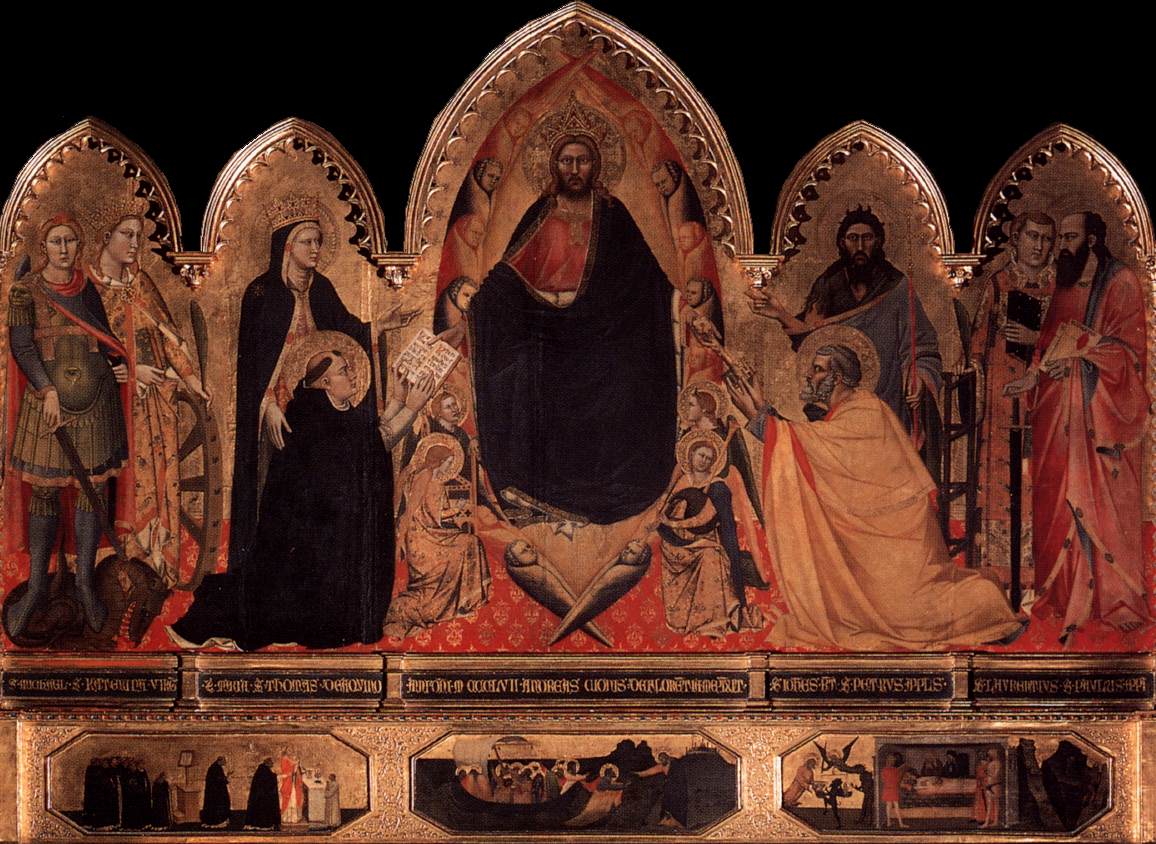
The Altarpiece of the Redeemer (1357)
Strozzi Chapel, Santa Maria Novella, Florence
Andrea di Cione di Arcangelo (Orcagna)1
St. Thomas Aquinas on the Essence of Original Sin
In Summa Theologiae I-II Q.82, St. Thomas teaches four things regarding the essence of original sin. In article 1 he argues that original sin is a kind of habit. In article 2 he argues that there is only one original sin in each person. In article 3 he argues that concupiscence is original sin materially, but not formally. And in article 4 he argues that original sin is equally in all men.
Original sin as a kind of habit
In the first article, Aquinas teaches that original sin is a kind of habit. By ‘habit’ he means “a disposition whereby that which is disposed is disposed well or ill, either in regard to itself or in regard to another.2 To show that original sin is a kind of habit, he first quotes from St. Augustine who says:
[O]n account of original sin little children have the aptitude of concupiscence though they have not the act.3
Aquinas notes that since an aptitude is a kind of habit, therefore original sin is a kind of habit.
But what kind of habit is original sin? Aquinas distinguishes between two ways in which something may have a habit. In the first way, a power of the soul is disposed to an act. In other words, a power of the soul has a disposition to act in a certain way. This is the way in which virtues are habits. But according to Aquinas, this is not the way that original sin is a habit; original sin is not a disposition of a power to an act.
The second way in which a habit can be in something is as a disposition of a complex nature [naturae ex multis compositae] whereby that nature is well or ill disposed to something, particularly when that disposition has become like a second nature. Aquinas gives two examples of this way of having a habit: sickness and health. A healthy disposition is not in itself a disposition of any particular power in the body, but rather of the body as a whole. Likewise, a sickly disposition is not a disposition in a particular power of the body; a sickly disposition is rather a disposition of the whole body. Similarly, for Aquinas, original sin is an inordinate (i.e. disordered) disposition of the soul, “even as bodily sickness is an inordinate disposition of the body, by reason of the destruction of that equilibrium which is essential to health.”4
This second way of possessing a habit is the way in which original sin is a habit. It is an inordinate disposition that results from the destruction of that harmony in which consisted the essence of original righteousness [Est enim quaedam inordinata dispositio proveniens ex dissolutione illius harmoniae in qua consistebat ratio originalis iustitiae]. He repeats this when he says, “In like manner, when the harmony of original justice is destroyed, the various powers of the soul have various opposite tendencies.”5
What does he mean by “harmony of original justice”? Aquinas answers this question in Summa Theologiae I Q.95 a.1 co. where he explains that man was made by God in such a way that man’s reason was subject to God, man’s lower powers were perfectly subject to his reason, and man’s body also was perfectly subject to his soul. The first subjection (i.e. the subjection of man’s reason to God) was the cause of the latter two subjections. This harmonized hierarchy of ordered subjections is for Aquinas the essence or form (ratio) of original justice. This harmony is called original justice because justice is giving to each its due, and when each of the powers in an ordered hierarchy gives to its superior what is due, this is therefore a just state or condition.
This harmony is not essential to man as man. A man is still a man without it. In other words, a fallen man is still a man. A fallen man does not ipso facto become a different species. Therefore original justice does not belong to the nature of man, but is something given to man in addition to his nature. Since original justice is not intrinsic to man’s nature, it must therefore be a supernatural gift. Hence Aquinas refers to it as a supernatural endowment of grace [supernaturale donum gratiae]. If, however, Adam had not sinned, this ordered subjection of the will to God, and of the lower powers of the soul to reason, and of the body to the soul, would have been transmitted to his offspring. Therefore not only nature but also grace would have been transmitted to Adam’s offspring through his semen. The implication of Aquinas’s theology on this point is that the sexual act was intended to be a sacramental act.6
When Adam sinned by his free will, which is a power of reason, he turned away from obedience to God, and therefore failed to give God His due. As a result of this act of injustice, the lower two subjections (i.e. the subjection of the lower powers of the soul to reason, and the subjection of body to soul) were destroyed. Even the harmony between man and woman was lost, as was the harmony between man and man (e.g. Cain and Abel), and that between man and nature, for nature was originally subject to man.
Aquinas argues that original sin is not a pure privation, but also a corrupt habit, because of the inordinate disposition of the lower ‘parts’ of the soul (inordinatam dispositionem partium animae).7 The original justice that Adam and Eve had been given by God “prevented inordinate movements” [prohibebat inordinatos motus] of these lower powers.8 So in the fallen state, the lower powers of the soul not only lack the disposition to give to reason what is due to it, but have inclinations toward that which is contrary to what reason would command.
That there is one original sin in each person
In the second article, Aquinas argues that there is one original sin in each person. He writes:
In one man there is one original sin. Two reasons may be assigned for this. The first is on the part of the cause of original sin. For it has been stated (81, 2), that the first sin alone of our first parent was transmitted to his posterity. Wherefore in one man original sin is one in number; and in all men, it is one in proportion, i.e. in relation to its first principle. The second reason may be taken from the very essence of original sin. Because in every inordinate disposition, unity of species depends on the cause, while the unity of number is derived from the subject. For example, take bodily sickness: various species of sickness proceed from different causes, e.g. from excessive heat or cold, or from a lesion in the lung or liver; while one specific sickness in one man will be one in number. Now the cause of this corrupt disposition that is called original sin, is one only, viz. the privation of original justice, removing the subjection of man’s mind to God. Consequently original sin is specifically one, and, in one man, can be only one in number; while, in different men, it is one in species and in proportion, but is numerically many.
Here Aquinas gives two reasons for his conclusion. He has shown already (in 81,2) that only Adam’s first sin was transmitted to his posterity, not Adam’s subsequent sins. So the first reason that there is only one original sin in each of Adam’s descendants is that Adam’s original sin was one, and each descendant of Adam has original sin from the same corrupt source (i.e. Adam) in the same manner (i.e. by generation from Adam).
The second reason follows from the fact that in every inordinate disposition, unity of species of the inordinate disposition depends on the cause of the inordinate disposition. Many diseases may cause the various organs of the body to malfunction, but the type or species of the disorder in the organs is taken from the cause of the disease. For example, a disorder in the liver on account of a virus (hepatitis) is a different type of disease than is a disorder in the liver on account of a cancer (hepatic carcinoma) or on account of some toxin (hepatotoxicity). Likewise, the species of the disorder which is original sin is taken from its cause. And the cause of original sin is the privation of original justice, that is, the removing the subjection of man’s reason to God. So even though there are many cases of original sin, because there are many men, yet in each man original sin has the same cause, and therefore original sin is one in species. When we consider all men, original sin is one in species but numerically many, for it is present in all Adam’s descendants. But in any particular man, original sin is one both in species and numerically.9
Original Sin and Concupiscence
In the third article, Aquinas considers whether original sin is concupiscence. He writes:
Everything takes its species from its form: and it has been stated (art. 2) that the species of original sin is taken from its cause. Consequently the formal element of original sin must be considered in respect of the cause of original sin. But contraries have contrary causes. Therefore the cause of original sin must be considered with respect to the cause of original justice, which is opposed to it.
First, he notes that everything takes its species (i.e. the kind of thing it is) from its form (not its matter). The same matter can become different things, as for example an apple, when eaten, becomes part of the eater. The matter is matter of an apple because it has the form of apple. But when that apple is eaten, the matter of the apple loses that form and receives the form of the eater. The matter of the apple becomes matter of a human when that matter receives the human form. In this way we can see what Aquinas means when he says that everything takes its species from its form.
Second he says that the species of original sin is taken from its cause, as he argued in article 2. So the form of original sin must be considered in respect of the cause of original sin. But since contraries have contrary causes, and since original sin is the contrary of original justice, it follows that the form of original sin must be considered in respect to the cause of original justice. So he then describes original justice in order to locate its formal cause:
Now the whole order of original justice consists in man’s will being subject to God: which subjection, first and chiefly, was in the will, whose function it is to move all the other parts to the end, as stated above (Question 9, Article 1), so that the will being turned away from God, all the other powers of the soul become inordinate.10
Original justice rested [causally] in the will, in this respect, that the subjection of the lower parts of the soul to reason, and of the body to the soul, depended on the will’s remaining subject to God.11 It was the role of the will to direct these lower powers, as well as the body, to their proper end. He then says:
Accordingly the privation of original justice, whereby the will was made subject to God, is the formal element in original sin; while every other disorder of the soul’s powers, is a kind of material element in respect of original sin. Now the inordinateness of the other powers of the soul consists chiefly in their turning inordinately to mutable good; which inordinateness may be called by the general name of concupiscence. Hence original sin is concupiscence, materially, but privation of original justice, formally.
Here Aquinas draws his conclusions. The form of original sin is the privation of original justice, whereby the will was made subject to God. The matter of original sin is the other disorders of the souls’ powers, namely, the disordered inclinations of the soul’s lower powers. But the name given to the inordinateness of the lower powers of the soul is concupiscence. Therefore, formally original sin is the privation of original justice, but materially original sin is concupiscence. The importance of this conclusion will be seen in Calvin’s response to the fifth paragraph of the Fifth Session of the Council of Trent.
Whether Original Sin is Equally in All Persons
In the fourth article, Aquinas says the following:
There are two things in original sin: one is the privation of original justice; the other is the relation of this privation to the sin of our first parent, from whom it is transmitted to man through his corrupt origin. As to the first, original sin has no degrees, since the gift of original justice is taken away entirely; and privations that remove something entirely, such as death and darkness, cannot be more or less, as stated above (Question 73, Article 2). In like manner, neither is this possible, as to the second: since all are related equally to the first principle of our corrupt origin, from which principle original sin takes the nature of guilt; for relations cannot be more or less. Consequently it is evident that original sin cannot be more in one than in another.12
He notes that there are two aspects of original sin. One is the privation of original justice, and the other is the causal relation between this privation and the sin of Adam. But in both respects, there are no degrees. In the first respect, the gift of original justice is entirely removed in Adam and therefore in all his posterity. Similarly, all men are equally related to Adam as their first principle, and hence here too there is no possibility for more or less. Hence, he concludes that original sin cannot be more in one than in another.
In Part 3, I will be discussing St. Thomas’ teaching on the effects of sin.
- In this painting we see Christ giving the keys of the Kingdom to St. Peter. Behind St. Peter is John the Baptist. On our left we see the Blessed Virgin presenting St. Thomas Aquinas to Christ. Aquinas is shown either offering his work to Christ, and/or receiving his wisdom from Christ. [↩]
- ST I-II Q.49 a.1. Aquinas is there quoting from Aristotle’s Ethics V.25. [↩]
- De Pecc. Merit. et Remiss. i, 39. “quod secundum peccatum originale parvuli sunt concupiscibiles, etsi non sint actu concupiscentes. Sed habilitas dicitur secundum aliquem habitum. Ergo peccatum originale est habitus.” [↩]
- ST I-II Q.82 a.1 co. [↩]
- ST I-II Q.82 a.2 rep obj. 2 [↩]
- Cf. ST I-II Q.81 a.5 [↩]
- ST I-II Q.82 a.1 ad.1 [↩]
- ST I-II Q.82 a.1 ad.3 [↩]
- Of course it should be understood here that Jesus Christ is excepted, and for Catholics so also was the Blessed Virgin. [↩]
- ST I-II Q.82 a.3 co. [↩]
- “Original justice has a prior relation to the will, because it is “rectitude of the will,” as Anselm states (De Concep. Virg. iii). Therefore original sin, which is opposed to it, also has a prior relation to the will. Two things must be considered in the infection of original sin. First, its inherence to its subject; and in this respect it regards first the essence of the soul, as stated above (Article 2). In the second place we must consider its inclination to act; and in this way it regards the powers of the soul. It must therefore regard first of all that power in which is seated the first inclination to commit a sin, and this is the will, as stated above (74, A1,2). Therefore original sin regards first of all the will.” ST I-II Q.83 a.3 co. [↩]
- ST I-II Q.82 a.4 co. [↩]

This opens up a view of “original man” that is deeply theological. I might be on a different train of thought than the one that you wish to take in forthcoming posts, but I’ll go ahead and blow the whistle anyway, since this brings up something that has been on my mind.
I believe that some modern Catholic theologians have departed from Aquinas on this point, since the identification of original justice as a supernatural grace poses a problem (supposedly) for conceiving Edenic man as an integral being. A state of “pure nature” in which man, qua man, would find his fulfillment, must terminate (in Aquinas’ view) in something short of the beatific vision. But how can a rational being have any other end than to know God?
I think that something like “being in relationship” comes into play here, such that God in an abundance of love endows man from the beginning with the gift of friendship, which friendship can only be a grace (given the immense creator/creature distinction). In this regard, however, the concept of “created grace” becomes problematic, for it seems to render original justice as something almost indistinguishable from nature (i.e., a “created habit” in man’s soul).
I wonder if the ancient and orthodox account of deification, which many Orthodox today consider to be a participation in God by means of a grace that is not distinct from God, can resolve this dilemma (if it is a dilemma), rendering more intelligible the nature/grace distinction that Aquinas needs for his thesis that original righteousness consists of grace, and original sin of the deprivation of that grace (i.e., God himself), with the concomitant thesis of a state of pure nature that nevertheless, even if perfected qua nature, falls short of beatitude/deification.
Hello Andrew,
A state of “pure nature” in which man, qua man, would find his fulfillment, must terminate (in Aquinas’ view) in something short of the beatific vision.
That is correct.
But how can a rational being have any other end than to know God?
He cannot. But we must not assume that the only way in which God can be known is the beatific vision. There is natural knowledge of God, according to what we can know of God through our natural (unaided) power of reason, and then there is supernatural knowledge of God, according to what we can know of God through grace. Correspondingly, there is a natural happiness, and a supernatural happiness, which is the beatific vision.
In this regard, however, the concept of “created grace” becomes problematic, for it seems to render original justice as something almost indistinguishable from nature (i.e., a “created habit” in man’s soul).
Grace, for Aquinas, is distinct from nature and distinguishable from nature. We do not, simply by nature, participate in the divine nature. Neither do the angels. Only God, simply by His nature, participates in the divine nature. This is why, for Aquinas, even the angels needed grace in order to enjoy the beautific vision. (I wrote about that here.) Grace, for Aquinas, is a participation in the divine nature. The divine nature is uncreated, but any participation by a creature in the divine nature must be created.
In the peace of Christ,
– Bryan
Thanks. I wonder, though, whether grace, as a created participation in the divine nature, can be clearly distinguished from those other created habits and faculties in man’s soul whereby he is also enabled to participate in God’s life in some way, and which we designate as “natural,” without also positing an uncreated aspect of that grace by which man participates in the life of God. This is why I brought in the Orthodox understanding of deification/justification.
Andrew,
I wonder, though, whether grace, as a created participation in the divine nature, can be clearly distinguished from those other created habits and faculties in man’s soul whereby he is also enabled to participate in God’s life in some way, and which we designate as “natural,” without also positing an uncreated aspect of that grace by which man participates in the life of God.
Could you name at least one natural habit or natural faculty whereby man, without grace, is enabled to participate in God’s life? (Maybe the “in some way” in your statement above needs to be made explicit.)
In the peace of Christ,
– Bryan
I was thinking of intellect and will, whereby man can direct himself towards God as the true and the good. Perhaps this falls short of “participation in God’s life”?
I came across this bit from M. Liccione on created grace and justification, which I think helps to bring out a theological dimension of justifying grace that can become obscured by the scholastics’ use of Aristotle. This can lead to the (mis)perception that Catholic soteriology is but a baptized version of Aristotelian ethics.
Andrew,
For Aquinas, the human intellect, apart from grace, cannot penetrate into the divine essence, because there is a vast difference between creature and Creator. Without grace, we do not have the proportionality to know God as He knows Himself. We may know of God through His effects. But, apart from grace, we are incapable of knowing God as He knows Himself. We would end up at best with the sort of happiness Aristotle describes in Book X of the Nicomachean Ethics. This would be the state of limbo, the highest level of hell. And, for Aquinas, the will cannot love what it does not know, so the will cannot go beyond the intellect with respect to entering the life and love of the Trinity, apart from grace. According to Aquinas, this is no less true for the angels, who are greater in being than are we. So if by their intellect and will they cannot enter the life and love of the Trinity apart from grace, then a fortiori, neither can we.
I’m not sure what “theological dimension” you are referring to, or what exactly you think may have been obscured by certain Scholastics. Insofar as grace perfects nature, and insofar as Aristotle’s ethics are correct, it would follow that Catholic soteriology would be a kind of baptized Aristotelian ethics. That’s not a problem from a Catholic point of view, because that phrase “but a baptized version of x” has its roots in a low [i.e. non-Catholic] view of baptism.
In the peace of Christ,
– Bryan
The theological dimension is that sense in which justfying grace is God himself, the indwelling Holy Spirit.
Andrew,
The notion of God giving Himself to dwell within us is, I think, quite clear in Aquinas. He writes:
Aquinas recognizes that God is present in the believer, in this new mode, only by way of sanctifying grace. Aquinas is drawing from John 14:23, where Jesus says, “If anyone love Me, he will keep My word; and My Father will love him, and We will come to him, and make Our abode with him.” There has to be love for God in us, before the Trinity can make its dwelling in us. Aquinas says this again in that same article when he writes:
So it is not just sanctifying grace that is given; God gives Himself to us, and in that sense God is gift. This is uncreated grace. Even the Father gives Himself, according to Aquinas, “as freely bestowing Himself to be enjoyed by the creature.” (ST I Q.43 a.4 ad 1)
He writes:
Here he is quoting Romans 5:5, which distinguishes the charity of God that is poured forth into our hearts, from the Holy Spirit who pours this charity into our hearts. Once we have charity in our hearts (and this is a supernatural virtue given by sanctifying grace), only then may our soul “possess” God.
In the peace of Christ,
– Bryan
The change wrought by the grace of God in the soul is aptly analyzed by Aquinas in terms of created grace/supernatural virtue, with the aid of Aristotelian philosophy. Yet the concept of “created grace,” particularly when cast in terms of ethics, does not make the nature/grace distinction seem quite so palpable as does the recognition that the gift of grace is also the uncreated, indwelling Holy Spirit. Of course Aquinas teaches both. I had not considered, though, what might be the relation between created and uncreated grace in terms of the precedence of sanctifying grace as a preparation for the indwelling Trinity. As to the baptism of Aristotle: my comment does not imply a low view of baptism. It implies that Catholic soteriology does not necessarily presuppose a high view, or any view, of Aristotle. I am glad that he has been “baptized” by St Thomas, but this happy event is not the sine qua non of Catholic theology.
This train of thought started with the consideration of how the notion that “original man” was created in a state of grace opens up our understanding of man in his origin, history, and destination in way that that is theologically interesting. Which is why I am looking forward to the continuation of this series.
Andrew,
I have encountered variations of that expression (“but a baptized version of x” ) in contexts in which it is used to dismiss philosophy that has been incorporated into the Church’s dogma according to the third stance of philosophy viz-a-viz sacred theology, as described in section 77 of Fides et Ratio. That’s what I was responding to, i.e. the phrase meant in that sense. That’s the sort of notion that Pope Benedict was arguing against in his Regensburg address. I have heard this notion used to justify taking out bits and pieces of the Nicene Creed in its use of ‘ousia‘ and the ‘hypostasis‘ – physis distinction in Chalcedon. I have also heard it used to dismiss transubstantiation, as well as the four Aristotelian causes that the Sixth Session of the Council of Trent uses to explain the causes of justification. So, I agree that Catholic soteriology does not “presuppose” a high view, or any view, of Aristotle. But I was looking at it a different way. When the Church does baptize something from Aristotle in her dogmatic explanations of theology, then we can know that this bit of Aristotle, at least, was correct, at least as used in that particular theological application. The principle that grace perfects nature, in conjunction with the Church’s theological incorporation of certain Aristotelian concepts or other philosophical tools in Her dogmatic pronouncements, means not that Catholic soteriology *presupposes* a high view of Aristotle, but that in those dogmatic pronouncements Catholic soteriology verifies (even veridicalizes) those baptized concepts.
In the peace of Christ,
– Bryan
The Church’s ancient understanding of the Cosmos was heavily baptized in Aristotilian philosophy. And we all know the story of Galileo. I do not disagree with Aquinas’ understanding of original sin by any means, and I think Bryans exposition is very helpful. However, it is evident that the Scriptures are for the most part a poetic explanation of reality, and reality revealed through scriptural language is not likely to coincide, in every detail, with how we understand things to be naturally(or I should say scientifically). So we have traditionally used terms as “supernatural” and “natural” when, in reality, these things may or do not hold this type of dualism. I believe that many times when we call things supernatural, such as being conformed to the immage of Christ through the spirit, they may be very scientifically natural, but we only gloss it over with these poetic devices and dualistic ways of thinking to explain mysteries we cannot explain scientifically. In other words, it is very reasonable, I believe, to suppose that the perfecting of the human nature into the immage of Christ is certainly a gift and grace of God, but that this grace may work in a very natrual way that we don’t completely understand, and probibly will never fully understand.
In Christ,
Jared B
Jared,
When I say ‘baptized’, I do not merely mean commonly believed or assumed by Church fathers. I mean formally incorporated into Church dogma. And Aristotle’s cosmology was never dogmatized by the Church. So the Galileo case is not a counterexample to my claim. The natural-supernatural distinction is essential to orthodox theology. To deny it is to fall either into deism / Pelagianism on the one hand, or occasionalism / “unqualified salvific monergism” on the other hand. If the supernatural is not distinct from the natural, then we are saved entirely by our natural power, and that is Pelagianism. But likewise, if the natural is not distinct from the supernatural, then the created nature does not do anything at all (which is occasionalism — see Neal’s recent blog post), or God does everything in our salvation. That latter notion is an unqualified salvific monergism that sets up the reductio I describe here. To deny the distinction between the natural and the supernatural is ultimately to deny the doctrine of creation, because it denies the distinction between Creator and creature. I’m not sure what you mean by “scientifically natural”, but the methods of empirical science cannot penetrate to the level of primary causes, which is the level at which philosophy (in its proper sense) and sacred theology speak. The distinction between primary causes and secondary causes must not be glossed as a distinction between a poetical way of speaking, and scientific truths, respectively. Such a gloss would be nothing less than positivism, i.e. a denial of philosophy altogether.
In the peace of Christ,
– Bryan
Actually, the way I meant the natural-ness of what we call supernatural is not that being conformed into the immage of Christ is something that comes essentially and naturally from us, but rather in a sense that we were created as beings who function according to natural laws, and that there was a certain natural harmony and equillibrium in the original creation in which adam originally lived, and in which was exhibited the original intended operation of the human soul in its existential context with the rest of the cosmos made by God, and through which man knew God in certain respects. And to the extent that we live according to that original and intended nature in the universe do we show forth Gods glory. There are elements of Spinoza’s theology in my framework here, but not complete Spinozism. The things I am saying take a ton of reasoning and argument which could not sufficiently be explained here, but in no way take away from orthodoxy. It is just orthodoxy from a different angle, that is, orthodoxy using philosophical concepts that are not opposed to Aristotilian philosophy, but very different from it. In fact, from first impressions it would seam antithetical to orthodoxy, but I think what I mean by supernatural and natural is something different than what you mean. But it is not necessary to explain this all here, I was just throwing it out there. I actually think the substance of the ideas I am talking about help in certain issues of soteriology and can be complimentary to Aquinas’ theology. But you are completely right in what you say about supernatural and natural given your framework and definition of terms. Using your framework, I would consider natural laws supernatural, and supernatural things which work in the created order as natural. It is a both/and sort of thing(e.g salvation operating both as 100% us and 100% God.) It carries a literal idea of what Paul means when he says, “In him we live and move and have our being.” I don’t think there is any necessary reason Paul wasn’t being literal here. It is my burden to explain myself better, and it is difficult. It is, in a way, original, so I don’t expect you to completely understand where I am coming from, or to agree with me. I guess it is rather unfair for me to make claims without backing them up sufficiently with argument, but I really don’t think they present a problem. I originally meant for my post to be complimentary and not as a counterexample to what you said. I should have made myself more clear.
In Christ,
Jared B
Bryan: But, apart from grace, we are incapable of knowing God as He knows Himself.”
Jay: How, with grace, do we know God as He knows Himself?
Bryan (re: original article),
Reformed apologists frequently criticize the Catholic conception of original sin as a privation of original justice. I’ve heard nearly a constant refrain that “Aquinas held man’s intellect and reason were unaffected by the fall” and similar statements in that regard (I can hunt down links if necessary). They then go on to attack this premise and argue that the bible presents a view of man who is totally fallen (i.e. both intellect and will were negatively affected by Adam’s sin). My question is: are they attacking a straw man? Or at least, are they oversimplifying things when they present his position that way?
It seems to me that because original justice entails the harmonized hierarchy of ordered subjections, and that such harmony was broken in the fall, then man’s intellect/reason were indeed negatively affected in the fall. Granted, perhaps they were not affected in the way the Reformed folks would have it, but after reading what you wrote I don’t think Aquinas would agree with their characterization of his position.
But, I’m no Aquinas expert, so perhaps I’m reading things wrong and thus I defer to you.
Peace,
John D.
Bryan:
In reading the Catechism, Aquinas, and thinking about Jesus as the “second Adam” I have been considering an idea of “what it was like” to be an unfallen human, and “what it would have been like” had Adam not fallen.
I confess this is only a little bit on topic. Normally I would not bring it up.
But I am bringing it up, in the hopes that someone will correct me if I am far wrong through mere ignorance. I have read a little, as I said; but I am not well read. It may well be that without me knowing it, every notion in my mental picture of unfallen humanity has already been pondered and rejected by wiser persons. If that is so, I want to know about it!
This idea is founded in the notion that St. Joseph, as defender of Jesus in His boyhood, is an icon of God as a Father tending Adam in his immaturity. It is also informed by the statement (Luke 2:52, I believe) that “Jesus increased in wisdom and in stature, and in grace before God and man,” and the idea that as Christ was the second Adam, Adam was supposed to have been like Christ (but failed through disobedience).
The idea is this:
1. That Adam was not materialistically impervious to harm or bodily destruction prior to the fall. To be “materialistically” impervious to harm or bodily destruction would be something like having Superman’s skin: bullets bounce off his chest, et cetera. I suppose that Adam’s deathlessness was not like that; but rather, it initially stemmed from God acting providentially towards Adam as a father (God protecting Adam from harm as St. Joseph protected Jesus) and later stemmed from an increase of divine power/life in Adam.
2. That Adam did not begin, from the outset, fully matured in grace, but “increased in grace before God” over time or through experience; that this maturation followed (or would have followed, were it not for the Fall) stages resembling to those reported by contemplatives (e.g. Teresa of Avila) approaching the divine union or mystical marriage with God.
3. That some (maybe all) of the miraculous powers (e.g. healing, walking on water) used by Jesus prior to His passion either were powers which Adam could exercise already by the time of the Fall, or powers into which he would have grown had he not fallen. These were not natural powers of an unfallen human in a materialistic sense, but consequences of the maturing divine indwelling in Adam.
4. That a mature unfallen human need not constantly be steered away from physical dangers by God’s providence the way an immature unfallen human must, but may instead benefit from the miraculous healing powers a mature unfallen human has: He may get bitten by a rattlesnake and merely “will” his body to heal the venom damage or metabolize the poison in an unusual way; he may survive a tsunami by walking on water or by levitating above it. A tiger will not attack him because he can exert lordship over animals; but he can feed a tiger one of his arms, if needed, as an act of animal husbandry and just miraculously repair/regrow the arm the way Jesus replaced Malchus’ ear.
5. That an unfallen human who has fully matured can voluntarily — not as some kind of psychic power through a materialistic mechanism, but as a consequence of his mystical union with God — abandon one set of physical atoms for constituting his physical body and choose instead to adopt another set of atoms. He may thus disincorporate from one place and reincorporate at another, appearing to “teleport” into locked rooms.
6. That an unfallen human who has fully matured is impervious to death not because God is steering him away from anything which might harm his physical body, but because in the event that all the atoms of his physical body are blasted apart from one another (e.g. by a nuclear explosion) he can, at will, adopt another set of nearby atoms to reincorporate. He does not do this as a natural material power of humanity but because God’s Holy Spirit is in him, the same Spirit which raised Christ from the dead. The unfallen human is thus immortal not because the laws of physical matter are any different for him than for us, but because he, in perfect union with God, can resurrect and/or instantaneously heal any bodily damage.
7. That the children of Adam and Eve, had Adam and Eve never fallen, would have started out immature in grace while under the protection of both God and the protection of a fully matured Adam and Eve. The fully-matured Adam and Eve would have been able to protect the children from physical harm (either by natural means or by the healing powers and other powers available to unfallen humans) until they themselves matured.
8. That the temptation in the garden involved some kind of physical threat by the serpent against Adam, perhaps to cow him into silence so that Adam, though he was standing beside her (Gen 3:6), did not intervene to guide Eve away from consenting to temptation, or perhaps to forbid her by his authority as husband. The beginning of Adam’s disobedience was thus not when he ate the fruit, but when he failed to protect and give leadership to his wife. This was another aspect of the test: Whether Adam would obey God and argue in favor of God’s righteousness against the slander of the serpent, even under the threat of having his body destroyed.
9. That, had Adam been obedient to God but then in retaliation been (physically) slain by the serpent, his obedience unto death would have resulted in a resurrection: Adam and God would have miraculously reconstituted Adam’s body by both Adam and Holy Spirit acting in union. The result would have been that Adam passed the test to enter full maturity in grace. After that Adam would have been unkillable not merely by providentially safe circumstances, but by miraculous power.
So, Adam failed to be like Christ through Adam’s disobedience; Christ later became what Adam should have been, through His obedience.
Bryan, is there any truth to any of that? Or am I far mistaken, perhaps accidentally recreating some heresy which the Church already dismissed ages ago?
RC (#17),
You might it of interest to check out the book, “Occult Phenomena in the light of Theology” by Alois Wiesinger. The book is written from an orthodox Catholic perspective (as far as I know) and although the emphasis is on things such as ghosts, paranormal phenomena, etc, there is a fairly lengthy discussion of the characteristics of the pre-fall body, including issues of disease or decay, in many ways very much along the line of your thoughts.
Peace,
Jeff
JohnD (re: #16)
No, that’s correct. Regarding the negative affects of the fall on the human condition, that’s what I wrote about in the next part of this series: Aquinas and Trent: Part 3.
In the peace of Christ,
– Bryan
Bryan,
If it would be an injustice for God to impute the guilt of the sin of Adam to the whole human race (i.e. the Reformed view), why is there no injustice in God permitting the transmission of the absence of the state of grace, merited by Adam, to the whole human race? We are all stuck with the consequences of one man’s choice, so isn’t that an injustice since we are not responsible for that one man’s choice? And if there is no injustice committed, what is the key distinction between the Catholic position and Reformed position that entails no injustice on God’s part in the Catholic view?
Peace,
John D.
JohnD (re: #20)
Not giving someone a good that person has not merited (i.e. grace) or is not otherwise owed, is not an injustice. By contrast, punishing someone for an evil he did not commit is an injustice. You’re conflating the two. This is why Numbers 14:18 does not contradict Ezekiel 18:20. The former is talking about good that would have been there’s, that is lost by the parents’ sins. The latter is talking about punishment proper.
In the peace of Christ,
– Bryan